life
Life — December 1933
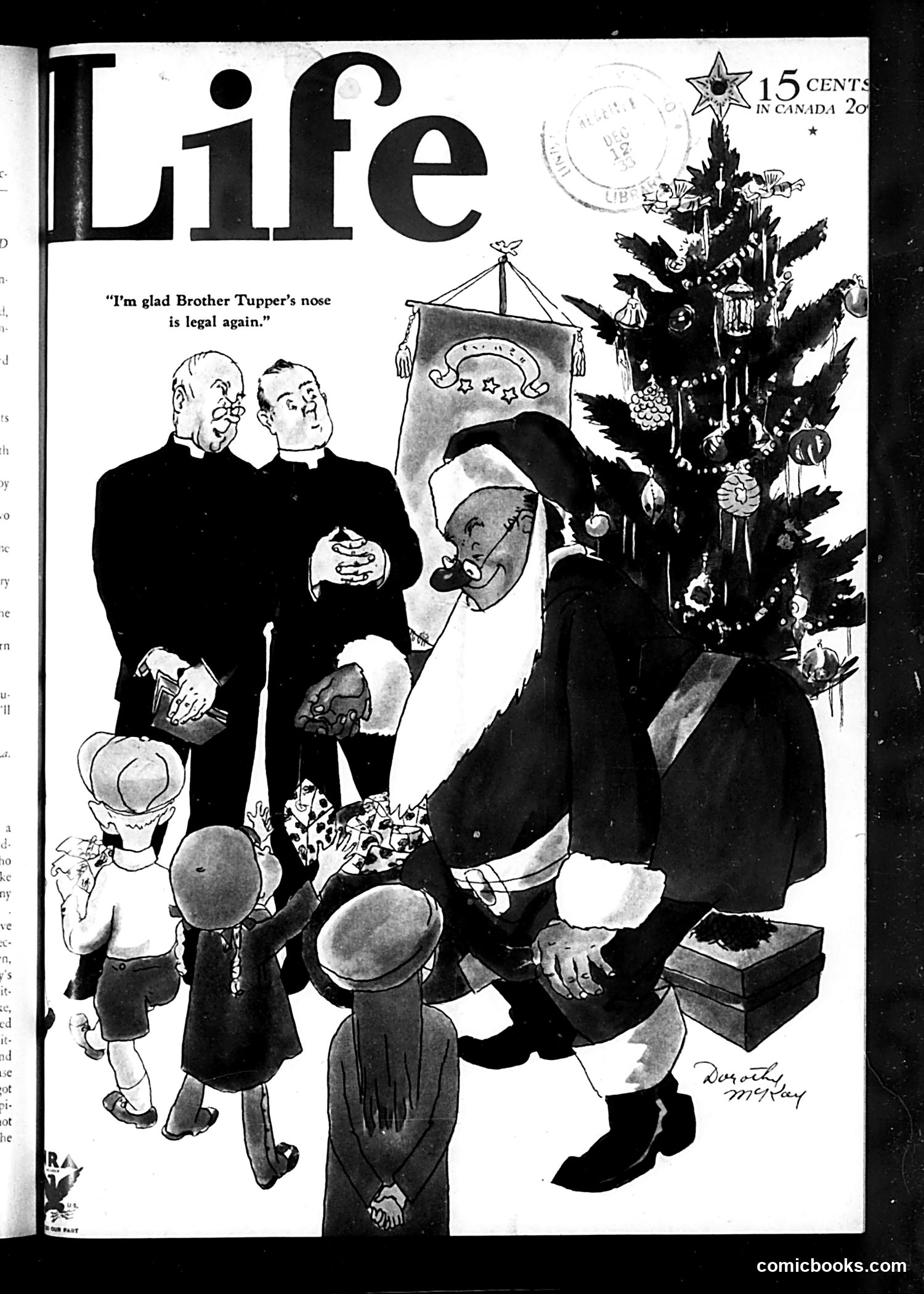
Analysis of Life Magazine Cover This satirical Christmas cartoon depicts Santa Claus distributing gifts to children while two well-dressed men in the background discuss legal matters. The caption reads: "I'm glad Brother Tupper's nose is legal again." The joke references "Brother Tupper," likely a public figure of the era whose nose was apparently subject to legal dispute or controversy—the specific nature of which isn't clear from this image alone. The satire suggests absurd legal cases, possibly mocking frivolous lawsuits or regulatory overreach. Santa's presence transforms this into holiday-themed social commentary, where even Christmas gift-giving becomes backdrop for poking fun at legal absurdities affecting prominent citizens. The 15-cent Canadian price indicates this is from Life magazine's early-to-mid 20th-century period.
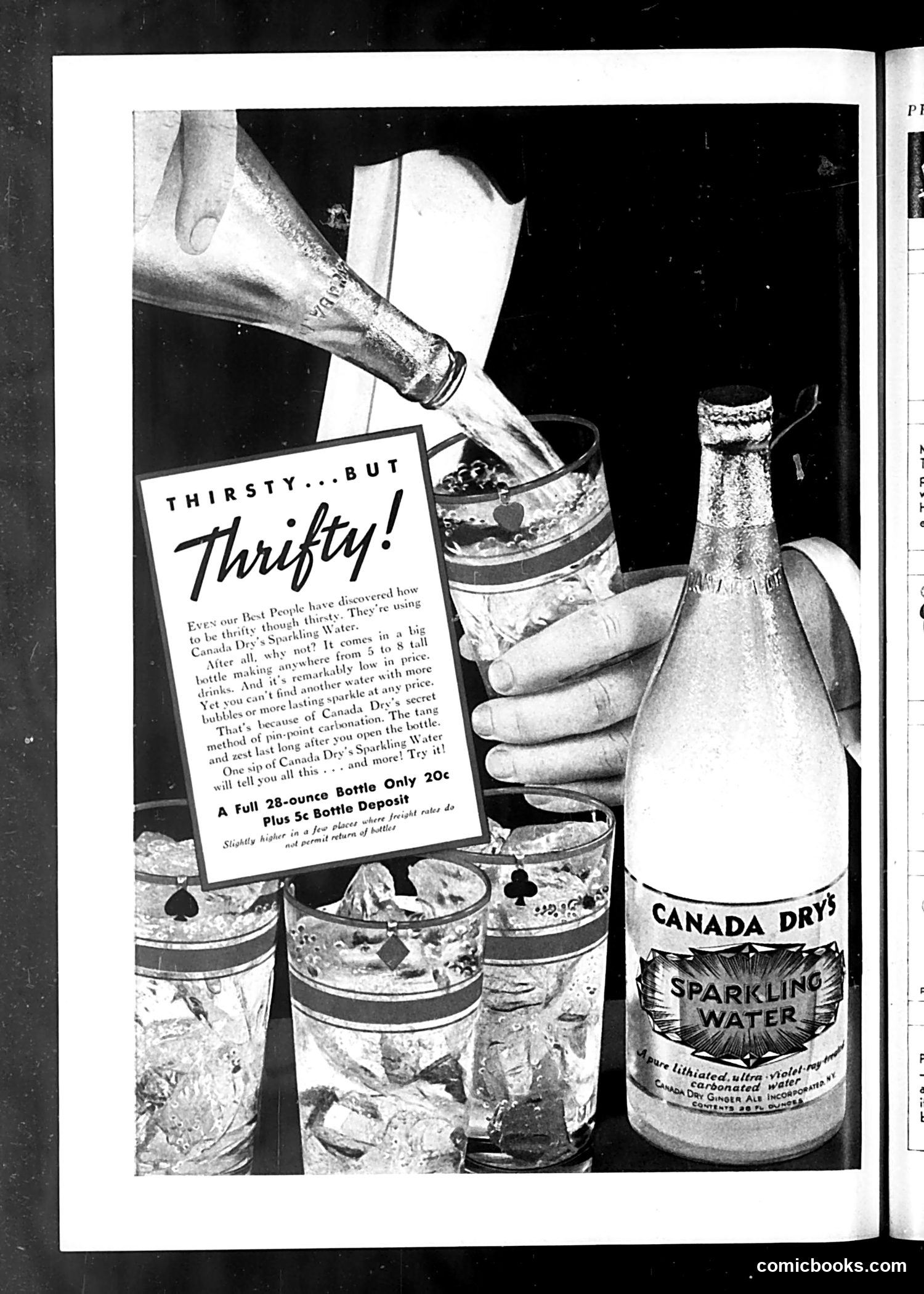
Analysis This is a Canada Dry's Sparkling Water advertisement, not political satire. The ad uses the slogan "THIRSTY...BUT Thrifty!" to market the product during what appears to be the Depression or wartime era when economizing was important. The ad's humor targets budget-conscious consumers: it claims Canada Dry's sparkling water offers more value than competitors because a single 28-ounce bottle (20¢ plus 5¢ deposit) provides multiple servings. The copywriting emphasizes the product's "remarkable low price" and longevity—you get "more lasting value" than buying separate drinks. The visual shows someone pouring the beverage into glasses filled with ice, demonstrating its appeal as an affordable refreshment. This is straightforward consumer advertising, not editorial commentary or political cartooning.
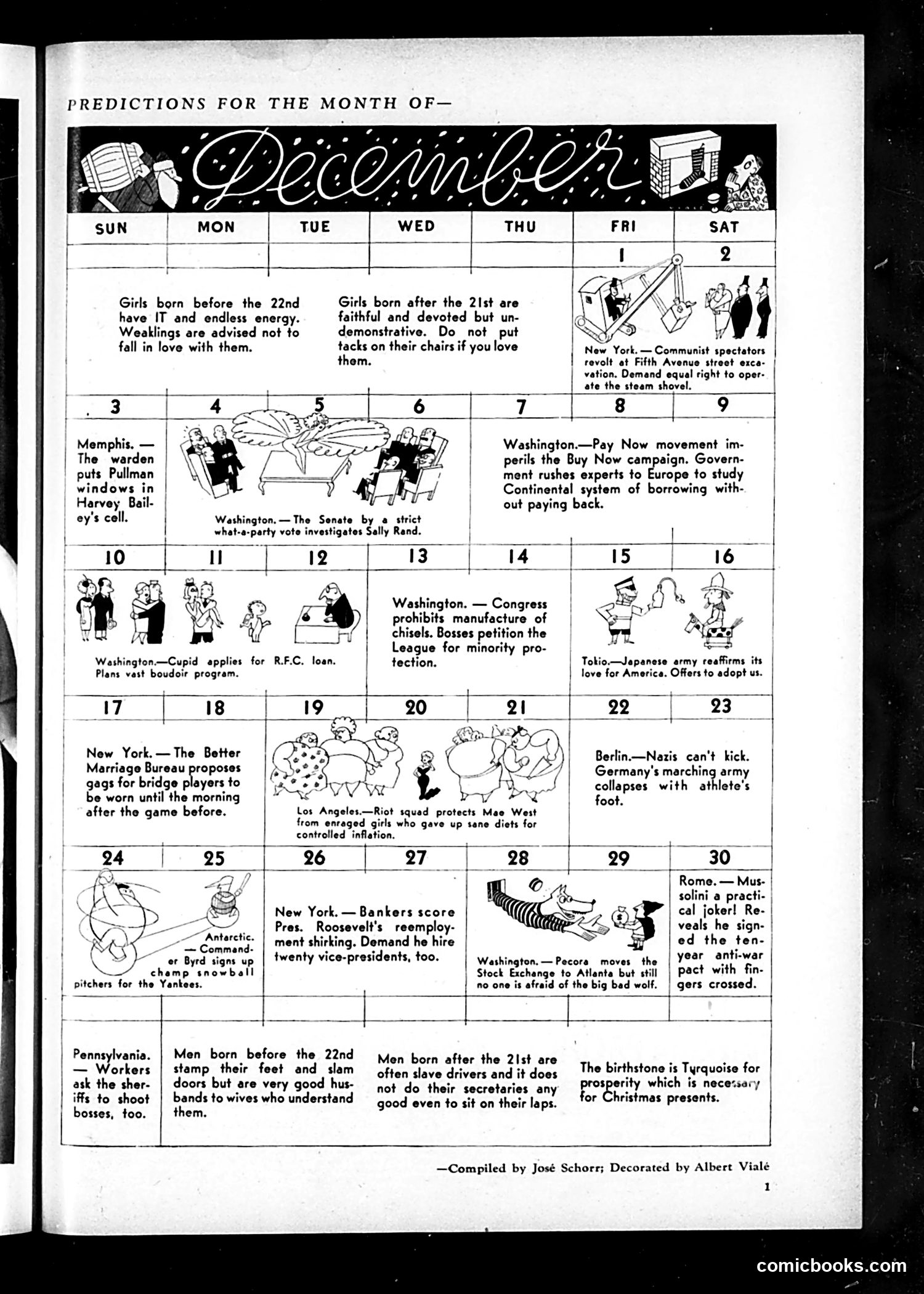
December 1934 Predictions Calendar This satirical calendar mocks contemporary political and social events with caustic humor typical of Life magazine's style. Key references include: - December 1-2: Communist agitation in New York, demanding equal rights to operate steam shovels - December 7-8: The "Pay Now" movement criticizing government spending and the "Buy Now" campaign - December 13-14: Congress prohibiting manufacture of chisels (unclear reference, possibly satirizing regulatory overreach) - December 20-22: A squad protecting Mass West from "enraged girls" who gave up lane diets for controlled inflation - December 26-28: Banking/stock market satire regarding FDR's reemployment policies and vice-presidents - December 30: Mussolini portrayed as a "practical joker" signing anti-war pacts The calendar combines domestic New Deal criticism with international commentary on fascism, using crude caricature to mock 1930s politics. The astrology-inspired format allows rapid-fire jabs at various targets.
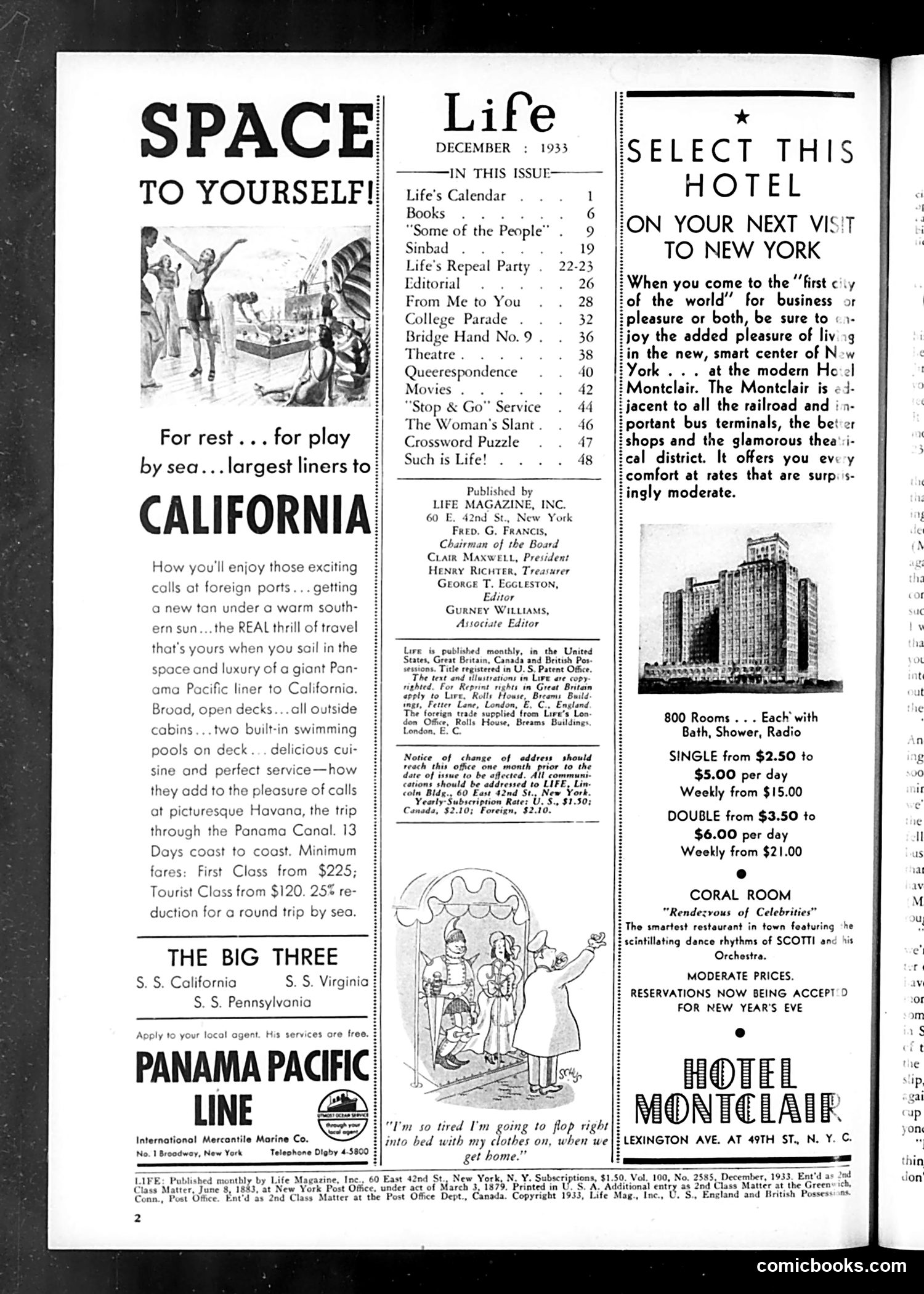
Analysis of Life Magazine December 1933 Page This is primarily a table of contents and advertising page, not a political cartoon. The left side advertises Panama Pacific Line steamship travel to California, promoting leisure cruises with amenities like swimming pools and calls at ports including Havana. The right side advertises Hotel Montclair in New York, featuring the Coral Room restaurant with "SCOTTI and his Orchestra" and noting "RESERVATIONS NOW BEING ACCEPTED FOR NEW YEAR'S EVE"—indicating this is December 1933, during Prohibition's final year. The small cartoon near the center depicts a child speaking to adults, with the caption referencing holiday travel ("I'm so tired I'm going to flop right into bed with my clothes on, when we get home"), a relatable domestic humor piece about holiday fatigue rather than political satire.
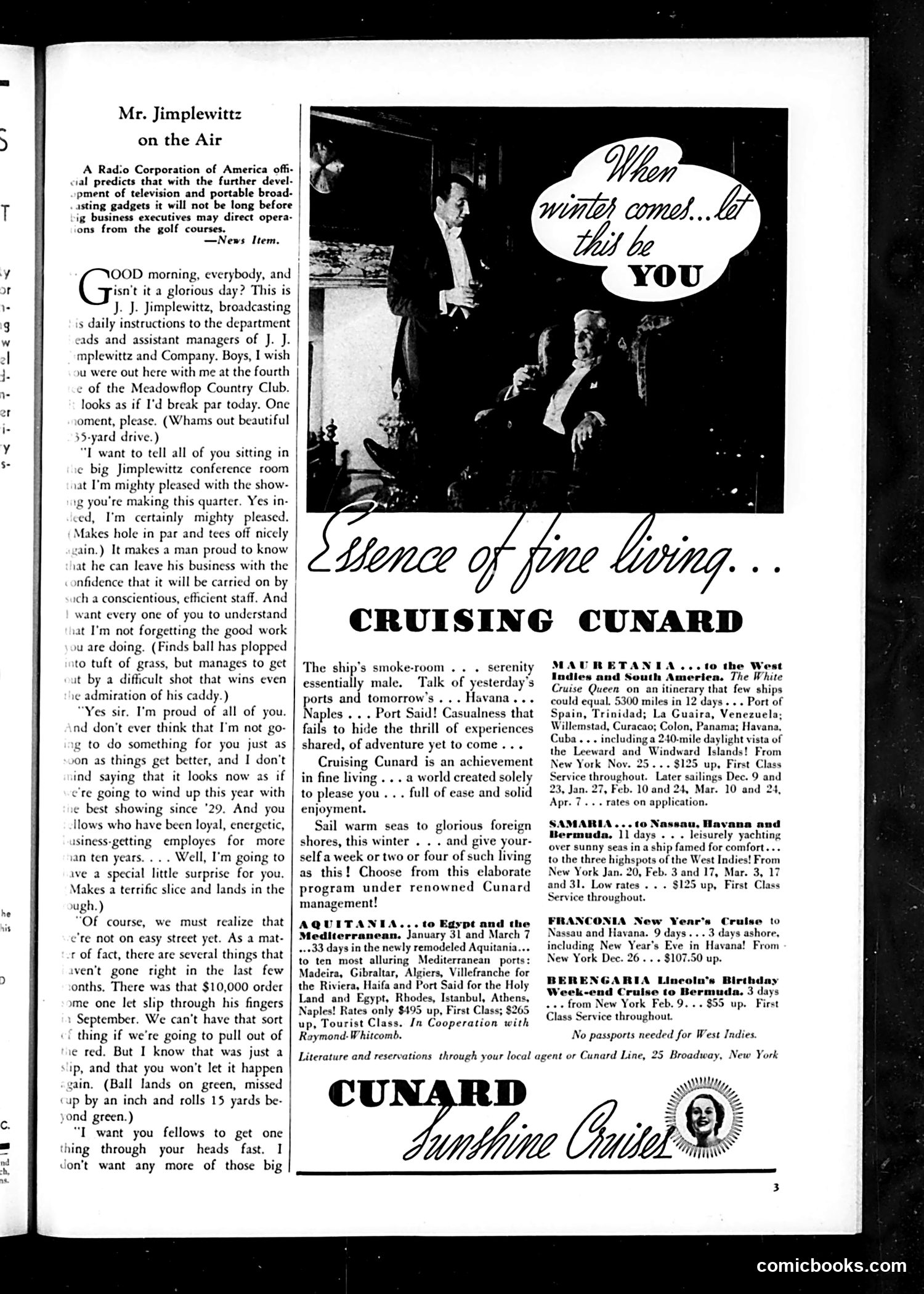
Page Analysis: "Mr. Jimplewittz on the Air" This page contains a satirical piece about J.J. Jimplewittz, apparently a radio broadcaster for RCA who gives daily instructions to business executives. The main text is a mock-heroic monologue where Jimplewittz addresses subordinates at a country club, boasting about his influence and importance while inadvertently revealing his own self-importance and obliviousness. The satire targets corporate radio personalities of the era who positioned themselves as authority figures dispensing business wisdom. The humor comes from the gap between Jimplewittz's self-perception (indispensable leader) and his actual behavior (self-aggrandizing, slightly absurd). The page's right side contains Cunard cruise ship advertisements—standard commercial content mixed with editorial matter, typical of Life magazine's format.
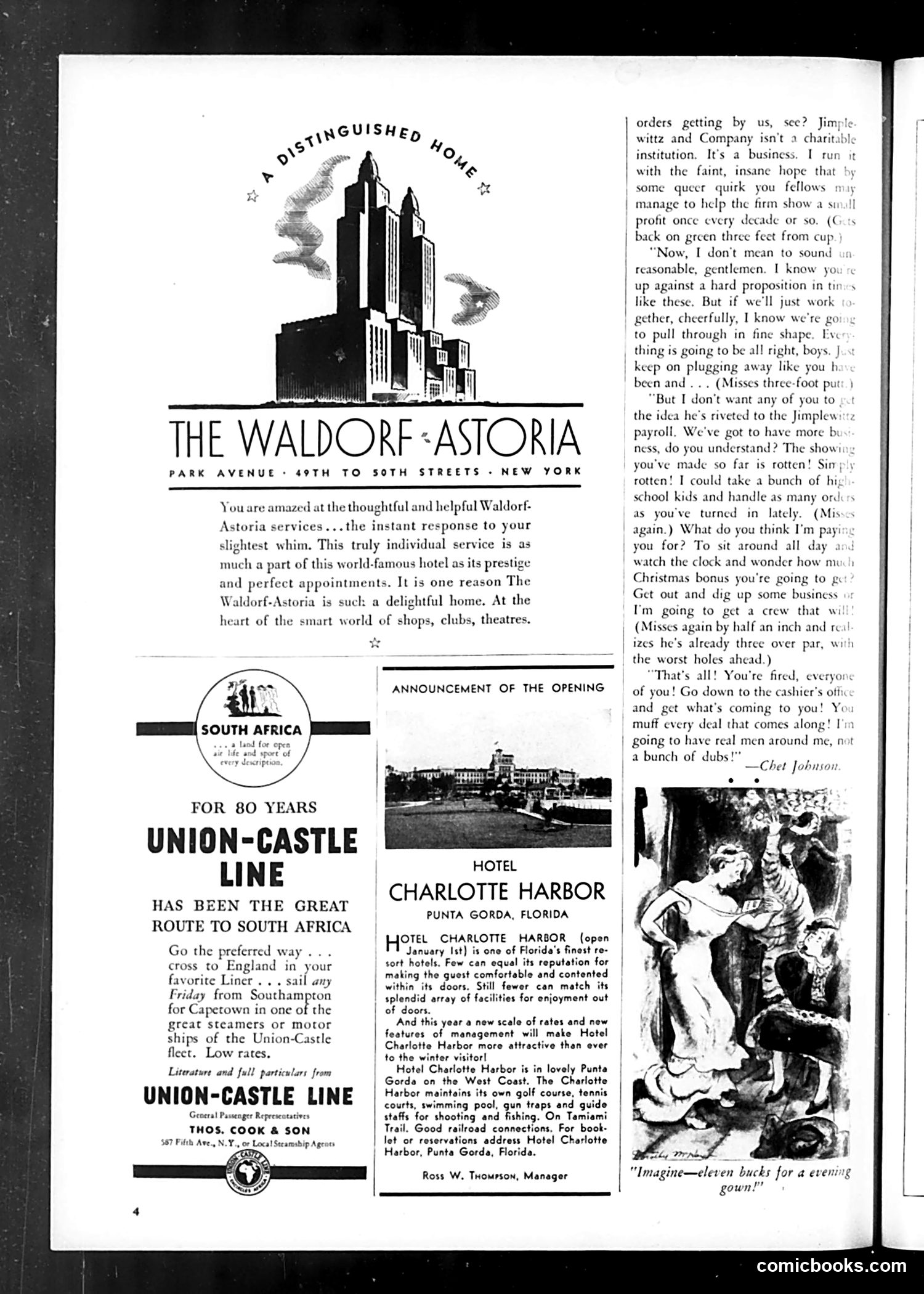
This page is primarily advertising, not satire or editorial content. It contains three ads: 1. The Waldorf-Astoria Hotel (top) — a prestigious NYC hotel advertising its distinguished service and location "at the heart of the smart world of shops, clubs, theatres." 2. Union-Castle Line (bottom left) — a shipping company promoting 80 years of service as "the great route to South Africa," offering passage via England to Capetown. 3. Hotel Charlotte Harbor (center-right) — a Florida resort advertising amenities like golf, tennis, and swimming pools for winter visitors. The right column contains what appears to be humorous office correspondence (attributed to "Chet Johnson") about staff discipline and holiday bonuses — likely satirical workplace commentary rather than political content. No political cartoons are present on this page.
Page Analysis This page contains a brief satirical anecdote rather than a cartoon. The text describes the Governor of North Carolina proposing to the Governor of South Carolina that they jointly vote to prevent a liquor advertisement from appearing in LIFE magazine's December issue (page 5). The satire targets the Prohibition era (when alcohol was illegal in the US). The joke is that two state governors—presumably supporters of Prohibition—want to censor alcohol advertising in a popular magazine. The humor lies in their futile gesture: even if they "vote" together, they cannot actually control what a private magazine publishes. The decorative rooster illustration at top is likely LIFE's recurring mascot/logo. The page urges readers: "Read LIFE Regularly!"
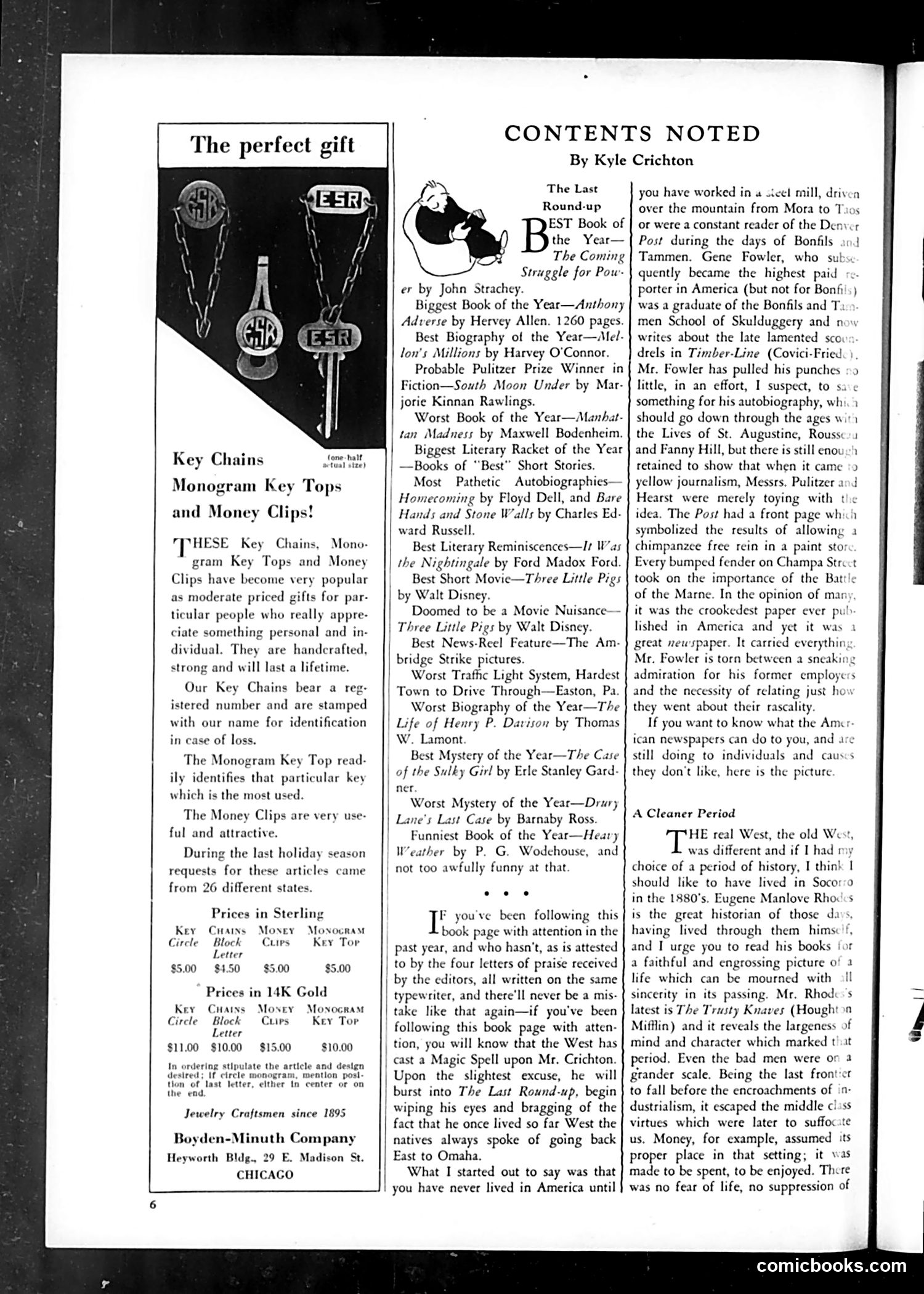
Analysis This page is primarily advertising and editorial content, not political satire. The left side features an advertisement for the Boyden-Minuth Company promoting key chains, monogram key tops, and money clips as gifts. The image shows four decorative items featuring monogram designs. The right side contains "Contents Noted," a book review column by Kyle Crichton. It summarizes recently published books and awards, including references to works by John Strachey, Harvey Allen, and Marjorie Kinnan Rawlings. The column also includes a brief essay titled "A Cleaner Period" discussing 1880s American history. There is no political cartoon or satire on this page. The content is straightforward commercial advertising combined with contemporary literary criticism and commentary typical of *Life* magazine's mixed format.
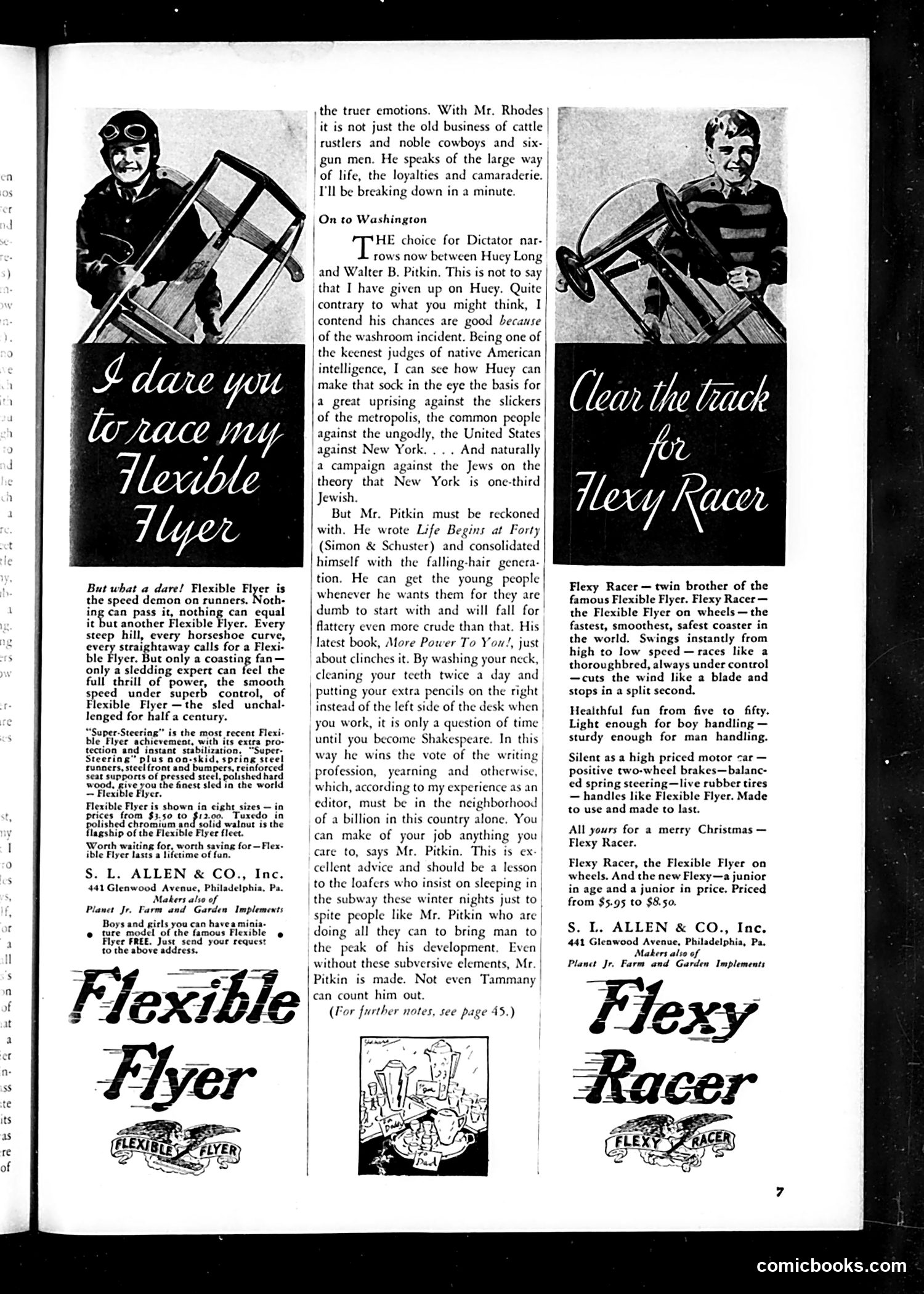
Analysis of Life Magazine Page This page contains advertisements for children's toys (Flexible Flyer sleds and Flexy Racer) rather than political cartoons. The middle column includes an essay titled "On Washington" discussing potential candidates for "Dictator"—specifically Huey Long and Walter Pitkin—in a clearly satirical tone. The author argues that Pitkin (who wrote *Life Begins at Forty*) has better chances than Long for leading a popular uprising against "the slickers of the metropolis" and "the ungodly." The piece sarcastically suggests Pitkin could manipulate young people through self-help philosophy. This appears to be 1930s-era satire about American populism and the appeal of authoritarian figures during economically troubled times, though the exact publication date isn't visible.
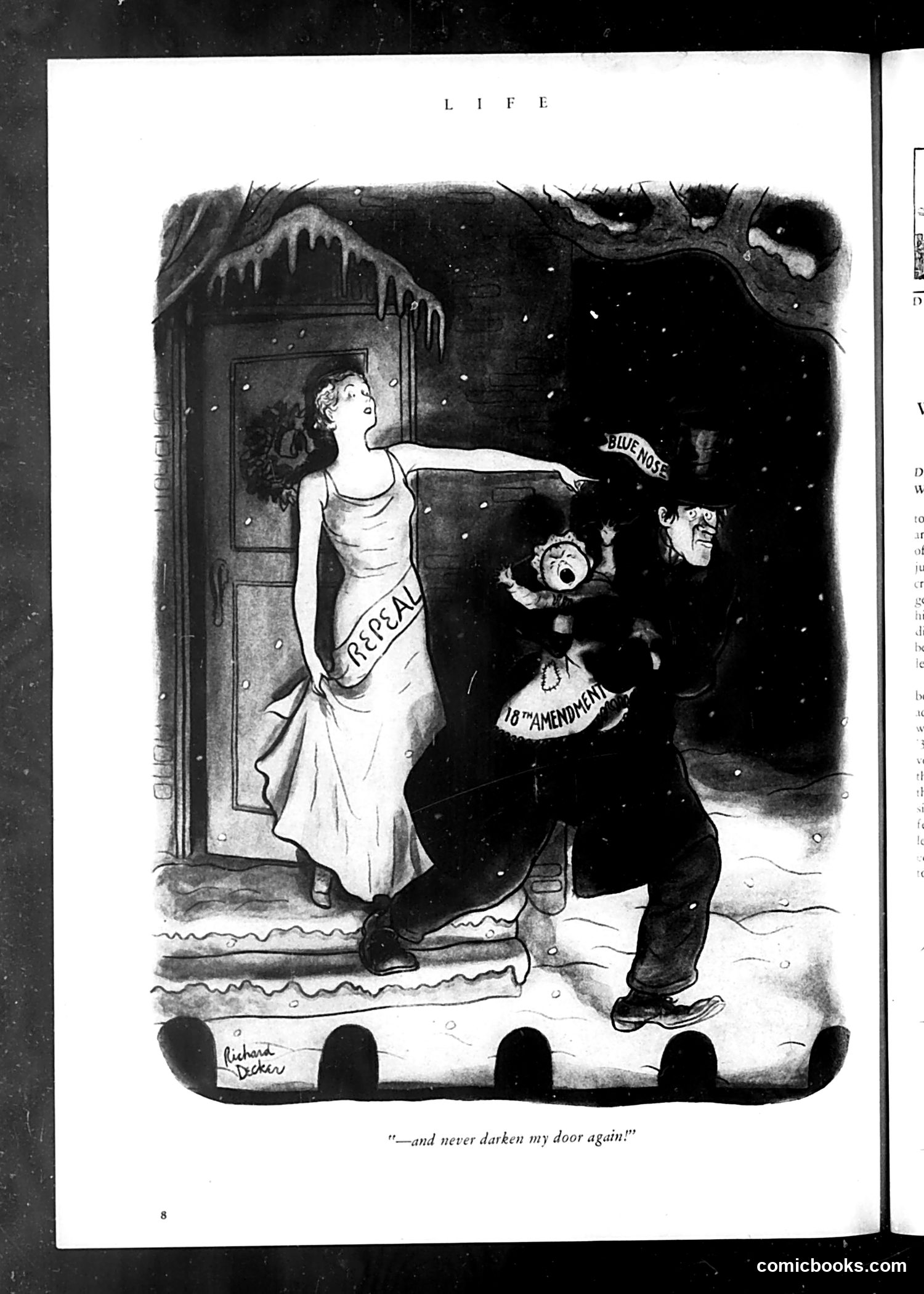
Cartoon Analysis This Richard Decker cartoon satirizes Prohibition enforcement. A woman labeled "REPEAL" stands at her doorway, looking upward hopefully. Two law enforcement figures—one wearing a "BLUE NOSE" band (slang for an overzealous moralist) and another labeled "18TH AMENDMENT"—approach menacingly in snowy conditions. The joke plays on the woman's caption: "and never darken my door again!" She's wishing these Prohibition enforcers away. "Blue nose" mocks self-righteous temperance advocates, while the 18th Amendment reference identifies the constitutional basis for Prohibition. The cartoon reflects public frustration with Prohibition enforcement during the 1920s-early 1930s, when many Americans viewed the law as intrusive government overreach and supported its repeal—which occurred in 1933.
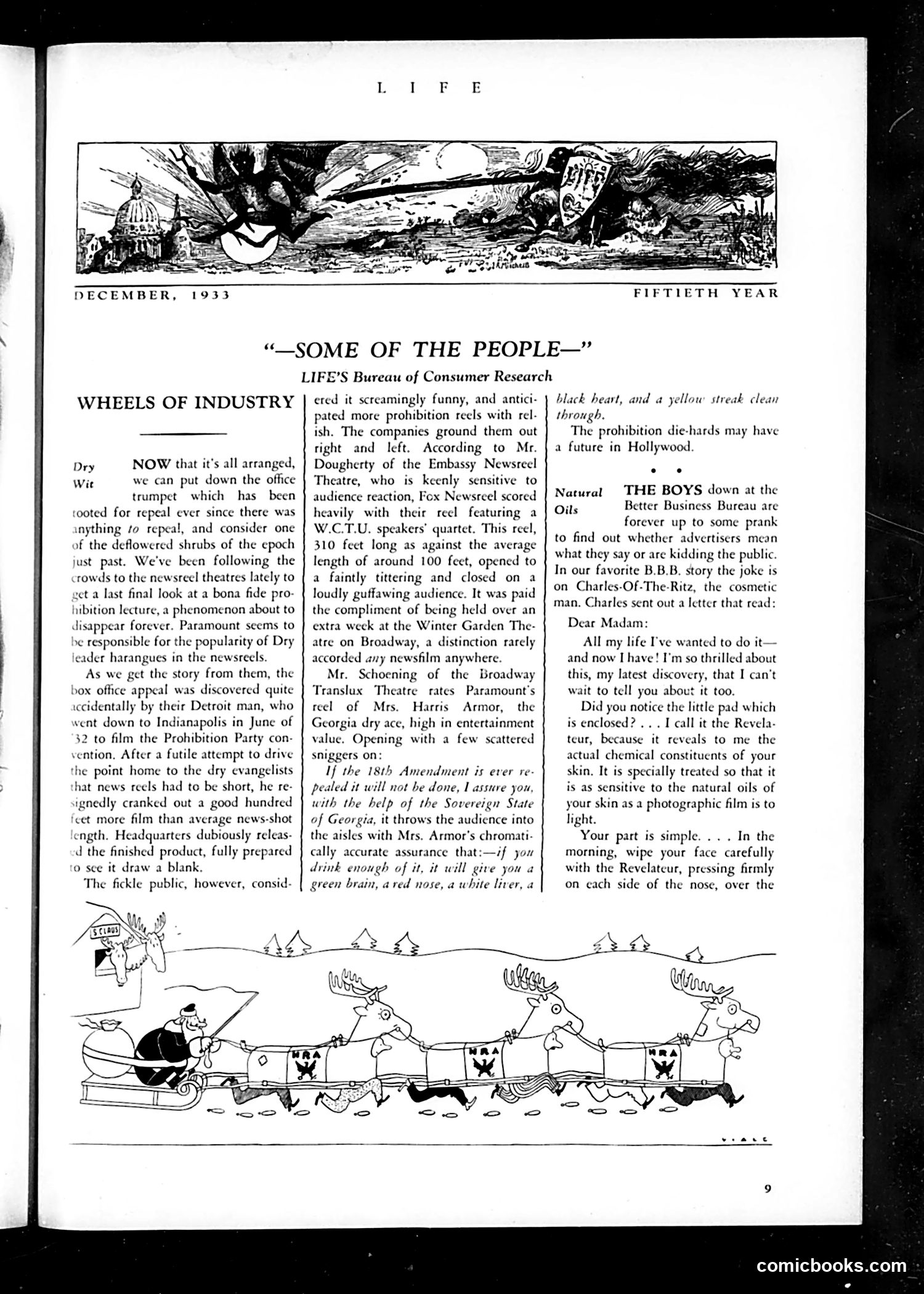
Analysis of Life Magazine, December 1933 This page satirizes Prohibition enforcement during its final year (repealed in December 1933). The "Wheels of Industry" cartoon depicts Santa's sleigh pulled by reindeer labeled "NAA" (likely representing the National Association Against the Prohibition Amendment). The satirical point: Prohibition enforcement had become an absurd industrial operation, grinding away pointlessly. The text mocks Prohibition's failures—newsreels showing confiscated alcohol, theatrical productions about it, and the futile attempt to prevent drinking. References to Fox Newsreel's coverage and a Broadway play about "Mrs. Harris Armor" indicate Prohibition had become entertainment fodder. The "Natural Oils" advertisement parody suggests Prohibition hypocrites were buying cosmetics containing alcohol under the guise of "natural oils." The overall message: Prohibition is dying and ridiculous.
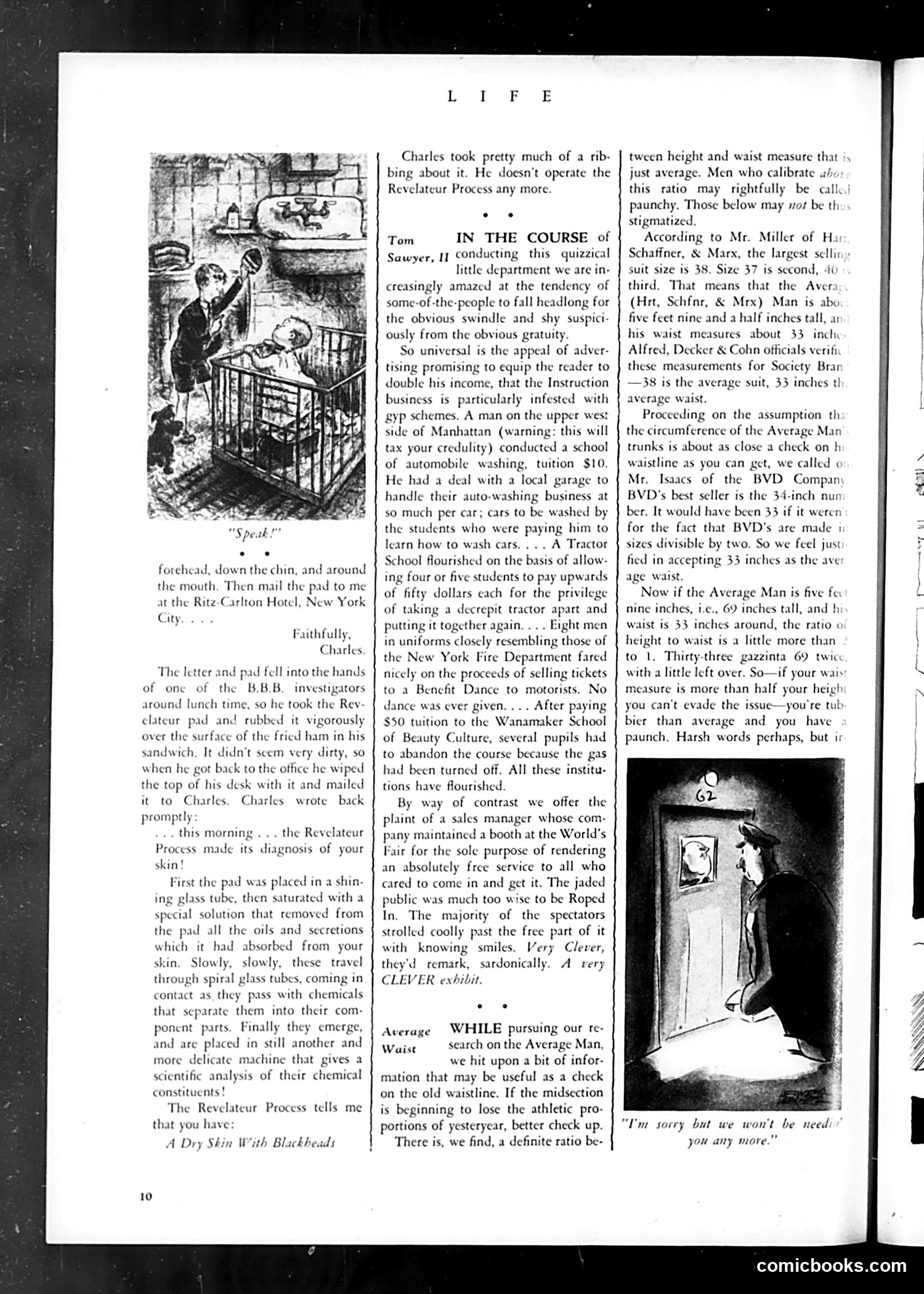
Analysis of Life Magazine Page This page contains satirical commentary on advertising and consumer culture, specifically mocking the "Revelateur Process"—apparently a dubious beauty/skin treatment marketed through exaggerated scientific claims. The left illustration shows a man at his desk receiving a suspicious promotional pad. The accompanying text (attributed to "Charles") humorously describes how the pad's supposed chemical analysis works through "spiral glass tubes," suggesting the whole thing is pseudoscientific nonsense. The right cartoon depicts a door-to-door salesman being rejected with the caption "I'm sorry but we won't be needing you any more." This satirizes the aggressive marketing tactics and door-to-door sales culture of the era. The "Average Waist" section mocks commercial size standardization and the exploitation of body-consciousness in advertising. The satire targets both fraudulent products and the hard-sell salesmanship methods common to interwar America.
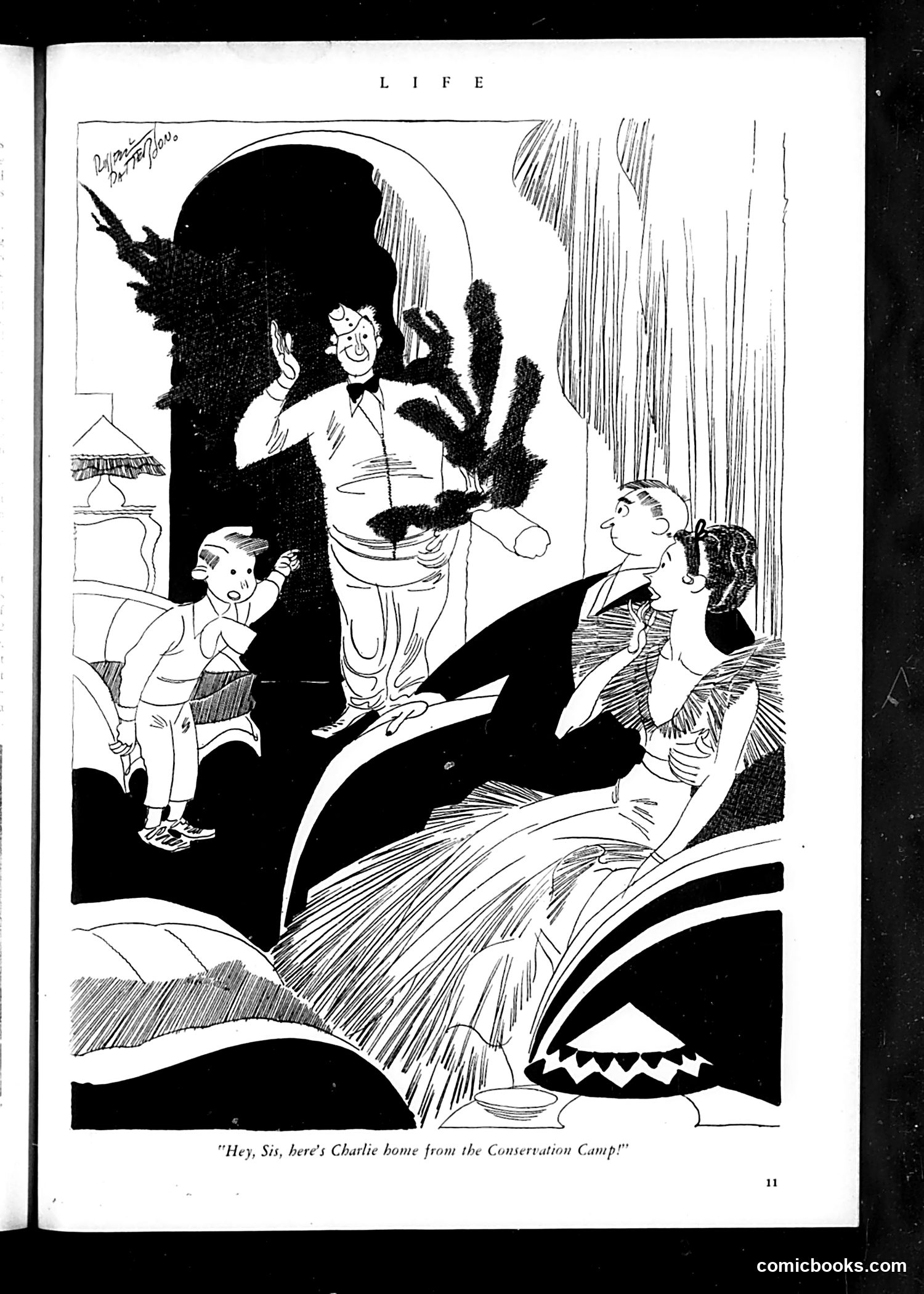
Life Magazine Cartoon Analysis This cartoon satirizes the "Conservation Camp," likely a New Deal-era program during the Great Depression. The caption reads: "Hey, Sir, here's Charlie home from the Conservation Camp!" The joke mocks the program's effectiveness. A young man (Charlie) returns home visibly overweight and out of shape—the opposite of what a conservation/work camp should produce. His parents appear shocked or amused at his condition, suggesting the camp failed to provide the expected physical labor or discipline. The satire critiques government programs that promised to build character and fitness through outdoor work but apparently delivered poor results. This reflects 1930s skepticism about New Deal initiatives' actual efficacy versus their stated goals.
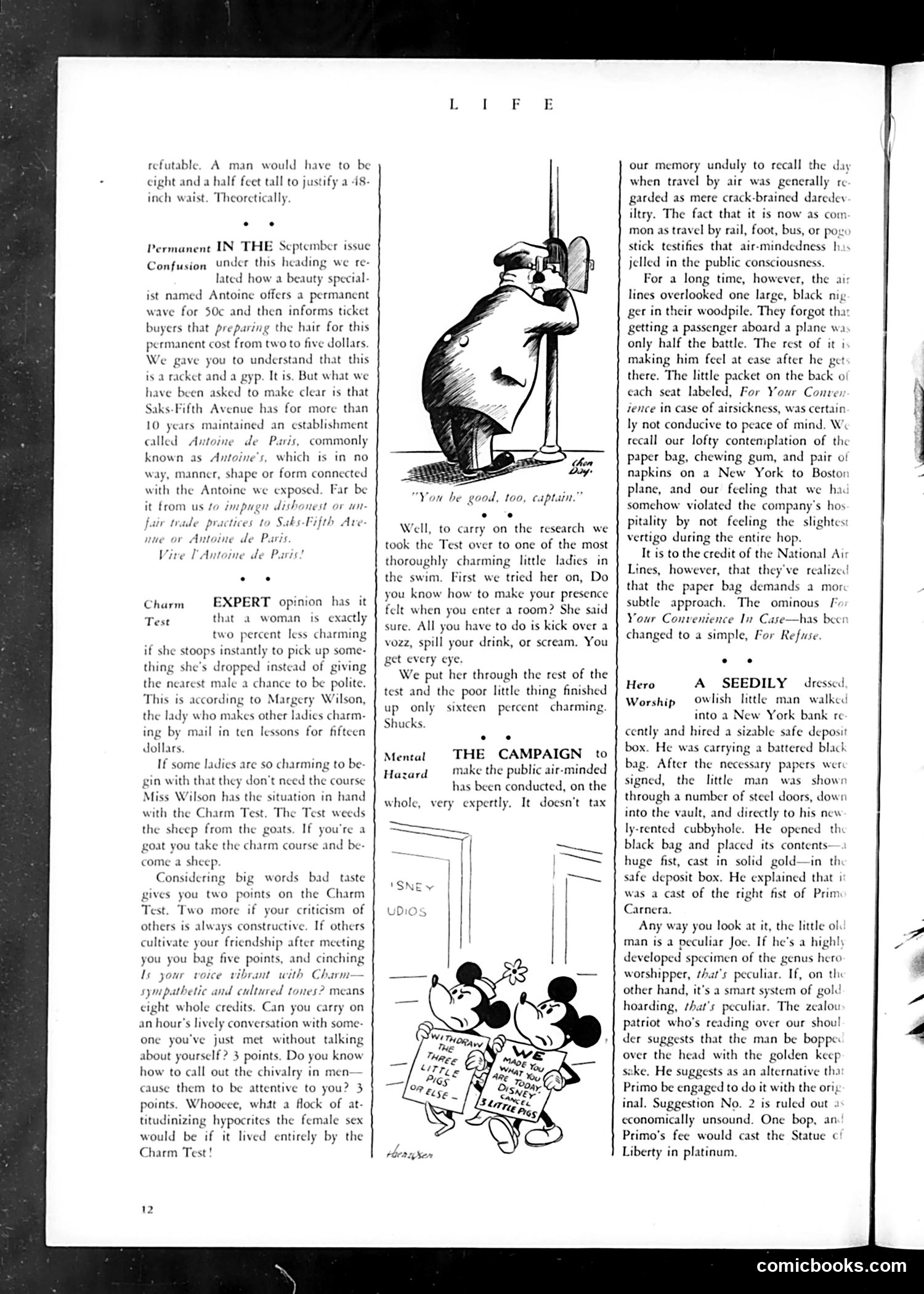
Life Magazine Page Analysis This page contains satirical commentary on 1940s air travel and charm/etiquette instruction. Upper cartoon ("You be good, too, captain"): Depicts an overweight passenger at an airplane window, likely mocking anxious flyers and the indignity of air travel—a still-novel experience for many Americans. Lower cartoon (Mickey and Minnie Mouse characters): Shows Disney characters at what appears to be a bank or financial institution, satirizing the commercialization of beloved characters or public interest in celebrity finances. Text sections discuss: - "Charm Test": Mock etiquette advice about women's behavior - "Hero Worship": A humorous anecdote about someone depositing gold in a safe deposit box - "Mental Hazard": The campaign to make the public "air-minded" The overall tone mocks both emerging aviation culture and superficial American social pretensions of the era.
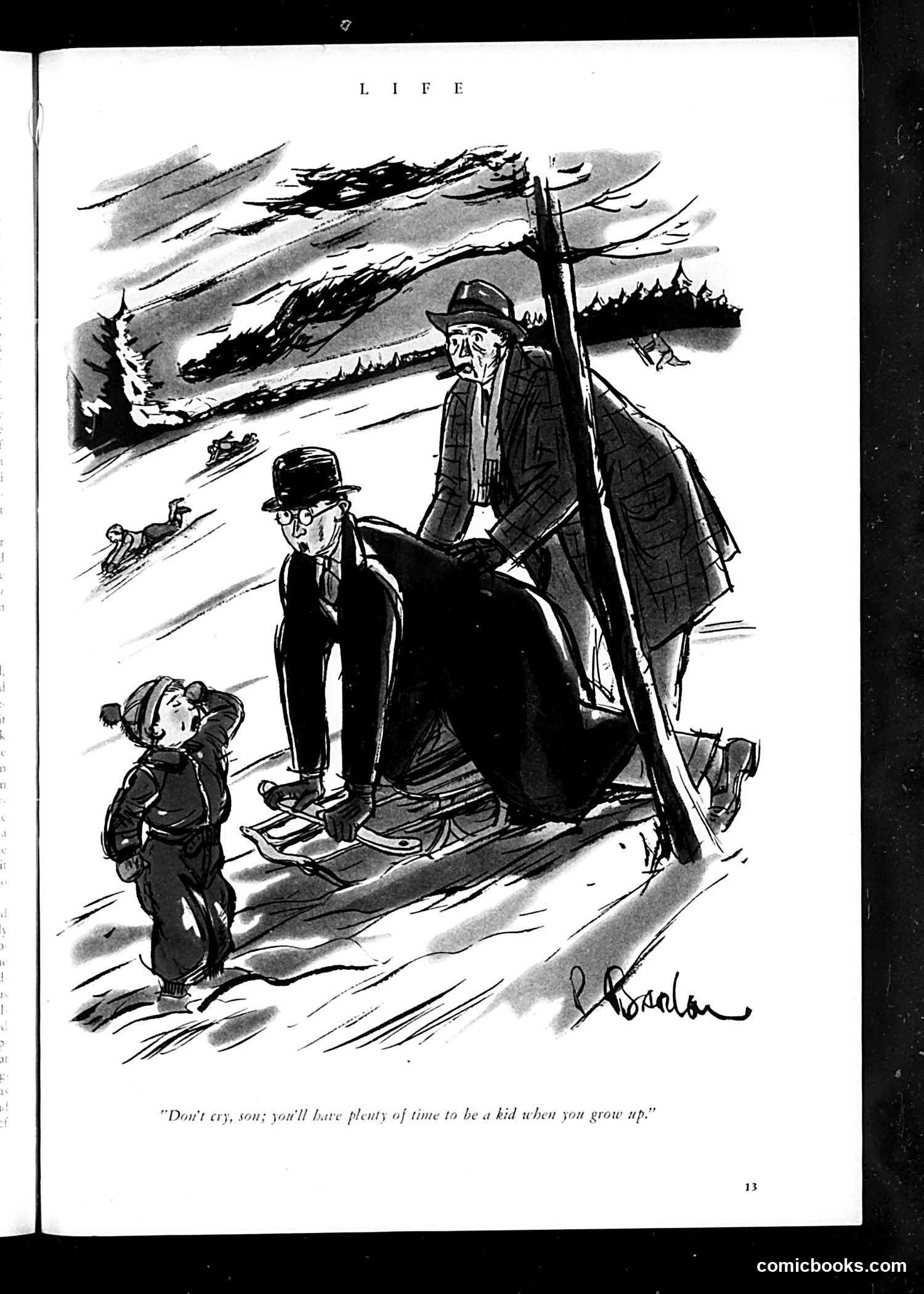
Analysis of "Life" Magazine Cartoon This single-panel cartoon depicts an adult and child skiing in a snowy mountain landscape. The adult, wearing formal attire (bowler hat, coat) and holding a ski pole, addresses a small child with the caption: "Don't cry, son; you'll have plenty of time to be a kid when you grow up." The satire inverts typical parental expectations—normally adults encourage children to enjoy childhood before adult responsibilities arrive. Here, the joke suggests that modern adult life has become so leisure-focused or frivolous that childhood is actually the serious phase, and adulthood the playtime. This likely critiques either wealthy leisure culture or post-Depression attitudes toward recreation and responsibility among the American upper classes, though the specific historical context remains unclear without additional publication information.
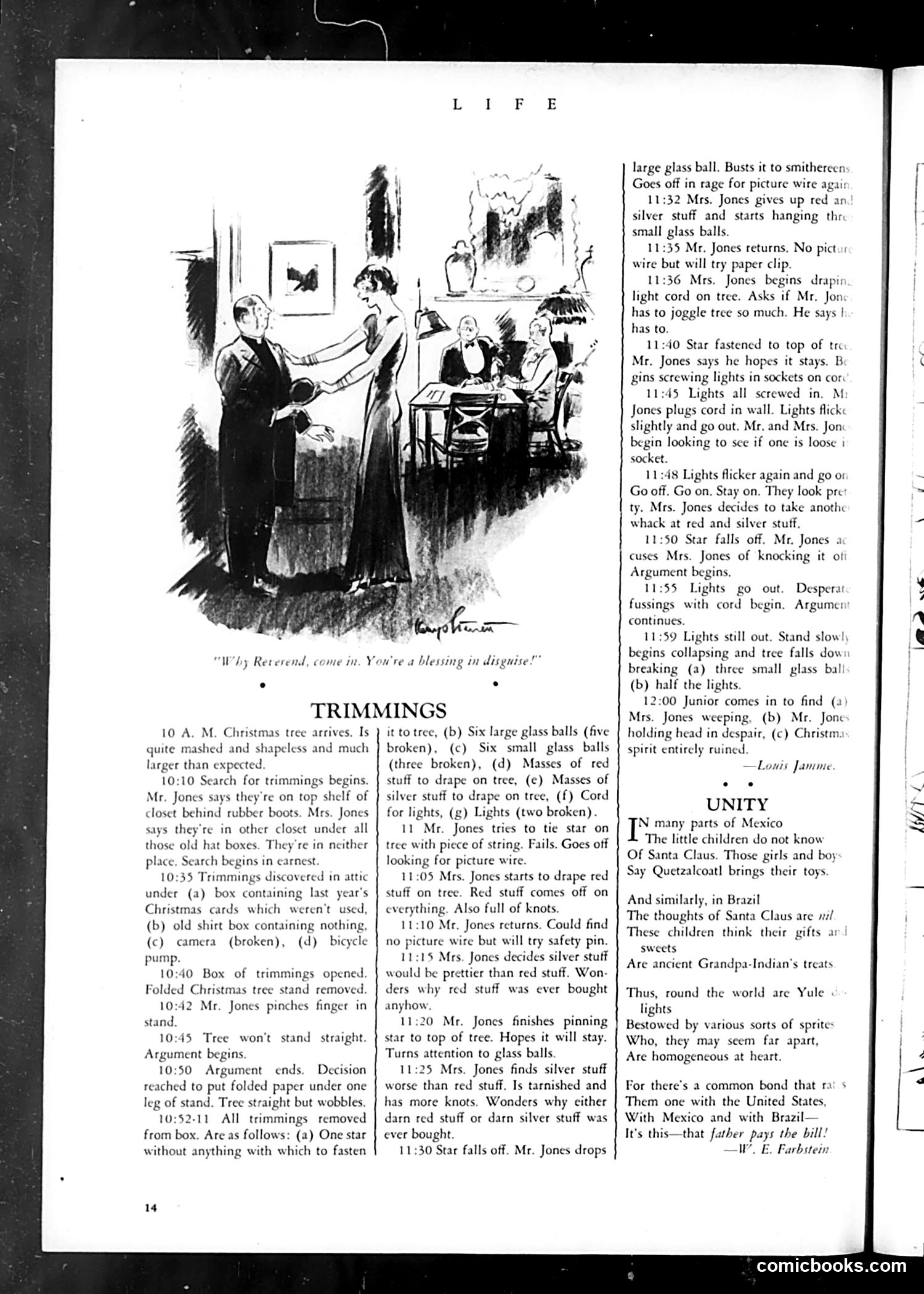
Analysis of Life Magazine Page This page contains a humorous domestic narrative titled "Trimmings," illustrated by a sketch showing a family attempting to decorate their Christmas tree. The accompanying text is a minute-by-minute account of the Jones family's increasingly chaotic attempts to install lights and ornaments, culminating in arguments, electrical failures, and the tree's collapse. The satire targets the gap between idealized Christmas imagery and the frustrating reality of holiday preparation—tangled cords, defective lights, family tensions, and physical mishaps. The cartoon depicts typical domestic discord during festive decoration efforts. The page also includes "Unity," a brief essay about Christmas gift-giving practices in Mexico and Brazil, emphasizing universal childhood traditions across cultures.
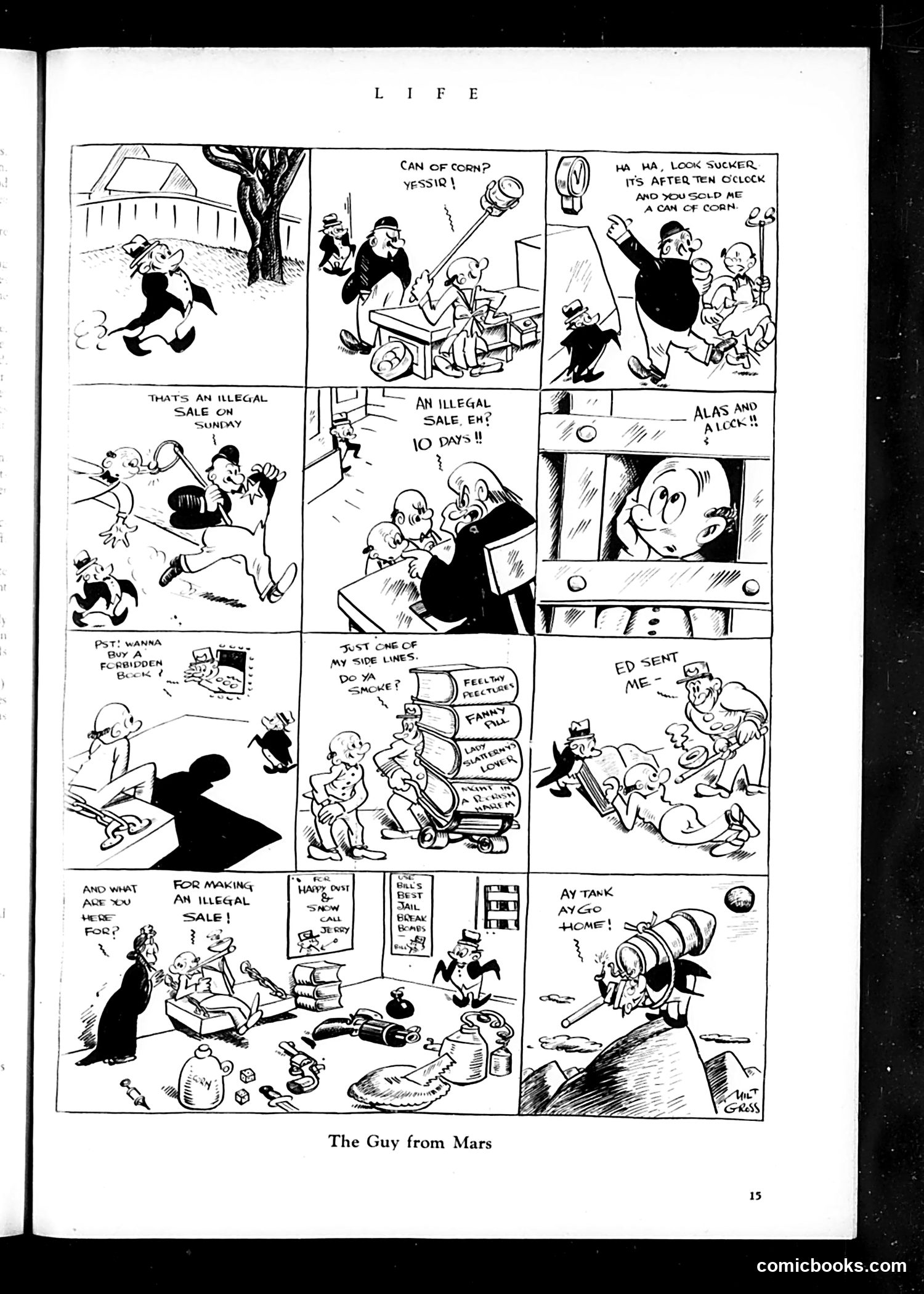
"The Guy from Mars" - Satire on Prohibition This comic strip satirizes American Prohibition-era hypocrisy. A Martian visitor observes humans frantically selling alcohol illegally ("Can of corn?" / "An illegal sale eh? 10 days!!"), then discovers it's an "illegal sale on Sunday." The joke targets the absurdity of selective law enforcement: Americans openly violate Prohibition laws constantly, yet prosecute technical violations like selling on the wrong day. The Martian's bewilderment highlights how ridiculous these distinctions appear to an outsider. The strip mocks both bootleggers' brazen operations and authorities' selective enforcement, revealing Prohibition as widely flouted and unevenly policed—a common complaint during the 1920s-30s era when the law proved unenforceable.
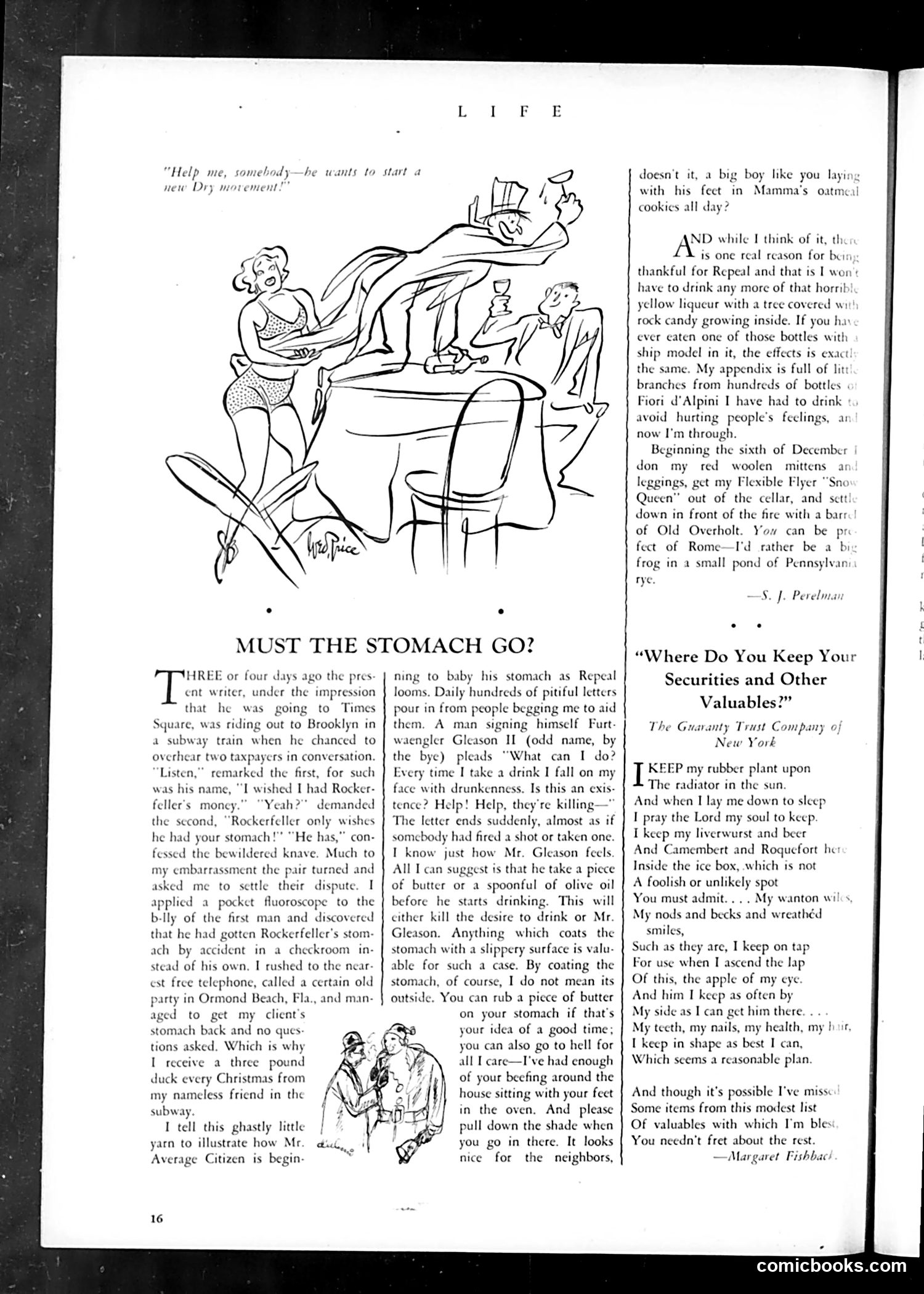
Explanation for Modern Readers The main cartoon illustrates a humorous domestic scene where a man sits at a table while a woman tends to him—likely depicting spousal care or concern. The accompanying article, "Must the Stomach Go?", satirizes a letter from a "Times Square writer" complaining to the president about digestive distress from drinking. The joke rests on excess alcohol consumption during Prohibition-era America, when drinking was technically illegal but widely practiced. The writer's complaint about a "stomach" problem is actually code for bootleg liquor effects. References to "Rockefeller" and casual mentions of various alcoholic beverages ("Old Overholt," liqueurs) mock both wealthy elites and common citizens circumventing alcohol laws through homemade or smuggled drinks. The satirical tone critiques Prohibition's failure to stop drinking while highlighting its health consequences.
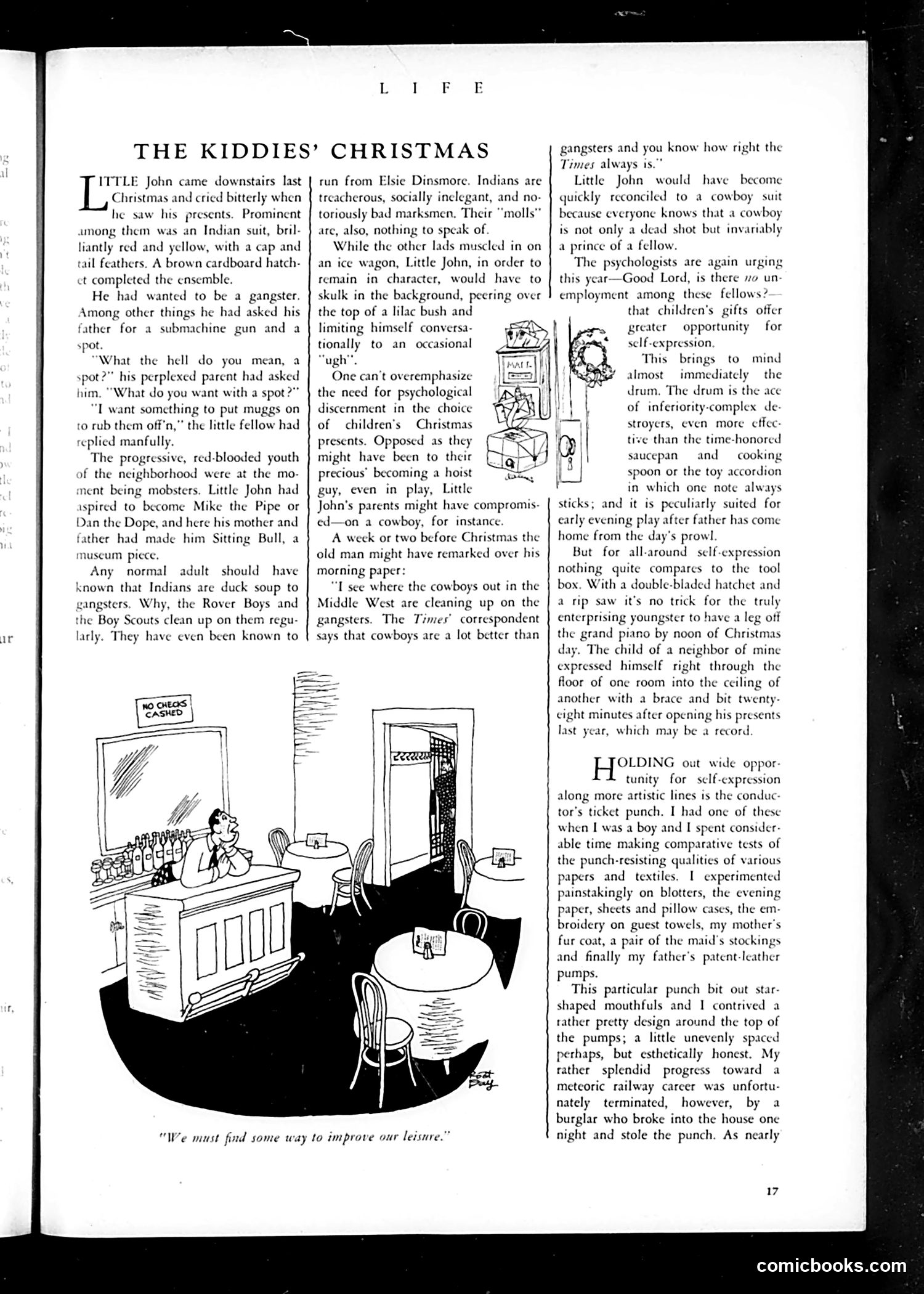
"The Kiddies' Christmas" - Analysis This is a humorous essay about children's Christmas gifts, not political satire. The main illustration shows a domestic interior with the caption "We must find some way to improve our leisure." The article satirizes modern parenting anxieties. It describes "Little John," a boy who wants a cowboy outfit and gangster suit—reflecting 1920s-30s children's entertainment preferences. The text mocks psychologists' growing influence on toy selection, criticizing experts who worry children's gifts don't provide "self-expression." The author humorously contrasts this with practical, action-oriented toys from their own childhood: drums, tool boxes, conductor's punches, and ticket punches—items that allowed genuine creative play rather than the psychologically-curated selections contemporary parents were being encouraged to buy. The satire targets expert culture and consumer anxiety, not politics.
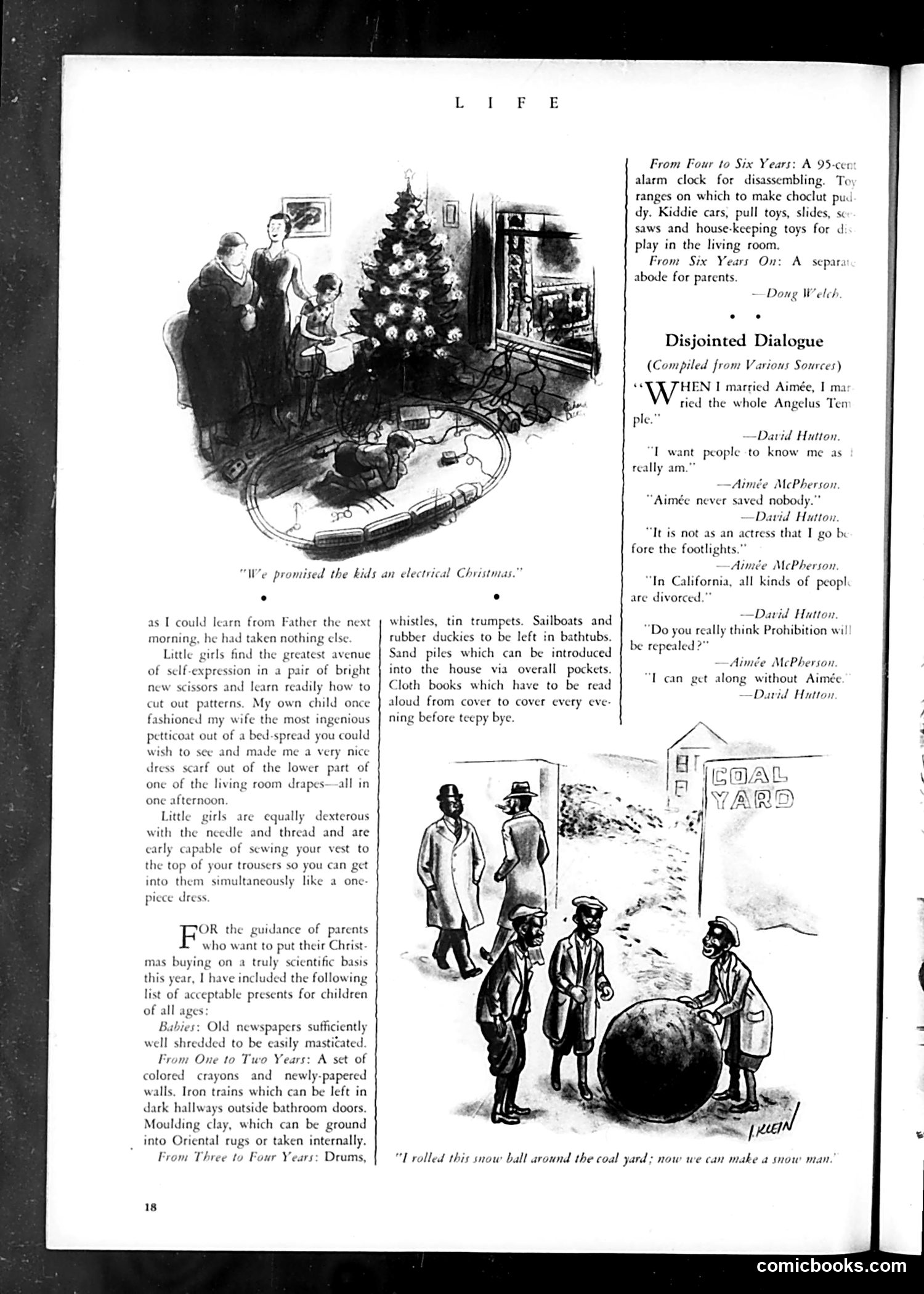
Analysis of Life Magazine Page This page contains gift-giving advice for Christmas presents aimed at children of various ages. The top illustration shows a family with a Christmas tree and electric train set, captioned "We promised the kids an electrical Christmas." The main text discusses age-appropriate toys and crafts, emphasizing "scientific basis" for gift selection. It includes a "Disjointed Dialogue" section featuring quotes attributed to David Hatton and Aimée McPherson (a famous evangelist of the 1920s-30s), presented as humorous non-sequiturs about marriage and morality. The lower cartoon shows children with a snowball in a coal yard, captioned about rolling it to make a snowman. The humor derives from post-war scarcity—using coal dust to create winter play. Overall, the page reflects early-20th-century consumer culture and domestic advice literature.
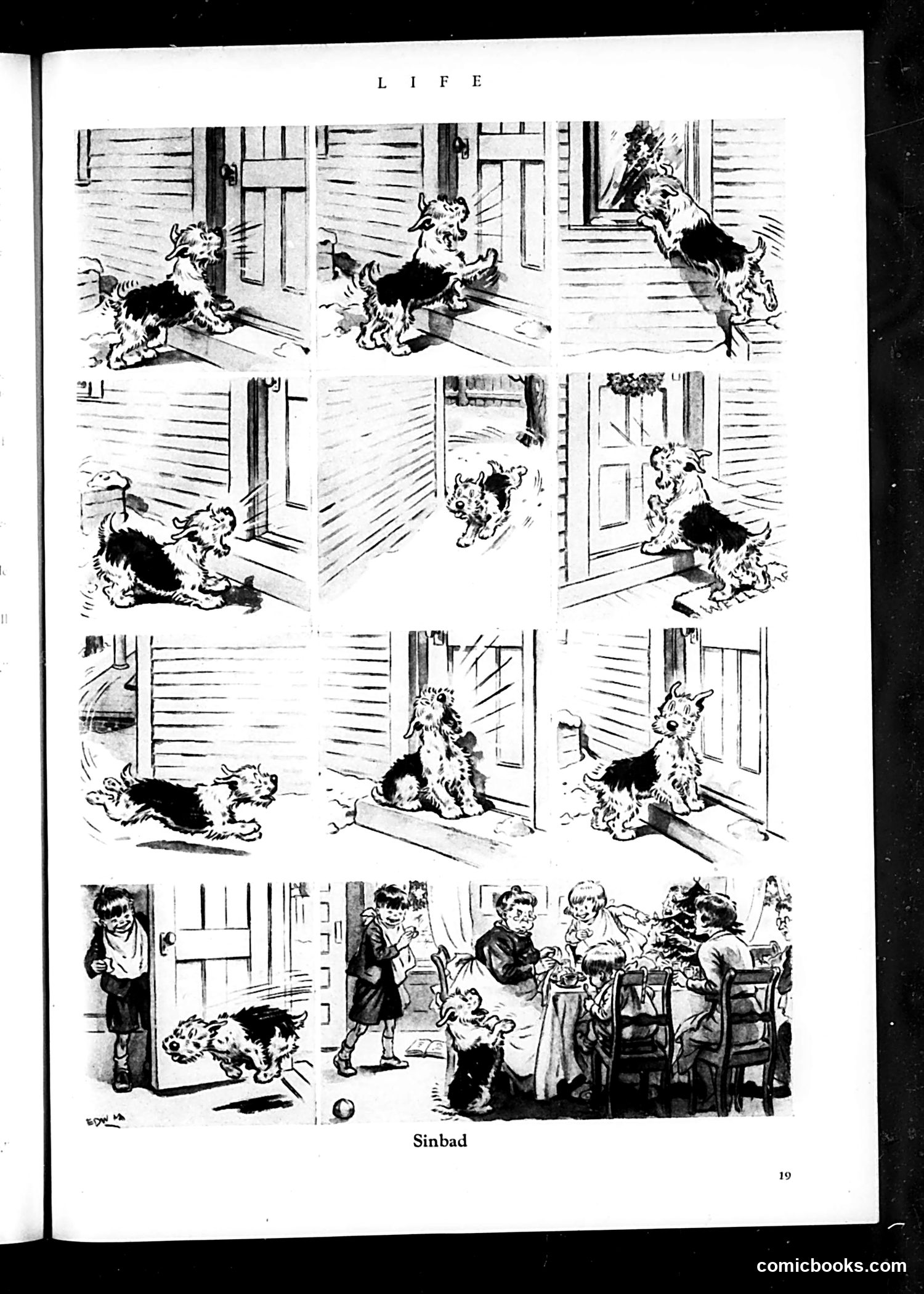
Sinbad Comic Strip Analysis This is a comic strip titled "Sinbad" showing a small, scrappy dog character involved in various misadventures around a house and neighborhood. The strip depicts the dog causing chaos—fighting with other dogs, being chased, creating disturbances—culminating in a final panel where the dog appears at a family dinner table, apparently having been invited inside despite (or because of) its troublemaking nature. The humor relies on slapstick and physical comedy typical of early-to-mid 20th century humor: a mischievous pet causing mayhem that somehow endears itself to humans. There are no apparent political references or social satire—this appears to be straightforward comedic entertainment about a problem dog, representative of Life magazine's general humor content.
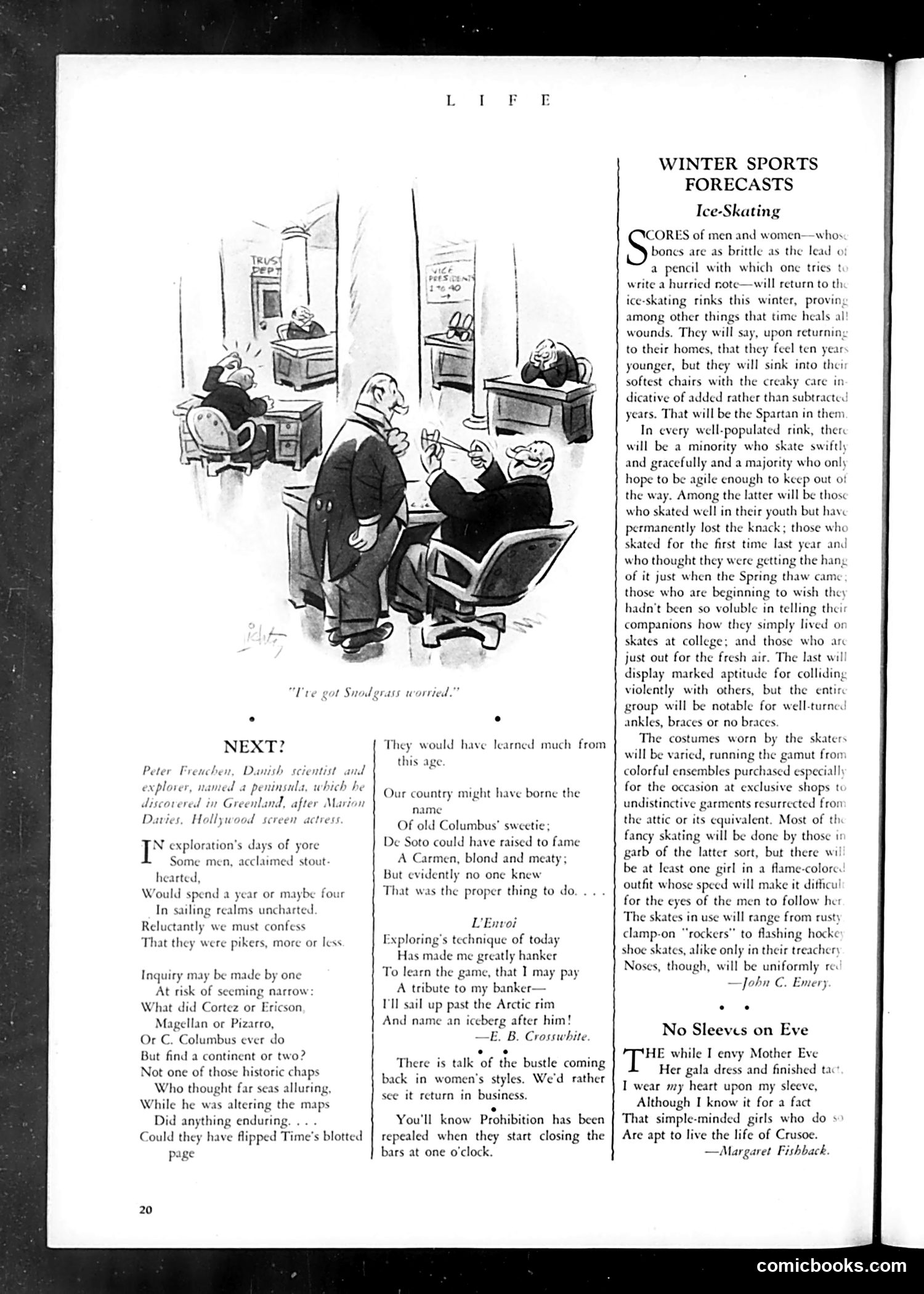
Explanation for Modern Readers This page contains satirical poetry and commentary typical of *Life* magazine's humor. "NEXT?" poem: Mocks historical explorers (Columbus, Cortez, Magellan) as overrated. The joke: modern explorers should follow today's practice of naming discoveries after celebrities—specifically referencing a real incident where explorer Peter Freuchen named a Greenland peninsula after actress Marion Davies. The satire ridicules both celebrity worship and the trivialization of exploration in the modern era. Other jokes: Brief quips about women's fashion ("bustles"), Prohibition's imminent repeal, and ice-skating season. "No Sleeves on Eve": A light poem playing on the phrase "wearing one's heart on one's sleeve"—contrasting Eve's simplicity with modern women who publicly display emotions. The page reflects 1920s-30s preoccupations: celebrity culture, Prohibition, and changing social norms around women. The humor targets intellectual pretension and modern superficiality.
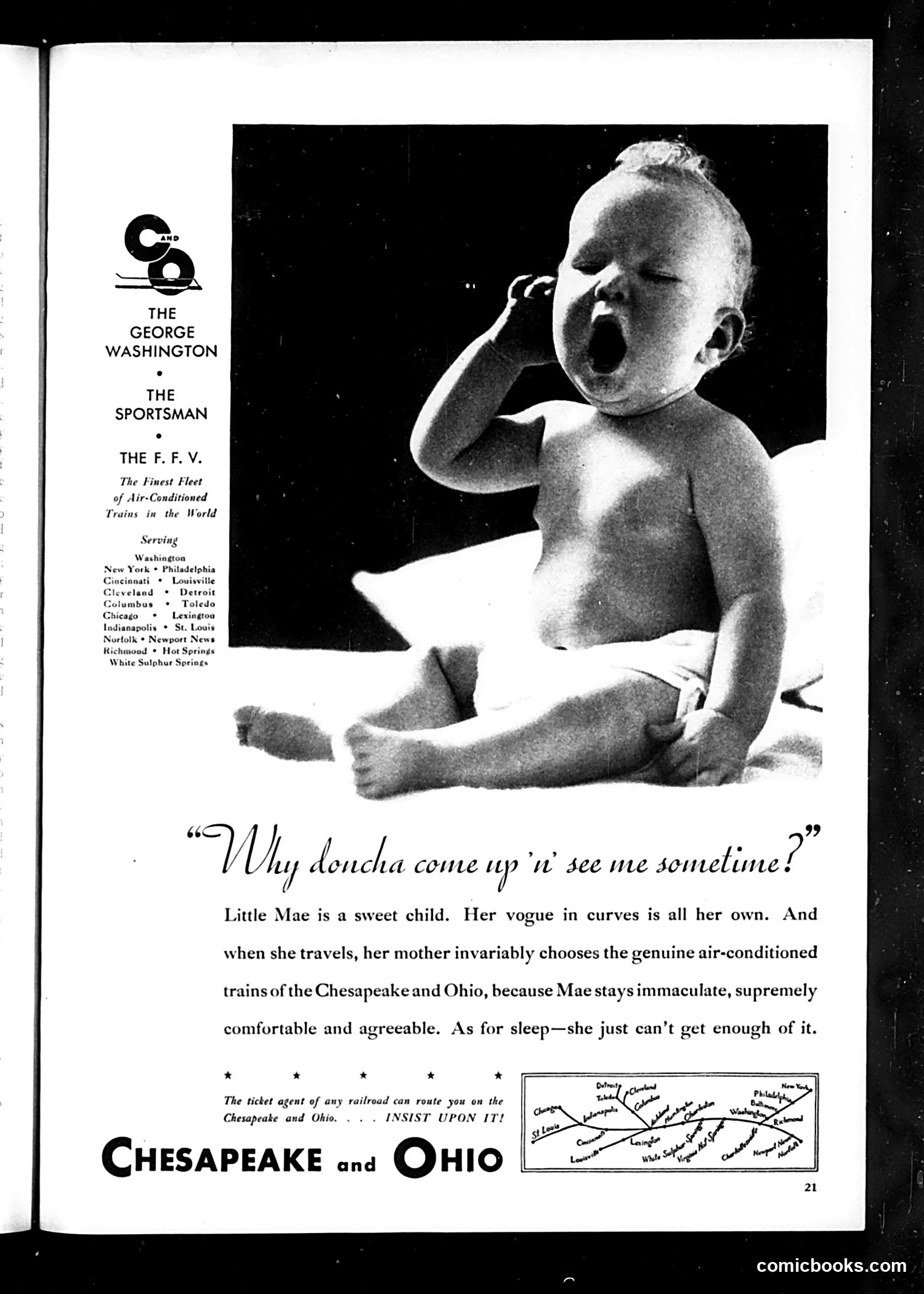
Advertisement Analysis This is a railroad advertisement, not political satire. The Chesapeake and Ohio Railway advertises its air-conditioned trains by depicting a baby girl named "Little Mae" with the caption "Why doncha come up 'n see me sometime?"—a famous Mae West catchphrase from the 1930s. The joke relies on audiences recognizing the sexual innuendo of Mae West's well-known flirtatious line, then subverting it by applying it innocently to a sleeping infant. The advertiser suggests that traveling on their trains is so comfortable that even a baby will sleep contentedly and remain "immaculate" and "agreeable"—a humorous contrast between Mae West's adult persona and an actual child. The ad emphasizes the trains' air-conditioning as a luxury amenity serving major cities from Washington to Chicago. The humor depends on 1930s-1940s familiarity with Mae West's comedic persona.
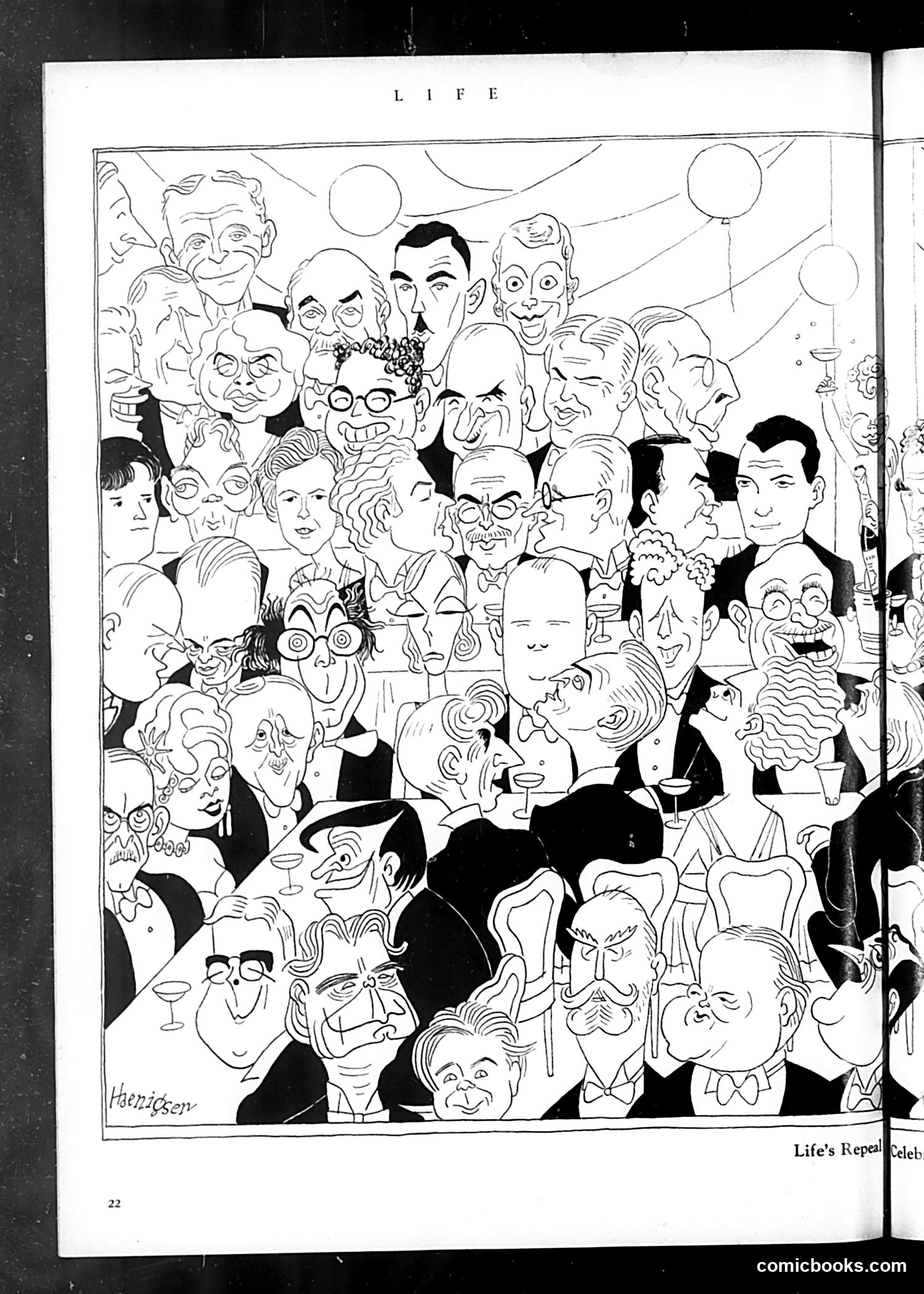
Analysis This is a satirical cartoon depicting a crowded society gathering or party, signed by the artist Hendrickson. The page header reads "LIFE" and the caption fragment references "Life's Repeal celeb[ration]," suggesting this illustrates a celebration of Prohibition's repeal (the 21st Amendment, ratified in 1933). The cartoon shows numerous caricatured faces of socialites and prominent figures in formal attire, many holding cocktail glasses. The exaggerated expressions and densely packed composition satirize upper-class society's enthusiasm for alcohol's legalization. The varied facial types and expressions suggest mockery of different personality types within high society enjoying the return of legal drinking. The work reflects 1930s social commentary on class, excess, and cultural attitudes toward Prohibition's end.
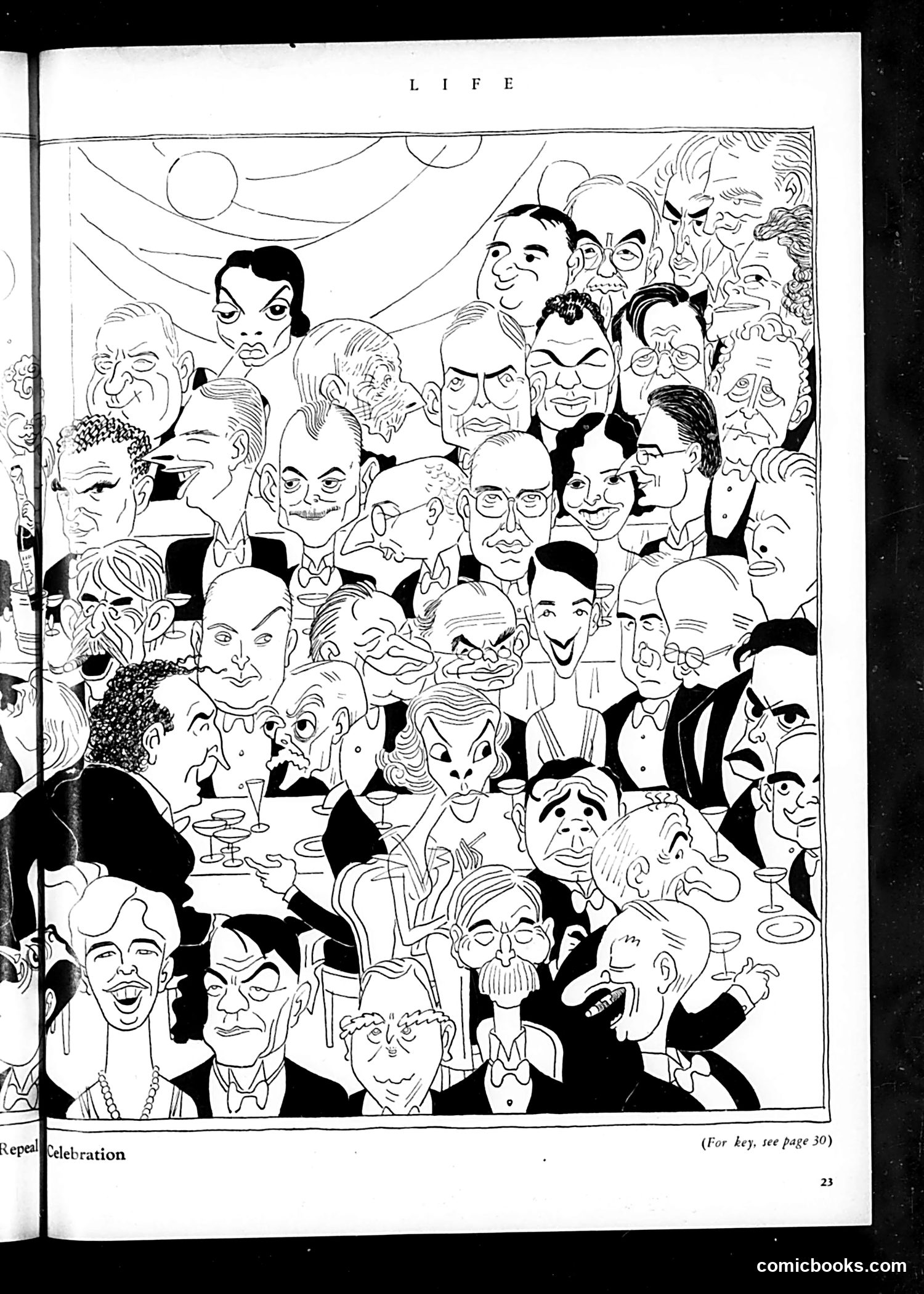
Analysis This is a satirical cartoon titled "Repeal Celebration" depicting a crowded formal party or gathering of exaggerated caricatured faces. The page references "(For key, see page 30)," indicating the figures were identified elsewhere in the magazine. The "Repeal" reference almost certainly means the repeal of Prohibition (the 18th Amendment), which occurred in 1933. The cartoon satirizes the celebration of this repeal—likely mocking various prominent figures and society types who gathered to celebrate alcohol's legalization. The densely packed, distorted facial features are characteristic of Life magazine's satirical style, emphasizing vanity, excess, and hypocrisy among the celebrants. Without the key on page 30, specific identities remain unclear, but the cartoon clearly ridicules the self-congratulatory nature of the repeal celebration among the social and political elite.
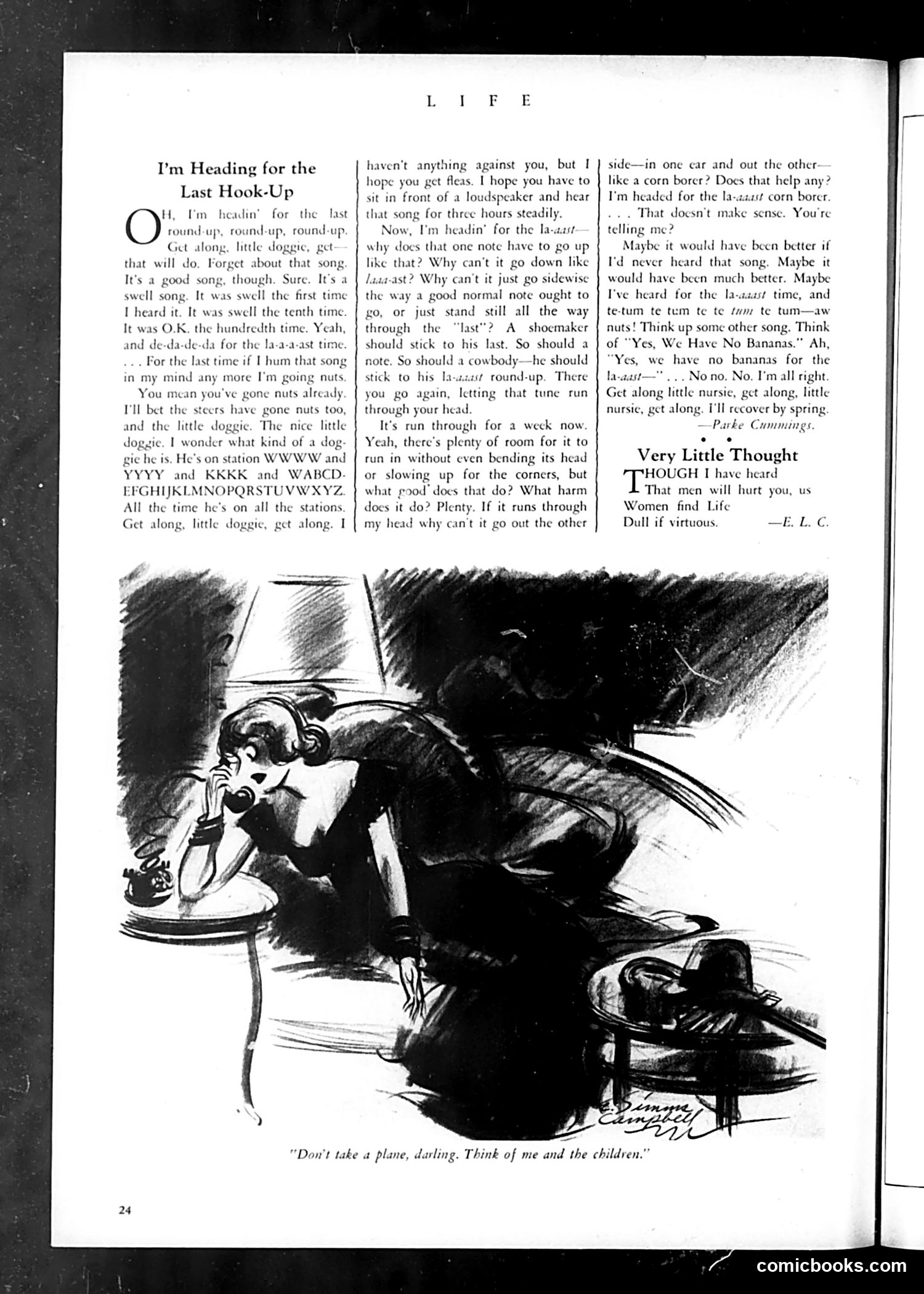
Analysis for Modern Readers This page contains two satirical pieces from *Life* magazine, likely from the 1920s-30s. "I'm Heading for the Last Hook-Up" is a humorous monologue about the maddening repetition of a popular radio song ("Get Along, Little Doggie"). The joke targets the new phenomenon of radio saturation—how a catchy tune gets stuck in your head through constant broadcast repetition across multiple stations (WWWW, YYYY, KKKK, etc.). The narrator's escalating frustration, comparing the earworm to a corn borer invading his brain, satirizes how radio advertising and popular music were becoming inescapable cultural forces that drove people to madness. "Very Little Thought" is a brief, cynical observation on gender and morality: women find virtue boring and life dull without male attention/romance. This reflects period attitudes about female sexuality and propriety, presented here as ironic social commentary. Both pieces mock contemporary mass culture and social conventions through exaggeration and absurdist humor.
This is a blank page with a clever meta-joke. The rooster illustration at top suggests this should contain an advertisement, but the text explains that state laws prohibited *Life* magazine from reproducing whatever ad was originally scheduled here. Rather than leave the space empty, the editors turned the censorship itself into humor—asking readers to use their imagination about the forbidden content. The closing "Read LIFE Regularly!" serves as both a call to subscribe and a wry acknowledgment that such legal restrictions were apparently common enough to warrant this self-aware response. This reflects early-to-mid 20th century state advertising regulations, likely concerning products deemed obscene or misleading (alcohol, patent medicines, or contraception were common targets).
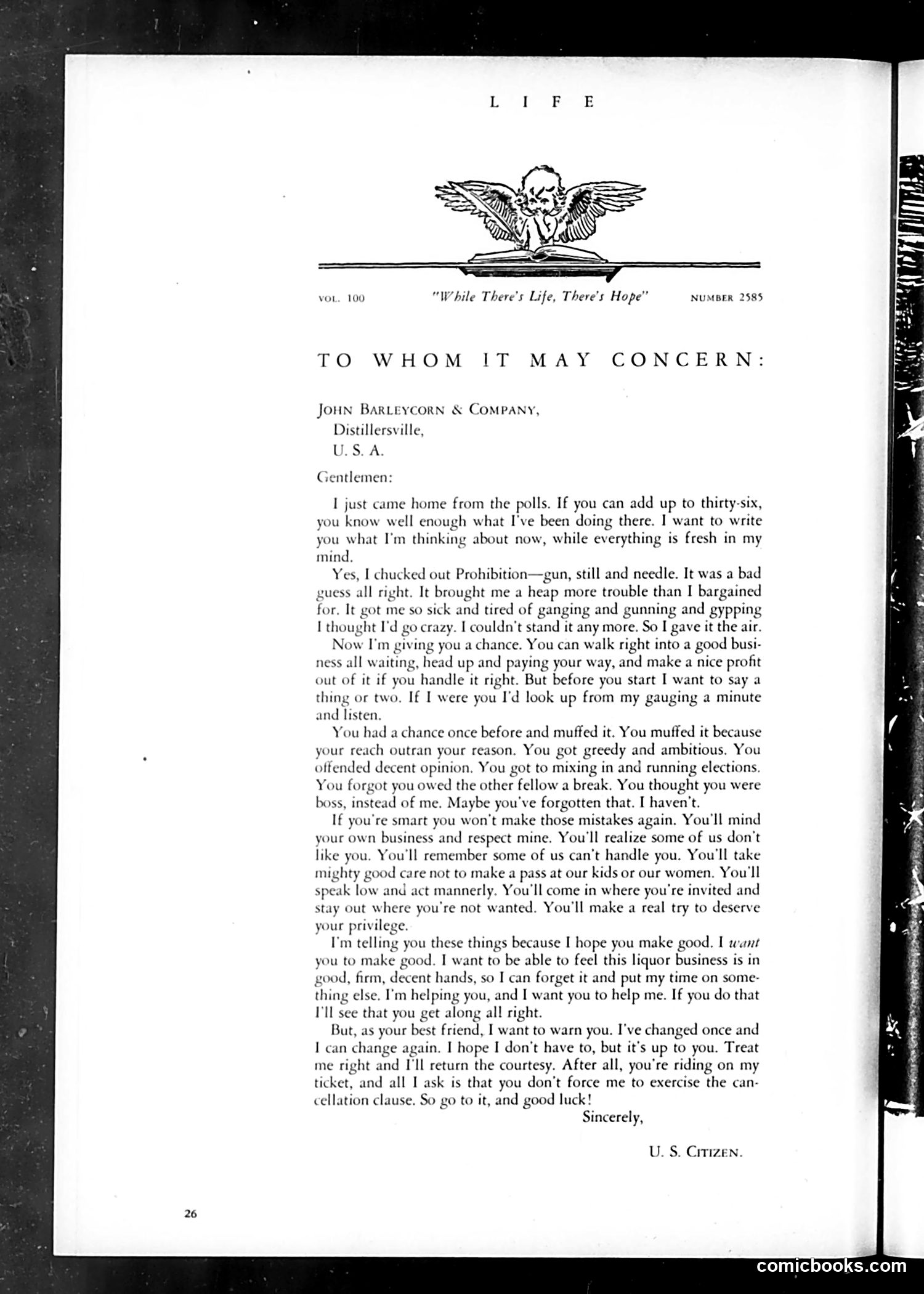
"To Whom It May Concern": Repeal and Warning This is a satirical open letter from "U.S. Citizen" to the liquor industry following Prohibition's repeal (1933). The sender—personified as an American voter—warns liquor manufacturers ("John Barleycorn & Company") not to repeat the industry's pre-Prohibition mistakes. The satire references how the liquor industry's political corruption, election interference, and disrespect for public morality contributed to Prohibition's passage. The citizen grants them a second chance to operate legally but threatens: behave responsibly, respect boundaries, stay out of politics and family life, or face another cancellation—a veiled threat of re-imposing Prohibition. The phrase "riding on my ticket" emphasizes the public's power: the industry exists only by public consent and can be revoked. It's a civic warning dressed as friendly advice, reflecting post-Repeal anxiety about whether legal alcohol would lead to renewed social harm.
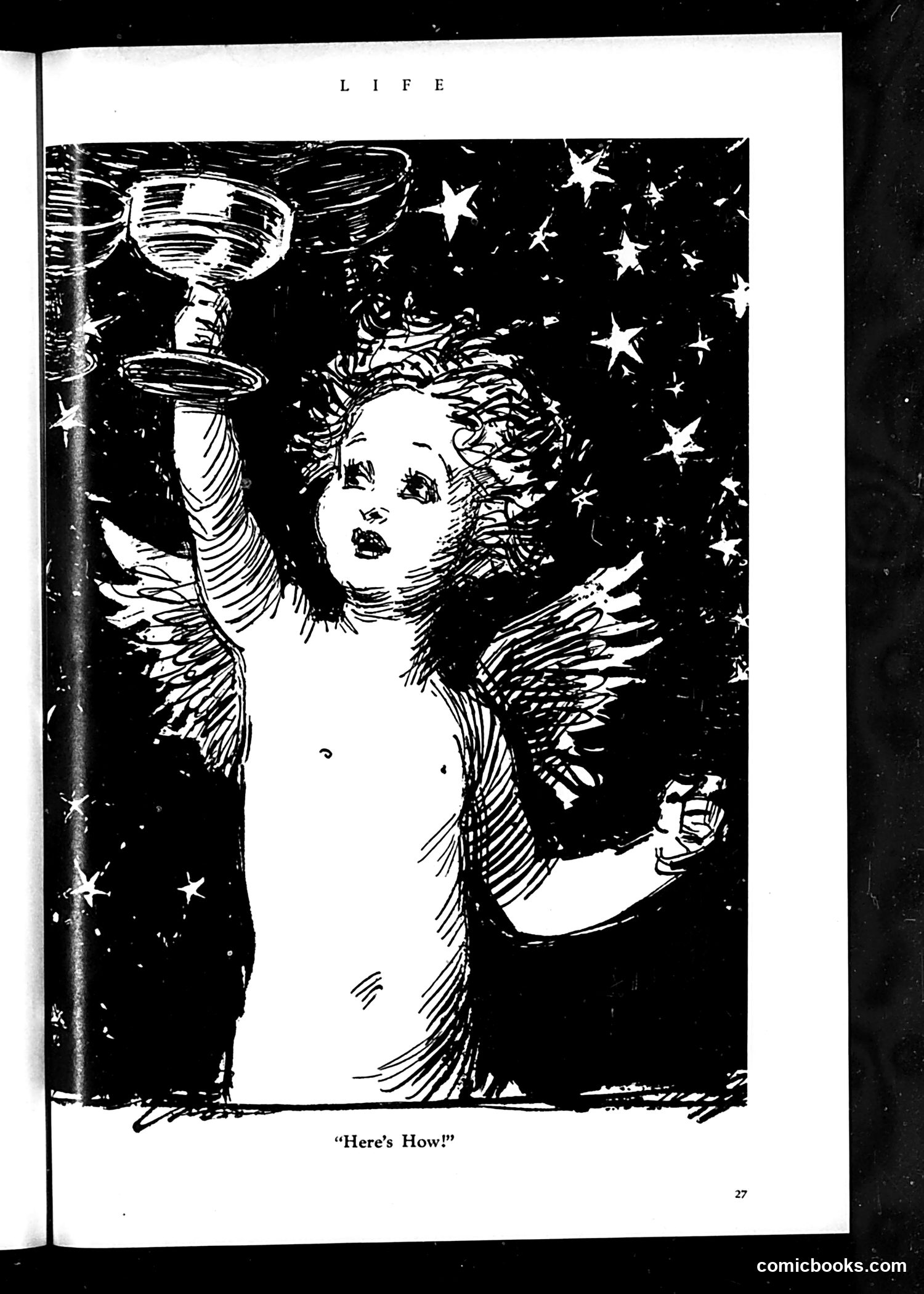
"Here's How!" - Life Magazine Cartoon This black-and-white illustration depicts a cherubic winged figure (a putto or baby angel) holding aloft a goblet in a celebratory toast. The figure has curled hair and is surrounded by stars against a dark background. The caption "Here's How!" suggests a drinking toast. Given Life magazine's satirical nature and the angelic imagery, this likely comments on alcohol consumption—possibly celebrating drinking or toasting during Prohibition era (when such depictions carried extra satirical weight). The innocent cherub figure making an adult gesture creates ironic humor through the contrast between the angelic imagery and the worldly act of raising a drinking glass. The page number (27) indicates this is interior content rather than a cover.
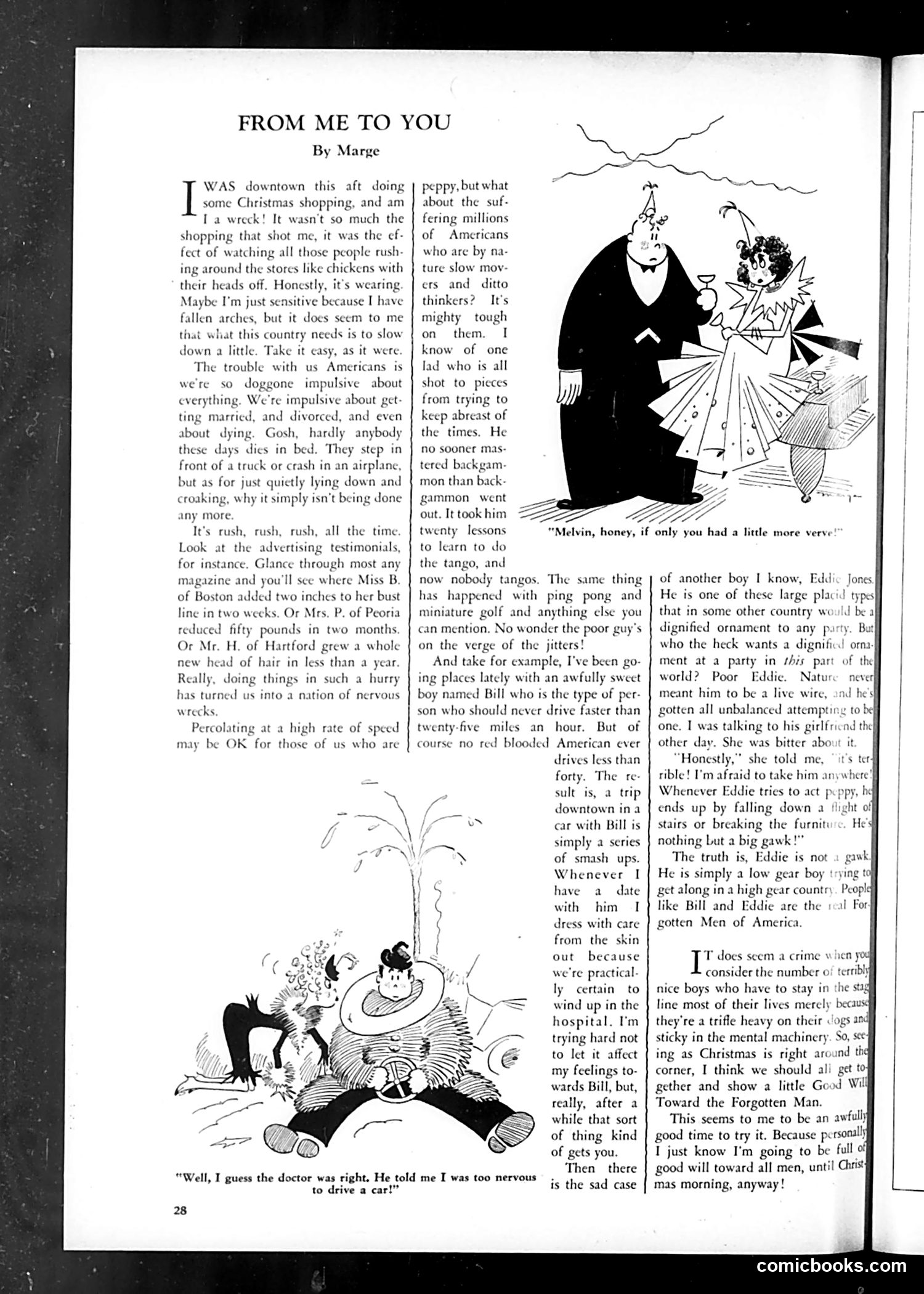
Explanation for Modern Readers This is a humorous essay by "Marge" critiquing American culture's obsession with speed and constant self-improvement. The author complains that Americans are "doggone impulsive" about everything—marriage, divorce, even dying—rushing through life without pause. The cartoons illustrate specific examples: one shows a nervous man being told by a doctor he's "too nervous to drive a car," and another depicts a couple in a car crash, representing the dating hazard of riding with "Bill," a naturally slow-moving person pressured to drive recklessly fast. The broader satire targets 1930s-40s advertising culture, which promoted rapid self-transformation ("Miss B. added two inches to her bust in two weeks"). The piece sympathizes with naturally introverted or slow-paced people struggling to keep up with societal expectations, calling them "Forgotten Men of America"—ironically referencing FDR's political messaging while suggesting society ignores those who don't fit the energetic American ideal.
This page contains a humorous advertisement placeholder referencing Prohibition-era politics. The text jokes that an advertisement scheduled for this page is only visible in copies distributed to "Wet States"—states that opposed Prohibition or allowed alcohol sales—implying the ad was removed from copies sent to "Dry States" that enforced alcohol bans. The rooster logo at the top is Life magazine's mascot. The joke relies on readers understanding the regional divisions over Prohibition, which divided American states into those permitting alcohol ("wet") and those banning it ("dry"). The satirical point: Life's advertisers carefully tailored content by state based on local alcohol laws, highlighting the absurdity and fragmentation caused by Prohibition's uneven enforcement across the country.
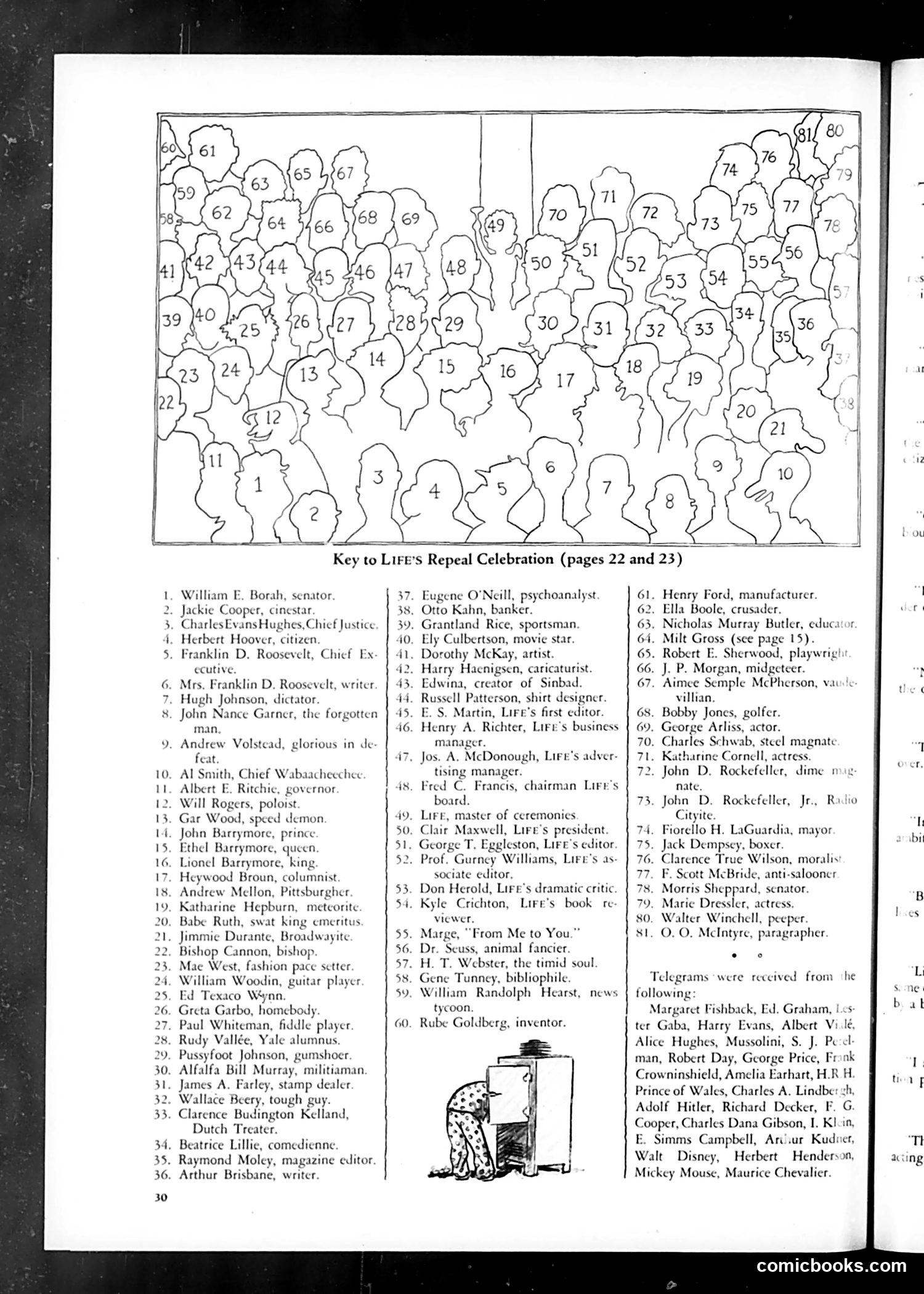
Life Magazine's "Repeal Celebration" Key This page is a legend identifying numbered figures in a satirical cartoon celebrating the repeal of Prohibition (the 1933 end of alcohol ban). The cartoon depicts major American political, business, and entertainment figures of the era in a celebratory scene. Key satirical identifications include: - Political figures: FDR, Hoover, Justice Hughes, senators, governors - Business titans: J.P. Morgan, Rockefeller, Henry Ford, Andrew Mellon - Entertainment: Mae West, Babe Ruth, Greta Garbo, the Barrymores - Prohibition enforcers (now "defeated"): Bishop Cannon, "Pussyfoot" Johnson The humor plays on role reversals and ironic descriptions—Hugh Johnson called a "dictator," Prohibition's supporters now shown in "defeat." The telegram list (bottom) humorously includes Hitler, Mussolini, and Mickey Mouse among congratulators. This celebrates alcohol's legalization after 13 years of federal ban, with the cartoon mocking both Prohibition's architects and its end's diverse supporters.
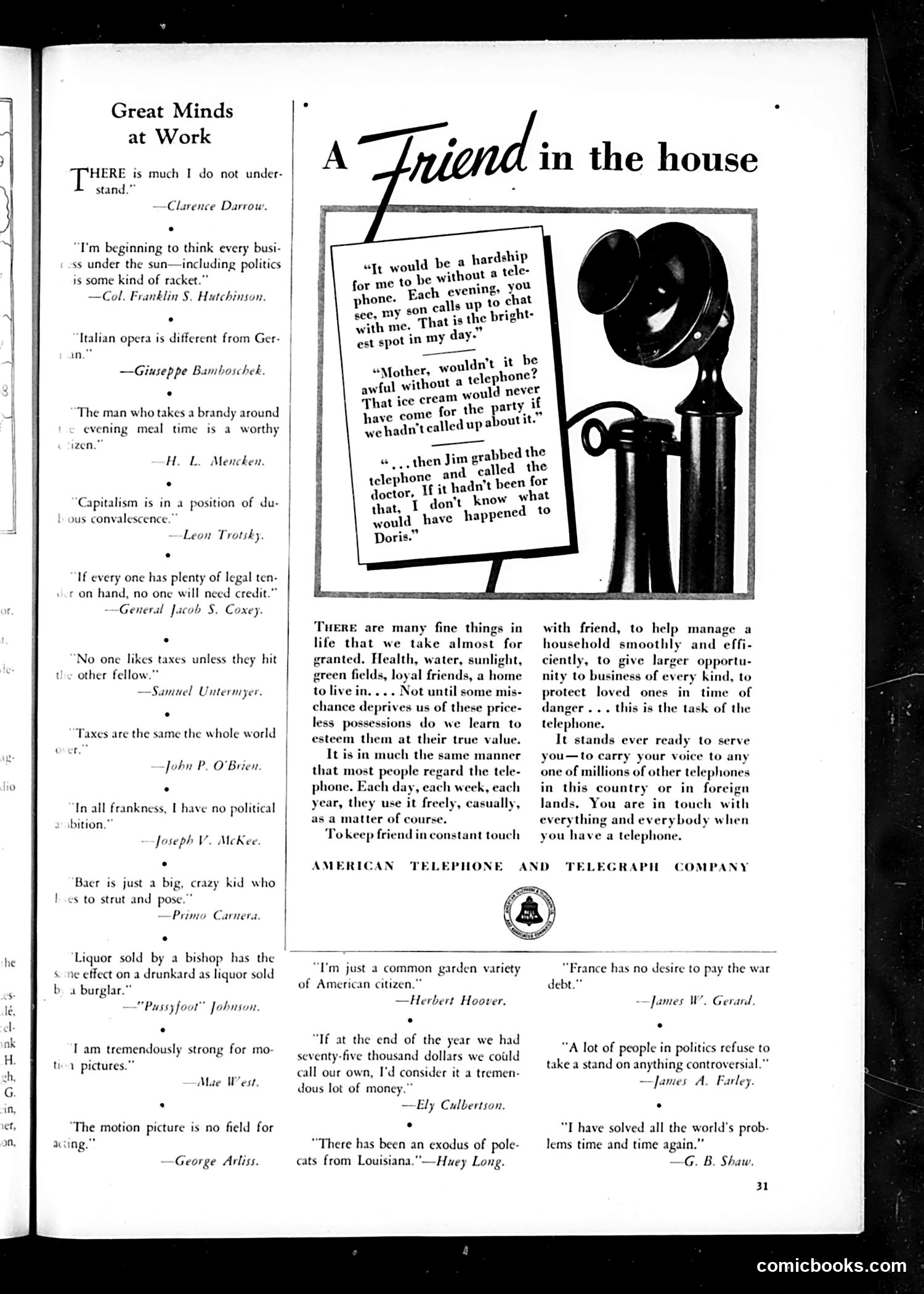
"A Friend in the House" — American Telephone & Telegraph Advertisement This is a corporate advertisement masquerading as editorial content. The left column features satirical quotes from famous figures (Clarence Darrow, H.L. Mencken, Mae West, etc.) — some genuine, some fabricated — to create an intellectual tone. The main illustration depicts a silhouetted family using a telephone, with dialogue boxes showing how essential the phone is to domestic life: a son calling home, arranging ice cream deliveries, summoning doctors in emergencies. The satire targets how people take modern conveniences for granted. The ad argues the telephone deserves appreciation as a crucial household tool for managing family logistics, business, and emergencies — not merely casual social conversation. This reflects 1930s American consumer culture, when home telephones were still relatively new and AT&T heavily promoted their indispensability to middle-class domestic life. The "Great Minds" quotes lend cultural authority to normalize telephone dependency.
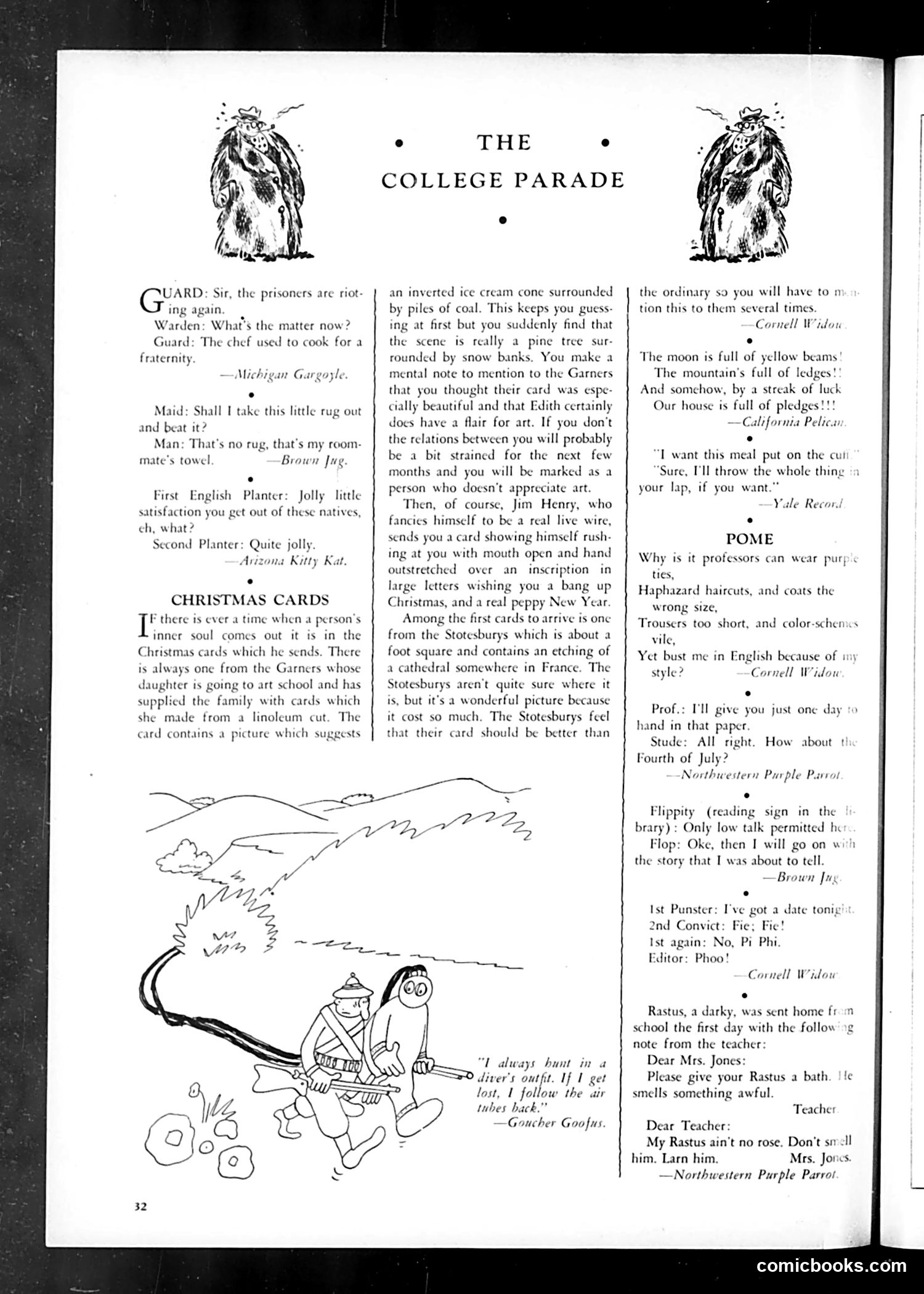
"The College Parade" — Life Magazine Humor Page This page collects humorous anecdotes and jokes from college and university newspapers, representing early 20th-century campus life. The content reflects period social attitudes and collegiate customs: Key themes: - Fraternity/student life: References to prison-like dining, roommate slovenliness, and dating mishaps - Class and taste: Satirizes social pretension (the Stotesburys' expensive cathedral Christmas card meant to impress) - Art school snobbery: Mocks students/families who affect cultural superiority through artistic endeavors - Racial humor: The "Rastus" section at bottom uses a racist stereotype common to the era—depicting an African American child with dialect humor The cartoon shows two figures (possibly miners or soldiers based on attire) with a comet or projectile overhead, accompanied by survival humor about following "air tubes back." The page is essentially a curated collection of collegiate wit from contributing university publications, functioning as an early form of "best of college humor" aggregation. It reflects 1920s-era undergraduate sensibilities, including problematic racial caricature considered acceptable in mainstream publications then.
Analysis This page is primarily a meta-commentary on censorship. The rooster illustration at top suggests morning news or revelation. The text indicates that Life magazine had to remove an advertisement due to "local edict"—meaning local government or moral authority censorship. The humor is ironic: readers are told they would have "gotten a big kick" out of whatever was censored, but they'll never see it. The deliberately obscured product name ("l-q-r," clearly "liquor") suggests alcohol advertising was banned locally, likely during or after Prohibition era when such restrictions were common. The page functions as both apology to readers and subtle protest against censorship, while still promoting the magazine itself with the closing "Read LIFE Regularly!"
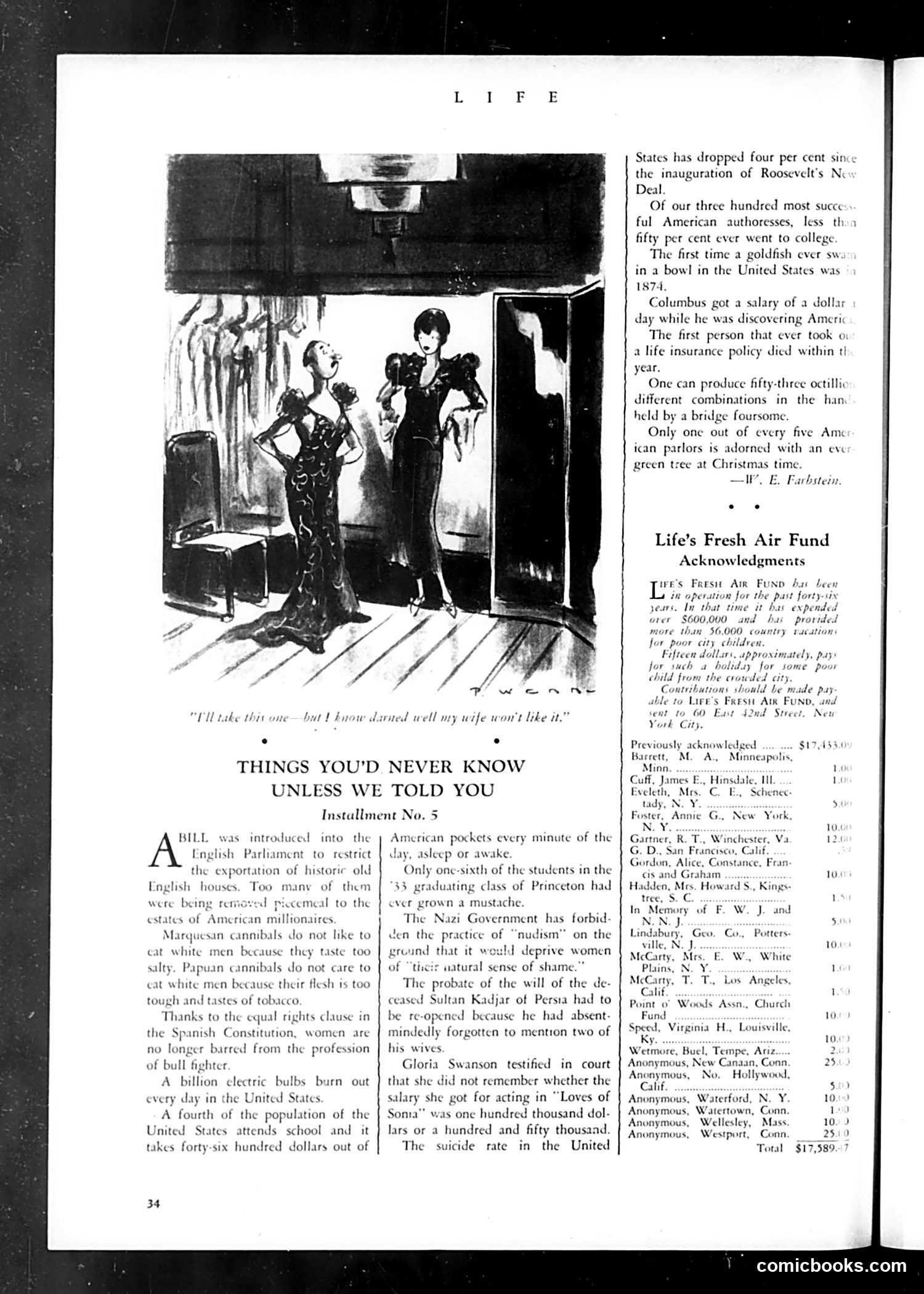
Understanding This Life Magazine Page The cartoon depicts a domestic scene where a man, viewing his wife's extravagant outfit, makes a nervous quip about her reaction to its cost. The humor relies on the stereotype of wives disapproving of husbands' spending—a common comedic trope of the era. The bulk of the page comprises "Things You'd Never Know Unless We Told You"—a humor column featuring trivia spanning absurd facts (cannibals' taste preferences), contemporary politics (Nazi nudism bans, Roosevelt's New Deal's effect on suicide rates), and celebrity gossip (Gloria Swanson's wage dispute). The final section acknowledges donors to Life's Fresh Air Fund, a charitable program providing poor urban children country vacations—a Progressive Era social welfare initiative. This page reflects 1930s-40s American magazine culture: light domestic satire, miscellaneous "facts" for entertainment, and prominent charitable fundraising appeals integrated into editorial content.
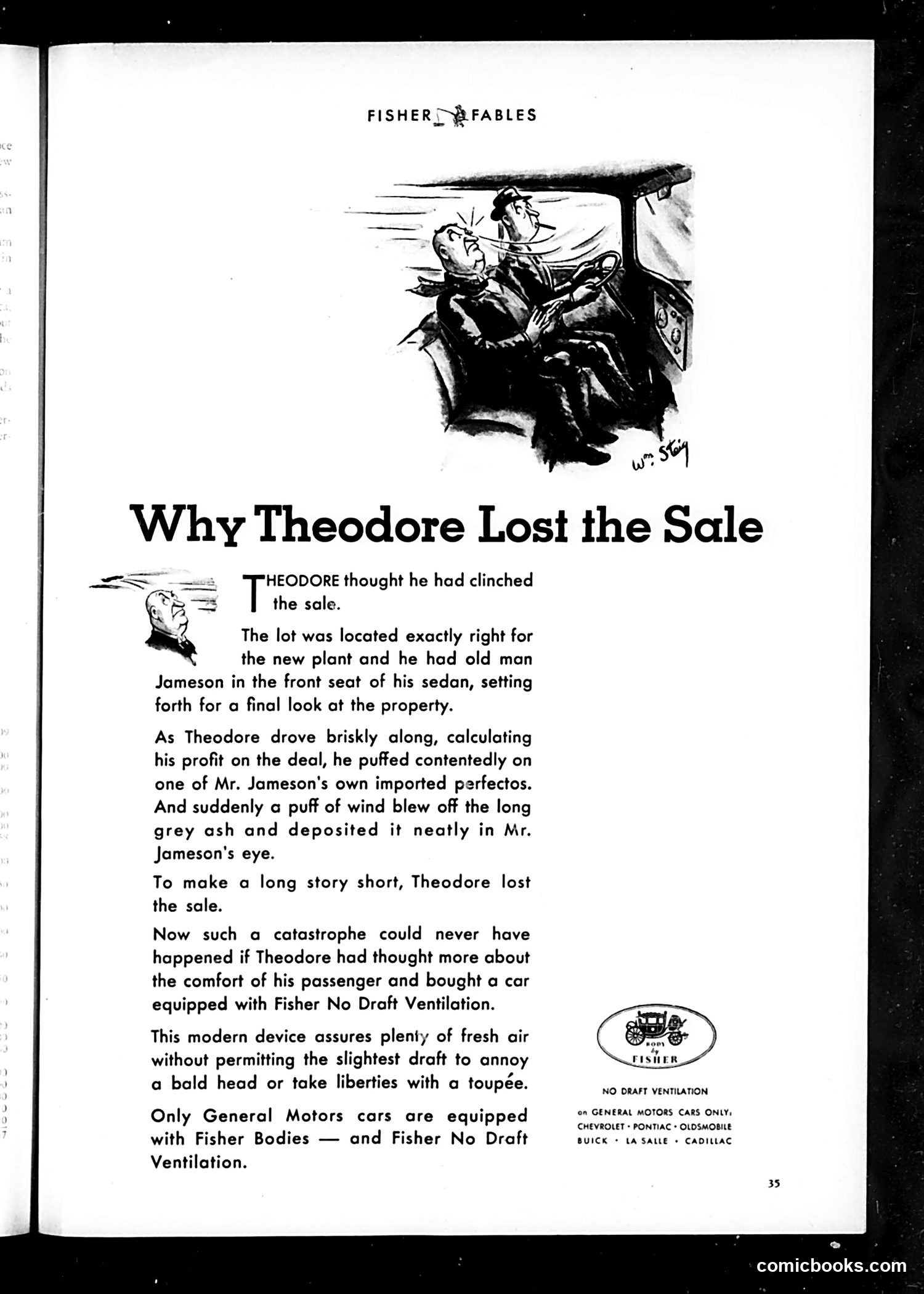
Fisher Fables: "Why Theodore Lost the Sale" This is an advertisement disguised as a humorous cautionary tale. "Theodore," a car salesman, nearly closes a deal with prospect "old man Jameson" for industrial property. However, while smoking a cigar during their inspection drive, ash blows into Jameson's eye—costing Theodore the sale. The moral: Theodore should have purchased a General Motors vehicle with Fisher No Draft Ventilation, which prevents such uncomfortable drafts. The satire mocks salesman overconfidence and poor judgment regarding passenger comfort. By presenting a trivial mishap with exaggerated consequences, the ad humorously suggests that Fisher Bodies' ventilation system is essential for business success. The fable format—common in advertising of this era—adds mock-serious gravitas to what is essentially a product pitch about car comfort features.
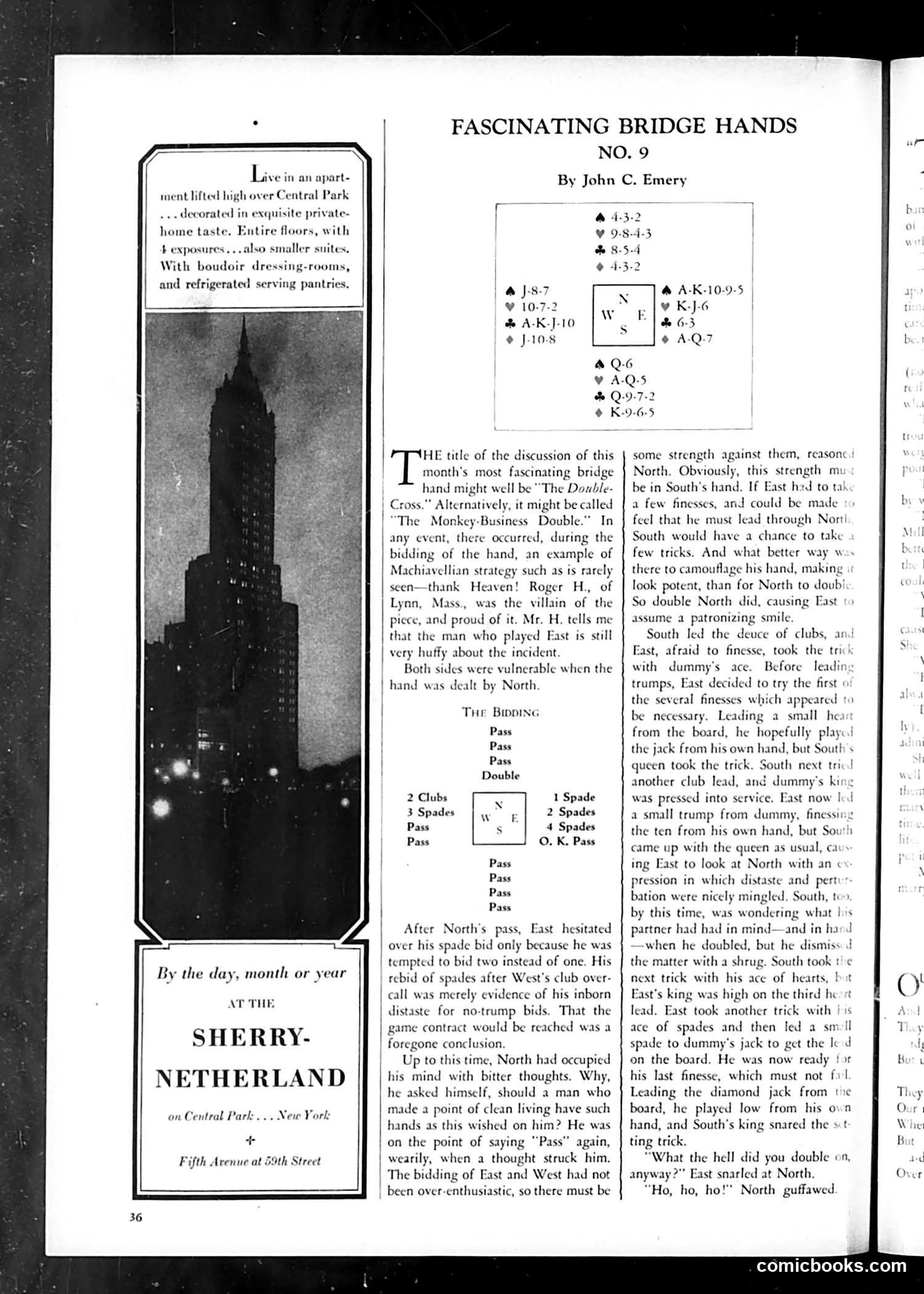
Explanation for Modern Readers This page contains two unrelated elements: a bridge card game analysis and a real estate advertisement. The main content is "Fascinating Bridge Hands No. 9" by John C. Emery, explaining a deceptive bidding strategy in contract bridge. North makes a bold "double" bid despite holding weak cards, betting that South has strength. The strategy works temporarily—East falls for the bluff and makes poor finessing decisions—but ultimately backfires when South's cards prove insufficient. East angrily confronts North afterward ("What the hell did you double on, anyway?"), while North laughs it off ("Ho, ho, ho!"). The satire lies in the irony: North's clever psychological ploy—meant to trick opponents—actually works against his own team, making him the fool despite his cunning attempt. The left sidebar advertises the Sherry-Netherland luxury apartment building on Fifth Avenue and Central Park in New York, emphasizing private taste and modern amenities (refrigerated pantries).
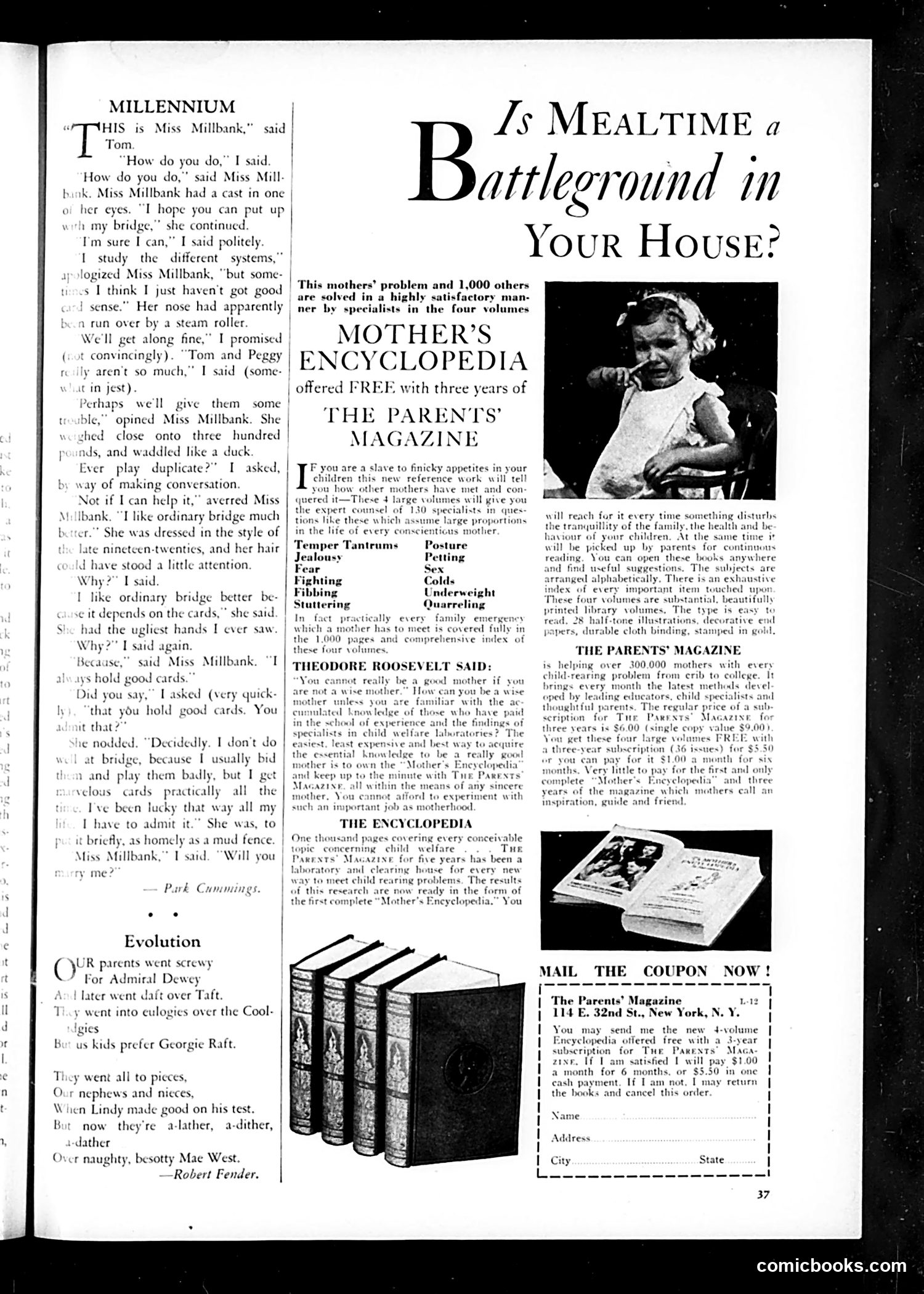
Understanding This Life Magazine Page This page contains two distinct elements: Main Story ("Millennium"): A satirical dialogue about bridge players. The narrator meets Miss Millbank, an unattractive woman ("run over by a steam roller," "ugliest hands") who claims to study bridge systems but lacks skill. The joke hinges on her paradoxical bridge strategy: she plays poorly yet always holds good cards—the narrator admits this luck makes him "bid wild and play them badly," implying good cards don't guarantee good play. It's gentle mockery of both incompetent bridge players and self-deluded amateur strategists. "Evolution" Poem: A satirical poem by Robert Fender mocking changing generational enthusiasms. Parents obsessed over Admiral Dewey, then Taft, then Coolidge, while children preferred entertainer Georgie Raft. The poem concludes with family members literally "going to pieces" until Lindy (Lindbergh) performed well, after which they became "a-lather" over him—satirizing how Americans chase celebrity fads. Advertising: The page is dominated by advertisements for *Mother's Encyclopedia* and *The Parents' Magazine*, offering reference materials for child-rearing advice.
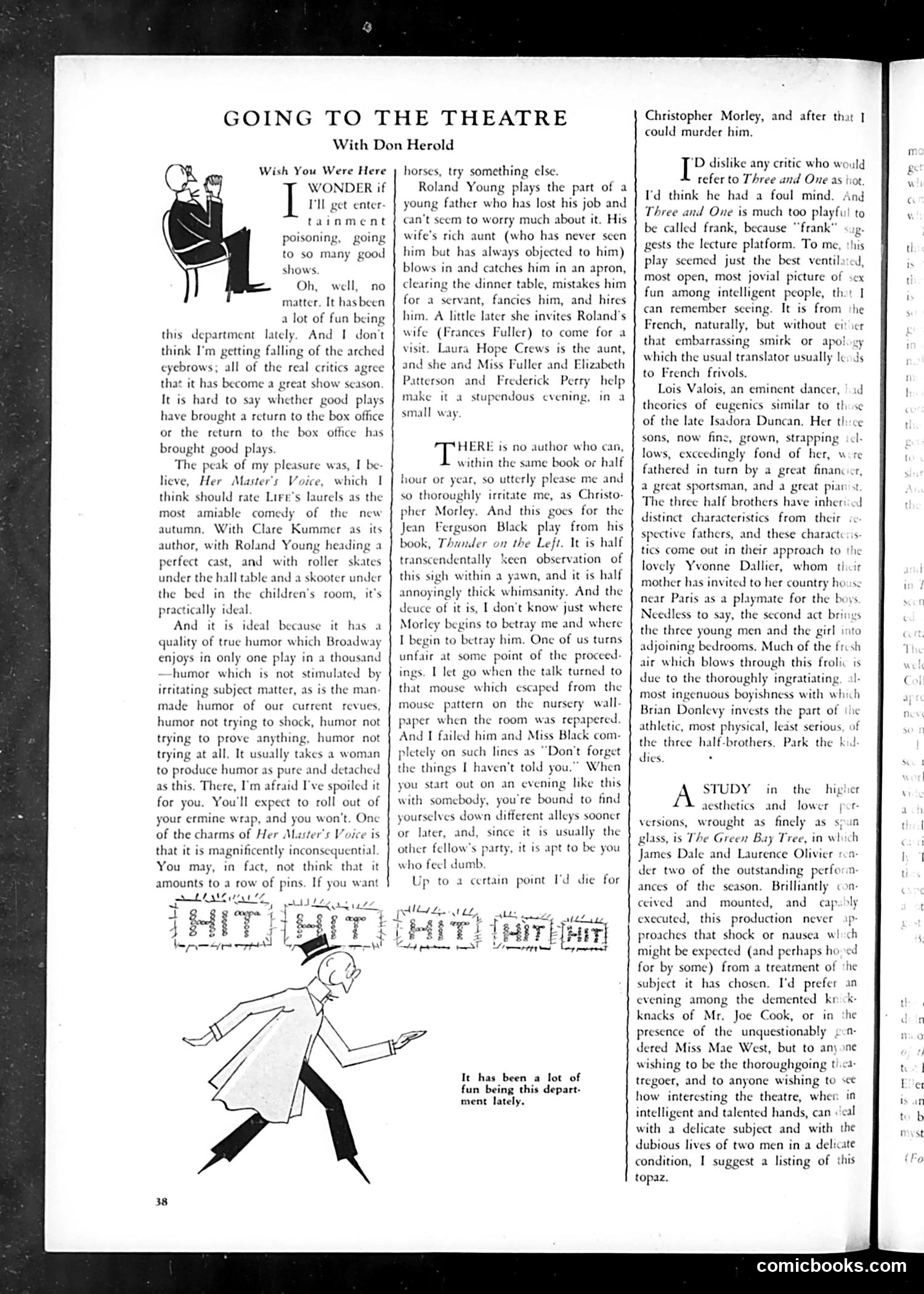
"Going to the Theatre" - Don Herold's Column This is a theater criticism column by Don Herold from *Life* magazine. The main cartoon shows a woman in an exaggerated pose, illustrating Herold's comedic point about theater-going. Herold reviews Broadway shows of the season, praising *Her Master's Voice* (starring Roland Young and Clare Kummer) as genuinely funny—humor that doesn't rely on shocking or proving a point. He contrasts this with other current comedies that force laughs. He then discusses his conflicted feelings about author Christopher Morley, whose play *Thunder on the Left* both delights and irritates him. Herold can't decide where Morley's keen observations end and his "annoyingly thick whimsanity" begins—making it unclear who has betrayed whom. The piece is essentially a witty complaint about theatrical inconsistency and the difficulty of assessing subjective artistic merit, wrapped in Herold's characteristically self-deprecating humor about his role as critic.
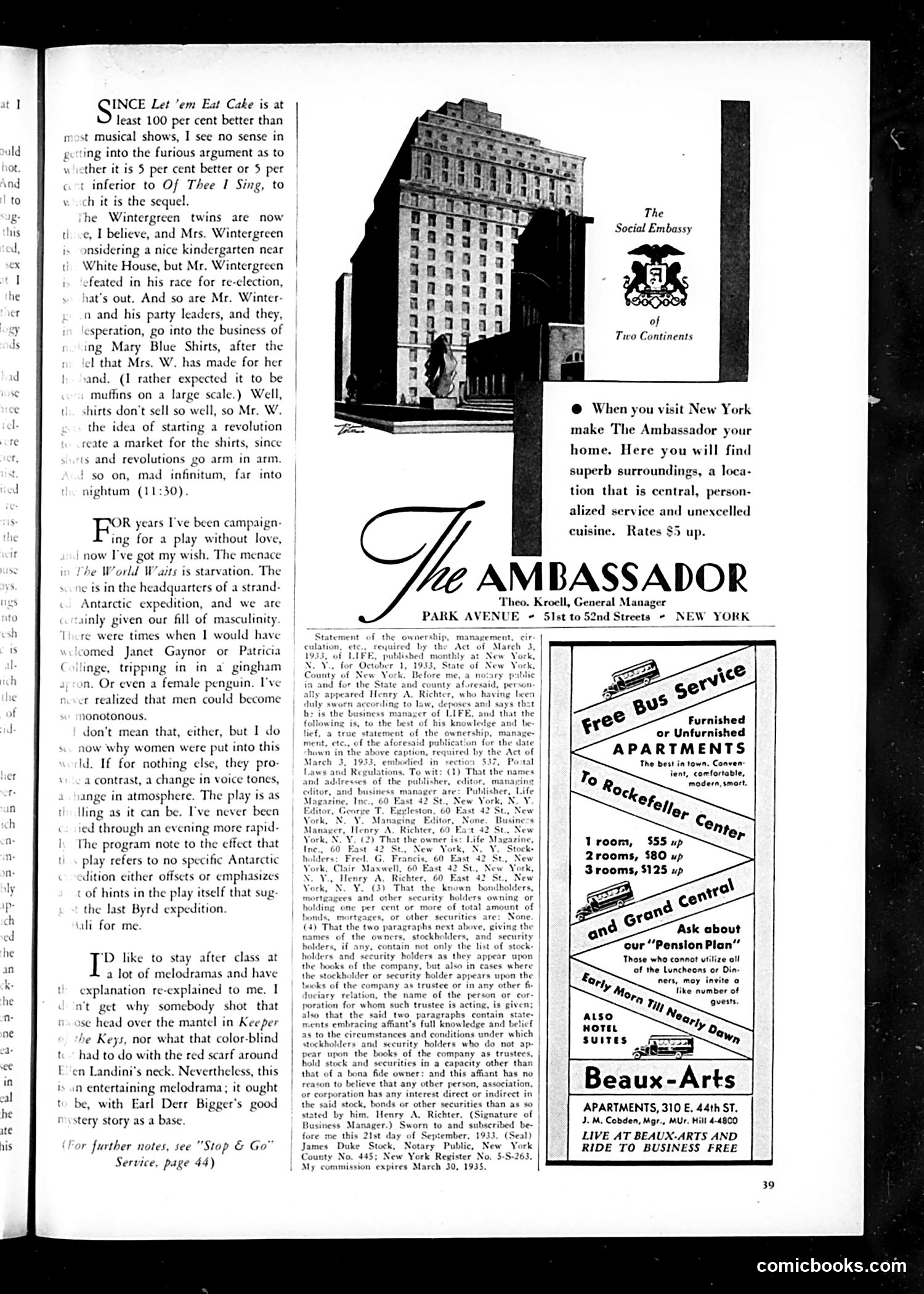
Life Magazine Page Analysis This page is primarily advertising and theater reviews, not political satire. The text discusses two Broadway musicals: *Let 'em Eat Cake* (sequel to *Of Thee I Sing*) and *The World Waits*. The reviewer praises *Let 'em Eat Cake* as superior entertainment. In the plot summary, the Wintergreen character (from the earlier show) loses his re-election bid and attempts to start a revolution to sell "Mary Blue Shirts"—a comedic escalation from political defeat to armed insurrection. *The World Waits* is criticized for being an all-male Antarctic expedition story with no female characters, which the reviewer finds monotonous despite the play's technical merits. The page's dominant content is real-estate and hotel advertisements (*The Ambassador*, *Beaux-Arts Apartments*), typical of Life magazine's revenue model. No political cartoon appears; the building illustration is promotional material for a hotel.
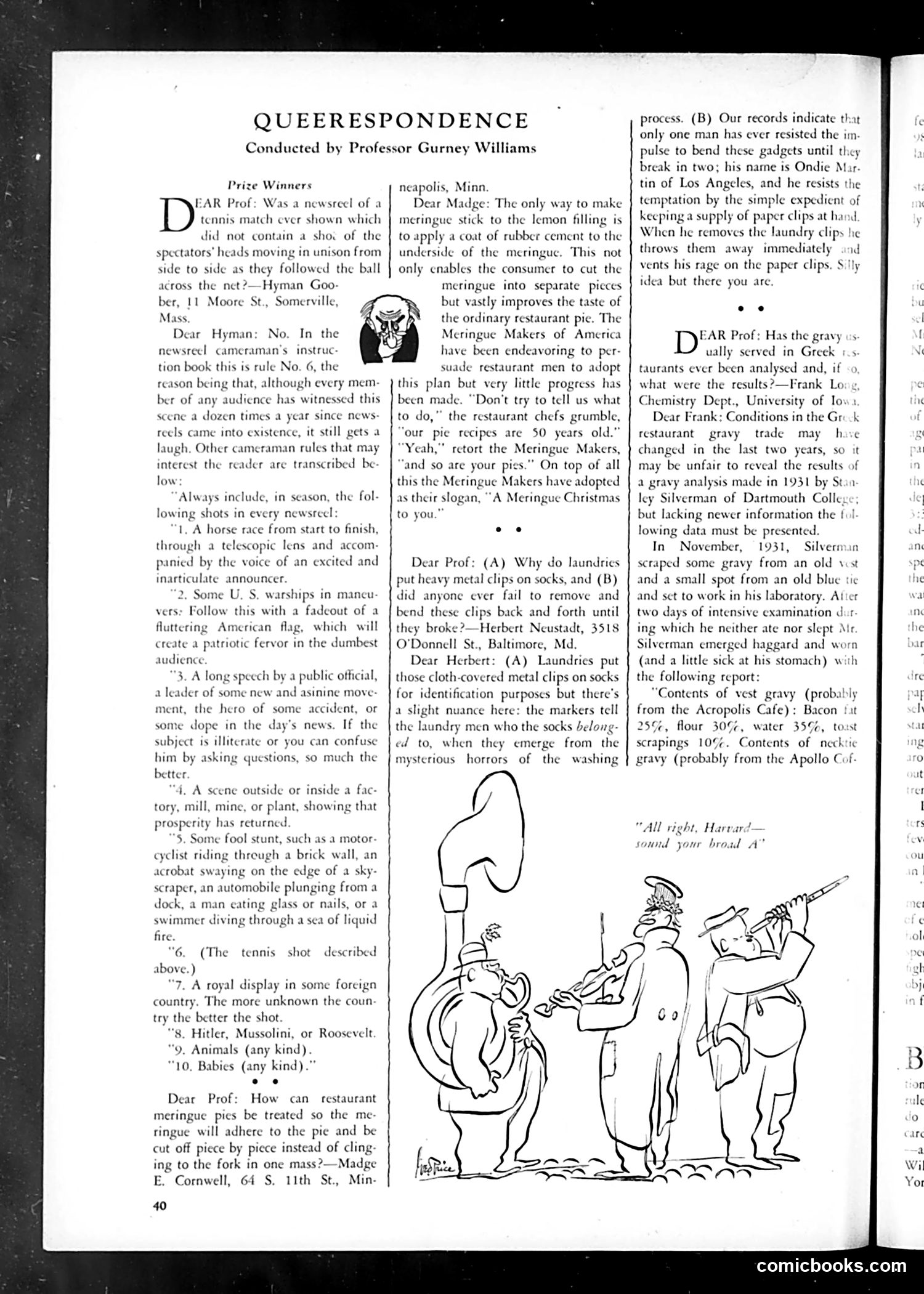
Explanation for Modern Readers This is a humor advice column called "Queerespondence," satirizing newsreels and consumer products of the era. The main cartoon (bottom right) illustrates absurd newsreel content: it shows figures engaged in ridiculous stunts—likely depicting the "fool stunt" category mentioned in the text. The column mocks newsreel conventions by listing mandatory shots, including patriotic imagery (warships, flags), political figures (Hitler, Mussolini, Roosevelt—contemporary leaders of the 1930s-40s), and crowd scenes. The satire ridicules both newsreel predictability and public appetite for repetitive, sensationalized content. The advice letters address mundane consumer problems (meringue adhesion, laundry clips) with deadpan, absurdist responses—the rubber cement suggestion for meringue is clearly a joke. This style of humor—mock-serious responses to trivial queries—was characteristic of Life magazine's satirical approach to American consumer culture and media.
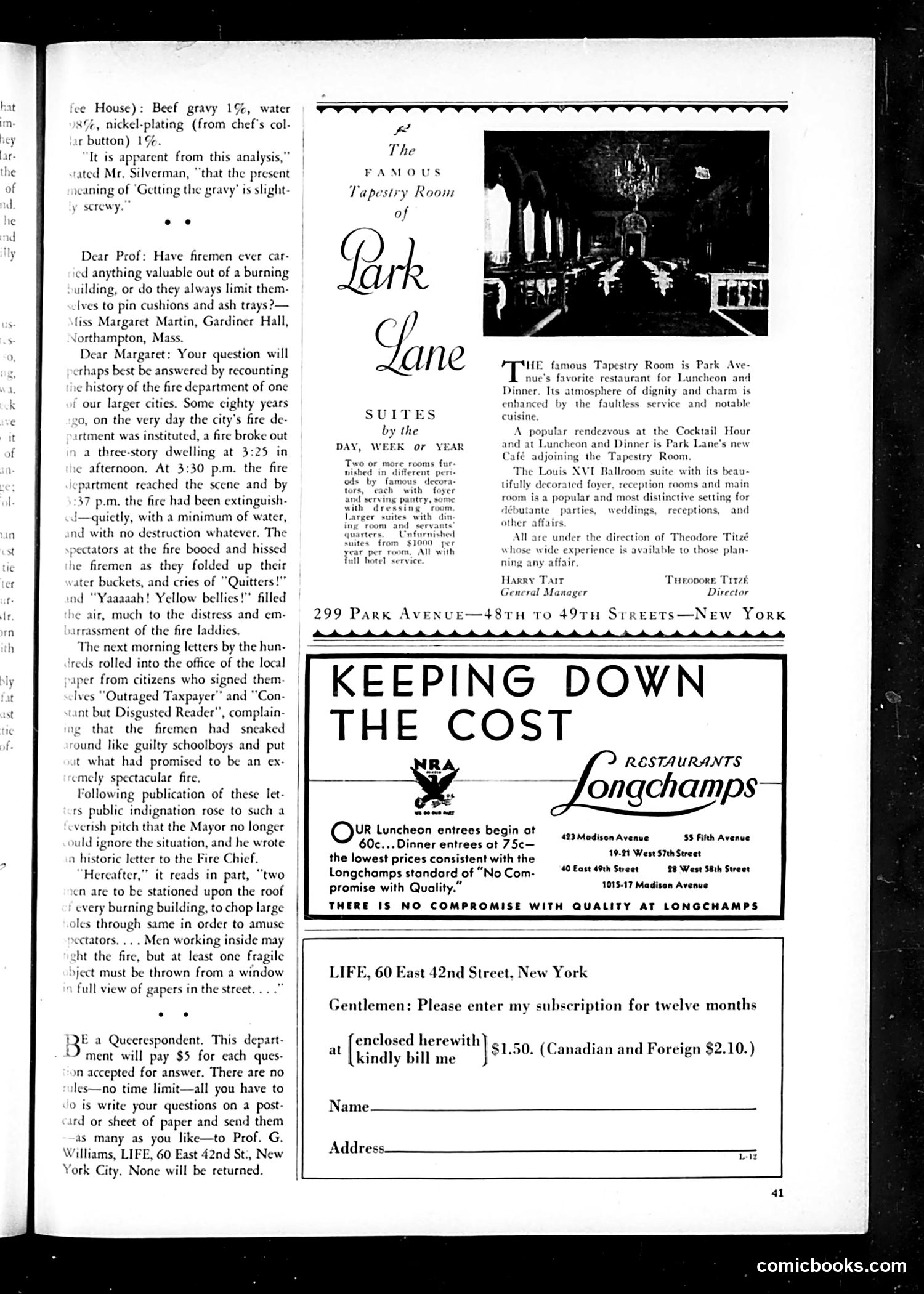
This page contains satirical advice columns typical of *Life* magazine, plus restaurant advertisements. The main humor appears in the column explaining how a fire department's professional efficiency—extinguishing a fire quickly with minimal water damage—angered spectators expecting dramatic destruction. Citizens complained, the mayor intervened, and now firemen are instructed to create spectacle: stationing men on roofs to demolish the building and throwing objects from windows for "gapers in the street" to watch. The satire mocks public expectations and municipal responsiveness to mob sentiment over rational governance. It suggests taxpayers paradoxically want both efficient services *and* entertaining disaster. The page also includes advertisements for upscale restaurants (Park Lane's Tapestry Room, Longchamps) emphasizing quality and reasonable pricing—standard early-20th-century magazine advertising.
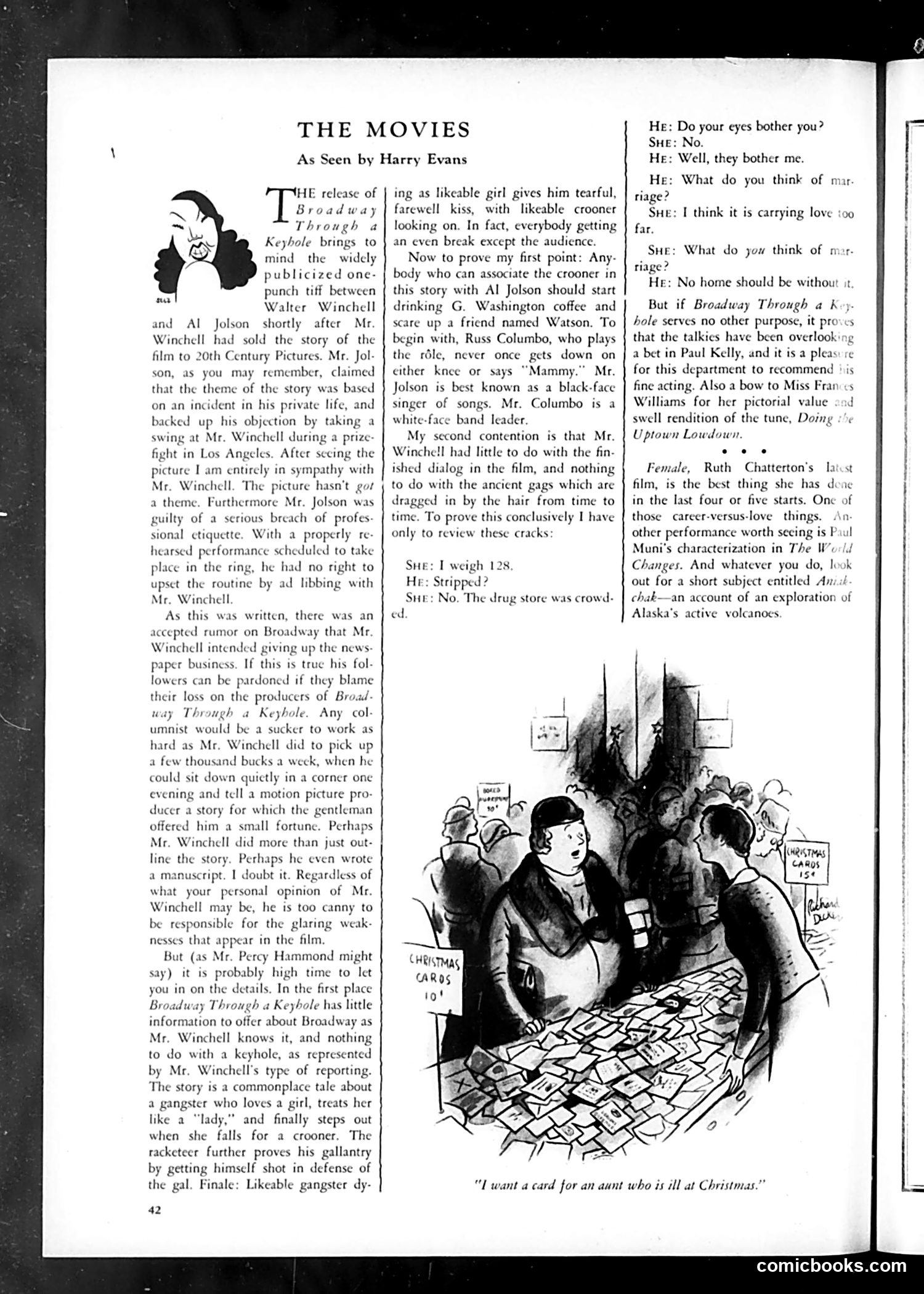
Life Magazine Movie Review: "Broadway Through a Keyhole" This page reviews the 1933 film "Broadway Through a Keyhole," which sparked real-life conflict between gossip columnist Walter Winchell and entertainer Al Jolson. Winchell sold the story to 20th Century Pictures; Jolson claimed it exploited his private life and punched Winchell at a Los Angeles prizefight. Critic Harry Evans defends Winchell, arguing the film lacks quality and that Jolson's grievance was unfounded—the crooner character (played by Russ Columbo, a white-faced band leader) bears no resemblance to Jolson, the famous blackface "Mammy" singer. Evans also mocks the film's dated, tired dialogue with examples of stale one-liners. The cartoon below shows Christmas shoppers browsing greeting cards, with one seeking "a card for an aunt who is ill at Christmas"—a gentle domestic humor unrelated to the film review.
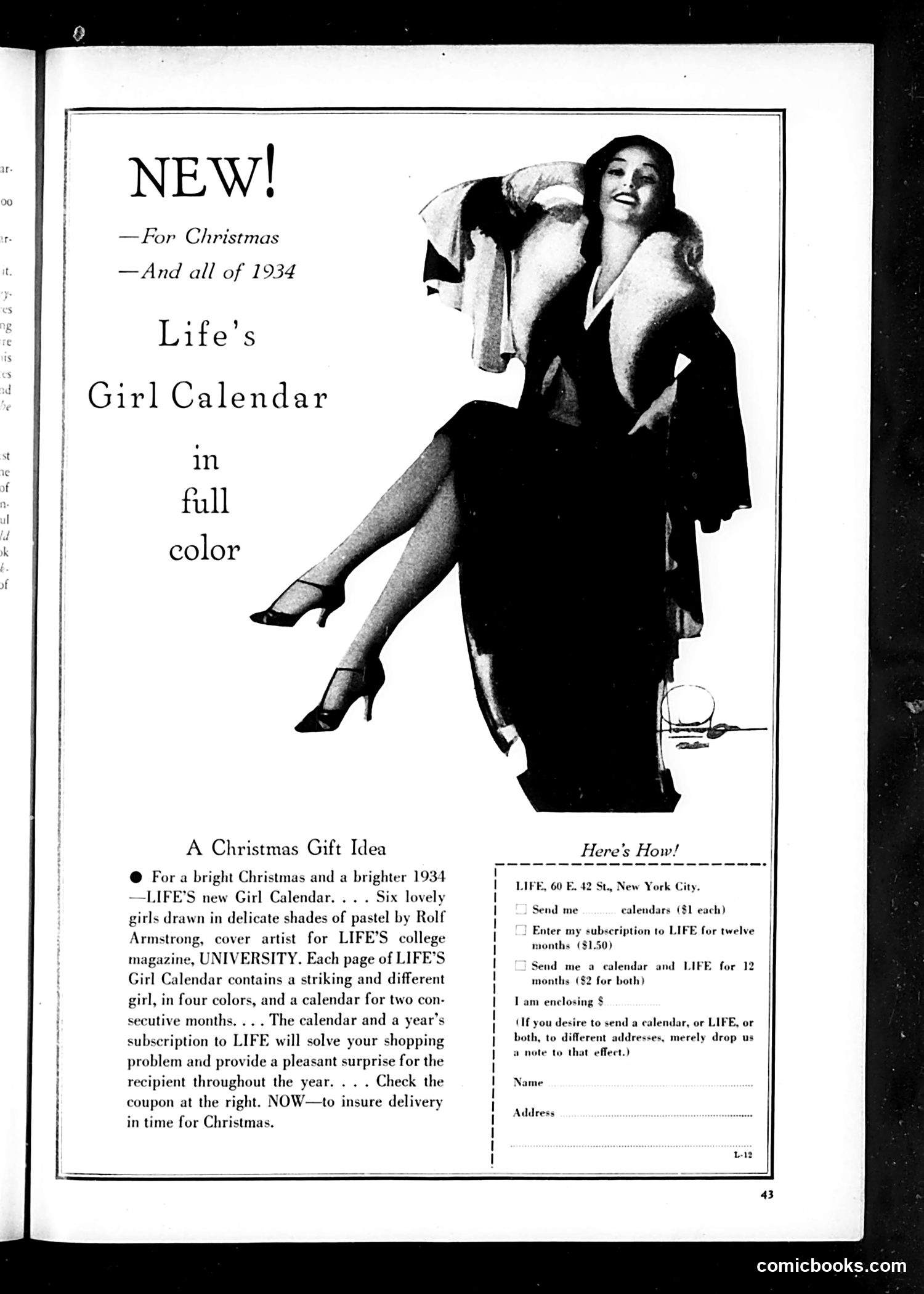
Life Magazine Advertisement, circa 1934 This is a product advertisement, not satire. Life magazine is promoting "Life's Girl Calendar" as a Christmas gift for 1934. The page features an illustration by Rolf Armstrong (a popular commercial illustrator of the era) depicting an attractive woman in fashionable winter clothing, positioned in a glamorous pose typical of 1930s advertising. The calendar itself consists of six illustrated girls in pastel colors by Armstrong, with each page displaying two months. The advertisement positions this as a dual gift: the calendar plus a year's subscription to Life magazine for $2 combined. This reflects common 1930s gift-giving practices and advertising conventions—pin-up style illustrated calendars were standard holiday merchandise. The appeal combines visual glamour with practical utility (calendar function), marketed specifically as convenient holiday shopping solutions.
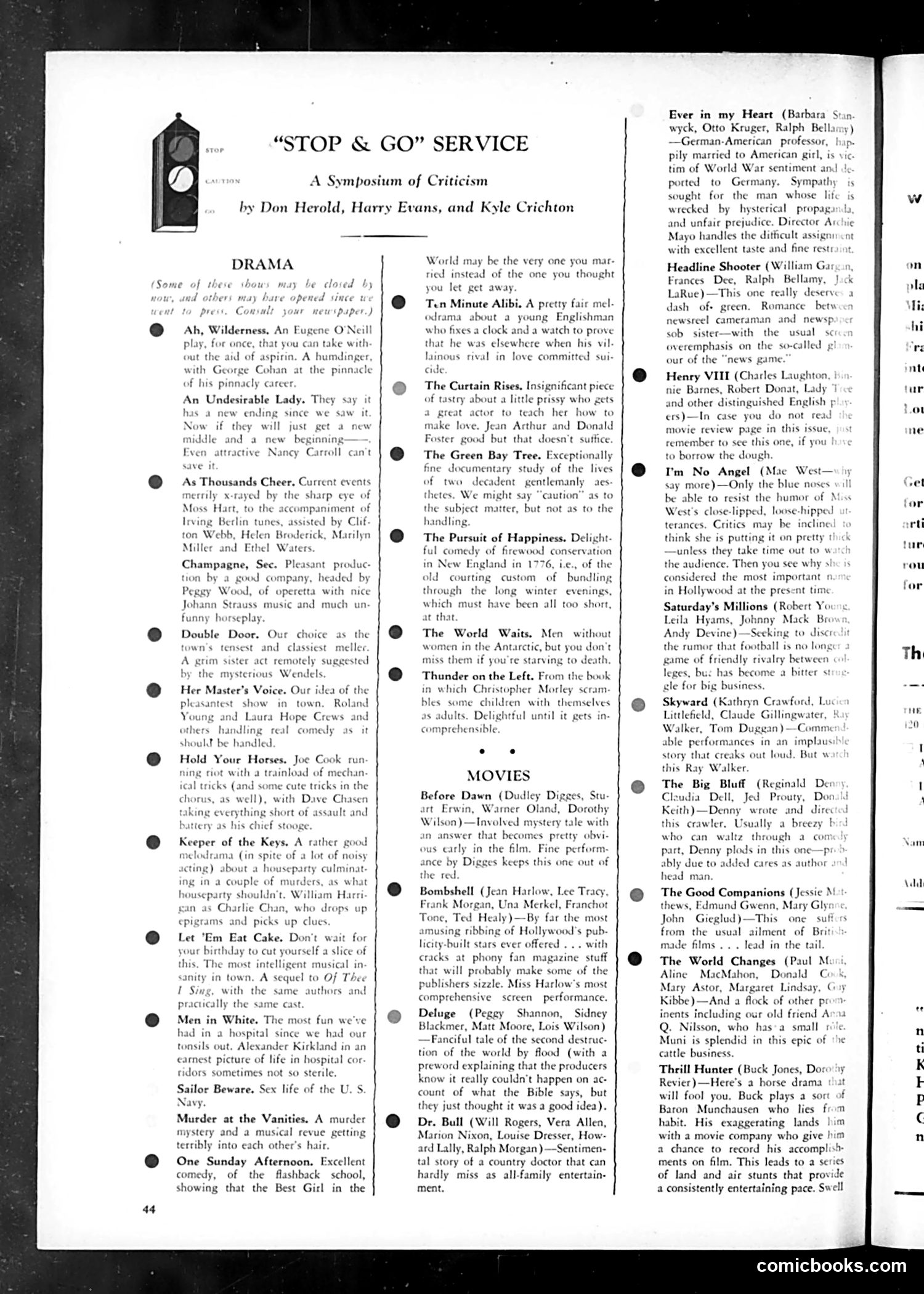
"Stop & Go" Service: A Theater Critic's Roundup This page presents brief reviews of Broadway plays and Hollywood films by three critics (Don Herold, Harry Evans, Kyle Crichton), using a traffic-light metaphor—"Stop & Go"—to indicate whether audiences should see or avoid each production. The reviews are witty, dismissive commentary: praising Eugene O'Neill's *Ah, Wilderness!* and the musical *Let 'Em Eat Cake* (a sequel to the successful *Of Thee I Sing*), while mocking lesser productions like *The Curtain Rises* (described as "insignificant") and *An Undesirable Lady* (criticized for needing rewrites). For films, Jean Harlow's *Bombshell* receives particular praise as "the most amusing ribbing of Hollywood's publicity-built stars ever offered." The reviews blend sharp wit with insider Broadway/Hollywood gossip, targeting contemporary audiences familiar with these productions and their casts.
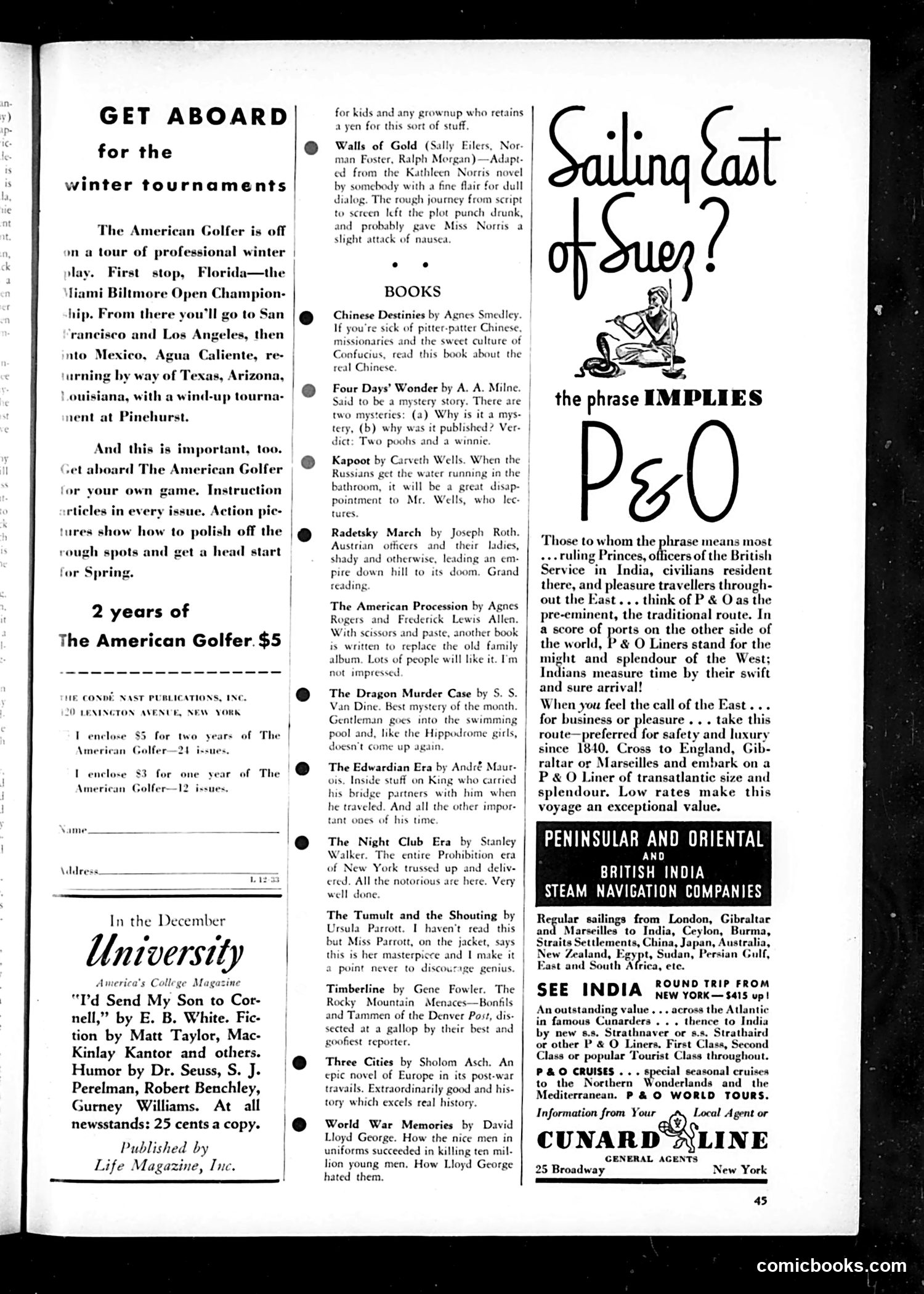
Magazine Page Analysis This page features golf tournament advertising and book reviews from a 1920s-30s *Life* magazine issue. The main content is promotional material for *The American Golfer* magazine and a book review column. The only cartoon element is a small illustration labeled "Sailing East of Suez?" showing a figure in colonial dress. It accompanies an advertisement for P&O (Peninsular and Oriental Steam Navigation Companies) shipping routes to India. The phrase "East of Suez" references Rudyard Kipling's colonial-era adventure fiction, evoking romance and British imperial travel to exotic destinations. The cartoon's humor is subtle: it playfully suggests that traveling with P&O is the traditional, prestigious route for British officers, colonial administrators, and wealthy tourists seeking adventure in India and the East—implying this is the proper way to "sail east of Suez." The book reviews are straightforward critical assessments, mostly dismissive in tone, typical of era's mordant literary criticism.
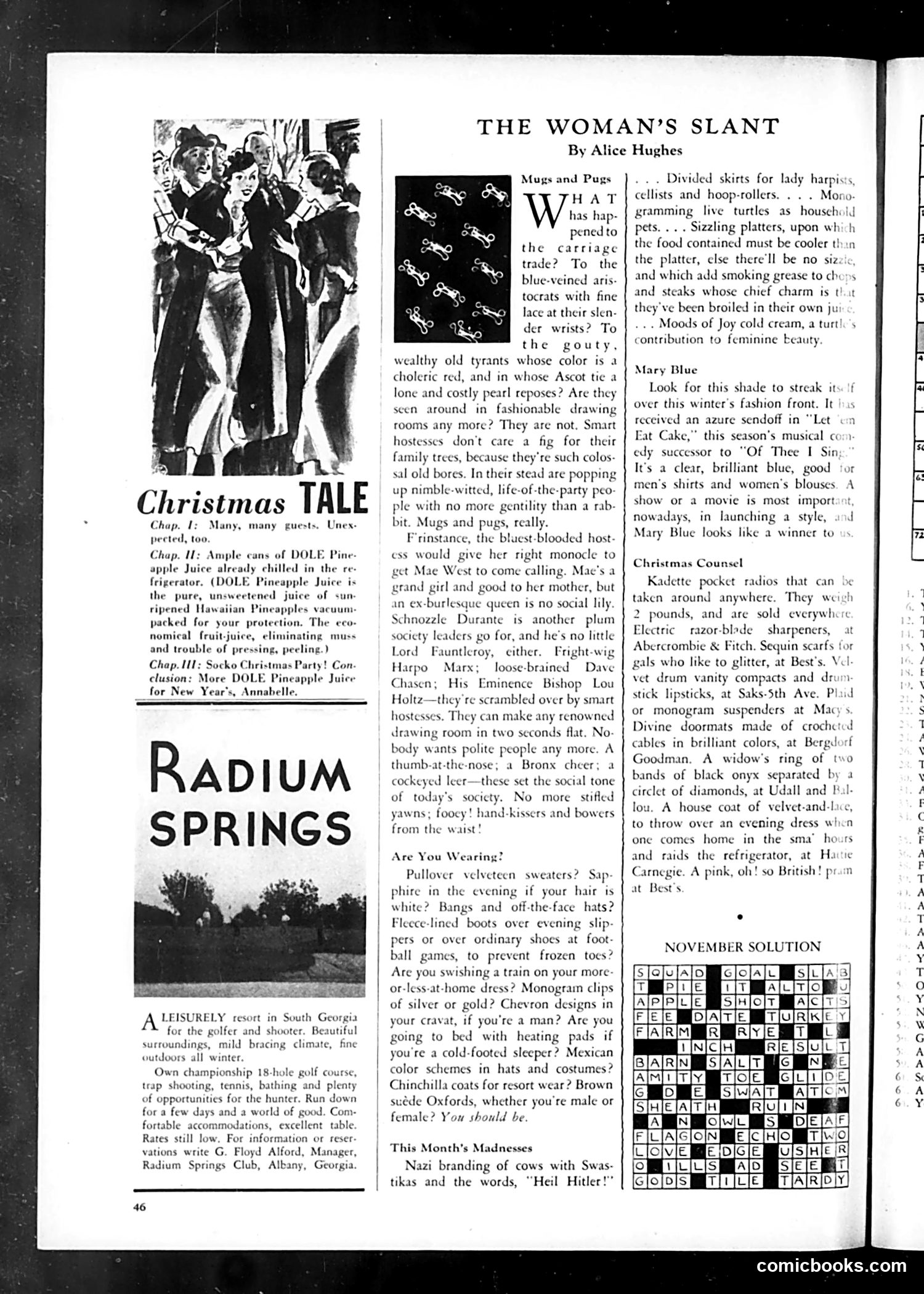
"The Woman's Slant" - Social Commentary on 1930s High Society This column by Alice Hughes satirizes the collapse of traditional aristocratic society during the Depression era. Hughes observes that wealthy, blue-blooded families with "fine lace at their slender wrists" are no longer fashionable hosts. Instead, smart society hostesses now court entertainers like Mae West (burlesque performer), Jimmy Durante ("Schnozzle"), and Harpo Marx—working-class performers with no gentility. The joke is that modern society values entertainment and personality over breeding and propriety. These "mugs and pugs" (common folk) who make rude gestures and Bronx cheers now set the social tone, replacing stiff formality. Hughes mocks both the old guard (boring "colossal old bores") and the nouveau riche obsession with celebrities. The column reflects Depression-era social upheaval where traditional hierarchies dissolved and entertainment culture gained unexpected cultural authority.
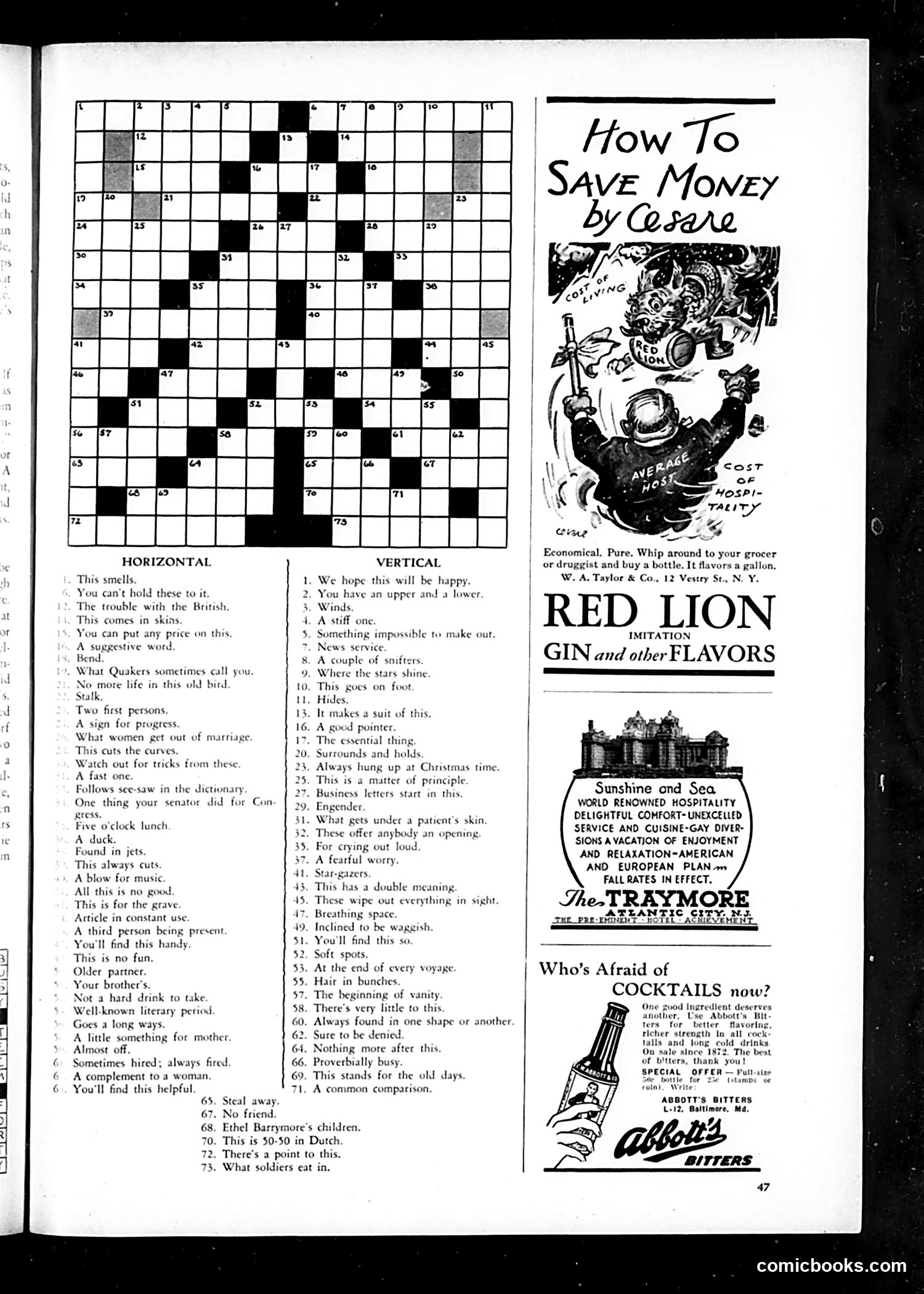
Analysis of Life Magazine Page This page is primarily a crossword puzzle with advertising, not political satire. The puzzle clues are clever wordplay typical of 1920s-30s humor—puns and riddles disguised as definitions (e.g., "This smells" = ODOR, "You can't hold these to it" = PROMISES). The advertisements reveal the page's historical context: Prohibition-era workarounds. Red Lion's "imitation gin" and Abbott's Bitters both advertise flavoring concentrates—legal products marketed as alcohol substitutes during the alcohol ban. The tagline "Who's Afraid of COCKTAILS now?" suggests these products let consumers recreate banned drinks at home, a common Prohibition-era practice. The hotel and gin advertisements acknowledge the absurdity: people could legally buy these "flavorings" to make their own liquor, circumventing Prohibition's intent. This represents consumer defiance of unpopular federal law through technically legal means—a significant social fact of the 1920s-30s.
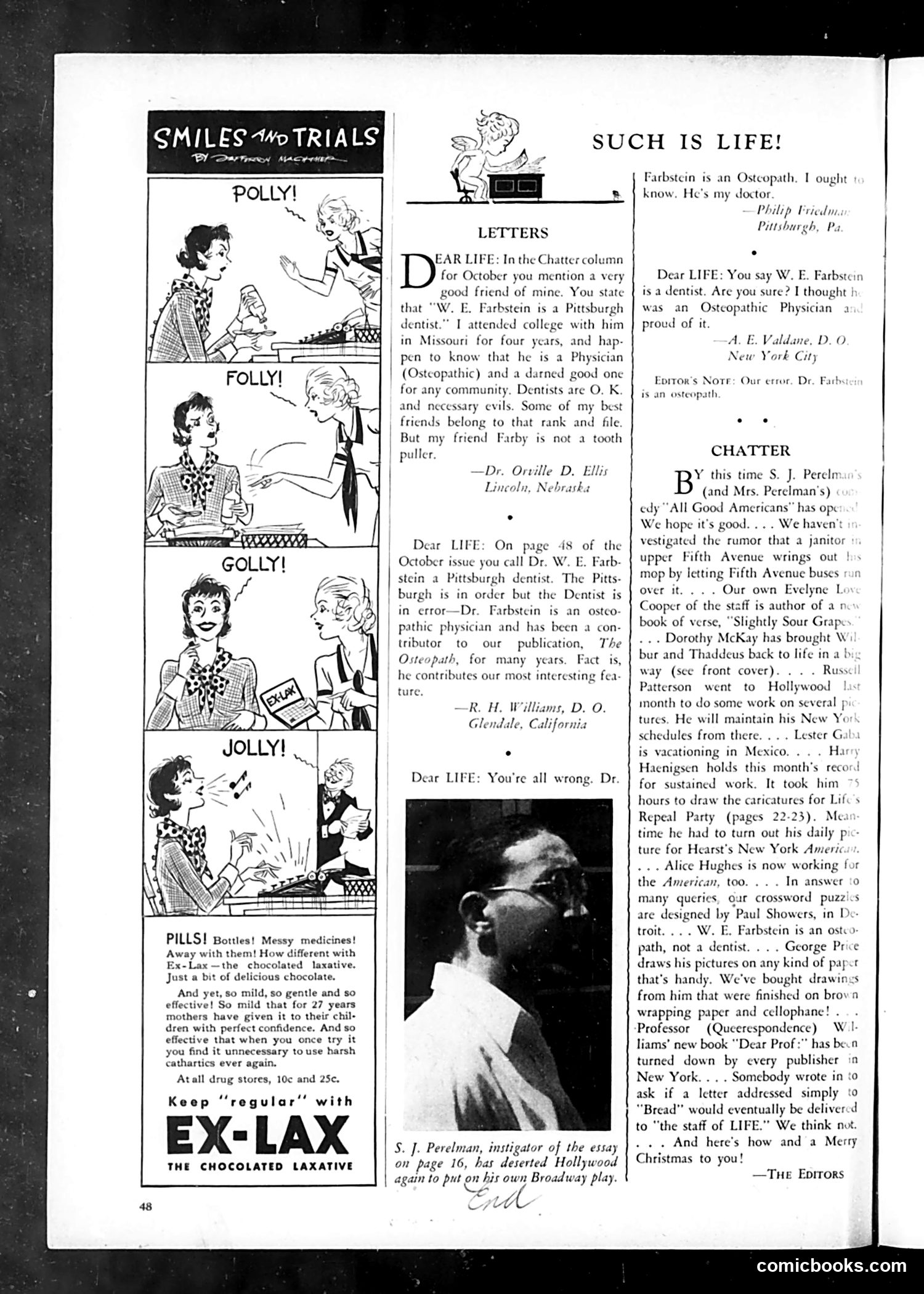
"Smiles and Trials" and the Farbstein Correction This page illustrates Life magazine's editorial process through a humorous correction cycle. The left panel shows a comic strip about a woman ("Polly/Folly/Golly/Jolly") experiencing the escalating effects of taking pills—clearly satirizing over-medication and the pill-popping culture of the era. The main content, however, focuses on reader letters correcting Life's October issue, which mistakenly identified Dr. W. E. Farbstein as a Pittsburgh dentist. Multiple readers—an osteopathic physician, Dr. Farbstein himself, and others—wrote in to clarify he was actually an osteopathic physician, not a dentist. The editors acknowledge the error. This reflects Life's satirical tone: the magazine playfully mocks its own mistakes while maintaining credibility through transparent corrections. The Ex-Lax advertisement alongside adds ironic context—the pill imagery connects thematically to the medication satire in the comic strip above.
I can see this is a page from Life magazine (indicated by the "comicbooks.com" watermark), but the page itself appears to be almost entirely blank or blank-white with only fragmentary text visible along the left margin that is too degraded to read clearly in the image. Without being able to see actual cartoon illustrations or legible text content, I cannot identify specific figures, political references, or explain the satirical point of any content on this page. The image quality and condition make it impossible to discern what the page's subject matter actually is. To provide accurate historical analysis, I would need a clearer, more complete image of the page with readable text and visible cartoon illustrations.