life
Life — January 1934
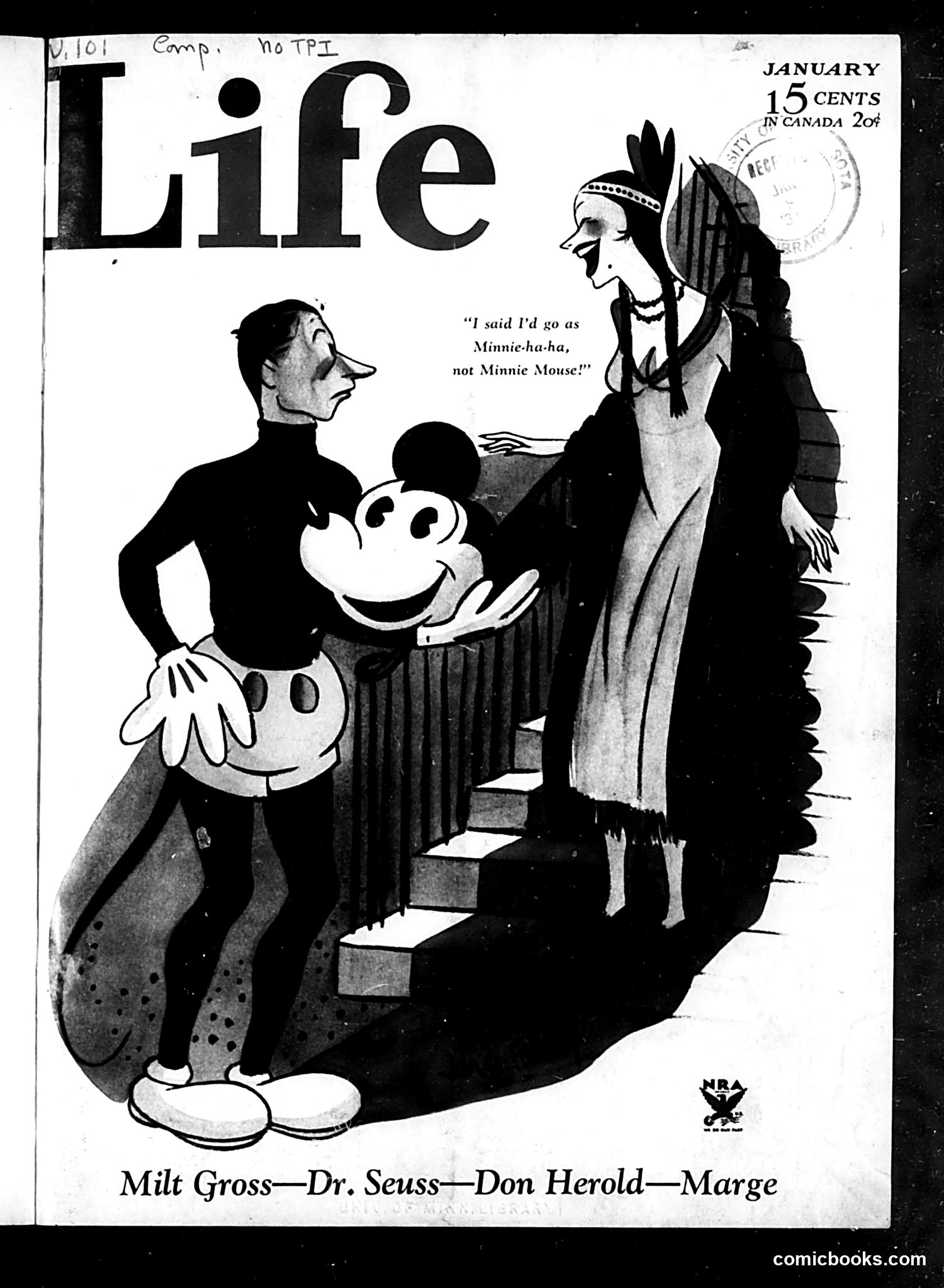
Life Magazine Cover Analysis This January issue cover depicts a man in blackface portraying a Native American character, holding a mouse costume. The caption reads: "I said I'd go as Minnie-ha-ha, not Minnie Mouse!" The joke plays on a pun: "Minnie-ha-ha" (a stereotypical Native American name) versus "Minnie Mouse" (the Disney character). The man appears disappointed about the costume mix-up at what seems to be a costume party or masquerade event. The credits list Milt Gross, Dr. Seuss, Don Herold, and Marge as contributors. This reflects the magazine's typical satirical humor combining wordplay with visual gags. The blackface and stereotypical Native American depiction represent casual racial caricature common in early-to-mid 20th century American popular culture, now widely recognized as offensive.
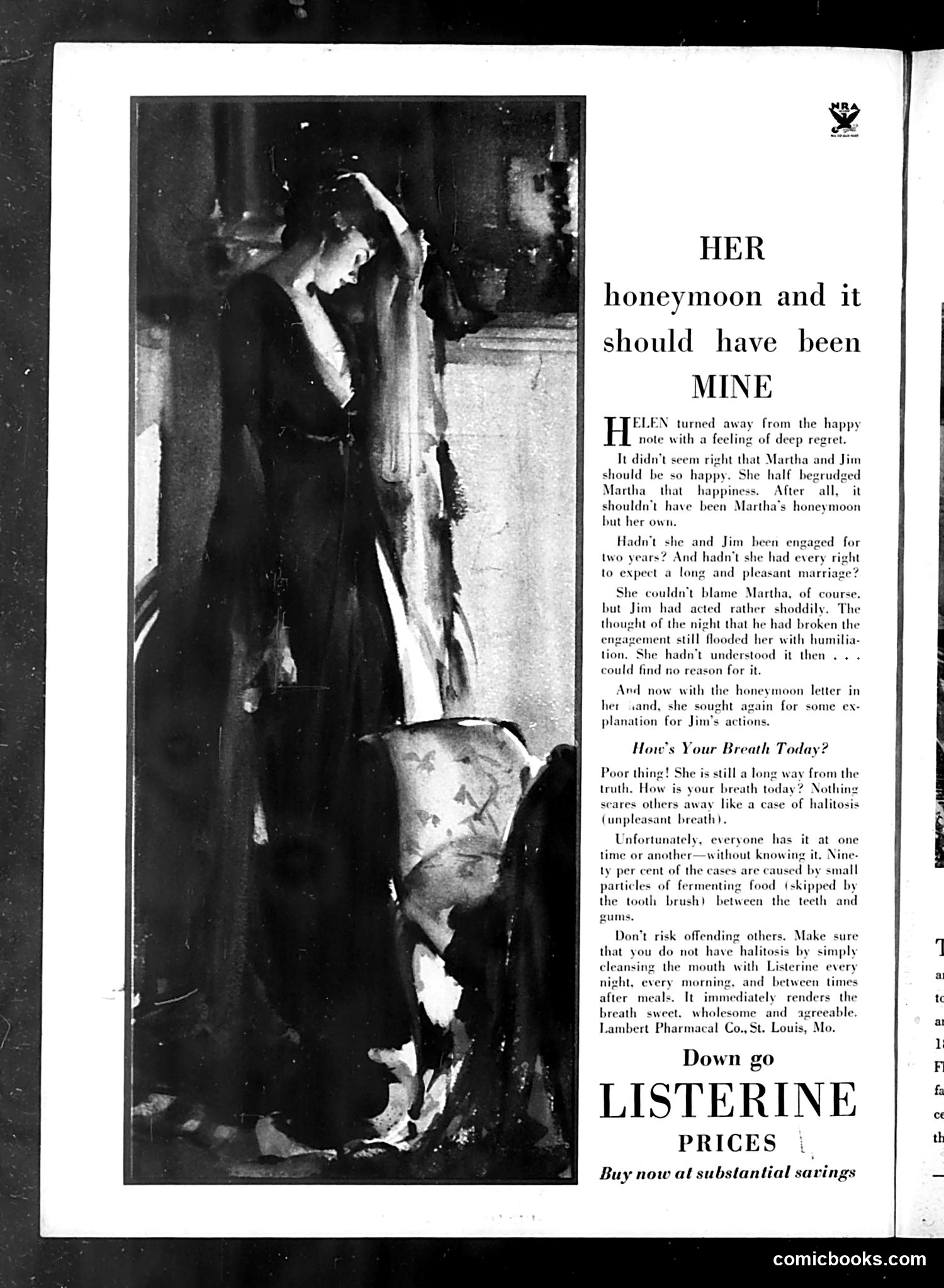
Page Analysis This page combines fiction and advertising. The left side shows a black-and-white photograph illustrating a short story titled "HER honeymoon and it should have been MINE," about a woman named Helen who is jealous that her friend Martha is enjoying a honeymoon with Jim—a man Helen had been engaged to for two years. The right side is a Listerine advertisement exploiting social anxiety. It warns readers about "halitosis" (bad breath), claiming this common condition could damage relationships and social standing. The ad promotes using Listerine mouthwash as a solution, emphasizing that doing so makes breath "sweet, wholesome and agreeable." This represents typical mid-20th-century advertising strategy: create anxiety about a personal problem, then sell the product as a cure.
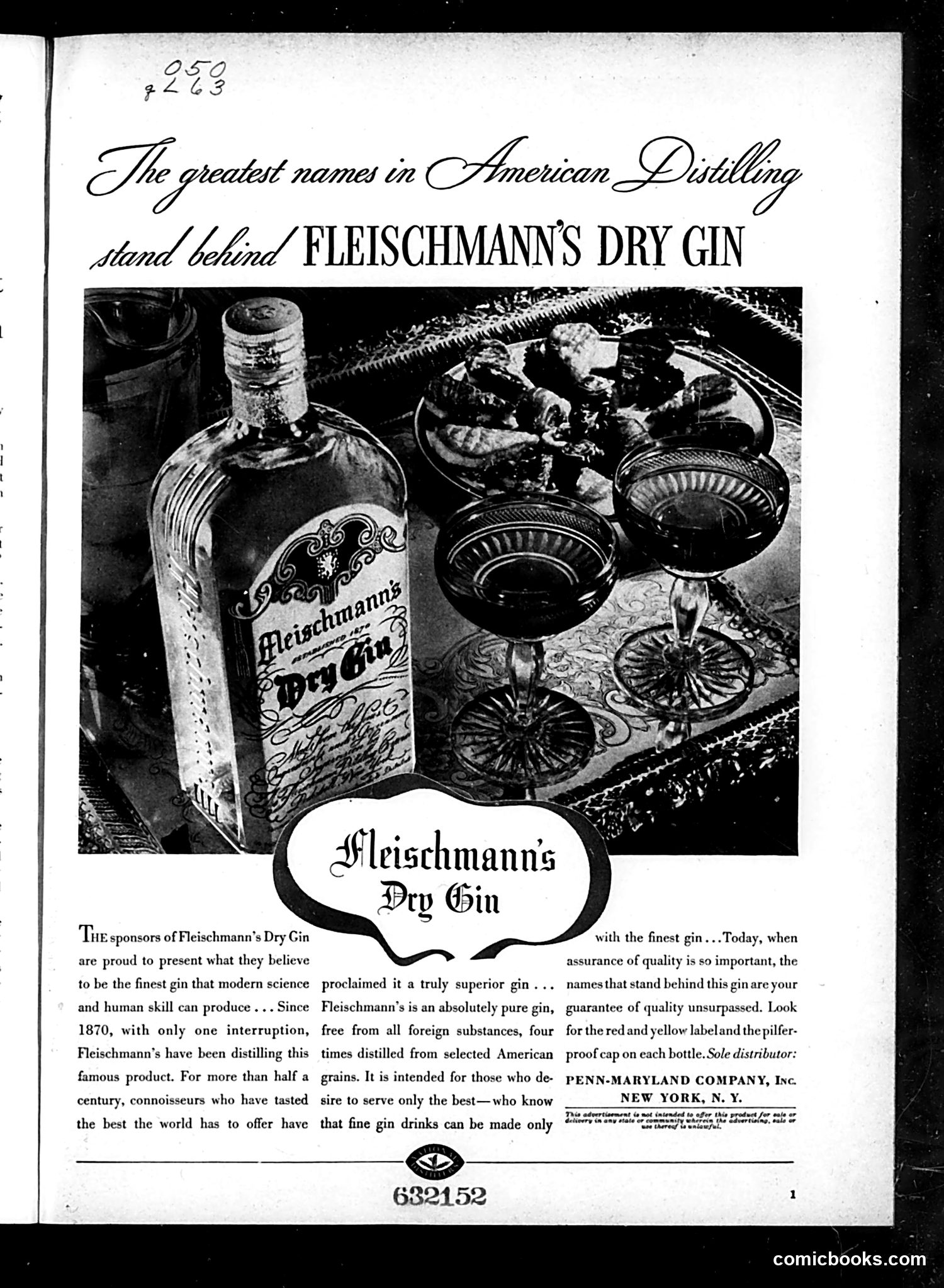
Analysis This is not a cartoon or satire—it's a full-page advertisement for Fleischmann's Dry Gin. The ad features a bottle of the product alongside elegant cocktail glasses on what appears to be a decorative tray. The marketing text emphasizes that Fleischmann's has been distilling continuously since 1876 and claims to produce "the finest gin that modern science and human skill can produce." It highlights purity and quality, noting the gin is distilled from American grains and contains no foreign substances. The distributor is listed as Penn-Maryland Company, Inc. of New York. This represents typical early-to-mid 20th-century luxury alcohol advertising, positioning the product as a premium choice for discerning consumers.
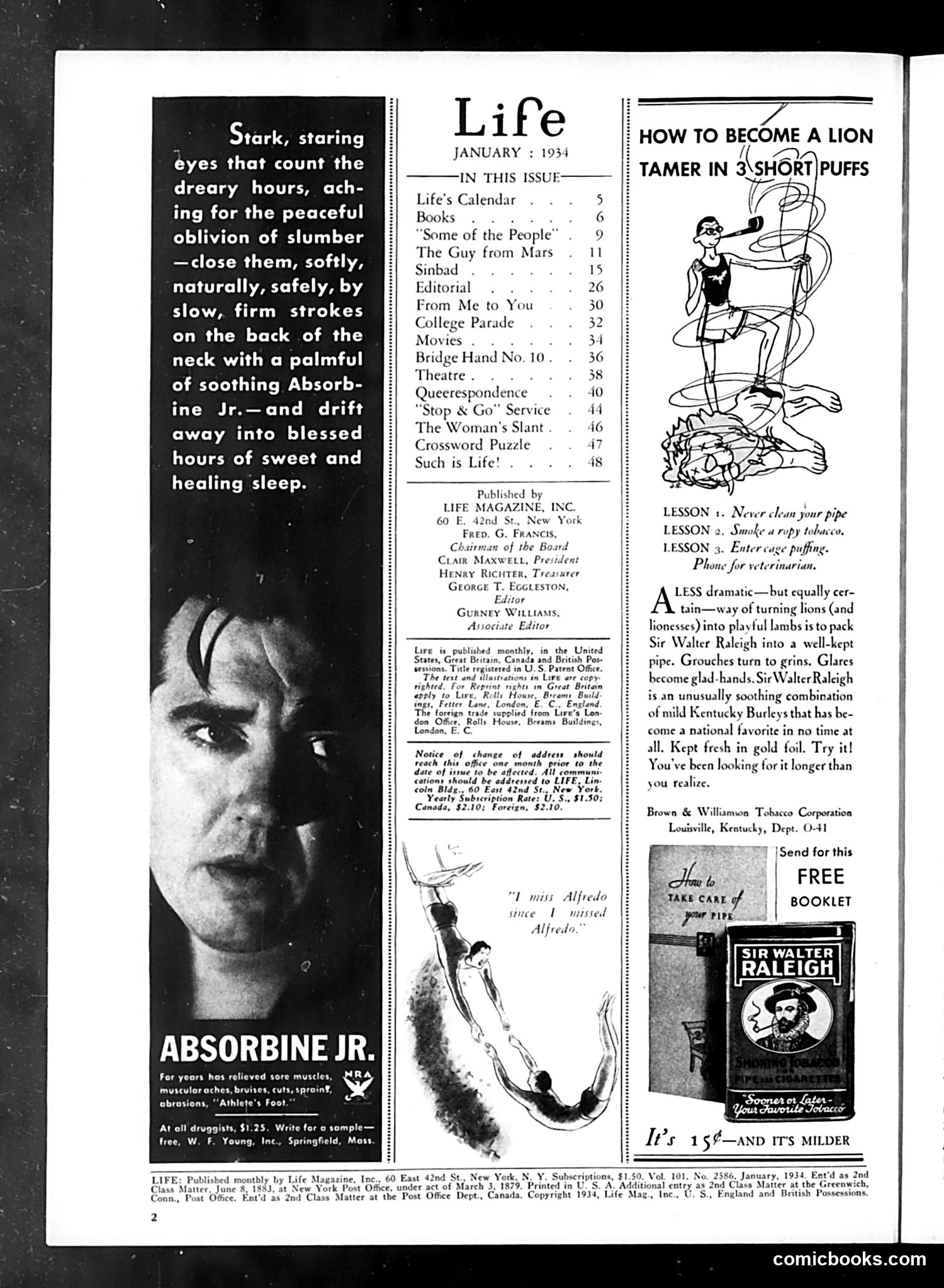
This page is primarily advertising and table of contents for Life magazine's January 1934 issue. The left column features an Absorbine Jr. advertisement with a close-up photograph of a man's face, promoting the liniment for "sore muscles, muscular aches, bruises, raft, sprains, abrasion, Athlete's Foot." The right side contains a humorous instructional piece titled "How to Become a Lion Tamer in 3 Short Puffs," illustrated with cartoon drawings showing someone taming a lion using tobacco pipes. This appears to be satirizing both lion-taming and tobacco advertising by suggesting smoking makes one fearless enough to handle dangerous animals. The Sir Walter Raleigh tobacco advertisement at bottom right includes a quote and promotes a free booklet about pipe care, tying tobacco use to sophistication and leisure. The page reflects 1930s advertising conventions and consumer product promotion.
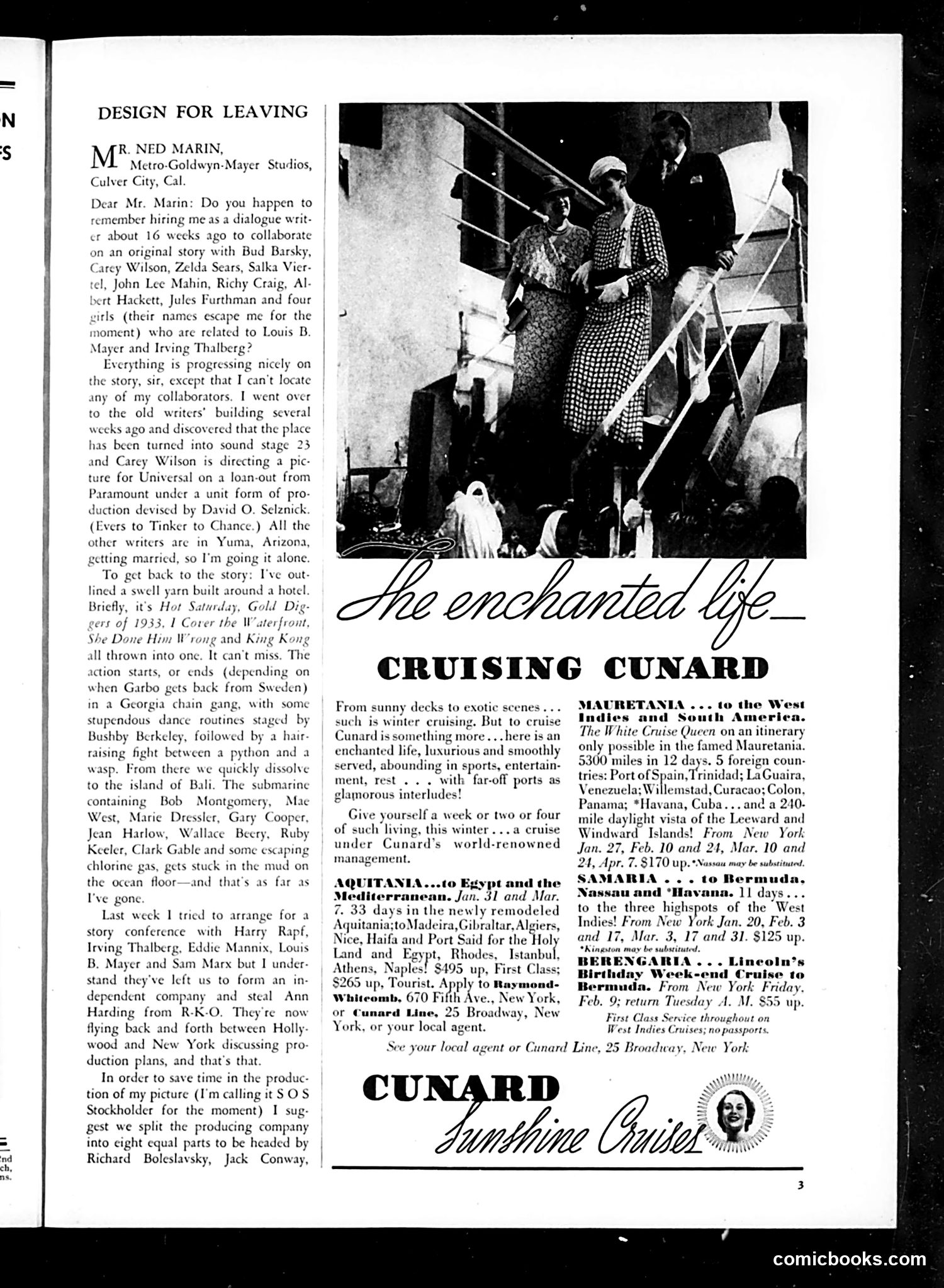
Analysis This page is primarily advertising and editorial content, not political satire. The left column contains a letter from a writer (signed "M") to Ned Marin at Metro-Goldwyn-Mayer Studios, discussing screenplay collaboration on an original story involving multiple writers (Bud Barsky, Carey Wilson, and others listed). The writer describes production challenges, including relocating to film at a former writers' building now converted to "sound stage 23." The right side features a Cunard cruise line advertisement titled "The Enchanted Life: Cruising Cunard." It includes a photograph of passengers boarding a ship and promotes luxury Caribbean and Mediterranean voyages aboard the White Cruise Queen, emphasizing "sports, entertainment, and glamorous interludes." This represents typical 1930s magazine content mixing industry correspondence with aspirational travel advertising.
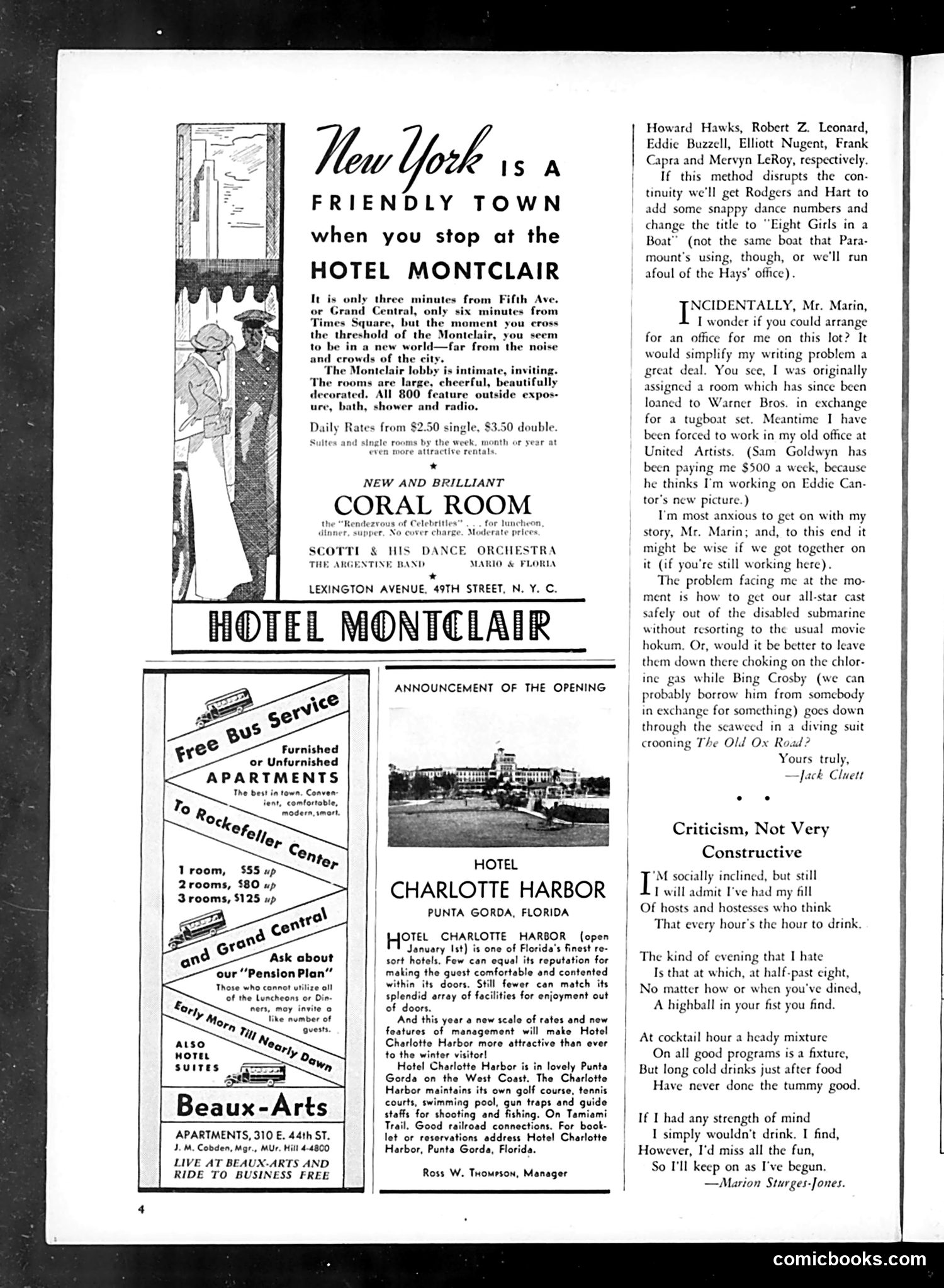
Page Analysis This page is primarily advertising and letters to the editor rather than political cartoons. The advertisements promote New York hotels (Hotel Montclair, Hotel Charlotte Harbor), apartments with "free bus service" to Rockefeller Center, and the Beaux-Arts apartments building. The right column contains reader letters. One correspondent (Jack Cluett) humorously describes Hollywood production challenges, mentioning actor Bing Crosby and a comedic scenario involving a disabled submarine and "The Old Ox Road." Below that is a poem titled "Criticism, Not Very Constructive" by Marion Sturges-Jones criticizing cocktail hour culture. This is not a satirical cartoon page—it's a standard magazine layout mixing commercial ads with reader correspondence and light verse, typical of Life magazine's format during this era.
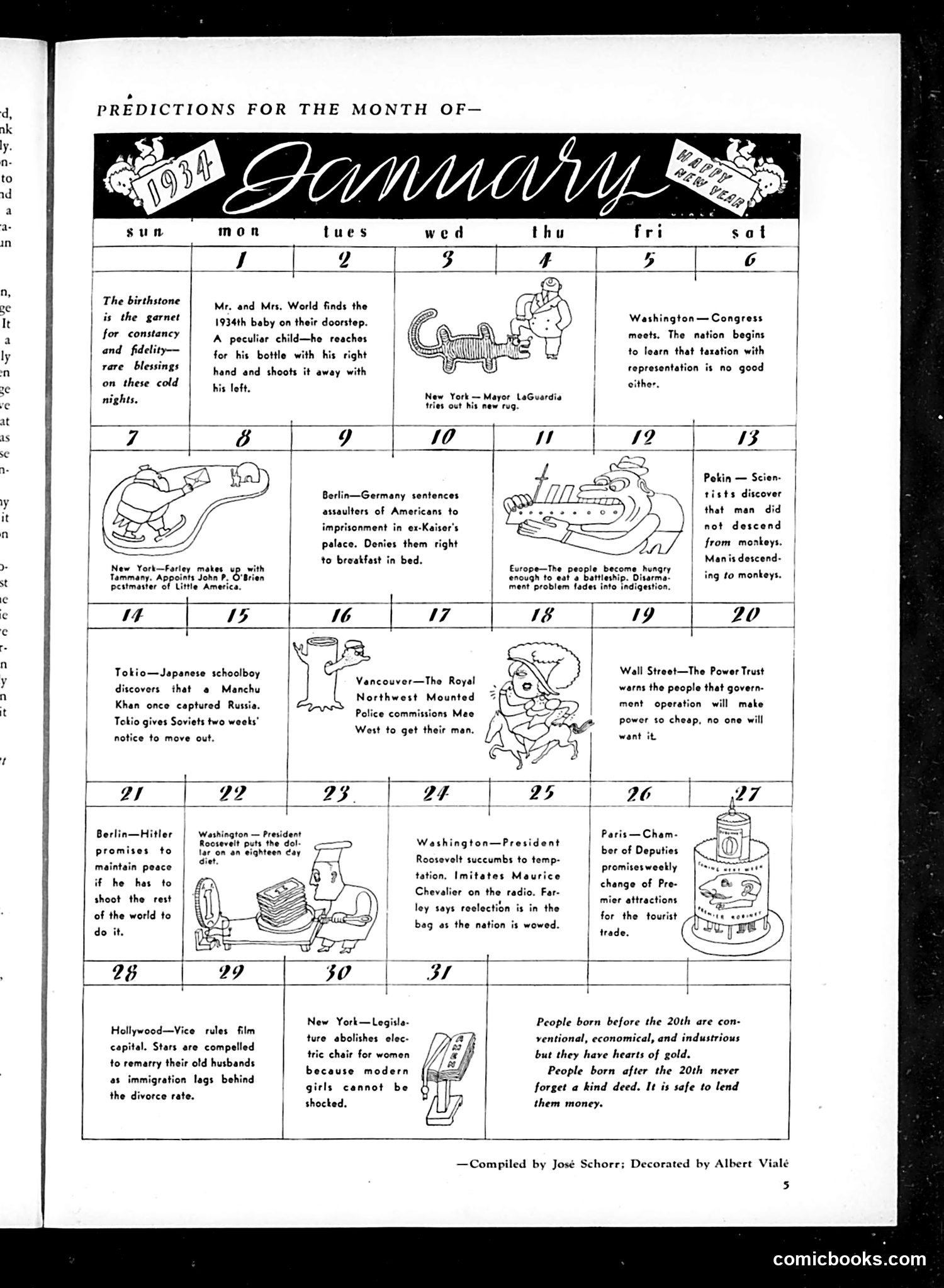
January 1924 Predictions Calendar This satirical calendar presents humorous "predictions" for January 1924, mocking current events and public figures. Key references include: - January 2: "Mr. and Mrs. World" having a baby—satirizing generalized world affairs - January 10: Berlin–Germany mocking American demands regarding the Kaiser's palace - January 22-25: President Roosevelt (likely Theodore, given the 1924 date) featured in multiple predictions about peace promises and temptation - January 30: New York legislature abolishing electric chairs for women because "modern girls cannot be shocked"—satirizing both gender attitudes and criminal justice The cartoons use exaggeration and absurdist humor to mock political hypocrisy, gender stereotypes, and international tensions of the era. The predictions are intentionally ridiculous, presenting the opposite of likely outcomes.
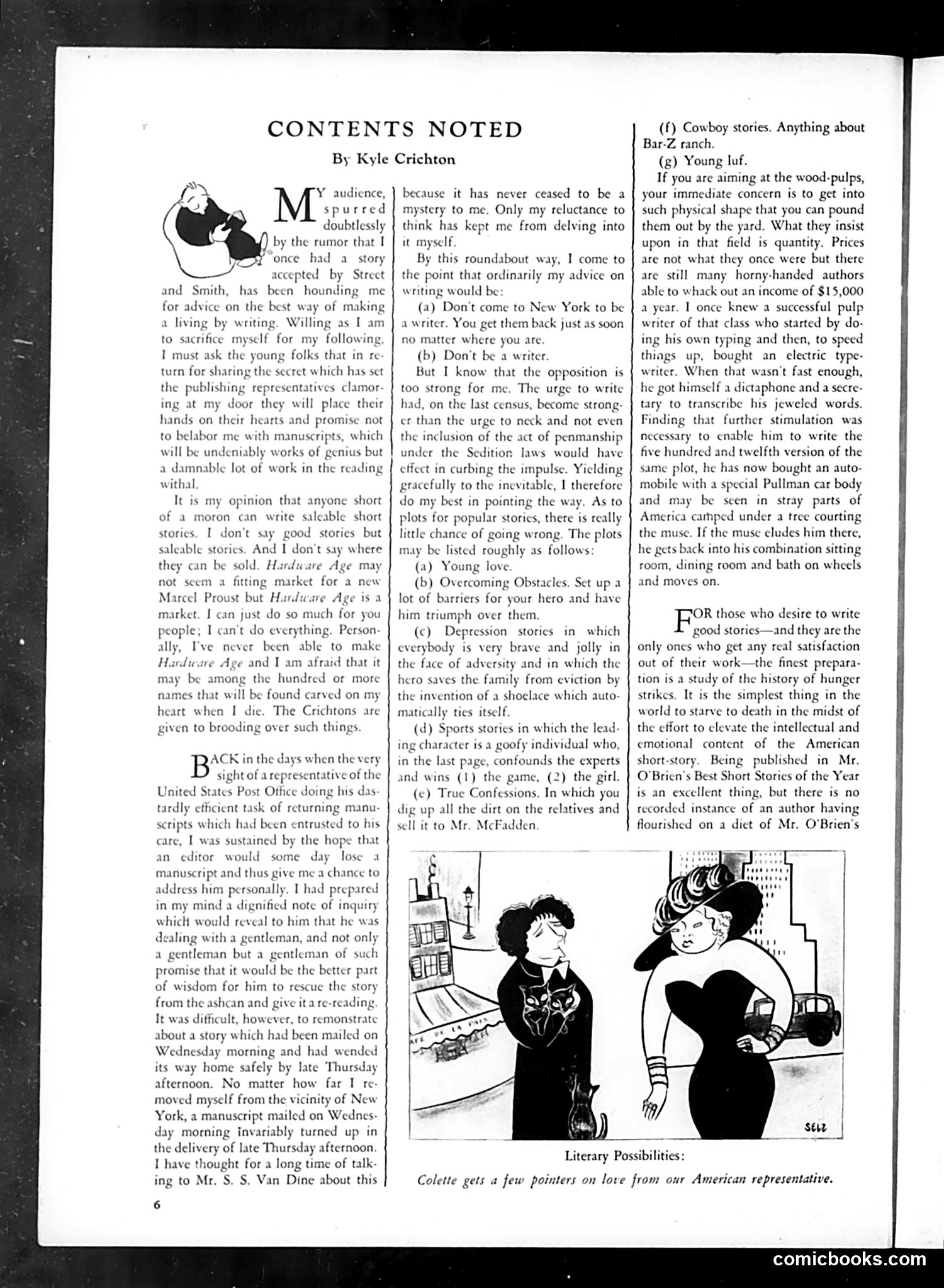
"Contents Noted" by Kyle Crichton This page features Kyle Crichton's editorial advice on writing, particularly short stories for publication. The accompanying cartoon illustrates "Literary Possibilities: Colette gets a few pointers on love from our American representative." The cartoon depicts two women—one appears to be the French writer Colette (identifiable by the caption), receiving romantic advice from what the text calls "our American representative." The satire targets the contrast between European literary sophistication and American cultural presumption: an American woman confidently dispensing romantic guidance to an internationally celebrated French author known for her sophisticated treatment of love and desire in literature. The joke mocks American cultural attitudes of the period—the assumption that American perspectives on romance could instruct a French literary master.
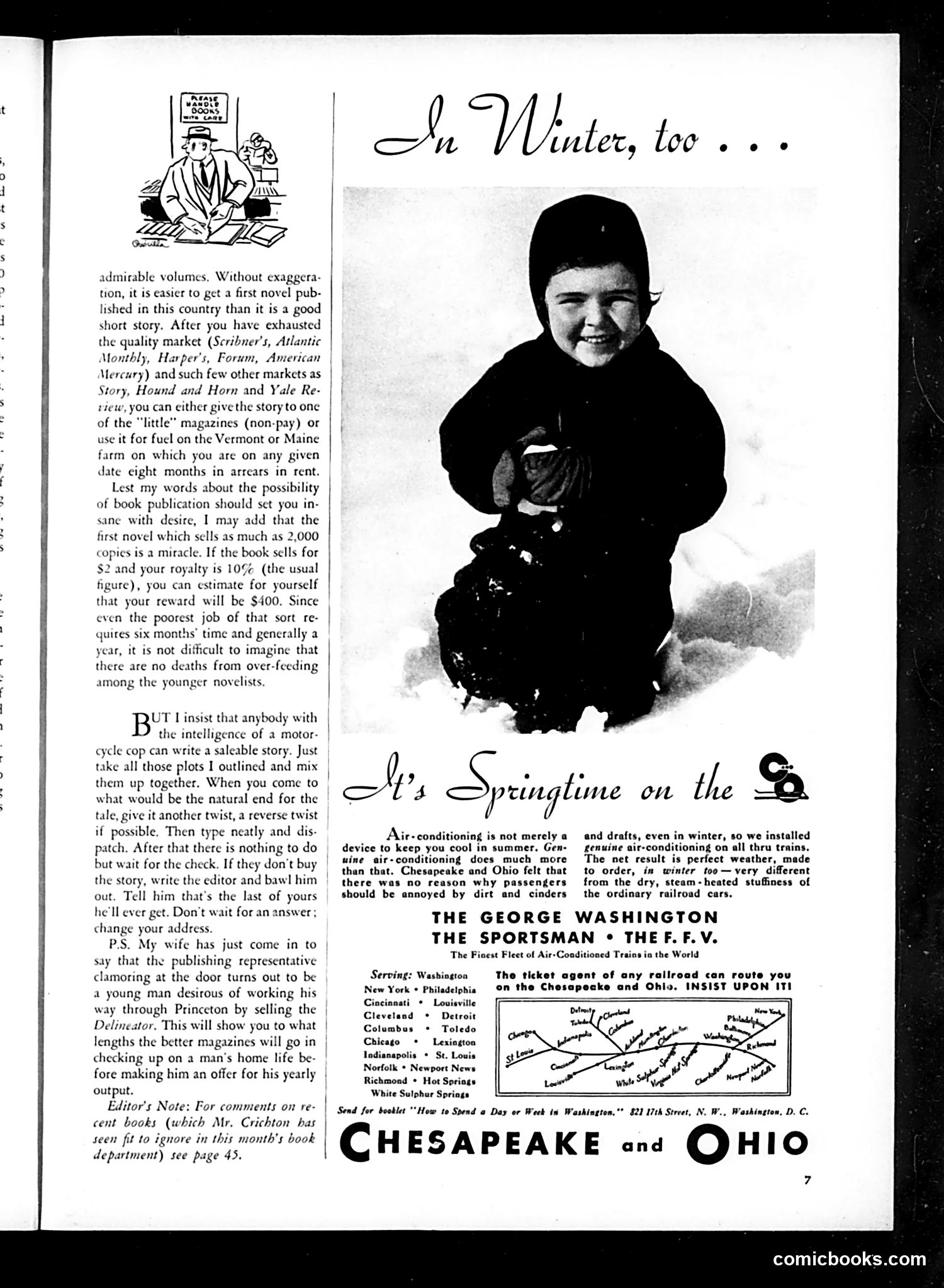
Page Analysis This page is primarily an advertisement for Chesapeake and Ohio Railway trains, not a political cartoon. The large image shows a smiling child in winter clothing sitting in snow, accompanying the headline "In Winter, too... It's Springtime on the C&O." The ad's main point: the railway's trains feature air-conditioning year-round, making winter travel as comfortable as spring. The text emphasizes that air-conditioning prevents summer heat and winter drafts/cinders—problems on ordinary railroad cars. The left column contains editorial commentary about publishing opportunities for short-story writers in various magazines, unrelated to the advertisement. This is commercial advertising using a cheerful winter scene to promote modern train amenities, not satire or political commentary.
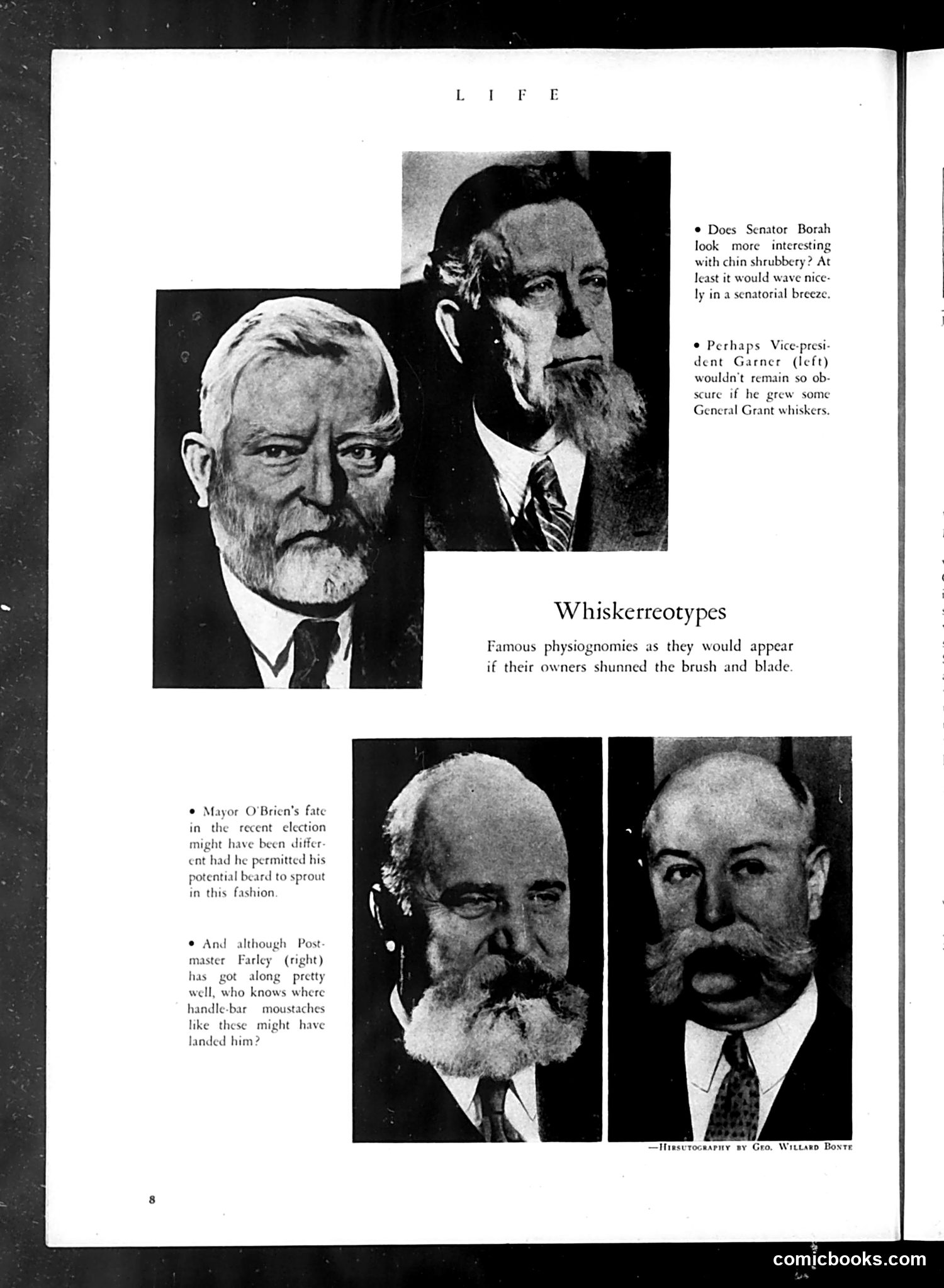
"Whiskerreotypes" Explained This page satirizes prominent political figures of the era through their facial hair. The section titled "Whiskerreotypes" presents four men with notably distinctive beards and whiskers, captioning them with humorous observations about how their appearance might change if they adopted different grooming styles. The visible captions reference Senator Borah, Vice-President Garner, Mayor O'Brien, and Postmaster Farley, suggesting these are real politicians being lampooned. The satire playfully speculates how their public images would shift with altered facial hair—implying that appearance significantly shapes political perception and authority. This reflects early 20th-century *Life* magazine's characteristic approach: using physiognomy and grooming as vehicles for gentle political mockery rather than harsh attack.
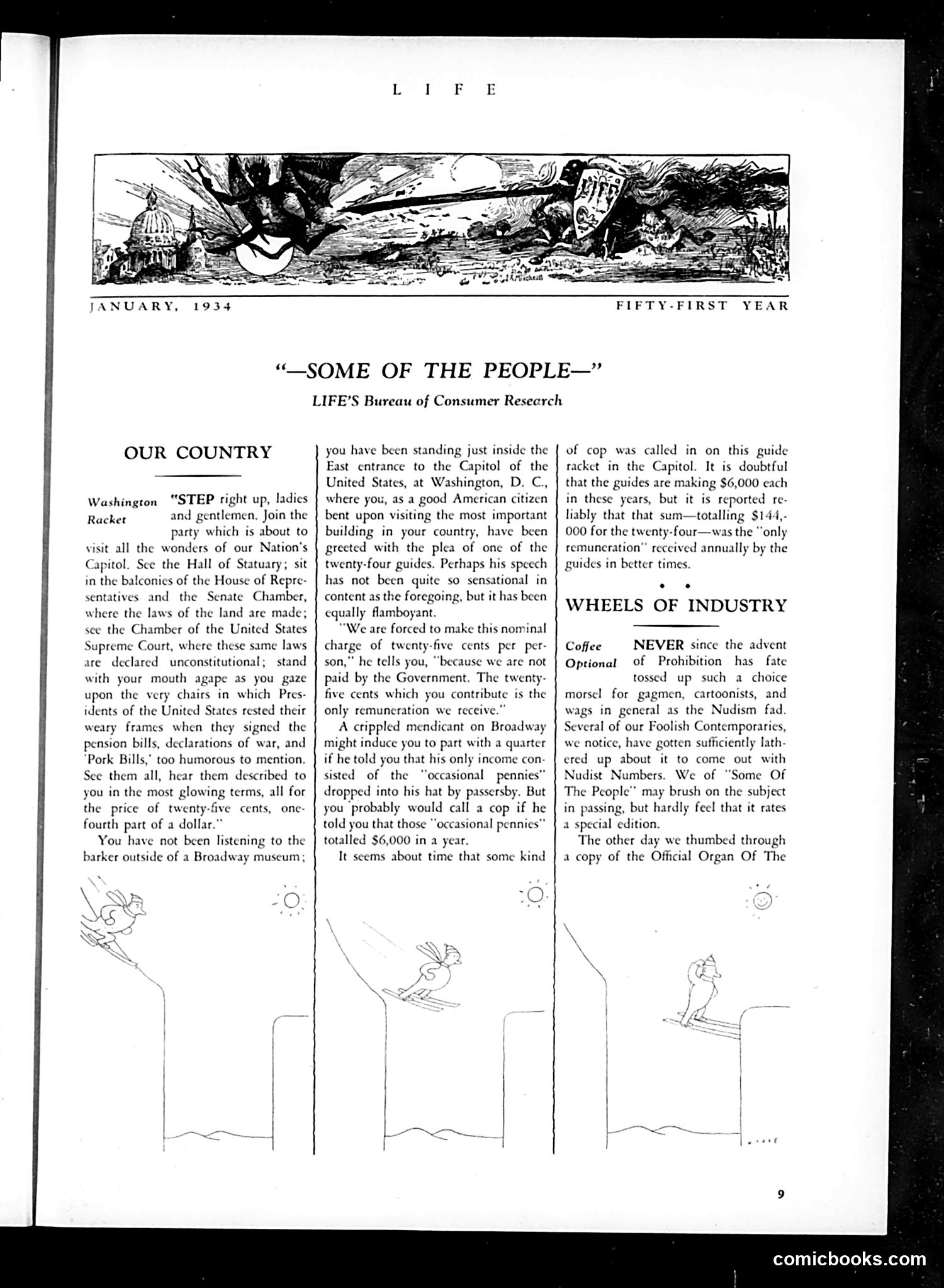
"Some of the People" - Life Magazine, January 1934 This page contains two satirical pieces about American life during the Depression era. "Our Country - Washington Racket" mocks tour guides at the U.S. Capitol who charge visitors 25 cents each, claiming guides earn $6,000 annually from these "occasional pennies." The satire targets the disconnect between guides' modest visible earnings and their actual substantial income—highlighting petty corruption or dishonest income during economically hard times. "Wheels of Industry - Coffee Dispensed" appears to satirize Prohibition's end and its economic aftermath, referencing "Foolish Contemporaries" who engaged in illegal alcohol sales. The sketches show figures in precarious positions, likely commenting on the unstable financial situations of those involved in bootlegging or related enterprises during the transition period. Both pieces exemplify Life's satirical commentary on Depression-era American economic realities and social hypocrisy.
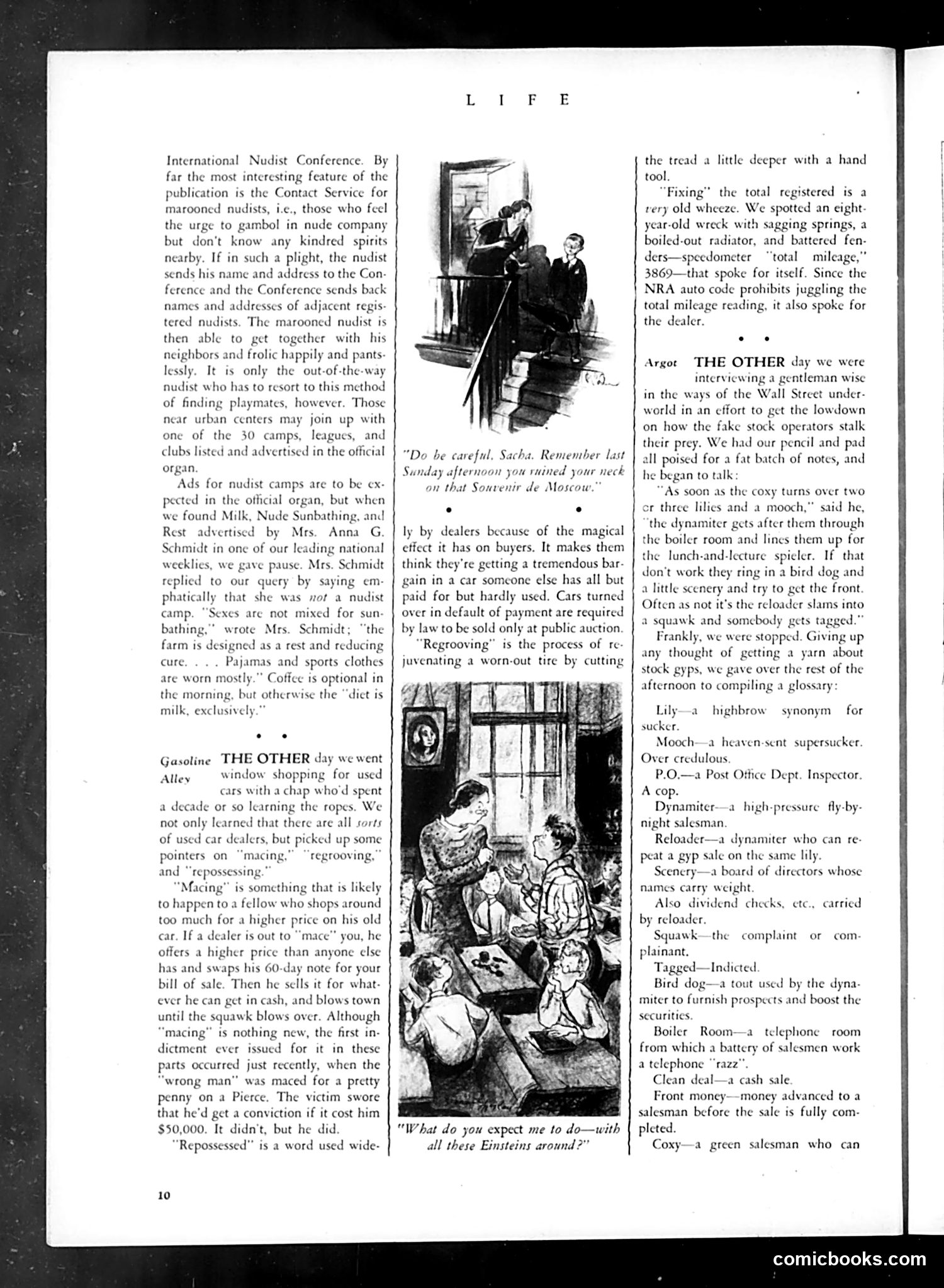
Analysis of Life Magazine Page This page contains two illustrations with accompanying text about con artists and fraud schemes in 1920s urban America. The upper cartoon depicts a street encounter where someone warns "Do be careful, Sacha. Remember last Sunday afternoon you nearly broke your neck on that Souvenir de Moscow"—appearing to reference a scam involving counterfeit goods or alcohol (possibly referring to Prohibition-era bootlegging). The lower, larger illustration shows what appears to be a con game in progress, with multiple figures gathered around in a tenement or cramped space, captioned "What do you expect me to do—with all these Einsteins around?" The surrounding text discusses various urban fraud schemes: used car "grooming" (odometer tampering), stock manipulation on Wall Street, and con artist tactics. The page satirizes how ordinary people fall victim to these schemes and exposes the vocabulary and methods of 1920s criminal enterprises.
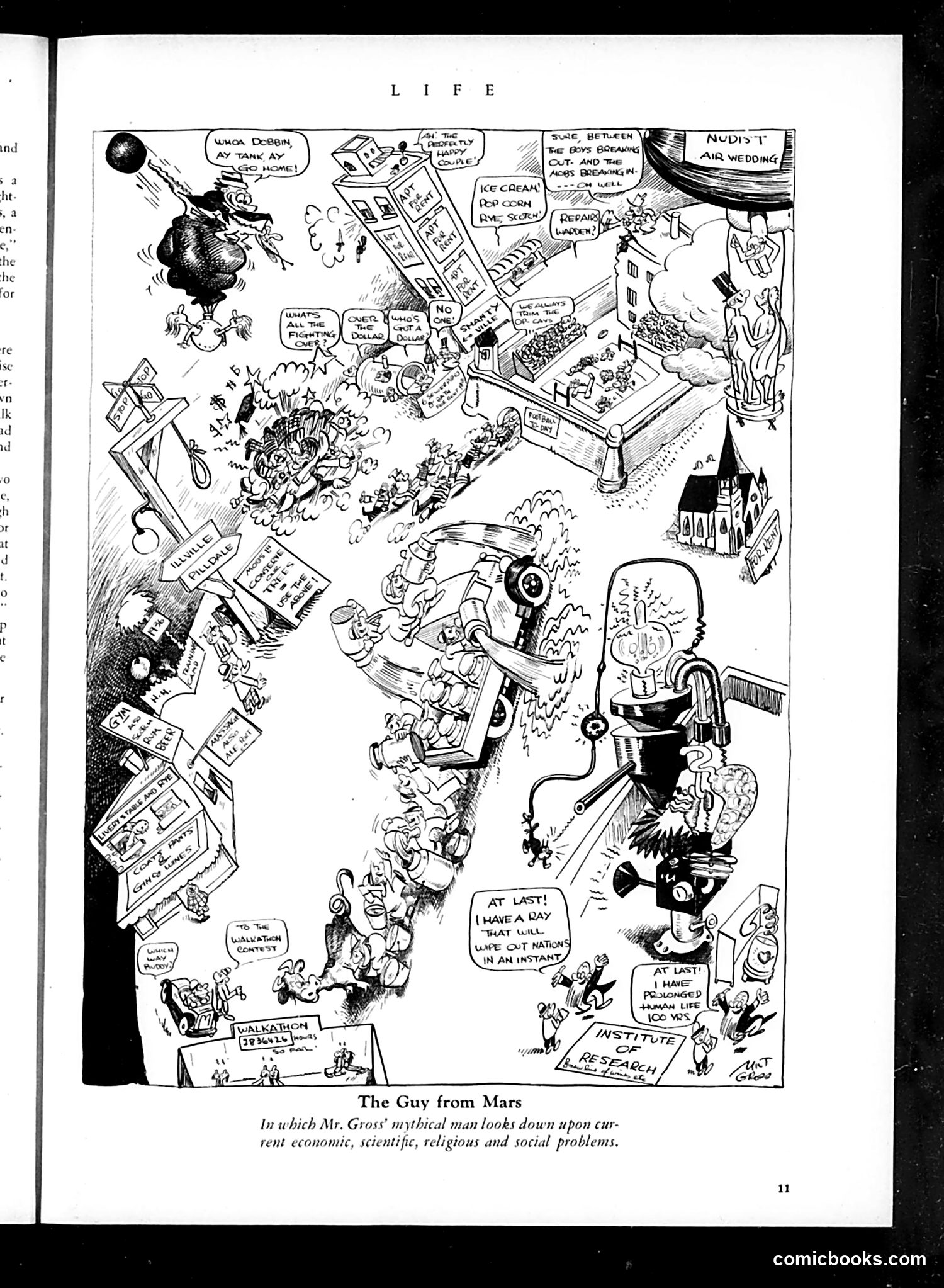
"The Guy from Mars" - Analysis This is a satirical cartoon by an artist signed "Cesare" depicting a Martian observer examining Earth's social problems. The subtitle explains the premise: Mr. Gross's "mythical man looks down upon current economic, scientific, religious and social problems." The cartoon's chaotic composition shows the visitor observing multiple crises simultaneously—labeled institutions (visible: "Institute of Research"), burning buildings, crowds in distress, and various human conflicts. The speech bubbles suggest the Martian expresses amazement that humanity hasn't solved these issues instantly. The satire targets 1920s-30s American society, mocking both earthly dysfunction and blind optimism about "progress." By using an alien perspective, the cartoonist critiques economic inequality, religious conflict, scientific limitations, and social disorder as viewed from outside—absurdly persistent problems for a supposedly advanced civilization.
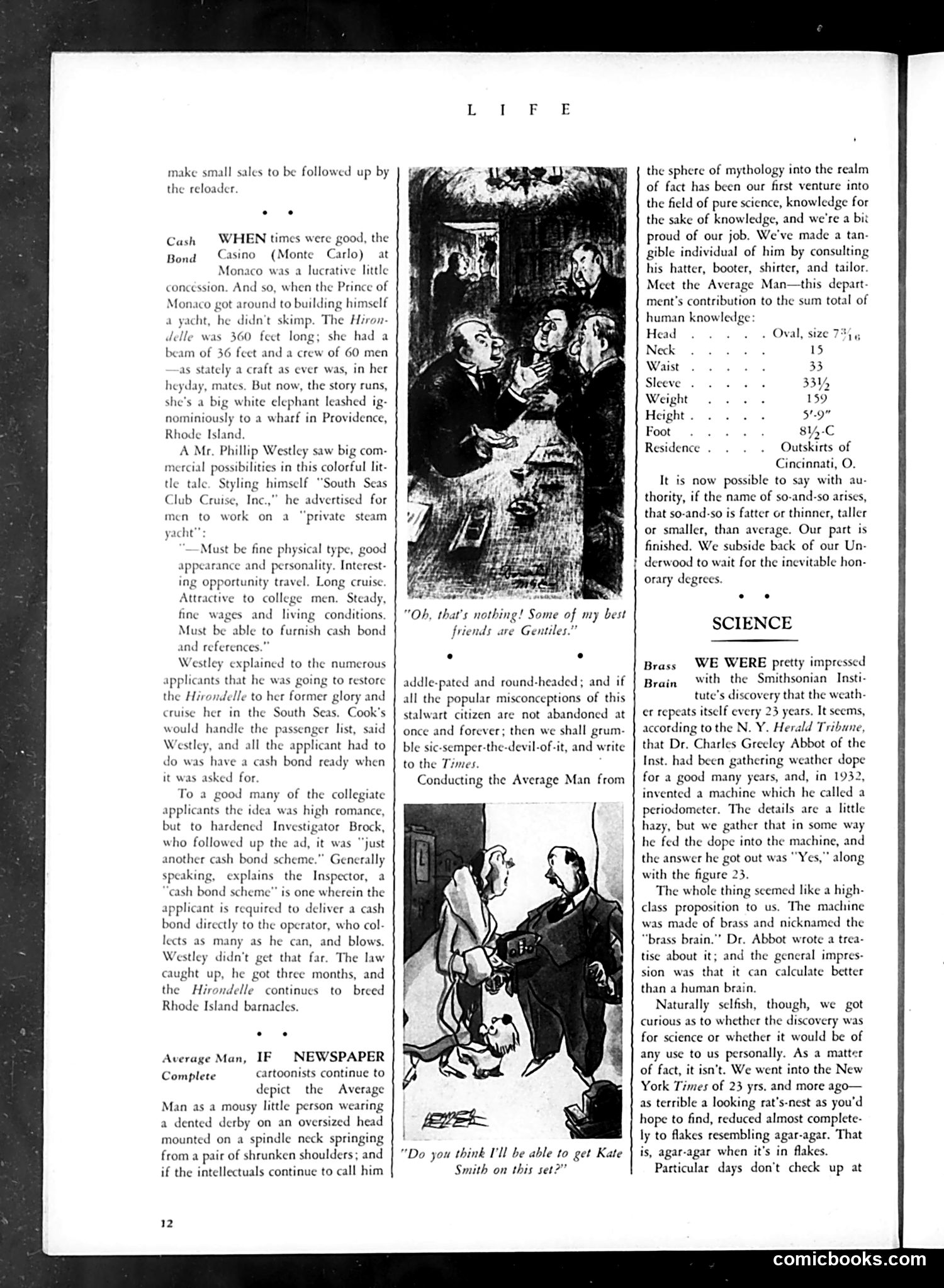
Analysis of Life Magazine Page This page contains satirical commentary on American society circa early 20th century. The left column mocks wealthy leisure culture, describing absurdly opulent yachts and recruiting schemes for "private steam yacht" crews—satirizing the pretensions of the ultra-rich. The central cartoon depicts what appears to be a social interaction, with the caption "Oh, that's nothing! Some of my best friends are Gentiles"—likely satirizing ethnic prejudice and social climbing among wealthy Jews who sought acceptance in exclusive circles. The right section titled "SCIENCE" humorously describes creating an "Average Man" through precise physical measurements, then notes the Smithsonian's "brass brain" invention that supposedly calculates better than humans. This parodies both scientific materialism and American enthusiasm for mechanical solutions to human problems. The lower cartoon's caption "Do you think I'll be able to get Kate Smith on this set?" references entertainment industry gossip, though the specific context is unclear without additional context.
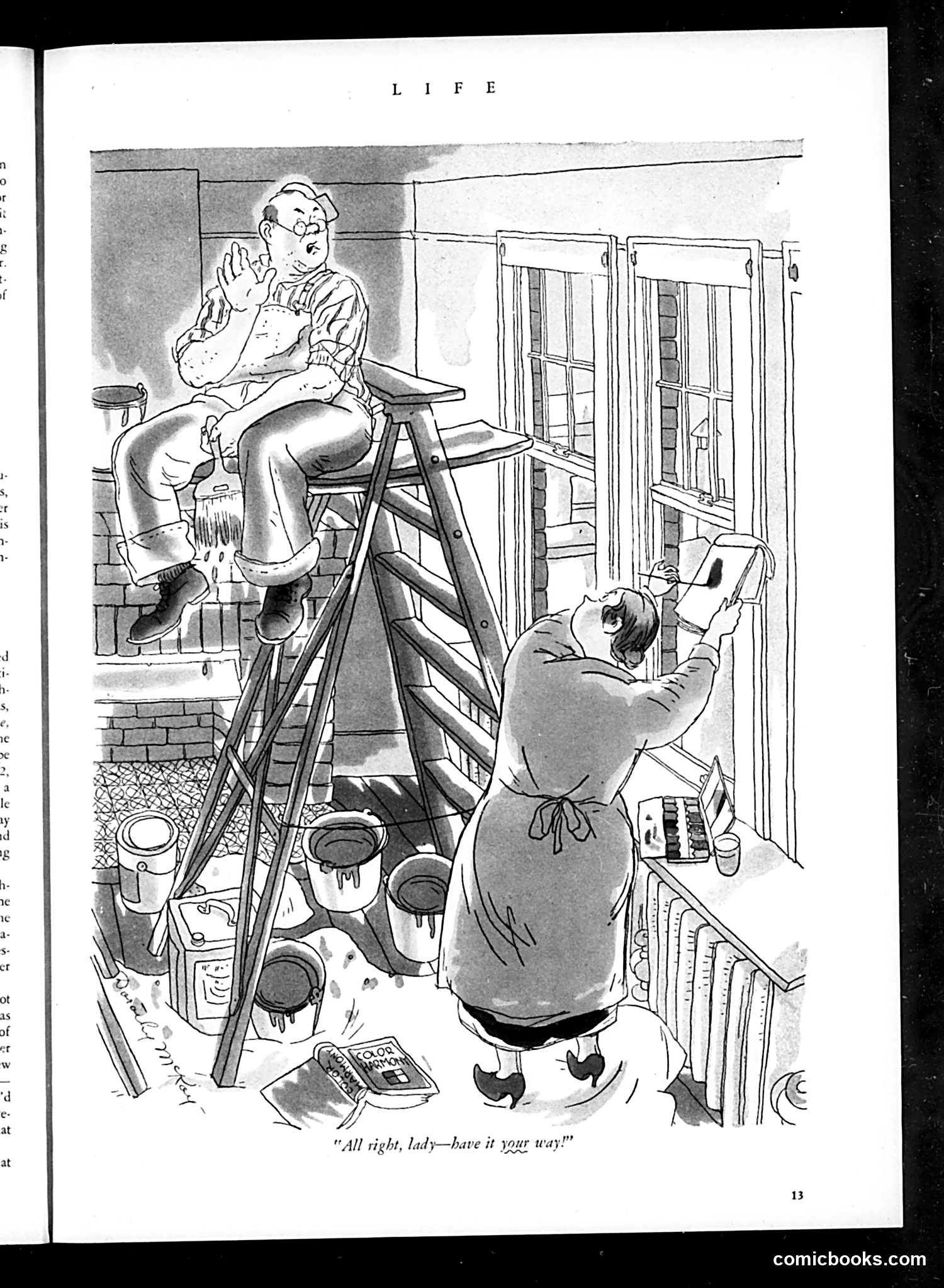
Analysis This is a single-panel cartoon titled "All right, lady—have it your way!" It depicts a domestic scene where a woman directs a man perched on a tall ladder while painting interior walls and trim. Multiple paint cans and supplies are scattered below. The satire appears to be about marital dynamics and home improvement projects. The man, positioned precariously high on the ladder, has surrendered to the woman's preferences or instructions regarding the painting work—hence his resigned caption. The visual humor comes from his uncomfortable, subordinate position (literally elevated yet dependent) versus her commanding stance below. This reflects early-to-mid 20th century humor about wives directing household decisions while husbands comply, often reluctantly. The joke assumes audiences would find relatable the dynamic of a spouse managing home renovation projects.
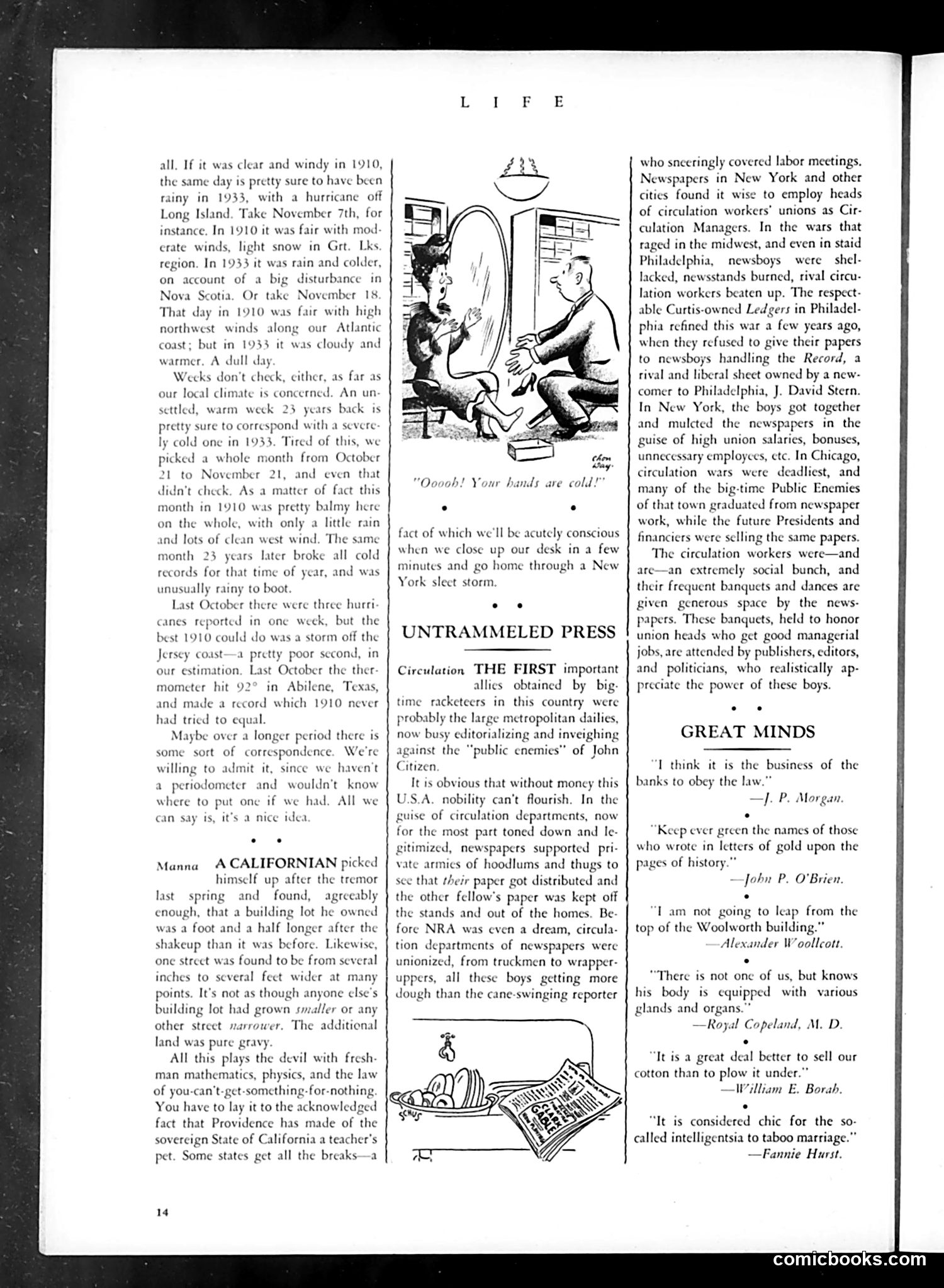
Analysis of Life Magazine Page This page discusses newspaper circulation wars and labor disputes in the early 1900s. The main cartoon shows two figures struggling over a large wheel or circular object, likely representing a printing press or circulation battle. The caption reads "Oooh! Your hands are cold!" — apparently a humorous jab at the intensity of their competition. The text describes how major metropolitan newspapers competed aggressively for circulation, employing newsboys as circulation managers. In Philadelphia, the *Record* (a newcomer) sparked violent conflicts when newsboys refused to handle it, leading to beatings and unrest. The article criticizes these "public enemies" disrupting legitimate newspaper distribution and notes that newspaper publishers and circulation departments operated like criminal rackets, despite editorializing against corruption. The satire targets the hypocrisy of newspapers simultaneously claiming moral authority while using ruthless business tactics.
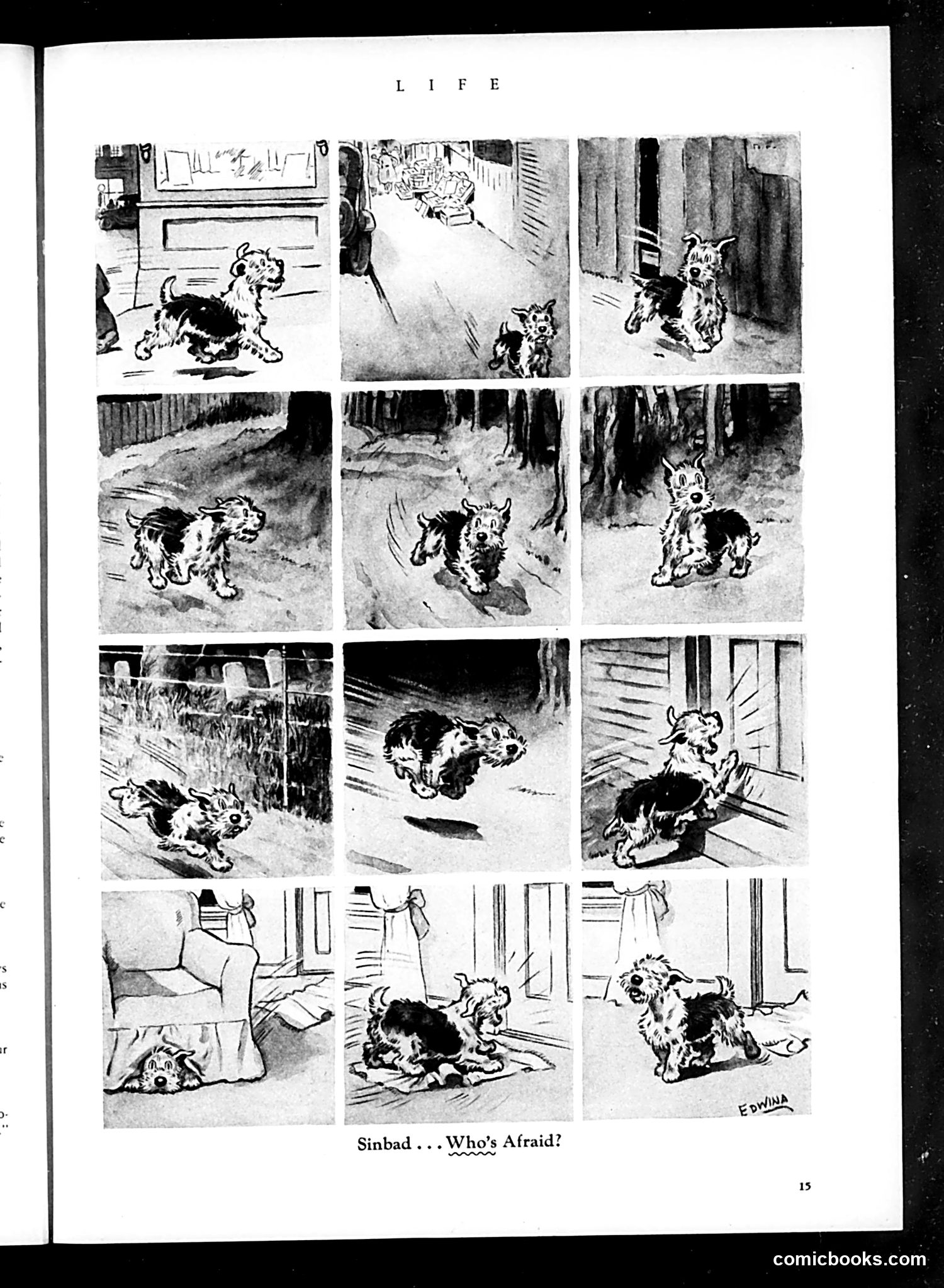
"Sinbad... Who's Afraid?" This appears to be a humorous comic strip about a small dog named Sinbad, signed by an artist named "Ebwua" (or similar). The twelve-panel sequence shows Sinbad in various situations—running through yards and alleyways, encountering larger dogs, hiding under furniture, and cowering indoors—that humorously contrast the character's name with his actual behavior. The joke plays on "Sinbad the Sailor," a legendary adventurer known for fearlessness and bravery. This Sinbad, by contrast, is portrayed as anxious and easily frightened by everyday situations. The title "Who's Afraid?" sarcastically questions whether this timid dog matches the bold reputation his name suggests. It's a gentle satire of the disconnect between names and personalities.
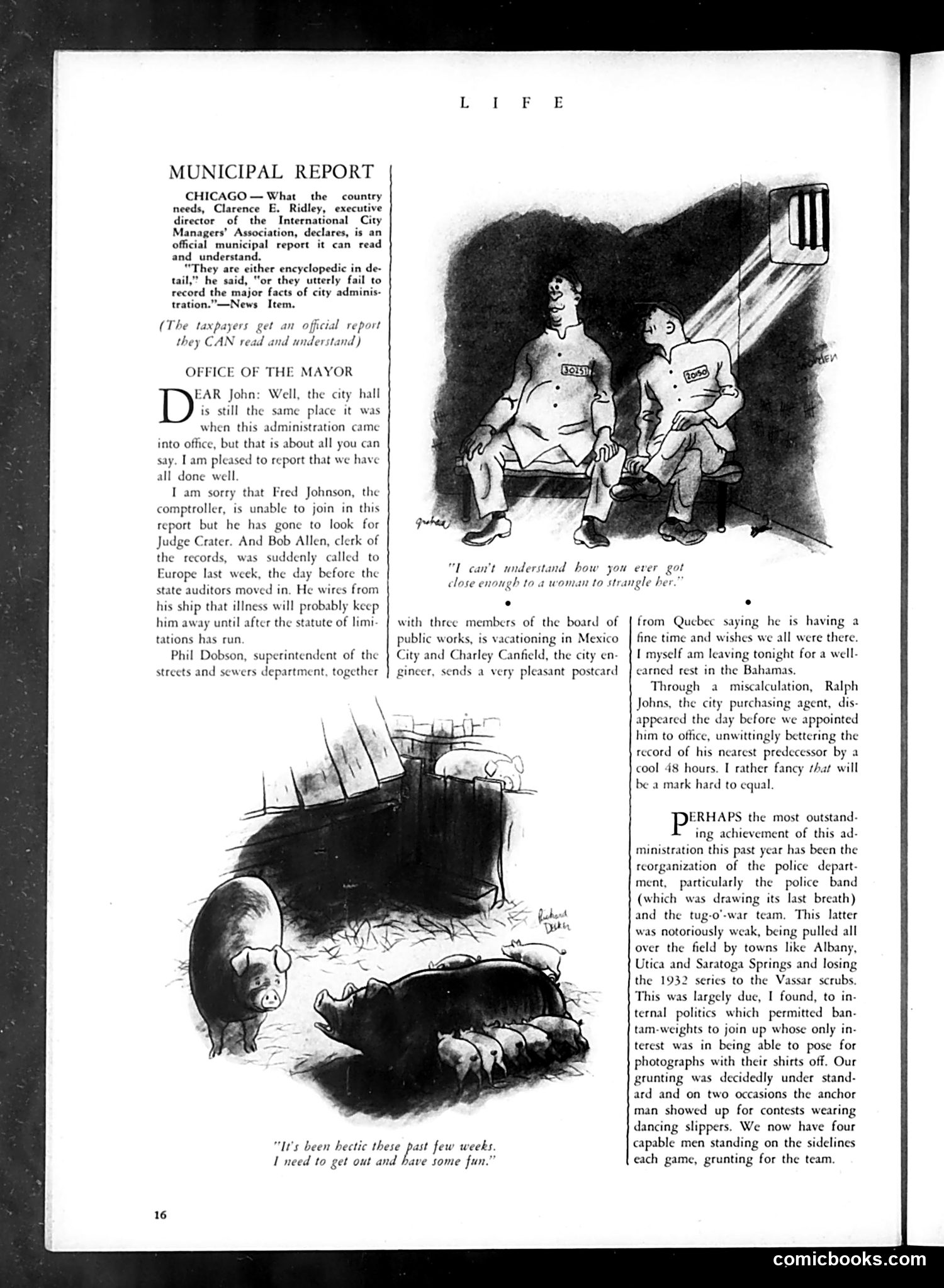
Political Cartoon Analysis: "Municipal Report" This page satirizes Chicago municipal administration under Mayor Clarence Ridley. The top cartoon depicts two overweight municipal workers in an office, with the caption "I can't understand how you ever got close enough to a woman to strangle her"—likely mocking incompetence or corruption among city staff. The lower cartoon shows a pig in mud with the caption "It's been hectic these past few weeks. I need to get out and have some fun," satirizing the messy state of municipal affairs. The text criticizes municipal reports as either "encyclopedic in detail" or completely failing to document city administration. The "Office of the Mayor" section ironically celebrates administrative competence while hinting at underlying dysfunction, absent officials, and organizational chaos—suggesting Chicago's government was poorly managed despite official proclamations of success.
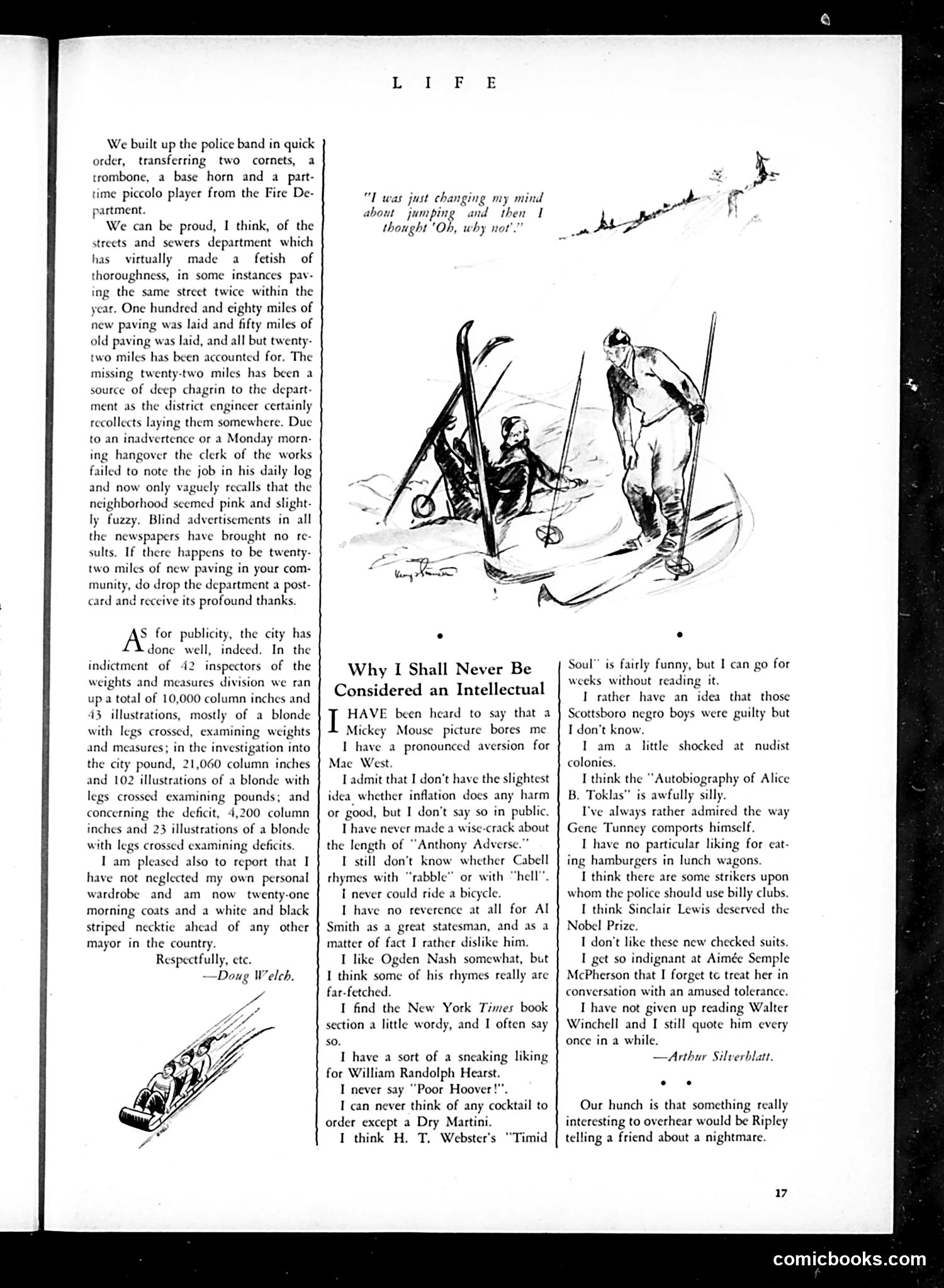
Page Analysis This page contains two distinct sections: Left column: A municipal department report discussing street paving projects and publicity achievements, including statistics on column inches and illustrations examined. Right column: A humorous essay titled "Why I Shall Never Be Considered an Intellectual," where the author lists entertainments and public figures they enjoy or dislike—including Mickey Mouse films, Sinclair Lewis, and various literary and cultural references. The tone is self-deprecating satire about failing to meet intellectual standards. Illustrations: A sketch of skiers on a snowy slope (top right) and what appears to be a sledding figure (bottom left). The page combines bureaucratic reporting with cultural commentary typical of *Life* magazine's satirical approach to American society.
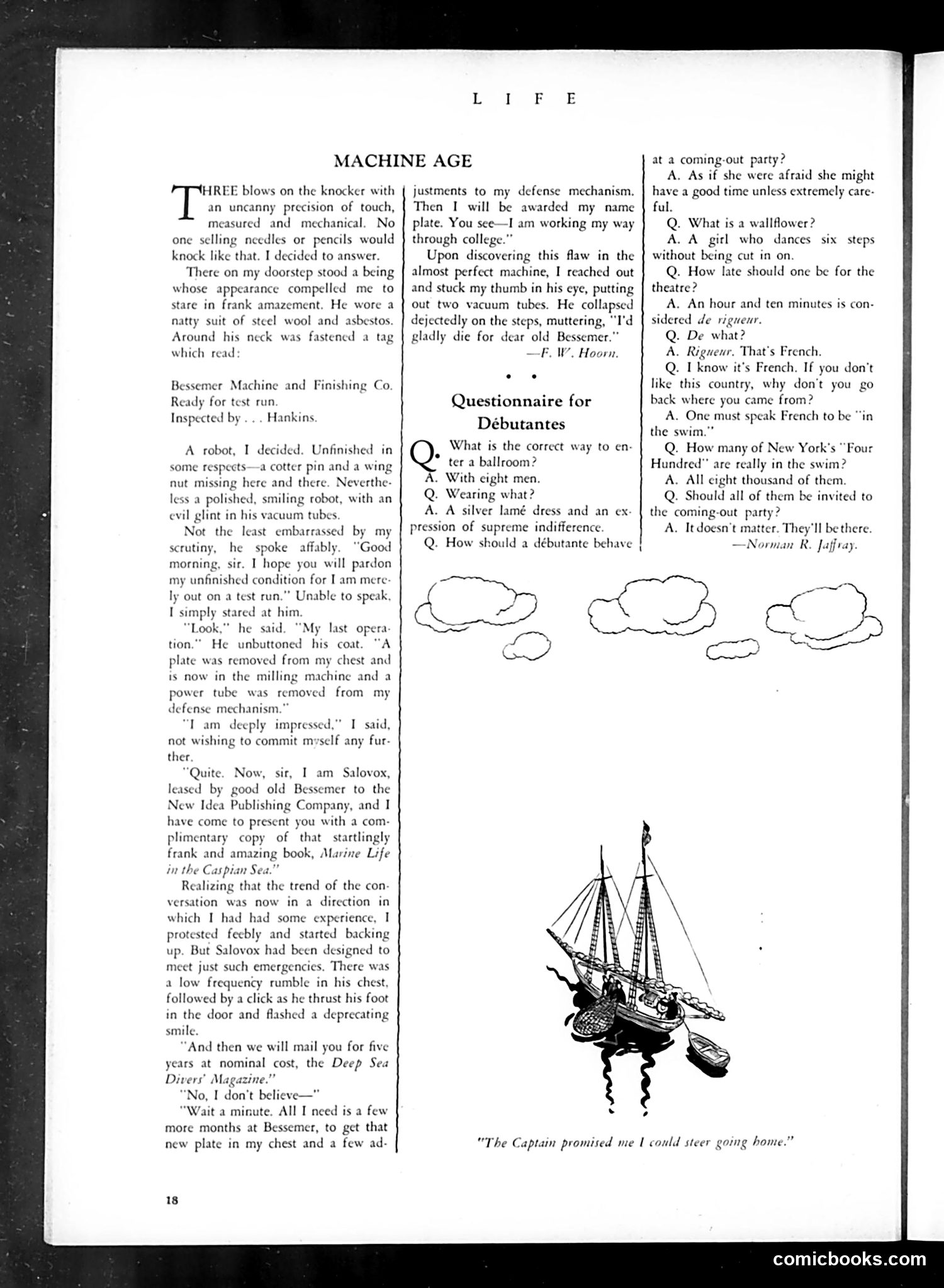
"Machine Age" - Life Magazine Satire This page satirizes early 20th-century robotics and automation through a humorous story about "Salovox," a robot designed by inventor Bessemer. The narrative mocks both the machine's malfunctions and the era's enthusiasm for technological solutions. The satire targets: - Overhyped technology: A robot that breaks down rather than performs reliably - Blind faith in progress: Characters promoting the machine despite obvious flaws - Social pretension: The "Questionnaire for Debutantes" section mocks upper-class etiquette obsession The accompanying ship illustration appears unrelated to the main story—possibly advertising or filler content. The humor relies on readers' simultaneous fascination and skepticism toward the "Machine Age," treating mechanical innovation as both promising and ridiculous.
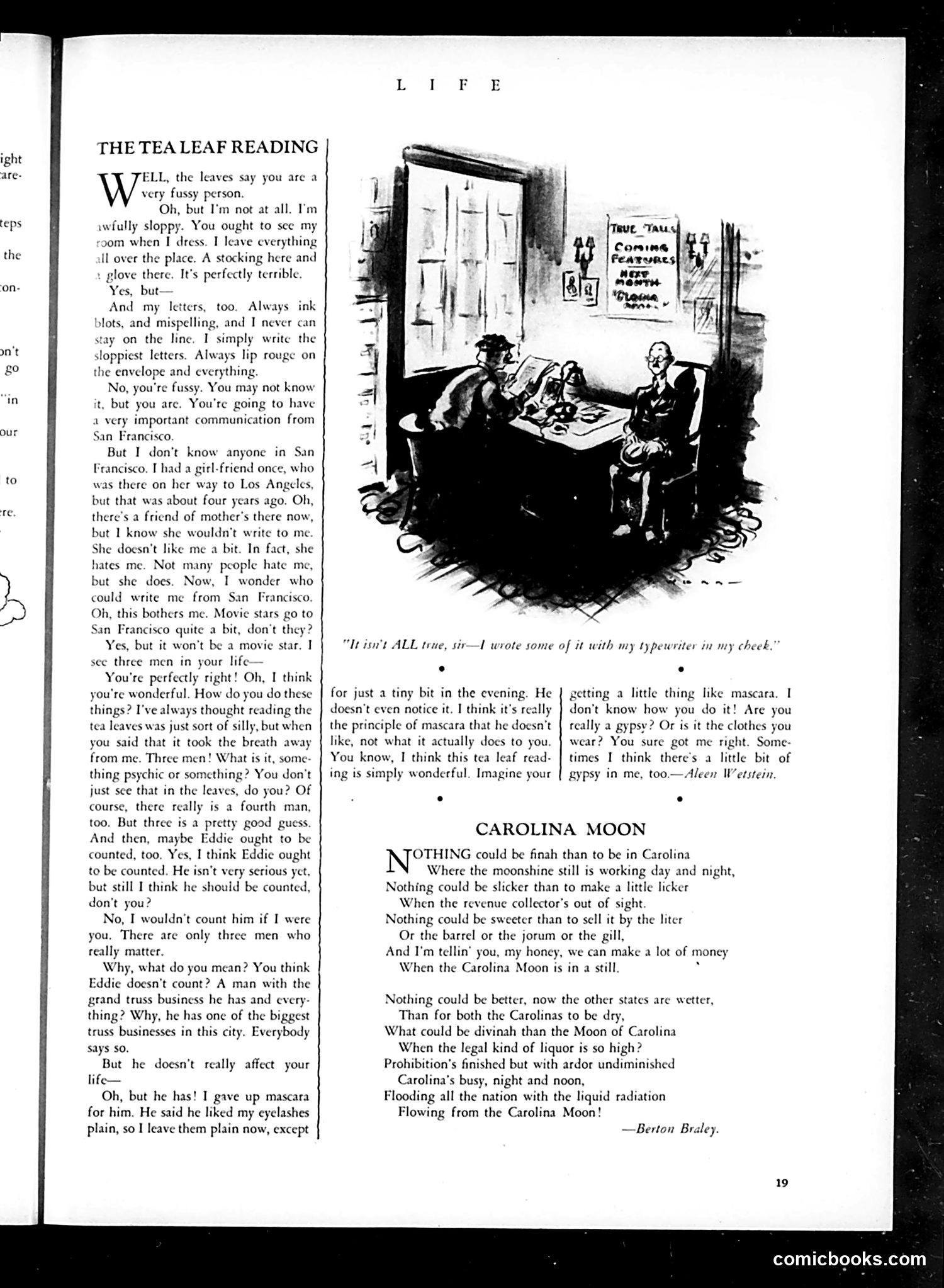
"The Tea Leaf Reading" Cartoon Analysis This page contains two distinct pieces: a satirical dialogue and a poem. The Cartoon: The sketch shows a tea leaf reader (fortune teller) making predictions to a client. The satire mocks both the client's anxiety about receiving a message from San Francisco and the absurdity of tea leaf reading itself. The reader claims the leaves reveal character traits (calling the client "fussy"), while the client obsesses over whether a former friend might contact them—treating the fortune-telling as genuine divination rather than nonsense. The Point: Early 20th-century Americans had genuine interest in occult practices despite their irrationality. The cartoon gently ridicules this credulity and the emotional weight people placed on superstitious predictions. The accompanying poem "Carolina Moon" is unrelated satirical verse about Prohibition-era bootlegging.
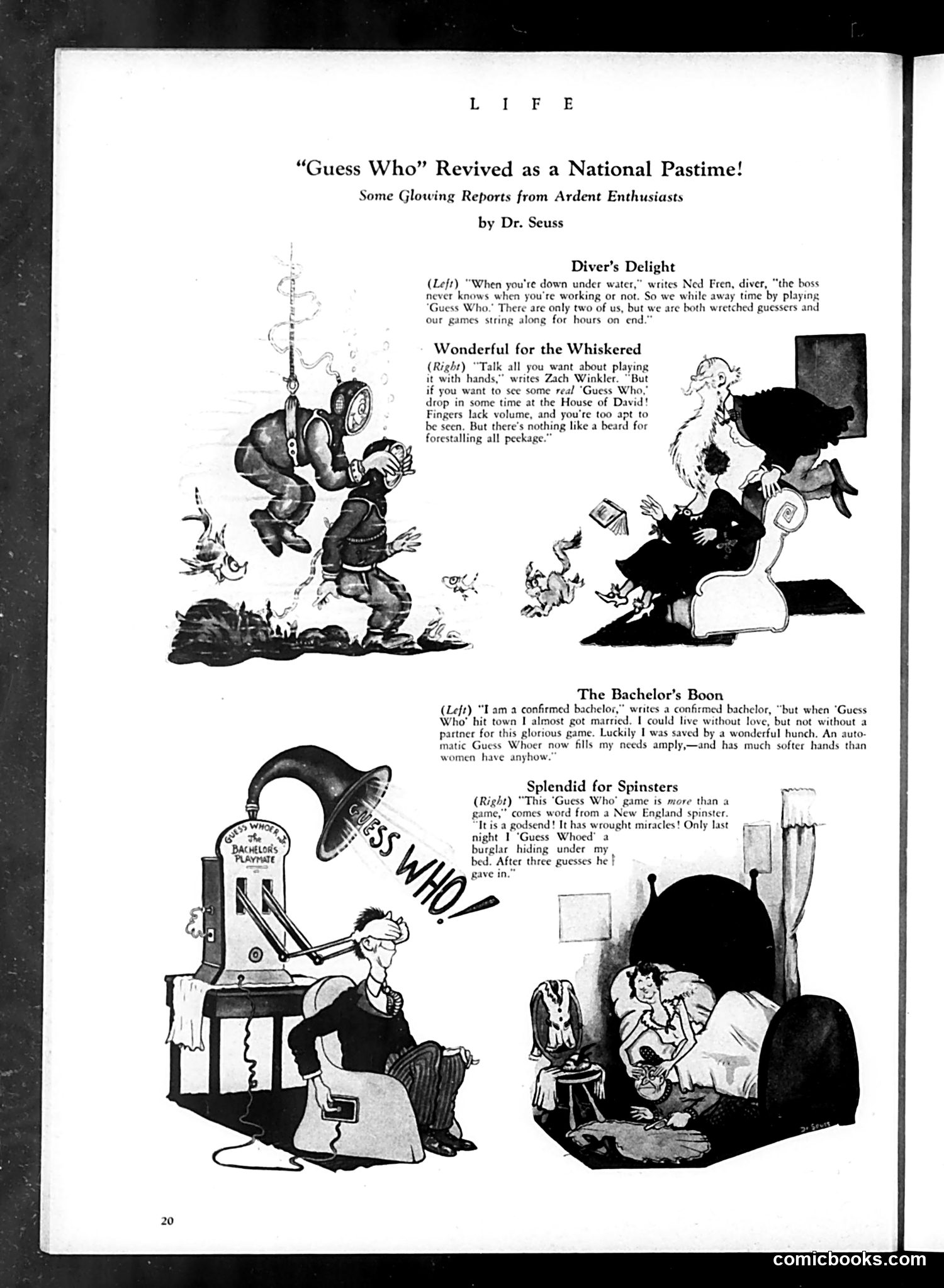
"Guess Who" Revival - Dr. Seuss Satire This Dr. Seuss piece satirizes the parlor game "Guess Who" as a national craze. The comic presents four humorous testimonials showing how absurdly people apply the game to everyday situations: 1. Divers use it to pass time underwater while avoiding work 2. Bearded men (referencing the House of David, a religious community known for their beards) play it with facial hair instead of hands 3. A bachelor nearly marries just to find a game partner, then buys an "automatic Guess Whoer" machine instead 4. A spinster claims the game helped her catch a burglar hiding in her bedroom The satire mocks both the game's supposed popularity and the desperation of lonely people seeking connection. The exaggerated scenarios and Seuss's characteristic whimsical illustrations underscore how ridiculous the game's supposed appeal has become—a social commentary on 1930s-40s American leisure culture and isolation.
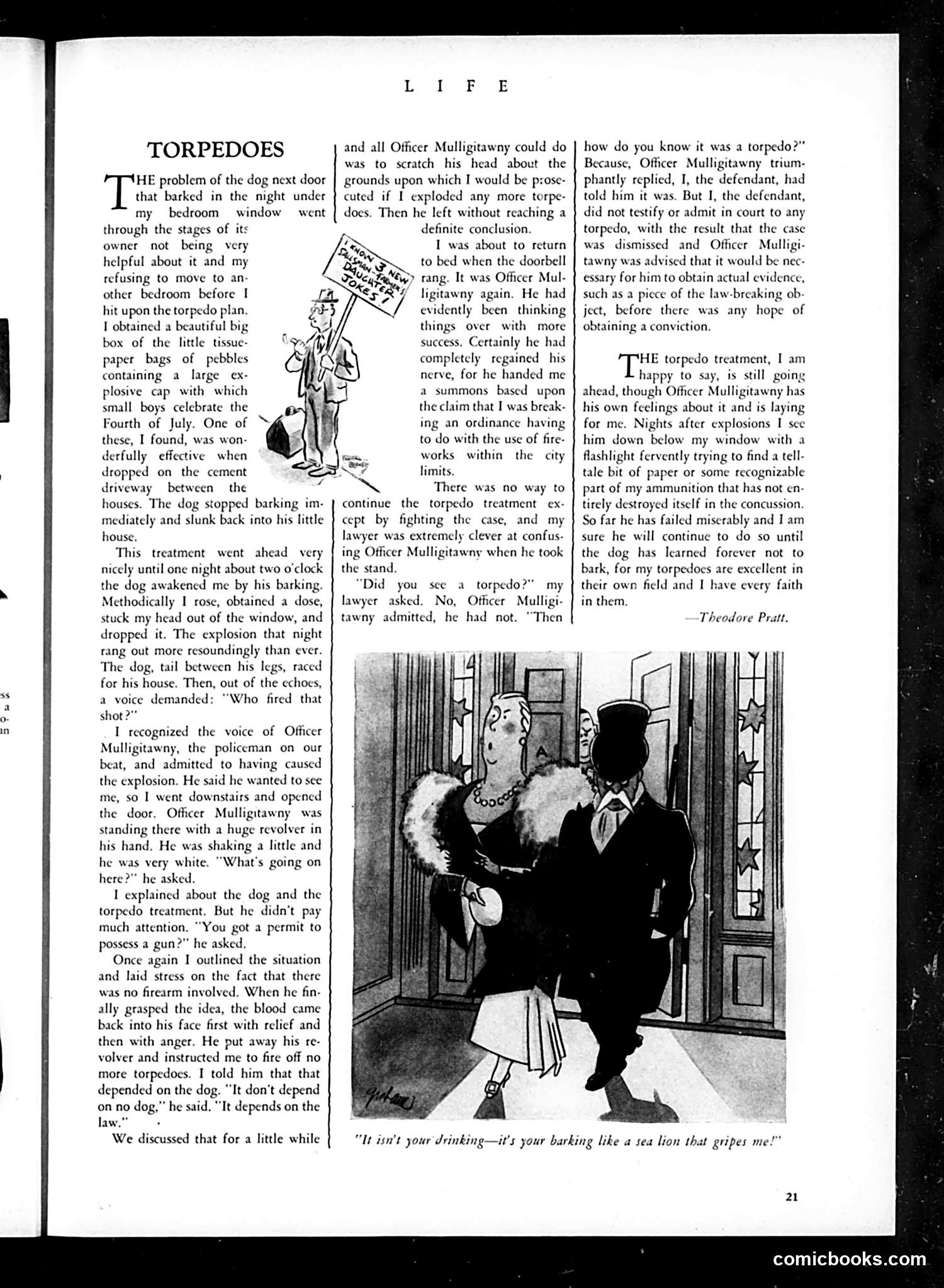
"Torpedoes" — A Life Magazine Story This humorous narrative by Theodore Pratt satirizes bureaucratic absurdity and police overreach. The author solves a noisy dog problem by tossing "torpedoes"—small Fourth of July firecrackers with explosive caps—onto his neighbor's driveway. Officer Mulligitawny (a comedic name suggesting bumbling incompetence) arrives after an explosion, initially believing a gun was fired. Once corrected, he struggles to find legal grounds for prosecution. The lawyer cleverly defeats the case by exploiting the officer's lack of physical evidence—he only has the defendant's own admission as proof. The satire targets legal pedantry: a clear violation goes unpunished because the prosecution cannot prove what was technically done. The cartoon below shows a woman complaining to a man that his barking dog disturbs her—inverting the setup as domestic comedy. The piece mocks both police incompetence and how technicalities can undermine justice, while celebrating ordinary citizens outsmarting authorities.
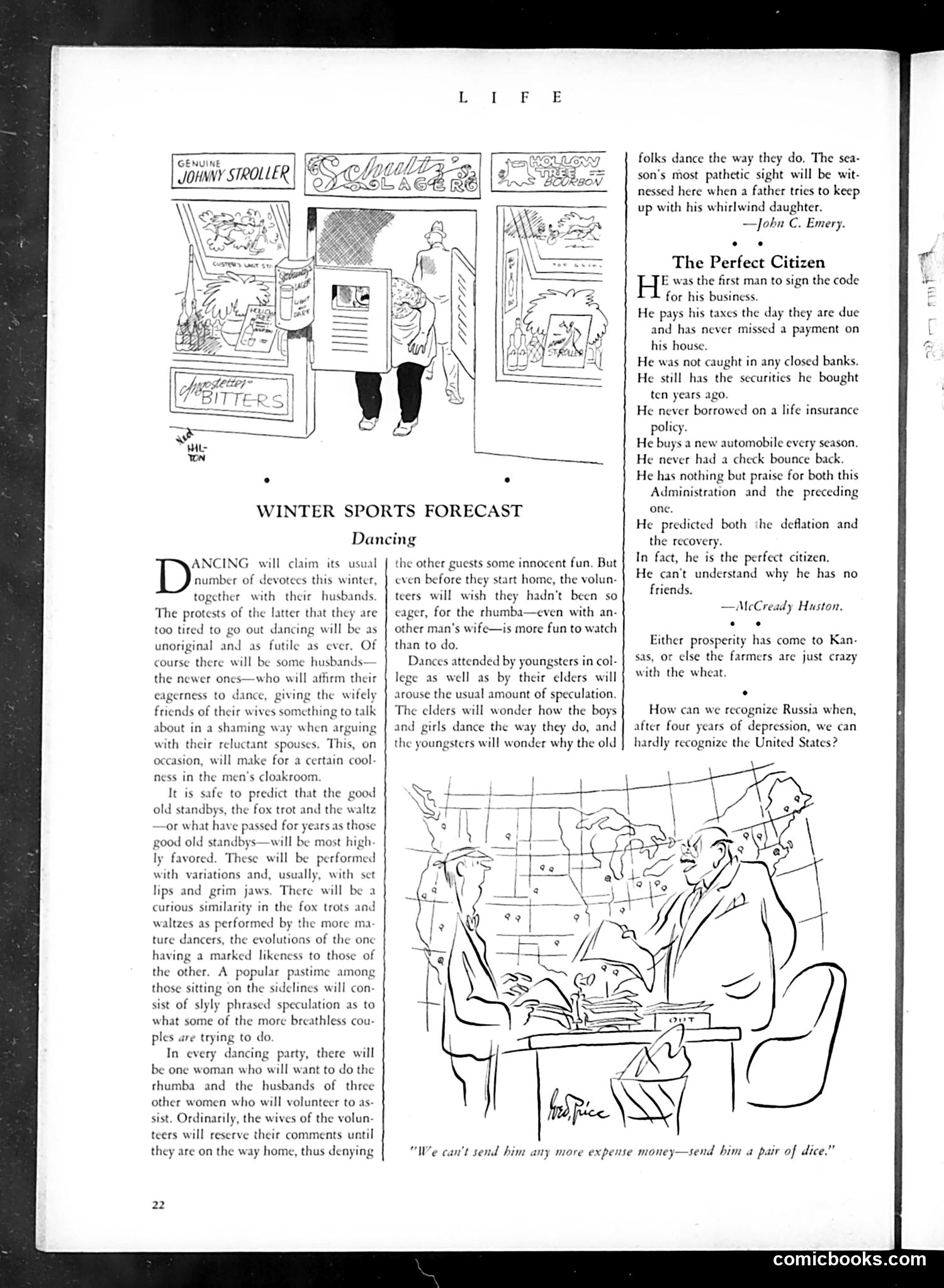
Analysis of Life Magazine Page This page contains satirical commentary on American social and economic life, likely from the 1930s (references to "deflation and recovery" and four years of depression). "Winter Sports Forecast: Dancing" humorously observes marital dynamics. Husbands reluctantly attend dances with wives, younger couples perform novel dance moves (the "rhumba"), while older couples' variations resemble each other. The satire targets middle-class social obligations and generational differences in behavior. "The Perfect Citizen" is biting irony: a man who follows all rules—pays taxes, avoids financial scandal, buys new cars regularly, supports the government—yet has no friends. The joke critiques blind obedience and suggests that rigid adherence to social/economic norms produces isolation. The cartoon below depicts someone receiving dice instead of money, implying financial recklessness or gambling. "Either prosperity has come to Kansas..." sarcastically questions whether wheat farmers' optimism reflects real economic recovery or delusion during the Depression era. The page collectively satirizes American conformity, economic anxiety, and social pretense.
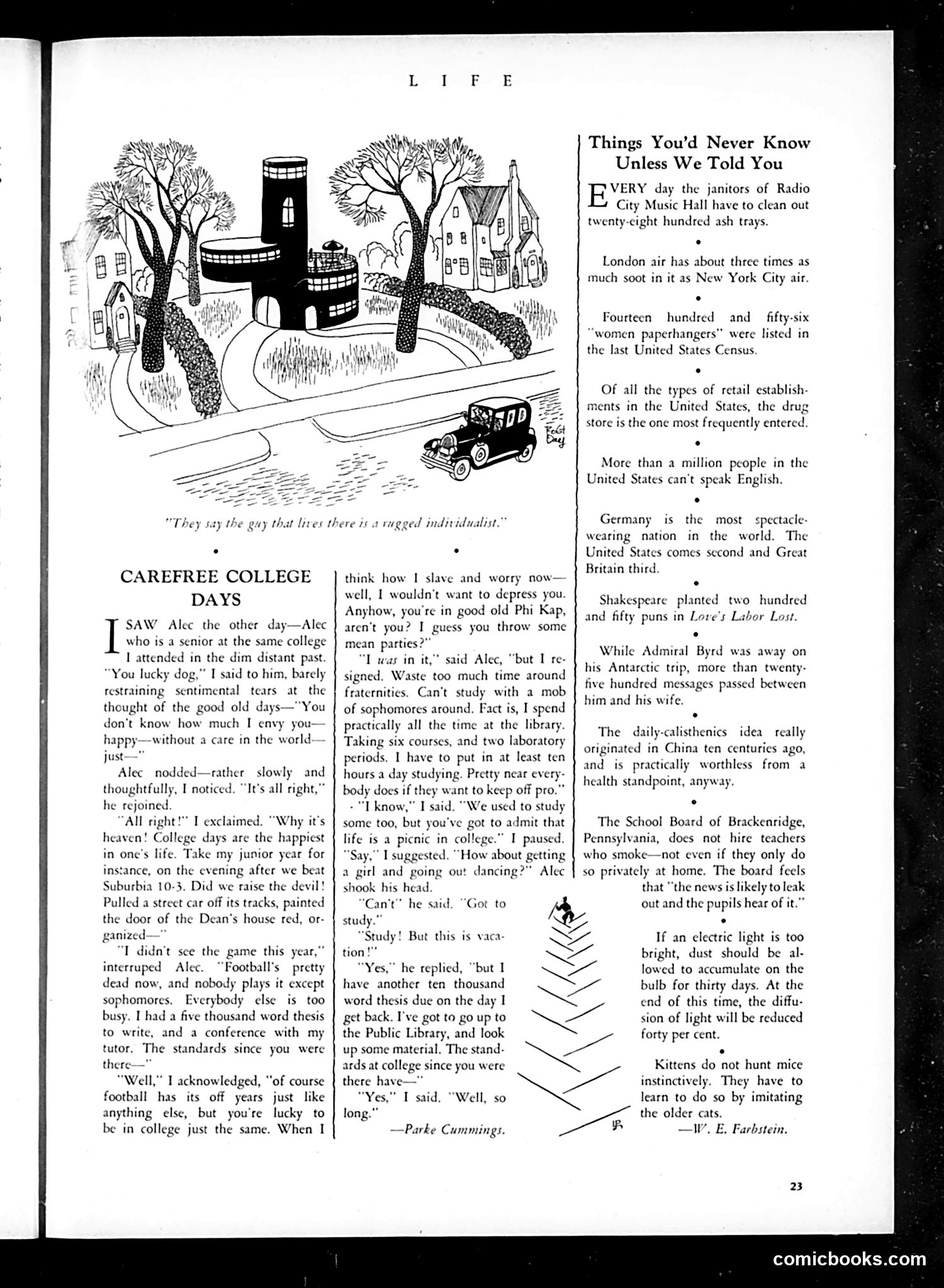
Analysis of "Carefree College Days" This satirical article by Parke Cummings contrasts romanticized memories of college with contemporary reality. A nostalgic alumnus encounters his former schoolmate Alec, expecting to hear tales of carefree fun—parties, football, fraternity life (Phi Kap). Instead, Alec describes a grueling academic grind: six courses, two labs, ten daily study hours, two ten-thousand-word theses, no time for socializing or romance. The satire targets the narrator's sentimental delusions. What he remembers as "heaven" was apparently less demanding; Alec's present experience—academically rigorous, socially isolating, competitive (students must maintain grades to "keep off pro[bation]")—reveals college has become strictly utilitarian rather than joyful. The cartoon above, showing a ramshackle modernist house, appears to comment on unconventional living arrangements or bohemian individualism, reinforcing themes of non-conformity and social anxiety that permeate the piece.
I can see this is a black and white photograph of a smiling woman in formal attire with a dark jacket and white collar, numbered page 24. However, without additional OCR text from the page itself—beyond just the "comicbooks.com" watermark—I cannot identify who this person is or what satirical point the image makes. The photograph appears to be from a historical publication, but I cannot responsibly identify the subject or explain the intended satire without textual context that identifies them. To provide accurate historical interpretation, I would need the actual article text or caption that accompanied this image.
Analysis This is primarily advertising, not satire or political commentary. The page promotes Fisher Body's "No Draft Ventilation" system for General Motors automobiles. The headline's play on "air-minded" is a pun referencing the aviation craze of the era, but it's a marketing device, not satire. The small photograph at top shows a woman looking out a car window, meant to demonstrate the ventilation feature's appeal. The ad emphasizes that only GM cars (Chevrolet, Pontiac, Oldsmobile, Buick, LaSalle, Cadillac) offer this patented technology, positioning it as a health and safety advantage over competitors who might attempt imitation. The tone is competitive but not satirical—it's straightforward automotive advertising exploiting contemporary consumer concerns about fresh air and hygiene in enclosed vehicles.
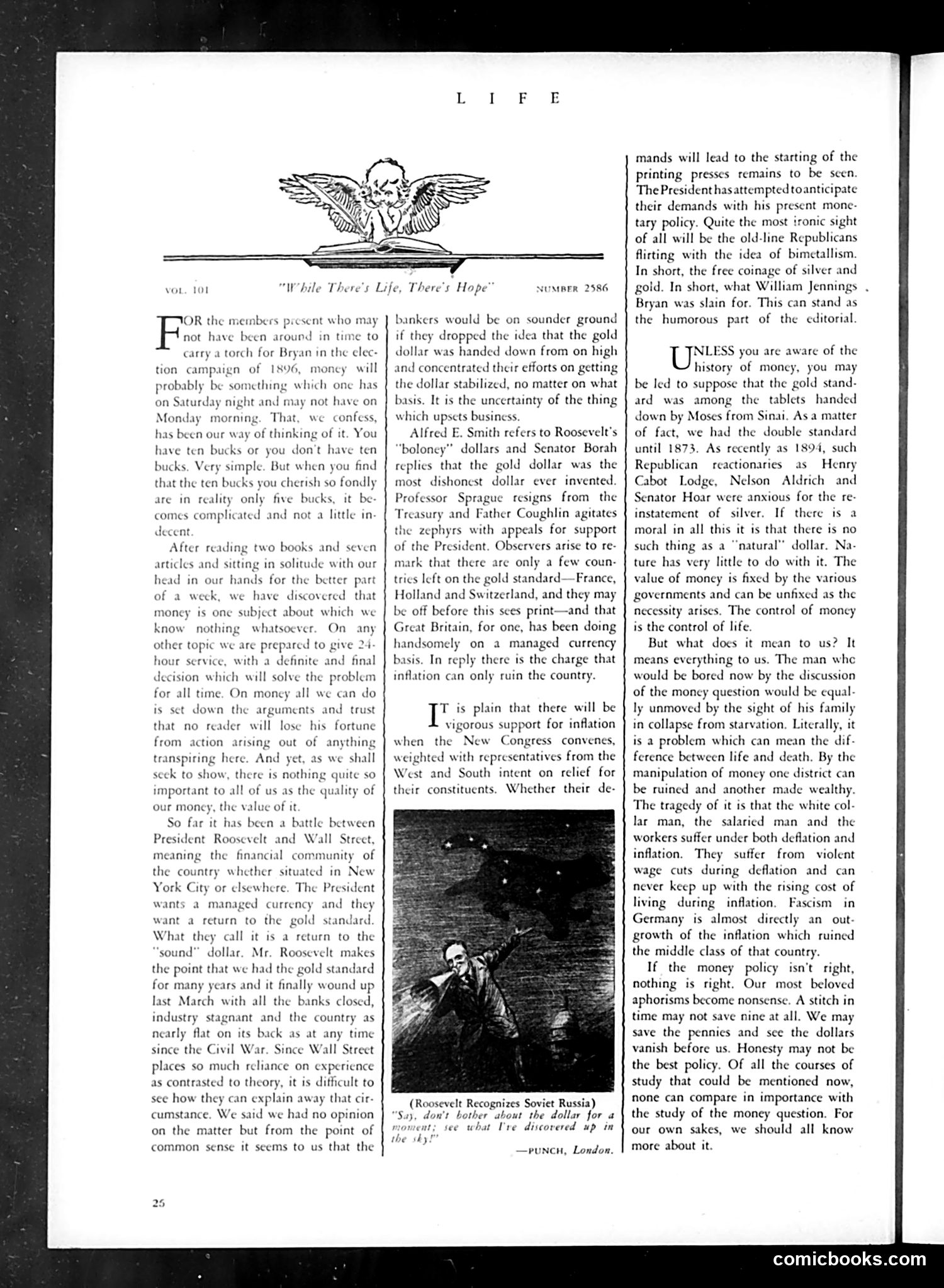
Life Magazine Political Commentary (c. 1933-1934) This editorial page debates currency policy during the Depression, centering on President Roosevelt's monetary experiments versus Wall Street's preference for the gold standard. The main figures referenced: - President Roosevelt: advocates managed currency - Wall Street bankers: want return to gold standard - Alfred E. Smith: criticizes Roosevelt's policies as "boloney dollars" - Senator Borah: defends the gold standard - Professor Sprague: resigned from Treasury (appears to oppose New Deal monetary policy) - Father Coughlin: supports Roosevelt's inflation approach The political conflict: The text opposes both sides' rigidity, arguing bankers' faith in gold is historically discredited (the gold standard failed during the Depression) while inflation fears are exaggerated. The cartoon caption (bottom) satirizes Roosevelt for promoting Soviet recognition as distraction from currency debates. The satire's point: Life mocks ideological entrenchment on both sides while supporting practical currency stabilization over dogmatic adherence to either gold or unlimited inflation.
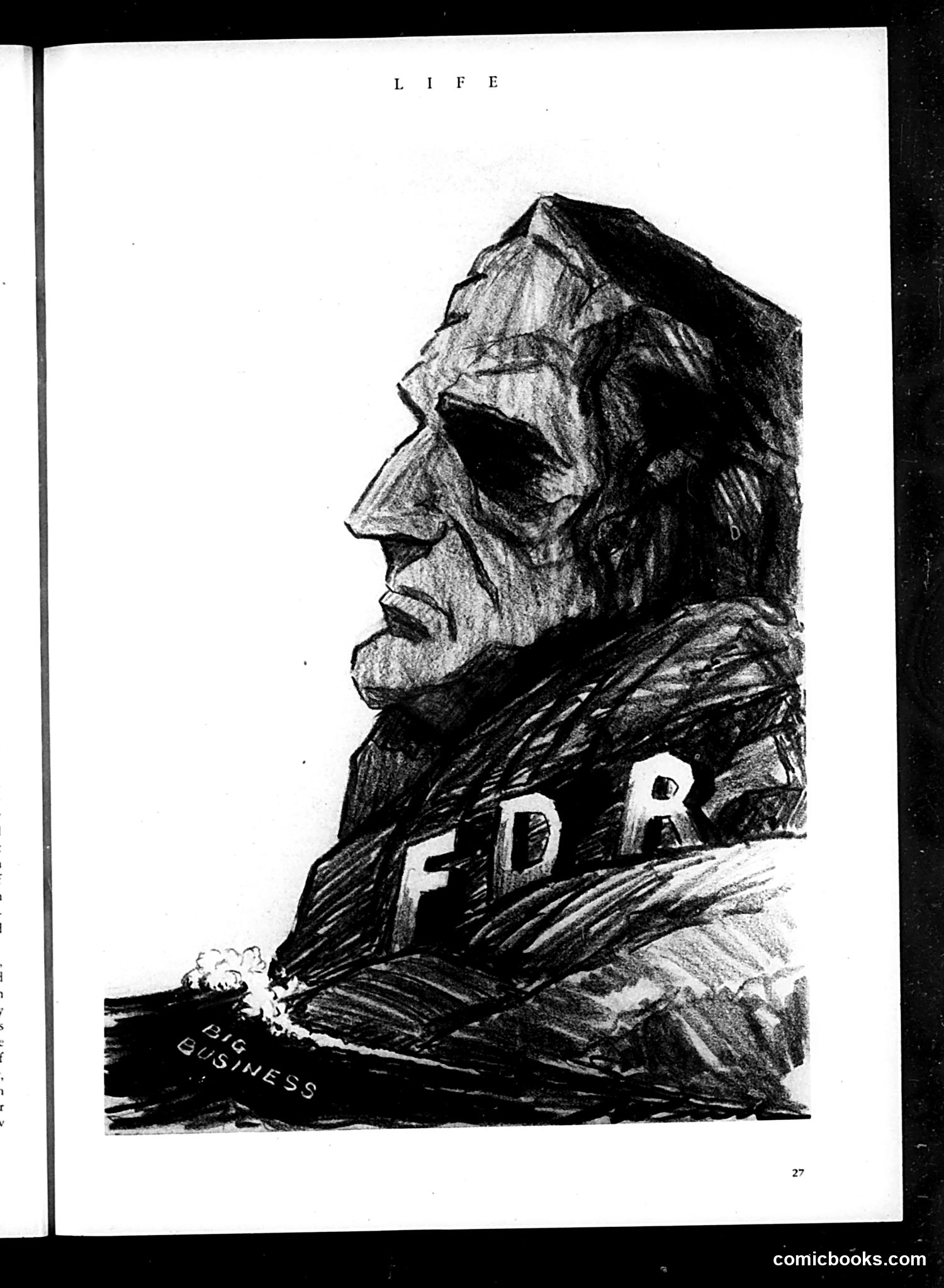
Analysis This is a political caricature titled "LIFE" showing a stern, angular male face in profile with the letters "FDR" on his shoulder. Below the figure appears text reading "THE BUSINESS." The drawing depicts Franklin D. Roosevelt, identifiable by the "FDR" initials and the distinctive caricatured features common in 1930s-40s satire. The phrase "THE BUSINESS" likely refers to Roosevelt's relationship with American business interests during the New Deal era—a contentious political topic. The caricature's harsh, unflattering style and stern expression suggest critical commentary, possibly criticizing FDR's policies toward business or his administration's approach to economic management. Without the publication date visible, the exact political moment remains unclear, but this appears to be anti-Roosevelt editorial commentary from Life magazine.
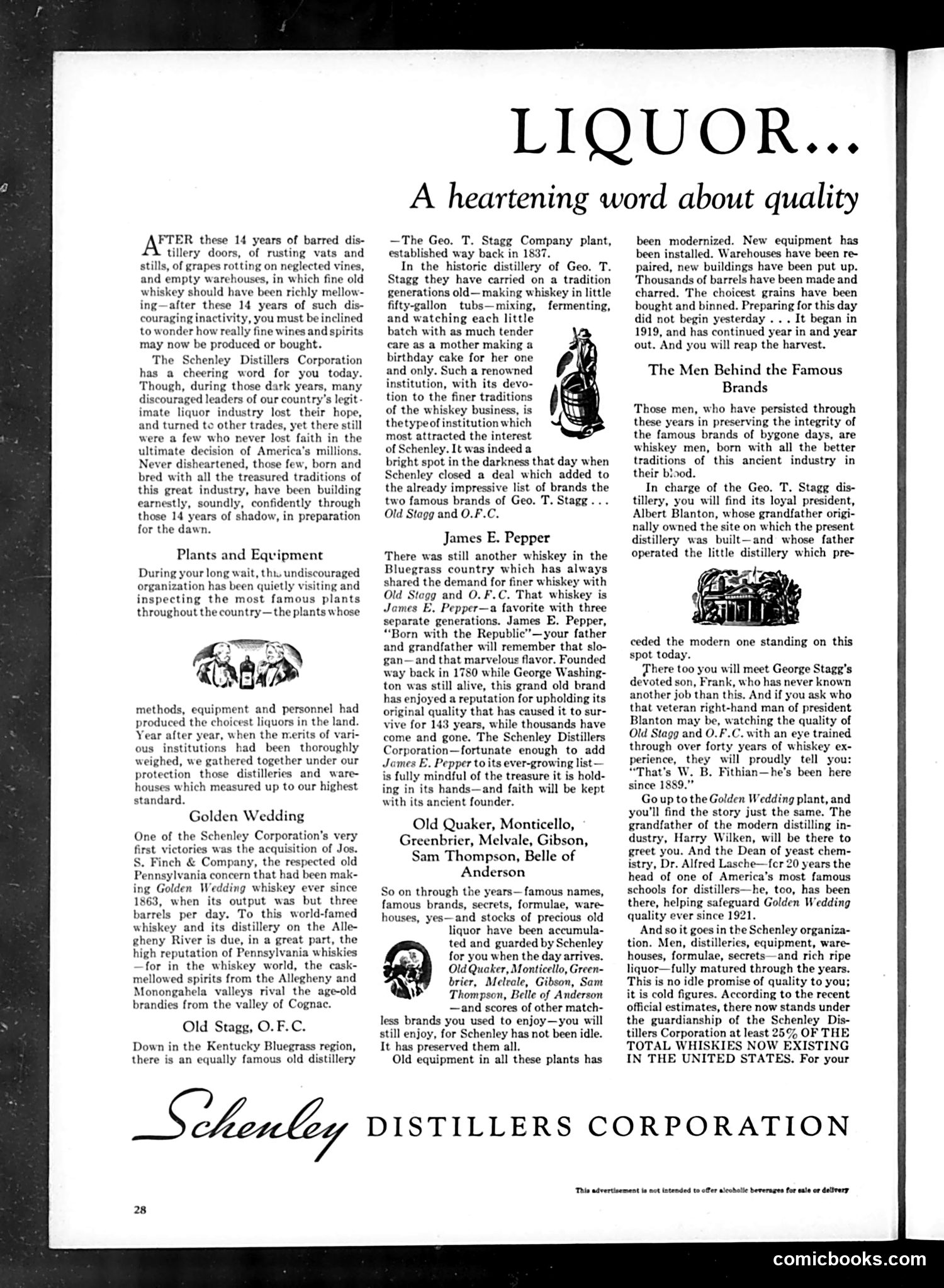
Analysis for Modern Readers This is advertising, not satire or political commentary. It's a Schenley Distillers Corporation promotional page celebrating the end of Prohibition (which lasted 14 years—1920-1933). The page promotes three whiskey brands Schenley acquired: Golden Wedding, Old Stagg/O.F.C., and James E. Pepper. Each brand claims historical prestige and continuous quality during Prohibition's "dark years." The illustrations show period distillery imagery and a woman in vintage dress—decorative rather than satirical. The text uses emotional language ("heartening word," "bright spot in darkness") to reassure consumers that these re-released spirits maintain their pre-Prohibition quality despite years of inactivity. The point: After 14 years of illegal closure, Schenley wants buyers to trust that premium American whiskeys are worth purchasing again. This reflects post-Prohibition optimism and the liquor industry's attempt to rebuild consumer confidence through heritage and tradition claims.
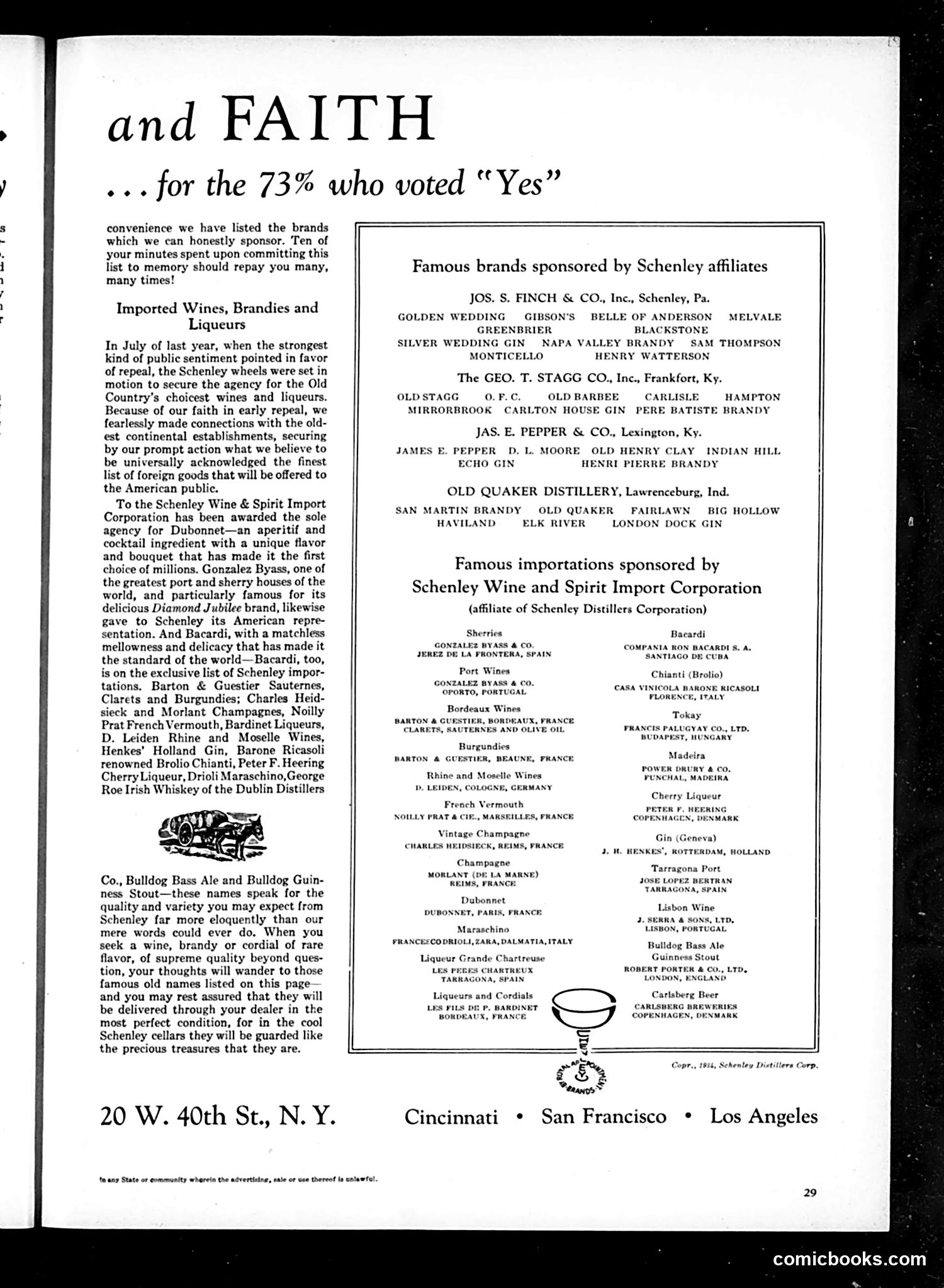
Context for Modern Readers This is a liquor advertisement from Life magazine, appearing after Prohibition's repeal in 1933. The "73% who voted 'Yes'" refers to public support for ending Prohibition through the 21st Amendment. The ad is Schenley Distillers Corporation promoting its newly acquired exclusive import agencies for premium alcoholic beverages—wines, brandies, sherries, and liqueurs from Europe. The company is emphasizing its "faith" in repeal's inevitability; they secured these prestigious brand relationships *before* Prohibition officially ended, betting on its demise. The advertisement lists dozens of famous imported brands (Bacardi, Dubonnet, Chianti, Guinness, etc.) as proof of Schenley's market dominance and quality assurance. The tone celebrates alcohol's return to American legality as a triumph of consumer choice and taste. There is no political cartoon on this page—it's purely corporate advertising capitalizing on the recent constitutional change that restored the legal liquor trade.
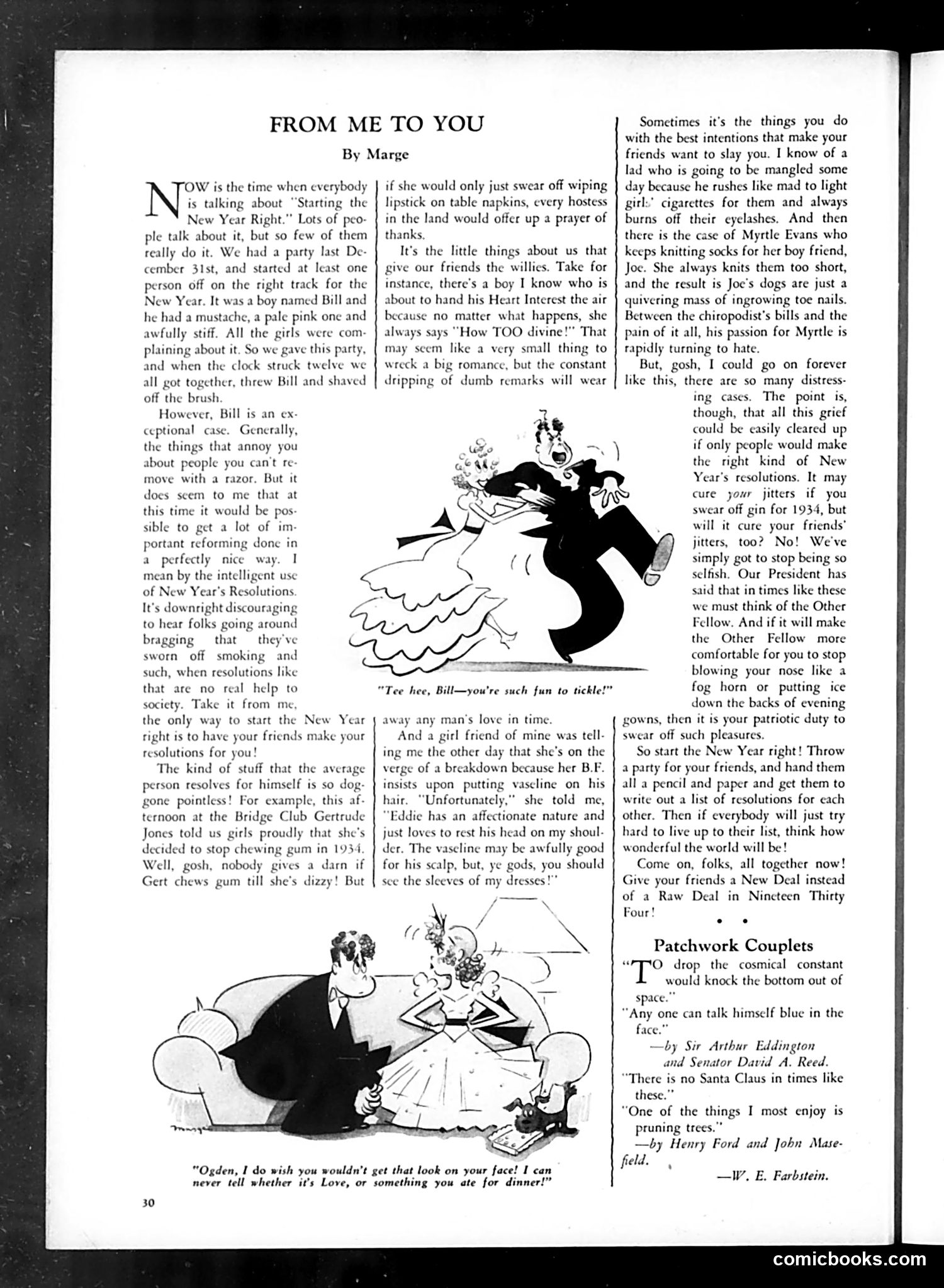
Analysis for Modern Readers This 1934 *Life* magazine humor column by "Marge" satirizes New Year's resolutions by arguing people should stop making selfish personal pledges and instead resolve to fix annoying habits that bother their *friends*. The cartoons illustrate specific social irritations: a man with a stiff mustache (shaved off at a party), and a couple where the man's greasy hair product ruins the woman's dress sleeves. The text offers other examples: someone who constantly says "How too divine!," a man who burns off women's eyelashes while lighting cigarettes, and a woman who knits socks too short, causing her boyfriend's toenail problems. The satire's point: personal vices like smoking matter less than small behavioral annoyances that affect others. The closing invokes President Franklin D. Roosevelt's call for collective thinking during the Depression era, suggesting patriotic duty demands we stop being selfish and fix ourselves *for others' comfort*. It's gentle social satire mocking both narcissistic self-improvement culture and the trivial complaints of privileged social circles (Bridge Club members, dating couples).
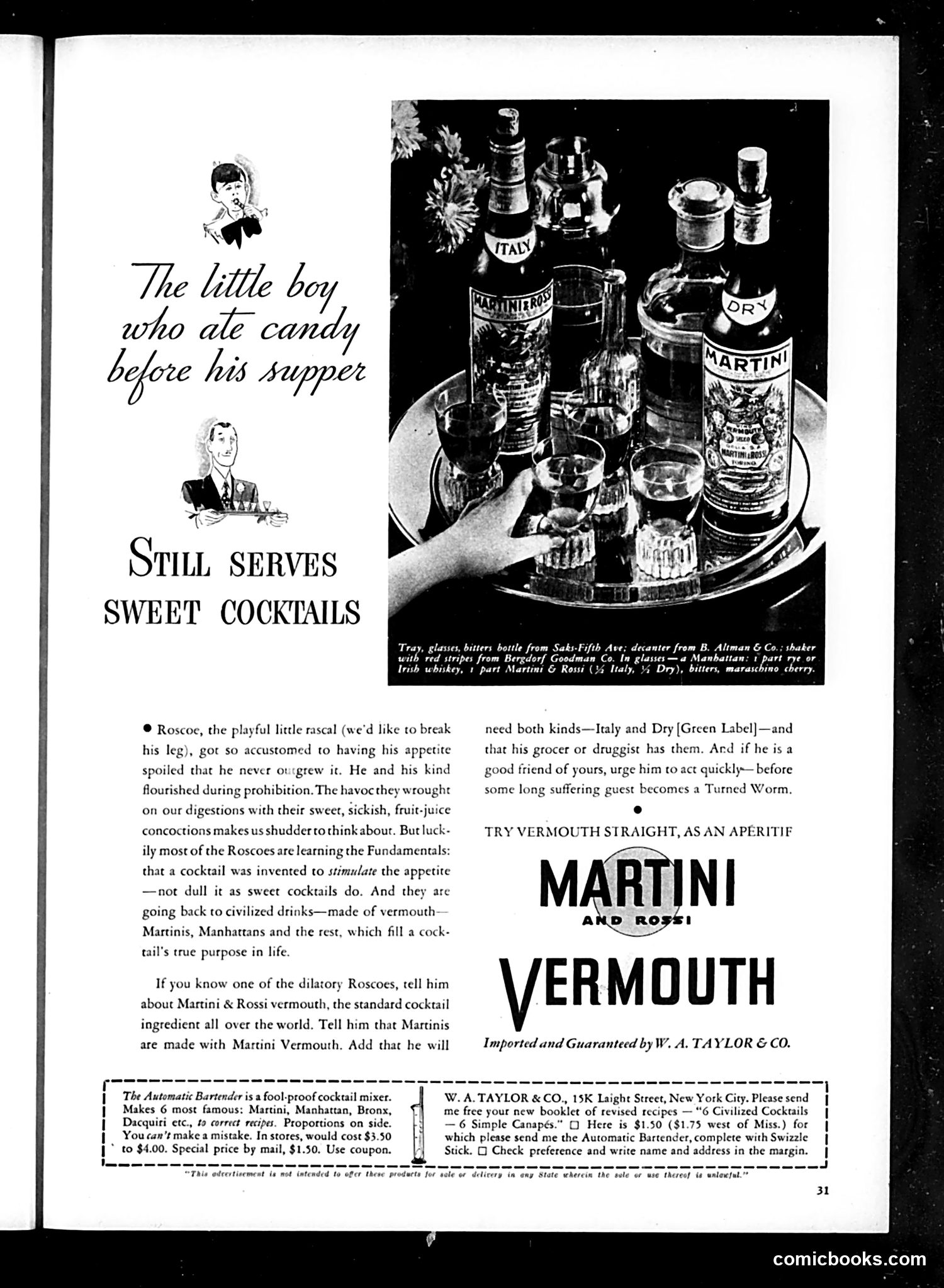
Martini & Rossi Vermouth Advertisement (Life Magazine) This is primarily a liquor advertisement, not political satire. It uses humor to promote vermouth cocktails during the post-Prohibition era (likely 1930s). The "joke" targets people called "Roscoes"—apparently a slang term for unsophisticated drinkers who developed a taste for sweet, fruity cocktails during Prohibition. The ad mocks these drinks as overly sweet and digestion-damaging, positioning them as childish (hence the opening anecdote about a boy who ate candy before supper). The advertisement's argument: "civilized" drinkers should abandon these habits and return to proper cocktails made with vermouth—Martinis and Manhattans—which supposedly stimulate rather than dull the appetite. The satire is social/cultural rather than political: it reflects post-Prohibition anxieties about proper drinking etiquette and mocks lower-class cocktail preferences as crude and immature. It's aspirational advertising disguised as witty social commentary.
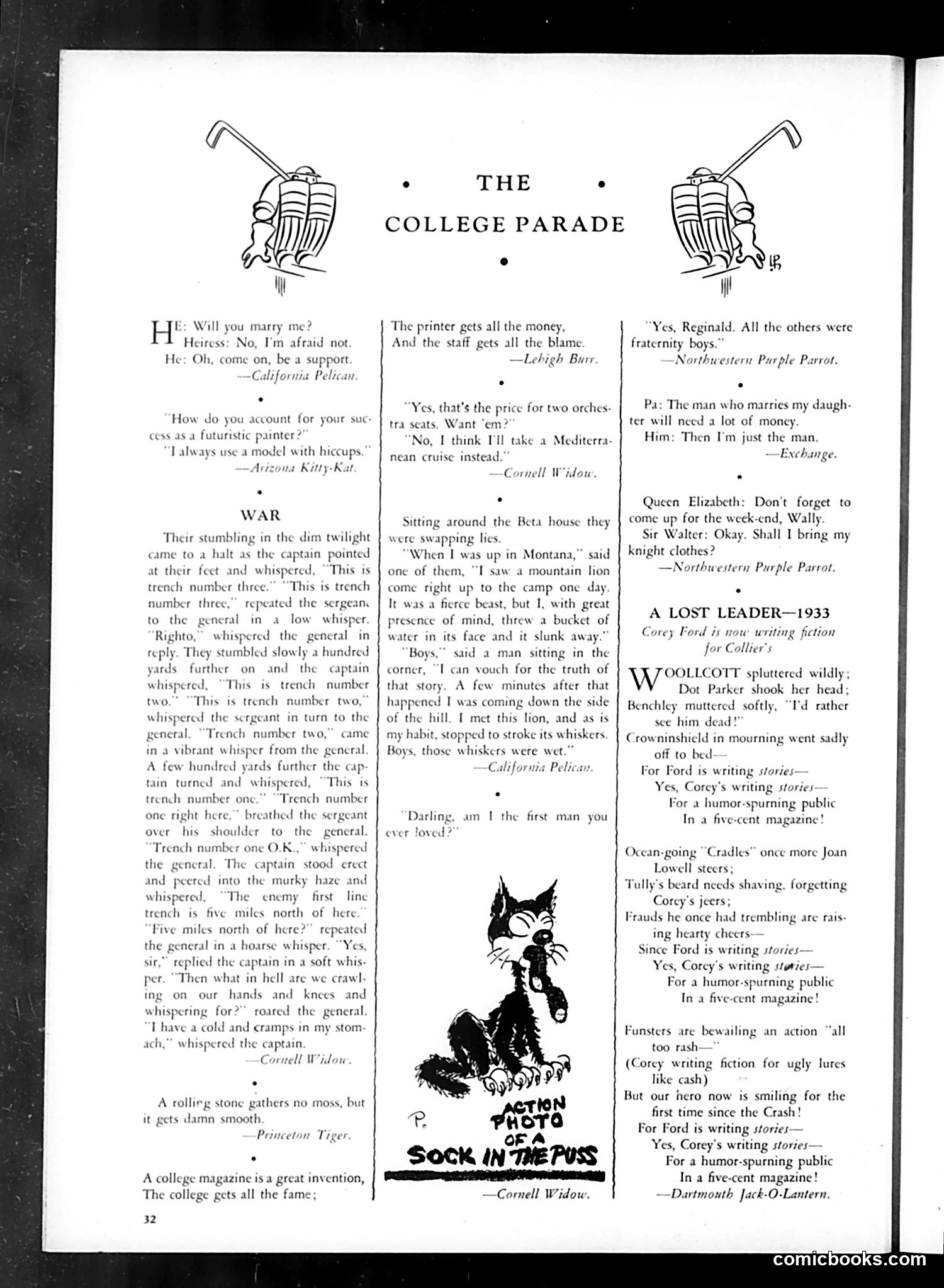
"The College Parade" Page Analysis This page collects collegiate humor from various college magazines (California Pelican, Cornell Widow, etc.), a common feature in *Life* during this era. Main content: Short jokes and quips about college life—marriage, art, fraternity pranks, and military service. The "War" piece satirizes WWI trench warfare through absurdist humor: soldiers whisper locations down a chain of command, culminating in the captain admitting he has a cold causing stomach cramps—the real reason for all the whispering. Notable item: "A Lost Leader—1933" mourns humorist Corey Ford leaving prestigious *Life* magazine to write fiction for *Collier's* (a lower-paying magazine). The poem parodies famous *Life* contributors (Dorothy Parker, Robert Benchley, Frank Crowninshield) lamenting Ford's departure as a betrayal—treating it as a personal tragedy rather than a career move. Context: This reflects 1930s anxieties about Depression-era job mobility and the perceived prestige hierarchy among American magazines.
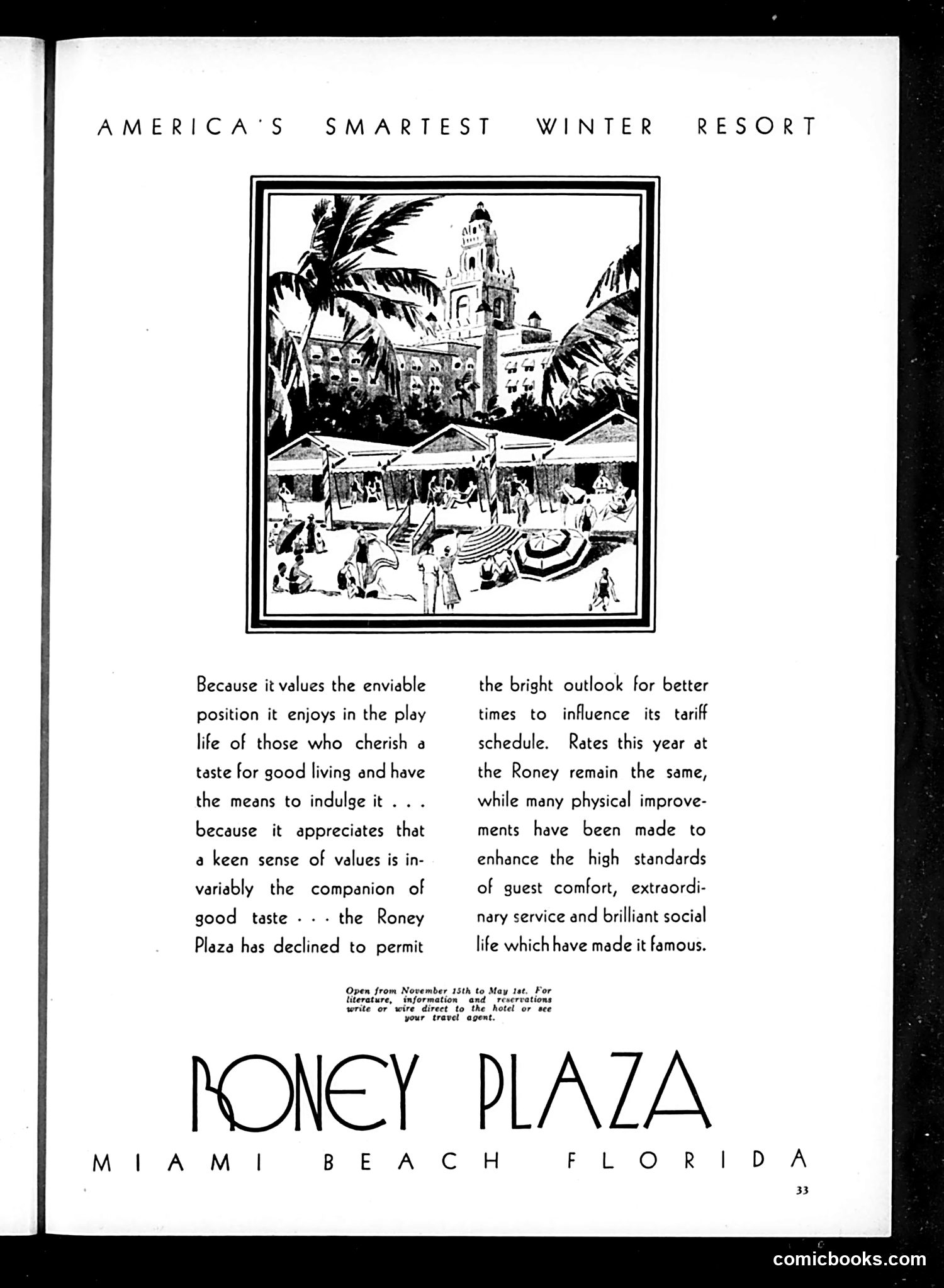
Analysis This is advertising copy, not satire or political commentary. The page promotes the Roney Plaza hotel in Miami Beach, Florida, billed as "America's Smartest Winter Resort." The text emphasizes luxury and exclusivity for wealthy clientele with refined taste. The illustration shows a Mediterranean-style resort with palm trees, a prominent tower, and leisured guests enjoying beach activities—visual shorthand for aspirational leisure. The key selling point is counterintuitive: despite economic hardship (likely the Great Depression era, given "bright outlook for better times"), the Roney Plaza deliberately maintains high rates rather than lowering them. This positions the hotel as so desirable and exclusive that it need not compete on price—staying there signals elite status. The message targets affluent readers who value "good taste" and associate luxury hotels with social distinction. No political figures or satire are present; this is straightforward luxury marketing using class anxiety and aspiration as its tool.
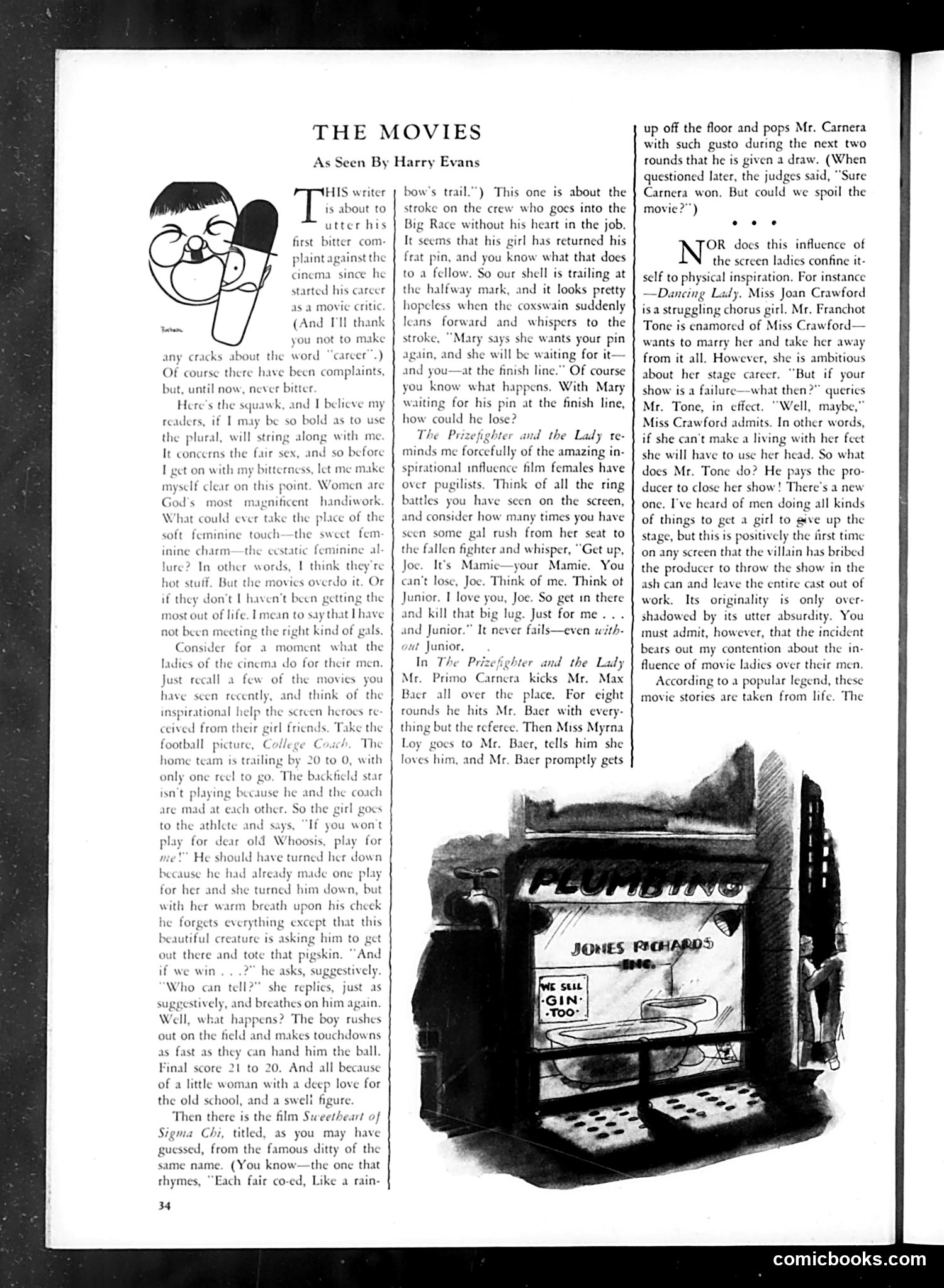
Analysis: "The Movies as Seen by Harry Evans" This is a film criticism column satirizing how 1930s Hollywood movies portrayed women's influence on male athletes and fighters. The author observes that cinema repeatedly shows women inspiring men to superhuman athletic feats through romantic encouragement alone. The specific films referenced—*College Coach*, *Sweetheart of Sigma Chi*, and *The Prizefighter and the Lady* (featuring boxers Primo Carnera and Max Baer)—all follow the same formula: a discouraged male athlete receives a woman's whispered words of love/support and suddenly dominates his competition. The satire's point: these movies absurdly overstate female physical inspiration while simultaneously confining women to the role of cheerleader. The author mockingly notes that cinema ladies "confine themselves to physical inspiration" rather than achieving anything independent, and quotes a character admitting that if her show fails, she'll "have to use her head"—implying women's only value lies in beauty, not intellect. The cartoon shows a movie theater marquee advertising *"We Sell 'Gin' Too"*—likely satirizing cinema's vapid commercialism alongside its gender stereotypes.
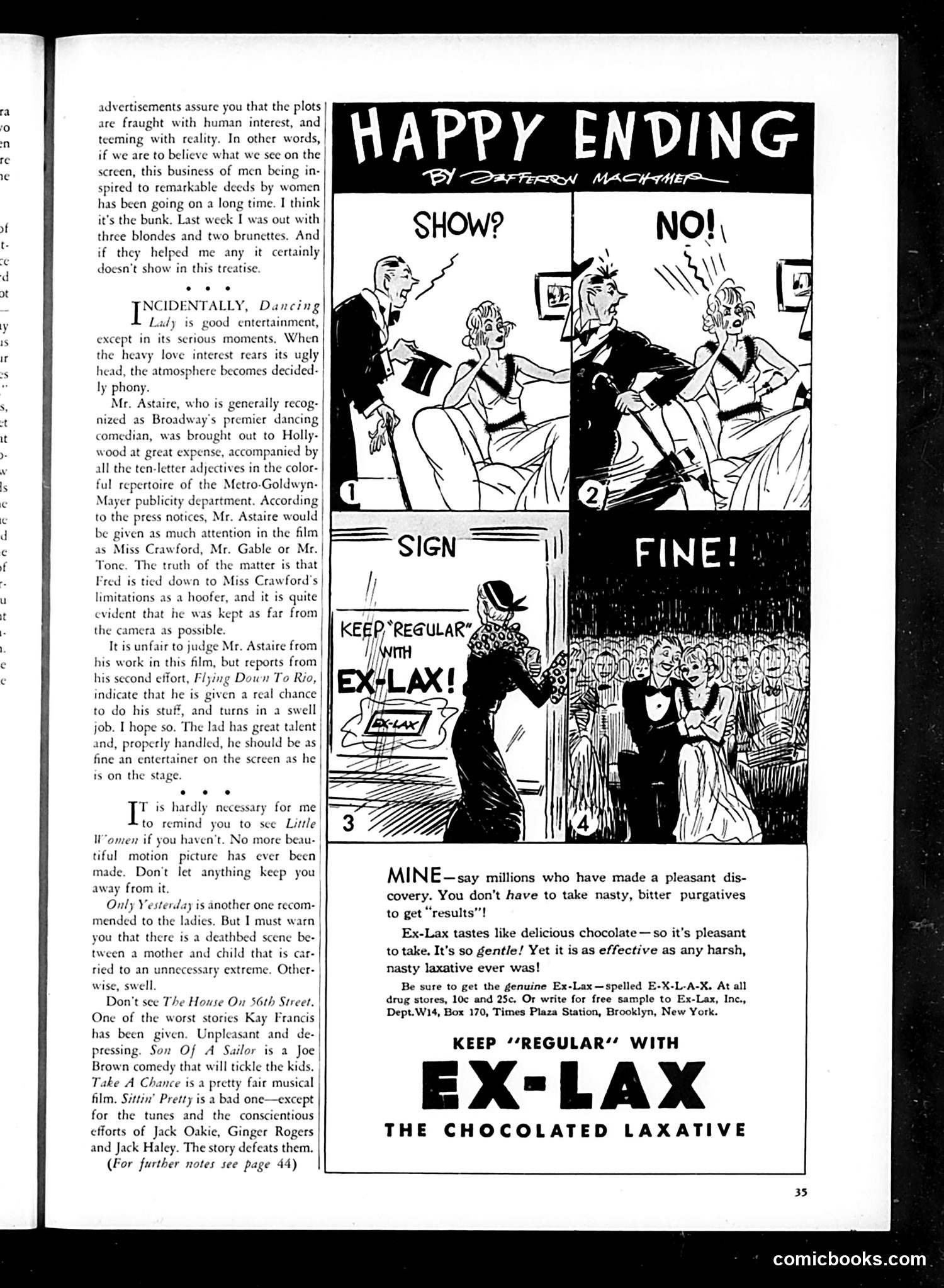
"Happy Ending" Comic Analysis This is a four-panel comic strip by Datterrow Mackhmer satirizing Hollywood's formulaic happy endings. The narrative shows a theater producer pitching a show concept, being rejected, then signing a contract after adding "Keep Regular with Ex-Lax" messaging, and finally receiving audience applause at the premiere. The satire mocks how studios would insert commercial tie-ins and advertisements into films to secure financing or sponsorship. The absurdist joke suggests that adding a laxative brand endorsement transforms an otherwise rejected project into a commercial success—critiquing both Hollywood's desperation for funding and audiences' willingness to accept blatant product placement if wrapped in entertainment. The comic runs adjacent to a film review discussing Fred Astaire and Joan Crawford's *Dancing Lady*, making the timing commentary on 1930s studio practices particularly pointed. The "happy ending" is purely commercial, not artistic.
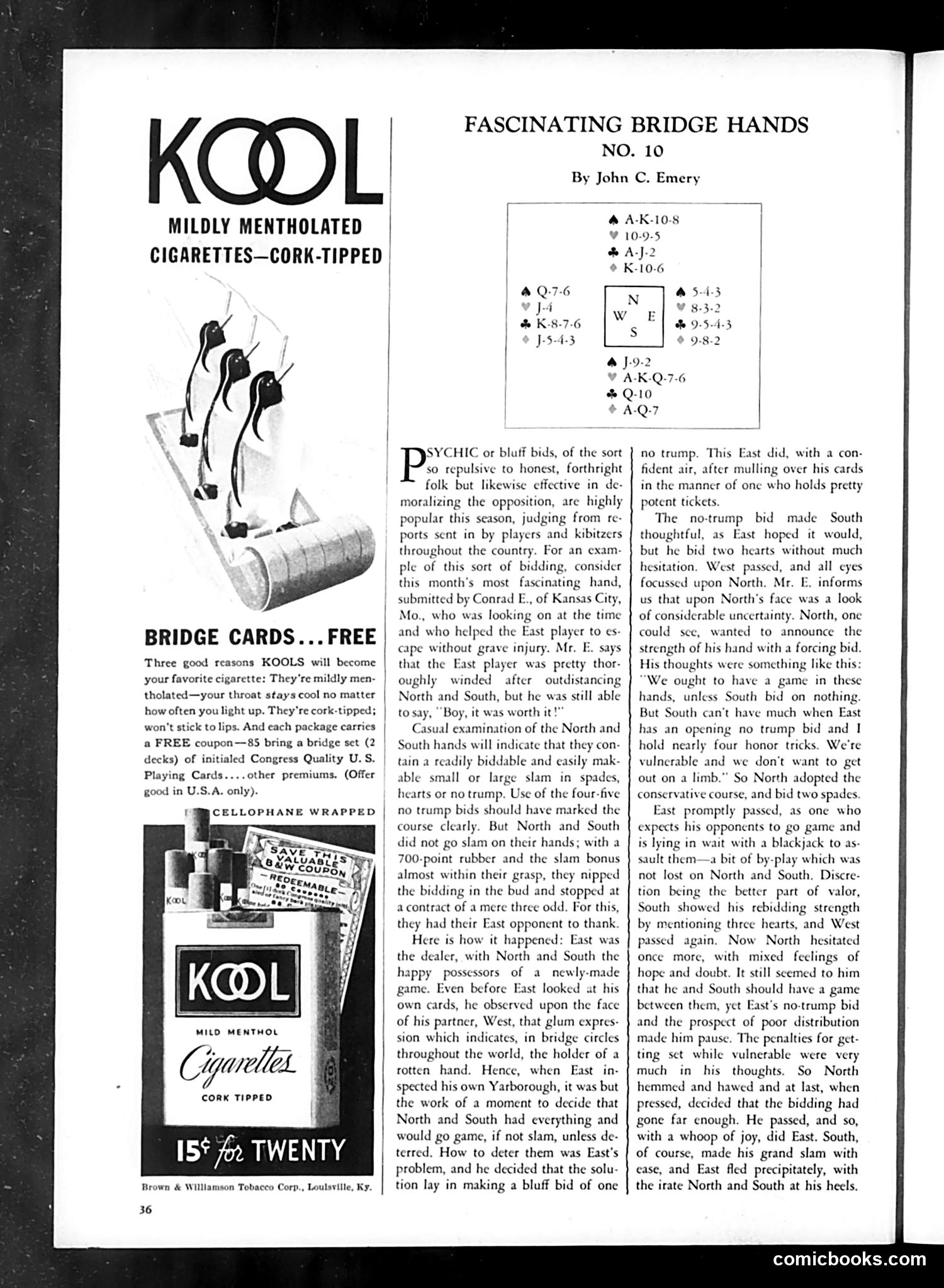
"Fascinating Bridge Hands" Column Analysis This page is primarily a bridge strategy column with cigarette advertising, not political satire. The content explains a competitive card game hand submitted by a Kansas City reader. The article describes a deceptive bidding strategy where East player makes a "bluff bid" with a weak hand (a "Yarborough"—bridge slang for a worthless hand) to psychologically intimidate opponents North and South into bidding conservatively, despite holding strong cards that should have resulted in a high-scoring slam contract. The column's point: skilled bridge players use psychological tactics and calculated bluffing—reading opponents' facial expressions and making misleading bids—to manipulate outcomes. East successfully deters North-South from their optimal bid through strategic deception. The surrounding Kool cigarette advertisements promote free bridge playing cards as a premium incentive, capitalizing on the bridge game's popularity in 1930s-40s American culture.
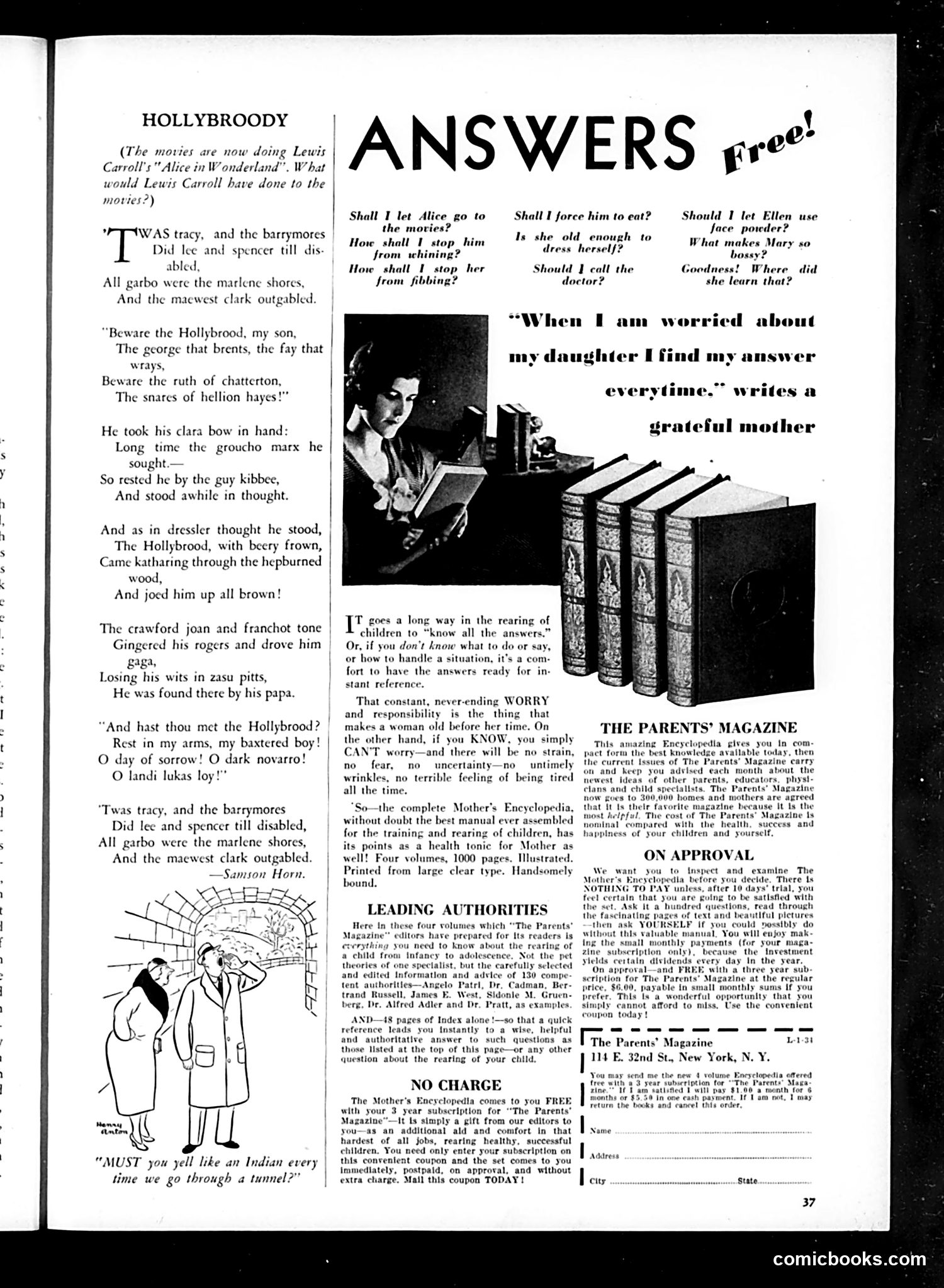
Explanation for Modern Readers This page satirizes Hollywood's 1930s celebrity culture through a parody of Lewis Carroll's "Jabberwocky" poem. The opening section titled "HOLLYBROODY" mocks the movie industry by replacing Carroll's nonsense creatures with actual Hollywood stars' names—Tracy, Barrymore, Garbo, Marx, Crawford, etc.—creating absurdist verse about these celebrities. The joke: Hollywood has become so self-absorbed and ridiculous that it rivals Carroll's surreal fantasy world. The cartoons below depict parenting dilemmas ("Should I let Alice go to the movies?" "Shall I force him to eat?"). These advertise *The Parents' Magazine's* Mother's Encyclopedia—a practical advice manual offering answers to common child-rearing anxieties. The advertisement promises mothers relief from worry through instant reference answers, positioning the encyclopedia as a health tonic for stressed parents. The tunnel scene cartoon appears unrelated satirical humor about family behavior.
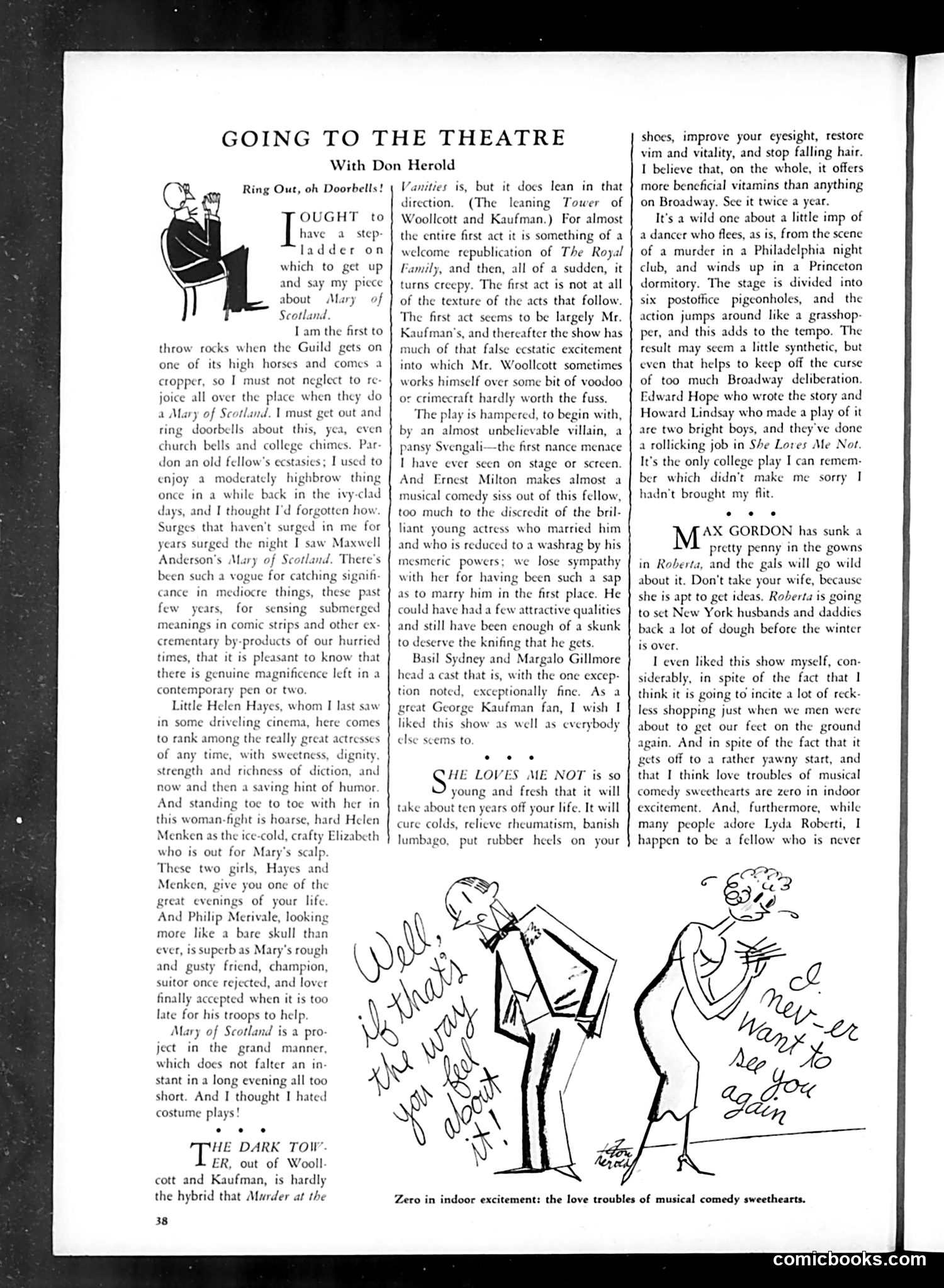
Analysis: "Going to the Theatre" by Don Herold This is a theater review column from Life magazine. The page contains three Broadway show reviews with accompanying cartoon illustrations. Main content: Herold enthusiastically praises *Mary of Scotland* (starring Helen Hayes and Helen Menken), calling it genuinely magnificent theater. He criticizes *The Dark Tower* for its inconsistent tone and an implausible villain character—notably described as "pansy Svengali" and "nance menace"—portrayed by Ernest Milton. The derogatory language reflects period attitudes toward homosexual characterization on stage. The cartoon (bottom) shows a man in formal dress awkwardly trying to court an unimpressed woman, illustrating the love troubles in the musical comedy *She Loves Me Not*—Herold's third review, which he praises as youthful and refreshing. The satire is primarily theatrical critique rather than political commentary, reflecting 1930s Broadway culture and period prejudices about stage portrayal.
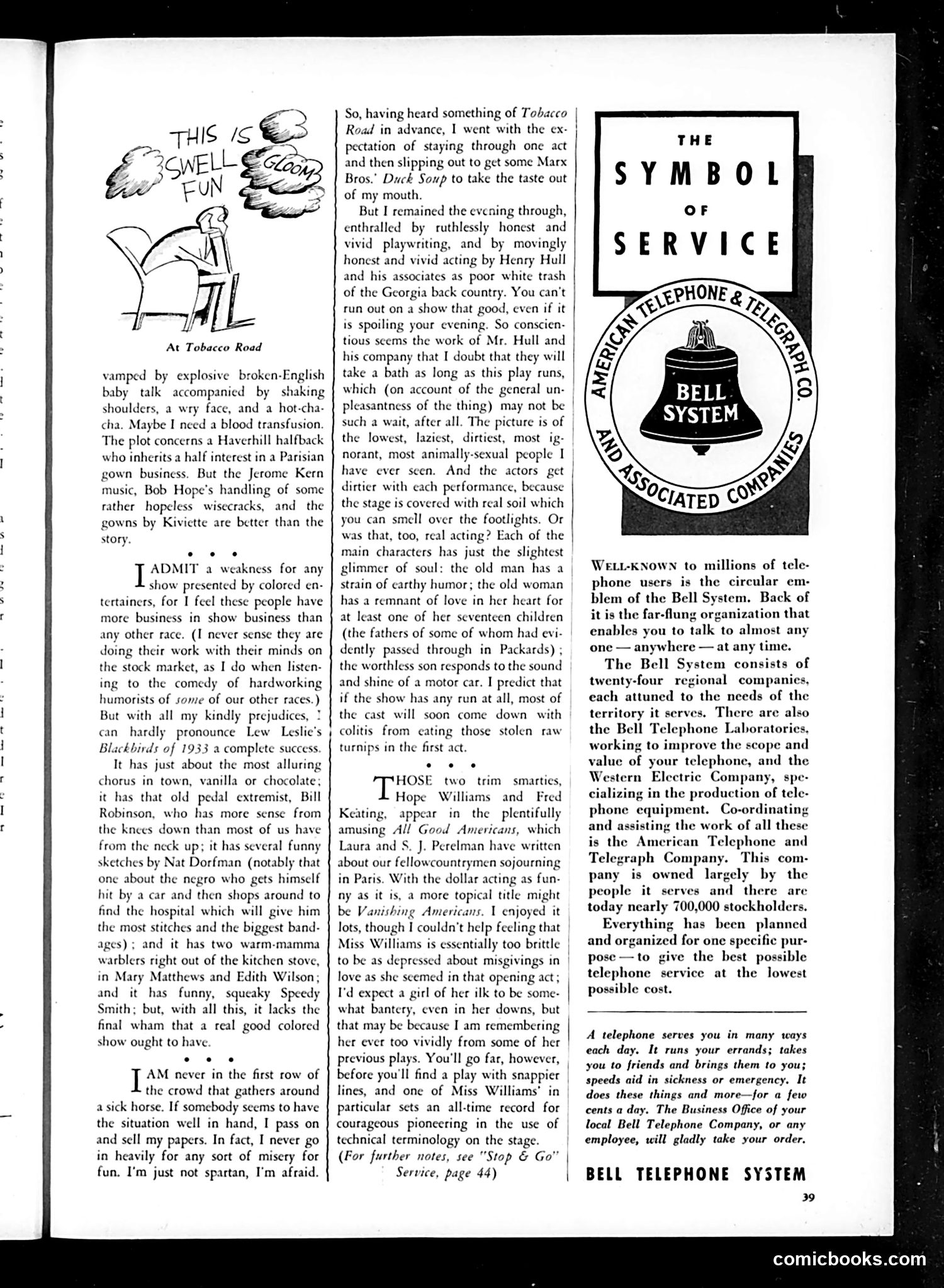
Theater Reviews from Life Magazine This page contains three theatrical reviews from what appears to be the 1930s. The critic discusses: 1. "At Tobacco Road" - A play about poor white Georgian farmers, praised for its raw authenticity. Henry Hull's performance is commended as genuinely gritty, with actors becoming progressively dirtier throughout the run due to actual stage soil. 2. "Blackbirds of 1933" - A revue featuring Black entertainers. The critic expresses admiration for Black performers' natural talent, while critiquing the show itself. Notable performers include Bill Robinson and others, though the critic finds it ultimately lacking despite individual strengths. 3. "All Good Americans" - A comedy by the Perelmans featuring Hope Williams and Fred Keating, set in Paris. The reviews use period-appropriate language reflecting 1930s attitudes. The right side contains a Bell Telephone System advertisement about service reliability.
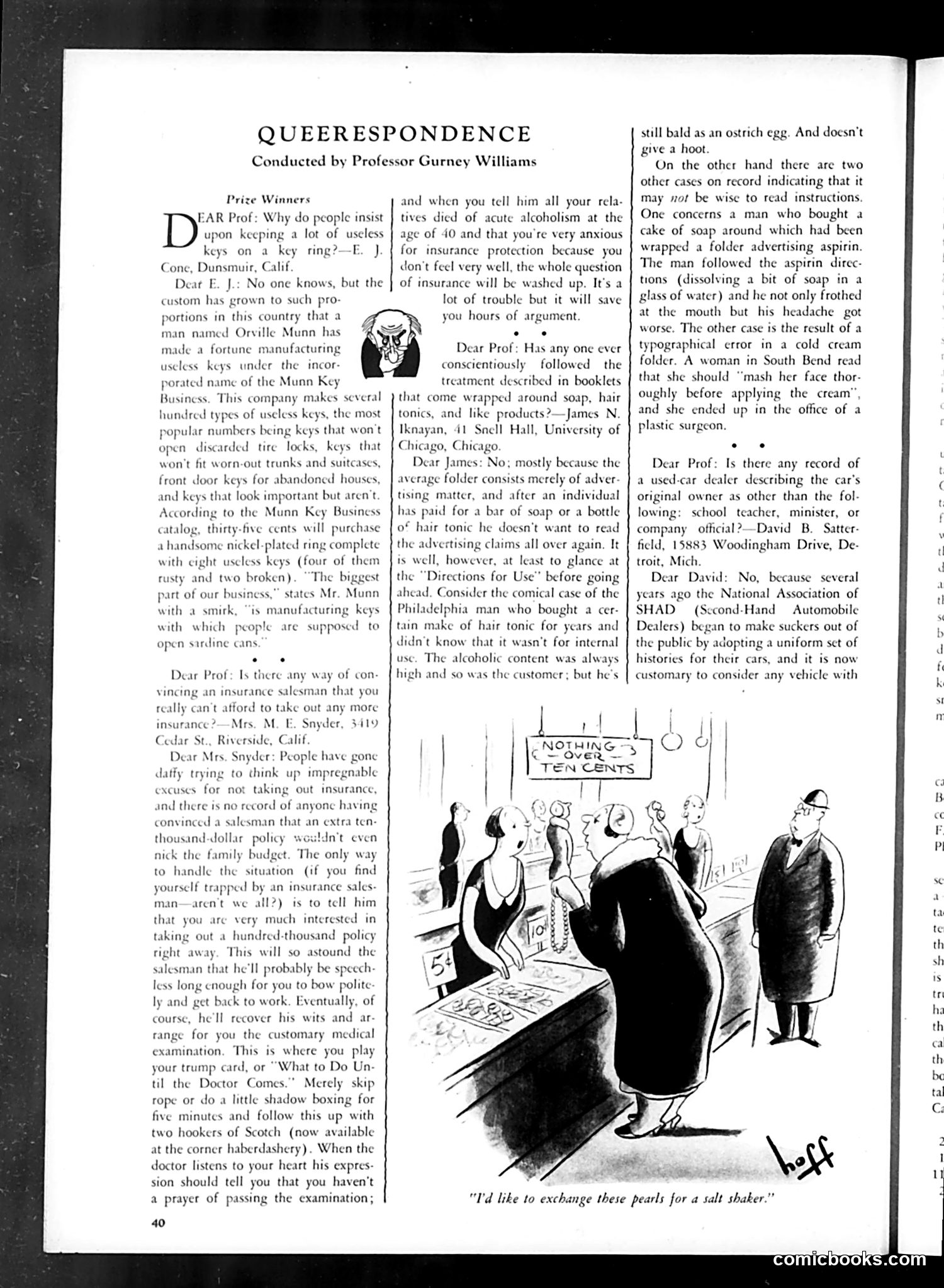
Explaining This Life Magazine Page to Modern Readers This is a humor advice column called "Queerespondence" (a pun on "correspondence"). The page contains three satirical Q&A responses about absurd everyday situations: 1. Useless key rings: The response jokingly claims a man named Orville Munn built a fortune manufacturing deliberately useless keys—keys that don't open anything, fit nothing, or are designed to open sardine cans. This mocks consumerism and Americans' tendency to accumulate junk. 2. Avoiding insurance salesmen: The advice humorously suggests telling the salesman you want a *larger* policy (shocking him), then deliberately failing the medical exam by rope-jumping and drinking whisky before the doctor's exam, claiming alcoholic relatives to seem unhealthy. 3. Following product instructions: The column ridicules people who ignore directions on soap and hair tonic, citing a Philadelphia man who drank hair tonic for years (because it was alcoholic) without realizing it wasn't for internal use, remaining bald. The cartoon below shows people trading items at a sidewalk stand marked "Nothing over ten cents." One figure says, "I'd like to exchange these pearls for a salt shaker"—mocking foolish consumer trades. The satire targets consumer behavior, advertising claims, and American gullibility.
Content Analysis This page is primarily advertisements and advice column content, not political cartoons. The main humor derives from a satirical advice column about used-car dealers' deceptive practices. It mocks how dealers misrepresent shabby vehicles using elaborate euphemisms—claiming a wreck with "burnt-out bearings" and "cracked radiators" can be "fixed up like new for about $1.50." The anecdote about the convertible containing a machine gun and gin labels (suggesting it belonged to a Prohibition-era liquor smuggler) satirizes both dealer dishonesty and the period's widespread illegal alcohol trade. A separate advice response ridicules the contents of typical bathroom medicine cabinets, finding them filled with empty bottles and expired items—mocking domestic disorder and false appearances of organization. The advertisements for the Waldorf-Astoria hotel and Longchamps restaurants emphasize luxury and quality control, appearing incongruous against the page's satire about deception and neglect.
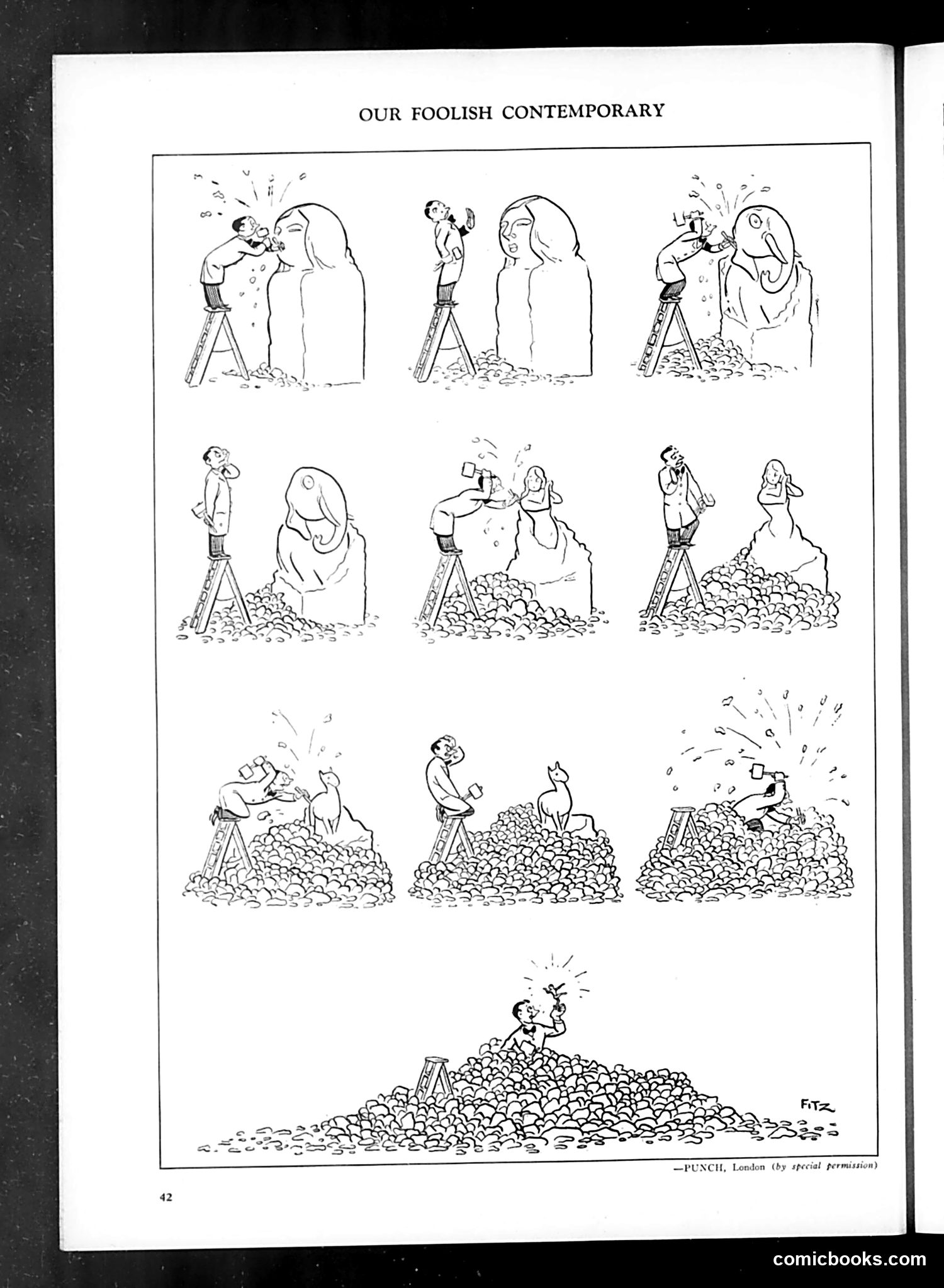
"Our Foolish Contemporary" This is a reprinted cartoon from *Punch* magazine (London), credited to artist Fitz. The sequential comic shows a man repeatedly attempting to sculpt or carve a large block of stone/ice into a female head using a hammer and chisel from a ladder. The humor escalates progressively: the figure's efforts repeatedly fail—the stone crumbles, pieces fly off unexpectedly, and he loses his balance. By the final panel, he's buried under the accumulated debris of his failed attempts. The satire likely mocks futile artistic ambition or perseverance in the face of obvious incompetence. The "foolish contemporary" is someone who stubbornly repeats the same failed approach, undeterred by repeated failure. The cartoon's title suggests this behavior typifies modern foolishness worthy of ridicule.
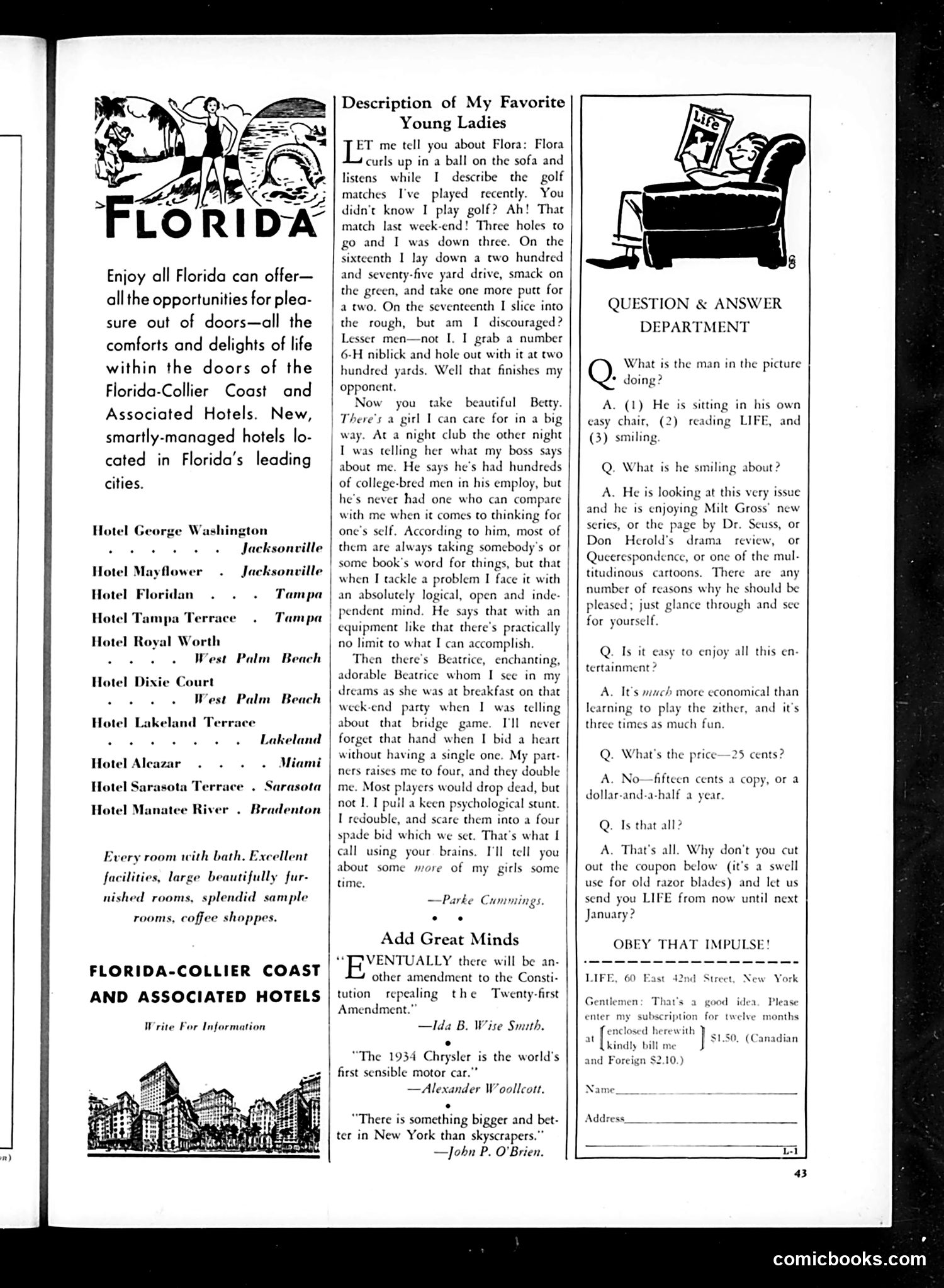
Analysis for Modern Readers This page is primarily advertising and humor content, not political satire. It contains: 1. Hotel advertisements for Florida properties (upper left), marketing leisure travel during what appears to be the 1930s. 2. "Description of My Favorite Young Ladies" — a satirical piece mocking self-absorbed male narcissism. The unnamed narrator obsessively describes himself to women (Flora, Betty, Beatrice), talking only about his own accomplishments: golf shots, his boss's praise, his bridge-playing prowess. The satire targets men who treat dates as captive audiences for their own ego-boosting monologues. 3. "Add Great Minds" — brief quotes (one on repealing Prohibition, one praising a 1934 Chrysler, one about NYC) presented without context, likely mocking grandiose or absurd public statements. 4. Question & Answer section — self-promotional banter advertising *Life* magazine itself as entertaining and economical. The overall tone is lighthearted social commentary rather than political critique.
"Stop & Go" Service: A 1930s Theater Review This page from *Life* magazine presents brief critical reviews of Broadway plays and movies, organized as a "Symposium of Criticism" by three writers. The "Stop & Go" traffic-light header is a visual pun—reviews proceed like traffic signals, presumably with favorable shows getting "green light" status. The reviews are witty, sardonic capsule critiques typical of *Life*'s satirical approach. They praise performances (George Cohan, Ethel Waters) and mock theatrical conventions—operettas with absurd plots, melodramas, revues weakened by murder-mystery subplots. The tone is irreverent and clever rather than mean-spirited; reviewers note when they genuinely enjoy shows despite obvious flaws. References to contemporary Broadway hits like "Ah, Wilderness!" and "As Thousands Cheer" ground this in early 1930s entertainment culture. The magazine assumes readers are familiar with Broadway and interested in witty dismissals of theatrical pretension.
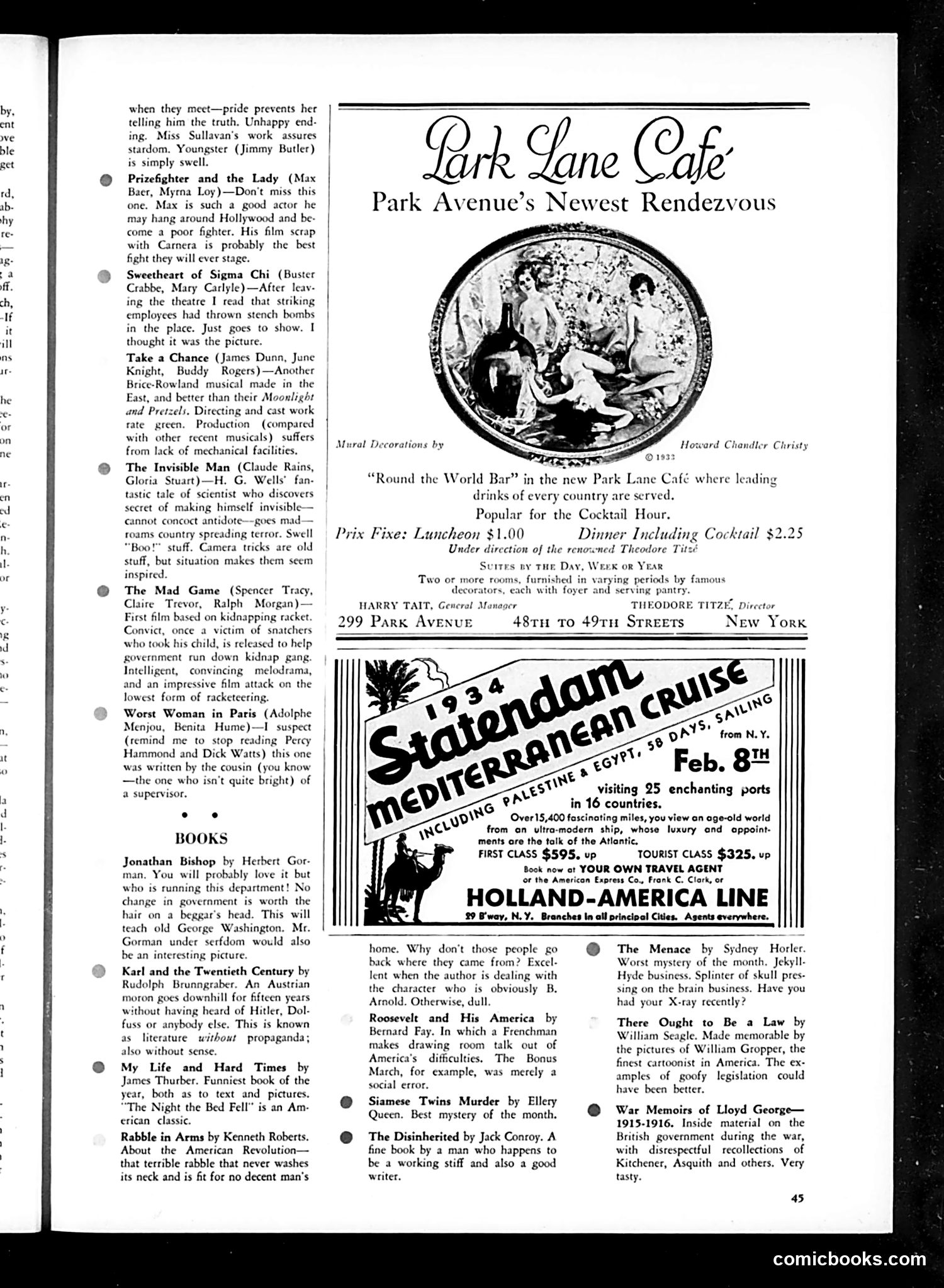
Page Analysis: Life Magazine, circa 1934 This page primarily features advertisements and book reviews rather than political cartoons. The main visual is an advertisement for the Park Lane Café on Park Avenue in New York, showing a mural of a "Round the World Bar" where international drinks are served. This reflects 1930s Manhattan leisure culture during Prohibition's end (repealed 1933). Below that is a Staatendam Mediterranean cruise advertisement offering 50-day voyages visiting Palestine and Egypt for $595 (first class) or $325 (tourist), typical of luxury travel marketing in the Depression era. The text consists of film and book reviews. The film section critiques 1930s Hollywood movies (including *The Invisible Man* and *The Mad Game*), while the books section discusses contemporary literature, including a notably dismissive review of a book about the American Revolution, calling revolutionaries "that terrible rabble that never washes its neck." No political satire is evident—this is essentially a leisure/culture page mixing entertainment advertising with contemporary arts criticism.
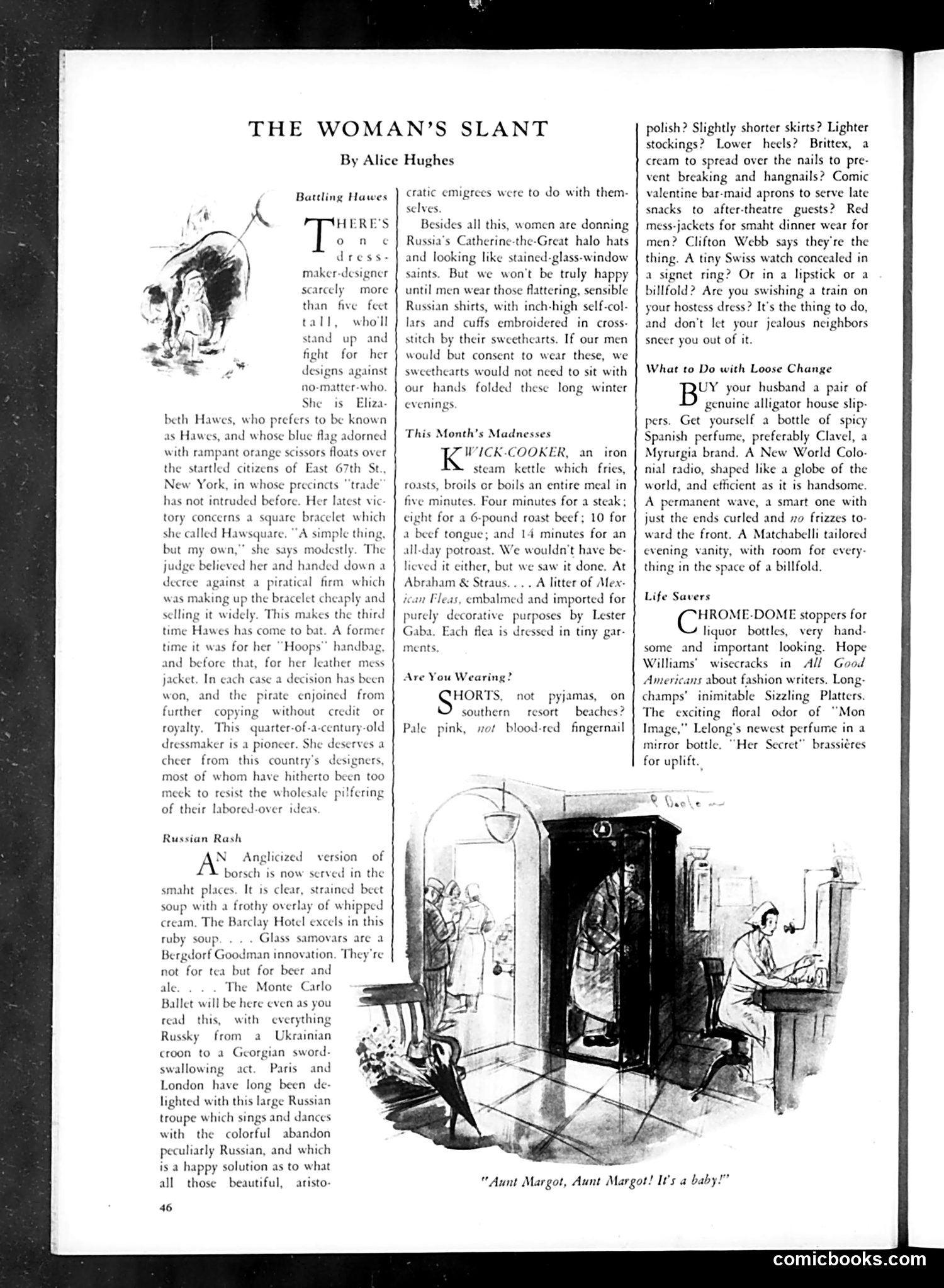
"The Woman's Slant" - Life Magazine Fashion Commentary This is a women's fashion column by Alice Hughes discussing contemporary style trends and consumer products, circa 1920s-1930s (based on references to Russian influences and Art Deco aesthetics). Main Feature: Elizabeth Hawes, a 5-foot-tall dress designer, is profiled as a legal victor against fashion pirates who copied her "Hawsquare" bracelet design. The satire celebrates her as a pioneer defending original design against wholesale knockoffs—a recurring battle in her career. The Broader Satire: The column gently mocks women's fashion obsessions through product recommendations: alligator house slippers, Spanish perfume, novelty radios shaped like globes, and specialized vanities. The humor lies in the breathless enthusiasm for trivial luxury items. Russian Fashion Note: There's tongue-in-cheek commentary suggesting men should wear flattering Russian embroidered shirts (hinting at the Russian cultural craze of the era) to match women's adoption of Catherine-the-Great halo hats. The cartoon illustration (captioned "Aunt Margot, Aunt Margot! It's a baby!") appears unrelated—likely a separate humorous piece about unexpected motherhood.
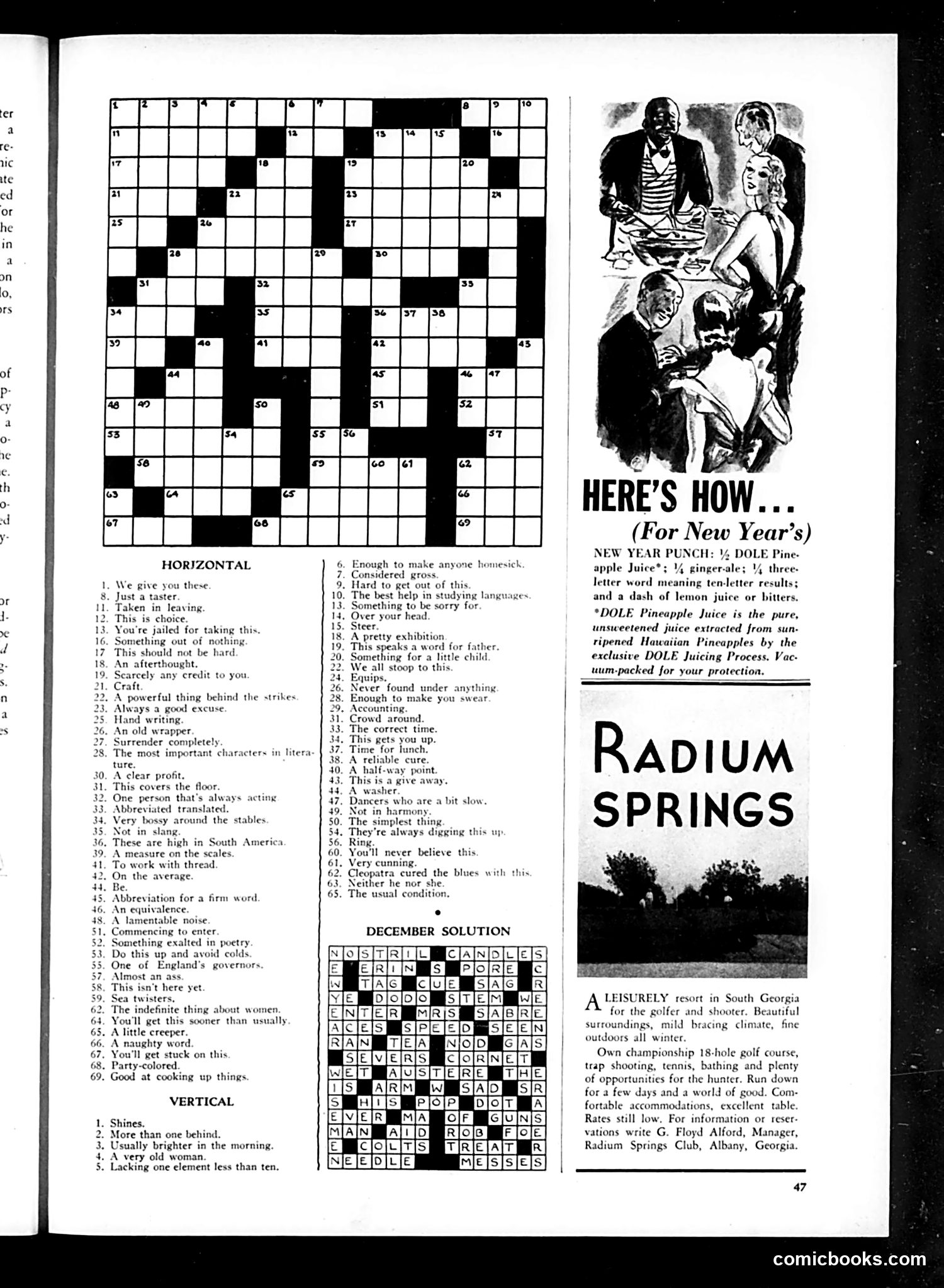
Page Analysis This is primarily a crossword puzzle page from Life magazine, not a political cartoon. The main content consists of: 1. A standard crossword puzzle with horizontal and vertical clues 2. The solution to the previous month's puzzle (December Solution) 3. Two advertisements: - DOLE Pineapple Juice promoting a "New Year's Punch" recipe - Radium Springs, a Georgia resort advertising golf, shooting, and hunting The illustration accompanying the Dole ad shows well-dressed socialites at what appears to be a cocktail party—typical 1930s advertising imagery targeting middle-class entertainers. The Radium Springs advertisement is notable for modern readers: it casually markets a resort around radioactive mineral springs, reflecting the era's widespread belief that radium had health benefits—a dangerous misconception we now recognize as causing serious illness. This page reflects Life's hybrid nature: satirical magazine combined with puzzles and consumer advertising.
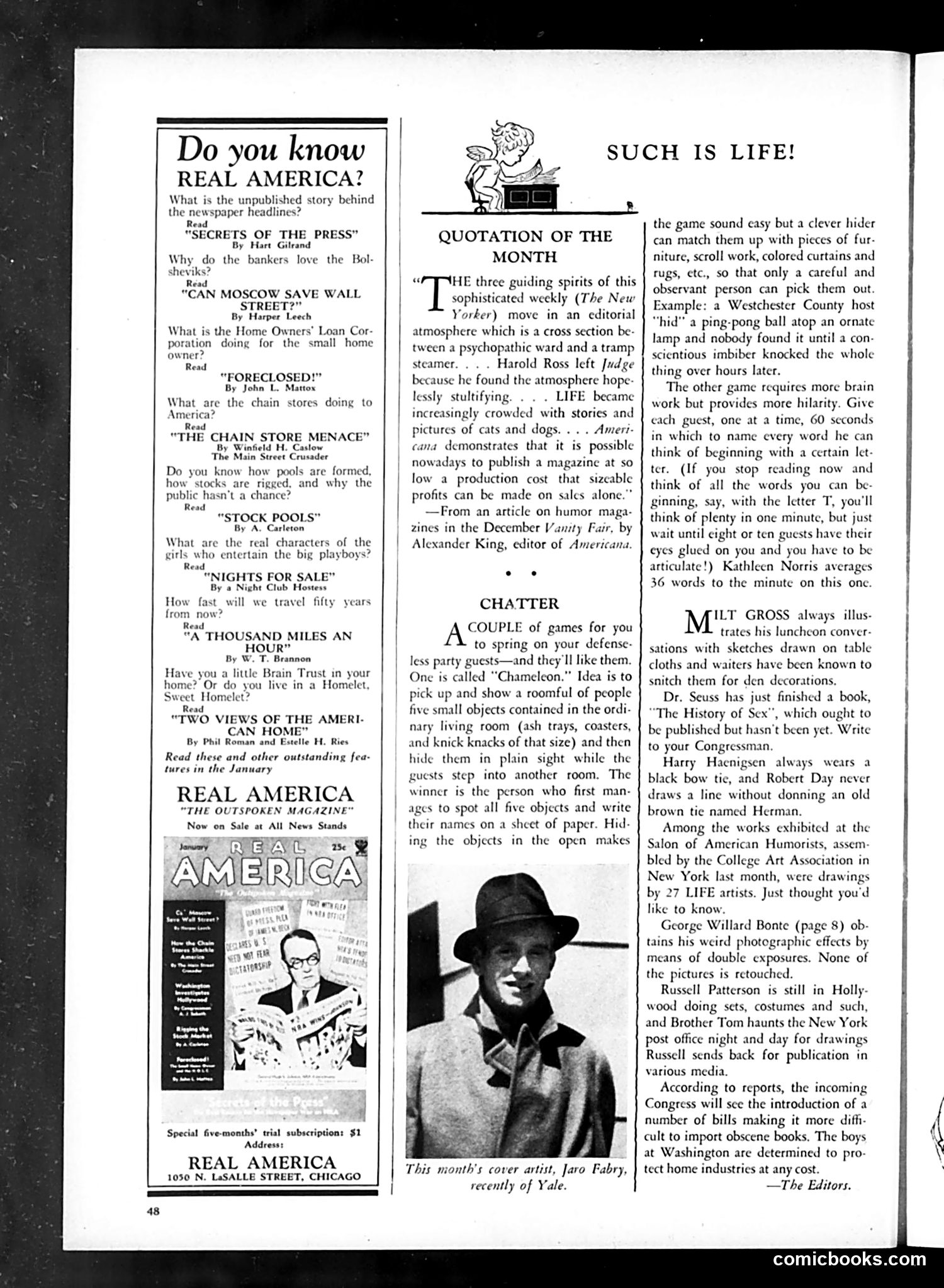
Analysis of Life Magazine Page This page is primarily advertising and editorial content rather than political cartoons. The left side advertises *Real America* magazine, a muckraking publication promoting exposés on banking, chain stores, stock manipulation, and housing—reflecting 1930s Depression-era concerns about economic injustice and corporate malfeasance. The right side contains light social commentary ("Such is Life!") and party game suggestions. The "Quotation of the Month" quotes Alexander King's criticism of *The New Yorker* magazine's editorial chaos and *Life*'s cat-and-dog content, contrasting it with *Americana*'s efficient low-cost production. The photograph shows Jaro Fabry, the cover artist, identified as "recently of Yale"—a biographical note typical of the era. Overall: This page reflects 1930s concerns about corporate power and economic transparency, mixed with lighthearted lifestyle content—no significant political satire is present.