life
Life — February 1934
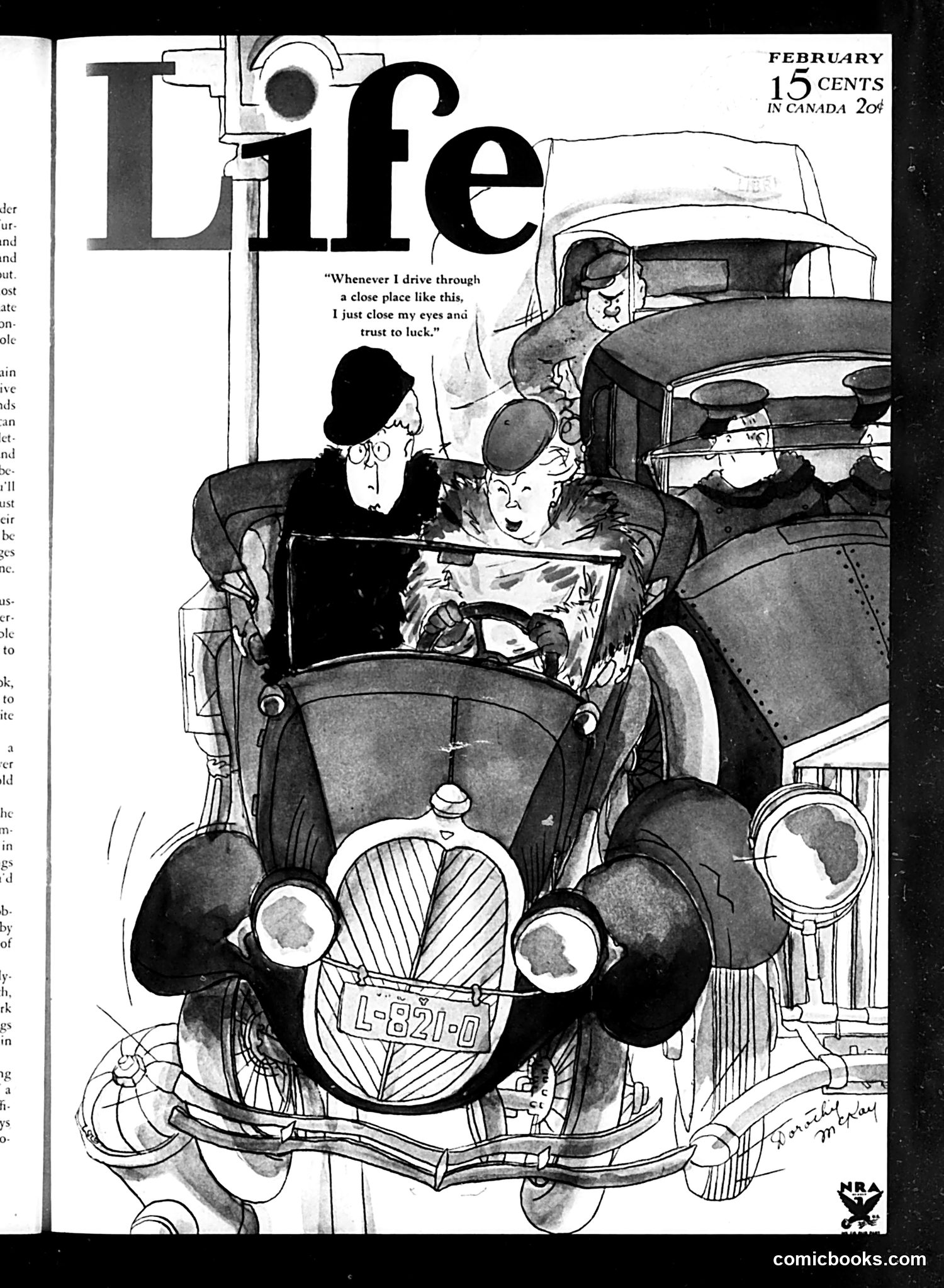
Life Magazine Cover - February, Early 1920s This is a Life magazine cover satirizing dangerous driving habits. The illustration shows a car full of passengers—a woman driver and what appears to be a family—passing dangerously close to other vehicles on the road. The driver's quote states: "Whenever I drive through a close place like this, I just close my eyes and trust to luck." The satire mocks reckless motorists of the era, particularly highlighting how some drivers—possibly women drivers, a newer phenomenon—operated vehicles with alarming disregard for safety. The cartoon critiques both the dangerous behavior and the fatalistic attitude ("trust to luck") that characterized some early automobile users. This reflects 1920s concerns about traffic safety as car ownership rapidly expanded.
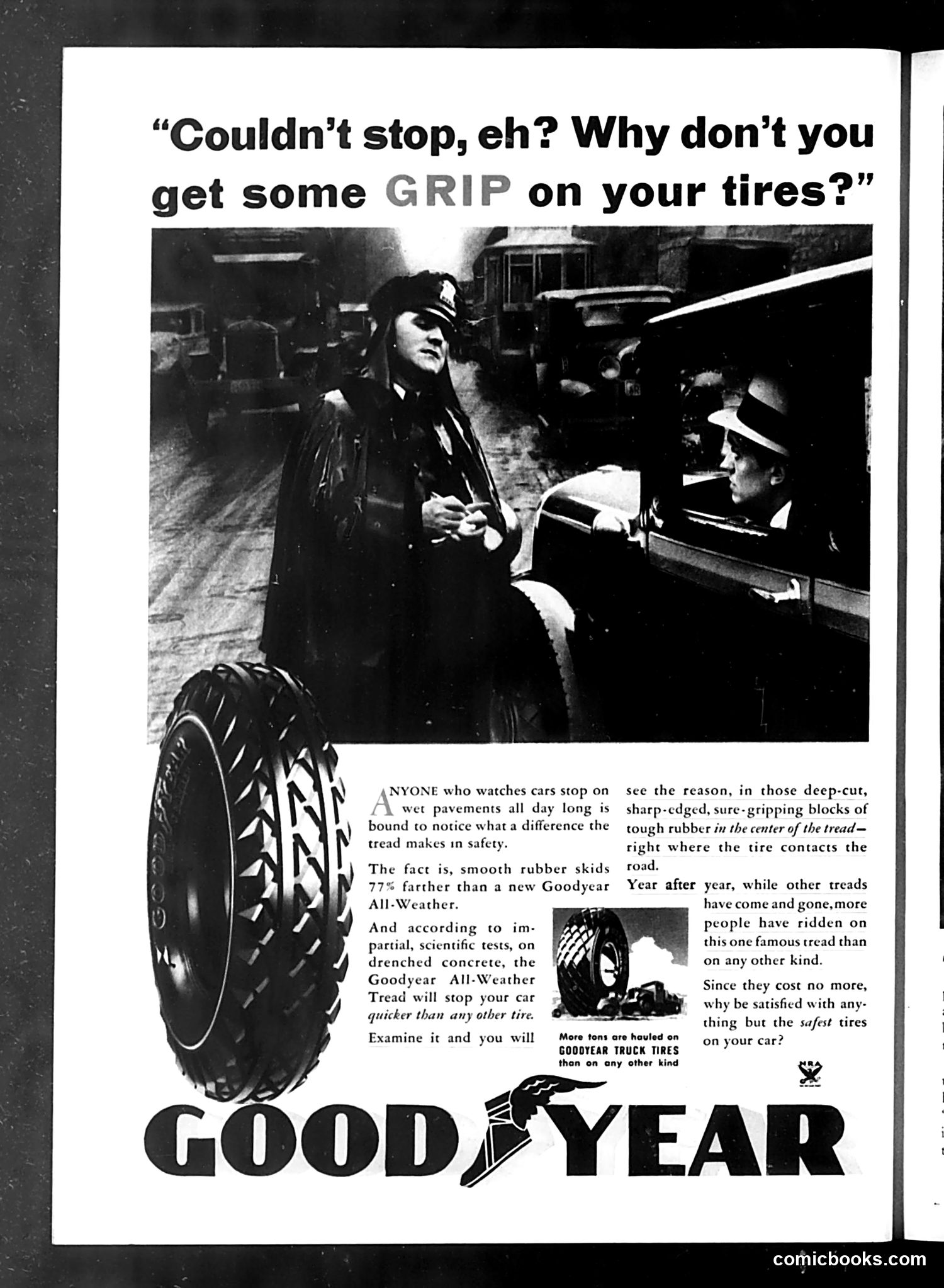
Analysis This is a Goodyear tire advertisement, not a political cartoon. The page shows a staged scene where a traffic officer appears to be scolding a driver for poor tire grip on wet pavement. The dramatic headline—"Couldn't stop, eh? Why don't you get some GRIP on your tires?"—uses the officer's authority to deliver the sales pitch. The ad argues that Goodyear All-Weather tires stop faster than competitors on wet roads, supported by "impartial scientific tests." A large tire image displays the distinctive tread pattern, presented as the reason for superior safety. The appeal is practical rather than satirical: purchase better tires to avoid accidents and legal trouble. This reflects early-20th-century automotive safety concerns when tire quality significantly affected braking performance.
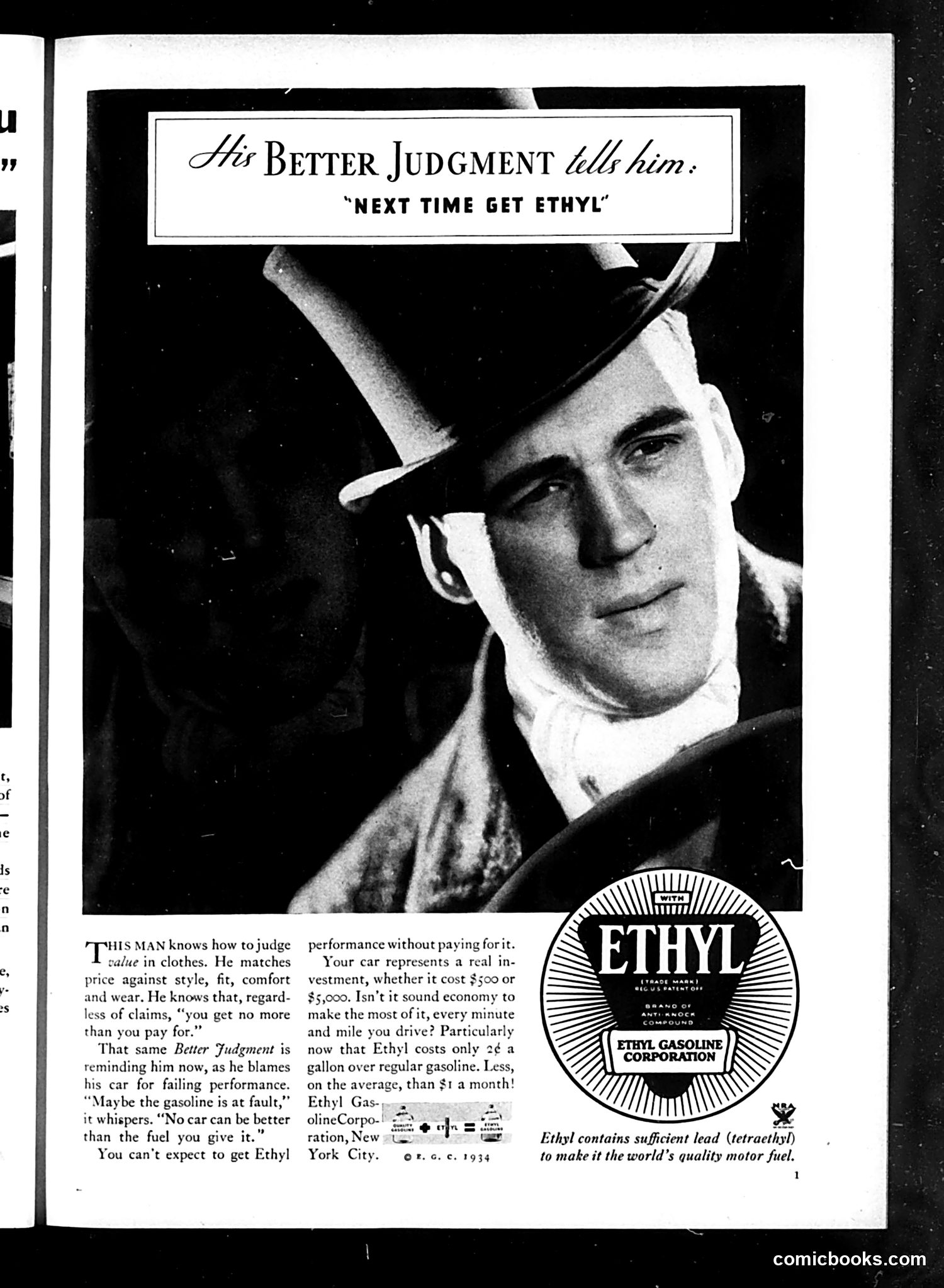
Analysis This is primarily an advertisement for Ethyl gasoline (1934), not satire or political commentary. The ad features a man in formal attire with a knowing expression—described as someone with "better judgment"—who understands automotive value. The joke is straightforward: this sophisticated man recognizes that Ethyl gasoline, though only 2¢ more per gallon than regular fuel, represents smart economics. The ad plays on class aspiration—suggesting that discerning people judge quality in clothes, cars, and fuel the same way. The circular logo emphasizes that Ethyl contains lead (tetraethyl), which was marketed as improving fuel quality. This advertisement predates widespread awareness of lead's health dangers; the lead content was actually promoted as a selling point for "world's quality motor fuel."
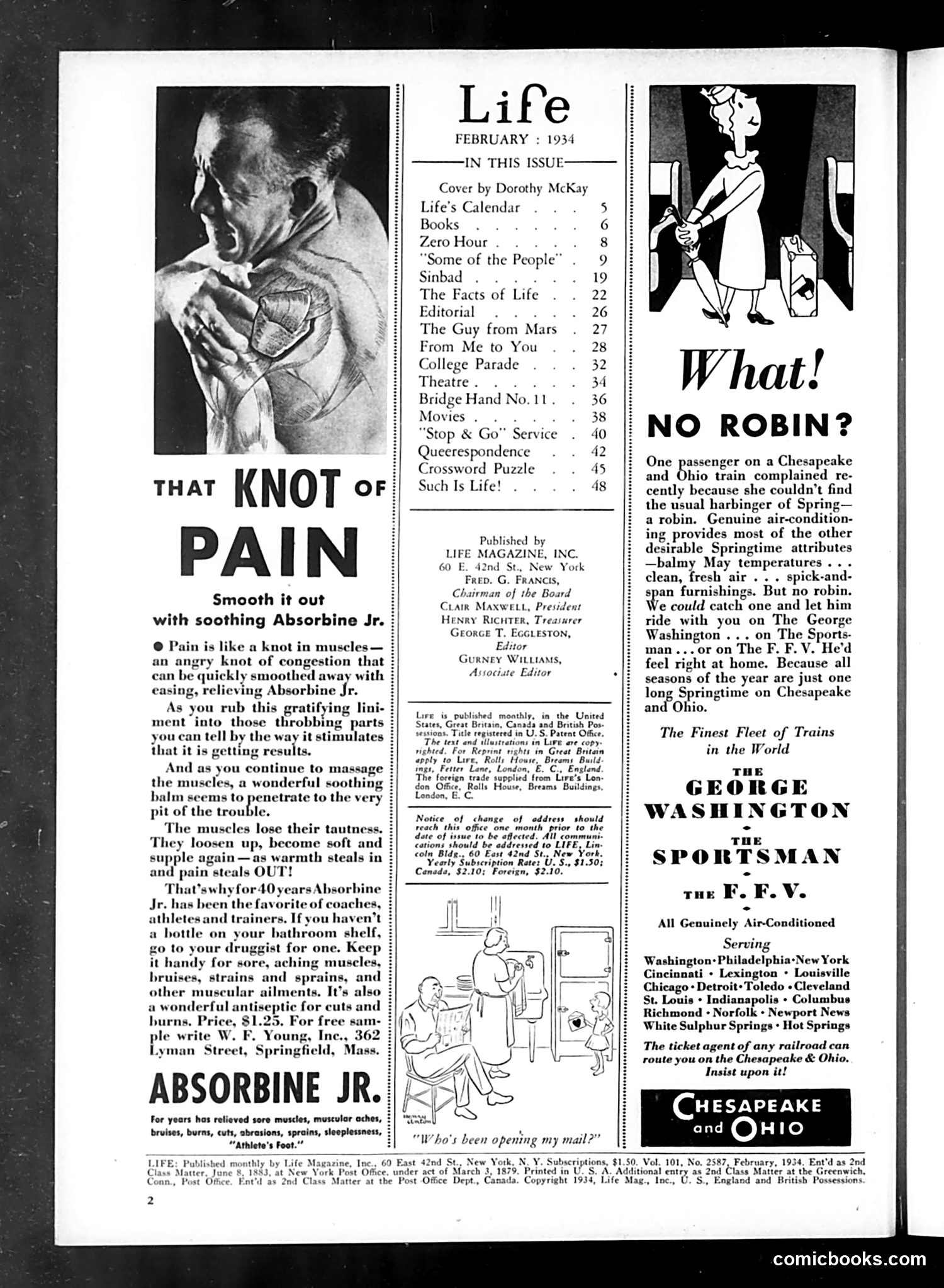
Analysis of Life Magazine, February 1934 This page is primarily a table of contents and advertisements rather than political satire. The main content includes: - A cover illustration by Dorothy McKay (right side) - An advertisement for "Absorbine Jr." pain relief (left side), featuring an anatomical drawing of muscular pain points - Railroad advertisements for the Chesapeake and Ohio line, promoting air-conditioned trains to major US cities - A small cartoon at bottom showing someone asking "Who's been opening my mail?" The "No Robin?" article (right) is a lighthearted complaint about missing springtime birds on a train route—not political commentary. This appears to be a standard magazine issue from the Great Depression era, focused on consumer products and travel rather than satirical commentary.
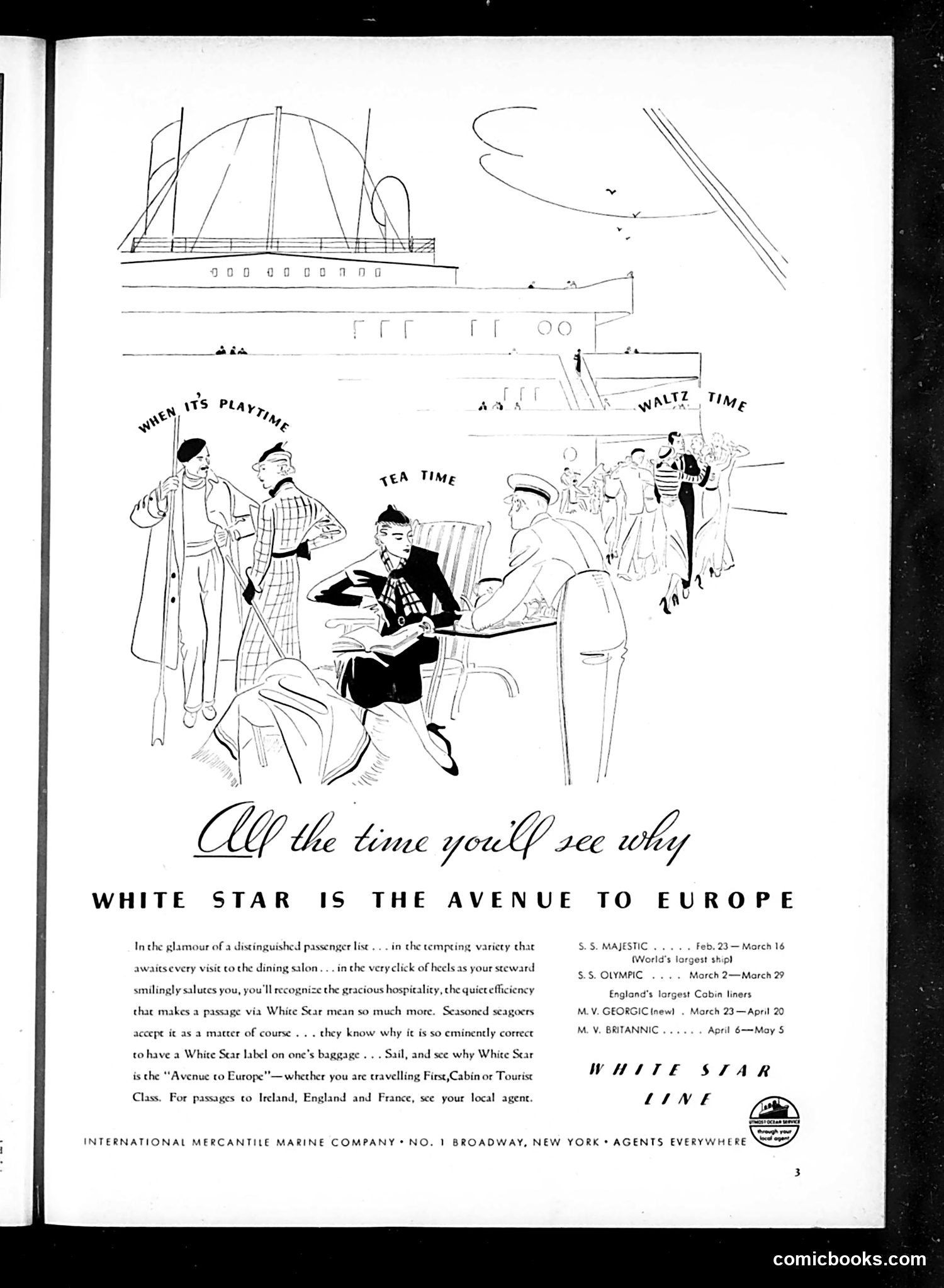
White Star Line Ocean Liner Advertisement This is a commercial advertisement for the White Star Line shipping company, not political satire. The page promotes luxury ocean travel to Europe via their passenger ships, including the S.S. Majestic, S.S. Olympic, and M.V. Britannic. The illustration depicts shipboard social activities—"playtime," "tea time," and "waltz time"—showing well-dressed passengers enjoying entertainment and dining. The accompanying text emphasizes the "gracious hospitality" and "quiet efficiency" of White Star service, positioning ocean liners as the prestigious mode of transatlantic travel. The headline promises that traveling White Star is "the avenue to Europe," appealing to affluent travelers seeking luxury passage to Ireland, England, and France. This reflects the pre-commercial aviation era when ocean liners dominated international travel.
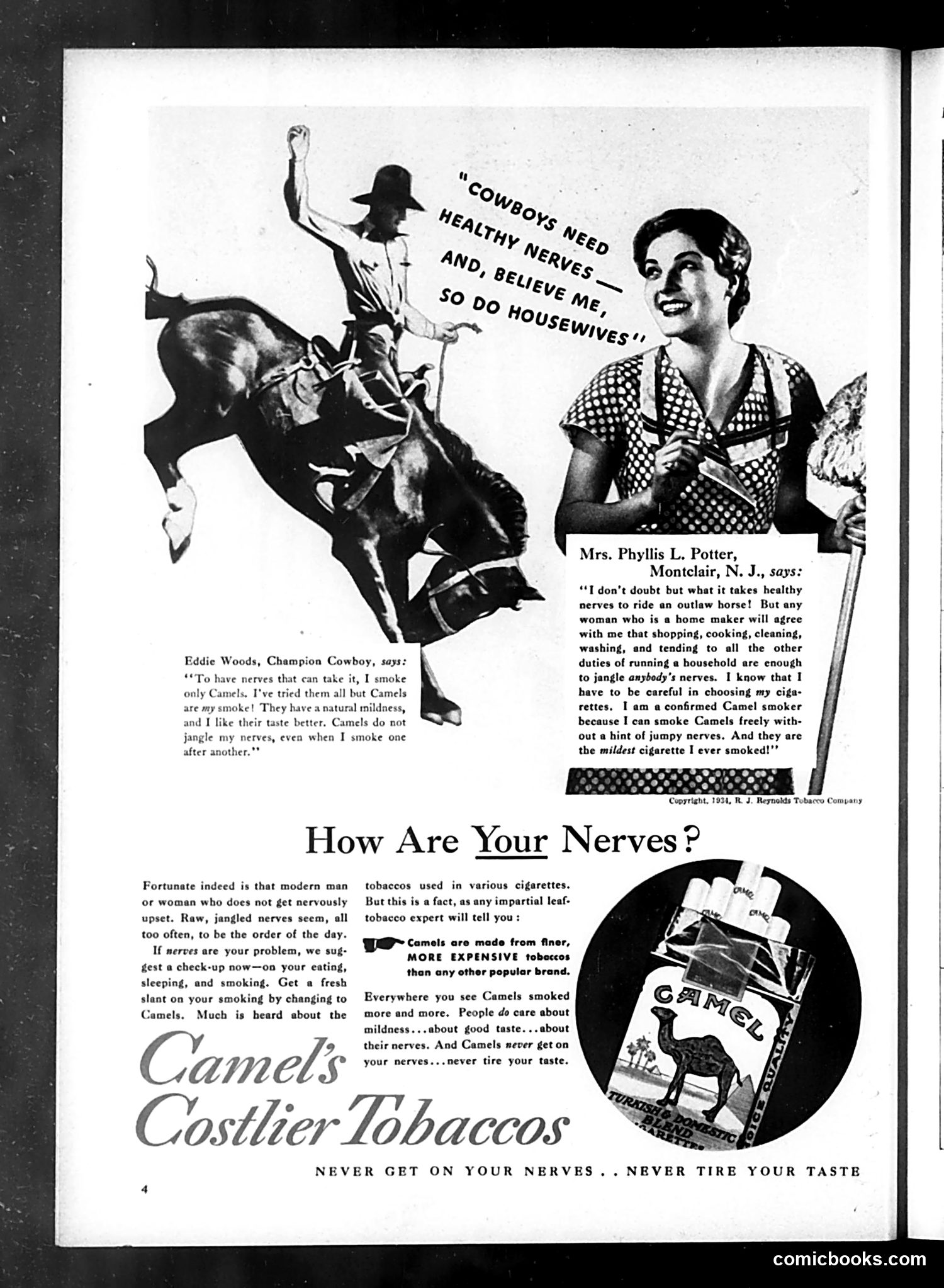
Analysis This is a Camel cigarette advertisement disguised as editorial content, a common 1930s marketing practice. The ad features testimonials from two figures claiming cigarettes don't harm nerves: - Eddie Woods, Champion Cowboy: Claims Camels won't "jangle" his nerves despite chain-smoking - Mrs. Phyllis L. Potter, Montclair, N.J.: A housewife who argues that managing a household is more nerve-wracking than smoking, so she smokes Camels freely The satire targets gender roles and health claims. Both testimonials ironically prove the opposite: cowboys and homemakers both experience genuine stress, yet both accept smoking as a solution rather than questioning it. Modern readers would recognize this as deceptive advertising—pre-regulation tobacco marketing that explicitly made unproven health claims to vulnerable audiences.
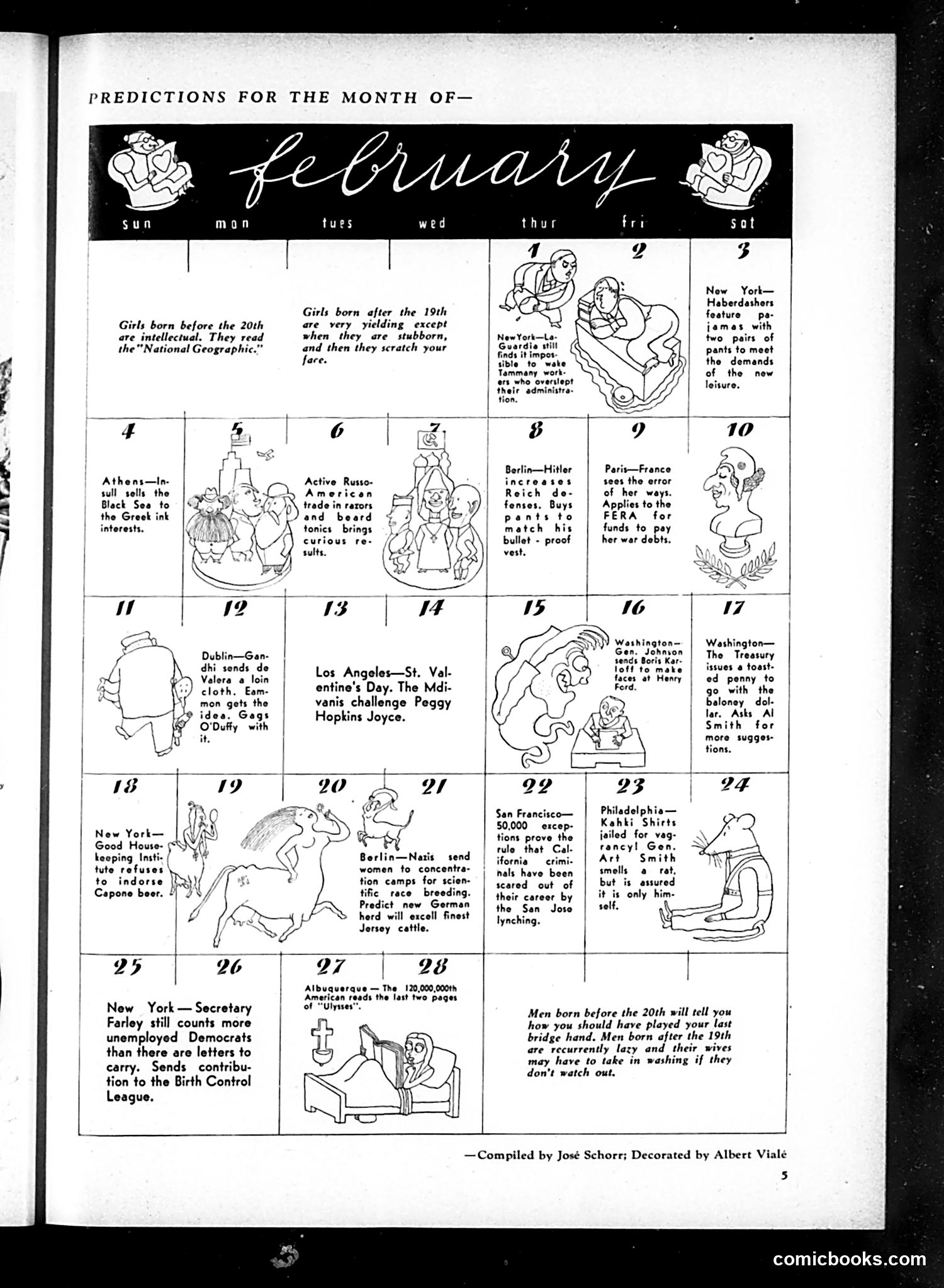
February Predictions Calendar - Life Magazine This is a satirical perpetual calendar offering tongue-in-cheek "predictions" for each day of February. The humor relies on gender stereotypes and contemporary 1930s-40s references: Key satirical points: - Early-month entries mock women's intellectualism and stubbornness (Feb 1-3) - Mid-month items reference Hitler, Berlin, and Paris—likely WWII-era political commentary - Feb 12 jokes about Dublin and Irish stereotypes - Feb 25 references Democratic politics and birth control advocacy - The bottom text contrasts men and women born before/after the 19th by personality traits (women: intellectual; men: lazy) The calendar combines domestic humor with contemporary political/social commentary typical of Life's satirical approach during the wartime period.
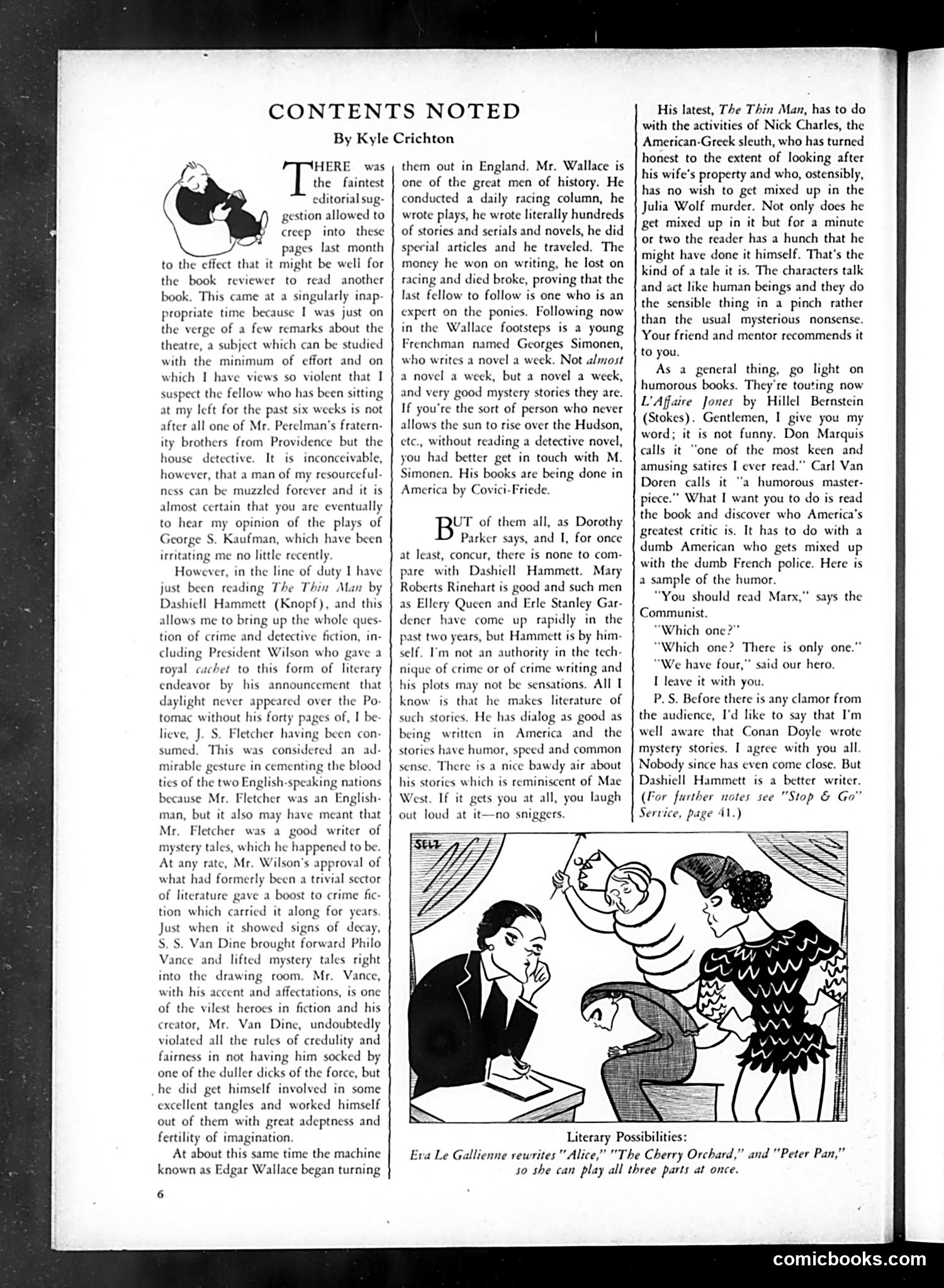
Analysis of "Contents Noted" Page, Life Magazine This is a book review column by Kyle Crichton discussing recent crime and detective fiction. The cartoon below illustrates "Literary Possibilities: Era Le Gallienne rewrites 'Alice,' 'The Cherry Orchard,' and 'Peter Pan,' so she can play all three parts at once." The joke depicts actress Eva Le Gallienne as an ambitious performer attempting to perform three classic works simultaneously—shown as her juggling multiple theatrical roles and characters literally at once. It's satirizing theatrical vanity and the desire for starring vehicles, suggesting an absurd solution to her ambitions. The cartoon mocks both Le Gallienne's theatrical aspirations and the impracticality of such theatrical "possibilities." The humor relies on readers' familiarity with these famous works and Le Gallienne's prominence in 1920s-30s theater.
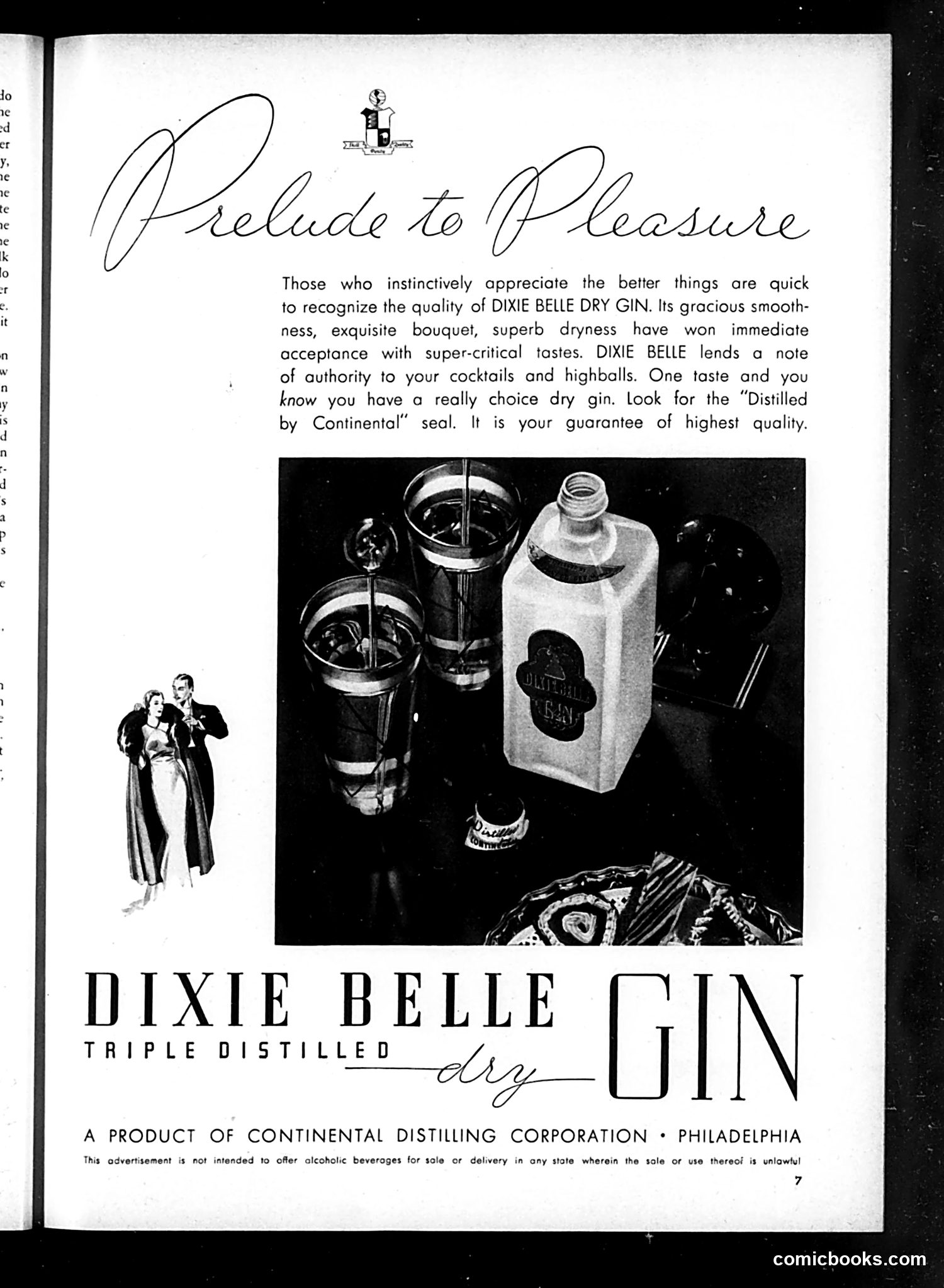
Analysis This is a full-page advertisement, not editorial content or satire. It promotes Dixie Belle Dry Gin, a product of Continental Distilling Corporation in Philadelphia. The ad features decorative illustrations (a couple in formal attire on the left, cocktail glasses and a gin bottle in the center photograph) alongside marketing text emphasizing the gin's quality, smoothness, and "dryness." The phrase "Prelude to Pleasure" frames gin-drinking as a refined leisure activity. The "Distilled by Continental" seal serves as a quality guarantee. The small disclaimer at bottom notes the ad complies with alcohol advertising restrictions of the era—this appears to be from the Prohibition repeal period (post-1933) when alcohol advertising resumed in American magazines. This is straightforward product promotion, not political or social satire.
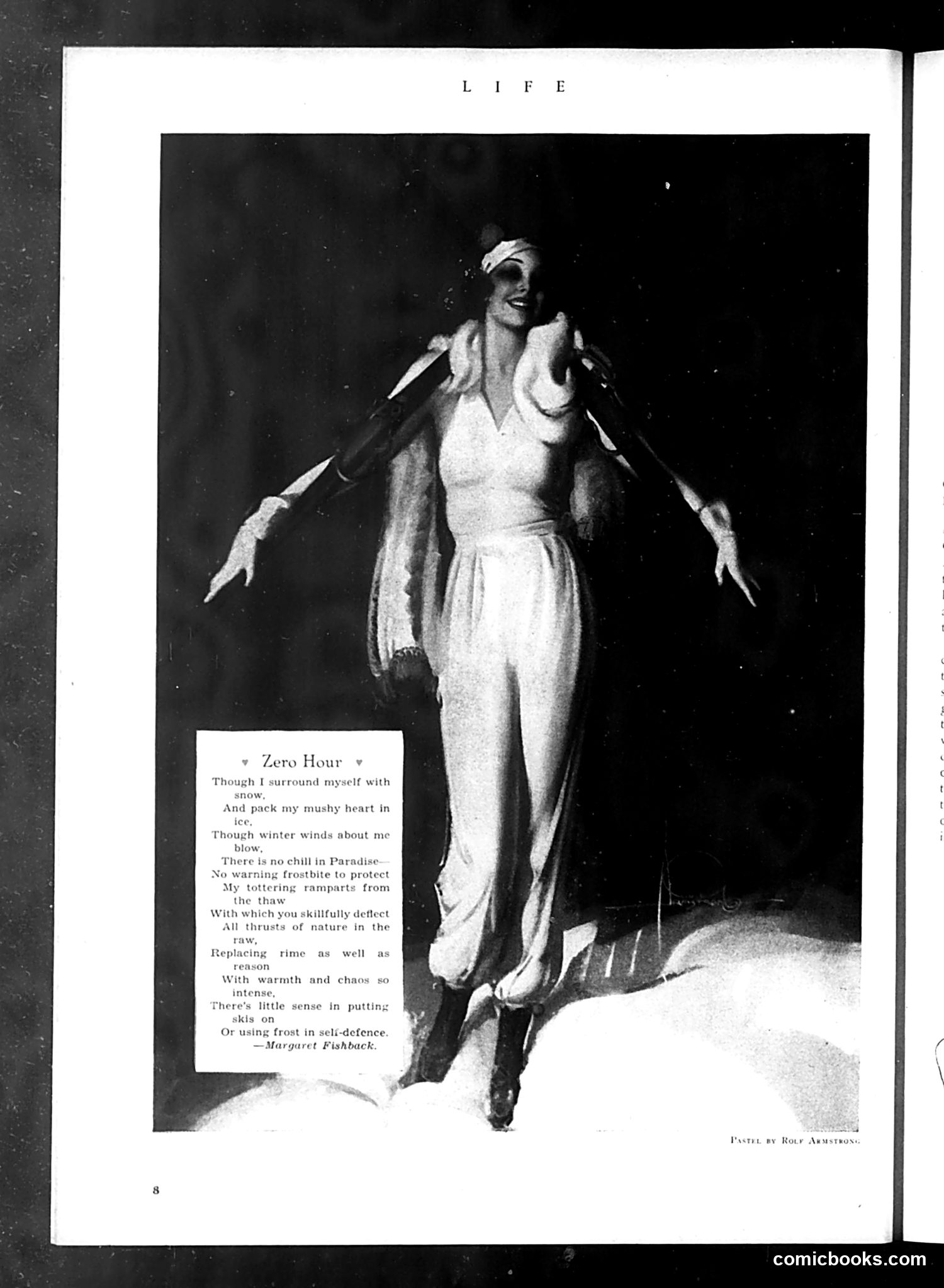
"Zero Hour" - Life Magazine Page This page features a dramatic illustration titled "Zero Hour" by poet Margaret Fishback, with a pastel by Rolf Armstrong. The image shows a woman in classical dress and fur stole, standing in snow against a dark background. The accompanying poem uses winter and freezing imagery metaphorically—"pack my mushy heart in ice," "winter winds," "frostbite"—to describe emotional coldness or defensive detachment. The poem suggests suppressing natural human warmth and feeling to protect oneself, replacing "rime as well as reason / With warmth and chaos so intense." This appears to be a romantic or psychological meditation on emotional self-protection rather than political satire. The "Zero Hour" likely references a critical personal moment where one must choose between emotional vulnerability and self-defense.
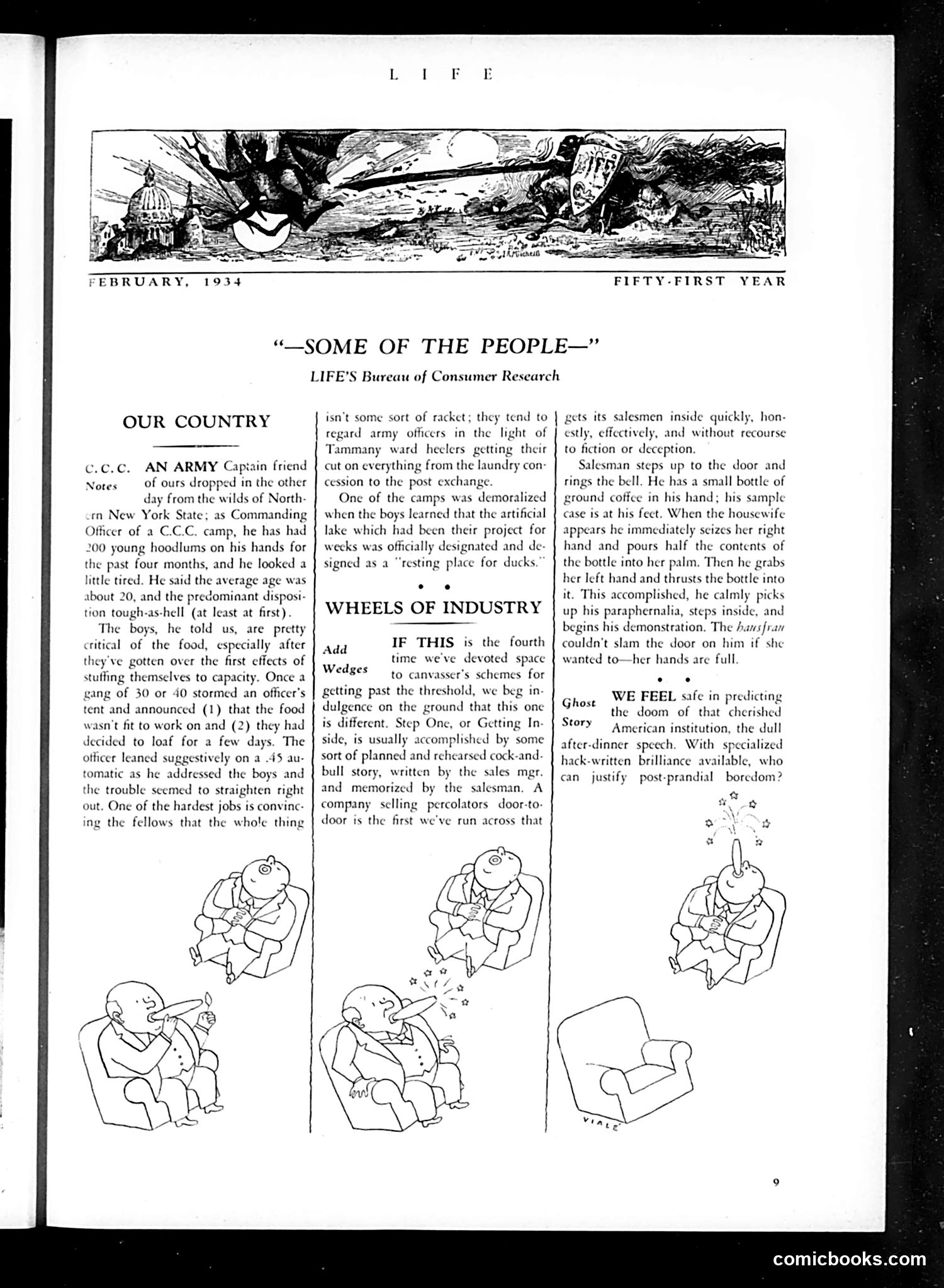
Explanation for Modern Readers This February 1934 *Life* magazine page satirizes door-to-door salesmen and consumer culture. The three cartoon sequences ("Add Wedges," "Wheels of Industry," and "Ghost Story") humorously depict aggressive sales tactics. In each scenario, a salesman demonstrates his pitch to a housewife sitting in an armchair. The "Add Wedges" and "Wheels" sequences show the salesman performing elaborate, rehearsed demonstrations—standard sales techniques of the era. The "Ghost Story" sequence appears to mock the hollow rhetoric of post-sales pitches, questioning whether such "specialized hack-written brilliance" can truly justify the product. The satire targets the manipulative door-to-door sales culture prevalent during the Depression, where salesmen used scripted stories and demonstrations to pressure consumers into purchases they didn't need.
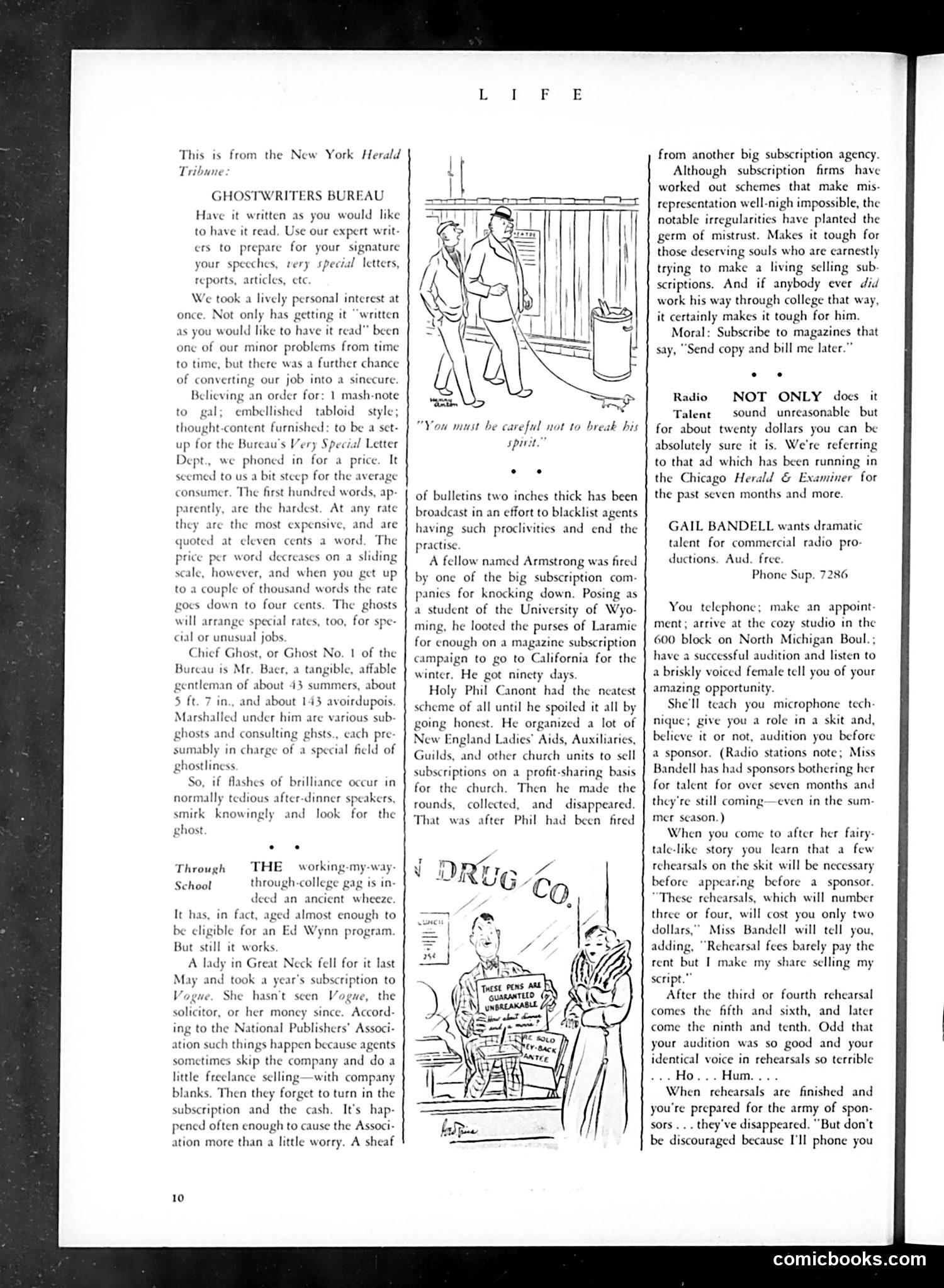
Analysis of Life Magazine Page This page contains three distinct sections mixing editorial content with satirical commentary: 1. Ghostwriters Bureau (top left): A New York Herald Tribune advertisement offering professional writers to compose speeches and articles for clients. The cartoon depicts two businessmen, with accompanying text warning that such services, while convenient, create problems—notably that people earning money through ghostwriting may harbor resentment or plant "germs of distrust." 2. Drug Company Cartoon (center): A sketch showing what appears to be pharmaceutical or drug company representatives, though the specific satirical point is unclear from the visible portions. 3. Radio Talent Advertisement (right): Text discussing radio auditions and dramatic talent recruitment, with practical details about rehearsal costs and sponsor preparation. The page targets 1930s-40s professional and commercial practices through light satire.
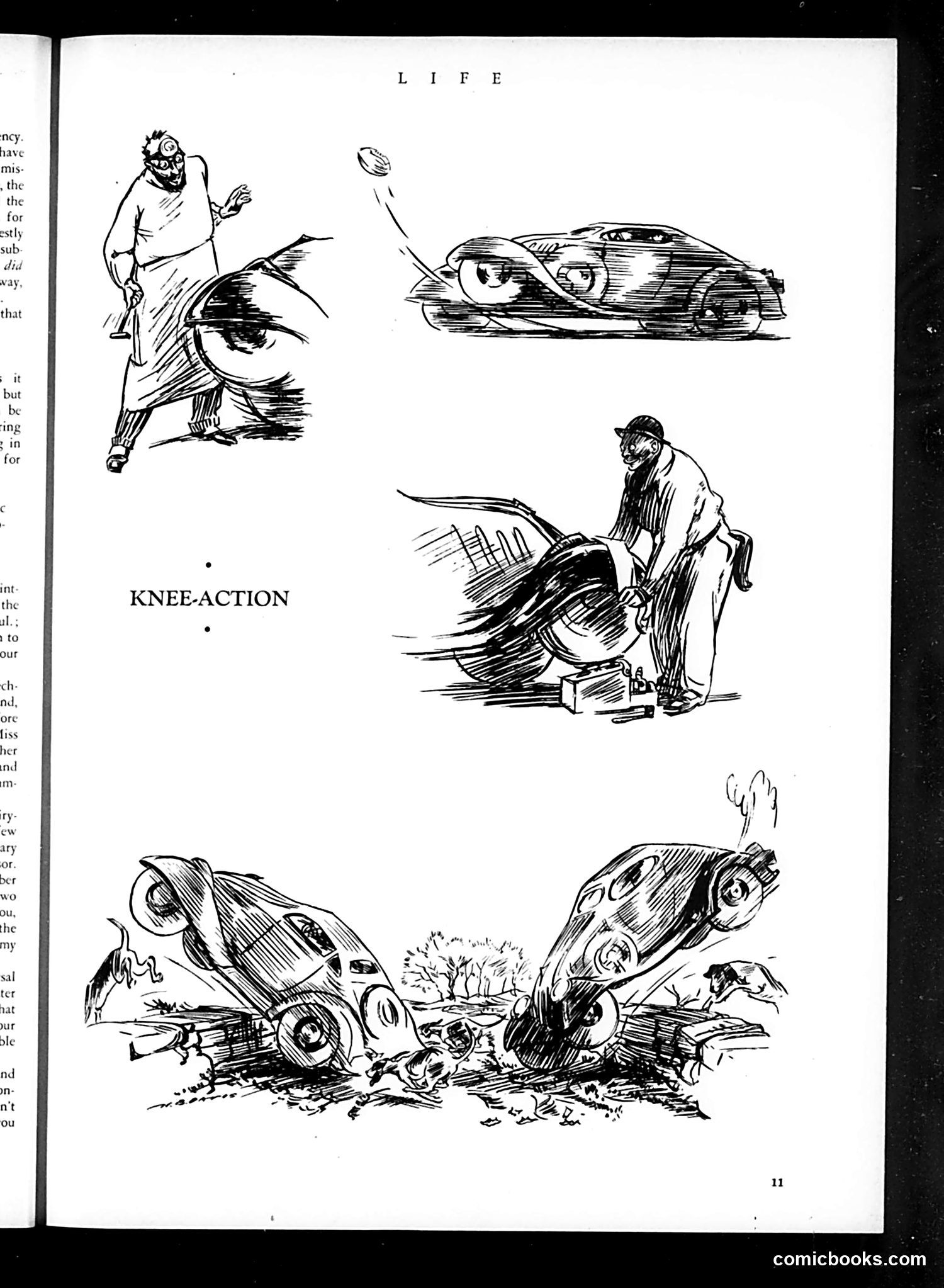
"Knee-Action" Satire This page satirizes "knee-action" automobile suspension—a mechanical innovation of the 1930s that improved ride comfort by allowing wheels to move independently. The cartoons humorously depict the exaggerated effects of this technology on car occupants. The top illustration shows a man being violently jolted while driving. The middle image depicts a person working underneath a car, suggesting mechanical difficulty. The bottom panel shows two cars colliding or bouncing chaotically off the ground with debris flying, their occupants thrown about wildly. The joke mocks the gap between manufacturers' promises of smooth, controlled driving and the reality of early implementation—portraying "knee-action" as causing uncontrolled, violent motion rather than stability. This reflects consumer skepticism toward new automotive features during the Depression era.
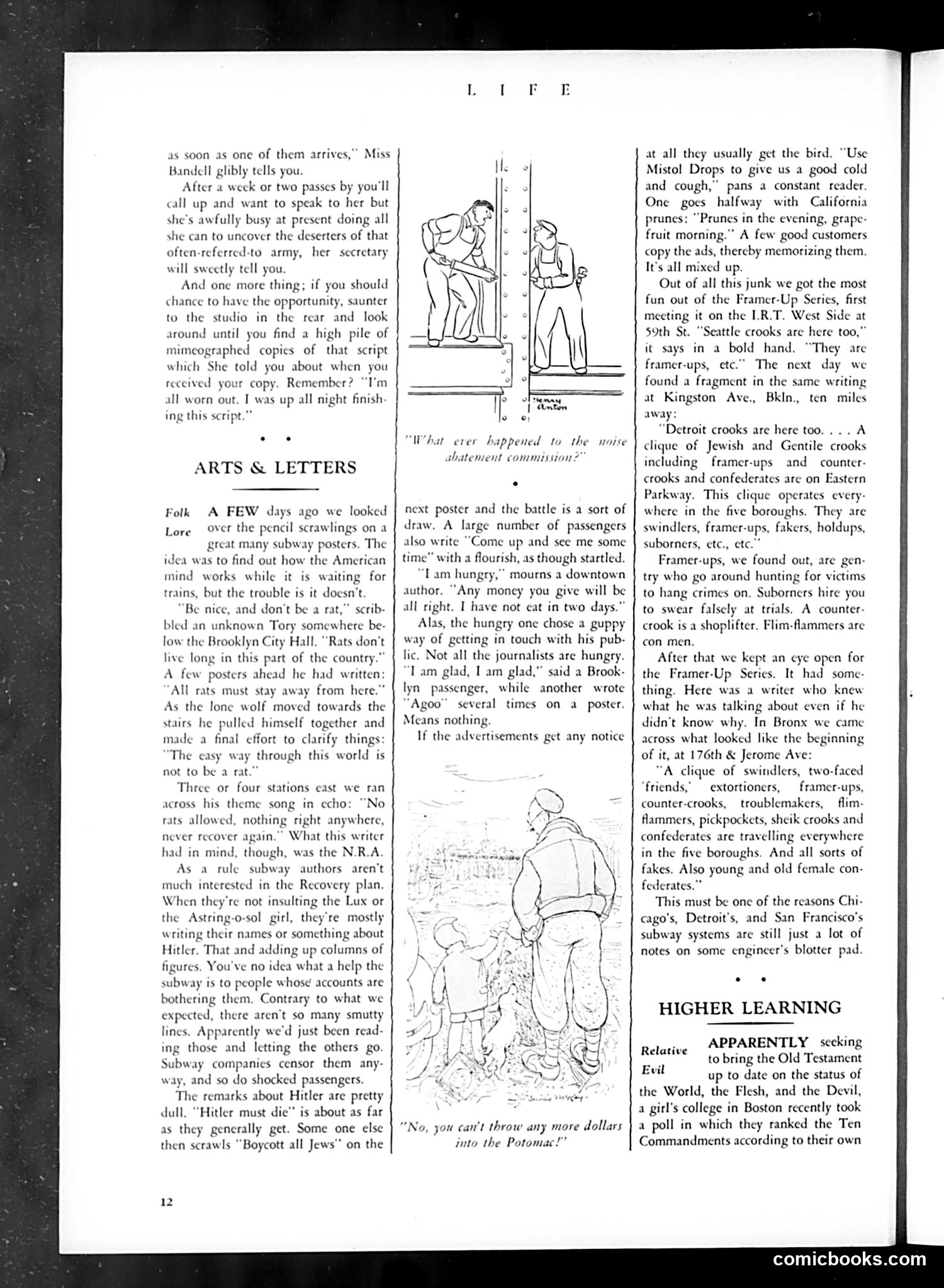
Analysis of Life Magazine Page This page contains three distinct sections: a narrative about Hollywood scriptwriting, an "Arts & Letters" column discussing subway posters and graffiti in major cities, and a brief "Higher Learning" section. The main illustrated content shows two cartoon sketches. The upper one depicts what appears to be a Hollywood studio scene with figures in conversation, captioned "What ever happened to the noise abatement commission?" The lower sketch shows figures in what looks like an urban setting, captioned "No, you can't throw any more dollars into the Potomac!" The Potomac reference suggests New Deal-era government spending criticism. The overall page satirizes bureaucracy, advertising culture, and urban decay through commentary on Hollywood commerce and city conditions rather than partisan politics.
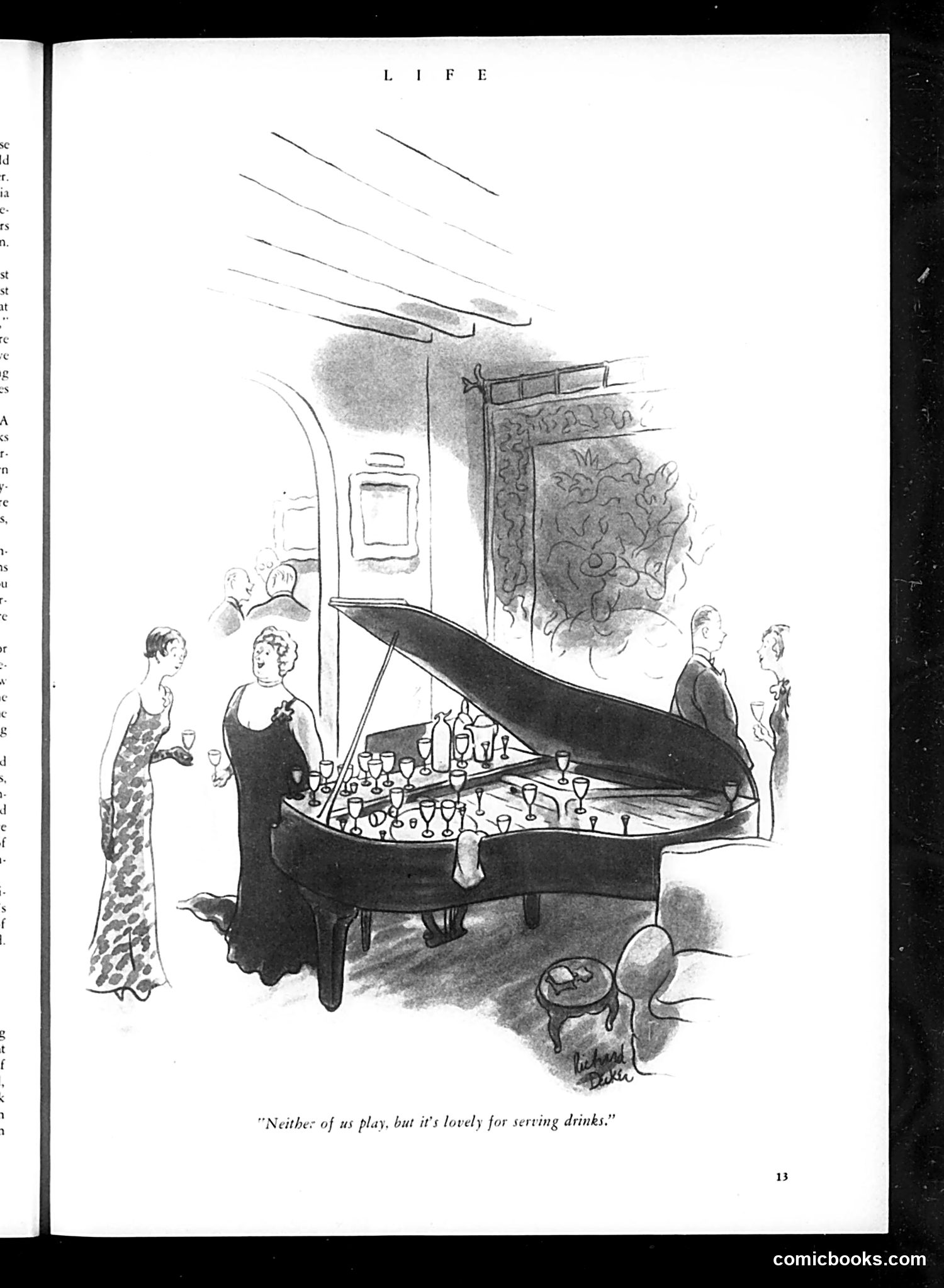
Cartoon Analysis This single-panel cartoon depicts a formal cocktail party scene centered on a grand piano converted into a drinks service station. Well-dressed guests mingle while champagne glasses are arranged across the piano's interior surface. The caption reads: "Neither of us play, but it's lovely for serving drinks." The satire targets wealthy socialites of the period who prioritize entertaining and display over substantive pursuits. The piano—traditionally a symbol of refined culture and musical accomplishment—has been repurposed as mere furniture for cocktail service. This joke mocks the pretension of the upper classes: they own cultured items not from genuine appreciation but as status symbols and convenient party props. The cartoon ridicules both the superficiality of high society and the decline of artistic values among the wealthy.
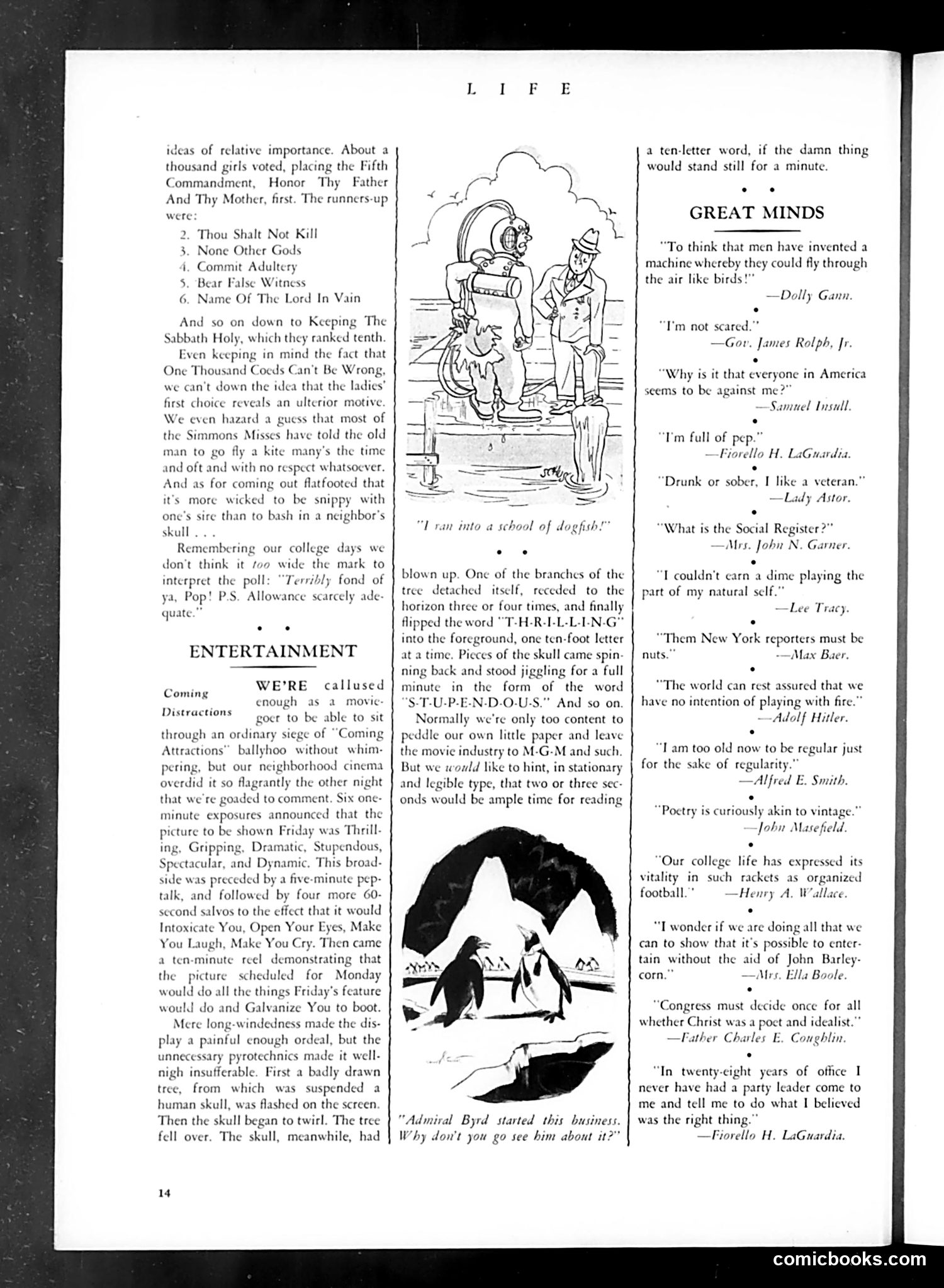
Analysis of Life Magazine Page This page contains two main elements: Left side: A section on "Entertainment" and "Coming Distractions" discussing early cinema. It describes a humorous incident where a tree branch fell during a film screening, and the word "THRILLING" appeared letter-by-letter on screen as pieces of skull moved across it—creating accidental entertainment. Right side: A "Great Minds" column featuring humorous quotes from notable figures (Dolly Gaum, Gov. James Rolph Jr., Samuel Insull, etc.) on various topics like flying machines, social registers, and poetry. Central cartoons: Appear to depict penguins in a comedic scene, with one caption reading "Admiral Byrd started this business. Why don't you go see him about it?"—likely referencing Antarctic exploration trends. The page satirizes both early cinema's appeal and contemporary celebrity culture through quotation humor.
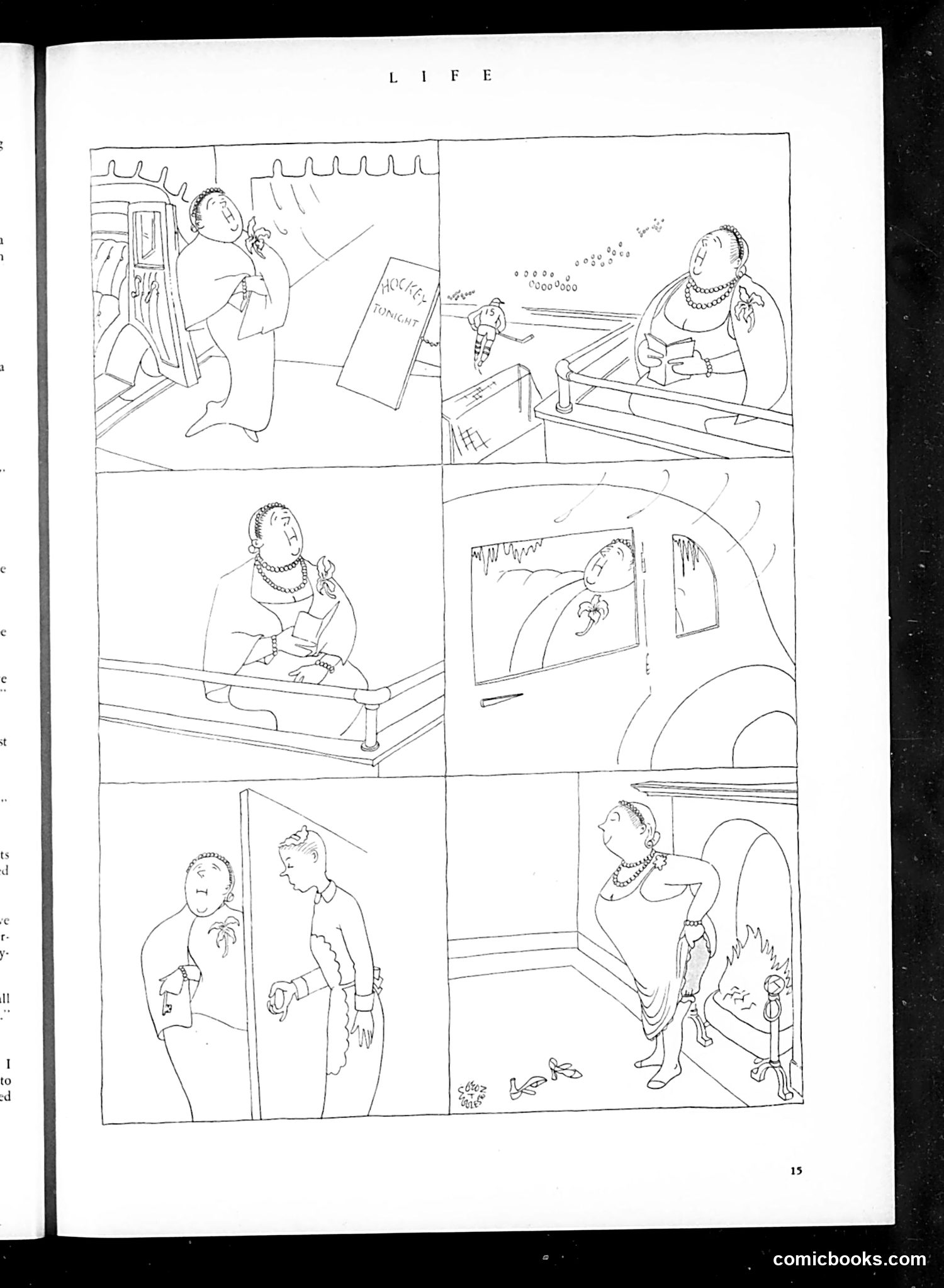
"Life" Page Analysis This is a six-panel comic strip titled "LIFE" depicting domestic scenes. The narrative appears to show a woman discovering her husband's infidelity or romantic indiscretion. In the opening panels, she finds evidence (possibly a note reading "HOCKEY TONIGHT"). The middle panels show her confronting him and his attempted explanations. The final panels depict escalating domestic conflict, with the woman's anger building—she appears to be throwing objects or gesturing dramatically in the last frame. The satire targets contemporary marriage dynamics and marital deception, presenting a comedic yet pointed critique of male infidelity and the "excuses" husbands use. The woman's progressive rage suggests commentary on female agency and justified anger at betrayal, making it both humorous social commentary on early-20th-century domestic relationships.
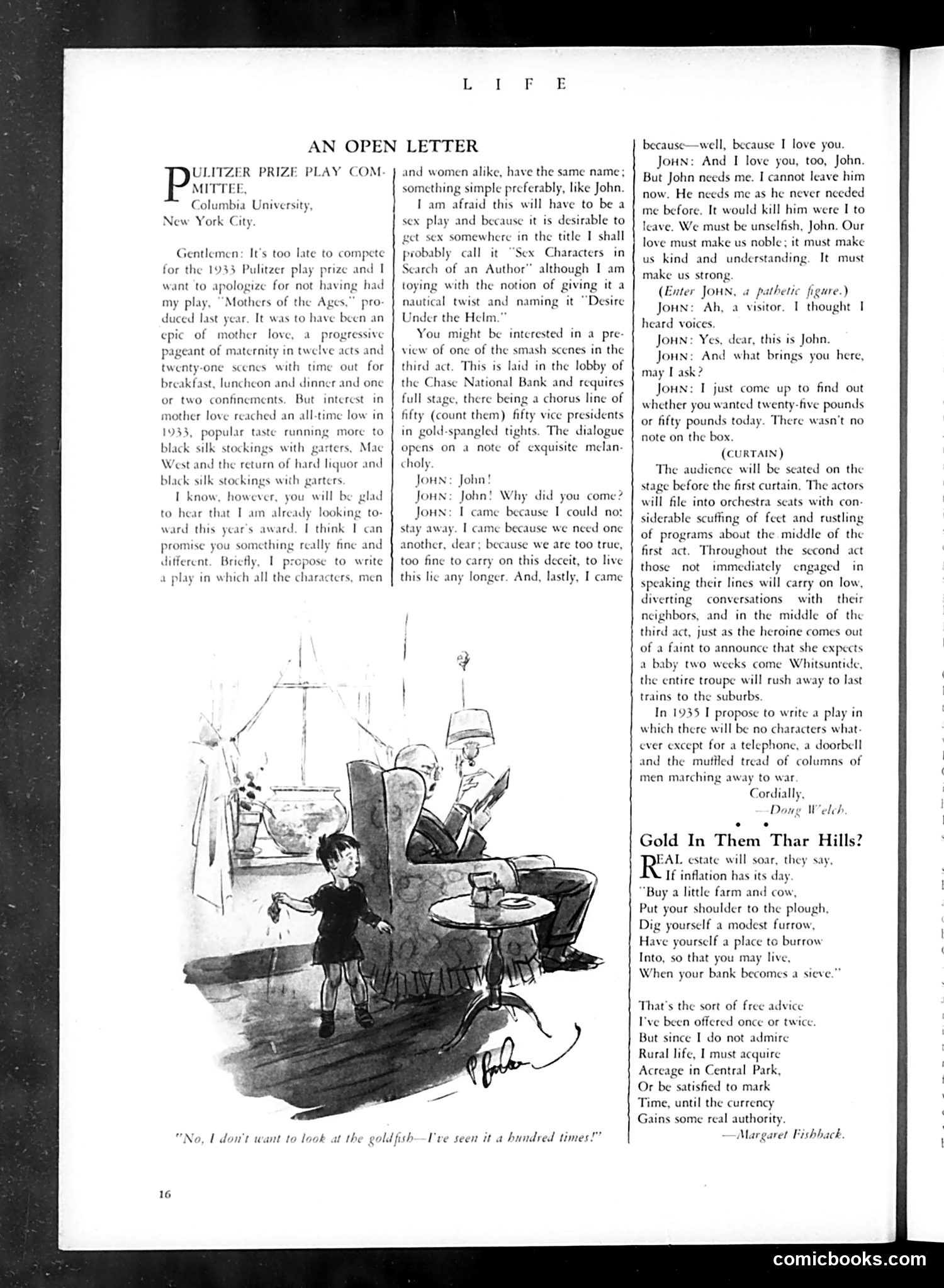
Analysis of Life Magazine Page This page contains an open letter to the Pulitzer Prize committee from playwright Doug Welch, proposing a 1935 play featuring only male characters except for a telephone and doorbell. It's satire on theatrical conventions and gender representation. The illustration shows a domestic scene with a woman and man in what appears to be a living room, with the caption "No, I don't want to look at the goldfish—I've seen it a hundred times!" This likely satirizes mundane married life and repetitive domestic routines. The second piece, "Gold In Them That Hills?" by Margaret Fishback, is humorous verse mocking Depression-era financial advice to acquire rural property and farming as economic solutions—satirizing impractical suggestions offered to struggling Americans during hard economic times.
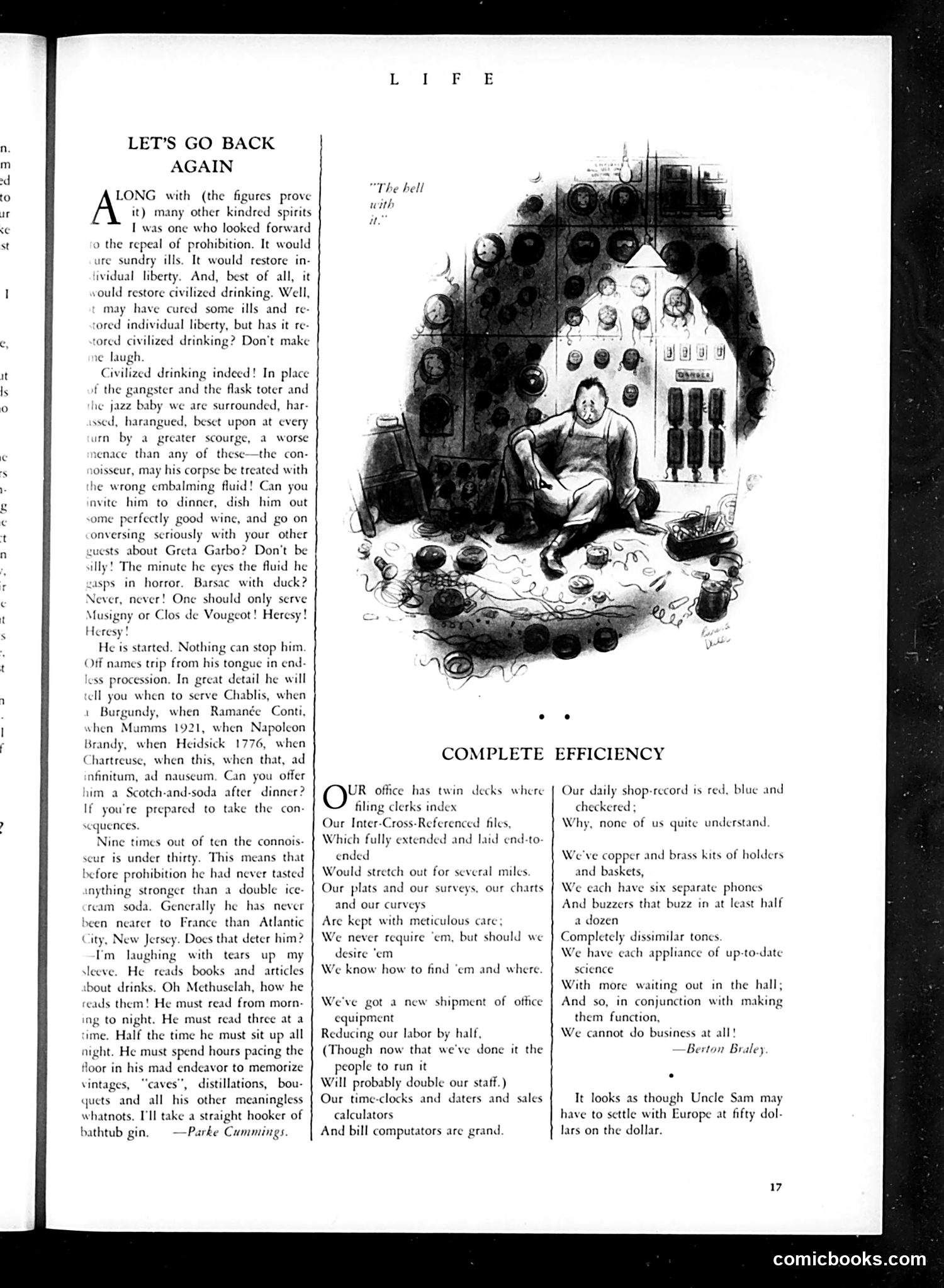
Analysis This page contains two separate pieces of satire from *Life* magazine. "Let's Go Back Again" (left) is a commentary on Prohibition. The author argues that Prohibition failed to eliminate drinking—it merely drove it underground. The piece sarcastically suggests that heavy drinkers actually improved their sophistication by learning about fine wines and French vintages during the illegal era, contrary to Prohibition's intended civilizing effect. The satire mocks both Prohibition advocates' claims and the criminal culture it spawned. "Complete Efficiency" (right) satirizes modern office bureaucracy. It catalogs the absurd proliferation of filing systems, equipment, and procedures designed to streamline work—yet paradoxically makes business less efficient. The poem humorously lists redundant files, multiple phones, buzzers, and calculators that supposedly help but actually complicate operations. The accompanying illustration depicts a befuddled office worker surrounded by chaotic equipment and files, visualizing the satirical point about organizational excess.
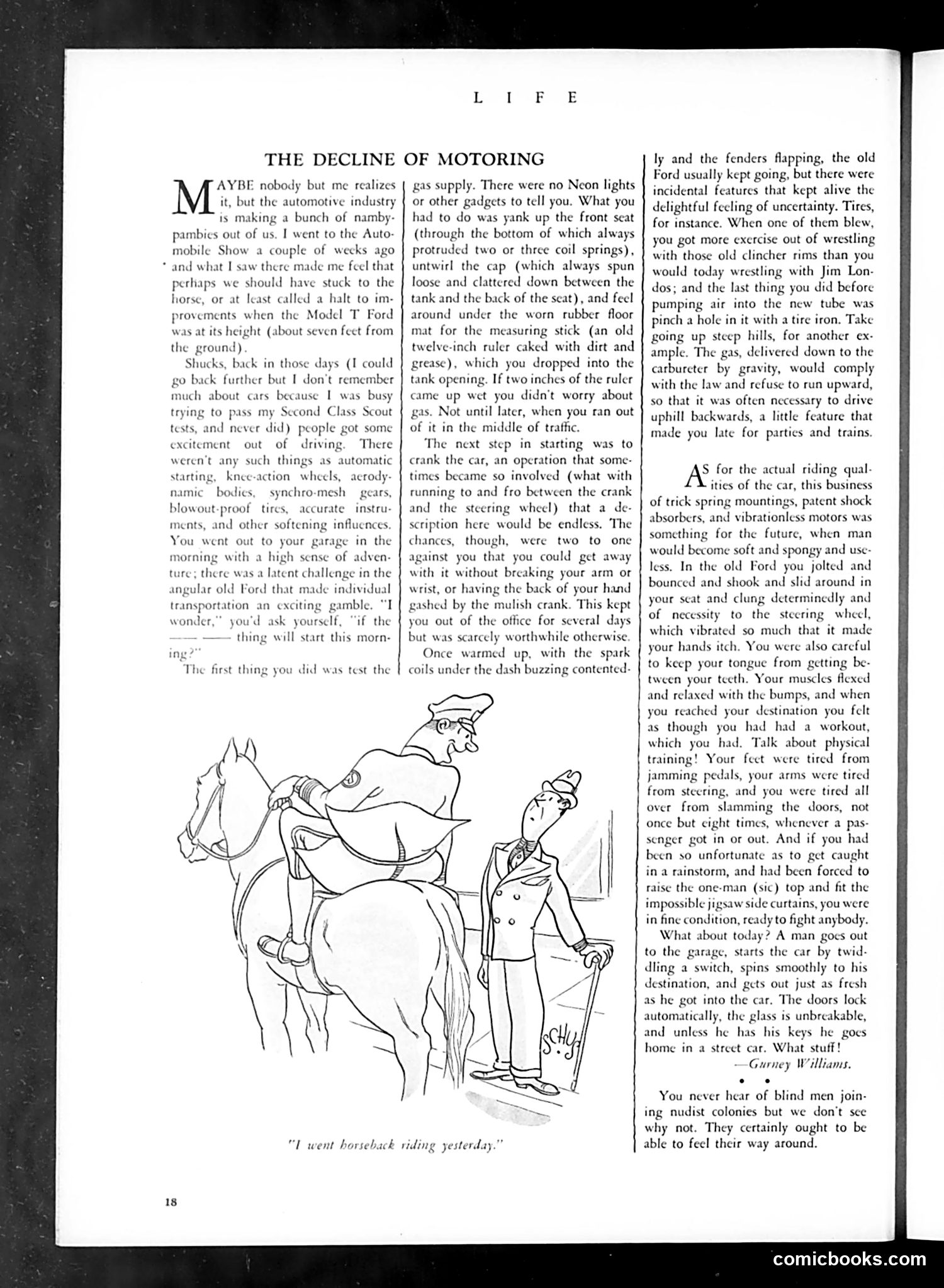
"The Decline of Motoring" Analysis This is a satirical essay by Garvey Williams about how car ownership has become mundane and lost its appeal. The accompanying cartoon illustrates the contrast between past and present: it shows a man riding a horse (captioned "I went horseback riding yesterday"), suggesting nostalgia for earlier transportation methods. The text mocks the modern ease of automotive ownership—cars now start with a switch and run smoothly—compared to the challenging, physically demanding experience of early automobiles. Williams argues that the adventure, skill, and bodily exertion once required to operate cars made them exciting. Contemporary drivers enjoy effortless transportation but have lost the sense of accomplishment and physical challenge that made motoring genuinely thrilling in the Model T era. The satire targets how convenience can paradoxically reduce enjoyment.
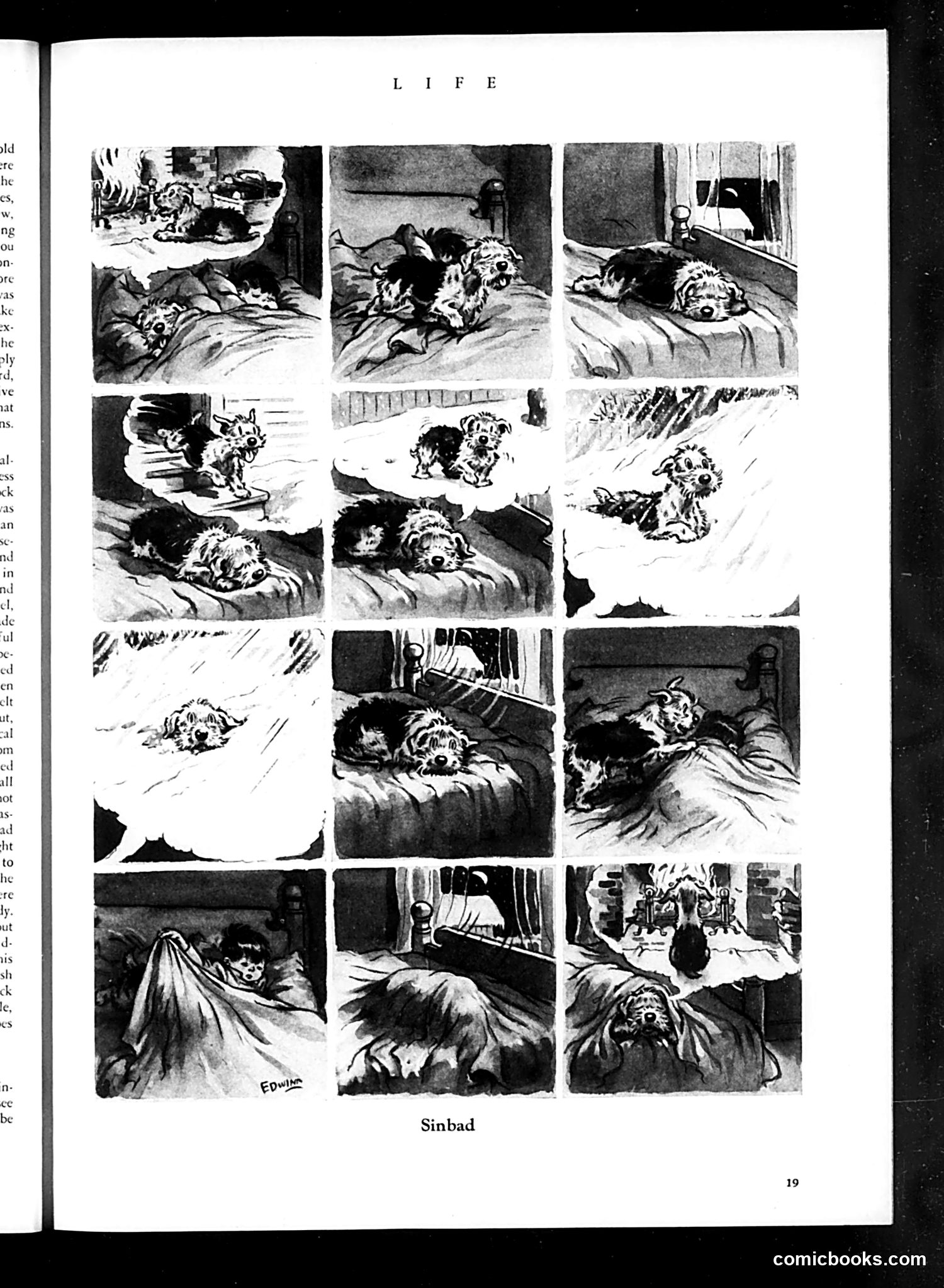
Analysis of "Sinbad" Page from Life Magazine This page presents a sequential comic strip titled "Sinbad" featuring a small, shaggy dog as the protagonist. The twelve panels depict the dog's various sleeping positions and nighttime activities across different indoor locations—beds, floors, and furniture. The humor appears to derive from the dog's restless, comical sleeping behavior and physical contortions. The title "Sinbad" references the famous fictional sailor known for extraordinary adventures, creating ironic contrast with this mundane domestic pet experiencing the "adventures" of an ordinary night indoors. The strip is primarily observational humor about pet behavior rather than political or social satire. It's a lighthearted, relatable domestic comedy depicting the quirks of dog ownership that would have appealed to Life's middle-class readership.
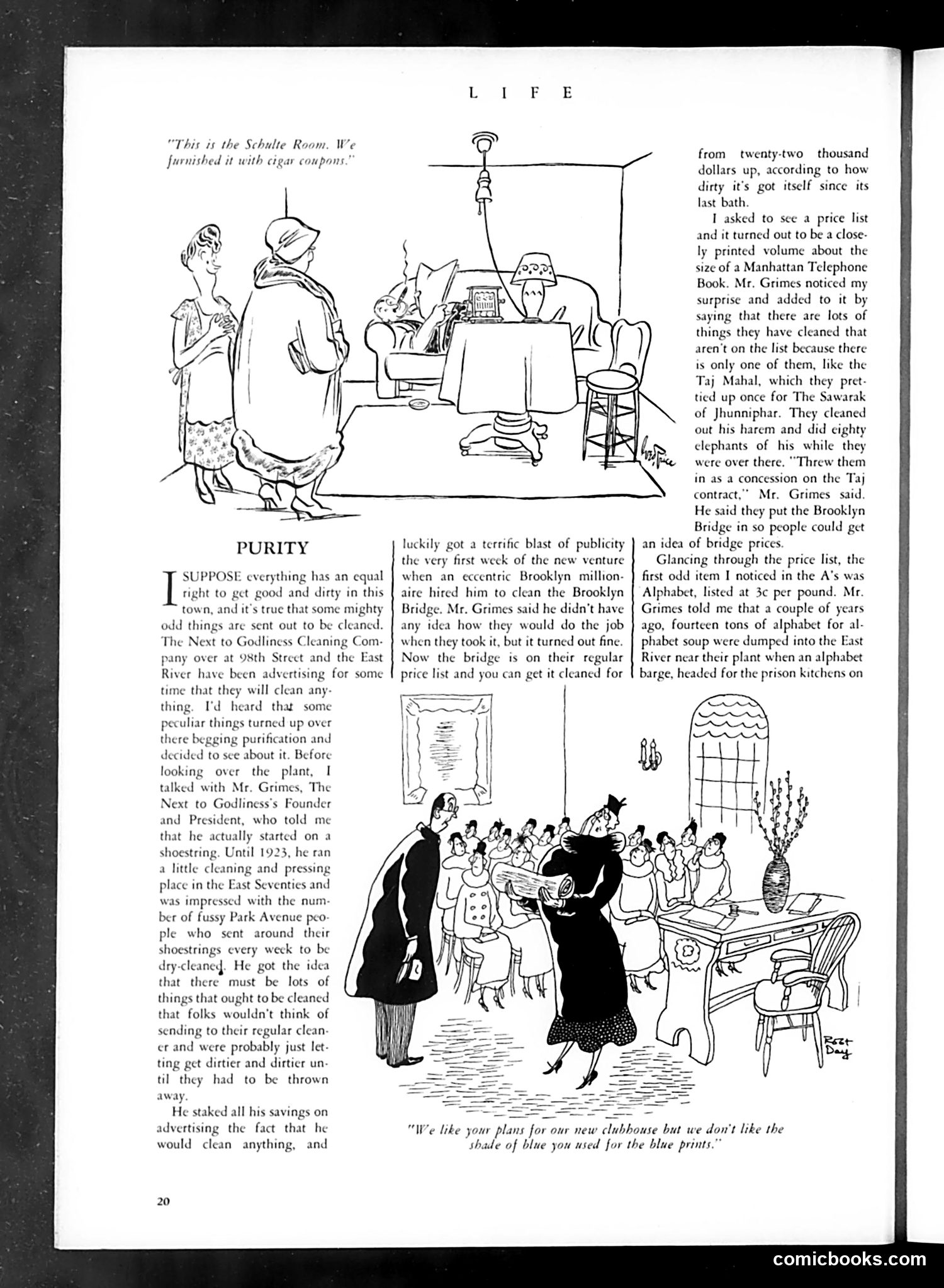
"Purity" – Life Magazine Satire This article satirizes the absurdity of modern commercial enterprise and consumer culture in 1920s America. The Setup: "Next to Godliness Cleaning Company" claims they'll clean *anything*—a parody of aggressive advertising and entrepreneurial excess. The founder, Mr. Grimes, built his business on this gimmick. The Joke: The satire escalates through increasingly ridiculous examples: cleaning the Brooklyn Bridge ($22,000+), the Taj Mahal, eighty elephants, and fourteen tons of alphabet soup from the East River. These are absurd to illustrate how far commercial cleaning culture has stretched. The Point: Life mocks both the overconfidence of 1920s businessmen and consumer willingness to pay for unnecessary services. The caption cartoon about "blue prints" reinforces the theme of impractical business dealings. The satire suggests Americans will purchase anything if marketed cleverly enough, no matter how nonsensical.
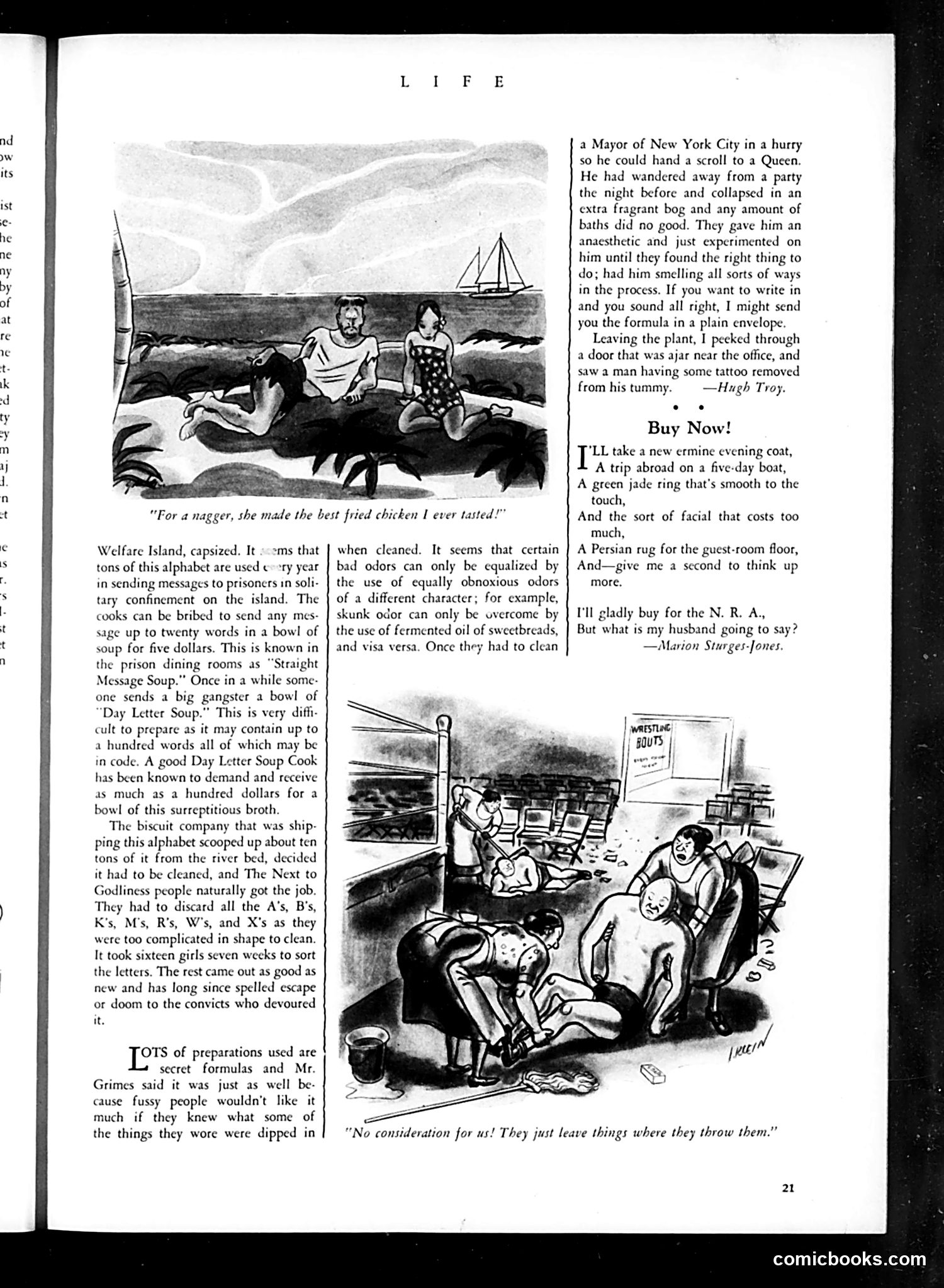
Life Magazine Satire Analysis This page contains two distinct pieces of satirical humor: Top cartoon: A single-panel joke about a Southern domestic worker, playing on offensive racial stereotypes prevalent in 1920s-30s American humor. The caption trades on the "mammy" stereotype—praising her cooking while using dehumanizing language. Middle text: A surreal, absurdist essay by Hugh Troy mocking Welfare Island (a NYC prison) and its supposedly corrupt systems—bribing cooks to smuggle messages in soup, a nonsensical story about cleaning alphabet soup that somehow relates to prison communication. The joke escalates ridiculously, including a Mayor falling in a bog. Bottom section: A poem attributed to Marion Sturges-Jones humorously listing luxury purchases a woman wants, ending with worry about her husband's reaction—light domestic comedy common to the era. The page exemplifies *Life*'s mix of crude racial humor, absurdist satire targeting institutions/politicians, and genteel domestic jest typical of early-to-mid 20th century American magazine humor.
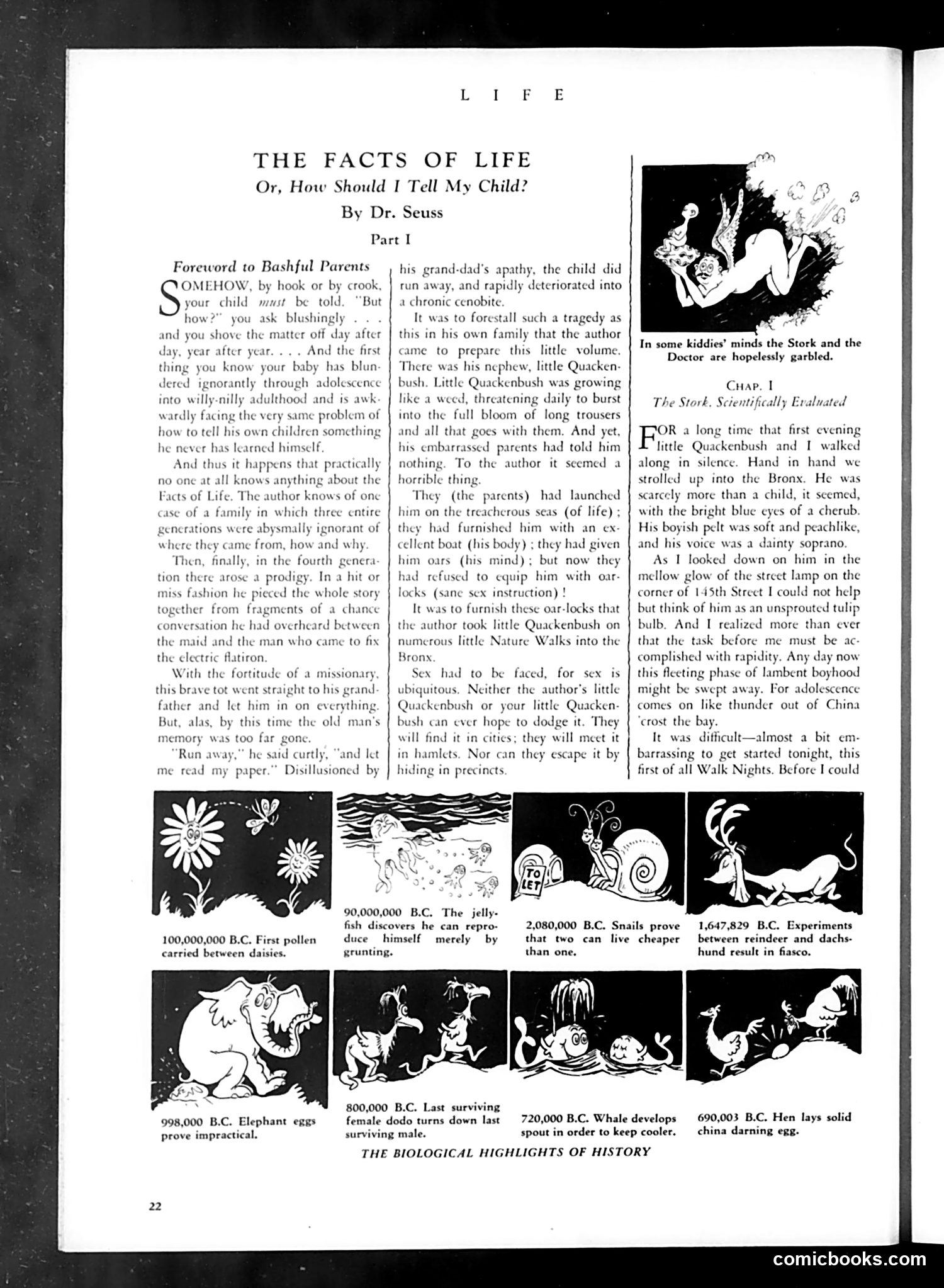
Analysis for Modern Readers This is a Dr. Seuss satirical piece about sex education for children, published when such discussions were considered taboo in polite society. The Setup: The foreword humorously depicts the problem of generational silence around reproduction—parents too embarrassed to explain "the Facts of Life," creating a chain of ignorance across families. One anecdote describes a grandfather so out-of-touch he dismisses his grandson's attempt to educate him. The Satire: Seuss mocks this prudishness by proposing to educate "Little Quackenbush" through nature walks in the Bronx (an unlikely location for such instruction). The accompanying illustrations use biological history—from jellyfish to whales—as comedic "evidence" that reproduction is natural and unavoidable. The Point: The satire suggests that avoiding sex education is absurd; human sexuality exists whether parents acknowledge it or not. Modern readers should recognize this as attacking mid-century American sexual repression and advocating for frank, scientific approaches to informing children about biology. The tone is gently ridiculous rather than crude—Seuss's trademark approach to uncomfortable subjects.
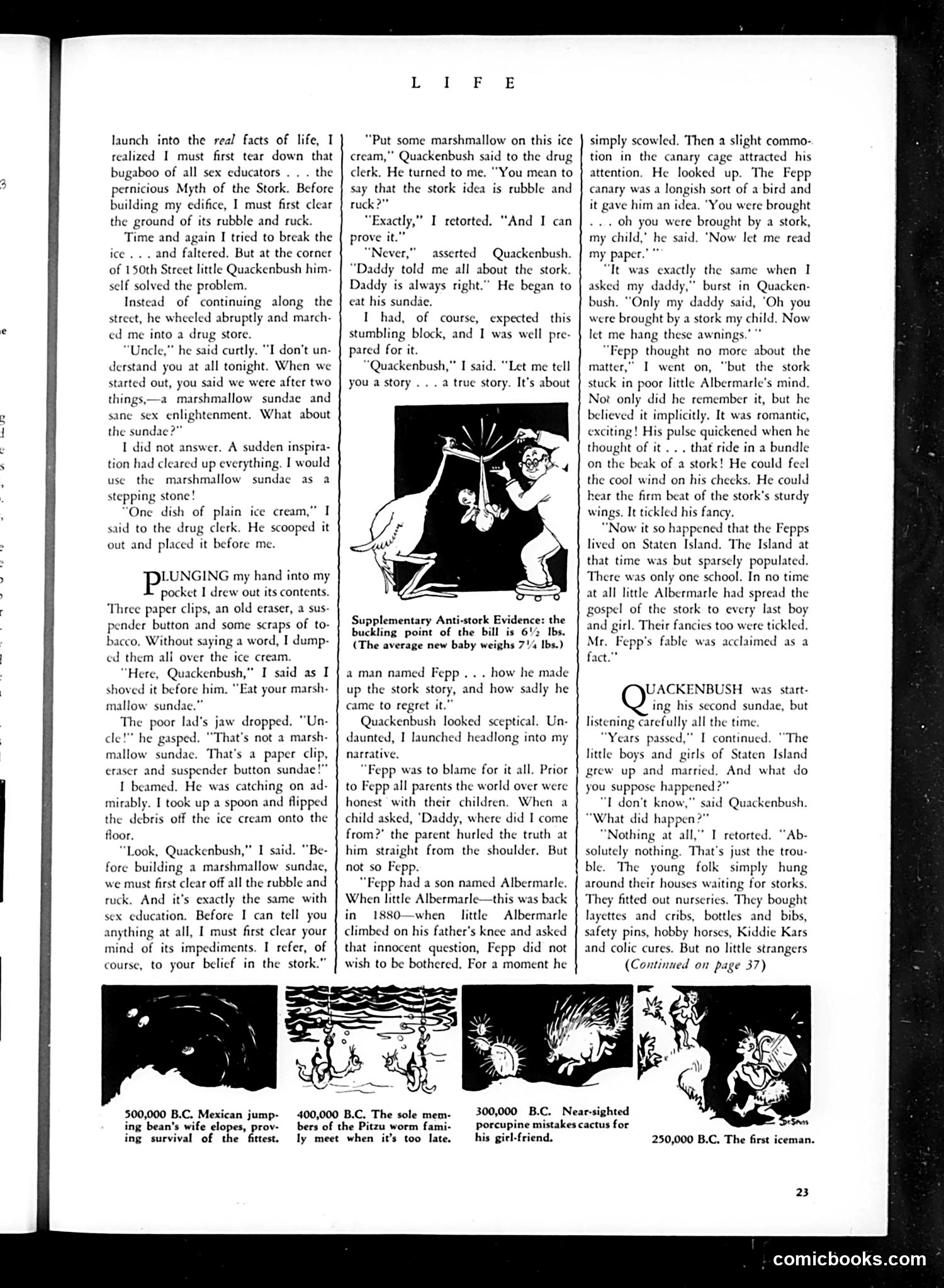
Explanation for Modern Readers This page satirizes sex education debates of the early 20th century. The unnamed adult narrator attempts to debunk the "stork myth"—the then-common euphemism parents used to avoid explaining human reproduction to children. The humor works on multiple levels: The narrator uses a deliberately absurd analogy (clearing "rubble and ruck" from ice cream to teach about clearing misconceptions) to explain his educational mission. Young "Quackenbush" represents resistant children who trust parental authority over reason. The satirical framing device—a story about "Fepp" inventing the stork lie in 1880 to avoid conversation with his son—mocks both parental evasion and the circular perpetuation of ignorance across generations. The bottom panels present pseudo-scientific "historical evidence" (B.C. jumping beans and worms) as absurdist commentary on attempts to debunk folk beliefs through "facts." The satire targets prudish adult culture while advocating for honest sex education—a progressive position for the era.
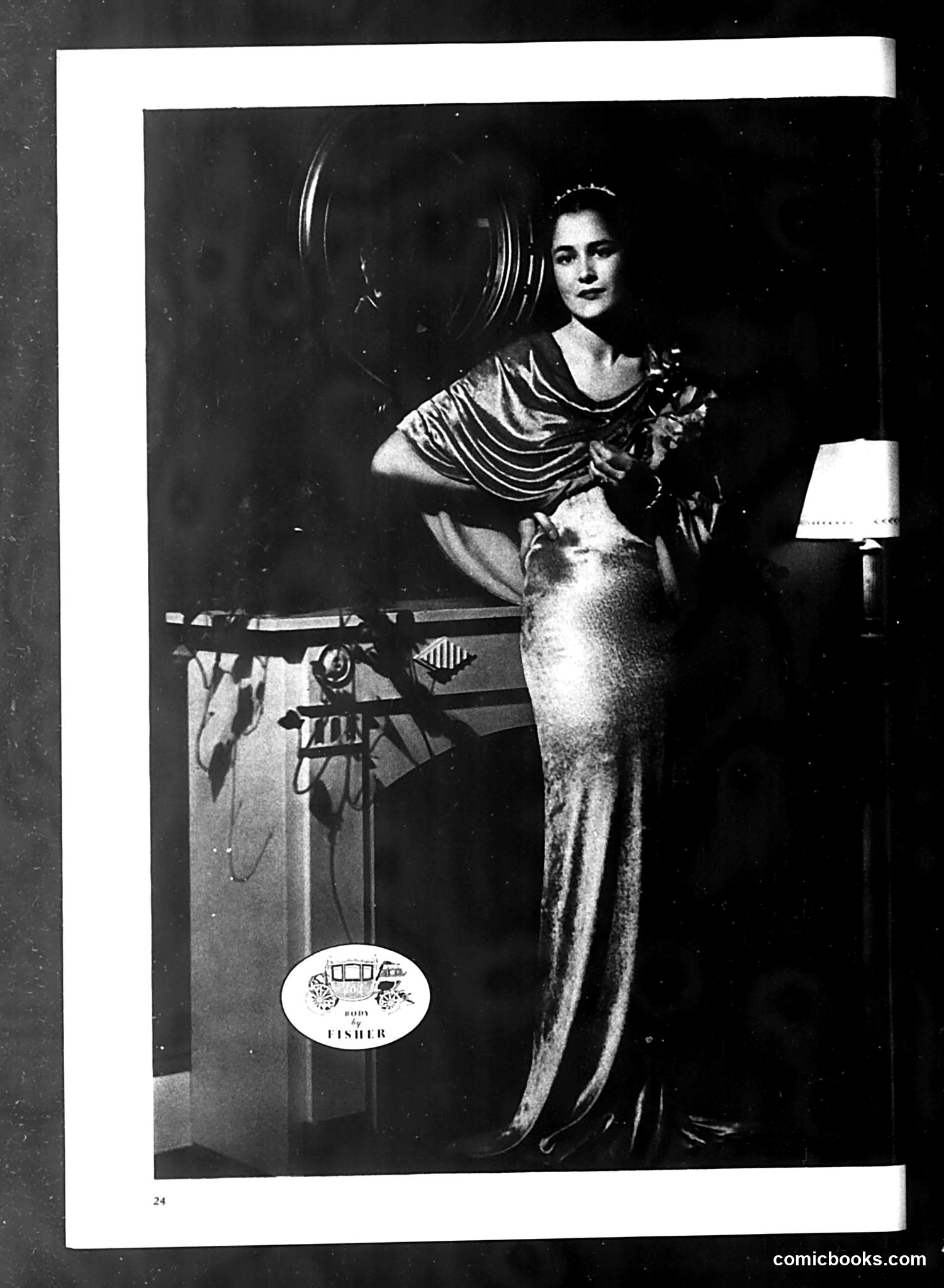
Analysis This appears to be a Fisher automobile advertisement from Life magazine (note the Fisher body company logo visible on the car door). The page features a glamorous woman in 1920s-30s evening wear posing with flowers next to a luxury automobile in an elegant interior setting, illuminated by a table lamp. The satire likely targets aspirational consumer culture — advertising's promise that buying this car will transform one's social status and romantic desirability. The formal posed composition and dramatic lighting mimic high-fashion photography, suggesting that purchasing a Fisher-bodied vehicle grants entry to sophisticated upper-class lifestyle. The humor lies in the obvious artificiality of the scene and the exaggerated claims implicit in automotive advertising of that era.
I can see this is a page from what appears to be a historical publication, but the image is almost entirely black with minimal visible detail. The OCR text only shows "comicbooks.com" at the bottom, which appears to be a watermark rather than actual page content. Without being able to discern any visible cartoon figures, caricatures, text, or political/social references in the image itself, I cannot accurately identify what satire or commentary this page contains. The image quality and contrast make it impossible to read any content or analyze the cartoons as requested. To provide an accurate historical analysis, I would need a clearer version of this page where the illustrations and text are legible.

I can see this is a black and white image from what appears to be a historical publication, but the image quality is too degraded for me to reliably identify specific cartoon content, figures, or caricatures. The contrast is very poor, with much of the page appearing as dark smudges and unclear forms. While there appears to be a circular element (possibly a target or emblem) visible in the center-right area, I cannot make out enough detail to identify who or what is being depicted or what the satirical point would be. To provide accurate historical analysis as requested, I would need a clearer, higher-resolution image where the cartoon artwork and any accompanying text are legible.
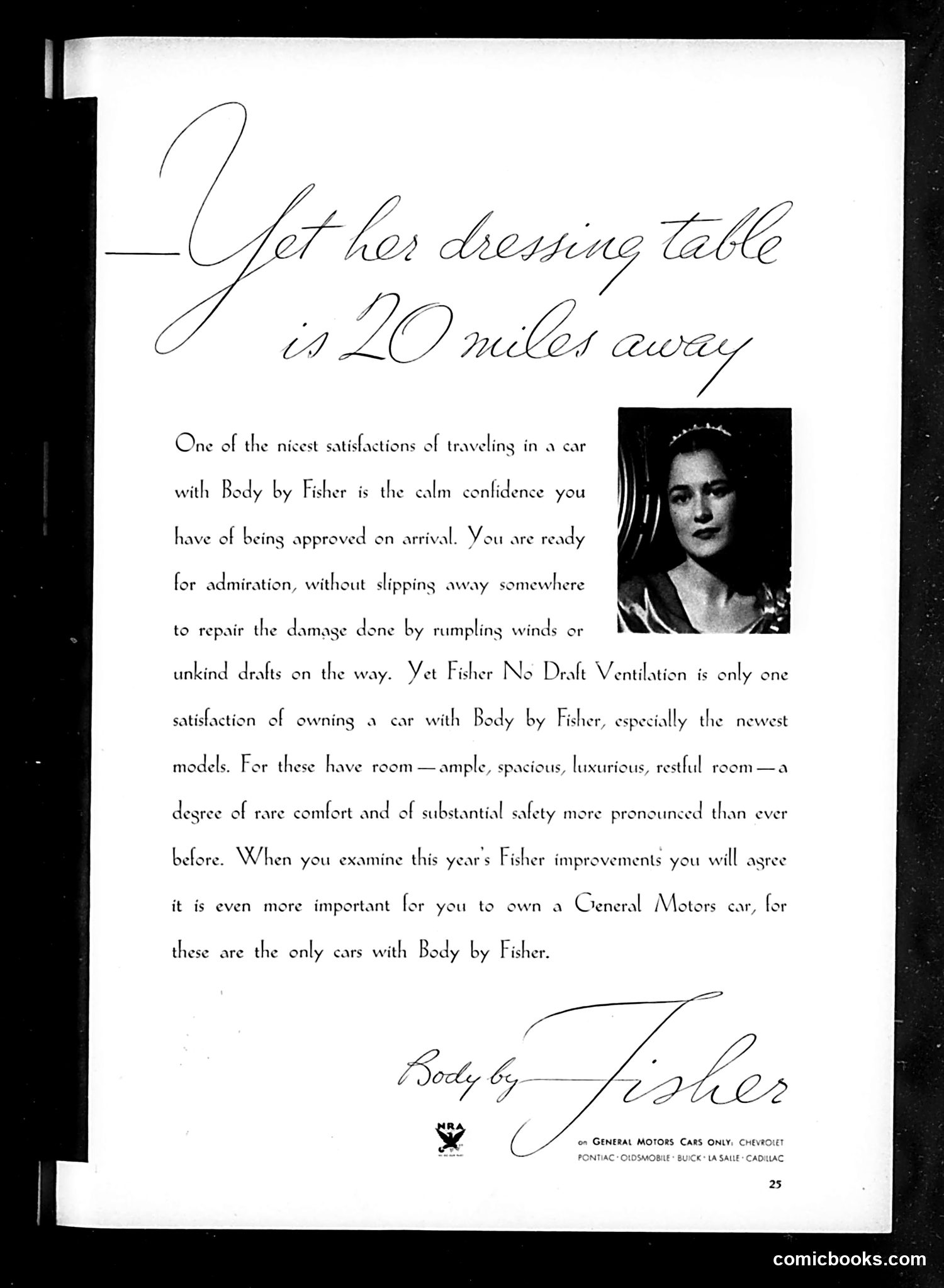
Analysis This is not a cartoon or satire page—it's a General Motors advertisement for "Body by Fisher," an automobile body manufacturing company owned by GM. The page features a glamorous photograph of a woman wearing a tiara, used to associate the car with elegance and luxury. The ad's headline—"Get her dressing table is 20 miles away"—plays on the idea that a woman traveling in a Fisher-bodied car arrives looking pristine and "approved," requiring no repairs to her appearance. The text emphasizes comfort, safety, and ventilation features ("No Draft Ventilation") as selling points. The final line reveals the advertisement's actual purpose: persuading readers that General Motors cars are superior because they're the *only* vehicles equipped with Fisher bodies—a monopoly claim meant to drive sales. This represents typical 1920s-30s advertising that used gender stereotypes and luxury aspirations to market automobiles to middle-class consumers.
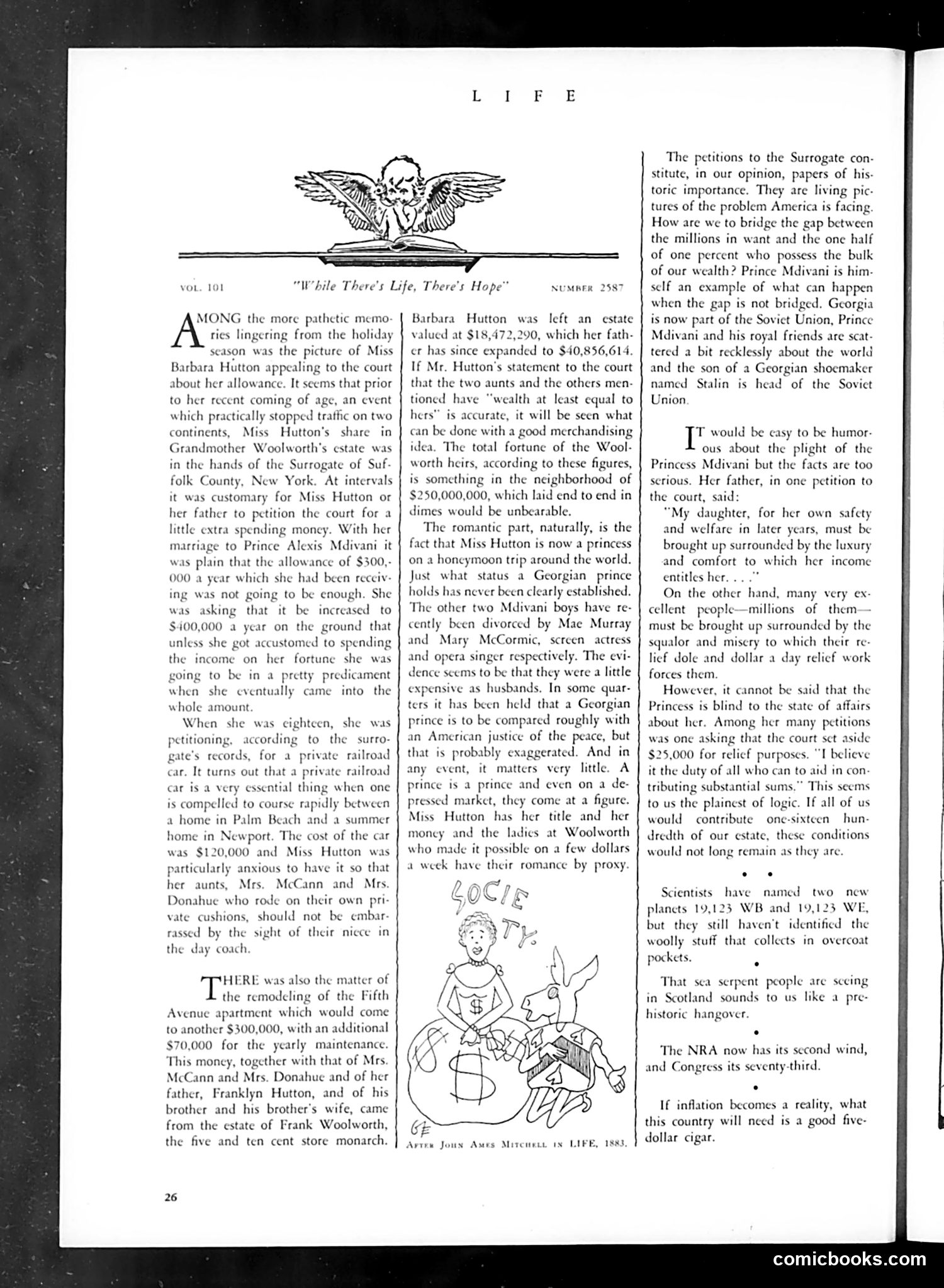
Explanation for Modern Readers This article satirizes Barbara Hutton, the immensely wealthy Woolworth heiress (granddaughter of the five-and-dime store founder), and her marriage to Prince Alexis Mdivani, a Georgian nobleman of unclear status. The satire targets wealth inequality during the Depression era. Hutton petitioned courts for allowance increases—requesting $400,000 annually plus funds for a private railroad car and Fifth Avenue apartment renovations—while claiming she needed to practice spending money. Meanwhile, her family's $250 million Woolworth fortune contrasts sharply with millions in poverty. The illustration depicts Hutton as a princess with symbols of luxury and frivolity. Life's editors mock the "romance" of her marriage as proxy fantasy for working-class Woolworth employees (who earned "a few dollars a week") while questioning how America can bridge such extreme wealth gaps. The Mdivani brothers are characterized as "expensive" husbands who divorced actresses, suggesting fortune-hunting.
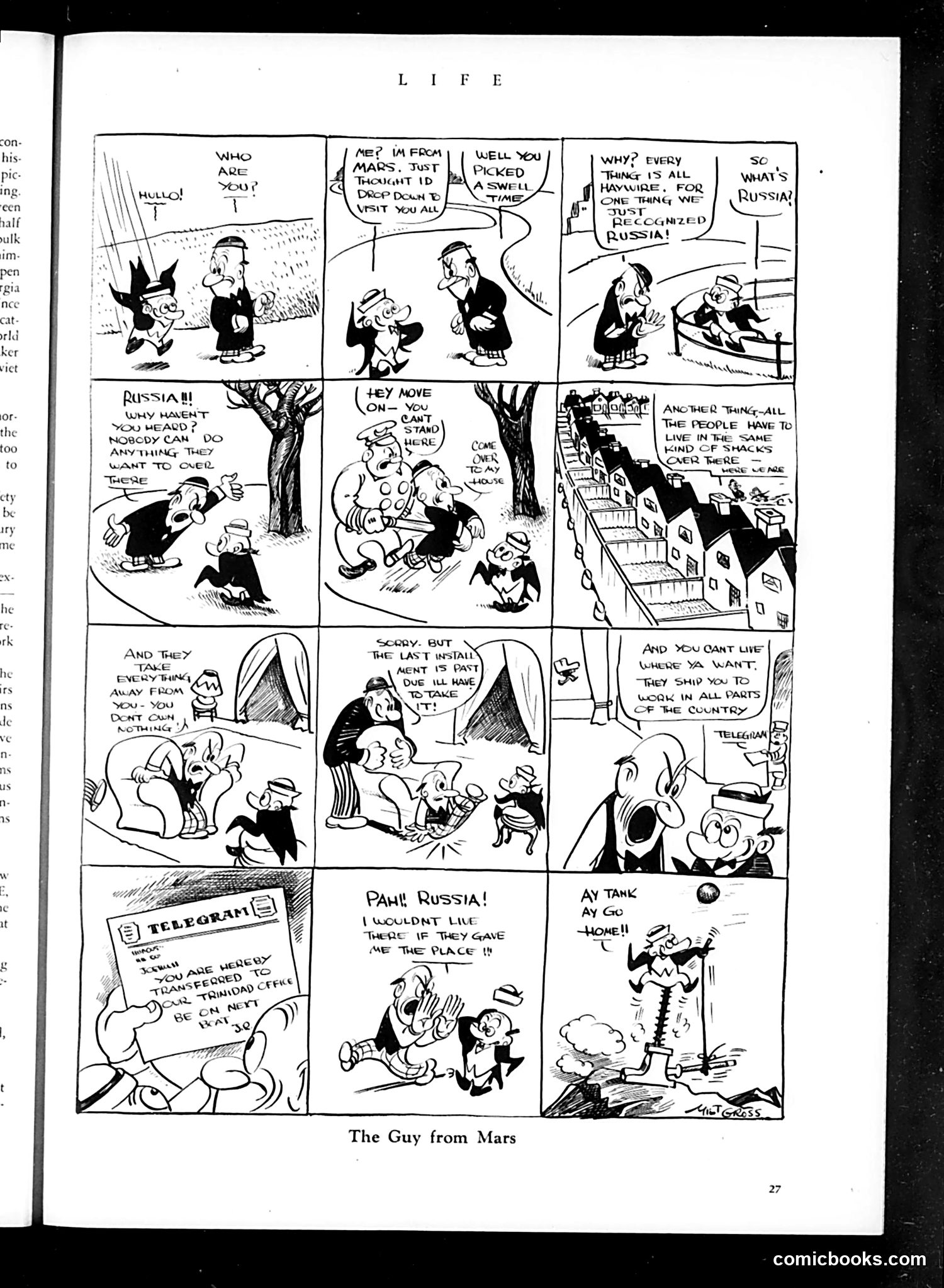
"The Guy from Mars" - Political Satire Explained This comic satirizes Soviet Russia by having a Martian visitor discover it's a totalitarian state. The joke structure uses the alien's naive questions to highlight what the comic presents as oppressive Soviet conditions: The targets: The Soviet Union under Stalin, critiqued for lack of freedom and central planning that controlled where people lived and worked. The satire: A visitor from Mars—someone with no Earth context—finds Russia's restrictions absurd. He's shocked that citizens can't choose where to live, must work assigned jobs, and can't leave. The punchline involves reporting his findings via telegram. Historical context: This appears from the Cold War era when American magazines regularly mocked Soviet authoritarianism. The "guy from Mars" device lets the cartoonist frame Soviet policies as obviously ridiculous to an outside observer. The humor depends on readers accepting the depiction of Soviet restrictions as self-evidently oppressive—making the political argument through comedic exaggeration rather than debate.
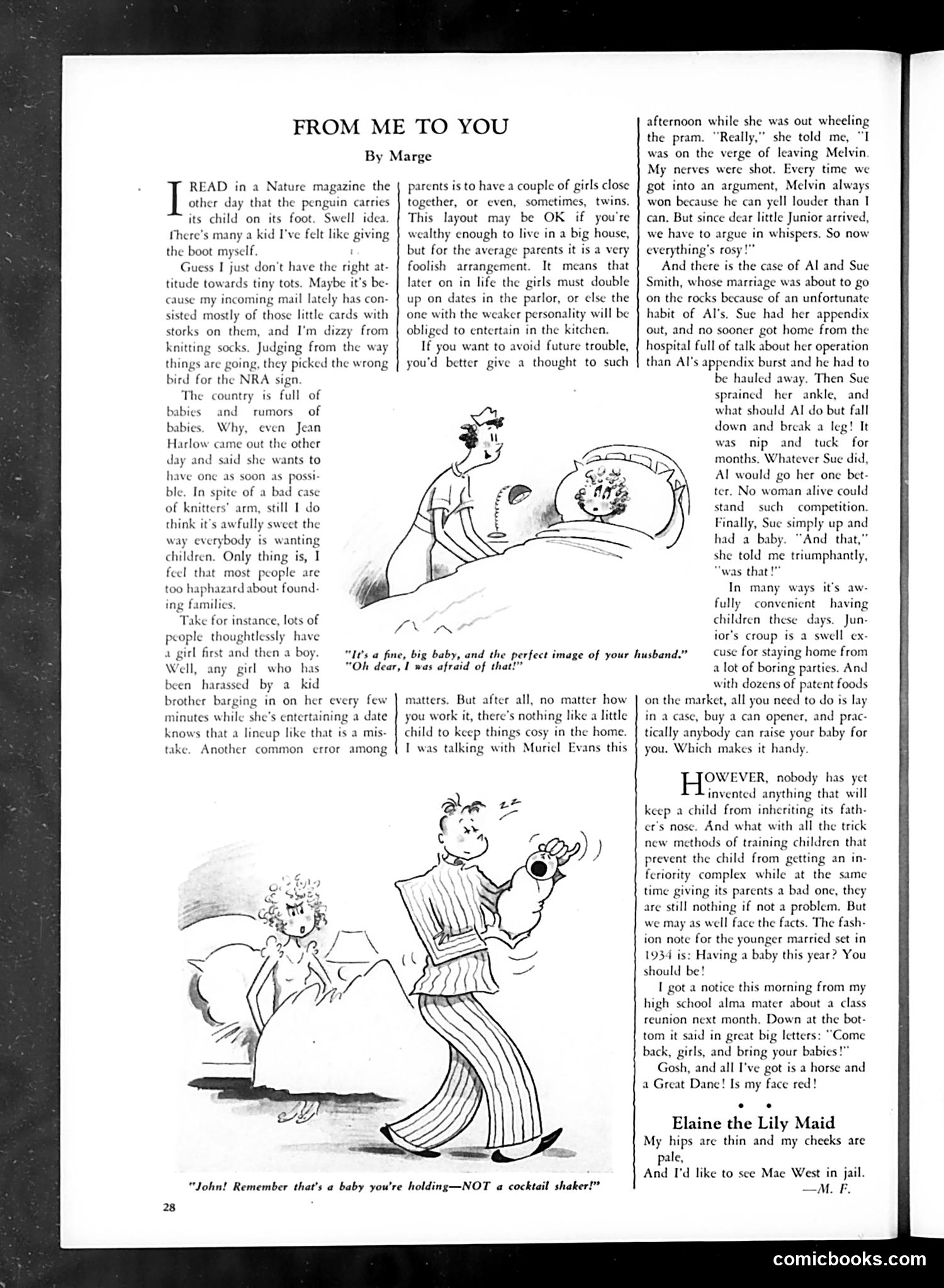
Explanation for Modern Readers This 1934 *Life* magazine humor column by Marge satirizes the era's obsession with having babies. The author mocks the trend by adopting a mock-serious tone about "proper" family planning—advising readers to thoughtfully space children by gender to avoid practical problems (daughters competing for dating attention, sons interrupting dates). The cartoons illustrate the absurdity: one shows a new mother horrified her baby resembles the father; another depicts a man so rough he shakes a baby like a cocktail. The subtext reflects 1930s anxieties: economic hardship made large families impractical, yet social pressure—even celebrity endorsements (Jean Harlow mentioned)—pushed parenthood as a status symbol. Marge's ironic tone critiques this disconnect, suggesting babies are promoted as convenient solutions to marital problems while actually creating new ones. The piece captures Depression-era ambivalence about family planning amid cultural pressure to reproduce.
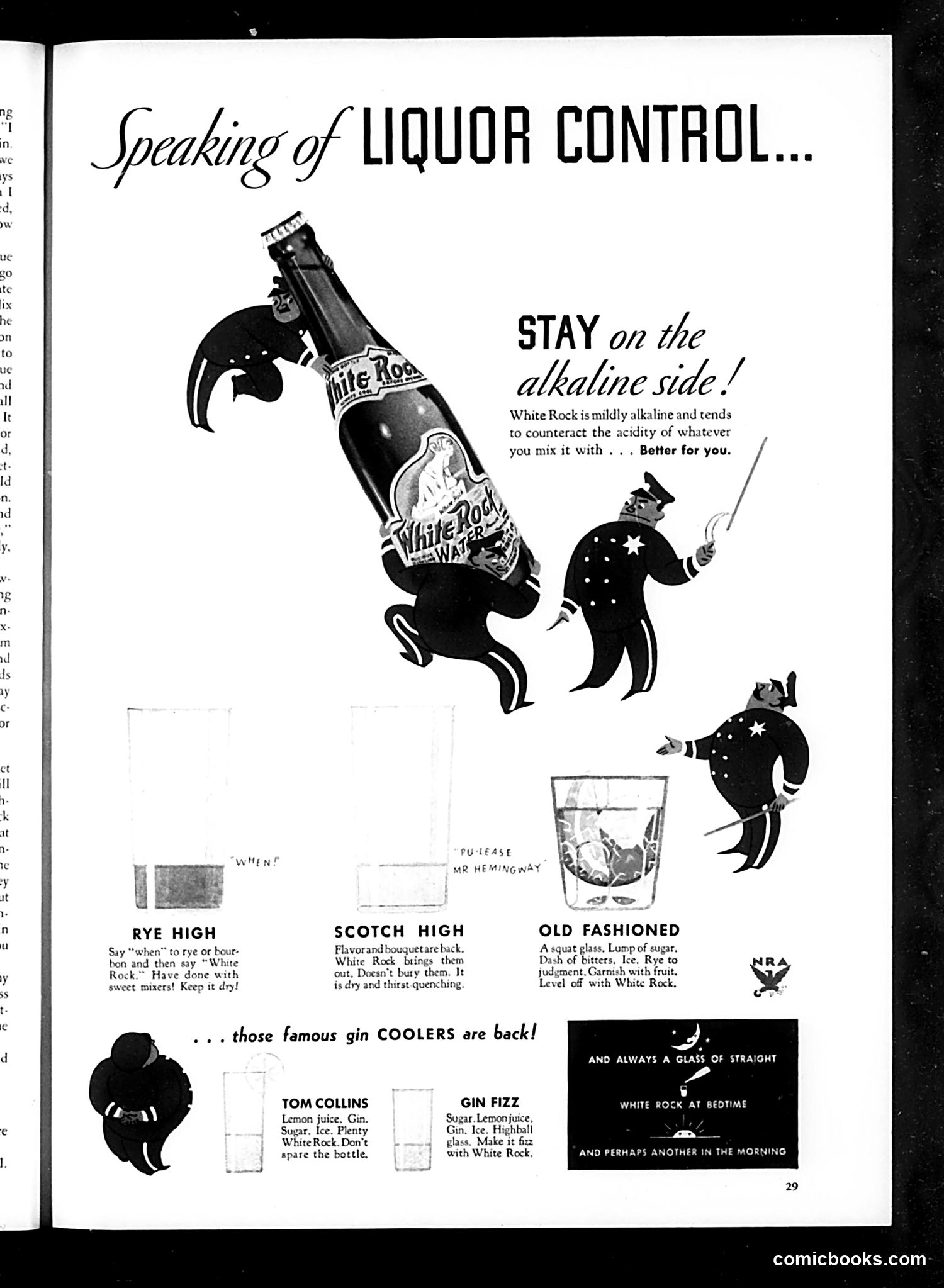
Explanation for Modern Readers This is a White Rock beverage advertisement, not political satire. It promotes White Rock mixer as a health-conscious choice for cocktails. The cartoon figures (appearing to reference Ernest Hemingway, given the "Mr. Hemingway" caption) humorously depict "liquor control"—not government regulation, but *personal moderation* through White Rock's mildly alkaline properties, which supposedly counteract alcohol's acidity and are "better for you." The page lists popular cocktails (Tom Collins, Gin Fizz, Old Fashioned, etc.) and playfully suggests that mixing drinks with White Rock makes alcohol consumption healthier. The tagline about "a glass of straight White Rock at bedtime" and "perhaps another in the morning" is tongue-in-cheek, implying the mixer itself becomes a wellness habit. This reflects 1930s-40s advertising logic: marketing alcohol as medically beneficial by associating it with a "healthy" mixer ingredient.
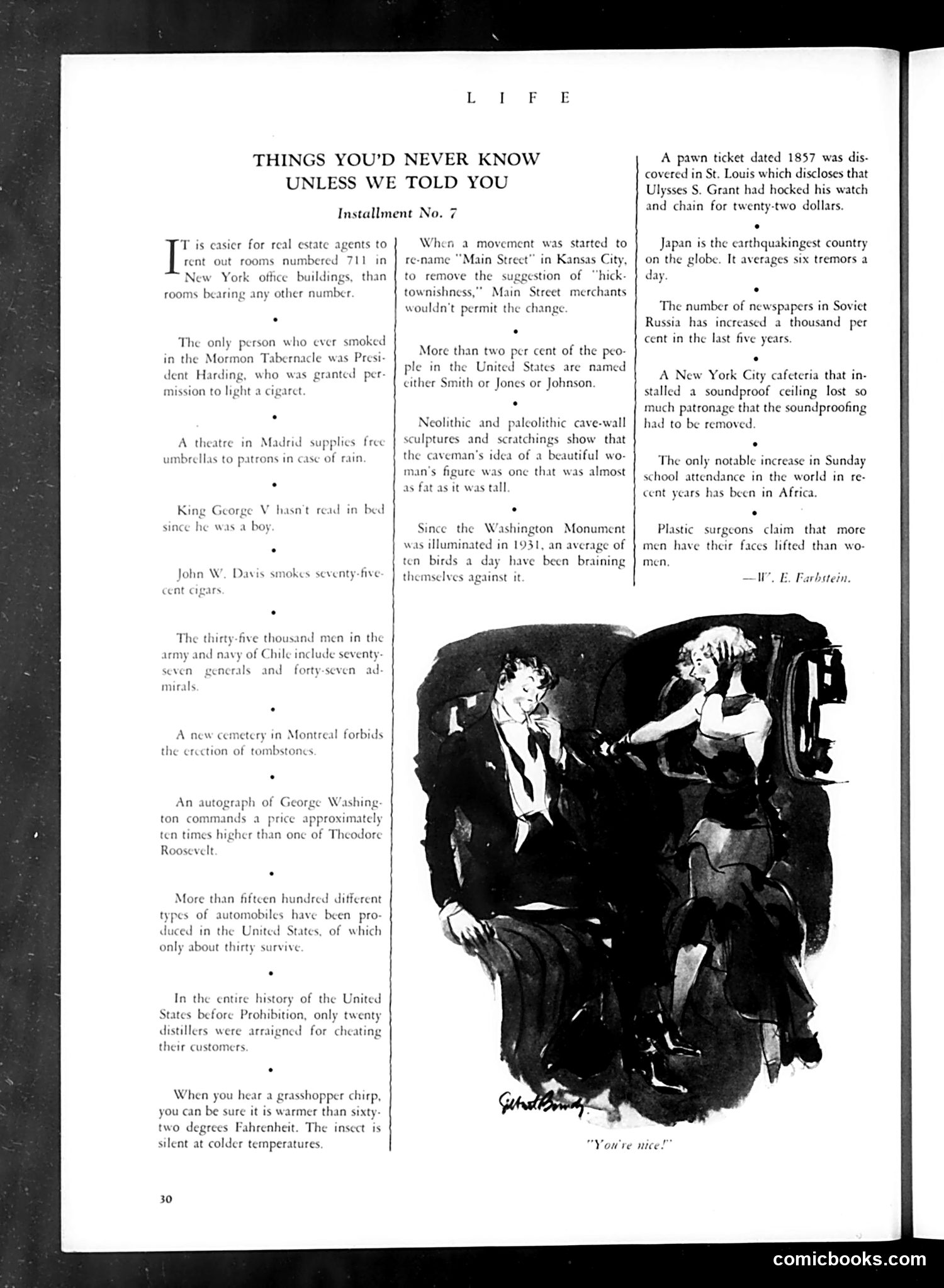
"You're Nice!" - Life Magazine Cartoon Analysis This page presents "Things You'd Never Know Unless We Told You" — a humorous trivia column paired with a cartoon illustration. The cartoon depicts two figures in what appears to be a car or vehicle: a man operating some kind of mechanical device or machinery, while a woman sits beside him saying "You're nice!" The sketch style and composition suggest this is satirizing courtship or romantic behavior — likely poking fun at how men try to impress women through technical displays or mechanical prowess. The woman's comment appears sarcastic or patronizing, as if the man believes his mechanical tinkering is charming when it's actually tedious or boring to her. The surrounding trivia items are random historical and geographical facts presented as amusing curiosities — establishing the magazine's tone as lighthearted social observation. The cartoon complements this satirical approach to modern American life and gender dynamics of the era.
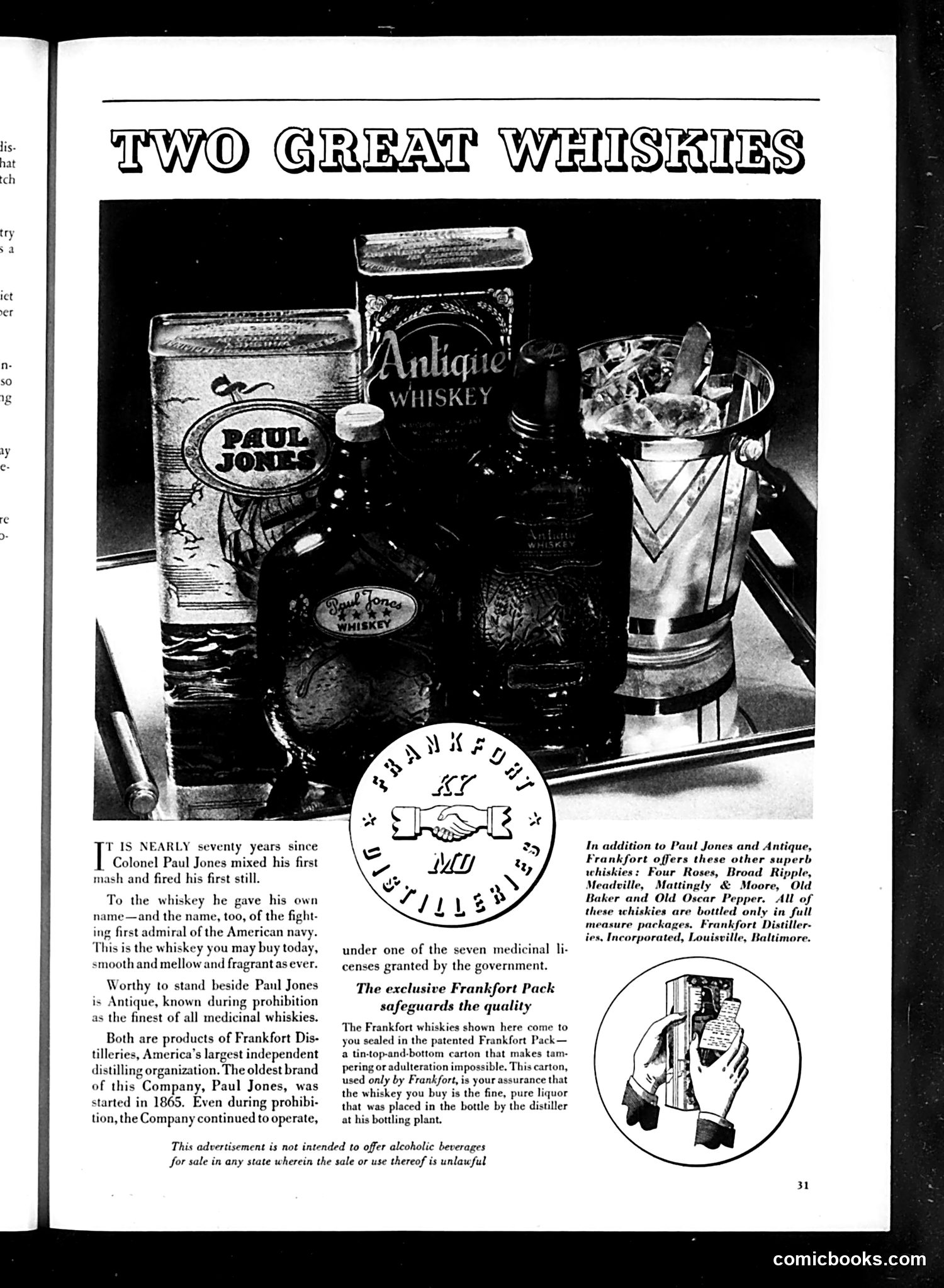
Analysis: "Two Great Whiskies" Advertisement This is primarily a whiskey advertisement, not political satire. It promotes Paul Jones and Antique whiskies from Frankfort Distilleries (Louisville, Baltimore). The page references Prohibition's aftermath—likely the 1930s. It notes that Paul Jones whiskey dates to 1865 and that during Prohibition, the company operated under government-issued "medicinal licenses" (a loophole allowing alcohol sales for medical purposes). Antique was marketed as "medicinal whiskey" during that dry period. The advertisement emphasizes the "Frankfort Pack"—a tamper-proof carton—as quality assurance against adulteration, a real concern when bootleg liquor was common. The "Colonel Paul Jones" naming references the Revolutionary War naval figure (John Paul Jones), lending the product patriotic cachet. This represents post-Prohibition industry recovery, targeting consumers now legally able to purchase alcohol again.
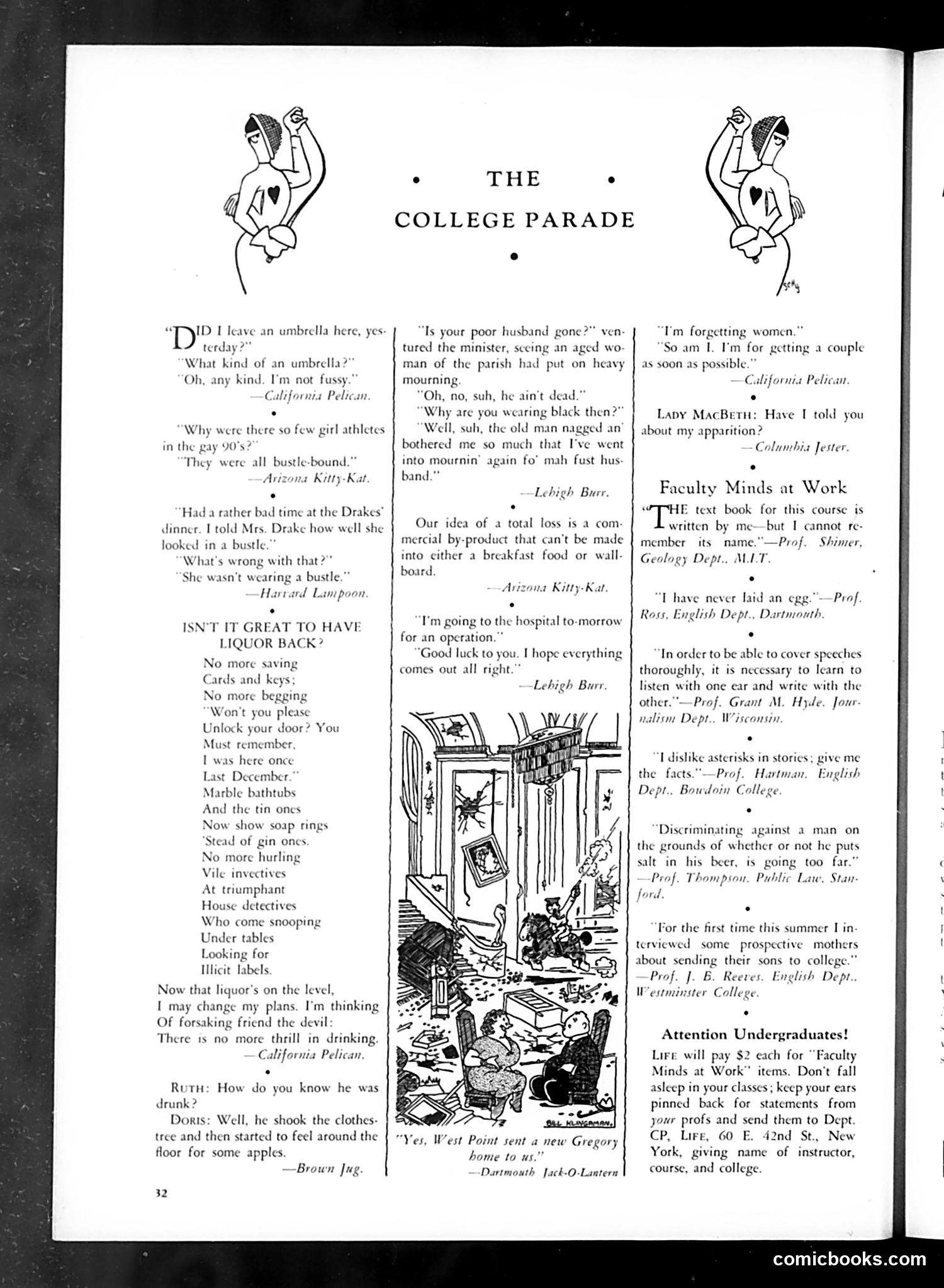
The College Parade Page Analysis This page from *Life* magazine presents college humor through multiple short jokes and anecdotes, likely from the 1920s (post-Prohibition repeal references suggest this era). Main Content: The page collects quips attributed to various college publications (California Pelican, Arizona Kitty-Kat, Lehigh Burr, etc.), satirizing college life, gender roles, and faculty absurdities. Key Satire Points: - Prohibition's end: Multiple jokes celebrate legalized alcohol's return, mocking the previous era's prohibition enforcement - Gender roles: References to "bustles" and "forgetting women" reflect period attitudes; one joke about girl athletes being "bustle-bound" comments on restrictive women's fashion limiting athleticism - Faculty pretension: The "Faculty Minds at Work" section mocks professors' absent-mindedness and peculiar statements - Campus culture: Jokes about drunkenness, dormitory life, and military academy humor The central illustration shows a messy dorm room, reinforcing themes of college disorder and debauchery. The page solicits reader submissions ($2 payment), positioning *Life* as a humor magazine dependent on college audiences for content.
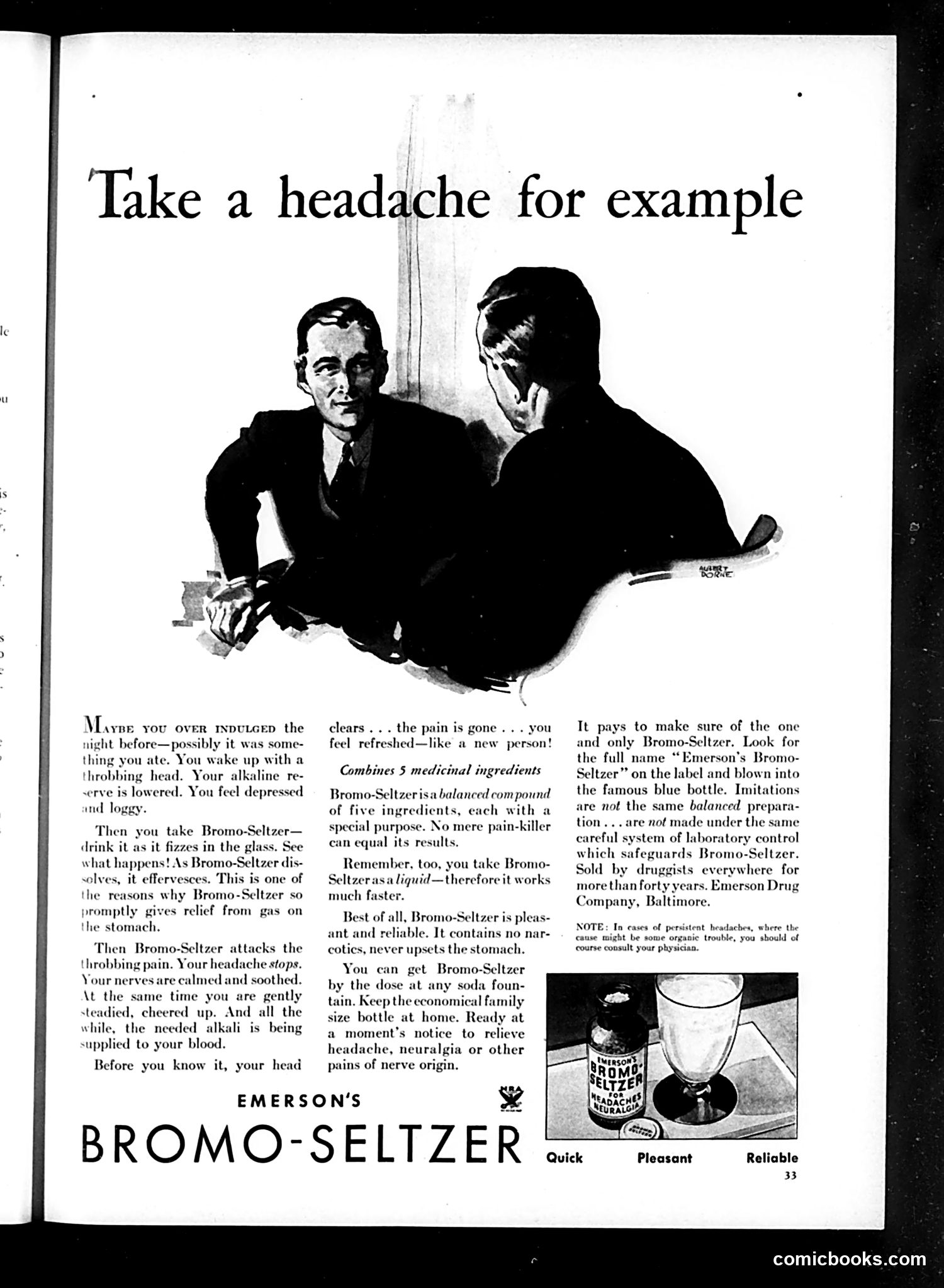
Analysis This is a Bromo-Seltzer advertisement, not political satire. The illustration shows two men in conversation—one appearing to have a headache (holding his head) while the other speaks to him, likely recommending the product. The ad uses a common early 20th-century marketing approach: presenting a relatable everyday scenario (overindulgence causing morning-after discomfort) and positioning Bromo-Seltzer as the solution. The text emphasizes the product's speed, balance of ingredients, and reliability—it's been sold for "more than forty years." The humor is gentle, playing on the universal experience of hangovers or indigestion. The "example" in the headline frames headaches as a straightforward problem with a straightforward remedy. This reflects the era's acceptance of patent medicines and over-the-counter remedies with relatively unregulated health claims—a practice modern FDA regulations would restrict.
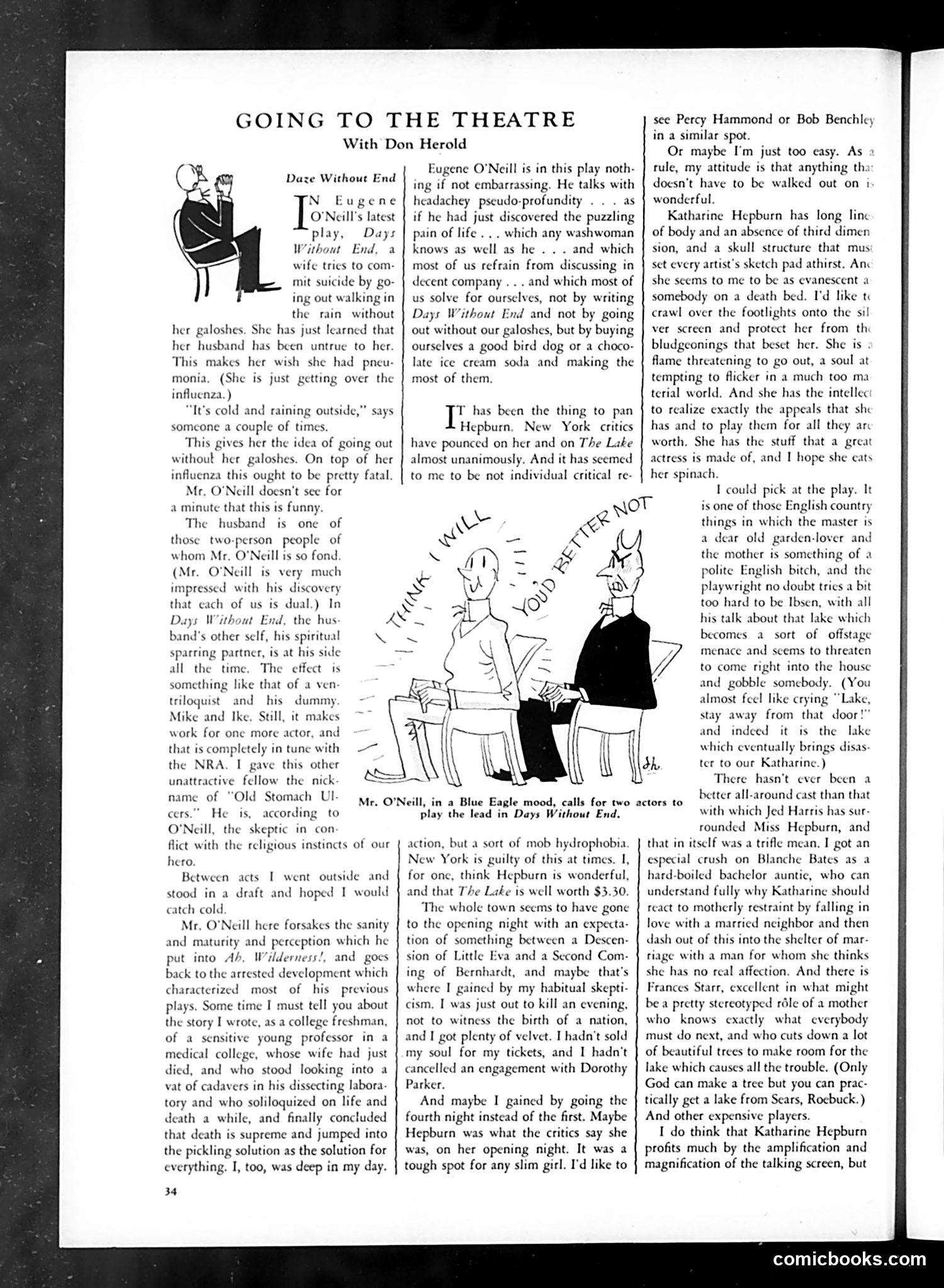
Analysis of Don Herold's Theater Column This is Don Herold's satirical review of Eugene O'Neill's play *Days Without End*, starring Katharine Hepburn in *The Lake*. The Main Joke: Herold mocks O'Neill's plot premise—a wife attempts suicide by walking in rain without galoshes after learning of her husband's infidelity. Herold finds this absurdly overwrought and pretentious, sarcastically noting that ordinary people solve life's problems with "a good bird dog or a chocolate ice cream soda" rather than existential drama. Key Targets: - O'Neill is criticized for pseudo-intellectual "headachey" dialogue about life's pain that "any washwoman knows" - The play features O'Neill's favorite gimmick: a man and his spiritual "other self" (illustrated in the cartoon), which Herold compares to a ventriloquist act - Hepburn faced harsh critical mob reaction to *The Lake*, which Herold defends as unfair, noting critics' inflated expectations The "Blue Eagle" reference alludes to FDR's NRA (National Recovery Administration) code, joking that O'Neill's dual-character device fits New Deal efficiency requirements. Herold's tone throughout is deflating pretension through common sense.
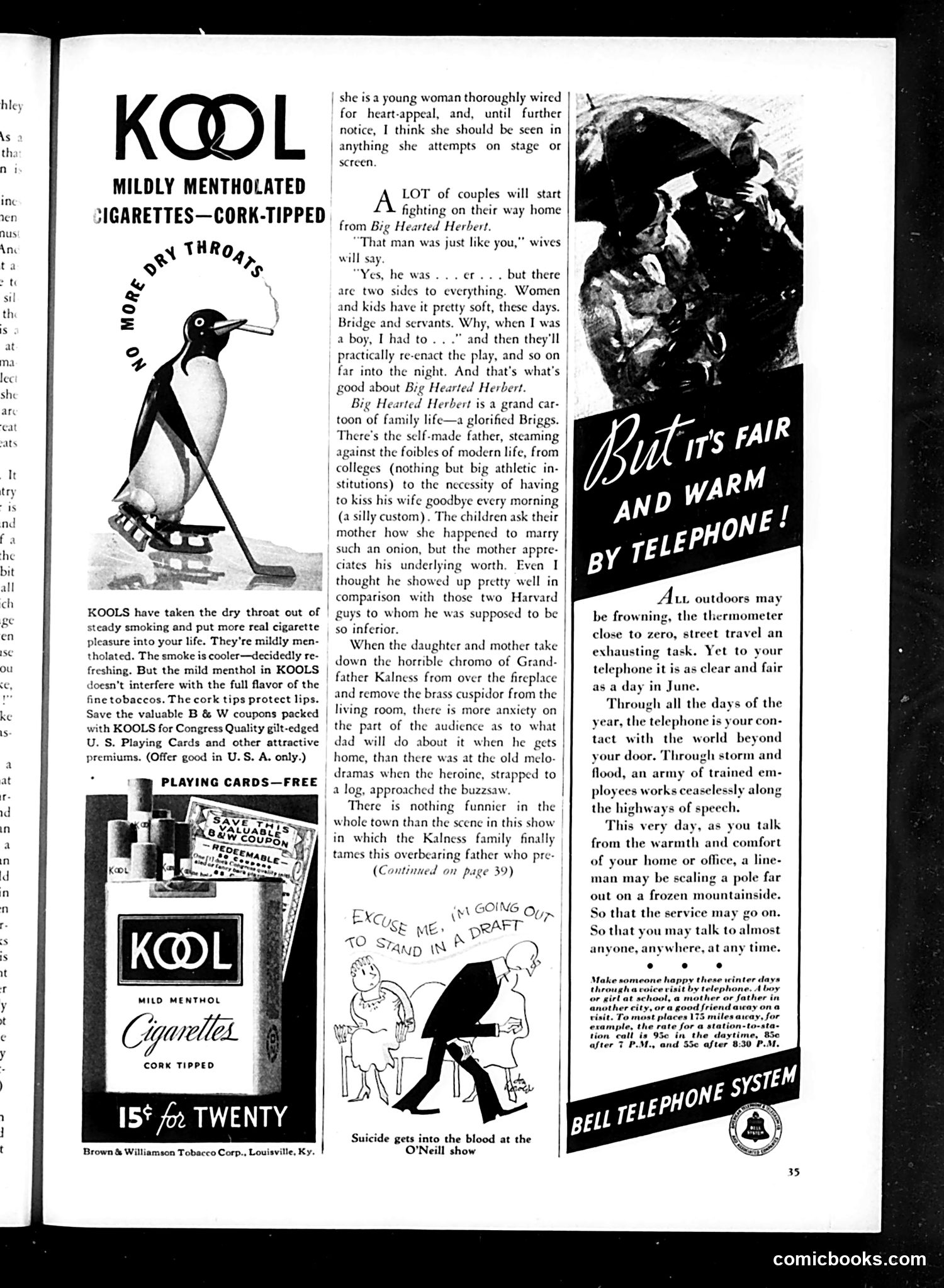
Analysis of Life Magazine Page This page contains two distinct advertisements plus theater/film reviews: KOOL Cigarettes ad (left): Advertises menthol cigarettes with a penguin mascot symbolizing coolness and relief for "dry throats." The ad promises mild mentholation without sacrificing tobacco flavor—typical mid-century cigarette marketing emphasizing pleasure and health benefits. Bell Telephone System ad (right): Shows a couple embracing outdoors in harsh winter conditions. The copy emphasizes that while "all outdoors may be frowning," the telephone provides clear connection "as a day in June." This celebrates telephone infrastructure reliability and emotional connection across distance—Depression-era messaging about technology's role in maintaining relationships during hardship. Theater reviews (center): Discusses films "Big Hearted Herbert" (a family comedy about a stern patriarch) and "The O'Neill show" (apparently about suicide). The reviews are typical period entertainment criticism. The page reflects 1930s consumer culture: advertising promises modern conveniences while reviews discuss popular entertainment addressing social themes.
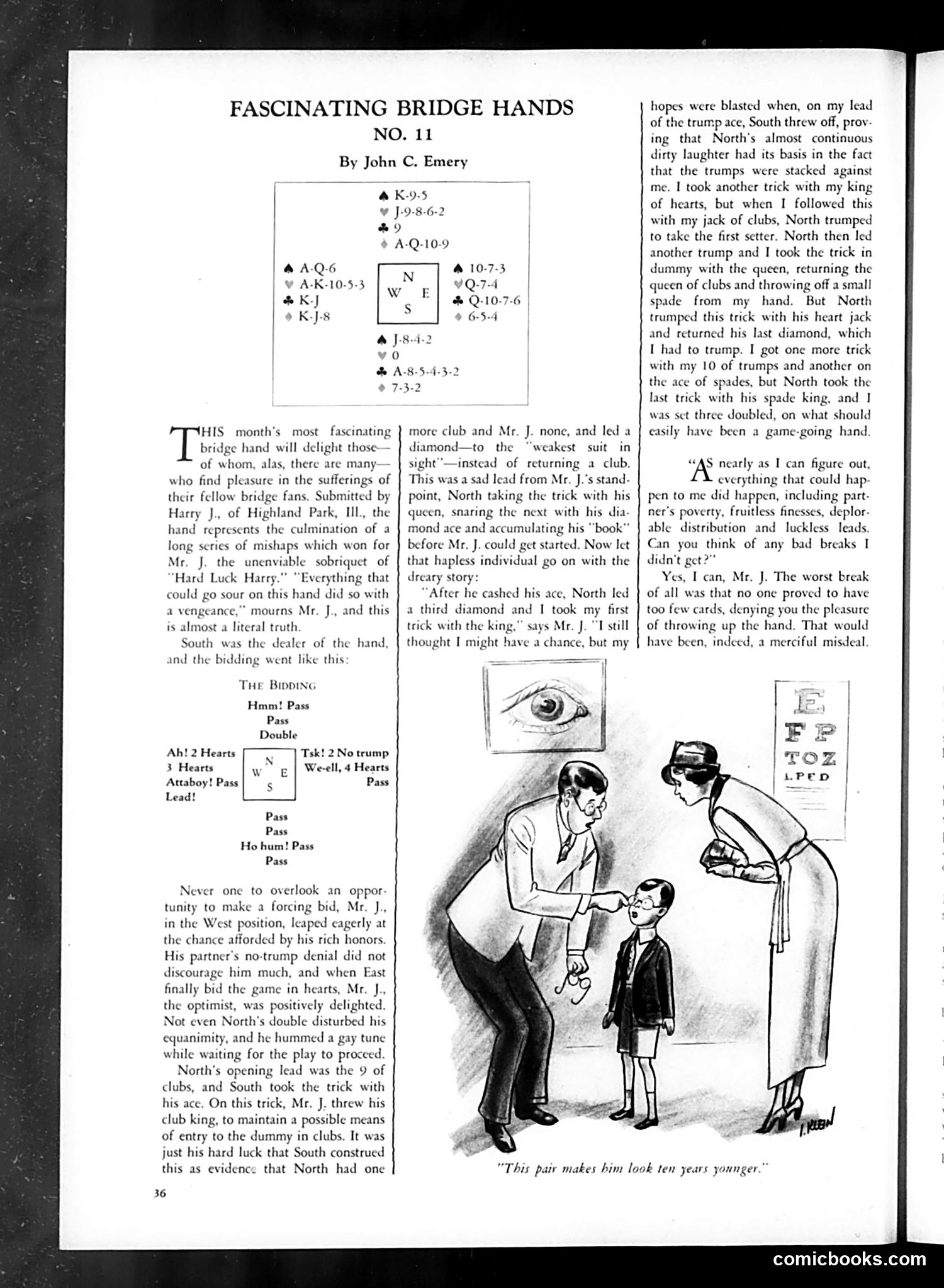
Analysis of "Fascinating Bridge Hands" This page contains a bridge card game analysis by John C. Emery, not a political cartoon. The main illustration is a domestic humor cartoon showing a man and woman looking at a young boy, with the caption "This pair makes him look ten years younger." The cartoon's joke is a mild marital jab: the woman (presumably the man's wife or romantic partner) makes him appear a decade younger, implying that without her, he looks old and worn. It's gentle domestic satire typical of Life magazine's humor. The bulk of the page is devoted to bridge instruction—a serious card game analysis of "Mr. J.'s" unlucky hand, where despite good cards, his partner's poor play and bad luck resulted in a disastrous outcome. The narrative illustrates why the player earned the nickname "Hard Luck Harry." This reflects bridge's popularity among early-to-mid 20th century American middle-class readers.
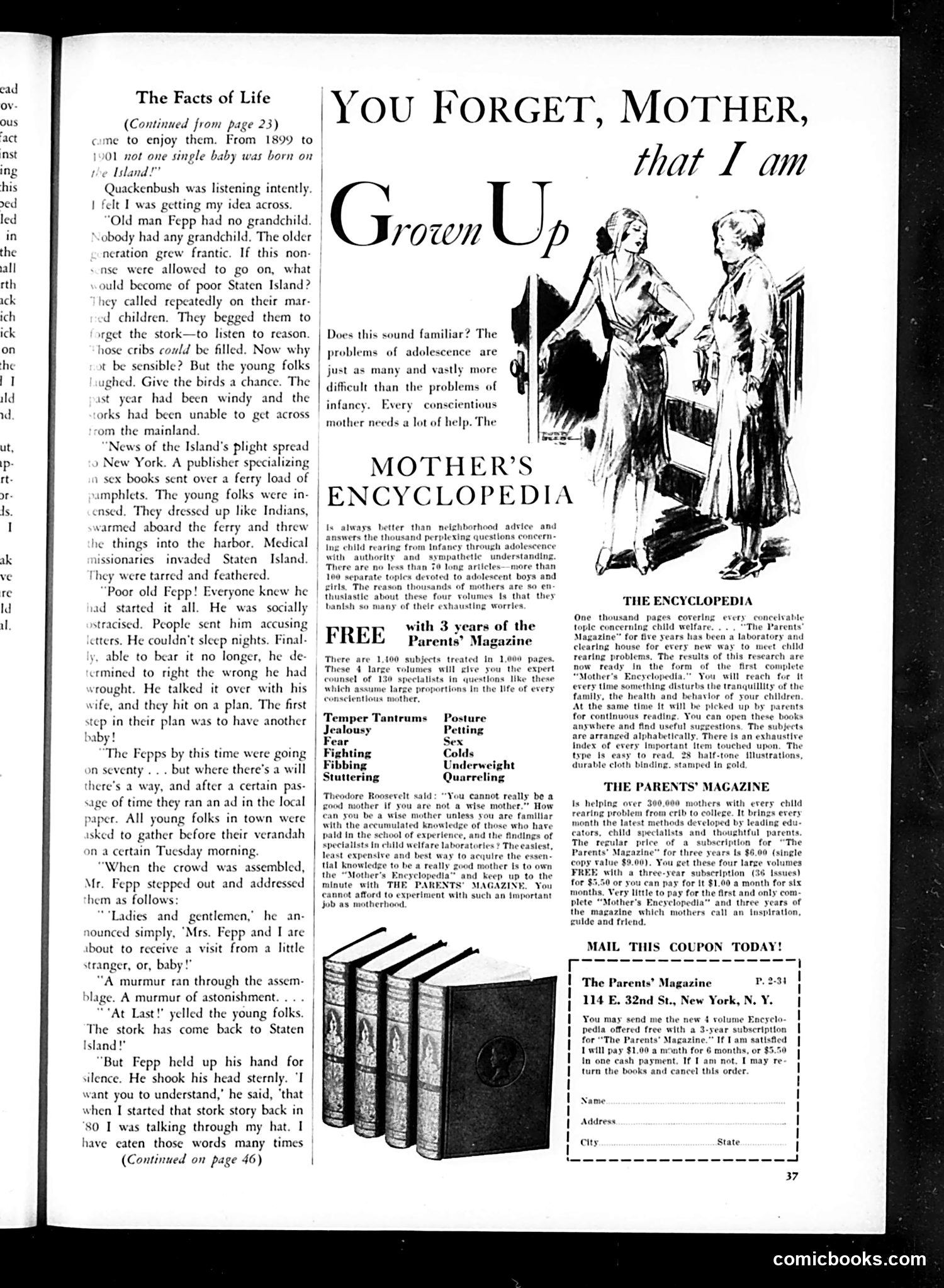
Satire on Public Health, Birth Control, and Community Responsibility This page reprints a satirical story about Staten Island, where townspeople spread rumors that babies were not being born there. When young people embrace this "stork story" as fact, refusing to have children, local officials panic—fearing the island's depopulation and decline. The joke satirizes how misinformation spreads, how communities can be destabilized by rumors about reproduction and public health, and ultimately, how even the originator of the hoax (old man Fepp) must recant and have another child to restore social order. The accompanying advertisement for "Mother's Encyclopedia" repurposes this satirical narrative to market parenting advice, capitalizing on anxiety about proper child-rearing. The pairing suggests that modern mothers need expert guidance to navigate both reproduction and adolescent child-rearing—a considerable shift from folk wisdom. This represents early 20th-century anxieties about population, modernization, and the professionalization of motherhood.
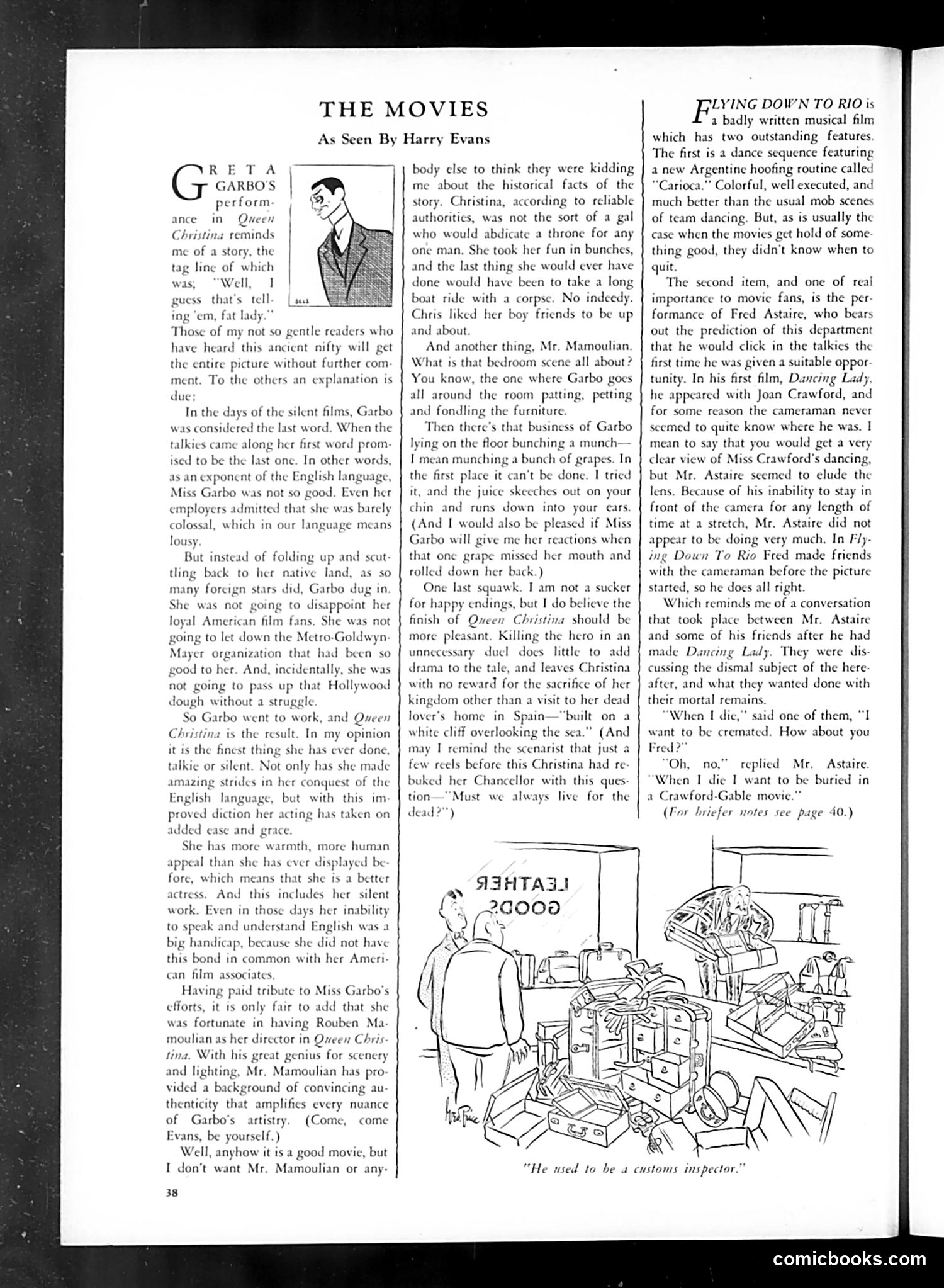
Analysis of "The Movies" Page This is a film review column by Harry Evans critiquing Greta Garbo's performance in *Queen Christina*. The accompanying cartoon shows a man examining a cluttered "Lighter Goods" display, captioned "He used to be a customs inspector." The main review praises Garbo's dramatic improvement in sound films, noting her previously poor English diction in early talkies. Evans acknowledges she's overcome this handicap through effort and director Rouben Mamoulian's skilled cinematography. The satire concerns historical accuracy: Evans humorously objects to the film's fictional elements—particularly the romantic final scene with a corpse and the bedroom furniture-fondling sequence—pointing out the real Queen Christina wouldn't have abandoned her throne for one man or behaved so sentimentally. The cartoon's joke appears to reference standards inspection: a "customs inspector" now surrounded by cluttered merchandise suggests bureaucratic laxity or someone unable to maintain order—possibly satirizing film censors or quality control. The overall tone is affectionate ribbing of both Garbo's work and Hollywood's historical liberties.
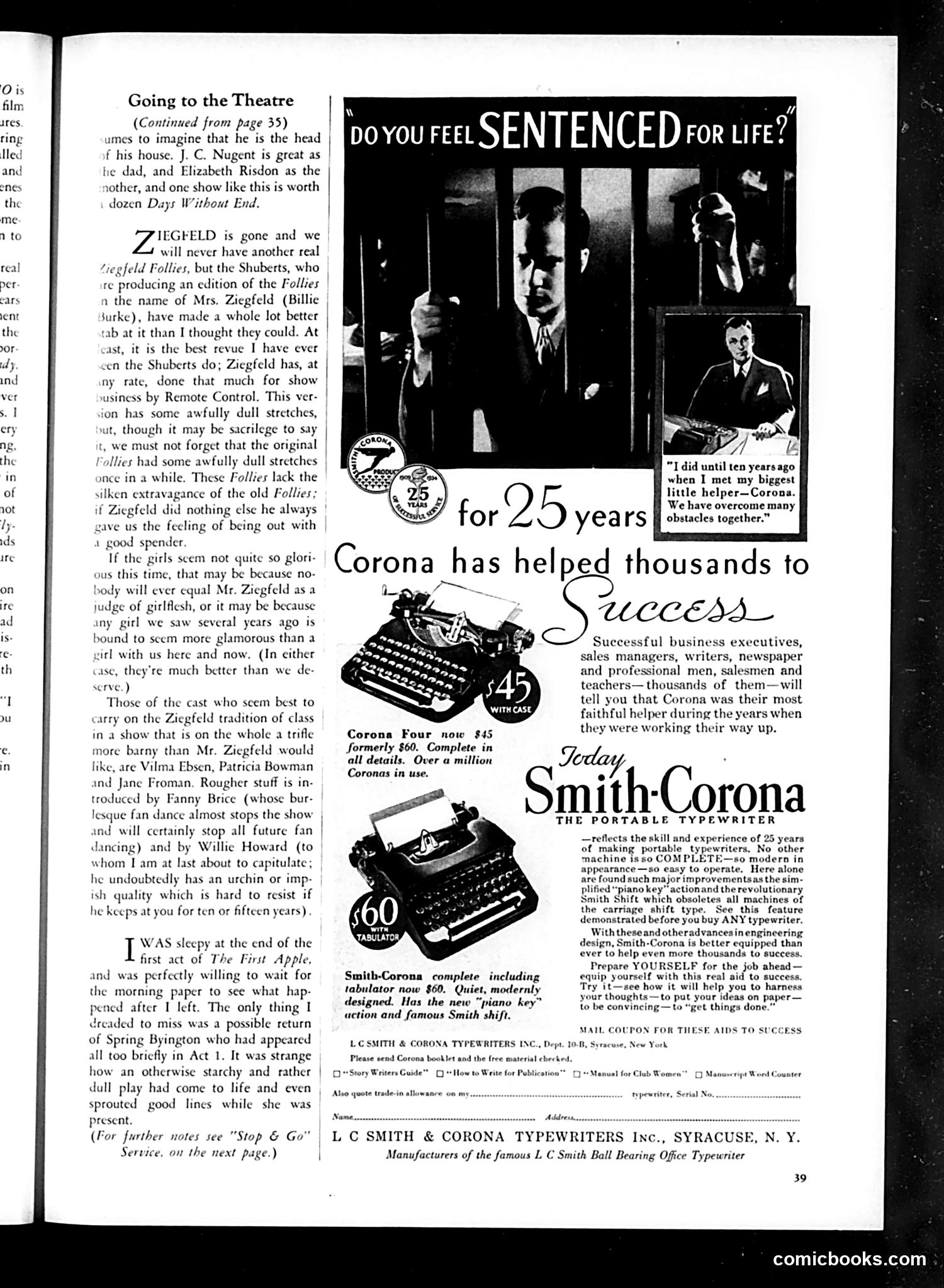
Life Magazine Page 39 Analysis This page combines theatre criticism with advertising and contains no political cartoon. The satirical content is minimal. The left column reviews Broadway shows, including praise for the new Ziegfeld Follies (produced by the Shuberts after Florenz Ziegfeld's death) and criticism of *The First Apple*. The critic notes the Follies lack Ziegfeld's original lavishness but feature strong performers like Fanny Brice and Willie Howard. The dominant right side is a Smith-Corona typewriter advertisement using testimonial marketing. A photo of a man in business attire claims he overcame obstacles with Corona's help "ten years ago." The ad emphasizes the typewriter's engineering superiority, particularly its "piano key" action and Smith Shift mechanism, positioning it as essential for "business executives, sales managers, writers" and professionals. Price is listed as $60 (formerly more). This is primarily advertising copy, not satire or political commentary. The page reflects 1930s marketing strategies targeting white-collar workers and demonstrates how Life magazine balanced editorial content with revenue-generating ads.
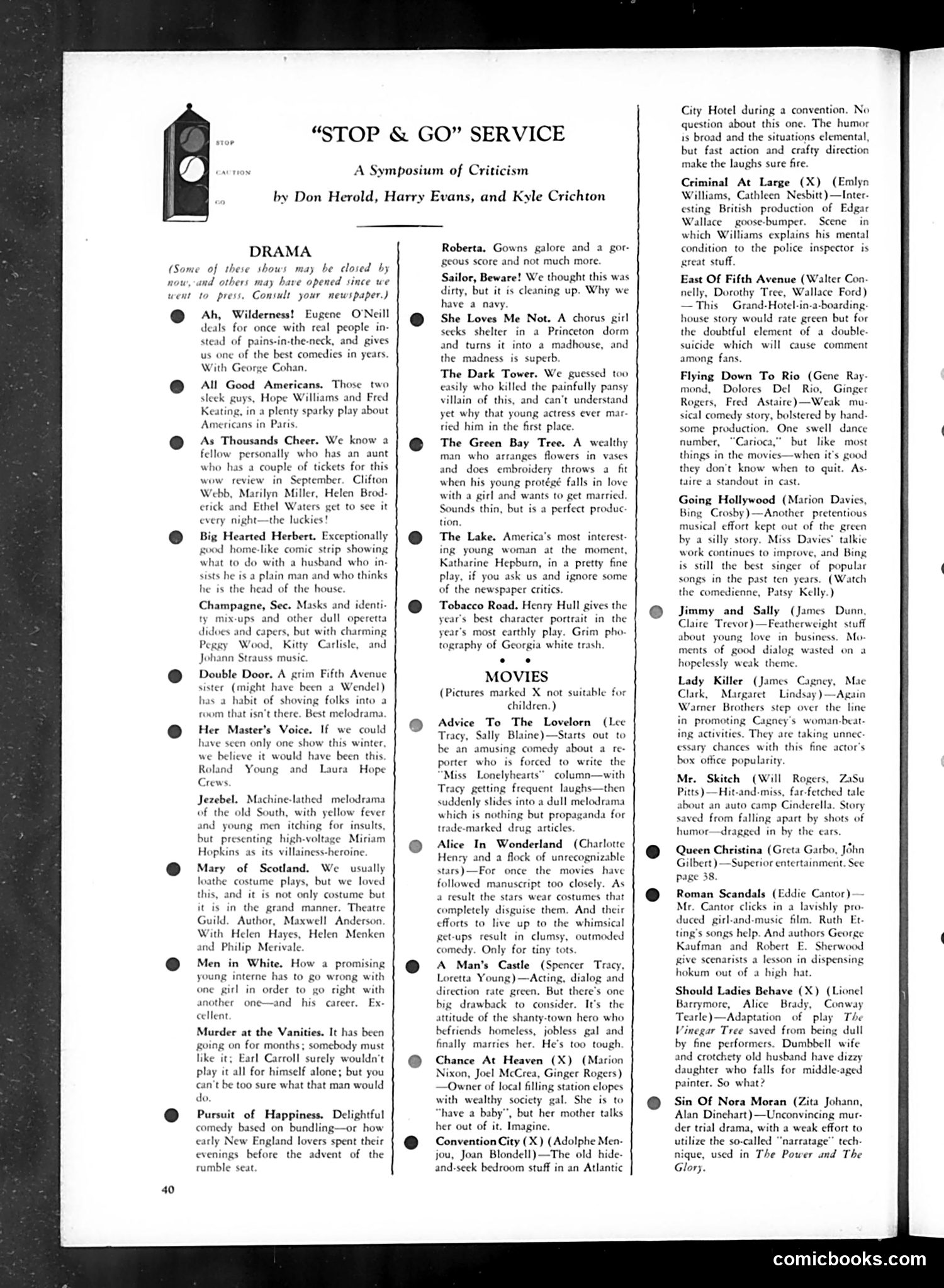
"Stop & Go" Service: A Theater Critic's Symposium This page presents brief, punchy reviews of contemporary Broadway plays and films by three critics. The title "Stop & Go Service" uses traffic-light imagery (visible in the masthead) as a metaphor for their ratings system. The reviews employ characteristic 1930s satirical wit: praising O'Neill's *Ah, Wilderness!* for dealing with "real people," mocking the predictability of operettas, and delivering backhanded compliments (like noting *Roberta* has "gowns galore and a gorgeous score and not much more"). Notable references include Katharine Hepburn in *The Lake* and Henry Hull's performance in *Tobacco Road*—both contemporary theatrical events. The critics' caustic tone—calling operetta "dull," questioning why *Murder at the Vanities* remains open—captures Life magazine's irreverent approach to entertainment criticism for educated urban readers who frequented Broadway and cinema. The format itself—rapid-fire judgments with minimal explanation—mirrors the "stop and go" concept of quick theatrical decisions.
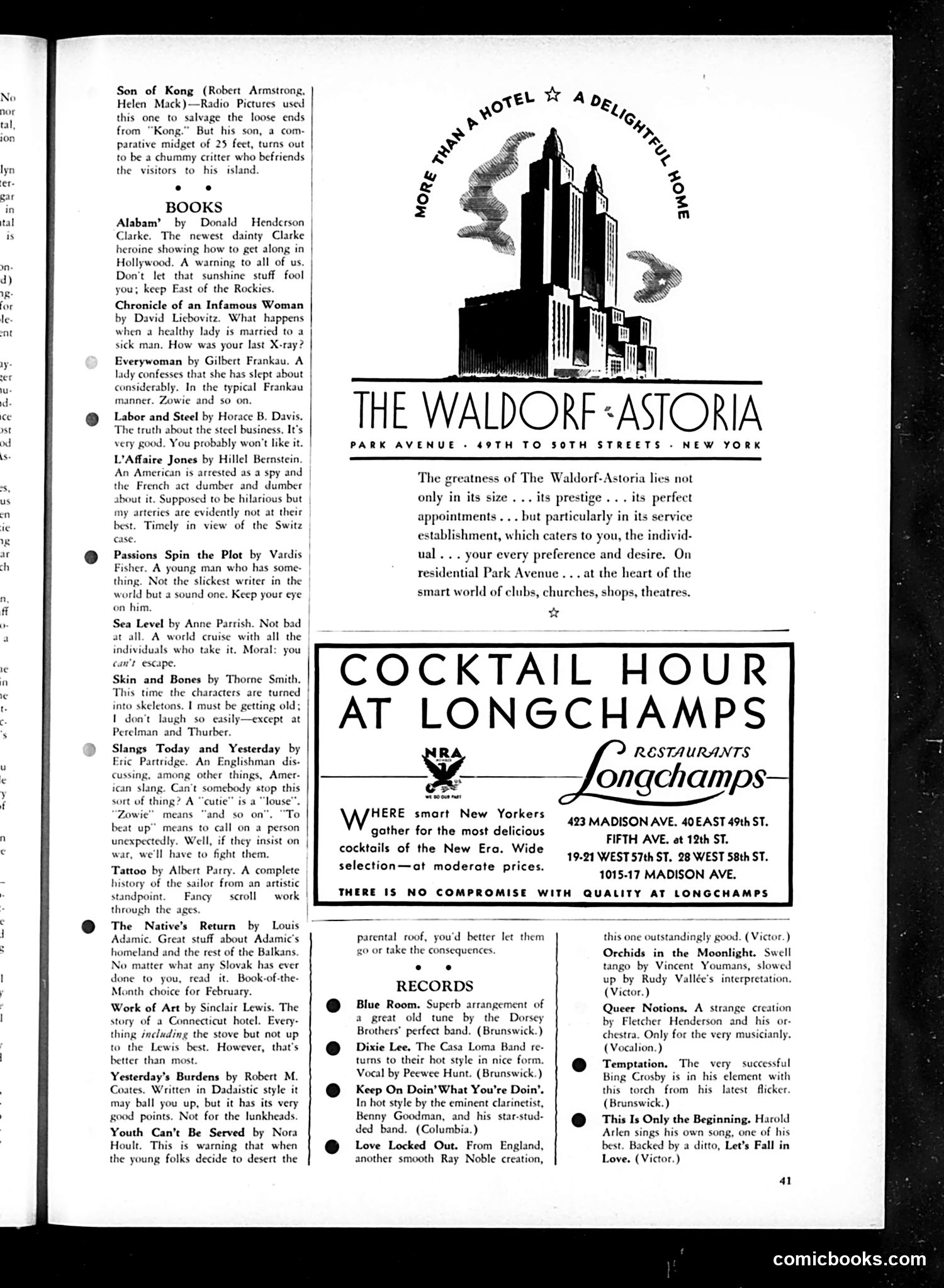
Analysis of Page 41 from Life Magazine This page is primarily advertising and entertainment reviews, not political satire. The content includes: Main Features: - Book reviews (brief, witty critiques of contemporary novels) - A large advertisement for the Waldorf-Astoria Hotel in Manhattan - Advertisements for Longchamps Restaurants (cocktail hour promotions) - Record reviews of popular music Notable Details: The book reviews employ Life's signature satirical tone—brief, knowing commentary poking gentle fun at authors and subjects. References like "Don't let that sunshine stuff fool you; keep East of the Rockies" about a Hollywood novel suggest skepticism toward entertainment industry narratives. The advertisements emphasize luxury and sophistication ("smart New Yorkers," "perfect appointments"), reflecting Depression-era aspirational marketing targeting affluent readers. No political cartoons appear on this page. It's a standard issue of Life's entertainment and lifestyle content from the 1930s.
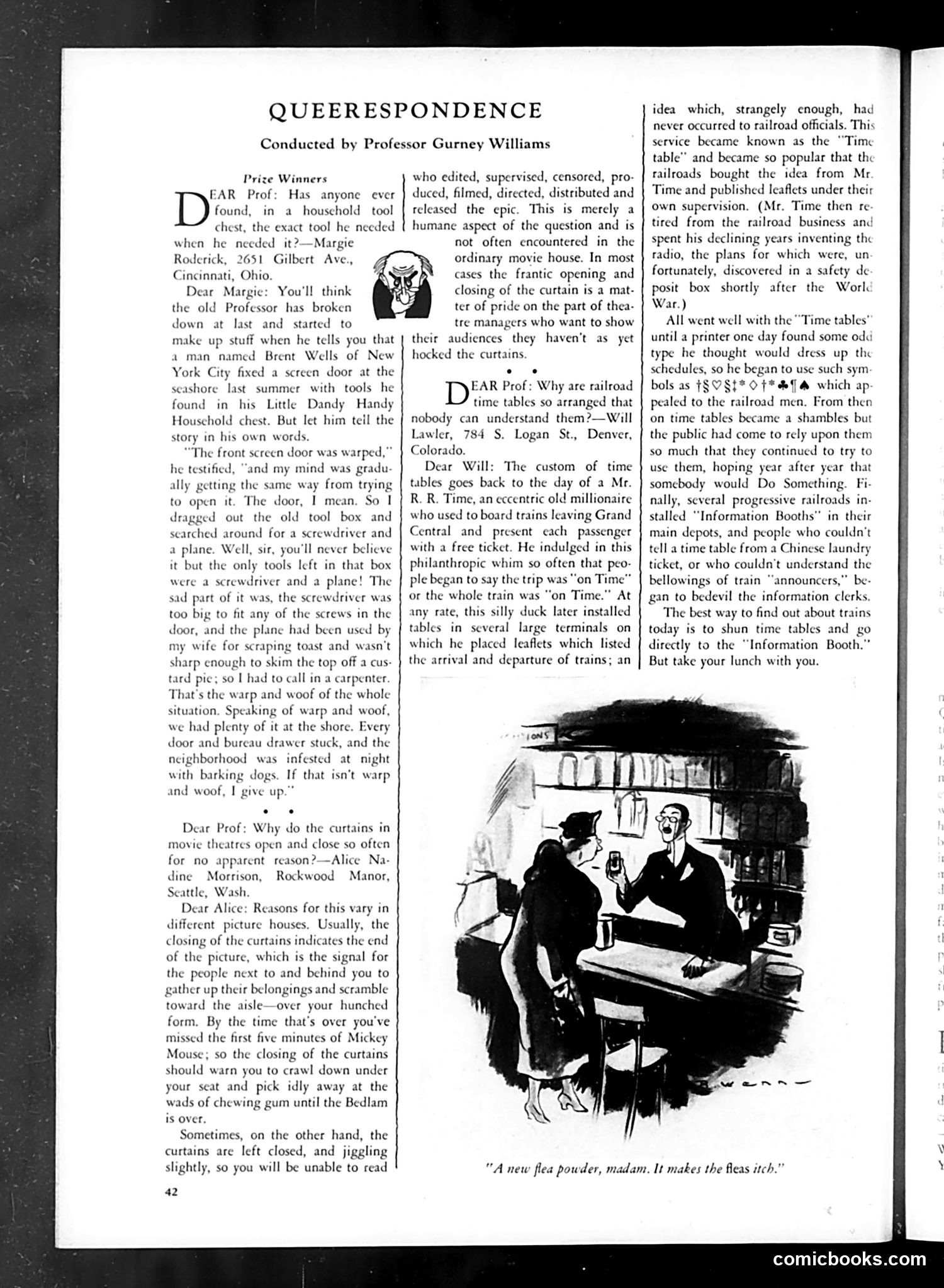
Analysis of Life Magazine Page This is a humor advice column called "Queerespondence" where readers submit questions about everyday annoyances, and the professor responds with deliberately absurd explanations disguised as earnest history. The main cartoon depicts a pharmacy or drugstore scene where a customer complains about a new flea powder to the clerk, saying "It makes the fleas itch"—a deadpan joke about a product that doesn't work. The written responses mock three common frustrations: 1. Tools in toolboxes: A man finds his toolbox contains only the exact tools he needs, yet they're useless (screwdriver too big, plane too dull), so he still needs a carpenter. The satire skewers false hope and Murphy's Law. 2. Movie theater curtains: Theater managers obsessively open/close curtains to show off their equipment since pawning them would be embarrassing—mocking unnecessary theater management. 3. Railroad schedules: Attributed to a fictional philanthropist "R. R. Time" who distributed free tickets, making trips "on Time," then invented incomprehensible timetables. This satirizes why railroad schedules remain confusingly complex. The humor relies on treating mundane modern problems with mock-serious historical narratives.
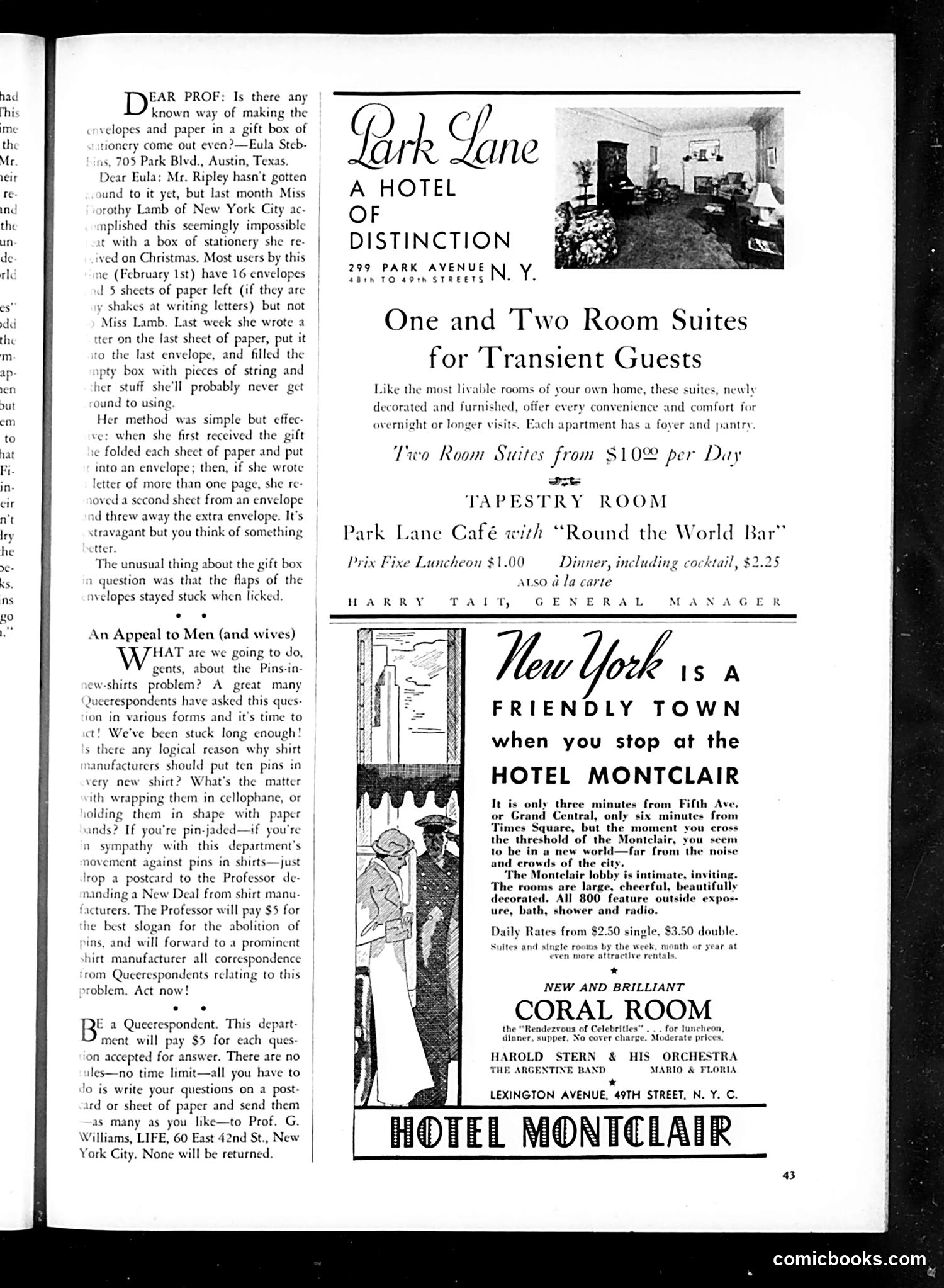
Page Content Analysis This page is primarily advertising for New York City hotels (Park Lane and Hotel Montclair), with a small advice column called "The Professor's Questions" featuring two reader queries. The column's content reflects 1930s-40s consumer frustrations: one reader asks about stationery quantities not matching (envelopes vs. paper), another complains about excessive pins packed inside new shirts. The professor solicits "slogans" against pins, offering $5 rewards and promising to forward complaints to manufacturers—a humorous appeal to readers' collective grievance. The second query includes an illustration (unclear from OCR) accompanying the shirt-pin discussion. The satire is gentle domestic complaint-airing rather than political. It captures everyday annoyances manufacturers ignored, framed as a consumer advocacy joke. The "Queerespondent" column was apparently a reader-submission feature paying small fees for amusing questions. The bulk of the page comprises hotel advertisements targeting traveling businessmen and tourists.
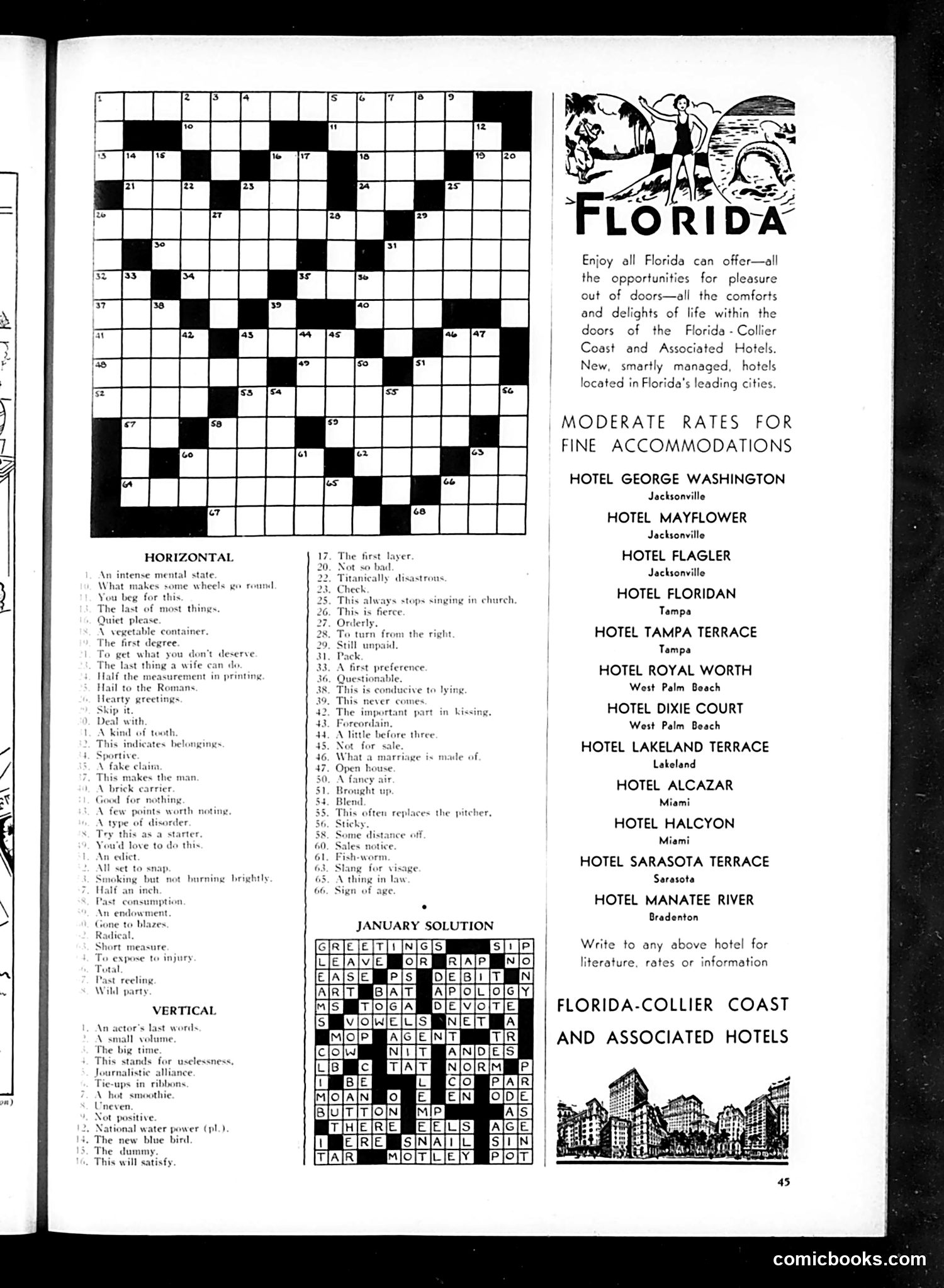
Analysis This page is primarily advertising, not satire or political commentary. It features a crossword puzzle (with solution provided) alongside a Florida tourism advertisement for the "Florida-Collier Coast and Associated Hotels." The right side promotes multiple hotels across Florida cities—Jacksonville, Tampa, West Palm Beach, Miami, Sarasota, and Bradenton—emphasizing "moderate rates for fine accommodations." The small illustration at top shows generic Florida imagery: a woman in leisure pose, palm trees, and water activities. The crossword clues are standard wordplay typical of 1920s-30s puzzles, with no discernible political or satirical content. This appears to be a magazine page blending entertainment (the puzzle) with commercial promotion (hotel listings), a common layout strategy for the era. There is no identifiable cartoon or caricature requiring historical context.
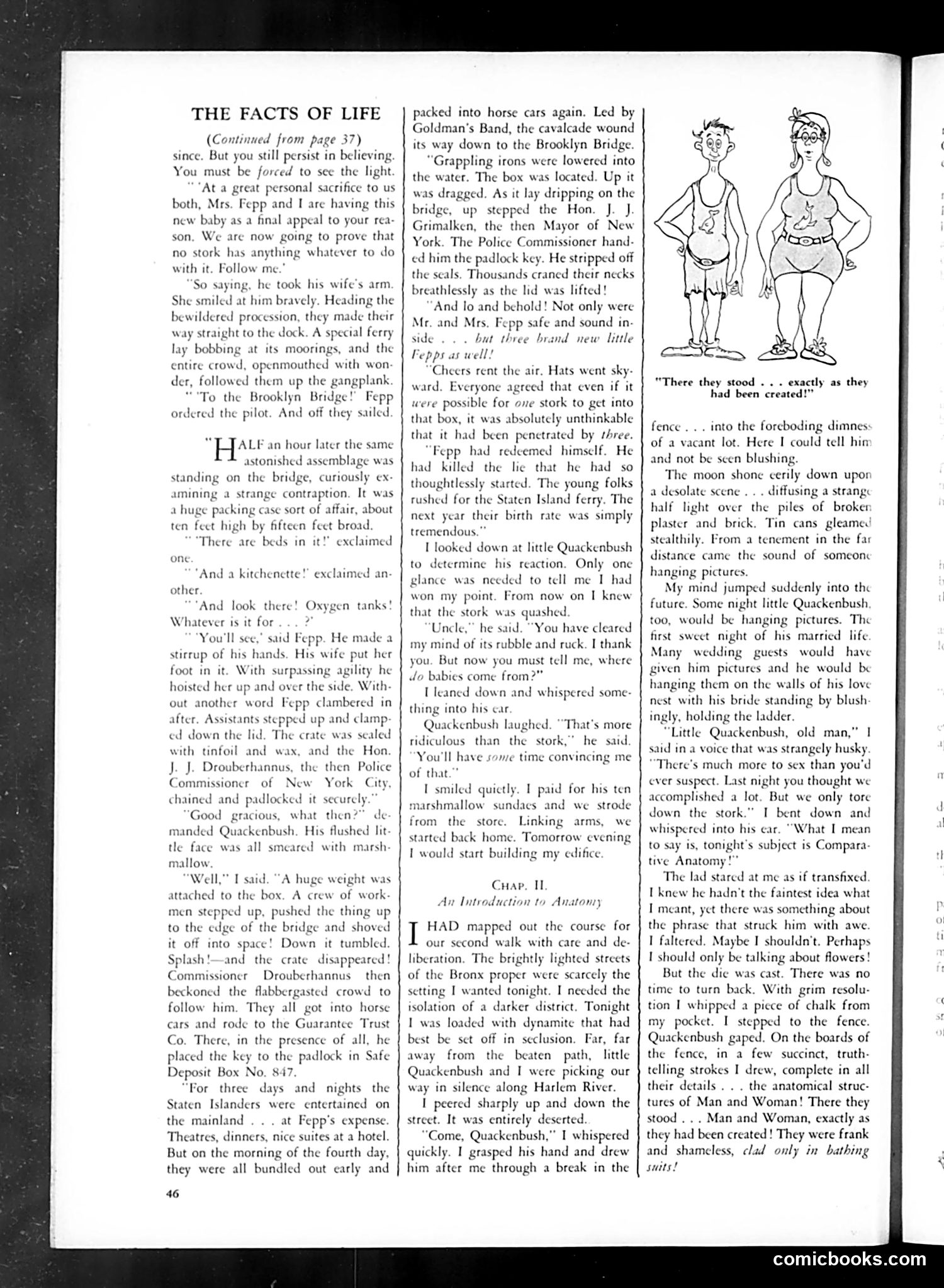
"The Facts of Life" - Life Magazine Satire This page is part of a satirical story mocking both overly complicated sex education and stubborn childhood skepticism. The Setup: Mr. Fepp attempts to prove to his nephew Quackenbush that babies don't come from storks by staging an absurd public demonstration. He seals himself, his pregnant wife, and their newborn in a crate, dumps it off the Brooklyn Bridge, retrieves it after three days, and opens it to reveal three Fepps—proving "one stork" couldn't possibly have delivered all three. The Satire: The story ridicules adults who resort to ridiculous "scientific proof" rather than honest conversation. The elaborate spectacle involving the Police Commissioner and Mayor of New York underscores the absurdity—treating a simple biological question as a major civic event requiring official ceremonies and safes. The Cartoon: The illustration shows anatomically exaggerated male and female figures labeled "There they stood... exactly as they had been created!"—a crude visual joke about the birds-and-bees conversation and human anatomy. The humor satirizes both prudish evasion and overcomplicated "logical" rebuttals to children's innocent questions about reproduction.
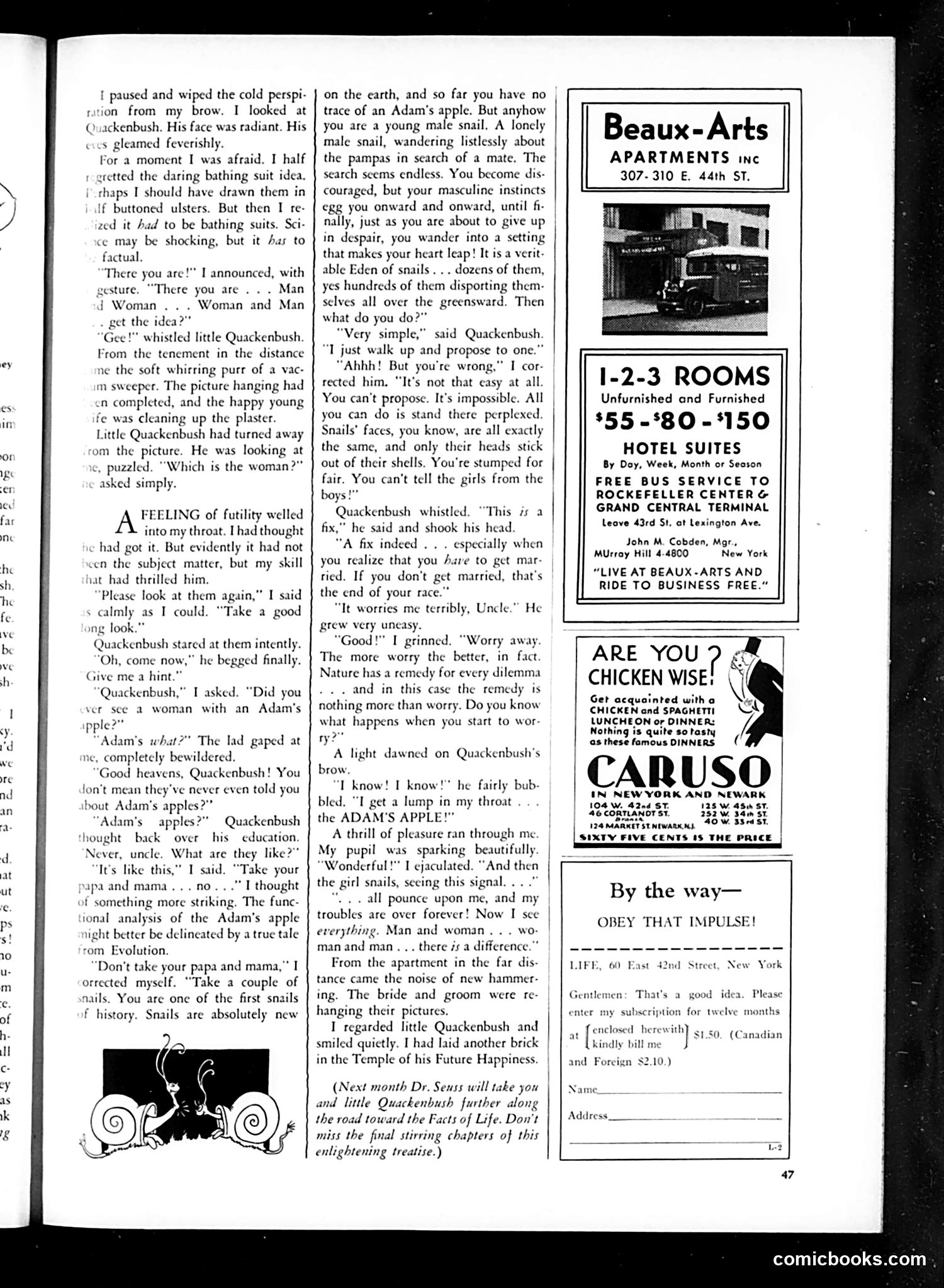
Analysis for Modern Readers This page contains a didactic story—not political satire—about a character named "Uncle" teaching a boy called Quackenbush about human biology through an elaborate evolutionary allegory. The narrative uses snails as metaphor to explain the Adam's apple: a male snail, desperate to find a mate among indistinguishable females, develops anxiety ("worry"), which creates a physical lump in his throat—the Adam's apple. This visible sign allows females to identify males, solving the reproductive problem. The story appears to be from an early-20th-century *Life* magazine installment about sex education (note the teaser promising "facts of life" continuation next month). The crude biological reasoning and euphemistic teaching method reflect period attitudes toward discussing human sexuality with youth. The surrounding advertisements—apartment rentals, restaurants—are typical magazine filler, not satirical content.
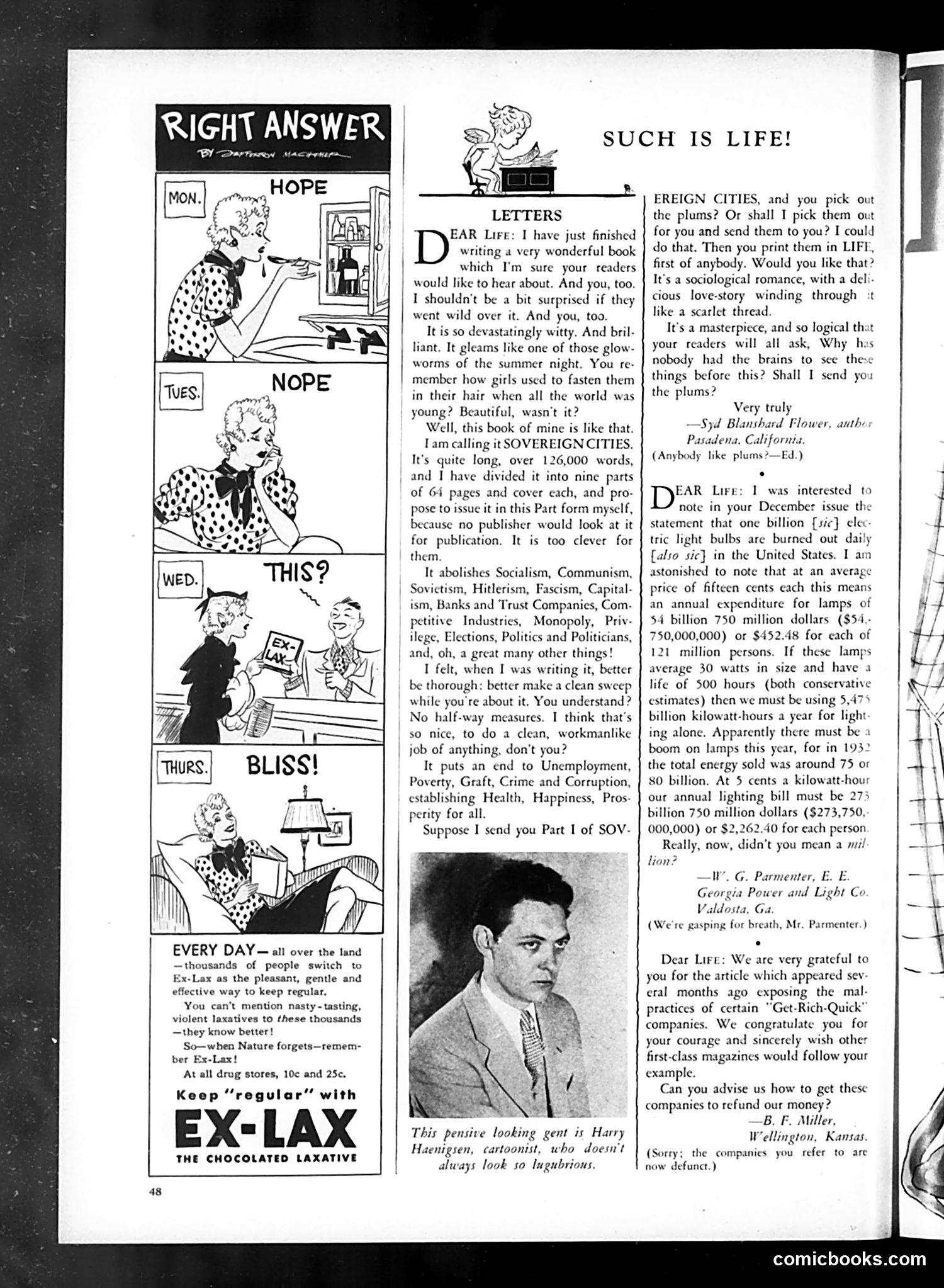
"Right Answer" Cartoon and Letters Page Analysis The left side features a four-panel comic strip titled "Right Answer" by cartoonist Harry Haenigsen (whose photo appears below). It shows a woman's mood progression Monday through Thursday: "HOPE," "NOPE," "THIS?," and finally "BLISS!"—depicting her emotional arc as she discovers Ex-Lax laxative. The joke satirizes how mundane daily concerns dominate life; her greatest happiness comes from solving constipation. The right side contains reader letters mocking common magazine submissions. One letter describes an absurdly self-important unpublished author hawking a 126,000-word manuscript called "Sovereign Cities" that supposedly solves unemployment, crime, Communism, and fascism simultaneously. Another letter hilariously fact-checks Life's claim about billion light bulbs burning daily, using mathematical precision to expose the magazine's error. Together, these elements satirize American life's trivialities, pretentious amateur writers, and readers' pedantry—all presented under the ironic heading "Such is Life!"