life
Life — March 1934
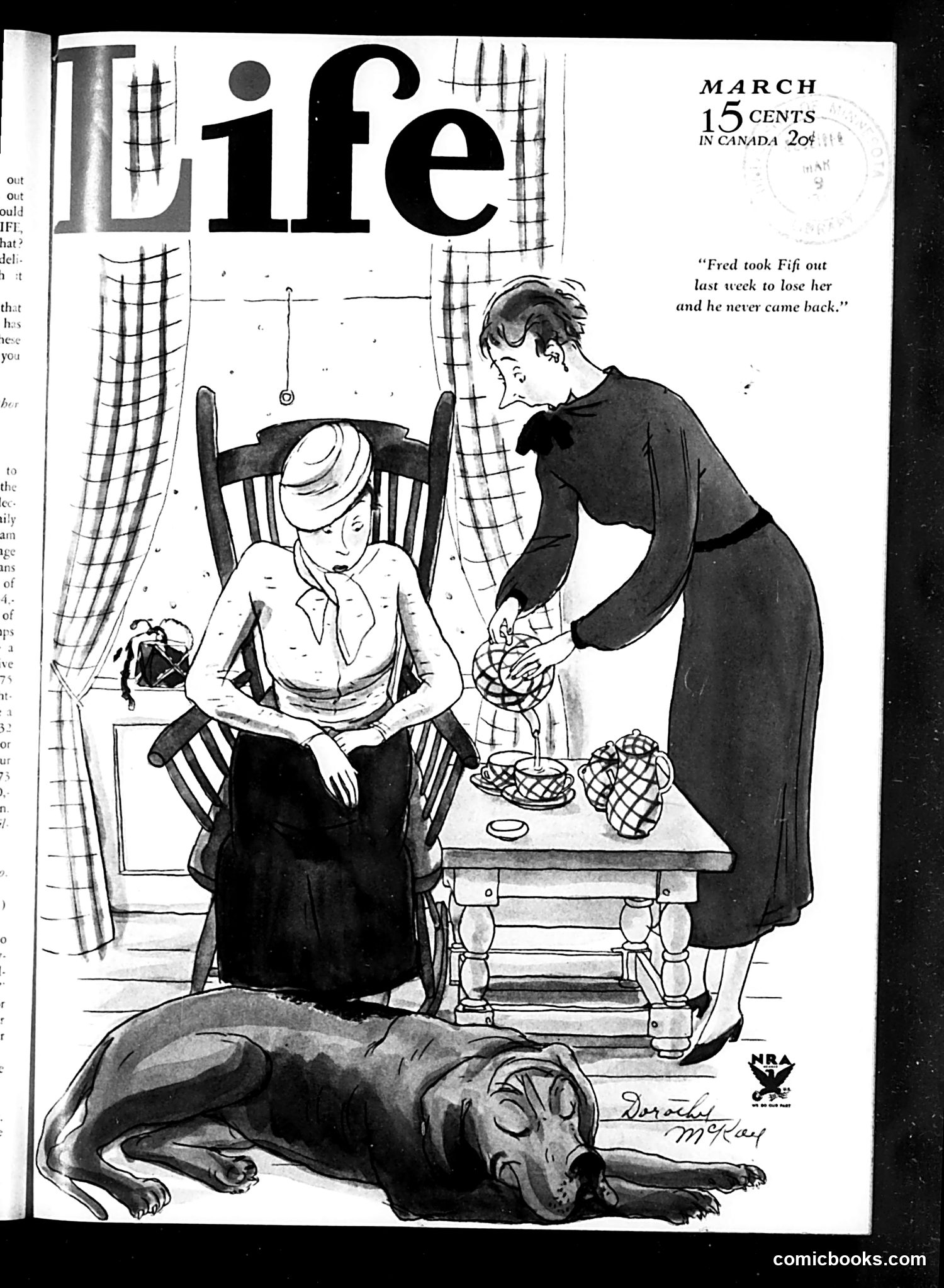
Life Magazine Cover Analysis (March, circa 1920s) This cover illustration depicts a domestic scene with satirical commentary on infidelity. A woman sits distressed in a chair while another woman stands nearby arranging flowers, appearing to console or confront her. The caption reads: "Fred took Fifi out last week to lose her and he never came back." The joke hinges on a double meaning: "Fifi" appears to be a dog (visible in the lower foreground), but the woman's distressed reaction and the standing woman's gesture suggest ambiguity about whether Fred lost a pet or was unfaithful with another woman named Fifi. The satire targets marital anxiety and infidelity humor common in 1920s popular culture. The illustration is signed by Dorothy McKay.
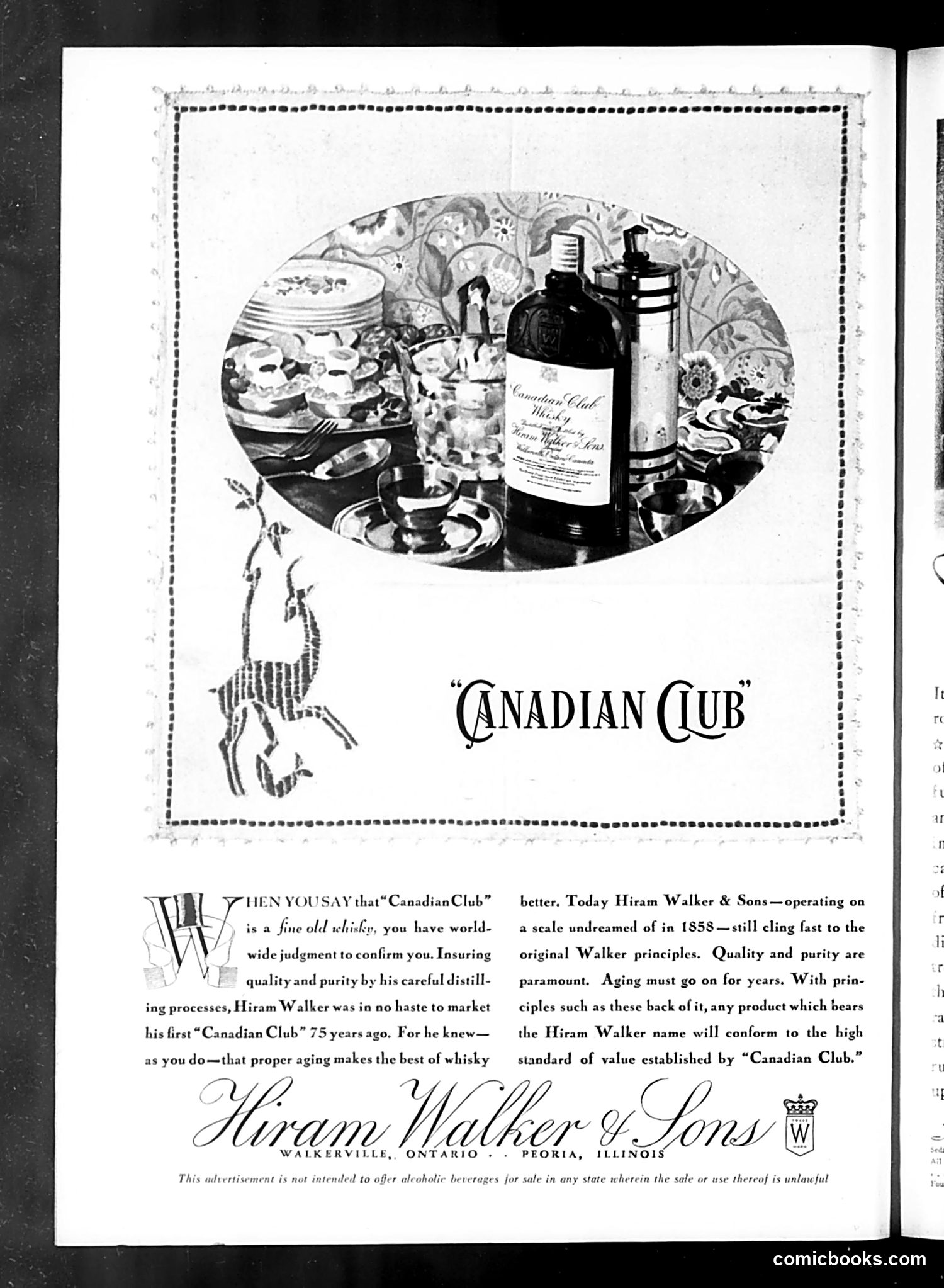
This is a Canadian Club whiskey advertisement, not a political cartoon. The page features a stylized photograph of a bottle of Canadian Club whiskey surrounded by dining items (plates, glasses, food) in an oval frame, with a decorative maple leaf design on the left side. The ad text emphasizes the product's heritage and quality—it claims Canadian Club is a "fine old whiskey" with "worldwide judgment" backing it. The copy notes that Hiram Walker & Sons has operated since 1858 using consistent principles of "quality and purity." The advertisement positions the whiskey as an established, trustworthy brand with aging credentials. The disclaimer at bottom notes this is not intended to offer alcoholic beverages for sale where prohibited.
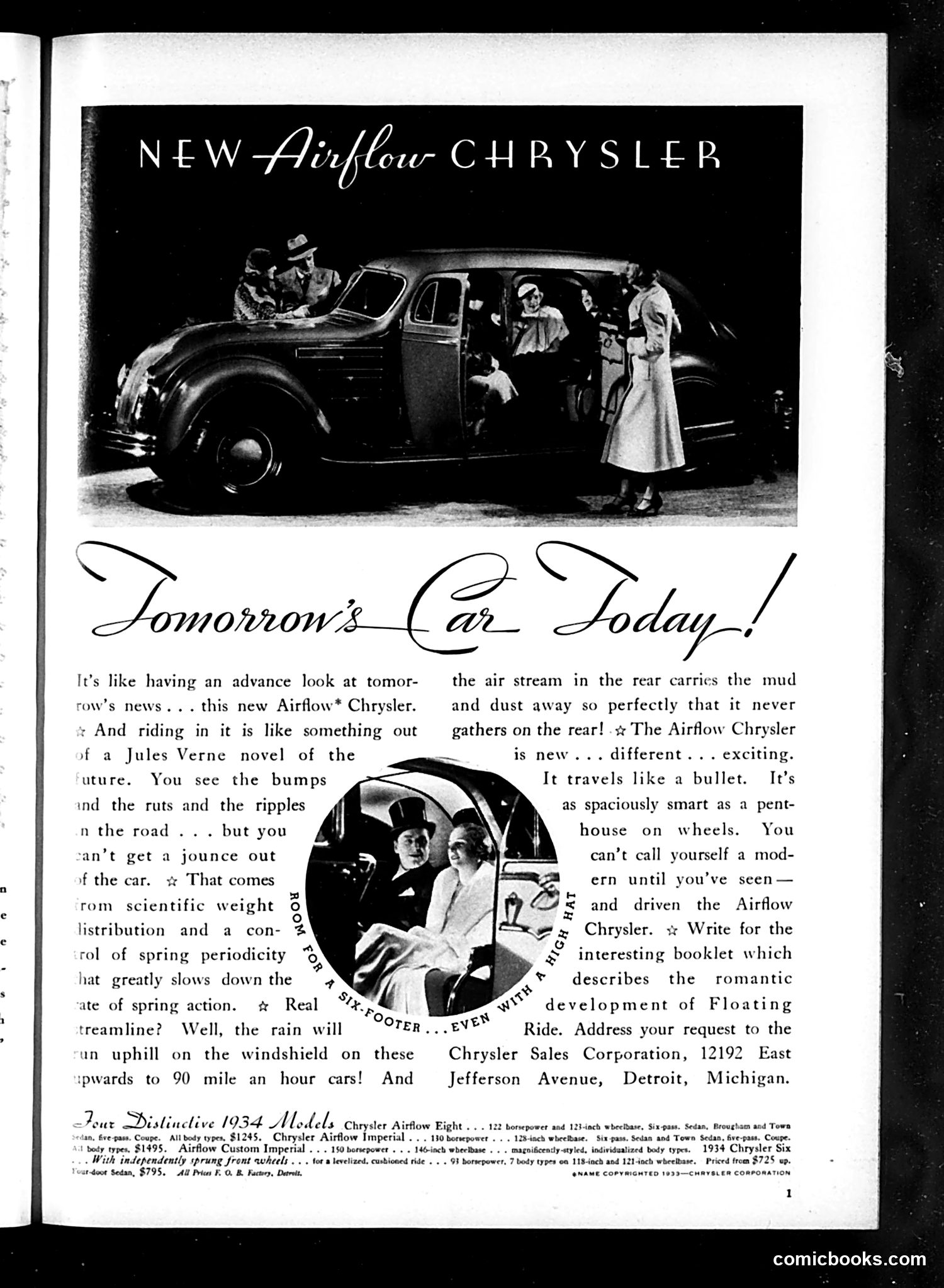
Analysis This is a 1934 Chrysler automobile advertisement, not political satire. The page promotes the new "Airflow" Chrysler model, featuring a photograph of the car with passengers and marketing copy. The advertisement uses science-fiction language ("like something out of a Jules Verne novel") to highlight the car's innovative features: streamlined design, improved weight distribution, and spring suspension that provide a smoother ride. The "Airflow" name references aerodynamic engineering—a selling point emphasizing modernity and technological advancement. The circular inset photograph shows the car's spacious interior, positioning it as a luxury vehicle ("a penthouse on wheels"). The bottom lists various 1934 Chrysler models available. This is straightforward product marketing from the Depression era, appealing to consumers' aspirations for modern comfort and innovation.
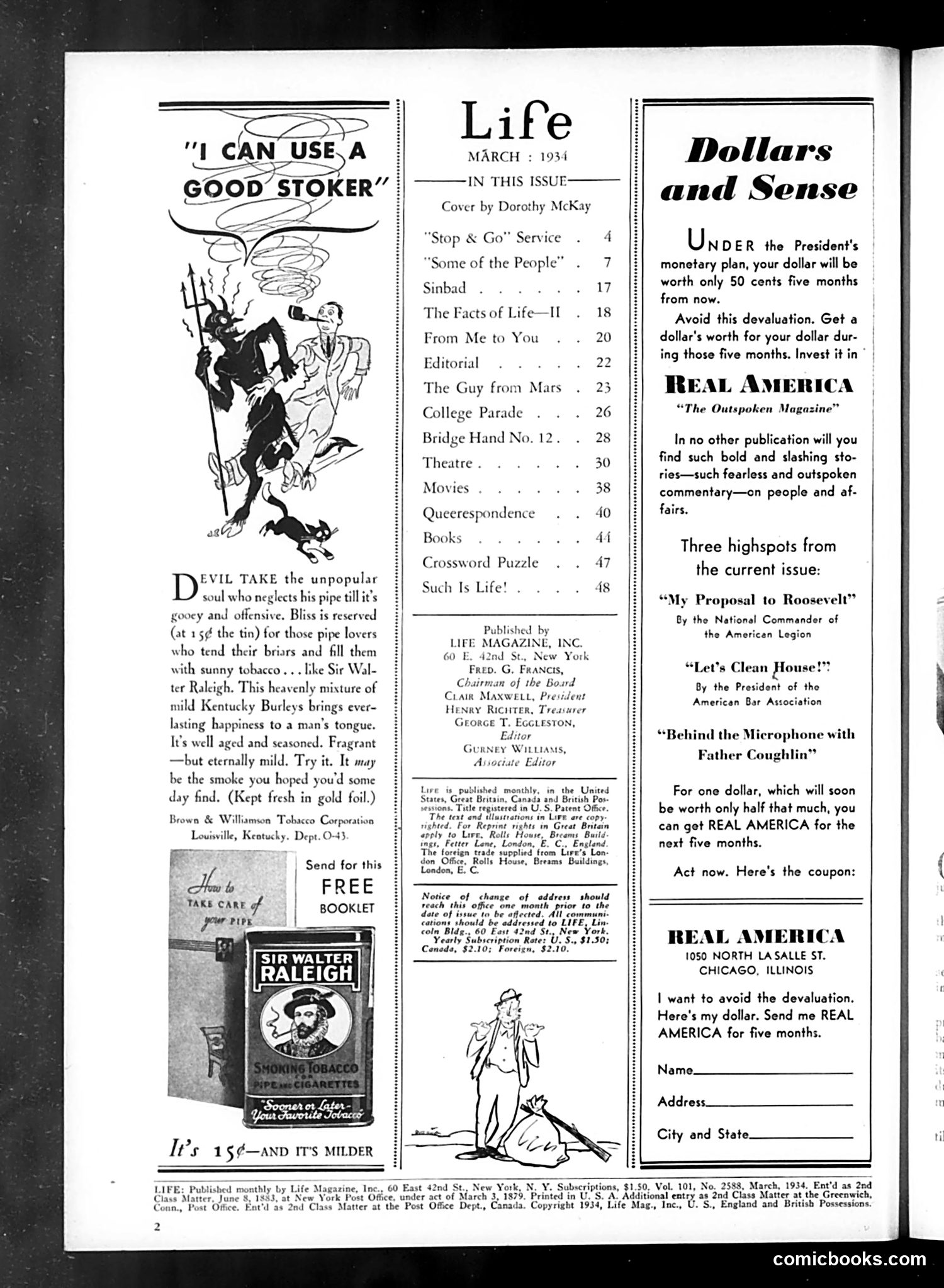
Life Magazine, March 1934: Political Satire on Currency Devaluation This page mixes advertisements with political commentary on President Franklin D. Roosevelt's monetary policy. The right column's "Dollars and Sense" section attacks the administration's plan to devalue the dollar to 50 cents within five months. It sarcastically warns readers their savings will lose half their value and urges them to subscribe to *Real America* magazine instead—positioning it as the antidote to Roosevelt's economic policies. The advertisement emphasizes *Real America* as "The Outspoken Magazine" offering bold criticism of "people and affairs," suggesting the publication positions itself as anti-New Deal. This reflects the significant political opposition to Roosevelt's early Depression-era monetary experiments among conservative Americans and business interests in 1934.
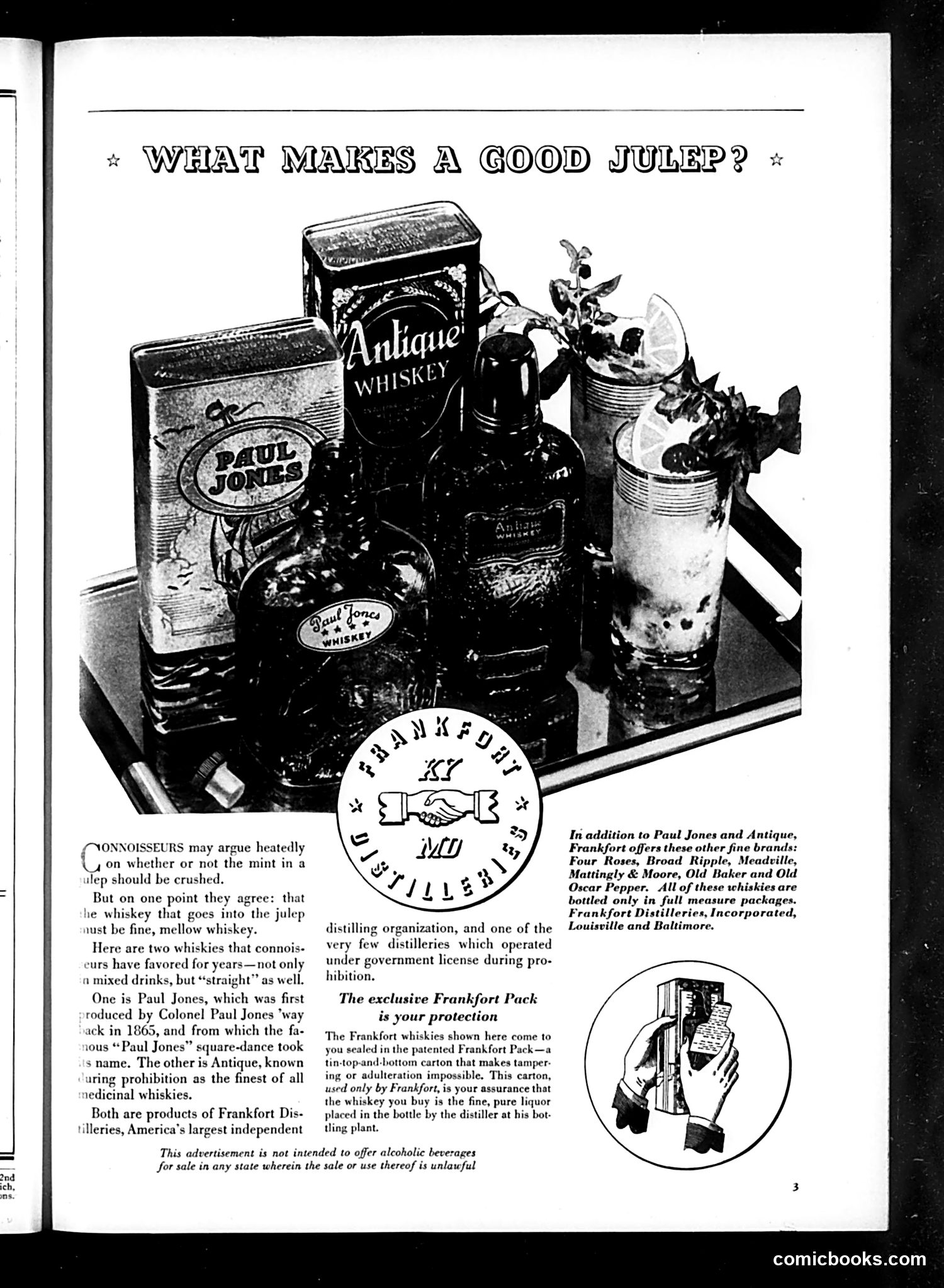
Advertisement Analysis This is primarily a whiskey advertisement for Frankfort Distilleries, not political satire. It promotes Paul Jones and Antique brand whiskeys during the Prohibition era. The page uses humor to argue that good juleps require fine whiskey. The ad emphasizes that Frankfort's whiskeys were among the few distilleries operating legally under government license during Prohibition, positioning them as reliable sources for quality spirits. The "exclusive Frankfort Pack"—a sealed tin carton—is presented as protection against tampering or adulteration, a significant concern when alcohol sales were restricted and black-market liquor was common. The advertisement explicitly notes it's not intended to offer alcoholic beverages where sale or use is unlawful, acknowledging Prohibition's legal constraints while marketing to those seeking legitimate access.
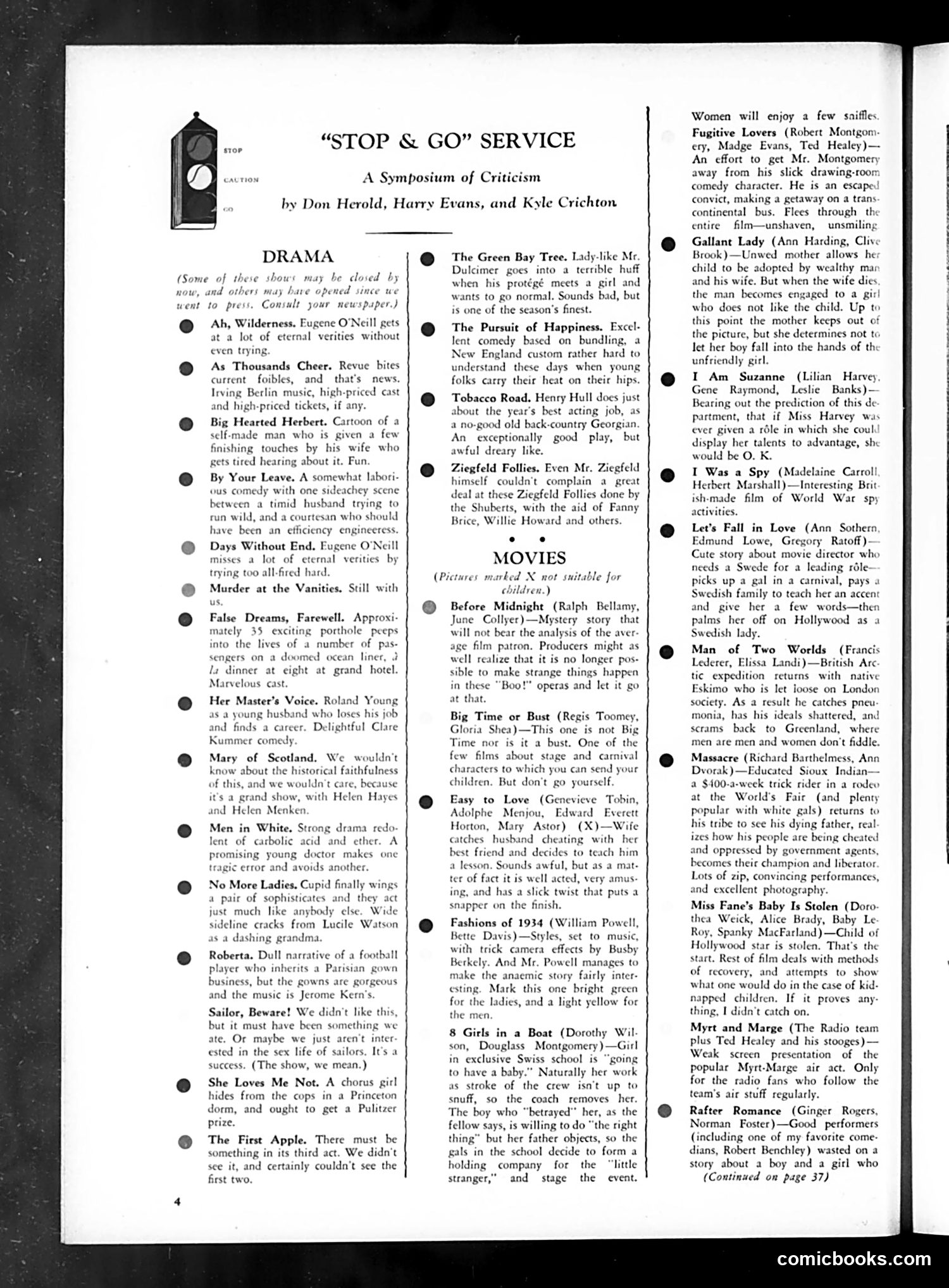
"Stop & Go" Service: A Symposium of Criticism This page presents theatrical and film reviews from Life magazine's critics (Don Herold, Harry Evans, and Kyle Crichton). The "Stop & Go" traffic light logo signals their approval system: plays and films either get the green light (worth seeing) or red light (avoid). The reviews cover 1934 dramas like *Big Hearted Herbert* and *Mary of Scotland*, and films including *Before Midnight* and *Easy to Love*. Critics offer brief, witty assessments—some praising performances, others mocking plot devices or acting quality. This format exemplifies Life's satirical approach: using modern, accessible imagery (the traffic signal) to deliver quick cultural judgments. The conversational tone and emphasis on entertainment value reflect 1930s magazine criticism aimed at educated, urban readers seeking guidance on what to see.
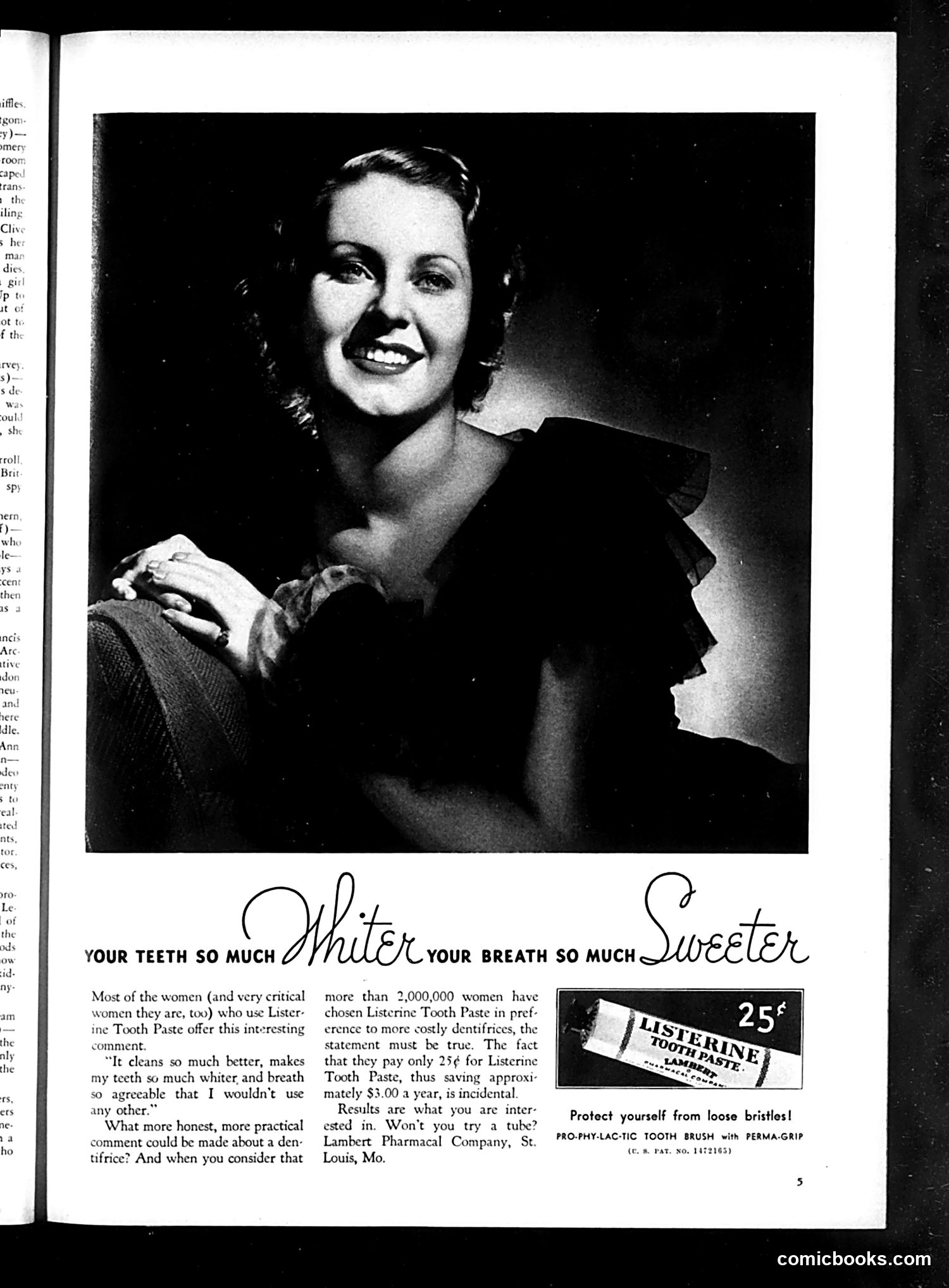
Analysis This is a vintage advertisement, not political satire. It promotes Listerine Tooth Paste and a Pro-Phy-Lac-Tic toothbrush, dated to the mid-20th century based on styling and design. The ad uses a professional headshot of an attractive woman with the slogan "Your Teeth So Much Whiter Your Breath So Much Sweeter"—a common marketing approach of the era that emphasized personal grooming for social/romantic appeal. The text quotes female users praising the product's whitening effects and cost-effectiveness (25¢), claiming over 2,000,000 women preferred it. The Lambert Pharmacal Company (St. Louis, Mo.) manufactured it. This reflects mid-century advertising strategies targeting women's insecurities about appearance and social acceptance through dental hygiene products.
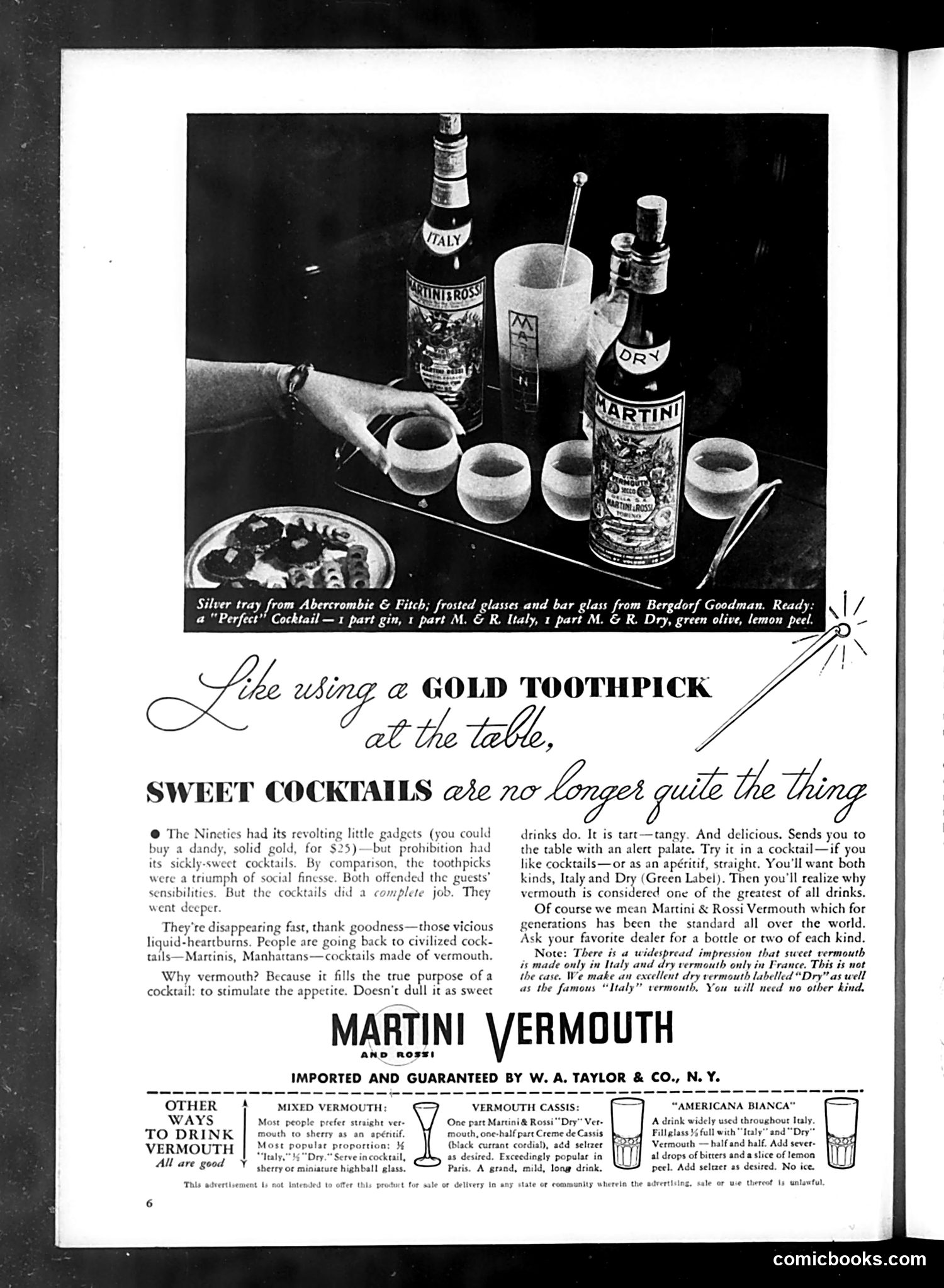
Analysis This is primarily a Martini & Rossi vermouth advertisement, not political satire. The page promotes sweet cocktails using vermouth, positioning them as a modern alternative to Prohibition-era drinking habits. The ad references Prohibition's end (implied by "those vicious liquid-inebriants" that are "disappearing fast"), suggesting vermouth cocktails now offer a sophisticated, socially acceptable way to drink. The "gold toothpick" reference positions vermouth drinks as elegant and refined—a contrast to crude speakeasies. The photograph shows an upscale bar setting with professional glassware and Martini & Rossi bottles, emphasizing respectability and class. This targets affluent readers seeking post-Prohibition legitimacy in their drinking habits. The satirical angle—if any—is subtle: promoting vermouth as the sophisticated choice for those wanting to appear cultured and refined.
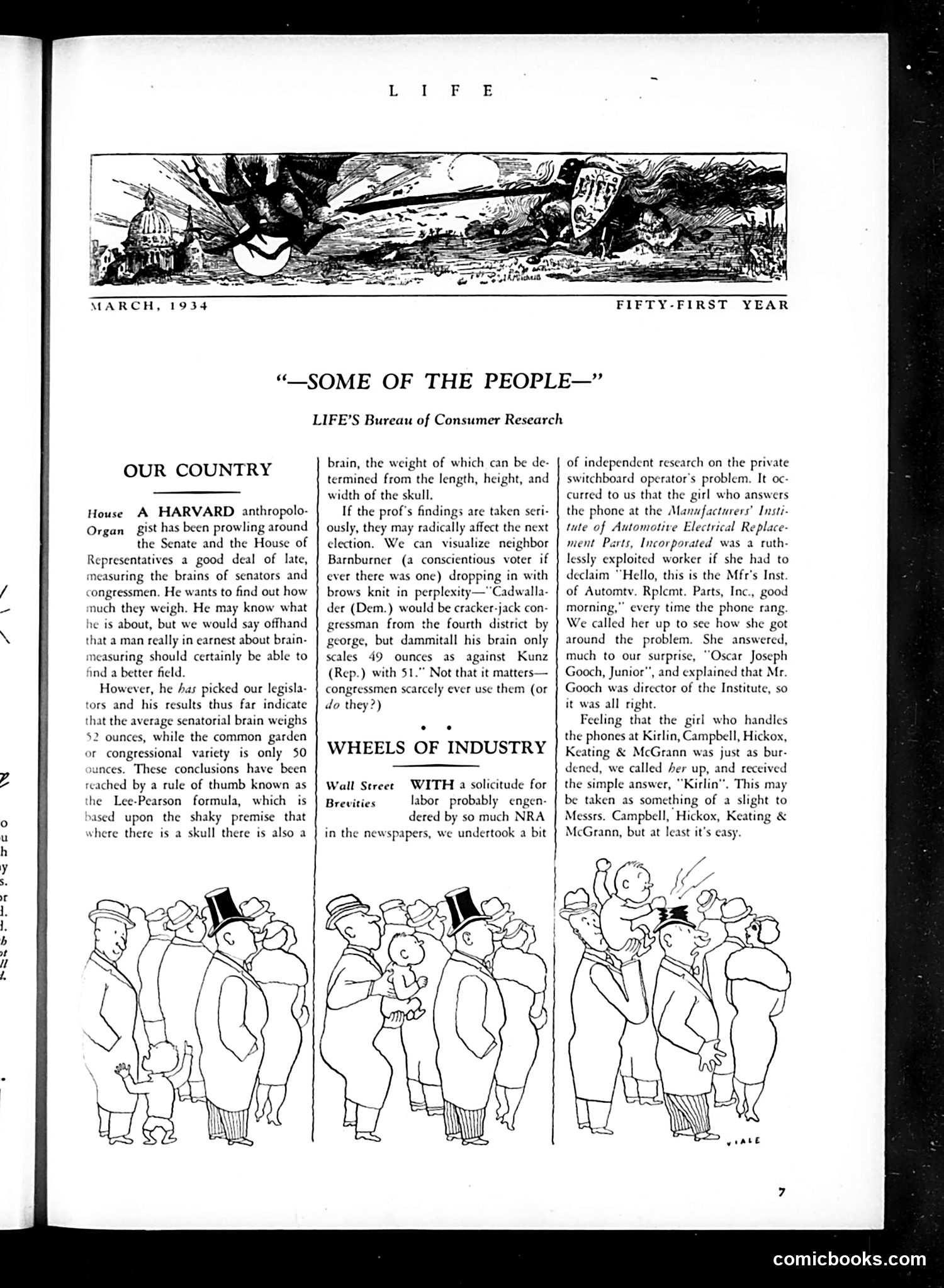
"Some of the People" - Life Magazine, March 1934 This page contains two distinct sections satirizing American institutions: "Our Country" mocks Harvard anthropologist A. Harvard's skull-measuring research on congressmen, suggesting they're examining politicians' brain capacity—a barely-veiled insult to their intelligence. "Wheels of Industry" features three cartoon panels about Wall Street brokers during the Great Depression. The text references an NRA (National Recovery Administration) investigation into labor conditions. The cartoons depict businessmen in top hats, likely representing wealthy industrialists or financiers, shown in what appears to be crowded, undignified situations. The overall theme critiques both academic pretension and corporate/financial exploitation during the Depression era, when such satire was common in Life magazine.
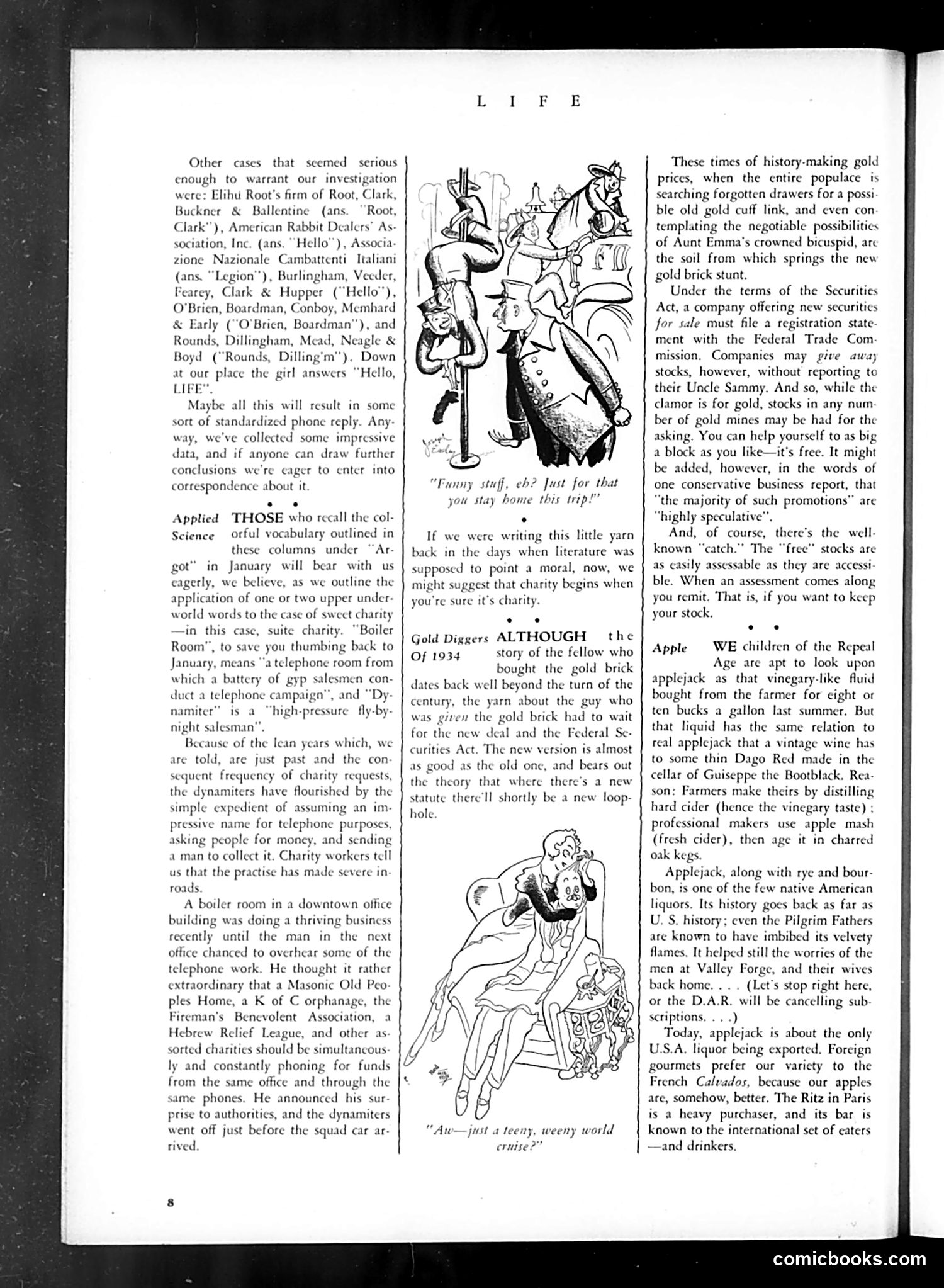
Analysis of Life Magazine Page This page contains two satirical cartoons addressing 1930s business fraud and commercial schemes. The first cartoon (top) mocks aggressive telephone solicitation tactics, showing a chaotic "boiler room" operation where con artists pressure people for money. The caption "Funny stuff, eh? Just for that you stay home this trip?" suggests victims being manipulated into financial schemes. The second cartoon (bottom) depicts a disheveled figure amid chaos, captioned "Au—just a teeny, weeny world crisis?" This appears to mock the disconnect between ordinary people experiencing economic hardship during the Great Depression and wealthy financiers treating crises as minor inconveniences. The surrounding text discusses gold-mining stock fraud and unregistered securities—reflecting genuine 1930s concerns about unregulated financial schemes preying on desperate Americans seeking quick wealth.
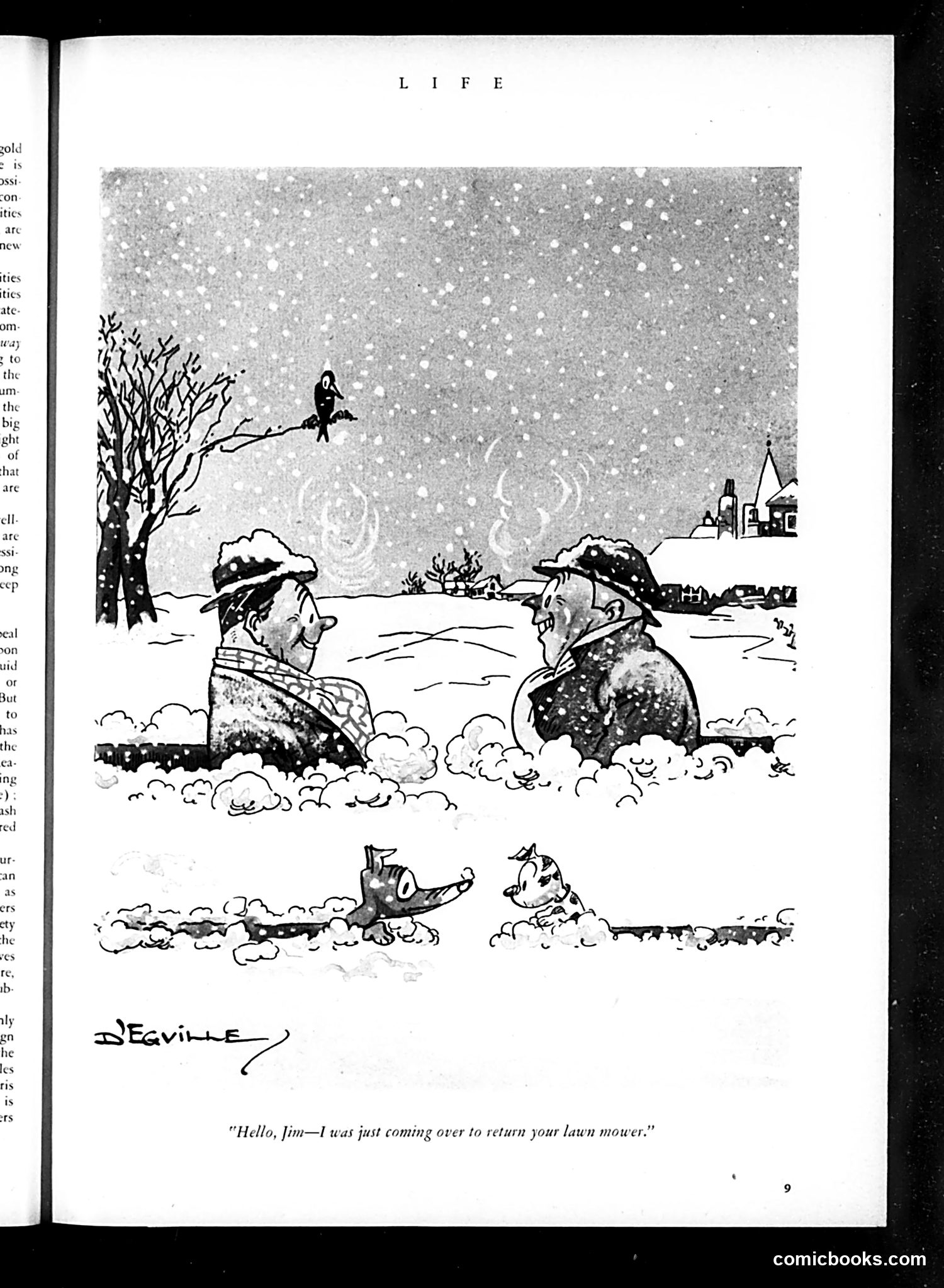
Analysis This cartoon by Deville depicts a winter scene with two men buried up to their necks in snow, engaged in conversation. One says to the other: "Hello, Jim—I was just coming over to return your lawn mower." The humor relies on an absurd contrast: the speaker is apologizing for borrowing a lawn mower while both men are literally frozen in snow, making lawn mowing completely impossible. This satirizes the social awkwardness of returning borrowed items and suggests that people will use any excuse—even extreme circumstances—to avoid admitting they've kept something that isn't theirs. The joke also plays on the universal experience of neighbors borrowing and keeping garden tools. The winter setting makes the excuse particularly ridiculous and funny.
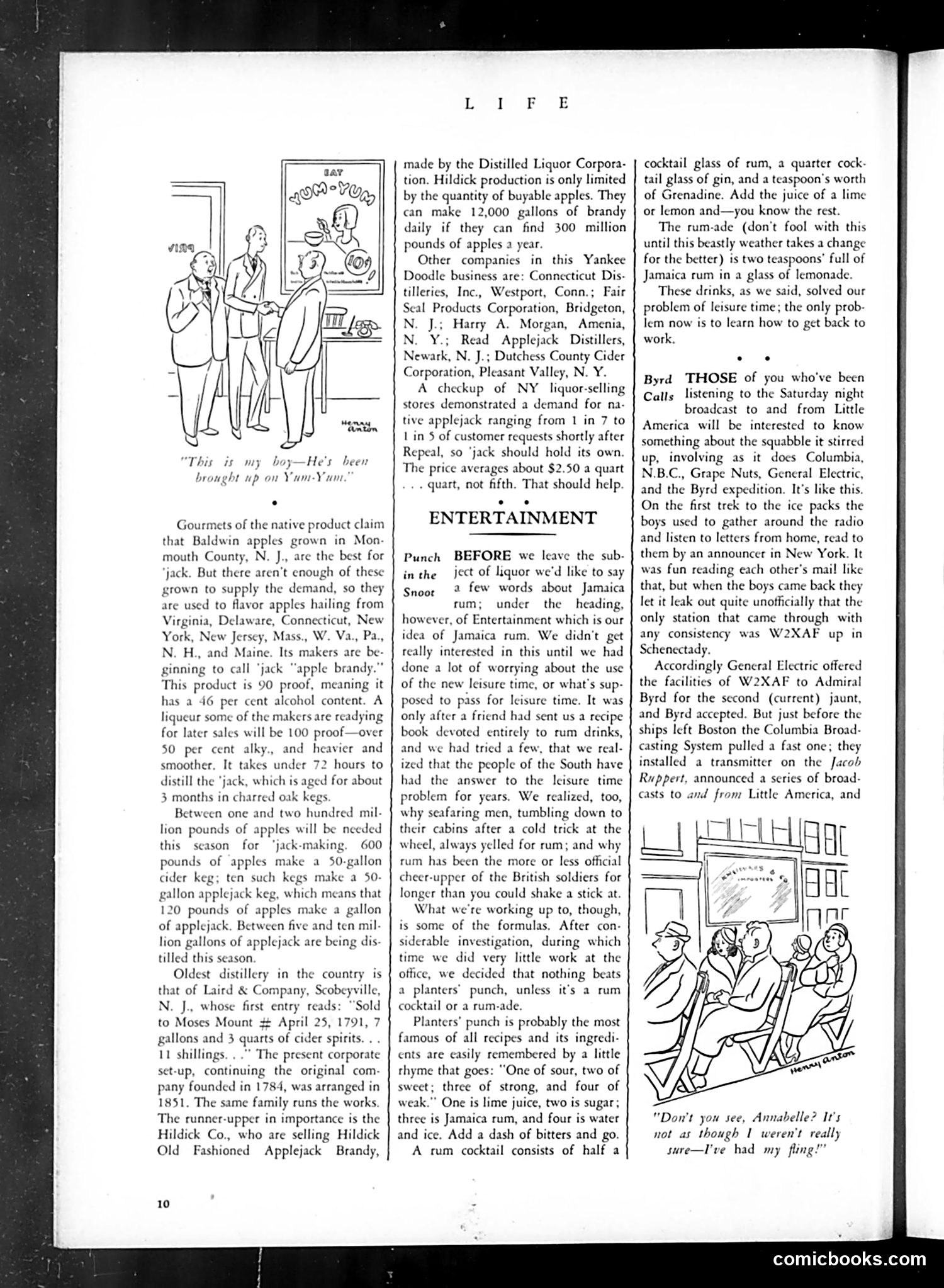
Analysis of Life Magazine Page This page contains two main sections: Left Cartoon: Shows three men in suits discussing applejack liquor. The caption reads "This is my boy—He's been brought up on Yum-Yum," a joke about applejack brandy being used to raise children—satirizing Prohibition-era attitudes toward alcohol. Right Section ("Entertainment"): Discusses rum drinks and the "Byrd expedition" broadcasts. The cartoon shows people listening to a radio transmitting from Little America during Admiral Byrd's Antarctic expedition. The caption "Don't you see, Annabelle? It's not as though I weren't really sore—I've had my fling?" suggests people were entertained by the expedition's radio broadcasts as leisure content. Both sections mock 1920s-30s American fascinations with alcohol and novelty entertainment during Prohibition.
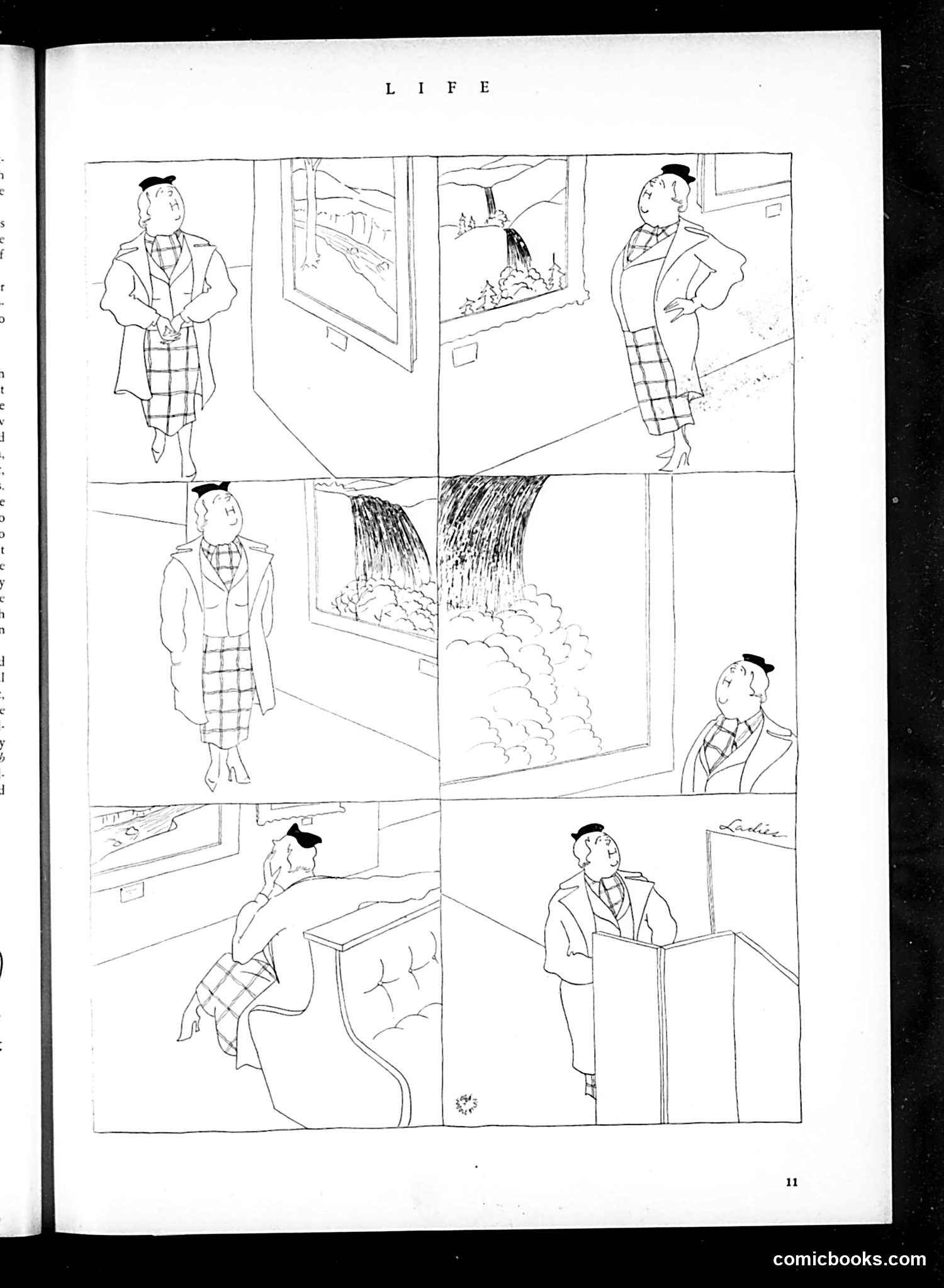
Analysis This page titled "LIFE" appears to be a sequential comic strip or narrative illustration rather than a political cartoon. The strip depicts a woman in a plaid skirt and jacket moving through various indoor spaces—standing in hallways, looking at windows (including one with what appears to be a dramatic waterfall scene), sitting on a bed, and interacting with a man in a doorway. Without accompanying text or caption, the specific narrative and satirical intent remain unclear. The artwork style and fashion suggest early-to-mid 20th century publication. The sequential panel layout tells a domestic story, but without visible dialogue or explanatory text, I cannot definitively identify the figures, reference the specific social commentary intended, or explain the joke to a modern reader.
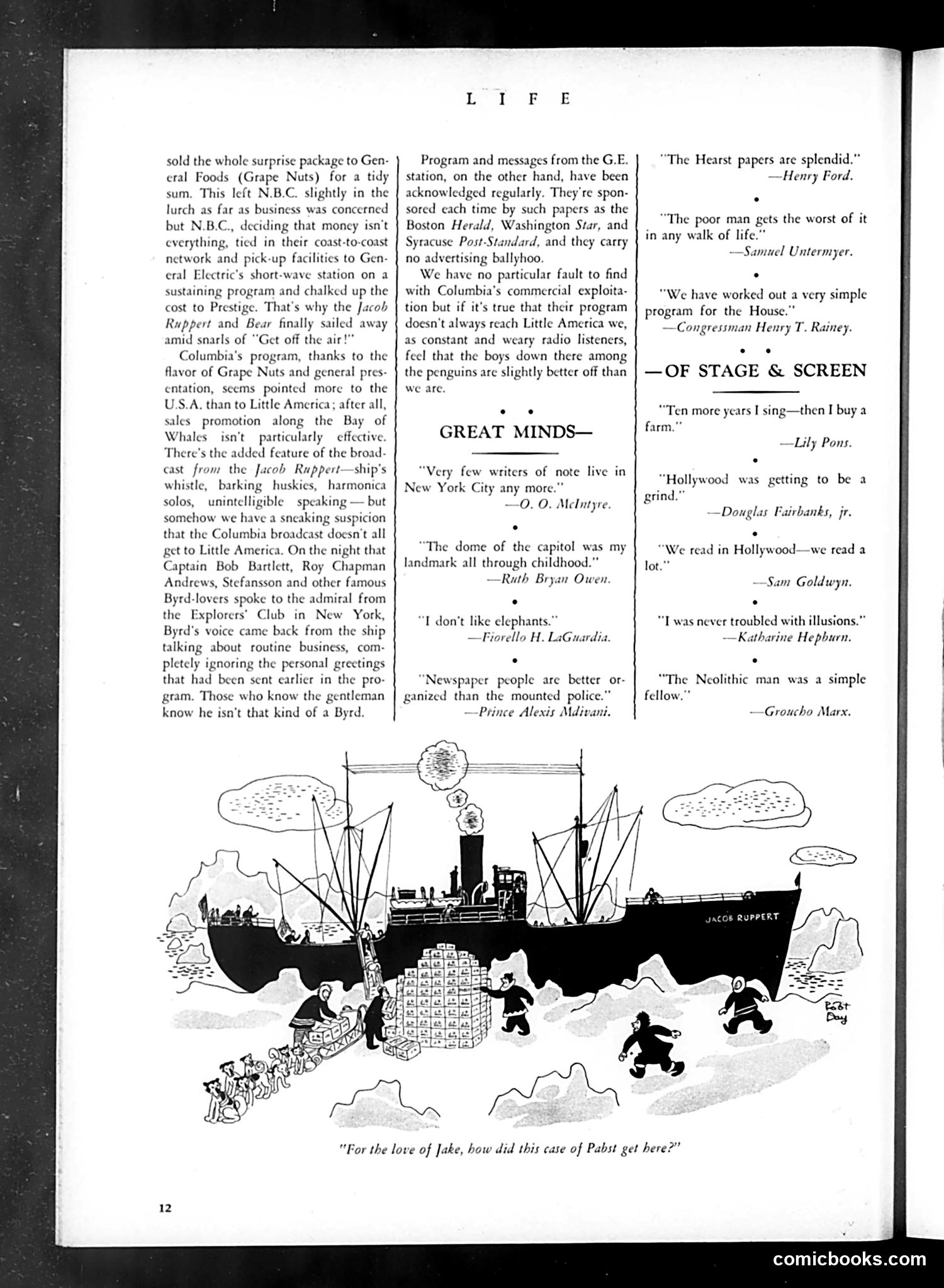
Analysis of Life Magazine Page This page combines editorial commentary with a satirical cartoon about radio broadcasting and commercial exploitation. The upper text discusses Columbia Broadcasting System's programming, contrasting their educational "Great Minds" segment with their commercial ventures. The criticism suggests CBS reaches "Little America" inconsistently while pursuing profit over public service. The central cartoon depicts the S.S. *Jacob Ruppert* (a ship) unloading cargo—specifically cases of Pabst beer—onto an icy landscape. Small figures appear to be transporting the goods. The caption reads: "For the love of Jake, how did this case of Pabst get here?" This likely satirizes either: 1) Alcohol smuggling during Prohibition, or 2) the absurdity of aggressive commercial advertising reaching remote locations. The humor derives from the improbable spectacle of beer distribution in such an isolated setting.
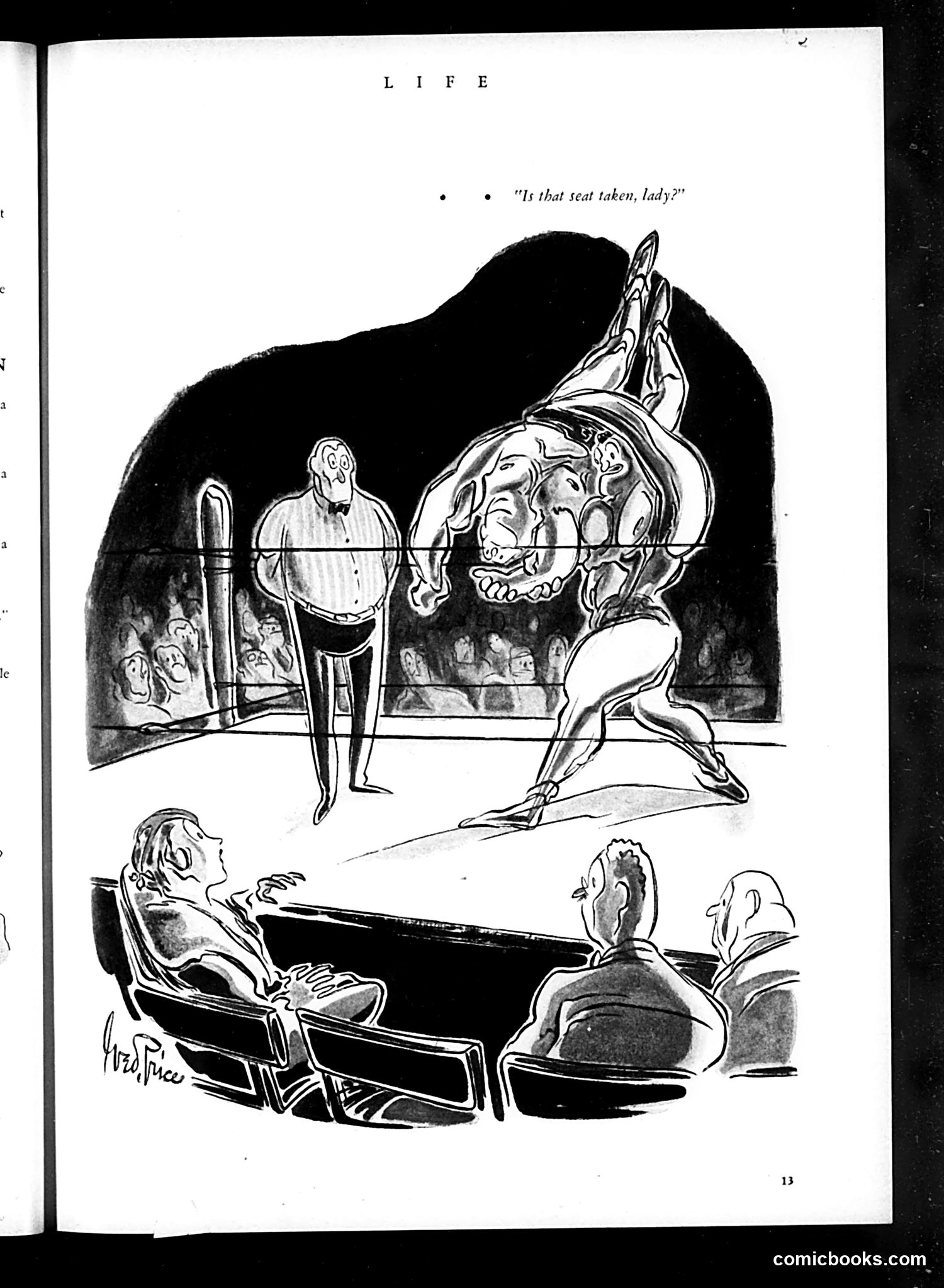
Analysis of "Life" Magazine Cartoon This cartoon depicts a circus or theatrical scene where a well-dressed man stands observing what appears to be an acrobat or performer in an exaggerated pose on stage. The caption reads, "Is that seat taken, lady?"—addressed to a woman seated in the foreground among other spectators. The satire appears to mock social pretension and circus-going culture, likely from the early-to-mid 20th century. The contrast between the formal gentleman and the grotesque performer, combined with the casual question about seating, suggests humor about audience behavior or the absurdity of theatrical entertainment conventions. The cartoonist's signature appears in the lower left, though it's not clearly legible. Without additional context about the specific issue date, the exact target of satire remains unclear.
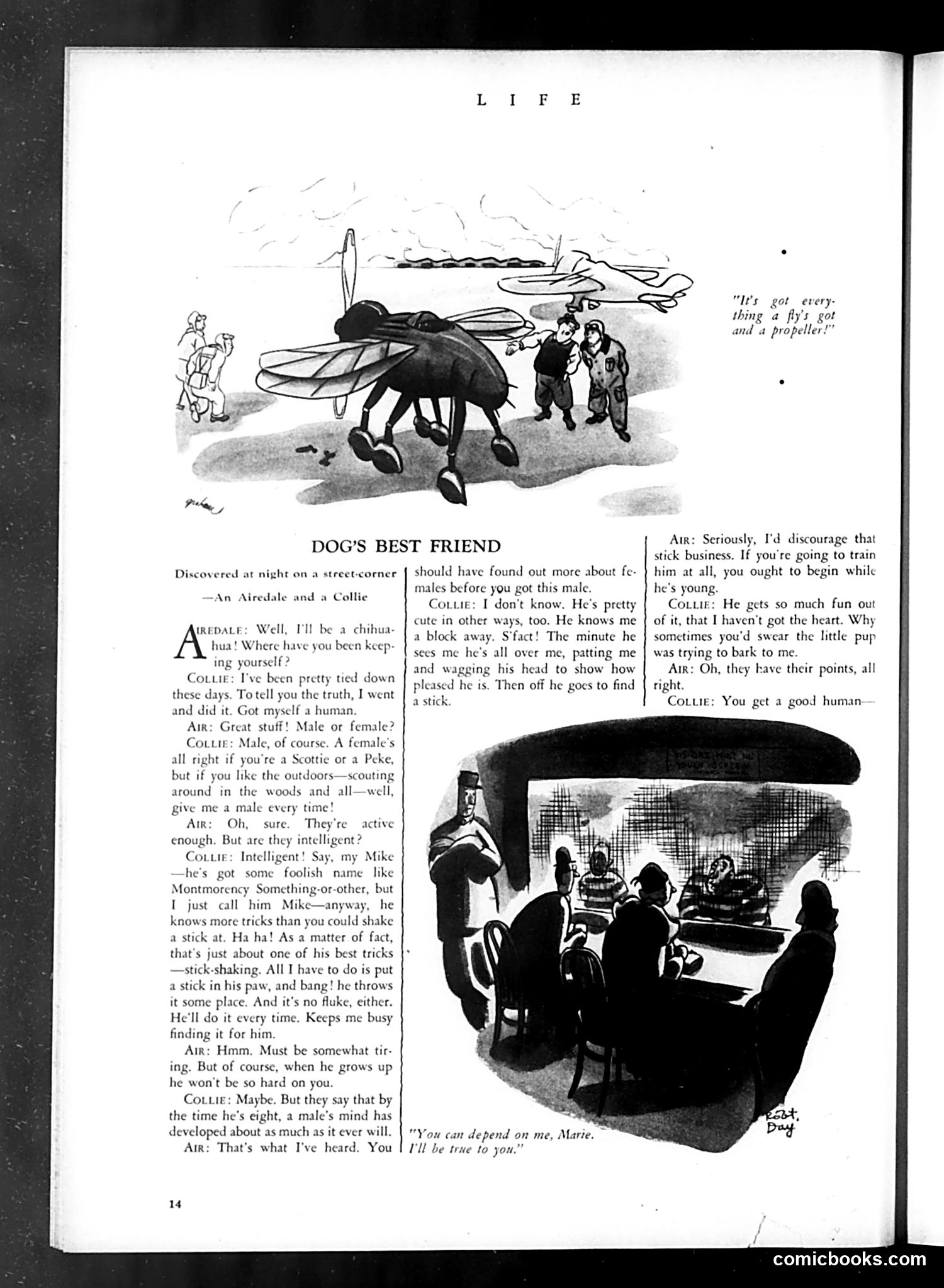
"Dog's Best Friend" This is a humorous dialogue between an Airedale and a Collie about the Airedale's new male puppy. The Collie expresses skepticism about training him, noting that male dogs are naturally active and harder to control than females. The Airedale defends his puppy's intelligence, claiming the dog knows tricks and obedience. The satire gently mocks dog-ownership anxieties: the Collie warns that by age eight, the male's instincts will be fully developed and harder to manage—mirroring contemporary concerns about raising boys to be obedient and controllable. The illustration of the dog with airplanes reflects the page's title "LIFE," suggesting aviation-era modernity. The final quoted line emphasizes loyalty and devotion between dog and owner.
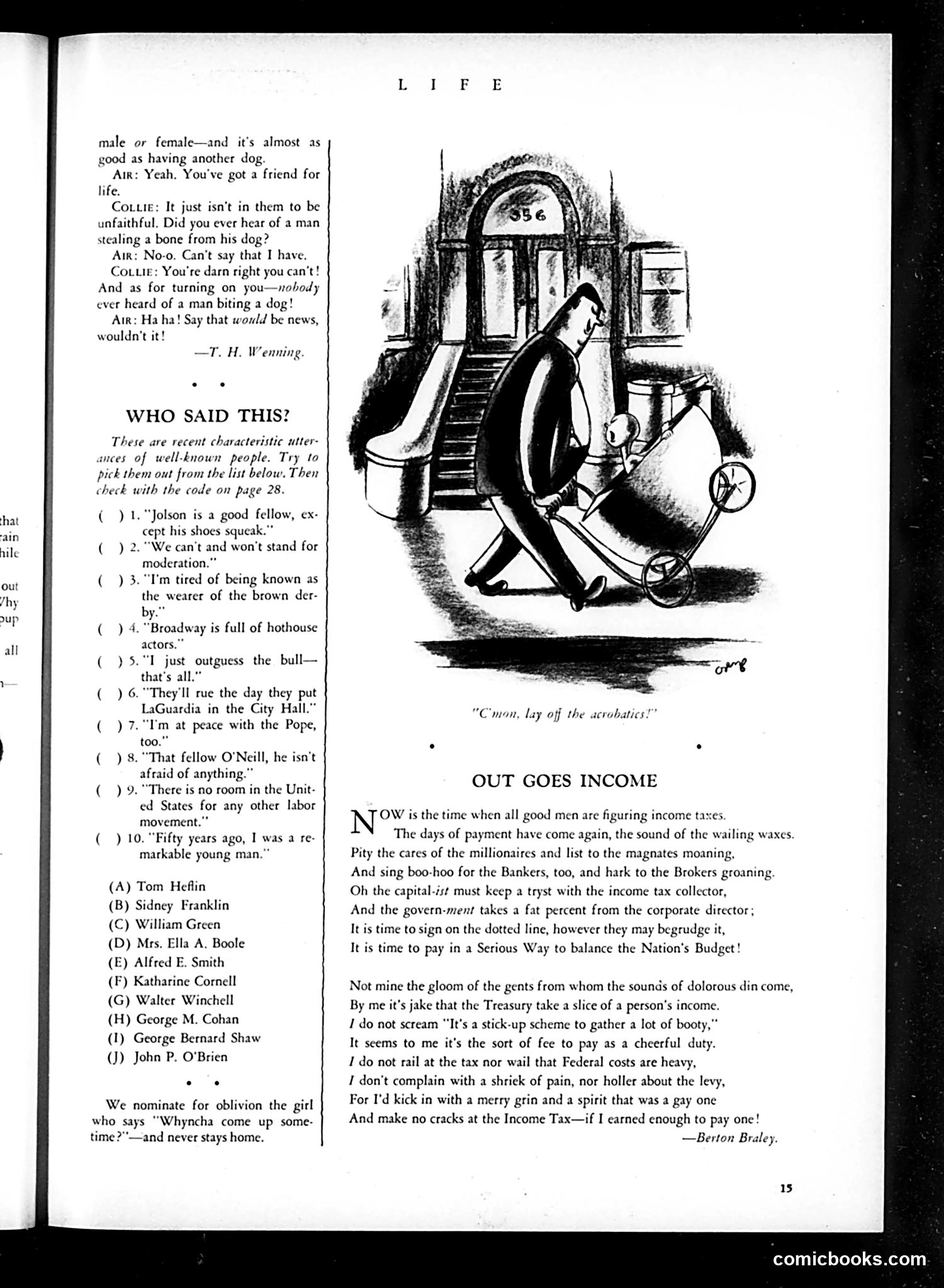
Political Cartoon Analysis: "Out Goes Income" The main cartoon depicts a figure being ejected down a slide labeled with tax-related imagery, illustrating the satirical poem "Out Goes Income" by Berton Baxley below it. The poem mocks income tax collection during a period when "all good men are figuring income taxes." It sardonically sympathizes with millionaires and bankers while celebrating the government's right to collect taxes to "balance the Nation's Budget." The humor derives from the speaker's contradictory stance—simultaneously lamenting the wealthy's burden and cheerfully accepting taxation as a patriotic duty, delivered with mock-heroic language. The cartoon's sliding figure visually represents income literally being extracted from taxpayers, reinforcing the poem's theme that tax season strips citizens of their earnings.
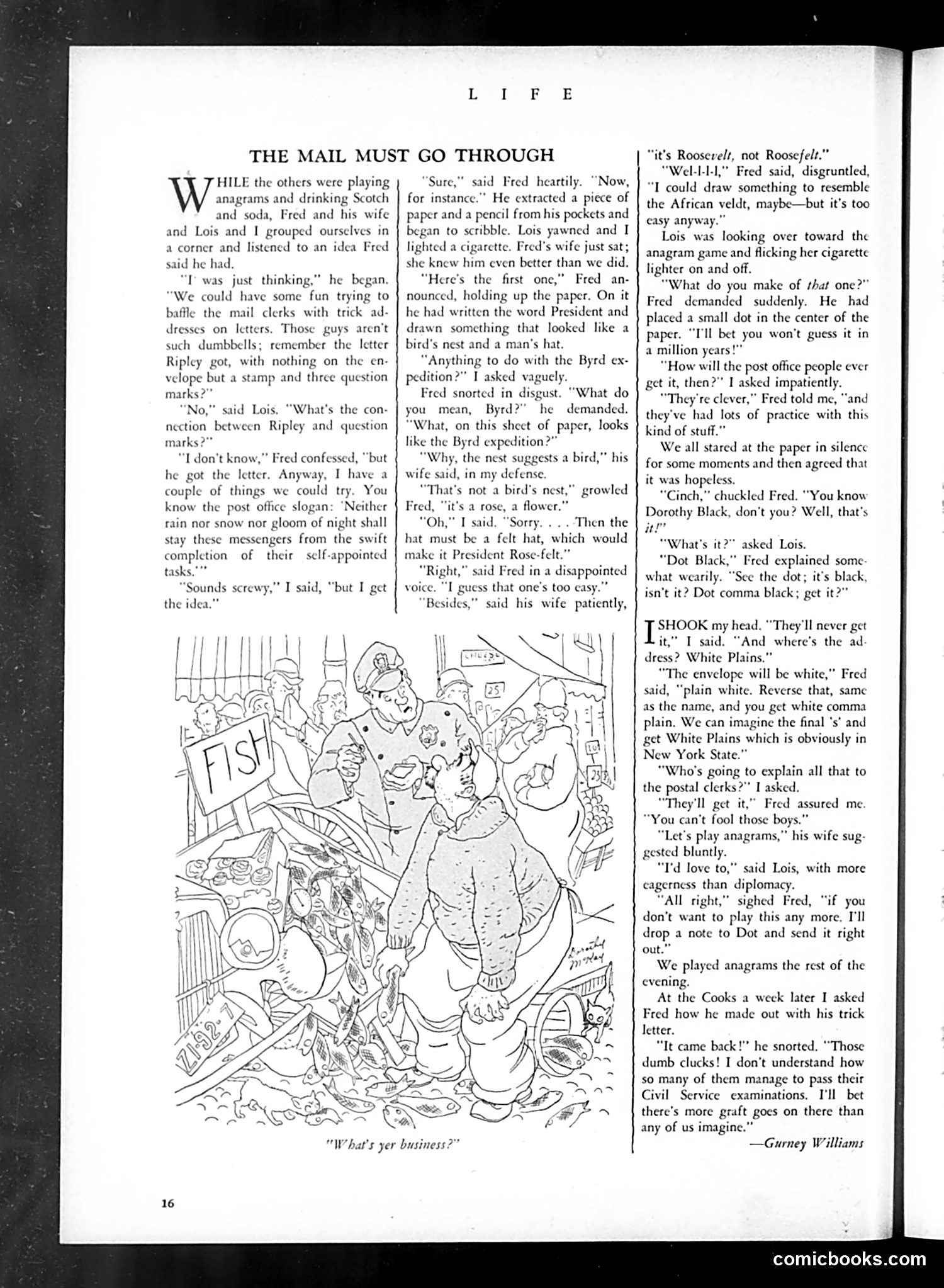
"The Mail Must Go Through" This is a humorous short story by Gurney Williams about postal workers attempting to deliver mail despite obstacles. The accompanying cartoon illustrates a chaotic post office scene where mail carriers struggle with an overwhelming volume of correspondence—the joke being the contrast between the postal service's motto ("the mail must go through") and the actual pandemonium of their workplace. The story involves characters debating how to address an envelope to "President Roosevelt" in a way that will reach White Plains (his residence). The satire gently mocks both the postal system's inefficiency and the bureaucratic complications of addressing mail to government officials. The crowded, messy cartoon emphasizes the absurdity of expecting postal workers to manage such chaos while maintaining service standards.
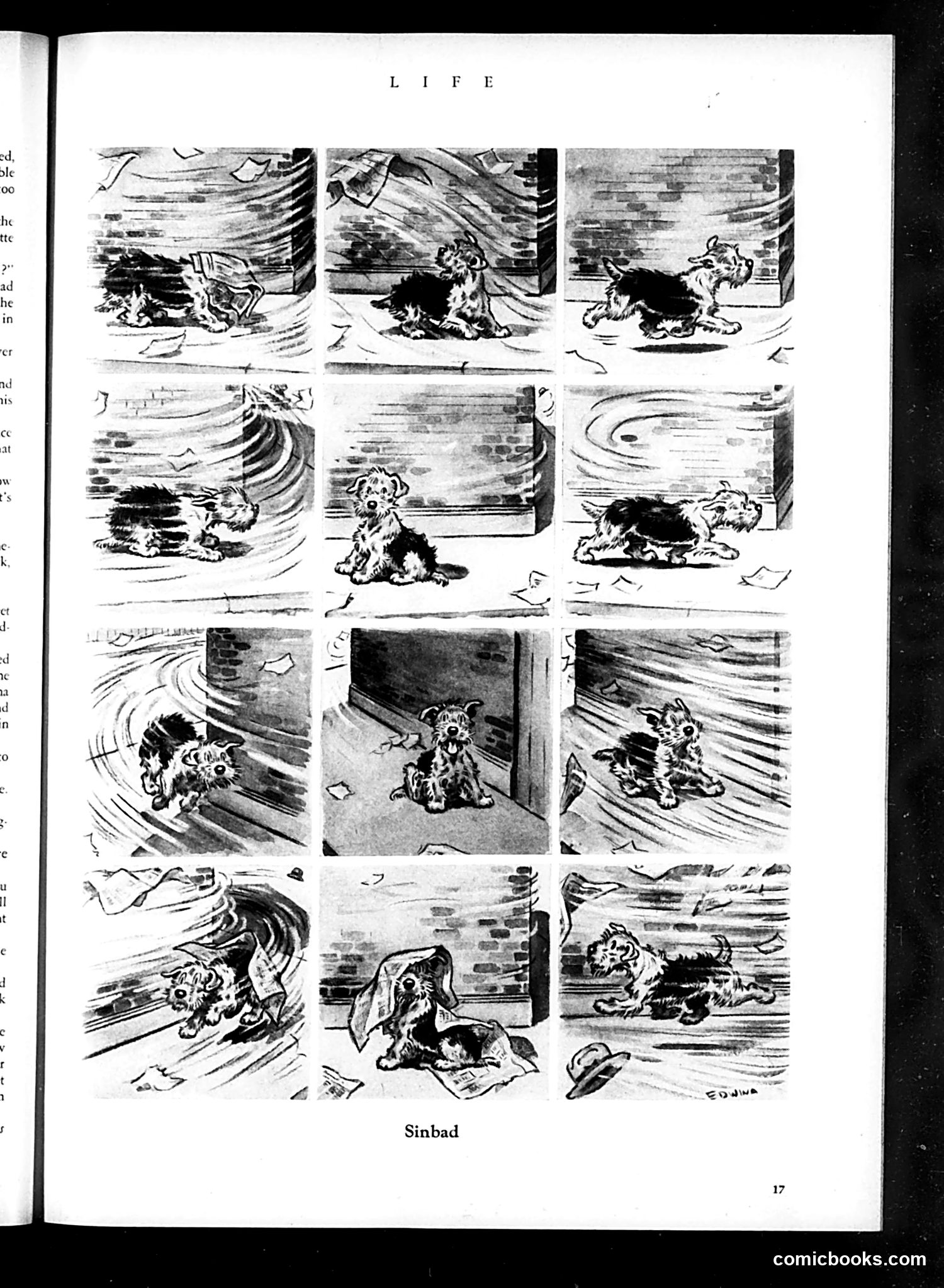
Sinbad Comic Strip Analysis This is a comic strip titled "Sinbad," appearing in Life magazine (page 17). The twelve-panel sequence depicts what appears to be a small dog character in various comedic situations, likely a slapstick adventure story inspired by the famous tales of Sinbad the Sailor. The strip shows the dog encountering various obstacles and dangers—including what appears to be wind, water, and environmental hazards depicted through dynamic line work. The humor derives from physical comedy typical of early 20th-century comics: the protagonist facing escalating mishaps and misadventures. The specific narrative is difficult to discern without accompanying text, but the visual style and format are characteristic of Life magazine's humorous comic content from this era, blending literary references (Sinbad) with animal character comedy.
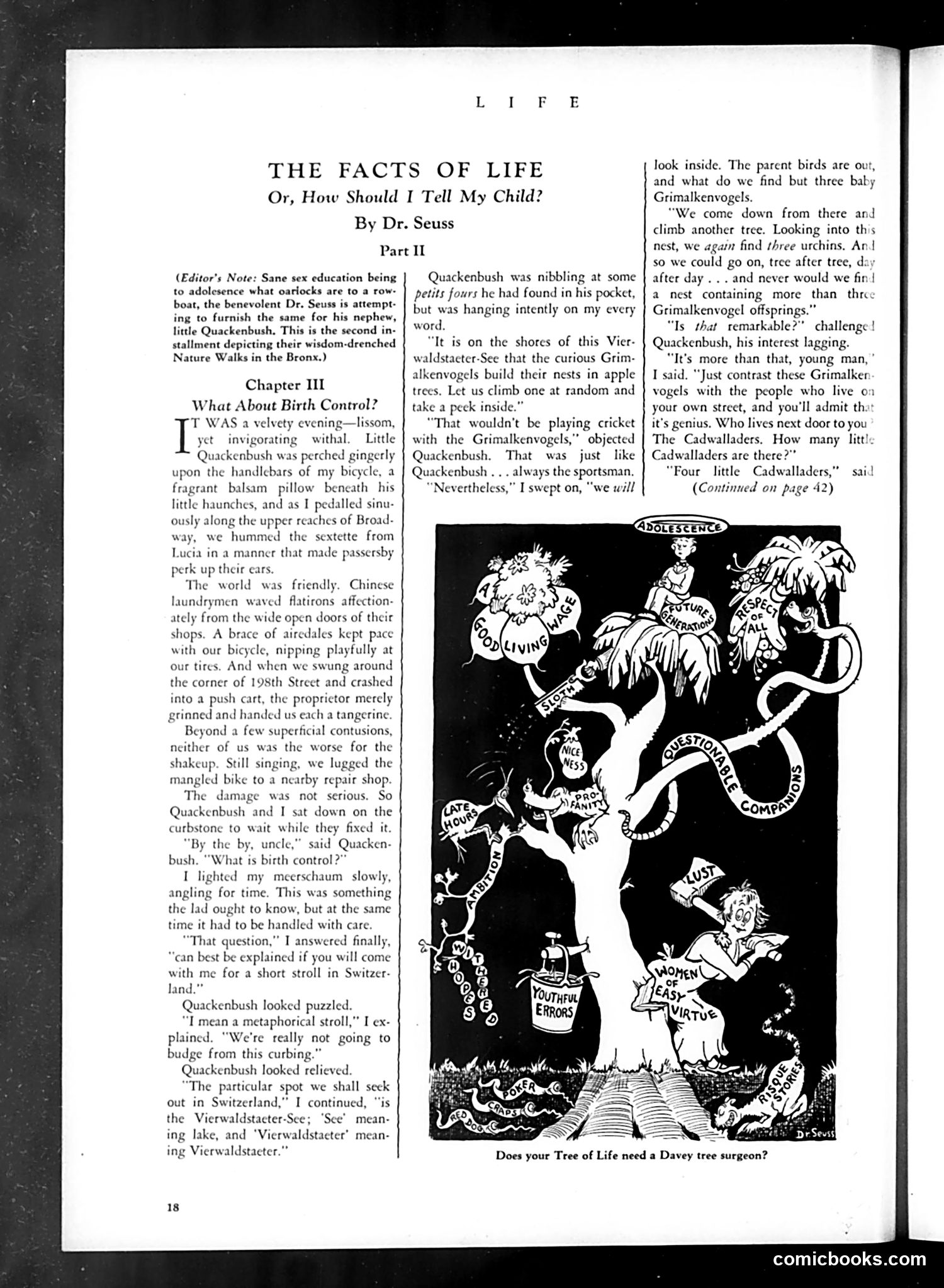
Analysis of Life Magazine Page This page contains a Dr. Seuss illustration accompanying an article titled "The Facts of Life: Or, How Should I Tell My Child?" (Part II). The cartoon depicts a tree labeled "Tree of Life" with various branches representing human concerns and characteristics—including "Good Living," "Questions," "Lost Youth," "Virtue," "Errors," and "Adolescence." The satirical point appears to be about the complications of human existence and moral development. The tangled, chaotic tree visually suggests how interconnected and messy life's various pressures and virtues become, particularly during adolescence. The caption asks: "Does your Tree of Life need a Davey tree surgeon?"—a commercial reference suggesting life's problems might need professional intervention, poking fun at both commercial solutions to human problems and the bewildering nature of growing up.
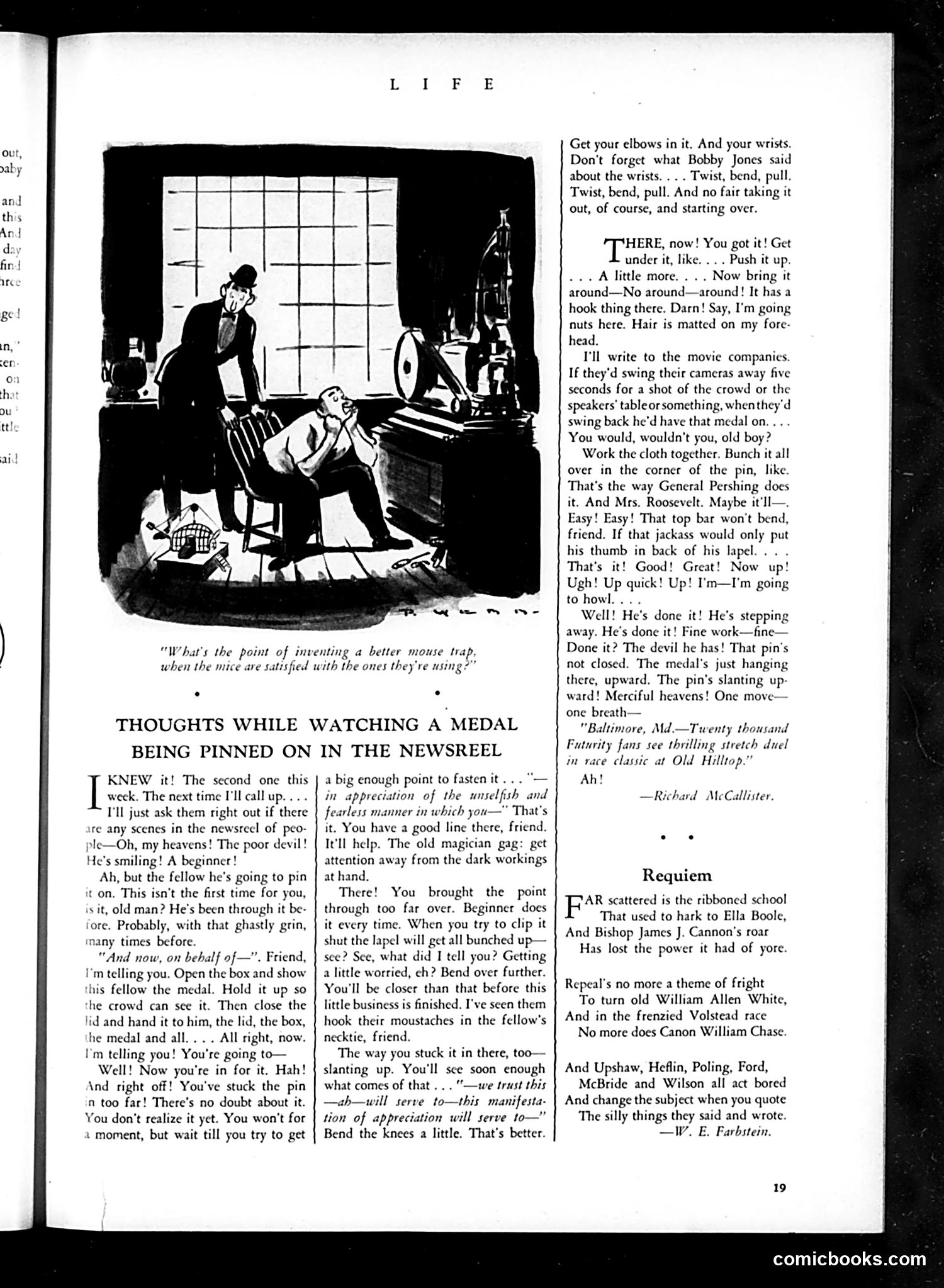
Analysis of "Thoughts While Watching a Medal Being Pinned On in the Newsreel" This cartoon satirizes the awkwardness of pinning medals on recipients during newsreel filming. The illustration shows a man struggling uncomfortably while another man attempts to pin a medal on him, observed by a cameraman at a window. The accompanying text humorously describes the difficulty: the medal recipient must hold still while the cameraman films, the pin won't cooperate, the lapel bunches up, and the whole procedure becomes a farcical struggle. References to "General Pershing" and "Mrs. Roosevelt" suggest this depicts typical military or civic medal ceremonies of the era. The joke targets the gap between solemn official ceremony and the ungainly reality of executing it before cameras—a commentary on how newsreels staged public moments of honor.
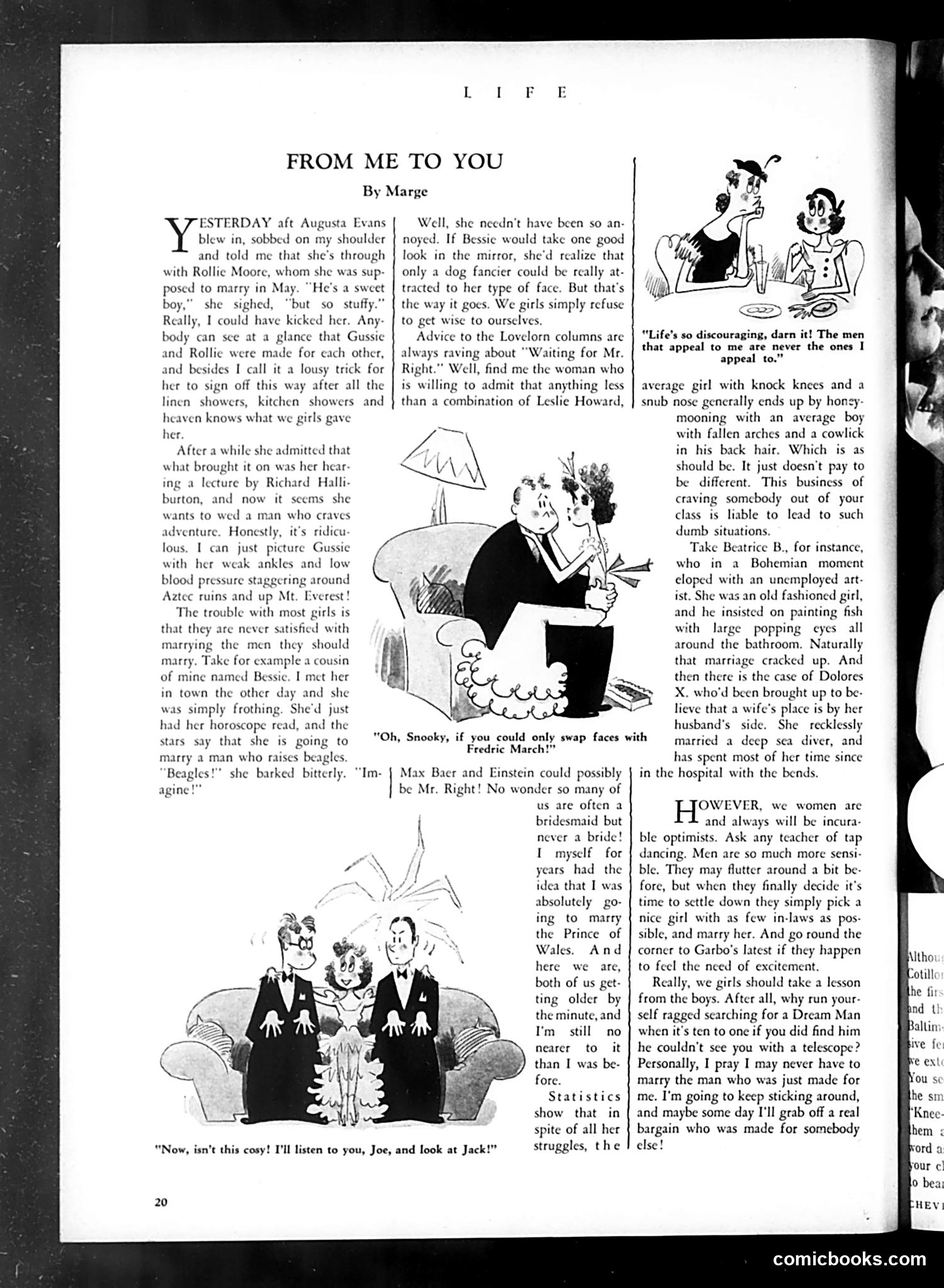
Analysis of "From Me to You" by Marge This satirical advice column mocks women's unrealistic romantic expectations. The author argues that women constantly pursue unattainable ideals—comparing themselves to glamorous Hollywood stars like Leslie Howard and Fredric March—while rejecting perfectly suitable average men. The column presents cautionary tales: Augusta Evans abandons her fiancé after hearing adventurer Richard Halliburton lecture, despite being physically unsuited for adventure; Bessie refuses a man matching her horoscope prediction simply because she dislikes the concept of dog-breeders; the author herself once fantasized about marrying the Prince of Wales. The core satire: women refuse to "get wise to ourselves" and accept matches appropriate to their actual circumstances, instead chasing romantic fantasies doomed to fail. The closing cartoons reinforce this—women wanting to swap faces with famous actors, or complaining that men they attract don't appeal to them. The piece ultimately argues that women's unrealistic standards make them perpetual bridesmaids, while men pragmatically settle down with suitable partners. It's period commentary on gender and marriage expectations, tinged with misogynistic resignation.
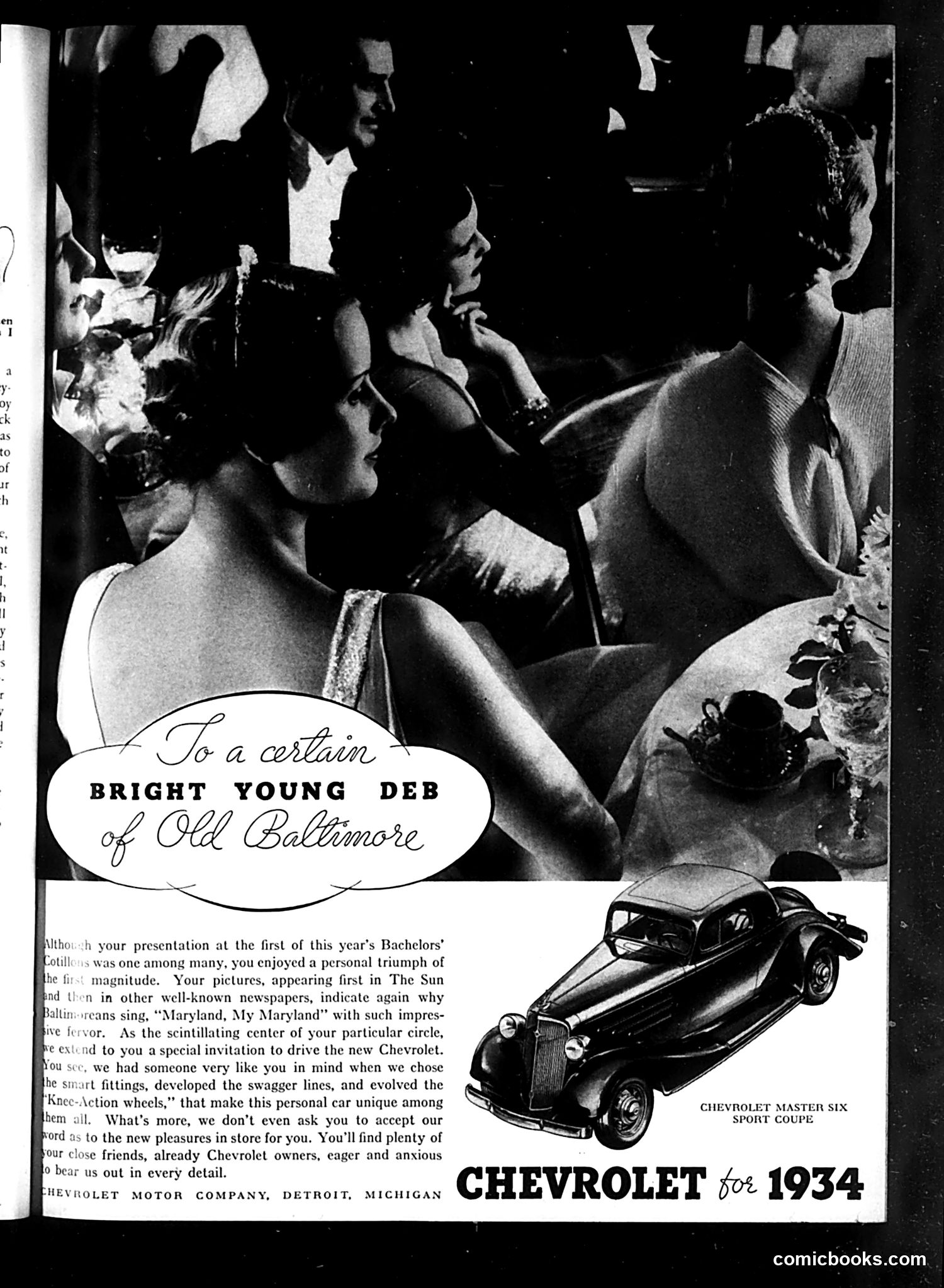
Analysis This is a Chevrolet automobile advertisement, not a political cartoon. The page celebrates a young debutante from Baltimore who made her social debut at the Bachelors' Cotillion (an exclusive social event). The ad addresses her directly, congratulating her on receiving newspaper publicity and social prominence. It then pivots to marketing the 1934 Chevrolet Master Six Sport Coupe by claiming the car was designed with someone "like you" in mind—suggesting it appeals to affluent, fashionable young socialites. The copy emphasizes luxury features ("smart fittings," "swagger lines," "Knee-Action wheels") and social proof, noting that her wealthy friends already own Chevrolets and can testify to the vehicle's appeal. Context for modern readers: This represents Depression-era advertising targeting the wealthy elite, using social status and debutante culture as aspirational marketing. The assumption that a prominent society woman would naturally attract other wealthy buyers reflects 1934's class-based consumer marketing.
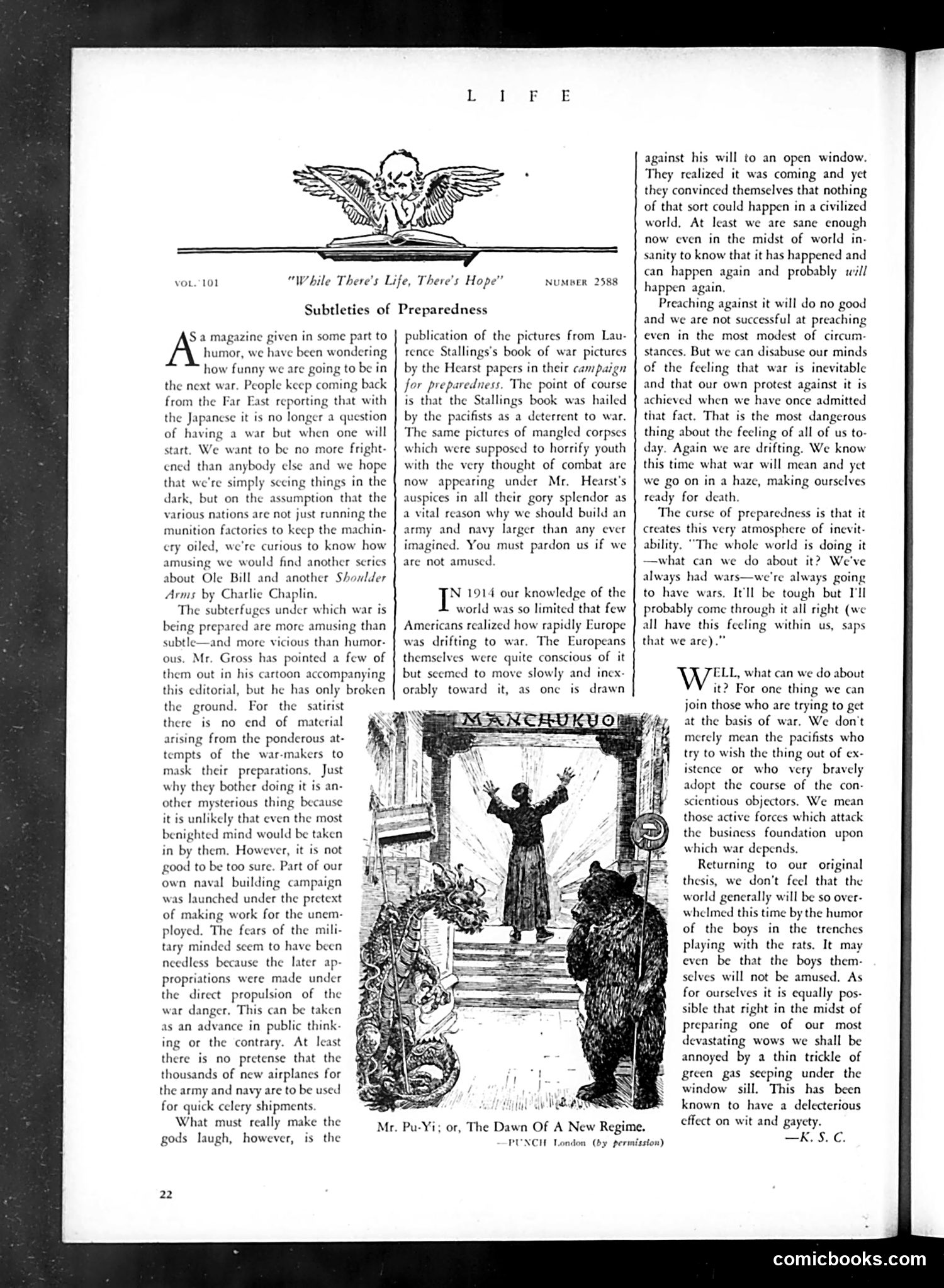
"Subtleties of Preparedness" - Life Magazine Analysis This editorial cartoon and accompanying text critique covert war preparation efforts in pre-WWII America. The cartoon depicts Mr. Pu-Yi (China's last emperor, used here as a symbol of political manipulation) seemingly thrown from a window—representing how nations drift inexorably toward war despite public denial. The editorial mocks the hypocrisy of American military buildup disguised as economic stimulus (naval construction as "work for the unemployed") and attacks newspaper magnate William Randolph Hearst for republishing graphic war photographs from Laurence Stallings's pacifist book—originally meant to discourage combat—now repurposed as propaganda *for* military expansion. The core argument: preparedness itself creates inevitability. By accepting war as unavoidable ("the whole world is doing it"), Americans psychologically surrender to conflict rather than resist it. The satire targets both warmongering politicians and public complacency masquerading as realism.
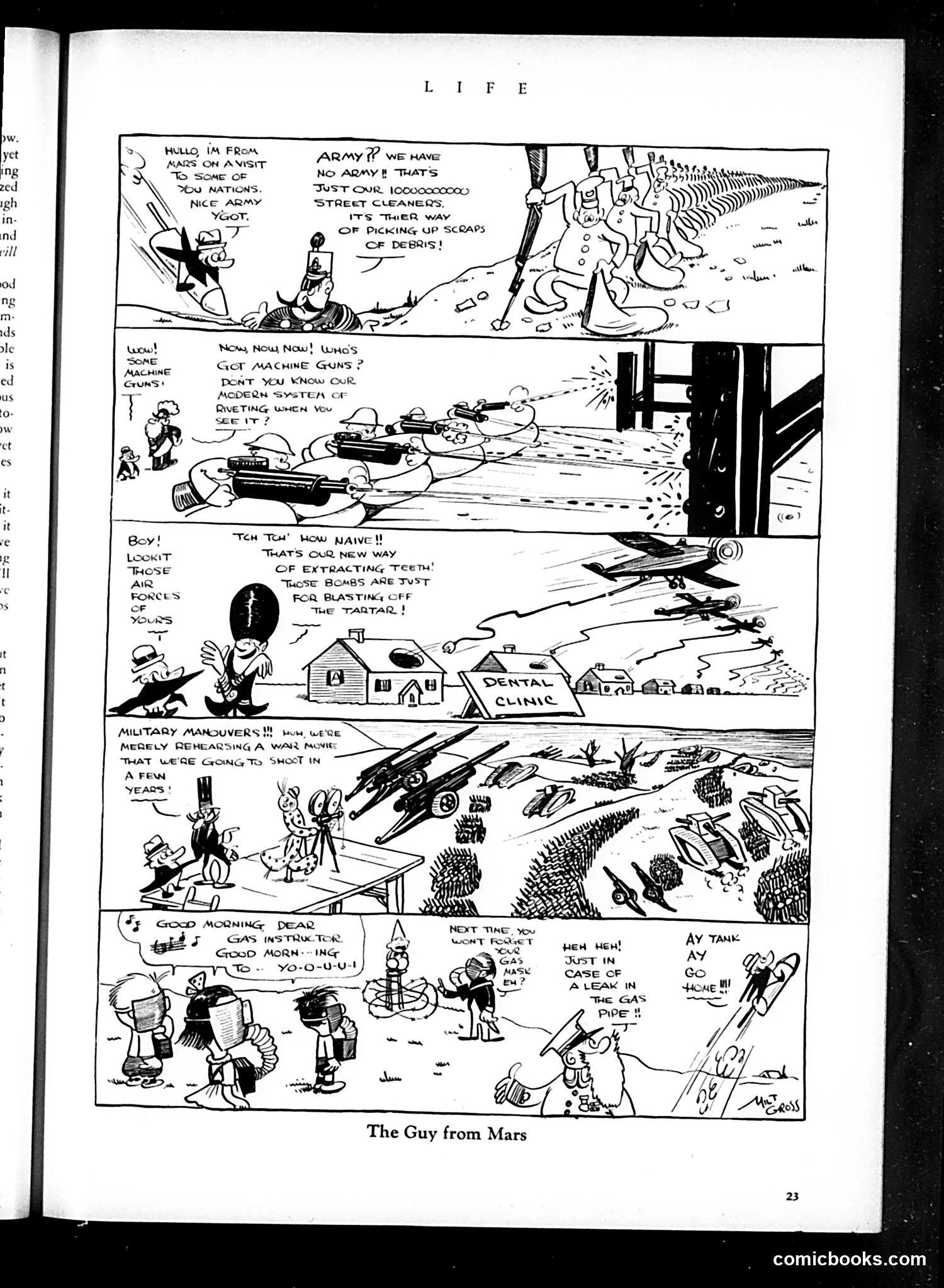
"The Guy from Mars" - Satire Explanation This comic depicts a Martian visitor encountering Earth's military preparations and warfare technology, presented as absurdly mundane or civilian activities. The satire works through deliberate misrepresentation: street cleaners are "armies," dental drills become "tooth extraction bombs," machine guns are ordinary tools, and military maneuvers are merely "a war movie." The joke targets 1920s-30s militarism and war preparation—showing how societies normalize and rationalize weapons and violence by disguising them as everyday civilian processes. By having an outsider (the Martian) react with confusion to these explanations, the cartoon exposes the absurdity of how humans justify and obscure their war-making activities. The final panels show ordinary morning greetings among military personnel, further emphasizing how normalized warfare culture had become to civilians themselves. The satire critiques both militarization and humanity's casual acceptance of it.
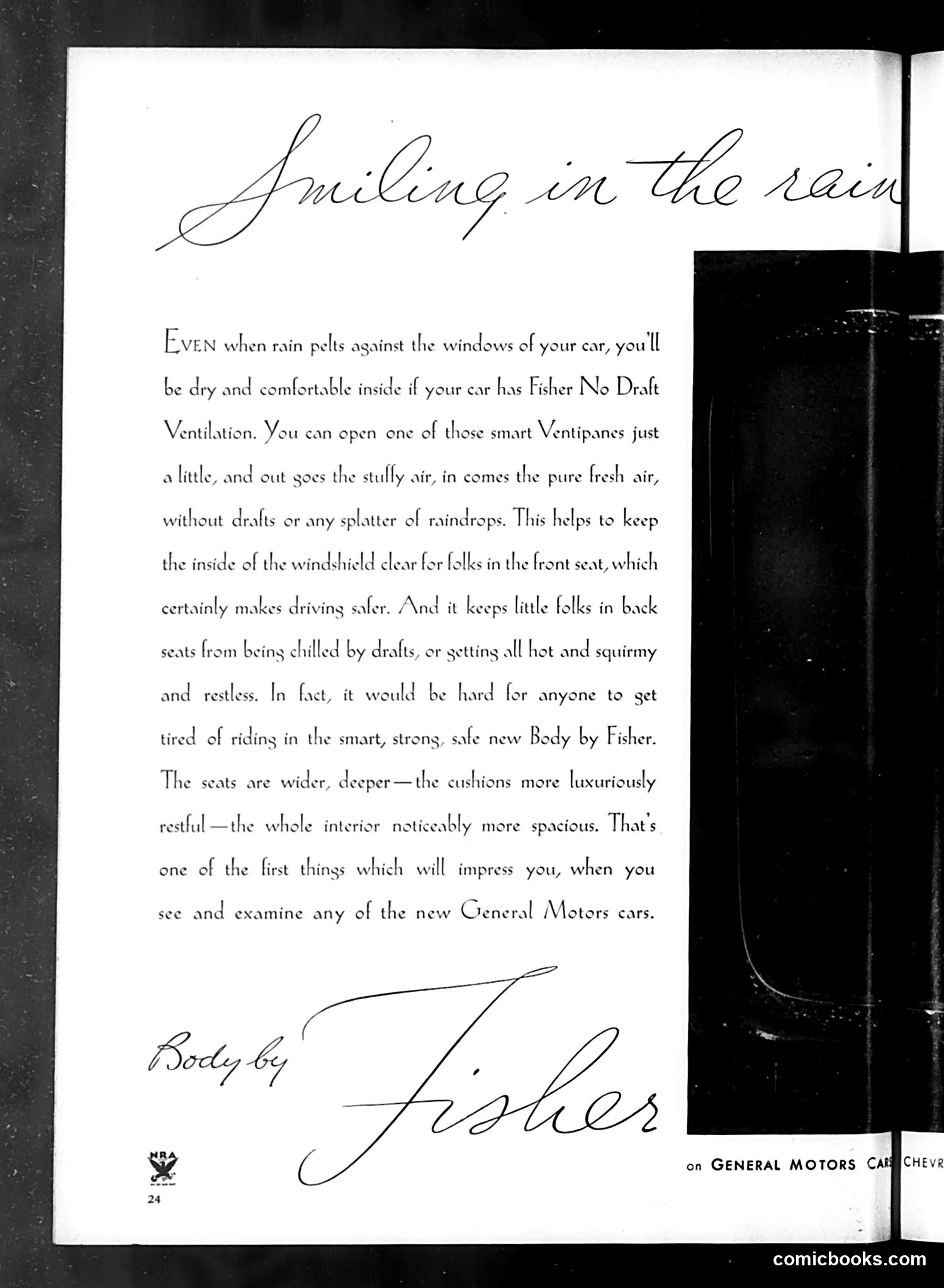
This is not a cartoon or satire—it's a straight automobile advertisement for General Motors' Fisher body cars, specifically promoting their "No Draft Ventilation" system. The ad targets middle-class car buyers by emphasizing comfort features: ventilation that provides fresh air without drafts or rain splatter, wider and deeper seats with luxurious cushions, and improved interior space. It appeals to practical concerns (safe driving visibility, keeping children comfortable) and aspirational desires (spaciousness, luxury). The signature "Body by Fisher" indicates this was Fisher Body Company's branded feature on GM vehicles—a selling point that Fisher was the quality body manufacturer for General Motors cars. There is no political satire or social commentary here; this is standard 1920s-1930s consumer advertising emphasizing modern automotive conveniences and comfort.
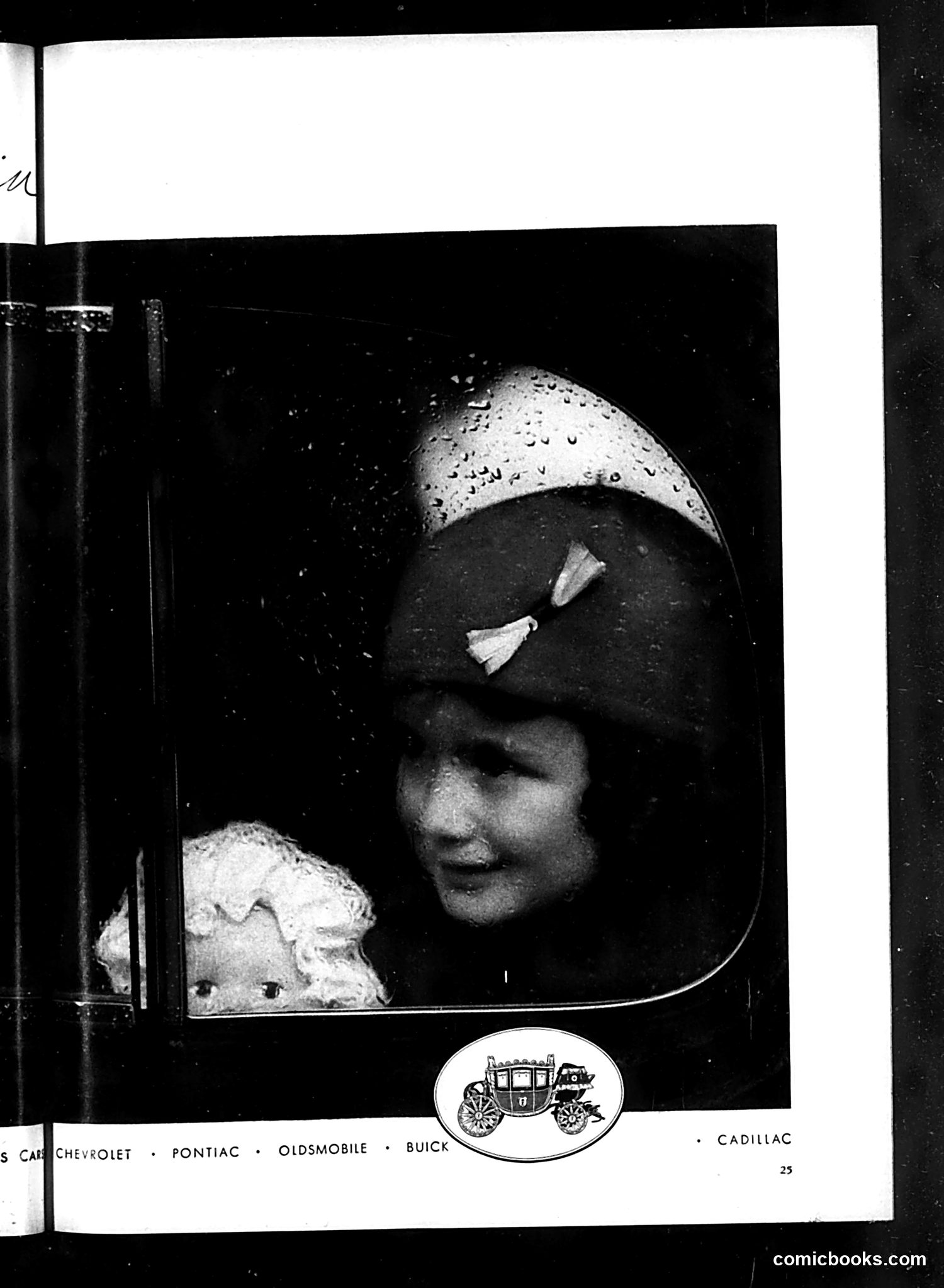
Analysis This appears to be a General Motors automobile advertisement rather than political satire. The page shows a black and white photograph of a woman wearing a decorative hat with water droplets, looking out what appears to be a car window. The visible text references multiple GM brands: Chevrolet, Pontiac, Oldsmobile, Buick, and Cadillac, with a classic car illustration as a logo. The imagery suggests this is advertising automotive products—likely emphasizing quality, luxury, or weather protection features. The woman's elegant appearance and the careful photographic composition were typical of mid-20th century car advertising that associated vehicles with sophistication and style. Without additional context or visible body text, the specific marketing message remains unclear.
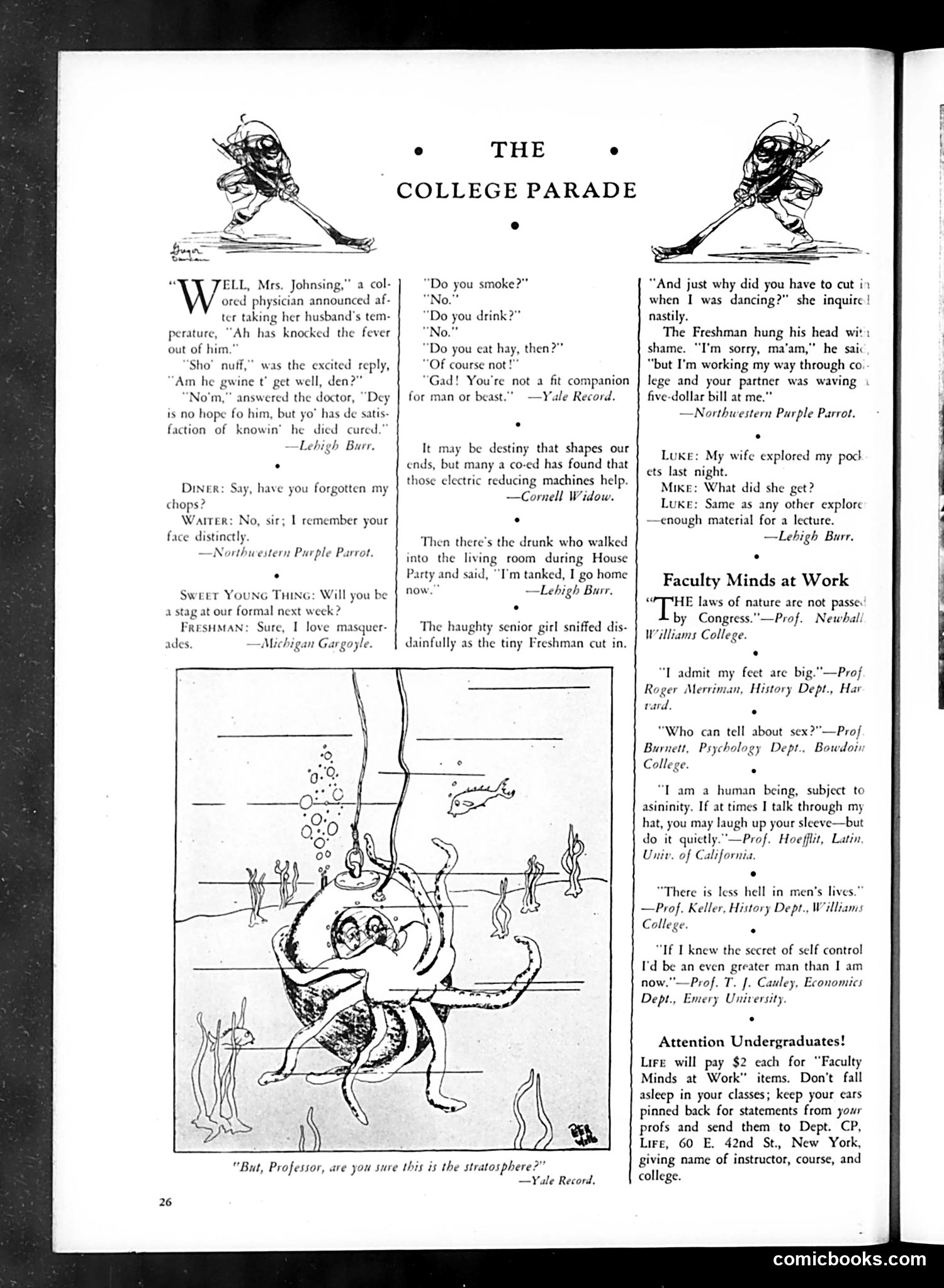
"The College Parade" - Life Magazine Satire This page collects humorous anecdotes from college newspapers, satirizing undergraduate life and academic pretension circa the 1920s-30s. The jokes target: - Racial stereotypes (the opening "colored physician" joke uses dialect humor now recognized as offensive caricature) - Student behavior: drunkenness, financial desperation, romantic mishaps - Class dynamics: the freshman cutting in on a senior's dance while desperately needing the five-dollar tip - Academic absurdity: professors' contradictory claims and self-awareness ("I talk through my hat") - Dating/courtship: the formal "stag" date and the exploitative "reducing machine" marketed to co-eds The central cartoon shows a fantastical creature in what appears to be the stratosphere—likely mocking pseudo-intellectual pretension or student confusion. Modern context: The "Faculty Minds" section monetizes student eavesdropping ($2 payment), treating professorial quirks as entertainment. The overall tone treats college as frivolous rather than serious.
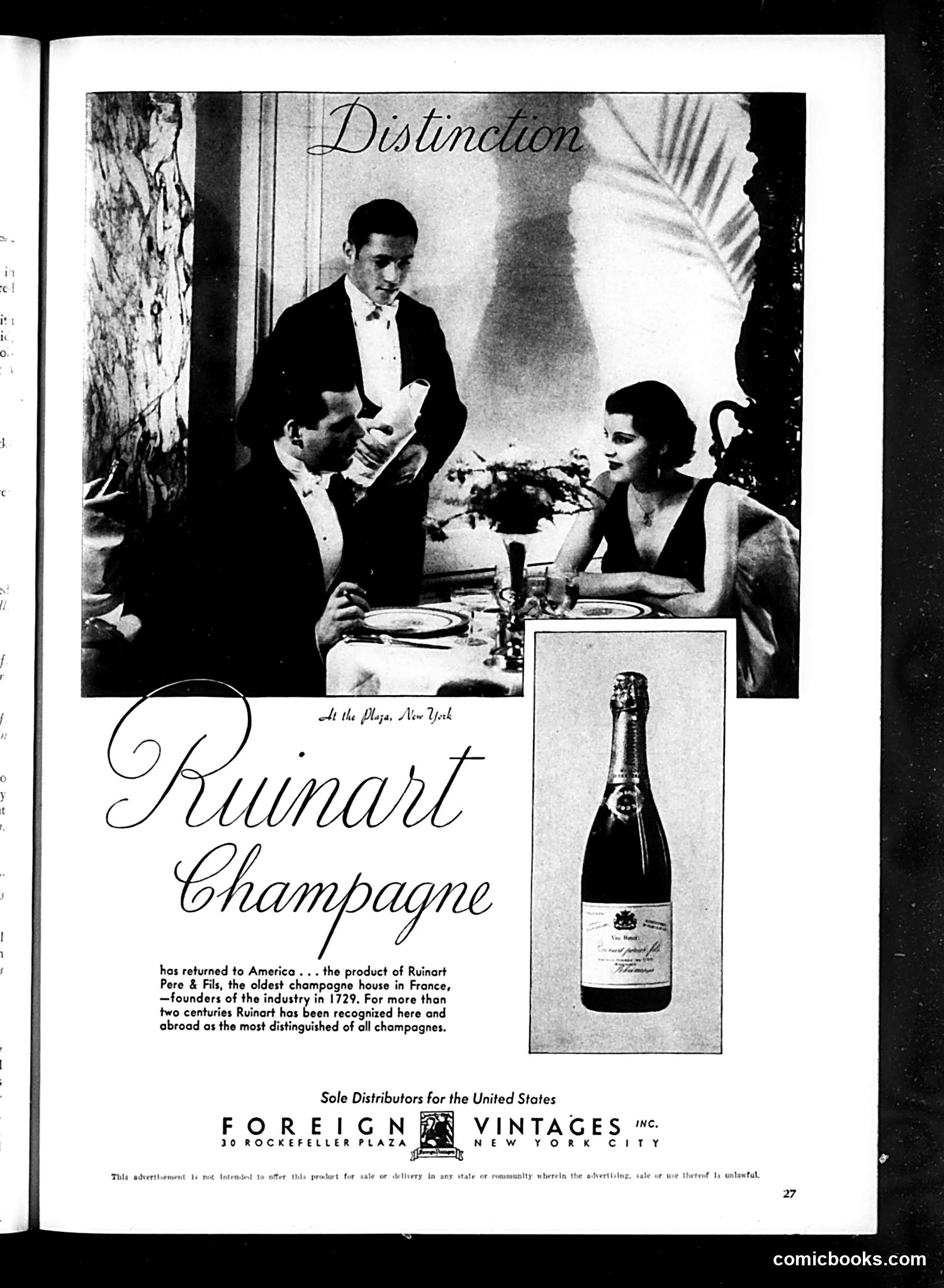
This is a champagne advertisement, not political satire. It advertises Ruinart Champagne, distributed by Foreign Vintages Inc. in New York City. The image shows an elegant dinner scene "at the Plaza, New York"—three well-dressed diners in formal attire, establishing an atmosphere of sophistication and luxury. The accompanying champagne bottle reinforces exclusivity. The ad's appeal relies on associating the product with refined dining and social distinction. The text emphasizes Ruinart's pedigree: founded in 1729 in France, it claims to be "the oldest champagne house" and "most distinguished of all champagnes." For modern readers, this represents typical 1920s-30s advertising strategy: luxury goods marketed through aspirational imagery, historical prestige, and the promise that purchasing this product signals cultured taste and high social standing.
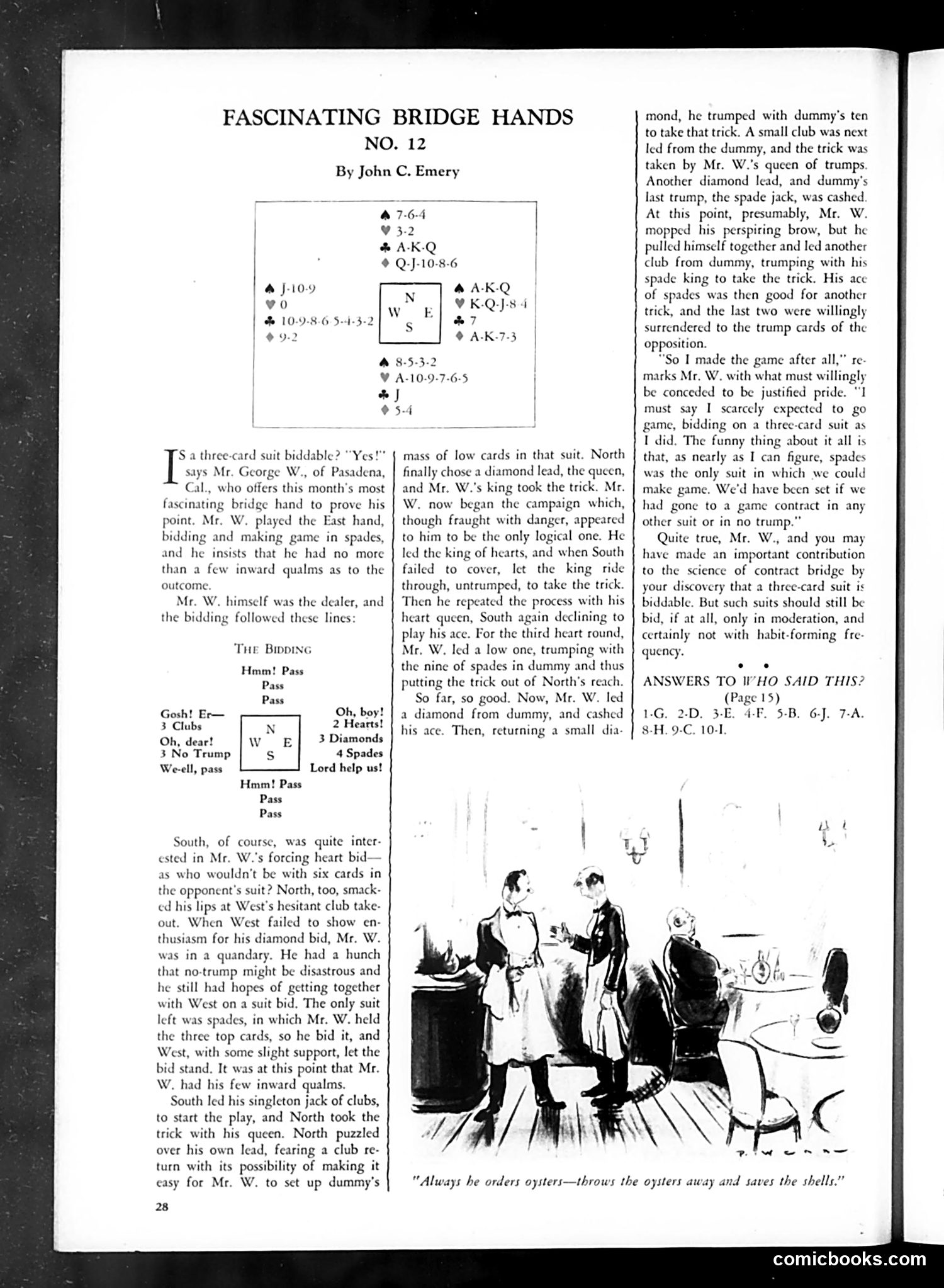
What This Page Means to Modern Readers This page contains a bridge column—not political satire, but a how-to feature about the card game contract bridge. "Fascinating Bridge Hands" presents a real game played by Mr. George W. of Pasadena, who bids and makes a spades game despite holding only three cards in that suit, which violates conventional wisdom. The accompanying illustration shows people at a dinner party, with the caption's joke about oysters being ordered but discarded—unrelated to the bridge content. The column celebrates Mr. W.'s unconventional but successful play, while gently chiding him that three-card suit bids, though occasionally justified, shouldn't become habitual. It's an instructional article for bridge enthusiasts, not satire. The "Who Said This?" answers reference a previous puzzle in the magazine.
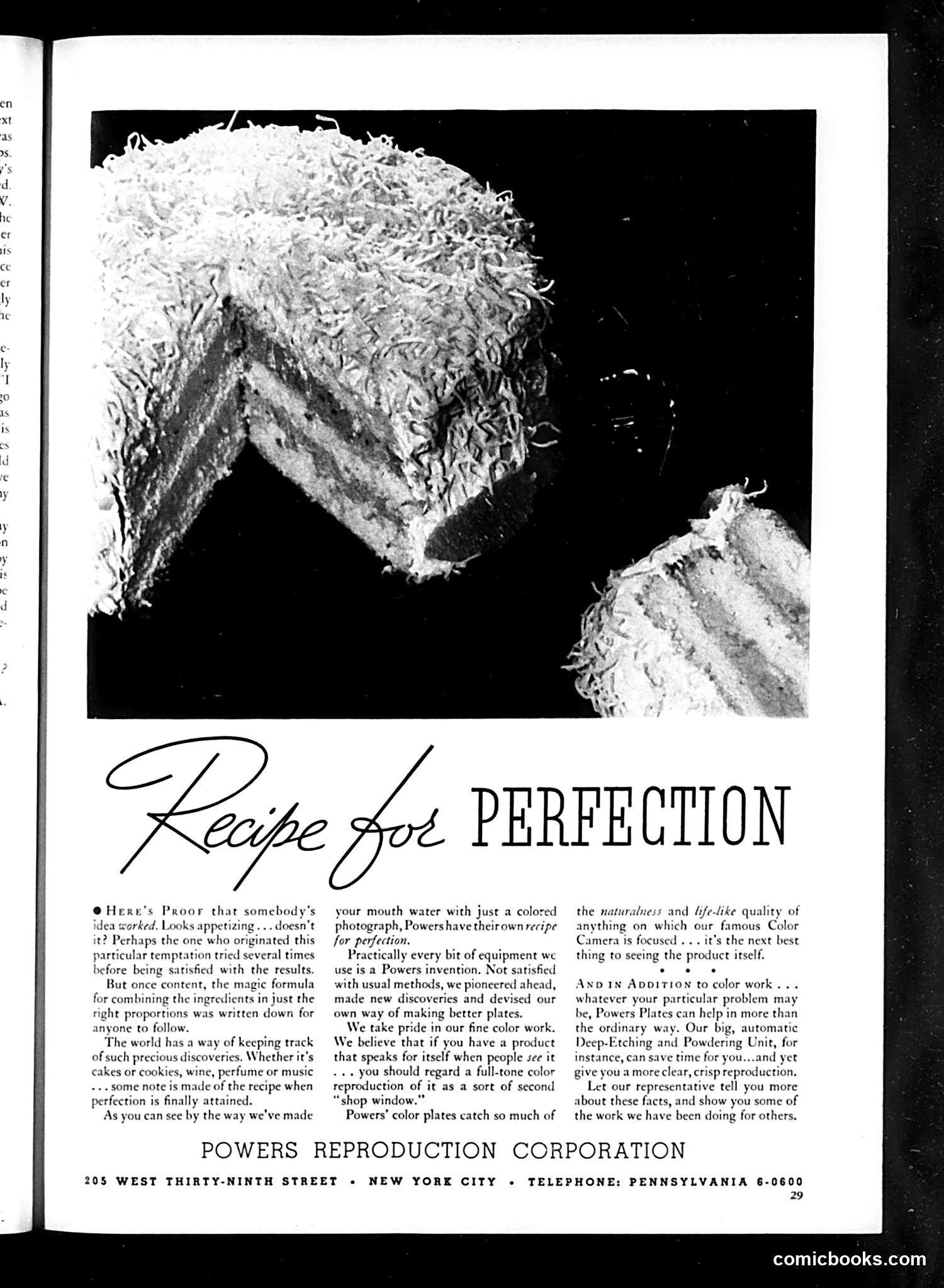
"Recipe for Perfection" - Powers Reproduction Advertisement This is not a political cartoon but rather a full-page advertisement for Powers Reproduction Corporation, a printing/color plate manufacturing company based in New York City. The image shows a sliced layer cake with frosting—a visual metaphor for the advertisement's central conceit: just as a perfect recipe produces appetizing food, Powers uses its proprietary "recipe" (specialized equipment and techniques) to produce superior color reproductions and printing plates. The text argues that their invented methods and "Deep-Etching and Powdering Unit" create clearer, crisper color reproductions than competitors, making their plates an ideal "shop window" for displaying products to potential customers. This reflects mid-20th-century advertising culture, where companies marketed industrial/technical services by emphasizing trade secrets, innovation, and quality craftsmanship. The cake imagery was meant to make industrial printing services seem accessible and desirable to business owners.
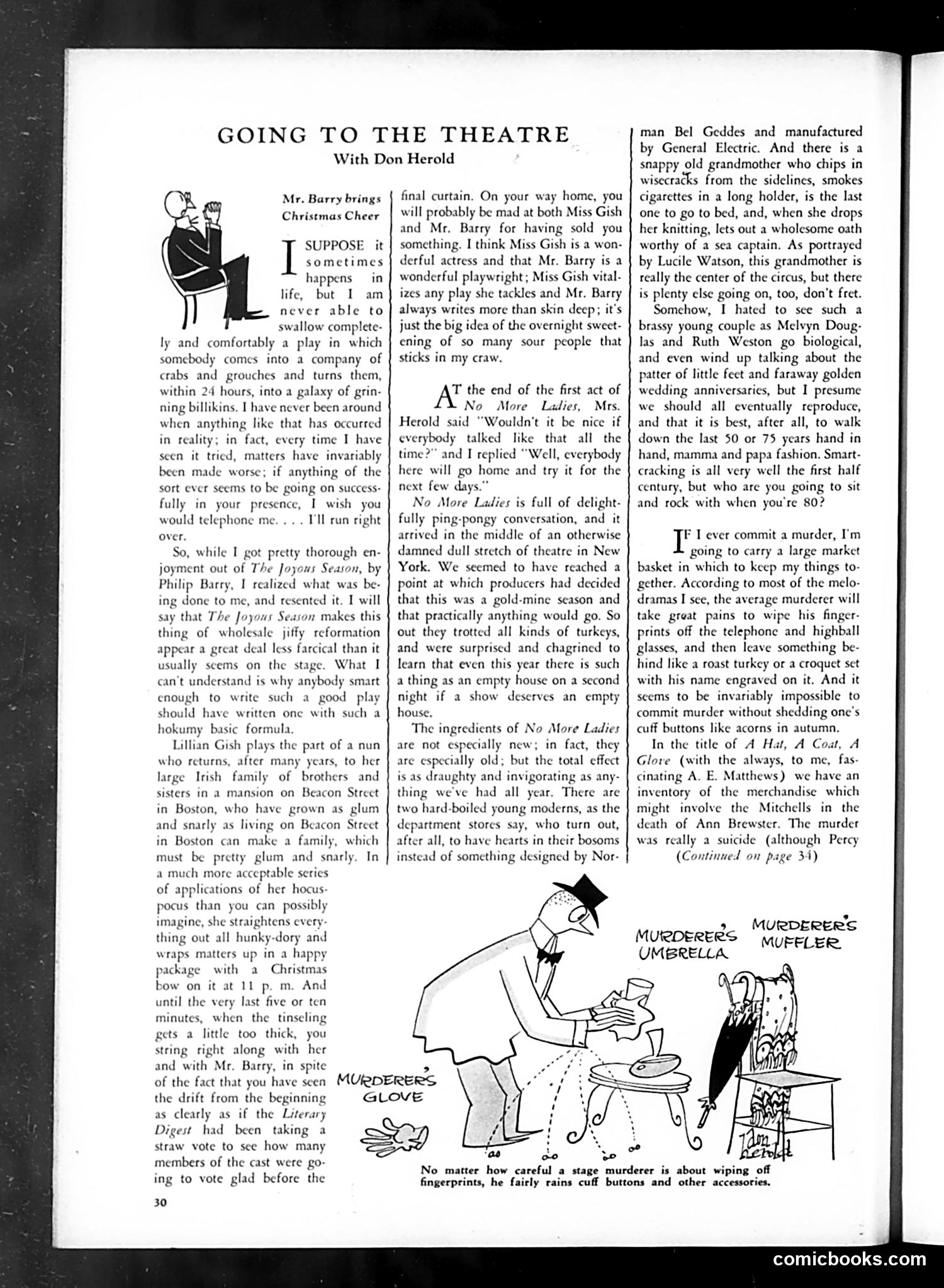
Analysis of This Life Magazine Theatre Column This is Don Herold's theatre review column featuring two Broadway plays: *The Joyous Season* (starring Lillian Gish) and *No More Ladies*. The Main Satire: Herold critiques the formulaic "redemption play" where a virtuous outsider transforms cynical, miserable people into happy ones within 24 hours. He finds this dramatically dishonest—claiming it never happens in real life yet theatrical audiences accept it readily. The implicit joke: audiences *know* they're being manipulated but willingly suspend disbelief anyway. The Bottom Cartoon: The illustration shows a stage murderer anxiously leaving behind accessories (glove, umbrella, muffler)—satirizing how stage murderers always carelessly shed incriminating evidence despite supposedly being careful criminals. The caption jokes that no matter how cautious a stage killer tries to be, he inevitably leaves "fingerprints" and "cuff buttons" everywhere. Context: This reflects 1930s Broadway's reliance on melodrama and formulaic plots that modern audiences would find heavy-handed.
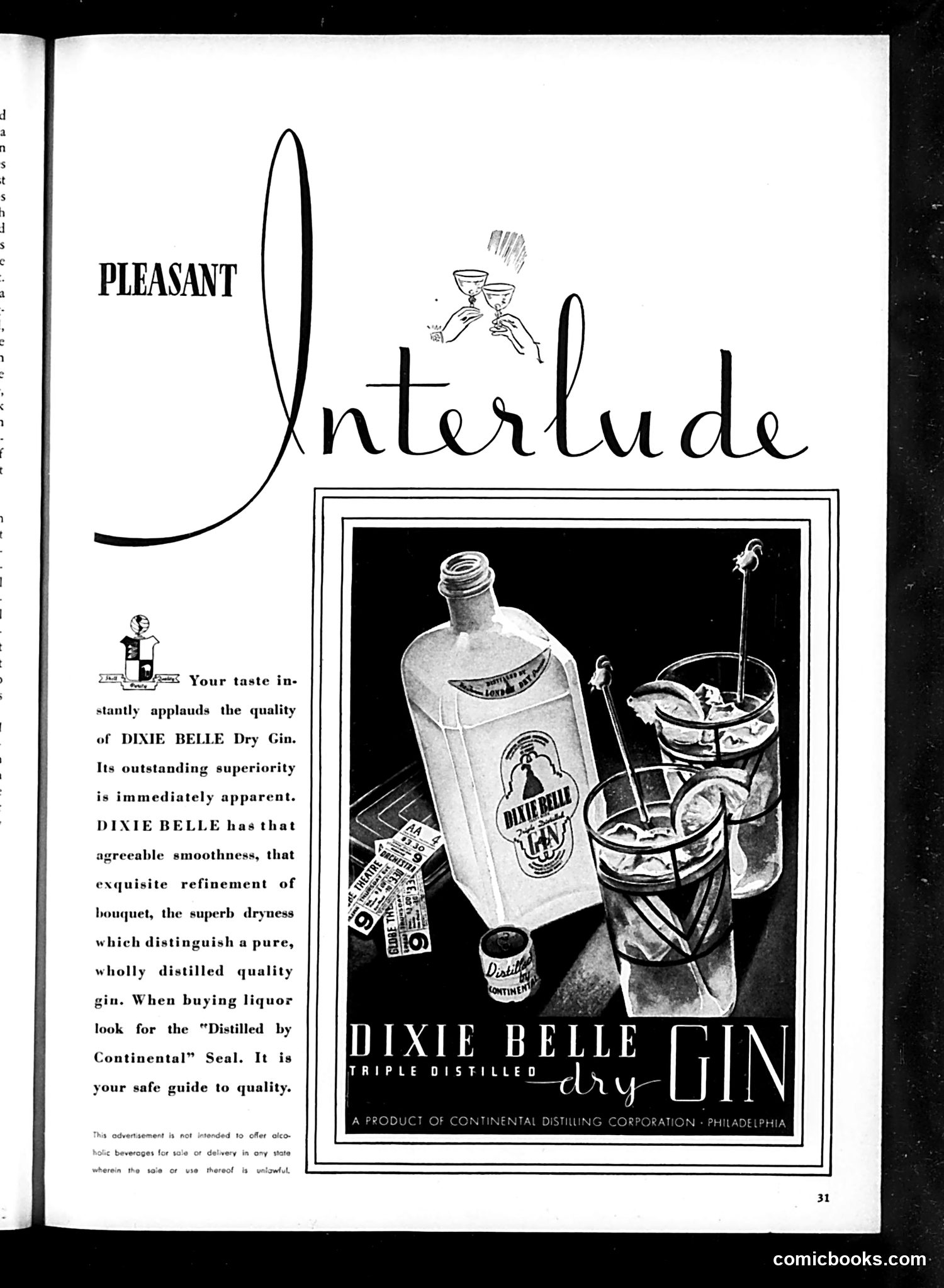
Analysis This is primarily an advertisement, not a political cartoon. It's a full-page ad for Dixie Belle Dry Gin, a product of Continental Distilling Corporation in Philadelphia. The page appears in *Life* magazine and uses the publication's typical satirical aesthetic—elegant typography and illustration—to market gin during what was likely the post-Prohibition era (1930s-40s). The "Pleasant Interlude" header frames drinking as genteel leisure. The central image shows an attractive bottle of Dixie Belle alongside cocktail glasses garnished with olives and citrus, presented as sophisticated entertainment. The accompanying text emphasizes quality markers: "triple distilled," smoothness, refinement, and a "Continental" seal as proof of authenticity. There's no political satire here—just a period alcohol advertisement leveraging *Life's* cachet and refined design sensibility to suggest that choosing this particular gin demonstrates good taste and sophistication. The "interlude" framing positions drinking as a pleasant social break.
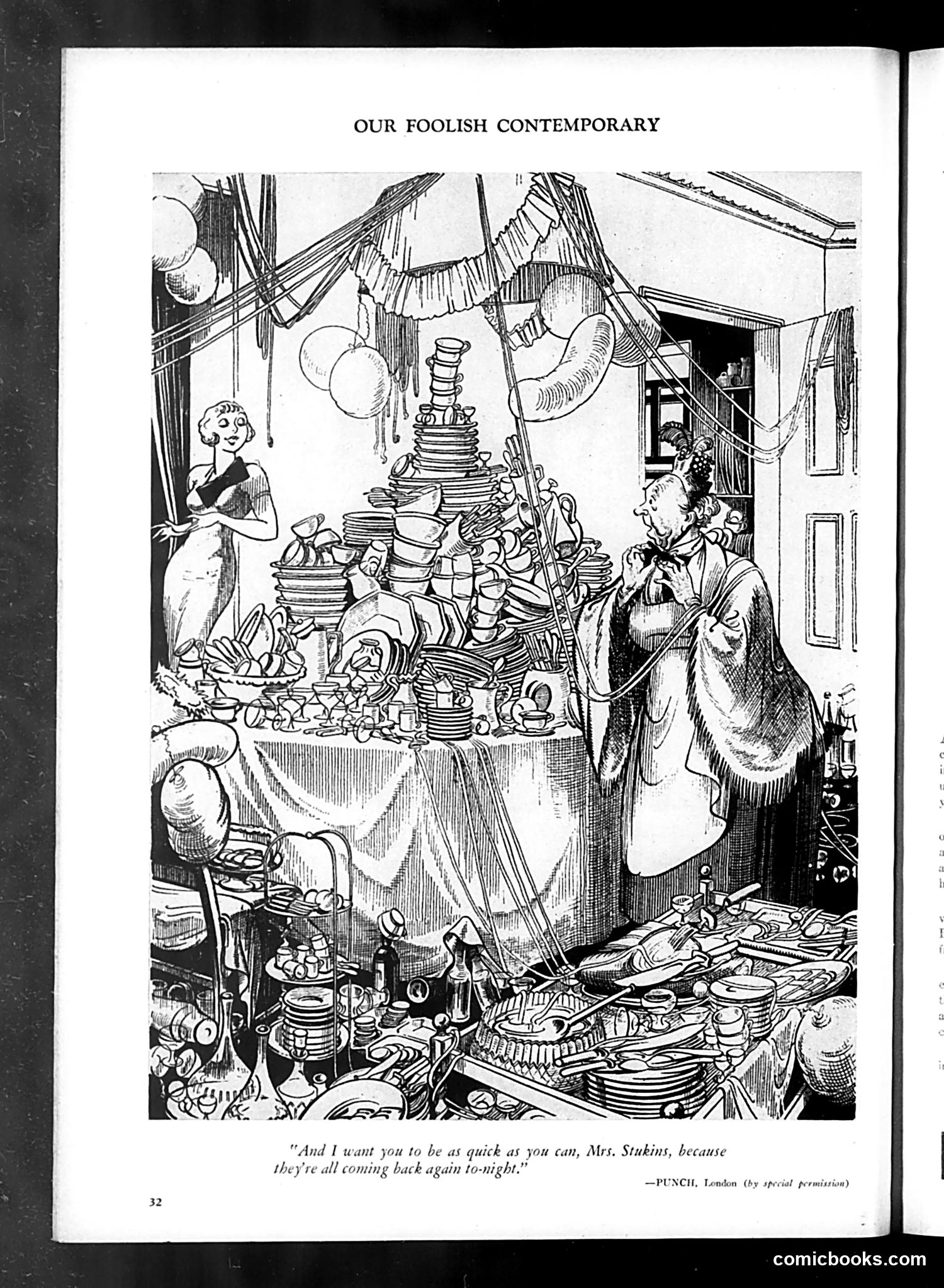
Analysis This is a satirical cartoon titled "Our Foolish Contemporary," reprinted from British *Punch* magazine. The image depicts a domestic servant (Mrs. Stukins) overwhelmed by an enormous, precariously stacked tower of dirty dishes, pots, and kitchenware. A well-dressed woman directs her to work faster because guests are returning that evening. The satire targets the absurdity of constant entertaining and lavish entertaining during peacetime—the "foolish" behavior referenced in the title. The cartoon mocks the upper-class hostess's casual disregard for her servant's exhausting workload and impossible task. The towering pile of dishes symbolizes the excessive consumption and waste of entertaining culture. The humor lies in the obvious impossibility of completing such a task, highlighting the unreasonable demands placed on domestic workers by wealthy households engaged in relentless social entertaining.
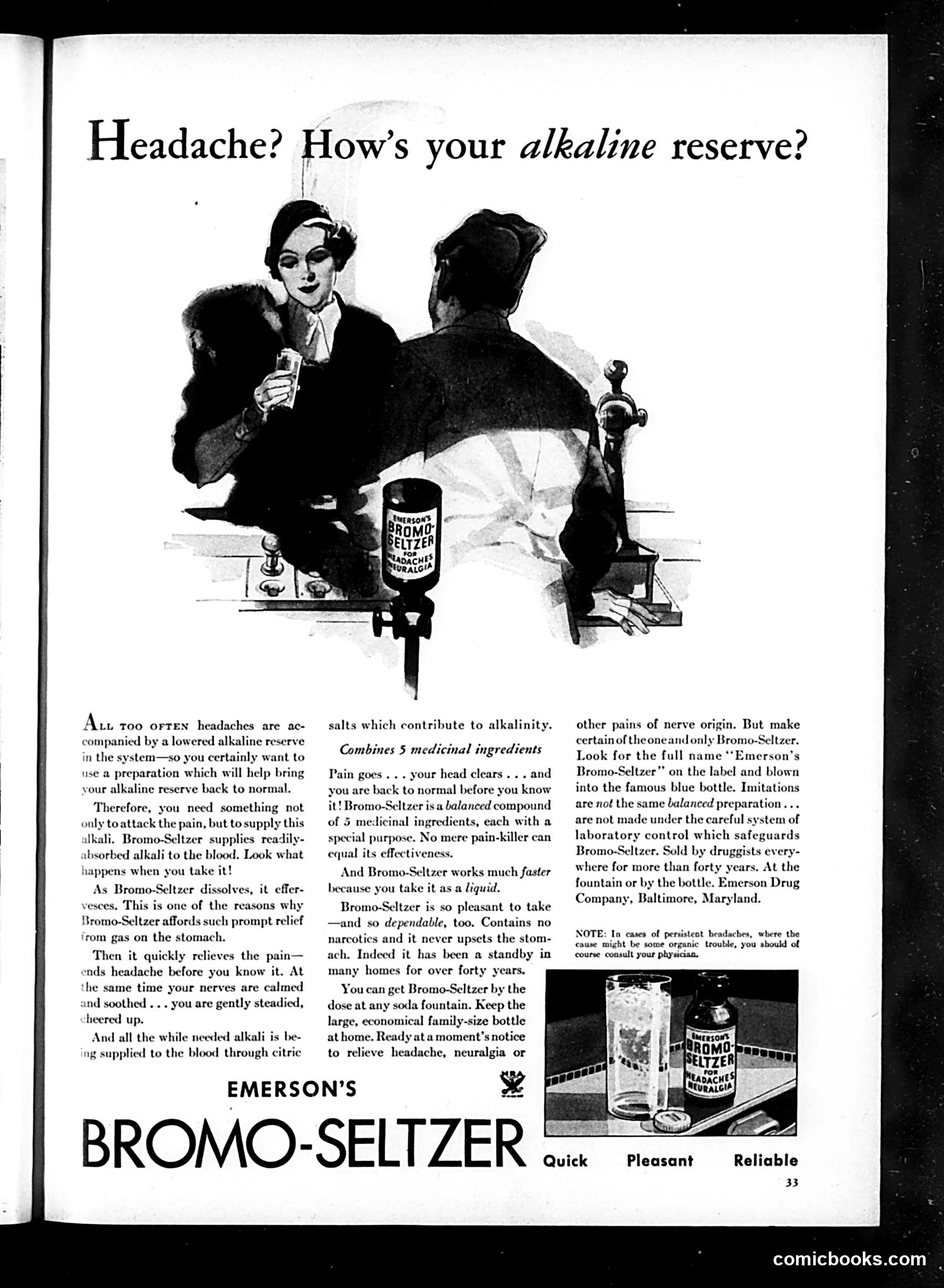
Bromo-Seltzer Advertisement This is primarily a product advertisement rather than political satire. The page promotes Emerson's Bromo-Seltzer, an antacid/pain reliever popular in the early-to-mid 20th century. The illustration depicts a social scene—a well-dressed woman at what appears to be a bar or social gathering, offering Bromo-Seltzer to a man with a headache. The ad's central claim is that headaches result from low "alkaline reserve" in the body's system, and that Bromo-Seltzer uniquely combines five medicinal ingredients to restore alkalinity while relieving pain. The satirical element is subtle: the headline "How's your alkaline reserve?" treats this pseudo-scientific concept as common knowledge, parodying the medicinal jargon and health claims typical of patent medicine advertising of that era. The emphasis on the product being "quick, pleasant, reliable" and available at soda fountains reflects Depression-era marketing aimed at broad audiences. This represents vintage advertising's characteristic blend of pseudoscience and social aspiration.
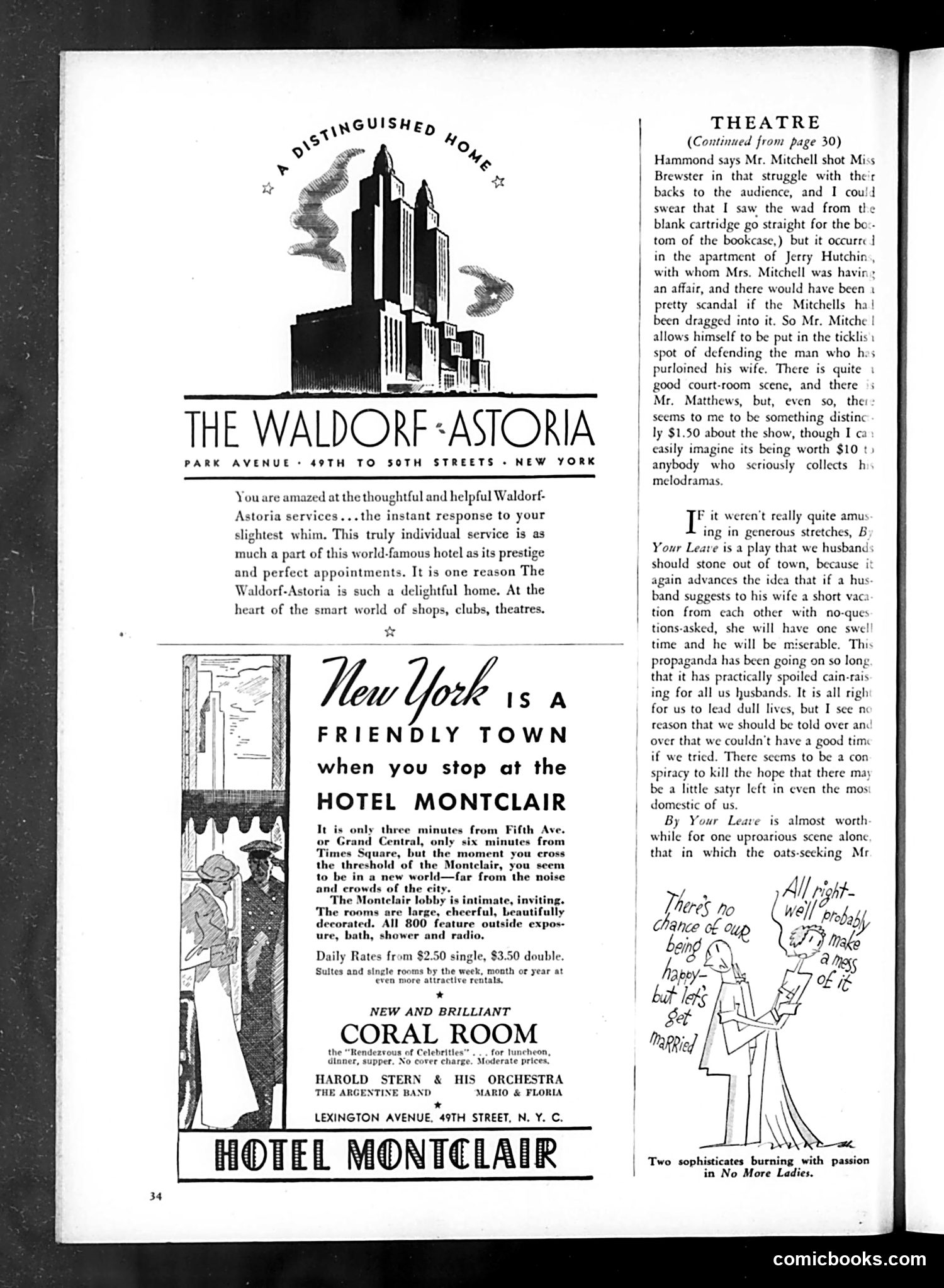
Page Analysis: Life Magazine Theatre Review & Advertisements This page combines theatre criticism with period hotel advertising. The main content is a theatre review (continued from page 30) discussing three Broadway plays: one involving a shooting incident and affair, *Your Leave*, and *No More Ladies*. The critic dismisses much of the content as melodramatic while acknowledging occasional amusing moments. Notably, he critiques *Your Leave* for perpetuating the idea that husbands should accept wives taking vacations away from them—mocking what he sees as anti-husband propaganda that undermines male hope and dignity. The advertisements promote the Waldorf-Astoria and Hotel Montclair as desirable New York lodgings, emphasizing luxury and service. The cartoon sketch at bottom right depicts "two sophisticates burning with passion" from *No More Ladies*—representing the era's interest in romantic/sexual drama as entertainment. The page reflects 1930s attitudes toward marriage, gender relations, and urban leisure.
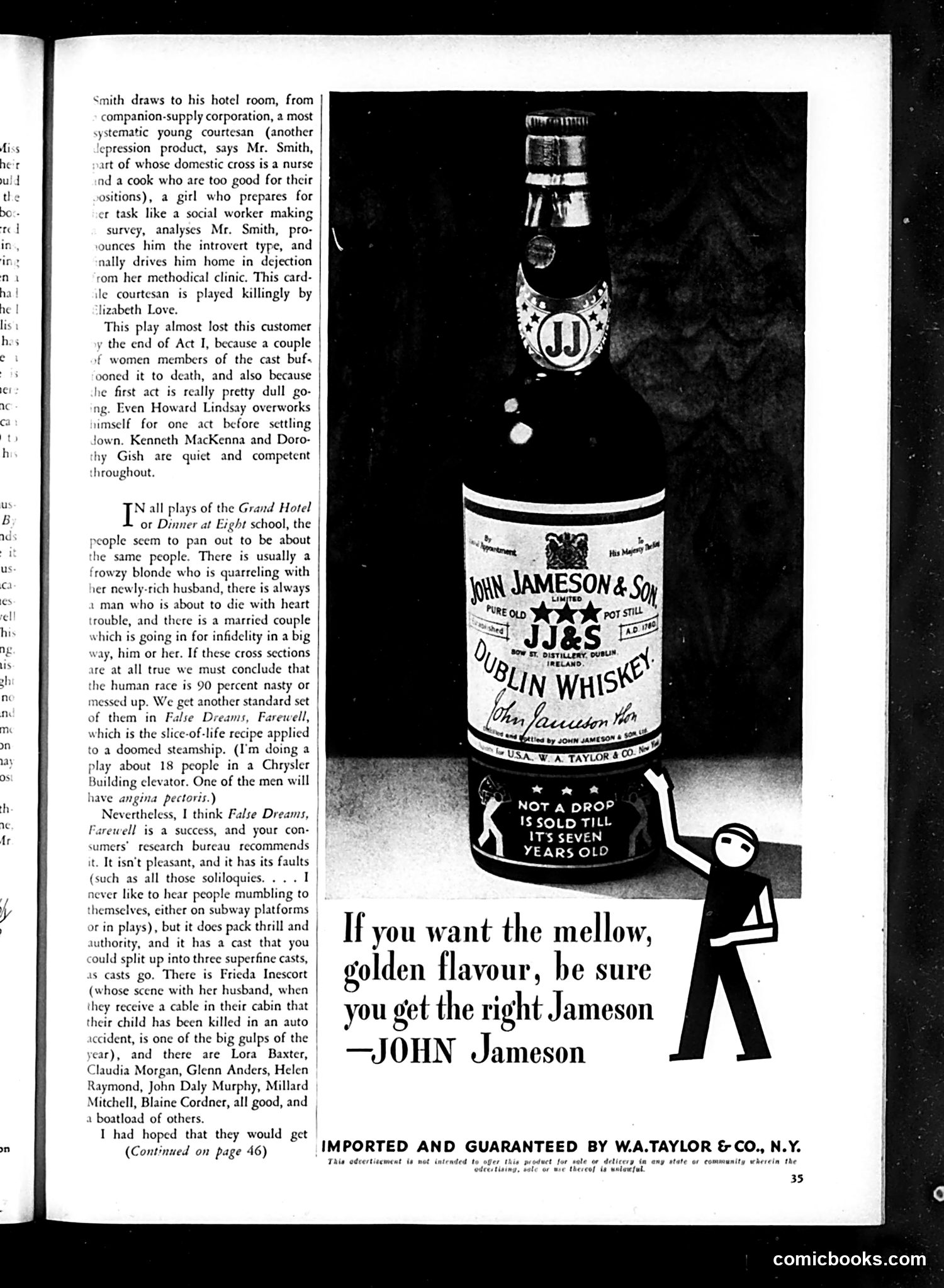
Analysis of Page 35 from Life Magazine This page combines a theater review with a whiskey advertisement. The text discusses plays from the "Grand Hotel" school of drama—formulaic pieces featuring stock characters (troubled marriages, wealthy nouveaux riches, infidelity, death). The reviewer critiques this predictable pattern while recommending "False Dreams, Farewell," praising its cast despite its flaws. The advertisement is for John Jameson Irish Whiskey, imported by W.A. Taylor & Co. The visual shows a bottle with a figure straining to hold it up, illustrating the product's weight and quality. The tagline—"If you want the mellow, golden flavour, be sure you get the right Jameson"—emphasizes authenticity and aging (seven years old). This appears to be a pre-Prohibition or post-Repeal era advertisement (likely 1930s-40s), when alcohol advertising was prominent in American magazines. The juxtaposition of theatrical satire with luxury product marketing was typical of Life's editorial-advertising mix targeting educated, affluent readers.
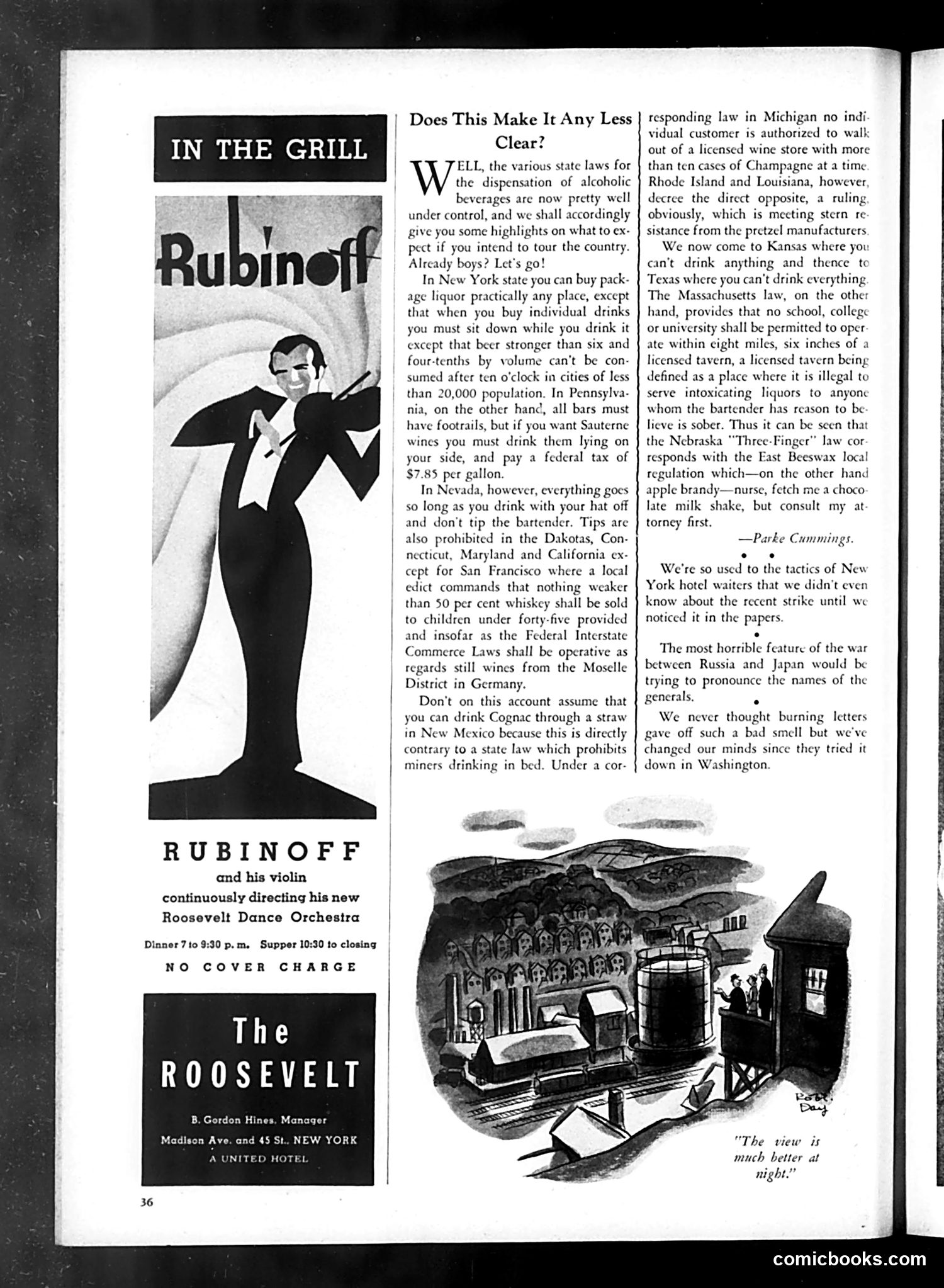
Analysis of This Life Magazine Page This page satirizes the confusing patchwork of state alcohol laws following Prohibition's repeal. The main article, "Does This Make It Any Less Clear?", uses absurdist humor to mock the bewildering and contradictory regulations across different states. The satire lists increasingly ridiculous "laws": New York requires sitting while drinking individual drinks; Pennsylvania mandates footrails but requires drinking Sauternes while lying down; Nevada allows anything if you remove your hat; San Francisco restricts sales to whiskey above 50% proof to children under forty-five. The humor escalates into complete nonsense—Kansas prohibits all drinking while Texas prohibits nothing, and Massachusetts bizarrely defines a licensed tavern as a place where serving sober people is illegal. The left advertisement promotes Rubinoff (a real violinist) and his orchestra at The Roosevelt hotel, capitalizing on the drinking culture the article mocks. The cartoon at bottom right shows a nighttime speakeasy or similar establishment, with the caption "The view is much better at night"—a wink to underground drinking culture persisting despite legal reforms. The page satirizes regulatory chaos and continued social tolerance of alcohol despite official contradictions.
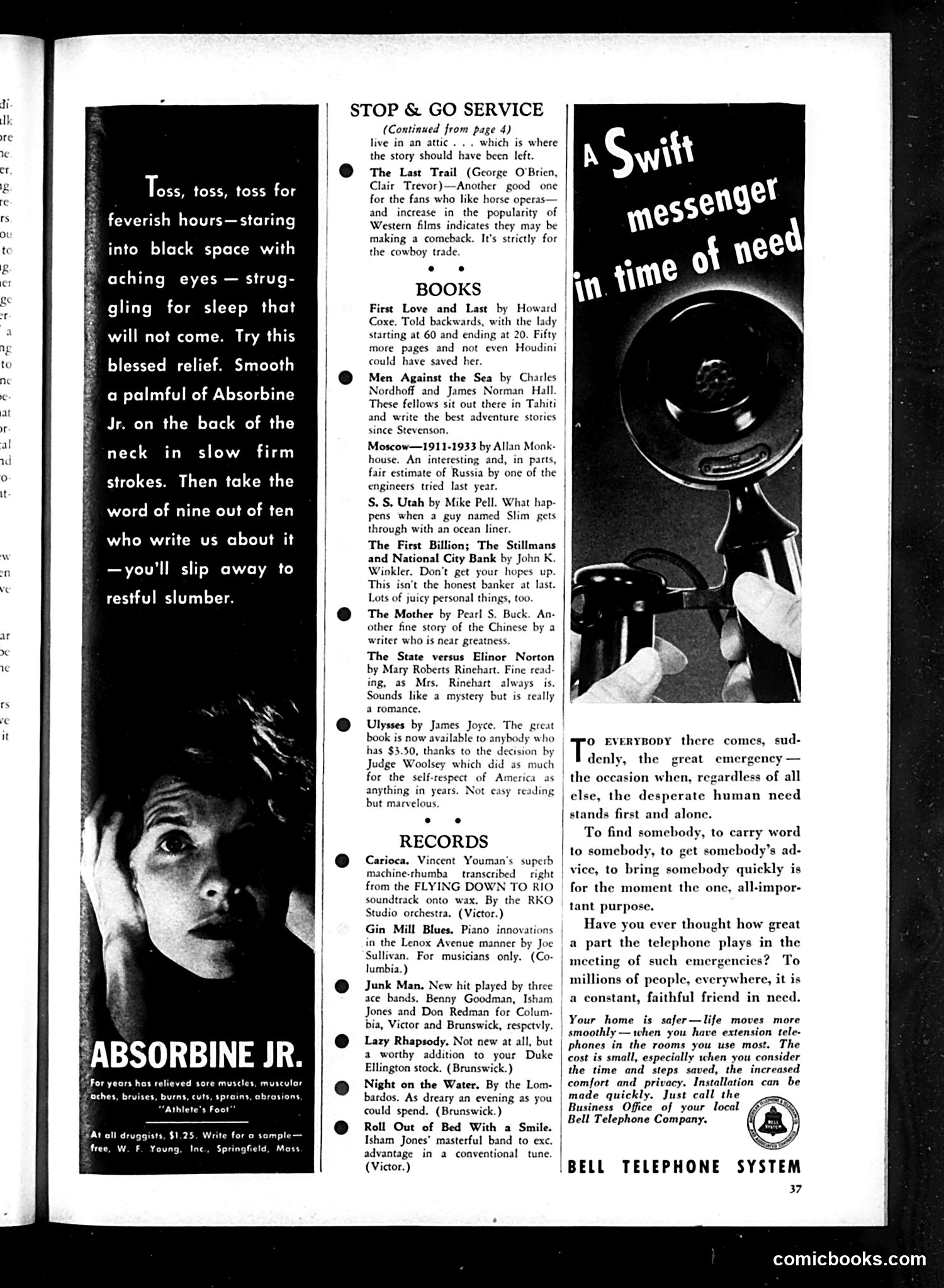
Page Analysis: Life Magazine Advertisement Section This page contains primarily advertisements and entertainment listings, not political satire. The left side features an Absorbine Jr. advertisement targeting insomniacs—promoting a topical liniment applied to the neck as a sleep aid. The accompanying image shows a distressed face staring into darkness, meant to depict sleeplessness. The center contains "Stop & Go Service," a film and entertainment review section covering: - Western films (noting their resurgence in popularity) - Book reviews (including Pearl Buck's Chinese stories and James Joyce's *Ulysses*, recently made legally available following Judge Woolsey's 1933 decision) - Record releases (popular music from films and performers like Duke Ellington and Benny Goodman) The right side showcases a Bell Telephone System advertisement emphasizing the telephone's importance during emergencies and promoting home extension phones. For modern readers: this reflects 1930s consumer culture, entertainment trends, and the significance of the *Ulysses* obscenity ruling—a landmark free speech victory.
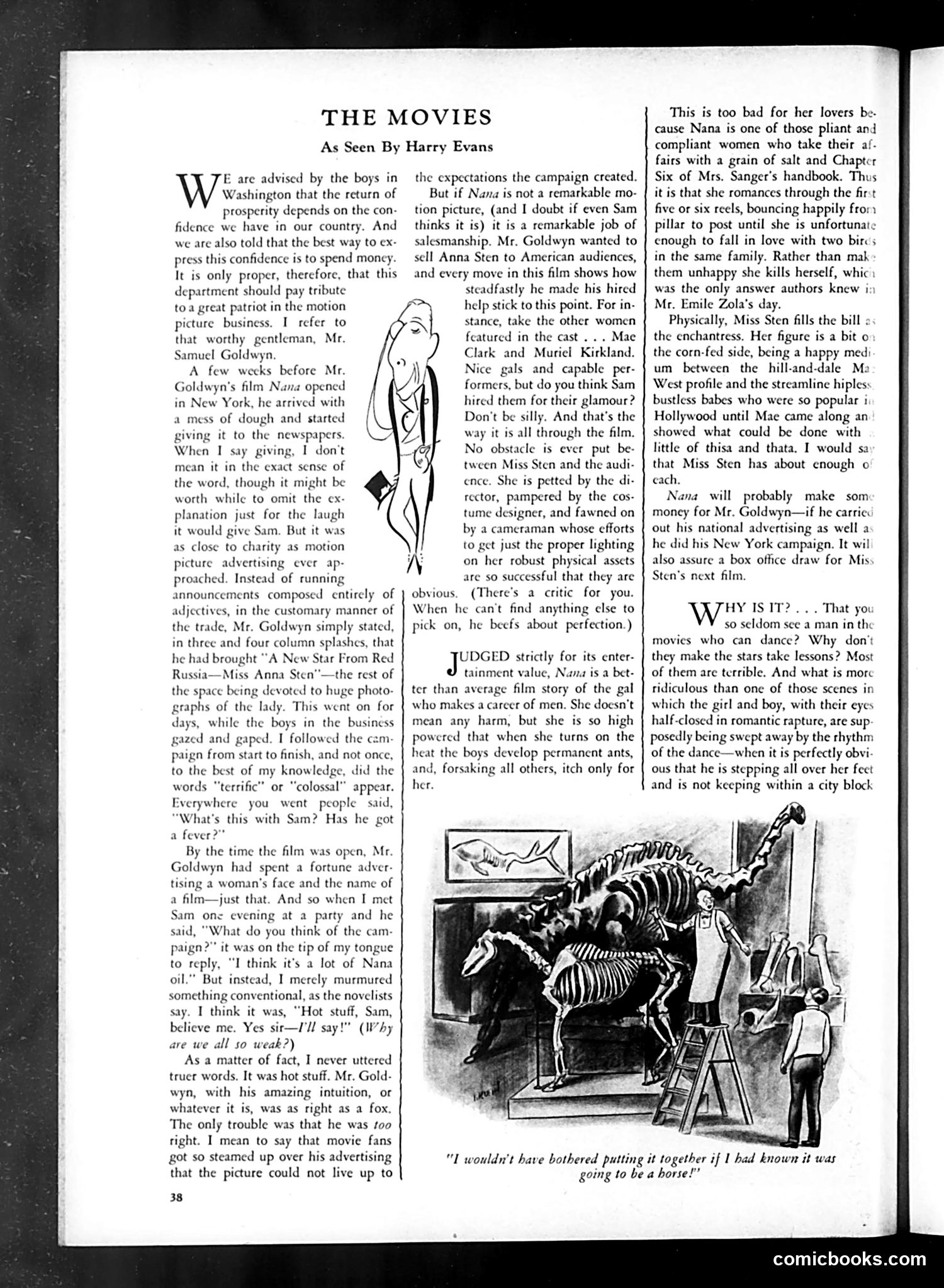
Analysis: "The Movies As Seen By Harry Evans" This is a film criticism column satirizing producer Samuel Goldwyn's marketing campaign for *Nana* (1930), starring Russian actress Anna Sten. The satire: Goldwyn spent lavishly advertising Sten's face and name rather than using industry-standard hyperbole ("terrific," "colossal"). The critic praises this restraint as brilliant salesmanship—yet notes it backfired: audiences' inflated expectations exceeded the film's actual quality. The cartoon (lower left) depicts a skeleton being assembled, captioned "I wouldn't have bothered putting it together if I had known it was going to be a horse!" This lampoons shoddy filmmaking: the elaborate promotional campaign couldn't disguise a weak product. The broader point: The column mocks both Goldwyn's cynical manipulation of public taste and the public's gullibility. It's satirizing 1920s-30s Hollywood's ability to sell glamour over substance through aggressive advertising—a commentary on consumerism dressed as patriotic duty ("spend money").
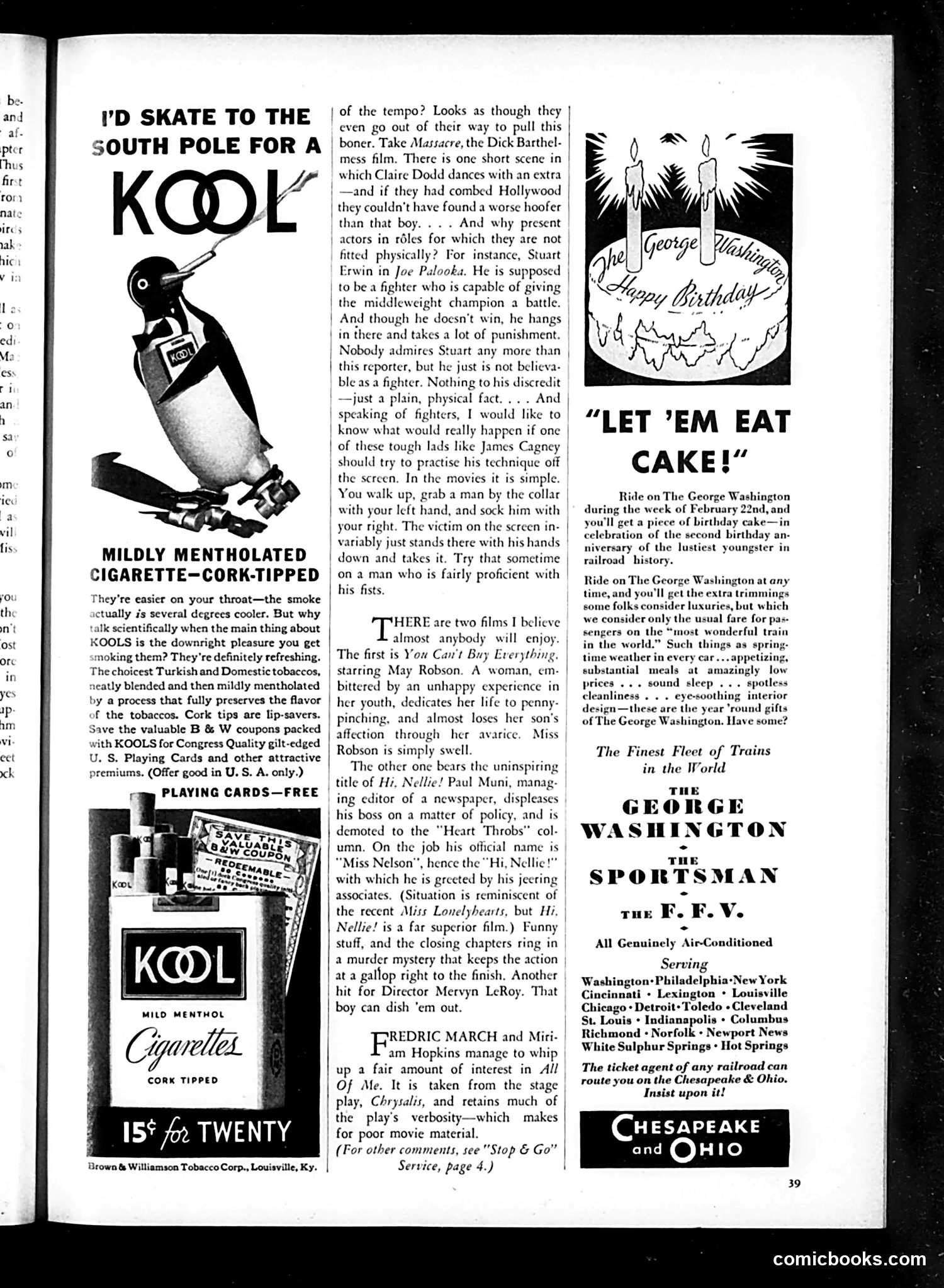
Page Analysis: Life Magazine (circa 1932) This is primarily advertising content, not editorial satire. The dominant feature is a Kool cigarettes advertisement showing a penguin mascot "skating to the South Pole" for menthol cigarettes—a nonsensical visual gag promoting the product's cooling properties. The text discusses film reviews, criticizing casting choices in contemporary movies (*Joe Palooka*, *Massacre*). The reviewer argues actors are poorly suited physically to their roles—notably criticizing Stuart Erwin as an unconvincing boxer. A secondary ad celebrates the S.S. *George Washington* ship's birthday (apparently its second anniversary) with cake promotions. The satirical edge is minimal here; the "South Pole" penguin is merely a whimsical marketing device playing on mentholation's "cooling" sensation. This reflects 1930s advertising style: surreal humor combined with product promotion rather than social or political commentary. The page demonstrates how Life blended editorial content with advertisement revenue.
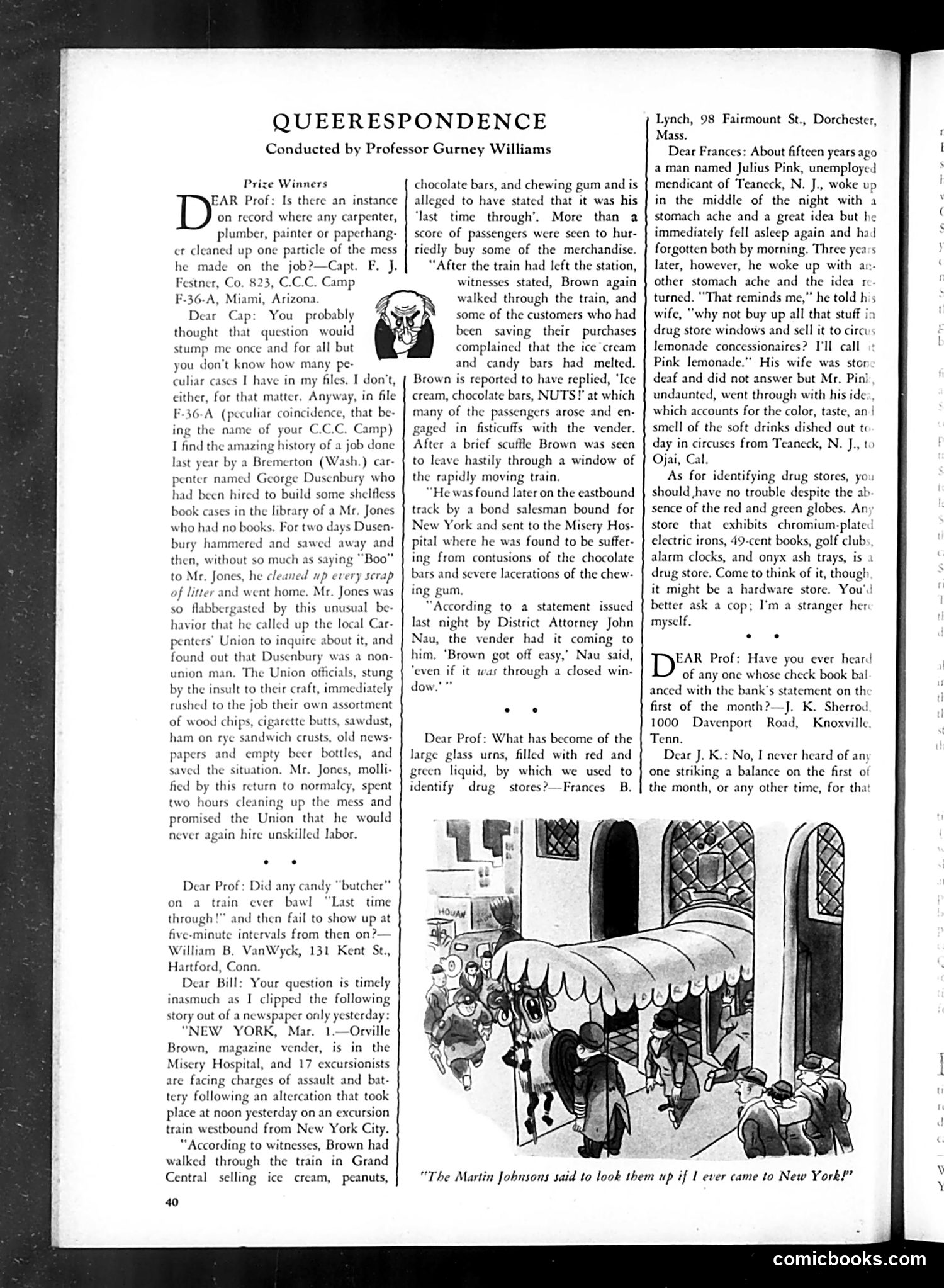
Explanation for Modern Readers This page from *Life* magazine's "Queerespondence" column presents humorous reader questions and answers about everyday oddities. The main cartoon depicts a street vendor scene, likely illustrating the story about Orville Brown, the train candy seller. The joke centers on a common annoyance: a vendor announces "last time through!" to pressure customers into buying perishable goods, then reappears moments later—the train has left the station and ice cream has melted. When customers complain, Brown insults them ("NUTS!"), sparking a brawl that ends with him diving through a moving window. The satire targets both consumer deception and working-class behavior. The absurd violence and the District Attorney's callous response ("Brown got off easy") exaggerate the situation for comedic effect. Other letters address similarly mundane but frustrating experiences: tradesmen never cleaning up job sites, and the disappearance of distinctive glass urns that once marked drugstores. The humor relies on readers recognizing these common irritations from Depression-era daily life.
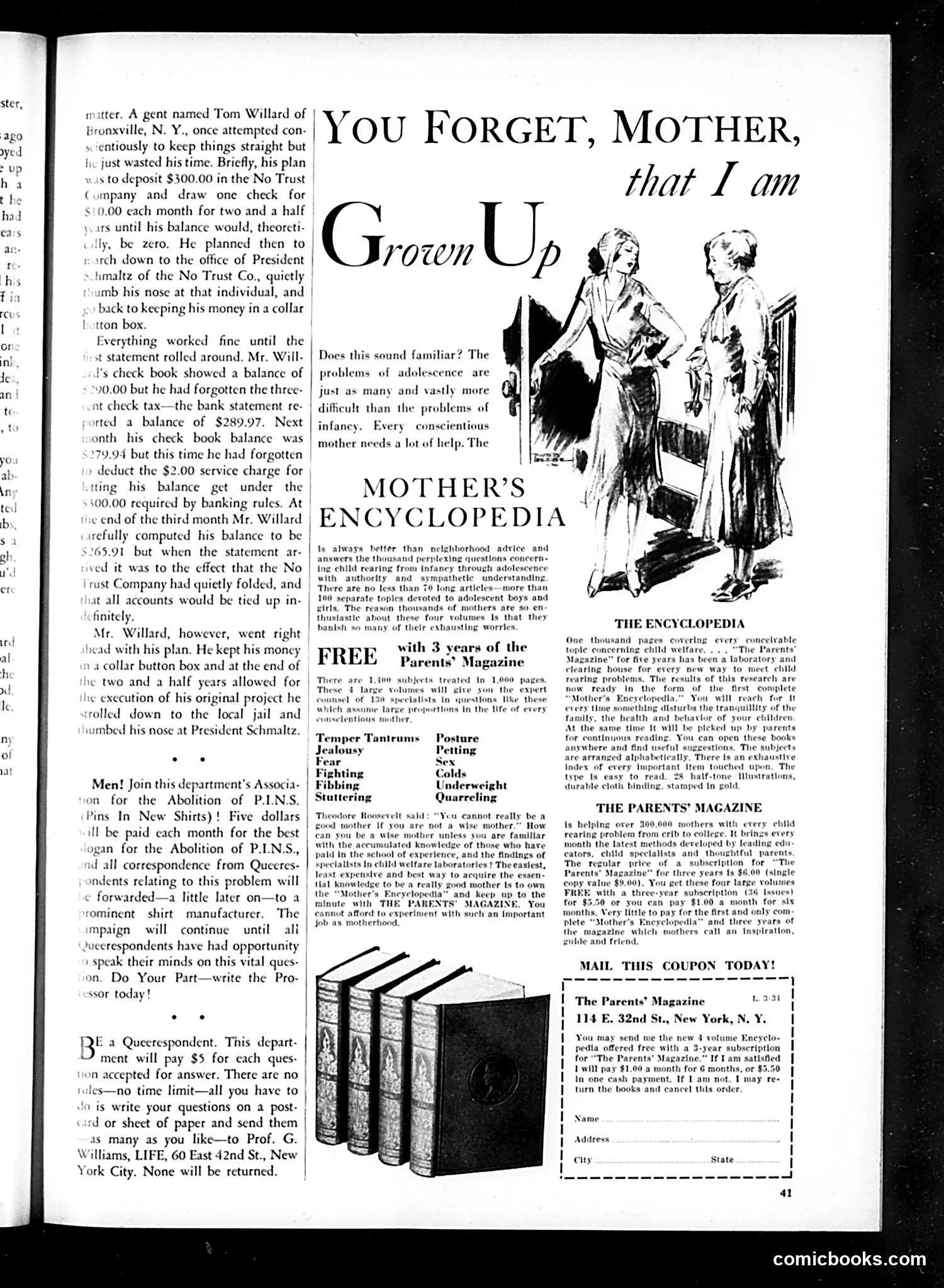
Analysis of Life Magazine Page This page is primarily advertising rather than a political cartoon. It contains two main elements: 1. Tom Willard anecdote (left column): A satirical story about banking frustrations. Willard attempts to carefully manage his account through systematic withdrawals, but repeatedly fails due to overlooked fees and service charges. The joke: despite his meticulous planning, the bank's hidden costs and complexity defeat him—he ends up in jail. This mocks the opacity and frustration of early 20th-century banking systems and their fees. 2. Mother's Encyclopedia advertisement (right side): A full-page ad promoting a four-volume parenting guide, positioned as superior to "neighborhood advice." It emphasizes expert knowledge for handling adolescent problems. The page also includes calls for readers to join campaigns against P.I.N.S. (pins in new shirts) and solicits questions for a advice column. The overall tone is lighthearted satire of modern life's small but persistent irritations.
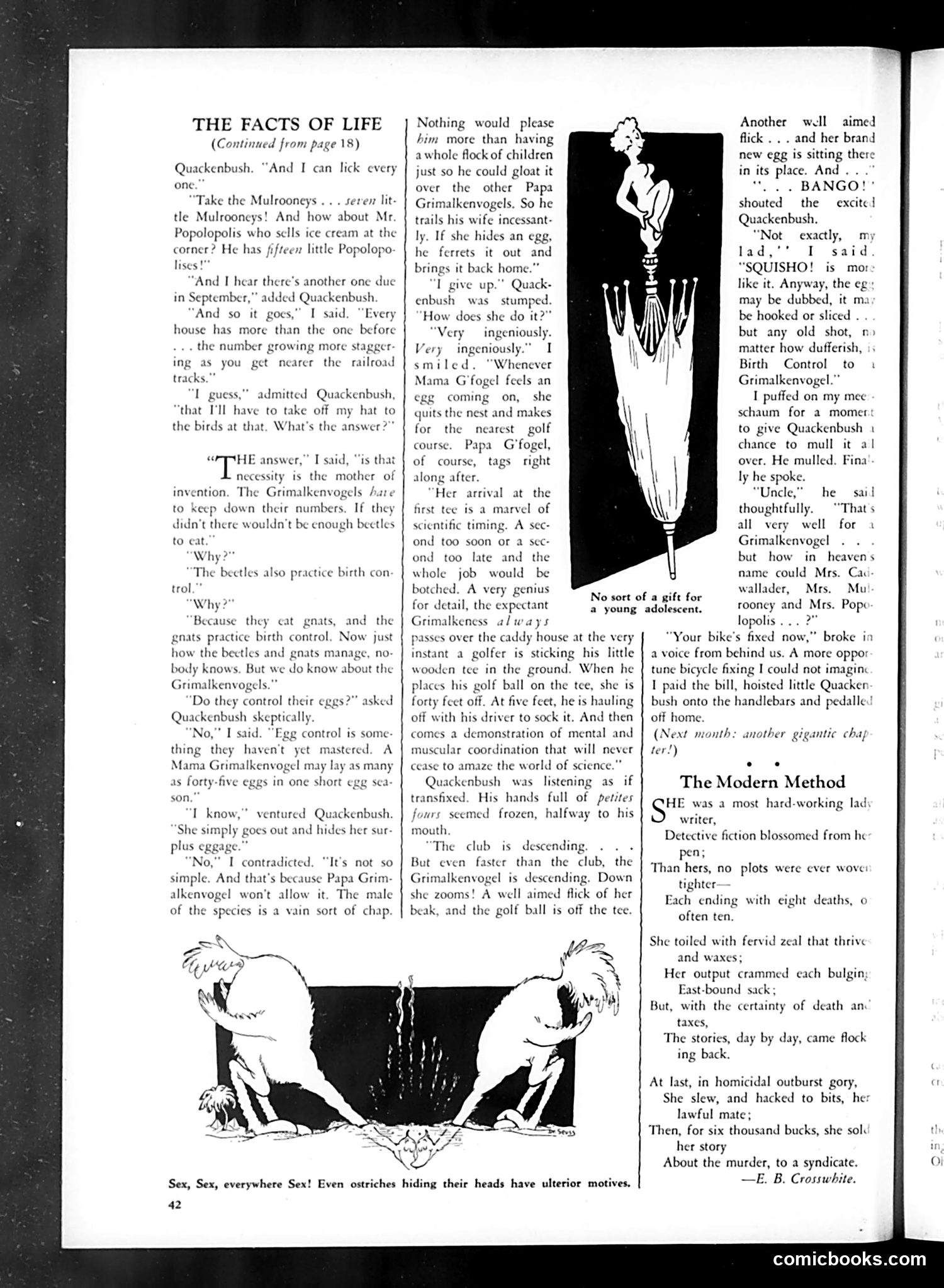
Satire Analysis: "The Facts of Life" This is a humorous fable about birth control disguised as natural history. A narrator explains to a boy named Quackenbush how fictional birds called "Grimalkenvogels" manage population through an elaborate scheme: the female bird times her egg-laying to coincide precisely with a golfer's swing, depositing her egg where the golf ball was—a metaphorical "solution" to overpopulation. The satire targets 1920s anxieties about large families and working-class fertility. References to families like "the Mulrooneys" and "Popolopolis" (suggesting ethnic working-class immigrants) having many children reflect contemporary concerns. The absurdist golf-course mechanism is intentionally ridiculous—the real point is that even nature practices "birth control," making the concept seem natural and inevitable rather than morally suspect. The final panel's caption—"Sex, Sex, everywhere Sex! Even ostriches hiding their heads have ulterior motives"—confirms the double meaning: this seemingly innocent nature story is actually about reproductive control.
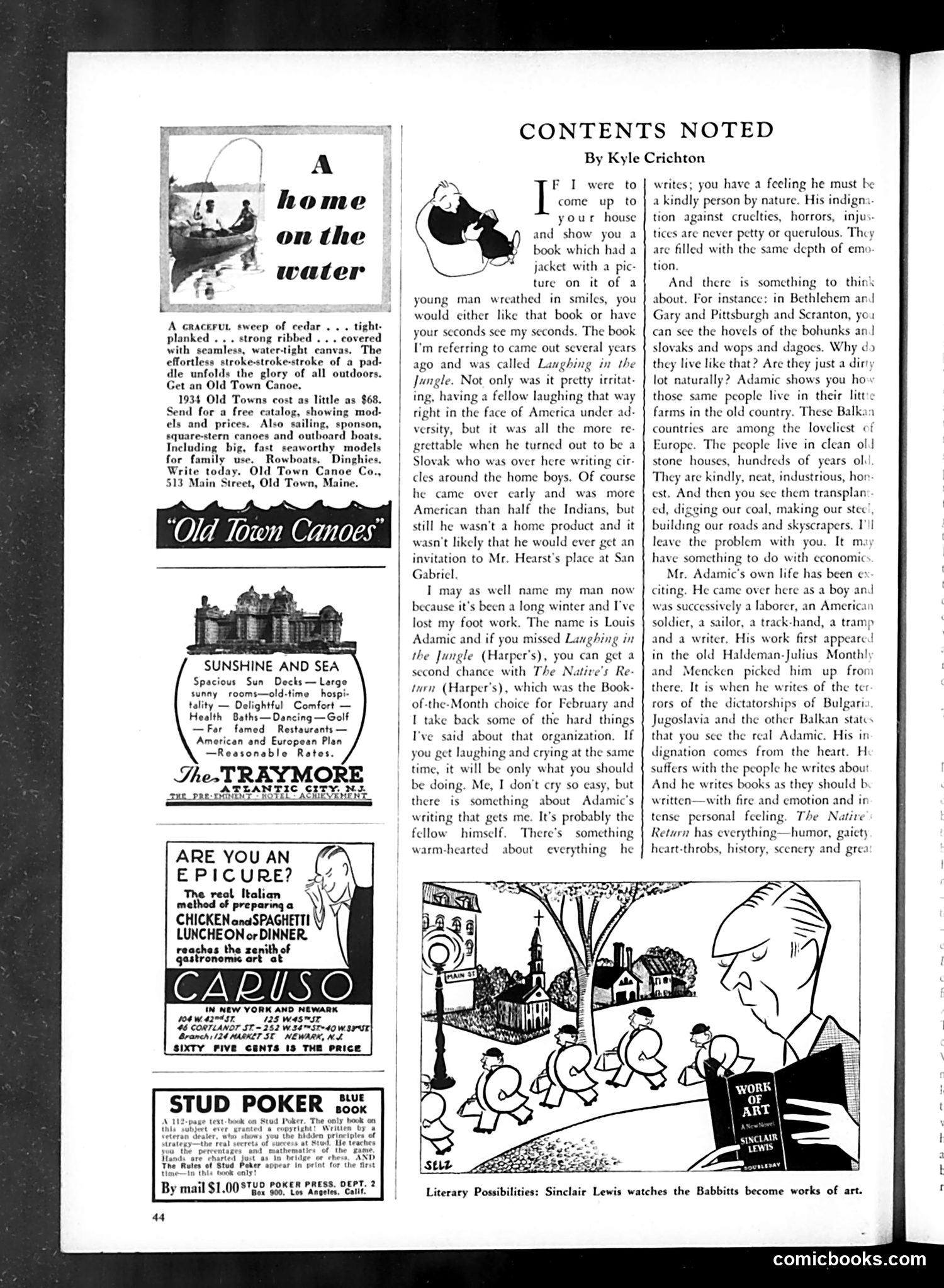
Contents Noted: A Review of Louis Adamic's Work This page features Kyle Crichton's book review column discussing Slovak-American writer Louis Adamic and his works *Laughing in the Jungle* and *The Native's Return*. Crichton initially expressed annoyance at Adamic's first book—irritated that a Slovak immigrant (rather than a native-born American) was writing successful social commentary. However, Crichton reconsiders, praising Adamic's genuine compassion and keen observations about Eastern European immigrant laborers in American industrial cities (Gary, Pittsburgh, Scranton, Bethlehem). The review contrasts immigrants' dignified lives in their Balkan homeland—living in centuries-old stone houses—with their degraded circumstances in America, working as coal miners and manual laborers. Crichton credits Adamic with raising important social questions about economic conditions rather than blaming immigrant character. The cartoon below (captioned "Literary Possibilities") depicts Sinclair Lewis watching crude figures becoming "works of art"—likely satirizing how literary figures transform raw American experience into artistic commentary.
Page Analysis This page is primarily advertising and book reviews, not political cartoons. The text discusses Alexander Woollcott's radio broadcasts (criticized as inferior to his written work) and compares two historical novels about Edward VII's era (1901-1910). The reviewer notes that André Maurois's *The Edwardians* and Esme Wingfield-Stratford's *The Victorian Aftermath* contain suspiciously similar anecdotes, suggesting possible plagiarism, though he acknowledges this may be coincidental. The advertisements dominate the page, promoting the Park Lane Hotel, Longchamps restaurant, and a cocktail recipe book ("1001 Drinks"). No political cartoon or satirical illustration is visible. The only image is a photograph of a hotel room. The page reflects 1930s consumer culture and literary commentary rather than political satire.
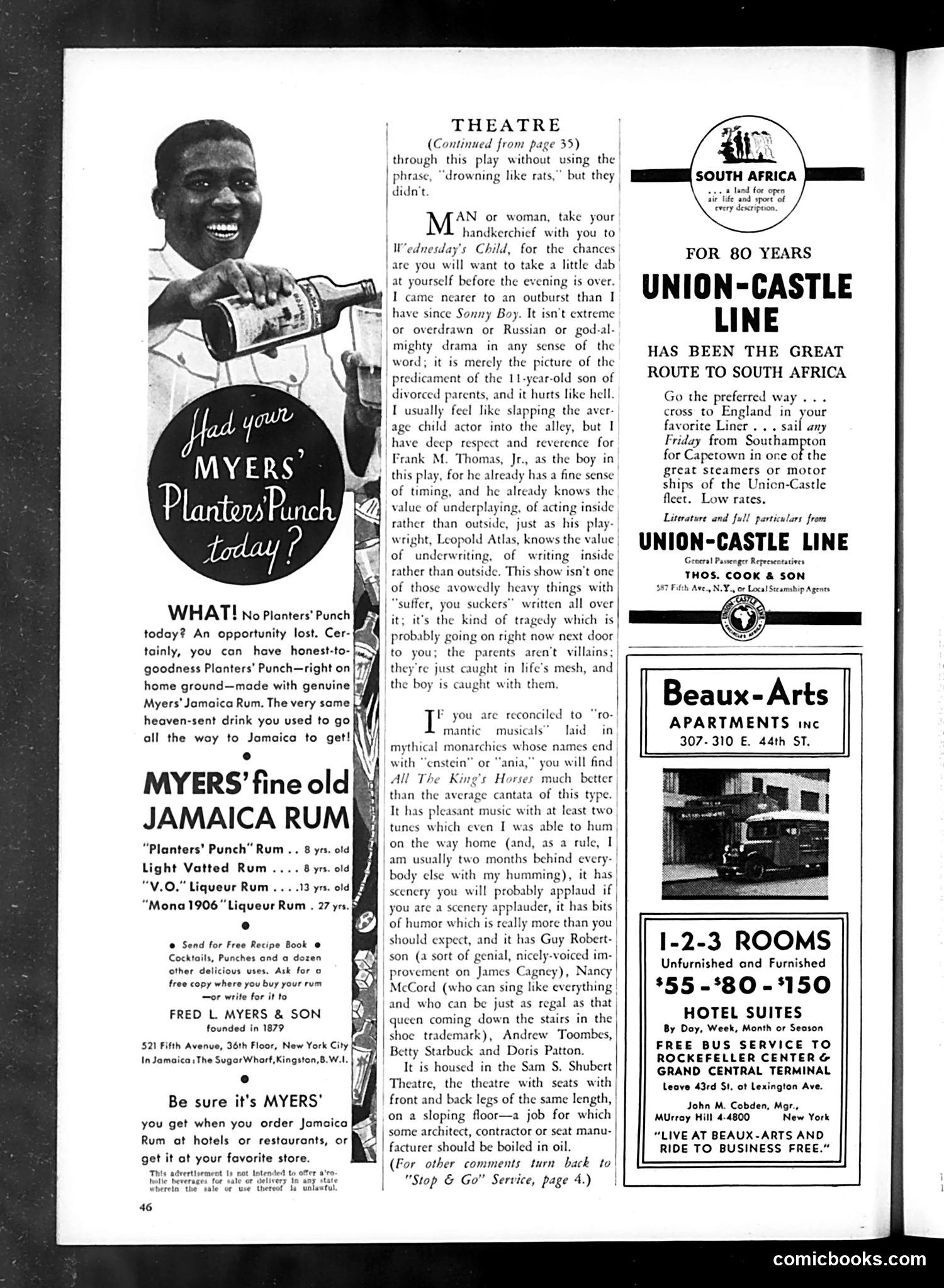
Analysis of Life Magazine Page Content This page is primarily advertising and theatre reviews, not political satire or comics. Left side: A Myers' Jamaica Rum advertisement featuring a smiling Black man holding a bottle, promoting "Planters' Punch" cocktails. The ad emphasizes that genuine Myers' rum—previously requiring travel to Jamaica—is now available domestically. Center: A theatre review (continued from page 35) discussing three Broadway productions: *Wednesday's Child* (praised for its understated acting by child actor Frank M. Thomas, Jr., depicting divorce's impact); *All The King's Horses* (a musical with pleasant tunes); and a theatre featuring notably equal-length front and back chair legs on a sloping floor. Right side: Advertisements for the Union-Castle shipping line (South Africa route) and Beaux-Arts Apartments in New York. The page reflects 1930s entertainment and leisure advertising, with no apparent satirical content.
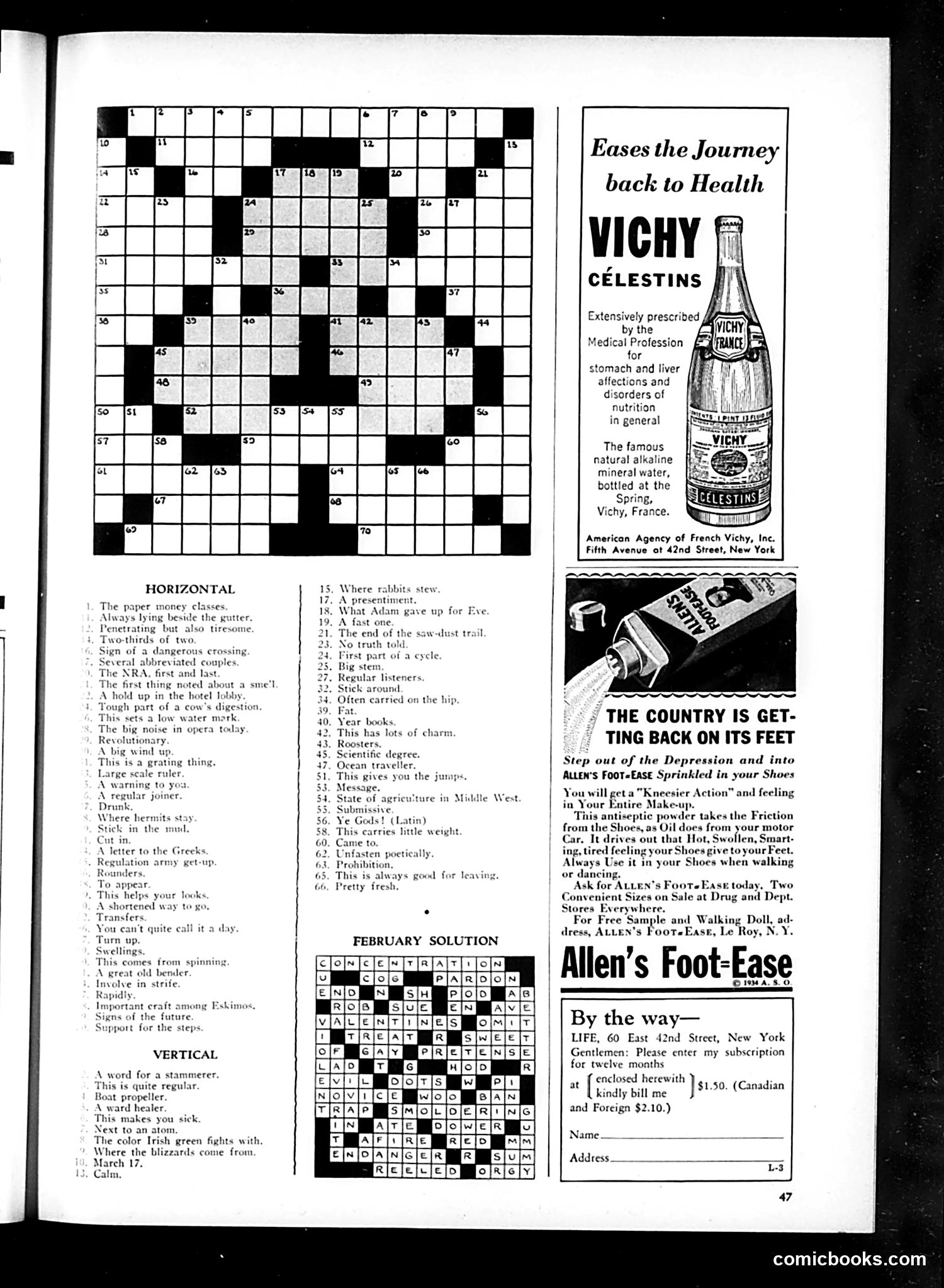
Page Analysis This page from *Life* magazine consists primarily of a crossword puzzle with its solution, along with vintage advertisements rather than political cartoons or satire. The advertisements are notable for their Depression-era messaging: 1. Vichy Céléstins mineral water claims to ease "the journey back to Health," positioning the product as a digestive aid for stomach and liver ailments. 2. Allen's Foot-Ease powder uses the slogan "The Country is Getting Back on Its Feet"—a play on words connecting foot care to economic recovery from the Great Depression. The ad promises relief from "Hot, Swollen, Smart-tired feeling" and suggests this antiseptic powder helps people return to normal walking and dancing activities. Both ads employ optimistic rhetoric about recovery and normalcy, reflecting the period's anxieties about health and economic hardship. The crossword puzzle itself contains clues referencing contemporary concerns (NRA, Prohibition) but contains no overt political satire on this particular page.
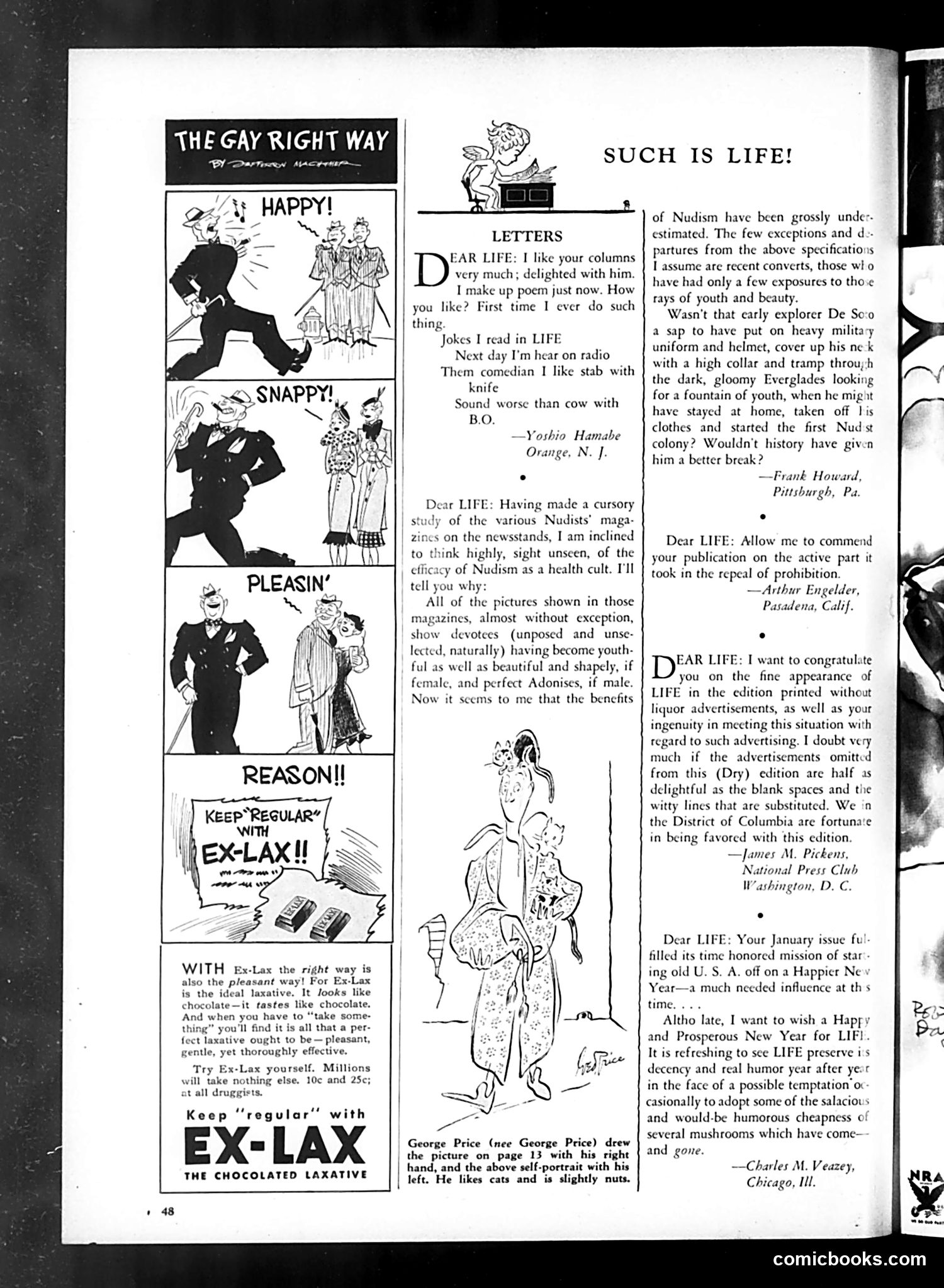
"The Gay Right Way" — Ex-Lax Advertisement & Letters Page Left side: A vintage laxative ad for Ex-Lax using crude humor. "The Gay Right Way" shows a man in various states of digestive distress—"HAPPY!", "SNAPPY!", "PLEASIN'"—alongside well-dressed couples, suggesting the product restores one's social presentability and mood by solving constipation discreetly. Right side: A letters column addressing contemporary 1930s-40s issues. Readers discuss nudism (sarcastically praising its supposed youth-giving effects), Prohibition's repeal (commending *Life* magazine's role), and the magazine's decision to print alcohol-free editions for D.C. readers—reflecting real regional drink laws. One letter praises *Life* for maintaining "decency and real humor" amid commercial pressures. The tone is earnest, satirical, and self-congratulatory about the magazine's editorial values.