life
Life — April 1934
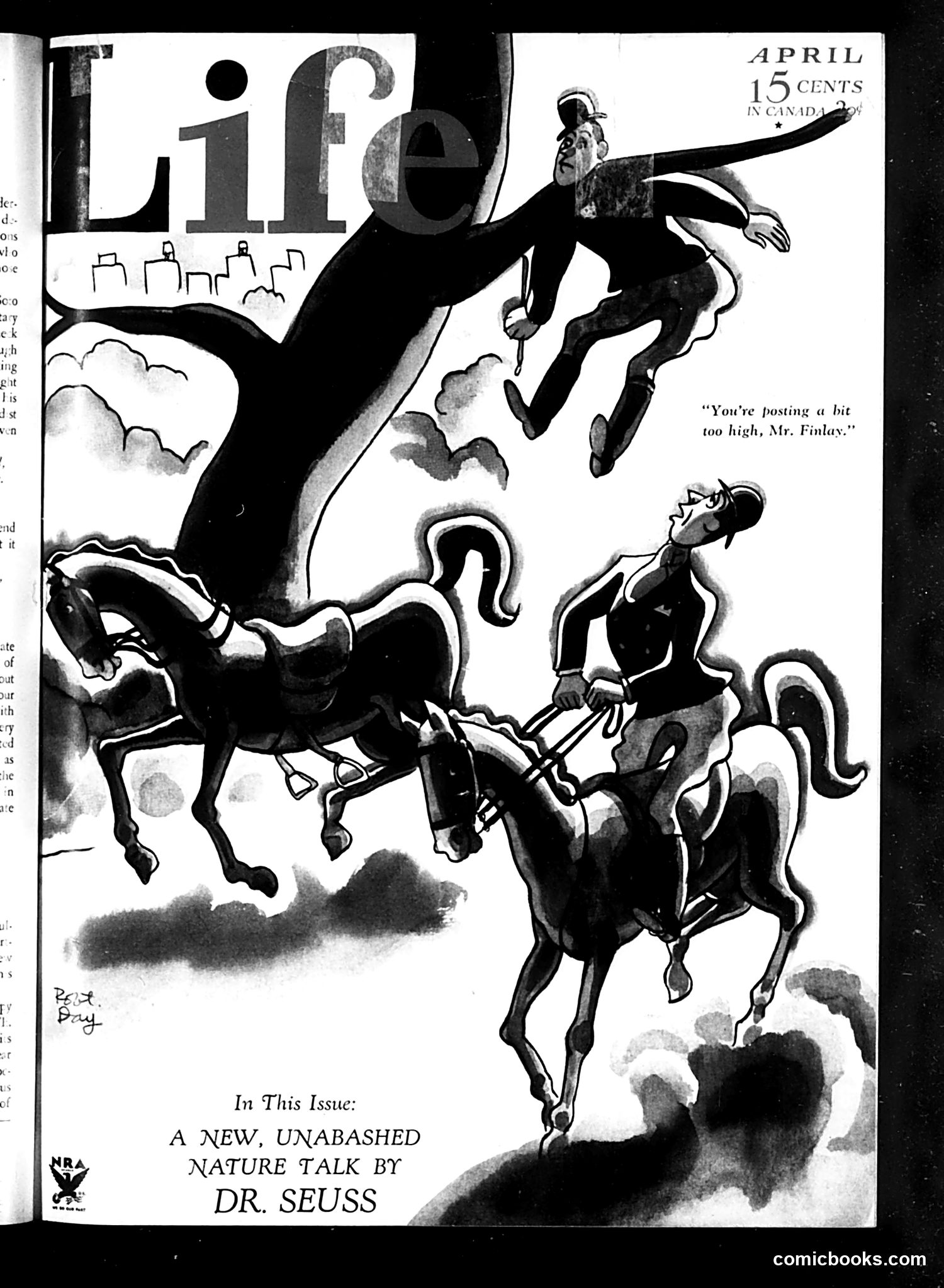
Life Magazine Cover Analysis (April, 15 cents) This is a satirical cover illustration by Peter Arno depicting a man on horseback being bucked off while riding wildly through clouds. The quote "You're posting a bit too high, Mr. Finlay" suggests the rider is overreaching—"posting too high" is equestrian terminology meaning sitting improperly in the saddle, but here functions as metaphor for ambition exceeding one's ability. The figure appears to be named Finlay, though his specific identity is unclear without additional context. The chaotic scene with rearing horses suggests financial or political instability—likely referencing someone whose overconfidence led to a dramatic fall during this April period (year unclear from image alone). The cover advertises "A New, Unabashed Nature Talk by Dr. Seuss" inside.
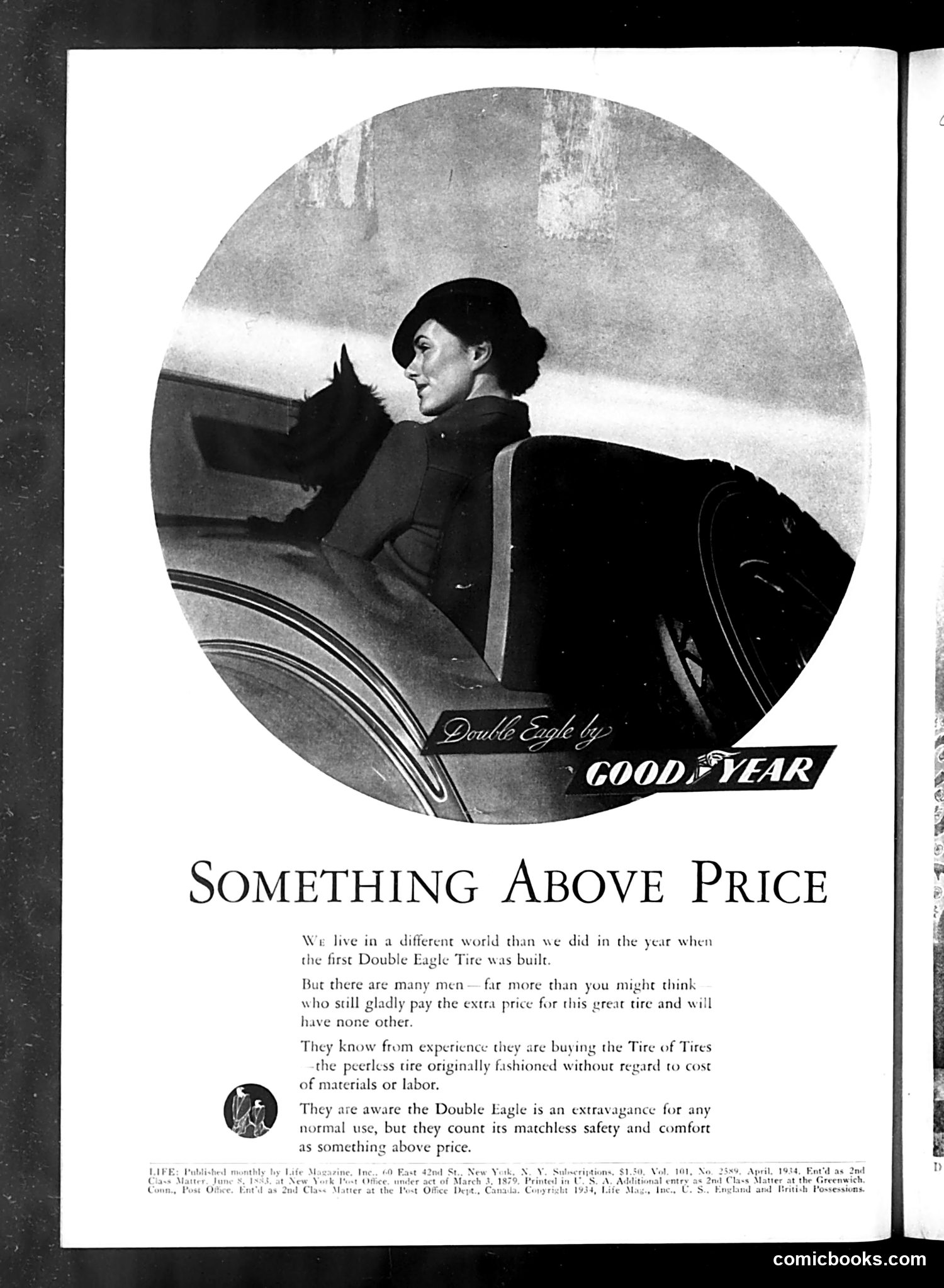
This is a Goodyear tire advertisement, not political satire. The ad features a woman in profile viewing what appears to be a tire display, with the headline "Something Above Price." The advertisement argues that while times have changed since the original Double Eagle tire was created, many consumers will pay extra for superior quality and safety. The copy emphasizes that the Double Eagle represents "the Tire of Tires—the peerless tire originally fashioned without regard to cost of materials or labor." The ad positions premium tire quality as a value proposition beyond mere cost considerations—appealing to buyers who prioritize safety and comfort. This reflects 1920s-1930s marketing strategies that emphasized product superiority and prestige rather than price competition.
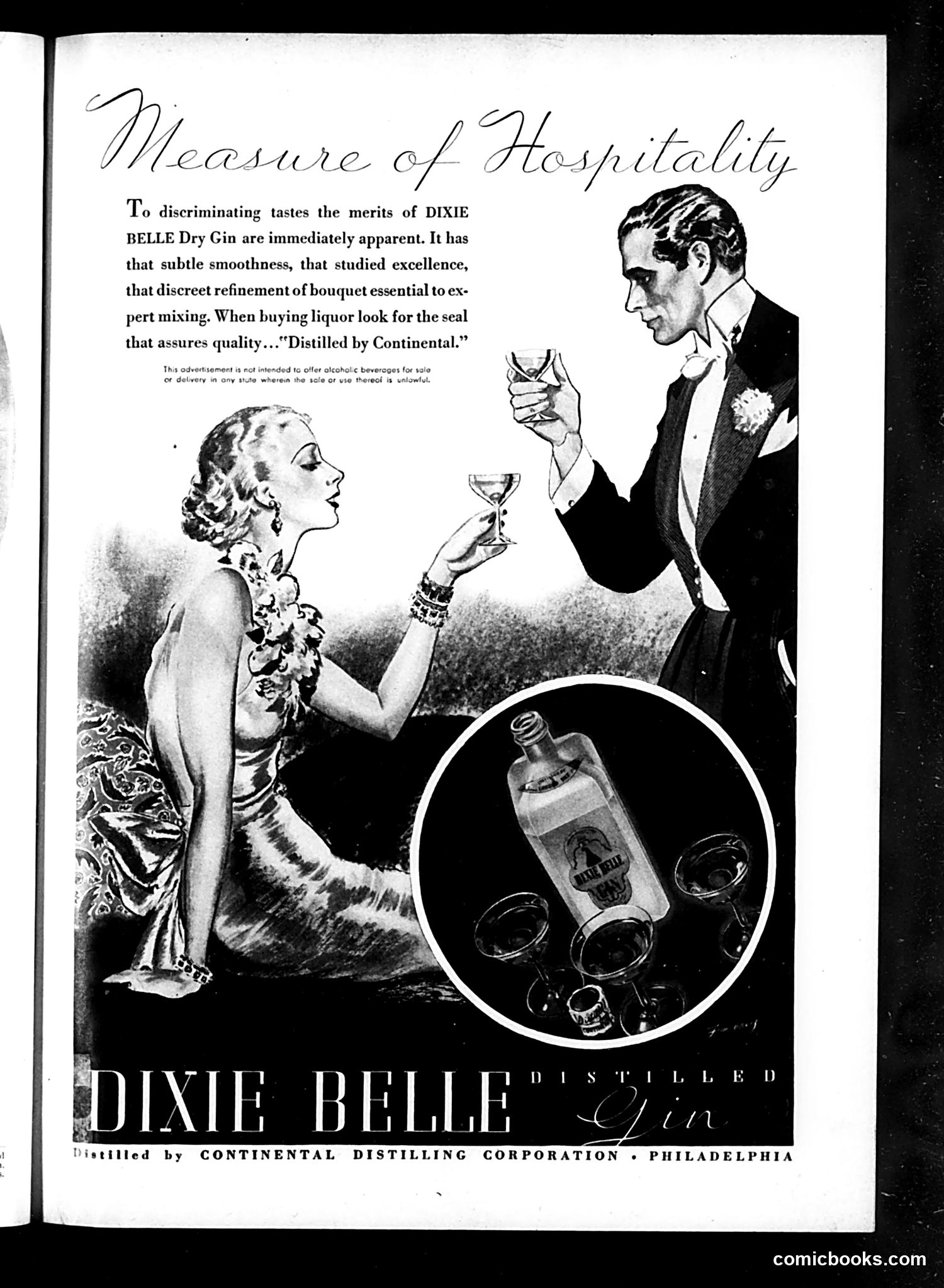
Dixie Belle Gin Advertisement Analysis This is a gin advertisement, not political satire. It depicts a luxurious social scene titled "Measure of Hospitality" showing an elegantly dressed couple at what appears to be a cocktail party. The man in formal wear offers a drink to a woman in evening dress. The ad emphasizes DIXIE BELLE Dry Gin's quality—its "subtle smoothness" and "studied excellence"—positioning it as a mark of refined entertaining and good taste. The circular inset shows the bottle and glasses. Historical context: This advertisement dates from the Prohibition era (1920-1933), when such liquor ads were illegal in America. The small disclaimer text indicates this was likely published in a magazine outside the U.S. or represents pre-Prohibition material.
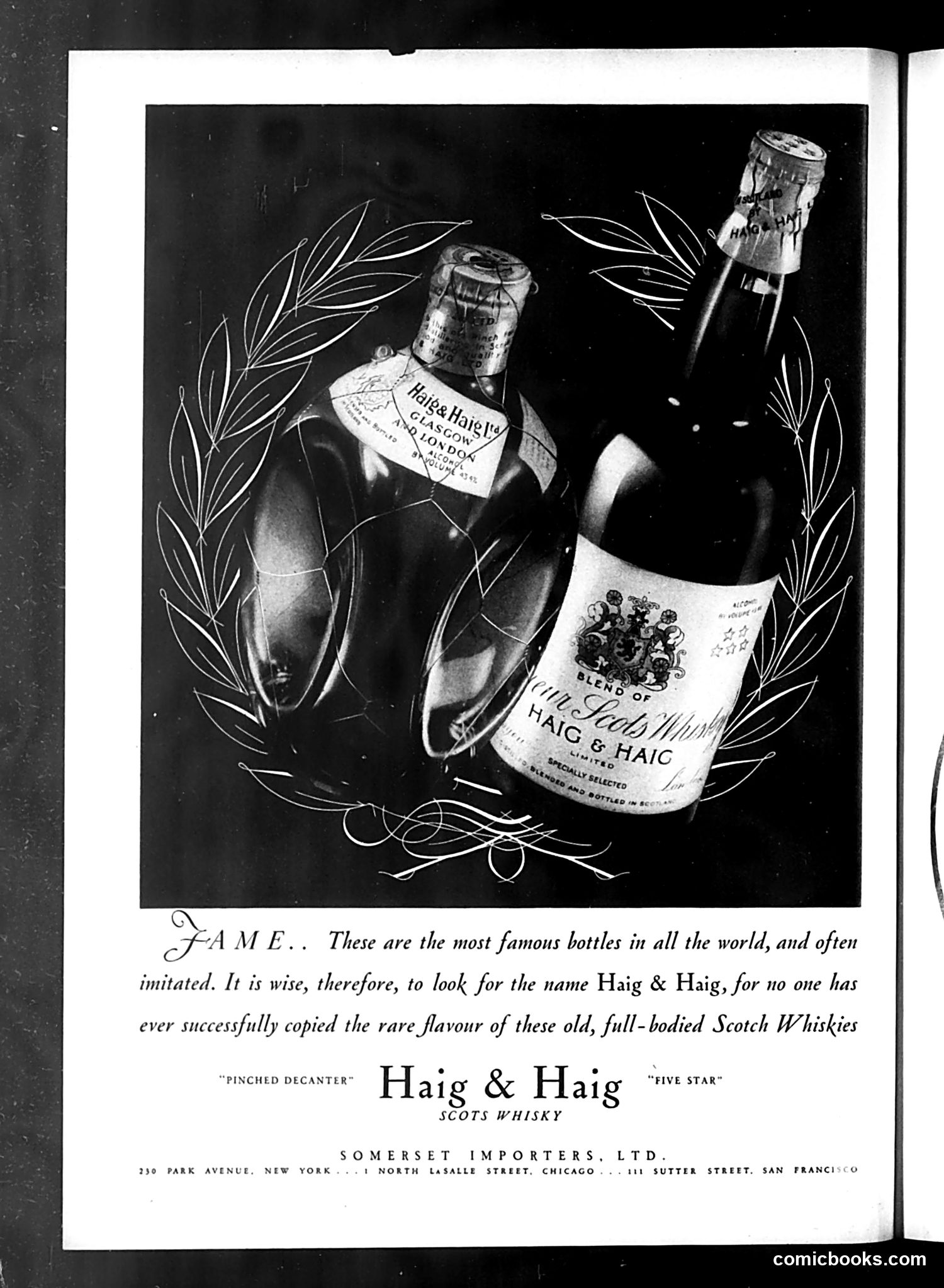
Haig & Haig Scotch Whisky Advertisement This is a commercial advertisement, not political satire. It promotes Haig & Haig Scotch Whisky, featuring two bottles arranged decoratively with laurel wreaths in a black-and-white photograph. The ad's sales pitch emphasizes brand authenticity and prestige: the text warns consumers that these are "the most famous bottles in all the world, and often imitated," advising buyers to look specifically for the "Haig & Haig" name because no competitor has successfully replicated "the rare flavour of these old, full-bodied Scotch Whiskies." Two varieties are shown: "Pinched Decanter" and "Five Star." The importer is Somerset Importers, Ltd., with offices in New York, Chicago, and San Francisco. This appears to be vintage pre-WWII advertising emphasizing brand recognition and anti-counterfeiting—common marketing concerns for premium imported spirits.
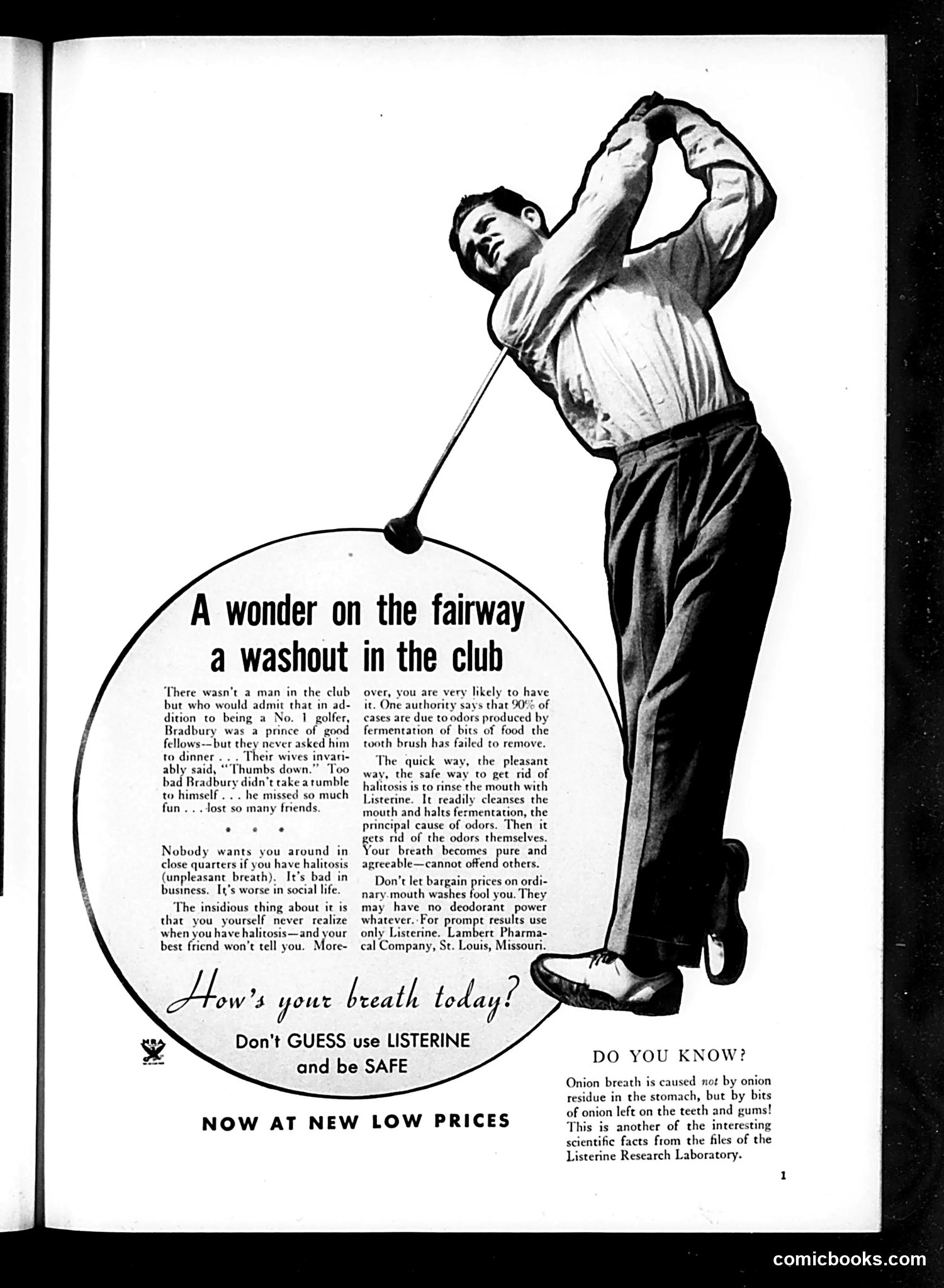
Listerine Advertisement as Social Satire This is a Listerine mouthwash advertisement disguised as social commentary. The cartoon shows a golfer mid-swing, with text describing how halitosis (bad breath) ruins social and business relationships—a condition the ad implies only Listerine can solve. The satire targets upper-class anxiety: a character named Bradbury, described as "a prince of good fellows," is socially isolated because of bad breath. His wives allegedly said "thumbs down," and friends avoid him. The ad invents pseudo-scientific claims (citing "one authority" and the "Listerine Research Laboratory") to justify the product's necessity. The golf setting appeals to affluent readers. This exemplifies early 20th-century advertising's strategy of creating shame-based demand—manufacturing social insecurity to sell products.
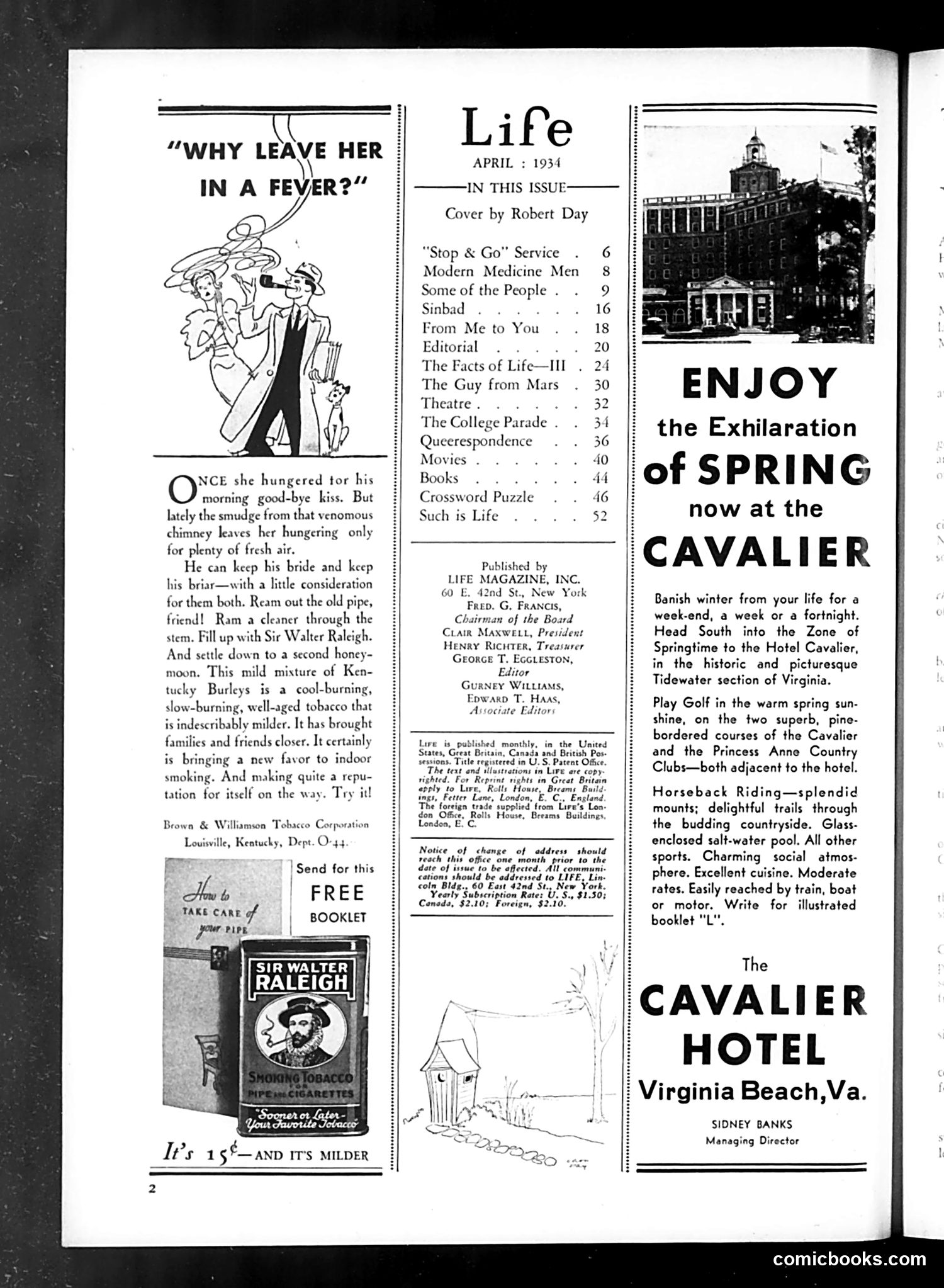
Life Magazine Table of Contents Page, April 1934 This is primarily a table of contents and advertising page rather than editorial content. The left side features a tobacco advertisement (Sir Walter Raleigh smoking tobacco) with a humorous illustration about a husband trying to keep his new bride satisfied during a honeymoon by using mild tobacco. The right side advertises the Cavalier Hotel in Virginia Beach. The cartoon at top left ("Why Leave Her in a Fever?") is a domestic humor piece about maintaining marital contentment—typical 1930s advertising messaging linking consumer products (tobacco) to relationship harmony. The page reflects the magazine's business model: mixing satirical editorial content with full-page advertisements integrated throughout.
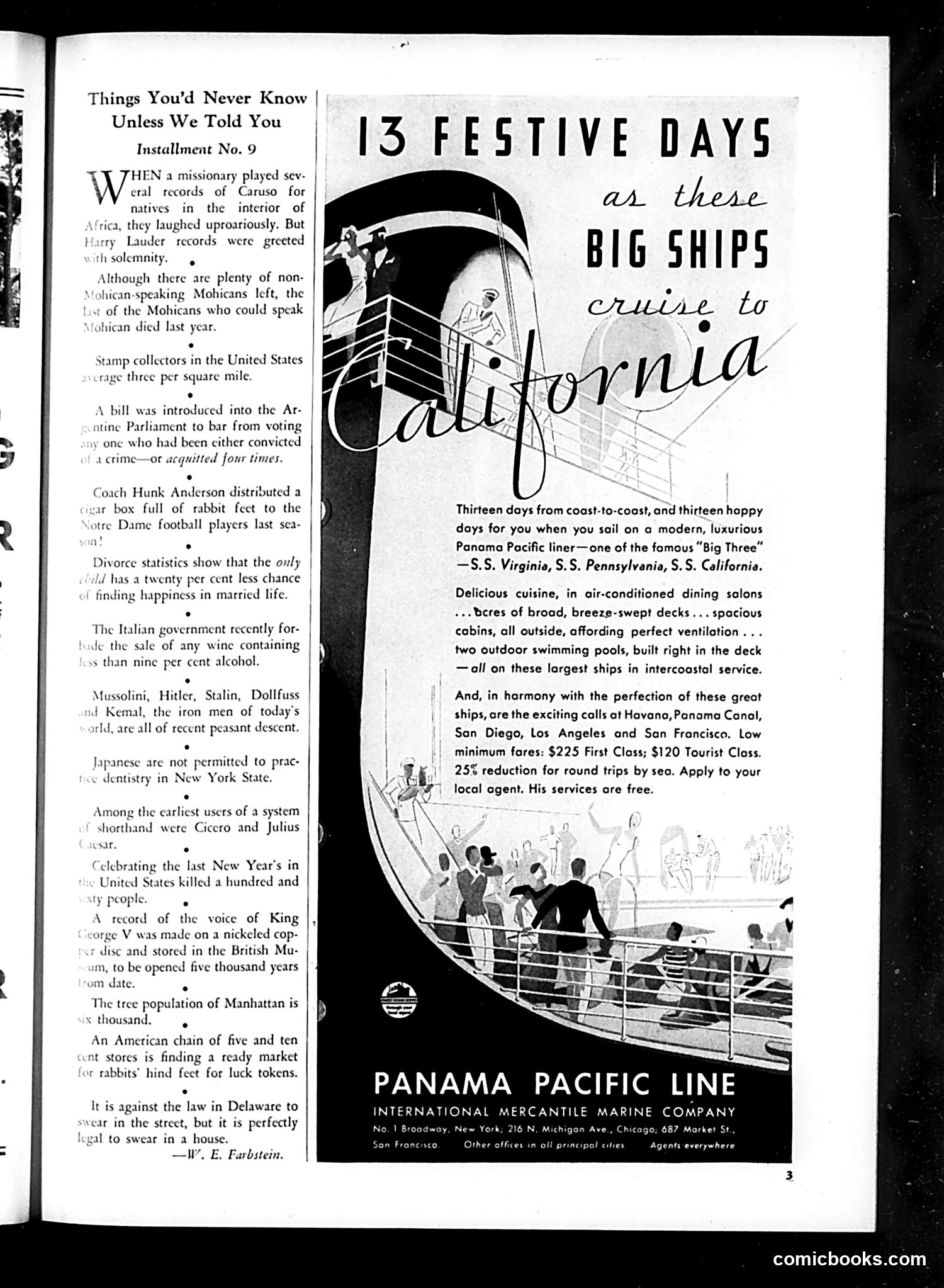
Page Analysis This page is primarily an advertisement for Panama Pacific Line cruise ships, not political satire. The left column contains "Things You'd Never Know Unless We Told You" — lighthearted trivia facts (about Caruso records, stamp collectors, rabbit's feet, etc.). The main content is a large cruise ship advertisement promoting 13-day California voyages on luxury liners including the S.S. Virginia, S.S. Pennsylvania, and S.S. California. The ad emphasizes amenities like air-conditioned dining, swimming pools, and stops at Havana, Panama Canal, and California ports. There is no political cartoon or satire on this page — it's commercial marketing material from what appears to be a 1920s-1930s era publication.
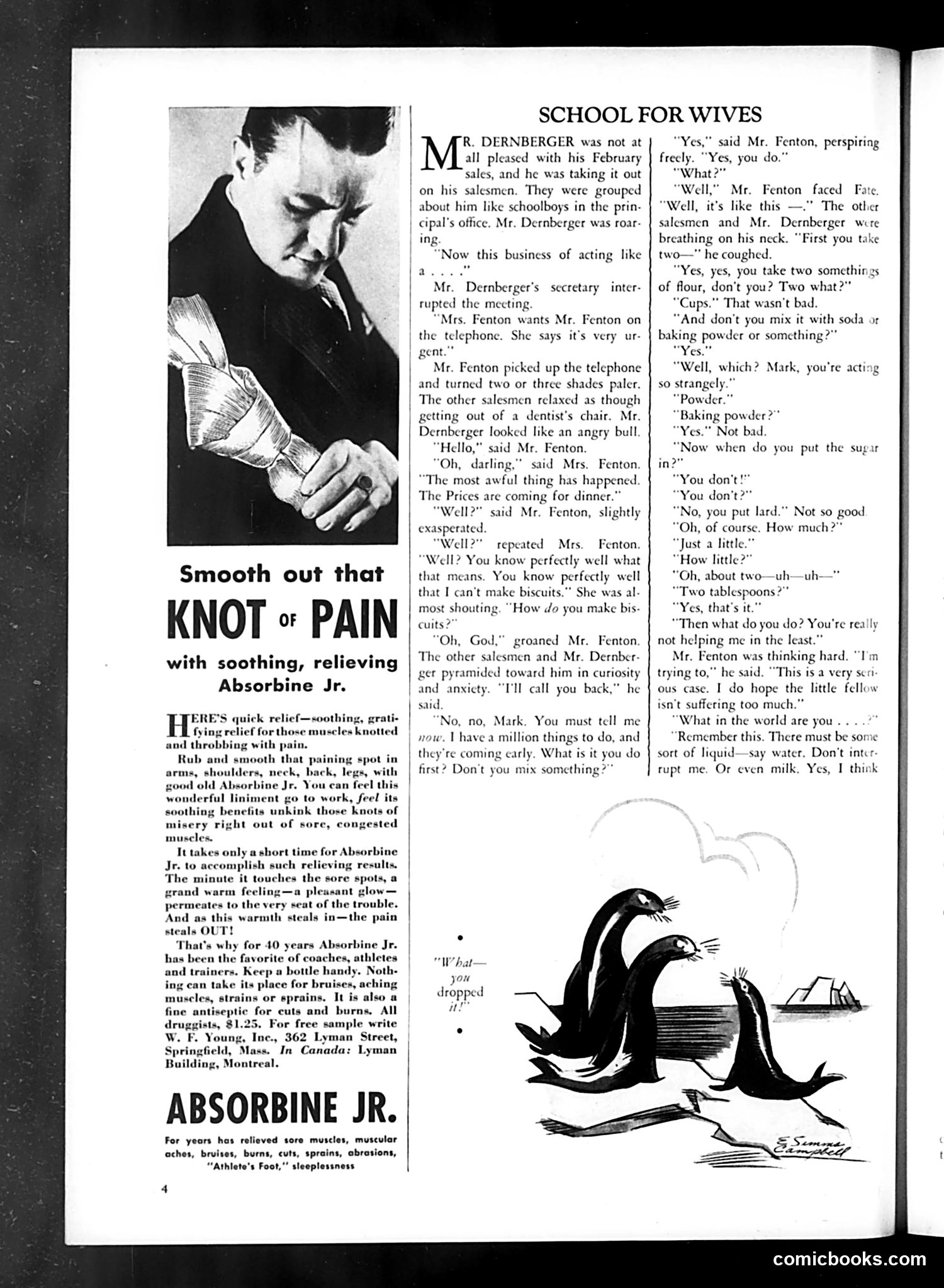
"School for Wives" - Page Analysis This page contains a satirical short story titled "School for Wives" about marital incompetence. Mr. Fenton calls his wife Mrs. Fenton to ask about dinner preparations, but she's frustrated because he doesn't follow basic cooking instructions—he can't remember whether to use flour, soda, or baking powder, or when to add sugar. The joke satirizes the gender dynamics of the era: wives were expected to educate their husbands on domestic matters, treating adult men like schoolchildren. The cartoon at bottom (showing a figure tripping) reinforces this theme of incompetence. The page also includes a full-page advertisement for "Absorbine Jr.," a pain-relief product, suggesting this is primarily a commercial publication disguised as humor.
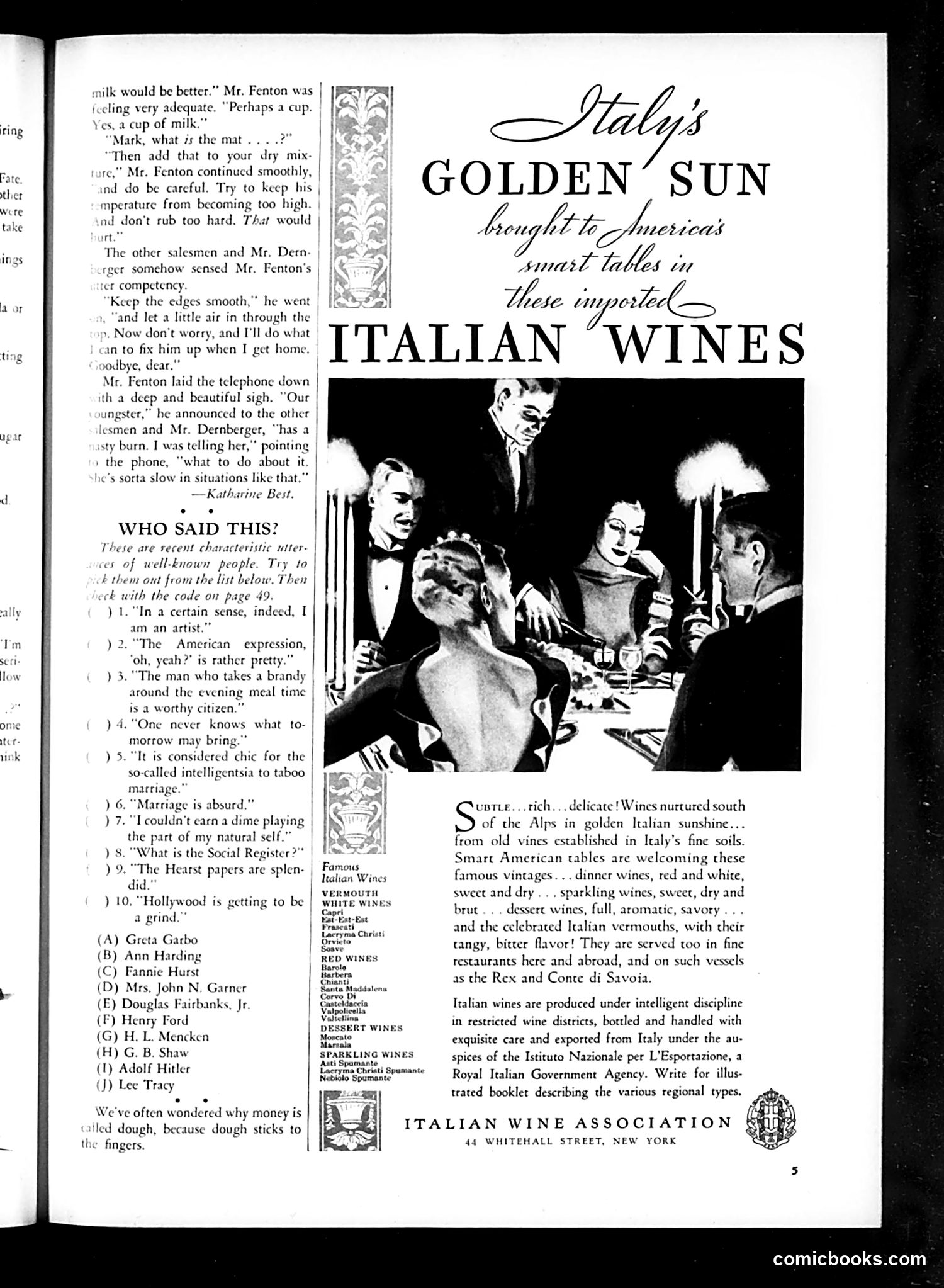
Analysis This page is primarily advertising, not satire or editorial content. The right side features a full-page advertisement for "Italy's Golden Sun" Italian wines, marketed to American consumers as sophisticated imports for "smart tables." The image shows an elegant dinner party scene with well-dressed diners. The left side contains unrelated editorial content, including a "Who Said This?" game asking readers to match famous quotations to historical figures (including Greta Garbo, Ann Harding, Henry Ford, and Adolf Hitler). There is no political cartoon on this page. The wine advertisement simply promotes Italian imports as status symbols for American dining, reflecting 1930s-era glamorization of European sophistication.
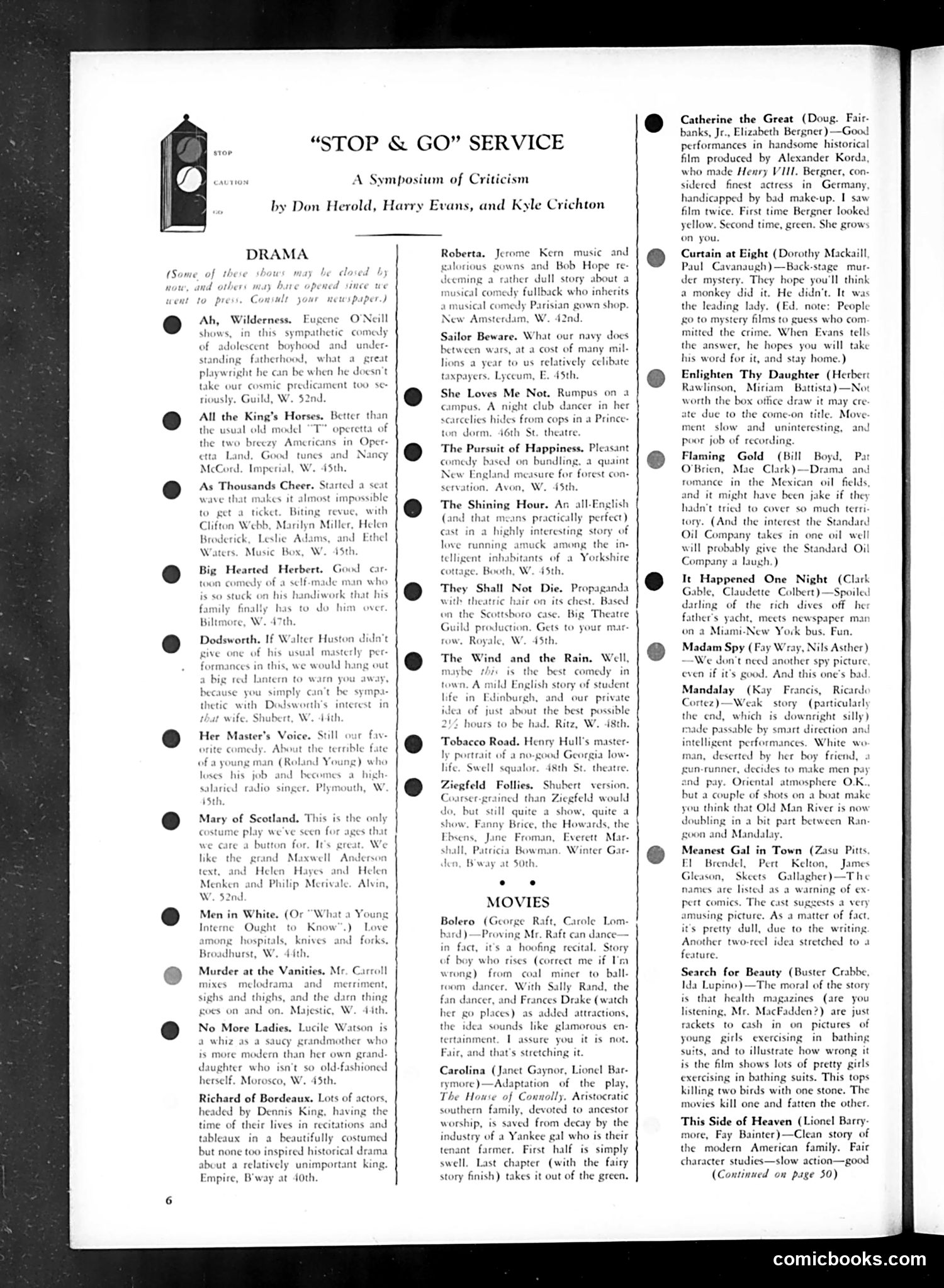
"Stop & Go" Service - A Symposium of Criticism This page presents drama and film reviews from Life magazine's critics (Don Herald, Harry Evans, and Kyle Crichton). The content is a straightforward critical survey of contemporary theatrical productions and movies, not satire or political commentary. The left column lists drama reviews (marked by bullet points) of plays like "Ah, Wilderness!" and "Big Hearted Herbert." The right side shifts to movie reviews, critiquing films such as "Catherine the Great" and "Flaming Gold." The "Stop & Go" metaphor in the title suggests the critics are giving a mixed assessment—some productions warrant stopping to see, others should be passed by. This is standard arts criticism, not political satire.
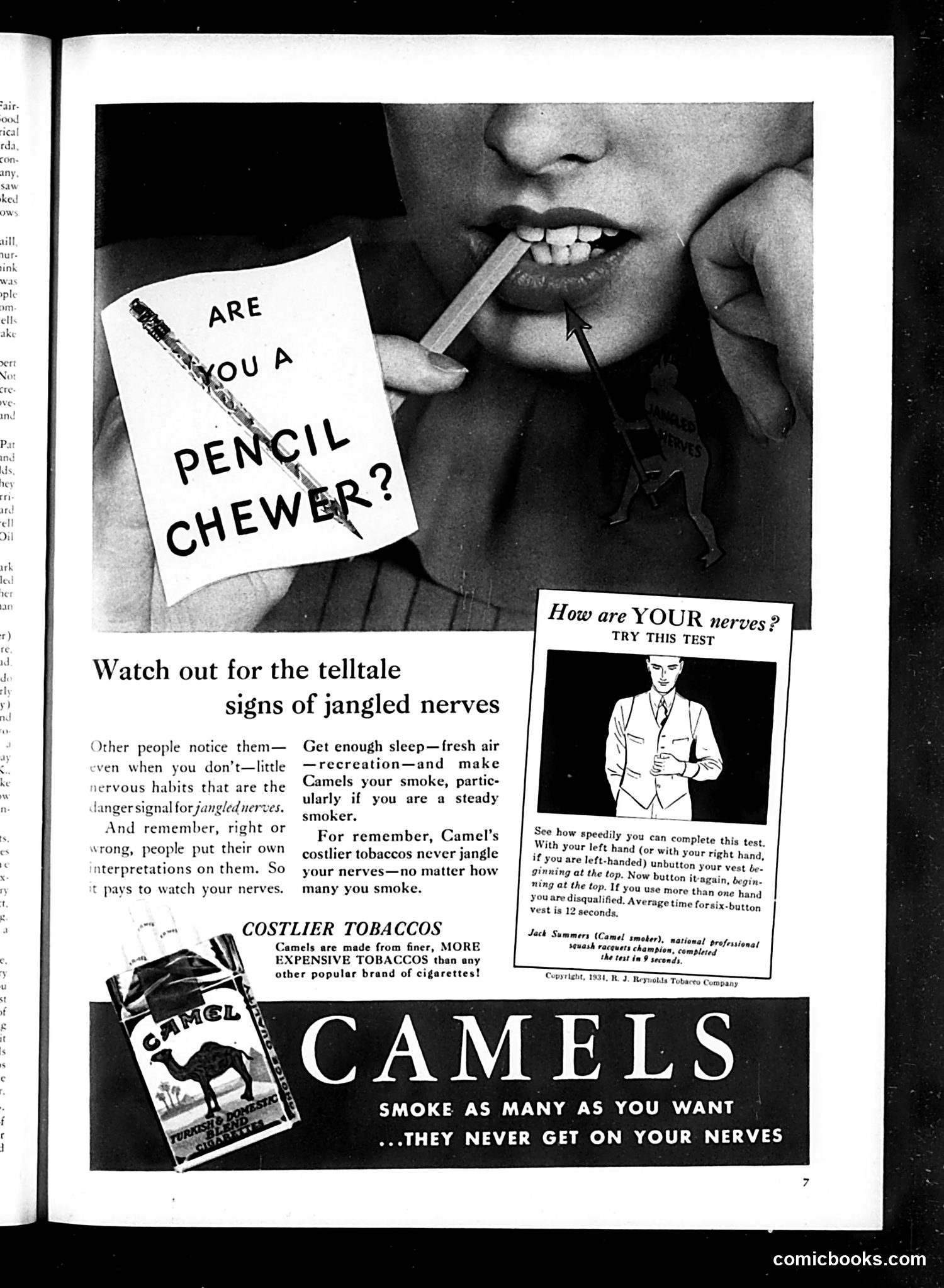
Advertisement Analysis This is a Camel cigarette advertisement, not satire or political commentary. The ad uses a now-infamous marketing strategy: claiming cigarettes *calm nerves* rather than damage health. The main image shows a young person chewing a pencil nervously, with text asking "ARE YOU A PENCIL CHEWER?" This depicts nervous behavior as socially embarrassing—a problem Camels supposedly solve. The "How are YOUR nerves?" test invites readers to check their own nervousness, implying smoking Camels prevents such habits. The advertisement explicitly claims Camel's "costlier tobaccos never jangled your nerves—no matter how many you smoke," directly marketing cigarettes as a anxiety remedy. This represents pre-warning-label tobacco advertising that made health claims later proven false and now illegal.
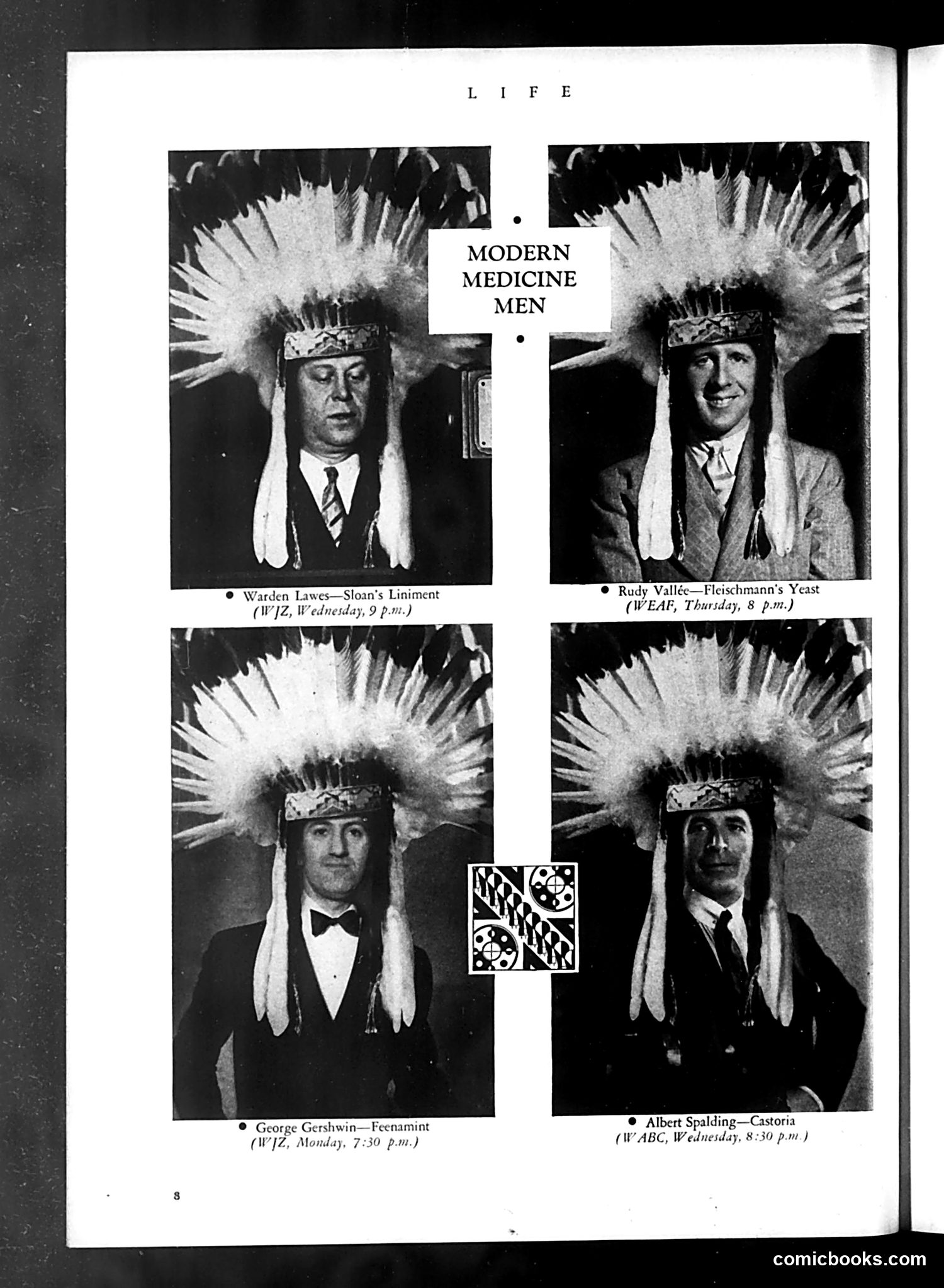
"Modern Medicine Men" This is a satirical page from *Life* magazine mocking four prominent figures by depicting them wearing Native American headdresses—a visual gag equating them with "medicine men" (fraudsters). The four men shown are: - Warden Lawes (promoting Sloan's Liniment) - Rudy Vallée (endorsing Fleischmann's Yeast) - George Gershwin (promoting Fenamint) - Albert Spalding (advertising Castoria) The satire targets celebrity endorsements of patent medicines and commercial products, suggesting these famous figures are charlatans peddling dubious remedies—no different from stereotypical "medicine men." The headdresses visually reinforce this accusation of fraudulence, mocking both the endorsers and the products they promote.
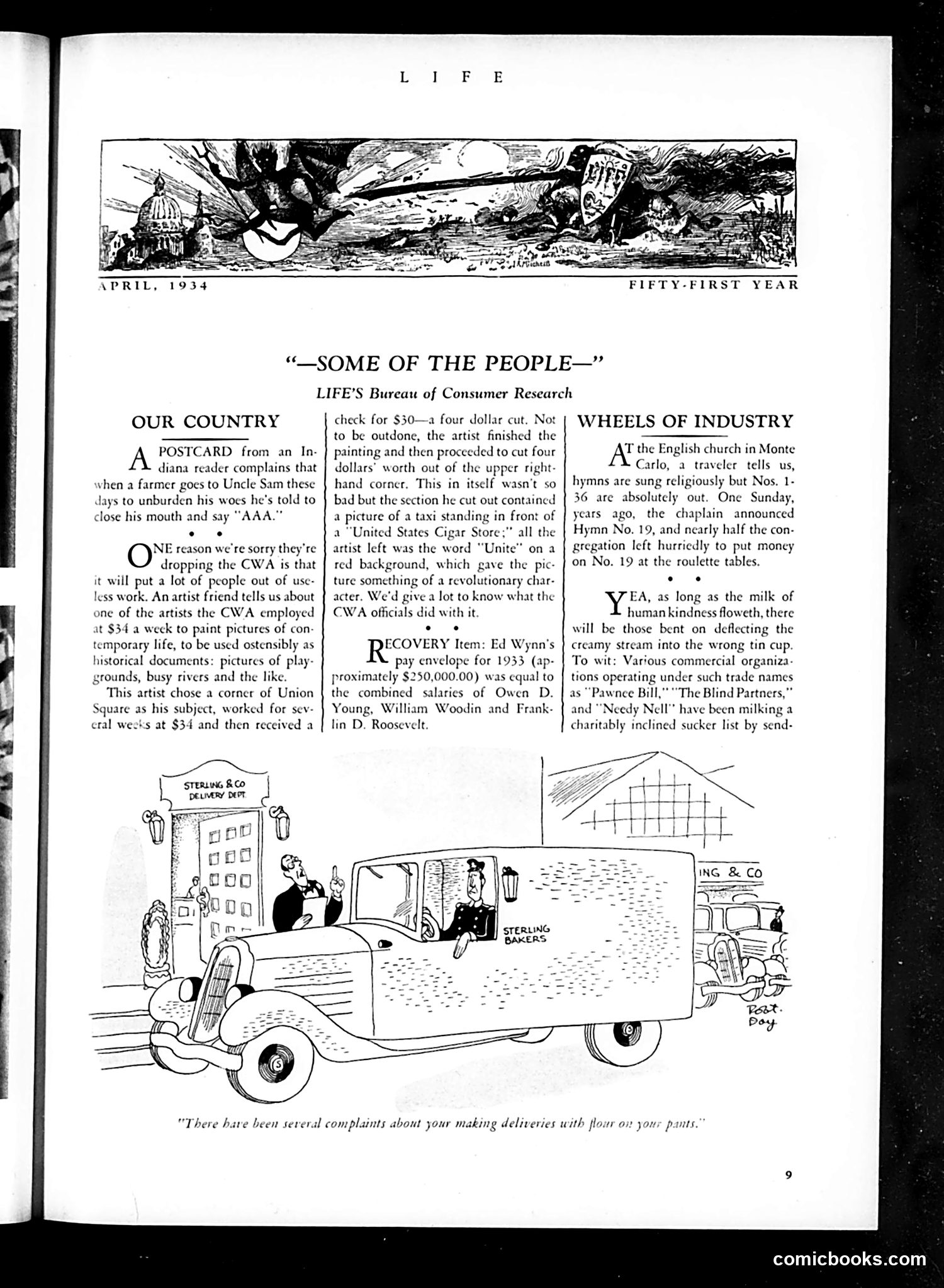
Analysis of Life Magazine, April 1934, Page 9 This page contains two distinct sections: "Our Country" discusses a Depression-era complaint: a farmer's complaint about "Uncle Sam" and the CWA (Civil Works Administration). The text notes the CWA reduced available work for artists, with one artist working for $31 weekly painting historical scenes. The main cartoon depicts a delivery truck labeled "Sterling Bakers" with flour covering the vehicle and driver's clothes. The caption reads: "There have been several complaints about your making deliveries with flour on your pants." This is workplace satire about hygiene standards—a bakery delivery driver is being scolded for appearing unprofessional by arriving dusty with flour. It's a mild humor piece about commercial standards, unrelated to the Depression-era CWA discussion above it.
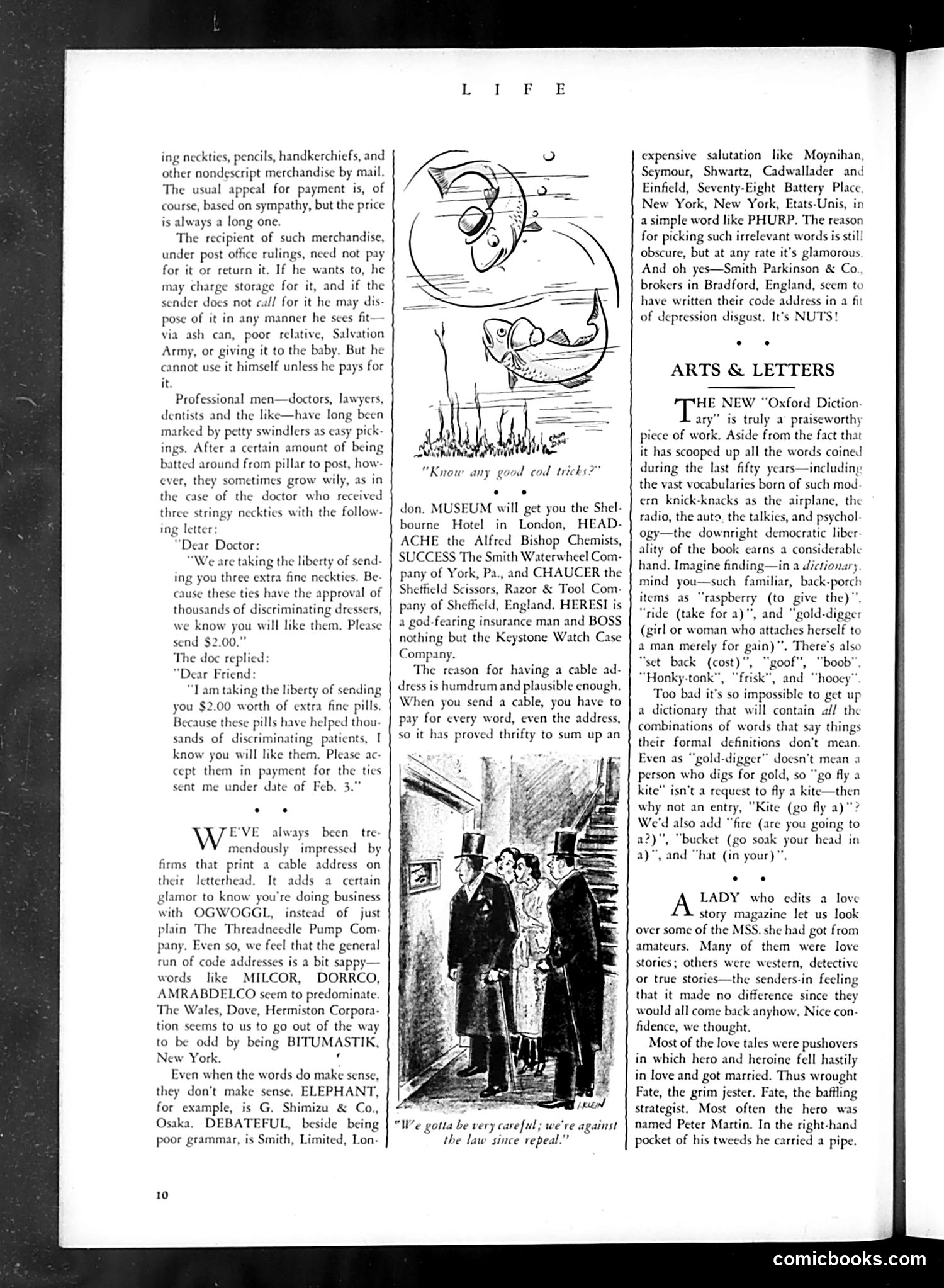
Analysis of Life Magazine Page This page contains two editorial sections rather than political cartoons. The left column discusses mail-order merchandise complaints and includes a sketch of what appears to be a comical fish or creature with an exaggerated expression, captioned "Know any good cod trick?" The right section, titled "ARTS & LETTERS," reviews the new Oxford Dictionary, praising its comprehensive vocabulary including modern terms like "gold-digger," "honky-tonk," and slang expressions. Below is a sketch showing three men in formal attire in what appears to be an interior setting, with the caption "If e gotta be very careful; we're against the law since repeal" — likely referencing Prohibition's repeal and illegal alcohol activities. The overall page mixes humor about everyday concerns with cultural commentary on contemporary language and social issues of the era.
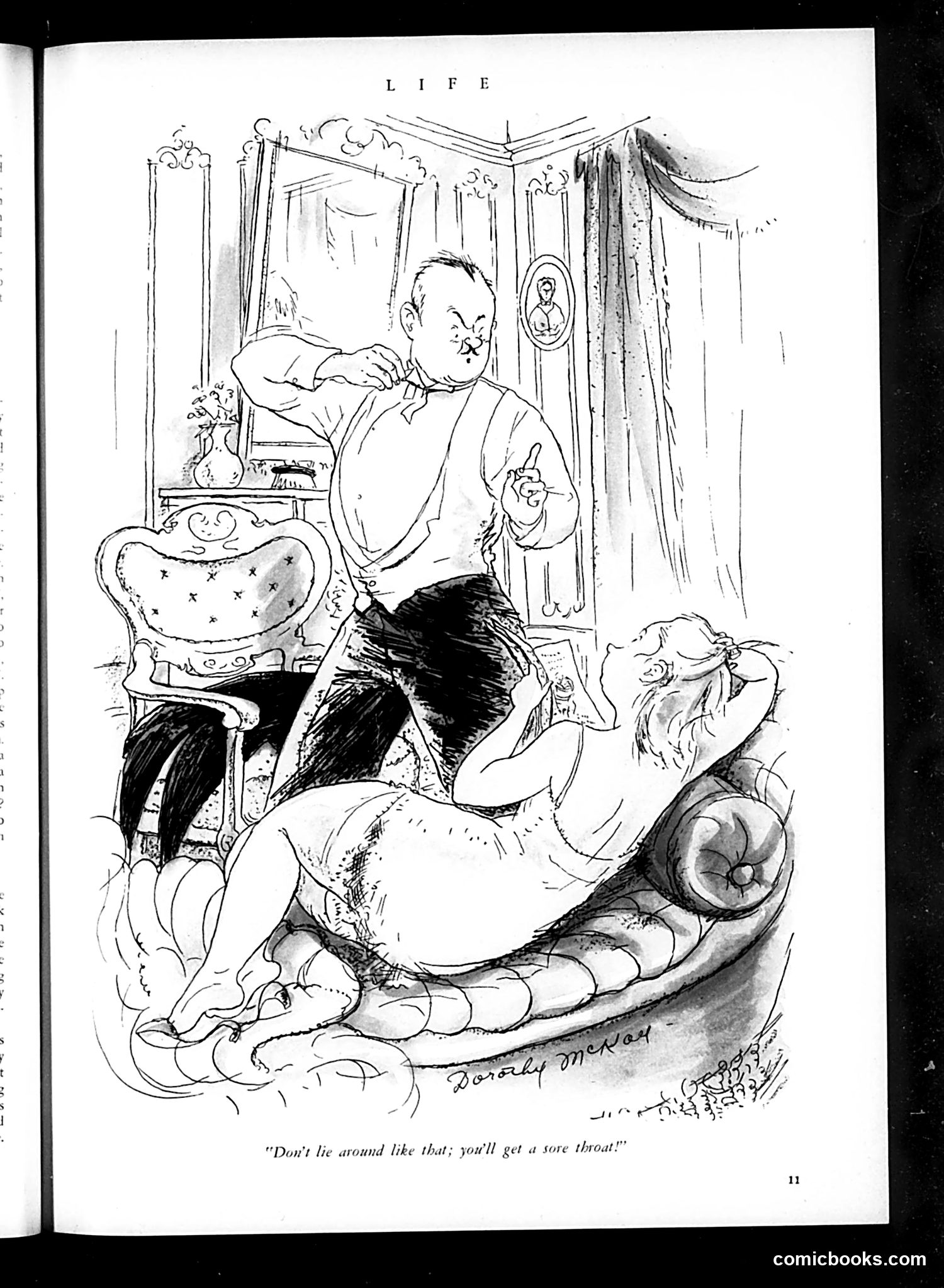
Analysis of Life Magazine Cartoon This single-panel cartoon depicts a domestic scene with satirical commentary on physical affection. A rotund, middle-aged man in formal attire lounges in an ornate chair while a woman reclines across his lap in an exaggerated pose. The caption reads: "Don't lie around like that; you'll get a sore throat!" The joke plays on the absurdity of the man's warning—an illogical concern suggesting he's either making an excuse to avoid intimacy or making a nonsensical complaint. The cartoon mocks domestic relationships and marital dynamics of the era, likely targeting the tension between romantic expectations and mundane reality. The artist's signature appears to be "Dorothy McKay" or similar. The illustration style and page number (11) suggest this is from an early-to-mid 20th century issue of Life magazine.
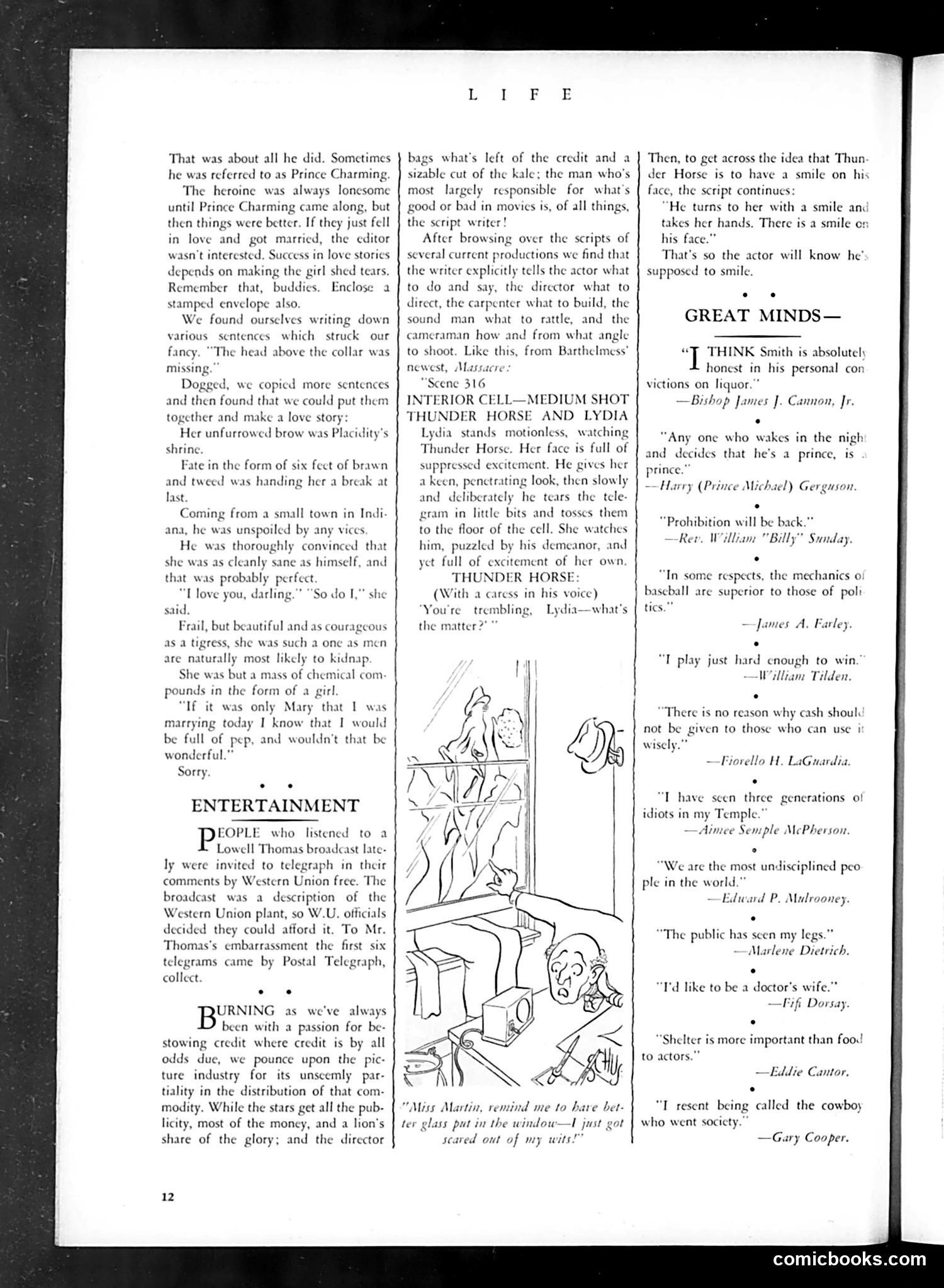
Life Magazine Page Analysis This page features a section titled "ENTERTAINMENT" discussing how people listened to a Lowell Thomas broadcast via Western Union telegram. The accompanying sketch depicts a film or theater scene labeled "INTERIOR CELL—MEDIUM SHOT" showing "THUNDER HORSE AND LYDIA," featuring what appears to be actors in a jail cell setting with dramatic tension. The right column contains a "GREAT MINDS" section—a satirical feature quoting various celebrities and public figures making often absurd or contradictory statements. These quotes mock the pretentiousness of famous people by presenting their utterances as profound wisdom when they're frequently banal or self-serving (references to liquor, baseball, cash distribution, and society vanity). The satire targets both entertainment industry culture and celebrity vanity.
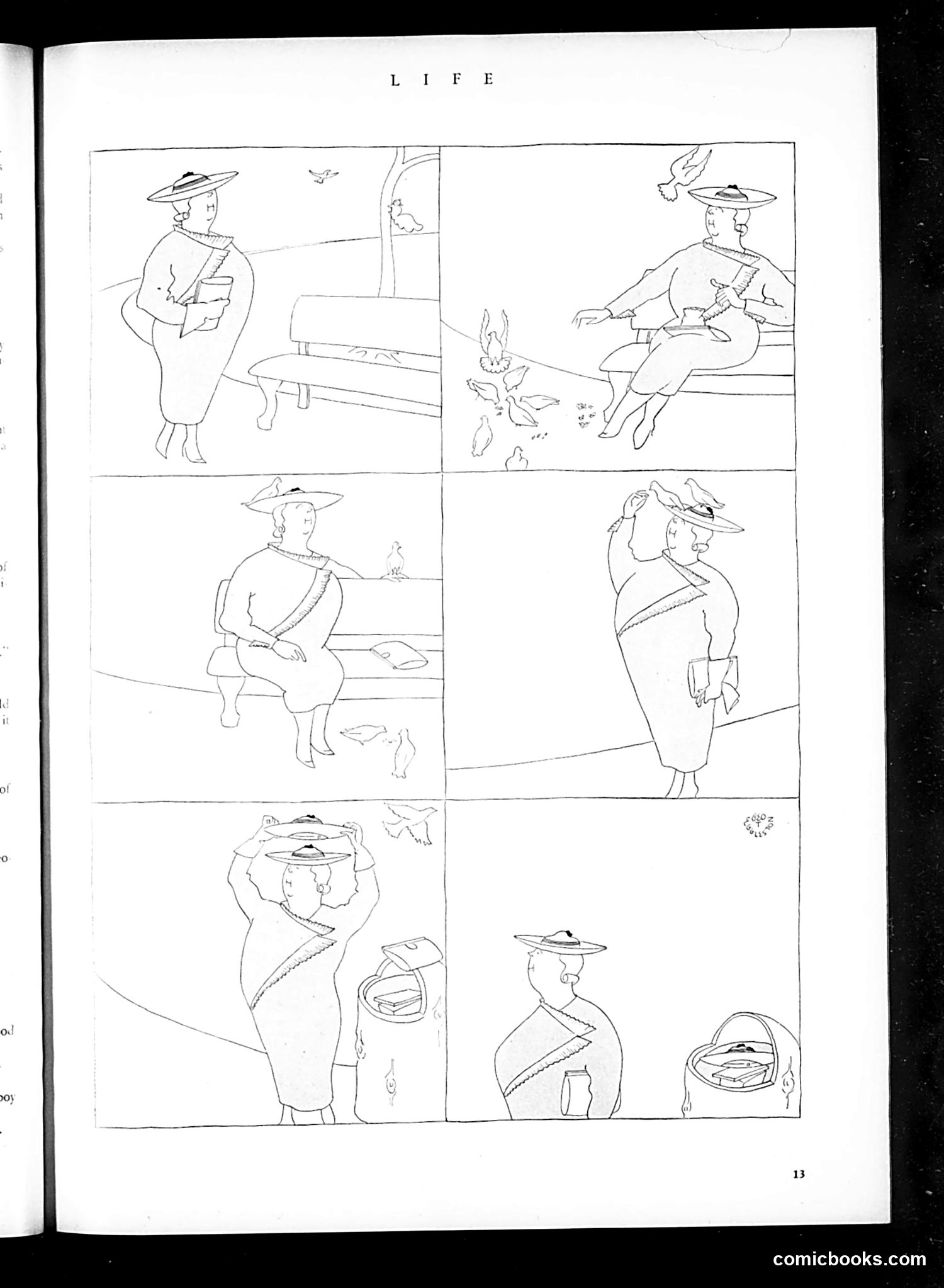
Analysis of "Life" Page 13 This page titled "LIFE" presents a six-panel comic strip depicting a narrative sequence involving figures wearing distinctive wide-brimmed hats and formal attire, suggesting military or official dress. The story appears to trace a progression: the first panels show two figures in conversation on a bench, then seated interactions, followed by panels showing the figures wrapped in blankets or cloaks. The final panels depict one figure increasingly bundled up, ending with what appears to be a basin or container. Without visible OCR text providing context, the specific political or social satire remains unclear. The repeated bundling motif and progression suggest commentary on either discomfort, hardship, or possibly bureaucratic entanglement. The formal dress and hats might indicate military or government officials, but the exact targets of satire cannot be definitively determined from the image alone.
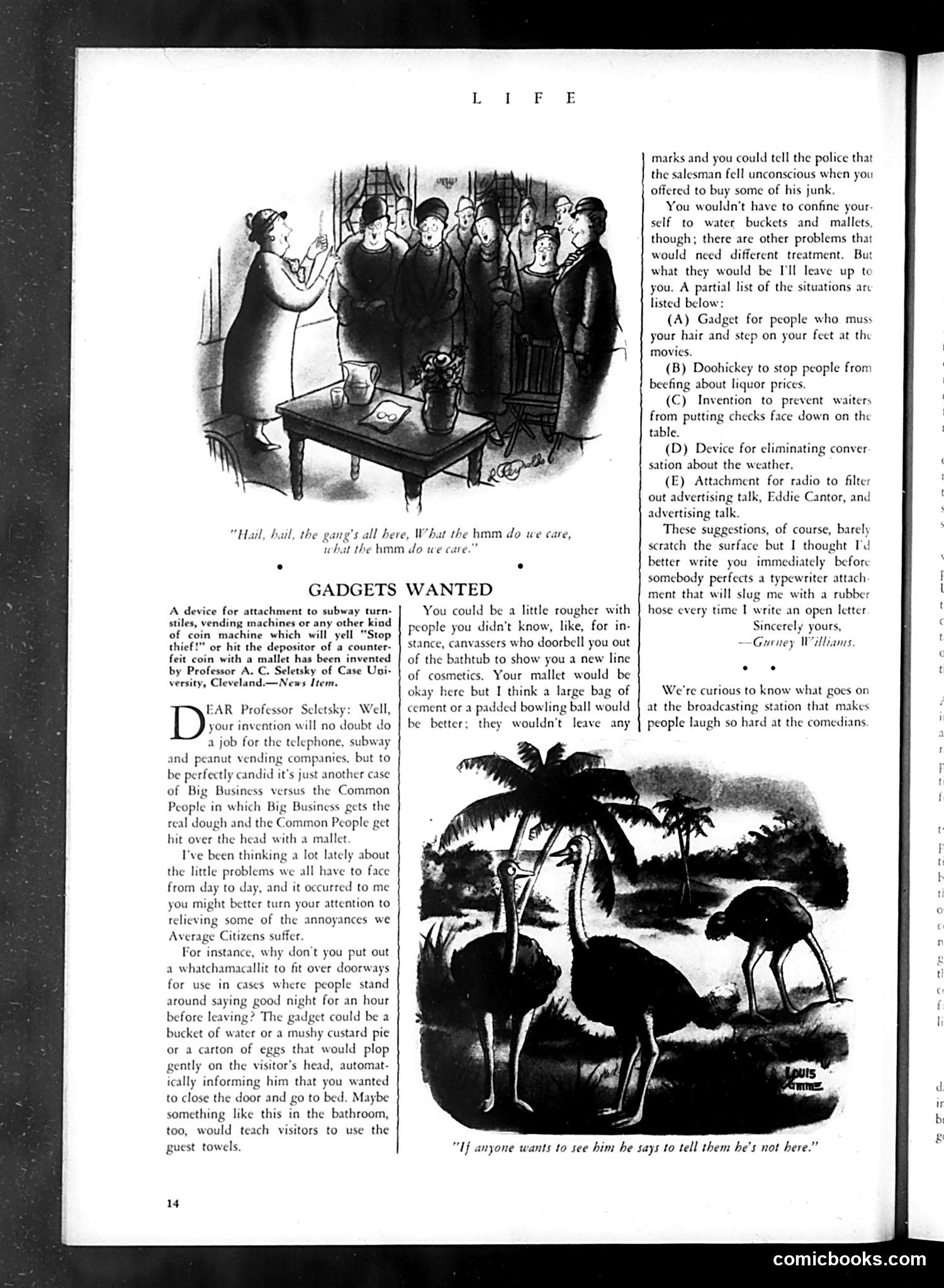
"Gadgets Wanted" - Life Magazine Satire This page satirizes everyday annoyances of urban life through invented gadgets. The top cartoon shows a woman pitching absurd contraptions to solve minor social irritations: a device to stop people from stepping on feet at movies, a "doohickey" to prevent discussions about liquor prices, and a gadget preventing waiters from placing checks face-down on tables. The humor targets both consumer culture's obsession with technological "solutions" and the petty frustrations of crowded city living. Professor A.C. Selsky (credited as the fictional inventor) is positioned as the well-meaning but misguided voice of Big Business trying to solve Common People's problems. The second illustration appears unrelated—a humorous desert scene with an ostrich, captioned with a joke about someone's absence.
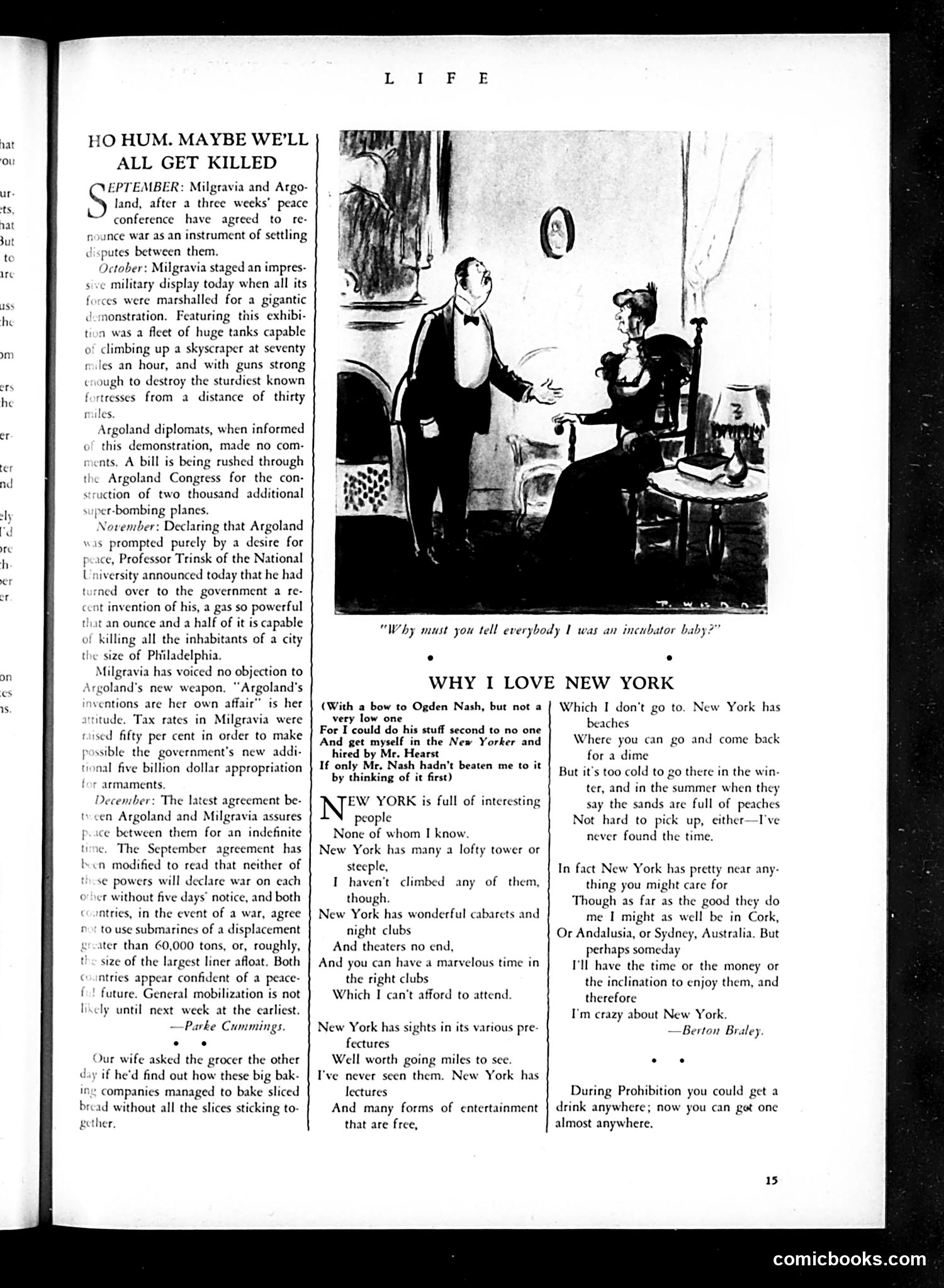
Analysis The main cartoon depicts a man in formal attire speaking to a woman seated at a desk, with the caption "Why must you tell everybody I was an incubator baby?" This satirizes the then-recent scientific development of incubators for premature infants—a medical innovation that was still novel and somewhat stigmatized in the early 20th century. The joke relies on the social embarrassment surrounding artificial birth assistance; the man appears concerned that his origins via medical intervention are becoming public knowledge. The accompanying article "Why I Love New York" by Bertron Bradley is a separate feature praising New York's attractions (theaters, cabarets, lectures, etc.), unrelated to the cartoon. The page's top section contains dated political commentary about Milgravia and Argoland's military displays and peace agreements—likely satirizing contemporary international relations—but lacks sufficient context for precise identification.
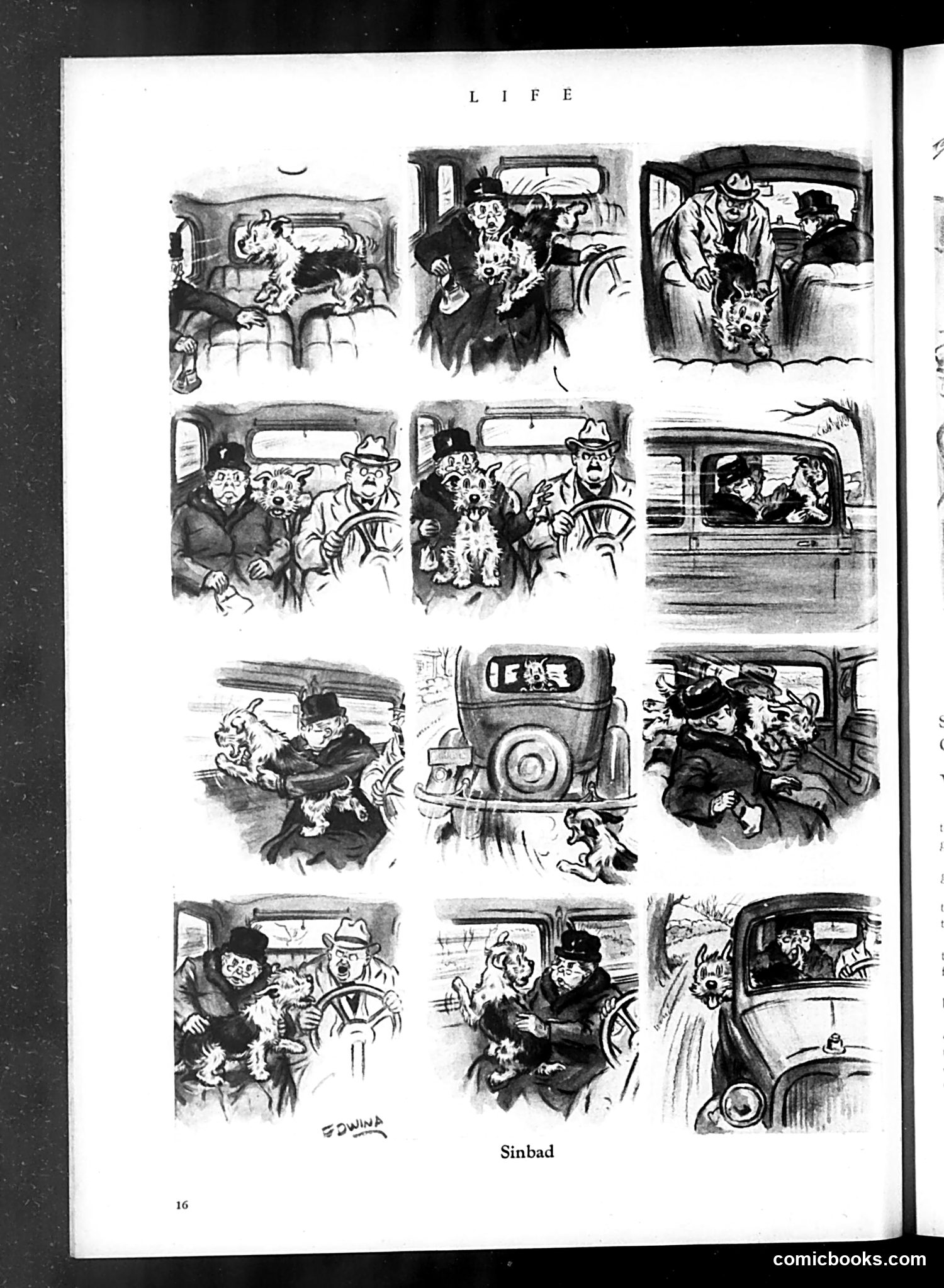
"Sinbad" Comic Strip Analysis This is a humorous strip by cartoonist Gould (as signed) depicting various scenes of chaos involving what appears to be a dog or animal character in automobiles and public transportation. The strip shows repeated scenarios where the animal creates mayhem among passengers—crowding into cars, causing disruption on buses, and generally wreaking havoc in enclosed vehicles. The comedy derives from the animal's obliviousness to social norms and personal space, contrasting sharply with the exasperation of the formally-dressed human passengers. The title "Sinbad" suggests the animal character's name. The satire gently mocks urban transit experiences, capturing the awkwardness and discomfort of crowded public conveyances—a relatable theme for *Life* magazine's urban readership. The strip's humor relies on visual slapstick rather than political commentary.
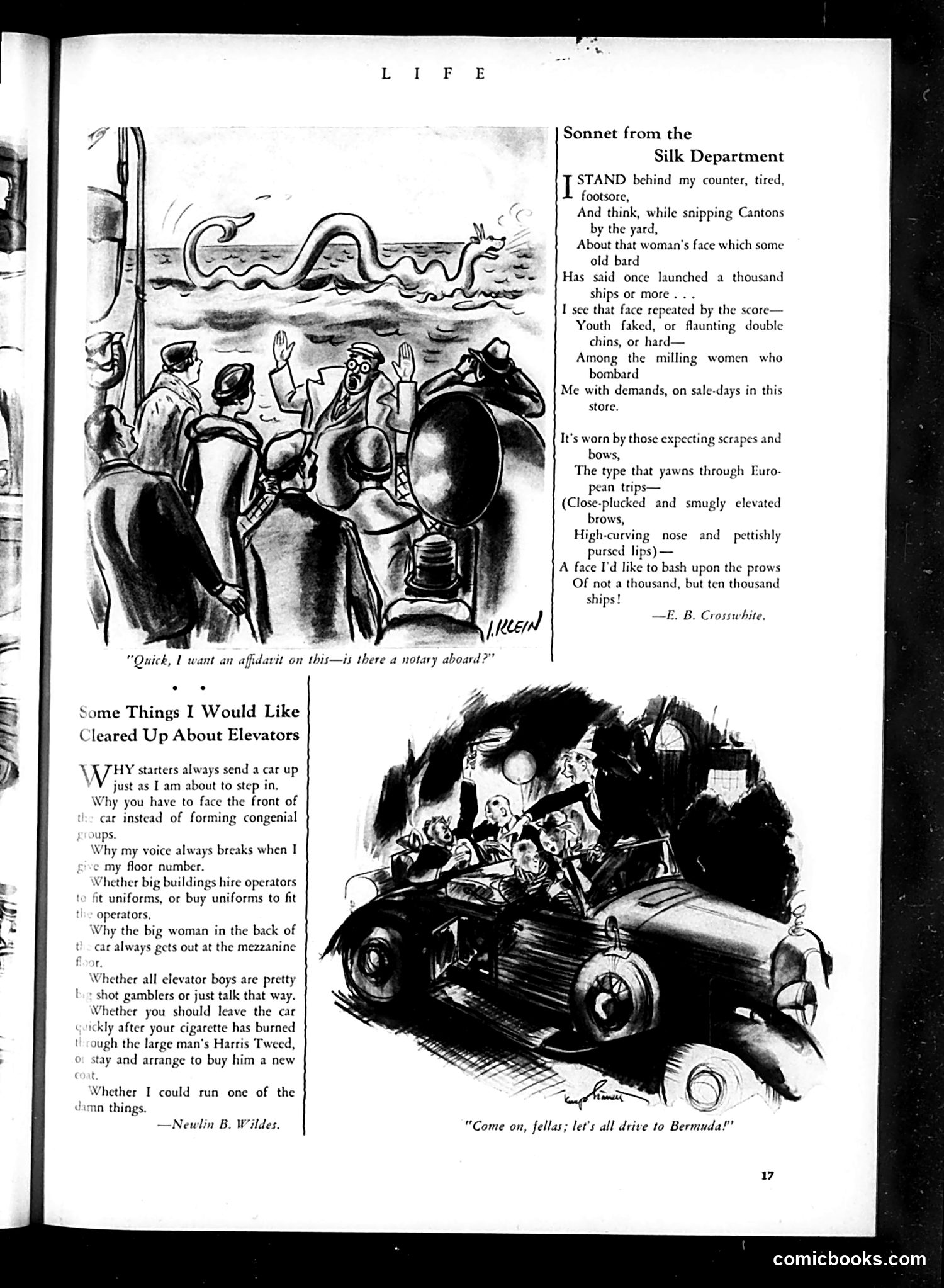
Analysis The page contains two distinct pieces of satire: Top: A "Sonnet from the Silk Department" by E.B. Cronwhite mocks a department store clerk exhausted by demanding customers—particularly women buying silk, described with unflattering caricature ("close-packed and snugly elevated brows, / High-curving nose"). The sonnet references women who "bombard / Me with demands, on sale-days," satirizing both consumer culture and female shoppers as aggressive and difficult. Bottom: "Some Things I Would Like Cleared Up About Elevators" by Newlin B. Wildes humorously lists elevator annoyances—operators' uniforms, the large woman always exiting at the mezzanine, smoking etiquette, whether elevator boys are "pretty shot gamblers." The accompanying cartoon shows an overcrowded car. Both pieces target early-20th-century urban inconveniences and social anxieties—retail commerce and modern building infrastructure—with gentle mockery of human behavior.
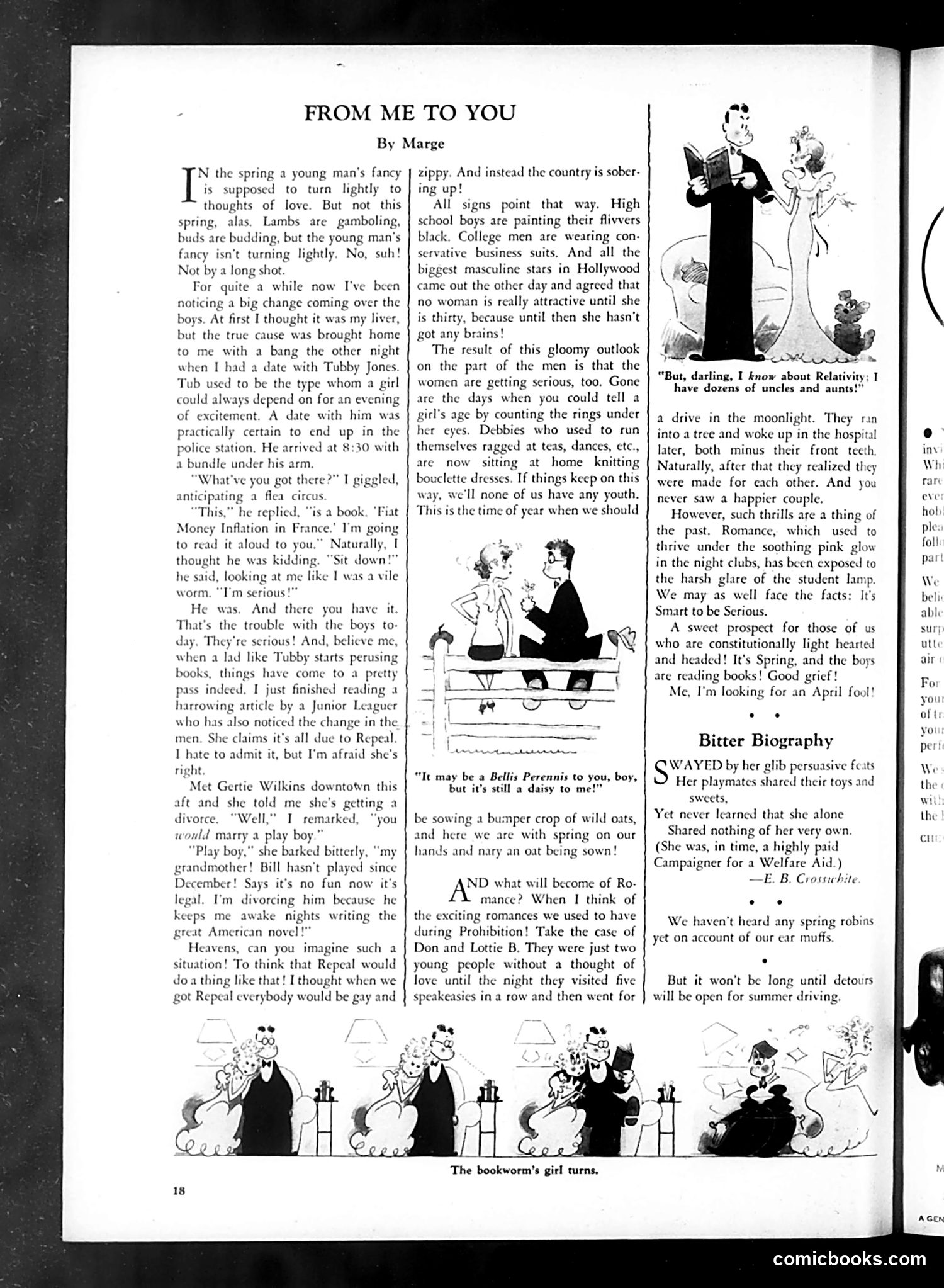
"From Me to You" by Marge — Life Magazine This satirical column laments the unexpected social consequence of Prohibition's repeal (1933). The author expected young men to become frivolous and pleasure-seeking once alcohol became legal again. Instead, the opposite occurred: men have become *serious*, intellectual, and studious—reading books on economics, wearing conservative business suits, and writing novels rather than pursuing romantic escapades. The satire targets this ironic outcome: young women, disappointed by their dates' newfound sobriety and intellectualism, have also become serious and domestic, sitting home knitting instead of attending parties. The author nostalgically recalls Prohibition-era romance—when spontaneous speakeasy adventures and moonlit drives (ending in comic mishaps) sparked passion. The cartoon's recurring figure of a man writing appears to represent this new "serious" male archetype. The joke is that legalizing alcohol *discouraged* rather than encouraged youthful hedonism, leaving romance languishing under harsh reality instead of "soothing pink glow."
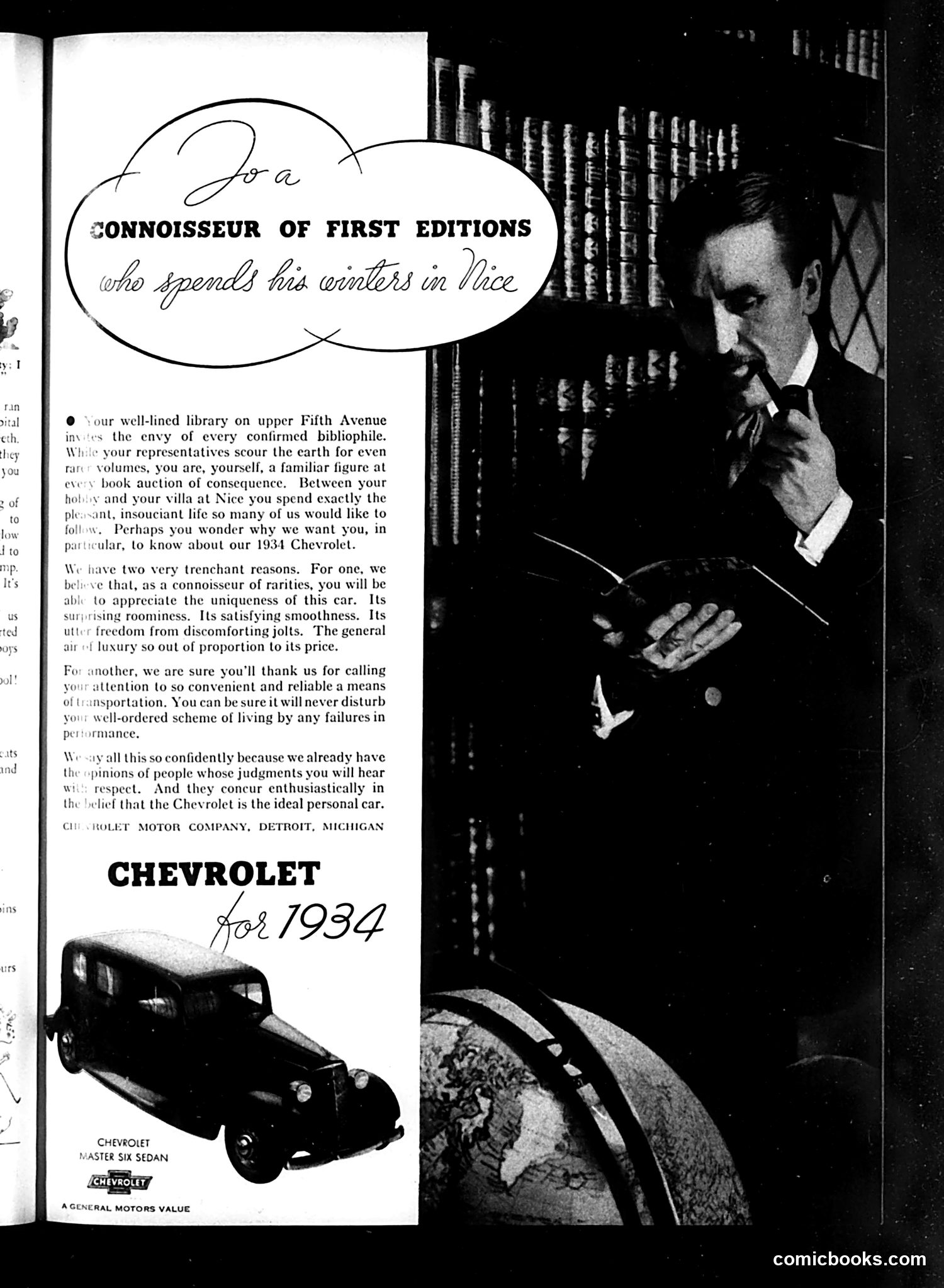
Analysis This is primarily a Chevrolet automobile advertisement, not political satire. The "cartoon" is the concept itself—a humorous pitch targeting wealthy bibliophiles. The Setup: The ad addresses a wealthy collector on Manhattan's Fifth Avenue who spends winters in Nice (France), frequents rare book auctions, and maintains a villa abroad. This figure represents upper-class conspicuous consumption. The Joke: Chevrolet pitches its 1934 sedan to this elite connoisseur of rare editions by arguing the car itself is a "rarity"—claiming it offers luxury "out of proportion to its price" and reliability so exceptional it won't disturb his refined lifestyle. The humor lies in the incongruity: why would someone accustomed to genuine rarities care about an affordable mass-produced automobile? Social Context: During the 1930s Depression, advertising to wealthy elites was aspirational messaging—suggesting that even the rich could appreciate Chevrolet's value. The ad exploits snobbery while flattering the target audience's taste and judgment. No identifiable political figures or events are referenced; this is commercial messaging using satire as a sales technique.
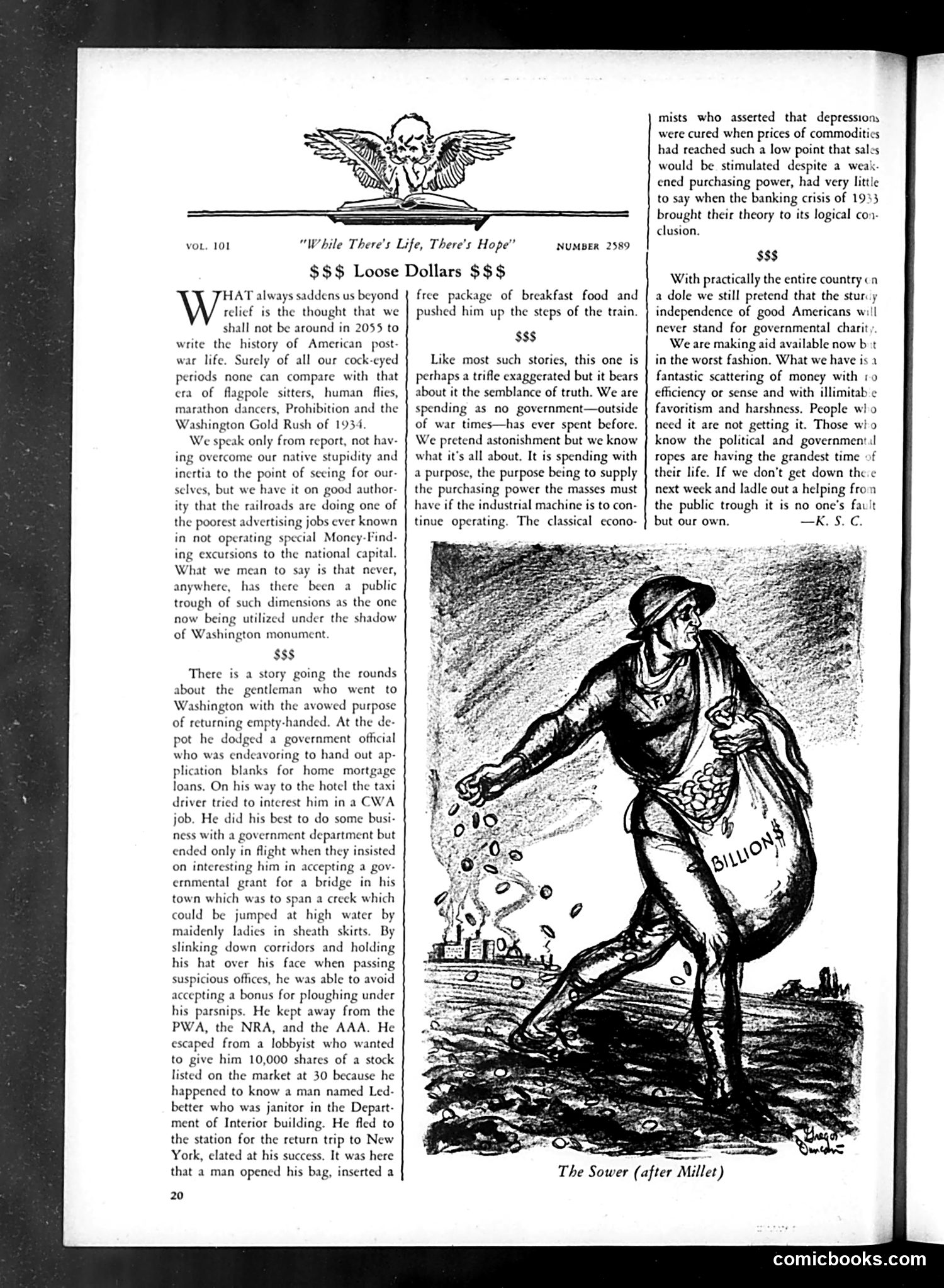
Political Satire on New Deal Spending (1934) This Life magazine page satirizes the Roosevelt administration's Depression-era spending programs. The accompanying cartoon, titled "The Sower (after Millet)," depicts a figure scattering money like seeds—a darkly ironic reference to Millet's famous painting of agricultural labor. Here, government money is being wastefully dispersed rather than purposefully sown. The text mocks the "Washington Gold Rush of 1934," describing government programs (CWA, PWA, NRA, AAA) as indiscriminate handouts. It tells of a man trying unsuccessfully to avoid federal aid—government officials pursue him with loan applications, job offers, and grants for absurd projects like bridging a creek jumpable by women in skirts. The satire cuts both ways: while acknowledging Depression relief is necessary to restore purchasing power, the author criticizes the programs' inefficiency, favoritism, and haphazard distribution. The cartoon visualizes this critique—money scattered wastefully rather than deployed strategically.
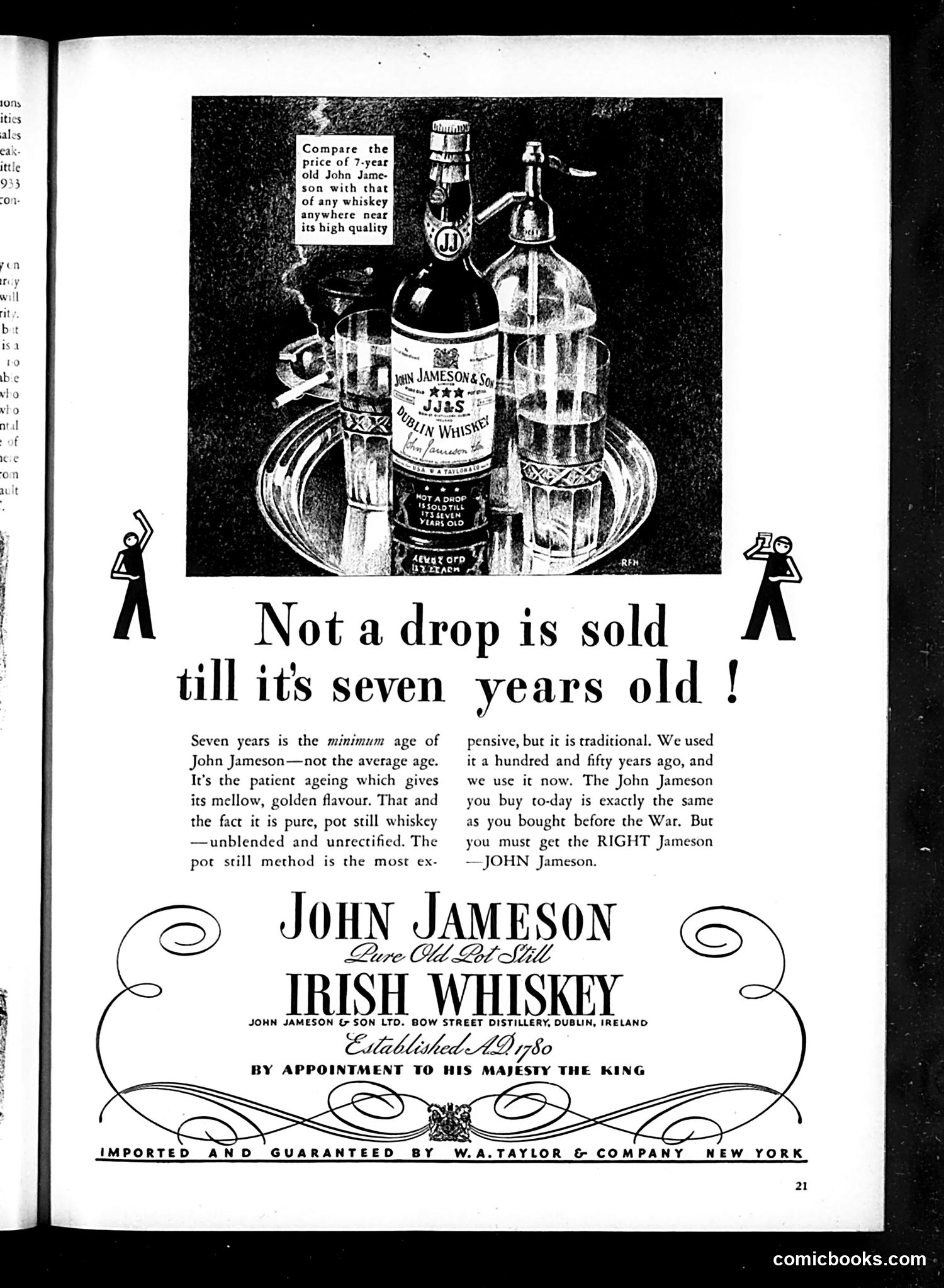
John Jameson Whiskey Advertisement This is a full-page advertisement, not a political cartoon. It promotes John Jameson Irish Whiskey to American consumers, likely from the 1920s post-Prohibition era. The ad's central claim—"Not a drop is sold till its seven years old"—emphasizes quality and patience in production. The text addresses post-WWI concerns: assuring buyers that despite Prohibition's disruption, John Jameson maintains its pre-war standards and traditional pot-still methods. The small cartoon figures (left and right margins) appear merely decorative, representing generic "people" rather than specific caricatures or political figures. The key sales pitch targets price-conscious consumers: compare John Jameson's cost against other premium whiskeys while maintaining equivalent quality. The "By Appointment to His Majesty the King" seal adds prestige and legitimacy to the Irish product for American importers.
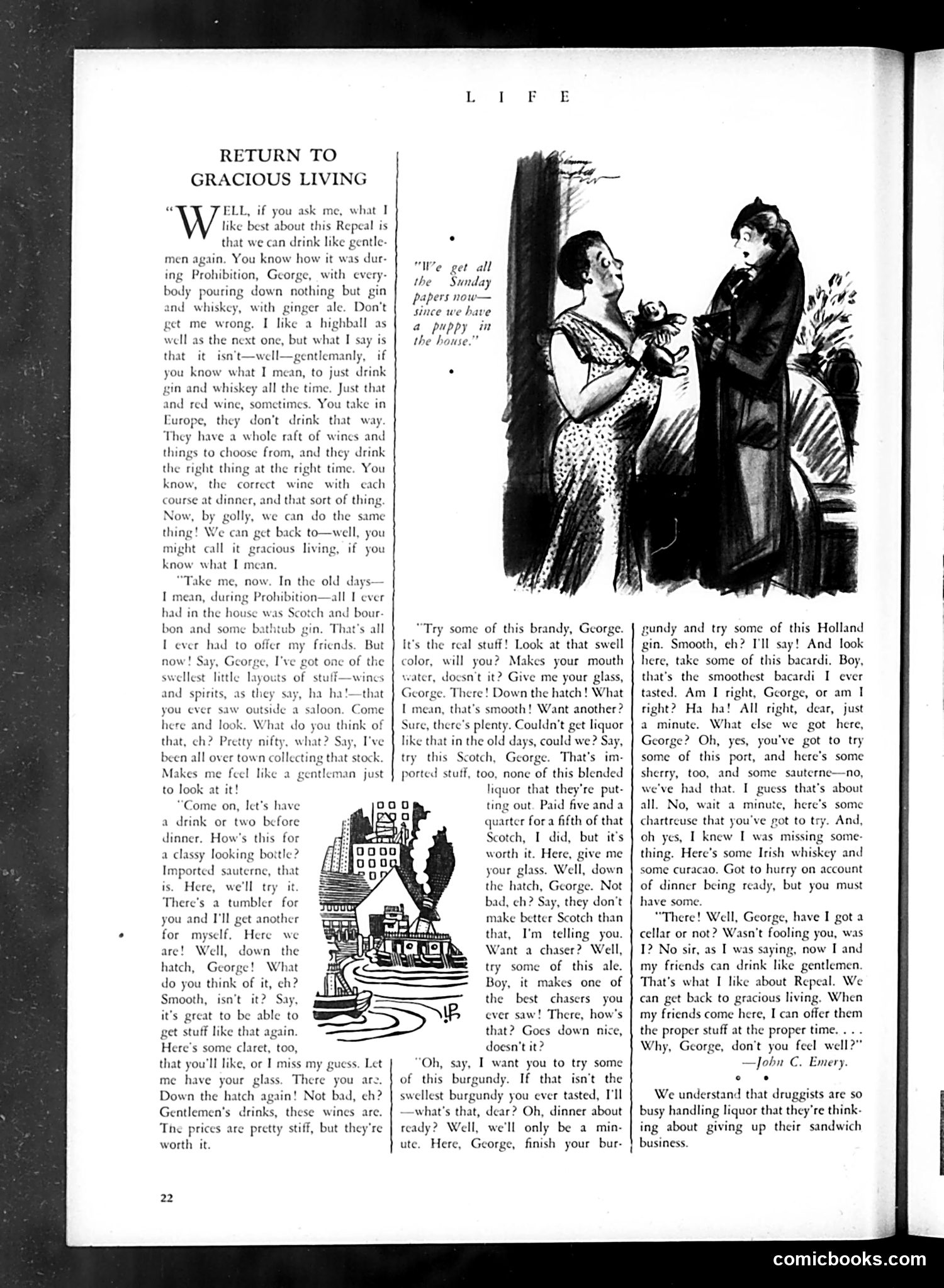
"Return to Gracious Living" — Life Magazine Satire This article satirizes the immediate aftermath of Prohibition's repeal (1933), mocking how Americans suddenly embraced alcohol consumption while adopting pretentious language about "genteel" drinking. The unnamed narrator character boasts to "George" about his newly assembled wine collection, claiming this represents a return to civilized European drinking customs—carefully pairing wines with courses, drinking "the right thing at the right time." The satire's target: the hypocrisy and absurdity of this pose. The narrator constantly urges George to "down the hatch!"—repeatedly getting drunk on everything available (brandy, Scotch, ale, gin, port, sherry, chartreuse, whiskey, curacao). His pretense of refined "gracious living" collapses into the same binge drinking that supposedly characterized Prohibition-era excess. The accompanying illustrations show the host and his somewhat bewildered guest amid this alcohol-fueled performance. The joke exposes how quickly Americans abandoned actual restraint or sophistication, simply relabeling their drinking habits with fancier terminology.
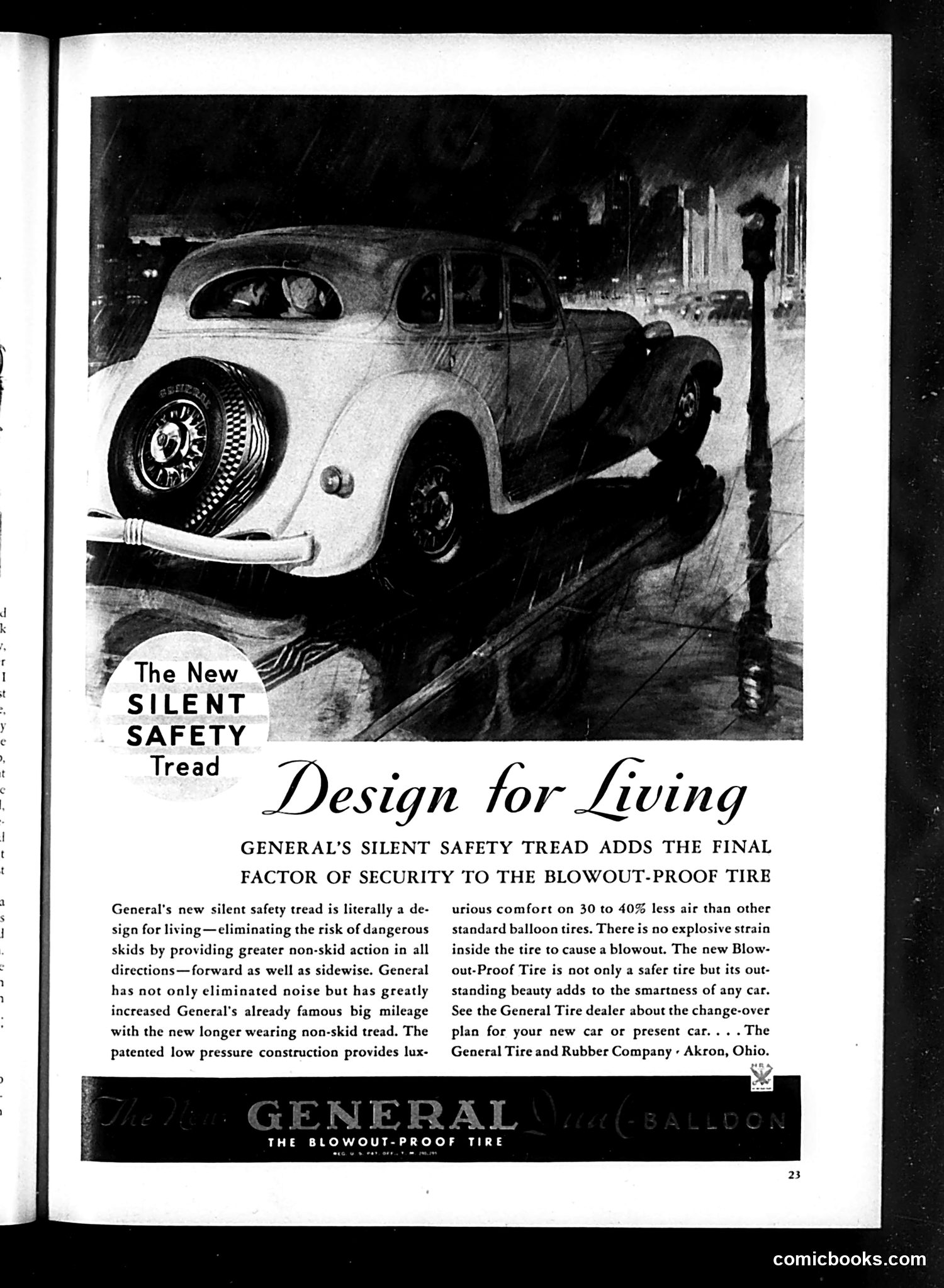
Analysis This is primarily a General Tire company advertisement, not political satire or a cartoon. It appears in Life magazine (likely 1930s based on the car style and design aesthetic). The ad features a photograph of a 1930s automobile parked on a street at night. The "joke" or selling point is the phrase "Design for Living"—a pun suggesting that safer tires represent modern comfort and security. The advertisement emphasizes the "Silent Safety Tread" tire's features: blowout-proof construction, better traction ("non-skid action"), reduced noise, improved mileage, and lower air pressure for comfort. These were genuine safety innovations for the era, when tire blowouts were common hazards. For modern readers: this reflects pre-1940s consumer anxiety about automobile safety and reliability, when tire failures could cause serious accidents. The "design for living" phrase appeals to aspirational, safety-conscious buyers who saw new technology as improving their quality of life.
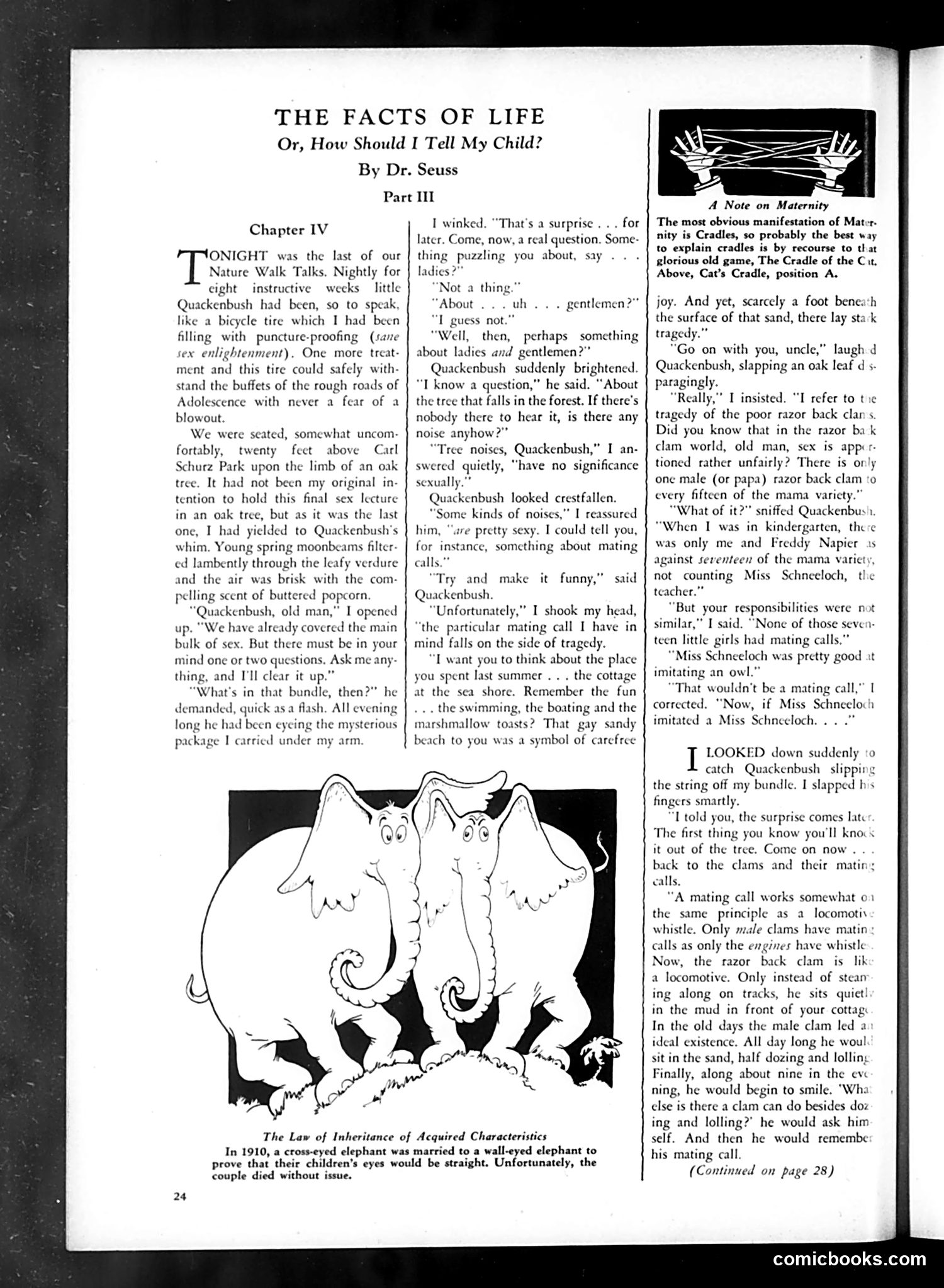
"The Facts of Life" by Dr. Seuss (1910s Life Magazine) This is a satirical sex-education piece presented as a humorous dialogue between an adult narrator and a boy named Quackenbush. The humor derives from the narrator's attempt to explain reproduction and mating through increasingly absurd analogies—comparing human courtship to clam mating calls and elephant genetics. The cartoon illustrates three elephants (possibly referencing the footnote about cross-eyed and wall-eyed elephants breeding), emphasizing the physical awkwardness of the subject matter. The satire targets the awkwardness adults felt discussing sex education in the early 20th century. By framing the lesson as occurring in an oak tree at night with mysterious packages, Seuss mocks both the prudishness of the era and adults' fumbling attempts to make "the facts of life" educational and entertaining rather than direct. The piece reflects period anxieties about proper moral instruction of youth.
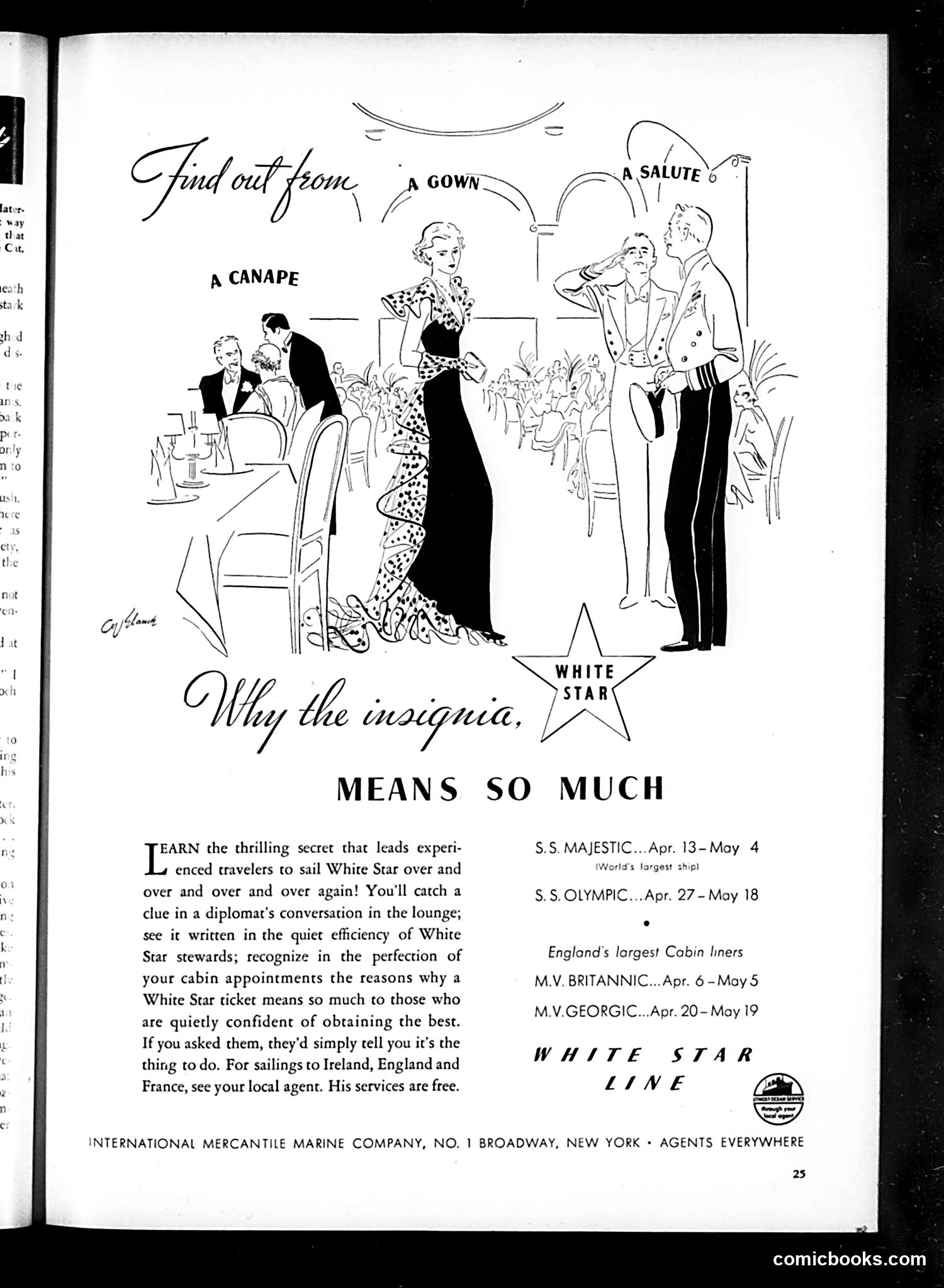
Page Analysis: White Star Line Advertisement This is primarily a luxury cruise line advertisement, not political satire. The page promotes White Star Line's passenger ships (Majestic, Olympic, Britannic, Georgic) for transatlantic travel to Ireland, England, and France. The illustration depicts elegant social scenarios—a canape reception, a gown fitting, and a formal salute—suggesting the refined experience and social status associated with White Star travel. The text emphasizes exclusivity: experienced travelers sail White Star "over and over again" because they're "quietly confident of obtaining the best." The phrase "Why the insignia means so much" refers to the White Star logo's prestige among the wealthy. This appears designed for affluent 1930s readers aspiring to transatlantic luxury travel. There is no apparent political commentary—it's straightforward aspirational advertising emphasizing class, elegance, and reputation.
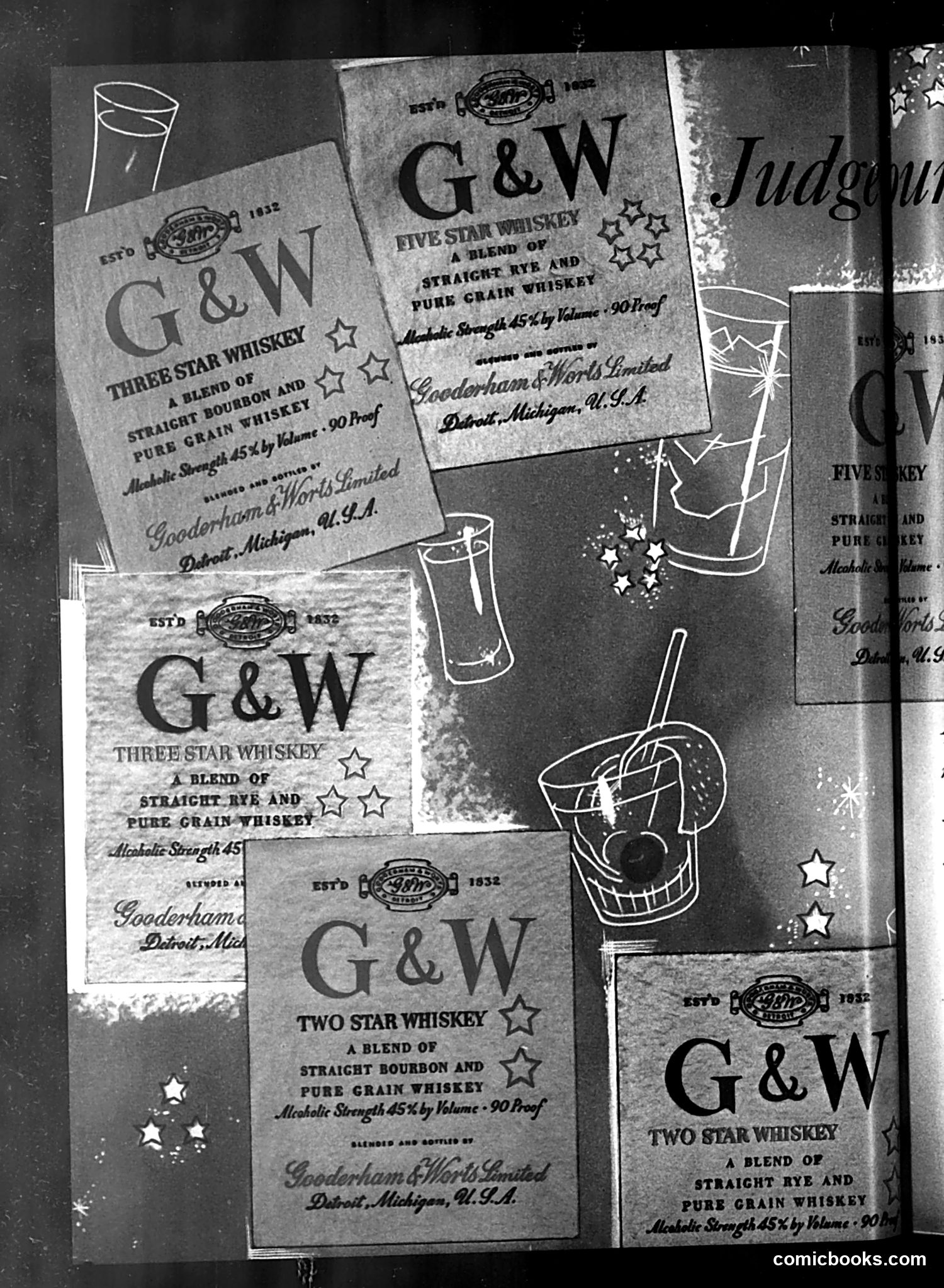
This page is primarily advertising, not political satire. It displays multiple G&W whiskey product labels from Gooderham & Worts Limited (Detroit, Michigan) - featuring Three Star, Five Star, and Two Star varieties. Each label identifies the whiskey blend type (bourbon, rye, grain) and proof content (90-45 proof). The decorative elements include illustrated cocktail glasses and stars, typical of 1930s-40s beverage advertising design. There is no political cartoon or satirical content visible - this appears to be a straightforward product advertisement page from Life magazine, likely from the Prohibition repeal era when whiskey marketing resumed in American publications.
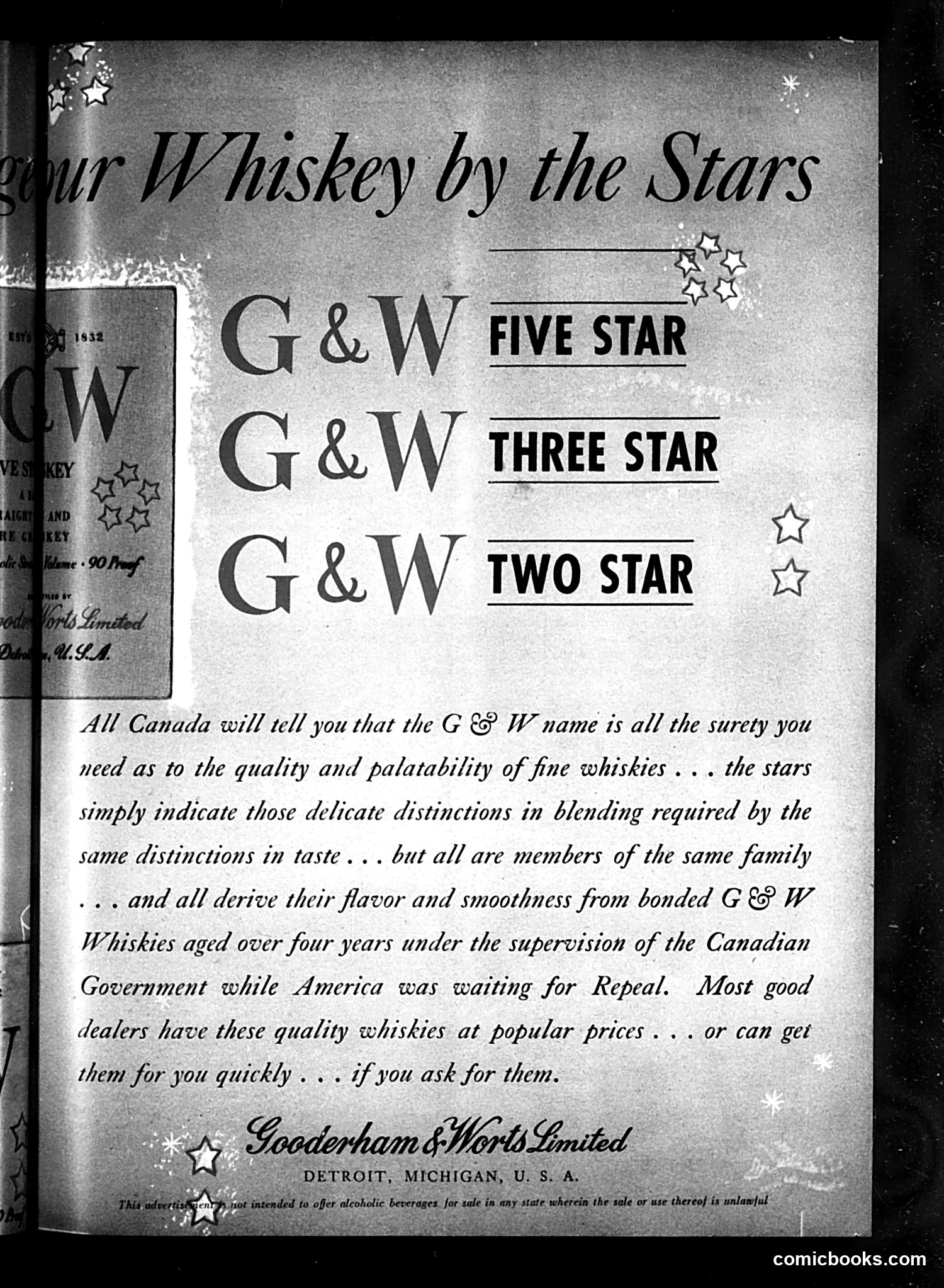
This is a whiskey advertisement, not political satire. Gooderham & Worts Limited (Detroit) markets G&W whiskey brands differentiated by star ratings (Five Star, Three Star, Two Star). The ad exploits Prohibition-era context: it references whiskey aged in Canada "while America was waiting for Repeal"—meaning during U.S. Prohibition (1920-1933), Canadian distilleries legally produced spirits that Americans smuggled across the border. The ad assures buyers that G&W's Canadian government supervision guarantees quality. The "stars" indicate taste distinctions within a single product family. This is essentially smuggling-adjacent marketing, appealing to American consumers who could obtain these Canadian whiskies despite federal ban. The ad's appearance in *Life* magazine suggests this was published near Repeal's end (1933).
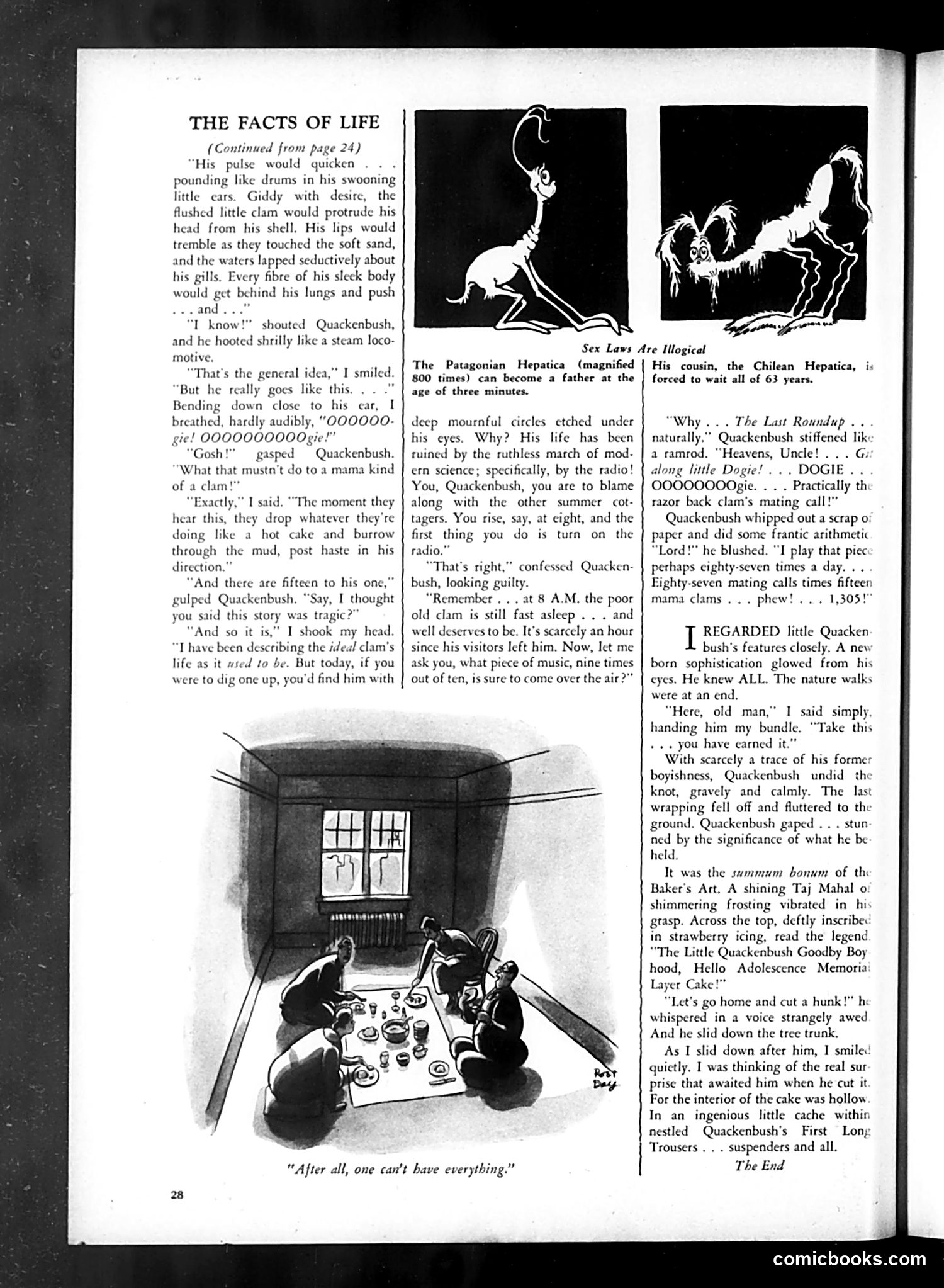
"The Facts of Life" — A Coming-of-Age Satire This is a humorous short story about a boy named Quackenbush learning about reproduction through an extended metaphor about clams. An adult narrator explains clam mating using increasingly euphemistic language ("OOOOGIE"), which excites the boy. The satire targets modern intrusions on nature: radio broadcasts of "The Last Roundup" (a popular 1933 song) allegedly trigger clams' mating calls at inopportune times, disrupting their natural cycles. This blames summer cottagers and technology for corrupting natural instincts. The ending reveals the story's true purpose—a coming-of-age ritual where Quackenbush receives his first long pants hidden in a cake, marking his transition to adolescence. The illustrations show two sea creatures and clams dining in a burrow. The page appears designed to amuse adult readers with innuendo while maintaining plausible deniability through animal-based humor.
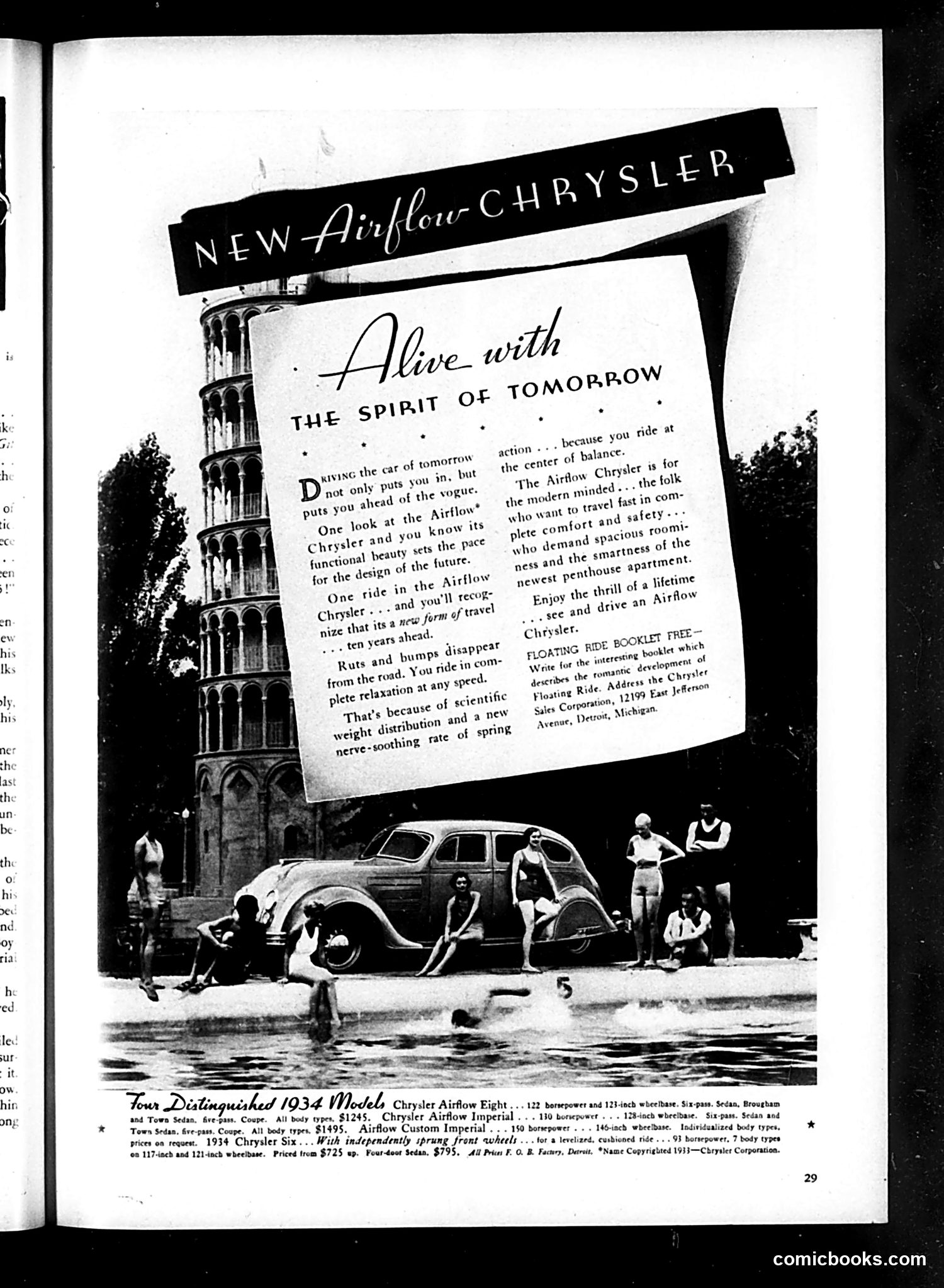
Analysis This is a Chrysler automobile advertisement, not a political cartoon. It promotes the 1934 Chrysler Airflow model positioned against the Leaning Tower of Pisa—a famous European landmark used here to suggest modernity and timeless engineering excellence. The ad's tagline, "Alive with the Spirit of Tomorrow," markets the Airflow as forward-thinking. The copy emphasizes technical innovations: scientific weight distribution, improved suspension ("nerve-soothing rate of spring"), and spacious interior comfort. The beach scene with people relaxing around the car reinforces leisure and accessibility. The multiple model listings at bottom (Airflow Eight, Imperial, Six, Custom Imperial) show Chrysler's product range and pricing ($795–$1,495). For modern readers: This represents 1930s automotive marketing—emphasizing technological progress and comfort as selling points, using European cultural references to signal sophistication. The "floating ride" concept was genuinely novel engineering for the era.
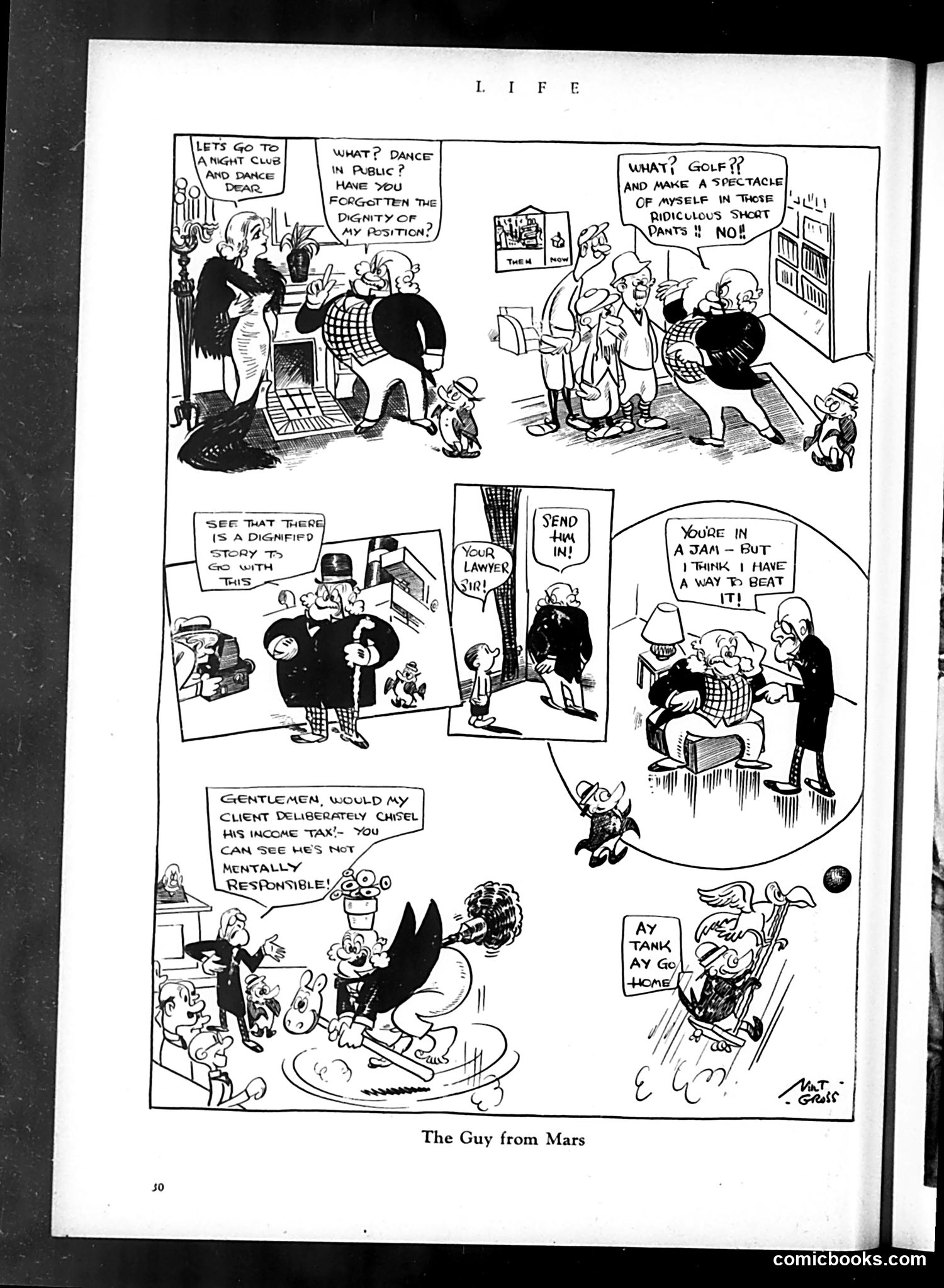
"The Guy from Mars" - Life Magazine Cartoon This multi-panel comic satirizes social pretension and tax evasion among the wealthy. The narrative follows a Martian visitor encountering Earth's upper class. In early panels, stuffy socialites reject dancing and golf as undignified. The central sequence depicts a wealthy man consulting his lawyer about deliberately underreporting income taxes, with the lawyer advising him to claim the client is "not mentally responsible." The satire targets two behaviors: (1) the hypocrisy of the rich who flaunt strict propriety while engaging in illegal activity (tax fraud), and (2) the complicity of lawyers in helping clients commit crimes. The Martian's final exclamation ("Ay tank, ay go home") suggests even an alien visitor finds Earth's corruption baffling and absurd. The cartoon criticizes tax evasion and professional ethics violations among the privileged class.
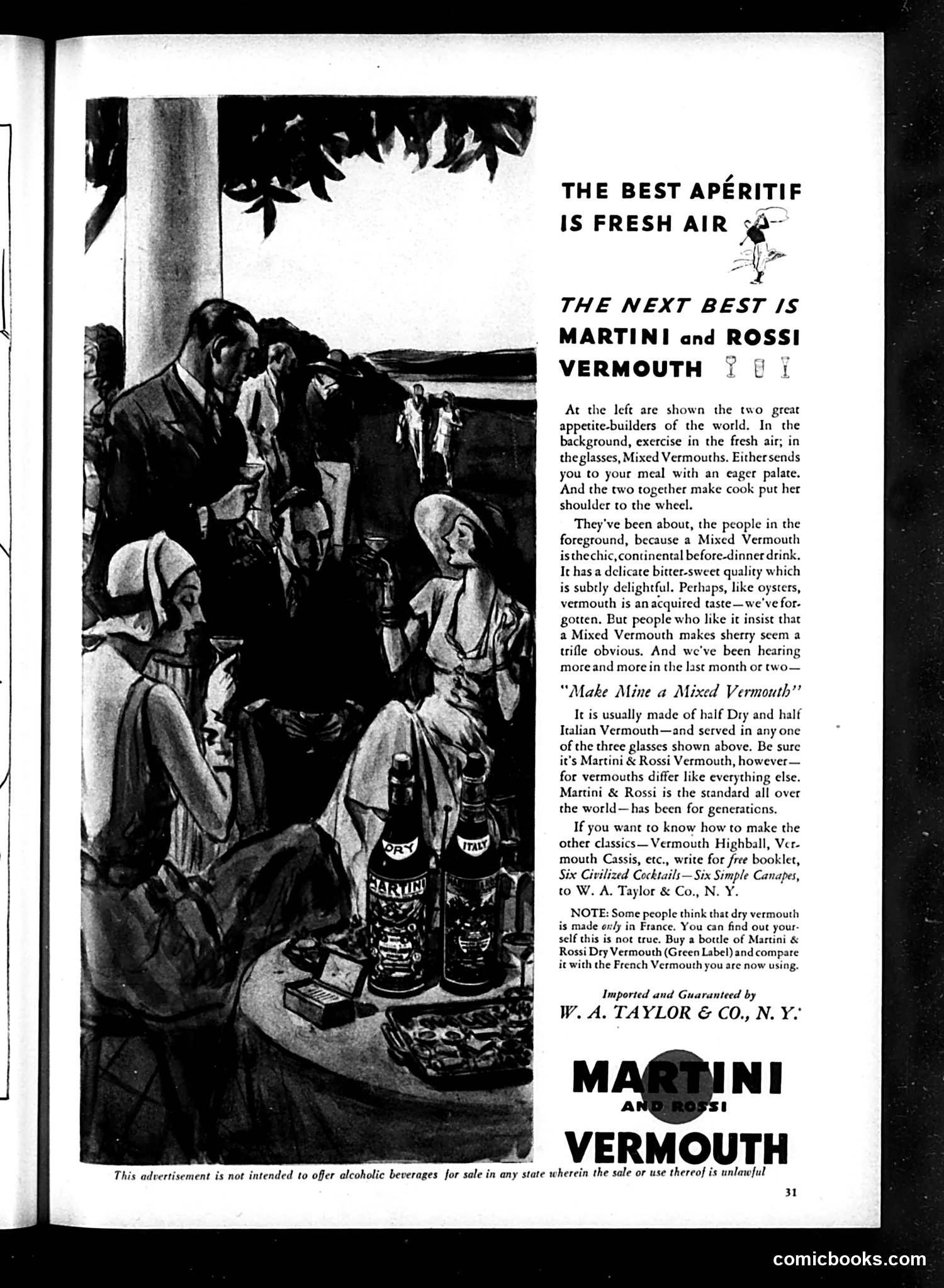
Martini & Rossi Vermouth Advertisement Analysis This is a vermouth advertisement, not political satire. The page promotes Martini & Rossi Vermouth as a pre-dinner aperitif. The illustration depicts European leisure culture—well-dressed figures enjoying outdoor exercise ("fresh air") as an appetite stimulant, positioned as equivalent to drinking vermouth before meals. The ad positions vermouth as sophisticated, continental, and "chic"—an acquired taste for cosmopolitan drinkers who find sherry "obvious." The text emphasizes that Martini & Rossi is the global standard and instructs readers on preparation ("Make Mine a Mixed Vermouth"—half dry, half Italian). A note defensively claims Italian dry vermouth rivals French production, suggesting contemporary market competition. The legal disclaimer reflects Prohibition-era regulations restricting alcohol advertising. This reflects 1920s-30s America when such advertising had to navigate strict state laws about alcoholic beverage promotion.
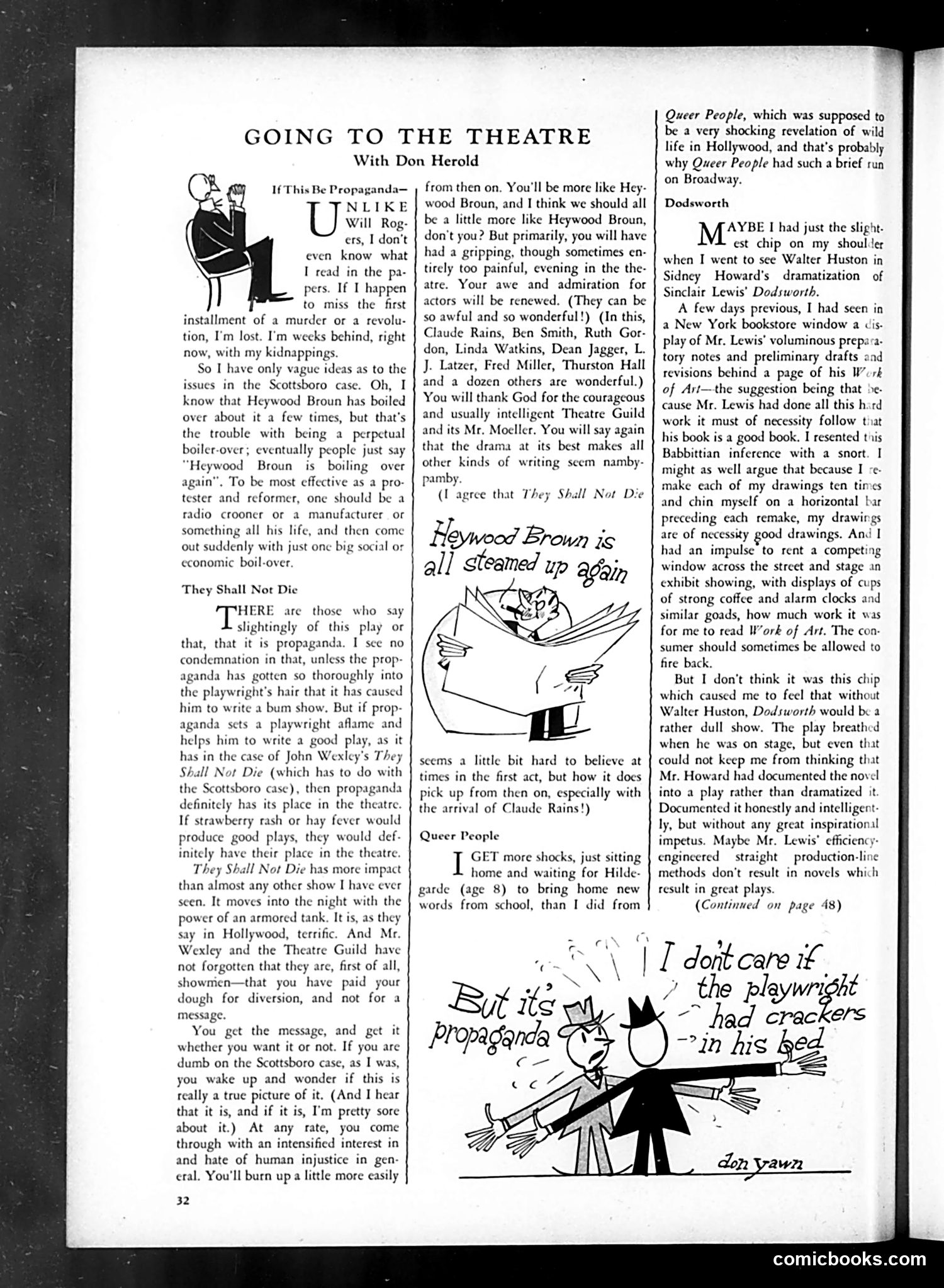
Analysis for Modern Readers This Life magazine theater column by Don Herold reviews three Broadway plays while discussing propaganda in theater. "They Shall Not Die" is praised as powerful drama about the Scottsboro case—a real 1931 incident where nine Black teenagers were falsely accused of rape in Alabama. Herold argues that while the play is overtly political, it succeeds because it's *good theater first*, not just messaging. He names prominent actors (Claude Rains, Ruth Gordon, Dean Jagger) and credits the Theatre Guild. "Queer People" is mocked as a supposedly scandalous Hollywood exposé that failed on Broadway because it wasn't actually shocking. "Dodsworth" adapts Sinclair Lewis' novel with Walter Huston. The cartoon caricatures Heywood Broun, a real famous newspaper columnist known for passionate social activism and criticism. Herold jokes that Broun "boils over" so frequently about causes that people dismiss him—humorously suggesting reformers need to maintain credibility through restraint. The satire targets both superficial "propaganda plays" and activist burnout, while championing socially conscious theater that entertains.
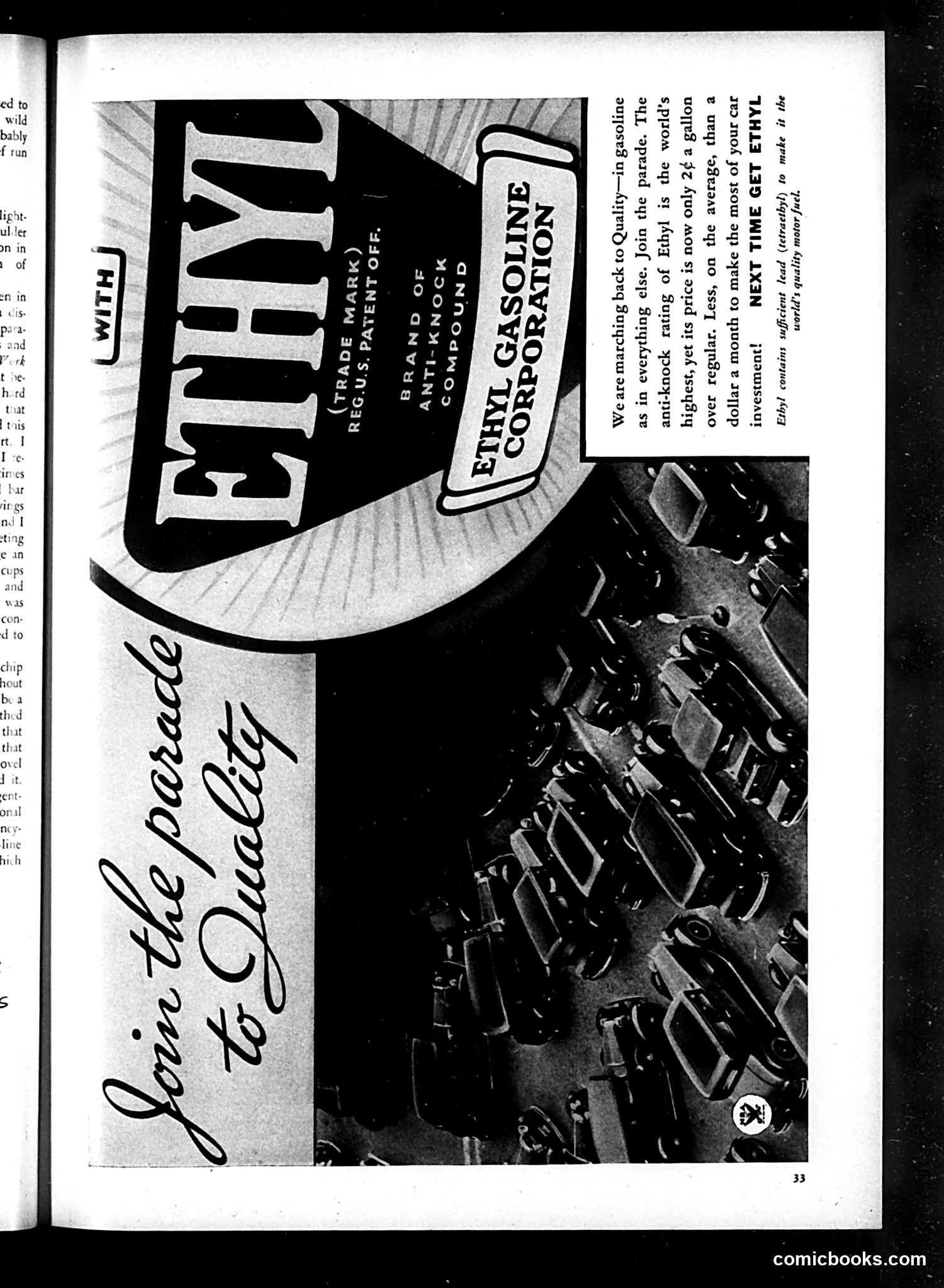
Analysis This page is primarily an advertisement for Ethyl gasoline, not a political cartoon. The OCR text appears corrupted and unreadable, but the visual content is clear: The ad features the Ethyl brand logo and emphasizes that the gasoline provides superior performance—specifically mentioning it produces "the highest, price is now only 2¢ a gallon" more than regular gas and offers "anti-knock" properties. The image shows an engine, illustrating the product's mechanical benefits. "Join the Parade K9 Quality" appears as the slogan at bottom left. This is a straightforward commercial advertisement from what appears to be a mid-20th century *Life* magazine, highlighting Ethyl's marketing position during an era when anti-knock gasoline additives were a notable technological advancement and selling point for automobiles.
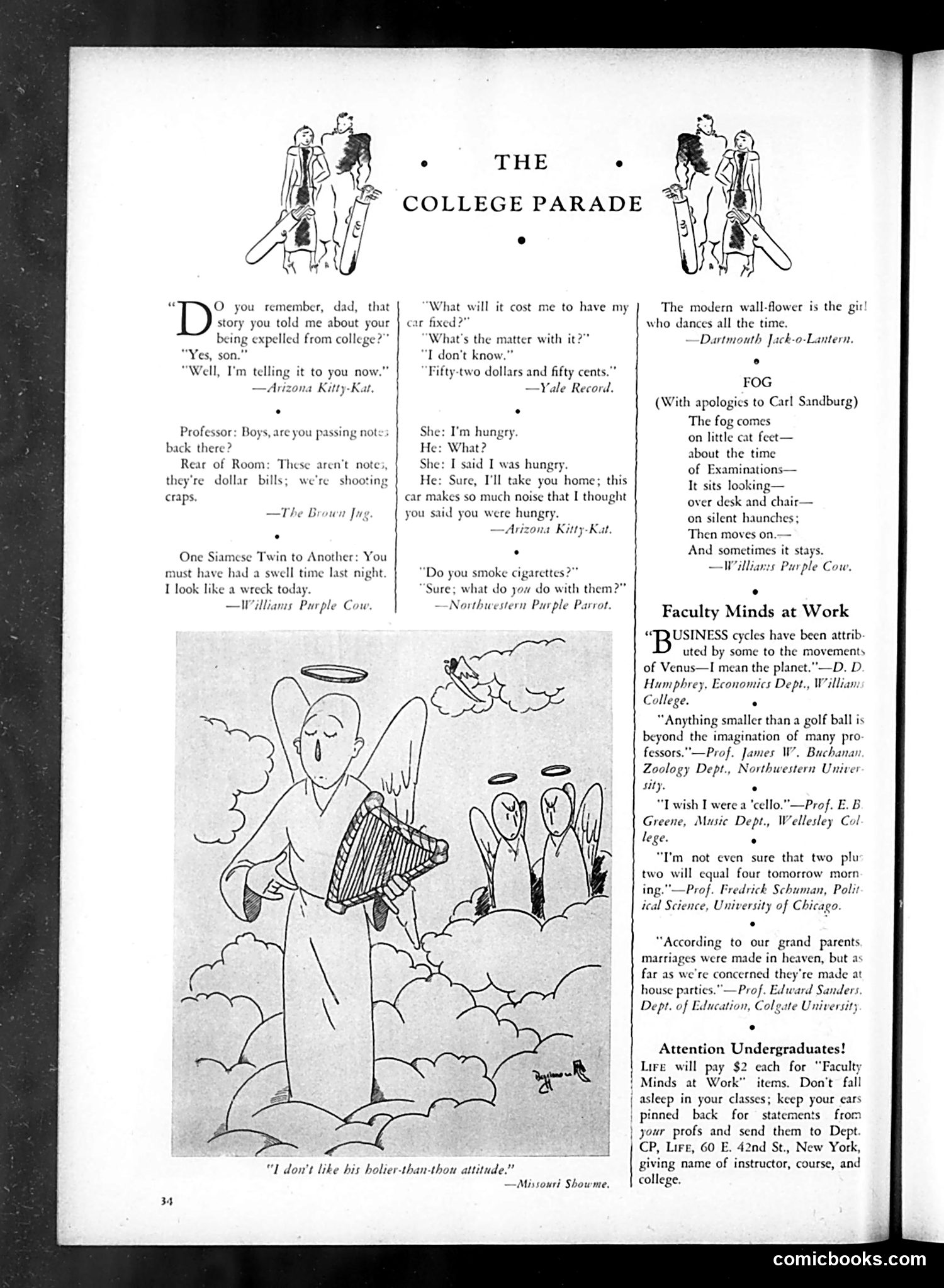
"The College Parade" - Life Magazine Satire Page This page collects humorous anecdotes and jokes about college life, drawn from various college humor magazines of the era (Arizona Kitty-Kat, Yale Record, Williams Purple Cow, etc.). The jokes target recognizable college stereotypes: students gambling instead of studying, expensive car repairs, loud automobiles making dates awkward, and professors who are absent-minded or pedantic. The cartoon depicts an angel playing a harp among clouds, illustrating a joke about a student claiming he had a "swell time" last night (implying excessive partying or debauchery). The "Faculty Minds at Work" section mocks professorial eccentricity—economists confusing planets with economics, zoologists with limited imagination, and a political scientist uncertain about basic mathematics. The final section humorously invites undergraduates to report professors' ridiculous statements to Life magazine for payment. The overall satire presents college as chaotic, indulgent, and filled with incompetent authority figures—reflecting 1920s-era skepticism toward academic institutions and student culture.
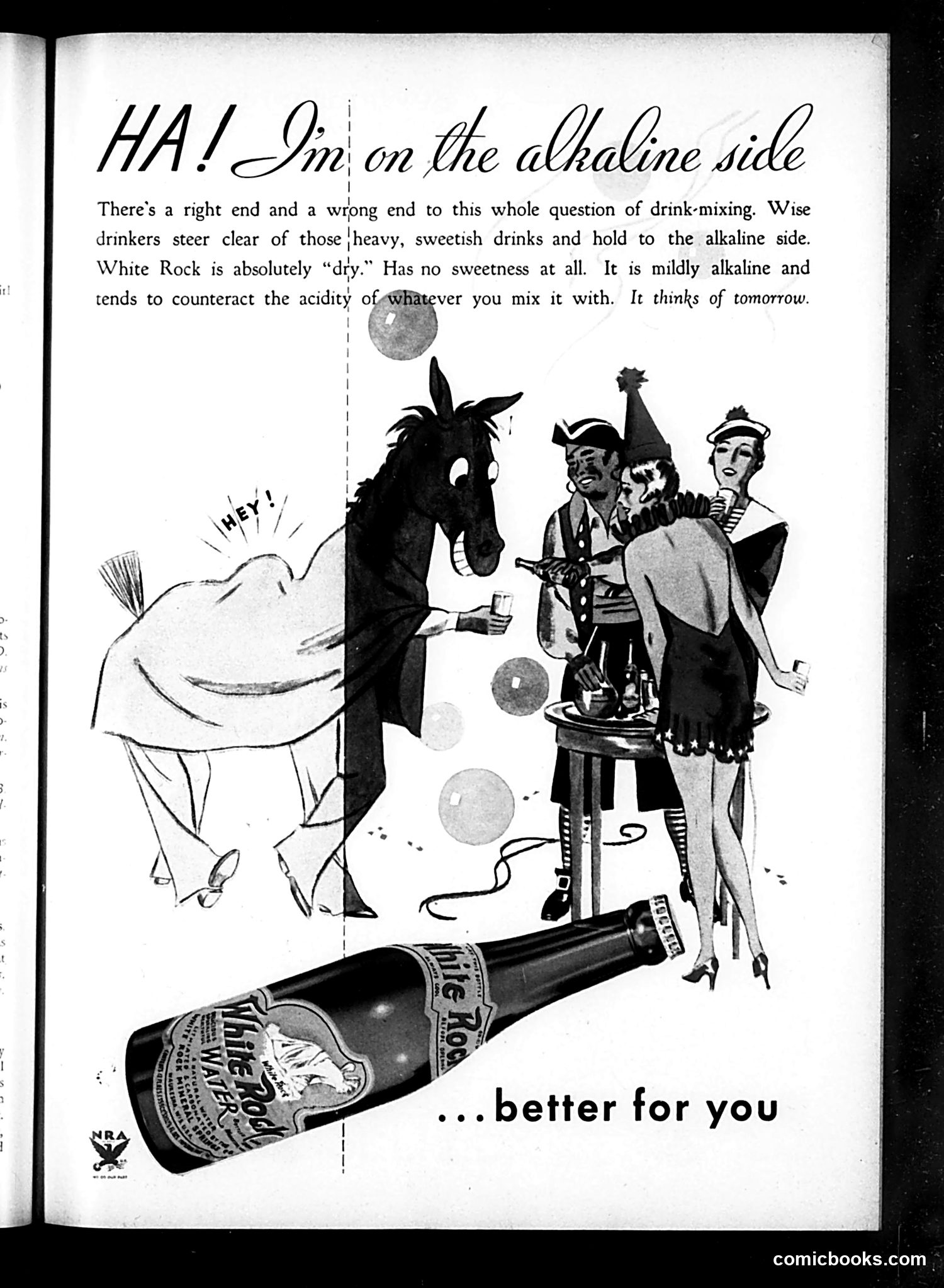
Analysis This is an advertisement for White Rock beverages disguised as humorous editorial content. The page mocks excessive drinking culture through caricature: a portly, intoxicated man (left) contrasts with fashionably dressed partygoers (right) holding drinks near a White Rock bottle. The joke centers on pseudo-scientific claims about "alkaline" drinks counteracting acidity—a marketing pitch presenting White Rock as the "responsible" choice for sophisticated drinkers. The phrase "It thinks of tomorrow" suggests moderation and hangover prevention. The exaggerated drunk figure represents the "wrong end" of drink-mixing, while the elegant party scene represents the "right end"—implying White Rock enables civilized socializing rather than slovenly excess. This reflects Prohibition-era anxieties about alcohol consumption and class distinctions in drinking habits.
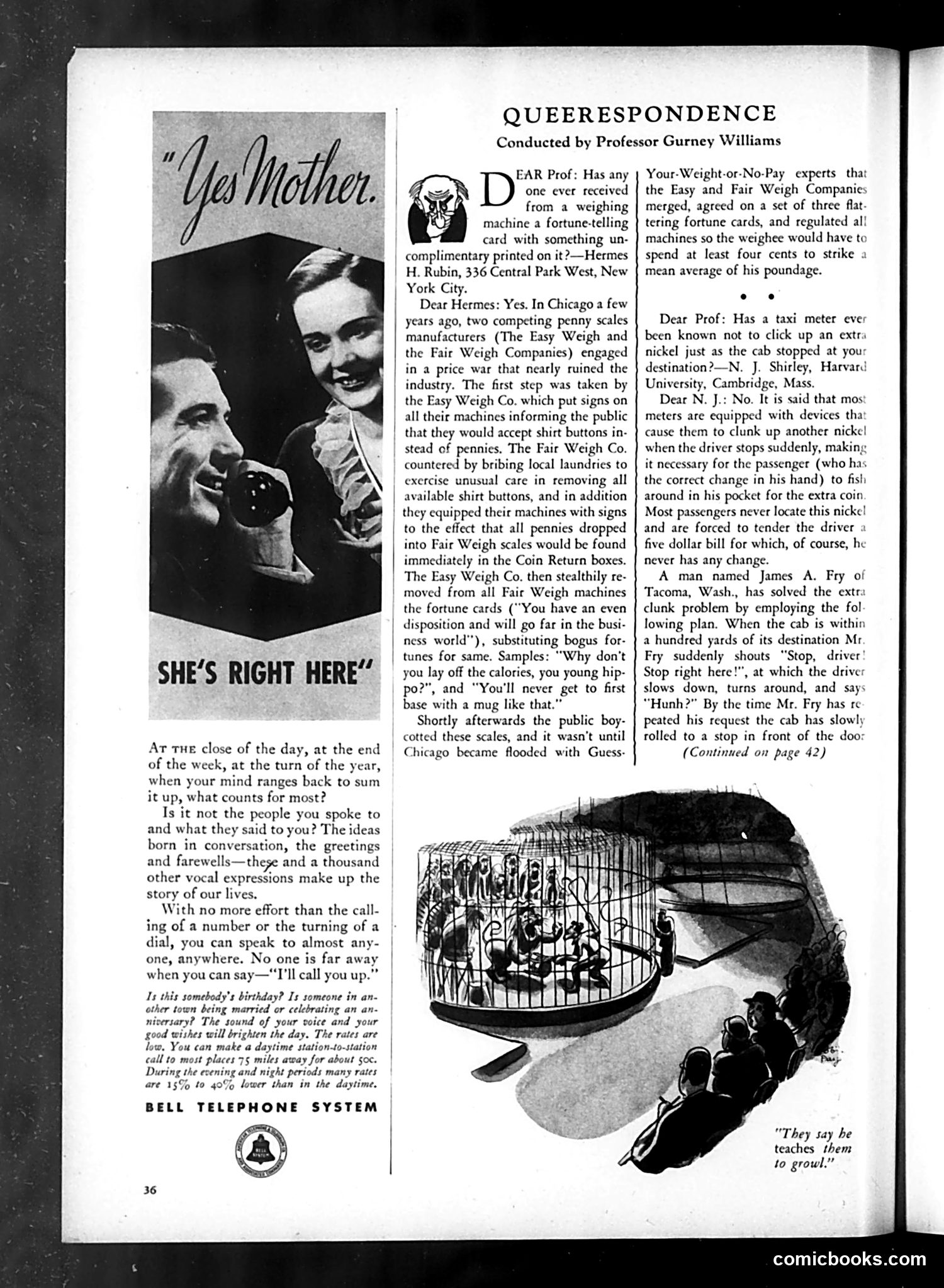
"Queerespondence" Page Analysis This page combines a Bell Telephone System advertisement (left) with a humorous advice column (right) conducted by "Professor Gurney Williams." The column presents fictional, tongue-in-cheek answers to reader questions about minor urban consumer frustrations. The first question concerns penny-weighing scales that allegedly printed insulting fortunes; the answer describes a comedic "price war" between competing scale manufacturers involving shirt buttons and sabotaged fortune cards. The second question humorously addresses taxi meter manipulation—the common complaint that meters mysteriously register extra charges. The satirical "solution" describes a passenger (James A. Fry) who shouts false stop commands to confuse the driver, causing the cab to slow gradually rather than stop suddenly, thereby preventing the meter's supposed "extra clunk." The satire targets both consumer anxiety about being cheated by machines and small service providers, and the absurdity of trying to outwit such systems. The humor lies in presenting ridiculous "solutions" to petty grievances as if they were genuine advice.
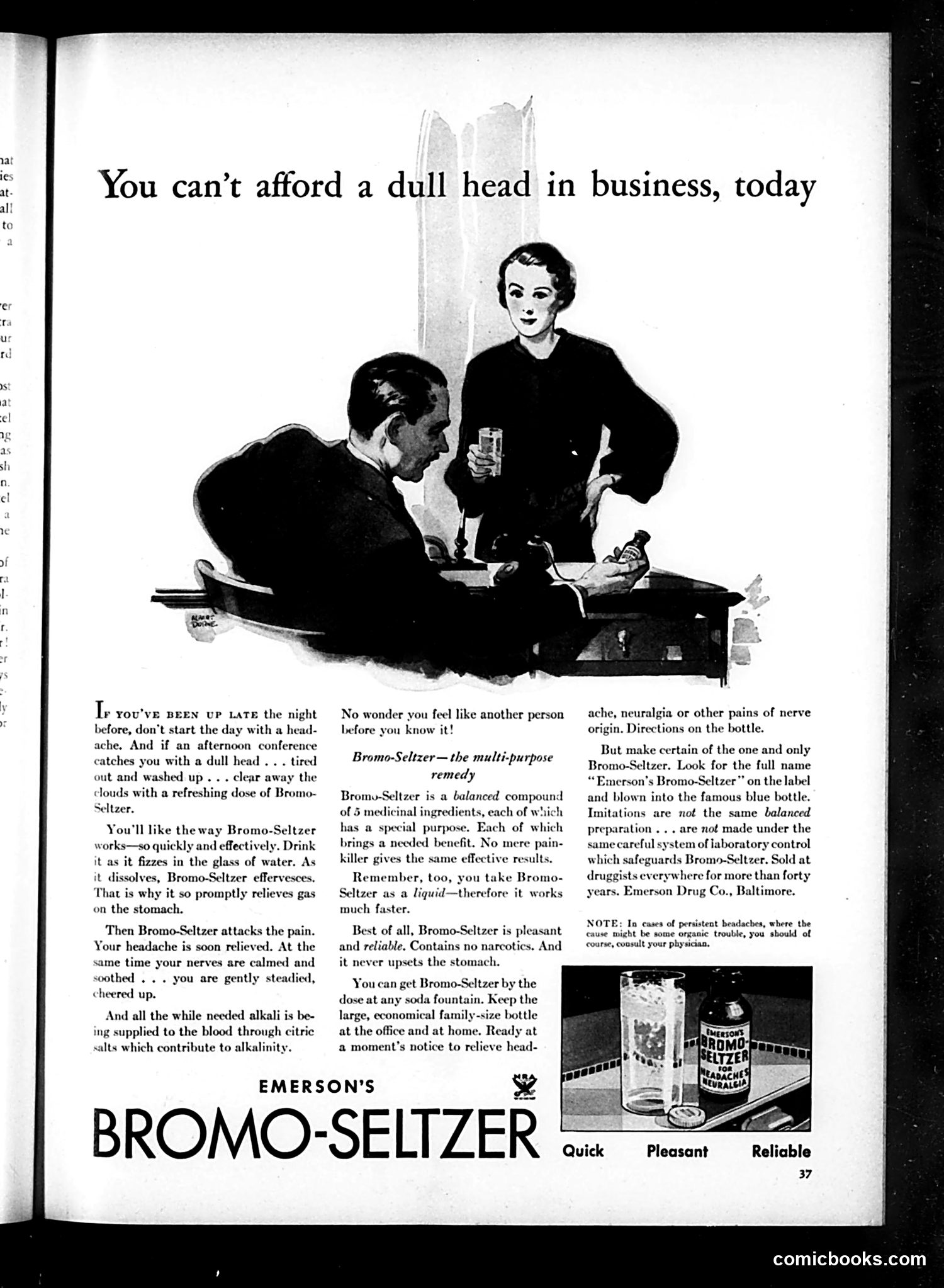
Analysis: Bromo-Seltzer Advertisement This is primarily a patent medicine advertisement, not political satire. The page depicts a business scenario to sell headache remedy. The illustration shows a tired businessman at his desk with a woman (likely his secretary or colleague) offering him a glass of Bromo-Seltzer. The headline "You can't afford a dull head in business, today" appeals to professional anxiety—the implicit message being that mental sharpness is essential to maintaining one's job or status. The advertisement's rhetoric reflects mid-20th-century attitudes: it assumes a male professional workforce and positions the product as a quick fix for the demands of modern business life. The copy emphasizes speed and effectiveness ("works much faster"), playing on workplace stress. The small print warns against imitations, a common tactic for branded medicines of this era when patent protections were looser. This is commercial messaging disguised as helpful advice, not satirical commentary.
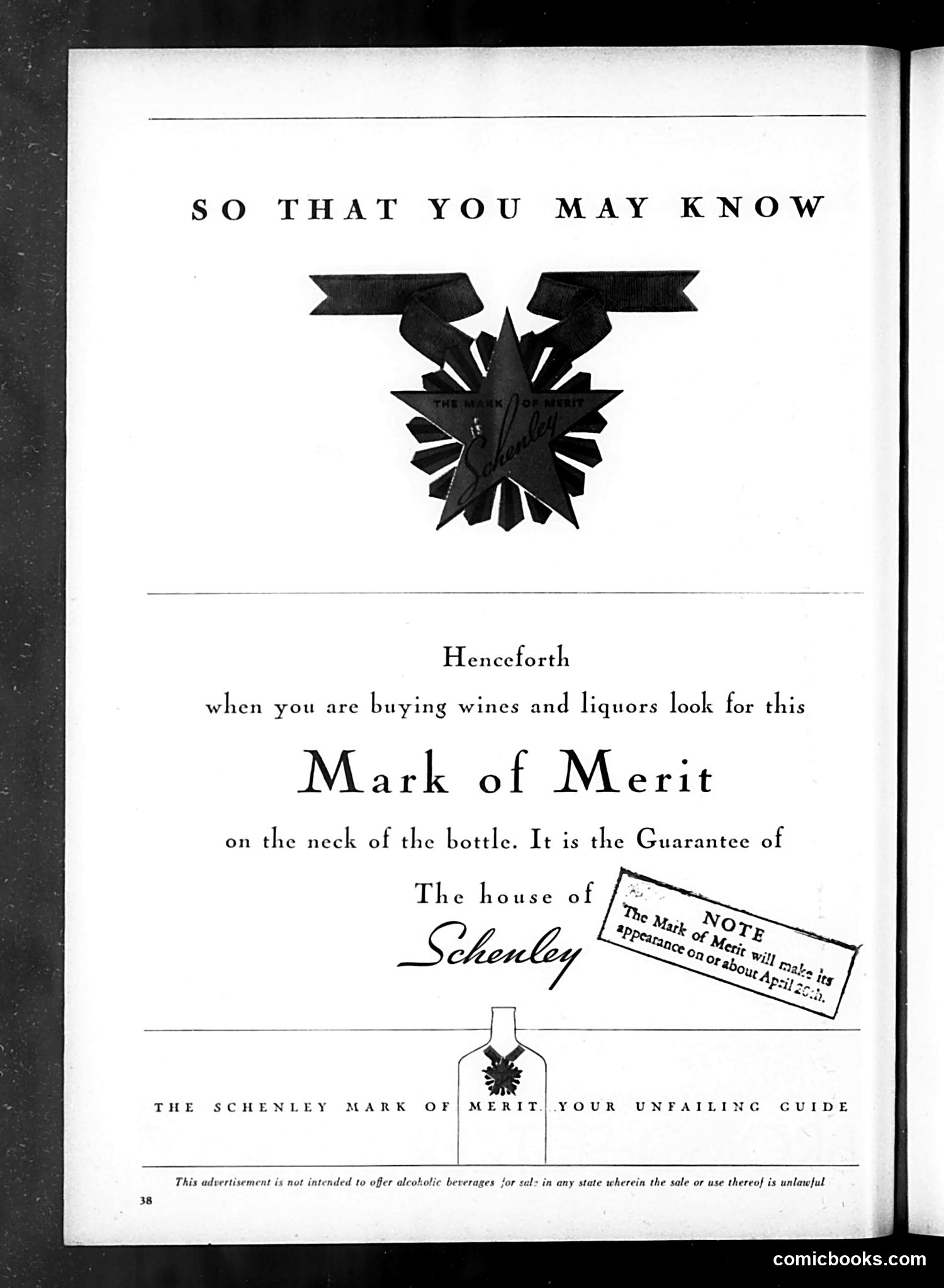
This is a straightforward advertisement, not satire or political commentary. It promotes Schenley's "Mark of Merit"—a seal or emblem to appear on wine and liquor bottles as a quality guarantee. The page instructs consumers to look for this distinctive mark when purchasing alcoholic beverages, positioning it as "your unfailing guide" to the Schenley brand. The small note indicates the Mark of Merit will debut around April 20th. A disclaimer at the bottom acknowledges legal restrictions on alcohol sales in certain states—likely referencing Prohibition-era regulations still in effect when this ran. This appears to be a standard commercial notice rather than satirical content.
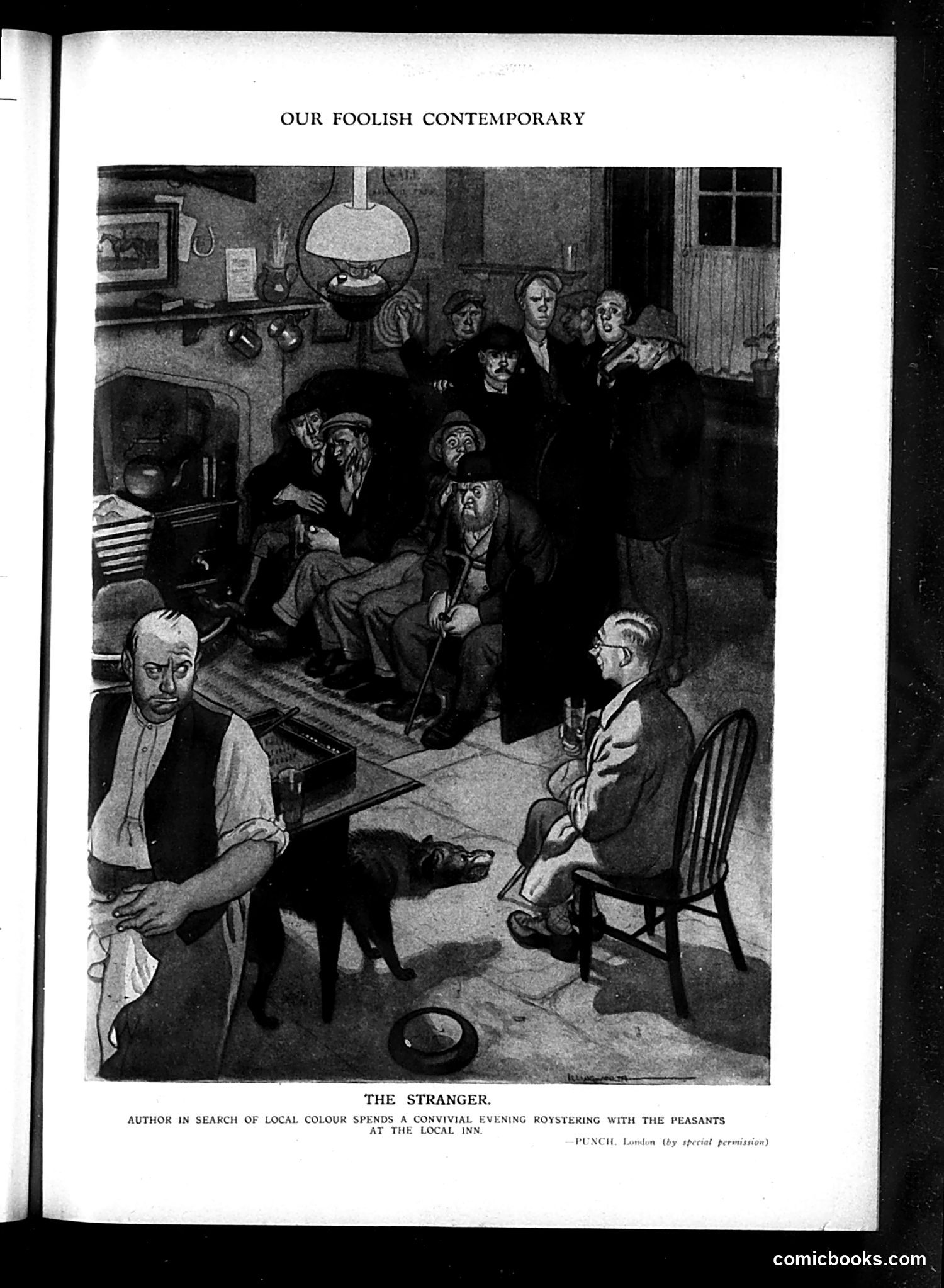
"The Stranger" This is a satirical illustration from *Punch* magazine depicting a social type common to the era: an author or intellectual visiting a rural village to gather "local colour" (authentic regional detail) for his writing. The cartoon mocks this pretentious figure—seated left, conversing with a rustic man—who has come to "roystering" (carousing) with "the peasants" at a local inn. The humor lies in the contrast between the author's self-conscious, affected interest in authentic working-class life and the indifference of the actual villagers gathered behind him, who appear unimpressed or bemused by his presence. The title "Our Foolish Contemporary" makes clear the satire targets this type of romanticizing, slumming intellectual. The page critiques both the author's pretension and the artificiality of his quest for genuine rural experience.
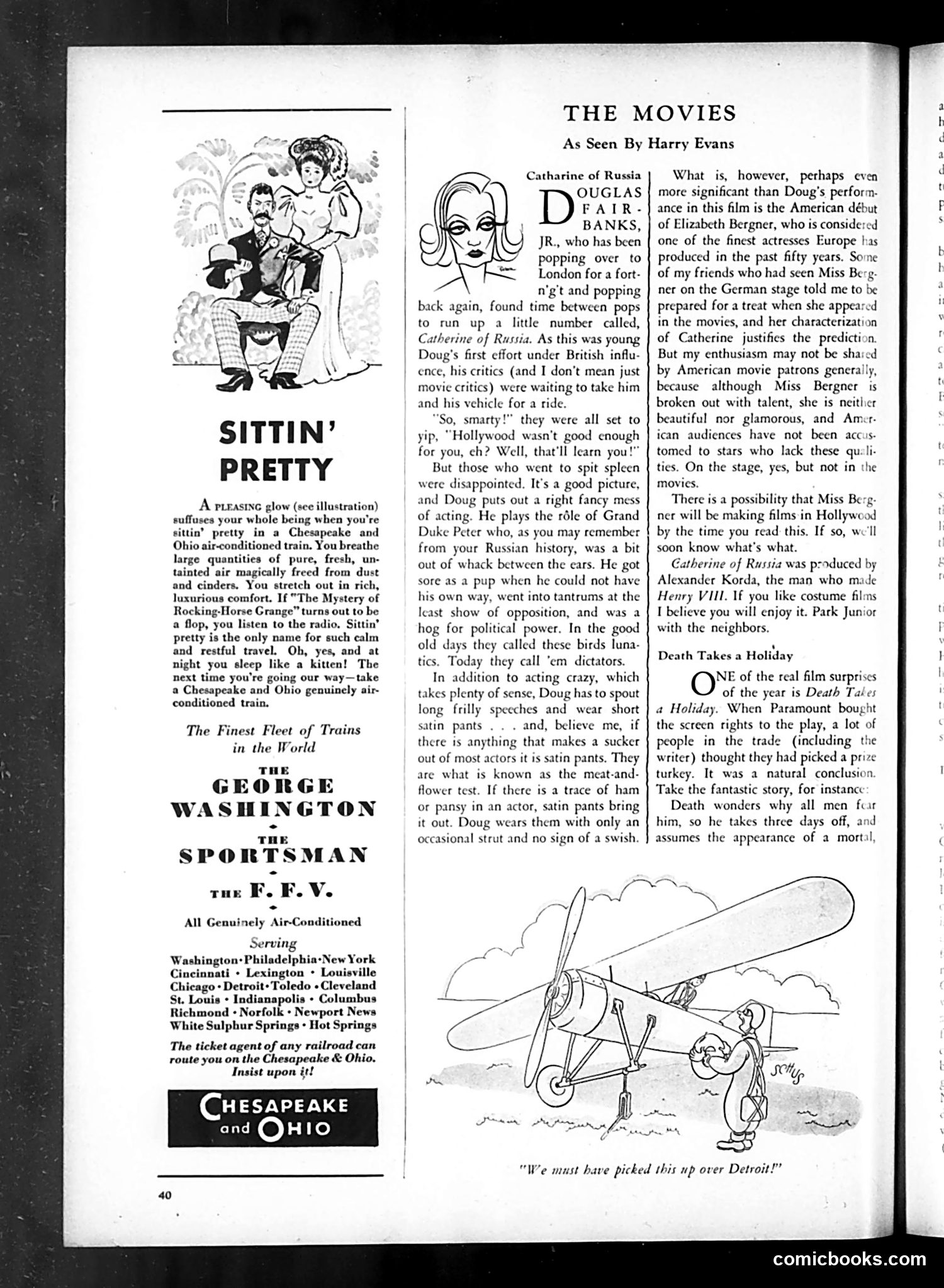
Analysis of Page 40 Content This page contains two distinct sections: Left side: A Chesapeake and Ohio Railroad advertisement disguised as editorial content, promoting air-conditioned trains with romantic appeals to comfort and leisure travel. Right side: A film review column by Harry Evans covering two movies: 1. "Catherine of Russia" — Douglas Fairbanks Jr. stars as Grand Duke Peter. The reviewer praises Fairbanks's performance while noting the film's British production. The review includes a pointed contemporary reference: the reviewer compares Peter's tyrannical tantrums and hunger for power to modern "dictators" (likely alluding to European fascism rising in the 1930s). The column also notes Elizabeth Bergner's European film reputation but expresses doubt American audiences will embrace her—she lacks conventional Hollywood glamour despite exceptional talent. 2. "Death Takes a Holiday" — A brief notice about Paramount's adaptation of a stage play. The cartoons accompanying these reviews use exaggeration and visual humor typical of Life magazine's satirical style. The airplane cartoon's caption ("We must have picked this up over Detroit!") is a geographic joke about the plane's unexpected location.
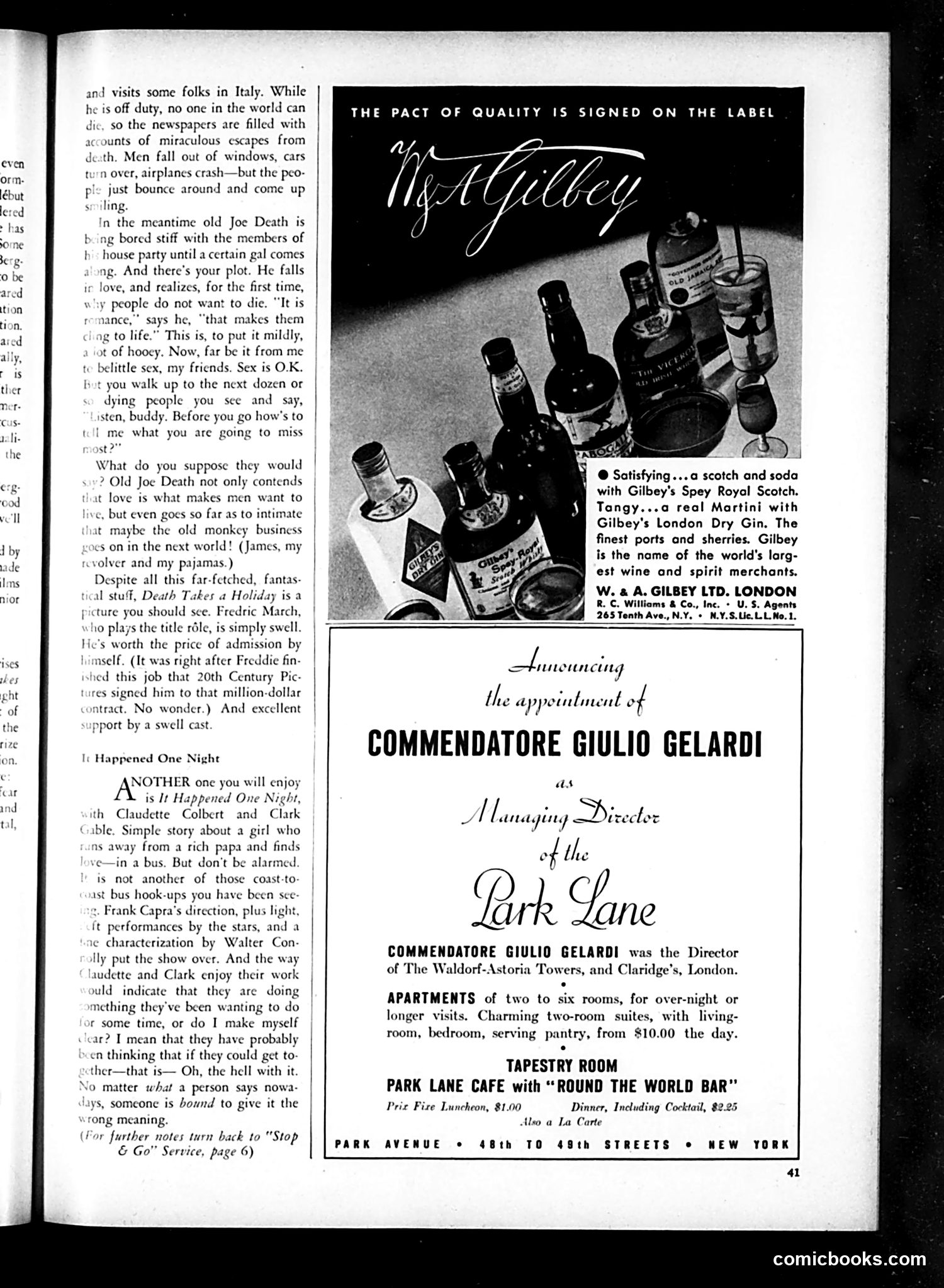
Analysis of Life Magazine Page This page contains film reviews and advertisements rather than political cartoons. The text reviews two movies: *Death Takes a Holiday* (starring Fredric March), about personified Death who falls in love and learns why humans value life, and *It Happened One Night* (with Claudette Colbert and Clark Gable), a romantic comedy about a runaway heiress. The advertisements feature Gilbey's spirits (scotch and gin) and the Park Lane hotel on Park Avenue, announcing an Italian hotel director's appointment as managing director. There is no political satire or caricature on this page. It reflects 1930s consumer culture—luxury travel, branded alcohol, and Hollywood entertainment targeting affluent readers. The humor is incidental to plot descriptions rather than editorial commentary.
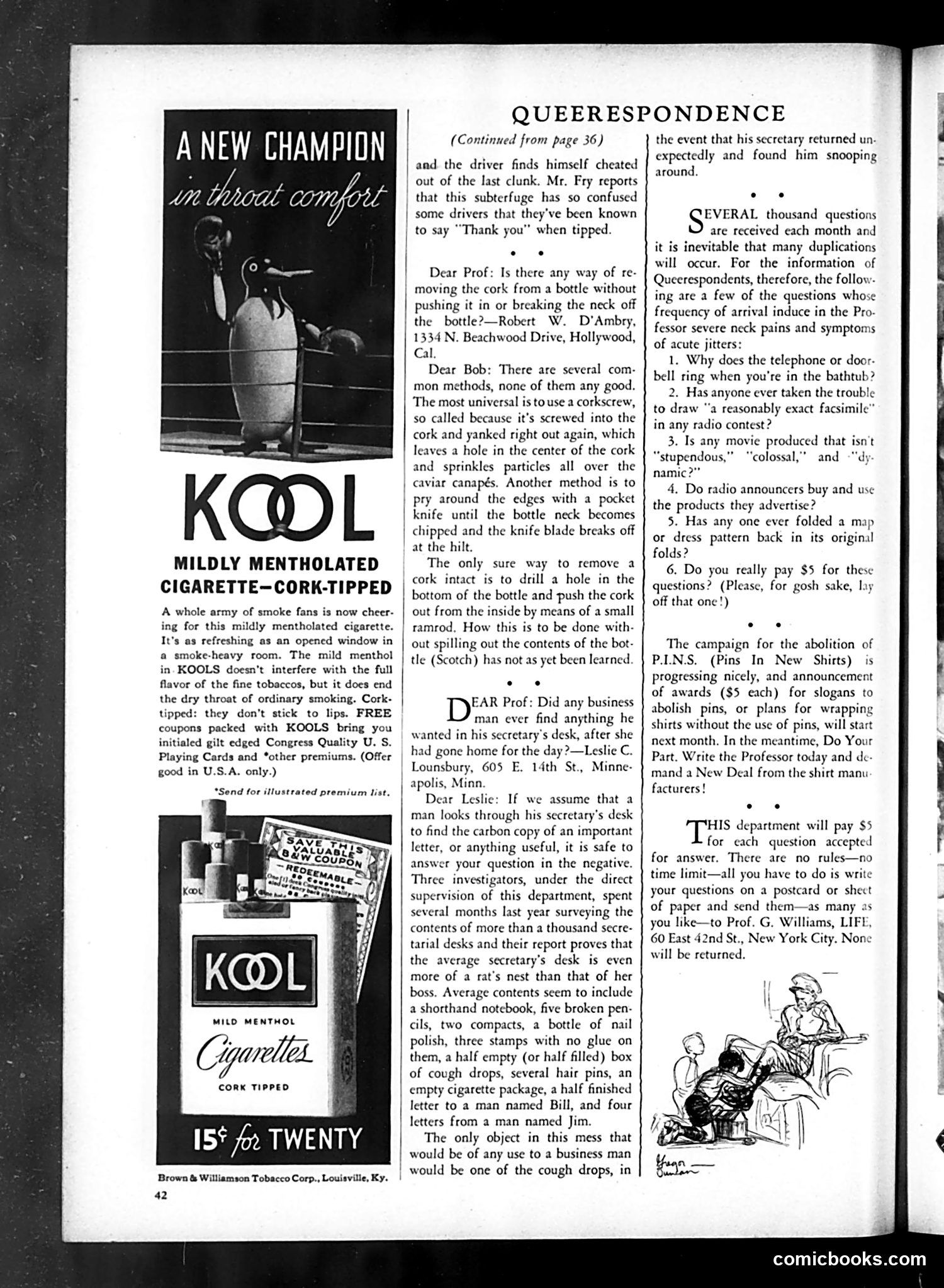
Analysis of This Life Magazine Page This page combines a cigarette advertisement with a satirical advice column called "Queerespondence." The Advertisement: Kool cigarettes are pitched as a "new champion" offering menthol freshness and cork tips—positioned as solving the problem of dry throat from smoking and lips sticking to non-tipped cigarettes. The ad emphasizes premium incentives (playing cards, coupons). The Satire: The advice column mocks everyday annoyances and human nature. One letter humorously describes the futility of removing a cork from a bottle without damage. Another reveals a tongue-in-cheek survey finding secretaries' desks contain mostly useless items (broken pencils, hair pins, half-finished letters to men named "Bill" and "Jim")—implying secretaries are disorganized and romantic. A final section sarcastically lists repetitive reader questions the editor receives monthly, mocking mass-media clichés like movies called "stupendous" or "colossal." The humor targets both consumer frustrations and mid-century gender stereotypes about secretaries.
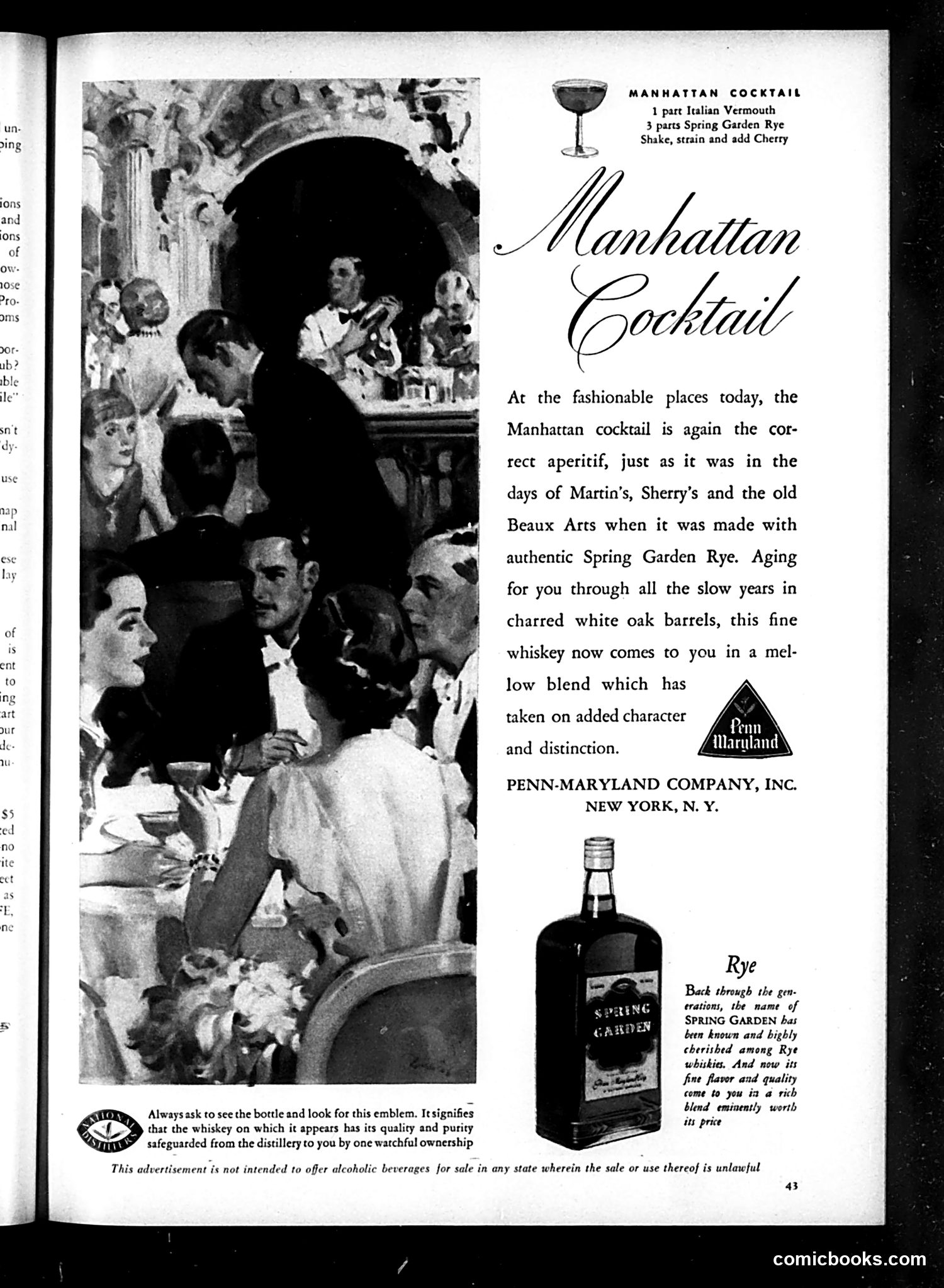
Analysis This is primarily a liquor advertisement, not a cartoon or satire. It advertises Penn-Maryland Company's Spring Garden Rye whiskey through a Manhattan cocktail recipe. The page references fashionable drinking establishments—Martin's, Sherry's, and the old Beaux Arts—suggesting nostalgia for pre-Prohibition cocktail culture. The advertisement implies that the Manhattan cocktail has regained popularity "at the fashionable places today" and positions Spring Garden Rye as the "authentic" ingredient for this classic drink. The photograph shows well-dressed diners in what appears to be an upscale restaurant or bar, establishing an aspirational image of sophistication and leisure. The disclaimer at the bottom ("This advertisement is not intended to offer alcoholic beverages for sale in any state wherein the sale or use thereof is unlawful") indicates this ran during or shortly after Prohibition's repeal era, when alcohol advertising required legal caution. The overall message is restorative nostalgia: refined drinking culture has returned.
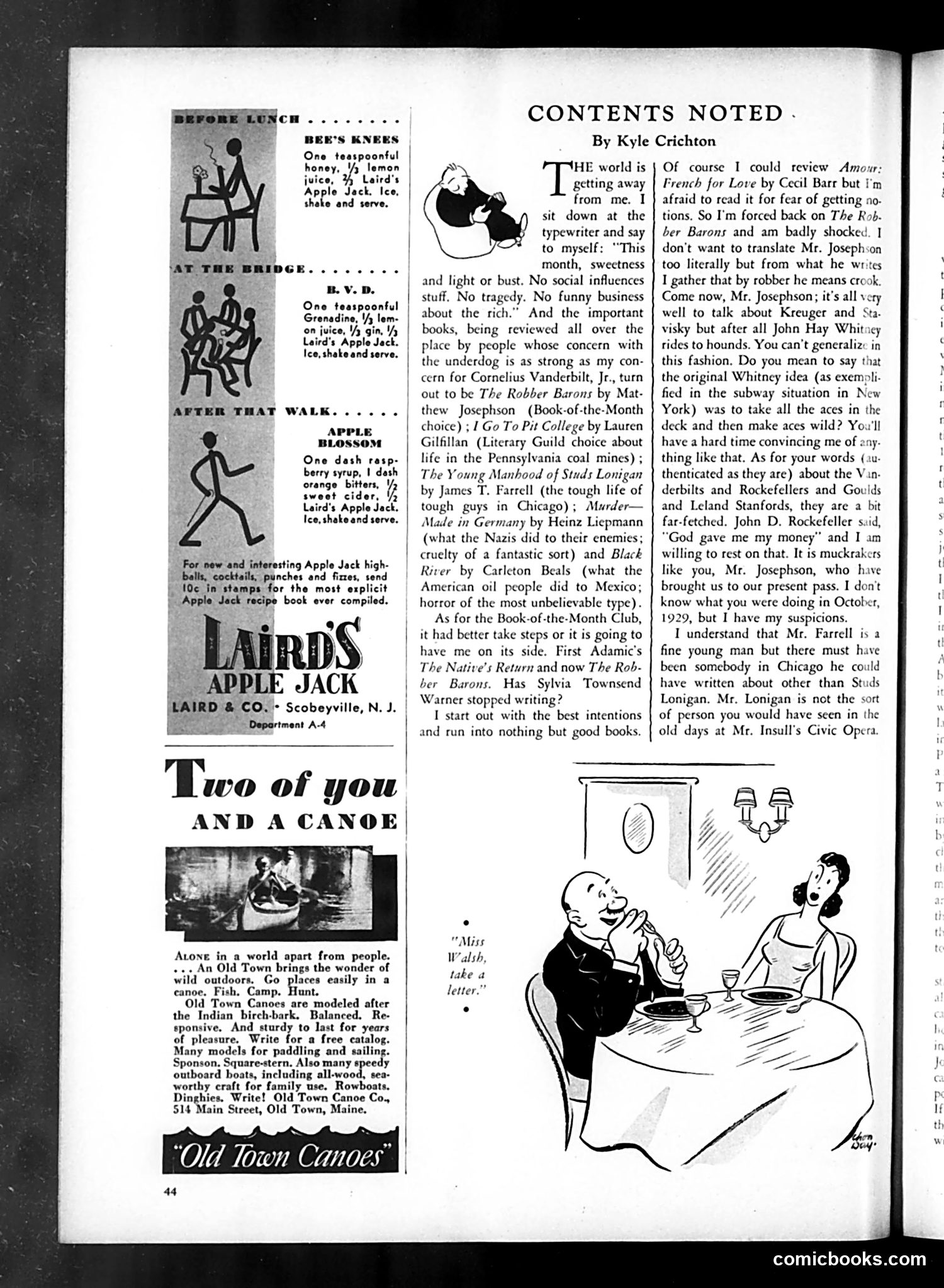
Contents Noted: Kyle Crichton's Book Review Satire This is a book review column by Kyle Crichton satirizing wealthy Americans' resistance to social criticism. Crichton complains that despite his intention to write "sweetness and light," he keeps encountering serious books about exploitation: *The Robber Barons* (about industrialists' ruthlessness), books about coal miners and Chicago slum life, and Nazi atrocities. The satire peaks when he defends the robber barons themselves—Krueger, Stavisky, Whitney—claiming you "can't generalize" about their criminality because Whitney "rides to hounds." He mocks James T. Farrell for writing about working-class "Studs Lonigan" rather than respectable society figures from Samuel Insull's Civic Opera. The joke: Crichton is exposing how the wealthy and their sympathizers dismiss muckraking literature as unfair attacks on "good people," while the books document genuine historical crimes. His mock-naive defense of the indefensible reveals the absurdity of such apologetics.
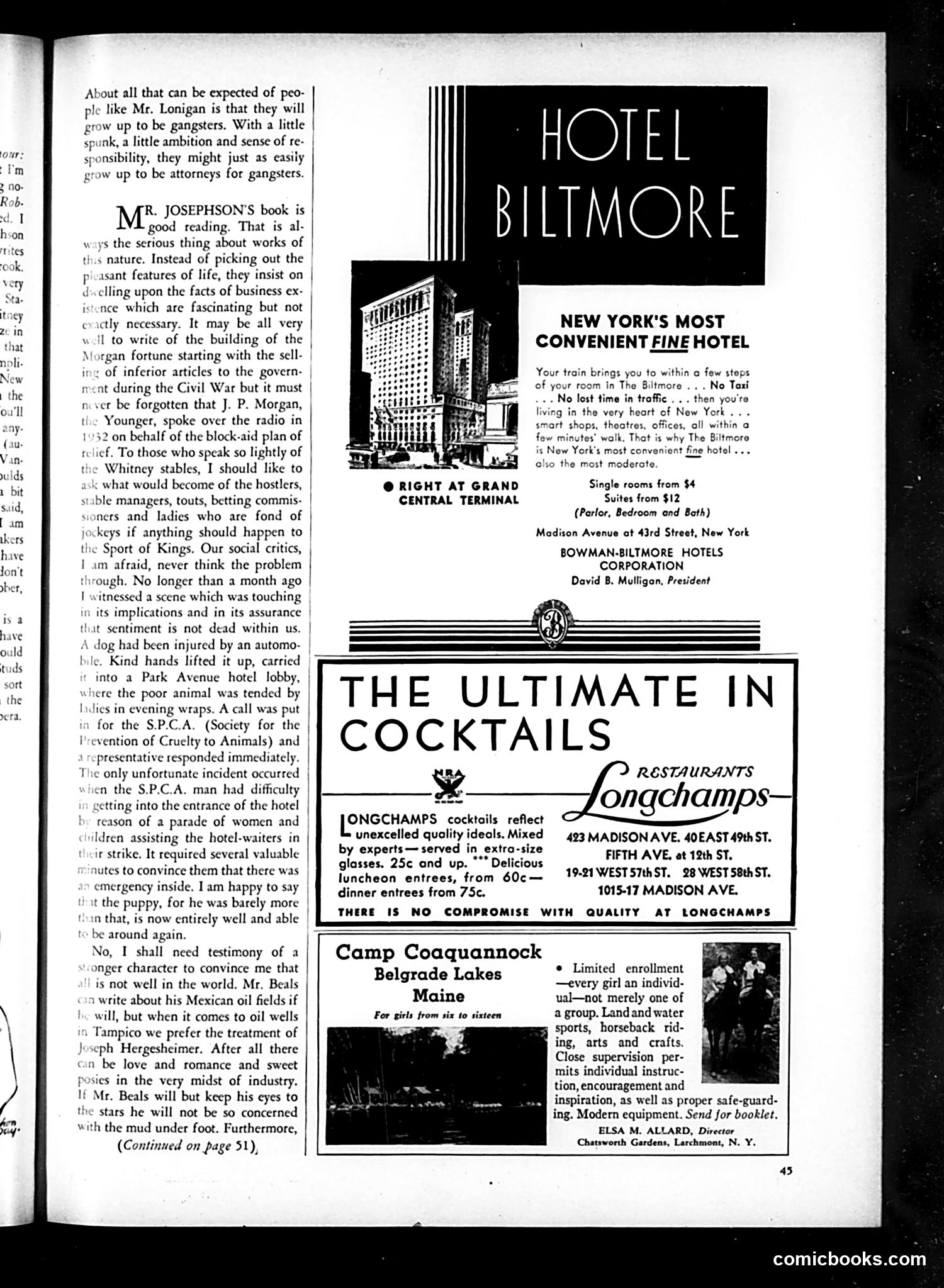
Analysis of This Life Magazine Page This page is primarily advertising, not satirical content. The left column contains book reviews discussing works by Josephson, Beals, and Hergesheimer—praising realistic depictions of business and industry while defending romantic treatments of subjects like oil wells and Mexican oil fields. The satire here is gentle and embedded in the prose: the reviewer mocks social critics who overlook practical consequences (what happens to jockeys if horse racing ends?) and defends sentiment as valuable even amid industry. A touching anecdote about a dog injured near a Park Avenue hotel receiving care illustrates that "sentiment is not dead." The right side features three advertisements: the Hotel Biltmore (near Grand Central Terminal), Longchamps restaurants (cocktails and dining), and Camp Coquannock (a girls' summer camp in Maine). There are no political cartoons on this page. The "satire" is purely literary—a columnist's wry observations about how we value both practical concerns and emotional decency in modern life.
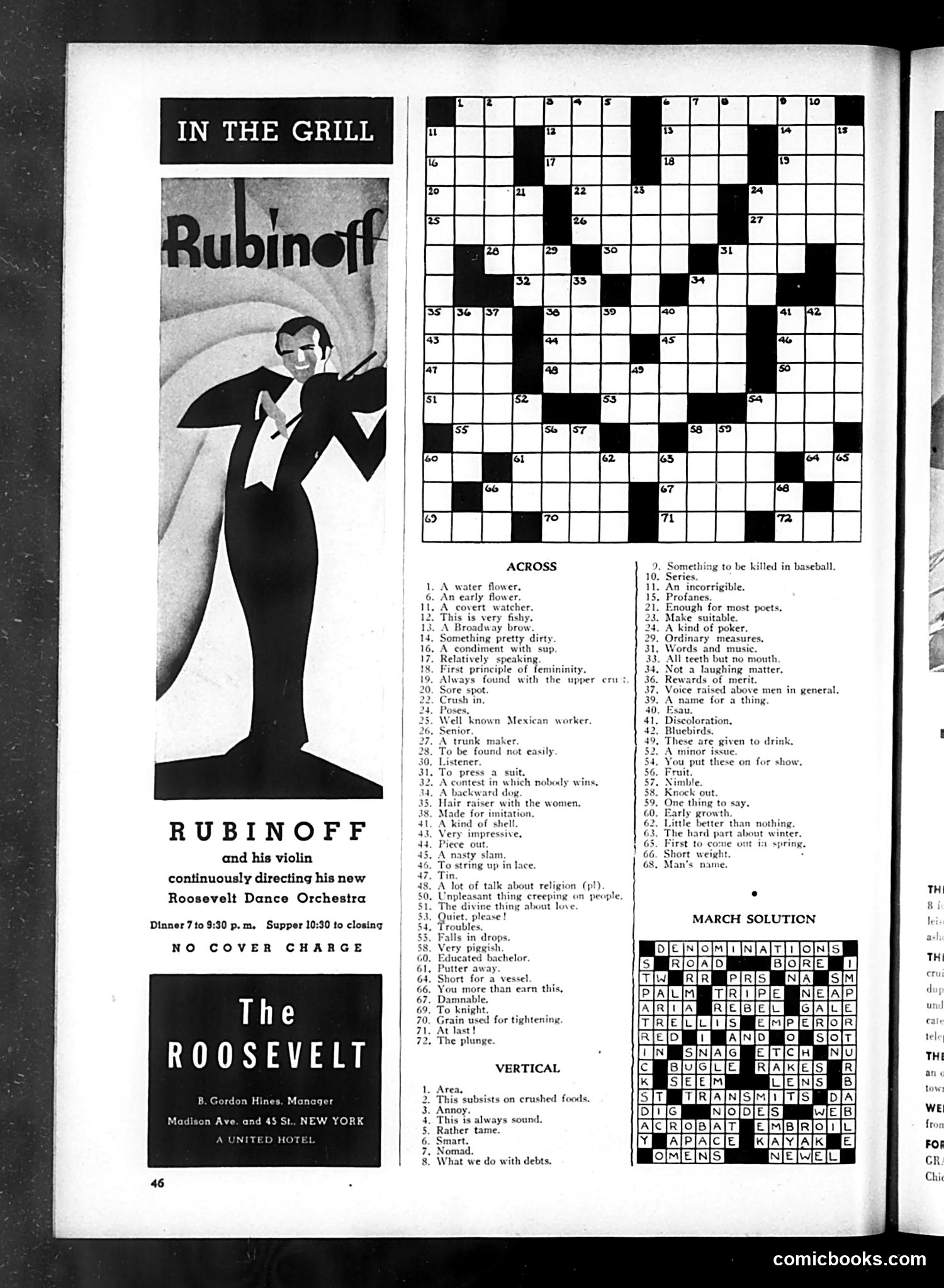
"In the Grill" - Rubinoff Advertisement & Crossword This page is primarily a restaurant advertisement for the Roosevelt Hotel in New York, featuring violinist Rubinoff and his orchestra. The "In the Grill" heading refers to the hotel's dining venue where Rubinoff performed nightly. The illustration shows Rubinoff in formal attire (tuxedo) with his violin—a glamorous nightclub scene typical of 1930s entertainment advertising. The mention of "Roosevelt Dance Orchestra" suggests this dates to the Depression era when such venues offered dinner and dancing as upscale entertainment. The bulk of the page is a crossword puzzle with clues, plus the previous month's solution grid shown below—standard magazine filler content from this period. There is no political satire here; this is straightforward commercial advertising and entertainment content promoting a Manhattan hotel's nightlife venue.
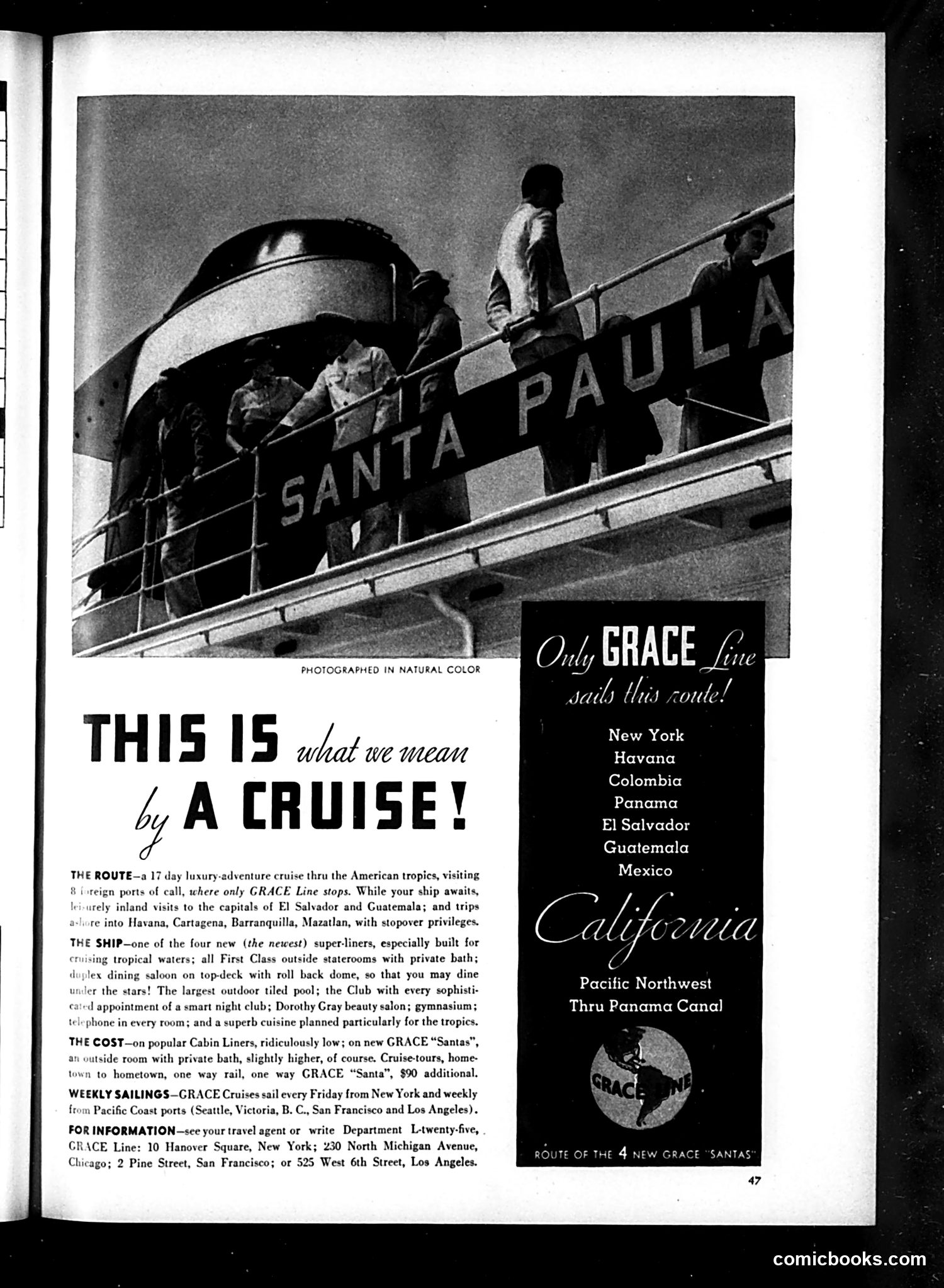
Analysis This is a cruise ship advertisement, not a political cartoon. It promotes the GRACE Line's luxury cruises through the American tropics. The image shows passengers boarding the S.S. Santa Paula, one of the company's newly built ocean liners. The advertisement emphasizes luxury amenities: private cabins, dining under stars, a large pool, a nightclub, and a beauty salon—appealing to wealthy travelers seeking exotic vacation experiences. For a modern reader: This reflects pre-WWII affluent tourism culture, when Caribbean and Central American cruises were glamorous leisure activities for the wealthy. The "adventure" framing of visits to El Salvador and Guatemala reflects a colonial-era perspective where tropical destinations were marketed primarily as exotic backdrops for American pleasure rather than as sovereign nations. The "Santa" ship names and weekly sailings from both coasts indicate an established luxury cruise industry. This represents the golden age of passenger ocean travel before commercial aviation became dominant.
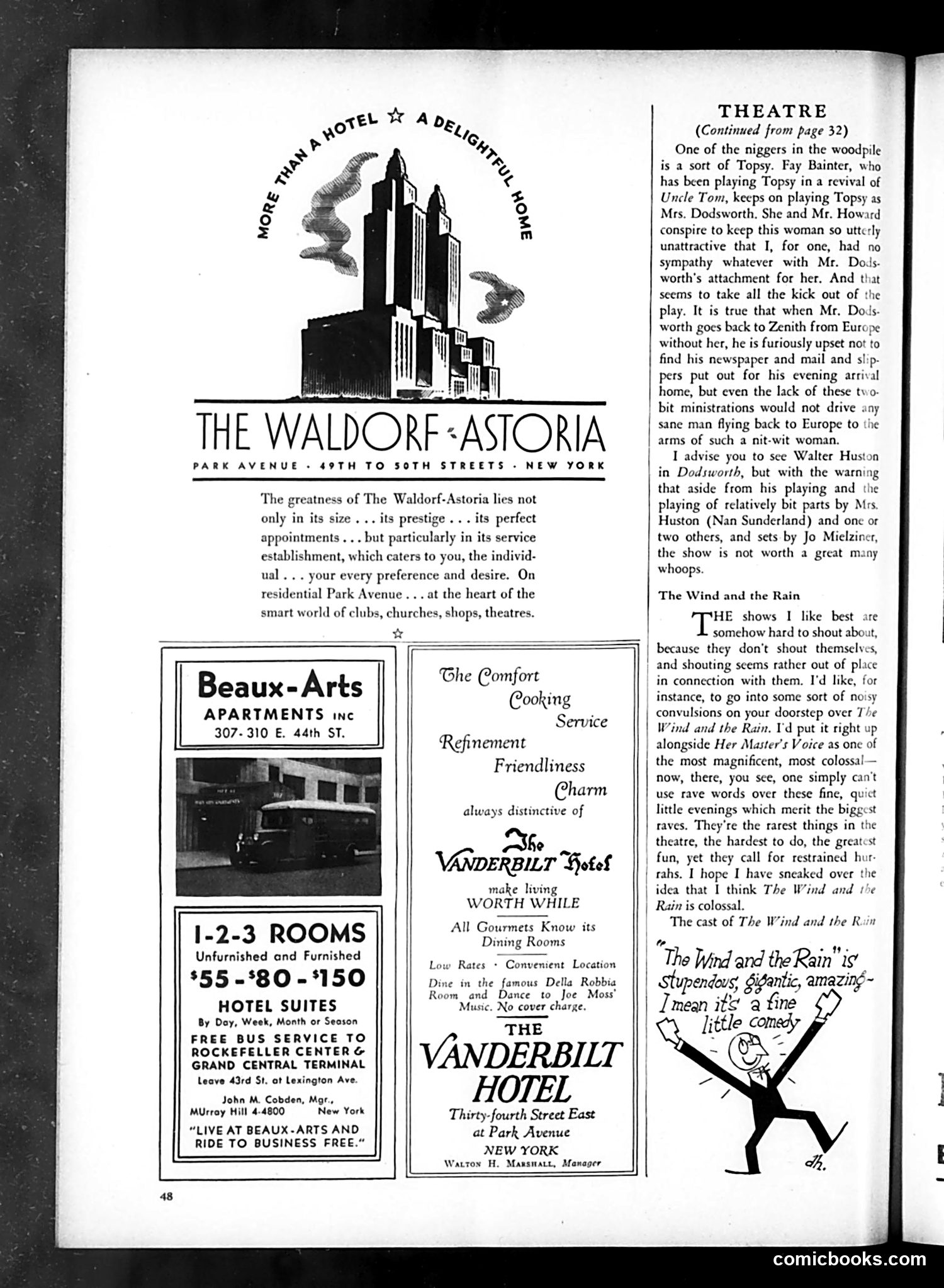
Analysis of Page 48 from Life Magazine This page is primarily advertising and theatre criticism, not political satire. The bulk of the content consists of hotel and apartment advertisements (Waldorf-Astoria, Beaux-Arts, Vanderbilt Hotel) typical of 1930s-era magazines. The substantive content is a theatre review column discussing stage productions. The critic reviews "Dodsworth" (starring Walter Huston) and "The Wind and the Rain," offering judgments on their merits. Notably, the review uses period language including a racial slur ("niggers in the woodpile"), which reflects offensive 1930s vocabulary but refers to theatrical casting choices, not a political statement. The phrase was an idiom meaning "hidden problem" or "complication." The cartoon visible shows a simplified figure with "The Wind and the Rain" caption—likely illustrating the review's point about understated theatrical excellence. This page demonstrates how Life combined entertainment advertising with theatre criticism for an urban, upscale audience.
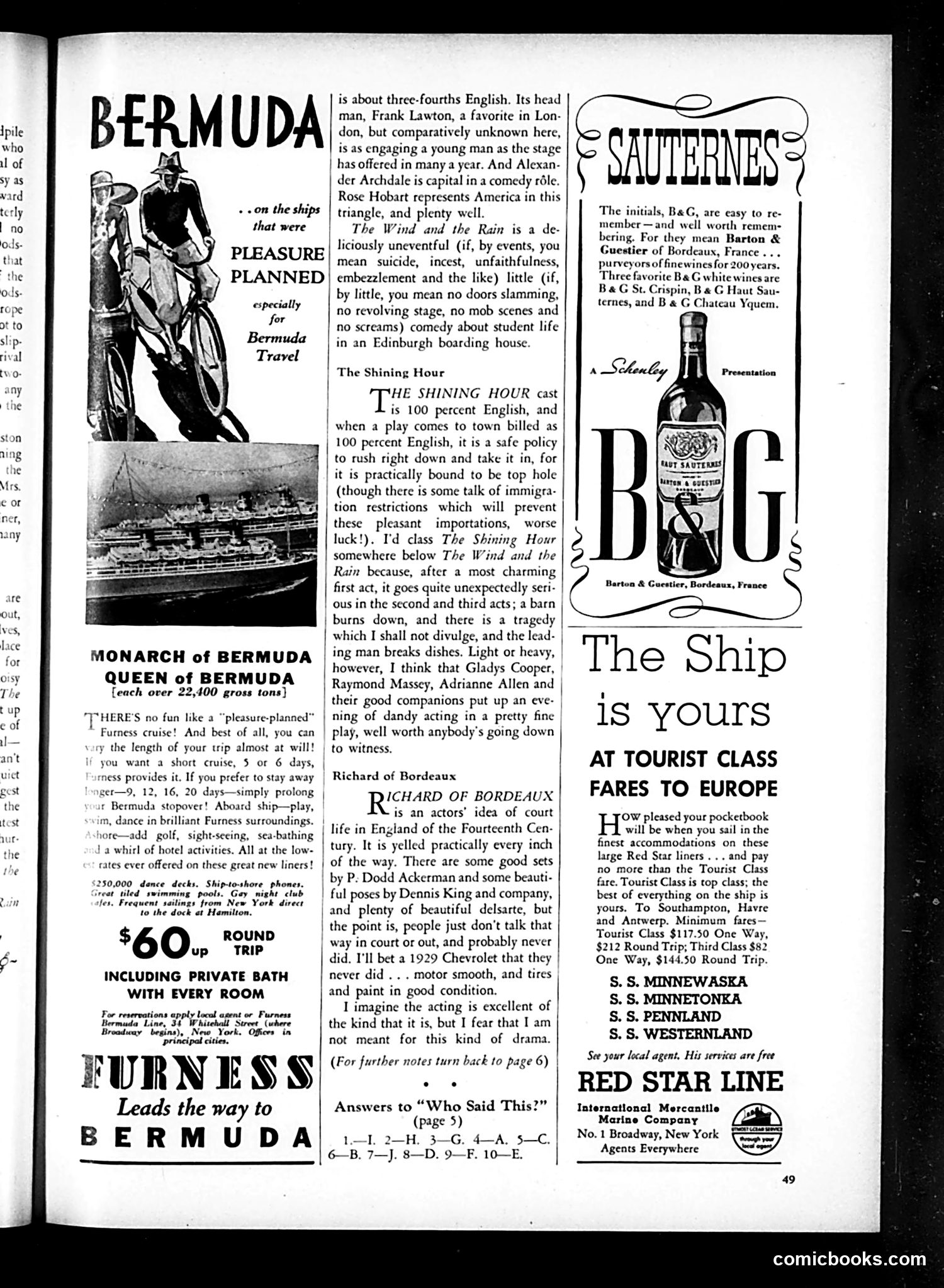
Analysis of Page 49 Content This page is primarily advertising, not satire. It contains cruise ship promotions and theatrical reviews alongside wine and shipping line advertisements. The main content includes: Left side: Furness Line cruise ship ads for the *Monarch of Bermuda* and *Queen of Bermuda*, promoting luxury travel packages from New York, emphasizing flexible trip lengths and onboard amenities. Center: Theater reviews (likely by a Life critic) discussing London plays—*The Wind and the Rain*, *The Shining Hour*, and *Richard of Bordeaux*—with mild wit about their British casts and dramatic conventions. The humor is conversational rather than satirical (e.g., joking that a 14th-century court drama probably didn't feature door-slamming melodrama). Right side: Wine and shipping line advertisements for Barton & Guestier sauternes and the Red Star Line. The page reflects 1920s-30s consumer culture, targeting affluent readers able to afford transatlantic cruises and imported wines. There's no political cartoon or significant satire—it's a commercial publication page.
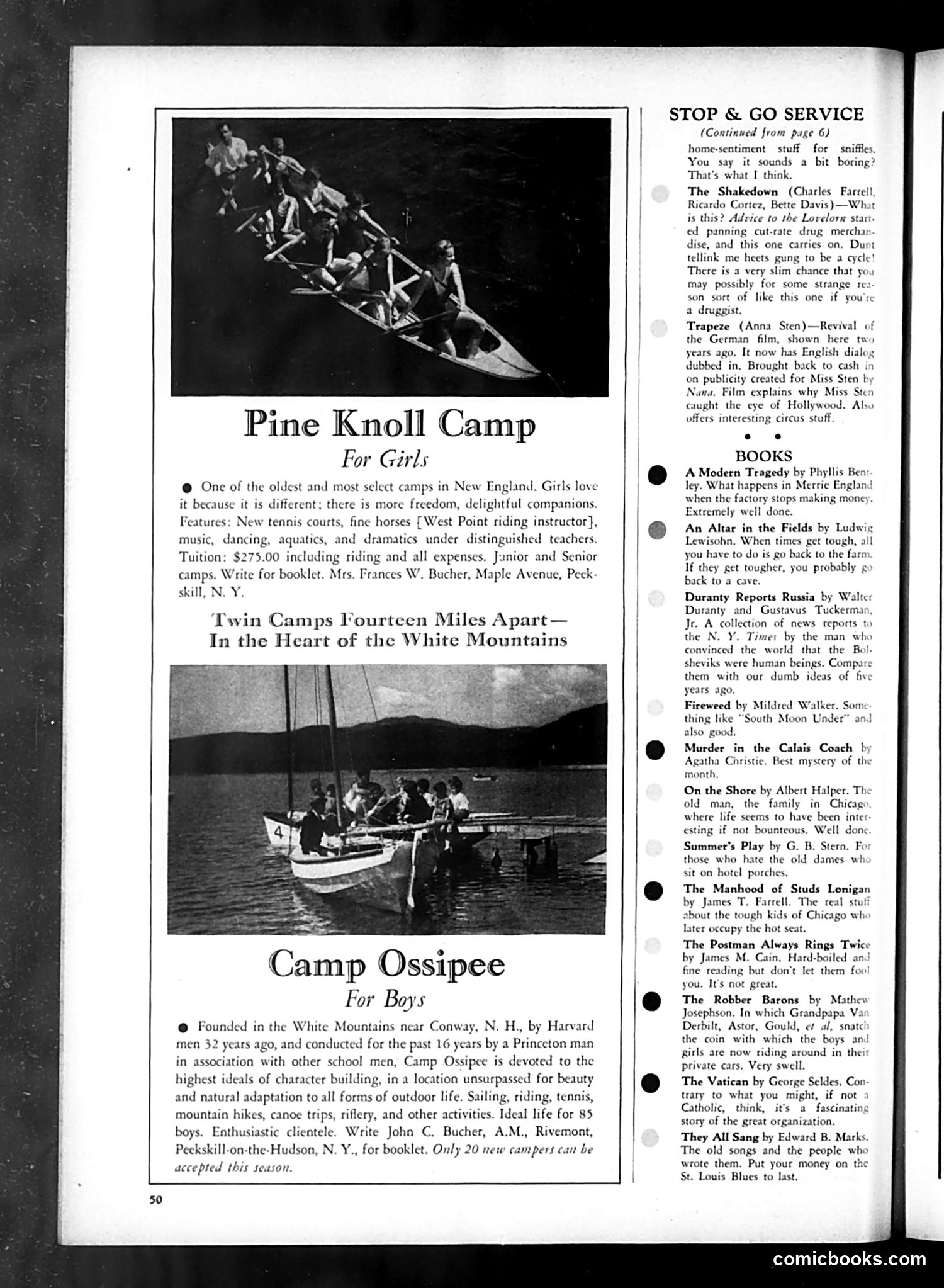
Page Analysis: Camp Advertisements and Book Reviews This is primarily advertising and editorial content, not satire or political commentary. The page features two summer camp advertisements for wealthy families: Pine Knoll Camp for girls and Camp Ossipee for boys, both located in New England's White Mountains. These emphasize prestige (Harvard and Princeton founders), exclusive features (riding instruction, distinguished teachers), and selectivity ("only 20 new campers"). The right column contains book reviews from Life's "Stop & Go Service" section. These brief notices cover contemporary 1930s literature, including works by Agatha Christie, James T. Farrell, and Walter Duranty. The reviews use casual, witty tone—typical of Life's style—mocking some books while praising others. Notable is Duranty's Russia book being critiqued for previously convincing readers that Bolsheviks were "human beings." This reflects 1930s consumer culture targeting educated, affluent readers interested in upscale leisure and literary trends.
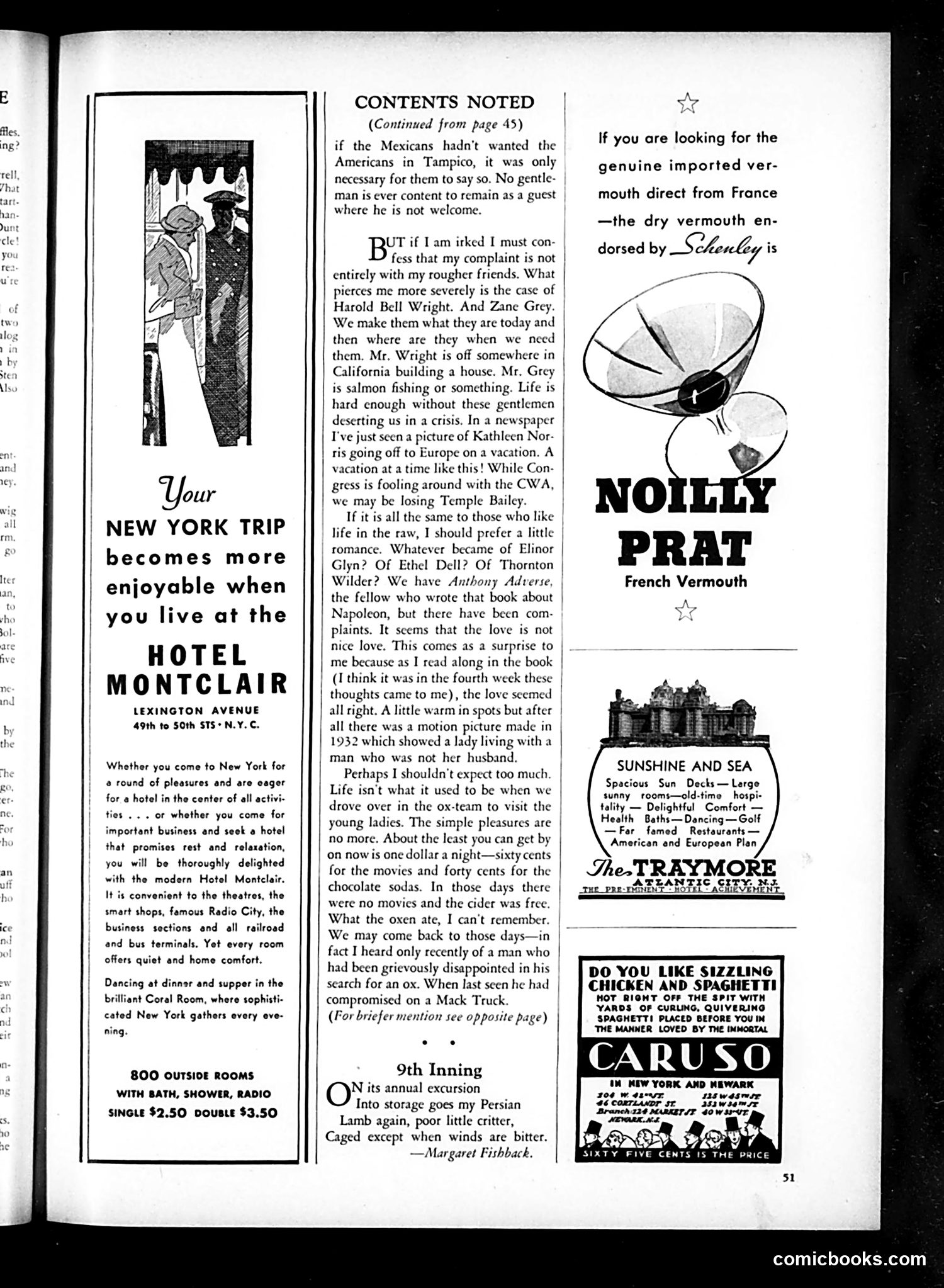
Page Analysis This is primarily a magazine contents page featuring advertisements and editorial content rather than political cartoons. The main text discusses popular American authors of the 1930s—Harold Bell Wright, Zane Grey, Kathleen Norris, Elinor Glyn, Ethel Dell, Thornton Wilder—satirizing their absence during a national crisis (likely the Great Depression). The writer humorously complains that beloved romance and adventure authors are unavailable when readers need escapism most, having instead retreated to personal pursuits like building houses or vacationing in Europe. The page includes advertisements for the Hotel Montclair, Noilly Prat vermouth, The Traymore hotel, and Caruso restaurant—typical 1930s luxury/leisure marketing. A brief poem by Margaret Fishback about storing a Persian lamb coat closes the contents section. The satire targets not politicians but celebrity authors and their perceived abandonment of devoted readers during hard times—a distinctly 1930s complaint about entertainment figures.
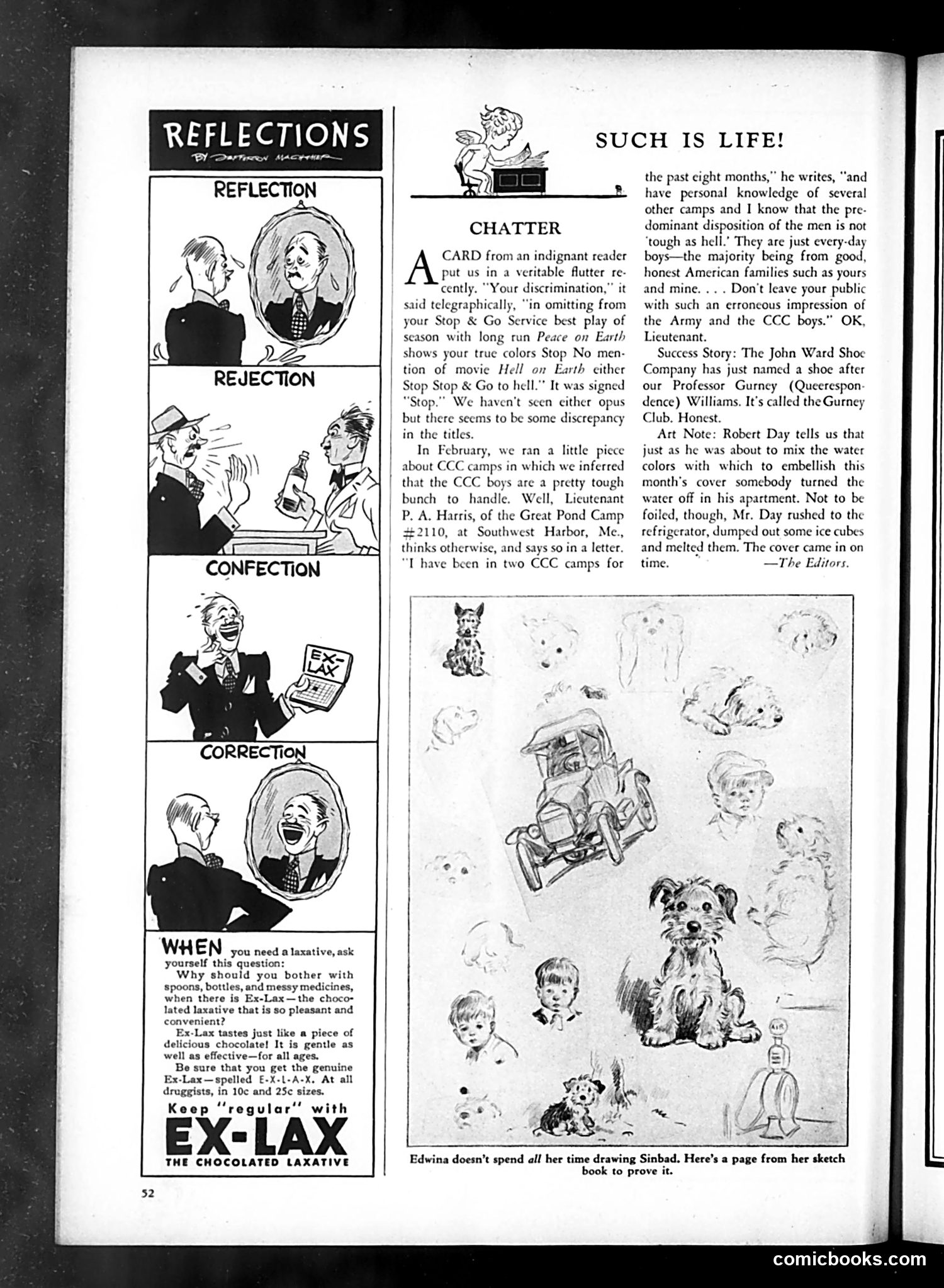
Explanation for Modern Readers This page from *Life* magazine contains satirical commentary and advertising. The left side features "Reflections," a comic strip showing the editorial process: initial reader feedback (Reflection), dismissal of complaints (Rejection), editorial brainstorming (Confection), corrections (Correction), and an Ex-Lax laxative advertisement. The main content discusses reader complaints about *Life*'s coverage. One angry reader criticized the magazine for omitting films titled "Peace on Earth" and "Hell on Earth" from their "Stop & Go Service" (likely a movie review column), sarcastically telling them to "go to hell." The editors also address criticism about a February piece implying CCC (Civilian Conservation Corps) boys were tough troublemakers. A lieutenant from a CCC camp defended the men as "everyday boys" from good families, contradicting the magazine's characterization. The page concludes with sketches by cartoonist Edwina (likely Edwina Dumm, known for "Sinbad"), demonstrating her broader artistic range beyond comic work.
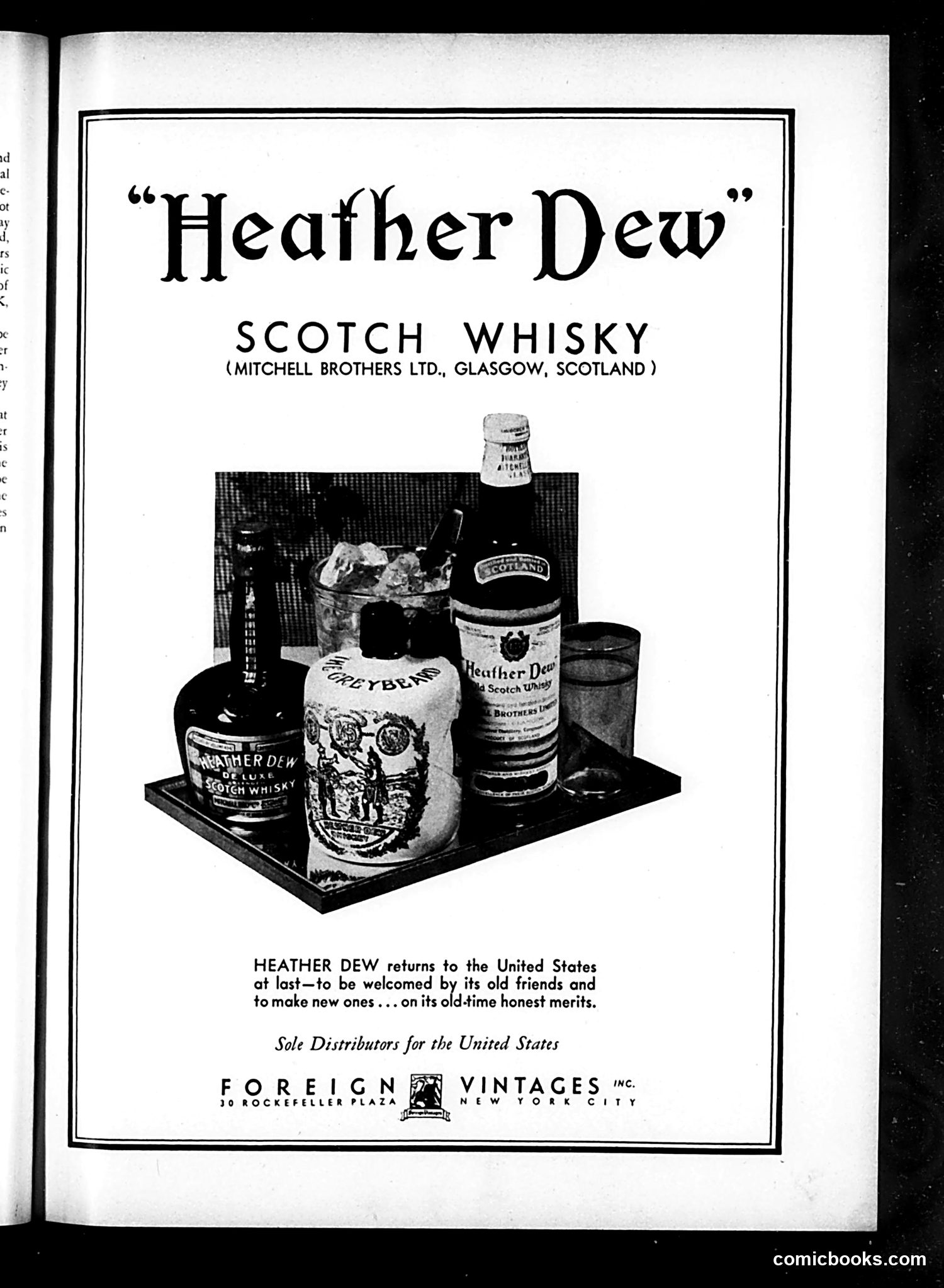
This is a straightforward advertisement, not satire or political commentary. It promotes Heather Dew Scotch Whisky, made by Mitchell Brothers Ltd. in Glasgow, Scotland. The ad announces the product's return to the American market after an absence (likely due to Prohibition, which ended in 1933). The copy emphasizes the whisky's reliability and long-standing reputation. The image shows bottles and a glass of the product arranged on a display platform. Foreign Vintages Inc., based at 30 Rockefeller Plaza in New York City, is listed as the sole U.S. distributor. This is purely commercial advertising with no satirical content.
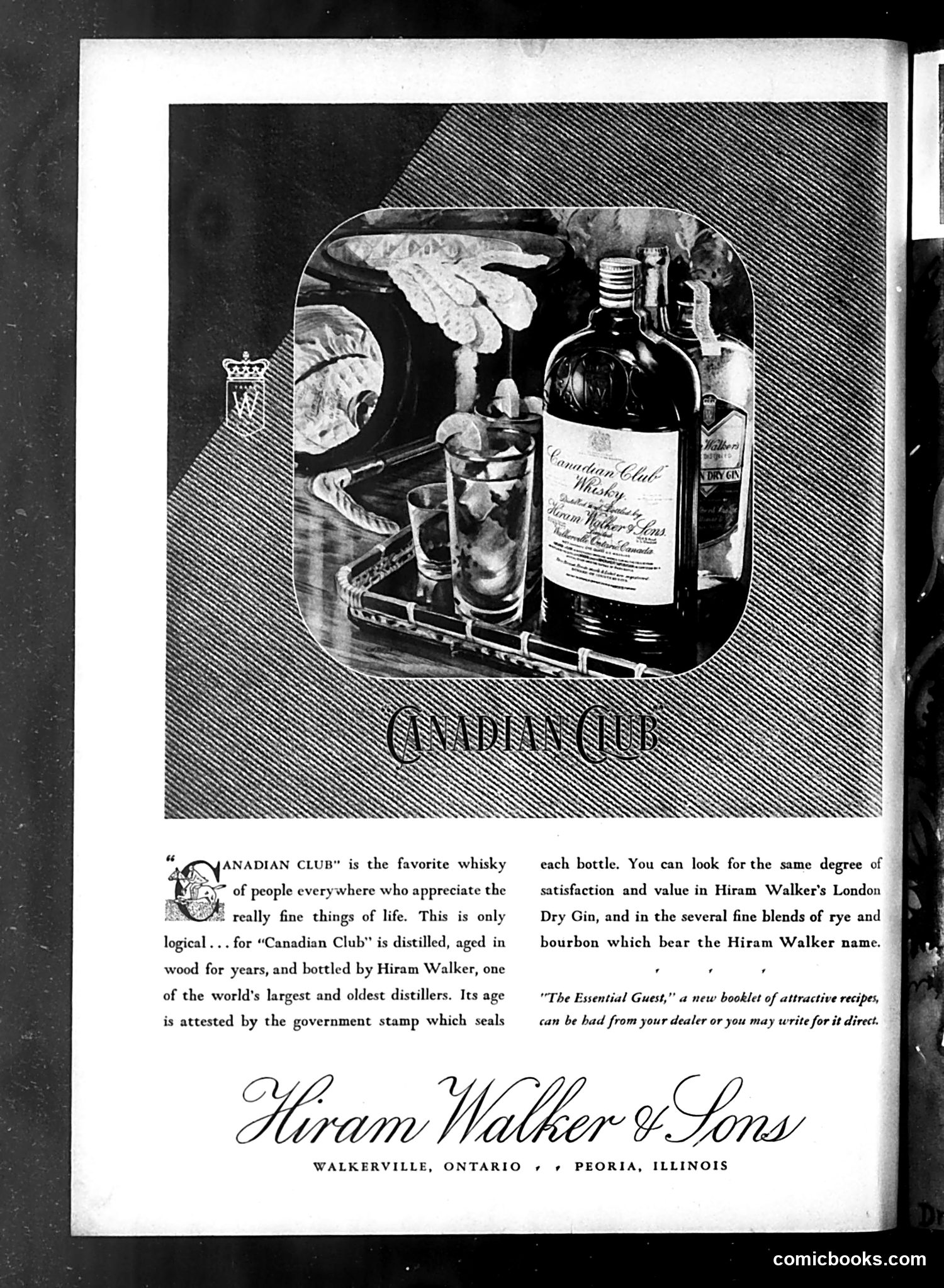
This is a whisky advertisement, not a cartoon or satire. It promotes "Canadian Club" whisky by Hiram Walker & Sons, distillers based in Walkerville, Ontario and Peoria, Illinois. The ad uses lifestyle messaging common to mid-20th century liquor advertising: the product is positioned as the choice of sophisticated people who "appreciate the really fine things of life." The image shows an elegant still-life arrangement with the bottle, a glass with drink, food items (appears to be appetizers or delicacies), and decorative plates. The ad emphasizes legitimacy through government sealing and the company's age and reputation. It also cross-promotes other Hiram Walker products (London Dry Gin, rye and bourbon blends) and offers a free recipe booklet titled "The Essential Guest." There is no political satire or cartoon content on this page—it's purely commercial advertising.