life
Life — May 1934
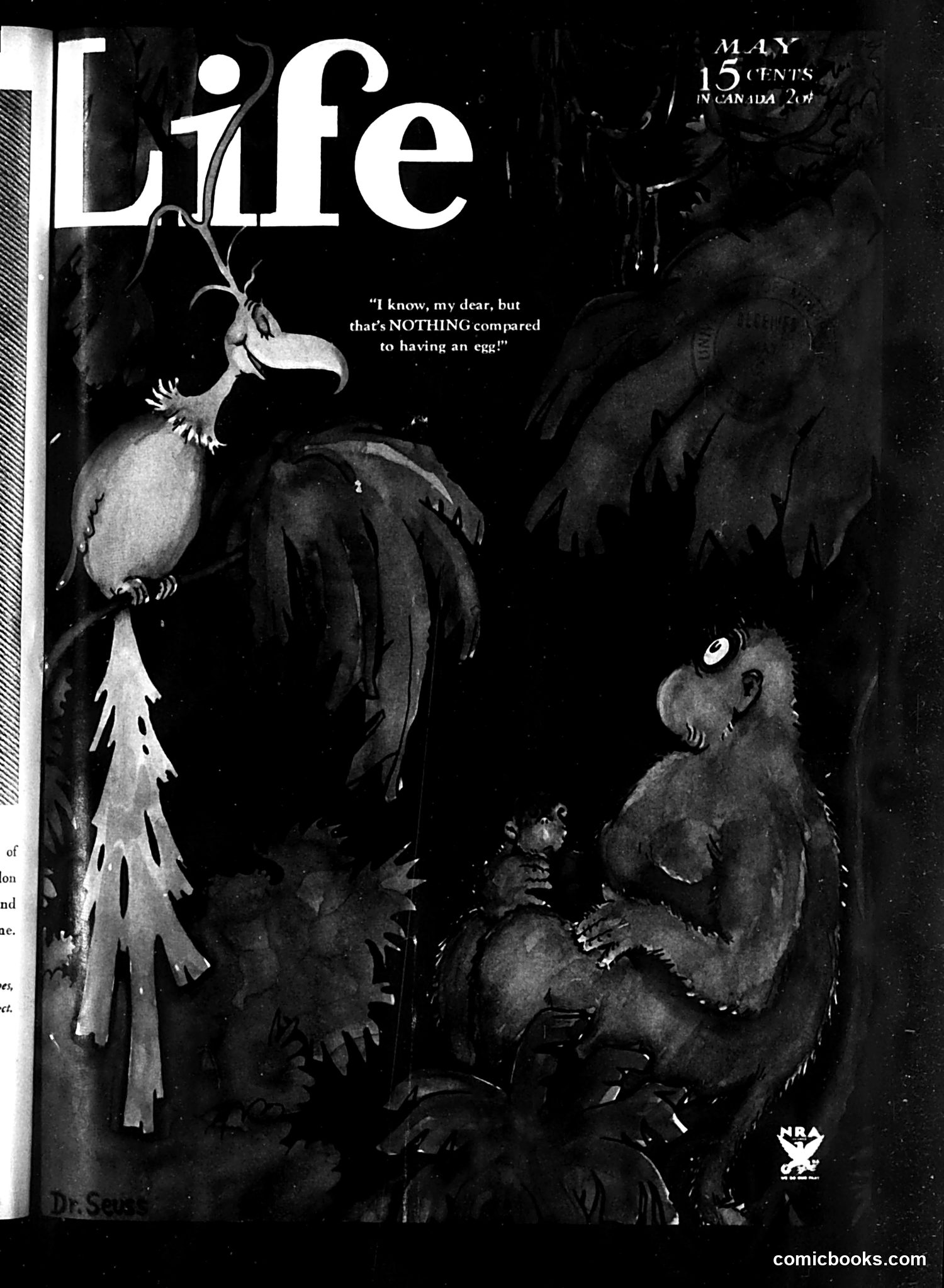
Life Magazine Cover Analysis This is a Dr. Seuss illustration for Life magazine's May issue (15 cents). The cartoon depicts anthropomorphic creatures in conversation, with one bird-like figure perched above speaking to another creature below. The quote reads: "I know, my dear, but that's NOTHING compared to having an egg!" The satire appears to address reproductive or fertility concerns, likely from the early-to-mid 20th century context. The humor rests on the creature's complaint about egg-laying being presented as a trivial concern compared to something unstated but supposedly worse. Without additional context, the specific social or political reference remains unclear, though it may relate to contemporary anxieties about parenthood, family planning, or gender roles of that era.
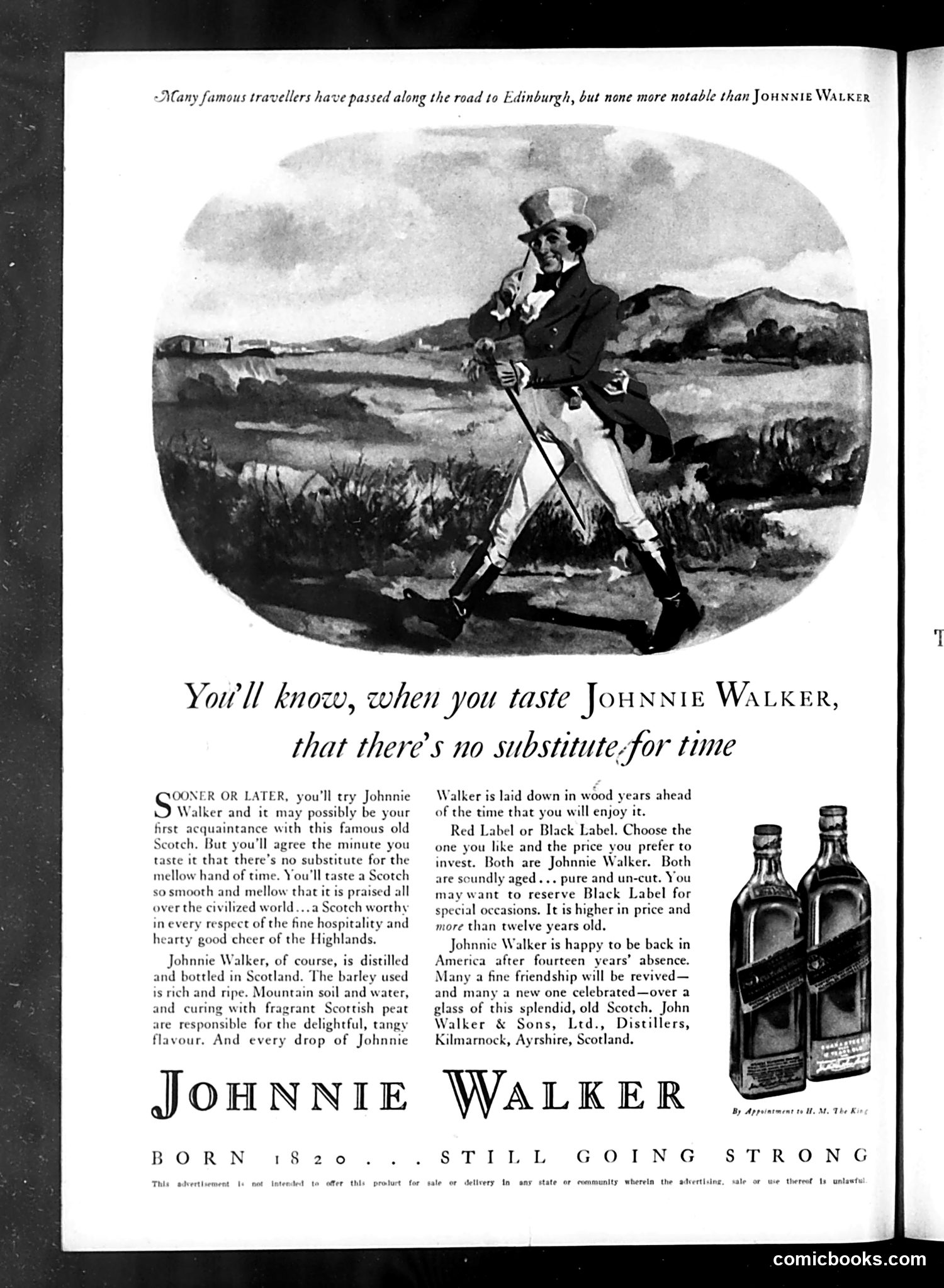
Advertisement Analysis This is a Johnnie Walker whisky advertisement, not political satire. The page features an illustration of a well-dressed Scottish traveler in 19th-century attire (top hat, coat, breeches, boots) striding across the Scottish landscape toward Edinburgh. The ad's humor relies on the "Johnnie Walker" brand mascot—a personified figure who literally "walks"—shown in motion across terrain. The copy emphasizes the whisky's Scottish authenticity, its long aging process (particularly the premium Black Label), and positions it as a refined choice for American consumers. The phrase "there's no substitute for time" serves dual purpose: promoting the product's quality while playing on the walking figure's name. This represents typical early-20th-century advertising that blended humor, nationalism, and product positioning.
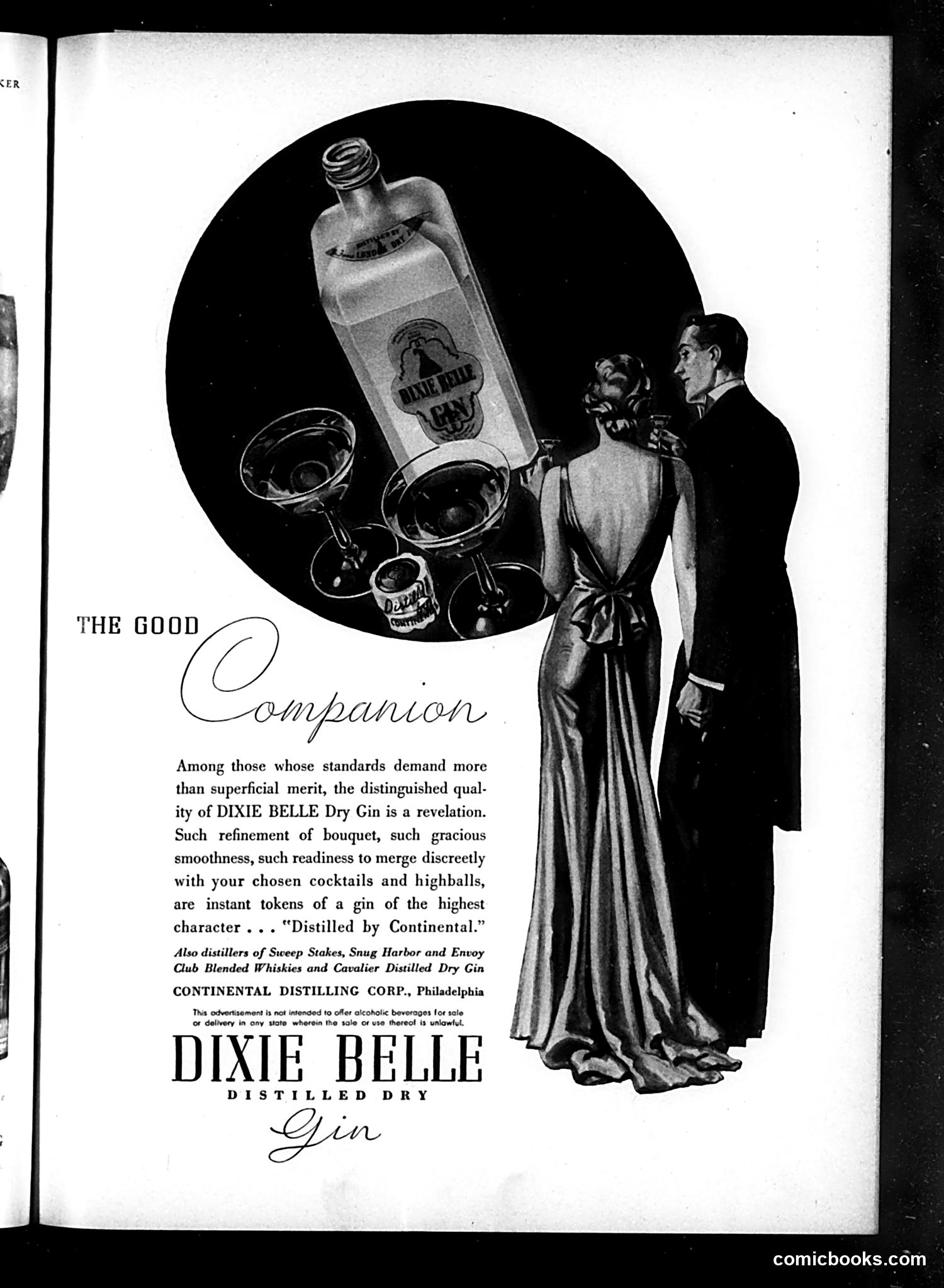
Analysis This is a advertisement, not political satire. It promotes Dixie Belle Distilled Dry Gin, manufactured by Continental Distilling Corp. in Philadelphia. The ad features an elegantly dressed couple admiring a large bottle of gin surrounded by cocktail glasses. The marketing copy emphasizes the product's refinement and quality ("distinguished quality," "refinement of bouquet"). The couple's formal attire and sophisticated poses suggest the gin is aspirational—marketed to upper-class consumers. The disclaimer at bottom acknowledges Prohibition-era restrictions: "This advertisement is not intended to offer alcoholic beverages for sale or delivery in any state wherein the sale or use thereof is unlawful." This represents typical pre-Repeal or early post-Repeal advertising (likely 1930s), when gin distilling resumed after Prohibition ended in 1933.
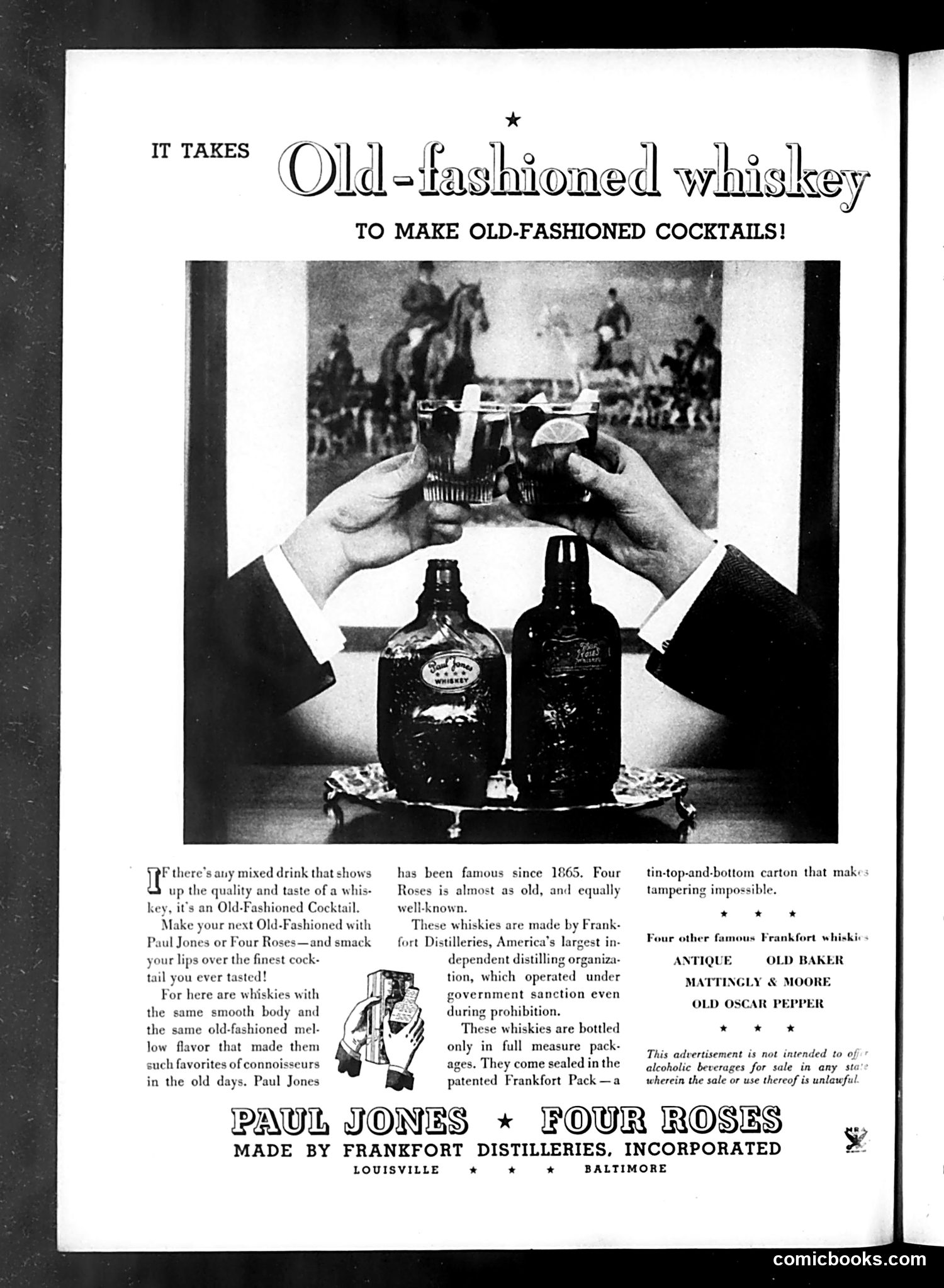
Analysis This is primarily a whiskey advertisement, not political satire. It promotes Paul Jones and Four Roses whiskeys made by Frankfort Distilleries. The ad features two hands toasting with Old-Fashioned cocktails above two whiskey bottles. The background shows a horse-racing scene, likely referencing Kentucky's association with thoroughbred racing and bourbon production. The text emphasizes these whiskeys' "smooth body" and "old-fashioned" character, claiming they've been "famous since 1865." It notes the whiskeys are "bottled only in full measure packages" and come "sealed in the patented Frankfort Pack." A small disclaimer states the ad isn't promoting illegal sale of alcohol—indicating this ran during or shortly after Prohibition (1920-1933), when such disclaimers were legally required.
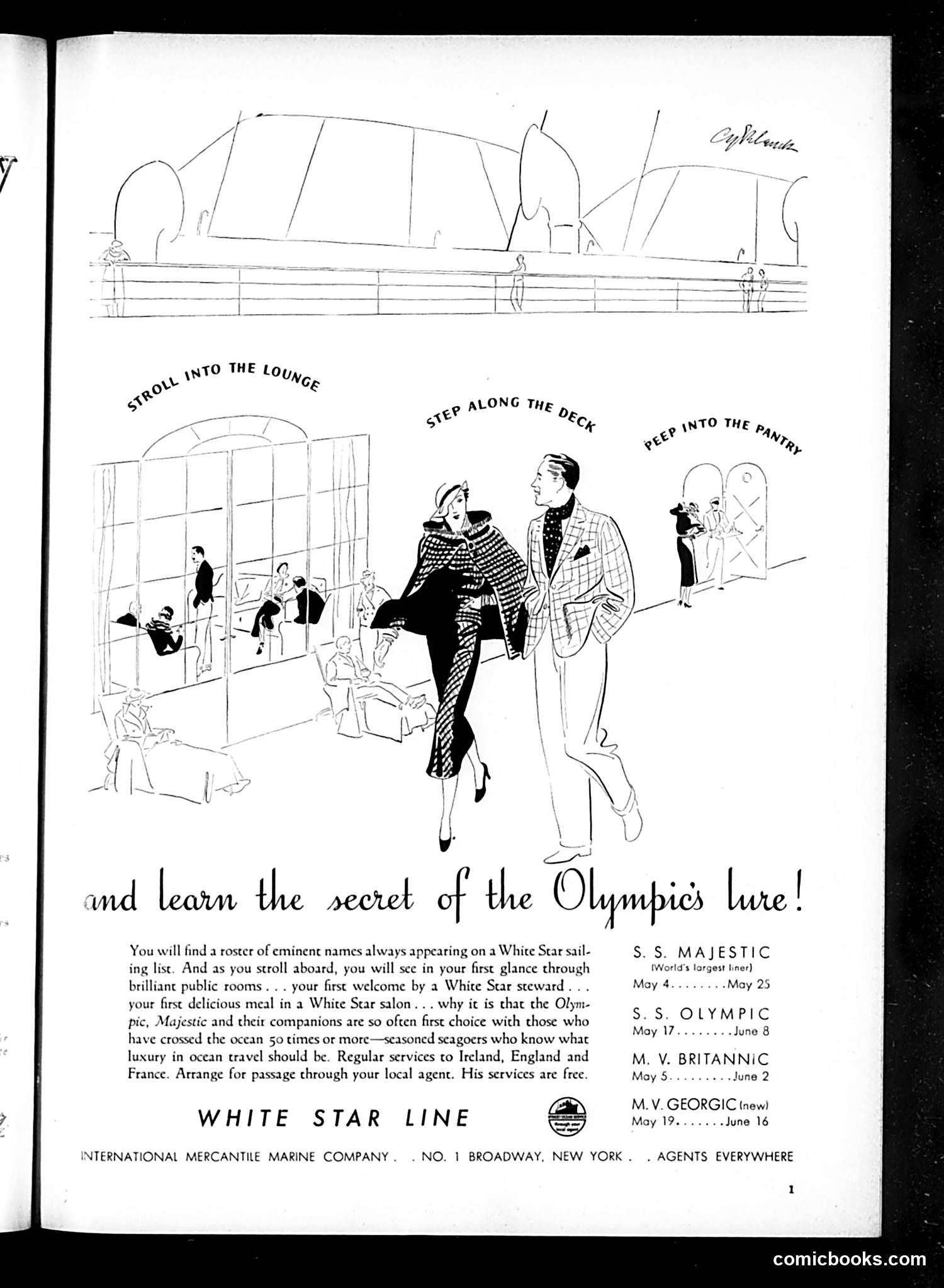
White Star Line Advertisement This is a luxury cruise ship advertisement, not political satire. The page promotes White Star Line's ocean liners, emphasizing prestigious transatlantic travel to Ireland, England, and France. The three illustrated scenarios—"Stroll into the Lounge," "Step Along the Deck," and "Peek into the Pantry"—showcase the ships' amenities and social atmosphere. The well-dressed passengers represent the wealthy clientele attracted to these voyages. The ships advertised include the S.S. Majestic, S.S. Olympic, M.V. Britannic, and M.V. Georgic, with sailing dates in May-June (likely 1930s-40s based on the illustration style). The tagline "learn the secret of the Olympics lure" uses glamorous language to market luxury ocean travel to affluent readers.
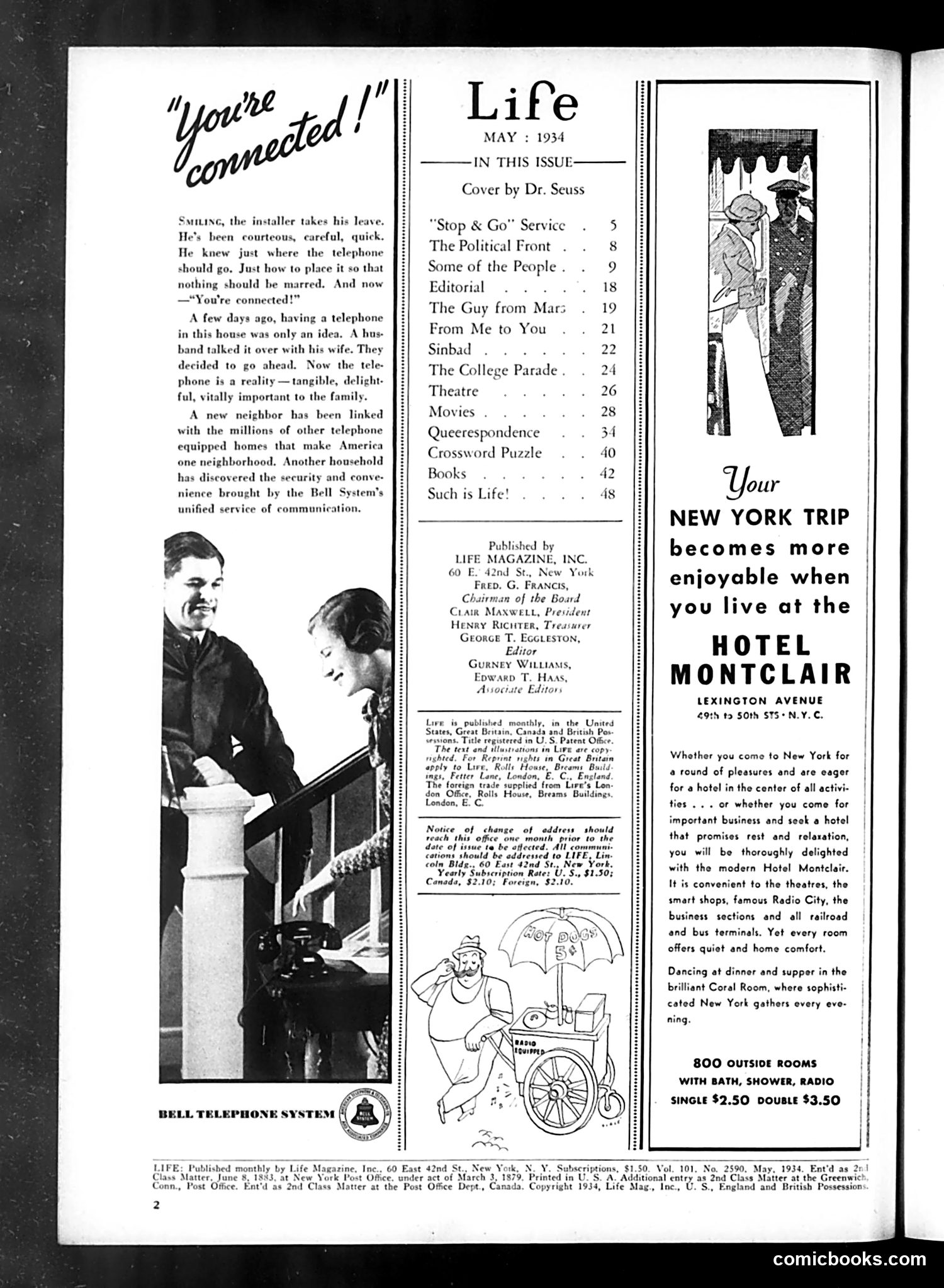
Life Magazine, May 1934 - Page Analysis This page is primarily a table of contents and advertisements rather than editorial cartoons. The left side features a Bell Telephone System advertisement showing two men at a telephone, promoting home connectivity as a luxury that links families across America—reflecting 1930s optimism about modern technology during the Depression era. The center lists the magazine's contents, noting a Dr. Seuss cover (the famous illustrator's early work). The right side advertises the Hotel Montclair in Manhattan, targeting affluent travelers seeking comfort and central location near theaters and businesses. The small cartoon at bottom appears to be a humorous illustration (likely by Dr. Seuss, given the style), though its specific subject is unclear from this image. Overall, the page reflects 1934 consumer culture and commercial leisure.
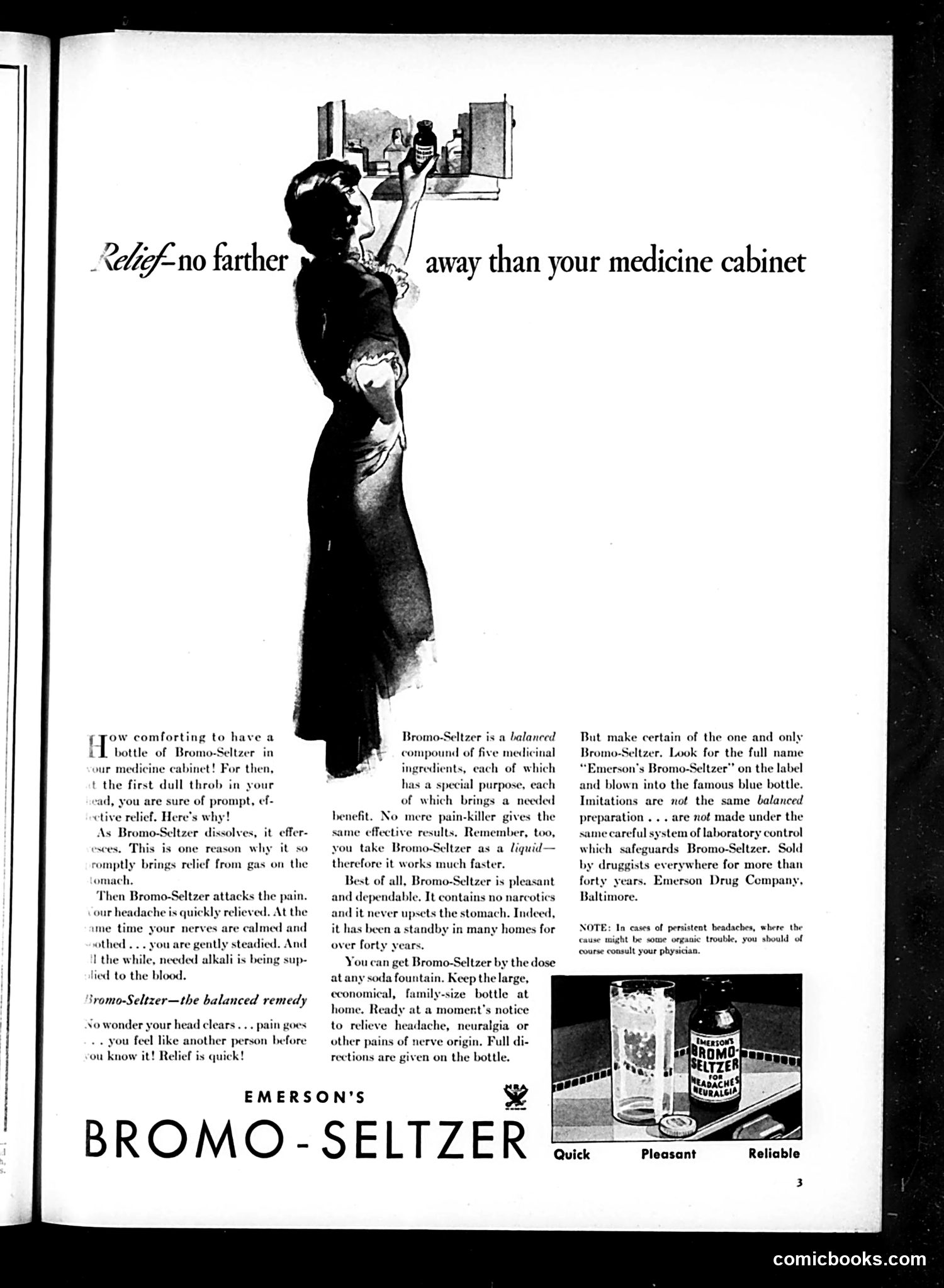
Analysis This page is primarily an advertisement for Bromo-Seltzer, a patent medicine marketed as a headache and digestive relief remedy. The illustration shows a woman reaching upward toward a medicine cabinet, with the tagline "Relief no farther away than your medicine cabinet." The ad emphasizes Bromo-Seltzer's convenience and effectiveness, claiming it's a "balanced remedy" containing five medicinal ingredients with "no narcotics" that "never upsets the stomach." It promises quick relief and was positioned as a household staple. Historical context: This reflects early-20th-century medical advertising before FDA regulations. Such remedies were widely promoted through lifestyle imagery showing domestic scenarios. The ad targets middle-class households and normalizes patent medicines as standard home healthcare.
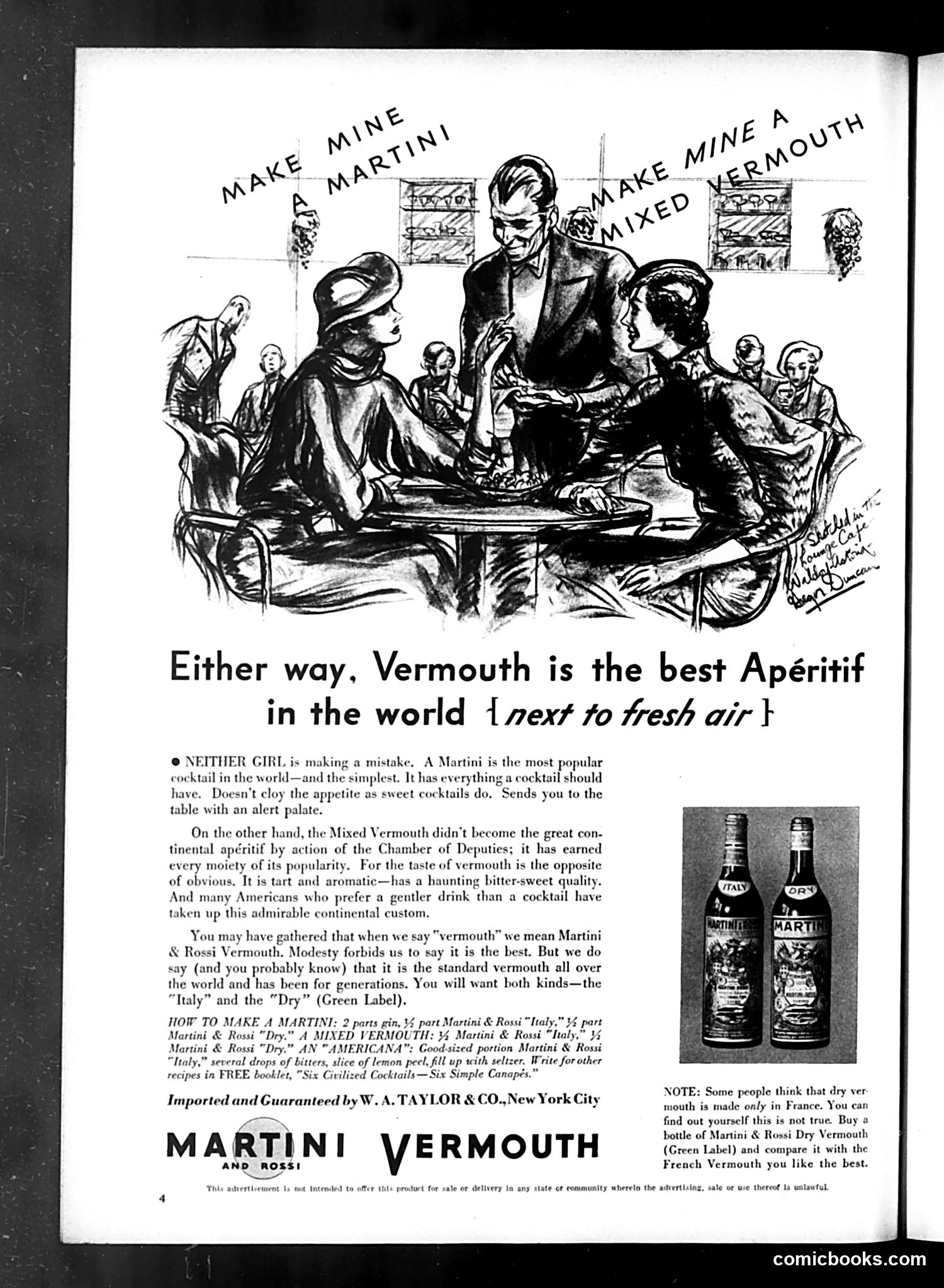
Analysis This is advertising content, not editorial satire. The page promotes Martini & Rossi vermouth through an illustration showing a social scene where two men and a woman are at a table, with text suggesting different vermouth-based cocktails ("Make mine a Martini," "Make mine a mixed Vermouth"). The headline claims vermouth is "the best Apéritif in the world [next to fresh air]"—a lighthearted exaggeration typical of period advertising. The copy positions Mixed Vermouth as an alternative to Martinis for those preferring gentler drinks, while claiming vermouth's popularity comes from its quality rather than Chamber of Deputies action. The two bottle images compare Martini & Rossi varieties. This is straightforward product advertising, not political commentary.
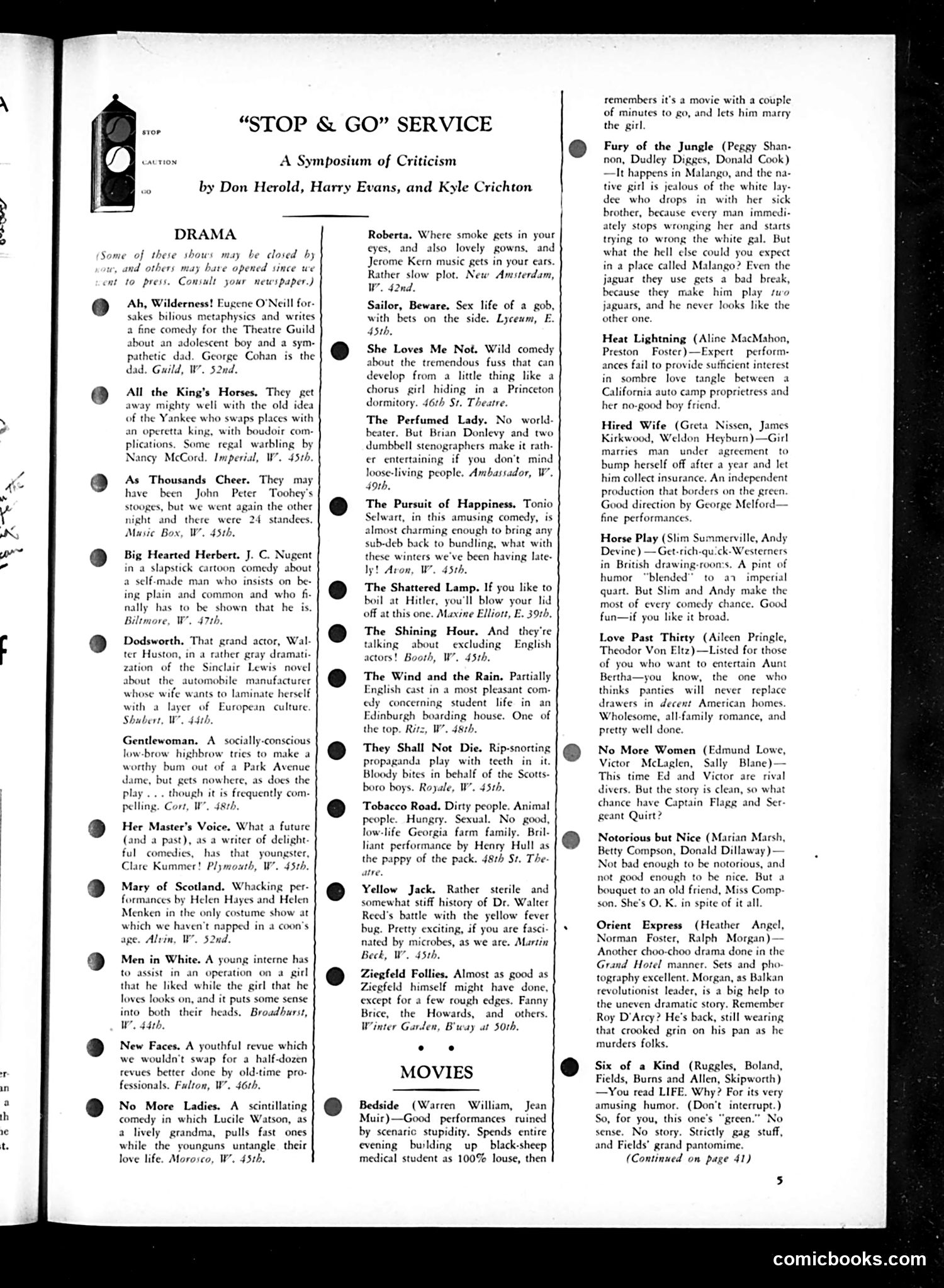
Analysis of "Stop & Go Service" Page This is a theater and film review page from *Life* magazine, not a political cartoon. The "Stop & Go Service" heading appears to be the column's title—a metaphor for brief, quick assessments of entertainment. The content consists of short, satirical reviews of theatrical productions and films. Critics (Don Herold, Harry Evans, and Kyle Crichton) offer witty, dismissive critiques using colorful language. For example, they mock overly ambitious or poorly executed plays and films with phrases like "no good," "sterile," and complaints about bad acting or thin plots. The reviews target both experimental theater and commercial cinema, critiquing everything from acting quality to narrative substance. The satire lies in the *brevity and harshness* of these professional dismissals of contemporary entertainment.
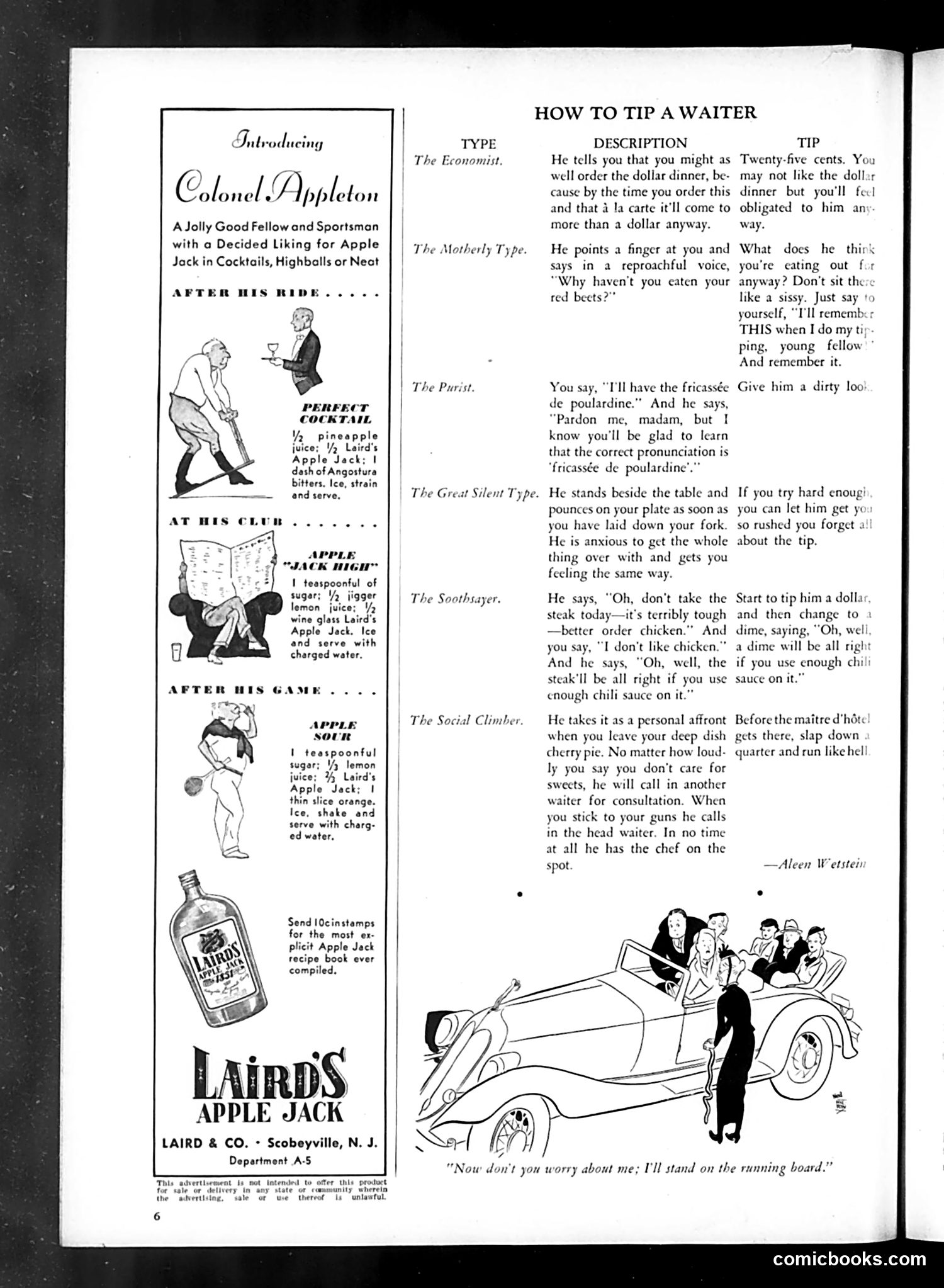
Analysis: "How to Tip a Waiter" This page is primarily humorous social commentary, not political satire. The right side catalogs different waiter "types" and their behaviors—the Economist (warns about costs), the Motherly Type (criticizes your eating), the Purist (corrects your pronunciation), and others. Each description ridicules both the waiter's pretension and the diner's awkwardness. The joke targets class anxieties of the era: diners unsure of proper etiquette and service workers who weaponize their knowledge to intimidate customers. The "Social Climber" waiter is particularly sharp—he's offended if you don't order sweets and summons the chef for consultation, maintaining control through hierarchical performance. The left side advertises Colonel Appleton Apple Jack cocktails, unrelated to the satire.
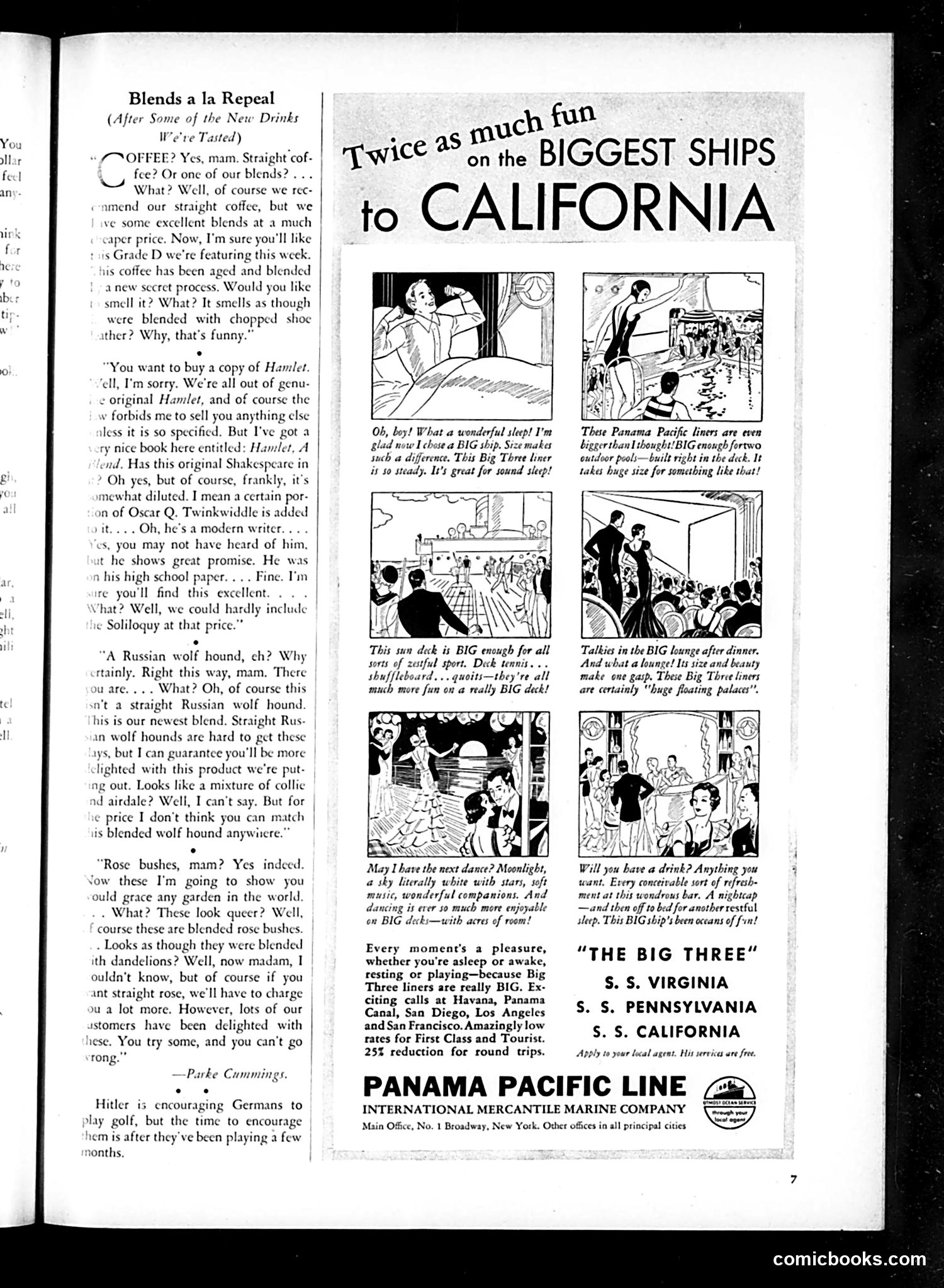
Analysis This page is primarily a Panama Pacific Line cruise ship advertisement disguised as editorial content, occupying most of the space with six comic panels showing leisure activities aboard "Big Three" ocean liners. The left column contains "Blends a la Repeal" — satirical dialogue about coffee blends and literary references (Hamlet, Oscar Wilde). The tone is humorous and whimsical rather than politically pointed. The advertisement's comic panels depict passengers enjoying sleeping quarters, deck sports, dining, dancing, and socializing—marketing luxury ocean travel to California via Panama Canal ports. The phrase "Twice as much fun on the BIGGEST SHIPS" emphasizes the ships' scale as a selling point. The final reference to Hitler encouraging golf is brief and contextual to the era, suggesting pre-WWII attitudes. This is fundamentally advertorial content, not political satire.
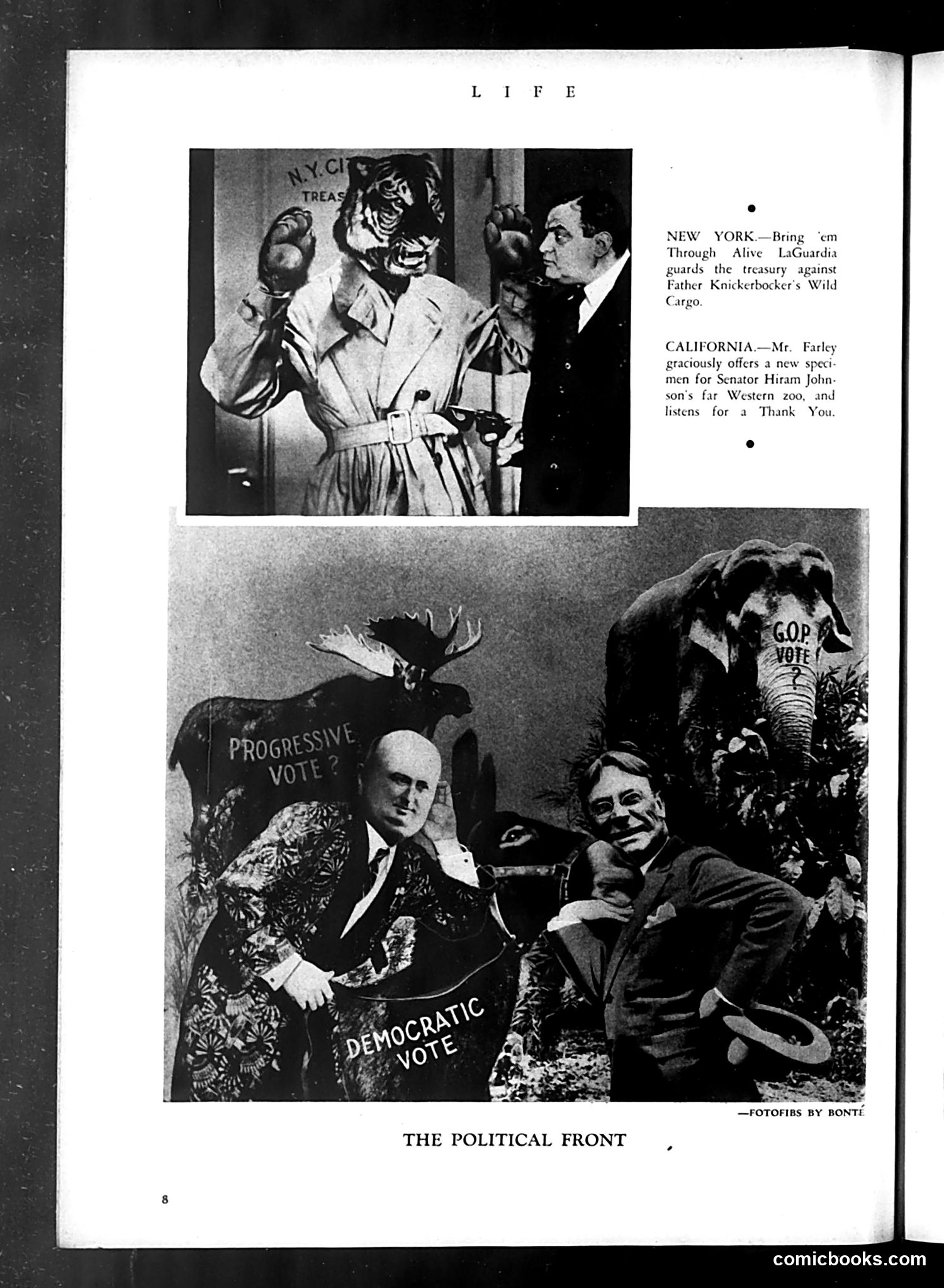
"The Political Front" - Life Magazine Satire This page presents political cartoons mocking the 1912 U.S. presidential election, a three-way race between Republican President William Taft, Democrat Woodrow Wilson, and Progressive Party candidate Theodore Roosevelt. The top image shows a woman (Lady Liberty) protecting the Treasury against "Father Knickerbocker's Wild Cargo"—likely referencing chaotic campaign promises. The bottom cartoon depicts two men (appearing to represent Democratic and Progressive candidates) awkwardly positioned with animals labeled "Progressive Vote," "Democratic Vote," and "GOP Vote"—symbolizing how the split between Roosevelt's Progressives and Taft's Republicans benefited Wilson's Democrats. The satire critiques the political chaos and competing claims on voter allegiance created by the three-candidate race.
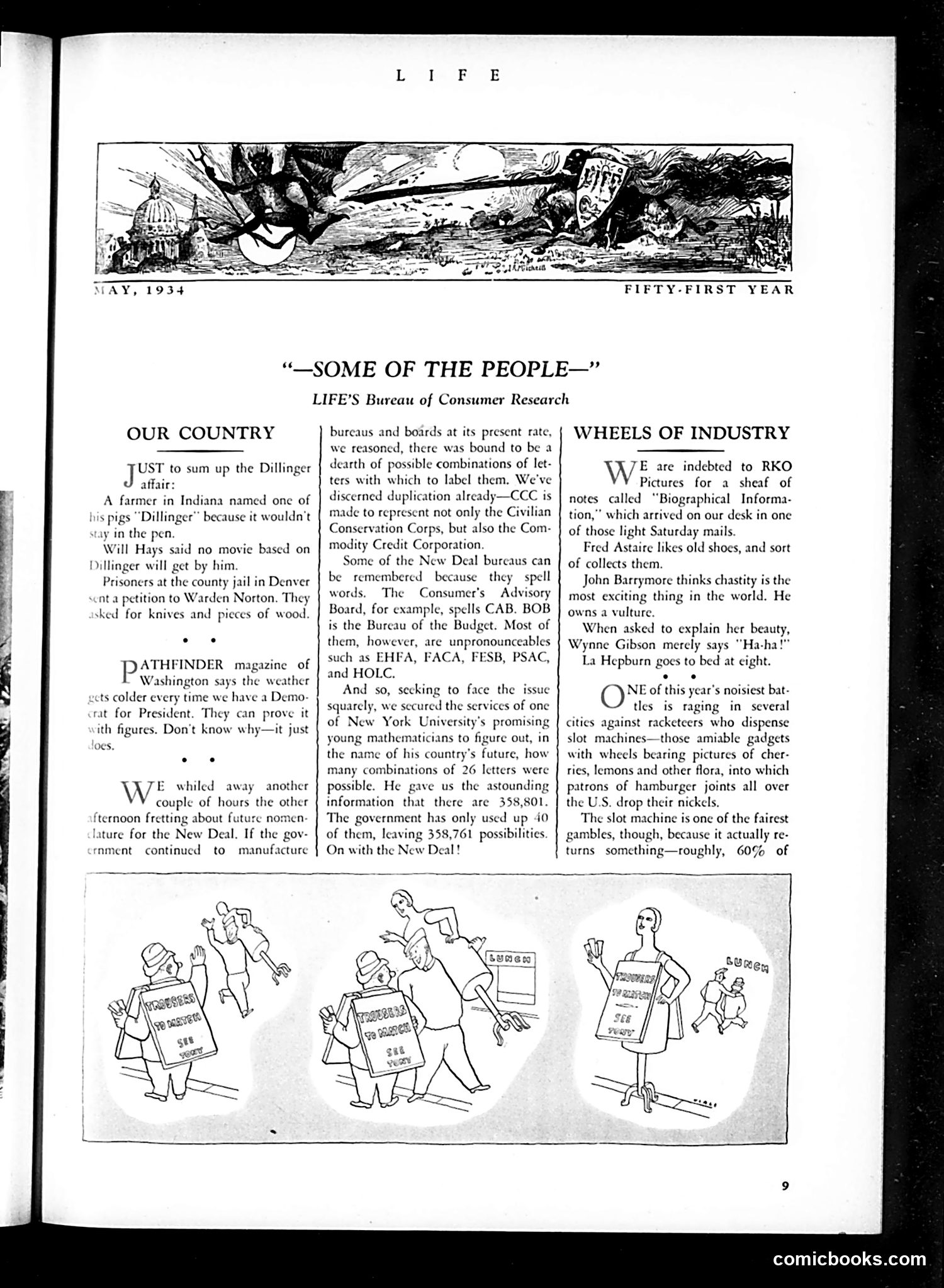
"Some of the People" — Life Magazine, May 1934 This page contains three distinct satirical pieces about New Deal bureaucracy and politics: "Our Country" mocks the proliferation of government agencies and their acronyms (CCC, CAB, BOB, SHEA, FACA, FESB, FSAC, HOLC). The writer jokes about the sheer number of possible letter combinations for labeling New Deal bureaus—so many that mathematicians calculated 358,801 possibilities, though only 40 were actually used. "Wheels of Industry" discusses slot machines in cities as a gambling phenomenon, noting they return roughly 60% of money inserted. The cartoon below (artist unclear) shows figures wearing sandwich boards advertising various government agencies, satirizing how omnipresent and confusing the alphabet-soup of New Deal programs had become to ordinary Americans. The satire targets bureaucratic complexity and proliferation under Franklin D. Roosevelt's administration.
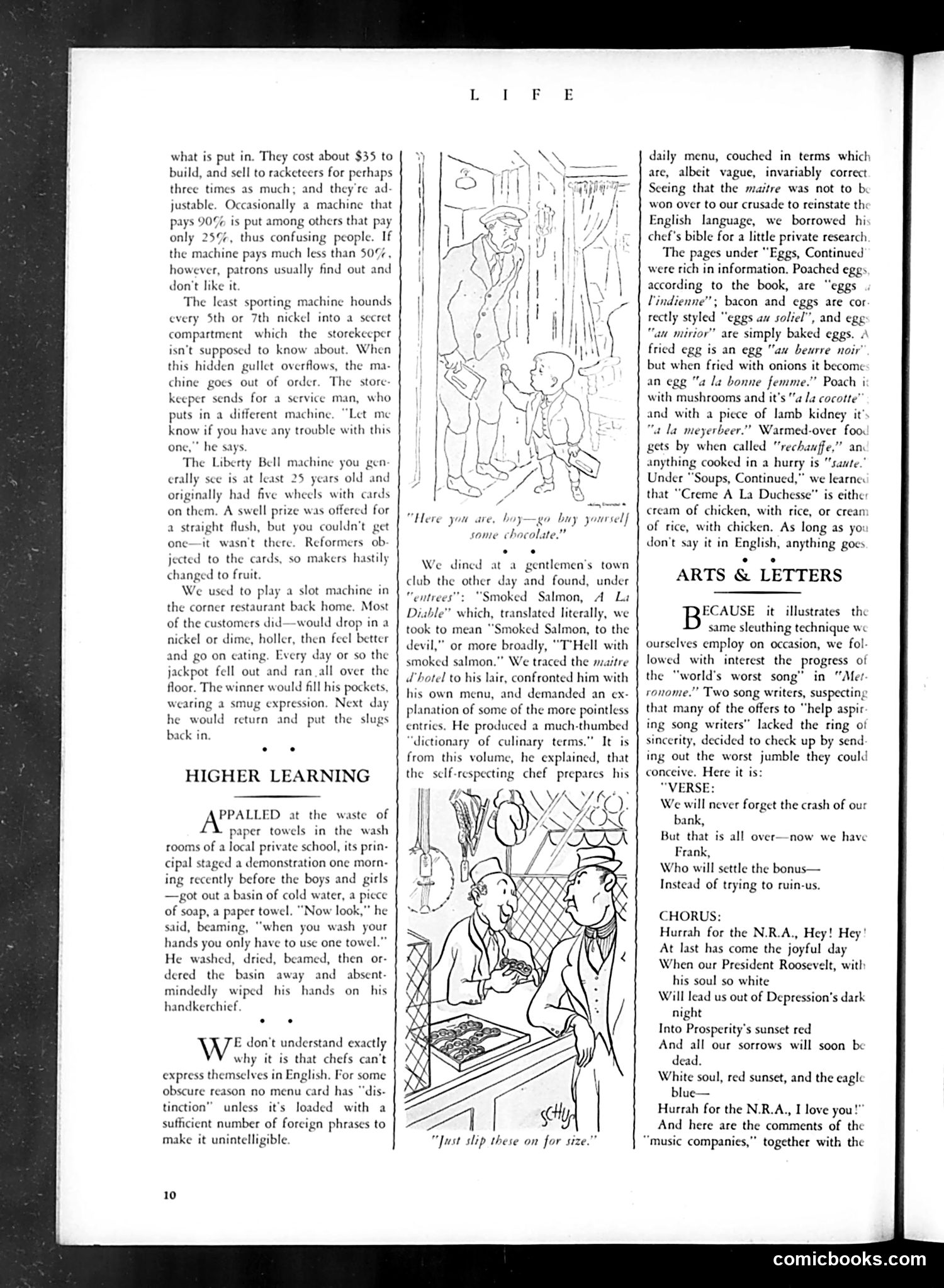
Page Analysis This page contains three distinct sections: a story about slot machines, a section on "Higher Learning" about school hygiene practices, and an "Arts & Letters" section featuring a satirical song about the N.R.A. (National Recovery Administration). The cartoon accompanying "Higher Learning" depicts a schoolmaster demonstrating hand-washing to students—likely satirizing overly pedantic educational methods of the era. The second cartoon shows two men examining what appears to be a lottery or betting slip, labeled "Just slip these on for size"—mocking gambling or financial schemes. The song lyrics mock Roosevelt's N.R.A. program, suggesting it failed to solve Depression-era problems. The satire implies the N.R.A., despite initial optimism ("Hurrah for the N.R.A."), ultimately disappointed hopes for economic recovery, leaving citizens' sorrows unresolved.
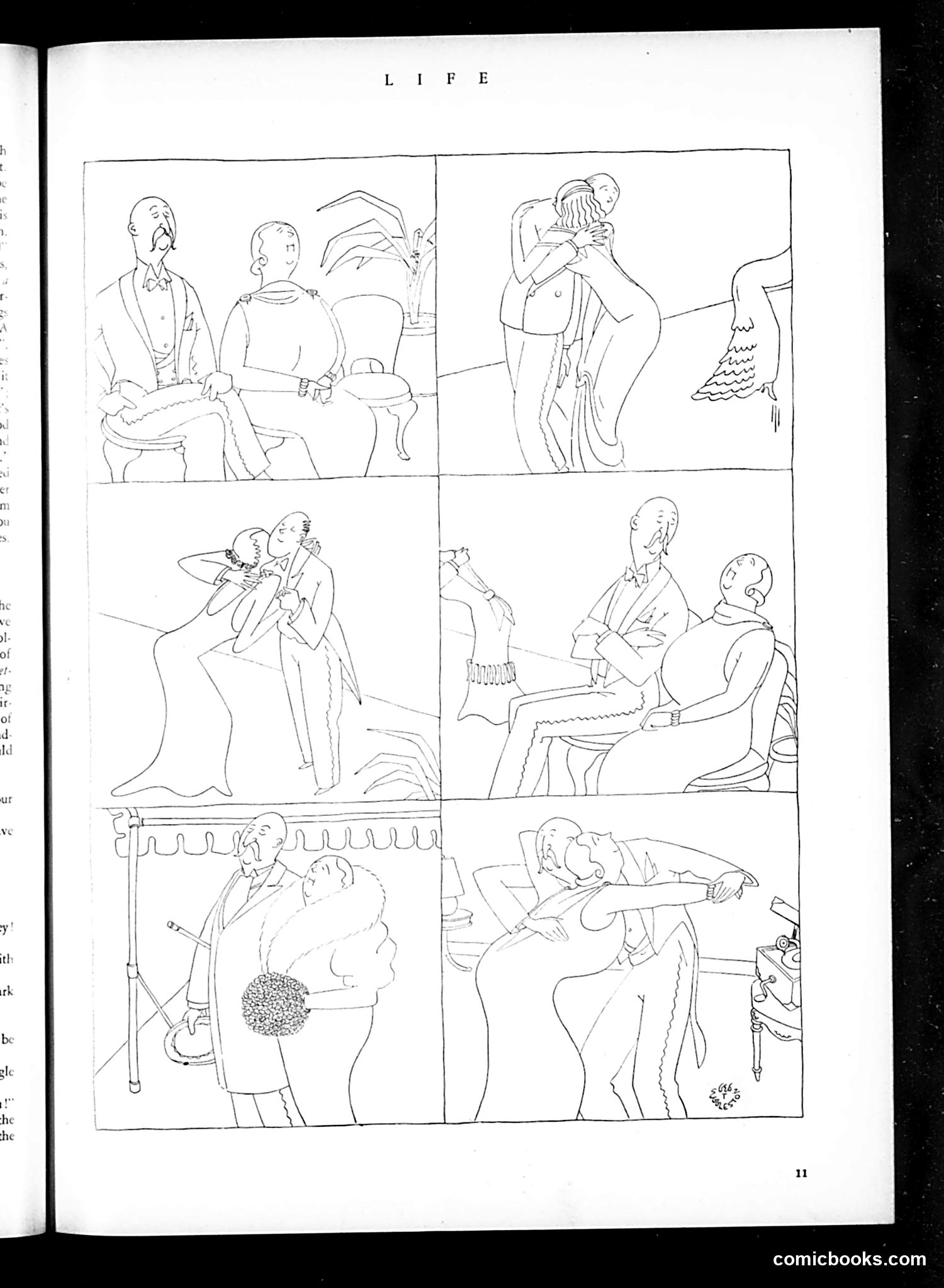
I can see this page is titled "LIFE" and contains a six-panel comic strip showing various scenes of social interaction. However, the OCR text provided is blank, containing no actual dialogue or captions that would explain the narrative or satirical intent. Based solely on the visual content, the strip appears to depict gentleman-figure interactions with women in what looks like early-to-mid 20th century settings, with formal clothing and interior spaces. The progression suggests a comedic or cautionary sequence, but without the accompanying text or captions, I cannot definitively identify the specific social commentary, political references, or the particular point of satire intended. To accurately explain this cartoon's meaning to a modern reader, the OCR'd captions would be essential.
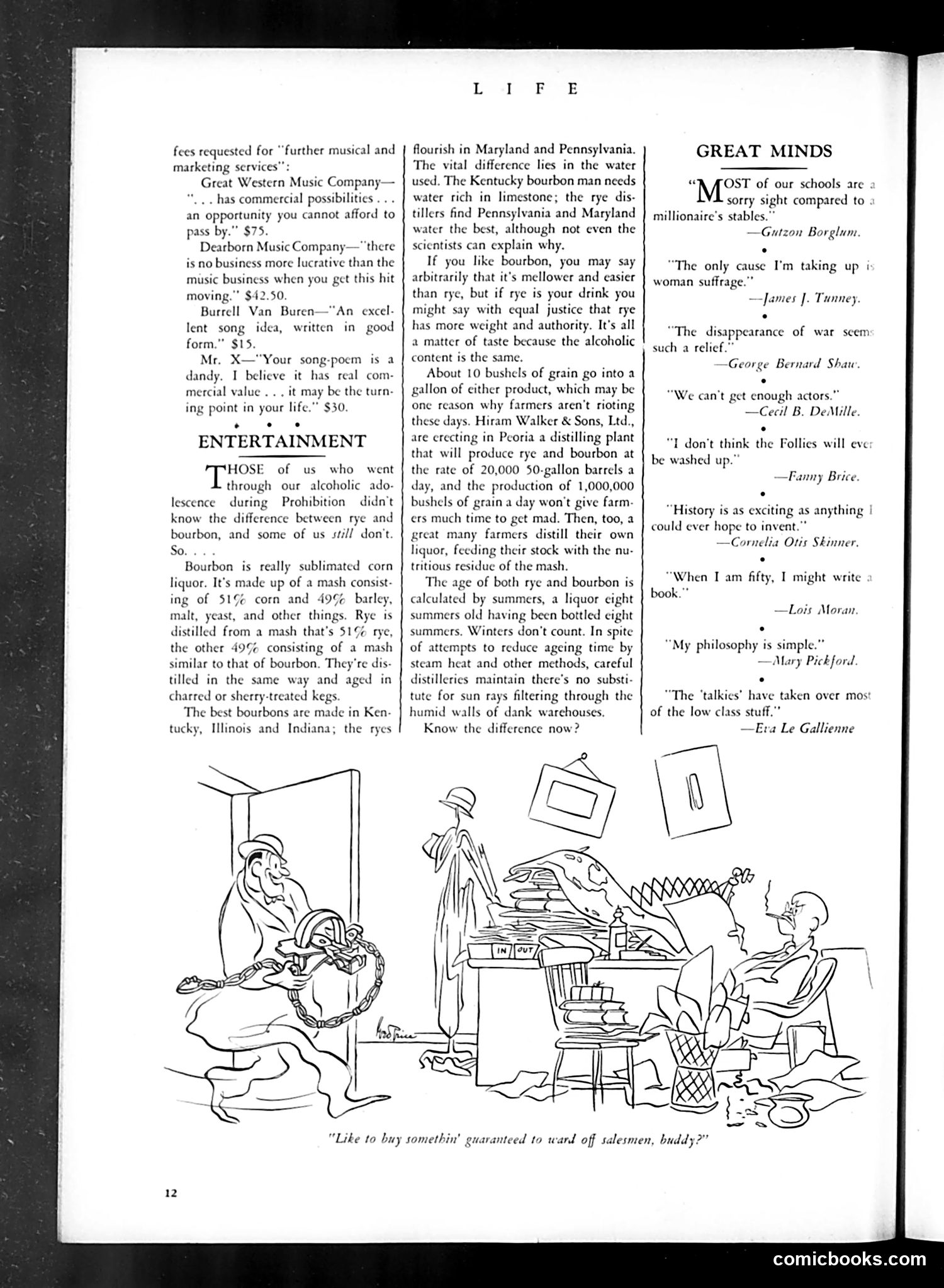
Explanation of the Page This page from *Life* magazine contains an article about bourbon and rye whiskey during Prohibition, alongside a cartoon commentary on the era. The Cartoon's Content: The illustration depicts a salesman pitching bottles to a customer in a cluttered office, with the caption: "Like to buy somethin' guaranteed to ward off salesmen, buddy?" The joke satirizes how Prohibition-era Americans used alcohol as a pretense for sales pitches—the "something" being sold is liquor disguised as a practical product. Historical Context: The article discusses how bourbon and rye differ (water quality, aging), mentions illegal distilleries in Kentucky and Indiana, and notes that farmers during Prohibition were distilling their own liquor due to lost farm income. The cartoon mocks the absurdity of Prohibition enforcement and the creative justifications people invented to buy alcohol illegally.
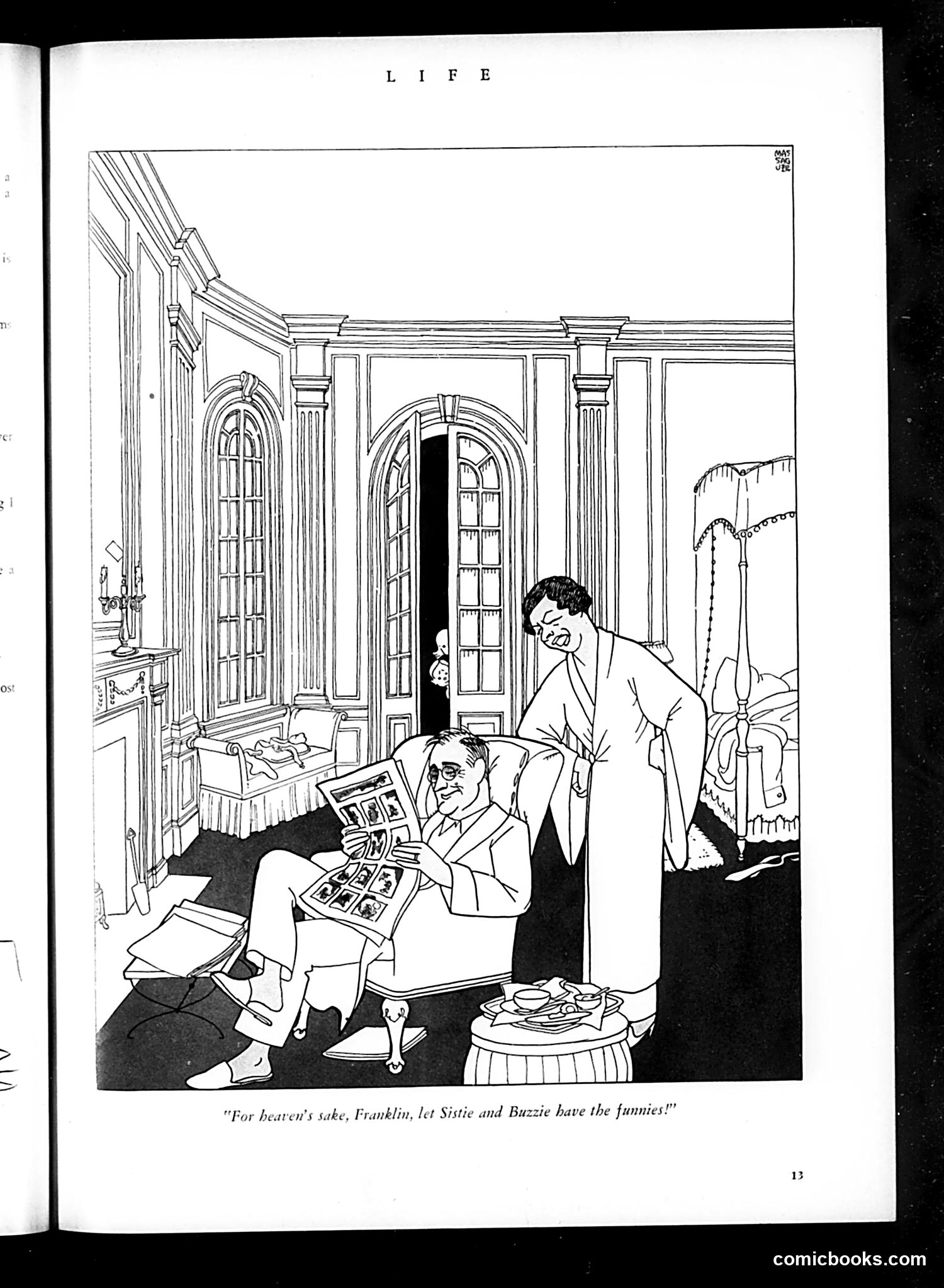
Analysis This single-panel cartoon depicts a domestic scene in an elegant room. A man reclines reading comic books while a woman stands nearby, apparently exasperated. The caption reads: "For heaven's sake, Franklin, let Sistie and Buzzie have the funnies!" The figures appear to reference Franklin D. Roosevelt (the man) and likely Eleanor Roosevelt (the woman). "Sistie" and "Buzzie" were the nicknames of FDR's grandchildren. The satire mocks Roosevelt for monopolizing comic strips—a popular leisure activity—rather than sharing them with the children. This reflects mid-20th-century domestic humor about grown men's attachment to comics, while also gently ribbing the prominent Roosevelt family's everyday behaviors. The joke relies on readers recognizing these family nicknames and finding humor in the mundane domestic conflict.
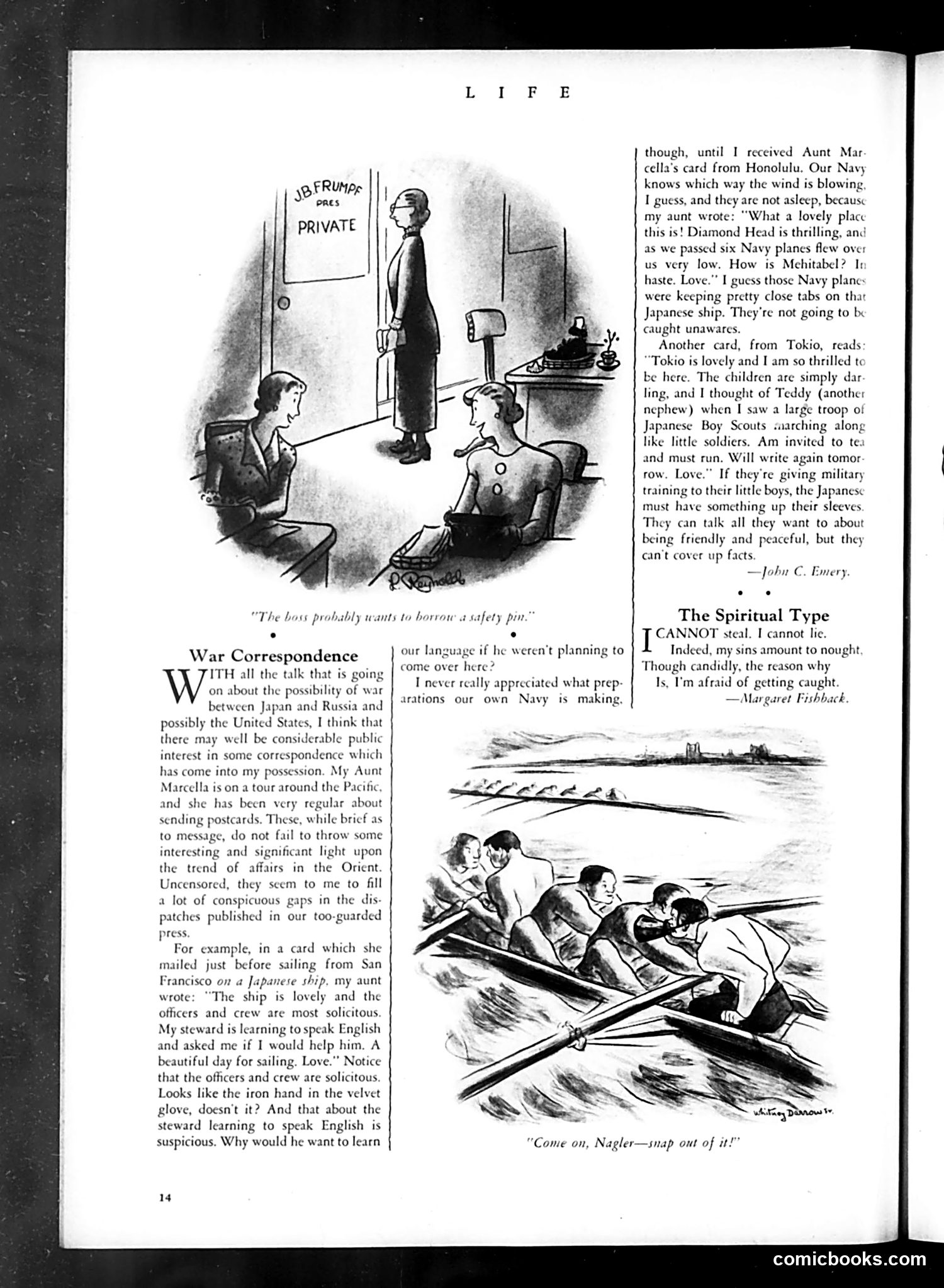
Political Context Analysis The top cartoon depicts a military officer confronting two civilians outside a "Private" office, with the caption "The boss probably wants to borrow a safety pin." This appears to be wartime satire about military bureaucracy and resource scarcity. The main text, "War Correspondence," discusses the author's aunt Marcella sending postcards from Japan during a period of potential Japan-Russia conflict. The author notes gaps in censored dispatches and expresses suspicion about the steward learning English—implying wartime espionage concerns. The lower illustration shows figures in a boat, captioned "Come on, Nagler—nap out of it!" Overall, the page reflects early-20th-century American anxieties about Far Eastern geopolitics, military preparedness, and wartime information control.
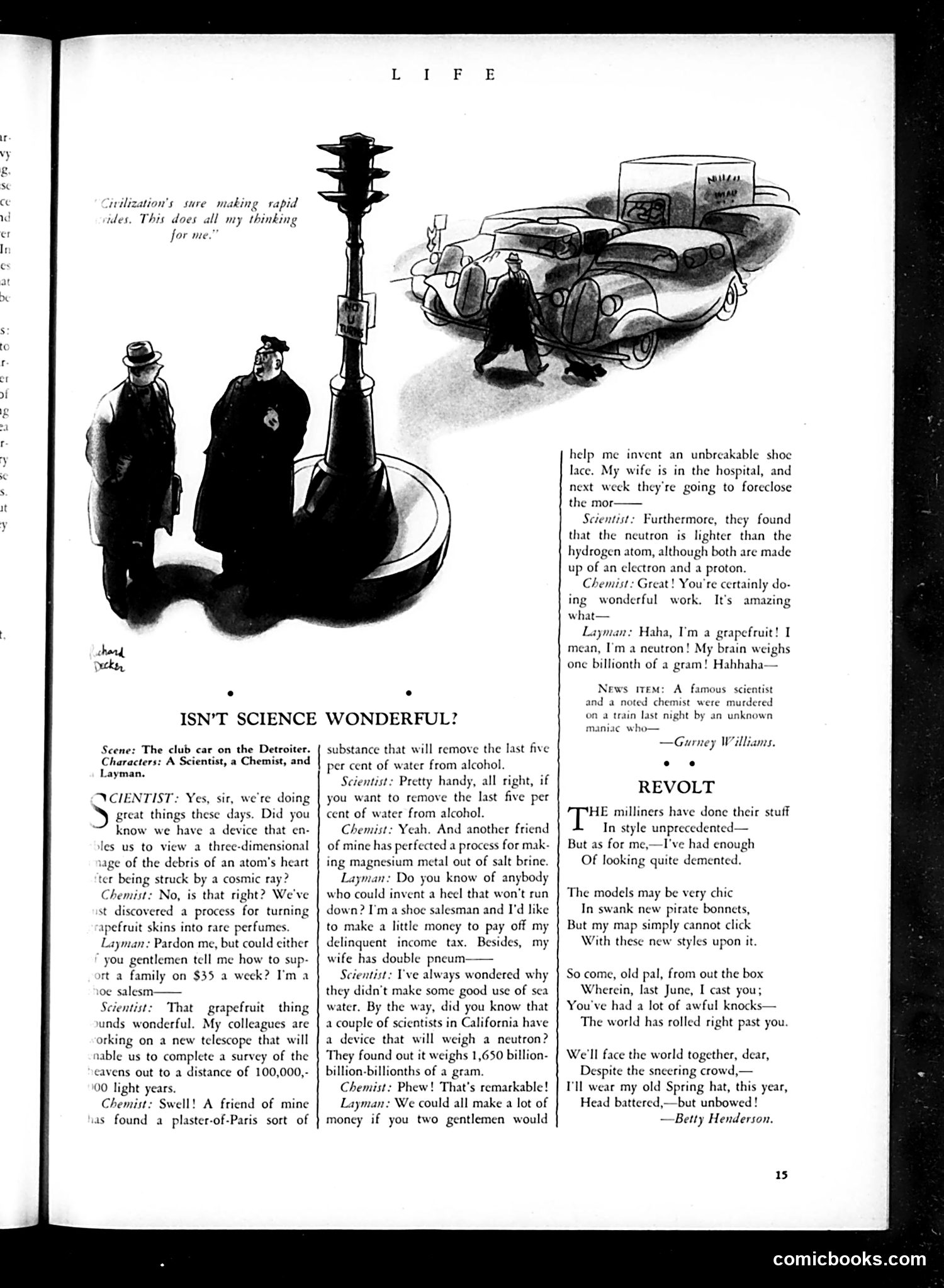
Analysis of Life Magazine Page This page contains satirical dialogue about scientific advances. The main cartoon "ISN'T SCIENCE WONDERFUL?" depicts three men (a Scientist, Chemist, and Layman) discussing modern innovations: three-dimensional films, cosmic ray detection, metal production from salt brine, and a neutron-weighing device. The satire mocks how scientists discuss impractical or absurdly specific inventions with enthusiasm while ordinary people struggle with real problems. The Layman character represents the common person, frustrated that scientists spend resources on theoretical achievements (like weighing a neutron) rather than solving everyday concerns like shoe laces or foreclosures. The "REVOLT" poem below reinforces this theme: ordinary people are tired of intellectuals' impractical pursuits while real hardship continues. The cartoon critiques the disconnect between scientific ambition and practical human needs during what appears to be the Depression era.
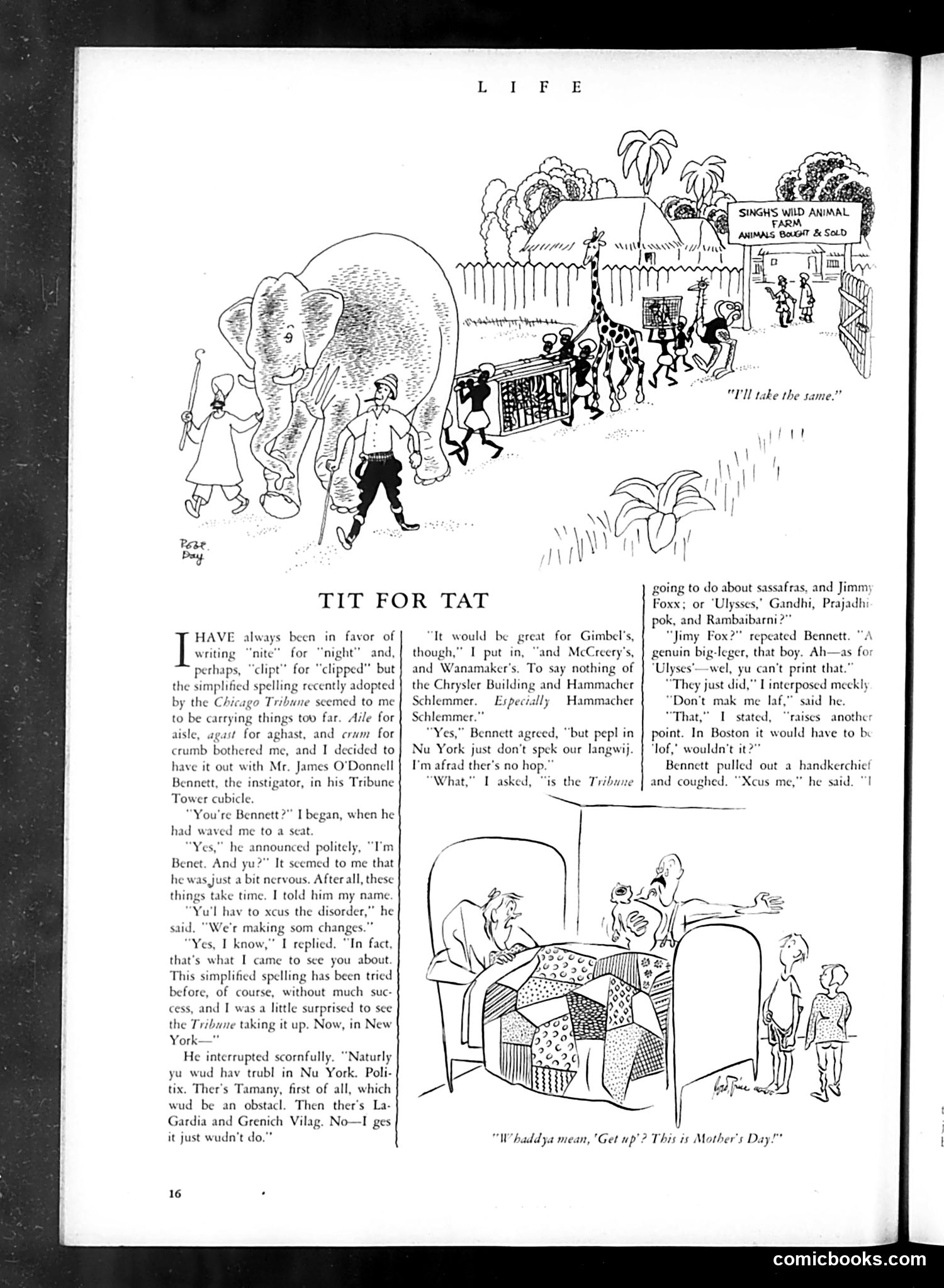
"Tit for Tat" - Life Magazine Cartoon Analysis This page discusses the *Chicago Tribune*'s recent adoption of simplified spelling (writing "nite" for "night," "clipped" for "clipped"). The author, James O'Donnell Bennett, debated these changes with Tribune editors. The top cartoon shows a circus procession featuring an elephant labeled "Bear Day"—likely referencing a specific Tribune promotion or feature. The caption "I'll take the same" suggests someone requesting whatever entertainment drew crowds. The lower cartoon depicts a domestic scene with the caption about Mother's Day, illustrating how everyday language and spelling conventions affect communication. The satire targets the Tribune's spelling reform as impractical and socially awkward—a humorous critique of corporate linguistic experimentation affecting public discourse and family life.
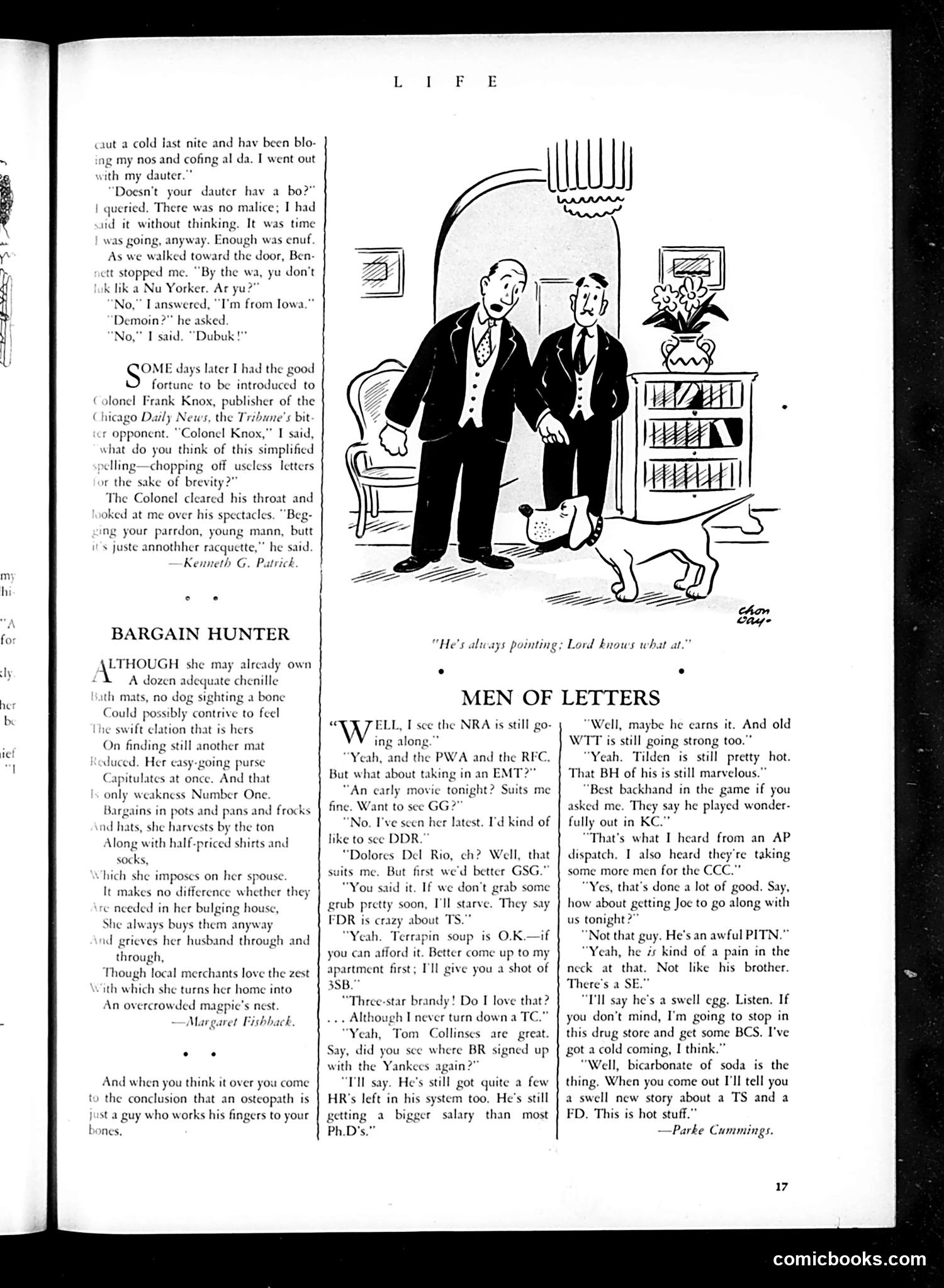
Analysis of This Life Magazine Page The main cartoon depicts two well-dressed men observing a small dog near furniture, with the caption "He's always pointing; Lord knows what at." This is a gentle visual gag about a pointing dog's unpredictable behavior—a relatable domestic humor piece requiring no historical context. Below, "Men of Letters" presents a dialogue between two men discussing various abbreviations and acronyms: NRA, PWA, RFC, EMT, GSG, DDR, GSS, FDR, TS, HR, and others. This satirizes the New Deal era's alphabet-soup of government agencies and programs that proliferated during Franklin D. Roosevelt's administration, mocking how many acronyms citizens now had to navigate in daily conversation and news. The humor lies in the characters' frustration with bureaucratic complexity and the ever-expanding roster of government initiatives.
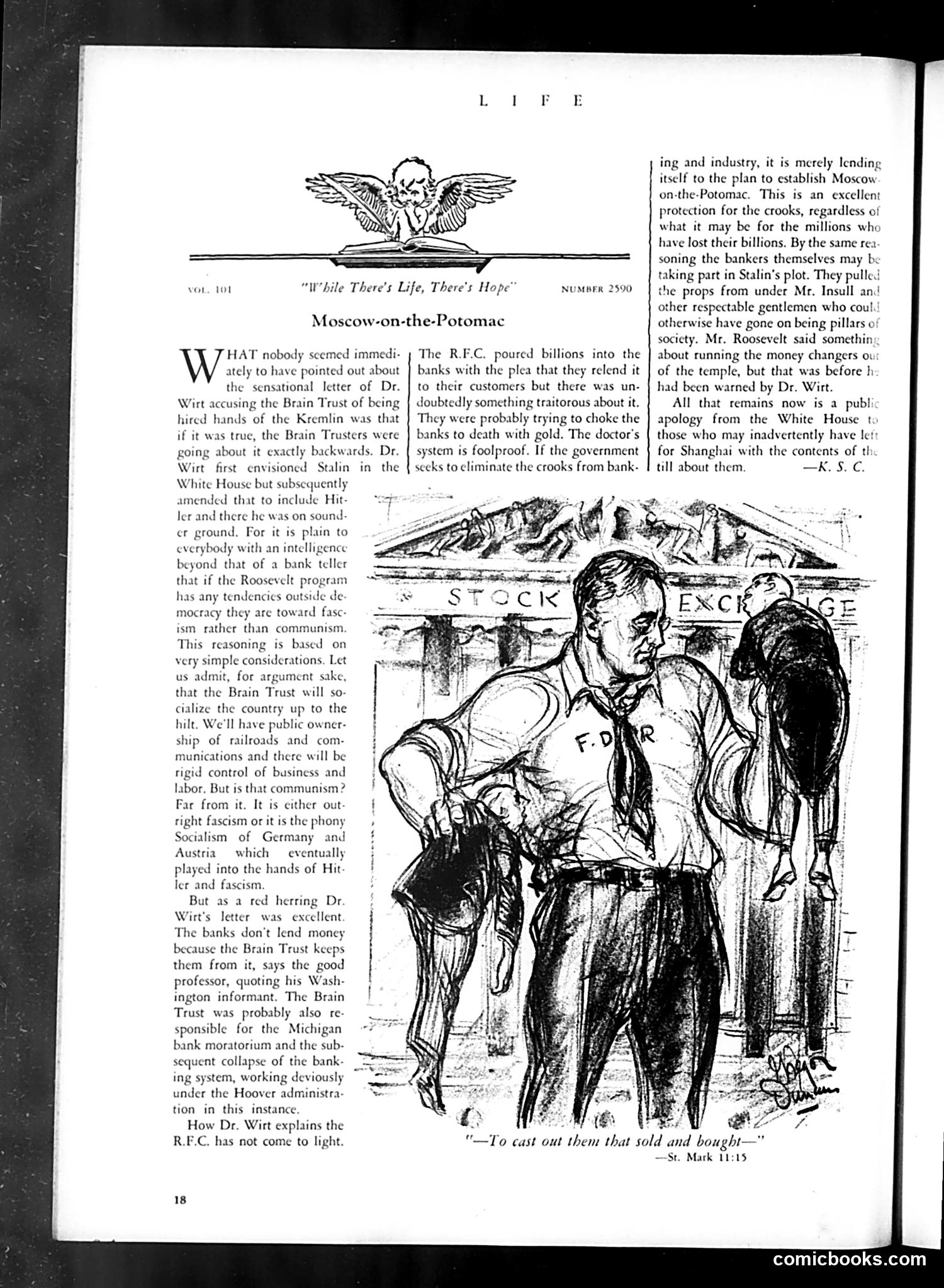
Political Cartoon Analysis: "Moscow-on-the-Potomac" This 1933 Life magazine page satirizes Dr. William Wirt's accusation that Franklin Roosevelt's "Brain Trust" advisors were communist infiltrators serving Stalin. The cartoon and accompanying text argue Wirt's logic is backwards and self-serving. The illustration depicts a figure labeled "F.D.R." at the Stock Exchange, seemingly controlled by shadowy forces—representing the conspiracy theory. However, the article demolishes Wirt's argument: the accusation conveniently protects bankers from scrutiny by suggesting any financial regulation is secretly communist. The text notes Roosevelt's actual policies resemble fascism more than communism, and that Wirt ignores Roosevelt's real aid to banks (the R.F.C.). The biblical epigraph references Jesus expelling moneychangers from the temple, sardonically suggesting that calling out financial impropriety gets one accused of communism. The satire targets how baseless red-baiting deflects from legitimate economic criticism during the Depression.
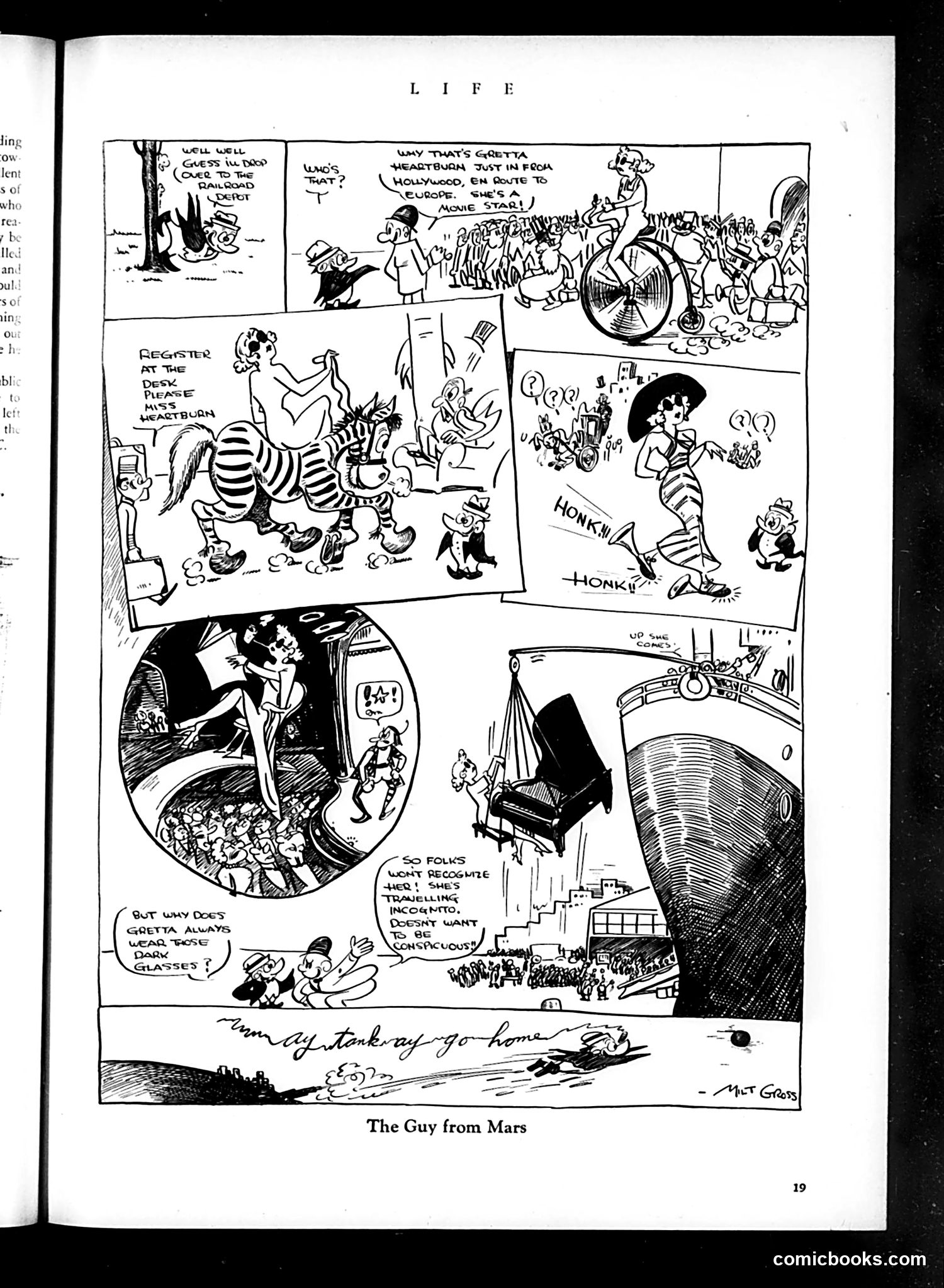
This comic satirizes Hollywood celebrity culture and the mystery surrounding a famous actress. A visitor from Mars observes "Gretta Heartburn," an apparent movie star traveling incognito to Europe. The joke centers on her trademark dark sunglasses—a visual reference to how celebrities attempt anonymity in public through disguises, which paradoxically makes them more recognizable. The comic mocks both celebrity pretension (the elaborate setup required for her travel) and public obsession with stars' private lives. The "Guy from Mars" framing device allows the cartoonist to present ordinary celebrity behavior as absurd to an outsider. The reference to "Hollywood" and European travel reflects post-WWII American entertainment industry prominence and wealthy celebrities' European vacations—popular satirical targets in mid-century American humor magazines.
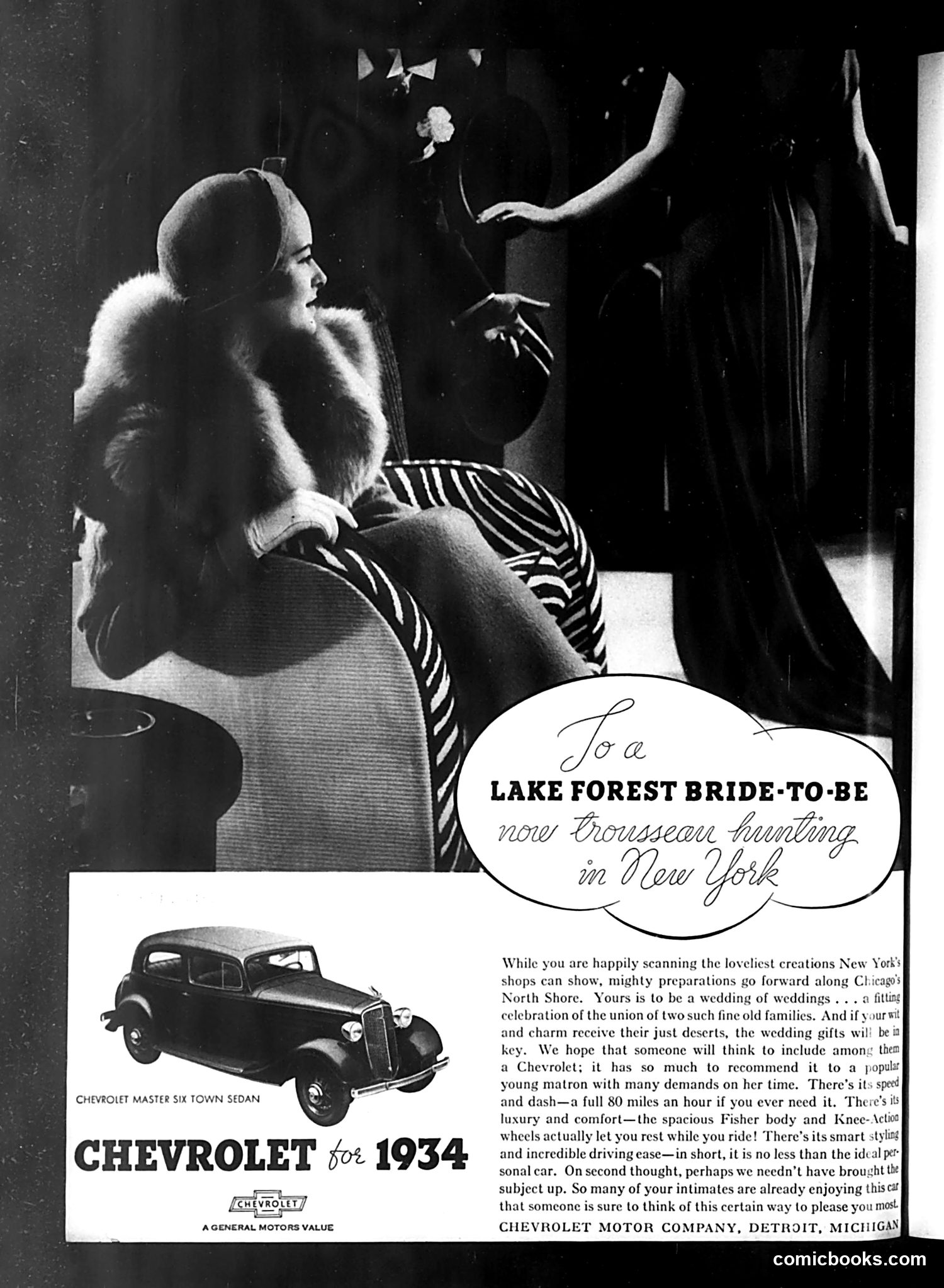
Analysis This is a Chevrolet advertisement disguised as satirical social commentary, not a political cartoon. The "joke" targets wealthy Lake Forest, Chicago residents—specifically an upper-class bride-to-be preparing for a society wedding. The satire is gentle and class-conscious: the ad mocks the pretensions of "fine old families" while simultaneously pitching a Chevrolet as the perfect wedding gift for a young society matron. The humor lies in the contradiction—suggesting a practical, mass-produced automobile as an appropriate gift for the privileged elite, while acknowledging that her wealthy social circle will likely already own one. The image shows a woman in furs and fashionable dress, embodying the affluent bride stereotype. The advertisement plays on 1930s social anxiety: it flatters wealthy readers while subtly suggesting that owning a Chevrolet is expected among their peer group, making the car appear both luxurious and democratically accessible.
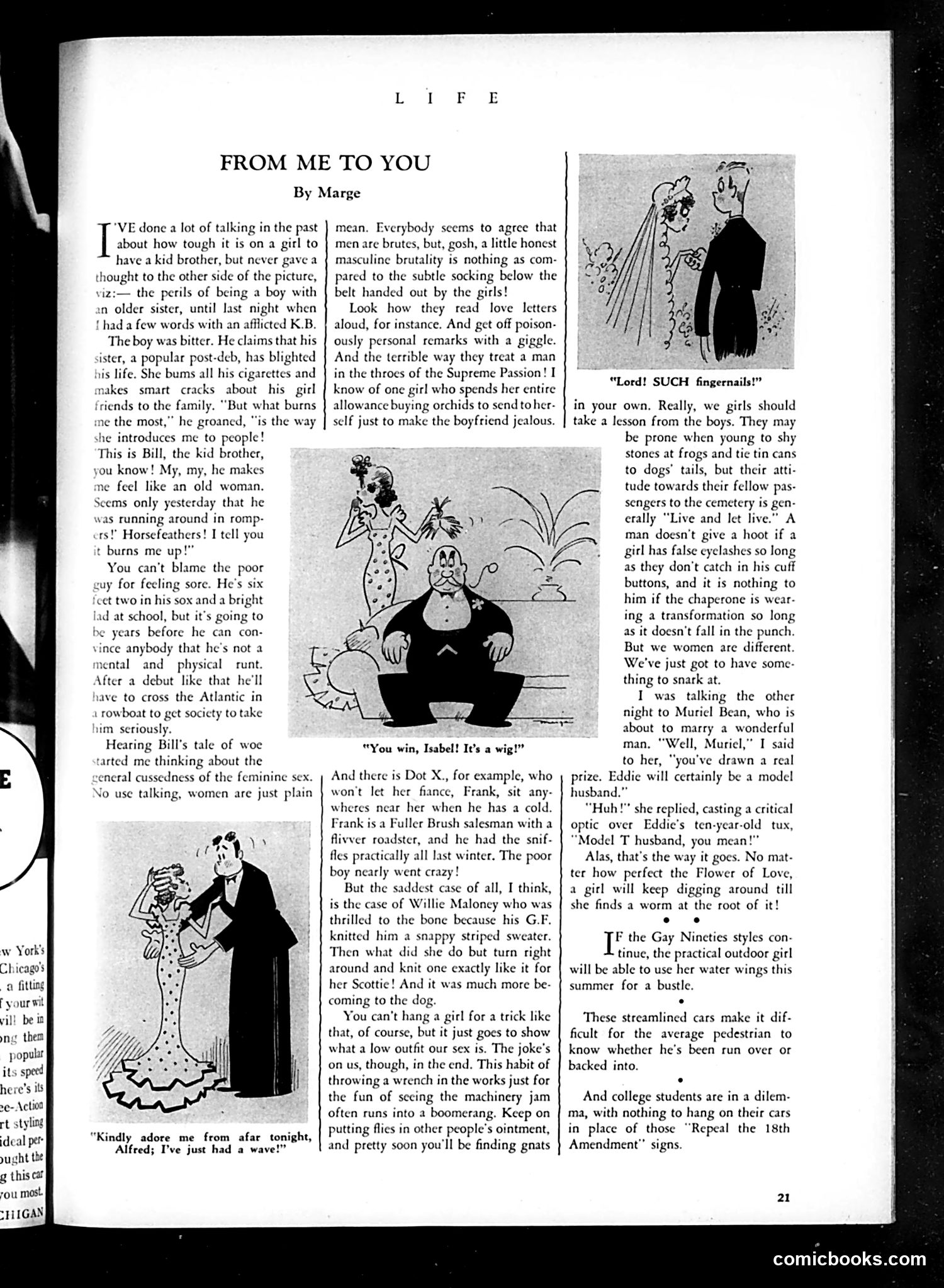
Analysis of "From Me to You" by Marge This humorous essay uses satirical anecdotes to critique women's behavior toward men. The author (Marge) argues that while society condemns male "brutality," women employ subtler psychological tactics that are equally damaging. The cartoons illustrate specific complaints: a woman showing off her manicure while ignoring her date's concerns; a woman winning a wig bet, suggesting vanity and competitiveness. Marge catalogs female offenses: reading love letters aloud to embarrass boyfriends, manufacturing jealousy through fake orchid purchases, refusing to sit near a fiancé with a cold, and—most absurdly—knitting her boyfriend an identical sweater, then making one for her dog instead. The satire targets 1920s-30s dating culture and female social behavior. The "moral" suggests women should adopt masculine indifference ("live and let live") rather than engaging in emotional games. The tone is lighthearted mockery of women's own pettiness, presented as self-aware female-to-female commentary.
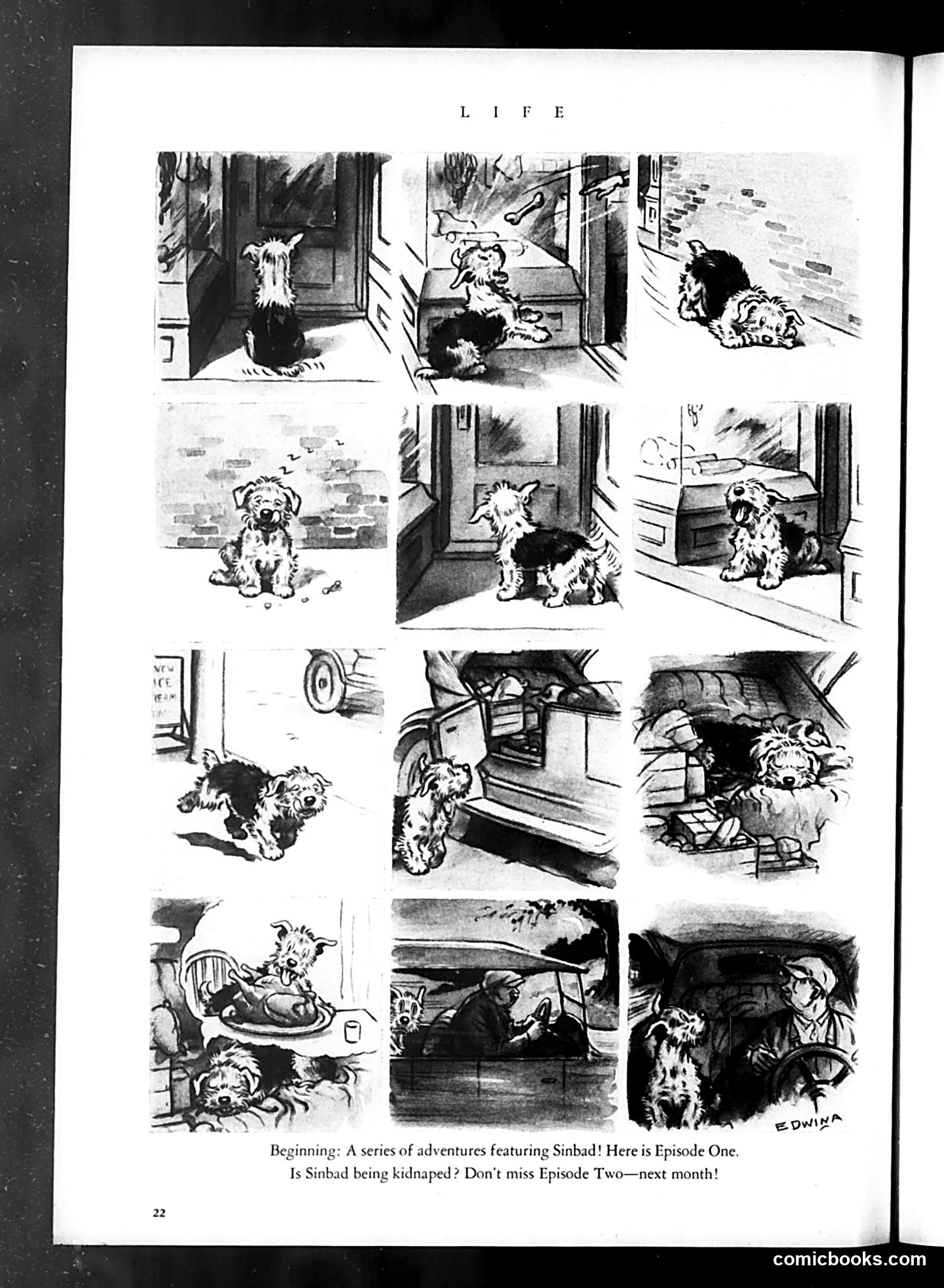
Content Summary This is a comic strip page titled "Sinbad" presenting the first episode of a serialized adventure story. The twelve-panel sequence depicts a small dog (presumably named Sinbad) encountering various misadventures: being discovered in doorways, surrounded by bricks, meeting other dogs, riding in cars, bathing, and ultimately being transported by a man in what appears to be a kidnapping scenario. The text promises readers that Episode Two will reveal whether Sinbad is actually being kidnapped, using suspense as a cliffhanger to encourage readers to return next month. This reflects *Life* magazine's serialization strategy to maintain reader engagement. The strip's humor derives from the dog's predicaments and the melodramatic kidnapping setup, treating a pet's ordinary misfortunes as dramatic narrative.
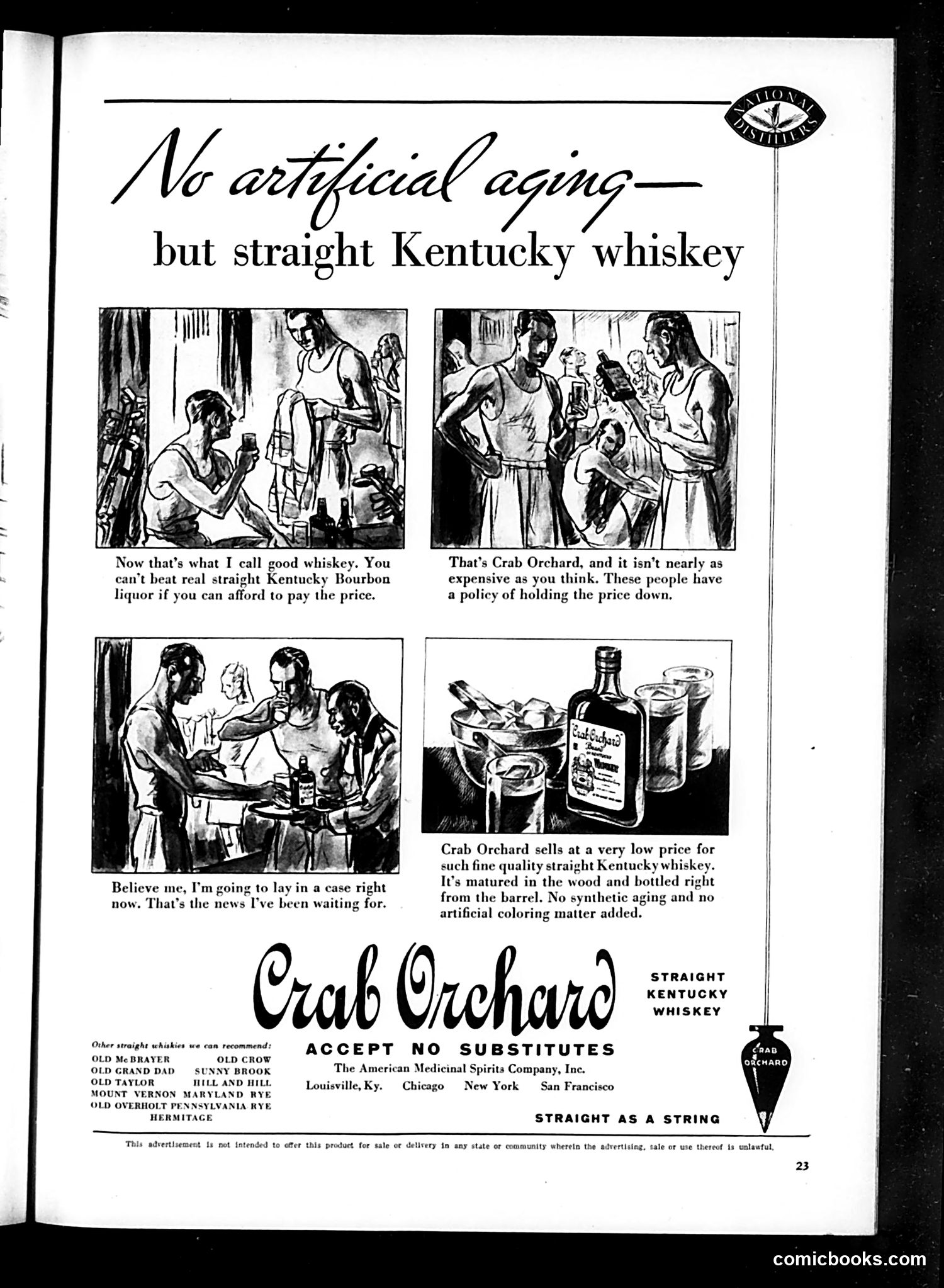
Crab Orchard Whiskey Advertisement This is primarily a whiskey advertisement, not political satire. It promotes Crab Orchard straight Kentucky bourbon through a comic narrative showing working-class men discussing the product's affordability and quality. The four panels depict conversations where characters praise Crab Orchard as genuine Kentucky whiskey that costs less than competitors despite superior quality—"matured in the wood and bottled right from the barrel" with "no synthetic aging." The tagline "Accept No Substitutes" emphasizes authenticity. The humor targets price-gouging competitors rather than political figures. The "no artificial aging" message likely references Prohibition-era practices where inferior spirits were artificially aged to appear legitimate. The advertisement lists competing brands (Old Crow, Old Grand Dad, etc.) to position Crab Orchard as the value option among authentic whiskeys.
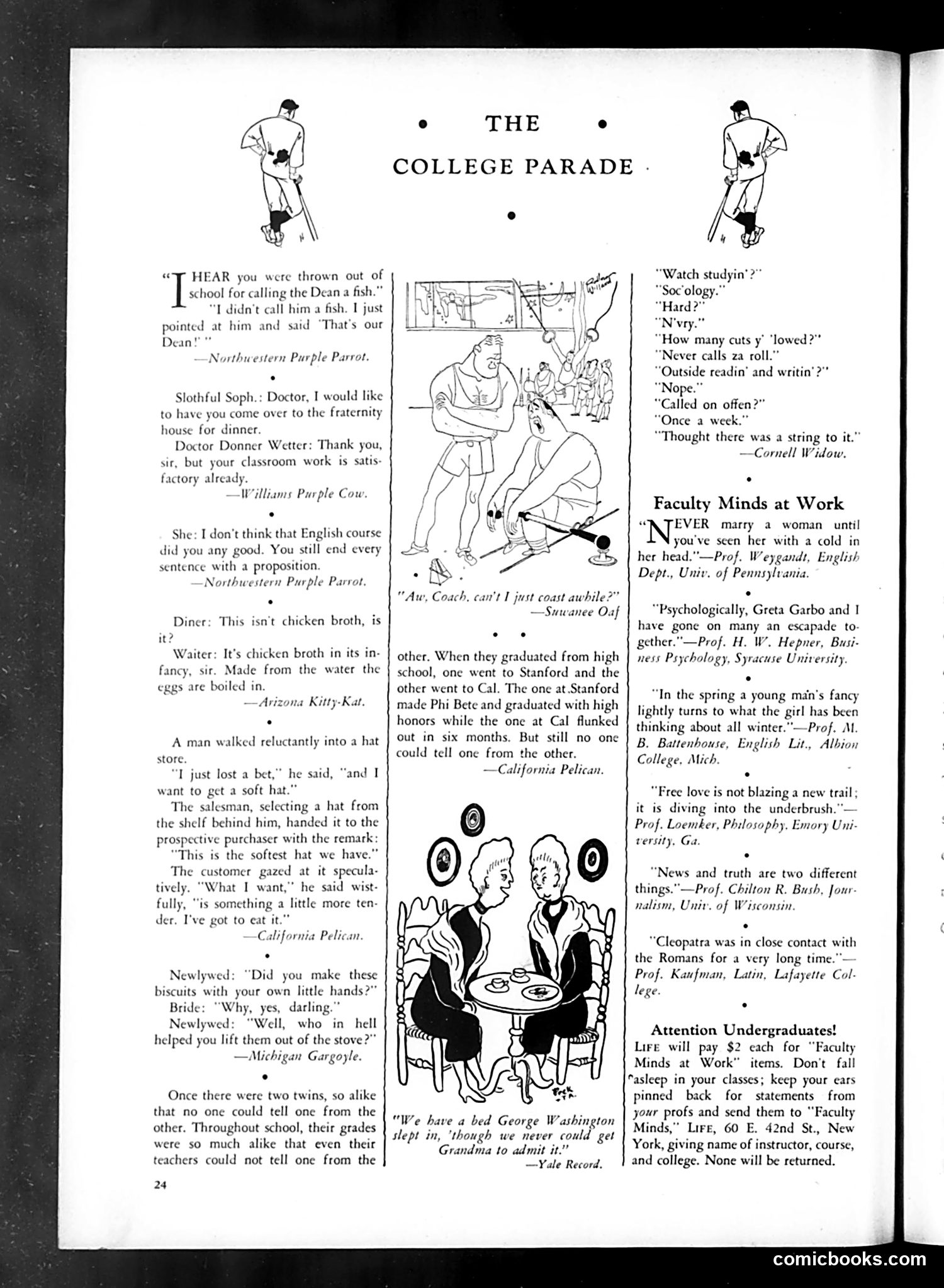
"The College Parade" - Life Magazine Humor Page This is a humor anthology page from *Life* magazine featuring jokes submitted by college newspaper staff writers. The content satirizes college life through brief anecdotes and witticisms. Key targets of satire: - Student-faculty dynamics: A dean mistaken for a fish; a professor declining dinner because the student's grades are already satisfactory (implying the student is lazy) - Academic standards: Jokes about lax attendance policies, minimal grading rigor, and easy coursework - Gender and marriage: Stereotypes about newlywed incompetence and women with colds - Regional college rivalry: A pointed joke contrasting Stanford's rigorous standards (Phi Beta Kappa honors) with UC Berkeley's perceived laxity (a twin flunks out) The "Faculty Minds at Work" section mocks professorial pretension—professors making grandiose claims about psychology, philosophy, and classical history that range from obvious to absurd. The page reflects 1920s-30s college culture, where *Life* actively solicited humorous contributions from university publications, creating a national college humor circuit.
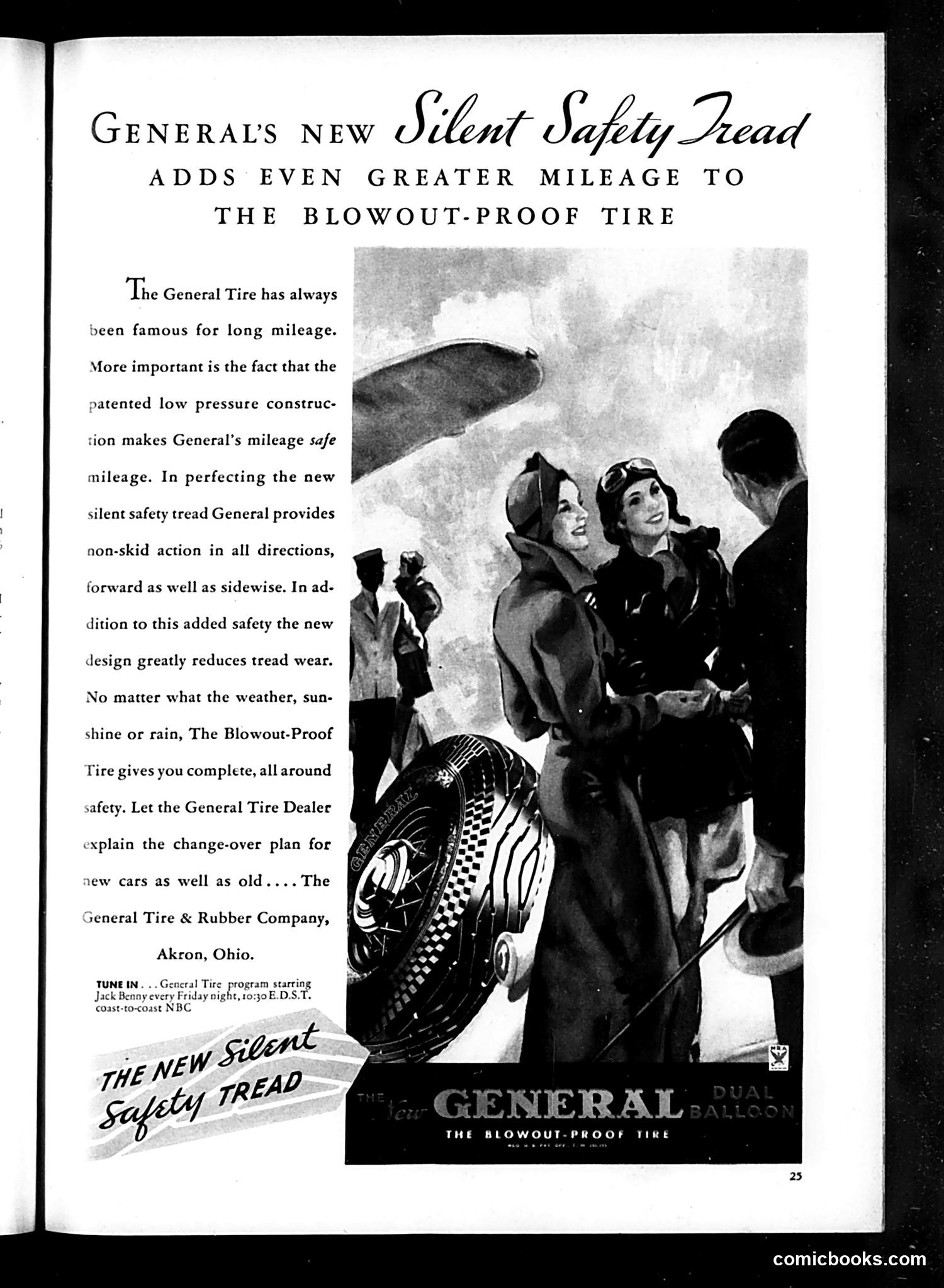
Analysis This is primarily a General Tire advertisement, not political satire. The page promotes the company's new "Silent Safety Tread" tire, marketed as "blowout-proof." The image shows well-dressed people (appearing to be from the 1930s-40s based on clothing) admiring or discussing a tire, with an airplane visible overhead—likely suggesting modern safety and reliability. The advertisement emphasizes practical benefits: non-skid performance in all directions, reduced tread wear, and safety in various weather conditions. The only noteworthy detail for modern readers: the ad mentions a Jack Benny radio program sponsorship, reflecting how major corporations used popular entertainment to build brand loyalty during the early broadcast era. There is no satire or political commentary present—this is straightforward commercial promotion.
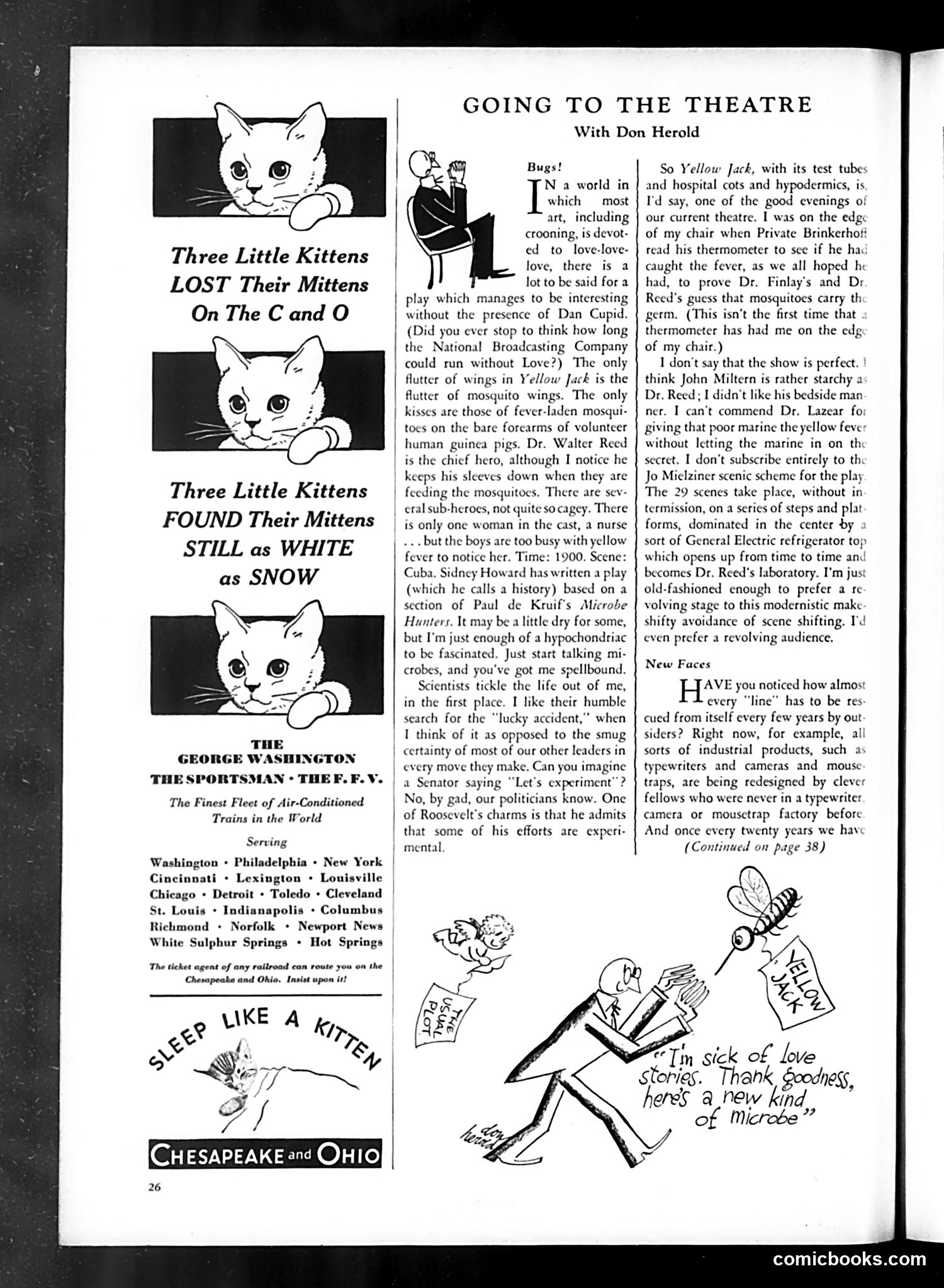
Analysis of Life Magazine Page This page contains advertising and theatre criticism, not political satire. The left side features ads: a playful nursery-rhyme ad for the Chesapeake and Ohio railway (showing kittens losing and finding mittens), and a train service advertisement. These use whimsy to market transportation. The main content is Don Herold's theatre column reviewing *Yellow Jack*, a play about Dr. Walter Reed's yellow fever experiments in Cuba (circa 1900). Herold praises the show for depicting scientific inquiry rather than romance—noting the only "kisses" are from infected mosquitoes. He admires scientists' experimental approach, contrasting it favorably with politicians who claim certainty. He critiques some staging choices and an actor's performance. The cartoon at bottom shows a harried figure juggling product redesigns, illustrating Herold's point about industries hiring outside designers to modernize goods. No political figures or partisan satire appear here—this is lifestyle and entertainment content typical of 1930s Life magazine.
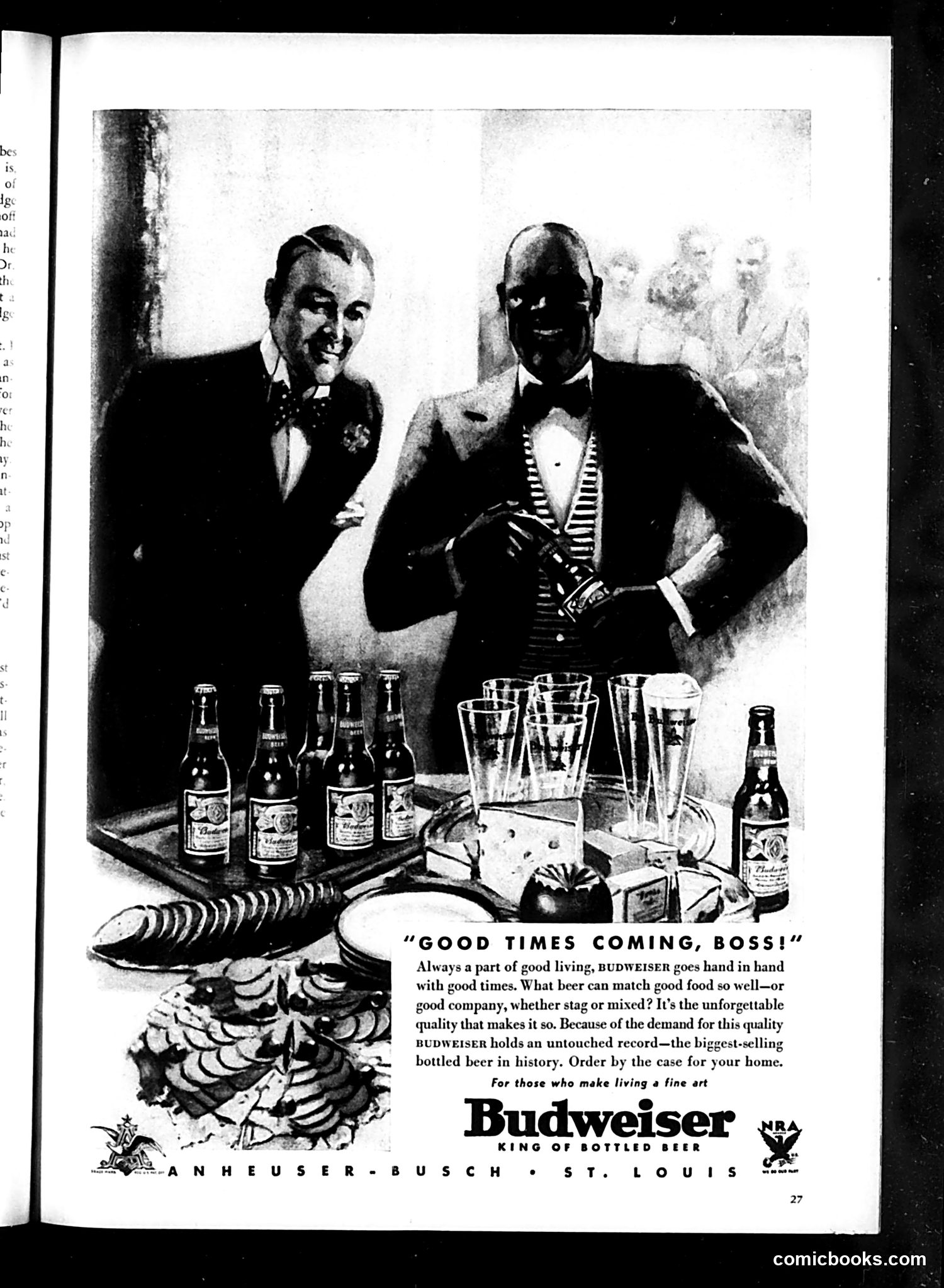
Analysis This is a Budweiser beer advertisement, not political satire. The page features two men in formal attire (tuxedos and bow ties) at what appears to be a social gathering, with beer bottles, glasses, and food (bread, oysters) displayed prominently. The ad's appeal targets affluent consumers by associating beer with "good living" and upscale socializing. The phrase "Good Times Coming, Boss!" suggests prosperity and leisure. The copy emphasizes Budweiser's status as "biggest-selling bottled beer in history." The presence of the NRA (National Recovery Administration) logo dates this to the 1930s New Deal era, when the NRA regulated business practices during the Great Depression. Historical context: This advertisement targets post-Prohibition America (Prohibition ended 1933), when beer companies aggressively marketed their products to reclaim market share. The sophisticated imagery and emphasis on "good company" and "fine living" were typical strategies to position beer as a respectable beverage for the middle and upper classes.
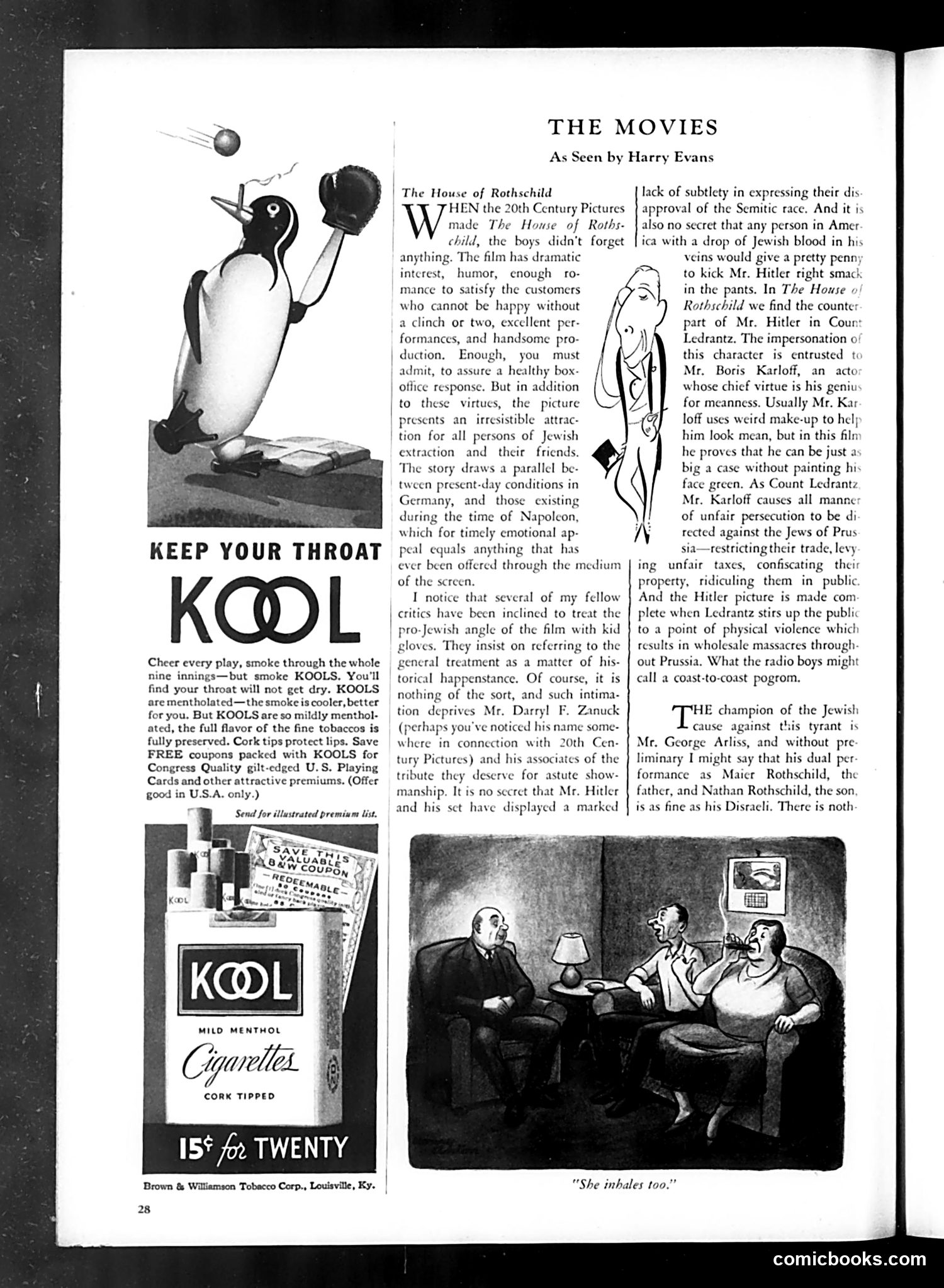
Analysis: "The House of Rothschild" Film Review This page combines a KOOL cigarette advertisement with film critic Harry Evans's review of the 1934 film *The House of Rothschild*. The Film Review's Context: Evans praises the 20th Century Pictures film for its timely anti-Nazi message. The story parallels contemporary Germany under Hitler with Napoleonic-era Prussia. Boris Karloff plays Count Ledrantz, a Nazi-like villain who persecutes Jews through unfair laws, property confiscation, and orchestrated violence ("coast-to-coast pogrom"). George Arliss plays the Rothschild family patriarch and son, defending Jewish interests against persecution. Evans criticizes fellow critics for treating the film's pro-Jewish angle with "kid gloves," praising instead the filmmakers' explicit, courageous anti-Hitler stance. He notes that American Jews would eagerly see this rare Hollywood challenge to Nazi antisemitism. The Advertisement's Dark Irony: The KOOL ad's caption—"She inhales too"—appears alongside the review, creating an uncomfortable juxtaposition given the film's discussion of persecution and the later historical context of Nazi atrocities.
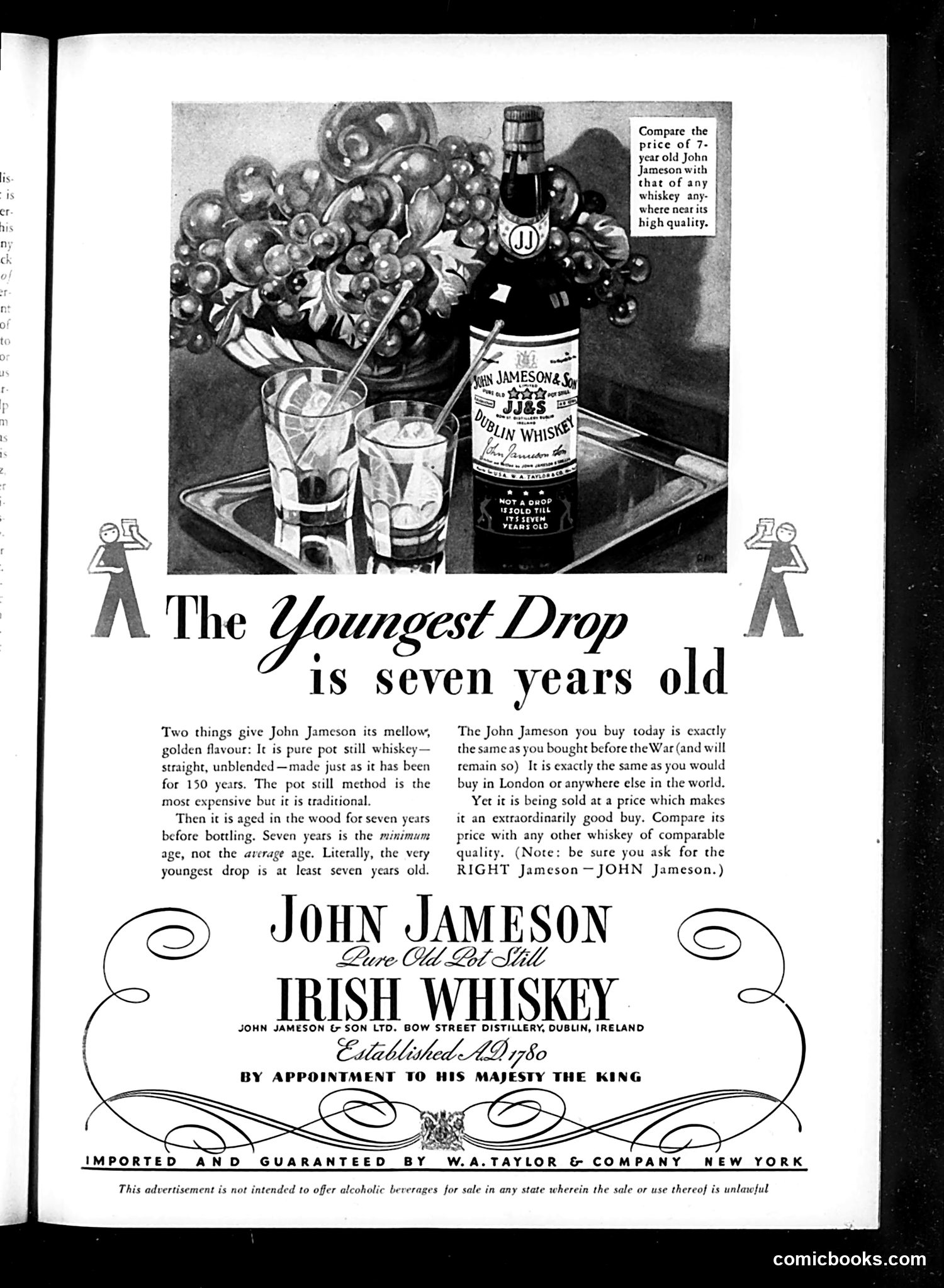
Analysis This is not a cartoon or satire—it's a straightforward advertisement for John Jameson Irish Whiskey, likely from the 1920s-1930s (post-Prohibition era in America). The ad emphasizes product quality through specific claims: the whiskey is aged a minimum of seven years (not average), uses traditional pot-still methods unchanged for 150 years, and costs less than comparable whiskeys. The decorative imagery (grapes, glasses, the bottle) and royal warrant ("By Appointment to His Majesty the King") reinforce prestige and tradition. The reference to comparing "before the War" suggests this ran after World War I, reassuring customers the product remained consistent. The disclaimer about unlawful sale states this couldn't be advertised in dry states—a constraint from American Prohibition's lingering aftermath. There is no political satire or caricature present. This is pure product marketing using appeals to tradition, value, and quality.
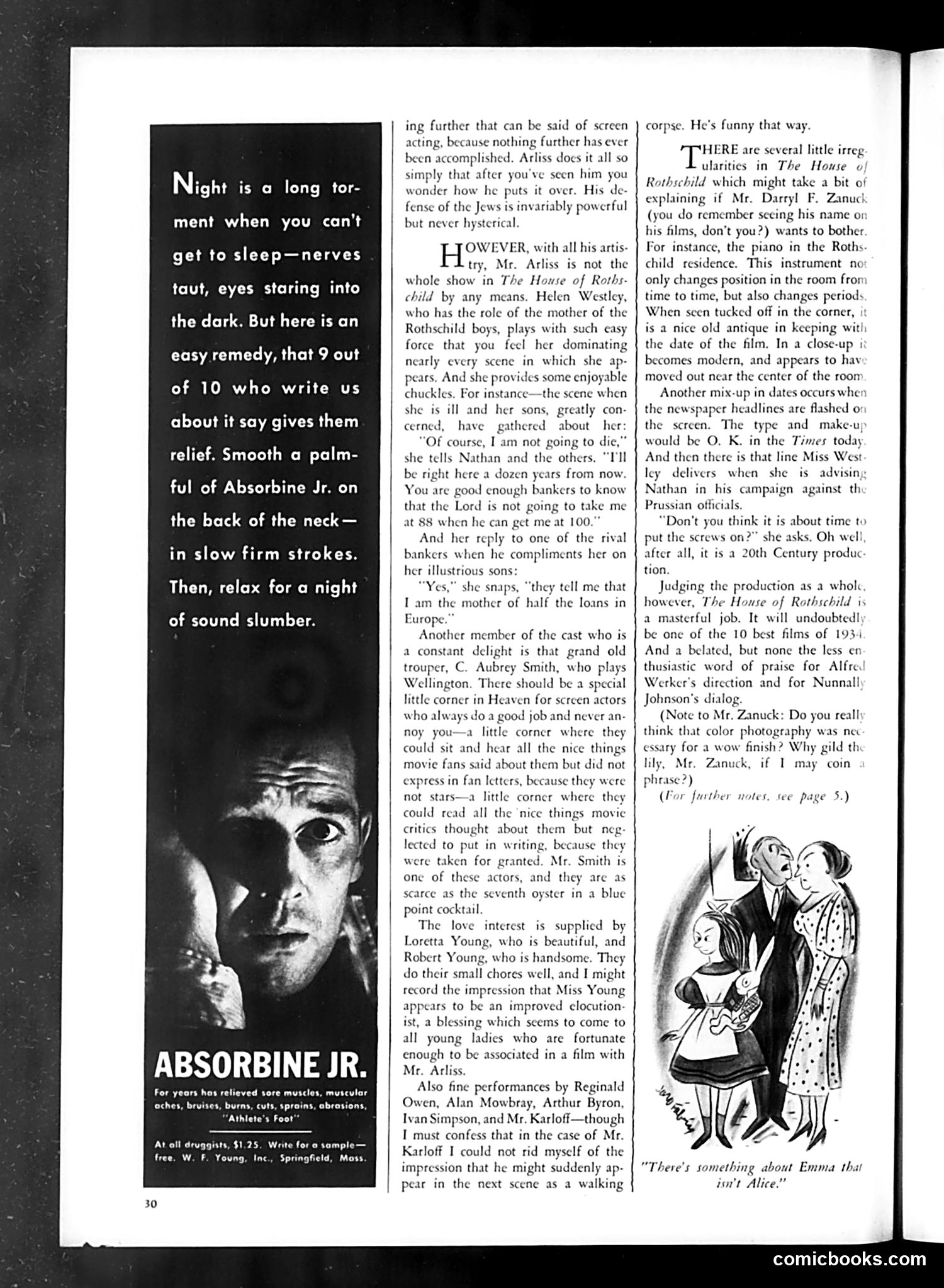
Page Analysis: Life Magazine Film Review & Advertisement This page combines a product advertisement (left) with a film review (right). The Absorbine Jr. ad uses insomnia as a relatable problem to sell a liniment product—a common mid-century marketing approach exploiting consumer anxiety about sleeplessness. The film review discusses *The House of Rothschild*, praising actor George Arliss's performance while critiquing supporting elements. The reviewer praises Helen Westley and C. Aubrey Smith as reliable character actors who deserve recognition despite playing secondary roles. There's a humorous jab at Boris Karloff, suggesting he seems out of place in non-horror roles—a reference to his famous monster roles. The review also notes production inconsistencies: props (a piano) changing styles and positions between scenes, and newspaper headlines appearing anachronistic. This was gentle professional criticism of a major studio production's attention to detail.
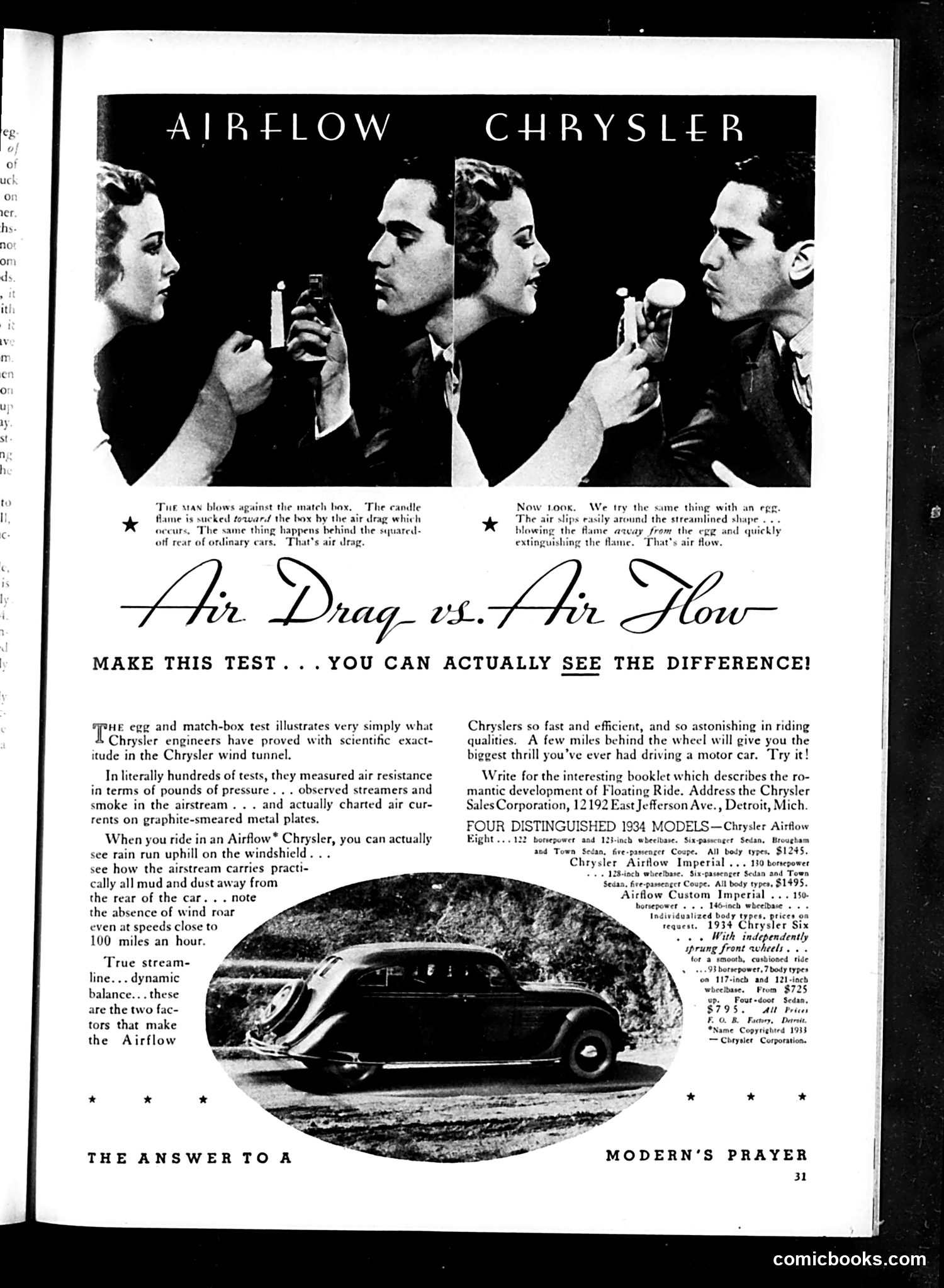
Analysis of "Air Drag vs. Air Flow" Advertisement This is a Chrysler automobile advertisement, not political satire. It demonstrates aerodynamic engineering through visual experiments rather than satirizing anything. The page shows two side-by-side demonstrations comparing air resistance. "Airbelow Chrysler" depicts a man blowing on a matchbox (showing air drag pulling a candle toward it), while "Chrysler" shows the same principle with an egg—air flowing smoothly around a streamlined shape extinguishes a flame without turbulence. The advertisement promotes Chrysler's "Airflow" 1934 models, emphasizing revolutionary streamlined design that reduces air resistance. The copy claims this results in faster speeds, better fuel efficiency, reduced wind noise, and improved handling at highway speeds (100+ mph). The "test" framing suggests consumers can verify these aerodynamic claims themselves, lending scientific credibility to the sales pitch during the Depression-era automotive market.
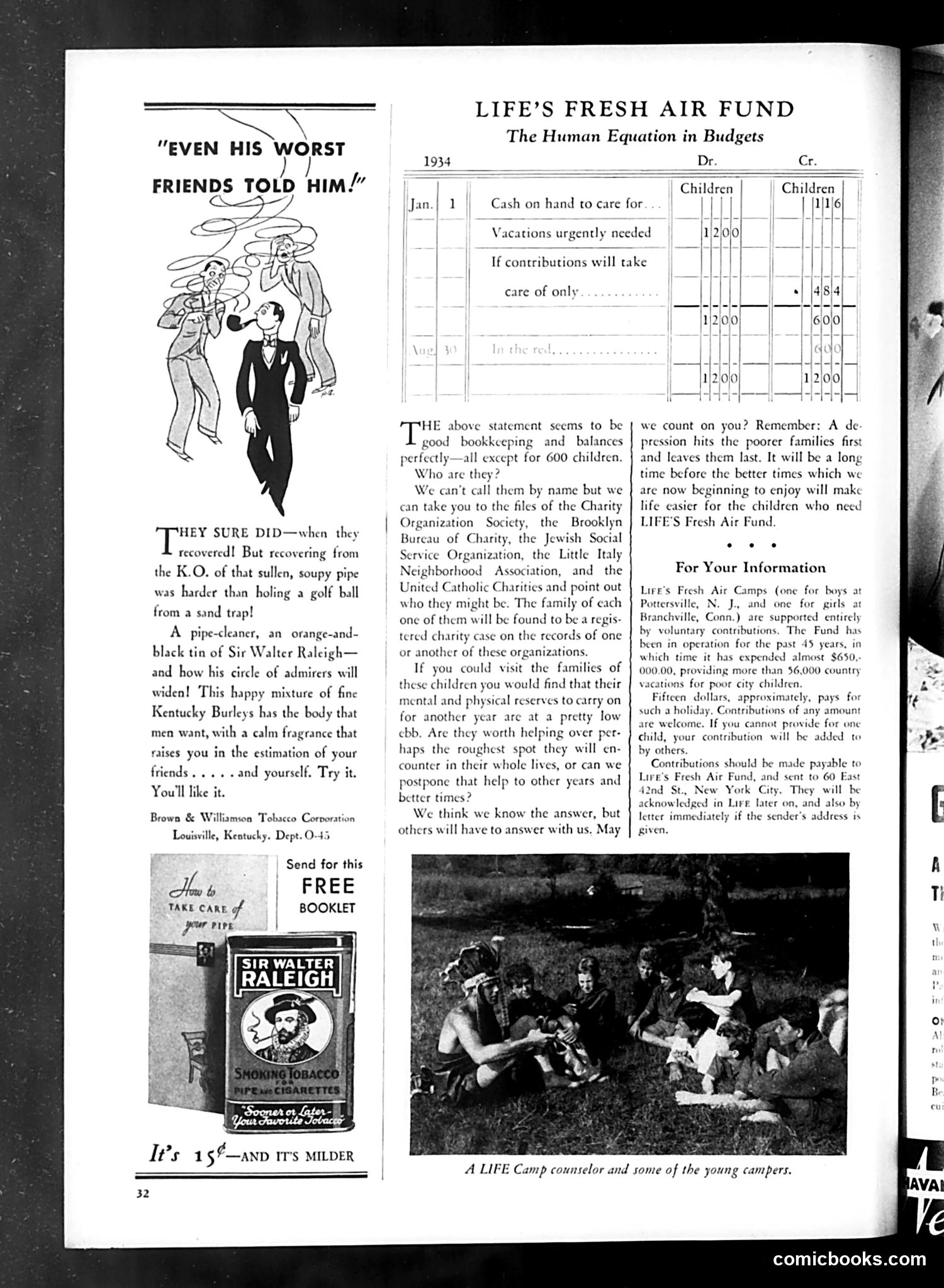
Political/Social Context This page combines tobacco advertising with a charitable appeal reflecting Depression-era social concerns. Left side: A Sir Walter Raleigh pipe tobacco ad uses humor to pitch smoking as socially elevating—a man's "worst friends" allegedly criticized his pipe until he switched brands, then his social standing improved. The joke plays on masculine insecurity about appearances. Right side: Life magazine's "Fresh Air Fund" addresses urban poverty. The budget table shows charitable organizations can care for poor children—except 600 remain unfunded. The appeal references Depression hardship hitting poorest families first and longest, asking readers to fund country vacations (at $15 each) for underprivileged city children. The fund had operated 45 years by this point, providing thousands of rural holidays. The jarring juxtaposition is notable: luxury tobacco marketing shares space with urgent pleas for hungry children—typical of 1930s magazine economics where advertising subsidized content addressing social crises.
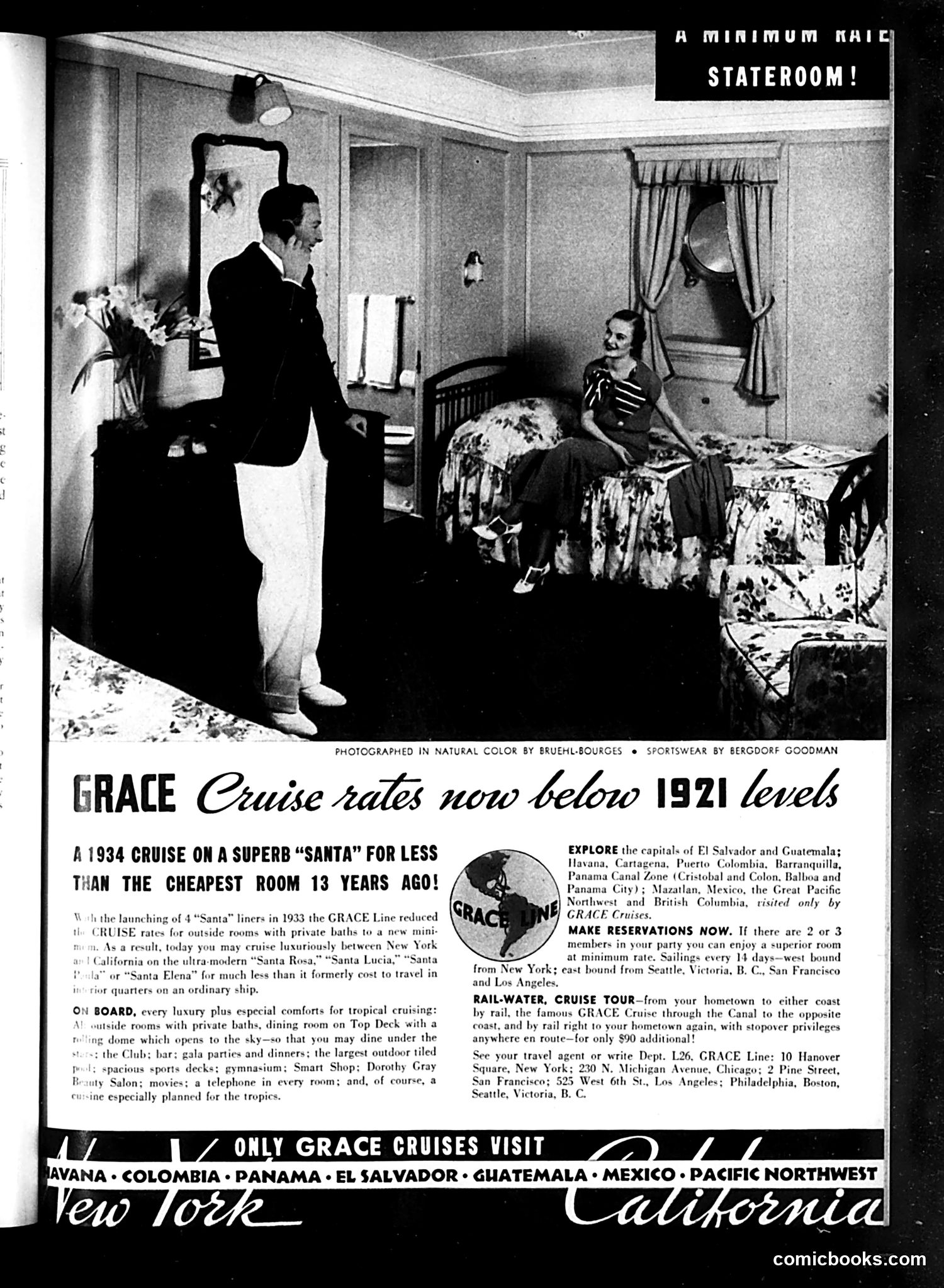
Analysis This is primarily a cruise-line advertisement, not political satire. The page promotes Grace Line cruises during the Great Depression era. The photograph shows a luxury cruise ship stateroom with a man and woman in 1930s attire. The headline claims Grace Line now offers 1934 cruises at rates "below 1921 levels"—undercutting prices from 13 years prior—and states this luxury costs less than the cheapest room did in 1921. The satire is economic, not political: the ad mocks the Depression by ironically celebrating that luxury travel has become *cheaper* than basic accommodations were pre-crash. The "minimum rate stateroom" caption emphasizes affordability of what would normally be premium space. The copy details itineraries to Central America and the Pacific, luxury onboard amenities (private baths, dining, gymnasium, telephone), and encourages booking "now" at special group rates. This reflects Depression-era marketing: selling affordable luxury as economic recovery and consumer confidence.
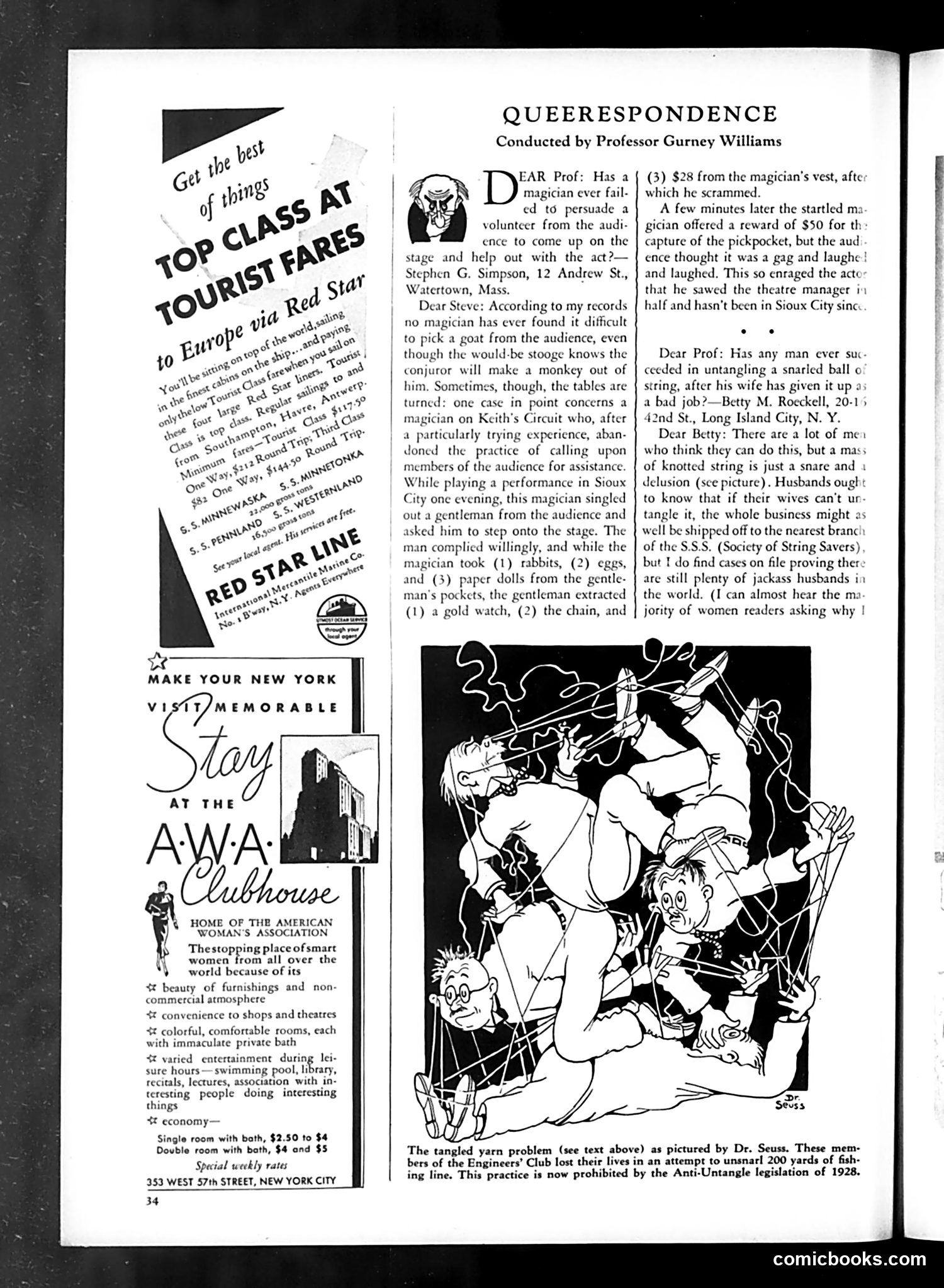
Explanation for Modern Readers This page contains a humorous advice column ("Queerespondence") and an unrelated Dr. Seuss cartoon illustration. The Column: Two readers ask absurd questions: whether magicians struggle to get volunteers, and whether husbands can untangle string their wives couldn't. The answers are comedic tall tales. The first describes a magician whose audience volunteer turns out to be a pickpocket, stealing from the magician while pretending to be "picked"—a reversal of the magic trick premise. The second uses Dr. Seuss's cartoon to illustrate the "danger" of untangling string, joking that men who attempt it after their wives give up are foolish. The Seuss Cartoon: Shows absurdist chaos with figures tangled in string, captioned with fake "Anti-Untangle legislation of 1928" as if string-untangling were a deadly, regulated activity. The humor relies on exaggeration and role-reversal—making everyday domestic frustrations into mock-serious predicaments.
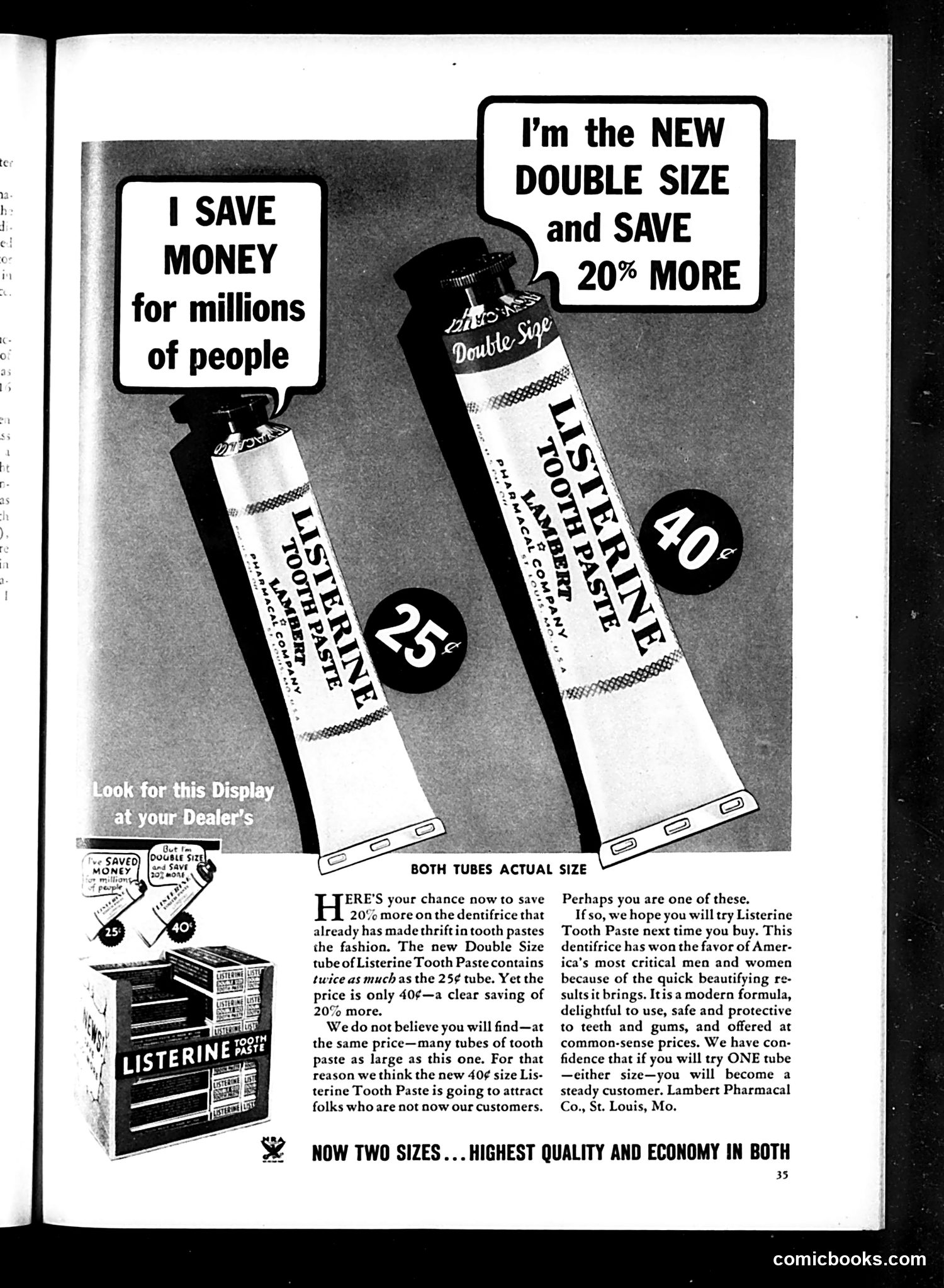
Analysis This is primarily a Listerine Tooth Paste advertisement, not satire or political content. It presents the company's new "Double Size" tube (40¢) alongside the original smaller tube (25¢). The selling point: The larger tube contains twice the product but costs only 60% more (40¢ vs. 25¢), yielding a claimed 20% savings. Two anthropomorphized toothpaste tubes "speak" in speech balloons, with the larger one boasting about the value proposition. Context for modern readers: This reflects early-to-mid 20th century marketing strategy—offering bulk purchasing as economy. The "two sizes, highest quality and economy in both" tagline emphasizes that larger ≠ inferior. The display stand shown suggests retail point-of-purchase promotion. The advertisement assumes consumers understood the math: paying more absolute dollars for better per-unit cost was a novel or noteworthy selling concept, indicating less sophisticated discount awareness than today.
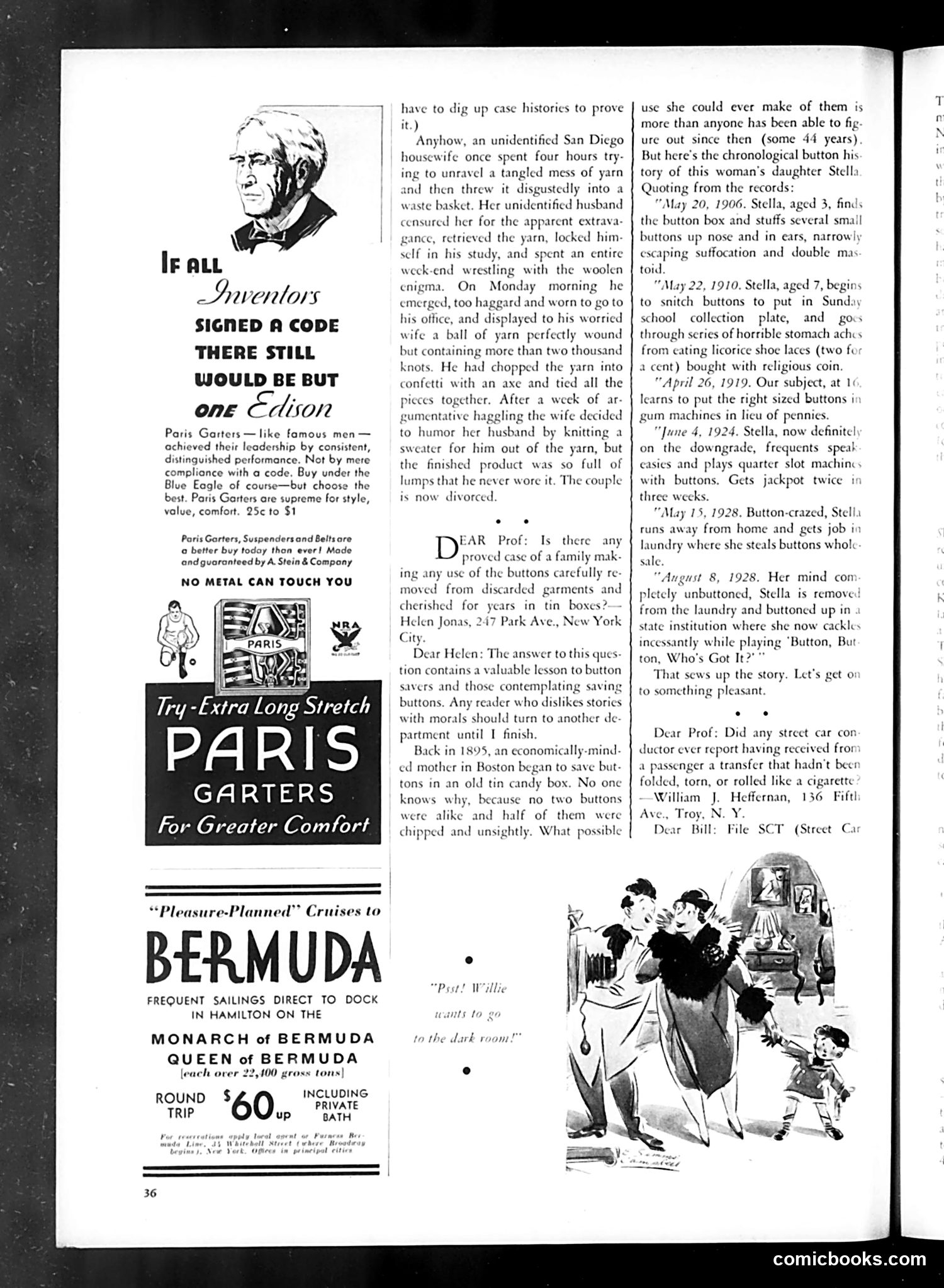
Explanation for Modern Readers This page is primarily advertising (Paris Garters, Bermuda cruises) with a satirical column by Life magazine. The main satirical content is a humorous "advice column" mocking Depression-era frugality. A reader asks if families actually save buttons from old clothes. The editor responds with a darkly comic cautionary tale: a Boston mother saved buttons starting in 1895; her daughter Stella's life spirals into ruin—from choking as a child, to stealing from church, to defrauding vending machines, ultimately ending institutionalized and mentally broken. The satire targets: obsessive penny-pinching and waste-saving that characterized working-class life during economic hardship. By tracing one button-saving habit's absurd consequences across decades, Life mocks the irrational desperation driving such behavior—suggesting that compulsive thrift itself becomes pathological and destructive. The column's tone is deliberately exaggerated and grim, using dark humor to critique both excessive frugality and the desperation underlying it.
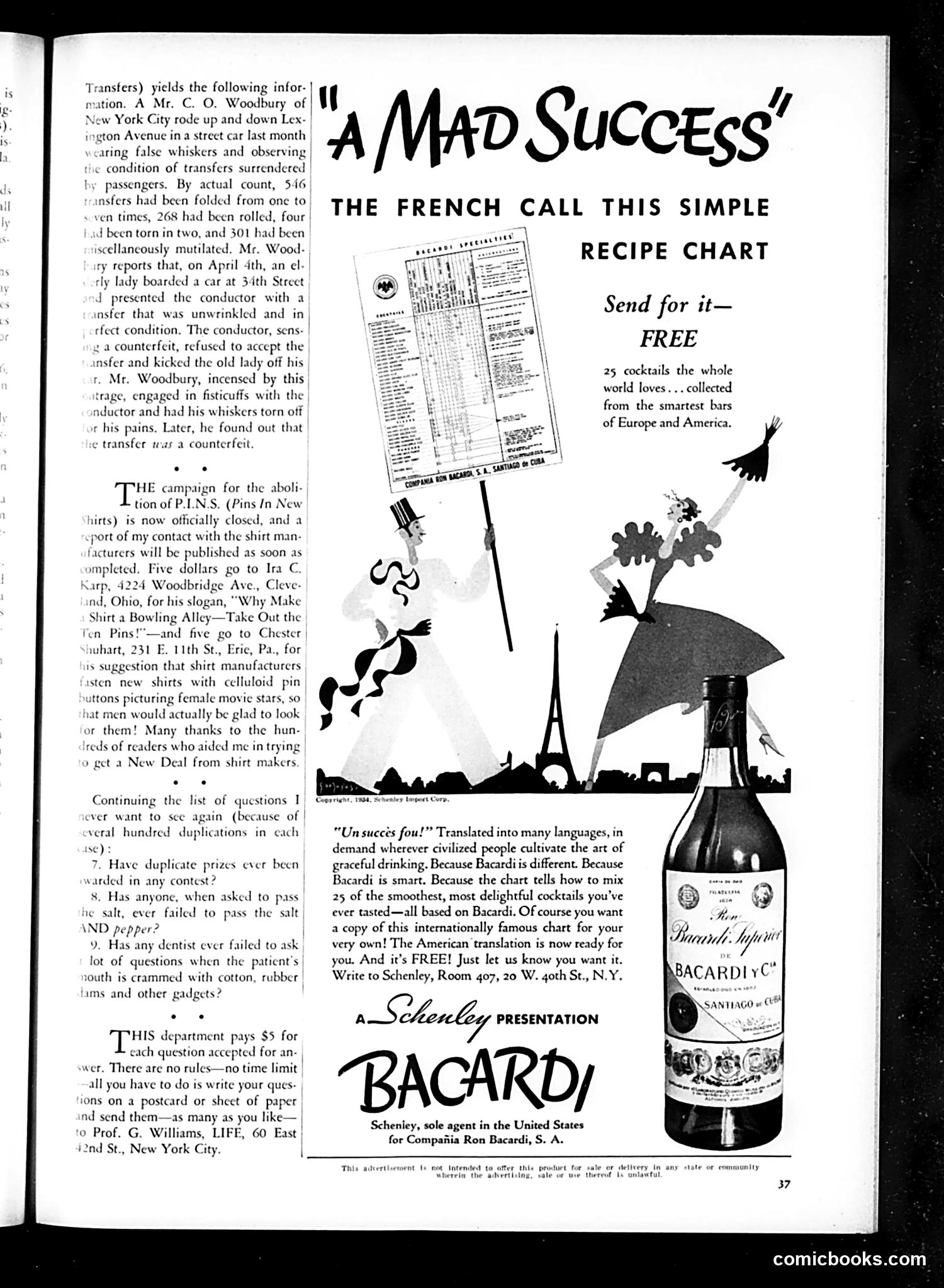
Life Magazine Page Analysis This page is primarily advertising, not political satire. The dominant content is a Bacardi rum advertisement promoting a free cocktail recipe chart, illustrated with a stylized Parisian scene (Eiffel Tower, wine bottle) to evoke French sophistication. The left column contains unrelated editorial content: humorous reader questions and contest winners, including absurdist items like a man wearing false whiskers on the subway to observe how passengers mistreat transfer tickets, and a campaign against pins left in new shirts. The advertisement's tagline "Un succès fou!" (a mad success) plays on the phrase "a mad success" to suggest the cocktails' popularity among "civilized people." The appeal to European cosmopolitanism and "smartest bars" reflects 1930s advertising's strategy of linking alcohol consumption to continental sophistication—particularly relevant during Prohibition's aftermath when cocktail culture was newly accessible to American consumers. There is no political cartoon or satire on this page.
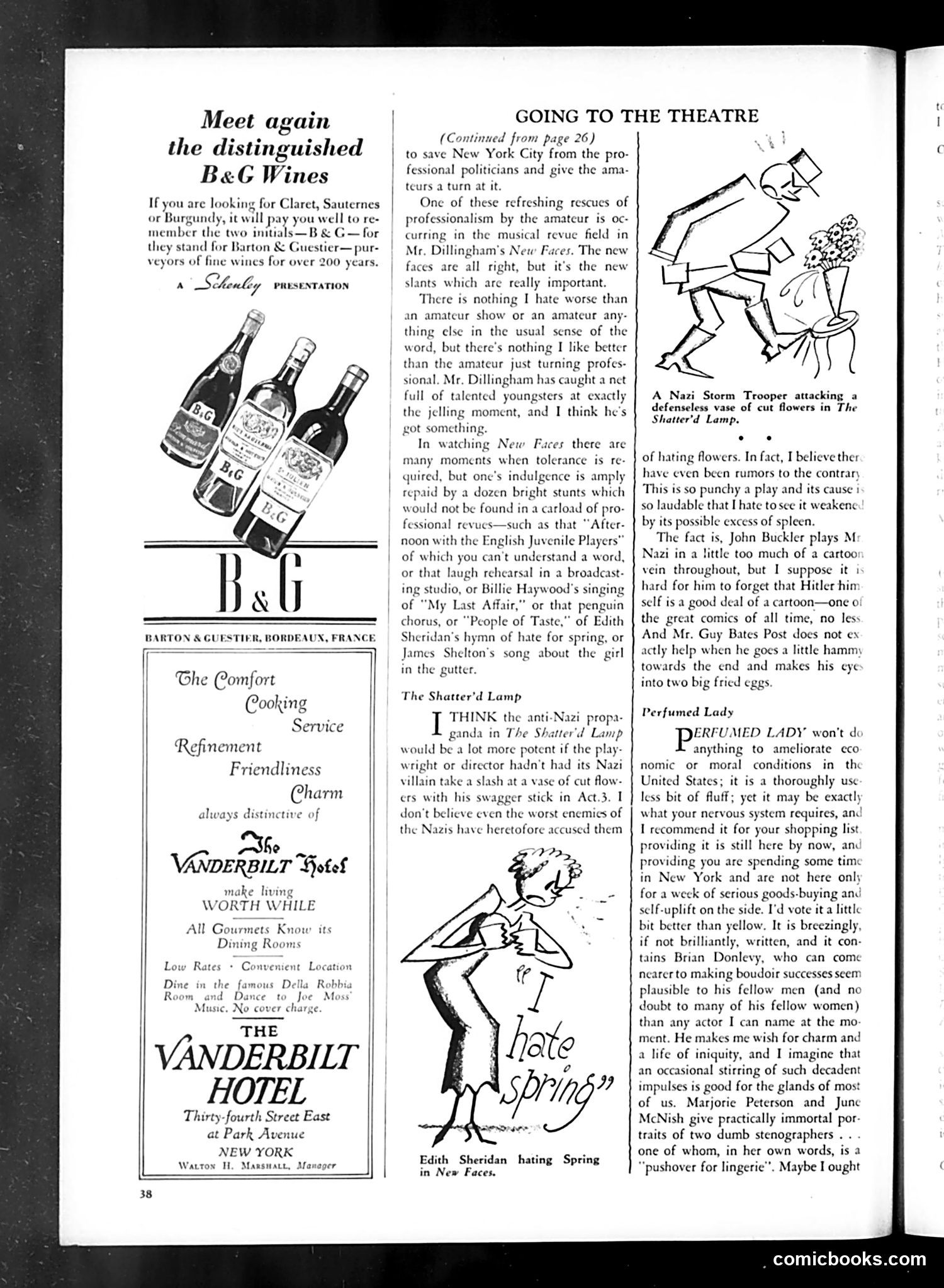
Page Analysis: Life Magazine Theater Reviews This page contains theater reviews and advertisements. The cartoons illustrate specific theatrical moments being critiqued: "The Shatter'd Lamp" cartoon shows a Nazi storm trooper slashing at a vase of cut flowers. The reviewer criticizes this scene as weakening the play's anti-Nazi message through excessive melodrama—the act of attacking flowers seems absurdly petty and undermines the serious political purpose. The reviewer notes the Nazi character (played by John Buckler) is portrayed too cartoonishly. "New Faces" cartoon depicts a figure attacking flowers, illustrating another theatrical bit from this musical revue, though this reference appears less critical. The reviews discuss amateur performers turning professional in Mr. Dillingham's revue "New Faces," and critiques other plays including "Perfumed Lady." The page is dominated by advertisements for B&C wines and the Vanderbilt Hotel, typical of Life's commercial content alongside editorial material.
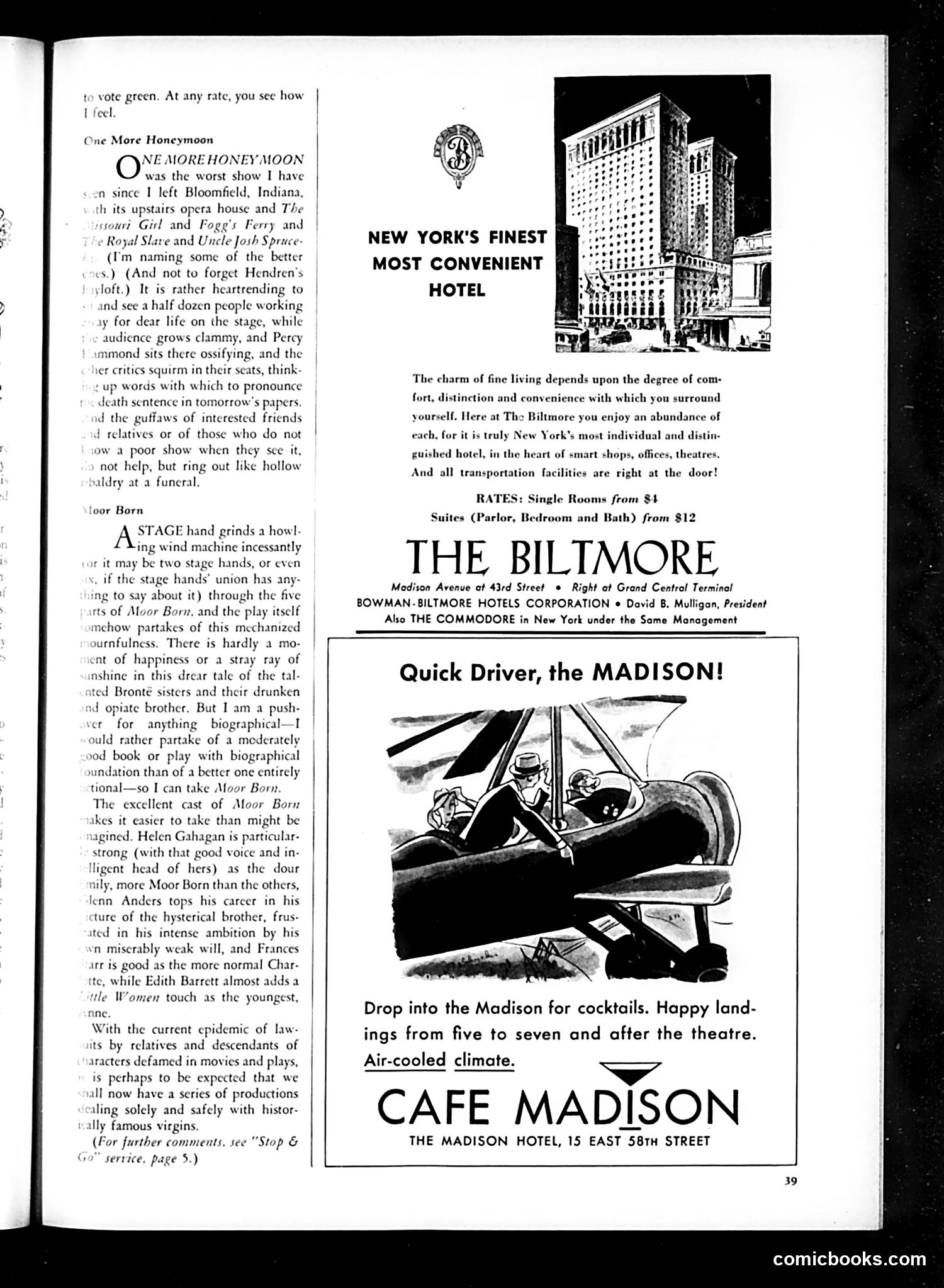
Page 39: Life Magazine Theater Reviews & Hotel Advertising This page combines theater criticism with period hotel/restaurant advertisements. The text reviews two Broadway productions: "One More Honeymoon" (dismissed as poor) and "Moor Born" (praised despite its bleakness, with particular credit to actress Helen Gahagan). The critic makes a satirical closing observation about litigation: given the "current epidemic" of lawsuits from descendants of people portrayed negatively in films and plays, producers may soon resort to staging only stories about "historically famous virgins"—a joking prediction that libel concerns would force safer, less interesting material. The advertisements (The Biltmore Hotel, Cafe Madison) are period pieces typical of 1930s-era Life magazine, targeting affluent theater-goers with upscale dining and lodging options near Grand Central Terminal. No political cartoons appear on this page.
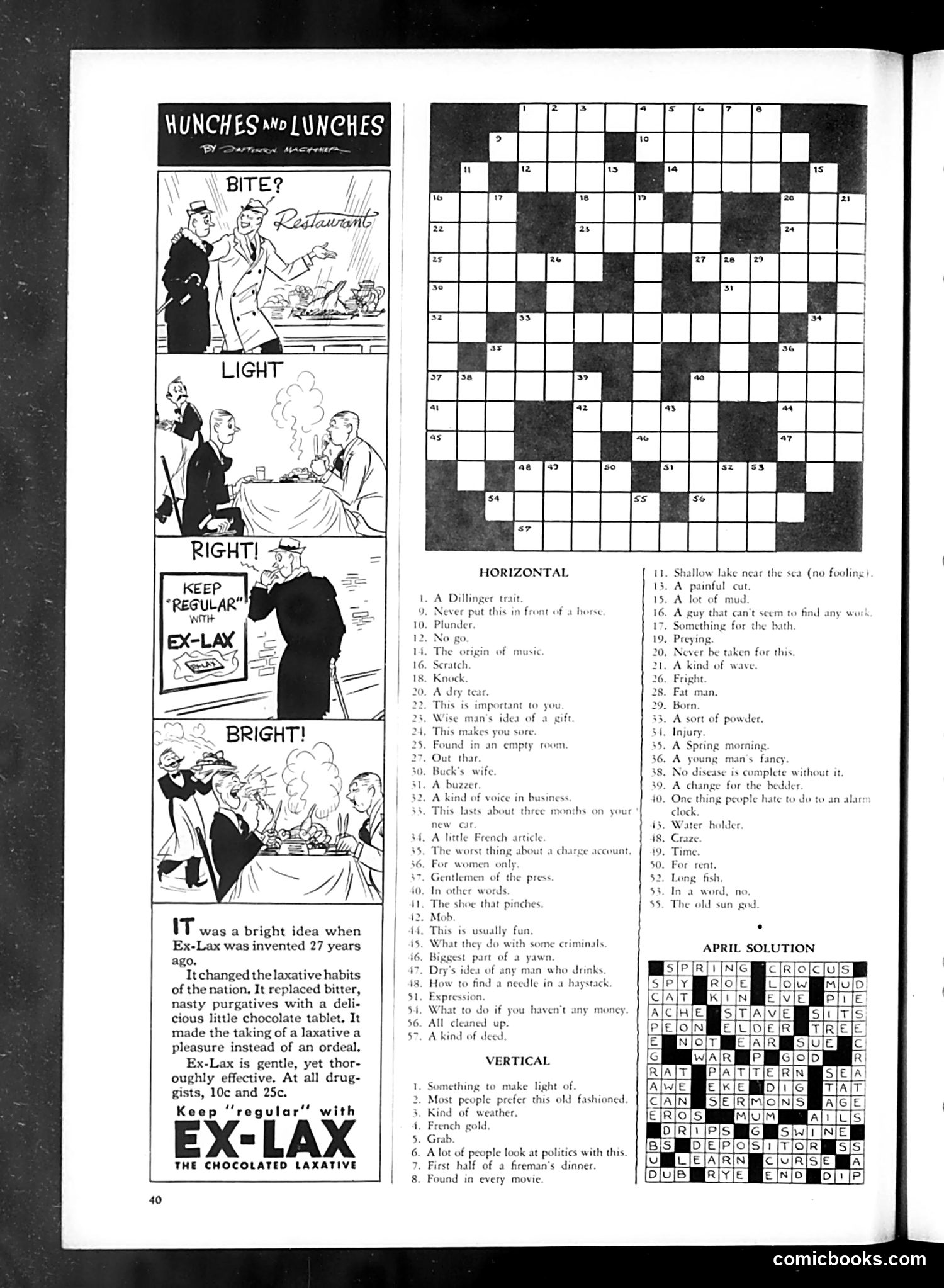
Analysis of "Hunches and Lunches" Page This page combines a vintage comic strip with a crossword puzzle and an Ex-Lax laxative advertisement. The comic strip (left side) shows two well-dressed men at a restaurant in four panels labeled "BITE?", "LIGHT", "RIGHT!", and "BRIGHT!" The humor appears to be visual wordplay about dining experiences—the men react to restaurant service and food with increasingly pleased expressions, culminating in satisfaction. The Ex-Lax advertisement below uses the "bright idea" theme from the comic to promote its chocolated laxative. The copy claims the product "changed the laxative habits of the nation" 27 years prior by replacing unpleasant purgatives with pleasant chocolate tablets. This reflects early-20th-century marketing that normalized discussing digestive health as a consumer product. The crossword puzzle (right) is a standard fill-in with themed clues, typical recreational content for Life magazine readers. The page represents mid-century American magazine advertising and entertainment conventions when product promotion was integrated directly into editorial content without clear separation.
Analysis of Life Magazine Page 41 This page mixes movie and book reviews with hotel advertisements. The "Stop & Go Service" section provides capsule critiques of films: *Spitfire* starring Katharine Hepburn receives cautious praise despite a thin plot, while *Wonder Bar* (featuring Al Jolson) is criticized for prioritizing elaborate musical production numbers and trick photography over substance—the reviewer admits "this grandeur gets me down." The books section offers brief dismissals and endorsements of contemporary literary works, including notably harsh judgment of Alexander Kerensky's memoir *The Crucifixion of Liberty*, where the reviewer sarcastically questions whether this historical Russian leader "really have been the ruler of Russia or of anything?"—a cutting reference to Kerensky's failed leadership during the Russian Revolution. The page is primarily advertising, promoting Park Lane hotel in New York and Hotel Dennis in Atlantic City, emphasizing luxury hospitality and leisure amenities typical of 1930s travel marketing.
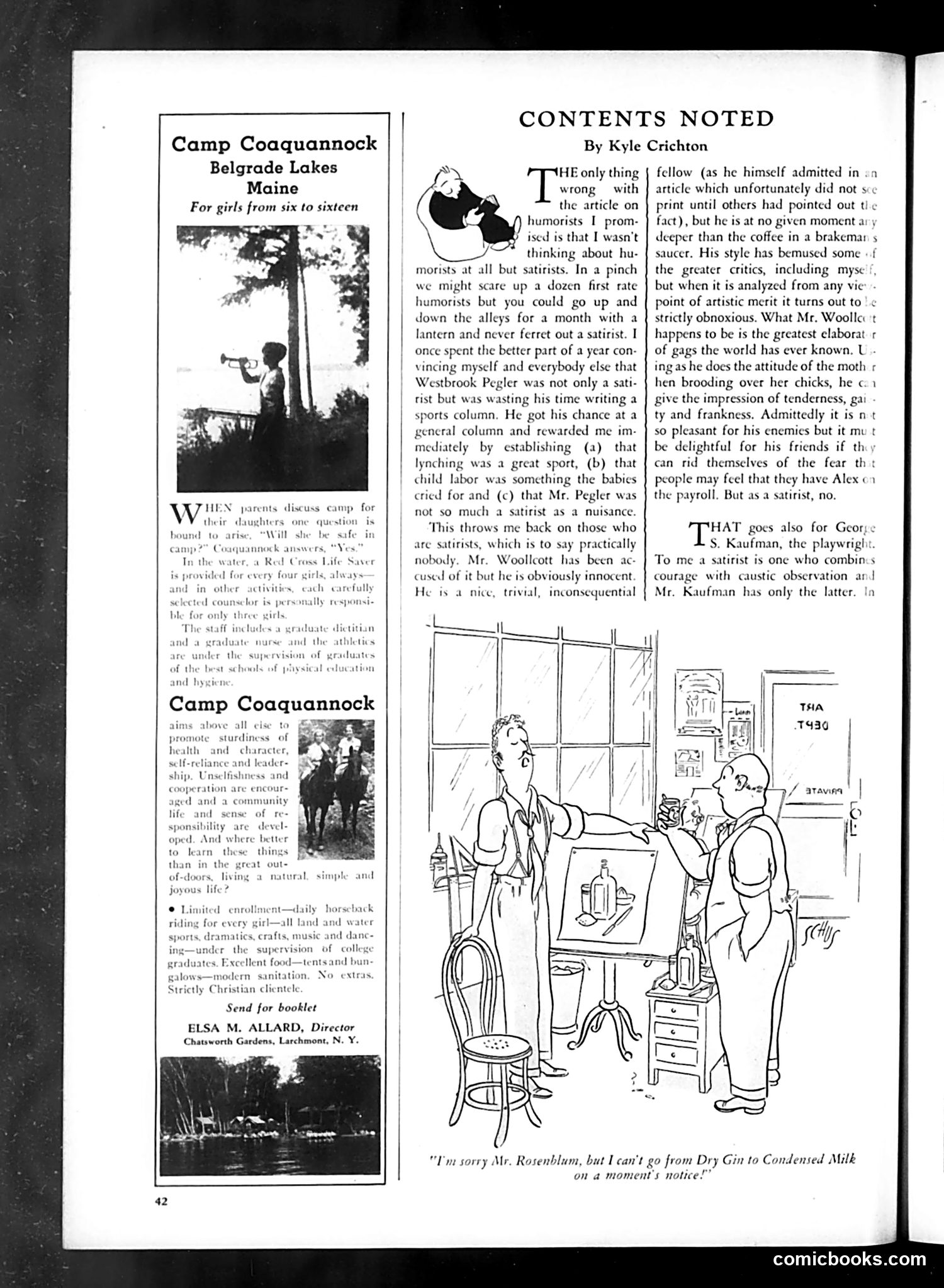
Life Magazine Page Analysis This page is primarily advertising and editorial content, not political satire. The main article discusses playwright George S. Kaufman and other humorists, arguing that Kaufman is not truly a satirist because he only attacks targets already weakened or socially acceptable—never the genuinely powerful. The author criticizes him for making audiences comfortable rather than challenging them, contrasting this with genuine satire's purpose: "attacking the mighty while they are still powerful." The ads showcase 1930s-40s urban living (Beaux-Arts Apartments, hotels) and consumer products (Old Town Canoes, Cinzano Vermouth). The page reflects Depression/pre-WWII era concerns about art, politics, and entertainment rather than delivering cartoon-based satire itself.
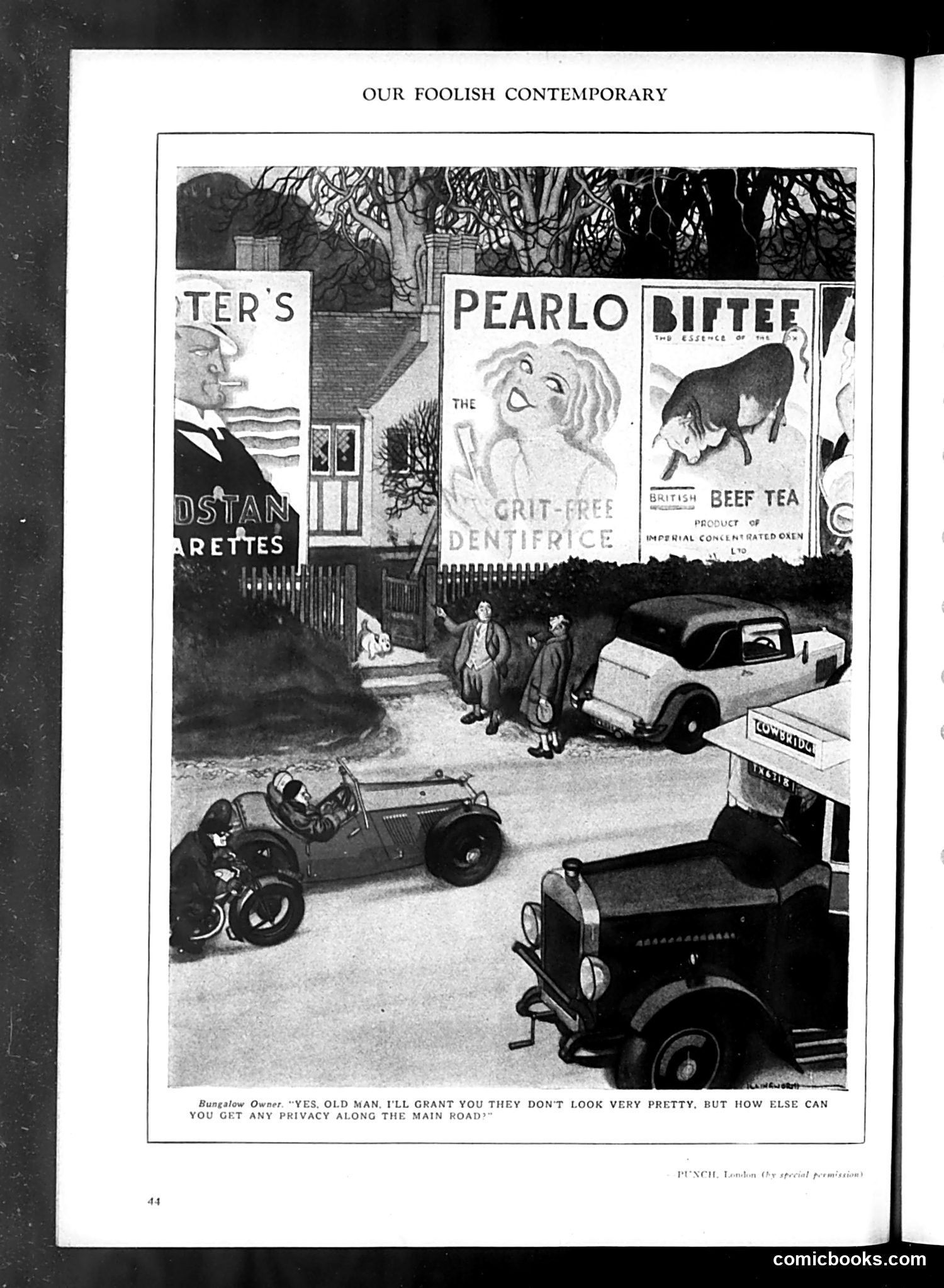
"Our Foolish Contemporary" This cartoon satirizes roadside advertising clutter. A bungalow owner defends his decision to display large commercial billboards (for cigarettes, toothpaste, and beef tea) on his property, claiming they provide privacy from the main road—an absurd rationalization. The joke targets suburban residents who tolerate or encourage eyesore advertisements in exchange for modest screening, and more broadly critiques the encroachment of commercial signage into residential areas. The parked cars and pedestrians represent the public whose view is obscured. The phrase "foolish contemporary" suggests Life magazine is mocking modern society's acceptance of commercialization's visual pollution as a necessary trade-off for privacy—a commentary on early 20th-century consumerism and poor urban planning.
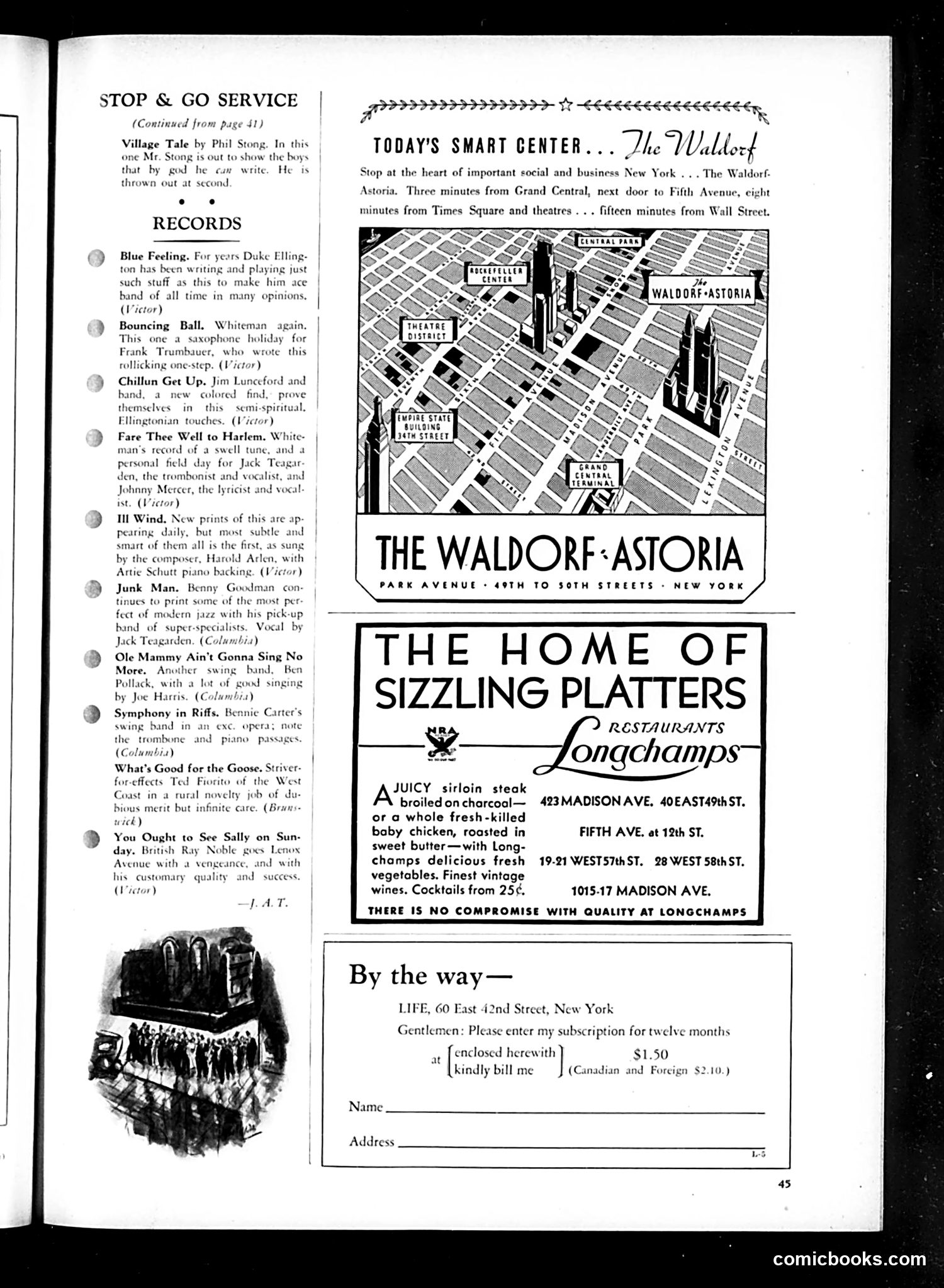
Page Analysis: Life Magazine (undated, likely 1930s) This page is primarily advertising and subscription material, not satirical content. The main features are: 1. "Stop & Go Service" column (top left): Brief record reviews by what appears to be a music critic, covering jazz and swing artists of the era (Duke Ellington, Benny Goodman, etc.). These are straightforward critical assessments with no apparent satire. 2. Waldorf-Astoria Hotel advertisement: A map-based advertisement positioning the luxury hotel as centrally located in Manhattan. 3. Longchamps Restaurant advertisement: Promoting their "sizzling platters" menu, with multiple NYC locations listed. 4. Subscription offer (bottom): A simple mail-in subscription form for Life magazine ($1.50/year). There is no political cartoon or satirical content visible on this page. It functions as a service/advertisement page typical of mid-20th century magazines, mixing editorial content with paid advertisements.
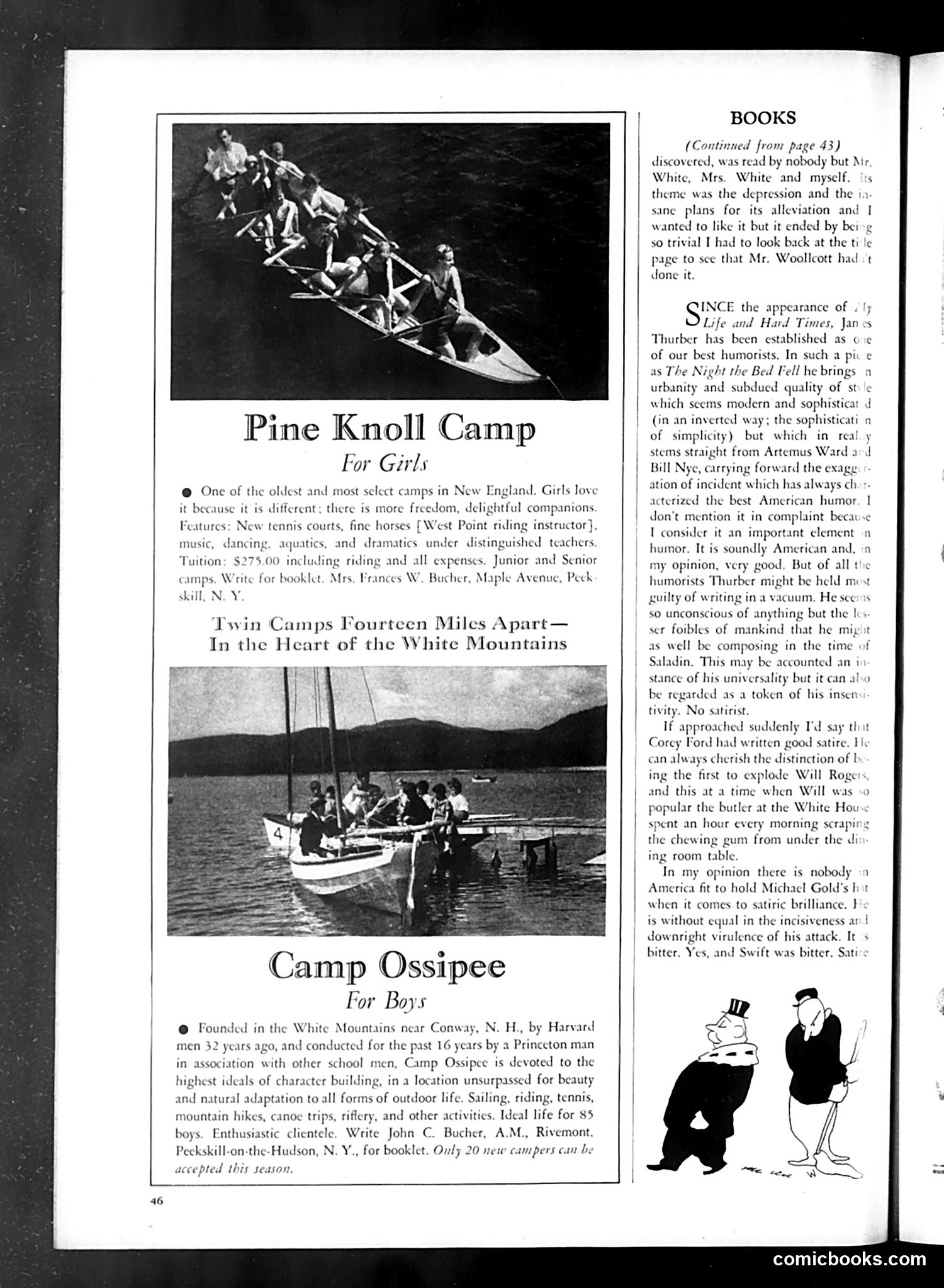
Page Analysis: Camp Advertisements and Book Reviews This page primarily contains advertisements for two elite summer camps in the White Mountains of New Hampshire—Pine Knoll Camp for girls and Camp Ossipee for boys. Both emphasize their prestigious origins (Harvard/Princeton founders), character-building ideals, and athletic activities (riding, sailing, tennis). The $275 tuition reflected luxury positioning for wealthy families. The right column contains a book review (continued from page 43) discussing American humorists, particularly James Thurber. The reviewer praises Thurber's urbanity and humor while critiquing his detachment from broader social concerns—he writes "in a vacuum," oblivious to anything beyond human foibles. The reviewer also briefly mentions Corey Ford and Michael Gold, comparing their satirical approaches, with Gold praised for "satiric brilliance" and "virulence of his attack." The small cartoon at page bottom appears unrelated to the main content—a generic humorous illustration.
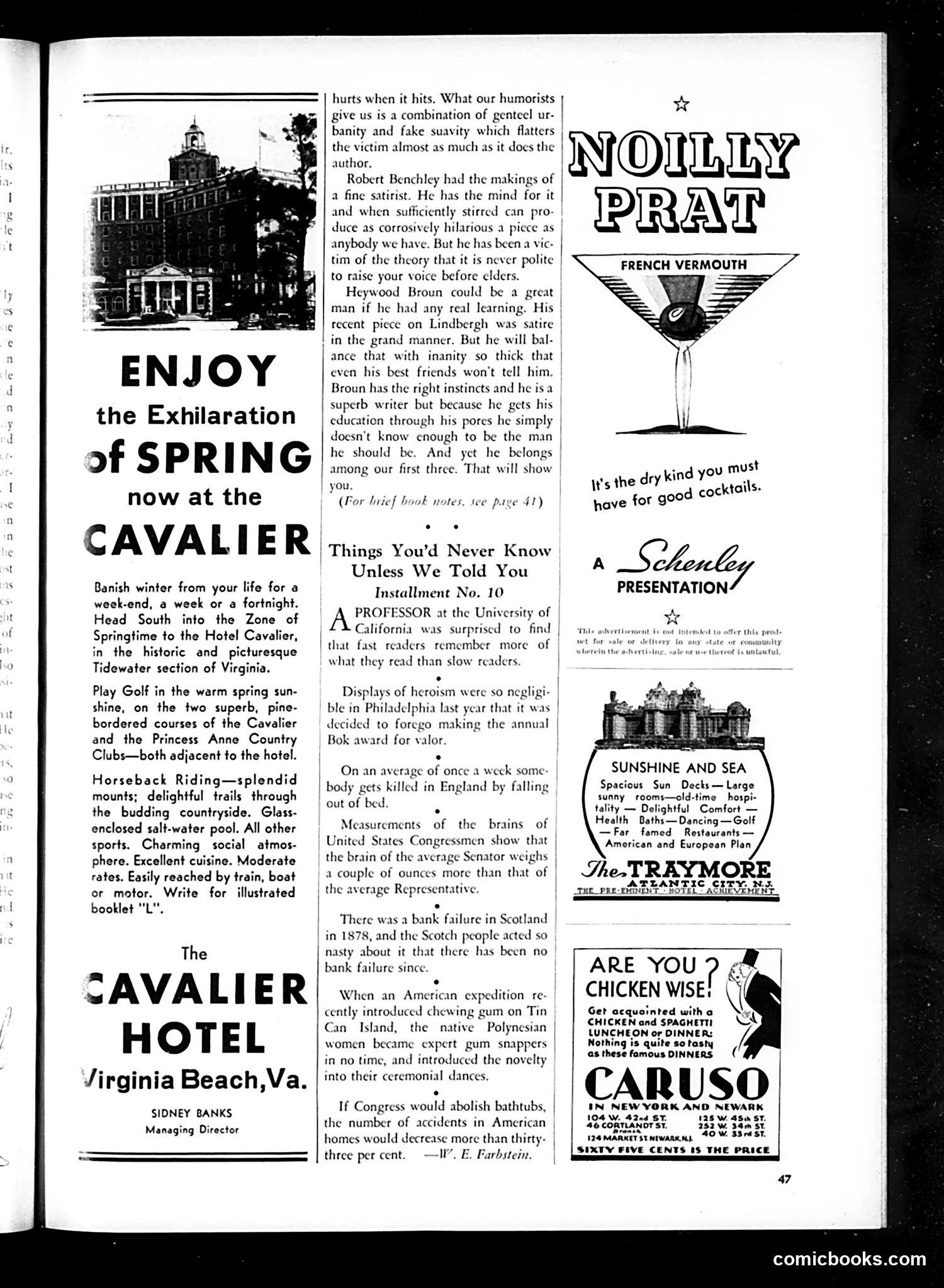
Analysis of Life Magazine Page 47 This page is primarily advertising and light editorial content, not political satire. The main content includes: Editorial Section: A critique of humorists Robert Benchley and Heywood Broun. The writer praises their talent but faults them for restraint—Benchley for being too polite to elders, Broun for lacking education despite his instincts. This reflects 1920s literary circles debating the proper role and boldness of American humor. "Things You'd Never Know" Trivia: Humorous factoids (Senators' brains weigh more than Representatives'; Scotland had no bank failures since 1878 due to public anger; etc.). These are mild jokes mocking bureaucracy and human nature. Advertisements: The Cavalier Hotel (Virginia Beach resort), Noilly Prat vermouth, The Traymore hotel, and Caruso restaurants occupy the remaining space. The page contains no political cartoons or caricatures—it's a typical Life magazine blend of light social commentary, celebrity gossip, and paid advertising from the 1920s era.
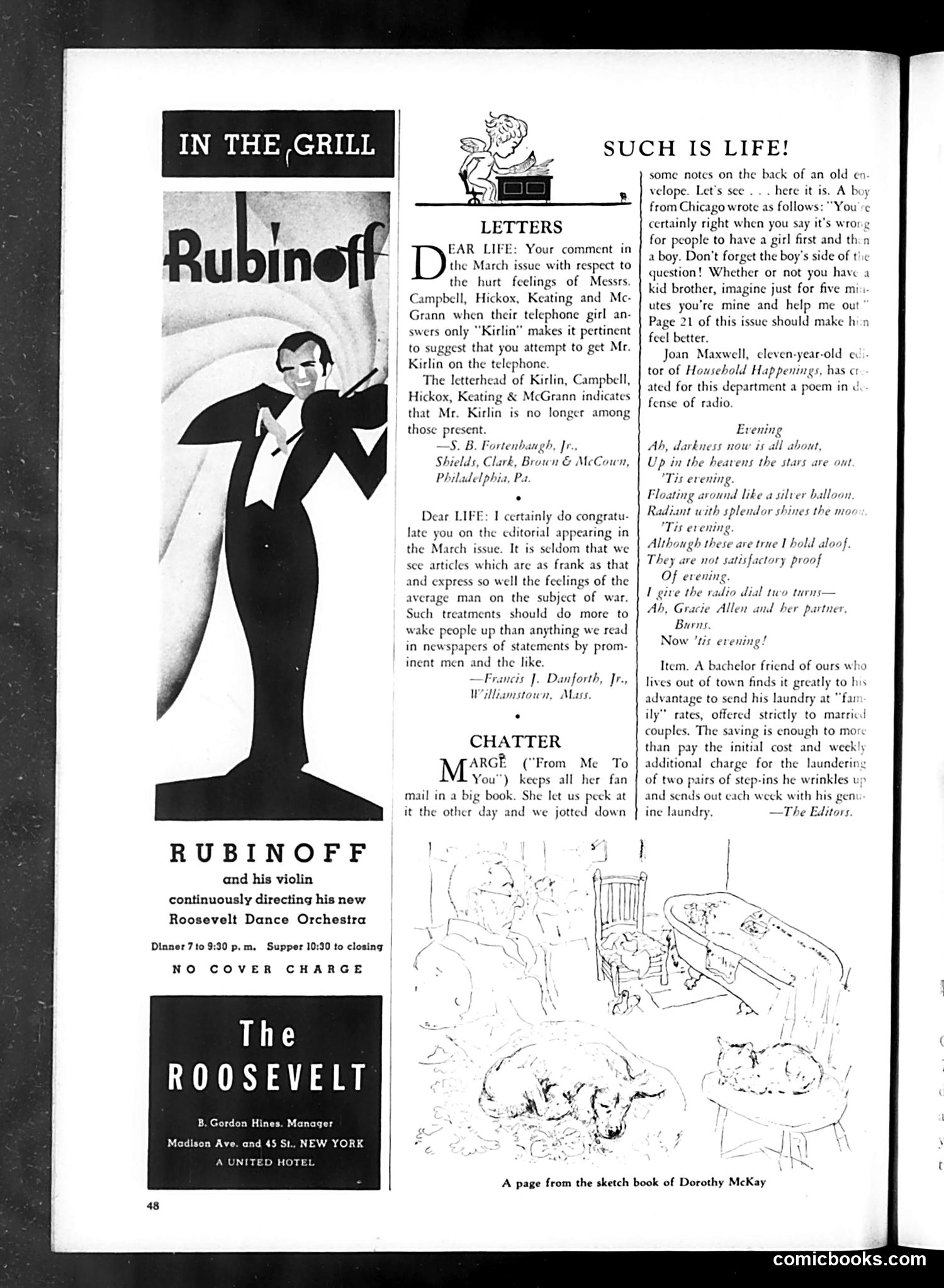
Analysis of Life Magazine Page This page is primarily advertising and reader correspondence, not political satire. The left side advertises Rubinoff, a violin soloist performing at the Roosevelt Hotel's grill room with his "Roosevelt Dance Orchestra" — likely named to capitalize on FDR's popularity during the New Deal era. The "no cover charge" suggests competitive marketing. The right side contains reader letters and a "Chatter" gossip column. The letters discuss workplace etiquette (a receptionist answering only with her name), editorial praise for frank war commentary, and defense of radio entertainment. The only visual humor is a sketch by Dorothy McKay showing domestic scenes — apparently illustrating the gossipy item about a bachelor exploiting "family rates" laundry service by sending wrinkled items weekly. The joke: he's gaming the system by sending minimal loads under discounted married-couple pricing. This reflects 1930s-40s consumer culture and modest domestic humor rather than political commentary.
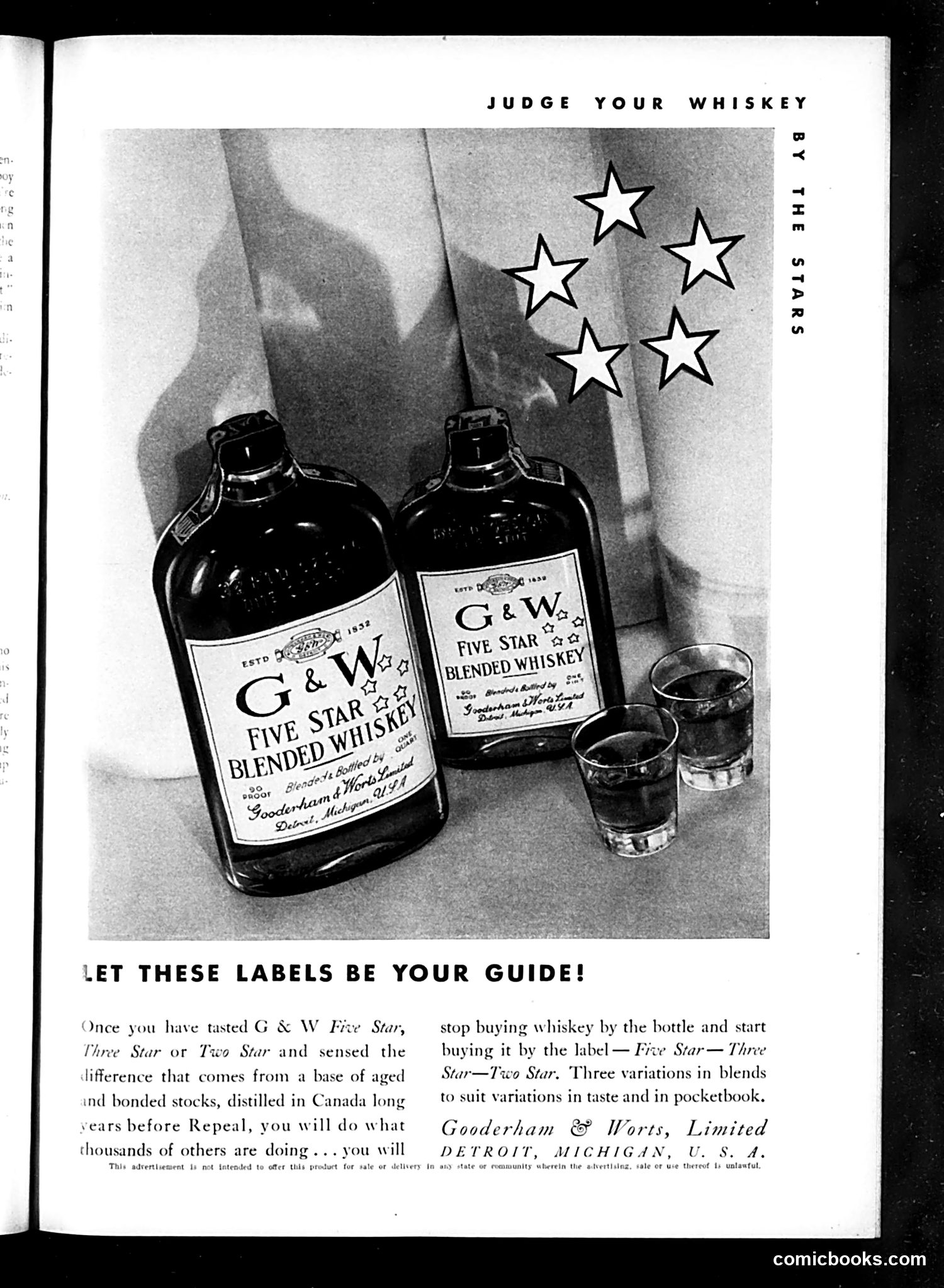
Analysis This is a whiskey advertisement, not political satire or a cartoon. It promotes G&W Five Star Blended Whiskey from Gooderham & Worts (Detroit, Michigan). The page capitalizes on post-Prohibition context: the ad explicitly references "long years before Repeal," meaning Prohibition's recent end (1933). It appeals to consumers now legally able to purchase whiskey again after years of illegal production/distribution. The five stars are a quality rating system. The ad's pitch is straightforward: consumers should identify whiskey quality by label ratings rather than bottle appearance alone, and choose among three blends (Five Star, Three Star, Two Star) based on taste preference and budget. The disclaimer at bottom notes the ad cannot offer the product for sale in certain jurisdictions—likely states or counties maintaining local alcohol restrictions despite national Repeal. This is commercial advertising with no political message or satirical intent.
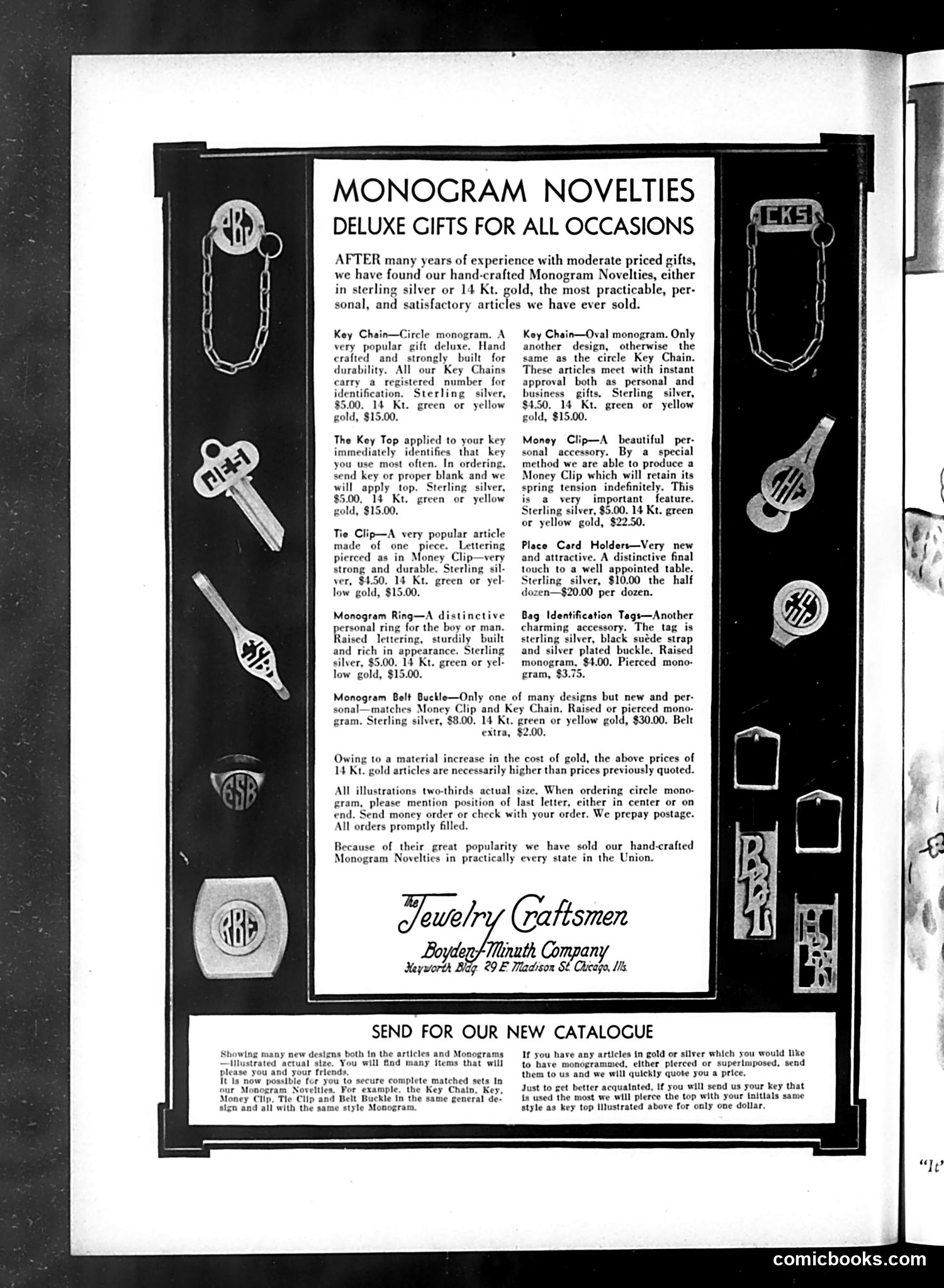
Analysis This is not a cartoon or satirical content — it's a full-page advertisement for monogrammed luxury gifts from the Boyden/Minuth Company of Chicago. The page promotes hand-crafted sterling silver and 14-karat gold novelty items including key chains, tie clips, money clips, rings, belt buckles, and place card holders. All items feature personalized monograms. There is no political or social satire here. This appears in *Life* magazine simply as a commercial advertisement targeting affluent readers seeking personalized gift items. The "deluxe gifts for all occasions" pitch suggests these were marketed to upper-class consumers. The note about gold price increases reflects post-WWI economic conditions, but this is business information, not satire. The page is straightforward product advertising with illustrations and pricing information.