life
Life — June 1934
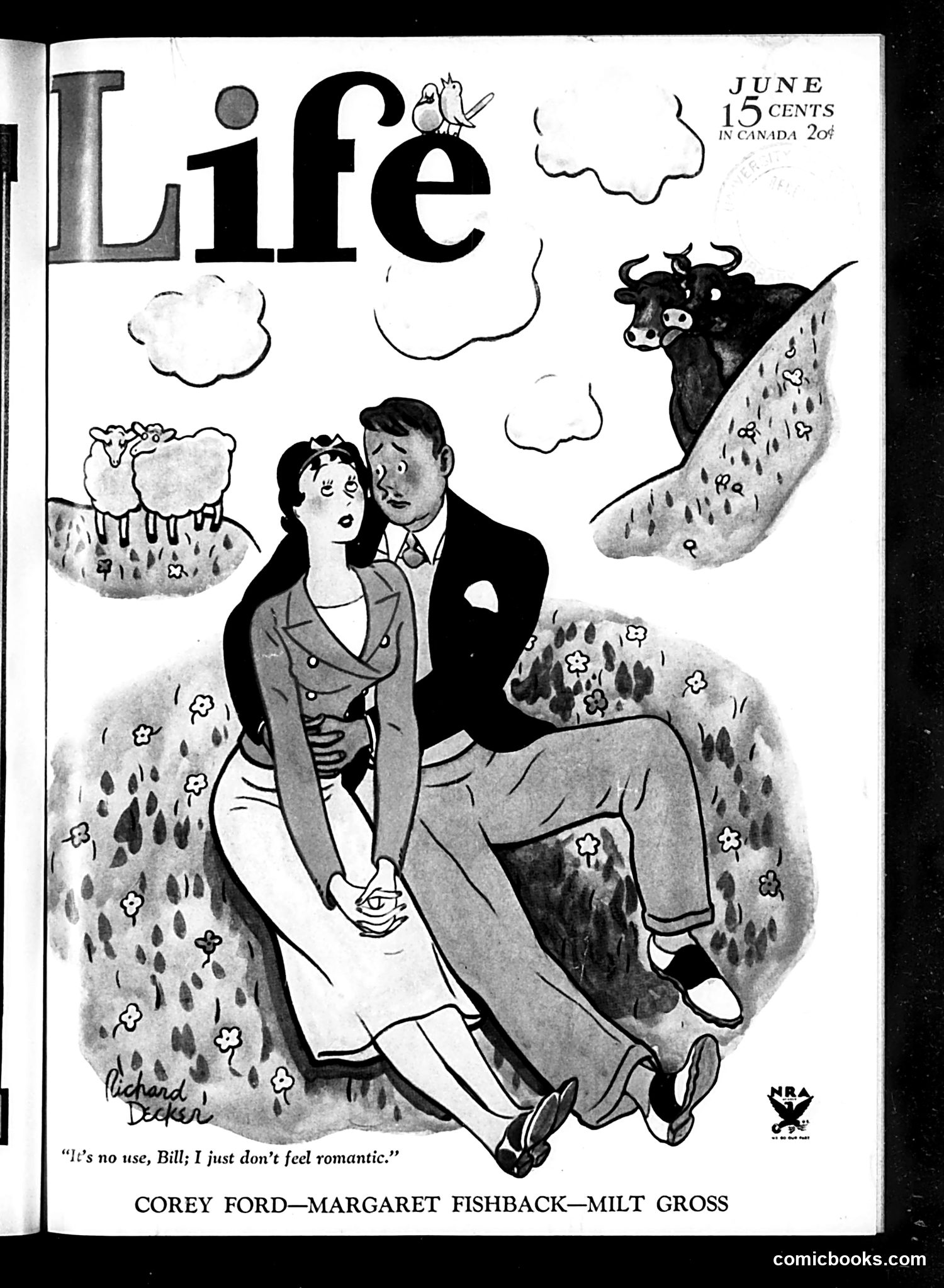
Life Magazine June 1925 Cover Analysis This is a romantic comedy illustration by Richard Decker featuring actors Corey Ford, Margaret Fishback, and Milt Gross. The scene depicts a couple in a pastoral setting surrounded by sheep, flowers, and a bull—clearly referencing rural or rustic romance. The caption reads: "It's no use, Bill; I just don't feel romantic." The humor lies in the ironic contrast: the man has orchestrated an idyllic countryside setting meant to inspire romance, yet his companion remains unmoved. The pastoral backdrop with farm animals was traditionally associated with romantic sentimentality, making her rejection of the mood particularly comedic. This satirizes the gap between male romantic expectations and female desire—a common theme in 1920s-era humor about modern relationships.
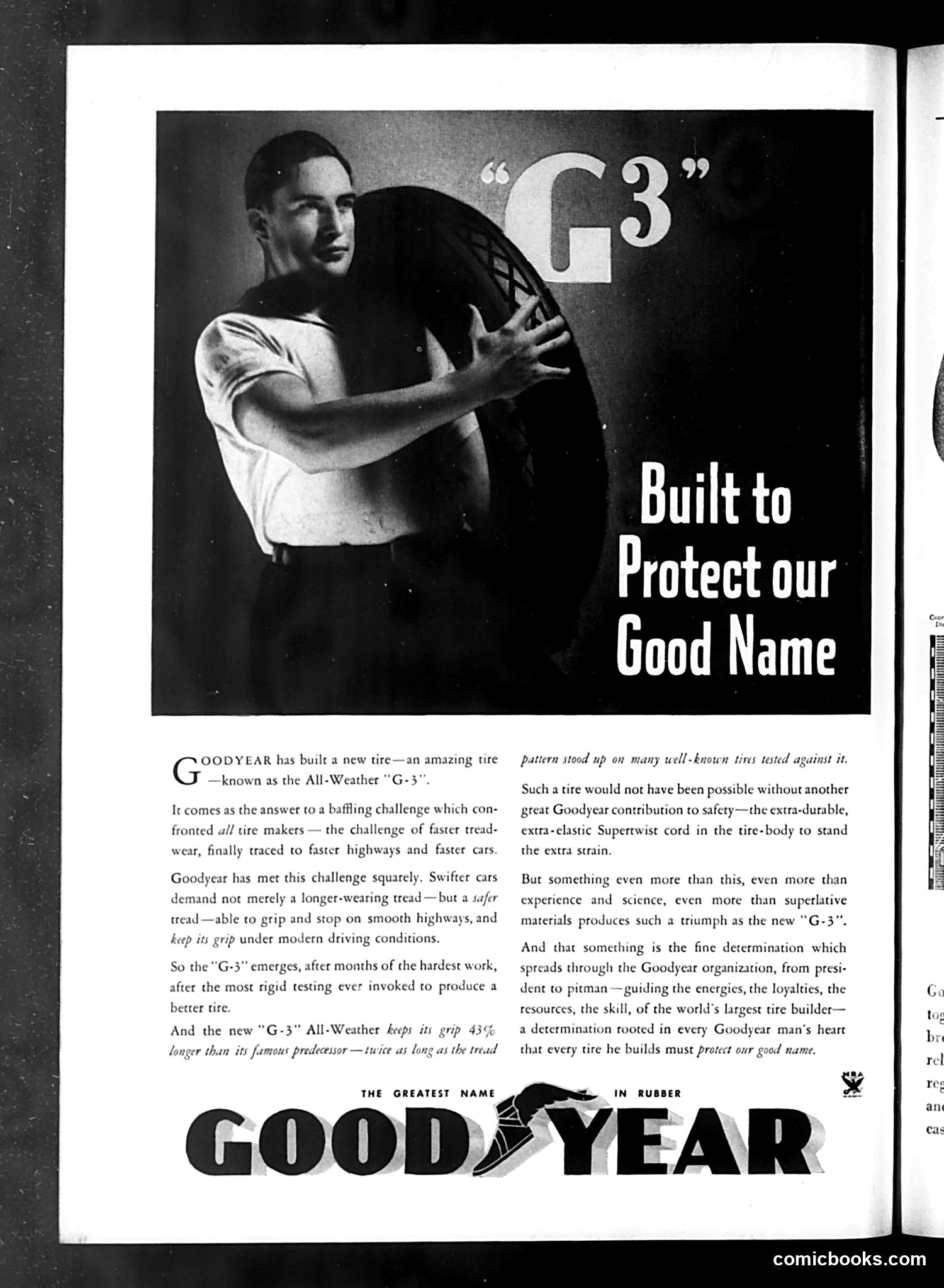
Analysis This is a Goodyear tire advertisement, not political satire or editorial content. The page promotes the "G-3" All-Weather tire, using a photograph of a man holding a large tire to illustrate the product. The headline "Built to Protect our Good Name" is a corporate branding message—Goodyear claims rigorous testing and quality ensure their reputation. The advertisement emphasizes the tire's safety features, durability, and superior grip compared to predecessors, positioning it as essential for modern driving conditions. The tagline at bottom, "The Greatest Name in Rubber," reinforces brand identity. This is straightforward product marketing typical of mid-20th-century magazine advertising, with no political or social satire present.
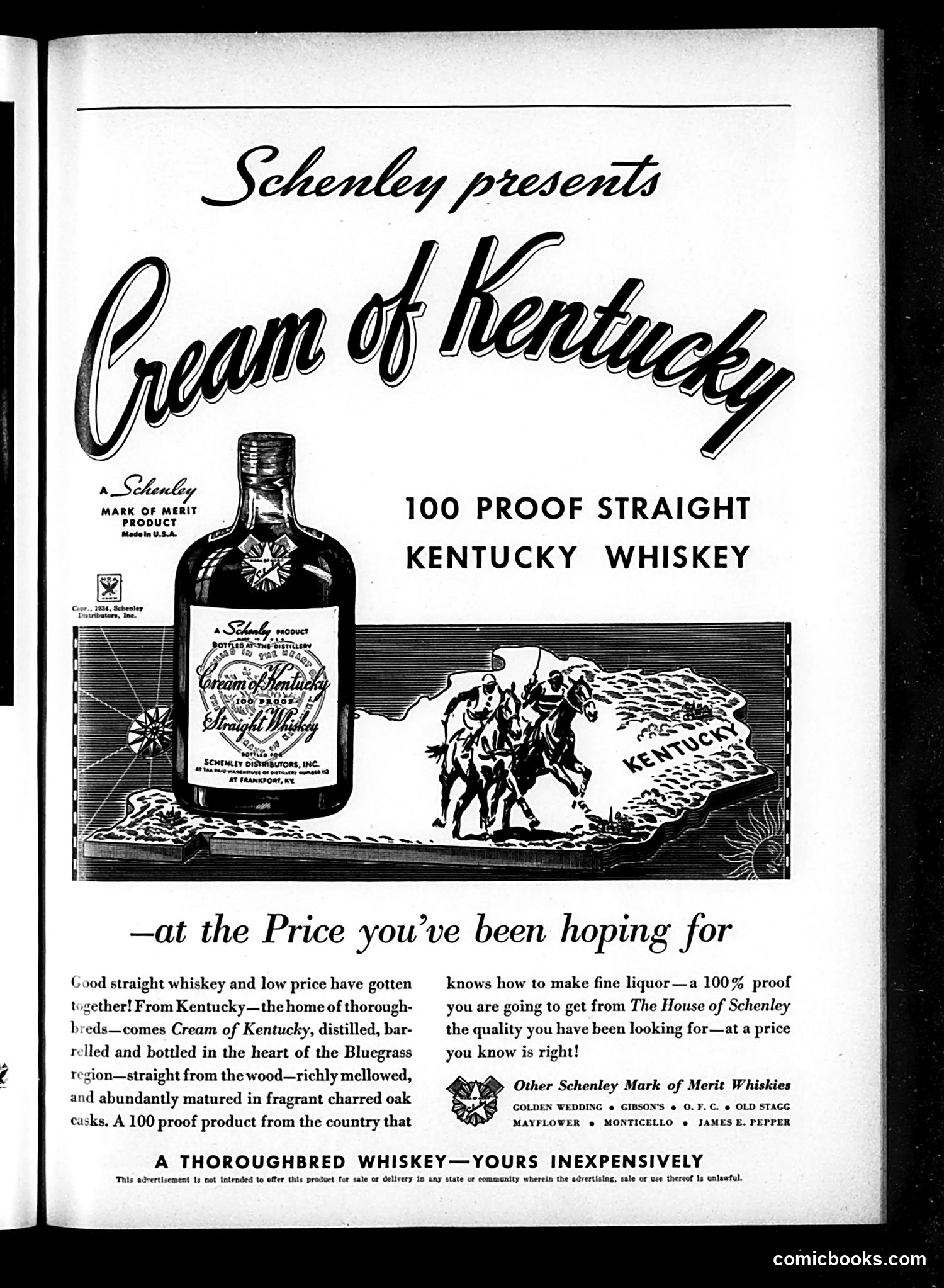
Analysis This is a whiskey advertisement, not satirical content. It promotes Schenley's "Cream of Kentucky" brand—a 100-proof straight Kentucky whiskey. The ad uses romantic Americana imagery: horsemen on a Kentucky landscape, referencing the state's thoroughbred racing heritage. The copy emphasizes quality ("the country that knows how to make fine liquor") paired with affordability ("the price you've been hoping for"), a selling point likely significant during the Depression era when this ran. The "Mark of Merit" seal establishes brand credibility. Other Schenley whiskey varieties are listed at bottom. This is straightforward commercial advertising with period-appropriate imagery, not political or social satire.
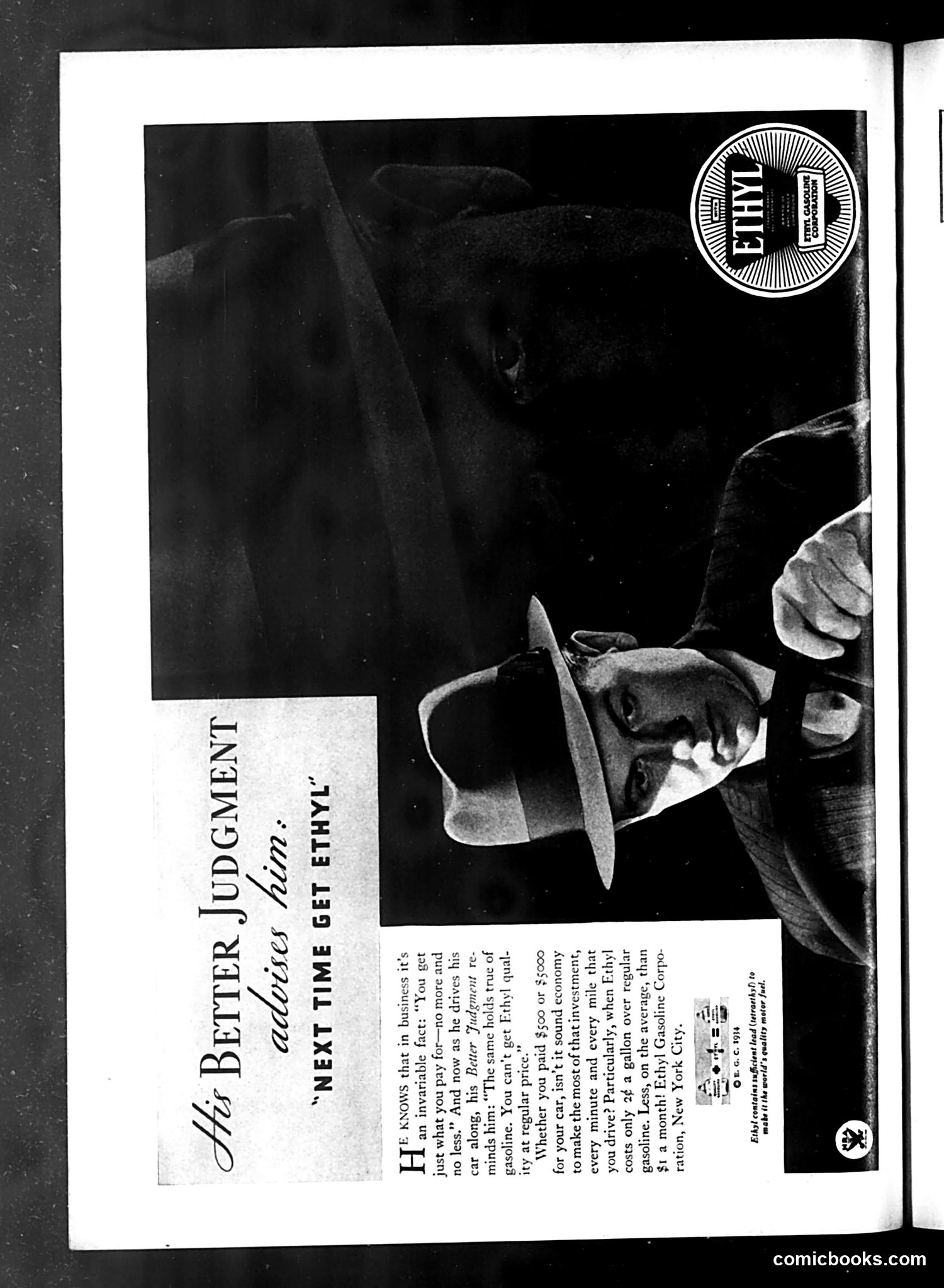
Analysis This page is primarily advertising, not political satire. It features a product ad headlined "His Better Judgment" with the tagline "MEET THY!" (likely "MEET THYSELF" or similar, partially obscured). The advertisement shows a man in a hat examining his reflection, emphasizing a message about business decision-making. The accompanying text discusses knowing oneself in business contexts—appearing to promote self-awareness or honest self-assessment as valuable for success. The circular logo in the upper right and the corporate-style text suggest this is commercial advertising rather than editorial content or political commentary. Without clearer text or identifying marks, the specific product or company being promoted remains unclear.
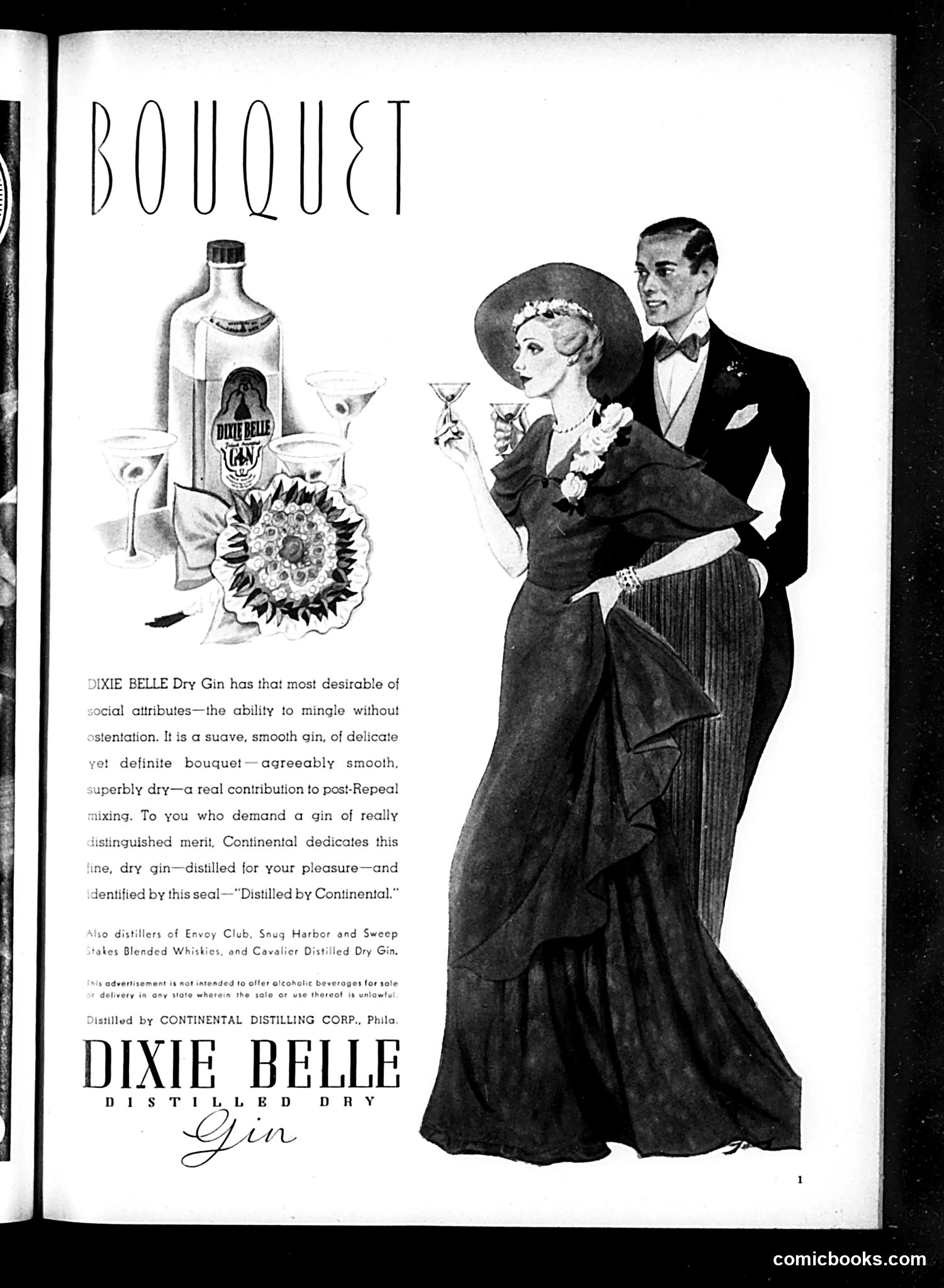
Analysis This is a Prohibition-era advertisement, not a political cartoon. It promotes Dixie Belle Dry Gin, marketed as a sophisticated social beverage for the wealthy. The image depicts an elegantly dressed couple at what appears to be a formal event—the woman in an evening gown with flowers, the man in black tie. The ad emphasizes gin's "social attributes" and its ability to "mingle without ostentation," suggesting discreet, refined drinking among the upper classes. The reference to "post-Repeal mixing" indicates this was published after Prohibition's end (1933), when alcohol sales became legal again. The ad targets affluent consumers seeking "distinguished merit" and Continental sophistication, positioning gin as a marker of class and good taste during the Jazz Age's return to legality.
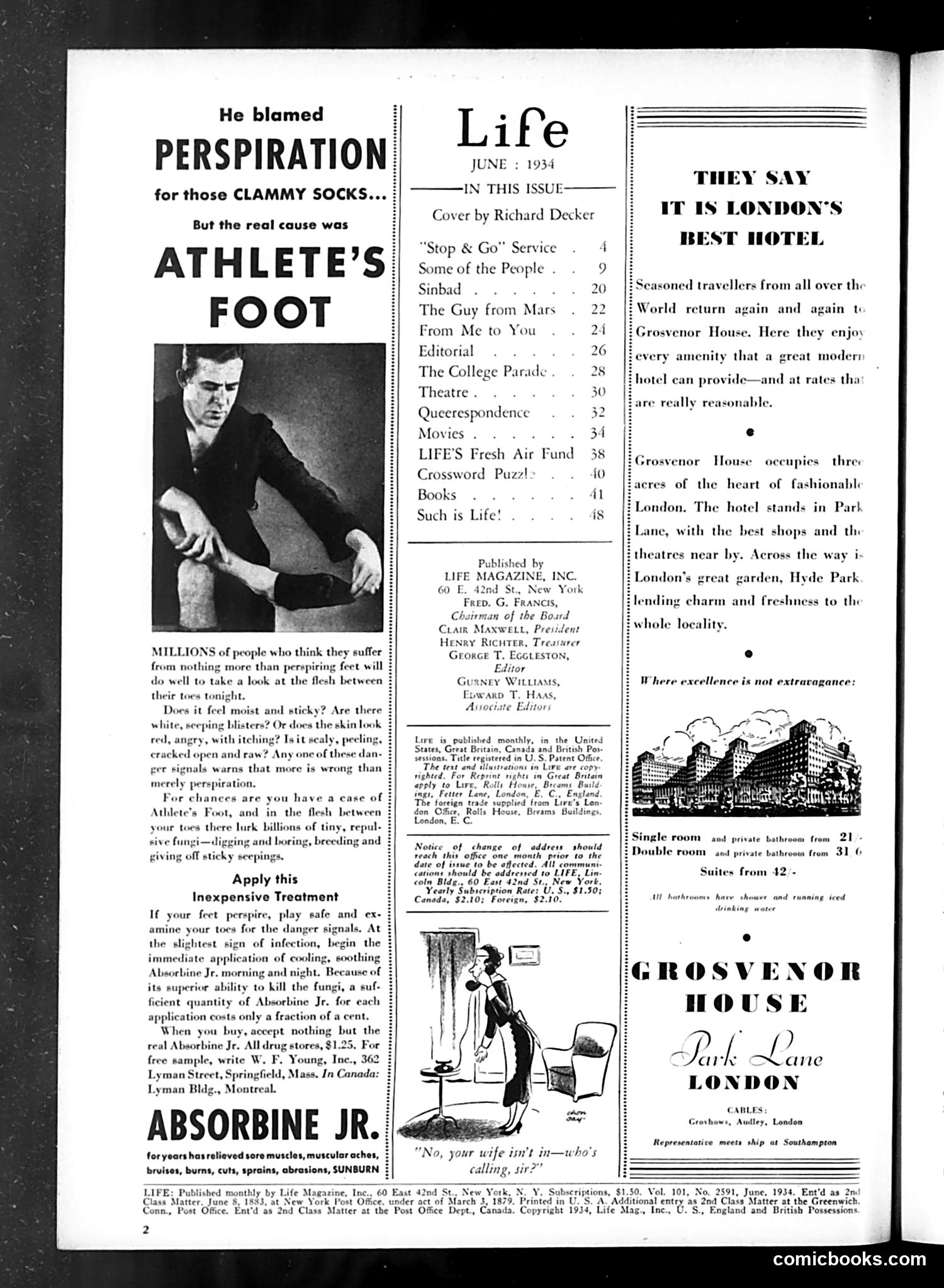
Life Magazine, June 1934 — Content Analysis This page is primarily advertisements and magazine content, not political satire. The left side advertises "Absorbine Jr.," a medicinal liniment, using a humorous premise: a man blames his clammy socks for foot problems, but the "real cause" is athlete's foot. The ad employs self-deprecating comedy to sell the product as an "inexpensive treatment." The center shows the magazine's table of contents for the June 1934 issue. The right side advertises the Grosvenor House hotel in London, emphasizing its fashionable Park Lane location, reasonable rates, and modern amenities. This is straightforward commercial promotion. No political cartoons or satire appear on this page. It reflects 1934 consumer culture: medicinal products, travel advertising, and middle-class leisure aspirations.
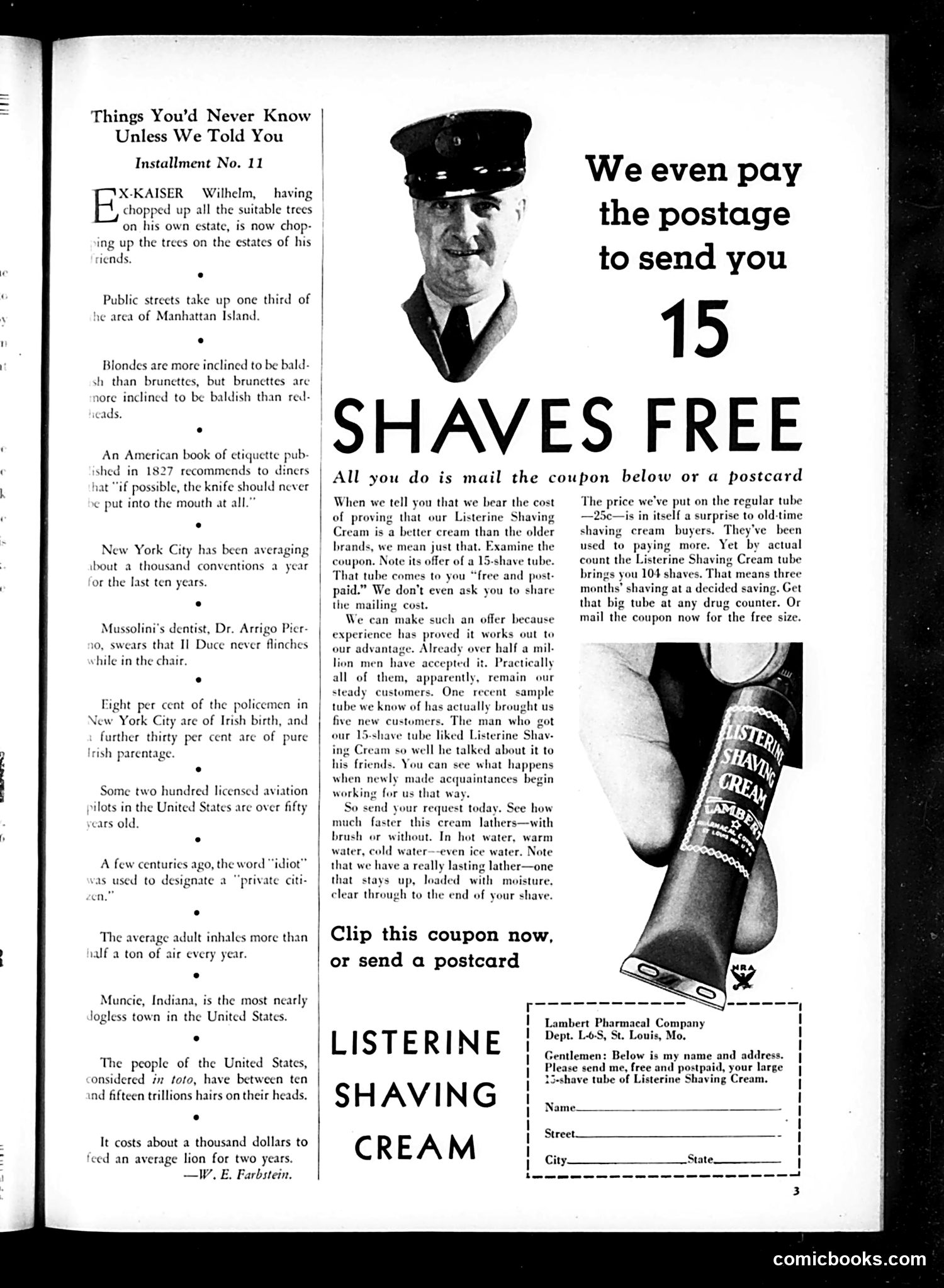
Analysis This page is primarily a Listerine Shaving Cream advertisement, not political satire. The left column contains "Things You'd Never Know Unless We Told You"—miscellaneous trivia facts (about Kaiser Wilhelm, Manhattan streets, hair color statistics, etc.)—a common magazine filler feature. The right side is a full-page ad offering 15 free shaves of Listerine Shaving Cream. The promotion claims the company will pay postage. It features a photograph of a man's face and an image of the product bottle applied to skin. The ad's appeal rests on the product's purported superiority: it lathers in various water temperatures and produces a lasting, moisturizing lather. The call-to-action invites readers to mail a coupon requesting the free sample. This is commercial advertising, not editorial content or political commentary.
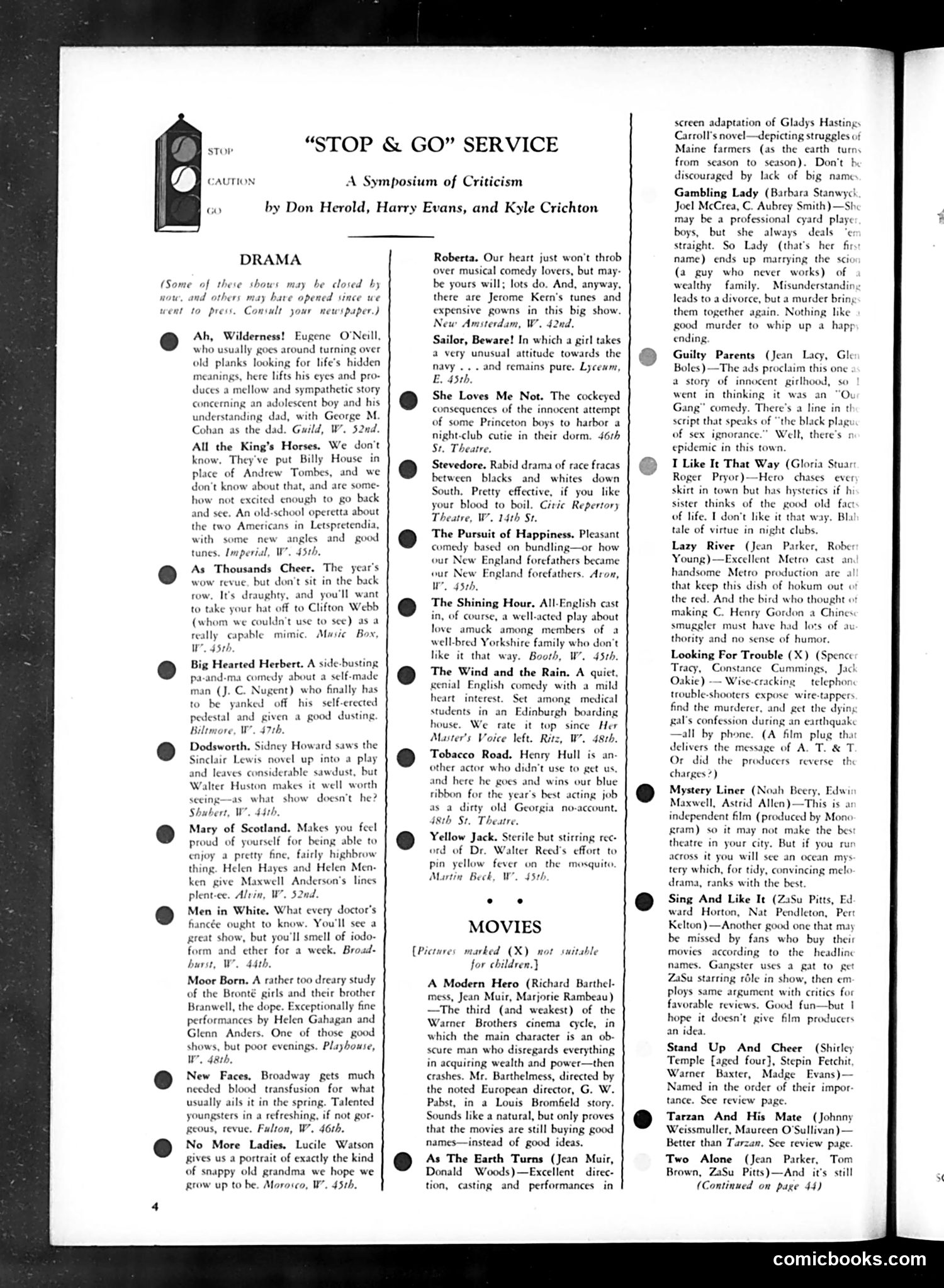
This page from *Life* magazine contains theater and film reviews rather than political cartoons. The header features a traffic light illustration labeled "STOP CAUTION GO," serving as the page's visual motif. The content is a "Symposium of Criticism" by three reviewers (Don Herold, Harry Evans, and Kyle Crichton) evaluating Broadway plays and movies. They assess productions like "Roberta," "Sailor, Beware!," and "She Loves Me Not" with brief, satirical commentary. The reviews use humor to critique theatrical quality and acting performances. For example, they mock overly sentimental plots and praise clever comedies. The "STOP & GO" framework suggests viewers should avoid some productions while seeking out others—a consumer guide for entertainment in Depression-era America.
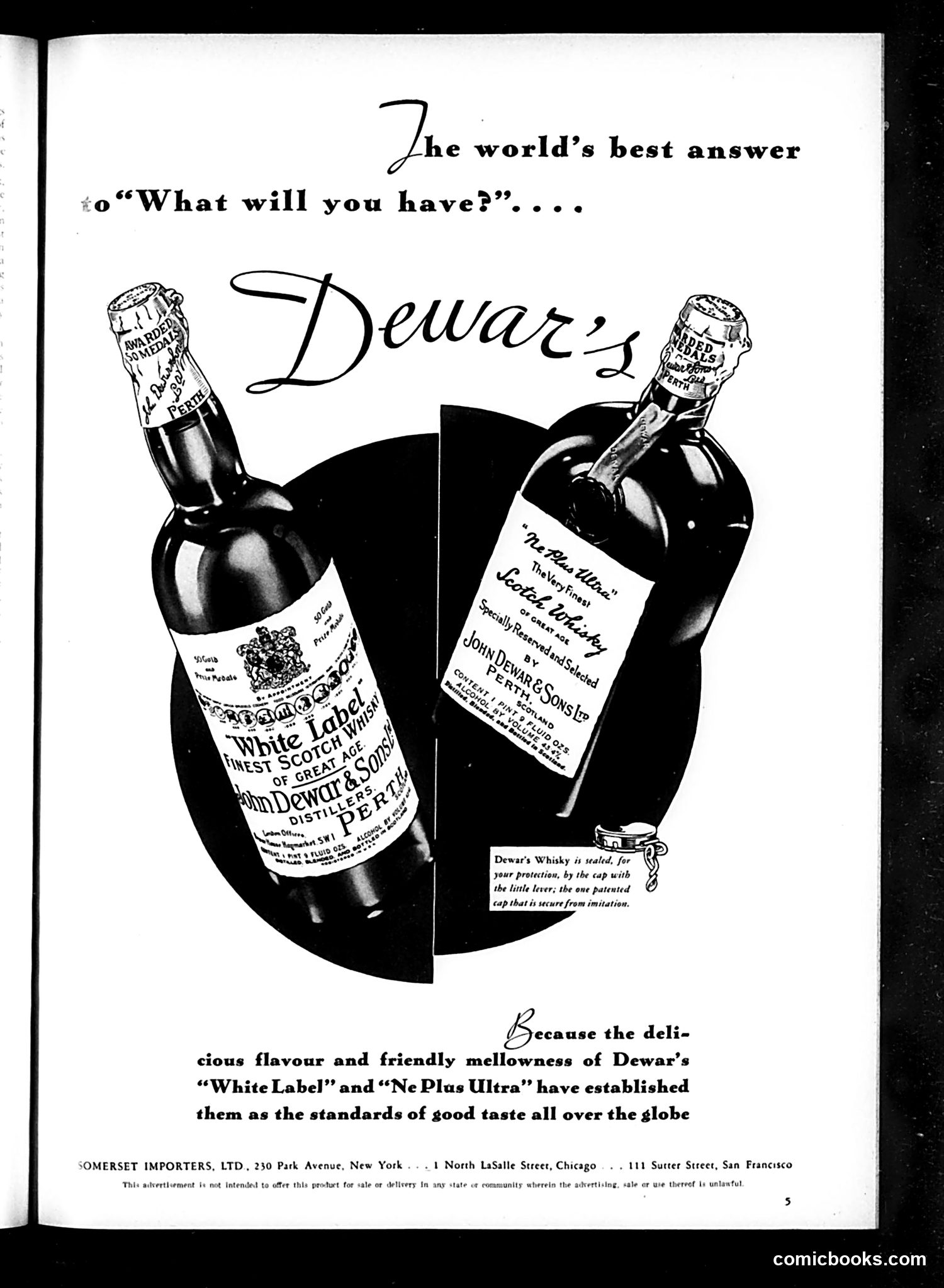
Analysis This is a Dewar's Scotch whisky advertisement, not satire or political commentary. The page shows two bottles of Dewar's whisky positioned in a black circular design. The headline "The world's best answer to 'What will you have?'" frames the product as the ideal response when offered a drink. The advertisement emphasizes two variants: "White Label" and "Ne Plus Ultra," claiming their "delicious flavour and friendly mellowness" have "established them as the standards of good taste all over the globe." A small note mentions the bottle's patented cap "sealed for your protection...to secure from imitation." This is straightforward product advertising typical of mid-20th-century magazines, not editorial content with satirical intent.
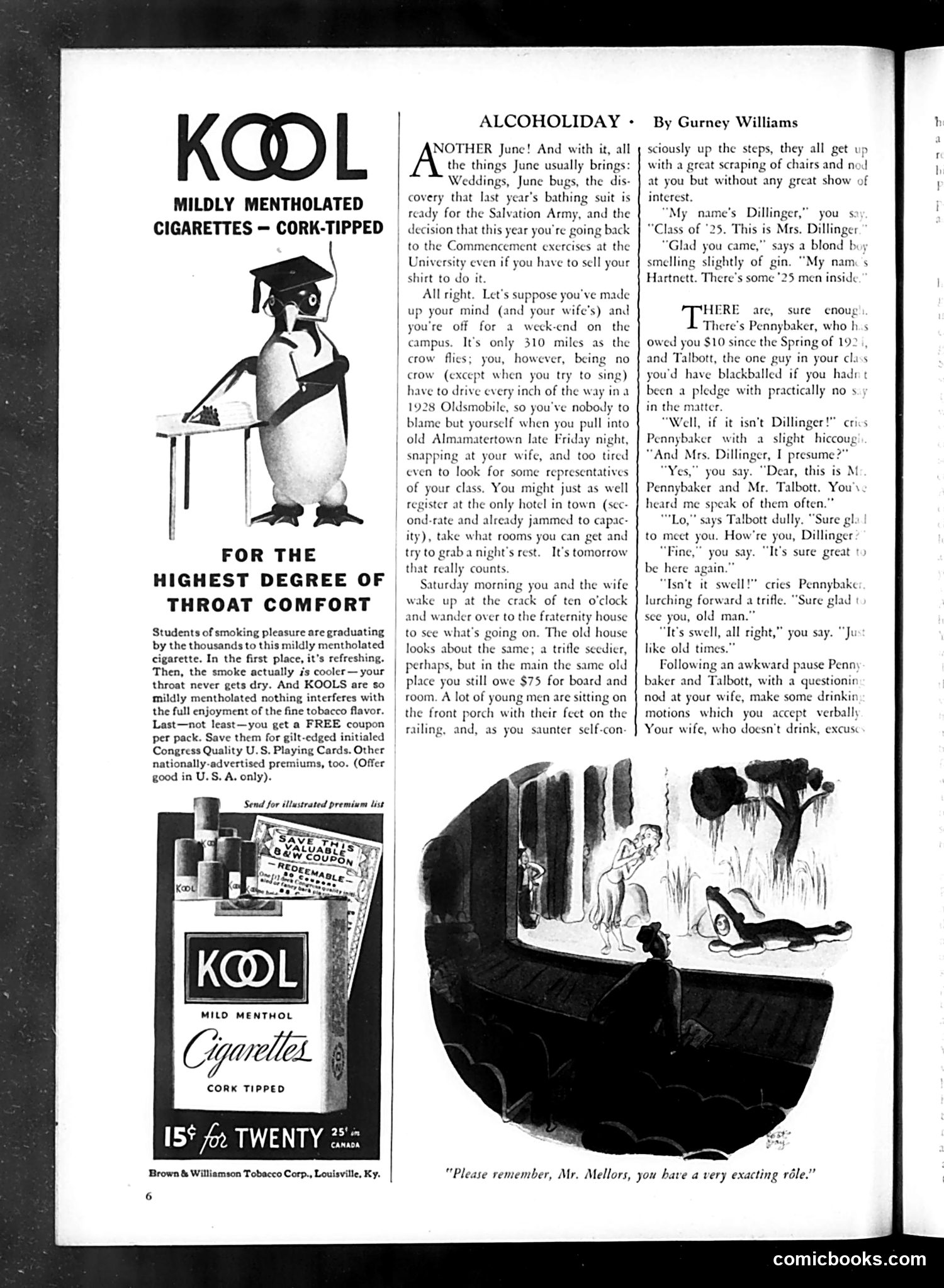
"Alcoholiday" by Gurney Williams This page combines a Kool cigarette advertisement with a satirical story about a college reunion weekend. The story mocks the pretensions and financial anxieties of alumni returning to campus for commencement. The narrative follows a narrator confronting old classmates—particularly "Mrs. Dillinger" and Mr. Talbott—revealing uncomfortable truths: the narrator still owes $10 from 1923, and one character apparently has a questionable reputation ("practically no say in the matter"). The humor derives from the awkward social dynamics of reunion encounters, where nostalgic bonhomie masks unresolved tensions and debts. The cartoon illustration shows figures in what appears to be a theater or auditorium setting, supporting the campus reunion scenario. The advertisement occupies the left third, marketing menthol cigarettes as throat comfort.
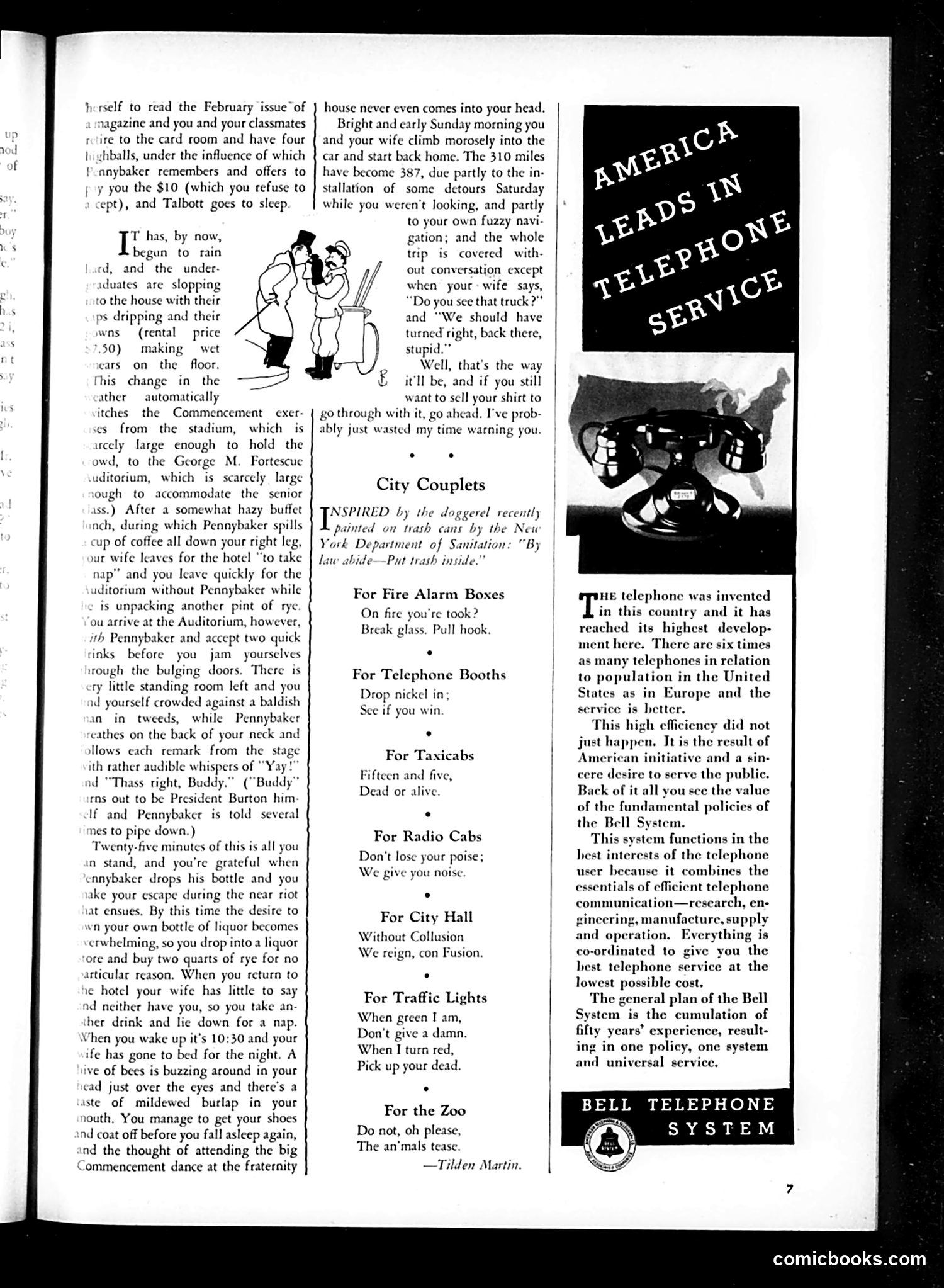
Page Analysis: Life Magazine Satire This page combines humorous social commentary with advertising. The left column contains satirical vignettes about attending a college commencement, mocking the predictable tedium: arriving late, sitting through speeches, dealing with crowds, and waking hungover the next morning. The humor targets the ritualistic, overcrowded nature of these events. The center section, titled "City Couplets," offers rhyming instructions for urban life—fire alarms, telephone booths, taxicabs, radio cabs, city hall, traffic lights, and the zoo. These are playful, irreverent guides poking fun at city living and bureaucratic absurdity. The right side is a Bell Telephone System advertisement claiming America leads in telephone service quality, emphasizing efficiency and universal service. This contrasts sharply with the page's satirical tone, presenting corporate boosterism alongside social mockery.
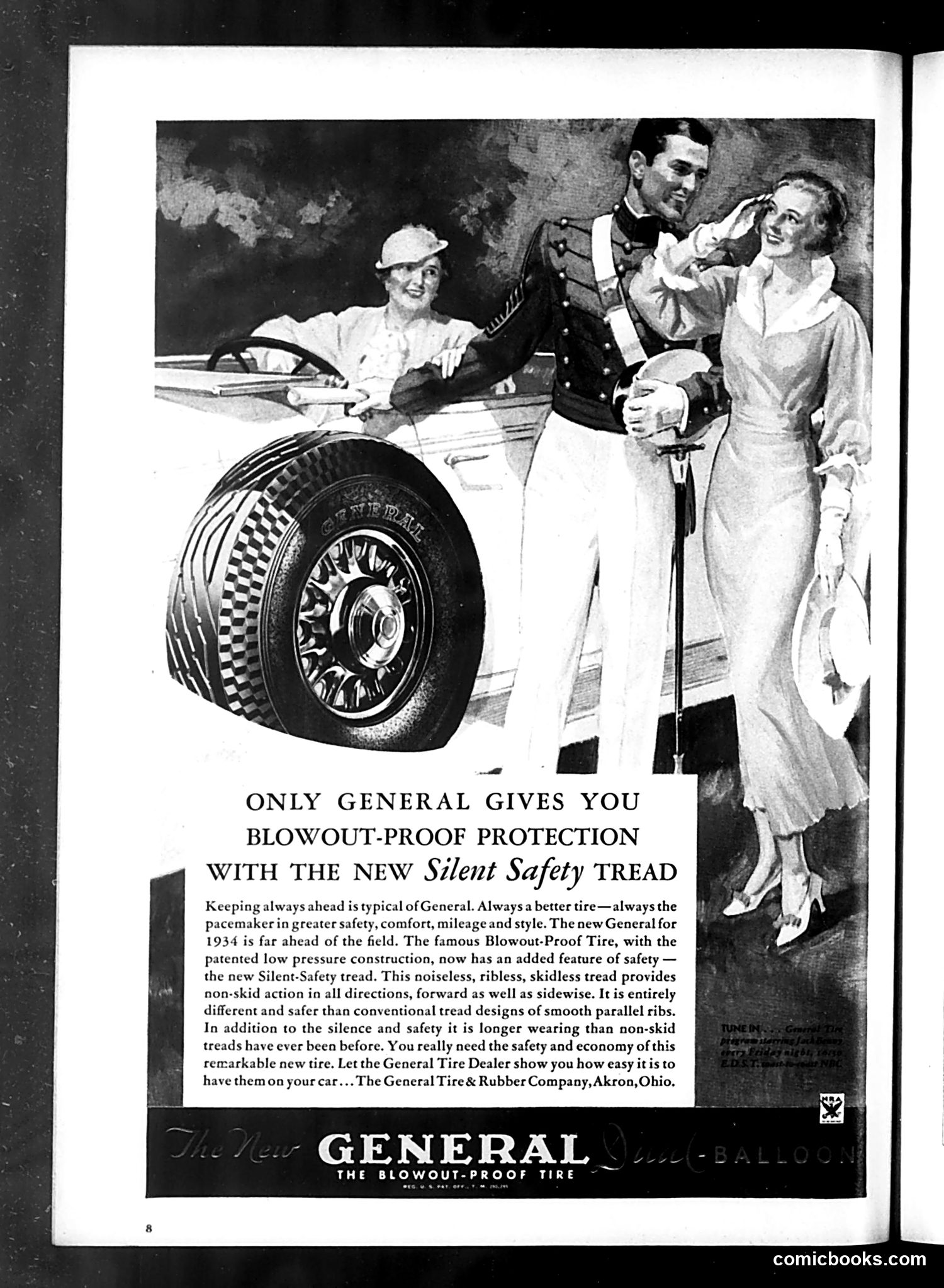
This is a General Tire advertisement, not political satire. The ad promotes General's new "Silent Safety Tread" for 1934 model cars, emphasizing blowout-proof protection. The image shows three figures—a woman in a light dress, a chauffeur or driver in uniform on the left, and a military or formal-dressed man in the center—posed beside a large tire displaying the tread pattern. The styling and composition suggest affluence and sophistication meant to appeal to upscale consumers. The advertisement's main selling point is safety innovation: the new tread design provides "non-skid action in all directions" and claims superior durability compared to conventional parallel-rib designs. The General Tire & Rubber Company, based in Akron, Ohio, positions their product as the industry pacemaker for "safety, comfort, mileage and style."
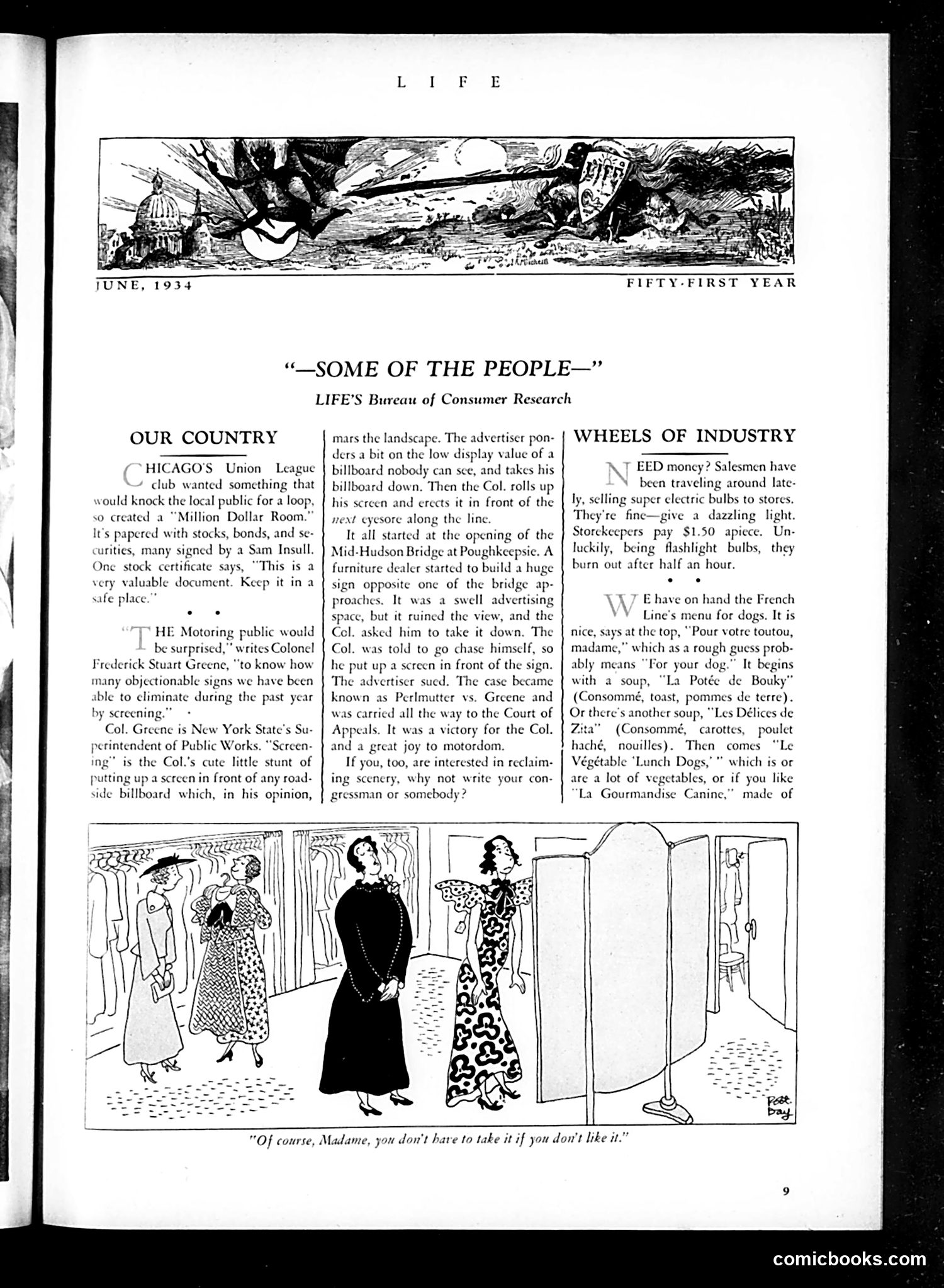
Life Magazine, June 1934: "Some of the People" This page combines consumer research commentary with a cartoon joke. The text discusses advertising disputes (including a case called "Perlmutter vs. Greene" about roadside billboards), electric light bulbs sold to stores, and French dog food menus. The cartoon below depicts women in a clothing shop or dressing room. One woman in black stands centrally while others browse. The caption reads: "Of course, Madame, you don't have to take it if you don't like it." The joke satirizes retail customer service: the salesman's statement is absurdly obvious—of course the customer can reject merchandise—yet he feels obligated to say it, suggesting either obsequious sales tactics or that customers were accustomed to being pressured into unwanted purchases.
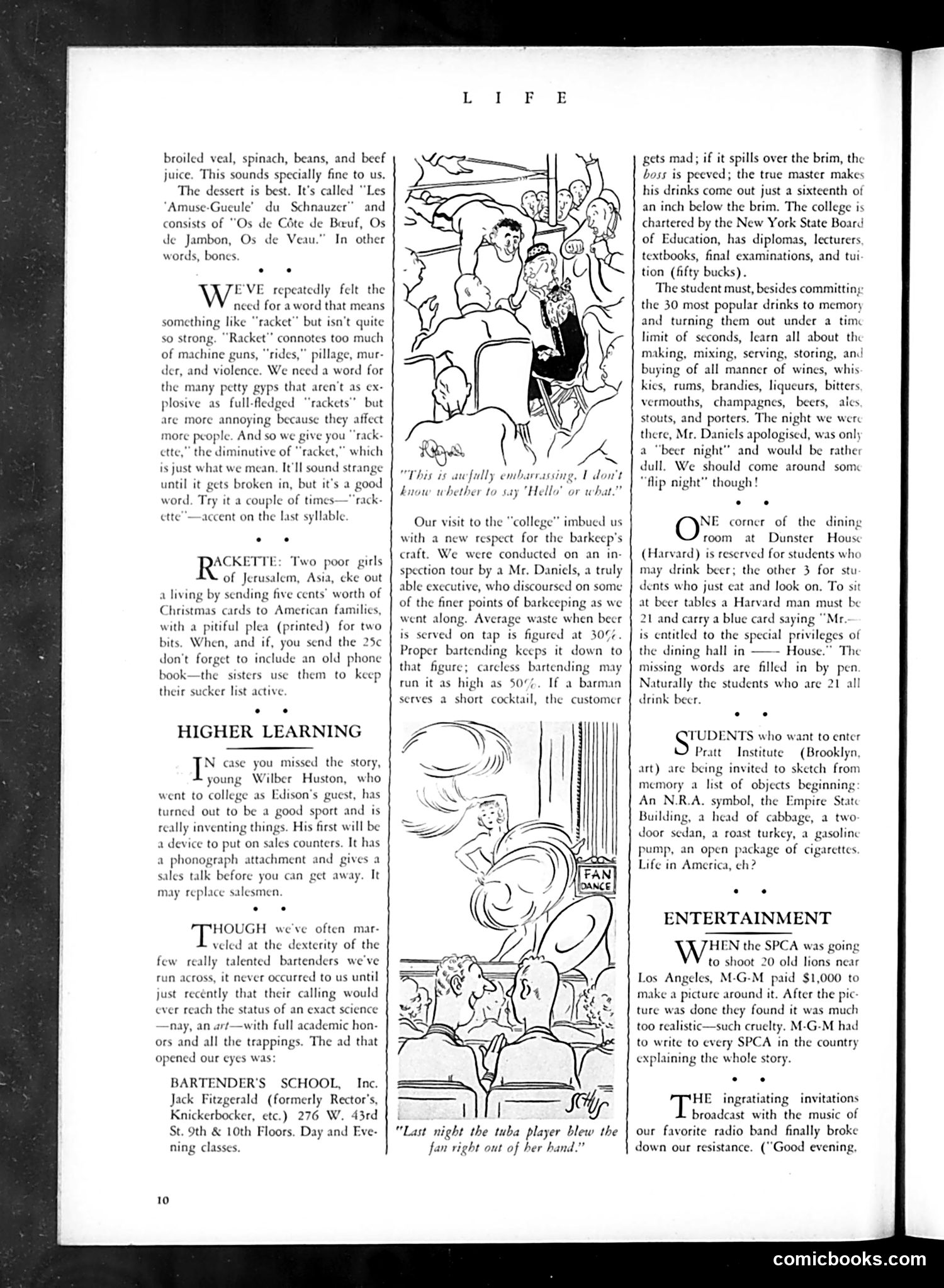
Analysis of Life Magazine Page This page contains three sections mixing editorial content with advertisements. The main illustrated articles discuss bartending and college life. One cartoon depicts a chaotic barroom scene with a tuba player, illustrating the article's discussion of bartender training and cocktail culture. The text mentions specific drinks ("Os de Côte de Beef") and jokes about the word "racket" having multiple meanings—a device for sports, but also slang for illicit schemes. A section titled "Higher Learning" appears to reference Edison's guest status at a college, discussing sales-counter devices and photography attachments. The "Entertainment" section mentions the SPCA and M-G-M filming lions near Los Angeles—apparently MGM paid $1,000 to film around actual lions, later finding the footage "too realistic" and explaining the circumstances to animal welfare organizations. The illustrations are period cartoons depicting 1920s-30s leisure and educational culture.
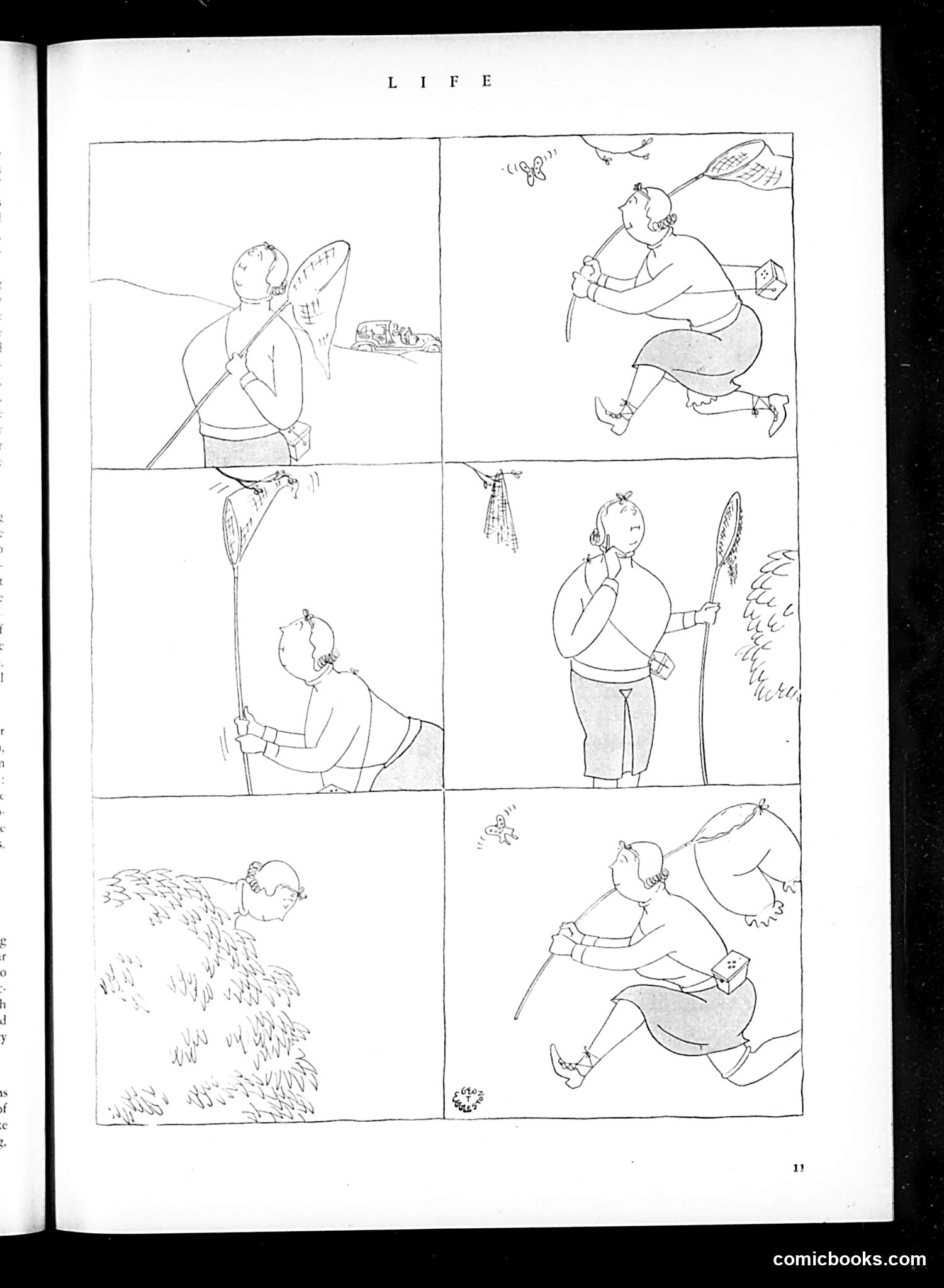
Analysis This page from Life magazine presents a six-panel comic strip titled "LIFE" depicting a portly man engaged in fishing activities. The sequence shows: 1. The man standing with fishing rod and net, observing a boat 2. Him actively casting or jumping while fishing 3. Wading in water with his net 4. Standing near reeds with his catch 5. Being sprayed or soaked by water 6. Struggling or falling while fishing The humor appears to derive from physical comedy—the man's clumsy, exaggerated movements and repeated mishaps while attempting to fish. Without additional context or visible text identifying specific political figures or social commentary, this reads as straightforward slapstick humor about an incompetent fisherman. The exaggerated cartooning style was typical of Life's satirical content, though the specific satirical target, if any exists beyond simple physical comedy, is unclear from the image alone.
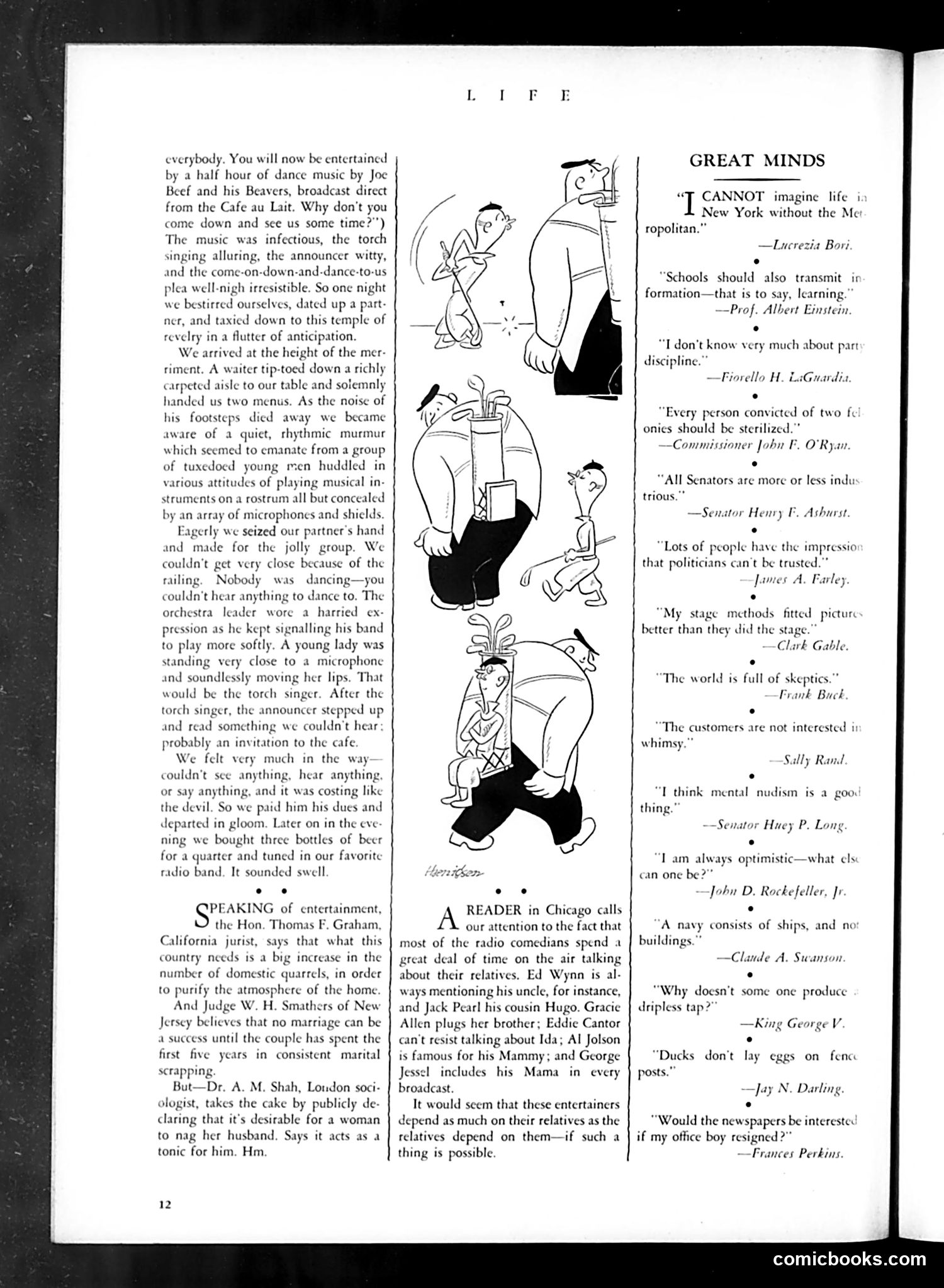
Page Analysis: Life Magazine (Page 12) This page contains a humorous narrative about attending a jazz performance at the Cafe au Lait, illustrated with caricatured sketches of dancers and musicians. The text describes the chaotic experience of trying to enjoy dance music by "Joe Beef and his Beavers" while unable to hear due to noisy patrons and poor acoustics—a satirical complaint about the disruptive social atmosphere of popular entertainment venues of the era. The right column features "Great Minds"—a collection of satirical quotes attributed to politicians, celebrities, and public figures (including Senator Henry F. Ashurst, Commissioner John F. O'Ryan, and others). These quotes mock contemporary attitudes about politics, entertainment, and social issues, using the format to poke fun at notable figures and prevailing opinions of the time.
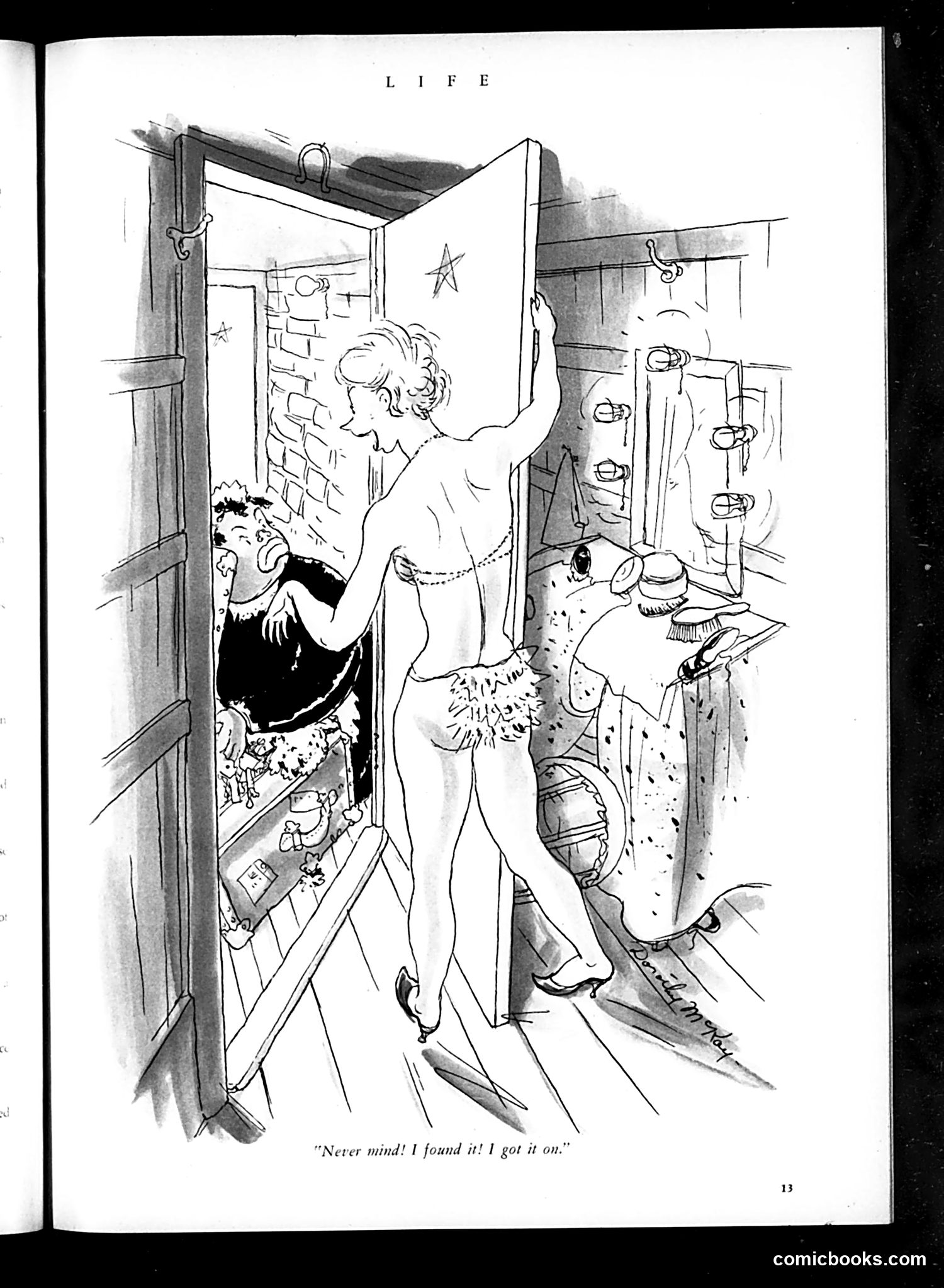
Analysis This is a single-panel cartoon from *Life* magazine titled "LIFE" at the top, with the caption "Never mind! I found it! I got it on." The cartoon depicts a domestic scene: a woman in 1920s-style clothing stands in a bedroom doorway, appearing to have just retrieved or adjusted something (likely a brassiere or undergarment, given the era and the caption's phrasing about "getting it on"). A man in bed looks on with apparent concern or surprise. The humor derives from the double entendre—the woman's matter-of-fact announcement about successfully fastening her undergarment, contrasted with the suggestive situation of a man in bed. This reflects typical *Life* magazine humor of the period: sexually suggestive but not explicit, playing on the tension between Victorian propriety and modern attitudes emerging in the 1920s-1930s.
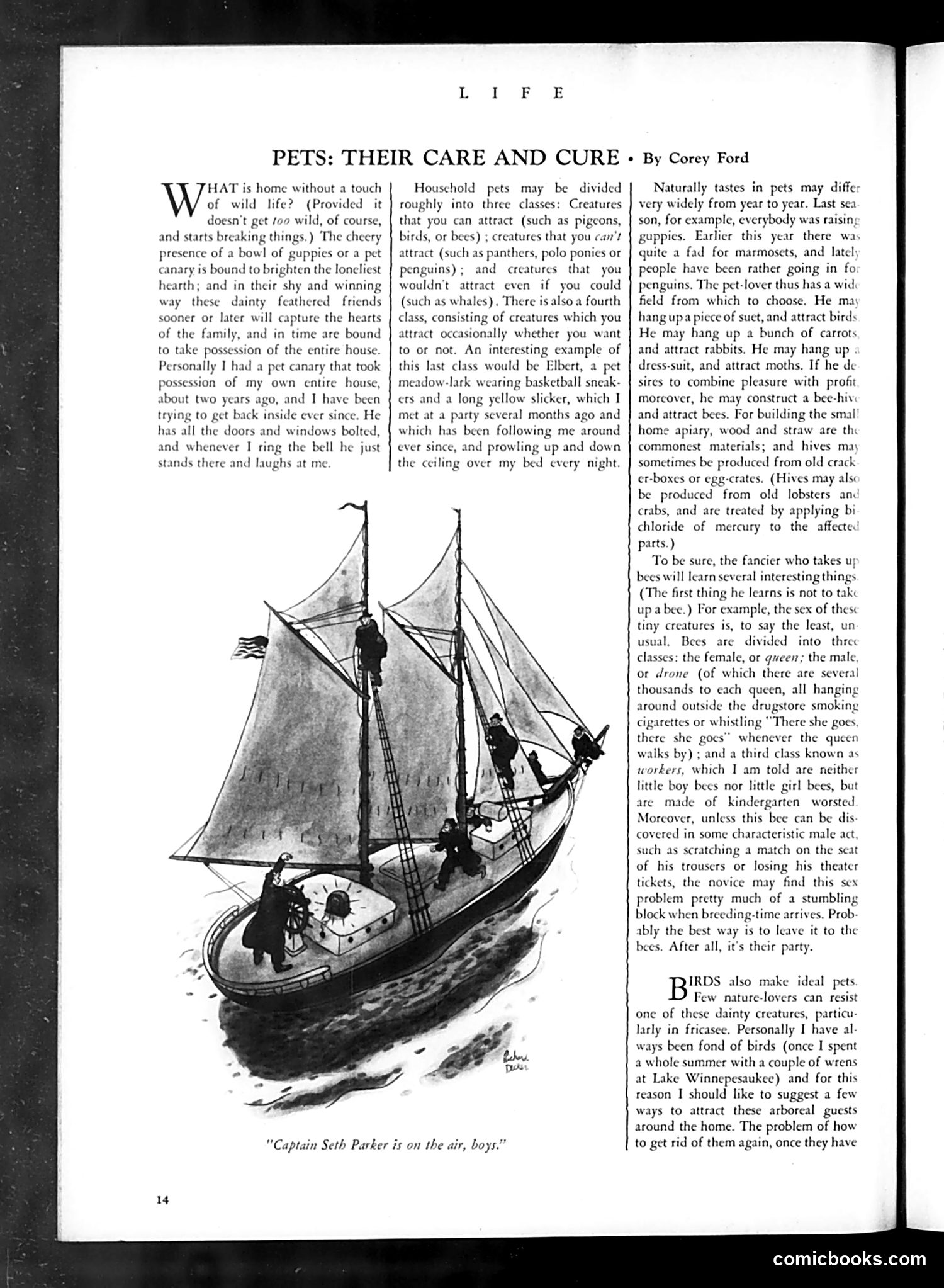
Explanation for Modern Readers This page from *Life* magazine contains an article by Corey Ford titled "Pets: Their Care and Cure." The central illustration depicts a sailing ship with the caption "Captain Seth Parker is on the air, boys." This references Captain Seth Parker, a fictional character from a popular 1930s radio comedy series. The ship illustration is likely a visual joke related to the character's nautical theme or persona. The article itself humorously discusses keeping various pets—from escaping canaries to bees to birds—offering satirical advice on pet ownership and their behavioral quirks. The humor relies on exaggerated anecdotes rather than political satire; it's gentle domestic comedy typical of *Life* magazine's entertainment content from this era.
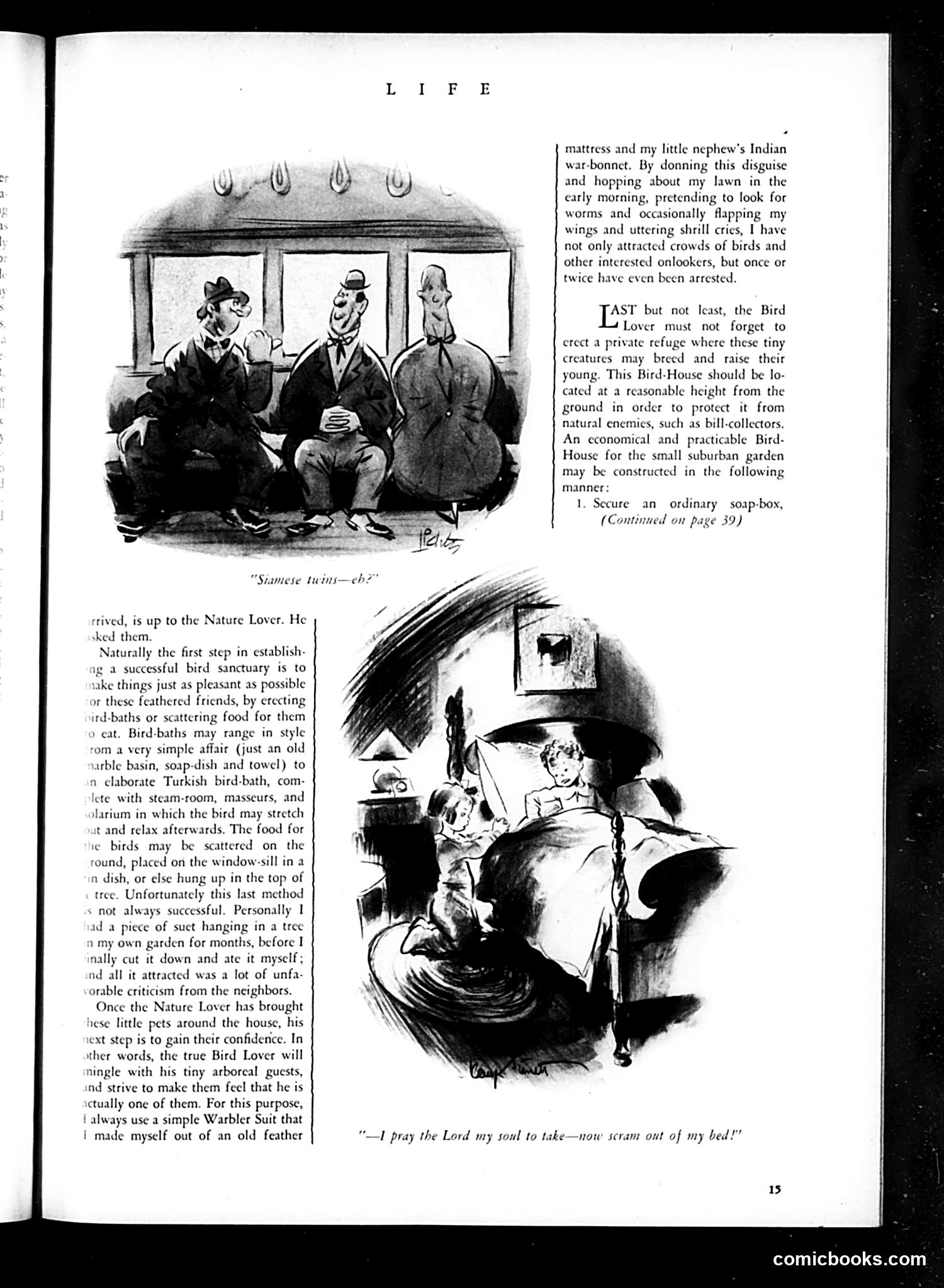
Analysis of Life Magazine Page 15 This page contains two cartoons about birdwatching and nature observation, drawn in a humorous style typical of early-to-mid 20th century Life magazine. The top cartoon shows three men in formal attire on what appears to be public transportation (likely a train or bus), with the caption "Somebody tu-tu—ch?" The joke appears to mock amateur birdwatchers or nature enthusiasts making awkward bird calls in public spaces, embarrassing fellow passengers. The bottom cartoon depicts someone in bed, startled, with the caption "I pray the Lord my soul to take—now scram out of my bed!" This illustrates the humorous problem of birdwatching enthusiasm intruding into domestic life. The accompanying text discusses creating birdhouses and attracting birds to suburban gardens. The overall theme satirizes the nature-lover's sometimes obsessive, socially awkward behavior and how their hobby disrupts everyday life.
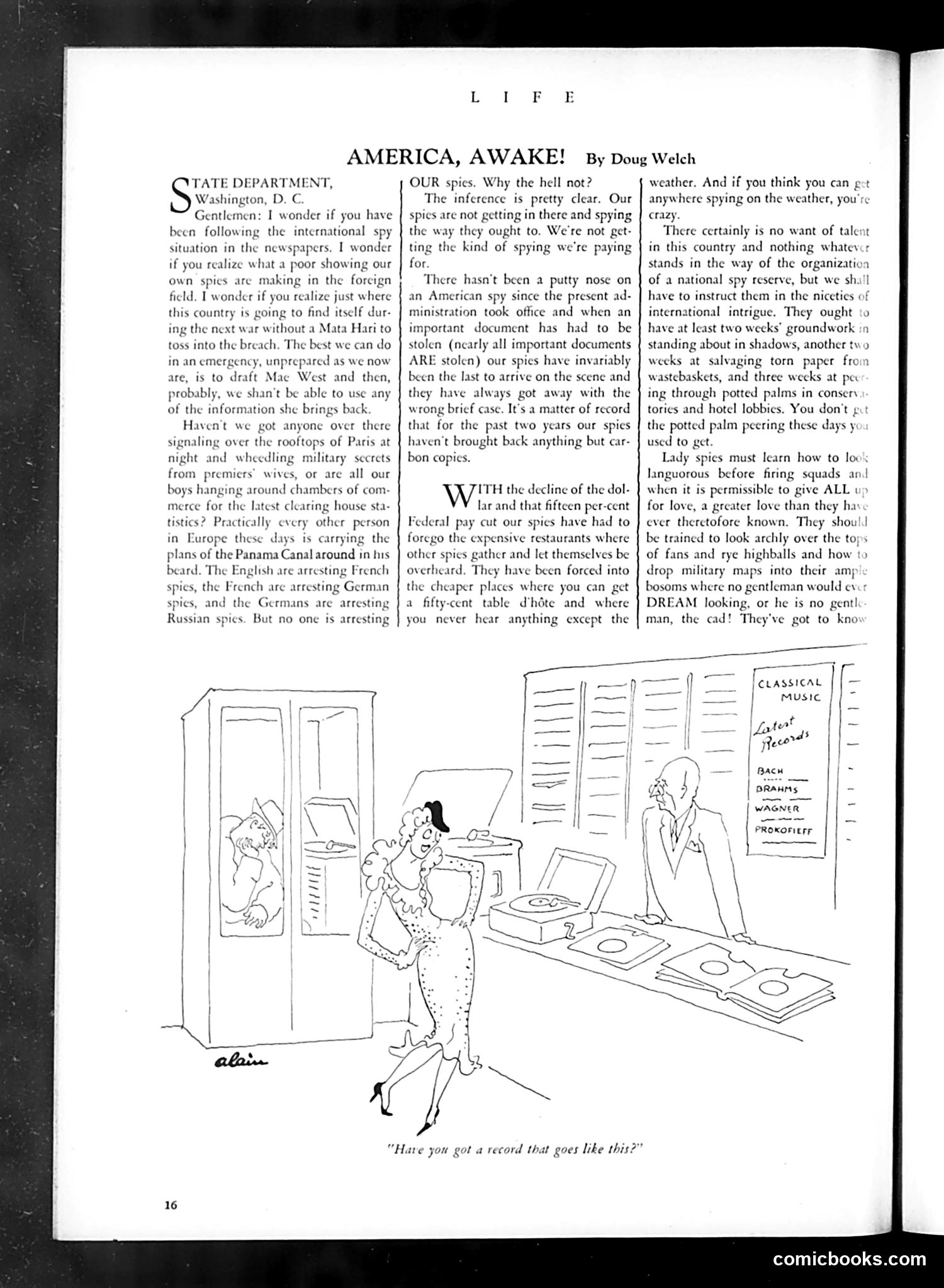
Analysis of "America, Awake!" by Doug Welch This satirical article criticizes American intelligence operations during what appears to be the early Cold War period. The author laments that U.S. spies are ineffective compared to foreign intelligence agencies, noting they arrive late with "carbon copies" of stolen documents rather than original intelligence. The accompanying cartoon depicts a woman at the State Department asking a male colleague, "Have you got a record that goes like this?"—suggesting espionage incompetence through a humorous double entendre about phonograph records (possibly alluding to listening devices or surveillance). The piece expresses concern about American spy capabilities lagging behind rival nations (France, Germany, Russia are mentioned), advocating for better-trained, more effective intelligence personnel to protect national security interests.
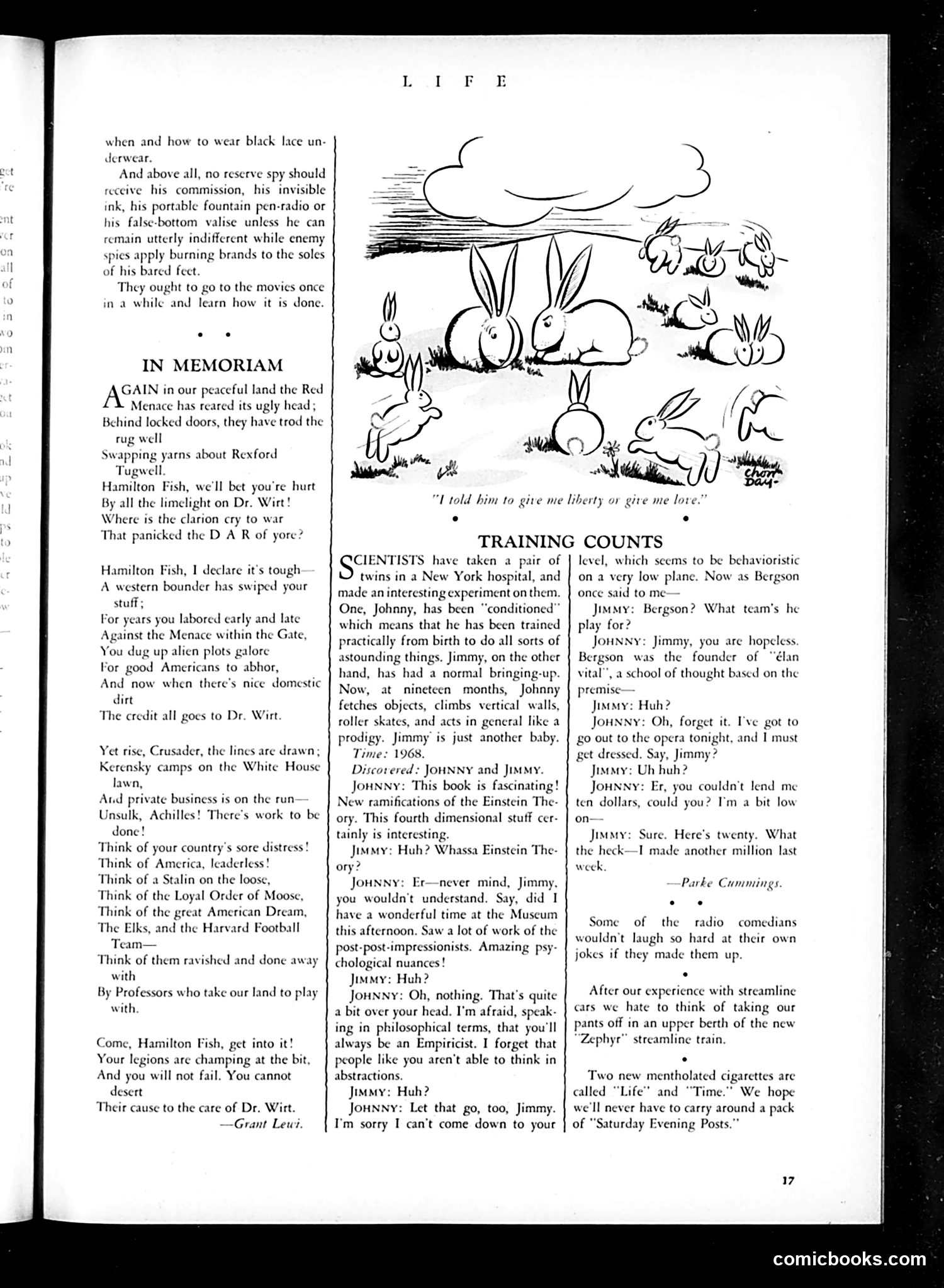
Political Context Analysis This page contains a satirical poem "In Memoriam" (left) mocking Hamilton Fish, likely a political figure of the era. The poem references "the Red Menace," suggesting anti-communist sentiment, and mentions "Dr. Wirt," "the Clarion," and "the D.A.R." — apparently figures or organizations involved in contemporary political disputes. The main illustration shows rabbits in various poses with the caption "I told him to give me liberty or give me death" — a famous Patrick Henry quote applied absurdly to rabbits, likely mocking overwrought patriotic rhetoric. Below, "Training Counts" presents a dialogue between Johnny and Jimmy about conditioning experiments on twins at a New York hospital, referencing Einstein's theories. This appears to satirize pseudo-scientific claims or behavioral conditioning fads popular at the time. The page's overall tone mocks contemporary political hysteria and pseudoscience through humor.
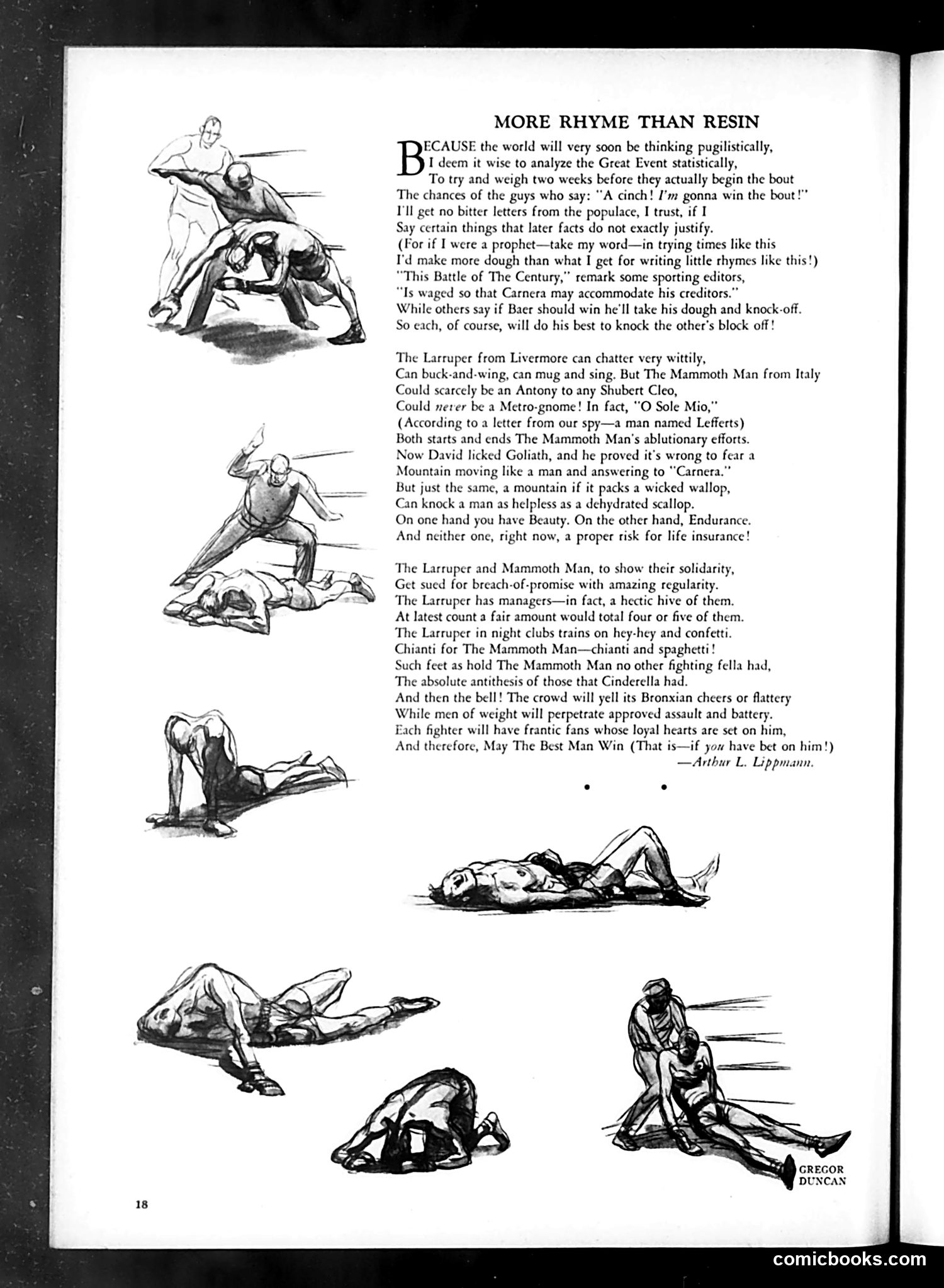
"More Rhyme Than Resin" Analysis This page satirizes the famous 1935 boxing match between Max Baer ("the Larruper from Livermore") and Primo Carnera ("the Mammoth Man from Italy")—billed as "The Battle of the Century." The satire's points: Baer is witty and entertaining but lacks serious training (trains on "hey-hey and confetti" in nightclubs). Carnera, by contrast, is a large but ungainly fighter whose only accomplishment is personal hygiene ("O Sole Mio" references his bathing habits). The poem mocks sports journalism's hype, the fighters' financial motivations (Carnera fighting to pay creditors), their dubious character (both sued for breach-of-promise), and the absurdity of predicting outcomes. The illustrations show various fighting positions and knockdown scenarios. The author (Lippmann) jokes that predicting the winner is impossible—he'd make more money as a prophet than writing satirical verses. The underlying message: this hyped "greatest fight" is really just two flawed characters fighting for money, despite sports media's grandiose framing.
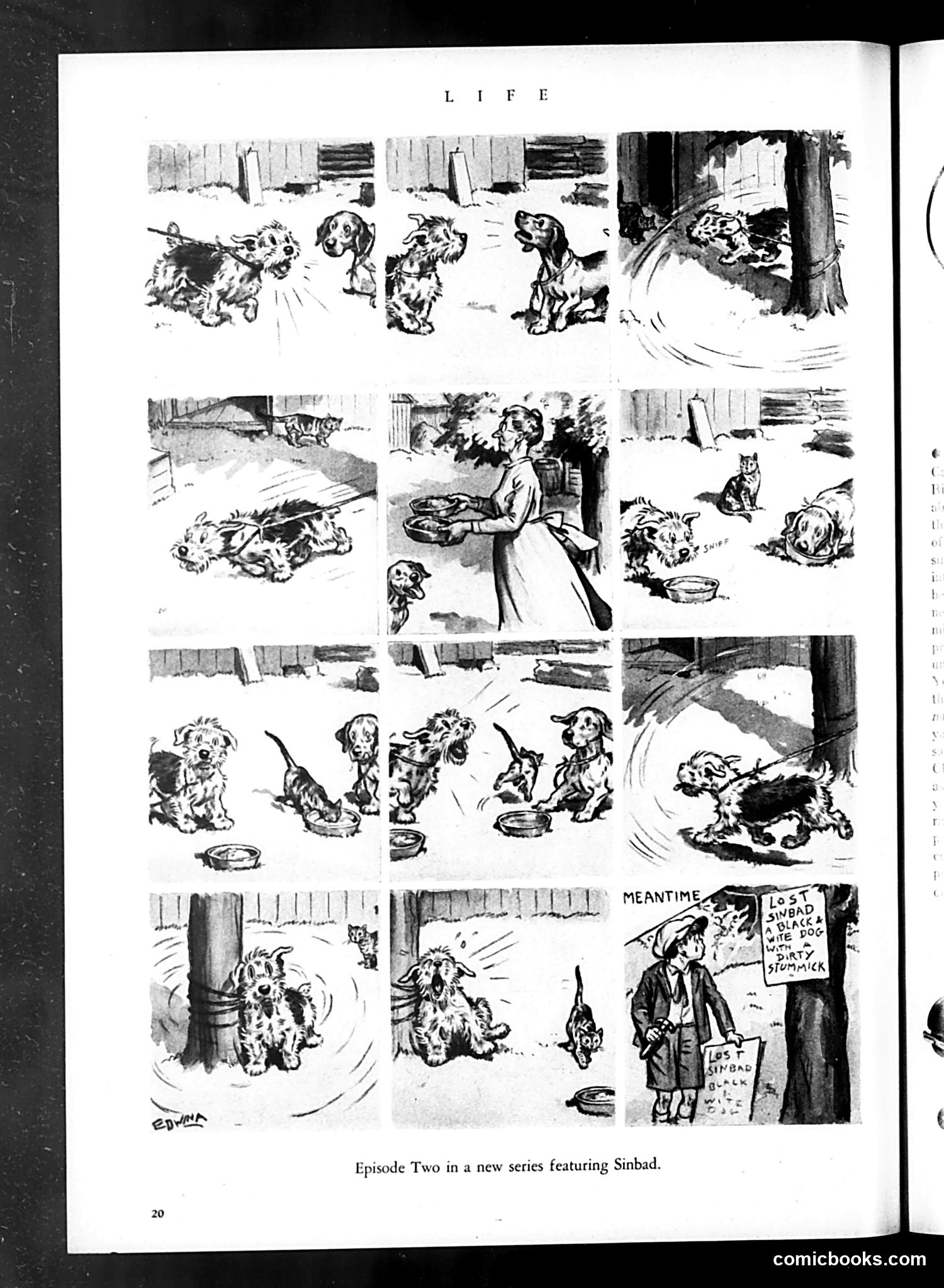
Page Analysis This is a comic strip sequence titled "Episode Two in a new series featuring Sinbad." The strip depicts a comedic narrative involving dogs and a person, culminating in a "Lost Dog" poster scenario. The story appears to show: dogs playing or interacting in a yard, a woman (likely a servant or housemaid based on her dress) feeding or managing the dogs, various scenes of the dogs eating and causing chaos, and finally a man posting a "Lost Sinbad" notice after apparently losing one of the dogs—likely due to the chaos the animals caused. The humor derives from the ironic juxtaposition: the dogs are so troublesome that losing one becomes almost a relief. The title character "Sinbad" is the lost dog, a playful reference to the legendary adventurer, applied absurdly to a domestic pet. This appears to be family-oriented comic humor typical of *Life* magazine's satirical content.
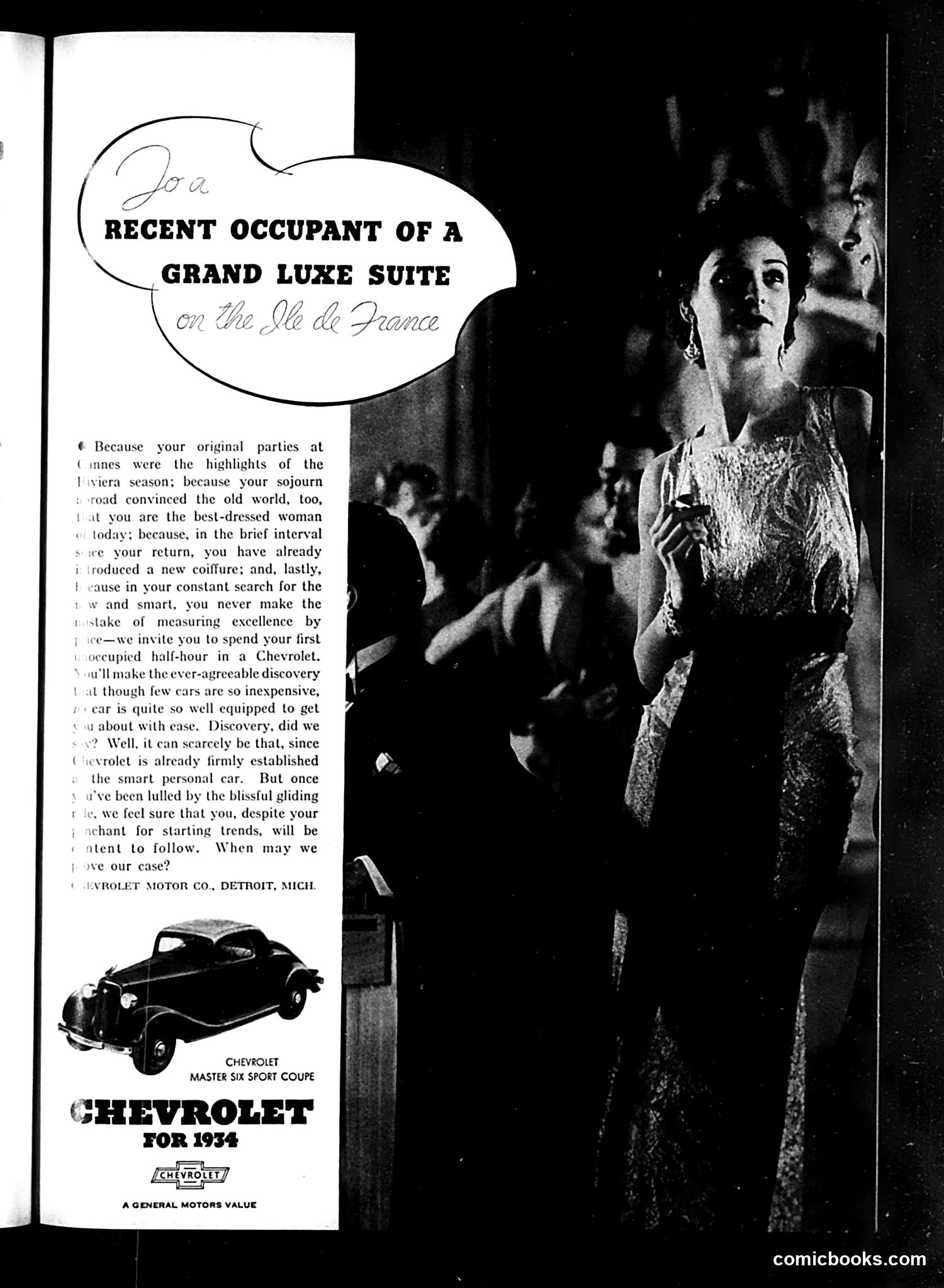
Analysis This is a Chevrolet automobile advertisement from 1934, not a political cartoon. The page targets wealthy, fashionable women—specifically addressing "a recent occupant of a grand luxe suite on the Île de France" (a luxury ocean liner). The ad's appeal is social status and taste: it flatters the reader as a best-dressed woman who frequents Cannes and maintains high standards. The pitch argues that despite Chevrolet's reputation as an economical car, it's actually "the smart personal car" and equipped well enough for someone of her refined sensibilities. The humor is gentle irony—the ad suggests that a woman accustomed to grand European luxury might discover that an affordable American car can be equally satisfying. The photograph on the right shows elegantly dressed women, reinforcing the aspirational lifestyle being marketed. This reflects 1930s advertising strategy: positioning mass-market products as accessible to the wealthy, rather than explicitly budget-conscious.
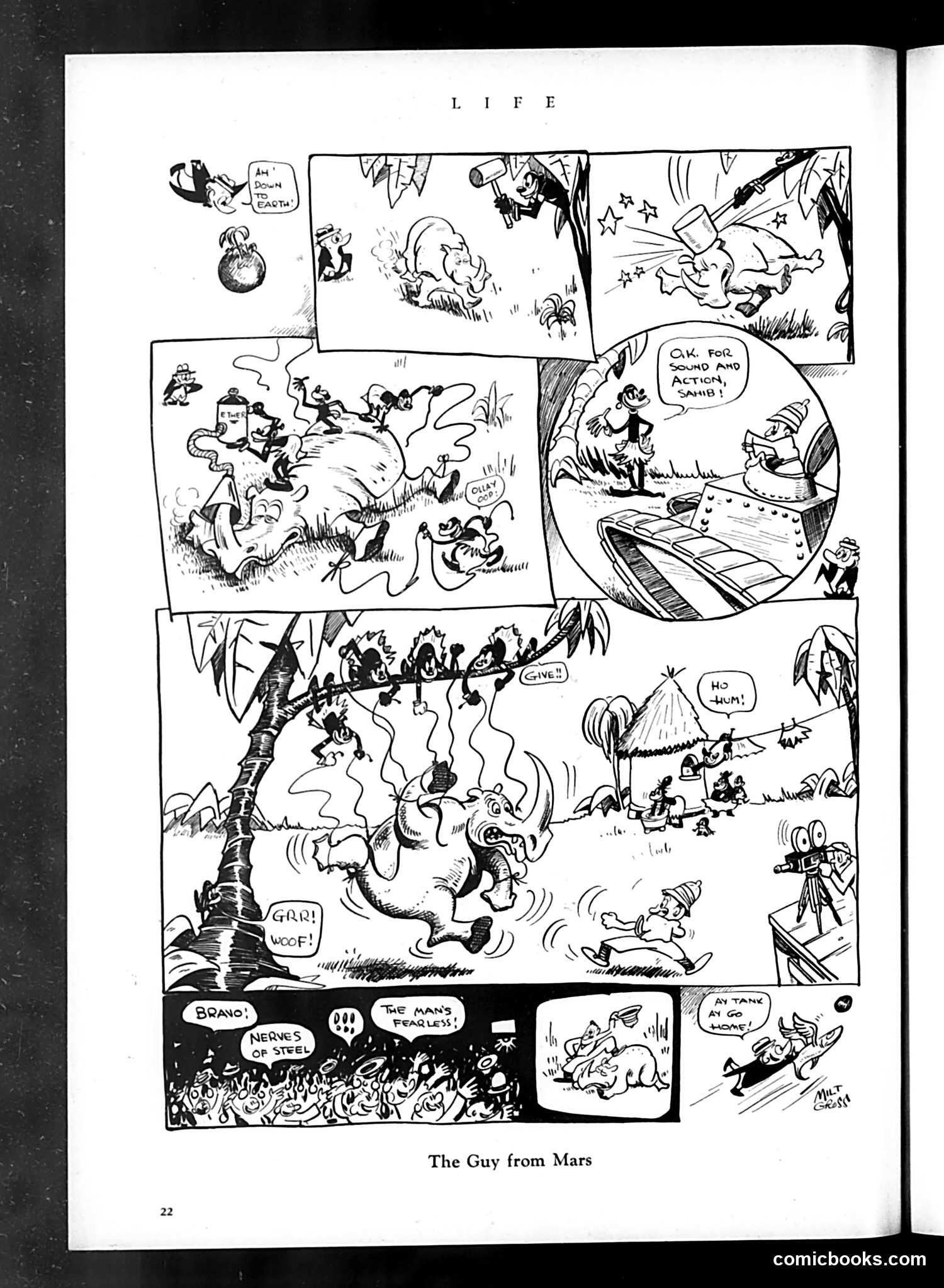
"The Guy from Mars" - Life Magazine Comic This is a science-fiction comedy strip about an extraterrestrial visitor. The narrative follows a Martian character's arrival on Earth and subsequent adventures among humans. The humor appears to derive from: 1. Fish-out-of-water comedy: The alien's confusion and misinterpretation of Earth customs and objects 2. Visual gags: Slapstick sequences showing the creature's unexpected reactions to ordinary situations 3. Satire of human behavior: Humans' reactions to the alien, shown through their comments ("O.K. for sound and action," "Nerves of steel," "The man's fearless!") The strip uses exaggerated character designs typical of early-to-mid 20th century comics. The final panel suggests a theatrical or cinematic context, possibly satirizing Hollywood's treatment of alien-encounter stories that were popular during this era.
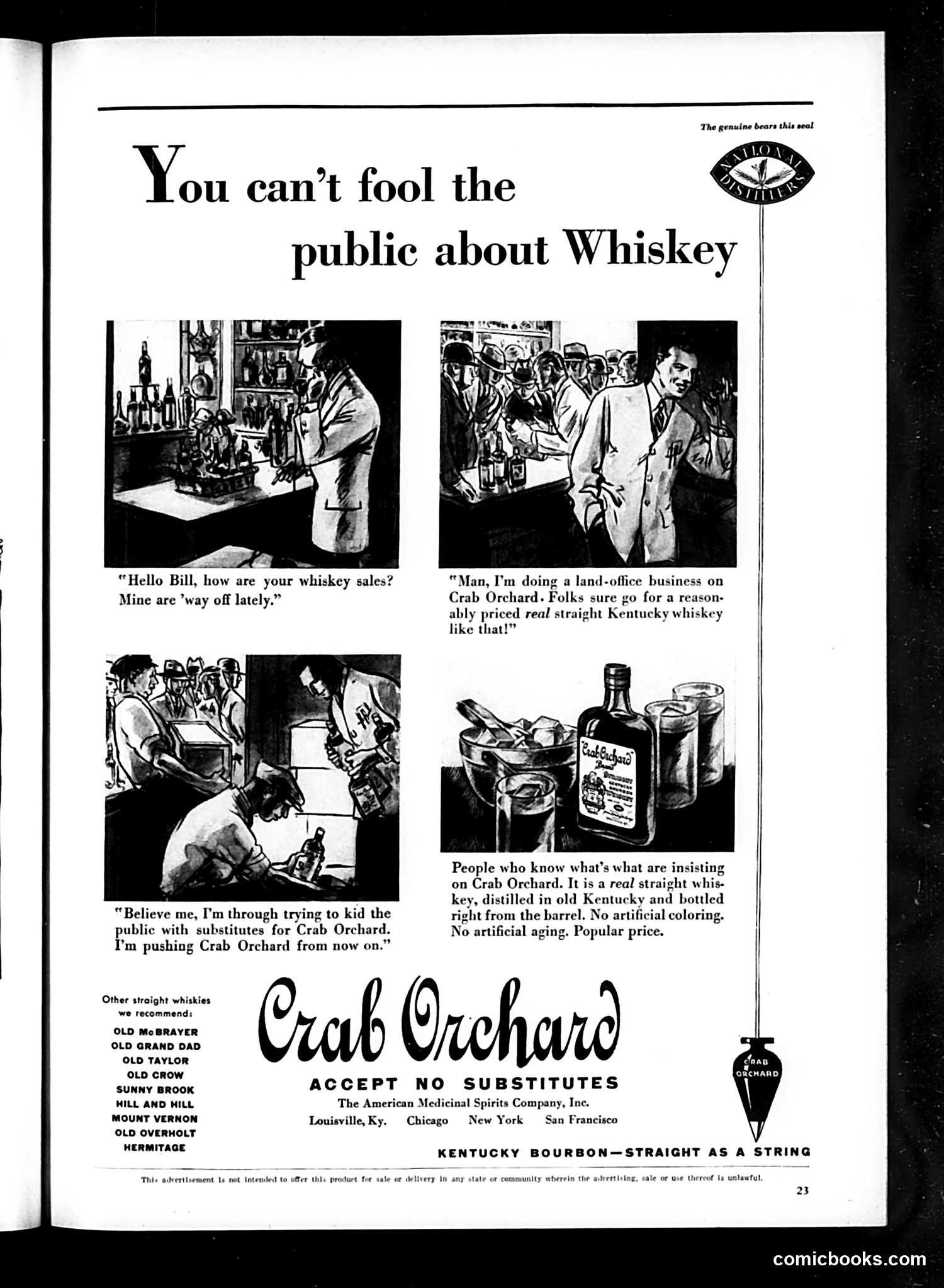
Crab Orchard Whiskey Advertisement This is a full-page advertisement, not satire or political cartoon. It uses comic-style panels to promote Crab Orchard Kentucky bourbon during what appears to be Prohibition or its aftermath. The three narrative panels depict salesmen discussing whiskey sales challenges. The first complains sales are down; the second promotes Crab Orchard as a genuine, reasonably-priced alternative; the third shows a salesman abandoning substitute whiskeys to push Crab Orchard instead. The underlying message: unscrupulous sellers were peddling counterfeit or inferior whiskeys to consumers. The ad positions Crab Orchard as authentically distilled in Kentucky with "no artificial coloring" or "artificial aging"—addressing public skepticism about whiskey quality and authenticity in an era when adulteration and fraud were widespread concerns. The disclaimer at bottom suggests state-level alcohol regulations remained complex and variable.
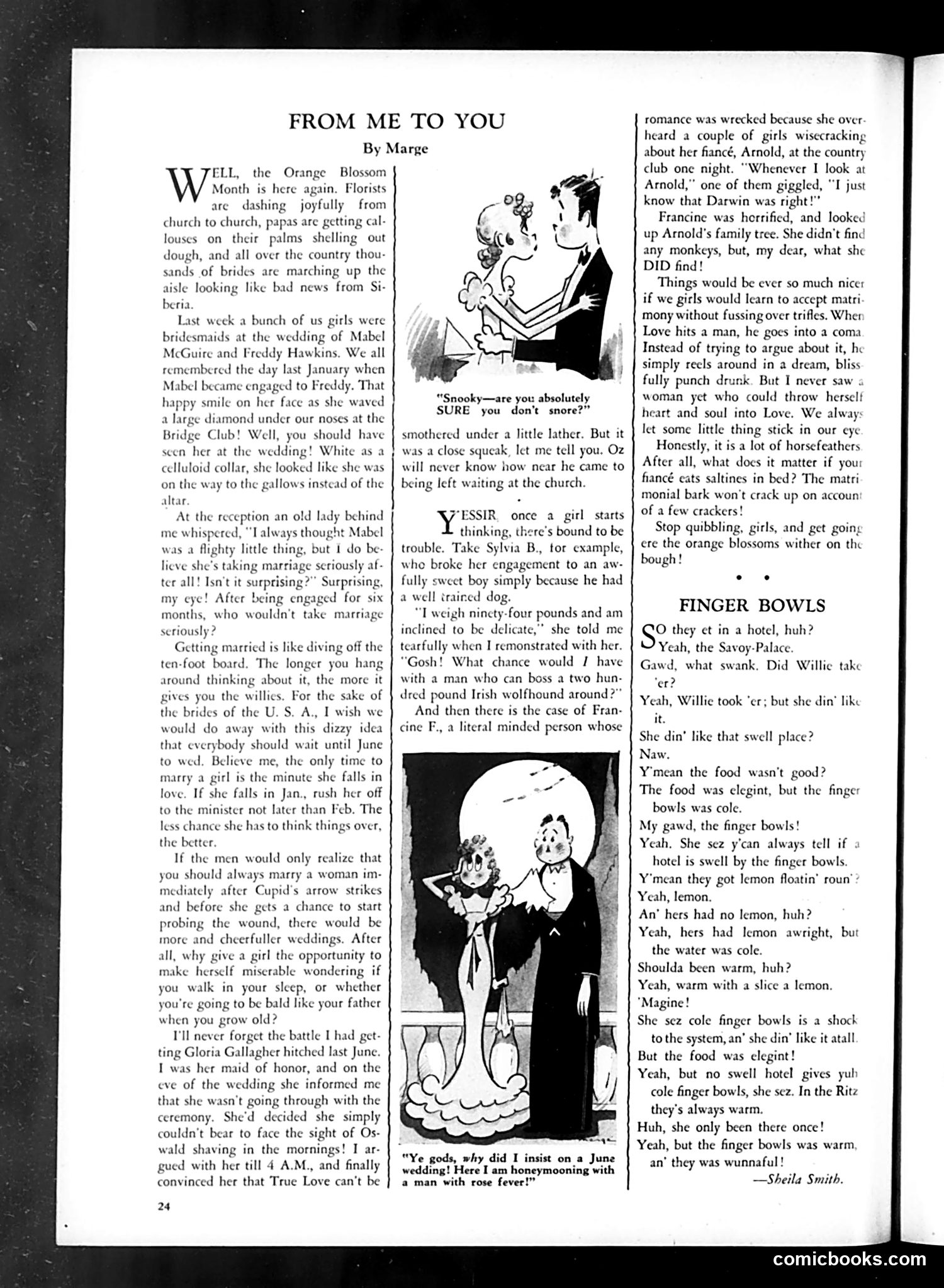
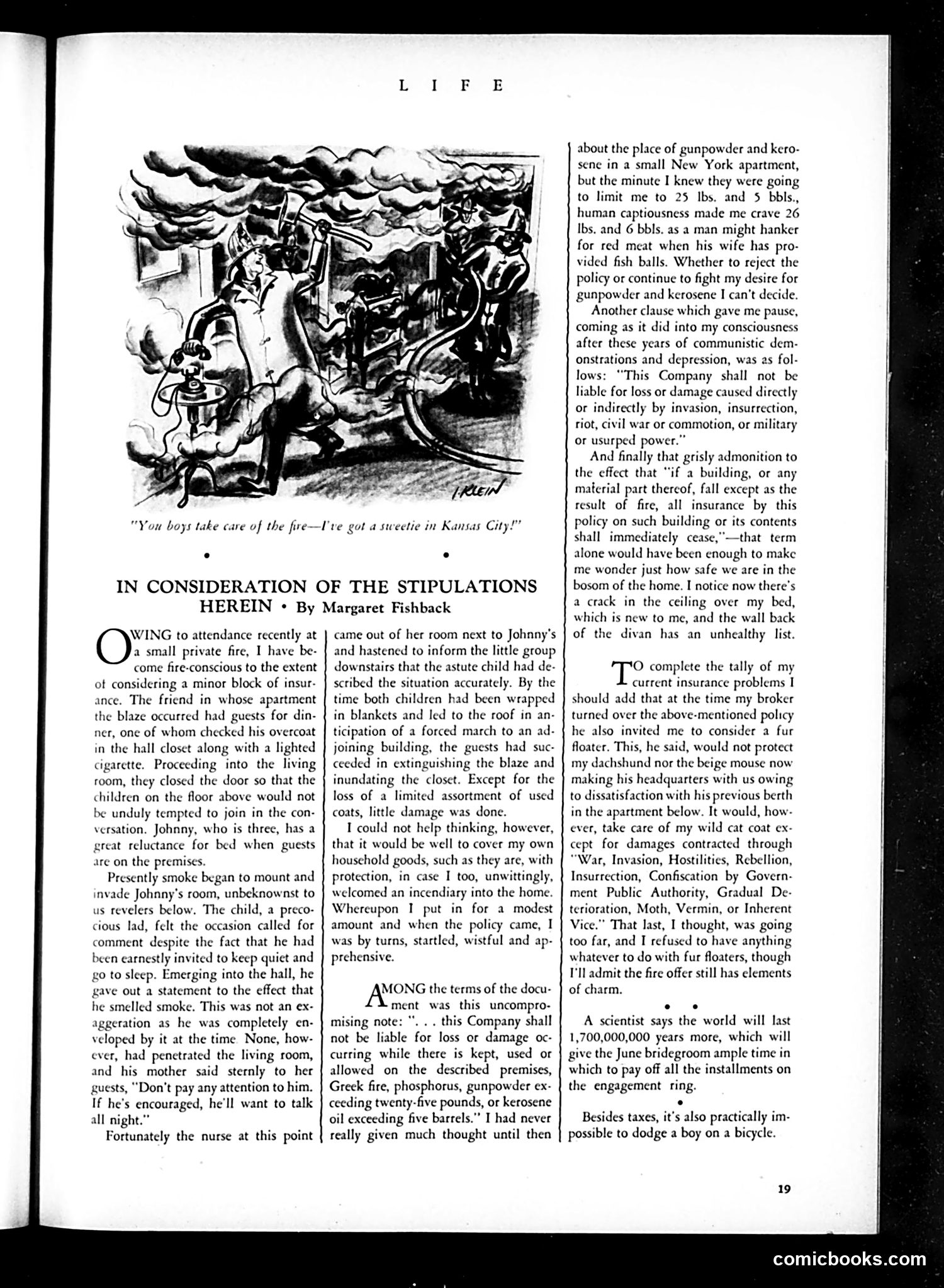
"From Me to You" by Marge - Life Magazine This satirical column mocks women's pre-wedding anxieties and the social pressure to marry in June. The author argues that women overthink marriage, discovering "deal-breakers" only after engagement—a well-trained dog, a man who shaves, evolutionary jokes about a fiancé's family resemblance to apes. The cartoons illustrate this anxiety: one shows a bride asking "Snooky—are you absolutely SURE you don't snore?" (worried about discovering annoying habits); another depicts a newlywed wife realizing her husband has "rose fever" after insisting on a June wedding. The satire targets female indecision and the era's expectation that women should marry quickly before second thoughts derail them. The author sarcastically suggests men should marry women "immediately after Cupid's arrow strikes" to prevent women from rational deliberation about compatibility. It reflects 1920s-30s attitudes about gender, romance, and marriage as inevitable rather than carefully chosen.
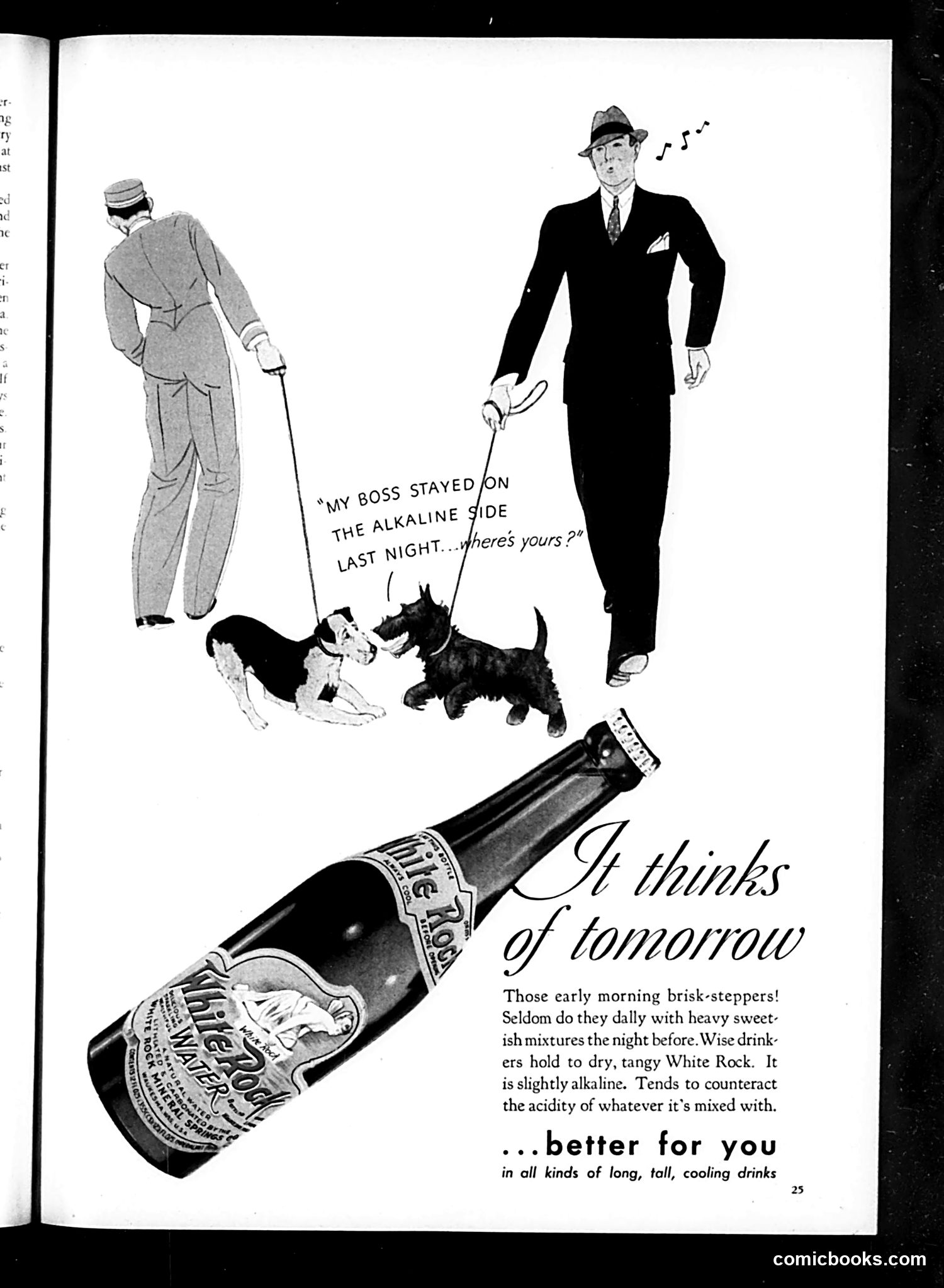
White Rock Beverage Advertisement This is a vintage advertisement for White Rock brand beverages, not political satire. The illustration contrasts two men: one hungover and sluggish (left, in golf attire), and one energetic and whistling (right, in business suit). The joke compares their mornings after drinking—the first stayed with "alkaline side" drinks and feels fresh; the second "stayed on" heavier, sweeter mixtures and suffers. Two small dogs sniffing each other serve as a visual bridge between the contrasting figures. The ad's sales pitch: White Rock is "slightly alkaline" and therefore "better for you" as a mixer in cocktails, supposedly counteracting acidity and preventing hangovers. This reflects 1920s-30s marketing claims about health benefits of carbonated beverages—promises that would later be heavily scrutinized or abandoned.
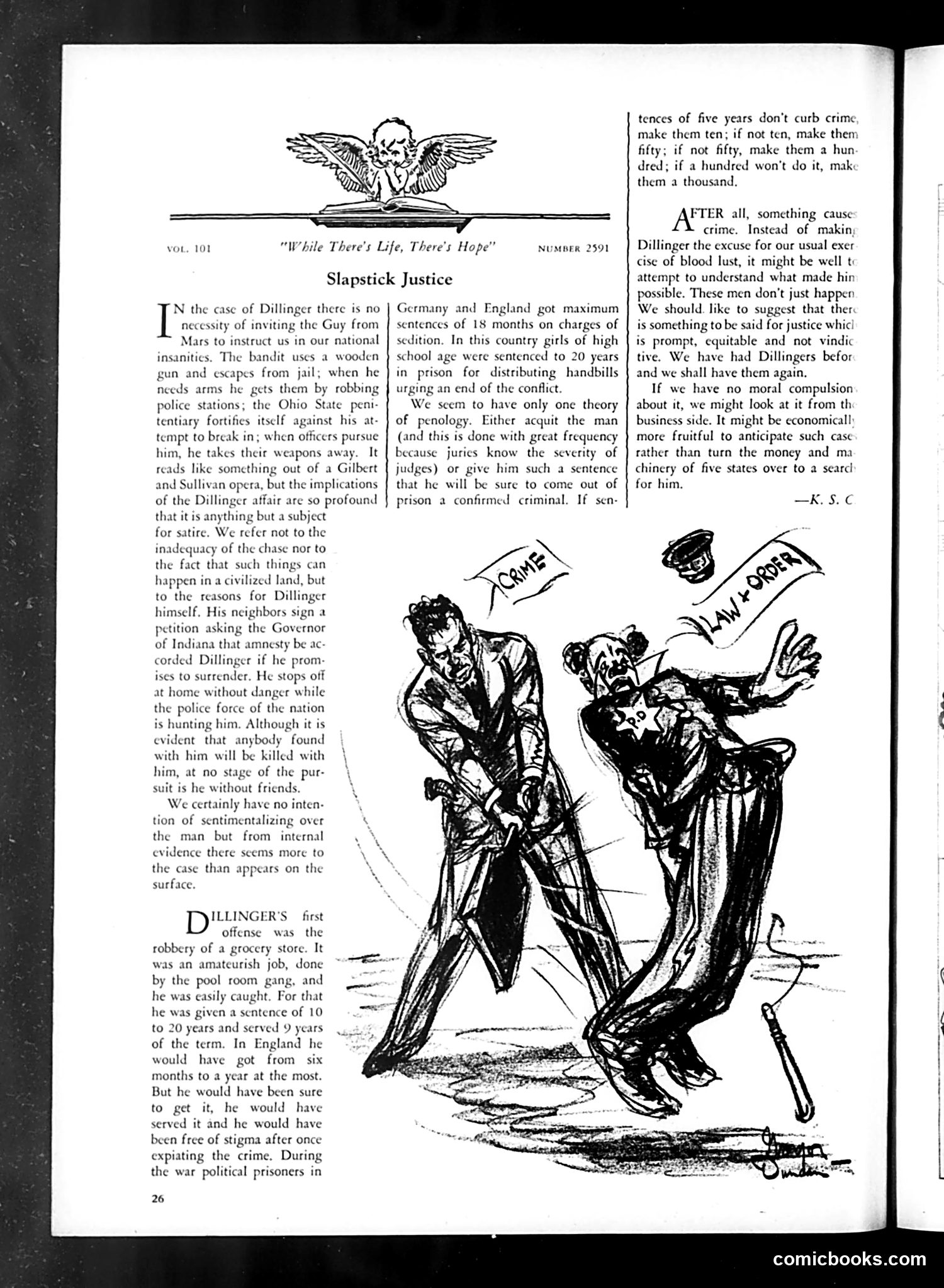
"Slapstick Justice" - Life Magazine Critique of Dillinger Case This article criticizes America's criminal justice system using John Dillinger—the notorious Depression-era bank robber then evading police—as its example. The unsigned piece argues that Dillinger's ability to escape capture repeatedly, hide among sympathetic neighbors, and rob police stations reveals systemic failures worth examining beyond mere sensationalism. The article's core argument: America employs only extreme penology—either acquit criminals or impose such severe sentences that prisoners emerge "confirmed criminals." Dillinger received 10-20 years for his first offense (a grocery store robbery); in England, he'd have served months. This harsh approach, the author argues, creates rather than prevents criminals. The accompanying cartoon depicts "Crime" and "Law & Order" as opposing forces in violent conflict, visualizing the text's point: America's punitive system fails because it addresses symptoms, not causes. The author calls for prompt, equitable justice instead of vengeful excess.
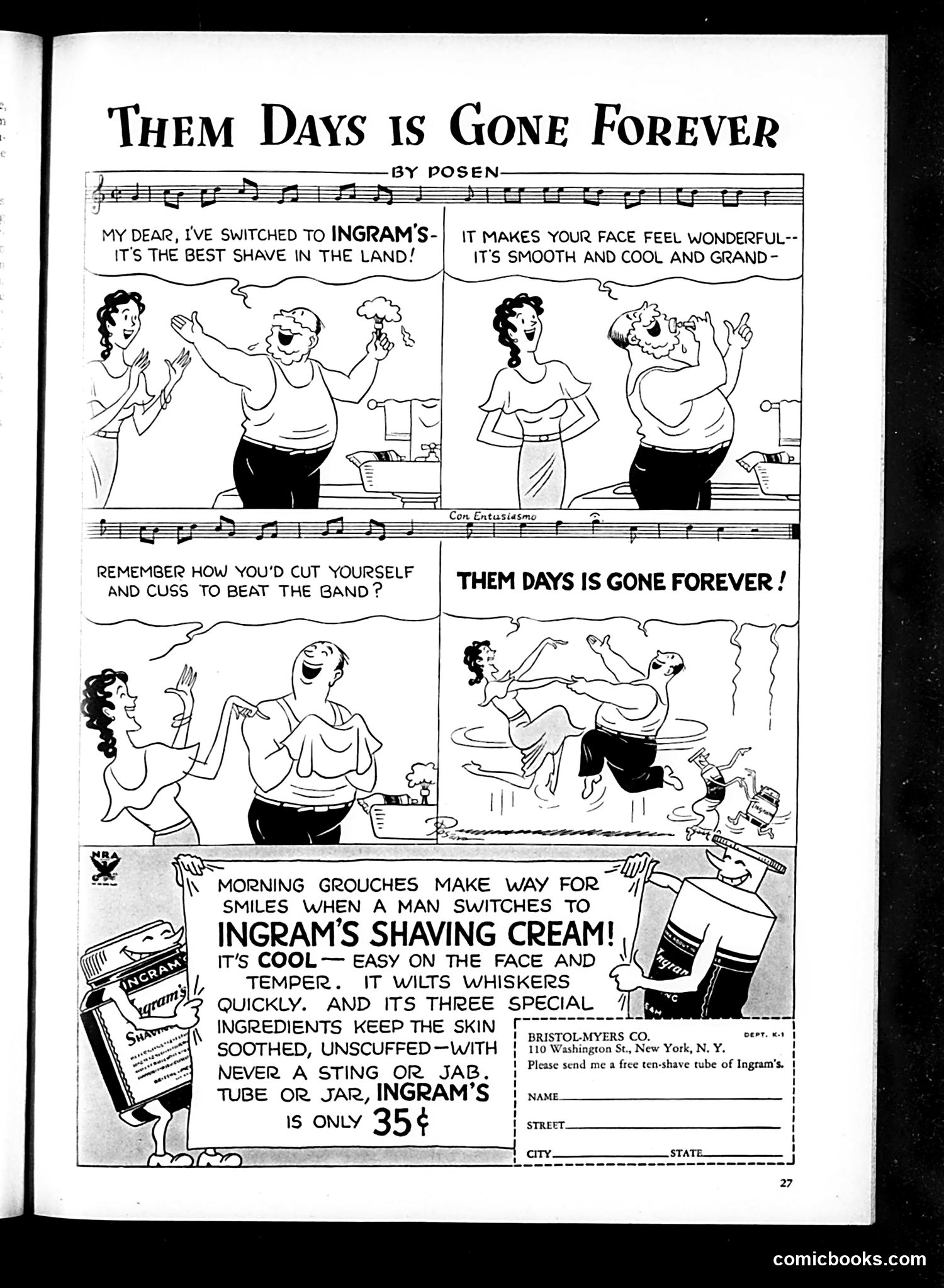
"Them Days is Gone Forever" — Ingram's Shaving Cream Advertisement This is primarily an advertisement disguised as comic entertainment. The "cartoon" by Posen uses humor to promote Ingram's shaving cream (35 cents). The joke contrasts old shaving methods with the new product: a man announces he's switched to Ingram's, prompting his wife to celebrate because he no longer cuts himself and curses angrily during shaving ("Remember how you'd cut yourself / And cuss to beat the band?"). The final panels show exaggerated relief—the couple dancing joyfully, their relationship improved by this simple product change. The satire gently mocks the minor domestic irritations of traditional wet shaving while positioning Ingram's as a solution that transforms a man's temperament and marriage satisfaction. The phrase "Them Days is Gone Forever" ironically suggests shaving-related marital discord is now obsolete, typical of mid-century advertising hyperbole that inflates a product's social benefits.
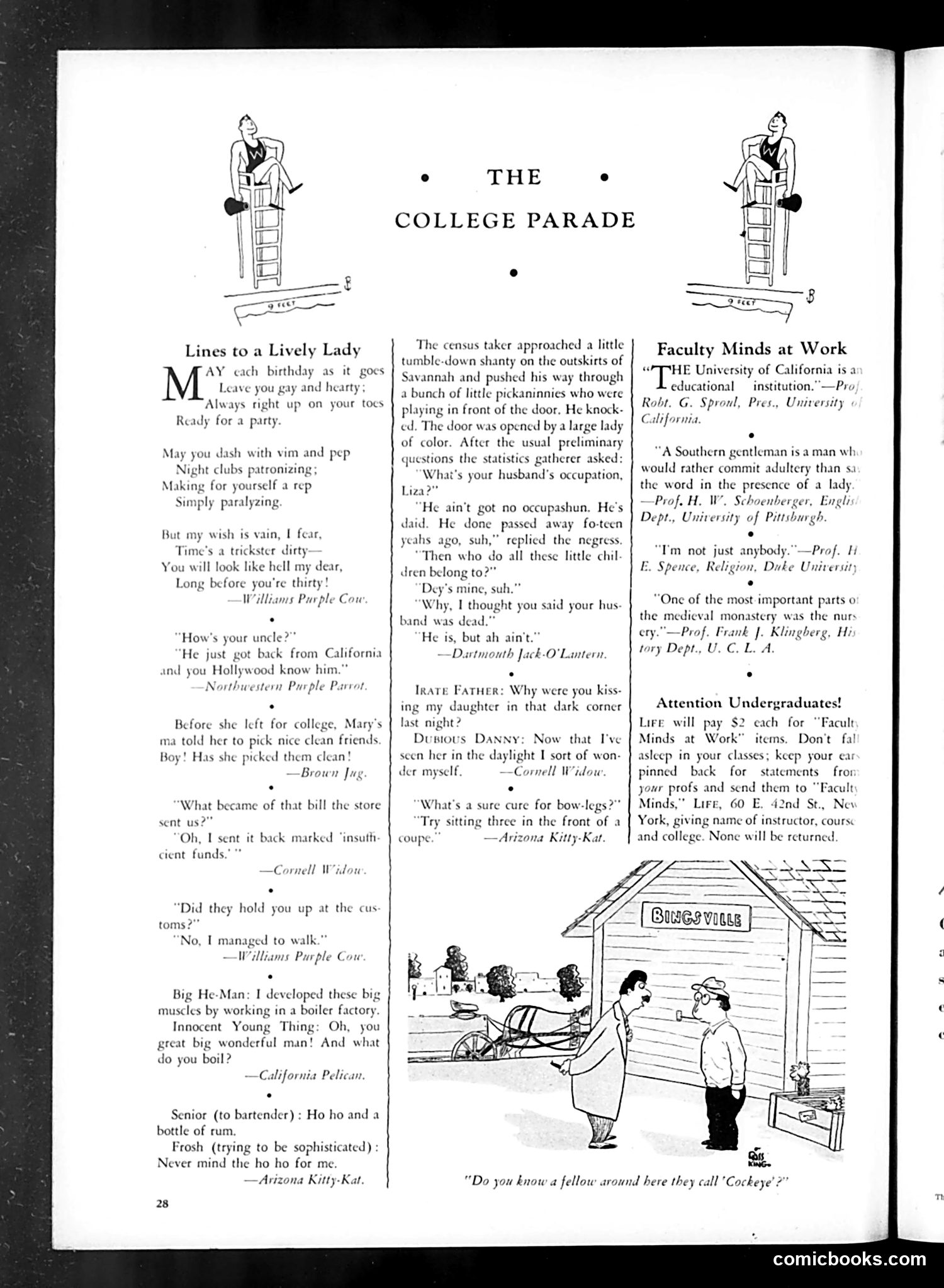
"The College Parade" - Life Magazine Satire Page This page collects humorous quotes and jokes from college publications, satirizing student life and academia in the early 20th century. Key sections: - "Lines to a Lively Lady": A poem mocking women's aging, suggesting they'll deteriorate by thirty—reflecting period attitudes toward women's value. - College jokes: Mostly crude humor about students, including a deeply racist "census taker" joke using offensive dialect and stereotypes common to the era. - "Faculty Minds at Work": Quotes from university professors presented as unintentionally absurd or pretentious—satire of academic pomposity. Features real professors credited by name and institution. - Bottom cartoon: Shows a man at a "Guessville" location asking about someone called "Cockeye"—likely simple visual humor about rural characters. The page satirizes both student immaturity and professorial self-importance. The casual inclusion of extremely racist content reflects the magazine's era, though such material would be completely unacceptable today.
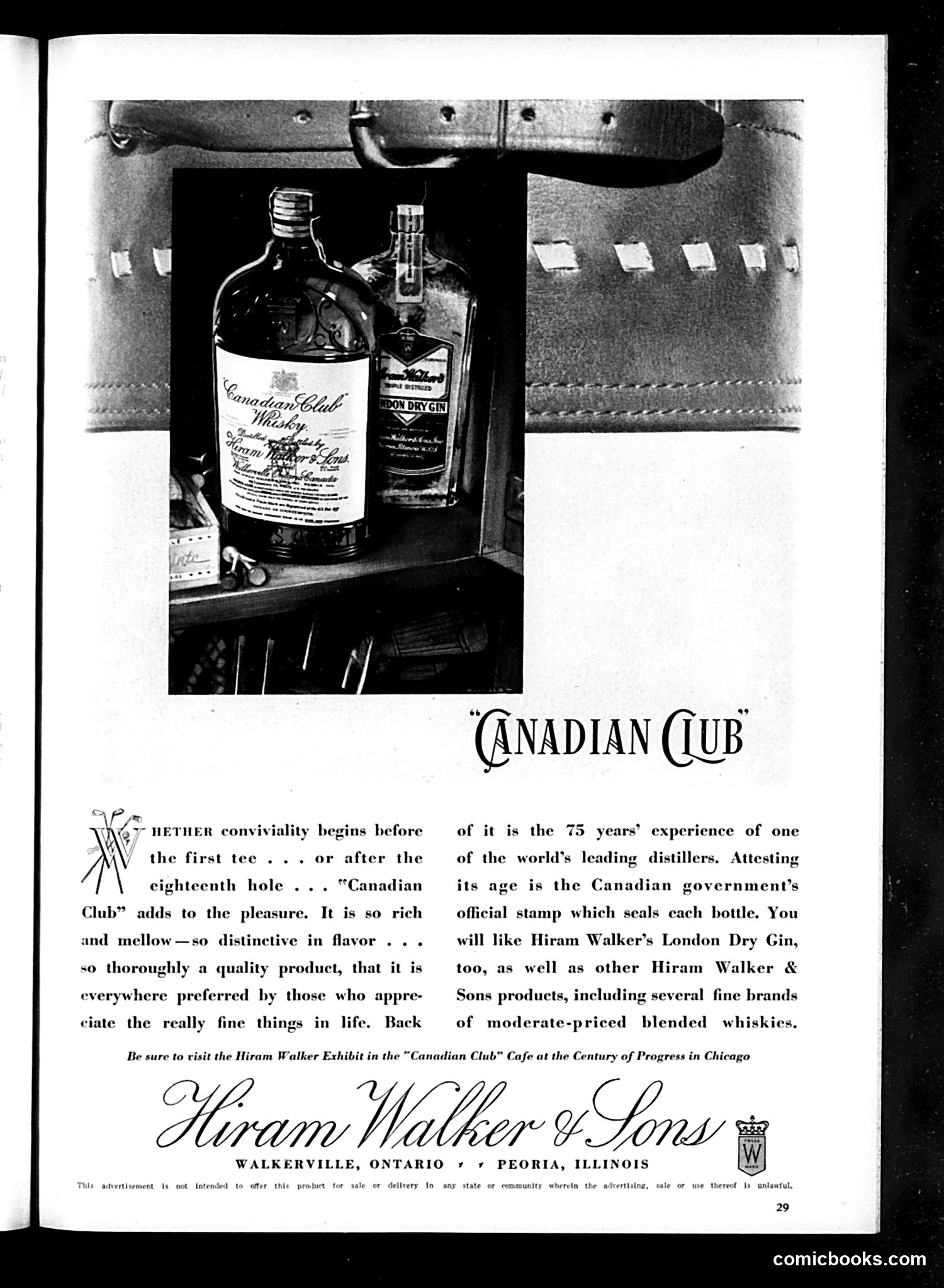
Analysis This is a liquor advertisement, not a cartoon or satire. It promotes Canadian Club whisky by Hiram Walker & Sons, a Canadian distiller. The ad uses a golf theme to associate the product with leisure and refinement—suggesting whisky enhances social pleasure "before the first tee or after the eighteenth hole." The image shows two bottles (Canadian Club whisky and London Dry Gin) displayed in what appears to be an elegant cabinet or bar. The advertisement emphasizes quality through age ("75 years' experience") and legitimacy (the "Canadian government's official stamp"). It targets affluent consumers who "appreciate the really fine things in life." Notably, the fine print at bottom reveals this ran during Prohibition in America—the disclaimer states the product is "not intended to offer this product for sale or delivery in any state or community wherein the advertising, sale or use thereof is unlawful," effectively acknowledging it cannot legally be sold in the U.S., despite advertising in an American magazine.
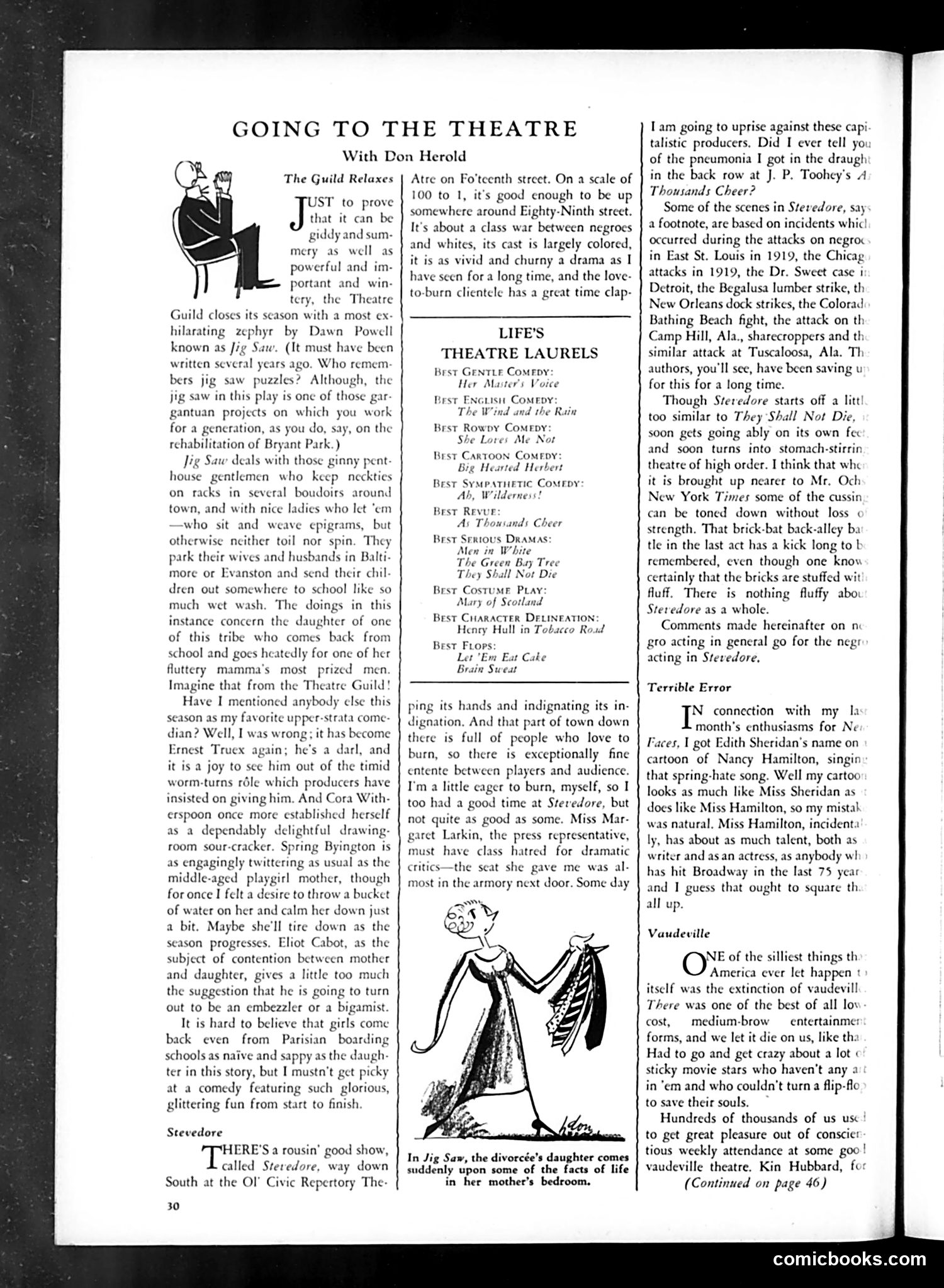
Theatre Review Analysis (Life Magazine) This page contains Don Herold's theatre column reviewing three Broadway productions. The cartoons illustrate plotlines rather than serve as political satire. Jig Saw (Theatre Guild): A comedy about wealthy Manhattan socialites—men who maintain multiple romantic interests across the city while parking spouses in provincial locations. Herold praises the cast (Ernest Truex, Cora Witherspoon) but finds the premise—a schoolgirl daughter pursuing her mother's lover—implausibly naive even for comedic purposes. Stevedore (Civic Repertory): A serious drama depicting class conflict between Black and white dock workers in the South. Herold considers it genuinely powerful, though he notes he received poor seating, joking that the press rep must resent theatre critics. The included cartoon shows a woman examining a dress or garment—illustrating the domestic/bedroom scene referenced in *Jig Saw*. The "Life's Theatre Laurels" sidebar lists award categories for various plays, revealing contemporary Broadway's range: *As Thousands Cheer* (revue), *Tobacco Road* (character work), *Men in White* (serious drama).
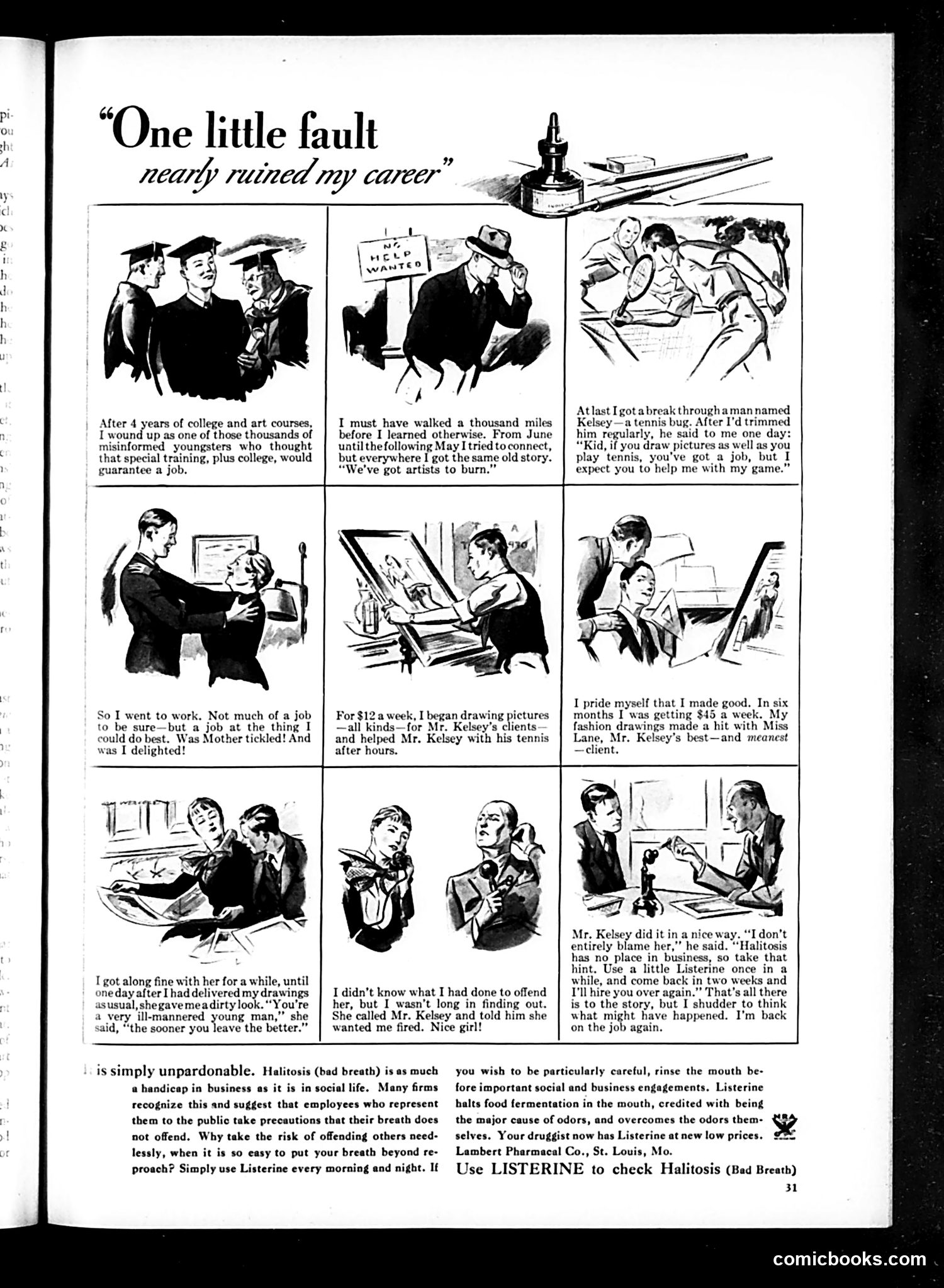
Analysis for Modern Readers This is a Listerine mouthwash advertisement disguised as a cautionary comic narrative. The "story" follows a young art-school graduate who lands a job through a tennis-playing businessman named Kelsey, but is mysteriously fired by Kelsey's demanding client, Miss Lane. The twist: Kelsey reveals the real problem isn't poor work—it's halitosis (bad breath). After the protagonist uses Listerine, he's rehired and succeeds. The satirical context: This exploits 1920s-30s anxieties about social embarrassment and professional failure. "Halitosis" was actually a marketing term *popularized by Listerine itself* to create demand for the product. The ad manufactures shame around a normal bodily condition to sell mouthwash. For modern readers: This is vintage fear-based advertising—using a relatable career disaster story to convince readers that a social/medical problem they may not have actually threatens their success. It's manipulative marketing dressed up as helpful life advice.
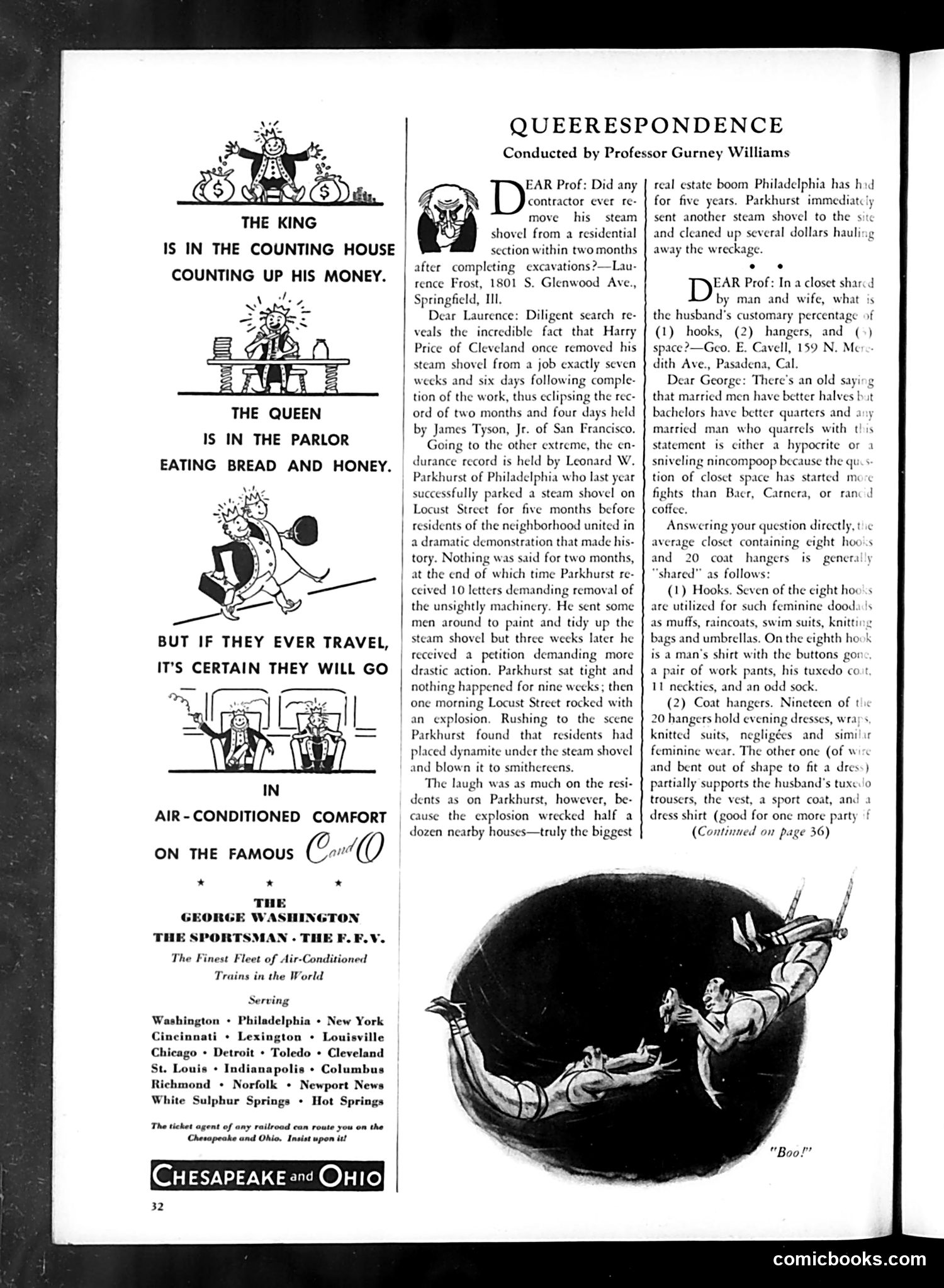
Explanation for Modern Readers This page mixes advertising with humorous advice columns. Left side: A Chesapeake and Ohio Railroad ad uses the nursery rhyme "The King is in the counting house, counting up his money / The Queen is in the parlor, eating bread and honey" to market air-conditioned train travel. The joke is that royalty (representing wealthy travelers) will definitely use their service if they travel. Right side: "Queerespondence" is a humor column answering reader questions. One anecdote satirizes Philadelphia construction delays—a contractor left a steam shovel on a residential street for five months despite complaints, until frustrated residents destroyed it with dynamite, ironically creating an accidental "real estate boom" by wrecking nearby houses. Another answer humorously describes how married couples share bedroom closet space: the wife uses nearly all hooks and hangers for her clothing, while the husband gets one overcrowded hook for everything. The satire targets 1920s-30s domestic gender dynamics and marital compromise.
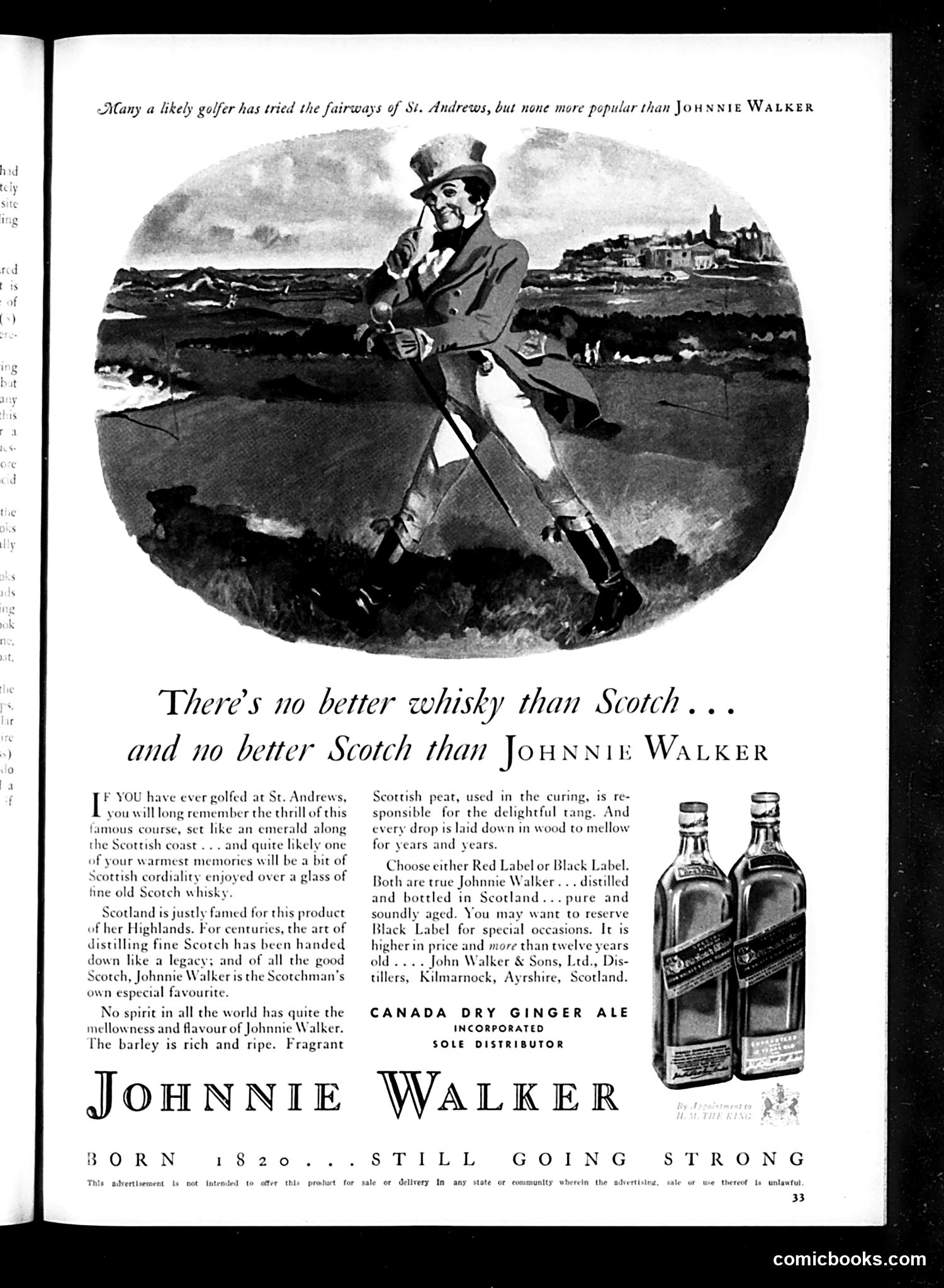
Johnnie Walker Whisky Advertisement This is a full-page advertisement, not satire or political commentary. It promotes Johnnie Walker Scotch whisky by leveraging the prestige of St. Andrews Golf Course in Scotland. The central image shows a well-dressed gentleman golfer at St. Andrews, using the famous golf course's reputation to suggest sophistication and desirability. The ad claims Johnnie Walker is "the Scotchman's own especial favourite," positioning the brand as authentically Scottish. Key selling points emphasized: Scottish peat adds flavor; whisky is aged in wood for years; available in Red Label and Black Label varieties (the latter "more than twelve years old" and pricier for "special occasions"). The tagline "Born 1820...Still Going Strong" stresses heritage and longevity. Canada Dry Ginger Ale is listed as the sole distributor. A legal disclaimer at bottom notes the ad complies with alcohol advertising restrictions of the era.
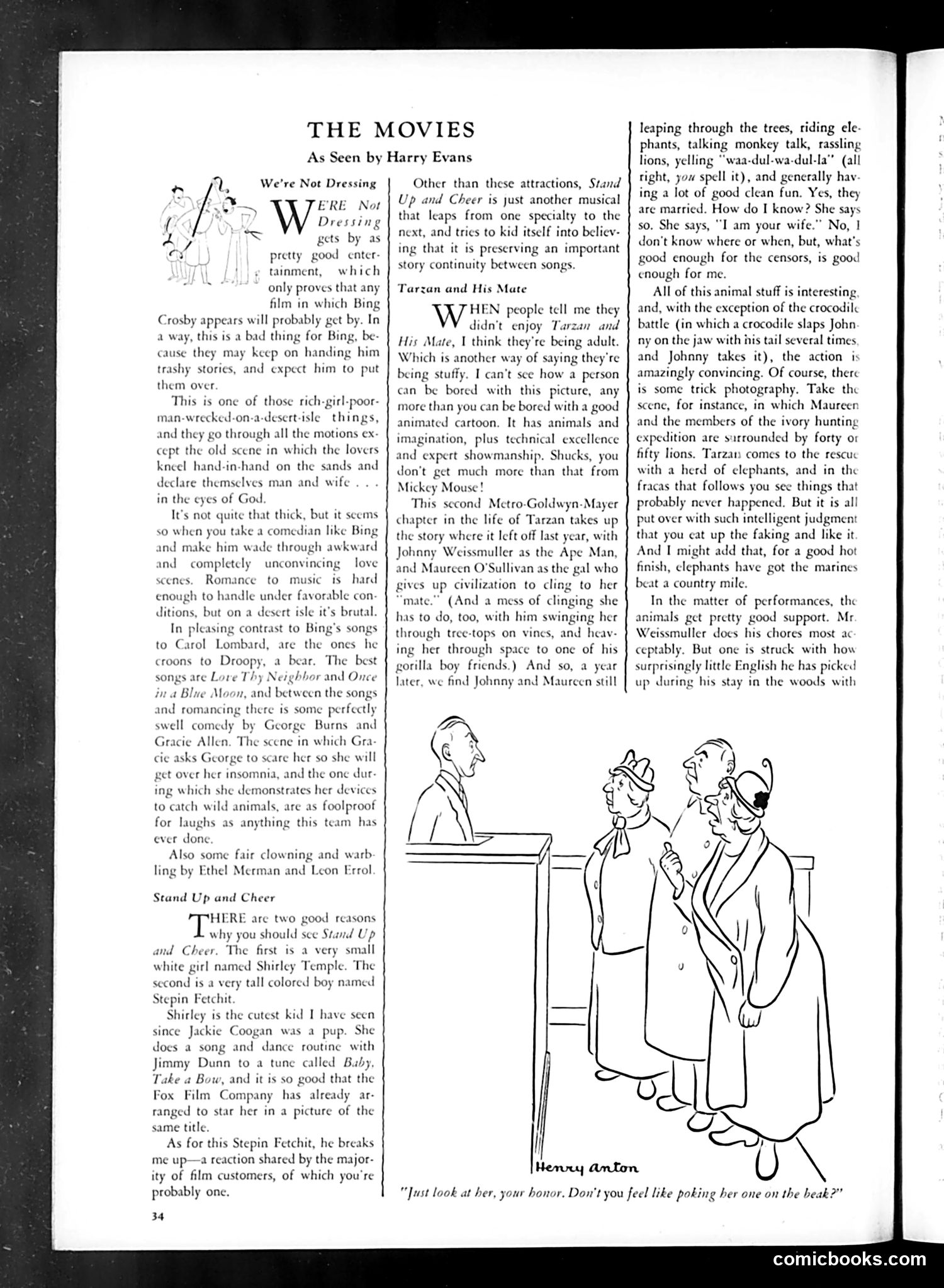
Analysis for Modern Readers This 1934 *Life* magazine movie review column by Harry Evans critiques three films with period-specific cultural attitudes. "We're Not Dressing": Evans criticizes a desert-island romance starring Bing Crosby as formulaic but notes Crosby's popularity carries weak material. He praises comedic relief from George Burns, Gracie Allen, Ethel Merman, and Leon Errol. "Stand Up and Cheer": Evans highlights child star Shirley Temple and "Stepin Fetchit" (a stage name for African-American performer Lincoln Perry). The casual, enthusiastic mention of Fetchit reflects the era's acceptance of racist minstrelsy entertainment—something modern readers would find deeply offensive. "Tarzan and His Mate": Evans reviews the Johnny Weissmuller/Maureen O'Sullivan sequel positively, comparing it favorably to animated cartoons for spectacle over plot substance. The cartoon (by Henry Anton) shows three men commenting on a woman's appearance in crude terms—typical of 1930s magazine humor reflecting then-acceptable sexism.
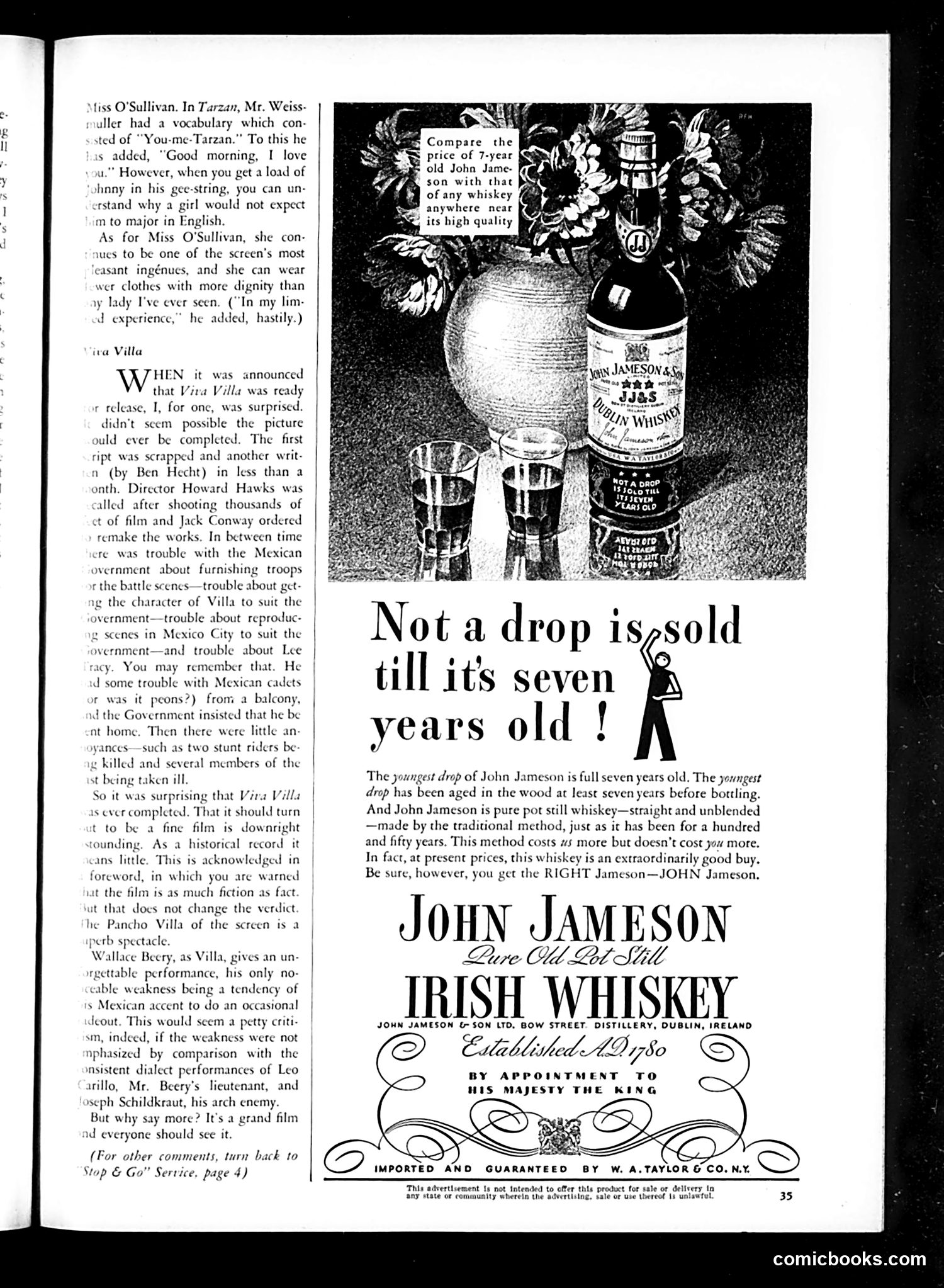
Page Analysis: Life Magazine Film Review & Whiskey Advertisement This page combines film criticism with a full-page whiskey advertisement. The editorial content reviews two films: *Tarzan* (starring Johnny Weissmuller and Maureen O'Sullivan) and *Viva Villa* (starring Wallace Beery). The Tarzan critique uses gentle satire, joking that Weissmuller's limited vocabulary ("You-me-Tarzan") makes his romantic scenes awkward, while praising O'Sullivan's elegance. The *Viva Villa* review describes the film's troubled production—script rewrites, Mexican government disputes over depicting Pancho Villa, and stunt deaths—yet concludes it's surprisingly worthwhile as spectacle. The advertisement dominates the lower half: John Jameson Irish Whiskey emphasizes its seven-year minimum aging process as justification for its premium price. The "By Appointment to His Majesty the King" designation signals luxury and tradition. The ad claims superior value despite cost, targeting affluent readers during what appears to be the Prohibition era's end (the disclaimer suggests varying state legality).
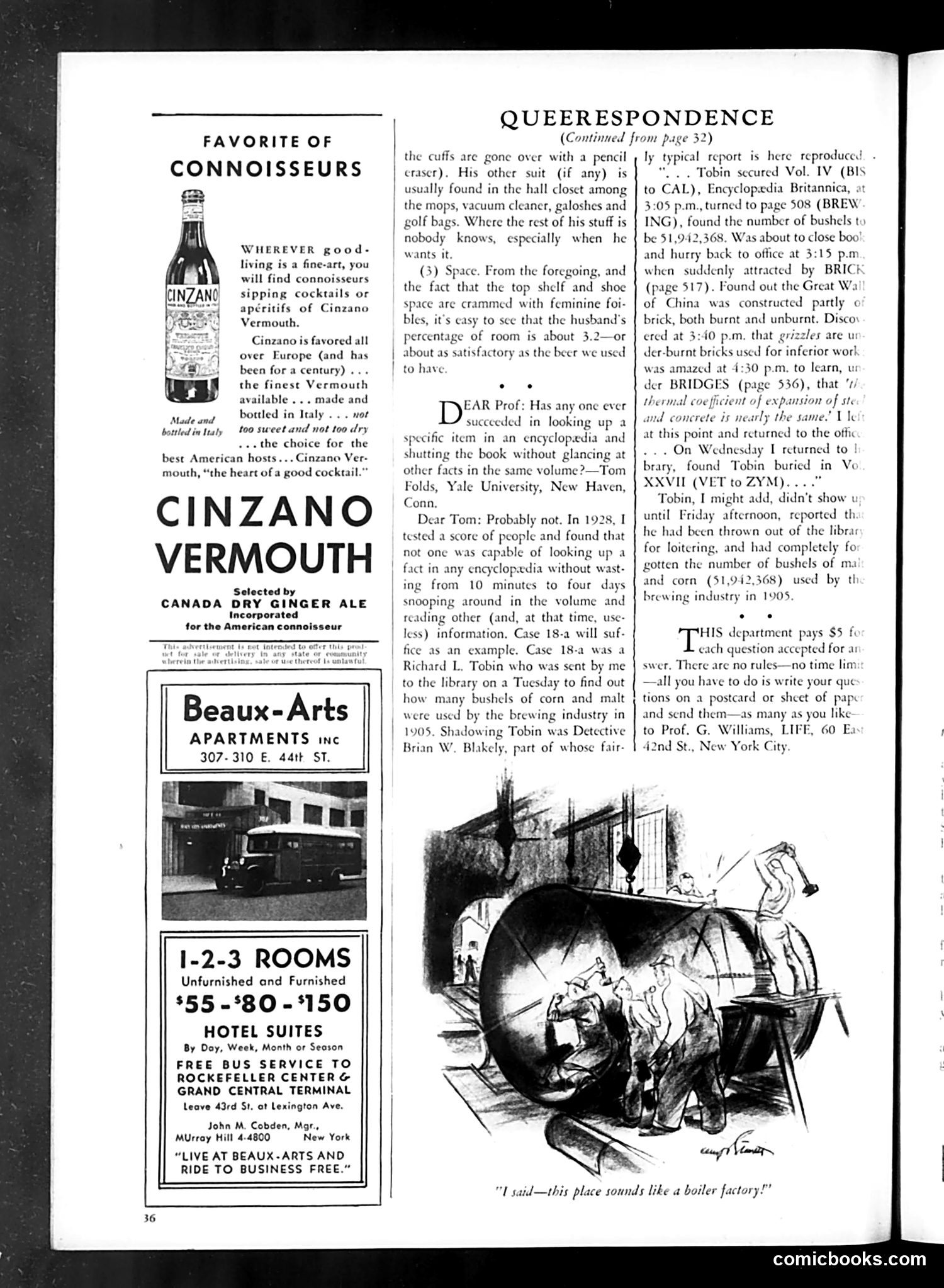
Life Magazine Page Analysis This page combines advertisements with a humor column called "Queerespondence." The Main Cartoon: Shows a couple touring what appears to be an industrial or mechanical space. The wife comments, "I said—this place sounds like a boiler factory!"—a joke about the husband mishearing or misunderstanding where they're going, likely confusing it with an actual factory rather than the intended destination (possibly a restaurant or entertainment venue). The Column Content: Features humorous reader questions and responses. One notable item describes a 1928 experiment where a man (Richard L. Tobin) was sent to a library to look up a specific fact about the brewing industry but got hopelessly distracted reading encyclopedia entries about unrelated topics (the Great Wall of China, brick types, thermal expansion). He returned three days later having forgotten the original answer—satirizing human curiosity and distraction. Context: The page is primarily advertisements (Cinzano Vermouth, Beaux-Arts Apartments) with humor content. The satire reflects 1920s-30s sensibilities about leisure, domestic life, and intellectual habits.
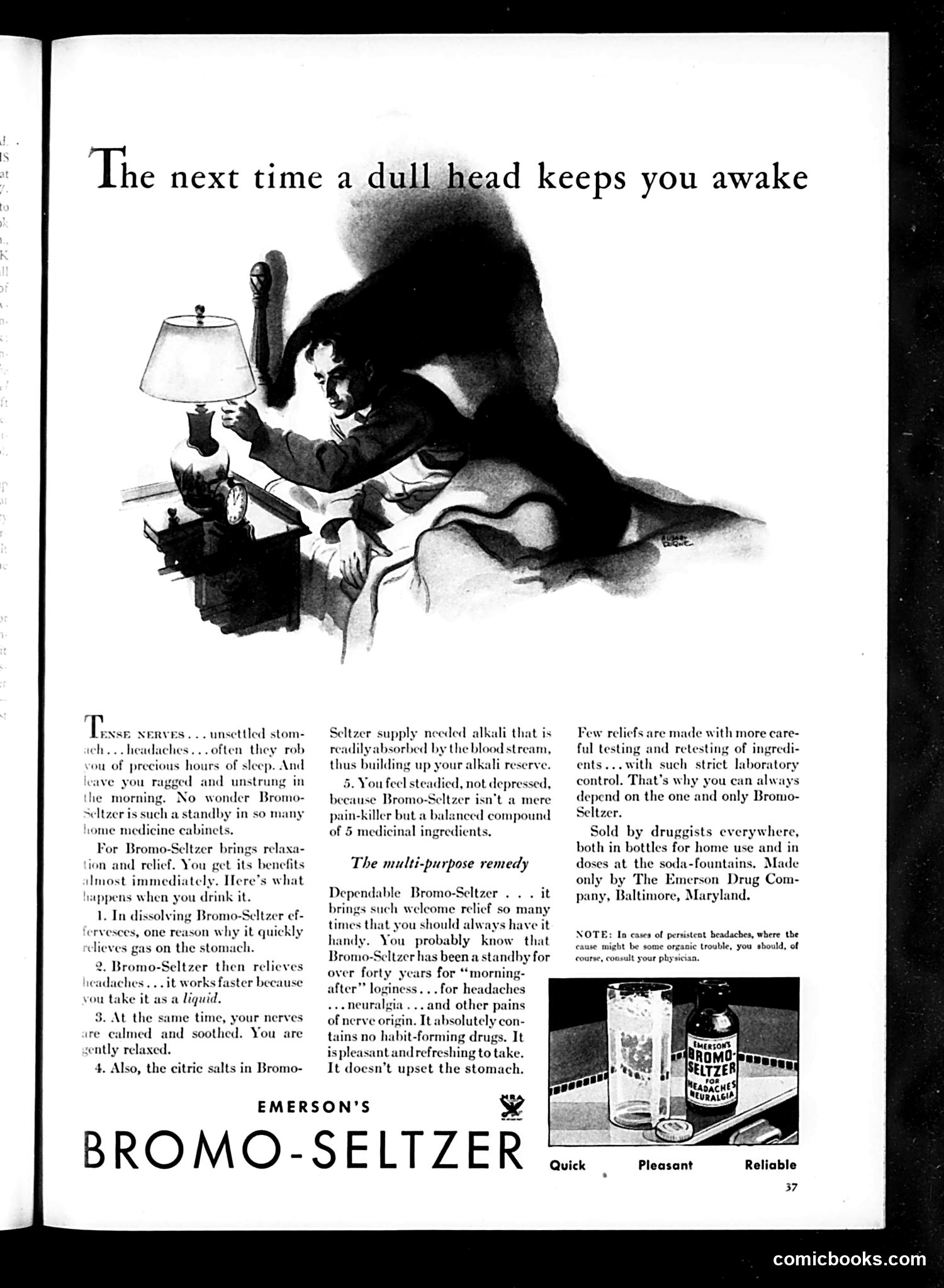
Bromo-Seltzer Advertisement Analysis This is a full-page advertisement, not satire or political commentary. It promotes Bromo-Seltzer, an over-the-counter digestive remedy made by The Emerson Drug Company (Baltimore). The illustration depicts a person in bed at night, troubled by insomnia and stomach distress, with an oversized dark silhouette of their distressed thoughts looming above. The headline "The next time a dull head keeps you awake" addresses common complaints: nervous tension, headaches, indigestion, and sleep loss. The ad lists five benefits of the fizzy antacid: it relieves gas, works quickly as a liquid, calms nerves, provides alkali salts, and contains "no habit-forming drugs"—a selling point suggesting competitors may have contained addictive substances (common in early 20th-century patent medicines). The product appears in the lower right photograph, marketed as "Quick, Pleasant, Reliable."
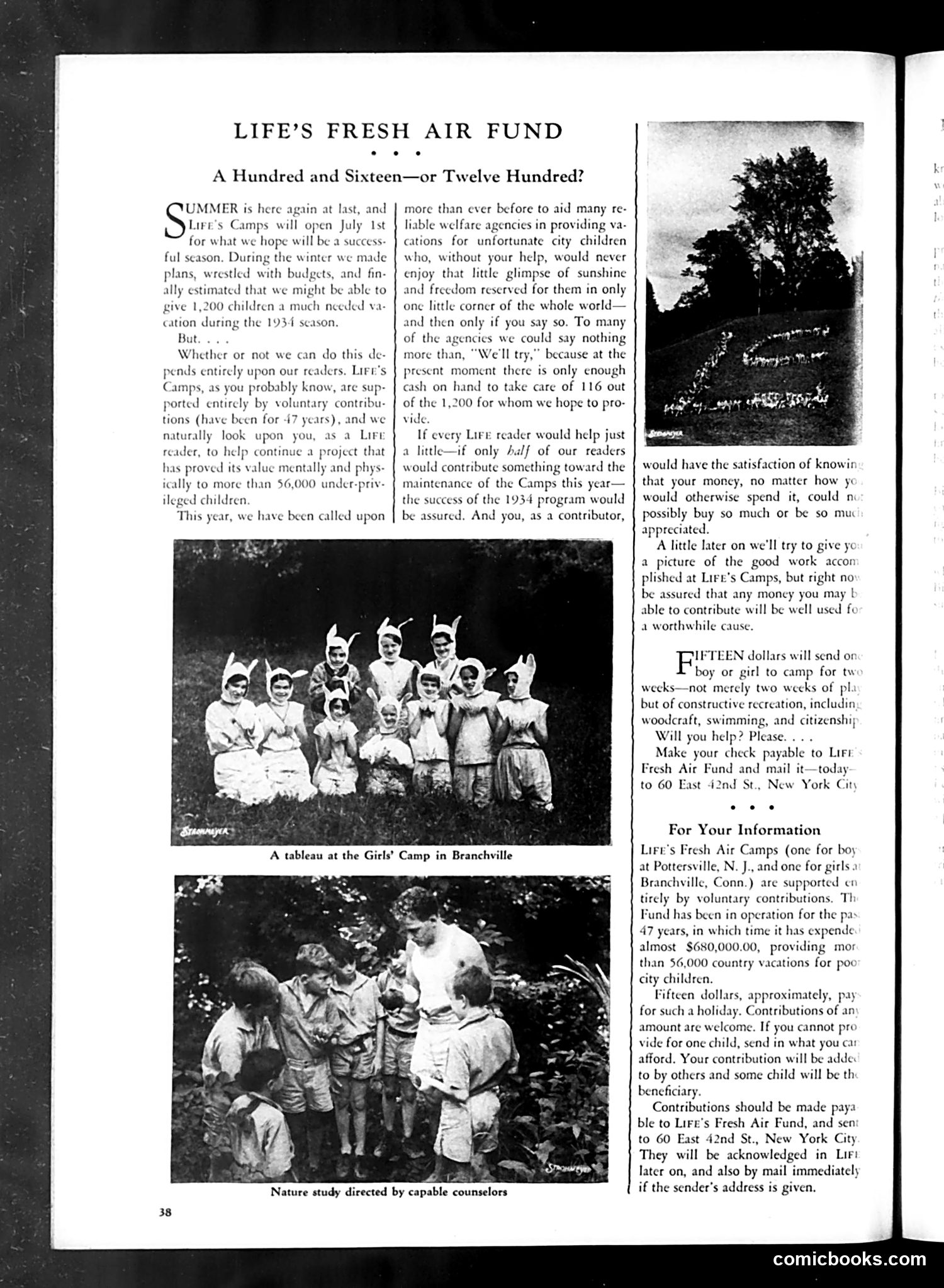
Life's Fresh Air Fund Appeal (1934) This is a fundraising appeal, not a political cartoon. Life magazine solicits donations for its Fresh Air Fund—a charitable program providing summer camp vacations for poor urban children. The appeal presents a stark financial crisis: the fund can currently afford to send only 116 of 1,200 needy children to camp. Two photographs show children at the camps engaged in wholesome activities (tableau at Girls' Camp, nature study). The text urges readers to contribute $15 per child, emphasizing the program's 47-year history and its documented value to over 56,000 underprivileged children. This reflects Depression-era charitable work: voluntary organizations stepped in where government assistance was minimal. The appeal's language—"unfortunate city children," "under-privileged"—reflects period attitudes toward urban poverty. The campaign relies entirely on middle-class reader generosity to bridge the funding gap, a common philanthropic strategy of the 1930s.
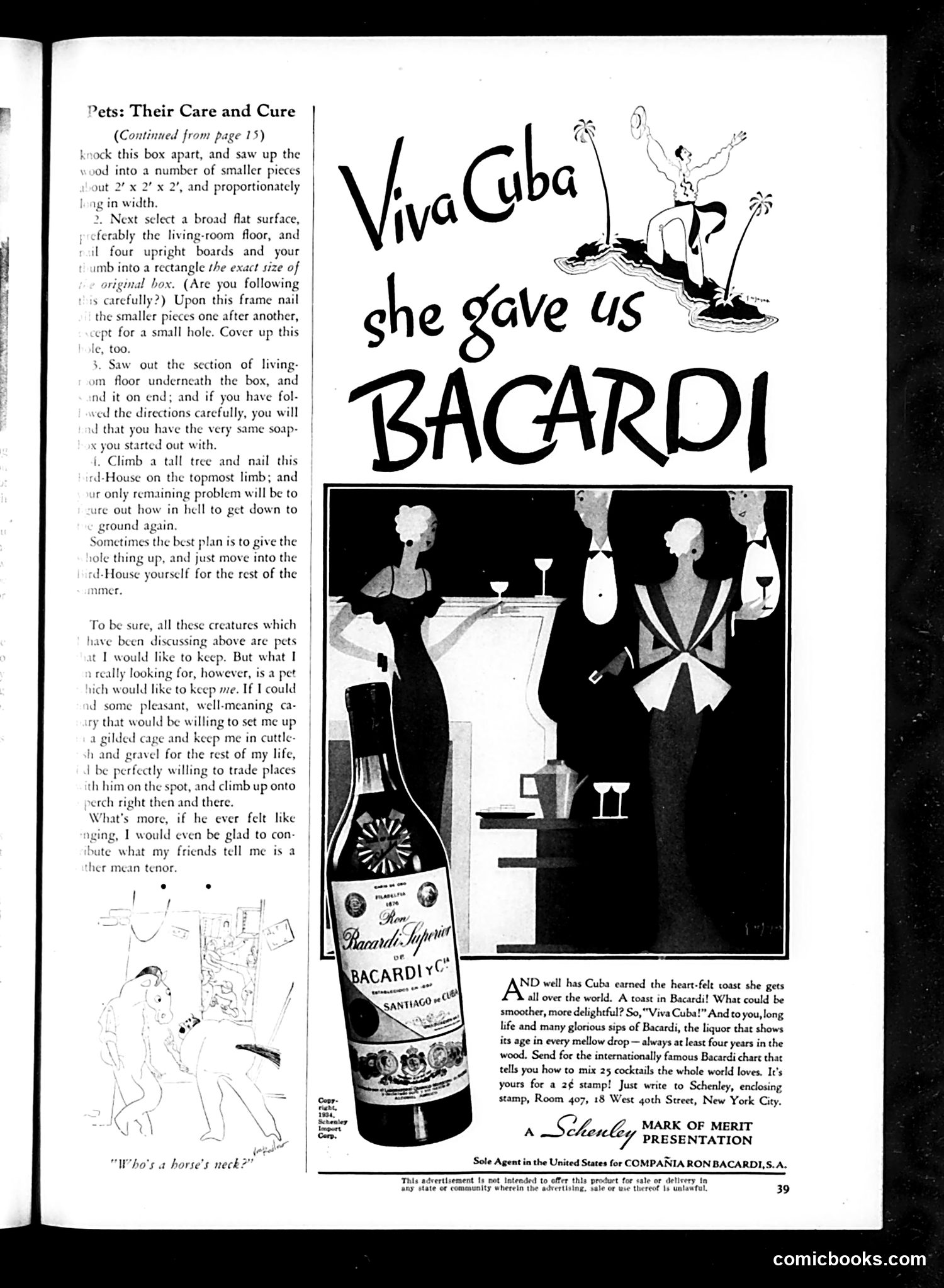
Analysis This page combines a humorous article about pet care with a Bacardi rum advertisement. The advertisement is the dominant visual element. The ad depicts an elegant Cuban social scene — well-dressed men and women at what appears to be a sophisticated cocktail party, with a prominent Bacardi bottle. The headline "Viva Cuba / she gave us BACARDI" celebrates Cuba as the origin of the rum. Historical context for modern readers: This advertisement assumes positive associations with Cuba and portrays it as a sophisticated, desirable source of luxury goods. The ad predates the 1959 Cuban Revolution; it reflects the pre-revolution era when Cuba was marketed to American consumers as an exotic, glamorous destination associated with leisure and elegance. The "Mark of Merit" branding suggests quality certification. The cartoon's placement alongside an article about keeping pets in boxes appears coincidental — the page layout simply combines unrelated editorial and advertising content, typical of mid-20th-century magazine design. The small cartoon at bottom-left ("Who's a horse's neck?") is separate satirical filler.
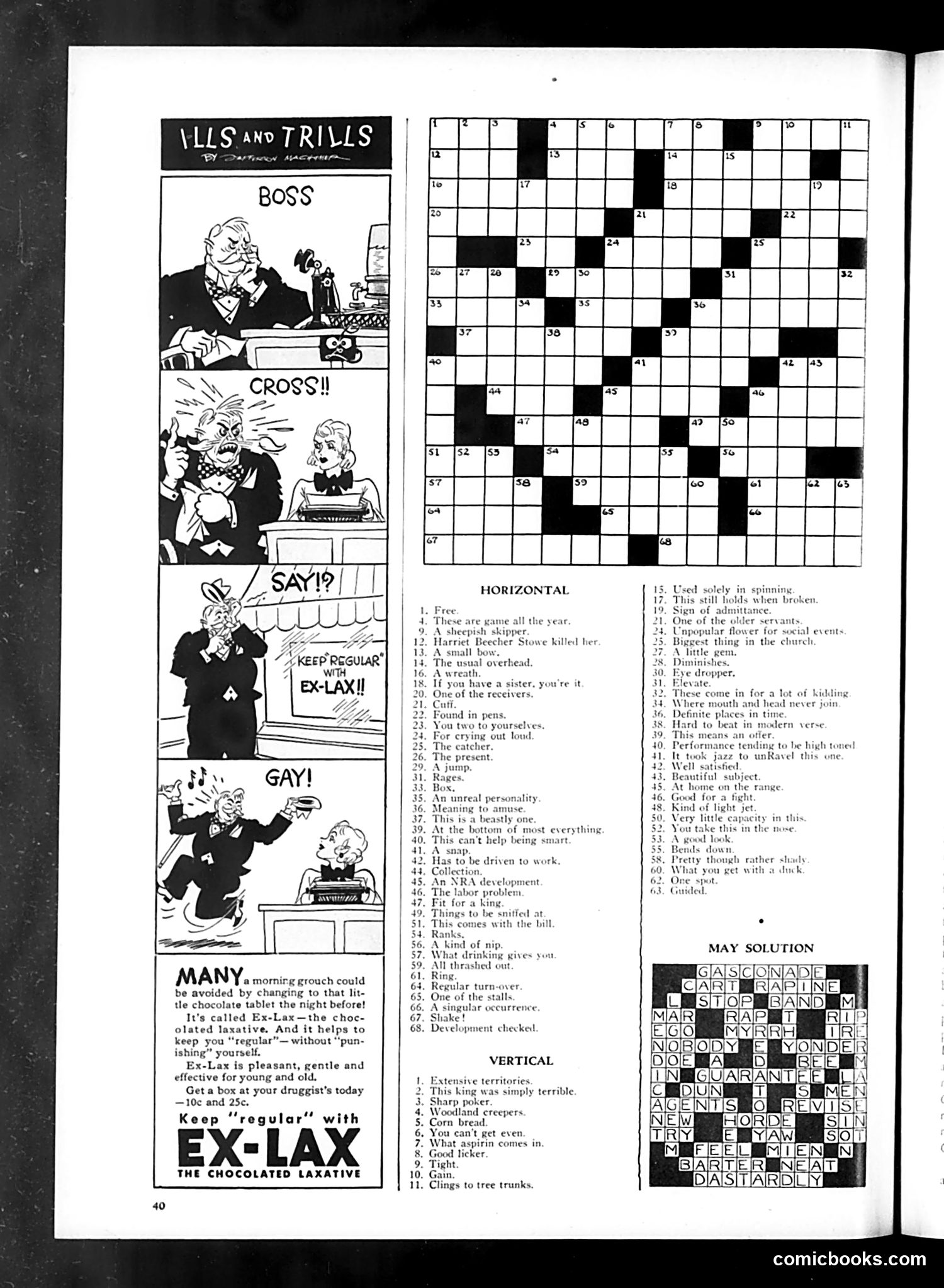
Analysis of This Life Magazine Page This page combines a crossword puzzle with a satirical cartoon advertisement for Ex-Lax, a chocolated laxative. The cartoon features an exasperated man at his desk labeled "BOSS," shown in four escalating panels: first calm ("BOSS"), then agitated ("CROSS!!"), then yelling ("SAY!?"), and finally frantic ("GAY!"). A woman (likely his secretary) watches his deteriorating mood. The accompanying text explains that a "morning grouch" can be prevented by taking Ex-Lax the night before—the implication being that constipation caused his bad temper. The satire mocks both the product's absurd health claims (attributing mood problems to bowel regularity) and advertising's willingness to medicalize everyday irritability. The joke relies on the then-acceptable bathroom humor in mainstream magazines. The crossword puzzle is unrelated editorial content typical of Life's format during this era.
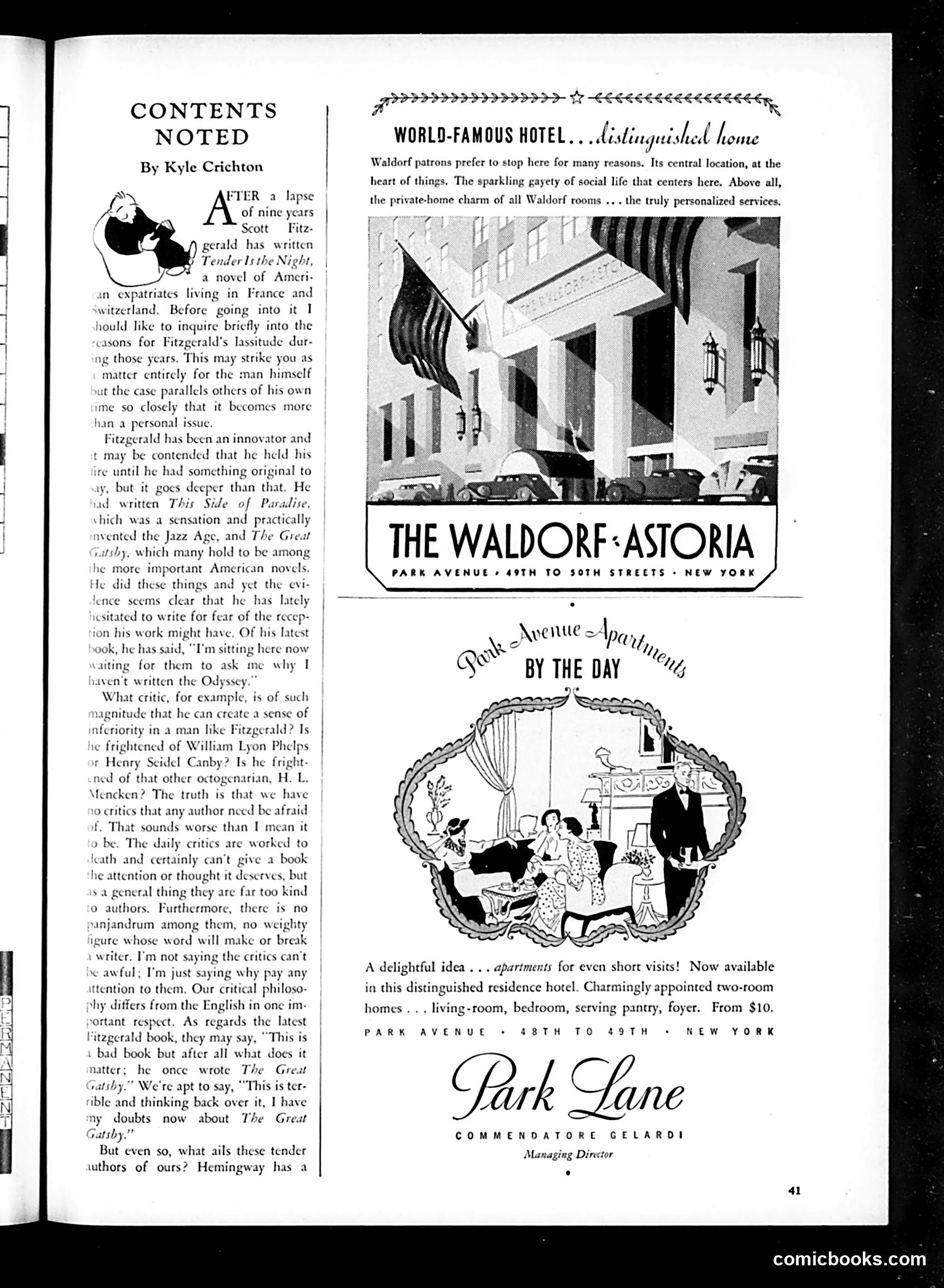
Page Analysis: Life Magazine Content Notes This page is primarily literary criticism and advertising, not political satire. The left column contains Kyle Crichton's essay on F. Scott Fitzgerald, discussing why the celebrated author (who wrote *This Side of Paradise* and *The Great Gatsby*) hasn't published in nine years. Crichton argues Fitzgerald shouldn't fear critical reception, claiming American critics—unlike English ones—are too lenient and lack unified authority figures like William Lyon Phelps or H.L. Mencken who could "make or break" a writer. The right side features two hotel advertisements: the Waldorf-Astoria and Park Lane, both luxury Manhattan residences. These ads emphasize upscale amenities and social prestige typical of 1930s-era luxury marketing. There is no political cartoon or satire on this page—it's a mixture of literary commentary and commercial advertising aimed at affluent readers.
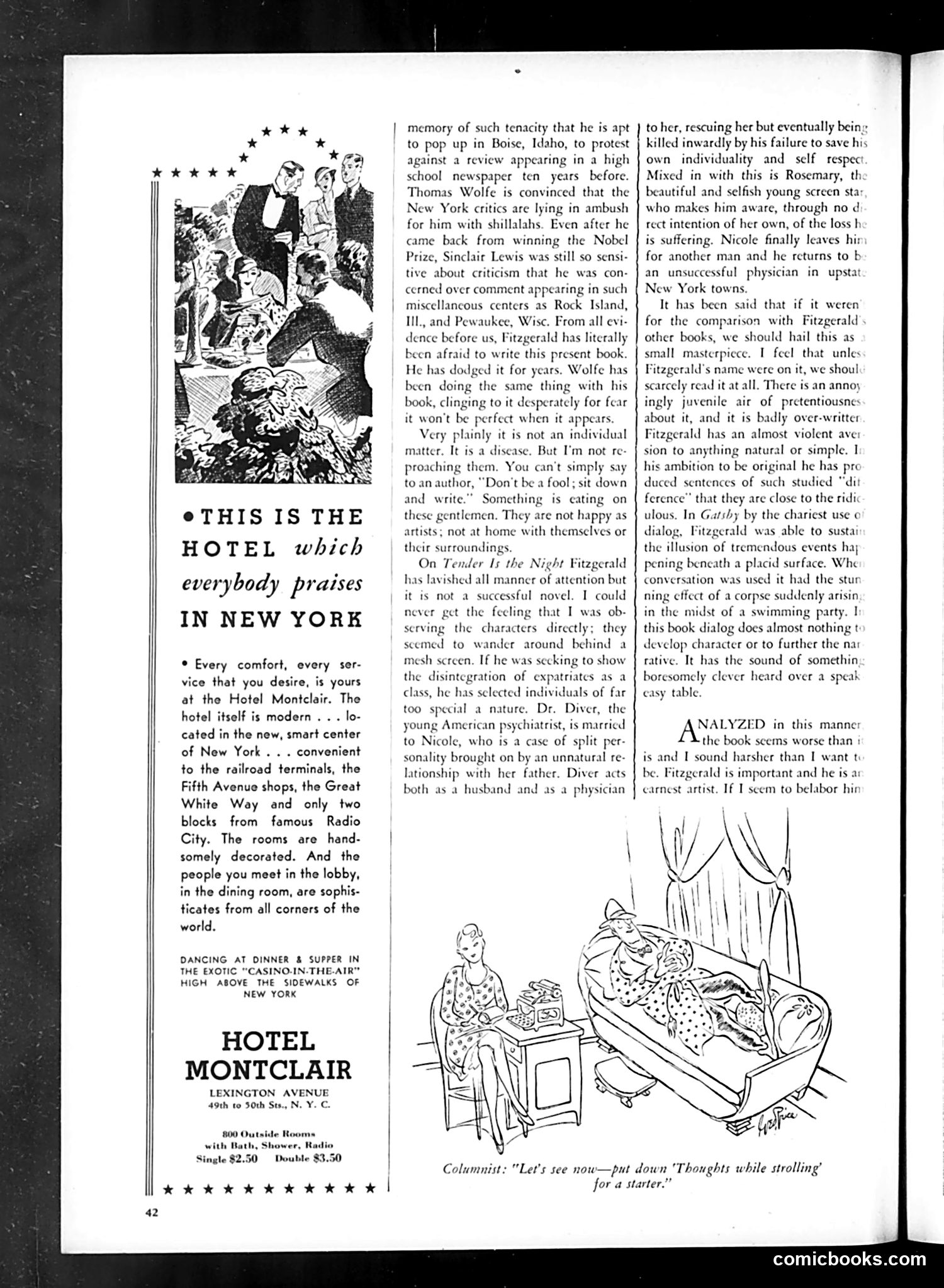
Analysis of This Magazine Page This page combines hotel advertising (left side) with a literary book review (right side). The review critiques F. Scott Fitzgerald's novel *Tender Is the Night*, comparing it unfavorably to his earlier work *The Great Gatsby*. The reviewer argues that Fitzgerald—along with contemporaries Thomas Wolfe and Sinclair Lewis—suffers from acute sensitivity to criticism, causing creative paralysis. The piece attacks the novel's execution: characters feel distant ("behind a mesh screen"), the plot involving a psychiatrist husband married to a woman with personality disorder stemming from paternal abuse is seen as artificially "special," and the prose is over-elaborate and pretentious. The reviewer suggests the book only receives attention because Fitzgerald's name is attached; without it, readers would dismiss it. The implicit point: great artists shouldn't let critics' potential judgment prevent them from writing authentically and simply. Fitzgerald's anxiety about perfection has produced an overwrought failure. The hotel ad at left is unrelated commercial content typical of *Life* magazine's revenue model.
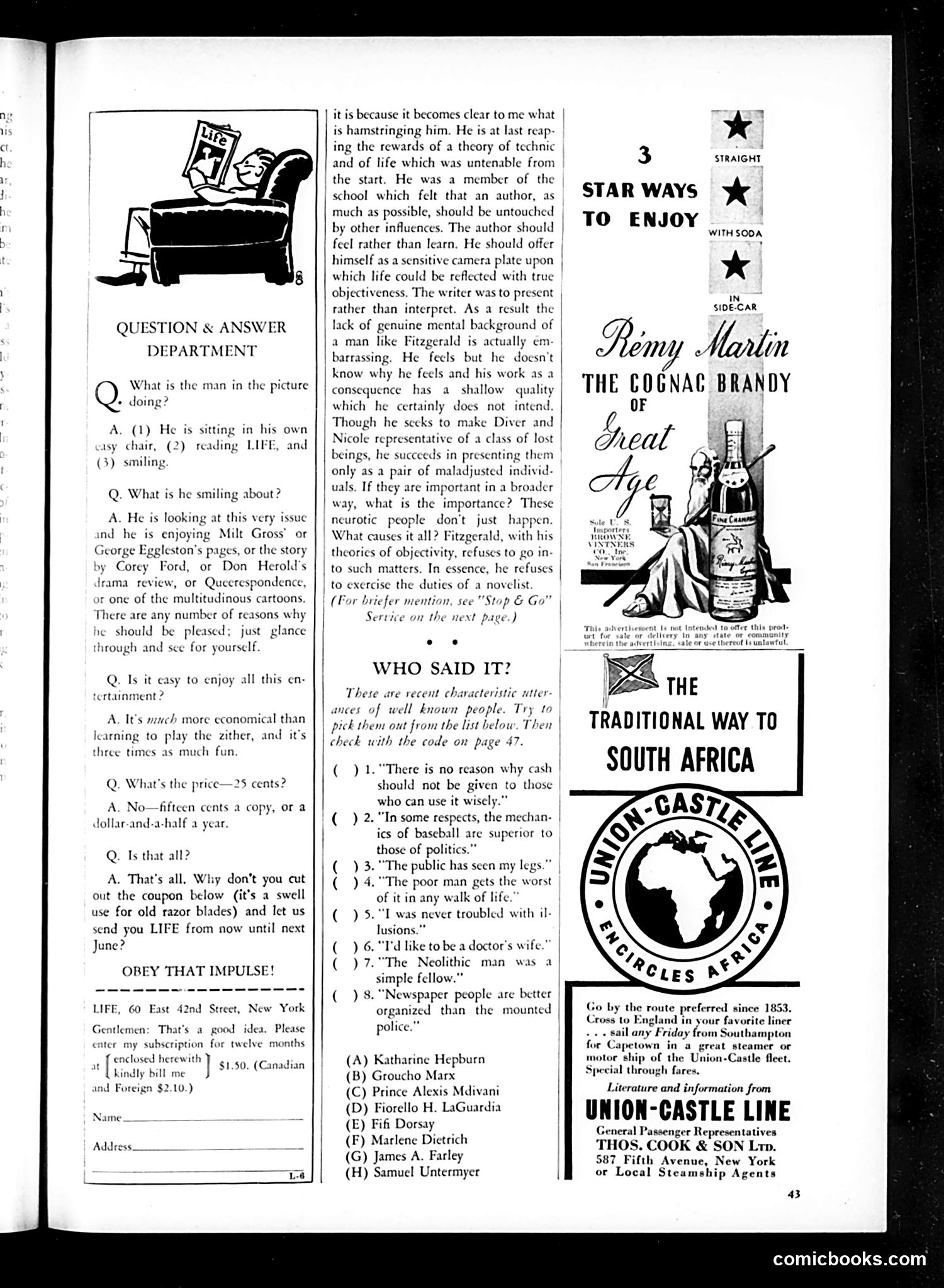
Life Magazine Page Analysis This page is primarily promotional and entertainment content rather than political satire. The main cartoon shows a man reading *Life* magazine in an armchair, smiling. The accompanying Q&A humorously sells the magazine's value: it's cheaper than learning zither, costs 15 cents (or $1.50/year), and contains diverse entertainment—cartoons, stories by writers like Corey Ford and Don Herold, and humor pieces. Below is a "Who Said It?" game where readers match celebrity quotes to famous figures like Katharine Hepburn, Groucho Marx, and Marlene Dietrich—a popular 1930s parlor game format. The page also contains advertisements: Remy Martin brandy and Union-Castle shipping line to South Africa. The Fitzgerald text discusses his literary technique, critiquing his lack of intellectual depth—unrelated to the page's entertainment focus. This appears to be magazine content continuing from another page.
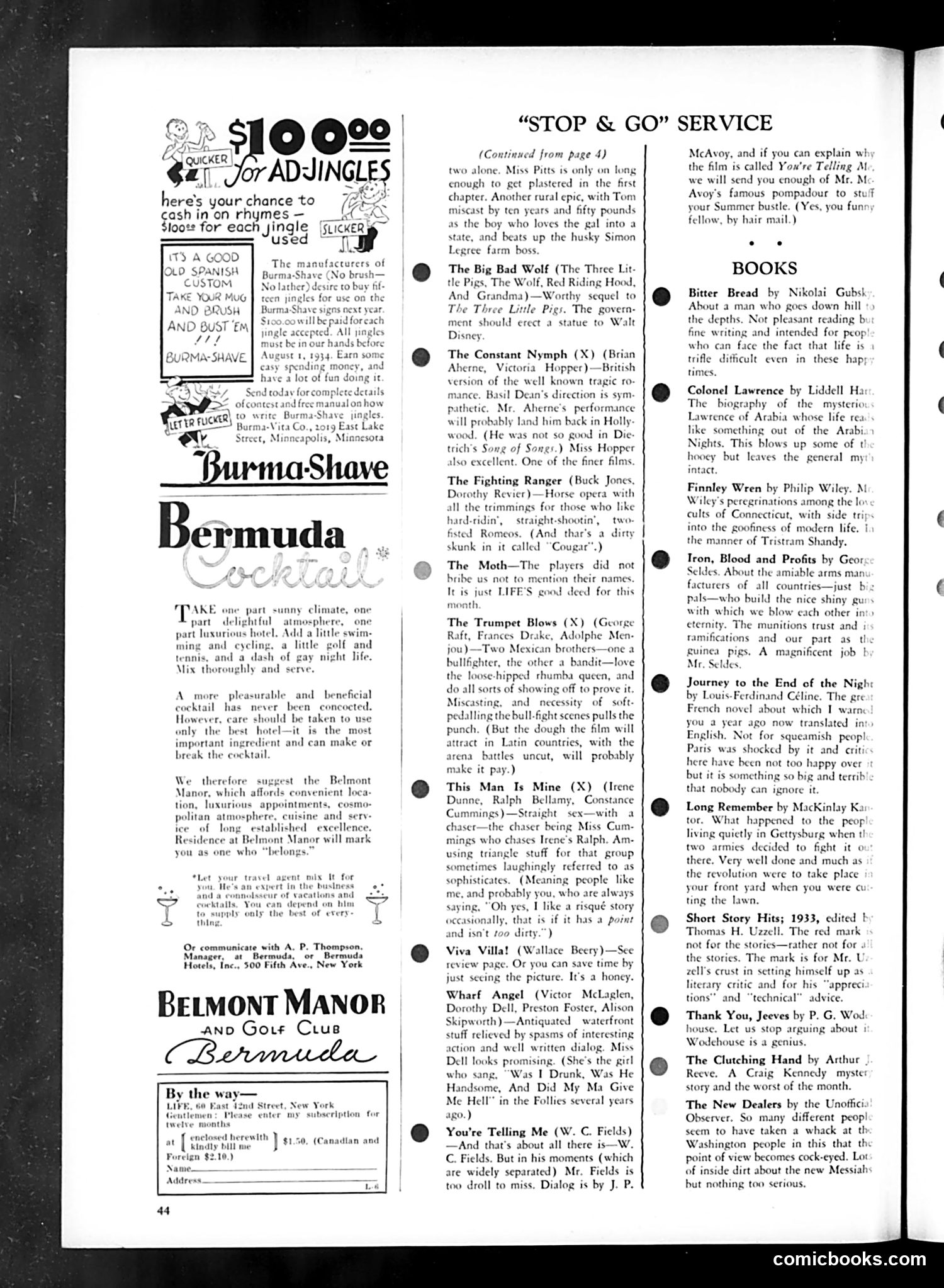
Page Analysis: Life Magazine Advertisement and Film Reviews This page combines advertising with entertainment content typical of 1930s Life magazine. The left side features Burma-Shave ads—a shaving cream brand famous for roadside billboard campaigns. The "$100 for Adjingles" contest invites readers to submit rhyming advertising copy for payment, a common marketing tactic of the era. Below is a Belmont Manor resort advertisement promoting Bermuda as a vacation destination, emphasizing luxury hotel amenities and cocktails—appealing to affluent readers during the Depression. The right column contains film reviews ("Stop & Go Service"), critiquing recent Hollywood releases. The reviews are characteristically irreverent and punchy—typical of Life's satirical voice. Notable: reviews mock weak casting choices, plot implausibilities, and studio star-power logic, while praising W.C. Fields and Walt Disney. The "(X)" notation likely indicates films recommended for mature audiences. This reflects early 1930s cinema criticism's candid, sometimes caustic approach to studio productions.
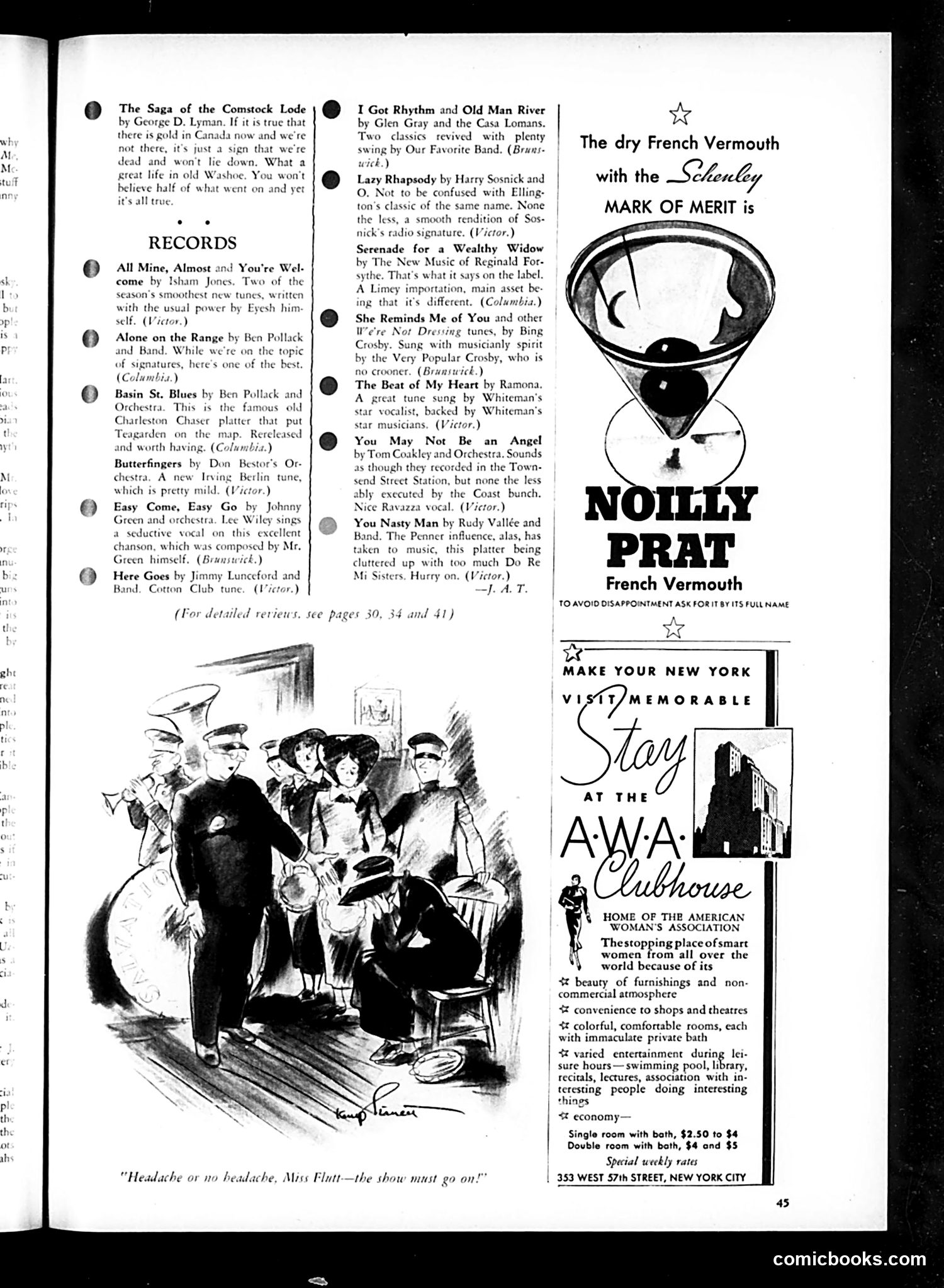
Content Analysis This is primarily a records review section with advertisements, not a political cartoon page. The main cartoon shows a theatrical scene: performers on stage with musicians, depicting the caption "Headache or no headache, Miss Flutt—the show must go on!" This is a show-business joke about theatrical professionals persisting despite personal discomfort—a common entertainment idiom of the era. The page consists mostly of record reviews (likely 1930s) discussing popular music recordings by artists like Bing Crosby, Rudy Vallée, and orchestras. The reviews use period slang ("seductive vocal," "no crooner") and note recording labels (Victor, Columbia, Brunswick). Advertisements include Noilly Prat French Vermouth and the AWA Clubhouse in New York City, a women's residential hotel marketed with typical 1930s amenities (swimming pool, library, theater proximity) at modest rates ($2.50-$5 per night). The page reflects entertainment and consumer culture of the 1930s but contains no political satire or caricature requiring historical context.
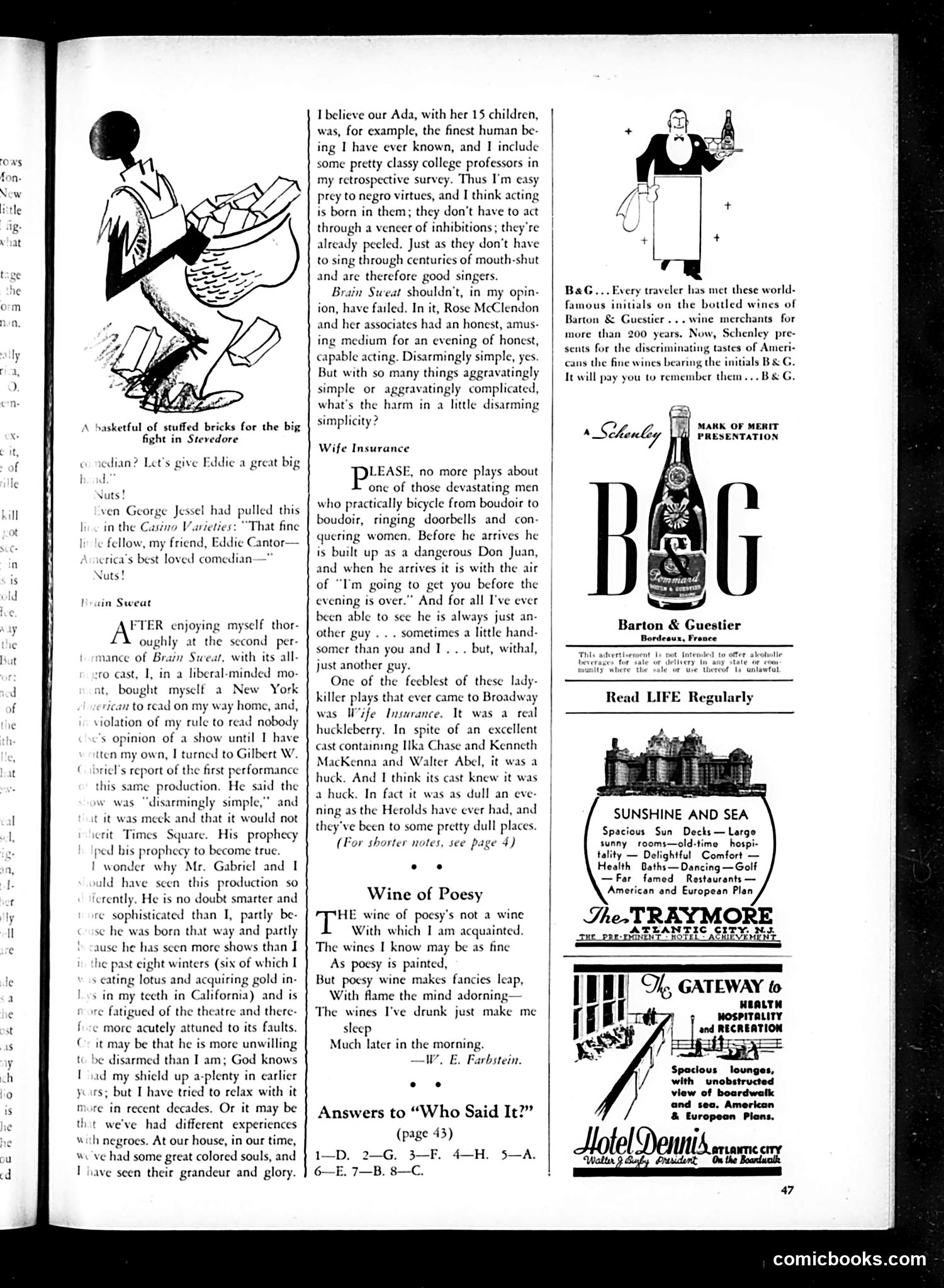
Political/Social Content Analysis This Life magazine page (page 47) contains theater reviews and advertisements rather than political cartoons. The main content critiques Broadway plays: "Brain Sweat" review discusses a play featuring Black actress Rose McClendon. The reviewer expresses progressive (for the era) views, praising African American performers' natural acting ability and referencing "our Ada," an enslaved woman from his past whom he describes as "the finest human being I have ever known." This reflects early-20th-century paternalistic racial attitudes—expressing admiration for Black people while maintaining hierarchical assumptions. "Wife Insurance" mocks a tired Broadway trope: plays about seductive "Don Juan" characters who seduce women. The reviewer dismisses such male conquests as unrealistic fantasy. The cartoonish illustration shows a figure carrying baskets, likely representing working-class labor or domestic service—possibly relevant to the racial themes in the adjacent review. The remainder features advertisements for alcohol (B&G wine, hotels) and travel, typical of Life's commercial content.
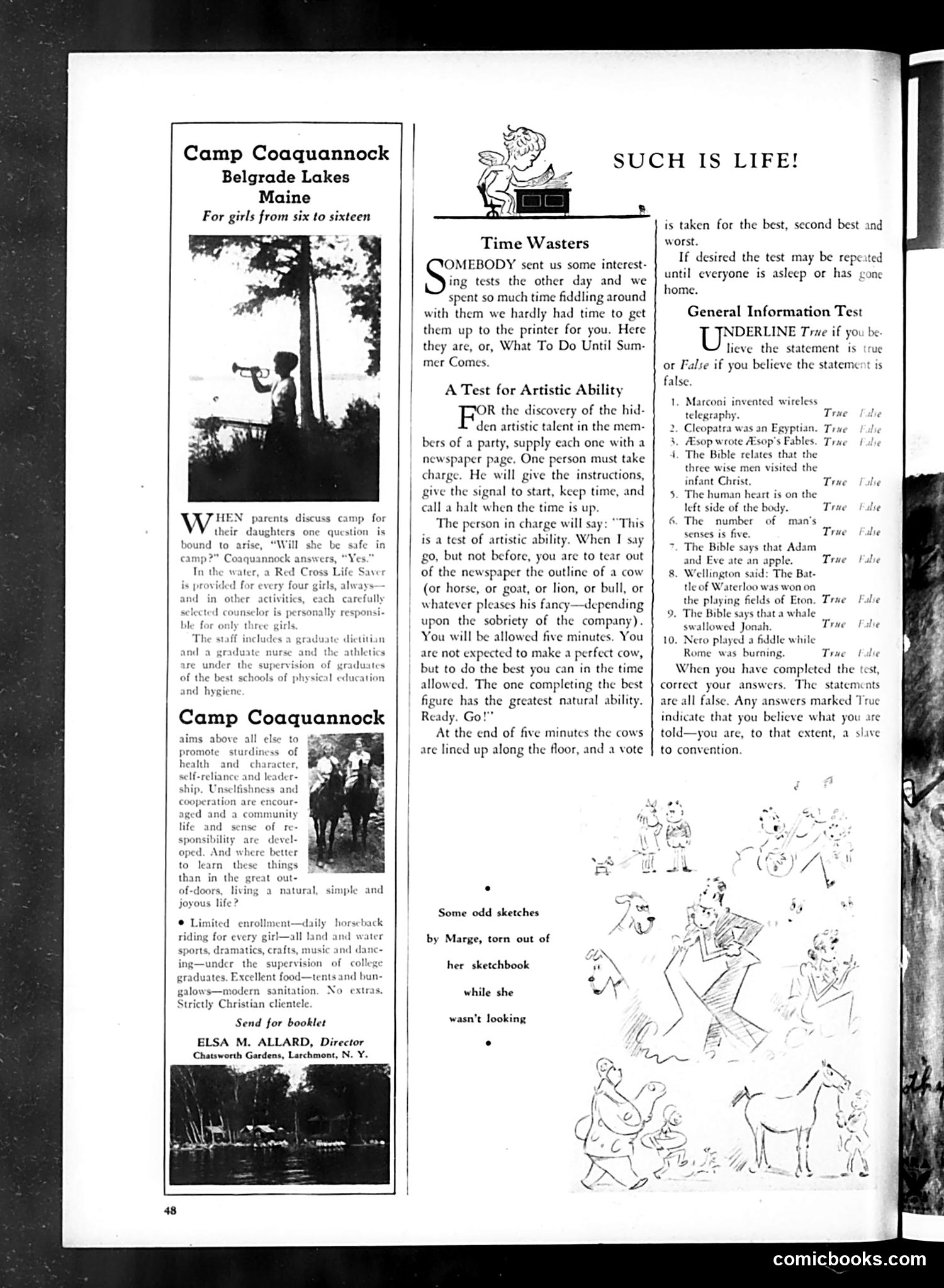
Content Analysis This page contains camp advertising and party games, not political satire. The left side advertises Camp Coaquannock, a girls' summer camp in Maine emphasizing outdoor activities, Christian values, and character development—typical early-20th-century marketing emphasizing wholesome, supervised recreation. The right side presents two humorous parlor games for entertainment: 1. "A Test for Artistic Ability": Players tear newspaper images of animals (cows, horses, etc.) in five minutes; the best drawing wins. The humor lies in the chaotic, rushed results. 2. "General Information Test": A true/false quiz where *all answers are intentionally false*. The joke reveals that anyone marking answers "True" is blindly accepting conventional wisdom rather than thinking independently—they're "a slave to convention." The crude sketches below show party participants and animals, illustrating the games' outcomes. This is lighthearted magazine filler promoting parlor entertainment for summer leisure, not political commentary.