life
Life — July 1934
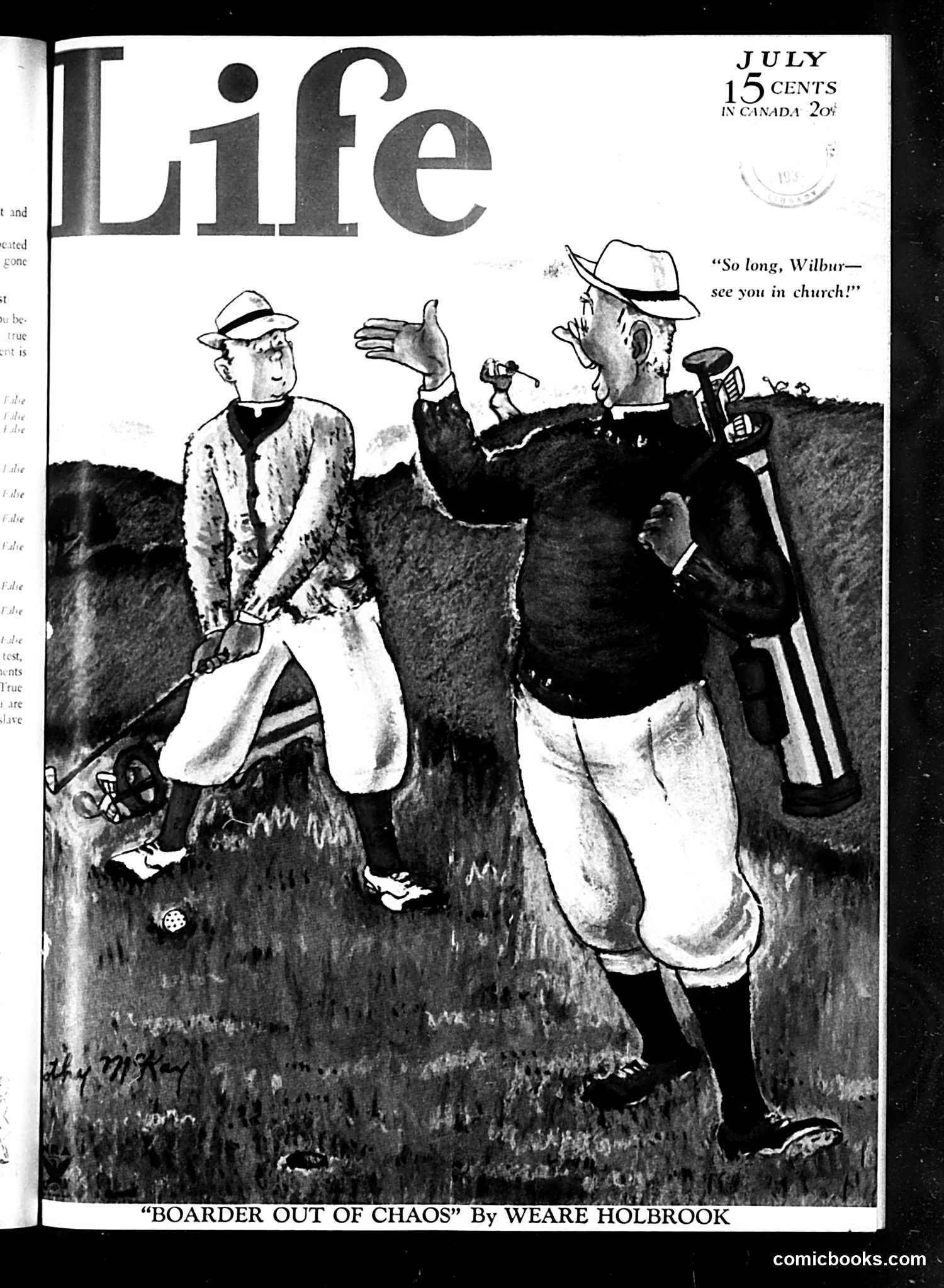
"Boarder Out of Chaos" by Weare Holbrook This Life magazine cover (July issue, 15 cents) depicts a golfing scene with the caption "So long, Wilbur—see you in church!" The cartoon shows two golfers on what appears to be a course with rough terrain. One figure is saying goodbye to "Wilbur" while holding golf clubs. The title "Boarder Out of Chaos" is unclear from the image alone—it may reference a specific contemporary event or person named Wilbur that modern readers would need additional context to identify. The humor appears to rest on the casual social interaction between the golfers and their promise to meet at church, suggesting ironic commentary about weekend leisure activities conflicting with religious observance. The specific satirical target remains uncertain without additional historical documentation.
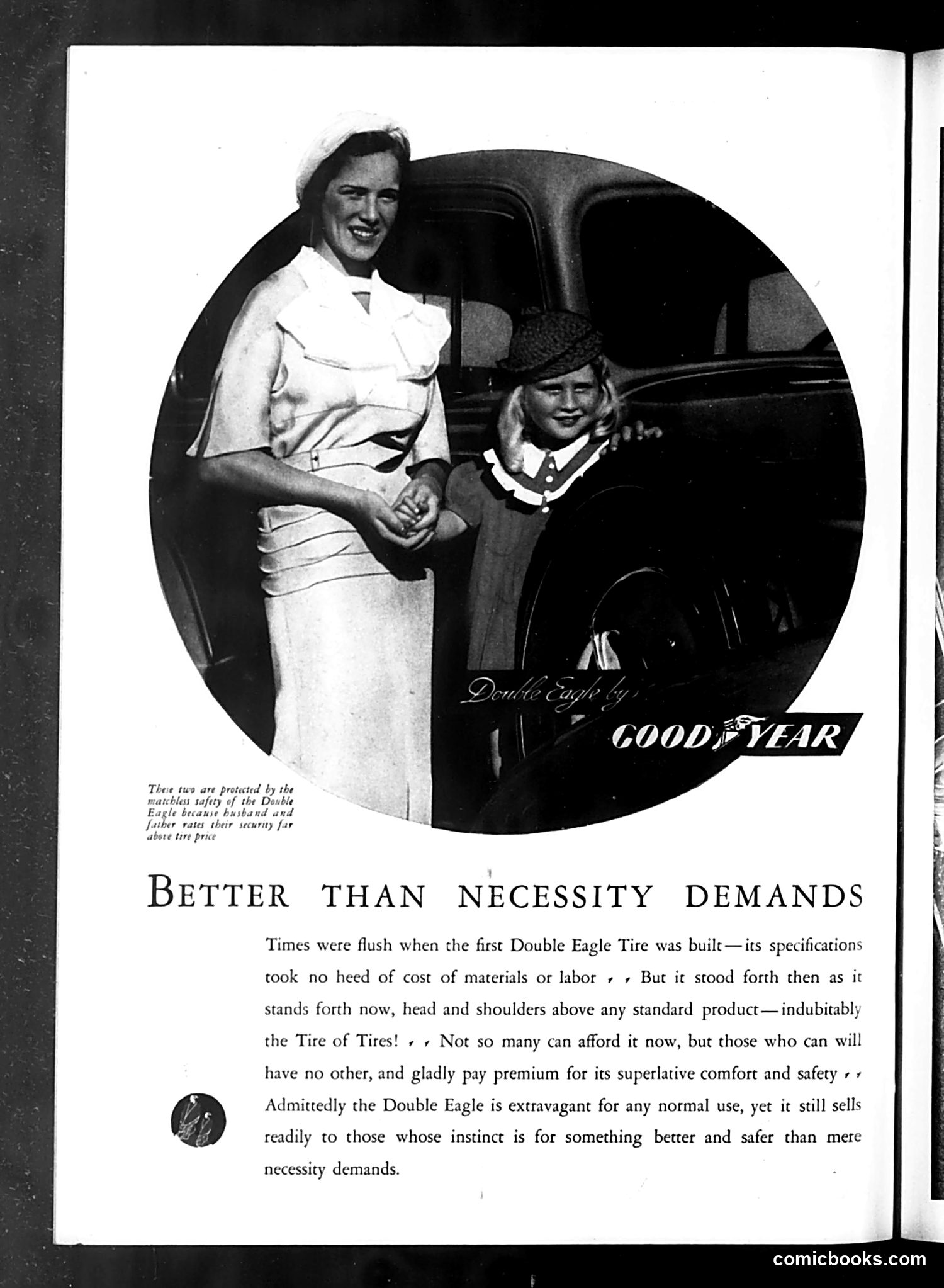
Analysis This is a Goodyear tire advertisement, not political satire or cartooning. The image shows a woman and child posed beside a car, with text praising the "Double Eagle" tire brand. The ad's headline—"Better than Necessity Demands"—frames premium tire purchase as a luxury choice for safety-conscious, affluent consumers. The accompanying text positions the Double Eagle as an extravagant but superior product: expensive, but justified for those prioritizing "superlative comfort and safety" over mere functionality. This reflects 1920s-30s consumer marketing that appealed to middle/upper-class aspirations through emphasis on quality, safety, and status. The family imagery was typical advertising strategy of the era, suggesting that buying premium tires demonstrated responsible parental concern.
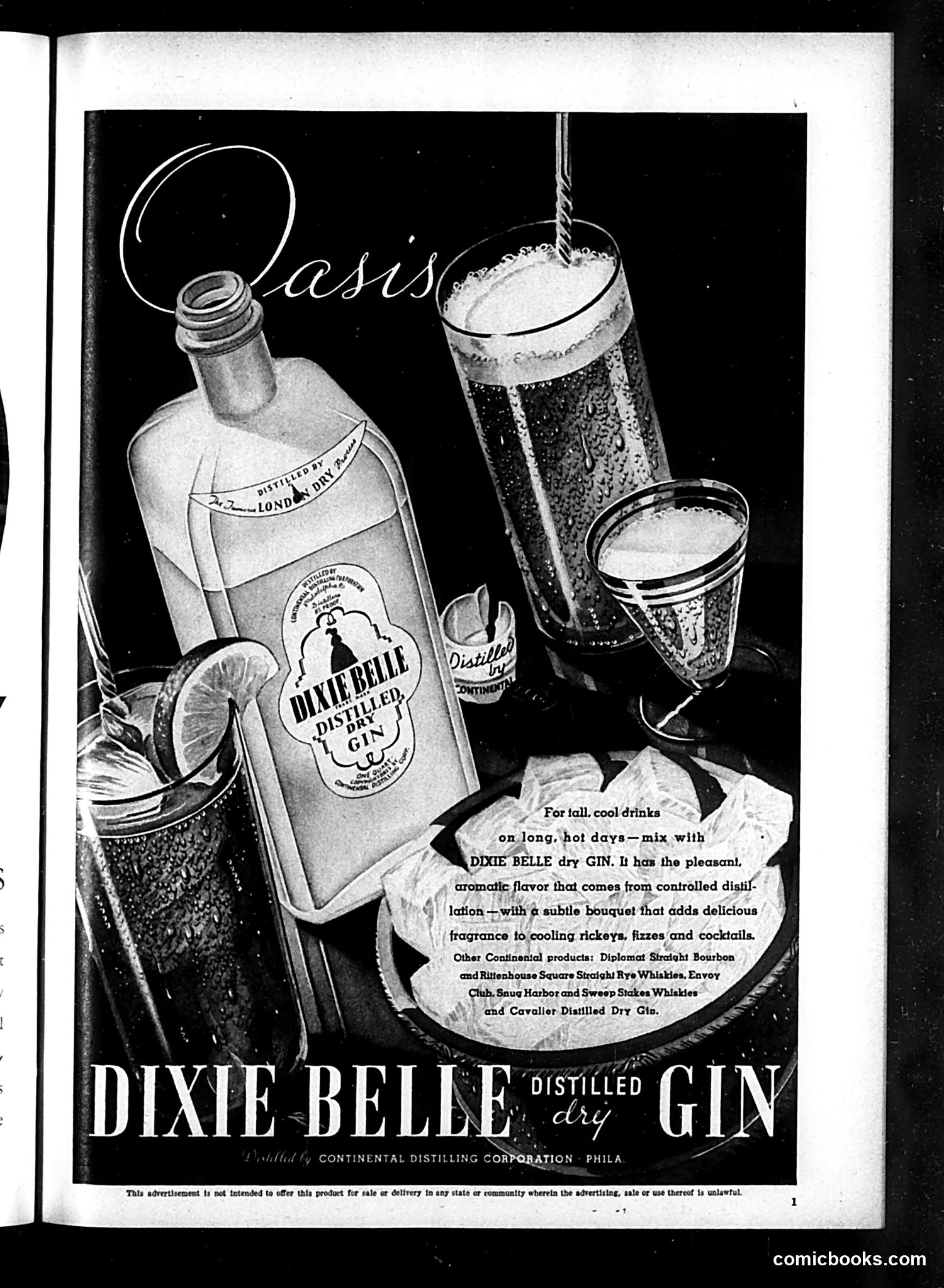
Analysis This is a full-page advertisement, not political satire. It promotes Dixie Belle Distilled Dry Gin, manufactured by Continental Distilling Corporation in Philadelphia. The ad uses the word "Oasis" at the top, positioning gin as a refreshing escape during hot weather. The visual shows a bottle of Dixie Belle gin alongside served drinks with ice and garnish (appears to be a lemon slice). The accompanying text emphasizes the gin's "pleasant aromatic flavor" and suitability for "tall, cool drinks on long, hot days." The disclaimer at the bottom indicates this was published during Prohibition or shortly after, when alcohol advertising faced legal restrictions. There is no political cartoon or satire present on this page.
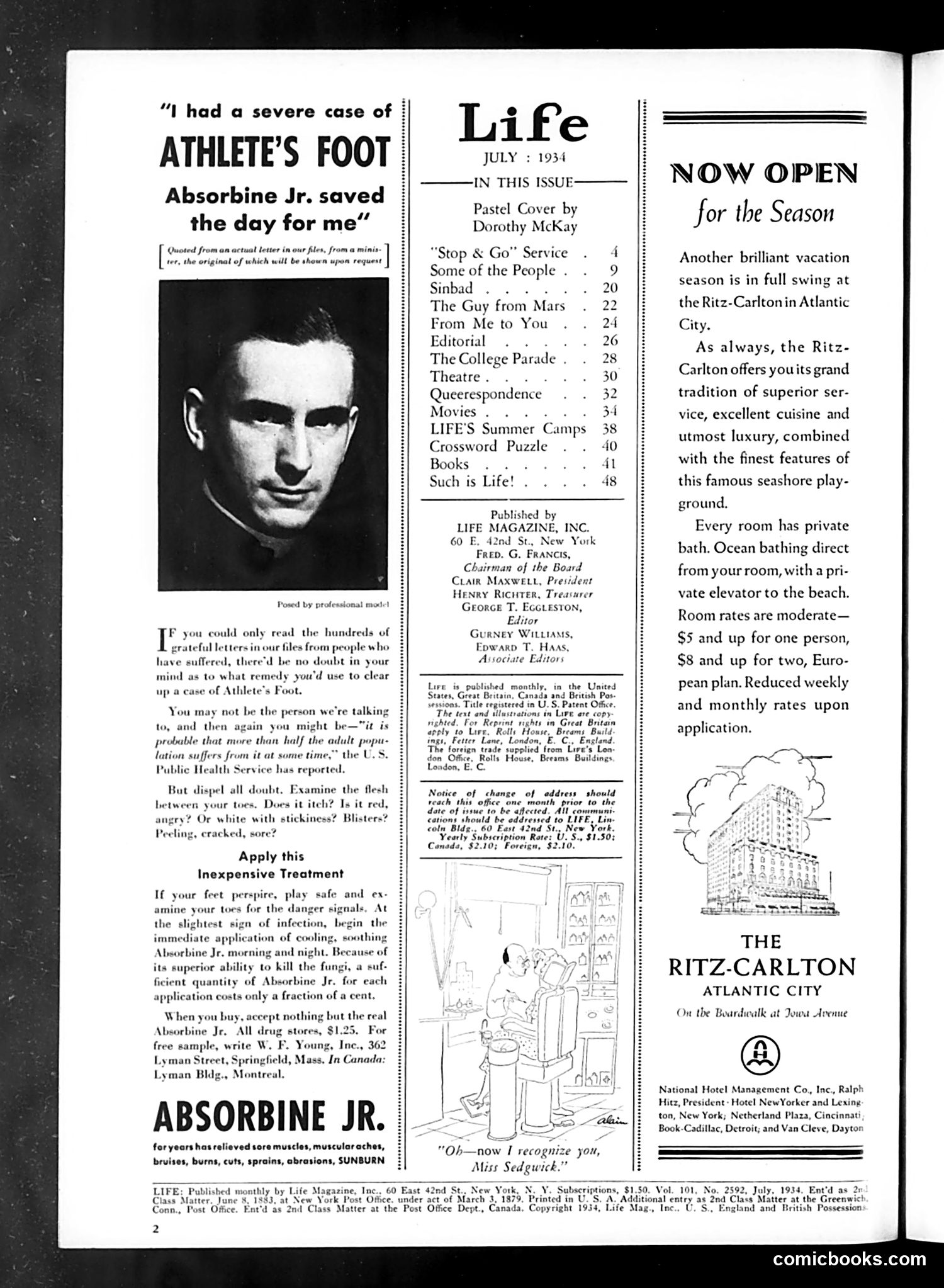
Analysis of Life Magazine, July 1934 This page is primarily advertising and magazine content, not political satire. The left side features an Absorbine Jr. advertisement using a testimonial format common in 1930s marketing. A man's photograph accompanies a claim about curing athlete's foot—a genuine medical product advertisement, not satire. The center shows the magazine's table of contents for July 1934, listing articles like "Sinbad" and "The Guy from Mars." The right side advertises the Ritz-Carlton Hotel in Atlantic City, emphasizing luxury amenities: private ocean-view baths, moderate rates ($5-8), and the "European plan." The small cartoon at bottom center appears unrelated to political content—just a humorous domestic scene caption. This is a straightforward magazine layout with no discernible political satire or commentary.
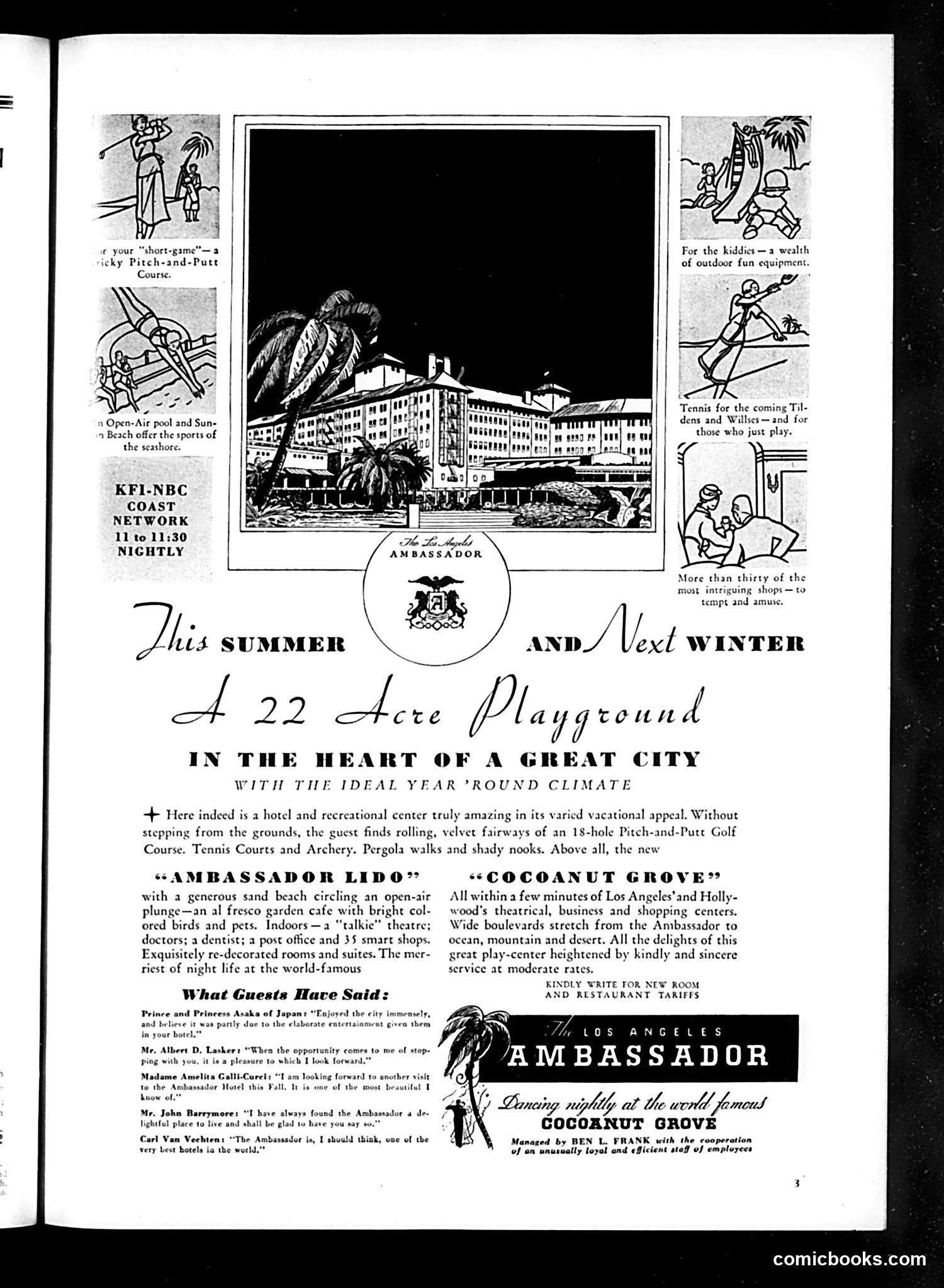
Analysis This page is primarily advertising for the Ambassador Hotel and its affiliated Coconut Grove nightclub in Los Angeles, not political satire or comics. The central image shows the hotel's Art Deco architecture. Surrounding illustrations depict recreational amenities: golf, tennis, water sports, and shopping—marketed as year-round entertainment in Southern California's climate. The "What Guests Have Said" section includes testimonials from named individuals (Prince and Princess Asaka of Japan, Alfred B. Lasker, etc.), lending prestige through celebrity endorsement—a common 1920s-30s marketing technique. The bottom advertises nightly dancing at the Coconut Grove, managed by Ben L. Frank. This is a straightforward hospitality advertisement, not satirical commentary.
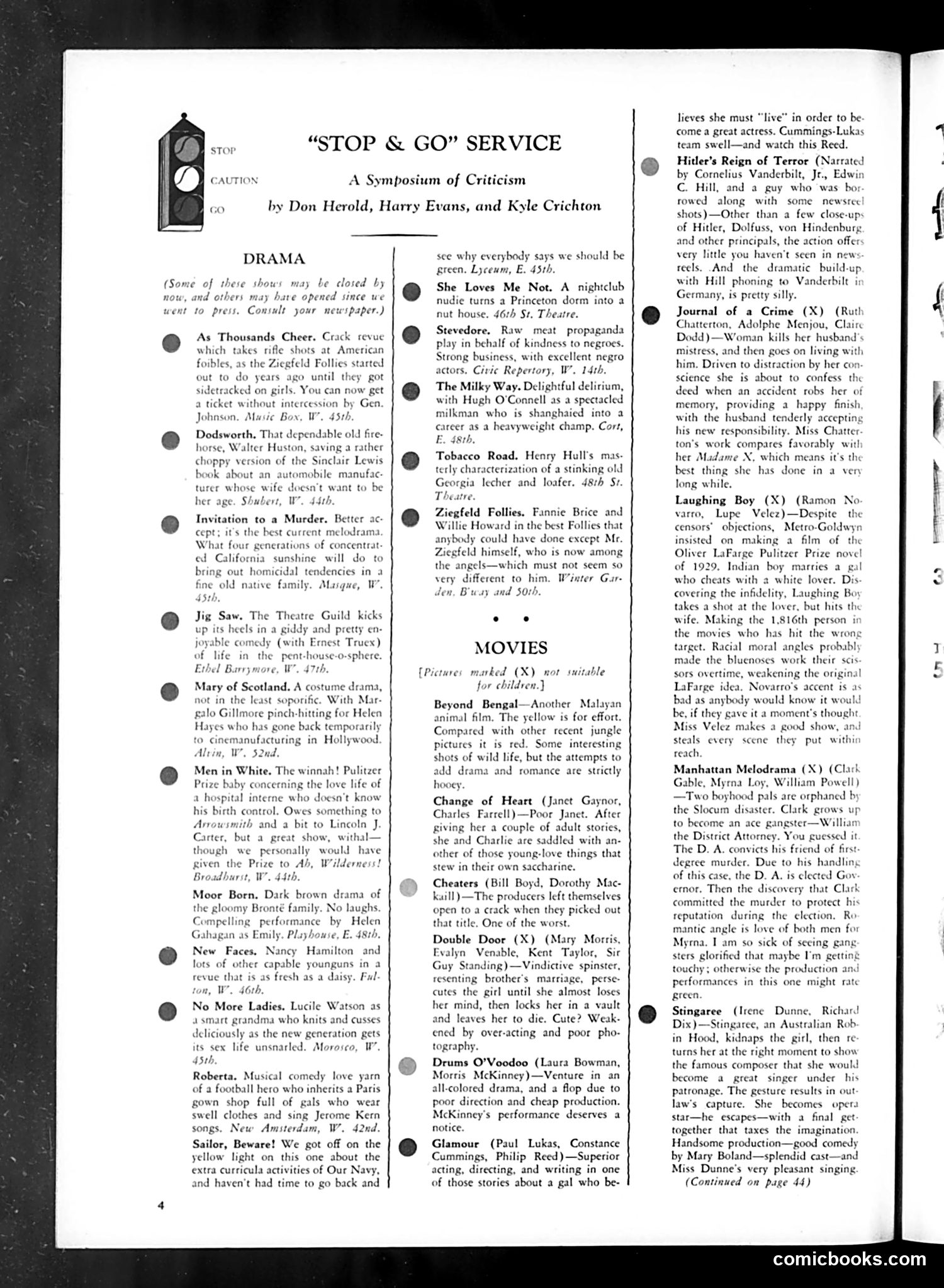
Page Analysis This is a theater and film review page from *Life* magazine, not a political cartoon. The main content consists of: "Stop & Go" Service - A symposium of criticism by Don Herold, Harry Evans, and Kyle Crichton reviewing contemporary theatrical productions and films. The Drama section lists plays with brief critiques (e.g., "As Thousands Cheer," "Dodsworth," "Jig Saw"). The Movies section reviews films including "Beyond Bengal," "Change of Heart," and "Manhattan Melodrama." The traffic light illustration at top left is decorative, reinforcing the "Stop & Go" title theme—suggesting some productions merit stopping to watch, others to skip. This is straightforward entertainment criticism, not satire or political commentary.
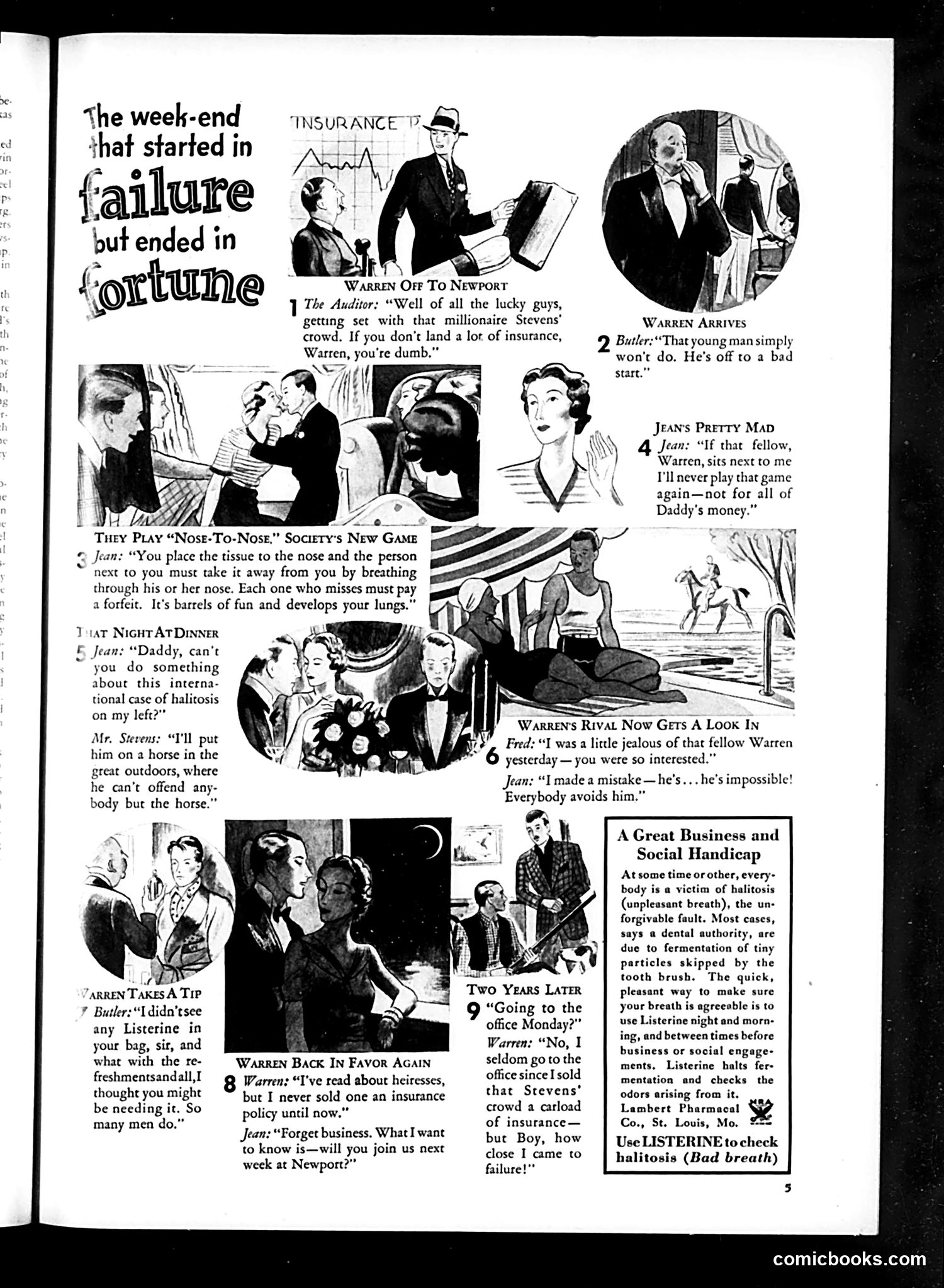
"The Week-End That Started in Failure but Ended in Fortune" This appears to be a serialized romantic comedy strip from Life magazine, likely from the 1920s-30s. The narrative follows Warren, a man seeking to join a wealthy social circle (the "millionaire Stevens' crowd"). Through a series of misadventures—including failed insurance pitches and social fumbles—Warren ultimately wins over Jean, a woman from that elite group. The satire targets social climbing and class aspirations of the era: Warren's desperate attempts to network, the shallow concerns of wealthy socialites, and romantic rivalries within high society. The strip mocks both Warren's ambitions and the frivolous preoccupations of the rich, while an embedded Listerine advertisement suggests commercial sponsorship typical of period magazines.
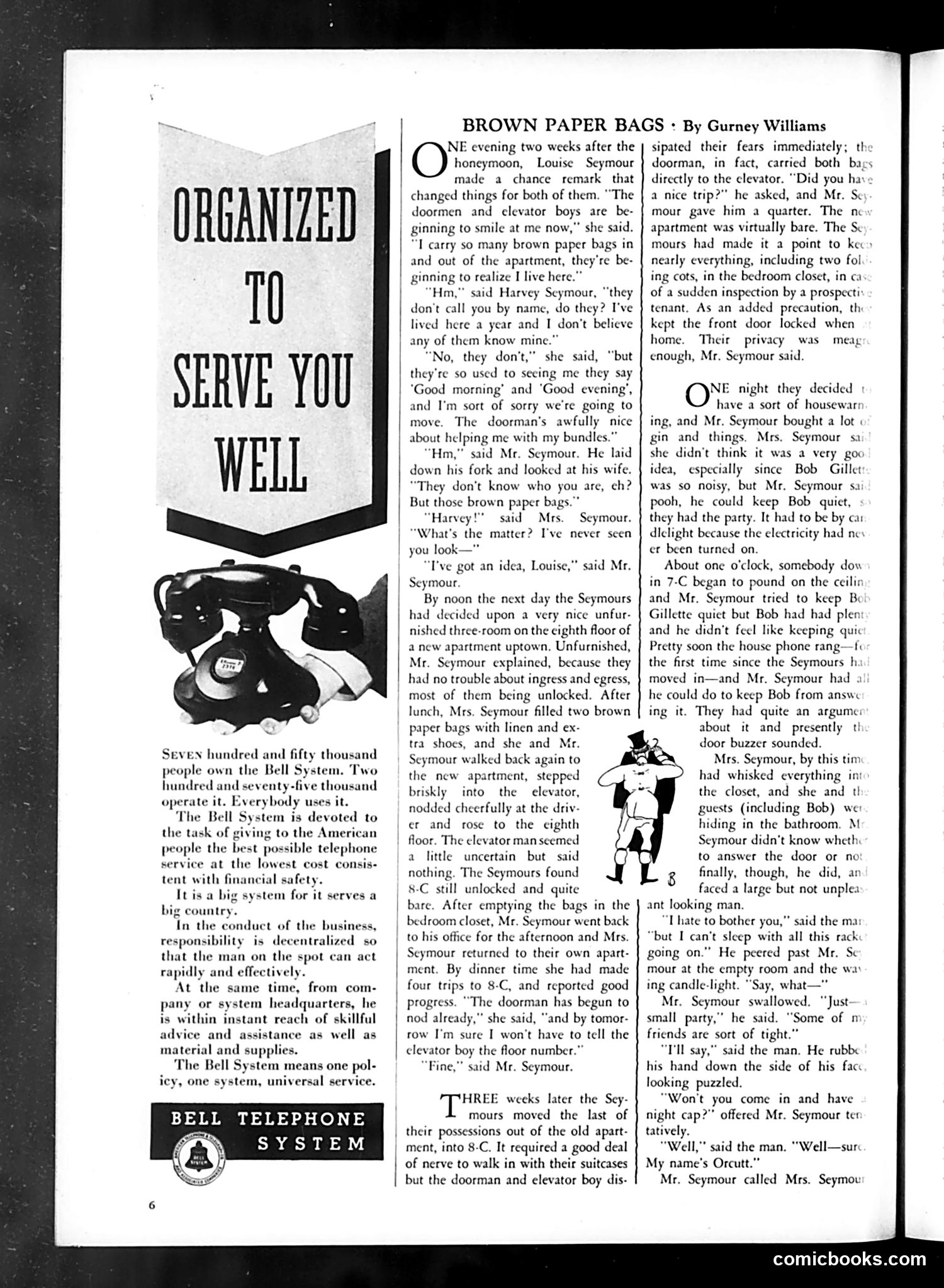
Analysis of "Brown Paper Bags" by Gurney Williams This is a short story with accompanying advertisement, not political satire. The narrative follows Mr. and Mrs. Seymour, who move into a modest apartment and use brown paper bags to organize their belongings—a humble, practical solution. The story humorously chronicles the chaos this causes among neighbors and building staff who don't recognize the couple, mistaking their paper-bagged items for suspicious activity. The accompanying Bell Telephone System advertisement emphasizes the company's reliability and reach, suggesting that proper communication (via telephone) could have prevented the misunderstandings. The satire is gentle—poking fun at urban apartment life, privacy concerns, and class anxieties of the era, rather than targeting specific political figures or events.
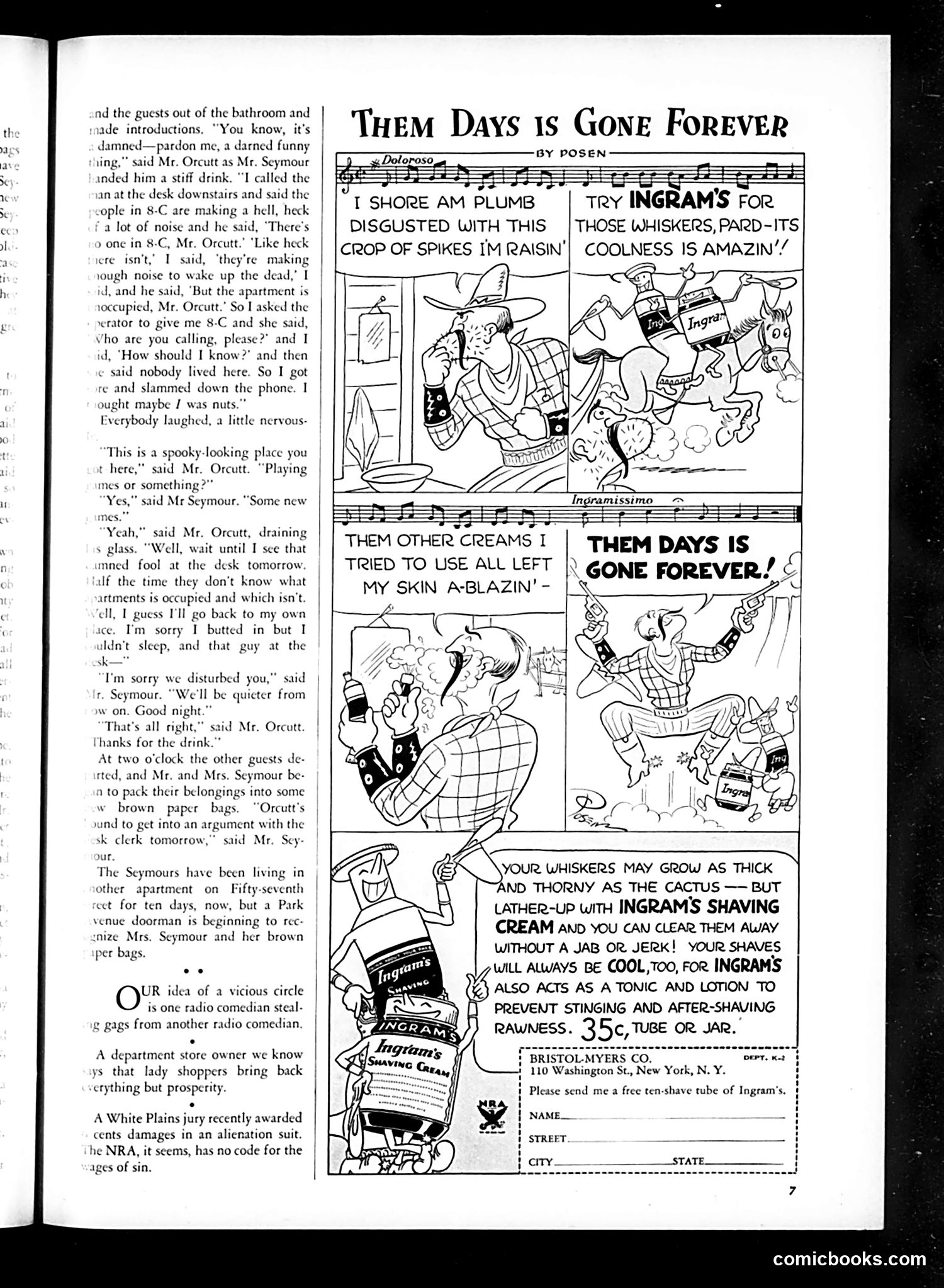
Analysis This page is primarily an advertisement for Ingram's Shaving Cream, disguised as editorial content. The comic strip "Them Days Is Gone Forever" by Posen uses humor to promote the product. The narrative shows a man complaining about his whiskers and trying various skin creams with poor results. The advertisement's message is that Ingram's Shaving Cream solves this problem and, as a bonus, acts as a "tonic and lotion" to prevent skin irritation. The accompanying text discusses a humorous apartment building incident but appears largely filler content surrounding the ad. For modern readers: this represents early advertising integration into editorial magazines—blending entertainment with product promotion in ways that would raise ethical concerns today regarding disclosure and advertising transparency.
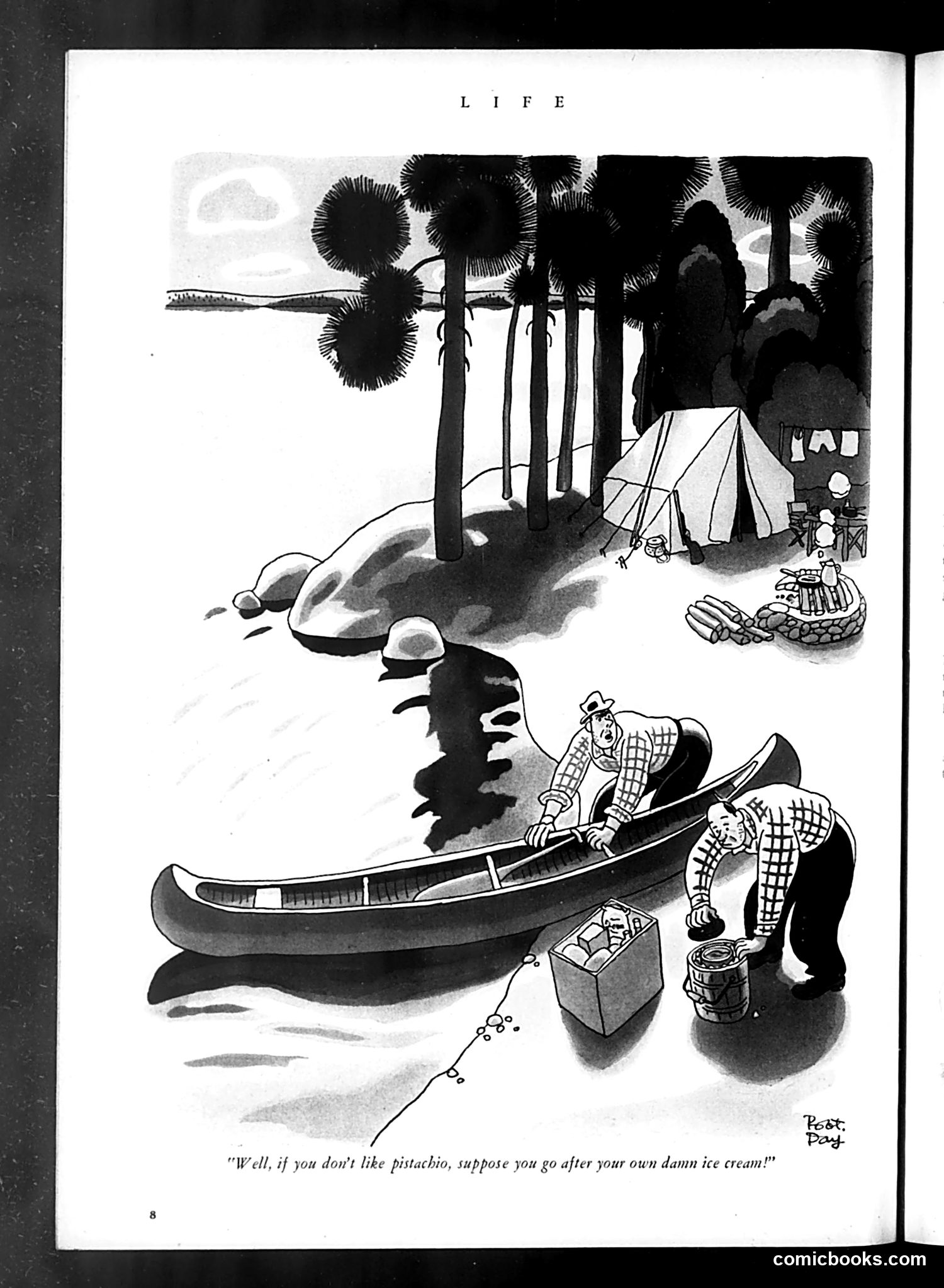
Analysis This is a single-panel cartoon showing two men in a canoe near a tropical camp with palm trees. One man says to the other: "Well, if you don't like pistachio, suppose you go after your own damn ice cream!" The joke is a humorous complaint about being stranded in what appears to be a remote tropical location (possibly suggesting an expedition or vacation). The satire mocks the expectation of comfort and convenience even in primitive circumstances—the speaker is irritated that his companion is being picky about ice cream flavor when they're apparently far from civilization. It's a commentary on modern entitlement and the demand for creature comforts in unlikely situations. The cartoon relies on the absurdity of expecting ice cream preferences to be accommodated in such isolated conditions.
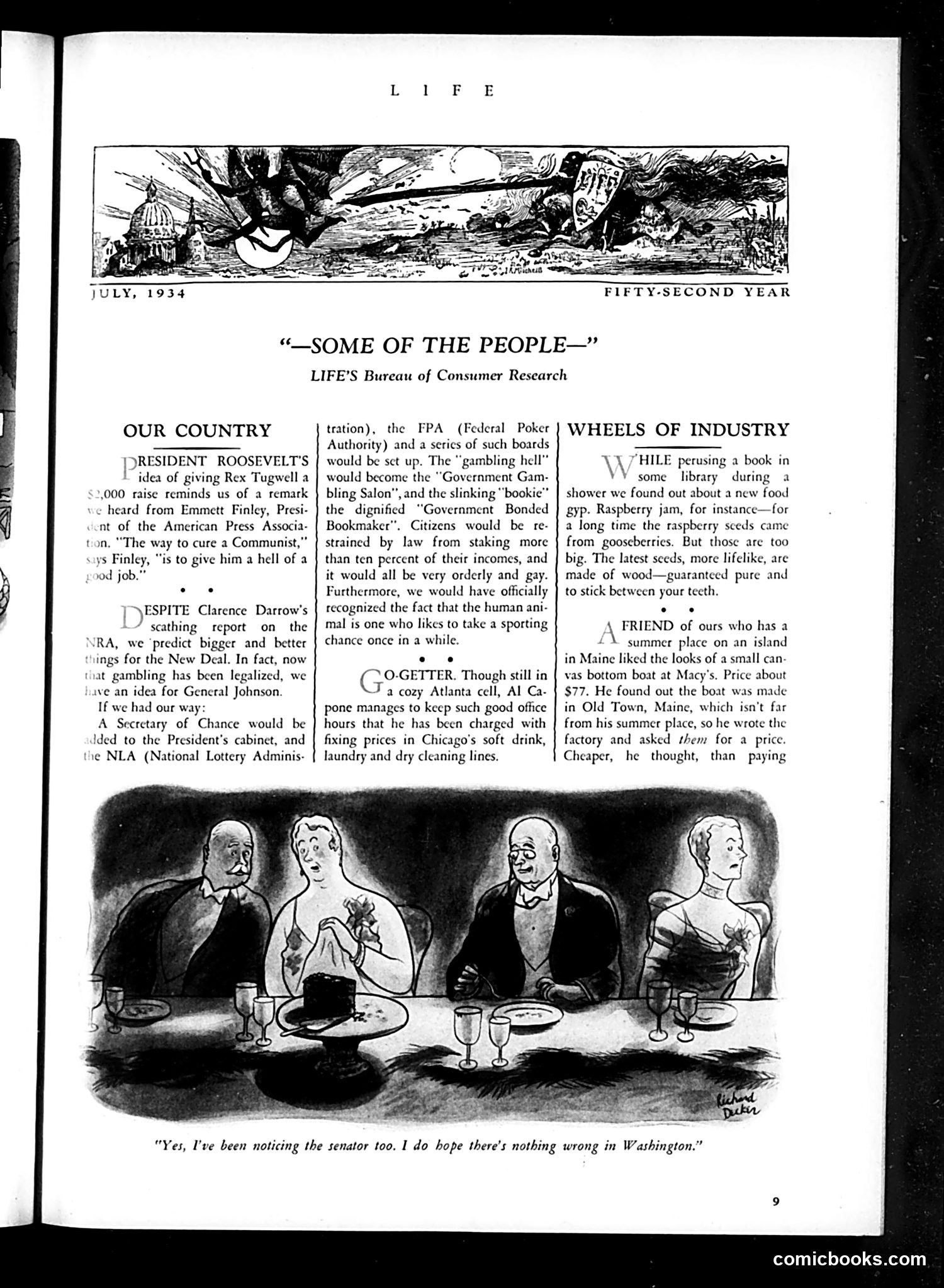
Political Cartoon Analysis: Life Magazine, July 1934 This cartoon satirizes Washington corruption during the Great Depression. Four well-dressed diners at an upscale restaurant represent political/corporate elites. The caption—"Yes, I've been noticing the senator too. I do hope there's nothing wrong in Washington"—uses ironic understatement to mock their collective moral blindness or complicity. The imagery contrasts sharply with the surrounding text about FDR's New Deal programs (NRA, Federal Poker Authority satire, gambling legalization debates). While ordinary Americans struggle economically, these establishment figures dine luxuriously, apparently unconcerned about ethical problems in government. The cartoon criticizes both political corruption and the wealthy class's detachment from national crisis during the 1930s.
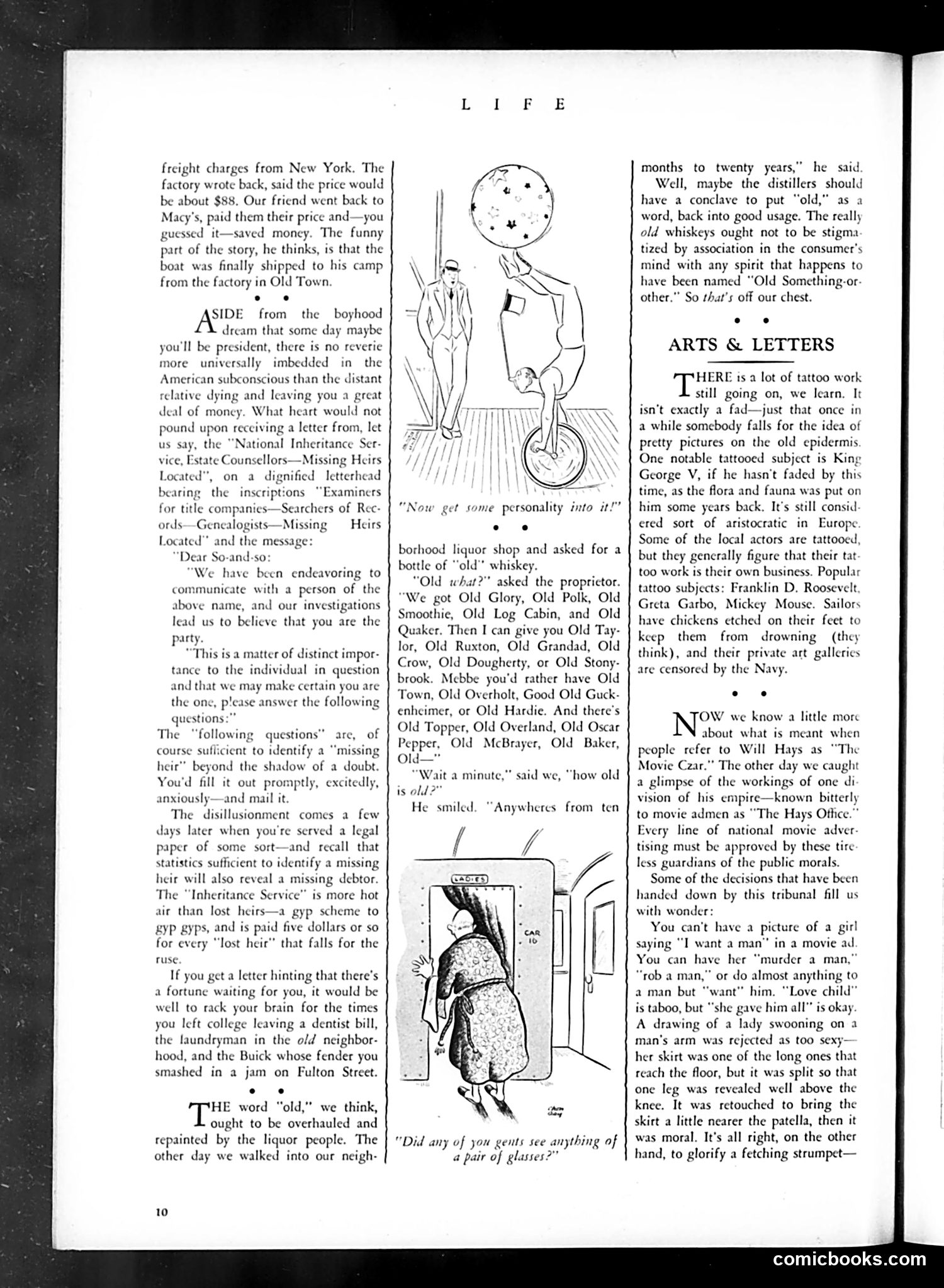
Life Magazine Page Analysis This page contains two main sections: a humorous essay about inheritance schemes and a satirical piece on Hollywood movie censorship titled "Arts & Letters." The Cartoon (center-left): Shows a man and woman examining a globe at what appears to be an antique shop. The caption reads: "Now get some personality into it!" This illustrates the preceding text's joke about a "National Inheritance Service" scam—promising to locate missing heirs through dignified letterhead and suspicious advertisements. The Lower Cartoon: Depicts a woman in a phone booth (labeled "USED"). The caption asks: "Did any of you gents see anything of a pair of glasses?" This accompanies discussion of Hollywood film censorship standards, which the text claims absurdly reject certain images while allowing others. The cartoon likely satirizes the arbitrary and ridiculous nature of these moral guardianship decisions affecting movie content.
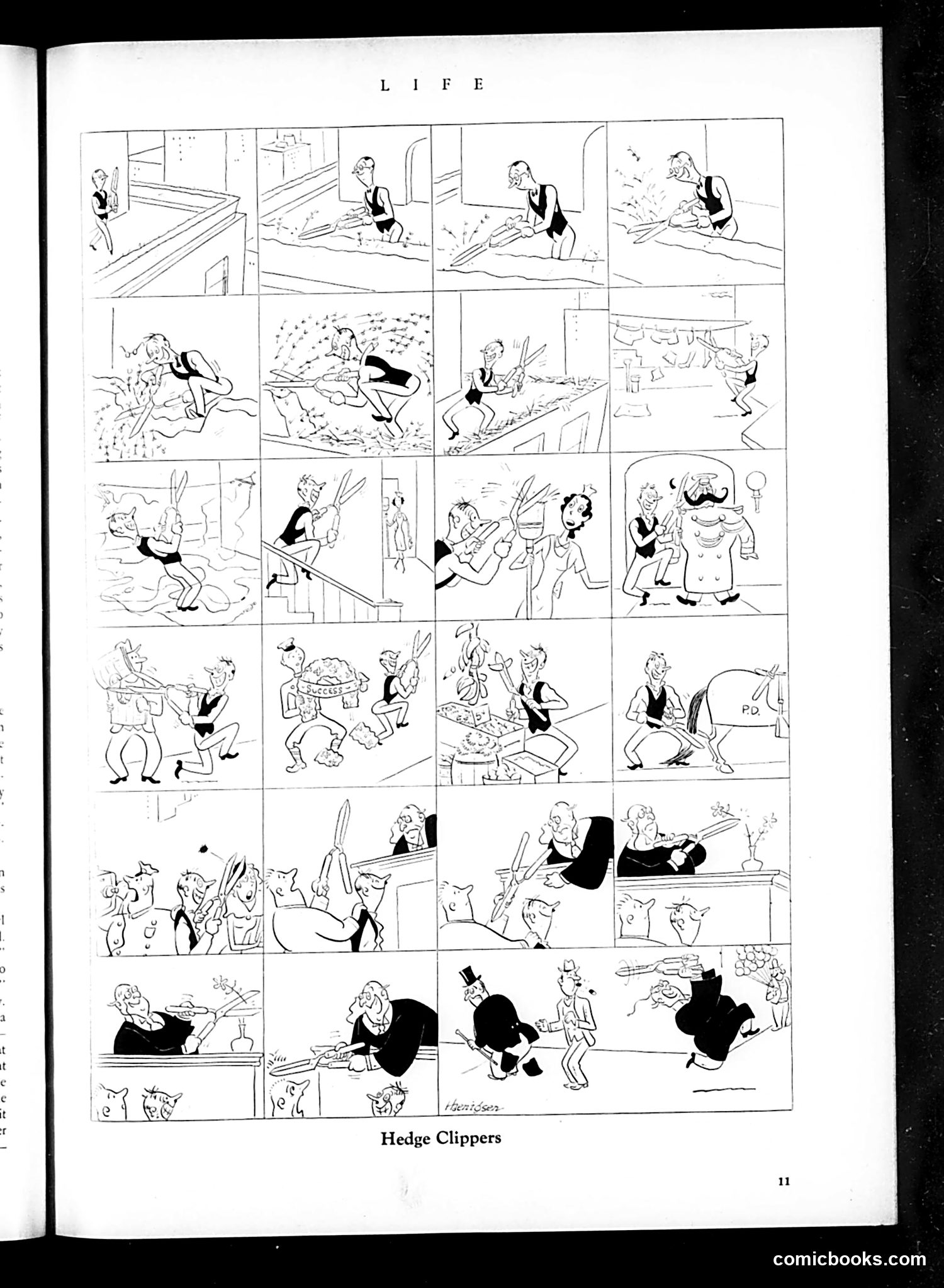
"Hedge Clippers" Comic Analysis This is a visual gag comic strip with no identifiable political figures or specific historical references. The humor centers on a slapstick narrative: a man in formal attire (tuxedo) repeatedly attempts to trim hedges but encounters escalating chaos—the hedges appear to contain small animal characters (possibly rabbits or similar creatures) that interfere with his efforts. The strip progresses from initial attempts at yard work through increasingly absurd situations: the creatures multiply, scatter, and cause comedic destruction. The final panels show the man's exasperation as the task becomes impossible. The satire appears social rather than political—likely mocking the frustrations of suburban domestic life and yard maintenance. Without an author attribution visible, the precise intent remains unclear, though it reflects early-to-mid 20th century humor conventions.
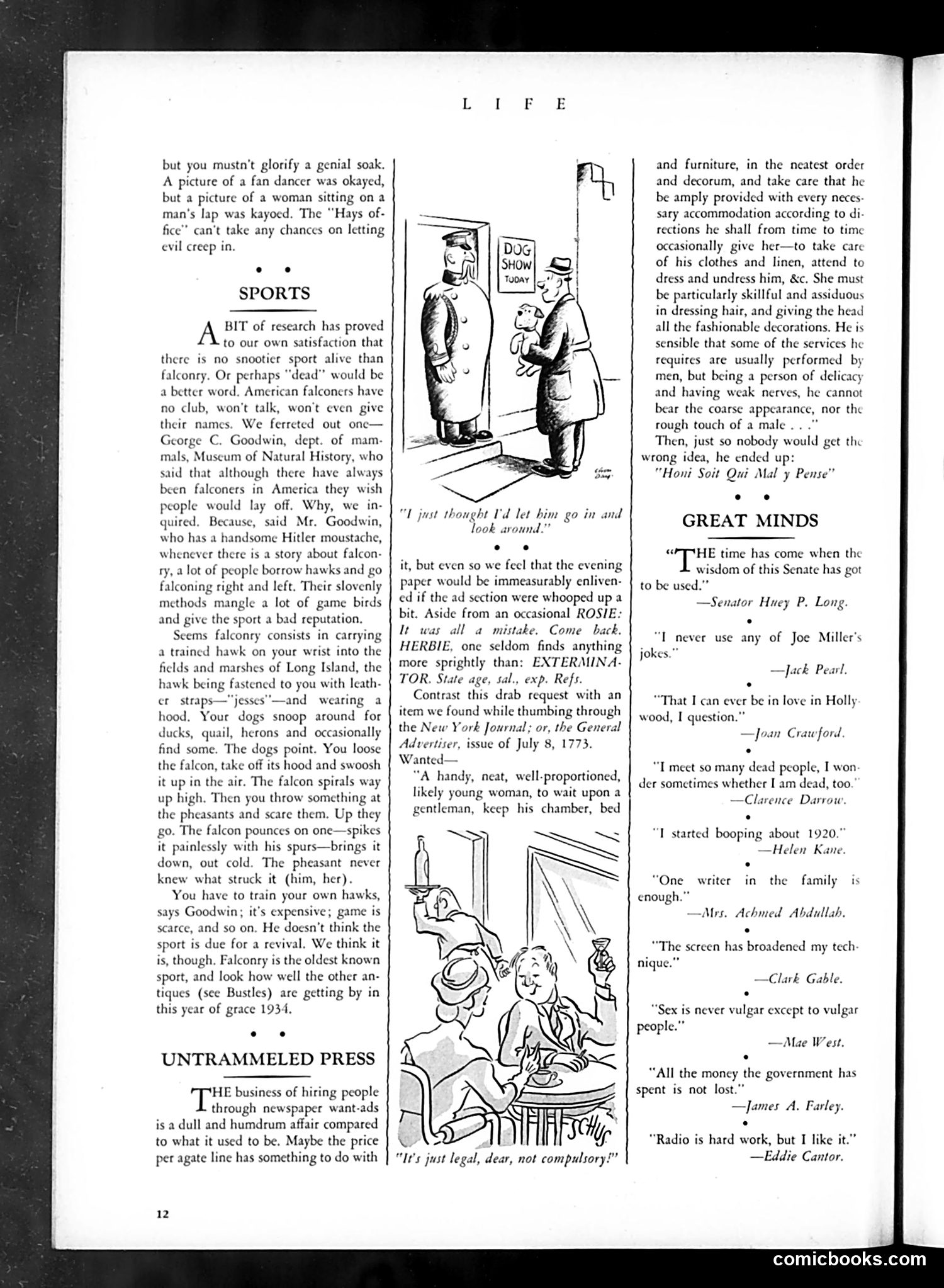
Analysis of Life Magazine Page This page contains three distinct sections: a "Sports" column discussing falconry, an "Untrammeled Press" section about newspaper want-ads, and a "Great Minds" quote collection. The two cartoons illustrate humorous workplace scenarios. The first shows what appears to be a dog show or similar event, with the caption "I just thought I'd let him go in and look around." The second depicts a casual social gathering, captioned "It's just legal, dear, not compulsory!" The Sports section's falconry discussion emphasizes the sport's appeal and training requirements. The Untrammeled Press section critiques the decline in newspaper want-ad quality. The Great Minds section collects brief, witty quotes attributed to various celebrities and public figures of the era, reflecting the magazine's satirical humor and contemporary cultural commentary.
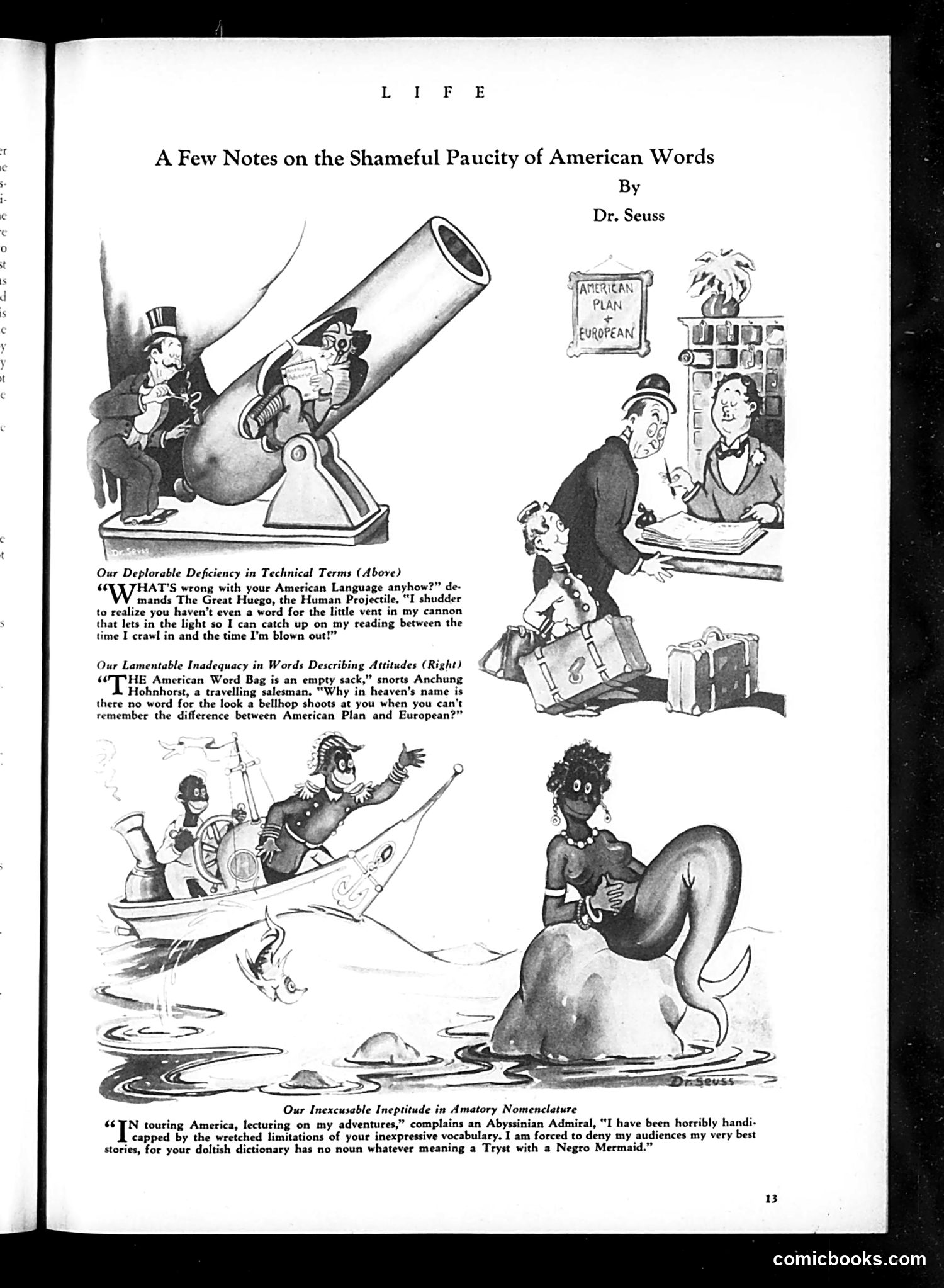
Analysis of "A Few Notes on the Shameful Paucity of American Words" by Dr. Seuss This satirical page critiques American English vocabulary as inadequate compared to European languages. Three illustrated complaints demonstrate the problem: 1. Technical terms: An American struggling with a telescope cannot name its parts, while a European casually uses precise terminology. 2. Descriptive words: A traveling salesman lacks vocabulary to distinguish between "American Plan" and "European" accommodations. 3. Anatomical nomenclature: An Abyssinian Admiral claims American English lacks proper words for body parts, forcing him to use crude or inappropriate terms in lectures. The cartoons mock American linguistic poverty and cultural inferiority, suggesting Americans are unsophisticated compared to Europeans. This reflects early 20th-century attitudes valuing European culture as superior.
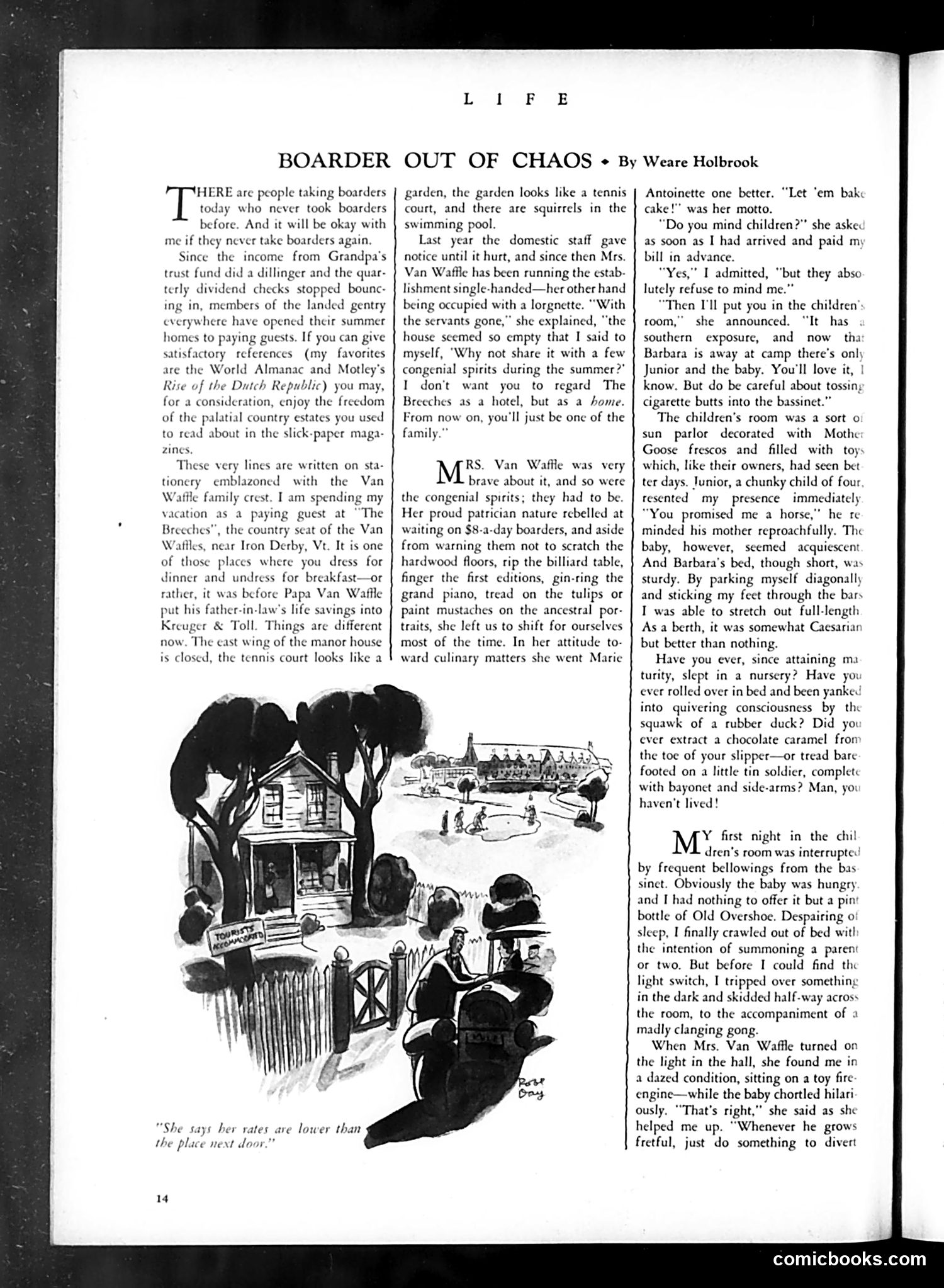
"Boarder Out of Chaos" by Weare Holbrook This article discusses the social phenomenon of taking in paying boarders during economic hardship. The accompanying illustration depicts a chaotic household scene where wealthy families have converted their estates into boarding houses to generate income—a response to reduced dividend checks from investments. The satire targets the upper class's desperation: genteel families who once employed servants now must share their homes with paying guests and tolerate disruption to their formerly orderly lives. The article's humor derives from contrasting their previous privilege with present indignity—the "palatial country estates" reduced to commercial lodgings, tennis courts repurposed as gardens, and refined households disrupted by rowdy children and crying babies. The piece reflects Depression-era economic anxiety among the wealthy.
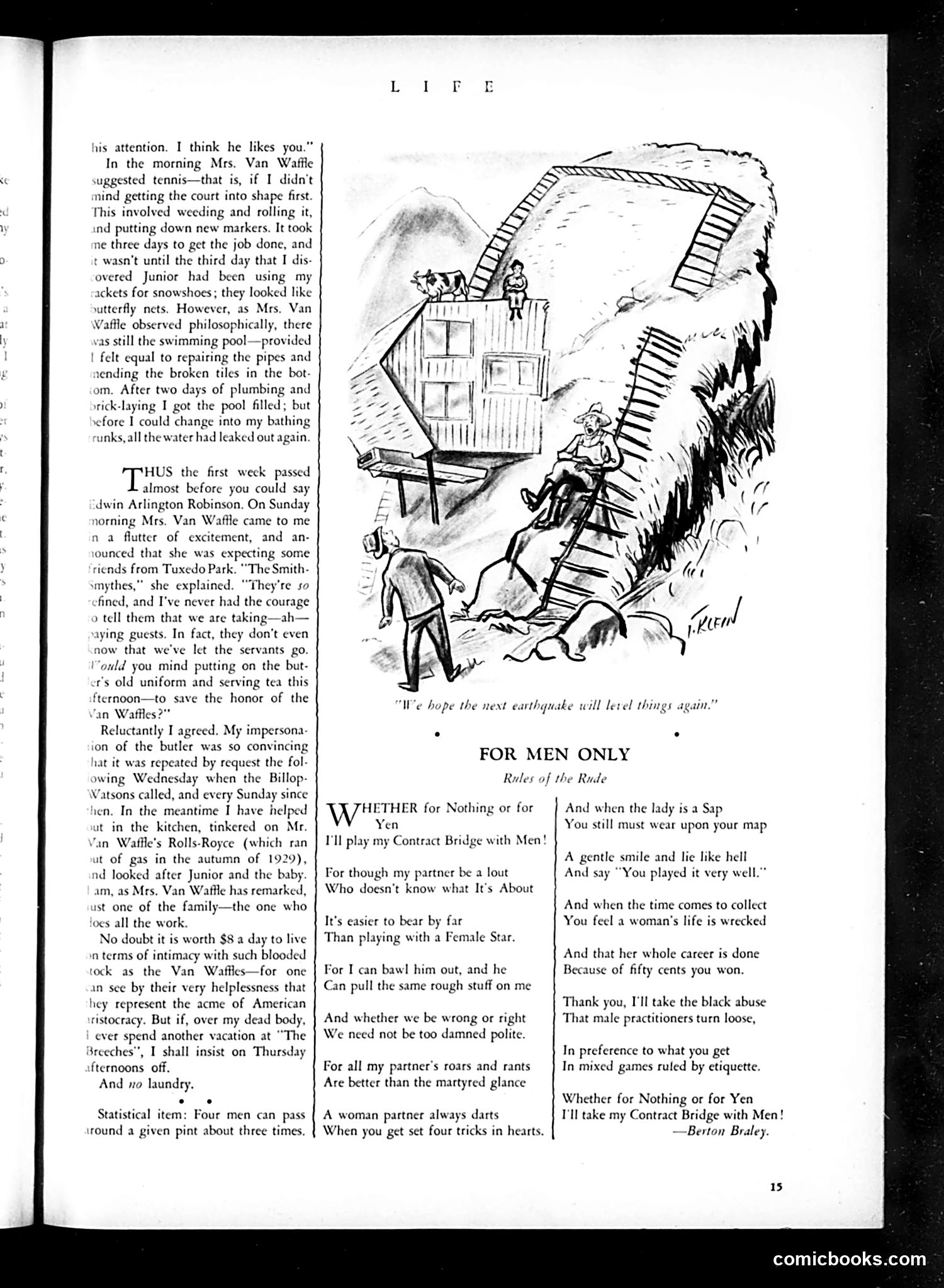
Analysis of Life Magazine Page This page contains a narrative about social upheaval following an earthquake, illustrated by a sketch showing a damaged building with people on ladders and sitting in disarray. The story humorously describes how disaster disrupted the rigid class hierarchy—servants stopped wearing uniforms, social protocols collapsed, and the narrator considers it worth the property damage to escape "the Van Waffles" and their pretentious household rituals. Below this is a poem titled "For Men Only: Rules of the Bride" by Berton Bradley, satirizing marriage dynamics. It mocks how male bridge players expect women partners to absorb blame for losses ("feel a woman's life is wrecked / Because of fifty cents you won"), while praising male misbehavior as acceptable. The satire critiques gender double standards in both card games and marriage.
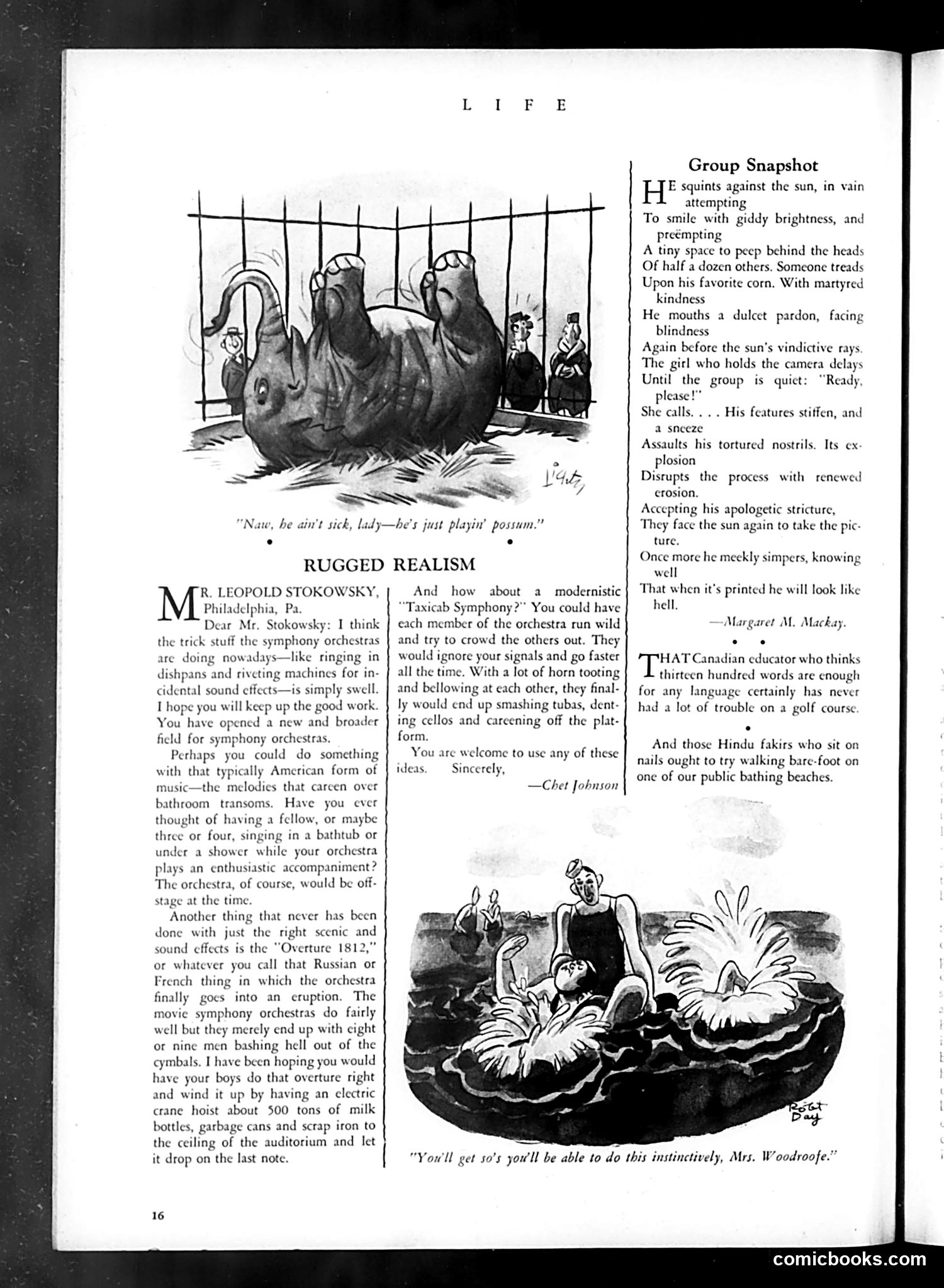
Analysis of Life Magazine Page This page contains two distinct pieces: "Group Snapshot" (top right): A poem by Margaret M. Mackay satirizing a photographer attempting to photograph a hippopotamus in sunlight. The animal resists cooperatively—squinting, sneezing, and grimacing—making the photographer's job miserable. The satire mocks both difficult subjects and photographers' struggles with uncooperative conditions. "Rugged Realism" (bottom left): A letter to conductor Leopold Stokowsky from Chet Johnson suggesting humorous alternatives to traditional orchestral performances—bathtub singing accompaniment, "Overture 1812" with electrical crane-dropped debris. It's satire on modernist symphony orchestras and their pretensions. The bottom cartoon shows a woman in water; its caption references "instinctively" doing something, though context is unclear from this excerpt.
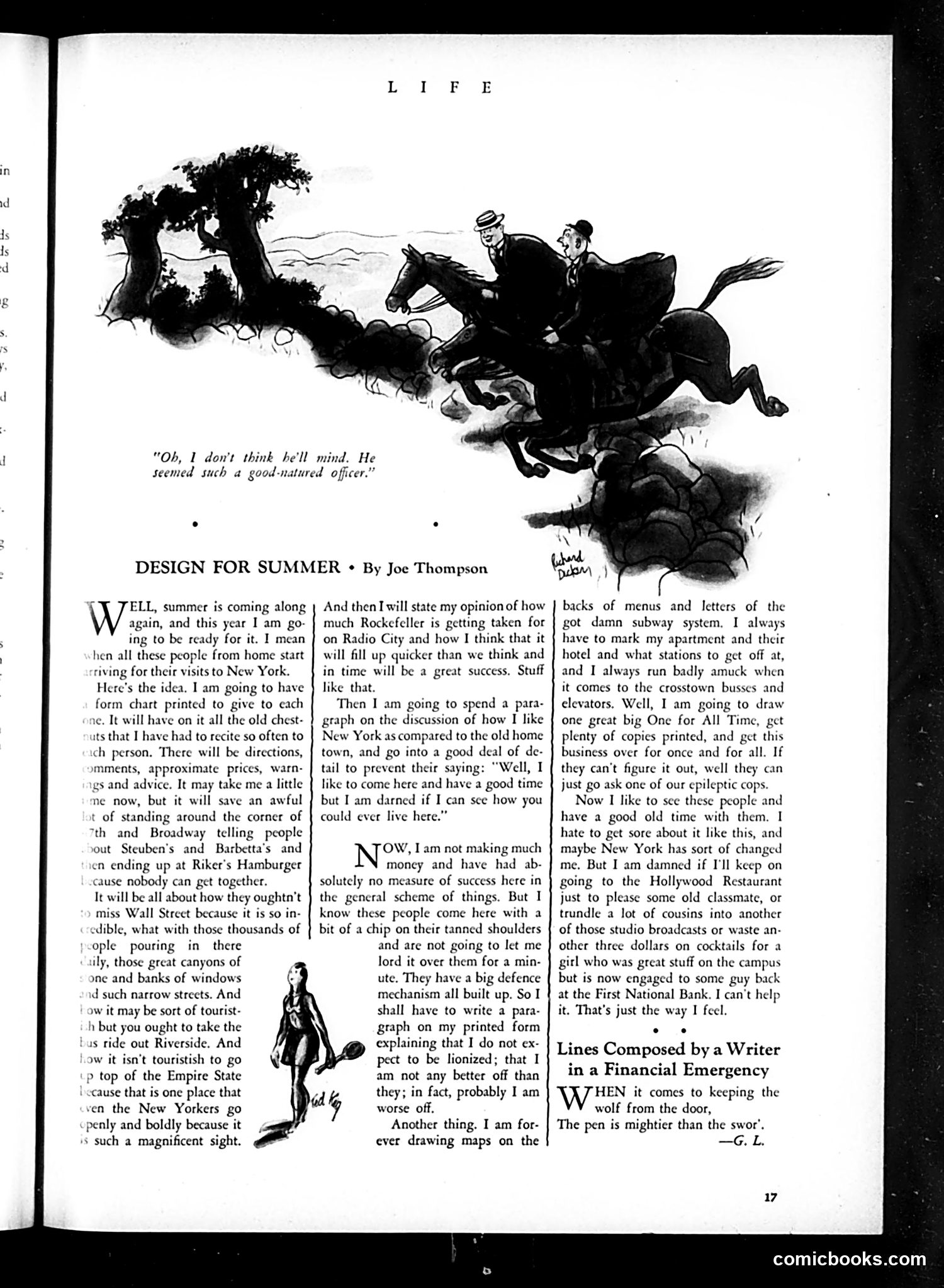
Analysis of Life Magazine Page 17 The Main Cartoon (top): Shows two men on horseback jumping over what appears to be an obstacle or fallen figure. The caption reads: "Oh, I don't think he'll mind. He seemed such a good-natured officer." This depicts a casual, dismissive attitude toward someone of lower rank—likely satirizing the indifference of upper-class officers toward subordinates' welfare or dignity. "Design for Summer" Article: Joe Thompson's essay humorously outlines his plans to capitalize on summer tourists visiting New York, claiming he'll profit from their visits while making minimal effort. He expresses cynicism about his prospects and admits he's probably "worse off" than the visitors he's trying to fleece—satirizing Depression-era opportunism and financial desperation among New Yorkers.
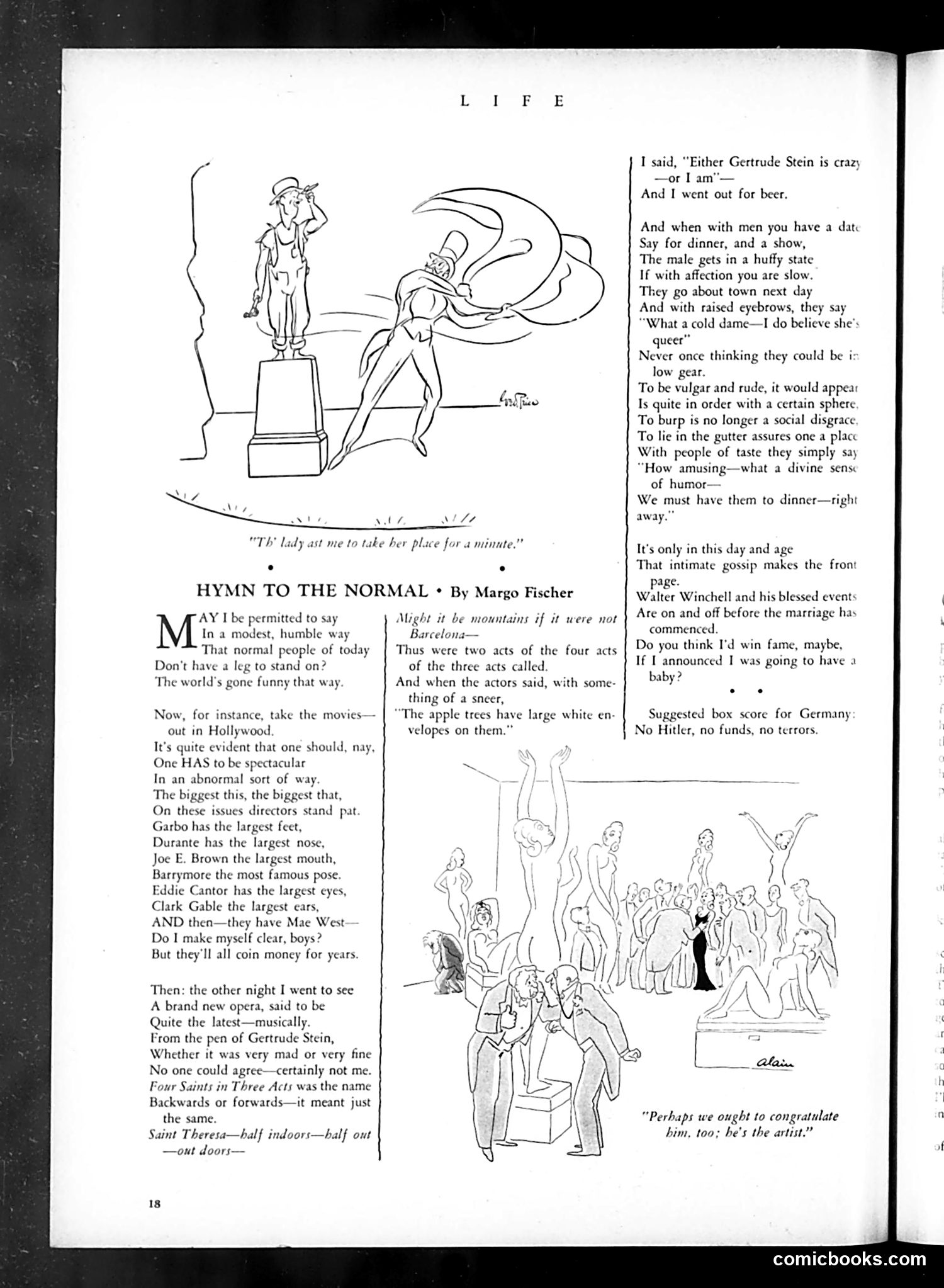
Analysis of Life Magazine Page This page contains satirical commentary on 1920s-30s social norms and Hollywood culture. "Hymn to the Normal" by Margo Fischer critiques the entertainment industry's excess—specifically Hollywood's obsession with physical extremes (largest noses, ears, etc. among famous actors like Greta Garbo and Mae West). The author attended a modernist opera by Gertrude Stein, finding it incomprehensible ("Four Saints in Three Acts"), yet notes that incomprehensibility became fashionable. The cartoons illustrate social commentary: the top sketch shows a woman muscling a man aside ("'The lady sat me to take her place for a minute'"), suggesting changing gender dynamics. The bottom cartoon shows a theatrical scene, captioned about congratulating "him, too; he's the artist!"—likely mocking theatrical pretension. The satire targets both Hollywood superficiality and avant-garde cultural snobbery.
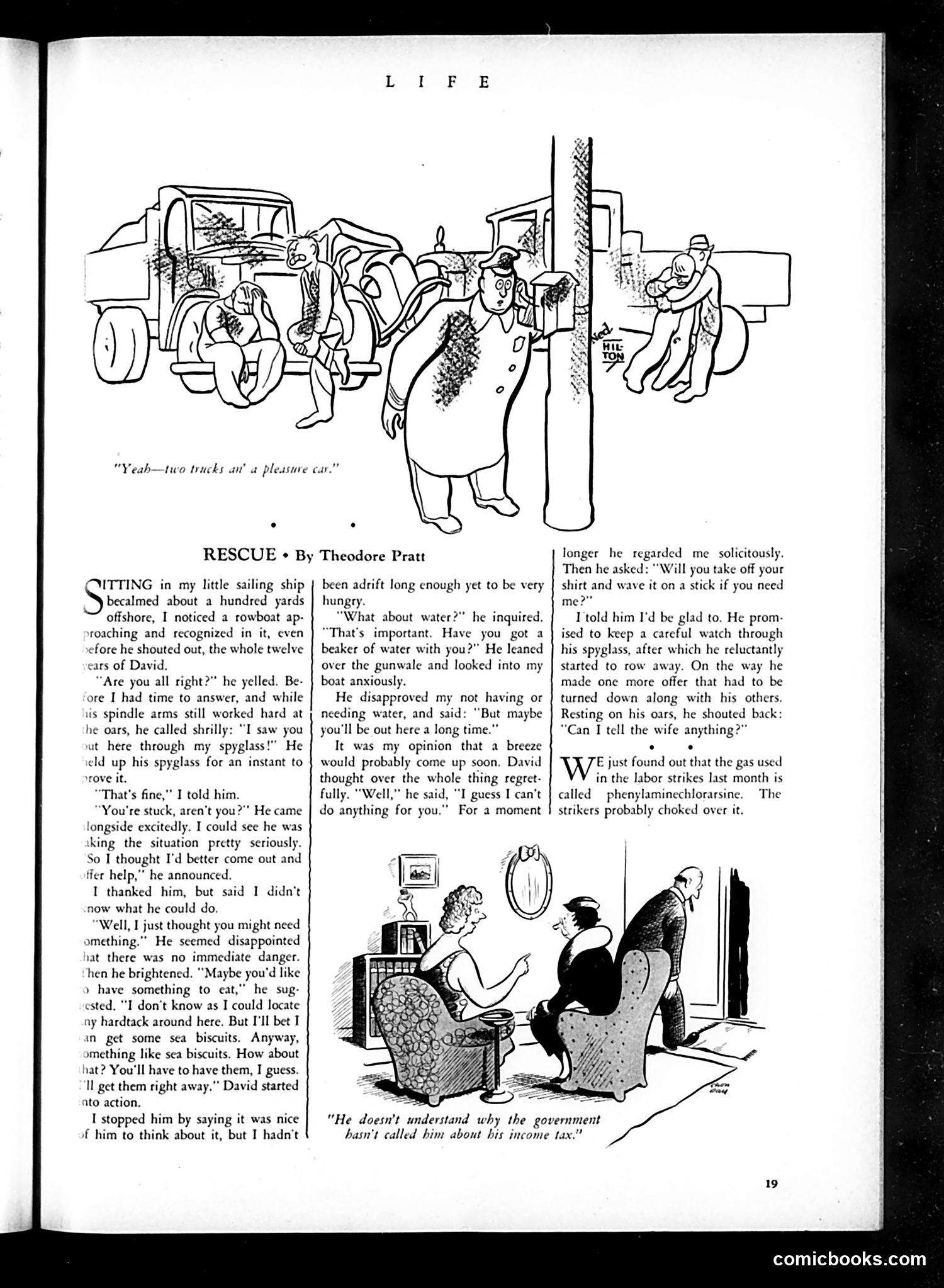
Analysis This page contains two separate pieces: Top cartoon (by Theodore Pratt): A humorous "Rescue" story about a stranded sailor helped by a rowboat crew. The joke plays on miscommunication—the sailor expects practical rescue (water, food) but instead receives trivial offers (using a shirt as a flag). The satire mocks well-meaning but unhelpful assistance. Bottom cartoon: Shows a woman at home receiving a visit from what appears to be a government official or tax collector. The caption reads: "He doesn't understand why the government hasn't called him about his income tax." This satirizes either tax avoidance or the absurdity of someone *wanting* to pay taxes—likely commenting on tax compliance attitudes during this era (appears to be pre-WWII based on style). Both pieces use situational humor rather than caricature.
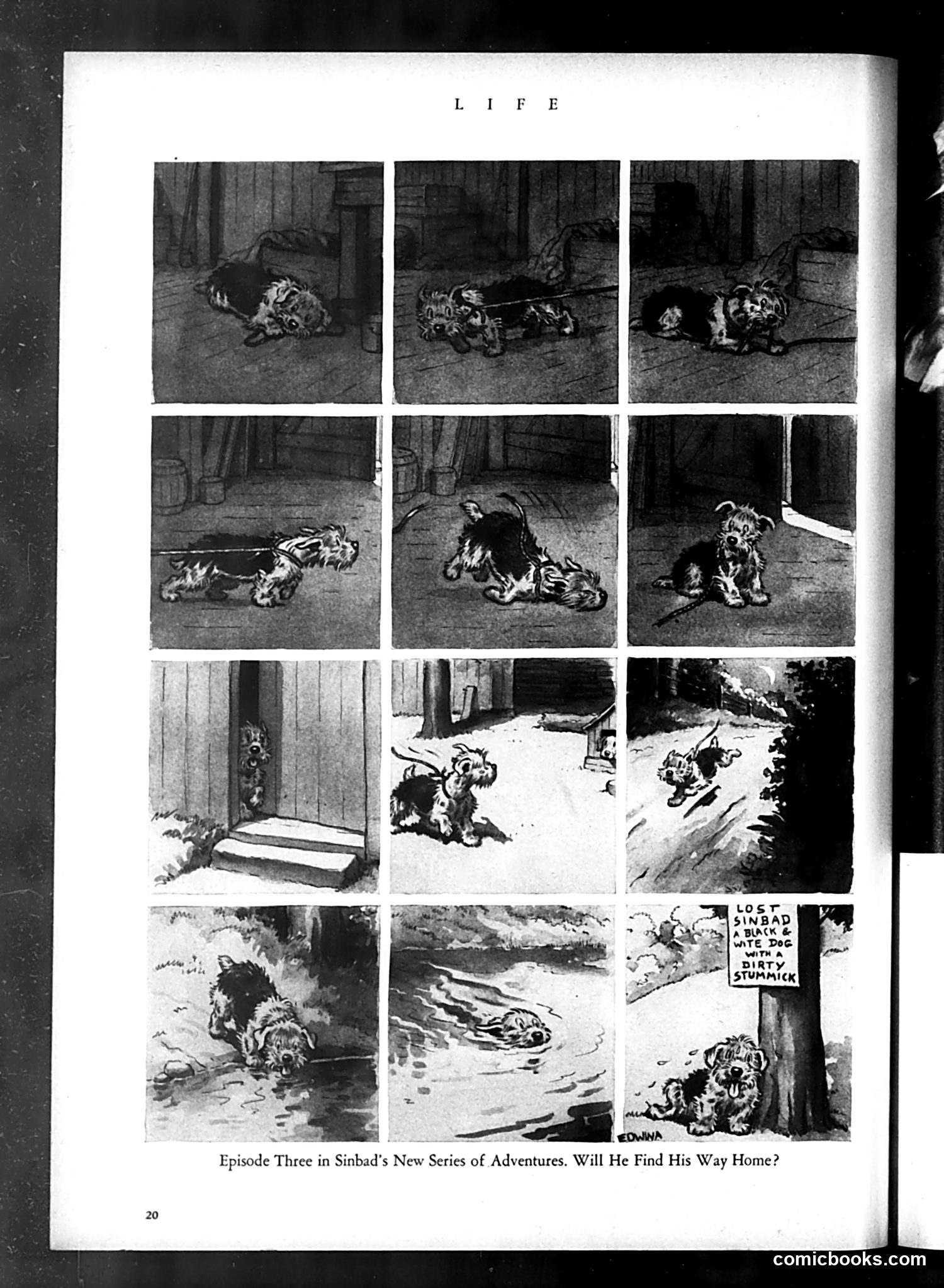
Explanation for Modern Readers This page presents a sequential photographic narrative (not a traditional cartoon) following a small dog named Sinbad through various adventures. The series appears to be a humorous "lost dog" story, culminating in a "Lost" notice describing "a black & white dog with a dirty stumbick [sic]." The satire likely mocks adventure serials popular in early 20th-century magazines—dramatic multi-episode narratives promising grand quests. Instead of an epic hero, readers follow an ordinary terrier encountering mundane obstacles: playing with toys, exploring yards and water, attempting to navigate home. The humor derives from treating a dog's everyday activities with the grandiose language and visual style of adventure fiction. The caption "Will He Find His Way Home?" parodies cliff-hanger endings that encouraged continued readership, applying that formula to a domestic pet's minor misadventure.
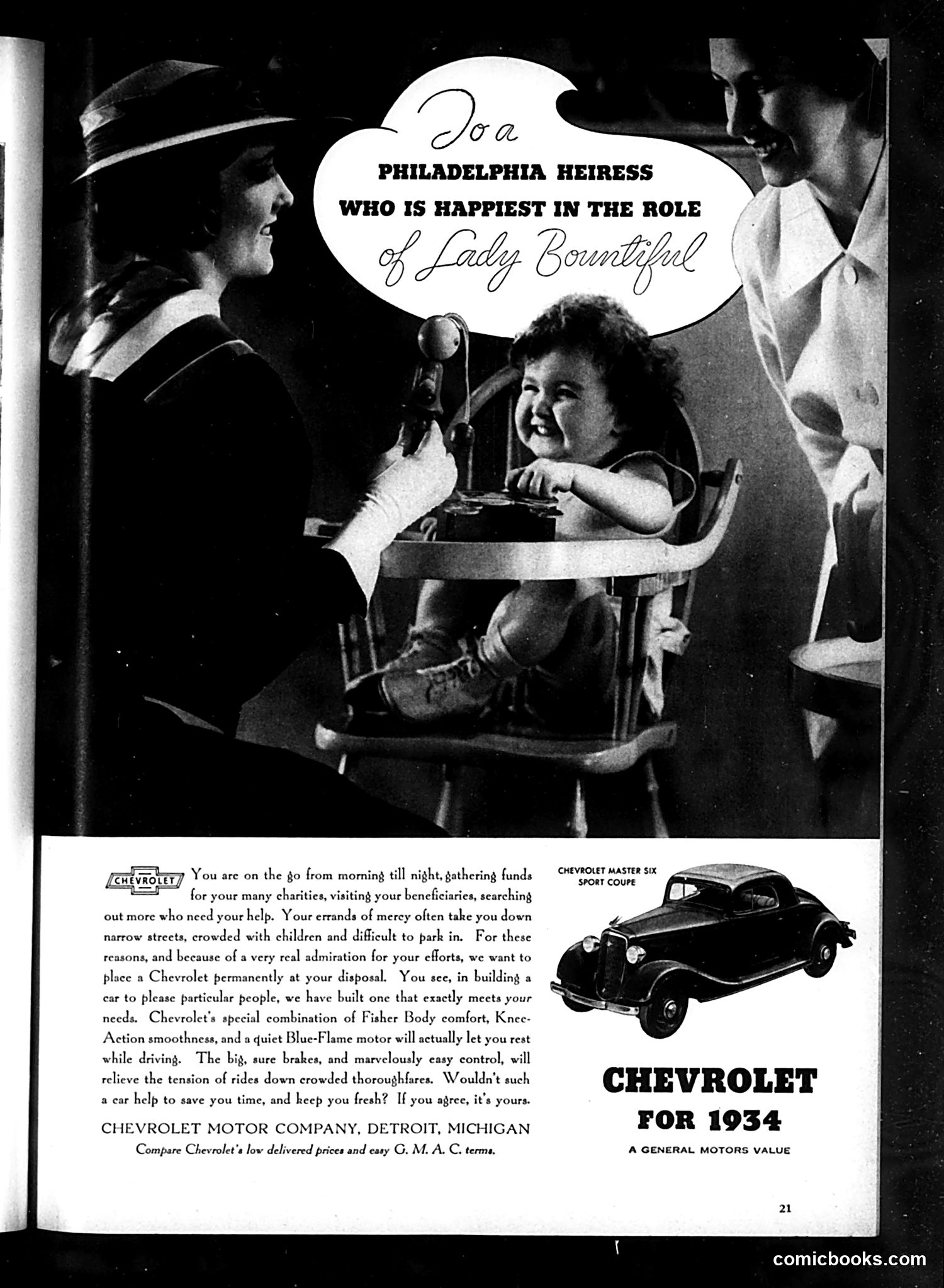
This is a 1934 Chevrolet advertisement, not satire. It targets wealthy Philadelphia women philanthropists by depicting an unnamed heiress performing charity work—visiting poor neighborhoods and distributing funds to the needy. The ad's pitch: a Chevrolet would facilitate her charitable missions by navigating narrow streets, providing reliable transportation for frequent errands of mercy, and allowing her to rest while driving through crowded areas. The implicit appeal flatters her charitable status while suggesting the car enhances her do-good image and efficiency. The "Lady Bountiful" reference (a stock character of wealthy benefactress) and the respectful framing reflect 1930s attitudes toward upper-class women's philanthropic roles. The ad strategically positions the car as practical for someone constantly on charitable business, combining luxury messaging with appeals to social responsibility—a marketing approach that merged class status with public service.
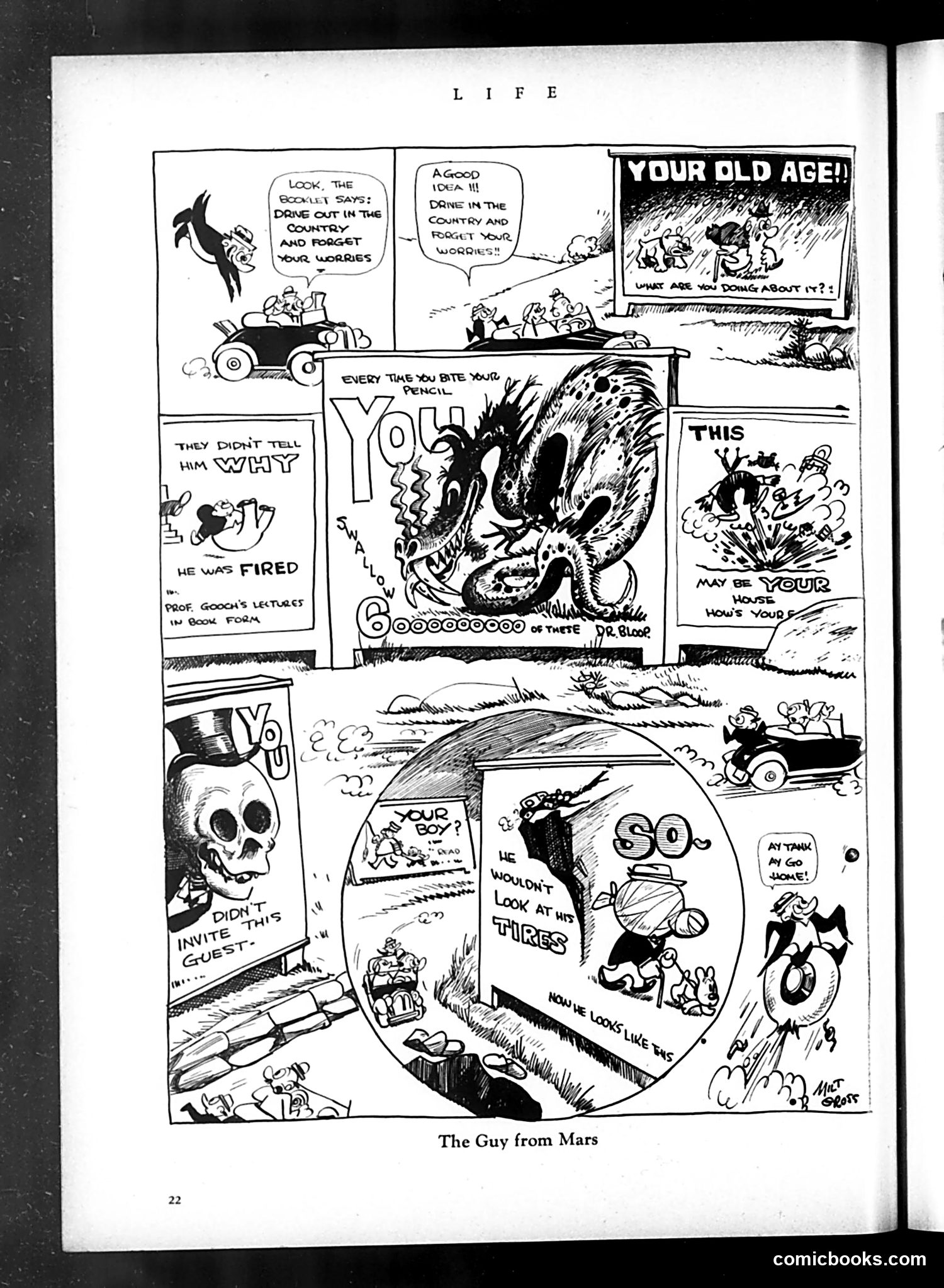
"The Guy from Mars" - Life Magazine Comic This is a surreal science fiction comic depicting a Martian visitor's chaotic tour of Earth. The narrative follows the alien encountering various American institutions and customs—driving in the countryside, attending Prof. Gooch's lectures (from which he's fired), and observing a chaotic "your old age" billboard and suburban house. The satire targets American anxiety about aging, conformity, and consumer culture in the mid-20th century. The absurdist humor—an alien firing from an academic lecture, a monstrous creature representing aging fears, the obsession with material possessions—critiques how Americans obsess over youth, productivity, and accumulation. The comic uses the "outsider perspective" device common to satirical science fiction: presenting Earth customs as bizarre to highlight their actual absurdity to contemporary readers concerned with post-war materialism and social pressures.
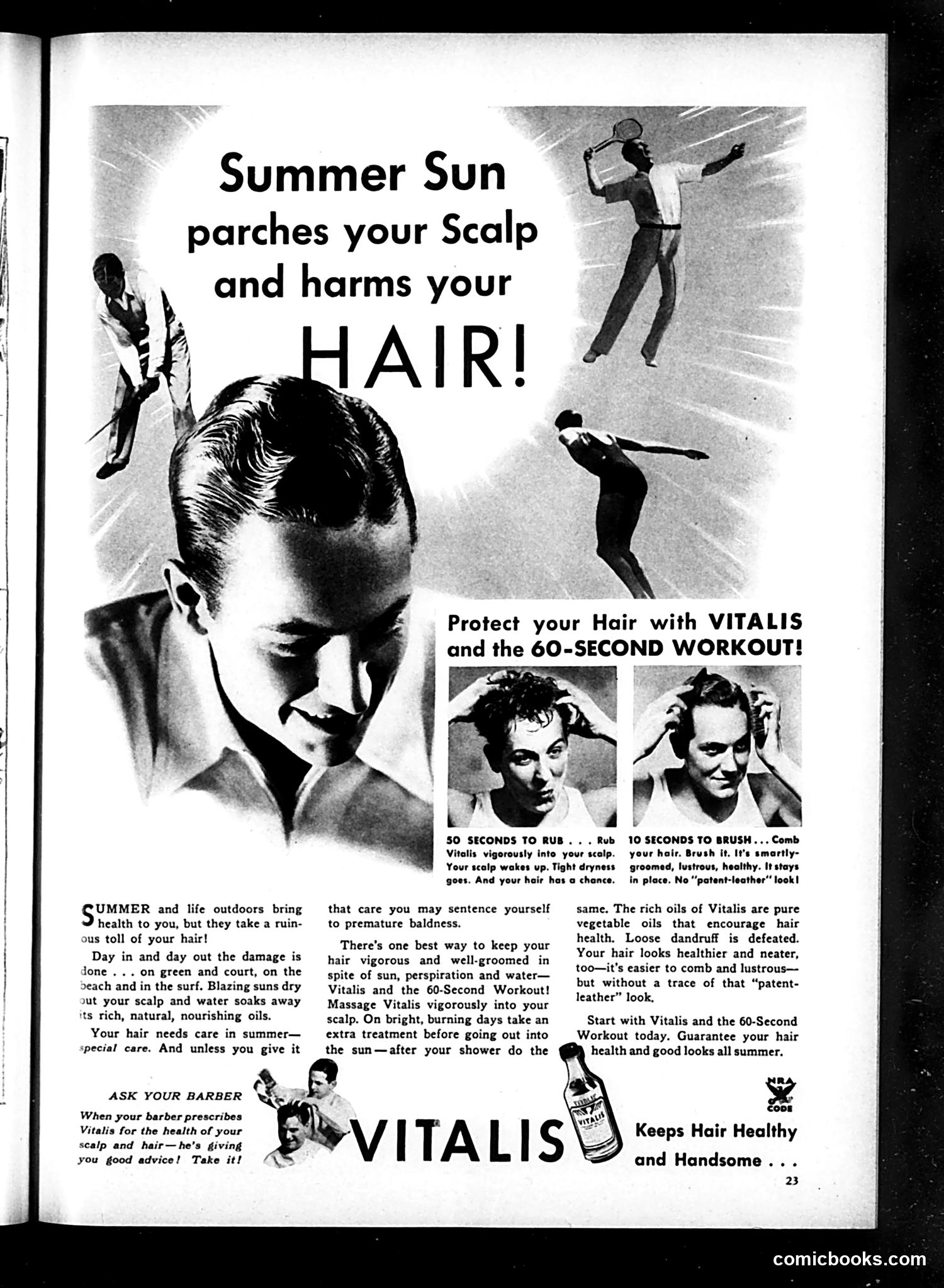
Vitalis Hair Product Advertisement This is a vintage advertisement, not satire or editorial content. It promotes Vitalis, a men's hair product, by warning about summer sun damage to hair and scalp. The ad uses dramatic imagery—men playing sports and exercising in bright sunlight—to establish the problem: outdoor activity causes hair dryness and potential baldness. The solution is Vitalis oil combined with a "60-Second Workout": a massage-and-brush routine to restore hair health. The advertisement appeals to male vanity and barber authority ("Ask Your Barber"), emphasizing that Vitalis provides "lustrous, healthy" hair without an artificial "patent-leather" appearance—a concern for 1940s-50s men's grooming standards. This reflects the era's marketing strategy of creating anxiety about grooming deficiencies while positioning commercial products as essential solutions.
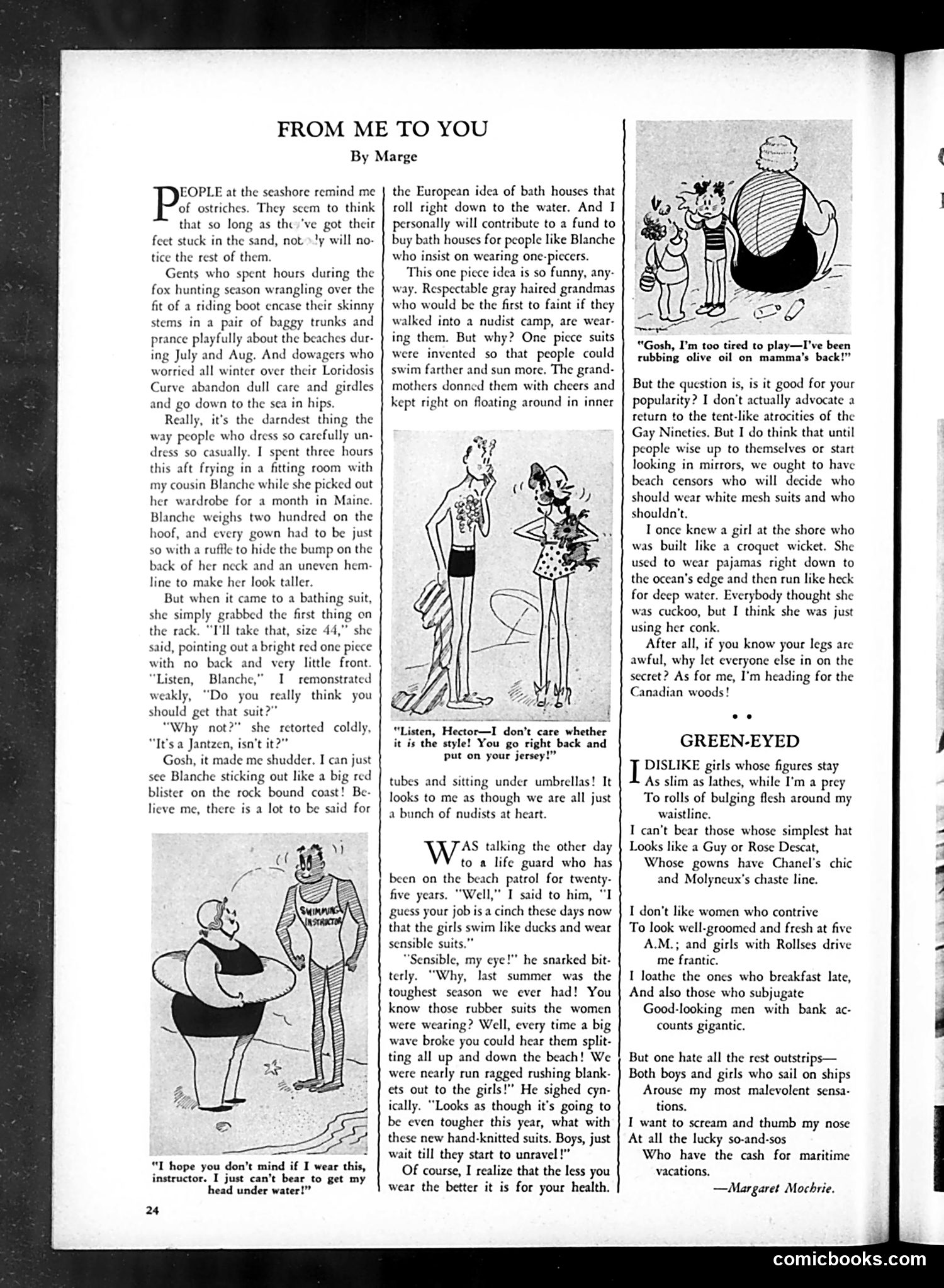
Analysis: "From Me to You" by Marge This is a humorous social commentary on 1920s-30s beach culture and women's fashion. The author satirizes the contradiction between how carefully people dress in formal settings versus how carelessly they choose bathing suits. The main target is overweight women, particularly "cousin Blanche," who spends hours selecting flattering clothes but then grabs an ill-fitting one-piece swimsuit. The joke rests on body-shaming: the author imagines Blanche as "a big red blister" on the coast. The cartoons illustrate related beach absurdities: a child requesting the instructor not dunk them, and a woman asking her husband to change back into his jersey (suggesting revealing swimwear looks undignified). Secondary jokes mock older women wearing modern one-piece suits while sitting fully clothed under umbrellas, and a life guard complaining that new knitted suits constantly unravel in the waves—creating embarrassing moments. The piece reflects period anxieties about propriety, female bodies, and modern swimwear fashion. The "Jantzen" reference is a contemporary swimwear brand.
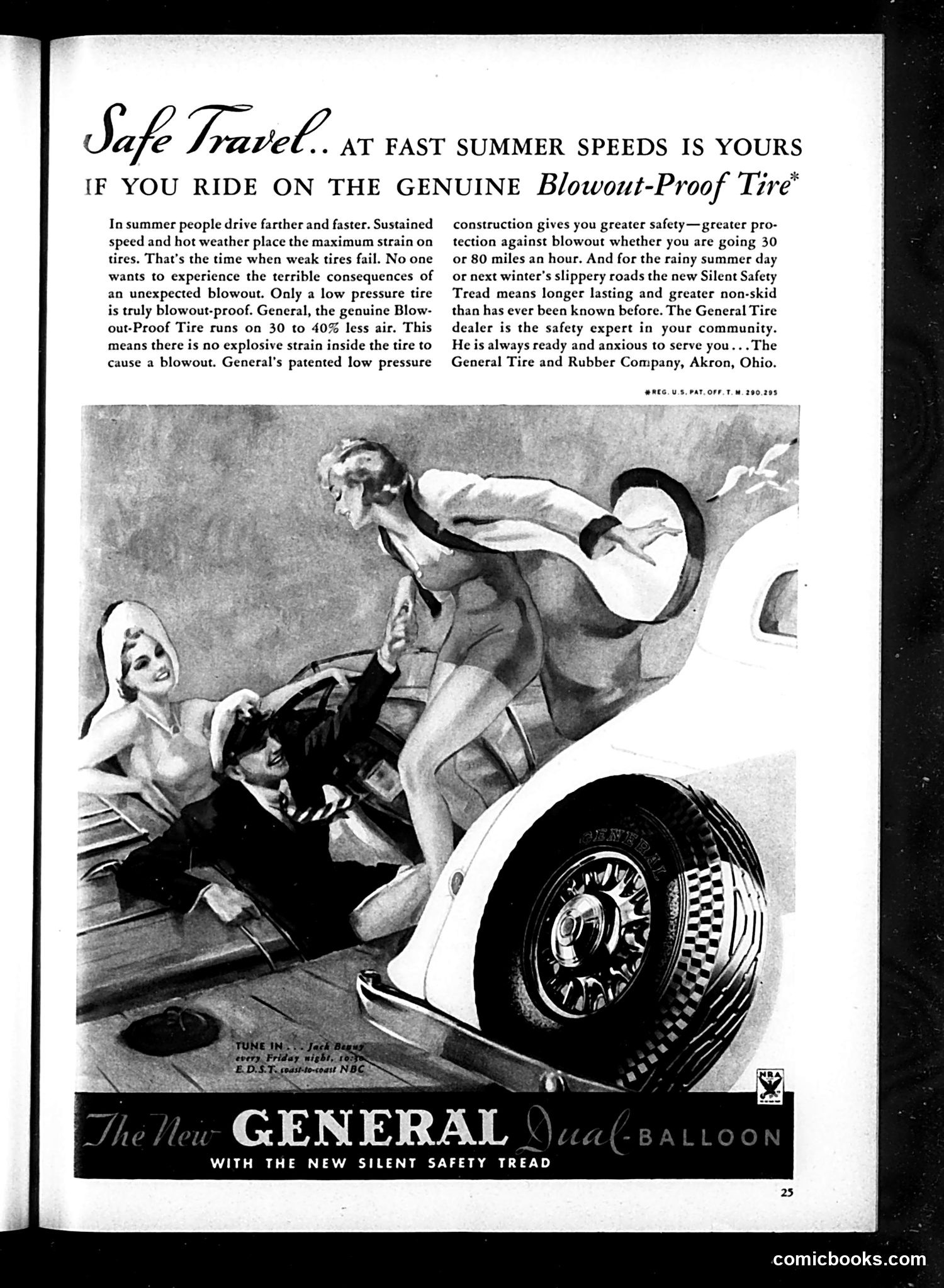
Analysis This is a tire advertisement, not political satire. It promotes General's "Blowout-Proof Tire" with the tagline "Safe Travel at Fast Summer Speeds." The illustrated scene shows a convertible car with two women and a man enjoying a carefree summer drive—the figures appear to be stylized 1930s-40s era fashionable people, not caricatures of specific individuals. The image conveys the freedom and speed of modern motoring. The "joke" or appeal is aspirational rather than satirical: the advertisement associates the tire brand with safety, summer leisure, and modern automotive pleasure. The text emphasizes the tire's low-pressure construction prevents blowouts during sustained high-speed driving—a genuine safety concern before modern tire technology. There is no political or social satire here; this is straightforward commercial messaging using period advertising conventions: glamorous people, modern technology, and safety assurances to sell a consumer product.
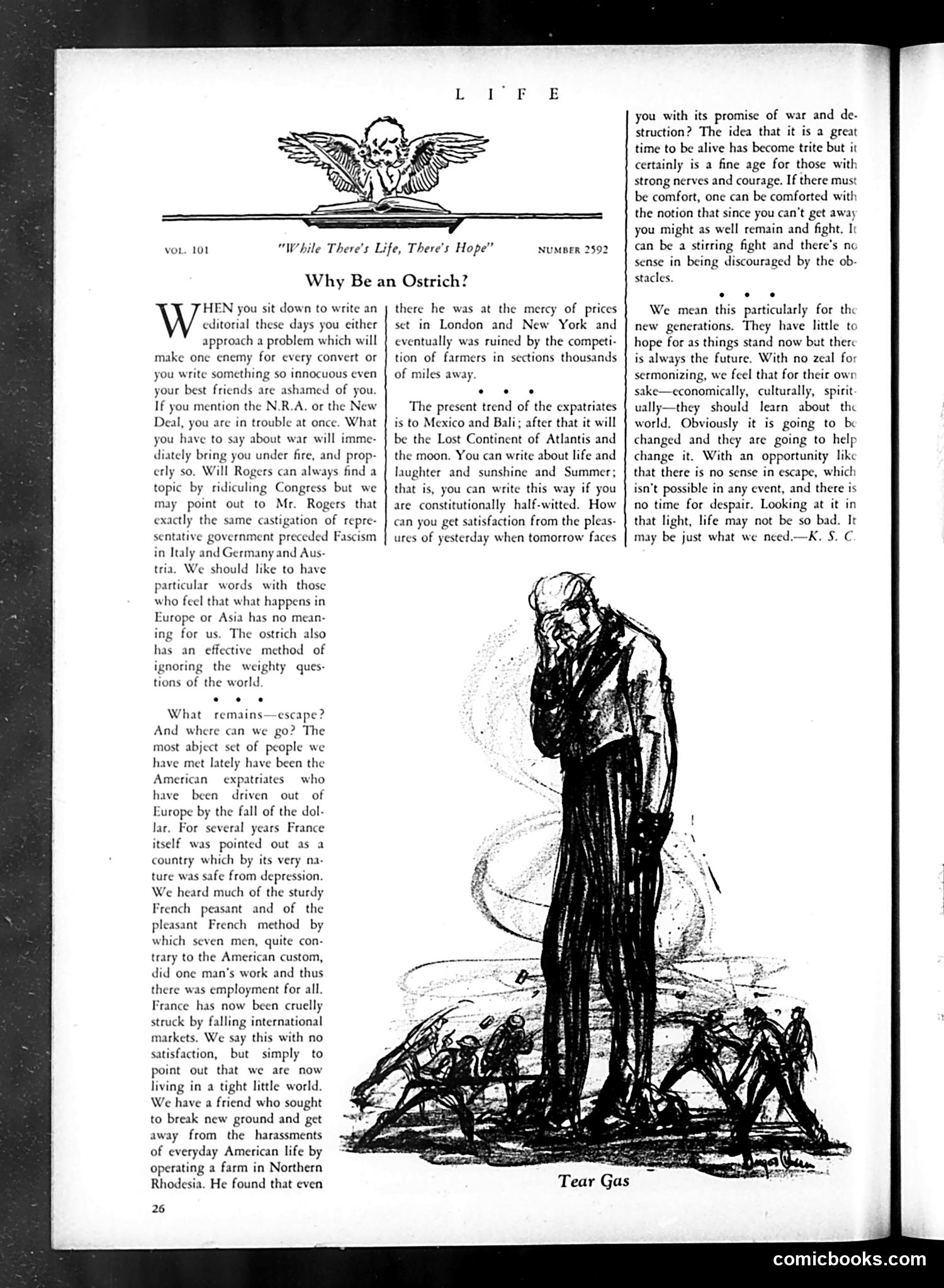
"Why Be an Ostrich?" — Life Magazine Editorial Cartoon This page critiques isolationism and escapism during the Depression era. The title references ostriches burying their heads in sand—a metaphor for ignoring world problems. The editorial argues against those who dismiss European and Asian affairs as irrelevant to Americans. It also mocks expatriates (Americans fleeing to Mexico, Bali, or fantasy locations like "Atlantis") seeking to escape economic hardship and geopolitical instability. The accompanying illustration labeled "Tear Gas" depicts a tall, gaunt figure (likely representing despair or a failed escapee) surrounded by turmoil, emphasizing that escape is impossible in an interconnected world. The author argues that young people should instead engage with global realities, learn about the changing world, and participate in shaping it—rather than retreat into denial or flee abroad. Escapism is presented as both futile and cowardly.
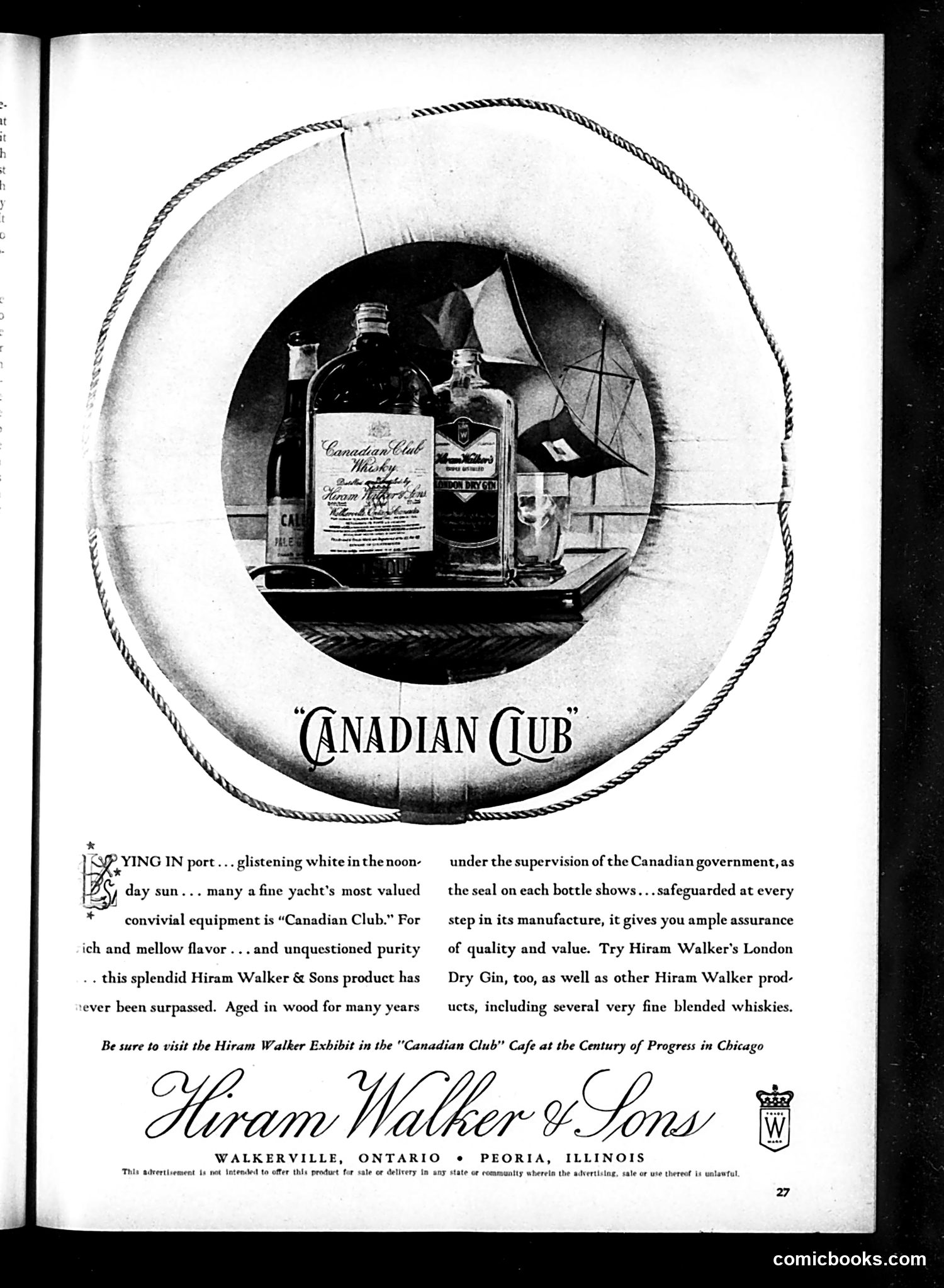
This is not a cartoon or satire—it's a straightforward advertisement for Canadian Club whiskey by Hiram Walker & Sons. The page shows liquor bottles displayed in a life preserver (nautical framing), promoting Canadian Club whiskey as essential yacht equipment. The ad emphasizes the product's quality, purity, and government supervision. It mentions the brand's London Dry Gin and invites readers to visit a Hiram Walker exhibit at Chicago's Century of Progress (a 1933-34 world's fair). The only notable historical context: this ad appeared during or shortly after Prohibition's repeal (December 1933), when alcohol advertising re-emerged in American magazines. The disclaimer at bottom—"not intended to offer this product for sale or delivery in any state or community wherein the advertising, sale or use thereof is unlawful"—reflects states' varying post-Prohibition regulations. This is commercial advertising, not political satire.
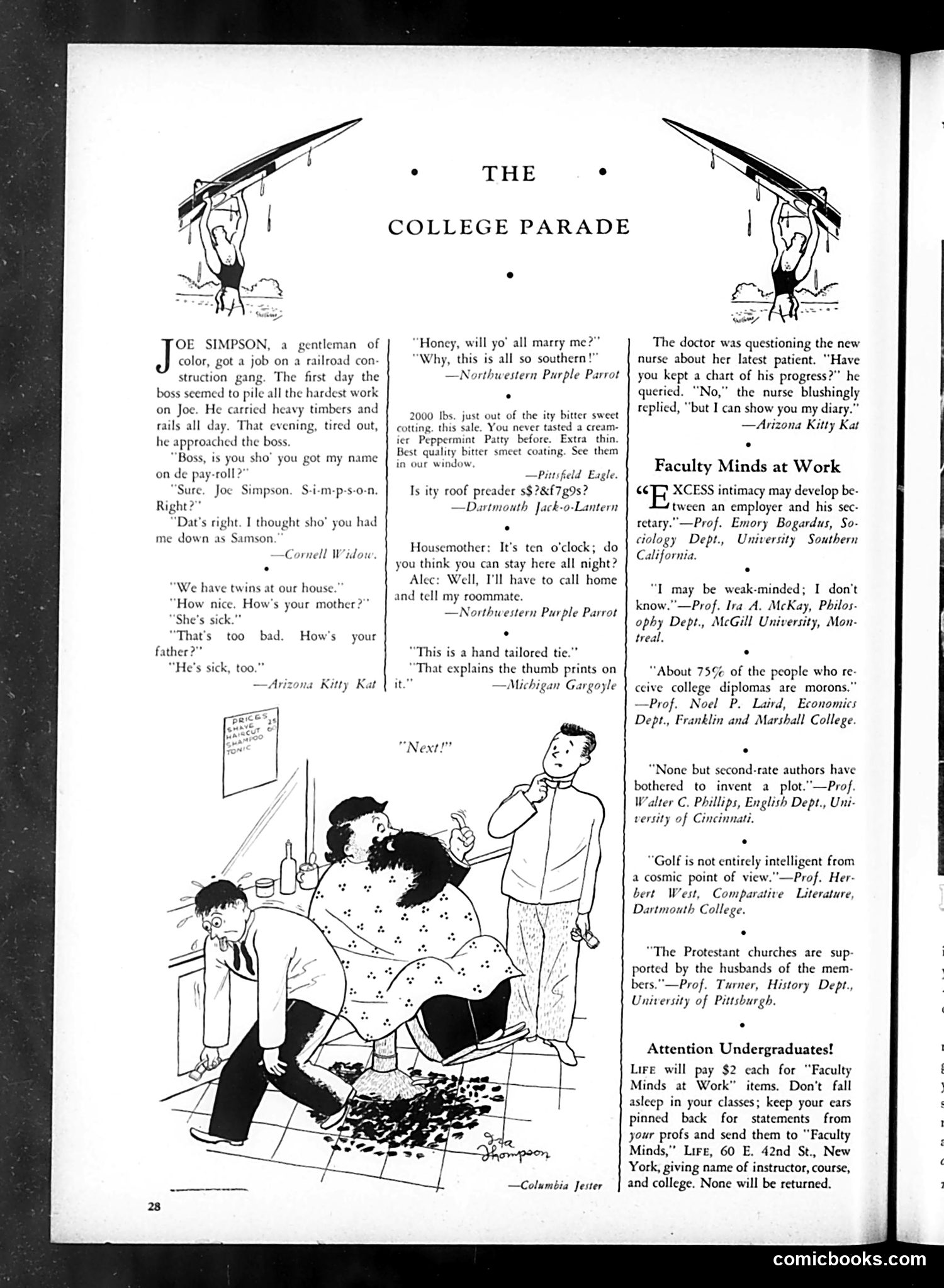
"The College Parade" Page Analysis This Life magazine page features humorous college anecdotes and satirical observations from university faculty. Main Cartoon: The large illustration by Columbia Jester depicts a chaotic domestic scene—a woman surrounded by children and mess exclaims "Next!" suggesting she's overwhelmed by her large family. This illustrates the era's humor about domestic life and motherhood. Content: The page collects jokes from various college humor magazines (Cornell Widow, Arizona Kitty Kat, Northwestern Purple Parrot, etc.), mocking: - Racial stereotypes (the Simpson/Samson joke relies on offensive dialect humor) - College romance and courting customs - Campus life (housemother rules, late-night visits) "Faculty Minds at Work" section quotes real professors making absurdist or provocative statements—portraying academics as out-of-touch, cynical, or deliberately shocking. The final notice offers payment for readers catching additional such quotes, making this participatory satire. The page reflects 1920s-30s college humor conventions: lighthearted mockery of romance, family, and intellectual pretension.
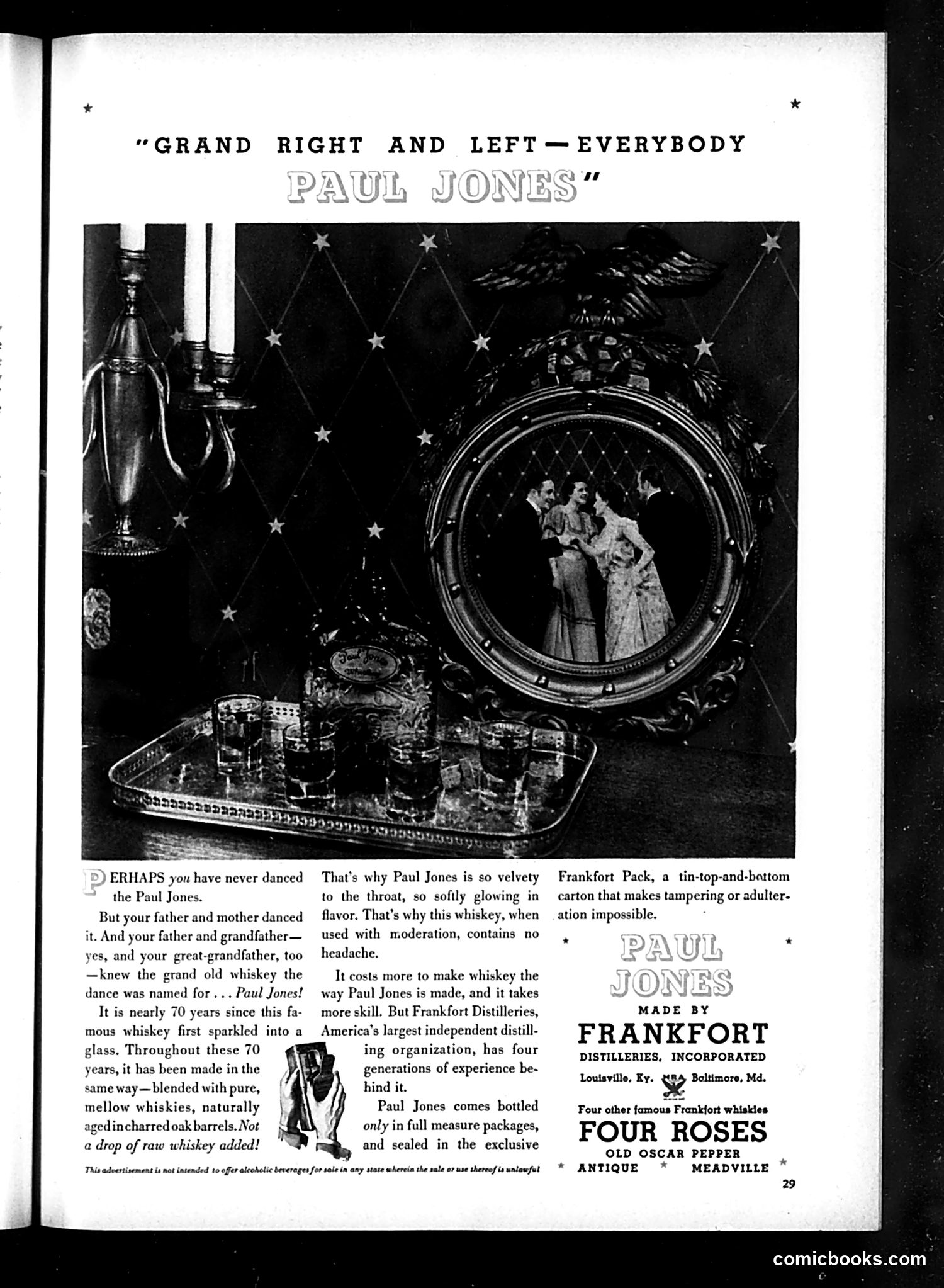
Paul Jones Whiskey Advertisement This is a whiskey advertisement, not political satire. It promotes Paul Jones brand whiskey made by Frankfort Distilleries. The ad uses nostalgia and family tradition as its sales pitch, claiming the whiskey has been made the same way for 70 years. It references the "Paul Jones" dance—a historical social dance popular in the 19th century—to establish the product's longstanding heritage. The decorative circular image shows people in what appears to be a social setting, reinforcing themes of tradition and respectability. Notable for modern readers: the ad emphasizes "no headache" and "moderation," reflecting Prohibition-era messaging (post-1933 repeal) when distilleries had to market alcohol cautiously and responsibly to rebuild their reputation. The tamper-proof packaging claim also addressed contemporary concerns about product authenticity.
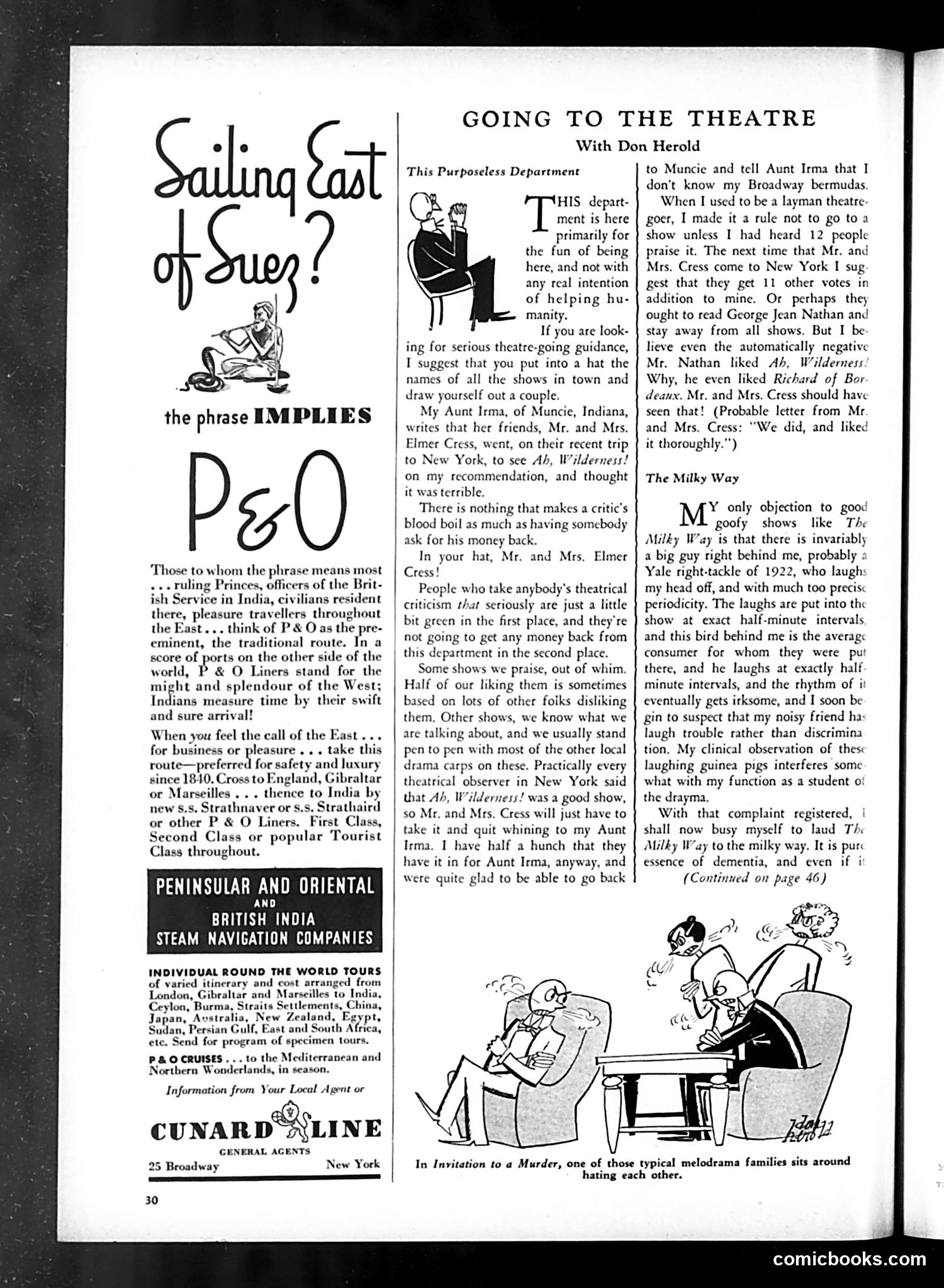
Page Analysis: Life Magazine Theatre Commentary This page combines travel advertising with theater criticism commentary by Don Herold. The main content is Herold's tongue-in-cheek "Purposeless Department" about Broadway theater-going. The satire's point: Herold mocks both theater critics and audiences. He jokes that his department has "no real intention of helping humanity" and suggests readers literally draw show names from a hat rather than trust critical opinion. When readers complain about shows he recommended (like *Ah, Wilderness!*), he dismissively tells them to go away ("In your hat, Mr. and Mrs. Elmer Cress!"). The social context: The piece satirizes the arbitrary nature of theater criticism and how audiences desperately seek validation for entertainment choices. Herold suggests critics are unreliable guides—sometimes praising shows because *other people* dislike them, other times genuinely knowing what they're discussing. He implies that consensus (hearing "12 people praise" a show) matters more than actual quality to theatergoers. The cartoon at bottom depicts a typical melodrama family "hating each other"—visual humor supporting the theater criticism theme.
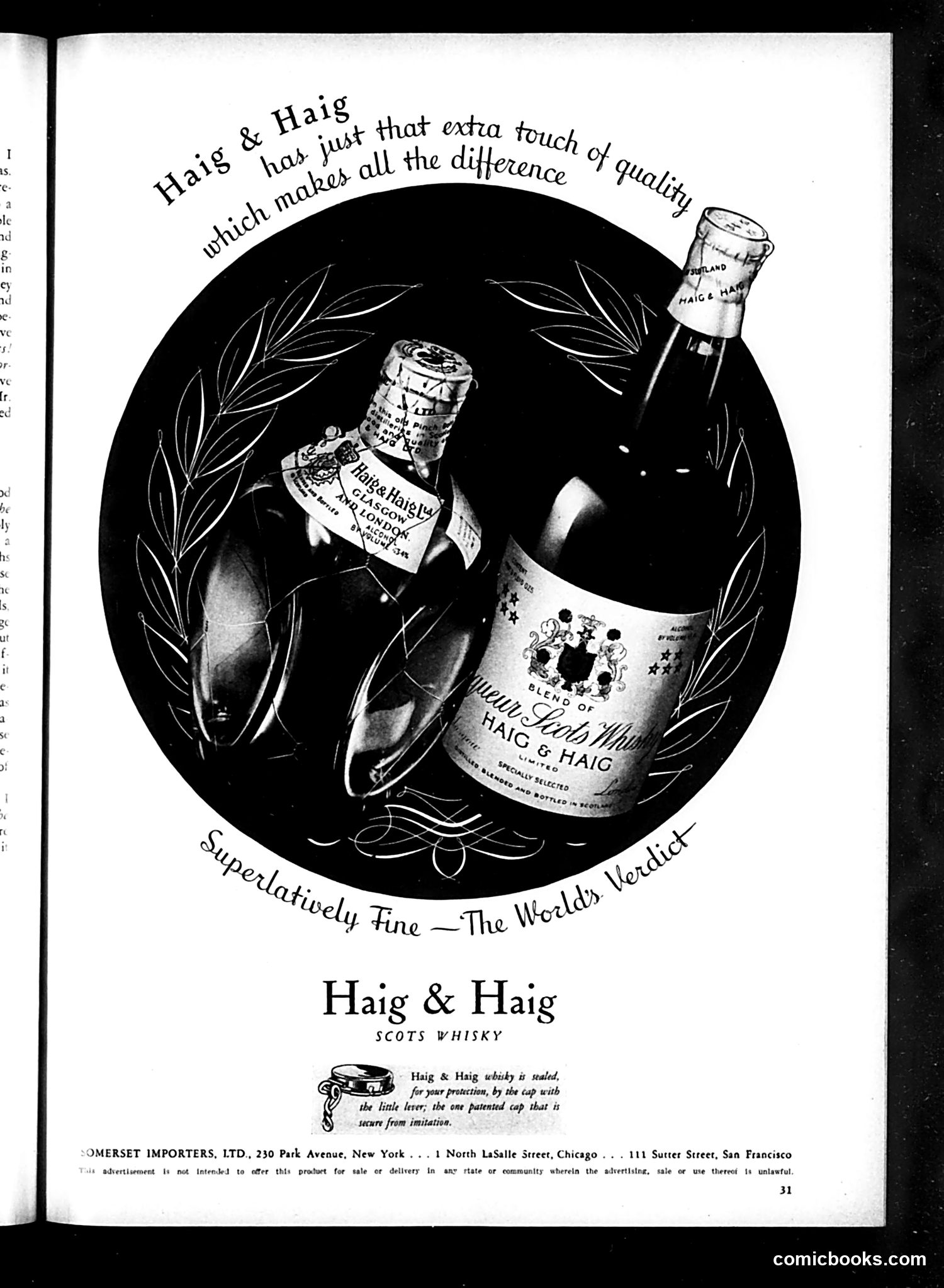
Analysis This is a full-page advertisement for Haig & Haig Scotch whisky, not satire or political commentary. The image shows whisky bottles arranged with decorative laurel wreaths in a circular composition. The text emphasizes the product's quality ("that extra touch of quality") and its security feature—a patented cap with "a little lever" that prevents imitation. The tagline "Superlatively Fine—The World's Verdict" makes a straightforward luxury claim. The disclaimer at bottom indicates this ran during Prohibition or in dry states, since sales were restricted in certain jurisdictions. There is no cartoon, caricature, or satire here—just marketing copy positioning Haig & Haig as premium, authenticated whisky for affluent consumers.
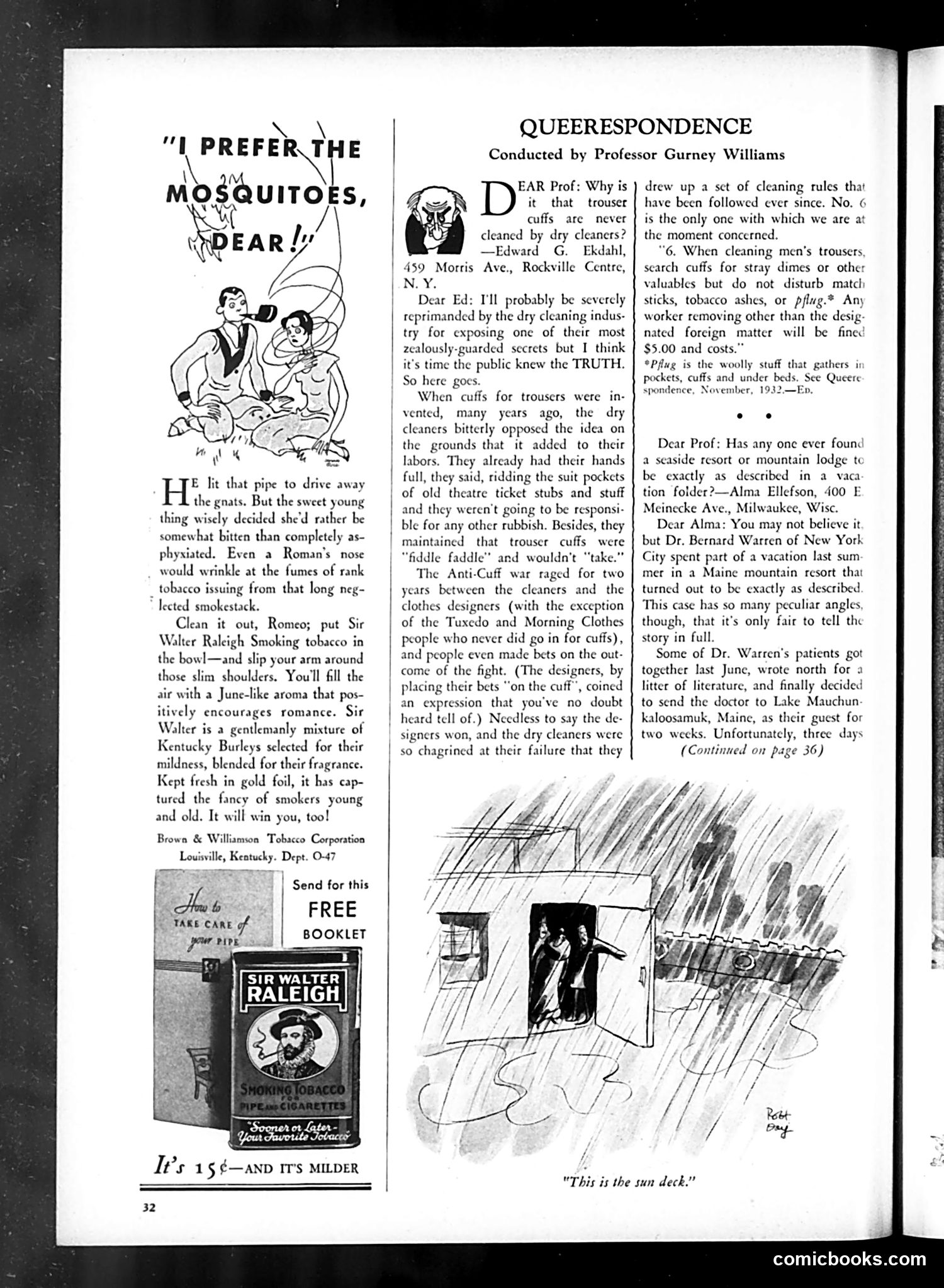
Analysis for Modern Readers This page contains two distinct pieces: a Sir Walter Raleigh tobacco advertisement and a humor column called "Queerespondence." The Advertisement (left): A romantic pitch claiming mild tobacco will attract women. The joke is dated—it assumes smoking indoors to impress dates is desirable, which modern readers would find absurd and offensive. The Humor Column (right): Presents fake "insider secrets" about dry cleaning and vacation resorts. The first letter claims dry cleaners deliberately avoid cleaning trouser cuffs due to a decades-old grudge against clothing designers who invented cuffs. The second letter (partially shown) promises an unusual vacation story. The humor relies on absurdist logic and mock-serious tone—presenting ridiculous explanations as fact. It's gentle satire mocking both consumer culture and the advice-column genre itself. Modern readers would recognize this as proto-absurdist comedy, though the specific product references and concerns (theater ticket stubs in pockets) feel quaintly dated.
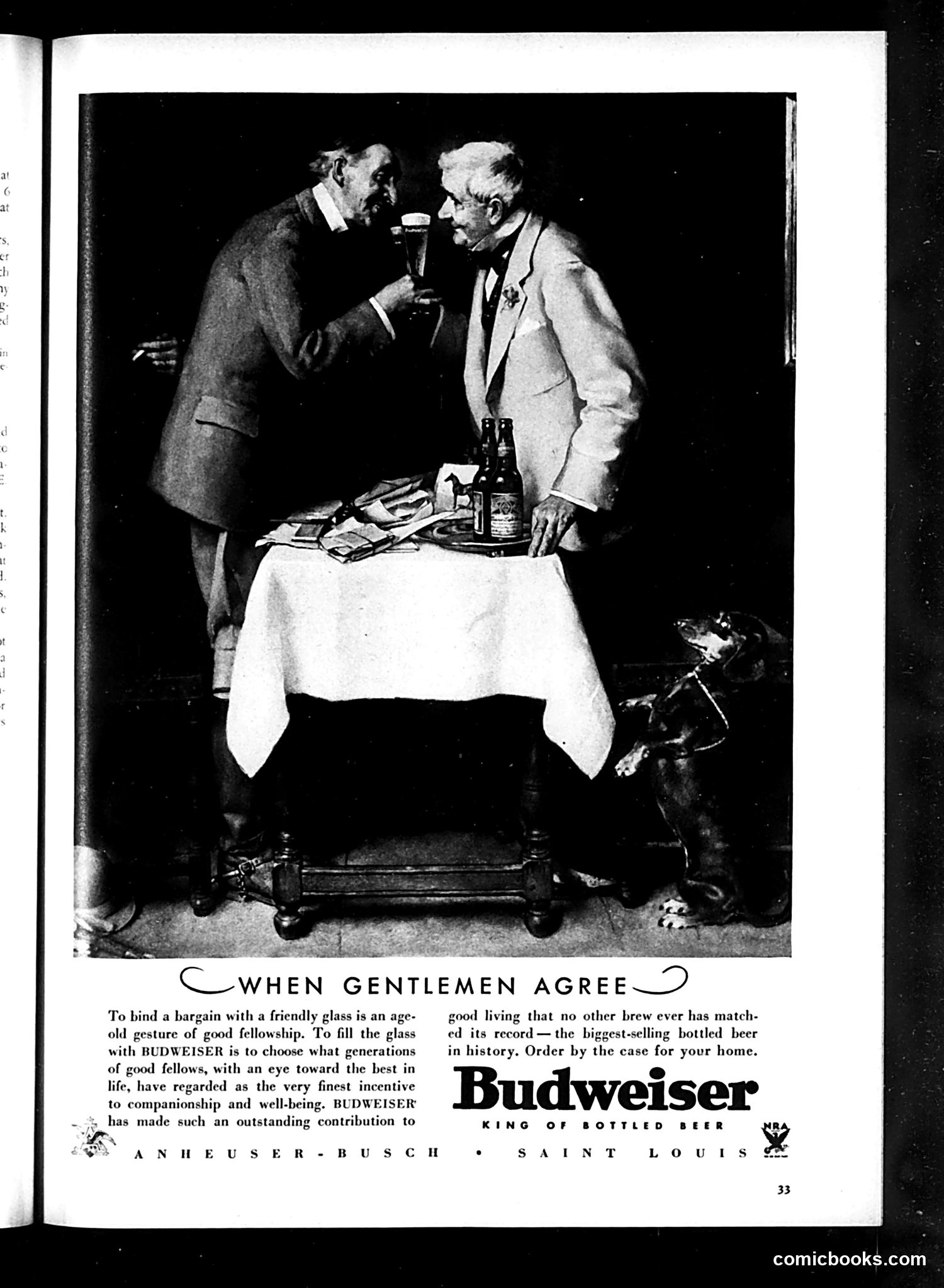
Analysis This is a Budweiser beer advertisement, not political satire. The image shows two well-dressed gentlemen in formal attire toasting over a table with a bottle of Budweiser and food, with a dog visible at the bottom. The ad's message is straightforward: drinking Budweiser together represents civilized fellowship and good living. The headline "When Gentlemen Agree" suggests that refined men naturally choose this beer as the finest available. The text emphasizes Budweiser as "the biggest-selling bottled beer in history" and frames the product as integral to companionship and well-being among gentlemen of taste. This reflects early-20th-century advertising that associated beer consumption with respectability and social status—a stark contrast to modern attitudes. The ad is from Anheuser-Busch, Saint Louis, and appears designed for a middle-to-upper-class male readership of *Life* magazine.
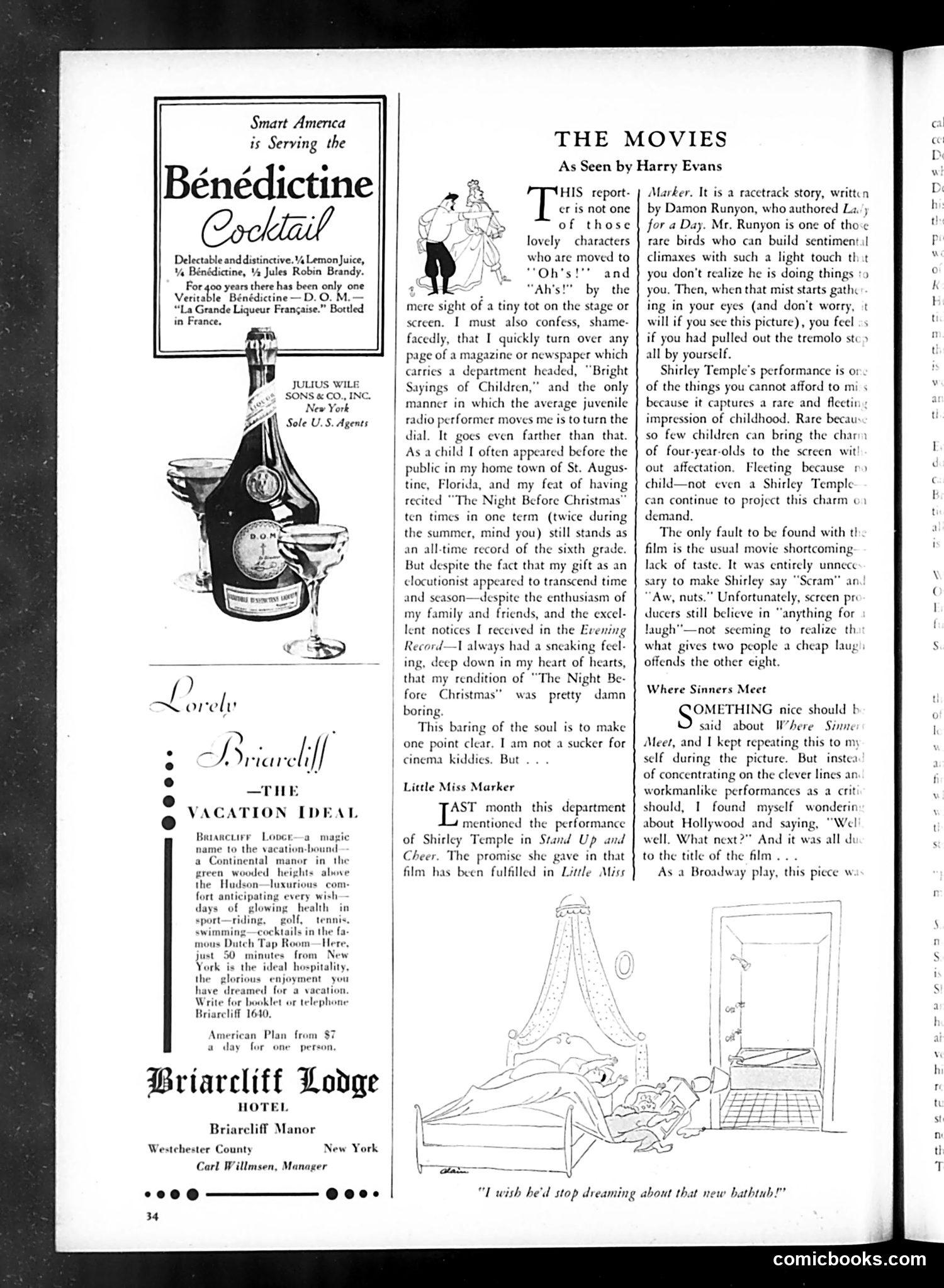
"The Movies As Seen by Harry Evans" This page is primarily a film review column mixed with advertisements. The main content is critic Harry Evans's commentary on recent movies, particularly praising child actress Shirley Temple's performance in *Little Miss Marker*, a Damon Runyon adaptation about a racetrack story. Evans establishes his credibility by confessing he dislikes child performers generally—he himself performed as a child reciting "The Night Before Christmas" repeatedly, finding it tedious. This establishes him as a skeptical observer, making his praise of Temple's rare ability to portray childhood authentically without affectation more meaningful. Evans criticizes Hollywood's reliance on crude language and cheap laughs (having Shirley say "Scram" and "Aw, nuts"), arguing such moments offend sophisticated audiences while amusing only the unsophisticated. The page also includes advertisements for Bénédictine cocktails and the Briarcliff Lodge resort in Westchester County, typical of Life magazine's revenue model blending editorial and advertising content.
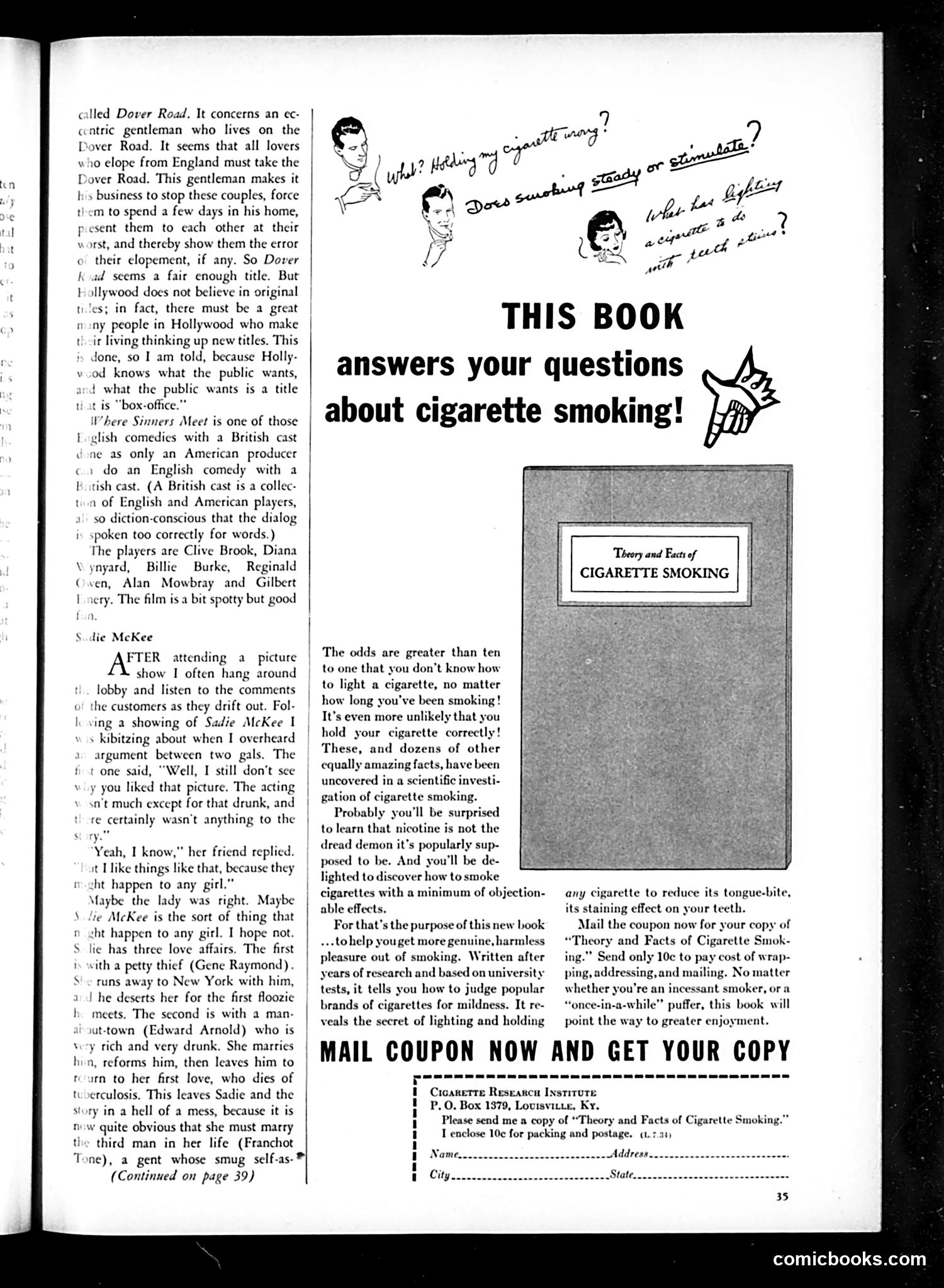
Analysis of This Life Magazine Page This page combines film criticism with tobacco advertising—a striking artifact of 1930s American media culture. The Movie Reviews (left side): Critic Sadie McKee discusses recent films like *Dover Road* and *Where Sinners Meet*, analyzing plot mechanics and cast performances. The tone is gossipy and informal, reflecting Life's style of accessible entertainment commentary. The Cigarette Advertisement (right side): The "Theory and Facts of Cigarette Smoking" book offer represents pro-smoking messaging that would be shocking to modern readers. The ad claims scientific research proves cigarettes can be smoked "with a minimum of objectionable effects" and promises readers will learn "amazing facts"—language that obscures health risks rather than disclosing them. Historical Context: This advertisement ran when cigarette health dangers were not yet widely acknowledged or regulated. The Cigarette Research Institute (the advertiser) was a tobacco-industry front group. Such advertising was commonplace in mainstream publications, appearing alongside entertainment content without irony or disclaimer—practices now illegal in most democracies.
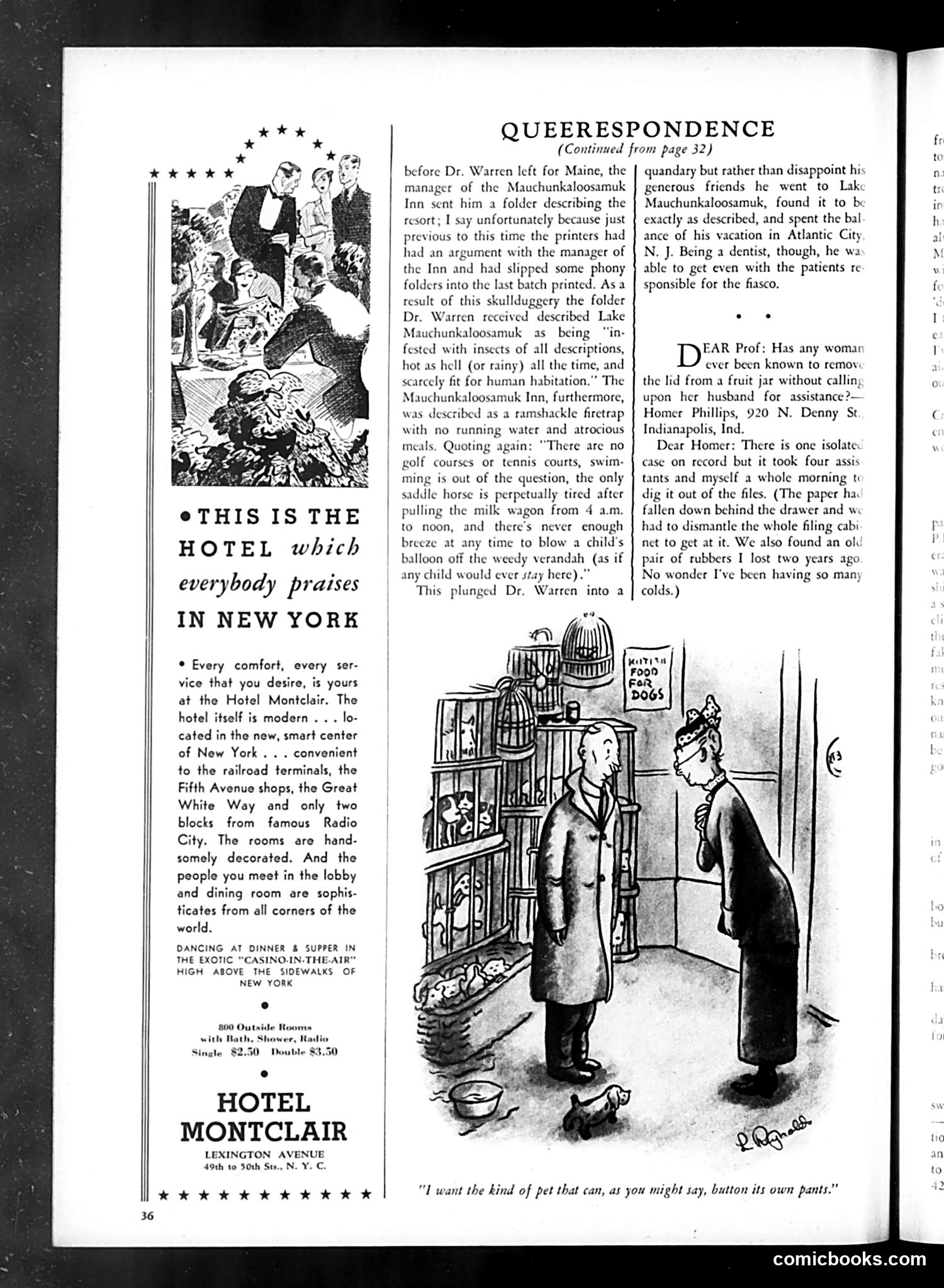
Page Analysis: Life Magazine Satire This page contains Hotel Montclair advertising (left) and reader correspondence (right), with one cartoon illustrating a humorous letter. The cartoon depicts a man visiting a pet shop, asking for "the kind of pet that can...button its own pants"—an absurdist joke about wanting an impossibly self-sufficient animal. The cartoon mocks impractical consumer demands. The correspondence section includes a satirical letter about Dr. Warren, who received deliberately sabotaged promotional materials for "Lake Mauchunkaloosamuk Inn" from printers who had quarreled with the manager. The fake brochure viciously mocked the resort (infested, ramshackle, no amenities), forcing the doctor to visit anyway. The humor lies in the elaborate prank and its consequences. Another letter jokes about women removing jar lids without male assistance—a period-typical gender joke. The page exemplifies *Life*'s satirical approach to everyday American life, workplace mishaps, and domestic absurdities.
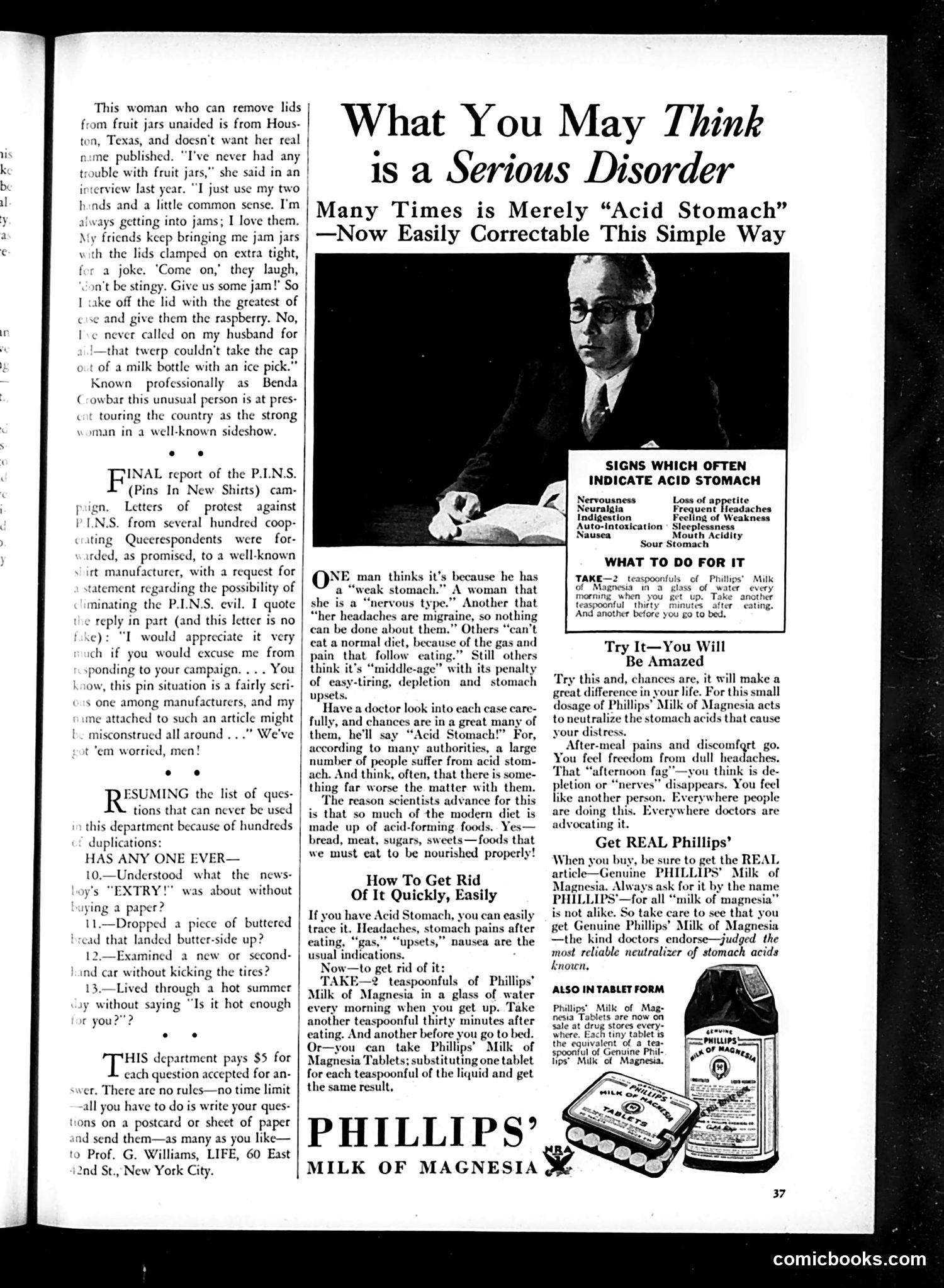
This page is primarily a vintage pharmaceutical advertisement for Phillips' Milk of Magnesia, disguised as health advice. The upper portions feature satire about minor human complaints and oddities, but the main content is a full-page ad. The satire sections mock everyday annoyances and unsolved questions Life magazine readers submitted—unaided jar-opening, promotional pins in new shirts, rhetorical questions no one can answer. One anecdote profiles a sideshow performer from Houston, Texas, known as "Benda Cowbar," who could remove stuck jar lids with her bare hands. The advertisement reframes various physical symptoms—headaches, indigestion, fatigue, nervousness—as symptoms of "Acid Stomach," then promotes Phillips' Milk of Magnesia as the solution. It suggests that a "modern diet" of bread, meat, and sweets causes the problem, positioning the product as correcting this through alkaline treatment. This reflects early 20th-century patent medicine marketing: identifying vague complaints as a single treatable "condition" to drive sales.
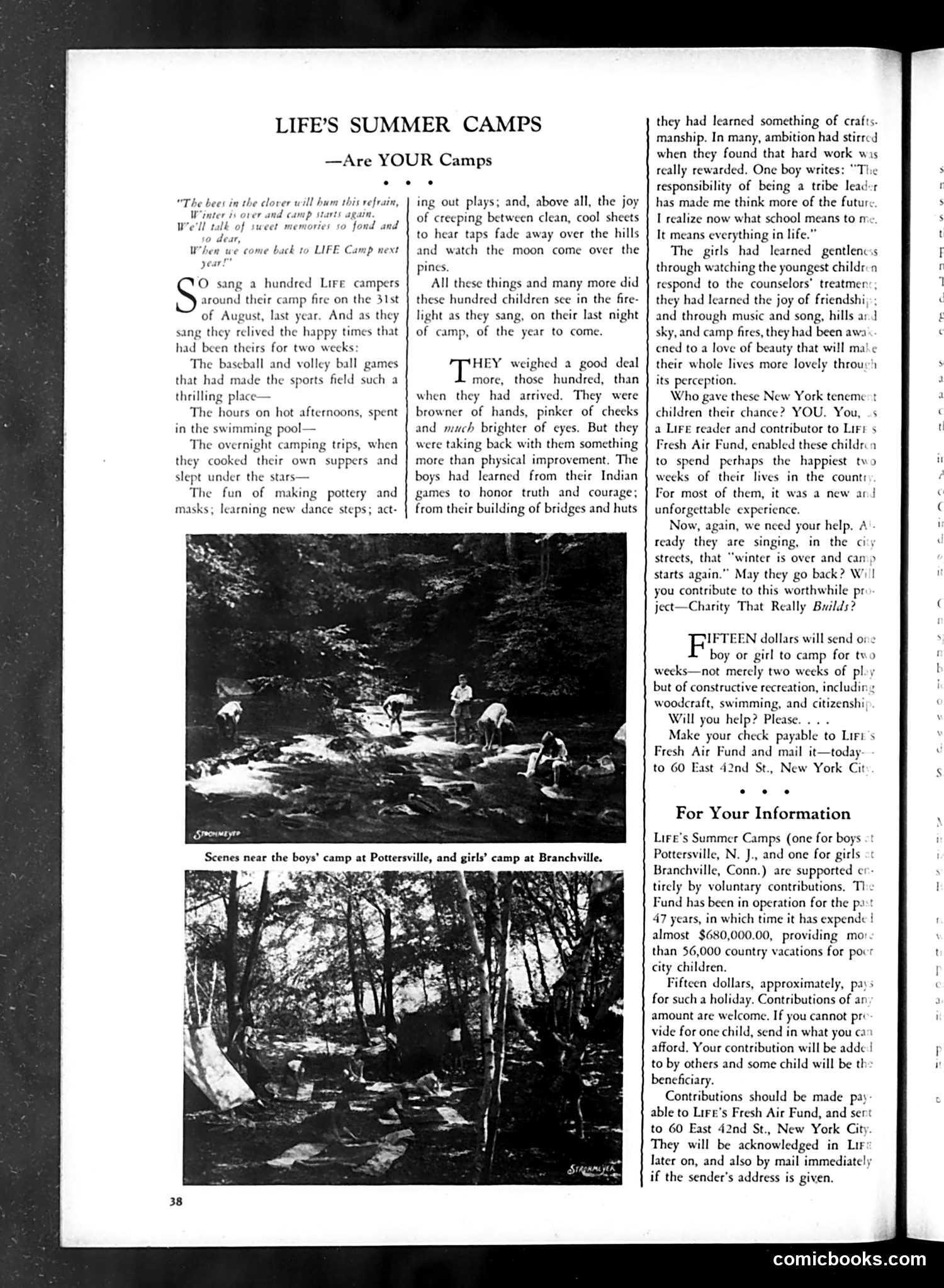
Life Magazine's Summer Camps Appeal This is not a cartoon but a charitable fundraising article for Life's Fresh Air Fund, which provided summer camp experiences for poor urban children, primarily from New York tenements. The piece describes how 100 children recently returned from two-week camps in New Jersey and Connecticut, where they gained physical health, skills (crafts, swimming), and moral lessons (courage, gentleness, friendship). It emphasizes the transformative impact on disadvantaged city youth. The article then solicits donations: $15 sends one child to camp for two weeks of "constructive recreation." Life magazine had run this fund for 47 years, having spent $680,000 on over 56,000 country vacations. The social context: This reflects early 20th-century Progressive Era concerns about urban poverty and child welfare. Providing "fresh air" and nature exposure to tenement children was considered healthful and character-building—a common philanthropic cause of the period.
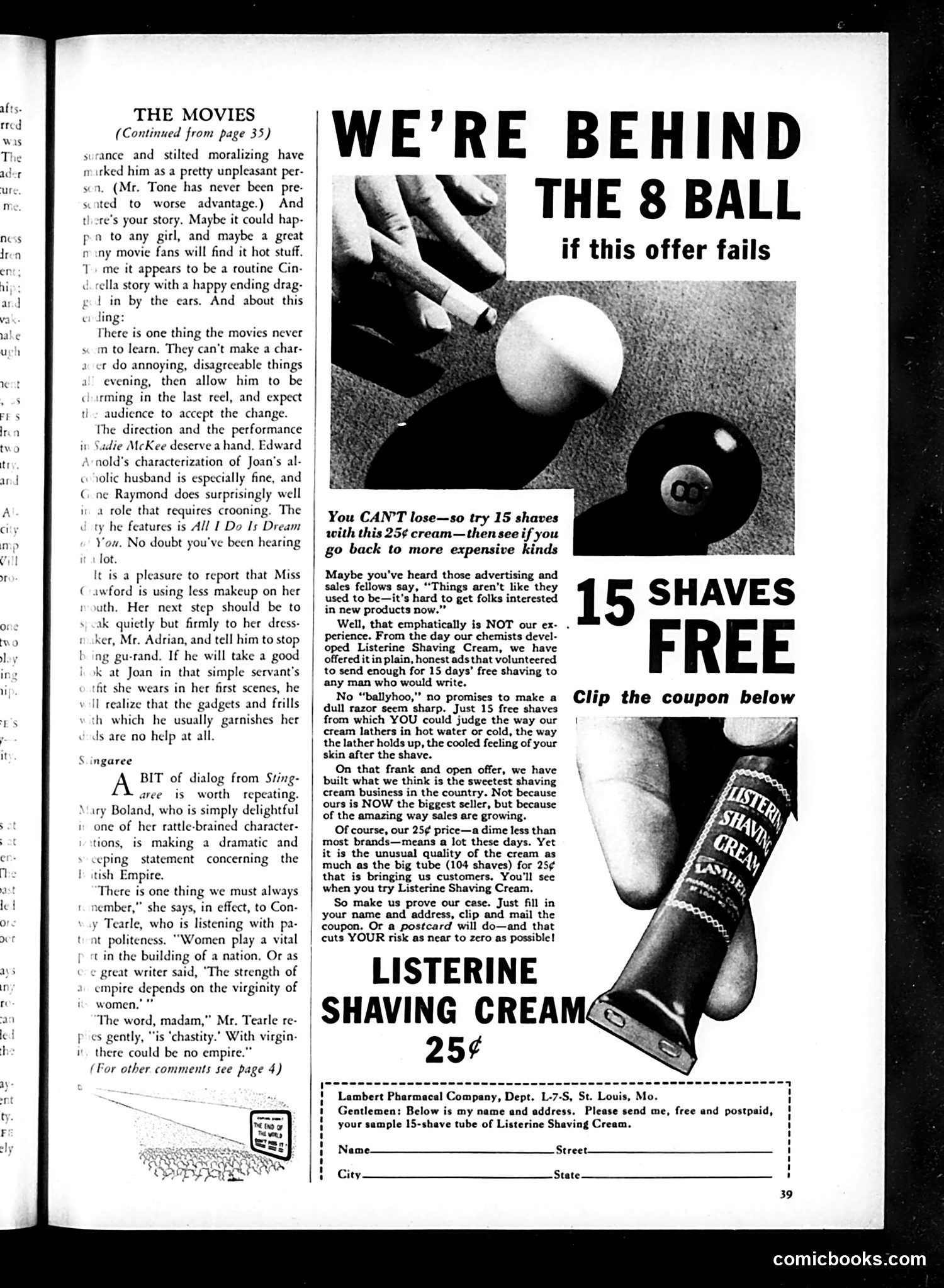
Analysis This page is primarily advertising, not satire or political commentary. The right half features a substantial Listerine Shaving Cream advertisement promising 15 free shaves for 25¢. The left column contains a film review section discussing movies including "Sadie McKee" and "Singaree." The review critiques character development in films and includes a brief dialog from "Singaree" where actress Mary Boland makes a statement about women's importance to empire-building, corrected by co-star Conwy Tearle on the proper word ("chastity" versus "virginity"). This appears to be genuine film criticism rather than satire. No political cartoons or satirical commentary appears on this page. The Listerine ad uses straightforward product marketing language emphasizing quality and low price rather than humorous or satirical approaches. The page represents typical Life magazine content mixing entertainment criticism with consumer advertising.
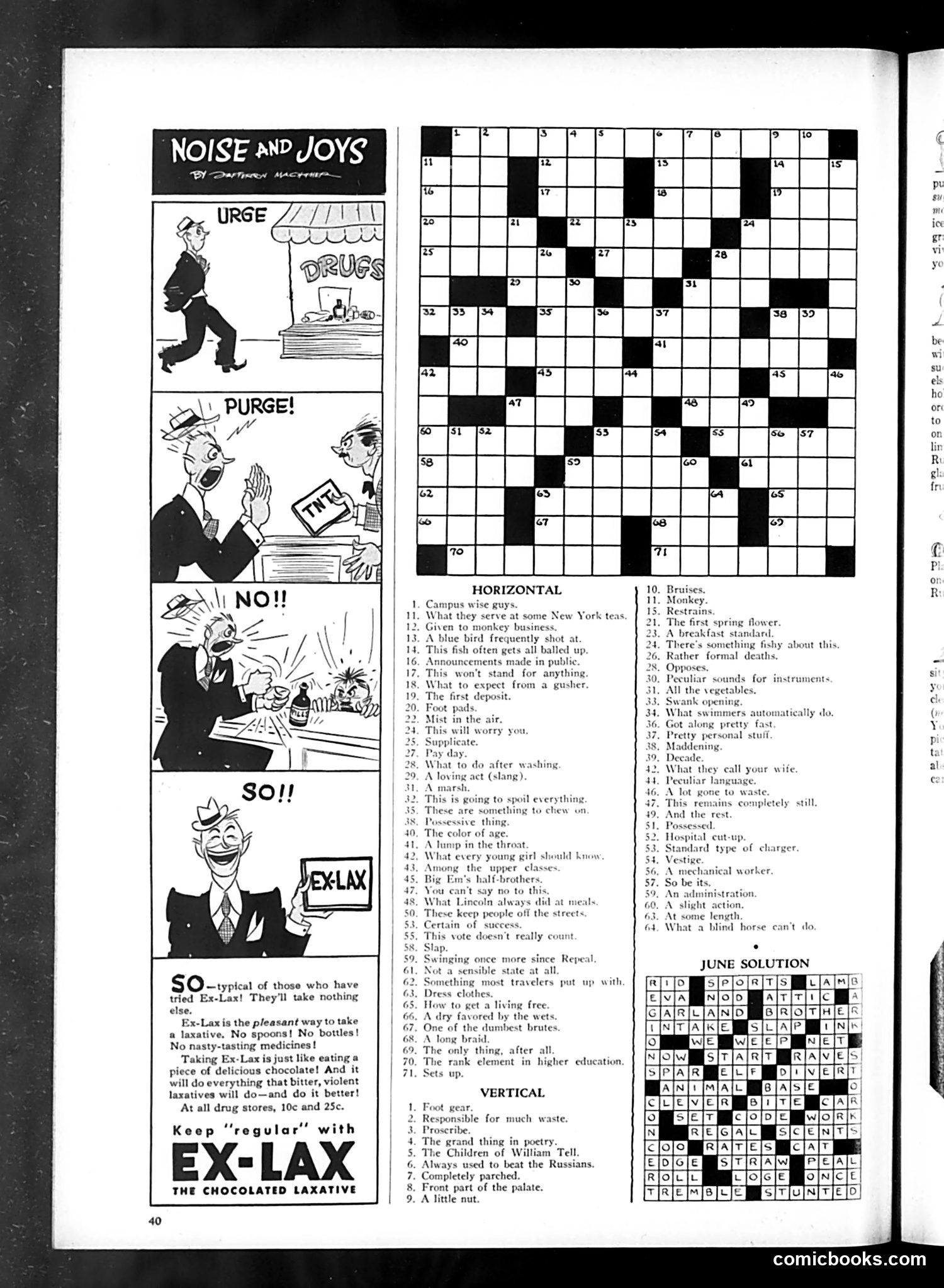
"Noise and Joys" Cartoon Analysis This page presents a satirical comic strip by Cartoonist Hastetter (OCR unclear on exact name) mocking those who dismiss warnings about drug use. The four-panel sequence shows a man urgently warning others to "URGE" people away from "DRUGS," then dramatically "PURGE!" his concerns, concluding with "NO!!" and "SO!!" — ending by happily endorsing "EX-LAX," a laxative. The satire targets hypocrisy: the character who passionately warns against harmful substances immediately promotes a medicinal product, suggesting he's merely substituting one form of consumption for another. The joke equates drug-pushing with aggressive marketing of any product, regardless of actual benefit. The crossword puzzle and Ex-Lax advertisement below reinforce the magazine's satirical purpose—juxtaposing serious social commentary with commercial promotion, reflecting Life magazine's blend of social critique and advertisements.
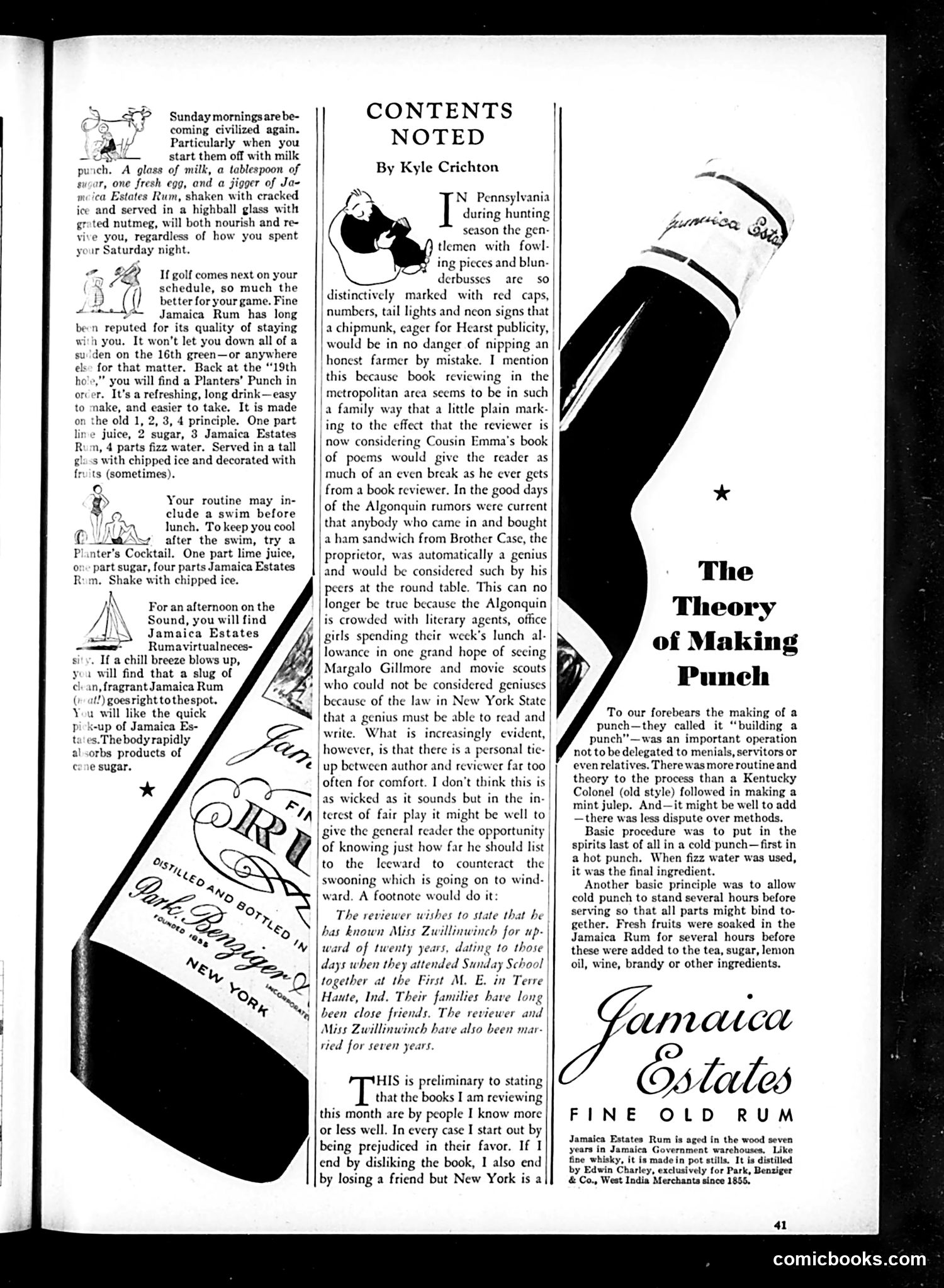
Analysis of This Life Magazine Page This is primarily advertising and lifestyle content rather than political satire. The page features: Left side: Multiple ads for Jamaica Estates Rum, depicting leisure activities (golf, swimming, boating) with suggested rum cocktails for each occasion. The copy presents rum-drinking as markers of civilized, wealthy leisure—a common advertising approach during Prohibition's end. Right side: Kyle Crichton's column "Contents Noted" critiques the Algonquin Round Table literary scene in 1920s-30s New York. Crichton satirizes how book reviewers' personal relationships with authors corrupt their objectivity. He references the famous Algonquin Hotel where literary figures gathered, noting it's now crowded with wannabes. His main point: readers deserve transparency about reviewer-author relationships, just as hunters wear identifying red caps to prevent accidents. The satire targets literary pretension and nepotism in Manhattan's cultural establishment, not politics. Crichton argues personal friendships make honest book criticism impossible—a timeless complaint about insider networks.
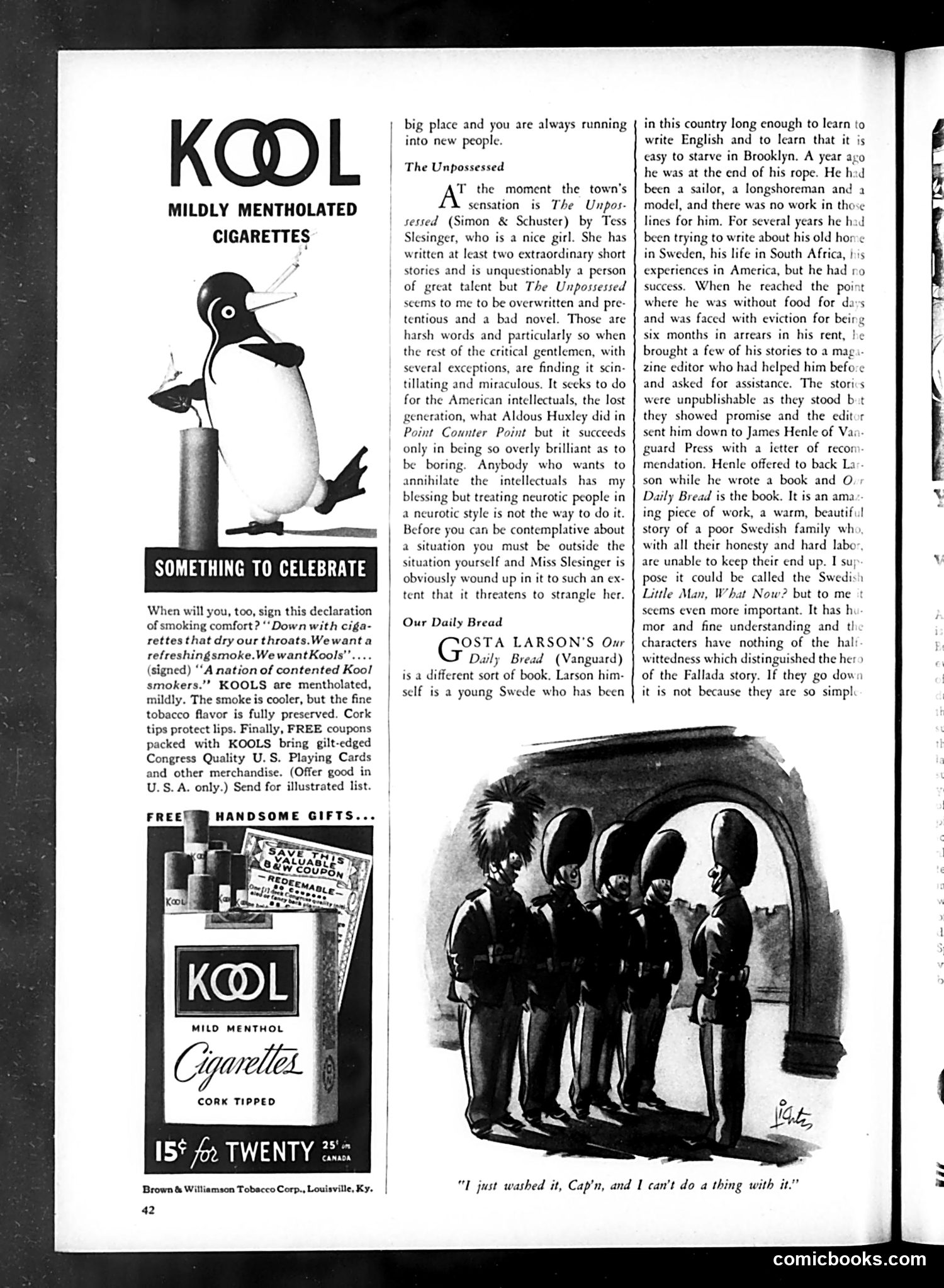
Analysis of This Life Magazine Page This page contains a Kool cigarette advertisement (left) and book reviews (right), with one cartoon illustration. The Advertisement The Kool ad uses a stylized bird mascot and emphasizes menthol as a selling point—"refreshing smoke" without throat irritation. It offers free premiums (playing cards) to encourage purchases. This reflects 1930s advertising normalcy; tobacco marketing to the general public was unrestricted. The Cartoon The single cartoon at bottom right shows military officers in uniform standing under an archway. One says, "I just washed it, Cap'n, and I can't do a thing with it"—likely referring to a uniform or military equipment. The joke appears to be about military grooming or maintenance problems, though the specific reference is unclear without more context. Book Reviews The page reviews Tess Slesinger's *The Unpossessed* (criticized as overwrought) and Gösta Larson's *Our Daily Bread* (praised as a genuine immigrant story). These represent typical literary criticism of the era.
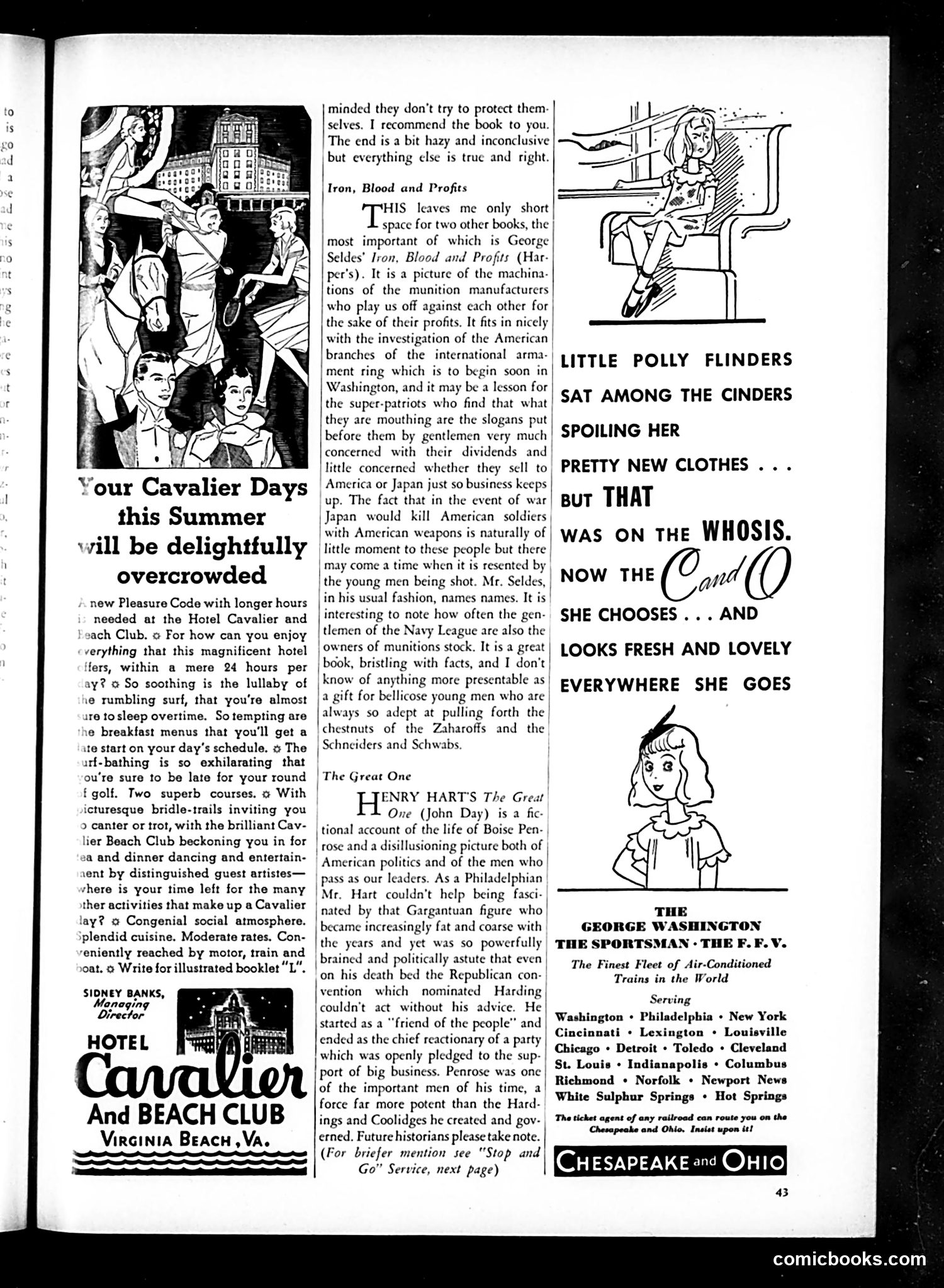
Analysis of This Life Magazine Page This page mixes book reviews with advertisements. The satirical content centers on George Seldes' "Iron, Blood and Profits," a critique of munitions manufacturers profiting from international conflict. The reviewer argues the book exposes how arms dealers pit nations against each other for profit, noting the irony that American weapons kill American soldiers. He names specific industrialists (Zaharoffs, Schneiders, Schwabs) as profiteers unconcerned whether they sell to America or Japan. The page also reviews Henry Hart's "The Great One," a fictionalized account of Boise Penrose, a Philadelphia political boss who evolved from "friend of the people" to reactionary supporting big business—critiquing American political corruption. The Polly Flinders candy advertisement (right side) uses the nursery rhyme to sell candy as a beauty product, unrelated to the political content. The reviews reflect pre-WWII American concerns about war profiteering and political corruption during the Depression era.
Analysis of This Life Magazine Page This page is primarily advertisements and entertainment reviews, not political satire. The notable element is the large opening quote: "If all Playwrights signed a code there still would be but one Shakespeare." This references the Motion Picture Production Code (also called the Hays Code), which Hollywood studios had recently adopted to self-regulate content. The satire suggests that while codes might enforce compliance, they cannot produce genius—only Shakespeare-level talent creates masterpieces, not industry regulations. The accompanying Paris Garters advertisement reinforces this message by claiming that famous brands achieve leadership through "distinguished performance," not mere "compliance with a code"—a clever commercial parallel to the editorial argument. The rest of the page contains film and radio reviews (typical Life magazine content) and hotel/summer camp advertisements. The book review of "Artists in Uniform" mockingly notes Soviet artists are "slaves," representing Cold War-era criticism of communist control.
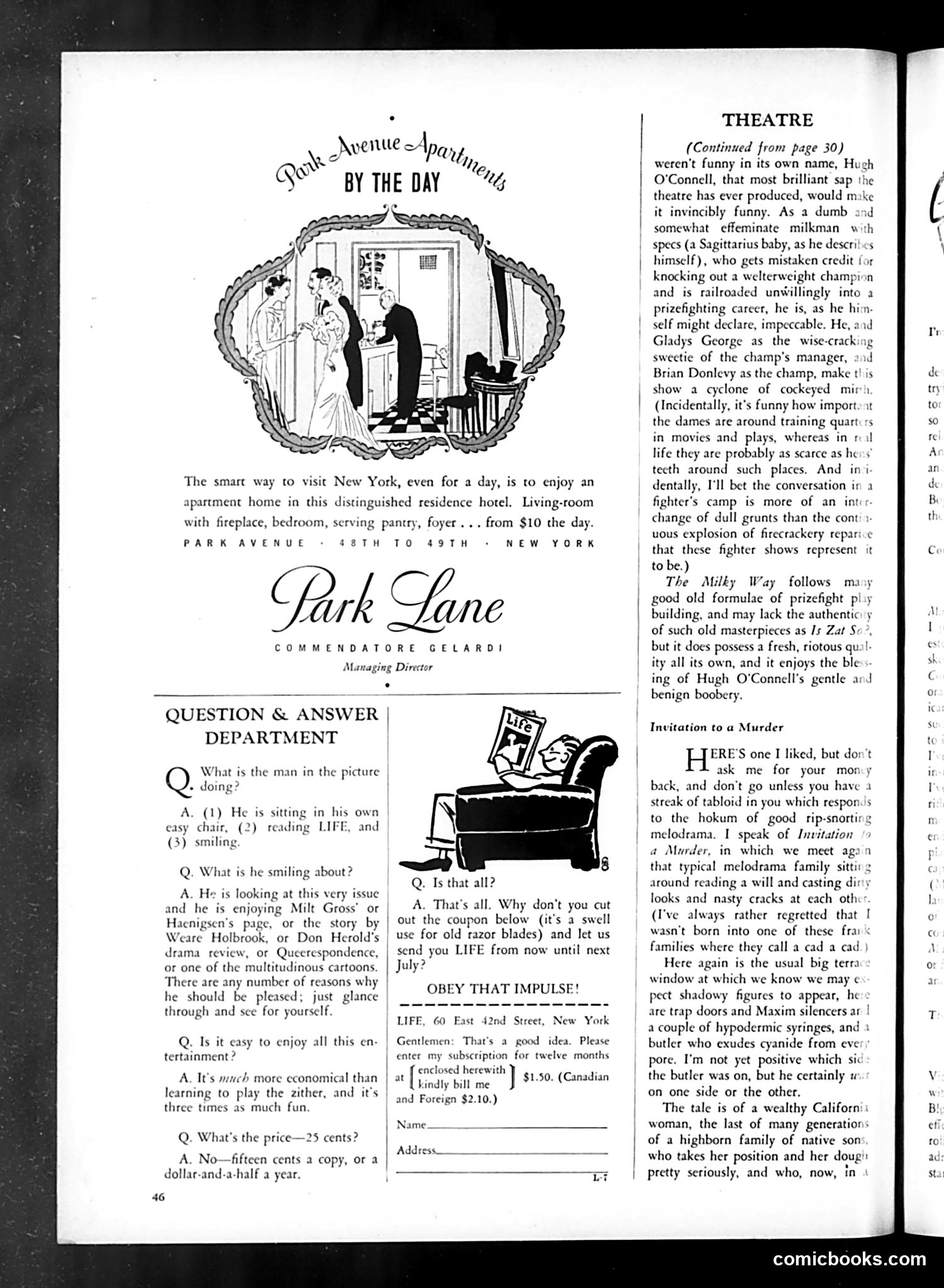
Life Magazine Page Analysis This page combines advertising with entertainment content typical of Life magazine's format. The Advertisement: The top features Park Lane, a luxury Manhattan apartment hotel on Park Avenue (48th-49th Street), renting furnished apartments "by the day" from $10—marketed as "the smart way to visit New York." The "Question & Answer" Section: This is a self-promotional advertisement for Life magazine itself, humorously presented as a Q&A. It depicts a man contentedly reading Life and explains why he's smiling: the magazine's cartoonists (Milt Gross, Haenigsen), fiction writers (Weare Holbrook, Don Herold), and humor columns entertain him. The copy argues subscribing to Life is "much more economical" and "three times as much fun" as learning the zither. It's essentially a pitch encouraging readers to subscribe for $1.50/year. Theatre Reviews: The right column contains drama criticism, reviewing *The Milky Way* (praising Hugh O'Connell's comedic performance) and *Invitation to a Murder* (a melodrama with typical genre tropes: suspicious families, trap doors, poisoning).
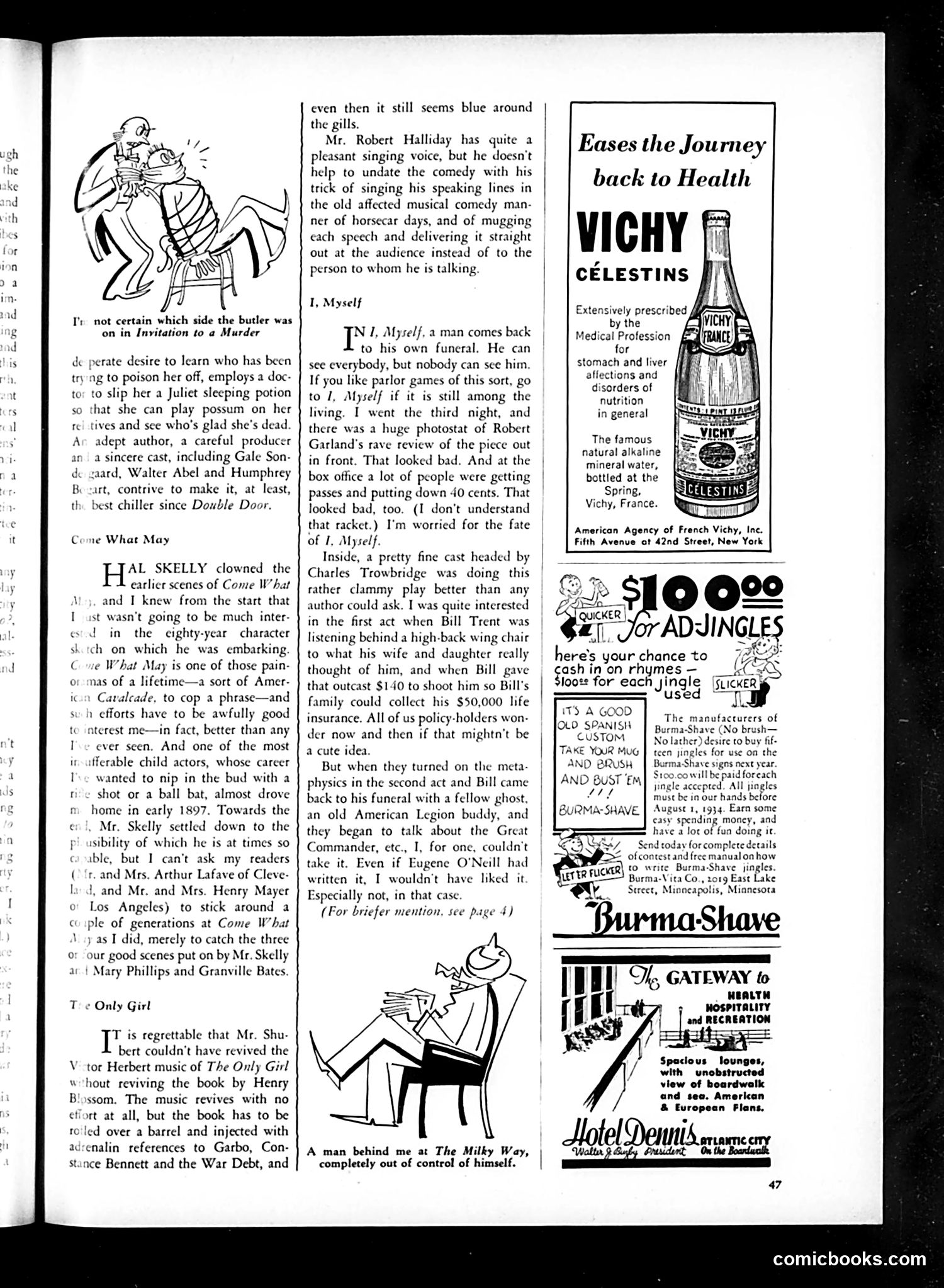
Page Content Analysis This page contains theater reviews and advertisements from Life magazine. The main text discusses four Broadway productions: "Invitation to a Murder," "Come What May," "The Only Girl," and "I, Myself." The cartoons accompanying the reviews are simple line drawings illustrating scenes from these plays—for instance, one shows a man at a piano, captioned as being "completely out of control of himself" from "The Milky Way." The reviews are critical assessments of contemporary theater, with the critic commenting on performances by actors like Hal Skelly and Robert Halliday. The reviewer critiques outdated musical-comedy conventions and finds some plots—particularly the metaphysical elements of "I, Myself"—unconvincing. The right side features period advertisements for Vichy mineral water (promoted for digestive health), Burma-Shave shaving cream, Hotel Dennis in Atlantic City, and a $100 prize offer for jingles. This page reflects 1930s American entertainment culture and marketing practices.
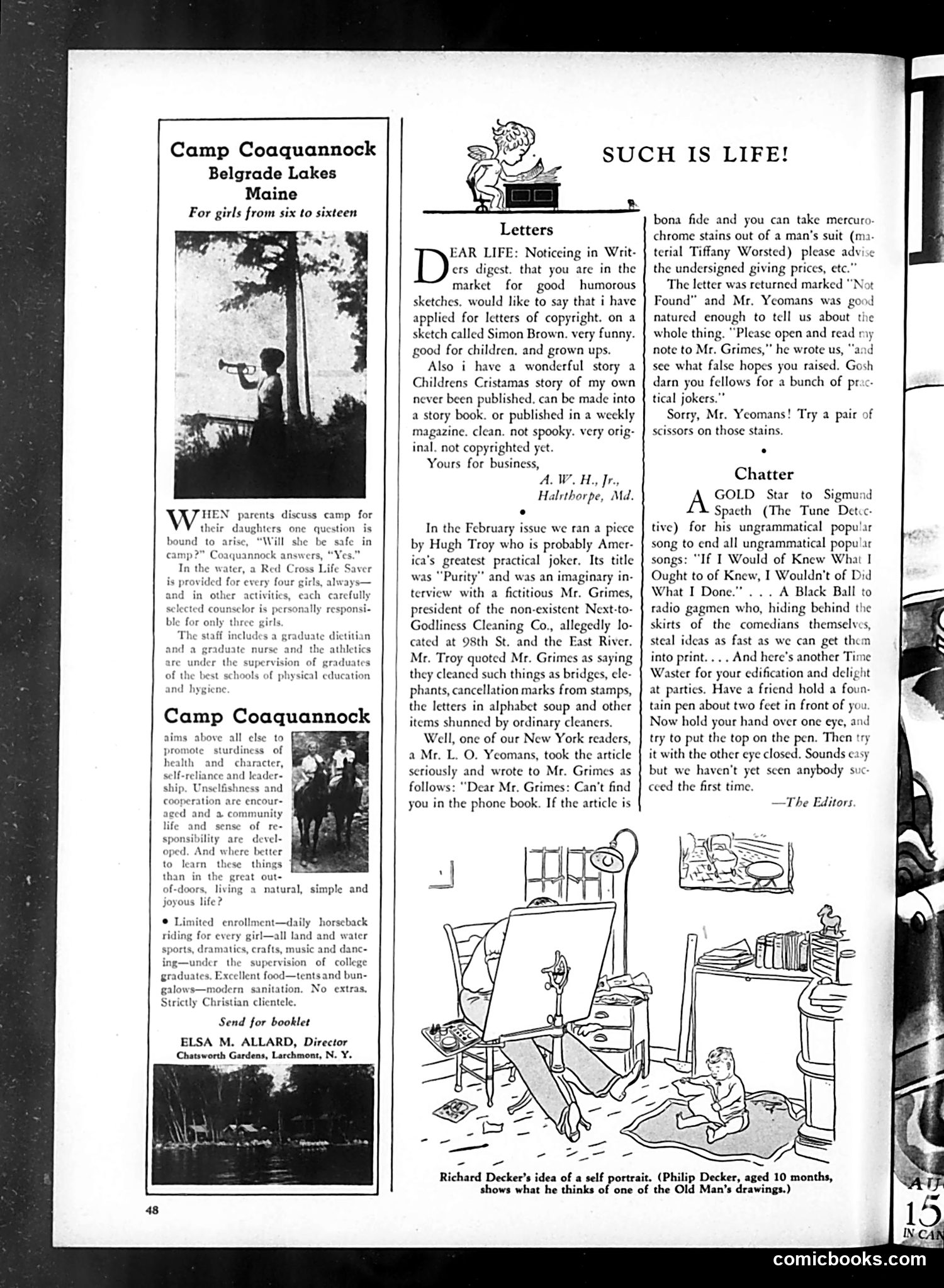
Analysis of This Life Magazine Page This page contains a camp advertisement, reader letters, and a humor column. The key satirical content is the "Letters" section, which documents a practical joke's real-world consequence. Hugh Troy, a famous prankster, published a fictional interview about "Mr. Grimes" of the "Next-to-Godliness Cleaning Co."—a made-up business that cleaned absurd items (elephant tusks, alphabet soup letters). A reader, L. O. Yeomans, took the article seriously and wrote to this non-existent company requesting service for mercurochrome stains on his suit, providing his address. The humor lies in the editors mocking their own readers' gullibility while sympathizing with Yeomans's embarrassment when the letter was returned marked "Not Found." The "Chatter" section continues the theme with complaints about radio writers stealing jokes and a party trick that tricks the eye. The final cartoon shows a 10-month-old child's crude scribbles labeled as "self-portrait," humorously critiquing adult artwork by contrast.