life
Life — August 1934
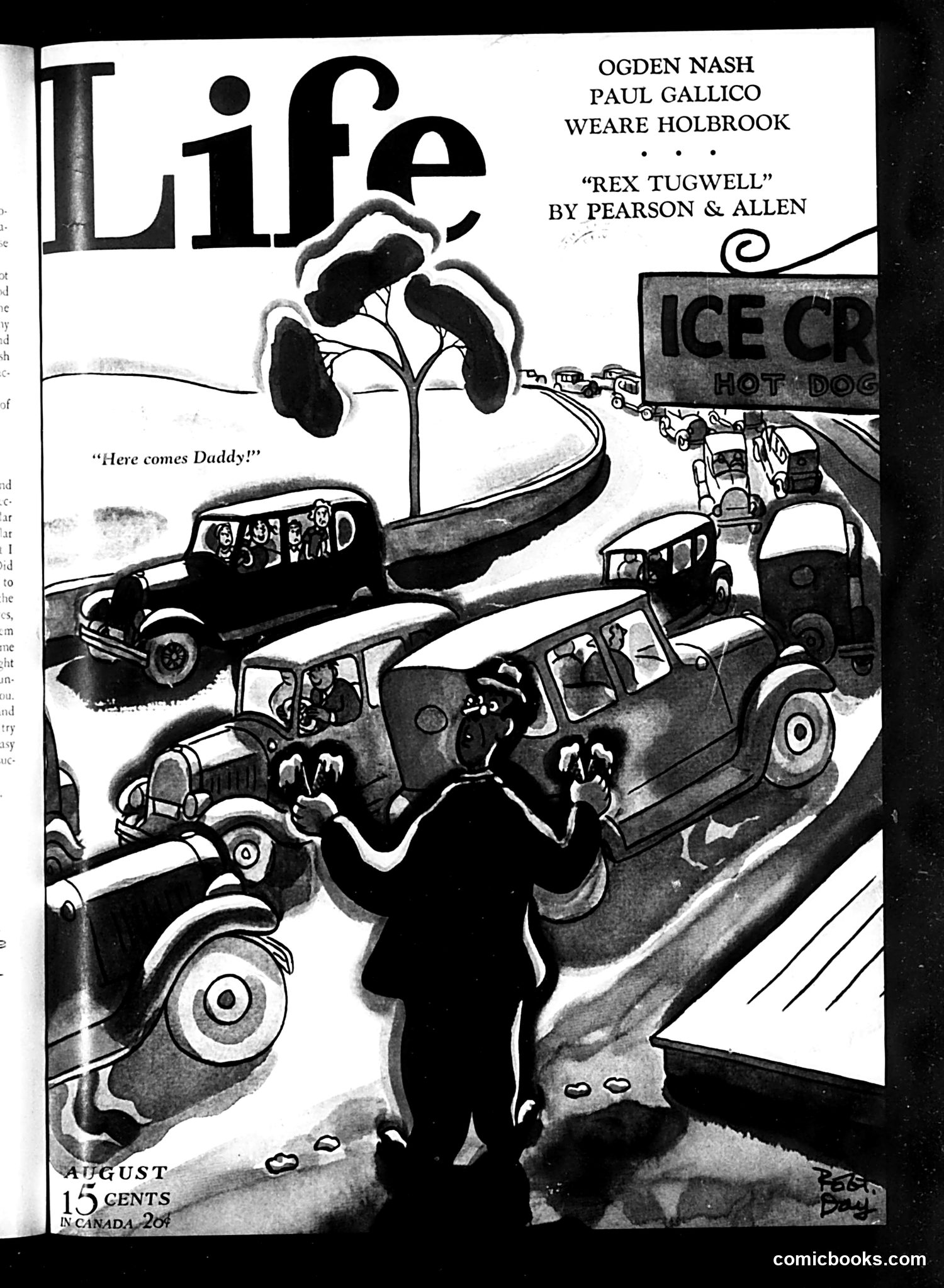
Analysis of Life Magazine Cover This appears to be a Life magazine cover from August 15 (price 15 cents in Canada, 20 cents U.S.). The main illustration depicts a traffic jam scene with multiple automobiles and a figure gesticulating in the center, captioned "Here comes Daddy!" The cartoon satirizes automobile congestion and the challenges of 1920s-30s motor traffic. The exaggerated central figure represents frustration with gridlocked vehicles—a social complaint about rapidly increasing car ownership overwhelming roads. The page also advertises content featuring Ogden Nash, Paul Gallico, and Weare Holbrook, plus a play called "Rex Tugwell" by Pearson & Allen. A partial advertisement for "Ice Cream" or similar product appears on the right edge. The overall theme suggests Life magazine's satirical commentary on modern American automotive culture and its chaotic side effects.
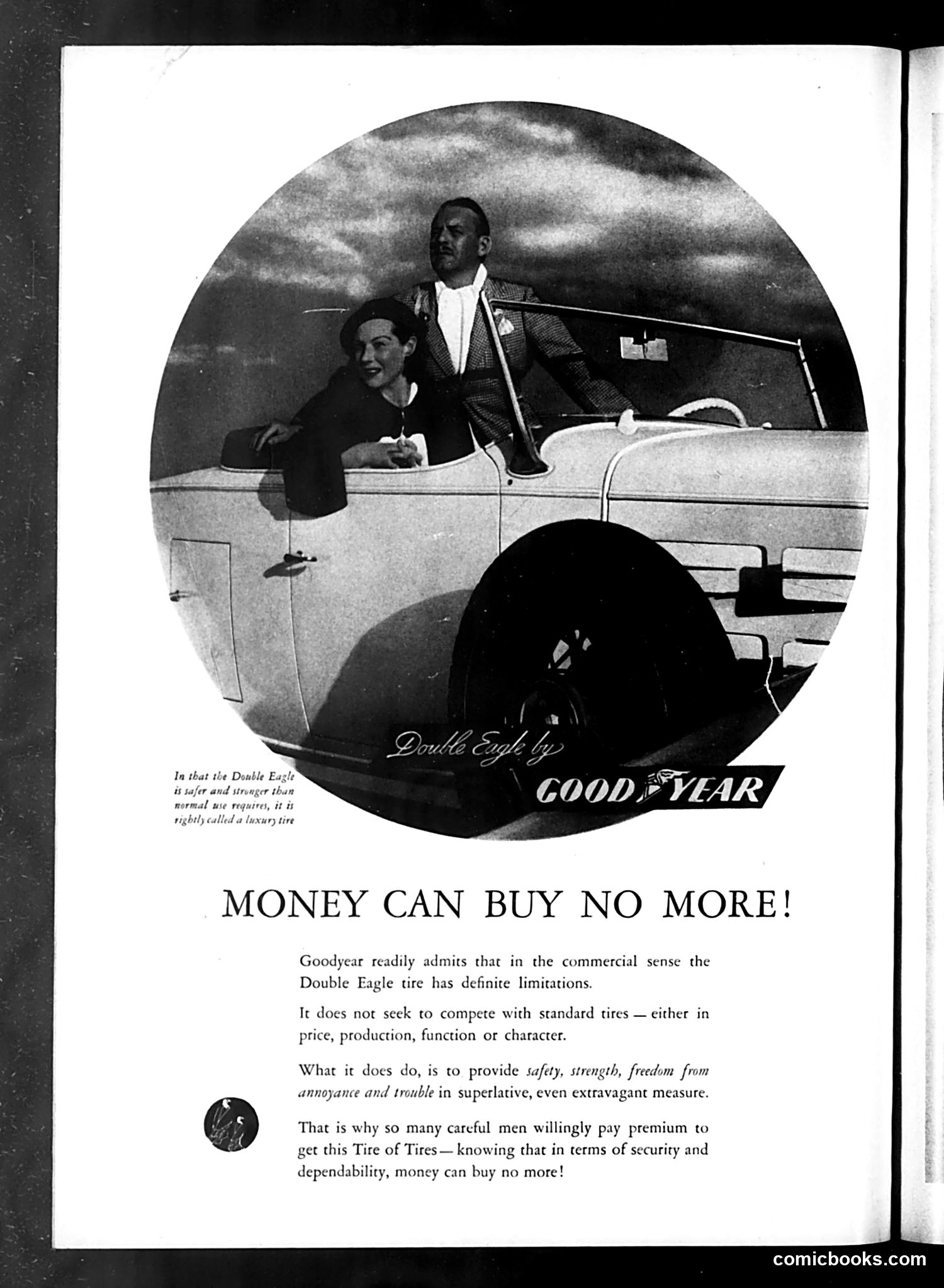
Analysis This is a Goodyear tire advertisement, not political satire. The page depicts two well-dressed people in a luxury convertible automobile, showcasing the "Double Eagle" tire. The advertisement's headline—"MONEY CAN BUY NO MORE!"—claims that premium pricing for this tire is justified because it offers superior safety and reliability that cheaper alternatives cannot match. The copy explicitly states Goodyear doesn't compete on price or production, but rather on "safety, strength, freedom from annoyance and trouble." This represents luxury marketing of the early-to-mid 20th century, positioning the product as aspirational and worth premium cost for "careful men" concerned with "security and dependability." The elegant imagery and confident copy reflect Depression-era or post-Depression advertising that appeals to affluent consumers.
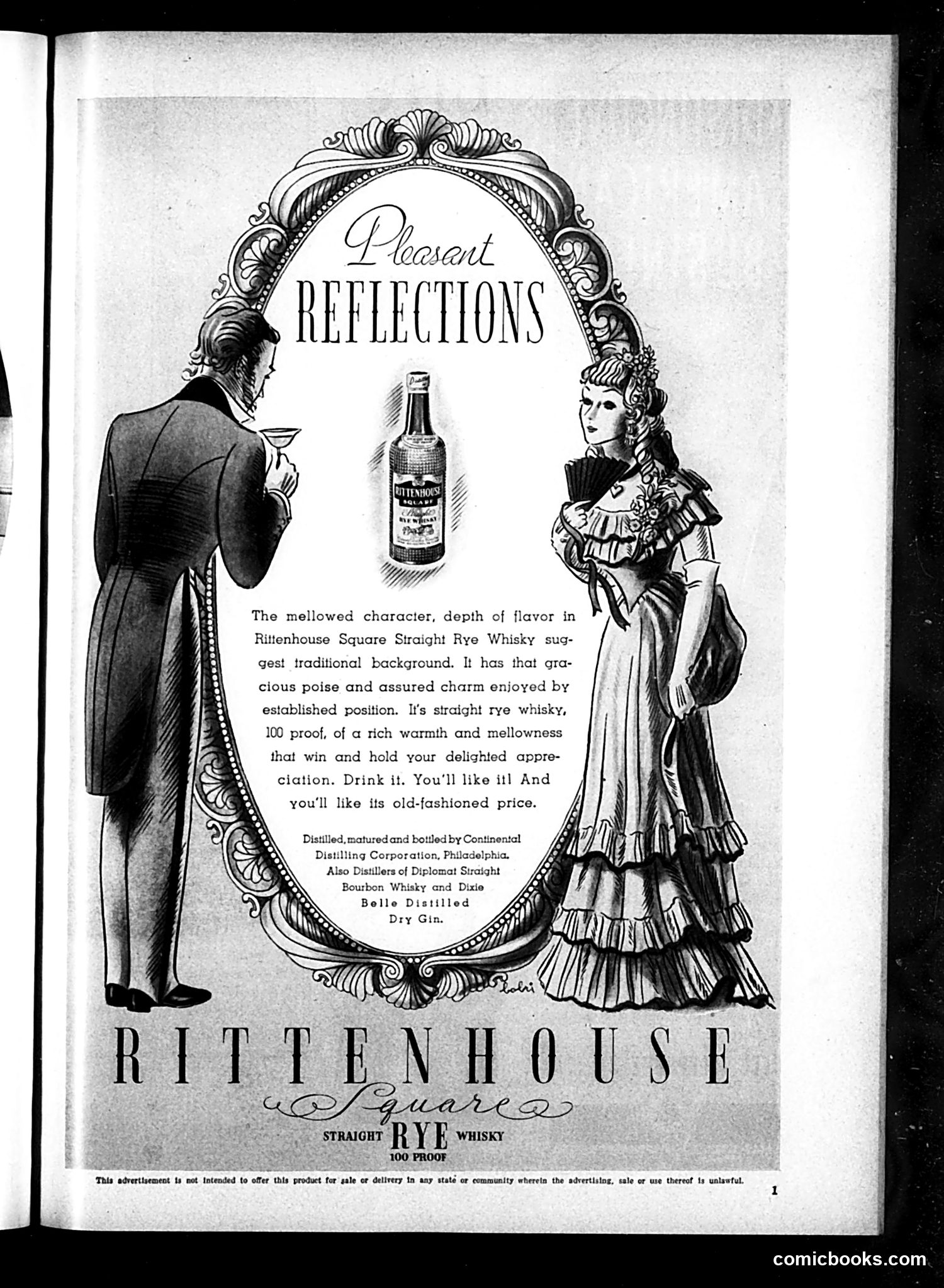
Analysis This is a advertisement, not satire or political cartoon. It promotes Rittenhouse Square Straight Rye Whisky (100 proof) made by Continental Distilling Corporation in Philadelphia. The ad uses period imagery—a gentleman and elegantly-dressed woman in 18th-century costume—to suggest aristocratic refinement and "traditional background." The ornate mirror frame reinforces associations with established wealth and "gracious poise." The text emphasizes the whisky's quality, smoothness, and "old-fashioned price," appealing to consumers seeking premium liquor with historical prestige. A disclaimer at bottom indicates this predates modern advertising regulations—notably stating the product is not offered "in any state or community wherein the advertising, sale or use thereof is unlawful," reflecting Prohibition-era legal complications around alcohol marketing.
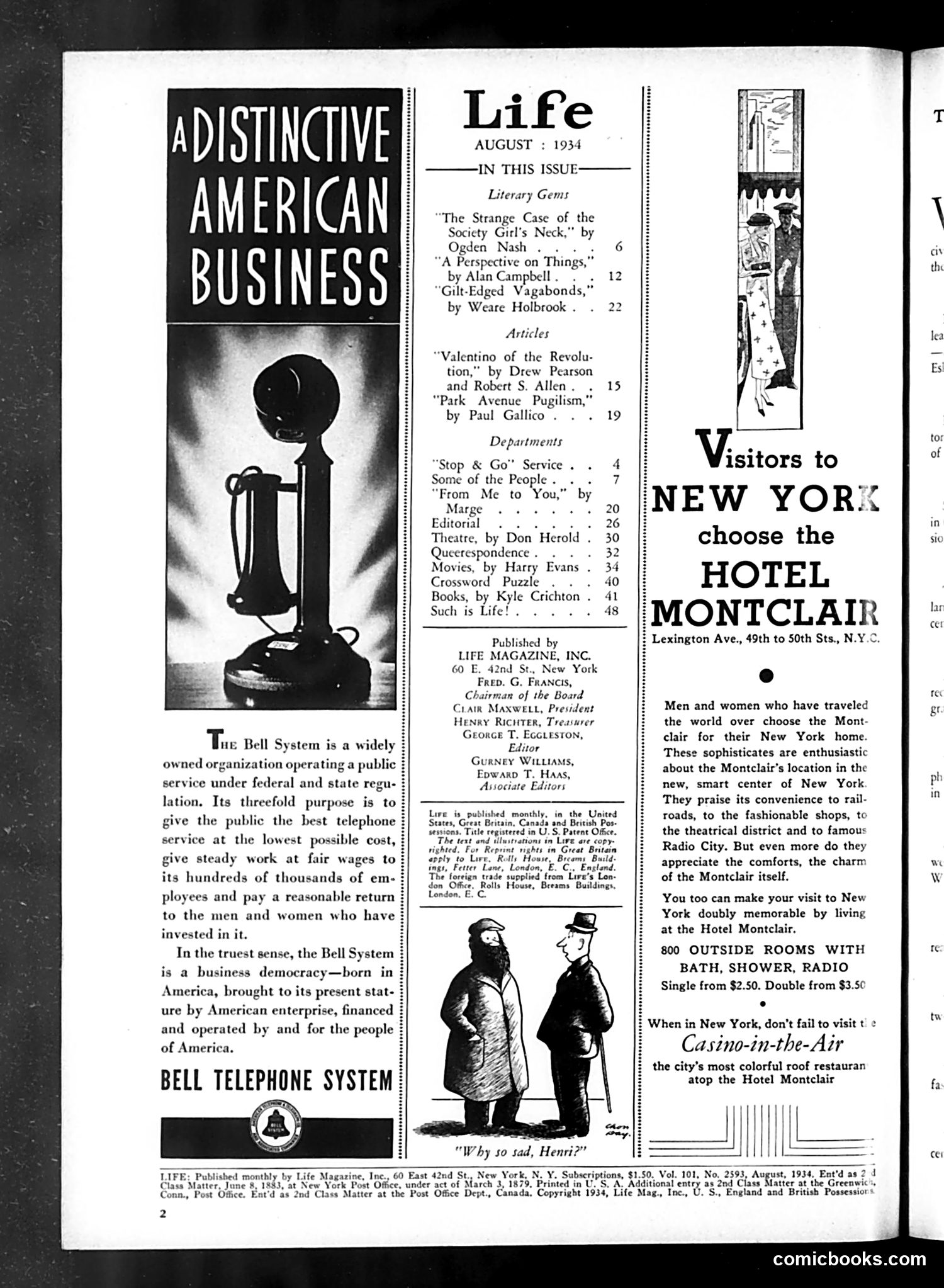
Life Magazine, August 1934: "A Distinctive American Business" This page features an advertisement for the Bell Telephone System alongside the magazine's table of contents. The left side displays a stark black-and-white illustration of an old-fashioned telephone handset on a stand, labeled "A Distinctive American Business." The accompanying text presents the Bell System as a "business democracy" — a widely-owned, publicly-regulated enterprise serving the American people efficiently. This represents 1930s corporate messaging emphasizing public service and broad ownership during the Depression era. The small cartoon at the bottom (captioned "Why is sad, Henri?") appears to be a separate humorous illustration unrelated to the telephone advertisement, typical of the magazine's mixed content format. The page is primarily commercial in nature, showcasing how major corporations advertised to Life's educated, middle-class readership.
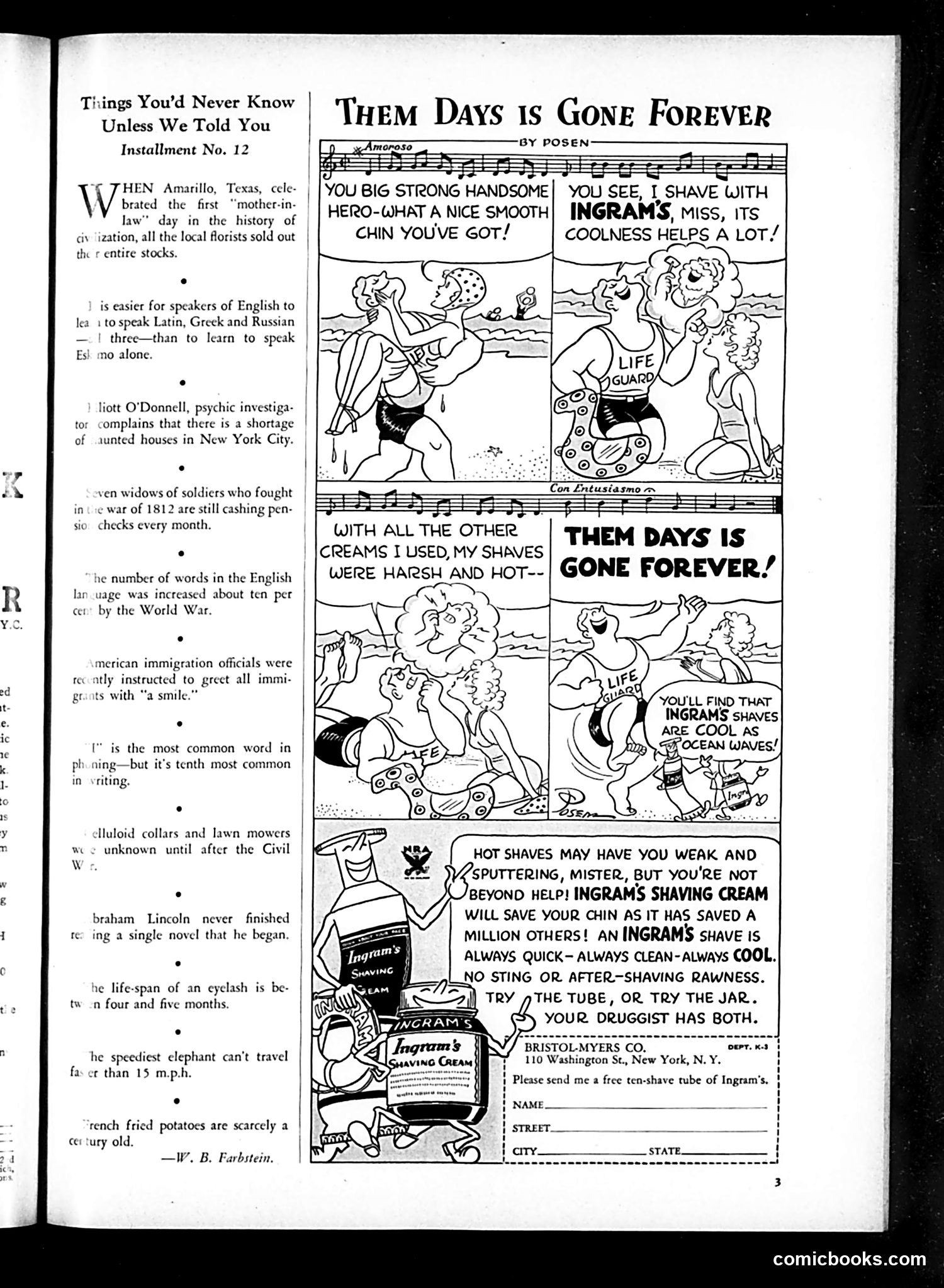
"Them Days Is Gone Forever" - Ingram's Shaving Cream Advertisement This is a vintage advertisement disguised as a comic strip by Posen for Ingram's Shaving Cream. The "cartoon" features beachgoers complimenting a man's smooth chin, attributing his "coolness" to Ingram's shaving cream rather than his own qualities. The humor targets masculine vanity: other men praise his appearance while women surround him—the implication being that good shaving cream grants social success. The phrase "Them Days Is Gone Forever" suggests old-fashioned, harsh shaving methods are obsolete. The bottom panel shifts to direct product messaging, claiming Ingram's eliminates irritation better than competitors. It's fundamentally a sales pitch wrapped in comedic flirtation and male fantasy, typical of mid-20th-century advertising strategies.
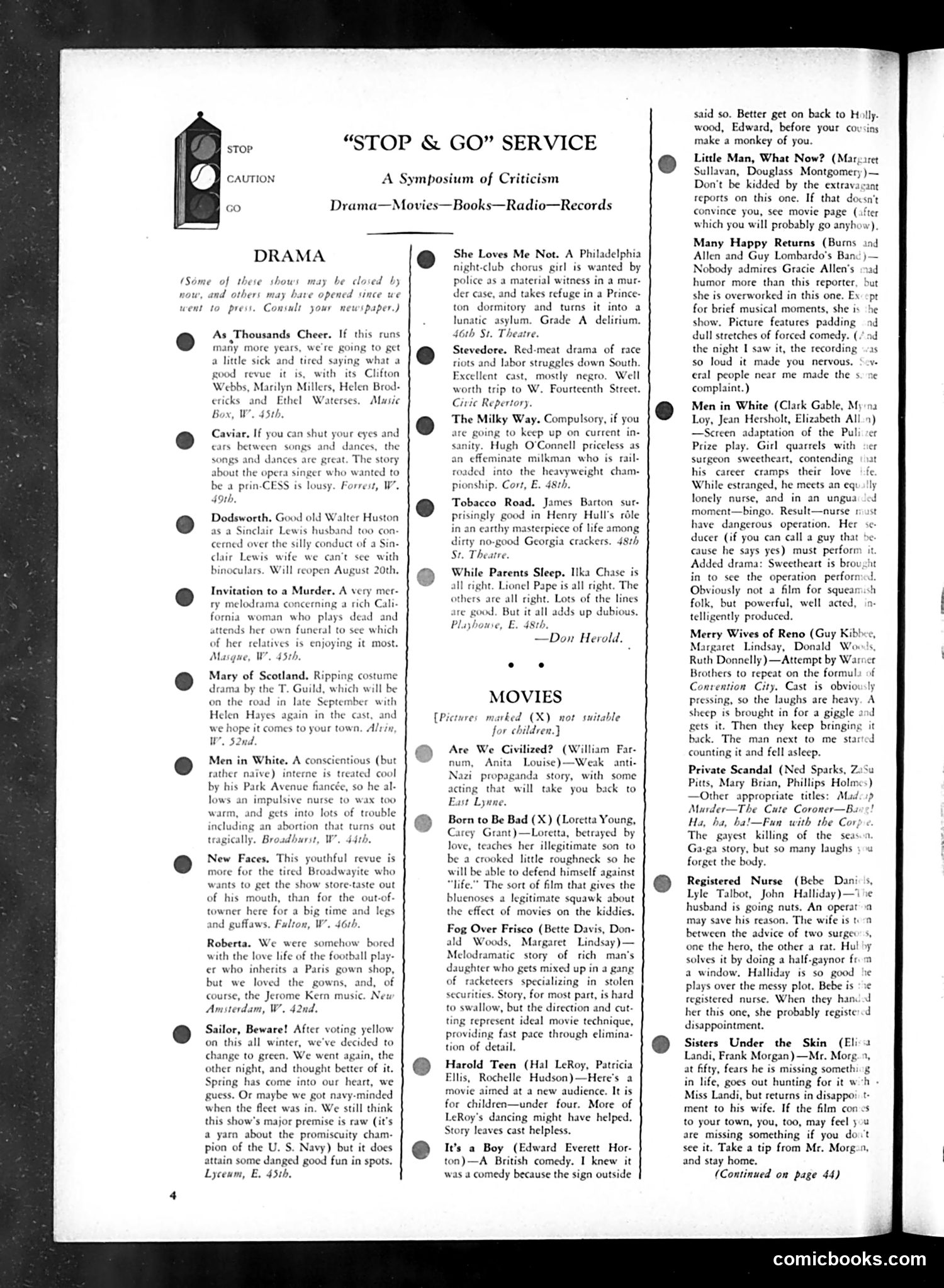
"Stop & Go" Service: A Symposium of Criticism This page presents entertainment reviews organized by medium (Drama, Movies, Books, Radio, Records). The traffic light illustration at top left is a visual pun—the "Stop & Go" title references both the signal and the reviewer's critical verdicts, suggesting they'll tell readers what entertainment to stop watching and what to go see. The reviews themselves aren't satirical commentary but rather straightforward critical assessments of 1940s films and theatrical productions. The satire lies in the page's conceptual framing: using a traffic signal as metaphor for critical gatekeeping—Life magazine as arbiter of taste, directing readers' entertainment consumption like traffic flow.
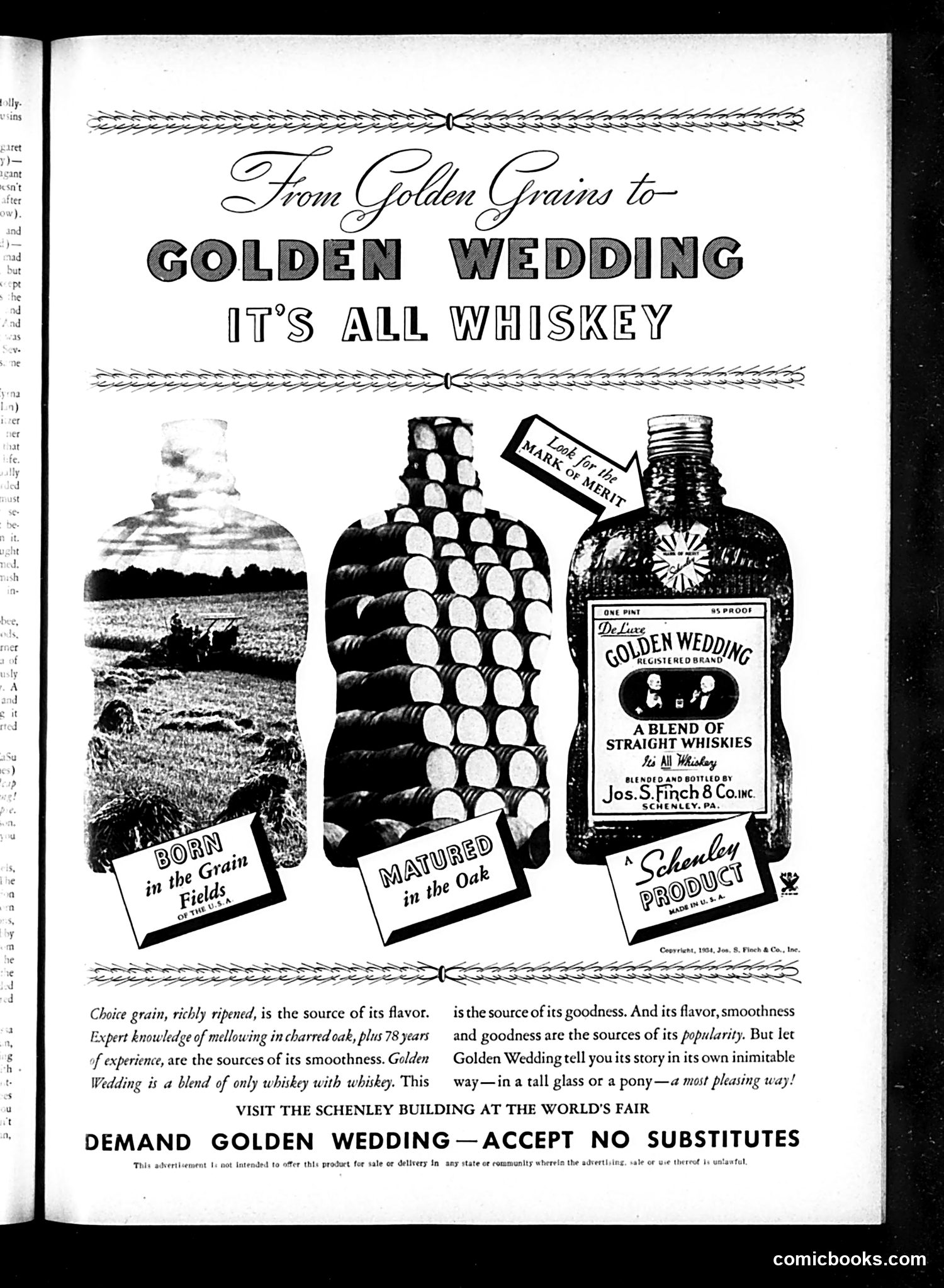
Analysis This is a whiskey advertisement, not political satire. It's a Golden Wedding brand ad from Jos. S. Finch & Co. in Schenley, PA, promoting their blended whiskey product. The ad uses a visual metaphor: three bottle-shaped panels showing whiskey's "journey" from grain fields (left) through oak barrel maturation (center) to the finished product (right). The tagline "From Golden Grains to Golden Wedding—It's All Whiskey" emphasizes the natural grain-to-bottle process. The ad references "The World's Fair" (likely 1933 Chicago), inviting readers to visit Schenley's building there. The bottom line demands consumers "Accept No Substitutes," a common competitive advertising tactic of the era. This represents Depression-era marketing emphasizing quality and authenticity.
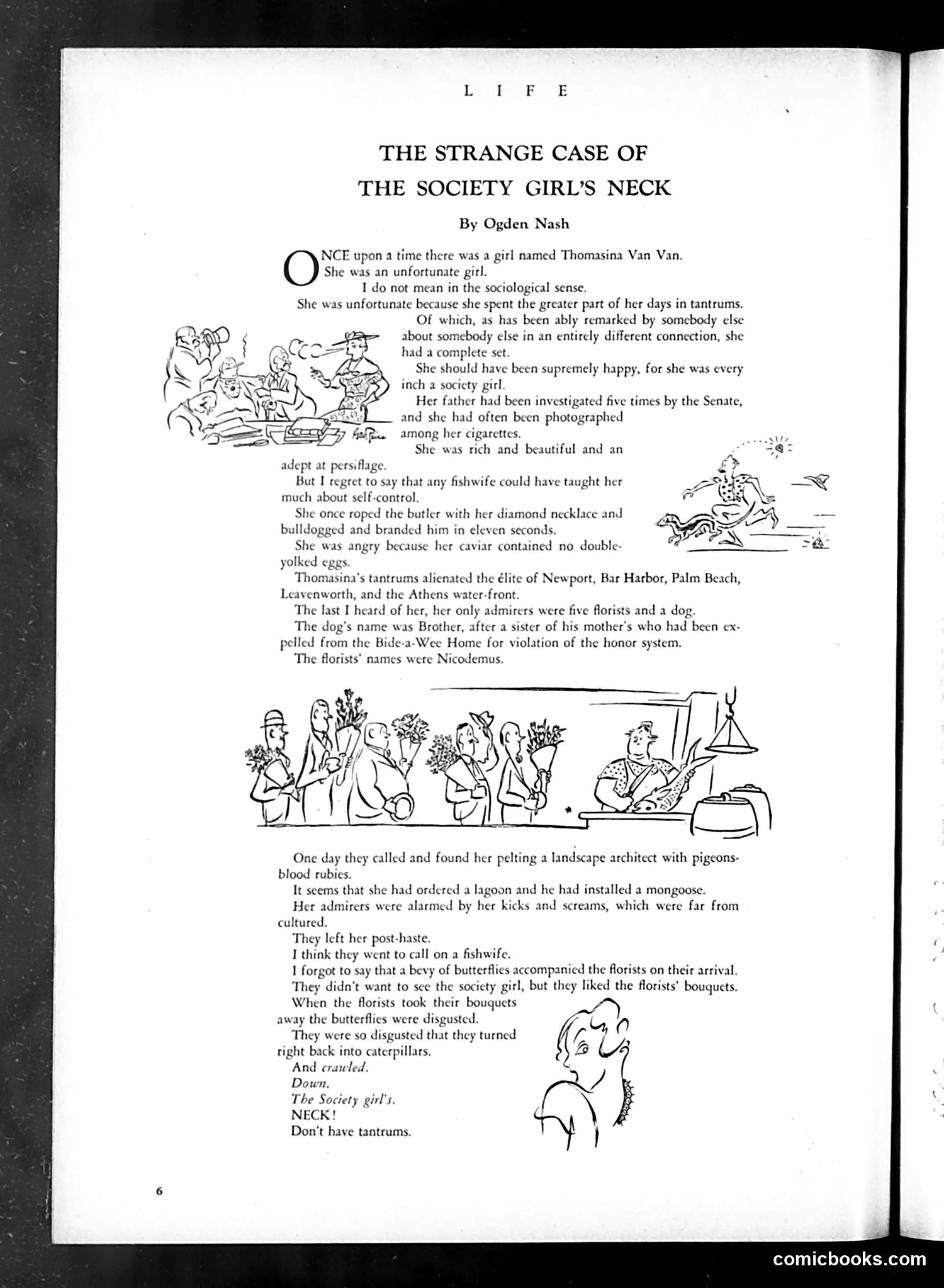
"The Strange Case of the Society Girl's Neck" by Ogden Nash This satirical piece mocks wealthy socialites' behavior and vanity. The story follows Thomasina Van Van, a rich "society girl" from elite East Coast locations (Newport, Bar Harbor, Palm Beach). The satire hinges on her lack of self-control—she abuses her butler, injures him with her diamond necklace, and throws tantrums over minor disappointments. The humor climaxes when florists and a dog are her only "admirers," and she melts down upon encountering a landscape architect with pigeons and a mongoose. The insects' transformation into caterpillars triggers her final breakdown. Nash uses exaggerated physical comedy and the punchline about her "neck" (lacking self-control/manners) to ridicule upper-class entitlement and emotional immaturity, suggesting even wealth cannot excuse boorish behavior.
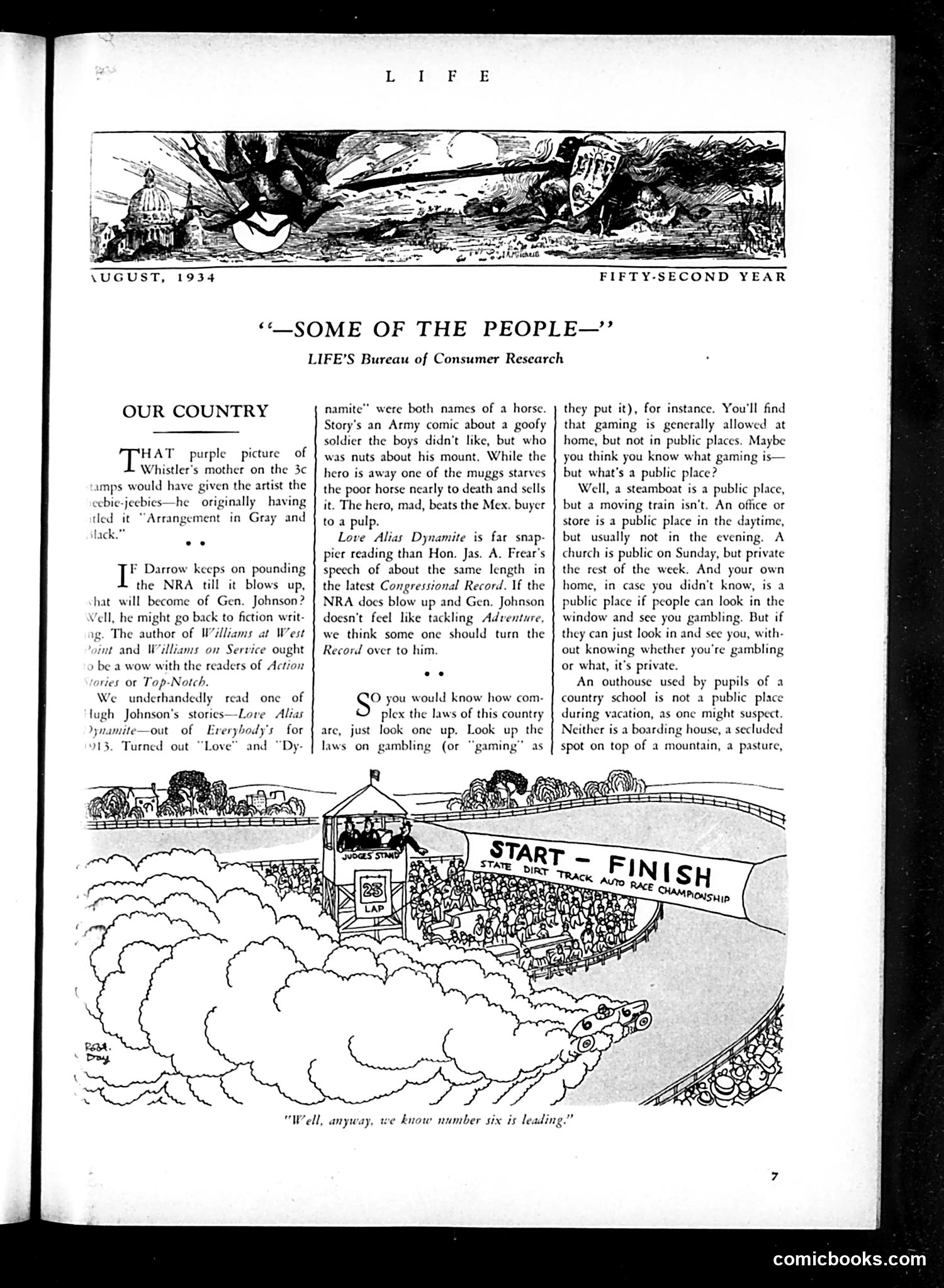
Political Cartoon Analysis: "Some of the People" This page from *Life* magazine (August 1934) satirizes American gambling laws and their inconsistent enforcement. The main cartoon illustrates a dirt-track auto racing event labeled "START-FINISH," depicting spectators at what appears to be a public racing venue where betting occurs. The accompanying text discusses the ambiguity of gambling's legal status: it's "generally allowed at home, but not in public places." The satire targets the hypocrisy that racing events—ostensibly public—operate in a legal gray area where gambling happens openly despite prohibition. The cartoon's caption, "Well, anyway, we know number six is leading," humorously acknowledges the gambling context while authorities tolerate or ignore it. This reflects 1930s Prohibition-era debates about regulation versus reality.
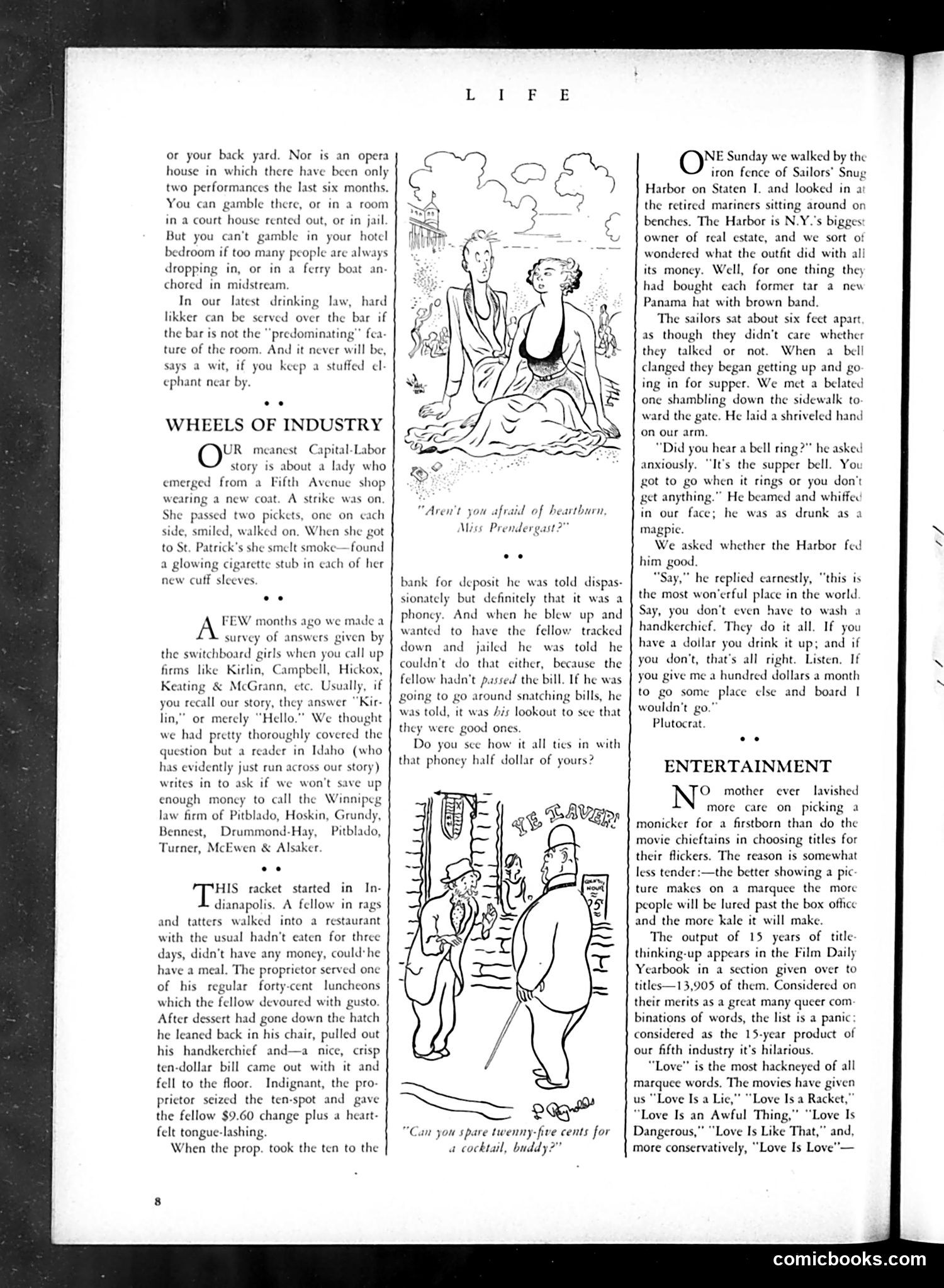
Analysis of Life Magazine Page This page contains three satirical pieces about American social customs and entertainment. "Wheels of Industry" mocks labor strikes through the story of a Fifth Avenue shop girl who picketed wearing a new coat—appearing fashionable rather than genuinely protesting. "A Few Months Ago" satirizes survey respondents claiming they'd refuse to patronize establishments with poor service, yet when actually facing minor inconveniences (like an unpaid bill or rude proprietor), they accept them passively rather than following through on their stated principles. The joke targets the gap between what Americans claim they believe and how they actually behave. "Entertainment" criticizes movie studios' desperation in titling films, noting they've produced 13,905 titles in 15 years. The cartoons mock both the absurdity of film titles and the movie industry's cynical approach to marketing. The overall theme: American hypocrisy and commercialism.
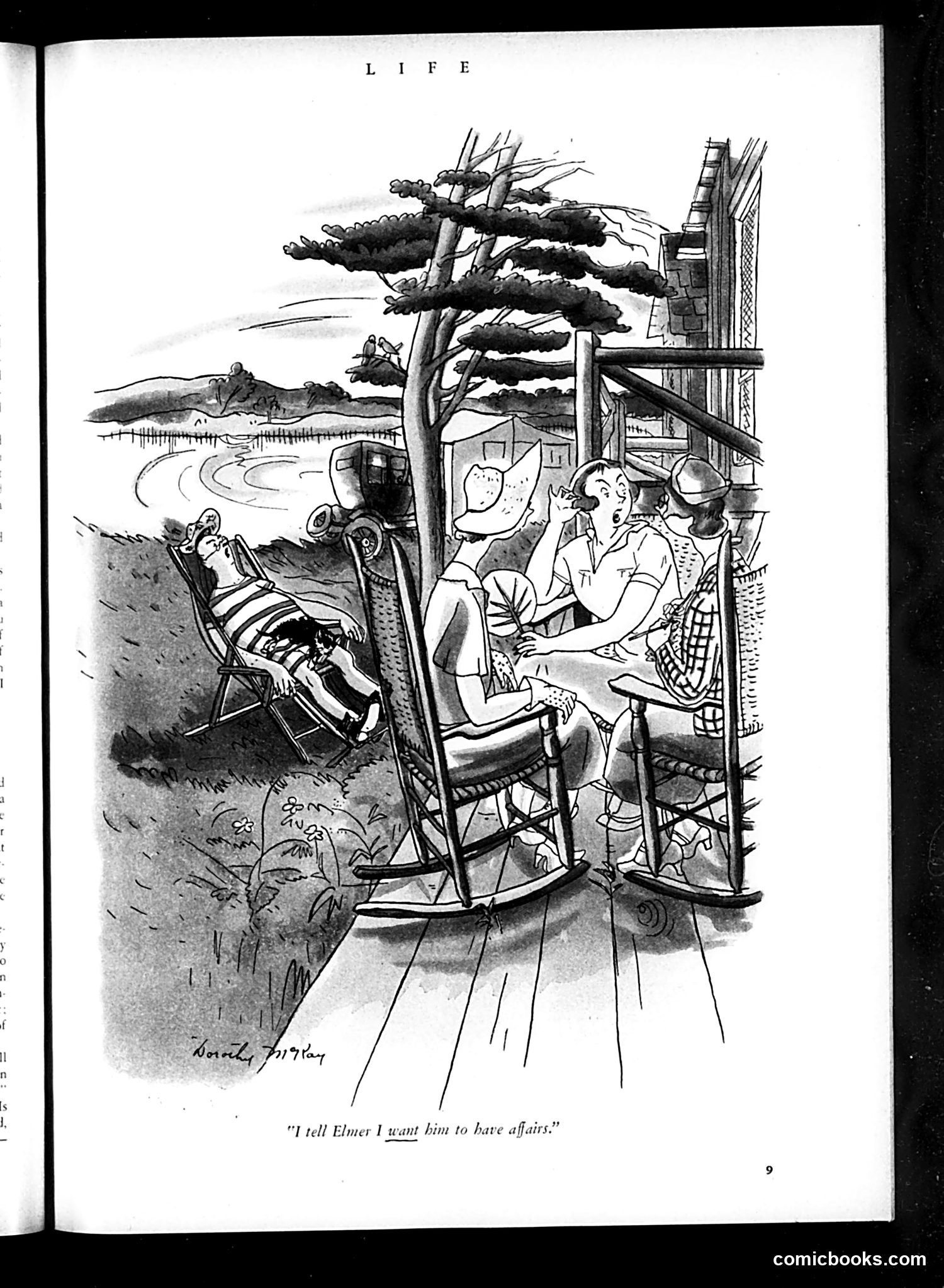
Analysis This is a single-panel cartoon captioned "I tell Elmer I *want* him to have affairs." The scene depicts a woman on a porch speaking to what appears to be a group of people (likely friends or neighbors), while a man labeled "Elmer" sits alone in a chair to the left. The cartoon satirizes marital dynamics and mid-20th century relationship attitudes. The joke's point appears to be ironic: the woman publicly claims she wants her husband to have affairs, likely as a way of appearing modern, liberated, or sophisticated to her peers. However, the visual isolation of "Elmer"—sitting apart and seemingly oblivious or uncomfortable—suggests the husband himself doesn't benefit from this arrangement, making the woman's stated position seem performative or self-serving rather than genuinely progressive. This reflects period anxieties about changing gender roles and relationship expectations.
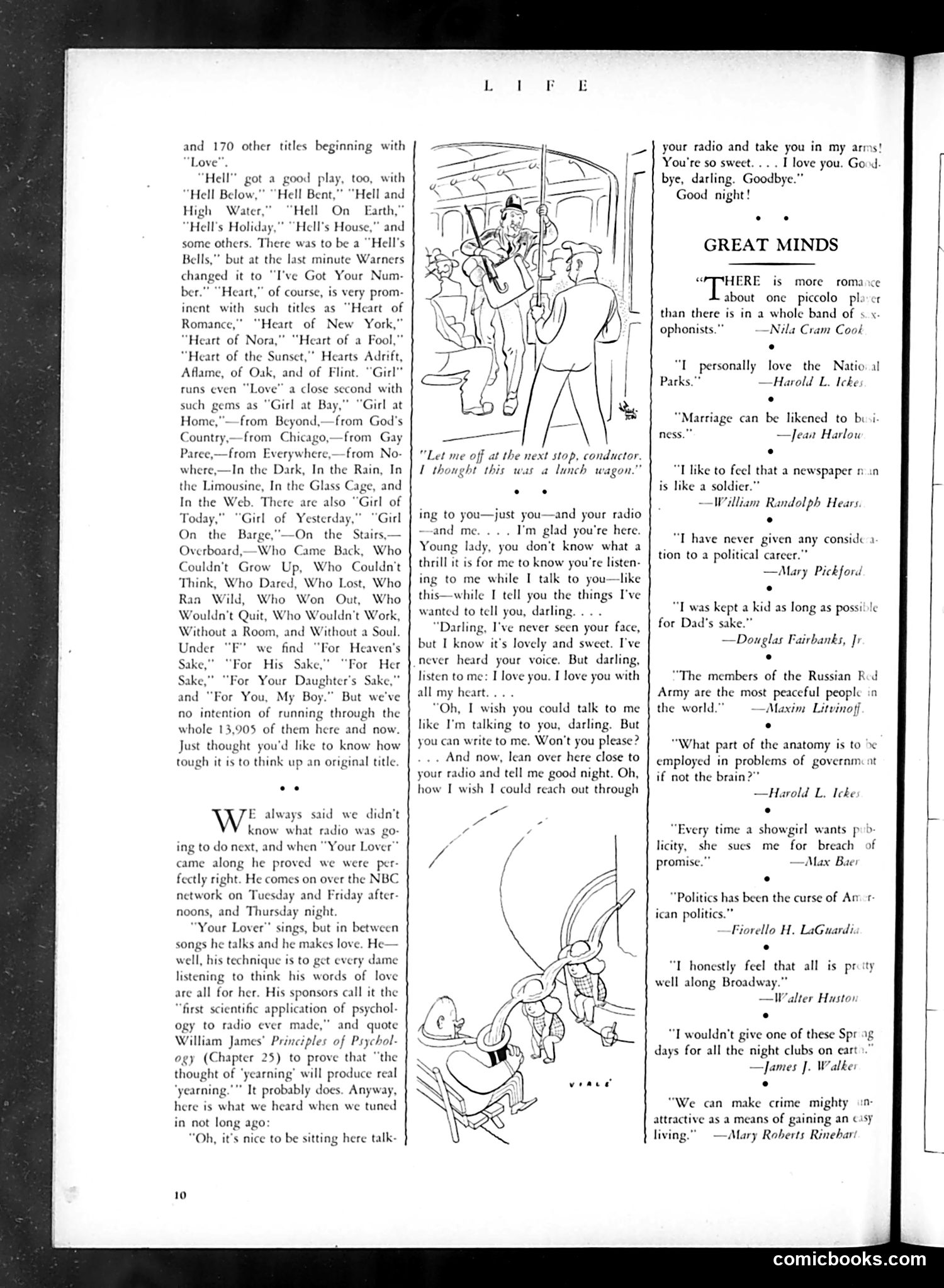
Analysis of Life Magazine Page 10 This page contains two illustrations with accompanying text about radio entertainment. The upper cartoon shows people in a car listening to a radio broadcast. The caption reads: "Let me off at the next stop, conductor. I thought this was a lunch wagon." The lower illustration depicts someone operating radio equipment, with dialogue about a radio romance—a person listening to "Your Lover" broadcasts and developing an emotional connection to the singer, saying "I love you" back through the radio. The satire targets the early radio era's power to create parasocial relationships—listeners becoming emotionally attached to radio personalities they've never met. The humor lies in the absurdity of one-way intimacy: people treating radio broadcasts as genuine personal connection. This reflects 1920s-30s concerns about mass media's psychological effects on audiences.
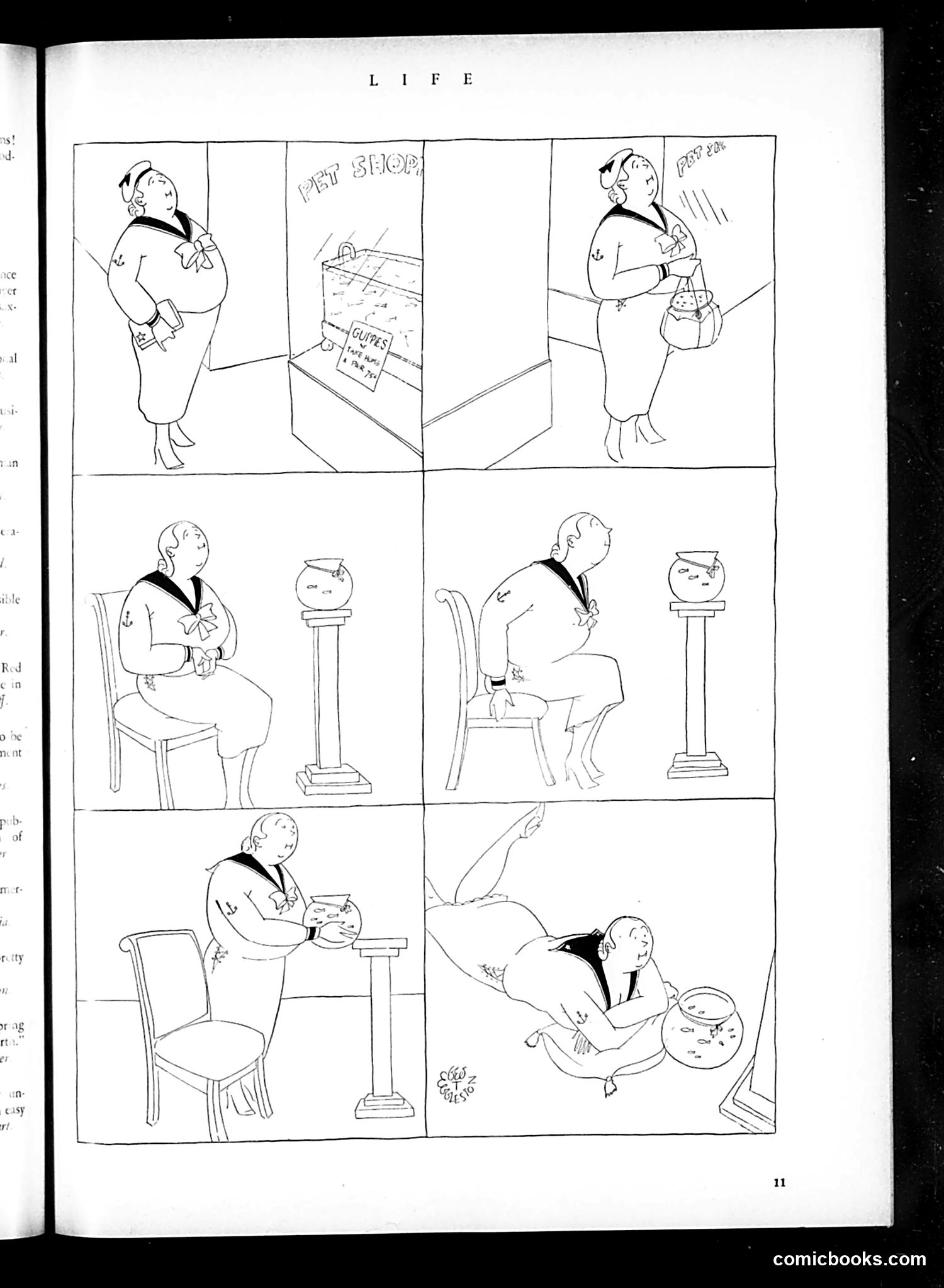
Analysis This is a six-panel comic strip titled "LIFE" depicting a humorous narrative about pet ownership. The sequence shows: 1. A rotund woman entering a pet shop 2. She examines the shop window (labeled "PET SHOP") 3. She leaves carrying a fishbowl 4. She sits at home admiring her new fish in a pedestal bowl 5. She continues observing the fish 6. The final panel shows her falling or bending over dramatically near the fishbowl The satire appears to mock the casual, fleeting nature of pet ownership and consumer impulse-buying—the woman impulsively acquires a pet but the final panel suggests comic mishap or the absurdity of her attachment to it. This reflects early 20th-century American attitudes toward disposable consumer goods and satirizes middle-class domestic life.
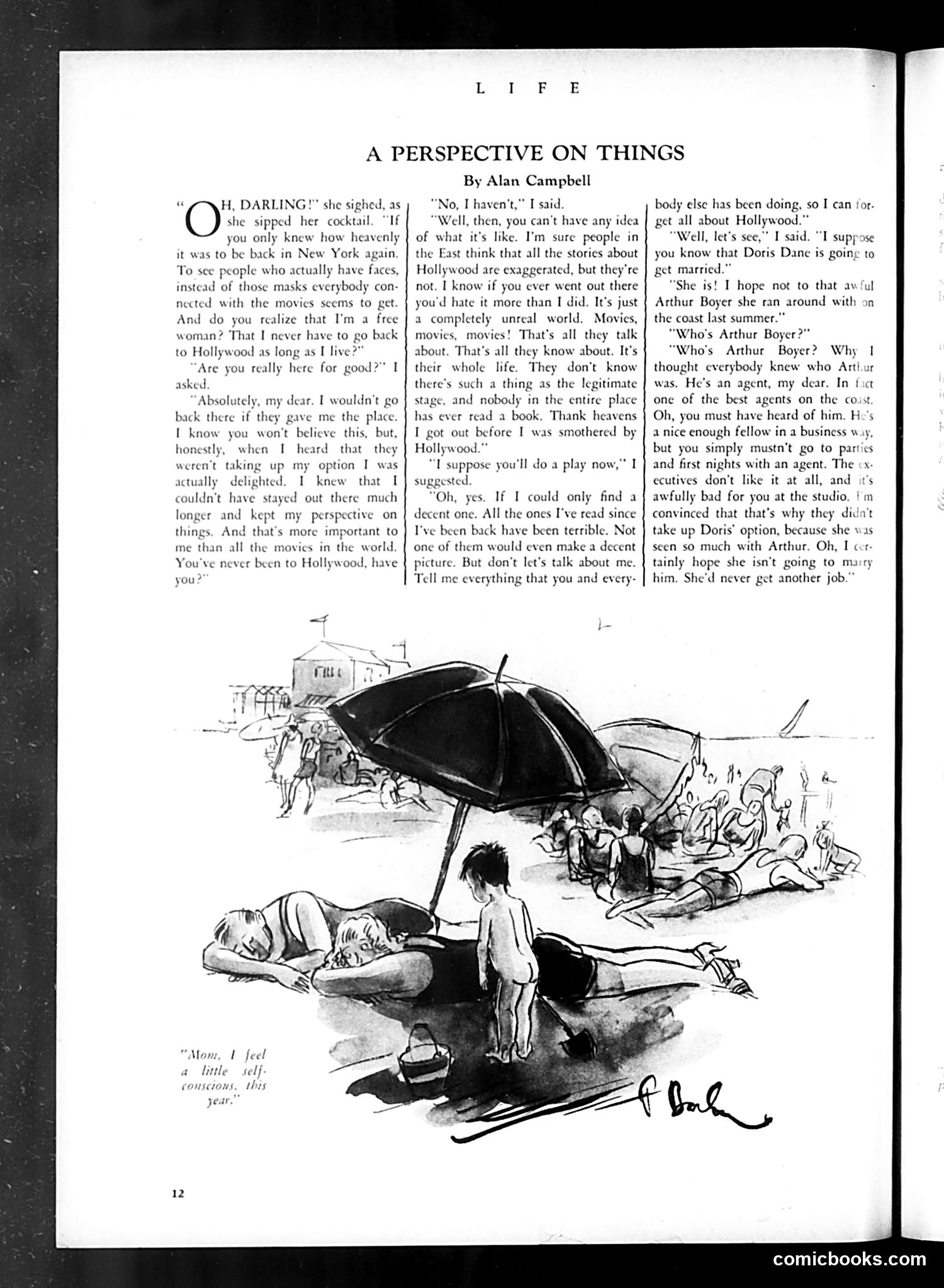
Analysis of "A Perspective on Things" by Alan Campbell This is a satirical dialogue between a woman and man about Hollywood. The woman defends her decision to leave the film industry, citing its superficiality—movies dominate conversation while people ignore legitimate theater and real life. The accompanying illustration depicts a beach scene where a child holds an umbrella over a reclining woman, while crowds enjoy typical beach activities in the background. The caption reads: "Mom, I feel a little self-conscious this year." The satire critiques 1920s-30s celebrity culture and vanity. The cartoon suggests that even mothers at leisure feel self-aware about their appearance or status—implying how deeply Hollywood's influence and image-consciousness had penetrated American society, making even ordinary moments feel performative.
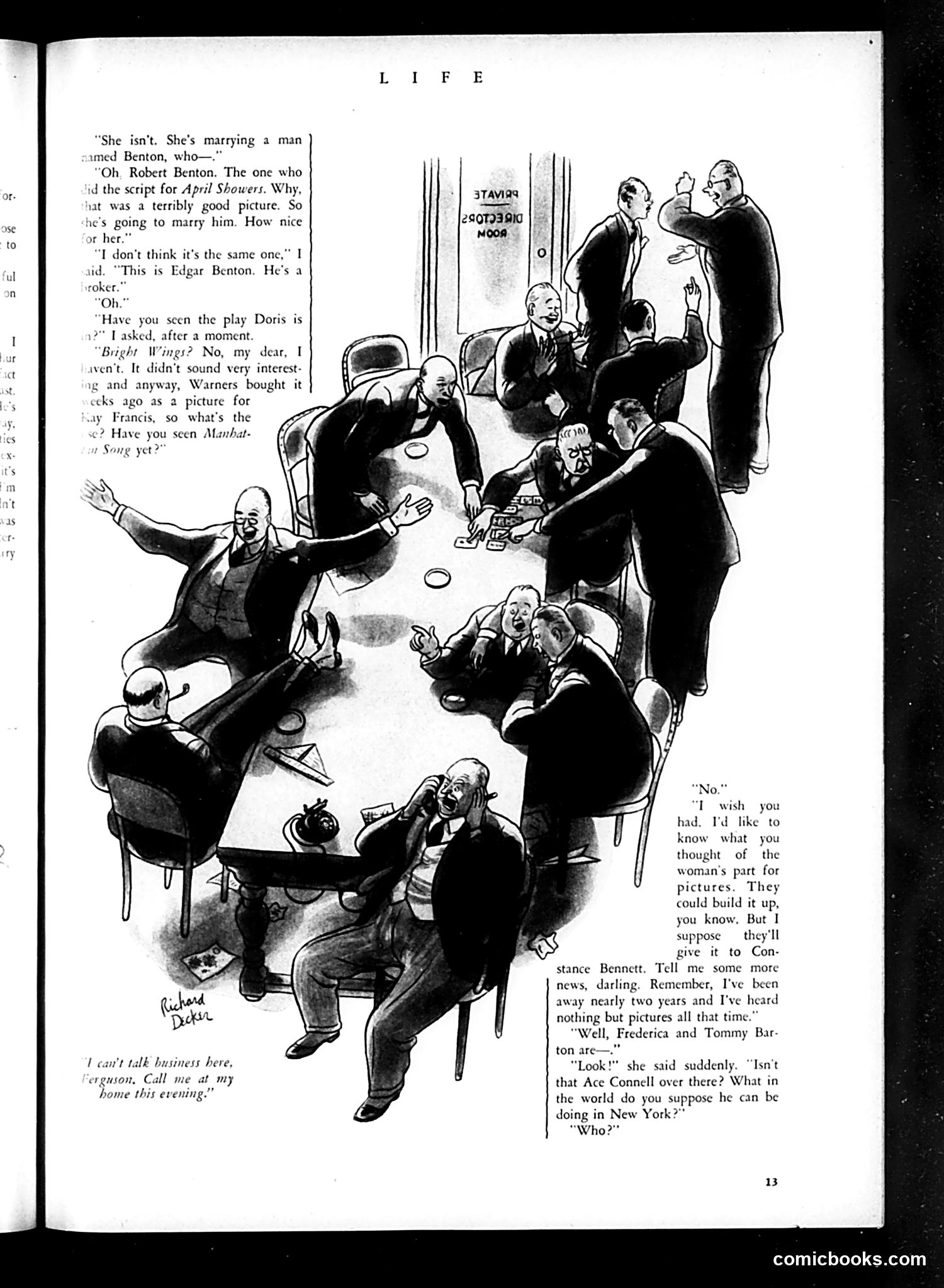
Analysis of Life Magazine Page 13 This page contains a satirical dialogue about Hollywood and theater figures. The main cartoon depicts a business meeting or social gathering of men in suits discussing entertainment industry gossip. The conversation references: - Robert Benton: described as a broker (not a playwright) - Doris and a play she's in - Edgar Benton: apparently a film producer - "Manhattan in Song": likely a theatrical production - Ace Connell: someone reportedly in New York The satire appears to mock the entertainment industry's social circles and gossip culture—how people discuss show business personalities and productions at social gatherings. The cartoon captures the pretentious, name-dropping atmosphere of 1920s-30s theater and film society, where social status derives from connections to entertainment figures. The illustrated scene conveys the busy, competitive nature of that world through crowded composition and animated gestures.
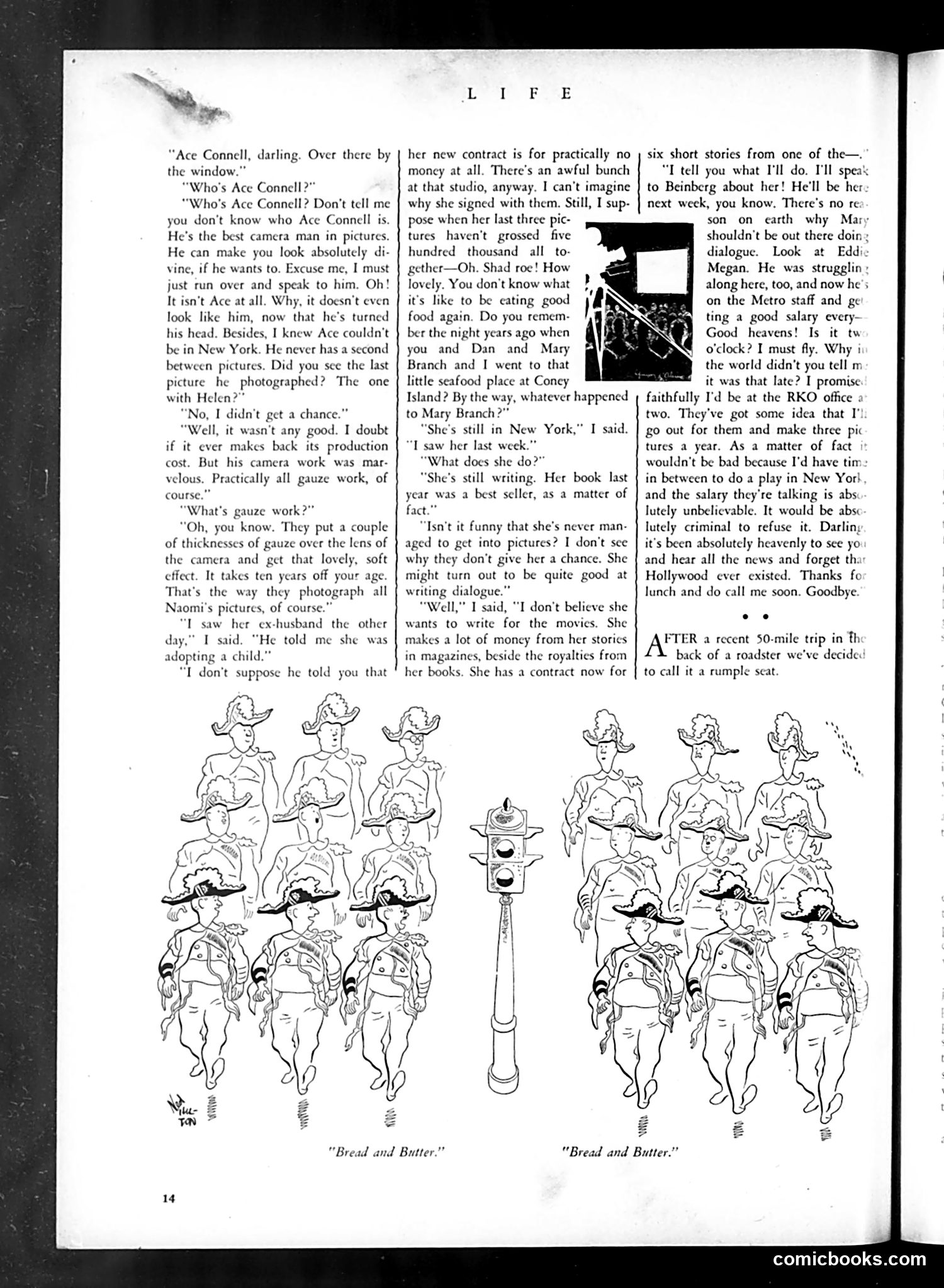
"Bread and Butter" - Life Magazine Cartoon Analysis This page contains two identical cartoon panels titled "Bread and Butter," depicting what appears to be a satirical commentary on military or government bureaucracy. Each panel shows a large traffic light in the center, flanked by groups of uniformed figures (appearing to be soldiers or officials) arranged in formation. The cartoons likely mock rigid institutional hierarchies and the mechanical, repetitive nature of following orders within large organizations. The traffic light—a symbol of automated control—suggests how individuals become interchangeable parts following predetermined signals rather than exercising independent judgment. The accompanying text discusses Hollywood filmmaking and contracts, but the visual satire's precise political target remains unclear from the image alone.
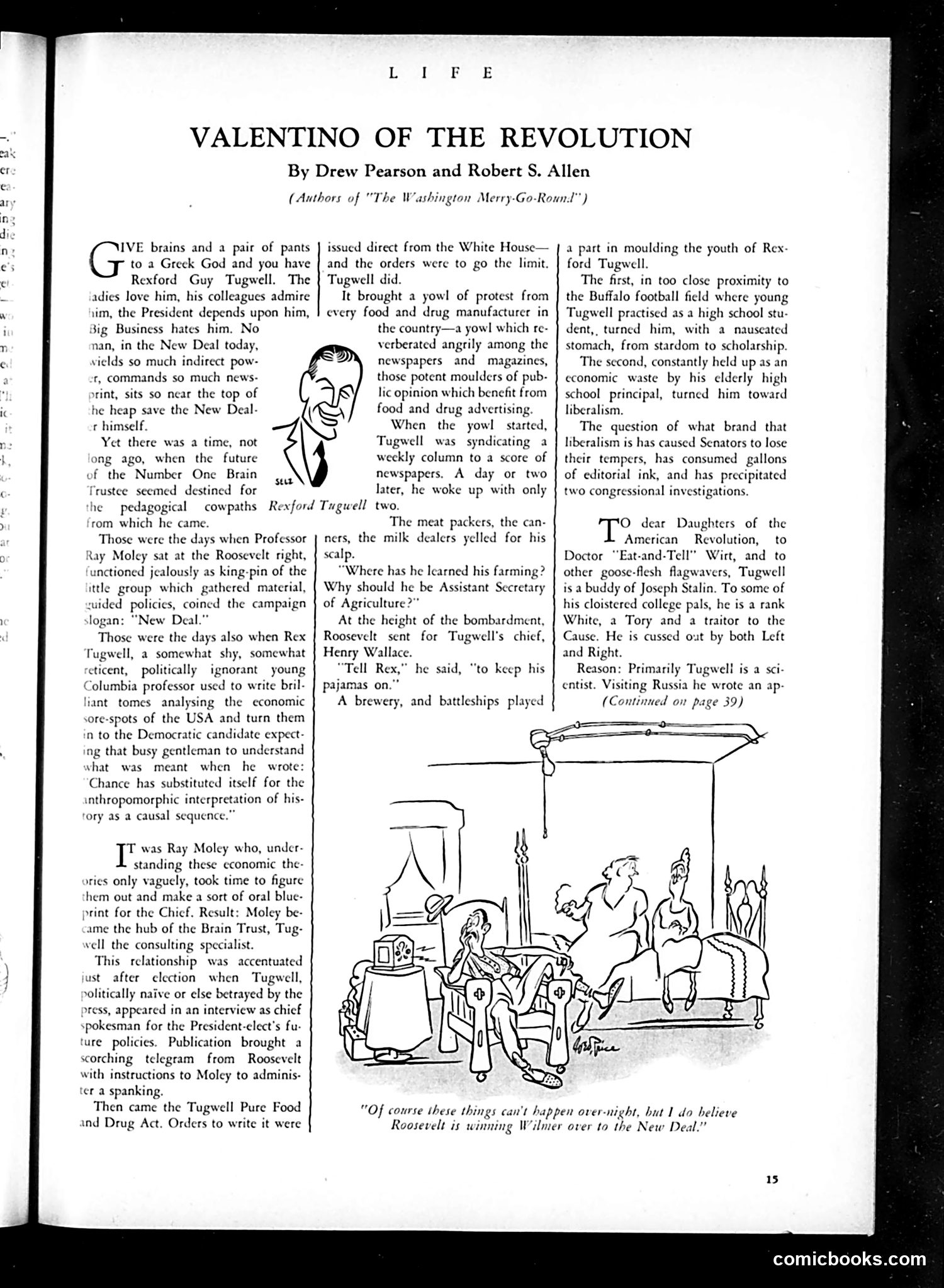
Satirical Analysis This article attacks Rexford Tugwell, a New Deal economist and advisor to President Roosevelt. The piece portrays him as dangerously ideological—comparing him to "a Greek God" with excessive influence over youth and policy. The cartoon depicts what appears to be a domestic scene where New Deal policies are being imposed, with figures representing government intervention into American home life. The caption's joke about Roosevelt "winning Willkie over to the New Deal" references the 1940 election between Roosevelt and Republican Wendell Willkie. The satire suggests that Tugwell and New Deal planners operate with unchecked power, reshaping American institutions—schools, agriculture, food production—according to centralized ideology rather than democratic input. The article frames this as dangerous social engineering.
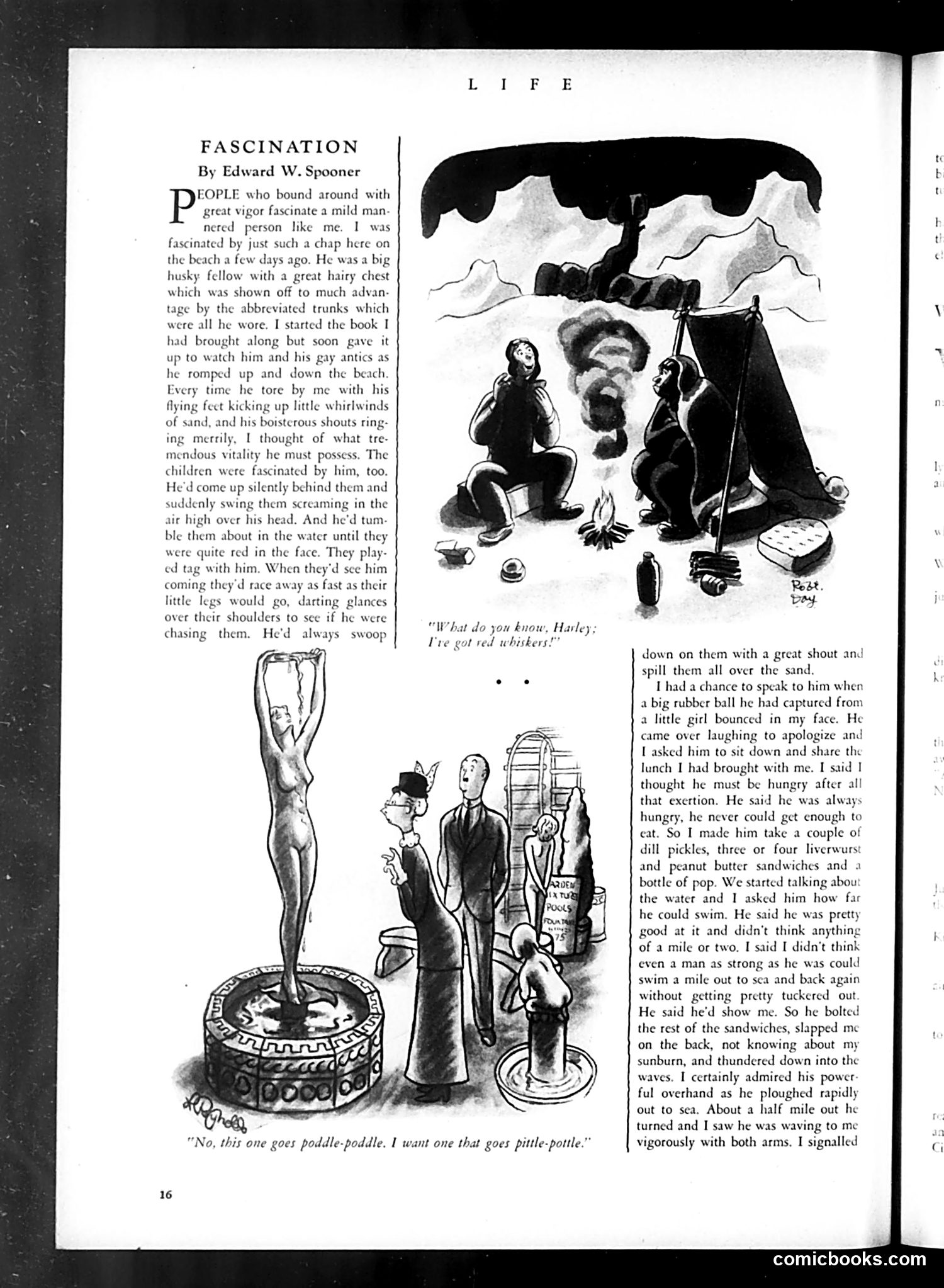
"Fascination" by Edward W. Spooner This is a humorous personal essay about the author's encounter with a remarkably vital, muscular man at the beach. The story describes how this stranger fascinated both the author and local children through displays of physical prowess—leaping, diving, and swimming with extraordinary power. The accompanying cartoons illustrate two separate jokes: one depicting a man emerging from or in water (suggesting athletic vigor), and another showing a man with formal gentlemen near a pedestal, captioned about wanting a "piddle-paddle" rather than a "tittle-bottle"—likely a double-entendre about drinking vessels or swimming toys, playing on similar-sounding words for comedic effect. The piece celebrates masculine physical vitality and athletic ability as sources of fascination and social status in early 20th-century American leisure culture.
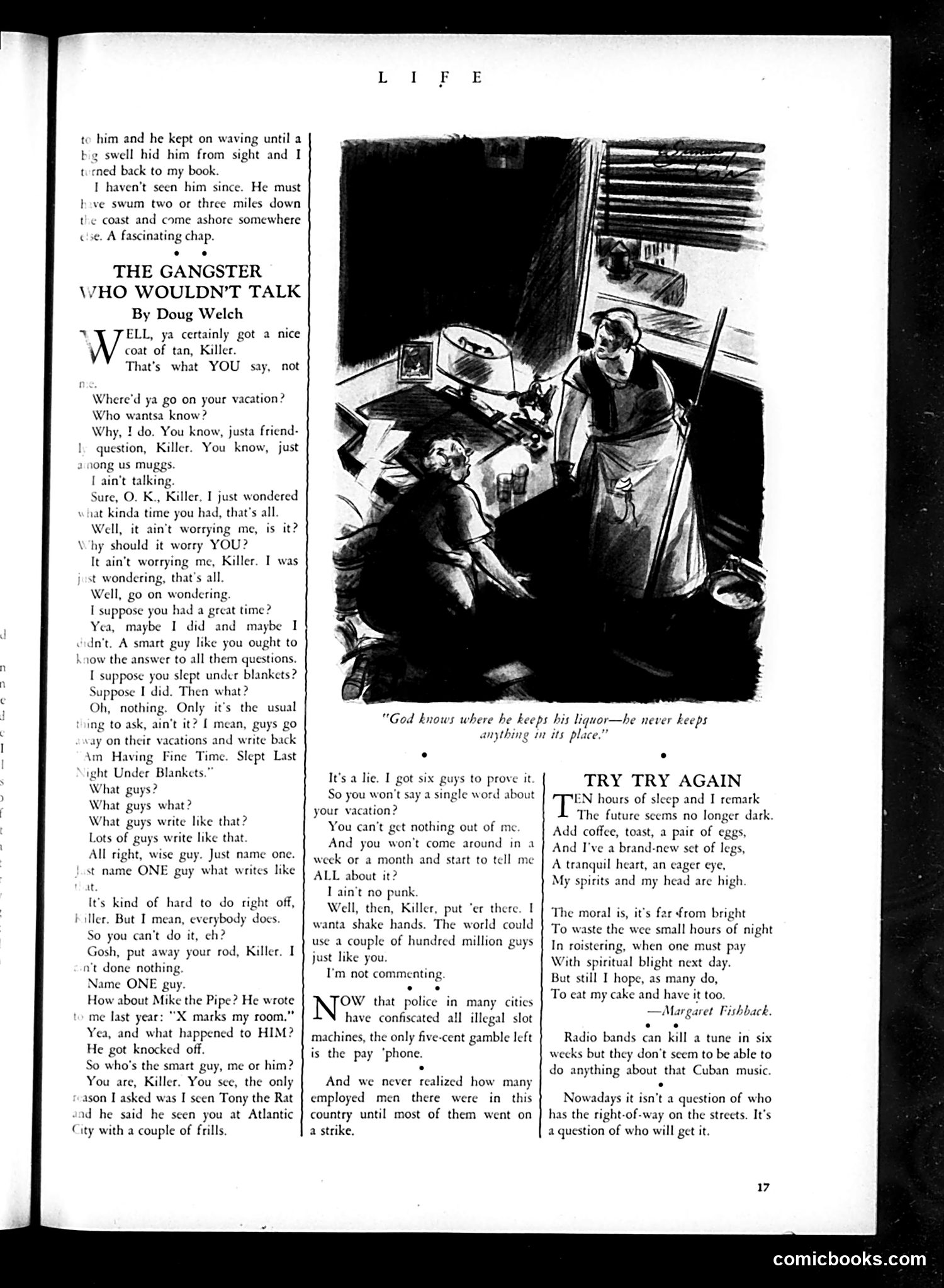
"The Gangster Who Wouldn't Talk" by Doug Welch This satirical story mocks a stereotypical gangster character named "Killer" who refuses to discuss his vacation or personal life with another mobster. The humor relies on the contrast between the tough, silent-treatment stereotype of organized crime figures and mundane social pleasantries. When pressed for conversation, "Killer" won't reveal where he went or what he did—maintaining criminal omertà (code of silence) even in casual small talk. The accompanying illustration shows two men in what appears to be a modest room or hideout, with the caption about liquor hiding reinforcing the criminal context. The satire targets both gangster movie clichés and the absurdity of applying underworld secrecy to ordinary vacation chat.
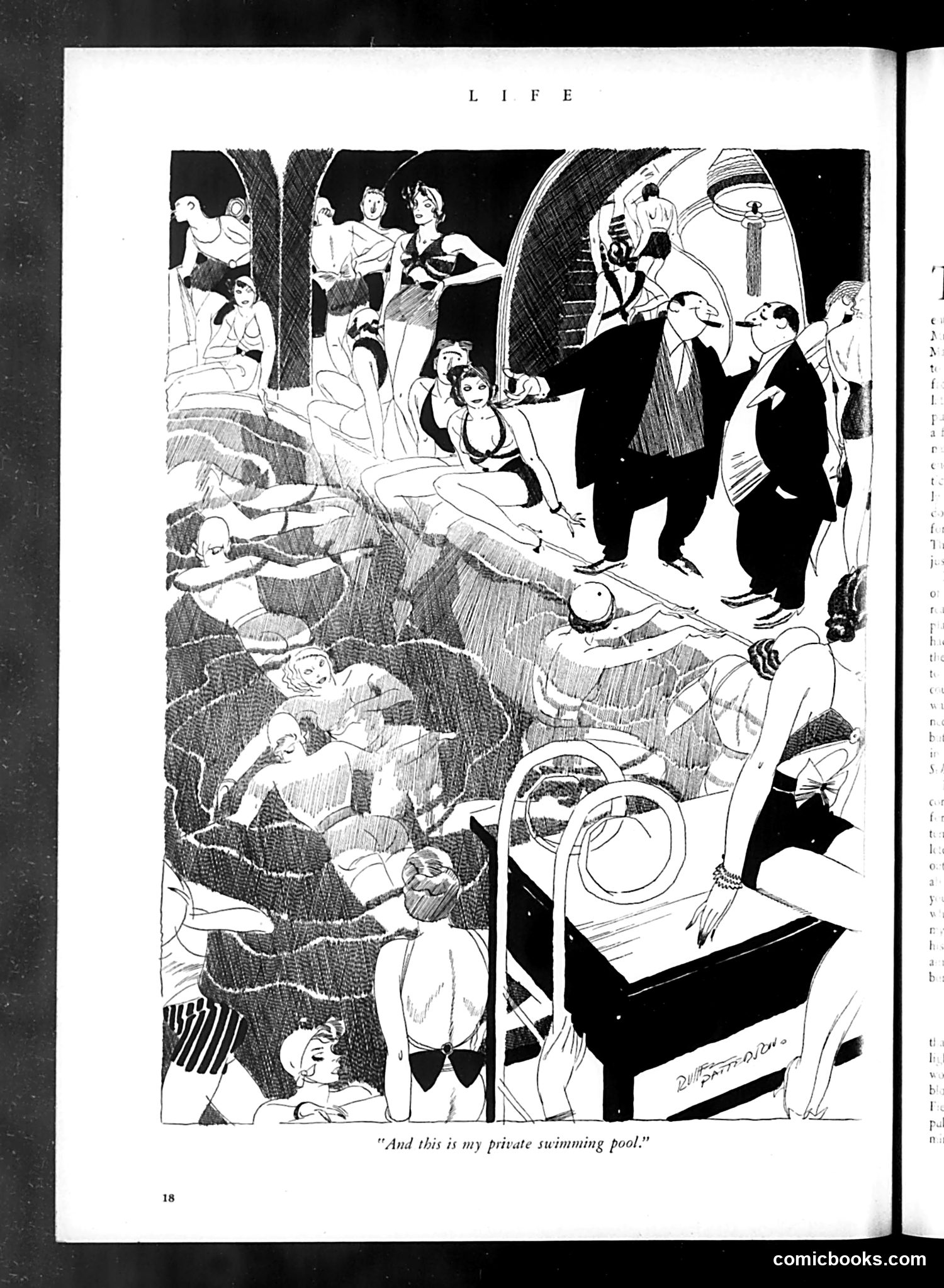
Analysis This is a single-panel cartoon satirizing wealth inequality and ostentatious displays of luxury. The scene depicts an opulent underground swimming pool filled with numerous people, while well-dressed men in suits stand above observing it. The caption reads: "And this is my private swimming pool." The satire targets the extreme disparity between the wealthy owner and the masses packed into his personal facility. The crowded, chaotic pool—packed far beyond comfortable capacity—contrasts sharply with the exclusivity implied by "private." This mocks both the pretension of calling something "private" when it's overrun with people, and the absurdity of displaying such excess to visitors. The cartoon likely comments on 1920s-30s wealth and conspicuous consumption, using the overcrowded pool as visual metaphor for the unsustainable concentration of resources and the poor's cramped living conditions during this era.
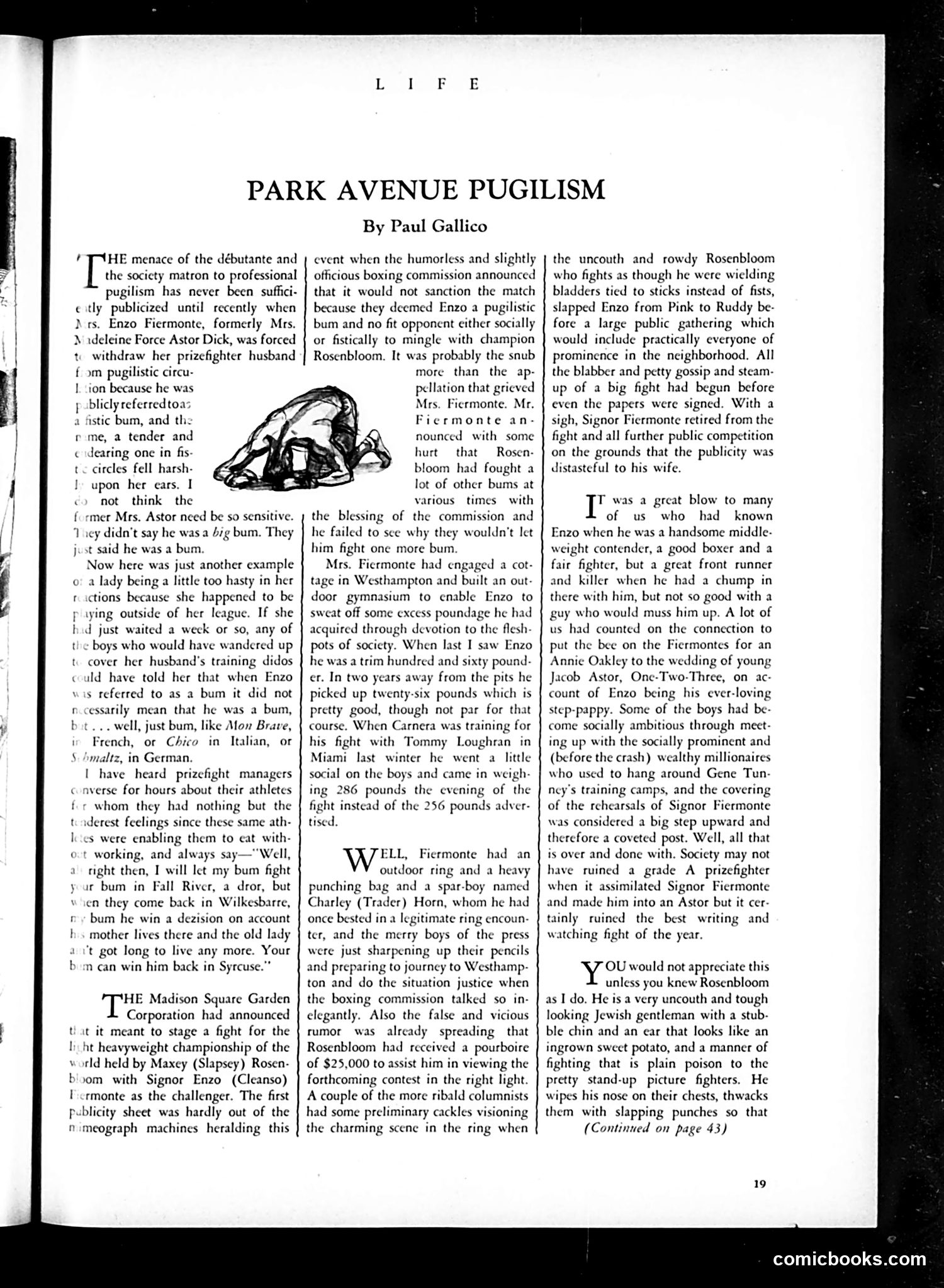
Park Avenue Pugilism This article by Paul Gallico satirizes professional boxing and wealthy society's fascination with it. The piece mocks "Mrs. Enzo Fiermonte" and her role as society matron attempting to launch her husband, boxer Enzo, into championship fights. The satire targets how society elites—particularly wealthy women—treat boxers as novelties or status symbols rather than athletes. Gallico ridicules the pretension of "Park Avenue" society figures trying to manage professional boxing, suggesting they're motivated by social climbing rather than genuine sport appreciation. The cartoon likely depicts the absurdity of this collision between high society and the rough working-class world of boxing. The text mocks both the boxers who accept society patronage and the wealthy patrons who treat the sport as entertainment divorced from its brutal reality.
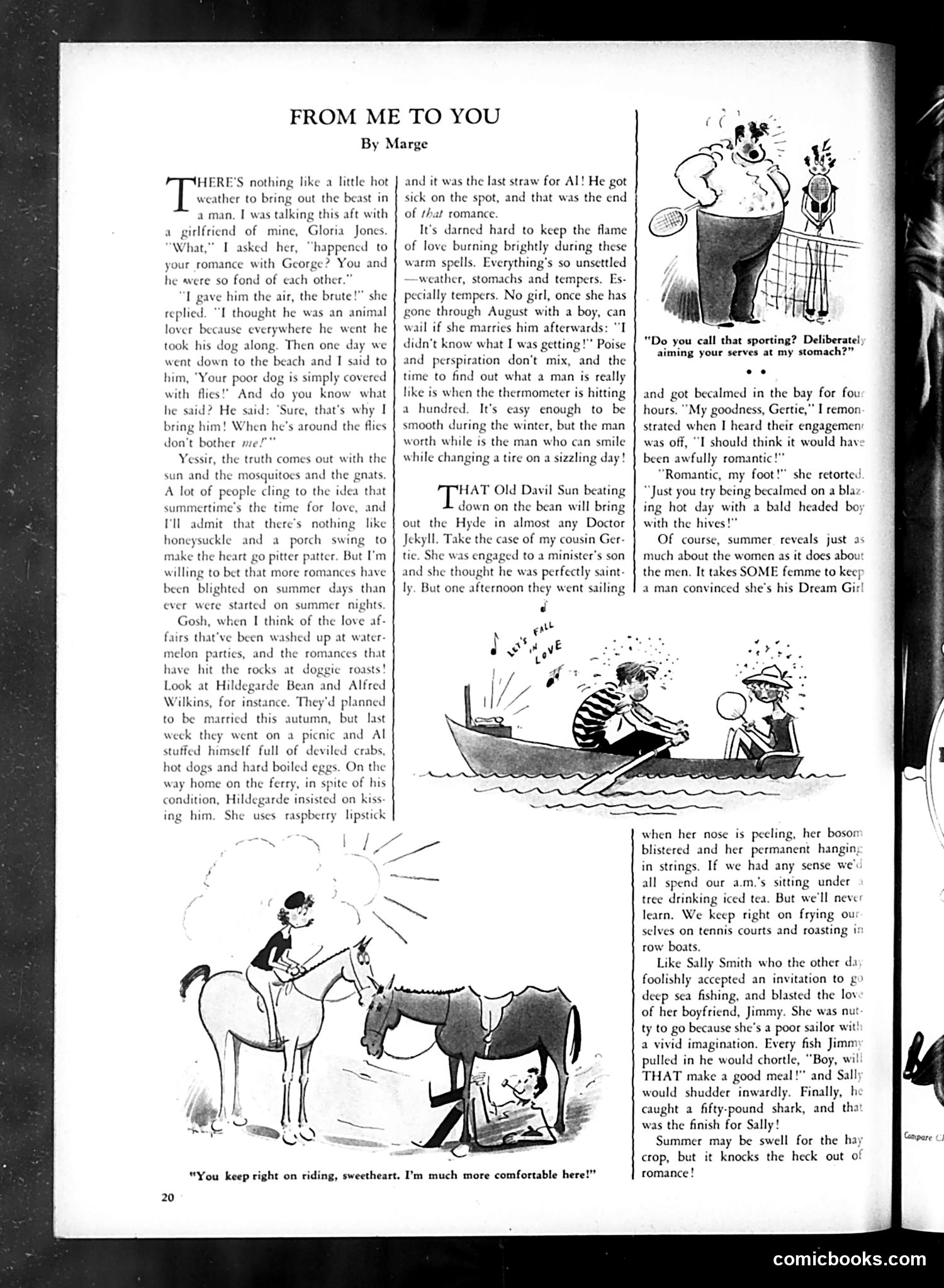
Analysis for Modern Readers This is a humorous essay by Marge about how summer heat destroys romance. The author uses anecdotes to argue that hot weather reveals people's true, unflattering nature—counteracting the cultural myth that summer is romantic. The cartoons illustrate specific stories: one shows a man riding while his girlfriend walks in heat (claiming the dog keeps flies off him), another depicts a couple arguing on a boat (the woman's permanent wave is ruined by humidity and sailing). The satire mocks several period-specific concerns: women's "permanent waves" (1920s-40s hairstyles), the importance of appearing as a "Dream Girl," and class anxieties about courtship rituals (picnics, beach outings, sailing trips). The underlying joke is that romance requires artifice—once heat exposes people's real, uncomfortable bodies and bad tempers, attraction evaporates. The piece essentially deflates romantic idealization through physical reality—a common comedic strategy in *Life* magazine's satirical tradition.
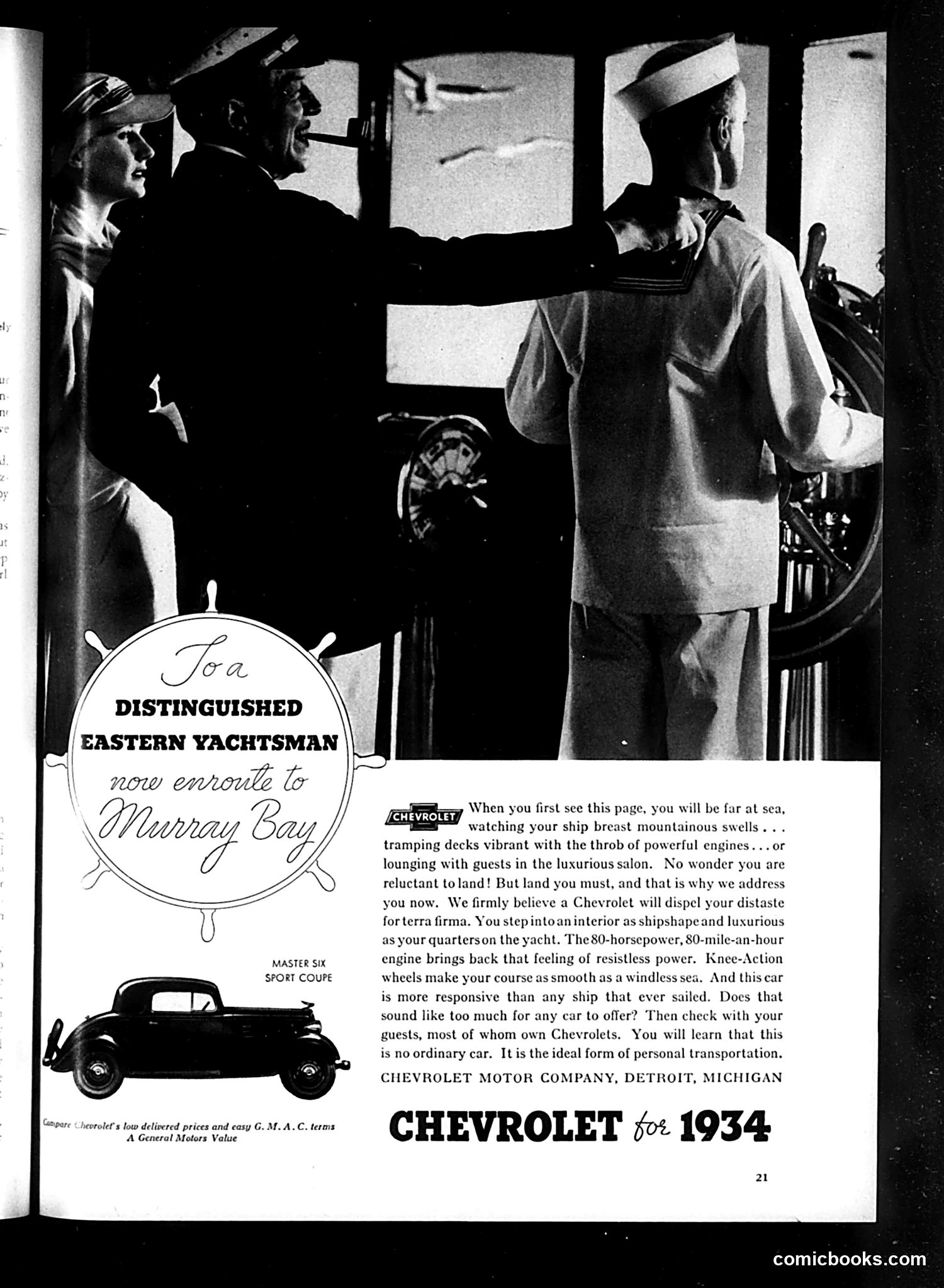
Analysis This is a Chevrolet automobile advertisement, not political satire. The page depicts a wealthy Eastern yachtsman reluctantly leaving his pleasure yacht at Murray Bay to return to land, where a 1934 Chevrolet Master Six awaits him. The advertisement's humor works through incongruity: it compares a modest car to luxury yacht life, suggesting the Chevrolet provides comparable comfort and performance ("smooth as a windless sea," "80-horsepower"). The implied joke is that a wealthy yachtsman might be so reluctant to leave his vessel that he needs convincing that driving a Chevrolet—not typically associated with luxury—offers acceptable terrestrial comfort. The ad appeals to aspirational snobbery: it flatters the target reader (affluent enough to yacht) while assuring him that owning a Chevrolet maintains social status, noting that his yacht-club guests "most of whom own Chevrolets" validate the car's quality. This reflects 1934 marketing strategy during the Depression: positioning a moderately-priced car as respectable for the wealthy class.
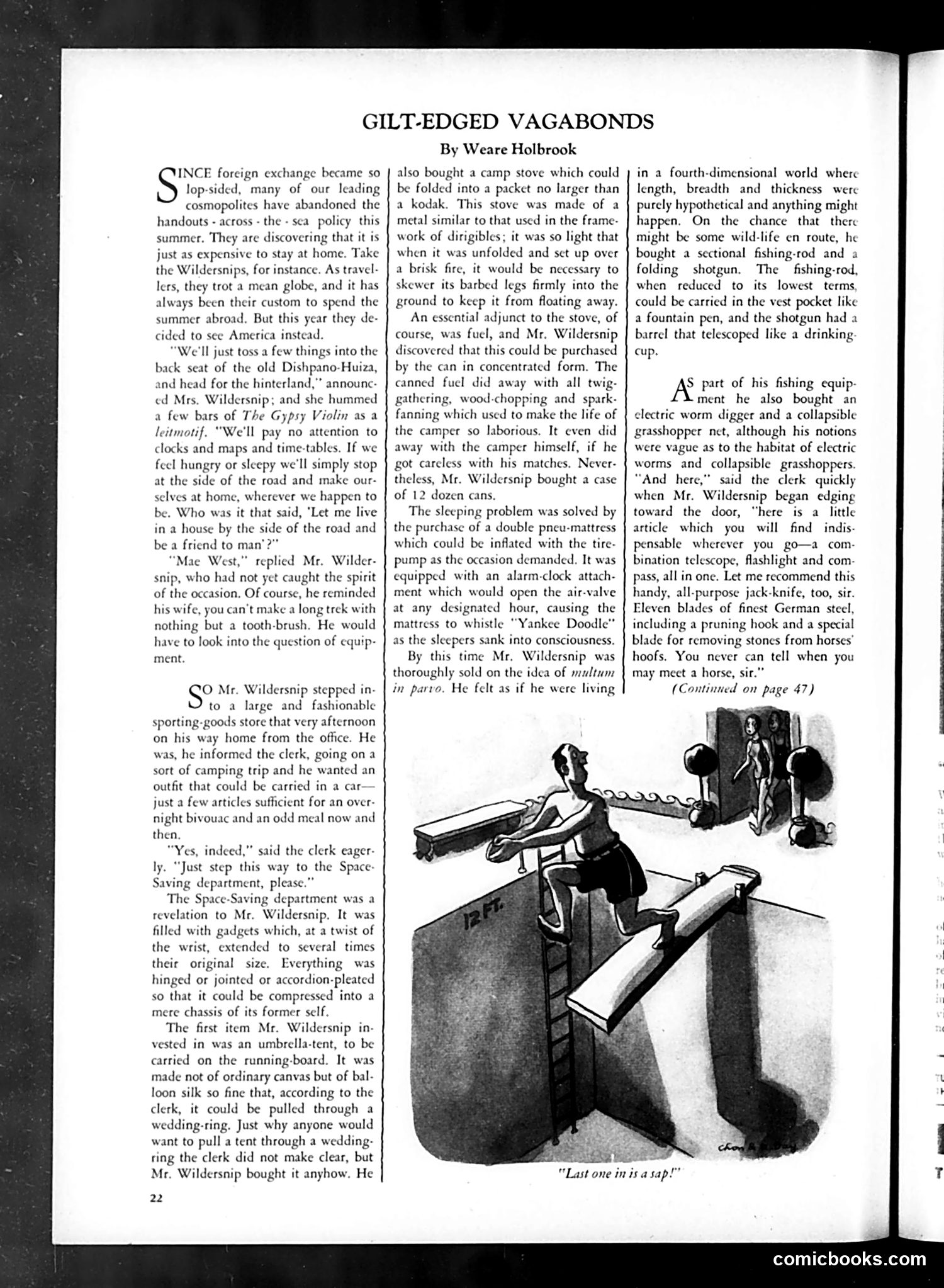
"Gilt-Edged Vagabonds" Explanation This is a humorous story satirizing wealthy Americans' obsession with camping gadgetry during the Depression era. Mr. and Mrs. Wildersnip, described as habitual foreign travelers ("cosmopolites"), decide to vacation domestically instead due to currency exchange problems. The satire targets their naive romanticism about "roughing it"—they imagine carefree bohemian travel but end up purchasing absurdly over-engineered contraptions from a "Space-Saving department." Each item exemplifies 1920s-30s consumerism: tents pullable through wedding rings, collapsible stoves made of dirigible material, canned fuel, and an alarm-clock mattress that whistles "Yankee Doodle." The joke: wealthy urbanites cannot authentically escape civilization; they merely recreate it portably, purchasing expensive gadgets instead of embracing actual simplicity. The illustration shows them comically burdened with camping equipment despite claims of traveling light. The underlying satire critiques both blind consumerism and the privileged class's disconnection from genuine outdoor experience.
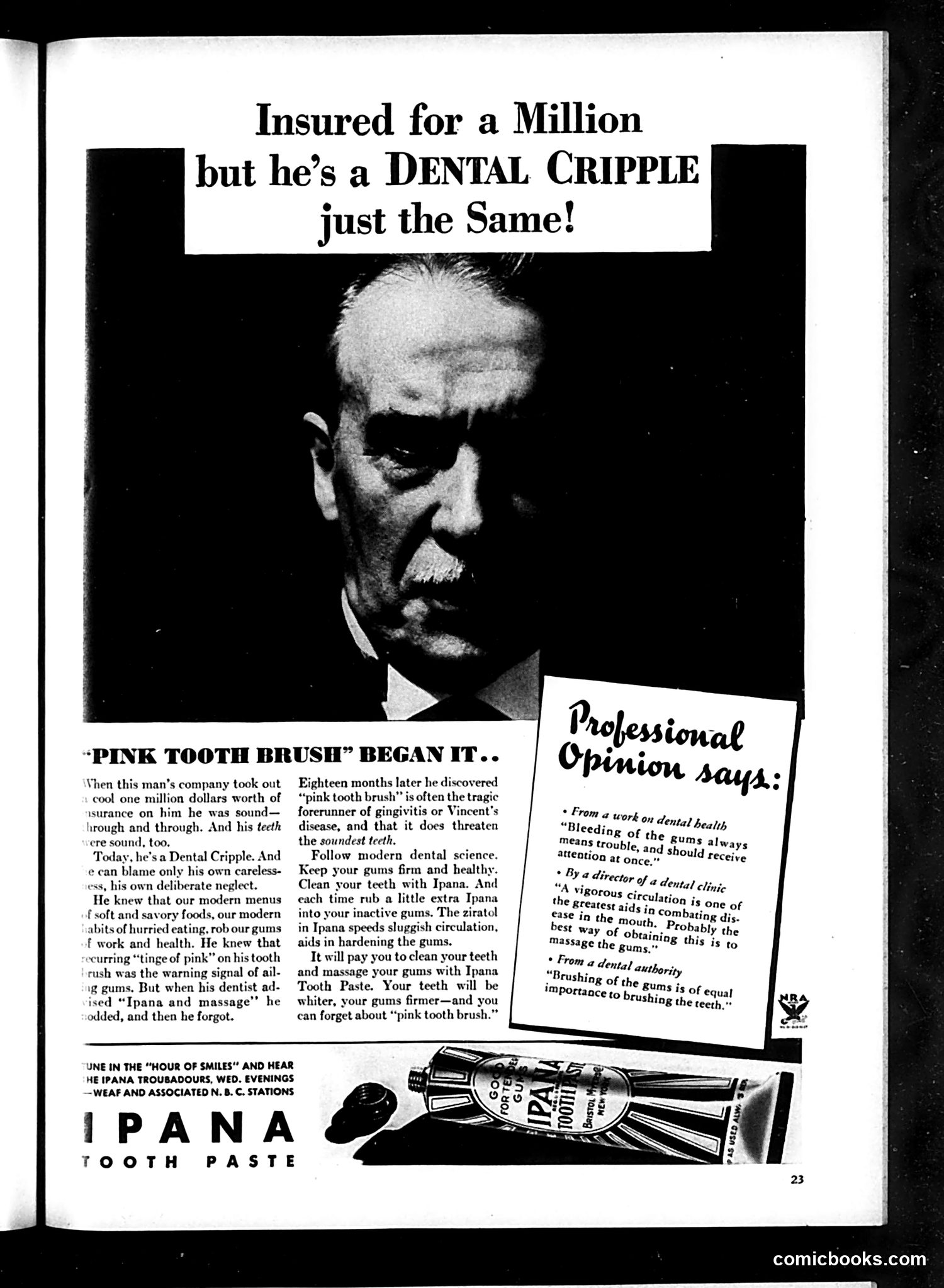
Ipana Toothpaste Advertisement (circa 1930s-40s) This is a vintage toothpaste advertisement, not political satire. The "cartoon" uses dramatic language to sell Ipana Tooth Paste by telling a cautionary tale: A wealthy man, insured for a million dollars, neglected his dental health despite warning signs (a "pink tooth brush" indicating gum disease). He ignored his dentist's advice about brushing with Ipana and massage. Eighteen months later, he developed gingivitis or Vincent's disease—becoming a "dental cripple" despite his insurance. The ad exploits class anxiety: wealth cannot protect you from poor dental hygiene. The solution is using Ipana, which contains "ziratol" to stimulate gum circulation. Professional opinions in the sidebar reinforce the message. This reflects early 20th-century advertising's reliance on fear-based messaging and exaggerated consequences to promote health products.
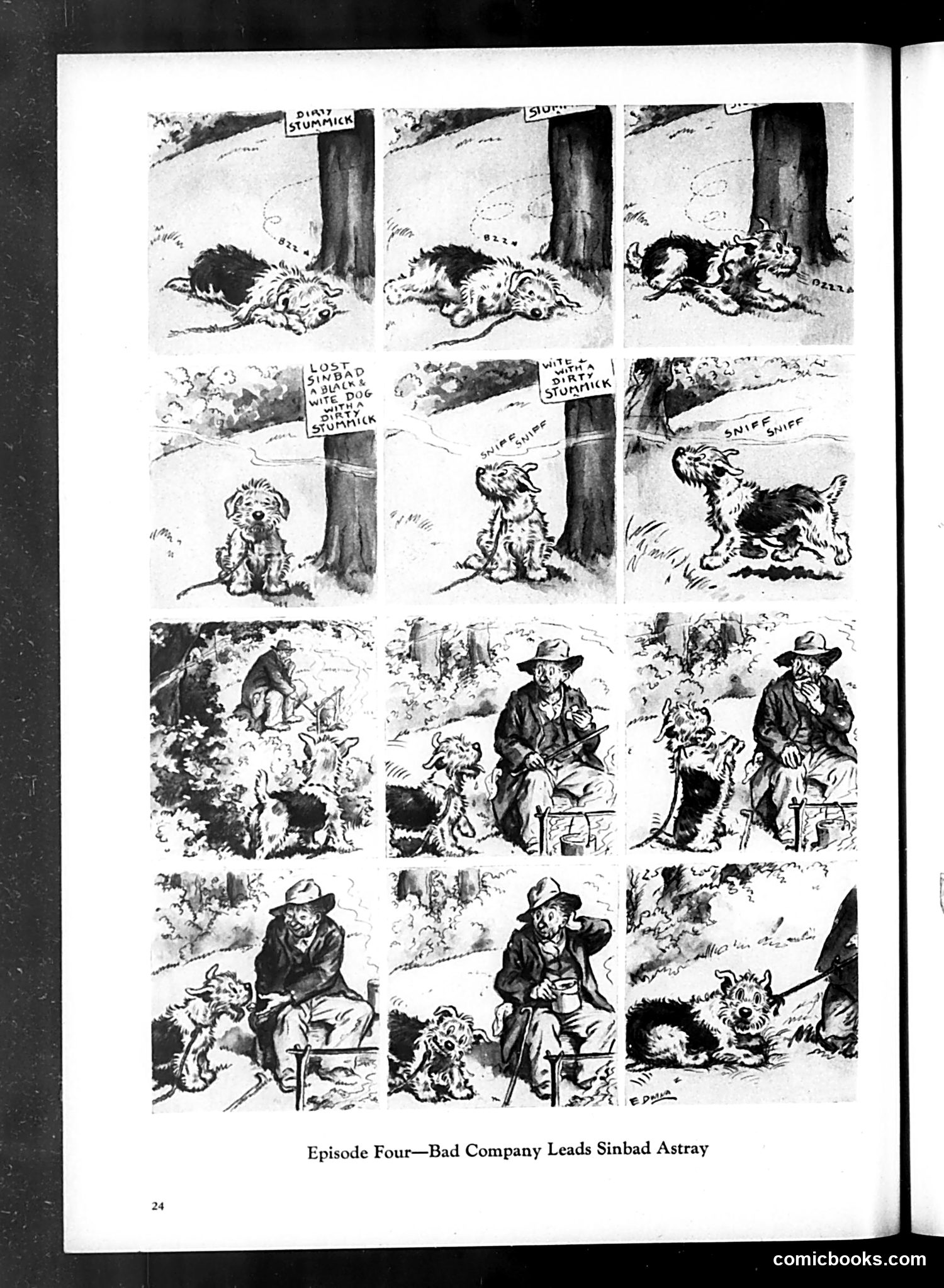
This is a sequential comic strip titled "Episode Four—Bad Company Leads Sinbad Astray." The narrative follows a sailor character (presumably Sinbad) who encounters a stray dog. Through the panels, the dog leads the sailor away from his responsibilities into increasingly disreputable situations—meeting with rough-looking characters in cowboy hats and engaging in questionable behavior. The satire appears to warn against the corrupting influence of "bad company" on moral character. The stray dog serves as a metaphor for temptation or wayward influences that lead an otherwise decent person astray into vice. The comic uses the Sinbad adventure framework (a classic sailor tale) to deliver a moral lesson about avoiding disreputable associates—a theme common to early 20th-century American moral storytelling in popular magazines.

White Rock Mineral Water Advertisement This is a vintage advertisement (not political satire) for White Rock mineral water from Waukesha, Wisconsin. The page depicts men from various professions and nationalities—appearing to include Scottish, cowboy, and other figures—engaging in hard labor ("Hard day tomorrow...make mine with white rock"). The ad's core message: White Rock's alkaline mineral content supposedly neutralizes acidity in whatever beverage it's mixed with, making drinks taste better and be "better for you." The global cast of workers suggests the product's universal appeal across occupations and cultures. The claim reflects early-20th-century marketing that attributed health benefits to alkaline mineral waters—a common but largely unsubstantiated sales pitch of that era.
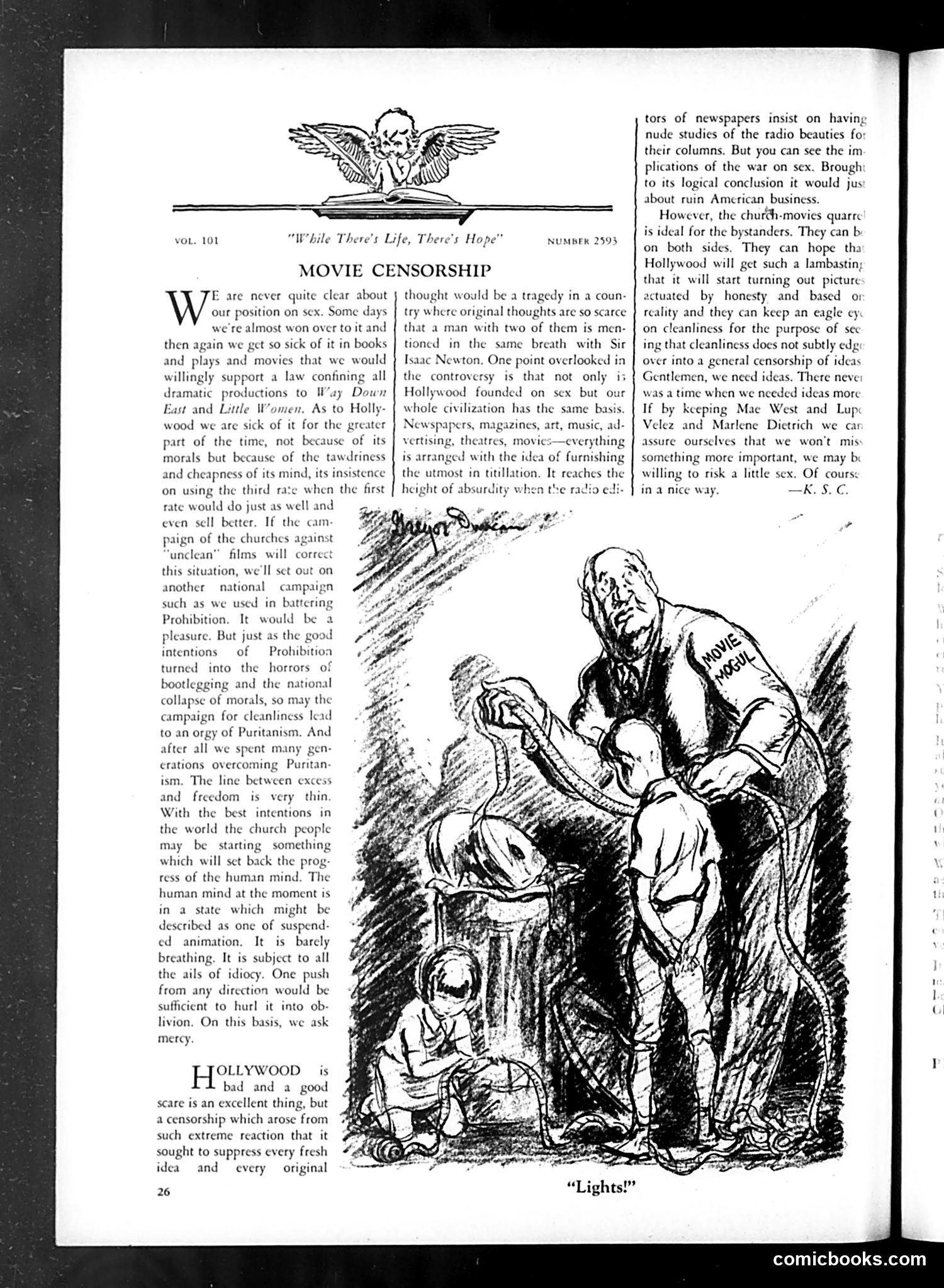
Life Magazine's "Movie Censorship" Commentary This 1930s article critiques the clash between church groups and Hollywood over film content. The accompanying cartoon titled "Lights!" depicts figures (likely representing censors or moral crusaders) aggressively attacking or constraining what appears to be the film industry, shown as a bound or struggling figure. The article's satire cuts both ways: it mocks Hollywood's cheap sensationalism while warning that aggressive censorship could be equally destructive. The author notes the hypocrisy of condemning Hollywood's sexual content while newspapers run nude photos of radio actresses—yet the real danger is stifling original thought entirely. The piece advocates nuance: rather than eliminate figures like Mae West and Marlene Dietrich, better to preserve some freedom of expression than risk another Prohibition-style moral crusade that backfires into widespread harm. The tone is darkly ironic about American prudishness and commercial exploitation simultaneously.
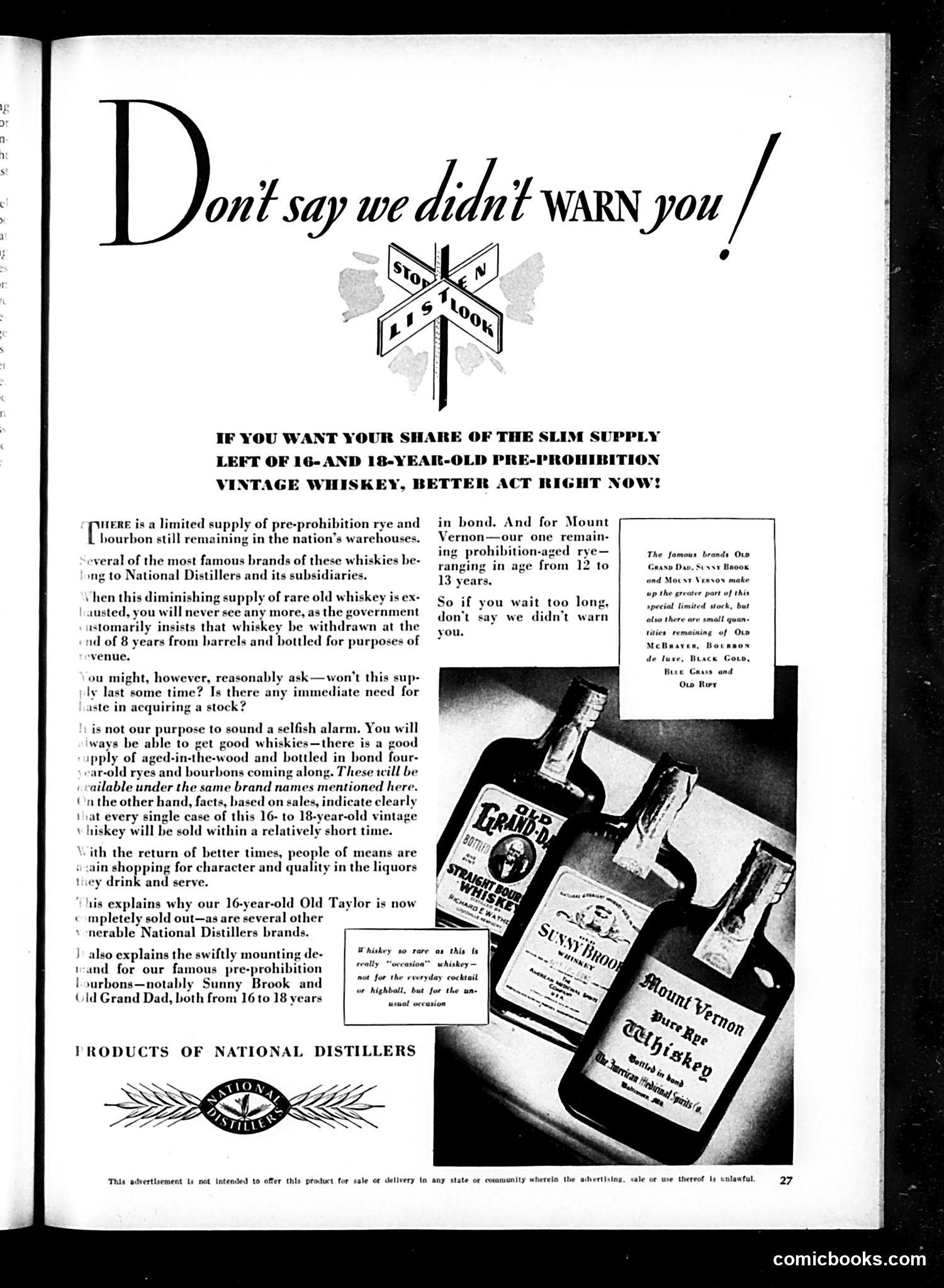
Analysis of National Distillers Advertisement This is a whiskey advertisement, not political satire. It exploits post-Prohibition economic conditions (likely early 1930s) to create artificial urgency. The pitch: National Distillers warns consumers that pre-Prohibition whiskey aged 16-18 years is nearly gone. The government mandates withdrawal of barrel-aged stock after 8 years, so this vintage supply won't be replenished. The ad claims wealthy consumers are already buying up remaining stock for "character and quality." The angle: By framing scarcity as inevitable and temporary, the company pressures readers into immediate purchases—"don't say we didn't warn you." The photo displays actual bottles (Old Taylor, Mount Vernon, Sunny Brook, Grand Dad) to seem concrete. Social context: Post-Prohibition (ended 1933), aged whiskey was genuinely rare and desirable among the affluent. The appeal to "people of means" seeking quality reinforces class exclusivity. The disclaimer at bottom acknowledges state alcohol laws still restricted advertising and sales.
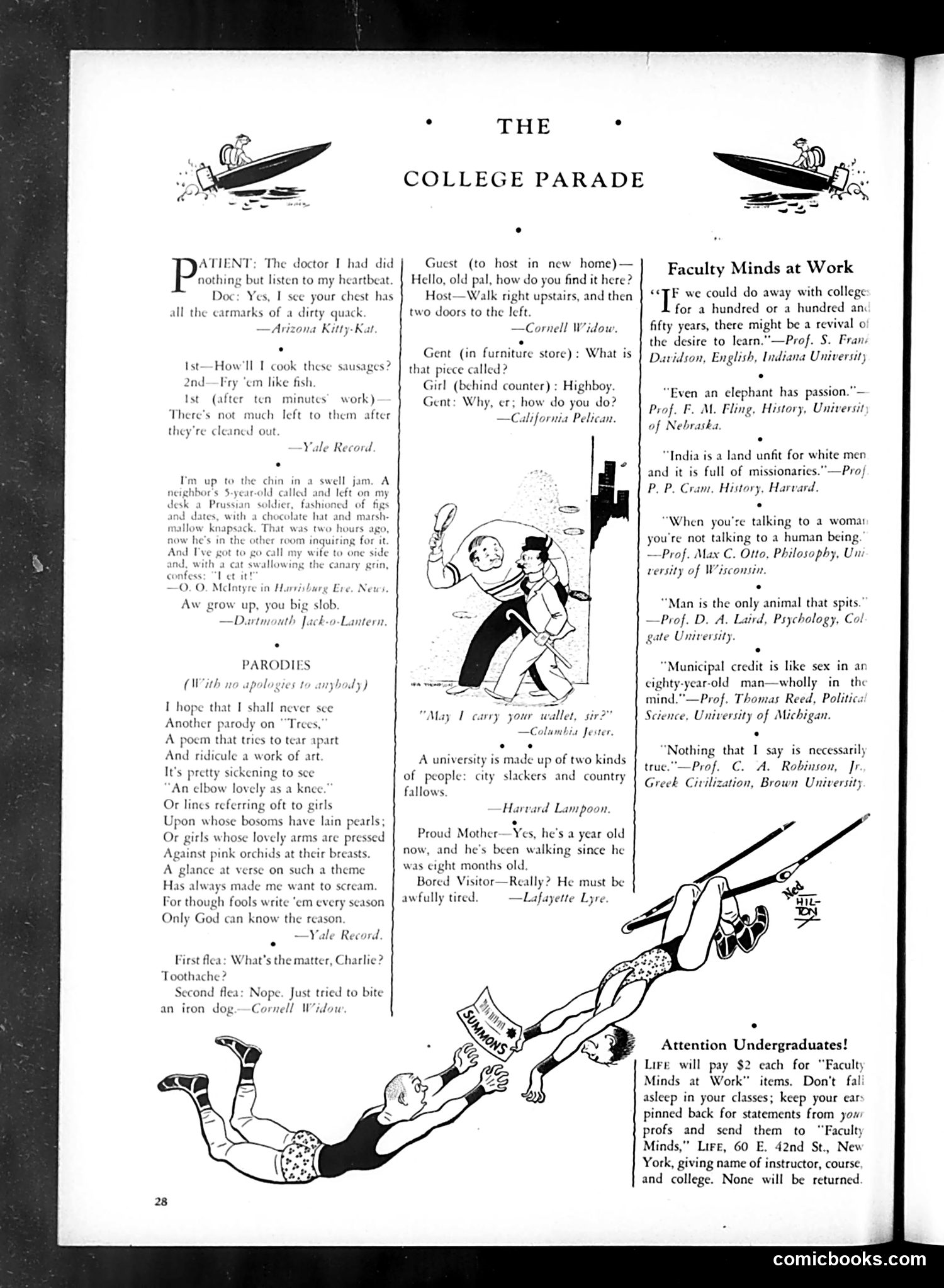
"The College Parade" - Life Magazine Page This page collects humorous anecdotes and jokes submitted by college publications across America. The content mocks academic life and professorial pretension. The cartoons feature college students in absurd situations—one shows a couple in a furniture store mishearing "highboy" as a greeting; another depicts two figures tussling over a wallet, captioned "May I carry your wallet, sir?" "Faculty Minds at Work" is the page's centerpiece: a collection of deliberately provocative or absurd quotes attributed to professors at named universities (Harvard, Indiana, Wisconsin, etc.). These quotes mock academic pomposity—claims about elephants having passion, that talking to women isn't talking to humans, or that nothing a professor says is necessarily true. The satire ridicules both ivory-tower pretension and the magazine's own audience: the final section solicits undergraduate submissions of "shocking professor quotes" for $2 each, inviting students to spy on and mock their teachers—a commentary on youth culture's irreverence toward authority. The overall tone is lighthearted mockery of collegiate life circa the 1920s-30s.
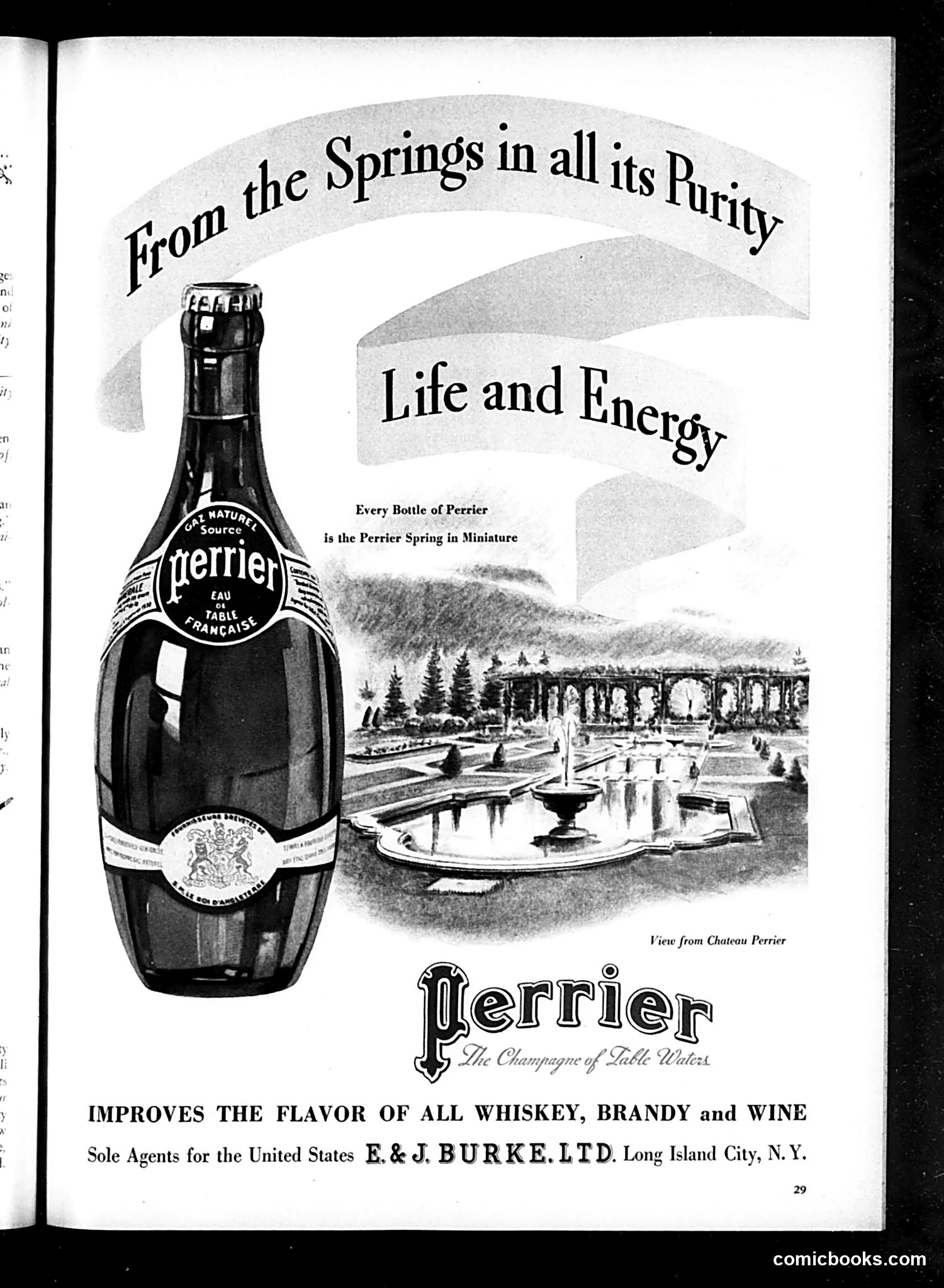
Perrier Advertisement Analysis This is not a political cartoon or satire—it's a straightforward advertisement for Perrier sparkling water, likely from the 1920s-1930s based on the style. The ad promotes Perrier as a mixer for alcoholic beverages, claiming it "improves the flavor of all whiskey, brandy and wine." The left side displays a Perrier bottle; the right shows an elegant European spa garden (Chateau Perrier) to convey luxury and natural purity. The tagline "The Champagne of Table Waters" positions Perrier as a premium product. A modern reader should note: this ad explicitly marketed carbonated water as a drink enhancer for spirits—unremarkable today, but notable given Prohibition's context in America (1920-1933). The U.S. distributor was E. & J. Burke, Ltd., based in Long Island City, New York. This is straightforward commercial advertising with no satirical content.
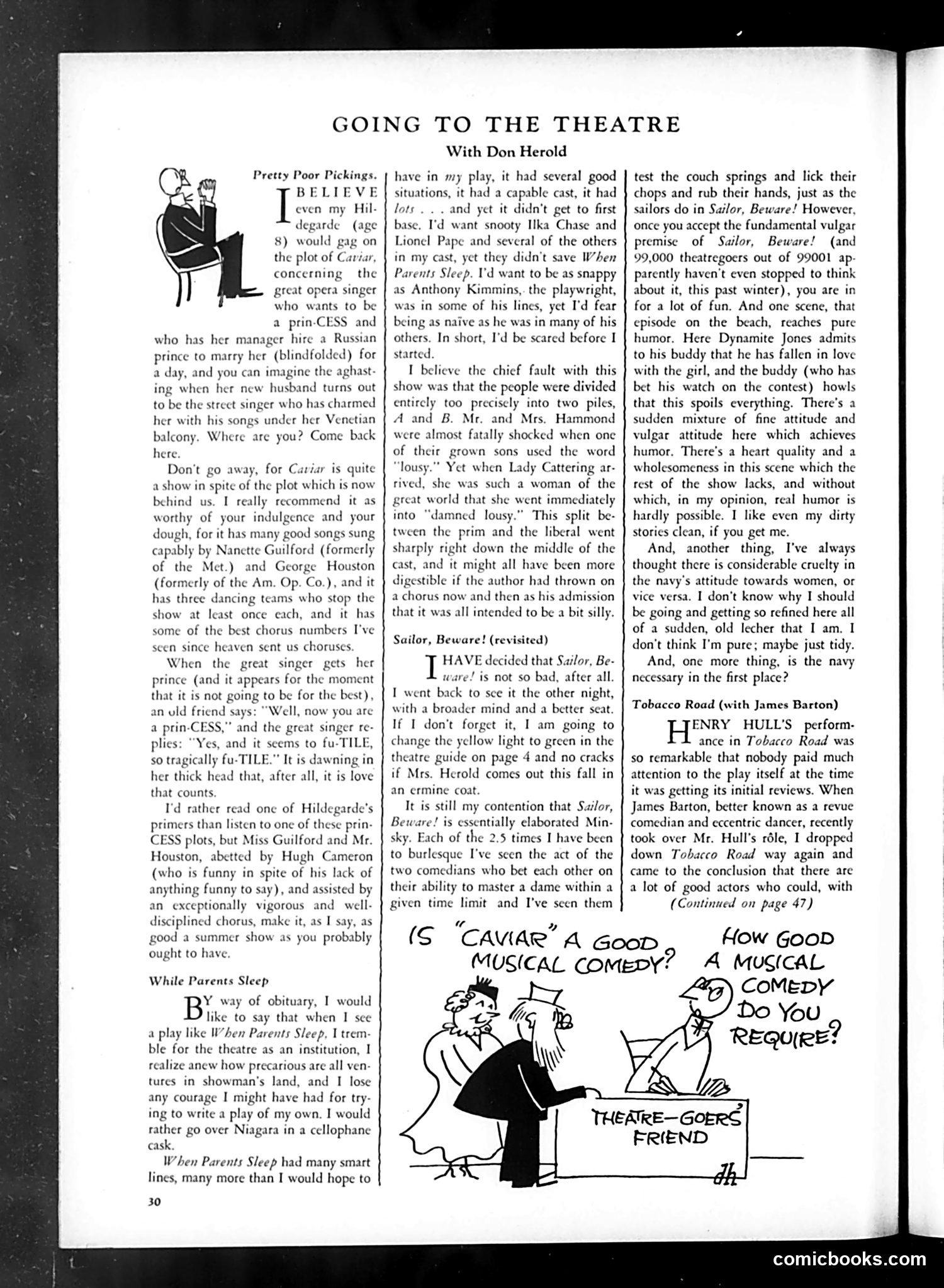
Analysis for Modern Readers This is Don Herold's theater review column from Life magazine. He critiques three Broadway shows: "Caviar": A musical about an opera singer hired to marry a Russian prince (sight unseen) who turns out to be a street singer. Herold dismisses the plot as clichéd ("prin-CESS" humor) but praises the performers—Nanette Guilford and George Houston—and the dancing. "When Parents Sleep": Herold faults this play for dividing characters too rigidly into "prim" versus "liberal" camps (represented by characters like the uptight Hammonds versus the worldly Lady Cattering). The satirical point: the play's artificial moral binaries make it dramatically hollow. "Sailor, Beware!": A returning review where Herold admits he initially underrated it. He compares it to burlesque theater, suggesting it's lowbrow entertainment with merit. The cartoon at bottom shows two theater-goers debating musical comedy quality—likely satirizing pretentious theatergoers. Herold's overall tone: wry acceptance that summer theater aims for lightweight entertainment, not art.
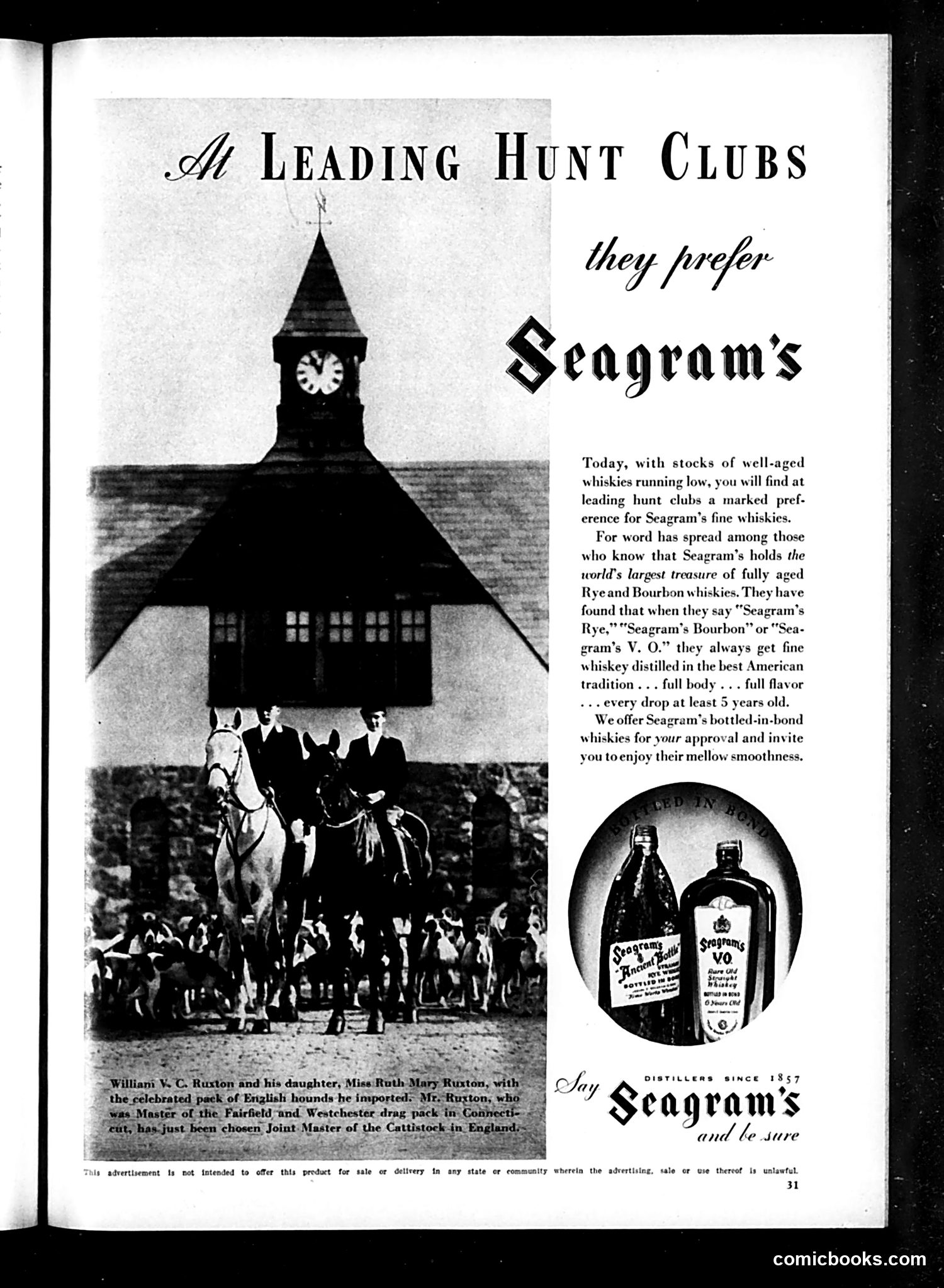
Analysis This is a whiskey advertisement, not political satire. It's a Seagram's marketing page targeting affluent consumers through aspirational imagery. The image shows William V.C. Ruxton and his daughter, Miss Ruth Mary Ruxton, posed with English hunting hounds at what appears to be a hunt club gathering. The caption identifies Ruxton as "Master of the Cattlestock in England"—lending Old World prestige and aristocratic authority to the brand. The advertisement exploits post-Prohibition era scarcity ("stocks of well-aged whiskies running low"), positioning Seagram's as the preferred choice among exclusive hunt clubs. By associating the product with English country gentry, imported hunting traditions, and established wealth, the ad appeals to American aspirational consumers seeking social status. The message is straightforward: sophisticated people at prestigious clubs choose Seagram's whiskey. The fine print asserts the product meets quality standards.
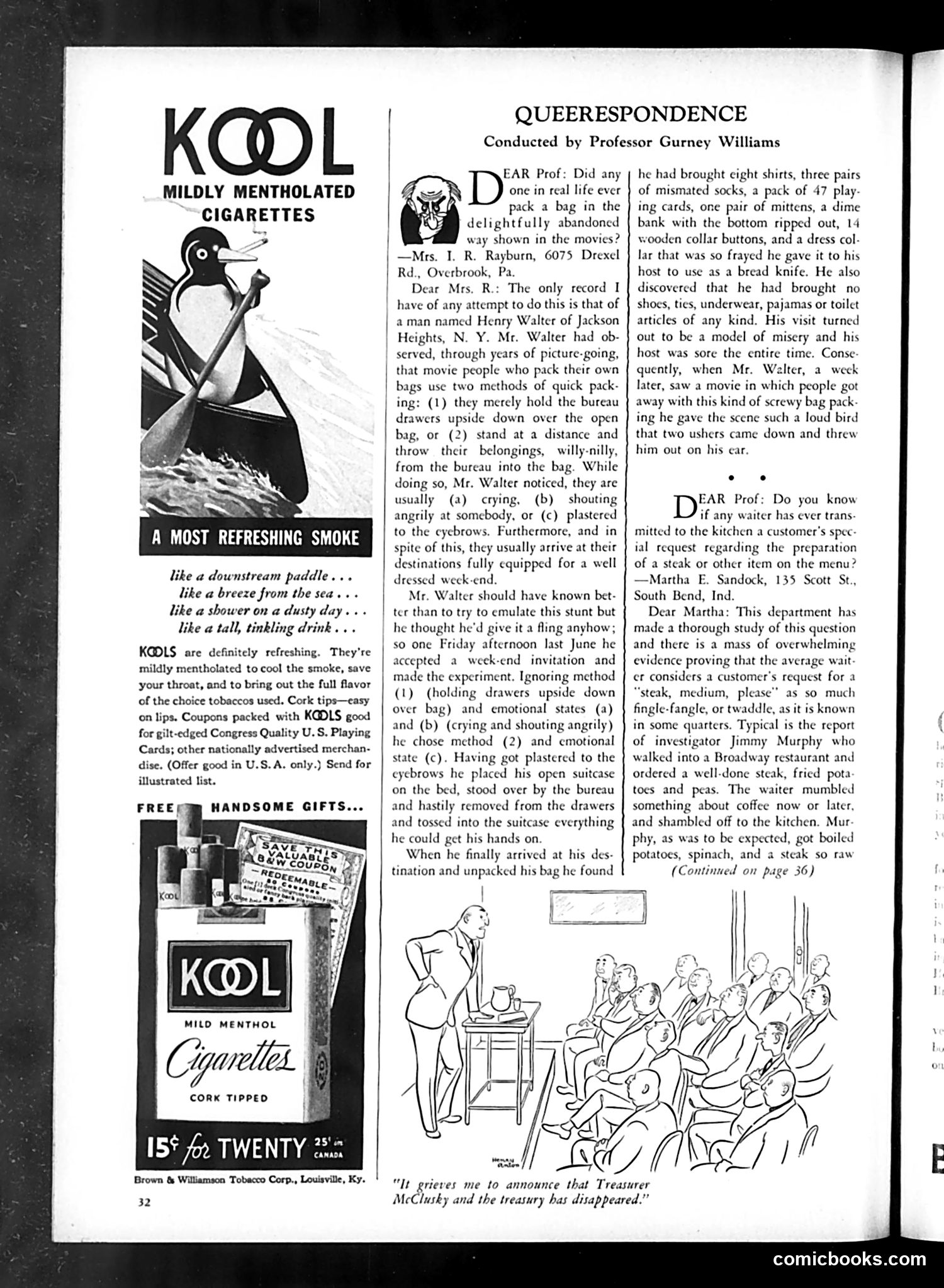
Analysis of Life Magazine Page This page combines cigarette advertising with a humorous advice column ("Queerespondence," conducted by Professor Gurney Williams). The Kool cigarettes ad dominates the left side, featuring a stylized penguin mascot and poetic language about refreshment ("like a downstream paddle"). The ad emphasizes menthol cooling and cork tips. The advice column contains two comedic letters: 1. A reader asks whether people in movies actually pack bags chaotically. The response describes Henry Walter, who attempted to replicate movie-style packing (throwing clothes randomly while drunk). The result: he brought completely wrong items—eight shirts, playing cards, mittens, no shoes or underwear—ruining his weekend. 2. A second letter (cut off) discusses whether waiters actually follow customers' special requests for how to cook steaks, implying they typically ignore them. The cartoon below shows a speaker addressing an audience, with a caption about "Treasurer McClusky and the treasury has disappeared." The satire gently mocks both movie clichés and everyday consumer frustrations through absurdist humor typical of *Life* magazine's tone.
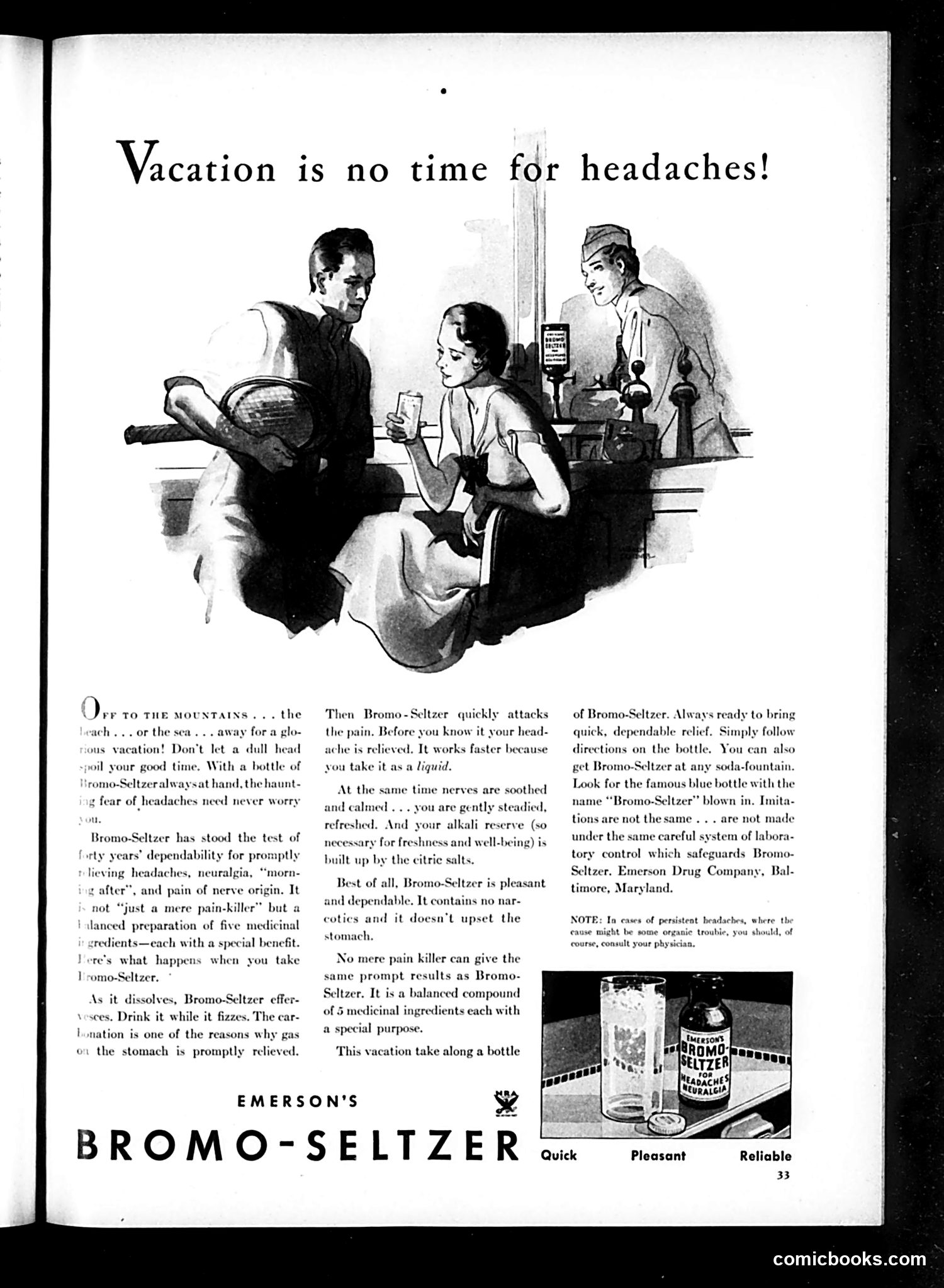
Analysis This is a Bromo-Seltzer advertisement, not political satire. The page promotes the antacid/headache remedy through a domestic vacation scenario. The illustration shows three figures in a 1920s-30s setting: a man holding a tennis racket, a woman drinking from a glass, and a bartender or server. The joke is the contrast—while vacationing (activities that might cause headaches), the woman has discovered Bromo-Seltzer, allowing her to enjoy herself worry-free. The ad emphasizes the product's speed and reliability by claiming it works as a liquid, contains no narcotics, and won't upset the stomach. The marketing strategy targets leisure travelers who fear vacation disruptions from headaches or hangovers (the "morning after" reference suggests this). The three descriptors at bottom—"Quick / Pleasant / Reliable"—are the product's key selling points. This represents typical early 20th-century medicine advertising, before strict FDA regulations, promoting a patent remedy with broad health claims.
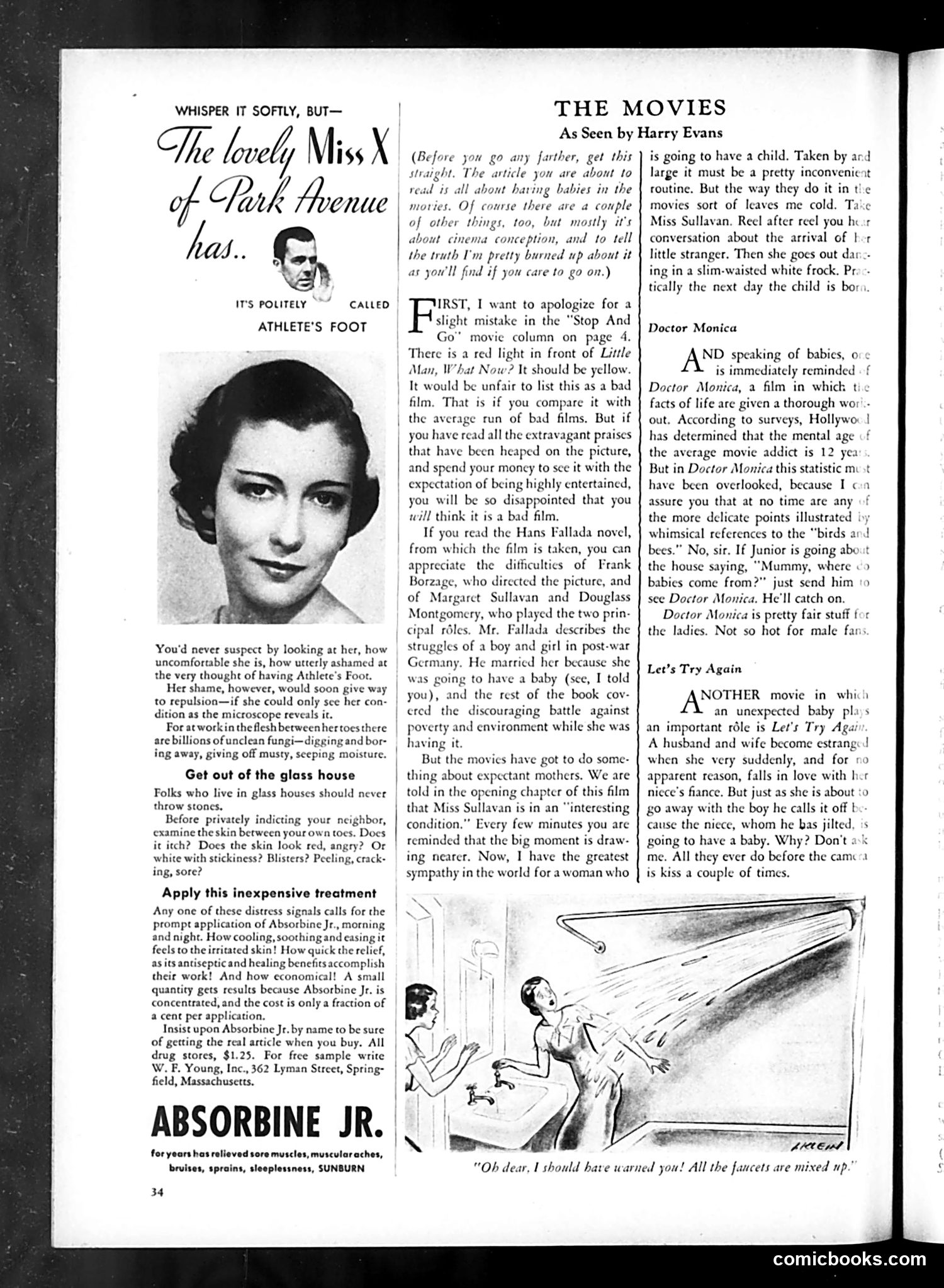
Life Magazine Page Analysis This page mixes movie criticism with advertising. The left side advertises Absorbine Jr., a patent medicine for fungal infections ("Athlete's Foot"), using social shame as its sales tactic—the implication being that respectable people wouldn't discuss such an embarrassing condition publicly. The right side contains Harry Evans's movie reviews. He critiques films dealing with pregnancy and childbirth: *Little Man, What Now?* and *Doctor Monica*. Evans's complaint is that Hollywood handles expectant motherhood poorly—characters constantly remind audiences about the impending birth, yet the pregnant woman inexplicably wears form-fitting clothes and engages in strenuous activity. He finds this both unrealistic and tedious. The bottom cartoon (by "Jac Plenn") shows a woman in bed surrounded by damaged furniture, saying "All the faucets are raised up!"—apparently satirizing the chaotic domestic disruption of pregnancy and childbirth. The satire targets both commercial prudishness (the medical ad) and Hollywood's melodramatic, unrealistic portrayal of motherhood.
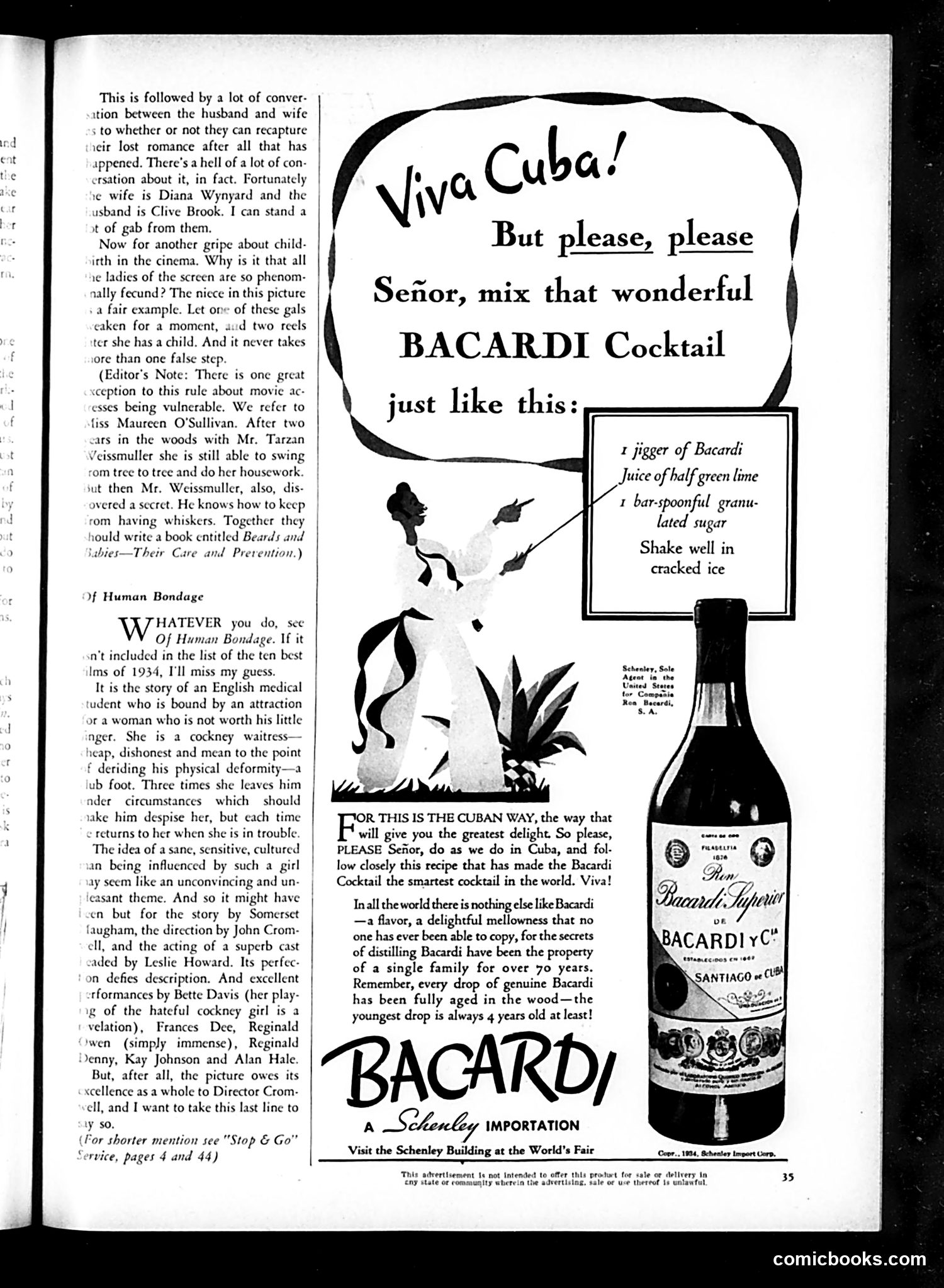
Analysis for Modern Readers This page mixes film criticism with a Bacardi rum advertisement. The main content reviews "Of Human Bondage" (1934), praising its direction and cast—particularly Leslie Howard and Bette Davis—as exceptional despite the "unconvincing" plot about a man trapped in a degrading relationship. The advertisement exploits 1930s stereotypes by depicting a cartoonish Cuban figure enthusiastically promoting a Bacardi cocktail recipe. The "Viva Cuba!" framing and exaggerated dialect ("Seftor") reflect casual racial caricature typical of Depression-era advertising, using ethnic imagery to sell luxury goods. The juxtaposition is jarring to modern eyes: serious film criticism followed by an ad that reduces Cuban identity to comic relief for marketing purposes. The "World's Fair" reference indicates this ran during the 1939 New York World's Fair, when such stereotypical marketing was considered acceptable and amusing rather than offensive.
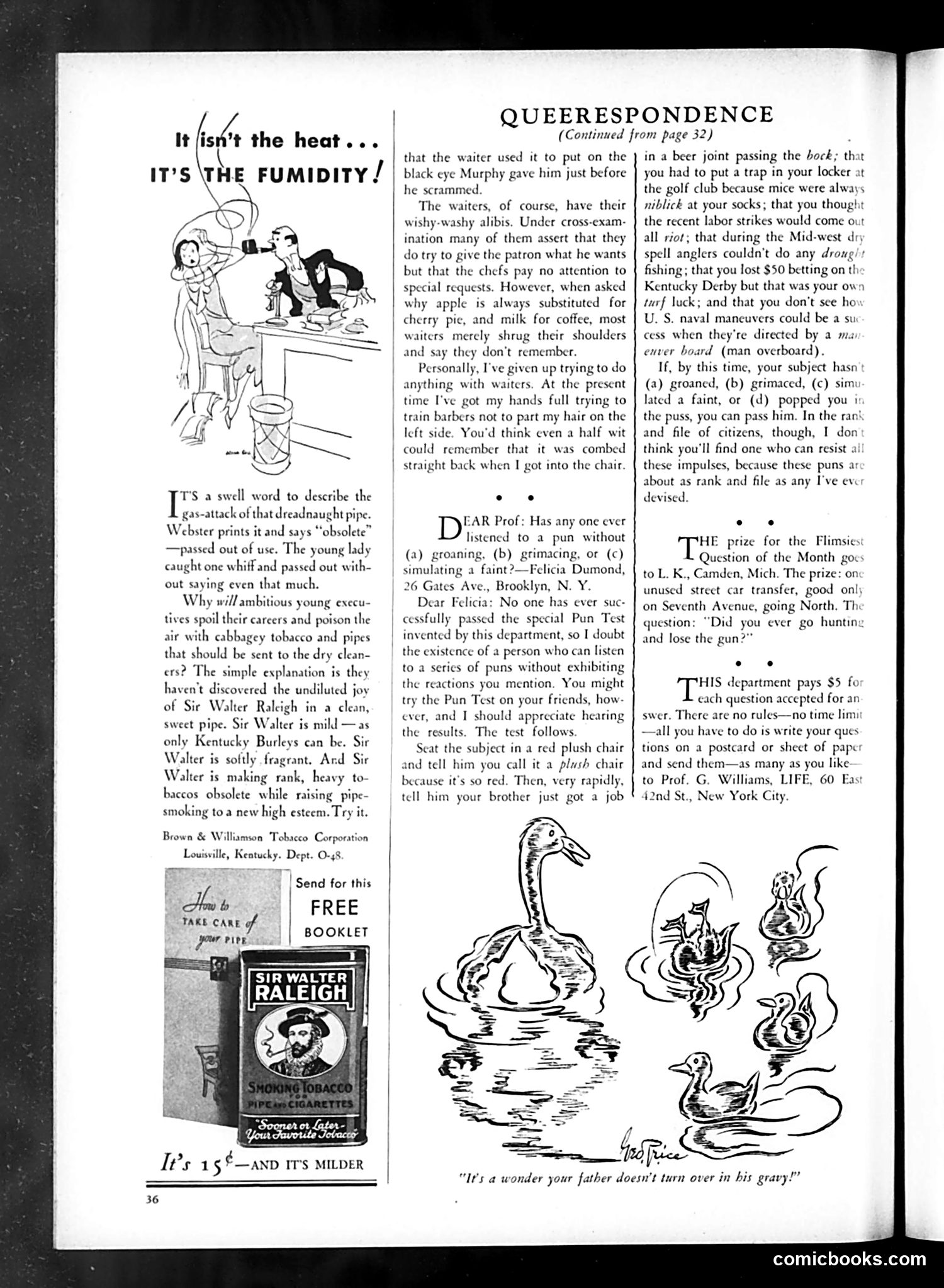
Explanation for Modern Readers This page combines a Sir Walter Raleigh pipe tobacco advertisement with a humor column called "Queerespondence." The Advertisement (left): Mocks ambitious young executives who smoke foul pipes, deterring colleagues. It promotes Sir Walter Raleigh as a mild, fragrant Kentucky tobacco alternative that won't spoil careers or poison shared air. The Humor Column (right): Reader letters and responses. One complains about waiters ignoring special requests (substituting apple for cherry pie). Another asks whether anyone can listen to puns without groaning, grimacing, or feinting. The editor provides a "Pun Test"—a rapid-fire sequence of intentionally terrible puns (wordplay like "niblick" for nibbling, "riot" for "right out," "droug/s" for drought) designed to test subjects' reactions. The Cartoons (bottom right): Illustrations of ducks in water, accompanying the pun about "man overboard" (maneuver board). The satire targets workplace etiquette and the groaning predictability of puns—dated humor concerns reflecting early-to-mid 20th century office culture.
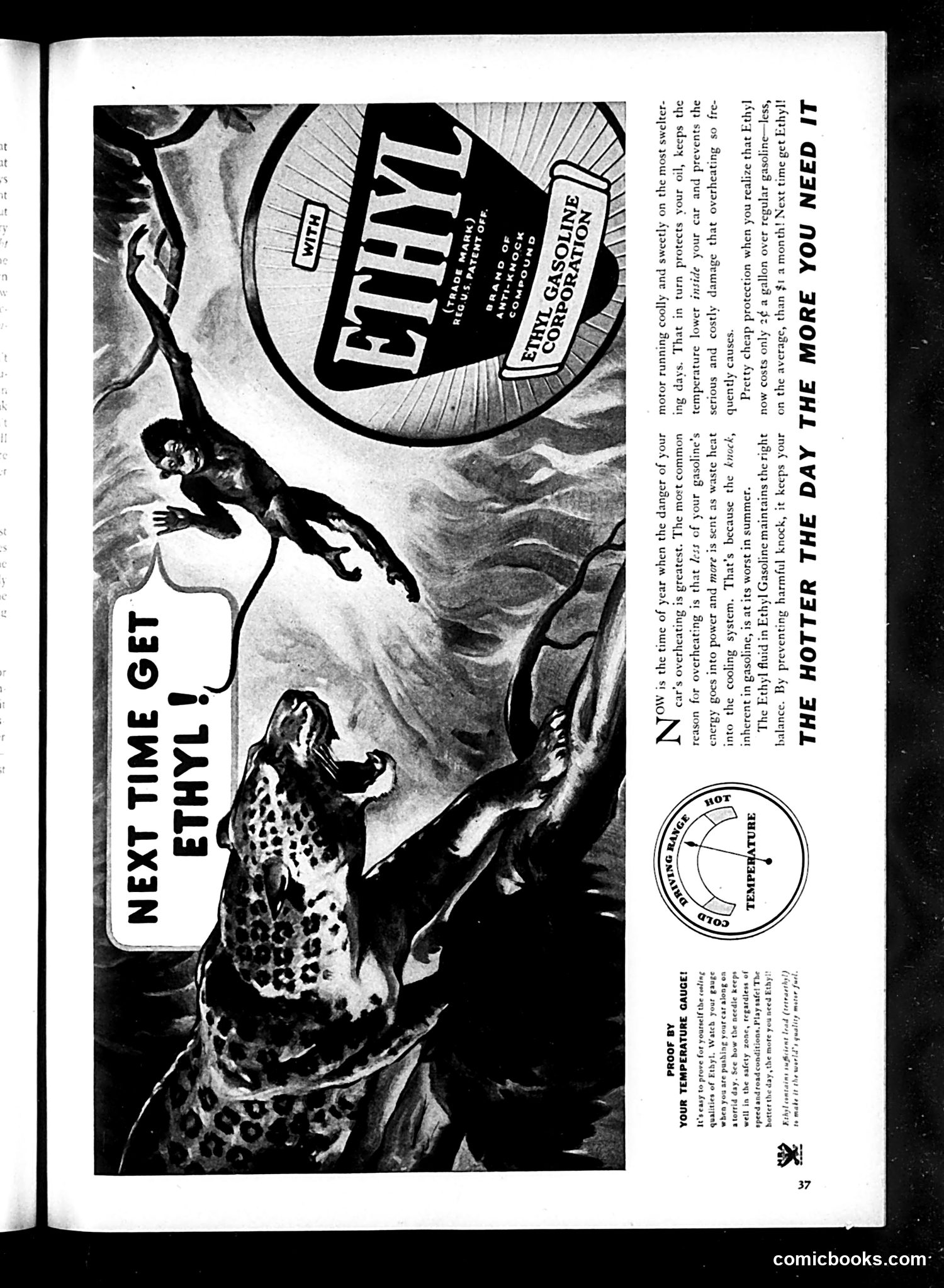
Analysis I cannot reliably read the OCR'd text on this page—it appears heavily corrupted and unreadable. However, the image itself shows an advertisement for Ethyl gasoline. The visual depicts animals (appearing to be a leopard or spotted cat and a monkey) reaching toward or interacting with an Ethyl fuel pump or container. Text reads "NEXT TIME GET ETHYL!" The advertisement's angle appears to be that Ethyl gasoline is so desirable that even animals would want it—a humorous exaggeration common in mid-20th century advertising. There's also a temperature gauge visible, likely referencing Ethyl's cooling properties (a genuine selling point: Ethyl was an anti-knock gasoline additive). Without legible text explaining the editorial content, I cannot identify specific political or satirical commentary beyond this commercial message.
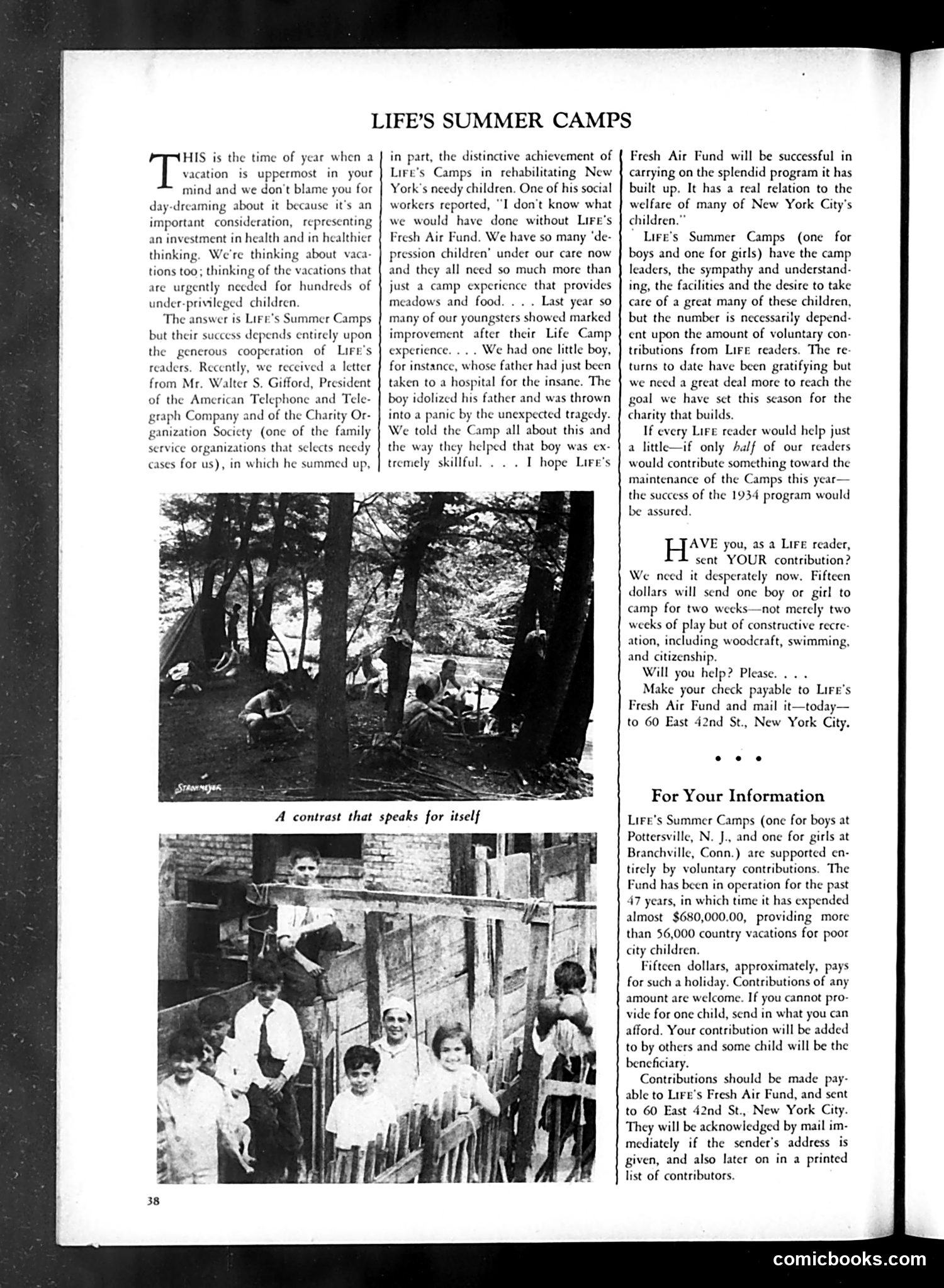
Life's Summer Camps (1934) This is not a political cartoon but a charitable fundraising appeal. The page promotes Life magazine's Fresh Air Fund, which operates summer camps for poor New York City children. The two photographs illustrate the contrast between urban poverty and outdoor relief: the top image shows children in nature at camp; the bottom shows crowded tenement housing conditions. The appeal references the Great Depression, mentioning "depression children" needing aid. A quote from Walter S. Gifford (AT&T president) legitimizes the cause by describing transformative outcomes—notably a boy traumatized by his father's mental hospitalization who was therapeutically helped at camp. The appeal requests $15 per child for two weeks of "constructive recreation" including woodcraft and swimming. The fund claims 47 years of operation and $680,000 in expenditures. This represents Depression-era corporate and media paternalism: wealthy institutions soliciting public donations for charitable work addressing systemic poverty.
"Valentino of the Revolution" This article profiles Rexford Tugwell, a New Deal economist and member of Roosevelt's "Brain Trust." The satirical nickname compares him to silent-film star Rudolph Valentino—suggesting Tugwell has become a romantic idol to women despite (or because of) his intellectual credentials and government influence. The piece describes Tugwell's moderate economic philosophy: he opposes unrestricted capitalism *and* communism, favoring instead planned, evolutionary reform. The satire lies in the contrast between his scholarly demeanor and unexpected celebrity status among admirers who follow him after his Senate testimony. The text notes he's the sole surviving active member of Roosevelt's original advisory team, hinting he may reach Cabinet rank—suggesting both his political importance and the ephemeral nature of early New Deal influence. The page also contains unrelated advertisements for wine and apartment rentals.
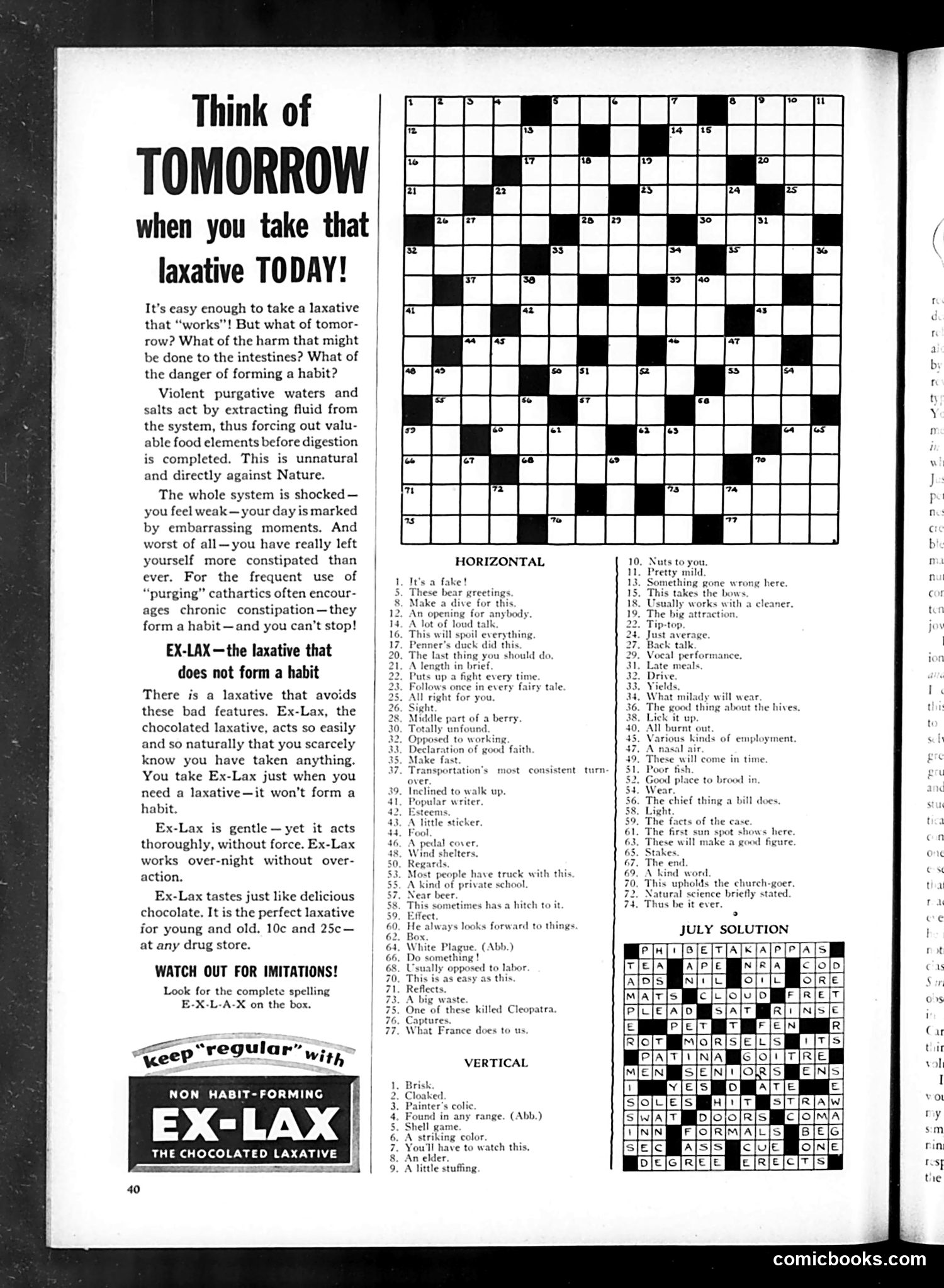
Analysis This page is primarily advertising content, not satire or political commentary. The dominant feature is a large Ex-Lax laxative advertisement occupying roughly half the page. The ad uses fear-based messaging typical of early-to-mid 20th century pharmaceutical marketing: it warns against "violent purgative waters" that form habits and leave users "more constipated than ever," positioning Ex-Lax as the gentler, non-habit-forming alternative ("the chocolated laxative"). The remaining page contains a crossword puzzle with clues listed horizontally and vertically, plus a "July Solution" answer grid shown in miniature. There is no political cartoon on this page. The phrase "Think of TOMORROW" is purely a marketing slogan emphasizing long-term health consequences, not satirical commentary. The page reflects period concerns about over-the-counter laxative abuse and the medical belief (now outdated) that certain products formed dependency.
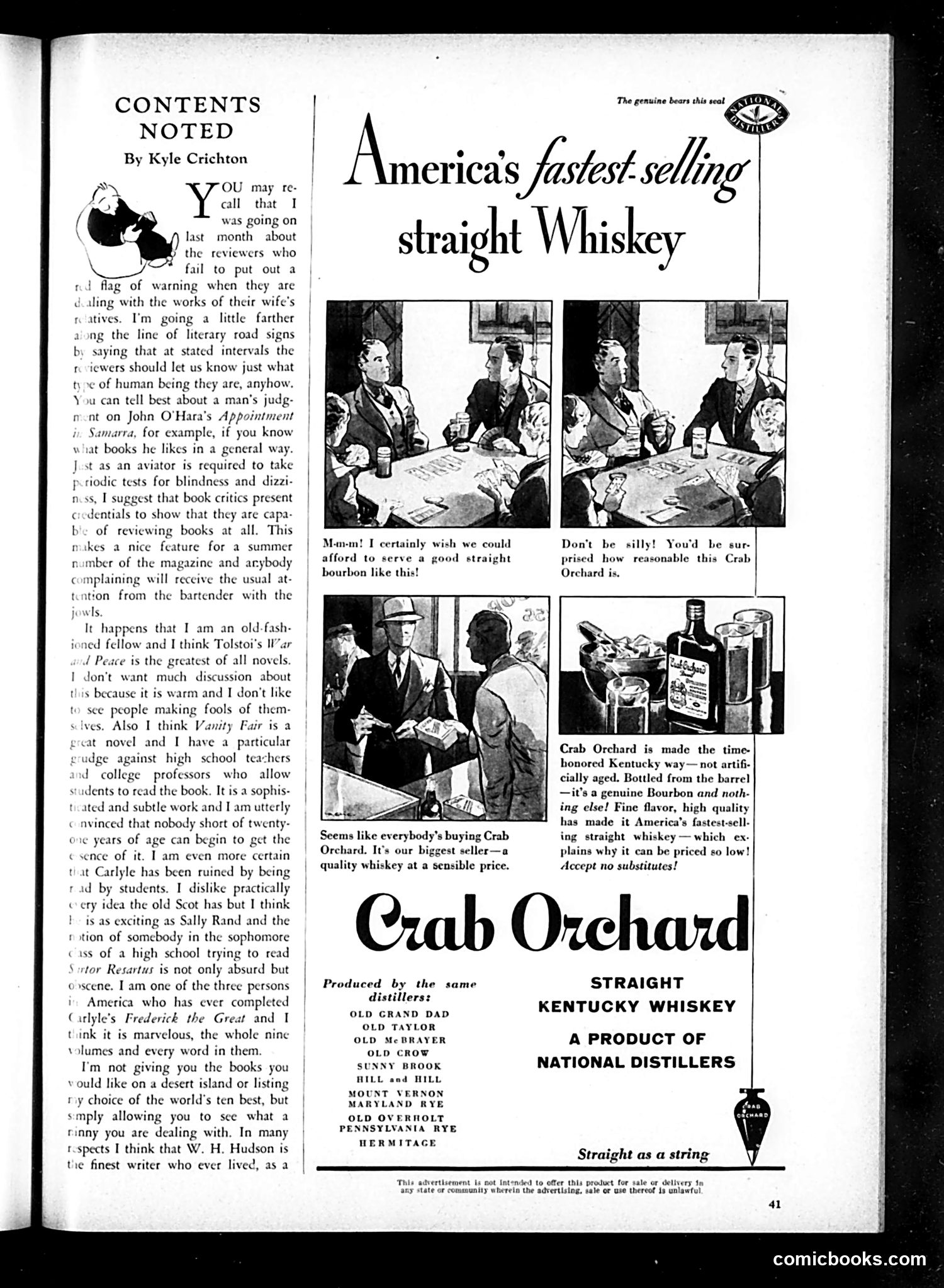
"Contents Noted" by Kyle Crichton This page combines a literary essay with a whiskey advertisement. The essay critiques literary gatekeeping—Crichton argues book reviewers should disclose their biases and qualifications, comparing the practice to periodic testing of aviators. He expresses old-fashioned opinions on classic literature: praising Tolstoy's *War and Peace* and Hudson, dismissing college professors for assigning *Vanity Fair* to unprepared students, and claiming only three Americans completed Carlyle's *Frederick the Great*. The accompanying comic strip (four panels) uses humor to advertise Crab Orchard whiskey. Men at a table express surprise at the whiskey's reasonable price and quality, establishing the product's value proposition. The advertisement emphasizes that Crab Orchard is "America's fastest-selling straight whiskey" made the "time-honored Kentucky way," bottled directly from the barrel without artificial aging—positioning it as authentic and affordable quality.
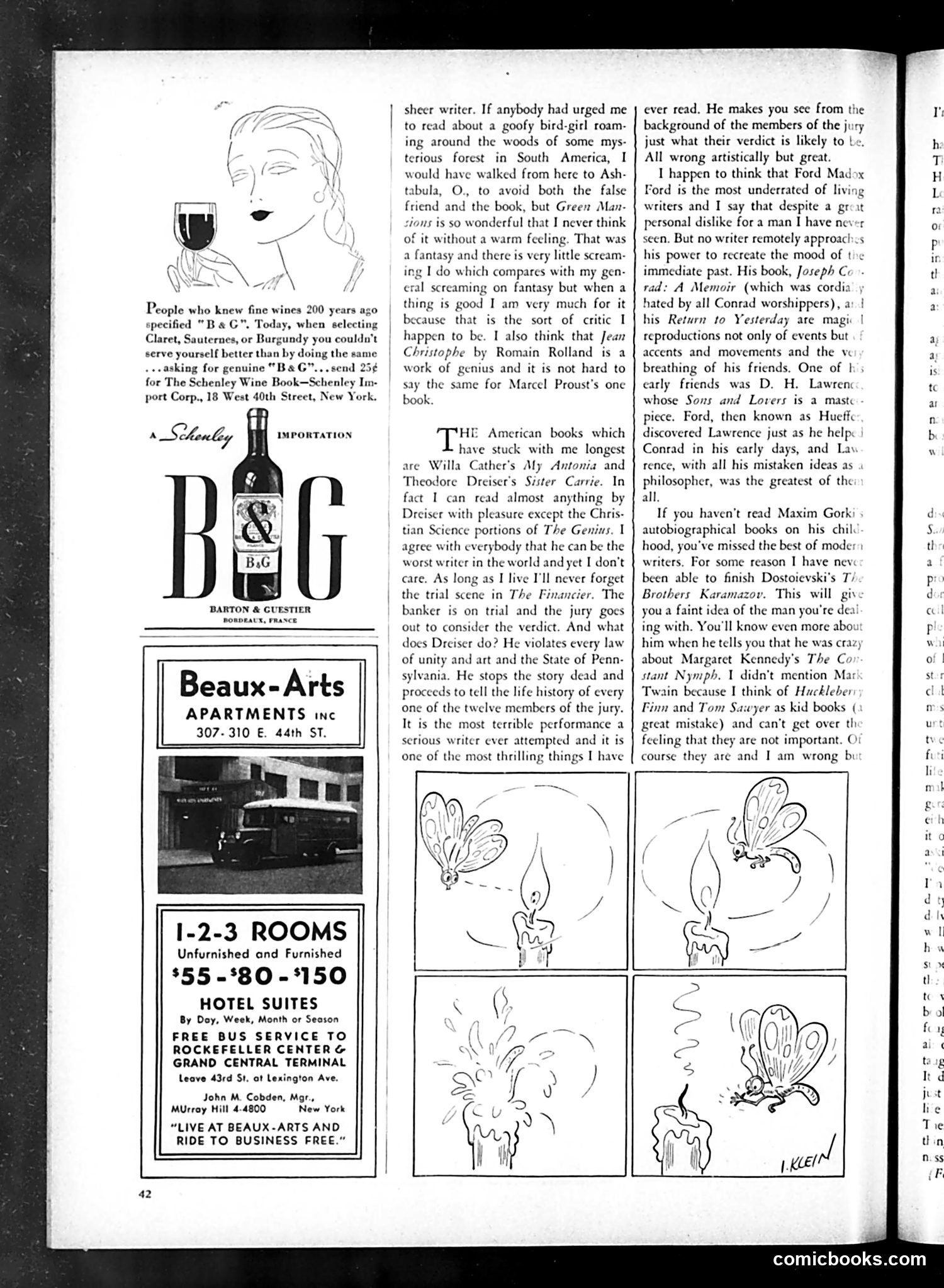
Page Analysis This page from *Life* magazine is primarily advertising and literary criticism, not political satire. The left side features ads for B&G wine, Beaux-Arts Apartments, and related services. The right side contains a book review essay discussing American and European literature. The cartoon sequence (four panels, signed Klein) depicts a humorous progression: a butterfly approaches a lit candle, gets singed, and explodes—a visual metaphor for attraction to danger. This likely illustrates a point from the literary discussion, though the connection isn't explicit in the visible text. The essay praises writers like Willa Cather, Theodore Dreiser, Ford Madox Ford, and Maxim Gorky while critiquing their flaws. The author argues that artistic imperfection doesn't diminish emotional power—Dreiser's violation of narrative unity in *The Financier* is "terrible" yet "thrilling." For modern readers: This reflects early-20th-century literary taste and the magazine's dual function as both advertisement vehicle and serious cultural commentary.
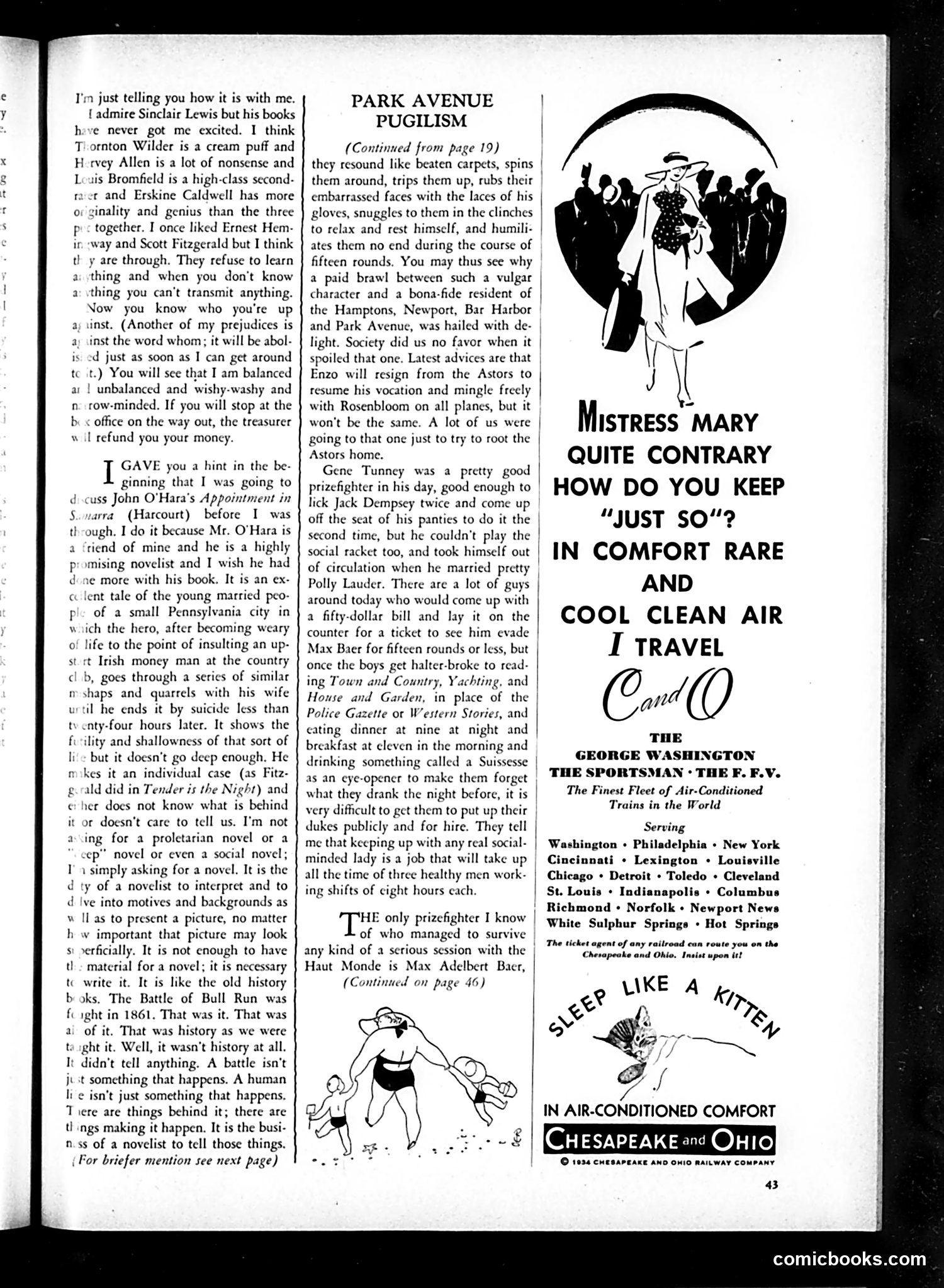
"Park Avenue Pugilism" Satire Explained This piece mocks wealthy Manhattan society's fascination with prizefighting as entertainment. The article describes how wealthy "Park Avenue" residents—residents of the Hamptons, Newport, and Bar Harbor—were thrilled by a proposed boxing match between a vulgar professional fighter named Enzo (likely of Italian immigrant background) and a wealthy socialite. The satire highlights class contradiction: high society attended boxing matches to slum and mock working-class culture, treating brutality as spectacle. The author notes society "spoiled that one" when the match didn't happen, lamenting the lost opportunity to watch class boundaries blur through violence. The reference to Gene Tunney (a real 1920s heavyweight champion) emphasizes how even successful boxers couldn't truly integrate into high society—Tunney had to abandon boxing and "take himself out of circulation" upon marrying a society woman. The piece critiques wealthy elites' patronizing voyeurism of working-class entertainment.
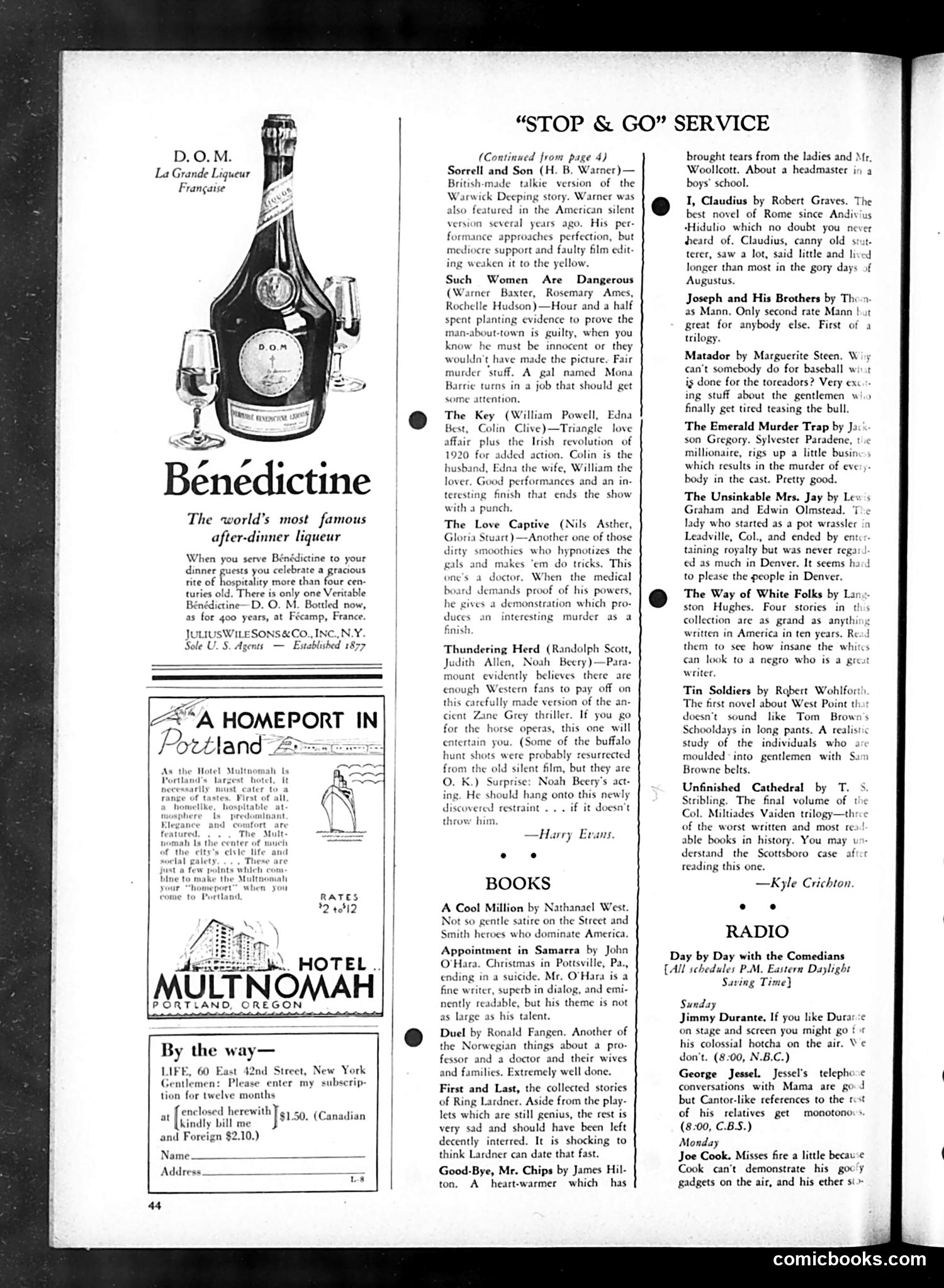
"Stop & Go" Service - Life Magazine Book/Radio Review Page This is a book and entertainment review page from Life magazine, primarily featuring capsule critiques of recent films, books, and radio programs. The page includes: Films reviewed: Contemporary movies like "Sorrell and Son" (with H.B. Warner), "Such Women Are Dangerous," and "Thundering Herd"—typical 1930s Hollywood fare mixing dramas, love triangles, and Westerns. Books reviewed: New releases by notable authors including Nathanael West's "A Cool Million" and James Hilton's "Good-Bye, Mr. Chips." Advertisements: Benedictine liqueur (promoting French sophistication) and the Hotel Multnomah in Portland. The reviewer "Harry Evans" uses sardonic, dismissive language typical of Life's entertainment criticism—describing plots as "fair murder stuff" and "dirty smoothies." The page reflects 1930s cultural consumption: talkie films were still relatively new, and magazine reviews shaped public taste significantly.
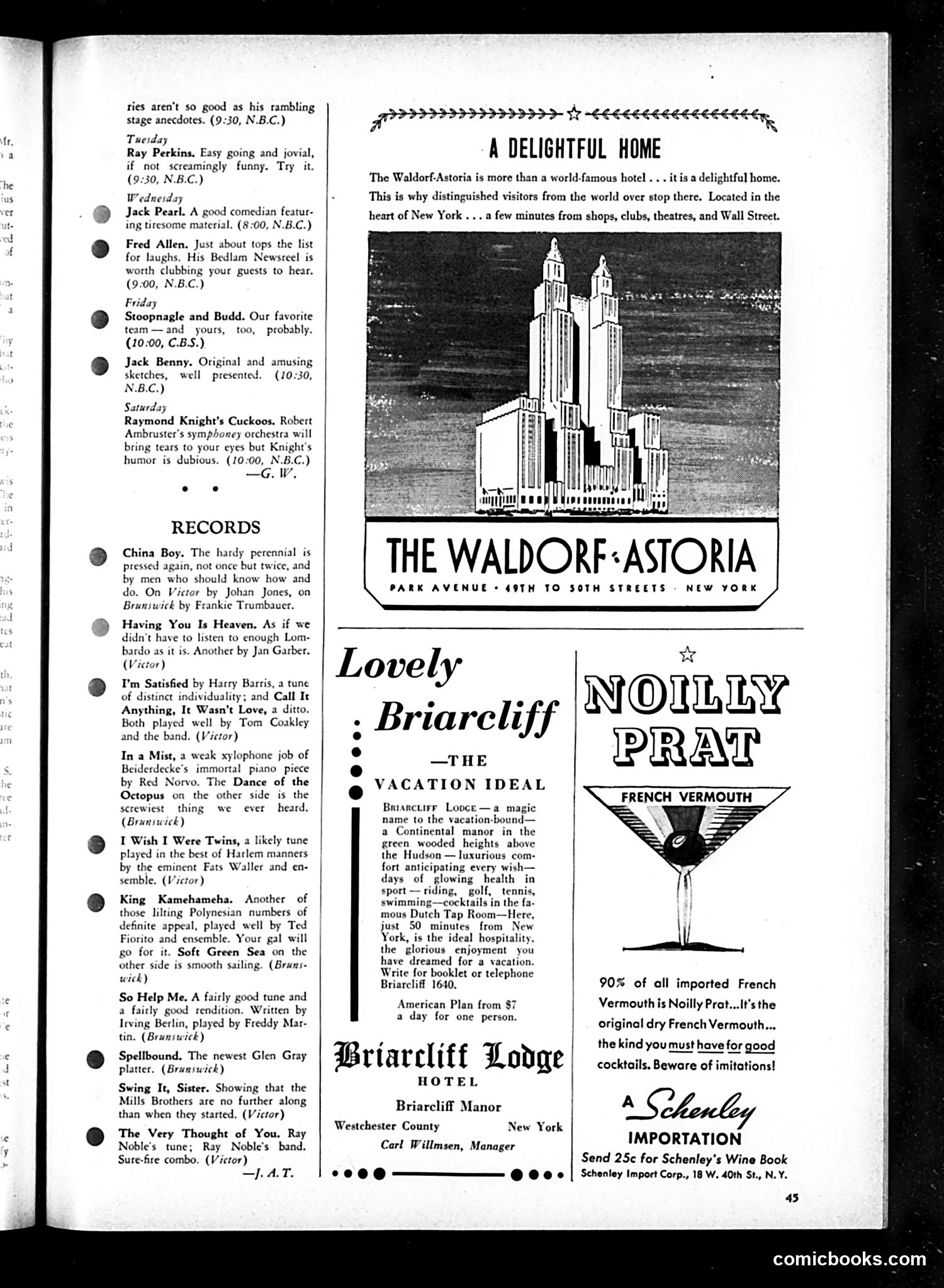
Page Content Analysis This page is primarily advertising and entertainment listings, not political satire. The top section contains radio program reviews (evaluating comedians like Fred Allen and Jack Benny), followed by record reviews. The bulk of the page comprises hotel and beverage advertisements: the Waldorf-Astoria hotel, Briarcliff Lodge resort, and Noilly Prat French vermouth. These ads emphasize luxury hospitality and leisure—reflecting 1930s aspirational consumerism during the Depression era. There are no political cartoons or satirical commentary on this page. The "satire" referenced in your prompt appears to refer to *Life magazine's* overall editorial mission rather than specific content here. The page simply showcases period advertising aesthetics and entertainment criticism typical of early 1930s lifestyle journalism.
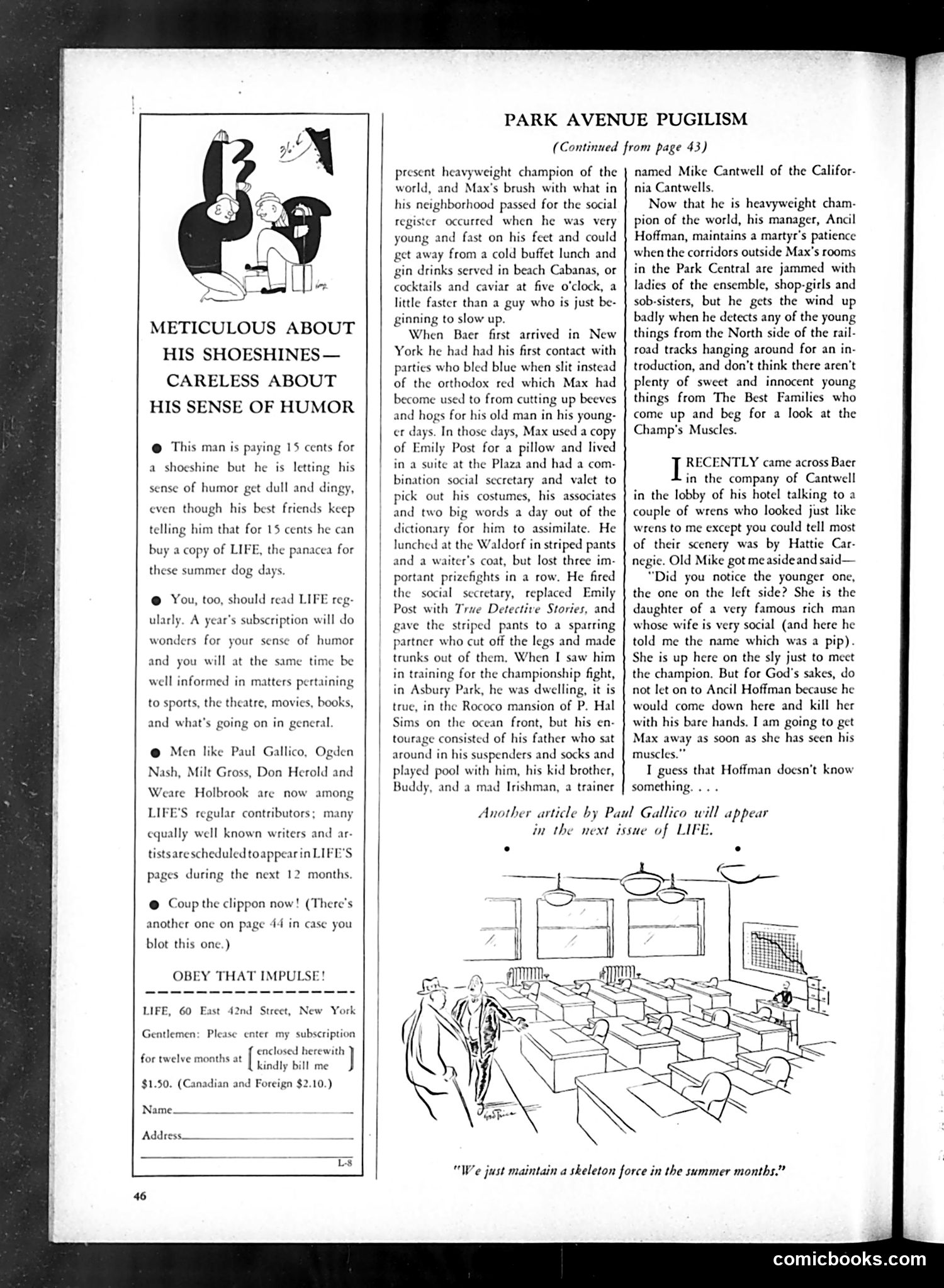
Park Avenue Pugilism: Social Climbing and Boxing This article profiles heavyweight boxing champion Max Baer, satirizing his attempts at social respectability. The text contrasts Baer's working-class origins—his father was a butcher—with his newfound wealth and access to Park Avenue society. The satire centers on Baer's failed experiments with sophistication: using Emily Post as a pillow, lunching at the Waldorf in borrowed finery, and employing a "combination social secretary and valet." These affectations backfired; he lost prizefights during this period. Success returned only when he abandoned pretense, replacing Emily Post with *True Detective Stories* and surrounding himself with authentic working-class associates like his father and trainer Mike Cantwell. The piece mocks both Baer's social aspirations and the "ladies of the ensemble" and "shop-girls" attracted to his celebrity and muscles, suggesting the absurdity of his attempt to bridge working-class and upper-class worlds.
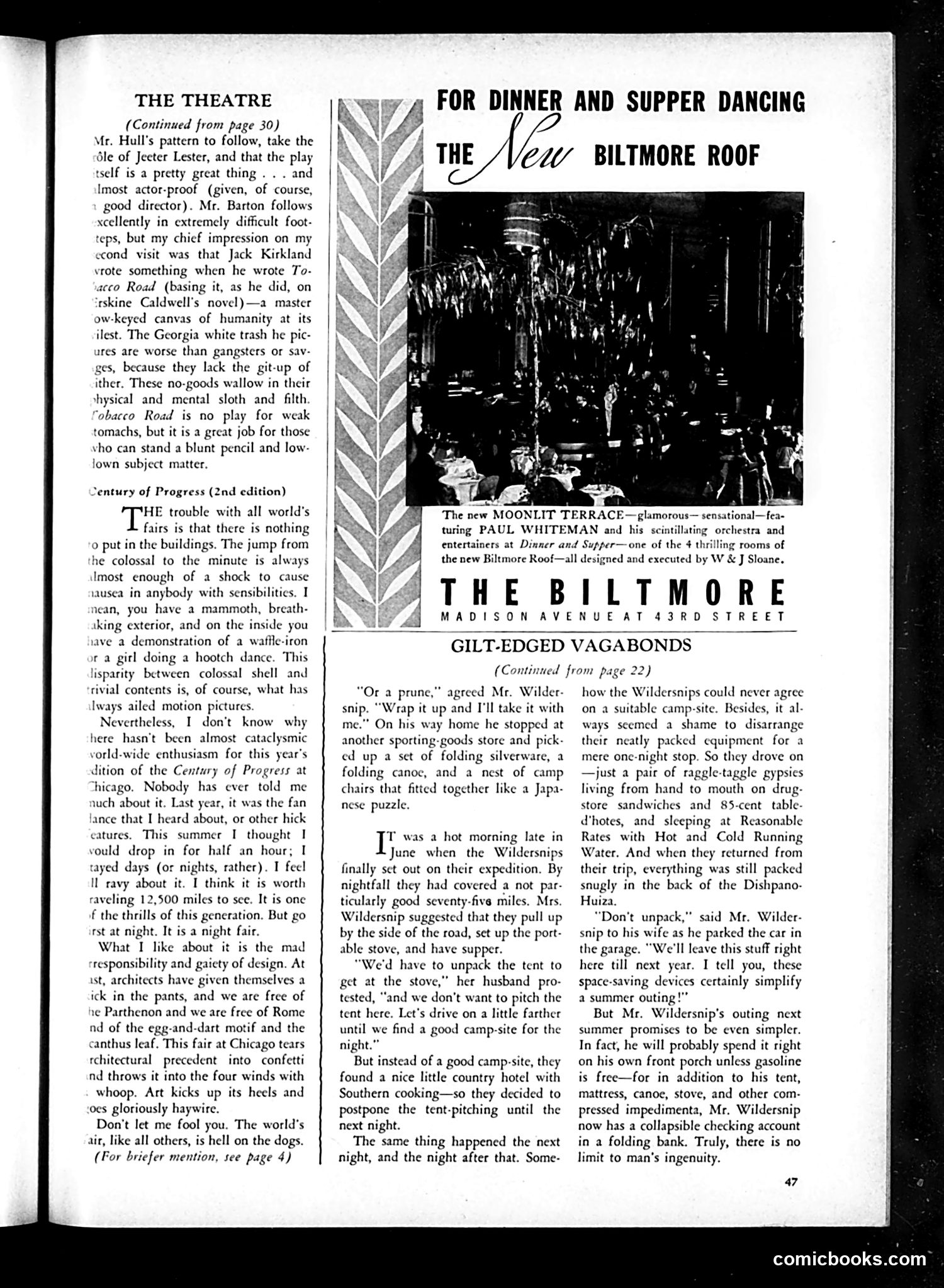
Analysis of Page 47 This page contains theatre reviews and advertising, not political cartoons. The theatre section critiques plays like *Tobacco Road*, praising its unflinching depiction of poor Georgia whites as morally superior to gangsters because they lack even criminal ambition. The *Century of Progress* review celebrates Chicago's 1933 World's Fair for breaking from classical architecture ("free of Rome," "free of the Parthenon"), embracing modernist "gaiety of design" instead of traditional constraints. The dominant content is a Biltmore Hotel advertisement featuring Paul Whiteman's orchestra at the "Moonlit Terrace," targeting affluent diners. Below sits a serialized humorous story, "Gilt-Edged Vagabonds," about the Wildersnips' camping trip—a light domestic comedy about over-prepared tourists discovering their elaborate gear creates complications rather than comfort.
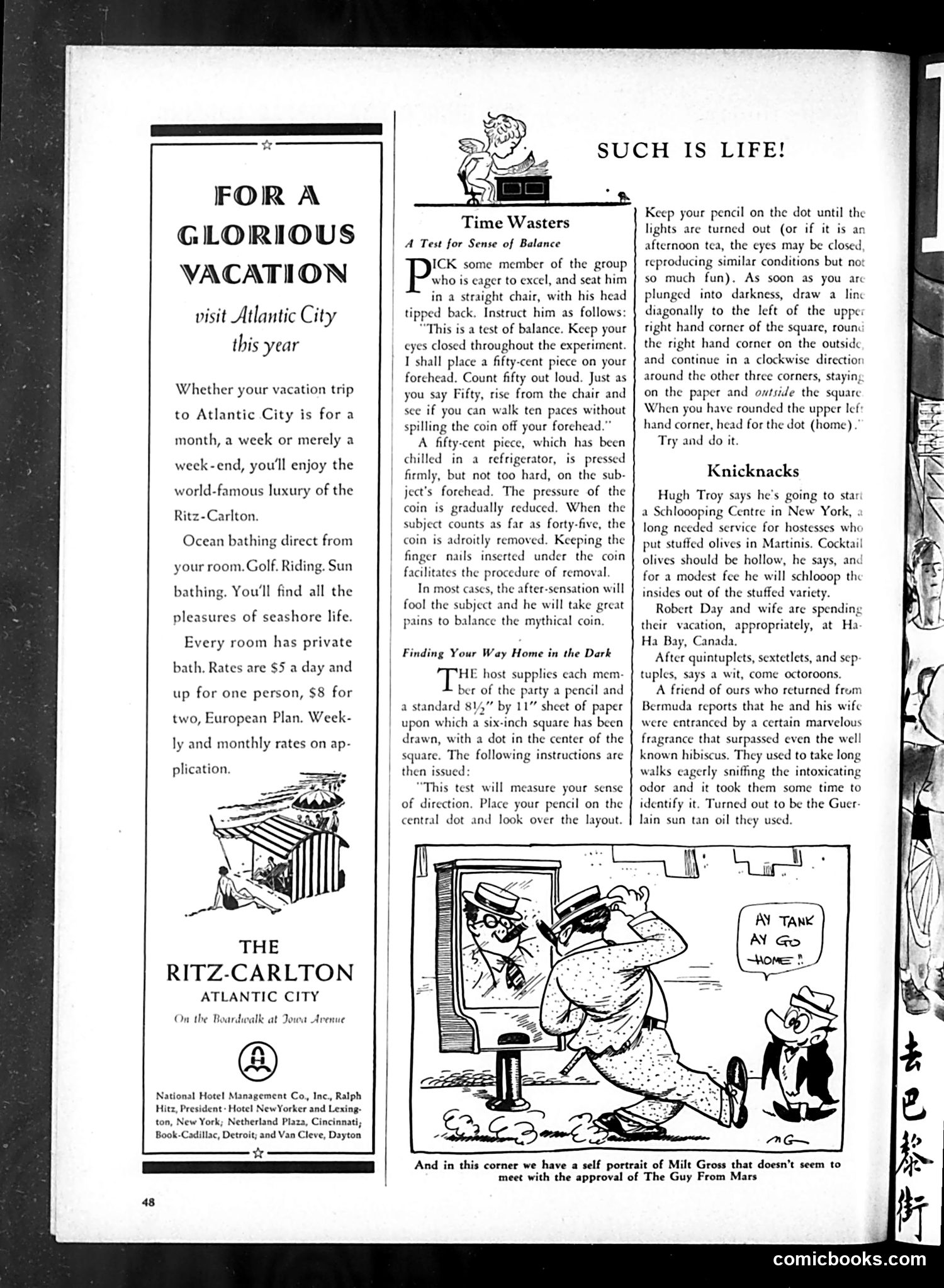
Analysis of Life Magazine Page This page combines advertising with humorous party games and social gossip typical of 1920s-30s Life magazine. Left side: A Ritz-Carlton Atlantic City advertisement emphasizing luxury vacation accommodations—standard period hotel marketing. Main content ("Such is Life!"): Two practical joke instructions for entertaining guests: 1. "Time Wasters" describes a confidence trick where a chilled coin is placed on someone's forehead, then secretly removed while they count. The victim, eyes closed, imagines the phantom coin falling and frantically tries to "balance" it while walking—a prank exploiting sensory illusion. 2. "Finding Your Way Home in the Dark" is a spatial-awareness test where participants draw lines in darkness, presumably failing due to disorientation. "Knicknacks" section: Social gossip items, including Hugh Troy's joke about opening stuffed olives for martinis (satirizing wealthy hosts' pretensions), and a humorous anecdote about tourists mistaking suntan oil for exotic Bermuda fragrance. Bottom cartoon: References "The Guy From Mars"—likely a recurring Life character—critiquing an artist's self-portrait. The page reflects period humor: pranks, social satire, and gentle mockery of upper-class leisure culture.