life
Life — September 1934
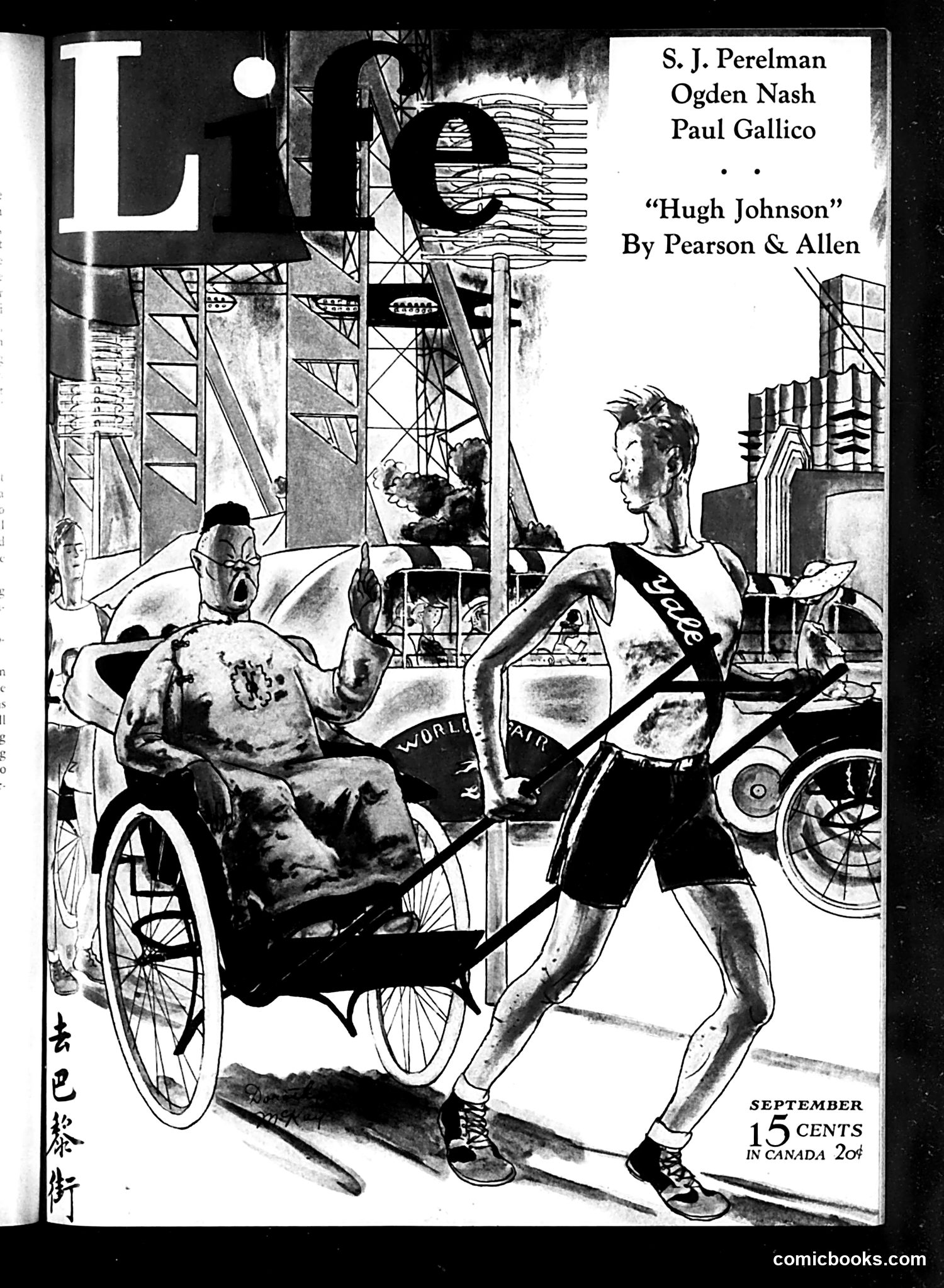
Analysis This appears to be a Life magazine cover from September (price 15 cents, 20 cents in Canada), featuring an illustration of a rickshaw scene. The cover credits list S.J. Perelman, Ogden Nash, and Paul Gallico as contributors, and advertises a story titled "Hugh Johnson" by Pearson & Allen. The illustration depicts a rickshaw puller (likely an Asian laborer) straining to pull a large, well-fed passenger through an urban landscape with industrial buildings visible behind. This appears to be satirizing American excess or corporate power — possibly Hugh Johnson, who was a prominent New Deal administrator. The caricature may be critiquing either his physical appearance or his perceived burden on society, using the rickshaw metaphor to comment on imbalanced power dynamics or exploitation during the Depression era.
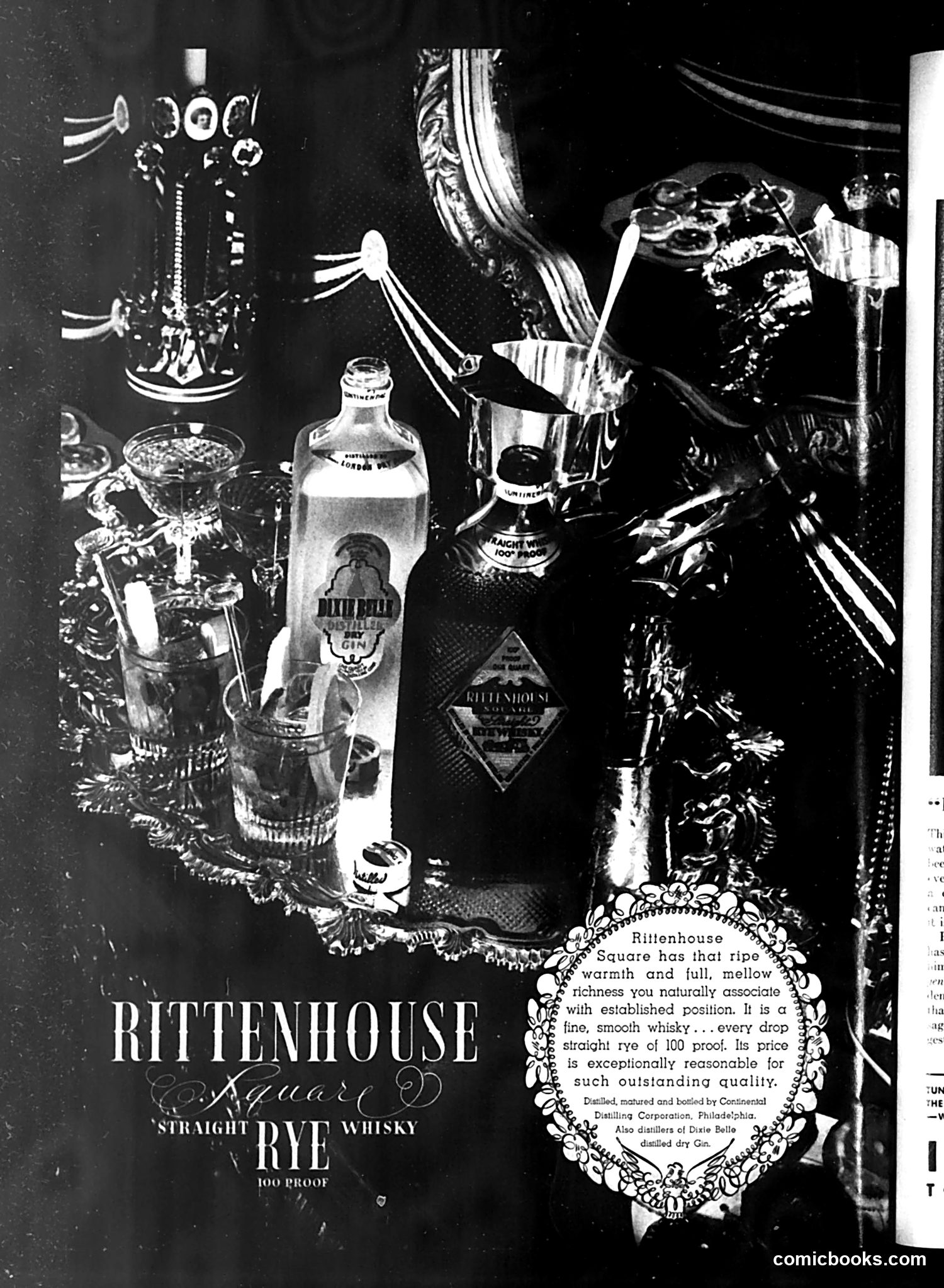
This page is primarily an advertisement for Rittenhouse Square Straight Rye Whiskey (100 proof), not a political cartoon. The ad features an elegant still-life arrangement of the whiskey bottle alongside decorative glassware, ornamental vessels, and what appears to be fine spirits or liqueurs displayed on an ornate surface. The accompanying text emphasizes the product's quality, describing it as having "ripe warmth and full, mellow richness" associated with "established position," marketed as "a fine, smooth whiskey" at "exceptionally reasonable" price for the quality. The ad notes it was distilled and bottled by Continental Distilling Corporation in Philadelphia. This appears to be vintage advertising content rather than satirical commentary.
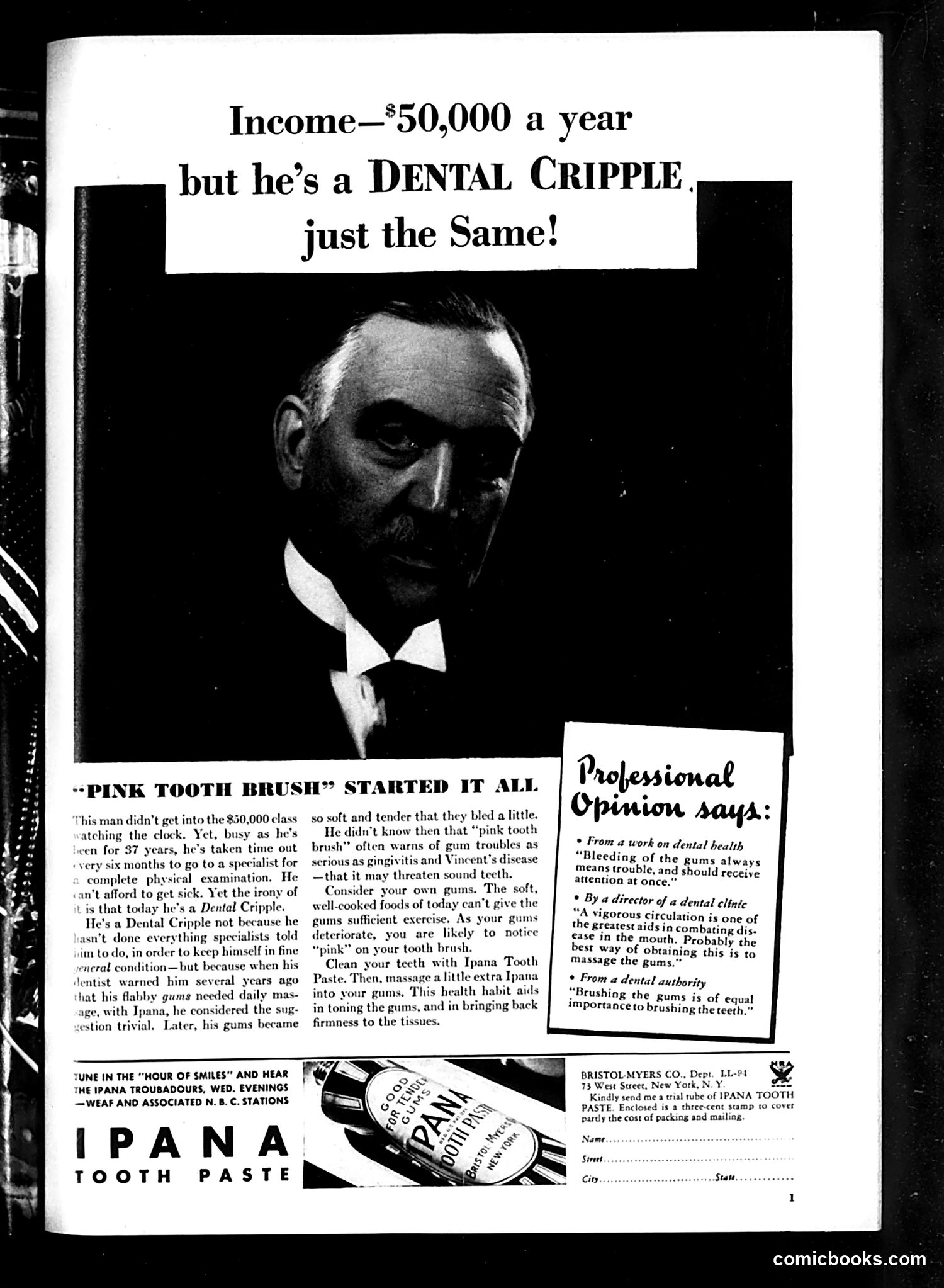
Analysis of Ipana Tooth Paste Advertisement This is a vintage toothpaste advertisement, not political satire. It uses a crude, now-offensive approach: a well-dressed man with poor dental health is labeled a "DENTAL CRIPPLE" despite earning $50,000 annually—substantial mid-20th century income. The ad argues that wealth cannot compensate for bad teeth, implying poor oral hygiene reflects personal failure. It claims the man neglected his gums, possibly due to using inferior toothbrushes, and recommends Ipana Tooth Paste with gum massage as the solution. The "Professional Opinion" box features quotes from dental authorities endorsing the product's gum-care benefits. By modern standards, the "cripple" terminology is considered deeply ableist and offensive, reflecting attitudes from an earlier era that would be unacceptable today.
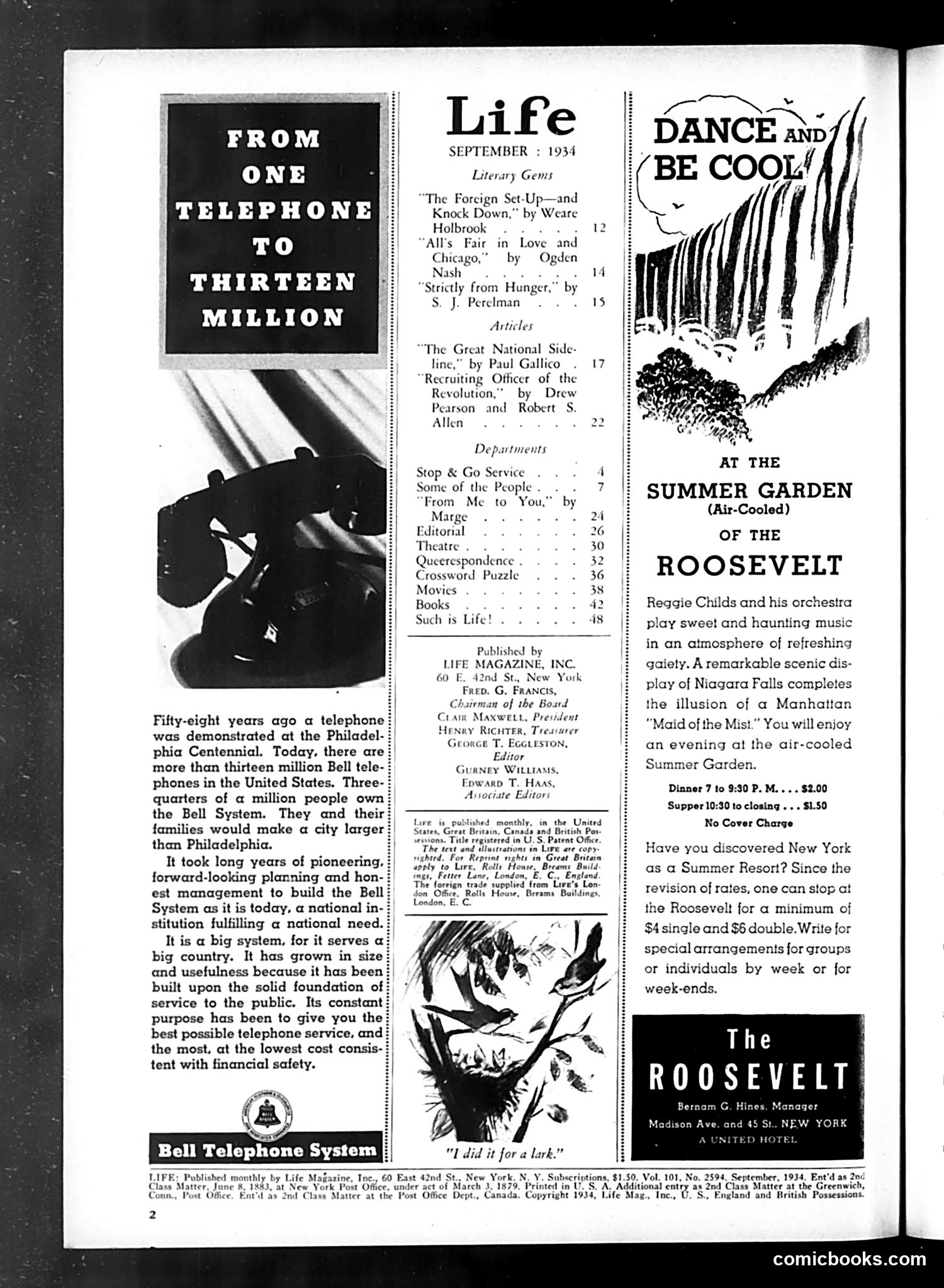
Life Magazine, September 1934 - Page Analysis This is primarily a table of contents and advertising page rather than a satirical cartoon page. The left side features a Bell Telephone System advertisement with the headline "FROM ONE TELEPHONE TO THIRTEEN MILLION," celebrating the telephone's 58-year history since its 1876 Philadelphia demonstration. The ad emphasizes Bell's growth and reliable service infrastructure. The right side contains advertisements for the Roosevelt Hotel in New York, promoting its air-cooled Summer Garden with live music by Reggie Childs' orchestra, and dinner pricing. The center shows the magazine's table of contents listing literary pieces, articles, and departments for this September 1934 issue. No political satire or caricature is present on this page—it's a standard contents/advertising section typical of Life's format during this period.
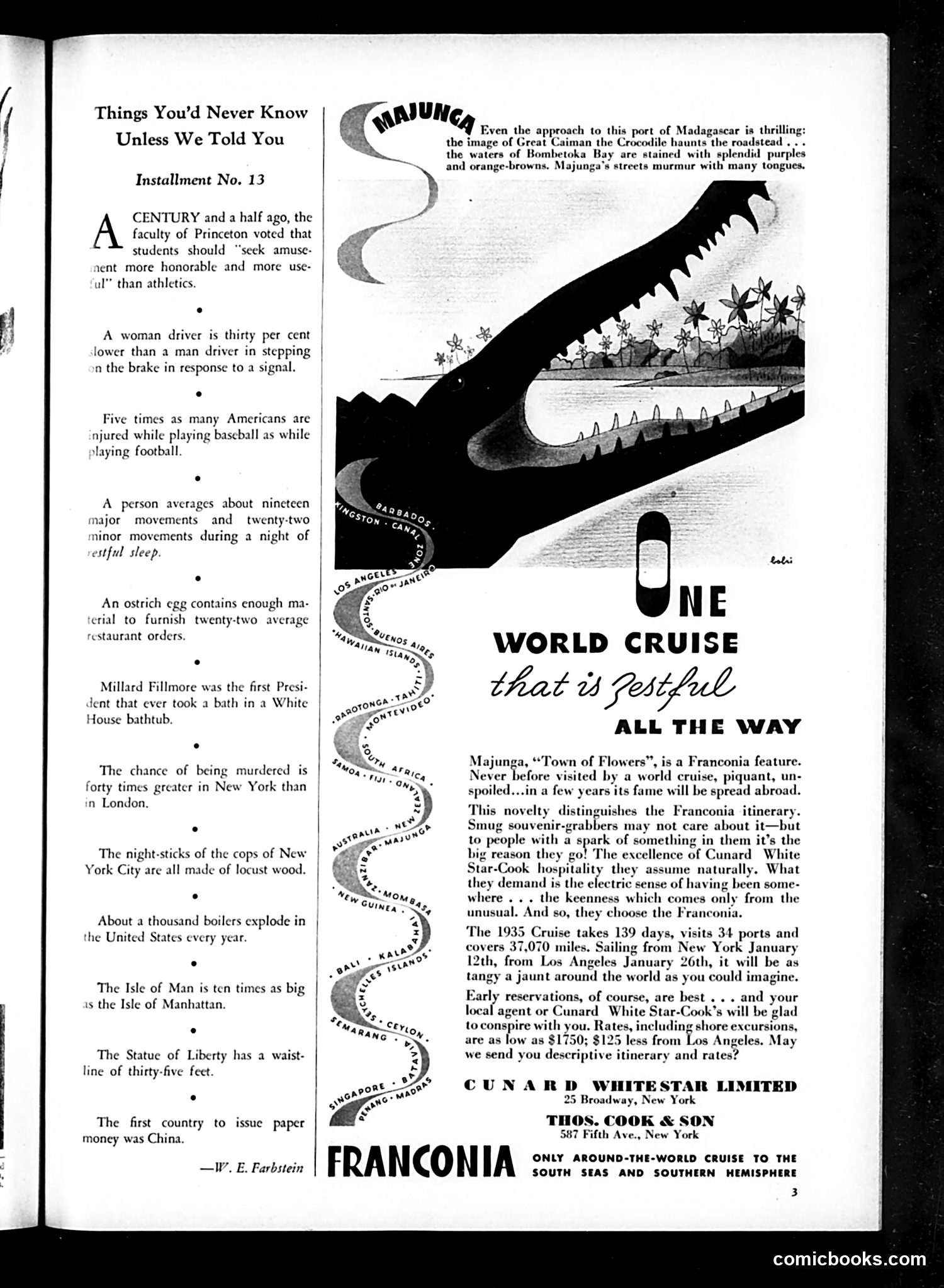
Page Analysis This page is primarily advertising, not satire or political commentary. The left column contains "Things You'd Never Know Unless We Told You"—trivia facts (Princeton voting on athletics, ostrich egg capacity, etc.). These are filler content typical of Life magazine. The right side features a Franconia cruise line advertisement with an illustrated crocodile as the central graphic element. The image plays on exotic colonial imagery—the crocodile represents adventure in Madagascar and other distant ports. The tagline "ONE WORLD CRUISE that is restful ALL THE WAY" markets luxury travel. The ad emphasizes the Franconia's 1935 voyage visiting 34 ports across 139 days. It's straightforward promotional material targeting affluent readers, not satirical commentary. The crocodile is decorative exoticism, not a caricature or political figure.
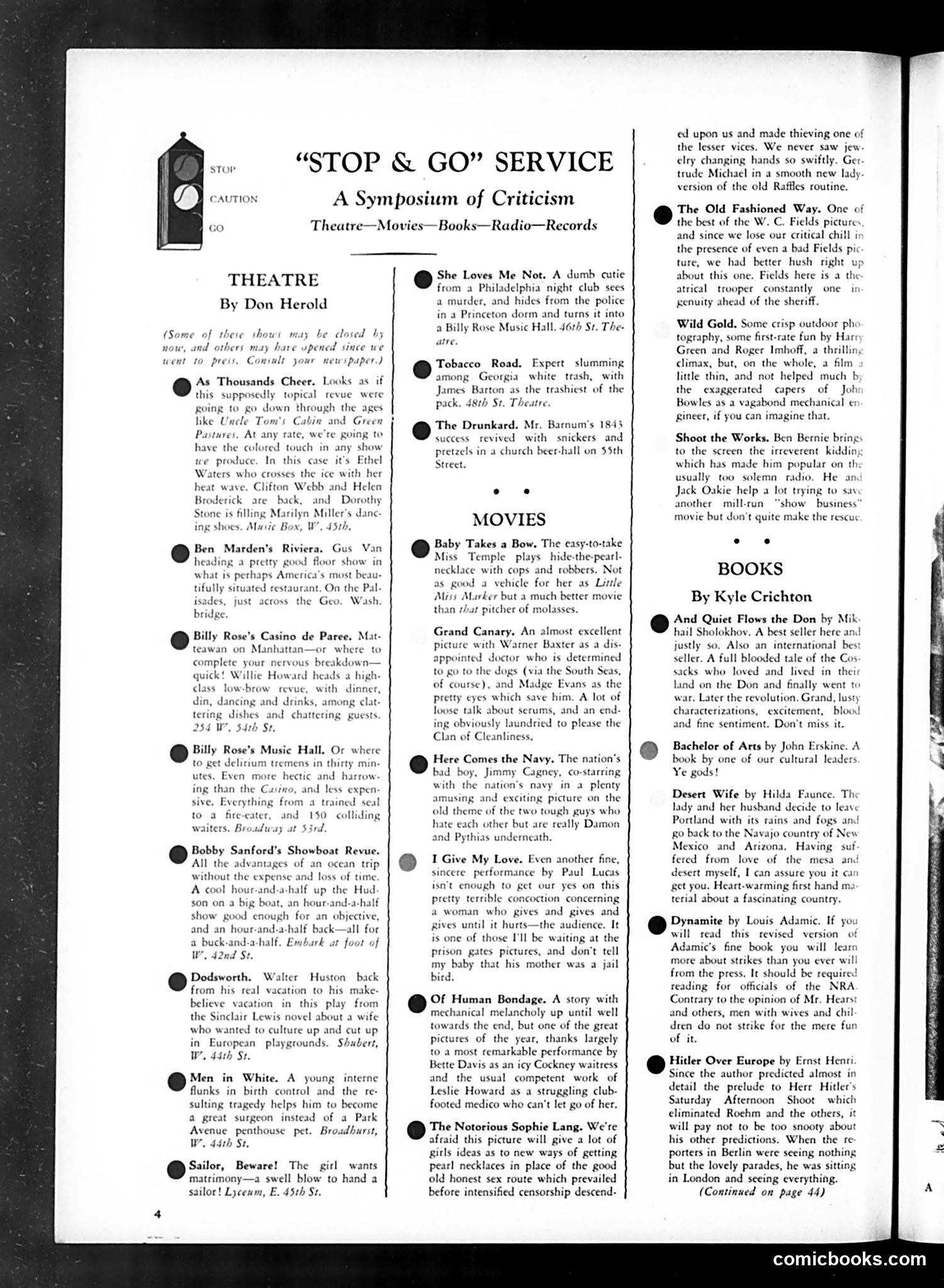
"Stop & Go" Service: A Symposium of Criticism This is a review/criticism page from Life magazine covering theatre, movies, books, radio, and records. The title "Stop & Go Service" refers to the traffic light imagery in the header—Life is using the metaphor of traffic signals to guide readers toward what's worth their time (green/go) versus what to avoid (red/stop). The page features brief critical reviews by Don Herold (theatre) and Kyle Crichton (books), with punchy assessments of contemporary Broadway shows, films, and literature. Rather than political cartoons, this is satirical *critique*—using humor and caustic commentary to evaluate popular entertainment. The format assumes readers want quick, witty dismissals of mediocre productions alongside endorsements of worthwhile ones.
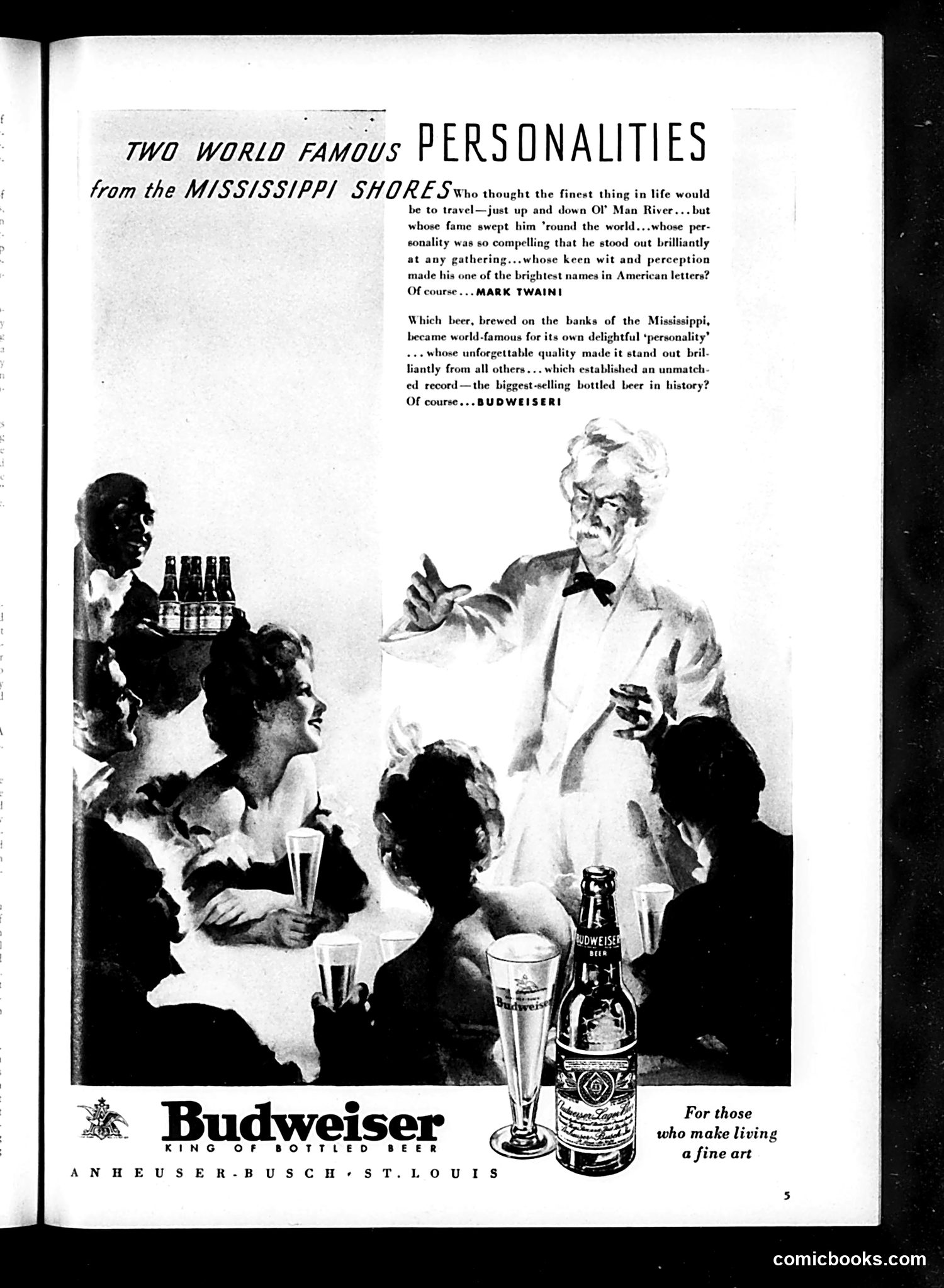
Advertisement Analysis This is a Budweiser beer advertisement, not satire or political commentary. The ad compares two famous Mississippi River personalities: 1. Mark Twain — the celebrated American writer known for travel literature and wit, praised for his "personality" and "keen wit and perception." 2. Budweiser beer — claimed as the world's biggest-selling bottled beer, praised for its "unforgettable quality" and distinctive "personality." The advertisement uses a clever analogy: just as Twain became world-famous for his personal magnetism and literary brilliance, Budweiser achieved fame through quality and character. The illustration shows a gentleman (likely representing Twain based on the distinctive hair) entertaining well-dressed patrons at what appears to be a social gathering, with Budweiser bottles and glasses visible. The tagline—"For those who make living a fine art"—positions the beer as a luxury product for sophisticated consumers.
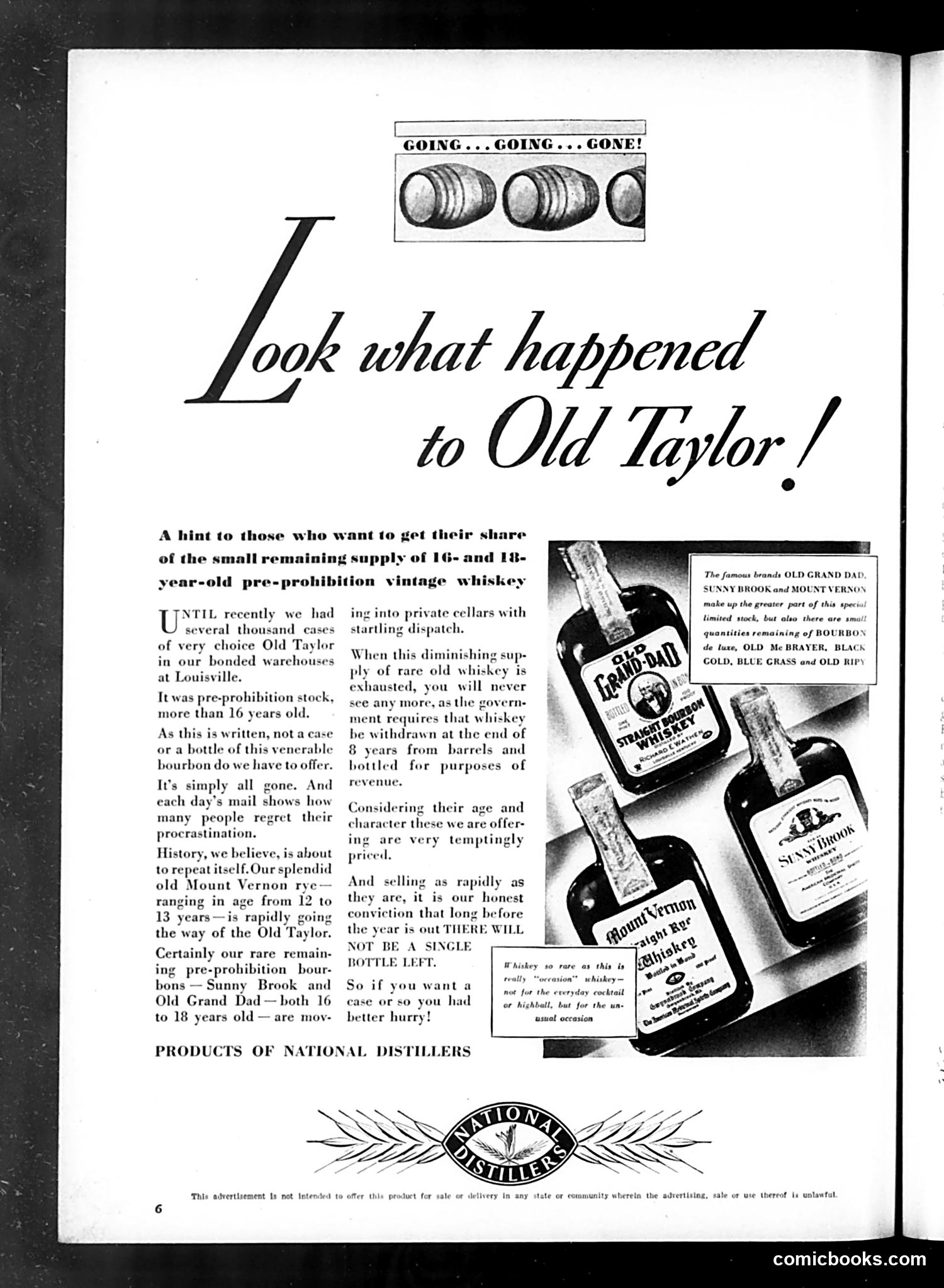
Analysis This is a National Distillers advertisement, not editorial satire. It advertises pre-Prohibition vintage whiskey brands (Old Taylor, Sunny Brook, Old Grand Dad, etc.) to readers during Prohibition. The ad's "joke" is darkly humorous: it acknowledges that supplies of 16-18 year-old pre-Prohibition whiskey are nearly exhausted. The headline "Look what happened to Old Taylor!" refers to the whiskey running out, not a person. The ad warns potential buyers to "hurry" before these rare bottles disappear forever—since the government requires all remaining pre-Prohibition stock be withdrawn after 8 years. This reflects a real market for black-market vintage spirits during Prohibition (1920-1933), when such bottles became scarce luxury items.
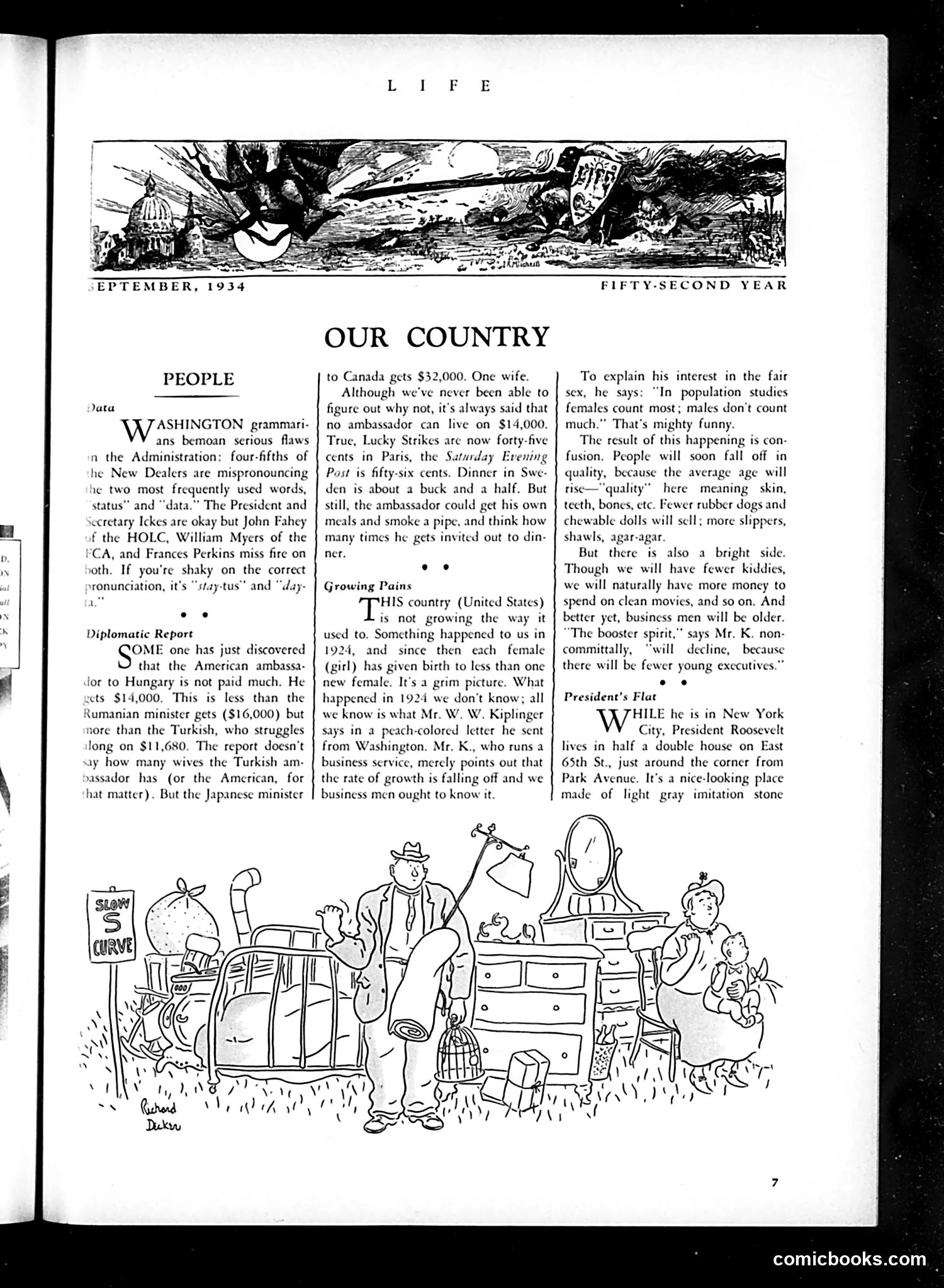
"Our Country" - Life Magazine, September 1934 This page satirizes American life during the Depression-era New Deal. The cartoon at bottom depicts a family amid economic chaos—a wrecked car, scattered furniture, and domestic disorder—suggesting the instability of ordinary American households. The text sections mock various absurdities: Washington officials mispronouncing words, the absurdly low salary of the American ambassador to Hungary ($14,000), and a demographic crisis where the U.S. birth rate has declined since 1924. One section quotes economist W.W. Kiplinger warning that fewer young people means "business men will be older." The "President's Flat" item notes Roosevelt lives in a modest Manhattan apartment, poking gentle fun at his residence. Overall, the page uses humor to comment on governmental incompetence, economic hardship, and social decline during the early Roosevelt administration.
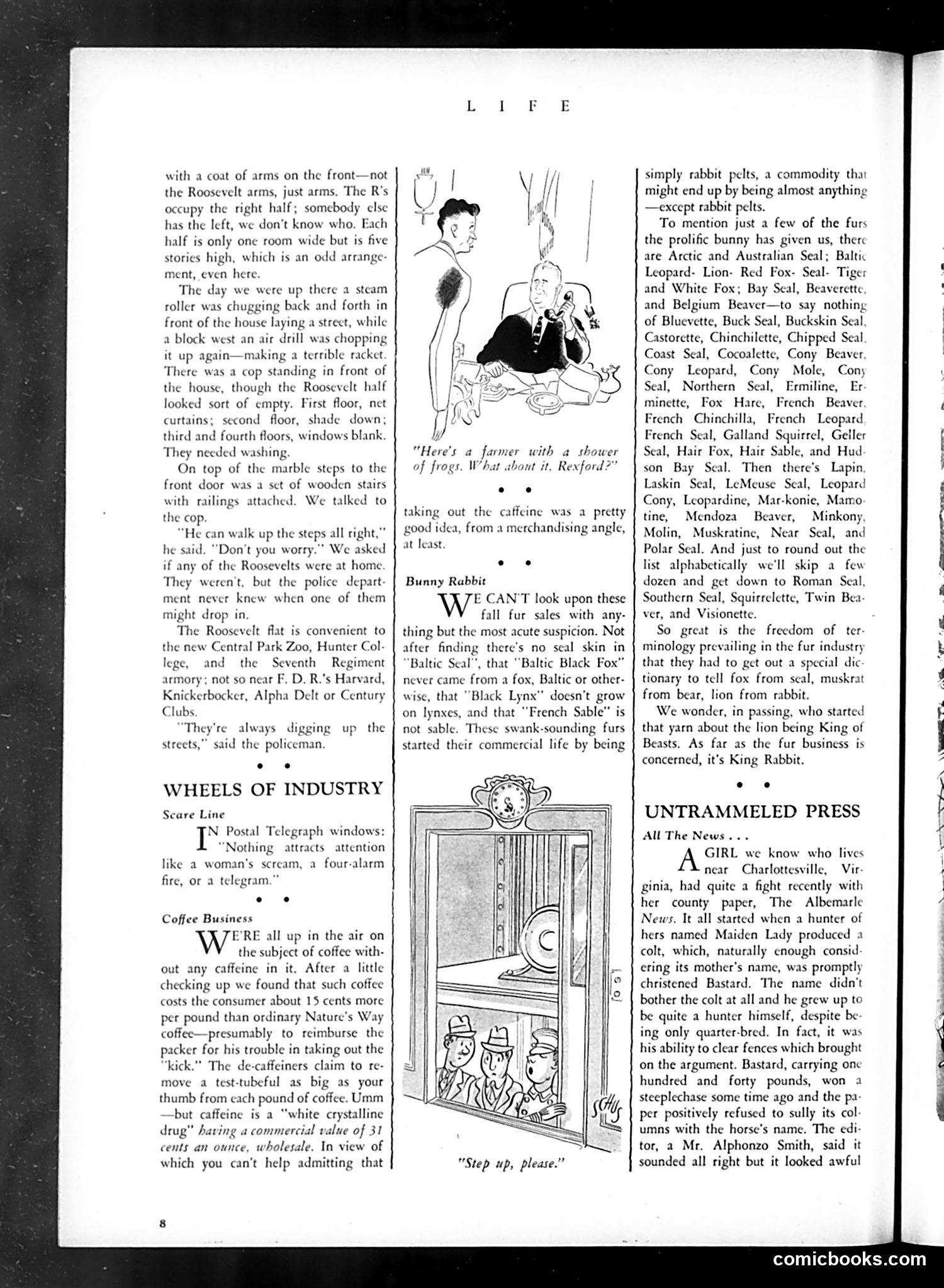
Content Analysis This page from *Life* magazine contains three sections: "Wheels of Industry" discusses the economics of coffee consumption, claiming caffeine costs consumers an extra 15 cents per pound compared to decaffeinated coffee. It's satirizing commercial markup practices and the public's acceptance of inflated prices. "Bunny Rabbit" critiques deceptive fur industry labeling, where animals like foxes are marketed under misleading names (e.g., "Baltic Black Fox" or "French Sable"). The satire exposes how sellers misrepresent cheap pelts as luxury furs to unsuspecting consumers. "Untrammeled Press" humorously recounts a Virginia newspaper story about a horse named "Bastard" that won a steeplechase. The satire mocks the editor's discomfort publishing the horse's legitimate name. The cartoons accompanying these sections illustrate the humorous situations described, using visual comedy to enhance the written satire.
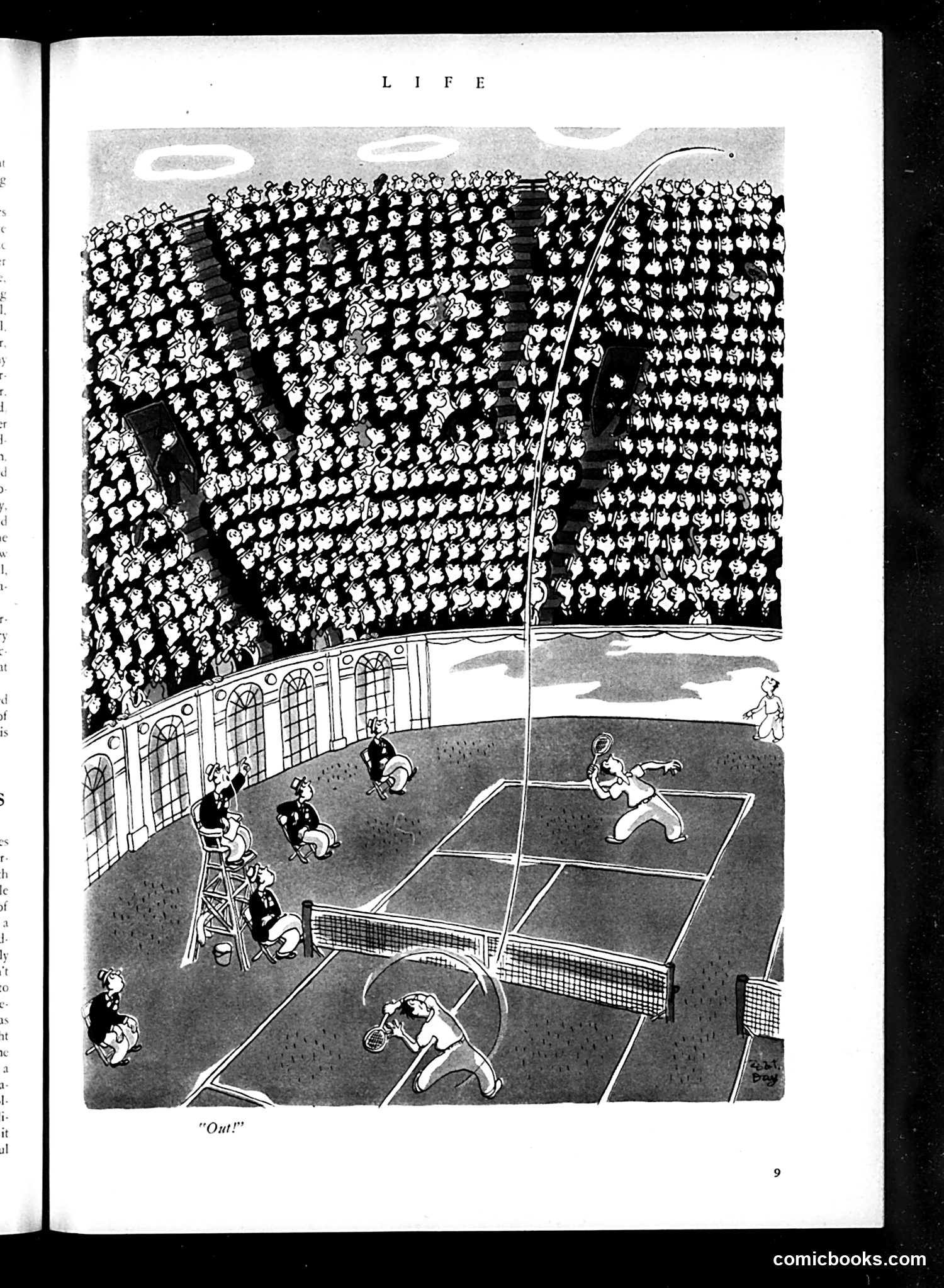
Cartoon Analysis: "Out!" This cartoon depicts a table tennis match being observed by an enormous crowd in stadium seating. The caption "Out!" suggests a disputed call—the ball appears to have gone outside the boundary line, hence the umpire's decision. The satire likely comments on the disproportionate public interest in minor sporting events. The massive audience dwarfs the actual players and their modest game, suggesting how modern mass media and spectator culture can inflate the significance of trivial competitions. This reflects early-to-mid 20th-century anxieties about crowds, entertainment, and society's misplaced priorities—filling stadiums for table tennis rather than more substantial pursuits. The humor derives from this absurd incongruity between the small-scale sport and the enormous, densely-packed crowd.
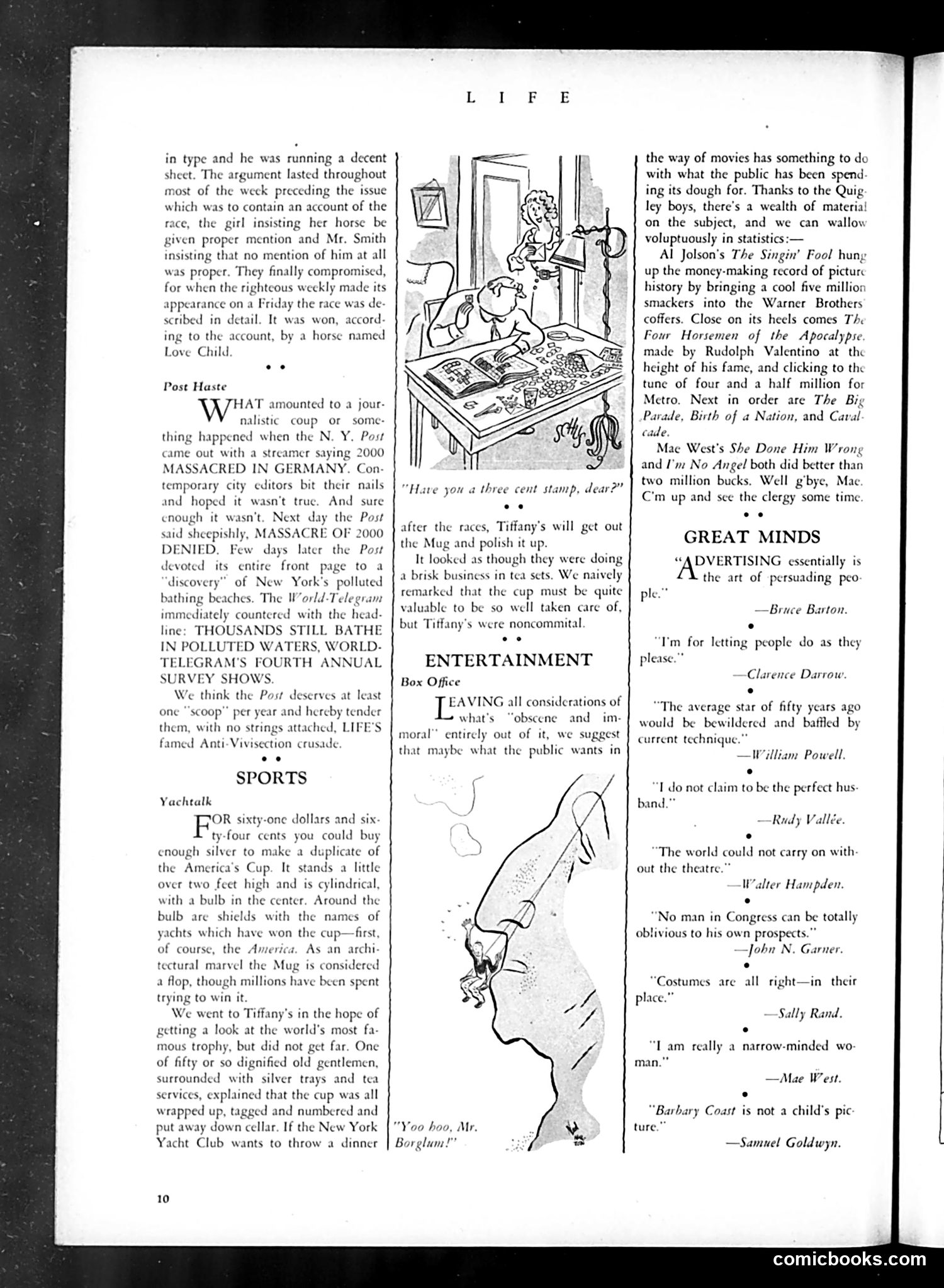
Analysis of Life Magazine Page This page contains three sections: continued articles about horse racing and journalism ethics, a "Sports" section about yacht racing, and an "Entertainment" section with film industry quotes. The main cartoon shows a figure being ejected from a window with the caption "You boo, Mr. Boynham!" This appears to satirize audience disapproval at a theater or performance venue—likely mocking either a performer or critic receiving harsh public rejection. The "Great Minds" section collects quotes from entertainment industry figures (Bruce Barton, Clarence Darrow, Mae West, etc.) about advertising, theater, and show business—a common Life magazine feature offering witty or contrarian takes on contemporary culture. The overall page reflects 1920s entertainment industry preoccupations: legitimate theater's status, cinema's growing dominance, and public taste in popular culture.
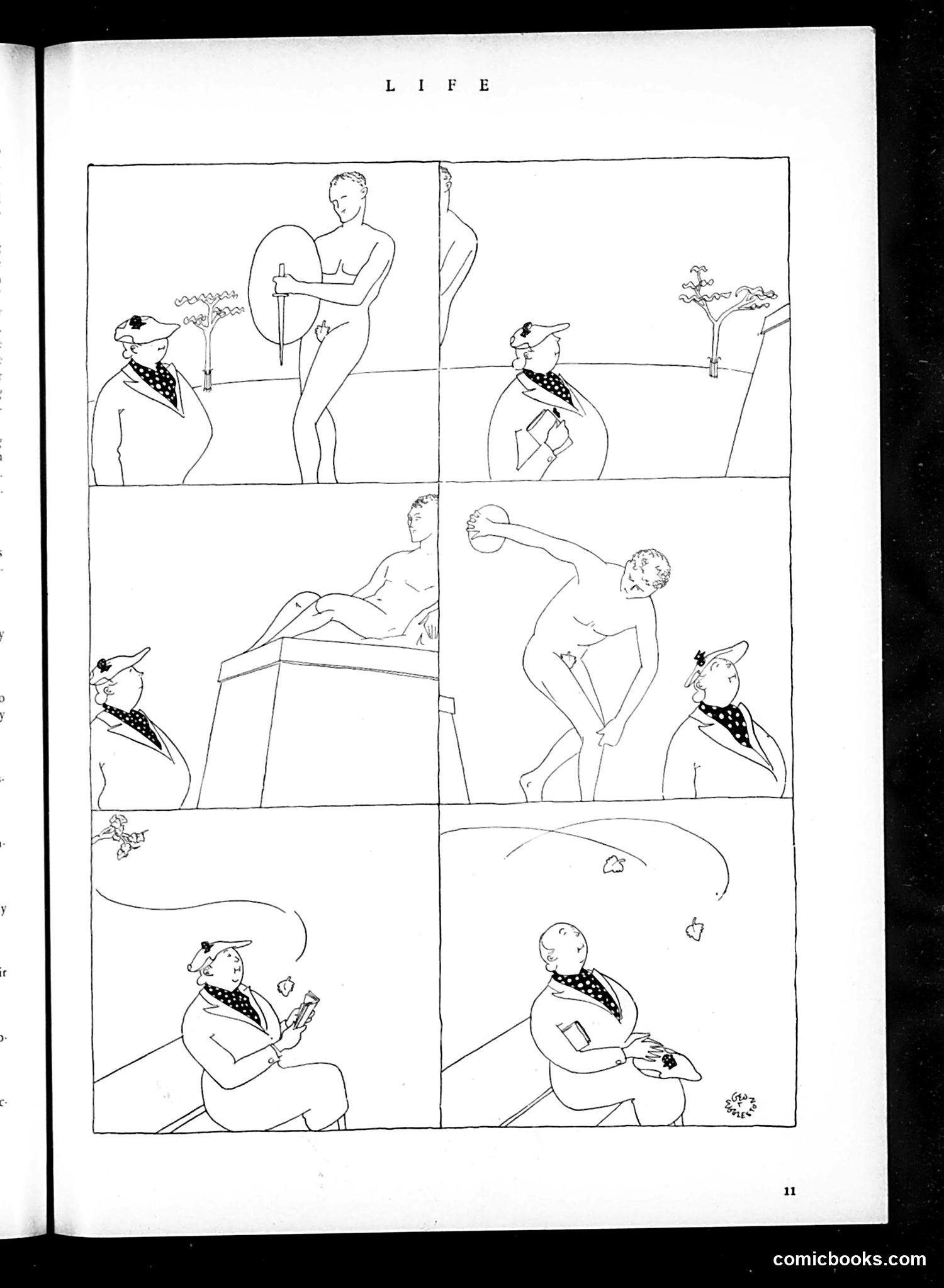
Analysis This page titled "LIFE" presents a six-panel satirical comic strip depicting a confrontation between a small, rotund figure (drawn in caricature style with exaggerated features) and a classical male nude statue or sculpture. The narrative appears to be: 1. The figure observes the statue 2. Attempts to measure or examine it 3. Views it from different angles 4. Eventually removes or damages it 5-6. The figure departs, having apparently destroyed or defaced the artwork The satire likely mocks vandalism, philistinism, or disrespect for classical art and culture. The contrast between the crudely-drawn small figure and the idealized classical form suggests commentary on cultural degradation or the triumph of vulgarity over refinement—a common theme in early 20th-century satirical magazines. Without visible text, the specific target remains unclear.
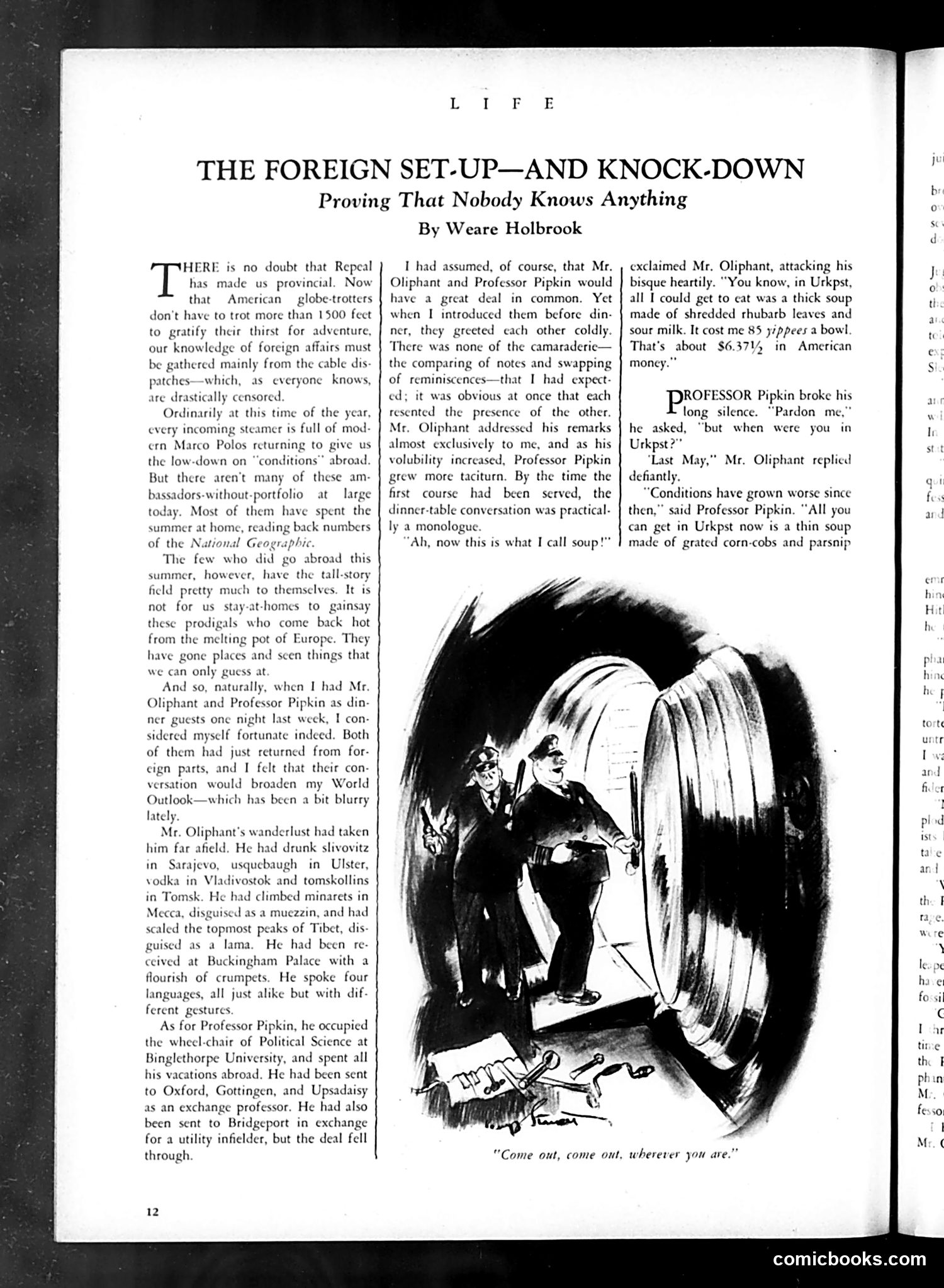
Analysis of "The Foreign Set-Up—and Knock-Down" This satirical piece by Weare Holbrook mocks American intellectuals who travel abroad and return with exaggerated tales of exotic foreign experience. The cartoon depicts two gentlemen emerging from what appears to be a barrel or confined space, captioned "Come out, come out, wherever you are." The text describes Mr. Oliphant and Professor Pipkin, dinner guests who boast of their foreign travels and expertise. The satire targets their pretentiousness—their condescending remarks about other nations (mocking Balkan conditions, comparing foreign goods unfavorably to American products) and their affected sophistication. The cartoon visually reinforces the joke: these supposed world travelers are literally cramped and constrained, suggesting their knowledge and perspectives are actually limited and narrow despite their pretensions to worldliness.
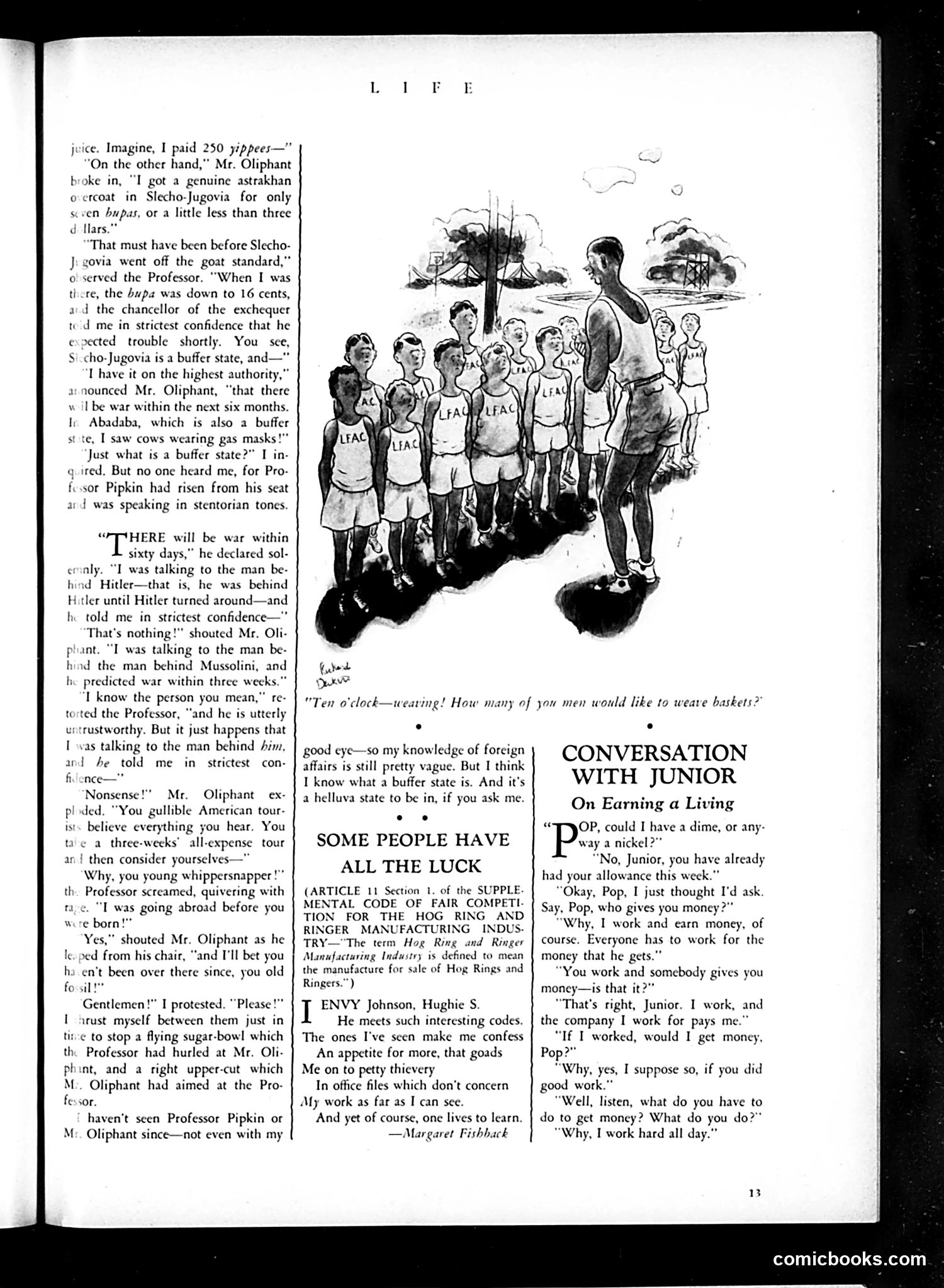
Analysis This page contains two distinct sections: a narrative text about international diplomacy and a cartoon illustration. The Cartoon: The illustration depicts a physical education instructor addressing a group of young boys wearing athletic uniforms marked "IFAC." The caption reads: "Ten o'clock—wearing! How many of you men would like to wear baskets?" The joke appears to be a play on words: the instructor is asking who wants to wear "baskets" (likely meaning athletic supporters or jockstraps), but the euphemistic phrasing creates an unintended double meaning that's humorous to adult readers. The Text Section: Below is a conversation titled "CONVERSATION WITH JUNIOR: On Earning a Living," where a parent questions a child about earning money and work ethic—a common satirical topic reflecting Depression-era attitudes about youth employment and values.
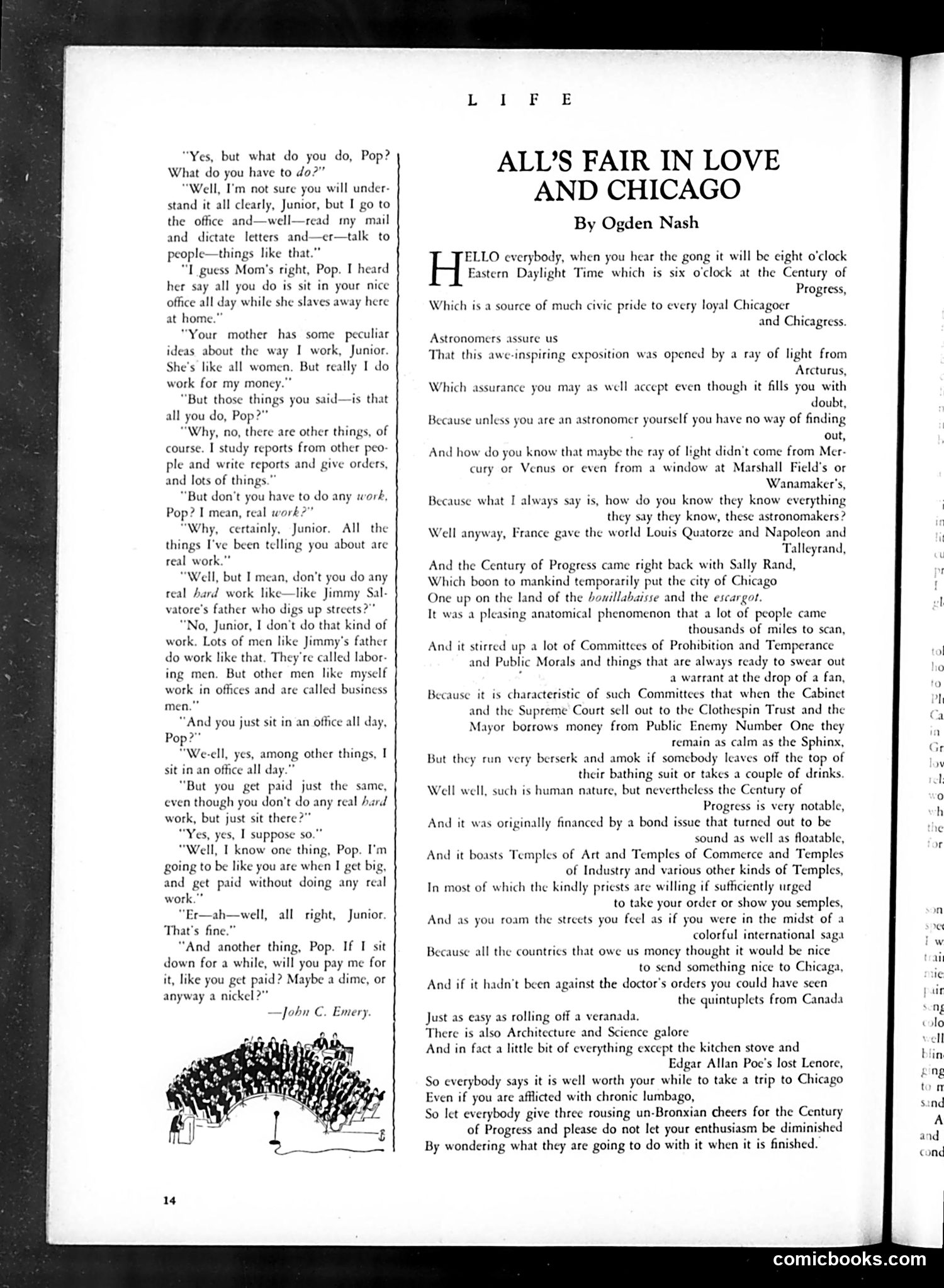
Analysis This page contains a satirical poem by Ogden Nash titled "All's Fair in Love and Chicago," mocking the 1933 Century of Progress exposition. The poem playfully critiques the fair's grandiose claims and the civic pride surrounding it, suggesting that Chicagoans exaggerate the fair's significance. The accompanying cartoon (lower left) appears to show a crowd of people, likely representing the masses attending the exposition. Nash's satire targets the fair's astronomical and scientific exhibits while humorously noting how Chicago committees used the event to push social agendas like Prohibition enforcement. He mocks both the fair's self-importance and the tendency of civic boosters to oversell local attractions, suggesting that despite chronic problems ("lumbago"), Chicagoans maintain unbridled enthusiasm for their city's projects.
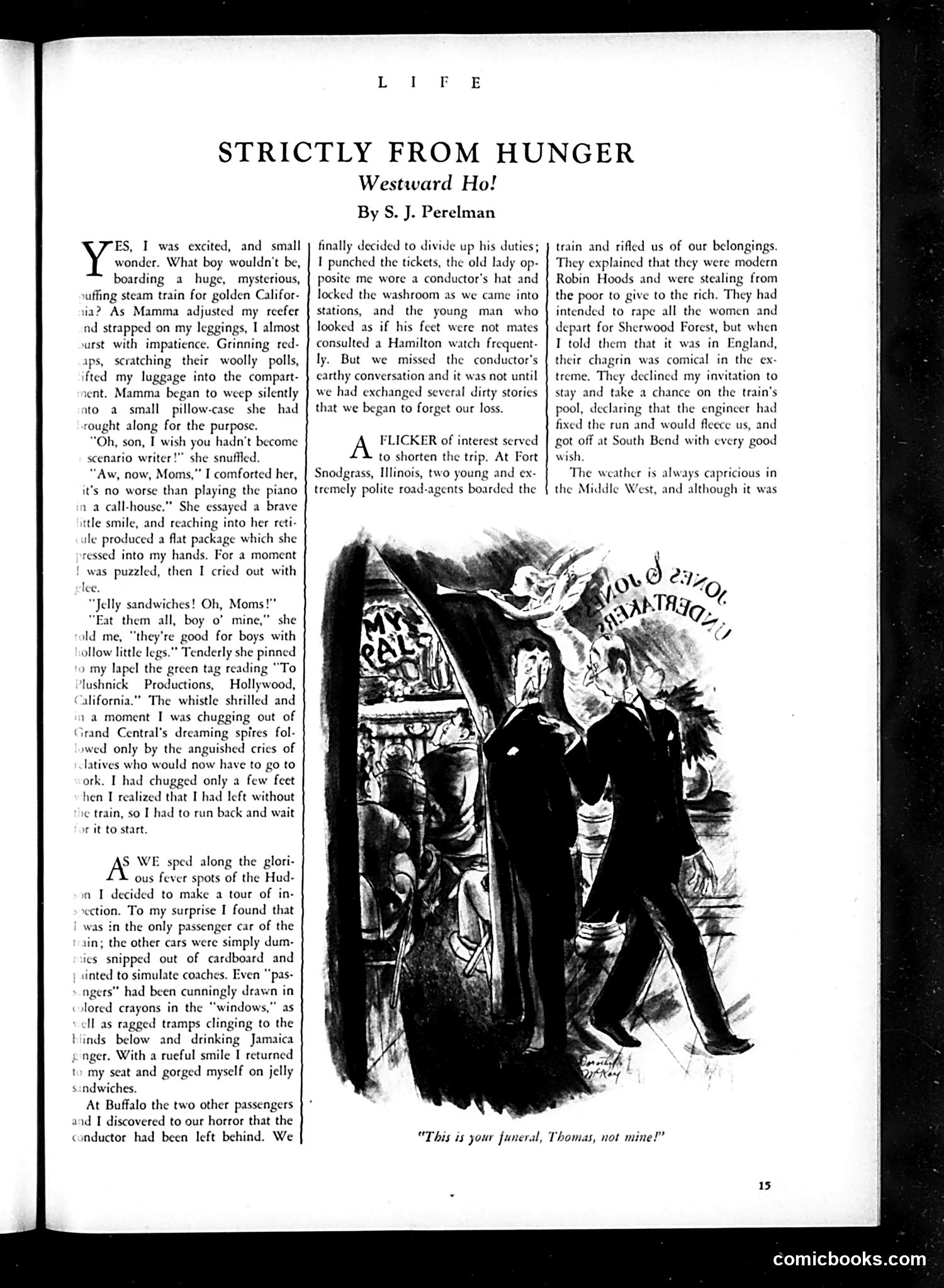
"Strictly From Hunger: Westward Ho!" by S.J. Perelman This is a humorous travel narrative with an accompanying illustration. The story describes a cross-country train journey where the narrator and his mother encounter various mishaps and colorful characters. The illustration depicts a dramatic confrontation on the train, with the caption "This is your funeral, Thomas, not mine!" suggesting a comedic dispute between passengers. The satire appears to target early 20th-century train travel experiences—cramped conditions, eccentric fellow passengers, and the contrast between romantic notions of westward expansion versus mundane reality. References to "modern Robin Hoods" and "Sherwood Forest" suggest petty criminals preying on wealthy travelers, a common literary trope of the era. The overall joke centers on the gap between idealized adventure narratives and actual travel experiences.
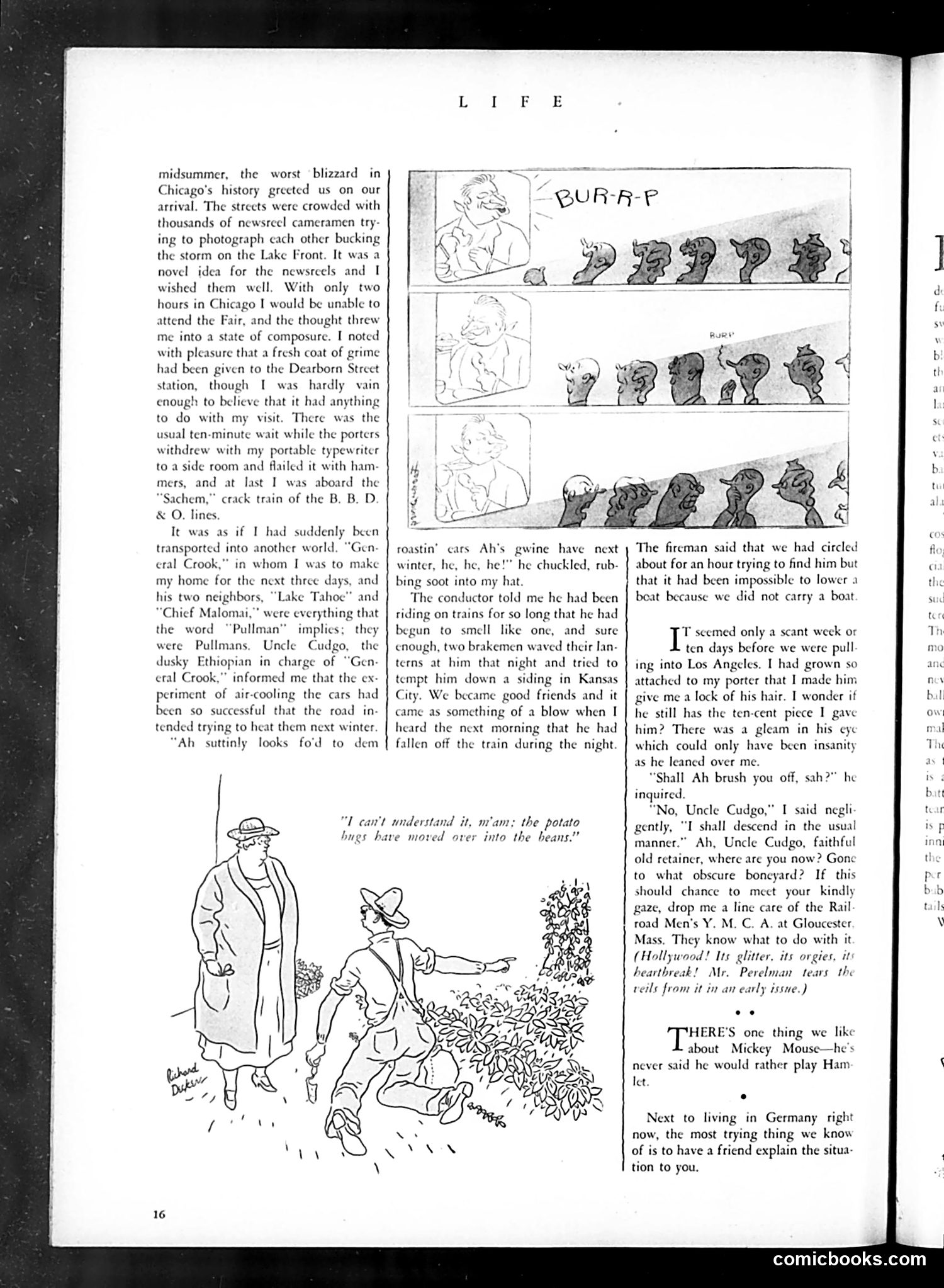
Analysis of Life Magazine Page This page contains a humorous comic strip titled "BUR-A-P" (a pun on "burp") showing a sequence of what appears to be hobos or vagrants progressively disappearing or diminishing across three panels—likely satirizing food scarcity or poverty during hard times. Below is an illustration with dialogue: "I can't understand it, w'am; the potato bugs have nosed over into the beans." This depicts economic hardship, with even pests crossing between crops, suggesting widespread agricultural or financial difficulties affecting working people. The right-side text discusses travel experiences and references to Chicago's weather and trains, reflecting early 20th-century American life and mobility during economically uncertain times. The overall tone mocks misfortune through cartoonish exaggeration typical of Life's satirical approach.
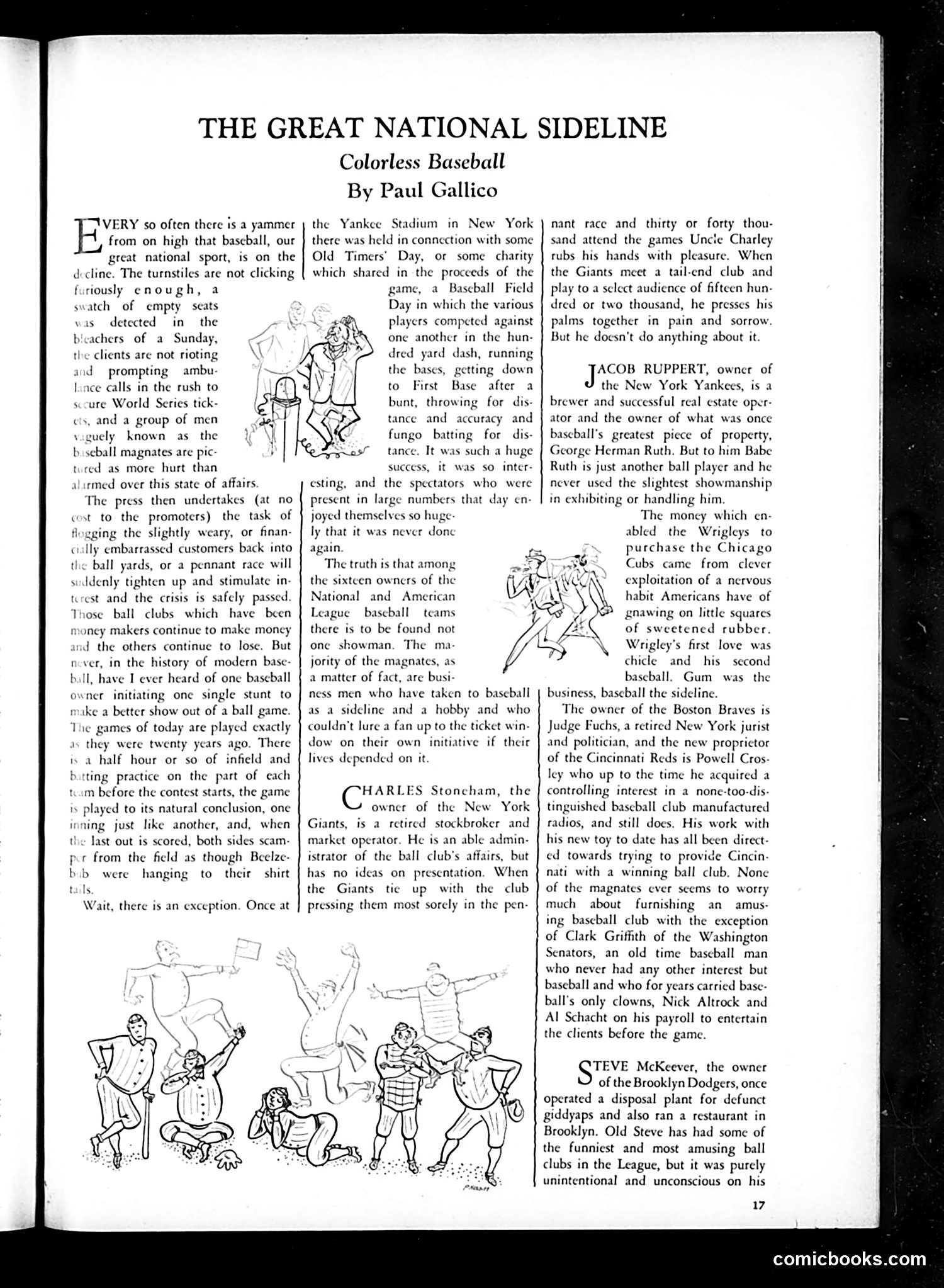
Analysis: "The Great National Sideline: Colorless Baseball" This Paul Gallico article satirizes baseball club owners as neglectful showmen. The text profiles several actual owners—Charles Stoneham (New York Giants), Jacob Ruppert (New York Yankees), Judge Fuchs (Boston Braves), and Steve McKeever (Brooklyn Dodgers)—criticizing their lack of business acumen and entertainment initiative. The accompanying cartoons depict various baseball figures in comedic poses, illustrating Gallico's complaint that owners fail to generate excitement or provide proper entertainment for spectators. The satire targets how these magnates run their clubs as passive investments rather than engaging public showpieces. The article argues that successful ownership requires more than financial capital—it demands promotional showmanship and genuine passion for the sport itself.
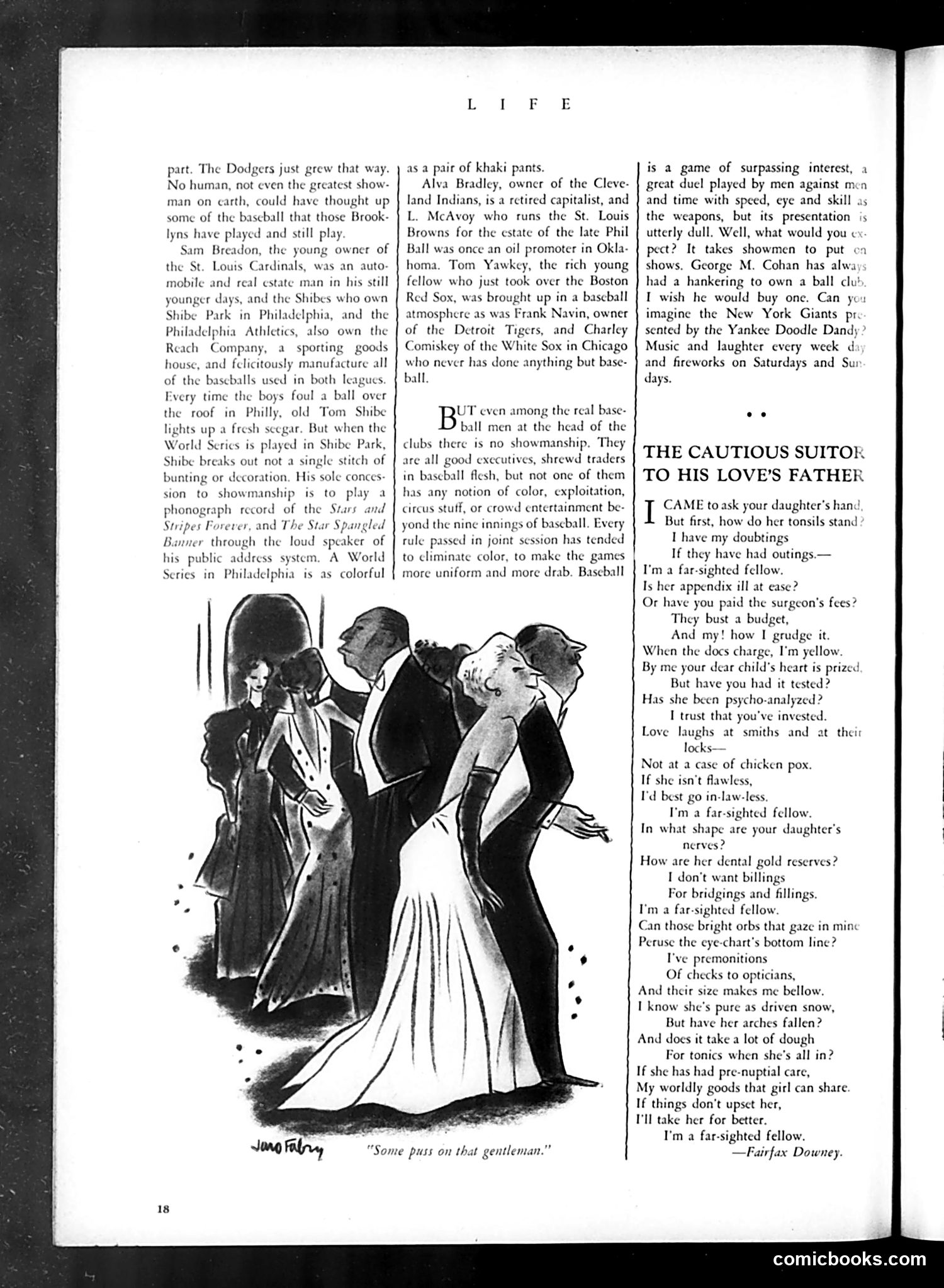
Analysis of Life Magazine Page This page contains two distinct pieces: Left side: A cartoon captioned "Some pass on that gentleman" depicts a social scene where a woman in an elegant gown appears to be introduced to men at what seems to be a formal event. The humor likely plays on class dynamics or romantic awkwardness of the era. Right side: A humorous poem titled "The Cautious Suitor to His Love's Father" where a prospective son-in-law anxiously catalogs his financial and health concerns to the bride's father—dental costs, medical expenses, psychological testing, etc. He repeatedly describes himself as "a far-sighted fellow," suggesting both prudence and anxiety about marriage's financial obligations. The satire mocks middle-class masculine insecurity about marriage costs and medical modernity.
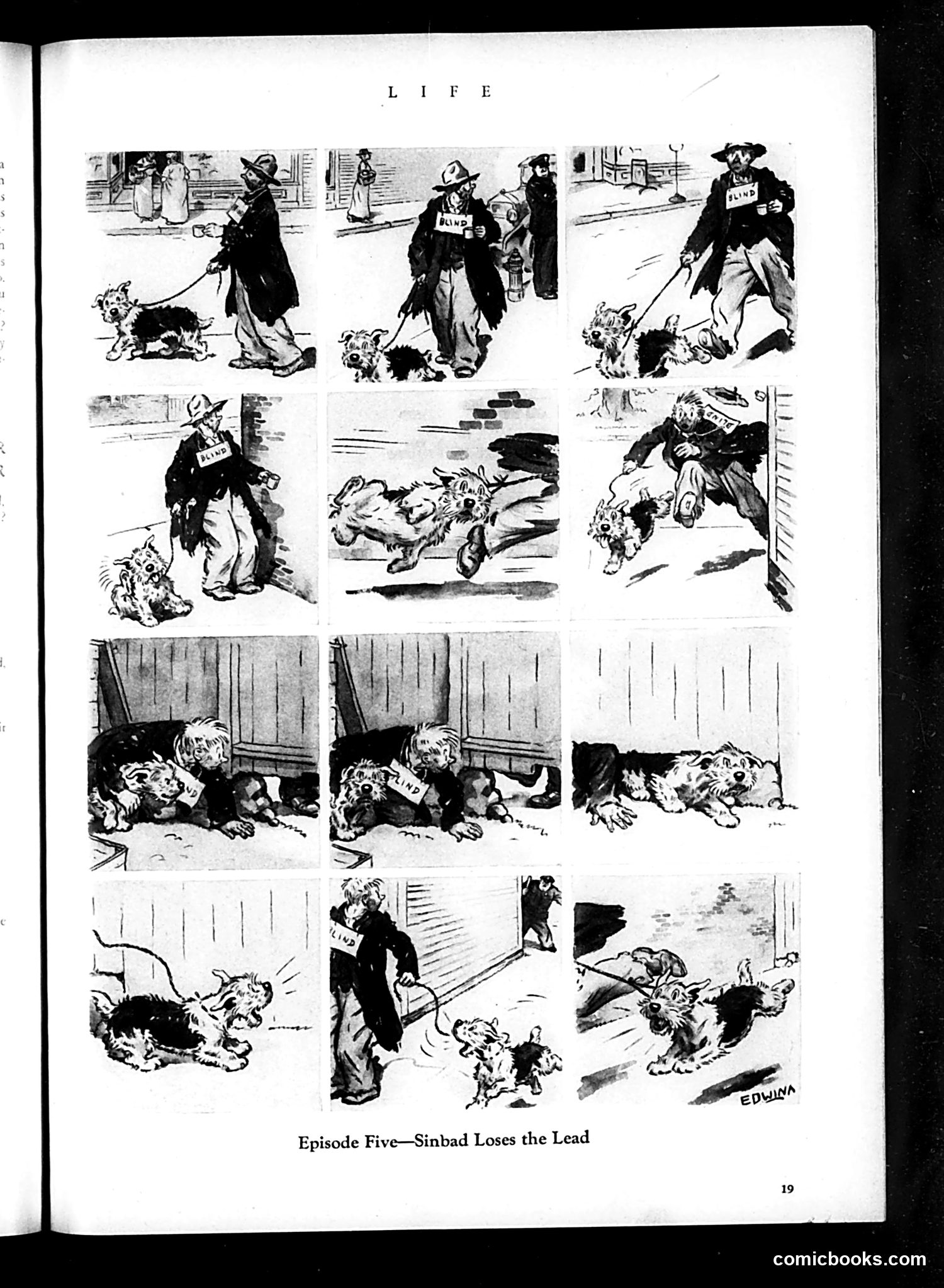
Episode Five—Sinbad Loses the Lead This is a comic strip sequence titled "Episode Five—Sinbad Loses the Lead," showing what appears to be a serialized adventure story. The narrative follows characters (likely including someone named Sinbad) navigating various scenes with small dogs or similar animals. The strip progresses through multiple panels showing physical comedy and action sequences—characters appear to be struggling, falling, or being pulled by the animals. The final panels depict indoor domestic scenes with the animals causing chaos. Without additional context about this specific Life magazine serial, the exact satirical or political meaning remains unclear. This appears to be entertainment-focused comics rather than political satire, likely appealing to readers through slapstick humor and animal-driven gags typical of early-to-mid twentieth-century comic strips.
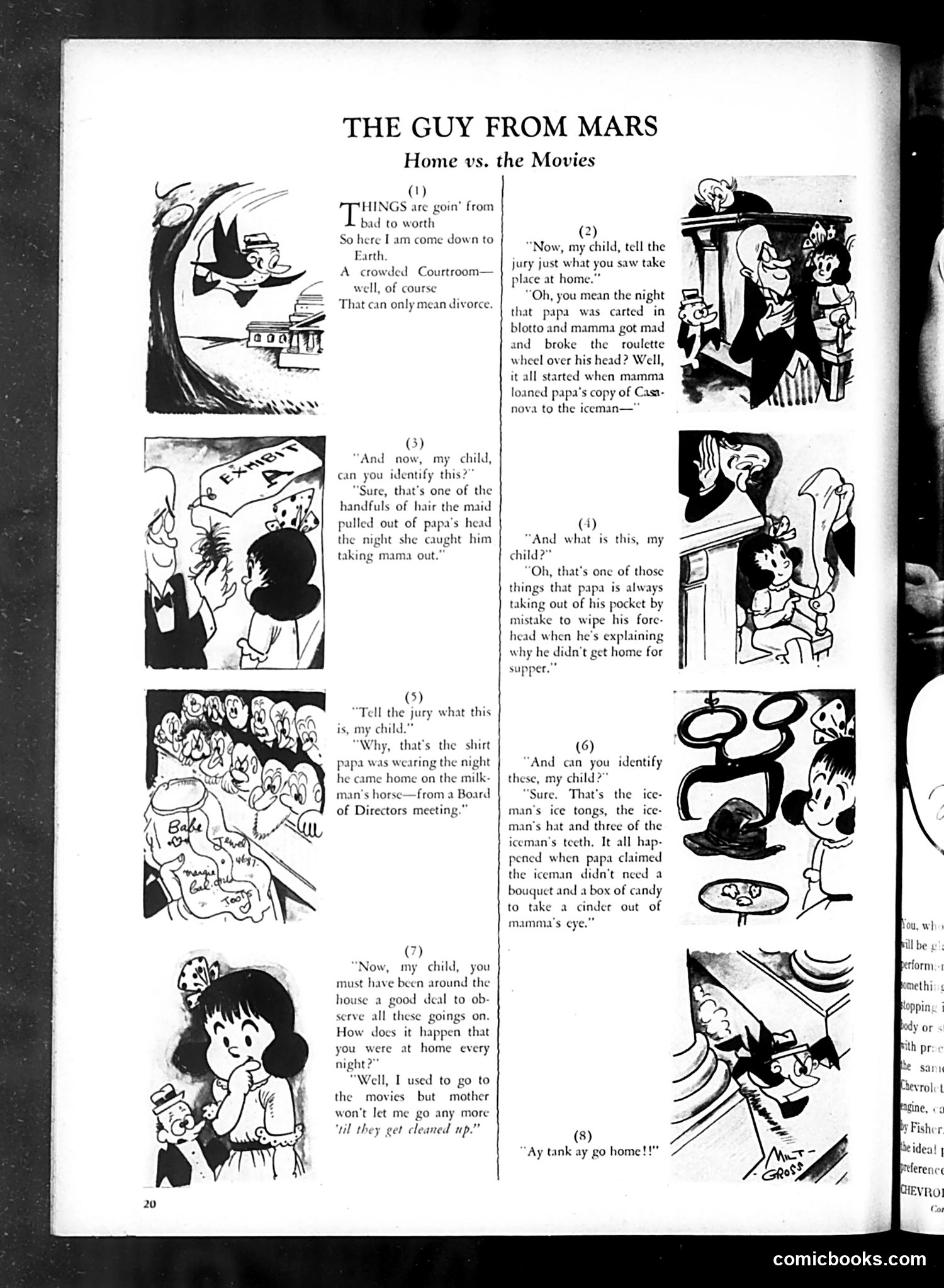
"The Guy from Mars: Home vs. the Movies" This satirical cartoon compares marital chaos at home to movie content. A child testifies in a divorce court about witnessing her parents' scandalous behavior: the father arriving drunk, fighting over an iceman (a common delivery worker and stock figure for infidelity humor), breaking furniture, and carrying lipstick-stained items. The central joke appears in panel (7): the mother won't let the child attend movies "til they get cleaned up"—implying that Hollywood films are morally corrupt, yet the child's home life rivals any movie's sordid drama. The final panel shows the bewildered iceman exclaiming he wants to go home, suggesting even he's caught up in this domestic mess. The satire targets 1920s-30s anxiety about cinema's influence on morality while revealing that real domestic life—infidelity, drinking, violence—matched or exceeded what scandal-mongering films depicted.
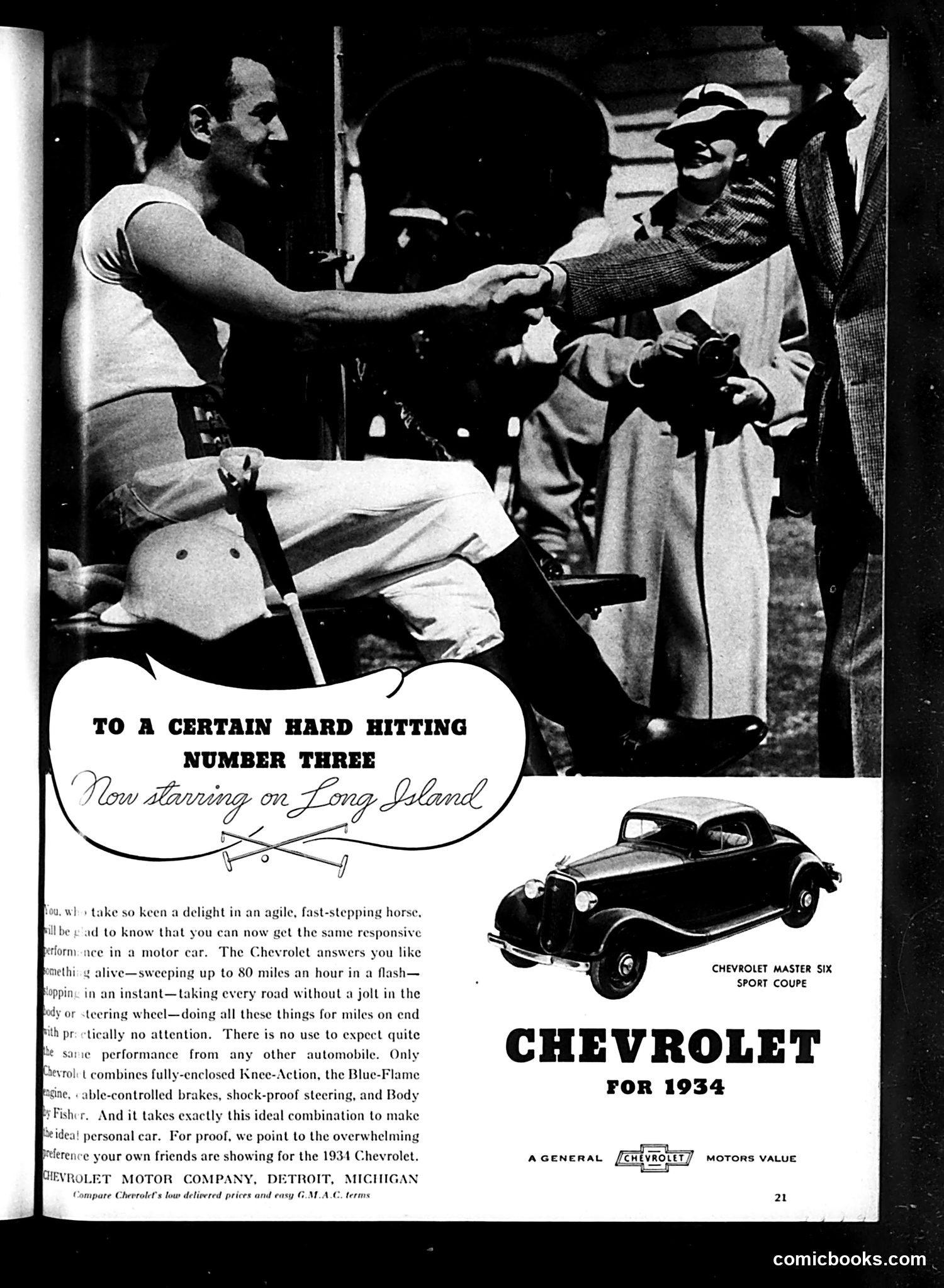
Analysis This is primarily a Chevrolet automobile advertisement for 1934, not political satire. The top photograph shows what appears to be a baseball player shaking hands with a man in a hat, likely at a public event. The caption "To a Certain Hard Hitting Number Three" references the player's batting position—apparently someone notable enough to warrant Chevrolet's attention, though the specific player is not identified in the visible text. The advertisement's strategy is celebrity endorsement: comparing the car's responsive performance to the qualities of a skilled athlete ("agile, fast-stepping"). The message targets sports enthusiasts by suggesting that just as they admire athletic prowess, they should admire the Chevrolet's speed, handling, and reliability. This reflects 1930s advertising convention—using sports figures to sell automobiles through aspirational association rather than technical specification alone. The "hard hitting" language plays on both baseball terminology and the car's purported power and responsiveness.
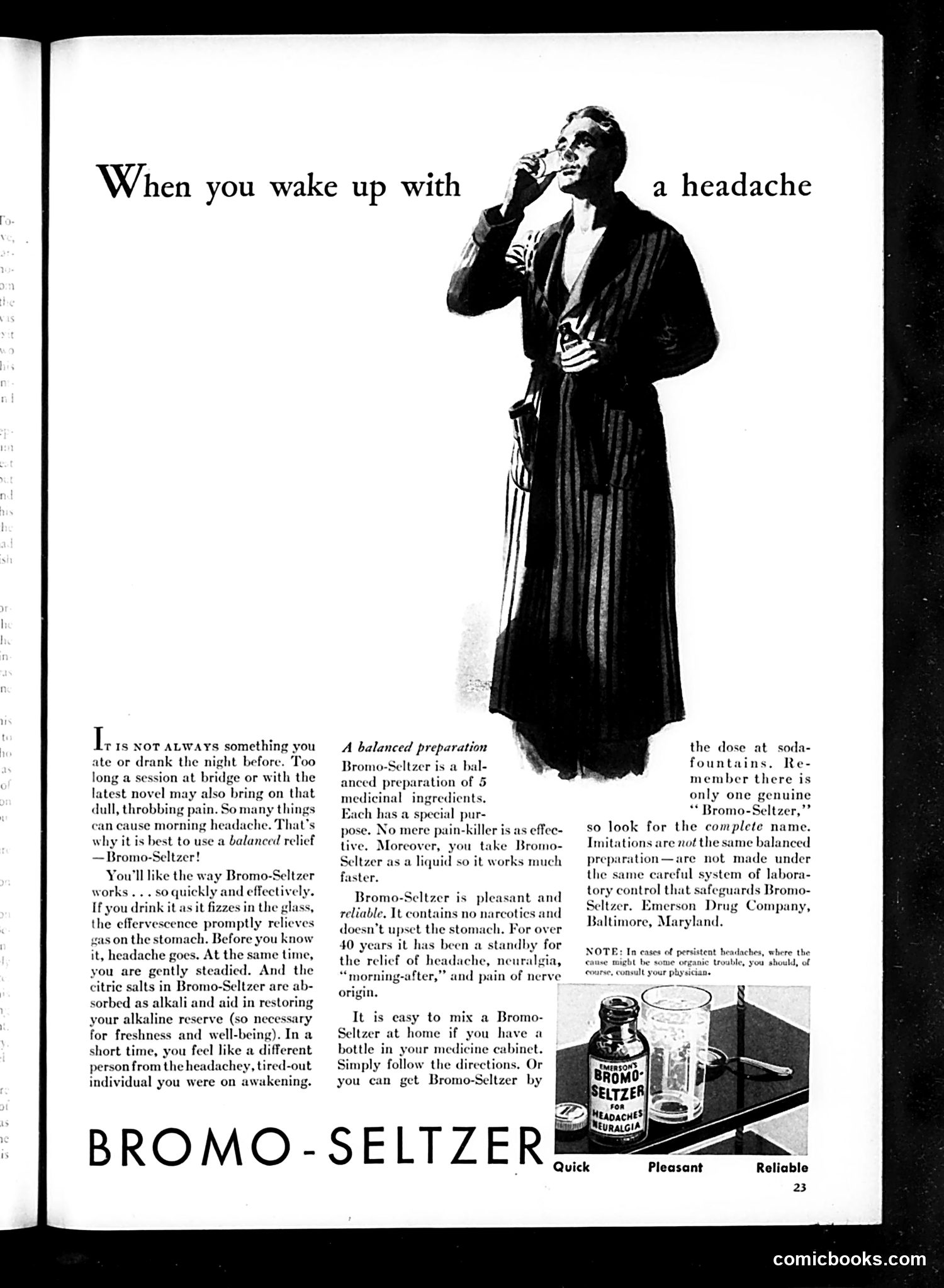
Analysis This page is primarily a Bromo-Seltzer advertisement, not a political cartoon. The illustration shows a woman in a robe, hand to her head, embodying the "morning headache" scenario the ad addresses. The advertisement plays on relatable modern anxieties: headaches from late-night bridge games, novel-reading, or unspecified social activities (the vague "morning-after" reference suggests hangover implications, though carefully euphemistic for the era). The satire is gentle and self-aware—the ad acknowledges that headaches have multiple causes and that people seek quick relief. Bromo-Seltzer is marketed as a "balanced preparation" with five ingredients, positioning it against mere pain-killers and counterfeits. The page reflects early-20th-century advertising that blended medical claims with lifestyle messaging, targeting people seeking both efficacy and respectability in their remedies. No specific political figures or events are referenced.
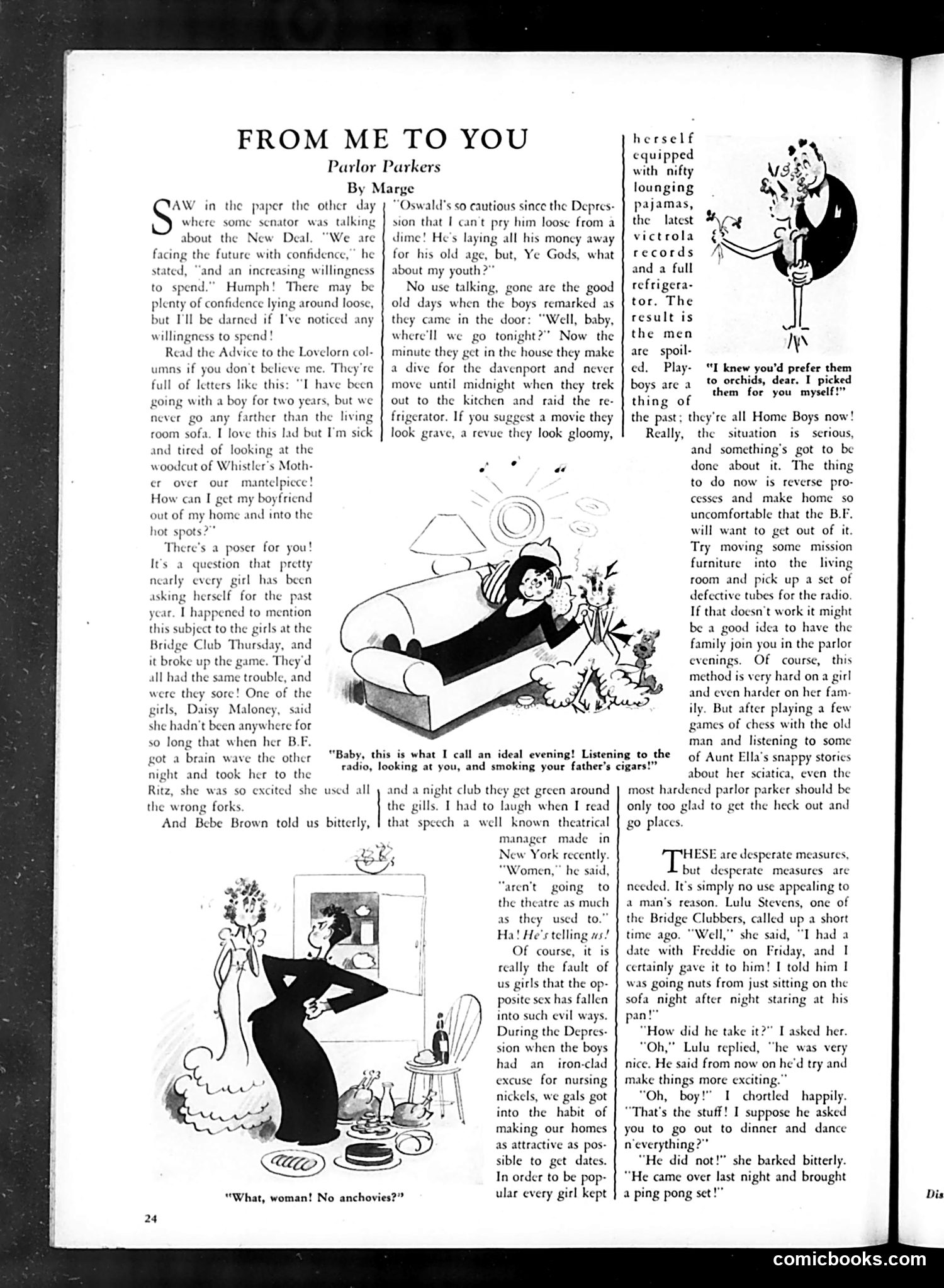
Understanding "Parlor Parkers" (Life Magazine, circa 1930s) This satirical column by Marge addresses Depression-era dating culture. The humor centers on how economic hardship has changed male behavior: young men ("B.F.s" — boyfriends) now stay home on cheap sofas instead of taking dates out to nightclubs, movies, or restaurants. The "parlor parker" is a homebody boyfriend who avoids spending money. Women complain they're stuck in living rooms listening to radios and examining Whistler's Mother prints rather than experiencing entertainment and romance. The column's satirical "solution" ironically suggests women make home *so uncomfortable* (bad furniture, broken radio tubes, boring family gatherings) that men will want to leave and actually spend money on dates. The cartoons show couples in domestic settings, emphasizing the contrast between Depression-era penny-pinching and pre-crash dating glamour. The subtext: economic crisis has made romance itself feel like a luxury nobody can afford, and women resent the loss of courtship's excitement and escape.
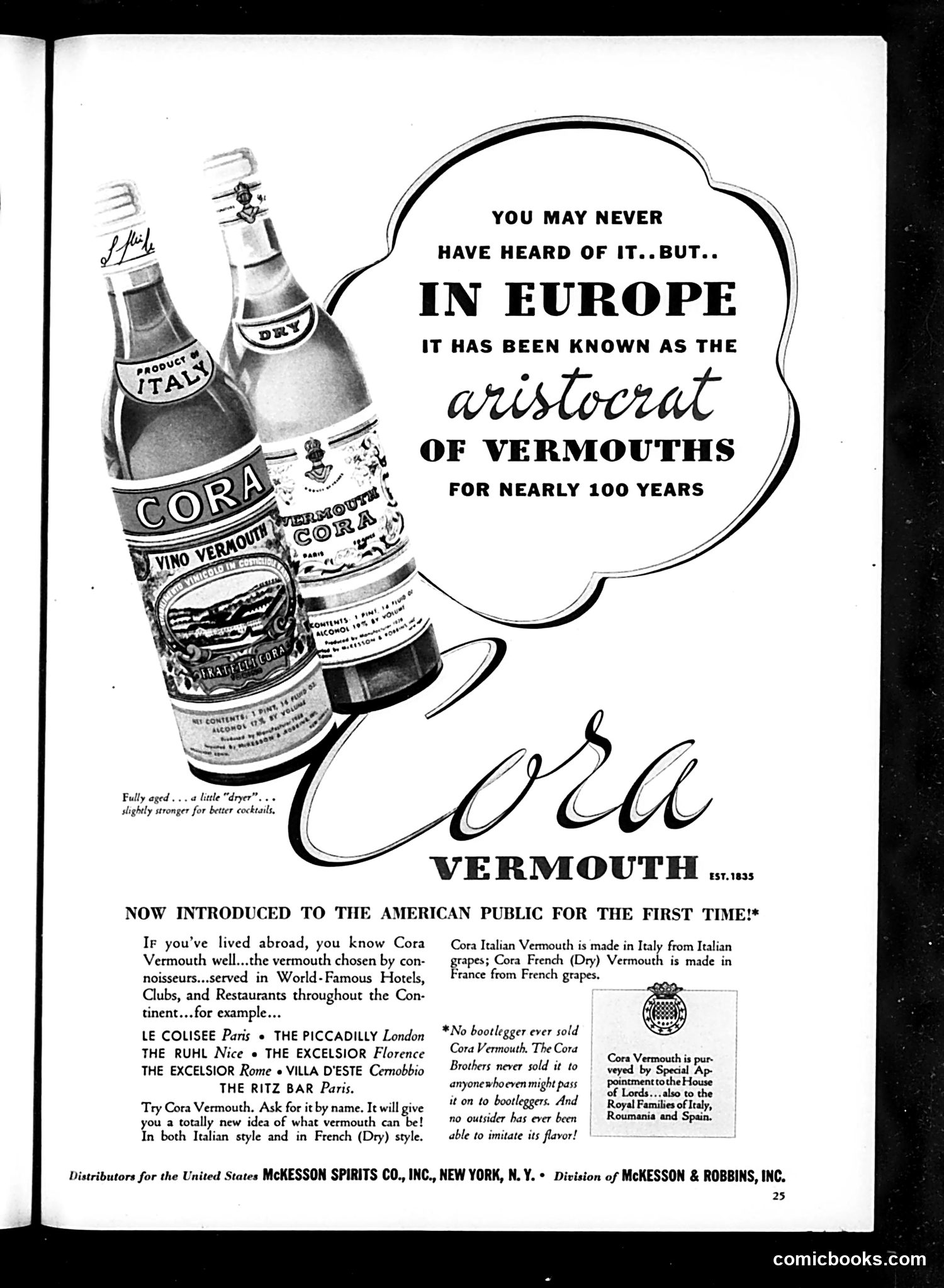
Cora Vermouth Advertisement Analysis This is a product advertisement, not satire or political commentary. It markets Cora Vermouth to American consumers, positioning it as an exclusive European import newly available in the U.S. The ad's appeal relies on snobbery and exclusivity: the product has been "the aristocrat of vermouths" in Europe for nearly 100 years, served in famous continental hotels and restaurants (Le Colisée Paris, The Ritz Bar). The implied message is that American consumers can now access what European sophisticates have long enjoyed. A notable element is the *bootlegger reference*—the ad explicitly claims "no bootlegger ever sold Cora Vermouth," suggesting legitimacy during Prohibition's tail-end. The footnote about the Cora Brothers never selling to outsiders and royal families using it reinforces exclusivity and authenticity. The two bottle varieties (Italian and French) offer choice while maintaining premium positioning. This is straightforward aspirational advertising, not commentary.
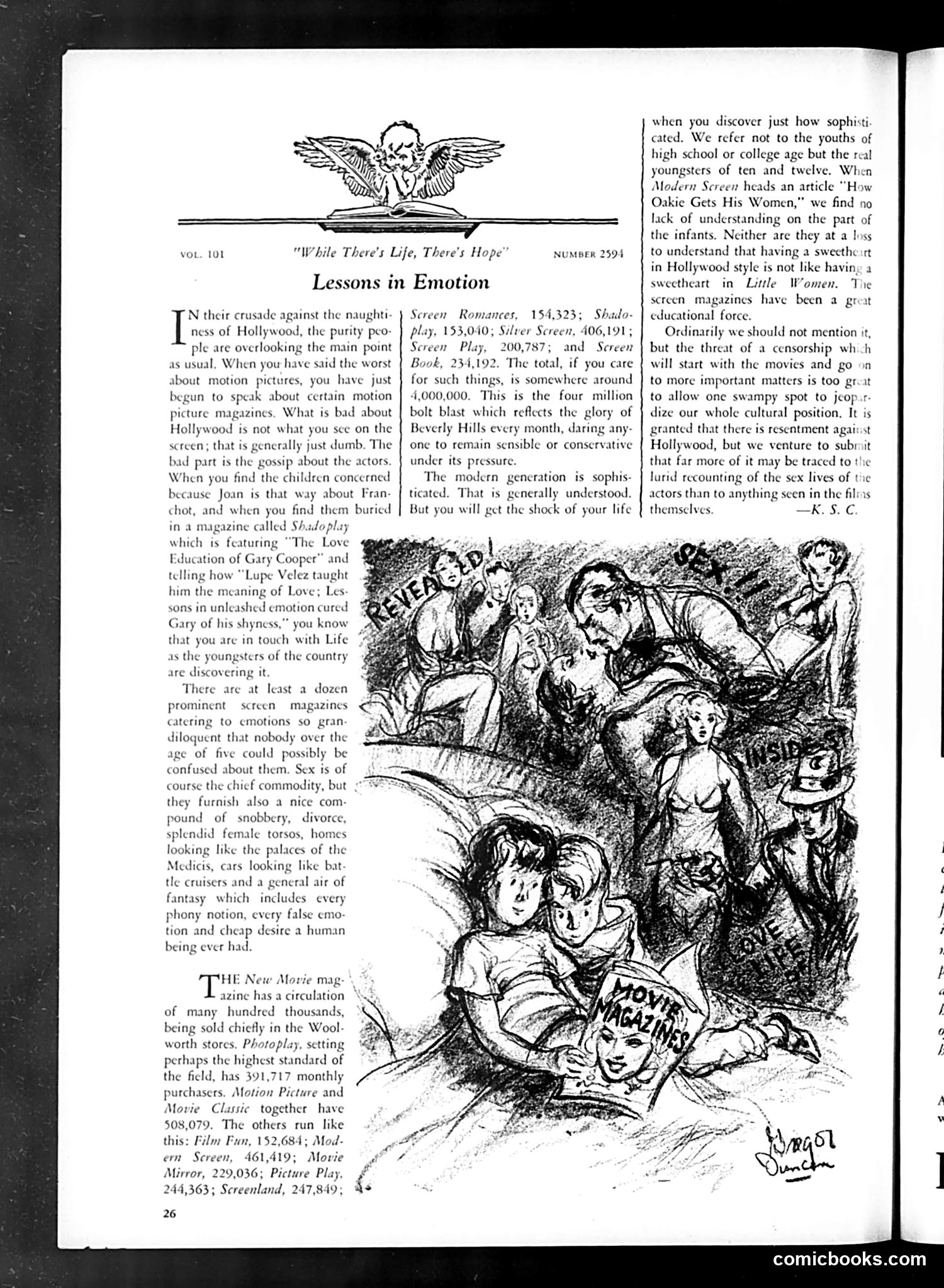
"Lessons in Emotion" - Life Magazine Satire This article attacks movie fan magazines (not films themselves) for corrupting children through sensationalized celebrity gossip. The accompanying cartoon shows young readers eagerly consuming publications like "Movie Magazine," depicted in a chaotic pile of eager consumers. The piece names real publications with their circulation figures—*Modern Screen*, *Photoplay*, *Motion Picture*, etc.—totaling roughly 4 million copies monthly. The author argues these magazines sexualize actors' private lives, teaching children aged ten and twelve worldly sophistication inappropriate to their age. The satire's target: magazine publishers who peddle "unleashed emotion," divorce scandals, and female "torsos" to vulnerable readers. The author warns that while censorship of films may be excessive, the actual threat lies in these magazines' lurid recounting of actors' sex lives—a more damaging "swampy spot" corrupting American youth culture than what appears on screen.
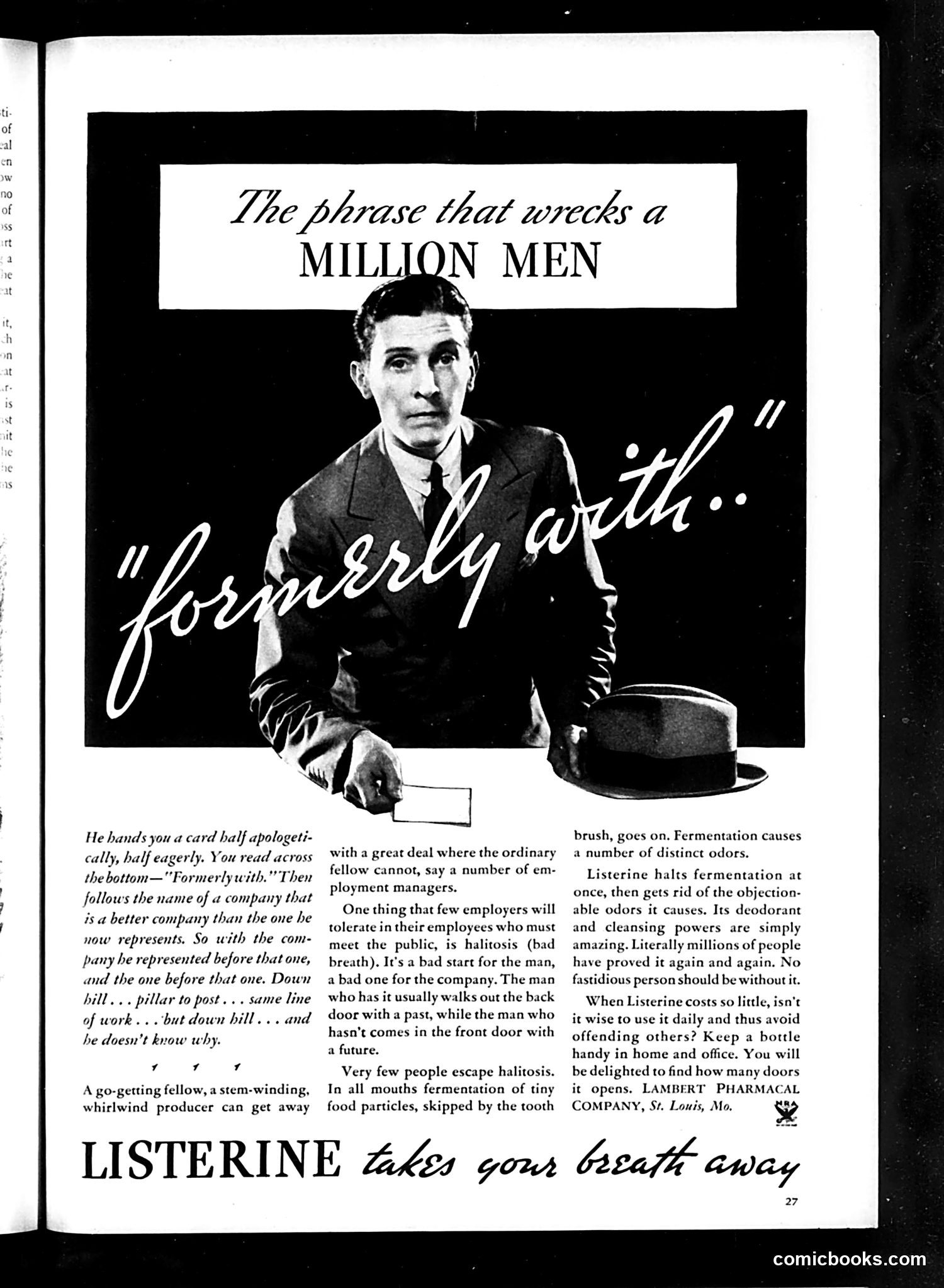
Analysis This is a Listerine advertisement disguised as social commentary. The "cartoon" is actually a cautionary narrative about career failure. The ad depicts a man who repeatedly changes jobs, each represented by a business card showing "Formerly with" previous employers—a pattern of downward mobility ("down hill"). The text explains his mysterious professional failure: halitosis (bad breath). The satire works by treating bad breath as a serious career-wrecker equivalent to incompetence. The ad claims that while talented workers might overcome personal flaws, ordinary employees cannot—and bad breath particularly damages those meeting the public. The man "walks out the back door with a past" while the man with fresh breath "comes in the front door with a future." The punchline: Listerine solves this by stopping fermentation and odors, thus literally "opening doors" professionally. For modern readers, this reflects 1920s-30s workplace anxiety about social acceptability and the emerging consumer culture that sold self-improvement products by manufacturing shame.
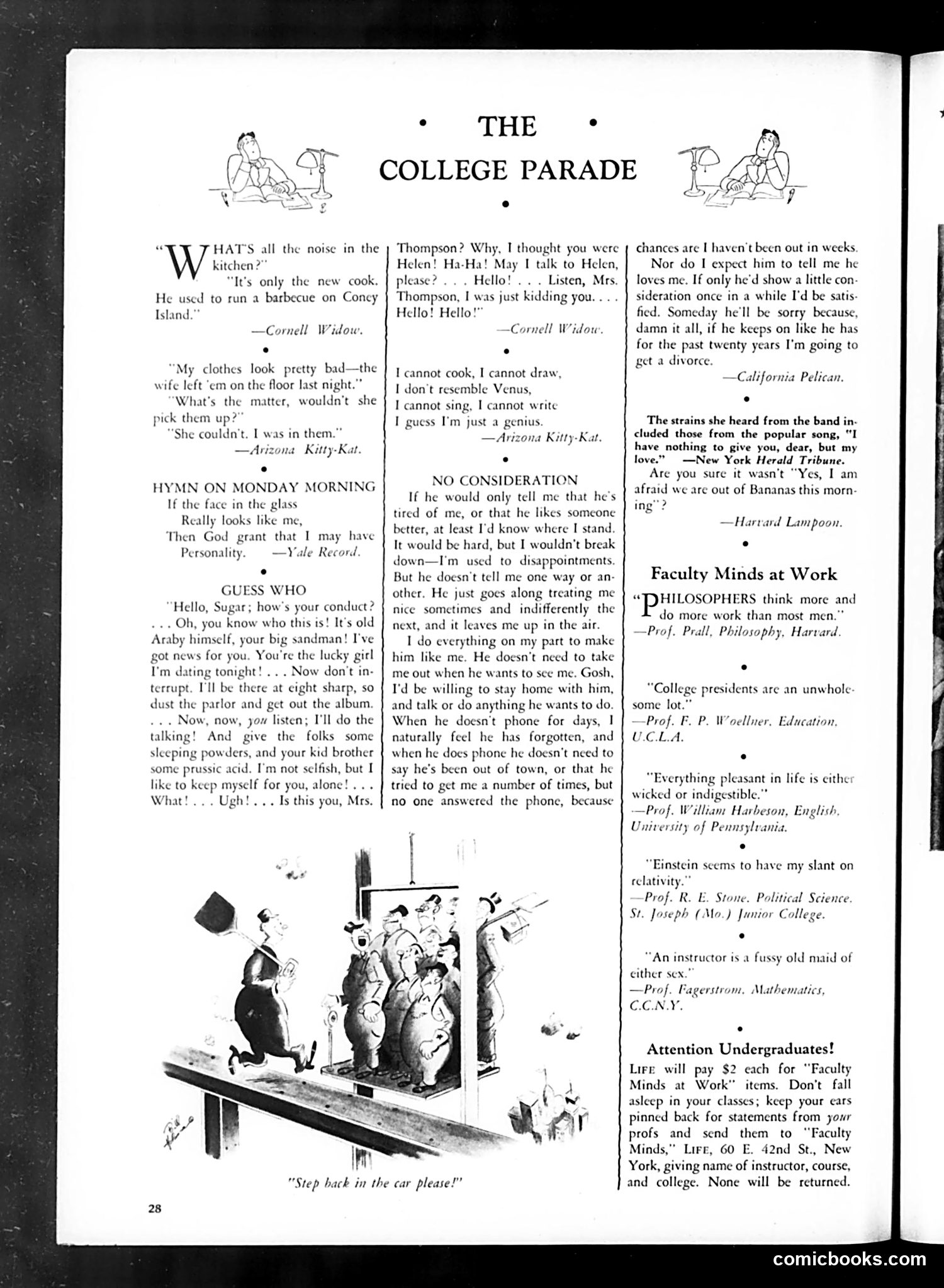
"The College Parade" - Life Magazine Humor Page This is a college humor anthology page featuring jokes and satirical pieces from various university publications (Cornell Widow, Arizona Kitty-Kat, Yale Record, etc.). The content targets typical college life anxieties: Main themes: - Dating awkwardness: A man's bumbling phone call mistaking a girl's mother for her ("Mrs. Thompson"), and a woman's frustration with an inattentive boyfriend who offers no emotional clarity. - Student self-mockery: Jokes about poor grades, messy clothing, and lack of talent ("I cannot cook...I guess I'm just a genius"). - Faculty absurdities: The "Faculty Minds at Work" section mocks professorial pretension through sarcastically attributed quotes (philosophers work hard, college presidents are problematic, etc.). The cartoon depicts crowded chaos ("Step back in the car please!"), likely illustrating collegiate disorder. The page's humor is gentle, self-deprecating college satire targeting early 20th-century undergraduates' romantic disappointments and academic mediocrity. The "Attention Undergraduates!" note invites submissions, making this participatory humor.
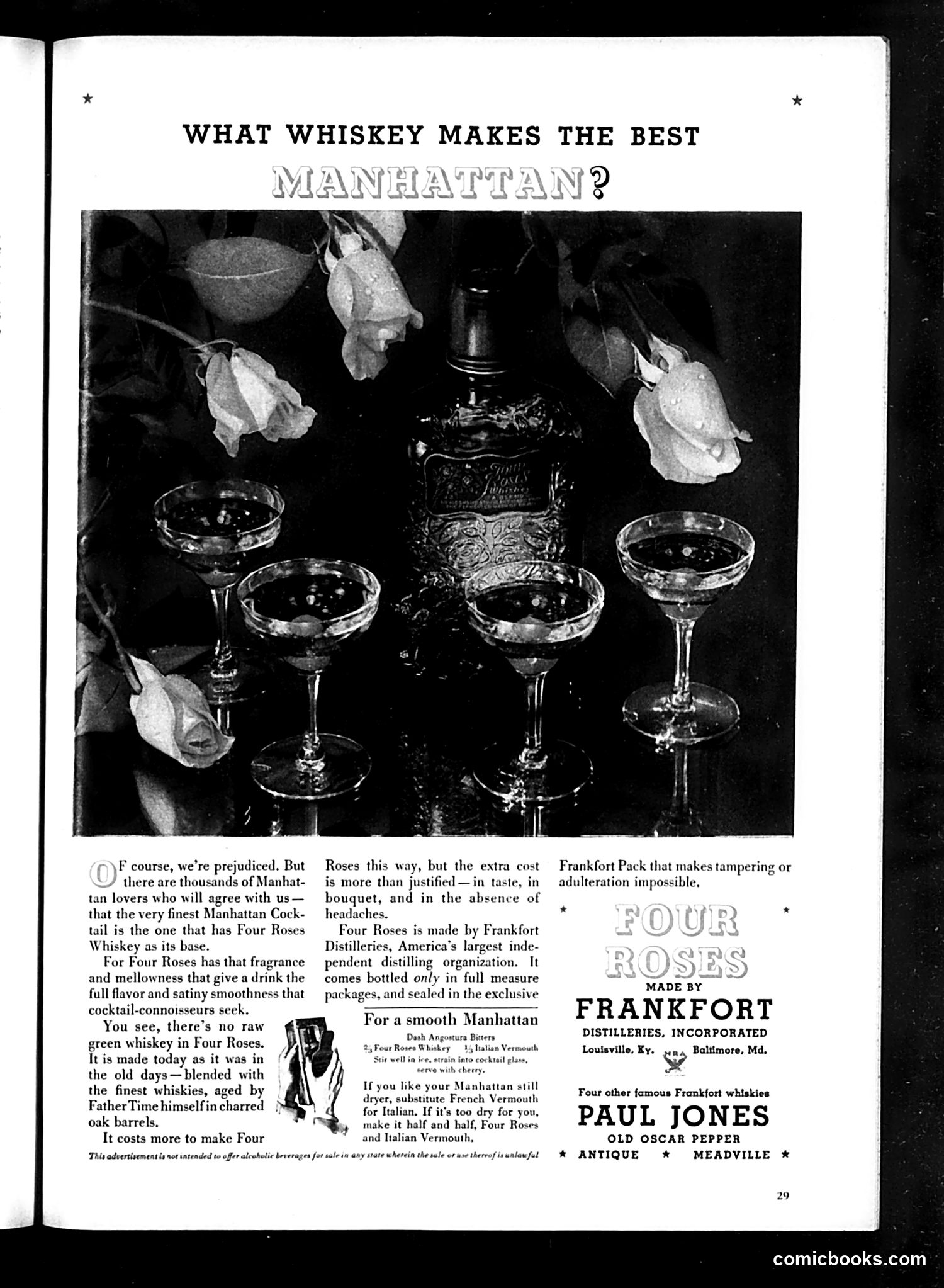
What This Page Means This is primarily a whiskey advertisement, not satire or political commentary. It promotes Four Roses whiskey as the superior choice for making a Manhattan cocktail. The page addresses a Prohibition-era concern: the quality and safety of alcohol. The ad emphasizes that Four Roses is properly aged in charred oak barrels (not raw/green whiskey) and comes in tamper-proof bottles—reassurances that mattered when illegal or adulterated liquor posed genuine health risks. The decorative roses and cocktail glasses create an upscale aesthetic, positioning Four Roses as a premium product for "cocktail-connoisseurs." The mention of "FatherTime" aging the whiskey is poetic marketing language. The fine print disclaimer about not offering alcohol "in any state wherein the sale or use thereof is unlawful" reflects Prohibition's complexity—some states had already begun repealing their bans by this publication's era, creating a patchwork legal landscape. This is sophisticated advertising capitalizing on emerging post-Prohibition consumer sophistication.
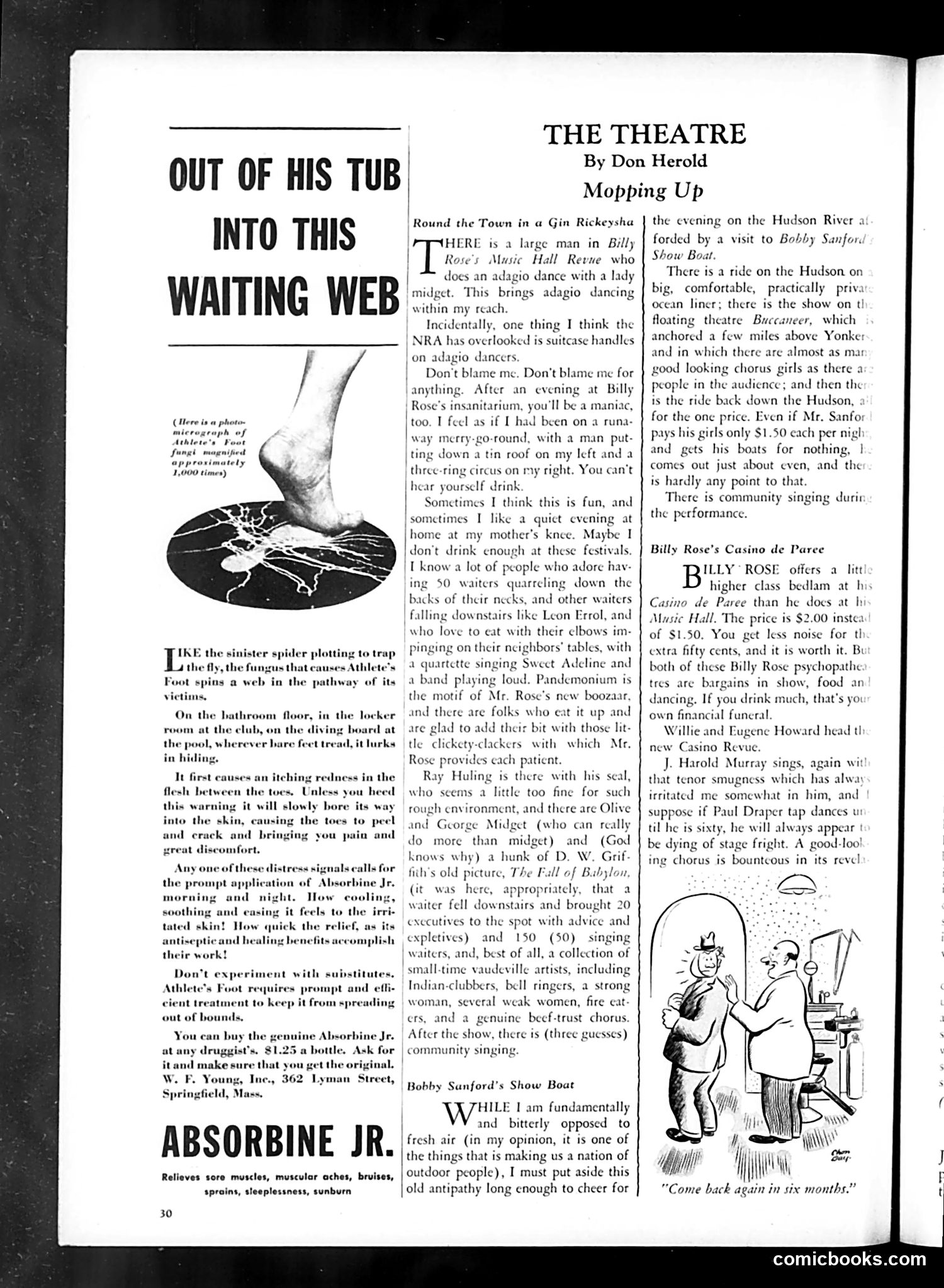
What This Page Means for Modern Readers This page contains theater reviews and advertisements from Life magazine's entertainment section. The main content reviews three New York nightclubs/theaters run by impresario Billy Rose: his Music Hall Revue, Casino de Paree, and the Show Boat. Critic Don Herold satirizes the chaotic, high-energy entertainment at these venues—featuring adagio dancers, live orchestras, dozens of waiters, and forced "community singing." His humor centers on the overwhelming sensory assault: loud bands, singing waiters, collapsing staff (comparing one to comic actor Leon Errol), and audiences expected to participate with noise-makers. The left side contains an advertisement for Absorbine Jr., a liniment for athlete's foot, with a microscopic photograph of fungi—common 1930s-40s medical advertising. The small cartoon depicts a patron asking to return within six months, mocking the show's chaotic appeal. Context: Billy Rose was a famous Broadway producer of this era known for extravagant, over-the-top productions.
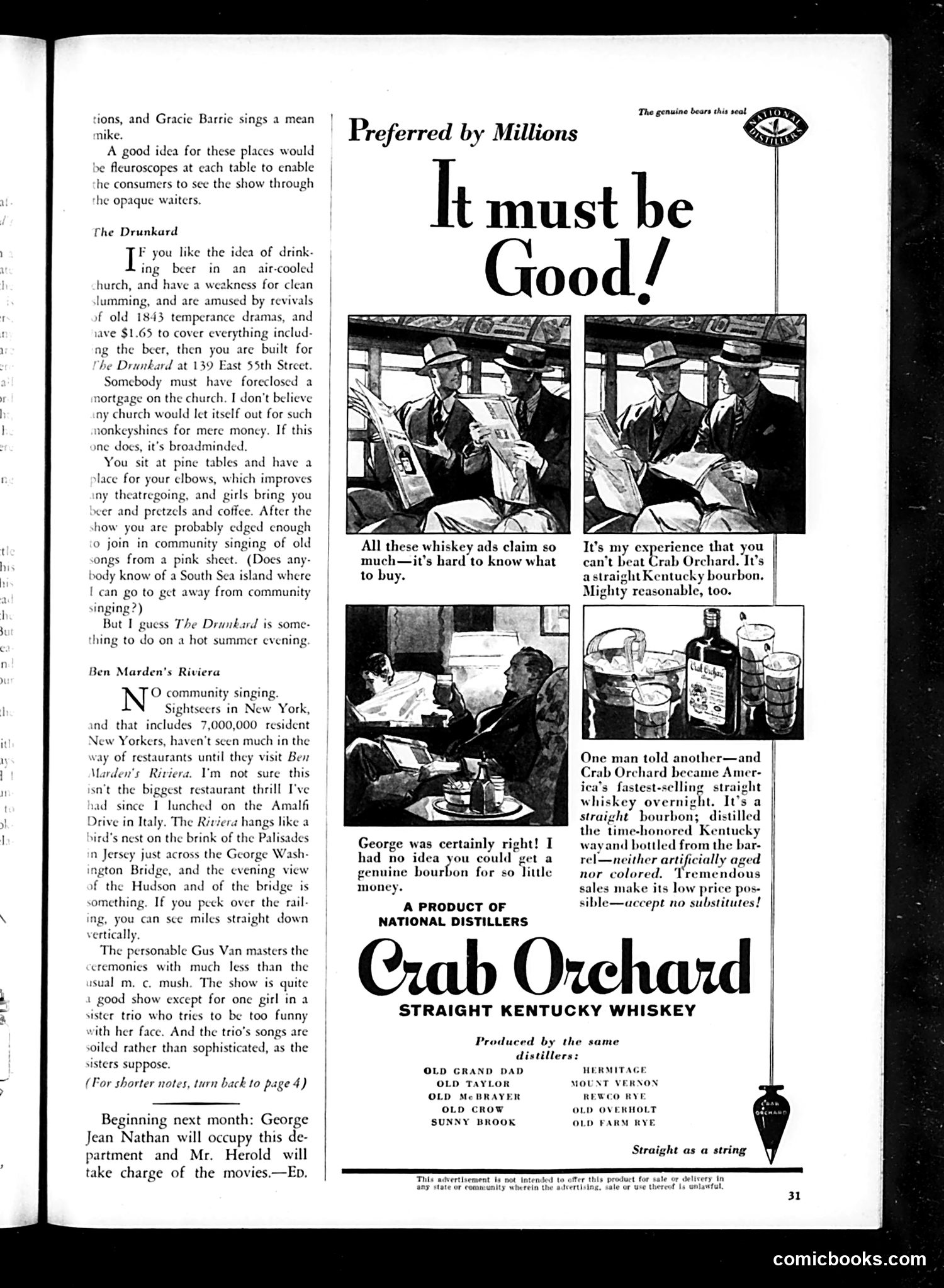
Content Analysis: Life Magazine Page This page contains restaurant/entertainment reviews alongside a whiskey advertisement. The reviews satirize New York leisure spots with characteristic mid-century snark. The Satire: The reviewer mocks "The Drunkard" (a theater serving beer during performances at a converted church) for its cheapness and forced community sing-alongs. The critique of Ben Marden's Riviera focuses on its gaudy spectacle—a riverside nightclub with mediocre entertainment, though the Hudson view is genuinely impressive. The Advertisement: A full-page Crab Orchard whiskey ad frames itself as consumer advice, showing men discussing competing bourbon brands. The ad's humor mimics the review's tone: it presents the product as surprisingly affordable and authentic ("straight bourbon...bottled from the barrel"), subtly mocking other whiskeys' exaggerated claims. Context for Modern Readers: This reflects 1930s-40s American attitudes: restaurants as theatrical experiences, church spaces commercialized without apparent scandal, and alcohol advertising that directly addressed consumer confusion in an unregulated market. The tone is urbane, somewhat cynical about entertainment marketing.
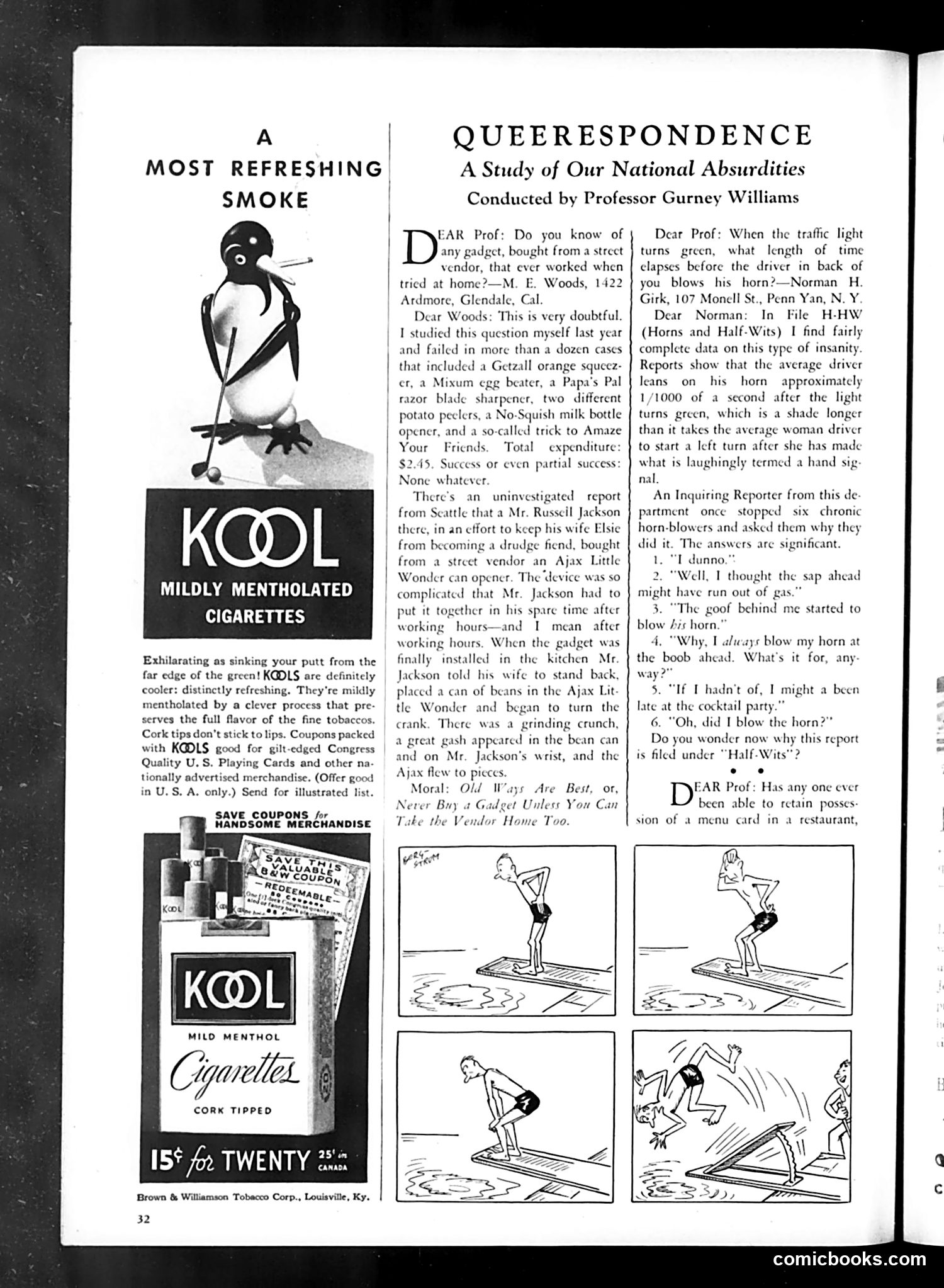
Explanation for Modern Readers This page contains two separate items: a Kool cigarettes advertisement and a humor column called "Queerespondence." The ad features a penguin smoking and emphasizes menthol as "refreshing"—appealing to mid-century smokers who valued cooling sensations. The humor column satirizes everyday American absurdities through reader letters: 1. Street vendor gadgets: Mocks the prevalence of cheap, worthless kitchen gadgets sold by street vendors—a common consumer complaint of the era. The example of the Ajax can opener injuring its user is the punchline. 2. Traffic horn behavior: Ridicules impatient drivers who honk immediately when lights turn green. The survey responses lampoon drivers' illogical reasoning and poor driving habits, with particular gentle mockery of women drivers' turning habits (a period stereotype). The column's tone is affectionately satirical about "national absurdities"—poking fun at consumer culture, driving etiquette, and everyday frustrations recognizable to Life's readers.
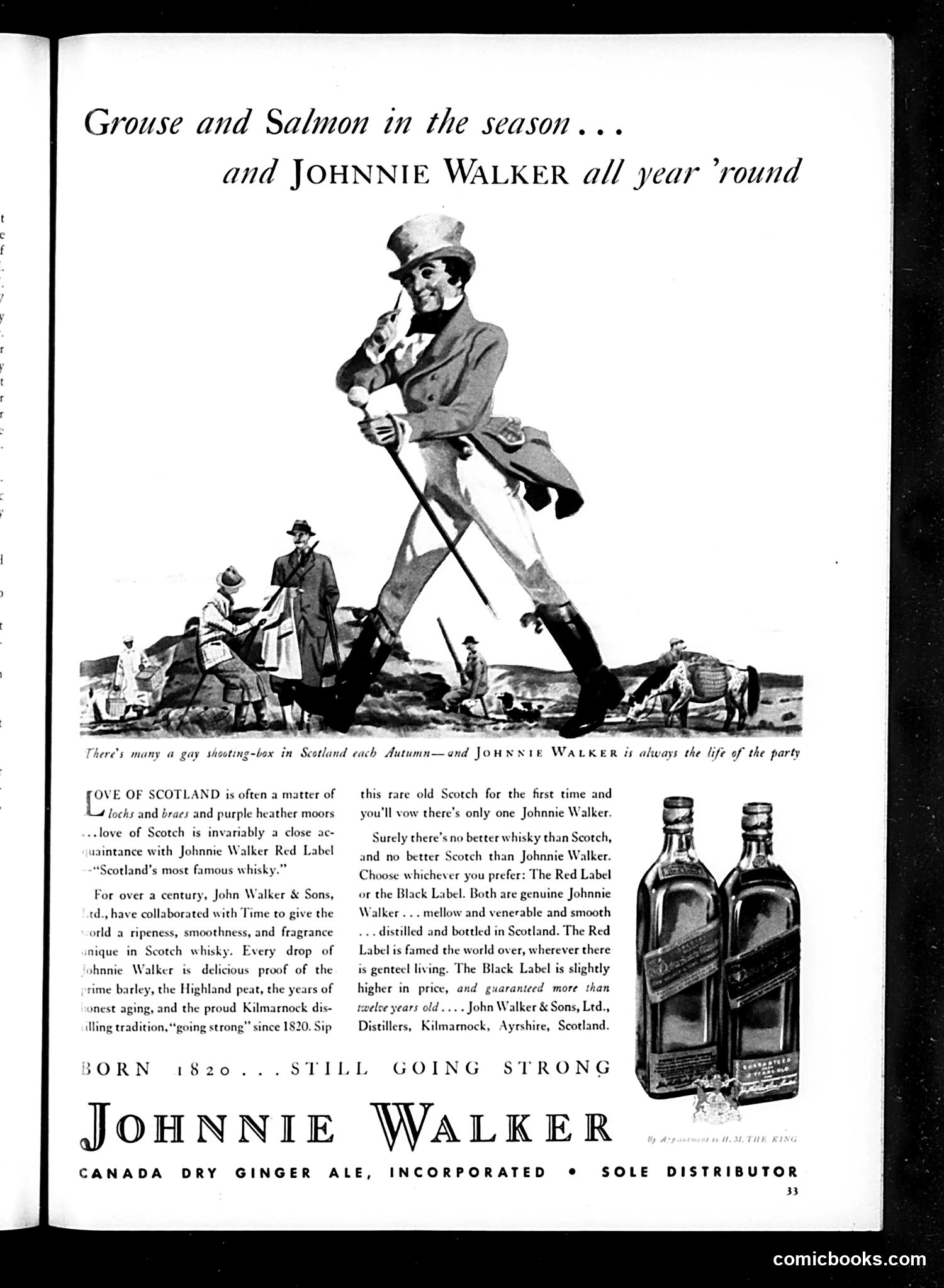
Johnnie Walker Whisky Advertisement (Life Magazine) This is a whisky advertisement, not political satire. It uses a giant anthropomorphic figure of "Johnnie Walker"—the brand's iconic mascot—towering over Scottish hunters and their game during autumn hunting season. The visual joke plays on the product name: "Johnnie Walker" is literally depicted as a striding, cheerful figure dominating the landscape, suggesting the whisky is as essential to Scottish leisure as grouse and salmon hunting. The text emphasizes the brand's heritage ("Born 1820"), Scottish authenticity (Highland peat, Kilmarnock distillery), and social prestige ("genteel living"). It positions Johnnie Walker as a year-round companion to seasonal activities, offering both Red and Black Label varieties. This reflects early-20th-century advertising's use of personified mascots and appeals to tradition and class status to market luxury goods.
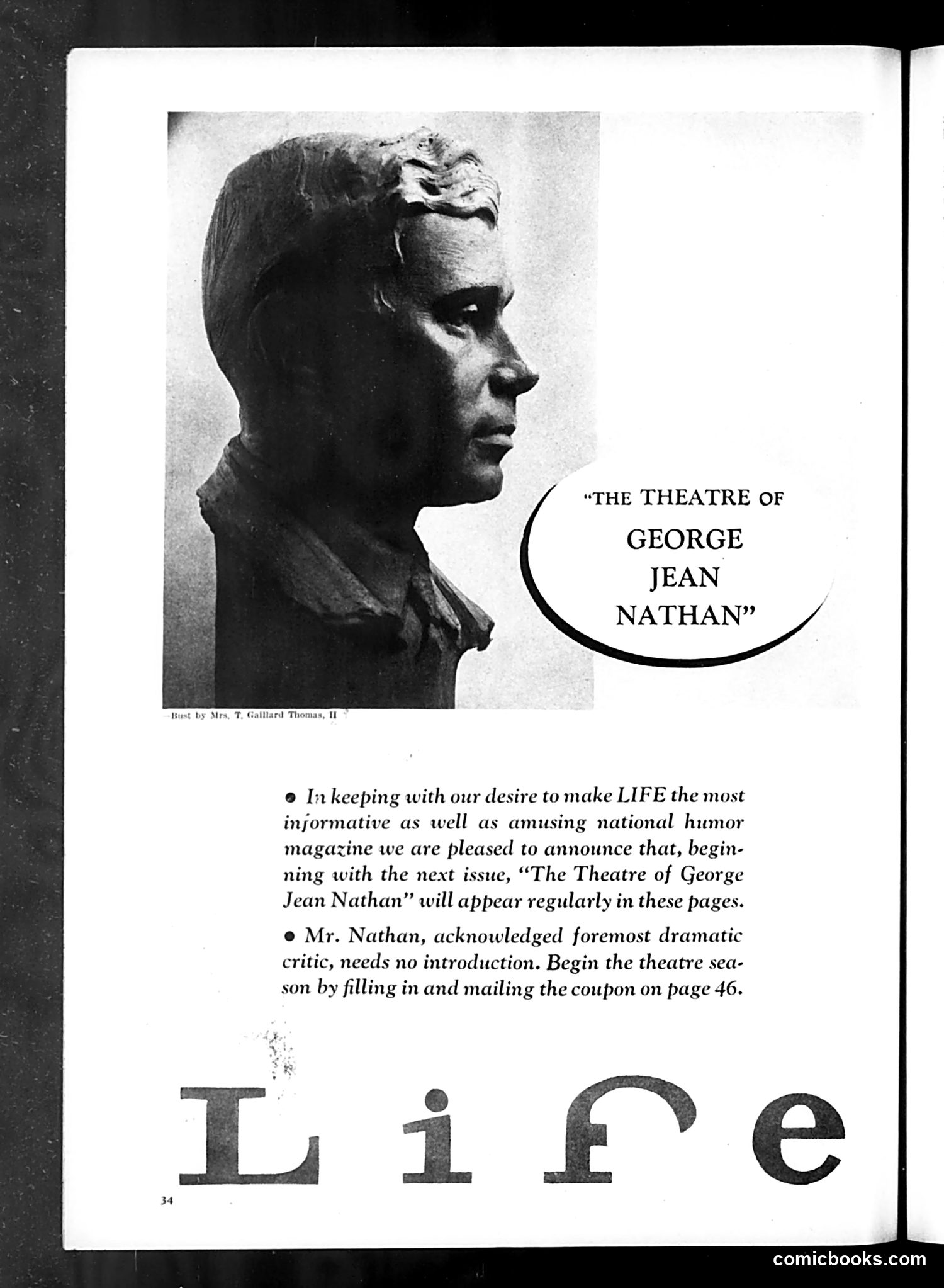
Analysis for Modern Readers This page announces a new regular column by George Jean Nathan, a prominent dramatic critic. The image shows a sculptural bust profile of Nathan by artist Mrs. T. Galliard Thomas. The satire is subtle: Life magazine presents Nathan's column as a major cultural event worthy of formal sculptural immortalization—treating theater criticism with mock-grandiose importance. The bust portrait humorously elevates what is essentially a opinion column to the status of fine art commemoration. Nathan was indeed "acknowledged foremost" theater critic of his era, so the joke isn't mocking him personally but rather the pretentiousness of theater world itself. Life frames this as an educational/amusing feature, inviting readers to subscribe for the upcoming theater season. The advertisement encourages readers to mail a coupon for subscription details, making this essentially a promotional page disguised as cultural commentary—typical of Life's satirical approach.
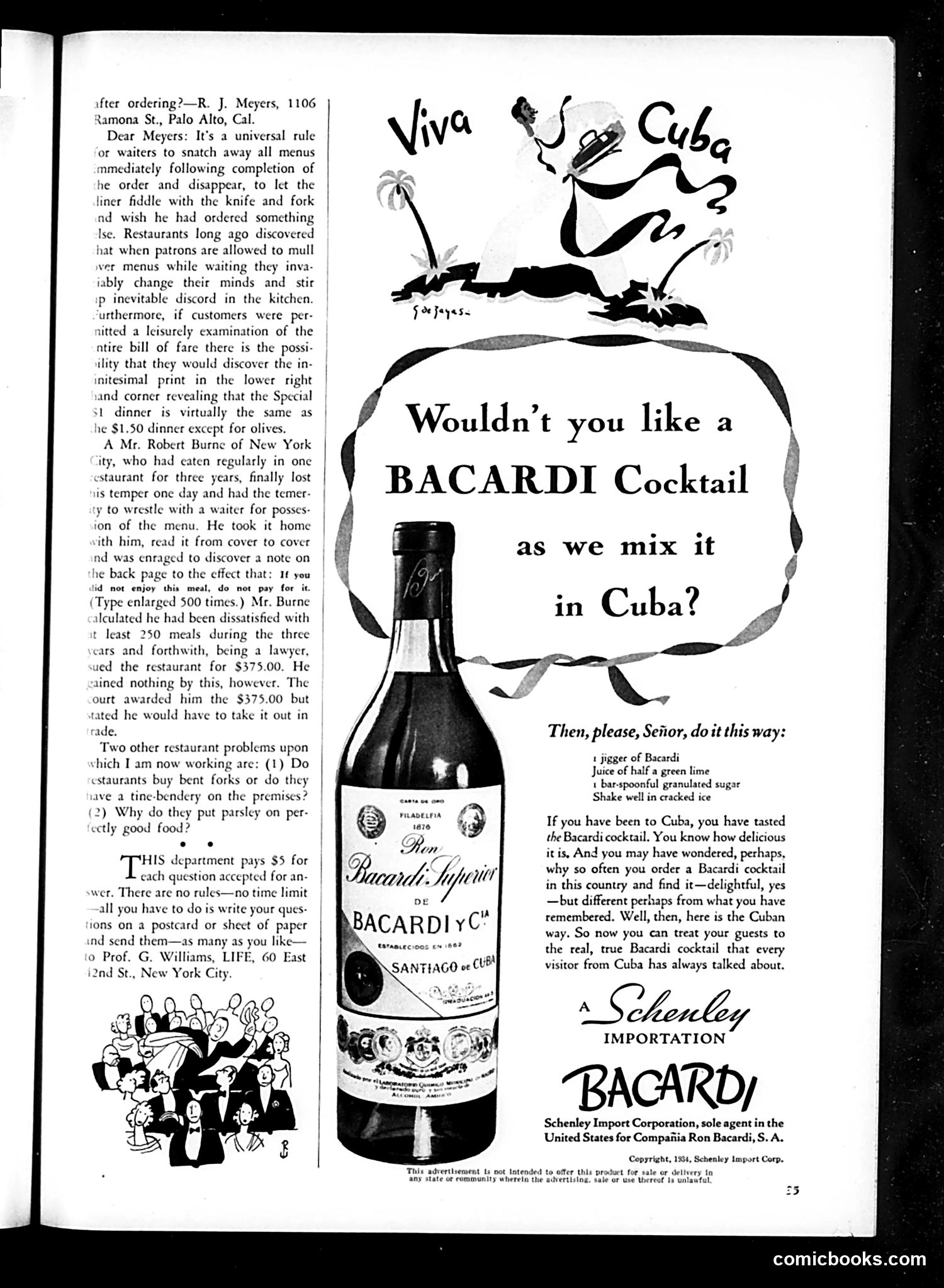
Life Magazine Page Analysis This page contains two distinct elements: Left side: A humorous advice column responding to reader questions about restaurant practices. It satirizes the universal restaurant custom of immediately removing menus after ordering to prevent customer second-guessing. The column includes an anecdote about a New York lawyer, Robert Burne, who wrestled a waiter for his menu and discovered a tiny-print disclaimer on the back stating "If you did not enjoy this meal, do not pay for it." He calculated 250 dissatisfying meals over three years and sued for $375—winning the award but having to accept it as restaurant credit. Right side: A Bacardi rum advertisement styled as Cuban travel promotion. It invites American readers to enjoy an authentic "Bacardi Cocktail as we mix it in Cuba," providing the recipe (Bacardi, lime juice, sugar, shaken ice). The ad capitalizes on mid-century American fascination with Cuba as an exotic destination, positioning the drink as an authentic Cuban experience available through Schenley Import Corporation. The page reflects 1950s consumer culture and restaurant industry commentary.
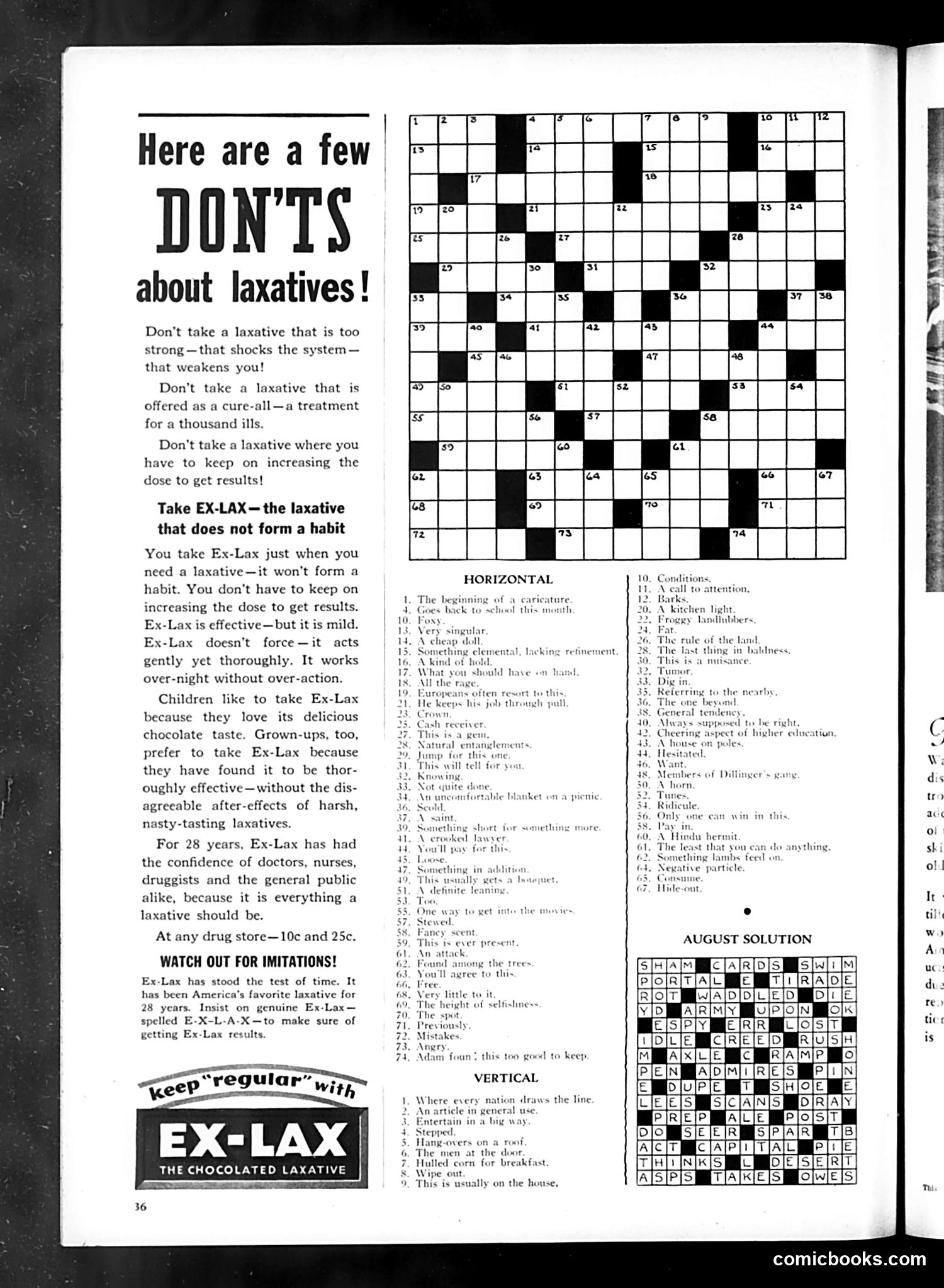
Ex-Lax Advertisement with Crossword Puzzle This page is primarily a pharmaceutical advertisement for Ex-Lax laxative, not political satire. The "DON'Ts" section lists warnings against laxative abuse—specifically avoiding overly strong products, cure-alls, and habit-forming doses. The advertisement emphasizes Ex-Lax's gentleness and non-habit-forming properties, appealing to both children (highlighting chocolate taste) and adults. It claims 28 years of medical trust. The crossword puzzle on the right is filler content, unrelated to the advertisement. The clues reference everyday items and concepts typical of vintage crossword construction. This reflects early-to-mid 20th century marketing: remedies for constipation were common advertised products, and the emphasis on avoiding "shock to the system" reflects period medical anxieties about digestive health. The chocolate formulation was a genuine marketing innovation to improve palatability.
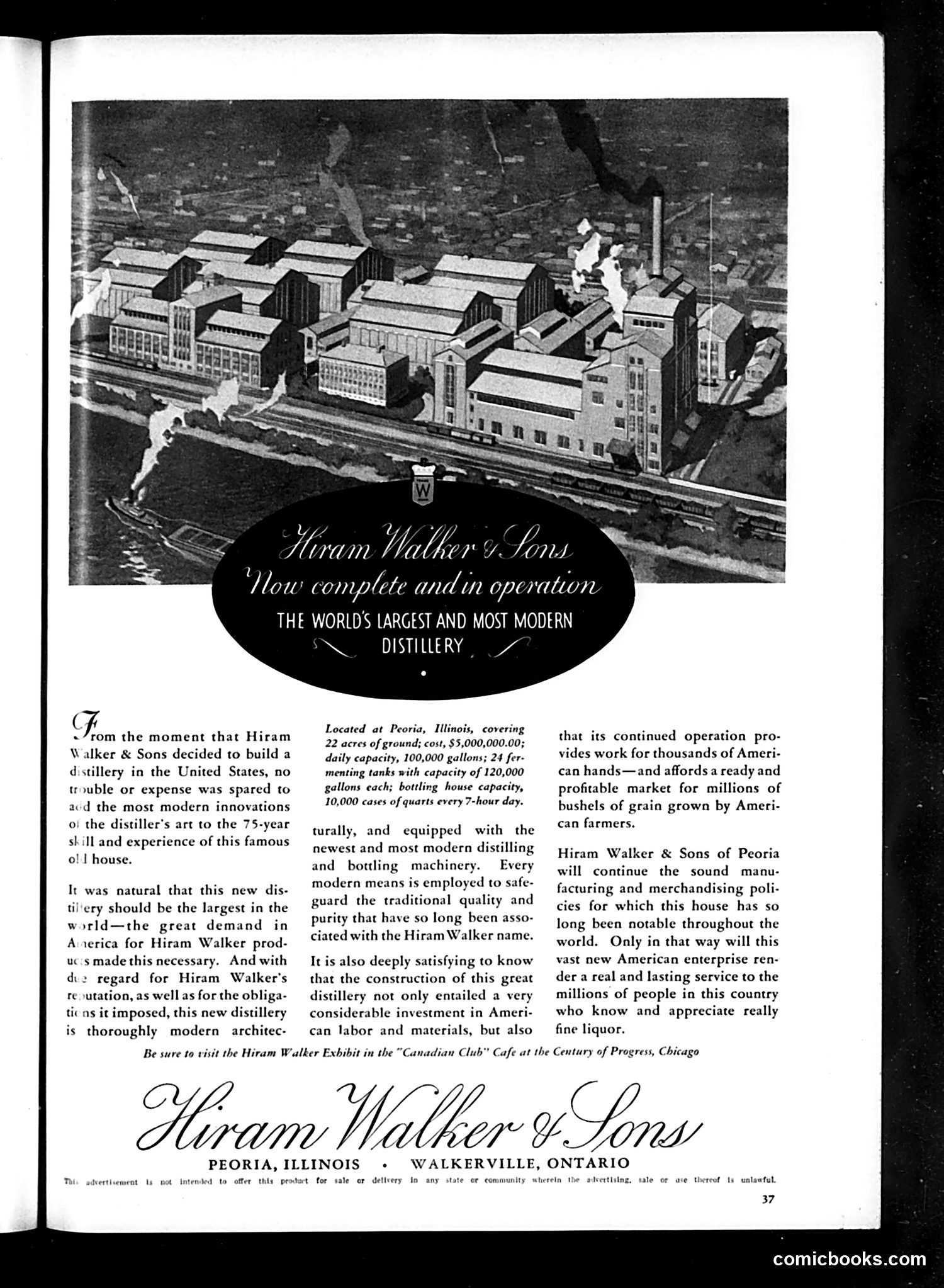
Analysis This is not a cartoon or satire—it's a full-page advertisement for Hiram Walker & Sons distillery, published during Prohibition's end (the ad references the 1933 Chicago World's Fair). The page celebrates the opening of a massive new distillery in Peoria, Illinois, presenting it as an economic achievement: $5 million investment, 22 acres, employment for thousands, and a market for American grain farmers. The aerial photograph shows an industrial complex of modern buildings and tanks. The text emphasizes legitimacy and tradition—the company's 75-year heritage, "sound manufacturing," and commitment to "quality and purity." This messaging was crucial: distilleries needed to rebrand after Prohibition as respectable, job-creating enterprises rather than sources of illegal whiskey. For modern readers, this represents how American business marketed the literal restart of legal alcohol production in the 1930s Depression era, framing it patriotically as industrial progress and agricultural support.
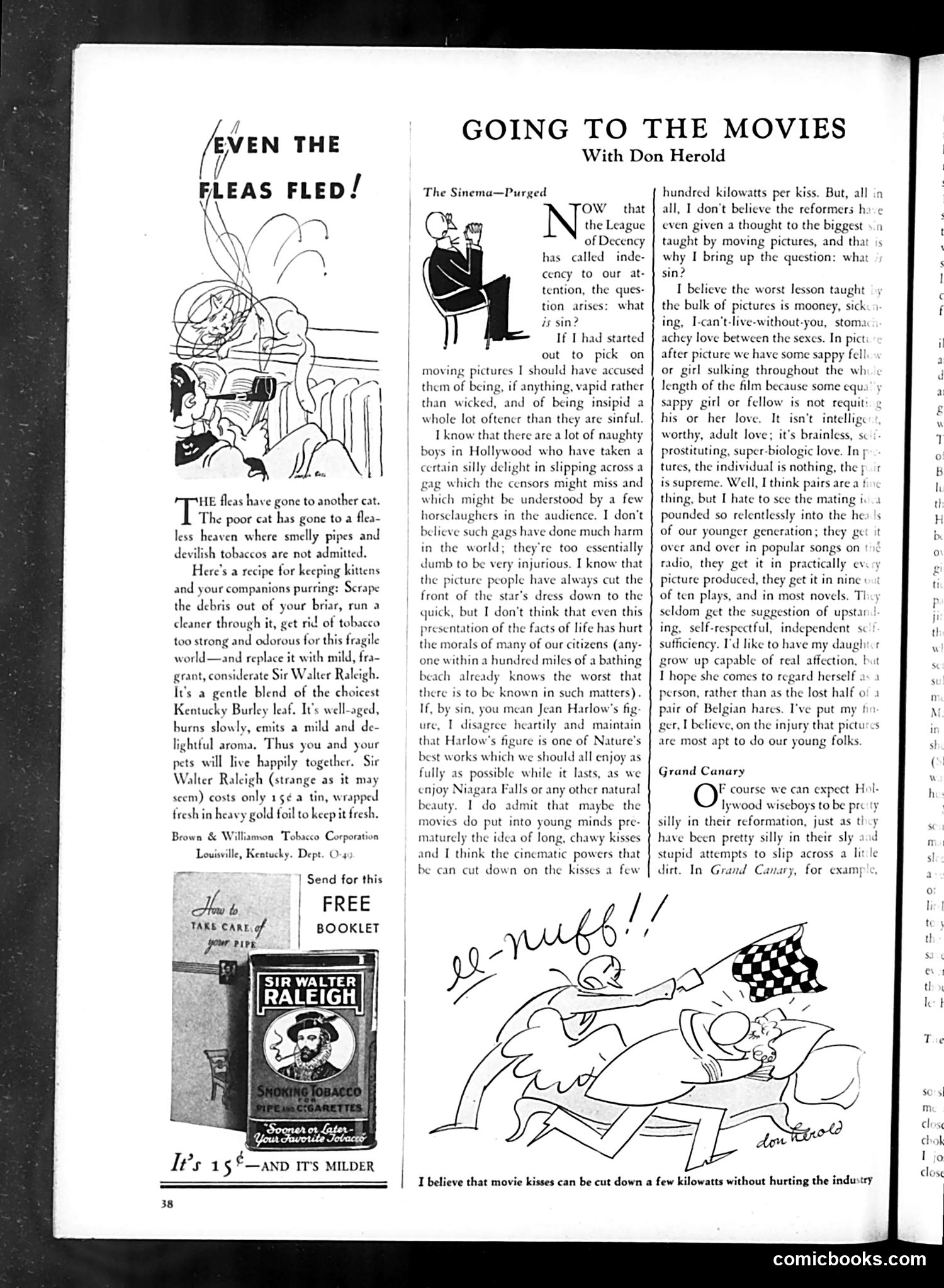
Analysis of This Life Magazine Page This page contains two distinct sections: Left side: A tobacco advertisement disguised as humor. A cartoon shows a cat scratching fleas with the headline "Even the Fleas Fled!" The joke suggests Sir Walter Raleigh pipe tobacco is so mild and pleasant that even parasites abandon it. This is pure advertising for a 15-cent tobacco product. Right side: "Going to the Movies" by Don Herold critiques Hollywood's moral content. Herold argues that while reformers (likely referring to the "League of Decency" mentioned) obsess over sexual imagery and kissing scenes, they miss the real problem: movies promote unhealthy, dependent romantic love between sexes. He specifically references Jean Harlow and complains that films teach young people—particularly young women—that personal identity should dissolve into romantic attachment rather than developing self-respect and independence. The piece reflects 1930s debates over film censorship and gender roles, with Herold advocating for stronger, more self-sufficient women rather than the "sappy" romantic heroines Hollywood produced.
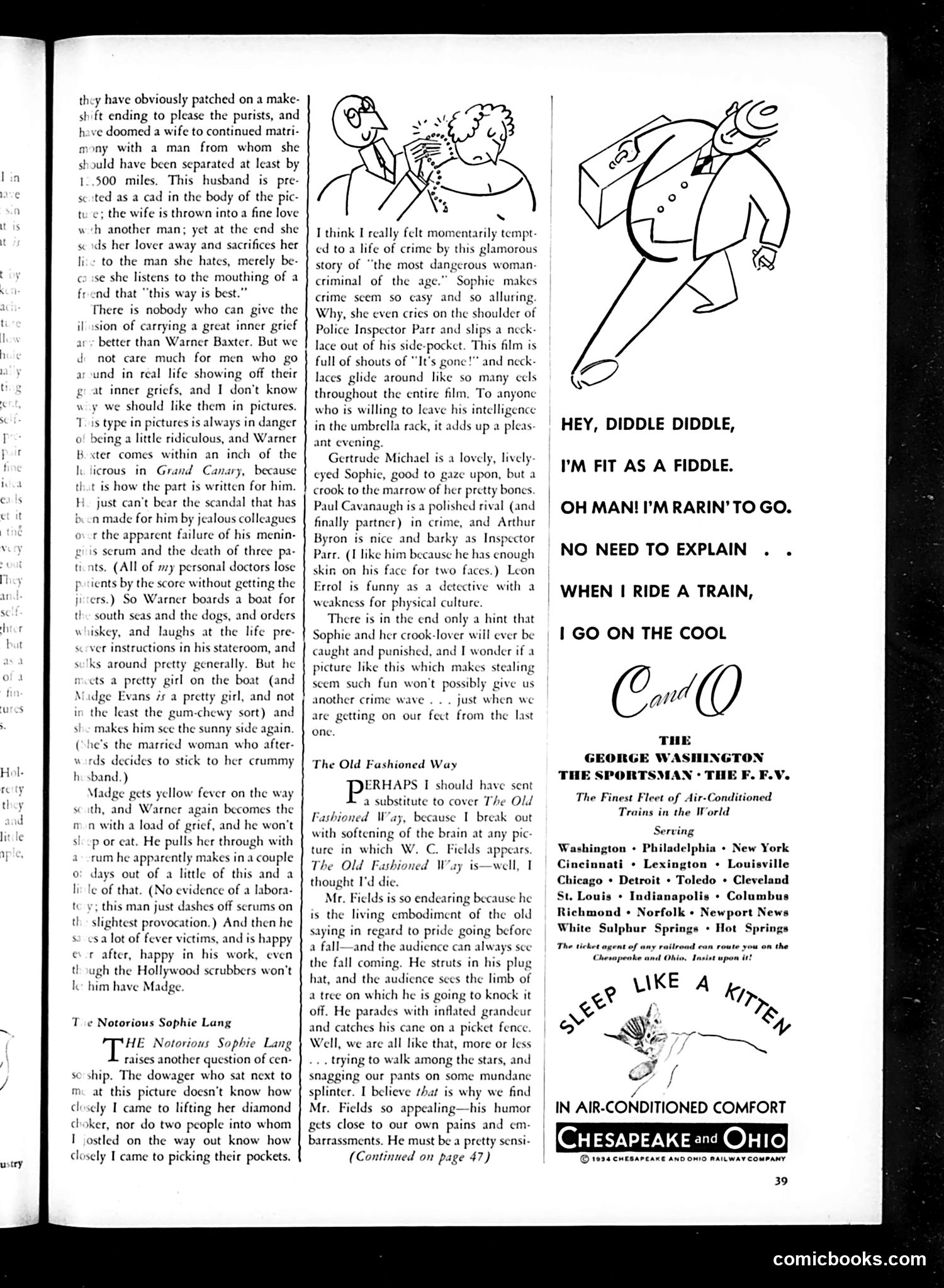
Content Analysis: Life Magazine Film Reviews Page This page contains film reviews from Life magazine's entertainment section. The critic discusses three movies: "Grand Canary" — A melodrama where Warner Baxter plays a disgraced doctor who boards a ship, falls for a married woman (Madge Evans), then heroically saves her when she contracts yellow fever. The reviewer criticizes the contrived "happy ending" that reunites the heroine with her despicable husband rather than her true love, and finds Baxter's portrayal of masculine grief somewhat ridiculous and self-indulgent. "The Notorious Sophie Lang" — A crime film the critic worries glorifies theft. The reviewer humorously admits feeling tempted to pickpocket audience members after watching jewel thief Sophie Lang (played by Gertrude Michael) so charmingly steal throughout the film, joking this might inspire a new crime wave. The page includes period advertisements for train services and a Chesapeake and Ohio Railway ad. The tone is witty, gossipy social commentary typical of 1930s entertainment journalism.
Page Analysis: Life Magazine This page combines advertising (left) with humorous fiction and poetry (right). The Park Lane advertisement promotes luxury short-term apartment rentals on Park Avenue—positioning it as a sophisticated alternative to hotels for wealthy New York visitors. The main content is "An Idea That Bore Fruit," a comedic short story by E.B. Crosswhite about domestic deception. When Mrs. Niffley cannot find grapefruit for breakfast, a resourceful druggist (Mr. Thripp) substitutes a rubber ball coated with gelatin, sugar, and quinine. The joke: her husband Mr. Niffley cannot tell the difference, especially after she squirts vinegar in his eyes (ostensibly to enhance the "grapefruit" experience). The satire mocks both marital conflict over trivial matters and 1920s-30s consumer culture's faith in ersatz solutions. Below is a brief "Triolet" poem by Margaret Fishback complaining about mixing carrots and peas—seemingly a lighthearted companion piece about culinary preferences.
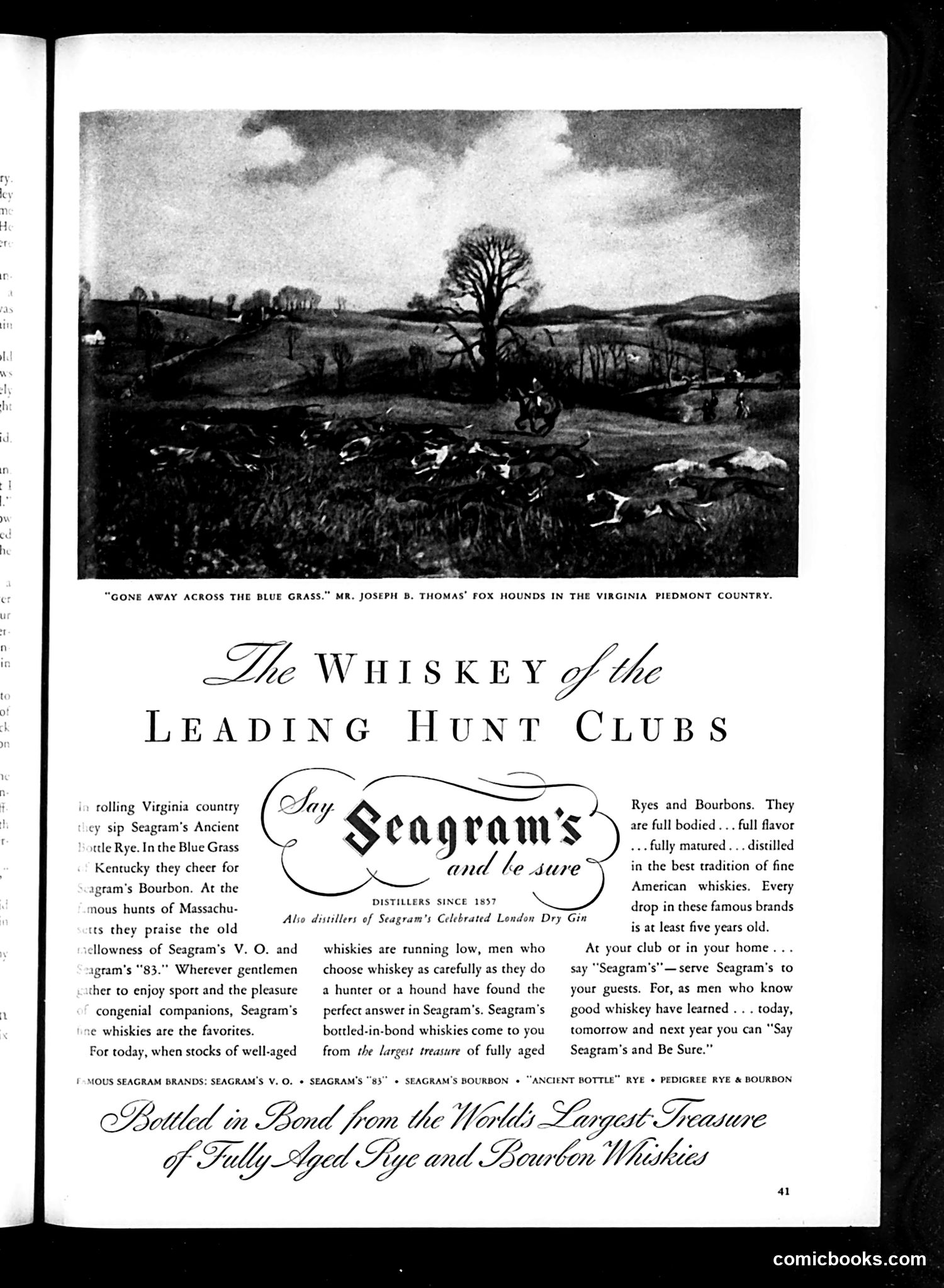
Analysis This is a Seagram's whiskey advertisement, not political satire. The page features a landscape photograph of fox hunting in Virginia's Piedmont region—a genteel, upper-class sporting activity—paired with marketing copy. The ad positions Seagram's whiskey as the drink of choice at exclusive hunt clubs across America (Virginia, Kentucky, Massachusetts). It appeals to wealthy, sophisticated men by linking the product to their leisure activities and social status. The phrase "Say Seagram's and Be Sure" served as the brand's slogan. The reference to "bottled-in-bond" whiskeys emphasizes authenticity and age (five years minimum), suggesting quality and prestige. By associating their product with fox hunting culture and gentlemanly pursuits, Seagram's marketed whiskey as essential to upper-class social life during what appears to be the pre-Prohibition or early post-Prohibition era (given the emphasis on "fully aged" stock availability).
Analysis for Modern Readers This page is primarily advertising (Noilly Prat vermouth, apartments, hotel suites) surrounding a satirical essay titled "Contents Noted" by Kyle Crichton. The satire concerns: A 1930s "Hollywood-Church campaign"—an effort by religious groups to censor motion pictures and literature deemed immoral. Crichton mocks the campaign's hypocrisy and reach. Key targets: - Hollywood executives (Laemmle, Sheehan, Thalberg, Minter) whom censors are trying to intimidate - Religious censors who destroyed Theodore Dreiser's *Sister Carrie* decades earlier and now aim to expand censorship beyond film to stage and books - Harold Bell Wright, a moralist author Crichton considers genuinely immoral for his sentimentality and "perversion of the human mind"—contrasted unfavorably with Noel Coward The point: Crichton argues censors target Hollywood's *vulgarity* while ignoring actual moral corruption in "respectable" literature, and warns that religious control over culture threatens deeper freedoms than Hollywood's cheapness ever could.
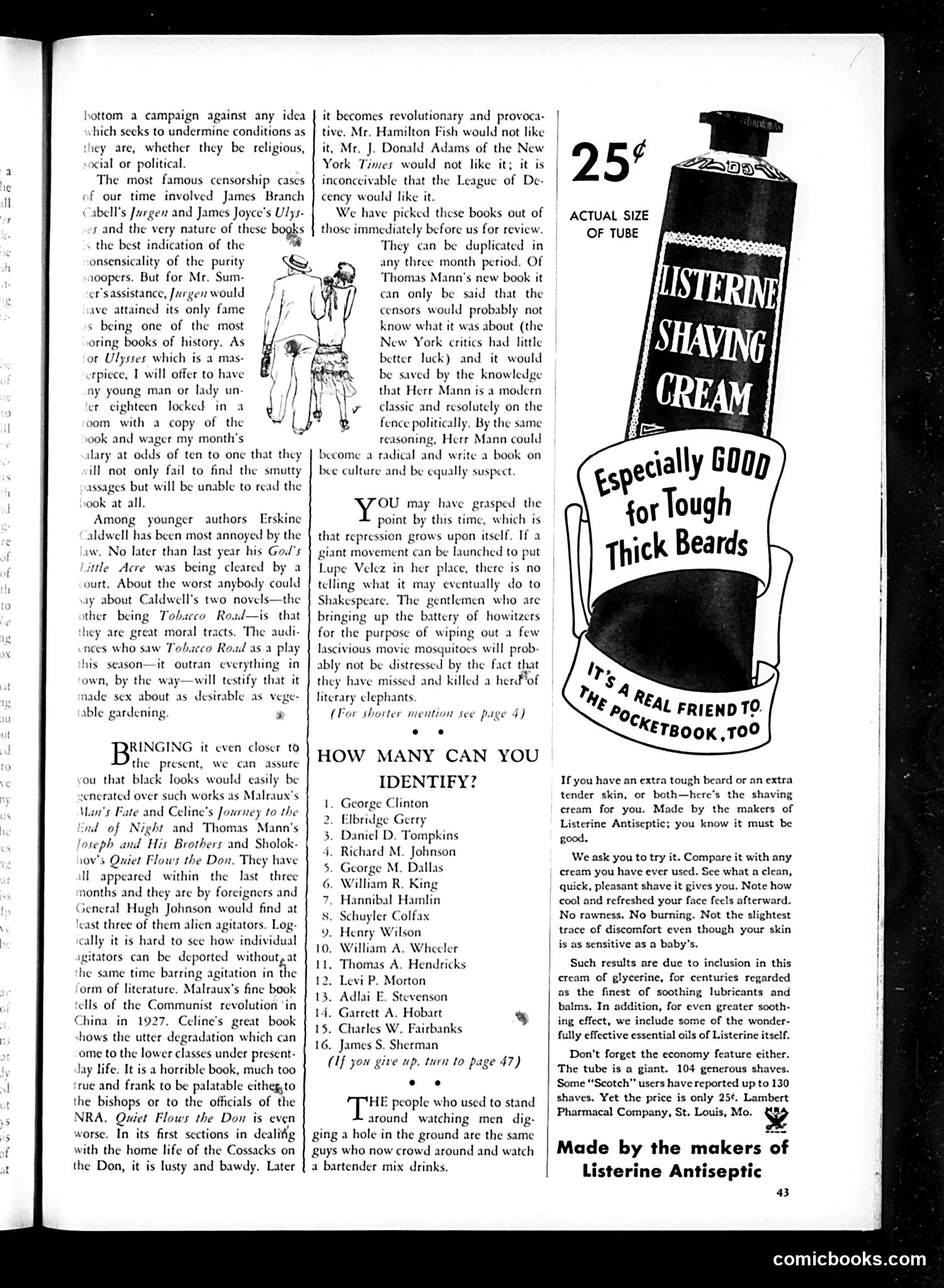
Political Satire on Censorship (Life Magazine) This page satirizes American censorship campaigns of the 1930s. The author argues that censors targeting "immoral" books—like Joyce's *Ulysses* and Caldwell's *God's Little Acre*—are hypocrites who haven't actually read the works they condemn. The piece names real figures opposing such literature: Hamilton Fish (conservative congressman) and J. Donald Adams (New York Times critic), alongside the League of Decency (Catholic censorship organization). The author defends foreign literary masterworks (*Man's Fate*, *Quiet Flows the Don*) as serious art, not propaganda, while mocking fears they represent "alien agitation." The core satirical point: censorship efforts against minor "offensive" content will inevitably expand to suppress serious literature and political speech—"kill a herd of literary elephants" while swatting "mosquitoes." The unrelated Listerine advertisement on the right is period advertising, not editorial content.
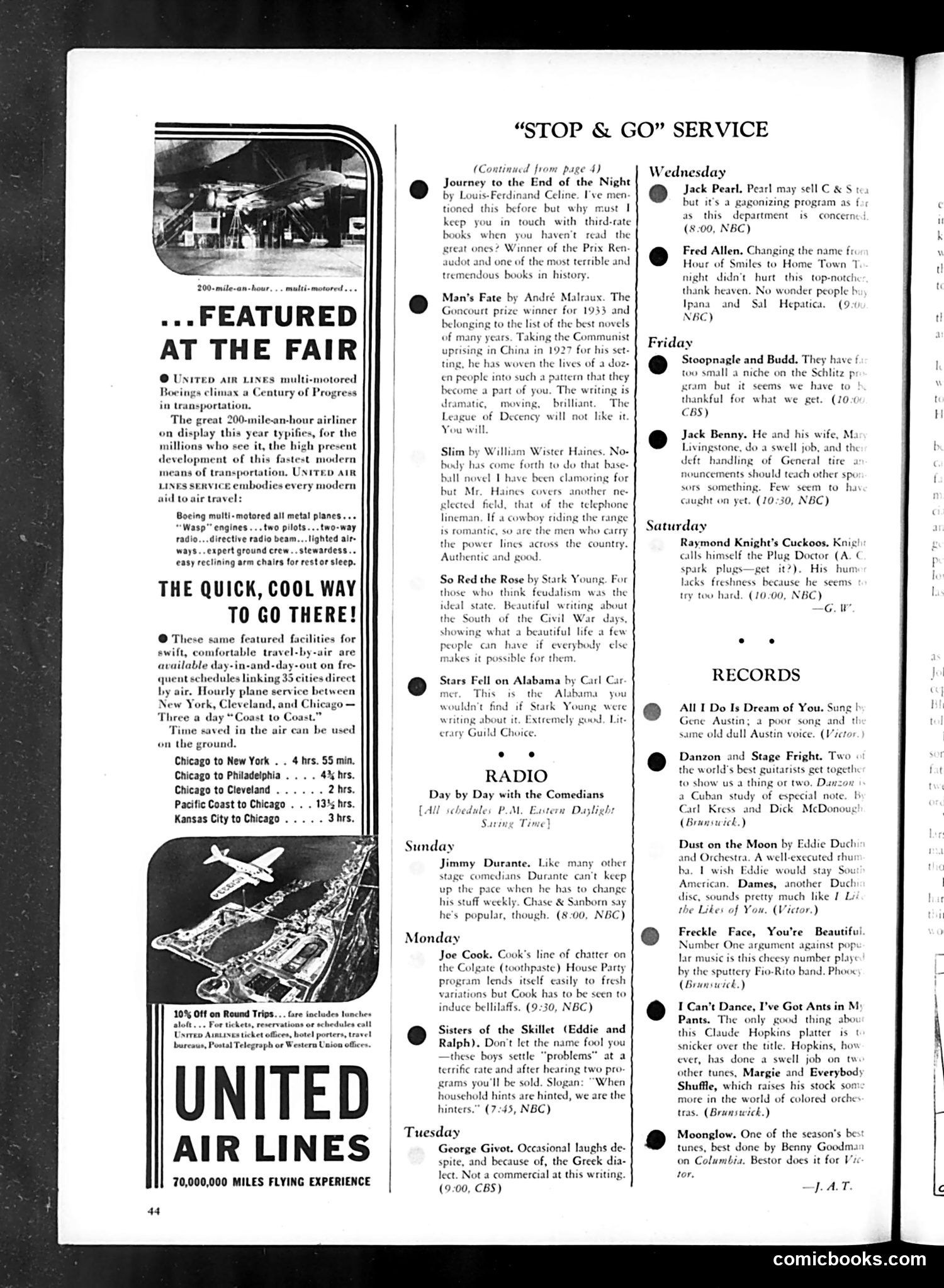
Life Magazine Page Analysis This page is primarily advertising and programming guides, not political satire. The left side features a United Air Lines advertisement promoting their modern Boeing aircraft displayed at what appears to be the 1933 Chicago "Century of Progress" World's Fair. The ad emphasizes technological advancement: multi-motored planes, two-way radios, expert crews, and reclining chairs. Flight times between major cities are listed to demonstrate speed superiority over ground travel. The right side contains "Stop & Go" Service—a weekly radio and book recommendations column. It reviews recent novels (including works by Céline and Malraux) and radio comedy programs airing on NBC and CBS, with broadcast times. The satirical element is subtle: the column's title ironically contrasts with the advertisement's emphasis on speed and progress. The juxtaposition suggests American consumer culture oscillates between technological enthusiasm and traditional entertainment, though this appears incidental rather than intentional satire. The page reflects 1930s optimism about aviation and mass media as markers of modernity.
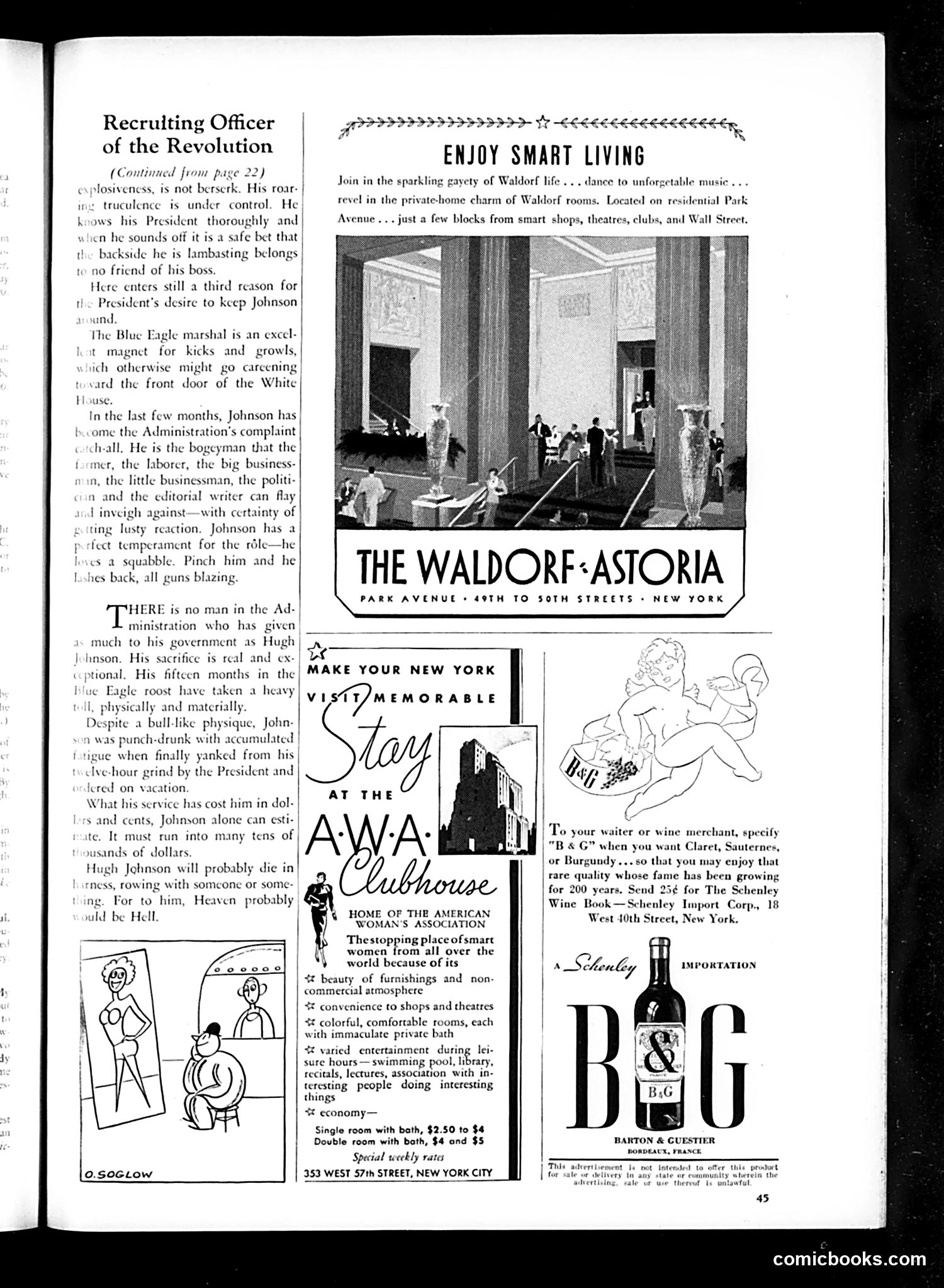
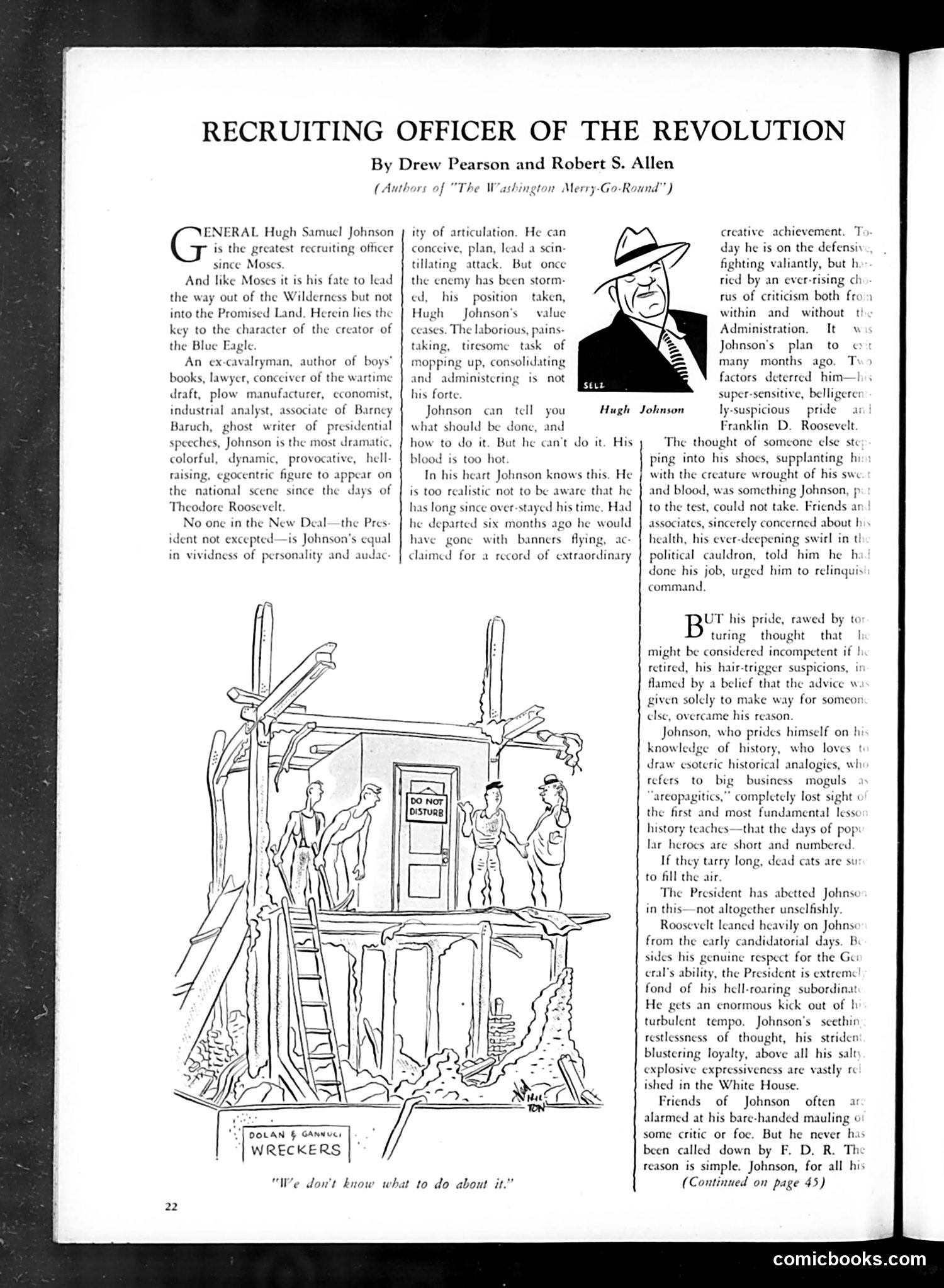
Analysis for Modern Readers The article discusses Hugh Johnson, head of the New Deal's Blue Eagle program (NRA—National Recovery Administration). The text praises Johnson as an indispensable but exhausted administrator who absorbs public complaints and criticism, serving as a "bogeyman" that farmers, laborers, businessmen, and politicians can attack while leaving President Roosevelt unscathed. Johnson is portrayed as physically and financially depleted by his service, yet temperamentally suited to absorb punishment without breaking. The small O. Soglow cartoon (left) appears to illustrate Johnson's role as a punching bag—a figure being hit or criticized while remaining standing. The page is otherwise advertisements for luxury hotels, clubs, and wine—incongruously juxtaposed against an article about New Deal sacrifice and exhaustion, likely satirizing the contrast between Depression-era austerity rhetoric and wealthy Manhattan leisure.
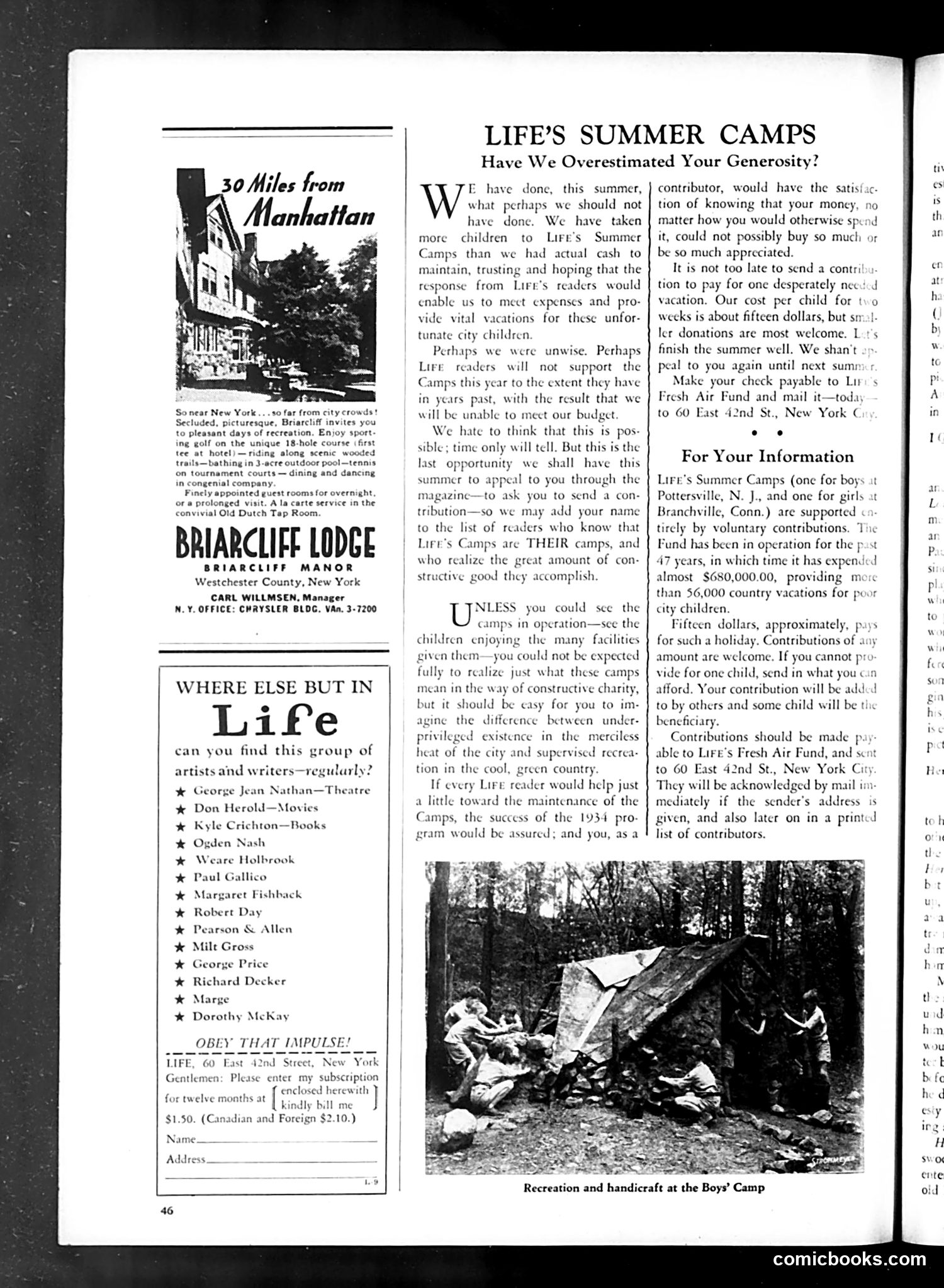
Life Magazine Summer Camps Appeal (1934) This page combines advertisements with a charitable fundraising appeal. The Briarcliff Lodge ad (top left) ironically juxtaposes luxury recreation—golf, riding, dining—available to wealthy patrons with the magazine's plea for donations to send poor city children to summer camps. The main article is Life magazine's honest admission that they've overcommitted: they've enrolled more children in their Fresh Air Fund camps than they have cash to support. The magazine appeals directly to readers for contributions (fifteen dollars per child for two weeks). The piece names contributors including prominent writers and humorists (Ogden Nash, Kyle Crichton, etc.), establishing Life's editorial credibility on charitable matters. A photograph shows children at the boys' camp enjoying outdoor recreation. This represents 1934 Depression-era philanthropy: Life, a commercial publication, positioned itself as a social institution providing "constructive charity" for underprivileged urban children while simultaneously selling luxury resort vacations and magazine subscriptions.
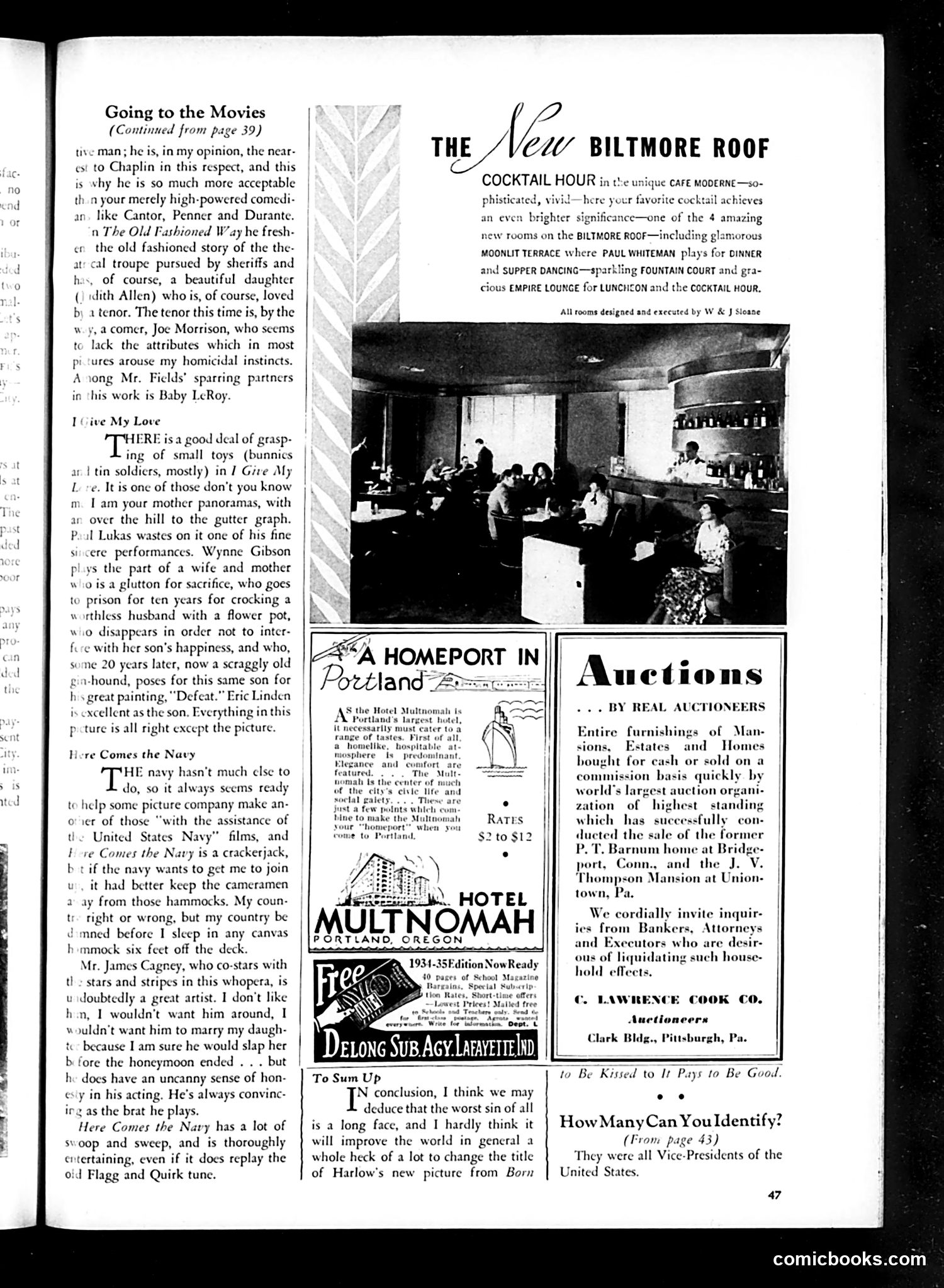
Page Analysis: Life Magazine, circa 1934 This page primarily contains movie reviews and advertisements rather than political cartoons. The main content is a film critic's assessments of recent movies: Film Reviews: - *The Old Fashioned Way* (W.C. Fields vehicle) praised for Fields' comedic acting - *Give My Love* - domestic drama criticized as mediocre despite good performances - *Here Comes the Navy* - a James Cagney film about naval life, entertaining but conventional The critic praises Cagney's acting ability while admitting personal dislike of his on-screen persona ("wouldn't want him to marry my daughter"). Advertisements dominate the right side: - Biltmore Roof cocktail lounge (with nightclub amenities) - Hotel Multnomah in Portland - DeLong Sub Agency (1934 edition merchandise) - C. Lawrence Cook Co. auctioneers The closing section references a Jean Harlow film titled *Born* (likely *Born to Be Kissed*). No political satire appears on this page — it's purely entertainment industry content typical of Life's magazine format from the 1930s.
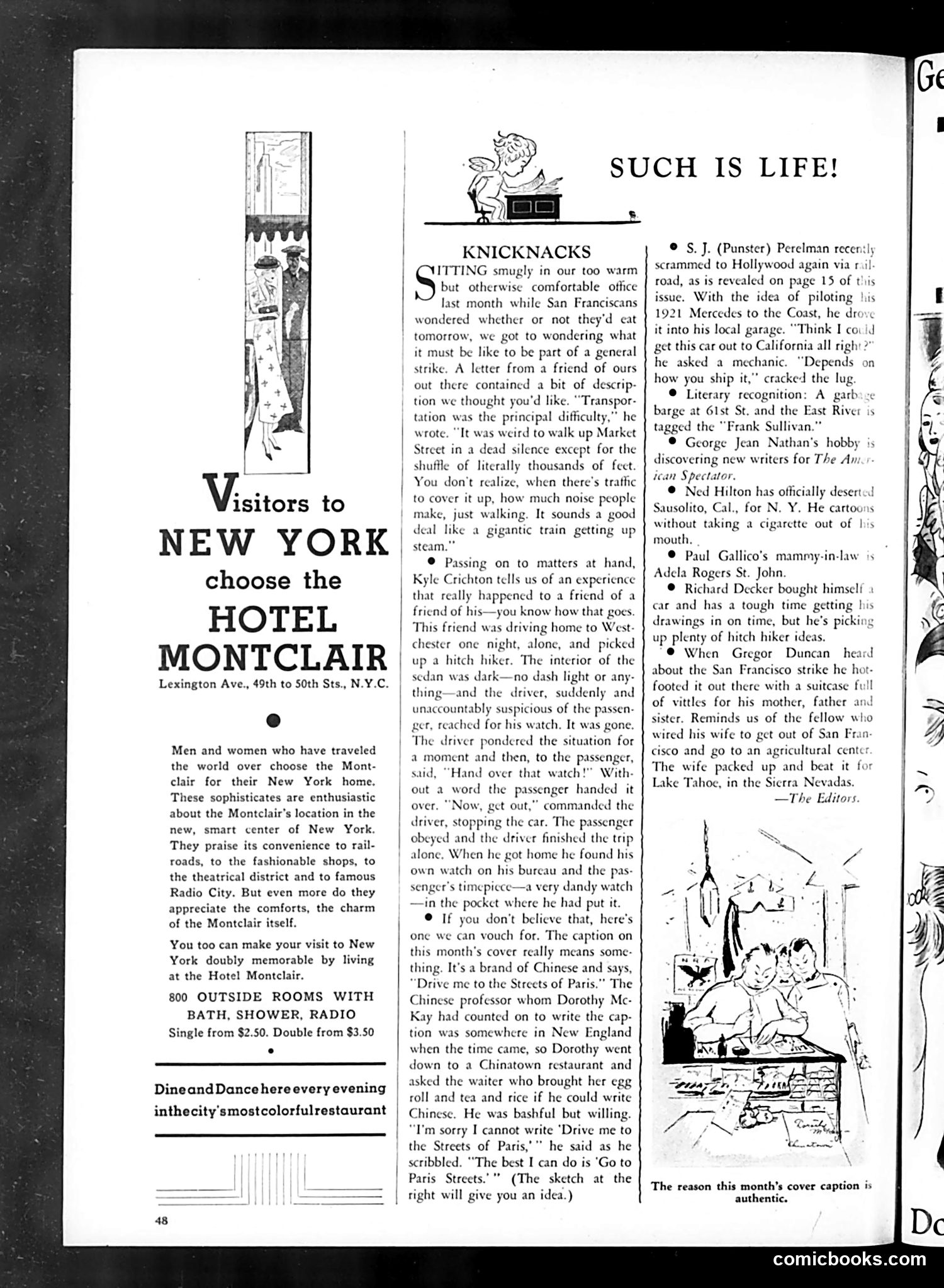
Explanation for Modern Readers This page is primarily a hotel advertisement (Montclair Hotel) with a secondary humor column titled "Knicknacks." The "Knicknacks" section contains brief anecdotes and celebrity gossip rather than political satire. The main items include: 1. San Francisco strike reference: A description of a general strike's eerie quiet on Market Street—likely the 1921 Pacific Coast maritime strike. 2. Hitchhiker anecdote: A cautionary tale about a paranoid driver who steals a hitchhiker's watch, only to discover he'd already misplaced his own. 3. Chinese restaurant joke: A waiter cannot write the phrase "Drive me to the Streets of Paris" in Chinese, managing only "Go to Paris Streets"—a mild humor piece about translation limitations. The remaining items are brief mentions of writers and celebrities (S.J. Perelman, George Jean Nathan, etc.) in the gossip-column style typical of *Life* magazine. This is not political cartoon satire but rather lifestyle content mixing advertising with light social humor for a sophisticated 1920s audience.