life
Life — October 1934
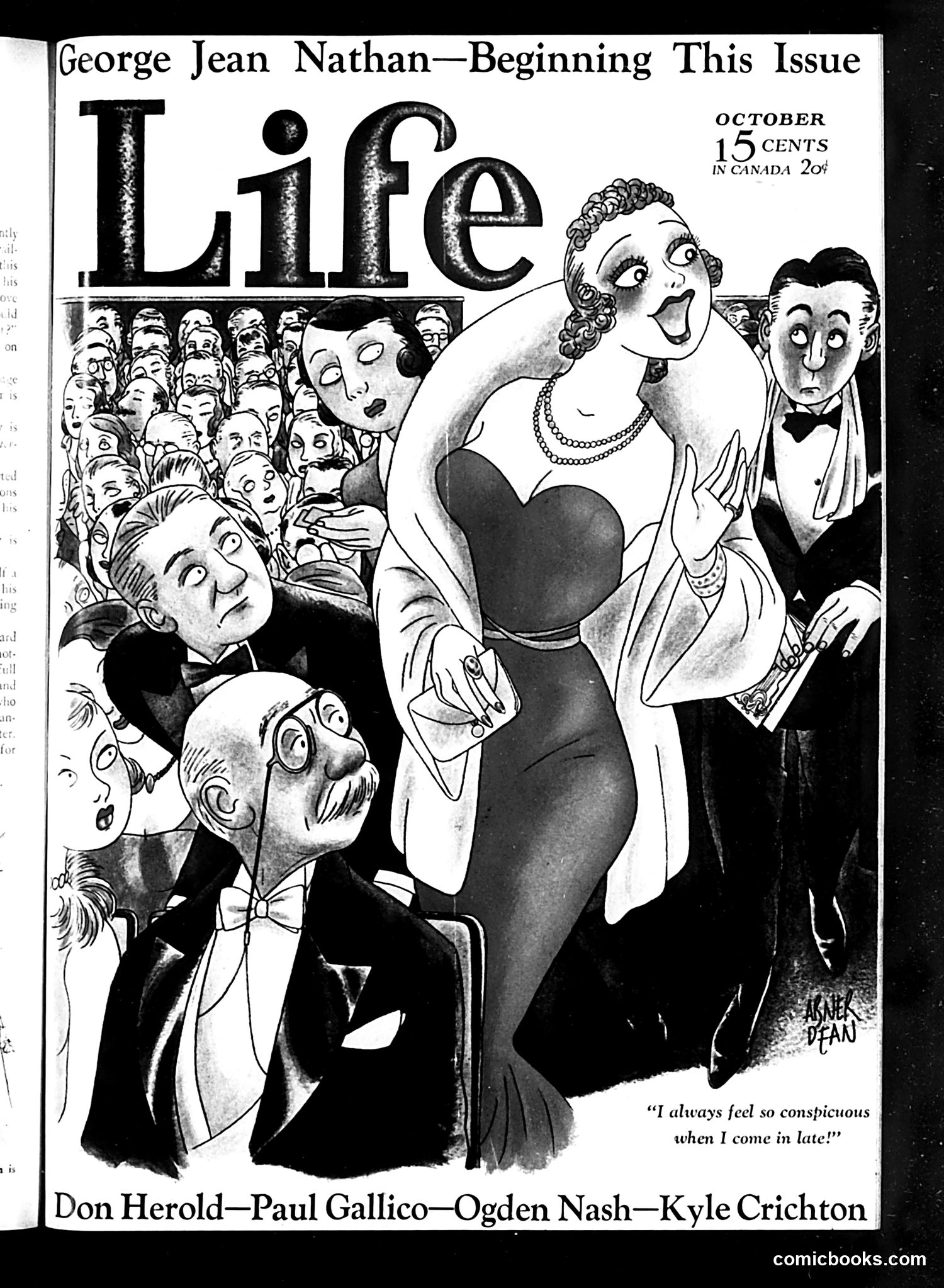
Life Magazine Cover Analysis This is the October cover of *Life* magazine (15 cents), featuring an illustration by Arsne Péan. The cover depicts a theatrical scene—likely from a Broadway show or nightclub—where a woman in an elegant dress and pearls enters late, drawing the attention of the formally dressed audience members around her. The caption reads: "I always feel so conspicuous when I come in late!" The satire is straightforward social humor: the woman's concern about being conspicuous contradicts reality, as her glamorous appearance and confident demeanor actually make her the center of attention. The joke plays on the disconnect between her self-consciousness and the obvious admiration she receives. The issue features contributions from Don Herold, Paul Gallico, Ogden Nash, and Kyle Crichton.
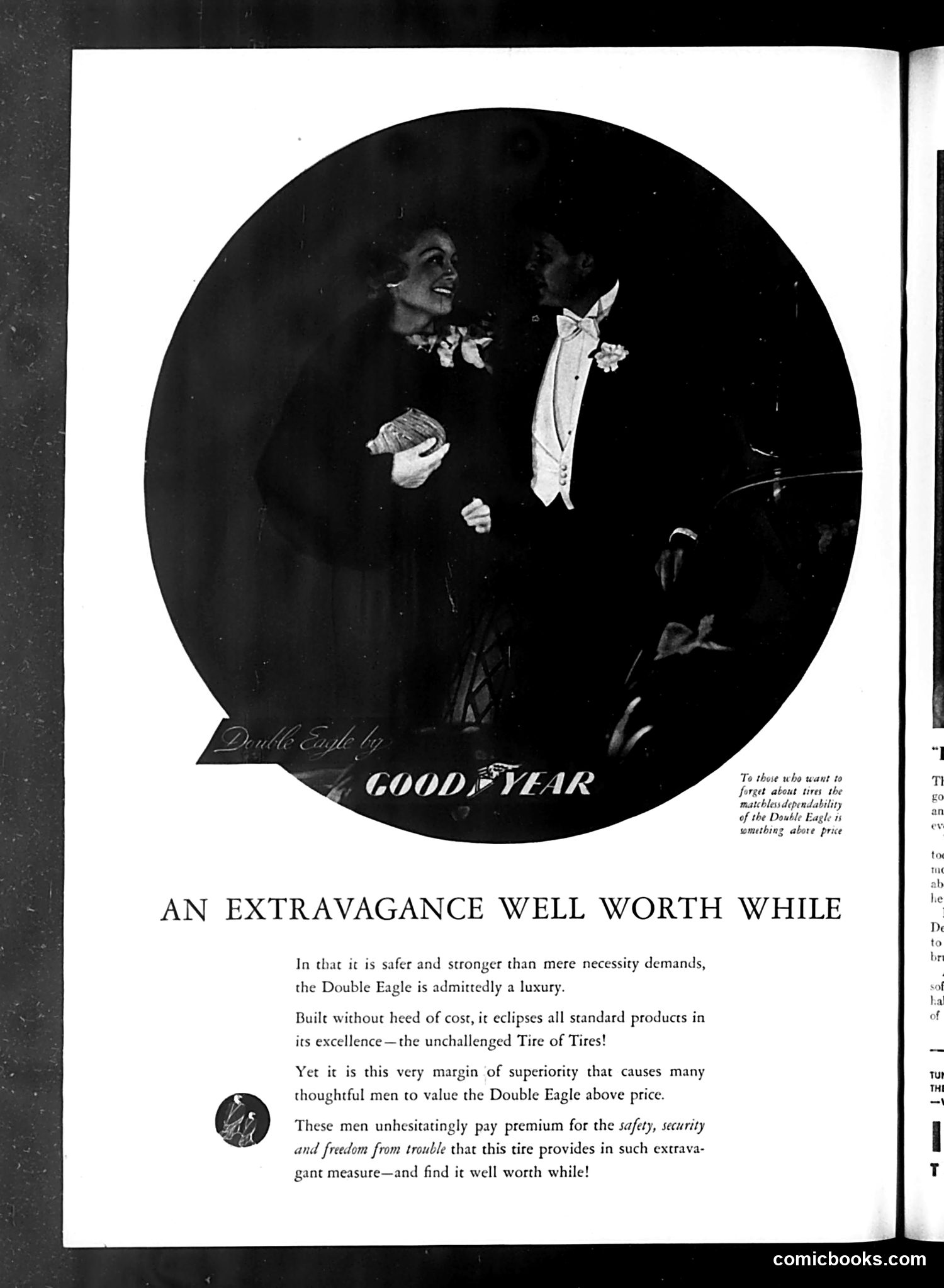
Analysis This is a Goodyear tire advertisement, not political satire. The circular vignette shows two well-dressed figures in formal evening wear (tuxedo and elegant gown) appearing to converse at what seems to be a social event. The ad headline reads "AN EXTRAVAGANCE WELL WORTH WHILE." The marketing pitch argues that Goodyear's "Double Eagle" tire is a luxury product—"safer and stronger than mere necessity demands"—positioned above standard tires. The copywriting appeals to affluent consumers, suggesting that "thoughtful men" willingly pay premium prices for superior "safety, security and freedom from trouble." This reflects 1920s-era advertising strategy: marketing durability and reliability as aspirational luxury goods for the wealthy, rather than practical necessities for all drivers.
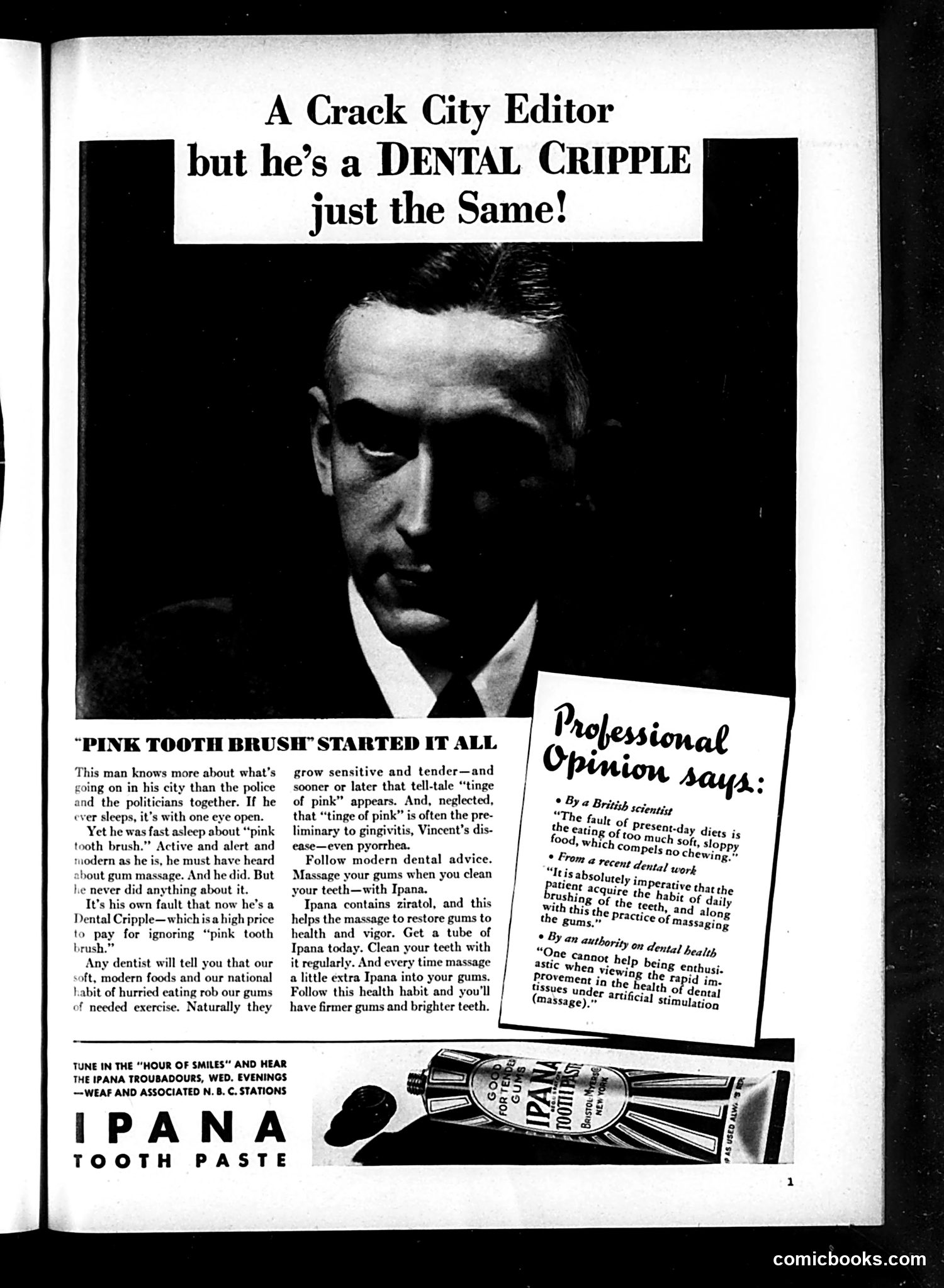
Analysis This is a Ipana toothpaste advertisement, not political satire. The headline mockingly identifies the subject as "A Crack City Editor but he's a DENTAL CRIPPLE just the same!" The ad uses shame-based marketing: it portrays a professional man (the "crack city editor") who, despite his competence and alertness in his job, supposedly suffers from poor dental health due to neglecting the "pink tooth brush" routine. The implication is that even successful, intelligent men can be undermined by bad teeth. The "Professional Opinion" sidebar quotes British dental experts endorsing Ipana's gum-massage approach and the use of Ipana toothpaste containing ziratel. The satire targets the gap between professional competence and personal grooming standards—a common mid-century advertising trope suggesting that dental neglect could undermine one's social standing.
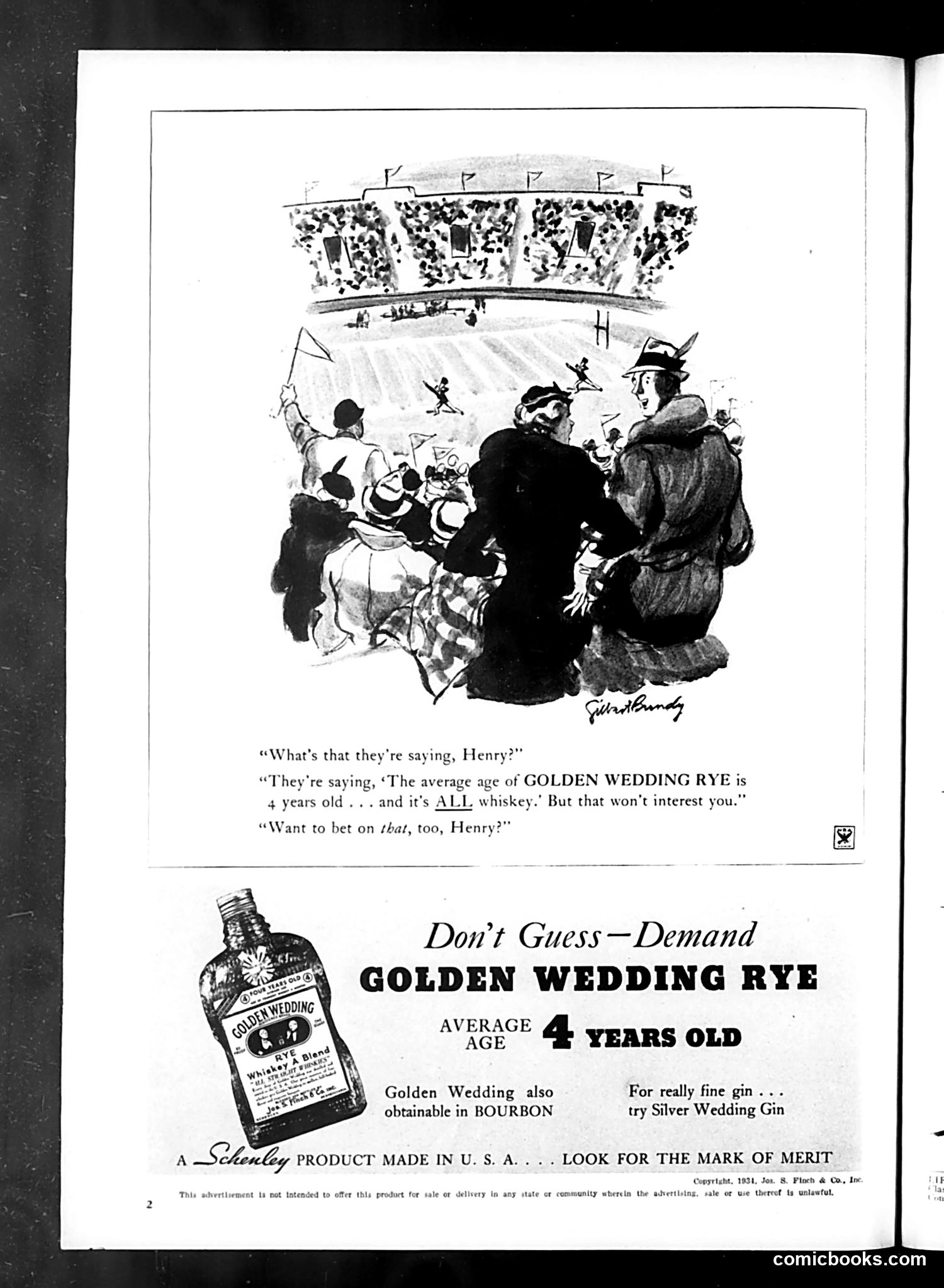
Analysis This page is primarily a whiskey advertisement for Golden Wedding Rye, disguised as editorial content. The cartoon depicts well-dressed spectators at what appears to be a sporting event or horse race, discussing the whiskey's age. The joke plays on the phrase "Don't guess—demand," suggesting consumers should insist on Golden Wedding Rye rather than accept inferior substitutes. The humor hinges on treating whiskey age as conversation-worthy at social events—the implication being that knowledgeable drinkers discuss spirits' quality the way they might discuss horses or sporting outcomes. The characters are generic gentlemen of apparent wealth, representing the target demographic. The advertisement emphasizes the product is "4 years old" and "ALL whiskey," positioning Golden Wedding as premium. A secondary product line, Silver Wedding Gin, is mentioned. This is typical 1930s advertising strategy: wrapping commercial messages in satirical cartoon format to increase engagement.
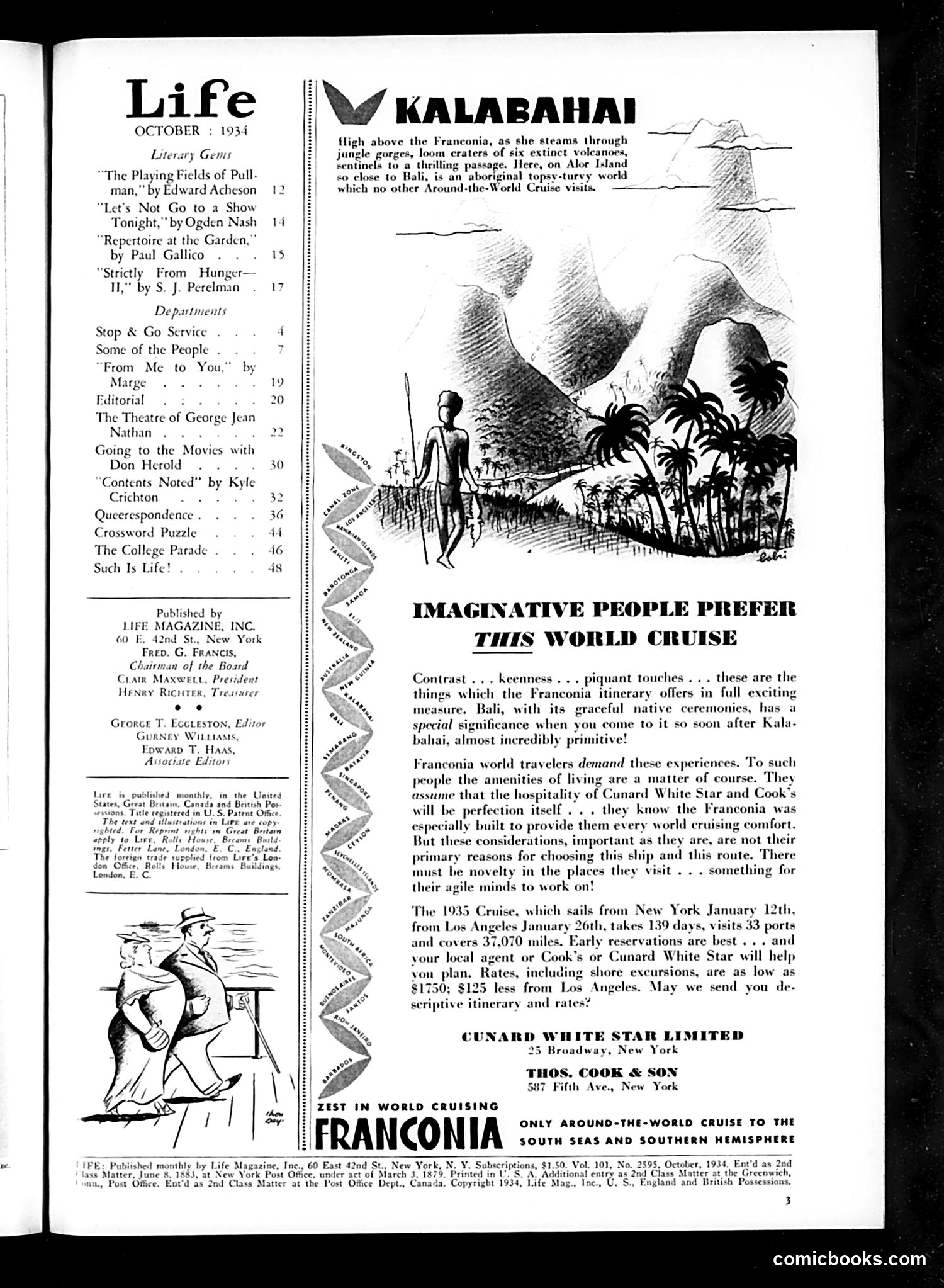
Analysis This page is primarily advertising for the Franconia, an around-the-world cruise ship. The main illustration depicts a traveler observing exotic volcanic peaks and palm trees, representing the adventure of global travel. The small cartoon at lower left shows a man at a ship's railing, likely illustrating the leisure and romance of ocean cruising—a common marketing image of the era. The text emphasizes that wealthy travelers seeking novelty and exotic experiences prefer this cruise because it visits unusual ports like Bali and Kalabahi (in Indonesia), offering "something for their agile minds to work on." The 1935 cruise would depart from New York or Los Angeles and cost around $1,750. This reflects 1934 American aspirations for luxury travel during the Depression era, targeting affluent audiences who could afford such indulgences.
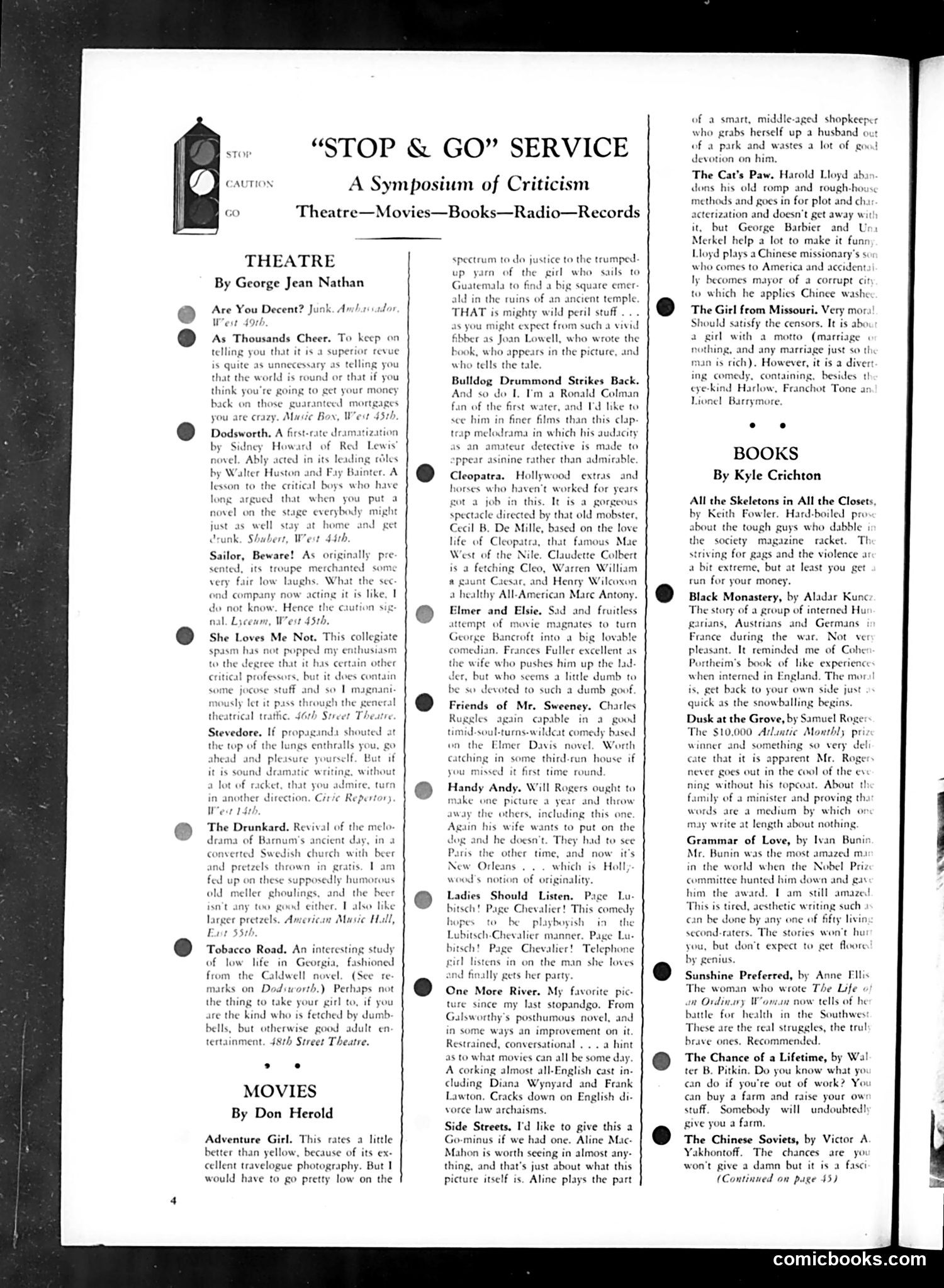
"Stop & Go" Service: A Symposium of Criticism This page presents reviews of contemporary theatrical and film offerings by George Jean Nathan and Kyle Crichton. The "Stop & Go" header with its traffic-light imagery suggests the reviewers are directing audiences toward or away from various entertainments. The theater section critiques films and plays featuring Hollywood stars of the era—Harold Lloyd, Joan Lowell, Cecil B. DeMille, and others. Nathan and Crichton offer pointed judgments on plot, acting, and execution, praising some works while dismissing others as derivative or poorly conceived. The reviews serve Life magazine's satirical mission: providing witty, informed cultural commentary that entertains while guiding readers' entertainment choices. This format exemplifies how mid-century magazines positioned themselves as arbiters of taste.
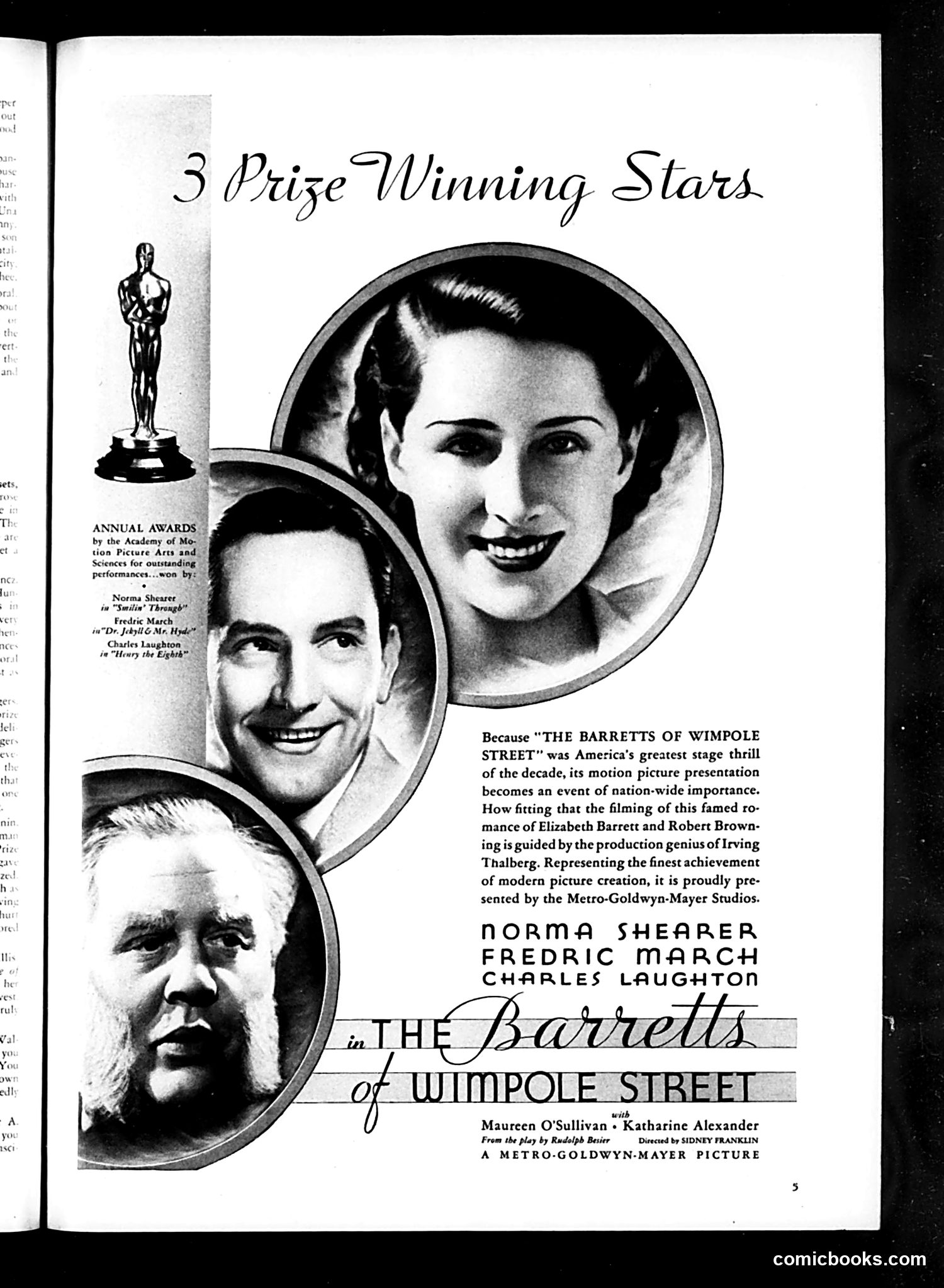
Analysis This is not a political cartoon, but rather a movie advertisement from Life magazine. It promotes "The Barretts of Wimpole Street," a Metro-Goldwyn-Mayer film starring Norma Shearer, Fredric March, and Charles Laughton. The page celebrates the film's adaptation of a famous stage play into a major motion picture production. The headline "3 Prize Winning Stars" highlights the actors' prestige. An Oscar statue appears on the left, suggesting awards recognition. The text emphasizes how Irving Thalberg's production genius transformed this theatrical work into a cinema event "of nation-wide importance." This is essentially a studio promotional piece celebrating Hollywood's ability to translate celebrated stage drama into prestigious film entertainment—a common concern during cinema's transition from silent to talking pictures.
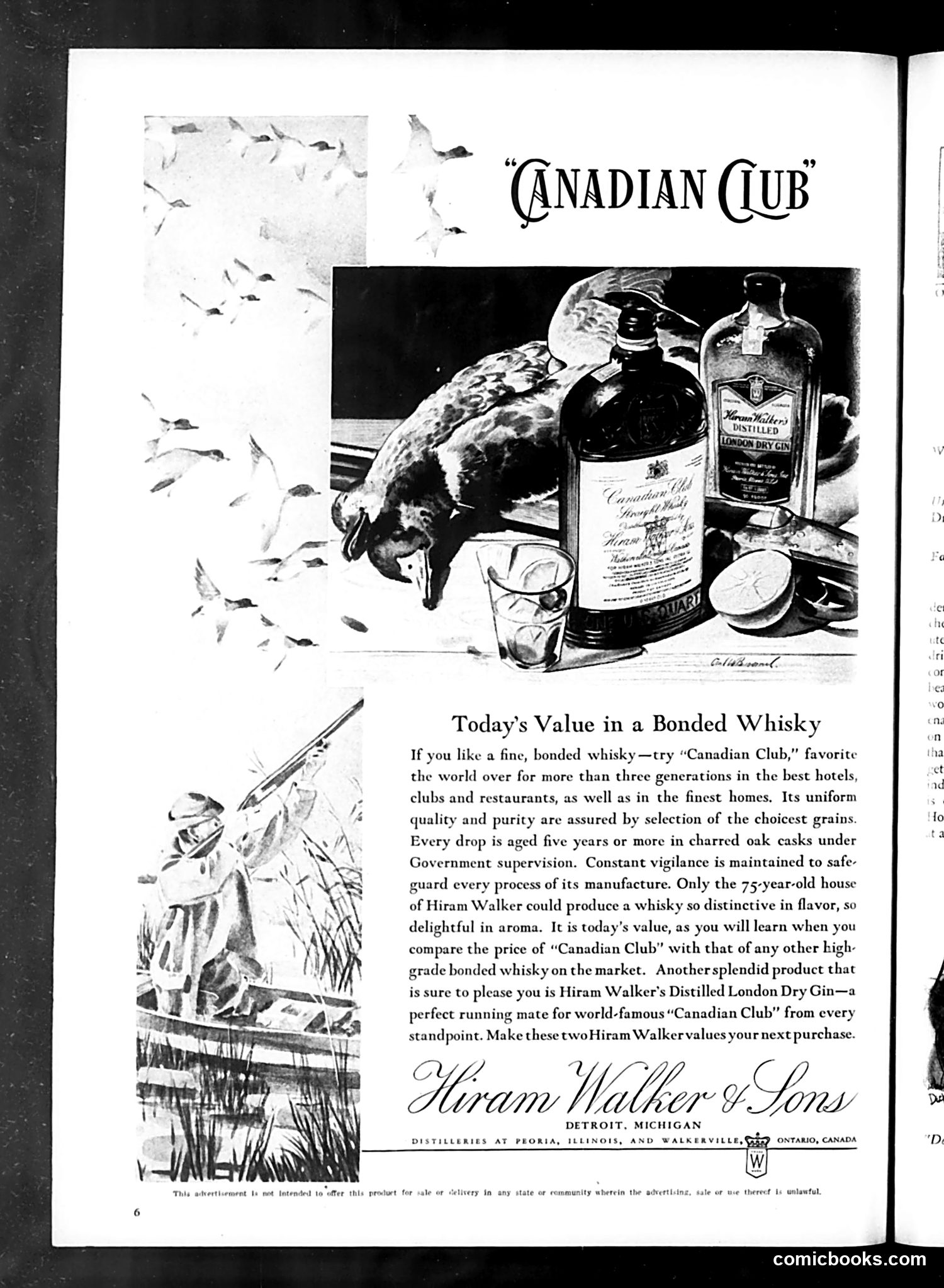
Analysis This page is primarily a Hiram Walker whisky advertisement, not a political cartoon. There is no satire or social commentary present. The ad promotes "Canadian Club" bonded whisky, emphasizing its quality, purity, and five-year aging process in charred oak casks under Government supervision. The imagery shows bottles, a glass, hunting game, and a duck—evoking leisure and affluence. The text explicitly pitches the product as a "value" compared to other high-grade whiskies, and recommends pairing it with "Hiram Walker's Distilled London Dry Gin." The company is based in Detroit, Michigan with distilleries also in Peoria, Illinois and Walkerville, Ontario. This is straightforward commercial advertising from the Prohibition or early post-Prohibition era.
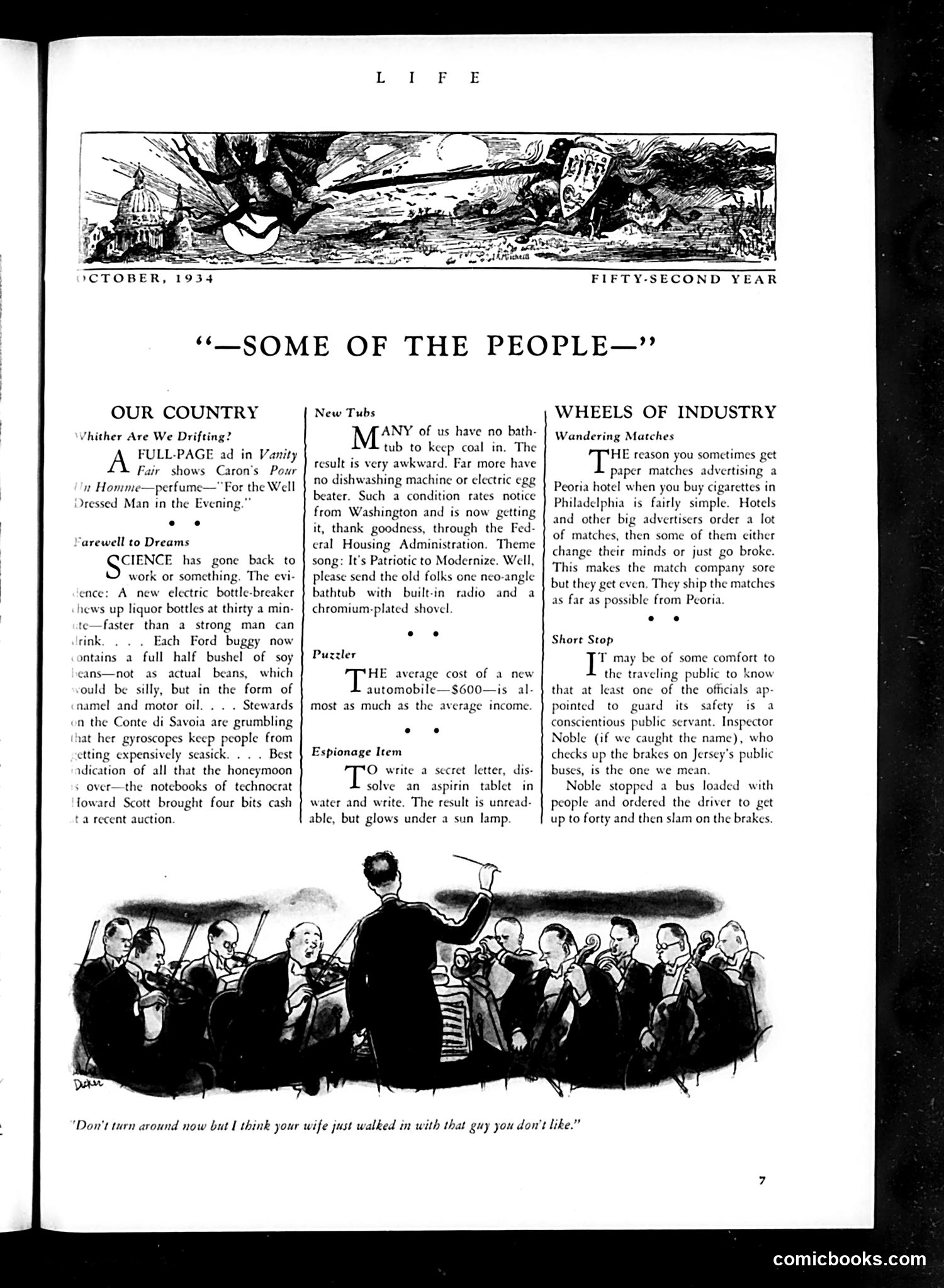
October 1934 Life Magazine - Page Analysis This page contains three satirical pieces about contemporary American life during the Depression era: "Our Country" criticizes modernization and consumerism—mocking things like electric bottle-breakers and chromium-plated shovels as impractical luxuries when basic needs aren't met. "Wheels of Industry" humorously discusses match advertising and a conscientious bus safety inspector named Noble who aggressively enforces brake standards. The cartoon at bottom shows a conductor addressing an orchestra with the caption: "Don't turn around now but I think your wife just walked in with that guy you don't like." This is a domestic joke about infidelity, playing on the awkwardness of public social embarrassment. The overall tone satirizes American consumer culture, industrial "progress," and contemporary social anxieties during economically uncertain times.
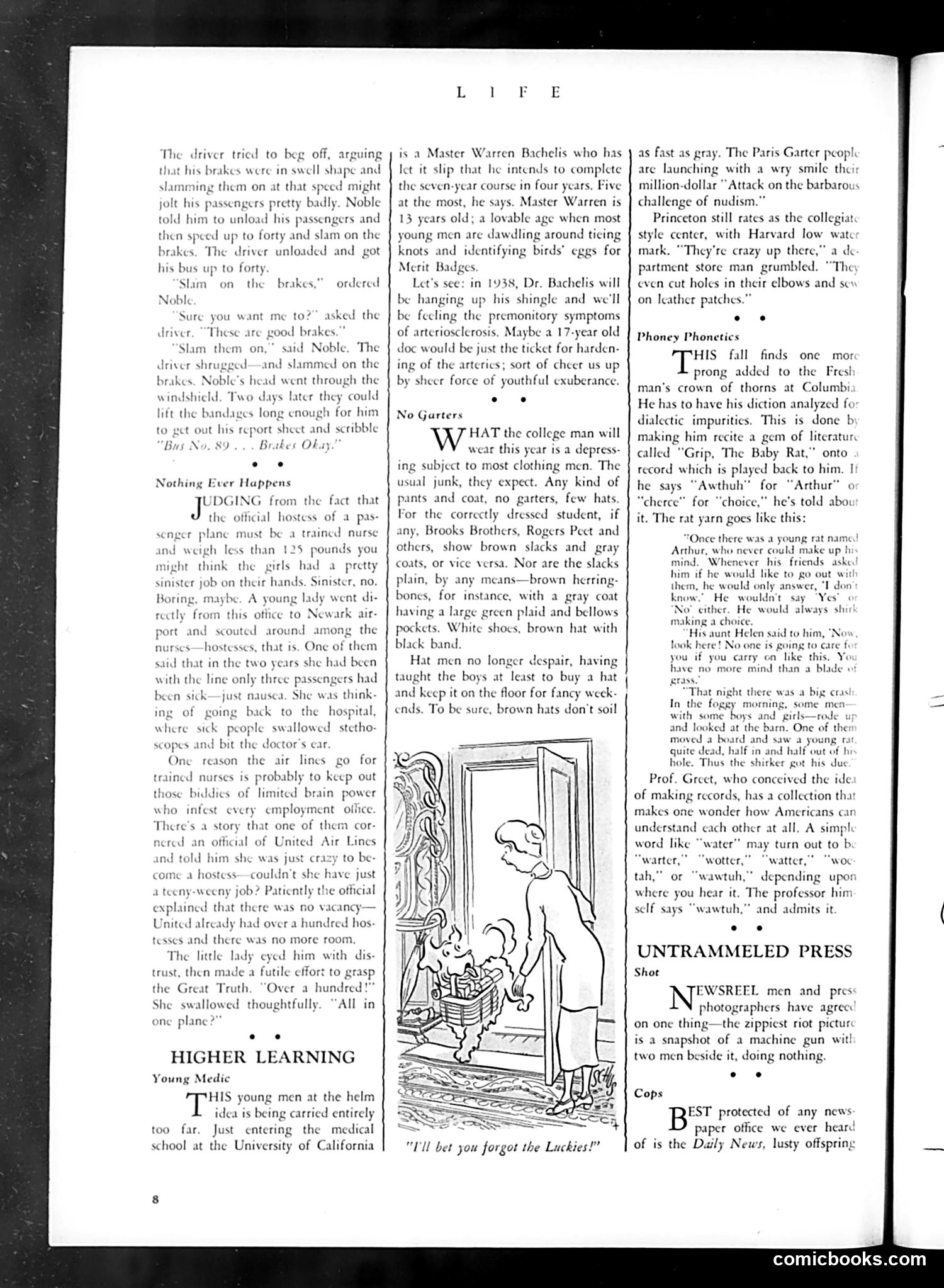
Analysis of Life Magazine Page This page contains several brief satirical pieces typical of Life magazine's humor section. The main cartoon depicts a man at a doorway with a child, captioned "I'll bet you forgot the Luckies!" — advertising Lucky Strike cigarettes. The text sections mock various subjects: an airline passenger plane incident involving nurse "hostesses"; college fashion (mocking brown hats and proper dress codes); and phonetic humor where a French boy's mispronunciations of English words are presented as comedy ("Grip" for "gripe," "Arthur" for "Arthur"). Additional humor sections include "Untrammeled Press" (satirizing newsreel photographers) and "Cops" (about newspaper offices). The overall tone is light, domestic satire typical of 1930s-40s American humor magazines, blending social observation with product placement and casual stereotyping.
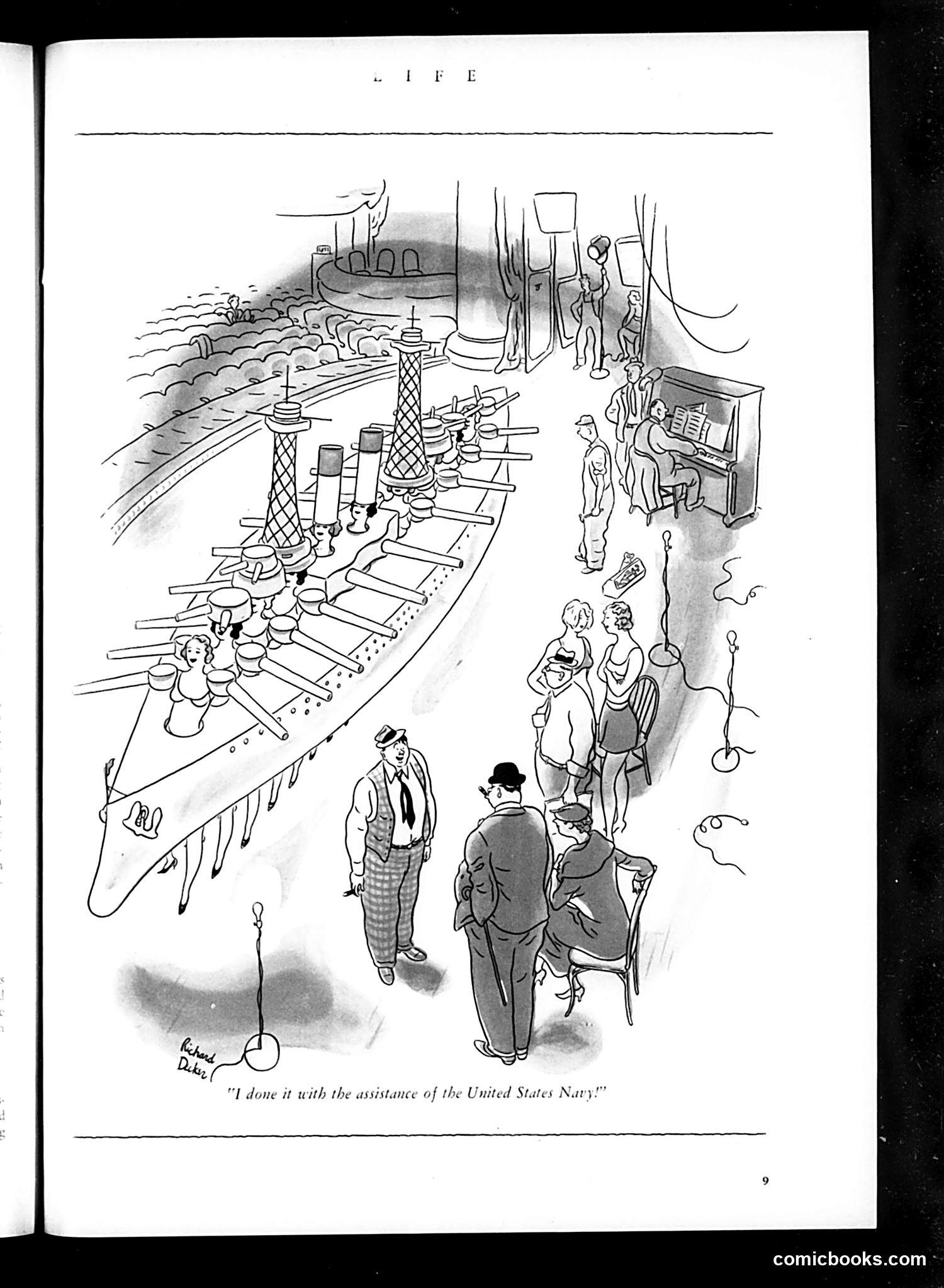
Cartoon Analysis This single-panel cartoon depicts a man in a suit and fedora standing on a dock, gesturing toward a large naval vessel. Two other men in business attire stand nearby, apparently listening to his explanation. The caption reads: "I done it with the assistance of the United States Navy." The cartoon satirizes someone taking personal credit for an achievement while acknowledging—somewhat sheepishly—that government/military resources made it possible. The humor lies in the contradiction: claiming individual accomplishment while simultaneously admitting dependence on substantial institutional support. The casual phrasing ("I done it") contrasts with the formal setting, adding to the satirical effect. Without additional context, the specific achievement being mocked remains unclear, though it likely references a contemporary news event from Life magazine's publication period.
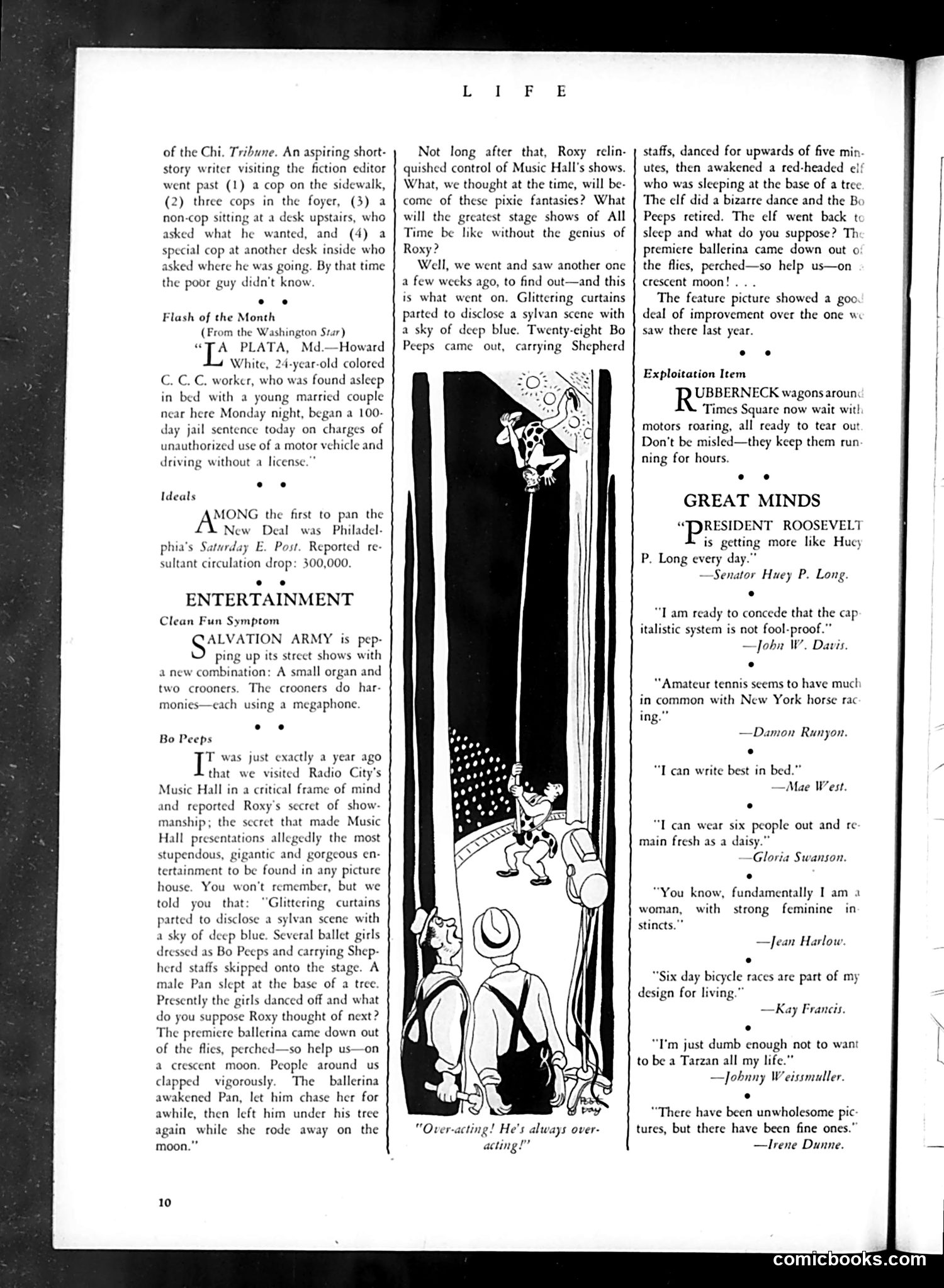
Analysis This page from *Life* magazine contains entertainment commentary and quotes from celebrities rather than political cartoons. The central illustration depicts a theatrical scene with performers in what appears to be a vaudeville or stage show setting—figures in costume on a stage with curtains. The "Bo Peeps" section discusses Radio City Music Hall's elaborate shows, specifically praising performer Rosy's contributions. The accompanying cartoon illustrates an over-the-top stage performance, with the caption "Over-acting! He's always over-acting!" satirizing theatrical excess. The right column features celebrity quotes on various topics (writing, tennis, bicycling), offering humorous observations typical of *Life's* celebrity commentary feature. The overall page reflects 1930s entertainment culture and magazine editorial style rather than political satire.
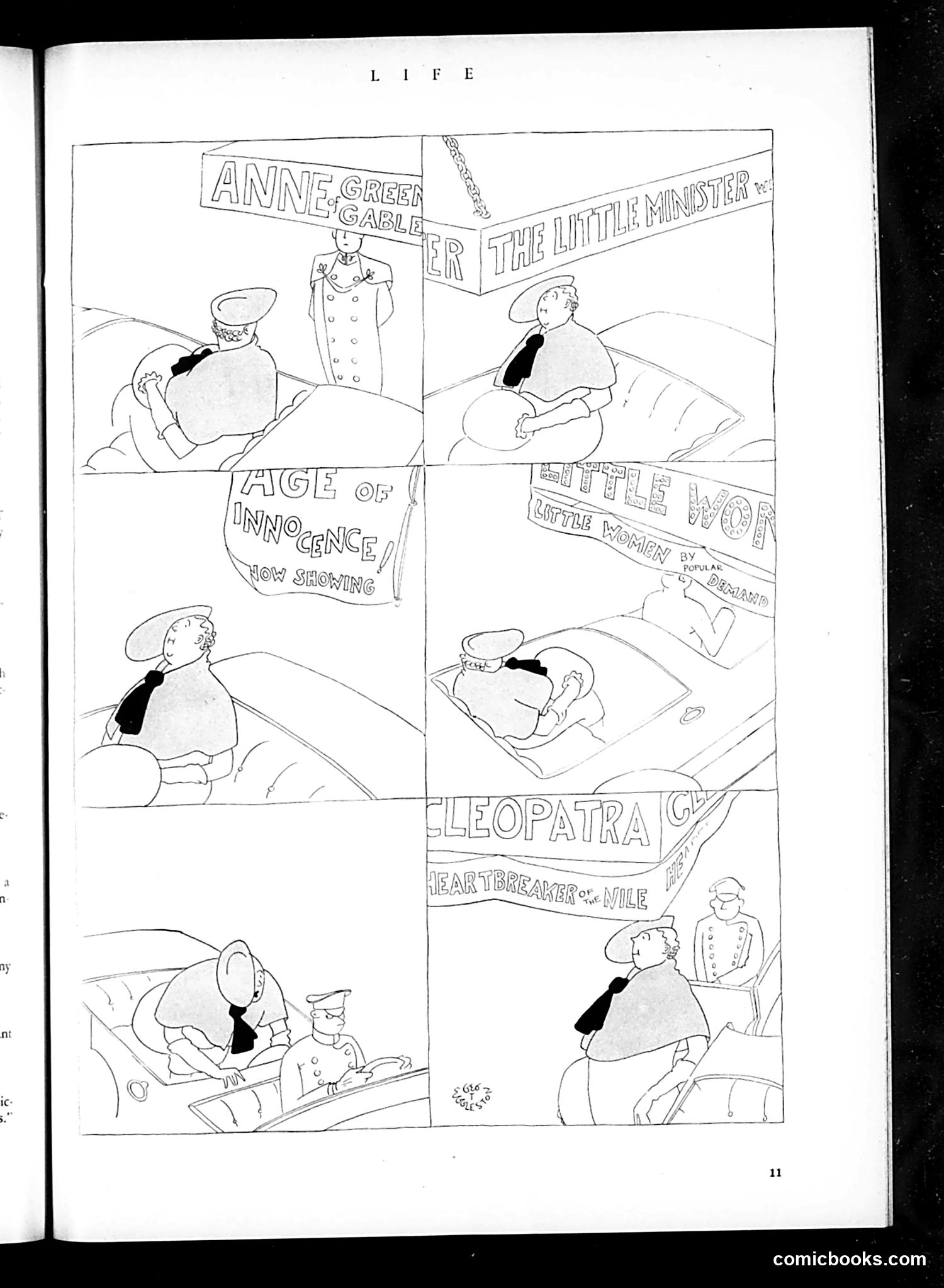
Political Cartoon Analysis This appears to be a satirical comic strip mocking popular women's literature and entertainment of its era. The visible book titles—"Anne of Green Gables," "The Little Minister," "Age of Innocence," "Little Women," "Cleopatra," and "Heartbreaker of the Nile"—suggest the cartoon critiques women readers' taste in sentimental novels. The humor seems to center on the contrast between the genteel, romantic content of these popular books and the mundane domestic reality depicted: a woman in bed reading these titles, suggesting she escapes monotonous life through escapist literature. The progression from wholesome classics to more sensational titles (like "Heartbreaker") may satirize how women's reading habits graduate from innocent to more melodramatic fare.
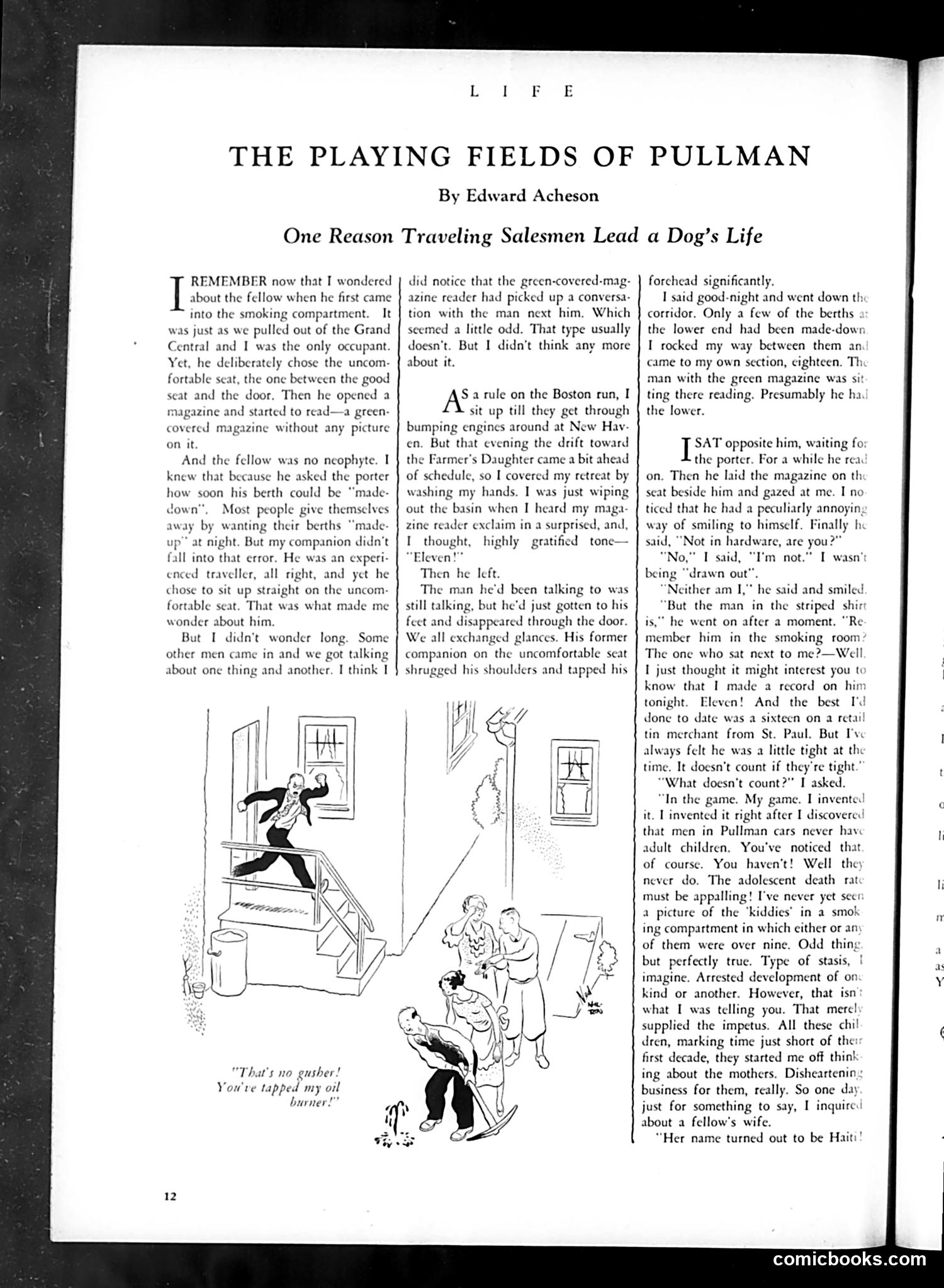
"The Playing Fields of Pullman" by Edward Acheson This satirical piece mocks traveling salesmen on Pullman train cars (the luxury sleeping compartment service). The humor centers on a peculiar "game" the narrator invented: counting adolescent children visible through train-car windows during evening stops. The accompanying cartoon illustrates the awkwardness of the scenario—a man peering out train windows while other passengers observe him with suspicion and disapproval. The joke's point is the absurdity of the narrator's fixation and the social discomfort it creates. The satire targets both the tedium of train travel and the peculiar, sometimes creepy pastimes travelers invent to pass time. The title's reference to "playing fields" ironically contrasts noble athletic grounds with this dubious voyeuristic "game."
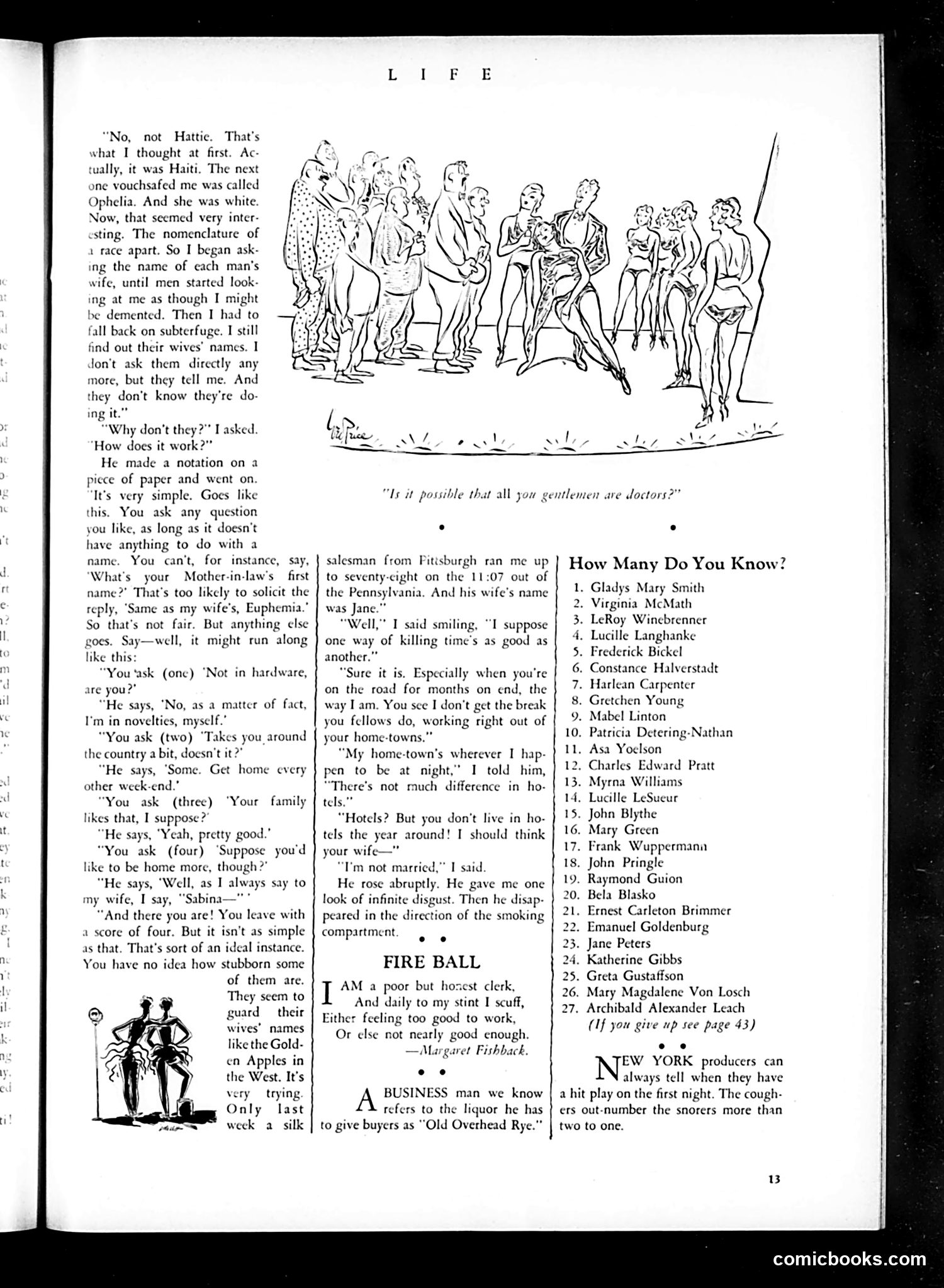
Analysis of Life Magazine Page 13 This page contains satirical anecdotes about American social customs rather than political cartoons. The main narrative mocks the pretentiousness of asking people's professions and genealogy at social gatherings. The narrator describes a man who asks his wife's name repeatedly in different ways, each time discovering new "names"—a satire on how people invent credentials or claim false identities to appear respectable. The "How Many Do You Know?" list appears to be a society column listing prominent individuals, a common Life feature mocking the obsession with social status. The small cartoon at bottom-left showing figures guarding wives references the "Golden Apples in the West"—an obscure cultural reference unclear from this image alone. The "Fire Ball" poem by Margaret Fishback is unrelated satirical verse about a struggling clerk.
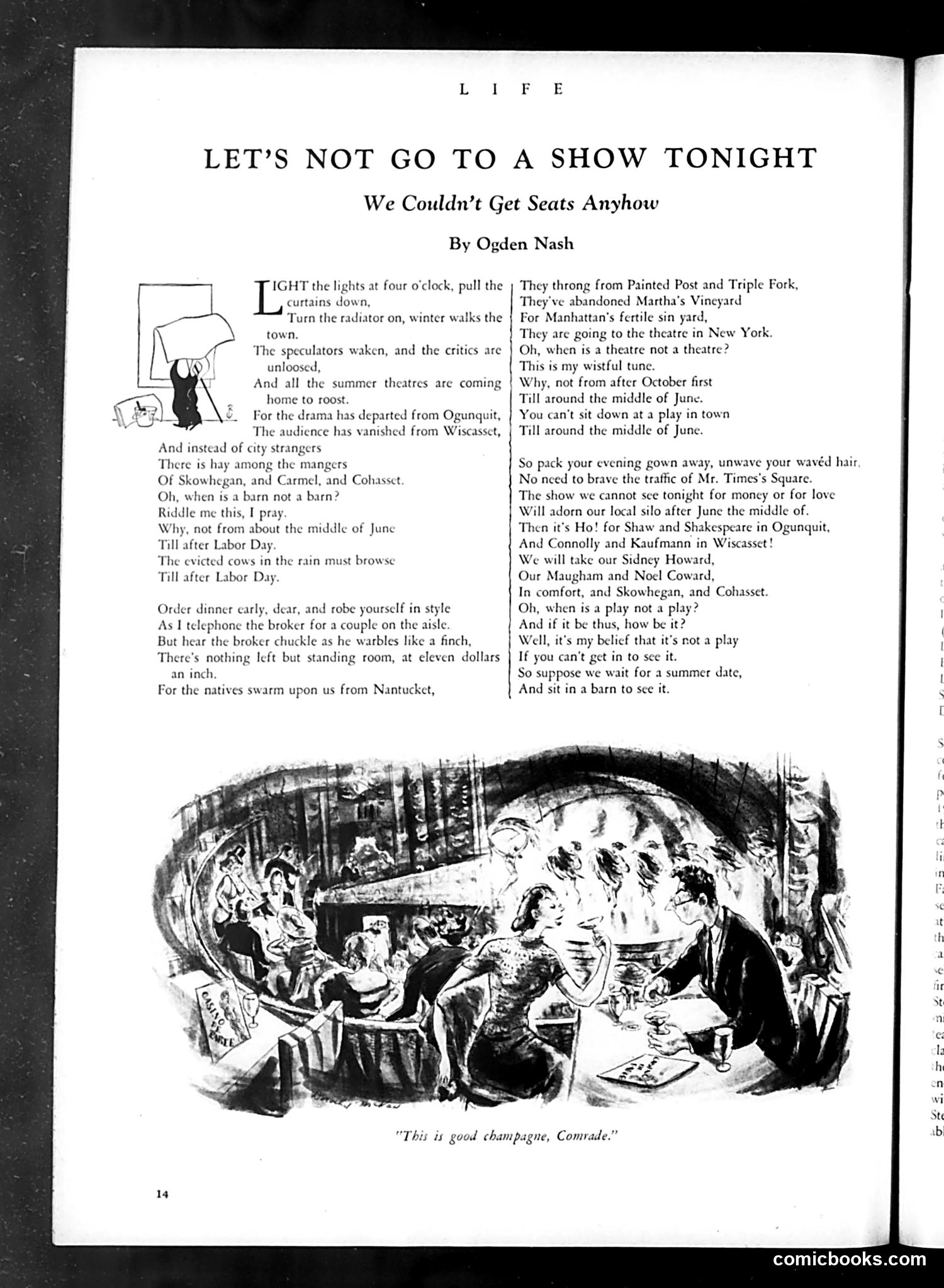
"Let's Not Go to a Show Tonight" by Ogden Nash This satirical poem by humorist Ogden Nash mocks the difficulty of obtaining Broadway theater tickets during the summer season. The poem laments that all accessible shows have closed or moved (mentioning specific theaters like Maria's Vineyard), while desirable productions in New York are sold out—"you can't sit down at a play in town / Till around the middle of June." Nash suggests alternatives: waiting for summer stock theater in rural areas, or simply staying home. The accompanying cartoon shows well-dressed urbanites dining at what appears to be a nightclub or restaurant instead, with the caption "This is good champagne, Comrade"—implying they're settling for entertainment and expense elsewhere. The satire captures mid-century theater-going frustrations among the affluent.
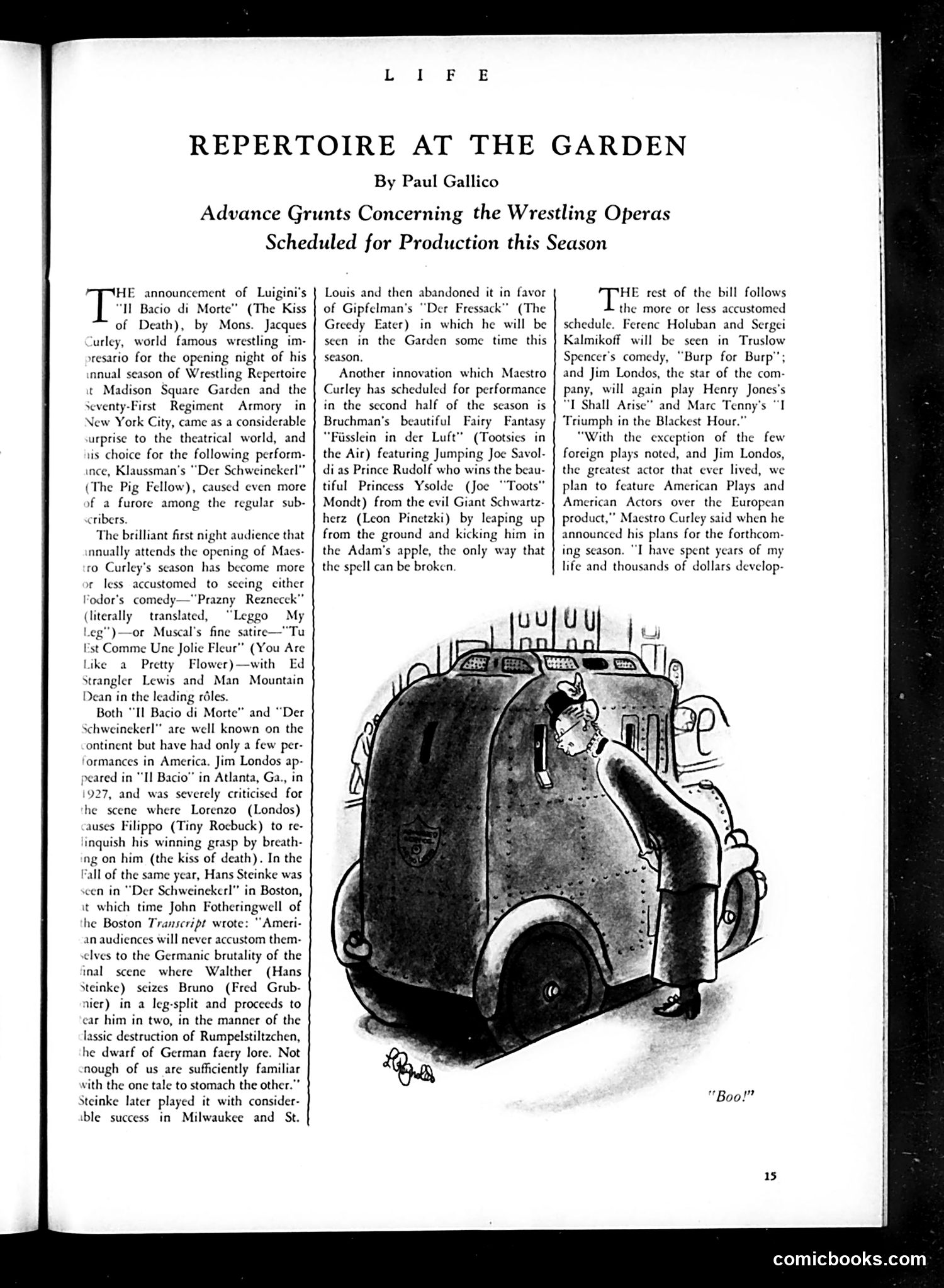
"Repertoire at the Garden" - Life Magazine Article This page discusses wrestling operas scheduled at Madison Square Garden, written by Paul Gallico. The main illustration labeled "Boo!" depicts a vintage automobile being tipped over—a visual gag representing the physical chaos of professional wrestling entertainment. The article announces Luigini's "Il Bacio di Morte" (The Kiss of Death) as the opening performance, following Jous Curley's wrestling season. It discusses various European operas being adapted with wrestling themes, noting that some violent scenes (like one involving strangulation) shocked American audiences unfamiliar with "Germanic brutality." The satire mocks the incongruity of combining high art (opera) with lowbrow entertainment (professional wrestling), using the automobile destruction as visual metaphor for the collision of these genres.
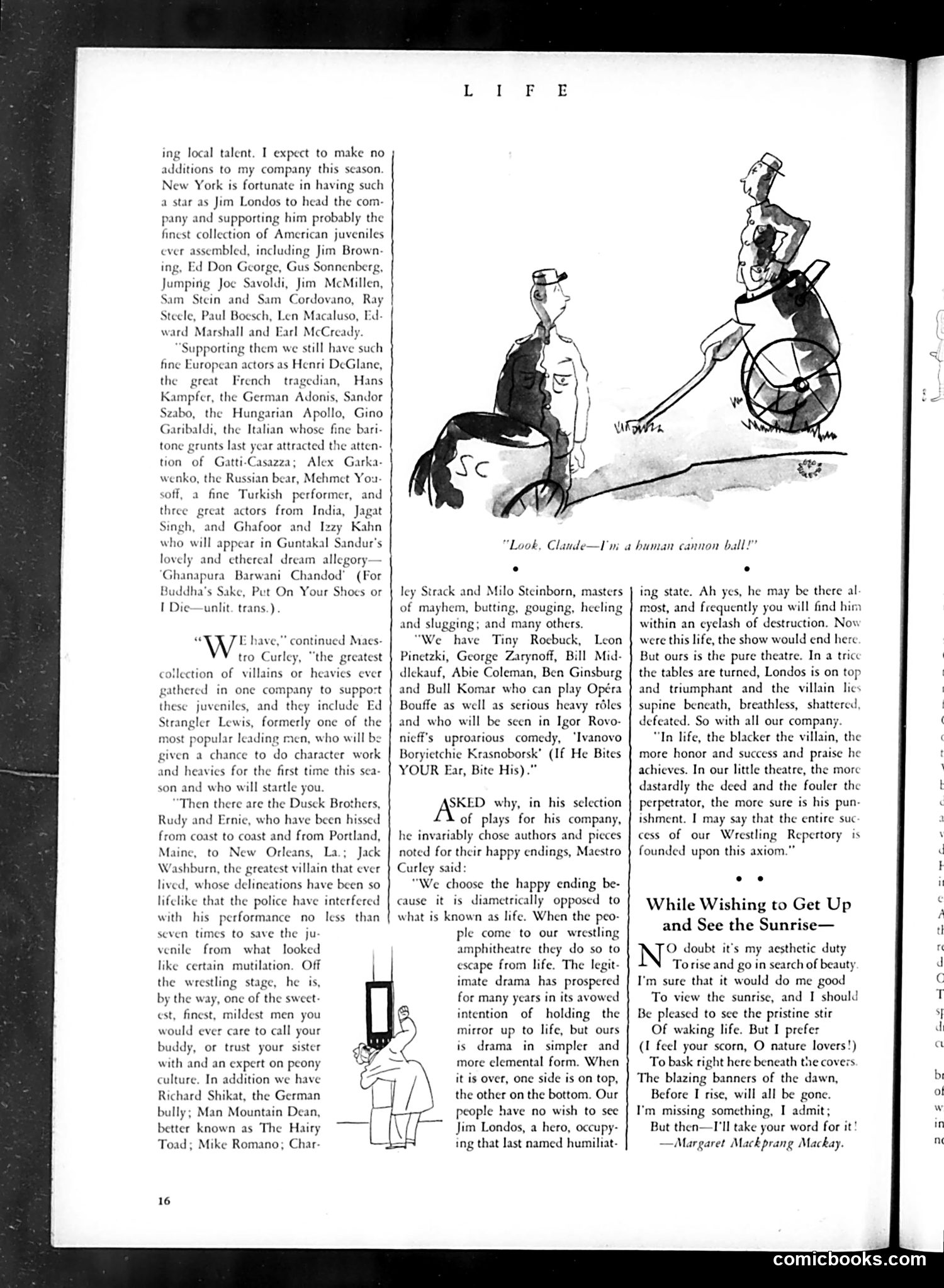
Analysis of Life Magazine Page This page discusses theatrical productions, specifically Jim Londos's wrestling company and Maestro Curley's selection of plays. Two cartoons accompany the text: 1. Top cartoon: Shows a man in formal attire observing another figure perched atop a large spherical object (labeled "Look, Claude—I'm a human cannon ball!"). This illustrates circus or vaudeville performance, likely satirizing the theatrical spectacle and physical comedy of the era. 2. Bottom cartoon: Depicts a simple figure in a chair, accompanying a poem titled "While Wishing to Get Up and See the Sunrise" by Margaret MacEpping Mackay—a humorous piece about reluctance to leave bed despite morning's appeal. The page reflects 1920s-30s entertainment culture, mixing wrestling promotions with theatrical criticism and light satirical commentary on show business and human nature.
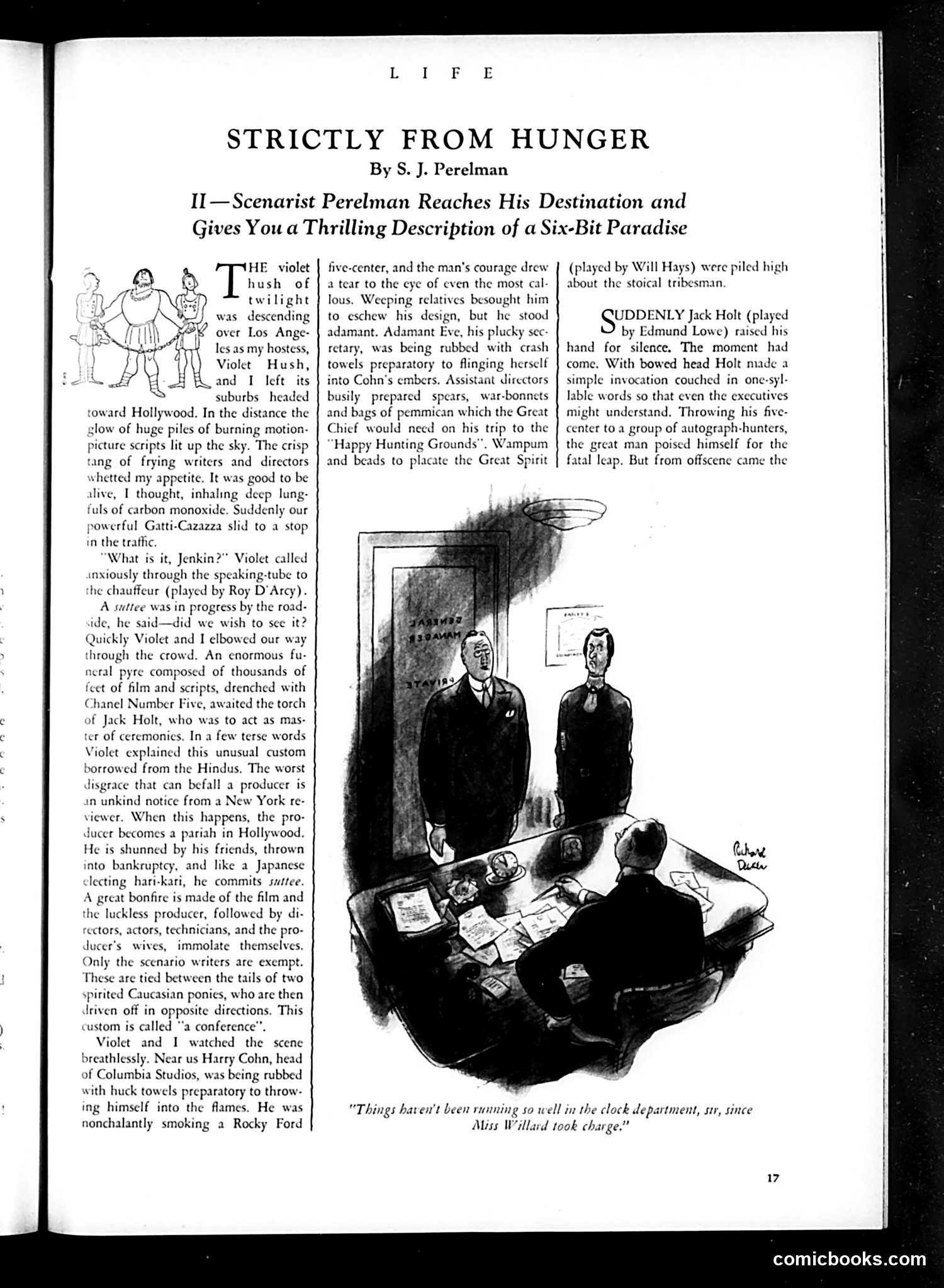
Analysis of "Strictly From Hunger" by S.J. Perelman This is a satirical article about Hollywood film production, illustrated with a cartoon showing studio executives at a desk. The piece mocks the film industry's treatment of creative personnel and producers. The cartoon caption reads: "Things haven't been running so well in the clock department, sir, since Miss Willard took charge." The satire appears to target: - Studio hierarchy and incompetence: Executives making poor decisions - Gender dynamics: The reference to "Miss Willard" suggests commentary on women in management positions, likely with sardonic implication that her leadership is blamed for departmental failure - Industry dysfunction: The "clock department" metaphor suggests disorganization and poor timekeeping in film production The text describes various Hollywood absurdities—funeral pyres for failed films, Eastern mysticism borrowed from Hindu customs—emphasizing the industry's pretentiousness and wastefulness.
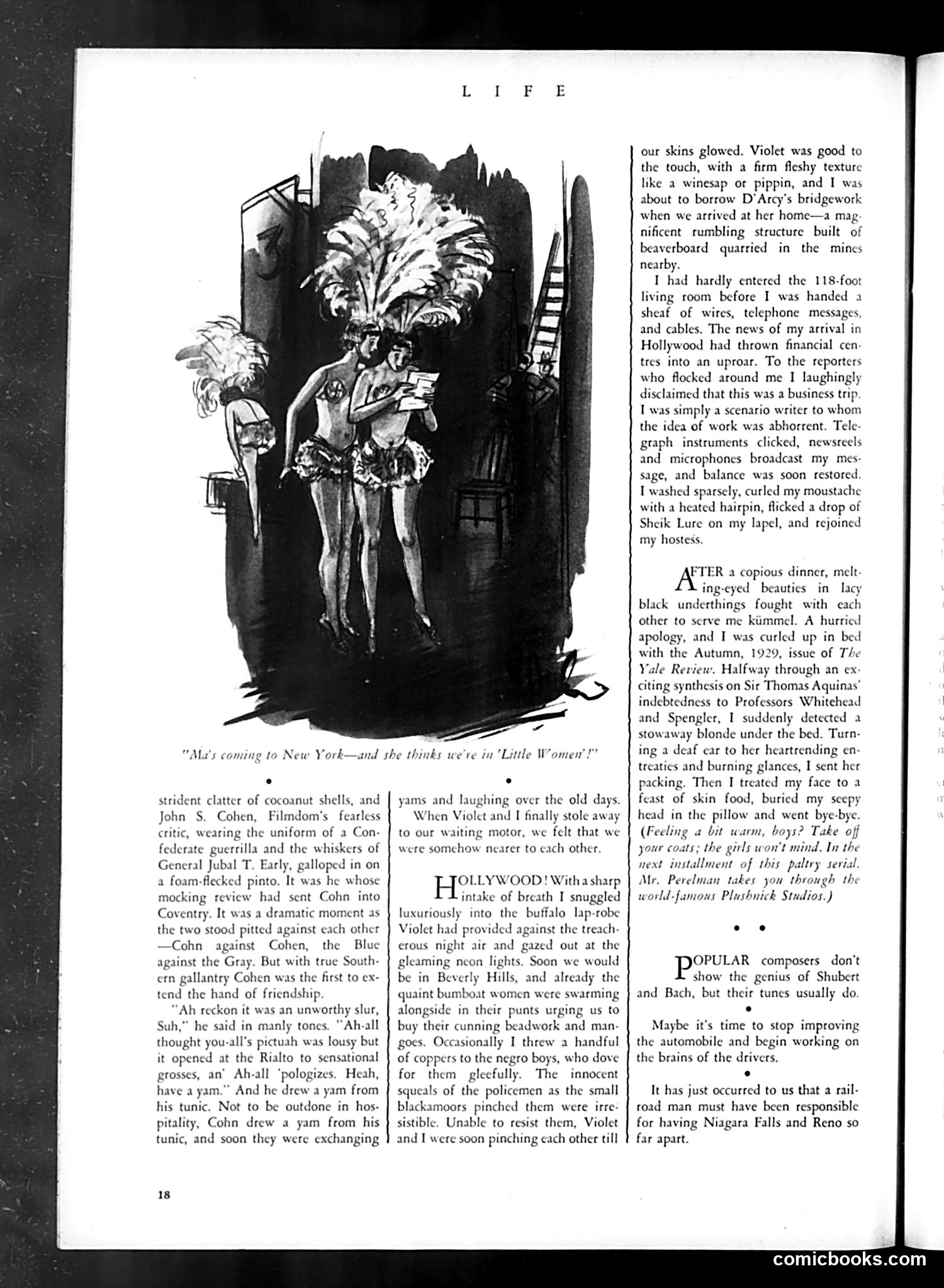
Political Cartoon Analysis The illustration depicts a satirical scene of Hollywood excess and celebrity chaos. The central figures appear to be glamorous women in fashionable 1920s attire surrounded by exaggerated architectural elements and frantic activity. The caption reads: "Ma's coming to New York—and she thinks we're in 'Little Women'!" This mocks the disconnect between Hollywood's glamorous public image and the actual behavior of film industry figures. The reference to "Little Women" suggests naïve expectations being shattered by reality. The accompanying text discusses a visit to Hollywood, critiquing how the film industry creates false impressions while depicting the actual scene as chaotic and morally questionable. The satire targets Hollywood's hypocrisy: promoting wholesome family entertainment while operating amid scandal, excess, and dubious behavior behind the scenes.
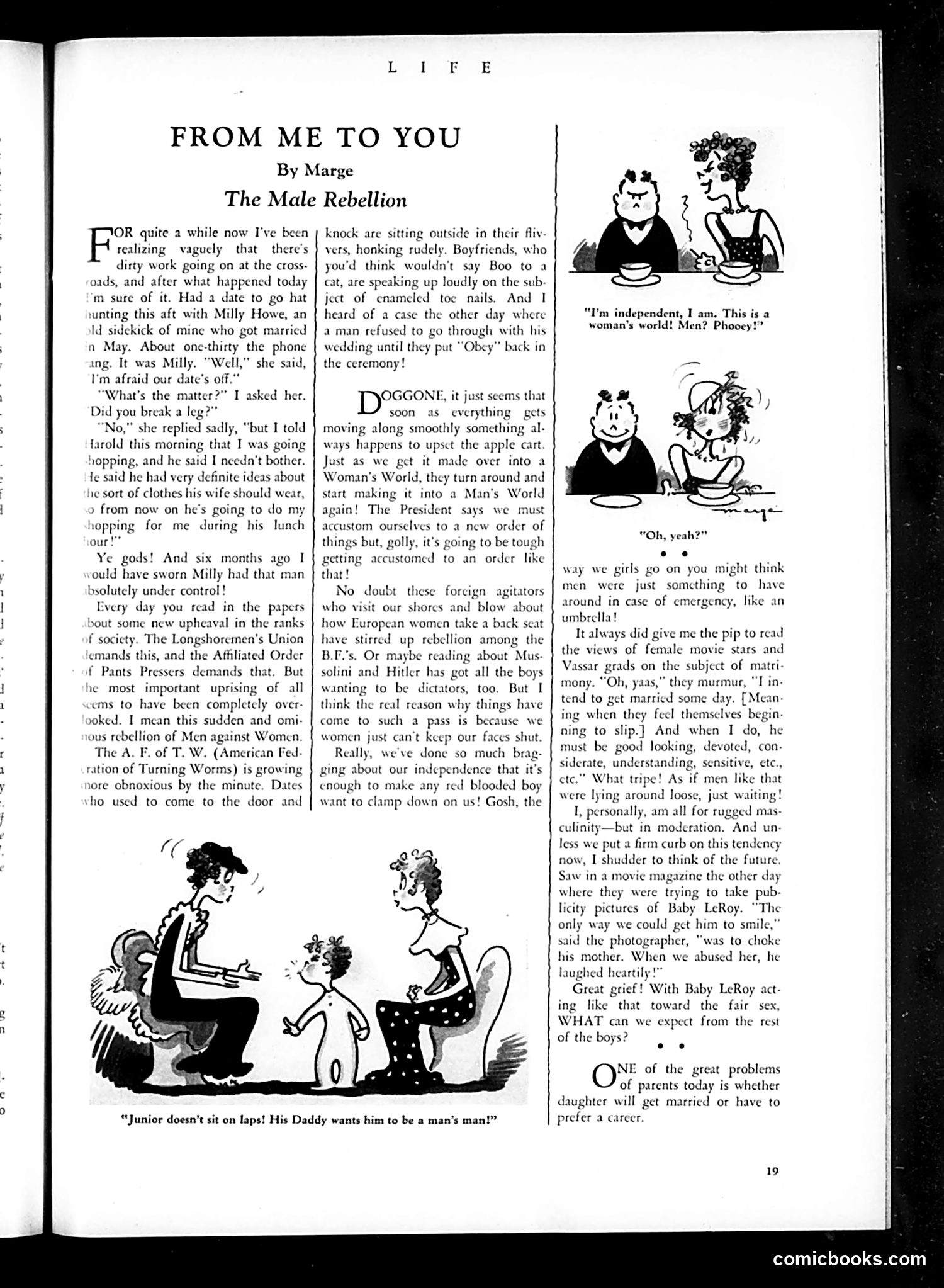
"From Me to You: The Male Rebellion" This satirical piece by Marge mocks the emerging backlash against women's independence. The article complains that women have become too outspoken about issues like "enameled toe nails" and wedding vows (specifically rejecting the word "Obey"). The cartoons illustrate the author's grievances: women asserting independence ("I'm independent, I am. This is a woman's world! Men? Phooey!"), and men losing domestic authority. The satire targets men's anxiety about women's liberation movements of the era. By having the male narrator melodramatically describe women's modest demands for autonomy as an oppressive "rebellion," the piece ridicules how threatened men felt by female self-determination. The cartoons emphasize the absurdity of men resisting women's basic rights and personal choices.
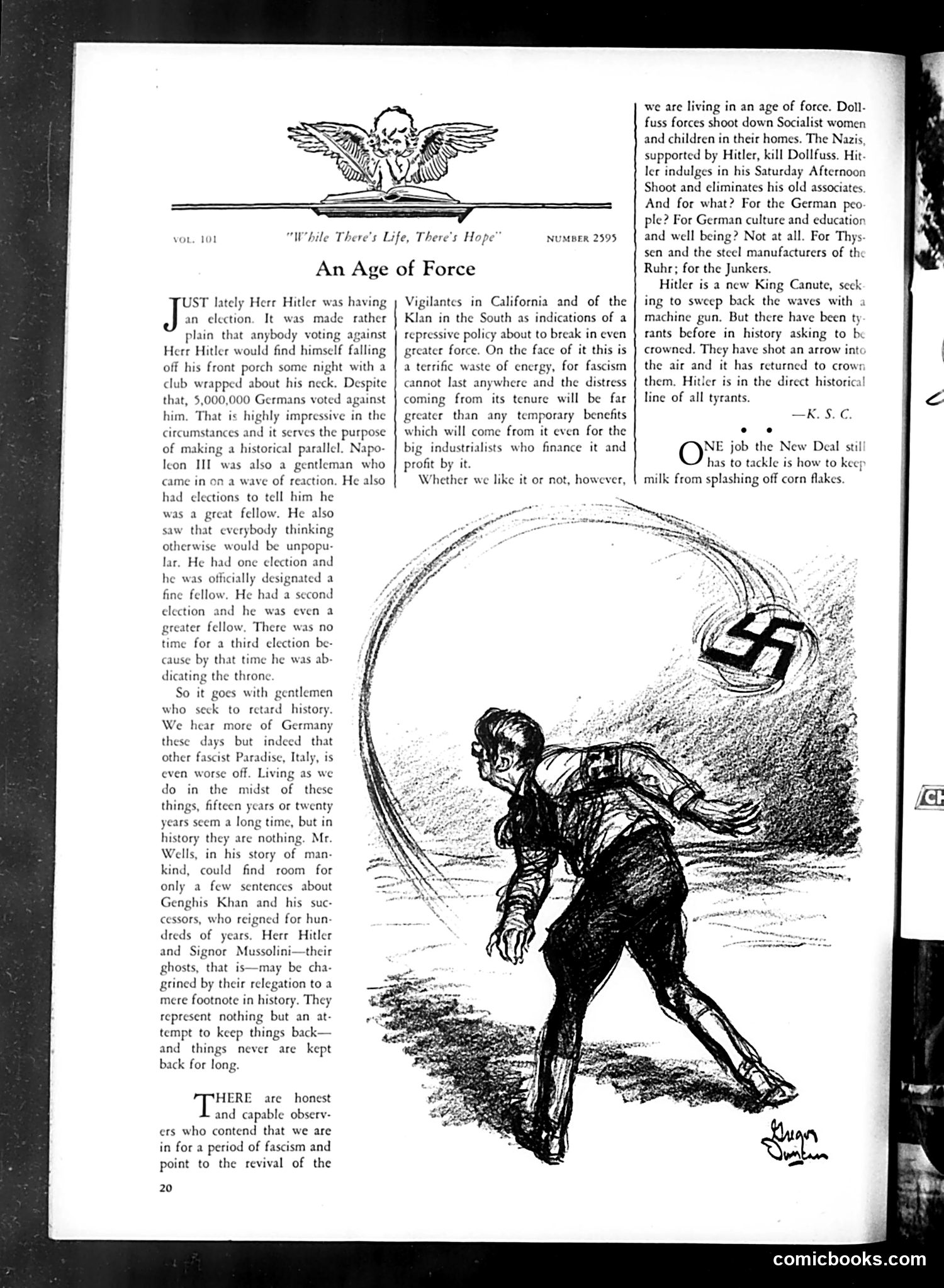
Political Cartoon Analysis: "An Age of Force" This 1934 *Life* magazine page critiques fascism in Europe and America. The editorial text, titled "An Age of Force," compares Hitler and Mussolini to historical tyrants like Napoleon III and Genghis Khan, arguing their regimes serve industrialists (steel manufacturers, the Junkers) rather than the German people. The accompanying cartoon depicts a figure struggling against a swastika symbol—likely representing resistance to Nazi tyranny. The artist (signed "Ilyin Dunakin") visualizes the futility of fascist force. The text references recent European violence: Dollfuss (Austrian chancellor, assassinated 1934), Nazi consolidation of power, and Italian fascism. It also draws parallels to American threats, mentioning California vigilantes and Southern Klan activity as signs of creeping authoritarianism. The piece's tone is warning: fascism appears temporary but causes immense suffering. The historical comparison suggests these regimes will ultimately fail—"things never are kept back for long"—yet the immediate danger requires vigilance.
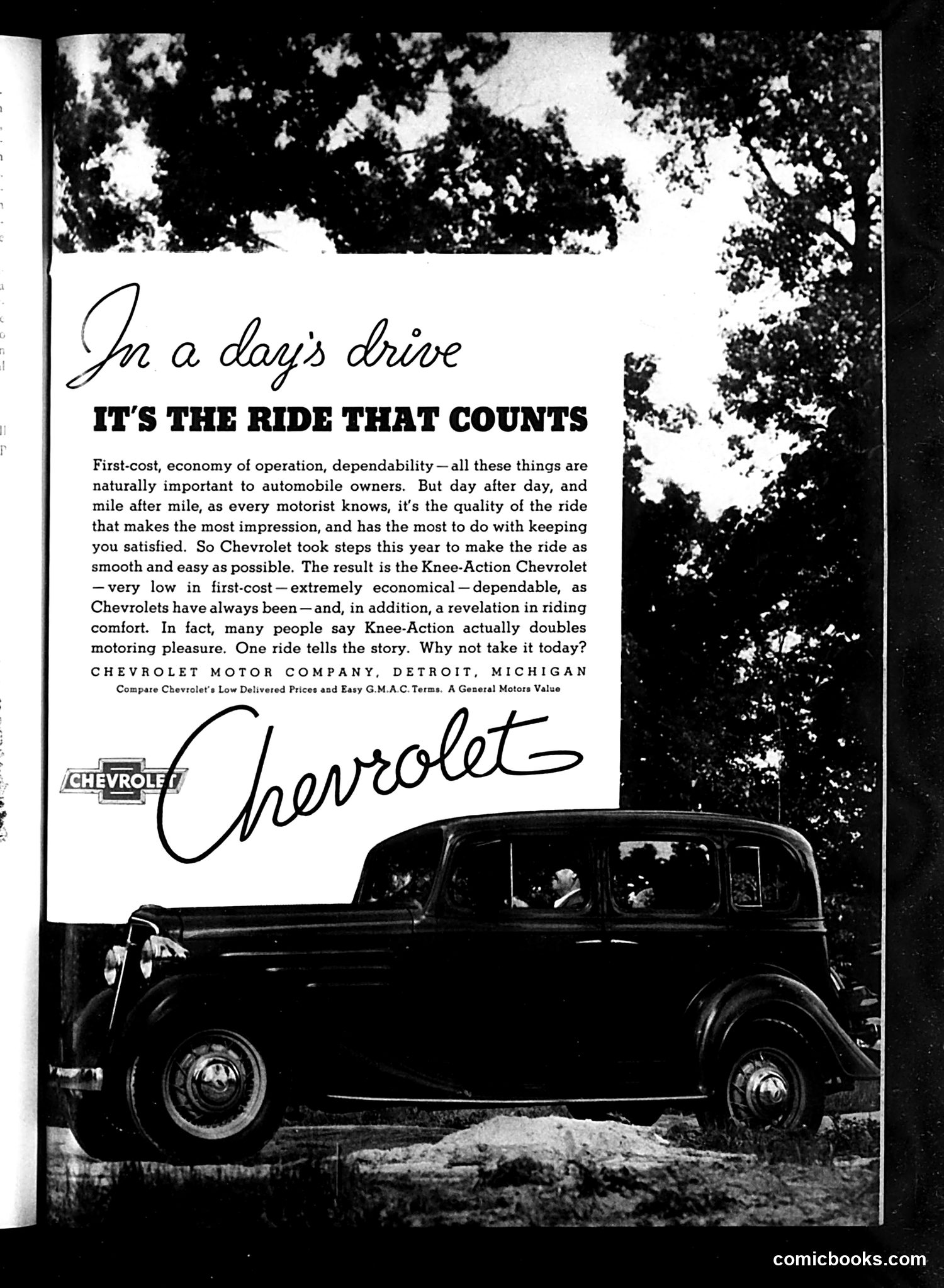
Analysis This is not a satirical cartoon but rather a straightforward automobile advertisement for Chevrolet, likely from the 1930s based on the car's styling and the reference to "Knee-Action" suspension technology (a real innovation Chevrolet introduced in 1934). The ad promotes the Knee-Action Chevrolet by emphasizing that while cost and reliability matter, the quality of the ride is what truly satisfies customers. It highlights the car's smooth suspension as a "revolution in riding comfort" that allegedly doubles motoring pleasure. The image shows a dark sedan photographed against trees, presenting an aspirational lifestyle image typical of Depression-era advertising that emphasized practical value alongside comfort. There is no political satire or social commentary here—this is simply period marketing copy emphasizing mechanical innovation as a consumer benefit.
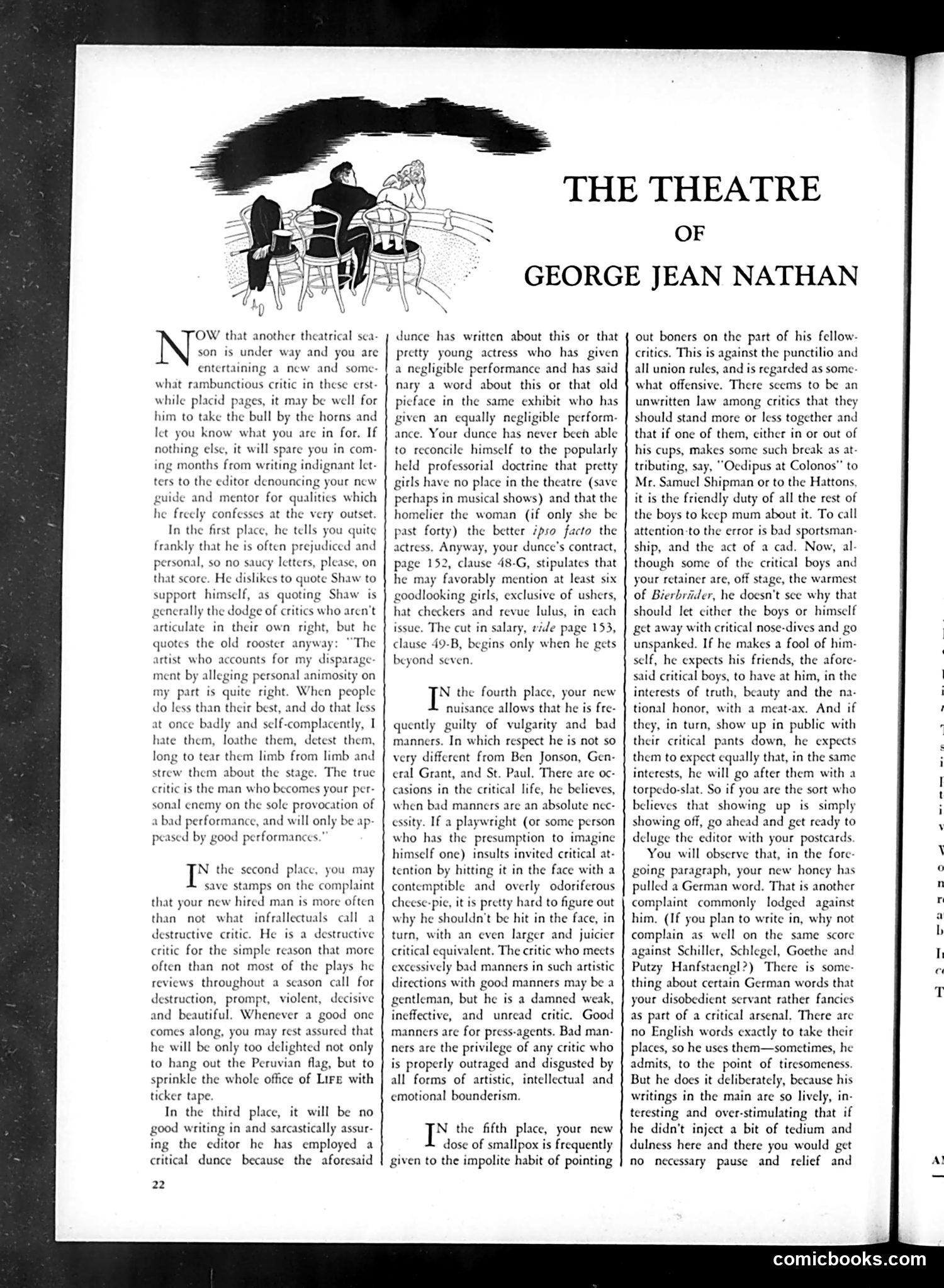
The Theatre of George Jean Nathan This page introduces Life magazine's new theater critic, George Jean Nathan. The cartoon shows three figures seated, likely representing Nathan and theatrical personalities. The text is Nathan's manifesto establishing his critical approach. Key points include: 1. Personal prejudice acknowledged: He admits to subjective, often prejudiced reviews—citing Shaw to justify harsh criticism of poor performances. 2. "Destructive critic" defense: He defends criticizing bad plays, promising enthusiasm for good ones. 3. Pretty actresses: He rejects the "professorial doctrine" that homely older actresses are inherently better, claiming contractual obligation to favorably mention attractive performers. 4. Vulgarity justified: He argues bad manners are sometimes necessary when playwrights present poor work ("cheese-pie"). The satire targets both pretentious theater criticism and Nathan's own brash, unapologetic approach to reviewing—establishing him as a provocative voice willing to mock critical conventions and academic snobbery about theater.
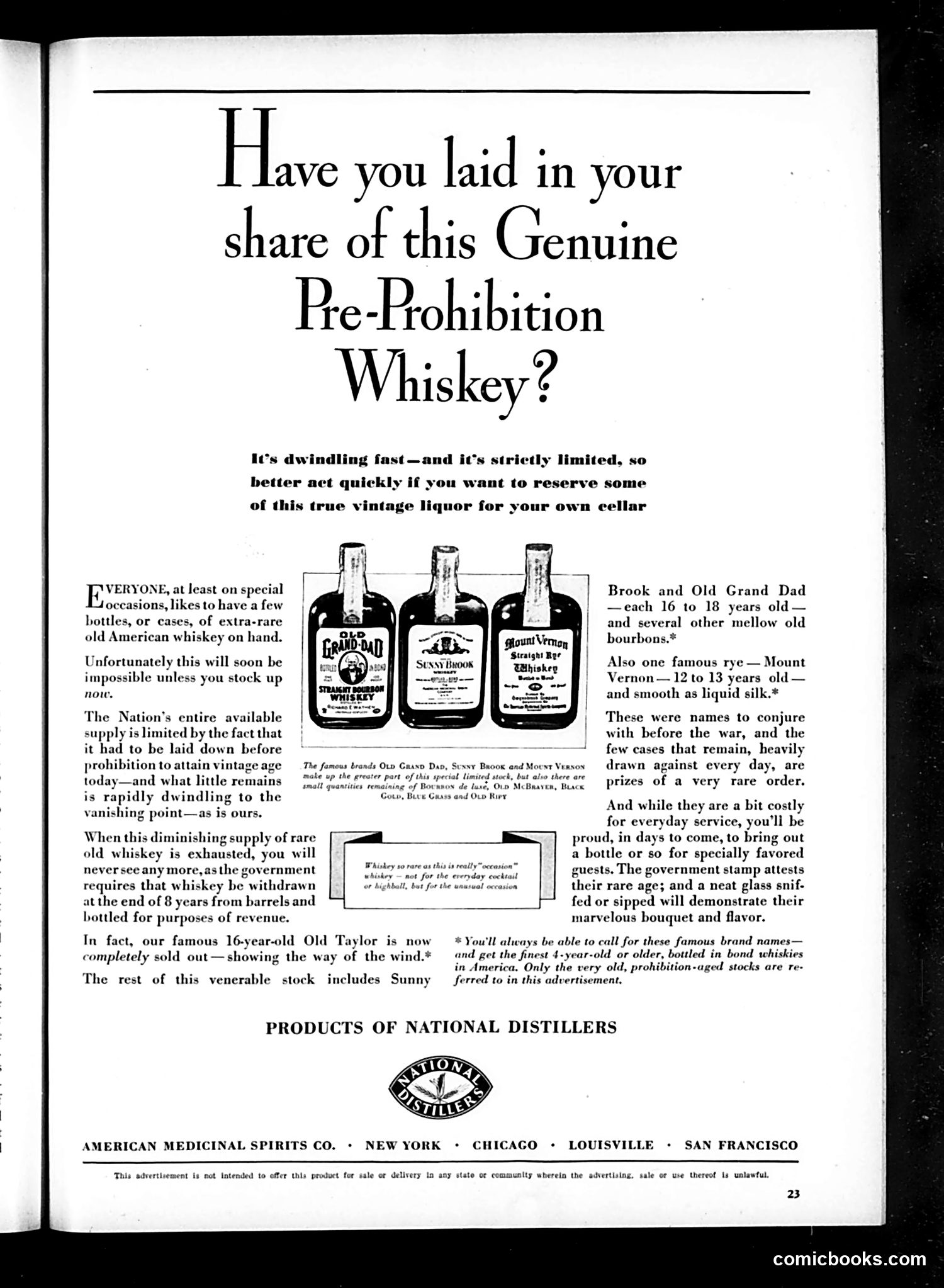
What This Advertisement Means This is not a cartoon but a whiskey advertisement from the Prohibition era (1920-1933), when alcohol sales were federally banned in the United States. The ad exploits a legal loophole: whiskey bottled *before* Prohibition took effect could still be sold and consumed legally. The pitch targets wealthy consumers, urging them to buy pre-Prohibition bottles while supplies last—framing scarcity as both a practical and status concern. The humor (for a modern reader) lies in the advertisement's transparent desperation and thinly veiled defiance of the spirit of Prohibition. It's essentially saying: "Buy now—once we run out, you'll never taste real aged whiskey again." The disclaimer at the bottom ("not intended to offer for sale...where unlawful") was required legal protection. The ad represents how commercial interests navigated Prohibition through legal technicalities, selling nostalgia and exclusivity to circumvent the law.
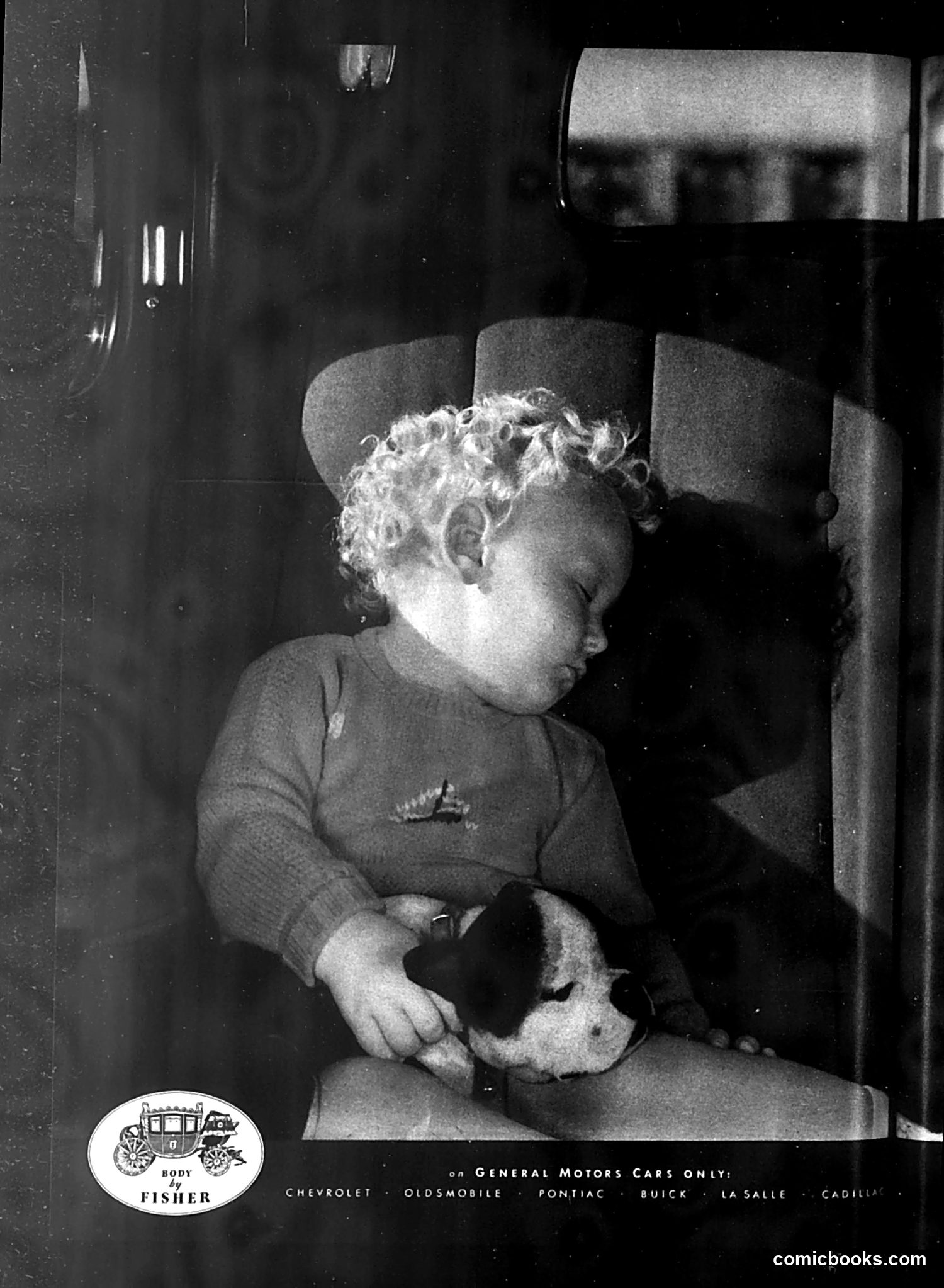
This appears to be a General Motors advertising page rather than political satire. The image shows a young child in what looks like a car interior, and the text identifies this as promotional material for Fisher Body (a GM subsidiary that manufactured car bodies) featuring General Motors vehicles: Chevrolet, Oldsmobile, Pontiac, Buick, La Salle, and Cadillac. The "Body by Fisher" logo is visible at bottom left. This seems to be vintage automotive advertising emphasizing craftsmanship and quality, using an image of a child—likely meant to suggest safety, comfort, and family-friendly design. The grainy black-and-white photograph style is consistent with mid-20th century advertising.
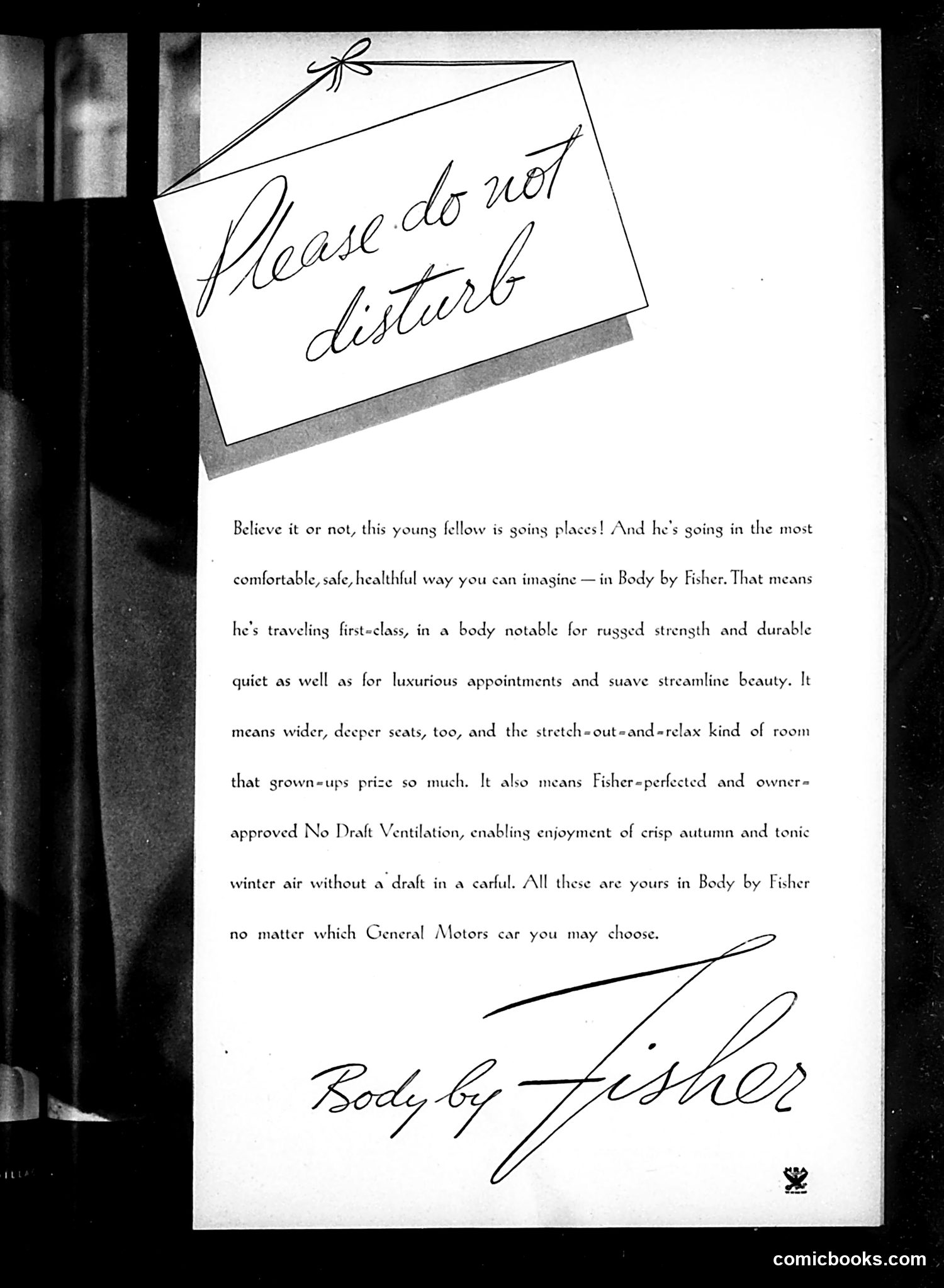
Page Analysis This is a General Motors advertisement, not political satire. It's a promotional piece for "Body by Fisher," a luxury automobile body manufacturer owned by General Motors. The ad uses playful language ("this young fellow is going places") to pitch Fisher's car bodies as premium features available across GM's vehicle lineup. It emphasizes comfort, durability, and engineering refinements—wider seats, streamlined design, and "No Draft Ventilation"—positioning Fisher bodies as desirable upgrades regardless of which GM model a customer chooses. The "Please do not disturb" tag attached to the page is a visual gimmick suggesting the car owner is so comfortable they don't want interruption. This is straightforward commercial messaging typical of mid-20th-century automotive marketing, targeting affluent buyers seeking luxury and status symbols.
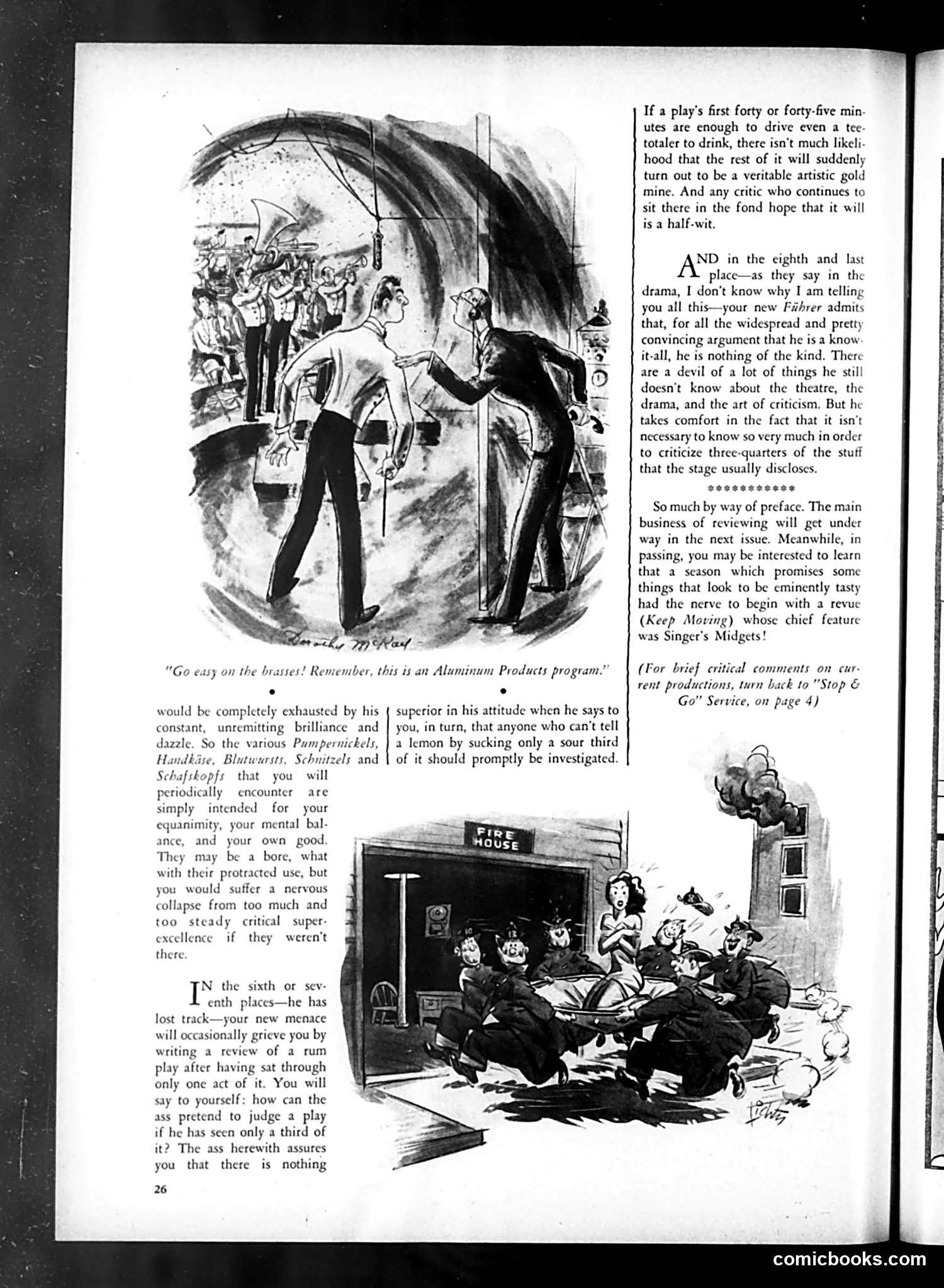
Page Analysis: Life Magazine Theater Criticism This page introduces a new theater critic for Life magazine using self-deprecating humor. The "new Führer" (a joking reference to authoritarian leadership, likely written in the 1930s-40s) admits upfront that he's not an expert but doesn't need to be—since most theatrical productions aren't worth serious analysis anyway. The top cartoon shows two well-dressed men at what appears to be a theater or concert, with the caption about "Aluminum Products program," satirizing corporate sponsorship of entertainment. The lower cartoon depicts chaos at a firehouse, apparently illustrating the absurdity of poorly-crafted theater (referenced as "Keep Moving," featuring Singer's Midgets). The humor relies on the critic's frank admission of incompetence and the implicit claim that judging bad theater requires minimal expertise. The made-up German-sounding names (Pumpernickels, Blutwursts, Schnitzels) add comedic exaggeration to describe verbose theater personalities.
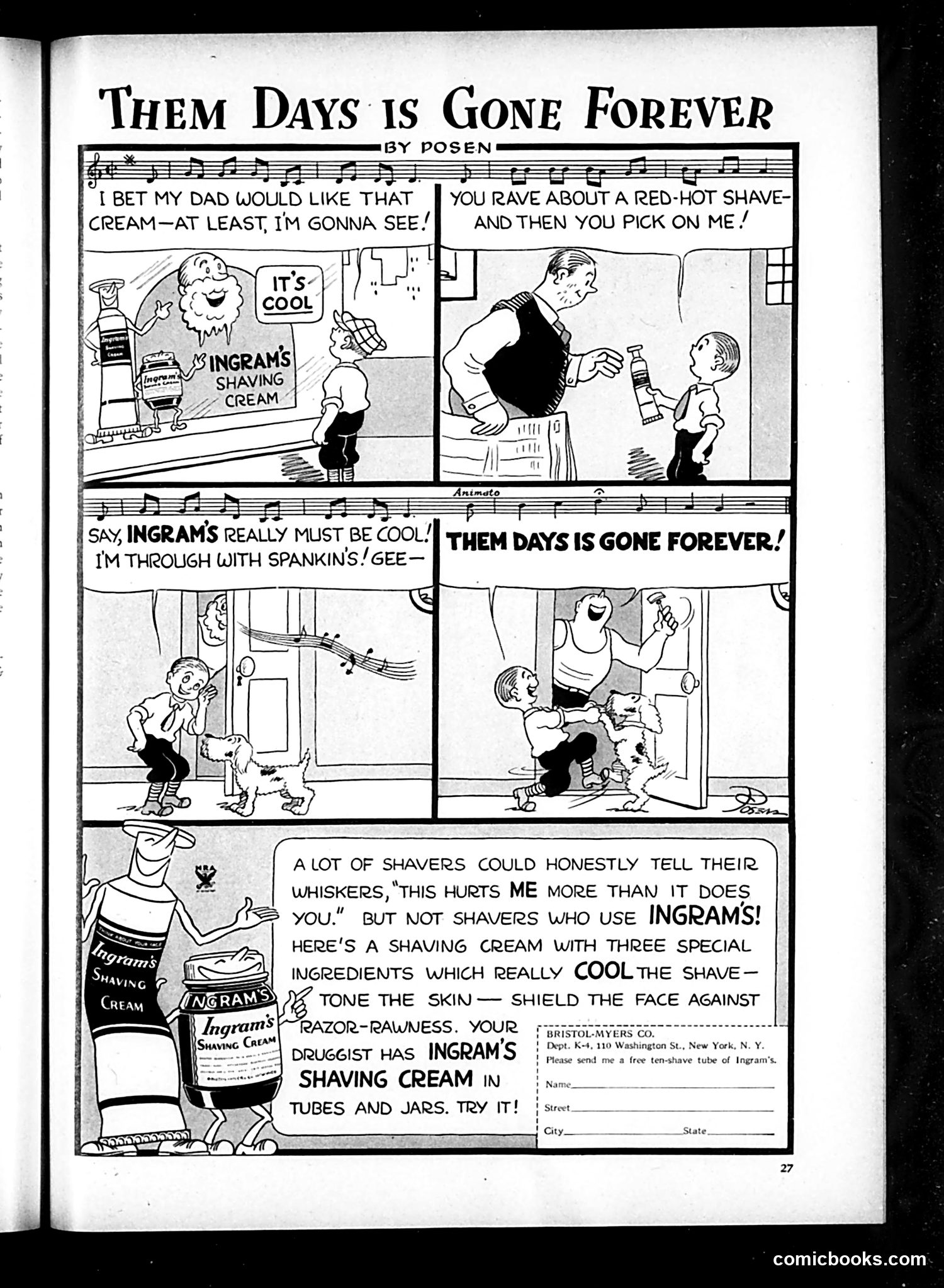
"Them Days is Gone Forever" — Analysis This is primarily an advertisement for Ingram's Shaving Cream disguised as comic entertainment. The narrative frames spanking as old-fashioned discipline ("them days is gone forever"), positioning the product as a modern alternative to physical punishment. The joke: A child suggests his father would like the advertised shaving cream instead of spanking him—implying that soothing shaving cream is preferable to corporal punishment. The child celebrates being "through with spankins." The satire/social commentary: The comic gently mocks old parenting methods (physical discipline) while promoting modern consumerism as the solution to family conflict. It's a lighthearted jab at outdated child-rearing practices, though by today's standards the casual mention of spanking reads quite differently. Artist: By Posen (cartoonist signature visible) The bottom panel explicitly advertises Ingram's three-ingredient formula that "cools the shave," appealing to readers' desire for modern, scientific self-care products.
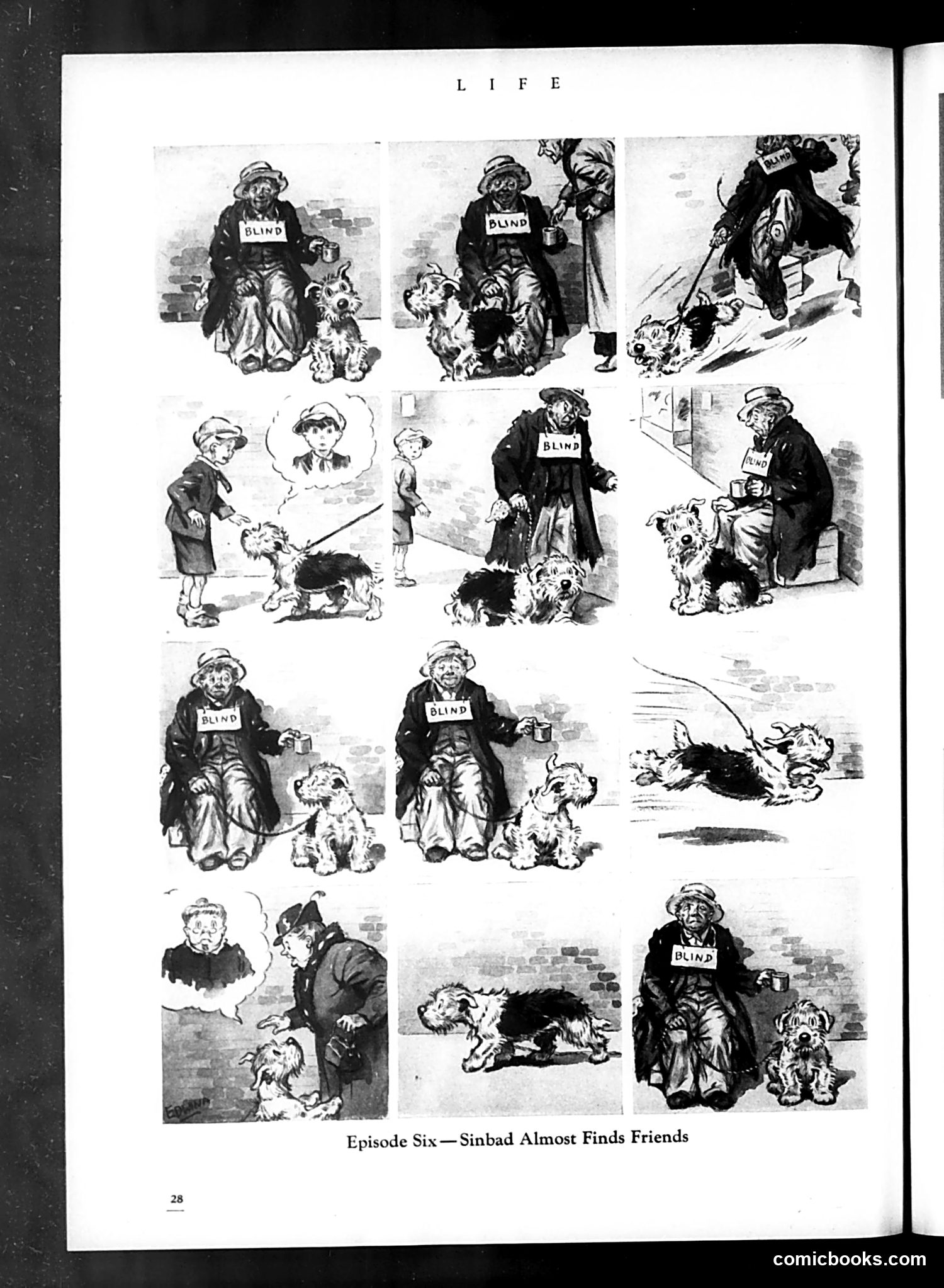
Episode Six—Sinbad Almost Finds Friends This is a comic strip sequence titled "Sinbad Almost Finds Friends." The protagonist—a blind beggar wearing a "BLIND" placard—repeatedly encounters small dogs throughout various urban scenes. The narrative appears to be satirical commentary on social isolation and human indifference. Despite the beggar's apparent attempts at connection (shown through interactions with passersby and dogs), he remains friendless. The recurring motif of dogs—creatures typically associated with loyalty and companionship—emphasizes the irony: a blind person seeking connection finds only animals, not genuine human friendship or assistance. The strip likely critiques urban apathy toward the disabled or impoverished, using the contrast between the beggar's hoped-for companionship and the reality of his solitude as the basis for its social satire.
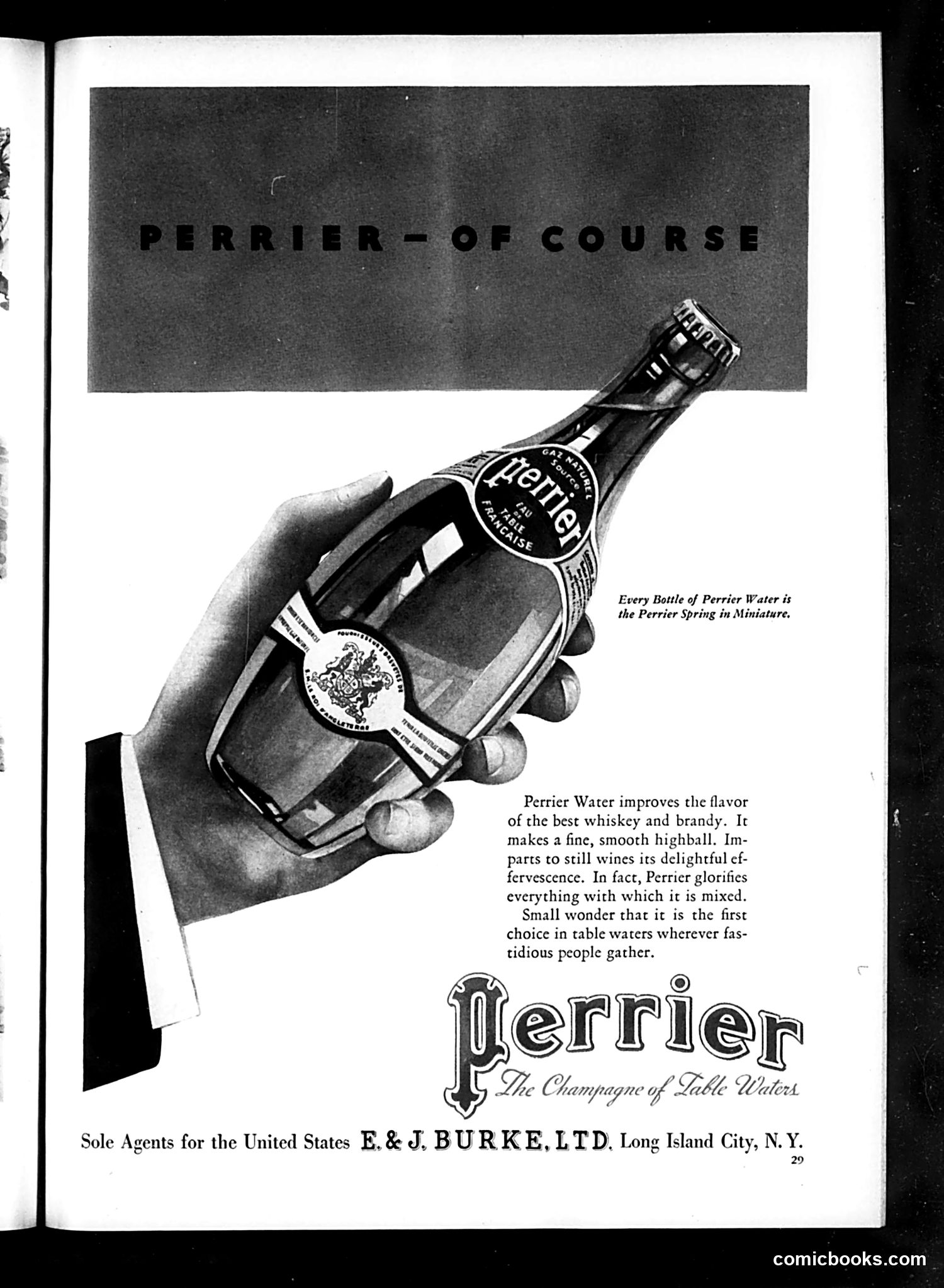
Analysis This is a full-page advertisement, not a political cartoon or satire. It promotes Perrier sparkling water as a luxury product for refined consumers. The headline "PERRIER—OF COURSE" establishes the brand's aspirational status. The image shows an elegantly dressed hand holding a Perrier bottle, emphasizing sophistication and class. The accompanying text claims Perrier enhances whiskey, brandy, and wine—positioning it as essential for "fastidious people" at formal gatherings. The ad's tagline, "The Champagne of Table Waters," directly compares the product to champagne, suggesting premium quality and prestige. The U.S. distributor (E. & J. Burke, Ltd.) is prominently noted. This reflects early 20th-century marketing that equated product consumption with social status and refinement—a common advertising strategy targeting the wealthy during this era.
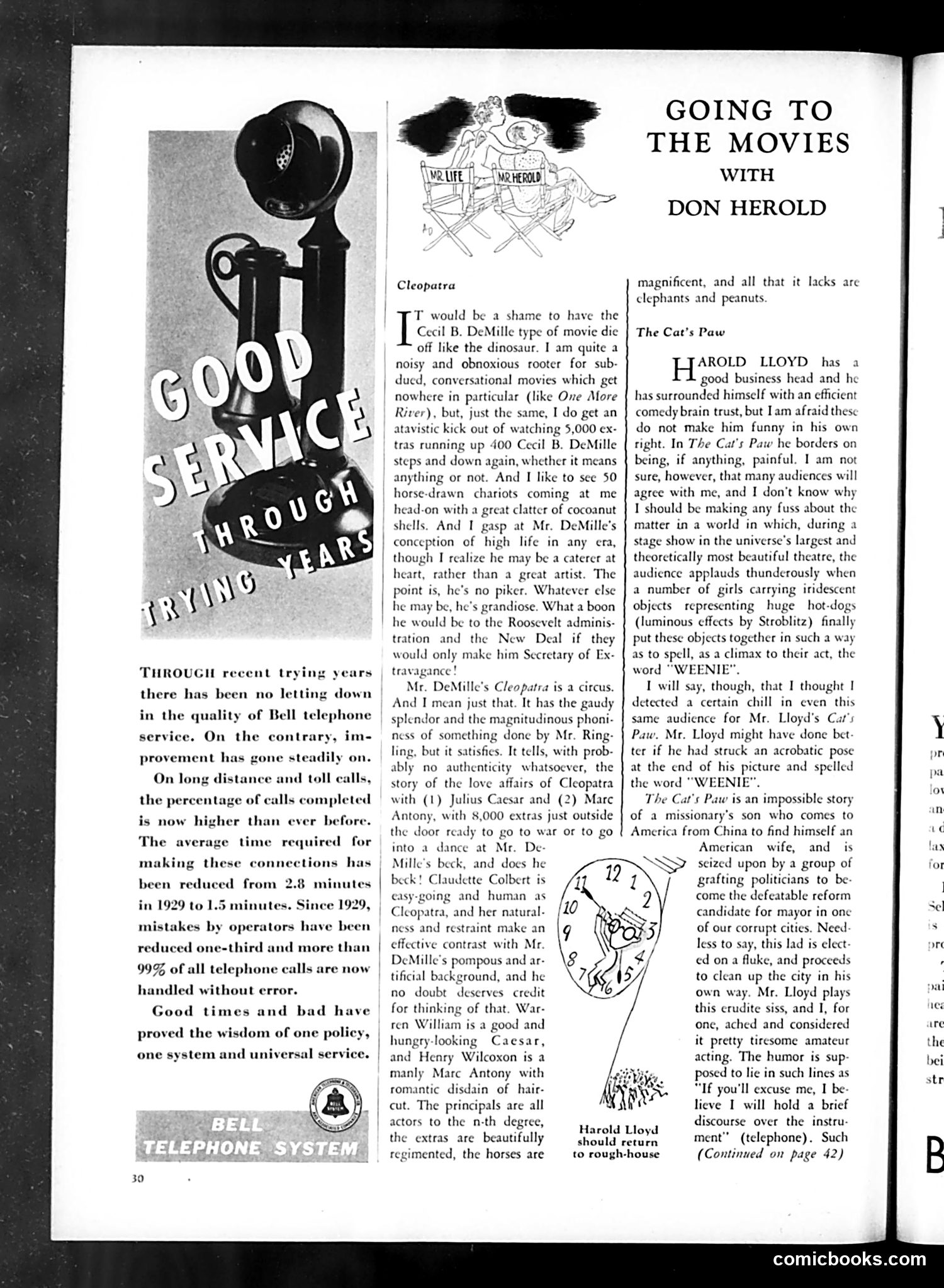
Analysis for Modern Readers This page contains two movie reviews by Don Herold from Life magazine's film criticism section. The cartoons show two women labeled "MR LITE" and "MR HEROLD" sitting in director's chairs—a visual pun on the column's author name. "Cleopatra" review: Herold praises Cecil B. DeMille's lavish spectacle, calling it a "circus" with 8,000 extras and elaborate sets. He admires the grandiosity while admitting it lacks historical authenticity. He jokingly suggests DeMille should become "Secretary of Extravagance" in Roosevelt's New Deal administration—satirizing both DeMille's excess and government spending debates of the 1930s. "The Cat's Paw" review: Herold criticizes Harold Lloyd's comedy, suggesting his "comedy brain trust" can't compensate for Lloyd's own lack of funny material. He complains audiences applaud mindless spectacle (iridescent hot-dog props spelling "WEENIE") while remaining silent at Lloyd's picture—implying lowbrow entertainment preferences. Both reviews use satire to critique both filmmaking excess and audience taste.
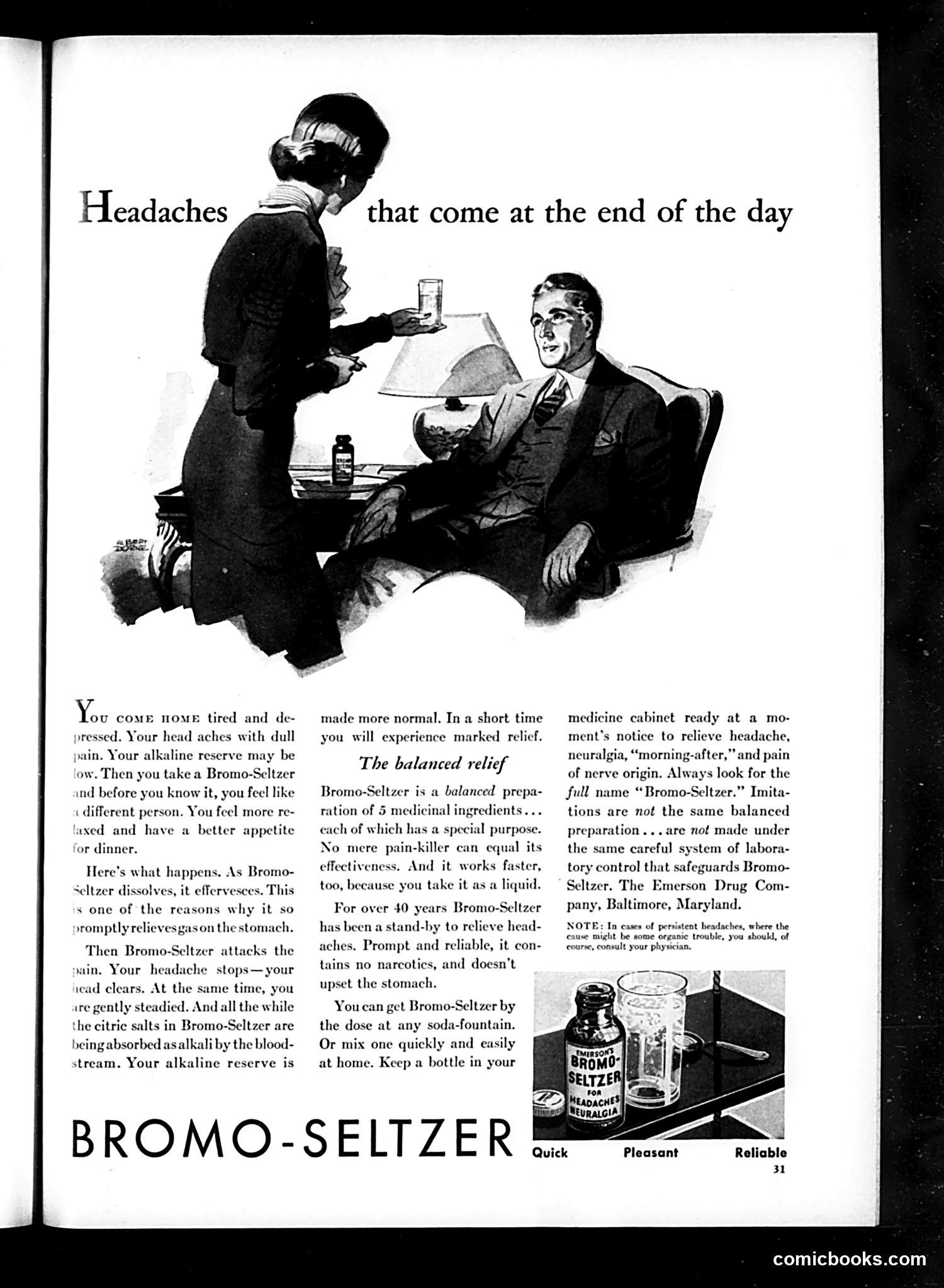
Bromo-Seltzer Advertisement Analysis This is a product advertisement, not satire or political commentary. It depicts a domestic scene where a tired, stressed businessman comes home with a headache. A woman offers him Bromo-Seltzer (an effervescent antacid/pain reliever). The advertisement uses the common early-20th-century marketing trope of the "modern miracle cure"—claiming the product addresses multiple ailments simultaneously (headache, stomach upset, low alkaline reserves). The social context reflects 1920s-30s gender roles: the solicitous wife administering medicine to her weary husband, implying her duty to restore his comfort and vitality for dinner. The "balanced relief" language and emphasis on containing "no narcotics" suggests competition with patent medicines of the era, some containing dangerous ingredients. The note recommending physician consultation for persistent headaches shows early medical credibility concerns. This is straightforward commercial messaging, not satirical commentary.
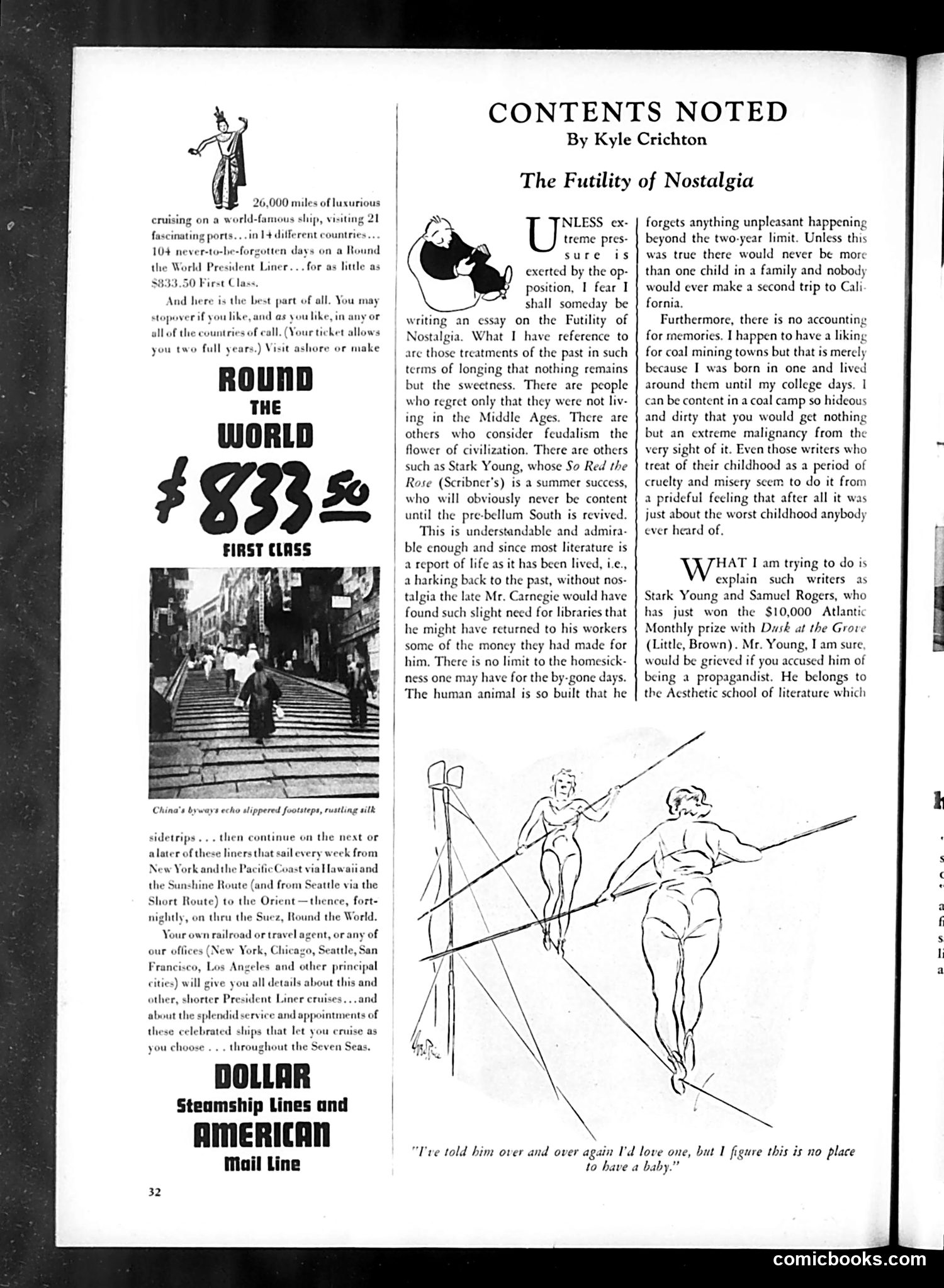
"Contents Noted: The Futility of Nostalgia" — Life Magazine This is a literary essay by Kyle Crichton critiquing writers who romanticize the past. The piece targets Stark Young, whose novel *So Red the Rose* was a contemporary bestseller celebrating pre-Civil War Southern life. Crichton argues Young and similar writers (including Samuel Rogers, winner of an Atlantic Monthly prize) sentimentalize bygone eras—the antebellum South, feudalism, the Middle Ages—by remembering only sweetness while erasing genuine hardship. The accompanying sketch shows three figures on a tightrope, illustrating the precarious nostalgia Crichton describes. The caption's joke about having a baby "no place" to have one suggests the disconnect between romanticized fantasy and harsh reality—the essay's central point. Crichton contends human memory conveniently forgets unpleasantness beyond two years, making people vulnerable to false nostalgia. He criticizes this as intellectually dishonest while acknowledging literature inherently looks backward.
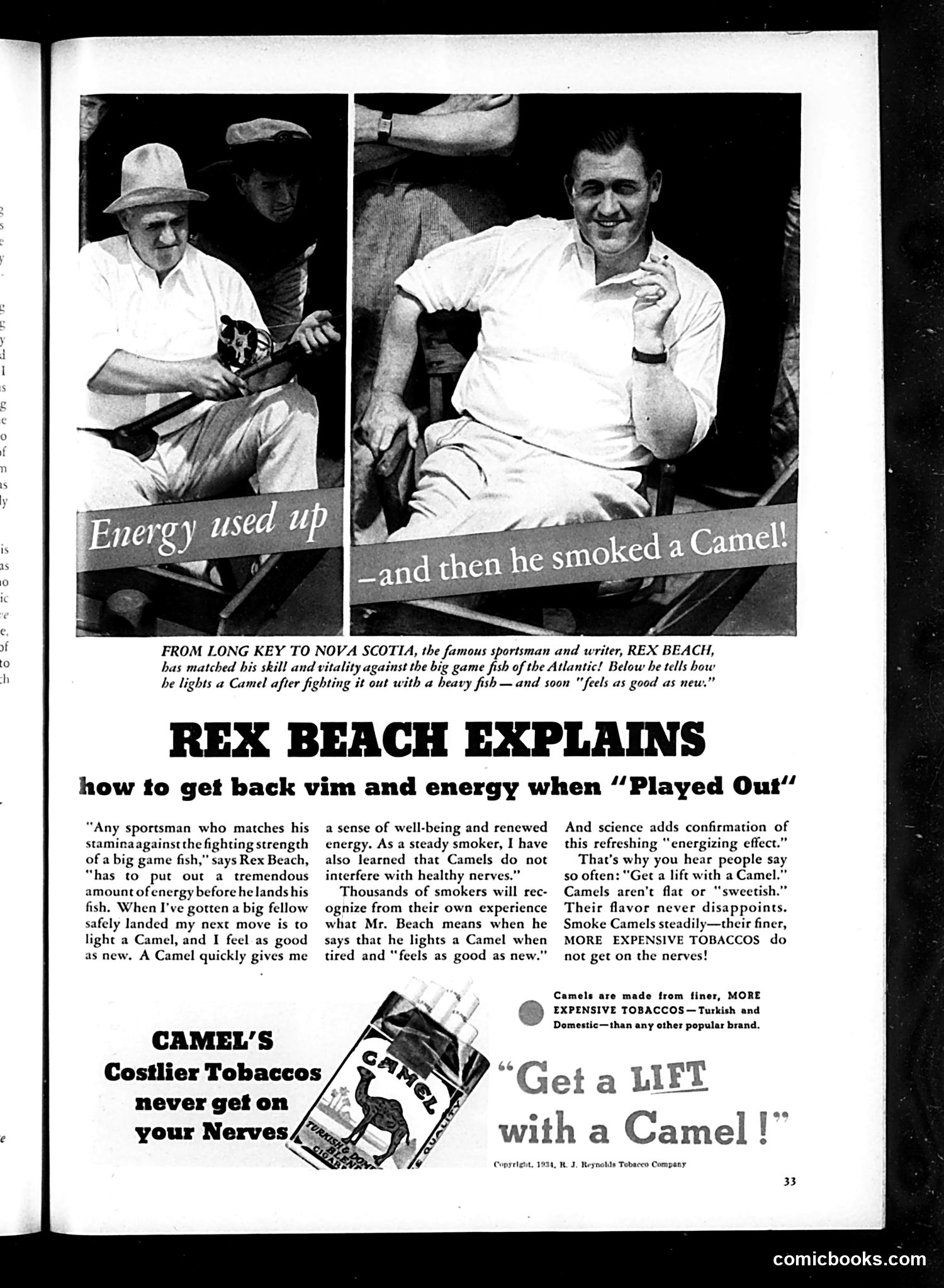
Analysis for Modern Readers This is a cigarette advertisement, not satire or political commentary. Rex Beach, a famous early-20th-century sportsman and writer, endorses Camel cigarettes by claiming they restore energy after physical exertion (he's shown fishing). The ad makes now-shocking health claims: that Camels provide an "energizing effect," don't "interfere with healthy nerves," and help you "feel as good as new." It emphasizes "costlier tobaccos" to suggest quality and safety. What we'd miss today: In 1934, such claims were legal and common. Tobacco companies routinely marketed cigarettes as healthful, even remedial. The ad targets active, masculine figures (sportsmen, hunters) to associate smoking with vigor and vitality—a strategy the tobacco industry used for decades before health dangers were widely acknowledged. This represents pre-regulation advertising when health warnings didn't exist and such promotional tactics were culturally normalized.
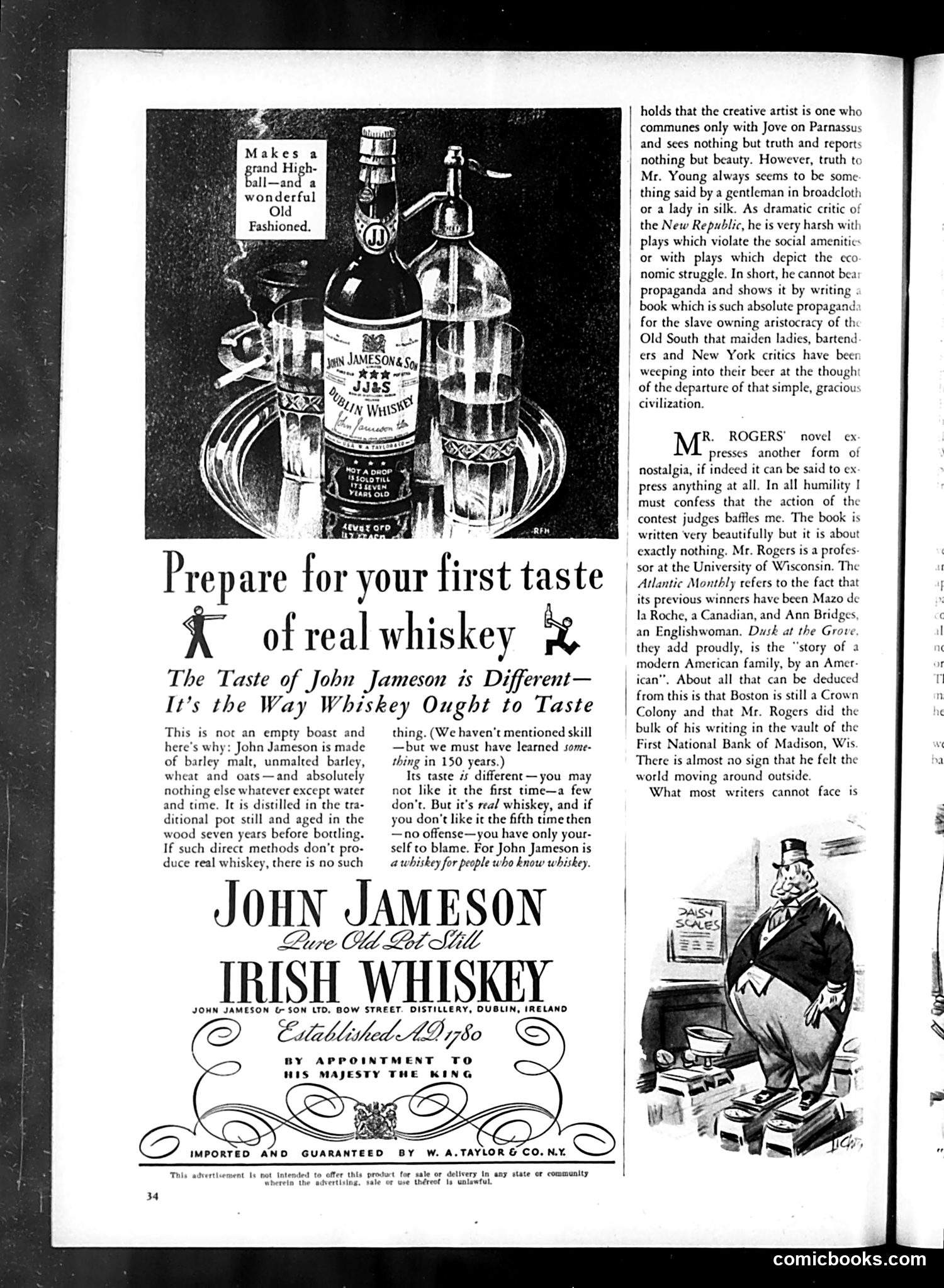
Analysis of This Page This page is primarily a John Jameson Irish Whiskey advertisement (left side), with unrelated literary criticism text (right side). The Advertisement: The left features a product image showing whiskey bottles with the slogan "Prepare for your first taste of real whiskey." The ad emphasizes traditional distilling methods—pot still aging, seven years in wood, specific grain combinations—positioning Jameson as authentic whiskey for connoisseurs who "know whiskey." It includes a royal warrant ("By Appointment to His Majesty the King"), lending prestige. Notable Context for Modern Readers: This appears to be from Prohibition era or shortly after (given the cautious language about "sale or use thereof is unlawful" in some states), when whiskey advertising was heavily restricted in America. Right Side: Unrelated literary criticism discussing playwrights and novelists—appears to be a separate article about artistic merit and social criticism in contemporary theater and literature. The juxtaposition suggests this is simply magazine page layout from that period, combining advertisement with editorial content.
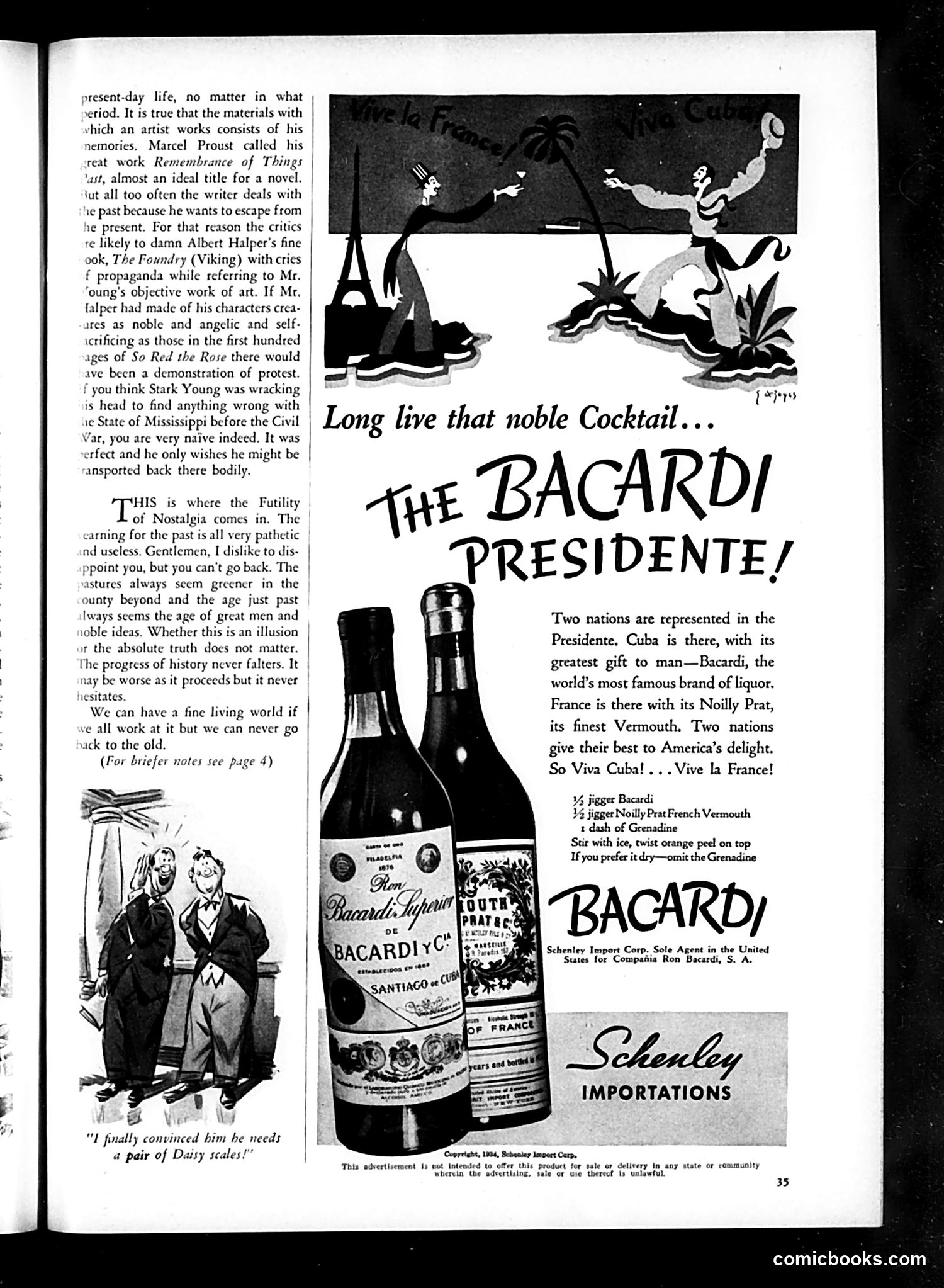
Political Context and Satire Analysis This page mixes literary criticism with advertising. The left column debates whether writers should address contemporary social issues or retreat into nostalgic past settings—criticizing authors like Stark Young for romanticizing the antebellum South rather than confronting present injustices. The cartoon below illustrates this theme: two men in old-fashioned dress, with the caption "I finally convinced him he needs a pair of Daisy scales!"—likely mocking outdated thinking or reliance on the past. The right side is a Bacardi rum advertisement titled "The Bacardi Presidente!" It celebrates the cocktail as representing Cuban-American relations through Bacardi liquor and French Vermouth, toasting both "Viva Cuba! Vive la France!" This patriotic framing appears designed to market rum during an era when such national symbolism was commercially appealing—predating the 1959 Cuban Revolution that would dramatically alter U.S.-Cuba relations.
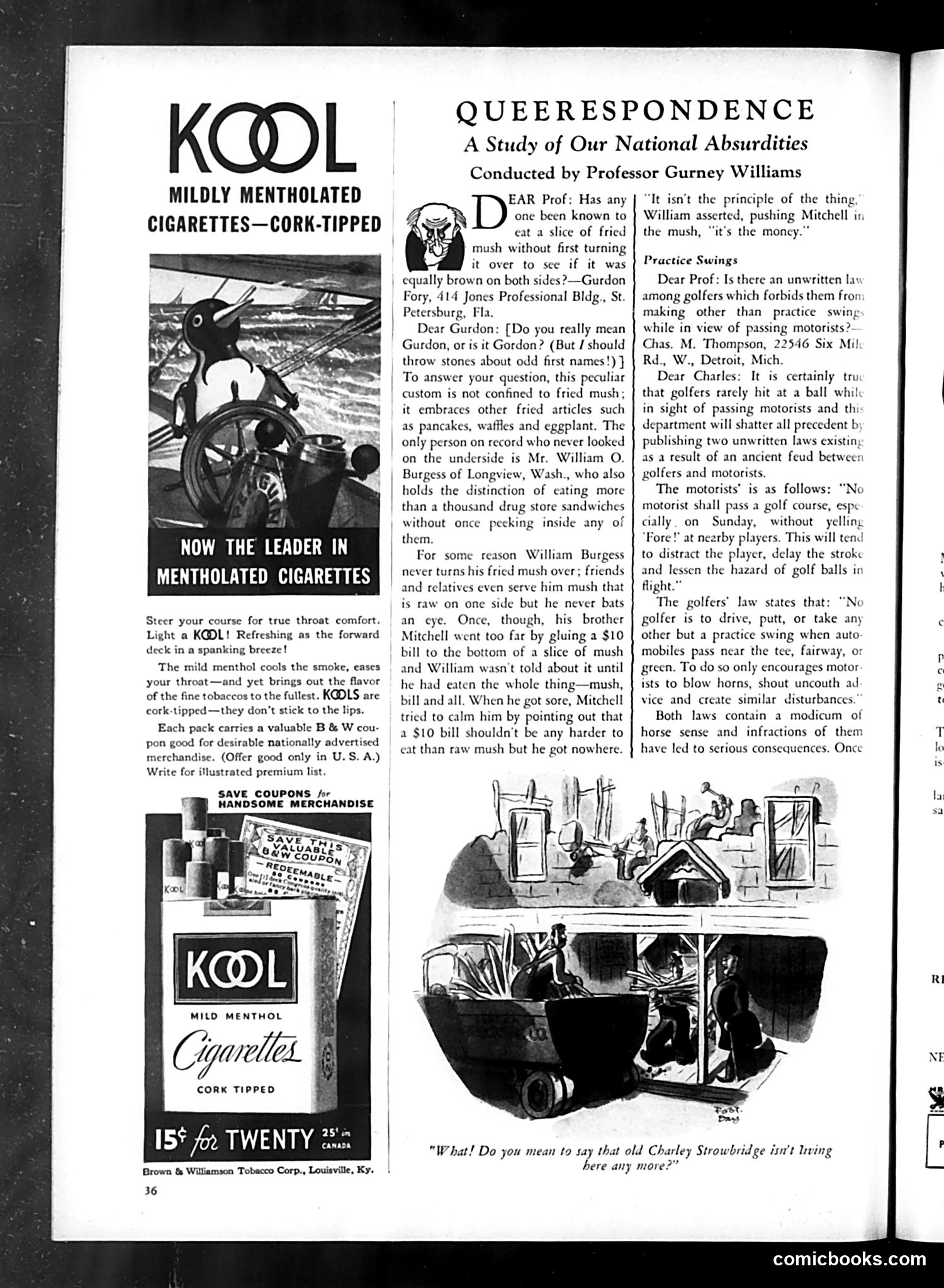
Explanation for Modern Readers This page contains a Kool cigarette advertisement (left side) and a satirical advice column called "Queerespondence: A Study of Our National Absurdities" (right side). The column mocks everyday American quirks through humorous Q&A. The first letter absurdly asks whether people check if fried mush is browned equally on both sides—answered with an equally ridiculous anecdote about a man who never does this, even when his brother glues a $10 bill to the bottom of his mush to trick him. The second letter satirizes the tension between golfers and motorists—a social friction point in early-to-mid 20th century America. It presents fake "unwritten laws": motorists must shout "Fore!" to distract golfers, while golfers must avoid swinging when cars pass. The joke highlights how these two groups' activities were genuinely at odds on American roads and courses. The cartoons illustrate these scenarios with simple line drawings. The satire gently pokes fun at American social conventions and the petty conflicts between recreational groups.
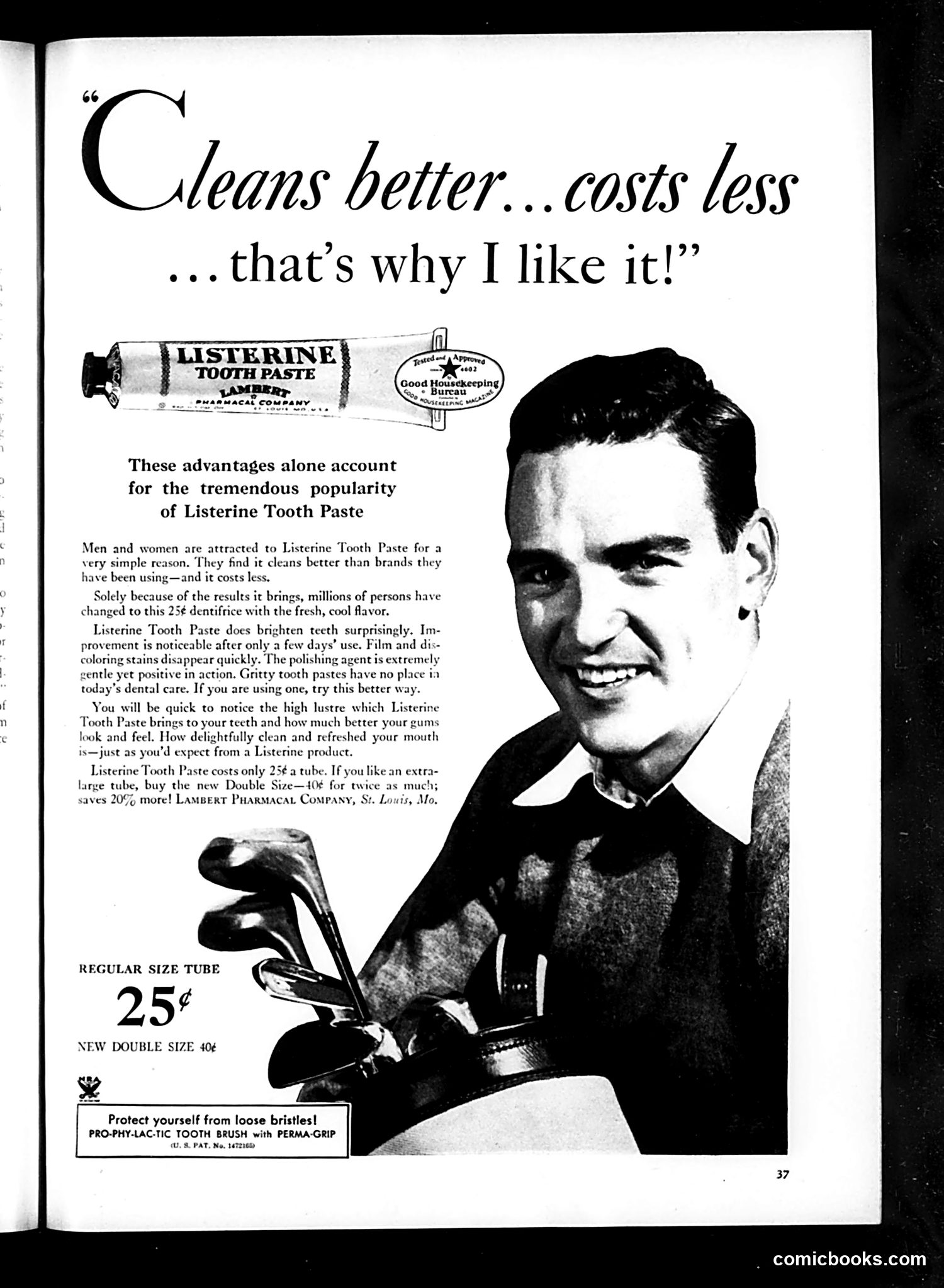
Analysis This is a Listerine Tooth Paste advertisement, not a political cartoon. It dates from the era when Life magazine ran both satirical content and paid advertising. The page features a smiling man holding a tube of Listerine Tooth Paste, endorsing the product with the quote "Cleans better...costs less...that's why I like it!" The advertisement emphasizes two main selling points: superior cleaning power and low cost (25 cents). The text makes specific product claims—that teeth brighten noticeably within days, that film and stains disappear quickly, and that the polishing agent is gentler than competitors' "gritty" formulas. A secondary product, the Pro-Phy-Lac-Tic Tooth Brush with Perma-Grip, is also advertised. For modern readers, this reflects early-to-mid 20th century consumer marketing strategies: testimonial endorsements, comparative pricing, and appeals to both effectiveness and economy. The "Good Housekeeping Bureau" seal visible on the toothpaste tube represents now-obsolete product certification authority.
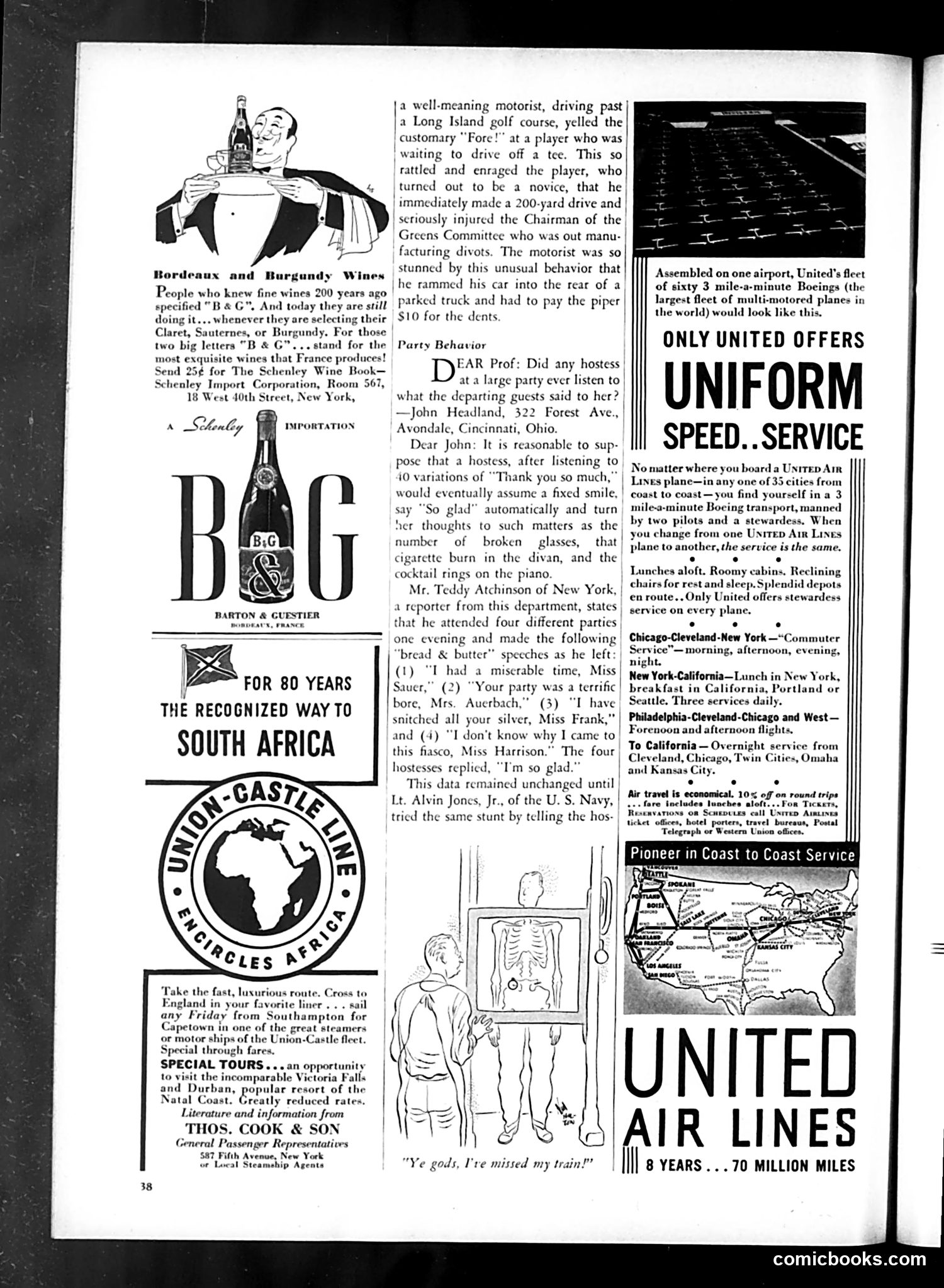
A Page of 1930s American Life Magazine This page combines satirical advice columns with period advertisements. The main cartoons mock social etiquette: "Party Behavior" depicts a Navy officer's experiment in honesty. He deliberately makes insulting departing remarks ("your party was a terrific bore," "I've snitched all your silver") to four different hostesses, yet all respond identically with "I'm so glad"—satirizing the hollow, automatic politeness of social conventions. The implication: hostesses aren't actually listening; they've deadened themselves to courtesy. Other content includes a golf-course anecdote about a motorist's well-meaning shout startling a novice golfer into an impressive drive that injures the Greens Committee chairman—ironic consequences of innocent intervention. The advertisements (B&G wines, Union-Castle steamships, United Air Lines) represent 1930s luxury travel marketing. The cartoon's satire of false politeness contrasts sharply with these ads' promises of genuine service and excellence—whether transatlantic voyages or coast-to-coast airline travel.
Page Analysis: Life Magazine Advertisement and Humor Section This page is primarily advertising and humor content, not political satire. The main cartoon advertises Noilly Prat vermouth, a French import, featuring a stylized woman's face with the brand name. The accompanying text humorously advises avoiding substitutions, emphasizing authenticity. The page's bulk consists of reader-submitted humor—a recurring Life magazine feature where readers submitted absurd questions for $5 payment. Examples include: "Why does a bald barber recommend hair tonic?" and "Has anyone eaten grapefruit without getting shot in the eye?" These are gentle, non-political jokes about everyday frustrations and logical contradictions. The remaining space contains hotel and apartment advertisements (Beaux-Arts Apartments, Hotel Montclair), typical mid-century Manhattan real estate marketing. No significant political or social satire is present. This is a lighthearted entertainment and commercial page from what appears to be the 1930s-40s era.
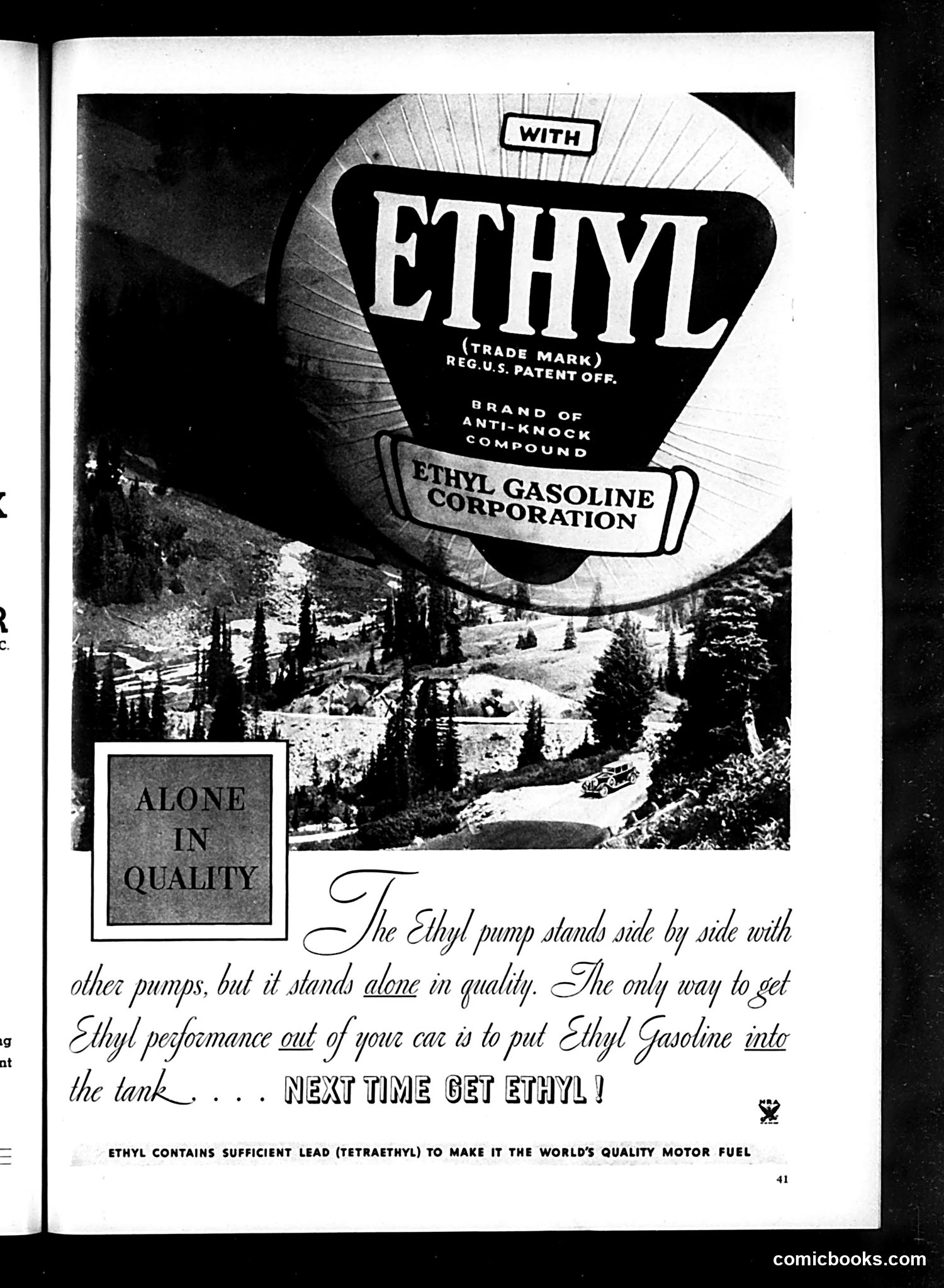
This is a full-page advertisement, not satire or political commentary. It promotes Ethyl Gasoline, a brand of leaded motor fuel manufactured by the Ethyl Gasoline Corporation. The ad uses a scenic landscape with a winding road to convey quality and superiority. The large balloon-style logo emphasizes that Ethyl is a trademarked "anti-knock compound" — a reference to engine knocking (a mechanical problem in early automobiles that lead additives reduced). The tagline "Alone in Quality" claims Ethyl's exclusive superiority over competing gas pumps. The text directly states the product contains tetraethyl lead, presented as a desirable feature that makes it "the world's quality motor fuel." Modern context: This advertisement is historically significant because it openly promoted lead in gasoline — a practice later recognized as causing severe public health and environmental damage. The ad reflects pre-regulation industrial marketing practices.
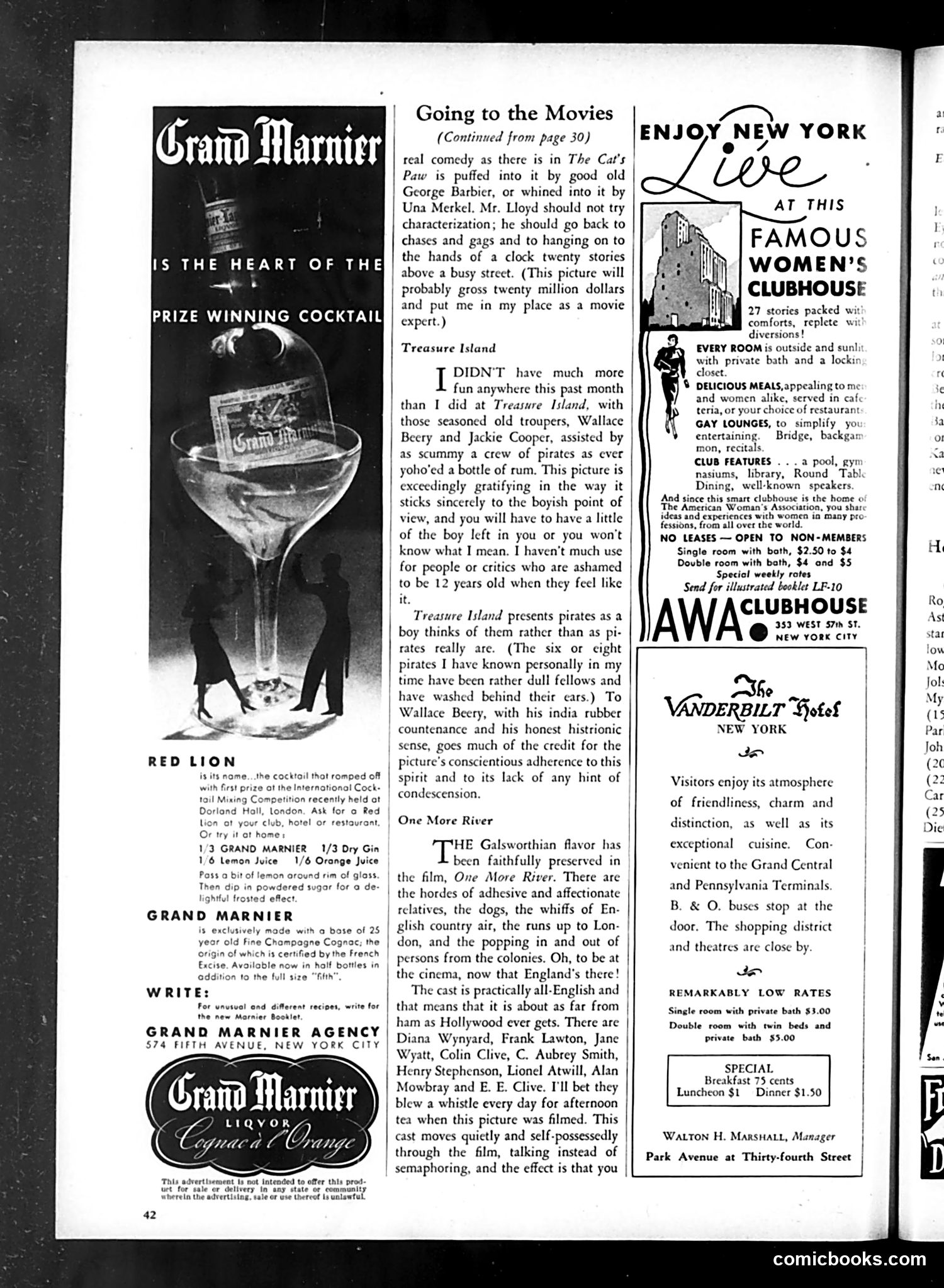
Page Analysis: Movie Reviews and Advertisements This page from *Life* magazine contains film criticism rather than political cartoons. The left side features a Grand Marnier liquor advertisement with a glamorous image of the "Red Lion" cocktail. The center and right columns present a movie critic's reviews of three films: *The Cat's Paw* (criticized as unfunny despite Lloyd's talents), *Treasure Island* (praised for its sincere boyish adventure appeal with Wallace Beery), and *One More River* (commended for its all-English cast and authentic Galsworthy adaptation). The right side advertises New York establishments: the Women's Clubhouse and the Vanderbilt Hotel, highlighting amenities like pools, dining, and lounges. The tone is sophisticated entertainment journalism aimed at affluent urban readers. The implicit critique suggests Hollywood's comedies often overreach characterization, while period dramas succeed through restraint and authenticity—particularly when featuring established British talent rather than American "ham."
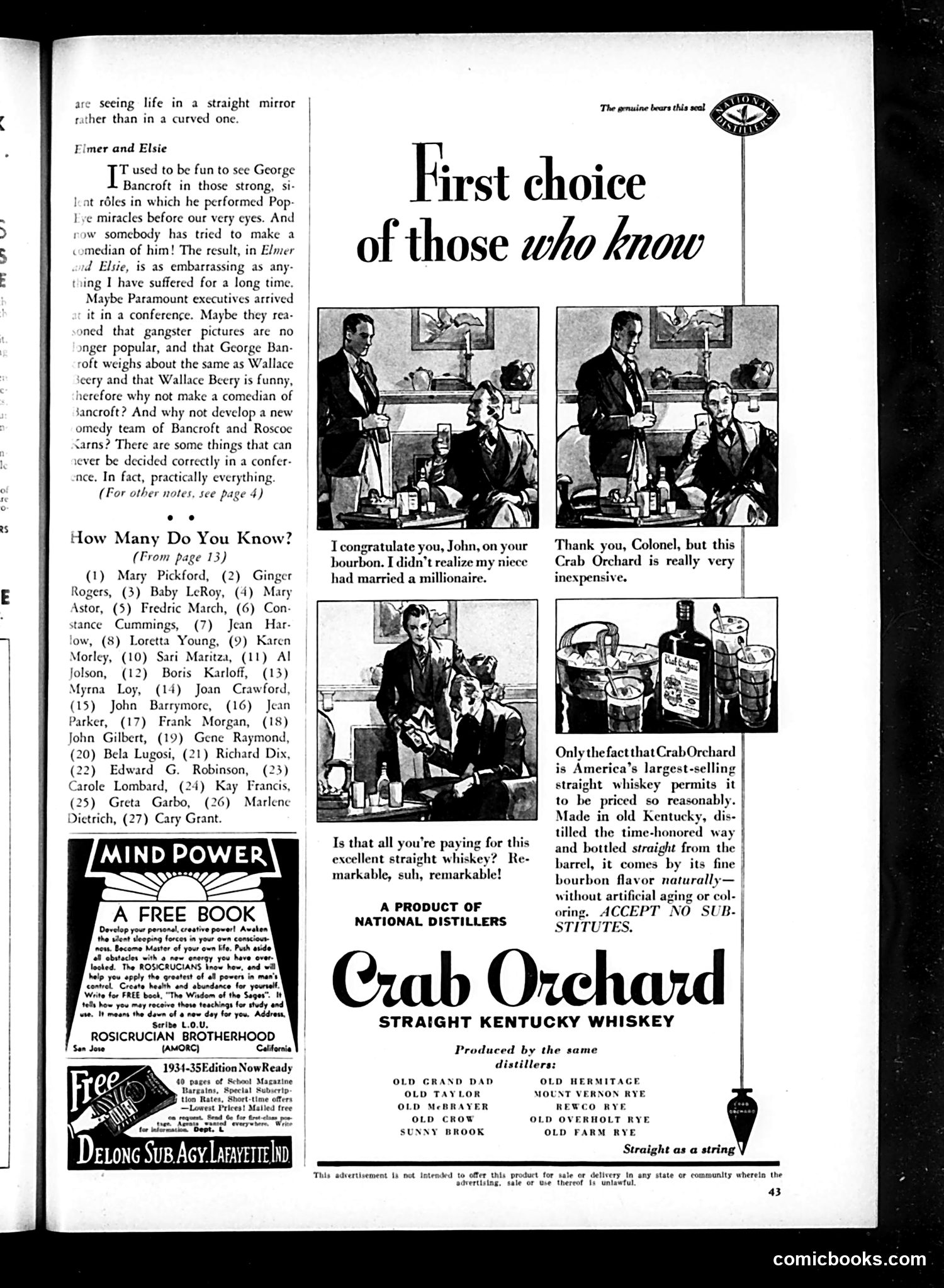
Life Magazine Page Analysis This page contains two distinct sections: a film review and a whiskey advertisement. Film Review ("Elmer and Elsie"): The critic laments actor George Bancroft's attempted transition to comedy. The satire targets studio executives' decision-making process—specifically, the flawed logic of conference rooms. The reviewer suggests that because gangster films were declining in popularity and Bancroft physically resembles funny actor Wallace Beery, executives decided to make Bancroft a comedian and pair him with Roscoe Karns. The critique is that such major creative decisions are "never decided correctly in a conference"—satirizing Hollywood's corporate approach to filmmaking as fundamentally absurd. Advertisement: The Crab Orchard whiskey ad uses social comedy dialogue: a wealthy character congratulates "John" on affording expensive bourbon, only to learn it's actually affordable Crab Orchard. The humor plays on class assumptions and the product's value proposition—quality whiskey at reasonable price.
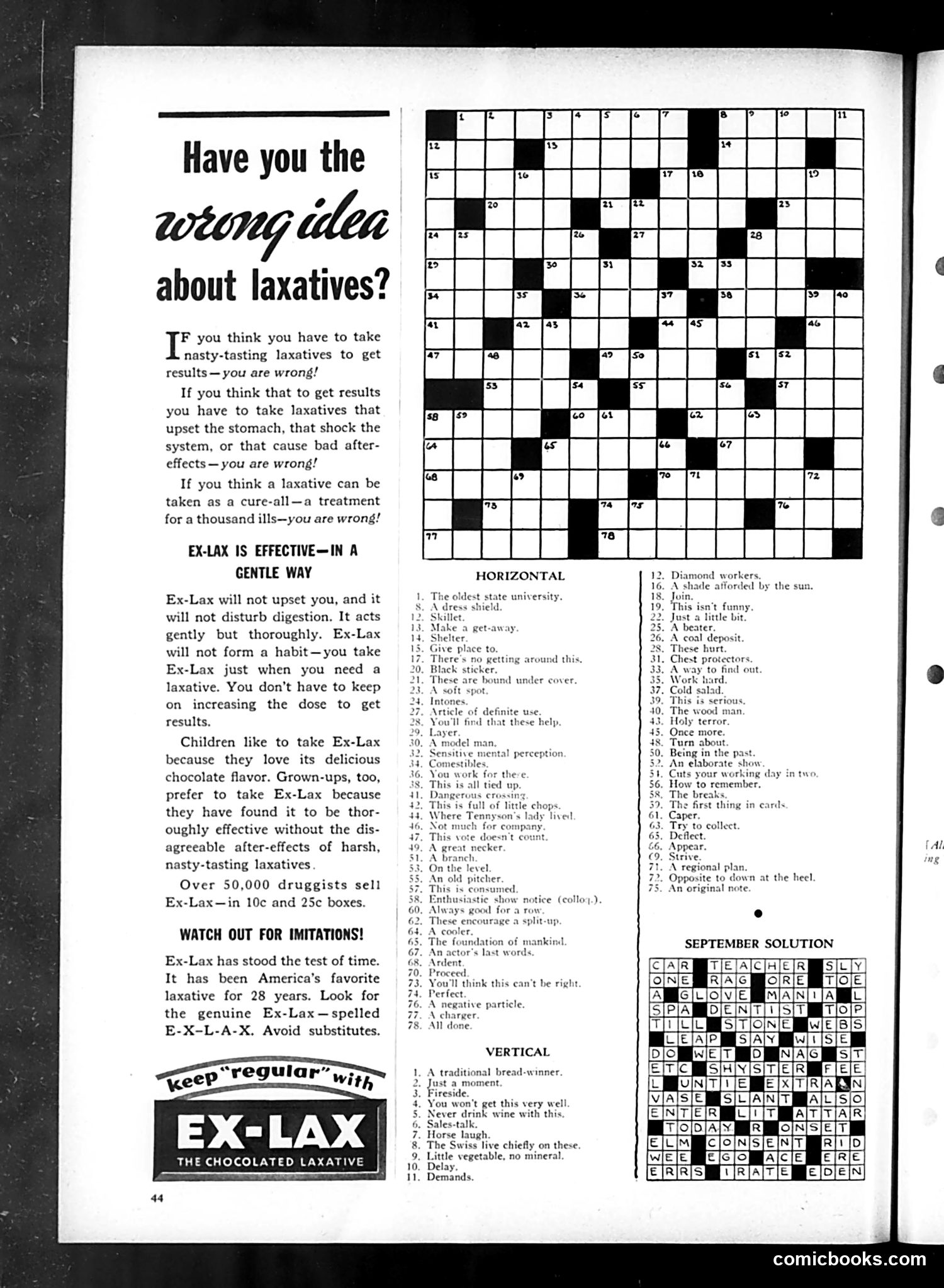
Ex-Lax Advertisement & Crossword Puzzle This page is primarily a pharmaceutical advertisement for Ex-Lax, a chocolated laxative product, paired with a crossword puzzle to engage readers. The ad addresses common consumer misconceptions about laxatives—that they must taste bad, upset the stomach, or create dependency. Ex-Lax counters these beliefs by emphasizing its gentle effectiveness and chocolate flavor, positioning it as a modern, non-habit-forming alternative to harsh competitors. The advertisement warns readers to avoid imitations and notes Ex-Lax has been "America's favorite laxative for 28 years," lending credibility through longevity. The product sold in 10¢ and 25¢ boxes at drugstores. The accompanying crossword puzzle served as entertainment to hold reader attention while promoting the product—a common advertising strategy of the era. This represents early 20th-century medicinal marketing targeting both adults and children.
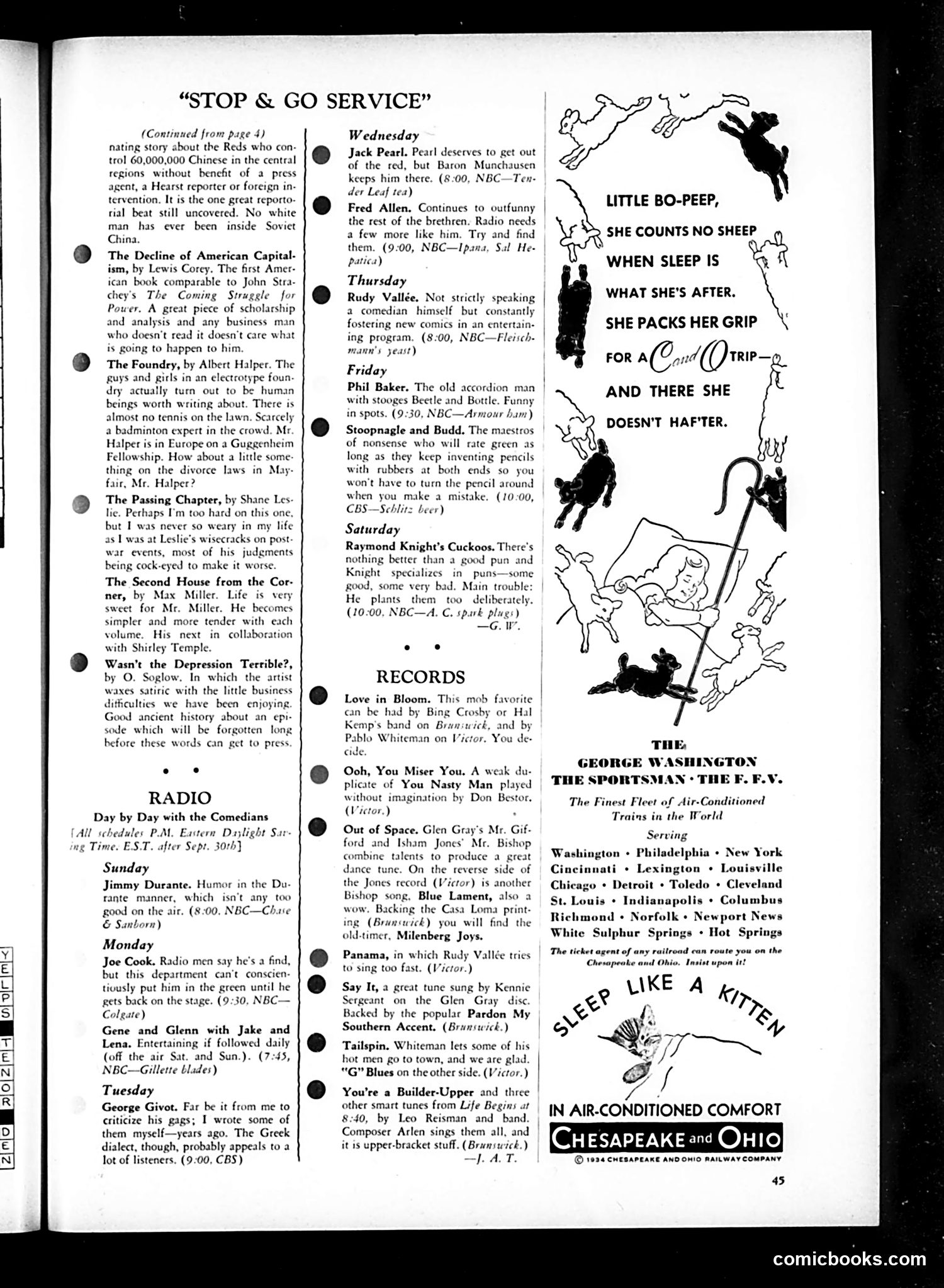
Analysis of Life Magazine Page (circa 1930s) This page is primarily book and entertainment reviews rather than political satire. The left column reviews recent books, including titles critiquing capitalism and Soviet China. The center and right sections cover radio comedy schedules and record recommendations. The notable satirical content appears in O. Soglow's book review entry: "Wasn't the Depression Terrible?" — a title itself mocking the recent economic collapse through forced cheerfulness. Soglow was a cartoonist known for depression-era satire. The accompanying cartoon (right side) titled "Little Bo-Peep" is whimsical rather than pointed political satire—showing a girl counting sheep during a "Carol O Trip," likely referencing leisure travel. The bottom advertisement for the Chesapeake and Ohio Railway promoting "air-conditioned comfort" is period marketing, not satire. Overall, this page reflects 1930s American cultural commentary through book reviews of capitalism's decline and gentle radio/entertainment criticism—snapshots of Depression-era intellectual concerns.
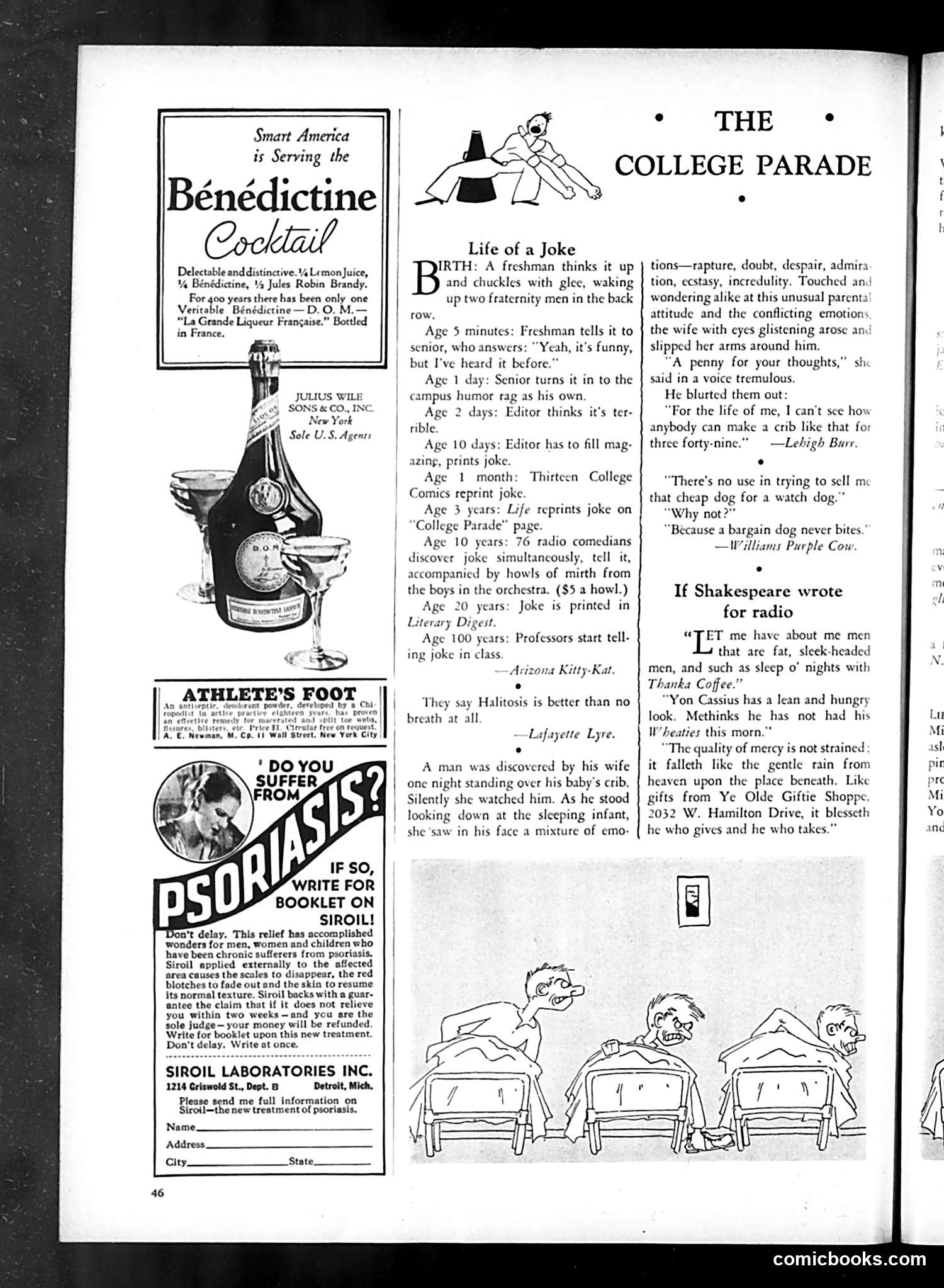
Explanation for Modern Readers This page contains satirical college humor and vintage advertisements from *Life* magazine's "College Parade" section. "Life of a Joke" traces how a college joke becomes commodified and trivialized over time—originating as a freshman's original thought, then stolen by seniors, reprinted across thirteen college humor magazines, broadcast by 76 radio comedians simultaneously, and eventually quoted by professors a century later. The satire critiques how humor loses authenticity through mass reproduction and commercial exploitation. "If Shakespeare wrote for radio" mocks the aggressive product placement in 1920s-30s radio advertising by imagining Shakespeare's famous lines rewritten to promote consumer goods like "Thanka Coffee," "Wheaties," and "Ye Olde Giftie Shoppe." The humor lies in the jarring incongruity between high literature and crass commercialism. The advertisements (Bénédictine cocktails, Athlete's Foot powder, Siroil psoriasis treatment) reflect period marketing conventions, while the cartoon at bottom depicts college students in chairs—likely illustrating classroom or dorm life referenced in the jokes above.
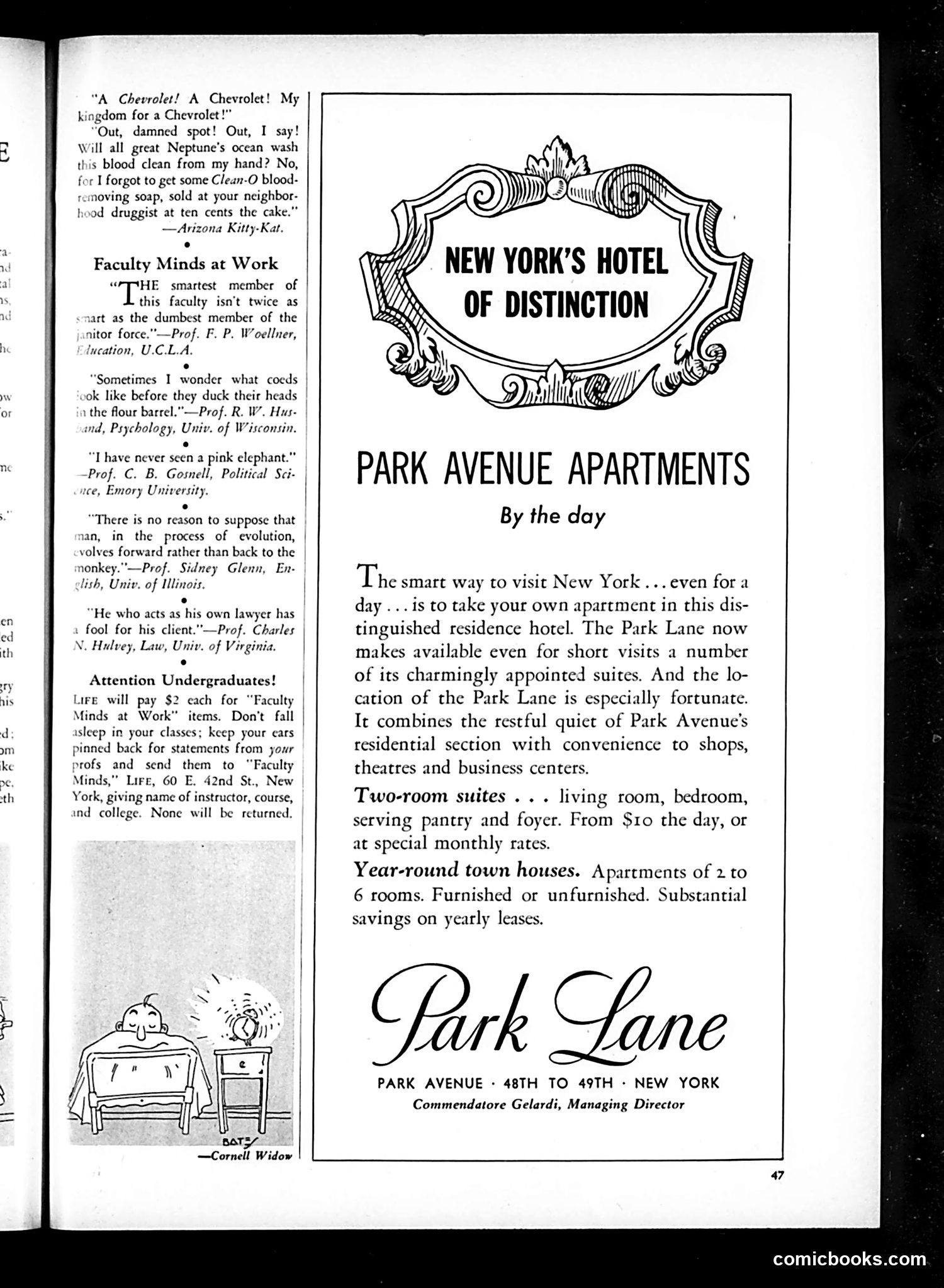
Analysis for Modern Readers This Life magazine page combines humor and advertising. The left side features "Faculty Minds at Work"—a humor column where professors are quoted making absurd or silly statements. These include comparing faculty intelligence unfavorably to janitors, and one claiming never to have seen a pink elephant. The satire mocks academic pomposity by presenting intellectuals as disconnected from reality. The cartoons parody Shakespeare: one mimics *Macbeth*'s "Out, damned spot!" to advertise cleaning soap, and another references *Richard III*'s "A horse! A kingdom for a horse!" but substitutes a Chevrolet—satirizing American materialism and car culture. The right side is a straightforward hotel advertisement for Park Lane Apartments on Park Avenue, offering furnished suites by the day or year. The page reflects 1920s-30s American humor: mocking academia, leveraging literary references for comedy, and celebrating consumer goods through advertising.
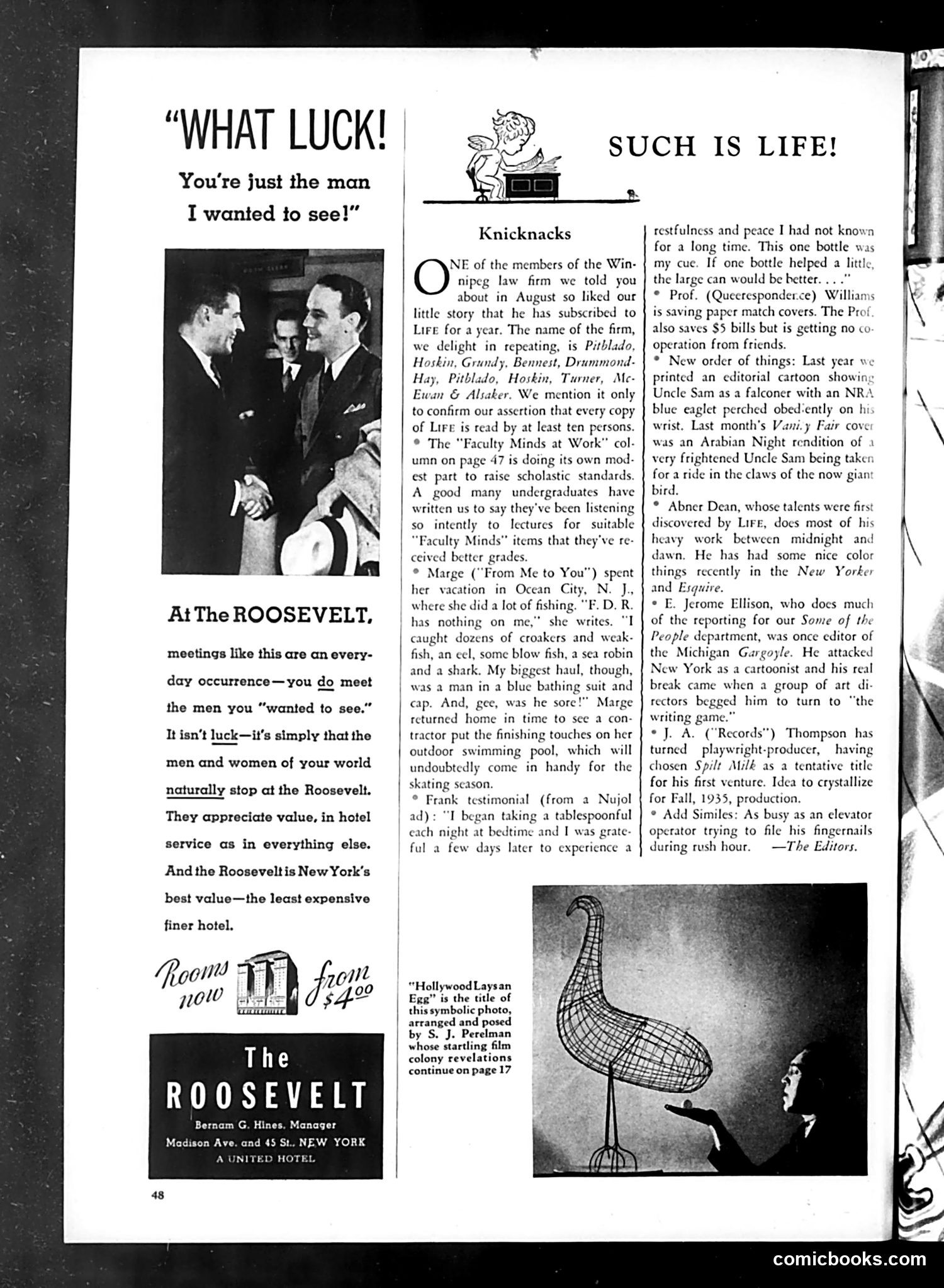
Analysis of Life Magazine Page This page comprises primarily advertising and magazine filler rather than political cartoons. The main content is a Roosevelt Hotel advertisement (left side) depicting three men in business attire meeting by chance—the ad's premise being that the hotel is where desirable professional encounters naturally occur. This is straightforward commercial marketing with no satirical intent. The right side contains "Knicknacks," Life's gossip/miscellany column featuring brief anecdotes about contributors and readers. One item references FDR (Franklin D. Roosevelt) humorously in a fishing anecdote. Another mentions the NRA (National Recovery Administration), a New Deal program, in a prior editorial cartoon reference. The only image with potential symbolic meaning is the "Hollywood Laysan Egg" photograph credited to S. J. Perelman, described as "symbolic" and tied to his film industry commentary (continued on page 17). This is primarily a magazine contents page mixing ads, gossip, and house notes—not a satirical cartoon analysis.