life
Life — November 1934
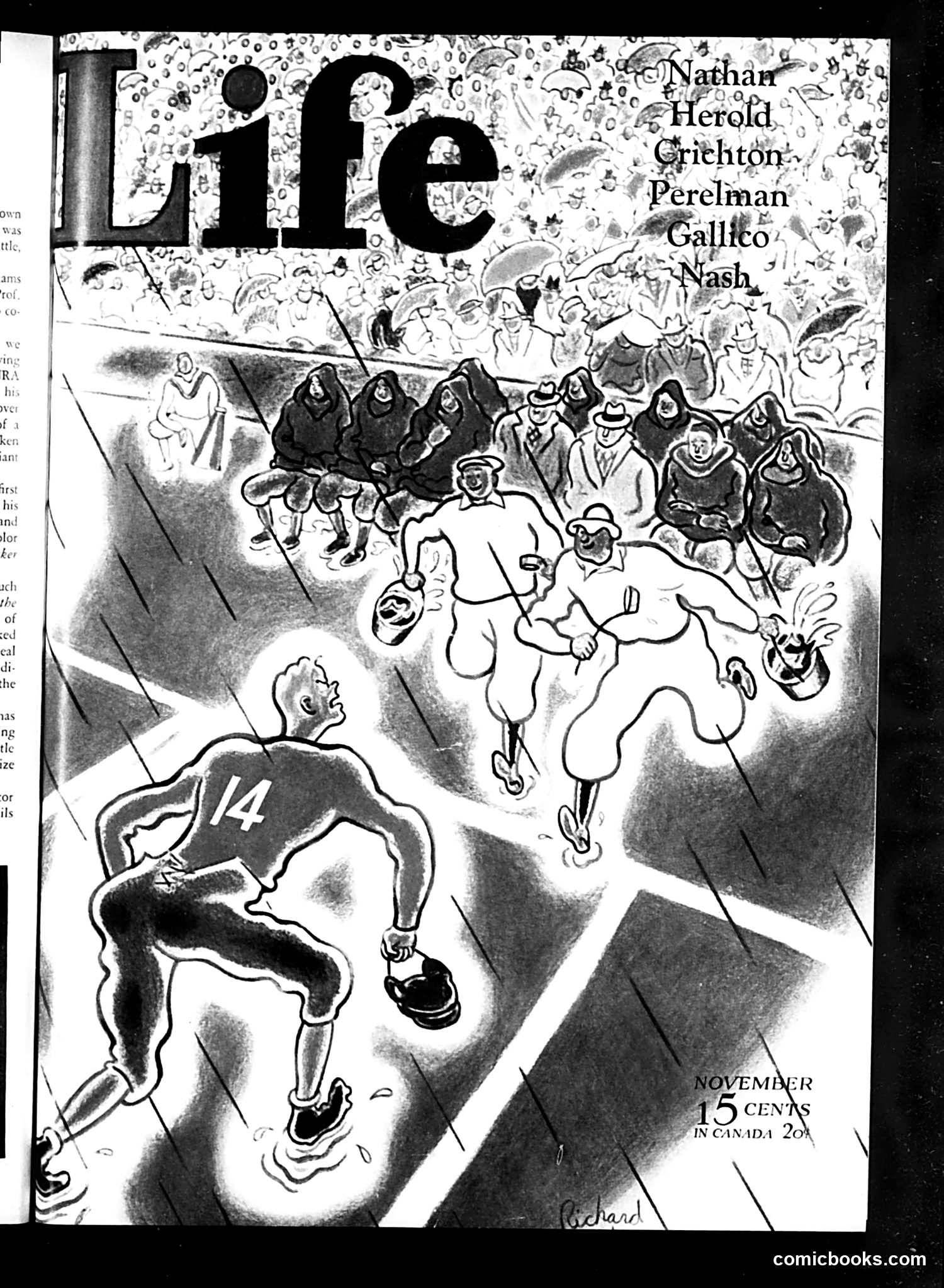
Political Cartoon Analysis This Life magazine cover (November, 15 cents) features a satirical illustration signed by Richard. The large "Life" masthead overlays a cartoon scene depicting what appears to be a chaotic sports or competitive event, with a prominent figure wearing jersey number 14 in the foreground. The named figures at top—Nathan, Herold, Crichton, Perelman, Gallico, and Nash—likely represent contemporary writers or public figures of the era. The cartoon's crowded composition and exaggerated physical comedy suggest satirizing a specific sporting event or social spectacle, though the exact reference remains unclear without additional context. The style is typical of Life's humorous social commentary from this period.
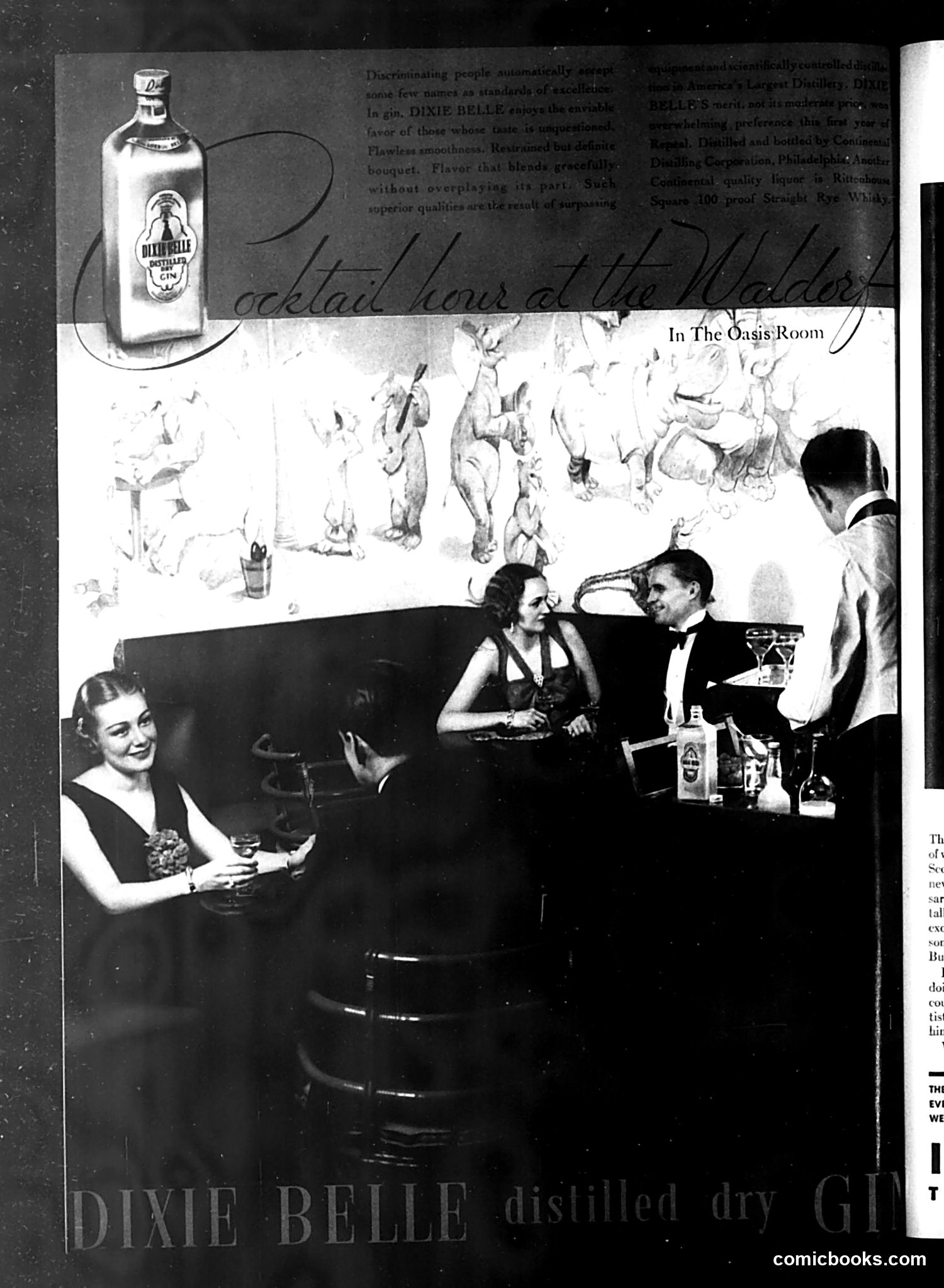
Analysis This is a liquor advertisement, not political satire. It advertises Dixie Belle distilled dry gin, promoting cocktails consumed in upscale social settings during what appears to be the Prohibition era or shortly after. The ad depicts well-dressed men and women socializing in "The Oasis Room" — a nightclub or hotel lounge. The illustration shows people enjoying cocktails in sophisticated surroundings, with artwork on the walls. The Dixie Belle bottle is prominently displayed. The advertisement emphasizes the product's qualities: "Flawless smoothness" and superior flavor that "blends gracefully without ever tasting its part." This was standard luxury liquor marketing language meant to appeal to affluent consumers seeking refined drinking experiences.
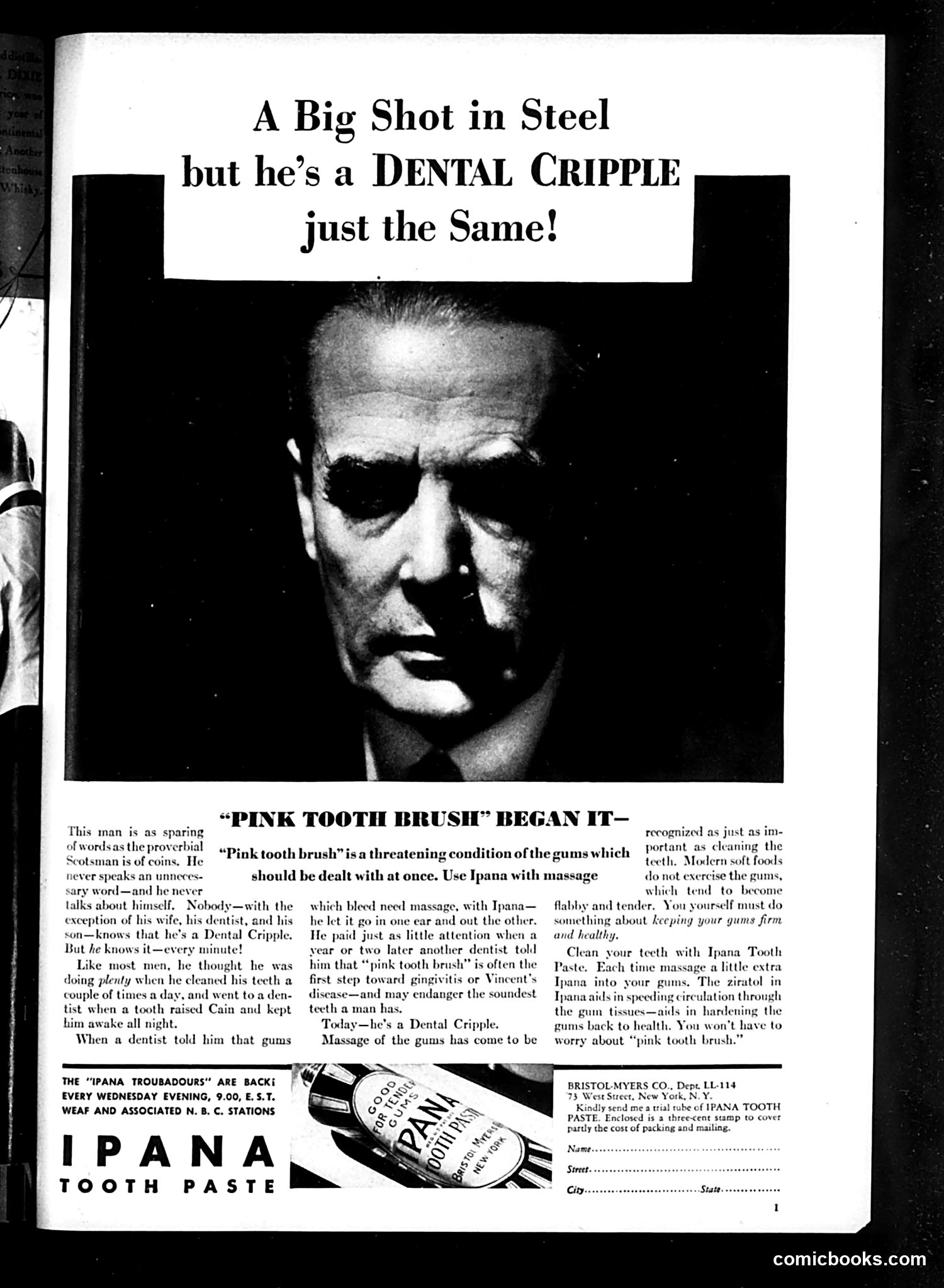
Analysis This is primarily a product advertisement for Ipana Tooth Paste, not political satire. The page uses an image of a man wearing sunglasses and smoking a cigar to advertise dental care. The ad's humor plays on a contrast: the man appears tough and world-weary (described as a "Big Shot in Steel" who is "sparing of words" and "never speaks unnecessarily"), yet he has a "Dental Cripple"—suffering from "pink tooth brush," a gum disease. The joke suggests that even tough, important men need proper dental hygiene. The ad promotes using Ipana Tooth Paste with massage to treat gum problems. A coupon for a trial tube appears at bottom right. Radio programming information indicates this was part of a multimedia campaign.
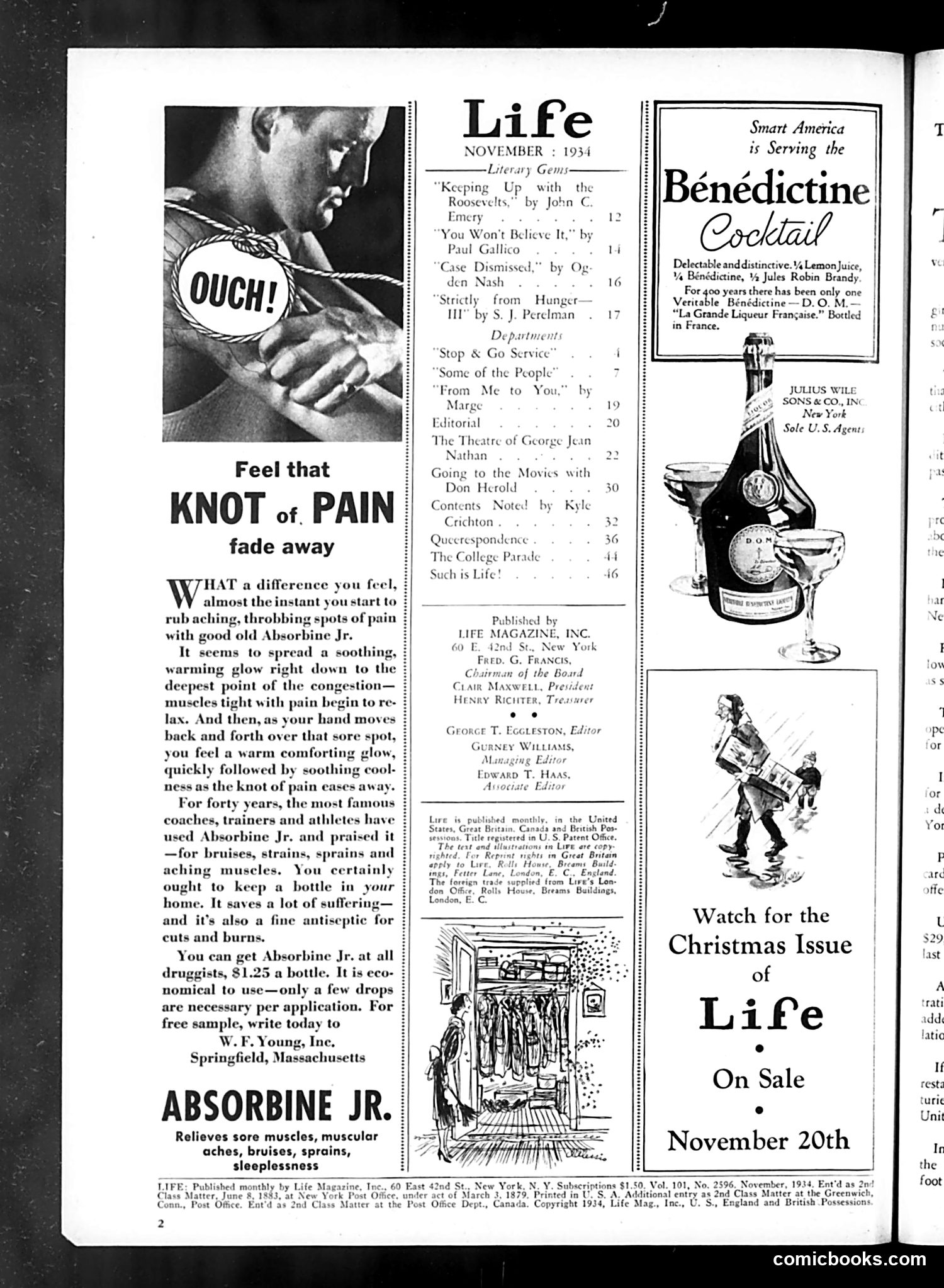
Page Analysis: Life Magazine, November 1934 This page is primarily advertising and contents/masthead material, not political satire. The left side features an Absorbine Jr. advertisement showing a man saying "OUCH!" The ad promises that the liniment "relieves sore muscles, muscular aches, bruises, sprains, sleeplessness" — typical early-20th-century patent medicine marketing. The copy uses testimonials from "coaches, trainers and athletes." The center displays the magazine's table of contents for the November 1934 issue, listing articles and departments. The right side advertises Bénédictine cocktail and promotes Life's upcoming Christmas Issue, to be sold November 20th. There is no political cartoon or satire visible on this page — it's a standard magazine layout mixing editorial matter with commercial advertisements typical of 1934 publications.
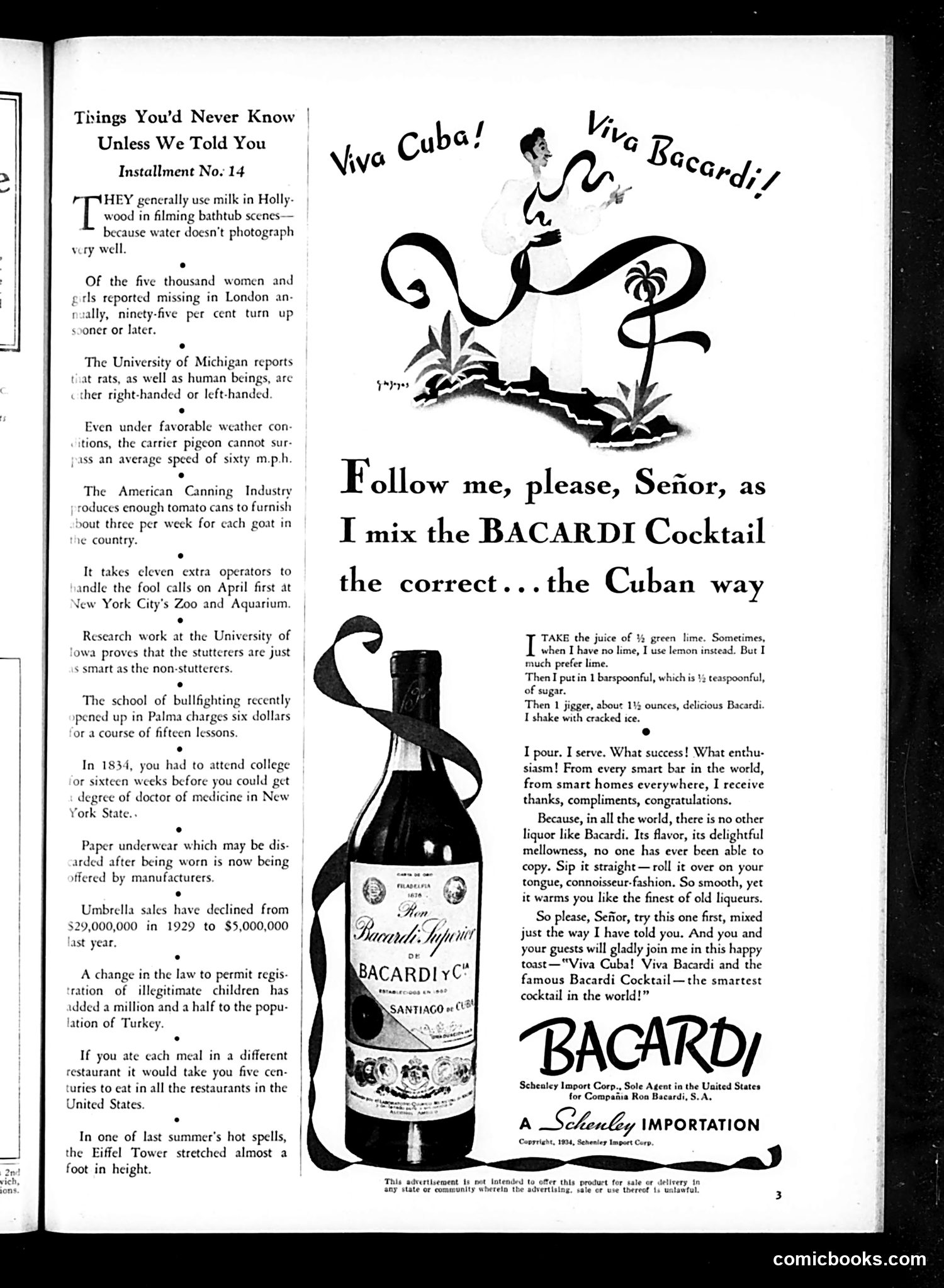
Analysis This page is primarily a Bacardi rum advertisement (1934, based on the copyright notice) disguised as editorial content. The left column presents trivia facts under "Things You'd Never Know Unless We Told You"—a common advertising format of the era that provided "useful" information to seem editorially legitimate. The right side features a cartoon character (a caricatured Cuban man, labeled "Señor") demonstrating how to properly mix a Bacardi cocktail "the Cuban way." The text emphasizes Bacardi's uniqueness and sophistication, claiming no other liquor can be copied. The cartoon relies on period stereotypes—the exaggerated Cuban accent and imagery (palm tree, decorative hat)—to create "exotic" appeal. This was typical pre-WWII advertising that marketed foreign products through ethnic caricature. The advertisement exploits romantic notions of Cuba and cocktail culture to sell the product.
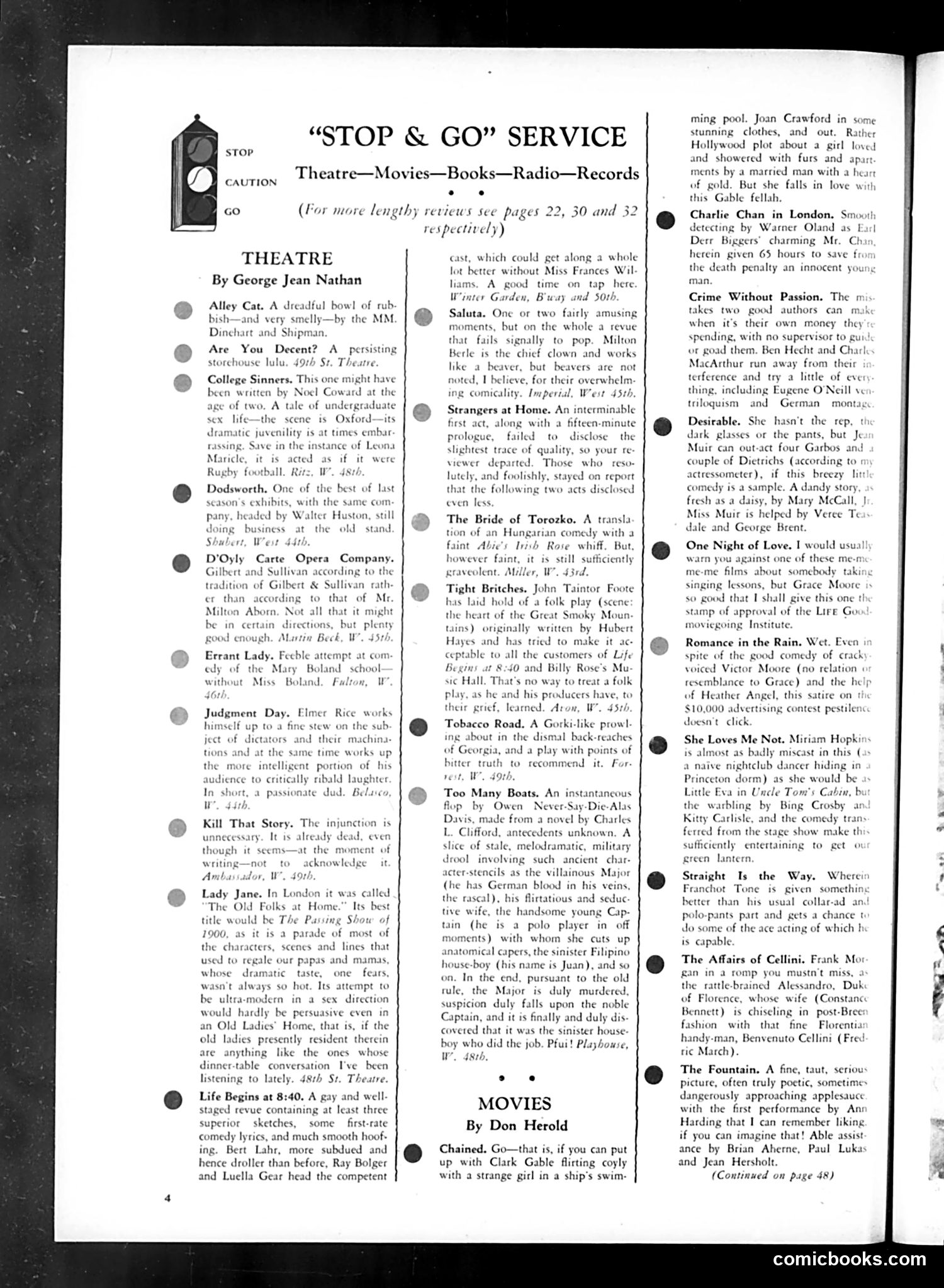
Content Analysis This page is primarily a "Stop & Go" entertainment review section covering theatre, movies, books, radio, and records—not a political cartoon. The page features critical reviews of stage productions and films from what appears to be the 1930s-40s era. The distinctive element is the traffic light icon (stop/caution/go) used as a visual metaphor for rating entertainment: "stop" (avoid), "caution" (mixed), and "go" (recommend). Reviews cover plays like *College Sinners* and *Dodsworth*, and films including *Chained* with Clark Gable. This is entertainment criticism rather than political satire—a clever organizational system using universal traffic signals to help readers quickly assess whether productions merit their time and money.
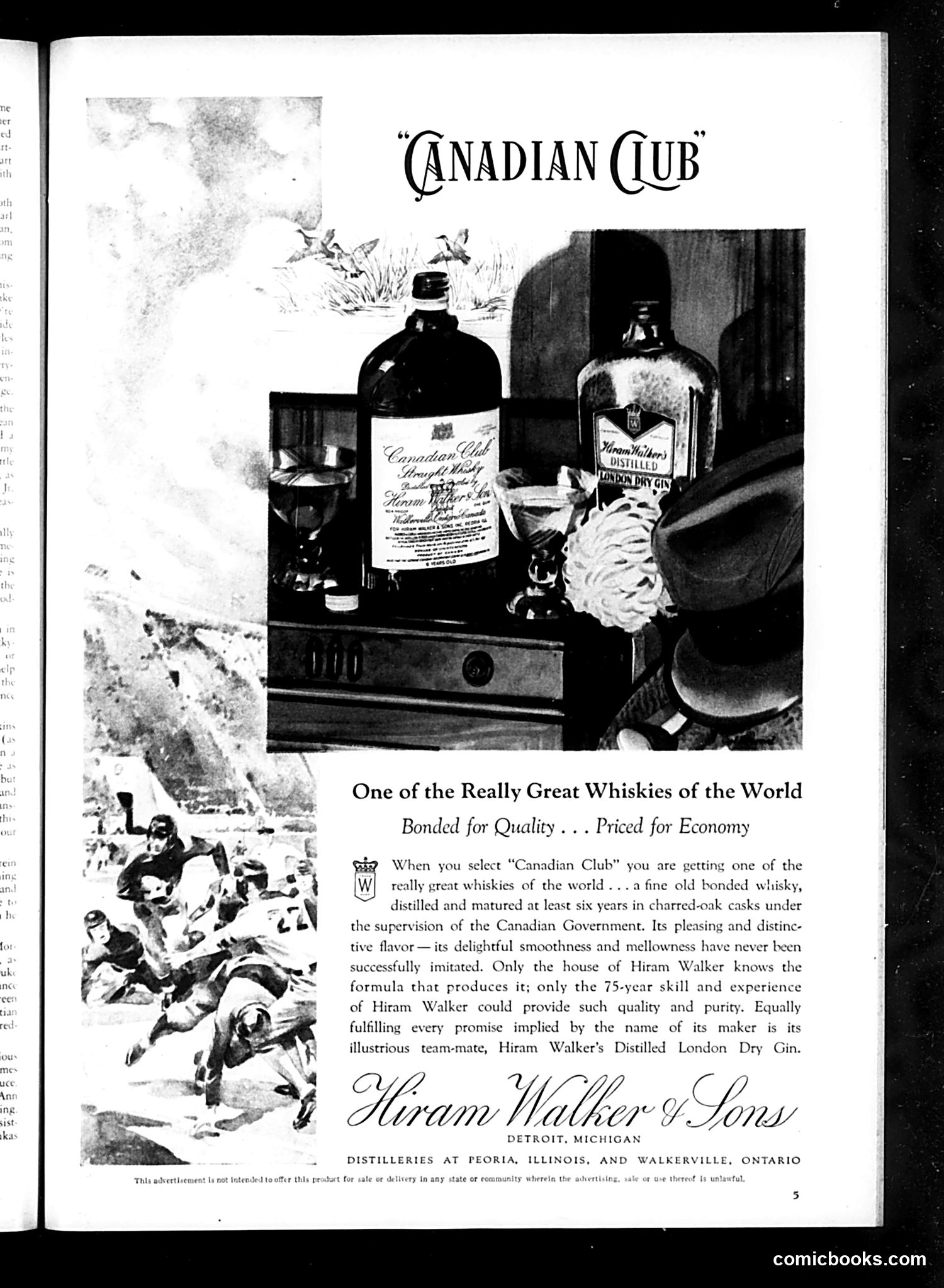
Canadian Club Whiskey Advertisement This is a liquor advertisement, not political satire or cartoon content. It promotes Canadian Club whiskey as "One of the Really Great Whiskies of the World," emphasizing that it's "Bonded for Quality... Priced for Economy." The ad highlights that the whiskey is distilled and matured at least six years in charred casks under Canadian Government supervision. It credits the quality to Hiram Walker & Sons' 75-year expertise and contrasts Canadian Club with their other product, Hiram Walker's Distilled London Dry Gin. The page includes a scenic illustration of what appears to be a Canadian landscape (likely Niagara Falls area, given the context) to reinforce the Canadian origin. Distilleries were located in Peoria, Illinois and Walkerville, Ontario.
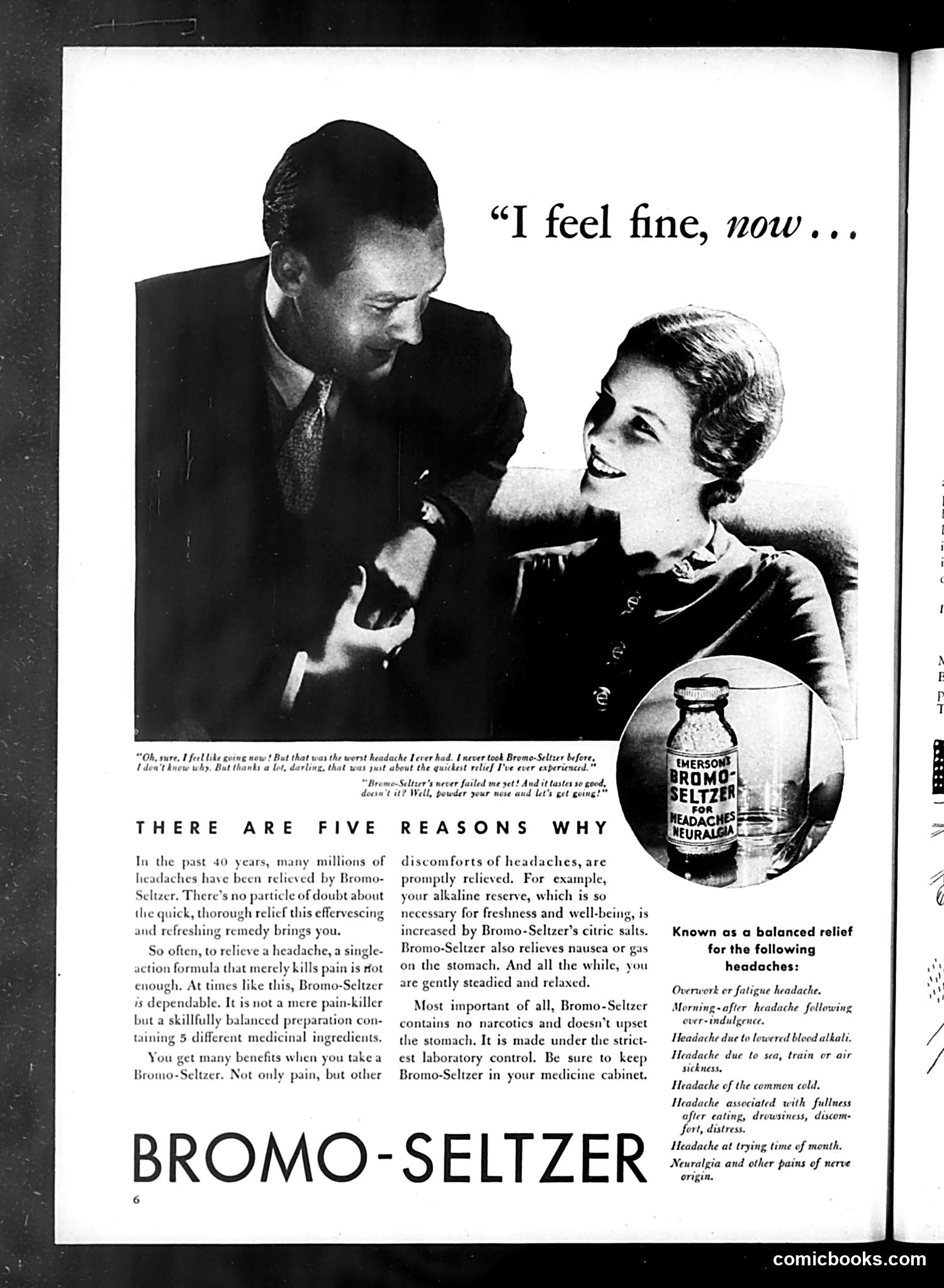
Analysis This is a vintage advertisement for Bromo-Seltzer, not a political cartoon. The page shows a man and woman in conversation, with the man saying "I feel fine, *now*..." — implying he had a headache before taking the product. The ad lists "Five Reasons Why" Bromo-Seltzer relieves various headaches, including "overwork or fatigue headache," "morning-after headache," and headaches from menstruation, sea travel, and nervousness. The advertisement reflects early 20th-century marketing that casually medicalized common discomforts and normalized over-the-counter remedies for everyday ailments. The domestic, cheerful scene was typical advertising rhetoric of the era, positioning the product as essential to modern well-being.
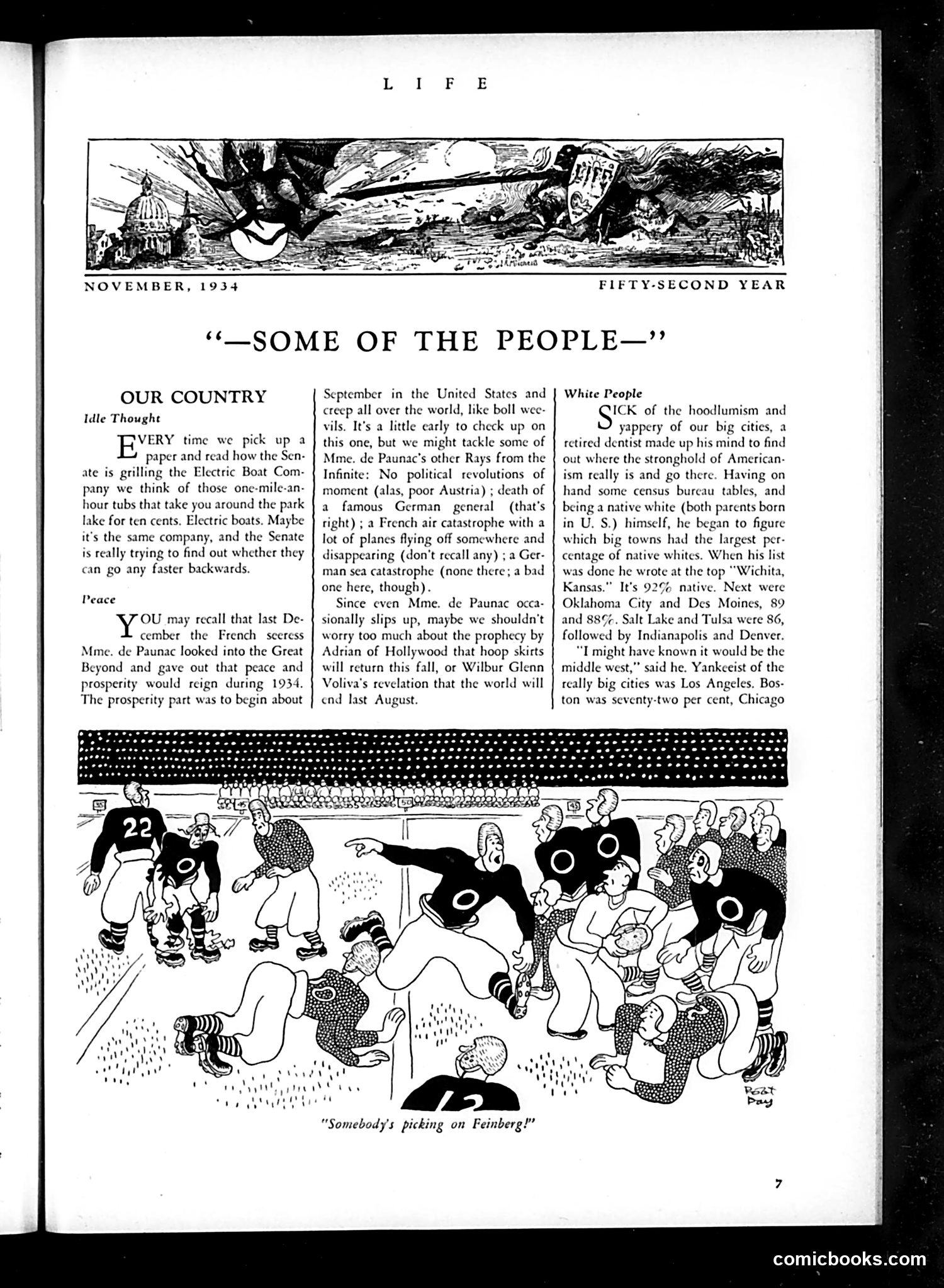
Analysis of Life Magazine, November 1934 This page contains editorial commentary titled "Some of the People" and a sports cartoon. The main illustration, captioned "Somebody's picking on Feinberg!", depicts a chaotic football game scene with players tackling and roughhousing around a player wearing number 22. The cartoon appears to be satirizing football violence or possibly antisemitic targeting on the field (Feinberg being a Jewish surname). The players are shown aggressively mobbing around this central figure, suggesting he's being singled out for rough treatment. The text above discusses various international and domestic topics from 1934, including French political developments and American cultural observations. The overall tone is light satirical commentary on contemporary events and social conditions.
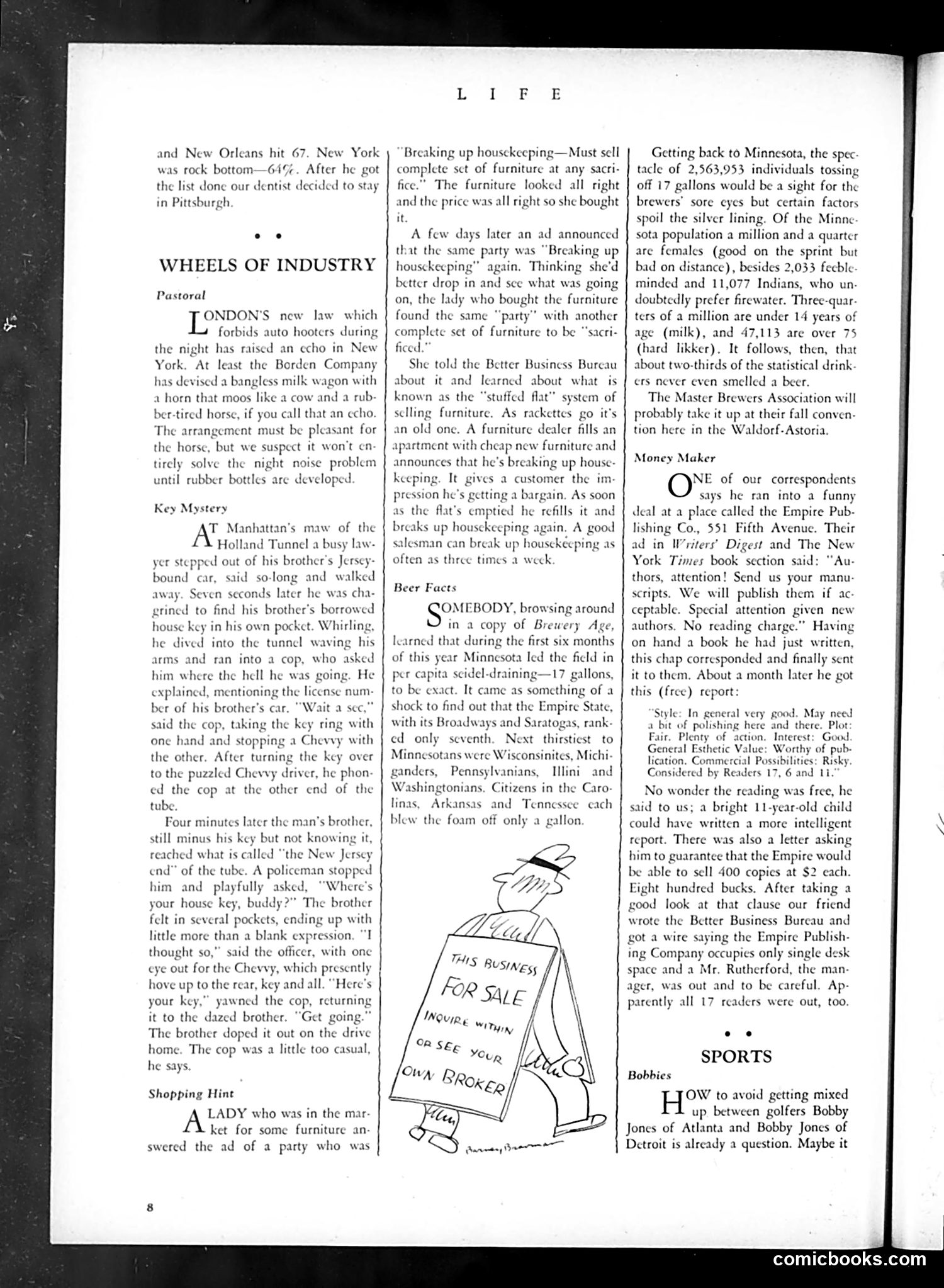
Analysis of Life Magazine Page Content This page contains three satirical sections, each mocking contemporary business practices: "Wheels of Industry" ridicules London's new law banning night workers by joking that the Borden Company used moose as delivery animals, creating an "echo problem" in New York—suggesting absurd solutions to labor restrictions. "Key Mystery" is a humorous short story about a lawyer who loses his brother's borrowed house key in the Holland Tunnel, leading to comedic chaos involving police—satirizing urban inconvenience. The central cartoon depicts a figure carrying a sign advertising "THIS BUSINESS FOR SALE" to a broker, mocking the common practice of quickly buying and selling struggling businesses as get-rich-quick schemes. The sections collectively satirize 1920s-30s American business culture: labor law workarounds, urban inefficiency, and the speculative economy.
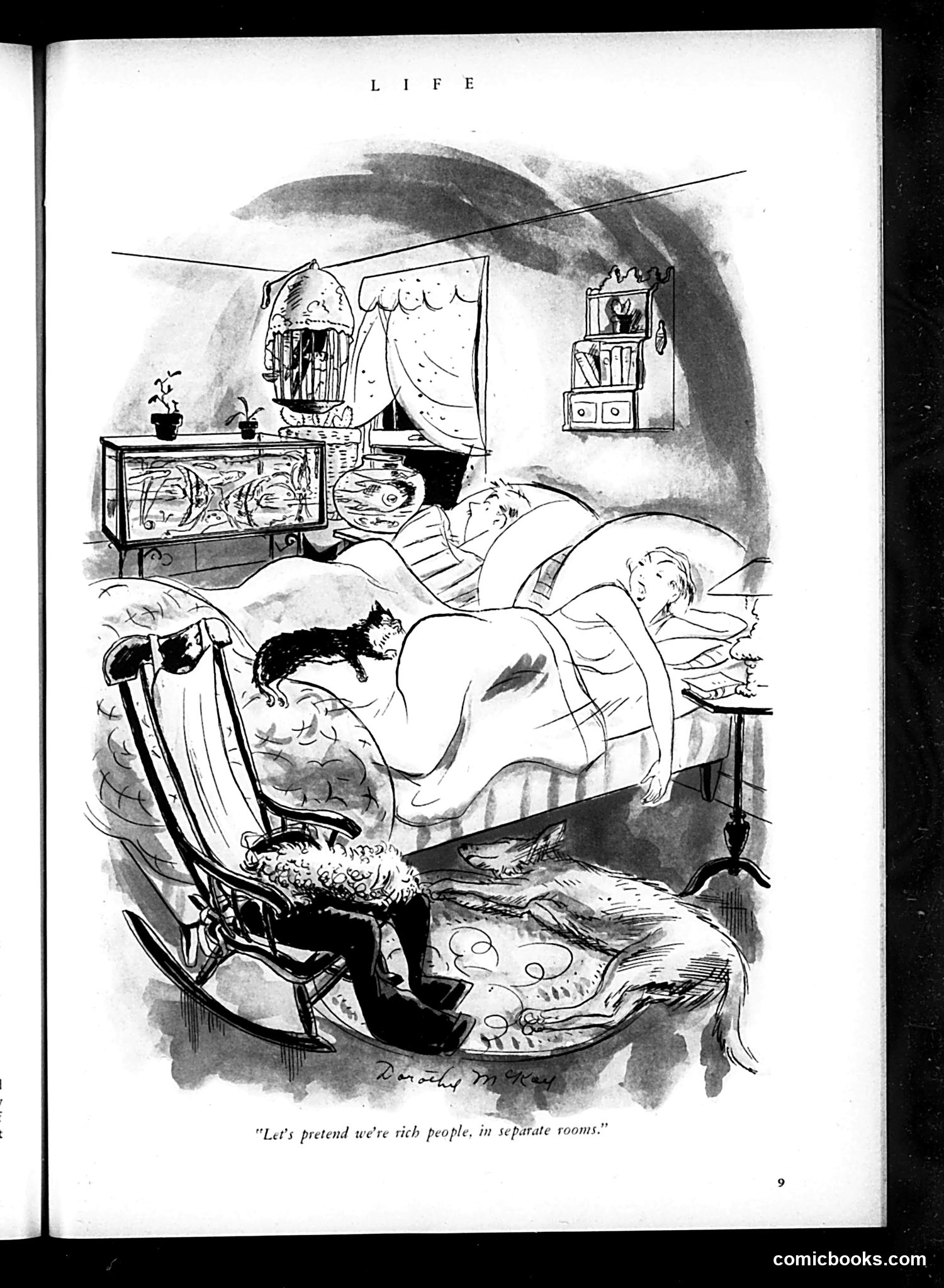
Analysis of "Life" Magazine Cartoon This single-panel cartoon depicts a domestic bedroom scene where two people are in bed together, with a cat walking across the mattress. A man sits in a rocking chair nearby. The caption reads: "Let's pretend we're rich people, in separate rooms." The satire mocks middle-class pretension and housing constraints of the era. The joke is that wealthy people traditionally maintained separate bedrooms (a marker of affluence and social status), while working and middle-class families typically shared cramped quarters. By "pretending" to be rich while confined to one room, the couple humorously acknowledges their actual economic limitations while aspirationally imitating upper-class conventions. This reflects early-to-mid 20th century anxieties about class status and domesticity.
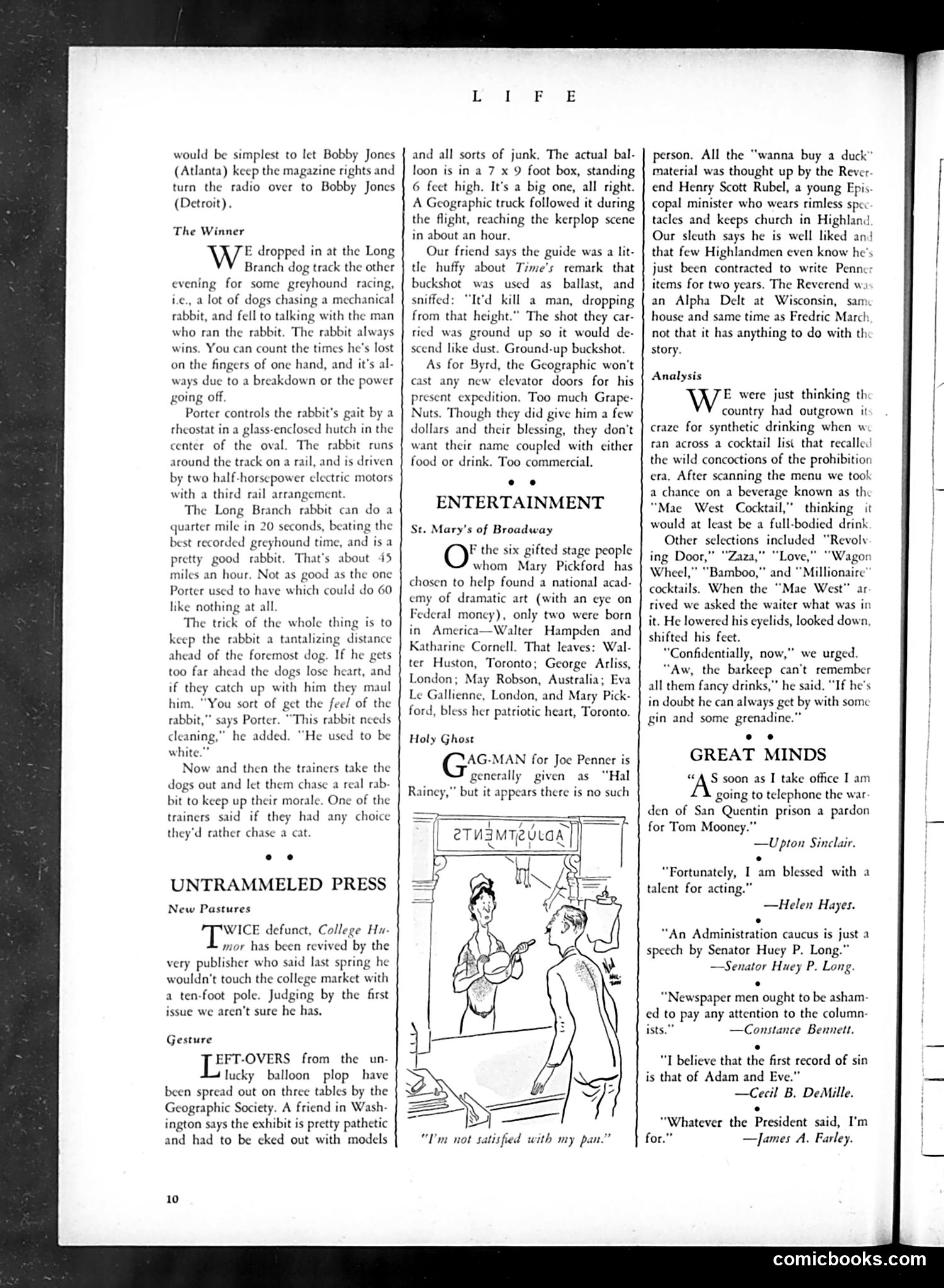
"I'm not satisfied with my pan" This cartoon depicts two men in what appears to be a kitchen or laboratory setting. One man holds a pan while speaking the caption line to another man. The illustration is part of the "Great Minds" section, a humor column featuring witty quotes and quips. The joke plays on double meaning: "pan" likely refers both to a cooking utensil and to the theatrical/critical term "to pan" (meaning to criticize harshly). The humor comes from the absurdist juxtaposition of someone complaining about a literal cooking pan in language that mimics serious artistic criticism—a light satire on overly pretentious language or the tendency to use grandiose vocabulary for trivial complaints.
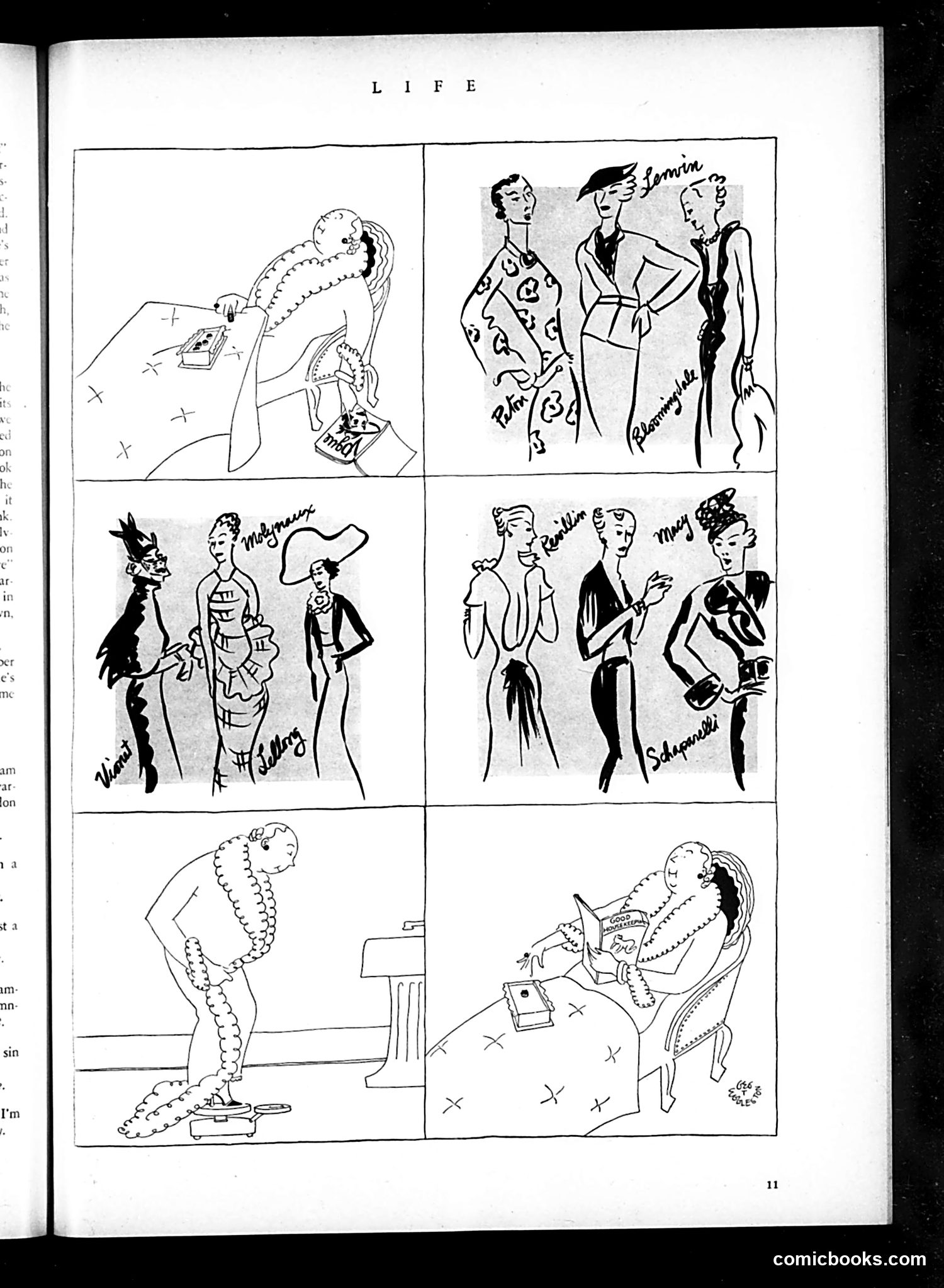
Analysis of Life Magazine Page This page presents a humorous six-panel comic strip about a woman's shopping excursion and romantic entanglements. The narrative appears to follow a fashionable woman acquiring various designer items and outfits (with designer names handwritten throughout), then encountering multiple suitors who compete for her attention. The satire mocks conspicuous consumption and the materialism of fashion-conscious socialites, while simultaneously poking fun at romantic competition and courtship rituals among the wealthy. The repeated focus on designer labels and the woman's preoccupation with acquiring fashionable clothing satirizes the superficiality of high society. The comic's final panels suggest absurdist humor, with the woman's transformation into an increasingly ornate, accessorized figure—suggesting that excessive shopping and fashion obsession have literally transformed her into something inhuman or monstrous.
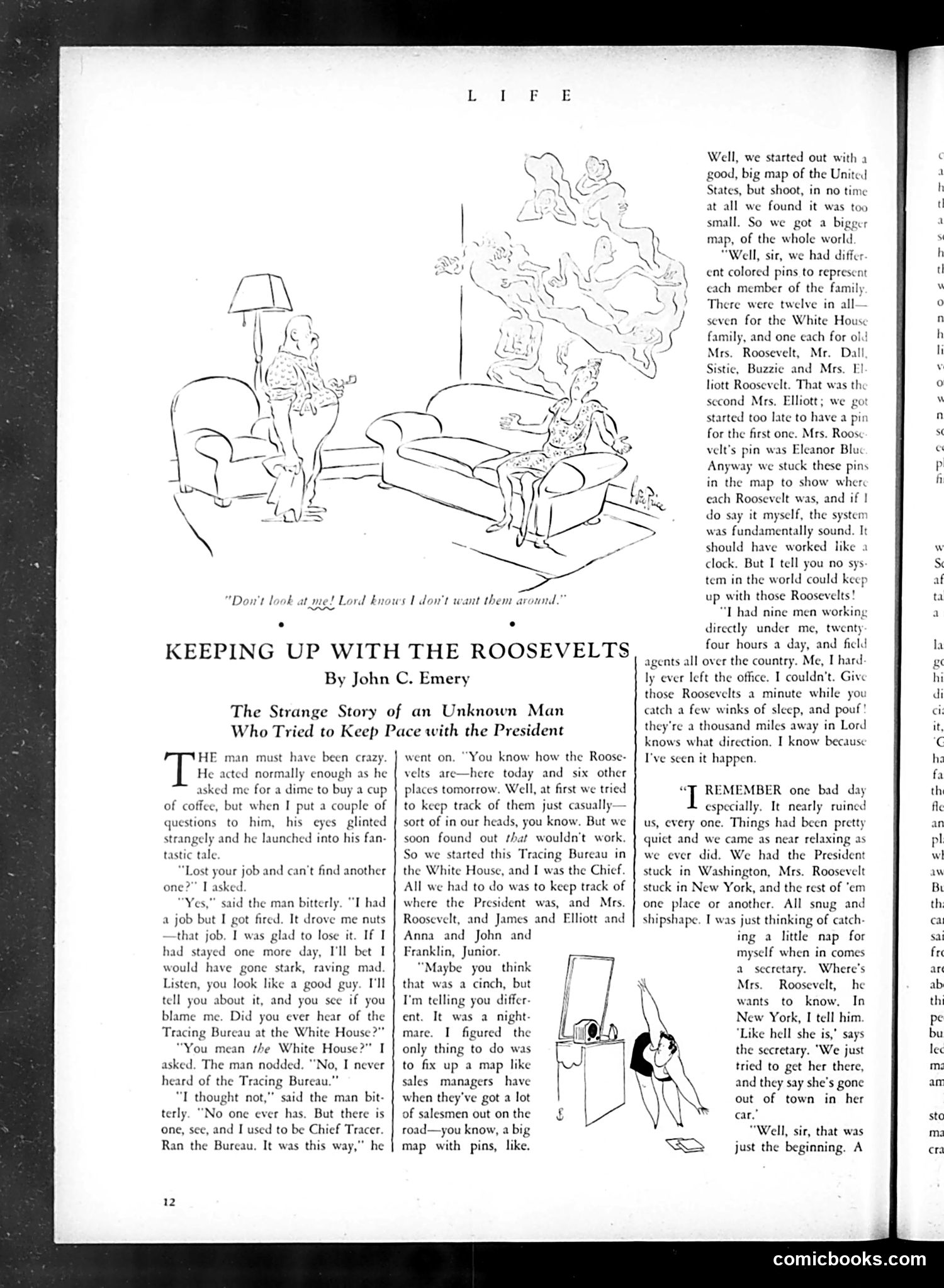
Analysis of "Keeping Up with the Roosevelts" This article by John C. Emery satirizes the chaos of tracking President Franklin D. Roosevelt's movements and those of his large family. The cartoon at top illustrates the core joke: a government official pleads "Don't look at me! Lord knows I don't want them around," depicting the frustration of trying to monitor Roosevelt's whereabouts. The article describes an absurd system where the Tracing Bureau attempted to track FDR, his wife Eleanor, children, and in-laws using colored pins on a world map. The narrator—apparently a government functionary—recounts how the system failed spectacularly because the Roosevelts were constantly traveling, making it impossible to maintain accurate records of their locations. The satire targets both the Roosevelt family's peripatetic lifestyle and the bureaucratic inefficiency of government tracking efforts.
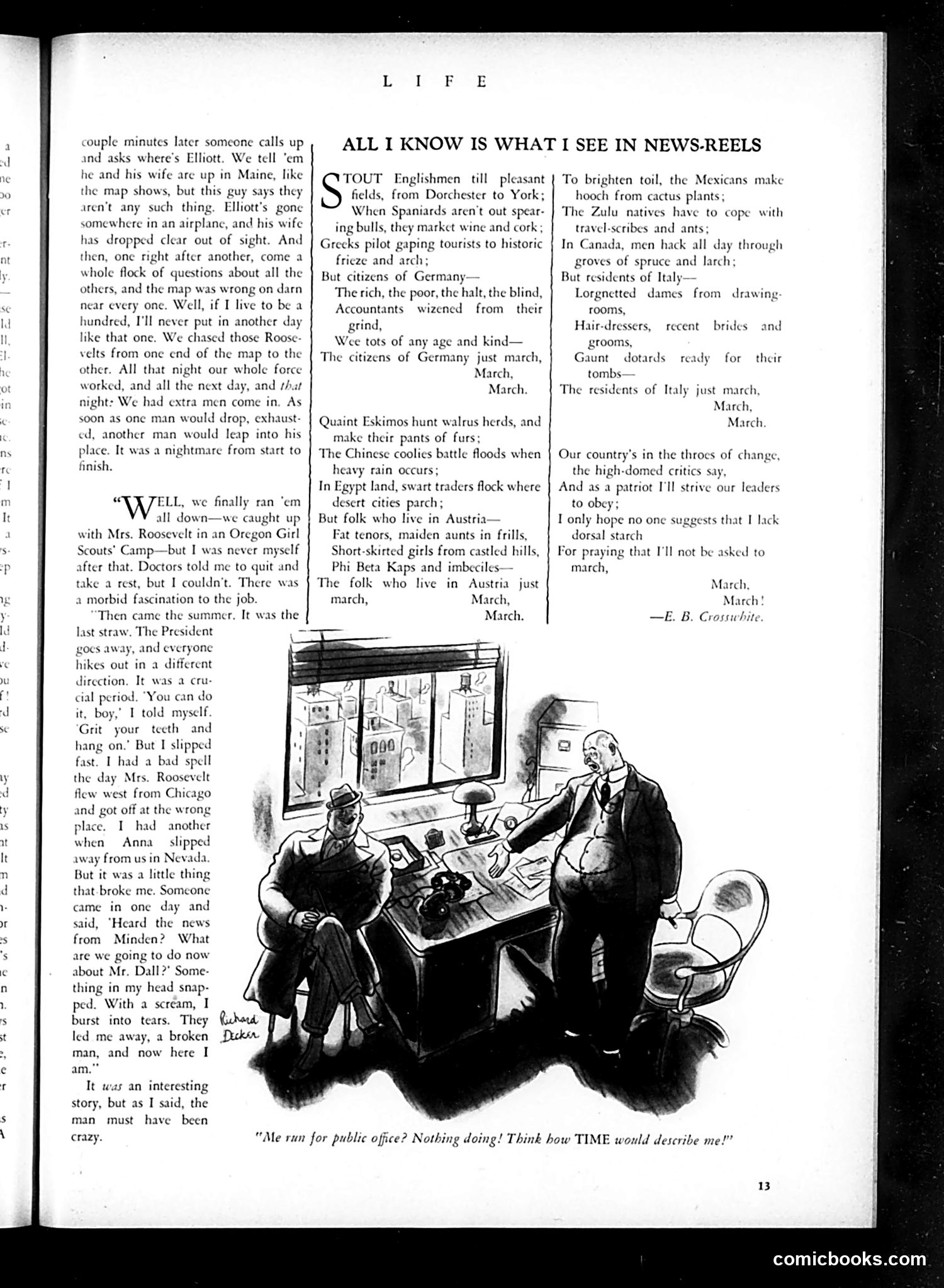
Analysis of Life Magazine Page This page contains two distinct pieces: a narrative essay titled "All I Know Is What I See in News-Reels" and an accompanying cartoon. The essay humorously critiques how citizens form opinions solely from newsreel footage (the primary visual news medium before television). The narrator describes absurd misadventures involving Mrs. Roosevelt, presidential travel mishaps, and confusion about current events—illustrating how fragmentary, decontextualized images in newsreels can mislead viewers. The cartoon depicts a man in an office rejecting a public office position, saying "Me run for public office? Nothing doing! Think how TIME would describe me!" This satirizes how media coverage (specifically TIME magazine) could damage political ambitions through unflattering descriptions—reflecting anxiety about media's power to shape public perception during this era. Both pieces mock media's influence on public understanding.
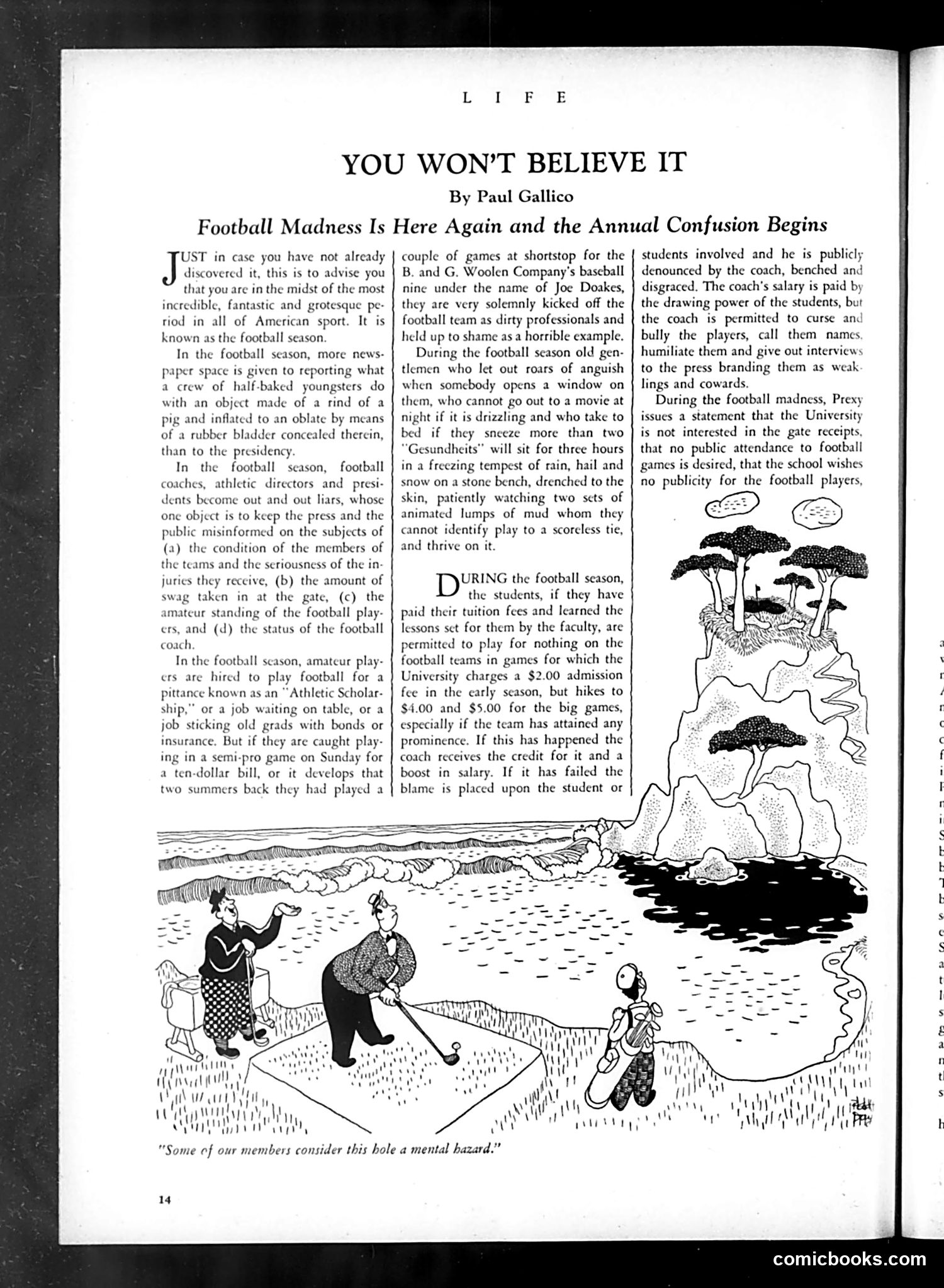
"You Won't Believe It" by Paul Gallico This satirical article criticizes the absurdity of American college football culture during the season. Gallico mocks how football coaches and athletic directors mislead the press about player conditions, team finances, and game attendance. The accompanying cartoon depicts a surreal landscape with a massive tree growing from a hole, captioned "Some of our members consider this hole a mental hazard." This visual metaphor suggests that football administrators are either oblivious to or deliberately ignoring obvious problems within the sport. The article highlights specific hypocrisies: coaches receive salary increases for successful seasons but blame students when games fail, while universities charge admission fees but claim no interest in attendance. Gallico satirizes the sport's contradiction between its amateur pretense and profit-driven reality.
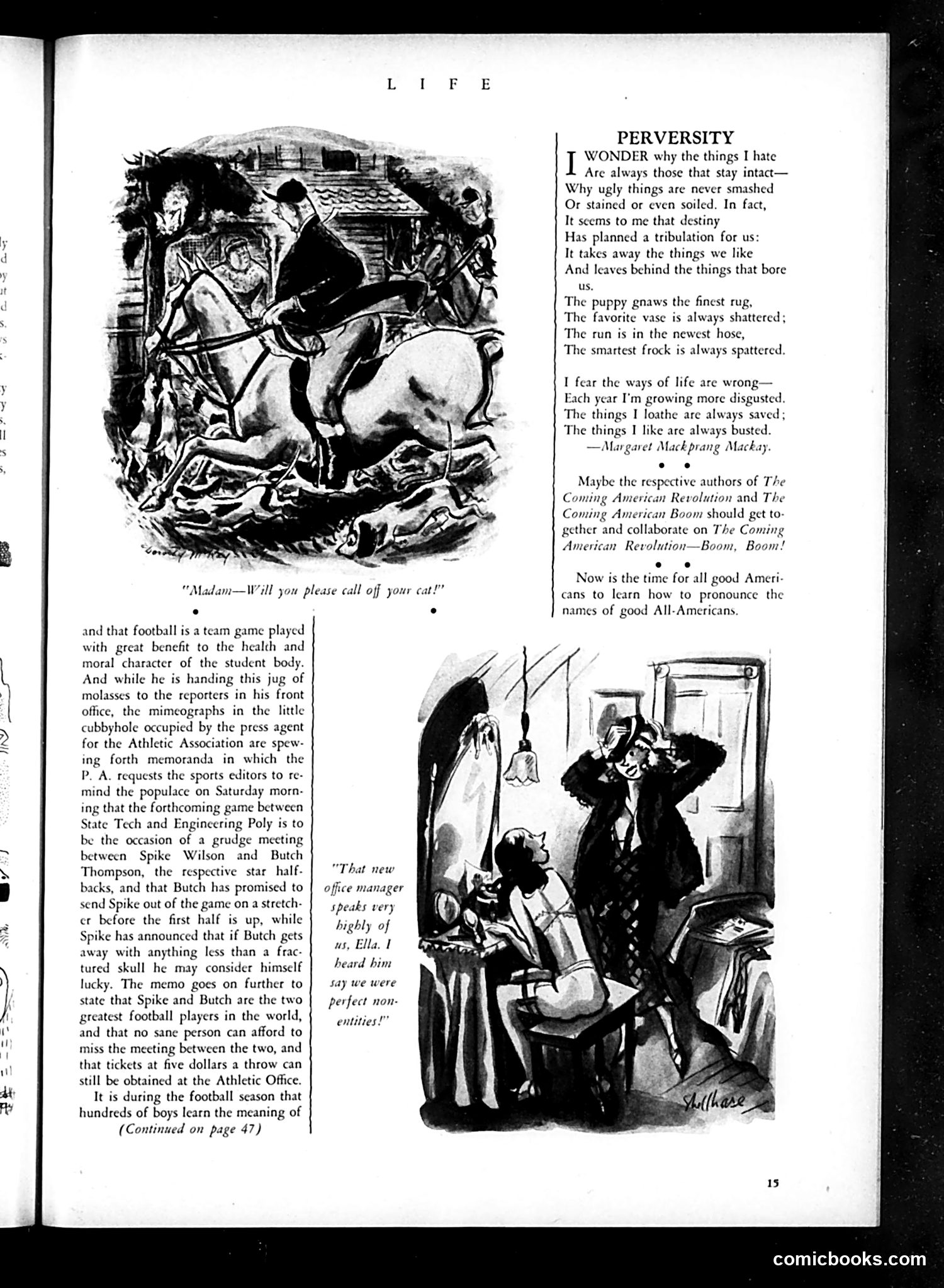
Analysis of Life Magazine Page This page contains a poem titled "Perversity" by Margaret Mackprang Mackay, which satirizes how life's best things are always destroyed or damaged, while inferior things survive intact. The poem expresses the speaker's growing disgust with this pattern. The top illustration depicts a man on horseback, likely from a classical or historical context, with the caption "Madam—Will you please call off your cat?"—a humorous domestic scene. The lower illustration shows an office scene with the caption about a new office manager speaking "very highly of us." The satire appears to mock office dynamics and workplace pretense. The text block discusses football's benefits and mentions State Tech versus Engineering Poly, referencing players named Spike and Butch Thompson—likely satirizing college sports culture and player dramatics.
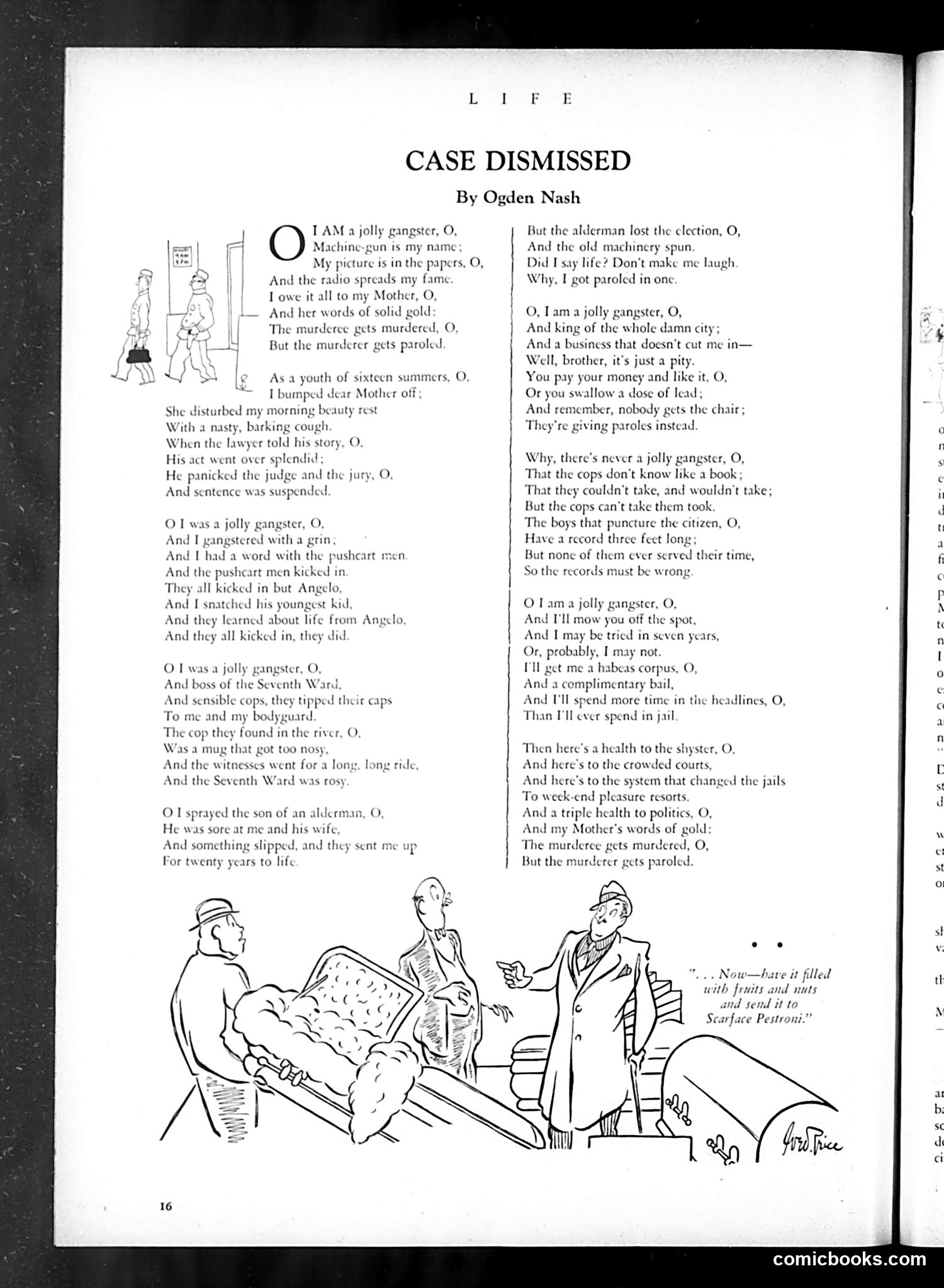
"Case Dismissed" by Ogden Nash This is a humorous poem about a career criminal ("jolly gangster") who repeatedly escapes justice through parole and legal technicalities. The speaker boasts of numerous crimes—disturbing the peace, assaulting a judge, spraying an alderman's son—yet faces minimal consequences because "the murderer gets paroled." The satire targets the criminal justice system's apparent failures: corrupt judges, inadequate police record-keeping, and lenient sentencing that allows dangerous criminals to return to the streets repeatedly. Nash mocks how gangsters exploit loopholes while law-abiding citizens suffer. The cartoon below depicts officials seemingly unconcerned, casually handling a criminal case. The poem reflects Depression-era anxieties about organized crime and judicial corruption.
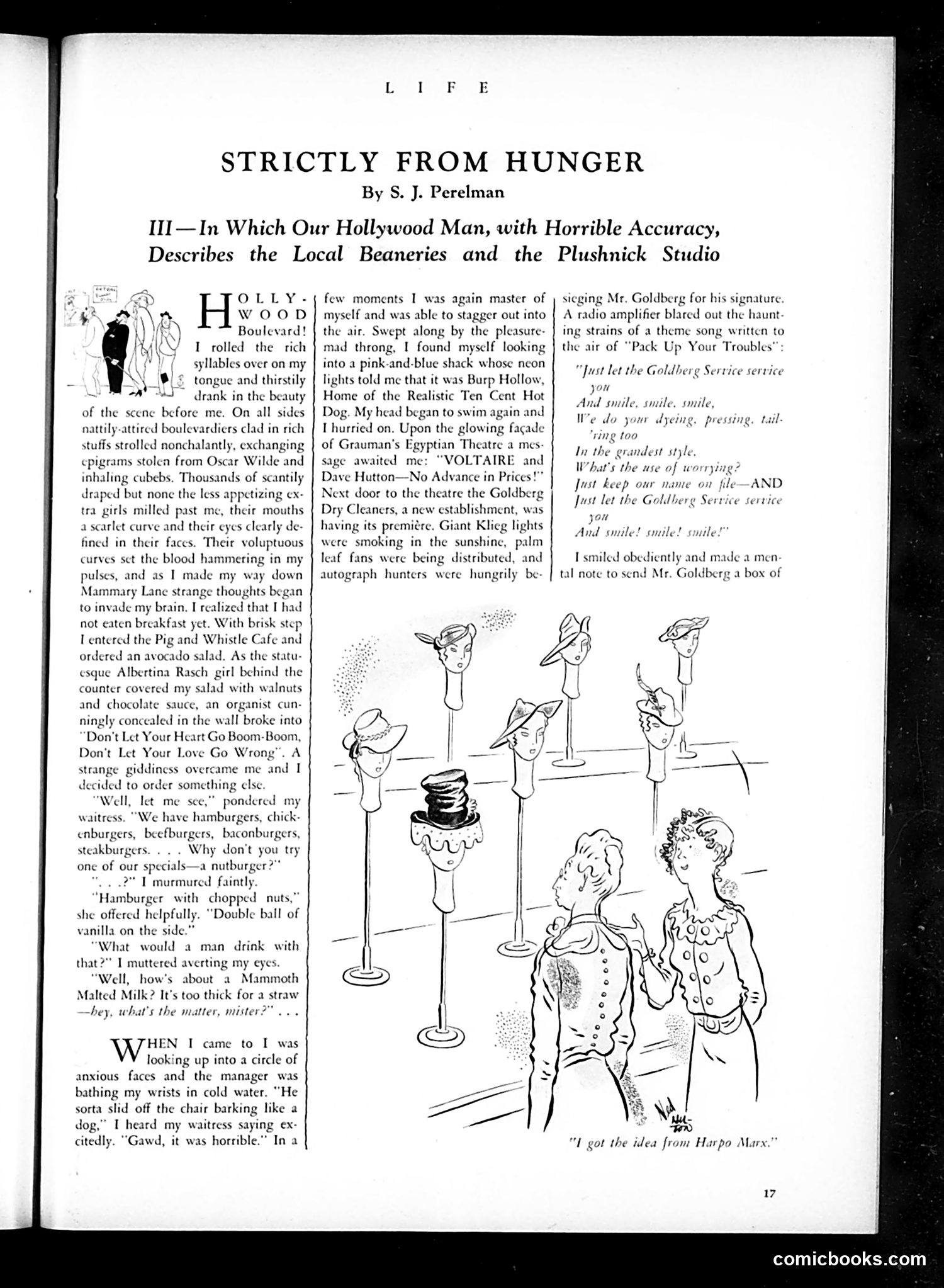
"Strictly from Hunger" - Life Magazine Article This is a humorous first-person account by S. J. Perelman about visiting Hollywood establishments while hungry. The narrator describes wandering past various venues (Burp Hollow, Grauman's Egyptian Theatre, the Goldberg Dry Cleaners) in an increasingly delirious state, obsessing over food. The cartoon illustrations depict stylized cocktail-hour figures at what appears to be a Hollywood party or bar scene. The humor derives from Perelman's satirical contrast between the glamorous Hollywood setting and the narrator's desperate, all-consuming hunger—a common satirical theme mocking both 1930s-40s Hollywood excess and the desperation of struggling industry workers. The title "Strictly from Hunger" is slang meaning "completely unfunny"—self-deprecating wordplay about the piece itself.
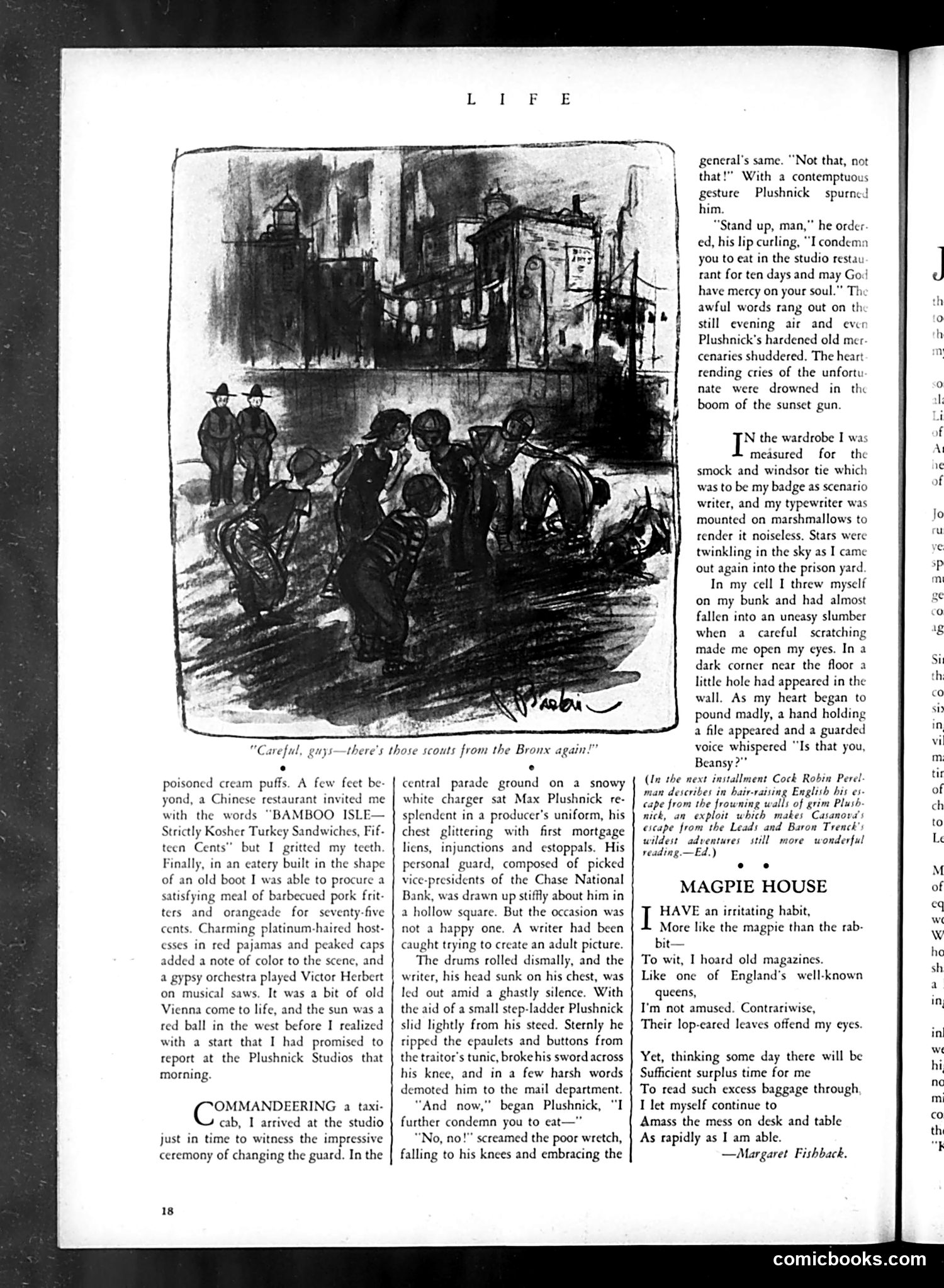
Analysis of Life Magazine Page The cartoon captioned "Careful, gosh—there's those scouts from the Bronx again!" depicts what appears to be a street scene with multiple figures in working-class dress gathered together. The sketch style and composition suggest this is satirizing urban social dynamics, likely contrasting different neighborhoods or social classes. The text references "Plushnick Studios" and describes a writer's visit there—suggesting satire of the entertainment/film industry and its pretensions. The broader context appears to mock urban hierarchies and class consciousness, with "scouts from the Bronx" implying stereotypes about that borough's residents or status. The accompanying text about entertainment industry figures adds commentary on Hollywood's social stratification, though specific identifications aren't clearly marked in the visible material.
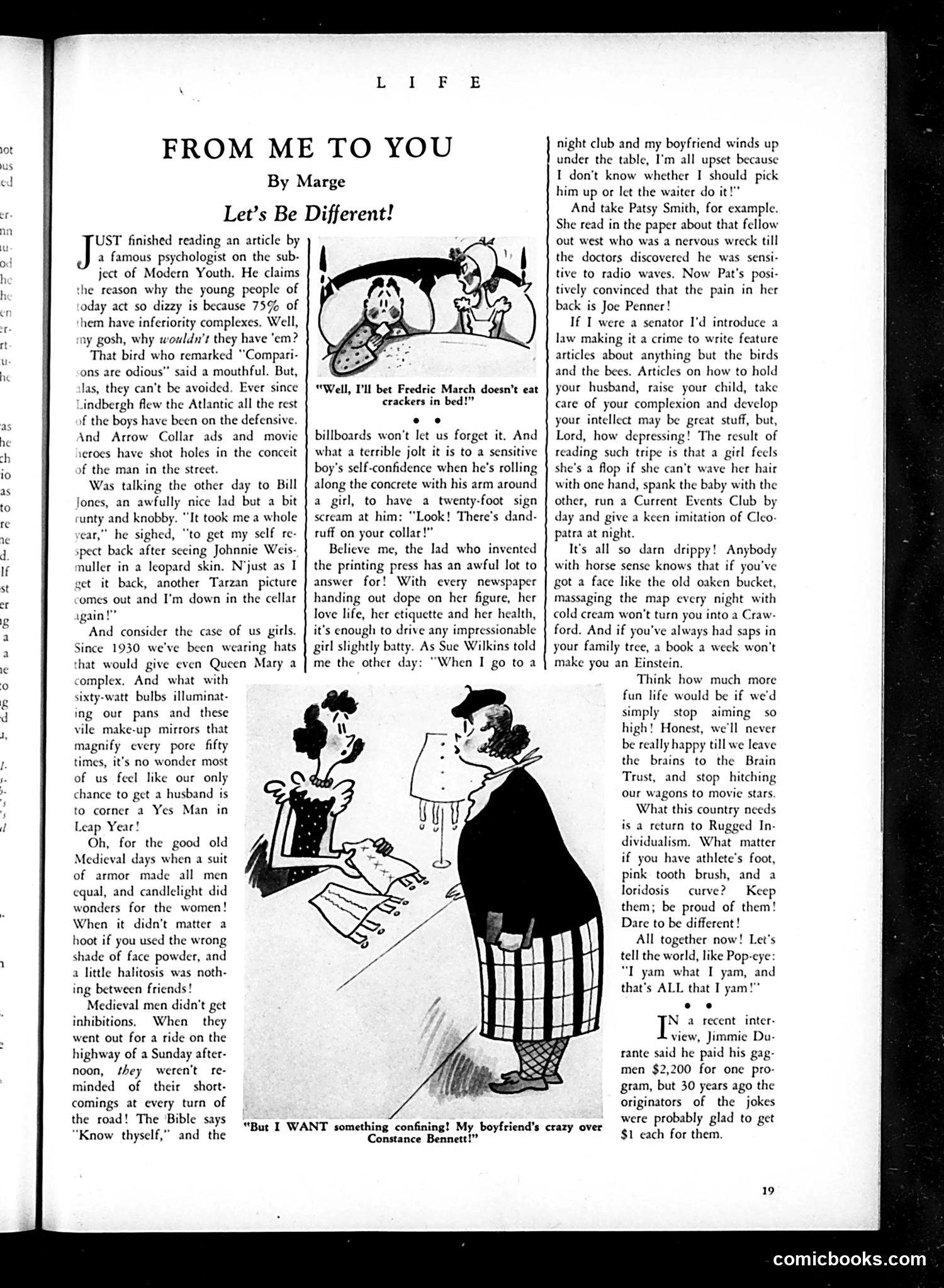
"From Me to You" by Marge - Life Magazine This satirical piece critiques conformity pressures on young women in the 1930s-40s era. The author mocks how girls are pressured to wear identical fashions (hats since 1930), use heavy makeup, and obsess over appearance and dating. The cartoons show women anxiously seeking validation—one fretting over a boyfriend's attention, another worrying about her appearance. The satire targets magazine advice columns that offer superficial "solutions" (cold cream, Current Events clubs) to deeper problems. Marge advocates instead for individuality and confidence: "Dare to be different!" She critiques how women are taught to reduce themselves to physical appeal rather than developing intellect and character. The piece attacks both the beauty industry and social expectations that trap young women in endless self-improvement cycles.
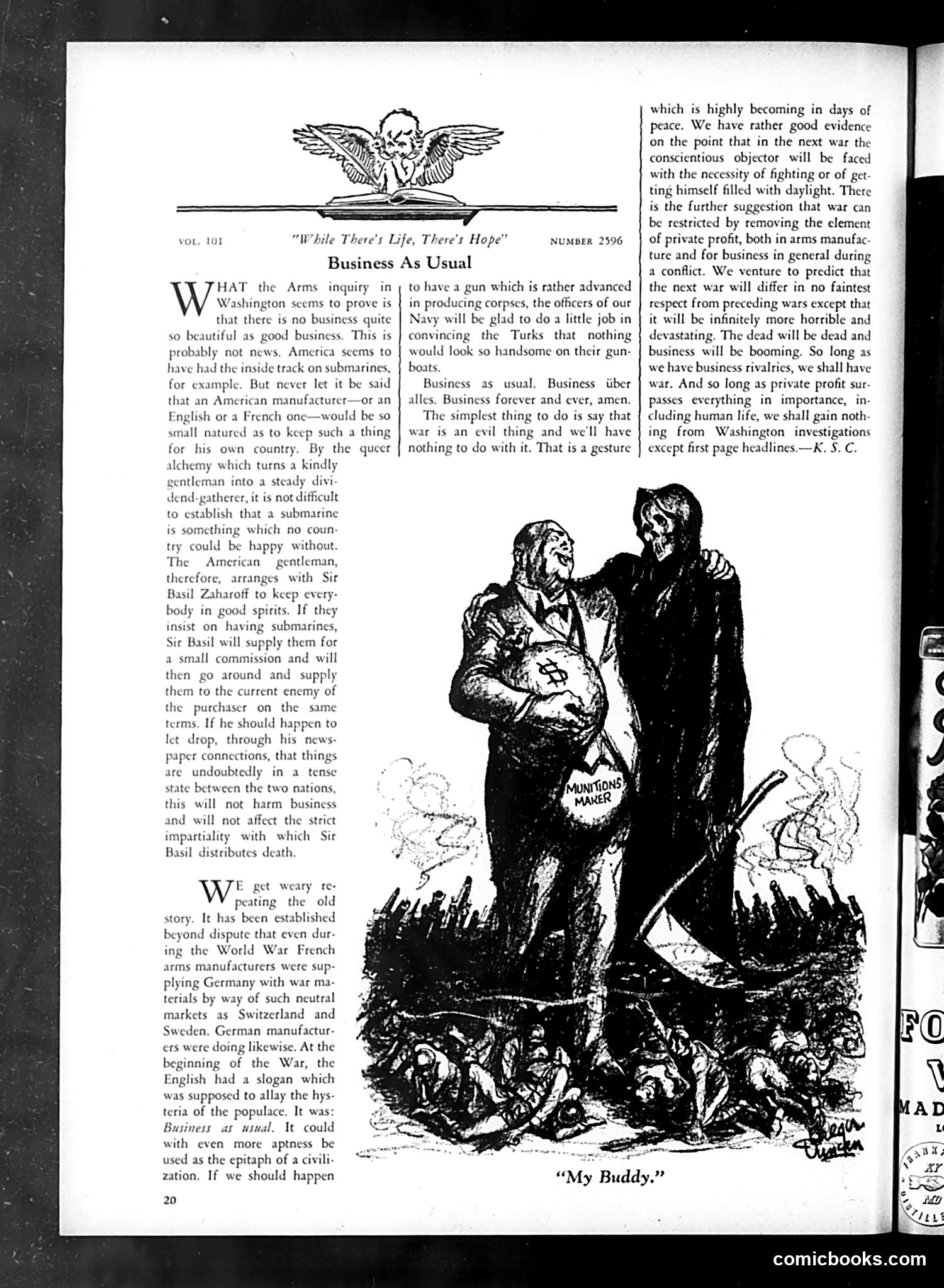
"Business As Usual" - Life Magazine Satire This article criticizes arms manufacturers' profiteering during wartime. The central figure is Sir Basil Zaharoff, a real historical munitions dealer infamous for selling weapons to both sides of conflicts for profit. The cartoon titled "My Buddy" depicts Zaharoff (the figure labeled "Munitions Maker") embracing death personified, suggesting his intimate relationship with mortality through weapons sales. The satire's point: American, English, and French manufacturers hypocritically sold weapons to enemies during WWI (via neutral Switzerland/Sweden), claiming patriotism while prioritizing profit. The article argues that as long as private profit drives warfare, peace is impossible—war will continue "Business as usual." The piece mocks the wartime English slogan "Business as usual" as an epitaph for civilization itself, predicting future wars will be even more devastating since profit incentives remain unchanged.
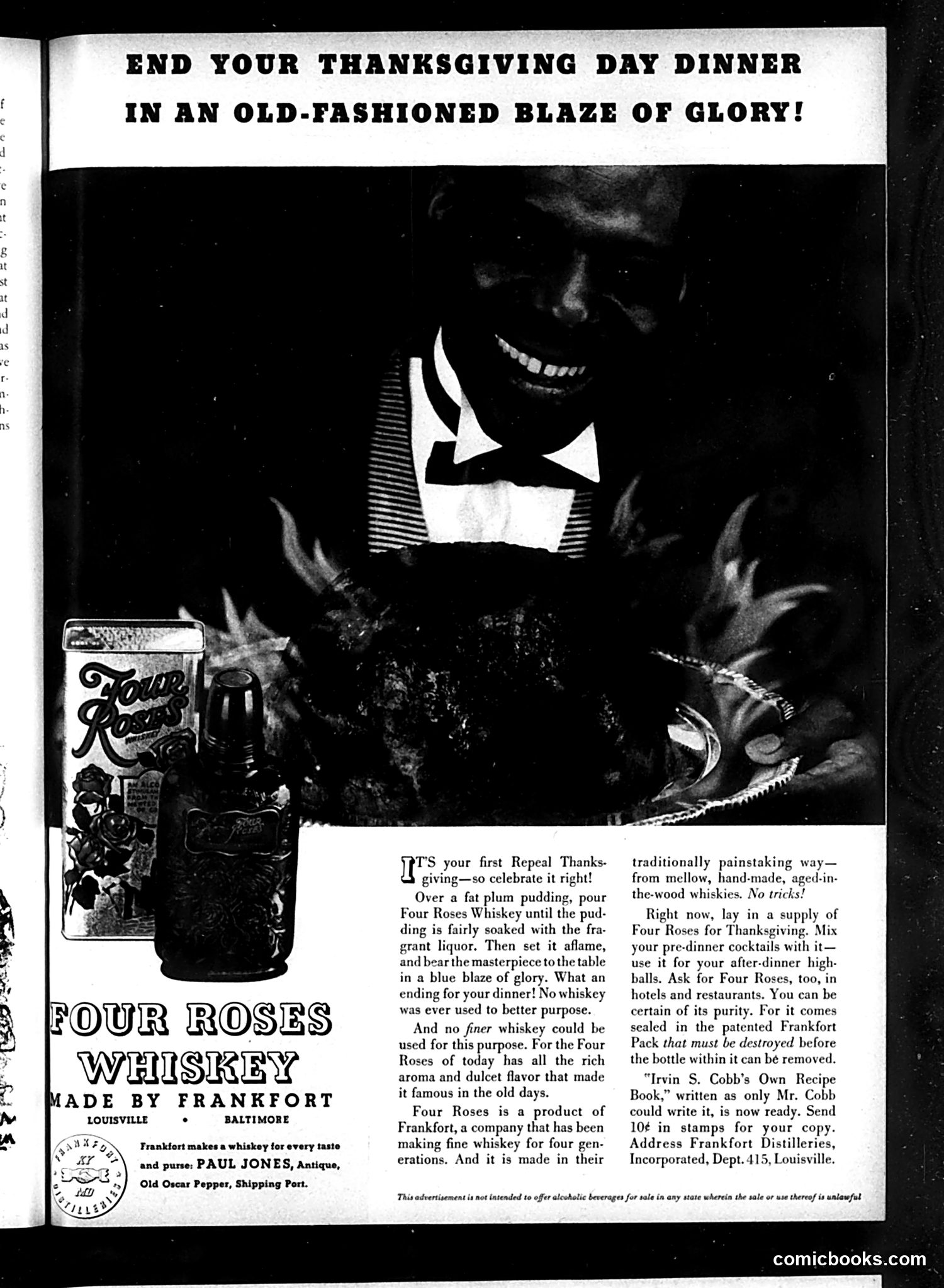
Four Roses Whiskey Advertisement Analysis This is a whiskey advertisement, not political satire. The page celebrates the end of Prohibition (repealed in 1933), explicitly calling it "your first Repeal Thanksgiving." The dramatic image shows a formally dressed Black man in a bow tie pouring flaming whiskey over a pudding—a theatrical presentation meant to convey celebration and luxury. The ad promises this "old-fashioned blaze of glory" as the perfect dinner finale. The copy emphasizes Four Roses' heritage ("famous in the old days") and quality ("hand-made, aged-in-the-wood"). It's straightforward product marketing capitalizing on Americans' newly legal ability to drink alcohol openly. The page includes pricing for various Frankfort whiskey brands and an offer for "Irvin S. Cobb's Own Recipe Book." This reflects post-Prohibition consumer enthusiasm and the whiskey industry's aggressive marketing in the 1930s.
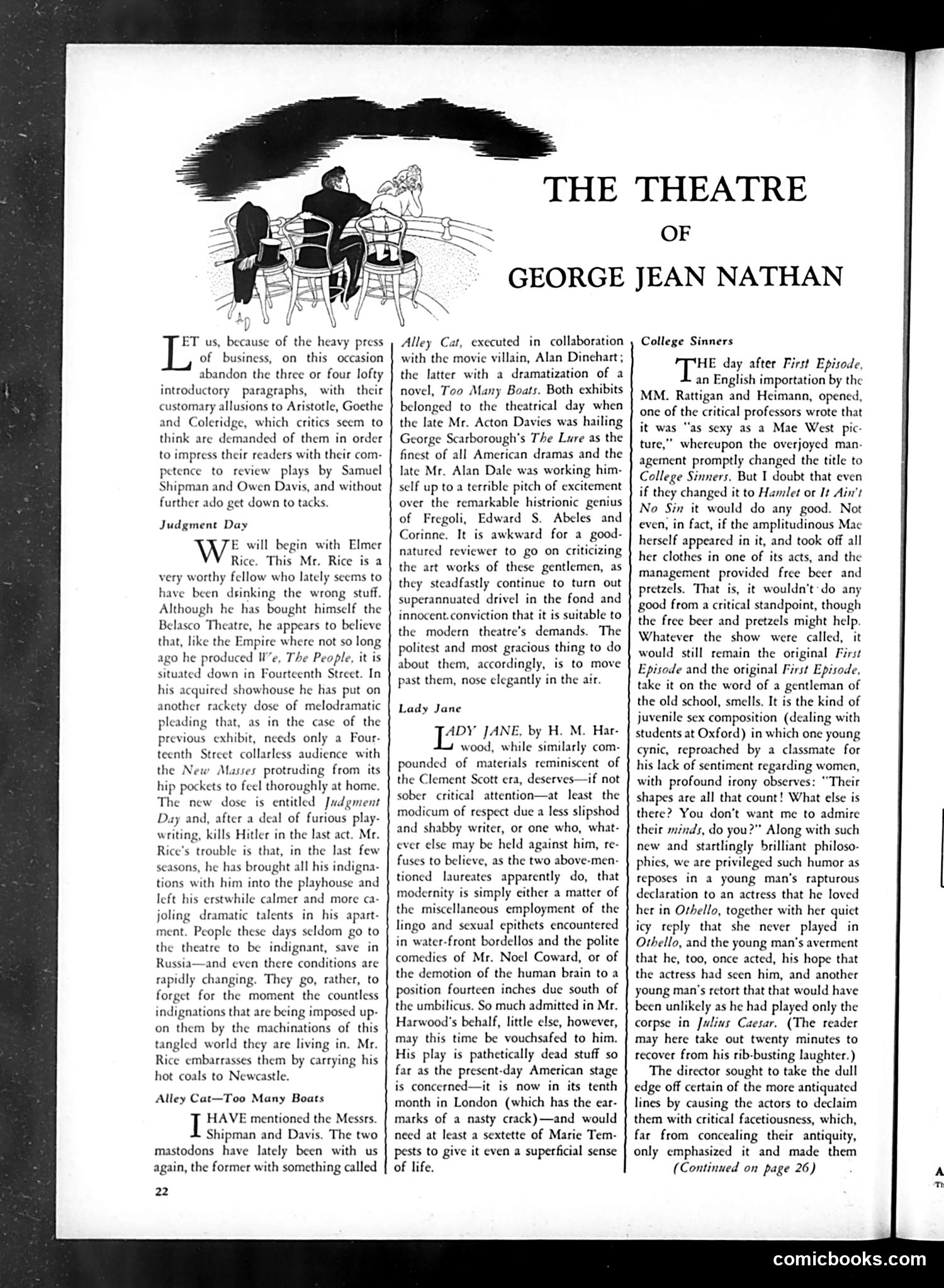
The Theatre of George Jean Nathan - Explanation This is a theater review column by prominent critic George Jean Nathan, published in *Life* magazine. The illustration shows Nathan seated with two other figures, establishing the critical authority reviewing Broadway productions. Nathan attacks three plays with sharp sarcasm. He criticizes Elmer Rice's *Judgment Day* for being preachy anti-Nazi melodrama that alienates audiences with political indignation rather than entertaining them. He dismisses Shipman and Davis's plays (*Alley Cat* and *Too Many Boats*) as outdated drivel from an earlier theatrical era, worthy only of contempt. H.M. Harwood's *Lady Jane* receives slightly more respect—Nathan grants it isn't relying on vulgar language or lowbrow shock tactics—but ultimately calls it "pathetically dead stuff." The satire targets both the playwrights' mediocrity and the critical establishment that once celebrated such work. Nathan's dismissive tone reflects *Life*'s role as sophisticated cultural arbiter mocking inferior Broadway productions.
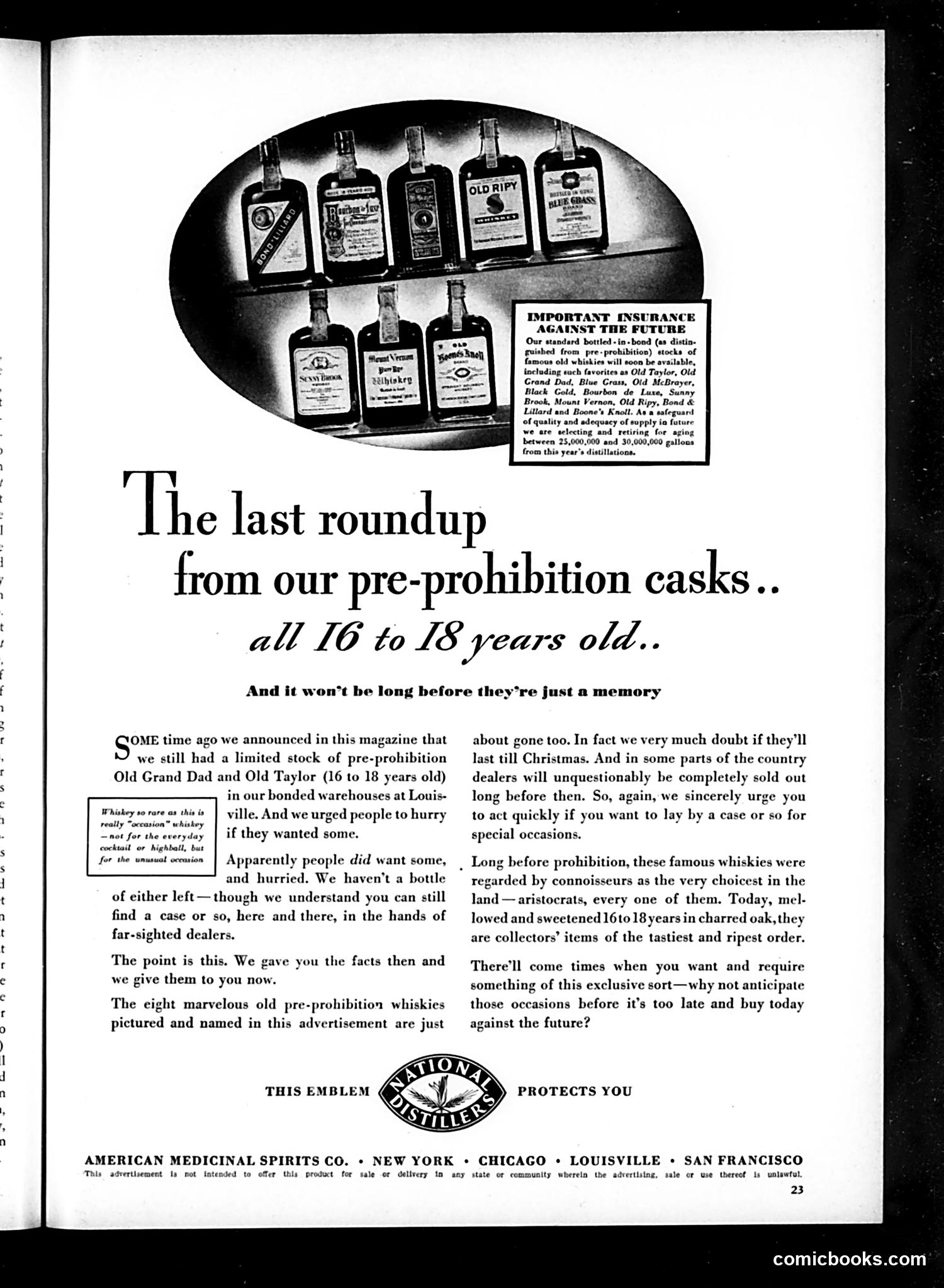
Analysis This is not a cartoon but a liquor advertisement from the Prohibition era (likely 1920s). American Medical Spirits Co. is marketing pre-Prohibition whiskeys—bottles aged 16-18 years from before alcohol became illegal. The ad's strategy exploits scarcity and nostalgia. It claims their stock of famous brands (Old Taylor, Old Grand Dad, etc.) is nearly exhausted and won't last until Christmas, urging readers to buy immediately "against the future." This creates artificial urgency. The satire lies in the framing: the company presents itself as a guardian preserving quality whiskey as a "memory," while simultaneously pressuring consumers to purchase before supplies vanish. The "National Distillers" emblem lends false authority. The fine print disclaimer reveals the cynical truth—this ad couldn't legally advertise alcohol sales in most states, yet it ran nationally anyway, banking on loopholes and collector interest during an era when such whiskey had genuine scarcity value and prestige.
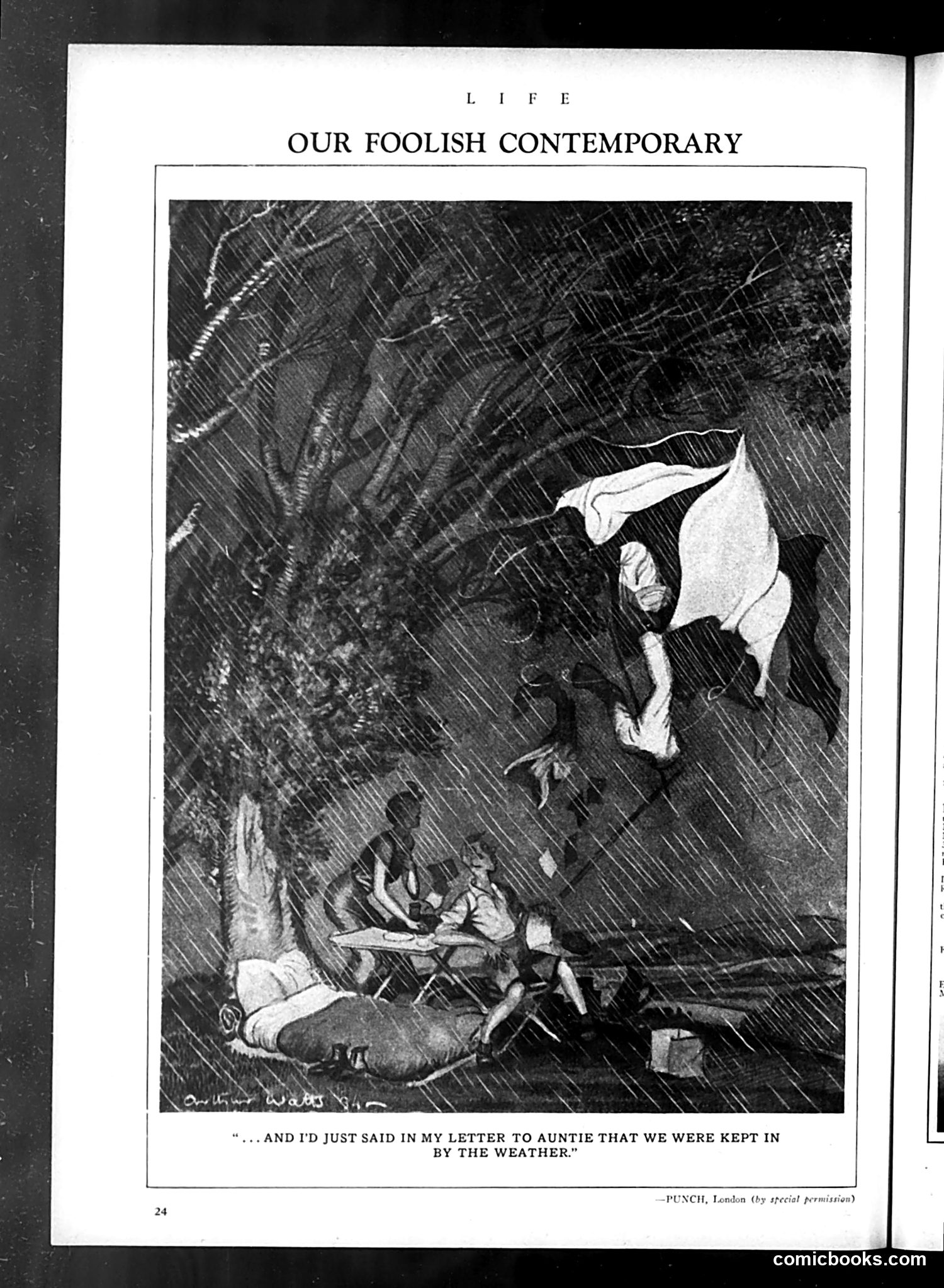
"Our Foolish Contemporary" This cartoon from *Life* magazine reprints British satire from *Punch* London. It depicts a child lying to an adult authority figure (likely a parent or guardian) during rainy weather. The child claims in a letter to "Auntie" that bad weather kept them indoors, but the cartoon reveals the actual situation: the child appears to be engaged in mischief or rule-breaking during that same period. The satire targets childhood dishonesty and the gap between what children tell adults versus reality. The title "Our Foolish Contemporary" suggests *Life* is mocking either the foolish child or the gullible adult who believes such transparent lies. It's a gentle joke about universal childhood behavior—fabricating excuses to authority figures.
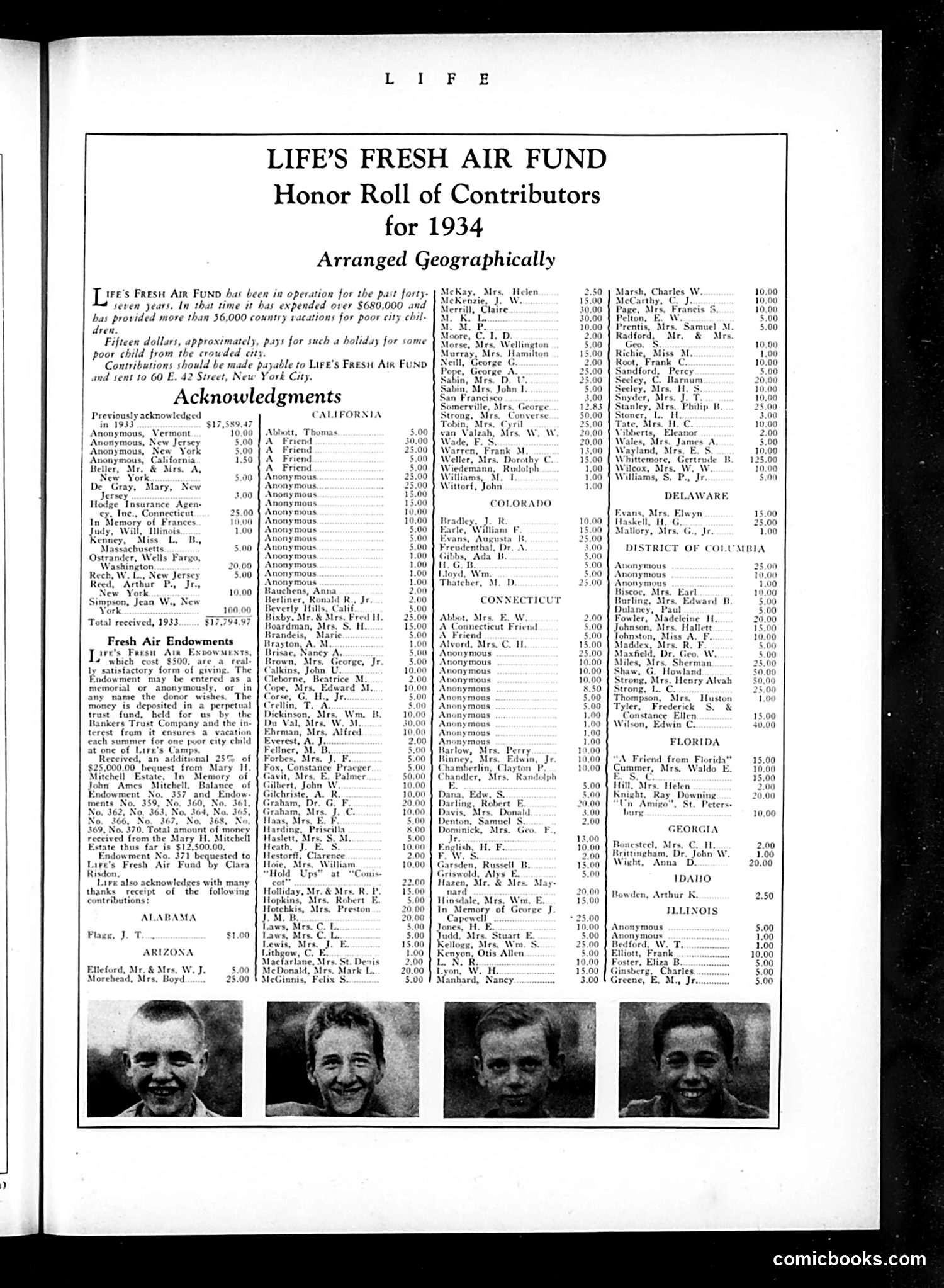
Life's Fresh Air Fund Honor Roll (1934) This page is not a cartoon or satire—it's a charitable fundraising document. Life magazine published an annual "Honor Roll of Contributors" listing donors to its Fresh Air Fund, a legitimate charitable program that provided country vacations for poor urban children. The text explains the fund's mission: for forty years, it had spent over $680,000 providing 36,000+ rural vacations to impoverished city kids, costing approximately $15 per child per holiday. The document lists contributors geographically (California, Colorado, Connecticut, Delaware, Florida, Georgia, Idaho, Illinois) with donation amounts ranging from $1 to $50. Many donors are listed as "Anonymous." The four portraits at bottom appear to be photographs of beneficiaries or program administrators, though the page doesn't identify them. This represents Life magazine's role as both satirist and community institution—using its platform for social reform and charitable work alongside humor and commentary.
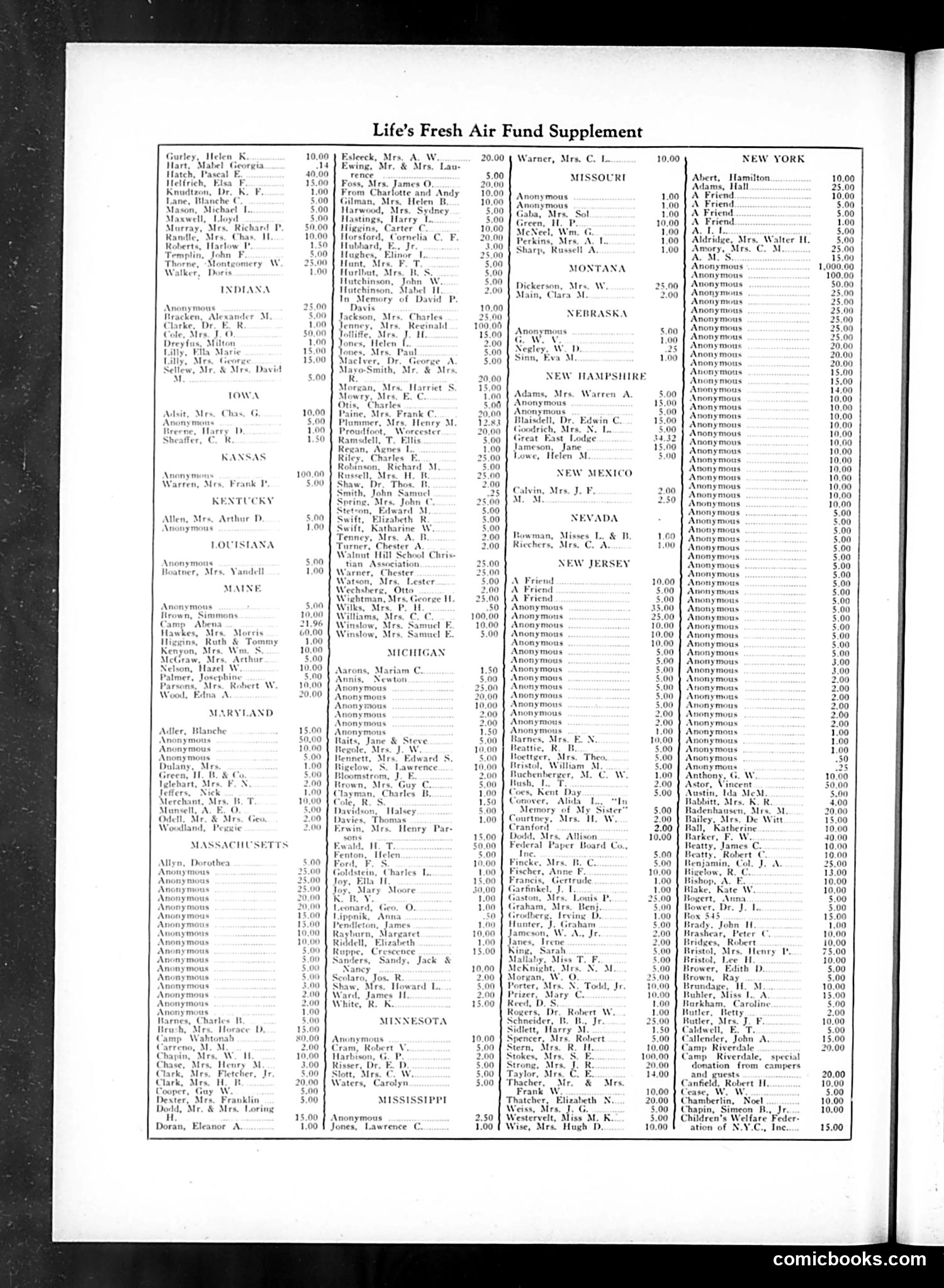
Life's Fresh Air Fund Supplement This page is not a cartoon or satirical article — it is a fundraising document listing donors to Life magazine's "Fresh Air Fund," a charitable initiative providing outdoor recreation for underprivileged children (primarily from urban areas). The page displays names and donation amounts organized by state (Indiana, Iowa, Kansas, Kentucky, Louisiana, Maine, Maryland, Massachusetts, Michigan, Minnesota, Mississippi, Missouri, Montana, Nebraska, New Hampshire, New Mexico, Nevada, New Jersey, and New York). Many donors are listed as "Anonymous," while others are identified individuals or couples. The Fresh Air Fund was a legitimate progressive-era charity addressing urban poverty and poor public health. This supplement served both as public recognition for donors and as an appeal mechanism — printing names encouraged additional contributions while demonstrating community support for the cause.
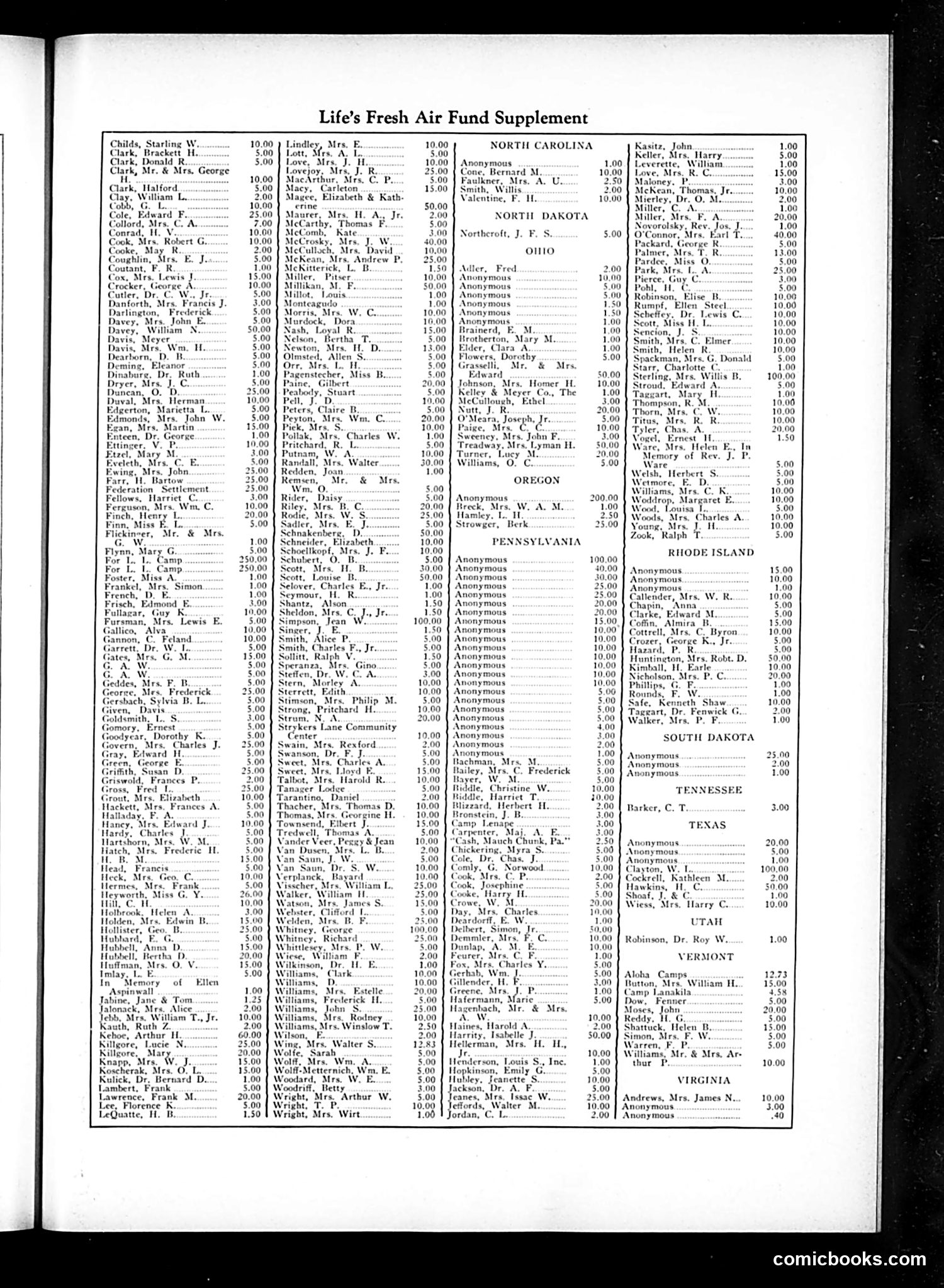
Description This page is not a cartoon or satirical content—it is a fundraising list for Life magazine's "Fresh Air Fund Supplement." The entire page consists of donated names and contribution amounts organized alphabetically by state (North Carolina, North Dakota, Ohio, Oregon, Pennsylvania, Rhode Island, South Dakota, Tennessee, Texas, Utah, Vermont, and Virginia). The Fresh Air Fund was a legitimate charitable organization that provided outdoor recreation and relief for underprivileged children in urban areas. This appears to be a public acknowledgment of donors, listing contributions ranging from $1 to $250. There is no cartoon, satirical commentary, or political reference—merely a record of supporters' generosity to this social welfare cause.
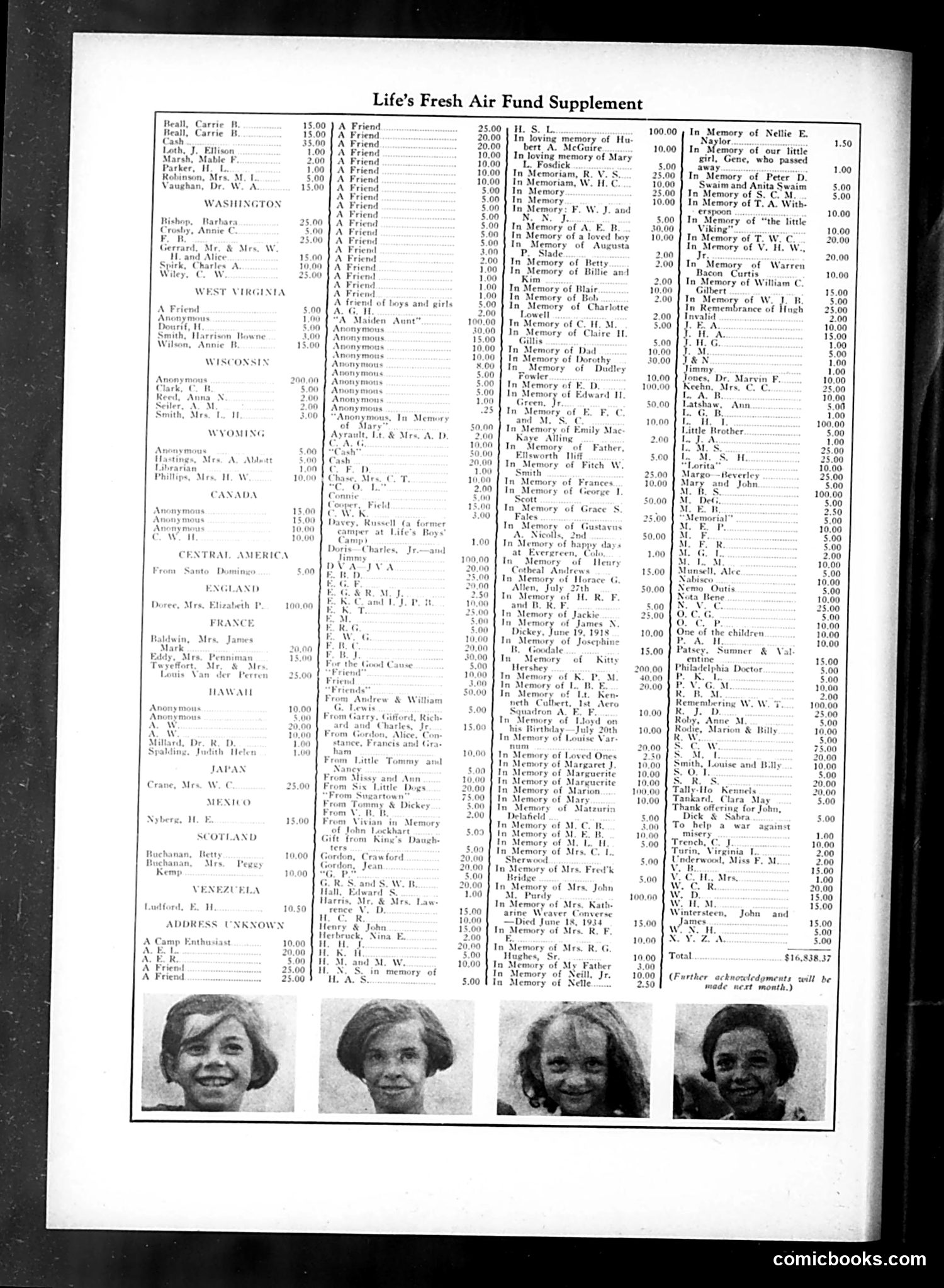
Life's Fresh Air Fund Supplement This page is not a cartoon or satire—it's a fundraising document for Life magazine's "Fresh Air Fund," a real charitable program that provided outdoor experiences for underprivileged urban children. The page lists donations from readers across America and internationally, organized by state/region (Washington, West Virginia, Wisconsin, Wyoming, Canada, Central America, England, France, Hawaii, Japan, Mexico, Scotland, and Venezuela). Amounts range from $1 to $200. The second column contains numerous "In Memory of" donations—contributions made in honor of deceased individuals, a common fundraising practice. Four photographs of young girls appear at the bottom, likely beneficiaries of the Fresh Air Fund program. The total raised was $16,838.27. This represents ordinary readers' charitable giving to send city children to the countryside for health and recreation—a Progressive Era social welfare initiative.
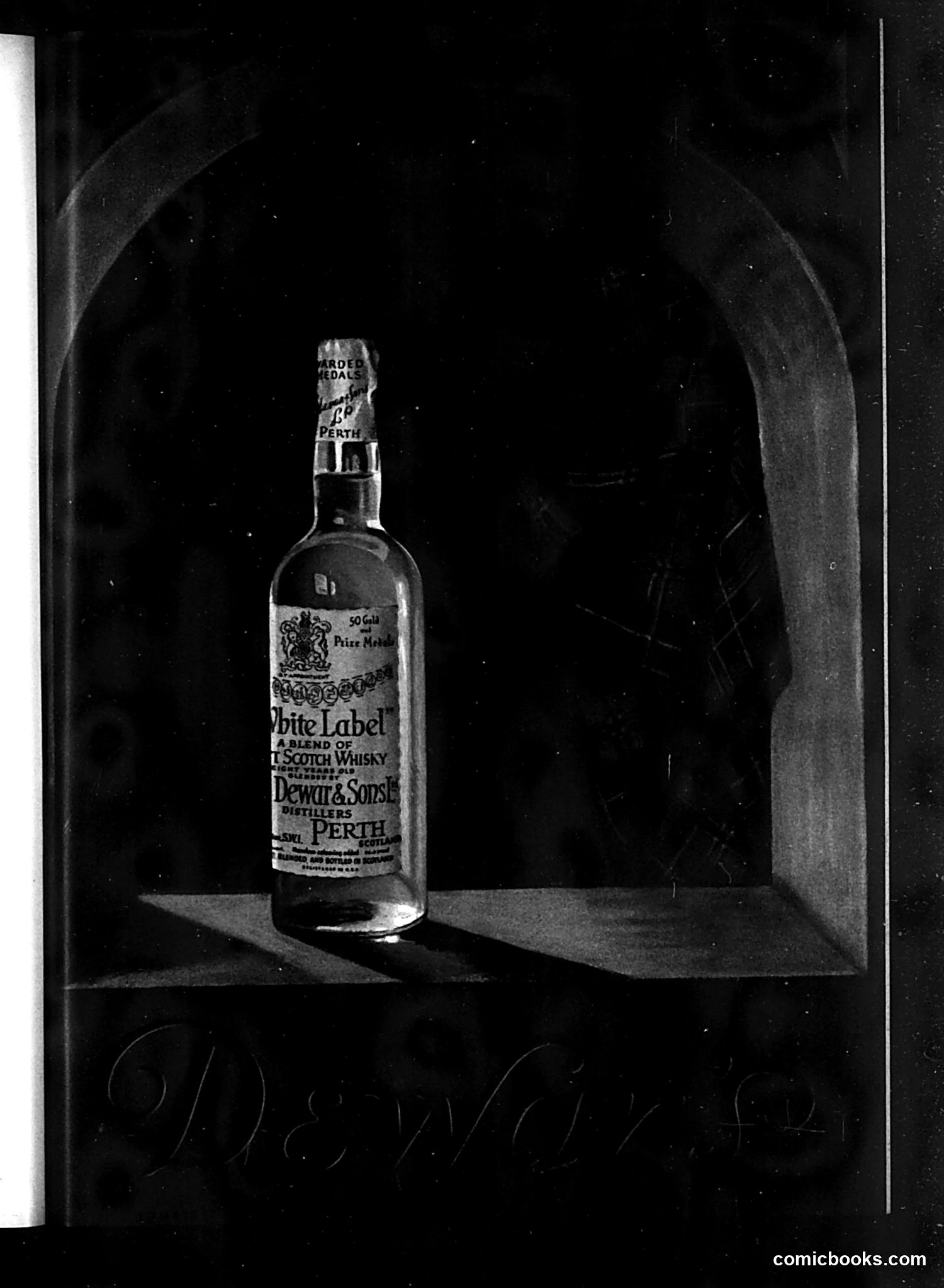
Dewar's White Label Scotch Whisky Advertisement This is a product advertisement for Dewar's White Label Scotch Whisky, distilled by Dewar & Sons in Perth, Scotland. The image shows a bottle photographed against a dark architectural background with dramatic arched elements, using professional studio lighting to create an elegant, sophisticated presentation. The advertisement employs modernist visual design typical of early-to-mid 20th century product marketing, emphasizing the product's prestige through refined presentation rather than humor or satire. This appears to be a straightforward commercial advertisement rather than political or social commentary—it's designed to appeal to consumers through aesthetic appeal and brand reputation.
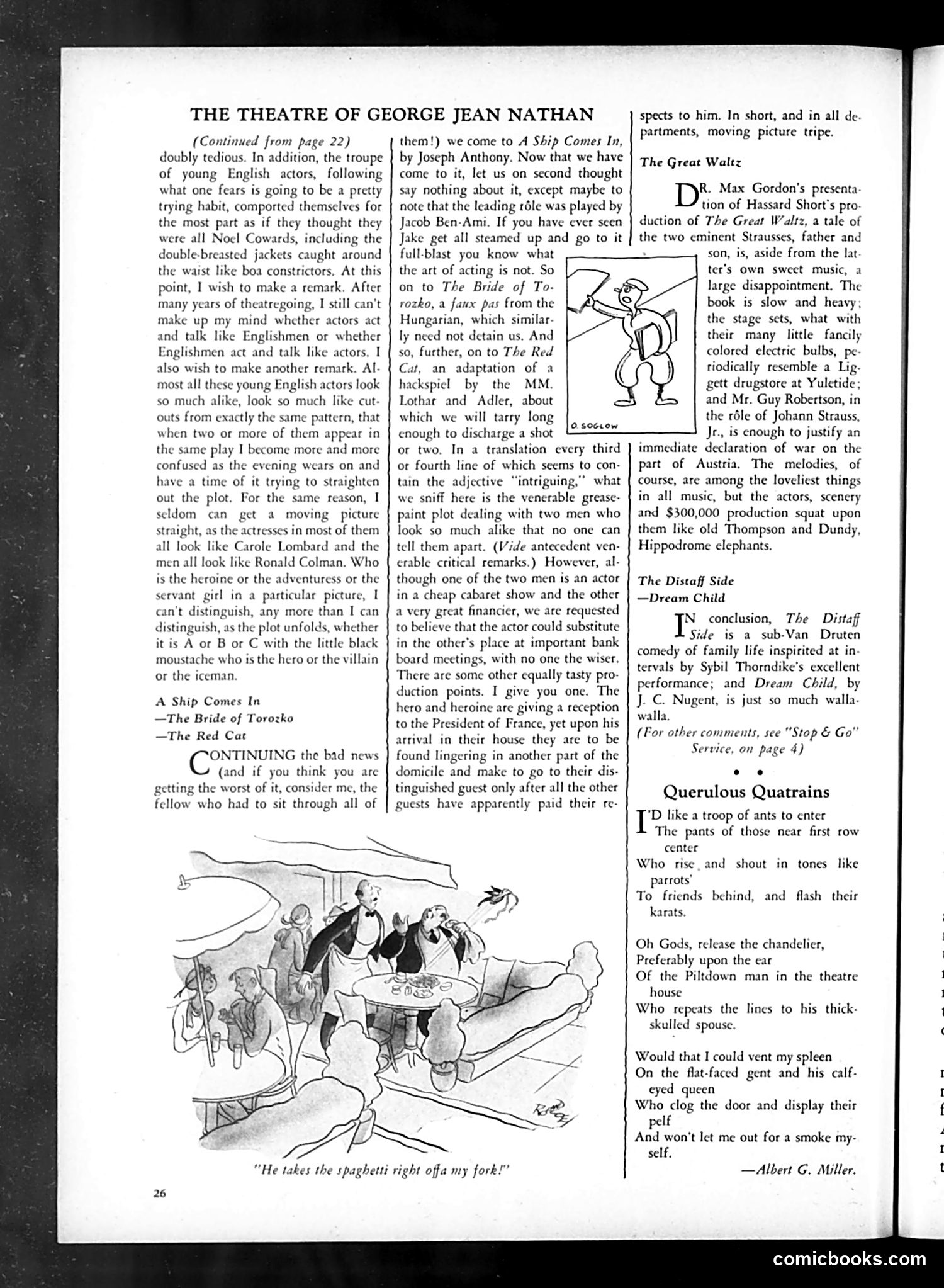
Theater Criticism and Social Commentary This page from Life magazine contains theater reviews by George Jean Nathan, a prominent drama critic. The main cartoon depicts a dining scene with the caption "He takes the spaghetti right offa my fork!"—a visual gag illustrating Nathan's complaint about the absurd plot of "The Red Cat," where two men who look identical cause confusion about who is who. Nathan's reviews mock contemporary theatrical productions: young English actors who imitate Noel Coward's affected mannerisms; "A Ship Comes In" and "The Bride of Torozko," which he dismisses as tedious; and "The Great Waltz," a musical about the Strausses that Nathan finds disappointingly heavy-handed despite its elaborate electric-bulb stage design. The satire targets both poor playwriting and theatrical pretension—actors who mistake affectation for skill, and producers who substitute spectacle for substance.
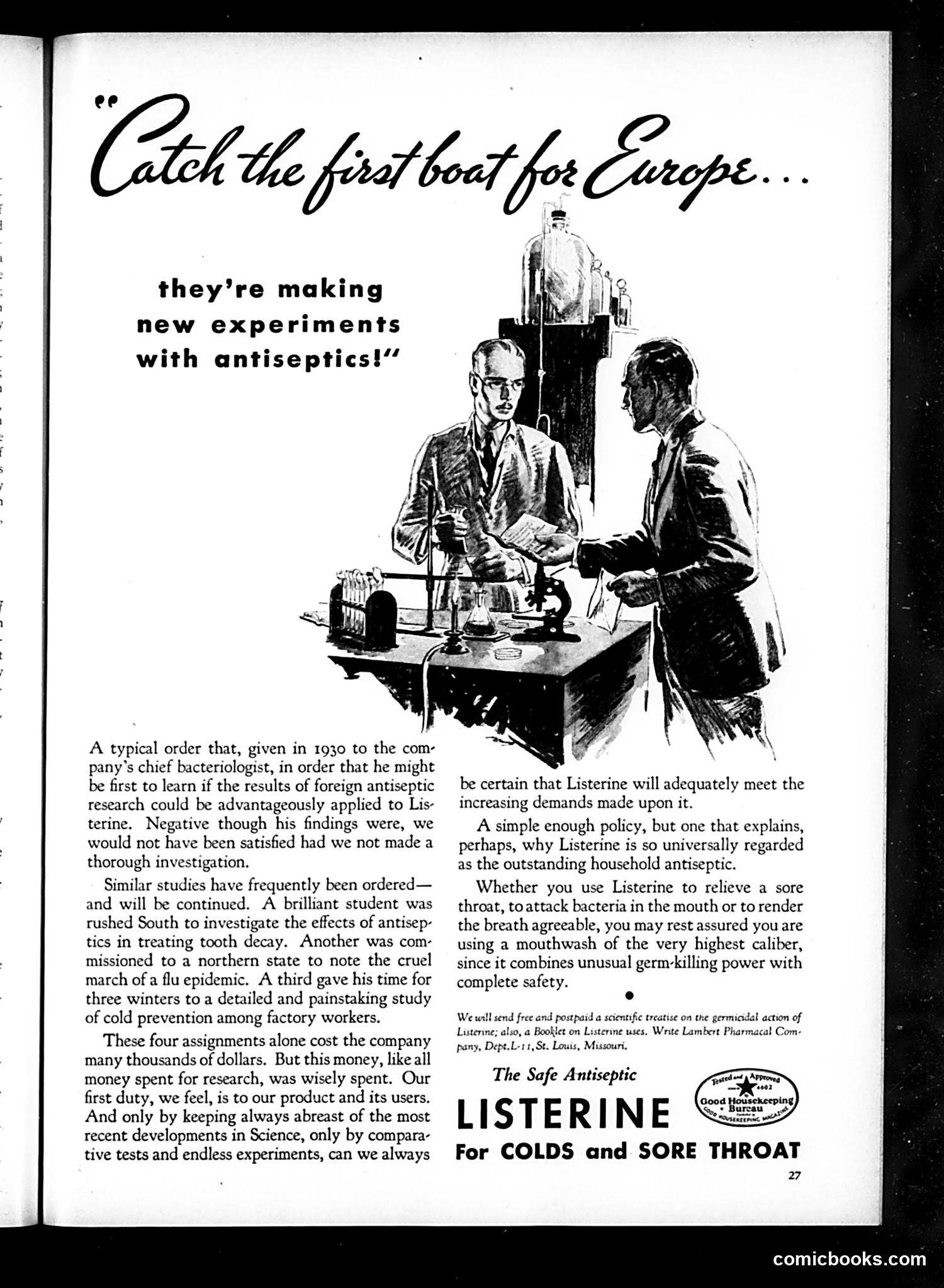
Analysis: Listerine Advertisement This is a Listerine antiseptic advertisement, not satirical content. The illustration depicts two men in a laboratory examining antiseptic research—likely representing the company's bacteriologist and a visiting scientist or colleague. The ad's narrative claims that in 1930, Listerine commissioned extensive research into foreign antiseptic developments to ensure product superiority. It describes four costly research projects: studying foreign antiseptics, investigating antiseptics for tooth decay, examining flu treatment, and testing cold prevention in factories. The advertisement presents this expenditure as evidence of corporate responsibility and scientific rigor—the company's commitment to keeping Listerine "abreast of the most recent developments in Science." For modern readers: this reflects early-20th-century advertising strategy emphasizing scientific credibility and research investment as marketing tools. The implicit message is that Listerine's widespread use and reputation stem from rigorous testing, positioning the product as the "outstanding household antiseptic."
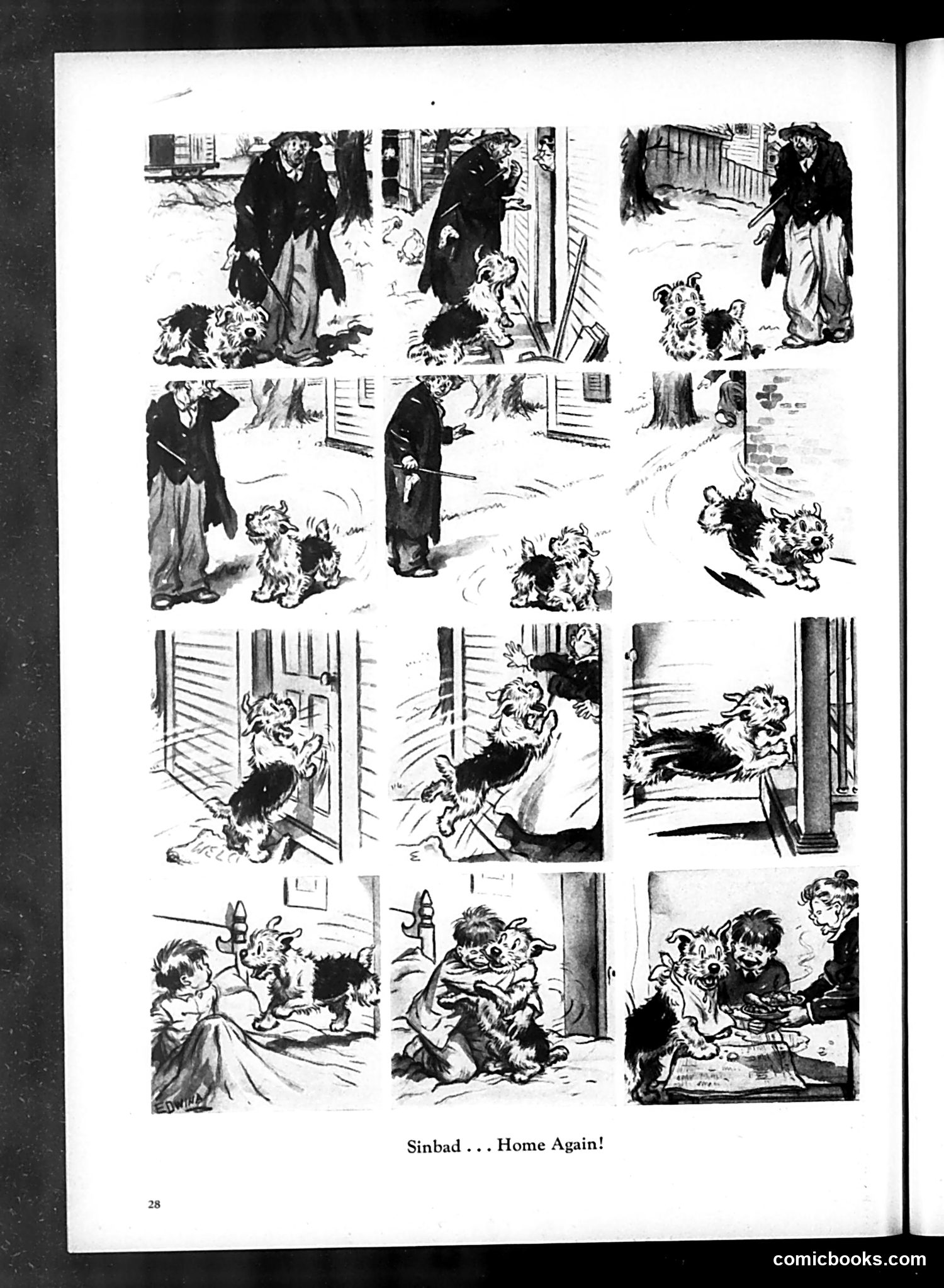
"Sinbad... Home Again!" This comic strip depicts a dog—apparently named Sinbad—returning home after an absence. The narrative follows the reunion between the dog and what appears to be its owner (a woman) and possibly children, shown across multiple panels. The humor derives from the dog's exuberant, chaotic behavior upon homecoming: it bounds around the house, jumps on furniture, disrupts domestic order, and generally causes mayhem despite being welcomed back. The title's ironic tone suggests the owner's mixed feelings—happy to see the pet but overwhelmed by the ensuing disorder. This appears to be a lighthearted domestic humor strip rather than political satire, playing on the relatable experience of pet owners dealing with an overeager returning animal.
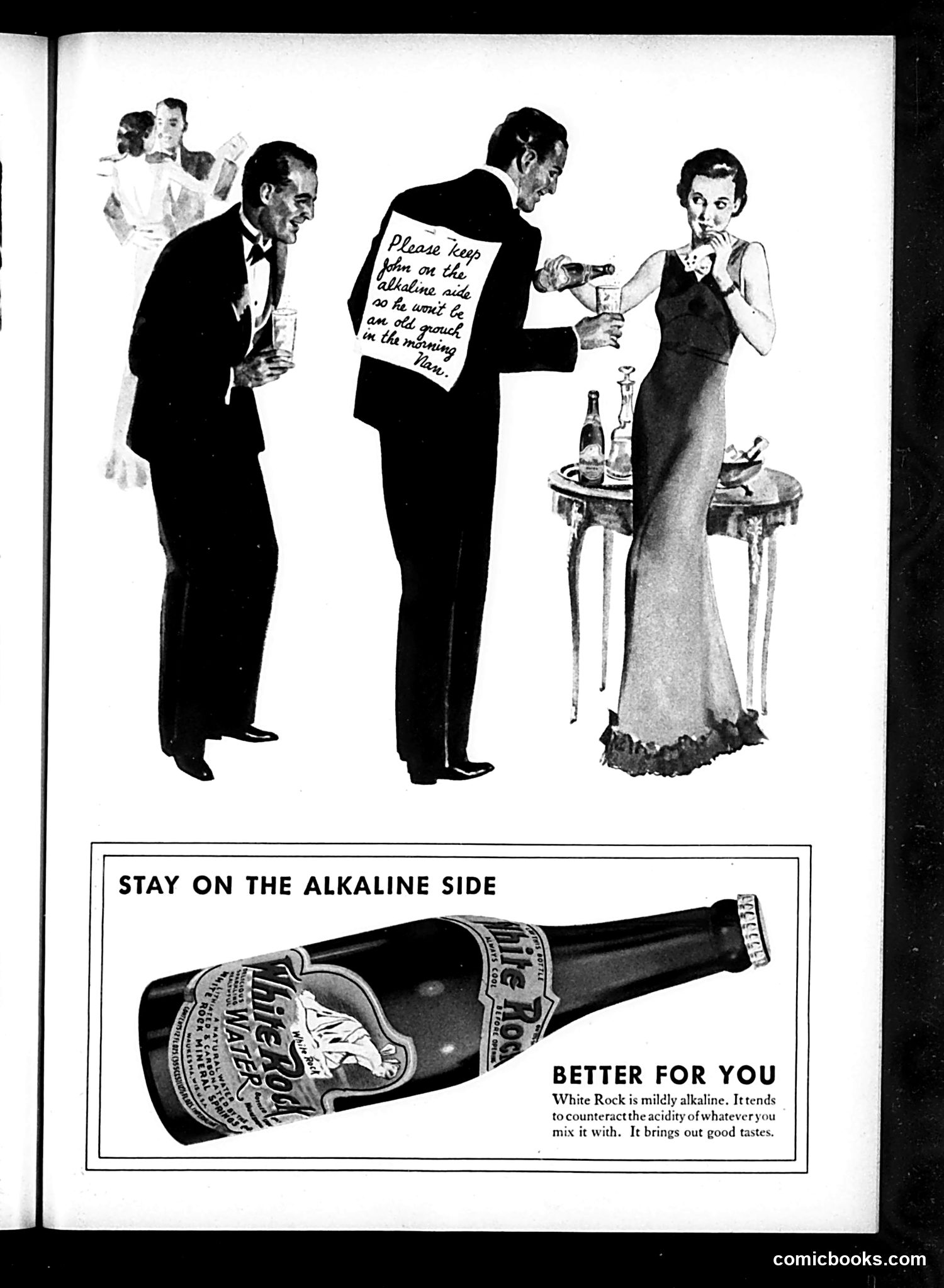
White Rock Beverage Advertisement This is a 1920s-era advertisement for White Rock mineral water, not political satire. The illustration depicts a humorous domestic scenario: a man reads a note (visible text warns about keeping alkaline water "on the alkaline side"), while another man offers a drink to a woman at a cocktail party, with a couple embracing in the background. The joke plays on Prohibition-era anxieties. The ad suggests White Rock water is "mildly alkaline" and counteracts the acidity of alcohol, implying it's suitable for mixing with illicit spirits. The humor targets drinkers mixing homemade or bootleg liquor during Prohibition—the alkaline properties supposedly improve the taste of questionable alcohol. The ad uses domestic comedy to market a health product while subtly acknowledging illegal drinking culture.
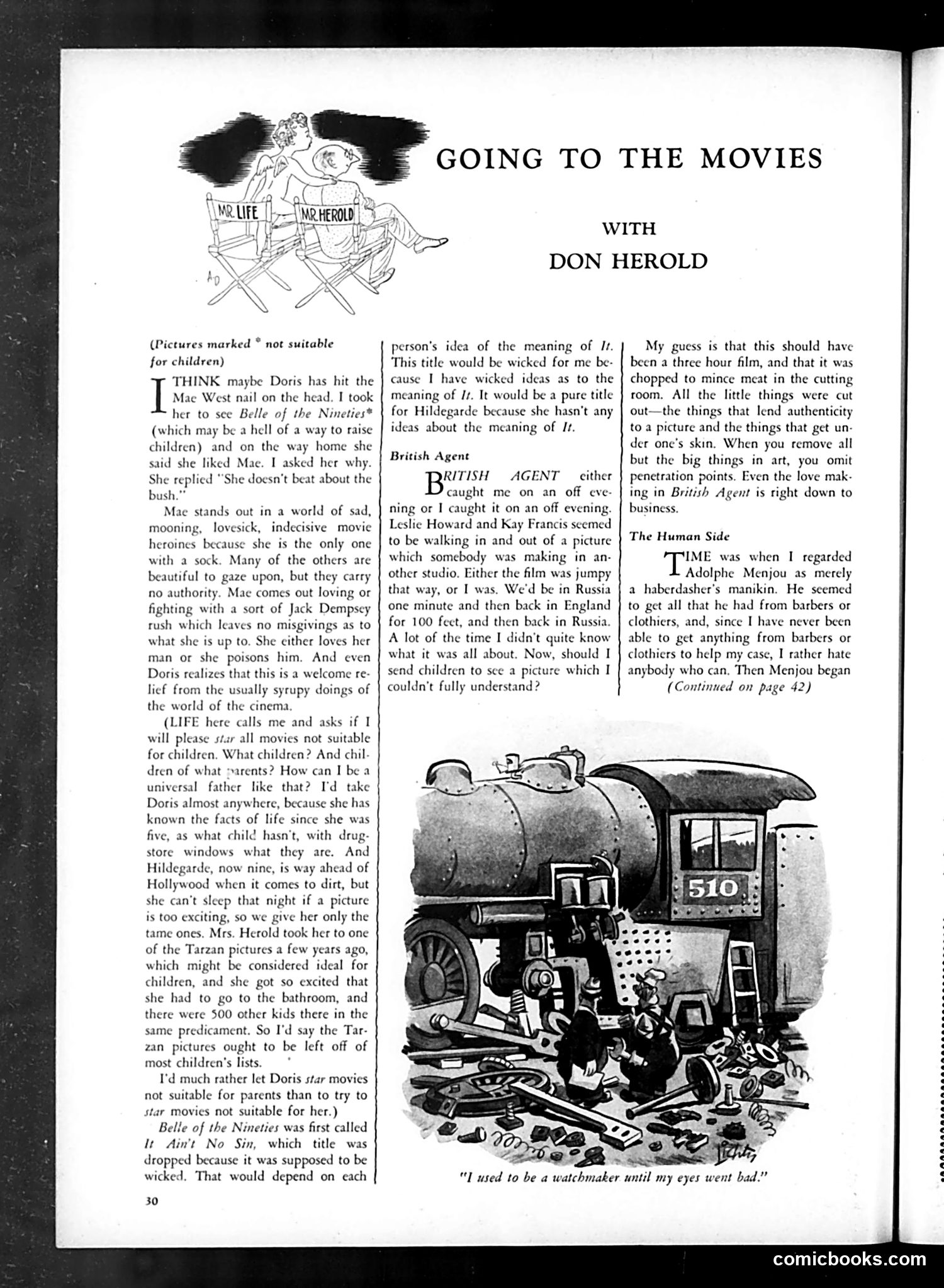
"Going to the Movies with Don Herold" This is a humorous film review column by Don Herold. The main cartoon depicts a watchmaker whose eyesight failed—a visual pun on poor film editing or cinematography that makes movies unwatchable. Herold discusses three films: Mae West's "Belle of the Nineties": He praises West's directness and authority compared to other movie heroines, contrasting her decisive characters (who "love or fight") with typical "syrupy" female roles. The asterisk marks it unsuitable for children—a running joke, since Herold questions who decides such ratings and notes his own daughter already knows about life anyway. "British Agent": He criticizes heavy editing that jumps confusingly between Russia and England, removing authentic details that give films depth. Adolphe Menjou section (continued on page 42): Apparently critiques the actor's reliance on costumers and barbers rather than genuine acting ability. The piece satirizes both Hollywood's prudishness about content ratings and its heavy-handed editing practices that destroy film quality.
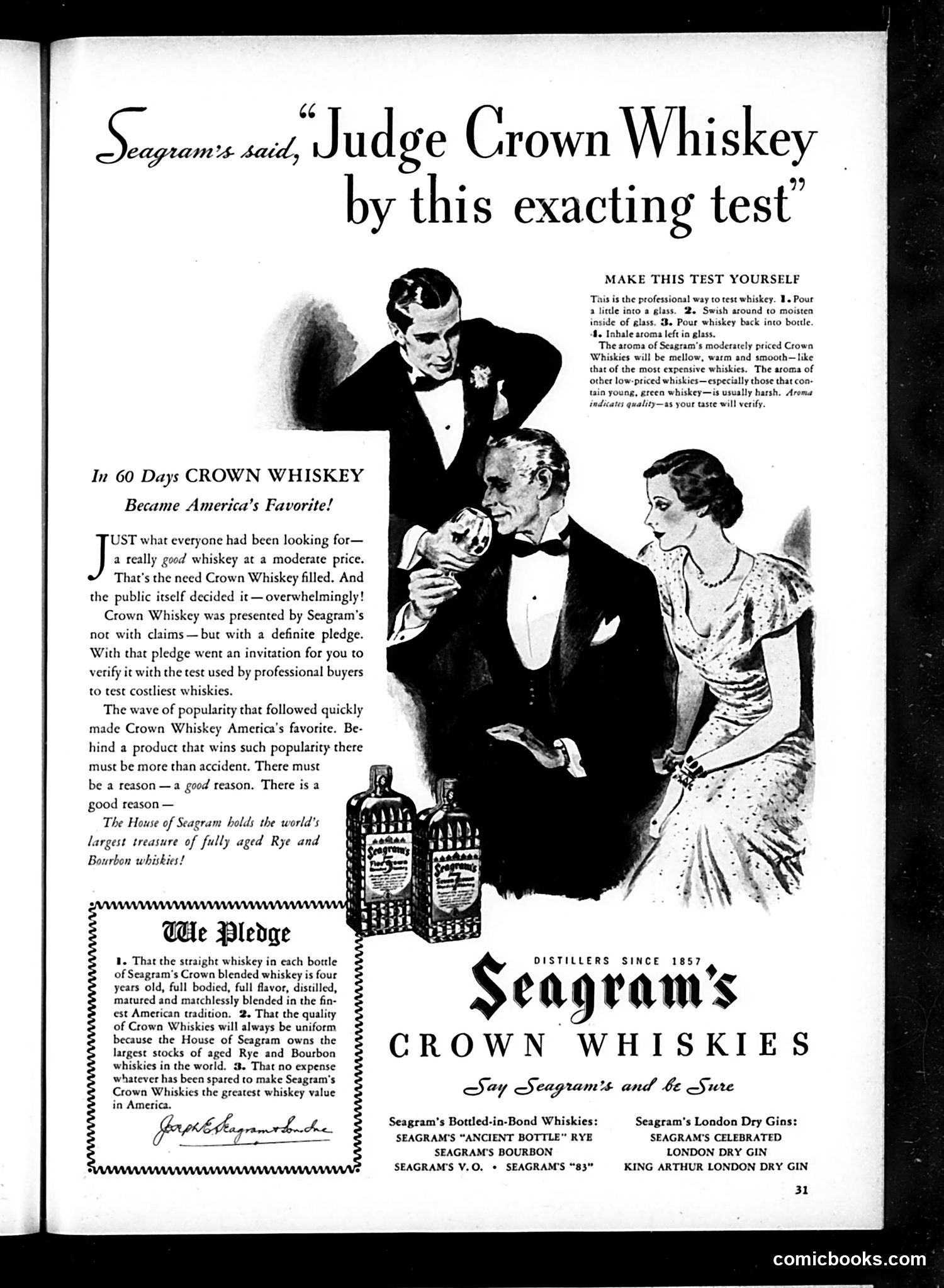
Analysis of Seagram's Crown Whiskey Advertisement This is primarily a whiskey advertisement, not political satire. The page promotes Seagram's Crown Whiskey using aspirational imagery and marketing claims typical of 1920s-30s advertising. The headline references "Judge Crown Whiskey by this exacting test"—a professional tasting method presented to legitimize the product's quality. The illustration depicts well-dressed, sophisticated figures (a judge or authority figure and socialites) conducting a sensory evaluation, suggesting that even expert palates will approve Crown Whiskey's "mellow, warm and smooth" aroma. The ad emphasizes that Crown achieved popularity within 60 days by offering quality at a "moderate price"—undercutting expensive competitors while claiming superiority over cheap alternatives containing "young, green whiskey." Seagram's pledges quality assurance based on owning "the world's largest treasure of fully aged Rye and Bourbon whiskies." This reflects the post-Prohibition era (the company notes "distillers since 1857"), when whiskey marketing relied on reassuring consumers about quality and legitimacy after years of black-market products.
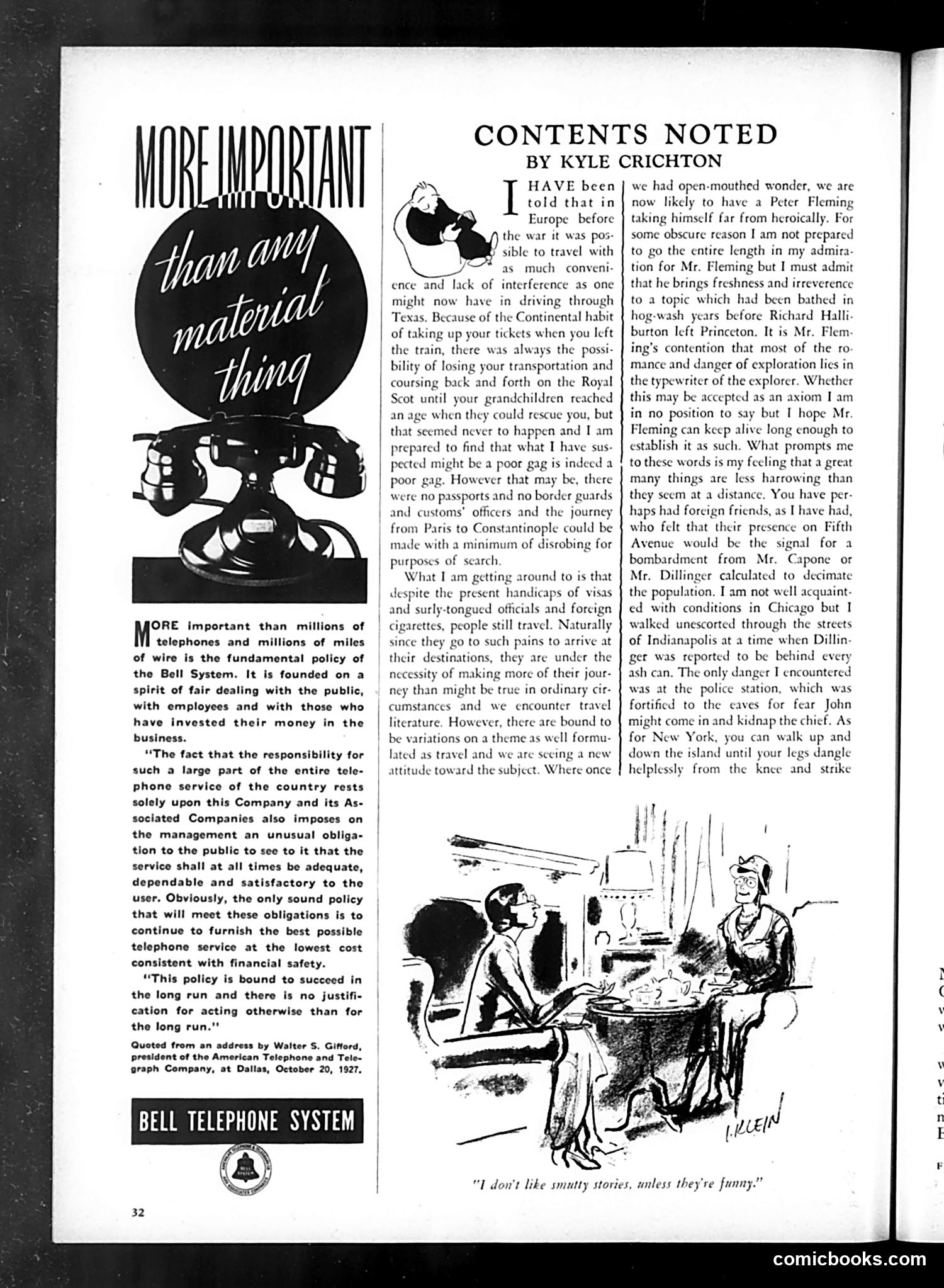
Page Analysis This page contains two distinct items: Left side: A Bell Telephone System advertisement promoting the company's "fundamental policy" of fair dealing and reliable service. The dramatic graphic shows a fist gripping telephone equipment, emphasizing the system's foundational importance. The quote attributes this philosophy to AT&T president Walter S. Gifford (1927). Right side: Kyle Crichton's essay "Contents Noted" discusses changing attitudes toward travel writing. He critiques the romanticism of earlier travel literature (referencing explorer Richard Halliburton) and praises Peter Fleming's more irreverent, realistic approach. Crichton uses contemporary examples to illustrate how people exaggerate travel dangers—noting that foreign visitors to America fear Chicago's gangsters (Capone/Dillinger) more than reality warrants. The accompanying cartoon shows a woman telling a man, "I don't like smutty stories, unless they're funny"—illustrating how audiences now prefer authentic humor over inflated adventure narratives. The page essentially contrasts corporate messaging about reliability with cultural commentary on authenticity in storytelling.
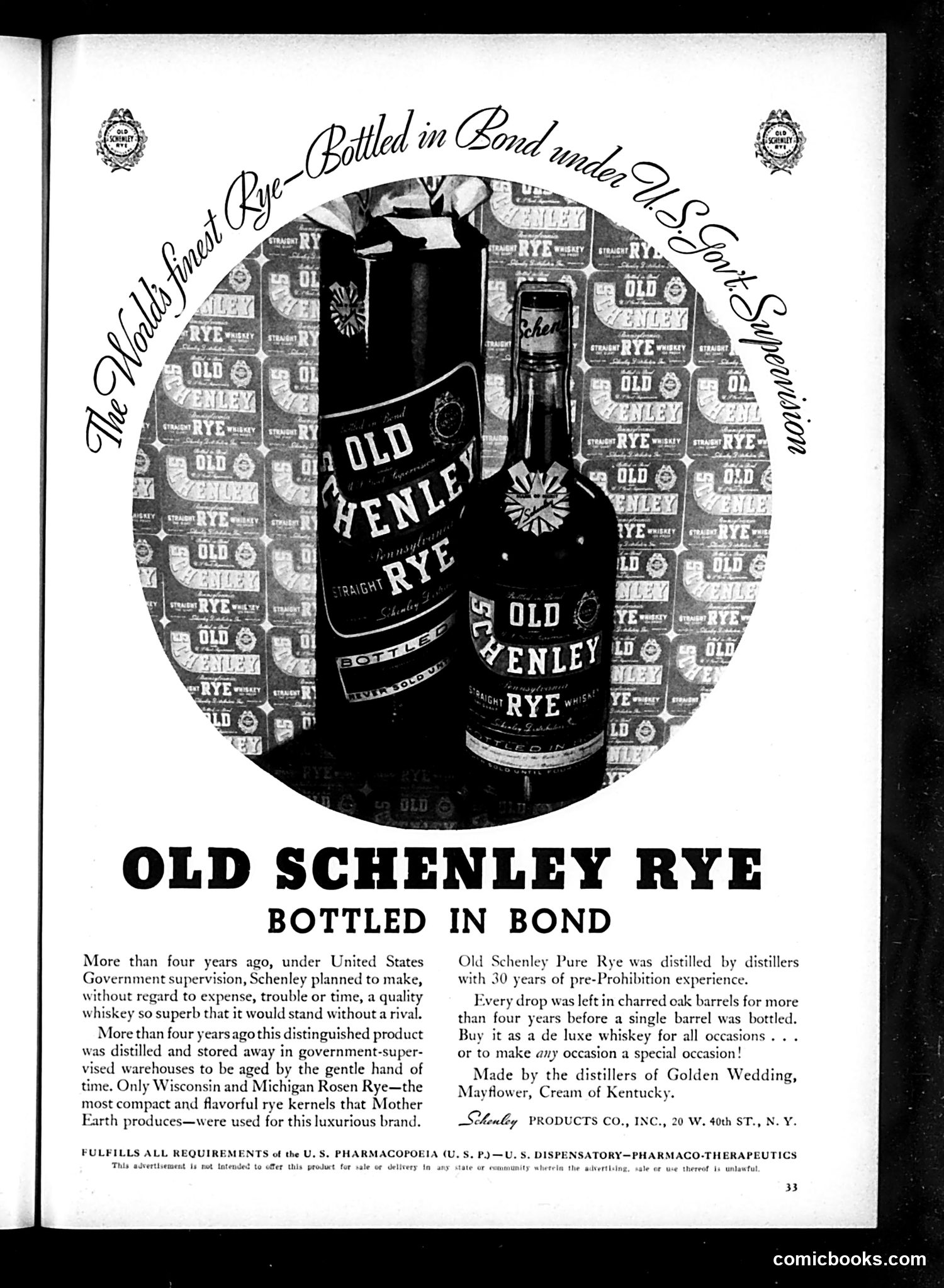
Old Schenley Rye Advertisement This is a full-page advertisement for whiskey, not a political cartoon. The page advertises Old Schenley Rye, marketed as "bottled in bond" under government supervision. The ad references Prohibition's recent end—the product emphasizes it was made by distillers with "30 years of pre-Prohibition experience," suggesting expertise from before the 1920-1933 alcohol ban. The four-year aging period and government oversight are presented as marks of quality and legitimacy. The advertisement targets post-Prohibition consumers eager to purchase legal whiskey again, positioning Old Schenley as premium and reliable. The small legal disclaimer at bottom about the U.S. Pharmacopoeia reflects how alcohol was still marketed with quasi-medicinal language in this era. This reflects 1930s American consumer culture as Prohibition ended and the liquor industry rebuilt itself.
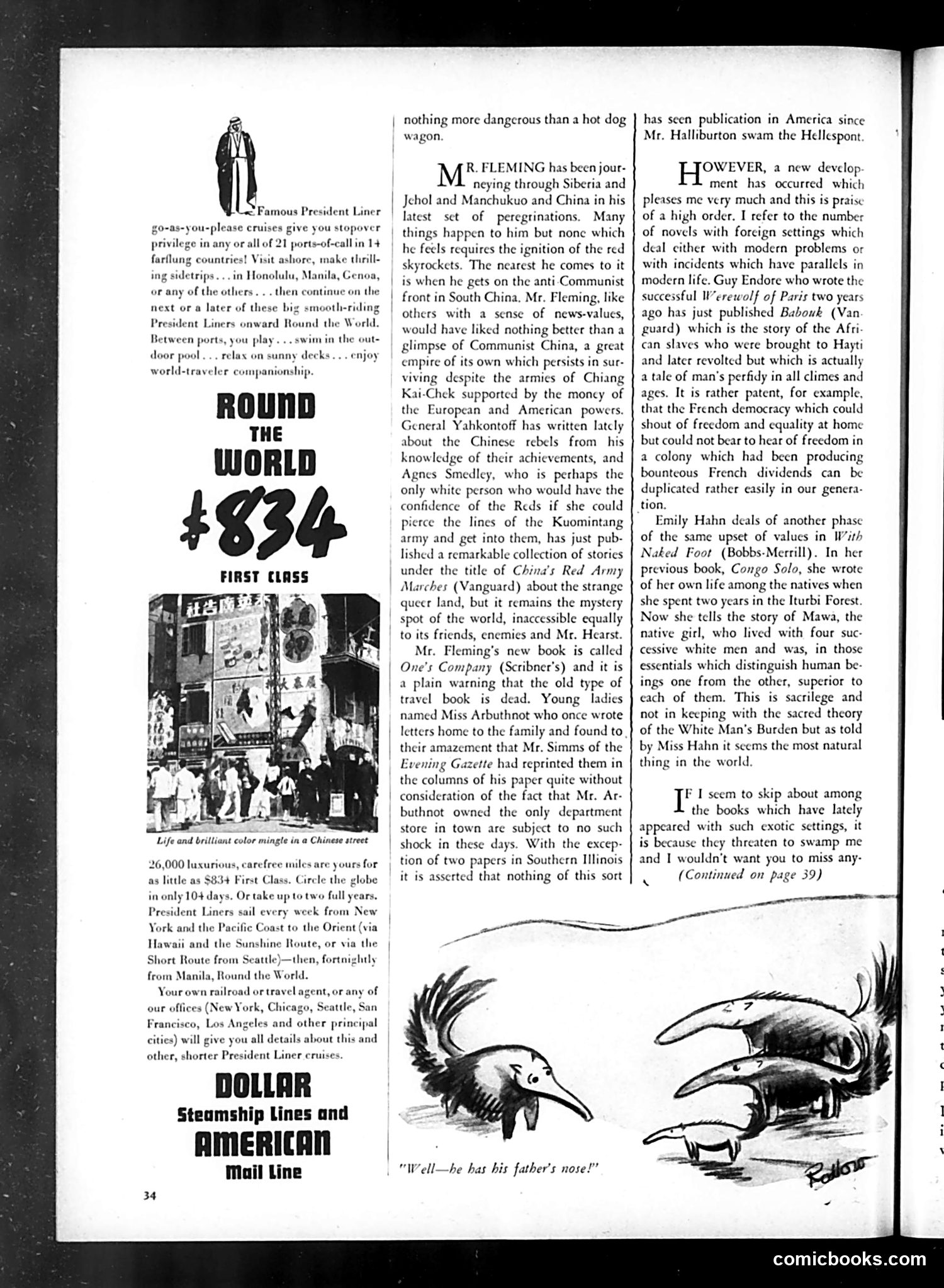
Analysis of This Life Magazine Page This page combines travel advertising with book reviews. The cartoon at bottom—showing birds examining a chick's nose—is a gentle family joke about heredity, unrelated to the political content. The text discusses Mr. Fleming's travel writings about China during a period of civil conflict. The passage references the Chinese Nationalist-Communist divide: Chiang Kai-Shek's Kuomintang government (backed by Western powers) fighting the Communist forces. Fleming apparently refused to dramatize this conflict despite its newsworthiness. The review praises modern travel literature that engages with contemporary social problems rather than sentimental travelogues. It notes approvingly that recent novels set abroad—like Guy Endore's *Babouk* about slave revolts in Haiti—draw parallels between foreign injustices and Western hypocrisy: France preached liberty at home while denying it in its colonies. The advertisement promotes President Liner cruises as leisure travel for affluent Americans, a stark contrast to the serious geopolitical and moral issues discussed in the reviews above it.
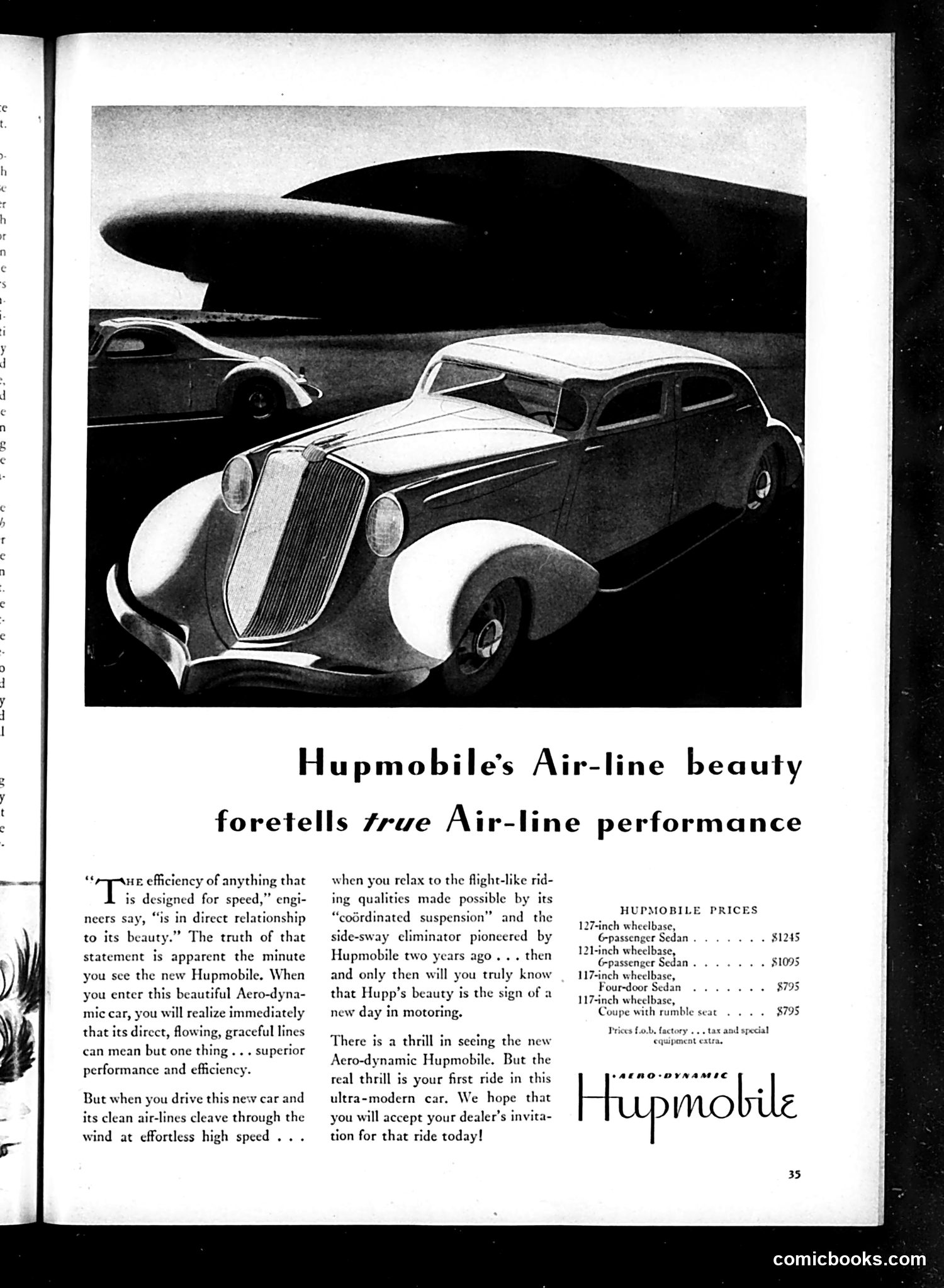
Analysis This is automotive advertising, not satire or political commentary. The page promotes the Hupmobile, an American automobile brand, emphasizing its aerodynamic design. The advertisement argues that a car's beauty directly indicates performance—its streamlined "air-line" silhouette promises superior speed and handling. The image shows a sleek, art deco-styled sedan alongside a biplane, visually linking automotive and aviation aesthetics, a common design philosophy of the 1930s era. The text encourages test drives and lists prices ($795–$1245), positioning the Hupmobile as modern and desirable. There is no satire present; this is straightforward product promotion leveraging the era's fascination with streamlining and flight-inspired industrial design.
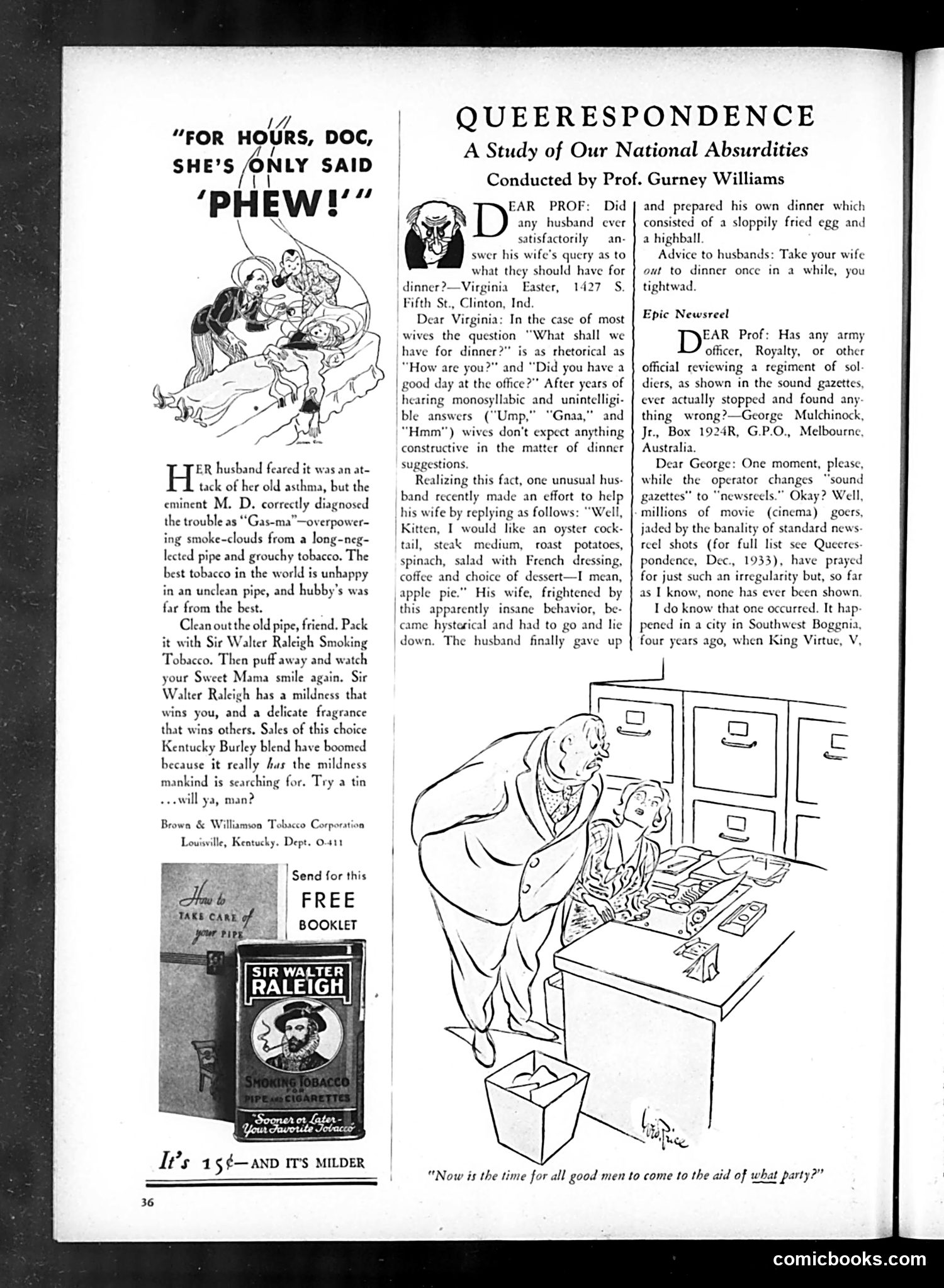
Analysis of Life Magazine Page This page contains two distinct sections: Left side: A Sir Walter Raleigh tobacco advertisement disguised as humor. It depicts a husband whose wife won't stop complaining—diagnosed as "Gas-ma" from his dirty pipe. The "joke" is that cleaning the pipe and switching tobacco brands will make her happy. This reflects period attitudes treating women's grievances as irrational complaints to be managed rather than addressed. Right side: "Queerespondence," a humor column answering reader queries about domestic and social absurdities. Notable responses include: - A husband's attempt to suggest dinner met with his wife's hysteria (satirizing marital communication) - A query about whether military officials ever actually find fault during inspections, answered with a fictional anecdote about "King Virtue V" in "Southwest Boggnia"—clearly fictitious, suggesting such inspections are theatrical performances where problems are never actually discovered The satirical point critiques institutional theater: officials go through motions without genuine oversight or accountability.
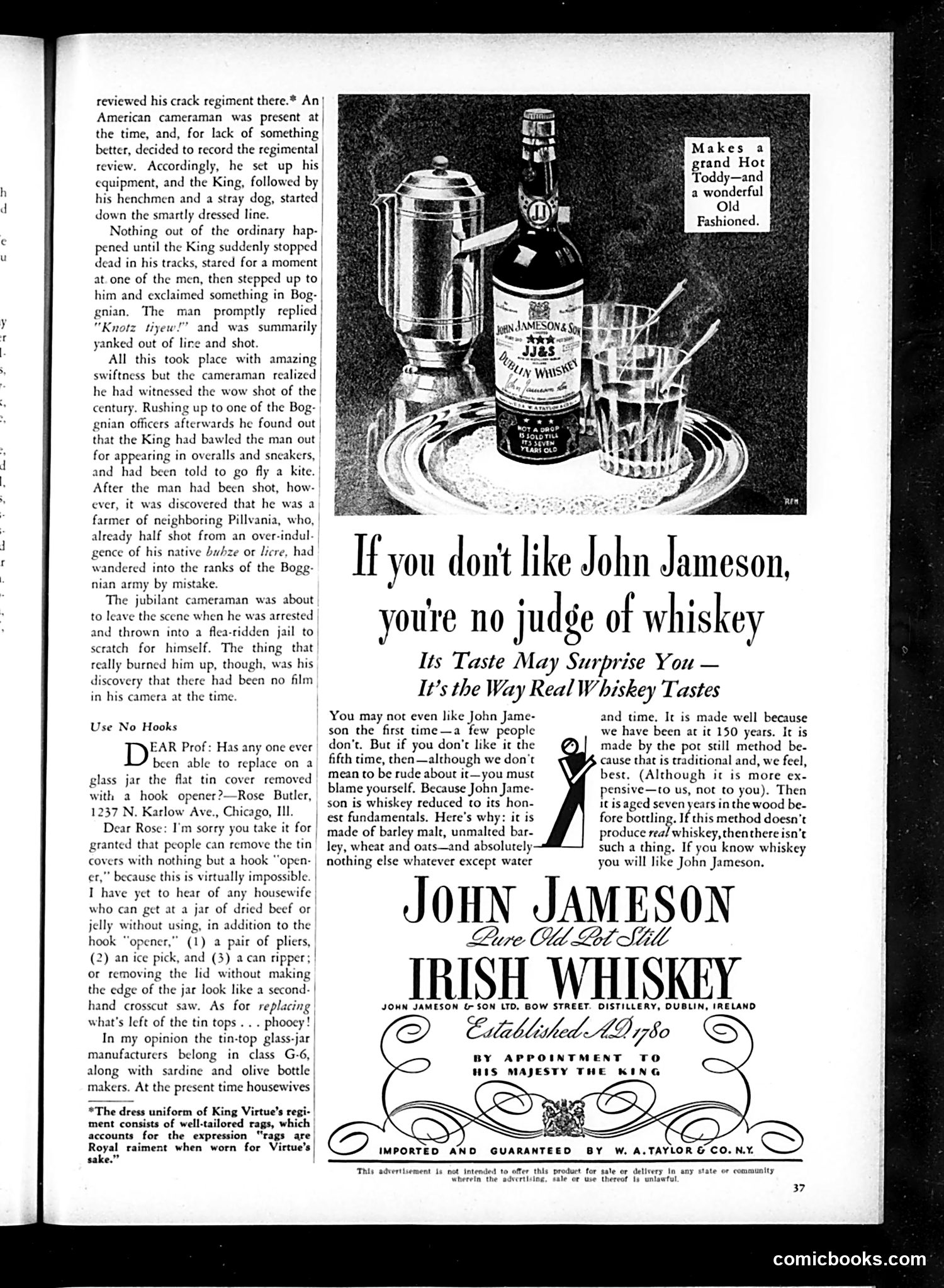
Content Analysis This page contains two distinct elements: Left side: A satirical story about fictional nations "Boggnia" and "Pillvania." A cameraman witnesses a military review where King Virtue executes a soldier for wearing overalls and sneakers (mistakenly, as the man was a drunken farmer from a neighboring country). The joke's punchline: the cameraman had no film in his camera. This appears to be typical *Life* magazine satirical humor mocking bureaucratic absurdity and military rigidity—the arbitrary, brutal execution over dress code violations is presented as darkly comedic commentary on authoritarian excess. Right side: A full-page advertisement for John Jameson Irish Whiskey. The ad copy argues that if you dislike their whiskey, "you're no judge of whiskey"—playing on snobbish confidence in the product's quality. It emphasizes traditional pot-still production methods and 150 years of history. The page is primarily advertising, with satire occupying secondary space. No real historical figures appear—only fictional characters in a generic political satire.
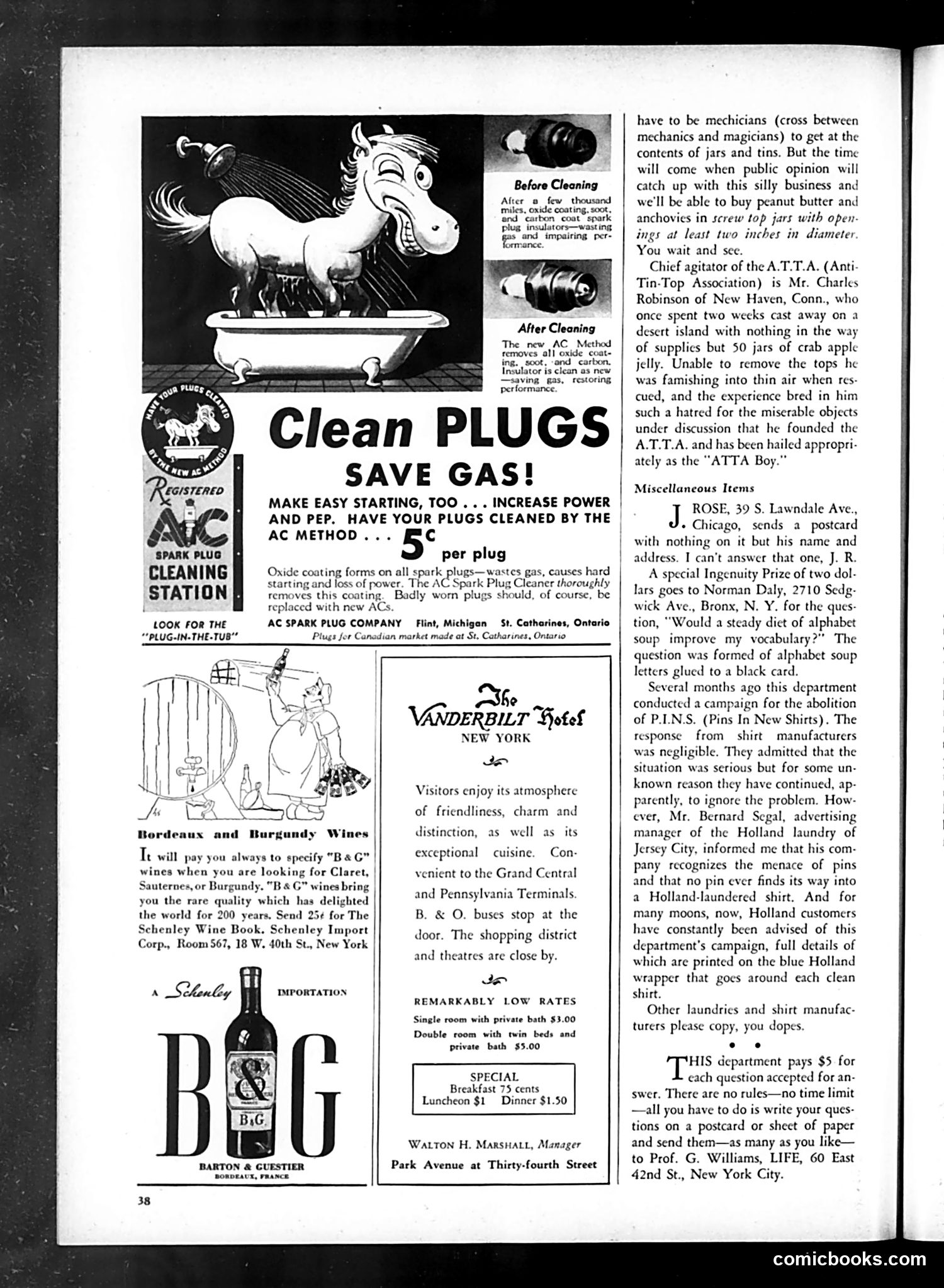
What This Page Means This is primarily an advertising page from Life magazine, featuring several product and service advertisements mixed with a brief reader-submitted humor section. The main cartoon shows a cow in a bathtub labeled "Before Cleaning" and "After Cleaning"—a visual gag advertising AC Spark Plug Cleaning, which promises to remove carbon buildup from spark plugs to improve engine performance and fuel efficiency. The crude cow imagery is meant to be humorous and memorable. Below the ads, the text discusses reader submissions: Charles Robinson, who founded the "Anti-Tin-Top Association" (A.T.T.A.) after being stranded on an island with only canned crab apple jelly he couldn't open—a satirical commentary on frustratingly sealed food containers. The piece also mentions campaigns against pins left in new shirts from manufacturers. These appear to be consumer complaint humor pieces—readers writing in about everyday product design annoyances that manufacturers ignored, treated as comedy in the magazine's "Miscellaneous Items" section.
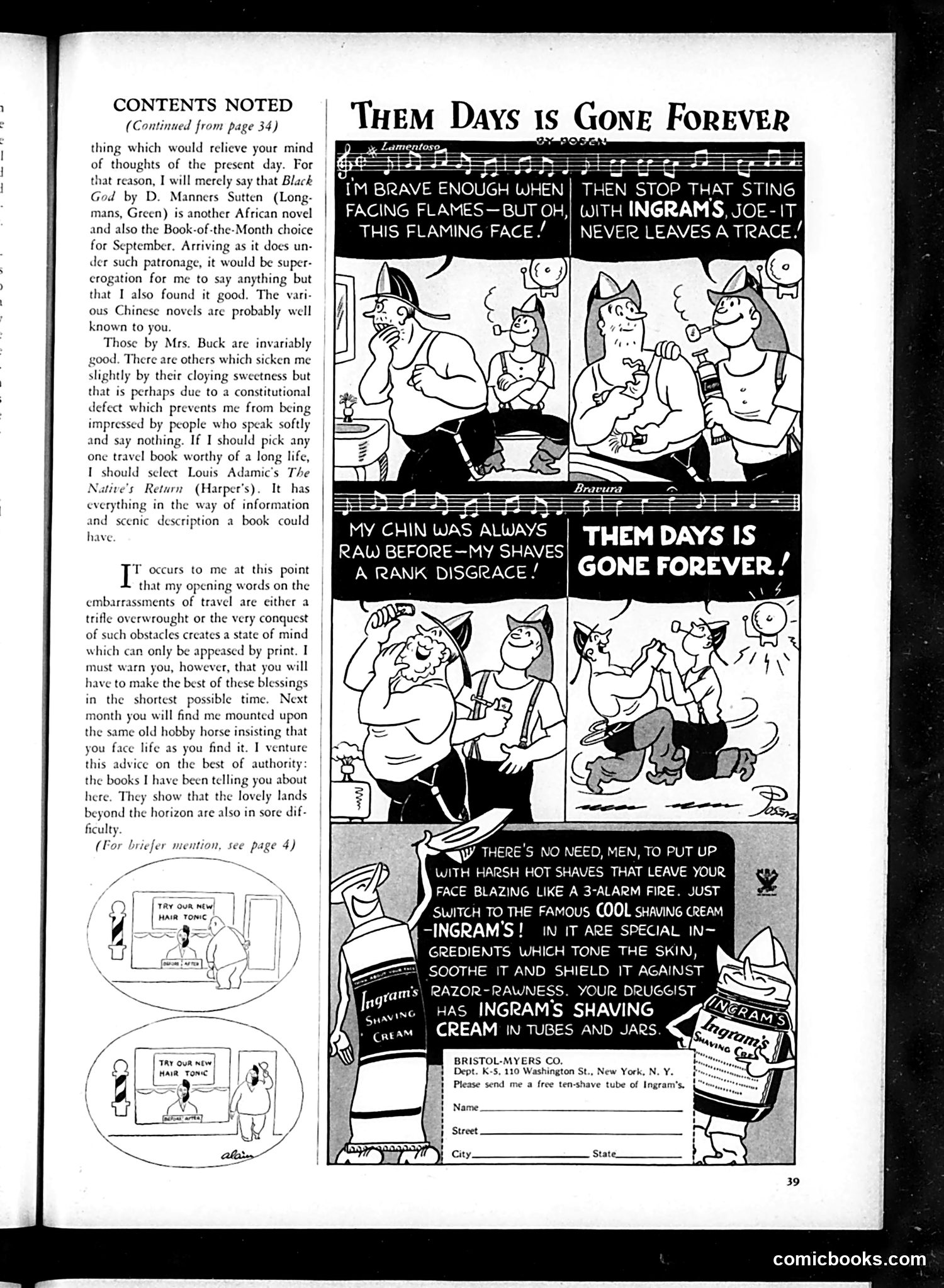
"Them Days Is Gone Forever" - Ingram's Shaving Cream Advertisement This page combines book reviews with a comic-strip advertisement for Ingram's Shaving Cream. The comic depicts firefighters experiencing razor burn from shaving before facing flames. The satire is straightforward: the product promises to eliminate the painful irritation ("raw" chin, "rank disgrace") that men endured with traditional shaving methods. The humor relies on exaggeration—comparing shaving discomfort to actual fire danger—and uses working-class male characters (firefighters) as relatable figures. The "them days is gone forever" refrain celebrates modern consumer products solving everyday complaints. This reflects 1930s-40s advertising strategy: using comic narratives and colloquial speech to pitch personal-care products to ordinary men, positioning the brand as a technological improvement over previous suffering. The advertisement includes a mail-in coupon for a free sample.
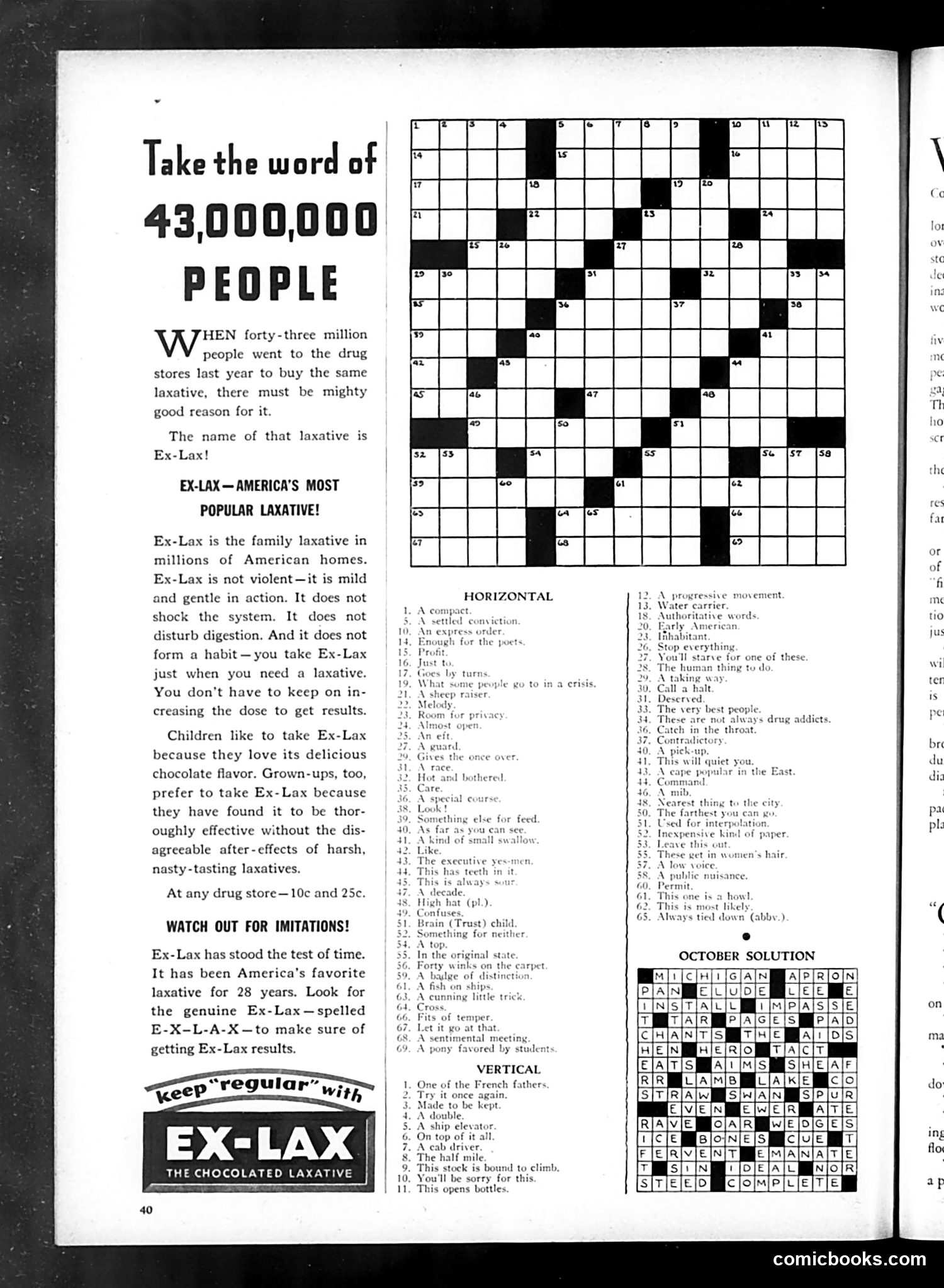
Ex-Lax Advertisement with Crossword Puzzle This page is primarily a product advertisement for Ex-Lax, a chocolated laxative, rather than satirical content. The ad claims 43 million people purchased the product, using this statistic to argue for its popularity and effectiveness. The marketing pitch emphasizes Ex-Lax's gentleness compared to harsh competitors, its appeal to children due to chocolate flavoring, and its 28-year track record. A warning against imitations suggests market competition. The page includes a crossword puzzle (common in Life magazine), with clues and solutions visible. This was typical editorial content used to fill magazine space and engage readers. No political satire or caricature is present here—this is straightforward mid-20th century advertising combined with recreational puzzle content, reflecting how magazines monetized space through both advertisements and reader entertainment.
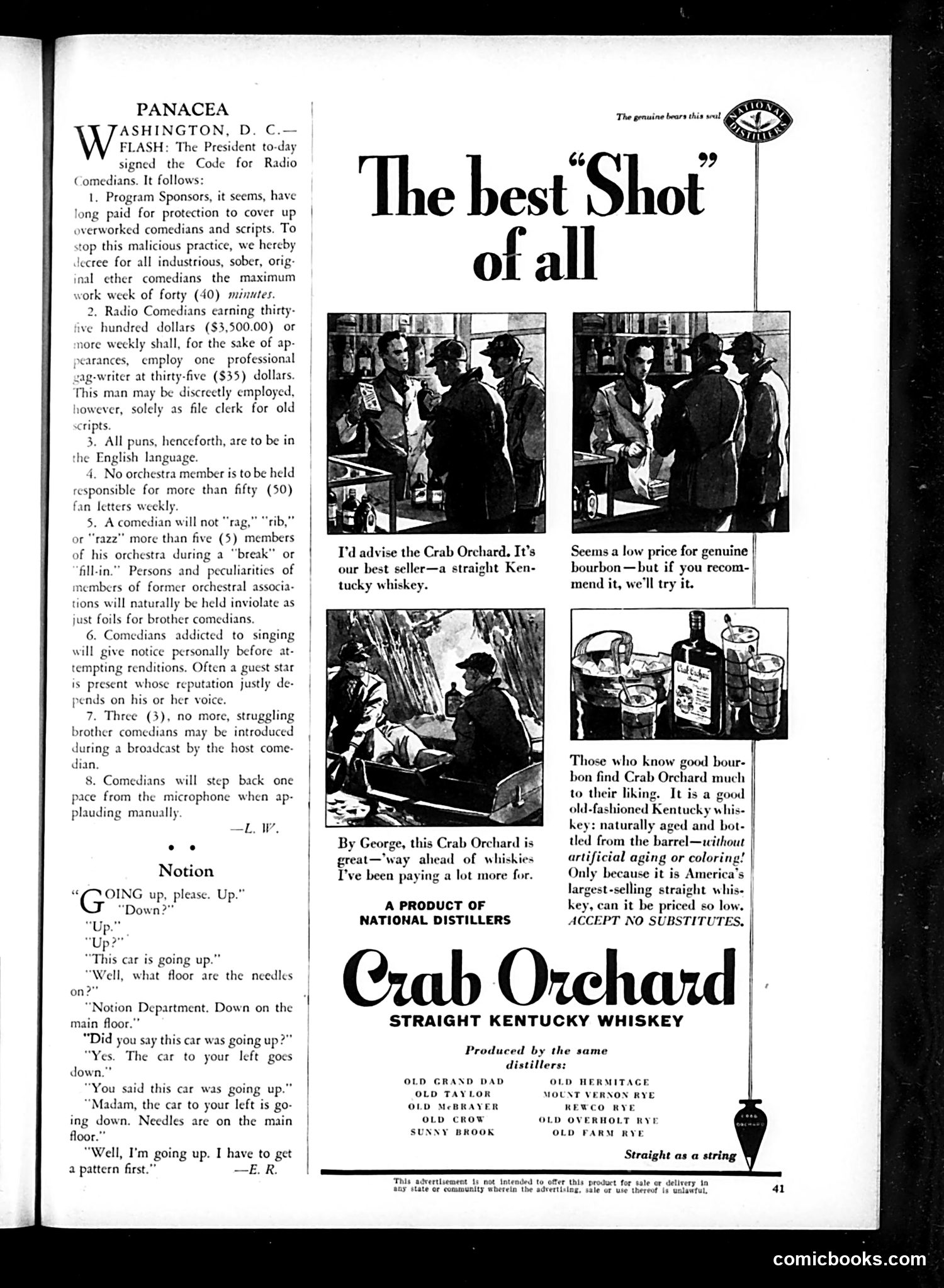
Page Analysis This Life magazine page contains two satirical pieces: "Panacea" (left column): A mock "presidential decree" regulating radio comedians during the early broadcast era. The satire targets radio sponsors' practices of over-protecting comedians and their material. It humorously proposes absurd regulations—limiting comedians to 40 minutes weekly work, requiring they hire writers as disguised "file clerks," restricting puns to English, and limiting orchestra ridicule to five members per broadcast. The joke critiques how much comedians were paid while producing minimal original work, and how sponsors controlled content to protect their investments. "Notion" (lower left): A brief wordplay joke about an elevator operator and customer misunderstanding which direction the car is going, played for absurdist humor. Right side: A full-page Crab Orchard whiskey advertisement featuring photographs of men discussing the product, emphasizing it as a quality Kentucky bourbon at a low price—notably this is Depression-era advertising highlighting value.
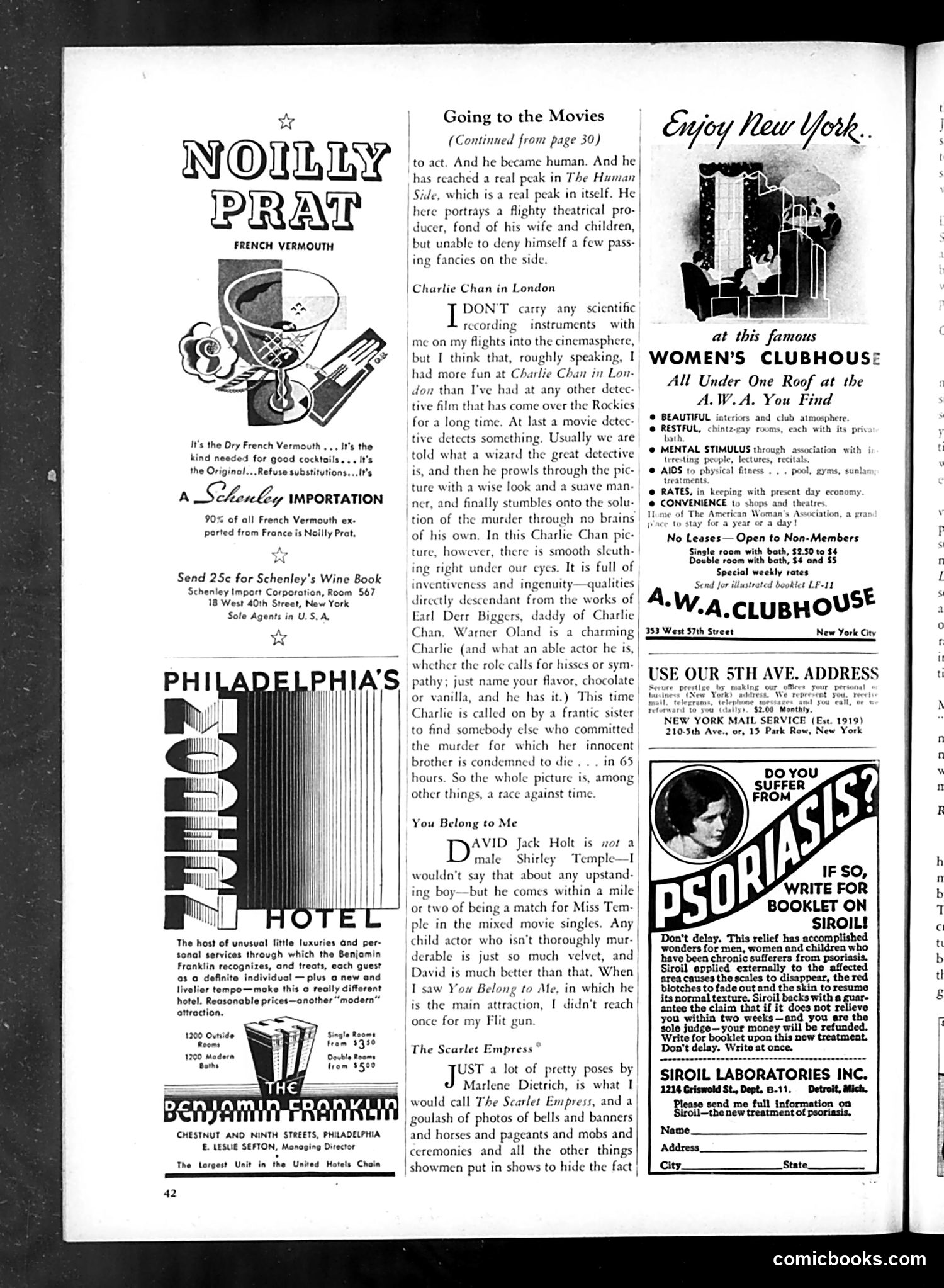
Analysis of Life Magazine Page Content This page is primarily advertisements and film reviews, not political cartoons. The notable content includes: Vermouth Advertisement (top left): Features a stylized cocktail glass promoting Noilly Prat French Vermouth, emphasizing it as the "original" import—likely responding to Prohibition's end (1933) when legal alcohol marketing resumed. Film Reviews (center): Critic discusses current movies including *Charlie Chan in London* (featuring Warner Oland as the famous detective), *You Belong to Me* (with child actor David Holt, compared favorably to Shirley Temple), and *The Scarlet Empress* (Marlene Dietrich, criticized as style over substance). Women's Clubhouse Advertisement (right): Promotes the A.W.A. Clubhouse on 57th Street—a boarding facility offering affordable rooms and social amenities for women. Psoriasis Treatment Ad (lower right): Siroil Laboratories advertises a mail-order cure for psoriasis. The page reflects 1930s consumer culture and entertainment, with no apparent political satire or commentary.
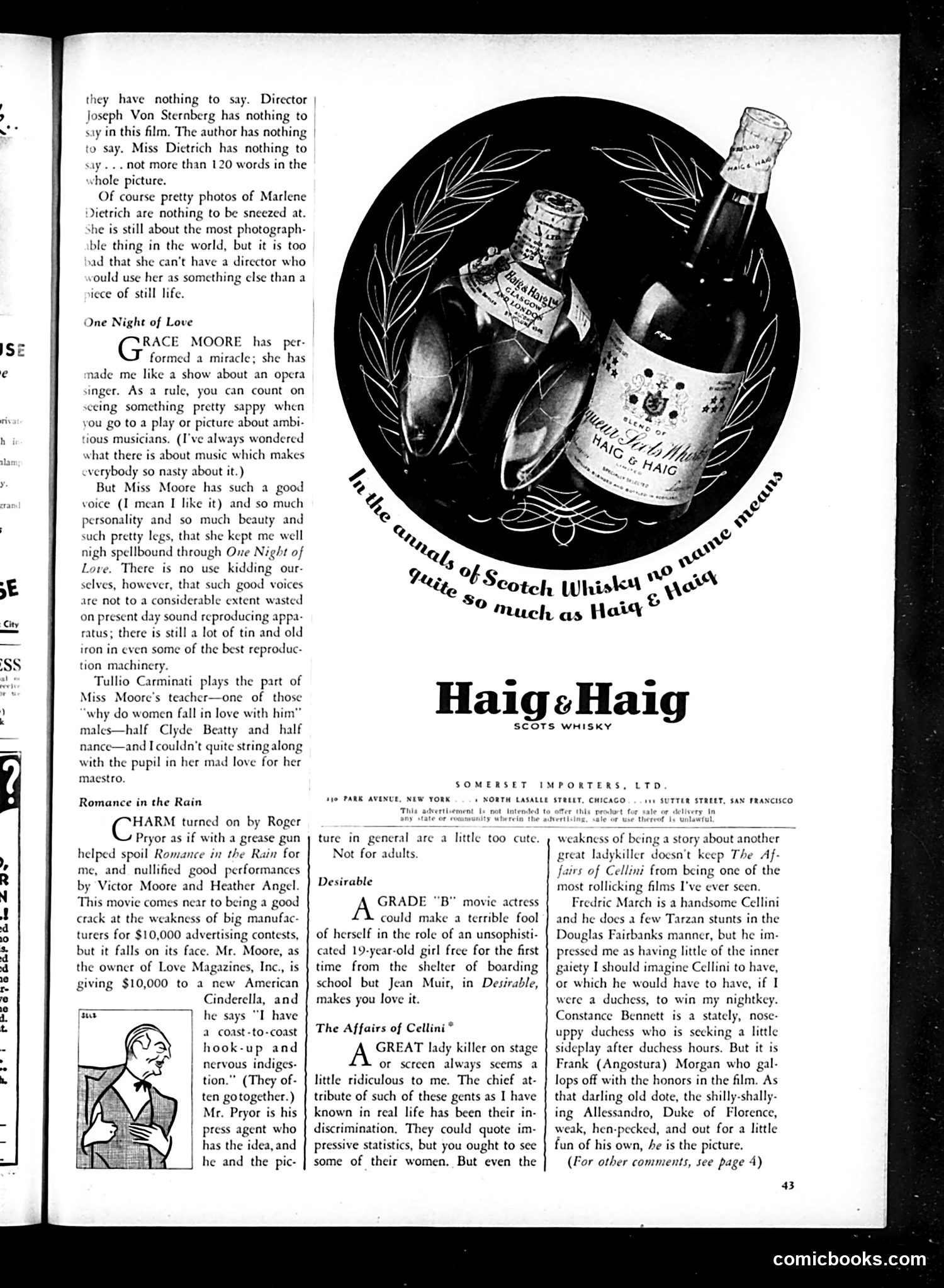
Life Magazine Page Analysis This page contains film reviews alongside a Haig & Haig Scotch whisky advertisement. The main satirical content critiques several 1930s Hollywood films. The review of an unnamed Marlene Dietrich film mocks the director (Joseph Von Sternberg) and the production for reducing Dietrich to purely visual spectacle—she speaks only 120 words total. The critic argues she's treated as "a piece of still life" rather than given meaningful material to perform. Other reviews critique Grace Moore's operatic film, Roger Pryor's comedy, and period pieces. The humor relies on contemporary Hollywood knowledge—references to specific actors, directors, and the era's tendency toward shallow vehicle films designed around stars' appearances rather than substance. The Haig & Haig advertisement uses classical imagery (laurel wreaths, wine bottles) to market Scotch whisky as refined and prestigious—typical luxury advertising of the period. The page reflects 1930s concerns about Hollywood's superficiality and the film industry's treatment of major stars.
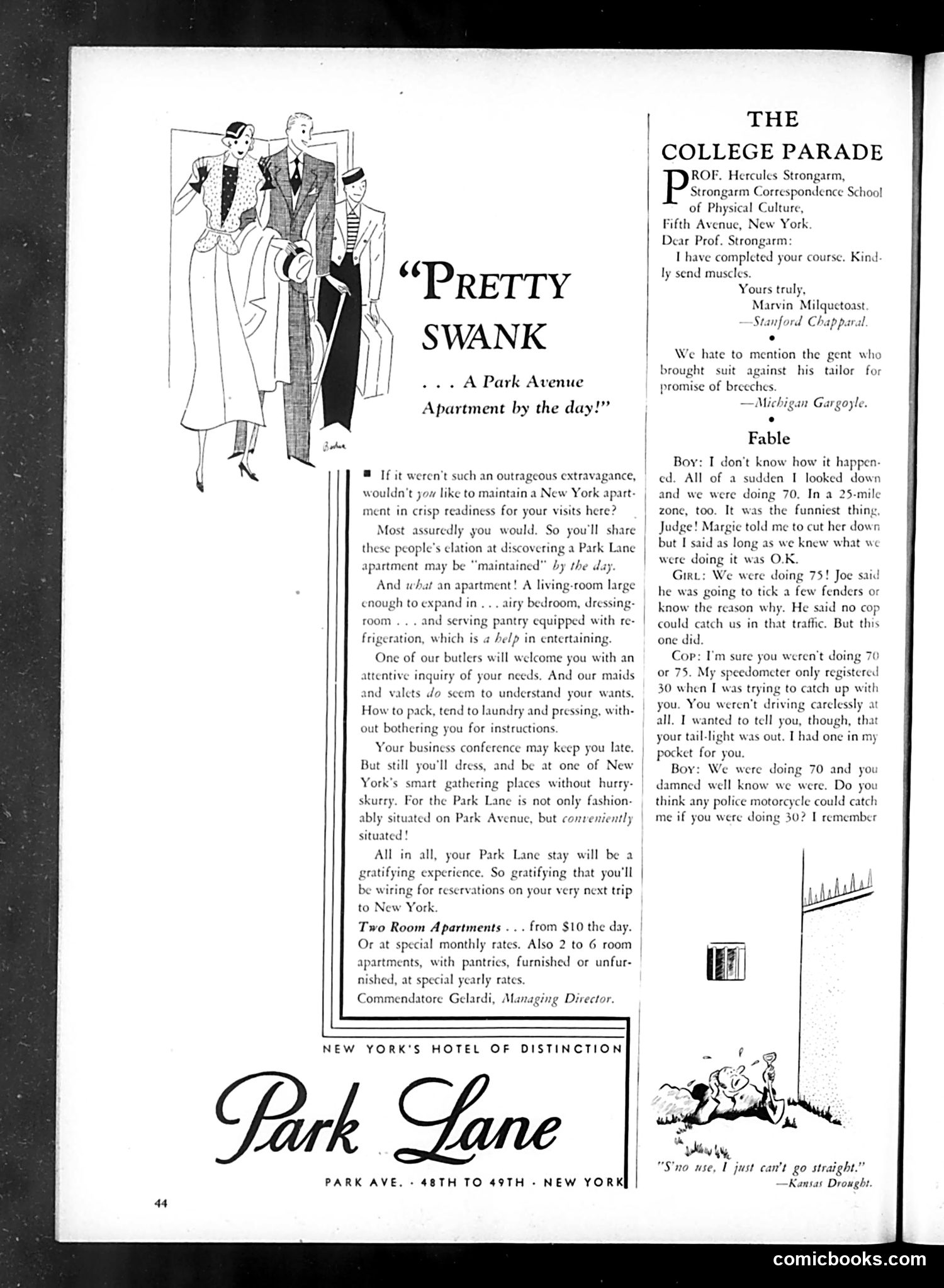
Analysis of "The College Parade" Page This page contains two distinct pieces of satire: "Pretty Swank" Advertisement: A Park Lane Hotel ad uses humorous copy suggesting wealthy New Yorkers maintain apartments "by the day"—poking fun at the extravagant lifestyle of the affluent who need ready-made homes for brief visits. "The College Parade" Section: Three satirical pieces mock youthful behavior: 1. A fake letter from "Marvin Milquetoast" (a name suggesting meekness) to "Prof. Hercules Strongarm" requesting muscles after completing a correspondence course—lampooning mail-order fitness schemes and scrawny college boys. 2. A brief jab at someone suing his tailor over promised breeches—likely referencing actual gossip or scandal. 3. "Fable": A speeding story where a boy and girl insist they were doing 70-75 mph in a 25-mph zone, while the cop claims his speedometer only registered 30—a joke about how reckless youth exaggerate their daring while adults downplay dangerous behavior, or mutual dishonesty in confrontations. The humor targets privileged excess, false advertising, and youthful recklessness.
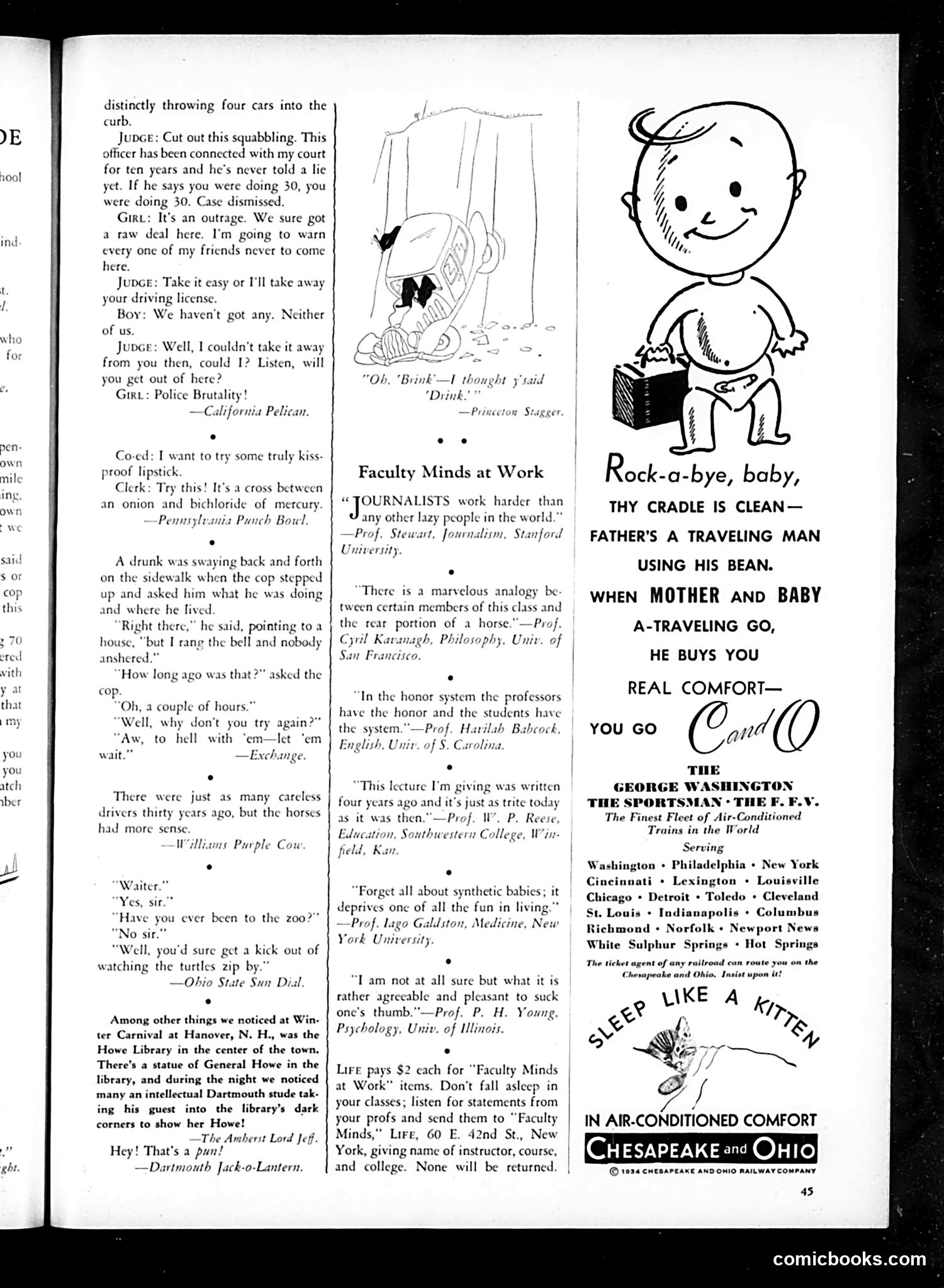
Page 45 of Life Magazine: Satire and Advertising This page mixes student humor with railroad advertising. The left side collects campus jokes from college publications (California Pelican, Pennsylvania Punch Bowl, etc.), mostly mocking authority figures and logic. A judge trusts a corrupt cop; a drunk can't remember where he lives; students make terrible puns about General Howe's statue at Dartmouth. The center section, "Faculty Minds at Work," reprints actual quotes from professors—presented as accidentally funny. A journalism professor calls journalists "lazy"; a philosophy professor compares students to a horse's rear end. Life paid $2 per submitted quote, crowdsourcing material from college readers. The right side is a full advertisement for the Chesapeake and Ohio Railroad, using a smiling baby to pitch air-conditioned trains. The tagline suggests traveling fathers choose this railroad for family comfort. The juxtaposition is typical of Life's format: satirical college humor alongside commercial advertising, both targeting educated, affluent readers.
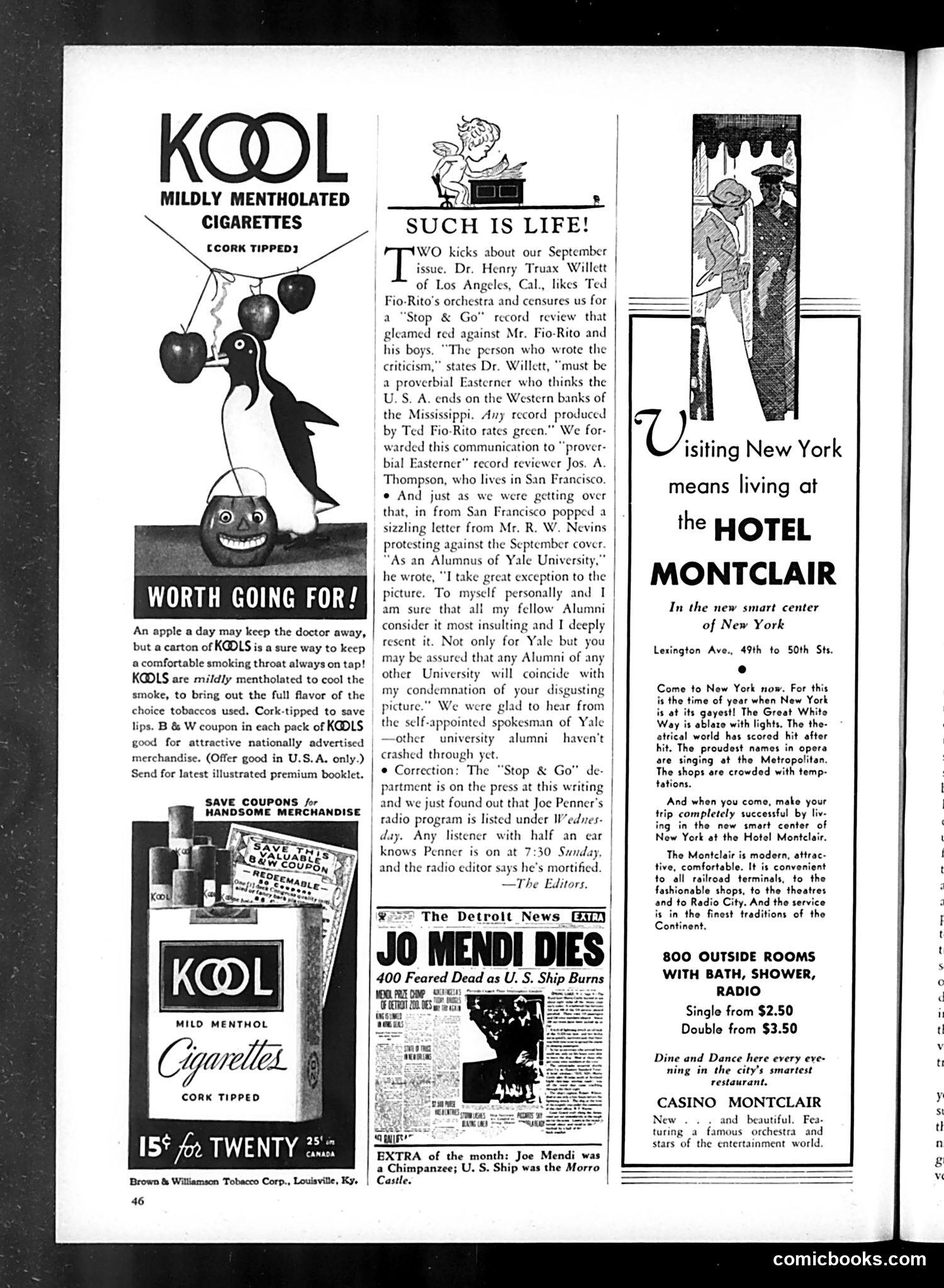
Page Analysis: Life Magazine (Vintage Era) This page is primarily advertising, with a small editorial section. The main content includes: Kool Cigarettes ads (left): Cartoon imagery of anthropomorphic fruits and a grinning face promoting menthol cigarettes as throat-cooling. The copy uses health-adjacent language ("keep a comfortable smoking throat"), reflecting pre-regulation cigarette marketing that made dubious wellness claims. "Such is Life" editorial (center): Reader complaints and Life's responses about previous issues—a Yale alumnus objecting to a magazine cover he found insulting to the university, and a correction about Joe Penner's radio program time slot. This reflects the era's active reader engagement with magazines. Hotel Montclair ad (right): Advertisement for a New York hotel with pricing ($2.50-$3.50) and amenities like radio and a casino. Detroit News masthead: Shows a major news story about a ship fire. The page captures 1930s-era advertising practices, editorial conventions, and consumer culture before modern regulations on tobacco marketing.
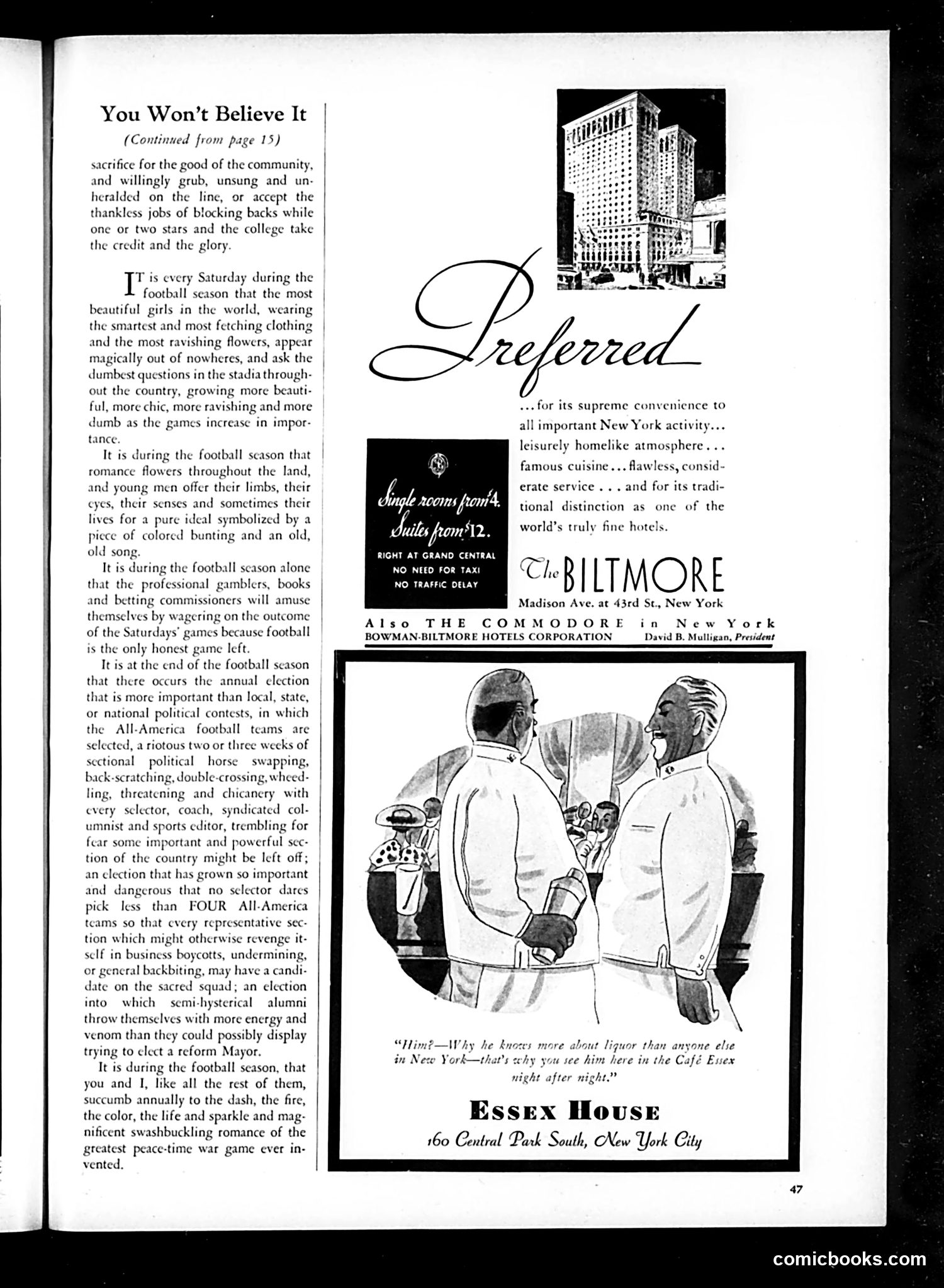
Analysis for Modern Readers This page mixes satire with hotel advertising. The main text, "You Won't Believe It," is a lengthy satirical essay about American college football culture. It mocks the sport's grip on the nation—particularly how beautiful women mysteriously appear at games asking "dumb questions," how young men sacrifice themselves for "colored bunting," and how professional gambling thrives despite football's claimed integrity. Most sharply, the essay satirizes the annual All-America team selection as a political process more vicious than actual elections, where regions engage in "horse swapping," "double-crossing," and "backbiting" to get their players selected. The point: Americans treat college football with absurd seriousness, rivaling genuine democracy. The cartoon below shows two men in what appears to be a hotel setting; the caption jokes that one man knows more about liquor than anyone in New York—hence why he's always at the Essex House's café. This plays on the Prohibition era's contradiction: despite the alcohol ban, such establishments were known gathering places.
Analysis of Life Magazine Page This page is primarily book and radio reviews, not political cartoons. The content consists of: BOOKS section by Kyle Crichton reviewing 1934 publications, including works on espionage, African slave revolts, China's Communist revolution, and rural American life. RADIO COMICS section listing radio programs with brief critiques. RECORDS section reviewing music recordings. The only visual element appears to be decorative—possibly an illustration margin element on the right side, though details are unclear. For modern readers: This demonstrates Life's mid-1930s role as a comprehensive cultural arbiter, reviewing not just entertainment but serious literature on contemporary issues (colonialism, communism, social upheaval). The tone is witty but substantive. Notably, Agnes Smedley's book on China's Red Army receives praise despite—or because of—its sympathetic coverage of Communist forces, reflecting pre-WWII American intellectual attitudes before such views became politically controversial.