life
Life — December 1934
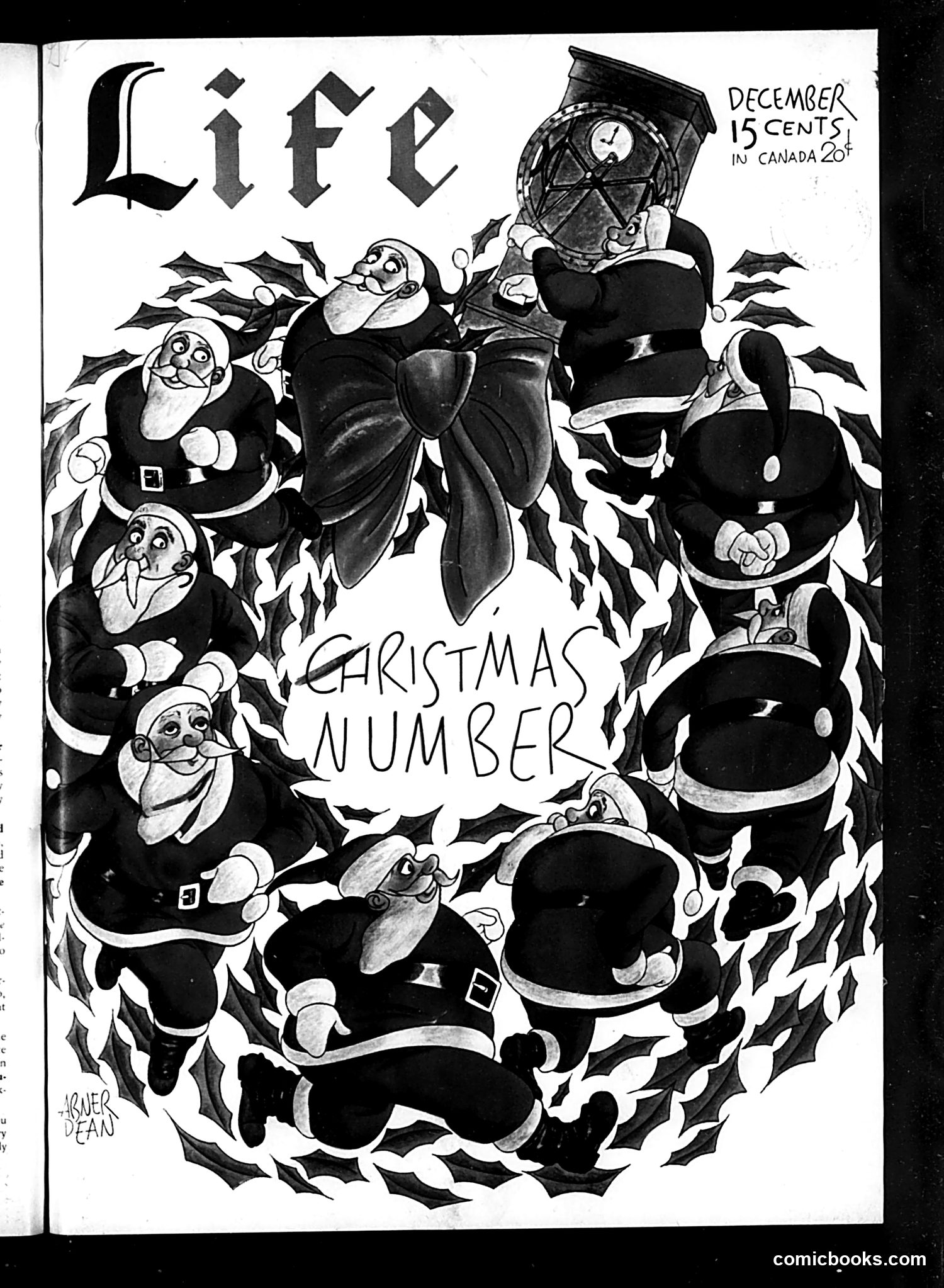
"Life" Magazine Christmas Number Cover Analysis This is the December cover of *Life* magazine (15 cents; 20 cents in Canada), featuring a satirical Christmas illustration by Barber Dean. The central image depicts multiple rotund Santa Claus figures arranged in a wreath of holly, surrounding a large bomb with a clock face—a striking juxtaposition of holiday cheer with militaristic imagery. The title "Christmas Number" appears innocuously, but the bomb's presence suggests dark satire about war and military concerns during what appears to be the early-to-mid 20th century. The contrast between jolly Santas and weaponry likely critiques either militarization during holiday season or wartime anxiety undermining Christmas celebration. The exact historical moment remains unclear without publication date confirmation.
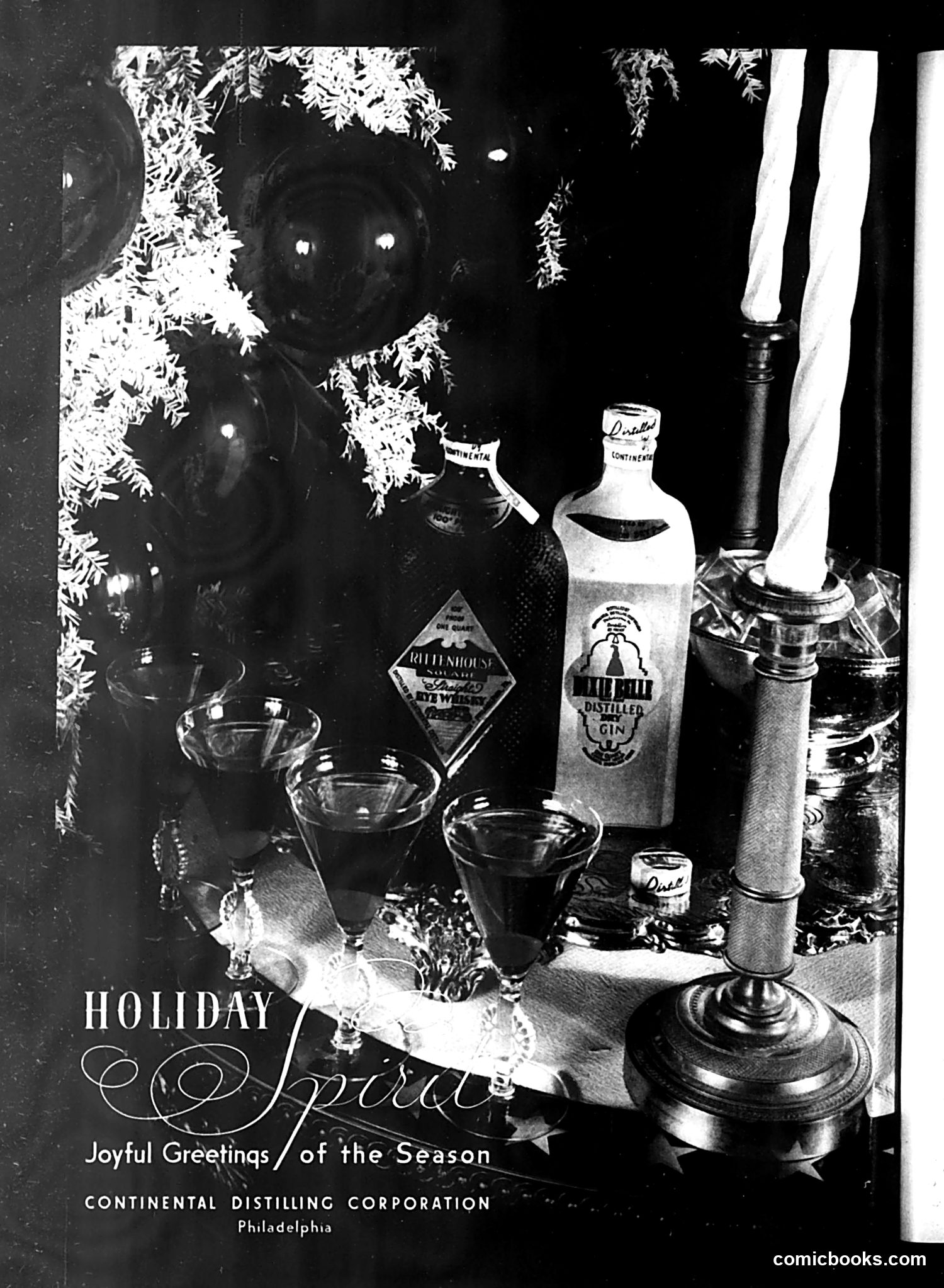
Analysis This appears to be a holiday advertisement rather than political satire. The page shows a festive display from Continental Distilling Corporation (Philadelphia) featuring: - Decorative evergreen garland framing the composition - Three cocktail glasses with dark liquid - A bottle labeled "Distilled Gin" - Candles in candlesticks - Text reading "Holiday Spirit" and "Joyful Greetings of the Season" The imagery suggests this is a liquor advertisement using seasonal holiday aesthetics to promote gin consumption. The "holiday spirit" pun plays on both the festive season and the alcoholic product being advertised. This reflects pre-Prohibition or post-Prohibition era advertising practices when such promotions were common in magazines.
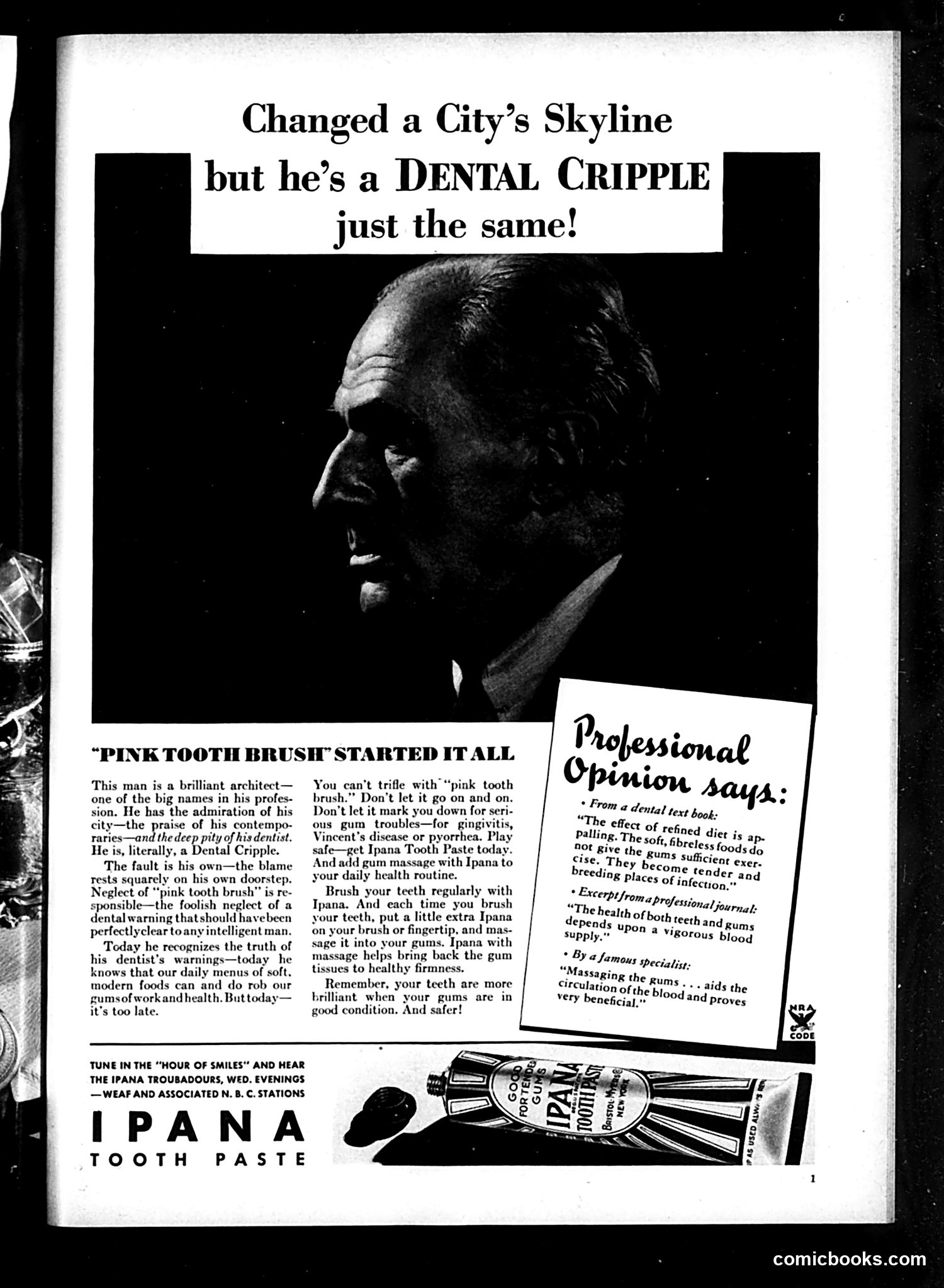
Analysis This is an advertisement for Ipana Tooth Paste, not political satire. The ad uses a visual joke about a famous architect with a "dental cripple"—someone whose poor dental health undermines his professional accomplishments. The headline suggests that despite his architectural achievements (changing a city's skyline), his teeth betray him as unhealthy. The ad features a profile photograph of what appears to be a well-known architect of the era, though the specific identity isn't stated. The satire is commercial rather than political: it argues that even brilliant professionals can't escape the social embarrassment of poor oral hygiene, making Ipana tooth paste essential for maintaining professional credibility. The "Professional Opinion" box includes testimonials about gum disease and dental care.
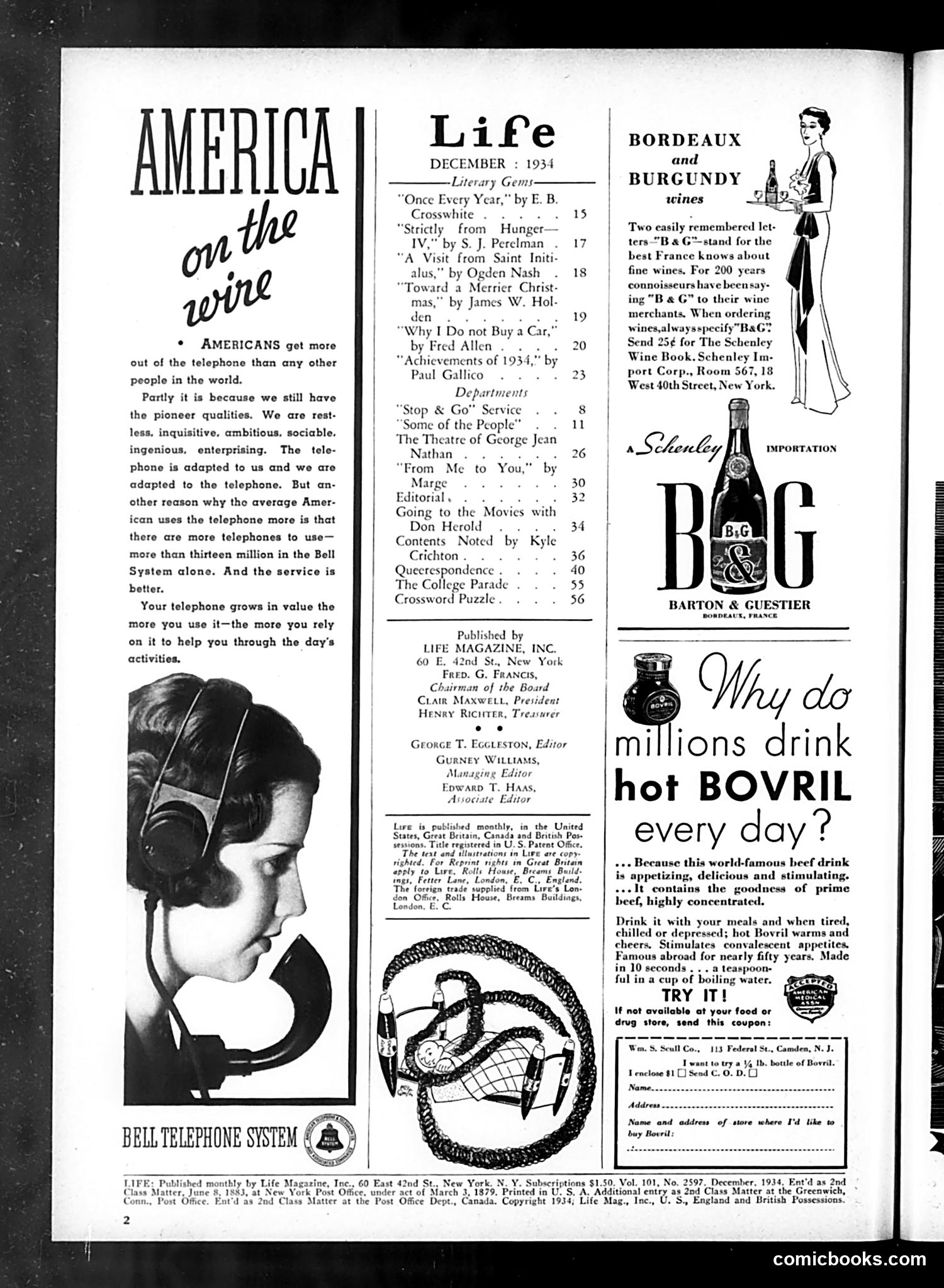
Page Analysis: Life Magazine, December 1934 This page contains primarily advertisements and magazine contents, not political cartoons. The main content includes: "America on the Wine" (left): A Bell Telephone System ad featuring a woman with headphones, arguing Americans use telephones more than other nationalities because they are "restless, inquisitive, ambitious, sociable, ingenious, enterprising." The "joke" is self-congratulatory—using telephone frequency as a marker of American character. Right side: Wine and food advertisements (Bordeaux/Burgundy, B&G wine, Bovril beef drink), typical of 1934 luxury marketing. The page is primarily a table of contents and ads, not satirical commentary. There are no identifiable political figures or social satire visible—just period consumer marketing and magazine layout.
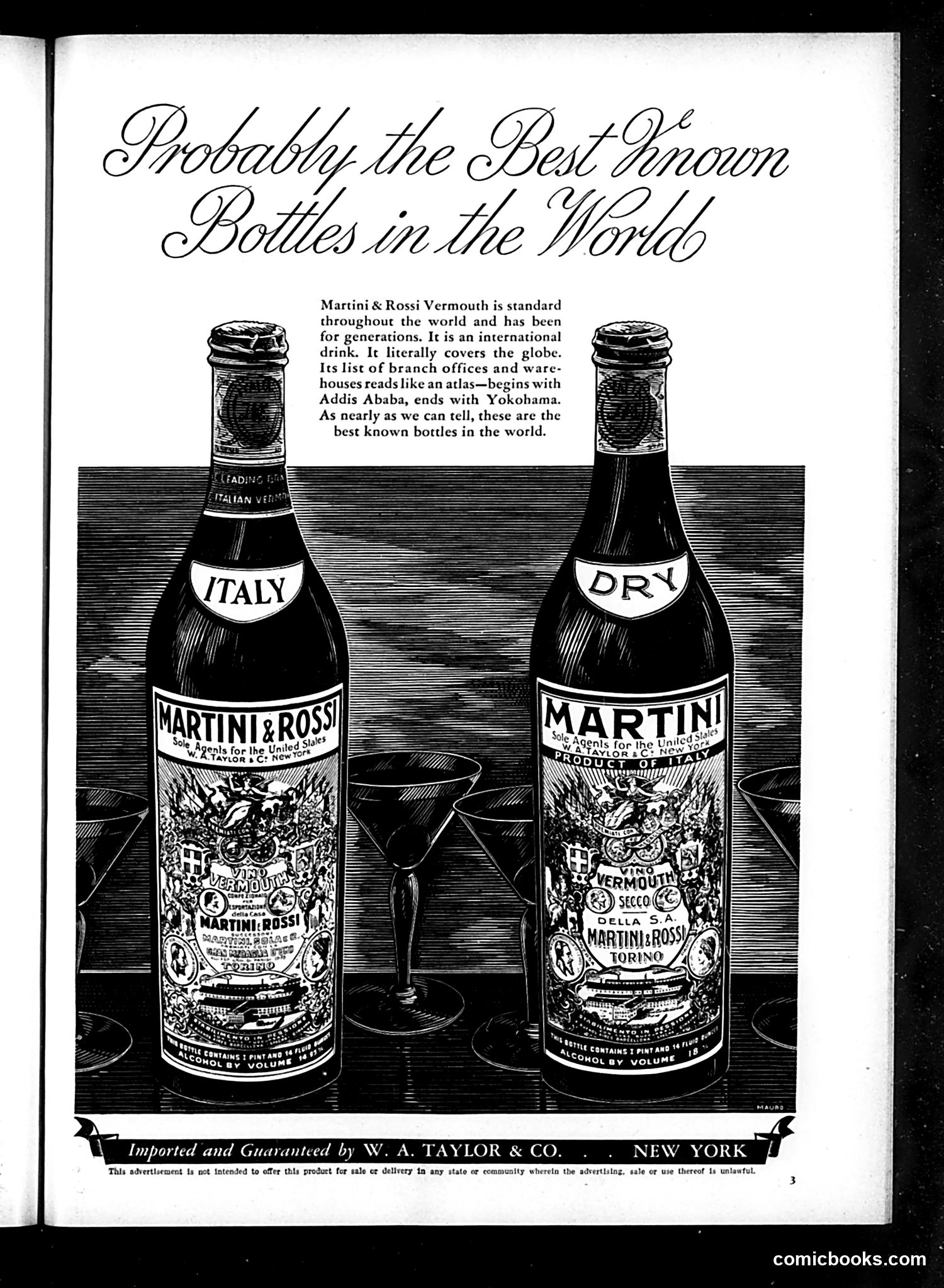
Analysis This is a full-page advertisement, not satire or a political cartoon. It promotes Martini & Rossi Vermouth, an Italian aperitif imported to the United States by W.A. Taylor & Co. of New York. The ad features two bottles side-by-side—one labeled "Italy" and one labeled "Dry"—positioned as if they are prestigious, globally-distributed products. The advertising copy claims Martini & Rossi is "standard throughout the world" with offices spanning from Addis Ababa to Yokohama, positioning it as the "best known bottles in the world." There is no political commentary or satire here—it's purely commercial messaging using international prestige and availability as selling points to American consumers.
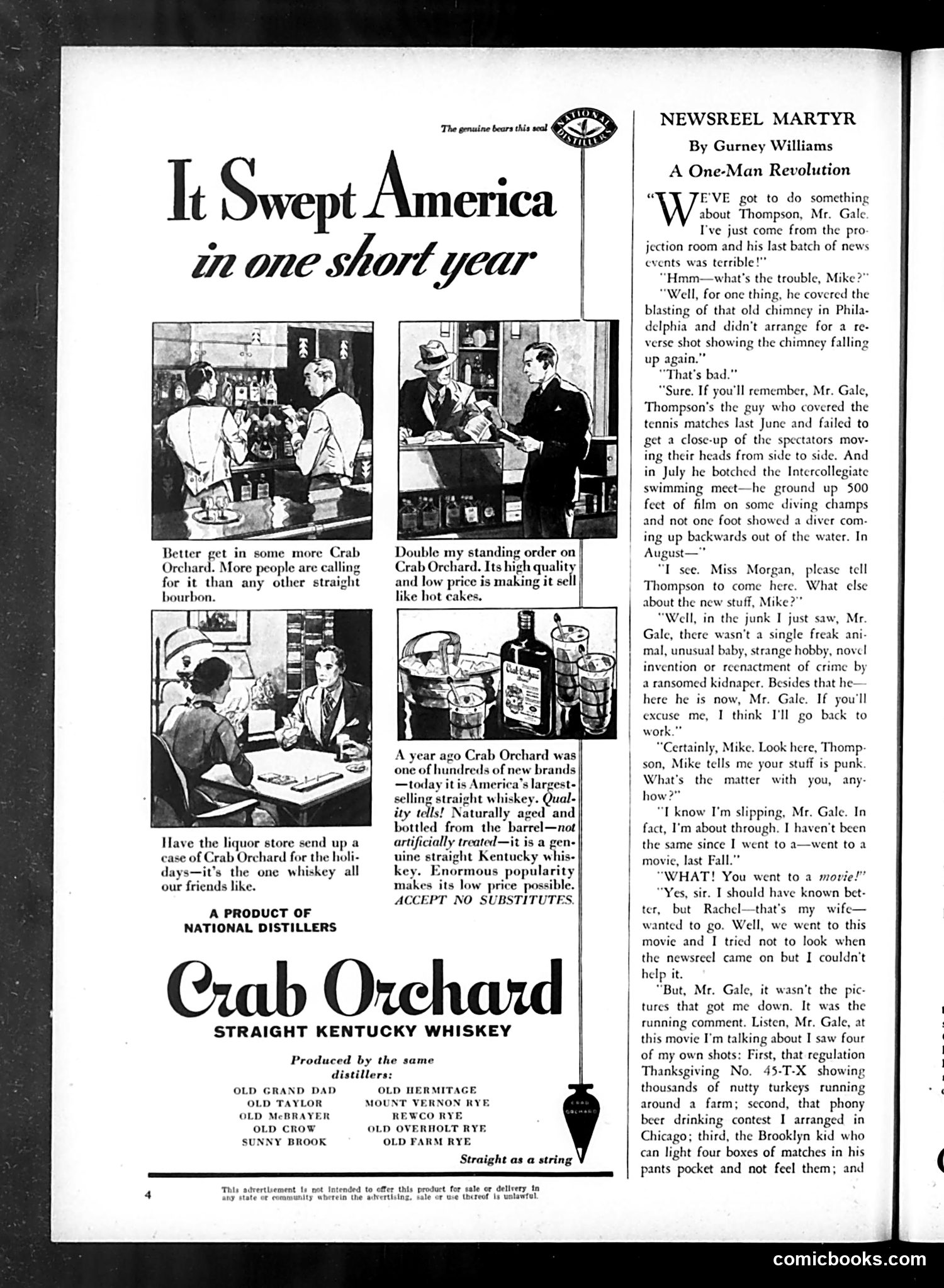
This page contains a Crab Orchard whiskey advertisement (left) and a satirical column titled "Newsreel Martyr" by Gurney Williams (right). The advertisement humorously depicts Crab Orchard's rapid market success, showing it "swept America in one short year." Images show bartenders, liquor store owners, and consumers enthusiastically promoting the whiskey. The right-side column satirizes newsreel cameraman "Thompson," whose incompetence at covering events has become legendary. Mr. Gale catalogs Thompson's failures: he missed key moments at tennis matches, an intercollegiate swimming meet, and various other assignments. The satire culminates when Thompson attends a movie—the very medium meant to capture news—and ironically appears in the newsreel footage himself, becoming the subject rather than the documentarian. The piece mocks both journalism and personal embarrassment through this ironic role reversal.
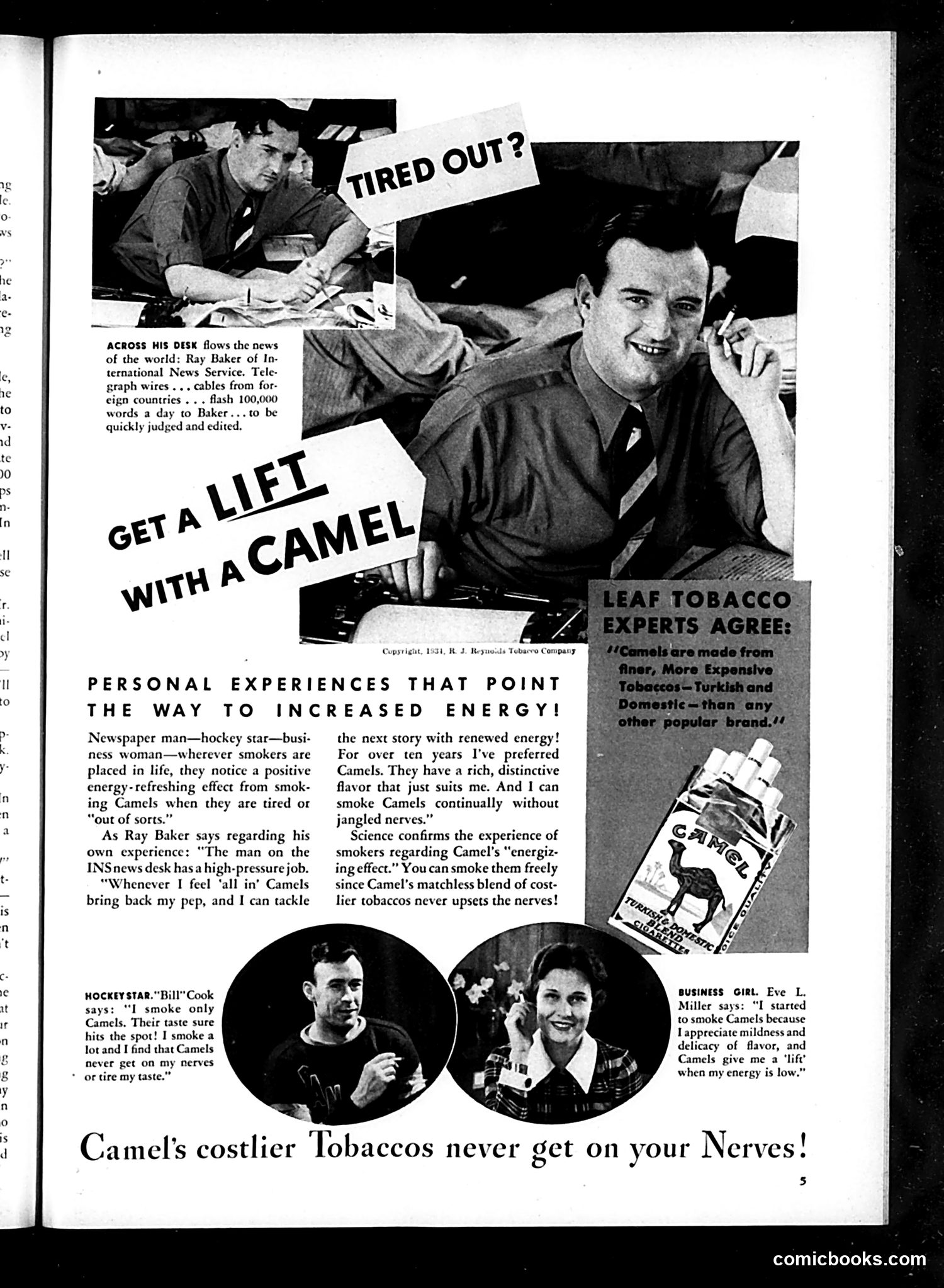
Analysis This is a Camel cigarette advertisement, not satire or political commentary. The page uses testimonials from recognizable public figures to endorse smoking Camels as an energy boost for tired workers. The advertisement features: - Ray Baker of the International News Service, describing how Camels help him tackle high-pressure work - "Bill" Cook, identified as a hockey star, claiming Camels don't affect his nerves - Eve L. Miller, a business girl, praising Camels' flavor and energizing effect The ad's central claim—"Get a Lief with a Camel"—promises that Camel's "costlier Tobaccos never get on your Nerves," implying smoking provides stamina without negative effects. This reflects mid-20th-century advertising practices before smoking's health dangers were widely acknowledged or regulated.
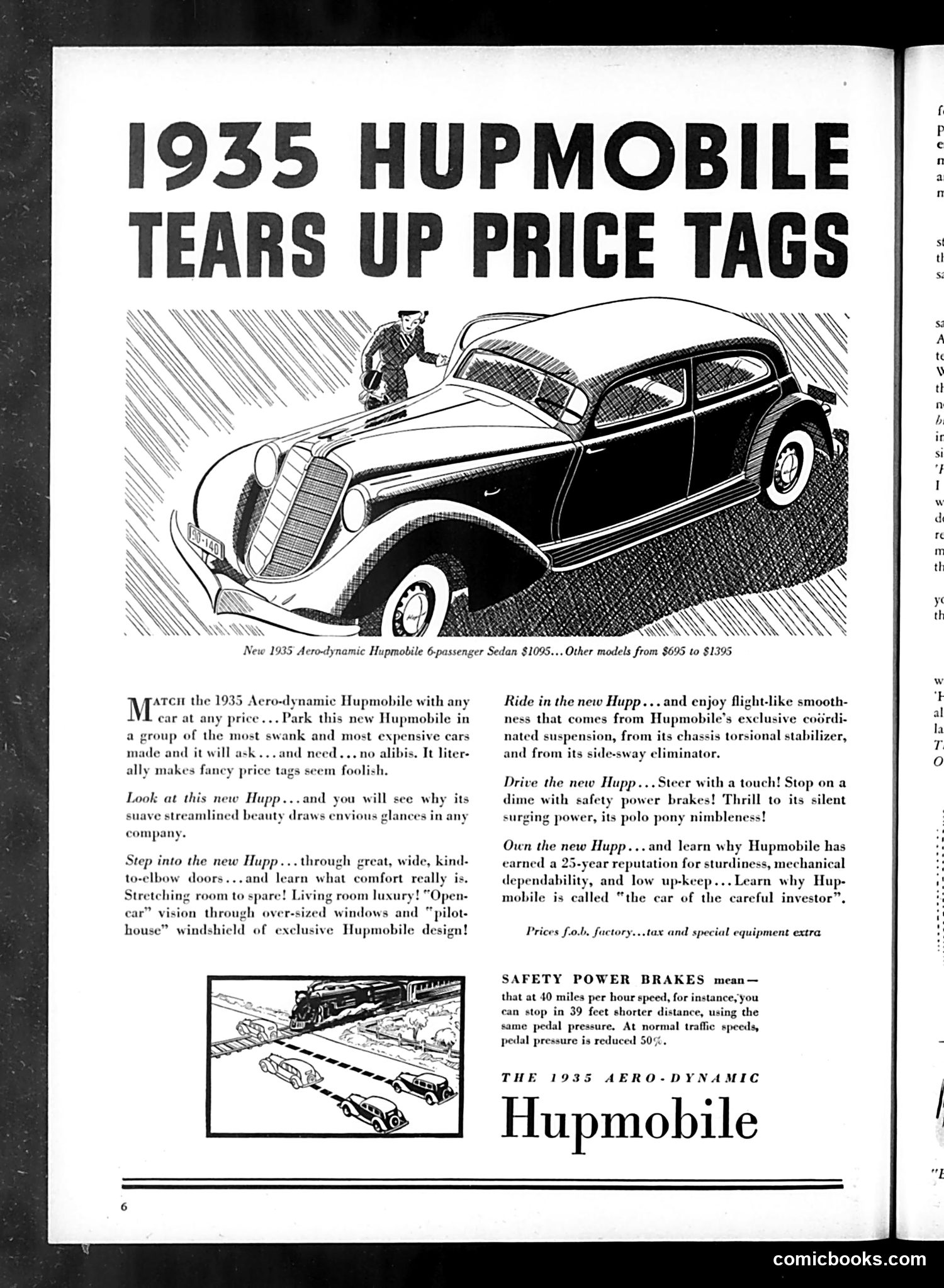
Analysis This is primarily an advertisement, not satire or political commentary. The page promotes the 1935 Hupmobile automobile, a mid-range car competing with more expensive vehicles. The headline "TEARS UP PRICE TAGS" is a pun: the car's affordability means customers can literally discard high sticker prices from competitor vehicles. The illustration shows a man tearing up a price tag while examining the Hupmobile. The ad emphasizes value propositions: streamlined design, comfort features (wide doors, spacious interior), safety innovations (power brakes), and Hupmobile's reputation as "the car of the careful investor." The smaller illustration depicts the car's superior braking performance compared to competitors. This reflects 1930s Depression-era marketing: emphasizing affordability and reliability rather than luxury.
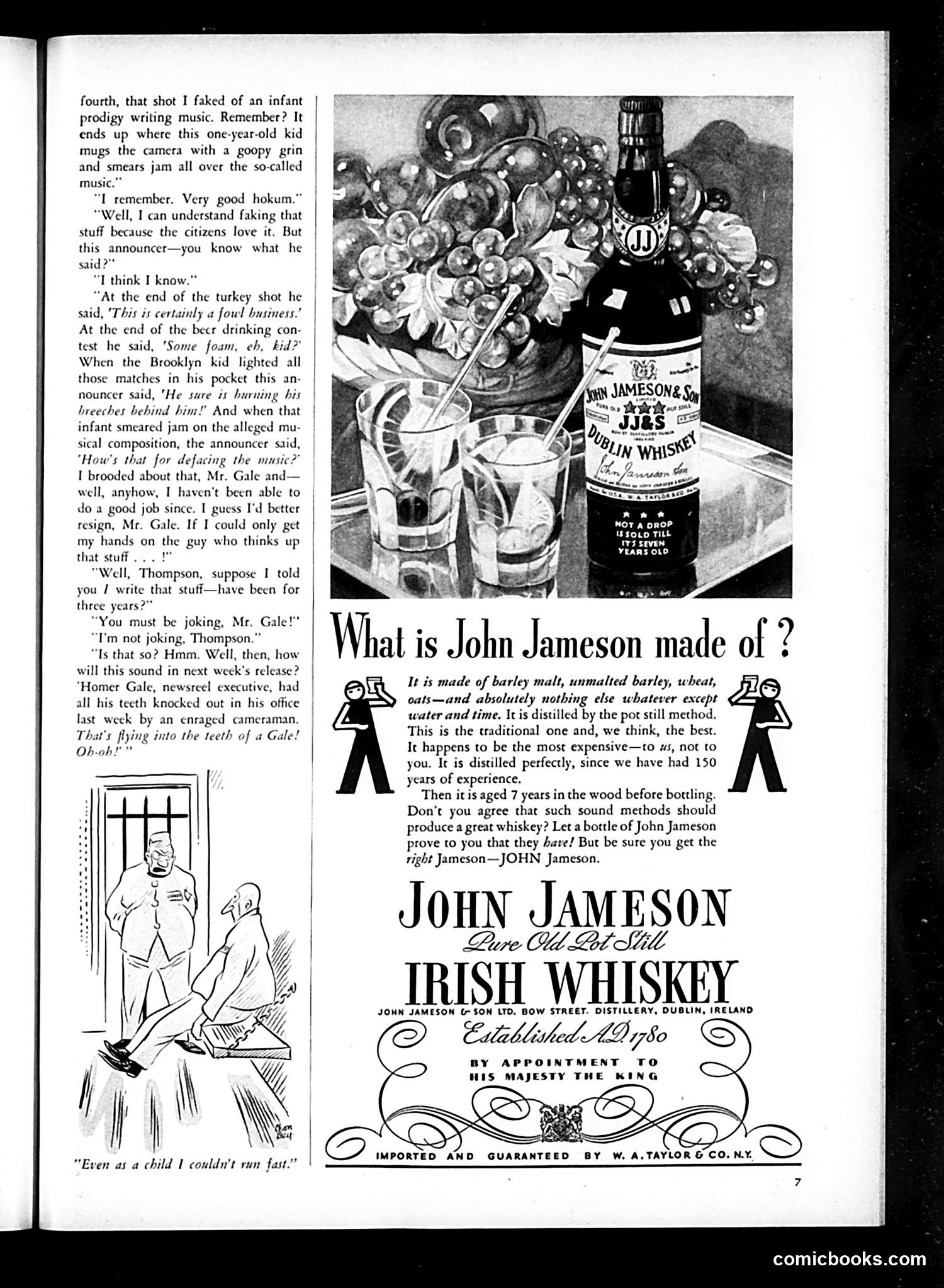
Analysis This page contains primarily a John Jameson Irish Whiskey advertisement rather than political satire. The left column features a conversational narrative about a music critic named Gale who fabricated stories about an "infant prodigy" composer—a satirical jab at pretentious cultural criticism and journalistic dishonesty. The small cartoon illustration shows a figure in what appears to be a jail cell, captioned "Even as a child I couldn't run fast," suggesting consequences for the critic's deceptions. The large advertisement on the right showcases the whiskey bottle and emphasizes its traditional production methods ("aged 7 years in the wood"), targeting affluent readers. This is essentially a full-page commercial rather than political commentary.
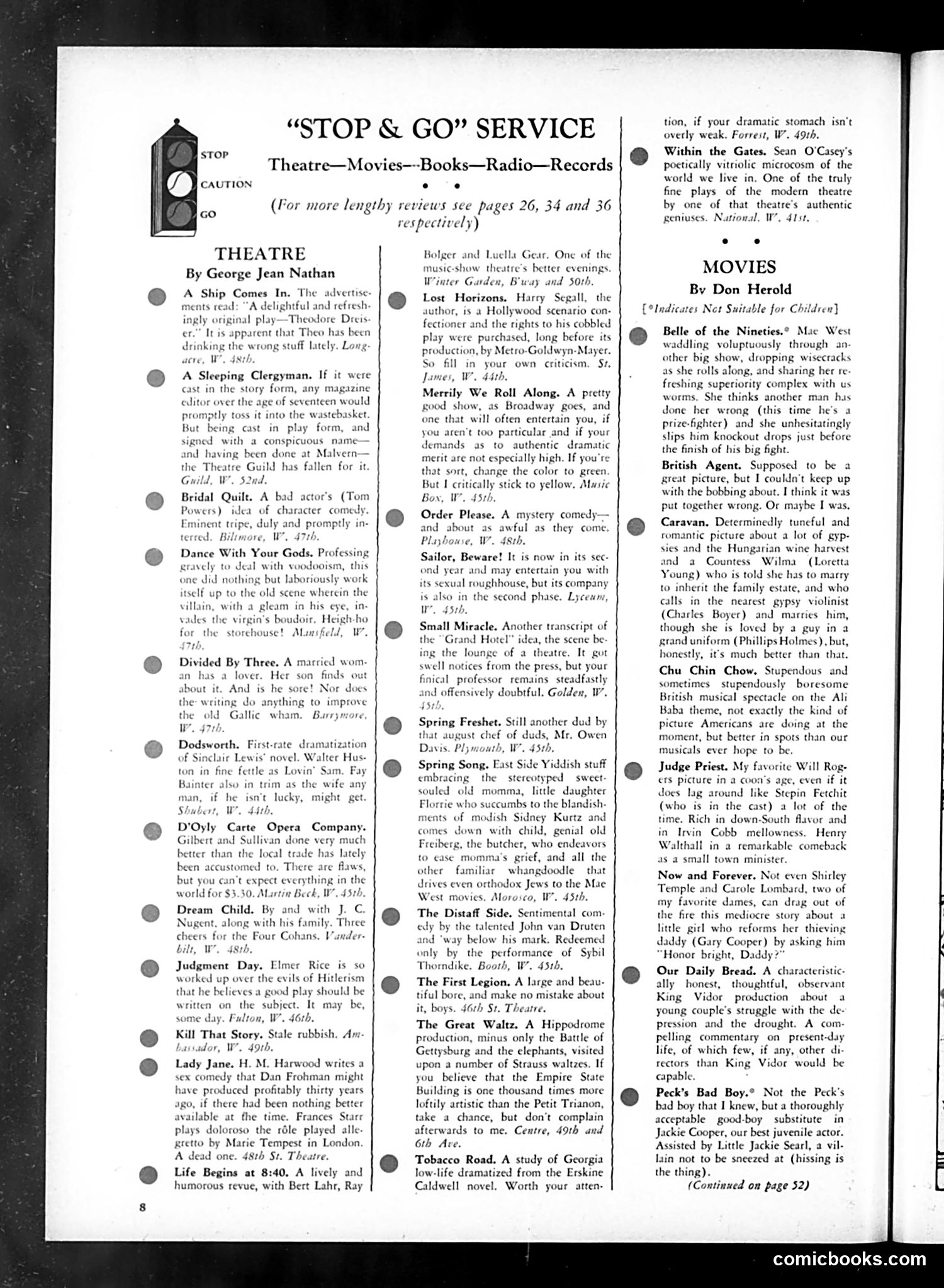
"Stop & Go" Service Page Analysis This is a review/criticism page, not a political cartoon. The traffic light graphic at top left is a visual organizing device, not satire—it labels three review sections (Stop, Caution, Go) for theater, movies, books, radio, and records. The content consists of brief, often sarcastic critical reviews of Broadway shows and films from around 1920s-1930s. Reviewers use the "Stop/Caution/Go" framework to recommend or warn against entertainment. Examples: "A Sleeping Clergyman" gets criticized as "heavy"; "Merrily We Roll Along" is praised as entertaining; "Judge Priest" is recommended as Will Rogers' best picture. This represents early American magazine criticism culture—witty, pointed, and dismissive of mediocre entertainment for general readers.
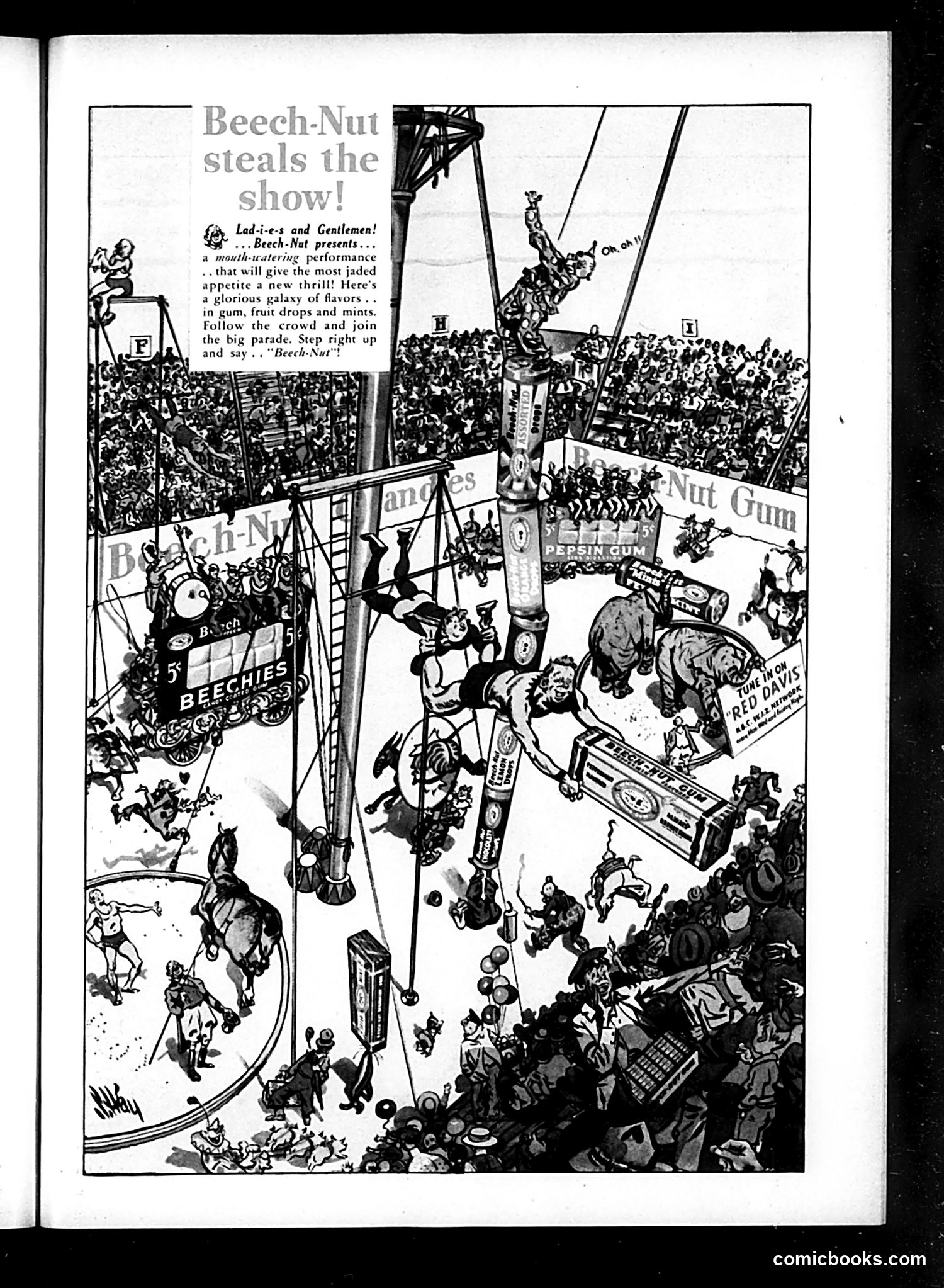
Beech-Nut Steals the Show This is a Beech-Nut gum advertisement depicting an elaborate carnival or circus parade. The headline claims "Beech-Nut steals the show," and the ad copy promises "a mouth-watering performance" featuring "a glorious galaxy of flavors...in gum, fruit drops and mints." The illustration shows a crowded fairground scene with acrobats, swings, rides, and spectators. Various Beech-Nut product boxes are prominently displayed among the carnival attractions. The style is vintage slapstick humor—exaggerated action and busy composition typical of early-to-mid 20th century advertising. The "joke" is straightforward marketing: that Beech-Nut products are so exciting and entertaining they rival an actual carnival attraction for public attention and excitement.
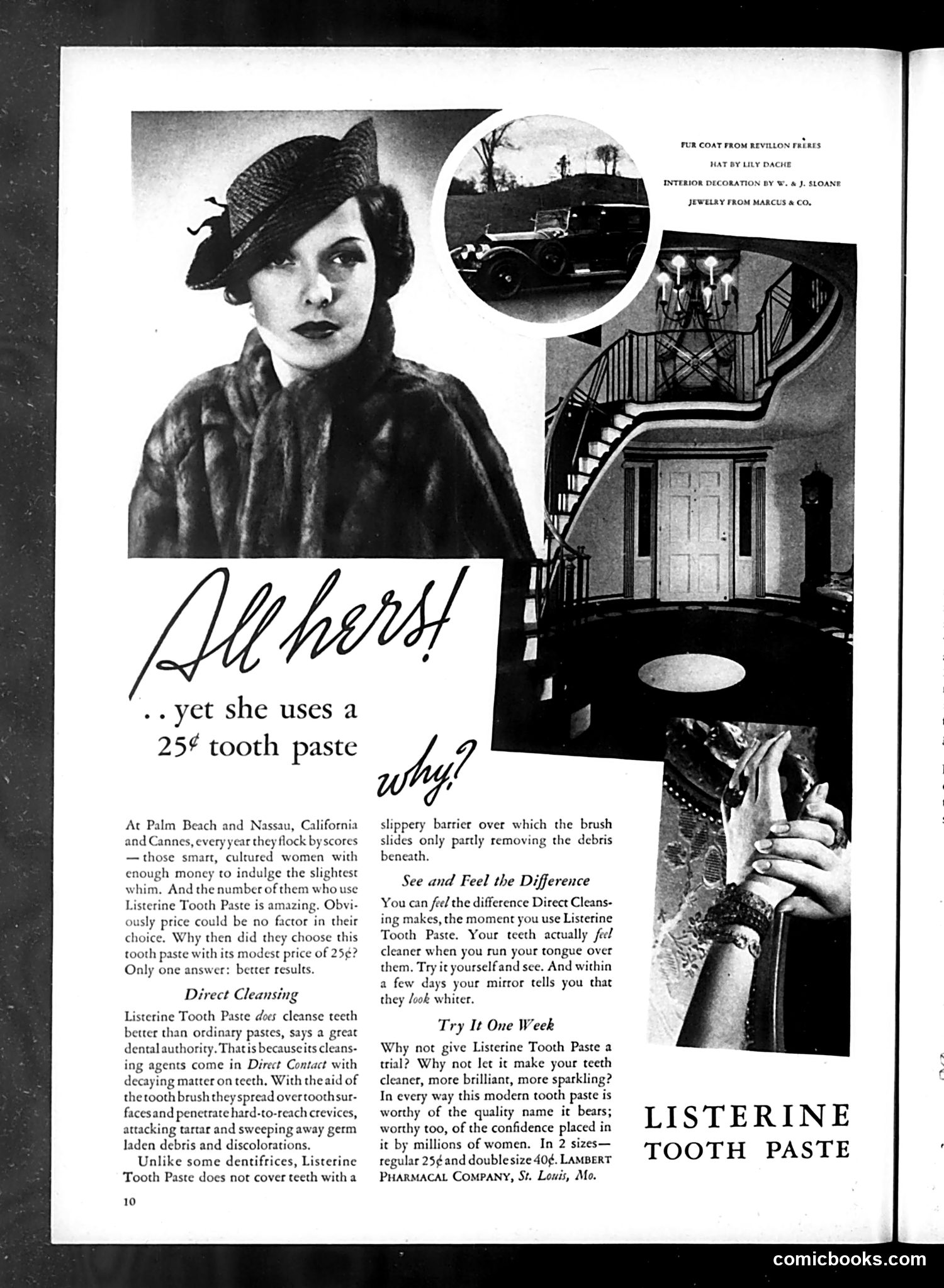
Listerine Tooth Paste Advertisement This is a vintage advertisement, not political satire. The page promotes Listerine Tooth Paste to wealthy women by depicting an elegantly dressed woman wearing an expensive fur coat and fashionable hat, positioned alongside images of luxury items: an automobile, an ornate interior staircase, and jewelry. The headline's implicit message: even wealthy, cultured women use this inexpensive 25¢ toothpaste. The ad emphasizes "direct cleansing" action and claims users will "feel the difference" within a week, with visibly whiter teeth. The copy targets affluent readers by flattering their status while suggesting that good oral care doesn't require expensive products—a sales pitch designed to appeal to both economy-minded consumers and status-conscious buyers in the interwar period.
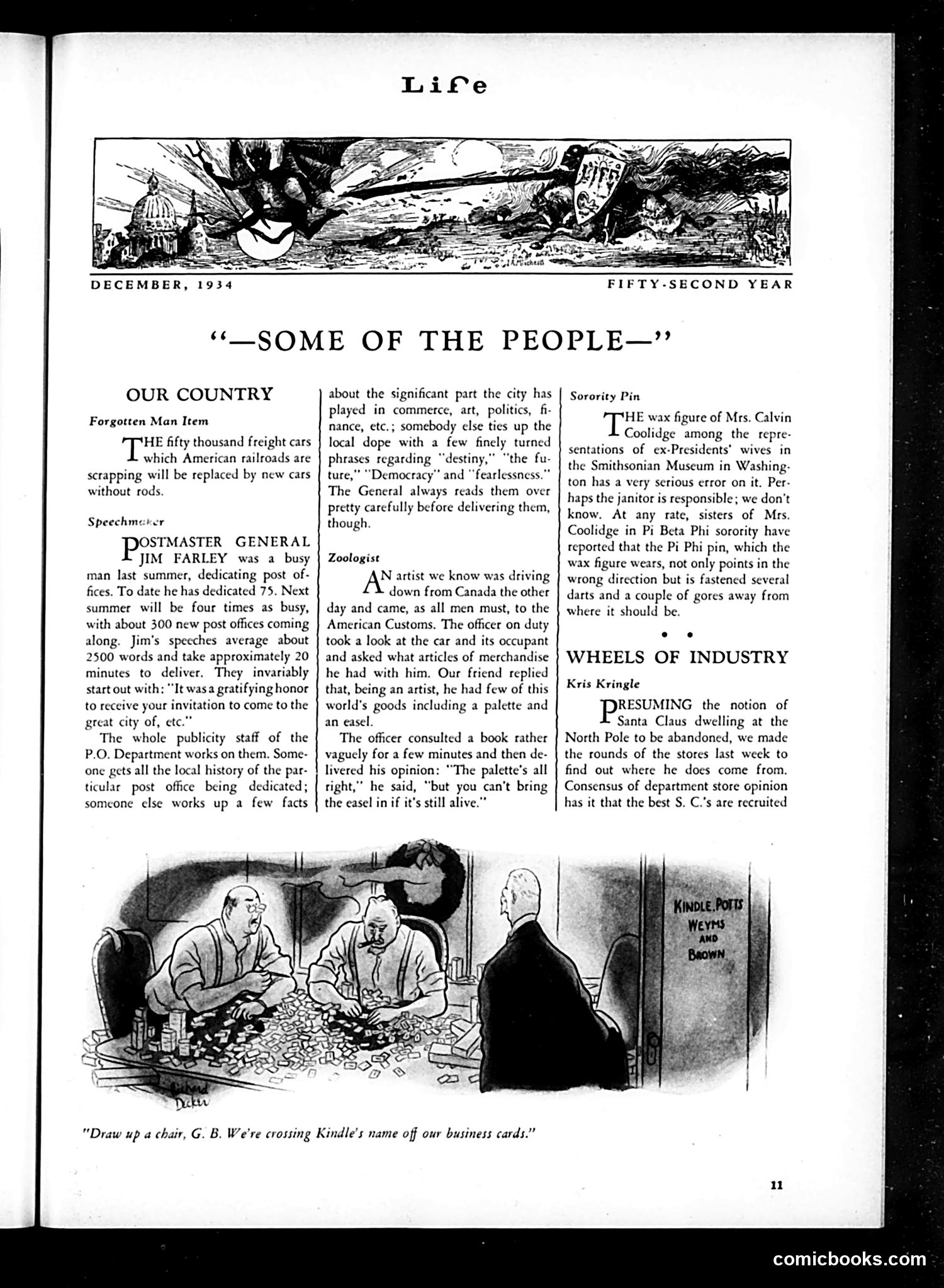
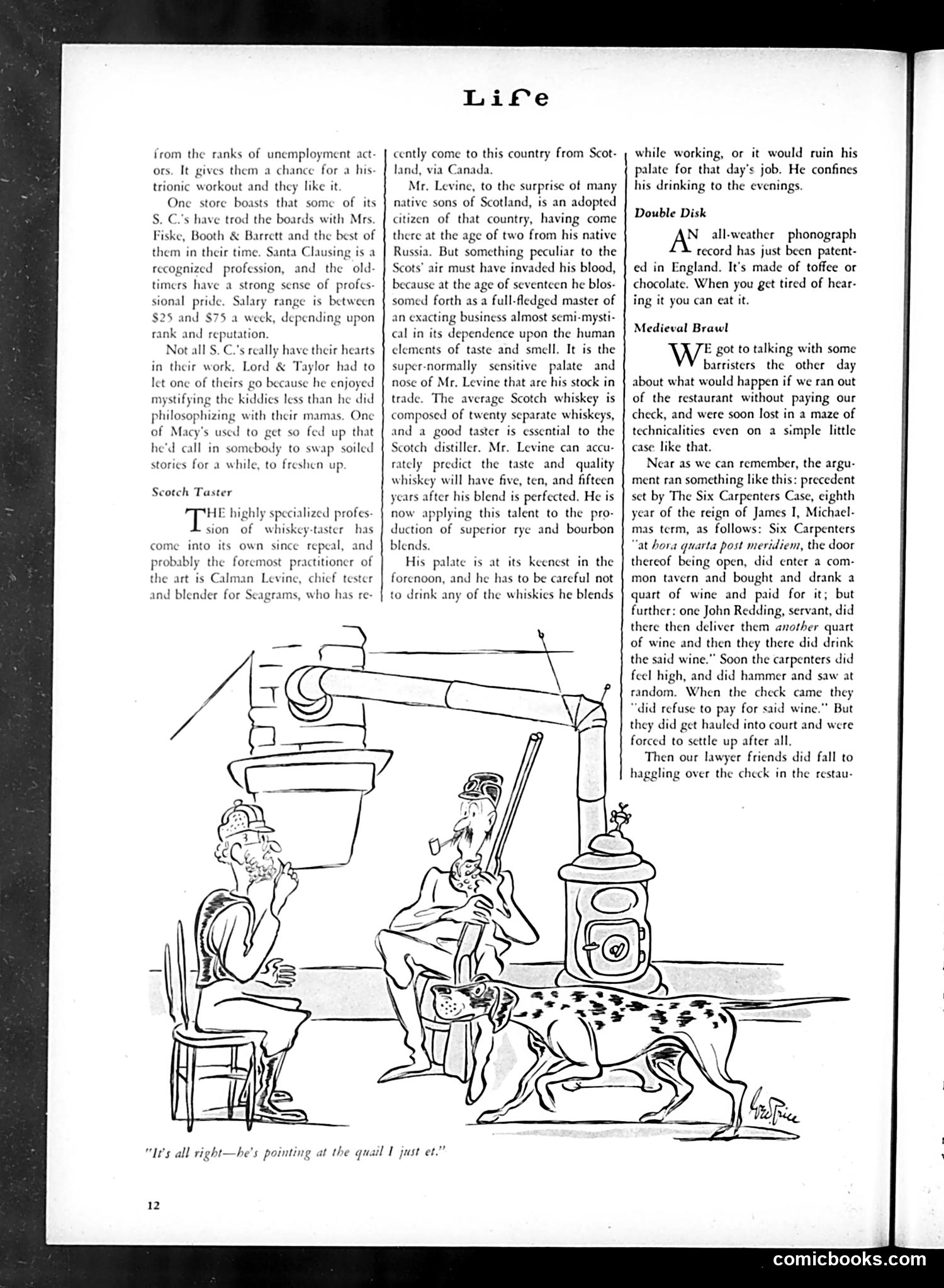
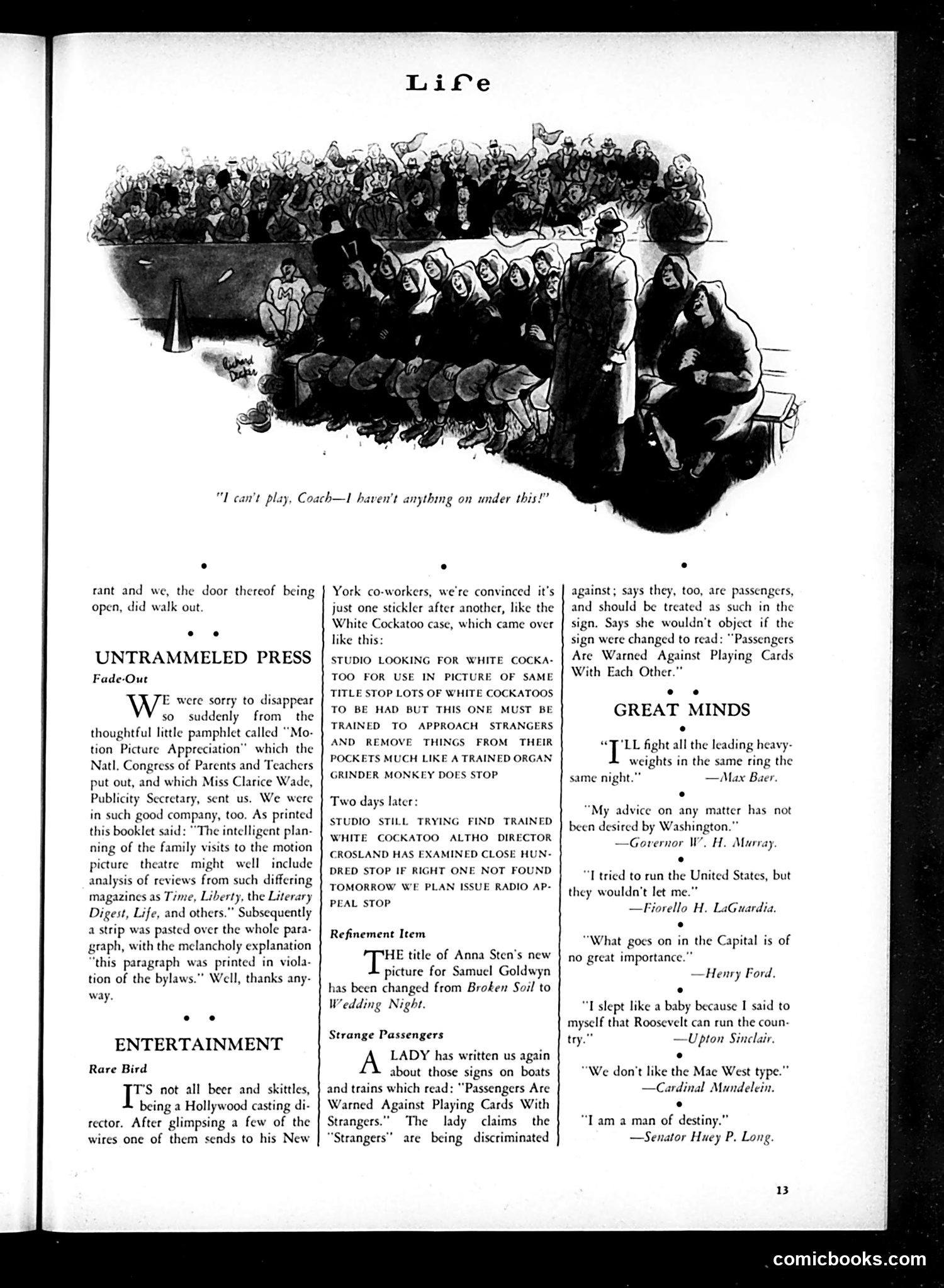
Analysis of Life Magazine Page The main cartoon depicts a crowded boat or vessel above, with a coach or authority figure below addressing players who refuse to participate. The caption reads: "I can't play, Coach—I haven't anything on under this!" This satirizes athletes' complaints or excuses, likely referencing professional sports culture where players might make absurd claims to avoid competition. The humor derives from the ridiculous nature of the excuse—that lack of undergarments would prevent athletic participation. The page also contains sections on entertainment, press critique, and "Great Minds" (famous quotes). The overall tone is satirical commentary on American culture, sports, and public figures, typical of Life magazine's editorial approach during the early-to-mid twentieth century.
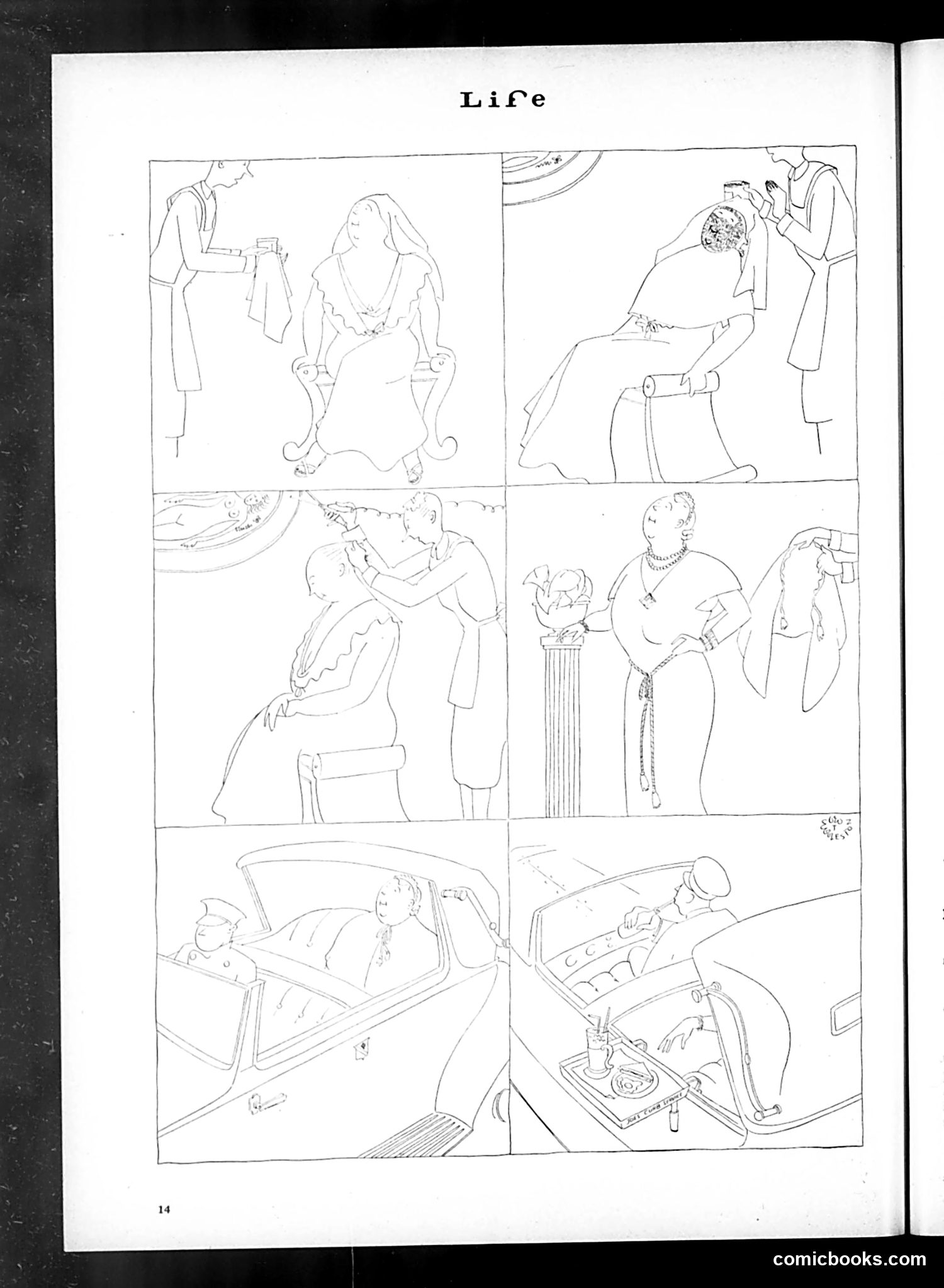
Analysis of "Life" Page - Titled "Life" This appears to be a satirical comic strip depicting the life stages or daily routines of a wealthy woman, likely from the early-to-mid 20th century based on the art style and clothing. The six-panel sequence shows: - Upper panels: A woman being dressed/groomed by servants - Middle panels: Social interactions with other women and servants - Lower panels: The woman in an automobile with companions The satire likely mocks the idle leisure lifestyle of affluent women—their dependence on servants, preoccupation with appearance and social status, and leisurely automobile rides. The progression suggests the repetitive, purposeless nature of their daily existence. The title "Life" is ironic, implying this shallow routine constitutes their entire existence. The comic critiques wealth-based class divisions and gender roles of the era.
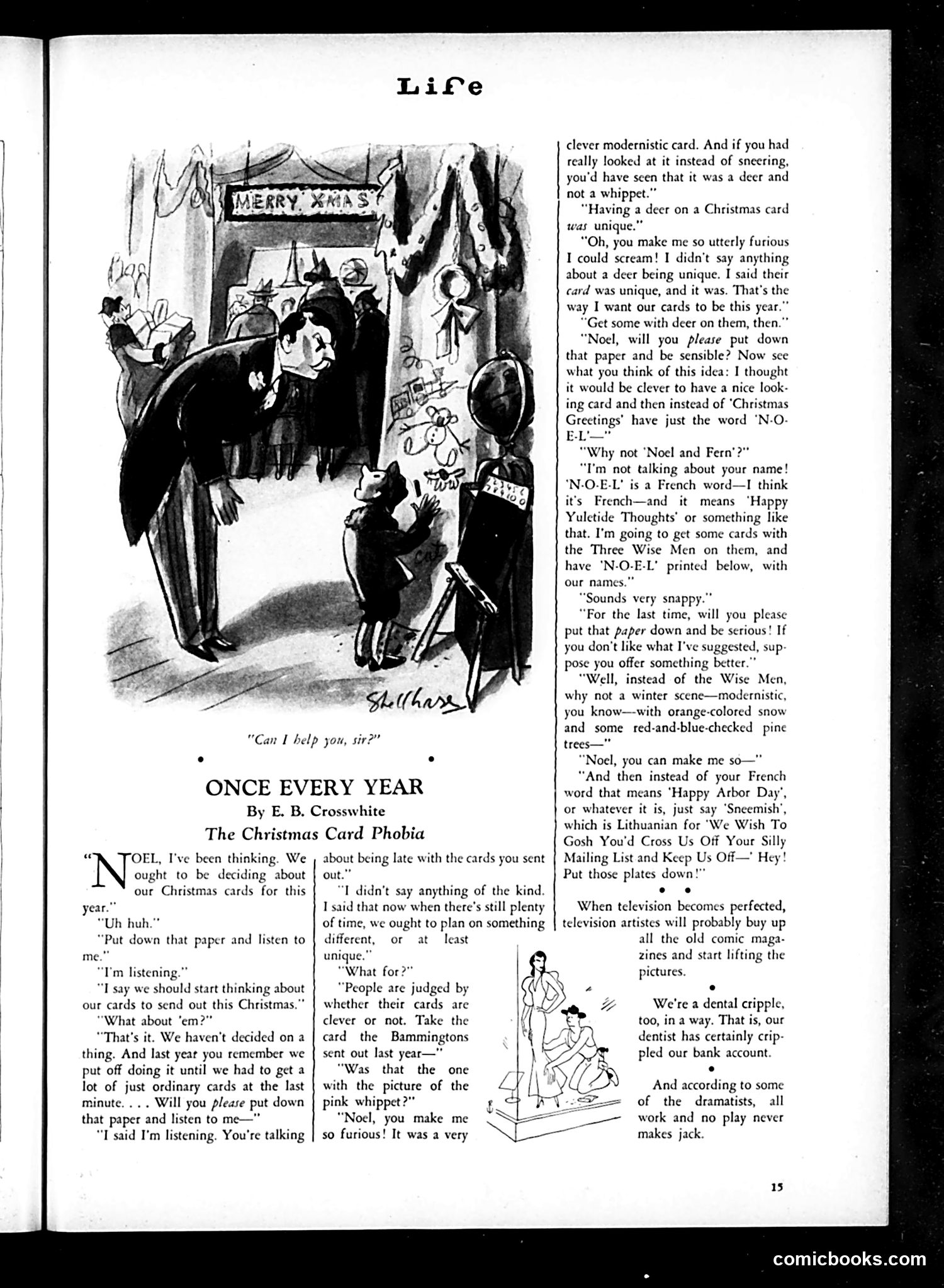
Analysis of "Once Every Year" by E.B. Crosswhite This is a humorous domestic dialogue about Christmas card selection. The cartoon depicts a couple debating card designs—the husband wants something "different" or "unique," while the wife grows increasingly exasperated by his suggestions. His proposed ideas (a deer instead of traditional imagery, "N.O.E.L." in French, modernistic winter scenes, or Lithuanian phrases like "Sneemish") are deliberately absurd and impractical. The satire mocks husbands who overcomplicate simple domestic decisions with pretentious suggestions while their patient wives bear the actual responsibility. The page also contains brief commentary on television and dentistry, suggesting broader 1950s-era concerns about consumer culture and professional services. The humor relies on recognizable gender dynamics of the period.
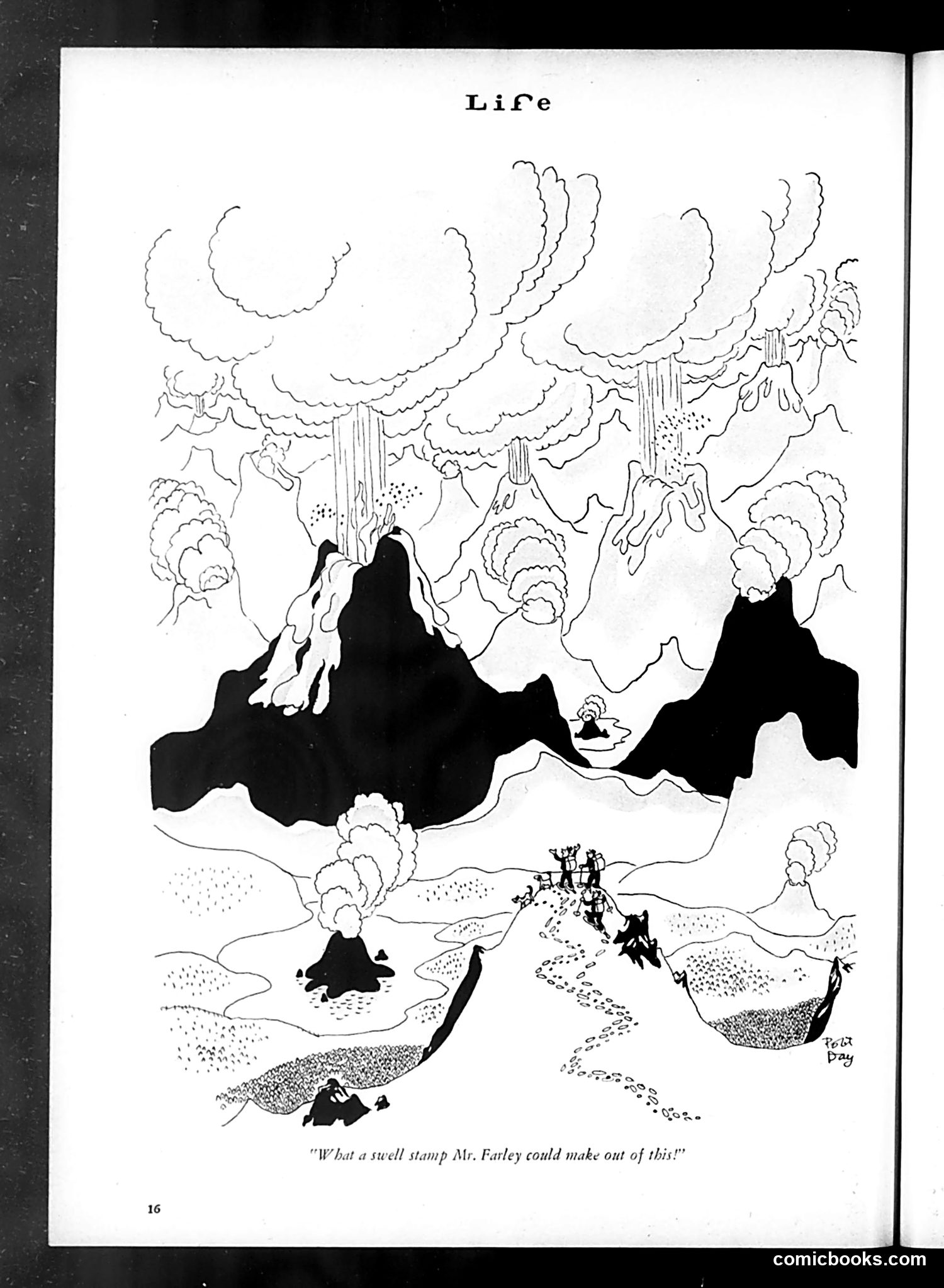
Analysis This is a single-panel cartoon titled "Life" showing a surreal landscape. In the foreground, small figures observe a massive natural formation—an enormous cavern or underground chamber with towering rock formations and vegetation above. The caption reads: "What a swell stamp Mr. Farley could make out of this!" The joke references James A. Farley, who served as Postmaster General under Franklin D. Roosevelt. This is likely satirizing either: 1. The Post Office's practice of commemorative stamps featuring natural landmarks 2. Farley's political influence or the politicization of stamp design The "swell stamp" suggests the cartoon mocks the scale of this geological wonder being reduced to postage-stamp size, or critiques how such public resources were being leveraged for political purposes. Without additional context about when this appeared, the specific Farley reference remains somewhat unclear.
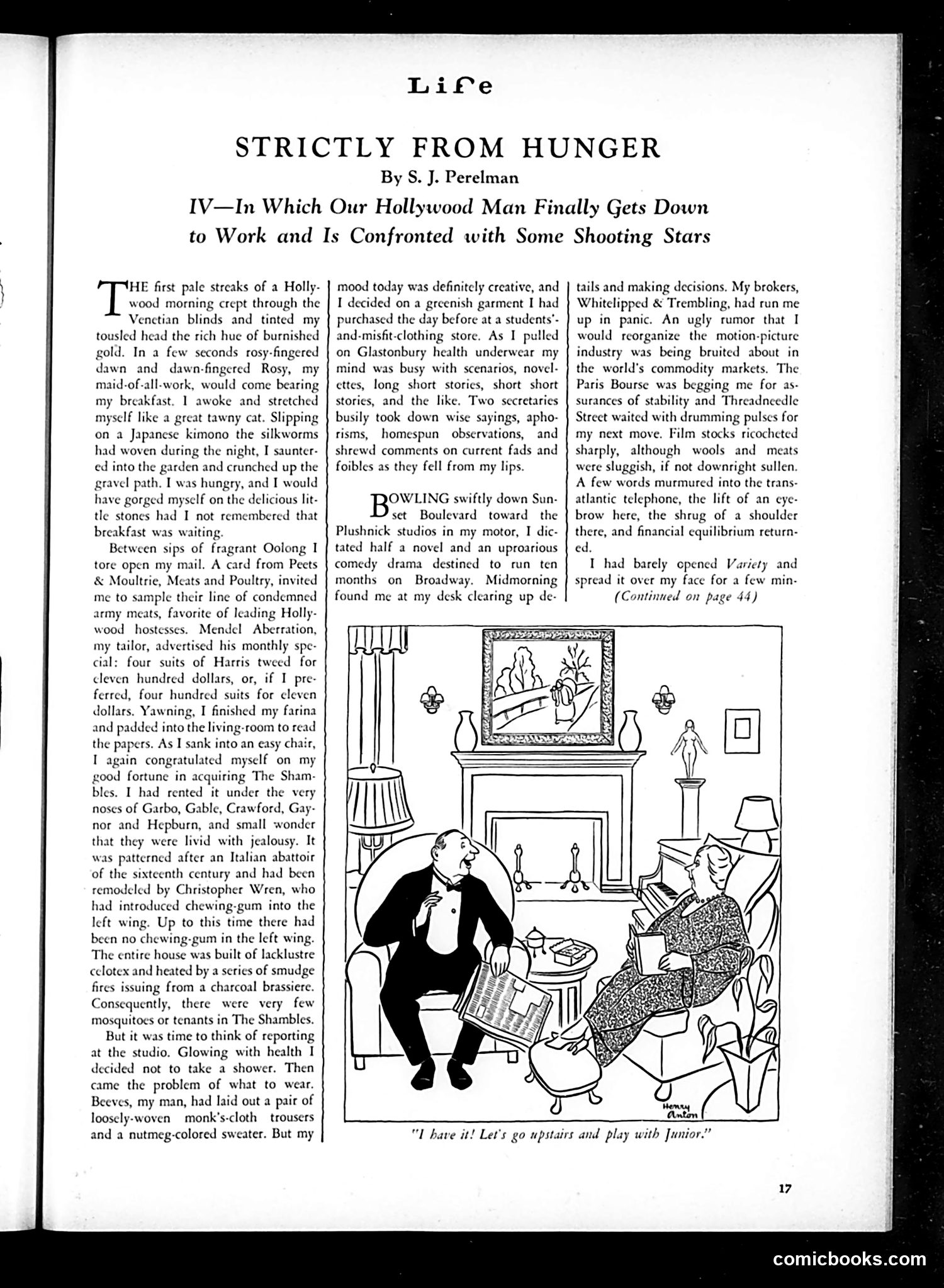
"Strictly from Hunger" by S.J. Perelman This is a humorous essay about a struggling writer in Hollywood, illustrated by a single cartoon. The drawing shows a well-dressed man in a living room speaking to a woman, with the caption "I have it! Let's go upstairs and play with Junior." The cartoon satirizes the shallow lifestyle and moral compromises of Hollywood society. The man's exaggerated formal attire and the affluent interior suggest new money and pretension. The joke appears to reference either infidelity or inappropriate behavior disguised behind euphemistic language about "playing with Junior" (likely a child). This mocks both the hypocrisy and moral laxity attributed to the entertainment industry during this era, while the essay itself humorously describes the author's financial desperation despite working in that glamorous but exploitative world.
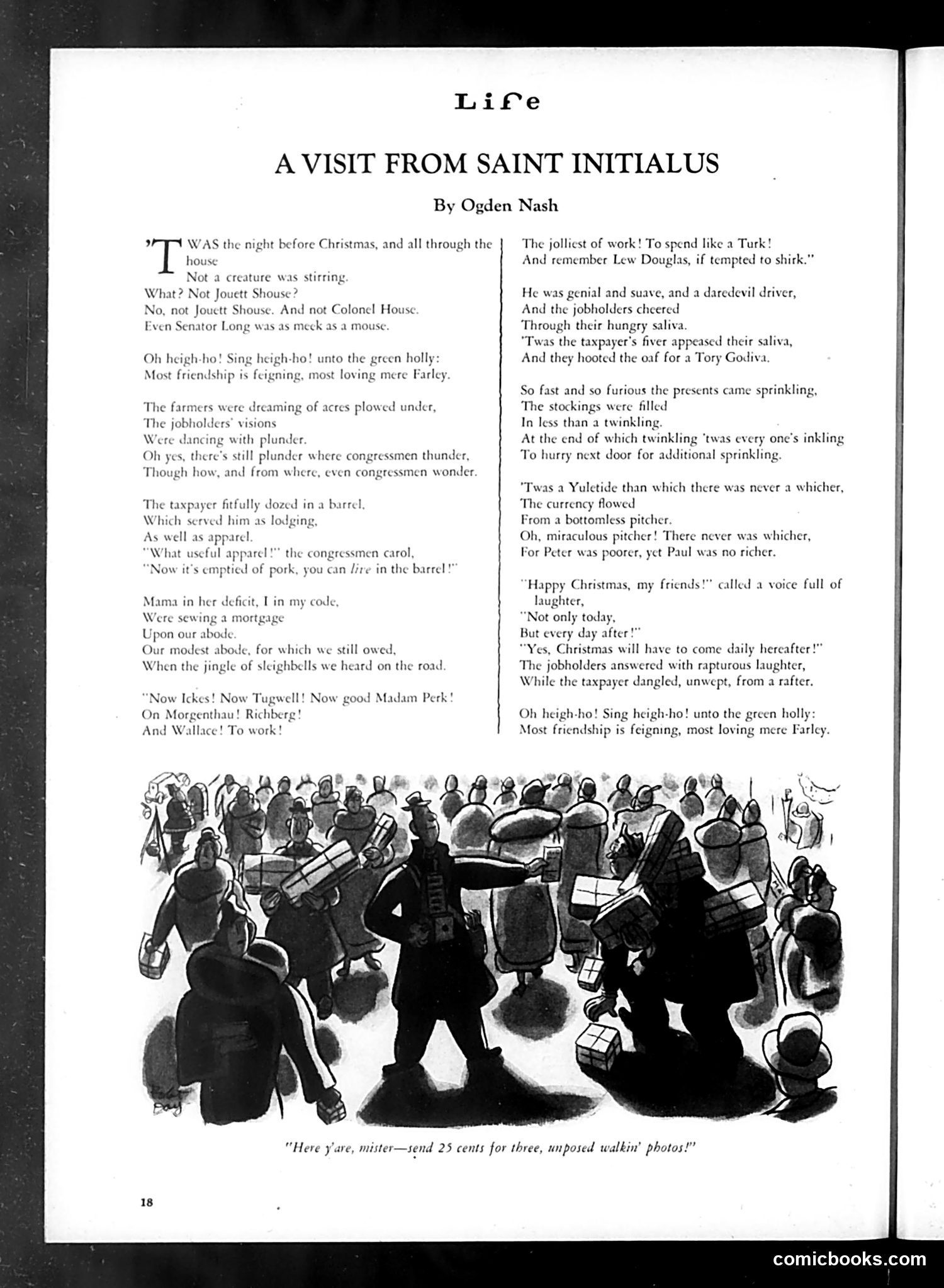
"A Visit from Saint Initialus" by Ogden Nash This satirical poem by Nash mocks the commercialization of Christmas during the Great Depression era. The verse contrasts idealized holiday imagery ("green holly," "friendship," "loving") with harsh economic realities: unemployed workers ("jobholders"), taxpayers struggling to pay mortgages, and a government seemingly indifferent to suffering. The accompanying illustration depicts a chaotic Christmas crowd—people bundling packages and gifts—while the caption reads: "Here y'are, mister—send 25 cents for three, unpoted walkin' photos!" This satirizes how even during economic hardship, commercialism exploits citizens desperate to participate in holiday consumption. Nash's "Saint Initialus" appears to represent bureaucratic abbreviations or impersonal authority, suggesting how Christmas had become reduced to commercial transactions rather than genuine human connection.
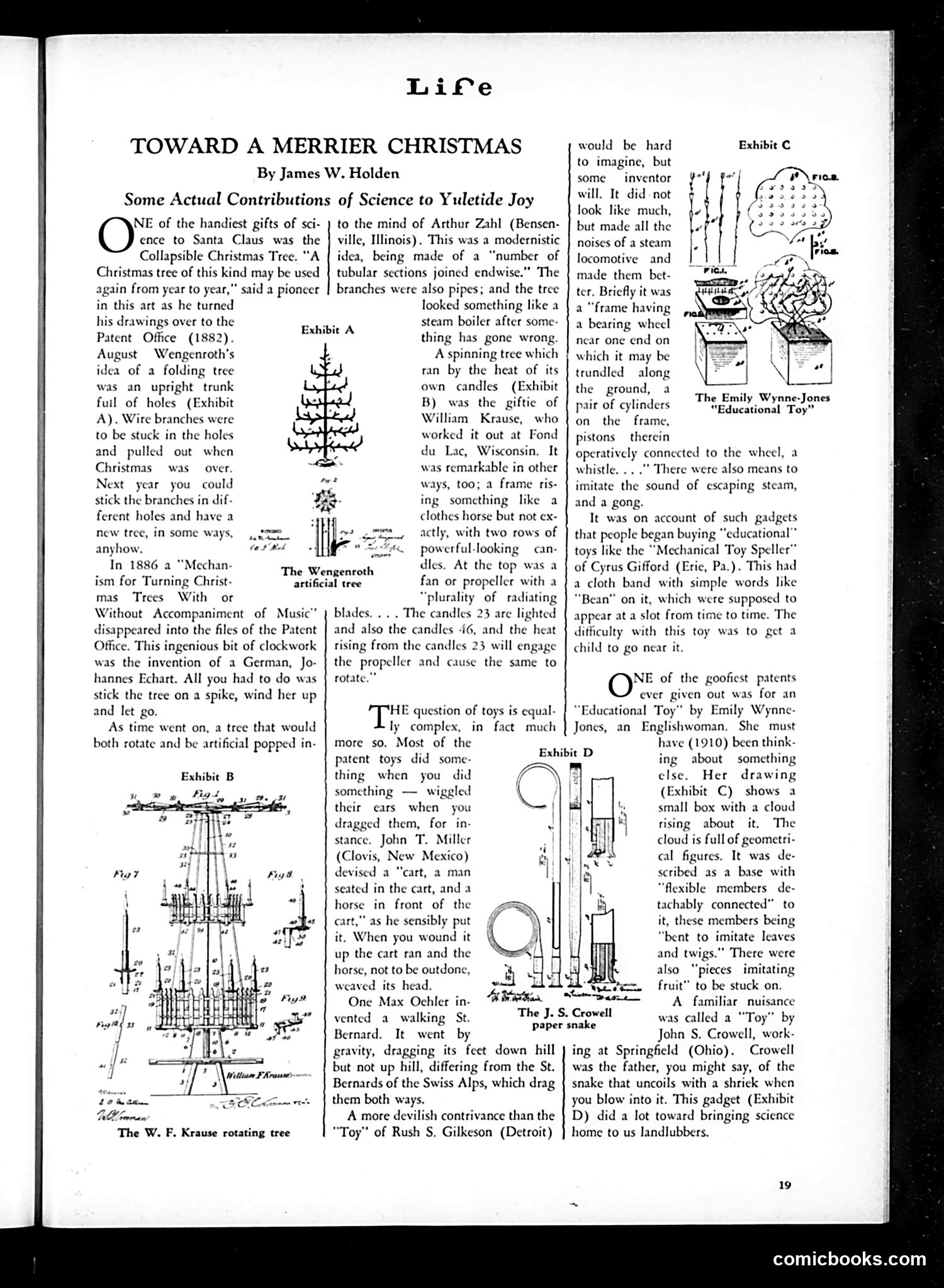
"Toward a Merrier Christmas" - Life Magazine Article This is not a political cartoon, but rather a humorous article by James W. Holden celebrating absurd Christmas tree patents and novelty toys from the late 1800s and early 1900s. The piece satirizes the American obsession with mechanical innovation by showcasing ridiculous patented "improvements" to Christmas traditions. Exhibits show a rotating tree powered by candle heat, a spinning tree with steam whistles, and various educational toys with moving parts—including Emily Wynne-Jones's cloud toy and J.S. Crowell's paper snake. The humor stems from inventors applying industrial-age complexity to simple holiday pleasures, treating Christmas as a problem requiring technological solutions. It's gentle mockery of the era's faith that machines could enhance domestic life.
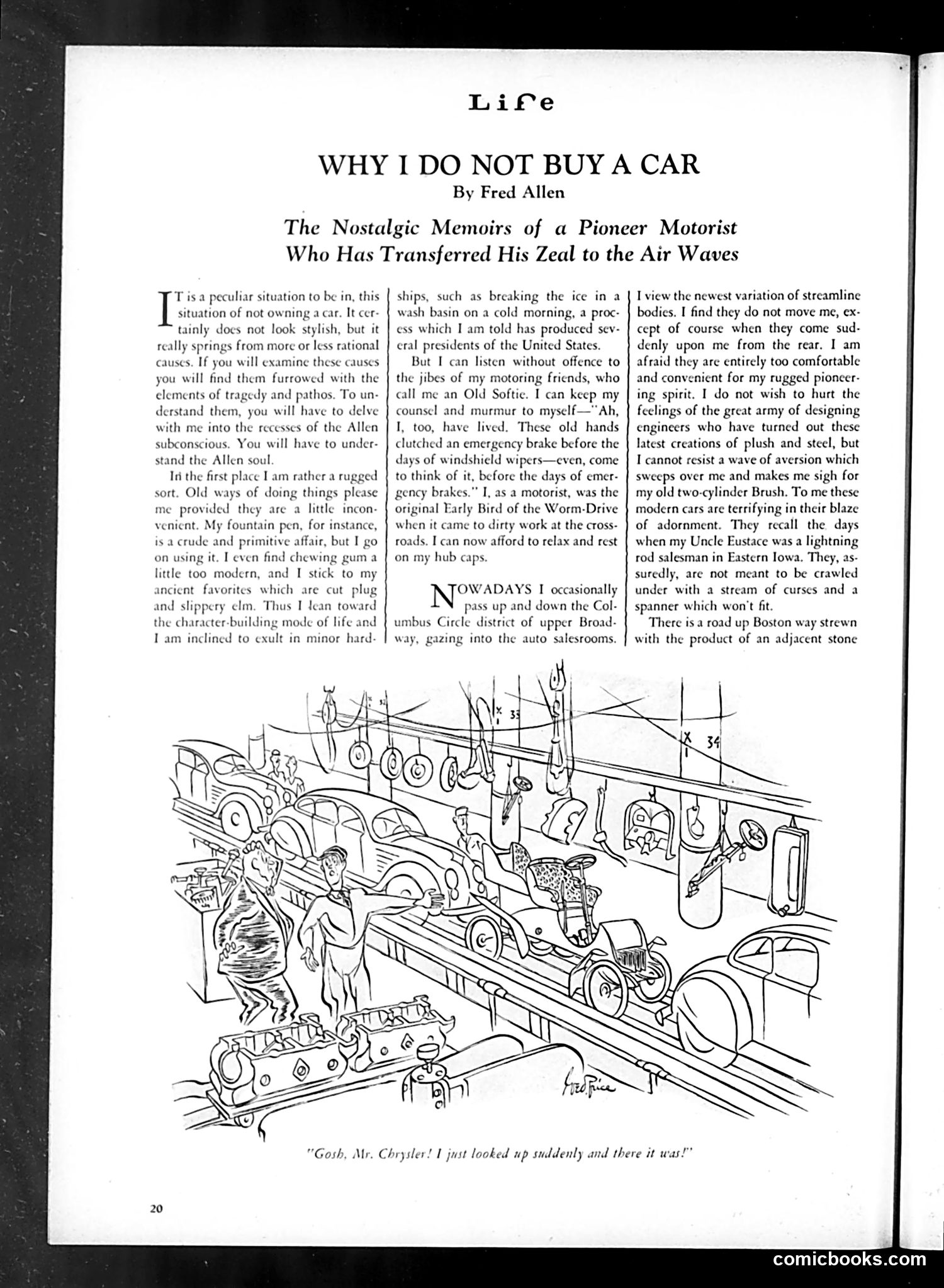
Explanation for Modern Readers Fred Allen's satirical essay argues against buying modern cars by adopting a deliberately contrarian persona. He claims to prefer primitive, inconvenient methods (fountain pens, chewing plug tobacco) as "character-building," positioning himself as a nostalgic "pioneer motorist." The humor lies in his mock-reverent tone about early automobiles—vehicles requiring ice-breaking, emergency brakes, and constant repairs—contrasted with his disdain for streamlined, comfortable modern cars (likely 1930s-40s models). He laments that today's vehicles are "too comfortable" and lack the character-building struggle of earlier motoring. The cartoon illustrates his point: a chaotic auto factory assembly line where cars are being assembled and suspended everywhere, suggesting industrial excess and overwhelming consumer abundance. The caption's apparent accident ("Gosh, Mr. Chrysler! I just looked up suddenly and there it was!") mocks the proliferation of automobiles. Allen, a famous radio comedian, channels curmudgeonly nostalgia while gently satirizing both old-car romanticism and modern consumer culture's emphasis on comfort and convenience.
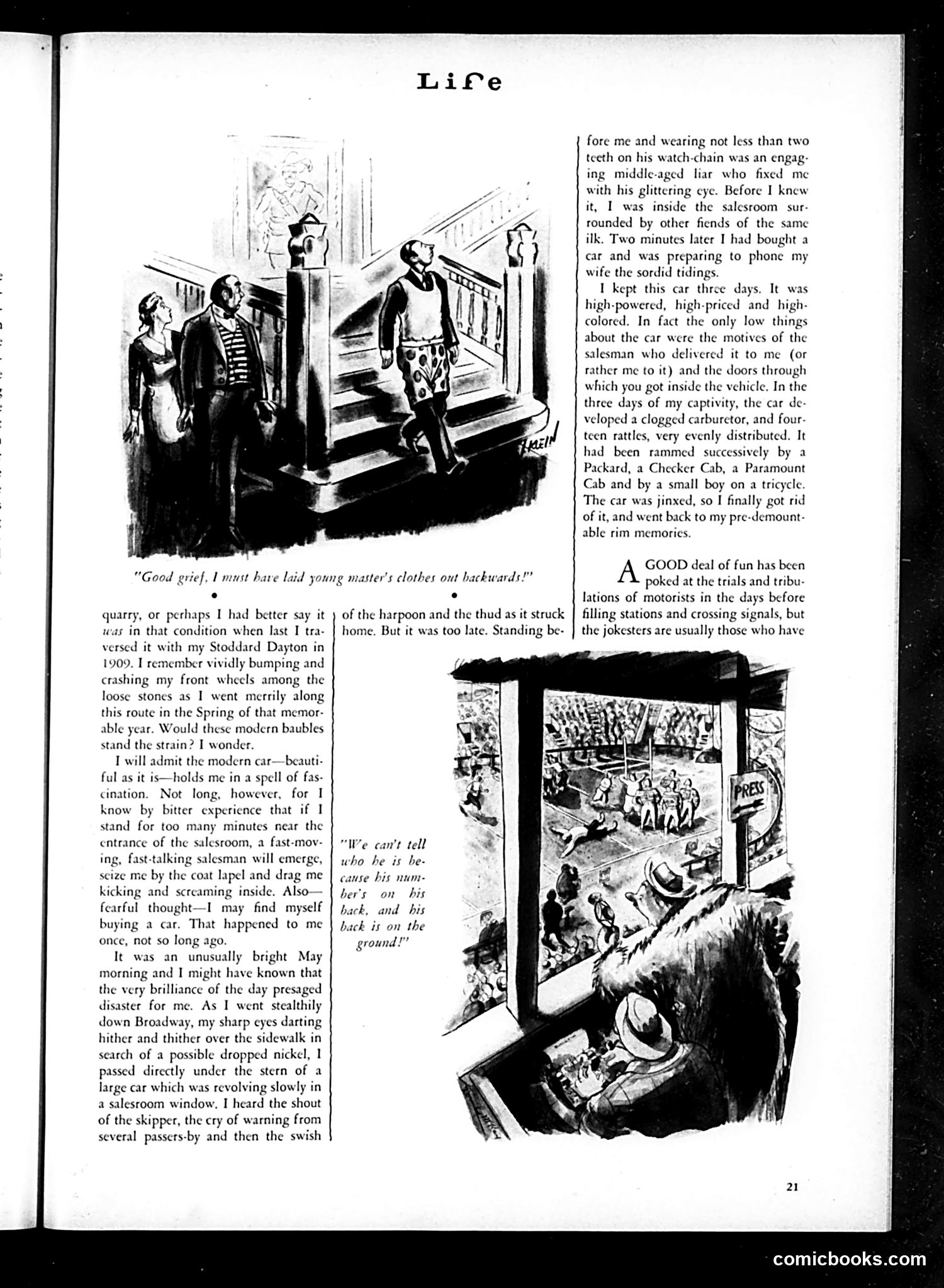
Analysis of Life Magazine Page This page satirizes early automobile culture and the aggressive sales tactics of car dealers. The top cartoon depicts a servant mixing up a gentleman's clothes—a visual gag about the "backwards" state of modern life. The main text is a humorous first-person account of being manipulated into buying a defective car by a fast-talking salesman who "seizes" customers near showroom entrances. The author describes the car developing problems within days: a clogged carburetor, rattles, and collision damage from various vehicles including a Packard taxi and a boy on a tricycle. The bottom cartoon shows someone pinned under a car, with onlookers unable to identify the victim because "his number's on his back, and his back is on the ground"—dark humor about hit-and-run accidents and poor traffic safety in the early automobile era. Together, these pieces mock both the unreliability of early cars and the dishonest dealer practices of the period.
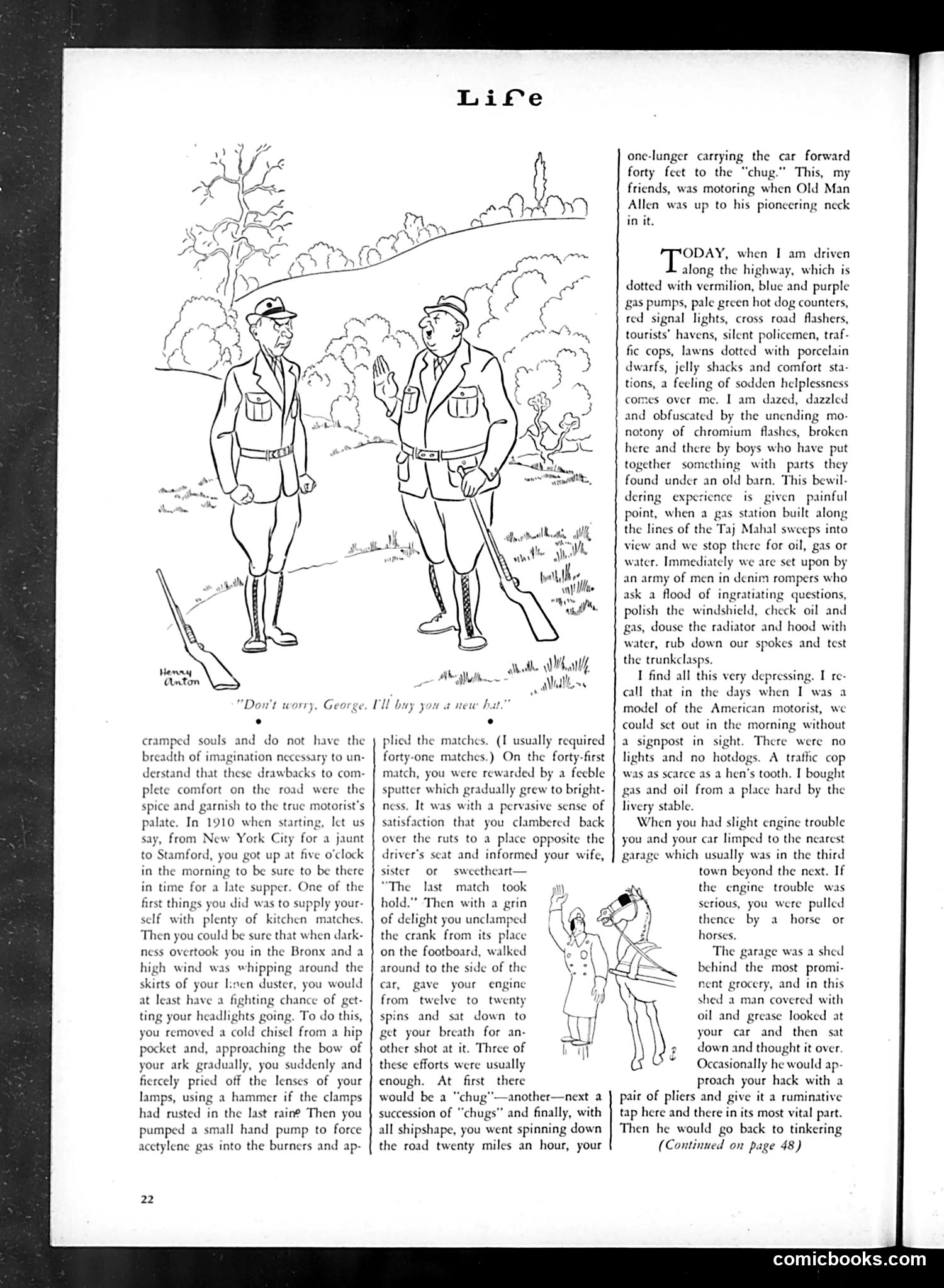
Historical Context for Modern Readers This page from *Life* magazine presents nostalgic commentary on early automobile culture, circa 1910. The cartoon caption "Don't worry, George, I'll buy you a new hat" depicts two uniformed figures (likely park rangers or similar officials) in a humorous scenario, though the specific joke requires fuller context. The accompanying article romanticizes early motoring as an adventurous, self-reliant endeavor—hand-cranking engines, manually lighting acetylene headlamps with kitchen matches, and troubleshooting roadside breakdowns without commercial assistance. The author contrasts this with modern (1920s-era) driving: standardized gas stations, mass tourism infrastructure, and impersonal service. The satire critiques how technological convenience has eliminated the challenge and personal agency that made early motoring appealing. The piece is fundamentally nostalgic commentary on lost independence in an increasingly commercialized, standardized American landscape—a common theme in interwar magazine writing.
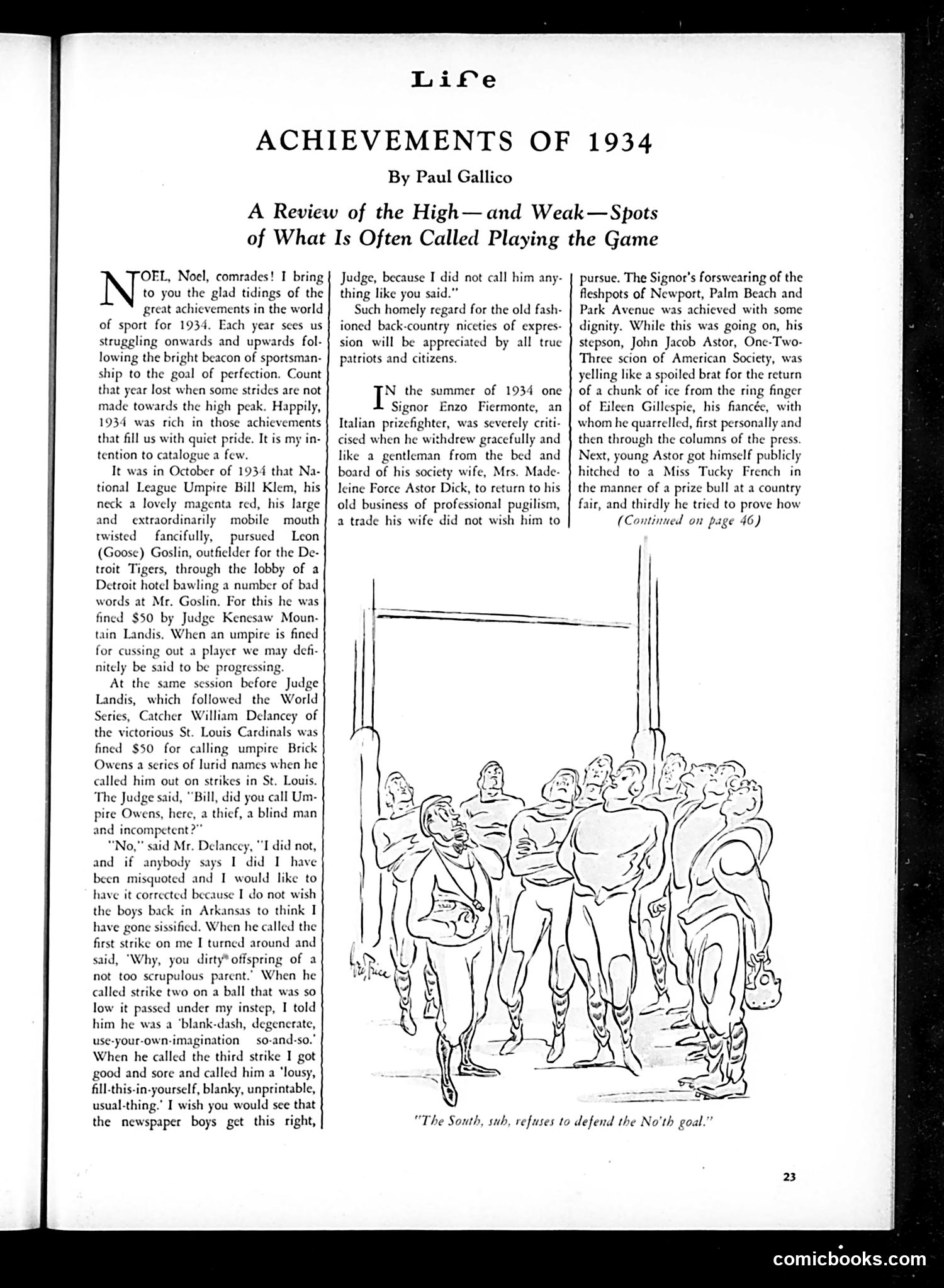
"Achievements of 1934" - Satire on Sports Conduct Paul Gallico's column sarcastically celebrates 1934 sports moments that supposedly demonstrate "progress" in sportsmanship—but actually highlight its absence. The piece mocks baseball officials fined for profanity: Umpire Bill Klem cursed at player Leon Goslin; catcher William Delancey denied calling umpire Brick Owens insulting names while hilariously enumerating exactly what he *did* call him (using euphemistic blanks). Gallico's irony is that fining these men for colorful language represents "progress." The cartoon depicts football players in a heated dispute, captioned "The South, suh, refuses to defend the No'th goal"—a regional sports rivalry joke referencing North-South football competition, rendered in exaggerated dialect. The column also covers wealthy socialite drama: Italian boxer Enzo Fiermonte leaving his wealthy American wife (society figure Madeleine Force Astor Dick), while her stepson John Jacob Astor III publicly quarrels over an engagement ring and hastily remarries. Gallico's satire deflates the myth of sportsmanship by treating petty conduct violations and celebrity scandals as "achievements"—highlighting how 1934 sports culture actually reflected poor behavior.
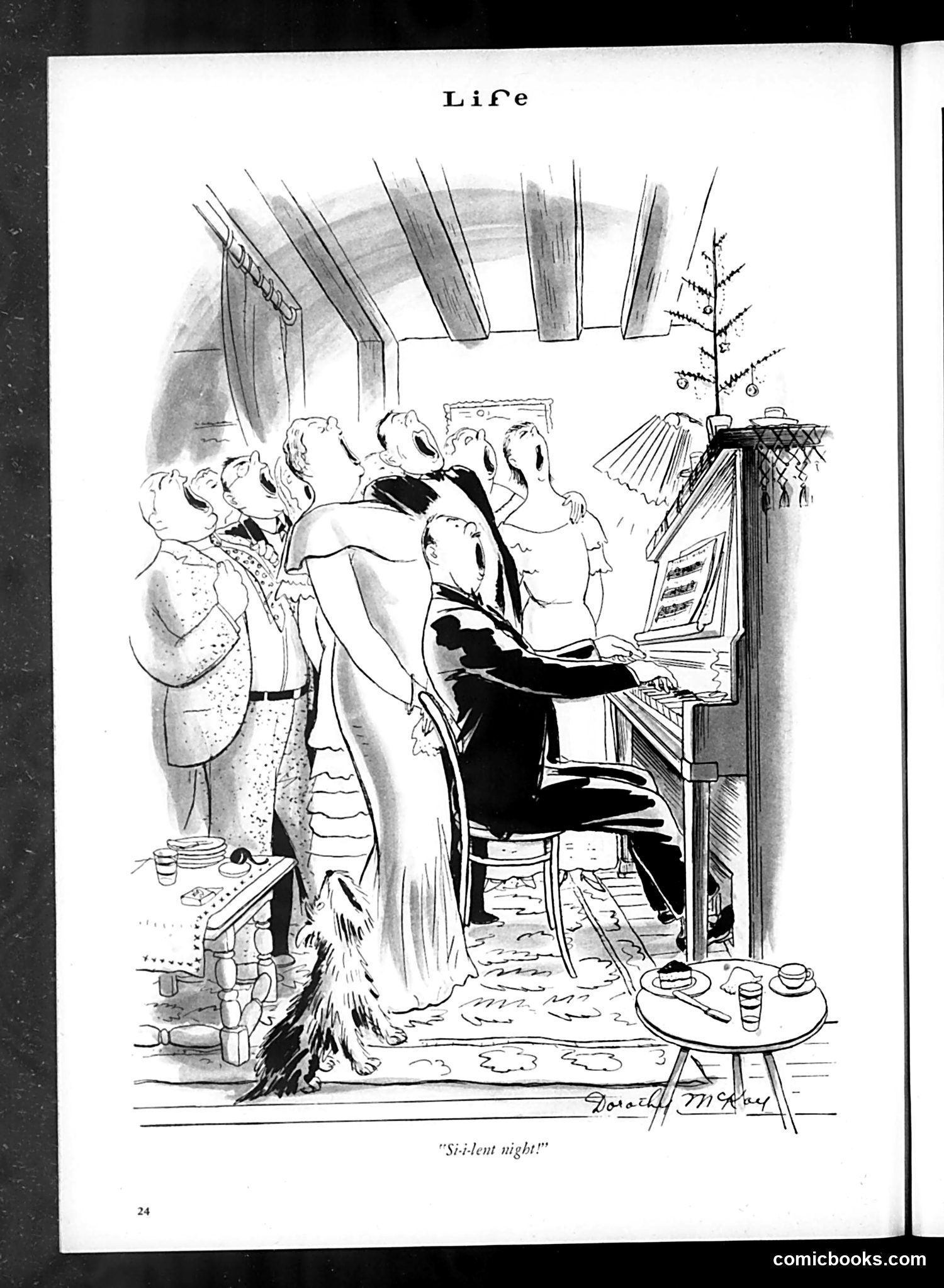
"Silent Night!" - Life Magazine Cartoon This cartoon depicts a musical performance gone awry. A pianist (in black, prominently featured) plays while a group of well-dressed men stand behind, apparently singing or attempting to sing Christmas carols—suggested by the "Silent Night" caption and small evergreen tree visible in the room. The humor lies in the contrast: despite the caption's ironic plea for silence, the singers appear to be producing loud, enthusiastic (and presumably off-key) noise. Their expressions and postures suggest vigorous, cacophonous singing rather than the quiet reverence the carol's title demands. This appears to be gentle social satire about amateur caroling or amateur musicians—mocking overzealous but talentless holiday performers, a timeless comedic subject.
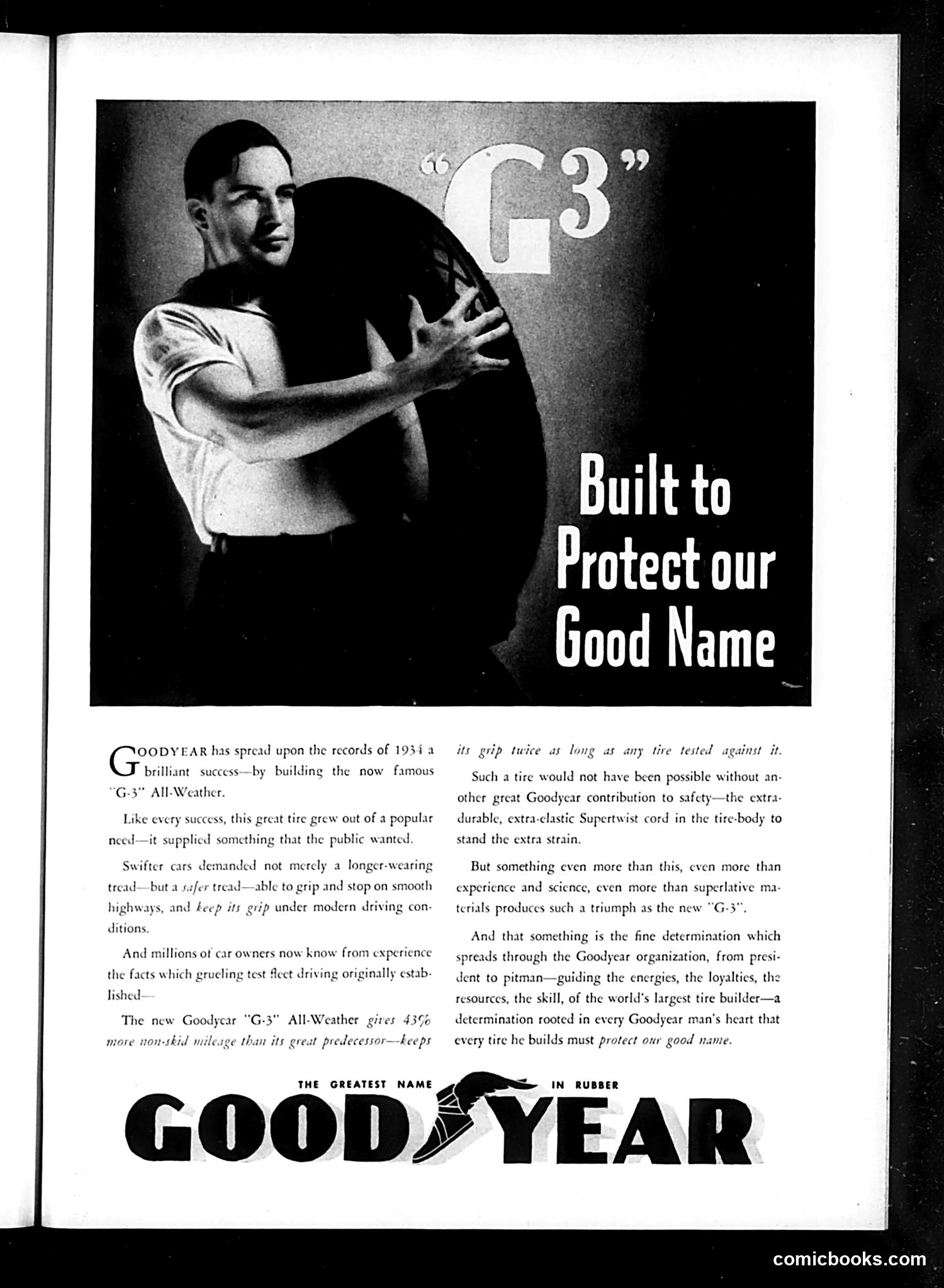
Analysis This is not a cartoon or satire—it's a straightforward advertisement for Goodyear tires from 1934. The page promotes the "G-3" All-Weather tire, Goodyear's new flagship product. The image shows a man gripping a large tire, illustrating the tire's grip and safety features. The headline "Built to Protect our Good Name" emphasizes brand reputation as the driving force behind quality. The text claims the G-3 provides 43% more non-skid mileage than its predecessor and uses a stronger "Supertwist cord" for durability. The broader message appeals to worker pride and organizational commitment—suggesting that every Goodyear employee, from executives to factory workers ("pitman"), is motivated by protecting the company's reputation. This reflects 1930s corporate messaging emphasizing brand integrity and industrial craftsmanship during the Depression era.
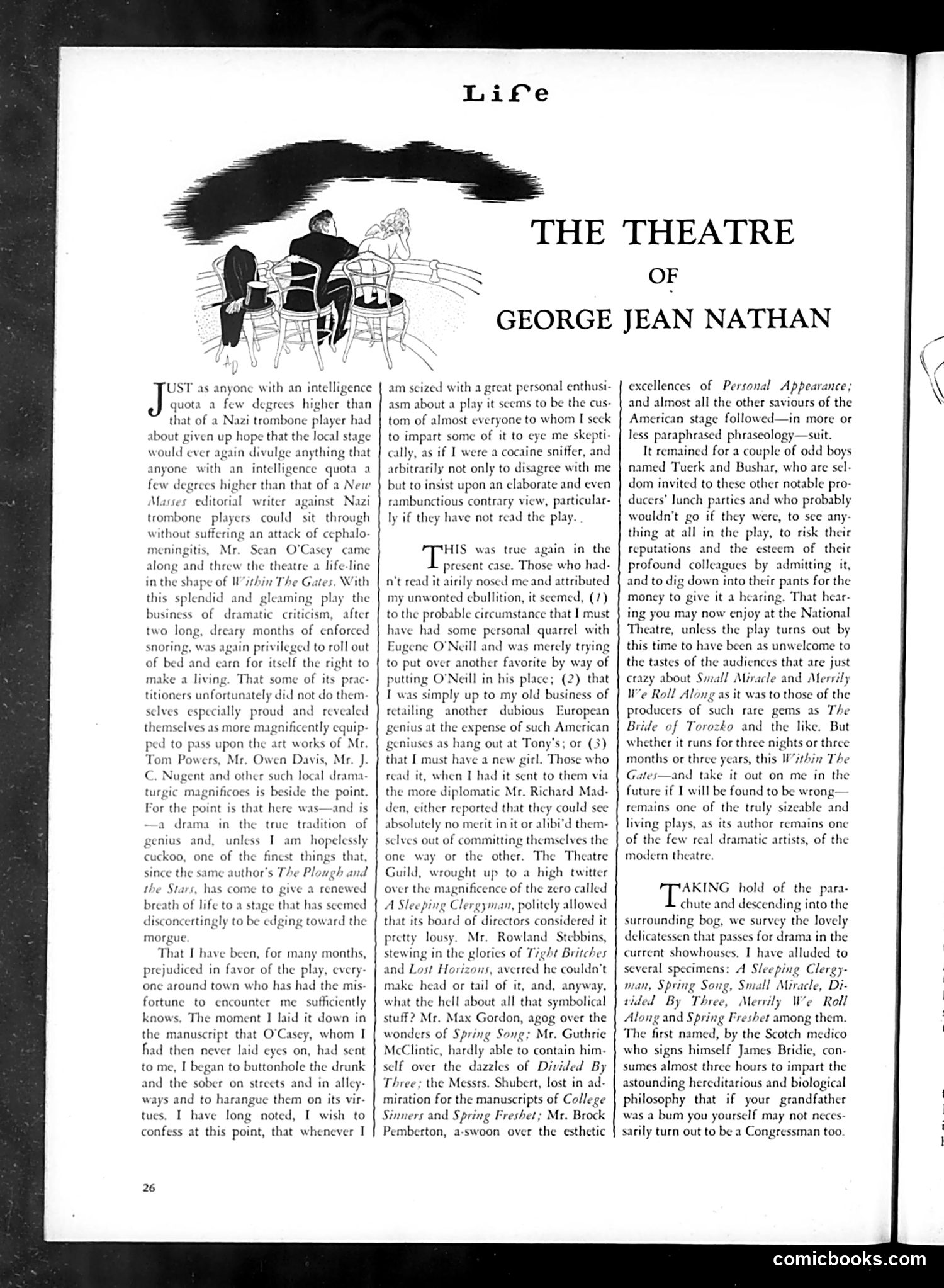
"The Theatre of George Jean Nathan" — Life Magazine This page showcases drama critic George Jean Nathan's enthusiastic advocacy for Sean O'Casey's play *Within The Gates*. The illustration depicts Nathan (center, gesturing animatedly) attempting to convince skeptical theater figures seated beside him. Nathan criticizes the theatrical establishment's resistance to his praise. He identifies three reasons people dismissed his enthusiasm: (1) assumption he had a personal quarrel with Eugene O'Neill; (2) belief he was promoting dubious European drama over American talent; and (3) suspicion he was romantically involved with someone connected to the play. The satire targets theater producers and guild directors—including the Theatre Guild, Max Gordon, Guthrie McClintic, and the Shuberts—who allegedly rejected O'Casey's work while championing inferior productions. Nathan's exasperated tone suggests the American theater establishment's resistance to serious drama, their preference for commercial entertainment, and their dismissal of critical judgment when it contradicts their own commercial interests.
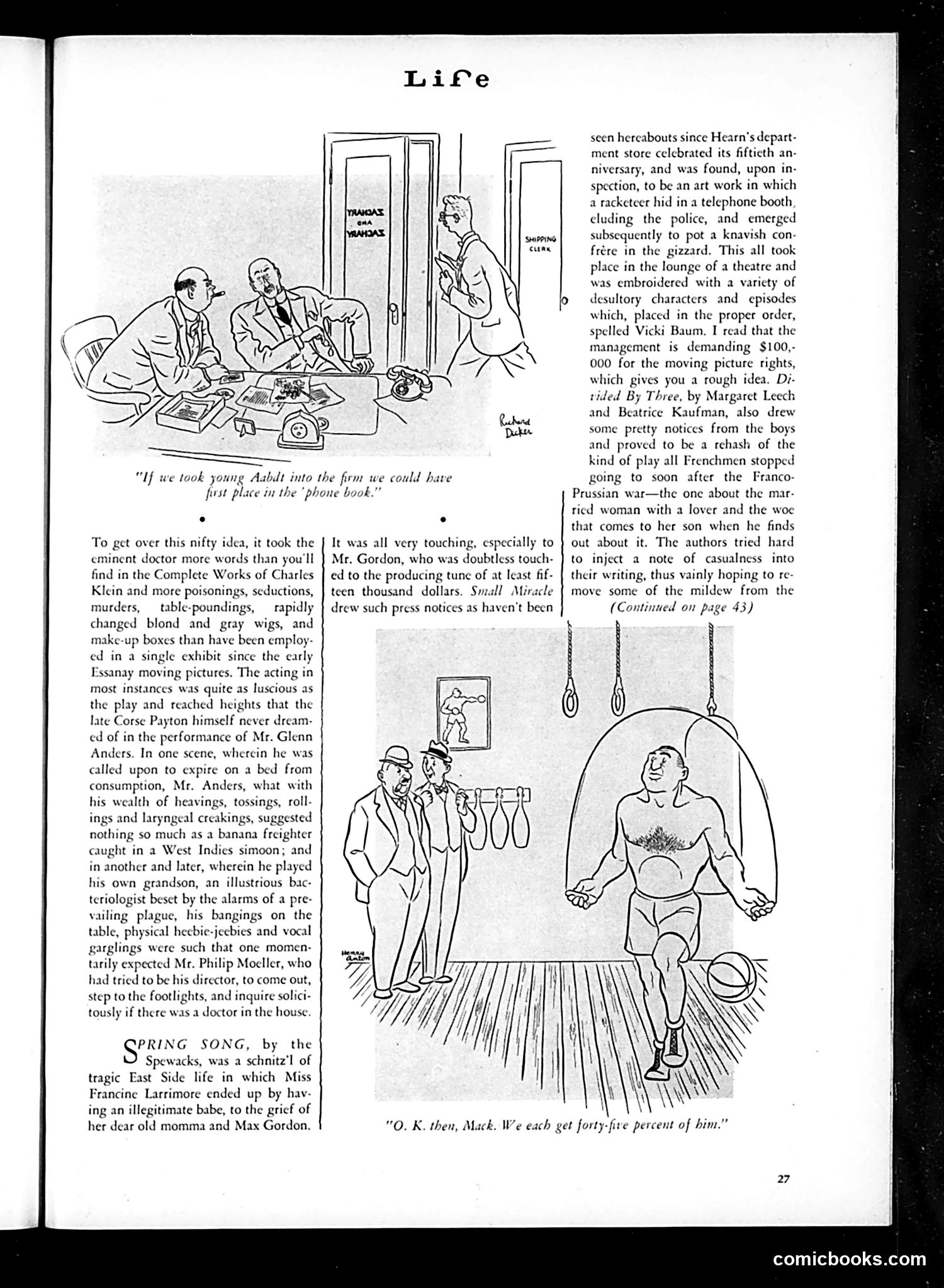
Life Magazine Theater Review - Page 27 This page contains theatrical criticism satirizing several Broadway productions from the 1920s-30s era. The top cartoon depicts a business meeting where someone suggests hiring a young man into a firm, with the cynical caption "If we took young Aabdt into the firm we could have first ple[ce] in the phone book"—mocking how theatrical producers manufacture publicity. The bottom cartoon shows two men discussing a child actor, agreeing each will "get forty-five percent of him"—satirizing how producers exploit child performers for profit-sharing arrangements. The text reviews recent plays including *Spring Song* and *Directed By Three*, criticizing their melodramatic acting and derivative plots. Life mocks the theatrical industry's extravagant pretensions, overwrought performances, and commercial greed—particularly Mr. Glenn Anders' histrionic acting style and producers' demands for exorbitant film rights fees ($100,000). The satire targets both the absurdity of contemporary theater and the industry's mercenary nature.
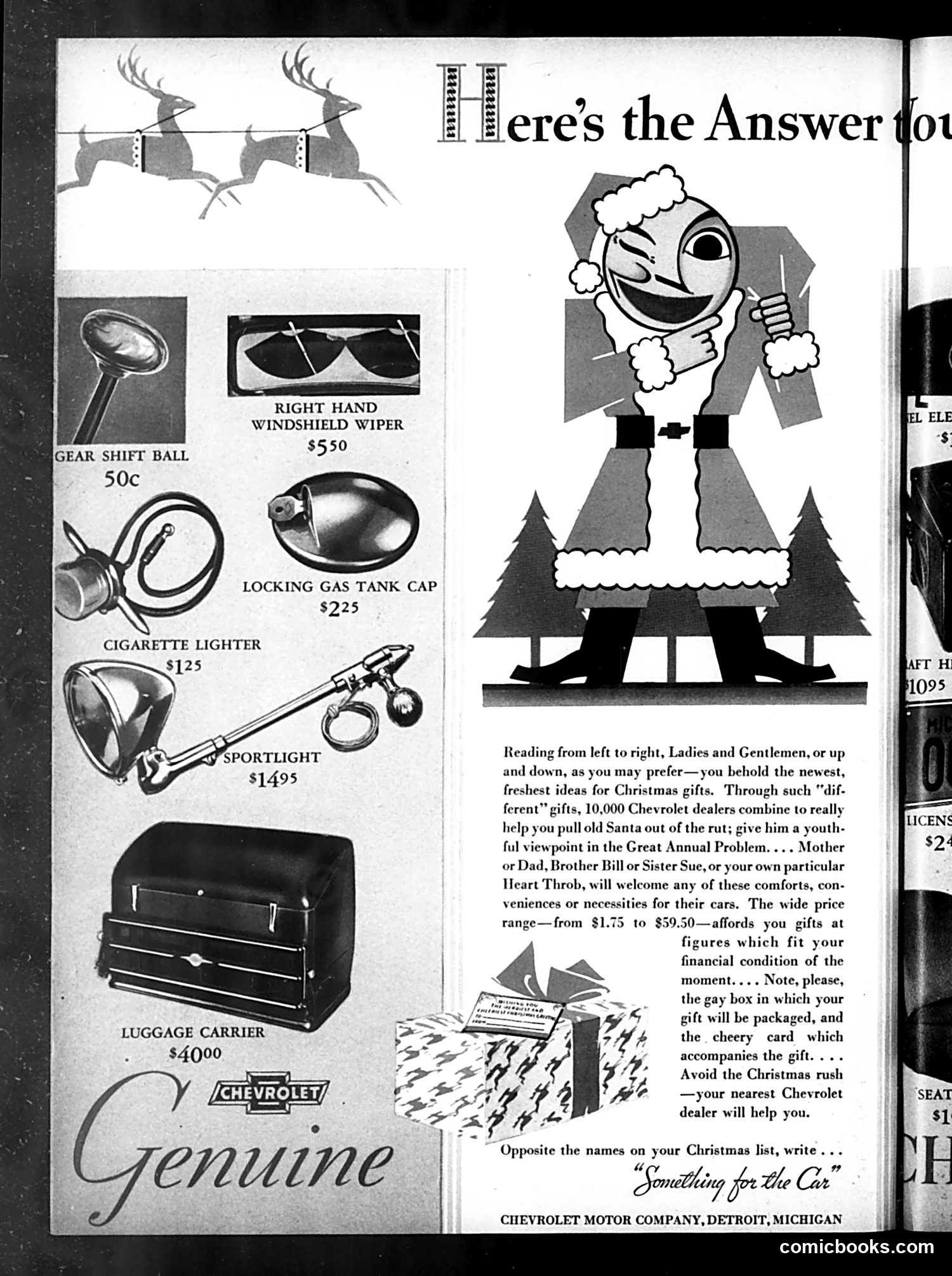
Analysis This is a Chevrolet automobile advertisement, not political satire. The page features a cheerful Santa Claus figure alongside genuine car accessories (windshield wipers, gear shift balls, cigarette lighters, luggage carriers) positioned as Christmas gift ideas. The ad's humor is gentle and commercial: it addresses the perennial problem of "pulling old Santa out of the rut" by suggesting practical car parts as gifts. The copy playfully addresses readers' holiday shopping anxiety, emphasizing Chevrolet's price range ($1.75–$59.50) to fit various budgets. The Santa cartoon simply serves as a mascot to personify the holiday gift-giving concept. There's no political commentary or social satire here—this is straightforward 1930s-era promotional material, relying on cheerful tone and relatability rather than critique.
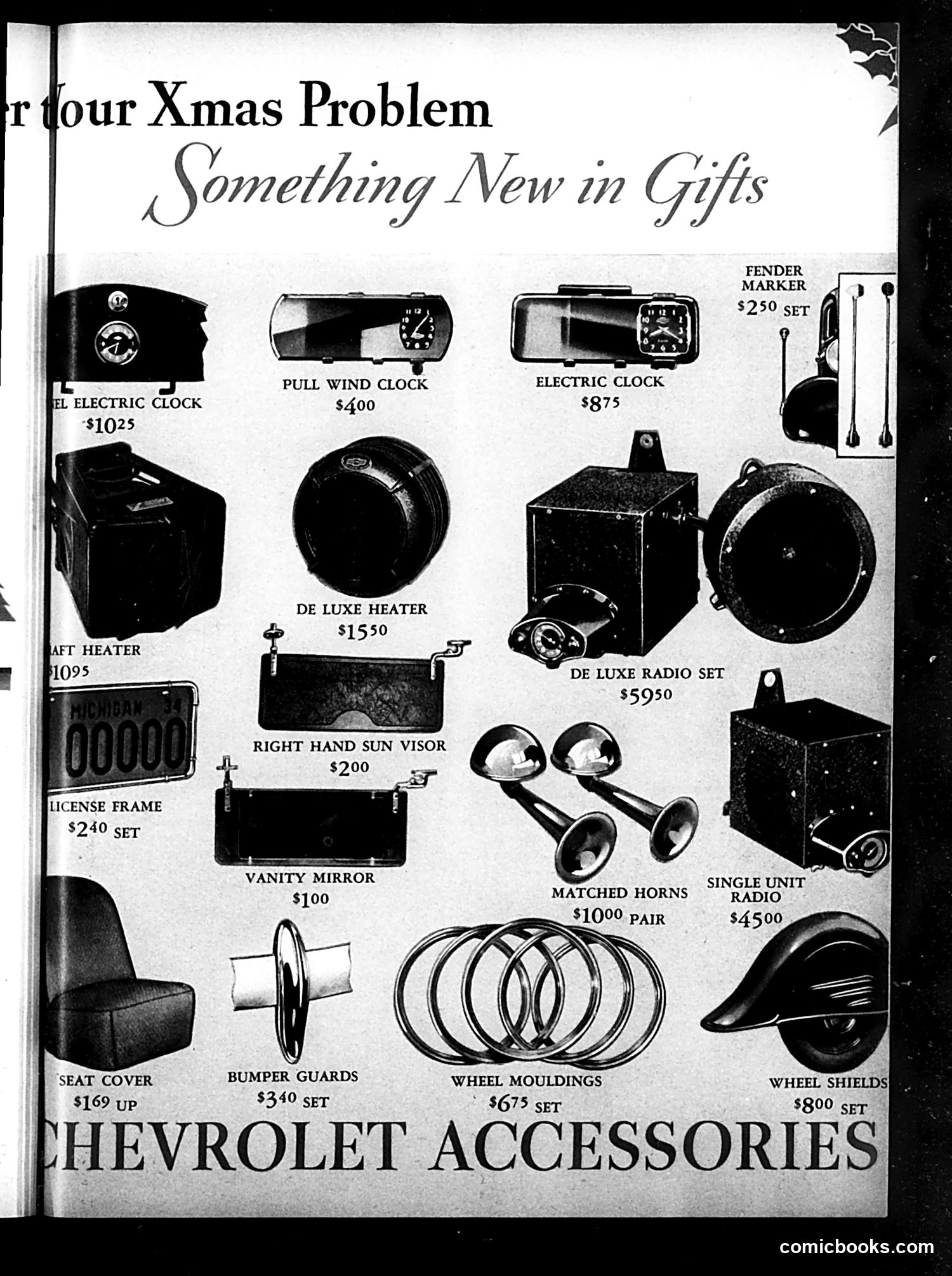
This is not a cartoon or satire page—it's a straightforward advertisement for Chevrolet automobile accessories. The headline "Solve Your Xmas Problem: Something New in Gifts" frames car parts and accessories as holiday gift solutions for the 1920s-1930s era (based on styling and prices in cents/dollars format). Items shown include clocks, heaters, radios, horns, mirrors, seat covers, and trim pieces. The ad targets car owners seeking practical or luxury upgrades for their vehicles as Christmas presents. There is no political commentary or satirical intent visible—this is genuine commercial advertising positioned to capitalize on holiday shopping.
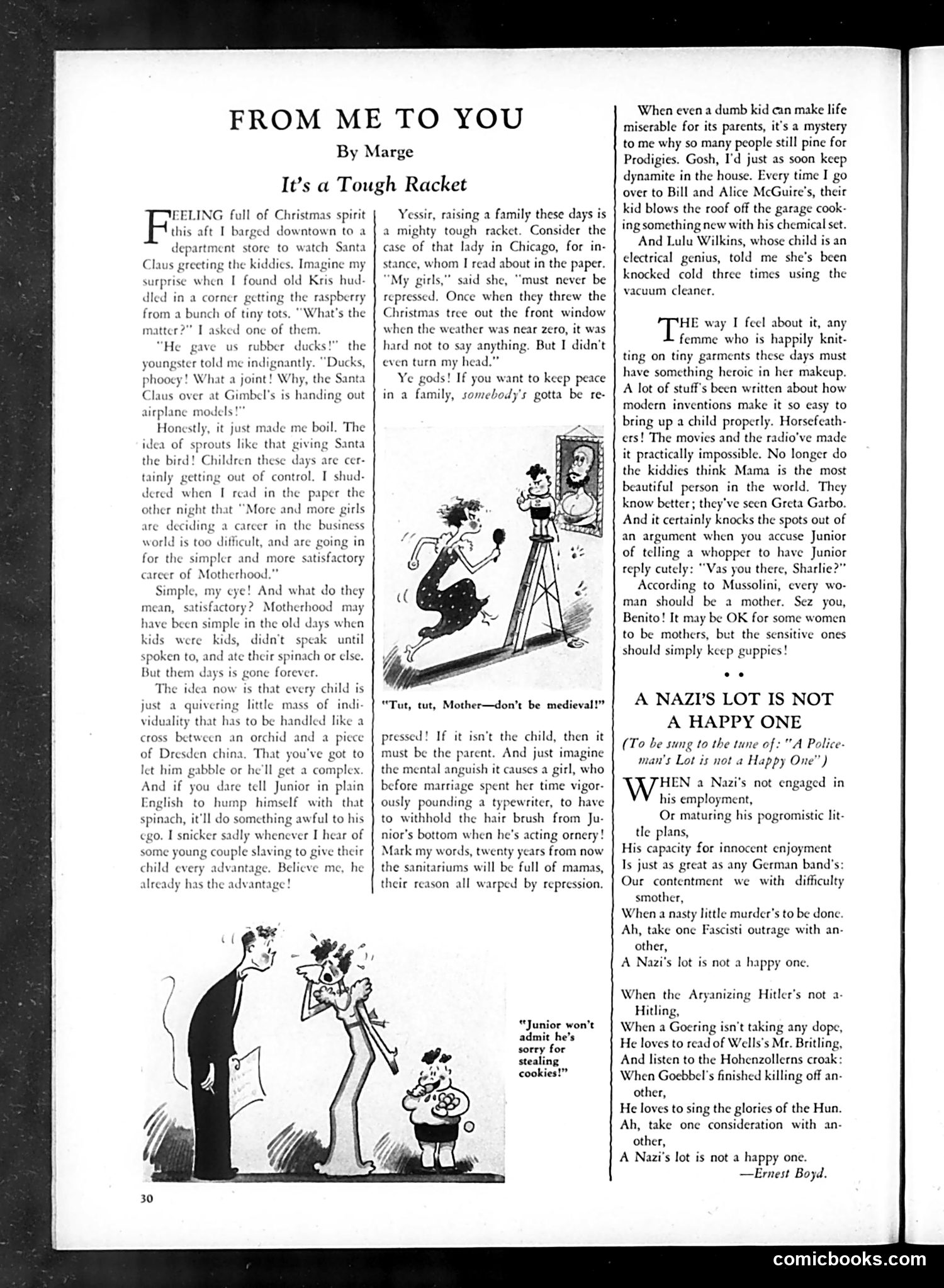
Analysis of "From Me to You" by Marge This humorous column satirizes modern parenting challenges in what appears to be the 1930s-40s. The author mocks the contemporary child-rearing philosophy of "progressive parenting"—the idea that children are delicate beings requiring constant psychological care and freedom of expression rather than discipline. The cartoon illustrates the absurdity through specific examples: children rejecting Santa for inadequate toys, a Chicago mother unable to discipline her daughters even when they throw a Christmas tree out a window, and parents enabling destructive behavior (a child's dangerous chemistry experiments). The satire targets two contradictions: parents who claim they've given their children "every advantage" while actually creating spoiled, ungovernable brats, and the gap between modern mothers' pre-marriage independence and their post-marriage mental exhaustion from unruly kids. The references to movies and radio stars (Greta Garbo) reflect how mass media supposedly corrupts children's values. The final reference to Mussolini appears cut off but likely continues the satirical theme.
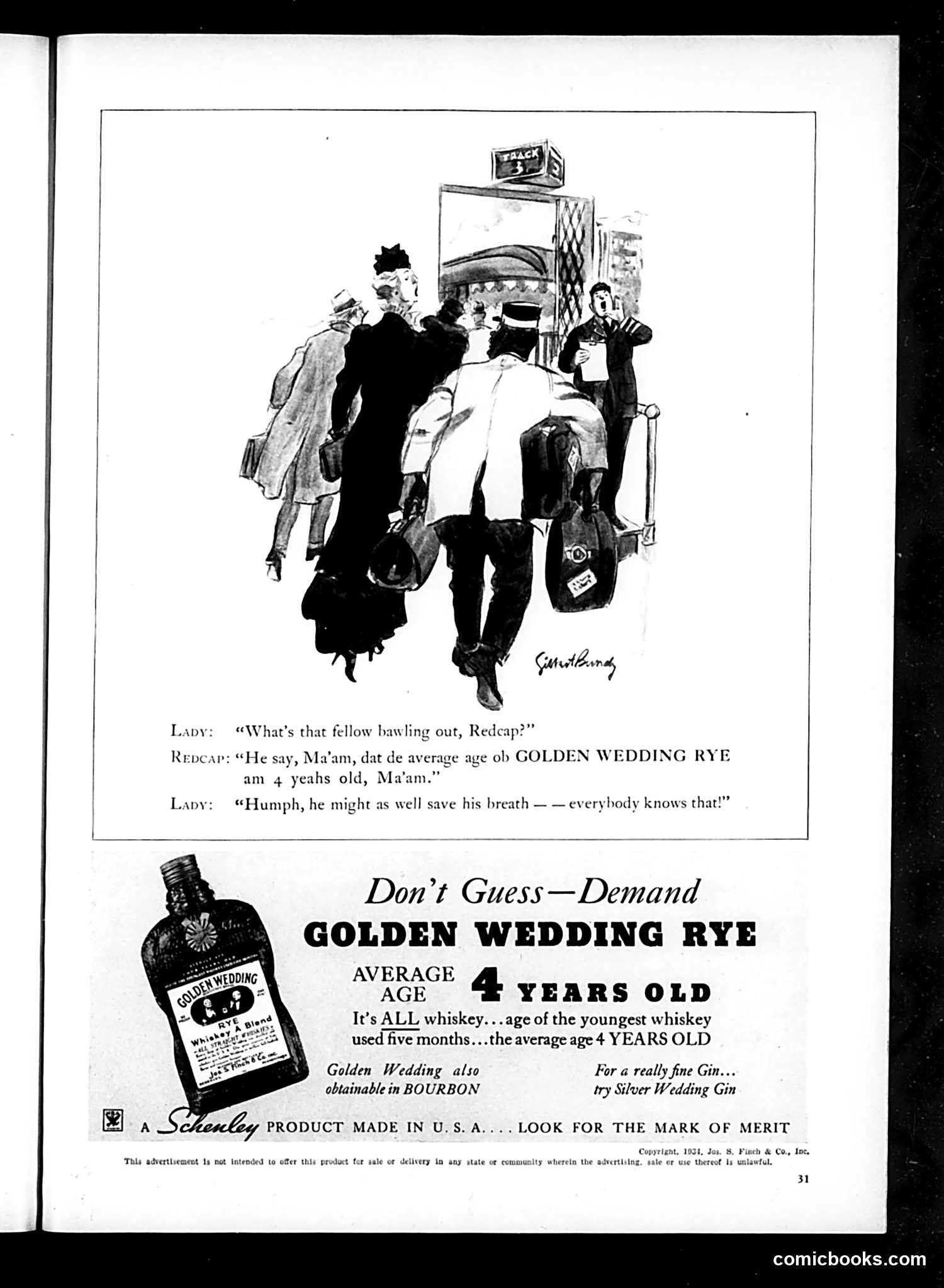
Analysis: Golden Wedding Rye Advertisement (1924) This is primarily a whiskey advertisement, not political satire. The cartoon illustrates a humorous sales pitch set at what appears to be a train station or public venue. The Joke: A redcap (porter) is explaining to an upper-class lady that Golden Wedding Rye whiskey has an average age of 4 years. Her dismissive response—"everybody knows that!"—suggests the advertiser's claim is so obvious it shouldn't need hawking. Historical Context: This ad appeared during Prohibition (1920-1933), when alcohol sales were technically illegal nationwide. The small copyright notice acknowledges this legal reality: "This advertisement is not intended to offer this product for sale...in any state or community wherein...sale...is unlawful." The Point: Despite Prohibition's restrictions, the company advertised openly, betting that consumers seeking whiskey would know to seek it out anyway. The ad emphasizes product quality (genuine whiskey, proper aging) as a selling point in an underground market. The illustration's social comedy—contrasting the refined lady with the working-class porter—reflects period class attitudes about who consumed spirits.
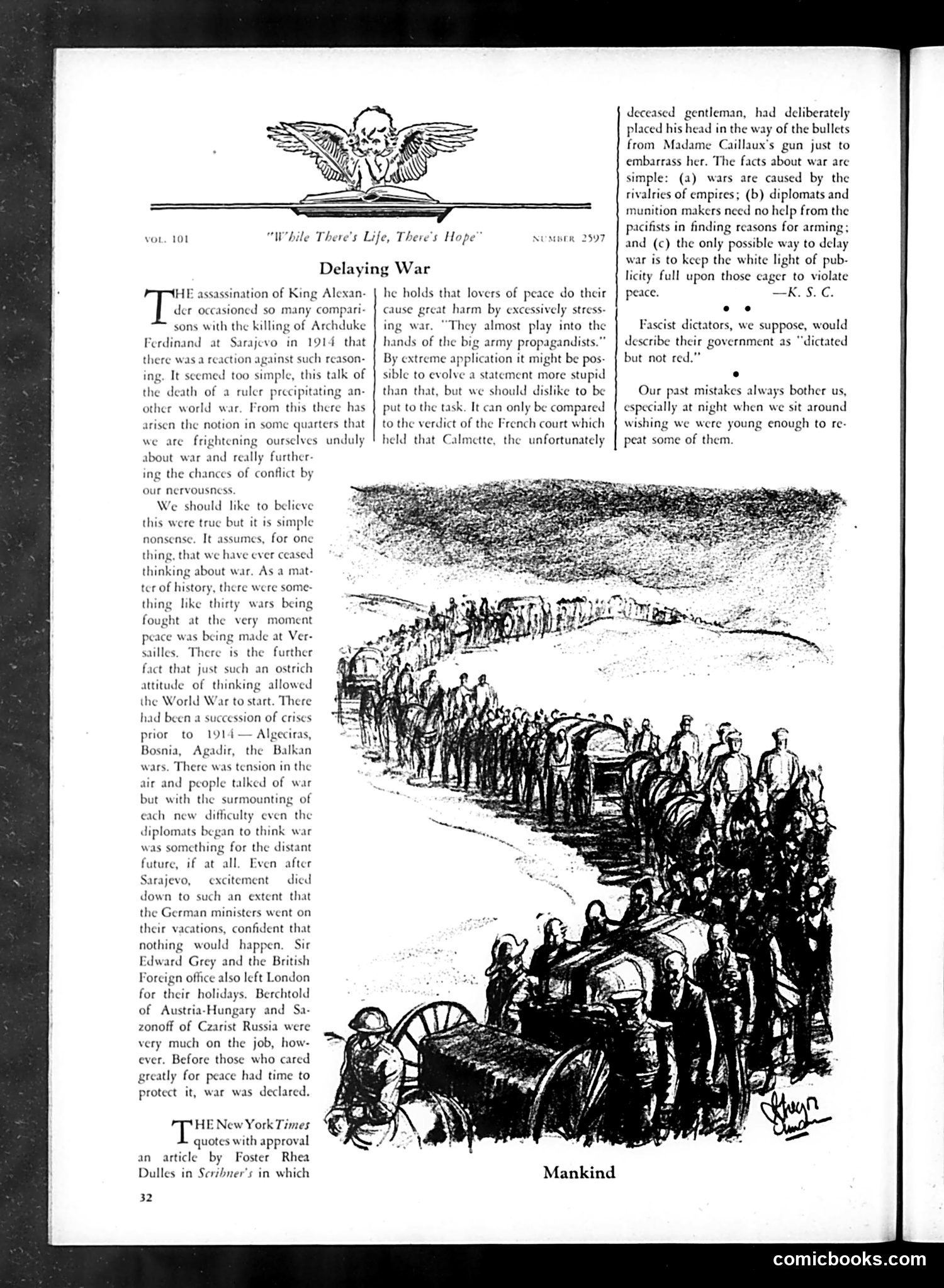
"Delaying War" — Life Magazine Analysis This editorial argues against complacency about war threats. The article compares contemporary anxieties (likely referencing 1930s fascism and tensions) to pre-WWI dismissiveness. It mocks the argument that peace advocates harm their cause by "stressing war," comparing this logic to blaming a shooting victim for being in the bullet's path. The large illustration titled "Mankind" depicts a funeral procession or mass movement of soldiers and civilians, visually reinforcing the article's warning: history shows that ignoring diplomatic tensions and military buildup allows wars to start despite warning signs. The pre-1914 crises (Algeciras, Bosnia, Agadir, Balkan Wars) are cited as missed opportunities to prevent conflict through vigilance. The piece advocates "publicity" and watchfulness over naive optimism—essentially arguing that keeping public attention on aggressive regimes and armament is the only realistic way to delay war, not stoke it.
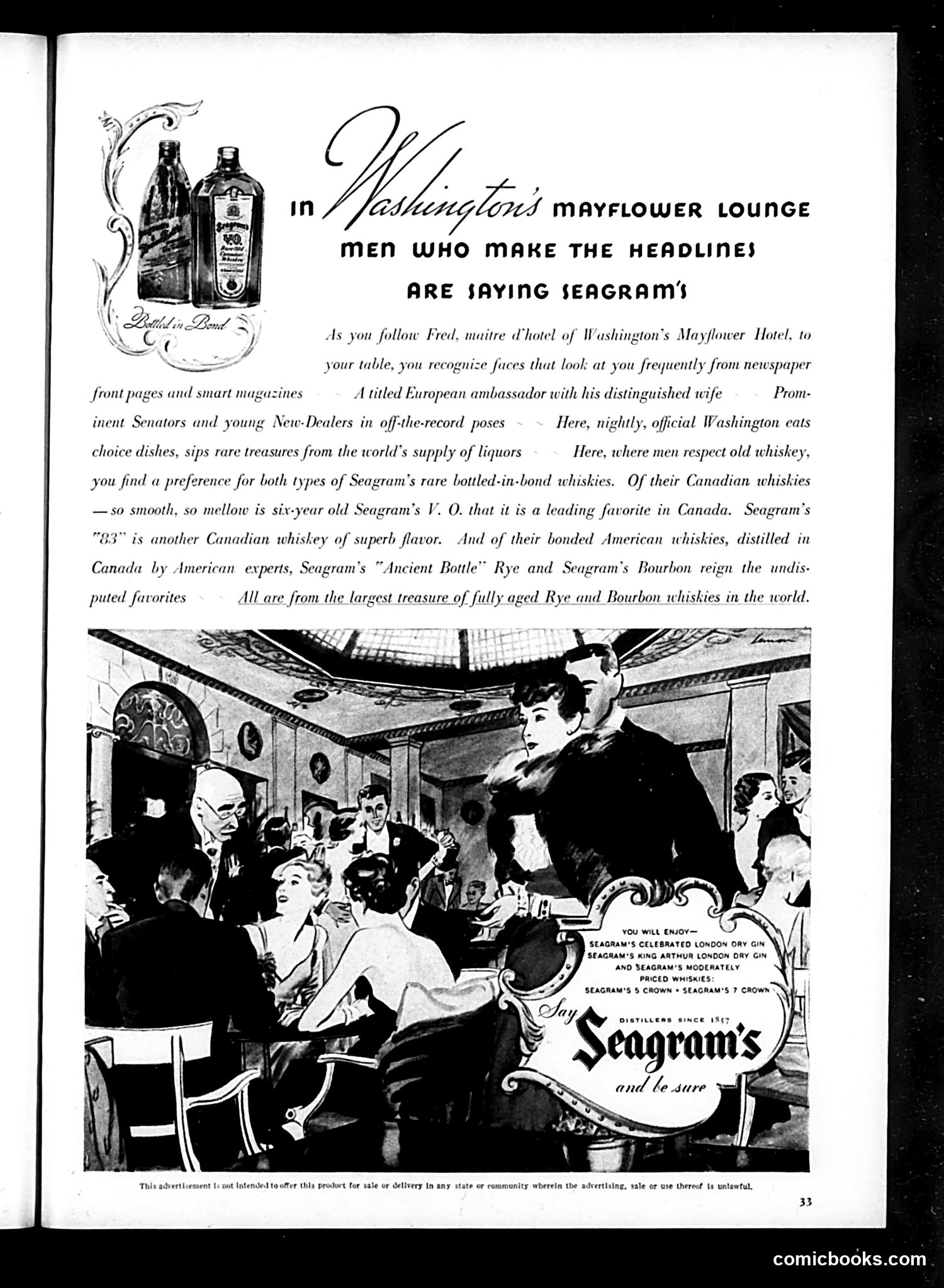
Advertisement Analysis This is a Seagram's whiskey advertisement, not political satire. It uses aspirational marketing to sell liquor by depicting Washington's elite social scene at the Mayflower Hotel's lounge. The ad references "men who make the headlines"—prominent Senators, diplomats, and "New-Dealers" (New Deal government officials from the Roosevelt era)—to suggest that important Washington figures drink Seagram's products. The copy emphasizes exclusivity and refinement: rare liquors, choice dishes, and a preference for quality whiskey among powerful men. The illustration shows well-dressed patrons in an upscale lounge setting, establishing social prestige through association. The ad promotes multiple Seagram's products: Canadian whiskeys (V.O., 83), American rye and bourbon, and gins. This represents mid-20th-century advertising strategy: attaching consumer products to wealth, power, and insider status to appeal to aspirational readers.
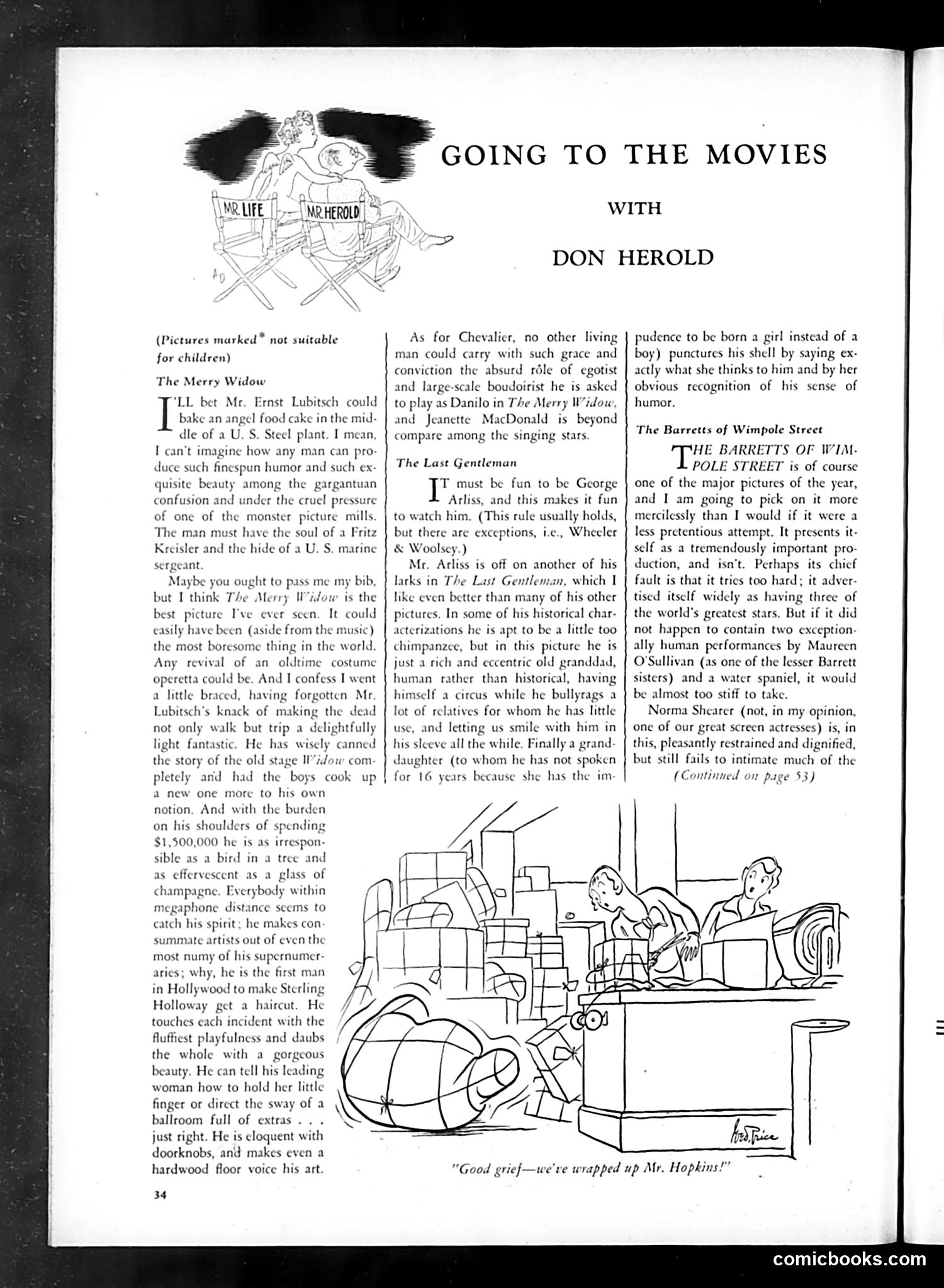
Analysis for Modern Readers This is a film review column by Don Herold in *Life* magazine, critiquing contemporary movies. The page discusses three 1934 films: "The Merry Widow" stars Maurice Chevalier and Jeanette MacDonald, directed by Ernst Lubitsch. Herold praises Lubitsch's ability to make operetta entertaining and Chevalier's charm. "The Last Gentleman" features George Arliss as an eccentric wealthy grandfather. Herold notes Arliss has a gift for making watching him enjoyable, even when playing historical figures. "The Barretts of Wimpole Street" stars Norma Shearer and Maureen O'Sullivan. Herold criticizes it as overly pretentious despite its famous cast, calling it "too stiff." He credits only O'Sullivan and a water spaniel with redeeming the film. The cartoon below illustrates a scene from "The Barretts," showing characters amid theatrical props. The column represents typical highbrow film criticism of Hollywood's "Golden Age."
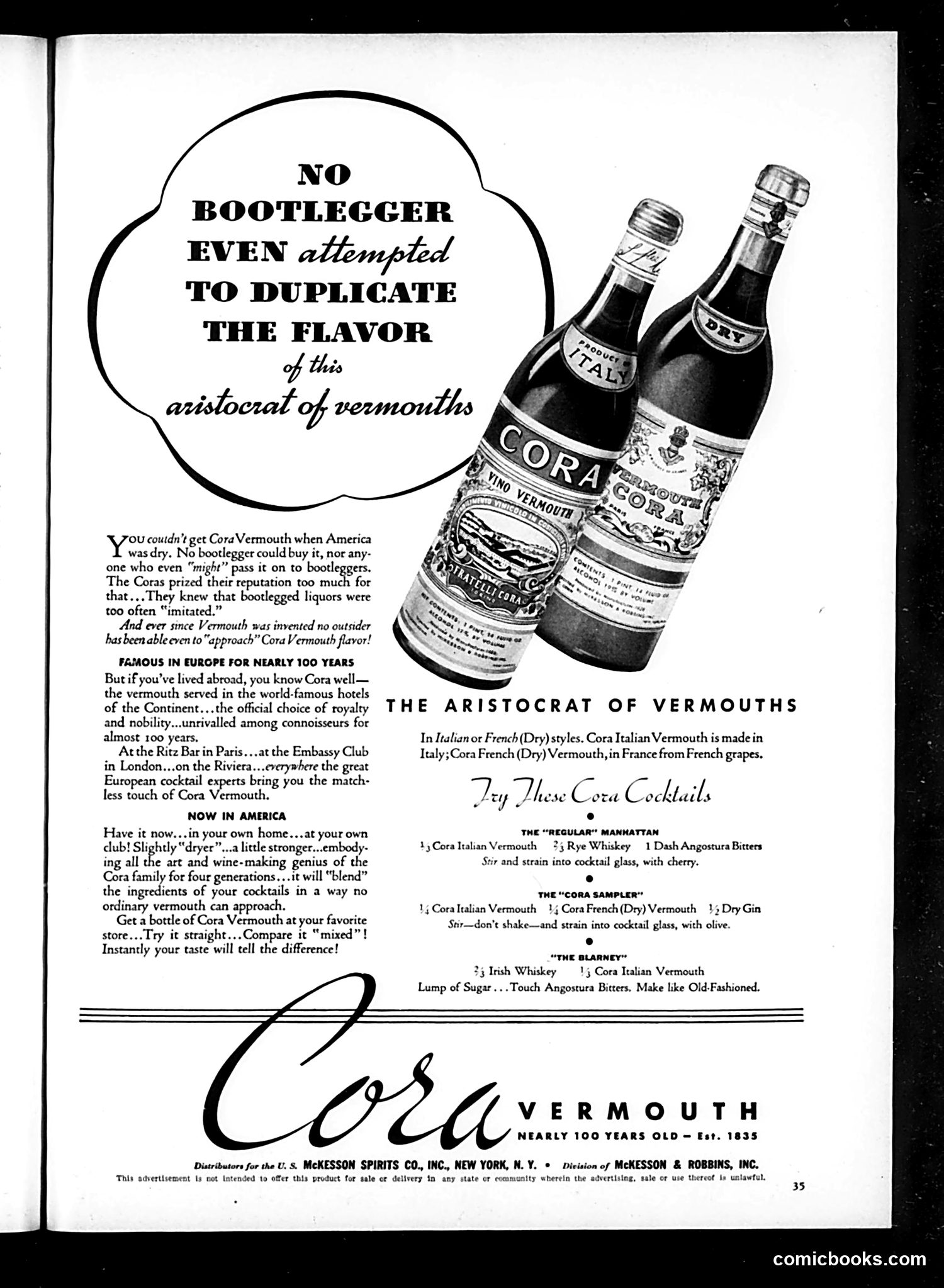
Cora Vermouth Advertisement (Prohibition-Era Reference) This is a liquor advertisement, not satire or political cartoon. It references Prohibition (1920-1933), when alcohol sales were illegal in America. The ad's main claim: unlike bootleg liquors during Prohibition, Cora Vermouth couldn't be counterfeited because bootleggers never obtained the original recipe to copy. The text emphasizes that "no bootlegger could buy it" and that imitation liquors were common and unreliable. The ad positions Cora as superior to American bootleg products by invoking its European prestige—served at Paris's Ritz Bar, the Embassy Club in London, and favored by European royalty for nearly 100 years. For modern readers: This leverages Prohibition's legacy (recently ended, likely 1933 or shortly after) to advertise legitimacy and quality. The implied message: we're so exclusive and valuable, even lawbreakers couldn't replicate us. Now that alcohol is legal again, you can finally buy the real thing at home.
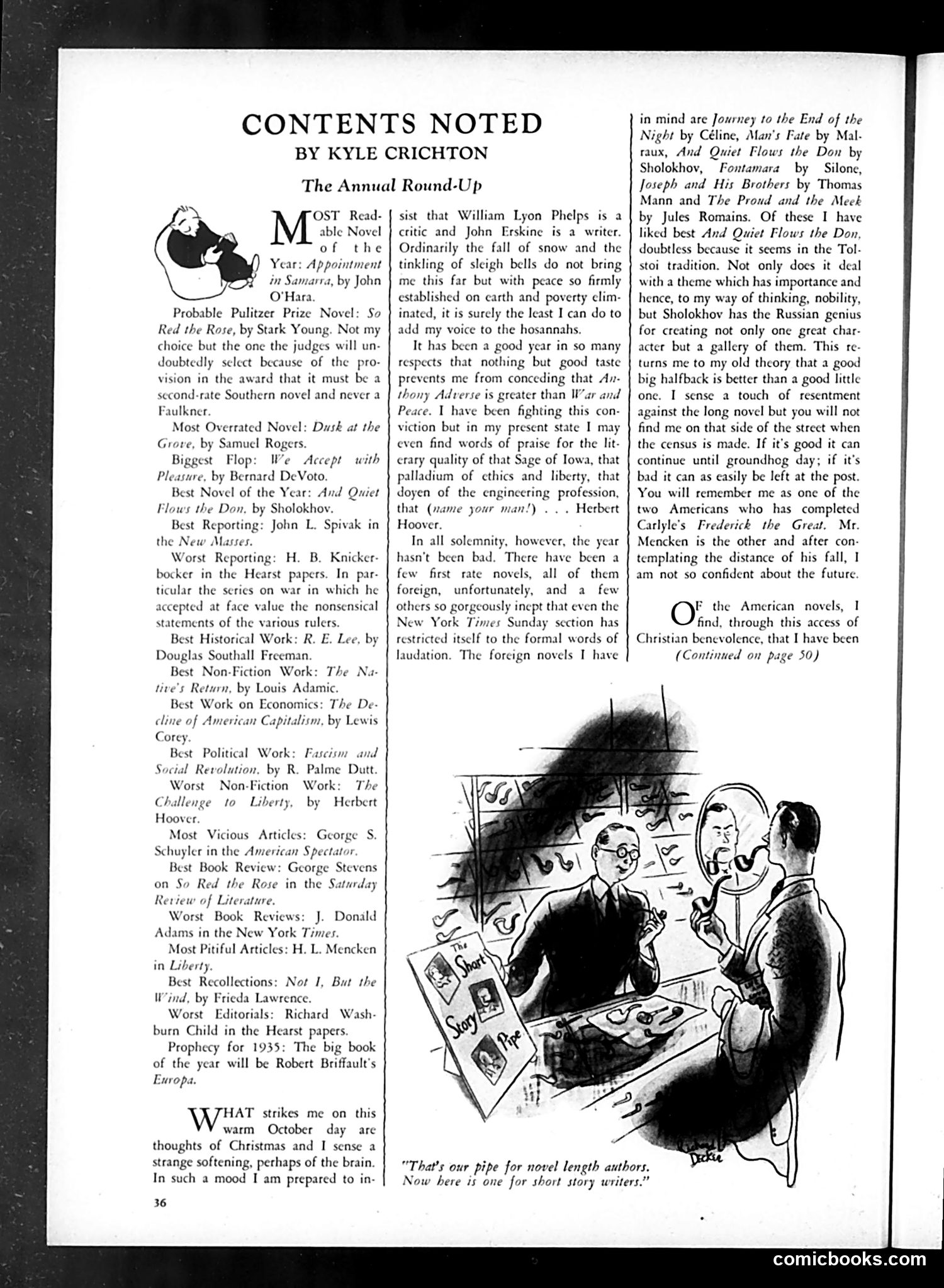
Analysis of This Life Magazine Page This is a book review roundup by Kyle Crichton from Life magazine's literary section. The cartoon illustrates the running joke: two men at a desk examine manuscripts, with one saying "That's our pipe for novel length authors. Now here is one for short story writers"—showing a comically tiny pipe beside a normal one. The humor mocks the magazine's editorial bias toward publishing novels over short stories, suggesting short-story writers get minimal space or attention. The cartoon's specific figures appear to be generic editors or publishers rather than caricatures of identifiable people. Crichton's text employs sardonic wit throughout, mock-praising figures like Herbert Hoover while genuinely championing Russian and European novels (Sholokhov, Céline, Malraux, Mann). His dismissal of H.B. Knickerbocker's Hearst reporting as accepting "nonsensical statements of various rulers" reflects 1930s press criticism. The overall tone—cynical yet playful—captures Life magazine's satirical approach to American letters and politics during the Depression era.
Analysis This appears to be an advertisement or promotional page for White Rock Water, a bottled water brand. The visual shows a bottle and bottle cap labeled "WHITE ROCK WATER." The headline "Good Cheer... on the alkaline side" is a marketing pitch emphasizing that White Rock Water is alkaline—a health claim that was apparently significant to early-to-mid 20th century consumers. The term "alkaline" references the water's pH level; alkaline products were marketed as health-promoting during this era. This is commercial advertising rather than political satire. It's a straightforward product promotion leveraging contemporary beliefs about alkaline water's health benefits to encourage consumers to purchase the brand.
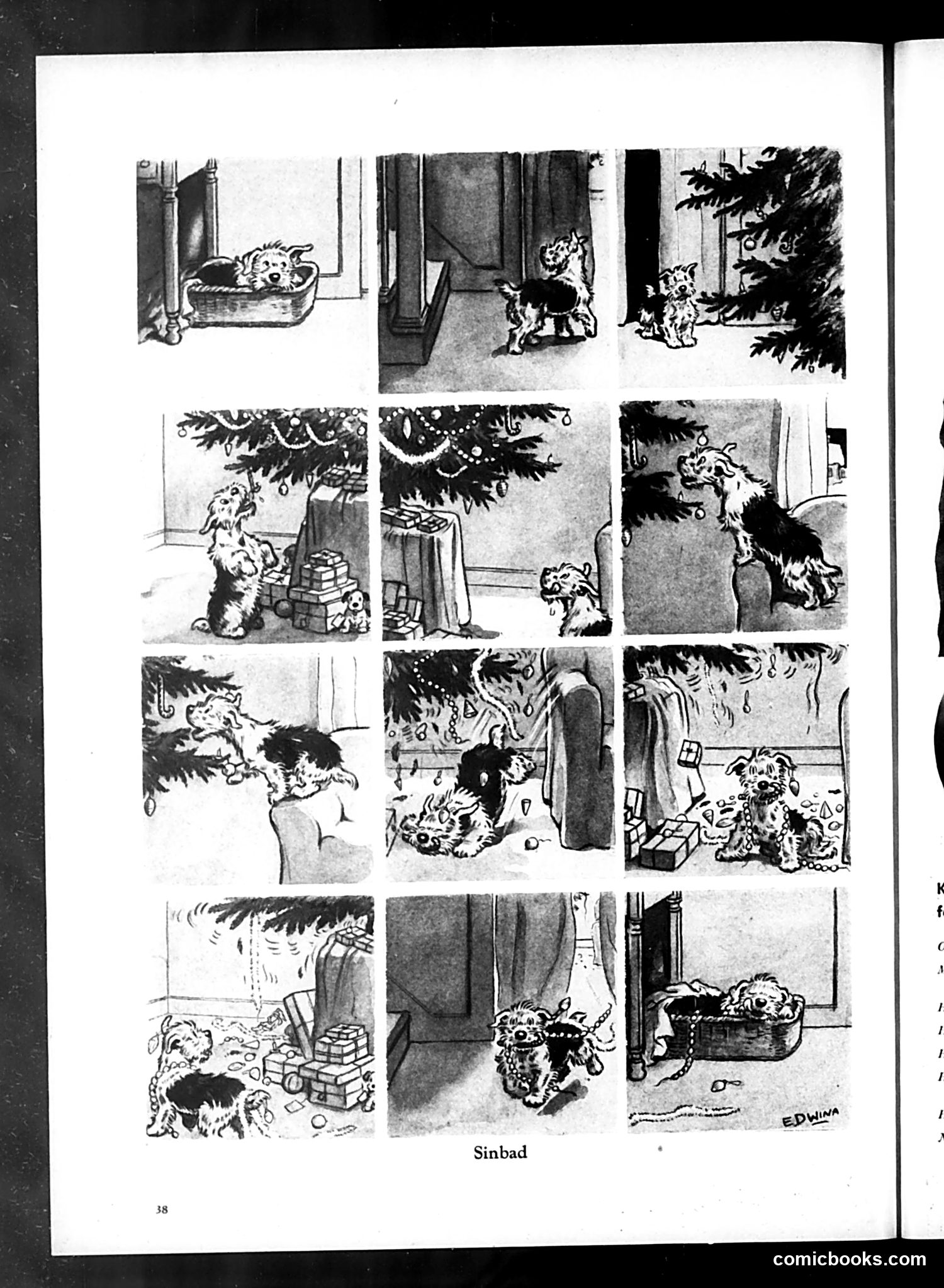
"Sinbad" Comic Strip Analysis This is a multi-panel comic strip titled "Sinbad" (signed by Edlina), depicting what appears to be a domestic Christmas scene. The narrative follows a small, shaggy dog encountering a decorated Christmas tree and wrapped presents throughout a home. The humor is visual and physical rather than political—the dog's interactions with holiday decorations and gifts drive the comedy. In early panels, the dog discovers the tree and presents; subsequent panels show escalating chaos as the animal investigates, plays with, and disrupts the holiday setup, scattering ornaments and gift wrapping. This represents typical early-to-mid 20th-century family comic strip humor, relying on relatable domestic situations and animal antics rather than satire or political commentary. The strip's appeal would be to general audiences enjoying lighthearted holiday humor.
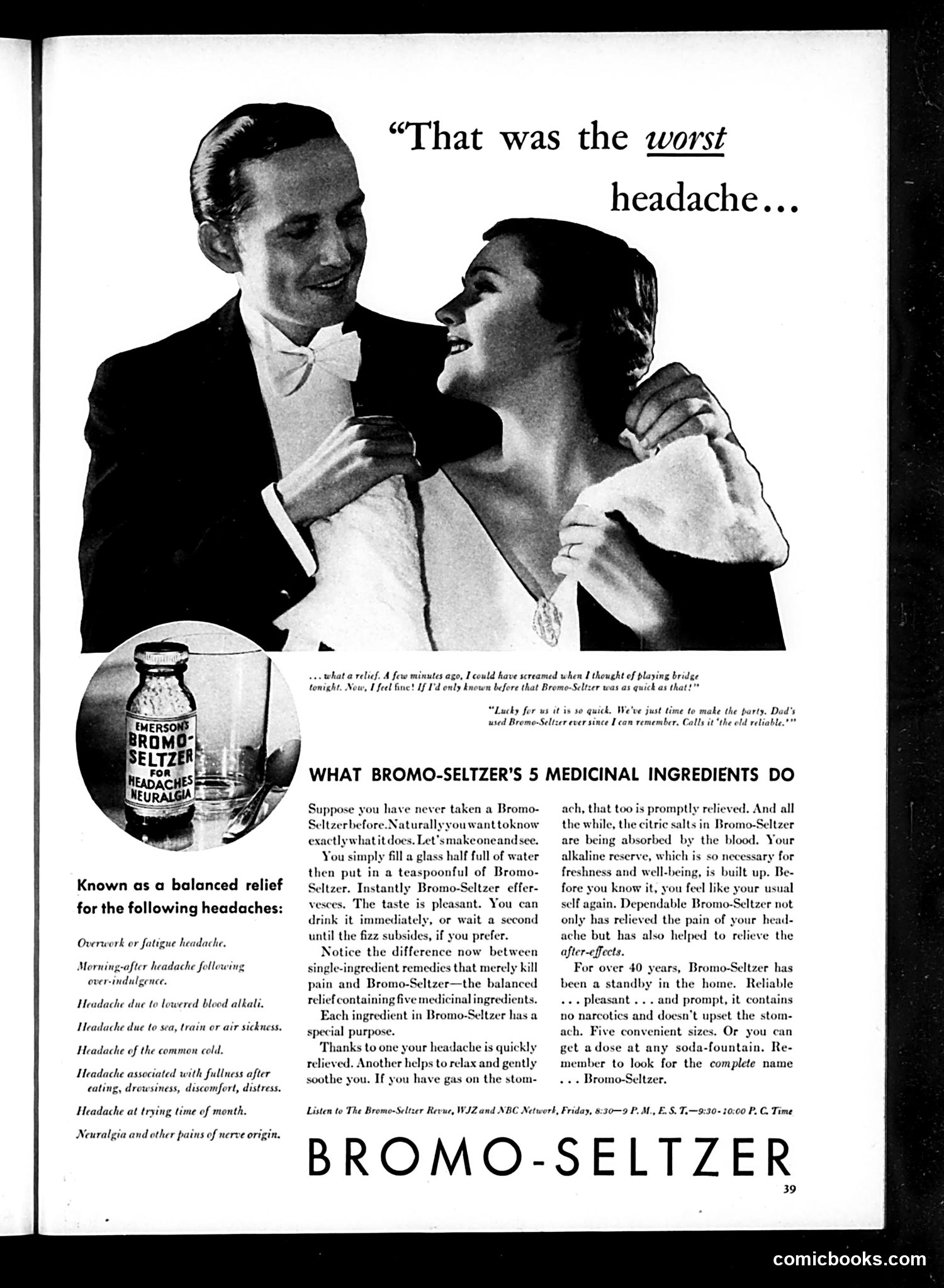
Bromo-Seltzer Advertisement Analysis This is a straightforward product advertisement, not satire or political commentary. It promotes Bromo-Seltzer, an antacid/pain-relief effervescent powder popular in the early-to-mid 20th century. The image shows a couple at an evening event; the woman expresses relief that her severe headache has been quickly resolved by the product, allowing her to attend a party. The accompanying text explains the product's "five medicinal ingredients" and lists conditions it treats—from hangovers ("morning-after headache following over-indulgence") to menstrual discomfort ("headache at trying time of month"). The ad emphasizes the product's reliability, speed, and safety (no narcotics). It also promotes the brand's radio show (*The Bromo-Seltzer Revue*), indicating this was a nationally distributed advertisement. There is no political message or satirical intent—this is period marketing copy reflecting early pharmaceutical advertising conventions.
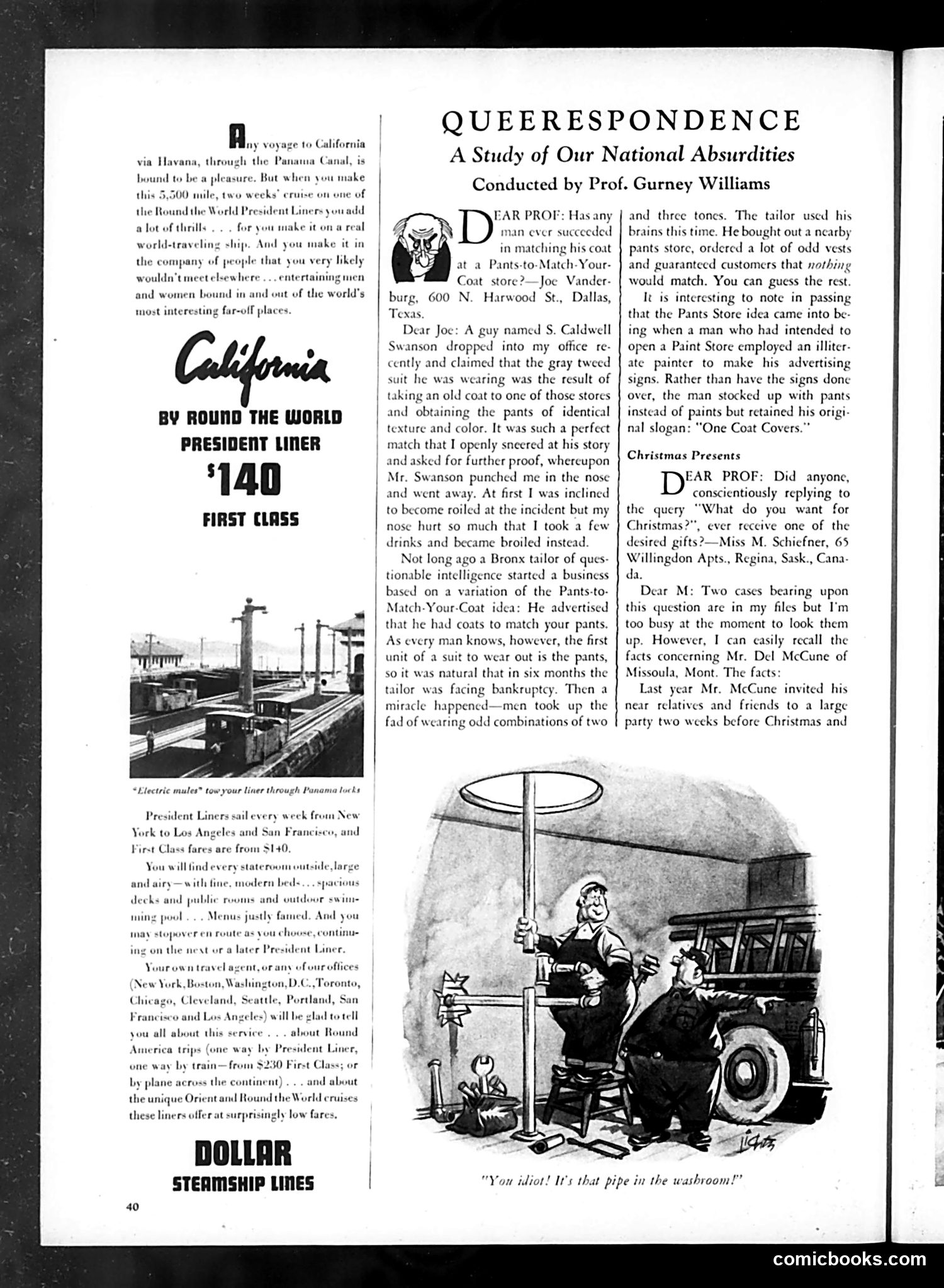
Explanation for Modern Readers This Life magazine page contains two main sections: Left side: A cruise-ship advertisement for President Liners offering California voyages at $140 first class. Right side: "Queerespondence," a humor column by Prof. Gurney Williams satirizing American absurdities through reader questions and replies. The cartoon at bottom depicts a man holding an umbrella while sitting in a car during a rainstorm, with the caption "You idiot! It's that pipe in the washroom!" The joke appears to be physical/slapstick humor about someone confused about the source of a problem. The column's three responses mock American consumer culture: (1) a pants-matching store whose owner got punched when his claim proved dubious; (2) a tailor's accidental success selling mismatched clothing combinations; (3) the cynical observation that people never actually receive desired Christmas gifts. The satire targets ordinary American life—retail failures, advertising mishaps, and consumer disappointment—rather than political targets. The humor is gentle, domestic, and observational.
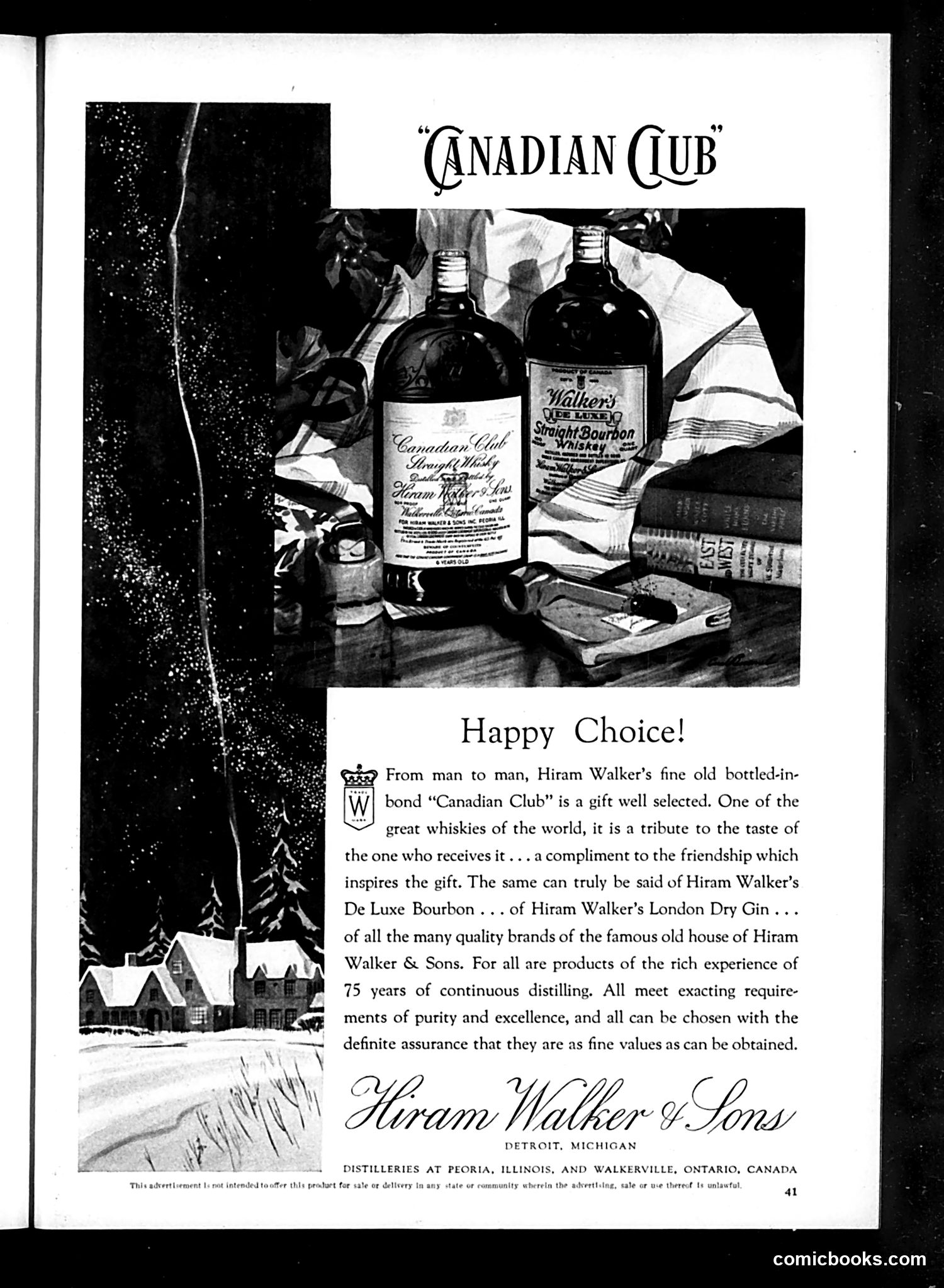
Analysis This is not a political cartoon or satire—it's a straightforward whiskey advertisement from Hiram Walker & Sons, a major distiller with facilities in the US and Canada. The page promotes "Canadian Club" whiskey as an appropriate gift "from man to man," emphasizing quality and friendship. The ad also mentions the company's other spirits: De Luxe Bourbon and London Dry Gin, all products of "75 years of continuous distilling." The small winter scene illustration (lower left) and the photograph of bottles with books and a cigar suggest masculine sophistication and refined taste—typical marketing imagery for premium spirits of the era. The disclaimer at the bottom acknowledges Prohibition-era restrictions on alcohol advertising and sales, which varied by state and locality. This ad ran during or shortly after Prohibition (1920-1933), when such advertising had to be carefully worded to comply with varying legal restrictions.
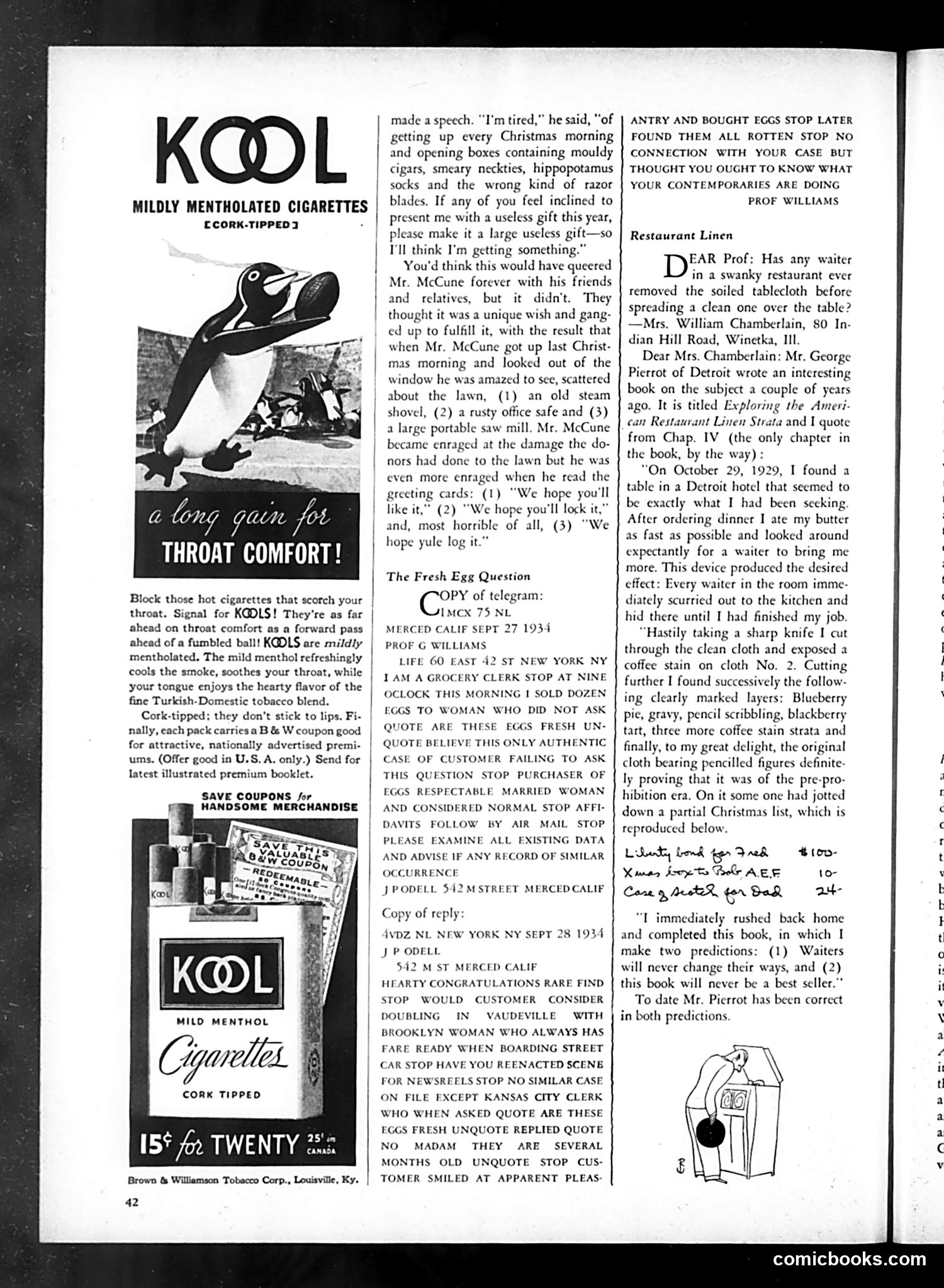
Life Magazine Page Analysis This page contains advertisements and humorous reader correspondence rather than political cartoons. The Kool cigarettes ad (top left) uses a penguin mascot to promote menthol cigarettes as soothing to the throat—typical 1930s tobacco advertising before health warnings. The main humor pieces are satirical reader letters to "Prof. Williams": 1. "The Fresh Egg Question" mocks the ubiquitous customer inquiry "Are these eggs fresh?" by presenting a telegram treating one grocery clerk's encounter with a customer who *didn't* ask this question as a rare, newsworthy occurrence. The reply includes a similar anecdote about a Kansas City clerk who answered "No, several months old"—suggesting customers never actually listen to answers. 2. "Restaurant Linen" appears to satirize whether fancy restaurants ever remove dirty tablecloths before laying clean ones atop them, implying slovenly practices in upscale dining. These are gentle, observational satires about everyday consumer absurdities and etiquette failures—typical Life magazine humor of the era.
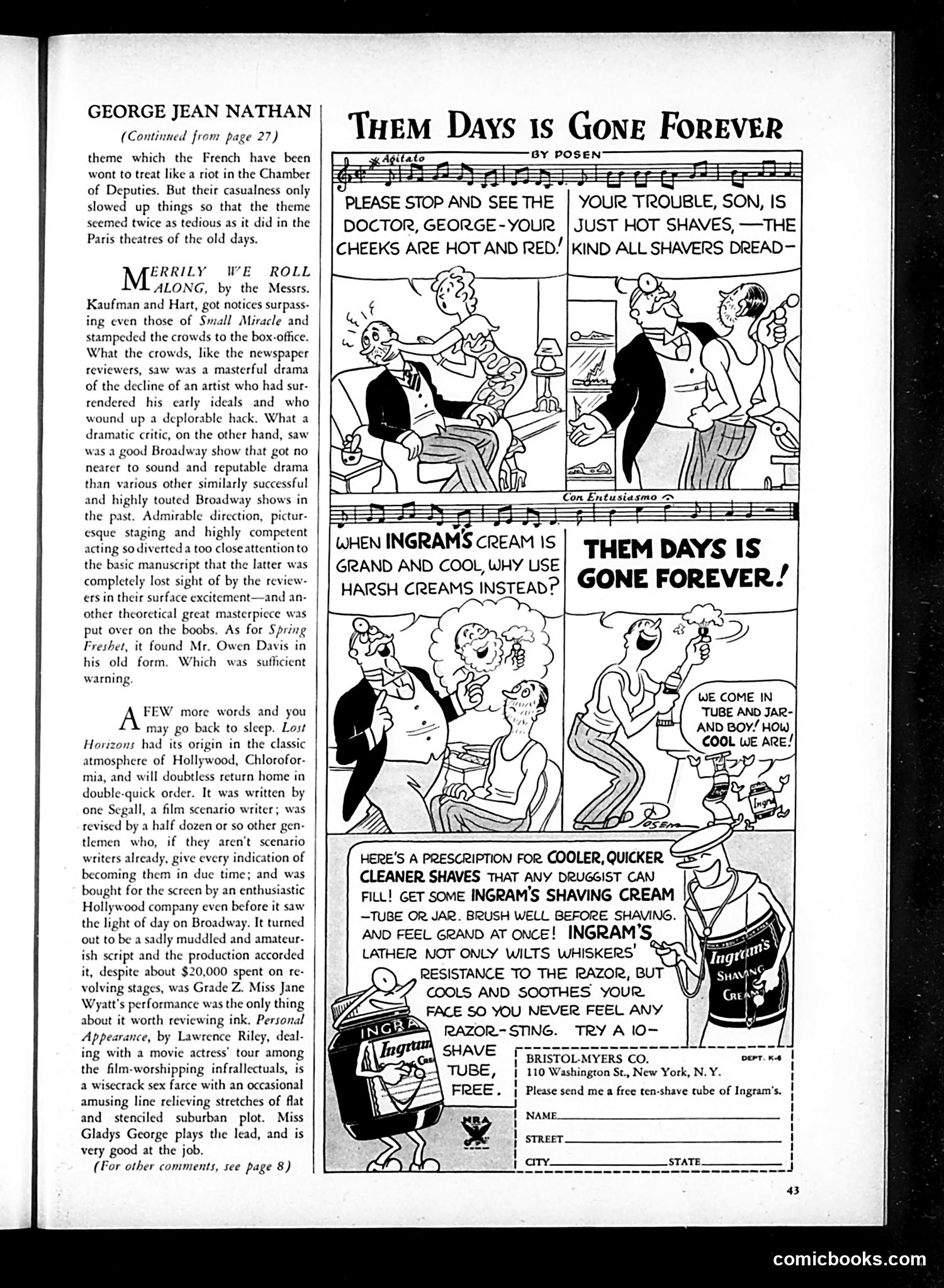
Analysis for Modern Readers This page combines theater criticism with vintage advertising. The top half critiques Broadway shows by George Jean Nathan, a prominent drama critic. He dismisses several productions—including "Merrily We Roll Along"—as technically impressive but dramatically hollow, arguing directors and actors distract audiences from weak scripts. The lower half is a full-page advertisement for Ingram's Shaving Cream disguised as comic strips. The cartoon panels humorously contrast Ingram's "grand and cool" cream with competitors' "harsh" alternatives, using exaggerated characters (a doctor, barber, and enthusiastic consumers) to pitch the product's benefits: it won't cause "razor-sting" and comes in convenient tube or jar formats. This represents 1930s-40s advertising strategy: embedding product pitches in entertainment content to bypass consumer skepticism. The "free sample" coupon at bottom was standard direct-response marketing of the era.
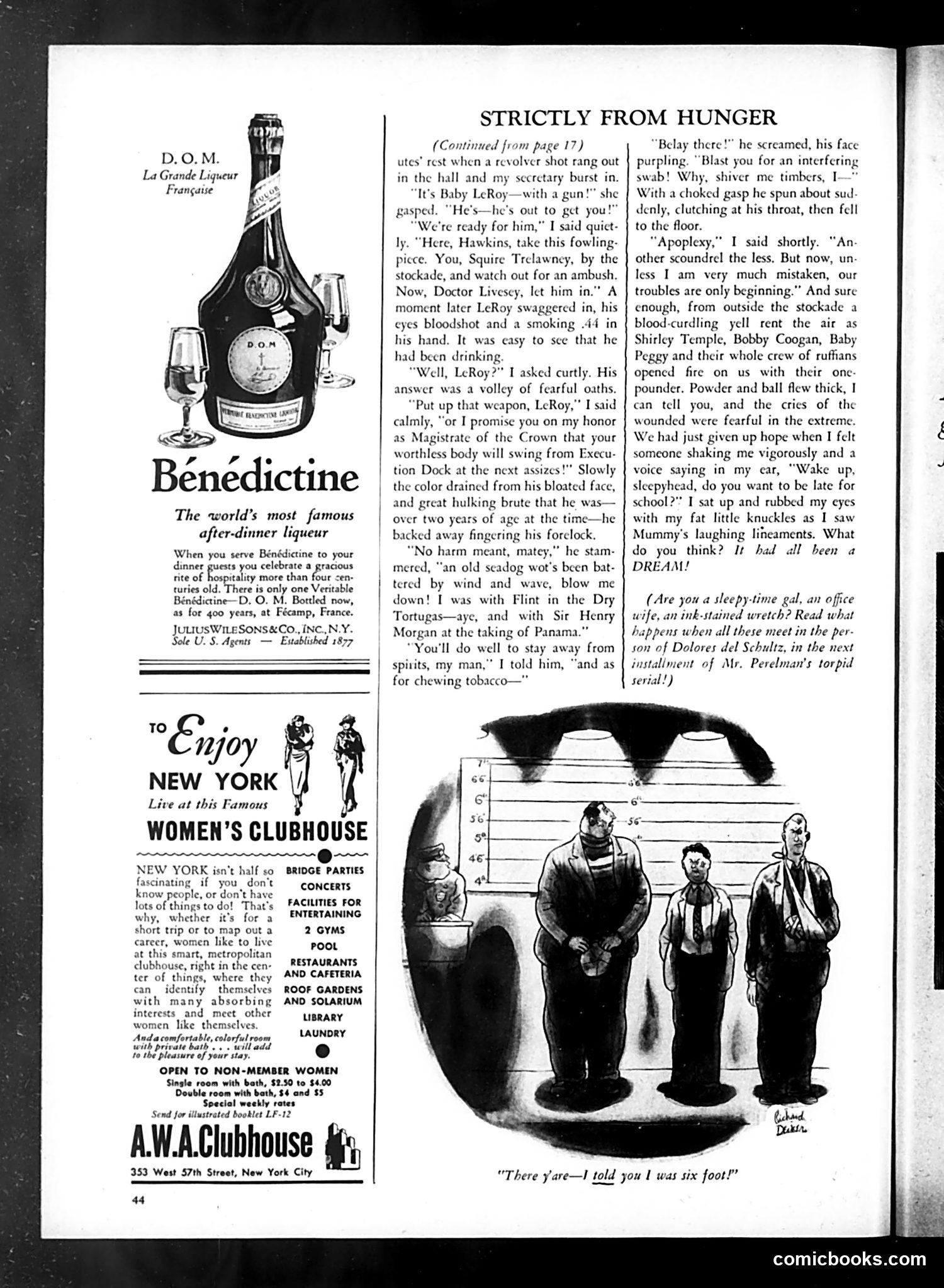
Analysis of This Life Magazine Page This page combines a fiction excerpt with period advertising. The main text, "Strictly from Hunger," is a humorous parody of adventure novels (particularly *Treasure Island*). The narrator absurdly inserts child actor Baby LeRoy into a swashbuckling pirate tale, mixing literary clichés with anachronistic modern references (Shirley Temple, Bobby Coogan). The joke culminates in revealing it's all a dream—mocking overwrought adventure fantasies. The accompanying cartoon depicts three men against a height-measurement chart with the caption "There y'are—I told you I was six foot!" This appears to satirize male vanity about height, a common masculine insecurity. The advertisements promote Bénédictine liqueur, a women's clubhouse in New York offering respectable accommodation and social activities, and the magazine itself. These ads target the magazine's audience: educated, urban readers with disposable income. The page exemplifies *Life*'s satirical approach: literary parody combined with social humor about contemporary manners.
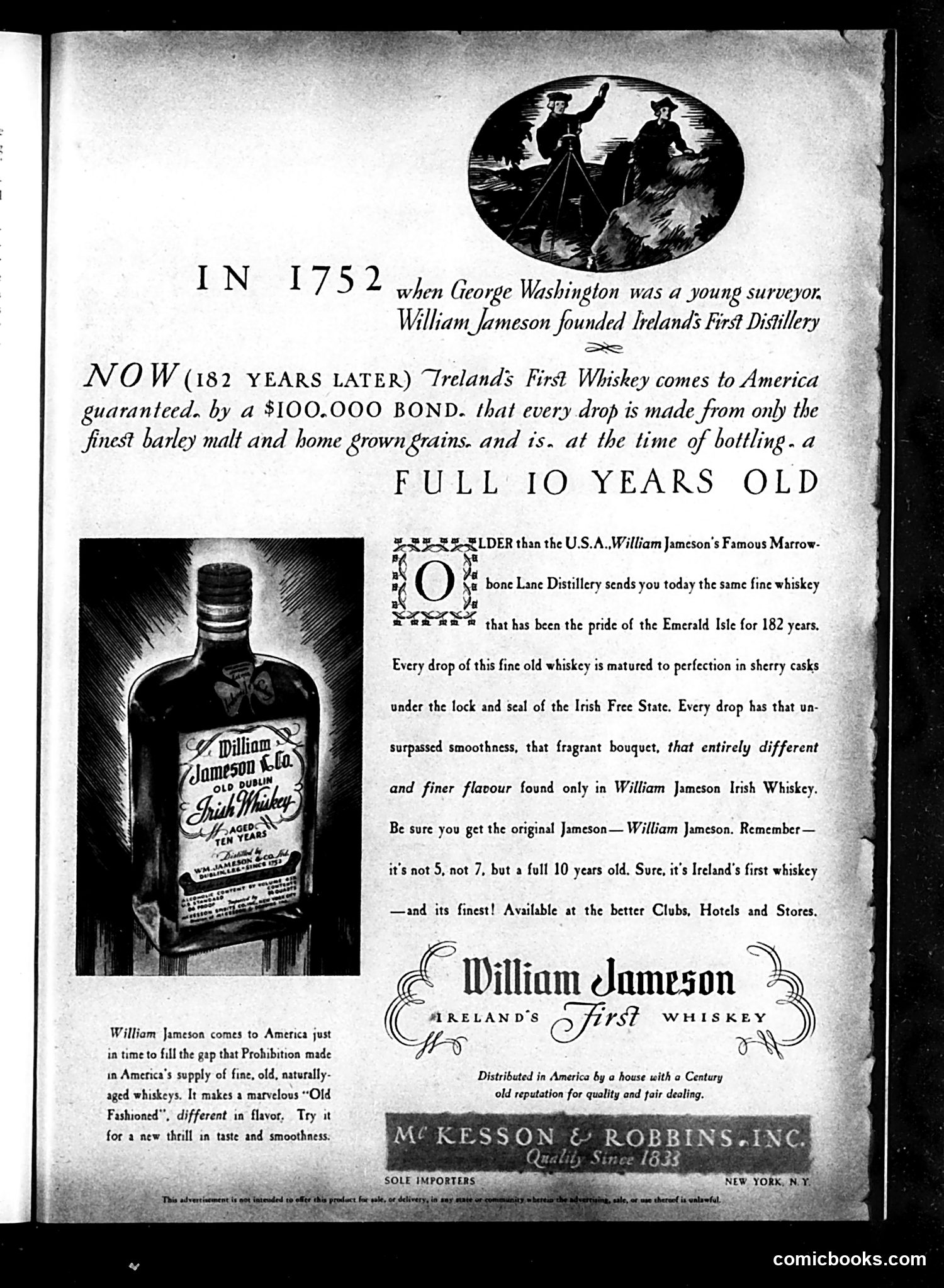
Analysis This is primarily a whiskey advertisement, not satirical content. It's a William Jameson Irish Whiskey ad capitalizing on the end of Prohibition (which ended in 1933). The ad uses historical framing to establish legitimacy: it notes that William Jameson founded Ireland's first distillery in 1752—the same year George Washington was a young surveyor—creating a parallel between American and Irish heritage. The "182 years later" hook emphasizes the product's age and authenticity. The advertisement directly addresses Prohibition's aftermath, stating Jameson "comes to America just in time to fill the gap that Prohibition made in America's supply of fine, old, naturally-aged whiskeys." It emphasizes the whiskey is "a full 10 years old" and backed by a $100,000 bond guaranteeing quality. The product imagery and text stress purity, Irish Free State certification, and exclusivity ("better Clubs, Hotels and Stores"), positioning it as a premium import for American consumers newly able to purchase alcohol legally.
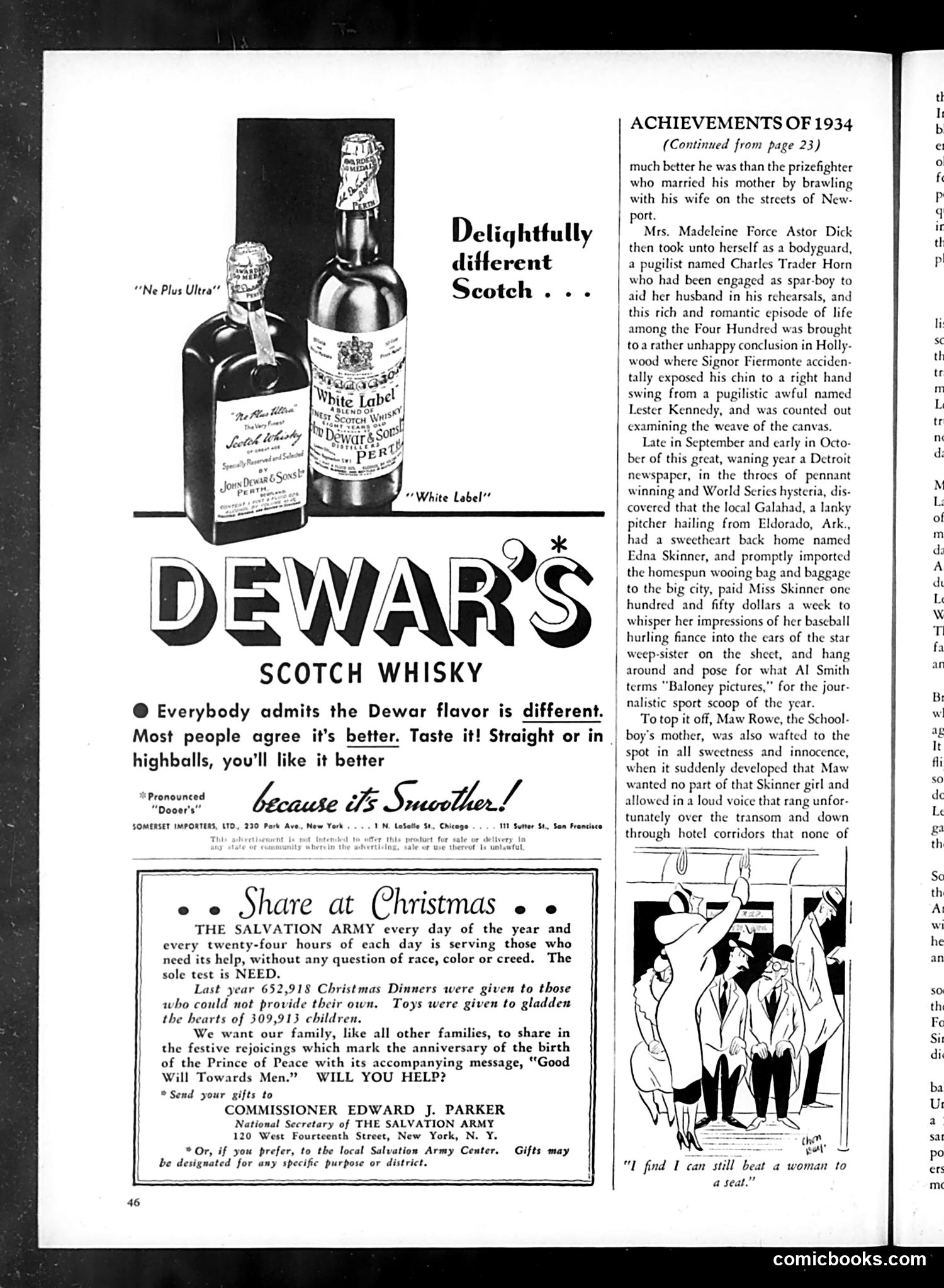
Analysis of Page 46 from Life Magazine This page combines three distinct elements: a Dewar's Scotch whisky advertisement, a Salvation Army charitable appeal, and a gossip column excerpt titled "Achievements of 1934." The Dewar's ad uses straightforward marketing ("Everybody admits the Dewar flavor is different"), typical of 1930s liquor advertising. The Salvation Army notice appeals for Christmas donations to feed the poor, referencing specific 1934 statistics (652,918 dinners served). This reflects Depression-era charitable work. The "Achievements" column appears to be satirical society gossip mocking wealthy and celebrity figures—including references to Mrs. Astor's entanglements with boxers and a Detroit baseball player's domestic drama. The final cartoon caption ("I find I can still beat a woman to a seat") depicts a man rushing to grab a streetcar seat before a woman, satirizing masculine rudeness or competitiveness. The juxtaposition of luxury advertising, charity appeals, and gossip about the wealthy creates an implicit social commentary on class disparities during the Depression era.
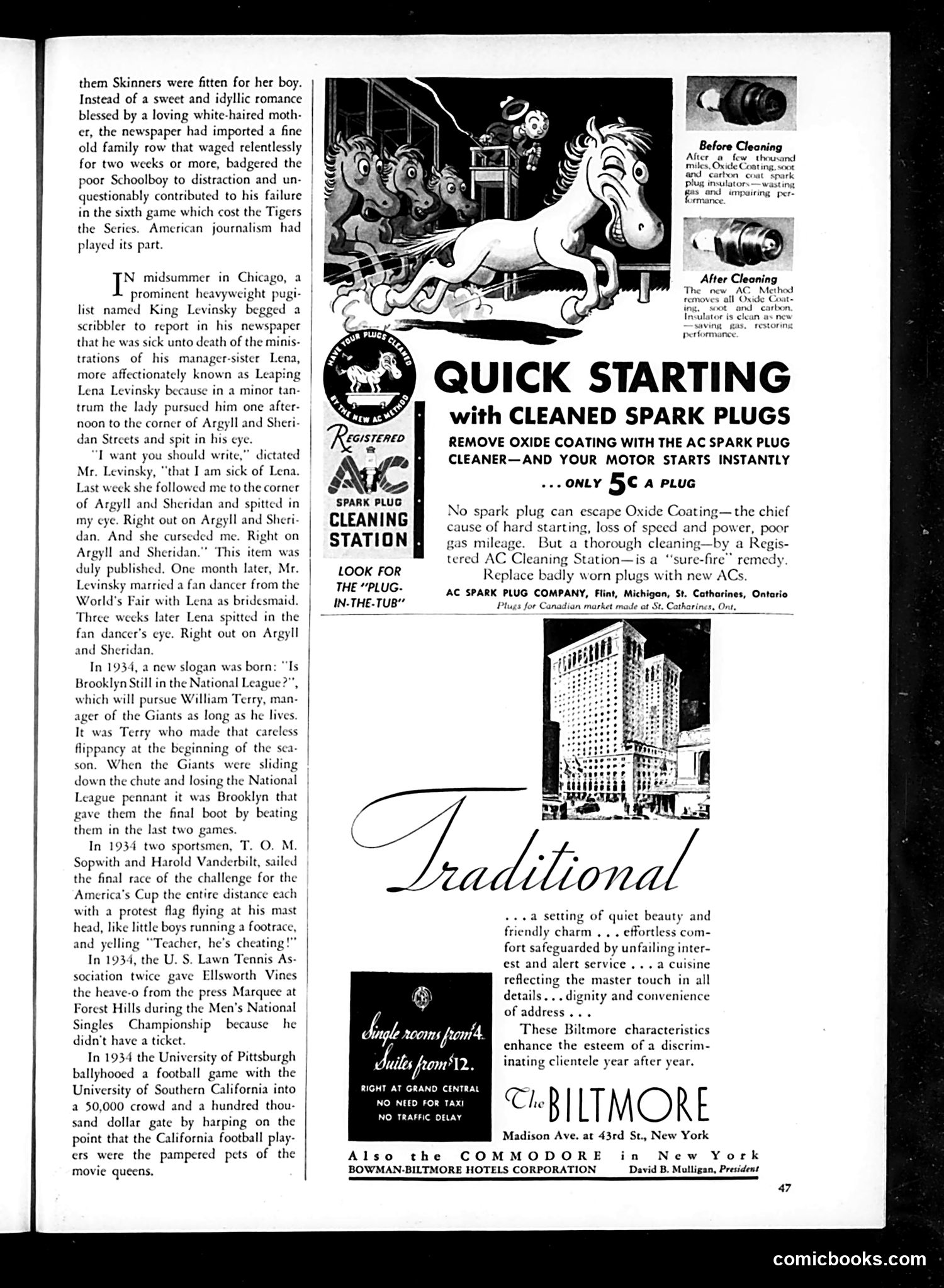
Analysis for Modern Readers This page mixes editorial content with advertisements. The main text criticizes 1934 sports journalism for sensationalism that distracted athletes and undermined their performance. The anecdotes illustrate the problem: King Levinsky's manager-sister publicly feuded with him (she allegedly spat in his eye), yet he reconciled with her; Brooklyn baseball fans mocked Giants manager William Terry for a careless comment; and yacht racers and tennis officials engaged in petty disputes—all amplified by press coverage that prioritized drama over sportsmanship. The satire targets American journalism's appetite for conflict, arguing that newspaper sensationalism damaged athletes' focus and competitive ability. The cartoonish central illustration of a horse bucking wildly likely symbolizes chaos created by media intrusion into sports. The remainder consists of advertisements: AC spark plugs, the Biltmore hotel, and the Commodore—typical mid-1930s commercial content common to *Life* magazine.
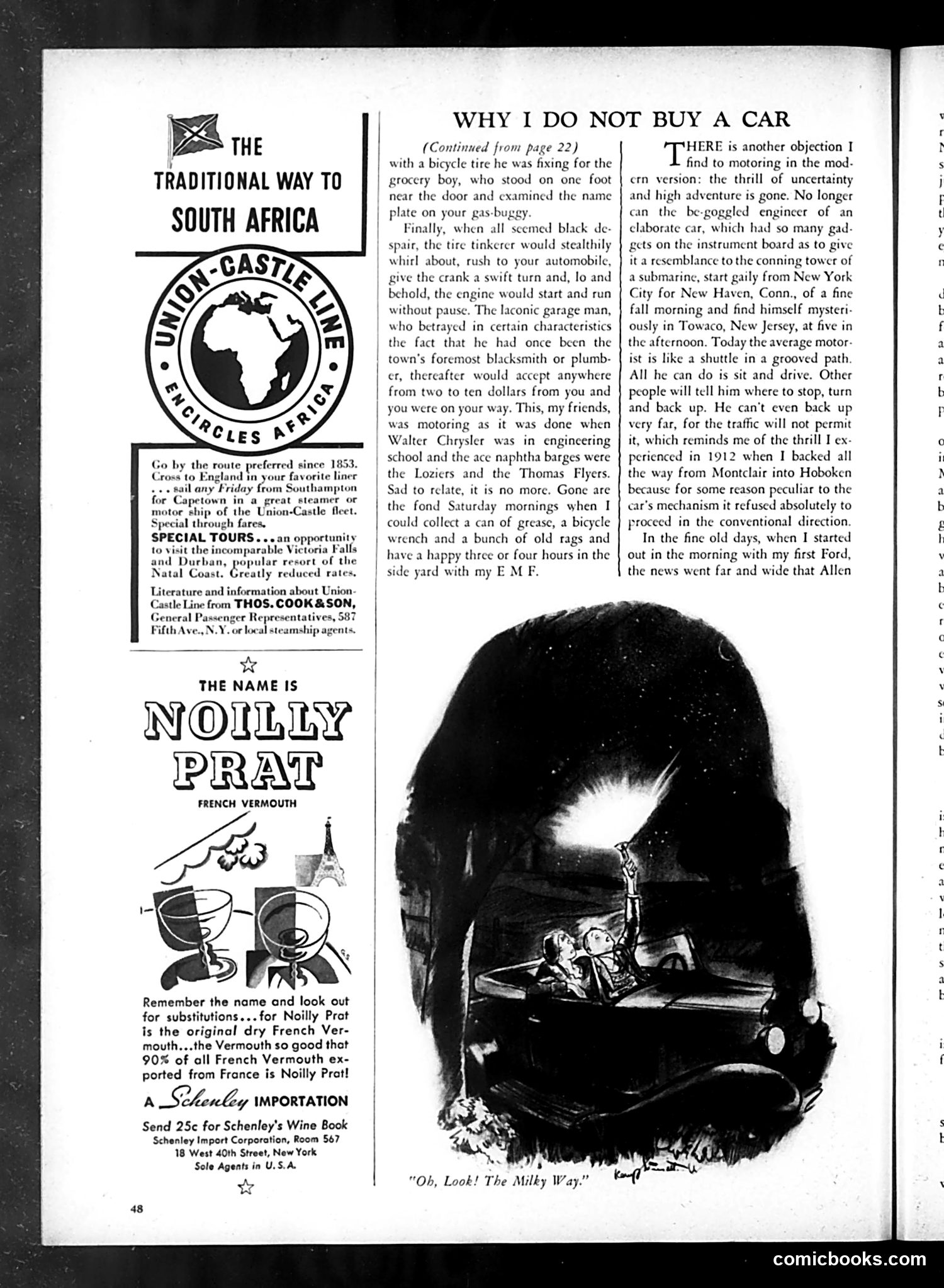
Analysis of Page 48 This page contains primarily advertisements rather than political cartoons, though it includes one small illustrated joke at bottom right ("Oh, Look! The Milky Way"). The main text is a humorous essay titled "Why I Do Not Buy a Car" (continued from page 22). The author—apparently named Allen—nostalgically contrasts early automobile ownership with modern motoring. In the old days (early 1900s), cars were unreliable adventures requiring resourceful problem-solving; the author recalls a 1912 Ford that only ran in reverse. Modern cars, by contrast, are predictable and controlled—"like a shuttle in a grooved path"—removing all romance and uncertainty from driving. The advertisements include travel promotions to South Africa, Noilly Prat French vermouth, and Schenley wine importation—typical period marketing. The small cartoon shows a car interior viewed through a tunnel, captioned "Oh, Look! The Milky Way"—likely a visual gag about the car's interior resembling an astronomical observation tunnel.
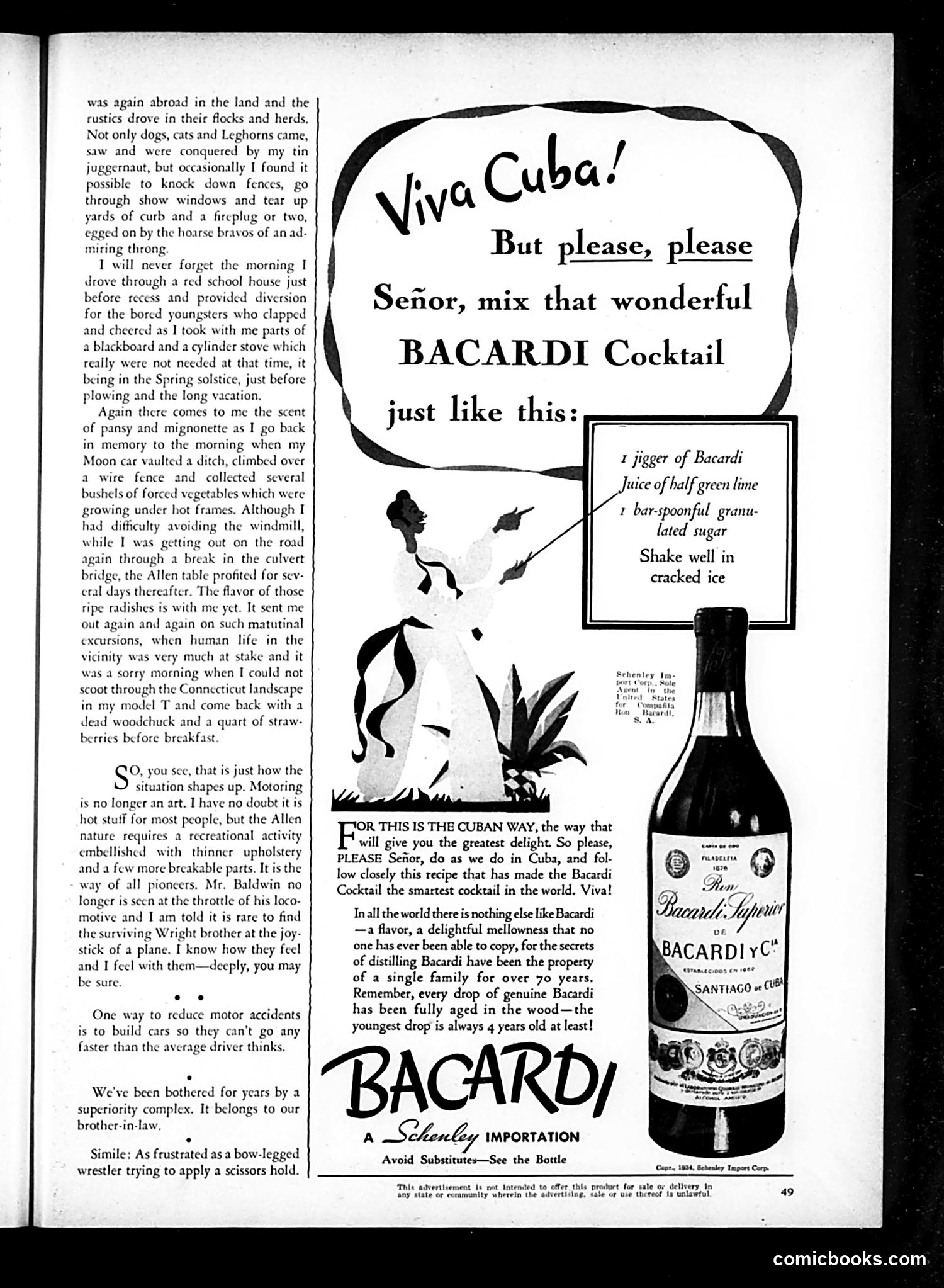
Bacardi Advertisement in Life Magazine This page is primarily a Bacardi rum advertisement, not editorial content or political satire. The ad uses a "Viva Cuba!" theme to market the cocktail by invoking Cuban authenticity and tradition. The left side contains unrelated editorial text about early automobiles (Model T, Wright brothers references), discussing motoring as recreation. The advertisement itself features: - A cartoon figure with a bottle of Bacardi rum - A recipe box for a Bacardi Cocktail (jigger of rum, lime juice, sugar) - Marketing copy emphasizing the drink's "Cuban way" preparation and family heritage (70+ years of distilling) Historical context for modern readers: The "Viva Cuba!" framing exploits American fascination with Cuba as an exotic, desirable destination in the 1930s, before the 1959 revolution. The emphasis on family secrets and aged quality reflects luxury brand positioning of the era. The ad appeared when rum cocktails were gaining popularity in American culture.
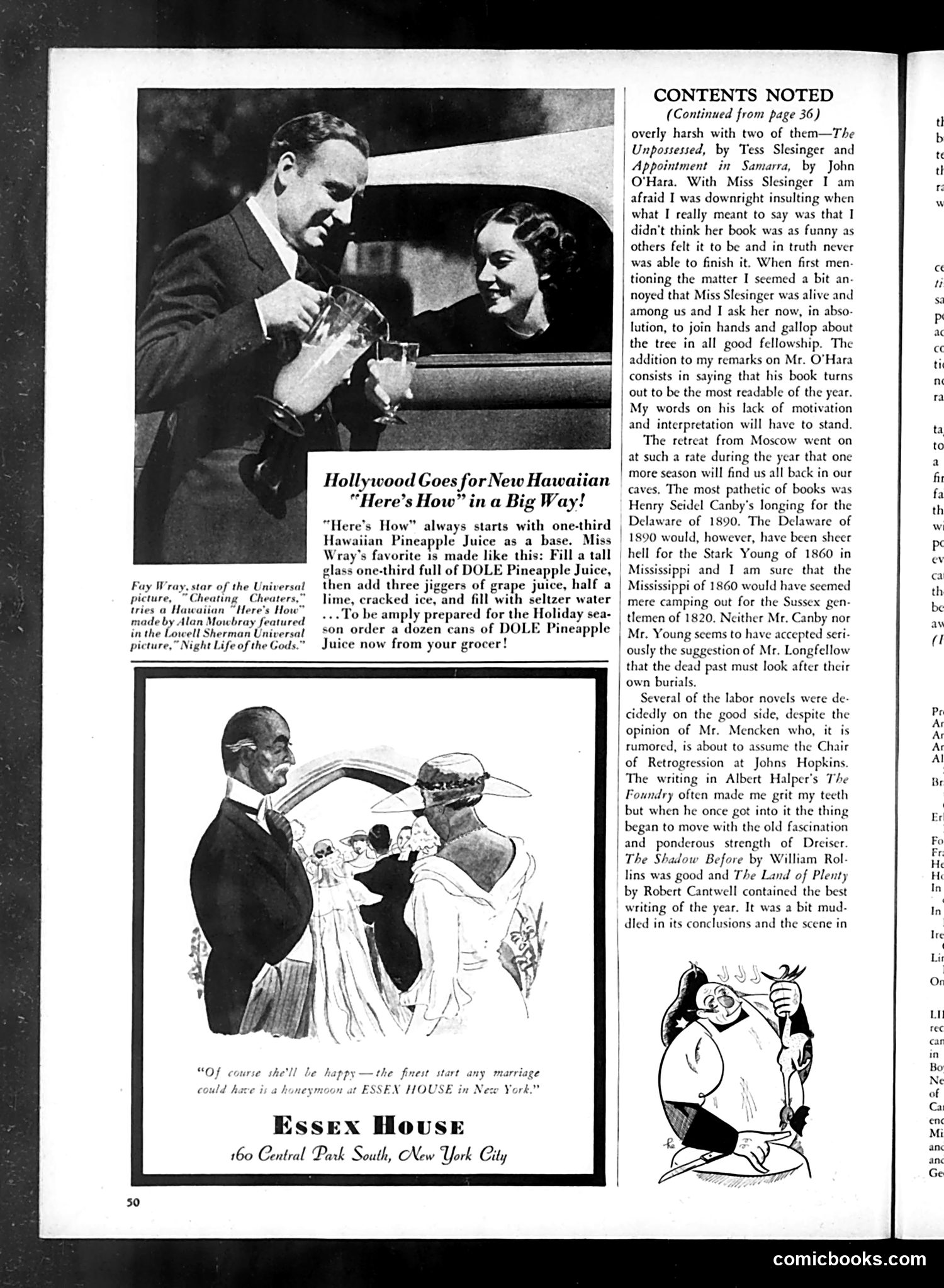
Analysis This page contains a book review column ("Contents Noted") alongside advertisements—not political cartoons. The review discusses 1930s literary works, including praise for labor novels and criticism of historical fiction. The reviewer apologizes to author Tess Slesinger for harsh earlier remarks, and praises John O'Hara's "Appointment in Samarra" as "the most readable of the year." The advertisements feature: 1. "Here's How" - promoting a Hawaiian cocktail recipe using Dole Pineapple Juice, featuring actress Fay Wray 2. Essex House - a New York hotel, with period illustration of a couple The cartoon illustration at bottom (showing a couple) is merely decorative advertising copy for the Essex House, with a marriage/honeymoon caption. No political satire or caricature appears on this page. It's a standard magazine layout mixing literary criticism with commercial advertising typical of Life magazine's era.
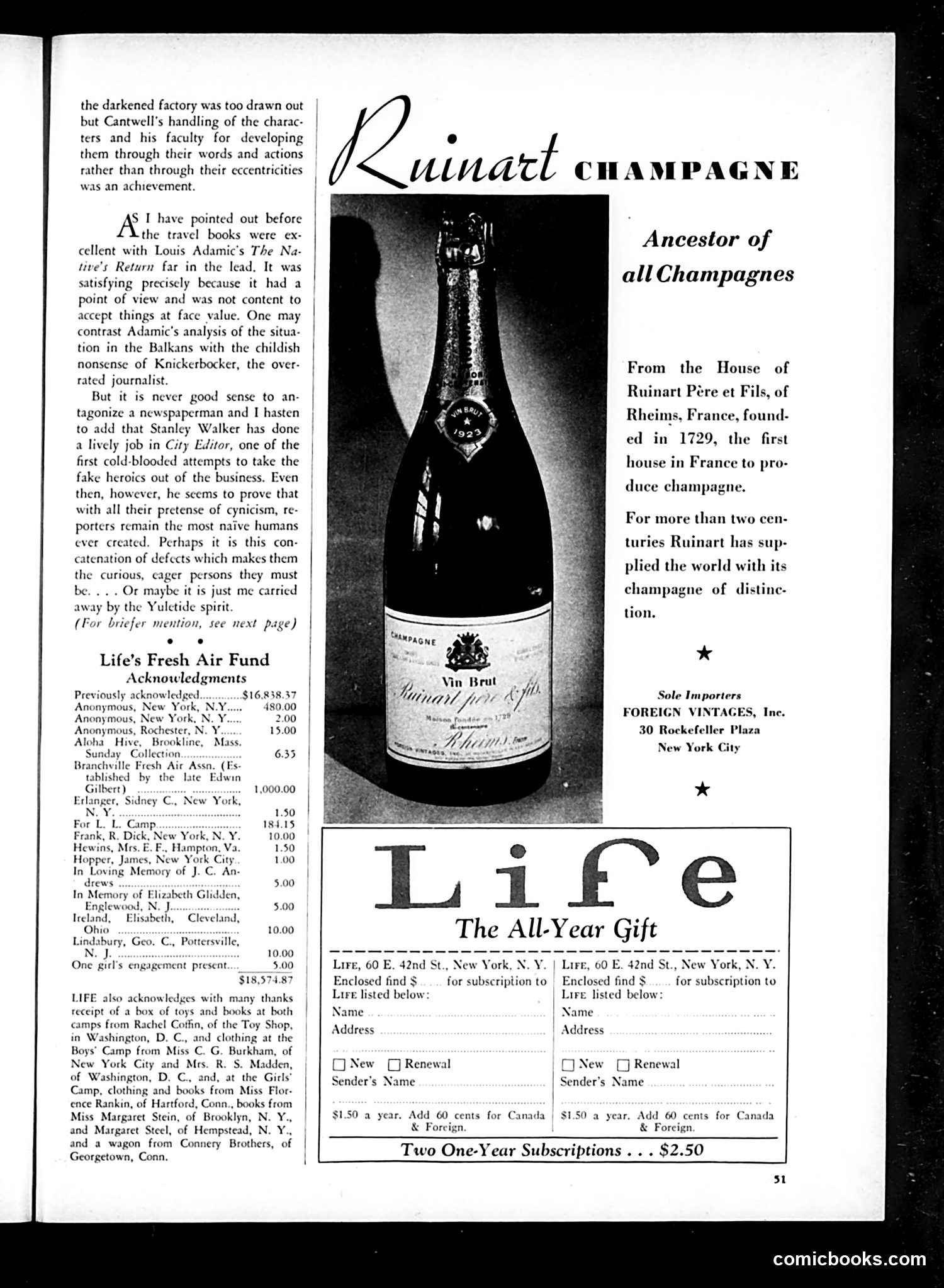
Page Analysis: Life Magazine, circa 1930s This page is primarily advertising and administrative content, not a political cartoon. The main content includes: 1. Book reviews (top left): Literary criticism of works by Louis Adamic, Knickerbocker, and Stanley Walker's *City Editor*—praising honest journalism over sensationalism. 2. Life's Fresh Air Fund acknowledgments: A charity drive listing donors who contributed to camps for underprivileged children in Washington D.C. and elsewhere. This was a genuine philanthropic initiative by *Life* magazine. 3. Advertisement: The right side features Ruinart Champagne, claiming to be the "ancestor of all Champagnes" from Rheims, France (founded 1729), with sole importers listed as Foreign Vintages, Inc. 4. Subscription offers (bottom): Two subscription cards for *Life* magazine itself at $1.50/year. There is no political satire or cartoon on this page—it's a typical magazine layout mixing editorial content, charitable fundraising, luxury advertising, and subscription promotion.
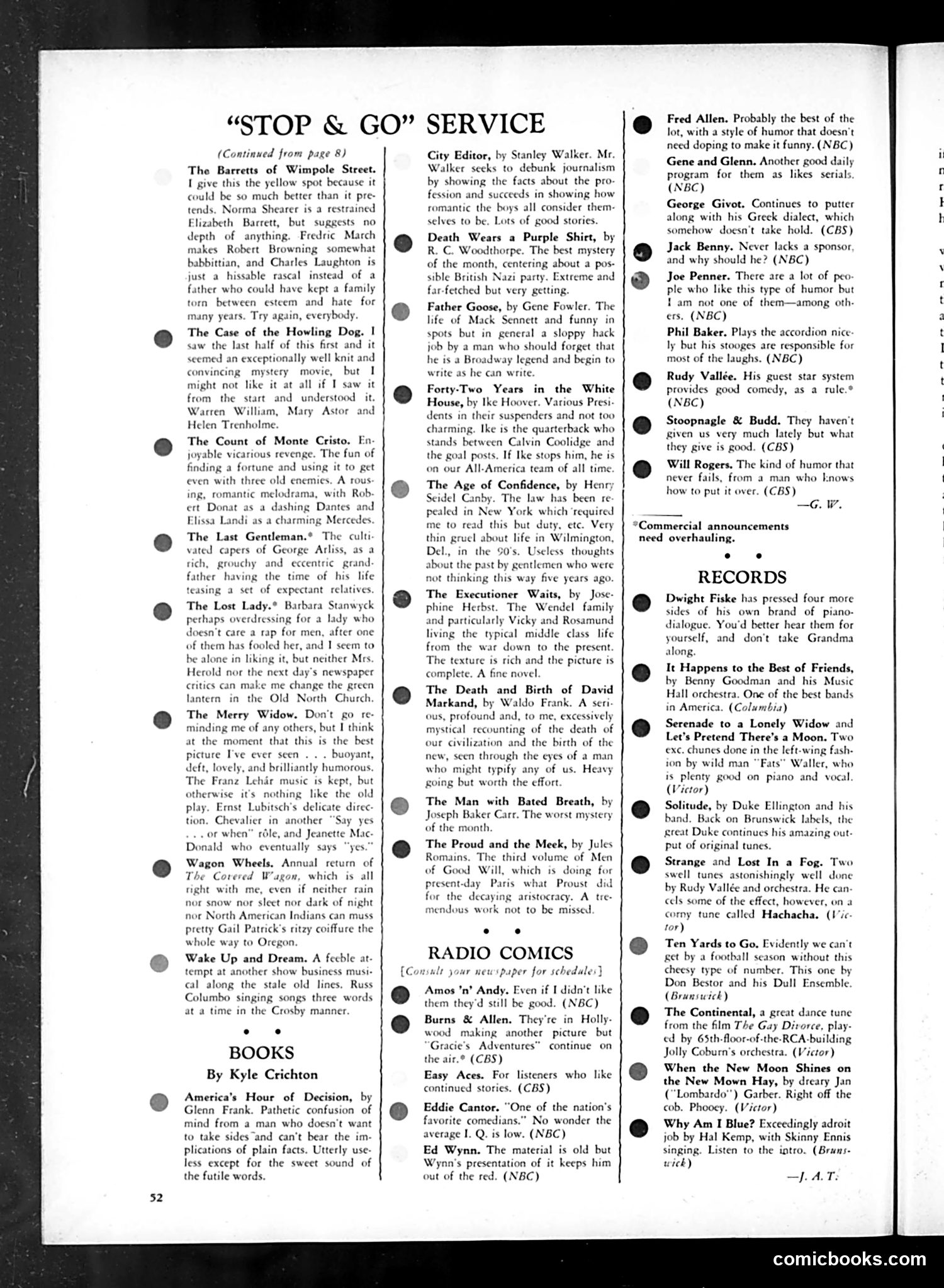
"Stop & Go" Service: A 1930s Entertainment Review This page contains film and book reviews from Life magazine's entertainment section, likely from the mid-1930s. The "Stop & Go" metaphor organizes critiques of recent movies and books, with reviewers assessing their quality. Film Reviews highlight contemporary productions: *The Merry Widow* receives highest praise as "the best picture I've ever seen," while *The Barretts of Wimpole Street* disappoints despite its cast (Norma Shearer, Fredric March, Charles Laughton). Reviews mention *The Case of the Howling Dog* and *Wagon Wheels*, showing typical Hollywood output of the era. Book Section by Kyle Crichton critiques recent publications, including political analysis (*America's Hour of Decision*), memoirs (*Forty-Two Years in the White House*), and mysteries. The tone is witty and occasionally caustic—dismissing some works while praising others for entertainment value or insight. The reviews assume readers familiar with contemporary film stars and publishing trends, reflecting Life's educated, middle-class audience interested in cultural commentary and entertainment guidance.
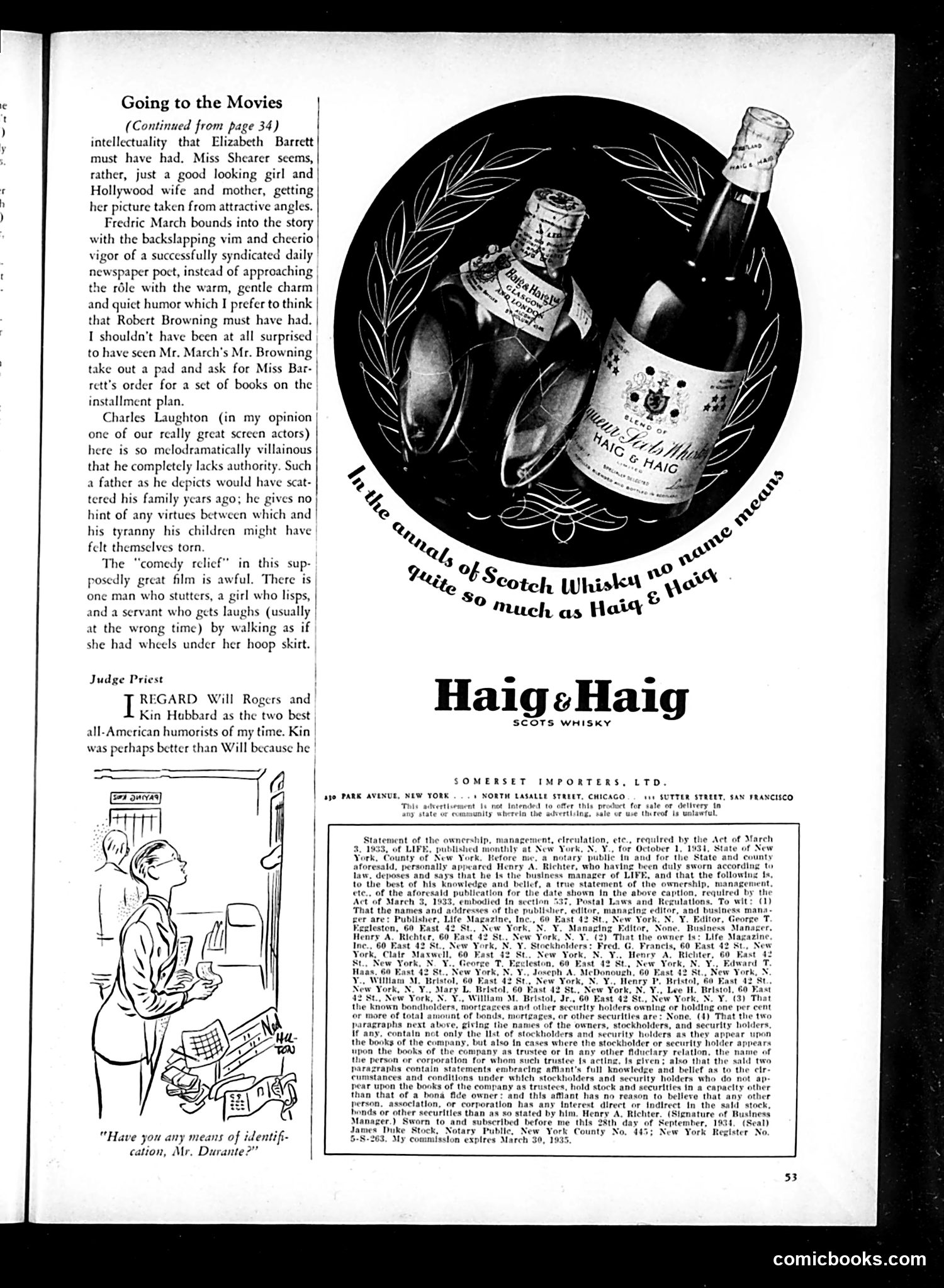
Page 53: Life Magazine - Film Criticism and Whisky Advertisement This page contains two distinct elements: Left side: A continuation of film criticism discussing recent movies. The critic dismisses the performances in what appears to be a literary adaptation, faulting actors Elizabeth Barrett (Norma Shearer), Fredric March, and Charles Laughton for lacking depth and authenticity. The critic praises Will Rogers and Kin Hubbard as superior American humorists, with a cartoon showing someone asking "Have you any means of identification, Mr. Durante?"—likely referencing comedian Jimmy Durante. Right side: A full-page advertisement for Haig & Haig Scotch Whisky, featuring an illustrated bottle and glass within a laurel wreath. The copy reads: "In the untold of Scotch Whisky no name quite so much as Haig & Haig means." This is standard 1930s liquor advertising, predating Prohibition's repeal regulations. The page exemplifies Life's dual nature as both satirical commentary and commercial publication.
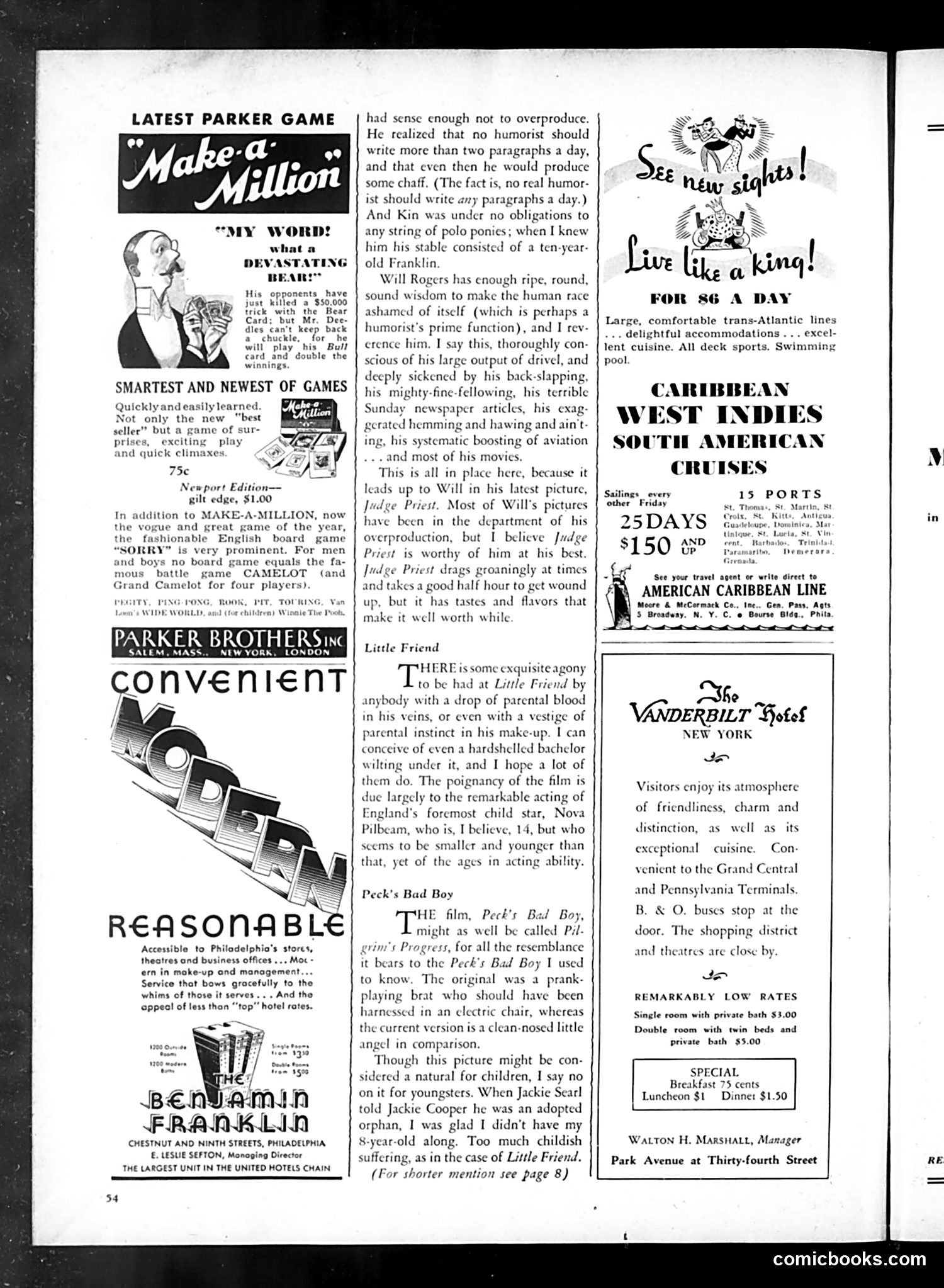
Analysis for Modern Readers This page mixes game advertising with film reviews. The "Make-a-Million" board game advertisement (top left) promotes Parker Brothers games using dated slang ("My word!") and depicts a wealthy gentleman pleased by his financial maneuvering—reflecting 1930s entertainment around stock-market themes. The main content reviews three films: Judge Priest (starring Will Rogers), Little Friend (featuring child star Nova Pilbeam), and Peck's Bad Boy. The reviewer criticizes Rogers's prolific output and "back-slapping" persona while praising this particular film. He praises Pilbeam's acting but warns parents that both *Little Friend* and *Peck's Bad Boy* contain disturbing content for children—specifically scenes of child suffering and adoption trauma that would upset young viewers. The remaining space contains hotel and cruise-line advertisements typical of period magazines. The tone assumes readers understand contemporary entertainment figures and early-sound-era cinema conventions.
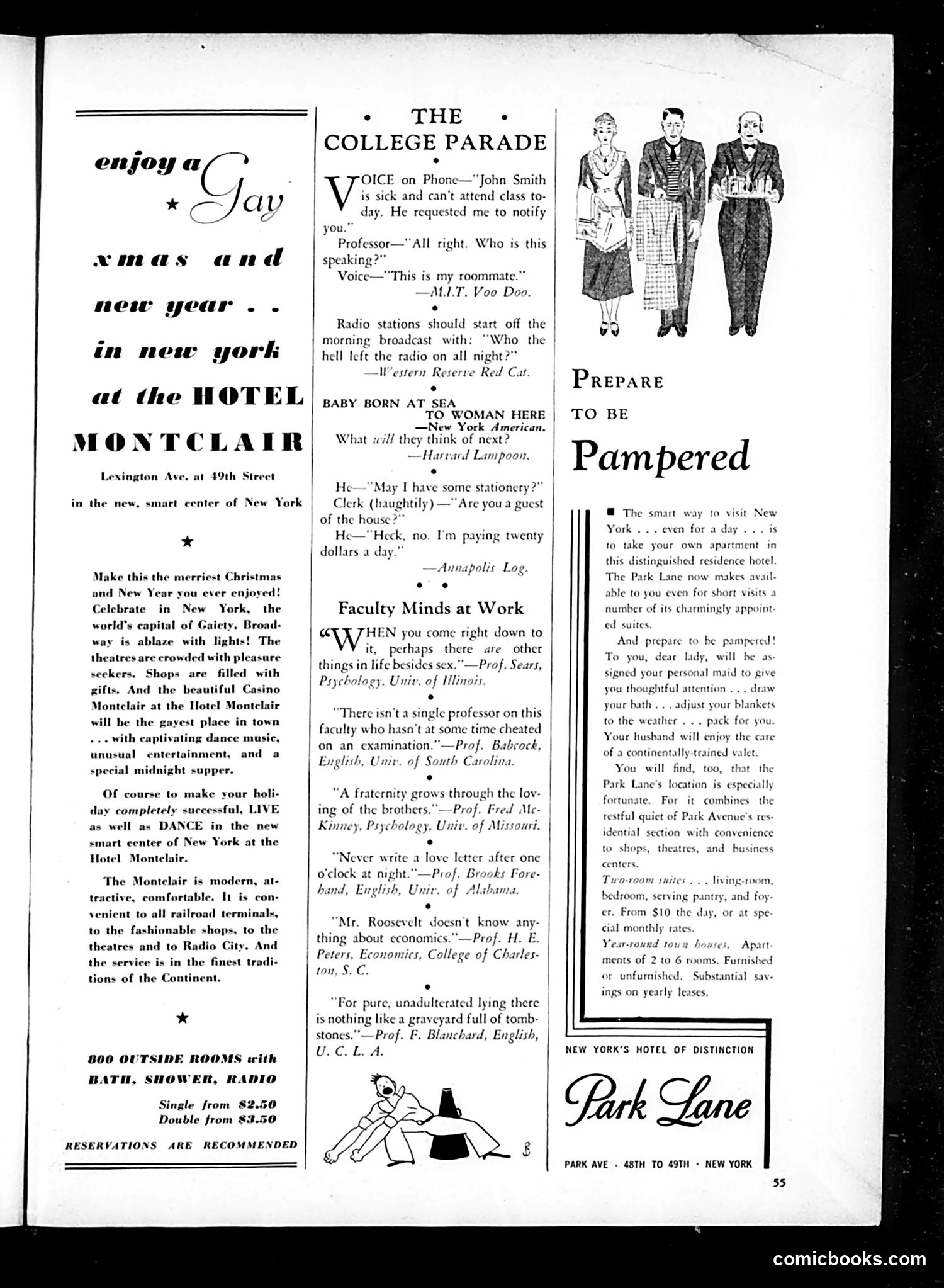
Analysis of Page 55 This page is primarily advertisements for New York hotels (Montclair and Park Lane) bracketing humorous content. The central section, "The College Parade," is a collection of satirical quotes from college professors and students, likely reprinted from university humor magazines (M.I.T. Voo Doo, Harvard Lampoon, etc.). The jokes mock academic life: a professor is fooled by a student's roommate calling in sick; radio stations leave equipment on overnight; a paying hotel guest is treated poorly by a clerk; professors are hypocritical (claiming none cheat while admitting they do); and one professor apparently disparages President Roosevelt's economics knowledge. The humor targets faculty pomposity and hypocrisy rather than specific individuals or political positions. These are gentle, collegiate ribbing typical of 1930s-era university publications. The right side features fashion illustration (three women in different outfits) and hotel advertising emphasizing luxury service for female guests ("assigned your personal maid").
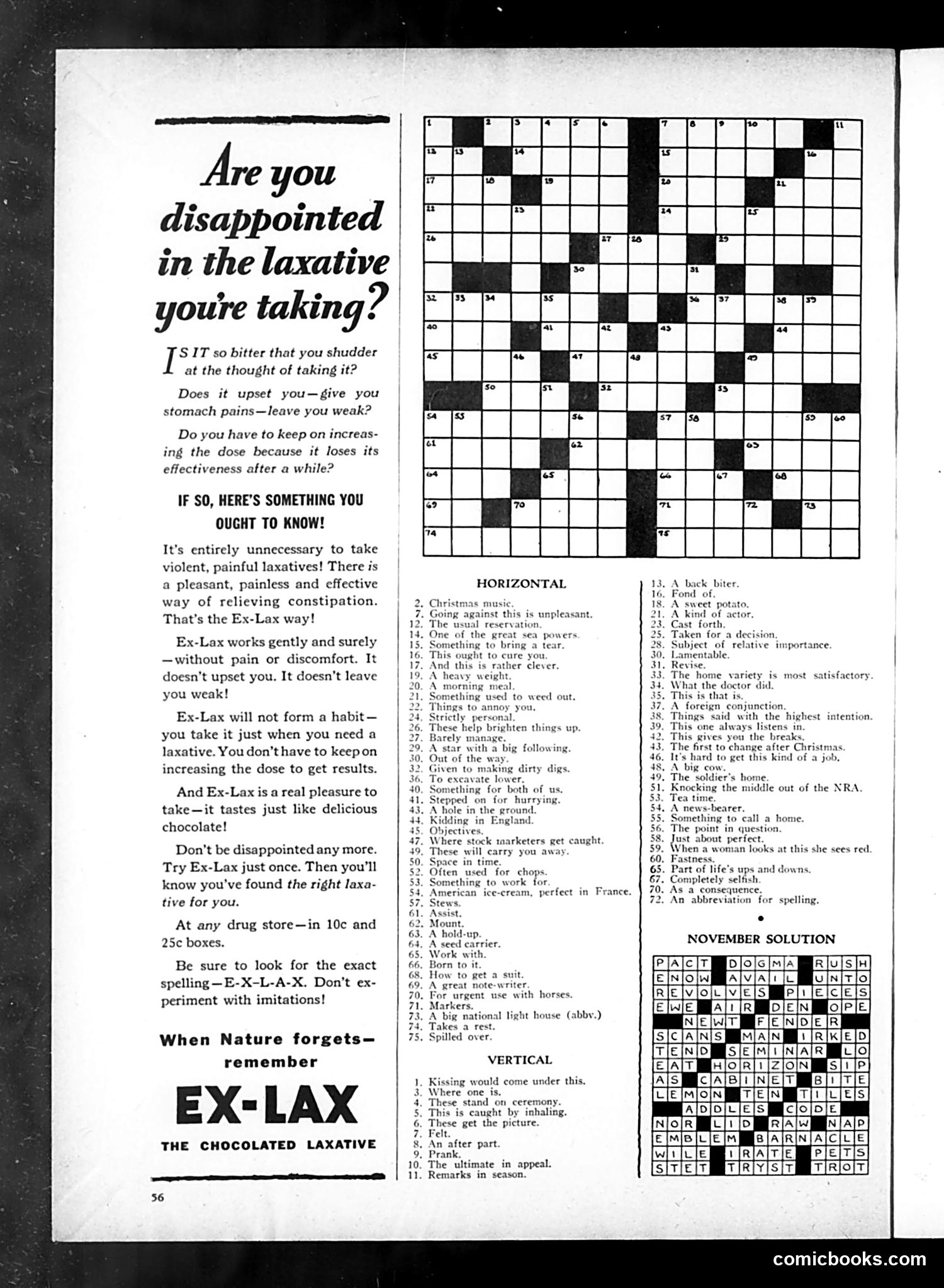
Analysis for Modern Readers This page is primarily a product advertisement for Ex-Lax laxative, not political satire. The left side contains a marketing pitch addressing consumer complaints about harsh laxatives of the era—bitterness, stomach pain, weakening effects, and tolerance buildup. Ex-Lax promises a gentler alternative that "tastes like delicious chocolate." The right side features a crossword puzzle, a common Life magazine feature unrelated to the ad. The puzzle's clues reference general knowledge topics typical of 1930s-40s publications. Historical context: This reflects an era when discussing digestive health in advertising was common and unremarkable. The ad's frank language about constipation and laxatives would be considered blunt by modern standards but was acceptable then. There is no political cartoon or satire on this page—it's purely commercial content with entertainment filler.
I can see this is a page from Life magazine, but the image shows primarily a blank or nearly blank white page with only some partial text fragments visible in the margins ("ory," "ion," "red") and what appears to be a printing guide or page marker on the left edge. Without clear visible content—whether cartoons, illustrations, or substantial text—I cannot identify specific figures, political references, or satirical points. This appears to be either a blank page, a page from the binding/interior of the magazine, or an image where the actual content did not scan clearly. To provide accurate historical analysis, I would need a page with legible cartoons or text content visible.