life
Life — January 1935
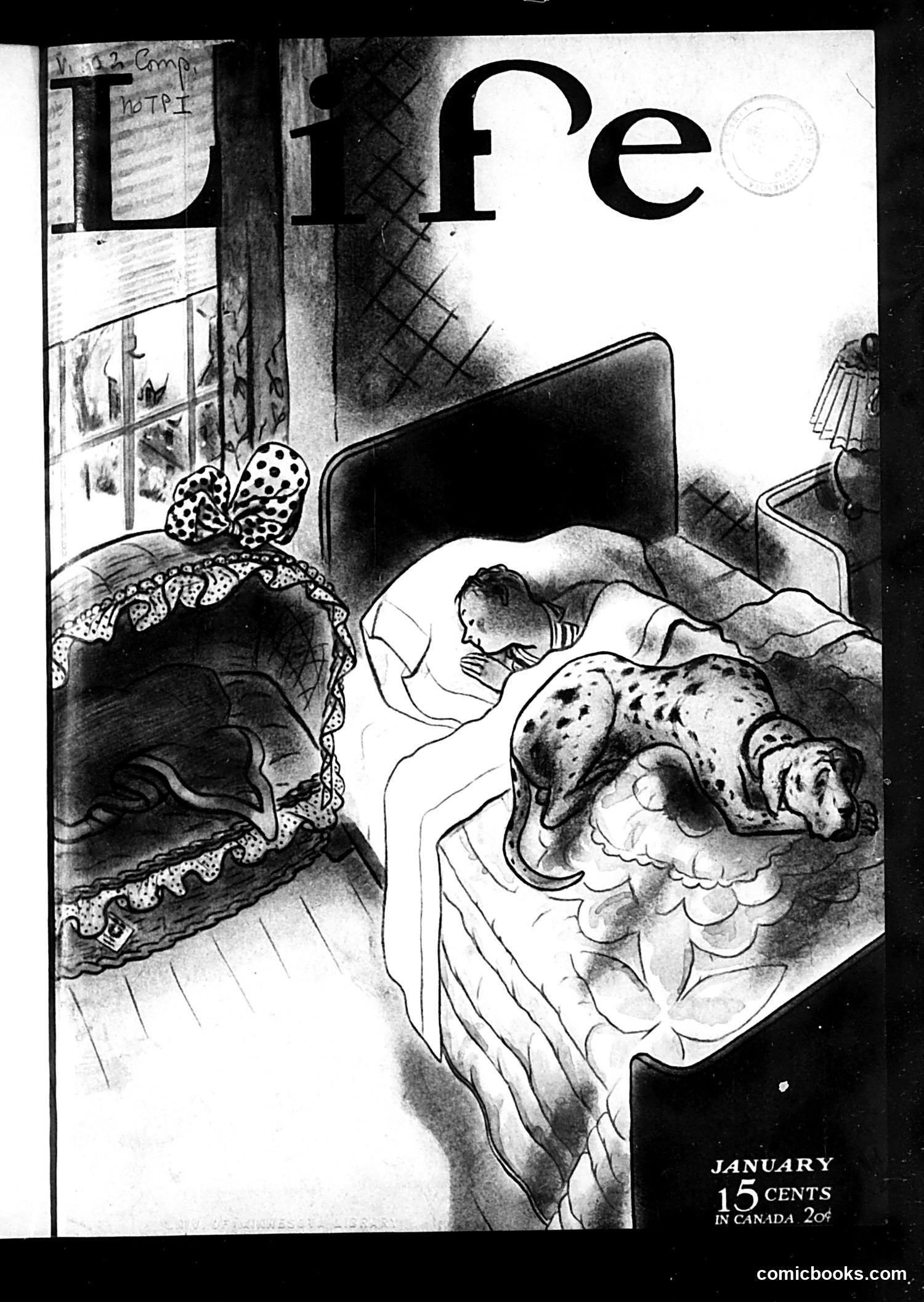
Analysis This is a Life magazine cover from January (15 cents, likely early 20th century based on pricing and style). The illustration depicts a bedroom scene with a sleeping child and what appears to be a large spotted dog on the bed. A woman in decorative clothing with a polka-dot bow sits nearby. The satirical point likely concerns pet indulgence or sleeping arrangements — a common humor topic of the era. The exaggerated size of the dog and its prominent placement on the child's bed suggests commentary on how pet owners anthropomorphize animals or allow them inappropriate household privileges. Without clearer context or visible text identifying specific figures, the exact satirical target remains unclear, though it appears to mock domestic customs around pets and child-rearing.
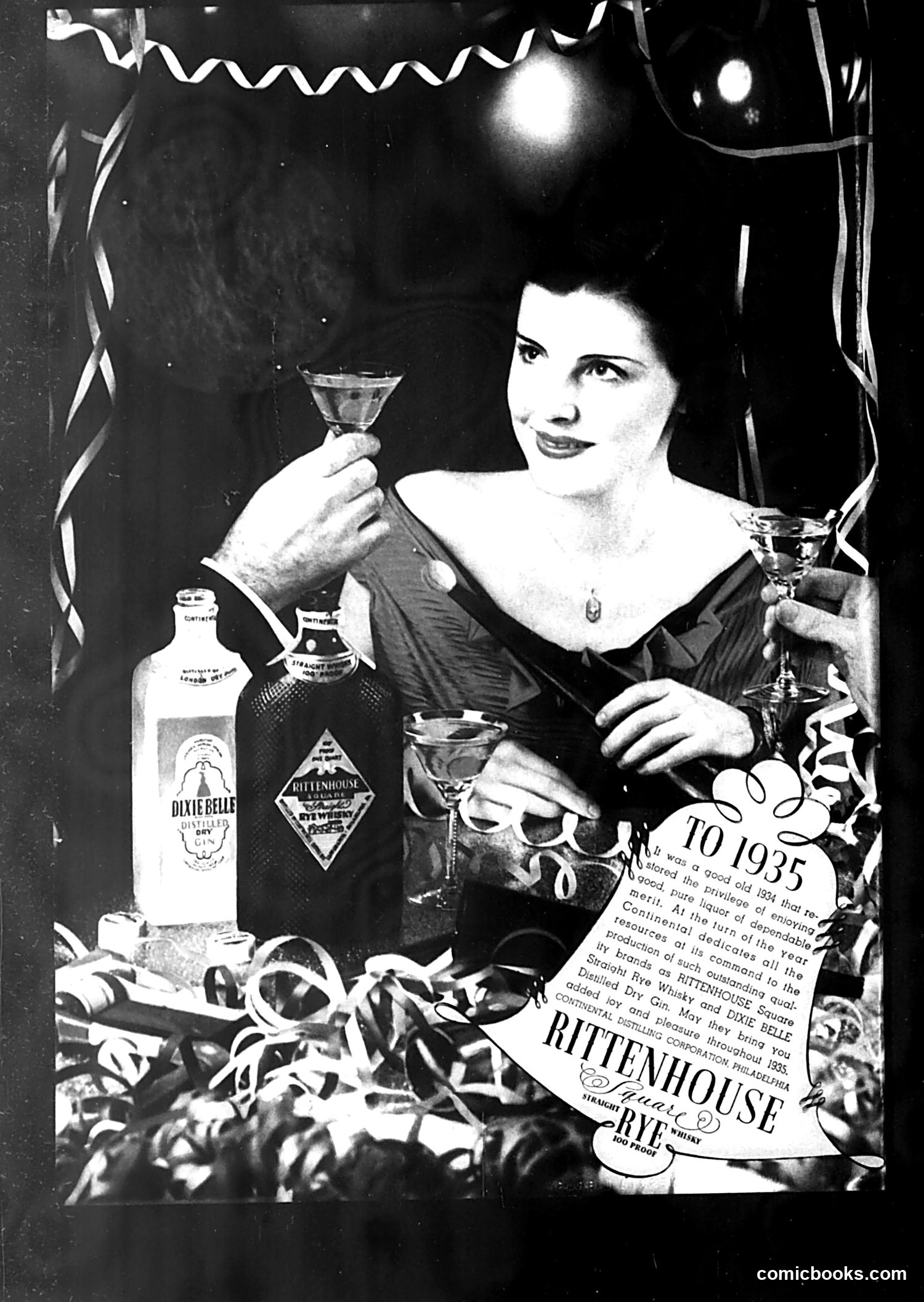
Rittenhouse Rye Whiskey Advertisement This is a commercial advertisement, not political satire. It promotes Rittenhouse Rye Whiskey and celebrates the brand's longevity—the visible text references "TO 1935" and mentions the whiskey being "aged" and "good old Rittenhouse." The ad features an elegantly dressed woman in 1930s style holding cocktail glasses, surrounded by liquor bottles (including Dixie Belle and Rittenhouse brands) and festive decorations like streamers and ribbons. The advertisement appears designed to appeal to affluent consumers during Prohibition's repeal era (1933 onwards), associating the whiskey with sophistication, celebration, and leisure. The woman's glamorous presentation was typical advertising strategy of the period to market alcoholic beverages to middle and upper-class audiences.
I can see this is a nearly black page with minimal visible content—just some white linear elements on the left edge and the "comicbooks.com" watermark at bottom right. The image quality is too dark and degraded to discern any cartoon figures, caricatures, text, or satirical content with confidence. Without being able to read the OCR text clearly or see the actual illustrations, I cannot reliably identify the political/social references, figures depicted, or the satirical point intended. This appears to be either a severely damaged scan, a blank/advertising page, or an image where the contrast has been lost. To provide accurate historical analysis as requested, I would need a clearer version of this page.
I can see this is a largely illegible black-and-white page from what appears to be *Life* magazine, with a circular illustration visible in the upper-center portion and text fragments on the right margin that are too faint to read with confidence. The circular image appears to show a figure, but the reproduction quality and darkness of the scan make it impossible to identify specific individuals, political references, or the intended satire with certainty. On the right edge, there are partial column headers or text fragments visible, but they're too obscured to decipher reliably. Without clearer reproduction quality, I cannot accurately explain the cartoon's meaning, identify its subjects, or contextualize its satire for a modern reader as requested. The page quality prevents meeting the accuracy standard required.
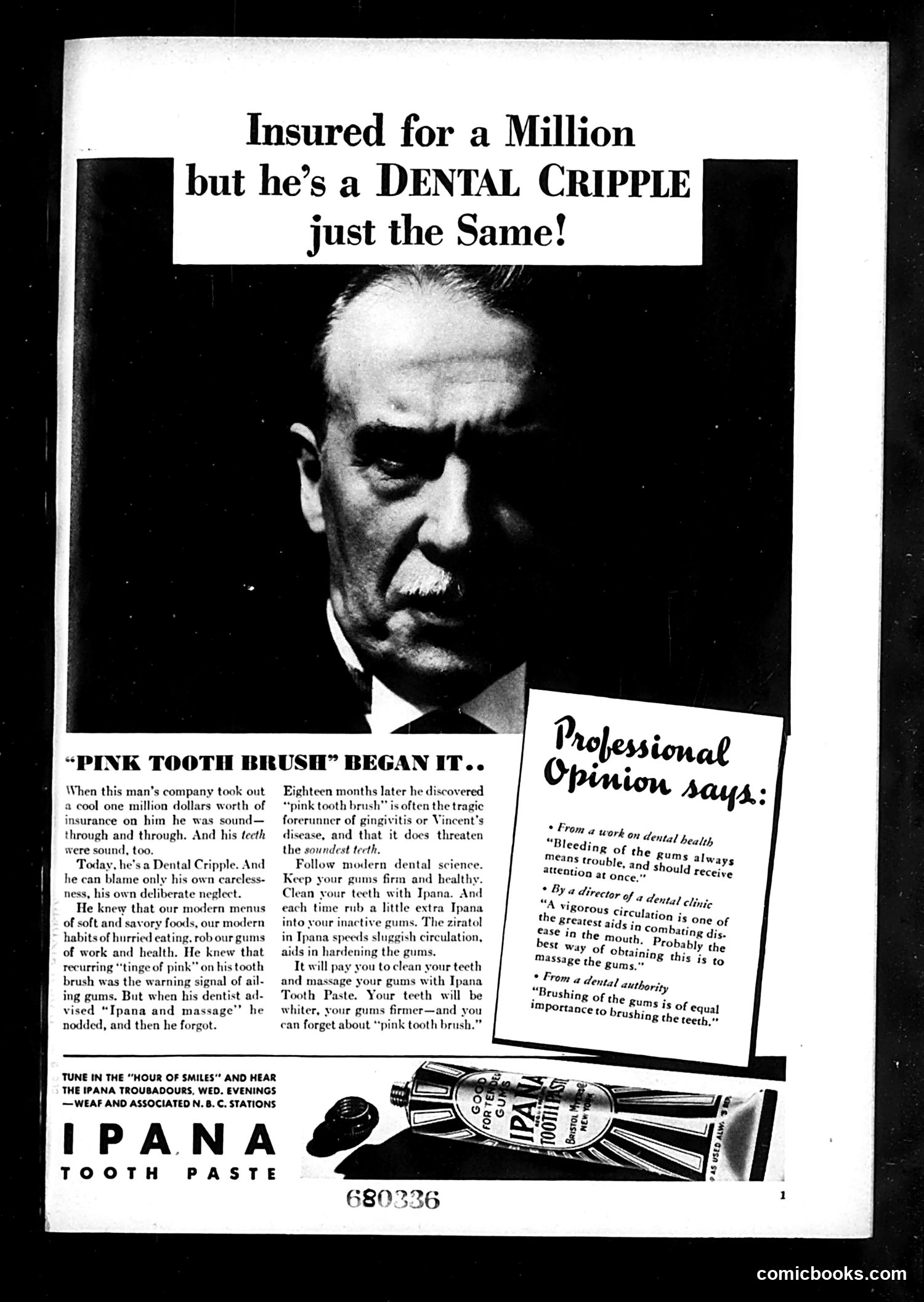
Analysis This is a vintage toothpaste advertisement, not political satire. It advertises Ipana Tooth Paste using a narrative approach popular in early-to-mid 20th century advertising. The ad tells a cautionary tale: a wealthy man ("insured for a million") developed gum disease ("pink tooth brush"—bleeding gums) from neglecting oral hygiene. Despite his financial security, this dental problem made him look unhealthy and aged. The ad presents Ipana as the solution, emphasizing gum health through regular brushing and massage. The "Professional Opinion" sidebar quotes dental authorities supporting the product's claims about gum disease prevention and treatment. The humor derives from the irony that money cannot protect against preventable dental problems—only proper brushing with Ipana can. It's lifestyle advertising leveraging anxiety about health and appearance.
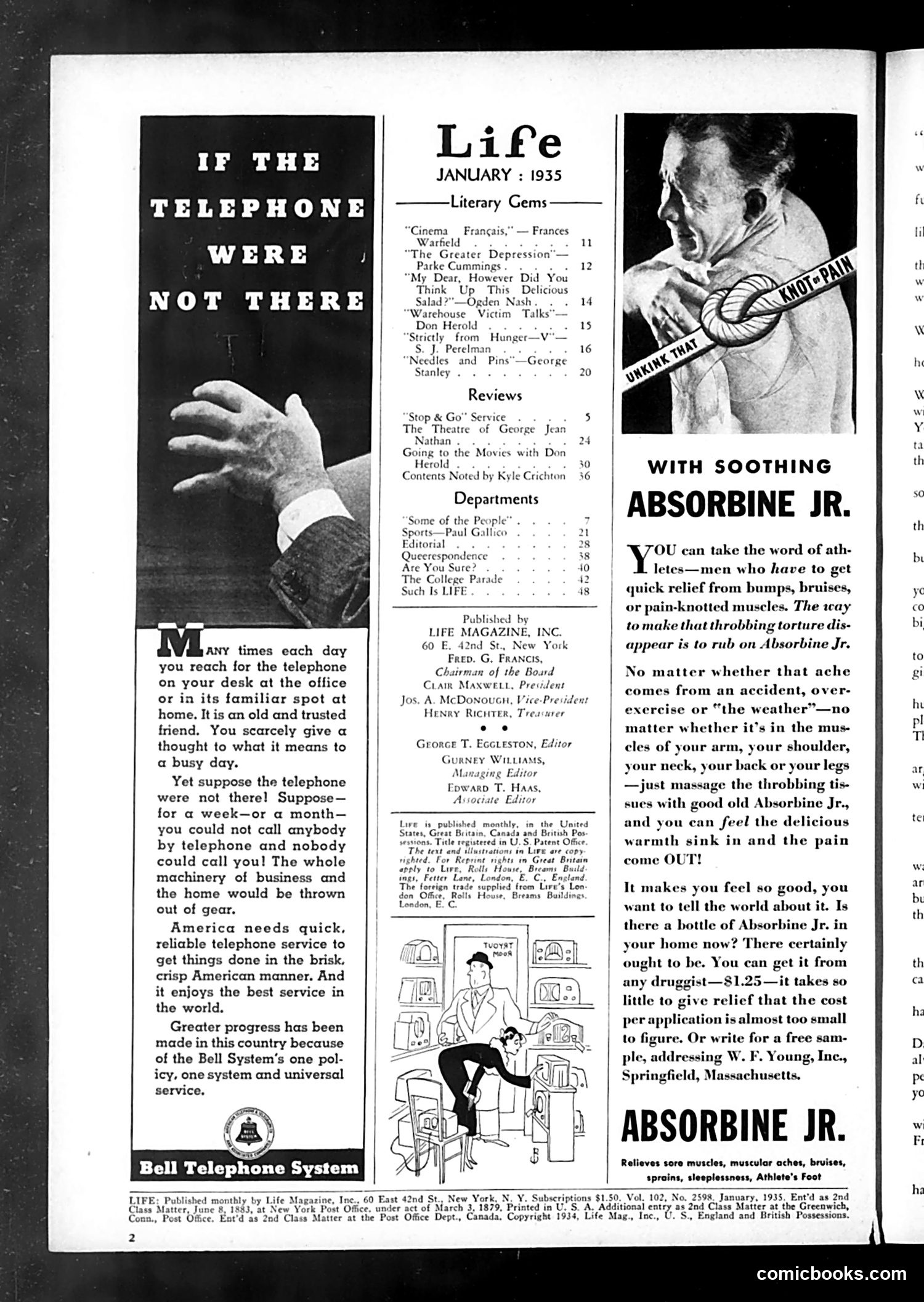
Life Magazine, January 1935 - Analysis This page contains a Bell Telephone System advertisement (left) and an Absorbine Jr. liniment advertisement (right), with the magazine's table of contents in the center. The Bell ad uses satire to argue that telephone service is essential to American business and daily life. It presents a hypothetical scenario: "If the telephone were not there" for a week or month, depicting how society would collapse without it. The message emphasizes that reliable telephone infrastructure underpins American progress and efficiency. The Absorbine Jr. ad shows an athlete and uses testimonial language about pain relief for muscles and bruises—typical 1930s advertising for medicinal liniments. The page is primarily commercial content rather than satirical commentary on contemporary politics or events.
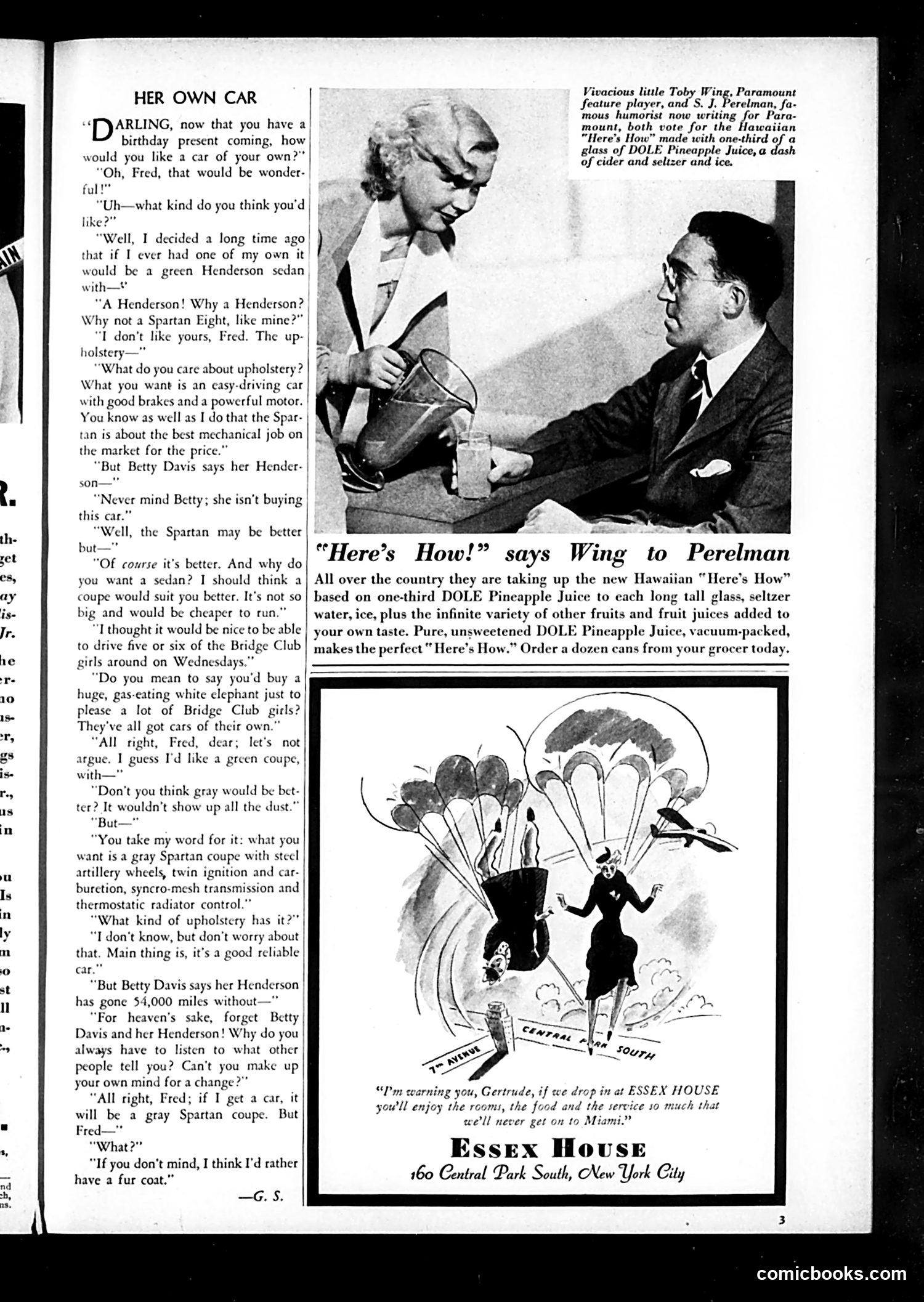
Analysis This page contains a lighthearted dialogue titled "Her Own Car" about a woman deciding what automobile to purchase as a birthday gift. The conversation satirizes consumer preferences and gender stereotypes of the era: Fred argues for practical, performance-focused choices (Spartan Eight), while the unnamed woman prioritizes comfort and aesthetics (green Henderson sedan, gray Spartan coupe). The humor lies in Fred's exasperation that she won't simply accept his recommendations and repeatedly changes her mind—a common comedic trope about indecisive women shoppers. The page also features advertisements for "Here's How!" (a DOLE pineapple juice drink) and Essex House hotel in New York City, reflecting typical 1920s-30s magazine content mixing editorial humor with branded messaging.
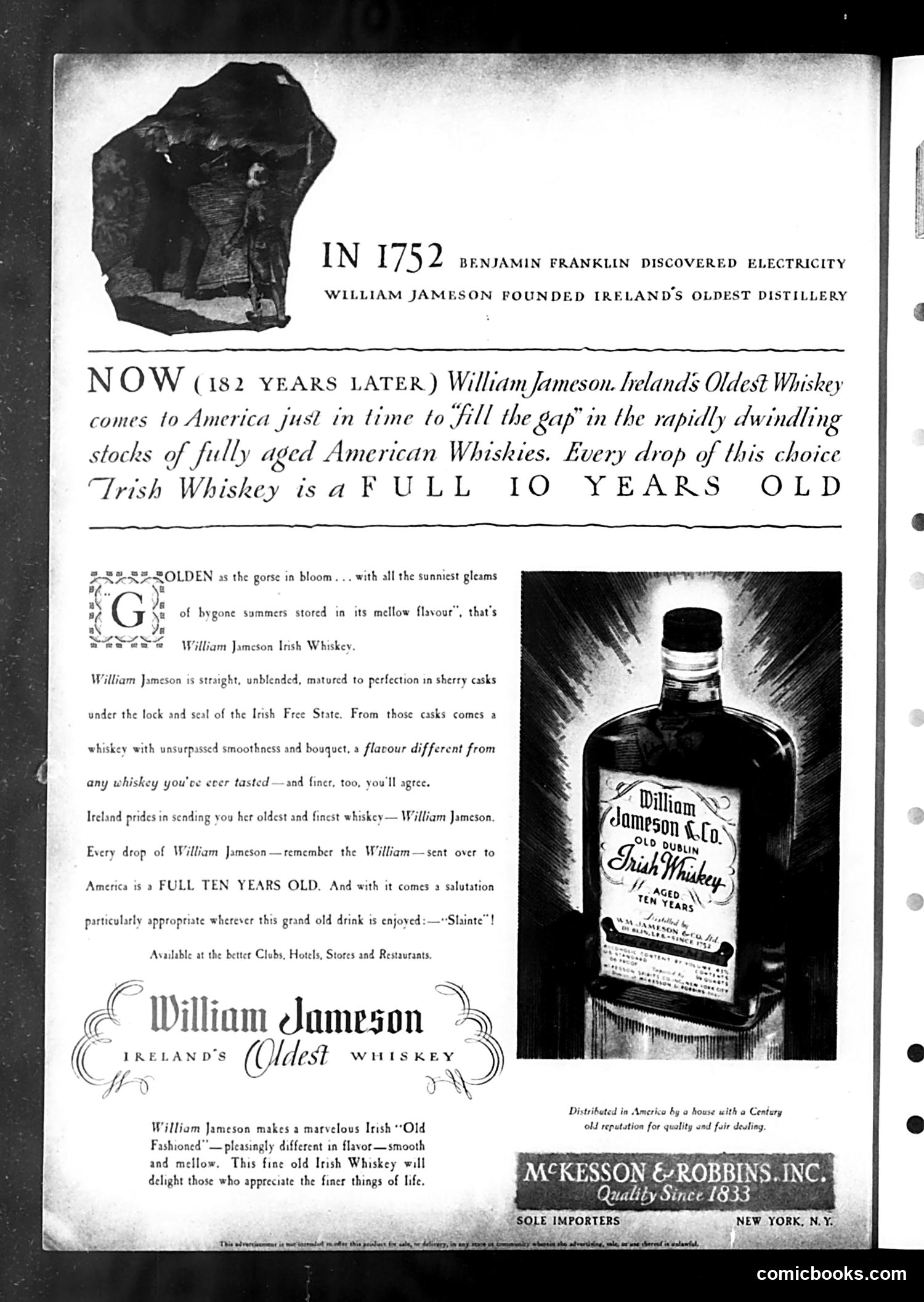
This is a whiskey advertisement, not satire or political content. The page promotes William Jameson Irish Whiskey, marketed as "Ireland's Oldest Whiskey." The ad uses historical framing—referencing Benjamin Franklin's 1752 electricity discovery and the distillery's founding—to establish prestige and tradition. The key selling point is that the whiskey is "a FULL 10 YEARS OLD," positioned as filling a gap in "rapidly dwindling stocks of fully aged American Whiskies." This suggests post-Prohibition scarcity (likely 1930s-40s context). The bottle image on the right shows the product label prominently. The distributor, McKession & Robbins, Inc. (New York), emphasizes quality and fair dealing. The tone is sophisticated, appealing to educated, affluent consumers who appreciate fine spirits and historical narratives.
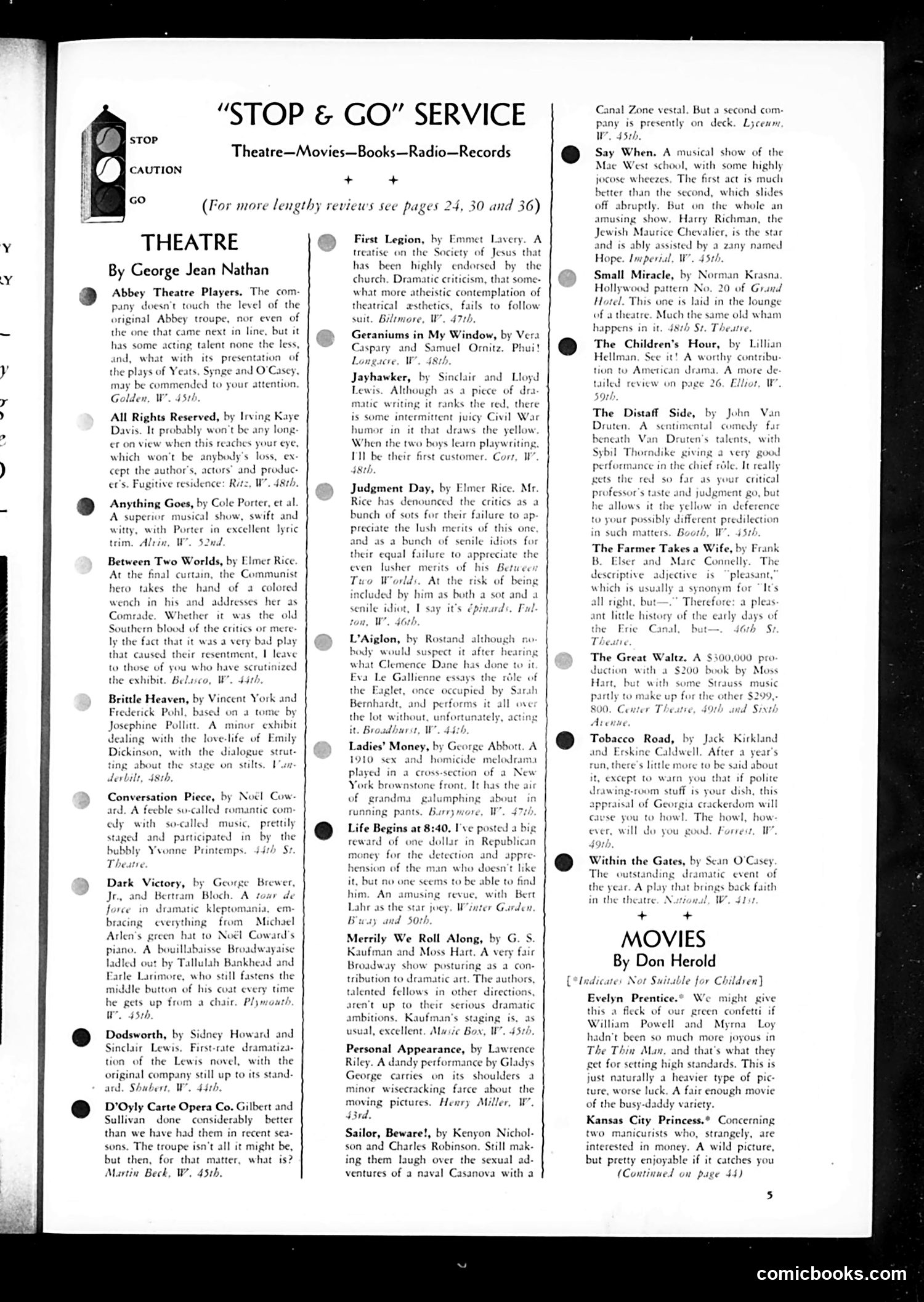
"Stop & Go" Service: Theatre Reviews Page This is a theatre and movie review page from *Life* magazine, structured as a "Stop & Go" service guide (indicated by the traffic light icon). The content is not satirical or political—it's a straightforward critical review section covering Broadway plays and films. The page lists theatrical productions with brief critical assessments (marked with filled or empty circles indicating quality). Reviews cover works like *Abbey Theatre Players*, *Anything Goes*, and *D'Orly Carte Opera Co.*, alongside movie reviews by Don Herold. This represents *Life's* role as a general-interest magazine providing entertainment criticism alongside its better-known satirical content. The format is informational rather than comedic or propagandistic.
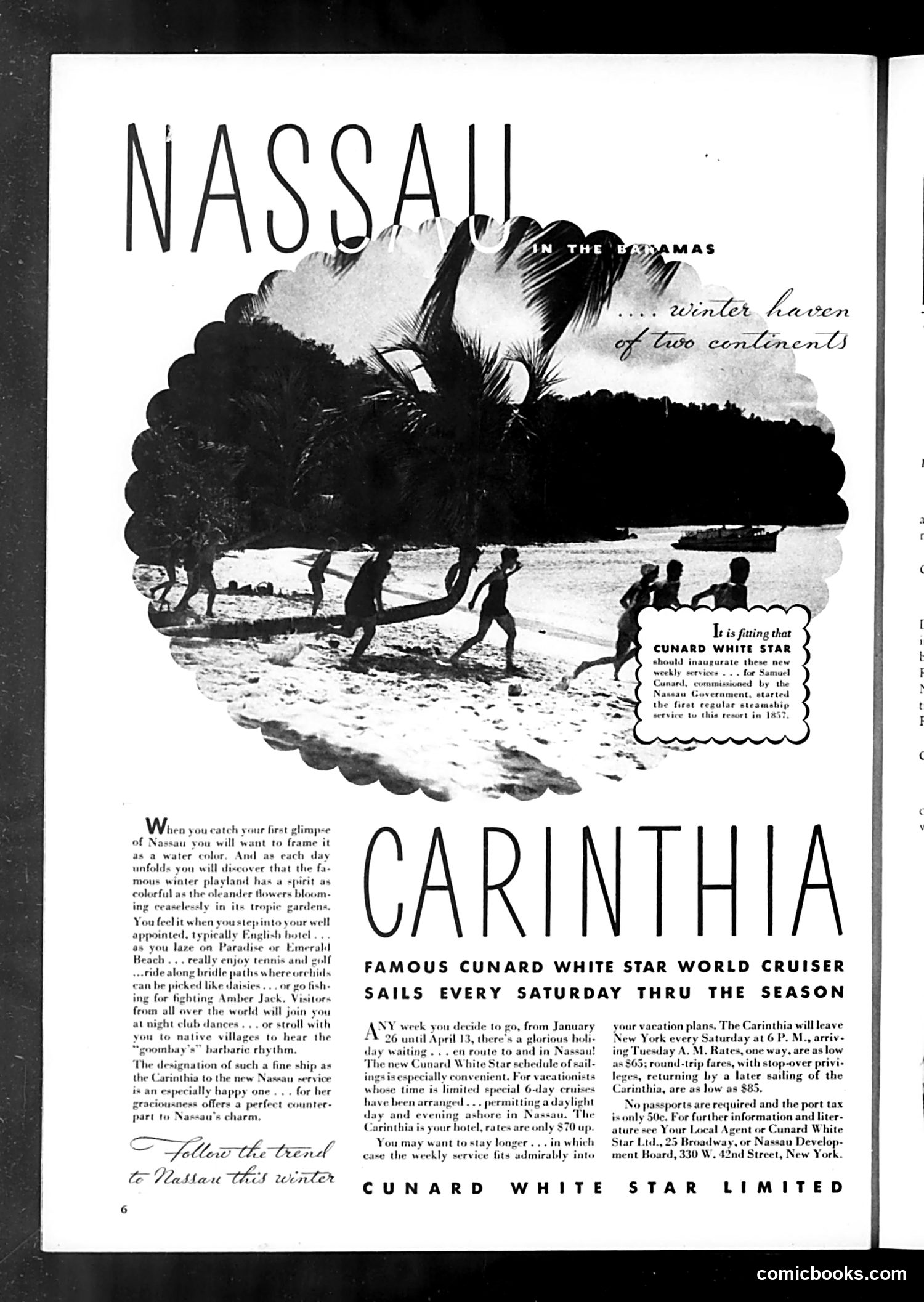
Analysis This page is primarily an advertisement, not satire or political commentary. It promotes the Cunard White Star Line's cruise ship *Carinthia*, which offered weekly Saturday departures to Nassau in the Bahamas during winter season (January-April). The imagery shows beachgoers and tropical scenery to evoke Nassau as an exotic winter destination. The text emphasizes luxury amenities—golf, fishing, lounging—and contrasts Nassau's colorful, relaxed atmosphere with presumably cold American winters. The historical note mentions that Cunard White Star "started the first regular steamship service to this resort in 1852," lending prestige to the company. This reflects 1930s-era cruise tourism marketing: framing Caribbean destinations as accessible escapes for wealthy Americans seeking warmth and leisure during winter months.
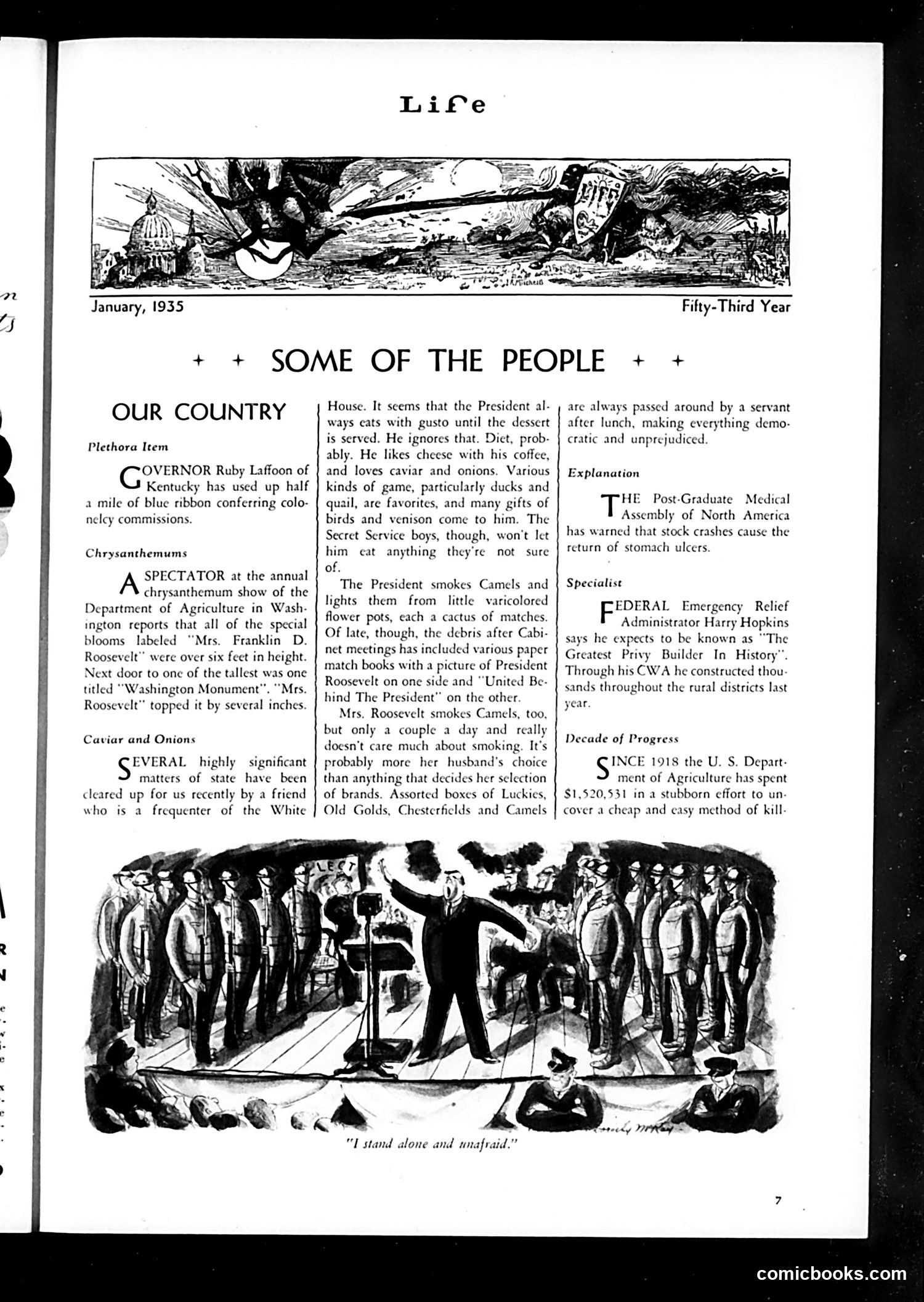
Life Magazine, January 1935: Political and Social Commentary This page features satirical commentary on President Franklin D. Roosevelt's personal habits and New Deal policies. The "Plethora Item" section mocks FDR's dining preferences—his love of game, caviar, and cheese—contrasting his refined tastes with Depression-era hardship. The text jokes about his cigarette smoking habits and his wife's apparent indifference to his brand choices. The large cartoon depicts a figure speaking to a crowd with the caption "I stand alone and unafraid"—likely satirizing Roosevelt's leadership claims during economic crisis. Below, sections on agricultural policy and Emergency Relief Administrator Harry Hopkins critique the administration's spending efforts as inefficient. The satire reflects conservative skepticism of New Deal programs and FDR's presidency.
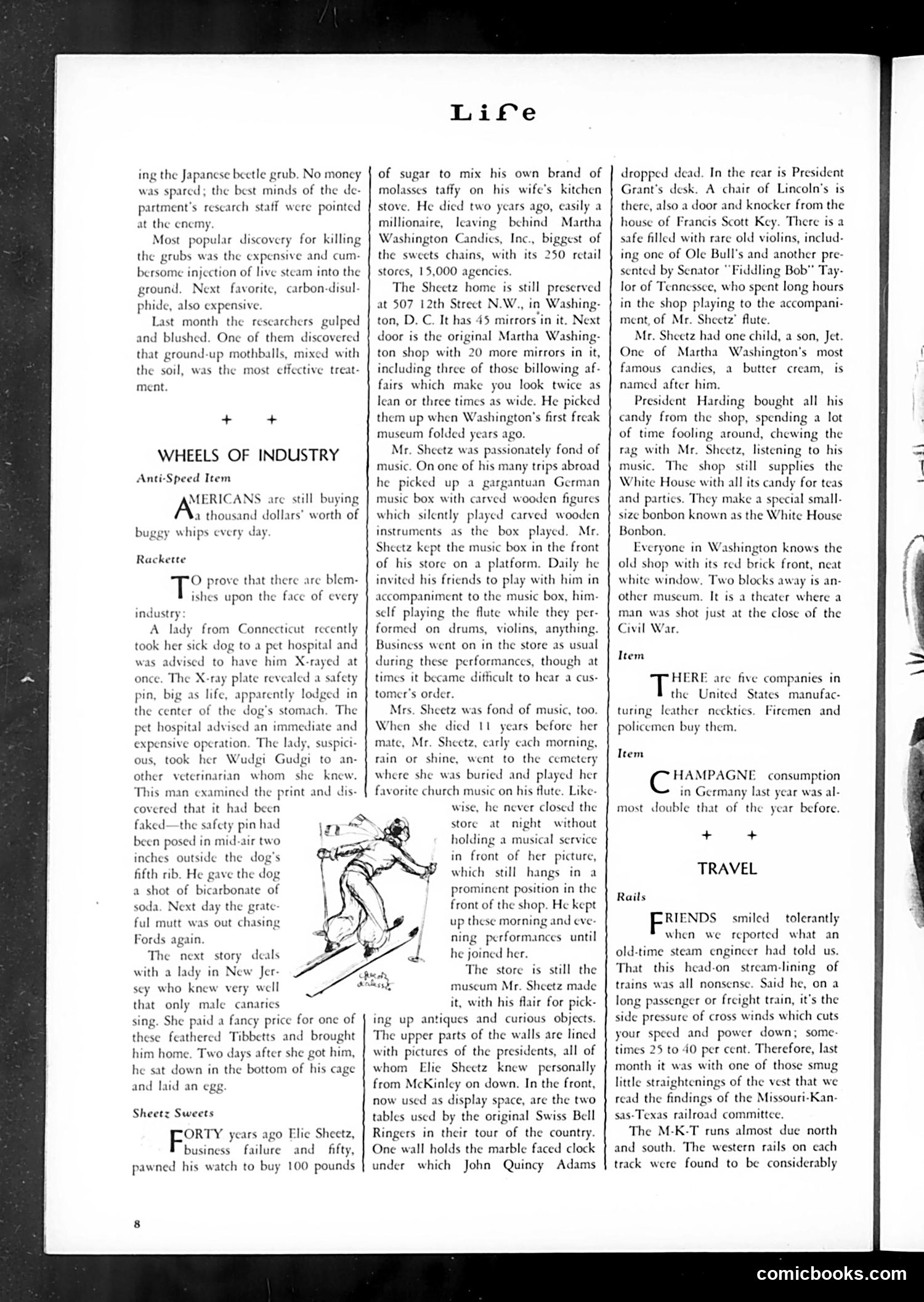
Analysis of Life Magazine Page This page contains miscellaneous humorous items rather than a political cartoon. The visible illustration shows a skier in an exaggerated pose, accompanying a short piece titled "Rockette" about an X-ray revealing a safety pin lodged in a dog's stomach. The content includes brief anecdotes labeled "Wheels of Industry" (about Americans buying buggy whips), sections on curiosities like the Sheetz candy store in Washington D.C., and travel observations about steam trains. The humor relies on absurdist situations and mild social observation rather than political satire. Without date information visible, the specific historical references are unclear, though mentions of President Harding and Civil War-era Washington locations provide period context.
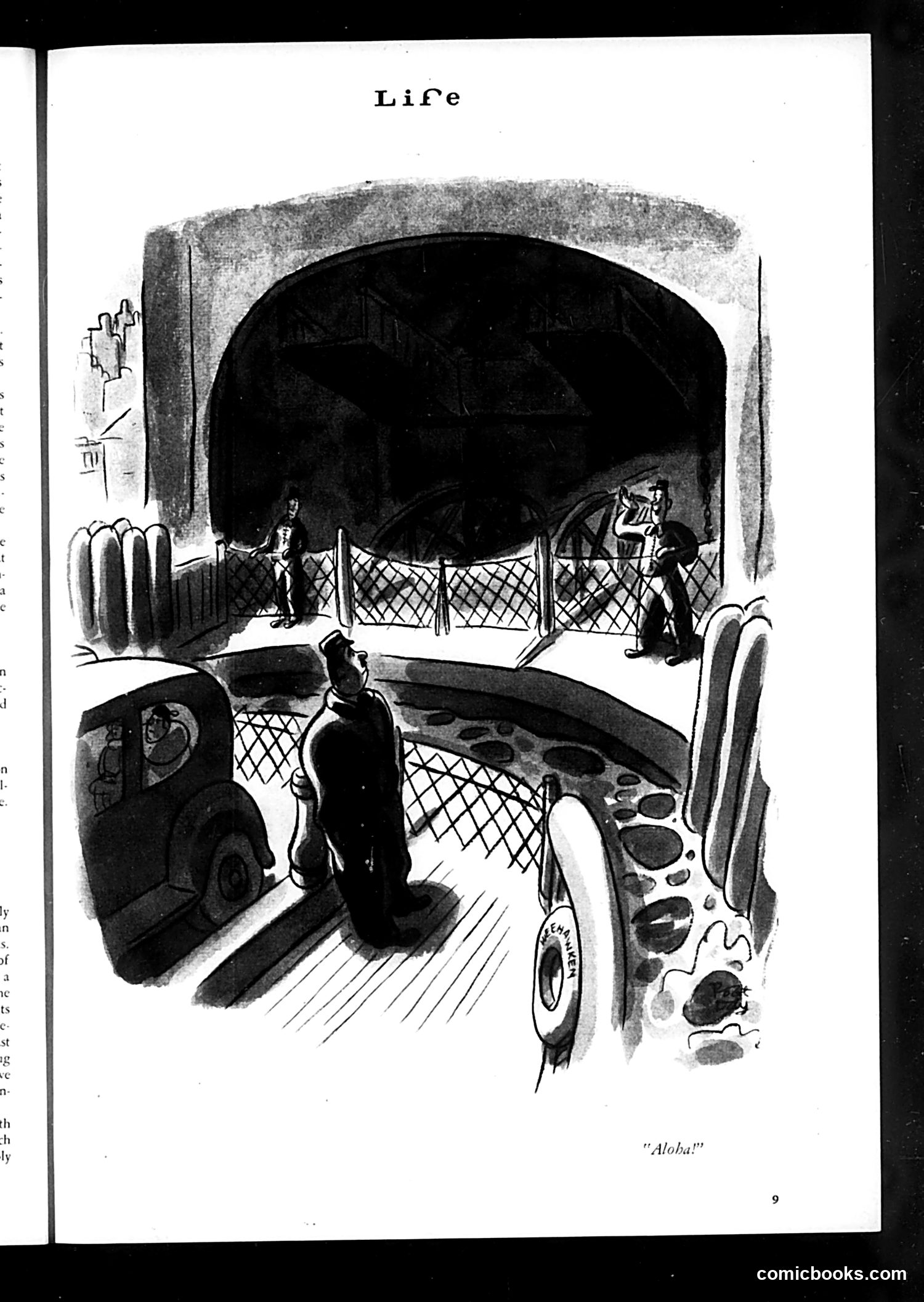
Analysis of "Aloha!" Cartoon This cartoon depicts a garage or warehouse setting where a uniformed official stands beside two cars, greeting someone with "Aloha!" (Hawaiian for "hello/goodbye"). The scene appears to satirize the inspection or confiscation of automobiles, likely during wartime rationing or vehicle restrictions. The formal gesture and Hawaiian greeting suggest ironic politeness masking an official duty—possibly the requisitioning of civilian vehicles for military use or enforcement of fuel/rubber rationing during World War II. The contrast between the cheerful "Aloha" and the serious nature of taking someone's car creates dark humor typical of *Life* magazine's satirical approach to wartime inconveniences and government intervention in American life. The specific historical context remains unclear without additional publication date information.
Analysis of Life Magazine Page This page contains no political cartoons. Instead, it features a standard satirical magazine layout with multiple short humor sections and an illustration of what appears to be a radio broadcaster or announcer. The content includes: - "Depression Item" and "Untrammeled Press": Brief satirical commentary on American life during the Depression era - "Great Minds" and "Entertainment": Humorous quotes and observations - "Radio Ratio": A detailed section about radio advertising costs, comparing NBC and Columbia network rates The illustrated figure appears to be a 1930s-era radio personality, reflecting the page's focus on broadcasting. The overall tone is light social satire typical of Life magazine, poking fun at contemporary media, business practices, and American attitudes rather than delivering pointed political commentary.
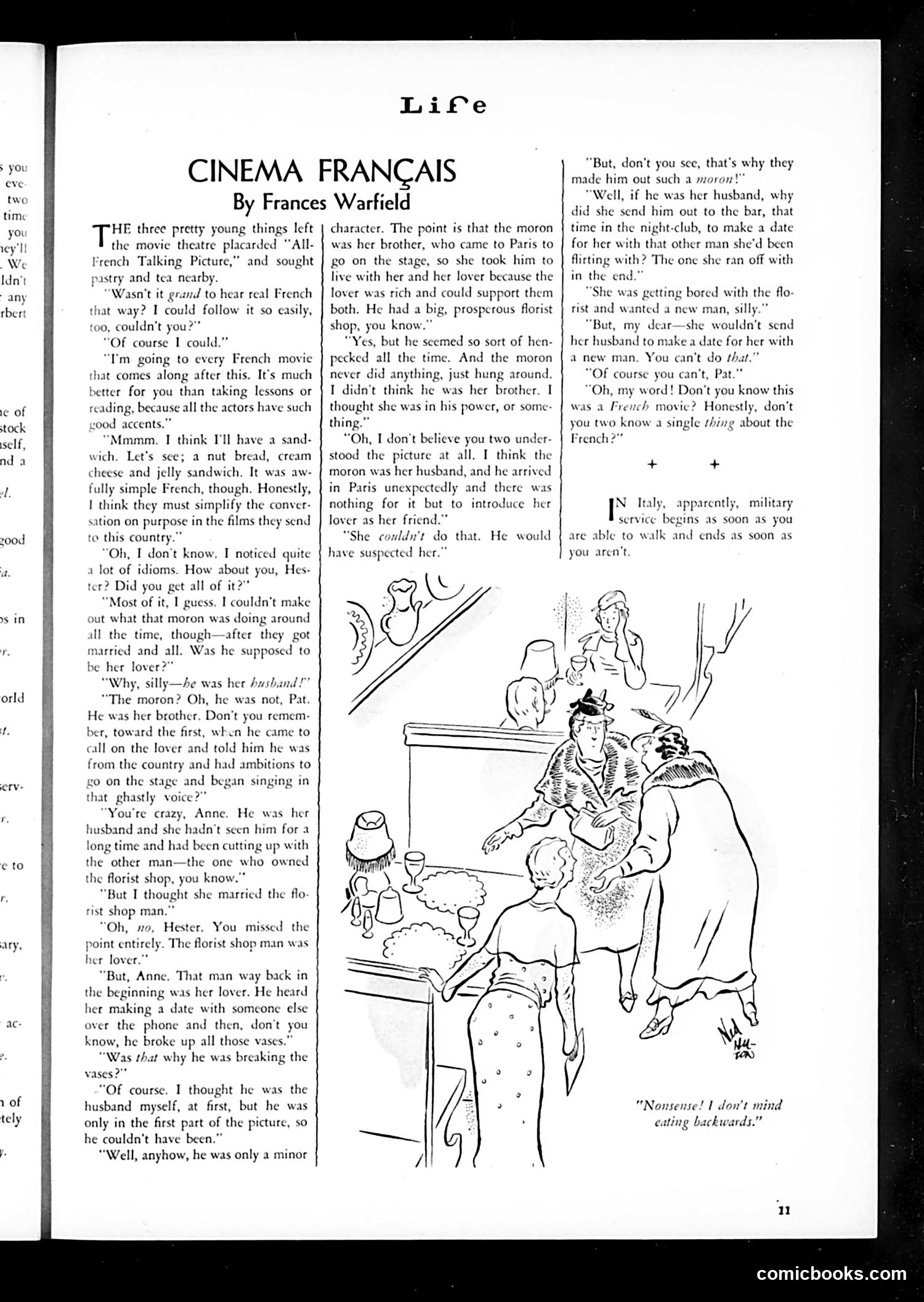
"Cinema Français" by Frances Warfield This article satirizes French cinema and cultural attitudes. The text discusses a French film featuring a "moron" character—apparently a foolish man whose wife took him to Paris as her lover's companion. The humor relies on sophisticated Parisian scandal: the wife's infidelity, the husband's obliviousness, and the absurd social dynamics. The accompanying cartoon illustrates a restaurant scene where diners eat while observing what appears to be bohemian or theatrical performers. The caption "Nonsense! I don't mind eating backwards" suggests mocking European affectation and absurdity. The piece satirizes both French cinema's melodramatic plots and American perception of European sophistication as pretentious and ridiculous—a common theme in 1920s American satire dismissing continental social conventions as backward or morally questionable.
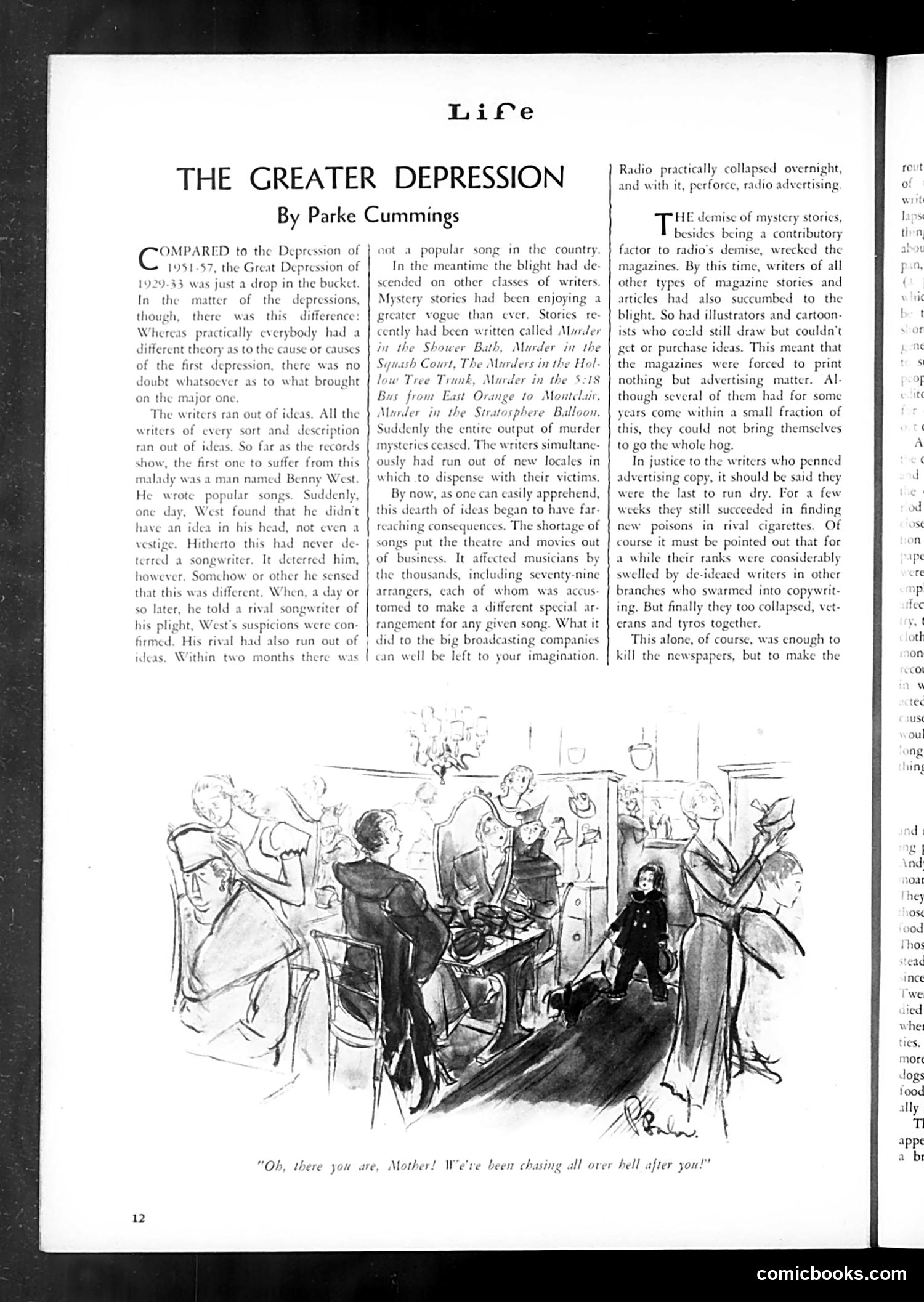
"The Greater Depression" by Parke Cummings This satirical article discusses how the 1920s Depression differed from the 1929-33 Great Depression. The text describes a specific entertainment industry crisis: mystery stories and murder narratives became so popular they exhausted creative possibilities, killing the genre's market appeal. The cartoon illustrates the chaos this caused in publishing offices—a crowded, frantic scene with editors and staff amid scattered papers and rejected manuscripts. The caption reads: "Oh, there you are, Mother! We've been chasing all over hell after you!"—suggesting the desperate, chaotic search for new ideas or viable content. The satire mocks how an oversaturated market can collapse an entire creative industry, mirroring economic collapse but within entertainment media specifically.
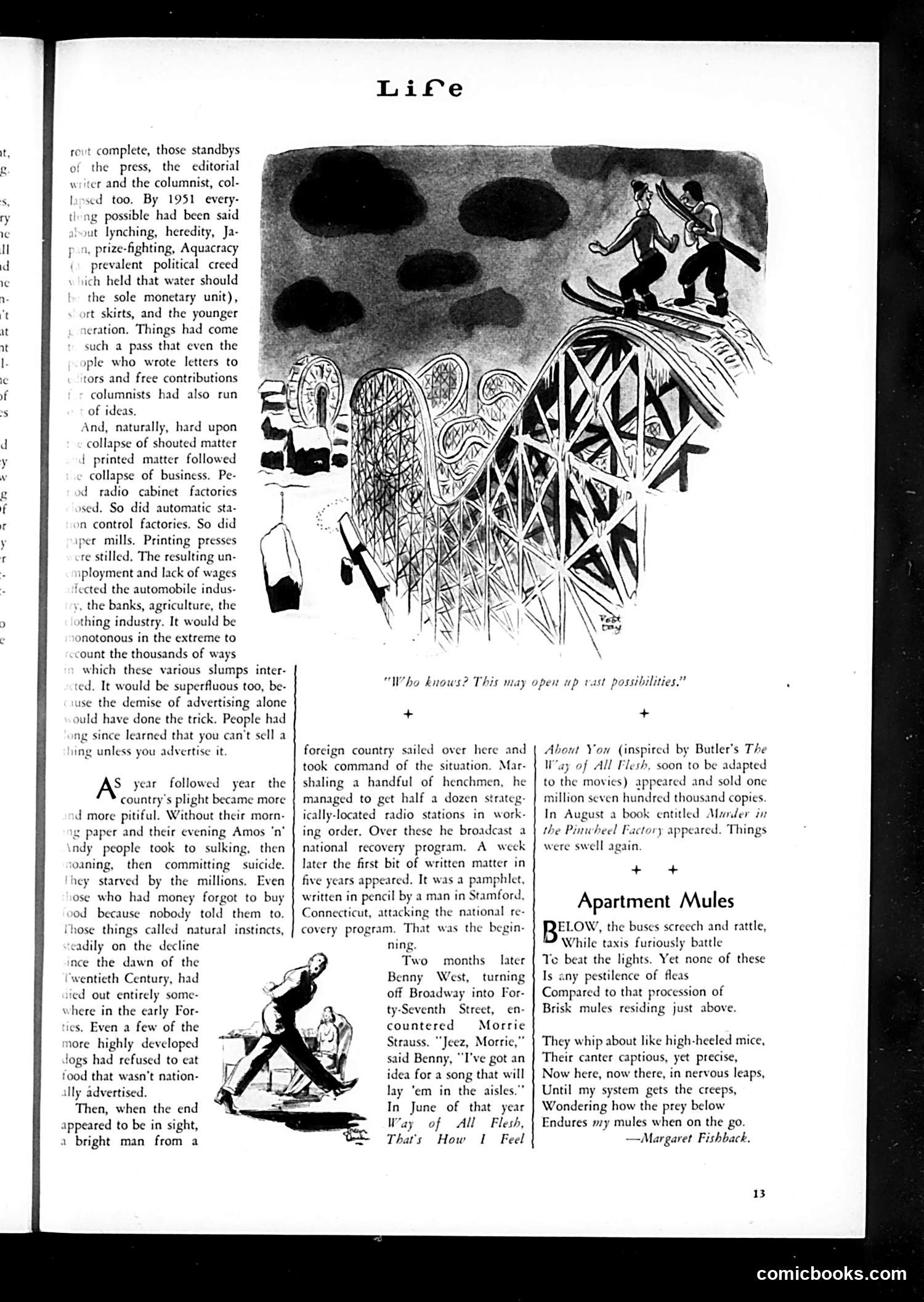
Political Cartoon Analysis: Life Magazine Page The main cartoon depicts two figures precariously balanced atop a rickety bridge or structure, with storm clouds overhead. The caption reads: "Who knows? This may open up vast possibilities." The context from surrounding text references economic collapse and business failure during what appears to be the Great Depression era. The cartoon satirizes false optimism during financial crisis—the precarious bridge represents an unstable economy, while the figures represent businessmen or politicians naively hoping for recovery despite obvious danger. Below, a section titled "Apartment Mules" contains a poem by Margaret Fishback about urban apartment living, a lighter satirical subject unrelated to the main economic cartoon. The overall page reflects Life's characteristic blend of sharp political commentary on economic hardship mixed with humorous social observation.
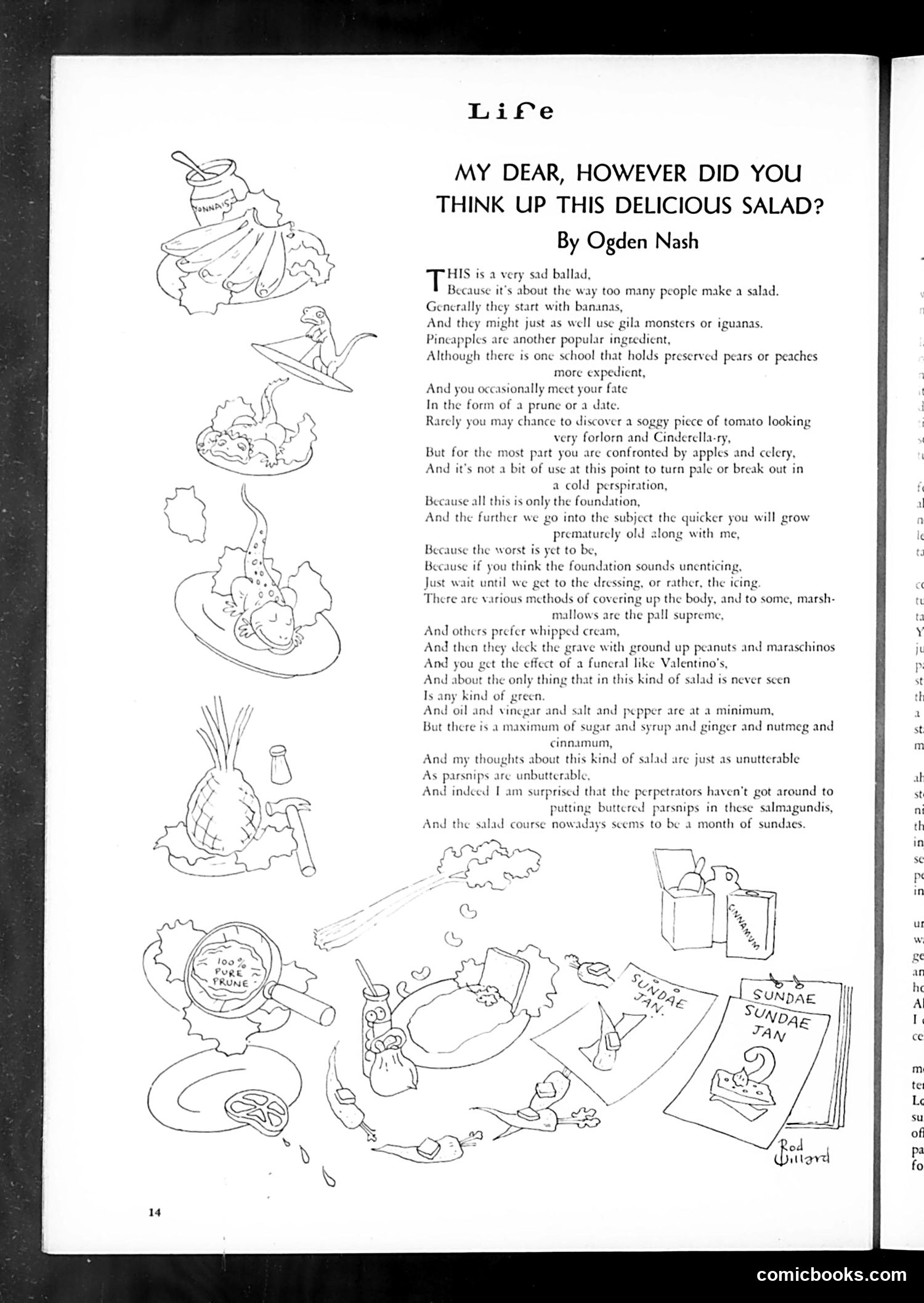
Analysis: "My Dear, However Did You Think Up This Delicious Salad?" by Ogden Nash This is a humorous poem by satirist Ogden Nash mocking the overly elaborate fruit salads that were fashionable in early-to-mid 20th century American cuisine. Nash critiques how home cooks assembled increasingly ridiculous combinations—mixing bananas, pineapples, preserved fruits, nuts, marshmallows, whipped cream, and heavy spices into single dishes. The accompanying illustrations show absurd salad constructions and their messy consequences. Nash's satire targets both the pretentiousness of these elaborate dishes and their fundamental unpalatability, joking that the "salad course nowadays seems to be a month of Sundaes." The poem gently ridicules American home cooking trends toward unnecessarily ornate and contradictory flavor combinations presented as sophisticated cuisine.
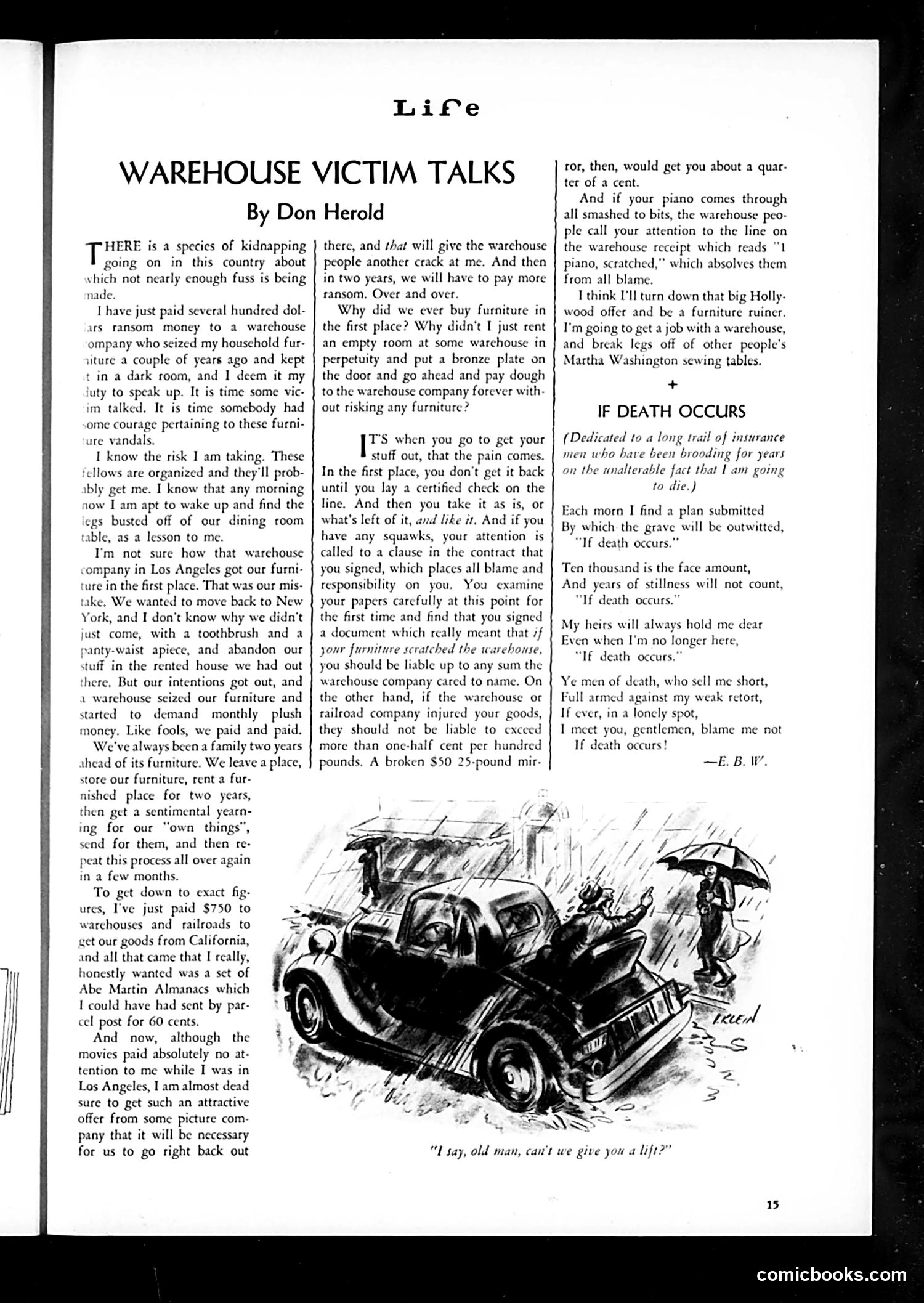
"Warehouse Victim Talks" - Satire on Furniture Storage This article by Don Herold satirizes the predatory practices of furniture warehouse companies. The author describes how warehouses store household furniture in poor conditions, then charge customers enormous fees to retrieve it—making the stored goods themselves liable for damage while absolving the warehouse of responsibility through contract clauses. The accompanying sketch illustrates the absurdity: a car crushed under falling furniture in the rain, with the caption "I say, old man, can't we give you a lift?"—darkly comic since the "help" offered would only cause more damage. The secondary poem "If Death Occurs" extends the satire, mocking insurance disclaimers warehouses use to evade all liability. The piece critiques how ordinary citizens become trapped by exploitative contracts they don't fully understand.
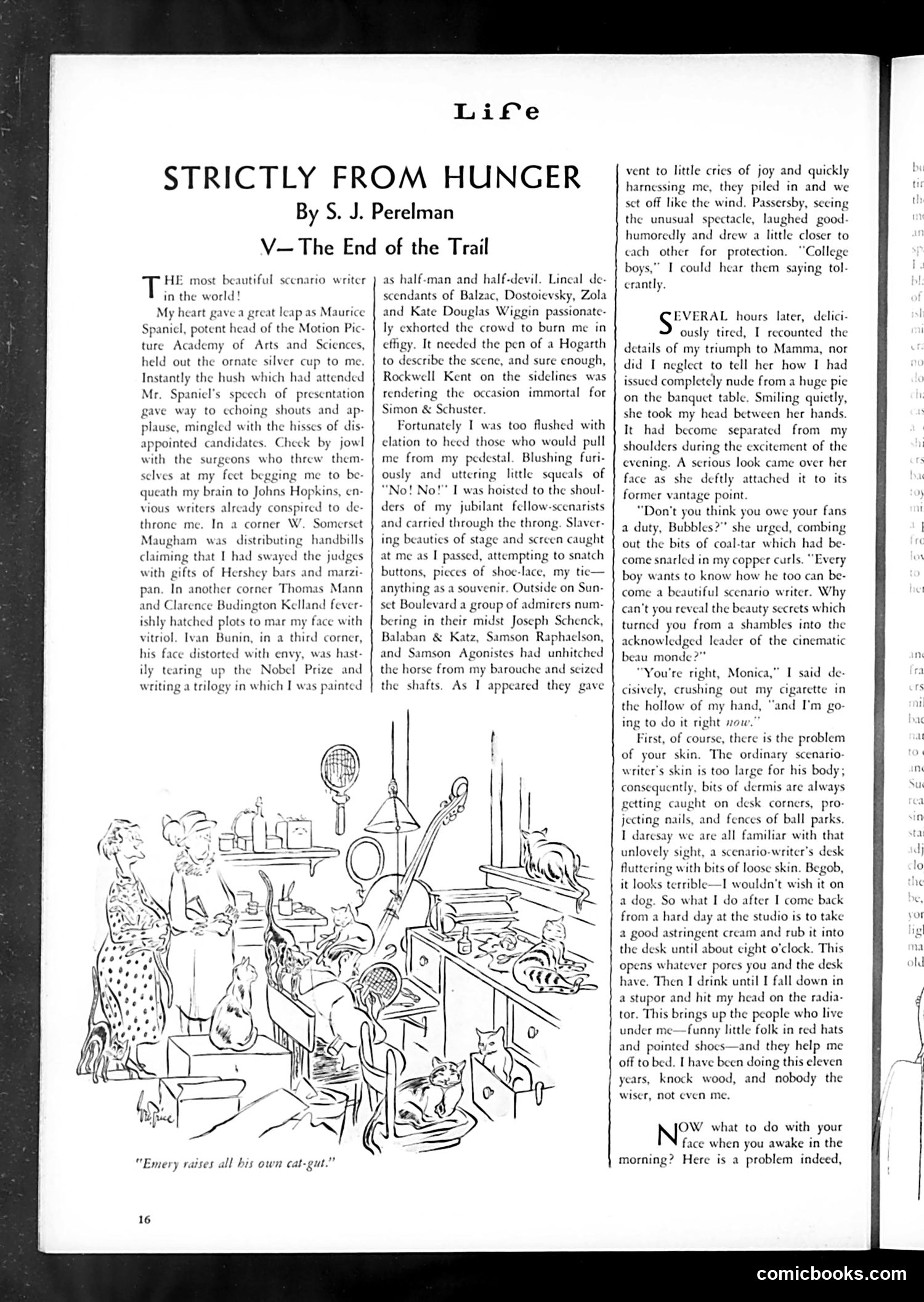
Analysis: "Strictly from Hunger" by S.J. Perelman This is a humorous essay about the perils of being a scenario writer in Hollywood. The cartoon illustrates the chaos of a writer's studio workspace, cluttered with props, musical instruments, and scattered materials—visual metaphor for creative disarray. Perelman's satirical point: scenario writers suffer from occupational hazards including literal skin damage (bits of dermis caught on desk corners, projecting nails), sleep deprivation, and the indignity of sharing quarters with pets and household staff. He self-mockingly suggests his own skin is literally wearing away from eleven years of this work. The humor targets both the absurdity of Hollywood's working conditions and the writer's own neurotic obsession with minor physical ailments—a characteristically Perelmanian blend of exaggeration and self-deprecation.
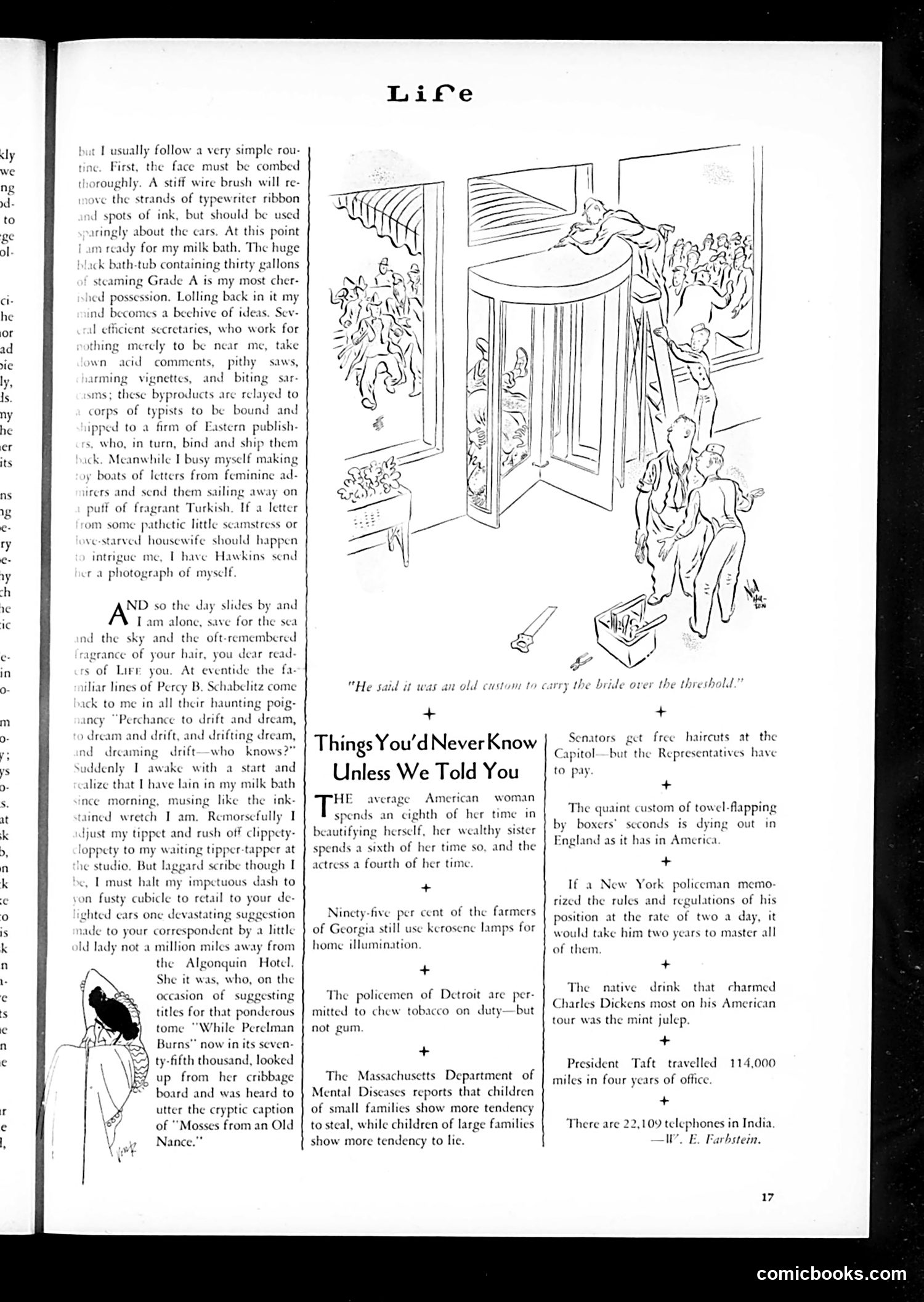
Analysis of Life Magazine Page This page combines a short story titled "Life" with a humorous feature called "Things You'd Never Know Unless We Told You" — a collection of trivial facts designed to amuse readers. The main illustration shows a chaotic domestic scene where a bride is being carried over a threshold by her groom, but numerous uninvited guests are crowding into the home behind them. The caption reads: "He said it was an old custom to carry the bride over the threshold." The satire mocks the tradition of threshold-carrying by suggesting it's being disrupted by modern intrusions. The accompanying trivia items — about farmers using kerosene lamps, police chewing tobacco, and statistics about lying — represent the magazine's characteristic light, observational humor about American life and customs.
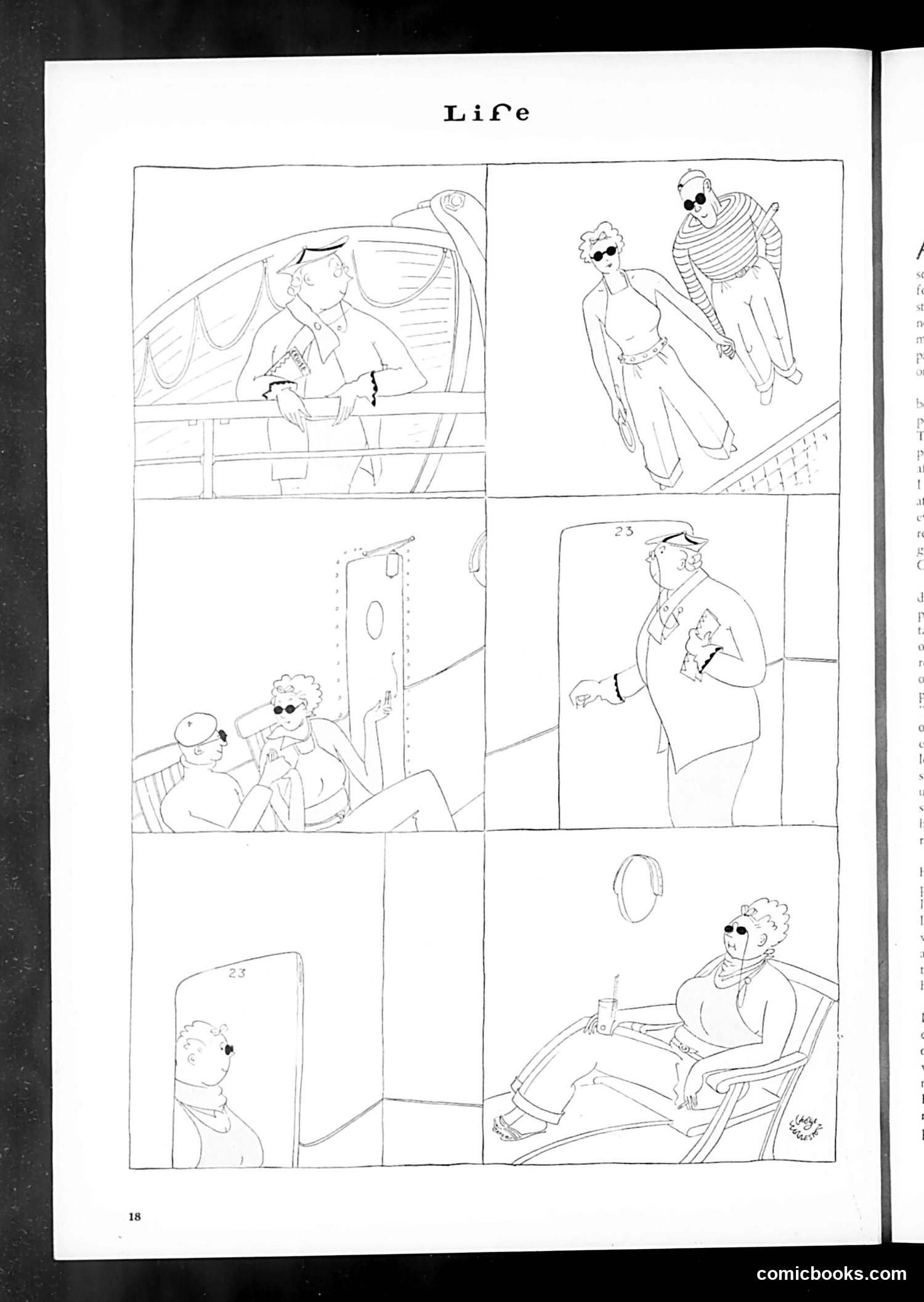
Analysis of "Life" Comic Page This appears to be a multi-panel comic titled "Life" depicting a narrative sequence involving wealthy or fashionable characters. The story follows a woman with curled hair and sunglasses in what seems to be a romantic or social scenario—beginning in a car, progressing to an elegant entrance, moving through what appears to be an official or formal setting with a uniformed man, and concluding with the woman relaxing indoors. The satire likely mocks upper-class social pretensions, romantic entanglements, or the performative nature of affluent leisure culture. The uniformed official figure suggests possible commentary on social hierarchies or bureaucratic pomposity. However, without publication date or caption text visible, specific political references remain unclear. The art style and subject matter suggest mid-20th century social commentary typical of *Life* magazine's satirical approach.
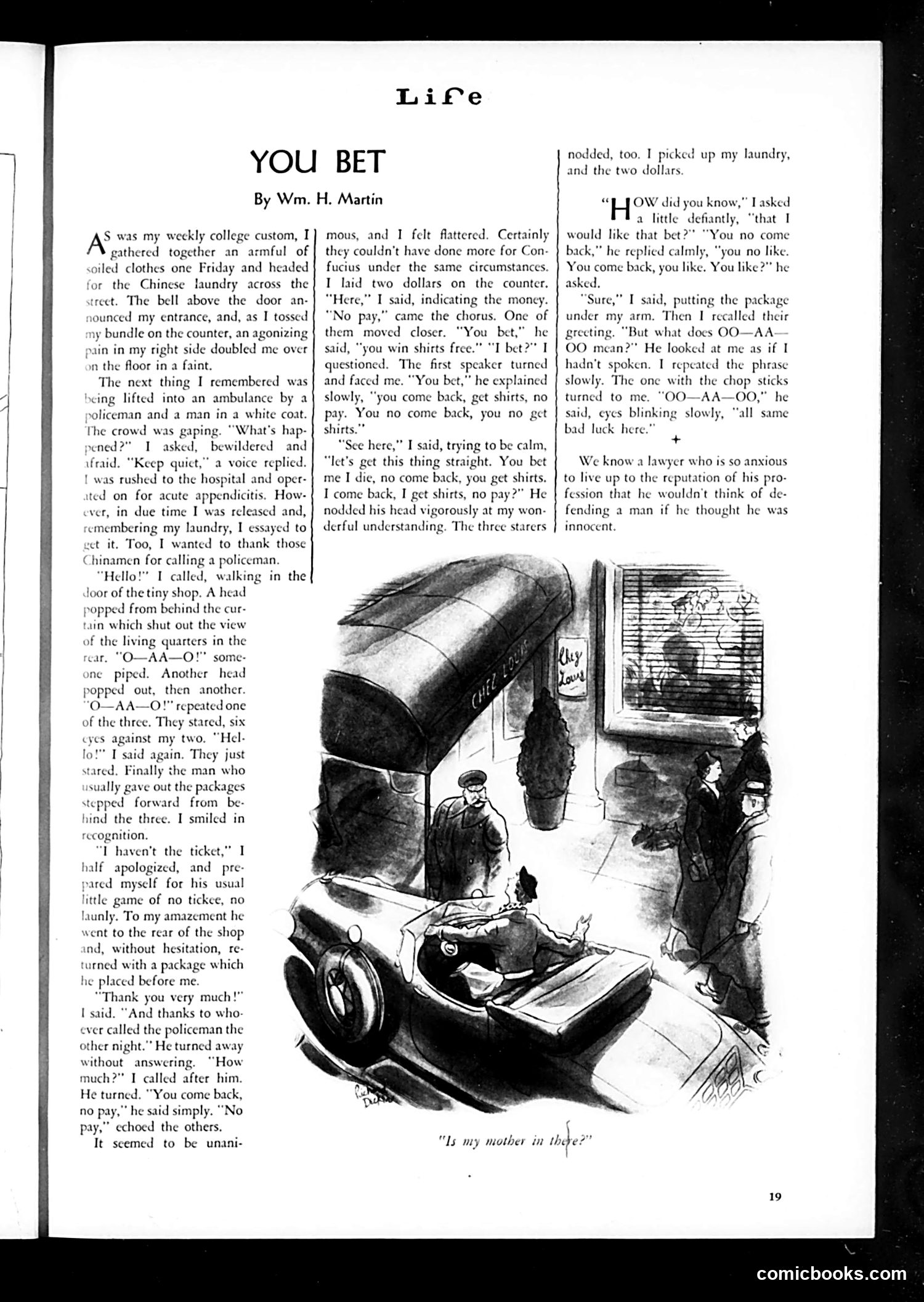
"You Bet" by Wm. H. Martin — Explanation for Modern Readers This is a humorous short story with accompanying cartoon, not political satire. It depicts early 20th-century American attitudes toward Chinese immigrants. The Plot: A college student collapses at a Chinese laundry, receives emergency surgery, then returns to retrieve his clothes. The Chinese laundrymen—portrayed with stereotypical "pidgin English"—make a darkly comedic bet: if he dies before returning, they keep the shirts free; if he lives and returns, he pays nothing. The student finds their logic oddly appealing. The Satire's Point: The humor relies on ethnic stereotyping—the laundrymen speak in broken English ("no tickee, no laundy"), make inscrutable sounds ("OO—AA—OO"), and their fatalistic wagering is presented as charmingly alien wisdom. The final cartoon caption ("Is my mother in there?") appears unrelated, suggesting magazine layout from that era. What We'd Miss: This reflects period racism normalized in "respectable" magazines, treating Chinese immigrants as comedic "others" while paradoxically portraying them as honorable and generous—a patronizing, contradictory stereotype common to early 20th-century American humor.
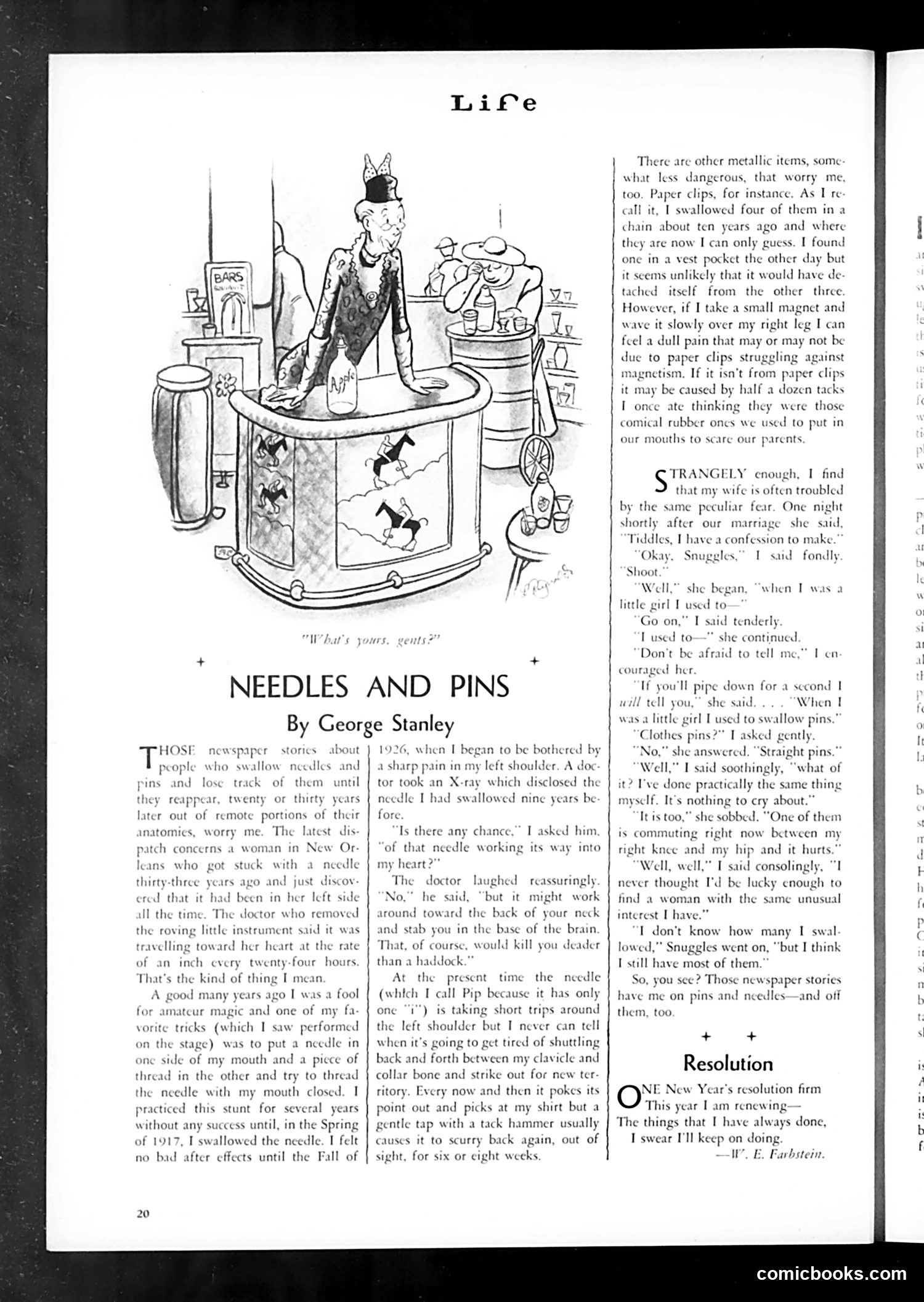
Analysis This is a humorous personal essay by George Stanley about swallowing needles and pins—a recurring theme in newspaper stories of the era. Stanley recounts swallowing a needle during a magic trick in 1917, which he claims is still traveling through his body nine years later, occasionally causing shoulder pain. He also mentions swallowing paper clips and admits to anxiety about metallic objects lodged in his anatomy. The satire targets the sensationalist newspaper stories of the 1920s-30s that reported on people discovering foreign objects in their bodies years after swallowing them. Stanley uses exaggeration and deadpan humor to mock both these stories and his own irrational hypochondria. The twist—his wife shares the identical fear and has also swallowed pins—amplifies the absurdist joke about couples sharing neurotic preoccupations. The cartoon illustrates a woman performing magic tricks surrounded by various objects, reinforcing the amateur-magician context of the needle-swallowing incident.
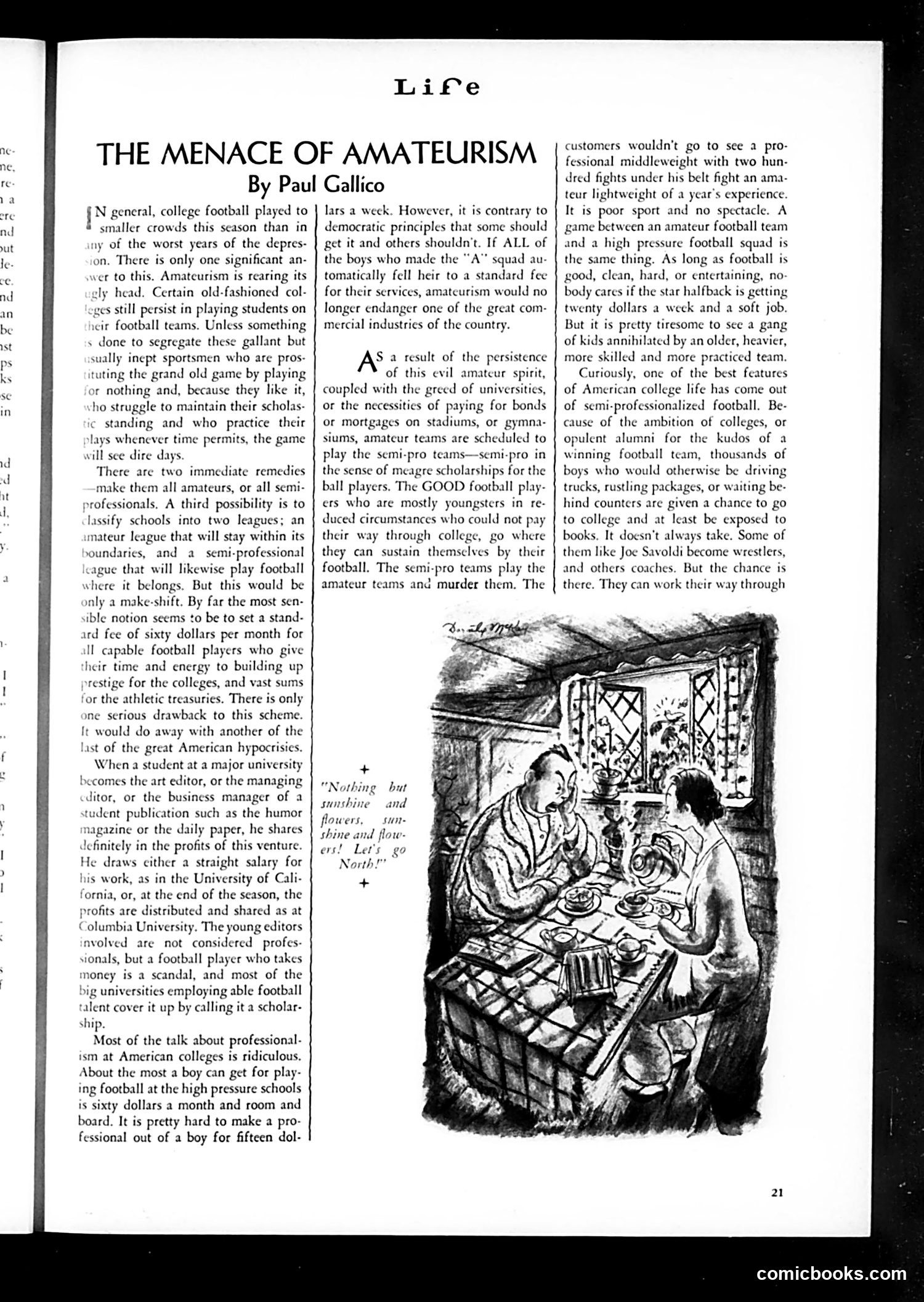
"The Menace of Amateurism" by Paul Gallico This satirical article attacks college football's hypocrisy regarding "amateur" status. Gallico argues that universities secretly pay star football players through scholarships while publicly maintaining amateur standards—yet simultaneously pay student editors of campus publications without scandal. The accompanying cartoon (bottom right) shows a man at a window with the caption "Nothing but sunshine and flowers, sunshine and flowers! Let's go North!"—likely depicting someone fleeing winter or escaping an uncomfortable situation, perhaps satirizing those who ignore the obvious corruption. Gallico's core argument: colleges treat football players who receive modest compensation ($60/month) as scandals, while student editors receiving similar payments are considered legitimate. He proposes either full professionalization or honest acknowledgment that these athletes are already semi-professionals. The piece exposes how American universities maintained a facade of amateurism while profiting enormously from college sports.
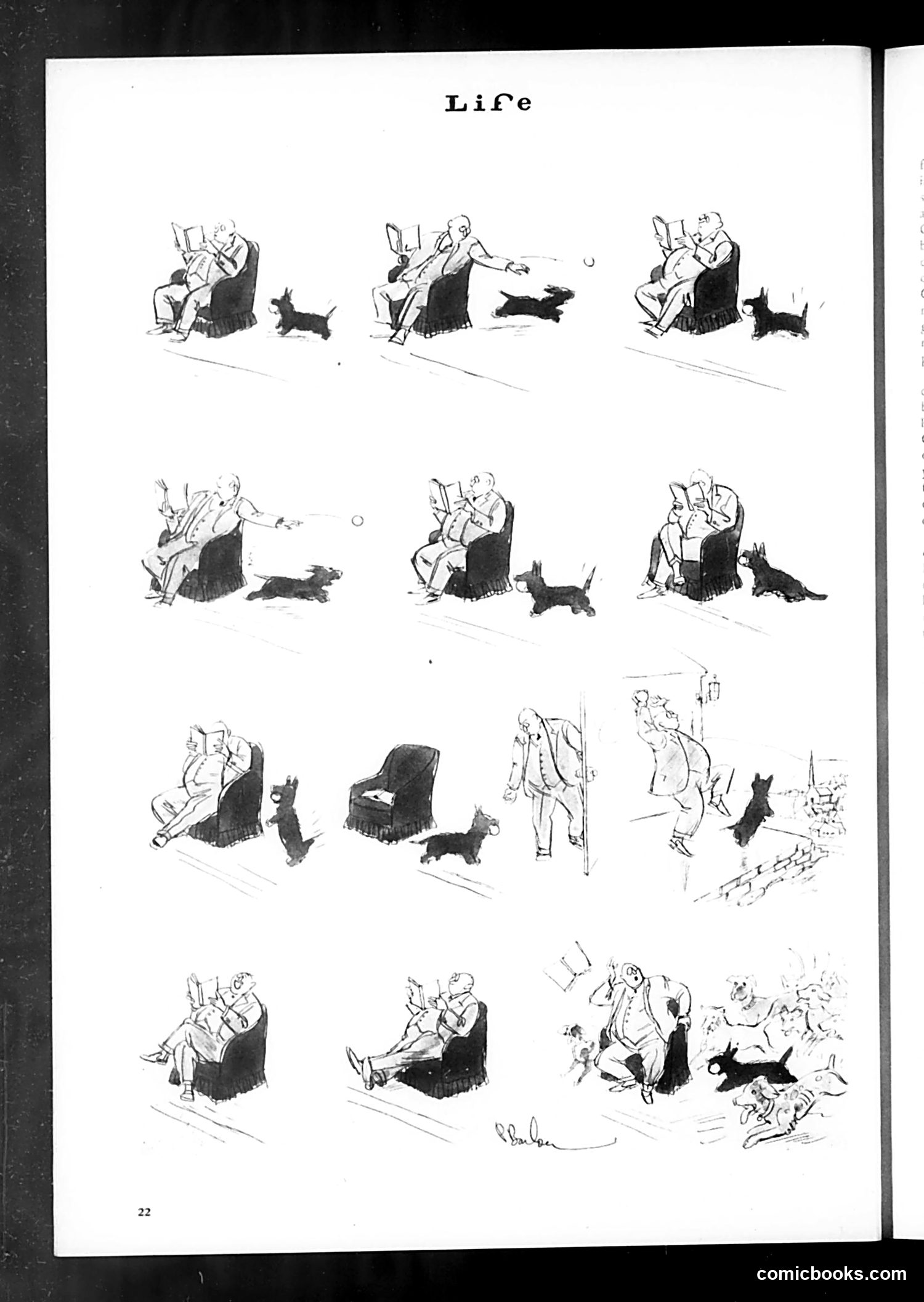
"Life" Page Analysis This page titled "Life" presents a wordless sequential comic strip showing a man in a chair reading a newspaper while a small dog repeatedly interrupts him. The narrative progresses through various panels: the dog brings objects, jumps on the chair, tangles the man's papers, and creates general domestic chaos. The satire appears to mock the tension between domestic life and leisure—specifically a man's desire for peaceful relaxation versus the constant demands of pet ownership (or family life). The humor derives from the dog's persistent, escalating disruptions to the reading man's attempts at tranquility. This reflects early 20th-century comedic themes about the complications of modern domestic life, using visual gags rather than dialogue for effect.
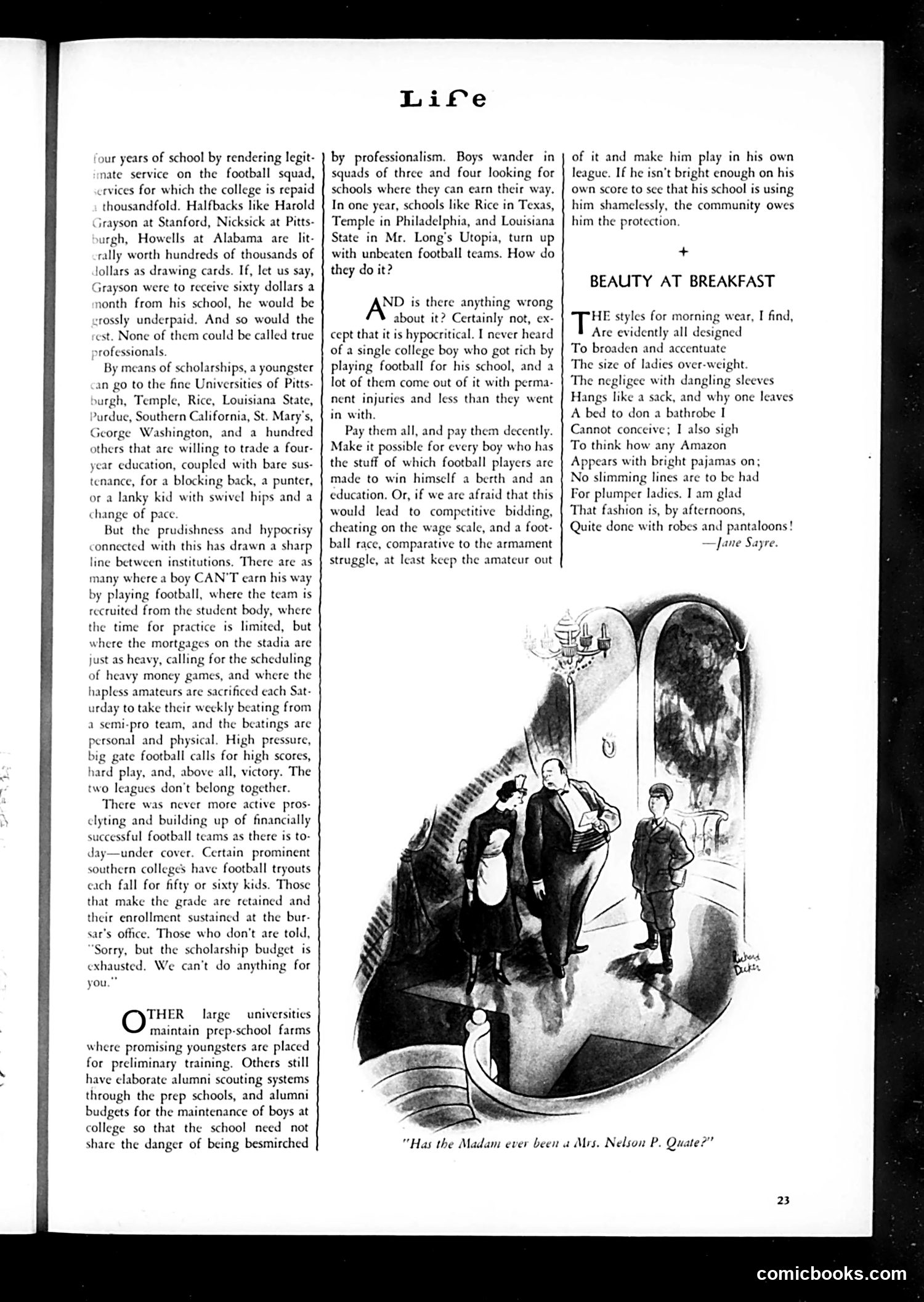
Analysis of This Life Magazine Page This page presents two distinct pieces of social commentary from early-to-mid 20th century America. Main Article - College Football Hypocrisy: The lengthy text critiques the exploitation of college athletes, particularly at major universities (Stanford, Alabama, Rice, Louisiana State, etc.). The author argues that schools benefit enormously from star players like "Harold Grayson" and "Nicksick" but maintain a facade of amateurism while secretly paying athletes through scholarships. The satire targets the hypocrisy: universities claim to run amateur programs yet recruit aggressively, schedule lucrative games, and sacrifice players' education and health. The proposal is either pay athletes openly or maintain truly amateur leagues. Cartoon - "Beauty at Breakfast": The illustration and accompanying verse by Jane Sayre mock 1920s-30s women's fashion. It satirizes how morning wear styles—particularly negligees with dangling sleeves—unflattering hang on women, making them appear larger. The cartoon shows well-dressed women entering what appears to be a residence, likely satirizing how impractical or unflattering these fashions are for everyday wear. Both pieces exemplify Life magazine's satirical approach to American social contradictions.
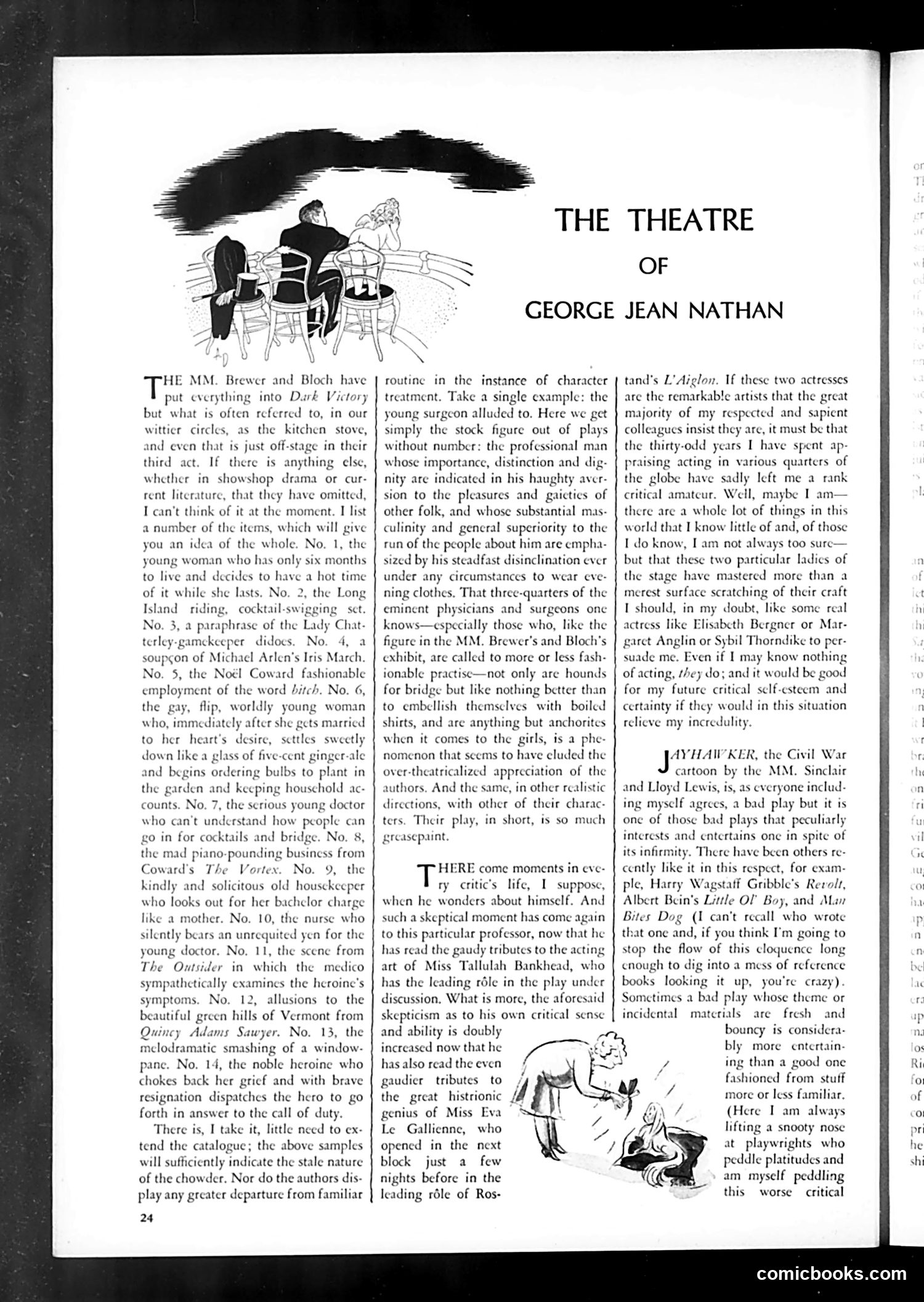
The Theatre of George Jean Nathan This is a theater critique by the renowned drama critic George Jean Nathan reviewing the play *Dark Victory*. Nathan dismisses the production as derivative and clichéd, cataloging fourteen stock theatrical elements it recycles—from the doomed heroine with six months to live, to the serious young doctor, to melodramatic window-smashing. He ridicules the character archetypes as unrealistic stereotypes, particularly the "stock figure" of the dignified surgeon who affects disdain for evening clothes and socializing, when Nathan notes real prominent physicians actually enjoy both. The accompanying illustrations show theatrical scenes with actors in period dress. Nathan's tone is withering—he calls the play "greasepaint" (artificial theatricality). He then pivots to questioning his own critical judgment regarding actress Tallulah Bankhead's acclaimed performance in the leading role, expressing self-doubt about whether he's missing something others praised.
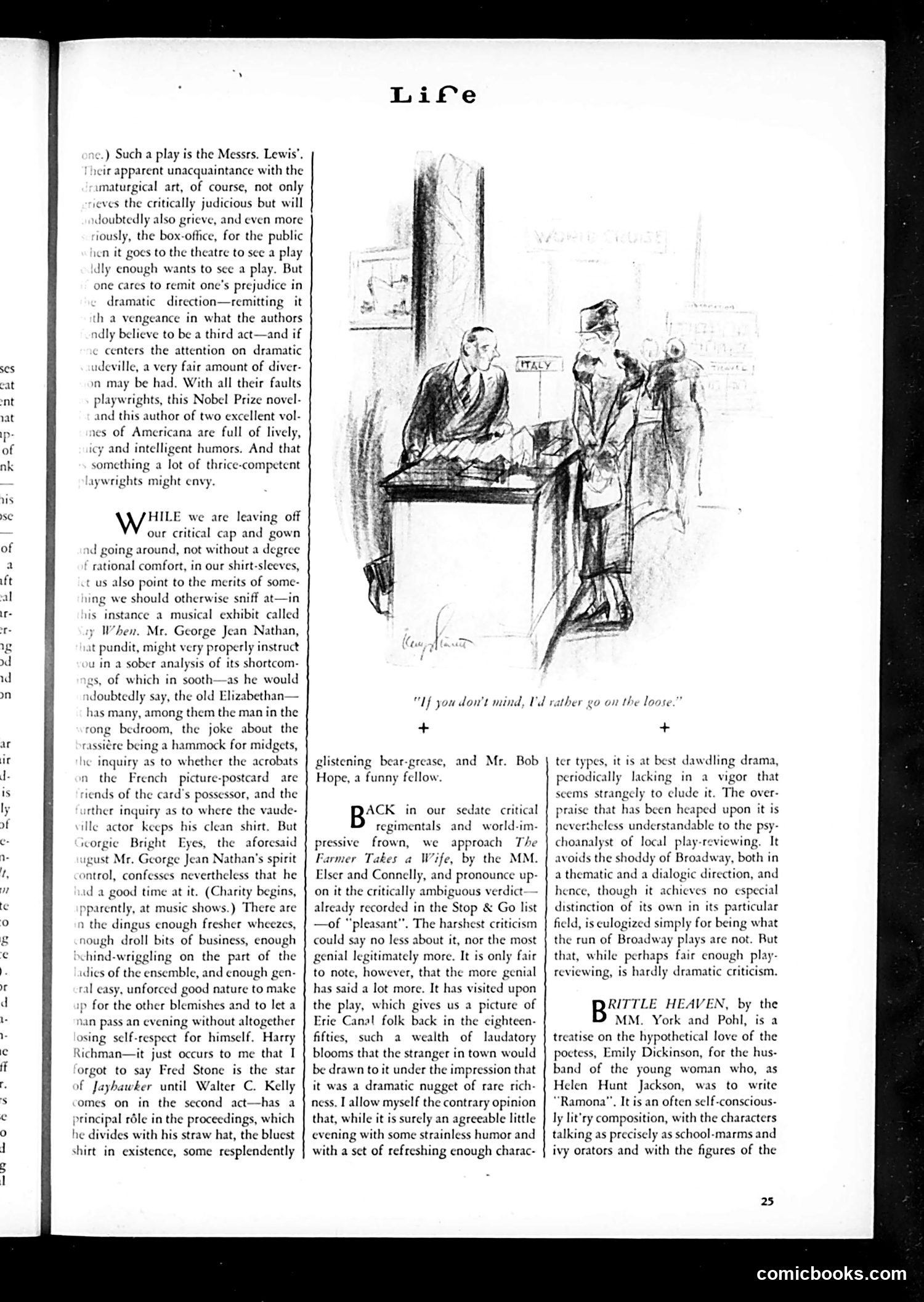
Life Magazine Cartoon Analysis The single cartoon on this page depicts a man at a desk, apparently an immigration or customs official (indicated by the "ITALY" sign), speaking to a visitor. The caption reads: "If you don't mind, I'd rather go on the loose." The humor relies on a double meaning of "go on the loose"—literally meaning to be released or set free, but colloquially suggesting dissolute behavior. The joke appears to target bureaucratic officials or their pretensions: the formally-dressed man at the desk, representing authority, is ironically rejecting proper procedure in favor of personal indulgence. The surrounding text discusses theatrical reviews, including plays by the Lewis brothers and "The Farmer Takes a Wife." The cartoon's exact connection to the theater criticism isn't explicit, though it may be commenting on institutional hypocrisy or the gap between official propriety and actual behavior—themes relevant to theater commentary of this era.
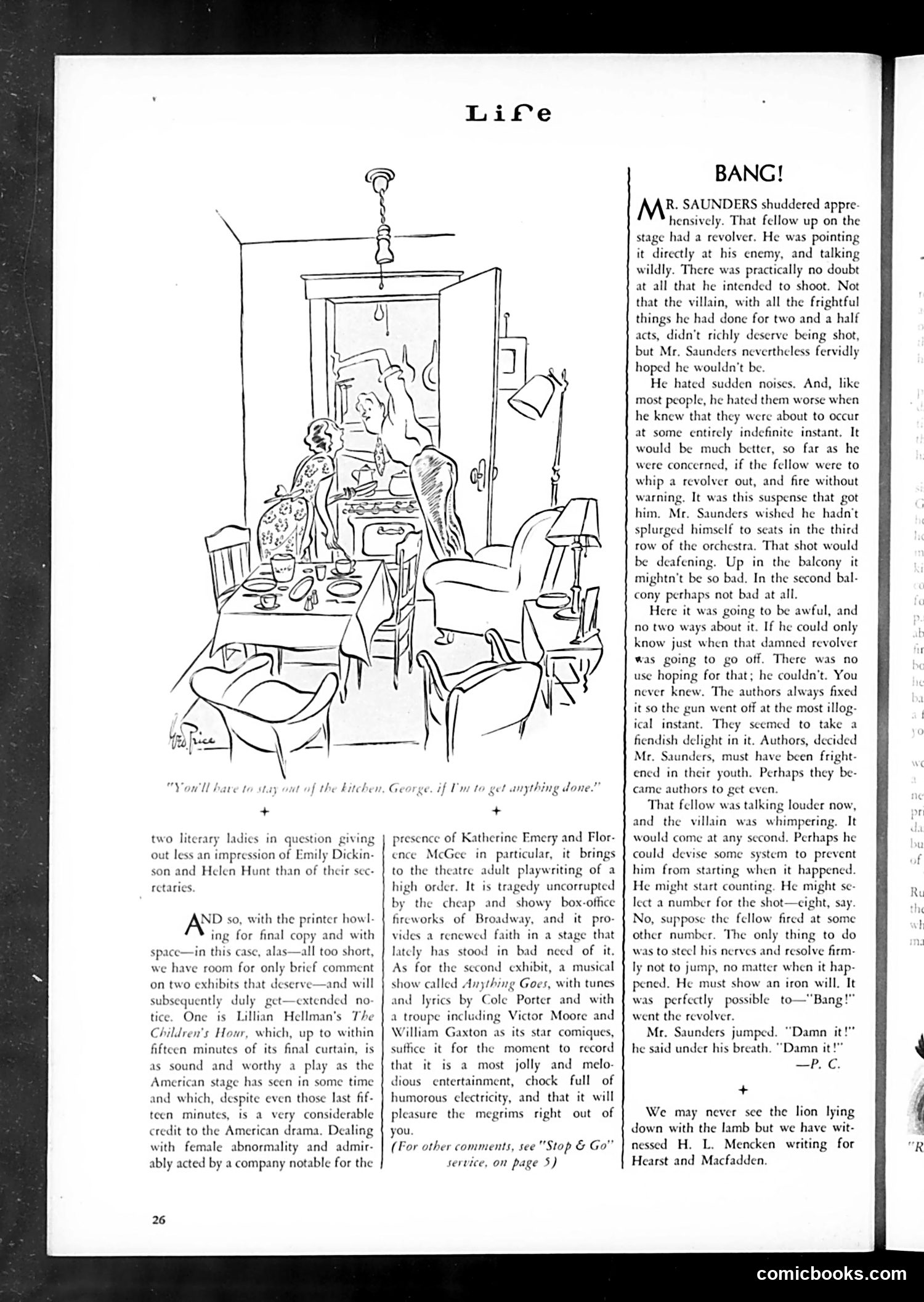
Content Analysis The page contains two distinct pieces: The Cartoon (left): An illustration by Ralph Barton depicting a dinner party in a small kitchen, with the caption mocking someone's attempt to entertain guests despite spatial constraints—a commentary on trying to host elaborate social gatherings in cramped urban apartments. "Bang!" (right): A humorous short story by P.C. about Mr. Saunders, a theater-goer in the third row who dreads the sudden gunshot he knows is coming in the stage play. The satire mocks the predictable melodrama of theater—where authors deliberately time explosive moments to startle audiences maximally. It's a gentle jab at theatrical manipulation and audience anxiety. Bottom section: Brief theater reviews of *The Children's Hour* (praised as serious drama) and *Anything Goes* (Cole Porter musical, deemed entertaining). The overall tone is urbane, sophisticated satire typical of *Life* magazine's commentary on American cultural life and theatrical conventions.
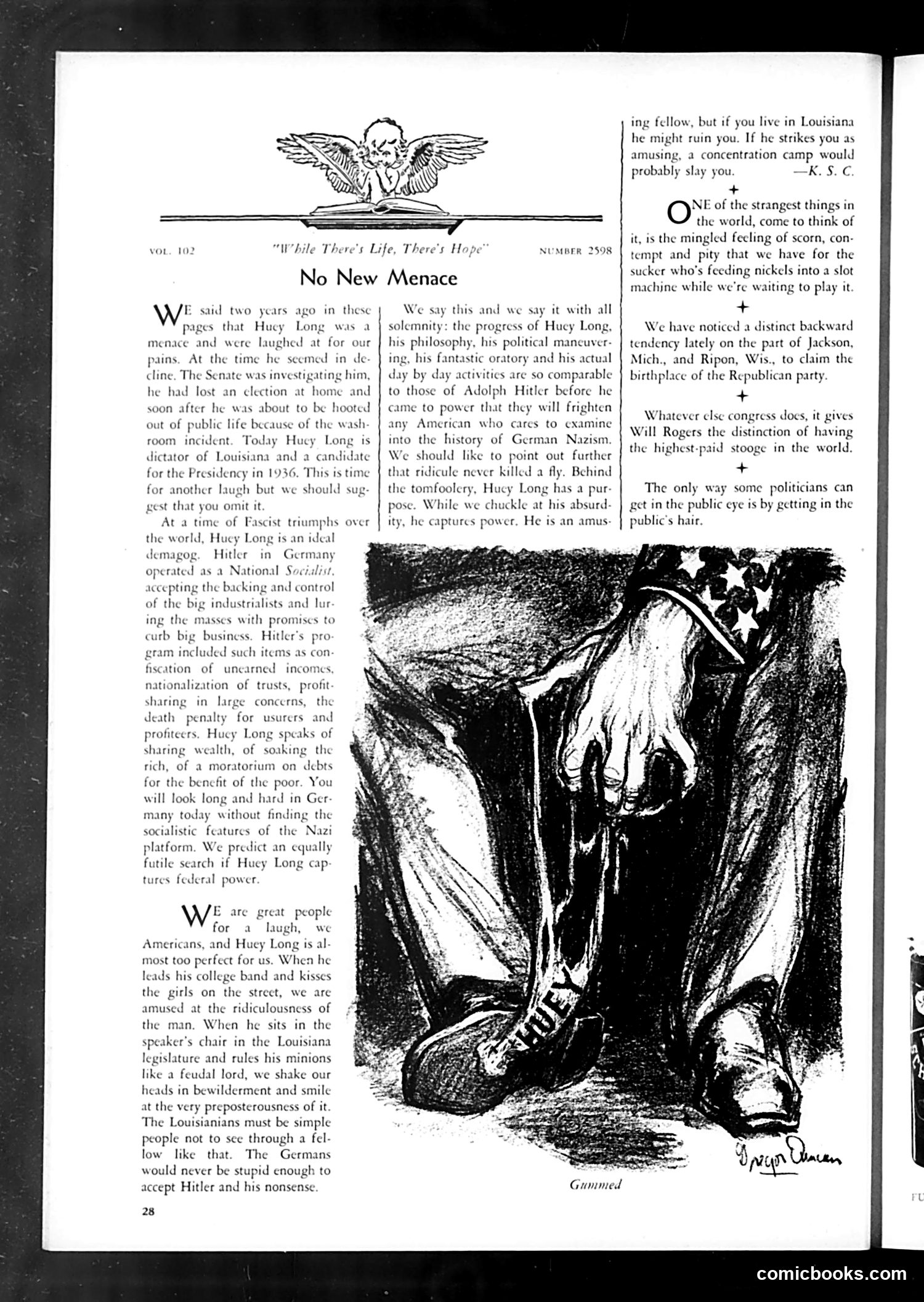
"No New Menace" — Huey Long as American Hitler This 1935 *Life* editorial warns that Louisiana politician Huey Long poses a fascist threat comparable to Adolf Hitler's rise in Germany. The accompanying cartoon depicts Long as a skeletal, menacing figure—a visual metaphor for his danger. The text argues that Long's populist rhetoric about "sharing wealth" and attacking big business mirrors Hitler's socialist promises, which masked authoritarian control. Both men use charismatic oratory and mass appeal to consolidate power while actually serving industrialists' interests. The satire targets American complacency: readers dismiss Long as a mere buffoon leading a "college band," but the magazine warns this comedy obscures real political peril. The final quoted line grimly suggests that for Louisiana residents, Long's amusement-park antics could culminate in "concentration camps." This reflects genuine 1930s anxiety about demagogues exploiting Depression-era economic grievances to establish dictatorial control.
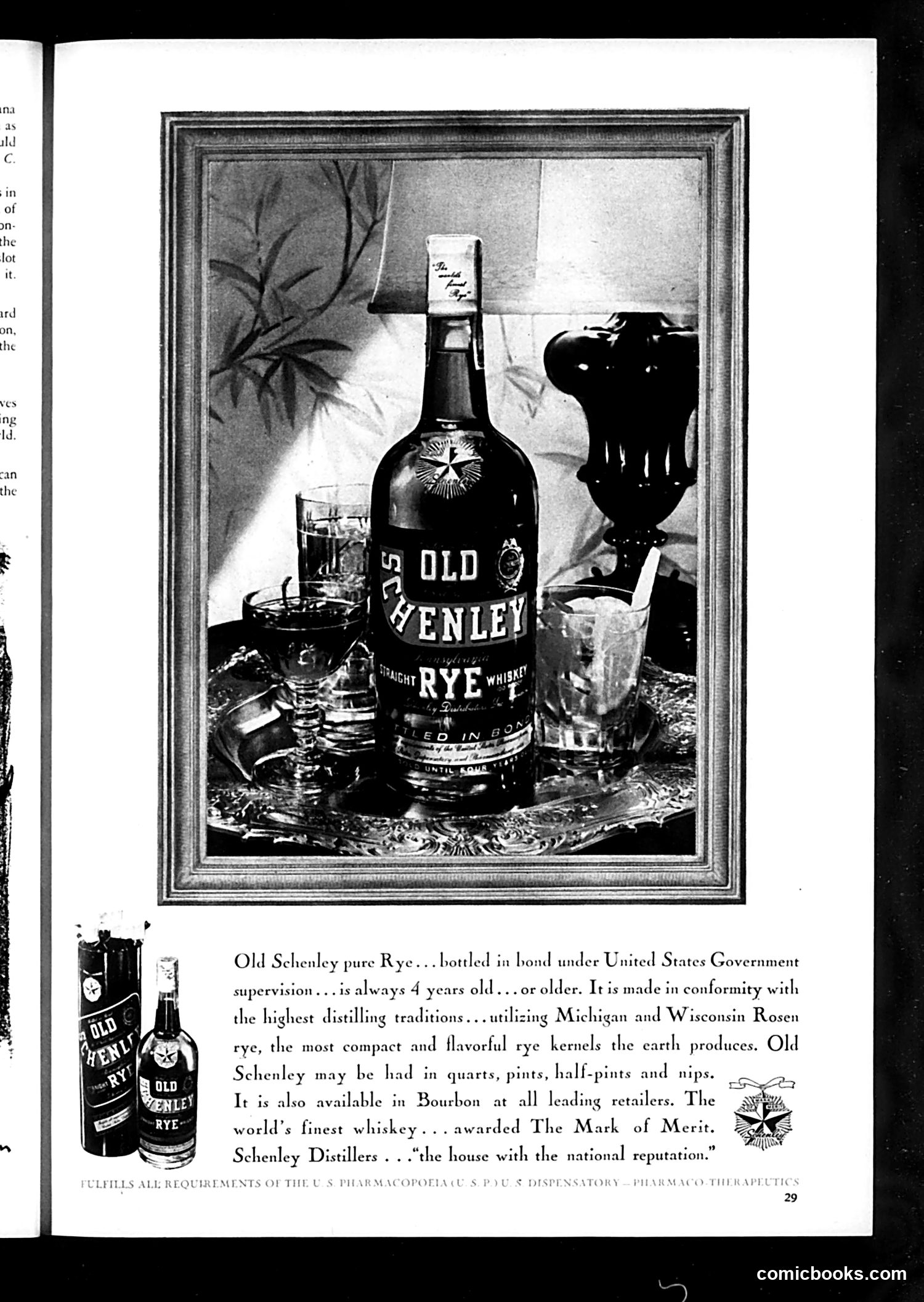
This is an Advertisement, Not Political Satire This page is a whiskey advertisement for Old Schenley Rye, not a political cartoon or satire. The image shows a styled still-life composition featuring a bottle of Old Schenley Rye whiskey surrounded by glasses and decorative elements like potted plants. The text emphasizes the product's legitimacy: it's "bottled in bond under United States Government supervision" and "4 years old or older." This language likely reflects Prohibition-era advertising (1920-1933), when distillers had to prove compliance with government regulations or claimed medicinal/pharmaceutical purposes to sell alcohol legally. The reference to "The Mark of Merit" and positioning as "the world's finest whiskey" represents standard luxury product marketing of the period. There is no satirical or political commentary present—this is commercial advertising appearing in Life magazine.
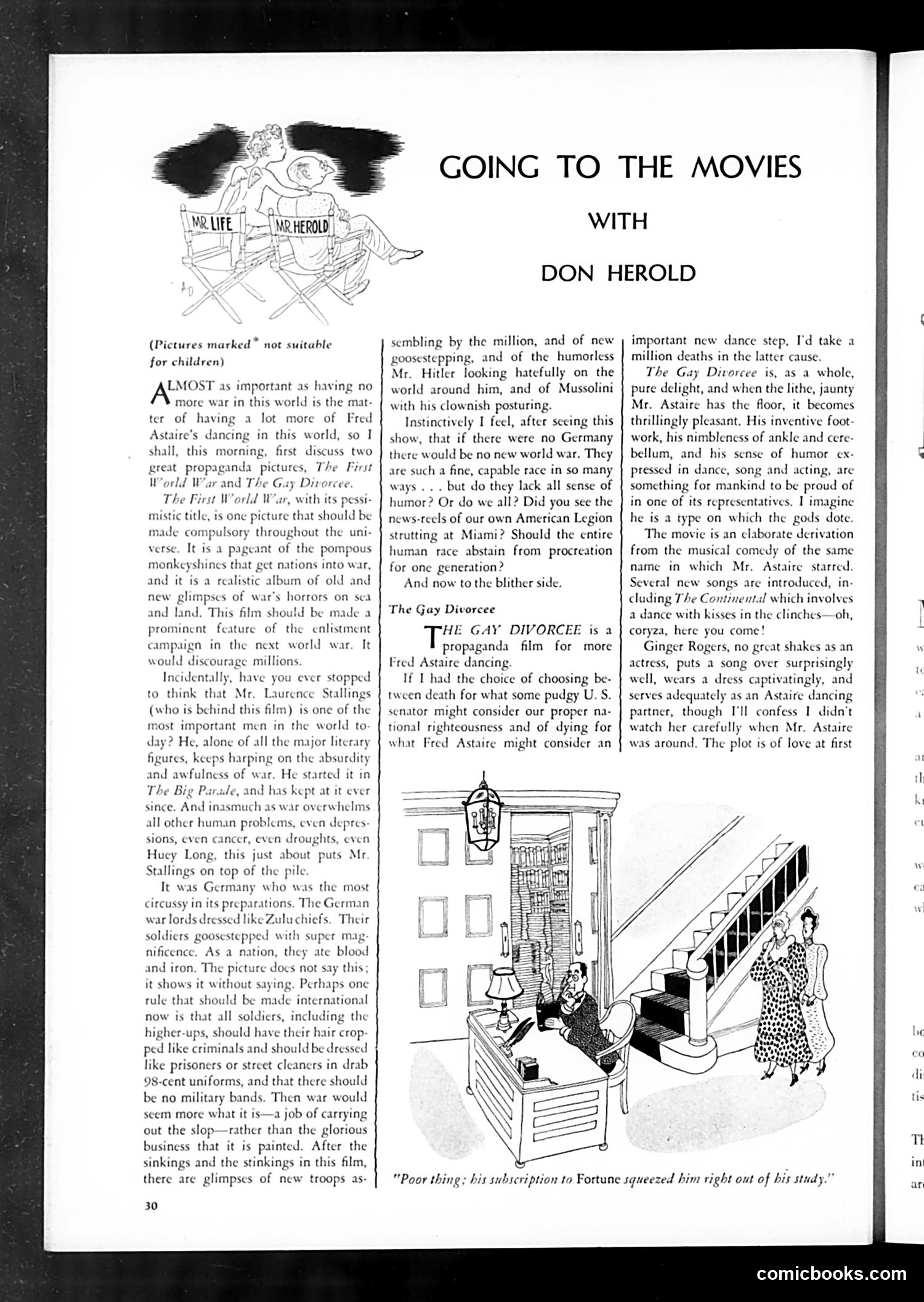
Analysis of "Going to the Movies with Don Herold" This Life magazine column reviews two films: *The First World War* and *The Gay Divorcee* (both featuring Fred Astaire). The satirical point contrasts serious and trivial concerns. Herold argues that preventing future war is crucial, praising Laurence Stallings' anti-war messaging in *The First World War*. He mockingly critiques German militarism—their "goosestepping" soldiers, theatrical uniforms, and leaders (Hitler and Mussolini) lacking humor. Then he pivots absurdly: he'd rather die watching Fred Astaire dance than for national "righteousness," claiming Astaire's talent represents humanity's highest achievement. The satire works on two levels: it genuinely advocates for anti-war sentiment while simultaneously mocking American priorities—suggesting we worship entertainment and celebrity over serious political engagement. The illustration shows a bureaucrat's office, likely depicting the shallow concerns of everyday life that overshadow weightier matters.
Analysis for Modern Readers This page combines educational content with advertising. The main article discusses the scientific debate over whether the common cold is caused by bacteria (visible under microscopes) or a "filtrable virus" (too tiny to see). Scientists in 1914+ had discovered that cold secretions filtered to remove bacteria still caused illness, suggesting a viral cause—revolutionary thinking at the time. The decorative airplane and microscope illustrations are period-appropriate visual flourishes emphasizing modernity and scientific progress. The satire/advertising hook: The text celebrates medical research institutions worldwide, then pivots to claim that Listerine antiseptic benefits from this cutting-edge science. The implication is that Listerine keeps up with bacteriological research to destroy cold-causing organisms. This is straightforward advertorial content—educational material that subtly positions a commercial product (Listerine) as scientifically sophisticated, a common marketing strategy of the era.
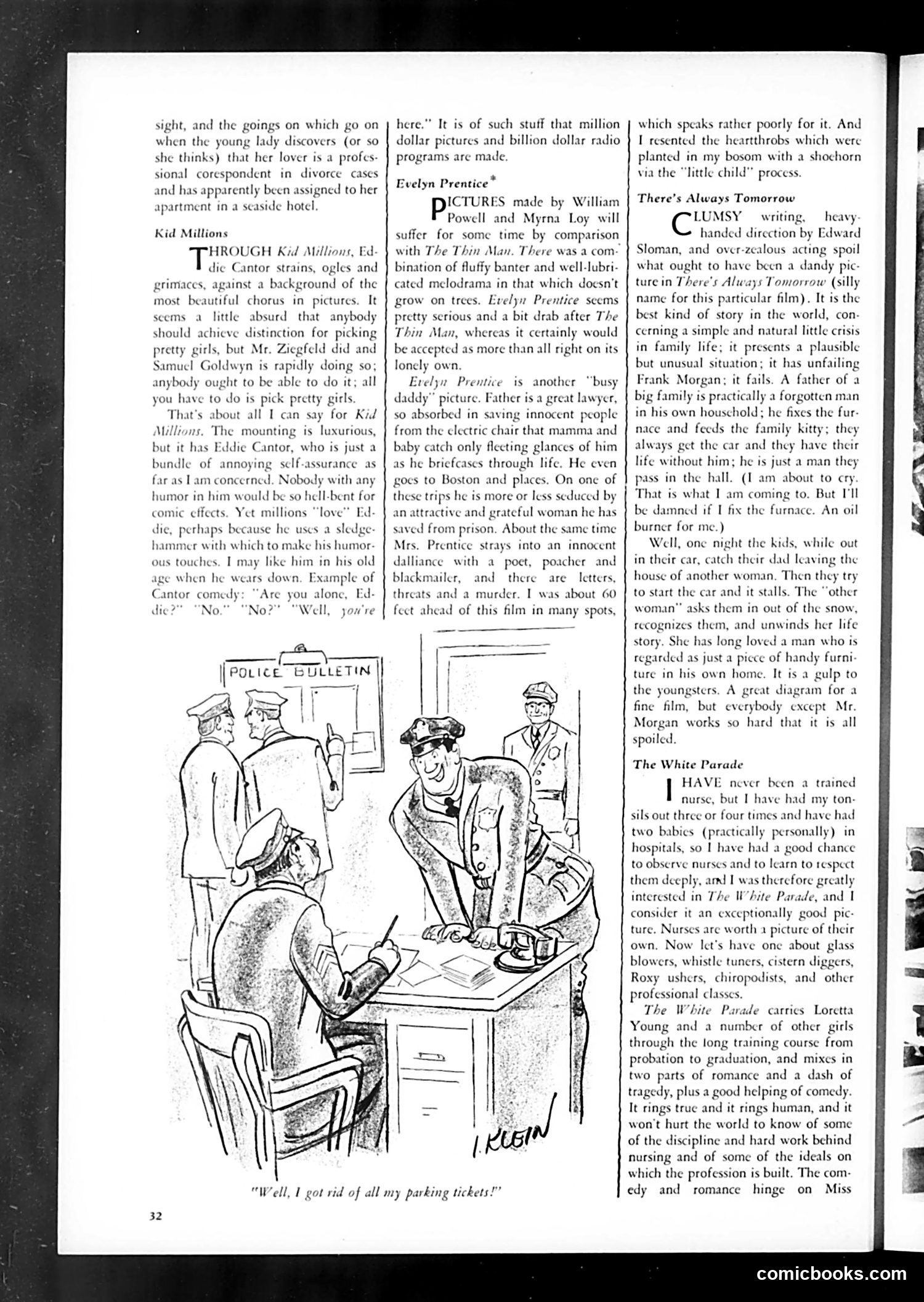
Life Magazine Film Reviews (circa 1930s) This page contains film reviews from Life magazine's satirical criticism section. The cartoon illustrates a police station scene where someone appears to be bragging about resolving parking violations—a mundane joke about bureaucratic hassles. The reviews critique three films: *Kid Millions* (mocking Eddie Cantor's slapstick humor as heavy-handed), *Evelyn Prentice* (comparing it unfavorably to the superior *The Thin Man*), and *There's Always Tomorrow* (praising its domestic premise but criticizing the direction and acting, particularly Frank Morgan's performance). The critic employs characteristic 1930s film journalism—comparing pictures, noting star power, and assessing plot predictability. The reviews reflect contemporary attitudes toward "busy daddy" melodramas and showcase Life's role as a venue for educated, sometimes caustic entertainment commentary targeting middle-class readers familiar with popular cinema.
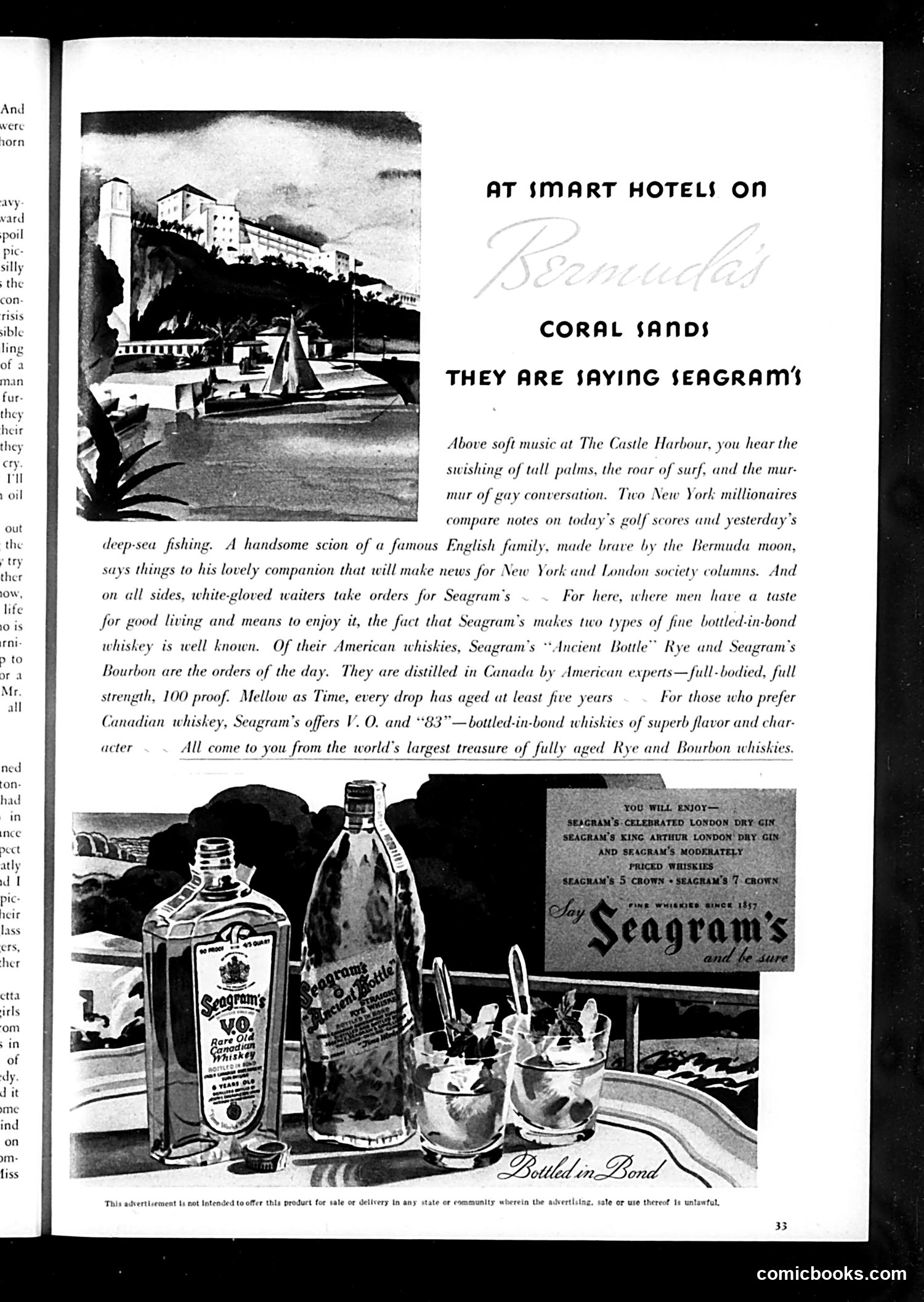
What This Page Actually Is This is not a political cartoon or satire—it's a full-page advertisement for Seagram's whiskey, likely from the 1930s-40s based on styling. The ad uses aspirational lifestyle imagery: a luxury hotel in Bermuda, wealthy socialites, "handsome scion of a famous English family," and upscale leisure activities (golf, deep-sea fishing). The copy creates an atmosphere of sophistication and exclusivity to sell three whiskey products: Seagram's V.O., Ancient Bottle Rye, and Bourbon. The photograph shows bottles of Seagram's displayed on what appears to be a beach or resort setting, reinforcing the "smart hotels on coral sands" narrative. Bottom line: This page contains no political commentary or satirical humor—it's straightforward luxury-goods marketing using class signaling and aspirational fantasy to reach affluent readers of *Life* magazine.
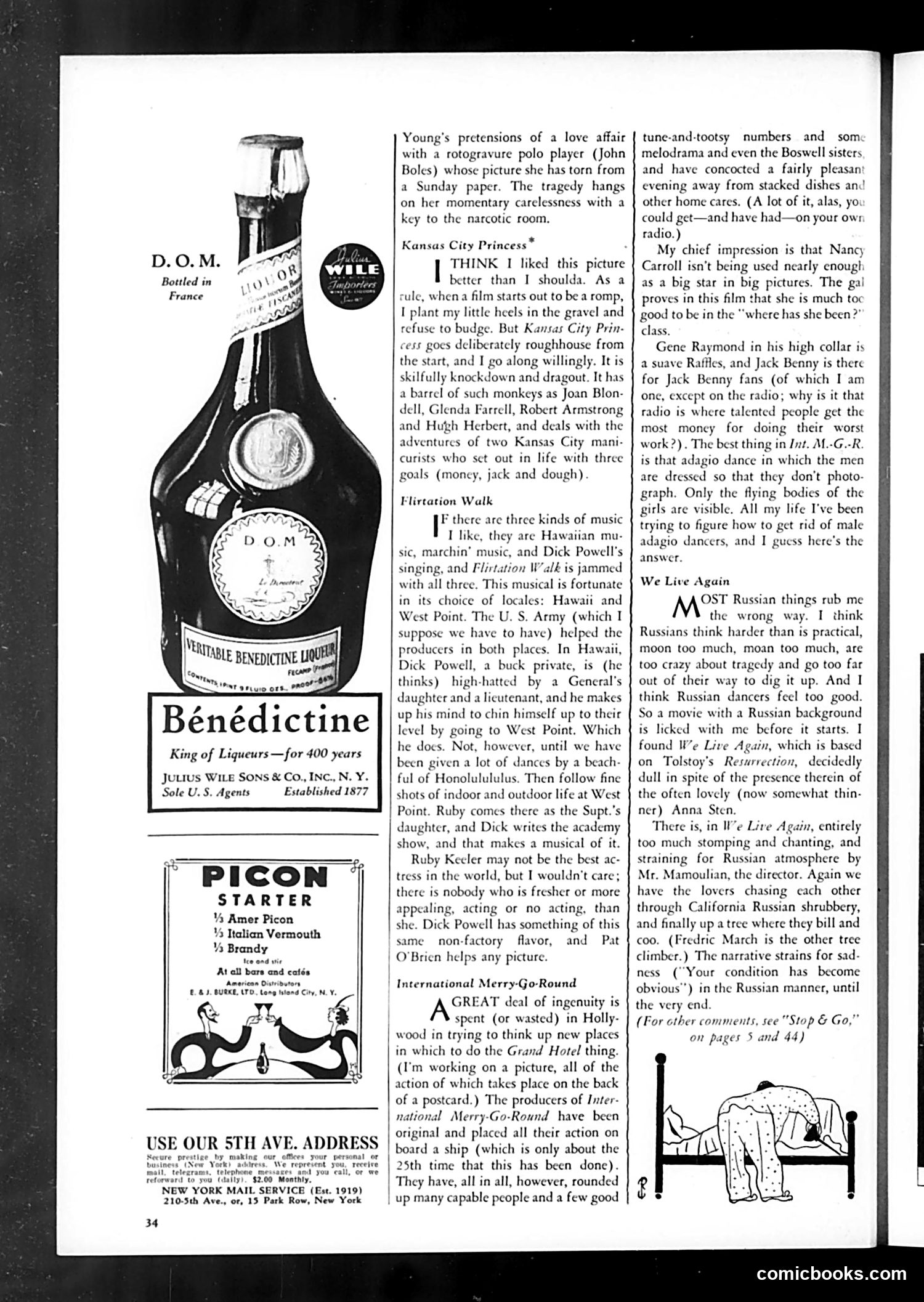
Life Magazine Page Analysis This page contains film reviews and liquor advertisements from Life magazine's entertainment section. The reviews discuss three movies: Kansas City Princess satirizes a formulaic Hollywood romp about manicurists seeking money and romance, praising its energetic cast (Joan Blondell, Glenda Farrell) for their physical comedy. Flirtation Walk reviews a Dick Powell musical set in Hawaii and West Point, mixing military cooperation with romance and musical numbers featuring Ruby Keeler. International Merry-Go-Round critiques Hollywood's repetitive "Grand Hotel" formula—placing ensemble casts in exotic settings (here, a ship)—while acknowledging the film's adequate entertainment value and Nancy Carroll's underutilization as a star. The sidebar criticizes a Russian film (We Live Again) for excessive melodrama and "Russian atmosphere." The advertisements promote Bénédictine liqueur and Picon aperitif—typical 1930s luxury goods marketing to Life's affluent readership.
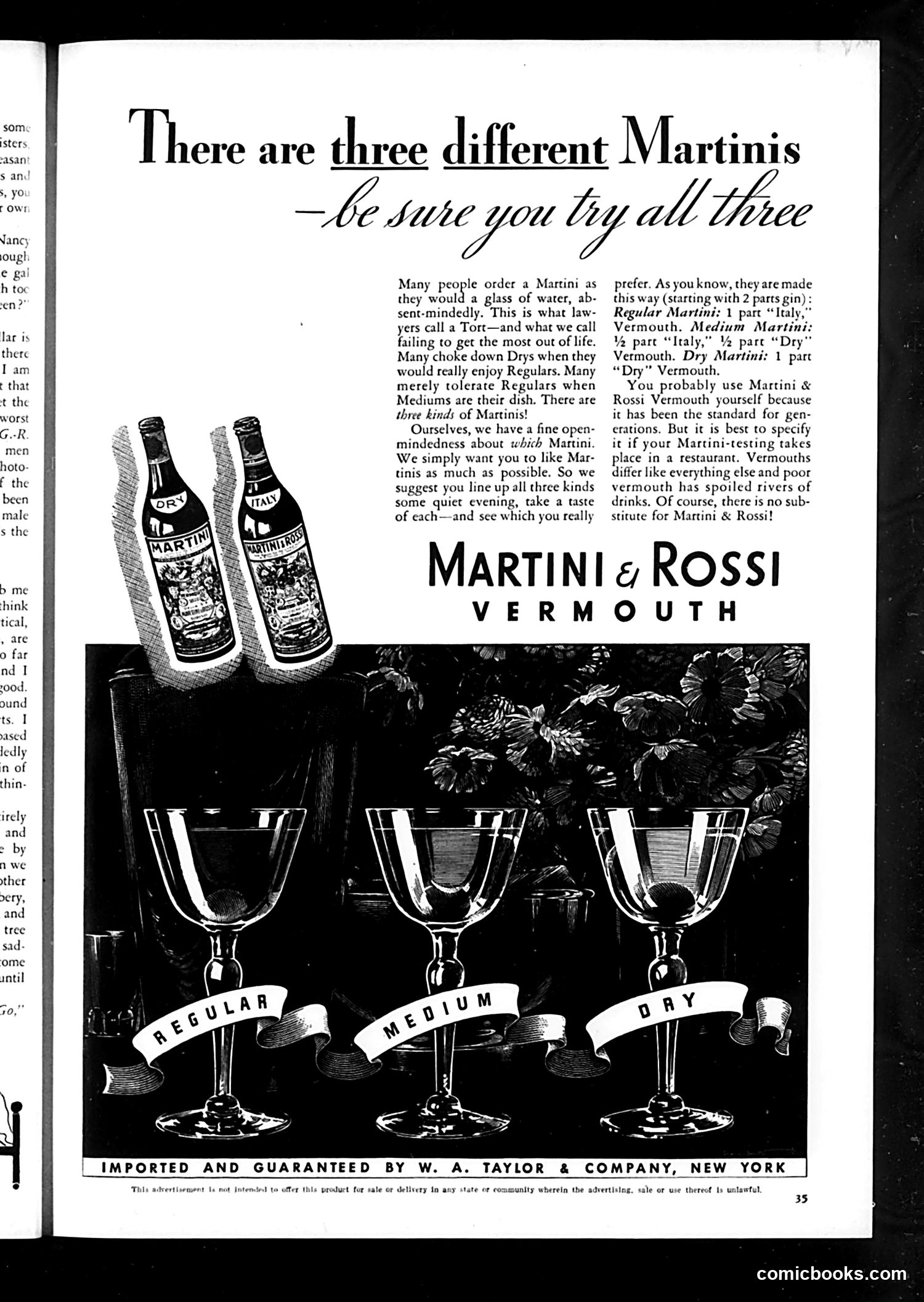
Martini & Rossi Vermouth Advertisement This is a straightforward advertisement, not satire or political commentary. It promotes Martini & Rossi vermouth by educating consumers about three cocktail variations. The ad addresses a common consumer behavior: people ordering Martinis "absent-mindedly" without considering their preferences. It argues that "three kinds of Martinis" exist, distinguished by vermouth ratios: - Regular: 1 part Italian vermouth - Medium: equal parts Italian and dry vermouth - Dry: only dry vermouth The visual shows three cocktail glasses labeled accordingly, with two vermouth bottles above. The copy encourages readers to taste-test all three to discover their preference, while subtly emphasizing that Martini & Rossi is the superior choice—the "standard for generations"—and should be specifically requested in restaurants, since inferior vermouths "spoil rivers of drinks." It's vintage advertising designed to build brand loyalty and drive sales by framing product selection as a refined, personal choice rather than an afterthought.
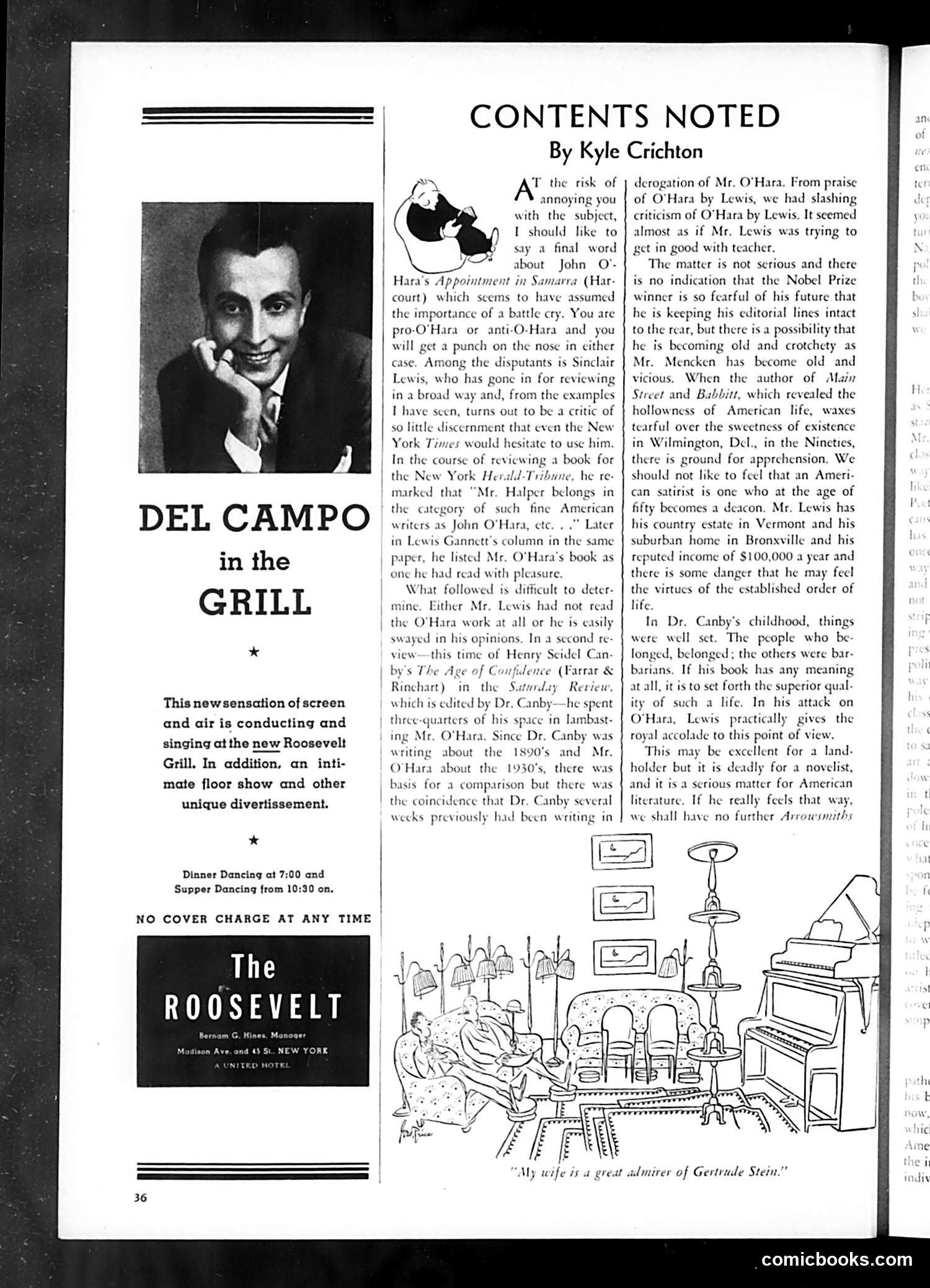
Analysis of This Life Magazine Page This page contains a column by Kyle Crichton critiquing Sinclair Lewis, the Nobel Prize-winning American novelist. Crichton accuses Lewis of inconsistency and moral compromise: Lewis praised John O'Hara's novel in one review, then harshly criticized O'Hara in another review of a Henry Seidel Canby book—apparently to curry favor with Canby. The larger concern is that Lewis, once a satirist of American life (*Main Street*, *Babbitt*), now appears to be defending the "established order." Crichton suggests Lewis's comfortable lifestyle—his Vermont estate, Bronxville home, and $100,000 annual income—has made him conservative and defensive of wealth and privilege rather than critical of it. The cartoon below (captioned "My wife is a great admirer of Gertrude Stein") satirizes artistic pretension among the wealthy. The page also advertises Del Campo performing at the Roosevelt Grill nightclub.
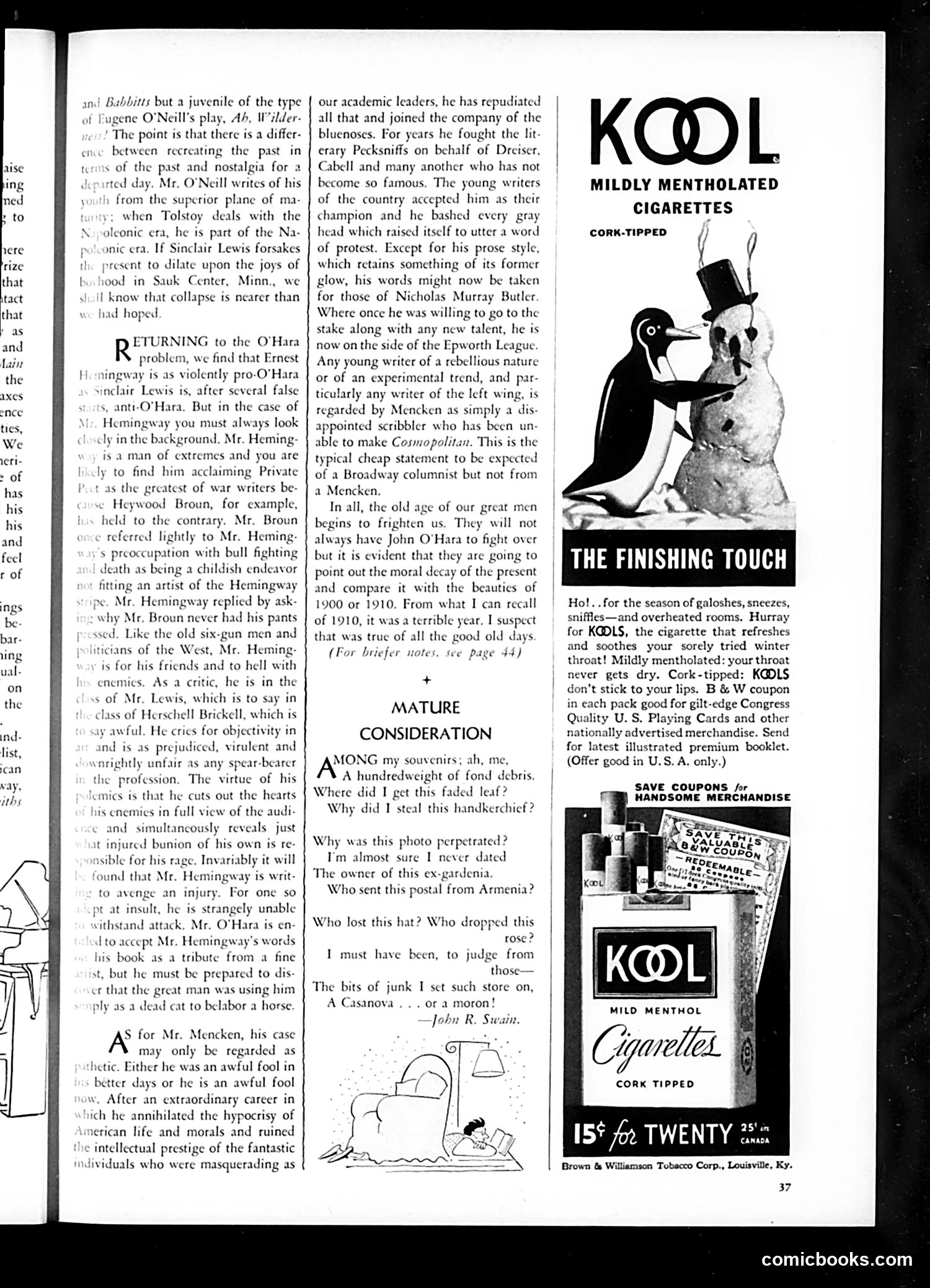
Analysis of This Life Magazine Page This page is primarily literary criticism, not political satire. The text discusses how aging American literary figures—Ernest Hemingway, H.L. Mencken, and others—have disappointed the author by becoming conservative or nostalgic in their later years. The critique centers on: - Hemingway: Praised for passionate advocacy but criticized as hypocritical and vindictive, using allies (like John O'Hara) as rhetorical weapons - Mencken: Once a fearless defender of modernist writers (Dreiser, Cabell) against prudish critics, he's now aligned with conservative "bluenoses" and dismisses experimental young writers as failures The author's main point: great men of letters are becoming their own enemies—replacing youthful artistic rebellion with cranky nostalgia for a mythical golden past (1900-1910). The cartoons (a small absurdist drawing of a figure in water) appear decorative rather than thematically connected. The Kool cigarette advertisement is period-appropriate commercial content unrelated to the editorial material.
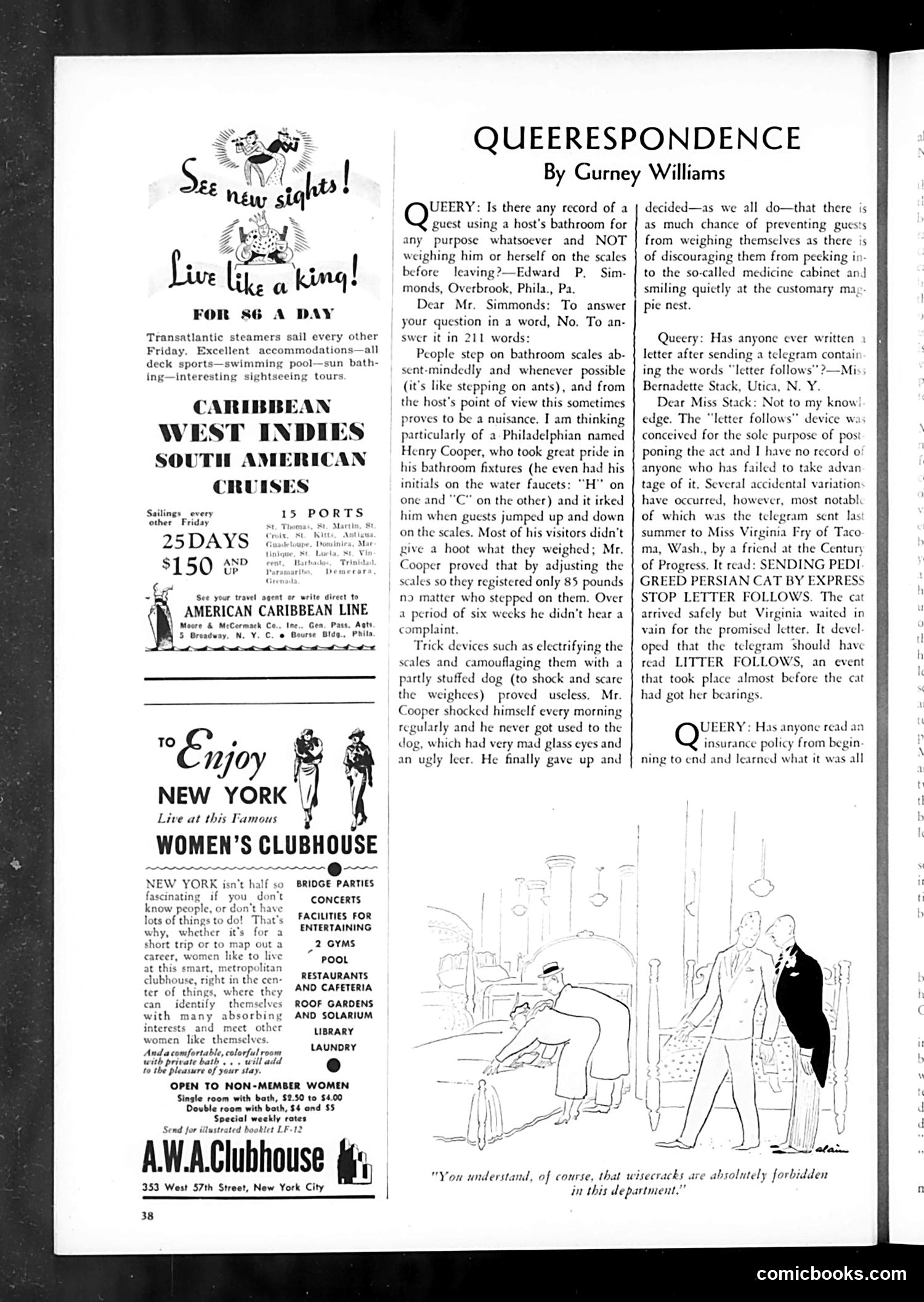
"Queerespondence" Cartoon Analysis This page features a humor column by Gurney Williams addressing peculiar social etiquette questions. The main cartoon illustrates the first query: a host's frustration with guests compulsively weighing themselves on bathroom scales. The joke satirizes a universal, slightly embarrassing human behavior—the irresistible urge to step on bathroom scales during visits. Henry Cooper's attempted solutions (rigged scales, electrification, a stuffed dog deterrent) humorously escalate, all failing because the compulsion is unstoppable. The second query's punchline involves a telegram typo: "SENDING PEDIGREED PERSIAN CAT BY EXPRESS STOP LETTER FOLLOWS" was meant to read "LITTER FOLLOWS"—a cat-related bathroom humor joke. The recipient waited for the promised letter but received something messier instead. Both items mock unconscious social habits and communication mishaps with gentle, observational humor typical of 1930s-40s Life magazine satire. The cartoons require no historical context—they lampoon timeless human quirks.
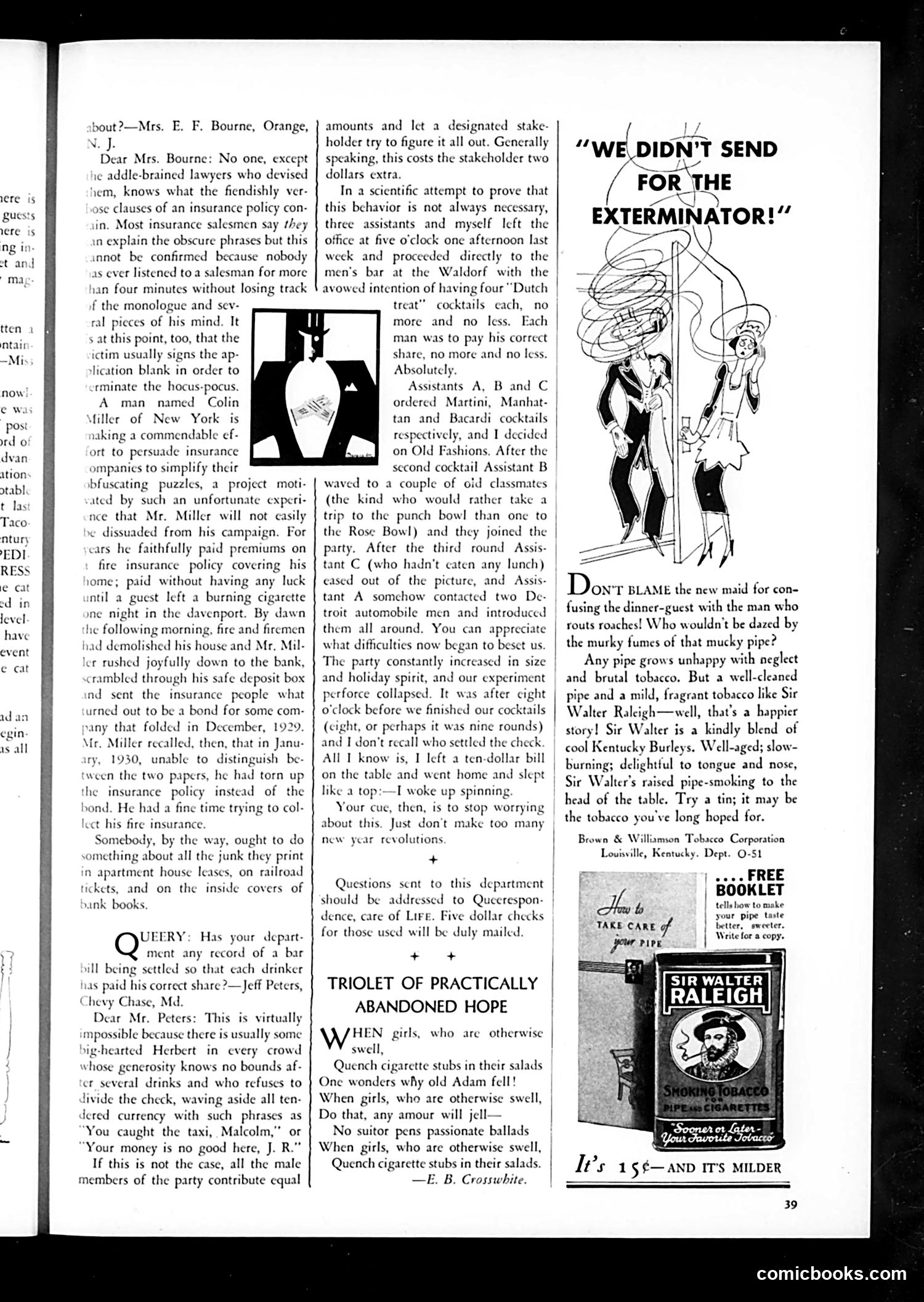
This page combines satirical articles with advertising, all dated from what appears to be Life magazine's humorous advice-column era (likely 1930s based on references). The main cartoon shows a woman in an exterminator's outfit confronting people at what appears to be a dinner party, with the caption "WE DIDN'T SEND FOR THE EXTERMINATOR!" The joke appears to reference using excessive cigars or tobacco smoke to fumigate a room—playing on the unpleasant effects of heavy smoking in social settings. The text articles discuss insurance policy confusion (how consumers struggle with impenetrable legal language) and a failed "Dutch treat" cocktail experiment (where four men attempted to split four drinks equally but the group expanded and costs became chaotic). These are satirical commentary on everyday frustrations and social awkwardness. An advertisement for Sir Walter Raleigh pipe tobacco occupies the bottom right, promoting smoking as a gentlemanly, pleasant activity—ironically positioned directly below content mocking tobacco's socially unpleasant effects.
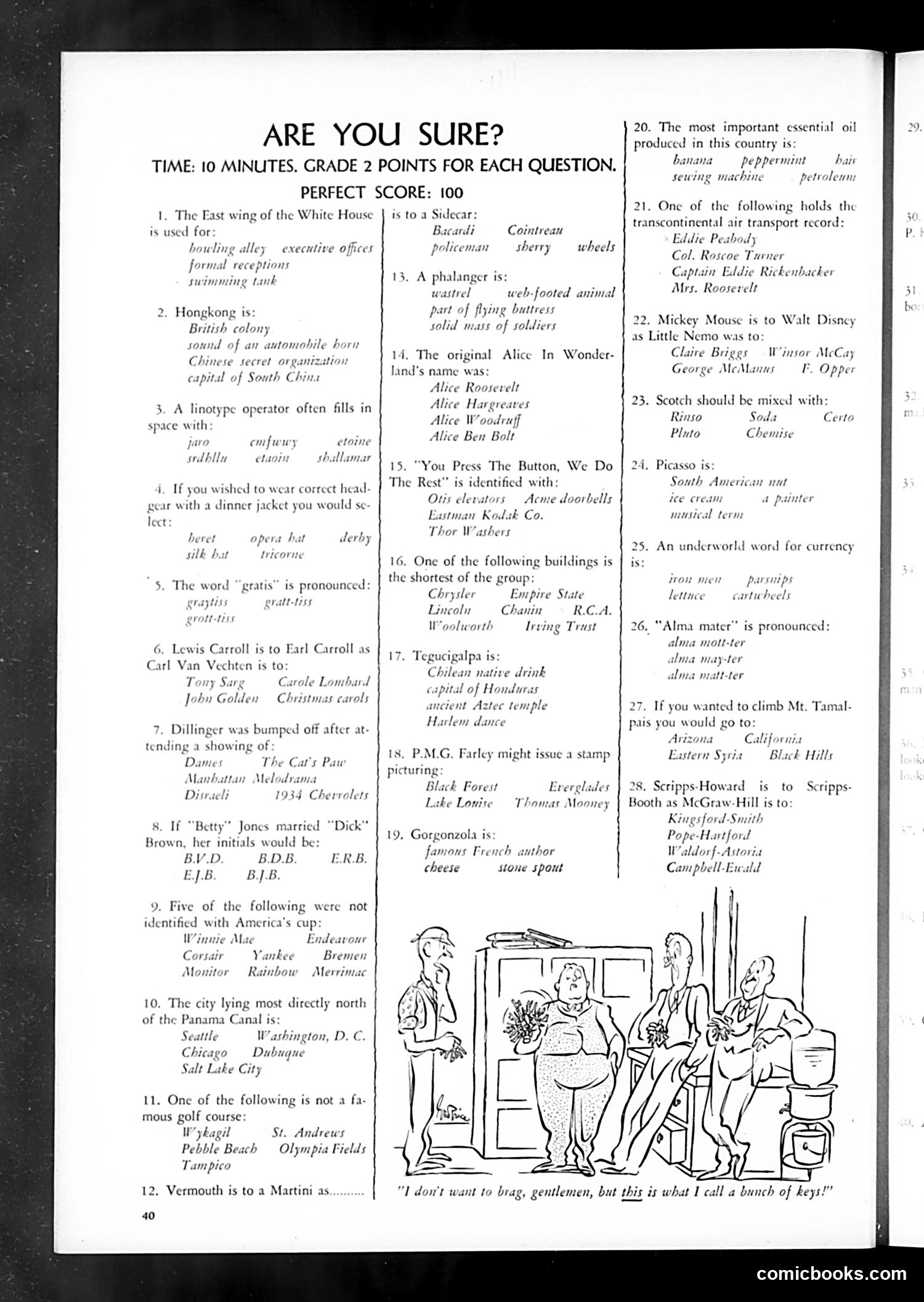
"Are You Sure?" Quiz Page Analysis This is a trivia quiz disguised as satirical commentary on American popular culture and knowledge circa the 1930s. The cartoon below depicts a woman displaying a large collection of keys—a visual pun on the quiz's final question about "a bunch of keys." The quiz itself mocks contemporary society by testing obscure or trivial knowledge: celebrities (Lewis Carroll vs. Earl Carroll), gangsters (Dillinger being "bumped off"), luxury goods (Scotch, Martinis), and celebrity gossip (Alice in Wonderland's real name). References include John Dillinger's 1934 death and P.M.G. Farley (Postmaster General), suggesting Depression-era context. The cartoon's punchline—a woman proudly displaying literal keys while the questions ask about figurative knowledge—satirizes how Americans pride themselves on knowing trivia rather than substantive information. The humor lies in the gap between the quiz's pretentious tone and its fundamentally shallow subject matter.
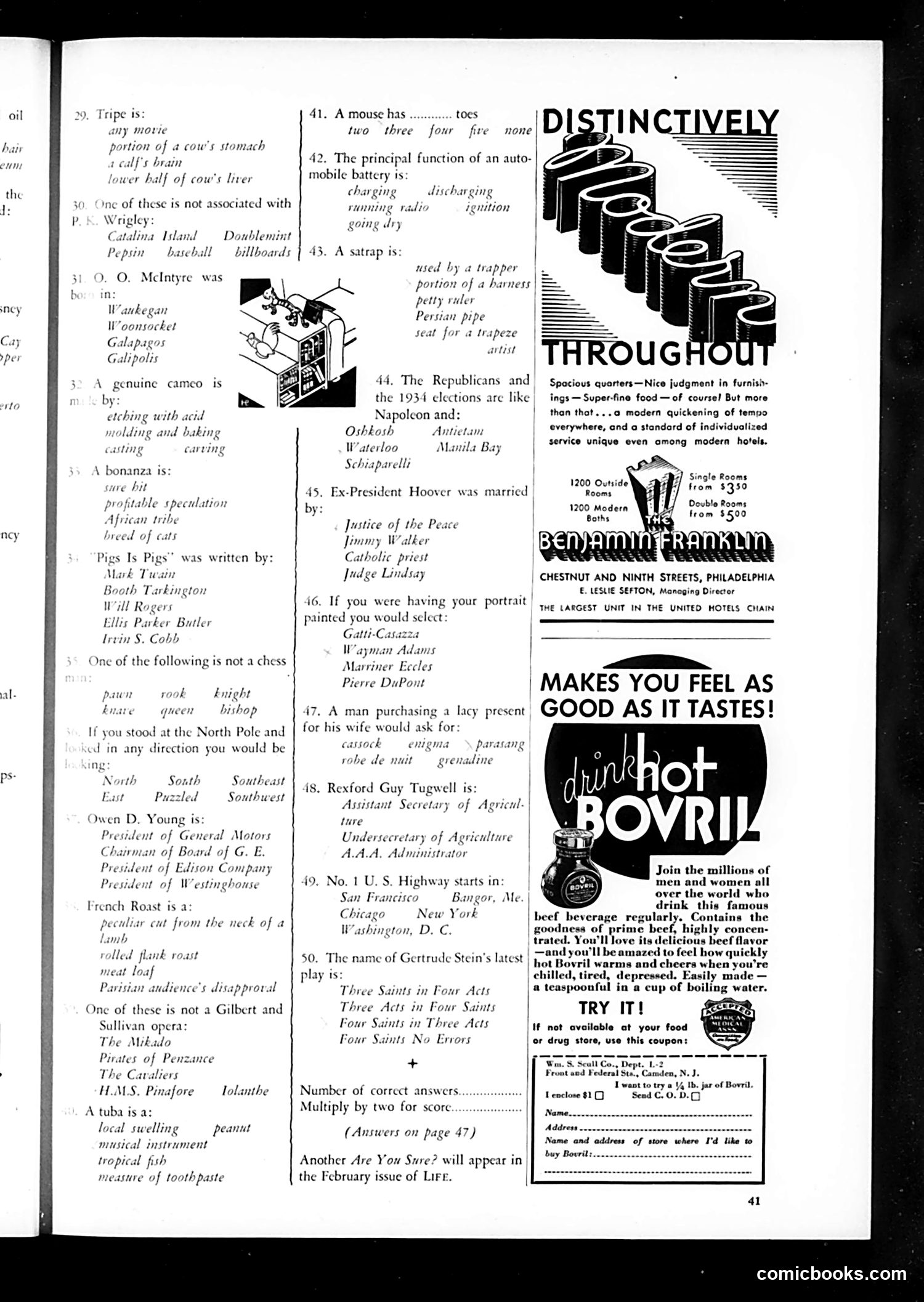
Life Magazine Quiz Page Analysis This page is primarily a trivia quiz rather than a political cartoon. It's a typical feature from Life magazine's entertainment section, testing readers' knowledge across general subjects: anatomy, history, literature, geography, and current events. The few satirical references include: Question 44 alludes to the 1934 U.S. elections, comparing Republicans to Napoleon's military defeats (Oshkosh, Antietam, Waterloo, Manila Bay)—suggesting Republicans faced electoral defeat comparable to major military losses. Question 45 asks who married Ex-President Hoover, with humorous answer options: "Justice of the Peace," "Jimmy Walker" (NYC mayor), "Catholic priest," and "Judge Lindsay"—poking fun at the dignified Hoover by suggesting absurd marriage scenarios. The page also features vintage advertisements for the Benjamin Franklin Hotel and hot Bovril beef drink, typical of 1930s magazine content. The quiz itself served as interactive entertainment, with scoring instructions at bottom—common reader engagement in pre-digital magazines.
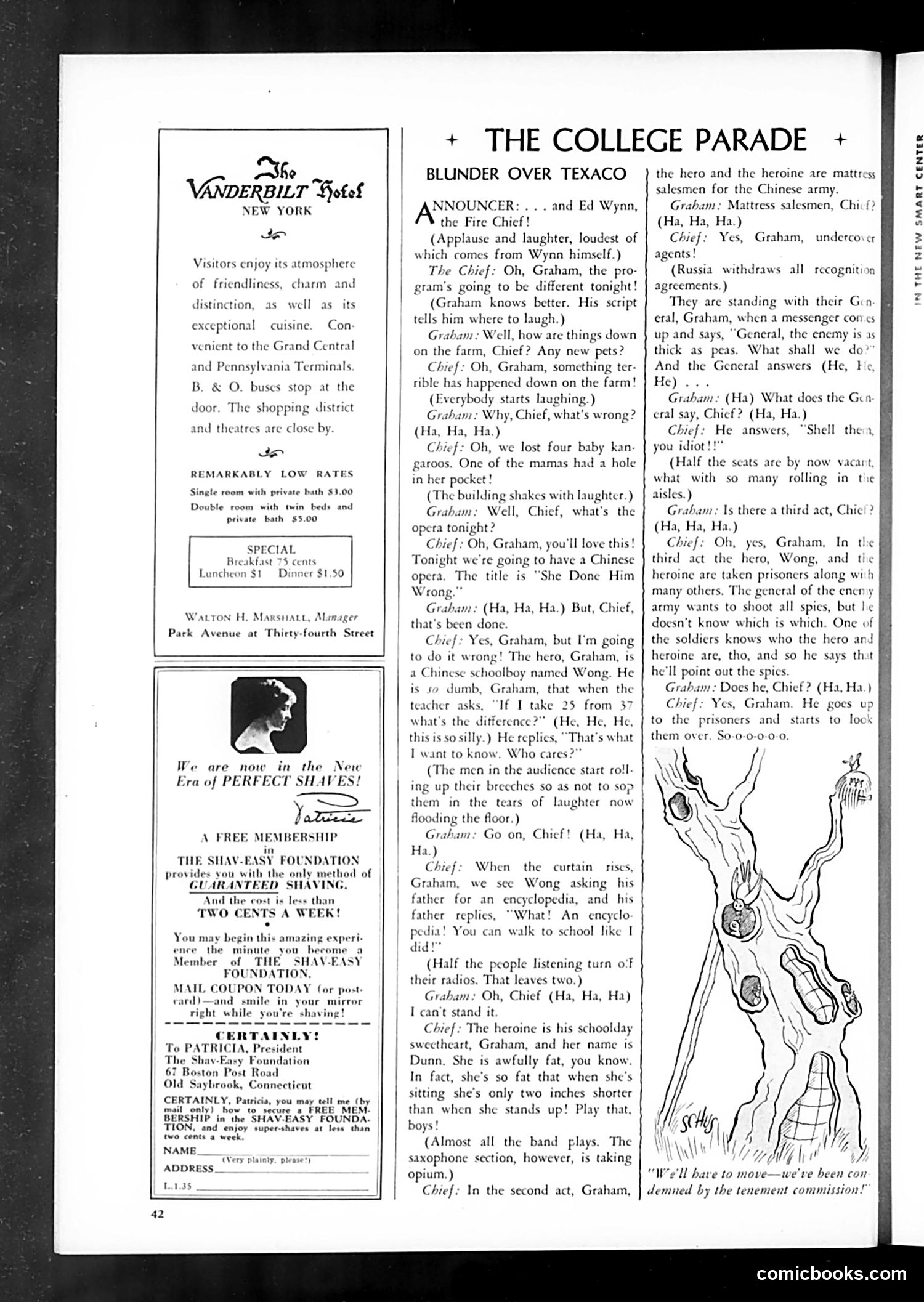
"The College Parade: Blunder Over Texaco" This page contains a theatrical sketch transcript rather than a political cartoon. The dialogue is a comedic exchange between a Fire Chief (named Graham) and a Chief character about a Chinese opera titled "She Done Him Wrong." The humor relies on absurdist misunderstandings: the Chief mistakes basic arithmetic ("If I take 25 from 37..."), confuses the opera's plot, and describes the heroine as "awfully fat." There's also a joke about the saxophone section "taking opium" during the performance. The satire appears aimed at lowbrow vaudeville comedy and ethnic stereotyping common in 1920s-30s entertainment. The surrounding advertisements (Vanderbilt Hotel, Shavease Foundation) suggest this is from Life magazine's entertainment section.
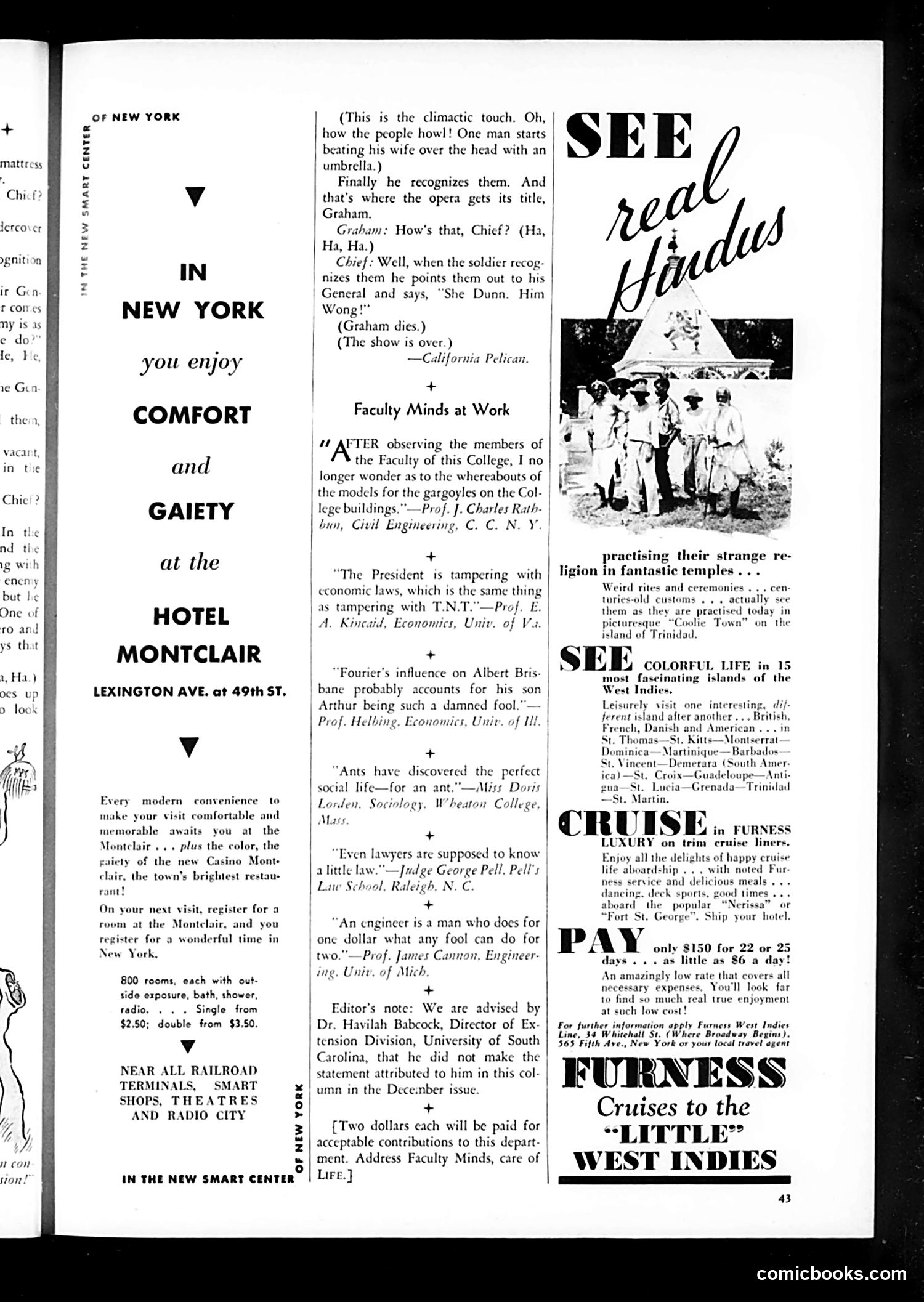
"She Dunn. Him Wong!" — A Vaudeville Joke This page is primarily advertisements, but includes a brief comedic excerpt from the *California Pelican* (a college humor publication). The joke describes a vaudeville opera performance's climactic moment: a soldier recognizes two characters and points them out to his General, saying "She Dunn. Him Wong!" — a pun playing on the names sounding like "She done him wrong," a common melodrama phrase. The humor relies on the audience's reaction to this crude wordplay, with the stage direction noting a man beating his wife with an umbrella in exaggerated response. The joke reflects early-20th-century vaudeville's reliance on broad physical comedy, ethnic-coded names for humor, and domestic violence played for laughs—elements that would be considered offensive today. The page also includes a "Faculty Minds" section: witty one-liners from college professors, a popular humor feature of the era.
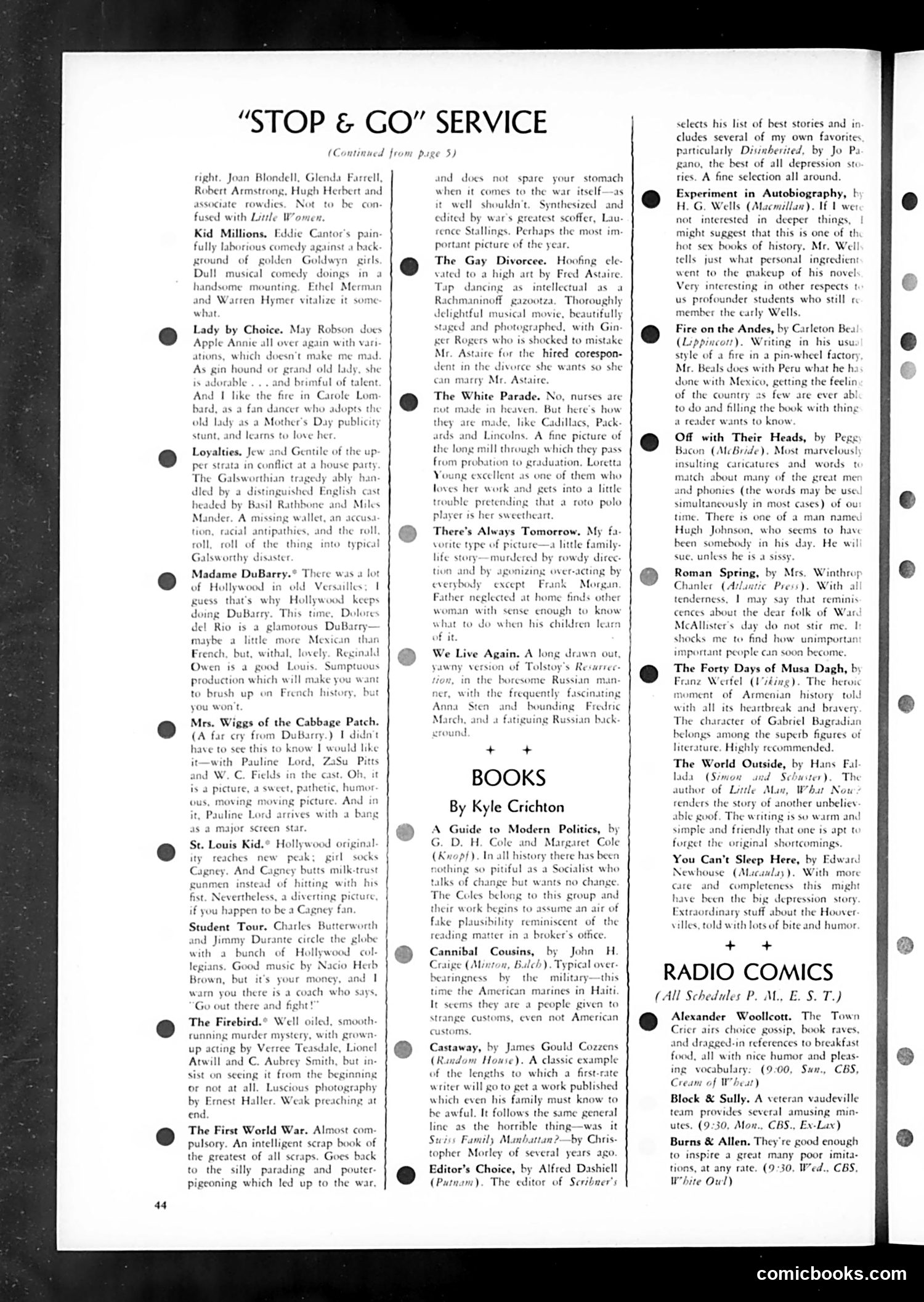
"Stop & Go" Service: Film Reviews This page contains film reviews from Life magazine's "Stop & Go" service—a critical guide to current movies. The reviews cover approximately a dozen films from the early 1930s, including *Kid Millions* (Eddie Cantor), *The Gay Divorcee* (Fred Astaire and Ginger Rogers), *Mrs. Wiggs of the Cabbage Patch*, and *The First World War*. The critics employ witty, sometimes caustic commentary typical of Life's satirical approach. For instance, they praise Astaire's dancing as "intellectual" while mocking other films' musical numbers, and they note that *The First World War* is "almost compulsory" viewing despite its harsh treatment of the subject matter. The tone is sophisticated and urbane—aimed at educated readers who appreciated sharp cultural critique alongside entertainment reviews.
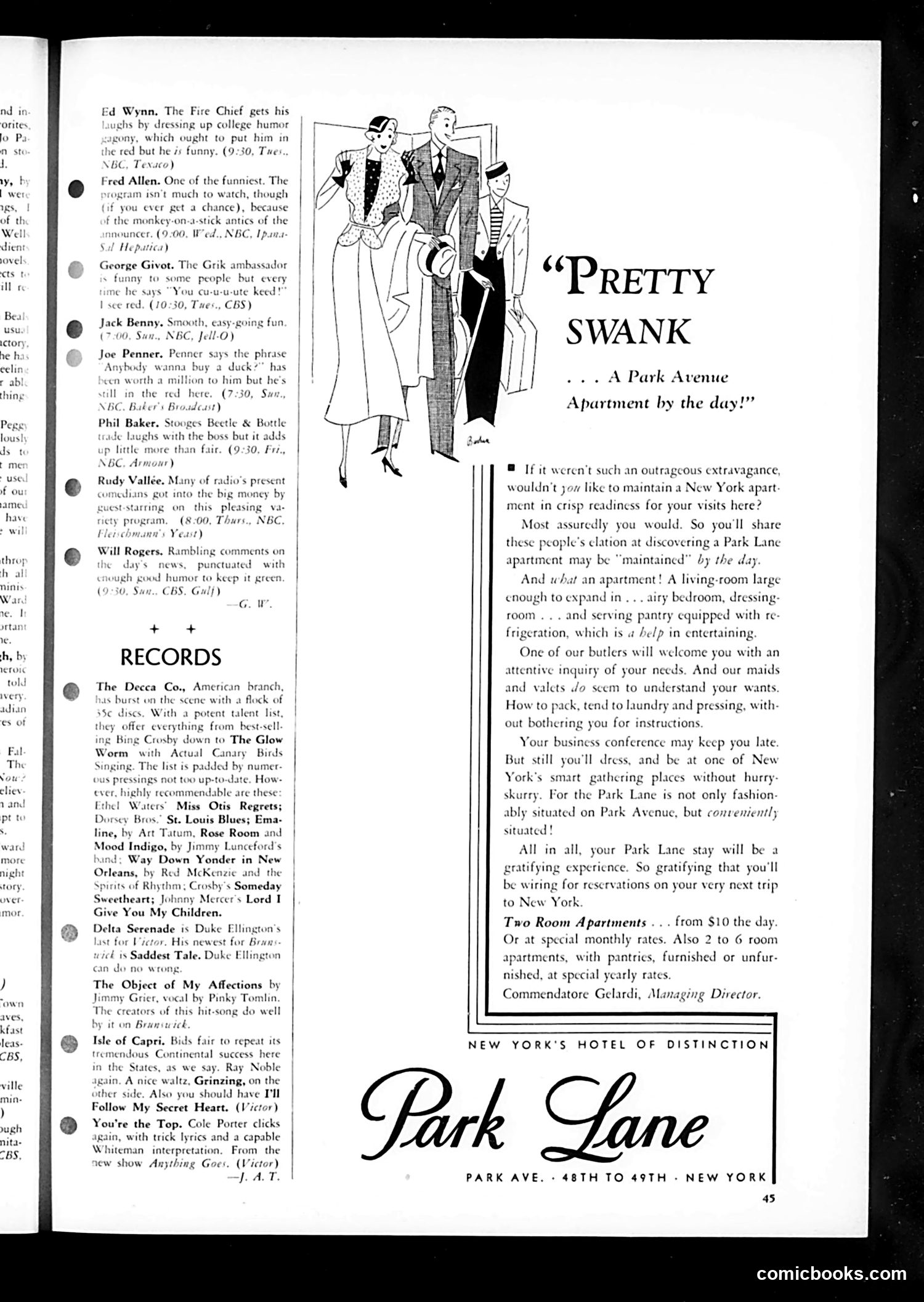
What This Page Means This is primarily a radio entertainment guide and advertisement from Life magazine, not a political cartoon page. The left column reviews popular 1930s radio comedians (Ed Wynn, Fred Allen, Jack Benny, Joe Penner, Phil Baker, Rudy Vallée, Will Rogers) with airtime and sponsors listed. The tone is gossipy and critical—praising some as genuinely funny while mocking others' affectations. The right side is a full-page advertisement for the Park Lane hotel on Park Avenue in Manhattan. The satirical hook: it markets short-term apartment rentals ("by the day") as a luxury solution for out-of-town visitors who want to maintain a fancy NYC pied-à-terre without the expense of permanent ownership. The copy humorously emphasizes the absurd indulgence—butlers, maids, refrigerated pantries—while pretending it's a practical service. The illustration shows three well-dressed men, likely representing the hotel's sophisticated clientele.
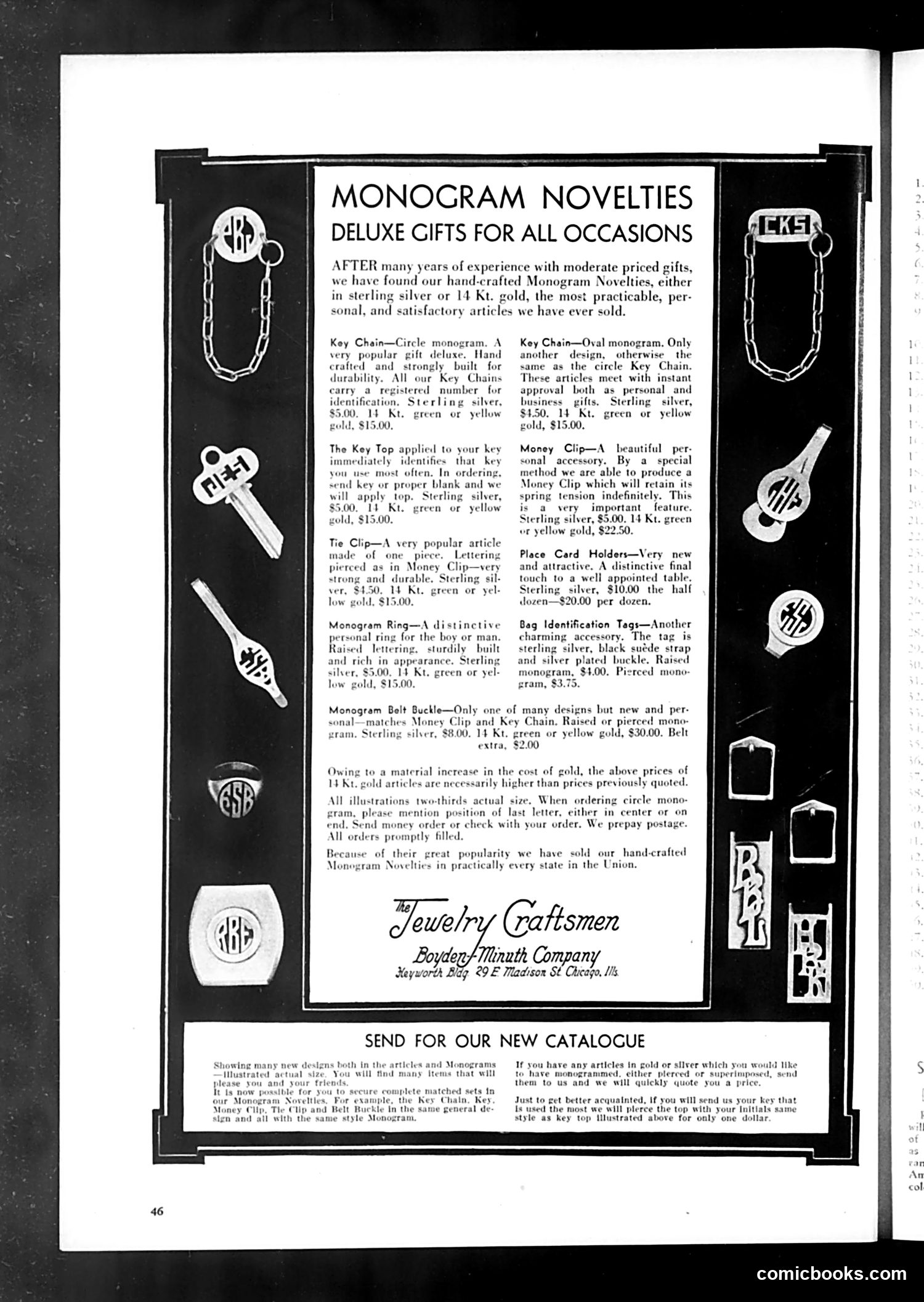
Analysis This page is not a cartoon or satire—it is a straightforward advertisement for monogrammed luxury goods from the Boydep-Minuth Company, a Chicago jewelry manufacturer. The ad promotes hand-crafted sterling silver and 14-karat gold novelty items for personal and business gifting: key chains, money clips, tie clips, rings, belt buckles, place card holders, and bag tags. Each item features custom monogramming (initials). Prices range from $3.75 to $30.00. The text emphasizes durability, personal appeal, and nationwide popularity ("practically every state in the Union"). A promotional offer invites customers to send their key for free monogramming for just one dollar. This appears in *Life* magazine's advertising section, reflecting 1920s-1930s consumer culture emphasizing personalized, luxury goods as appropriate gifts for business and social occasions.
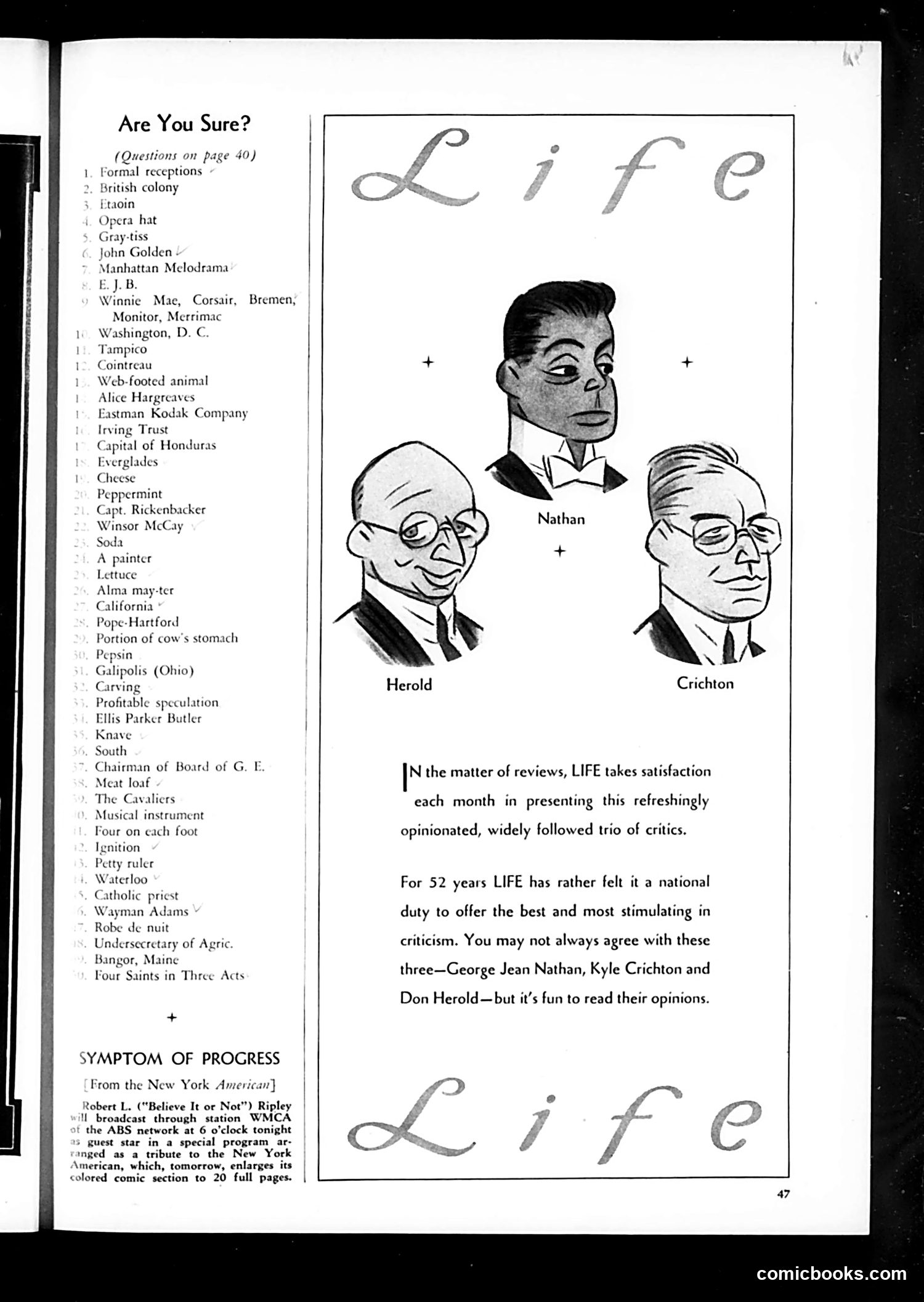
"Are You Sure?" - Life Magazine Critics Page This page introduces Life magazine's monthly trio of book/arts critics: George Jean Nathan, Kyle Crichton, and Don Herold—shown as caricatured heads (Nathan center, Herold left, Crichton right). The "Are You Sure?" section references a trivia quiz from page 40, with answers listed on the left (a common magazine feature). The cryptic clues—mixing geography, wordplay, and cultural references—were typical early-20th-century brain-teasers for educated readers. The bottom note about Robert L. Ripley's "Believe It or Not" is pure editorial promotion, advertising both Ripley's radio broadcast and the New York American's expanded comic section. The satire here is gentle: Life positions its three critics as authoritative arbiters of taste while admitting readers "may not always agree"—a tongue-in-cheek acknowledgment that criticism is subjective, not gospel.
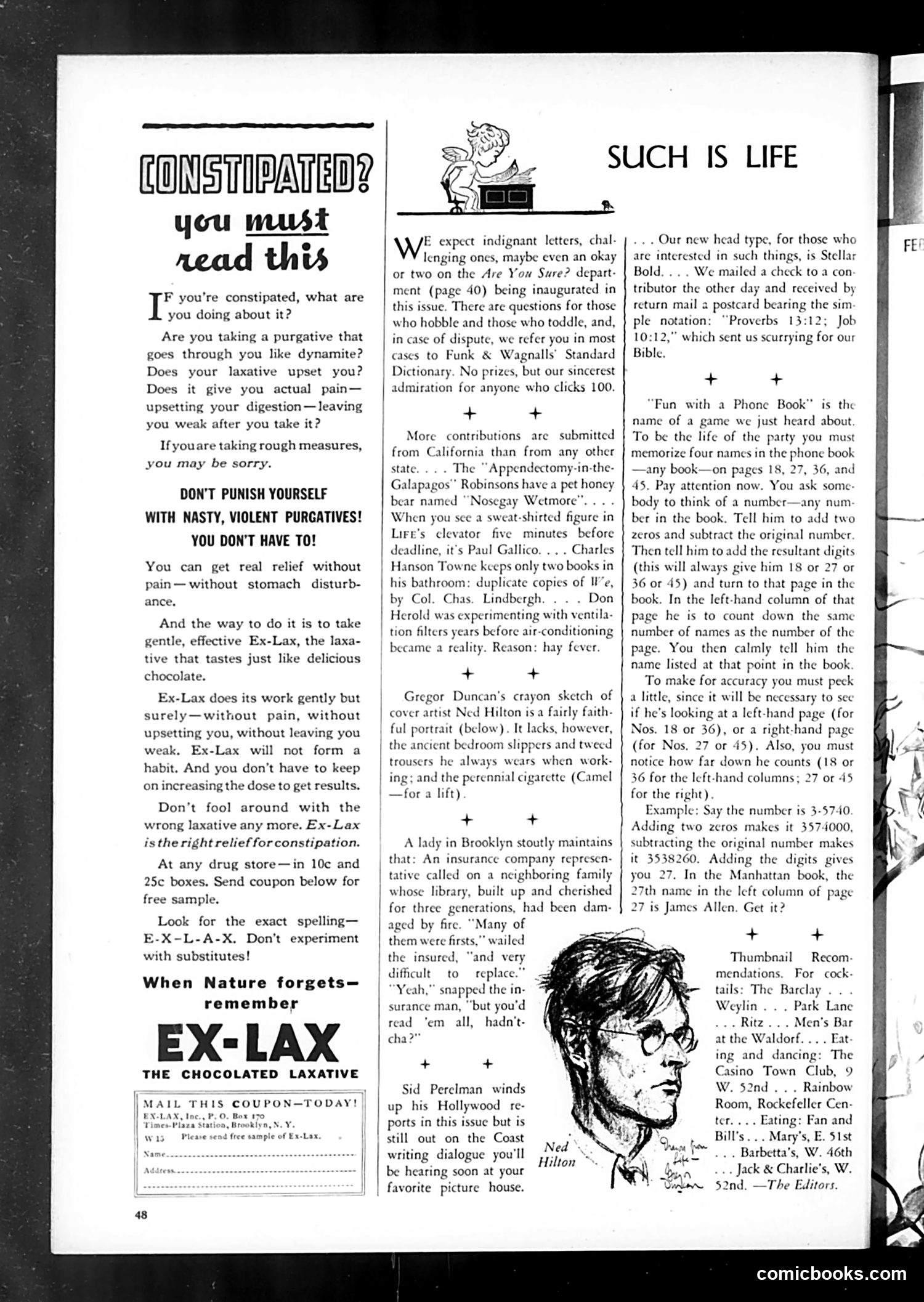
Analysis of Life Magazine Page This page is primarily advertising and editorial content, not political satire. The main content is an Ex-Lax laxative advertisement disguised as advice column—a common early 20th-century marketing tactic. It warns against harsh purgatives and promotes Ex-Lax as a gentle chocolate-flavored alternative, using medical language to establish credibility. The "Such is Life" section is a gossip/humor column featuring trivial anecdotes about Life magazine contributors and readers: - A Brooklyn woman's story about an insurance adjuster dismissing rare first-edition books - References to writer Gregor Duncan, Ned Hilton (portrait artist), and Sid Perelman (Hollywood screenwriter) - A parlor game called "Fun with a Phone Book" involving number memorization The tone is lighthearted and self-referential—poking gentle fun at magazine staff and readers' everyday situations. There's no political content; this reflects Life's mid-century editorial approach of mixing sophisticated humor with commercial sponsorship.