life
Life — February 1935
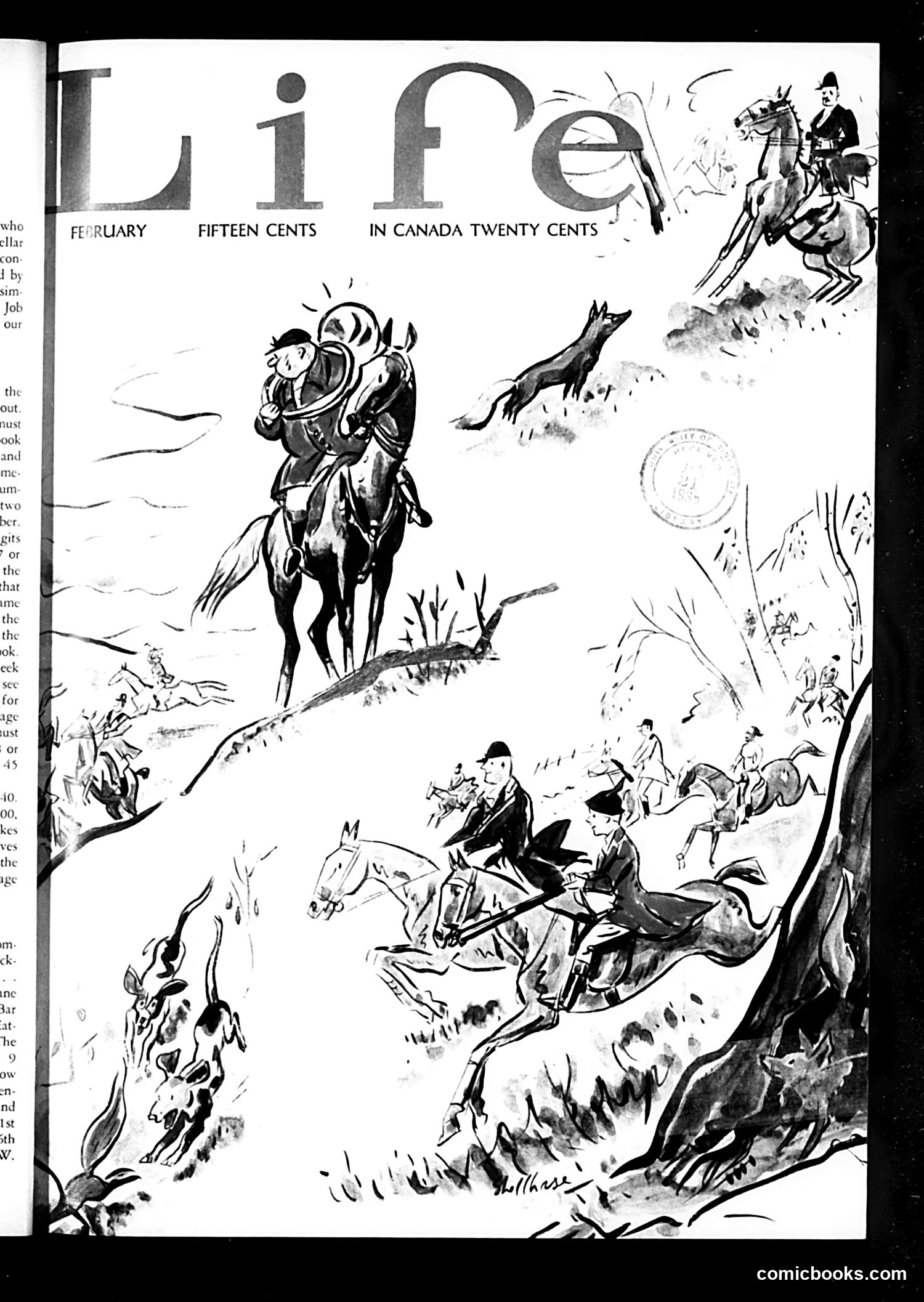
Life Magazine Cover - February Issue This is a Life magazine cover from February (price: 15 cents US, 20 cents Canada). The illustration depicts a fox hunt scene with mounted riders pursuing a fox across countryside terrain with flames visible below. The visual metaphor appears to satirize a hunt or pursuit of some kind—likely political or social in nature, given Life's satirical mission. The dramatic composition, with the fox fleeing downhill while aristocratic hunters pursue on horseback, suggests commentary on power dynamics or the persecution of a vulnerable target by the privileged class. Without additional context or visible date, the specific political reference remains unclear, though the imagery invokes themes of class conflict and inevitable doom for the hunted.
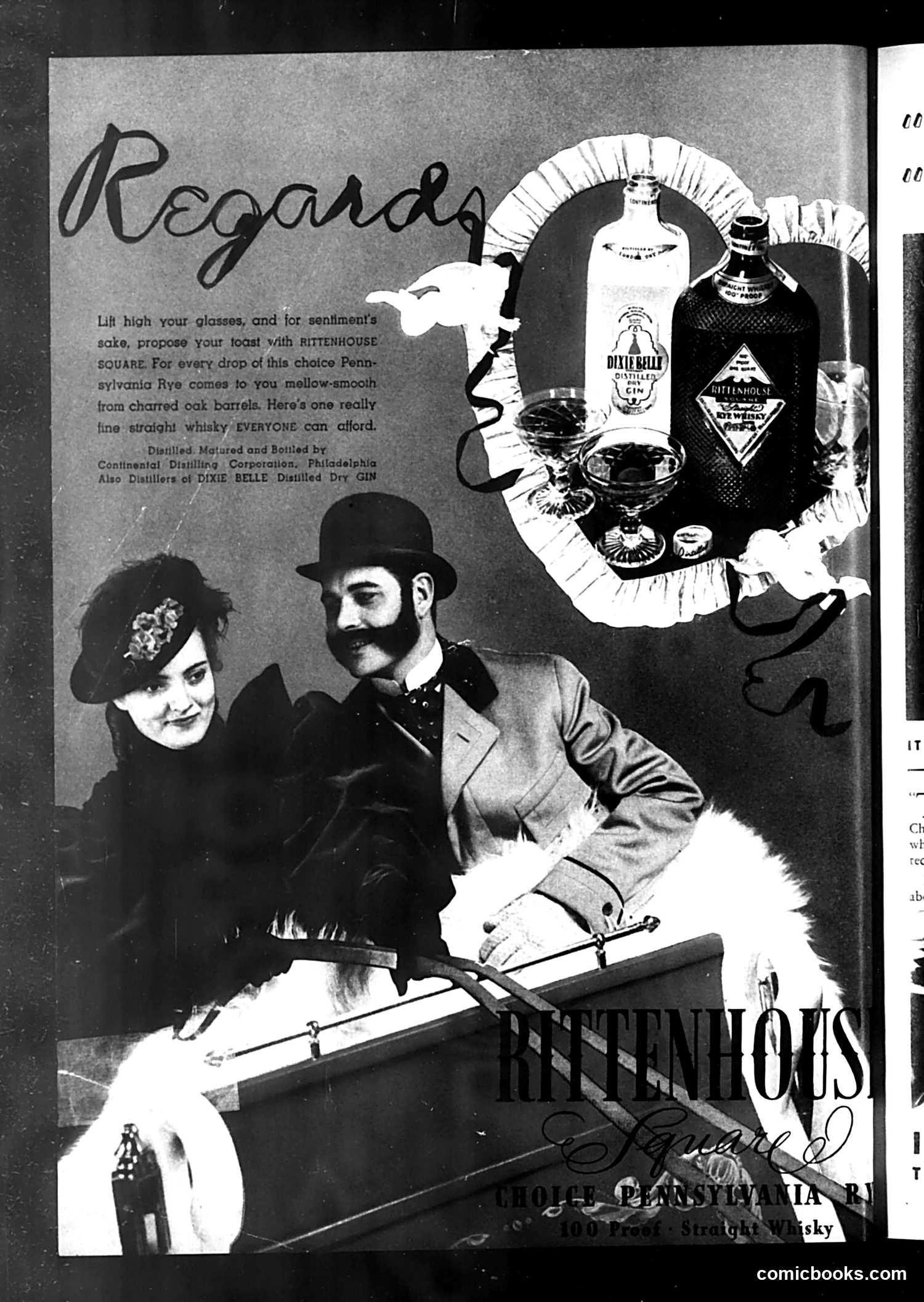
Rittenhouse Square Whiskey Advertisement This is primarily a liquor advertisement for Rittenhouse Square rye whiskey and Dixie Belle gin, produced by Continental Distilling Corporation of Philadelphia. The ad uses the heading "Regards" and depicts an elegantly dressed couple in formal attire (she in a decorated hat, he in a bowler) raising glasses in a toast. The copy encourages readers to "lift high your glasses" and propose toasts with this whiskey, emphasizing it's "really fine, straight whiskey EVERYONE can afford." The advertisement reflects pre-Prohibition or early post-Prohibition era marketing, targeting middle and upper-class consumers through imagery of sophisticated social occasions and formal dress. The humor lies in the aspirational lifestyle it promises—affordable luxury for social gatherings.
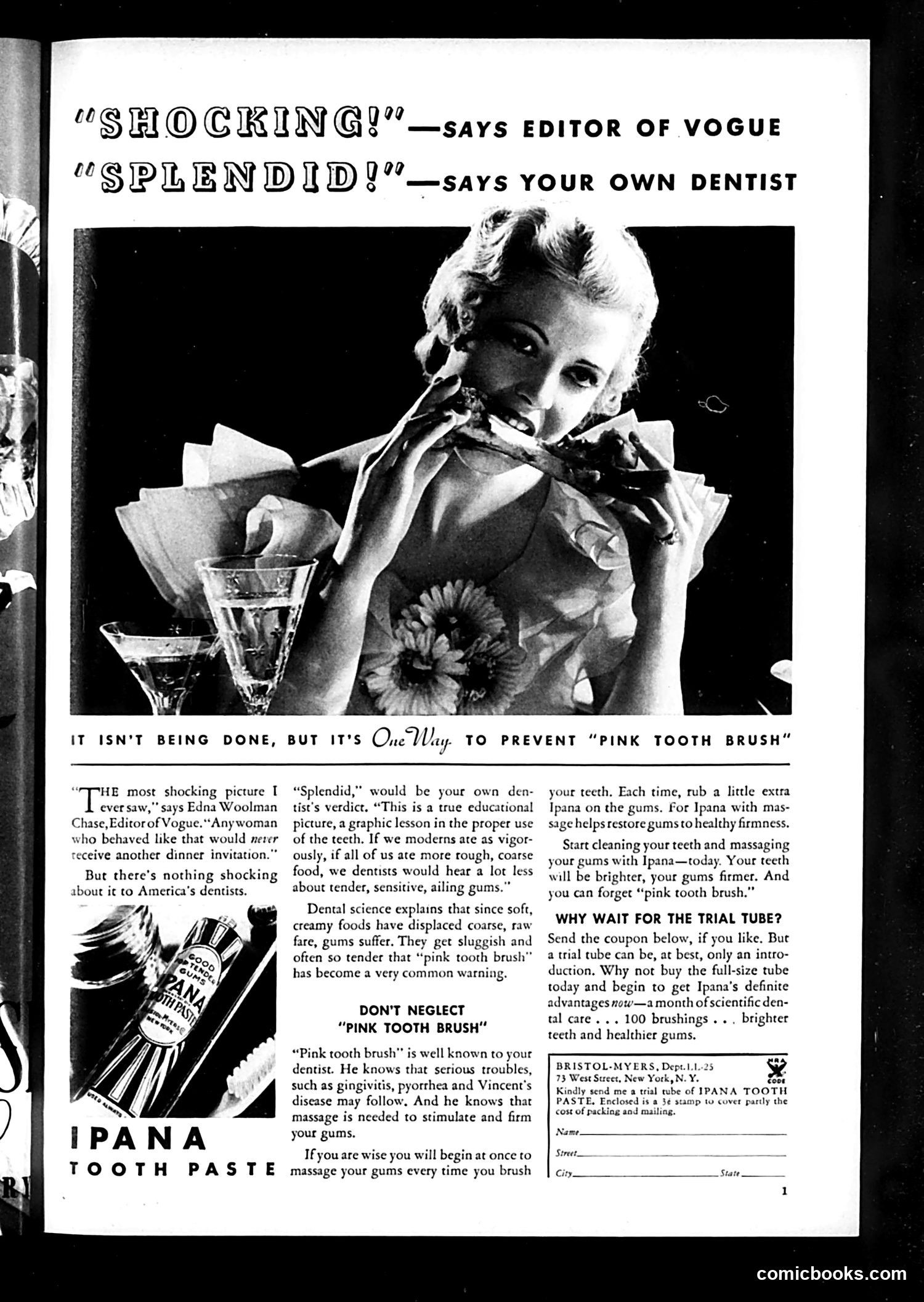
Analysis This is primarily an advertisement for Ipana Tooth Paste, not political satire. The page uses social commentary as marketing strategy. The headline quotes "Vogue Editor" calling something "shocking" and contrasts it with "your own dentist" calling it "splendid." The central image shows a woman in an elegant pose with cocktails, appearing to eat messily or carelessly—illustrating poor oral hygiene habits. The "shocking" behavior referenced is neglecting gum health, which dentists warned caused "pink tooth brush" (bleeding gums). The ad argues that modern soft foods have displaced coarse diets, making gum disease common. The satire targets upper-class women who prioritize fashion magazine approval (Vogue) over practical health advice. It's purely commercial messaging dressed in social commentary to sell toothpaste and gum care.
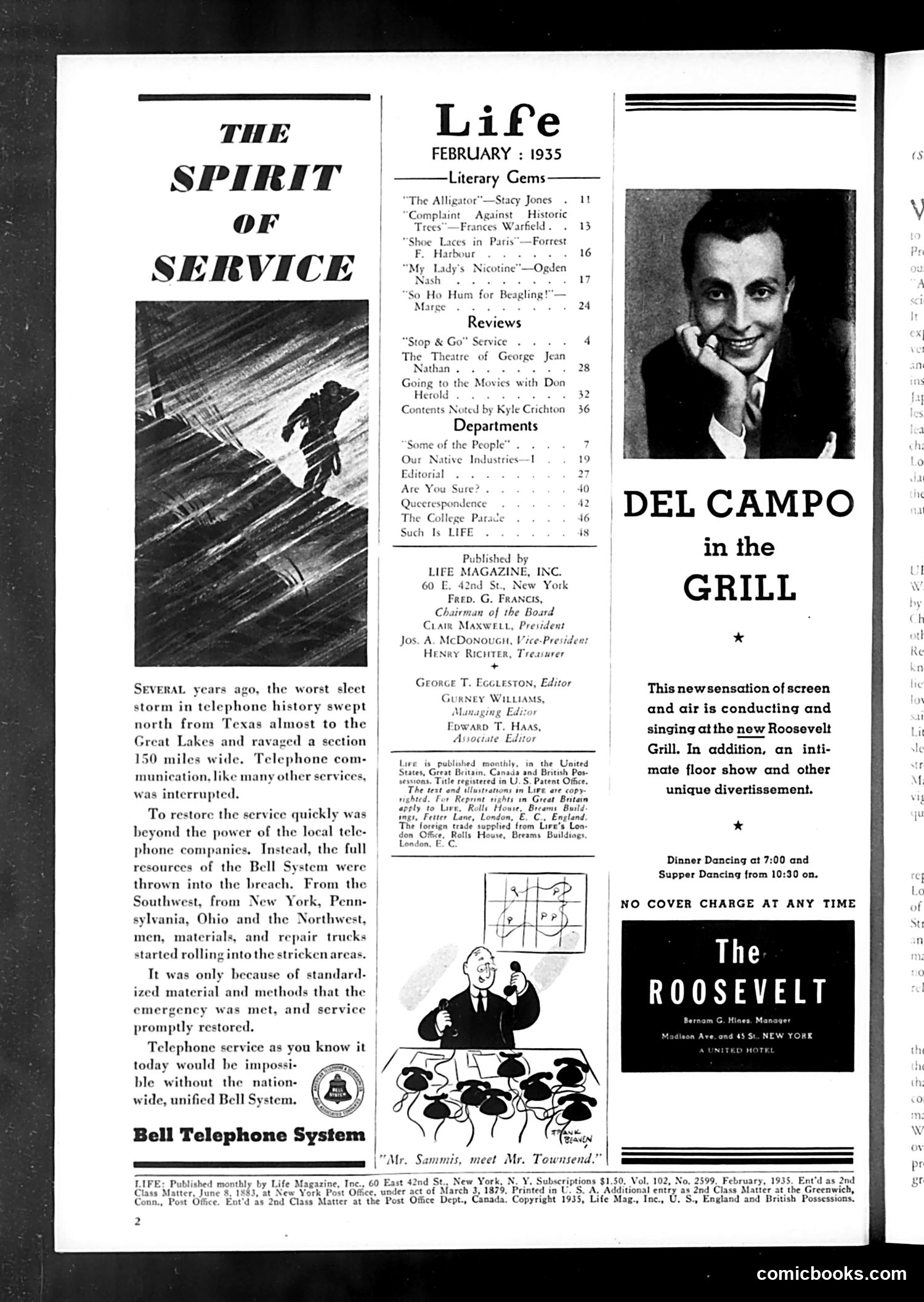
Analysis This page is primarily advertising and magazine content rather than political satire. The left side features "The Spirit of Service," a Bell Telephone System advertisement about restoring phone service after a severe sleet storm that disrupted communications across the Great Lakes region. The narrative emphasizes the Bell System's coordinated resources and standardized methods as essential to rapid service restoration. The right side advertises Del Campo in the Grill, a Roosevelt Hotel nightclub featuring dinner and supper dancing. A small cartoon shows a man at a desk with a calendar, captioned "Mr. Sammit, meet Mr. Townsend"—likely a mild office humor about scheduling rather than political commentary. The page reflects 1935 Depression-era confidence in institutional systems and leisure entertainment.
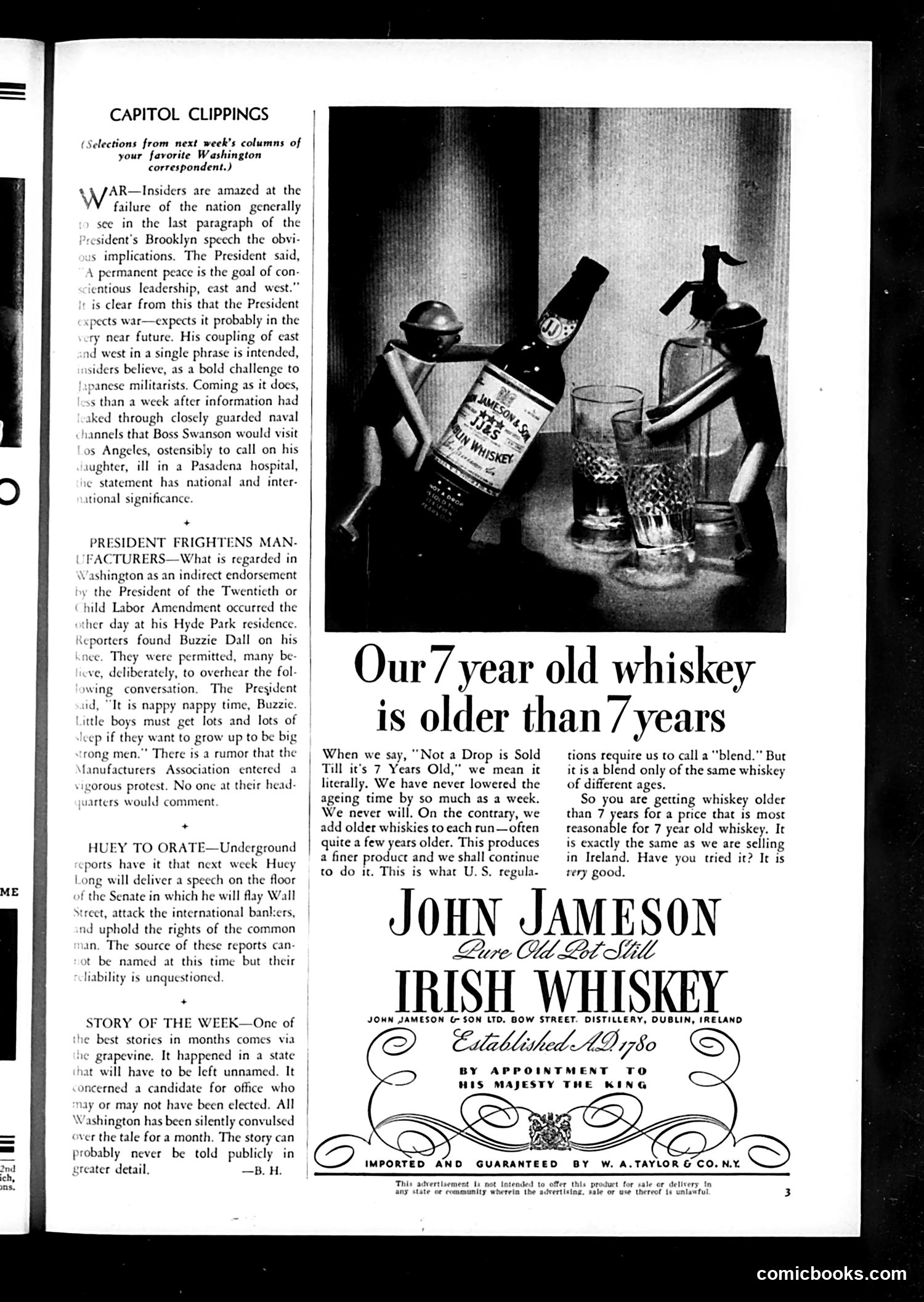
Analysis This page is primarily a John Jameson Irish Whiskey advertisement (established 1780), not political satire. The ad's headline cleverly plays on product labeling: "Our 7 year old whiskey is older than 7 years," explaining that the whiskey ages longer than its stated designation requires, making it premium quality. The left column contains "Capitol Clippings"—brief political gossip items about Washington insiders, including references to the President's Brooklyn speech, a rumored visit by "Boss" Swanson, and an upcoming Senate speech by someone named Huey about Wall Street and international bankers. The cartoon image (bottles and glasses) is merely decorative product photography, not political commentary. This is fundamentally a commercial page using news-style formatting to lend credibility to advertising.
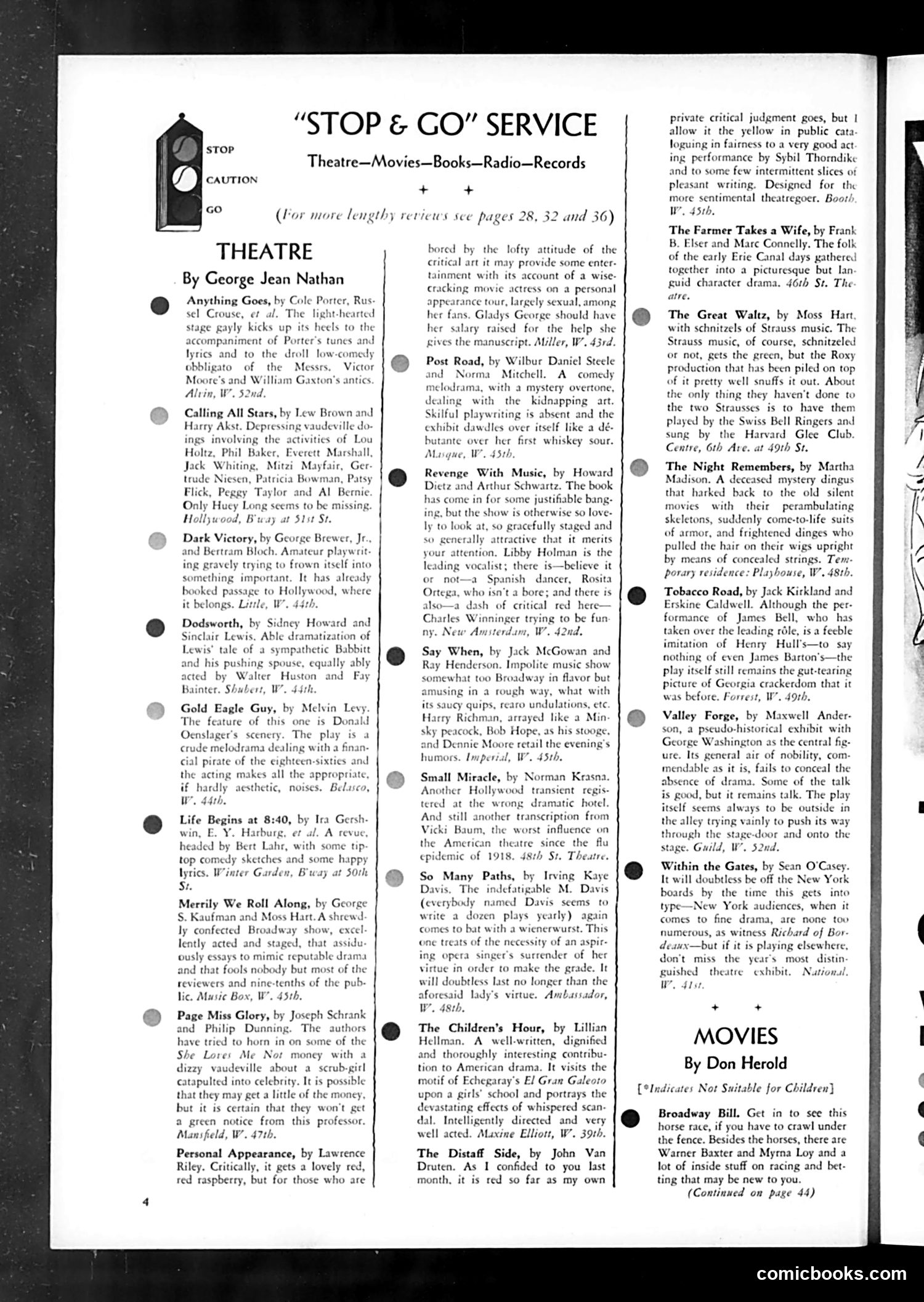
"Stop & Go" Service Page - Life Magazine This page is primarily a theater and movie review section, not a political cartoon. It features George Jean Nathan's theater column reviewing Broadway productions, followed by Don Herold's movie reviews. The actual design element is a small illustration at the top: a traffic light labeled "STOP CAUTION GO," serving as a visual metaphor for the review format—the magazine "stops" readers to alert them about theater and film worth seeing or avoiding. The reviews discuss various 1930s productions with Nathan's characteristic critical commentary. This appears to be a standard entertainment criticism page rather than political satire, focusing on theatrical and cinematic quality assessment for contemporary readers.
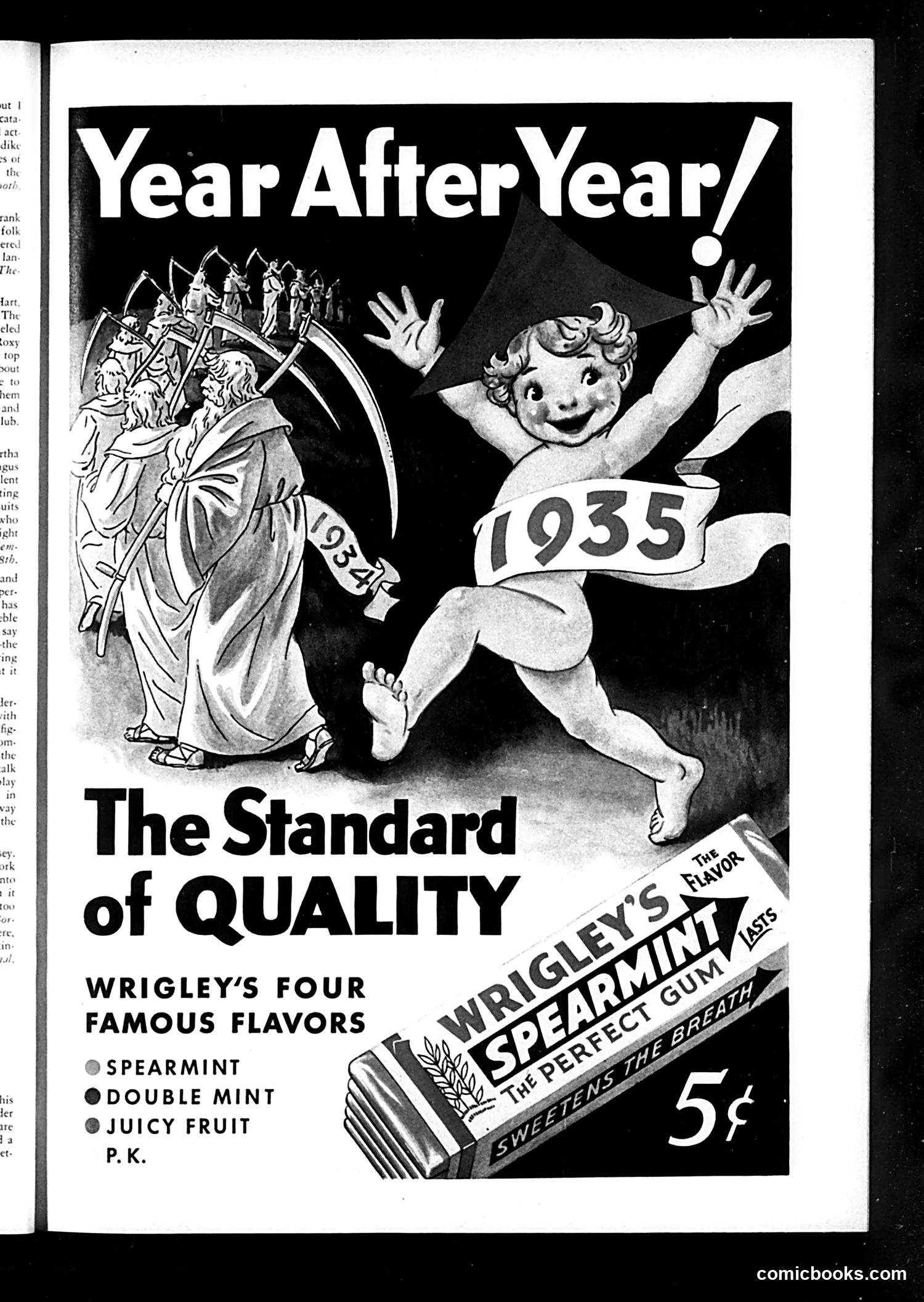
Analysis This is primarily a Wrigley's gum advertisement, not political satire. The page uses the phrase "Year After Year!" to emphasize product longevity and consistency. The imagery depicts: - Left side: A robed figure (likely representing Death or Time) holding a scythe, labeled "1924," symbolizing the passage of time - Right side: A cherub or baby figure marked "1935," representing the present year and renewal The advertisement's message is that despite a decade passing (1924-1935), Wrigley's maintains "The Standard of QUALITY." The contrast between Death/Time and youthful vitality suggests the brand has remained vibrant and relevant through changing times. The ad lists Wrigley's "four famous flavors" (Spearmint, Double Mint, Juicy Fruit, and P.K.) and prices the product at 5 cents, emphasizing affordability alongside quality.
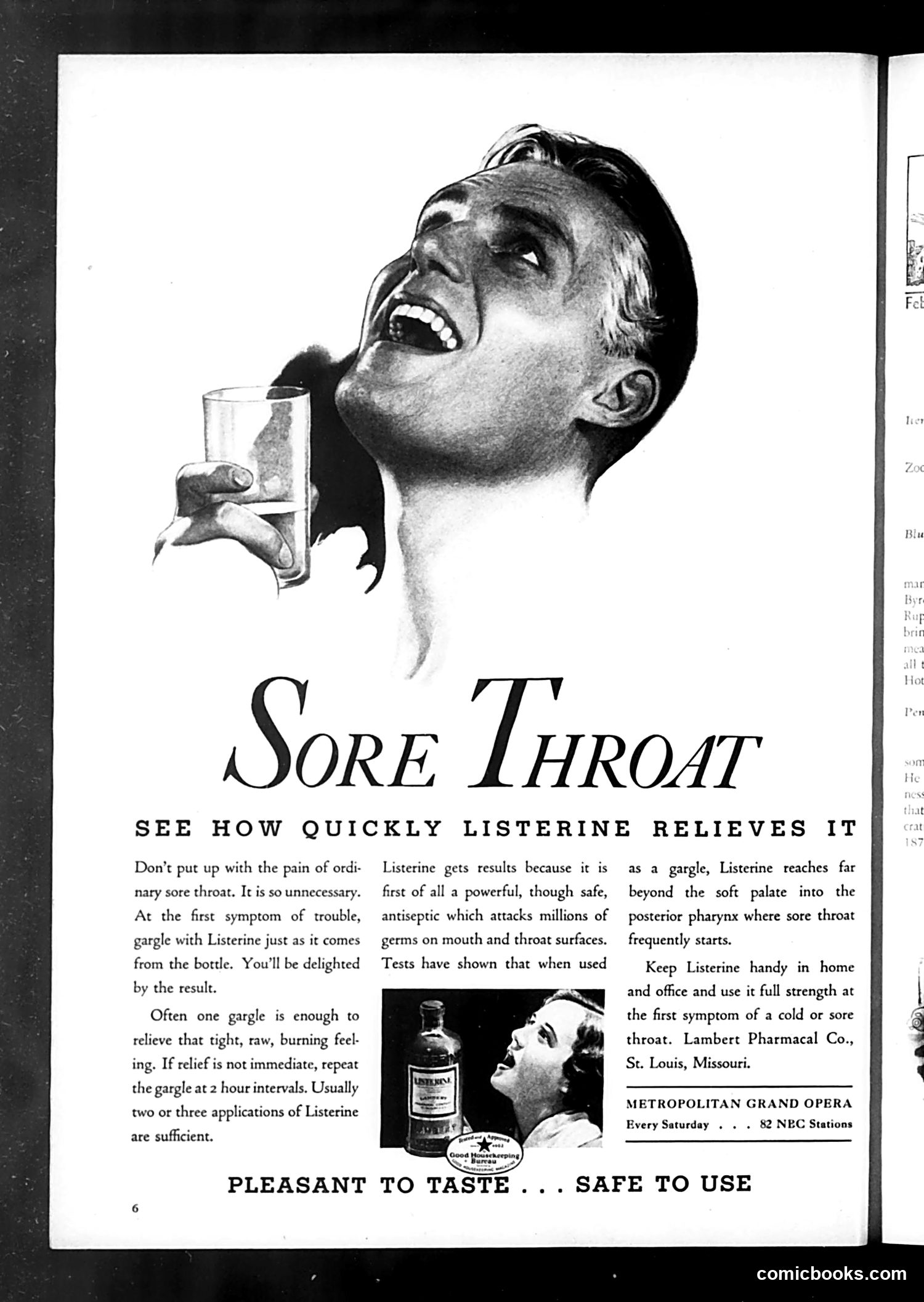
Analysis This page is an advertisement, not satire or political commentary. It's a Listerine mouthwash ad from an era when such products made dramatic medical claims. The image shows a man gargling, head tilted back in exaggerated relief. The ad promises Listerine quickly relieves sore throats through antiseptic action against germs. It recommends keeping the product "handy" and using it "at the first symptom of a cold or sore throat." The small text notes Metropolitan Grand Opera airs Saturdays on NBC, likely cross-promotional advertising to reach radio listeners during the broadcast. By modern standards, this represents misleading health marketing—mouthwash cannot treat infections. Such claims would violate current FDA regulations. The ad exemplifies vintage advertising's unchecked therapeutic promises before strict medical advertising oversight.
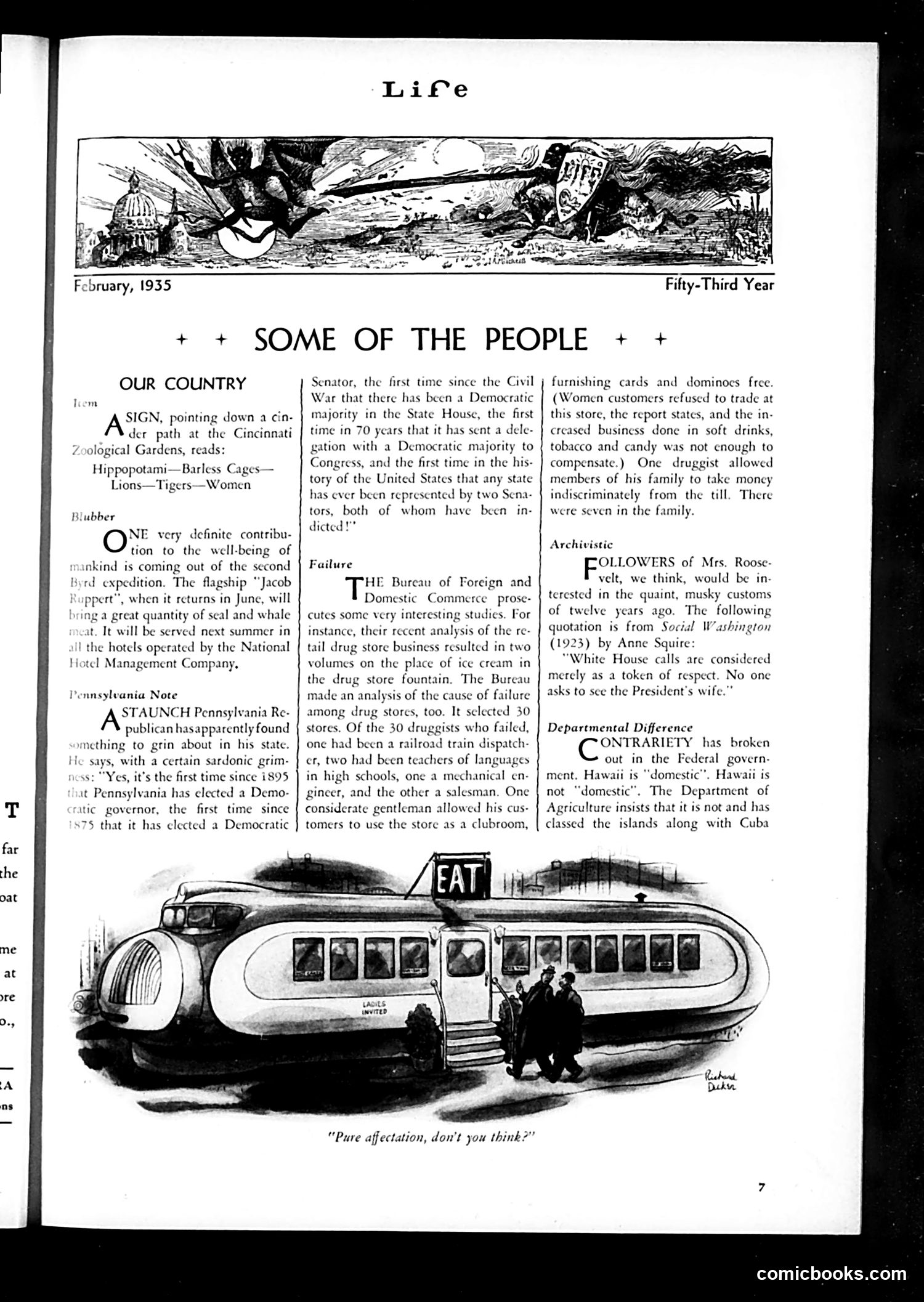
"Pure Affectation, Don't You Think?" This cartoon satirizes the streamlined, futuristic diner design craze of the 1930s. The illustration shows an ultra-modern, silver bullet-shaped roadside eatery with an "EAT" sign, featuring rounded windows and sleek industrial styling—the height of Art Deco modernism popular during the Depression era. The caption's snobbish comment mocks the pretentiousness of this "pure affectation." The joke targets how such restaurants adopted fashionable, impractical aesthetic design over substance or comfort. The well-dressed figures outside suggest upper-class diners evaluating whether this trendy establishment is truly refined or merely affected posturing. The cartoon reflects broader 1930s cultural tensions between modernist design aspirations and skepticism about their real utility.
Life Magazine Page Analysis This page contains three humorous anecdotes about retail and consumer oddities from the "Wheels of Industry" section. The visible cartoon—a simple line drawing of a duck or waterfowl—accompanies the "Fish Story" column, which describes a man who discovered a live trout flopping in a washing machine at a roadside restaurant. The satire targets the absurdities of modern commerce and consumer culture: department stores implementing impractical policies (C.O.D. purchases for glassware), industrial inefficiency (unwashed glassware returned to customers), and bizarre customer service scenarios. The humor relies on readers finding these retail mishaps relatable—reflecting early-to-mid 20th-century consumer frustrations with inconsistent business practices.
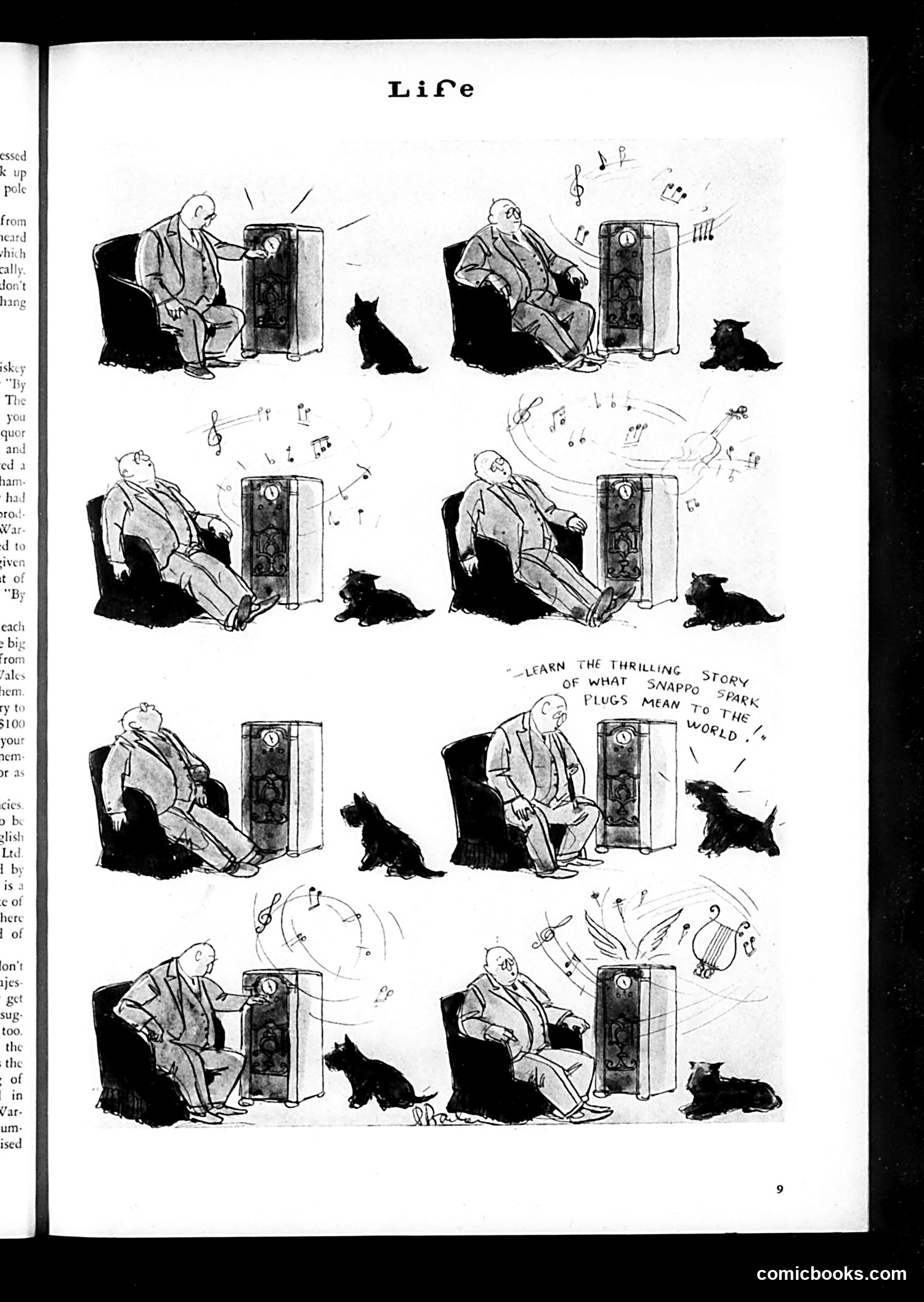
"Life" Cartoon Page Analysis This is a humorous multi-panel comic titled "Life" depicting a man repeatedly attempting to operate what appears to be an early radio or electronic device, with a black cat present throughout. The joke progresses through eight panels showing the man's escalating frustration—from careful adjustment, to animated gestures, to increasingly wild conducting motions—as he struggles with the device's function or reception. Musical notes accompany many panels, suggesting he's trying to tune in to music or broadcast content. The caption at the bottom reads: "LEARN THE THRILLING STORY OF WHAT SNAP SPARK PLUGS MEAN TO THE WORLD." This appears to be an advertisement for spark plugs, using the man's comedic frustration with early radio technology as a vehicle for product promotion. The satire mocks both newfangled electrical devices and advertising hyperbole of the era.
Analysis This page contains several brief humorous anecdotes and quotations rather than political cartoons. The one illustration shows a figure climbing or clinging to what appears to be a ship's rigging or mast. The "Cockroaches" section satirizes an exterminating company in Washington, D.C., recounting an awkward encounter where a cockroach specialist was called to an apartment but ended up chasing cockroaches alongside embarrassed residents—poking fun at the incompetence of pest control services. The page's other content consists of quips and observations attributed to various figures (including Elmer Rice and Joseph Hergesheimer), touching on theatrical criticism, authorship, and politics. These are brief satirical commentary rather than visual cartoons, characteristic of *Life* magazine's format during this era.
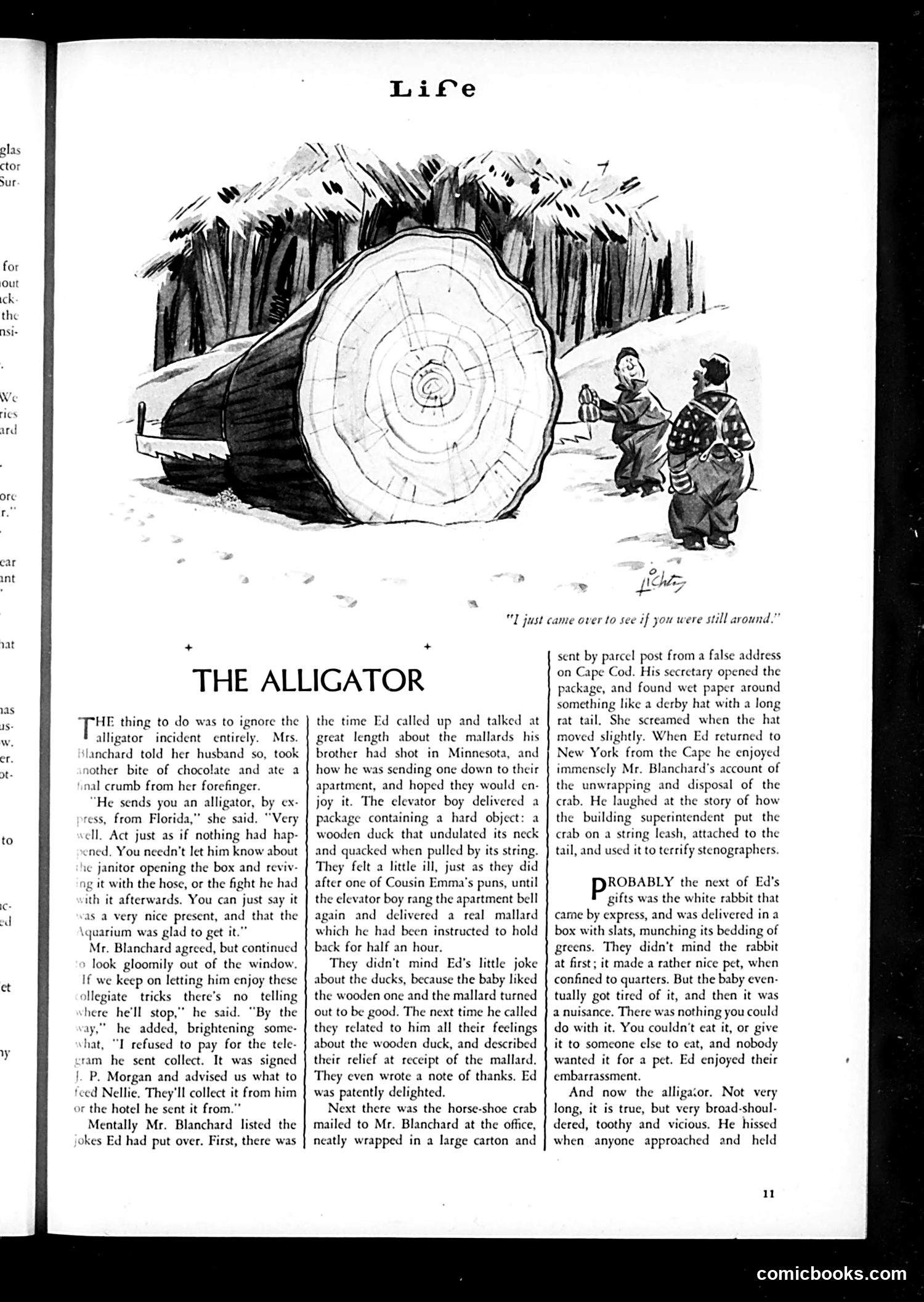
"Life" Magazine Page: "The Alligator" This page contains a humorous short story titled "The Alligator," accompanied by an illustration showing two figures examining a large felled tree trunk with visible growth rings. The story concerns a man named Ed whose brother sends him an alligator from Florida as a prank gift. The narrative humorously details Ed's attempts to manage this unwanted pet in his New York apartment building, including complaints from neighbors and the superintendent's frustration with the situation. The cartoon's visual joke plays on the title: the enormous tree trunk resembles an alligator in profile, with the growth rings suggesting an eye. The two figures appear to be examining it with surprise or concern, creating a visual pun that complements the story's theme of unexpected, problematic "gifts" causing disruption to urban life.
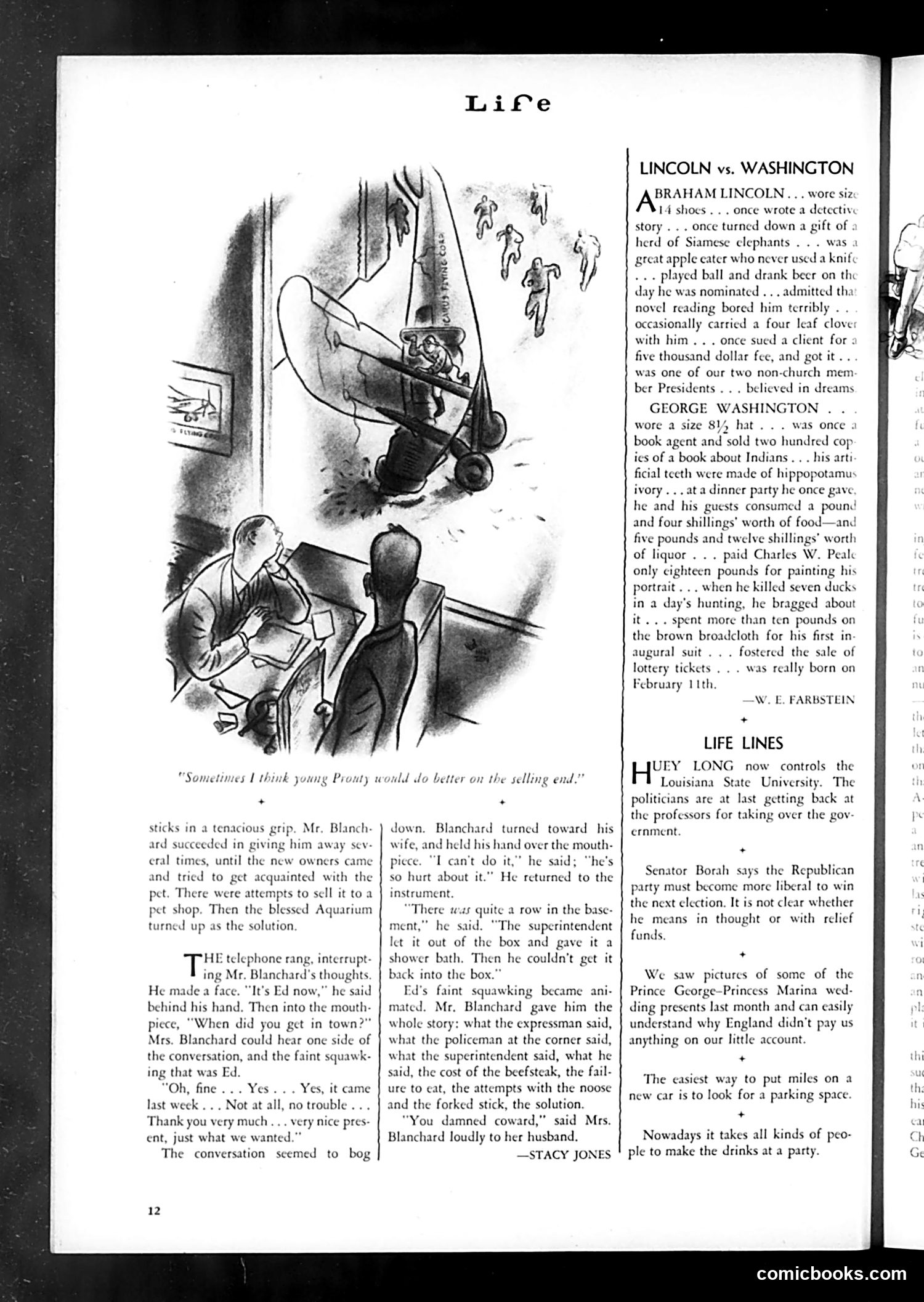
"Sometimes I think young Pronty would do better on the selling end." This cartoon depicts a domestic scene where a man attempts to play a musical instrument (appears to be a saxophone or similar) while his wife and another person listen. The caption suggests the wife is critiquing her husband's musical ability, implying he'd be better suited to *selling* music rather than performing it—a cutting remark about his lack of talent. The humor relies on marital tension and the wife's withering sarcasm about her husband's unsuccessful attempt at musicianship. "Pronty" appears to be a pet name, adding domestic familiarity to the insult. This reflects common early-20th-century satirical themes about incompetent husbands and sharp-tongued wives.
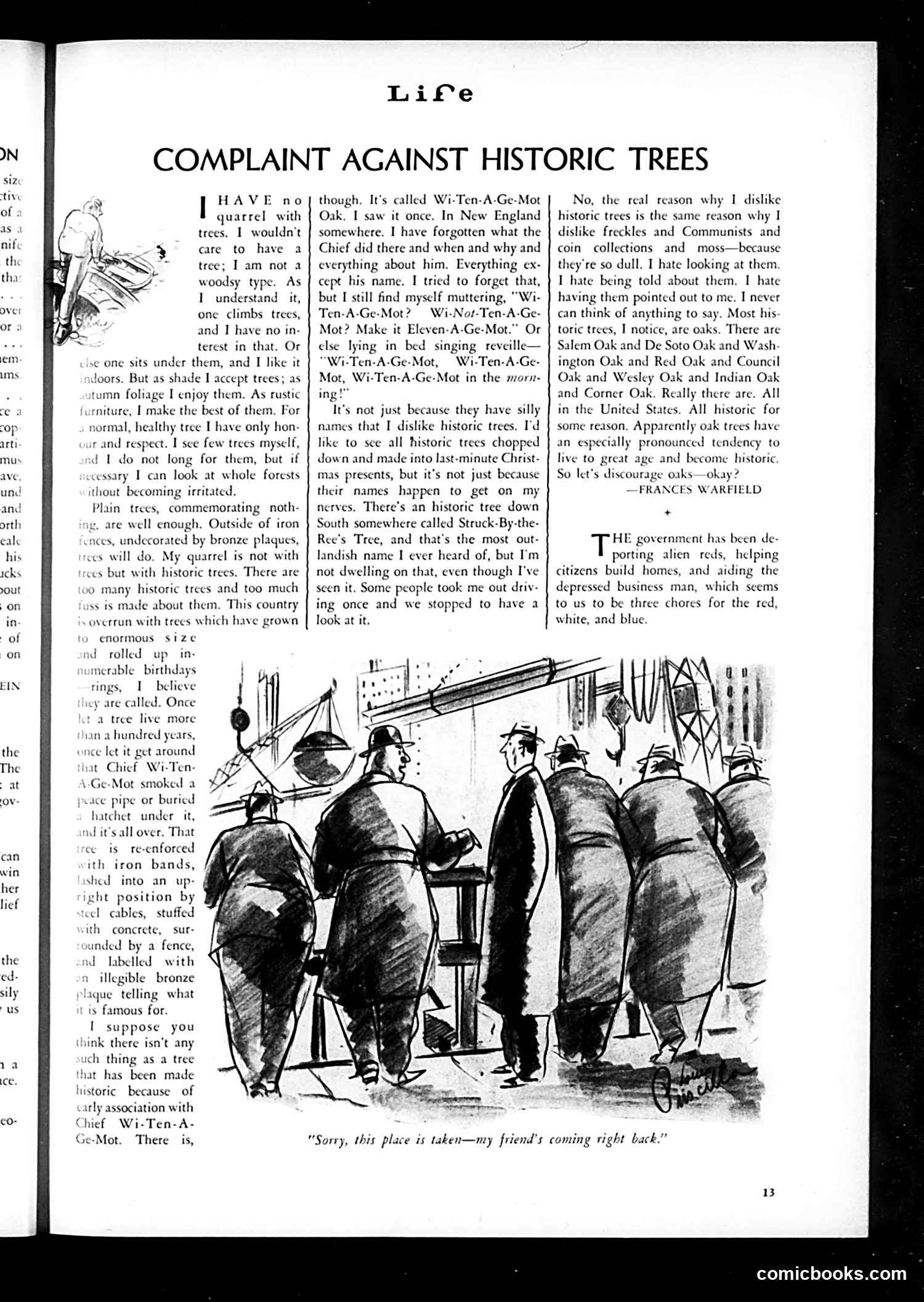
"Complaint Against Historic Trees" This satirical piece mocks the American obsession with historical preservation. The author complains about "historic trees"—particularly ones named after Native American figures like "Wi-Ten-A-Ge-Mot"—claiming they're tedious tourist attractions covered in plaques and bronze markers. The cartoon illustrates the joke: men in period dress stand near a historic tree site, with one saying "Sorry, this place is taken—my friend's coming right back," suggesting the trees create absurd traffic jams and civic inconvenience. The satire targets both excessive antiquarianism and the tendency to commercialize history. The second section suggests the government's tree-preservation efforts distract from more pressing civic duties. The humor lies in treating venerable historical landmarks as mere nuisances rather than cultural assets.
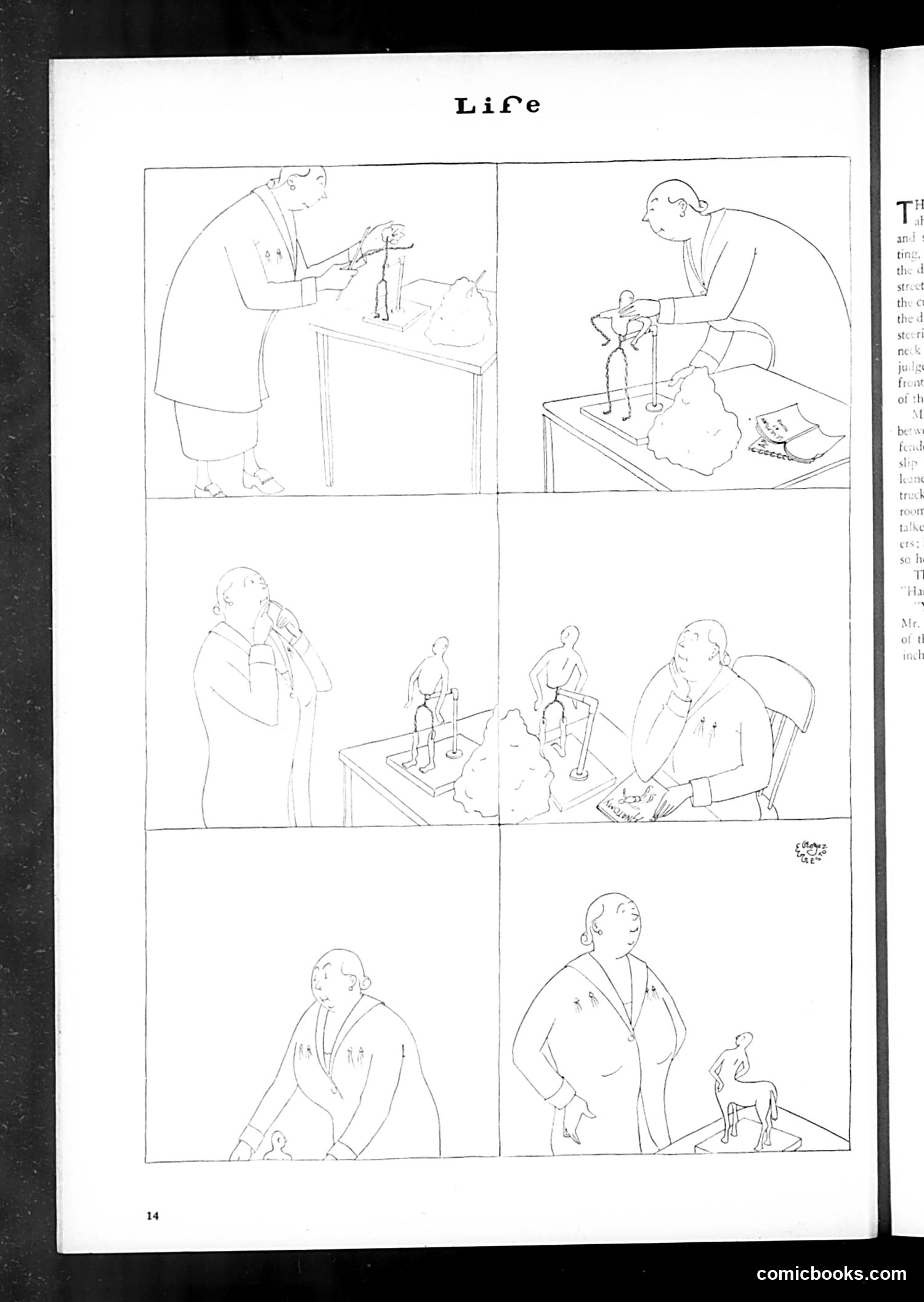
Analysis of "Life" Page This appears to be a satirical comic strip titled "Life" depicting a medical or scientific examination scenario. The sequence shows: 1. Top panels: A doctor or scientist examining small figurines or dolls on a table, suggesting some kind of medical/anatomical study or demonstration. 2. Middle panel: The same authority figure presenting findings to what appears to be a patient or subject, with small figures displayed. 3. Bottom panels: The subject's physical transformation or response, ending with the figure appearing diminished or changed in stature. The satire likely comments on medical authority, examination procedures, or pseudo-scientific practices common to the era. Without clearer identification of specific individuals or clearer OCR text, the exact political target remains uncertain, though it appears to mock medical professionals or their methods.
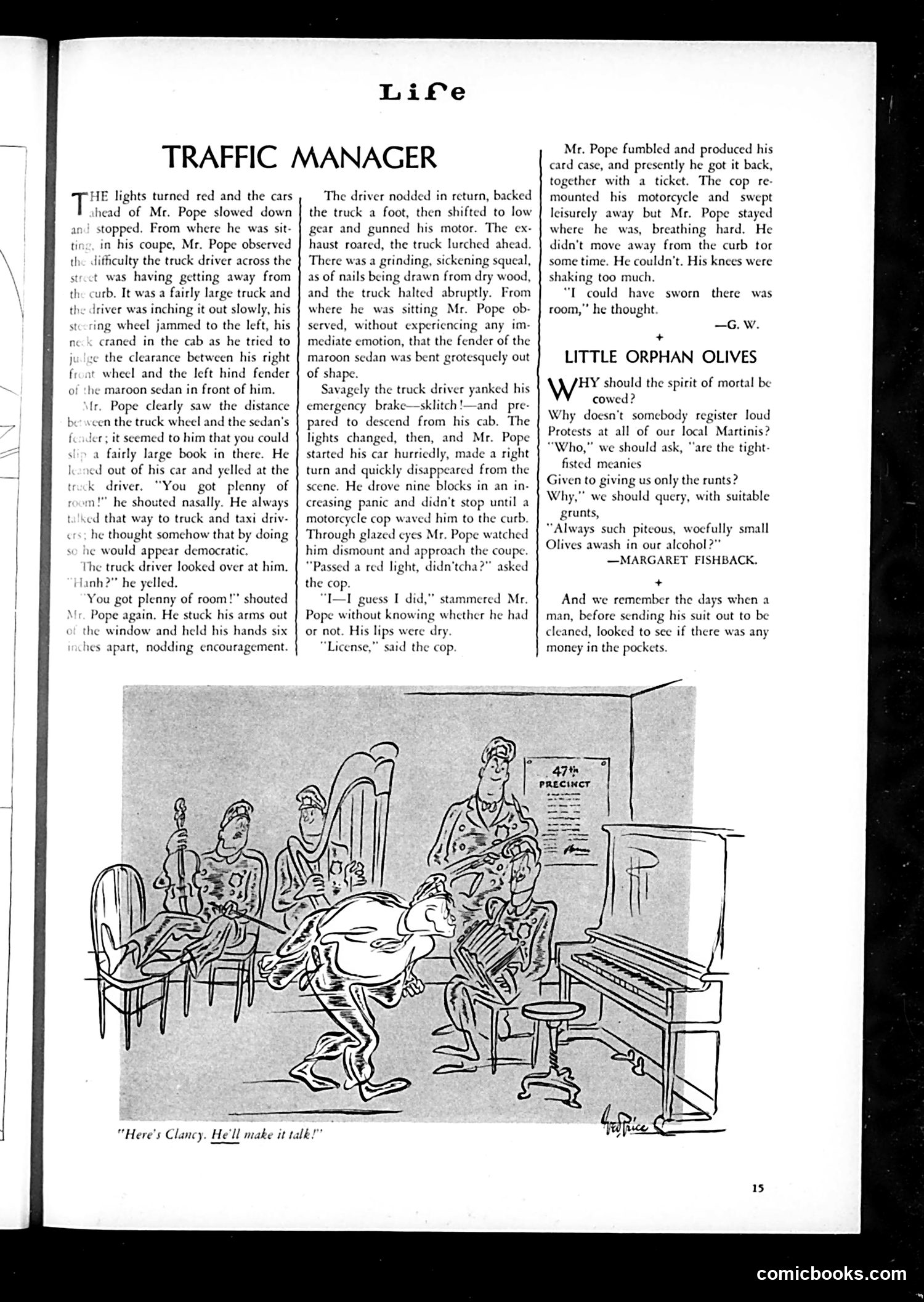
Page Analysis This page contains two separate pieces of satirical humor from *Life* magazine: "Traffic Manager" (top): A story mocking Mr. Pope, a traffic cop who gets stuck trying to direct traffic while his motorcycle is wedged between a truck and a sedan. The humor centers on his embarrassment and powerlessness—the very authority figure responsible for managing traffic becomes helplessly trapped, unable to direct the truck driver to move. It satirizes bureaucratic incompetence and the absurdity of traffic enforcement. "Little Orphan Olives" (bottom): A brief poem critiquing the city's treatment of street urchins and poor children ("Olives"), suggesting that local charities (Martinis) ignore their plight while officials give only rhetoric, not real assistance. The accompanying cartoon depicts what appears to be a police precinct scene with musicians, captioned "Here's Clancy. He'll make it talk!"—likely satirizing police brutality or coercion tactics.
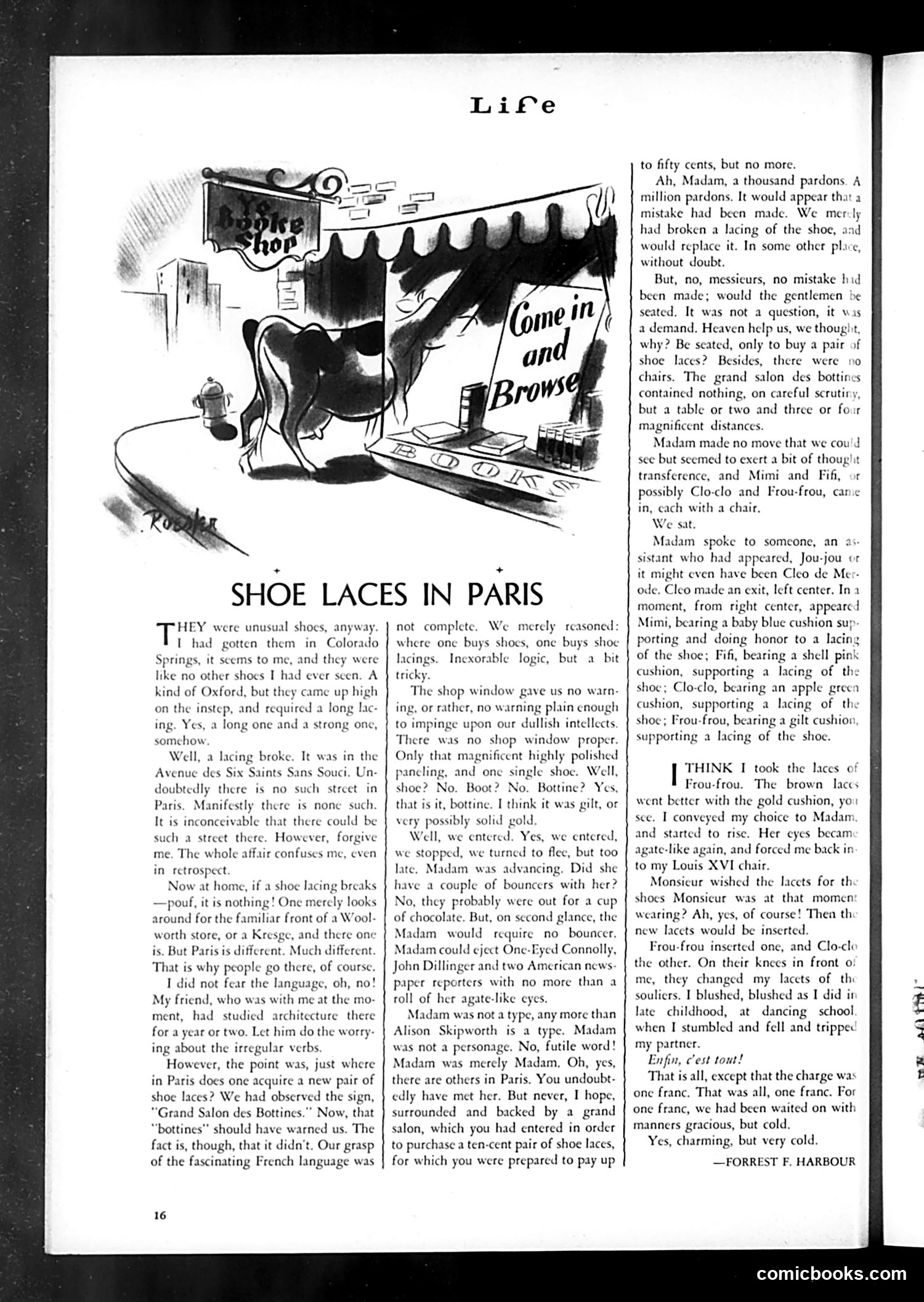
"Shoe Laces in Paris" This page contains a humorous essay by Forrest F. Harbour about an embarrassing incident in a Paris shoe shop. The accompanying cartoon illustrates a cow entering a fashionable boutique marked "Come in and Browse," depicting the absurdity of the situation described. The satire mocks both French pretension and American tourists' cultural mishaps abroad. The author recounts how his group entered an exclusive Parisian salon expecting to buy shoe laces for fifty cents, only to discover the establishment was a grand, elegant space with no actual merchandise displayed—merely a "magnificent distance" and expensive ambiance. The joke highlights the gap between American expectations and French luxury retail culture, with the cow symbolizing how out-of-place these Americans felt in this refined setting.
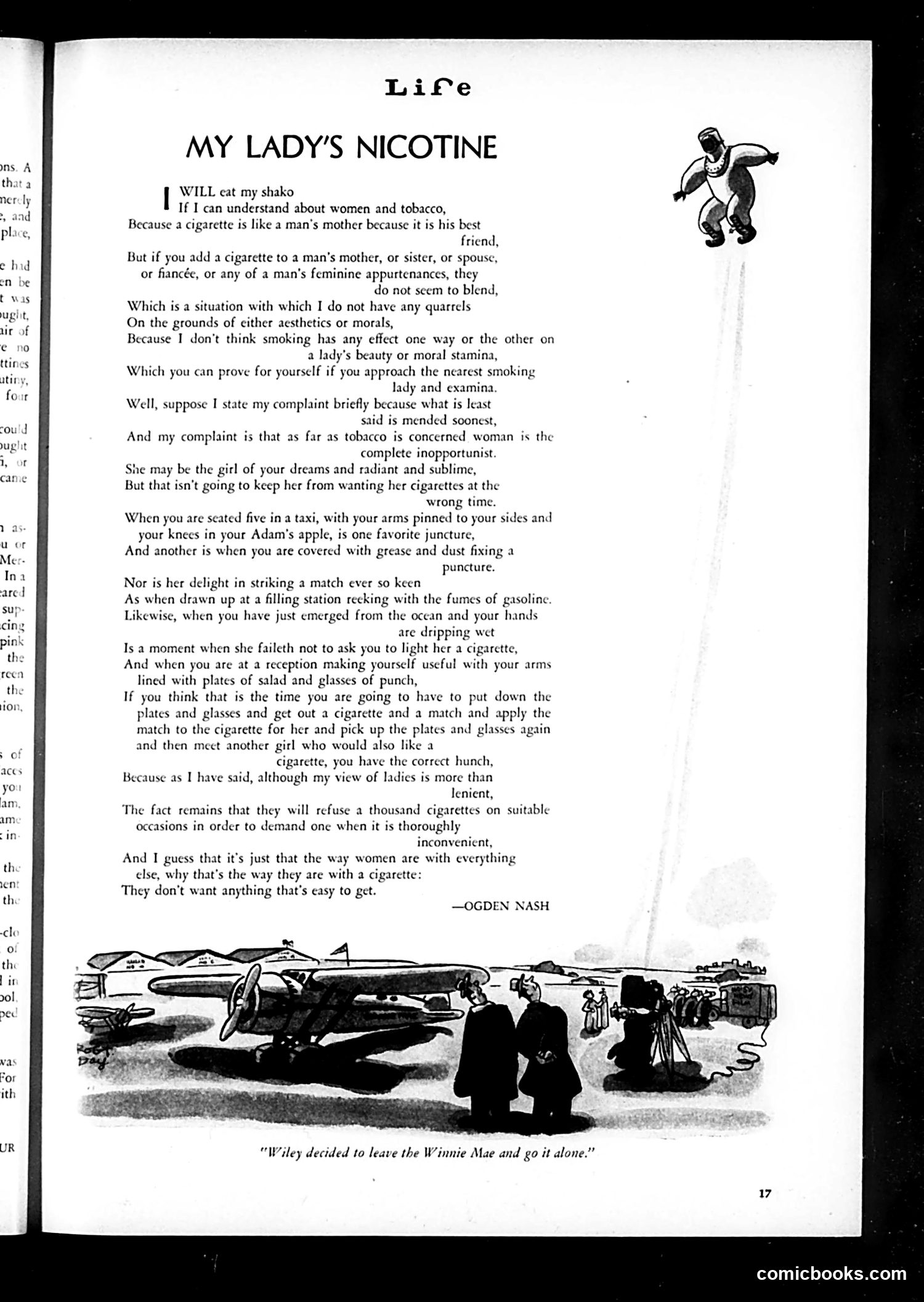
"My Lady's Nicotine" by Ogden Nash This satirical poem by humorist Ogden Nash defends women smoking cigarettes against moral objections. Nash argues that smoking doesn't affect a woman's beauty or virtue, and that women—like men—should be free to smoke whenever convenient, regardless of circumstances (in taxis, at receptions, etc.). The poem's central point: women's desire for cigarettes is as strong and legitimate as any other want, and they'll refuse a thousand cigarettes to demand one at an inconvenient moment simply because they want what's difficult to obtain. The lower illustration shows a silhouetted couple beside an airplane, with the caption "Wiley decided to leave the Winnie Mae and go it alone"—likely referencing Wiley Post's famous aircraft and humorous marital commentary.
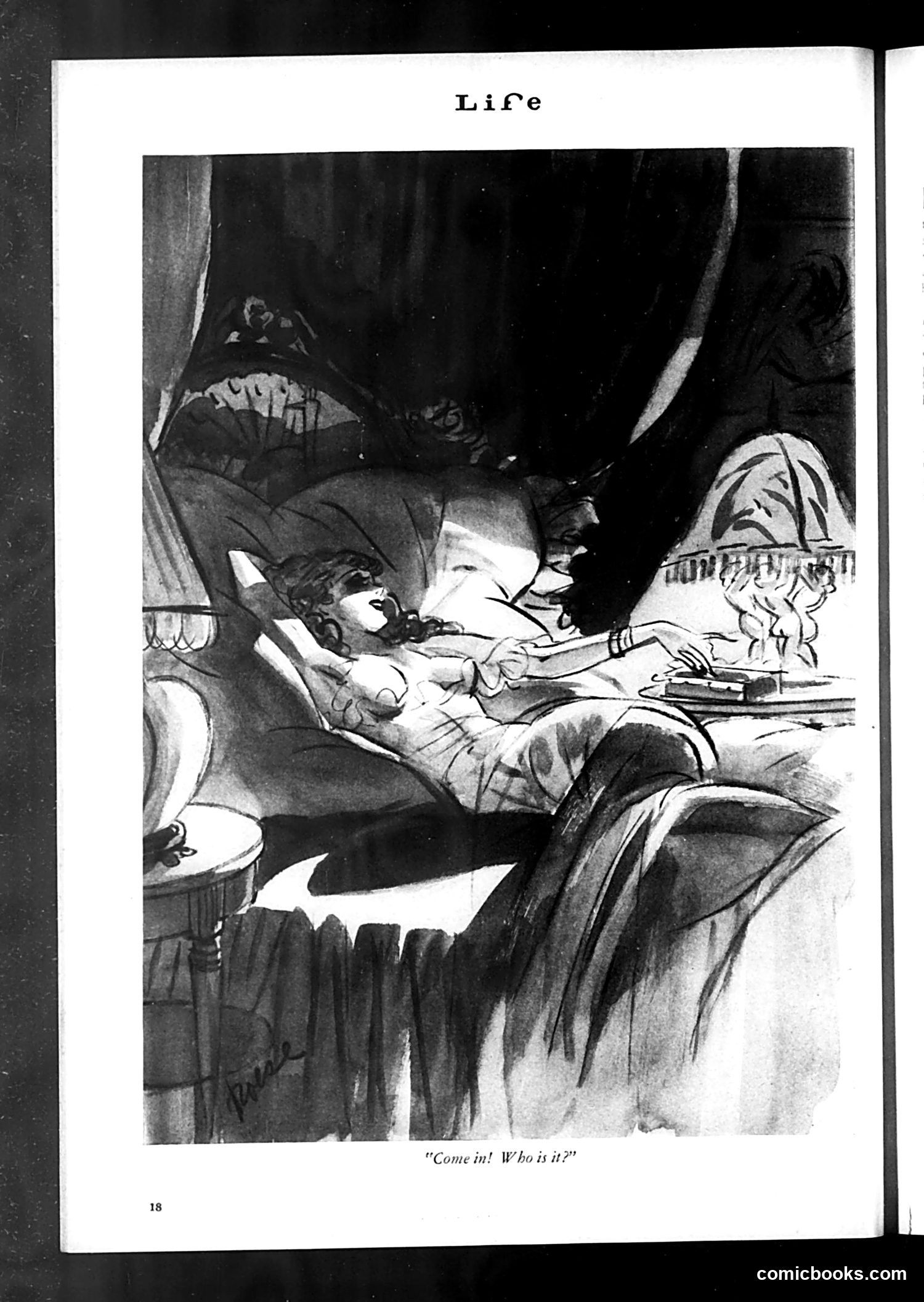
Analysis of Life Magazine Page This page from *Life* magazine presents a satirical illustration titled "Come in! Who is it?" The sketch depicts what appears to be a bedroom or private chamber scene with figures in period costume—one wearing a mask or eye covering and elaborate headwear, another in military dress with a tall hat. The cartoon likely satirizes romantic or social intrigue, possibly referencing historical or contemporary scandals involving masked identities or secret meetings. The theatrical staging and costuming suggest mockery of affected behavior or hidden affairs among the wealthy or powerful. Without additional context about the publication date or specific historical events referenced, the precise targets of this satire remain unclear, though the intimate setting and disguise theme indicate commentary on deception or illicit conduct among the elite.
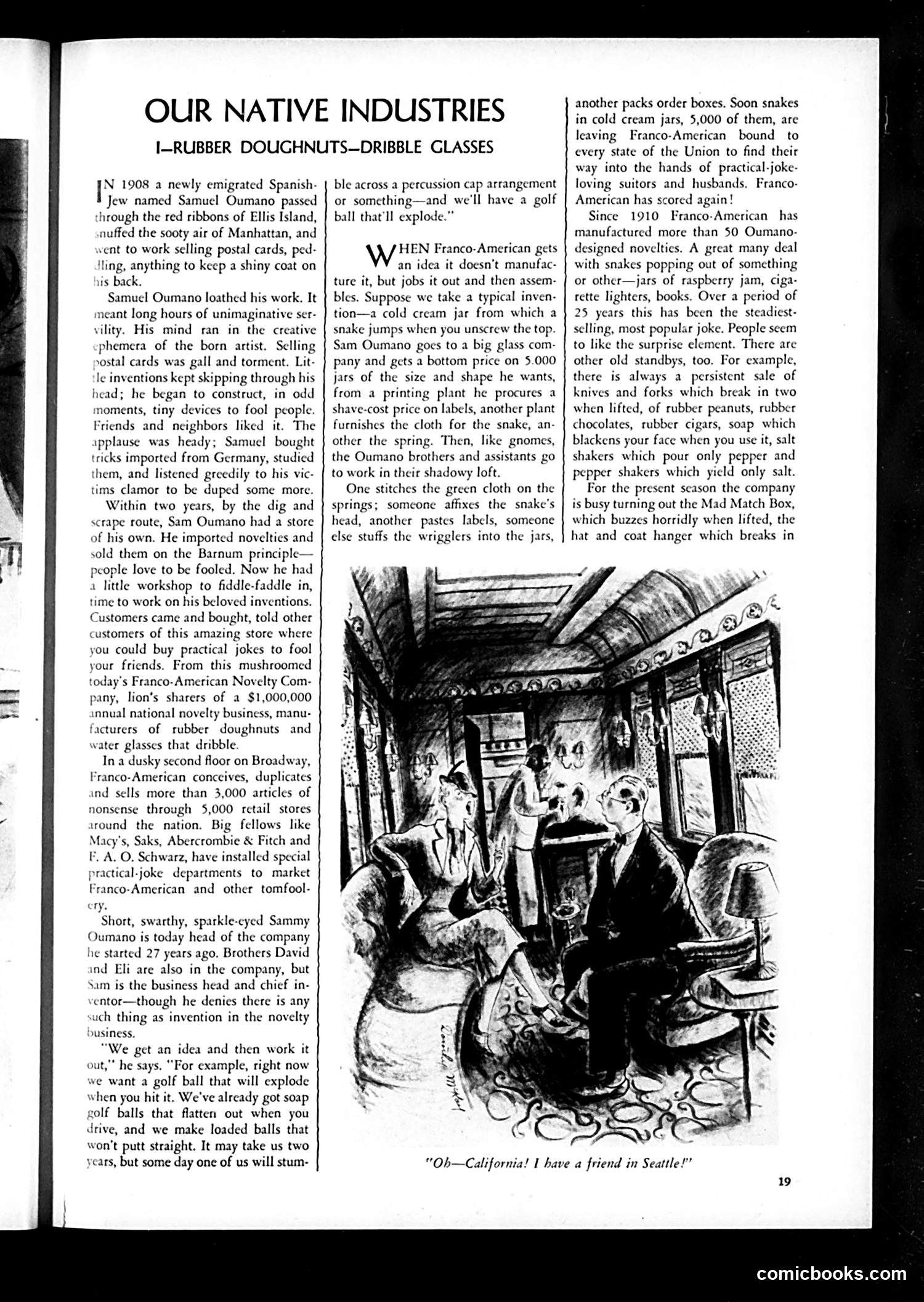
"Our Native Industries" Satirical Commentary This page satirizes American novelty manufacturing, specifically the Franco-American Novelty Company founded by Samuel Oumano in 1908. The article traces how Oumano, a Spanish-Jewish immigrant, built a $1,000,000 business selling practical jokes and novelties—rubber doughnuts, dribble glasses, and fake snakes in cream jars. The accompanying cartoon shows the factory workshop where workers assemble these trick items. The satire mocks both the frivolous nature of the business and American entrepreneurship's capacity to profit from deceiving consumers. The caption "Oh—California! I have a friend in Seattle!" suggests the company's national reach in distributing these joke products. The piece celebrates American ingenuity while gently ridiculing how immigrants monetize foolishness as legitimate industry.
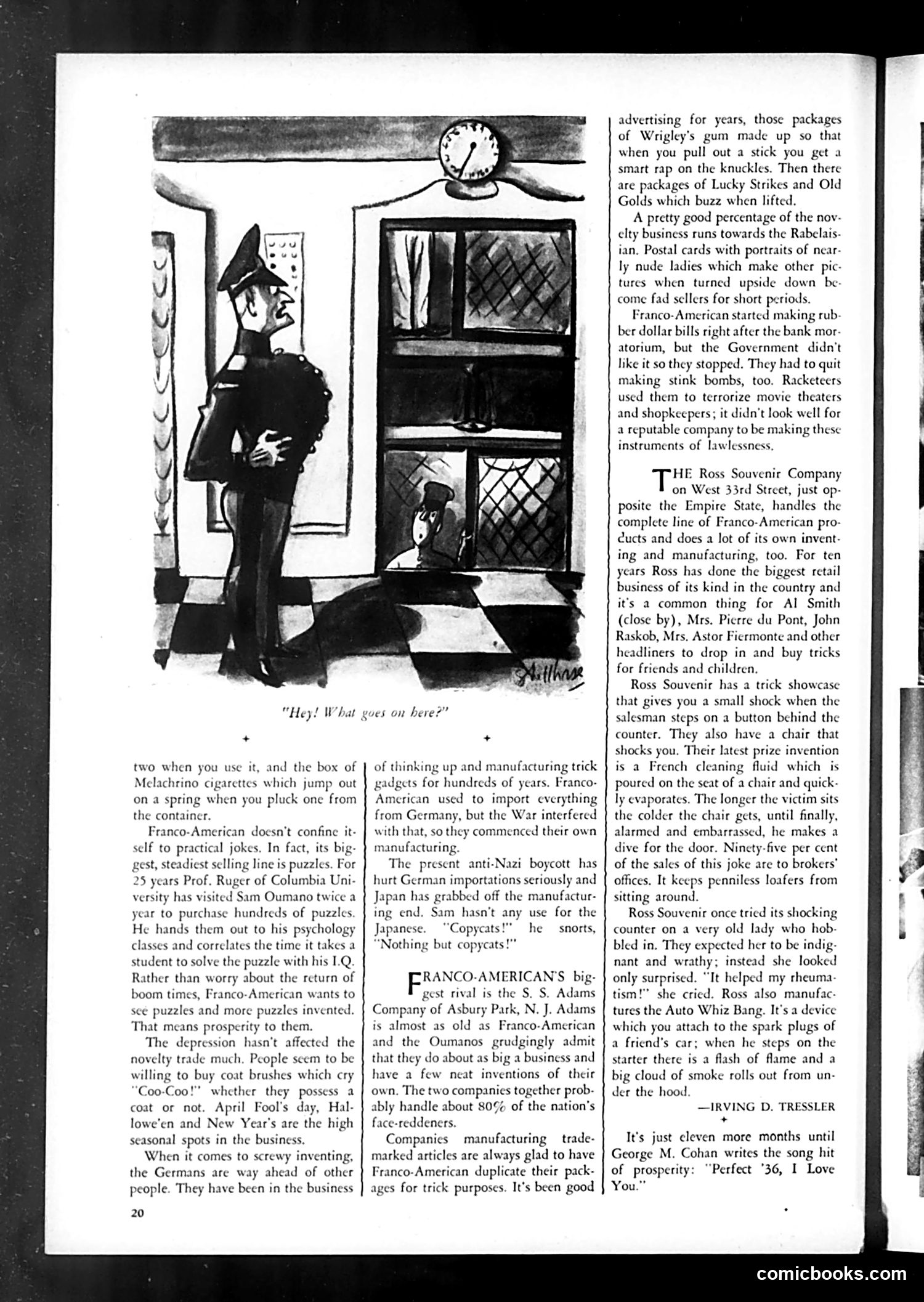
Cartoon Analysis: "Hey! What Goes On Here?" This cartoon satirizes novelty trick manufacturing during the Depression era. The illustration shows a figure peering through a window at what appears to be trick gadget production or display—likely referencing Franco-American, a major novelty company discussed in the accompanying article. The accompanying text explains the novelty trade's thriving business despite economic hardship, detailing items like spring-loaded cigarette boxes, buzzing gum packages, and whoopee cushions. The article notes Franco-American's competition with S.S. Adams Company and mentions government pressure forcing them to stop manufacturing rubber dollar bills and stink bombs—the latter exploited by racketeers to terrorize theaters. The cartoon's humor relies on the incongruity of people eagerly purchasing frivolous joke items while the nation struggled economically. The window-peeping pose suggests voyeuristic fascination with this peculiar, thriving industry. The caption's exclamation captures bemused observation of an unexpected economic phenomenon.
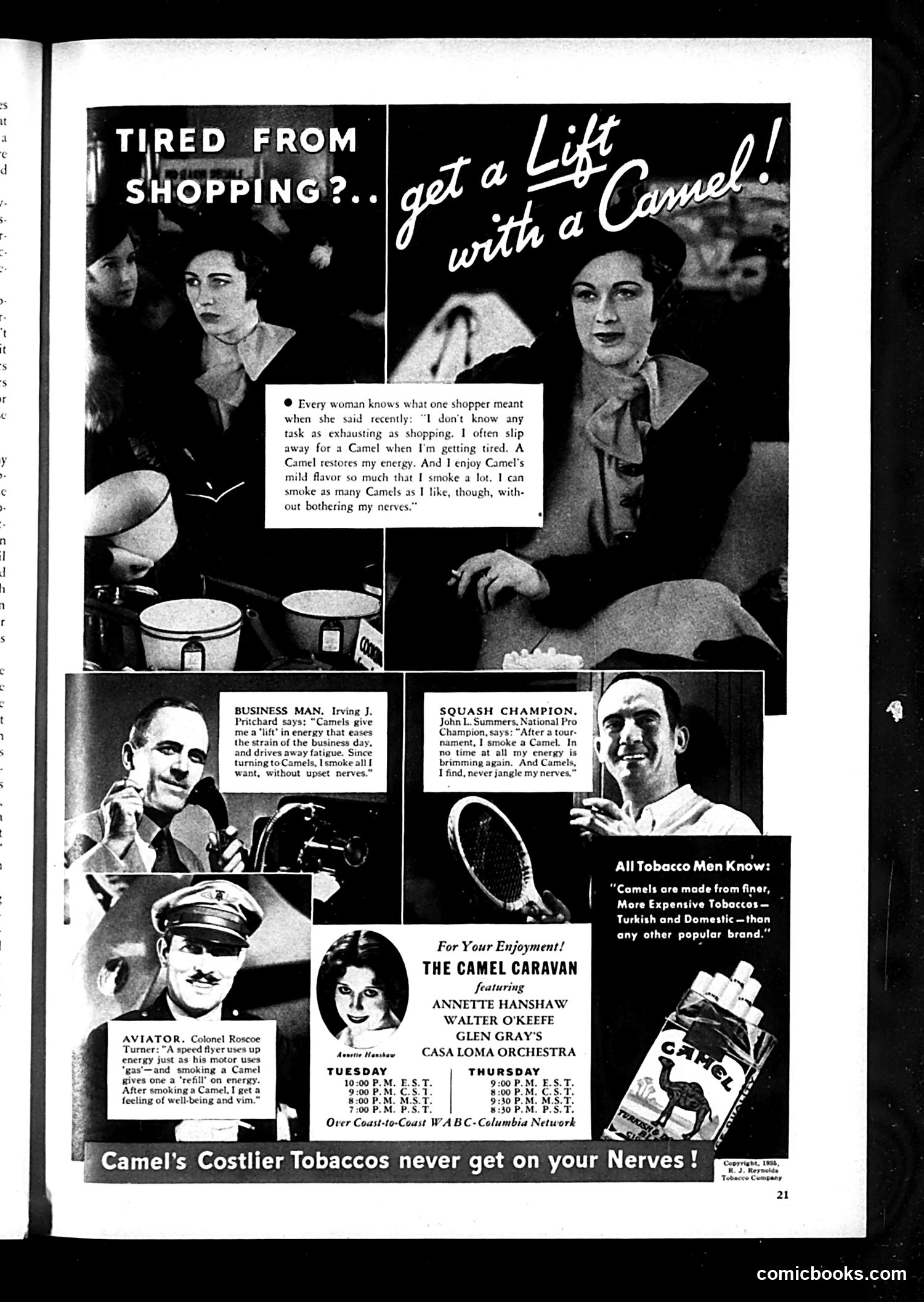
Analysis This is a cigarette advertisement, not satire or political commentary. It's a 1935 Camel tobacco campaign disguised as testimonials. The page features endorsements from various professionals—a shopper, businessman, aviator (Colonel Roscoe Turner), and squash champion—all claiming Camels provide an "energy lift" without "bothering nerves." The tagline promises "Camel's Costlier Tobaccos never get on your Nerves!" The advertisement also promotes "The Camel Caravan," a radio show on ABC-Columbia Network featuring entertainers like Annette Hanshaw and Walter O'Keefe. For modern readers: This represents pre-regulation tobacco advertising that made health claims (no nerve damage, safe to smoke frequently) now recognized as false. Such direct medical claims are illegal today. The celebrity endorsements and radio tie-in exemplify how thoroughly cigarettes were integrated into 1930s popular culture and advertising.
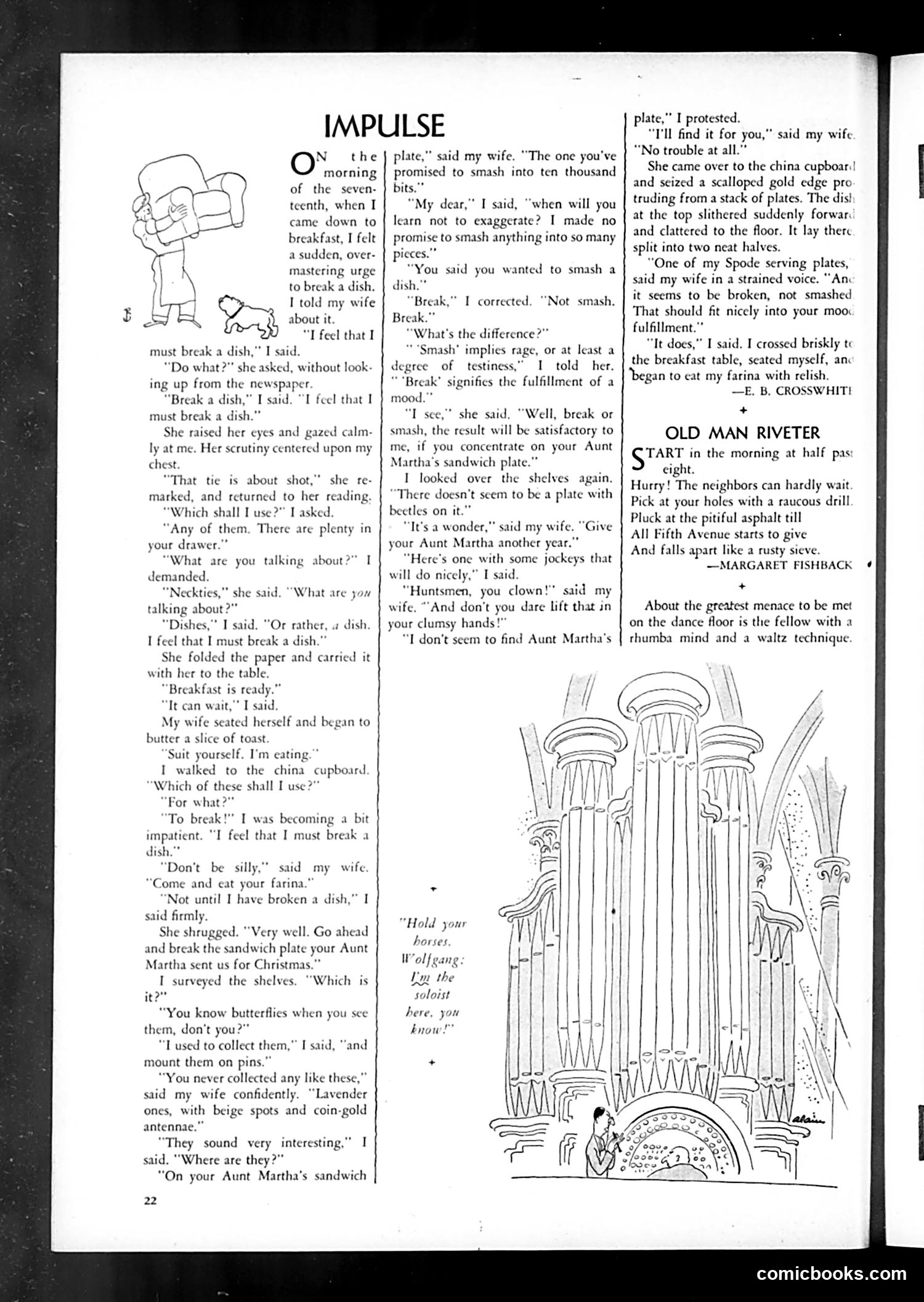
Explanation for Modern Readers "Impulse" is a humorous domestic comedy about a husband who gets an irrational urge to break a dish at breakfast. His wife misunderstands him repeatedly—thinking he means neckties, then sandwiches—creating absurdist confusion. The joke relies on marital banter and the wife's deliberate obtuseness. When she finally retrieves the plate he wants (decorated with butterflies on an Aunt Martha gift plate), *she* breaks it by accident while he watches. The irony: his "impulse" is accidentally fulfilled by her clumsiness, satisfying his strange mood without his effort. The satire gently mocks both domestic impulsiveness and the gap between husband-wife communication. "Old Man Riveter" is a brief poem satirizing urban construction workers who disrupt city streets (Fifth Avenue) with loud drilling and jackhammering, leaving the pavement in ruins. It mocks both the workers' apparent indifference to the chaos they create and the public's frustration with endless street repairs. Both pieces reflect 1920s-30s American magazine humor: domestic squabbles and modern urban annoyances treated as comedic material.
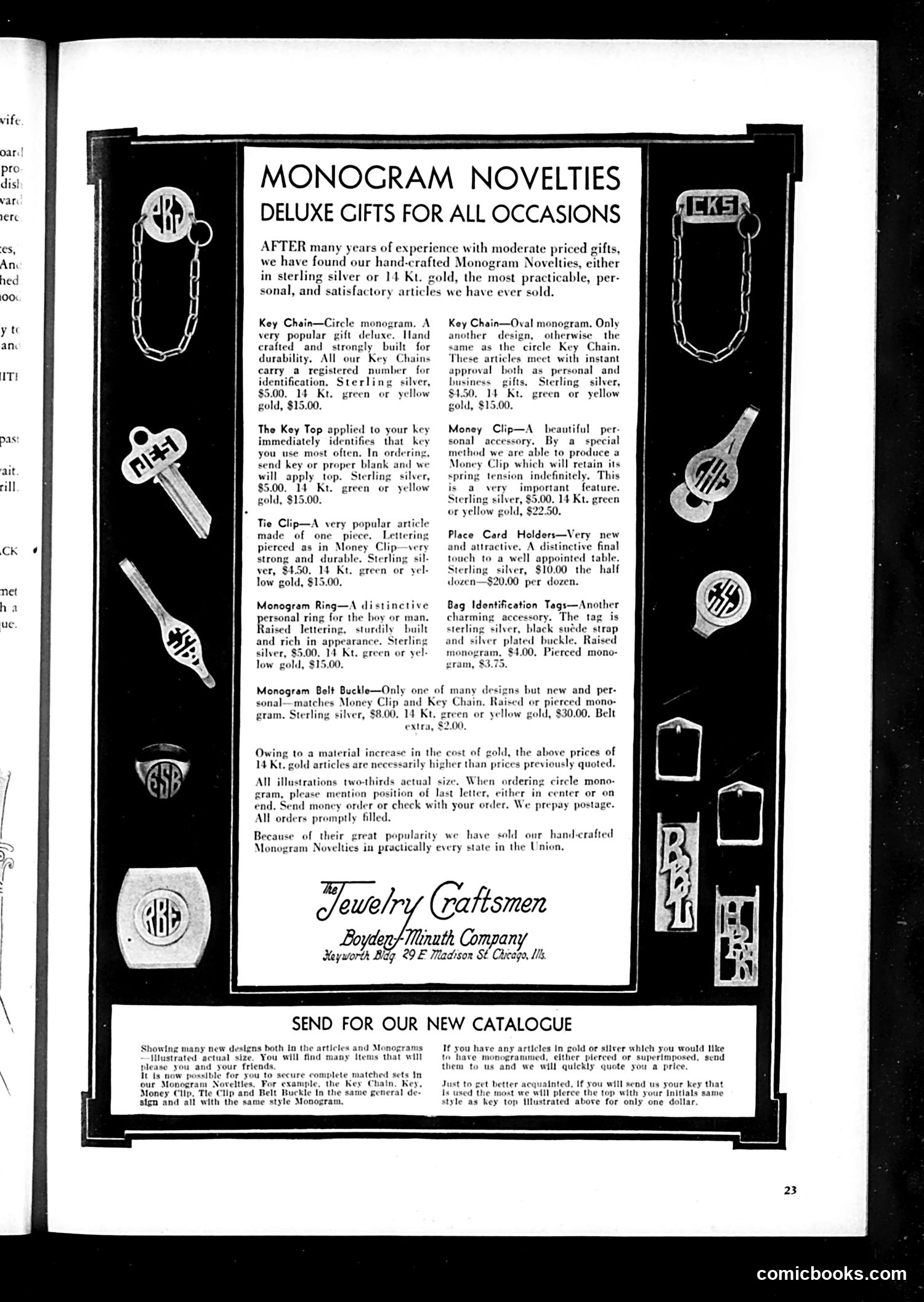
Monogram Novelties Advertisement This is not a cartoon or satire—it's a straightforward product advertisement from Life magazine's advertising section. The page promotes hand-crafted monogrammed gift items from Jewelry Craftsmen (Boyden/Minuth Company, Chicago). Products include key chains, tie clips, rings, money clips, belt buckles, and bag tags—all available in sterling silver or 14-karat gold with personalized monograms. The items are positioned as "deluxe gifts for all occasions," emphasizing durability, distinctive personalization, and availability nationwide. Prices range from $4.50 to $30.00. The ad includes product illustrations and ordering instructions, noting that the company will prepay postage and fill orders promptly. This represents early 20th-century consumer advertising targeting middle-to-upper-class readers seeking personalized luxury gifts.
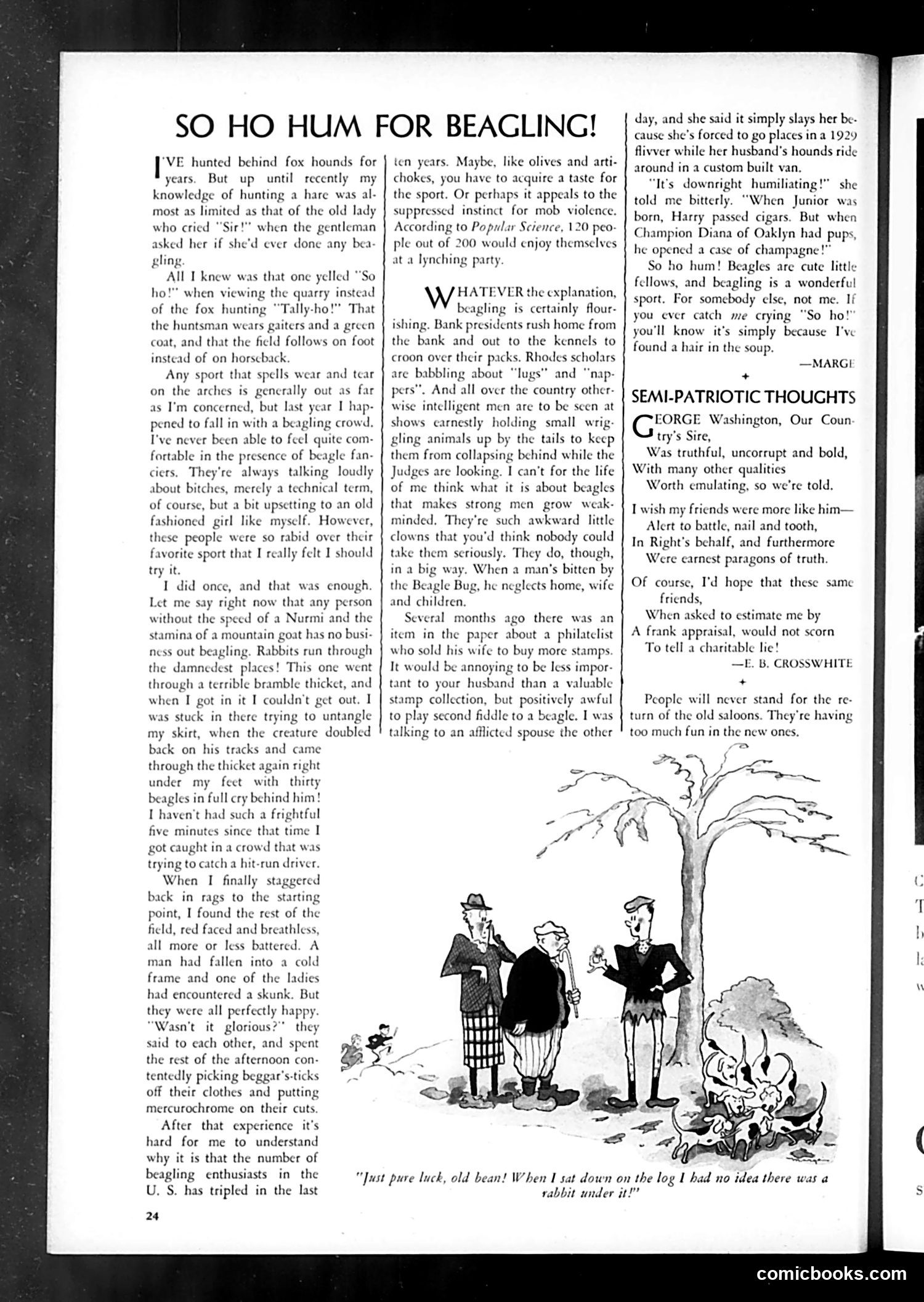
Life Magazine Satire: "So Ho Hum for Beagling!" This article mocks the beagling craze sweeping 1920s America—a hunting sport using small hounds to pursue rabbits. The author, a woman, sarcastically chronicles her disastrous attempt to participate, getting tangled in brambles while thirty dogs chase a rabbit directly under her feet. The satire targets upper-class obsession with the sport. Bank presidents abandon work; Rhodes scholars (wealthy, educated men) speak its jargon; judges hold writhing dogs by their tails. The piece compares beagling's grip to a "Beagle Bug," suggesting cultish irrationality—one man sold his *wife* for stamp collecting; wives are neglected for beagle packs. The cartoon below (caption: "Just pure luck, old bean!") depicts well-dressed hunters with beagles under a bare tree, satirizing how genteel sportsmen present their muddy, chaotic pursuit as refined sport. The underlying joke: respectable men behave irrationally over a trivial hobby, neglecting families and dignity for small dogs chasing rabbits.
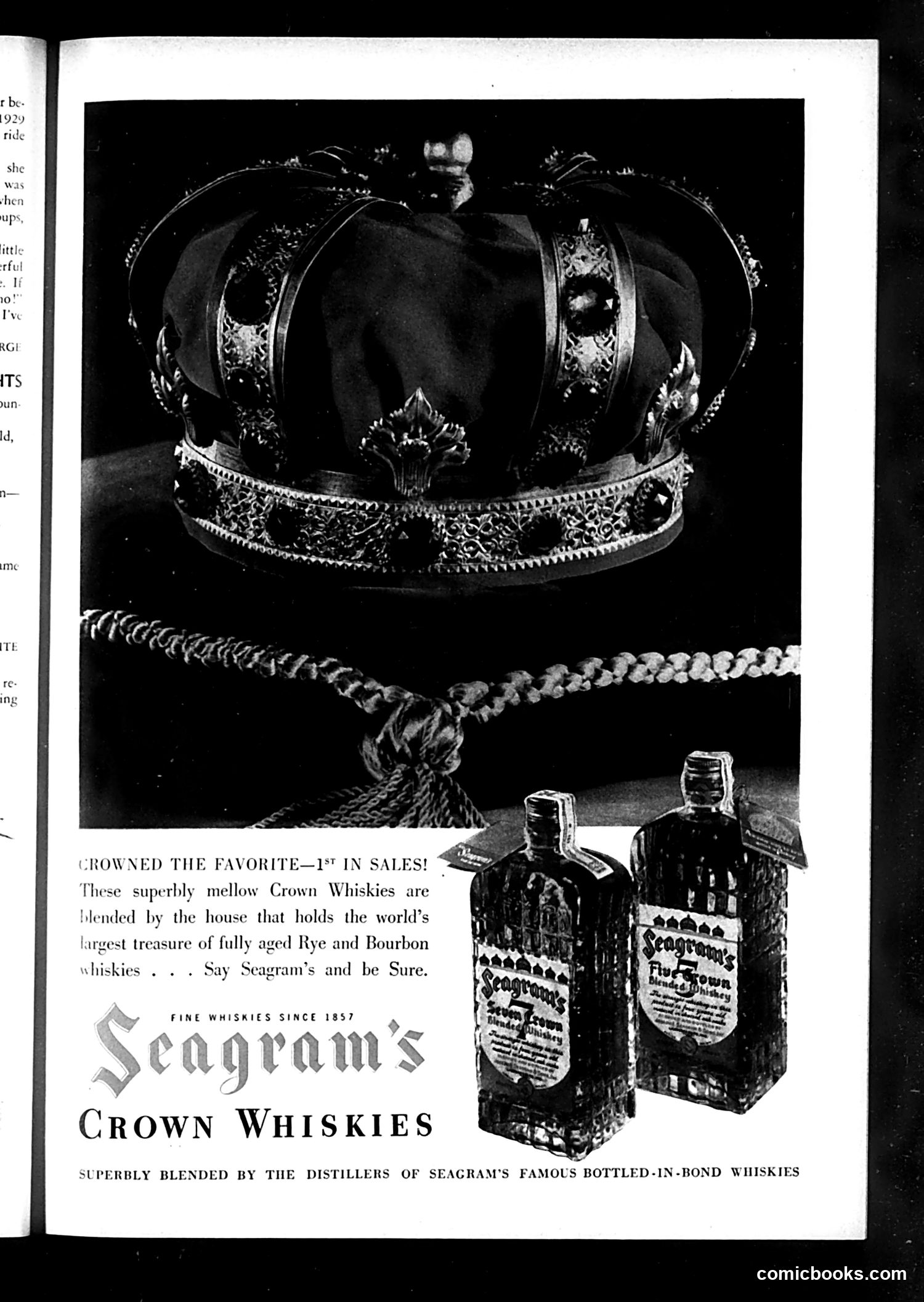
This is a Seagram's Crown Whiskies advertisement, not political satire. The page features an ornate royal crown as the central image—a visual pun matching the product name "Crown Whiskeys." Below sit two bottles of the whisky product. The ad's sales pitch claims Crown is "crowned the favorite—1st in sales" and highlights that Seagram's blends "the world's largest treasure of fully aged Rye and Bourbon whiskies." The tagline "Say Seagram's and be Sure" emphasizes brand reliability. This appears to be a straightforward 1920s-era commercial advertisement using royal imagery and exclusivity messaging to market premium whisky to consumers. No political commentary or satire is present—it's purely promotional.
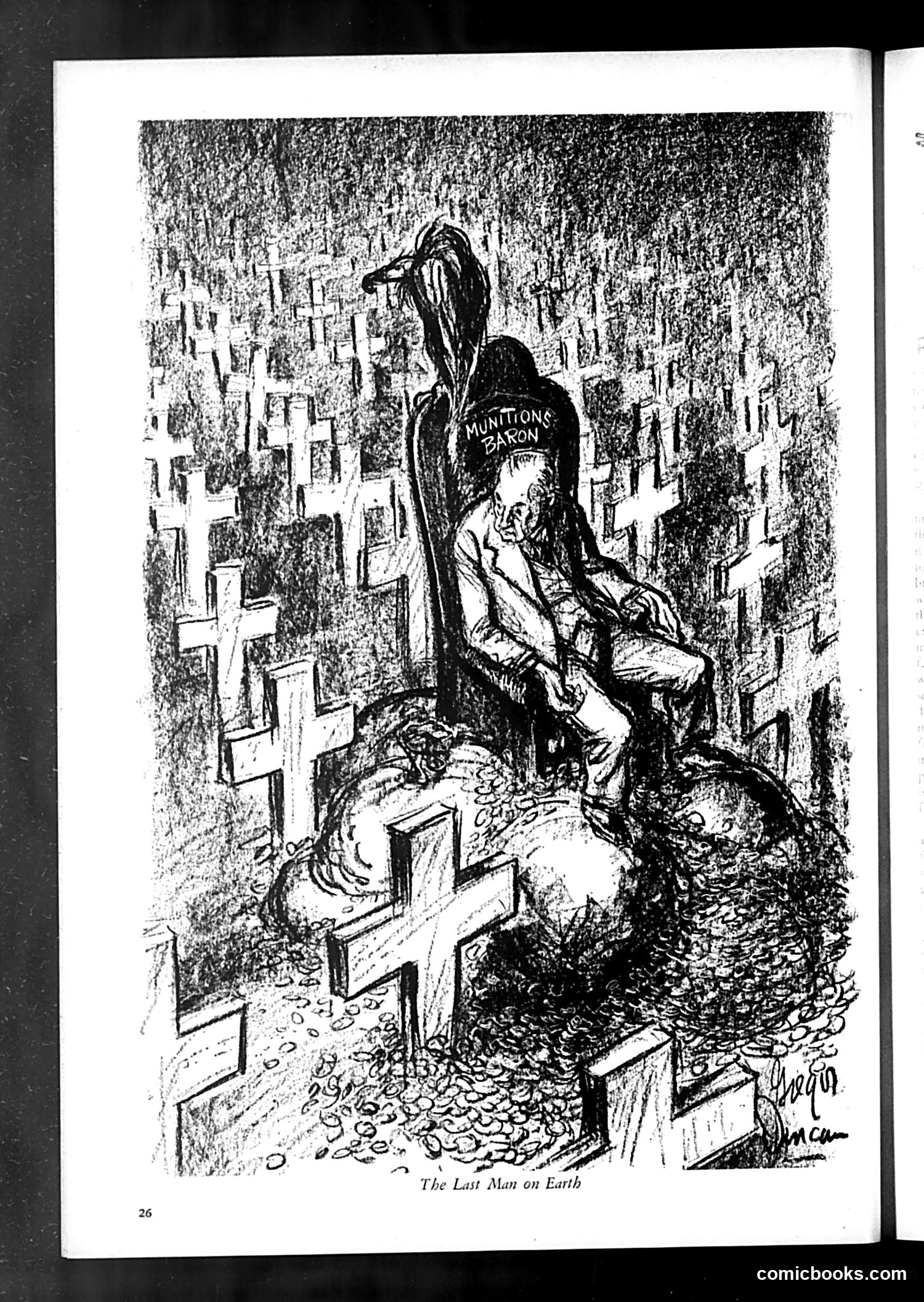
"The Last Man on Earth" This stark political cartoon depicts a solitary figure sitting among countless graves marked with crosses in a vast cemetery. A vulture labeled "MUNITIONS BARON" perches overhead, seemingly waiting. The image's title and composition suggest a commentary on the catastrophic consequences of war—specifically, the role of munitions manufacturers and war profiteers in creating mass death. The cartoon appears to critique industrialists who profit from military conflict while soldiers and civilians die en masse. The lone surviving figure represents humanity reduced to near-extinction through mechanized warfare. This likely reflects early-to-mid 20th century anxieties about industrial-scale warfare and antimilitarist sentiment, positioning weapons manufacturers as parasitic vultures feeding on human carnage.
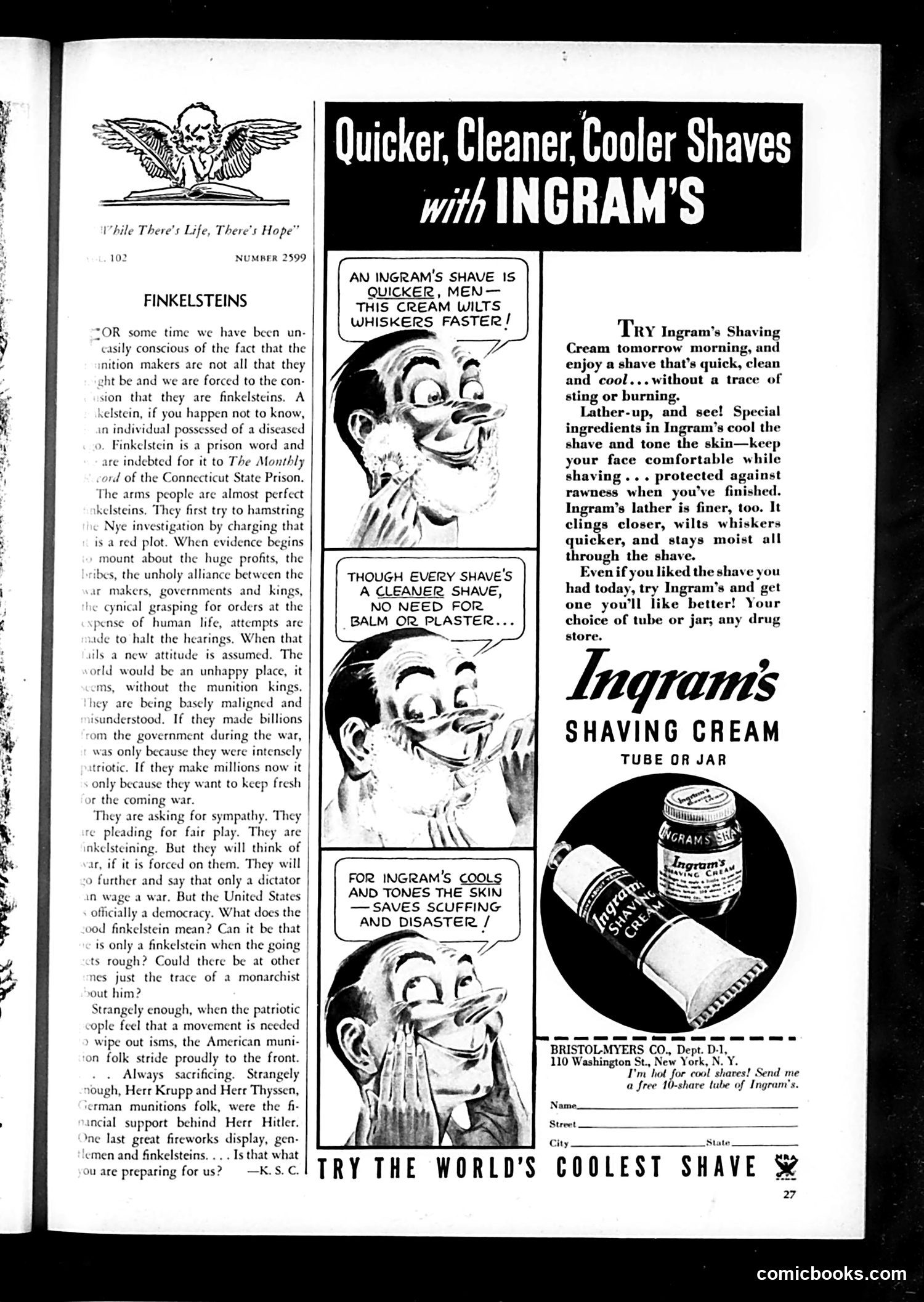
Political Content & Advertisement Analysis Left Column - "Finkelsteins" Essay: This is a scathing political commentary on American munitions manufacturers. "Finkelstein" (prison slang for a diseased mind) describes arms makers who profited enormously during WWI, then claim patriotism while lobbying for future wars. The author sarcastically notes they blame the government for profits while simultaneously supporting dictators—specifically referencing German industrialists Krupp and Thyssen who financially backed Hitler. The piece attacks the hypocrisy of corporations claiming sacrifice while preparing for the next conflict. Right Side - Ingram's Shaving Cream Advertisement: A full-page ad featuring a cartoon man extolling the product's speed and cooling properties. The ad uses comic-strip dialogue panels to highlight product benefits (quick lather, skin-cooling, no irritation). This is straightforward commercial copy with no political content. Context: The page juxtaposes serious anti-war, anti-corporate sentiment with mundane consumer advertising—typical of Life magazine's satirical approach to wartime content.
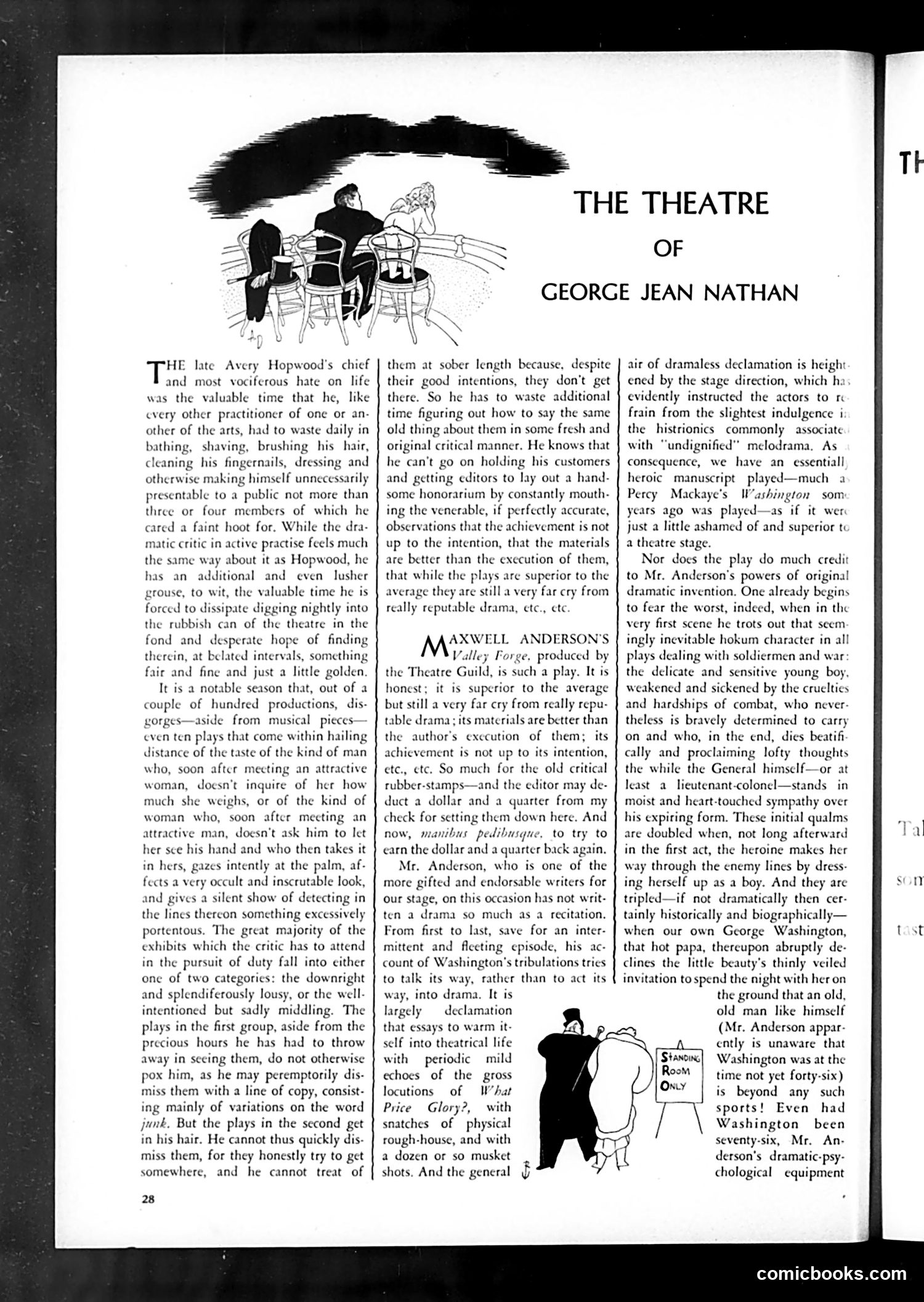
Analysis: "The Theatre of George Jean Nathan" This is a theater criticism column by George Jean Nathan (a prominent early-20th-century drama critic) examining the theatrical season. The piece critiques Maxwell Anderson's play *Valley Forge*, produced by the Theatre Guild. Nathan's central complaint: most theatrical productions are either "downright lousy" or "well-intentioned but sadly middling." The latter category frustrates critics because they require thoughtful analysis rather than dismissal. Anderson's *Valley Forge*—a play about George Washington's encampment—exemplifies this problem. Nathan acknowledges Anderson's talent but argues the play relies too heavily on declaratory speeches rather than dramatic action. It "talks its way" into drama rather than *acts* its way there. The small cartoon shows a figure posting a "Standing Room Only" sign, likely ironizing the play's commercial success despite artistic shortcomings. Nathan's broader satire targets both lazy theater and the critic's thankless task of finding fresh language for recurring mediocrity.
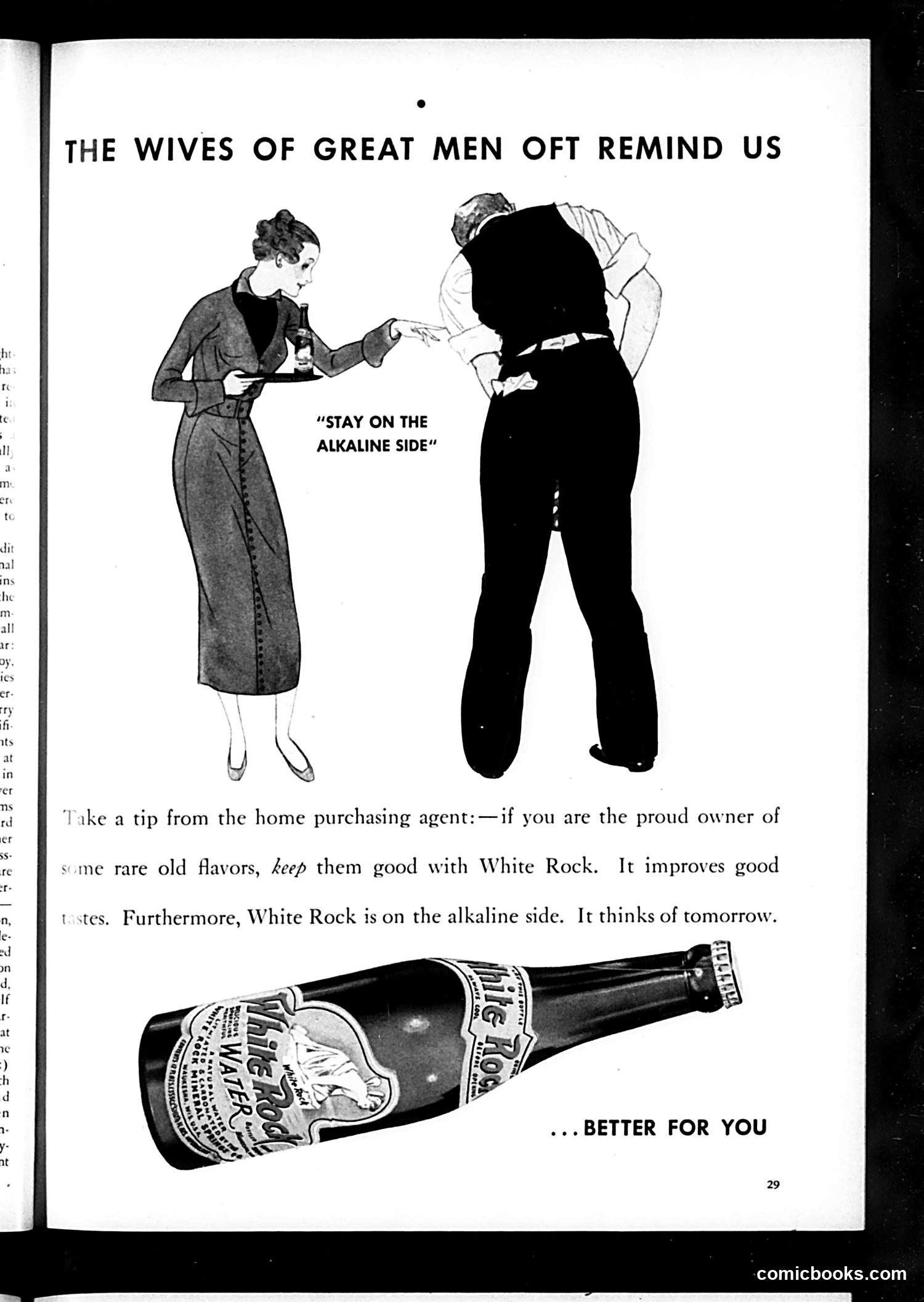
This is a White Rock beverage advertisement disguised as domestic advice. The headline alludes to a famous poem about great men's wives, but the "satire" is actually a marketing pitch. The illustration shows a woman in a dress advising a man to "stay on the alkaline side"—a reference to White Rock's purported health benefits. The ad positions the wife as a "home purchasing agent" responsible for maintaining her husband's wellbeing through product choices. The humor (mild by modern standards) plays on the era's assumption that wives controlled household purchases and health decisions. The "alkaline side" language reflects early-20th-century pseudo-scientific health claims common in advertising. The bottle image at bottom drives the actual sales message: White Rock improves taste and health through its alkaline properties.
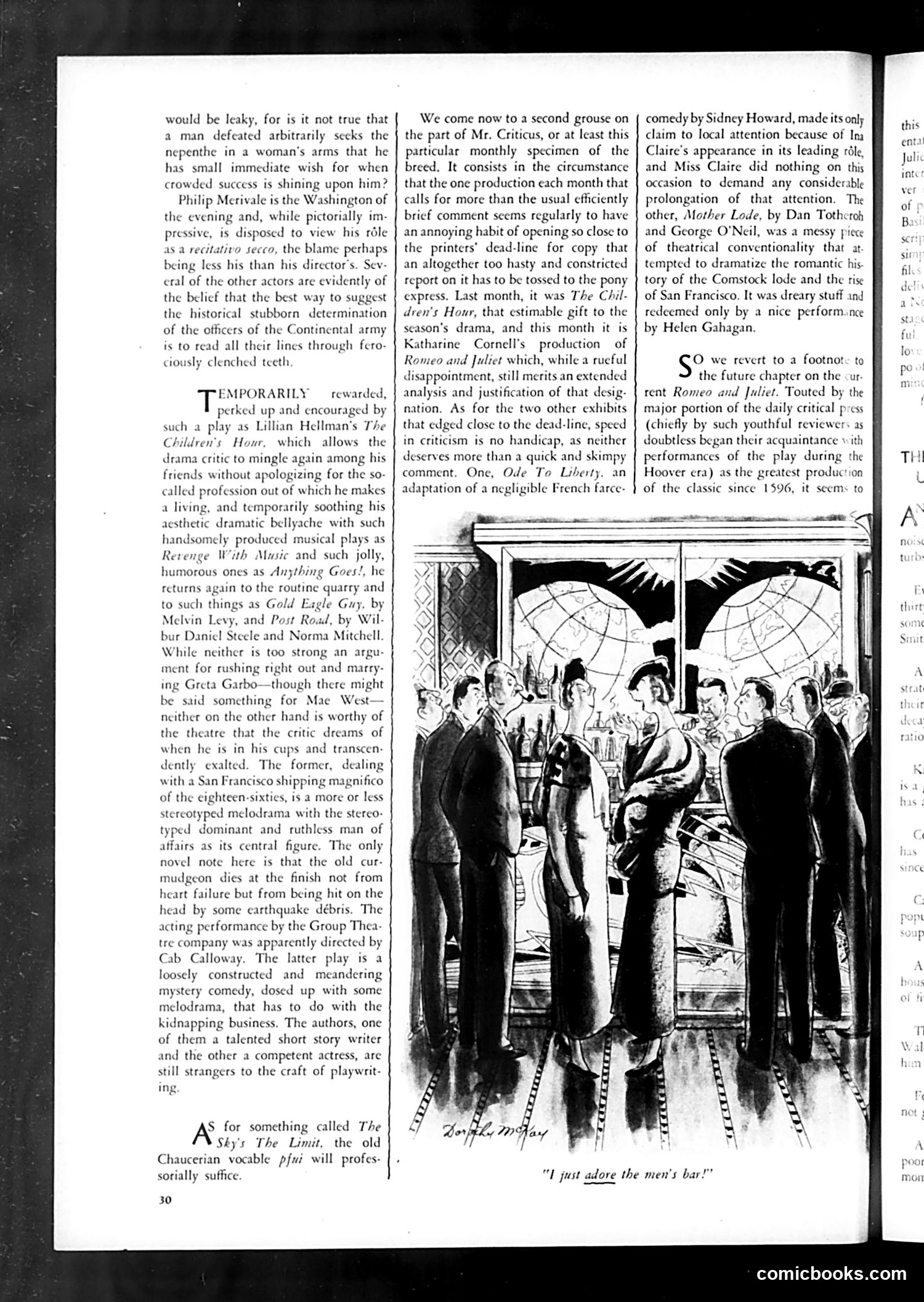
Analysis for Modern Readers This page reviews several Broadway productions from what appears to be the 1930s. The main illustration depicts a ship's bar scene, captioned "I just adore the men's bar!" — likely satirizing wealthy passengers' social pretensions during the era. The text criticizes theatrical performances, particularly praising Lillian Hellman's *The Children's Hour* while dismissing others like *Gold Eagle Guy* (a San Francisco shipping melodrama) and *Post Road*. The reviewer mocks *Gold Eagle Guy*'s absurd death scene where the villain dies from earthquake debris rather than heart failure, and jokes that the Group Theatre's direction resembled "Cab Calloway" (likely referencing poor coordination, as Calloway was a famous bandleader, not theater director). The review also criticizes Katharine Cornell's *Romeo and Juliet* production and Ina Claire's appearance in *Ode to Liberty*, suggesting Claire contributed nothing worthwhile to the latter play. The overall tone reflects mid-century theater criticism's snobbish dismissal of commercial entertainment while championing serious dramatic work.
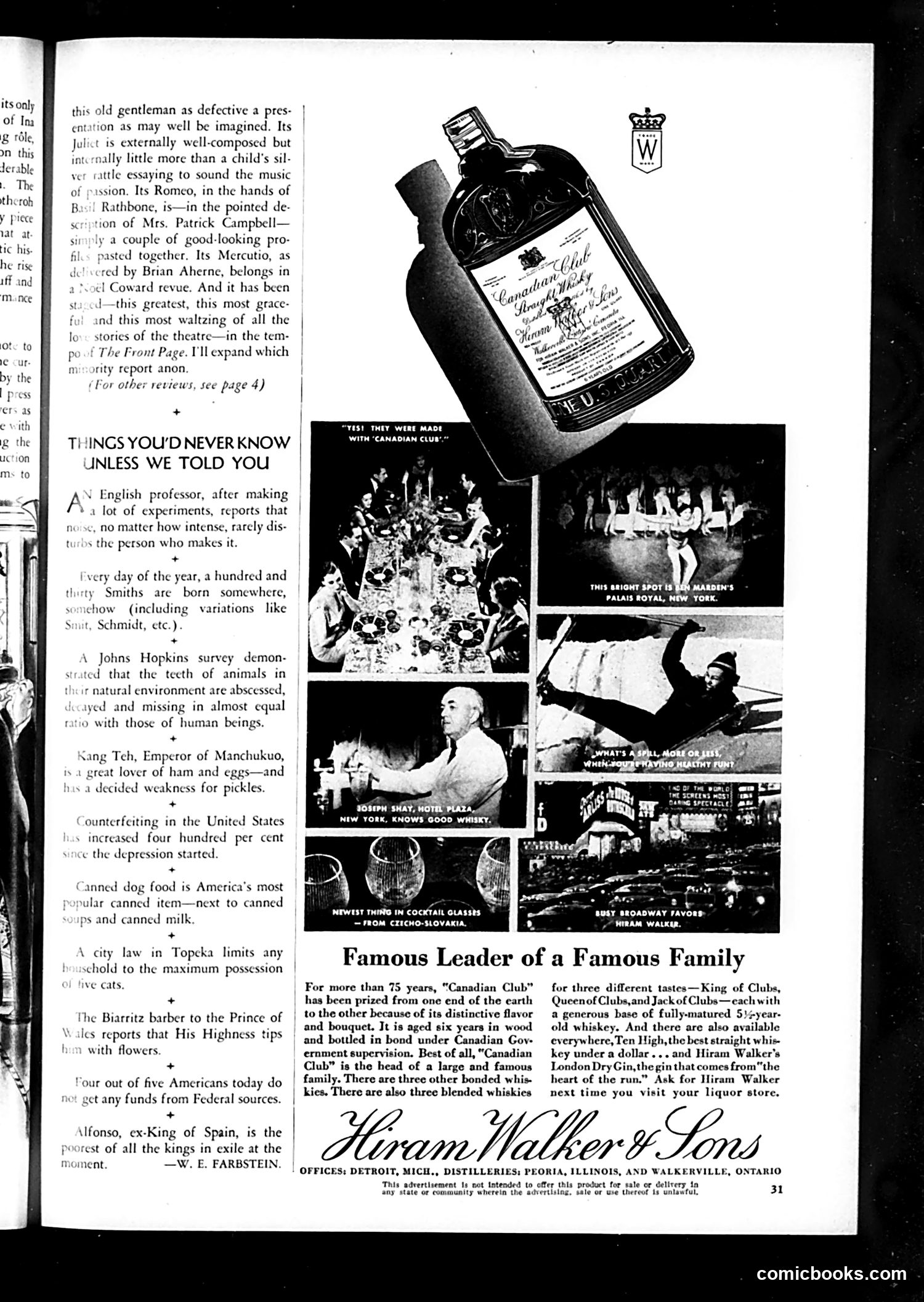
Analysis of This Life Magazine Page This is primarily a whiskey advertisement for Hiram Walker & Sons' "Canadian Club" brand, disguised within editorial content. The page opens with theater criticism (likely referencing Basil Rathbone's Romeo and Juliet production), followed by a humorous "trivia" section titled "Things You'd Never Know Unless We Told You"—a recurring Life feature mixing genuine facts with absurdities (e.g., "100 Smiths born daily," animal teeth are as diseased as humans'). The advertisement's centerpiece features a large Canadian Club bottle and smaller photographs showing people enjoying cocktails and nightlife. The pitch emphasizes the whiskey's 75-year heritage and "distinctive flavor," positioned as the "head of a famous family" of related spirits. Historical Context: This advertisement likely dates to the Prohibition era (1920-1933) or shortly after Repeal (1933), when alcohol advertising was newly legal and brands aggressively marketed their products. The "family" metaphor and emphasis on government supervision reflect efforts to portray liquor as respectable and regulated.
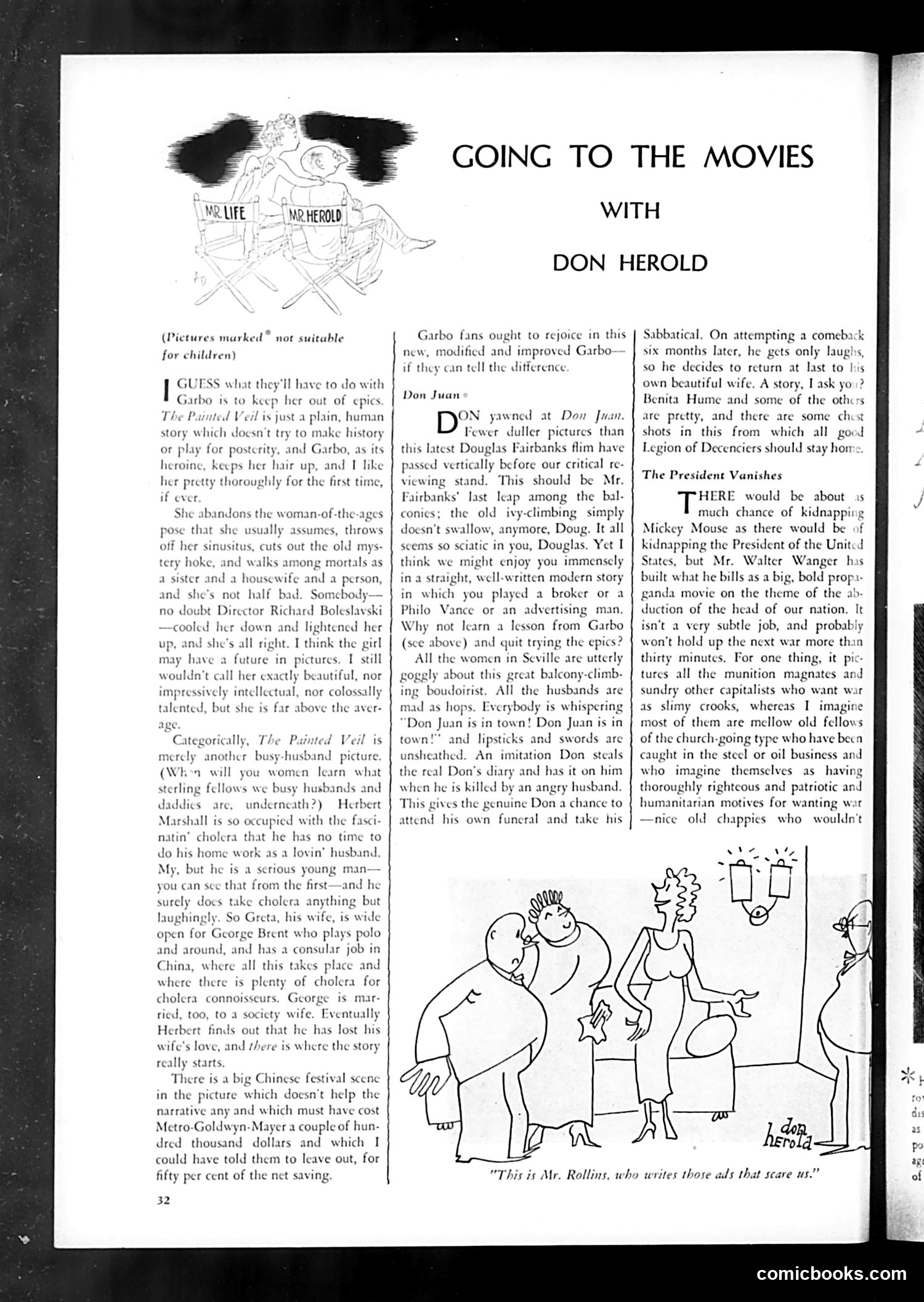
Analysis for Modern Readers This page reviews three films in Don Herold's satirical movie column. The main points: Greta Garbo in "The Painted Veil": Herold praises Garbo for abandoning her usual dramatic, mysterious persona and playing an ordinary housewife. He argues she should abandon "epics" (historical/grand films) for modern stories. Douglas Fairbanks in "Don Juan": Herold savagely mocks this swashbuckling film as tedious and outdated. He criticizes Fairbanks's acrobatic balcony-climbing stunts as no longer charming, urging him to follow Garbo's lead and pursue contemporary roles instead of period spectacles. "The President Vanishes": Herold dismisses producer Walter Wanger's anti-kidnapping propaganda film as absurd—suggesting kidnapping Mickey Mouse would be as likely as abducting a president. The cartoon below shows a man displaying fearful advertisements, joking about advertising's scaremongering tactics. Overall, Herold advocates modernizing Hollywood away from antiquated adventure formulas.
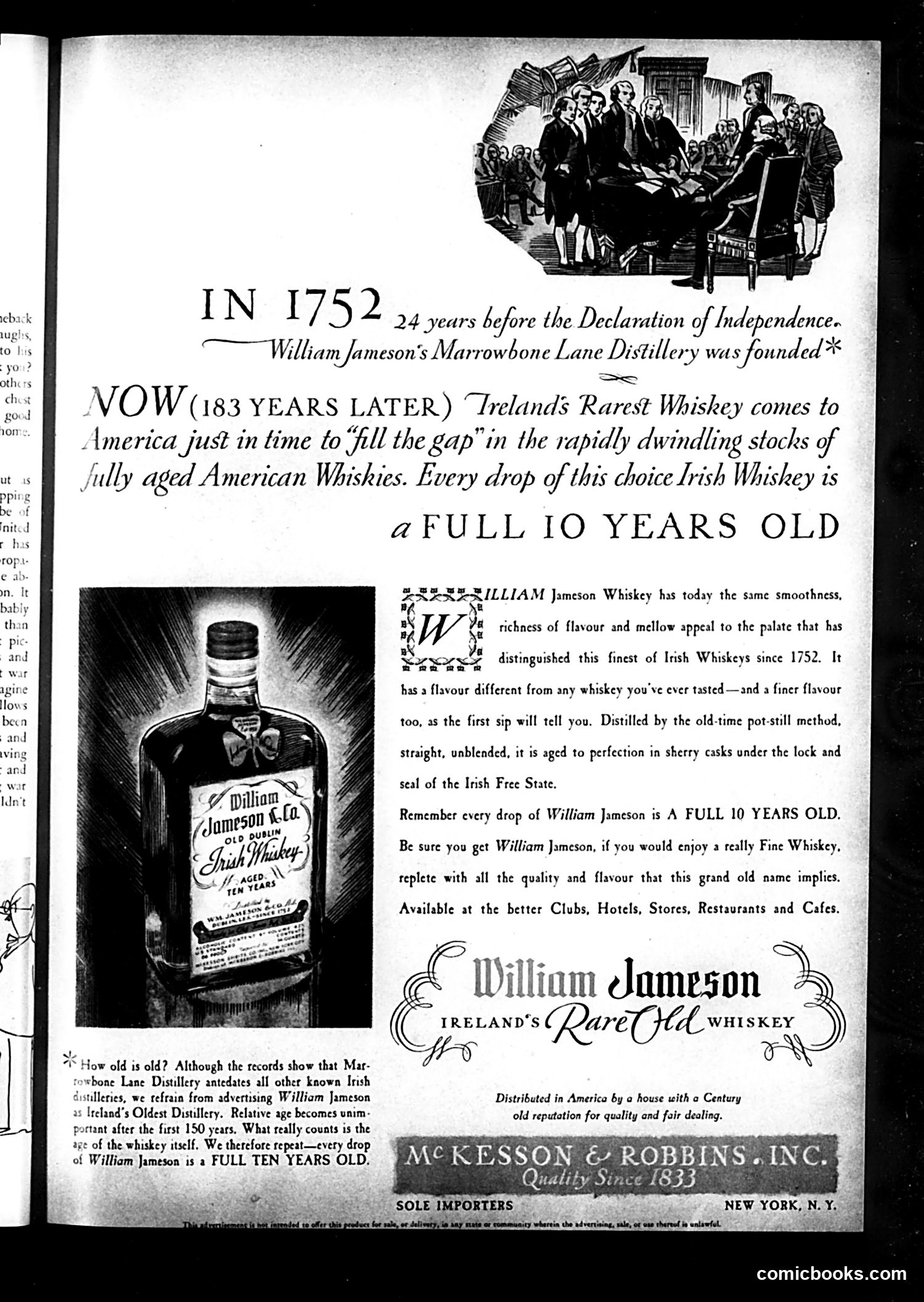
William Jameson Whiskey Advertisement This is a full-page advertisement (not satire or editorial cartoon) for Irish whiskey, likely from the 1930s. The top illustration shows what appears to be a historical signing or formal meeting, establishing the brand's heritage dating to 1752. The ad's pitch exploits Prohibition-era concerns: American whiskey stocks were "rapidly dwindling" due to the alcohol ban (1920-1933), creating market demand for imported spirits. The advertisement emphasizes the whiskey's age (10 years old), quality, and Irish provenance as selling points to affluent American consumers at "better Clubs, Hotels, Stores, Restaurants and Cafes." The footnote defensively addresses the brand's claimed antiquity, clarifying that while the distillery predates competitors, the *whiskey's* age (not the company's founding) matters most—a subtle marketing distinction typical of vintage advertising.
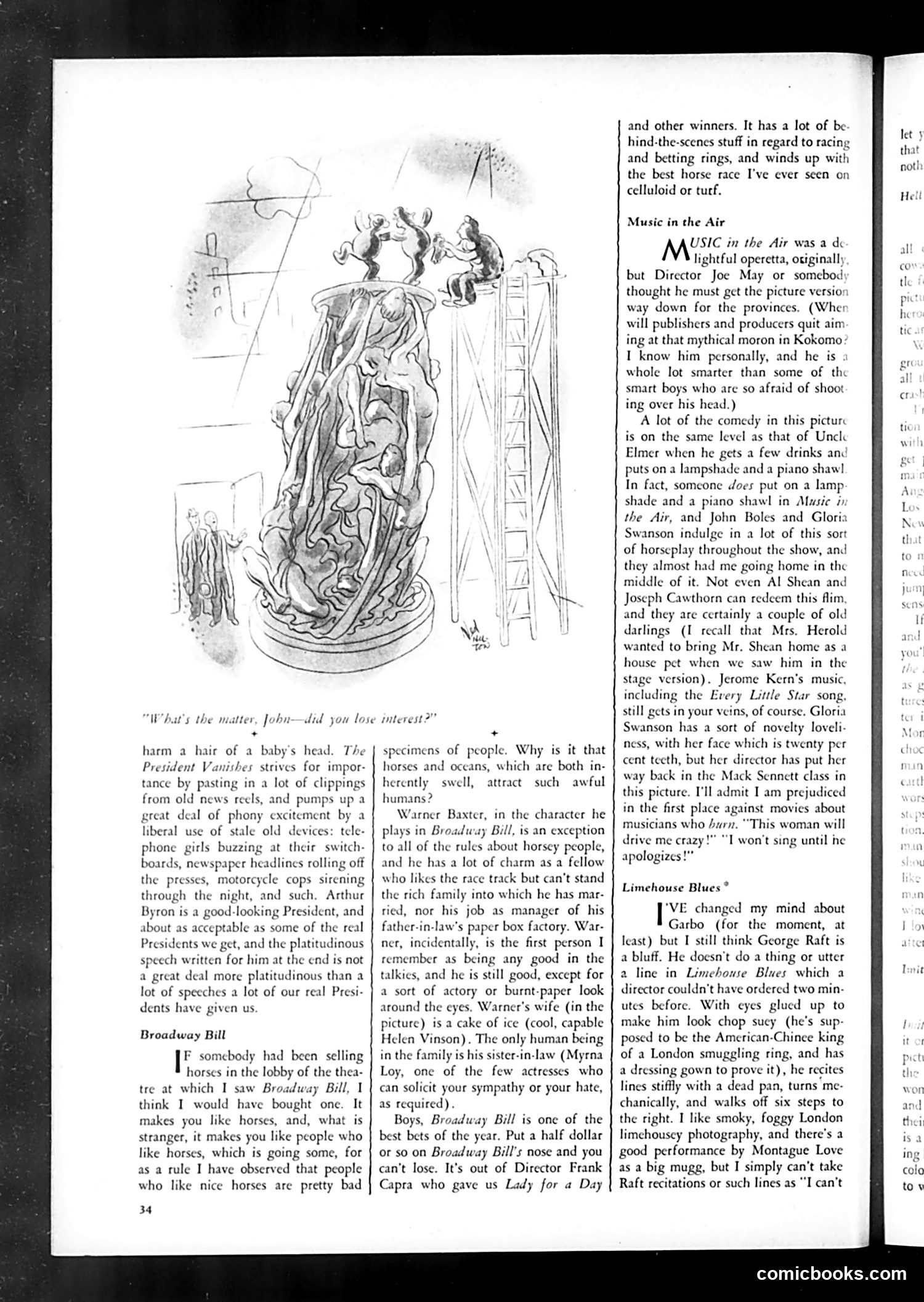
Life Magazine Movie Reviews Page This page contains film reviews rather than political cartoons. The main illustration shows a statue or monument being worked on by laborers—likely accompanying a review of "The President Vanishes," a 1934 film about a missing U.S. President. The reviewer critiques three films: 1. "The President Vanishes" — dismissed as artificially sensational, relying on outdated cinematic devices (buzzing switchboards, rolling newspaper headlines, sirens) to create false excitement. 2. "Broadway Bill" — praised enthusiastically. Starring Warner Baxter, it concerns a man who loves horses and gambling but despises his wealthy in-laws. The reviewer notes it's one of director Frank Capra's successes (like "Lady for a Day"). 3. "Music in the Air" — criticized as condescending. The reviewer mocks the filmmakers' assumption that audiences ("the mythical moron in Kokomo") need dumbed-down comedy, including slapstick like putting lampshades on heads. The tone is witty, opinionated satire typical of Life's entertainment criticism.
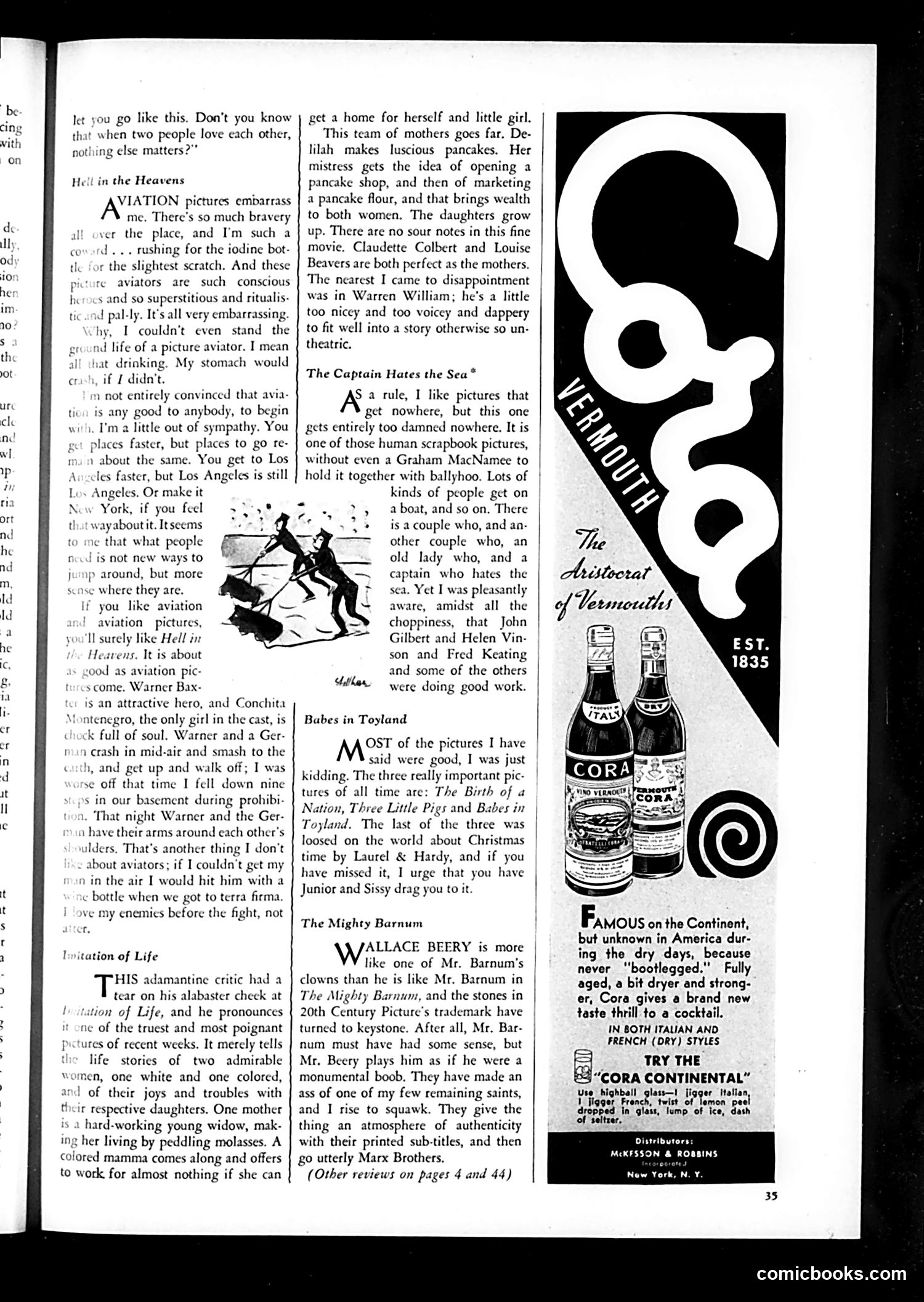
Life Magazine Movie Reviews - Context for Modern Readers This page contains satirical film reviews from Life magazine's drama critic. The key point is the critic's deliberately contrarian stance: he dismisses aviation movies as pointless ("You get to Los Angeles faster, but Los Angeles is still Los Angeles"), yet praises three films—*The Birth of a Nation*, *Three Little Pigs*, and *Babes in Toyland*—claiming they are "the three really important pictures of all time." The satire works through exaggeration and absurdity. By lumping together a controversial 1915 film (*Birth of a Nation*) with a cartoon short and a Laurel & Hardy comedy, the critic mocks both pretentious film criticism and audience taste. His self-aware admission ("I was just kidding") about previously praising films undercuts his own authority, making the entire critical enterprise seem ridiculous. The right page features a Cora vermouth advertisement, typical period product placement.
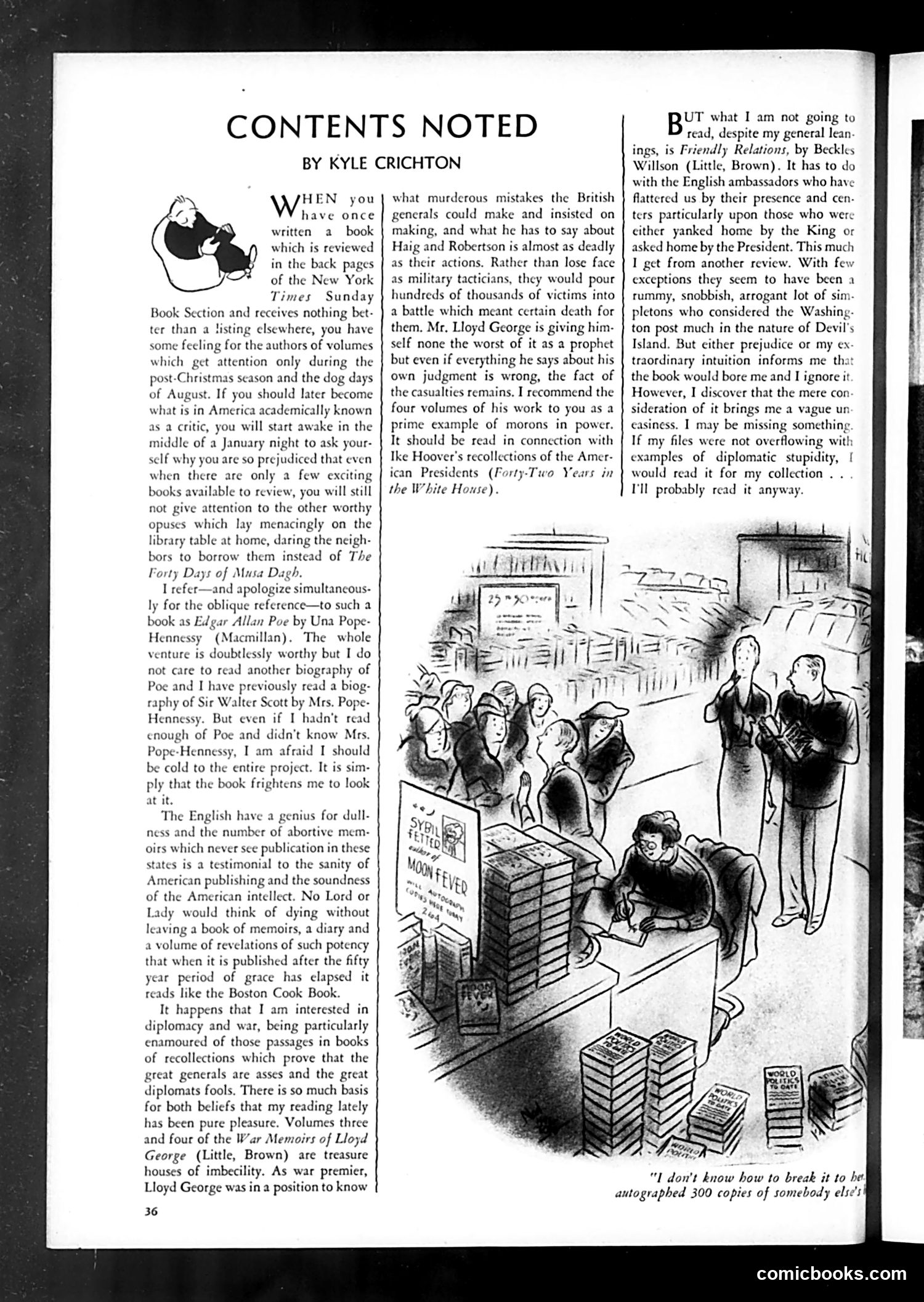
"Contents Noted" by Kyle Crichton - Life Magazine This is a book review column with accompanying cartoon. Crichton discusses newly published books, candidly admitting his prejudices as a critic. He praises Lloyd George's war memoirs (volumes 3-4) as valuable exposés of military incompetence, particularly criticizing British generals Haig and Robertson for sacrificing troops to preserve their reputations. He recommends pairing these with Ike Hoover's White House memoirs. The cartoon illustrates a bookstore or library scene where stacks of unsold books accumulate—visual commentary on the glut of mediocre publications, particularly British memoirs and biographies that fail to sell. Crichton uses this to satirize English authors' compulsion to publish self-important memoirs, contrasting American publishing's "soundness" in rejecting such work. The piece blends personal honesty about critical bias with broader social satire about publishing and war accountability.
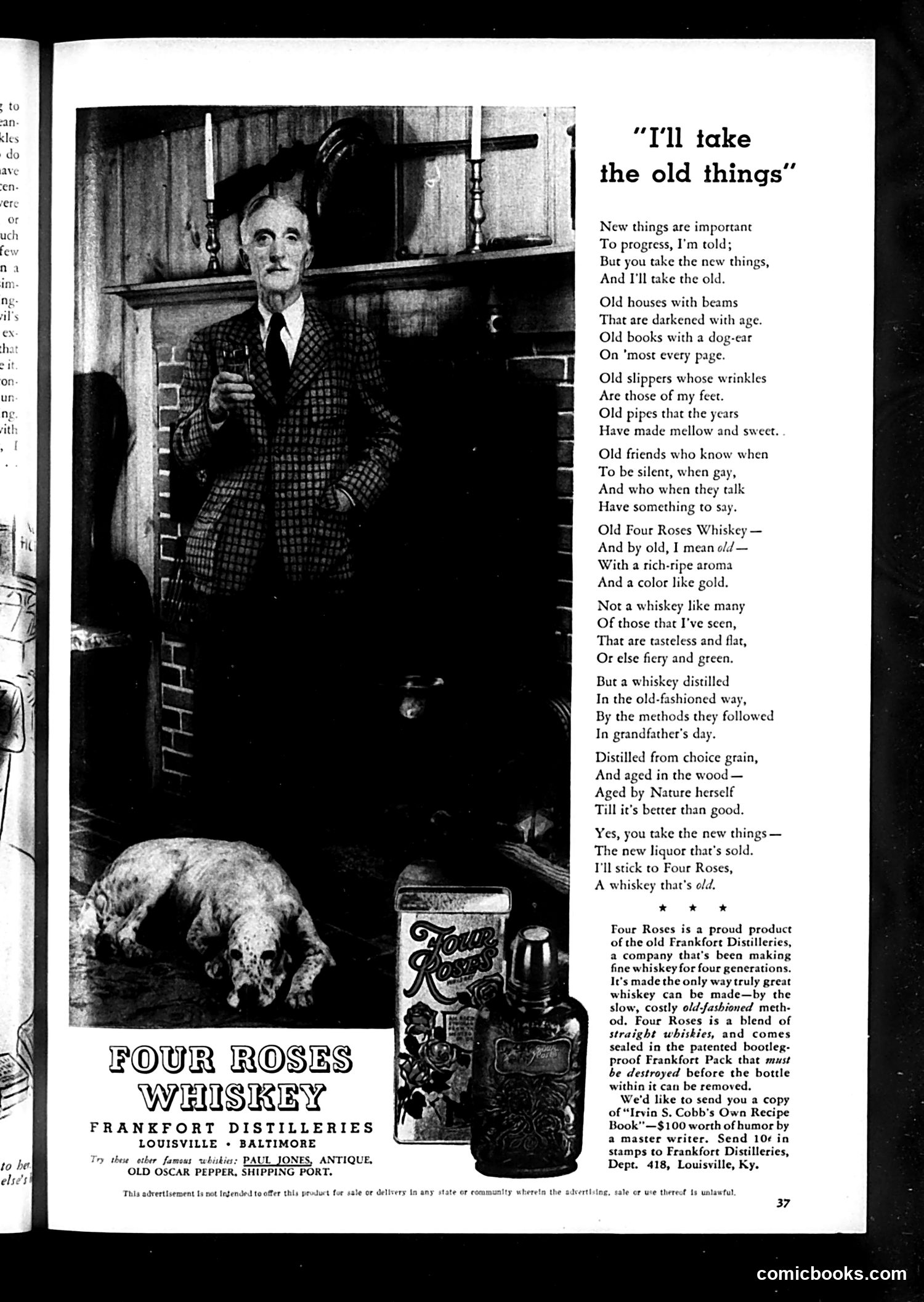
Four Roses Whiskey Advertisement Analysis This is a whiskey advertisement, not political satire. It appeared in *Life* magazine and uses a poem titled "I'll Take the Old Things" to market Four Roses whiskey by appealing to nostalgia and tradition. The ad features an elderly gentleman in a plaid suit standing in a rustic interior, with a dog at his feet and a Four Roses bottle visible. The poem contrasts "new things" (progress, modern liquor) with "old things" the speaker prefers—old houses, books, friends, pipes, and crucially, Four Roses whiskey. The marketing strategy equates the product with timeless quality, craftsmanship, and grandfather-era methods. A footnote mentions Irvin S. Cobb, a popular humorist, offering his "Recipe Book" as a premium—a common advertising tactic of the era. The small legal disclaimer acknowledges Prohibition-era restrictions on alcohol advertising, indicating this ad predates or references that period's regulations.
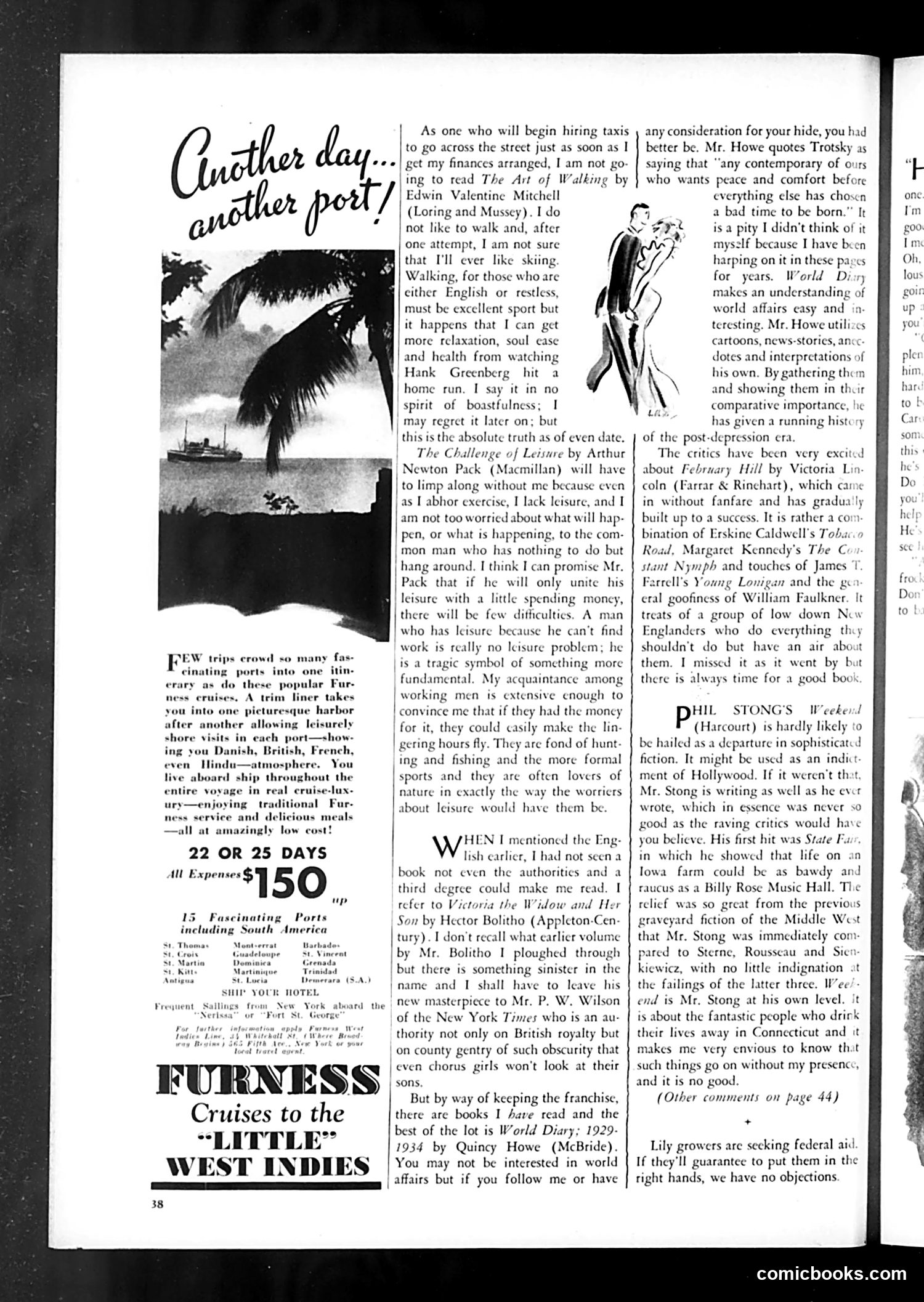
Analysis of Life Magazine Page This page is primarily book reviews by a humorously opinionated critic, with a cruise ship advertisement at the bottom. The cartoon at top left shows a tropical harbor scene—part of the Furness cruise line ad promoting Caribbean voyages ("Little West Indies," 22-25 days, $150). The main content is satirical book criticism. The unnamed reviewer dismisses walking and leisure advice books, admitting he'd rather watch baseball (Hank Greenberg) than exercise. He mocks concern for unemployed men with "leisure" they can't afford—a pointed reference to Depression-era unemployment. The critic praises *World Diary* by Quincy Howe, quoting Trotsky's warning that choosing "peace and comfort" during contemporary times is choosing "a bad time to be born"—a 1930s reference to rising fascism and war threats. The satire targets both self-help literature and privileged indifference to economic crisis and global danger.
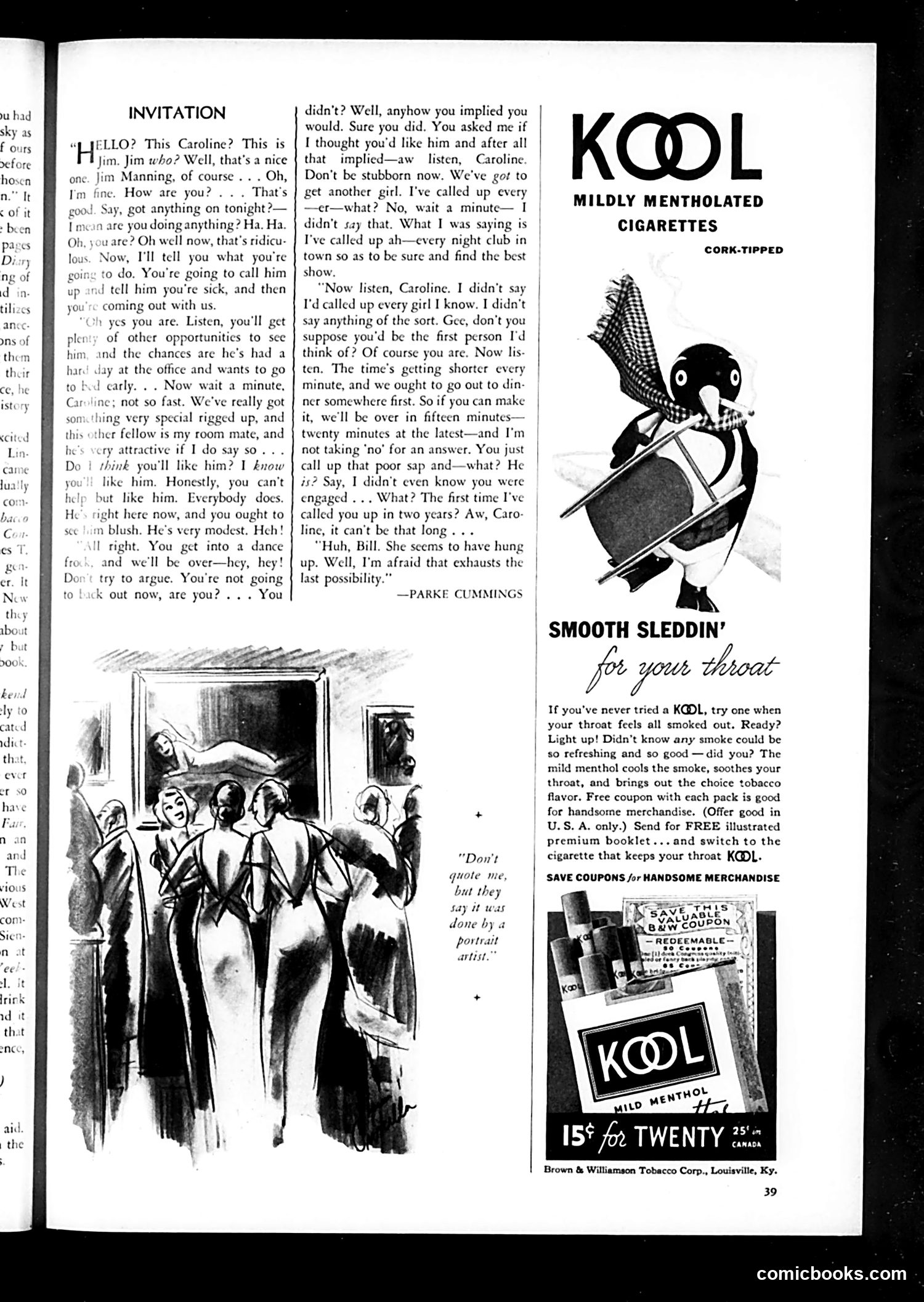
Analysis of This Life Magazine Page This page combines a short satirical story with cigarette advertising, typical of 1930s-40s magazines. The "Invitation" Cartoon/Story by Parke Cummings depicts a smooth-talking man (Jim) pressuring a woman (Caroline) into a date through manipulative phone tactics. He uses flattery, false urgency, and persistent cajoling to overcome her refusals—claiming he's arranged something "special," that she'd be his "first choice," and insisting he won't accept "no" as an answer. When she finally mentions being engaged, he dismissively ignores it. The humor (for period readers) satirizes aggressive dating behavior and male persistence, though it also reflects contemporary social norms where such pushiness was treated as charming rather than coercive. The Advertisement for Kool cigarettes uses a cartoonish penguin mascot to promote menthol cigarettes as soothing and refreshing—standard mid-century tobacco marketing before health warnings existed. The contrast between the manipulative romance narrative and the innocuous product placement is notable but unremarkable for the era.
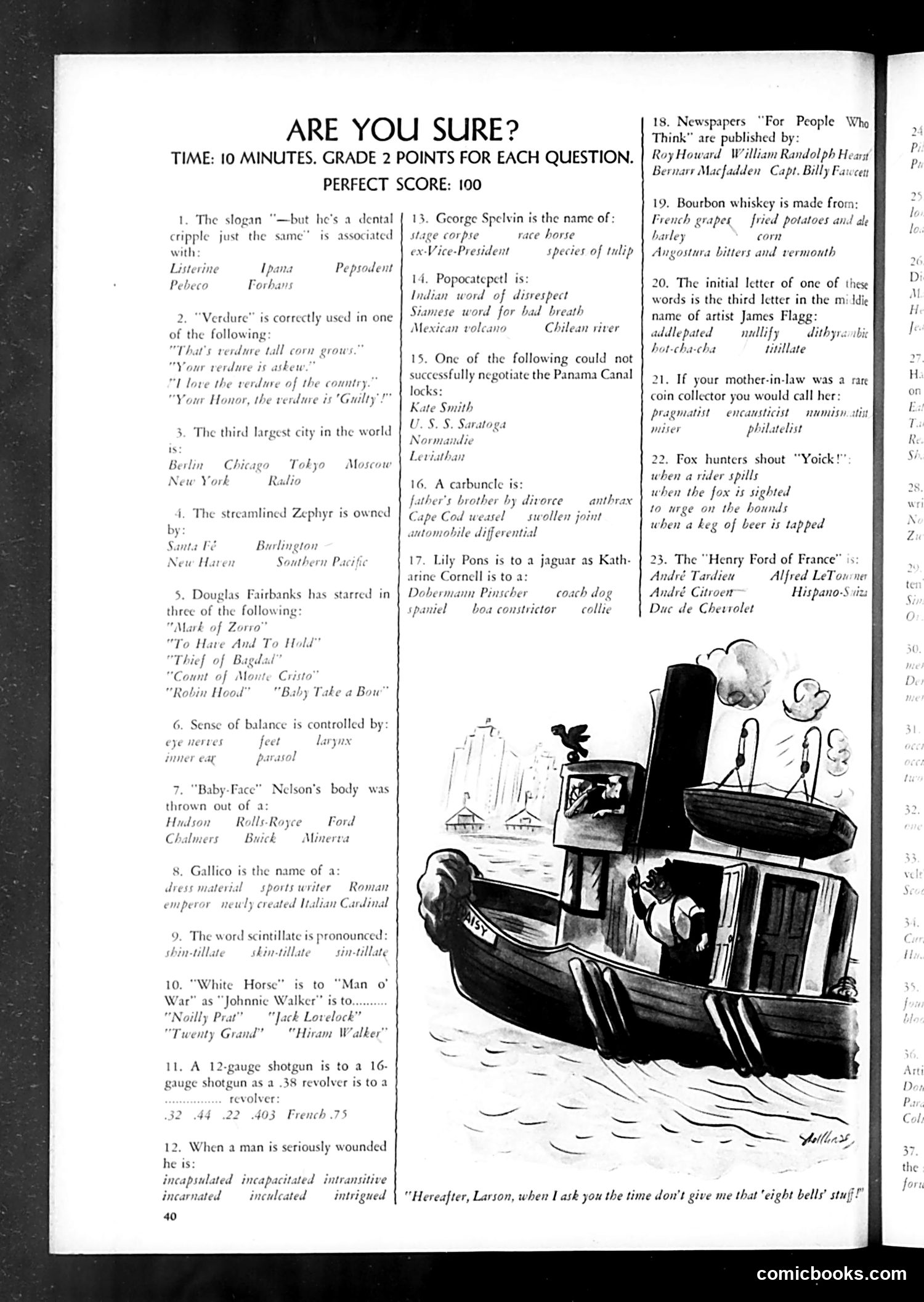
"Are You Sure?" Quiz Page Explanation This is a trivia quiz disguised as a satirical test of general knowledge—a popular Life magazine feature. The humor lies in mixing legitimate questions with absurd ones to mock readers' pretensions about being "cultured" or well-informed. The cartoon depicts a sea captain at the helm, apparently irritated when asked the time by someone shouting nautical terminology ("eight bells"). It illustrates the quiz's broader joke: people often use specialized jargon or affected language incorrectly, claiming knowledge they don't possess. The quiz questions target 1920s-30s cultural touchstones (Douglas Fairbanks films, radio celebrities, brand advertising slogans) while sneaking in trick questions—like whether "Baby-Face" Nelson's body was thrown from a car, mixing real criminals with absurd details. The satire mocks both advertising manipulation ("dental cripple" slogans) and readers who pride themselves on trivial knowledge while missing obvious answers or falling for planted deceptions.
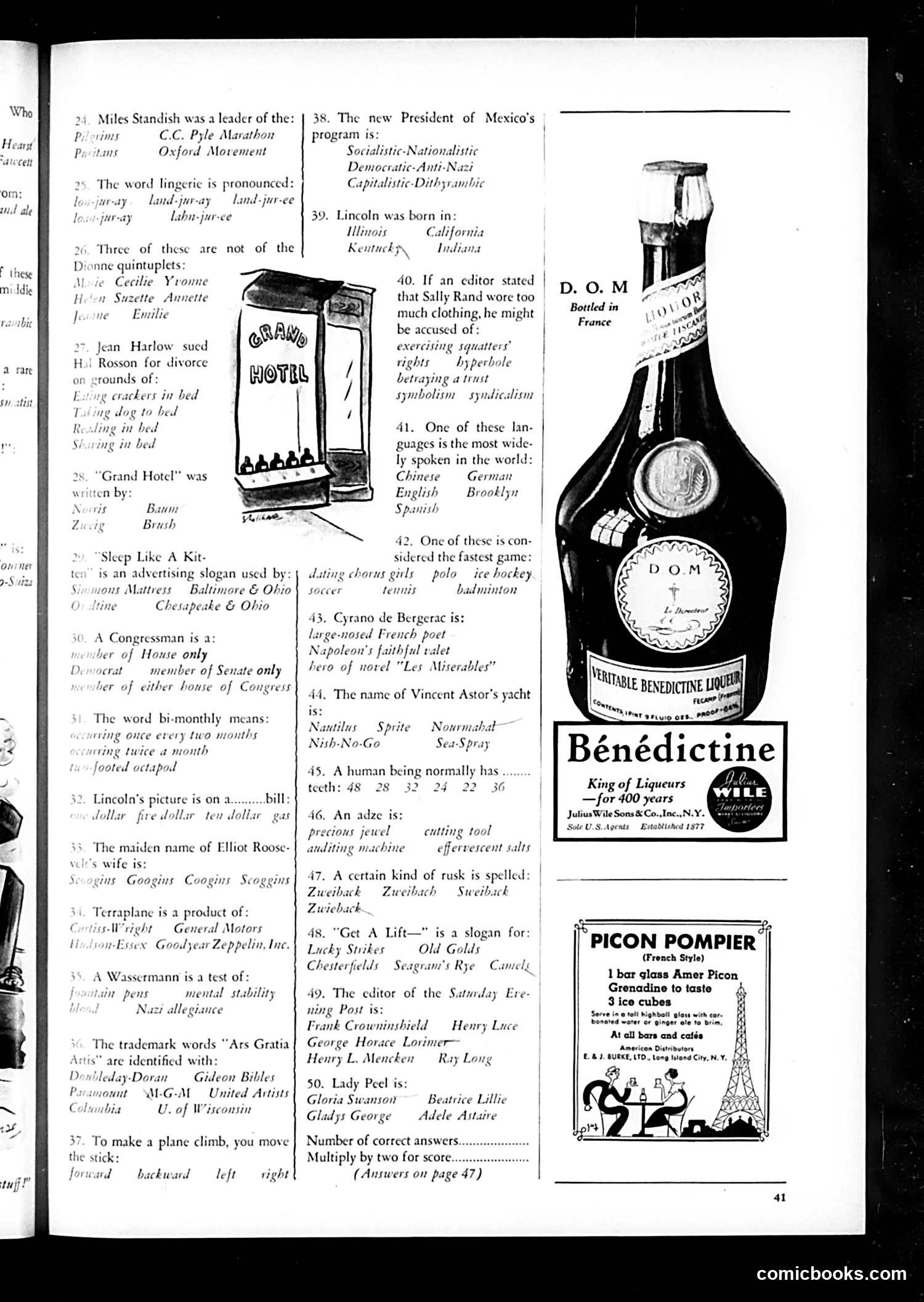
Analysis of Life Magazine Quiz Page This page is primarily a trivia quiz rather than political satire—a popular feature in Life magazine during this era (appears to be 1930s based on references). The questions test readers' knowledge of contemporary celebrities, products, geography, and culture. Notable references that would resonate with 1930s readers: - Sally Rand: A famous fan dancer known for minimal clothing, making the question about "too much clothing" a risqué joke - Jean Harlow: Hollywood star whose divorce was tabloid news - Vincent Astor's yacht: Wealthy socialite, suggesting fascination with the ultra-rich - Saturday Evening Post editor: Questions about media gatekeepers reflect middlebrow cultural literacy The advertisements (Bénédictine liqueur, Picon Pompier cocktail) were standard revenue sources. The overall tone is lighthearted entertainment for educated, middle-class readers rather than political commentary—it's a snapshot of what 1930s American mass media considered "important" cultural knowledge.
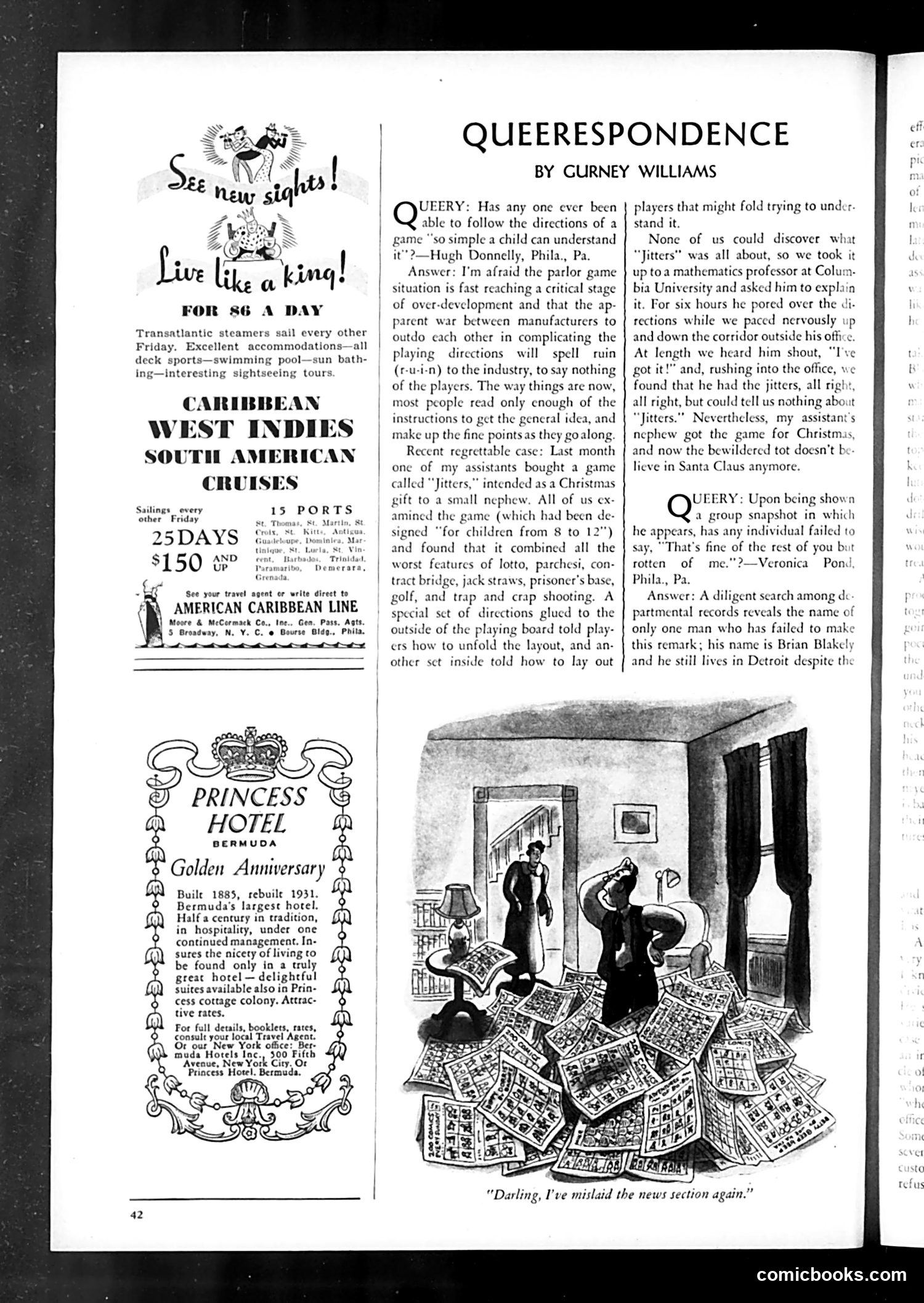
Analysis This page contains Gurney Williams's "Queerespondence" advice column (a play on "Correspondence"), which answers humorous reader questions about social etiquette and common annoyances. The main cartoon illustrates the second query: a woman has lost a newspaper's news section and asks her frustrated husband. The joke satirizes a common domestic frustration—husbands wanting to read the news while wives allegedly prioritize other sections (fashion, society pages). The scattered papers everywhere emphasize the chaos of the lost section. The first query's answer humorously describes a children's board game called "Jitters" so incomprehensibly complicated that even a Columbia University mathematics professor spent six hours trying to understand the rules and left "bewildered"—unable to explain it. The satire targets 1930s-40s toy manufacturers competing to create increasingly complex games while claiming they're "for children from 8 to 12." The surrounding advertisements promote luxury travel (Caribbean cruises, Bermuda's Princess Hotel), typical for *Life* magazine's affluent readership.
"Stop & Go" Service: A 1930s Media Criticism Column This page is part of Life magazine's film and book review section. The "Stop & Go" feature critiques recent movies and publications for sophisticated readers. Key Content: The film reviews mock contemporary Hollywood output—Joe Penner's comedy ("hopelessly rah rah"), Douglas Fairbanks' dated *Don Juan*, and George Raft's *Limehouse Blues* (criticized for racist stereotyping: "eyes pasted up Chinese like"). The one praised film is *Imitation of Life*, a drama addressing race and class through parallel stories of white and Black mothers. The book section reviews contemporary titles about social issues: *Skin Deep* exposes fraudulent beauty-industry advertising (paralleling the food-industry exposé *100,000,000 Guinea Pigs*); *The Red Flag* critiques political regimentation. The Satire's Point: Life positions itself as an arbiter of cultural taste, distinguishing intelligent art from exploitative trash. The reviews reflect 1930s Depression-era concerns: social responsibility in entertainment, skepticism toward advertising, and anxiety about government control.
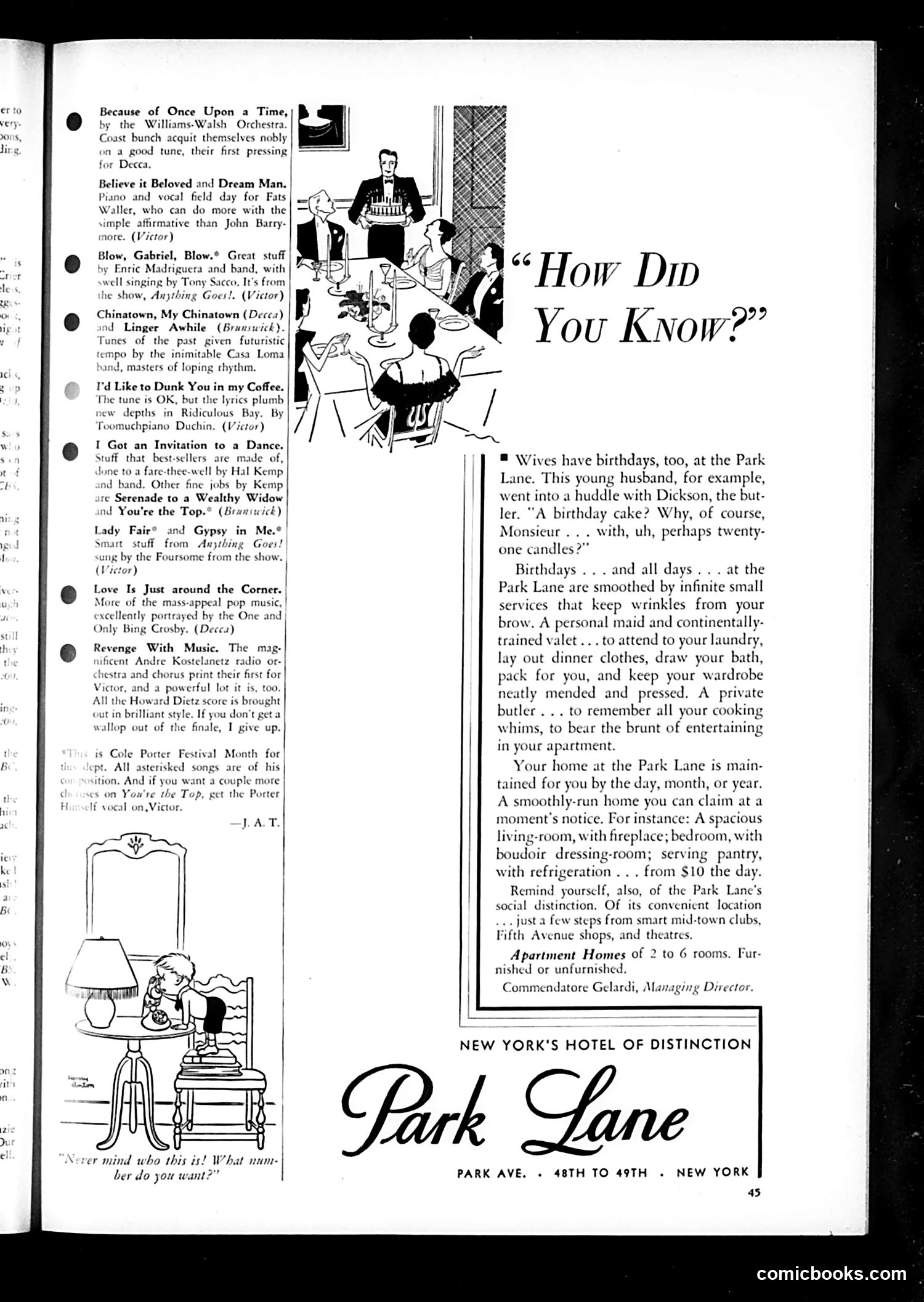
Analysis of This Life Magazine Page This page is primarily advertising for the Park Lane Hotel, framed as editorial content about phonograph records and contemporary entertainment. The left column reviews popular 1930s songs and musical performances—referencing Cole Porter compositions, Fats Waller, and the Broadway show *Anything Goes!* The small cartoon at bottom (showing a child asking "Never mind who this is! What number do you want?") appears to be unrelated filler. The main content is a luxury hotel advertisement disguised as a humorous anecdote. The headline "How Did You Know?" introduces a scenario where a Park Lane resident consults his butler about a birthday cake, establishing the hotel's promise of aristocratic domestic service. The text emphasizes staffing (maids, valets, butlers), amenities (fireplaces, refrigeration), and social prestige—marketed to wealthy New Yorkers seeking temporary or semi-permanent housing near Fifth Avenue and midtown clubs. The satire is mild: the humor relies on the absurdity of someone needing a butler's consultation for basic hospitality, reinforcing the hotel's appeal to status-conscious clients.
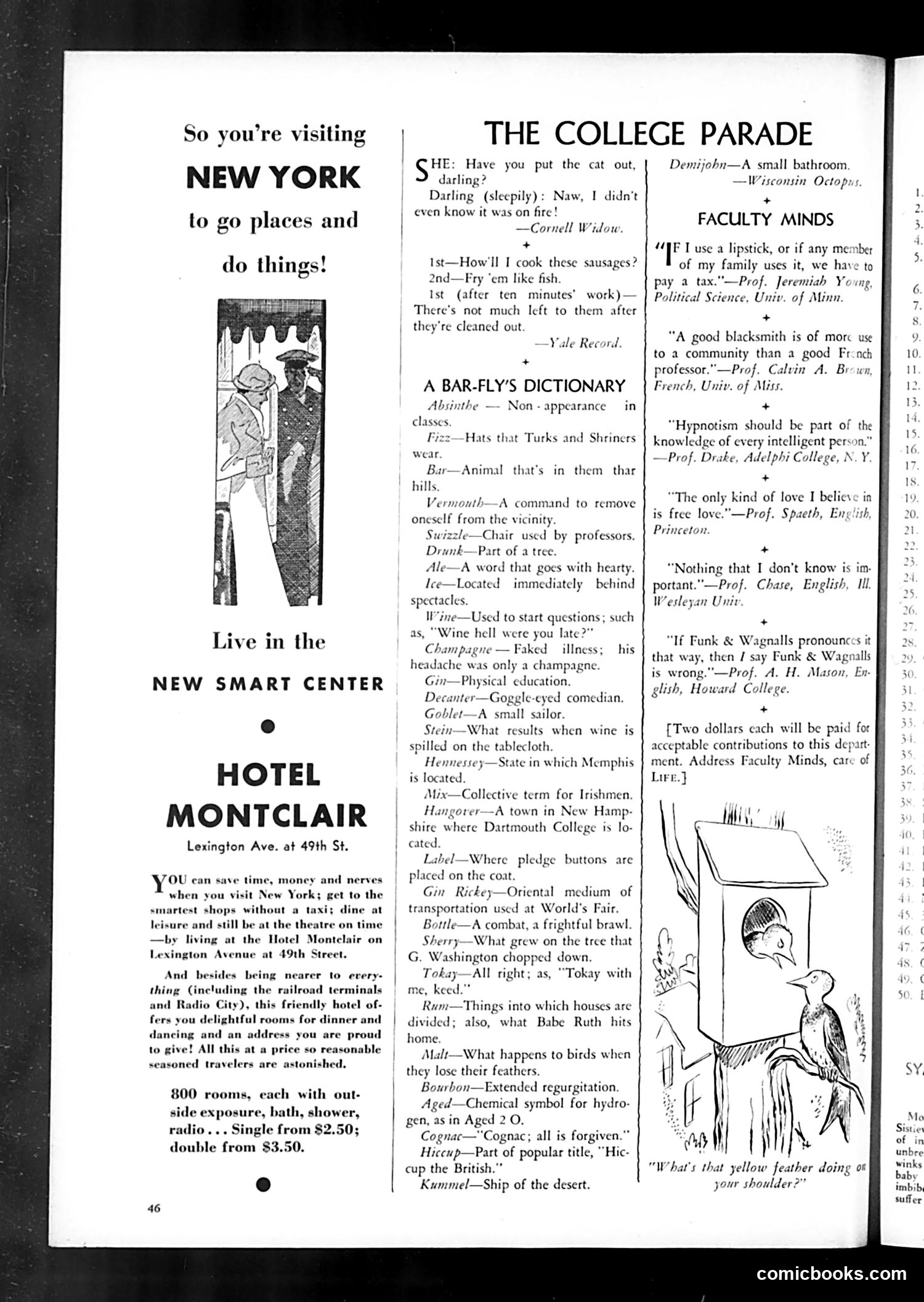
Analysis for Modern Readers This page contains advertising and humor columns, not political cartoons. The Hotel Montclair ad targets tourists visiting New York, emphasizing convenience and affordability ($2.50-$3.50 per night). "The College Parade" collects humor from college newspapers. The jokes mock student behavior: - A wife's fireplace hazard joke (Cornell Widow) - A cooking mishap (Yale Record) "A Bar-Fly's Dictionary" is absurdist wordplay defining drinking-related terms through puns and non-sequiturs ("Demijohn—a small bathroom," "Gin—Physical education"). This satirizes both college drinking culture and the era's obsession with slang dictionaries. "Faculty Minds" collects outrageous quotes from real professors at American universities, mocking academic pretension—a professor claiming ignorance makes knowledge unimportant, another defending dictionary mispronunciation, one praising blacksmiths over French professors. The cartoon depicts a bird with a yellow feather, likely illustrating a joke about questionable conduct. The overall tone reflects 1920s-era collegiate humor: irreverent, alcohol-focused, and gently mocking both students and academics.
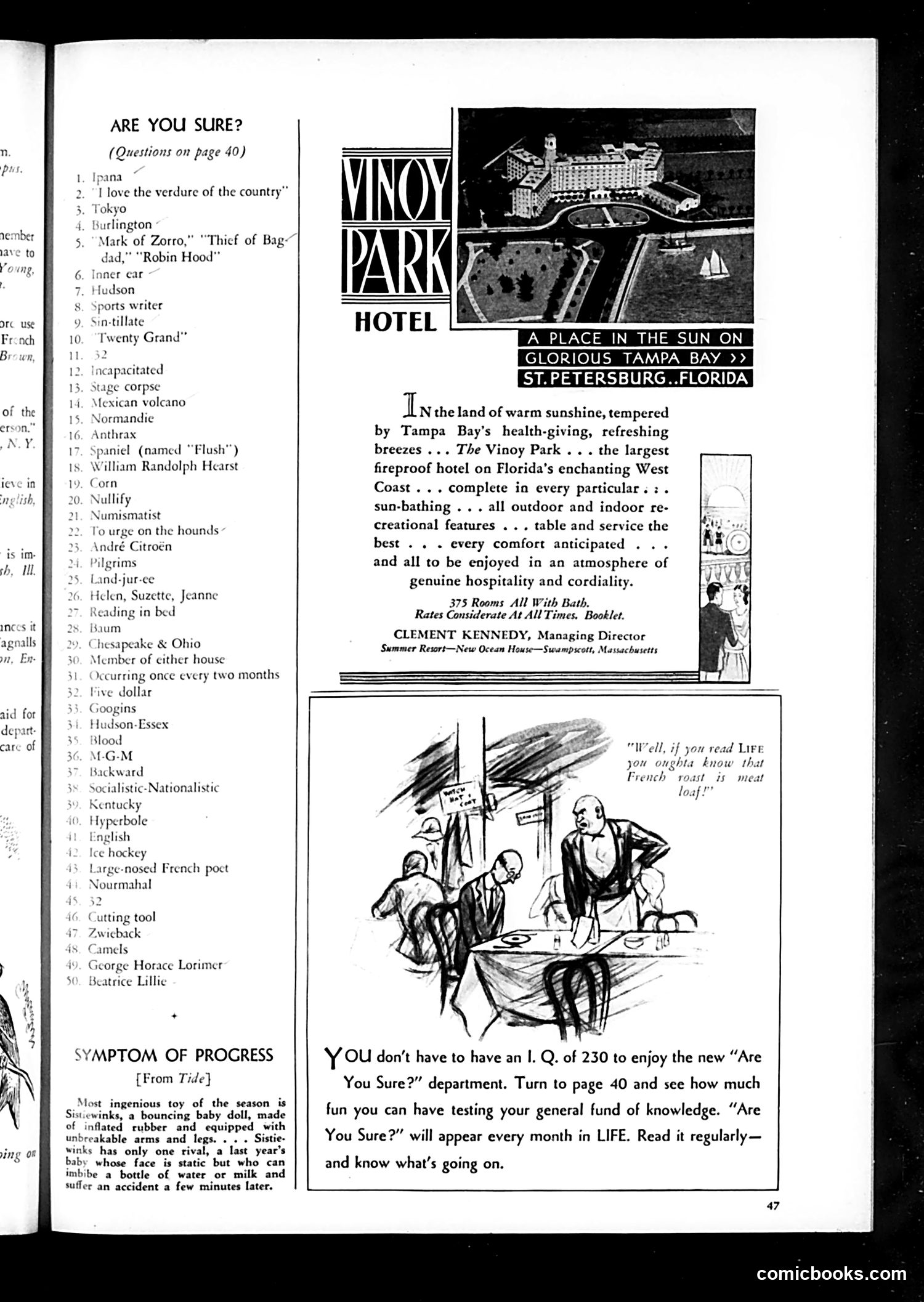
Analysis of Life Magazine Page 47 This page contains two distinct elements: Top Half - Advertisement: The Vinoy Park Hotel in St. Petersburg, Florida, promoting a luxury resort with typical 1920s-30s advertising language ("fireproof," "health-giving breezes," "genuine hospitality"). Bottom Half - Two Features: 1. "Are You Sure?" Quiz Section: A trivia/knowledge-testing feature with 50 questions referencing contemporary culture, geography, and famous figures (Zorro, William Randolph Hearst, Beatrice Lillie, etc.). This appears to be Life's regular quiz column. 2. "Symptom of Progress" Sidebar: A brief satirical note about a novelty doll—a bouncing rubber baby that can drink water or milk and then have a diaper accident. The joke mocks modern toy manufacturing excess, suggesting that even toys designed to mimic unpleasant bodily functions represent "progress." This is gentle social satire typical of Life's humor. The cartoon illustration accompanying the quiz shows people casually discussing general knowledge, emphasizing that the quiz requires no exceptional intelligence to enjoy.
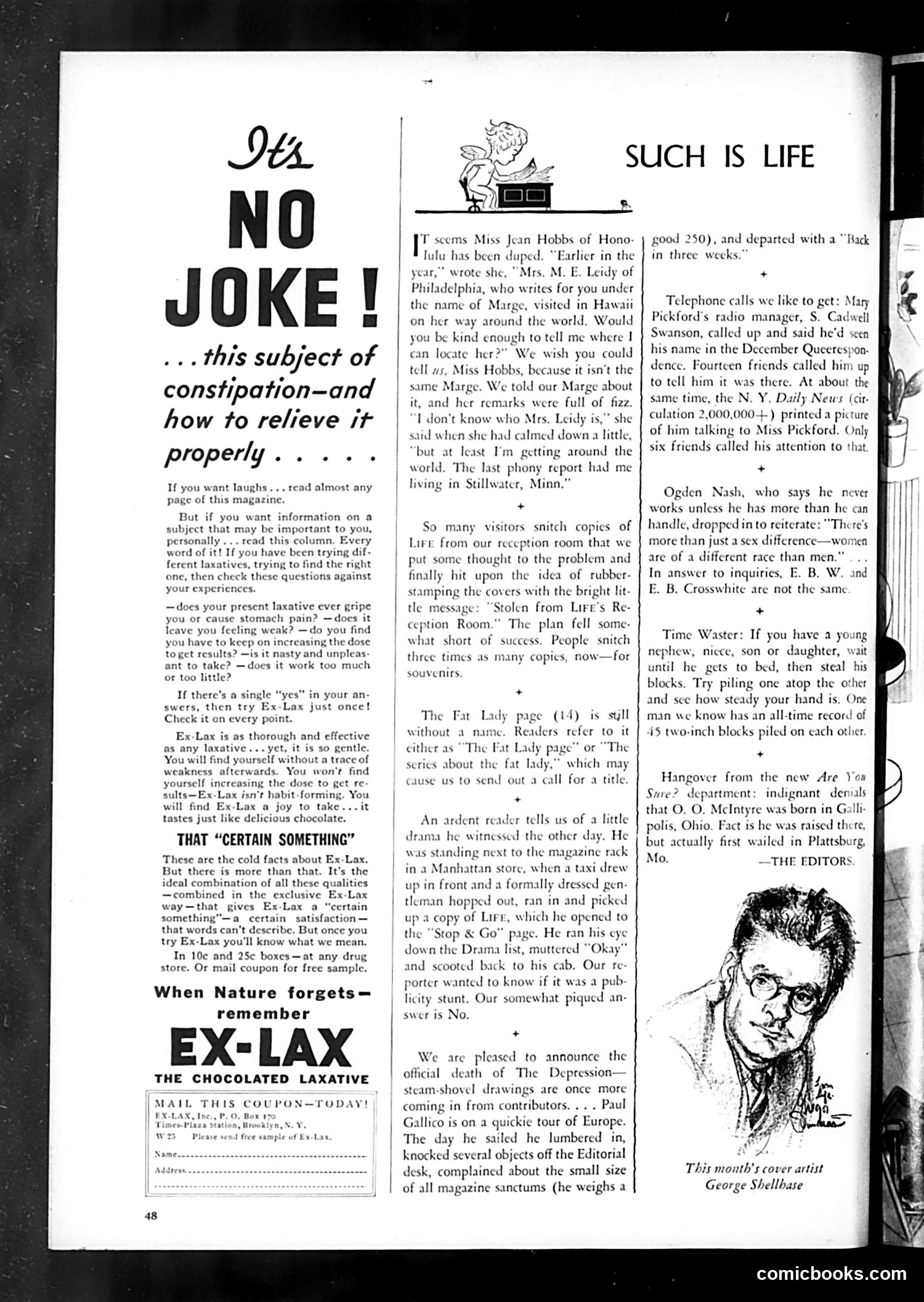
Life Magazine Page Analysis This page is primarily an advertisement for Ex-Lax laxative disguised as editorial content. The humor lies in Life's self-aware presentation: the left column openly admits this is "no joke" while advertising a constipation remedy, playing on the magazine's reputation for satire. The right column, "Such is Life," contains gossipy anecdotes mocking Life's own operations: readers impersonating columnists, theft of magazines from the reception room (tripled after anti-theft stamping), and an unnamed "Fat Lady" page. A sketch of artist George Shellbach appears at bottom. The humor targets Life's celebrity culture and editorial chaos. A brief note announces "the official death of The Depression"—satirizing how economic hardship has ended—signaled by the return of steam-shovel drawings (perhaps symbolizing resumed construction/prosperity). The overall effect mocks both consumer culture and the magazine industry itself.