life
Life — March 1935
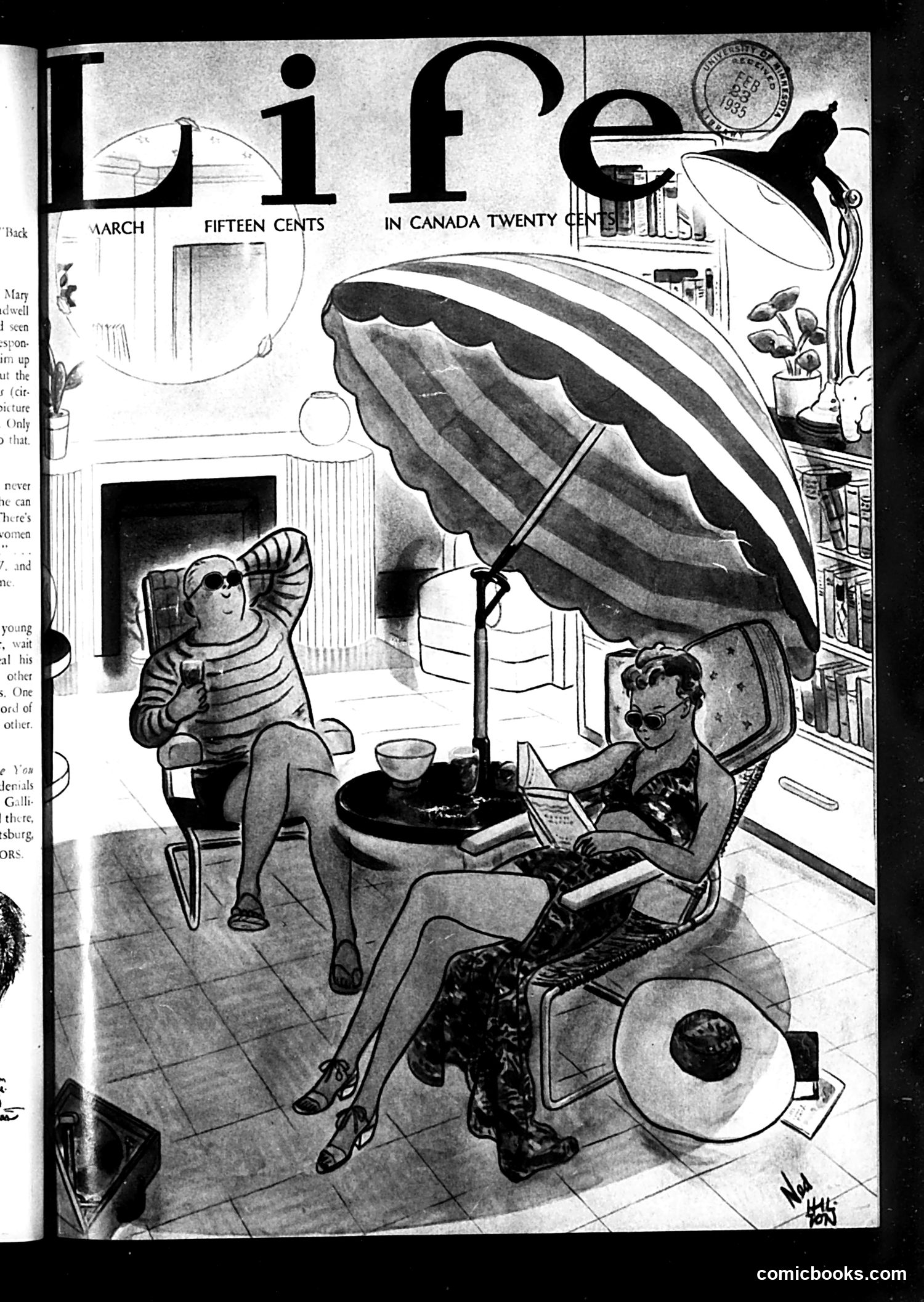
Life Magazine Cover Analysis This is a Life magazine cover from March (price: 15 cents in Canada, 20 cents in the U.S.), featuring a satirical illustration of two women relaxing indoors during what appears to be spring or summer weather. The main joke centers on leisurely domestic life: one woman sits in a striped beach chair holding a parasol, while another reclines reading. The setup suggests they're enjoying vacation-like comfort at home rather than venturing outdoors. The satirical point likely mocks either wealthy leisure or the contrast between advertised ideals of relaxation and actual domestic routines. The artist's signature appears at bottom right. Without additional context from the magazine's interior, the specific social commentary remains somewhat unclear, though the overall tone is light domestic humor typical of Life's era.
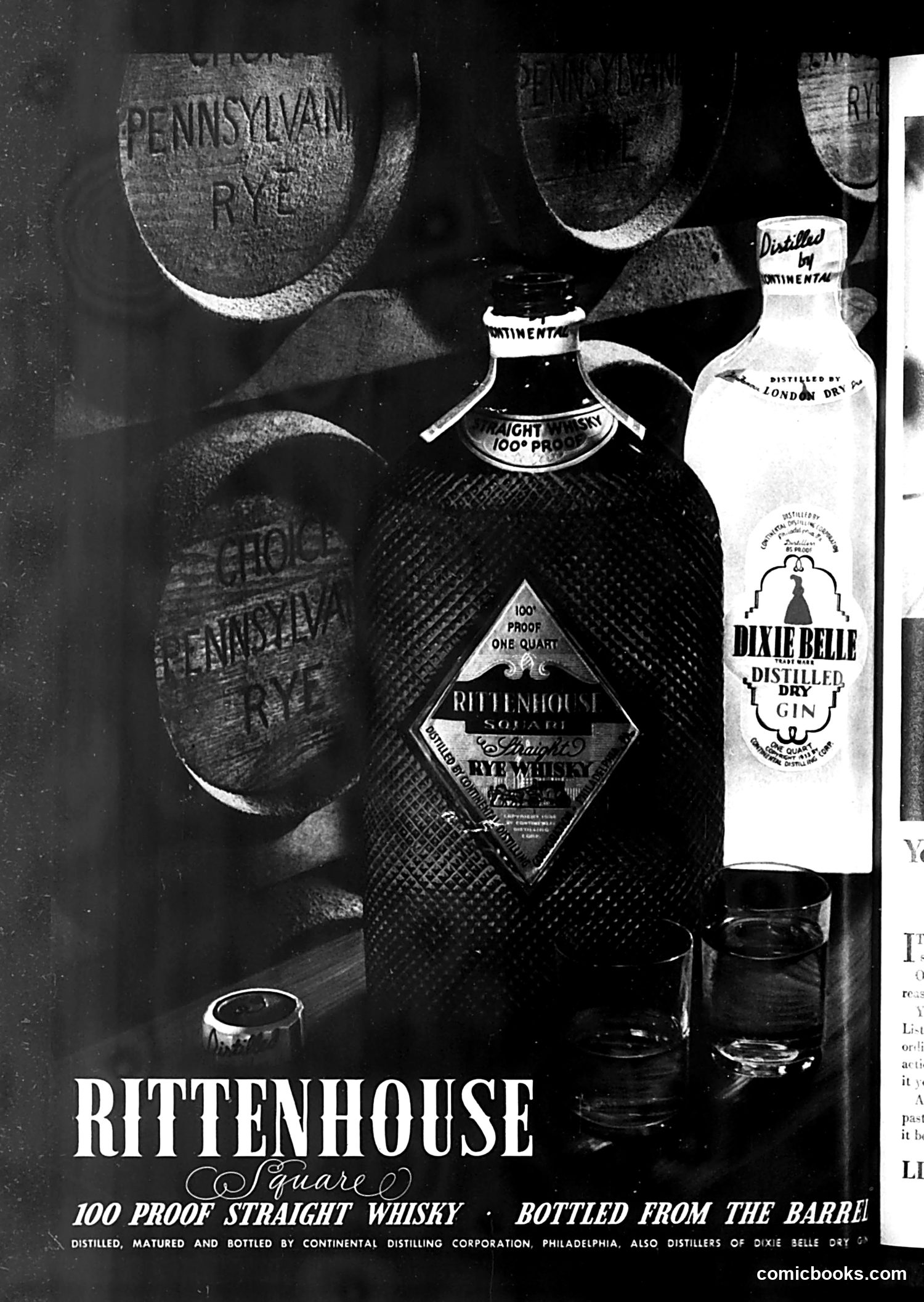
Analysis This is primarily a liquor advertisement, not a political cartoon. It advertises "Rittenhouse Square" rye whiskey at 100 proof, "bottled from the barrel" by Continental Distilling Corporation of Philadelphia. The ad also mentions they distill "Dixie Belle" dry gin. The image shows bottles of these spirits alongside wooden barrels (marked "Pennsylvania Rye" and other text) and drinking glasses. The black-and-white photography emphasizes the product's premium, traditional character. This likely dates to the pre-Prohibition or early post-Prohibition era (1920s-1930s), when American distillers were reestablishing their brands after alcohol's legal ban. The ad appeals to consumers seeking quality American whiskey with established regional pedigree.
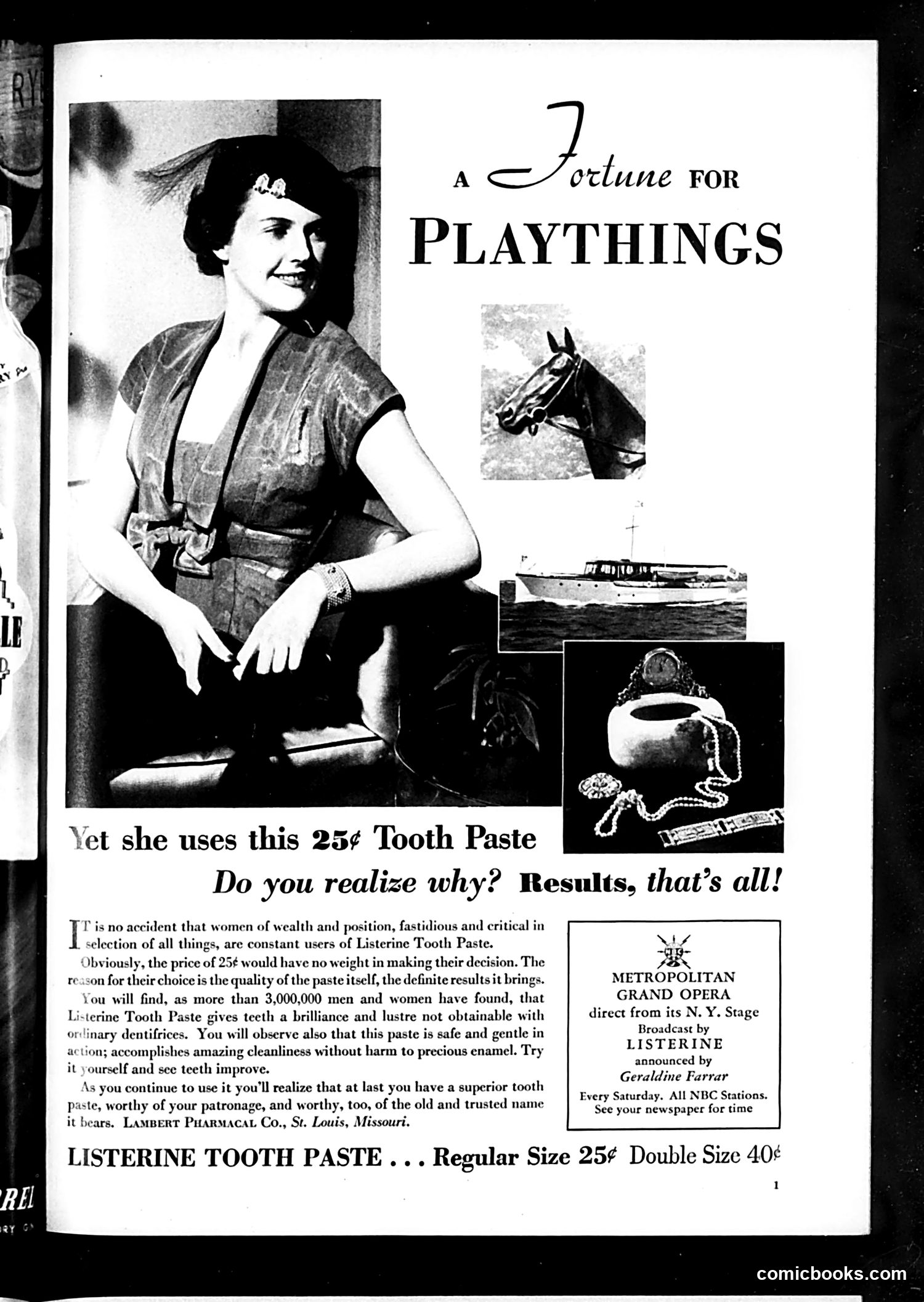
Analysis This is primarily an advertisement for Listerine Tooth Paste, not editorial content or satire. The page features a glamorous woman in 1920s-30s styling alongside luxury items (a horse, yacht, and decorative vessel), suggesting wealth and refined taste. The ad's rhetorical strategy employs aspirational marketing: it argues that women of "wealth and position" choose this 25¢ toothpaste because results matter more than price. The accompanying text claims over 200,000 users have found Listerine superior for brightness and lustre. The sidebar advertises a Metropolitan Grand Opera broadcast on NBC radio, featuring singer Geraldine Farrar—adding cultural prestige to the page. This represents typical early 20th-century advertising logic: associating affordable products with luxury lifestyles and celebrity endorsement.
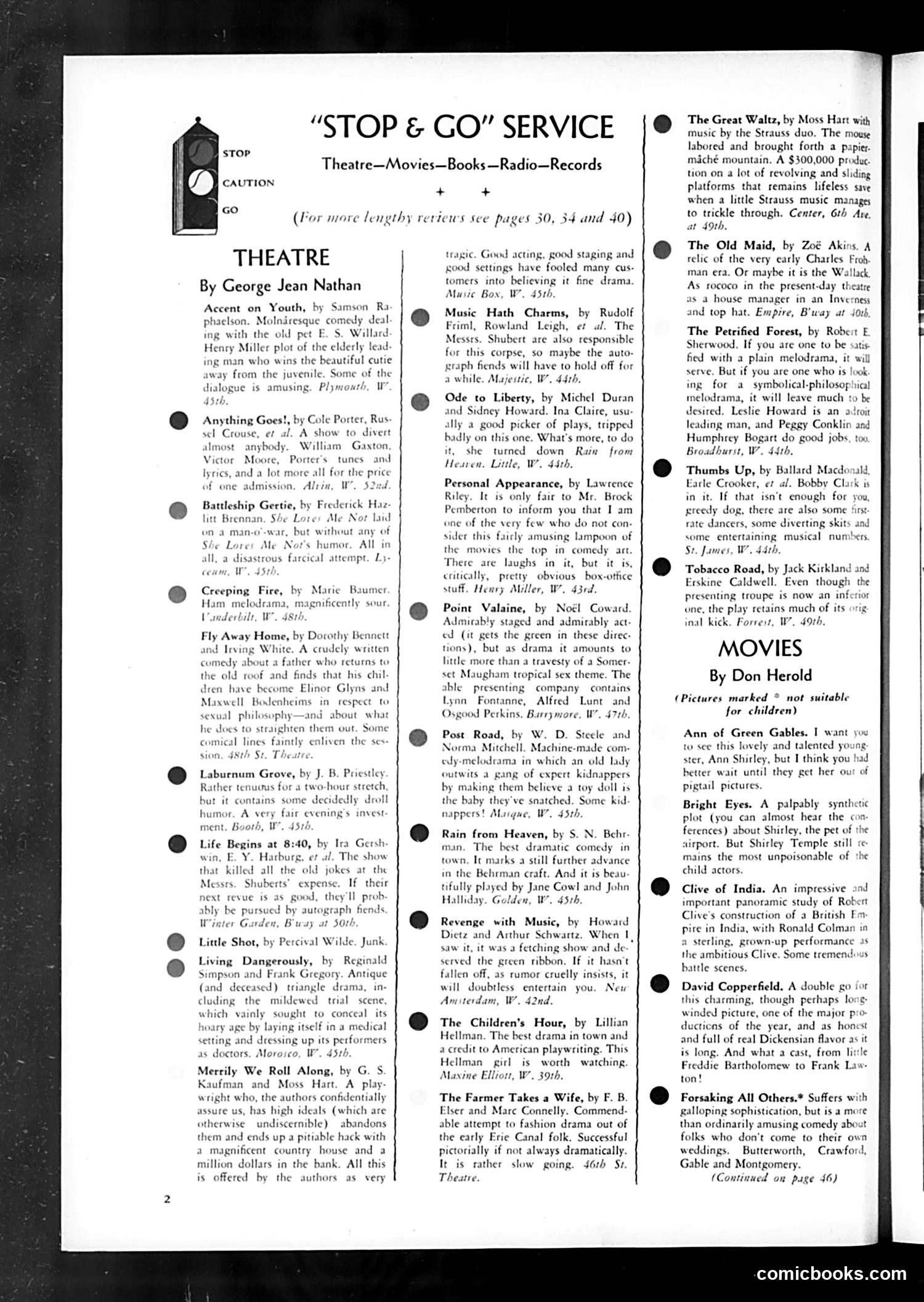
Analysis This page is primarily a review section, not a cartoon or satirical feature. It's titled "STOP & GO SERVICE" and contains theater, movie, book, radio, and record reviews by George Jean Nathan and Don Herold. The only visual element is a small traffic light icon at the top left, serving as the section's design motif—"STOP" and "GO" refer to the reviewing format of recommending or warning against entertainments. The reviews themselves are critical assessments of Broadway productions and films from what appears to be the 1940s, offering opinions on performances, staging, and dramatic merit. This is editorial content rather than political satire or cartooning.
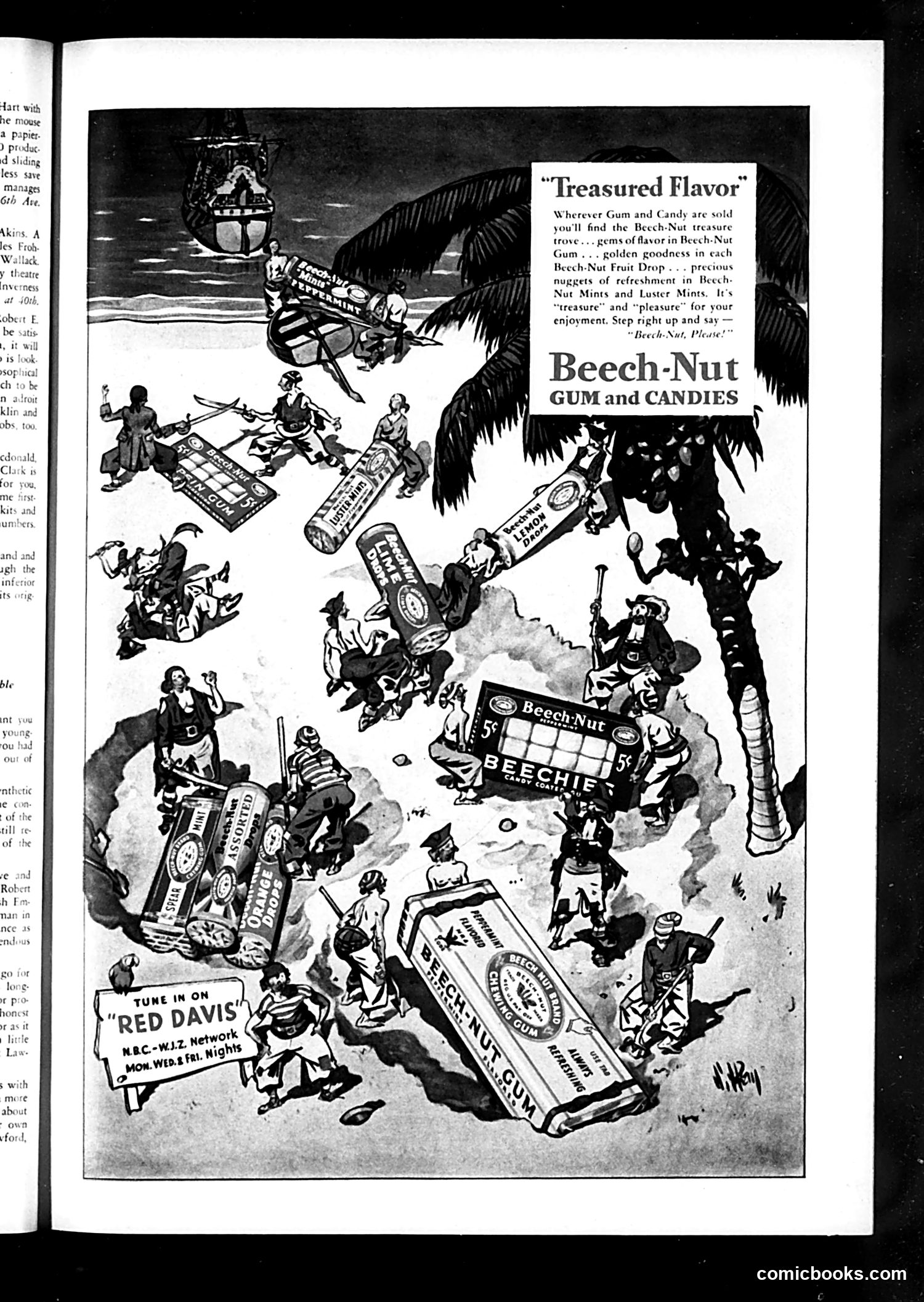
Beech-Nut Gum and Candies Advertisement This is a vintage advertisement, not political satire. The full-page ad for Beech-Nut gum and candies depicts a whimsical island scene populated by cartoon characters enjoying the products. The "Treasured Flavor" headline emphasizes the brand's appeal. Notable elements include: - Large Beech-Nut product packages dominating the landscape - Multiple figures in playful poses scattered across a tropical setting - A palm tree and what appears to be a parrot - A small radio advertisement at bottom left promoting "Red Davis" on NBC-WIZ Network (MON, WED, FRI NIGHTS) The illustration style is typical 1930s-40s advertising art. The ad sells the product through escapist fantasy rather than any political commentary.
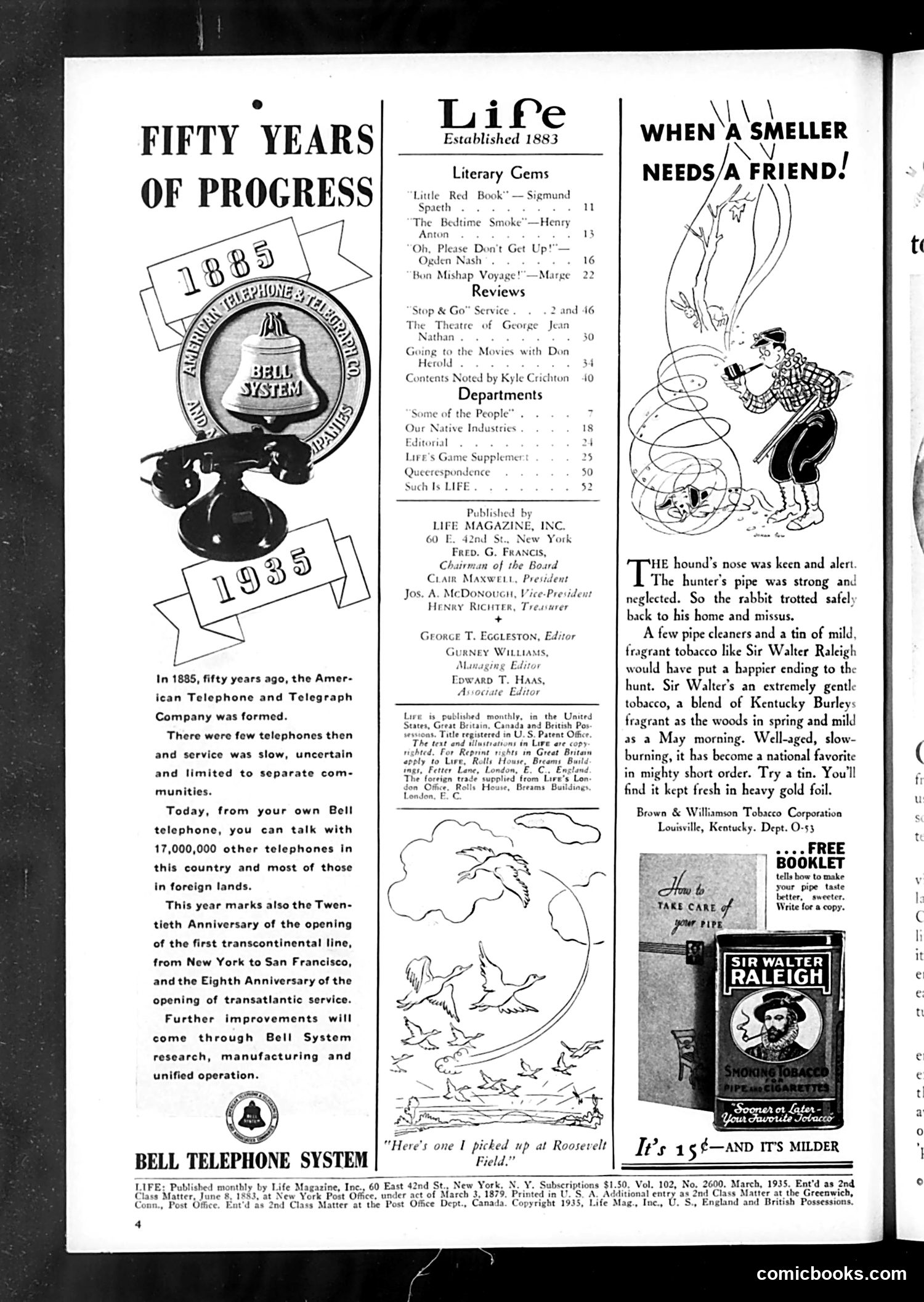
"When a Smeller Needs a Friend" This cartoon illustrates a humorous hunting scenario. A hunter with his dog discovers that his pipe tobacco—specifically Sir Walter Raleigh brand—is so fragrant and pleasant that it attracts rabbits instead of helping him hunt them. The joke plays on the marketing claim that the tobacco has an appealing scent. The accompanying text describes Sir Walter Raleigh as a "mild" tobacco blend from Kentucky, noting that its pleasant aroma would make "a happier ending to the hunt" than typical hunting outcomes. This is essentially an advertisement disguised as a cartoon joke, using humor to promote the tobacco brand's desirable qualities to readers in 1935.
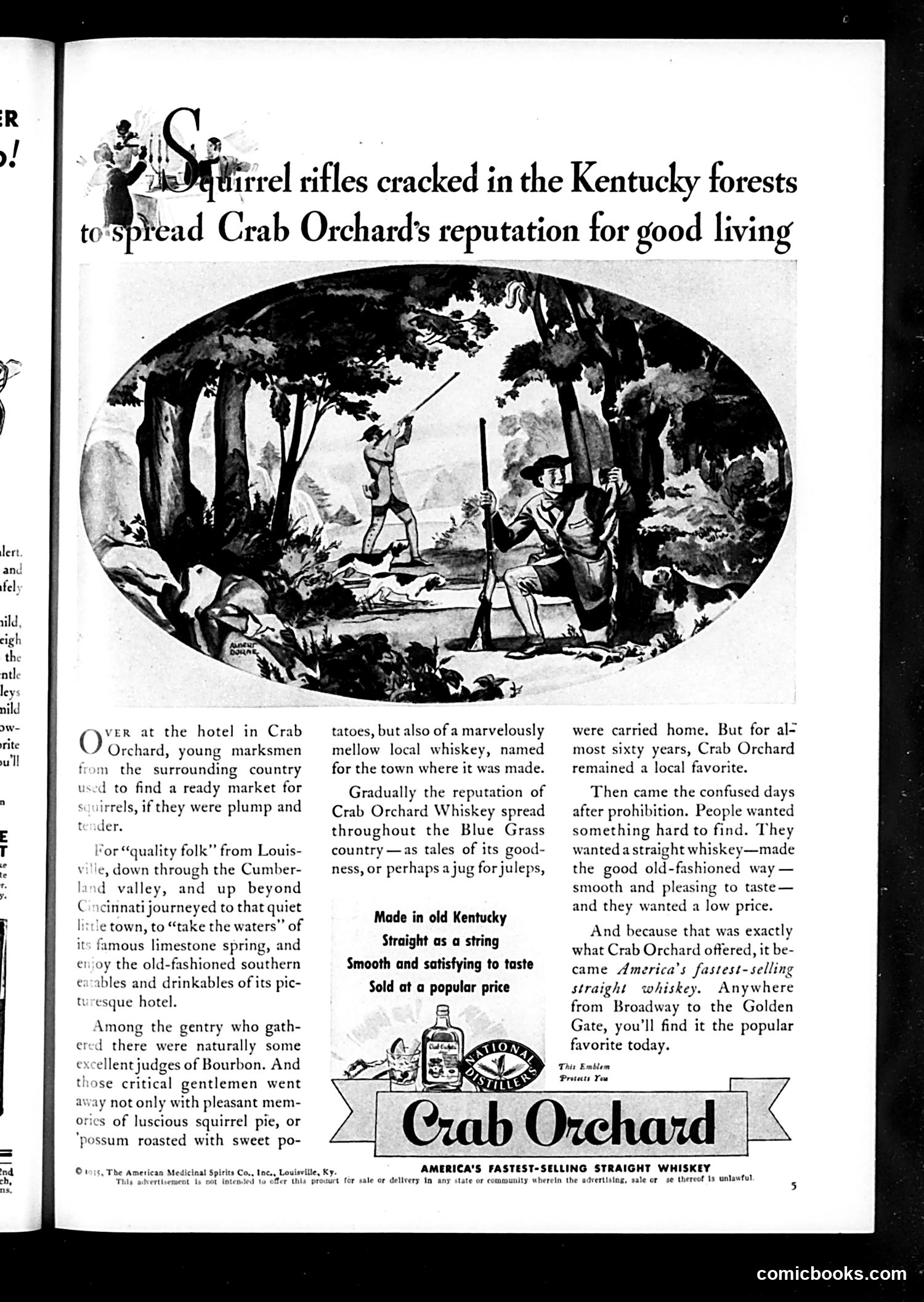
Crab Orchard Whiskey Advertisement This is a whiskey advertisement, not political satire. It uses a romanticized illustration of Kentucky frontier life—hunters with rifles in a forest—to market Crab Orchard Whiskey as an authentically American product with historical roots. The text narrates how the whiskey gained reputation among Kentucky gentry and travelers, eventually becoming famous nationwide. Notably, it addresses the Prohibition era aftermath: the ad acknowledges people wanted "a straightforward whiskey—made the good old-fashioned way" at "a low price," positioning Crab Orchard as satisfying post-Prohibition demand for accessible quality spirits. The slogan calls it "America's fastest-selling straight whiskey," suggesting market dominance during alcohol's legal return.
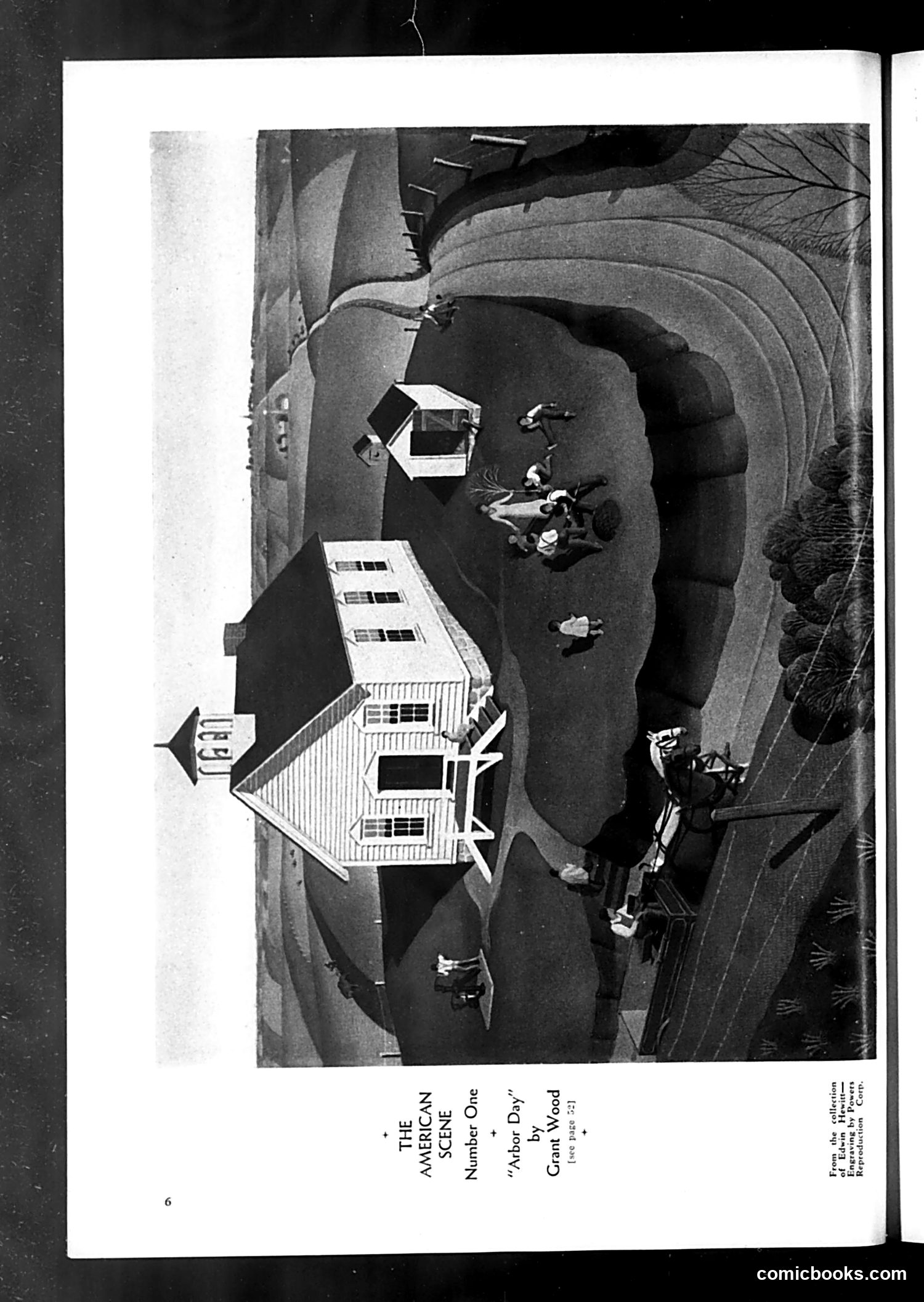
"The Umpire Scene" - Life Magazine This appears to be a scene illustration (possibly from a play or story) showing a baseball umpire's decision-making moment. The caption reads "THE UMPIRE SCENE" with credits listing "Number One," "Arbor Day," "Grant Wood," and what appears to be a publication date reference. The image shows a figure in an umpire's stance making a call, with other figures (likely players) gathered around. The composition and style suggest this is satirizing the dramatic, consequential nature of an umpire's judgment in baseball—a moment of absolute authority where one person's subjective decision affects the game's outcome. Without additional context about the specific publication date and artistic references, the precise satirical target remains unclear, though it likely comments on power, authority, or decision-making in American life through the baseball metaphor.
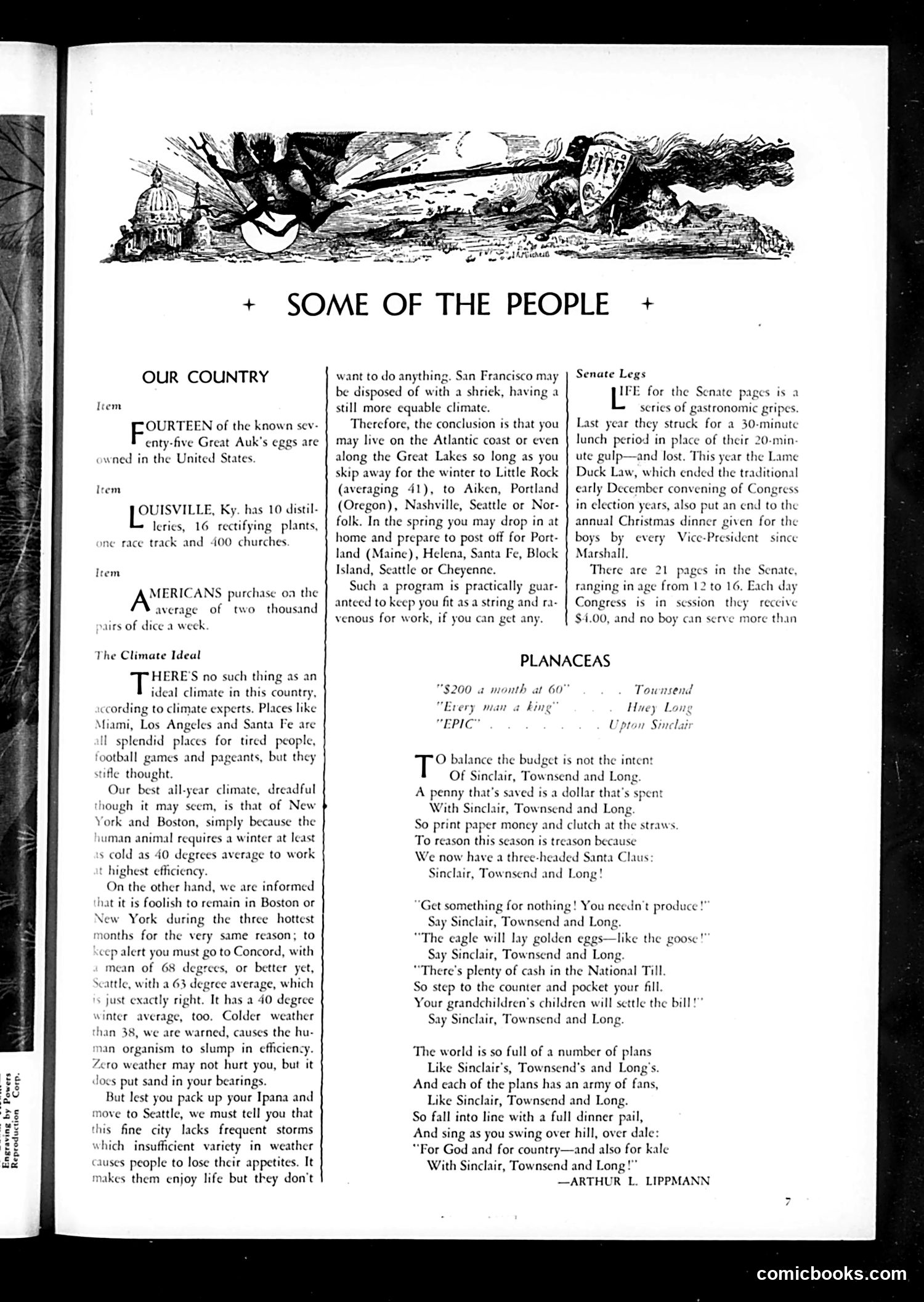
Analysis This page from *Life* magazine contains satirical commentary on American life rather than political cartoons. The content critiques several contemporary issues: "Our Country" mocks American consumption (noting people buy two thousand pairs of dice weekly) and regional disparities. "The Climate Ideal" sarcastically debates which U.S. city has the best weather. It ridicules the notion that an "ideal climate" exists, noting that places like Miami and Los Angeles are praised for outdoor activities, yet New York and Boston's harsh winters are defended as character-building. The satire suggests Americans irrationally romanticize their regional climates despite objective discomfort. "Planaceas" presents verse by Arthur L. Lippmann parodying political slogans and economic plans—likely referencing 1920s-30s political rhetoric about budgets and national prosperity, mocking their hollow promises.
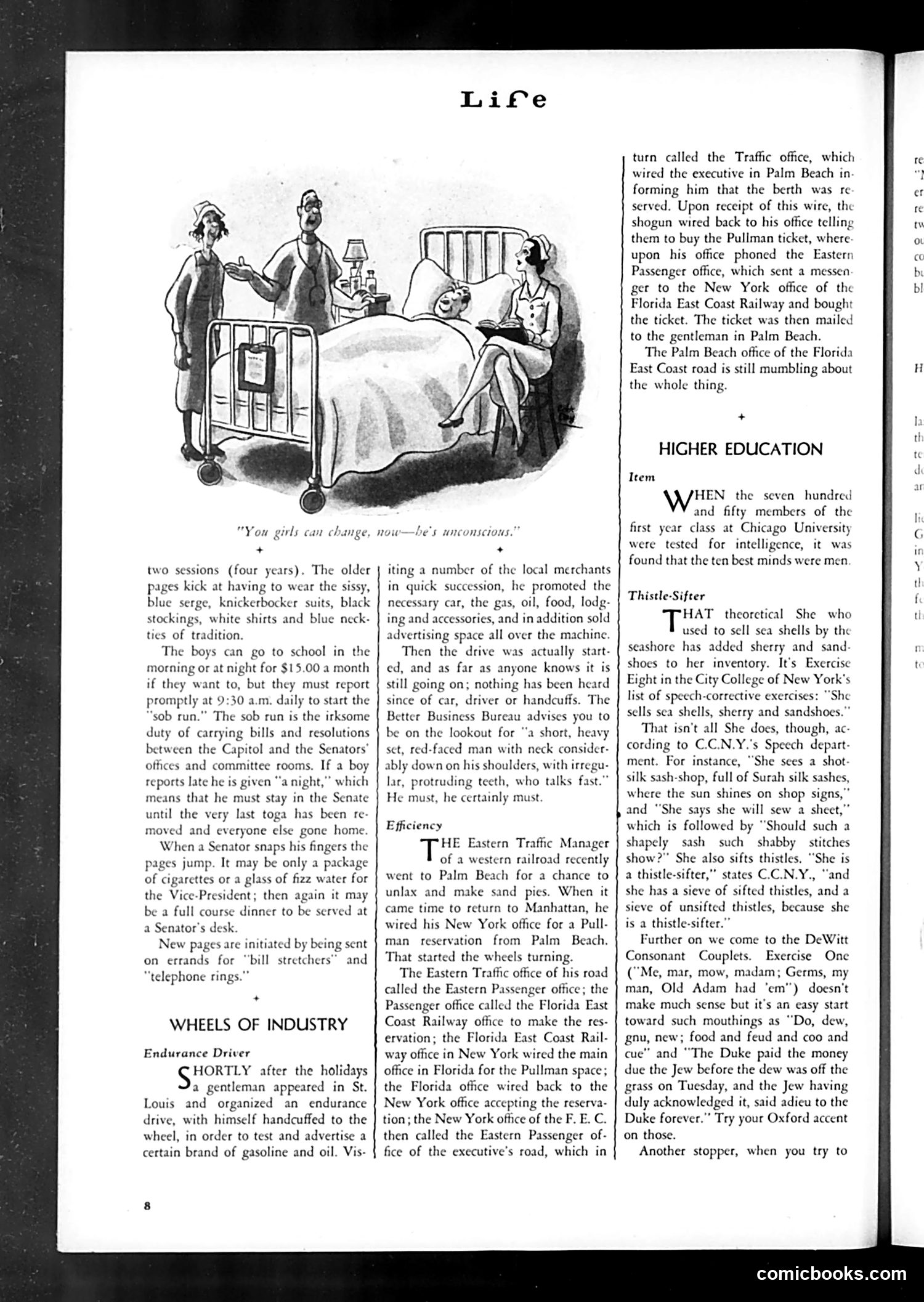
Analysis of Life Magazine Page This page contains satirical anecdotes about American institutional absurdities rather than political cartoons. The main illustration shows a hospital scene with the caption "You girls can change, now—he's unconscious," mocking medical staff behavior. The three short humor pieces mock: 1. Senate page boys — critiquing the absurd bureaucratic duties required of young congressional staff 2. Railroad efficiency — satirizing the comically convoluted chain of offices and communications needed for a simple Pullman ticket reservation between Palm Beach and New York 3. Higher education — poking fun at women's colleges teaching "practical skills" like sewing and selling seashells The humor relies on readers recognizing everyday institutional inefficiency and pretension in early 20th-century America.
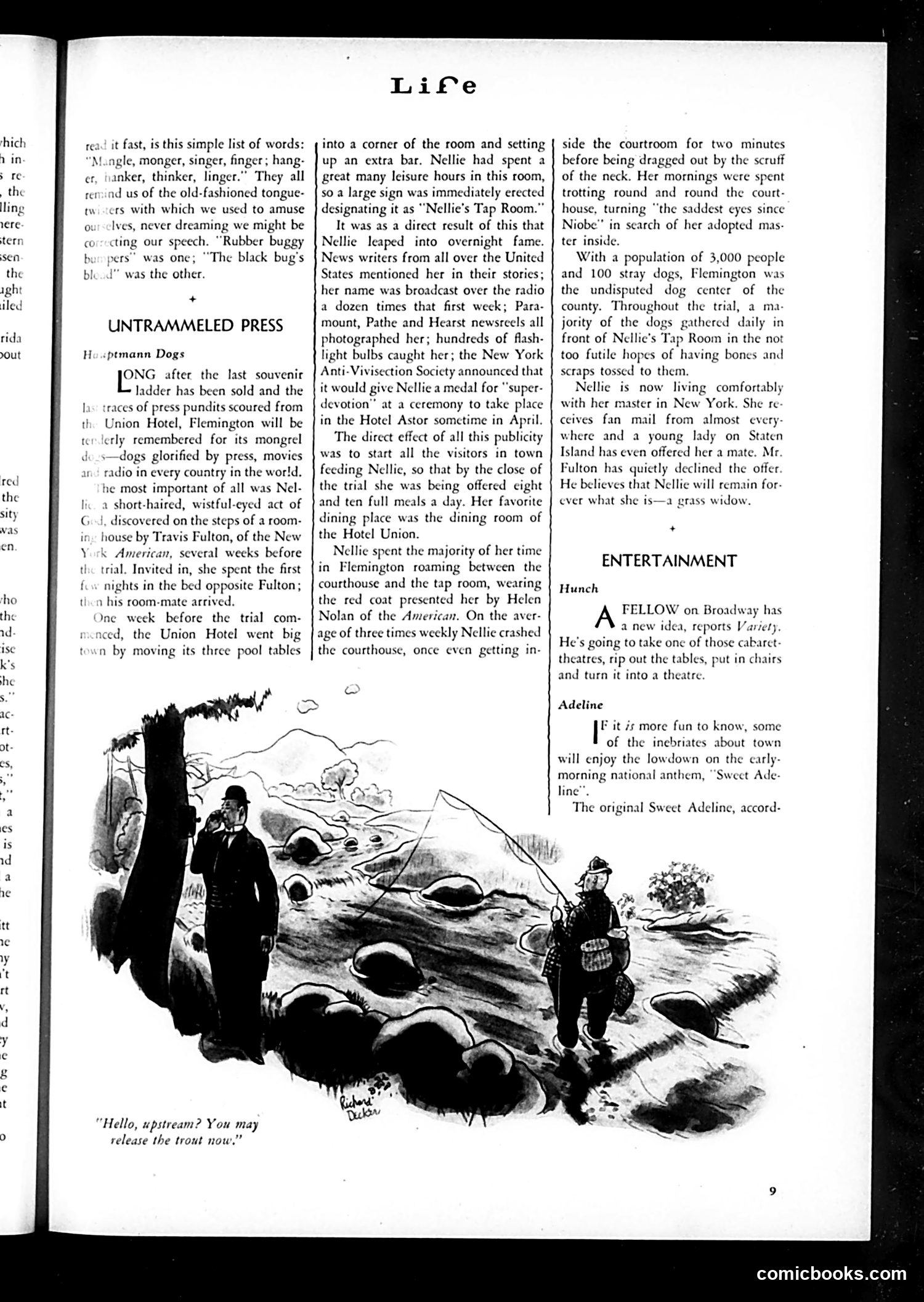
Life Magazine Page Analysis This page contains two distinct sections: "Untrammeled Press" - Hessmann Dogs: An article celebrating a dog named Nellie who became famous through media coverage. The piece describes how press attention and radio broadcasts made her a celebrity—she received fan mail, was offered a medal, and drew crowds. The satire appears to mock how the press can manufacture celebrity from trivial subjects, turning an ordinary dog into a sensation through relentless coverage. "Entertainment" Section: Two brief items: one about a Broadway fellow converting a cabaret theater into a theatrical venue by simply rearranging furniture, and another about the origins of the song "Sweet Adeline." The cartoon below depicts two men in a rural/outdoor setting with logs, with one saying "Hello, upstream? You may release the trout now."—likely satirizing artificial or staged nature activities.
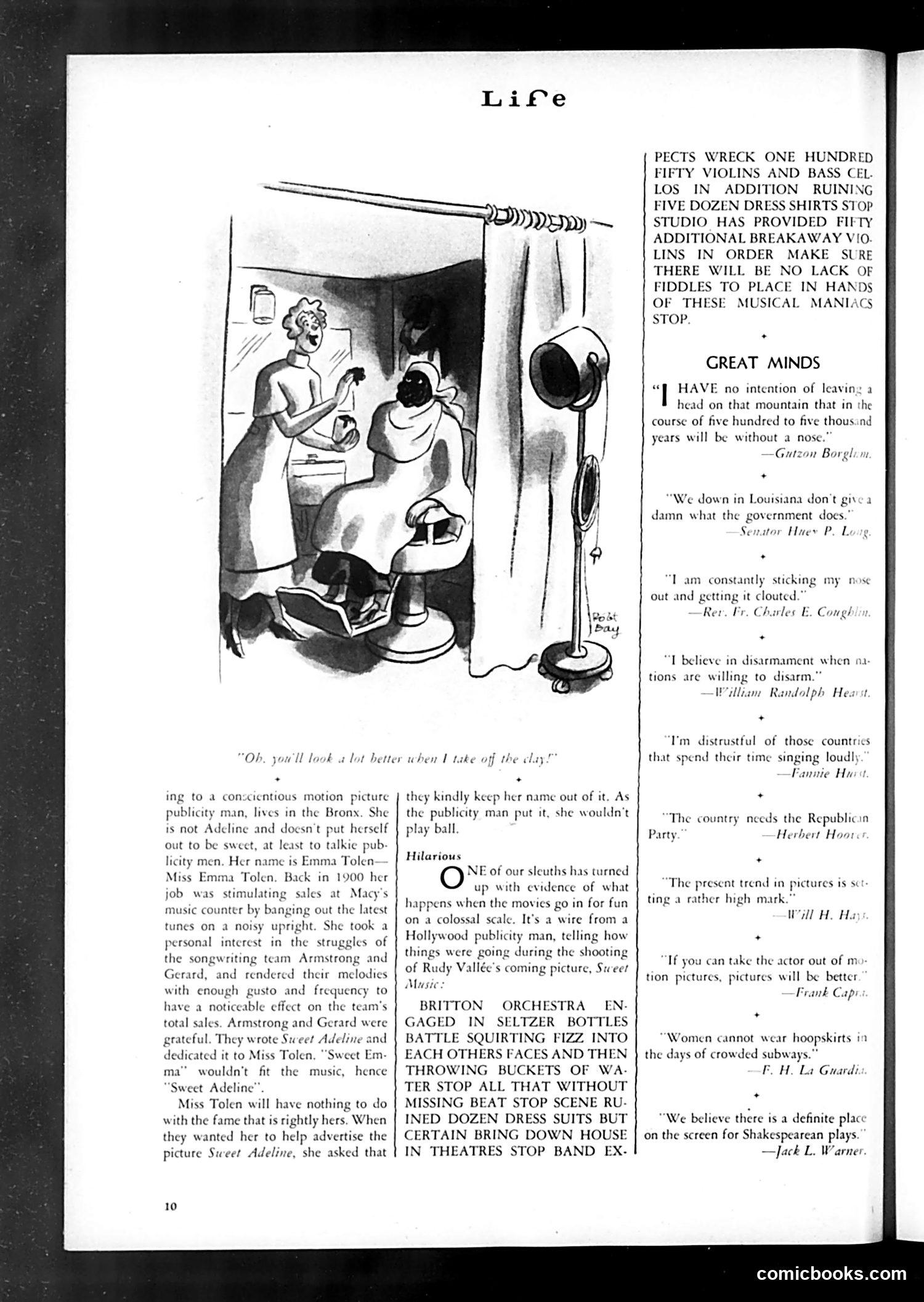
Analysis of Life Magazine Page The main cartoon depicts a publicity man showing a woman his work—likely promoting her as a singer or entertainer. The caption "Oh, you'll look a lot better when I take off the city!" suggests a publicist's makeover strategy, implying cosmetic or image manipulation to sell performers. The accompanying article discusses Emma Tolen, a Broadway singer turned publicist in the Bronx. It describes how she successfully promoted musical acts through unconventional means, collaborating with songwriters Armstrong and Gerard. The "Great Minds" section collects humorous quotes from public figures on various topics—disarmament, government, motion pictures, and Shakespeare. Overall, the page satirizes entertainment industry image-making and the role of publicists in manufactured celebrity personas.
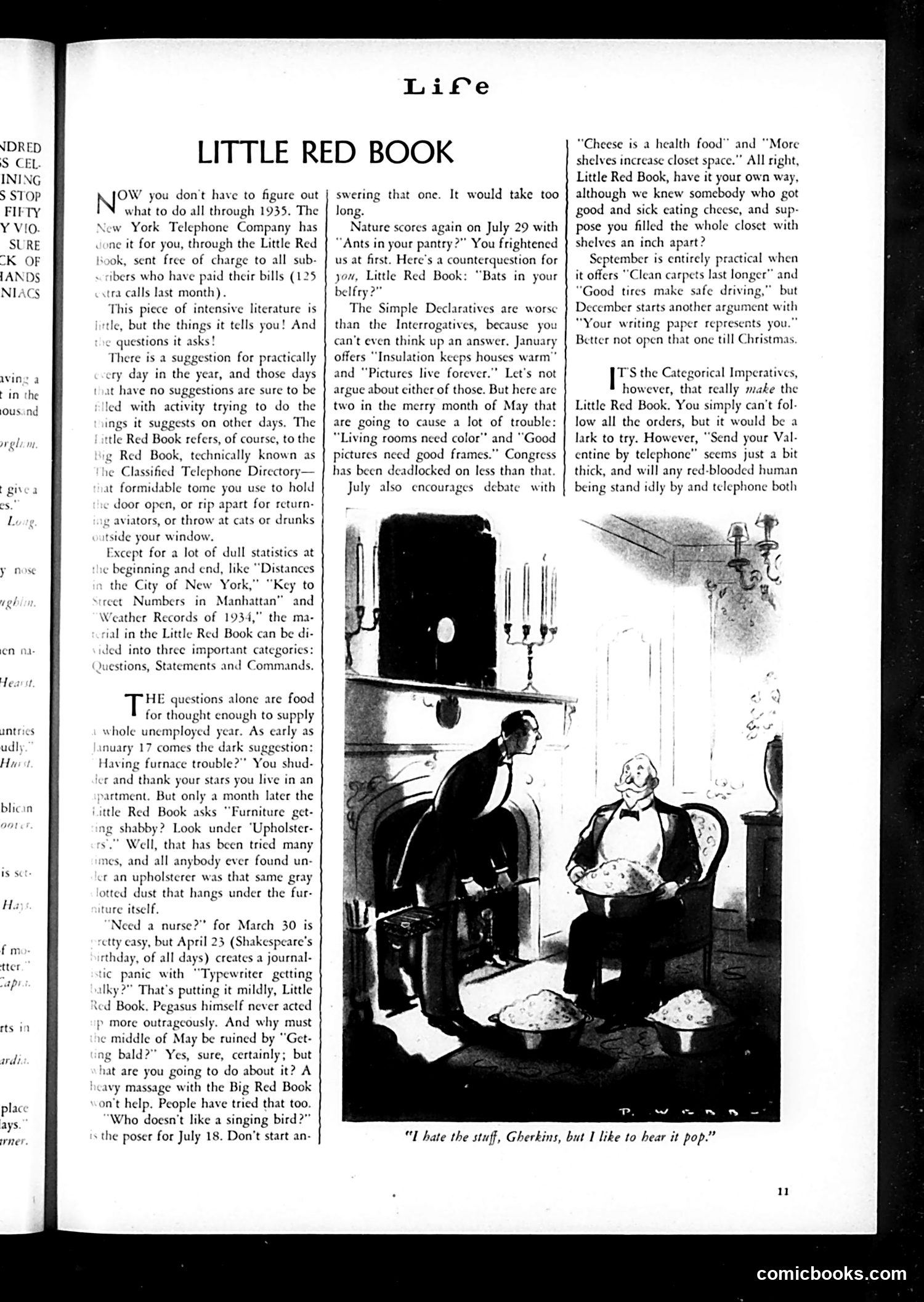
"Little Red Book" Satire Analysis This page satirizes the *Little Red Book* — the New York Telephone Company's published directory of practical advice (questions, statements, and commands organized by topic). The cartoon depicts two men in formal dress examining what appears to be a large, complex telephone switchboard or mechanical device. The caption reads: "I hate the stuff, Gherkins, but I like to hear it pop." The satire mocks the *Little Red Book's* pretension to usefulness. The article humorously catalogs its absurd suggestions—ranging from furniture care to medical advice—suggesting the reference book offers superficial solutions to everyday problems. The cartoon likely visualizes the mechanistic, impersonal nature of following such instructions, contrasting the book's promise of practical wisdom with the chaos of actual life.
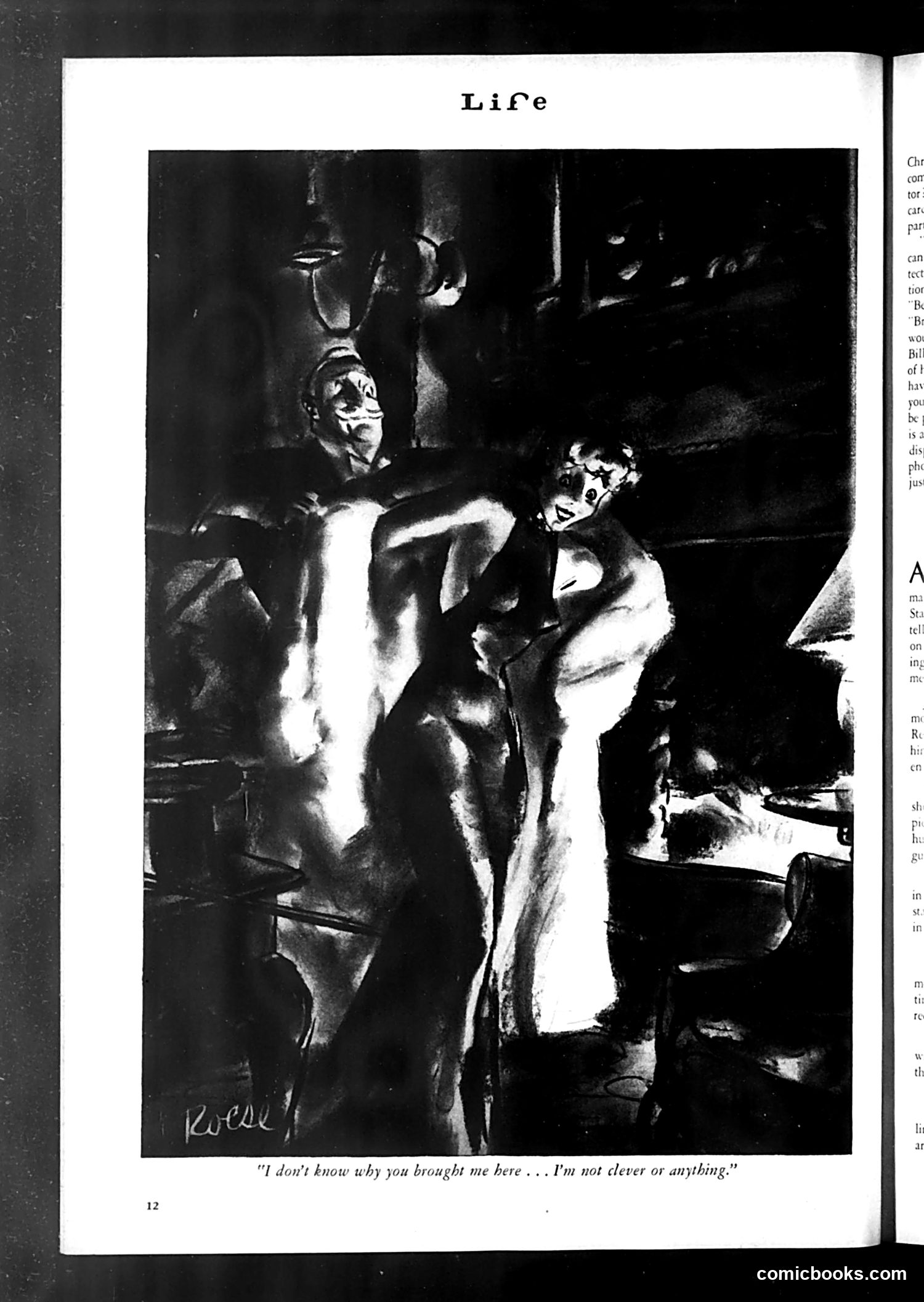
Analysis of Life Magazine Cartoon This single-panel cartoon depicts what appears to be a theatrical or nightclub scene, with figures in dark clothing surrounding a partially undressed woman in the center. The woman's dialogue—"I don't know why you brought me here . . . I'm not clever or anything"—suggests satire of either social pretension or seduction scenarios. The signature appears to read "Rolfe" (the artist). Without additional context about the publication date, the specific identity of the surrounding figures remains unclear. The cartoon likely satirizes either: shallow social climbing, the objectification of women in entertainment venues, or the gap between men's expectations and women's actual intellect or interests. The humor turns on the woman's self-deprecating simplicity contrasting with the apparent sophistication of her surroundings.
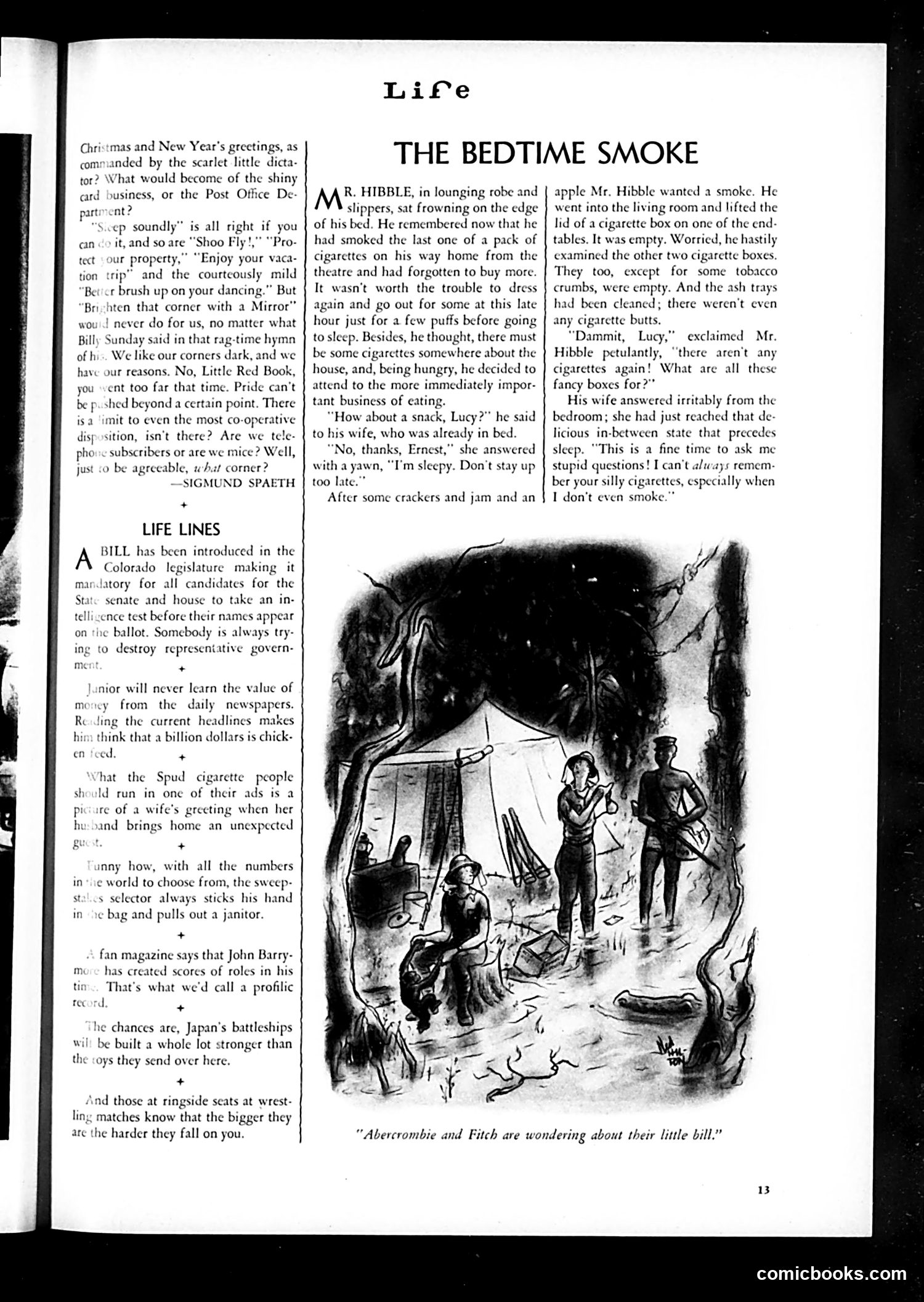
"The Bedtime Smoke" Analysis This is a humorous domestic story titled "The Bedtime Smoke," illustrated with a sketch showing figures in what appears to be a bedroom or living space. The narrative depicts Mr. Hibble, a man in lounging clothes who wants to smoke a cigarette before bed. His wife Lucy is already in bed and objects to him smoking, citing that cigarette butts and ash will dirty their bedroom. Mr. Hibble argues he deserves the smoke after his day, while Lucy insists it's inconsiderate. The story satirizes mundane married-life disagreements over domestic habits—specifically, the conflict between a husband's desire for personal leisure and a wife's concern for household cleanliness and propriety. It reflects early-20th-century gender dynamics around domestic space control and household management.
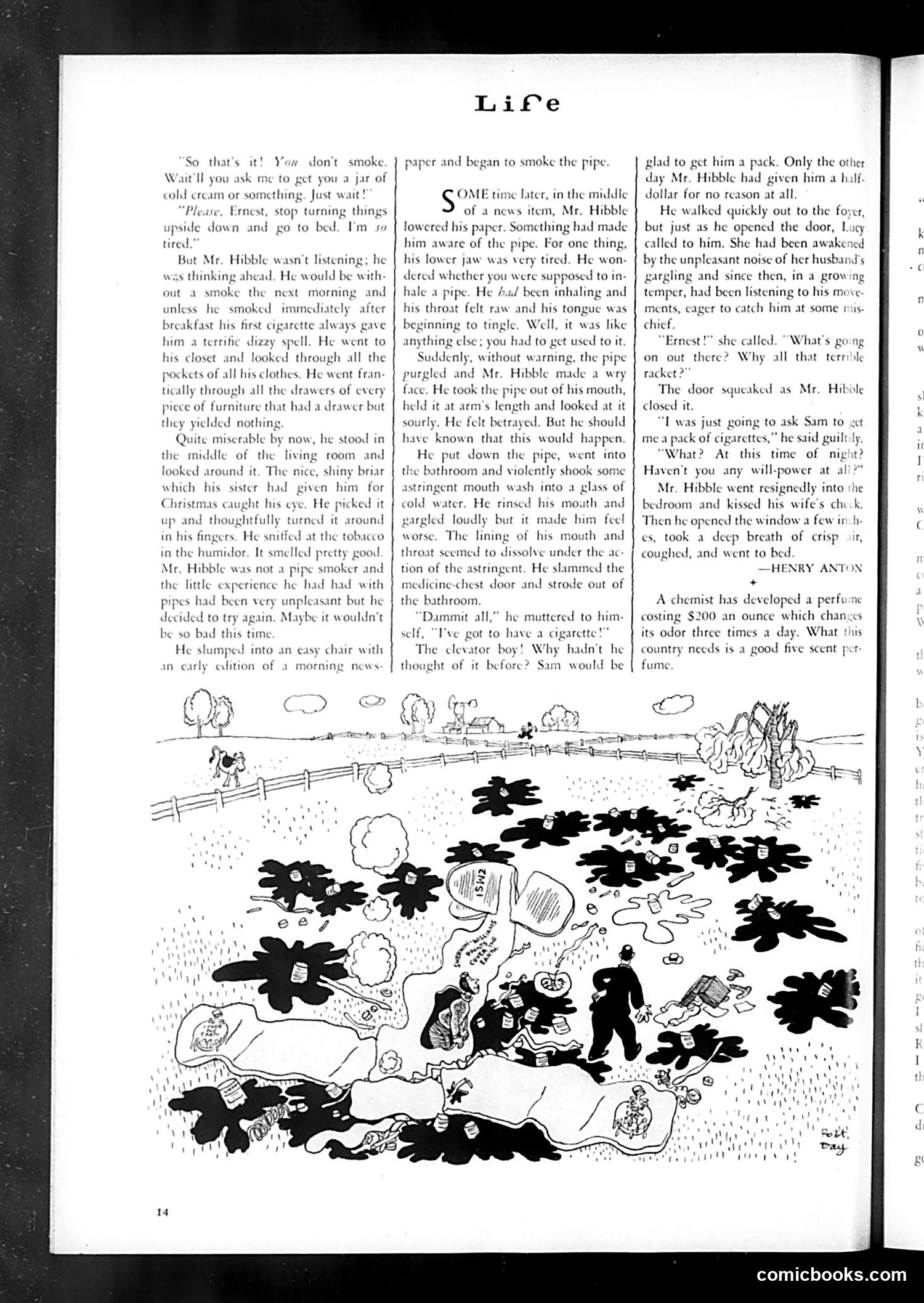
Analysis of Life Magazine Page This page contains a humorous short story titled "Life" about Mr. Hibble, a man who attempts to smoke a pipe for the first time. The narrative describes his failed attempt—the pipe causes him dizziness, discomfort, and nausea, culminating in him vomiting. He abandons the idea, resolving to ask his wife for a cigarette instead. The accompanying illustration depicts a surreal landscape with oversized black flowers or plants, suggesting the dizzy, distorted perception Hibble experiences while smoking. The satire mocks the pretension of pipe-smoking as a gentlemanly habit, revealing the reality that novice smokers often become violently ill. It's a lighthearted critique of masculine affectation and social conventions around tobacco use.
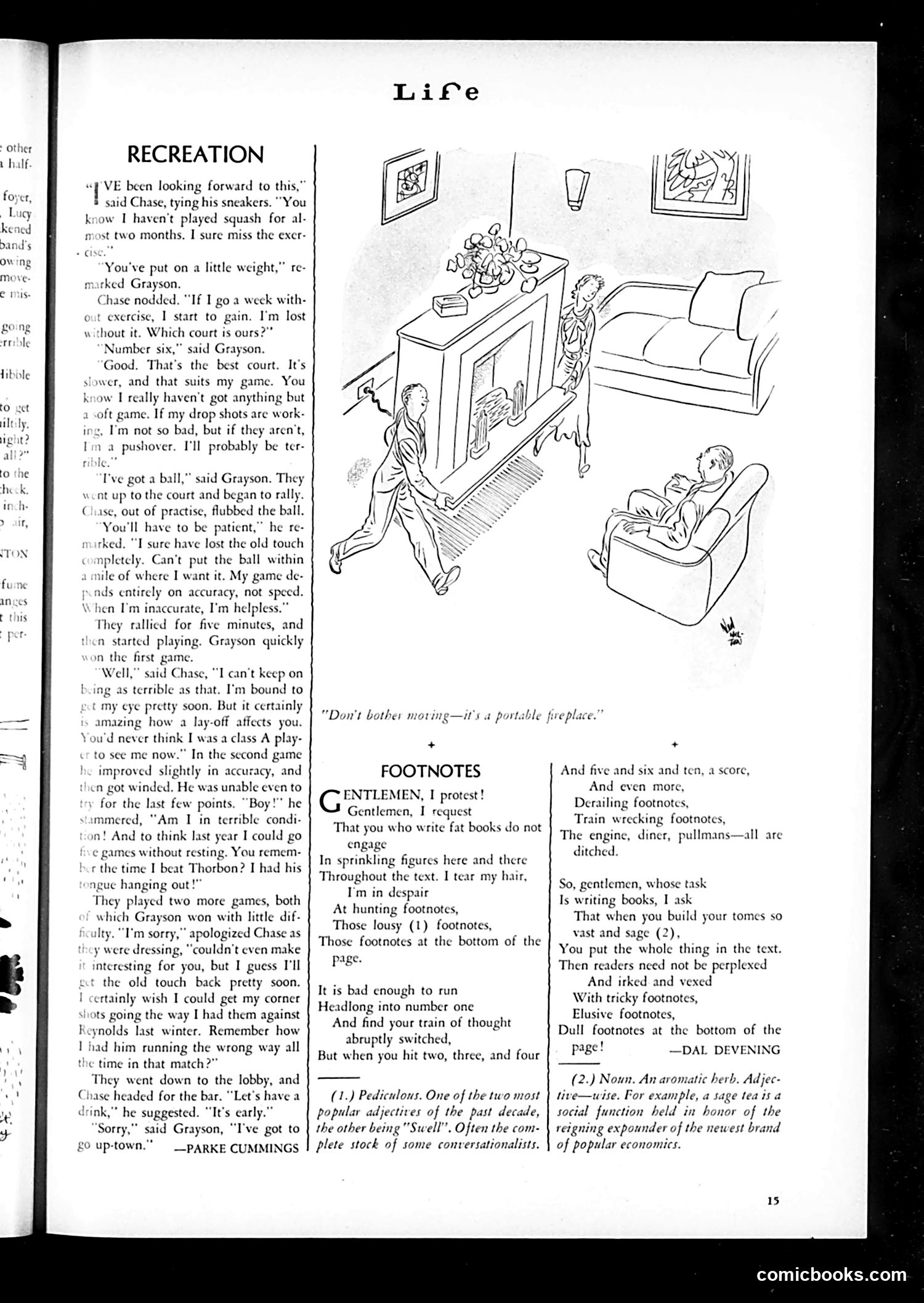
Life Magazine Page Analysis This page contains a humorous short story titled "Recreation" by Parke Cummings, accompanied by a cartoon illustrating the narrative. The story depicts two men, Chase and Grayson, playing squash after months without exercise. Chase has gained weight and struggles with the sport, while Grayson mocks him for being out of shape. The cartoon shows them in a living room with a portable fireplace, illustrating the caption "Don't bother moving—it's a portable fireplace." The page also includes "Footnotes," a humorous poem by Dal Devening complaining about footnotes in books—a meta-joke about the very footnotes defining terms (1) and (2) at the bottom of the page. This is lighthearted social satire about domestic leisure and publishing conventions, typical of Life magazine's genteel humor.
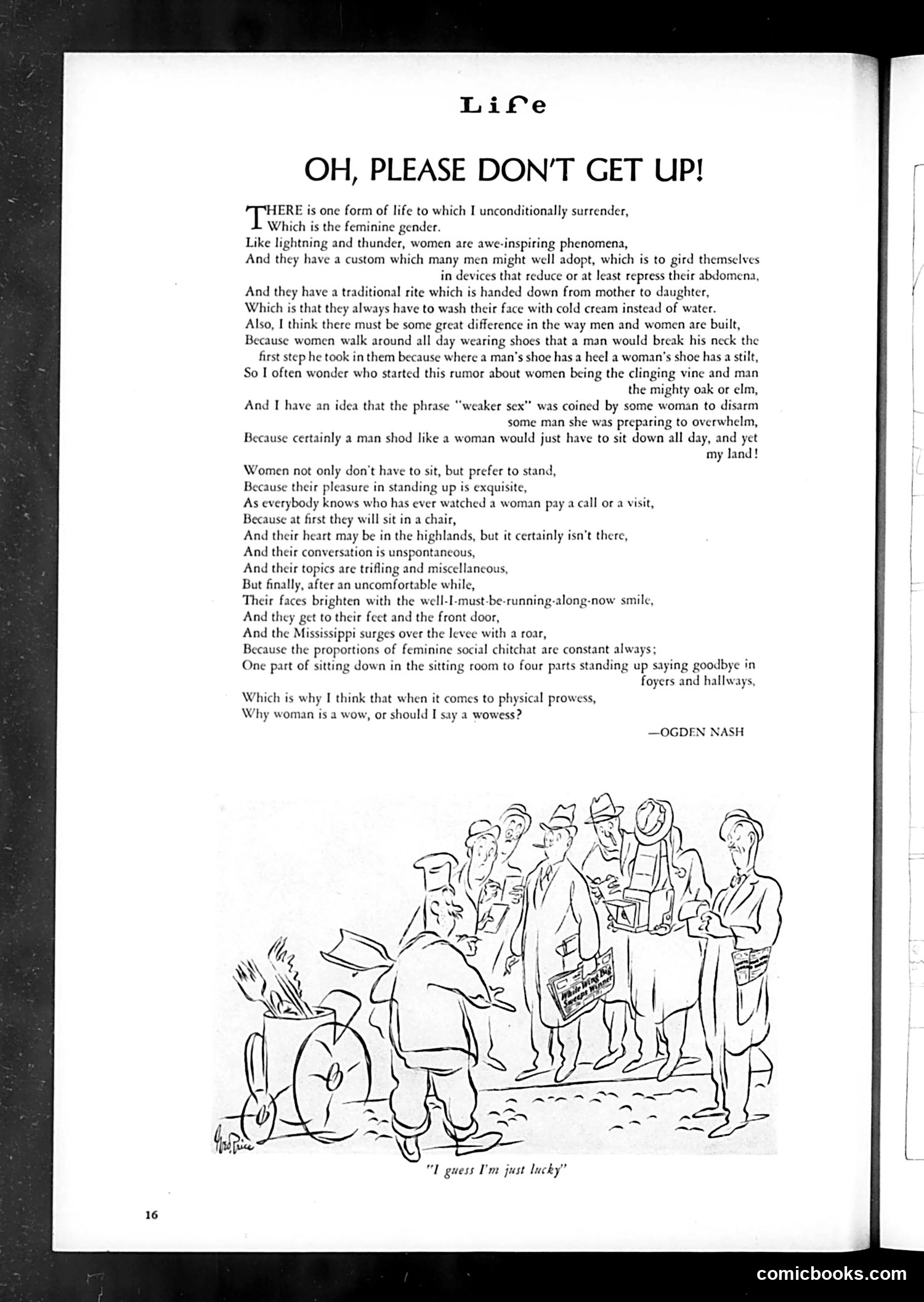
"Oh, Please Don't Get Up!" — Ogden Nash This page presents a humorous poem by Ogden Nash satirizing gender differences, particularly women's social behavior. Nash playfully argues that women are naturally inclined to stand rather than sit, citing their preference for remaining upright during social calls and visits. He observes that women eventually rise and leave to socialize elsewhere—in foyers and hallways—rather than settling down. The accompanying cartoon illustrates this theme: it shows a man seated on the ground surrounded by standing figures at what appears to be a social gathering. The caption "I guess I'm just lucky" suggests the man's ironic commentary on being the only one seated while others stand around him, humorously embodying Nash's point about gender-based social posturing and movement patterns.
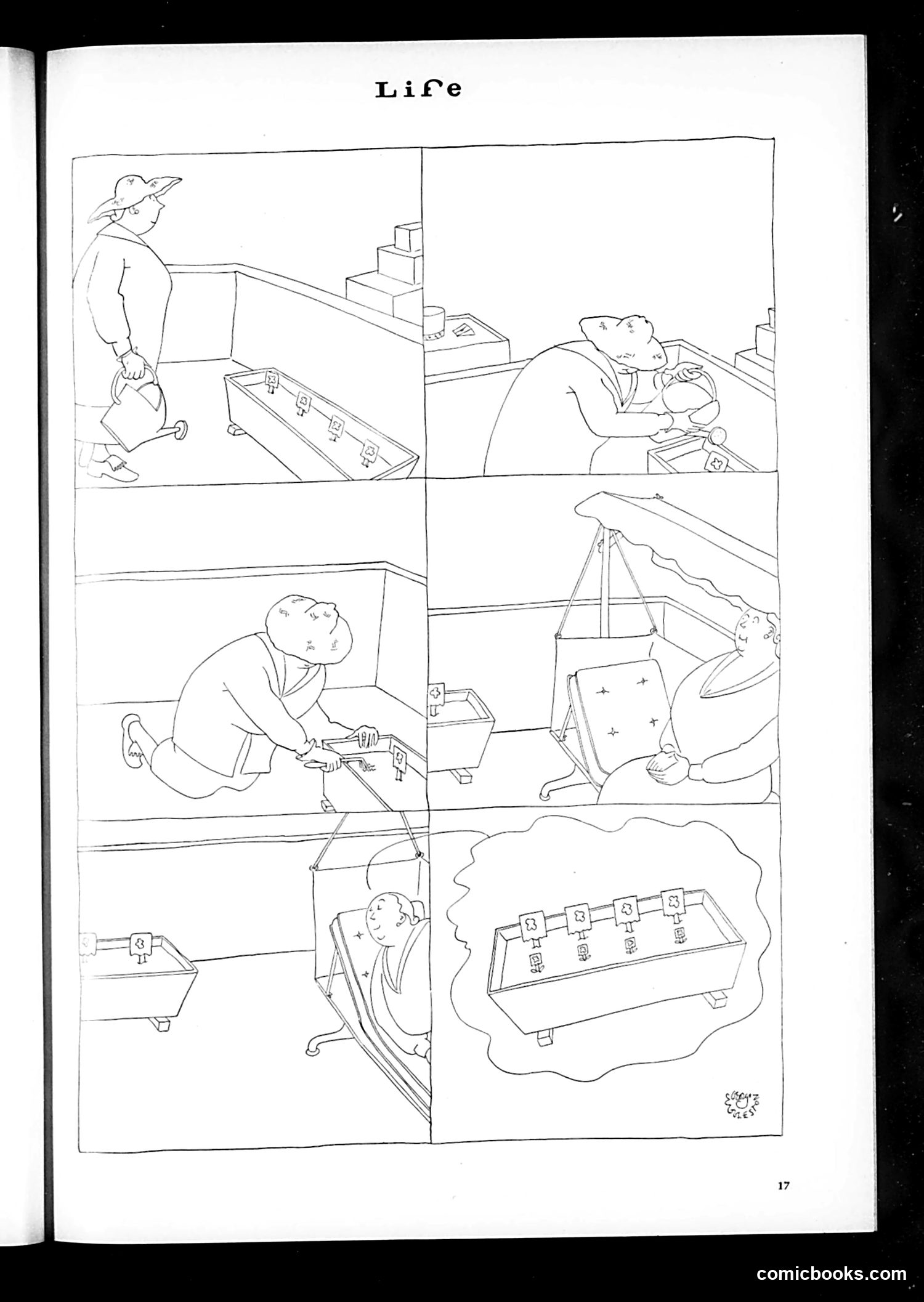
"Life" Page 17: "Life" (Comic Strip) This is a six-panel sequential comic titled "Life" depicting the cycle of human existence through a coffin or casket. The narrative progresses from left to right, top to bottom: 1. An older man waters a coffin like a plant 2. A couple tends to an infant in a coffin 3. A man constructs or works on a coffin 4. A couple relaxes beside a coffin under stars 5. A person lies in the coffin 6. The final panel shows an ornate coffin displayed The satire appears to treat the coffin as a constant life companion—present from birth through death—suggesting that mortality and preparation for death are inescapable human realities. The domestic, almost mundane depiction of coffin-related activities satirizes society's relationship with death and mortality.
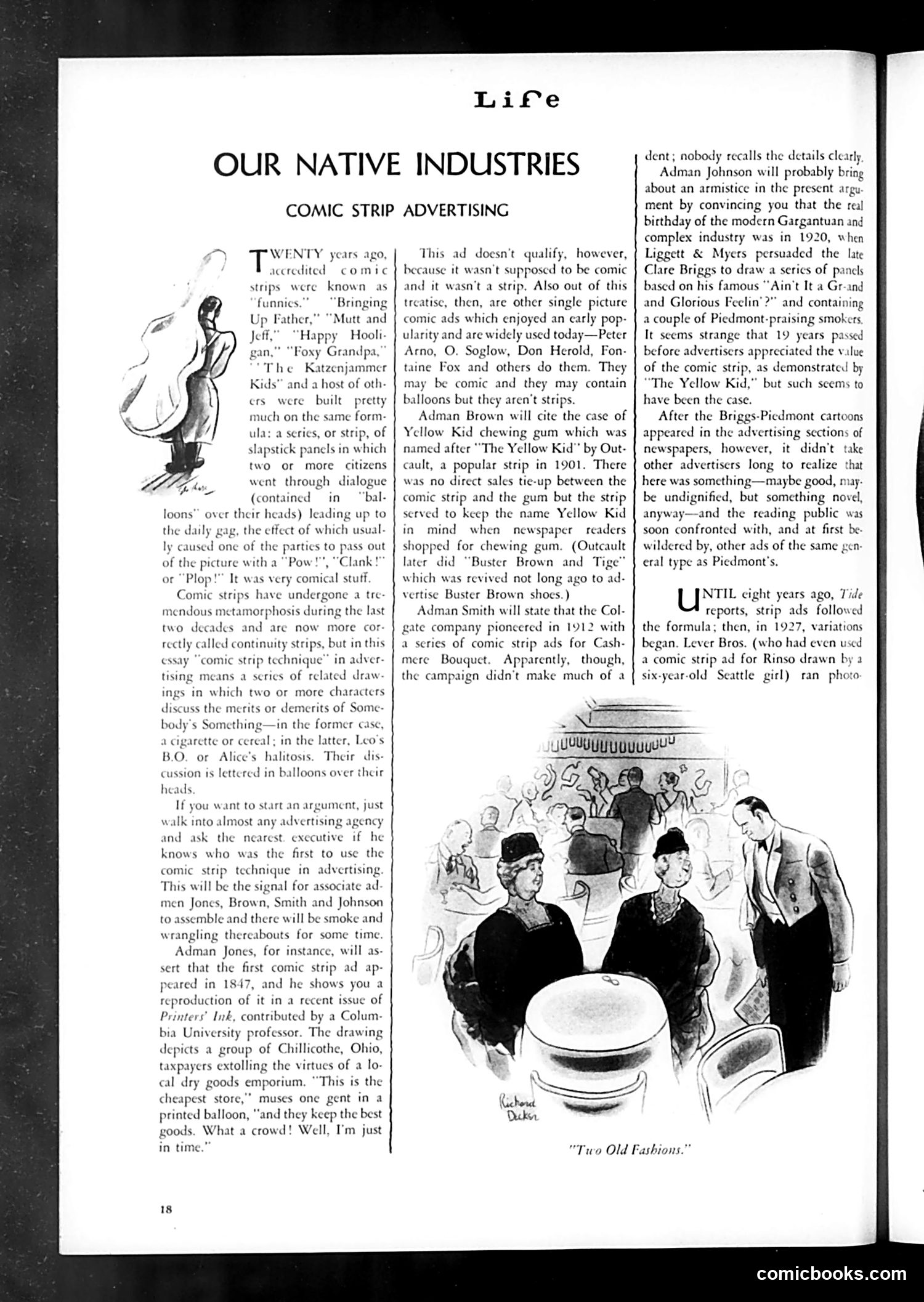
"Our Native Industries: Comic Strip Advertising" This article discusses the history of comic strips used in advertising, tracing the technique back about twenty years. The text credits men named Jones, Brown, Smith, and Johnson with pioneering comic strip ads. The bottom illustration, titled "Two Old Fashions," appears to be a satirical cartoon showing well-dressed men examining what looks like a large hat or fashion item, likely mocking outdated or absurd fashion trends. The joke seems to critique men's fashion choices—the "old fashions" referenced in the title—by depicting gentlemen gathered around this peculiar object as if it were a marvel worth serious attention. The article emphasizes how comic strip advertising was a relatively novel technique for its era.
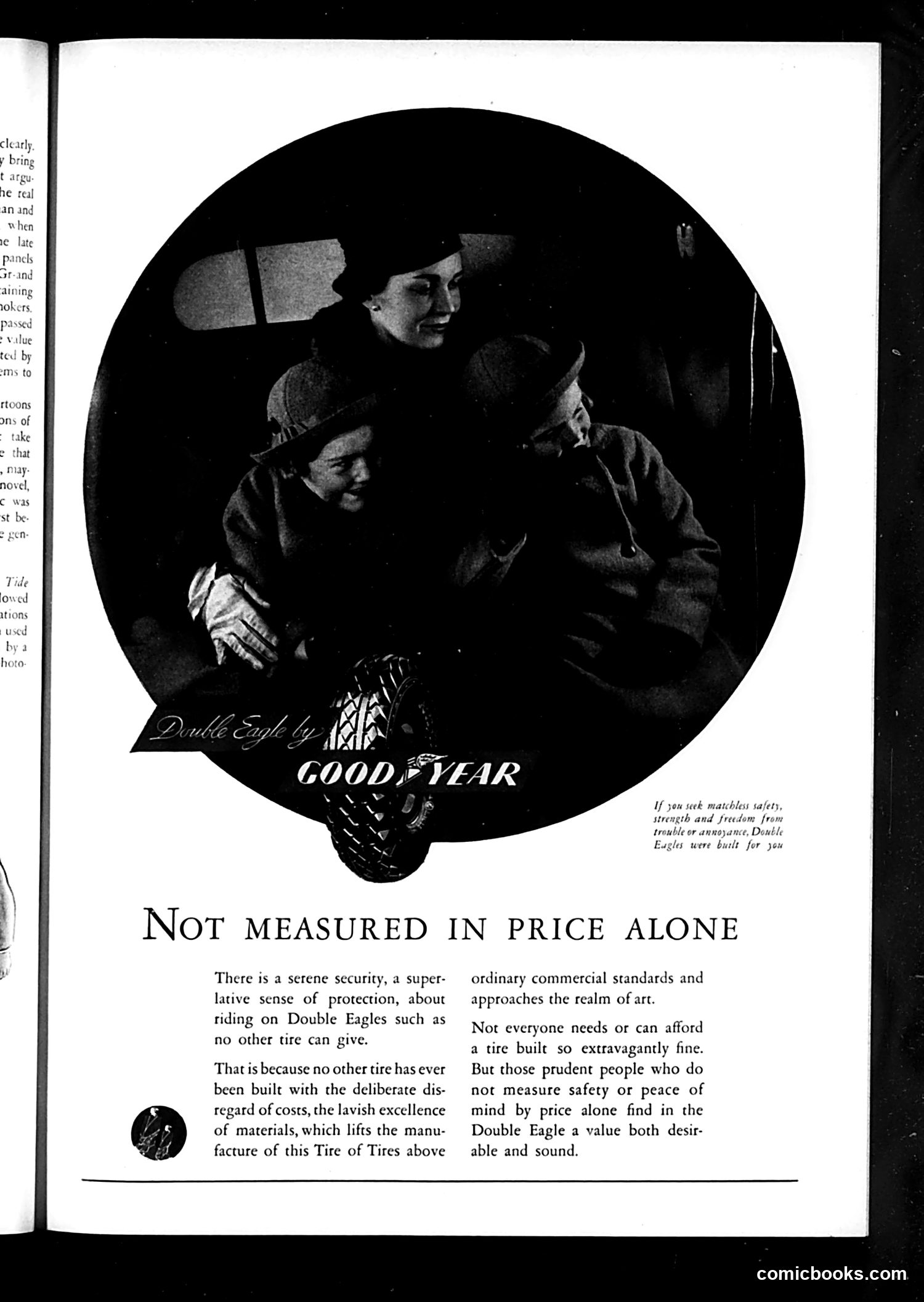
Analysis This is a Goodyear tire advertisement, not political satire. The circular photograph shows three people (appears to be a family group) in period clothing, with the headline "NOT MEASURED IN PRICE ALONE." The ad argues that Goodyear "Double Eagle" tires offer value beyond mere cost—emphasizing "serene security" and "a superlative sense of protection" that "approaches the realm of art." It explicitly states not everyone needs such expensive tires, but those prioritizing safety and peace of mind will find Double Eagle "desirable and sound." This is typical early-to-mid 20th century luxury goods marketing: positioning premium products as reflections of prudent judgment and refined values rather than extravagant spending. The family imagery suggests safety and responsibility as core selling points.
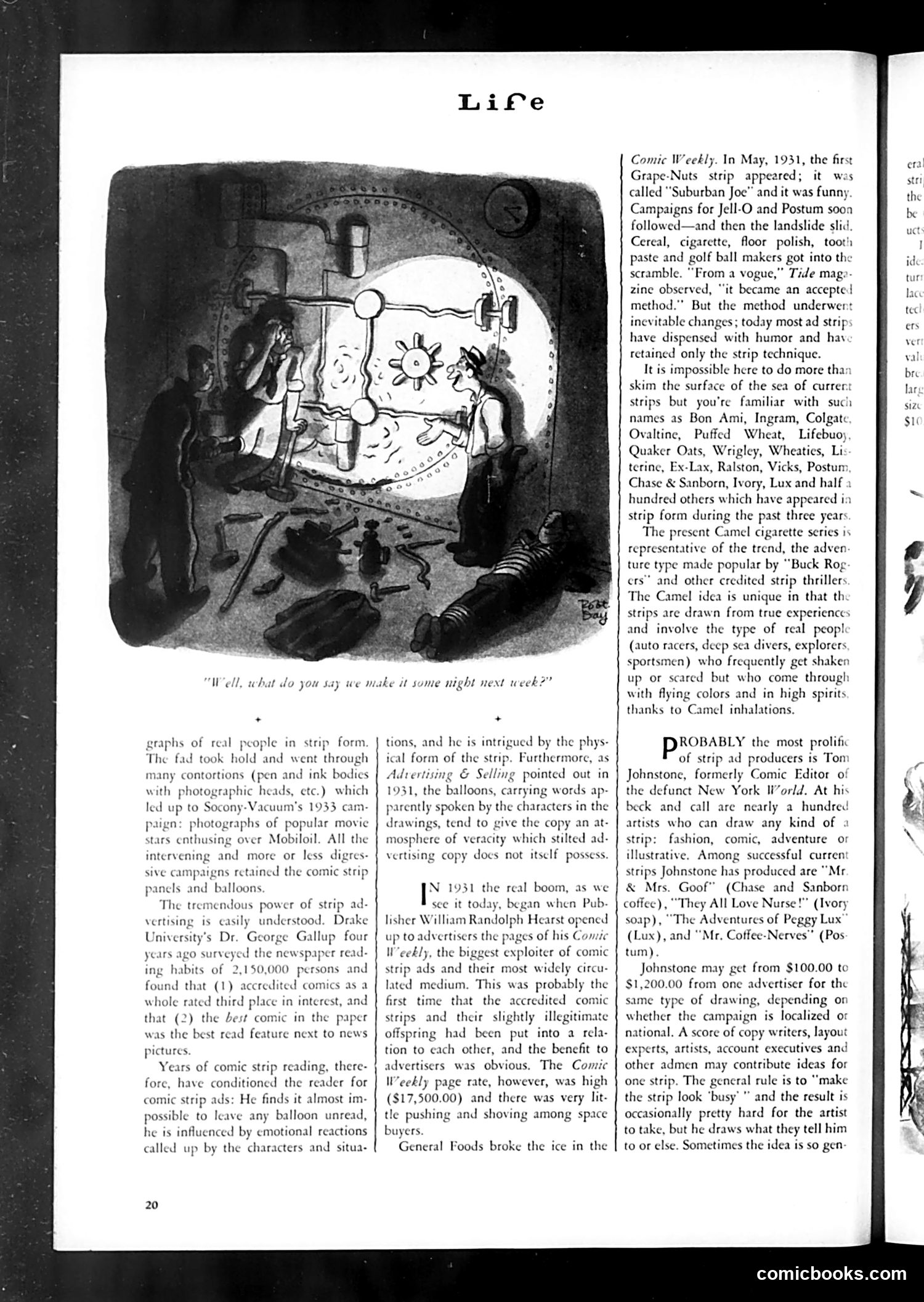
Explaining This Life Magazine Page This page discusses the explosive growth of comic strip advertising in early 1930s America. The cartoon at top depicts an advertising agency pitch meeting—figures gathered around a table discussing a strip ad concept (the drawing on the wall shows typical comic strip style). The text explains that comic strips had become America's third-most-read newspaper feature by the early 1930s, making them ideal for advertising. William Randolph Hearst opened his *Comic Weekly* to advertisers in 1931, launching the trend. General Foods' "Suburban Joe" Grape-Nuts strip (May 1931) broke the ice; soon cereal, cigarettes, toothpaste, and other mass-market products flooded the medium with ads. The satire's point: advertisers exploited readers' emotional engagement with comics—people couldn't resist reading speech balloons—to sell mundane products through entertainment format. By the time this article was written, most ad strips had abandoned humor, retaining only the comic strip *form* as a marketing tool.
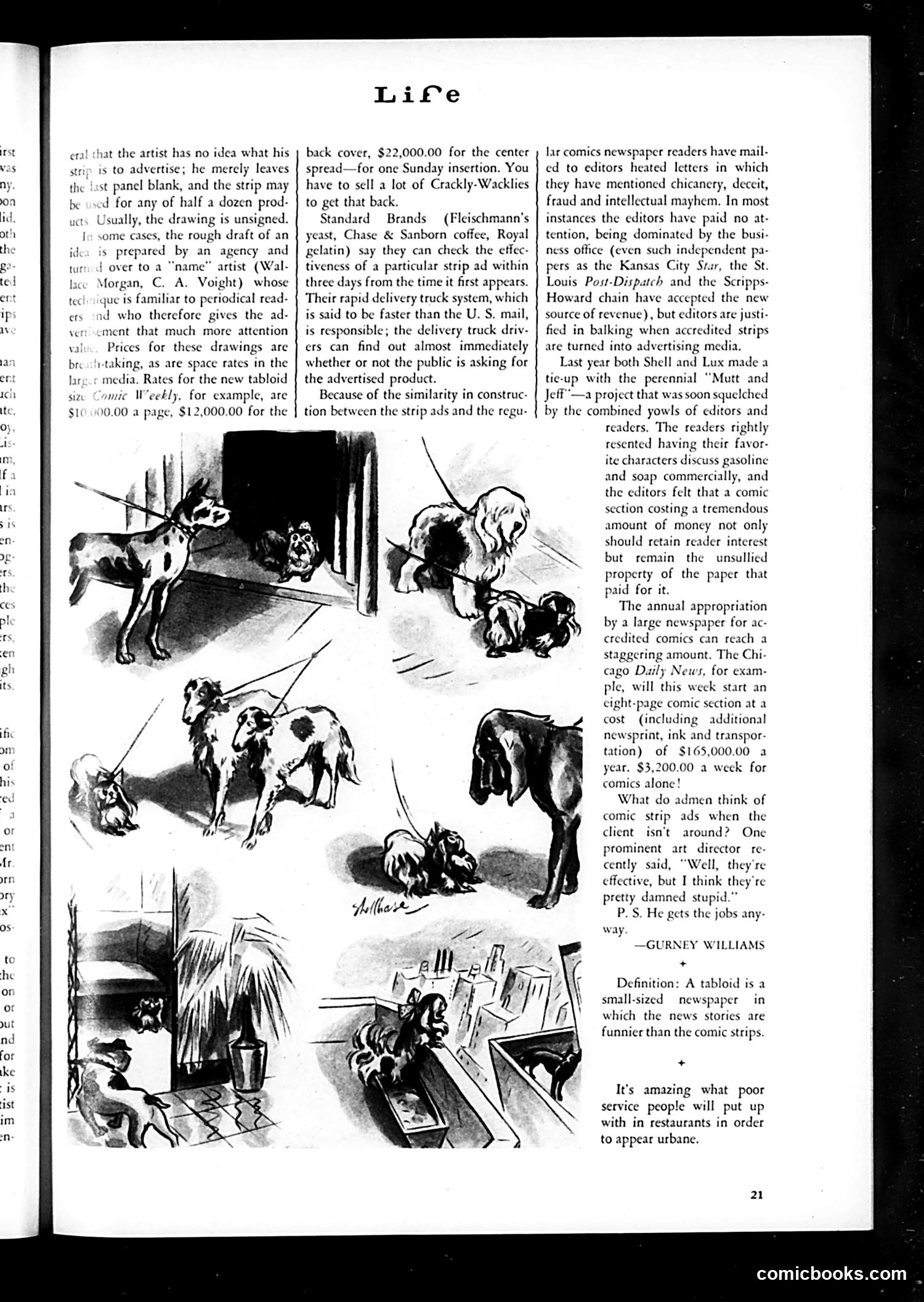
Analysis: Comic Strip Advertising in 1920s-30s Life Magazine This article by Gurney Williams critiques the emerging practice of disguising advertisements as comic strips in newspapers. The accompanying illustration shows dogs in various scenarios—likely satirizing how ads mimicked the format of legitimate comic content to deceive readers. The satire: Newspapers were charging enormous sums ($22,000 for a Sunday center spread) to run fake comic strips advertising products like Fleischmann's yeast and Chase & Sanborn coffee. Readers couldn't distinguish these ads from genuine comics, leading to complaints about "chicanery" and "fraud." The irony: Even when legitimate strips like "Mutt and Jeff" accepted sponsorships to discuss gasoline or soap, readers and editors rebelled—the comics belonged to the papers, not advertisers. Williams highlights the hypocrisy: an art director admits these ads are "pretty damned stupid," yet continues creating them for lucrative fees. The definition of "tabloid" at page's end reinforces the joke: even news sections became comedic.
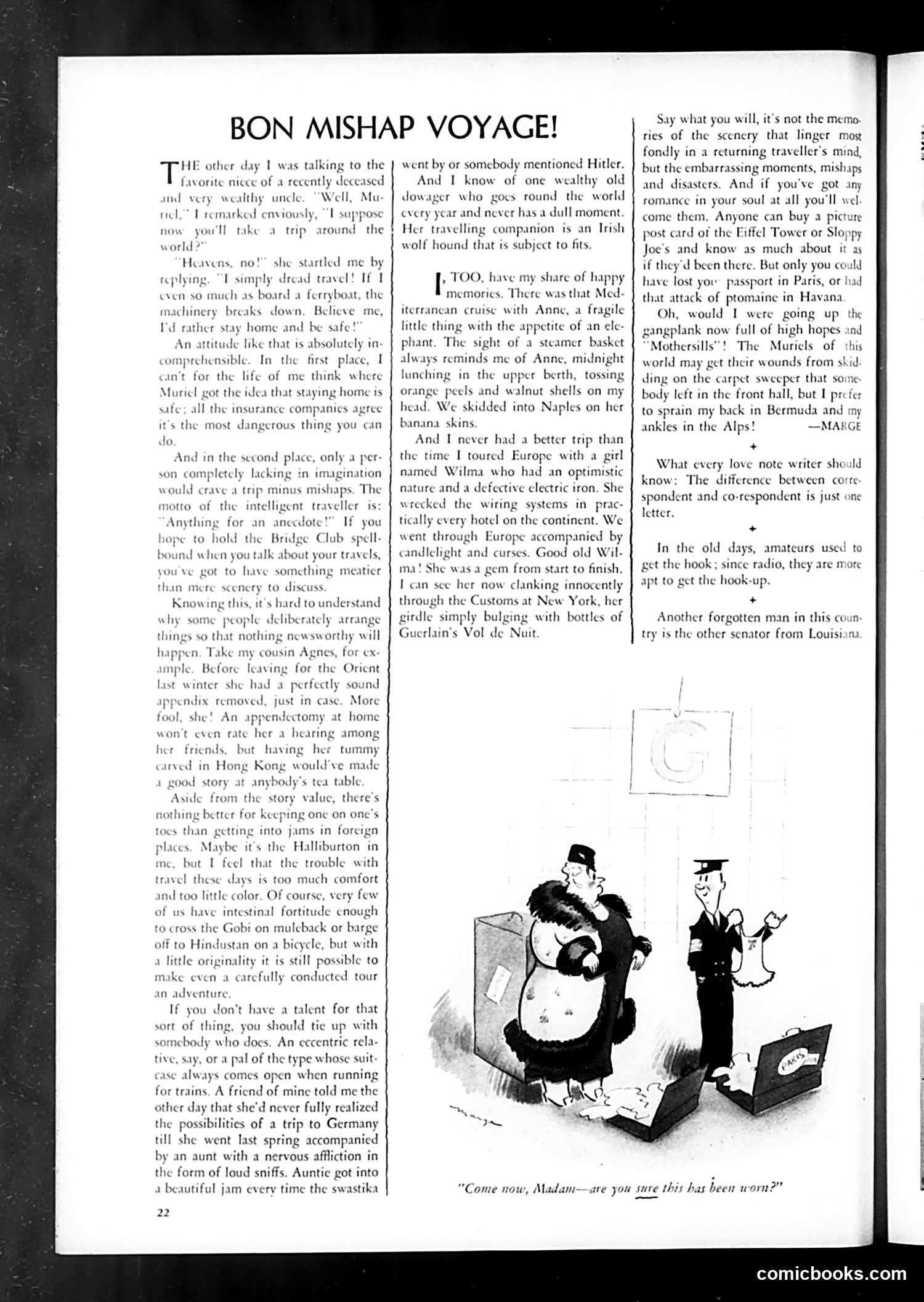
Explanation for Modern Readers This 1930s *Life* magazine article satirizes travel culture and the wealthy. The author argues that disastrous trips make better stories than pleasant ones—mishaps are more memorable than scenery. The accompanying cartoon depicts a customs inspection, with the caption "Come now, Madam—are you sure this has been worn?" This likely mocks wealthy travelers smuggling luxury goods (like the perfume "Vol de Nuit" mentioned in the text) through customs by wearing them to avoid declaration. The article references Hitler and swastikas in passing, indicating pre-WWII timing when these were still emerging symbols of Nazi Germany, not yet universally recognized as the ultimate evil. The overall satire targets upper-class Americans who traveled for social status and amusing anecdotes rather than genuine experience—valuing the "Bridge Club" gossip value of travel disasters over actual adventure or cultural understanding.
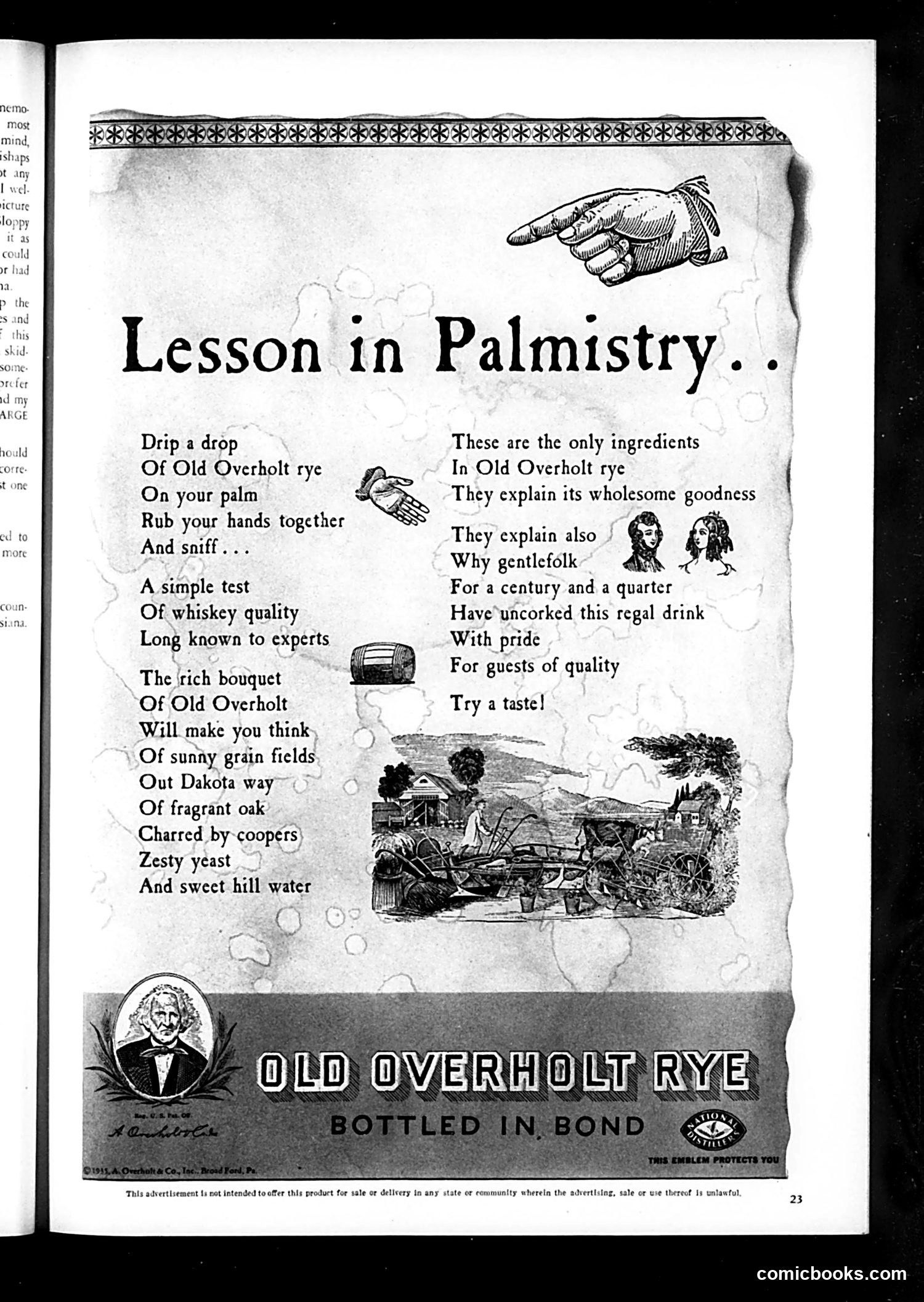
"Lesson in Palmistry" — Old Overholt Rye Advertisement This is a full-page whiskey advertisement disguised as entertainment. The "palmistry" angle is a gimmick: the ad instructs readers to drip whiskey on their palm, rub their hands, and smell it—presenting this as a "simple test" that "experts" use to judge quality. The ad emphasizes Old Overholt's purity and prestige: only basic ingredients (grain, oak, yeast, water), endorsement by "gentlefolk" for "a century and a quarter," and suitability for "guests of quality." The pastoral engraving of farmland reinforces wholesomeness. The small disclaimer at the bottom—stating the ad isn't meant to offer the product where advertising or sale is "unlawful"—is crucial context: this appeared during or just after Prohibition (1920-1933), when alcohol advertising and sales were federally banned. The disclaimer is a thin legal fig leaf acknowledging the ad violates the law it claims to respect.
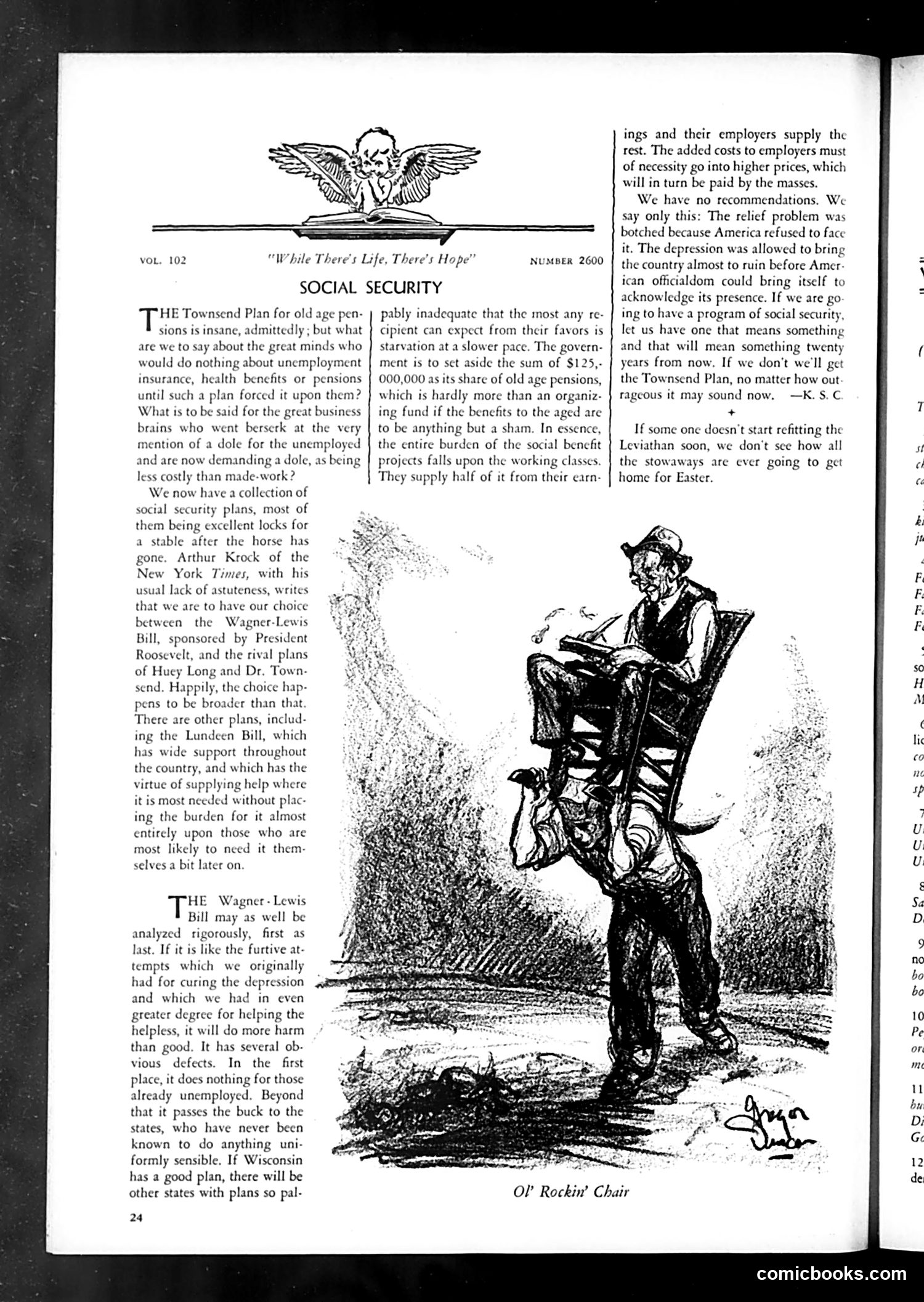
Social Security Debate, circa 1935 This Life magazine page satirizes competing Depression-era social security proposals. The cartoon "Ol' Rockin' Chair" depicts an elderly man in a rocking chair—likely representing the dependent elderly or retired worker—suggesting obsolescence and helplessness. The article critiques the Wagner-Lewis Bill (sponsored by President Roosevelt) as inadequate, calling it a "lock for a stable after the horse has gone"—meaning it addresses problems too late. The author dismisses rival plans from Huey Long and Dr. Townsend as equally flawed, while supporting broader alternatives like the Lundeen Bill. The core satire: politicians ignored unemployment and poverty until forced by radical proposals like Townsend's, yet their compromises still burden working people through higher prices while providing minimal actual relief. The message warns that inadequate half-measures will drive Americans toward more extreme political solutions.
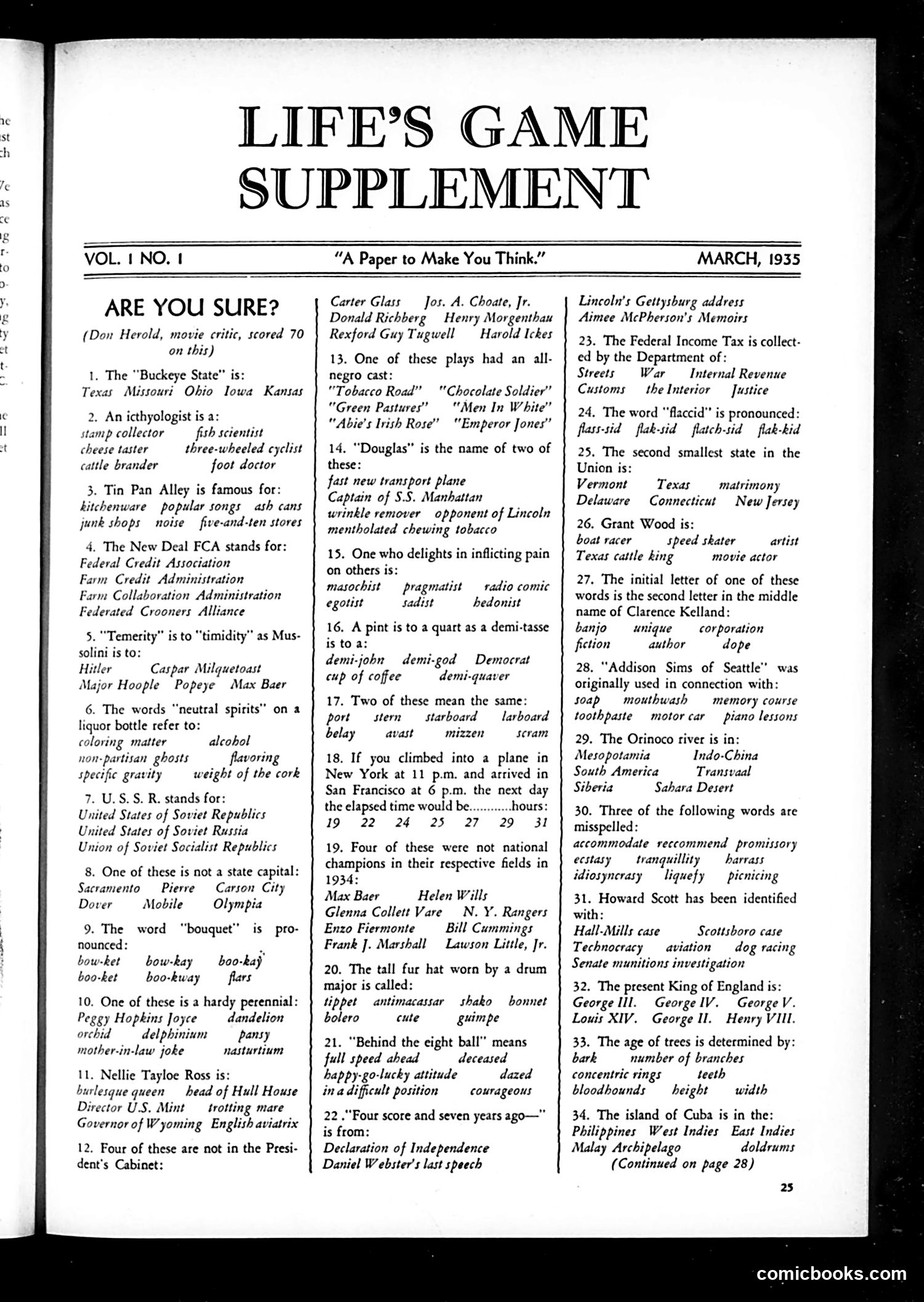
Life's Game Supplement, March 1935 This is a trivia quiz page titled "Are You Sure?" designed to test readers' knowledge across history, current events, and general culture. The quiz references 1930s personalities and events: Political/Social References: - Question 5 compares Mussolini to political figures, reflecting fascism's contemporary prominence - Question 12 lists actual New Deal administrators (Morgenthau, Tugwell, Ickes), testing readers' familiarity with Roosevelt's cabinet - Question 22 attributes Lincoln's Gettysburg Address to various speakers, including radio evangelist Aimee McPherson—likely satirizing her self-promotion - Question 19 references 1934 sports champions (Max Baer, Helen Wills) The Satire's Point: Don Herold, a movie critic, scored only 70 points, suggesting the quiz mixes easy and deliberately tricky questions to humiliate even educated readers. The subtitle "A Paper to Make You Think" ironically undercuts readers' confidence in their own knowledge during economically uncertain times.
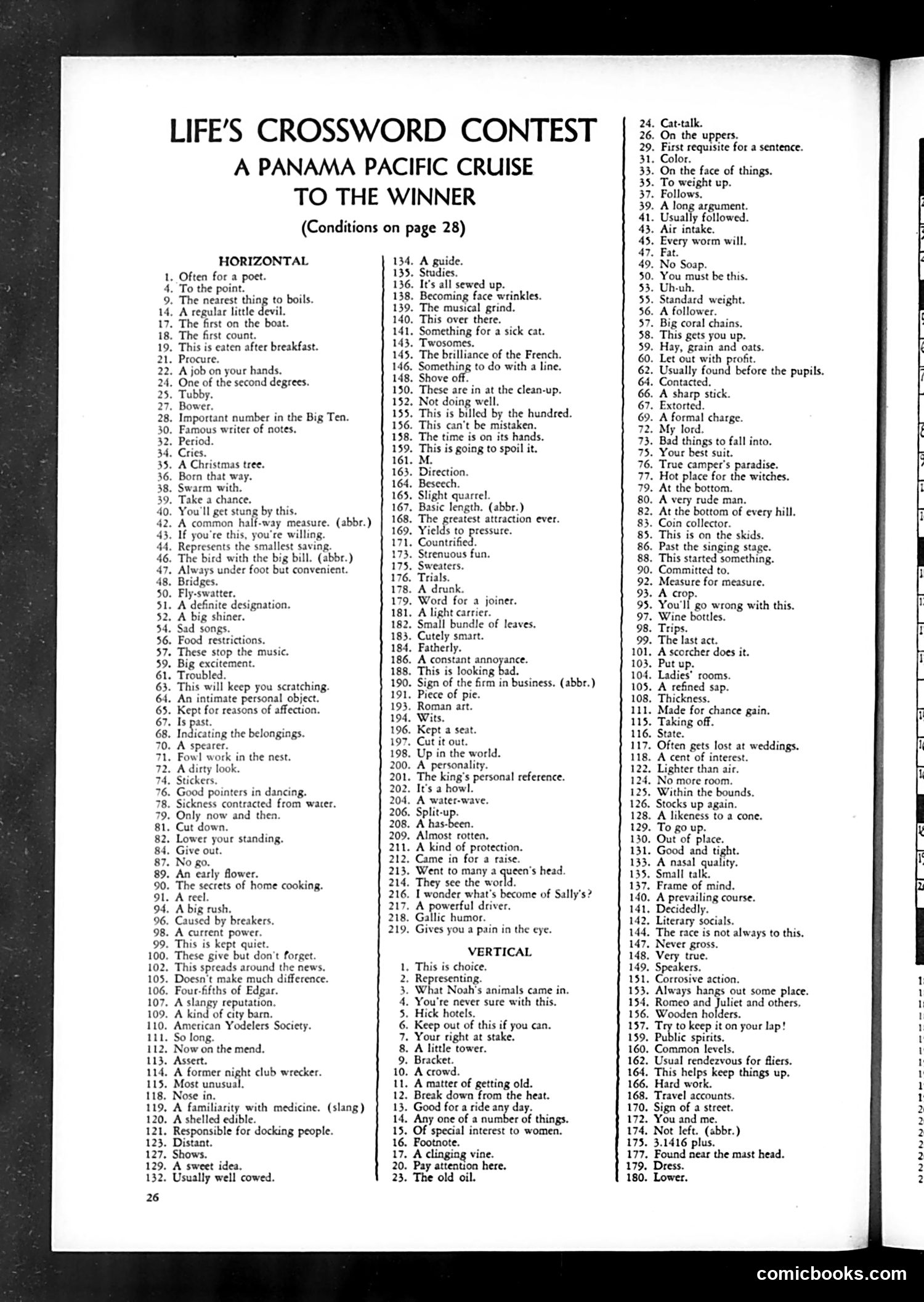
Life's Crossword Contest Page This page presents a crossword puzzle contest, not a political cartoon. Life magazine (known for satirical humor and social commentary) is offering a Panama Pacific Cruise as the prize to whoever solves the puzzle correctly. The clues themselves contain dated references and wordplay typical of 1920s-30s Life magazine humor. References like "American Yodelers Society" (110 Horizontal), "A former night club wrecker" (114 H—likely alluding to Prohibition-era raids), and "What Noah's animals came in" (3 Vertical—the Ark) reflect the era's cultural preoccupations. The puzzle is primarily a contest vehicle rather than satire itself—a common magazine feature of the period designed to engage readers while promoting the publication. The clues use puns and oblique wordplay typical of Life's sophisticated, educated readership.
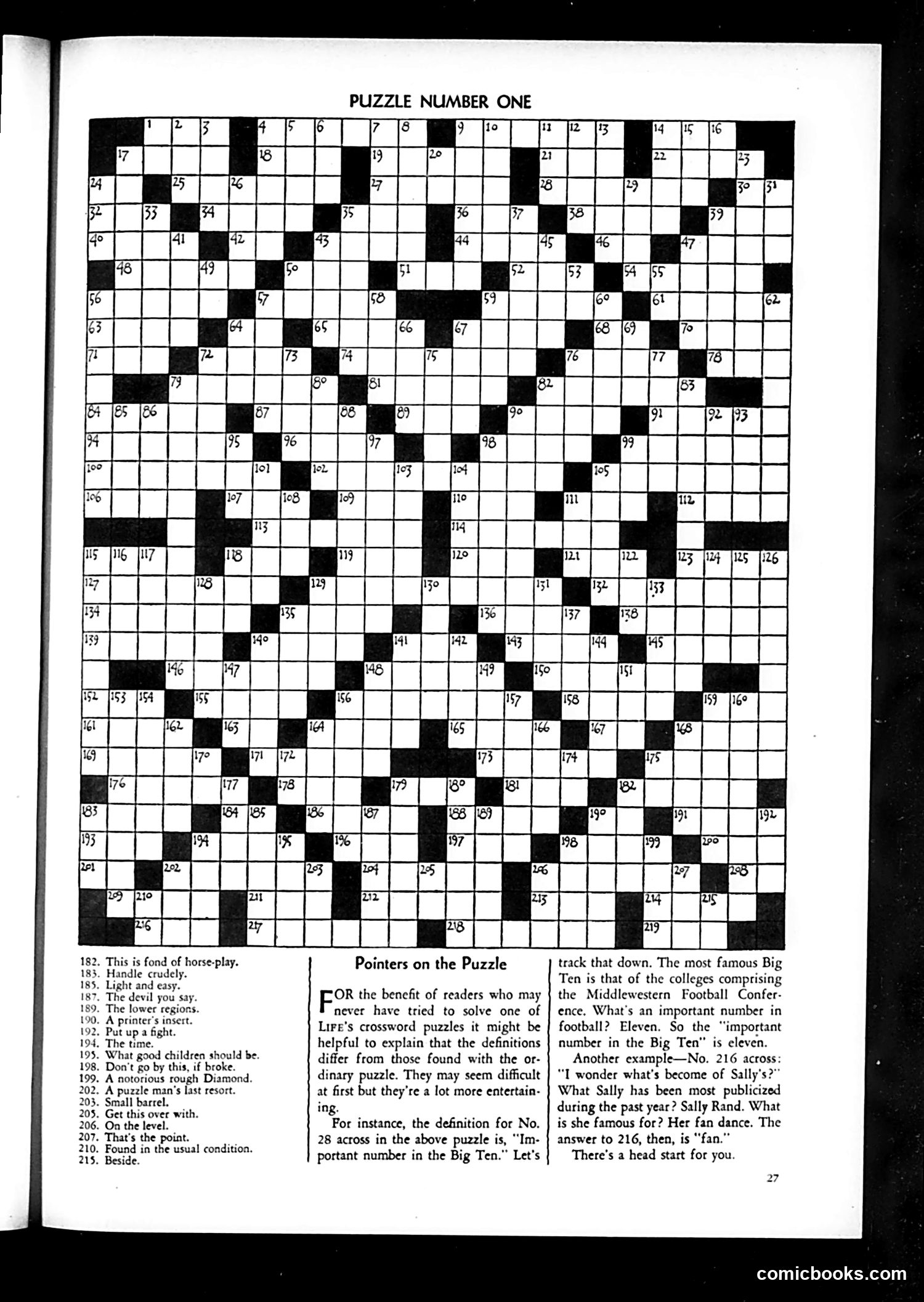
Explanation for Modern Readers This page is not a political cartoon but rather a crossword puzzle from *Life* magazine with instructional guidance for solvers. The page presents "Puzzle Number One" and includes a section titled "Pointers on the Puzzle" explaining *Life*'s distinctive approach: their clue definitions differ deliberately from standard crosswords, using wordplay and indirect references rather than straightforward definitions. The text provides two examples: 1. "Important number in the Big Ten" = ELEVEN (referencing the Midwestern college football conference, where eleven is the standard team size) 2. "I wonder what's become of Sally's?" = FAN (referring to Sally Rand, a famous performer publicized for her fan dance) This demonstrates how *Life* puzzles required cultural knowledge and lateral thinking—solvers needed familiarity with contemporary celebrities and sports to solve them. The magazine positioned this as more "entertaining" than ordinary puzzles, offering readers intellectual engagement tied to current events and popular culture.
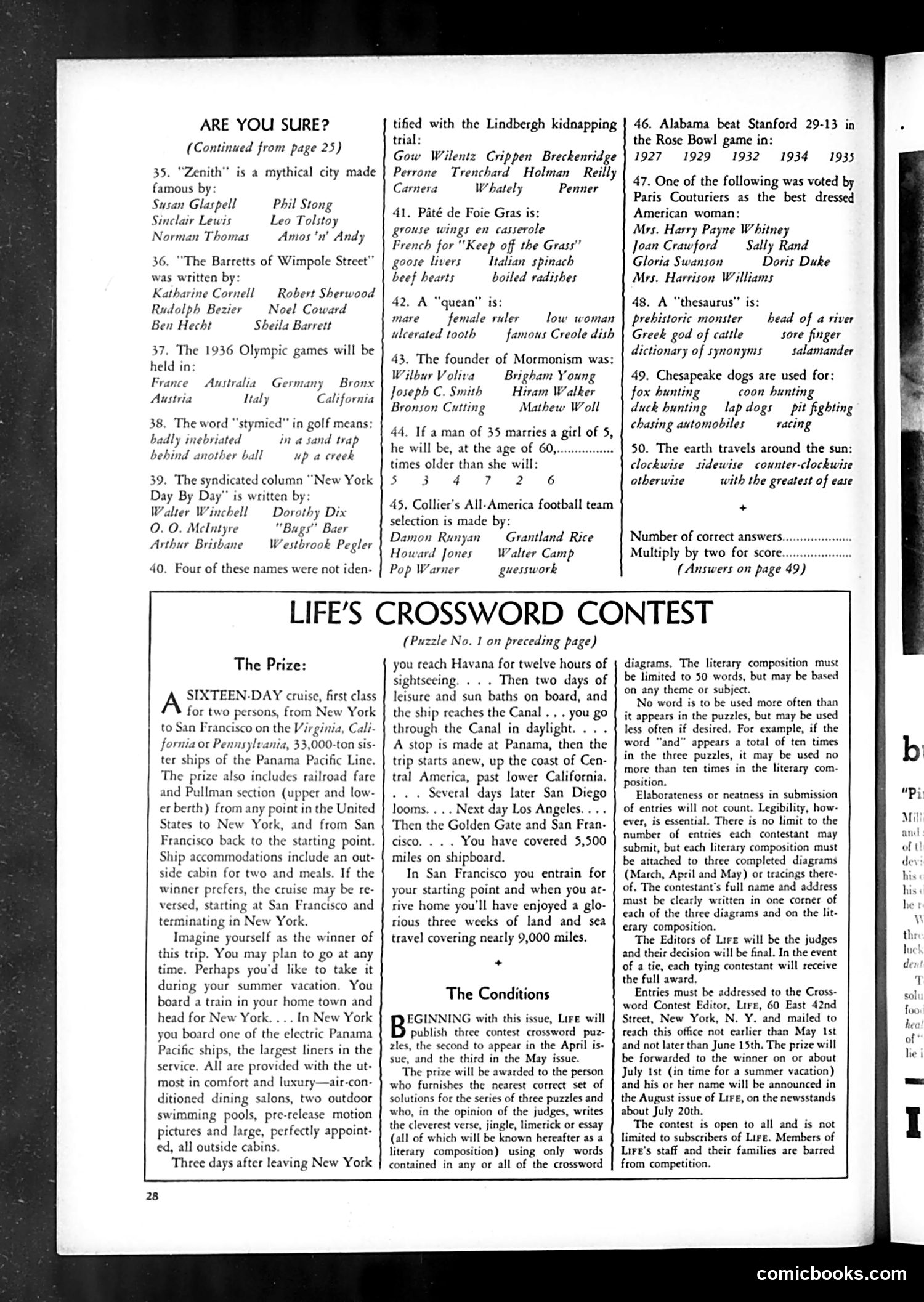
Analysis of Life Magazine Page Content This page contains a trivia quiz contest ("Are You Sure?") and announces Life's Crossword Contest—not a political cartoon. The quiz tests readers' knowledge on diverse topics: literature (Sinclair Lewis, Noel Coward), sports (Olympic venues, golf terminology), journalism (Walter Winchell), and current events (the Lindbergh kidnapping trial, a sensational 1932-1935 crime that captivated America). The main contest offers a luxurious prize: a 16-day first-class cruise from New York to San Francisco aboard Panama Pacific steamships, plus train fare—reflecting the Depression-era appeal of aspirational travel entertainment. Readers solve crossword puzzles across three issues (March-May) competing for this grand prize. The page reflects 1930s American popular culture: references to famous trials, radio columnists, sports figures, and the glamour of ocean liner travel as entertainment for magazine readers.
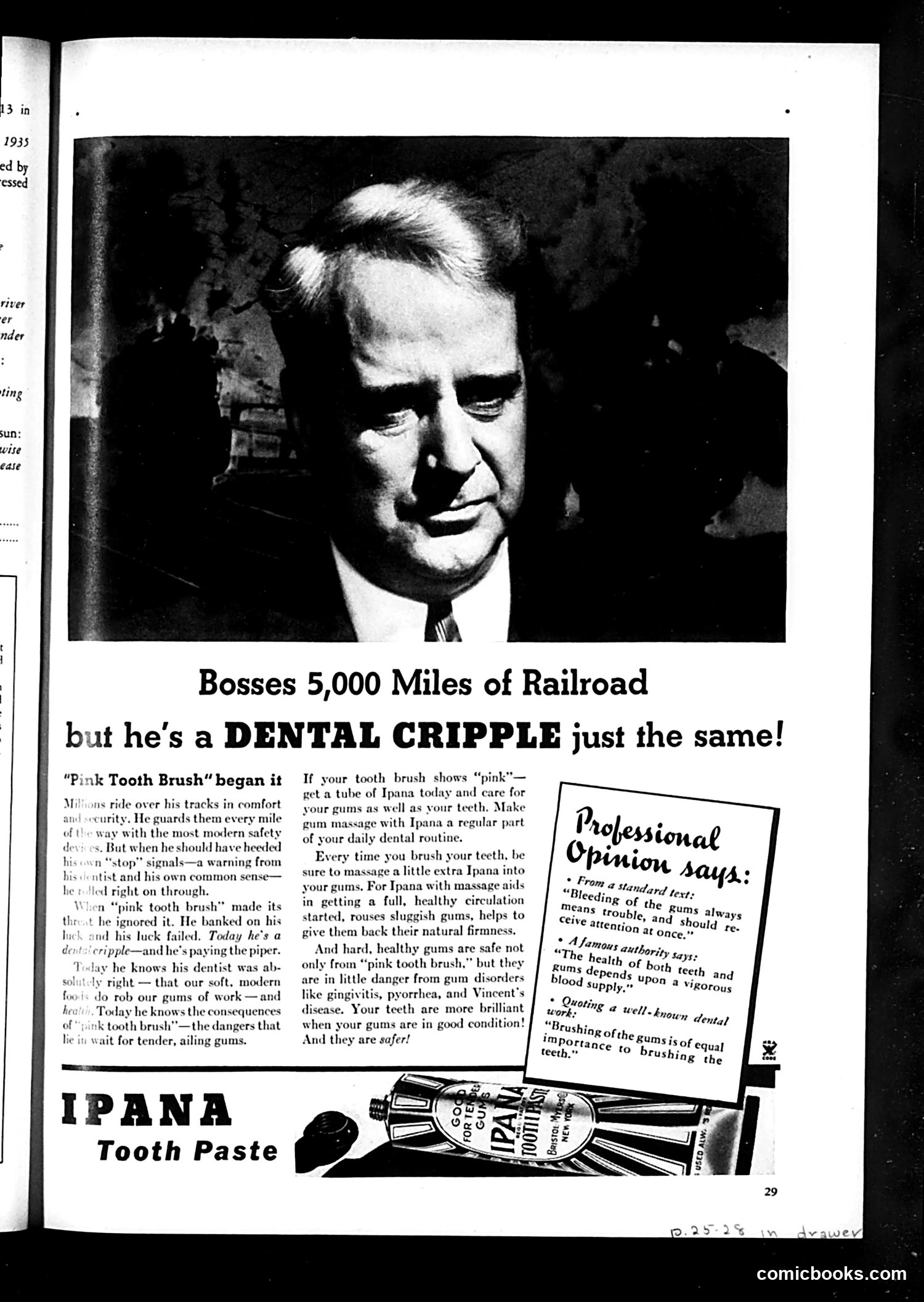
Analysis This is a vintage toothpaste advertisement, not a political cartoon. It uses a specific social anxiety pitch: a successful railroad executive who manages 5,000 miles of track but has neglected his gums and now suffers from "dental cripple" status. The ad plays on class anxiety and shame. Despite his professional achievement and power, this man ignored warning signs (the "pink tooth brush" indicating gum disease) and is now paying the price. The implied message: even the most powerful and competent men can fail at basic self-care. The advertisement for Ipana Tooth Paste positions itself as the solution, promoting gum massage alongside brushing. Professional endorsements in a sidebar box add credibility. The era (likely 1930s-40s based on the magazine and photographic style) normalized such shame-based advertising targeting masculinity and social status. A man's professional success couldn't mask physical decline caused by dental neglect—a powerful motivator to purchase the product.
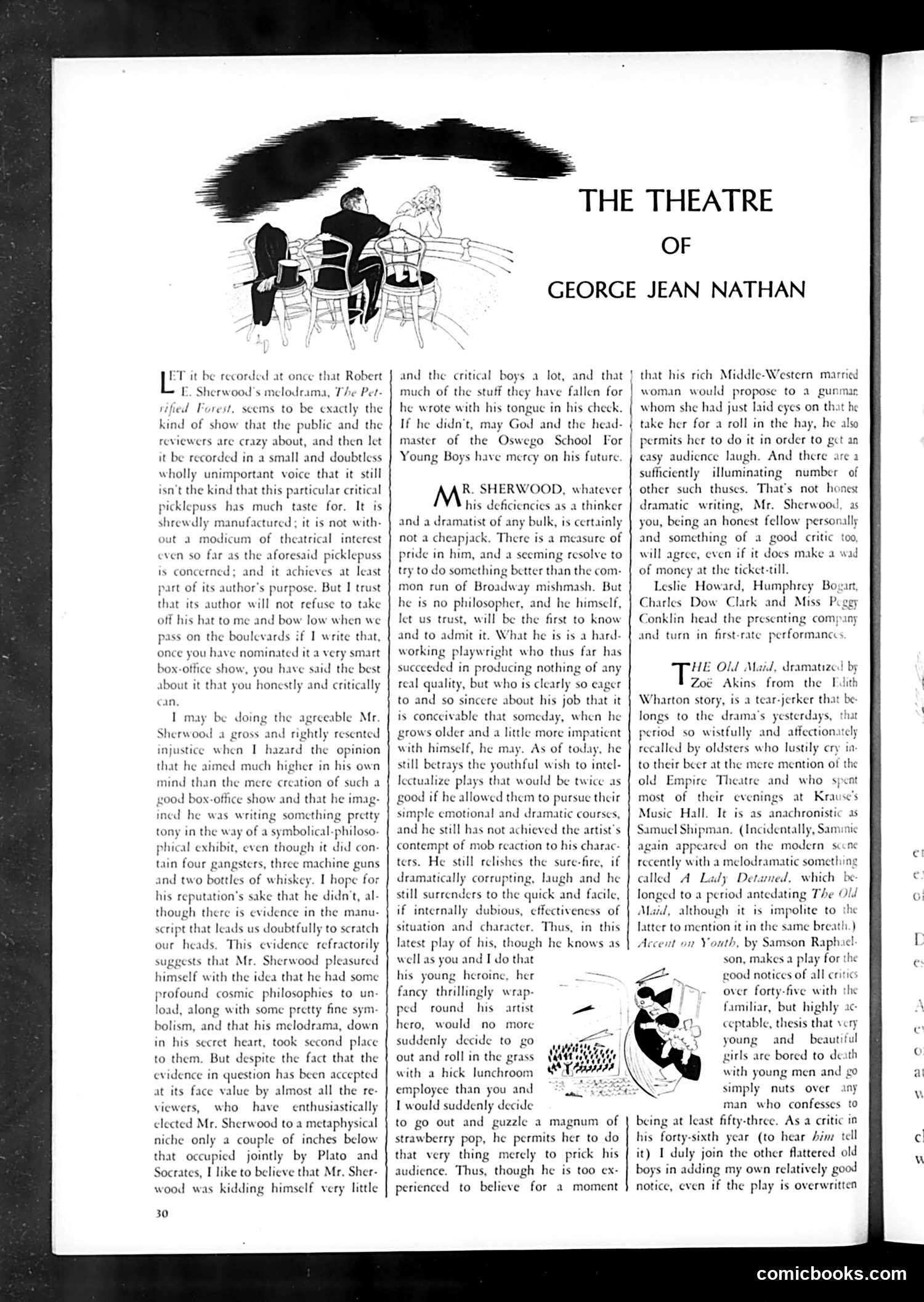
Understanding This Theatre Critique This is critic George Jean Nathan's review of Robert E. Sherwood's play *The Petrified Forest*. The illustration shows three figures in conversation, representing the theatrical world being discussed. Nathan praises the play as commercially successful ("smart box-office show") but criticizes Sherwood for aspiring beyond his abilities. The reviewer suspects Sherwood imagined he was writing profound philosophical drama when he should stick to straightforward melodrama—four gangsters, three machine guns, and whiskey. Nathan's core complaint: Sherwood tries to intellectualize entertainment, when audiences and critics have mistakenly elevated his work to philosophical importance (comparing him to Plato and Socrates). Nathan argues Sherwood lacks the artistic maturity to either write genuine philosophy or dismiss popular approval—he still chases laughs and "sure-fire" effects rather than pursuing genuine art. The satire targets both Sherwood's pretensions and critics' gullibility in over-praising commercial theatre as serious literature.
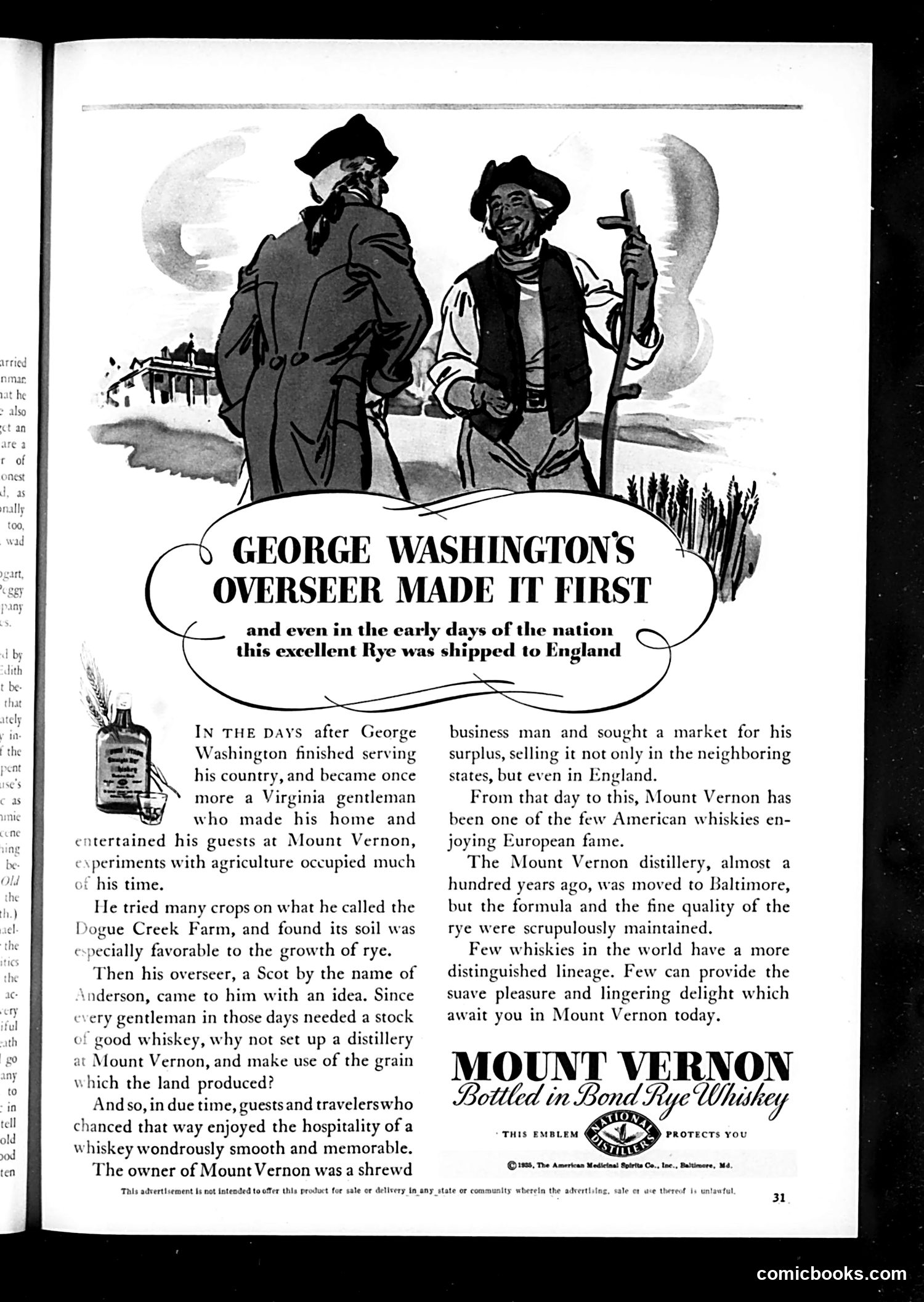
Mount Vernon Rye Whiskey Advertisement This is a whiskey advertisement, not political satire. It uses George Washington's historical credibility to market Mount Vernon brand rye whiskey. The ad claims Washington, after leaving the presidency, experimented with rye cultivation at his Virginia estate. His Scottish overseer Anderson supposedly suggested establishing a distillery. The narrative asserts that Washington's whiskey became successful enough to export to England—positioning the brand as authentically American and historically distinguished. The two illustrated figures appear to represent Washington and his overseer discussing the business venture. The ad leverages Washington's name and Mount Vernon's fame to suggest the product carries presidential-level quality and heritage. Though the distillery later moved to Baltimore, the ad emphasizes the original formula was "scrupulously maintained." This is straightforward historical marketing rather than satire—using founding-father association to build consumer trust and justify premium pricing.
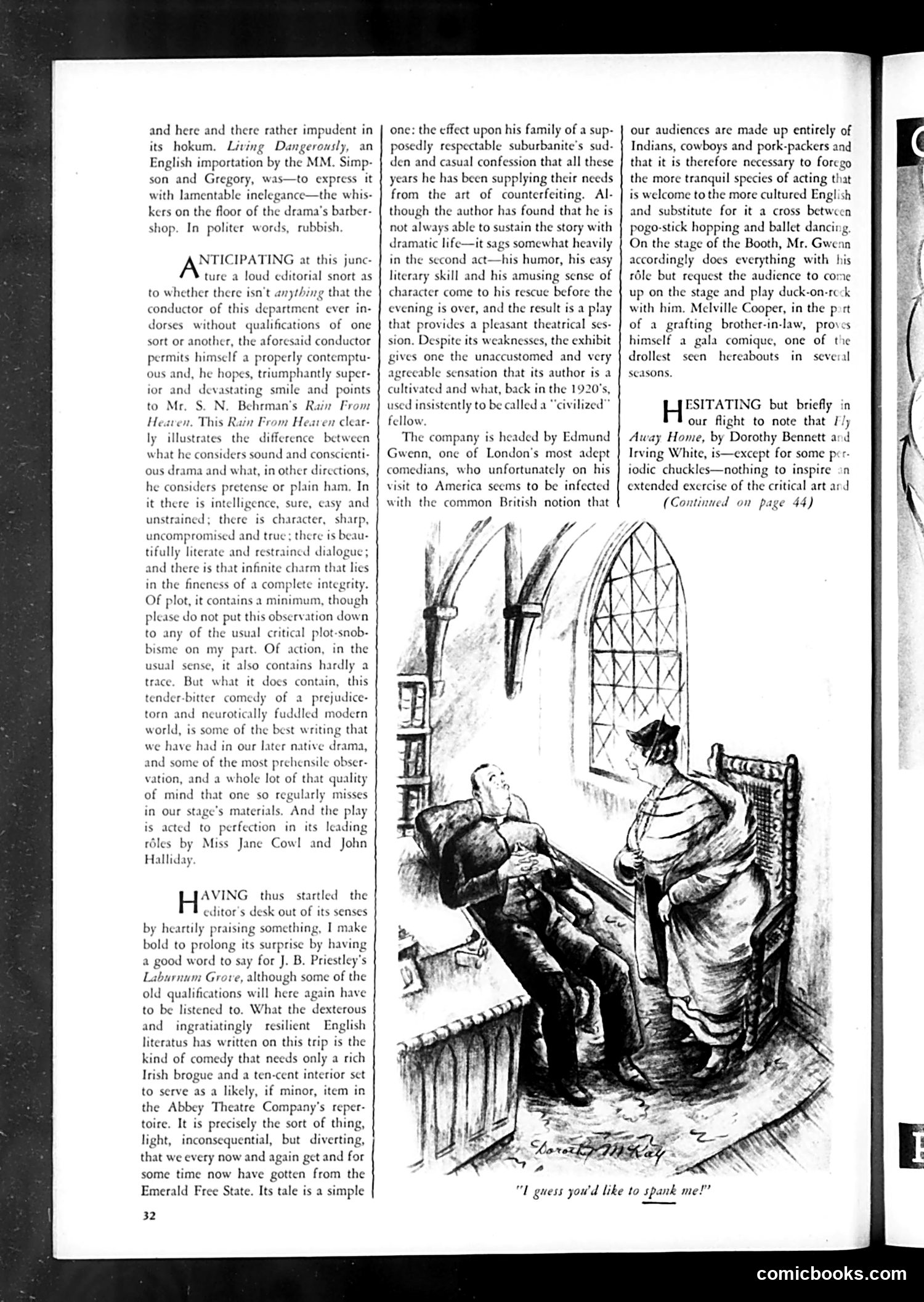
Theater Review Cartoon Analysis This page critiques theatrical performances and British actors' attitudes toward American audiences. The accompanying sketch shows a scene from "Laburnum Grove," a J.B. Priestley comedy about a respectable suburban man who confesses to counterfeiting money. The text praises the play's witty writing despite structural weaknesses. However, it contains sharp social satire: the reviewer criticizes Edmund Gwenn (the lead actor, "one of London's most adept comedians") for adopting an exaggerated performance style, assuming American audiences consist only of "Indians, cowboys and pork-packers" rather than cultured theatergoers. The cartoon illustrates this condescension—showing what appears to be broad, physical comedy staging. The satire targets British actors' stereotyping of American audiences as unsophisticated, contrasting refined English theater traditions with perceived American vulgarity.
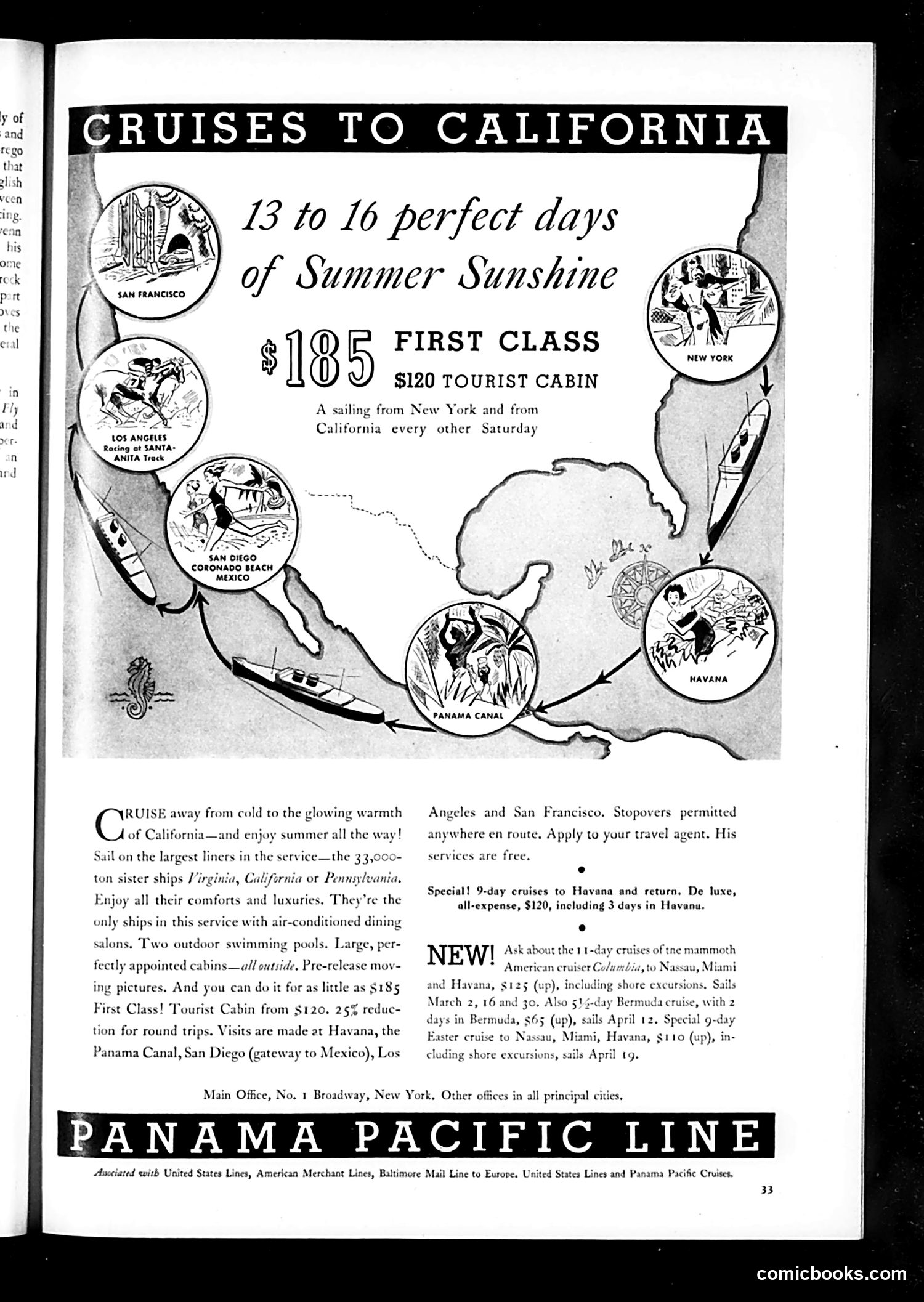
Panama Pacific Line Cruise Advertisement This is a travel advertisement, not political satire. It promotes luxury Caribbean and California cruises offered by the Panama Pacific Line during what appears to be the 1930s. The page shows a stylized map illustrating cruise routes from New York to California ports (San Francisco, Los Angeles, San Diego) with stops in Mexico, the Panama Canal, and Havana. Circular illustrations depict destinations: San Francisco, New York, Los Angeles, Coronado Beach/Mexico, Panama Canal, and Havana. The pitch emphasizes affordable luxury—$185 First Class or $120 Tourist Cabin—aboard large liners (Virginia, California, Pennsylvania). Amenities highlighted include air-conditioned dining, swimming pools, and outside cabins. The message targets middle-class Americans seeking escape to warm destinations during summer. There is no satire or caricature here; this is straightforward commercial promotion encouraging leisure travel during the pre-WWII era.
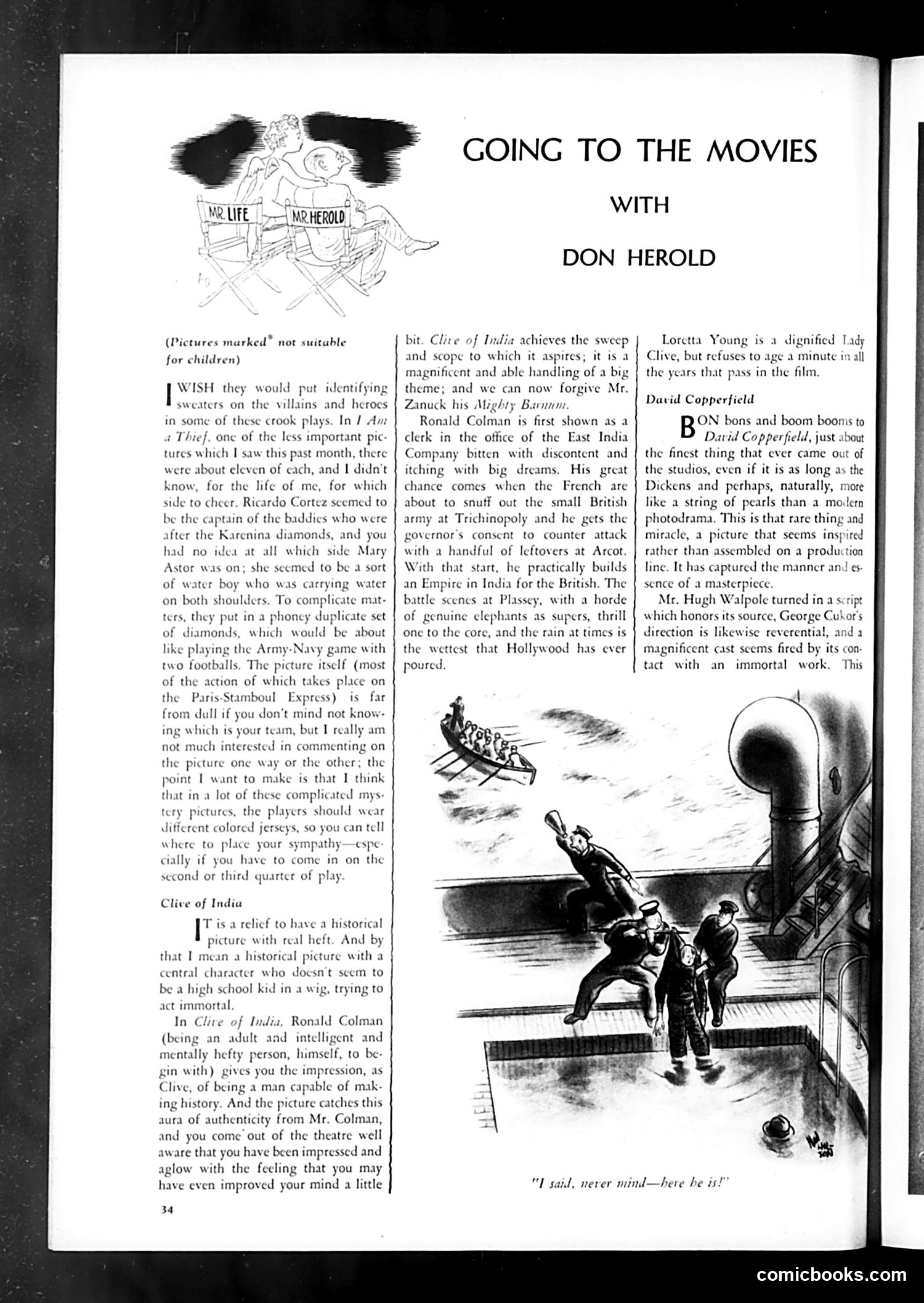
Analysis of Life Magazine Movie Review Page This is a satirical movie review column by Don Herold critiquing contemporary films from the 1930s. The humor targets common problems in mystery films: confusing plots where viewers can't distinguish heroes from villains. Herold jokes that actors should wear colored jerseys (like sports teams) so audiences know whom to root for—mocking overly complicated narratives in films like "I Am a Thief" starring Ricardo Cortez and Mary Astor. The column praises "Clive of India" for being a serious historical epic with Ronald Colman as an adult actor capable of conveying gravitas, contrasting with younger actors unconvincingly playing historical figures. It lavishes praise on "David Copperfield," calling it superior filmmaking that honors Dickens rather than cheaply adapting it. The cartoon at top depicts two figures labeled "Mr. Life" and "Mr. Harold" reviewing films together—a visual pun on the column's concept.
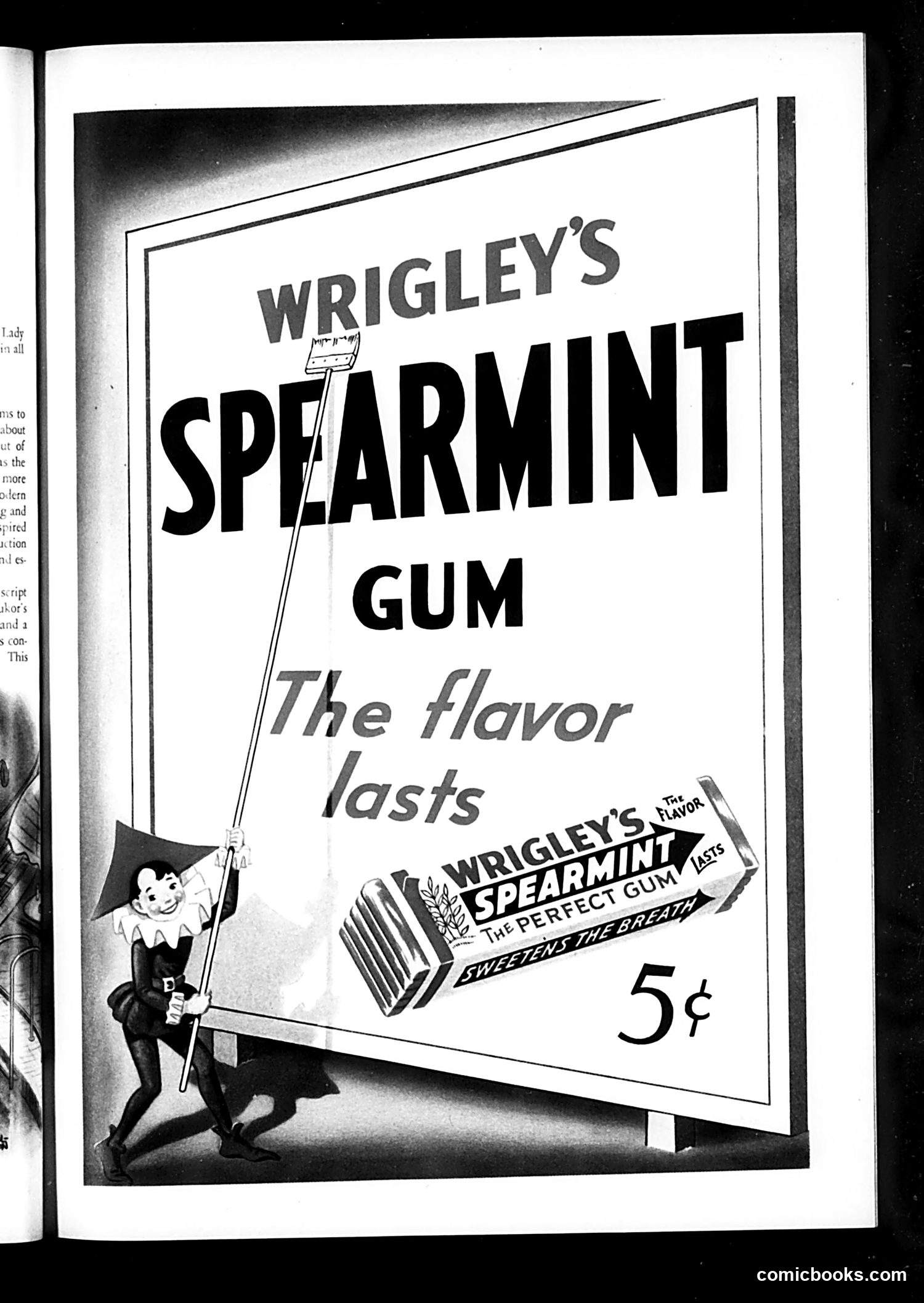
Wrigley's Spearmint Gum Advertisement This is a vintage advertisement for Wrigley's Spearmint Gum, priced at 5 cents. The ad features a cartoon character—appears to be a gnome or elf-like figure—holding a large spear or sword, positioned dramatically next to an oversized gum package. The tagline reads "The flavor lasts" and emphasizes that Spearmint is "The Perfect Gum" that "Sweetens the Breath." The visual pun associates the product name "Spearmint" with an actual spear, creating a playful, lighthearted marketing approach typical of early-to-mid 20th century advertising. Rather than political satire, this is purely commercial content designed to appeal to consumers through humor and memorable imagery.
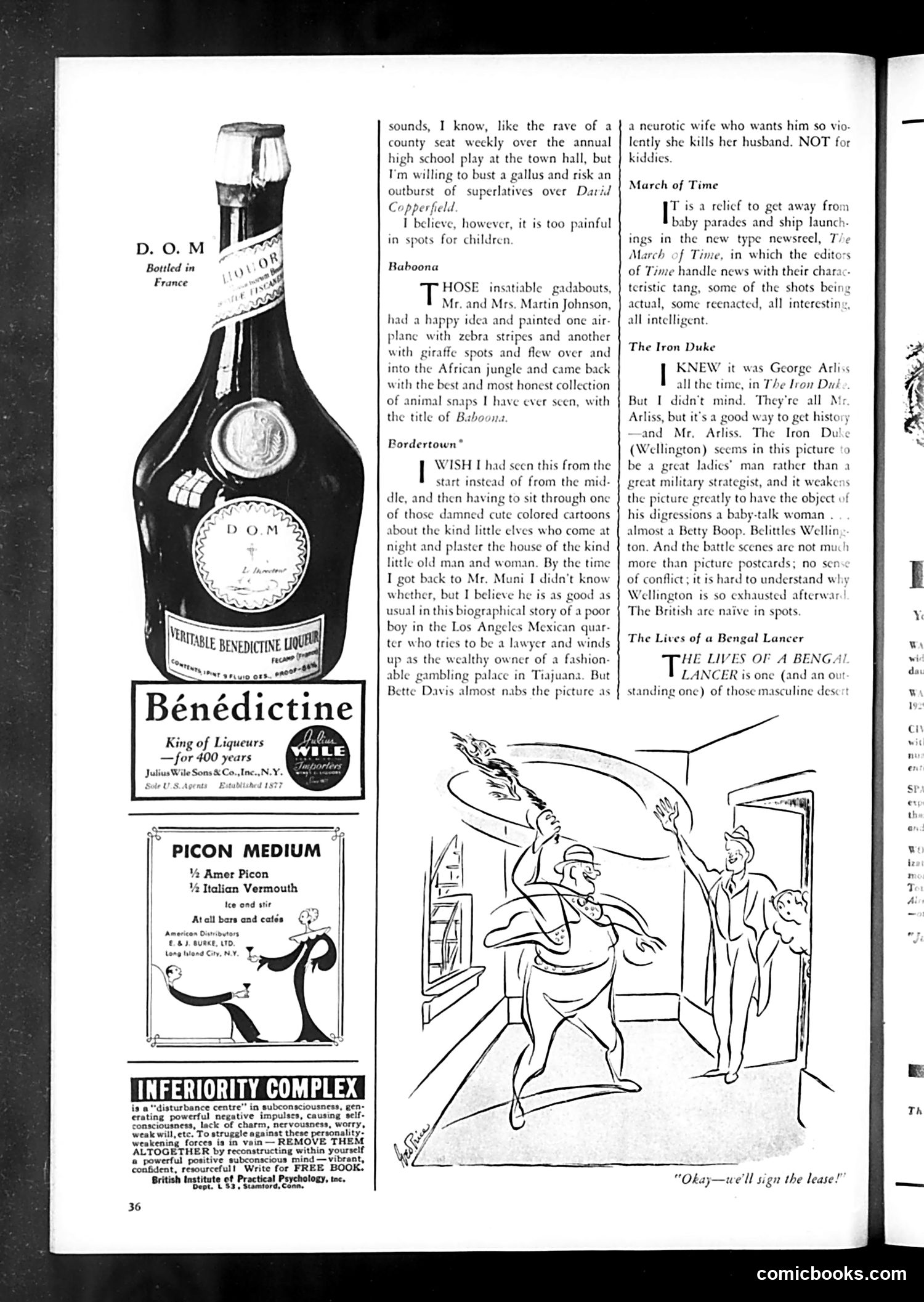
Page Analysis: Life Magazine Film Reviews & Advertisements This page combines film reviews with liquor advertisements typical of 1930s American magazines. The Cartoon The single cartoon depicts a chaotic domestic scene captioned "Okay—we'll sign the lease!" A couple appears to be moving or deciding on housing while their belongings fly about in disarray. The joke relies on the everyday frustration of relocation—suggesting they'll accept poor conditions simply to end the chaos of moving. Film Reviews The page reviews contemporary movies: *Baboona* (wildlife documentary by Martin Johnson), *Bordertown* (starring Paul Muni and Bette Davis), *March of Time* (newsreel series), *The Iron Duke* (George Arliss historical drama), and *The Lives of a Bengal Lancer*. The reviewer offers candid, somewhat caustic commentary—praising *Baboona's* authenticity while criticizing cutesy cartoon interludes, and dismissing *The Iron Duke* for portraying Wellington as a ladies' man rather than military strategist. Advertisements Three liquor ads dominate: Bénédictine, Picon Medium, and an Inferiority Complex "cure" promoting positive thinking—typical 1930s psychological self-help marketing disguised as remedial psychology.
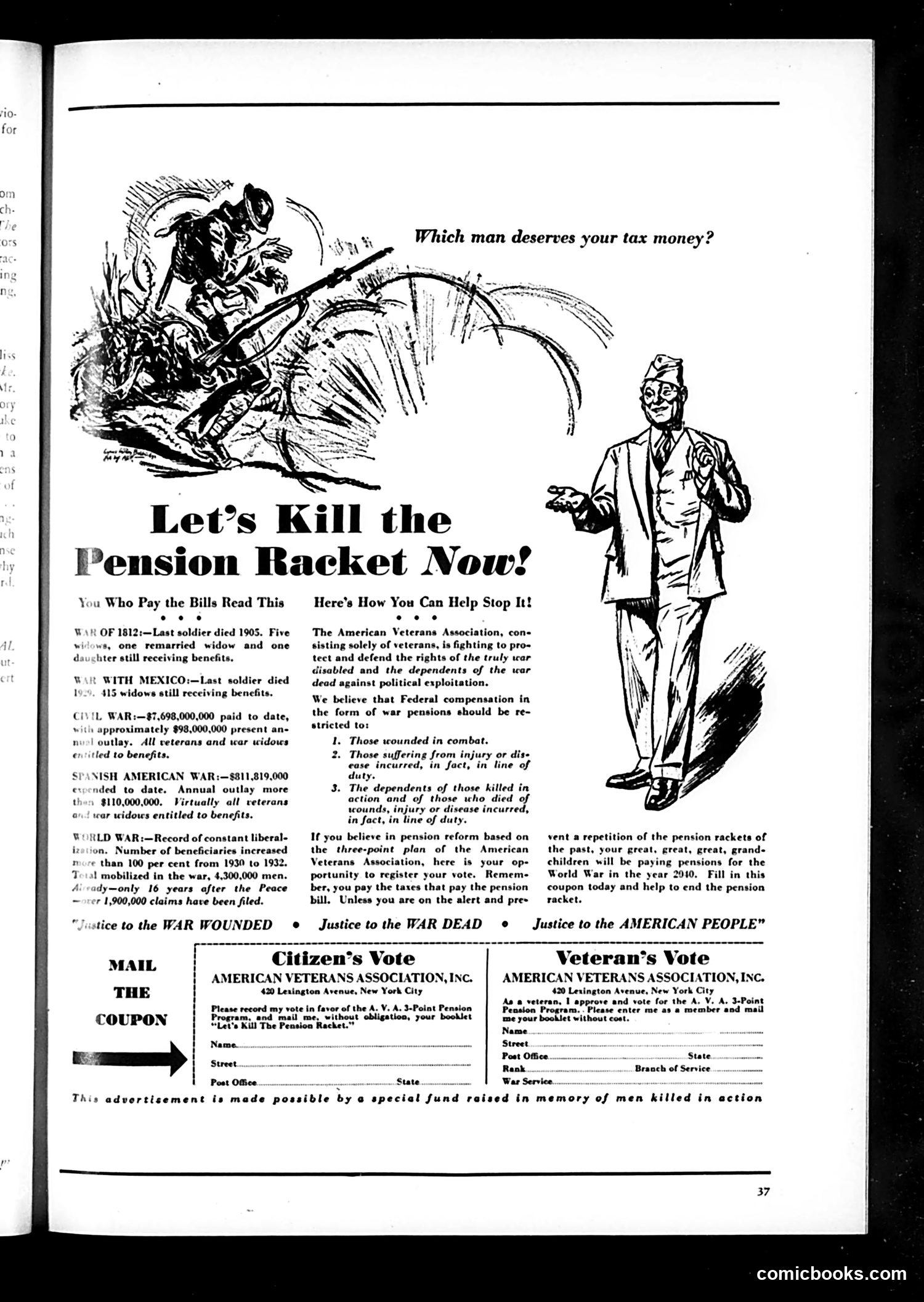
"Let's Kill the Pension Racket Now!" - Analysis This is a political advertisement, not satire, advocating against what the American Veterans Association calls excessive war pension spending. The page argues that pension benefits have become a "racket"—claiming costs balloon decades after wars end (citing 1,900,000 WWI claims filed 16 years post-peace). It presents statistics showing Civil War widows still collecting in 1905, suggesting indefinite liability. The cartoon (left) appears to show a figure caught in entangling vines—representing the messy consequences of unchecked pension expansion. A well-dressed man (right) represents the taxpayer burdened by these costs. The actual position: The AVA (consisting of veterans themselves) advocates restricting pensions to those wounded in combat, those injured in duty, and dependents of the war dead—rejecting broader benefit categories. They frame this as "reform" to prevent future generations from "paying pensions for the World War in the year 2010." The advertisement includes mail-in coupons for both citizens and veterans to register support for this restrictive three-point plan.
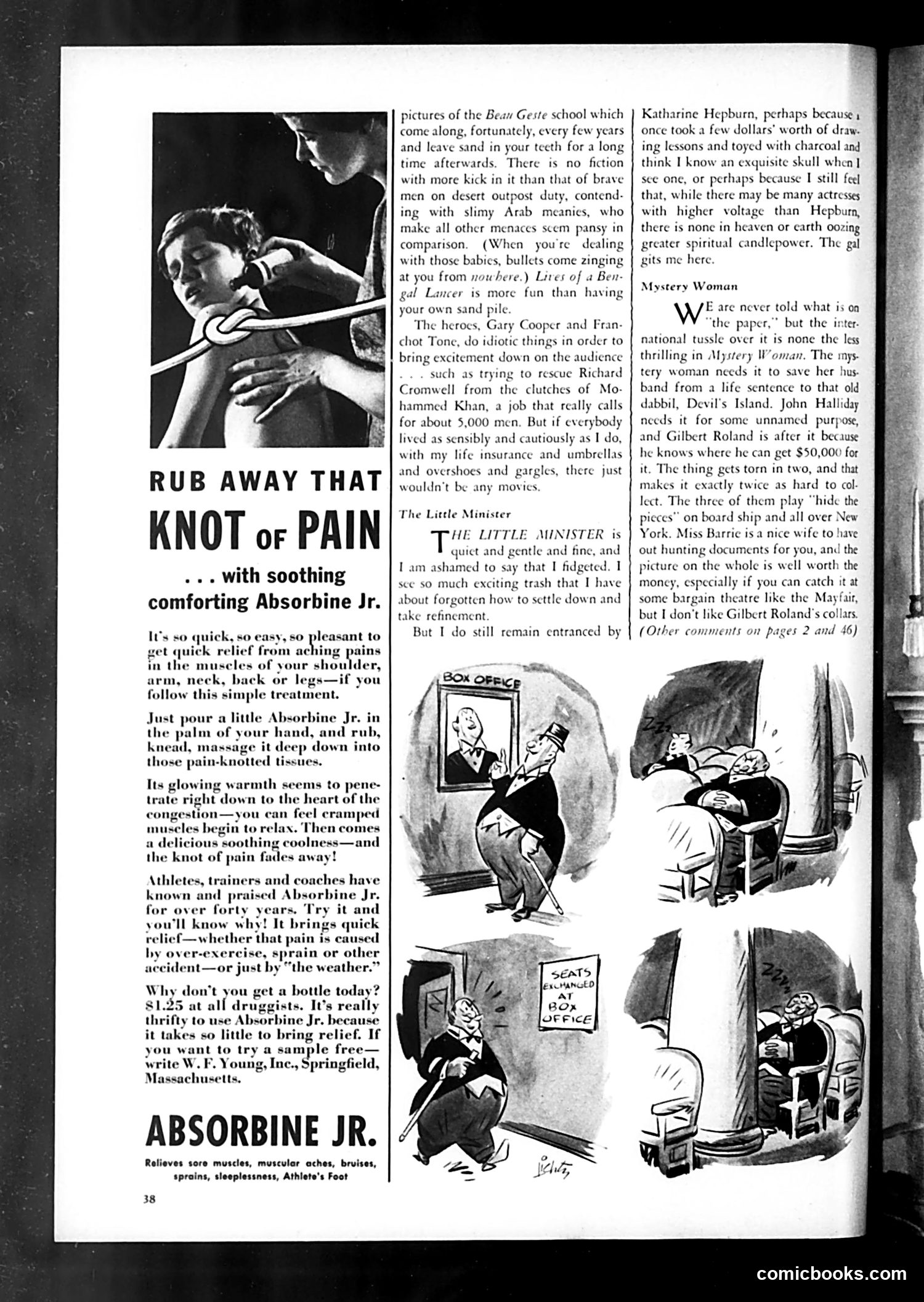
Page Analysis: Life Magazine Film Reviews & Advertisement This page combines an Absorbine Jr. liniment advertisement (left) with film reviews (right). The ad uses the classic pitch: rub this product on sore muscles for quick pain relief—targeting athletes and those with everyday aches. The reviews discuss three contemporary films: *Beau Geste* (praised for exciting desert action with Gary Cooper and Franchot Tone), *The Little Minister* (a quieter film notable for Katharine Hepburn's charisma), and *Mystery Woman* (a ship-based spy thriller involving a mysterious document and actors John Halliday and Gilbert Roland). The critic's tone is witty and personal—admitting she fidgets through refined drama but loves Hepburn's "spiritual candlepower," and dismissing Roland's collar style. No political satire is present; this is straightforward entertainment journalism alongside period advertising.
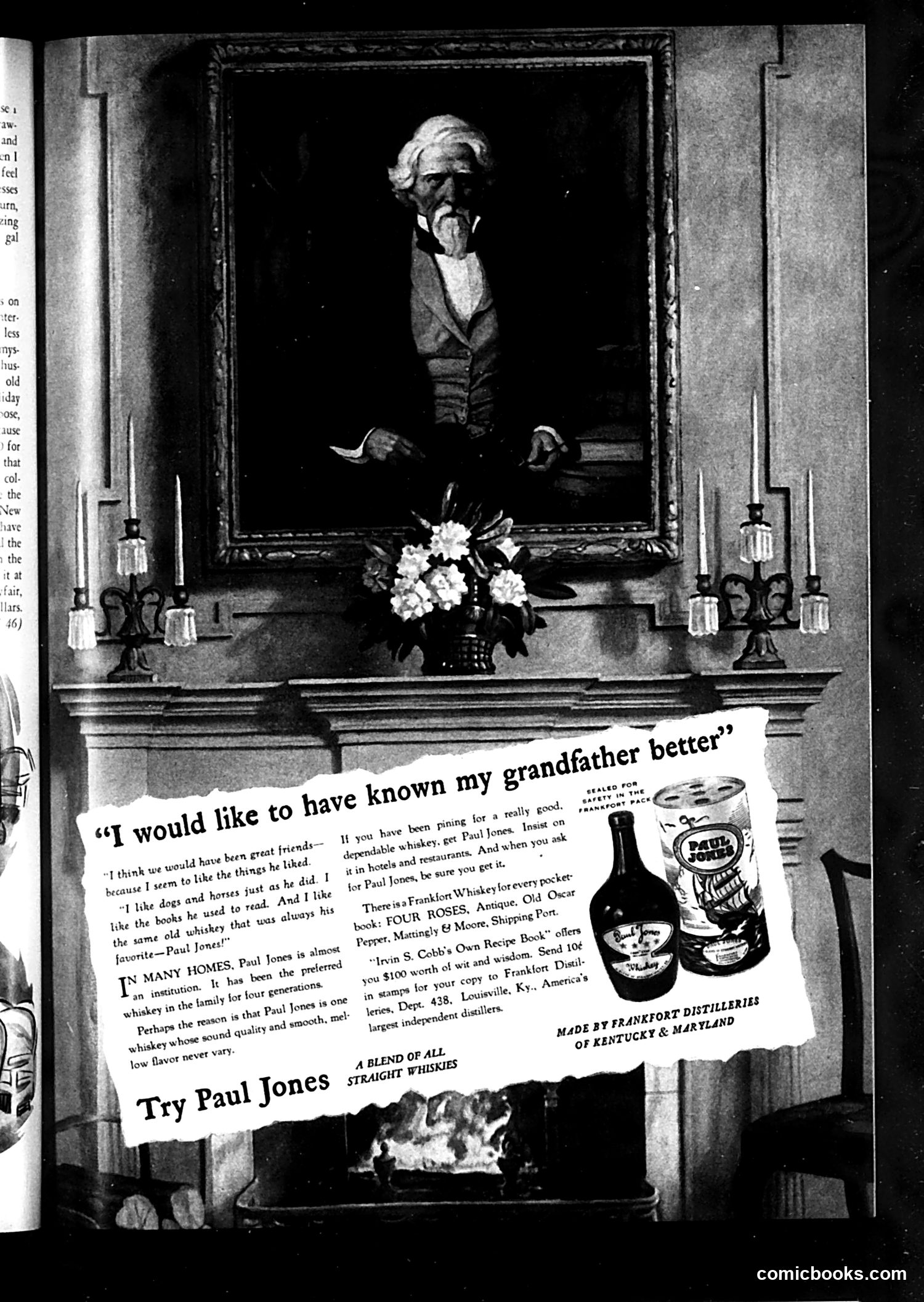
Analysis This is primarily a whiskey advertisement for Paul Jones brand, not a political cartoon. The ad uses a portrait of an elderly bearded gentleman (appearing to be a historical figure, possibly the distillery's founder or namesake) displayed above a fireplace mantle with candelabras and flowers. The advertisement's tagline—"I would like to have known my grandfather better"—attempts emotional appeal by suggesting the product connects to family heritage and tradition. The copy emphasizes Paul Jones whiskey's qualities and history as "a blend of all straight whiskies," made by Frankfort Distilleries. This represents typical mid-twentieth-century advertising strategy: linking consumer products to respectability, tradition, and nostalgia rather than the product's actual qualities.
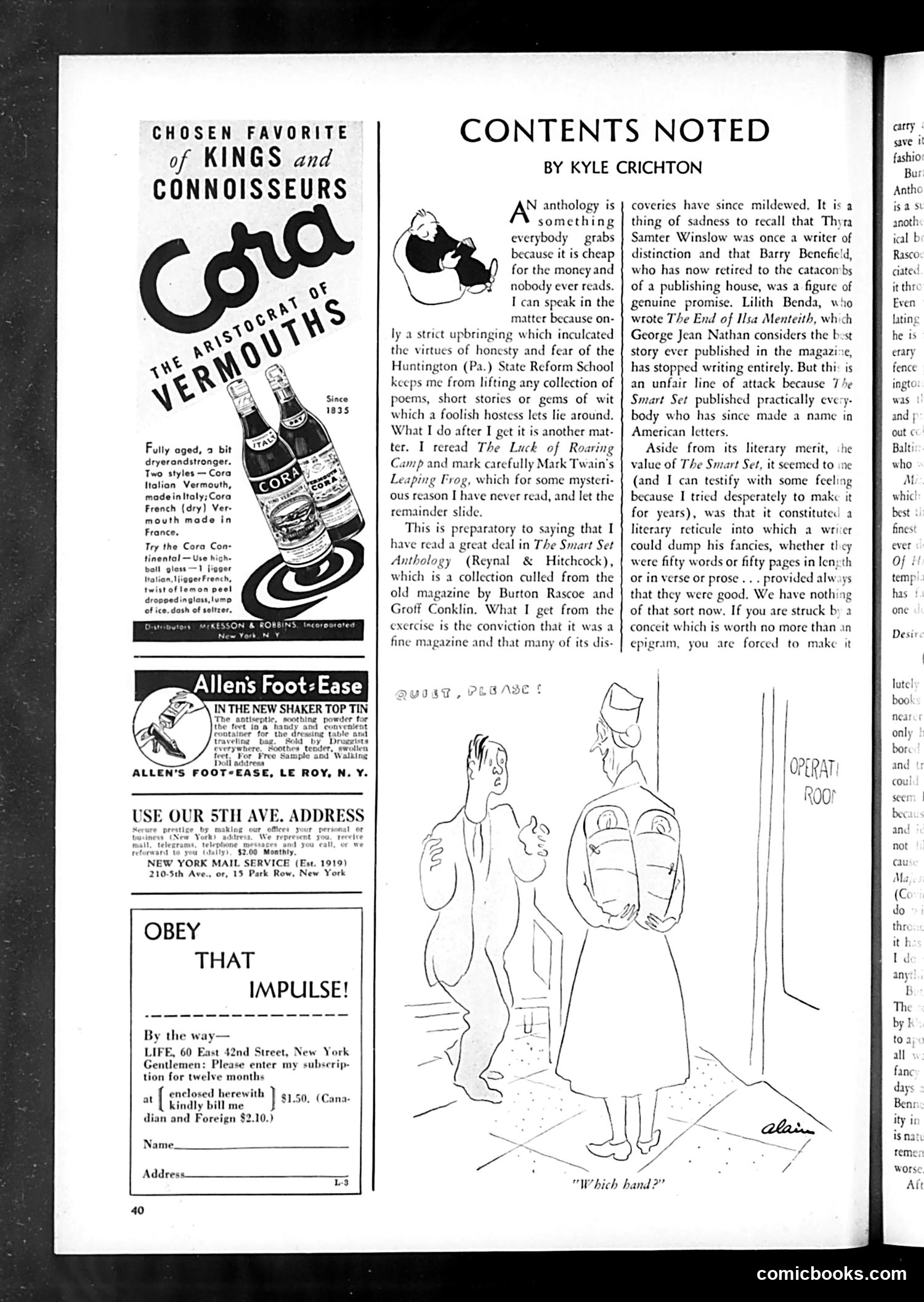
Analysis of Life Magazine Page This page is primarily advertising and editorial content rather than political satire. The main cartoon depicts a simple domestic scene: a woman showing two men what appears to be a marching band or musical group, with the caption "Which band?" The humor is gentle and social rather than political—likely a play on romantic competition or courtship confusion. The dominant content is Kyle Crichton's essay "Contents Noted," reviewing *The Smart Set Anthology*—a collection from the defunct literary magazine that published established and emerging American writers. Crichton reflects nostalgically on the magazine's cultural significance, noting that several once-promising writers (Thyra Samter Winslow, Barry Benefield) have since faded from prominence. The remaining space contains period advertisements: Cora Vermouth, Allen's Foot-Ease powder, and subscription solicitations for *Life* magazine itself. No significant political content appears on this page.
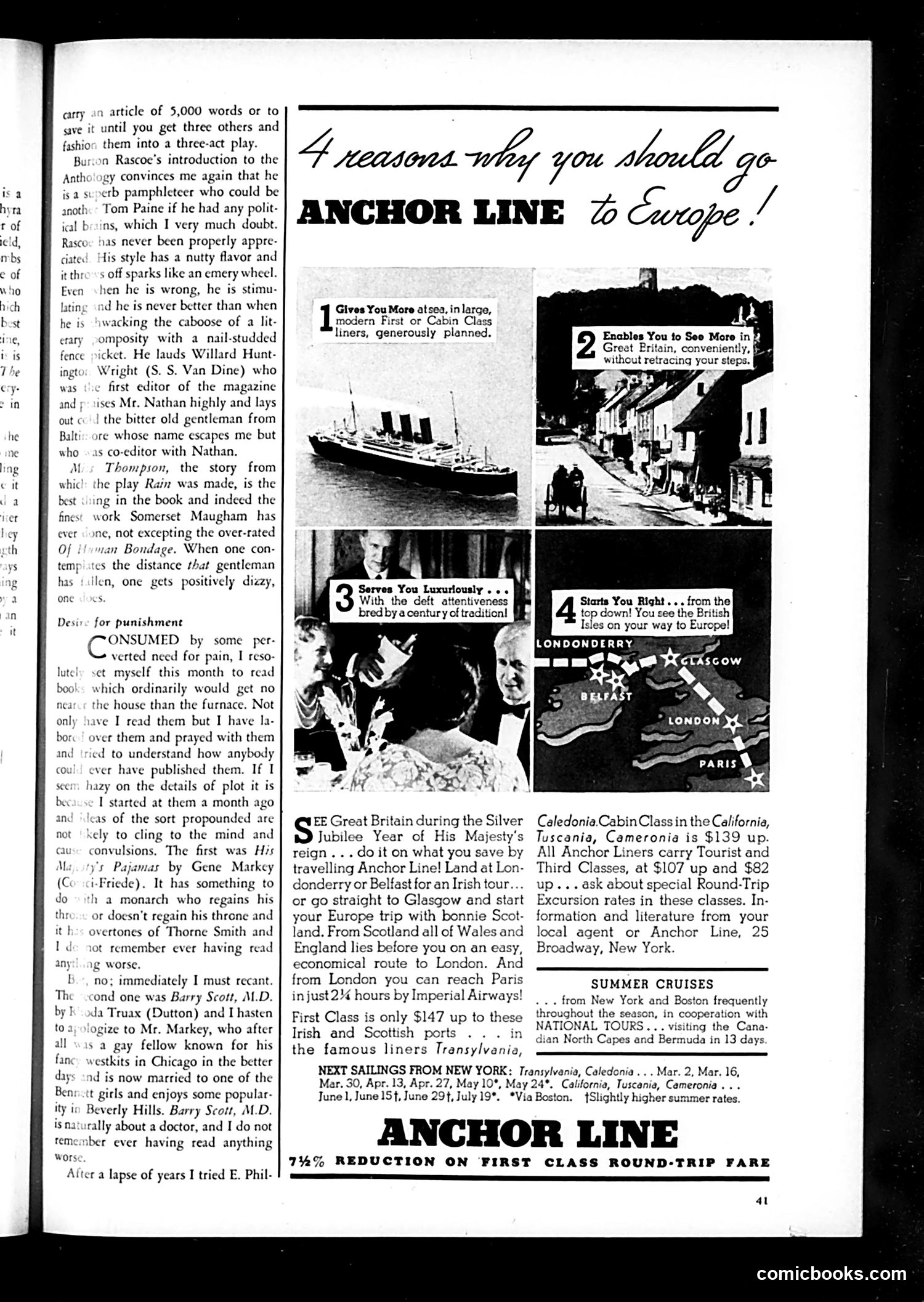
Content Analysis This page is primarily advertising for Anchor Line cruise ships, not political satire. The "4 Reasons Why You Should Go Anchor Line to Europe" advertisement dominates the right side, featuring numbered points about ship amenities, sightseeing opportunities, and luxury service. The left column contains a book review discussing literary works and authors (Burton Rascoe, Somerset Maugham, Gene Markey, others). The reviewer humorously recounts reading poorly-written novels out of "some perverted need for pain," describing the experience as punishing. This is social/literary satire—mocking bad literature—not political commentary. The small map in the advertisement shows travel routes from ports like Glasgow and Belfast to London and Paris, emphasizing economical European travel during Britain's Silver Jubilee year (1935). No political cartoons or caricatures appear on this page. It's a mixed content page: mostly travel advertising with accompanying book criticism.
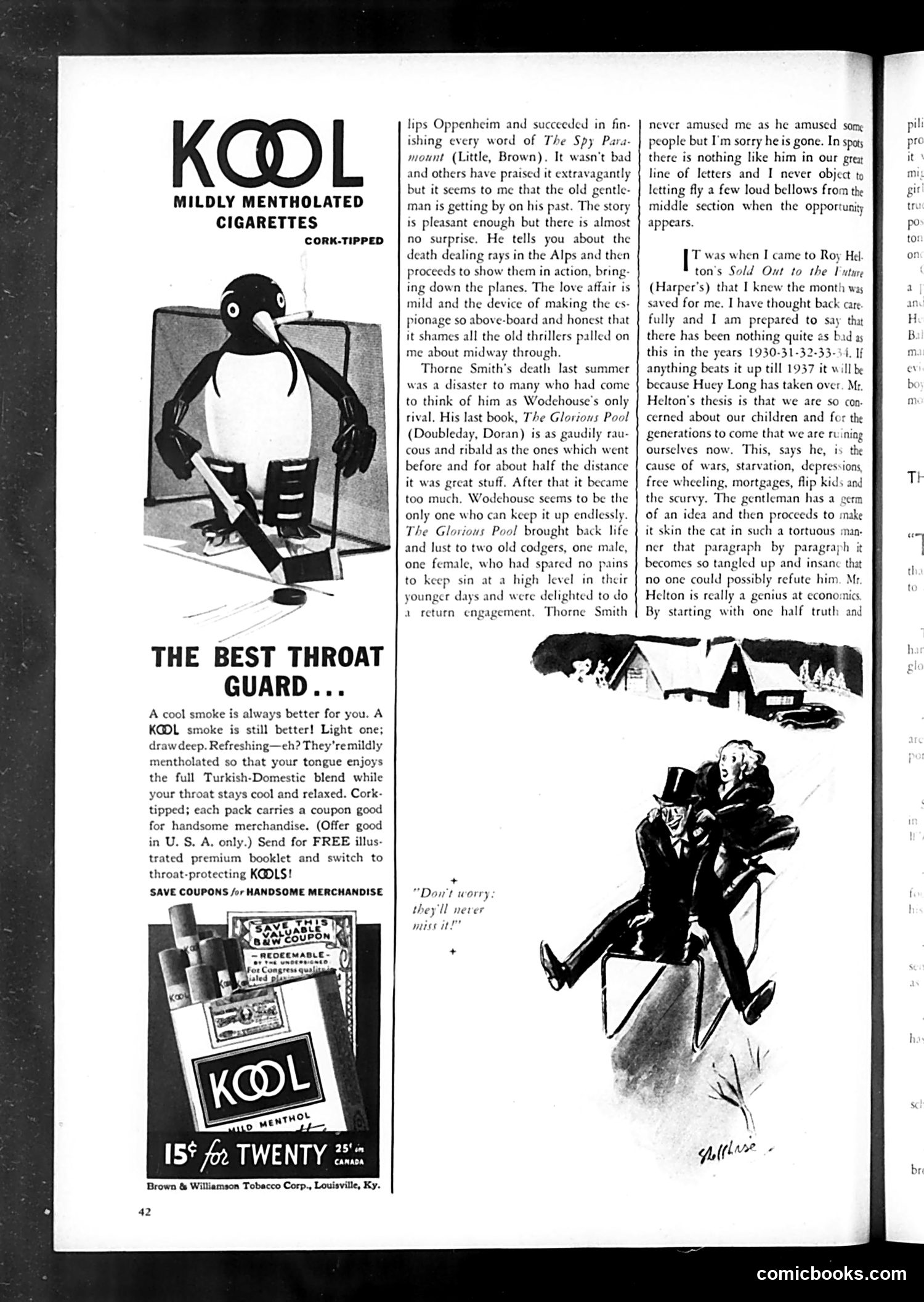
KOOL Cigarettes Advertisement, Life Magazine This page is primarily a cigarette advertisement for KOOL brand mentholated cigarettes, featuring a stylized penguin mascot as the company's trademark character. The penguin serves as a visual symbol of coolness and refreshment. The ad's marketing pitch emphasizes that menthol keeps smokers' throats "cool and relaxed" while enjoying tobacco. It promotes cork-tipped cigarettes and offers coupons redeemable for merchandise—a common sales tactic of the era. The pricing (15¢ for twenty, 25¢ in Canada) dates this to the 1930s. The right side contains unrelated book reviews by what appears to be a literary critic, discussing recent novels by P.G. Wodehouse and Thorne Smith. A small cartoon illustration accompanies one review. This page exemplifies mid-20th-century magazine layout: commercial advertising occupying substantial space alongside editorial content, with no clear visual separation between the two.
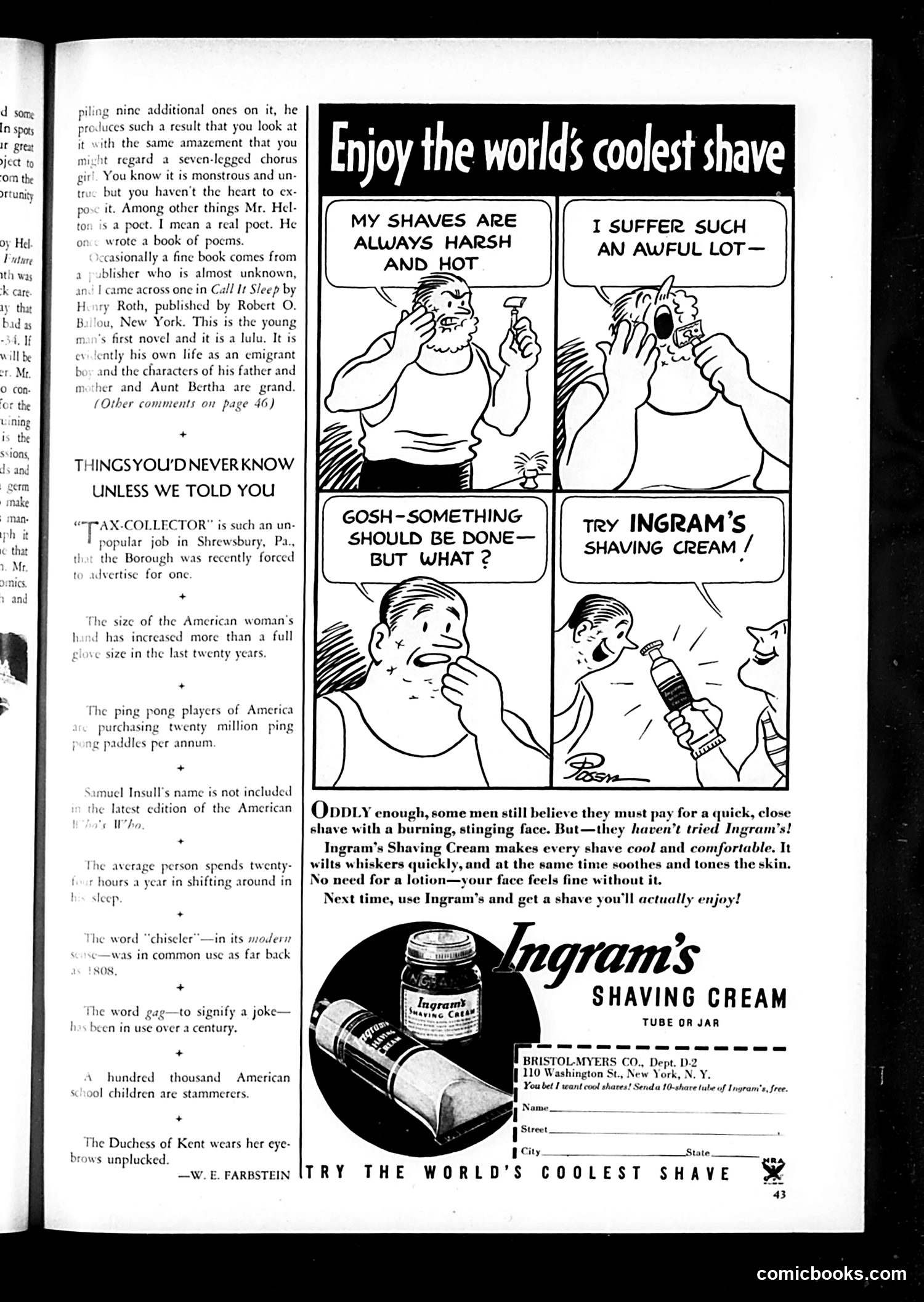
Ingram's Shaving Cream Advertisement This page is primarily a vintage advertisement for Ingram's Shaving Cream, presented as a four-panel comic strip. The cartoon depicts two men discussing shaving problems: one complains his shaves are "always harsh and hot" and cause suffering, while the other offers the solution of trying Ingram's product. The ad's humor relies on a simple problem-solution format common to mid-20th century advertising—presenting an everyday complaint (uncomfortable shaving) and offering the branded product as relief. The cartoon's casual tone and illustration style were typical marketing approaches of the era. The left column contains miscellaneous "trivia" facts unrelated to the ad, a common editorial filler feature in Life magazine. The page demonstrates how advertisements were integrated into magazines as both commercial messaging and entertainment content, with the comic format designed to engage readers while promoting the product.
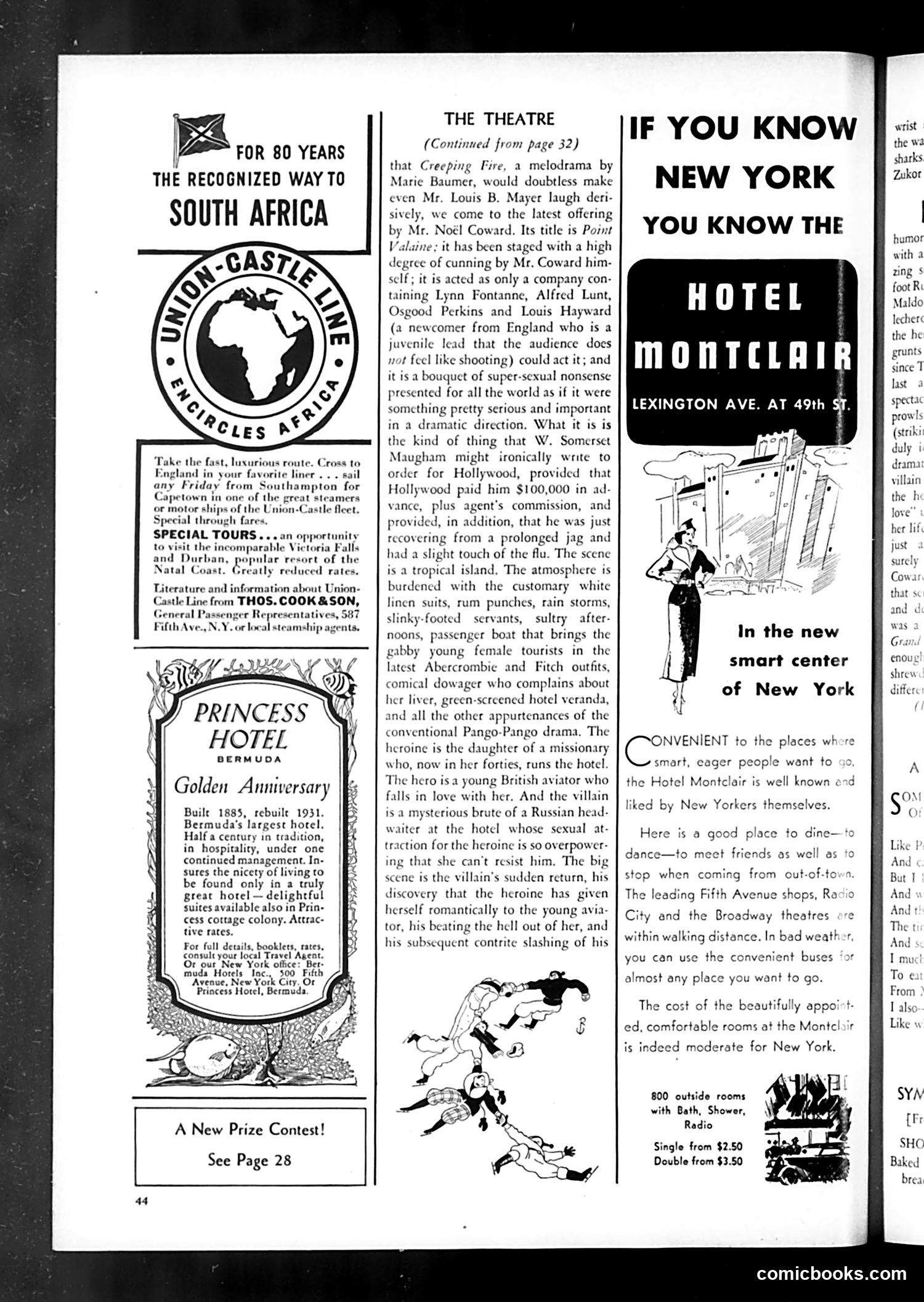
Analysis of Life Magazine Page 44 This page is primarily advertising and theatre criticism, not political satire. The Theatre Section reviews Noël Coward's play "Point Valaine." The critic dismisses it as frivolous "super-sexual nonsense" dressed up as serious drama—comparing it to what Somerset Maugham might cynically write for Hollywood. The plot involves a missionary's middle-aged daughter running a tropical hotel, falling for a British aviator while tempted by a Russian headwaiter villain. The reviewer's tone is mocking: this is melodramatic, conventional "Pango-Pango drama" with stock characters (complaining dowagers, servants, tourists in Abercrombie & Fitch outfits). The Advertisements promote travel (Union-Castle Line to South Africa, Princess Hotel Bermuda) and the Hotel Montclair in New York, positioned as convenient for shopping and theatre. There are no political cartoons on this page. The small illustrations accompanying the theatre review are simply comedic sketches of the play's absurd plot points, not satire of current events or figures.
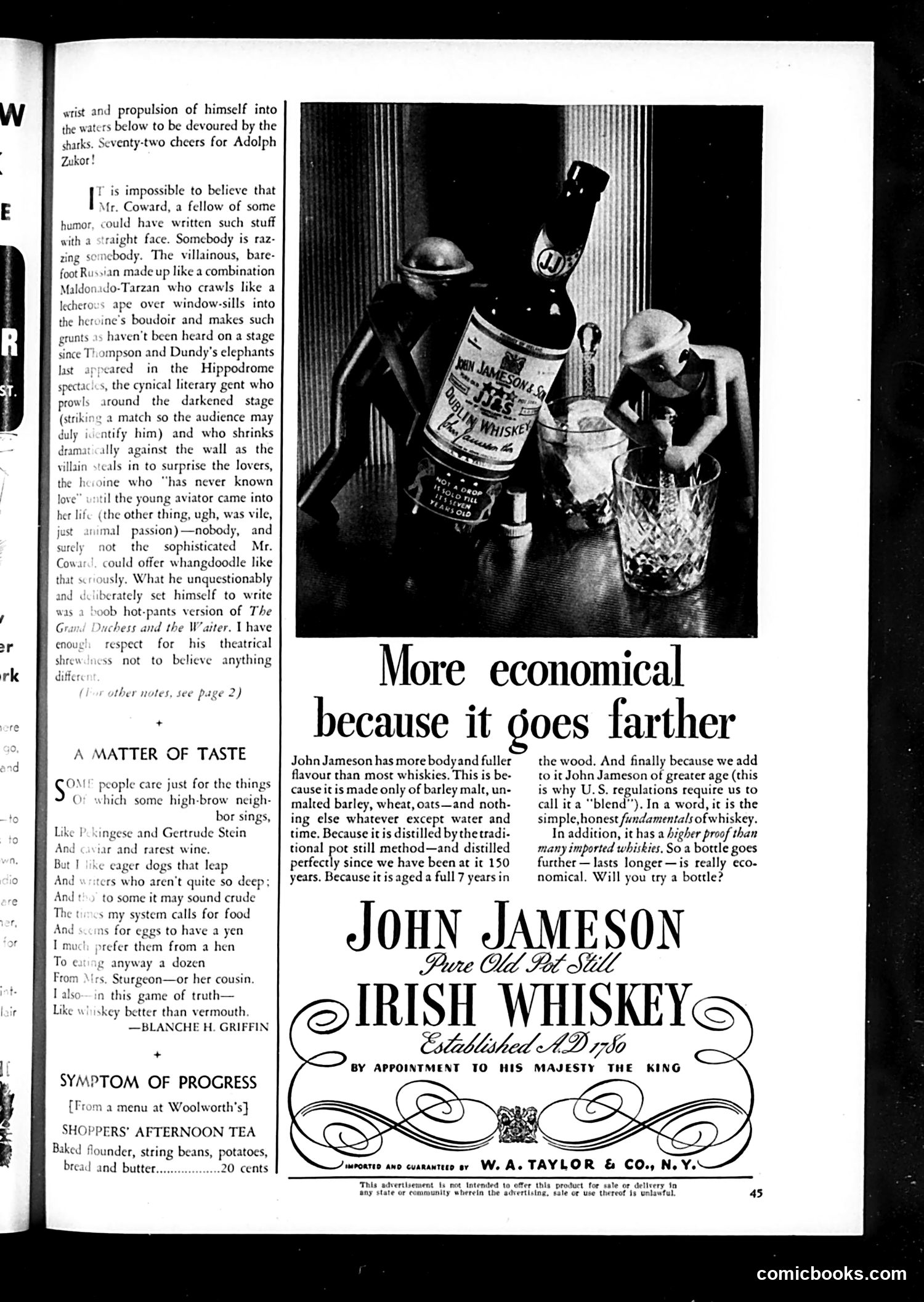
Life Magazine Page Analysis This page consists primarily of advertising and literary criticism, not political satire. The upper section critiques a theatrical work (likely a play called "The Grand Duchess and the Waiter"), mocking its melodramatic plot involving a villainous Russian character and improbable scenarios. The critic sarcastically praises producer Adolph Zukor and suggests playwright Noël Coward couldn't have written such overwrought material seriously—implying someone is deliberately writing bad theater as a joke. The middle includes light verse about taste and preference, and a "Symptom of Progress" note—a brief humorous observation that a Woolworth's lunch counter now offers "Shoppers' Afternoon Tea" for 20 cents, suggesting democratization of upscale dining. The dominant content is a full-page whiskey advertisement for John Jameson Irish Whiskey, emphasizing its quality, aging process, and value. The ad features a bottle photograph and marketing copy targeting economical consumers during what appears to be the Prohibition era (based on the legal disclaimer about unlawful sale/delivery).
"Stop & Go": Movie and Book Reviews This page contains entertainment reviews by Kyle Crichton, a prominent Life magazine critic. The "Stop & Go" column critiques recent films with sharp, witty dismissals. Notable reviews include: - W.C. Fields in "It's a Gift"—praised for slapstick comedy with obstinate props - Will Rogers in "The County Chairman"—a political fixer comedy - Carole Lombard in "The Gay Bride"—a gangster film - Katharine Hepburn in "The Little Minister"—called "divinely ethereal" The reviews reflect 1930s Hollywood output: mysteries, comedies, and melodramas. Crichton's tone is irreverent and gossipy—he notes Lombard is "one of my weaknesses" and dismisses Roy Helton's novel "Sold Out to the Future" as deserving his invented "Crichton Award for Lousiness." The book section reviews new fiction, including Henry Roth's *Call It Sleep* and Thornton Wilder's *Heaven Is My Destination*, with similarly acerbic commentary on contemporary literature.
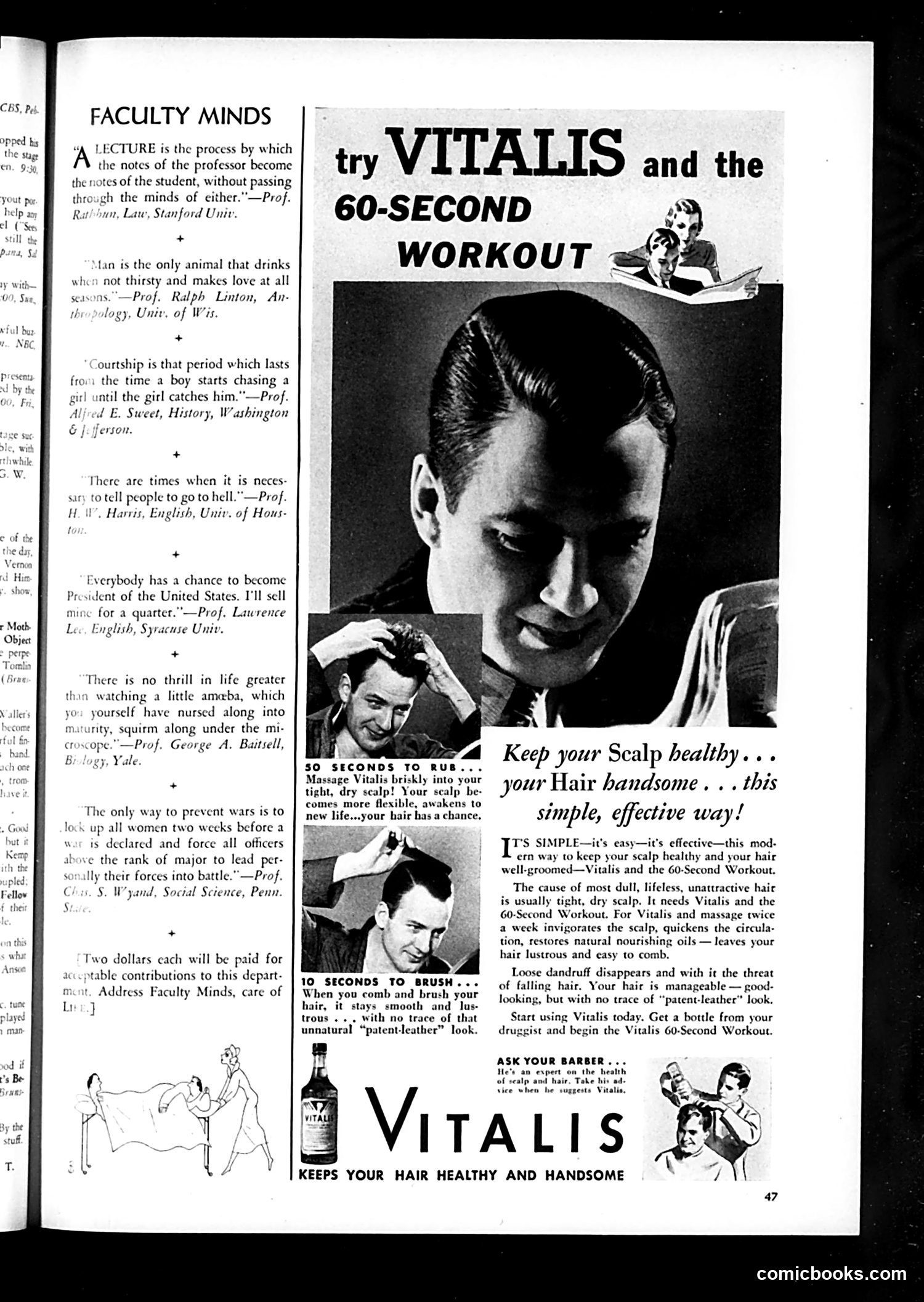
Analysis This page contains two distinct sections: Left side ("Faculty Minds"): A satirical column featuring humorous quotes from real university professors. The jokes mock academic pretension—professors offering cynical or absurd observations on human nature (lectures bypassing minds, courtship as chase, the necessity of telling people "go to hell"). This reflects a common mid-century magazine format poking fun at intellectual overconfidence. Right side: A full-page advertisement for Vitalis hair product, disguised as editorial content. The ad promotes a "60-Second Workout"—a scalp massage routine using Vitalis oil to combat dry scalp and dandruff. The layout mimics a how-to article with instructional photos and pseudo-scientific claims about scalp health and hair appearance. The satire: The juxtaposition is the point. The "Faculty Minds" column mocks pretentious academics; immediately adjacent is an ad presenting dubious grooming advice with faux-authoritative language ("Ask your barber—he's an expert"). Both traffic in inflated claims about simple matters. This was common in Life magazine—editorial and advertising deliberately blurred together.
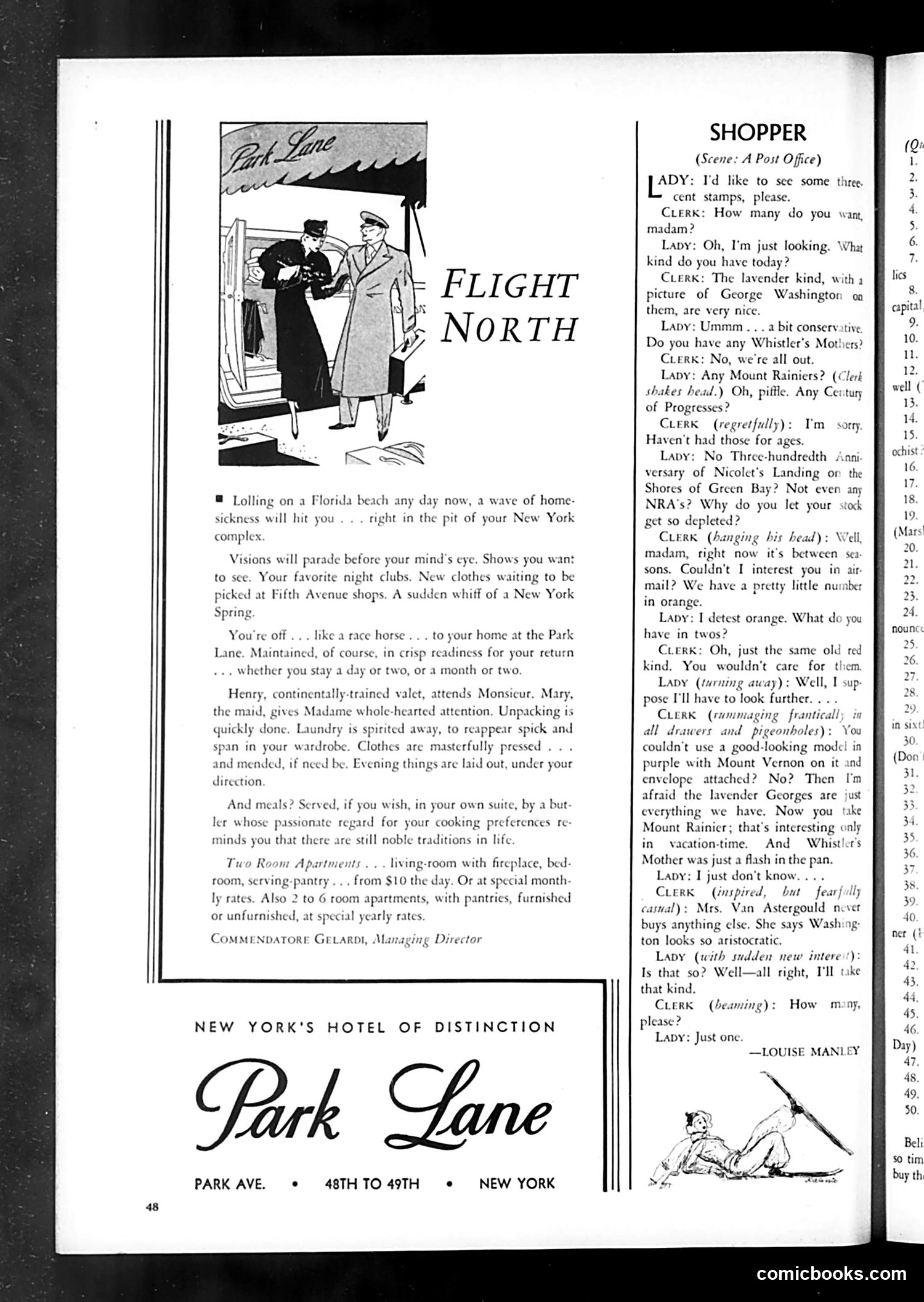
"The Shopper" Comic Explanation This is a satirical sketch about a frivolous female customer at a post office stamp counter. The humor operates on several levels: The Setup: The woman claims to be "just looking" at stamps—typically a trivial purchase—but behaves as though selecting haute couture. The Satire: She dismissively rejects practical options (standard Washington stamps, mail stamps) while demanding exotic commemorative stamps (Whistler's Mother, Mount Rainier, Century of Progress, NRA issues). She treats commonplace items as fashion statements requiring sophisticated taste. The Punchline: When the clerk mentions that Mrs. Van Astergould (a wealthy-sounding name) buys only the standard Washington stamps because "Washington looks so aristocratic," the customer immediately reverses her position and buys the same ordinary stamps—revealing her entire critique as performative snobbery rather than genuine preference. The joke mocks status-conscious consumers who adopt pretentious opinions based on what they believe the wealthy do, rather than holding actual convictions.
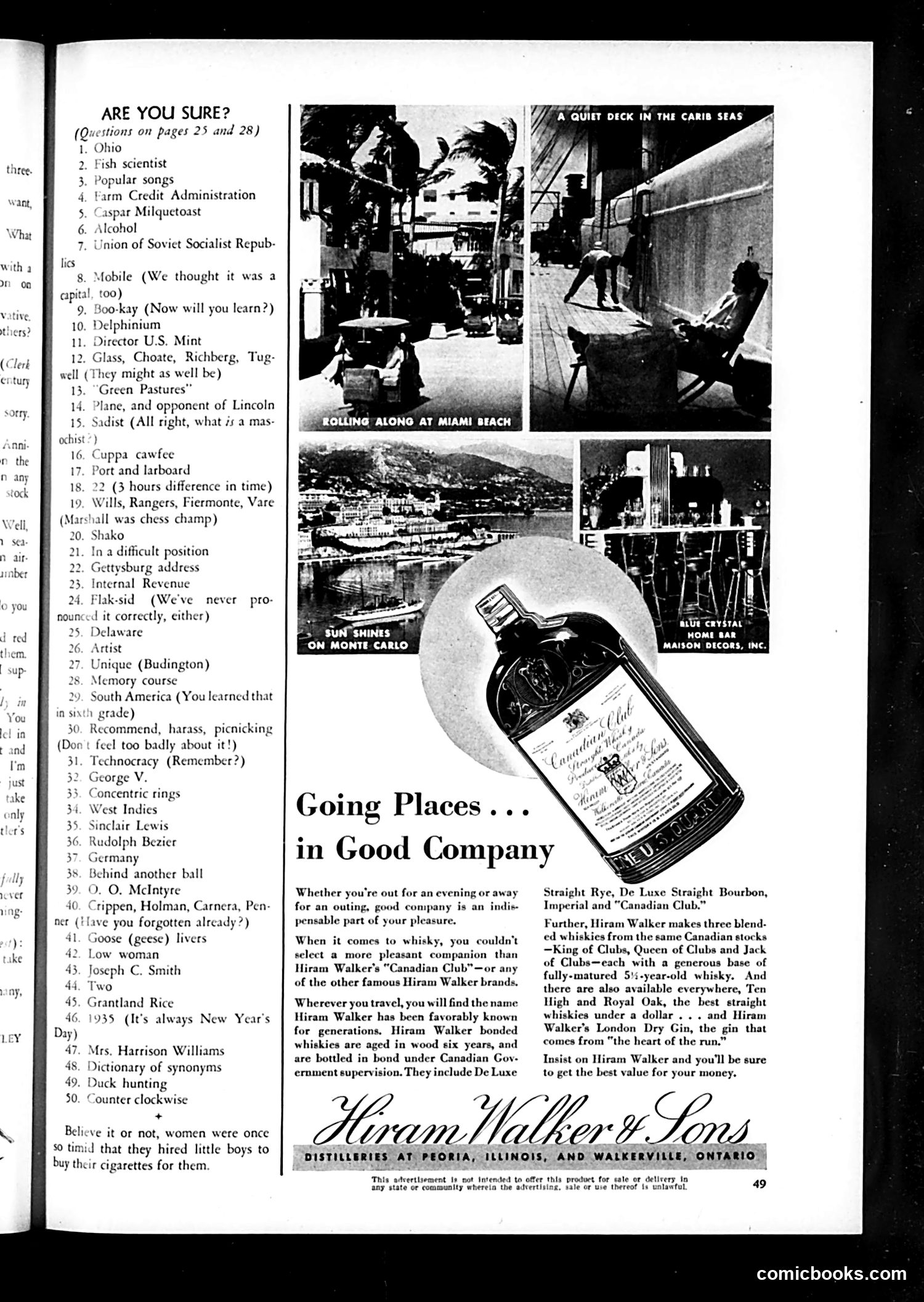
Analysis This page contains a trivia quiz answer key ("Are You Sure?") alongside a liquor advertisement for Hiram Walker whiskeys and gin. The quiz itself references Depression-era and 1930s American culture: farm programs (Farm Credit Administration), popular entertainers (Sinclair Lewis, George V), and contemporary figures. "Caspar Milquetoast" alludes to a timid comic-strip character, while references to the "Soviet Socialist Republic" reflect Cold War anxieties beginning to emerge. The advertisement uses aspirational imagery—glamorous locations (Monte Carlo, Miami Beach) and upscale venues (the Blue Crystal Home Bar)—to position Hiram Walker spirits as markers of sophistication and "good company." The tagline emphasizes prestige through history and quality control ("aged in wood six years"). The closing joke about women once being "too timid" to buy cigarettes themselves subtly normalizes women as consumers, reflecting post-Depression shifts in marketing toward female audiences—though framed as overcoming outdated bashfulness rather than genuine empowerment.
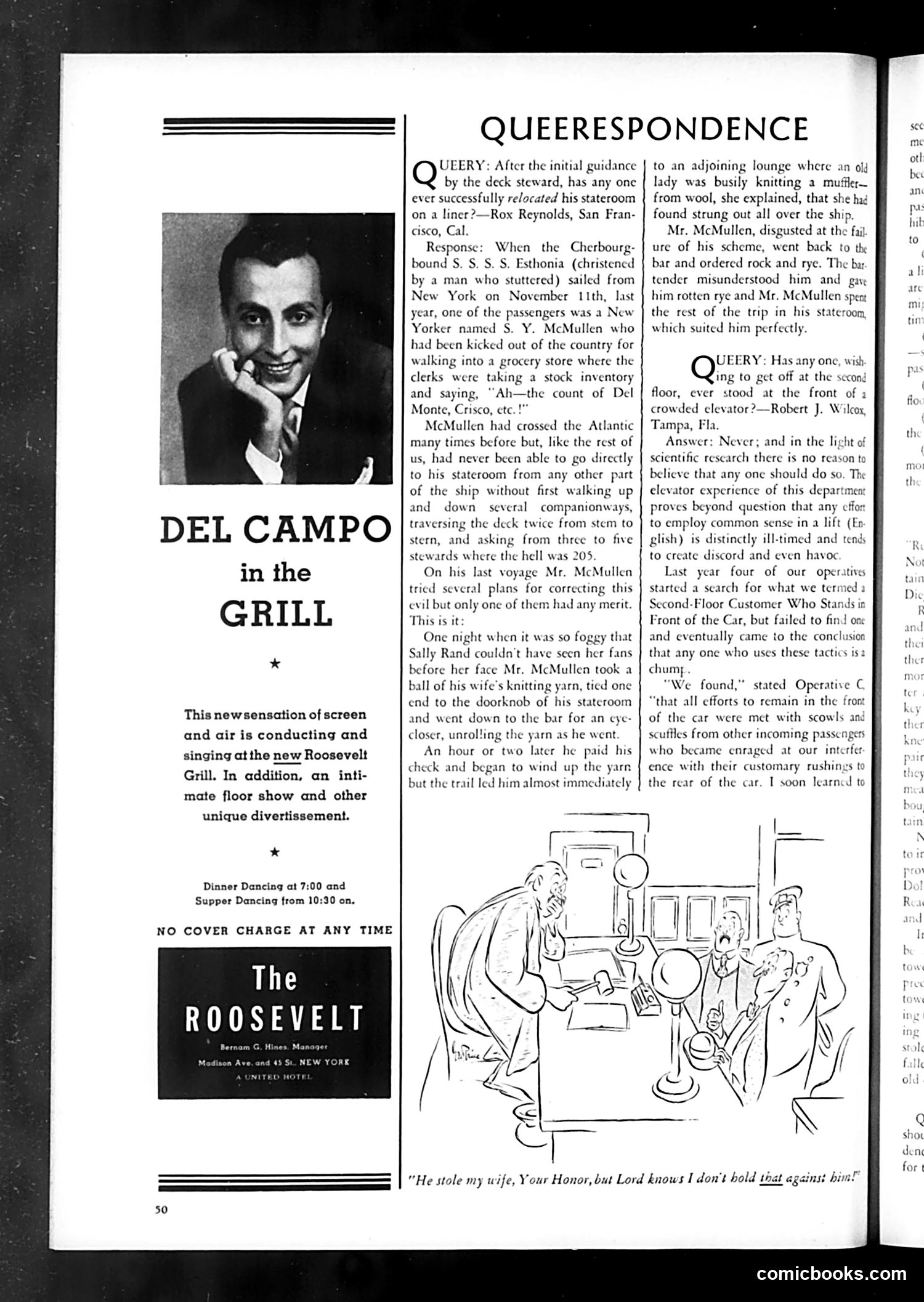
Life Magazine Page Analysis This page combines advertising with satirical humor pieces typical of Life magazine's format. The Advertisement: Del Campo, a singer/conductor, is promoted at the Roosevelt Grill nightclub in New York, featuring dinner dancing and floor shows. The Satire ("Queerespondence"): This is a humor column answering reader questions with absurd anecdotes. The main joke involves passenger S.Y. McMullen attempting to navigate a ship by unrolling yarn from his stateroom to mark a path—only to discover an elderly woman has knitted it into a muffler. The humor relies on the common frustration of finding one's cabin on ocean liners, exaggerated through ridiculous problem-solving. A secondary joke mocks elevator etiquette, suggesting anyone standing at the front of a crowded elevator gets attacked by other passengers rushing toward the rear. The cartoon below illustrates maritime/legal absurdity with the caption "He stole my wife, Your Honor, but Lord knows I don't hold *that* against him!"—playing on the contrast between serious offense and casual acceptance. The humor is lighthearted, focused on everyday social situations rather than political commentary.
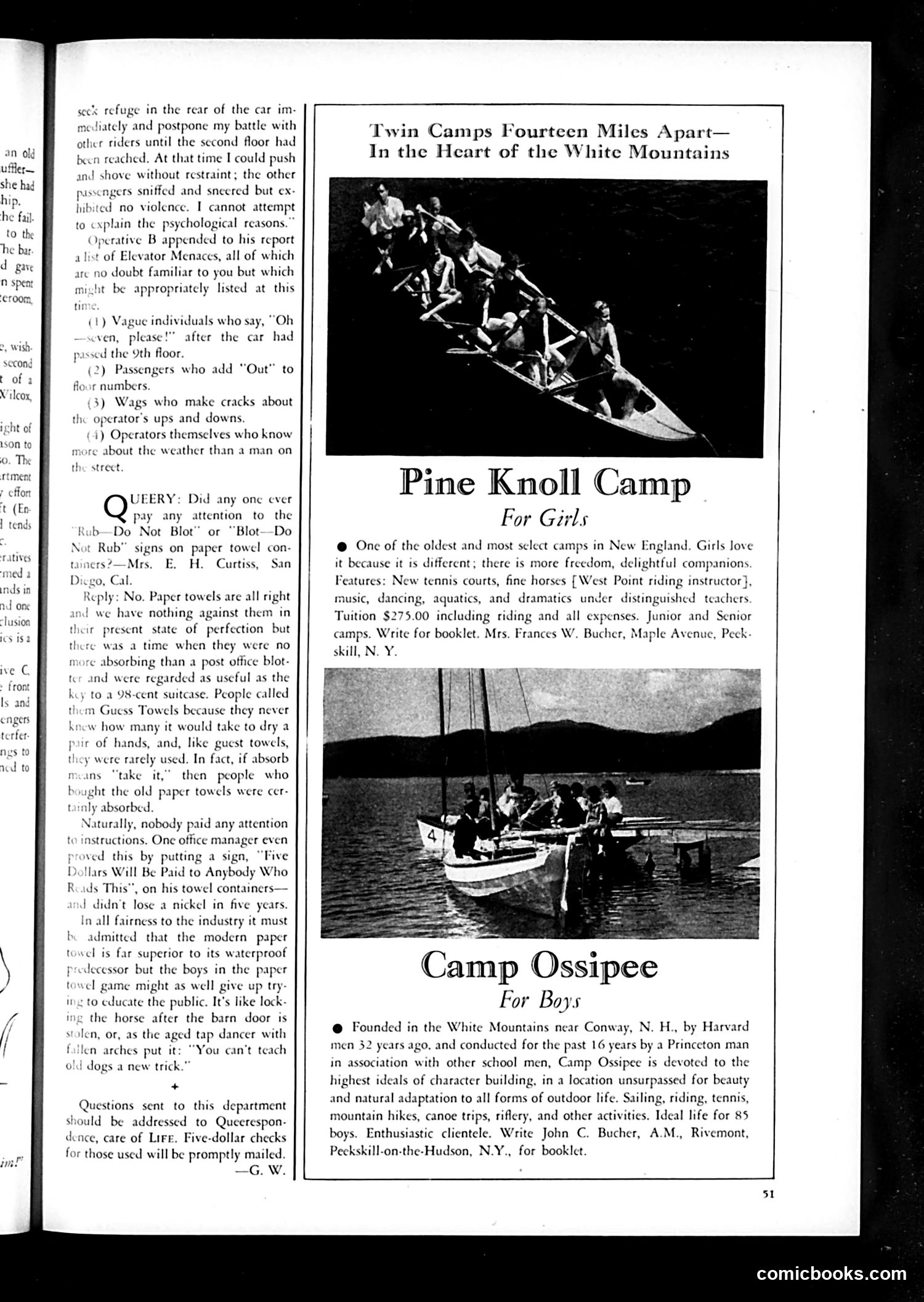
Analysis of Life Magazine Page Content This page contains no political cartoon. Rather, it features: 1. A humor column addressing reader questions about social etiquette and consumer products—specifically discussing paper towel usage and elevator behavior. The "Elevator Menaces" satirize annoying commuter behaviors (people saying "Oh seven, please!" after passing the ninth floor; passengers adding "Out" to floor numbers). The tone gently mocks public rudeness and absurdity. 2. Summer camp advertisements for two facilities in New Hampshire's White Mountains: Pine Knoll Camp (for girls) and Camp Ossipee (for boys). These are presented as complementary "twin camps" fourteen miles apart, emphasizing traditional upper-class recreation—horseback riding, tennis, sailing, character-building. The page reflects 1920s-30s American middle-to-upper-class concerns: urban etiquette anxieties and wholesome summer camp culture for youth. The camp ads suggest affluent families seeking structured outdoor recreation for their children.
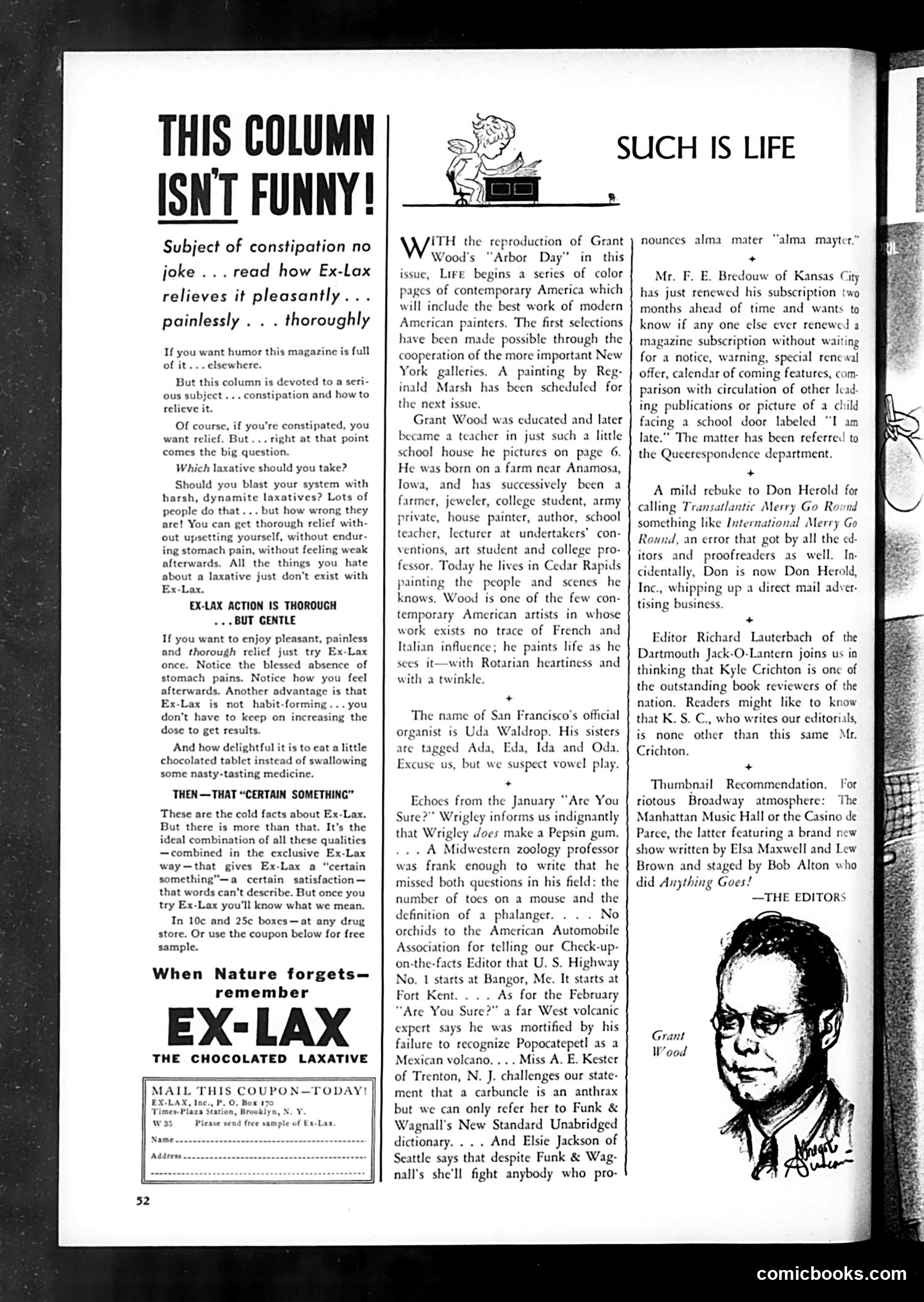
Explanation for Modern Readers This page is primarily advertising for Ex-Lax laxative, disguised as editorial content. The satire is clever: the column header admits "THIS COLUMN ISN'T FUNNY!" then pivots to treating constipation as a "serious subject" worthy of discussion, making the uncomfortable topic the entire premise. The right side contains miscellaneous short items ("Such is Life" section), including notes about painter Grant Wood and a portrait of him. There's gentle humor in reporting that San Francisco's organist is "Uda Waldrop" with sisters named "Ada, Eda, Ida and Oda"—obvious vowel-play wordplay the editors acknowledge. The overall page exemplifies how Life magazine blended satire with advertising: by framing a laxative ad as earnest editorial advice, it mimics the magazine's satirical style while promoting the product. The juxtaposition of constipation relief advice with artistic and cultural commentary reflects the magazine's eclectic, humorous approach to American life.