life
Life — April 1935
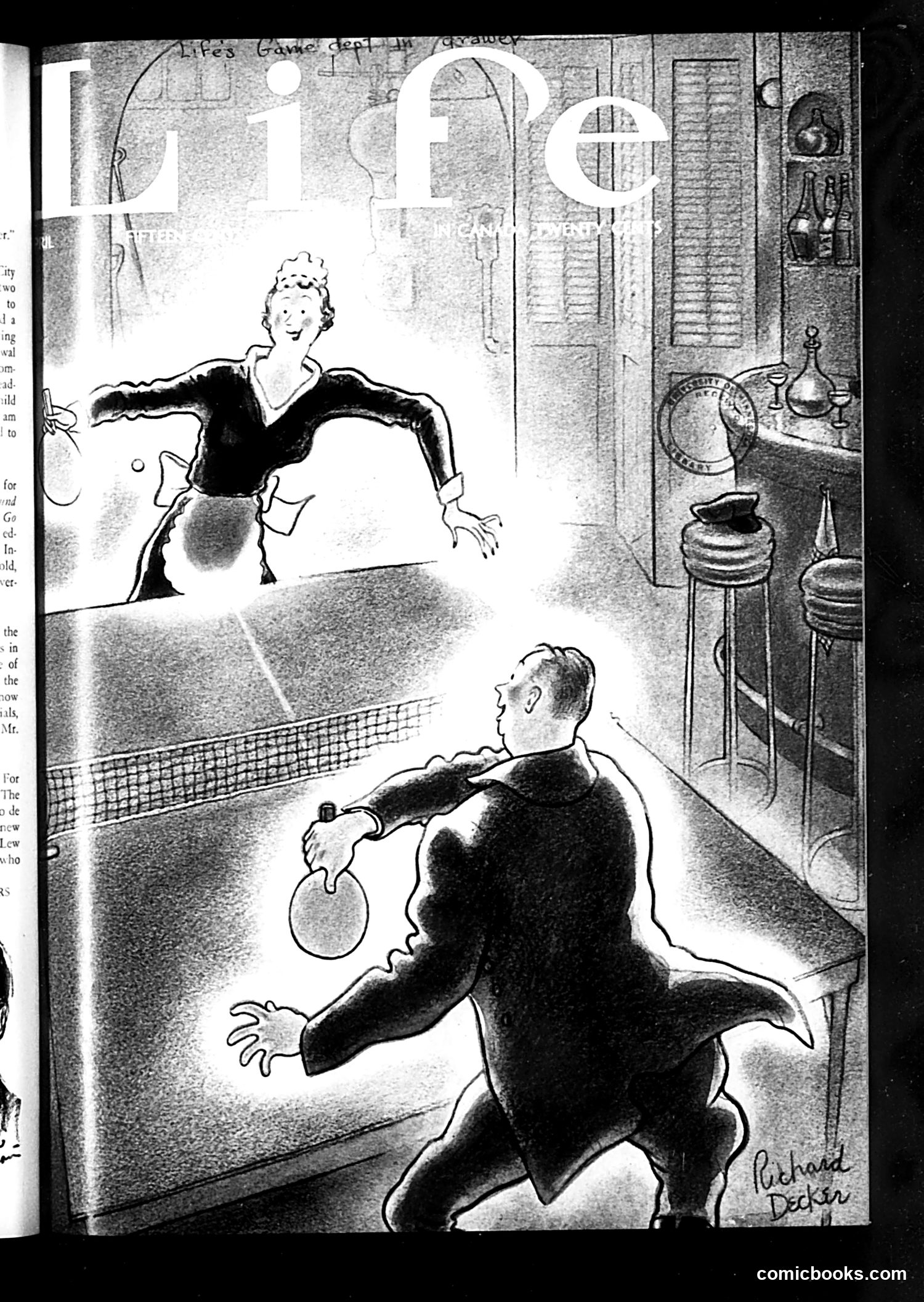
Life Magazine Cartoon Analysis This cartoon depicts a man playing badminton or tennis against a woman across a net. The man, drawn in an exaggerated caricatured style with heavy shading, appears to be losing or struggling with the game. The woman stands confidently on the opposite side. The satire likely comments on gender roles and changing social dynamics, possibly from the 1920s-1940s era when women's increased participation in sports and social activities was noteworthy. The cartoon may mock male anxiety about women's athletic competence or their shifting social position. The artist's signature reads "Richard Decker" (visible at bottom right). Without the complete text visible, the specific social commentary remains somewhat unclear, but the visual joke appears to center on role reversal or female athletic prowess challenging traditional gender expectations.
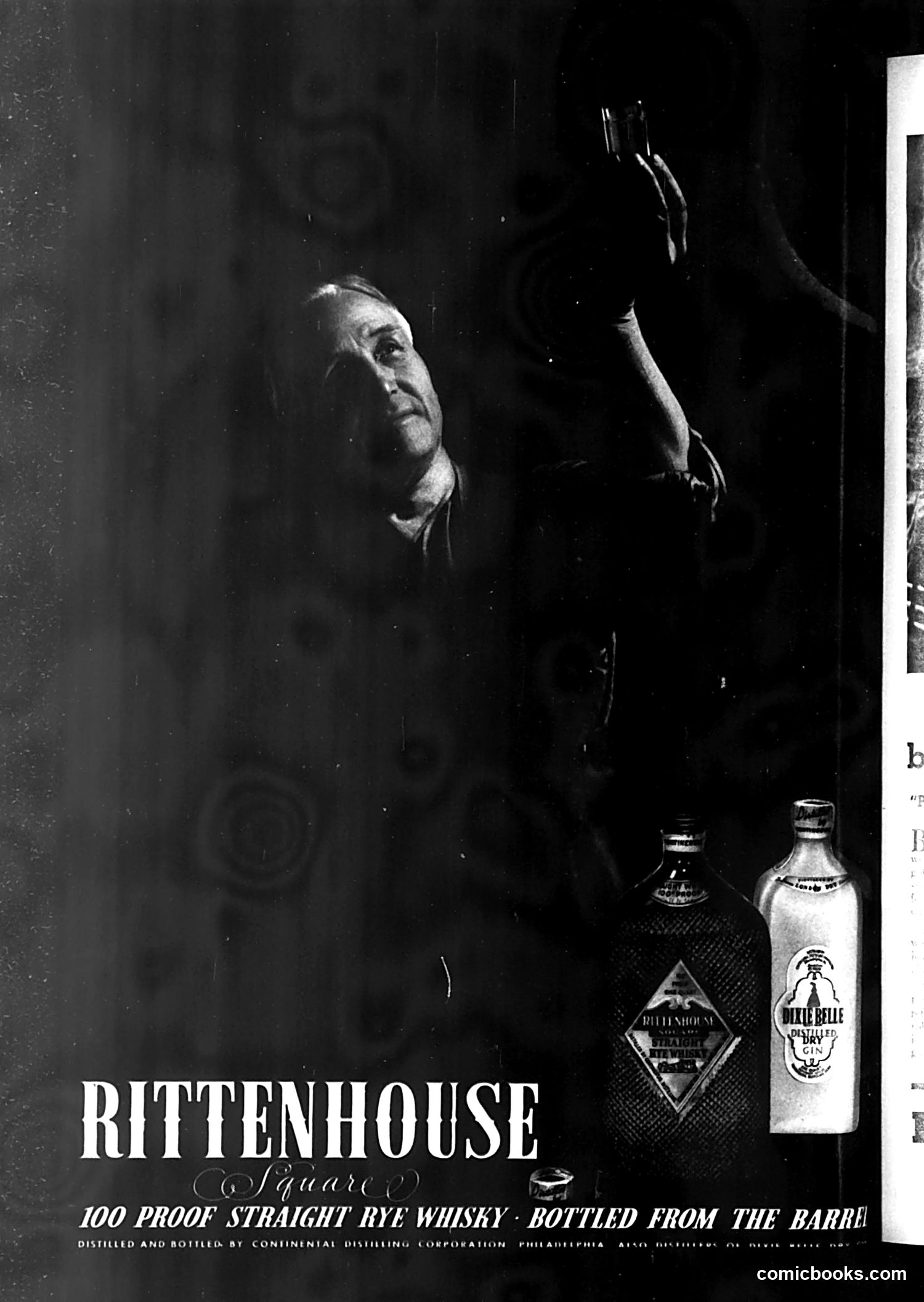
Advertisement Analysis This is a Rittenhouse Square whiskey advertisement, not political satire. The page shows a dramatic black-and-white photograph of a man examining two bottles of Rittenhouse brand rye whisky in low lighting, creating atmospheric, sophisticated branding. The text identifies it as "100 Proof Straight Rye Whisky - Bottled from the Barrel," made by Continental Distilling Corporation in Philadelphia. This appears in Life magazine, which despite being satirical, carried advertisements. The ad uses dramatic photography and product display typical of 1930s-40s liquor marketing—emphasizing quality and straight-from-barrel authenticity during an era when such claims held marketing appeal. No political cartoon or satire is present; this is straightforward commercial advertising.
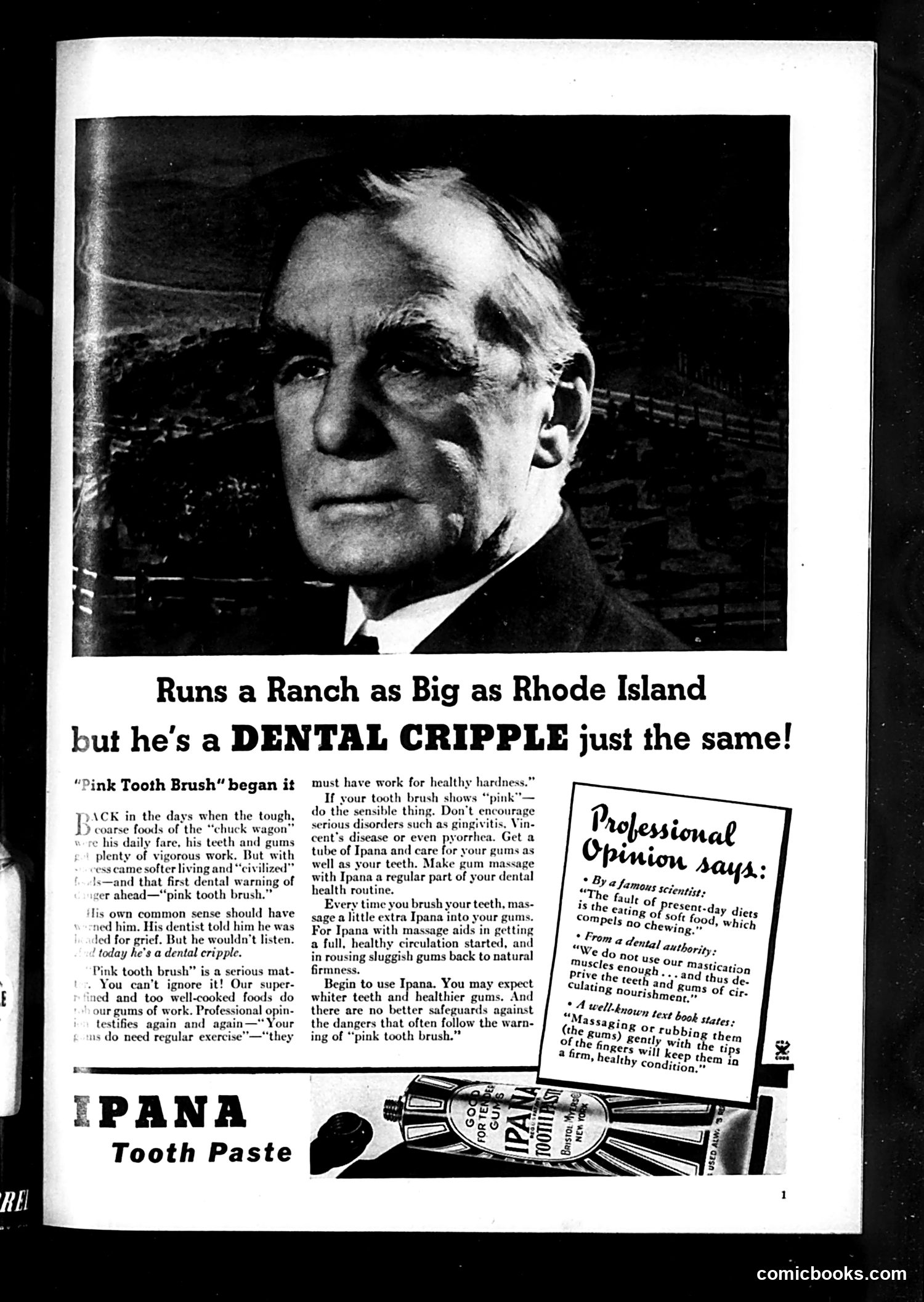
Analysis This is a vintage Ipana toothpaste advertisement, not political satire. The page features a photograph of an older man in formal attire with the headline: "Runs a Ranch as Big as Rhode Island but he's a DENTAL CRIPPLE just the same!" The ad uses shock-value language to sell Ipana toothpaste and their associated "Pink Tooth Brush" product. The "dental cripple" phrase refers to someone wealthy and successful in business who nonetheless suffers from poor dental health—suggesting even successful people need proper dental care products. The advertisement includes testimonial-style "Professional Opinions" claiming Ipana and massage aids prevent gum disease. This reflects early-20th-century marketing that emphasized gum health alongside tooth cleaning, a common sales angle for dental products of that era.
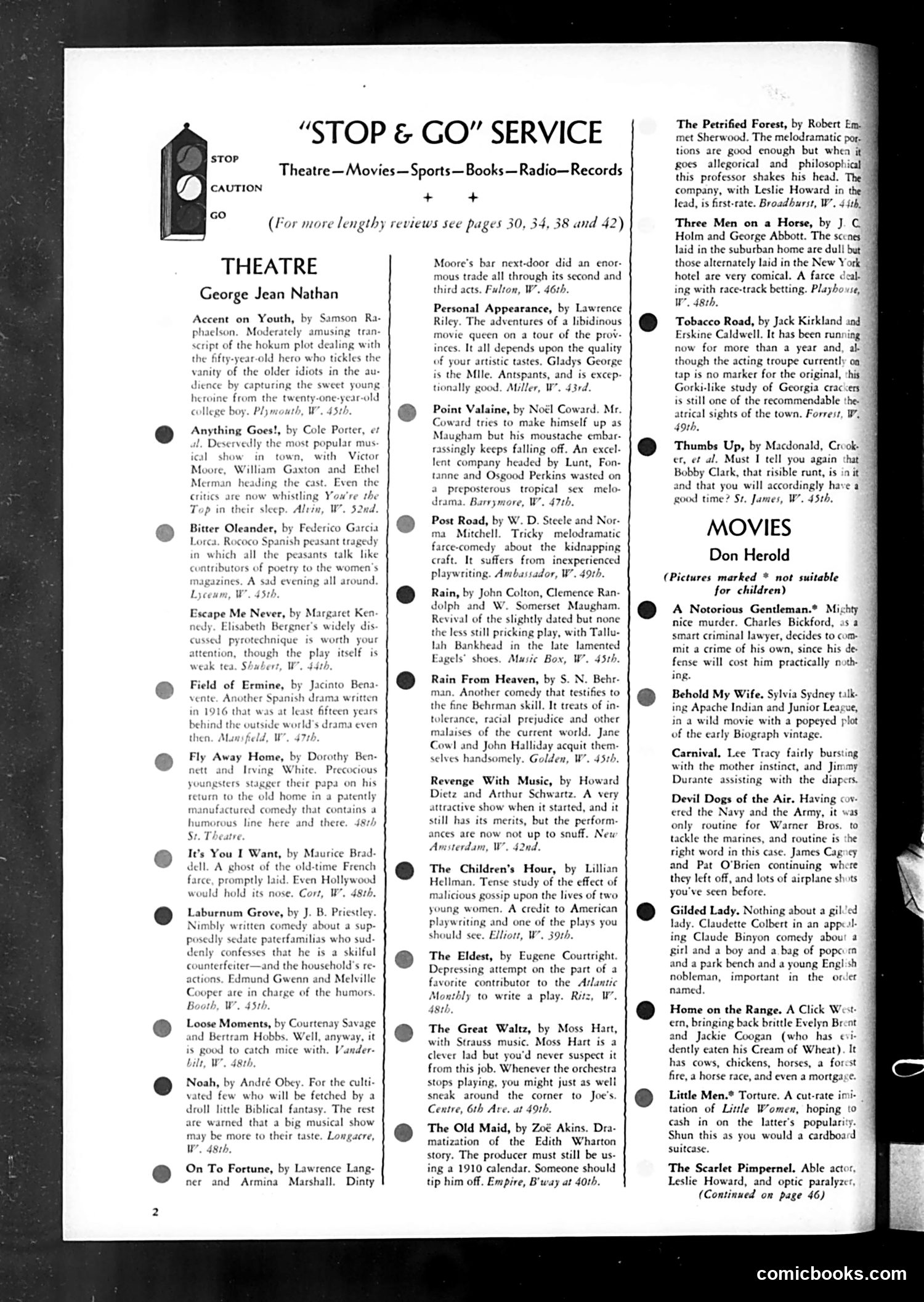
This page is a "Stop & Go" entertainment review section from *Life* magazine, covering theatre, movies, sports, books, radio, and records. The header features a traffic light logo, which is the section's recurring visual device. The content consists of brief critical reviews of theatrical productions (like "Accent on Youth" and "Anything Goes!") and films, written in the magazine's characteristic witty, abbreviated style. Rather than containing political cartoons or satire, this is straightforward entertainment criticism—a regular magazine feature reviewing contemporary Broadway shows and Hollywood movies from what appears to be the 1930s era. The reviews are largely descriptive, offering quick judgments to help readers decide what to see, with shorthand noting venue locations and cast members.
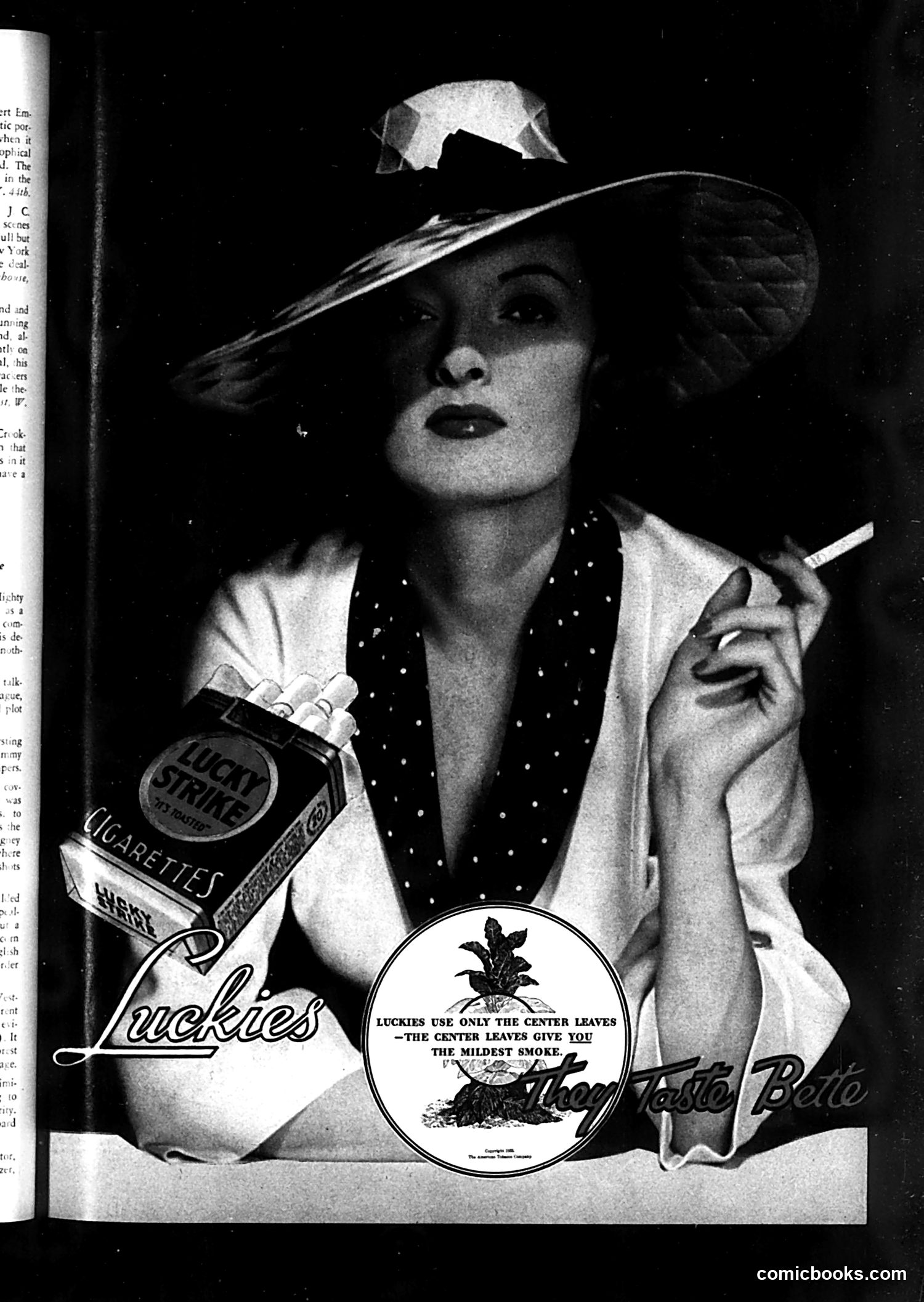
Analysis This appears to be a cigarette advertisement for Luckies rather than political satire. The image shows a fashionably dressed woman in 1920s-30s attire (wide-brimmed hat, polka-dot scarf, cigarette holder) posed glamorously against a dark background. The central circular text reads: "LUCKIES USE ONLY THE CENTER LEAVES—THE CENTER LEAVES GIVE YOU THE MILDEST SMOKE." This is a marketing claim emphasizing product quality—that Lucky Strike cigarettes use only the finest tobacco leaves, positioned as a premium choice. The sophisticated styling targets affluent consumers, particularly women, during an era when cigarette advertising increasingly featured elegant imagery to expand the female market. This is commercial advertising, not political or social satire.
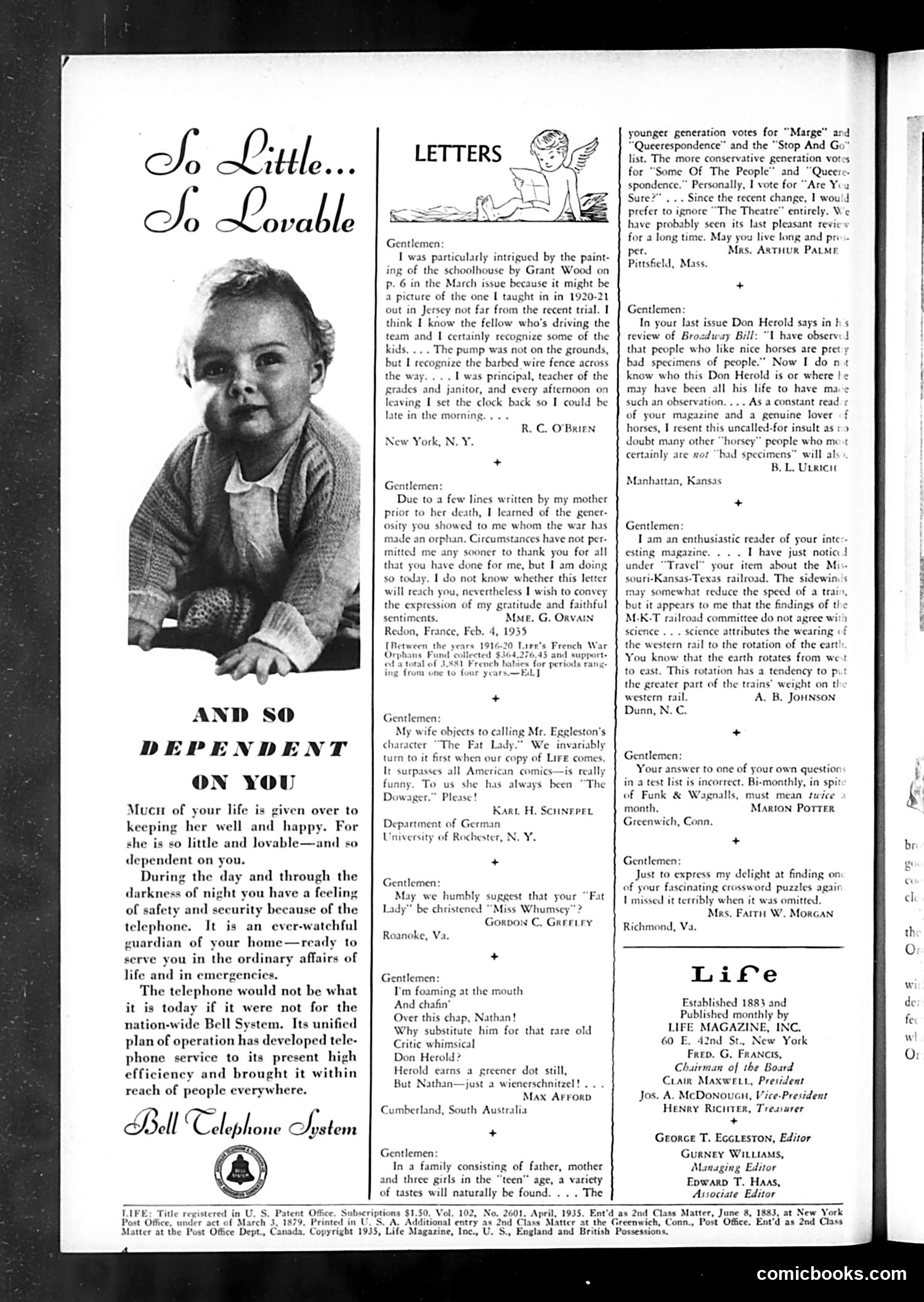
Life Magazine Page Analysis This page features the "Letters" section with reader correspondence and advertisements. The prominent left-side image and text titled "So Little... So Lovable and So Dependent On You" appears to be a Bell Telephone System advertisement emphasizing the telephone's role in home security and family connection. The copy stresses how the telephone provides "safety and security" during day and night, positioning it as an essential guardian service. The letters discuss various topics including Broadway reviews, railroad operations, and crossword puzzles—typical early 1920s reader concerns. No specific political cartoon or satire is evident on this page; it's primarily a letters column with accompanying commercial messaging about telephone utility and reliability.
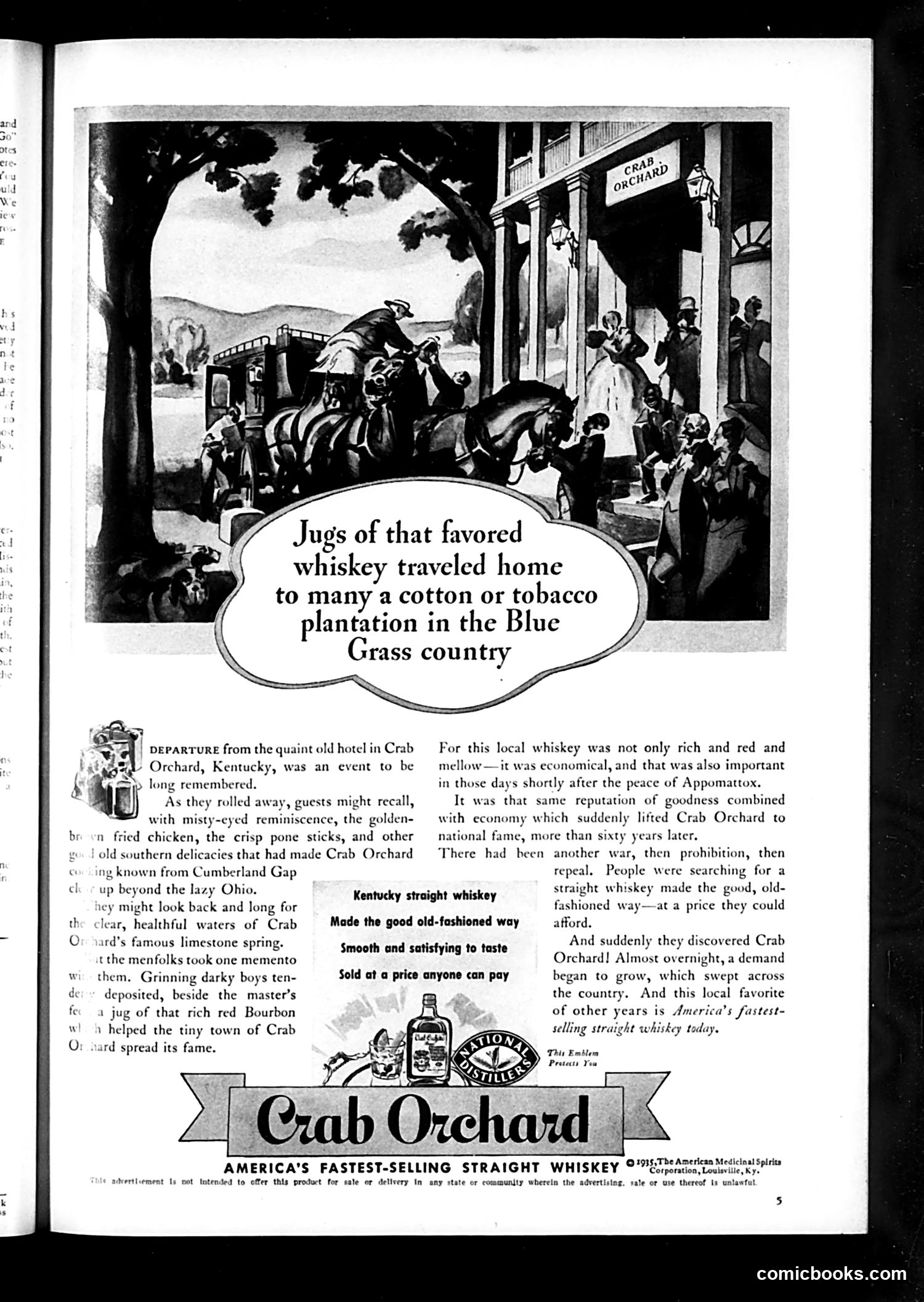
Analysis This is a Crab Orchard whiskey advertisement, not political satire. The ad uses nostalgic Americana to market the product. The illustration depicts a colonial-era scene: a stagecoach arriving at an inn labeled "Crab Orchard" in Kentucky, with period-dressed figures gathered around. The text romanticizes the whiskey's history, claiming jugs traveled "home to many a cotton or tobacco plantation in the Blue Grass country." The ad emphasizes the whiskey was "economical" and "good, old-fashioned"—selling post-Prohibition appeal by positioning Crab Orchard as an established, trusted brand with deep American roots. The phrase "America's fastest-selling straight whiskey" claims current market dominance. This leverages historical legitimacy and regional pride to boost sales in the post-Prohibition era.
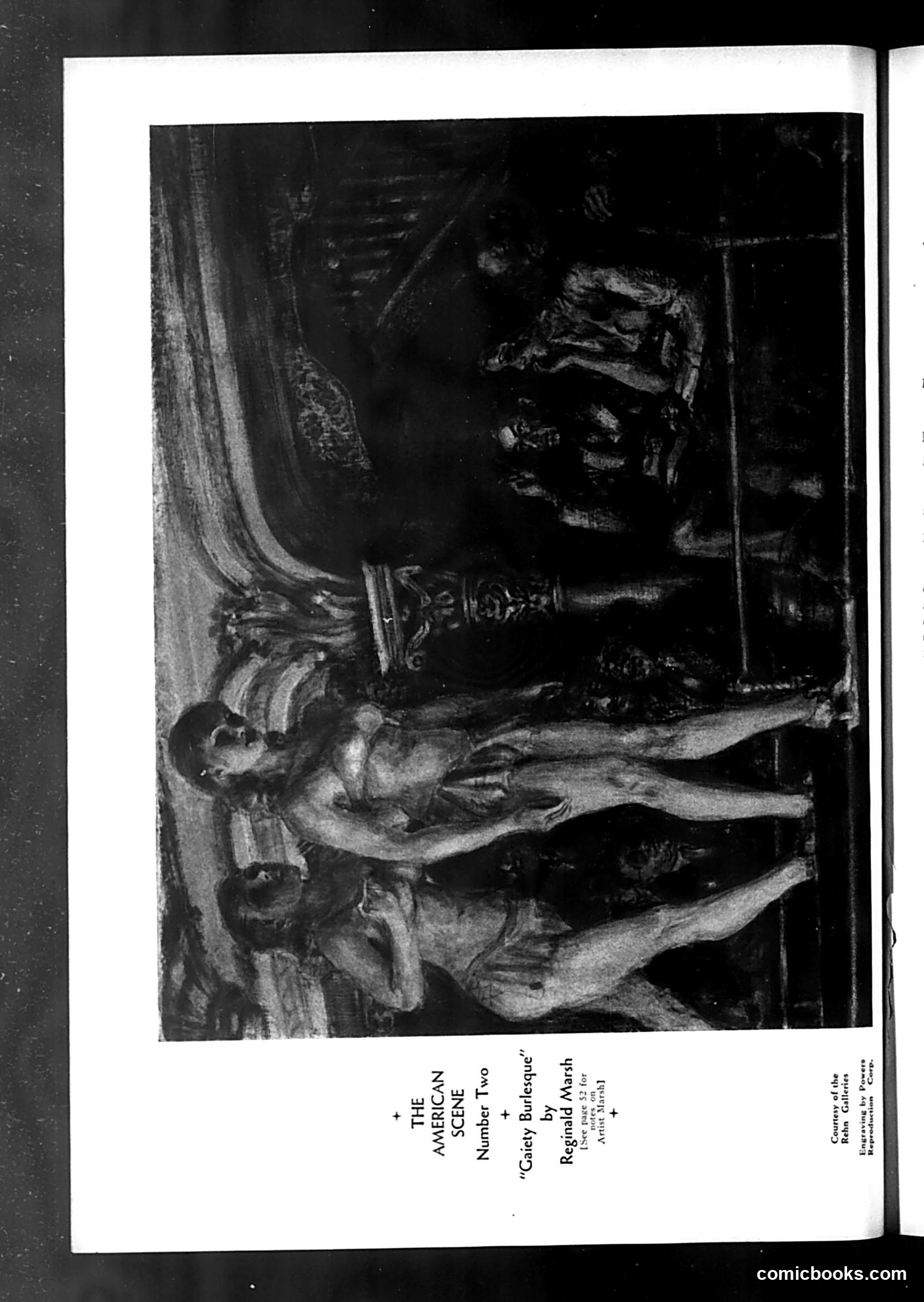
Analysis This appears to be a page from *Life* magazine showing "The American Scene, Number Two" — a satirical illustration labeled "Gassy Bridegroom" with credit to "Reginald Marsh." The image depicts what seems to be a theatrical or domestic scene with multiple figures in an interior setting. The composition is rotated 90 degrees, requiring careful viewing. The subject matter — titled "Gassy Bridegroom" — suggests satire about either a wedding scenario or a character type associated with excessive talk or pretension. Reginald Marsh was known for satirical social commentary through caricature. Without additional context about the specific date or cultural references, the exact target of satire remains unclear, though the title implies mockery of pompous or verbose behavior, likely a common social type or contemporary figure of the period.
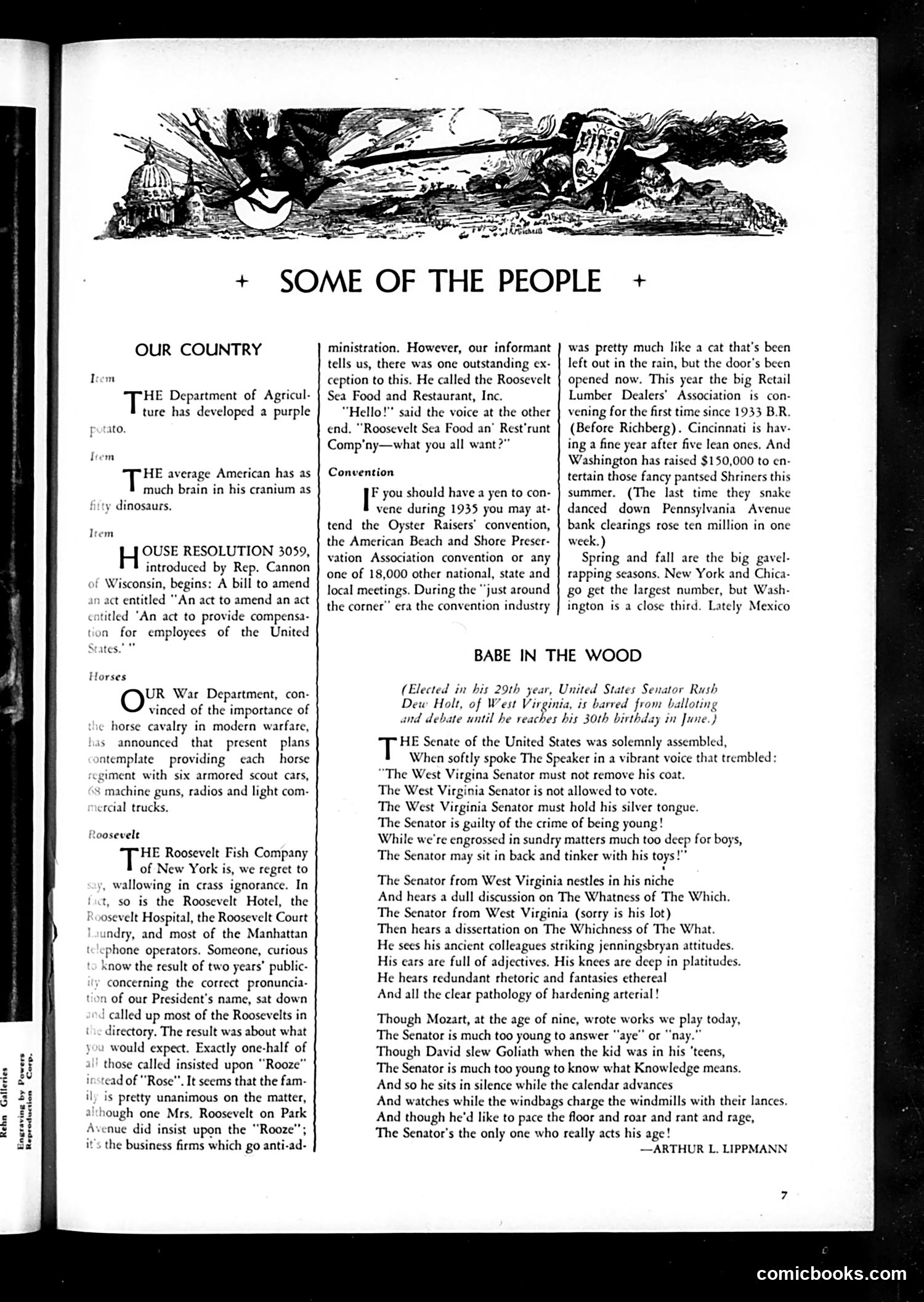
"Some of the People" / "Babe in the Wood" This page contains satirical commentary on various American institutions and figures. The left column mocks government agencies (Agriculture Department's purple potato), conventions (Oyster Raisers' Association), and the Roosevelt administration's various initiatives—particularly poking fun at the pronunciation disputes around "Roosevelt" and the Roosevelt Hotel/Fish Company. The main poem "Babe in the Wood" (by Arthur Lippmann) satirizes Senator Ruth Dew Holt of West Virginia on his 29th birthday. It mocks him as inexperienced and unfit, using extended metaphors of youth and ignorance—comparing him to Mozart and David (both young) to suggest he's too immature for Senate. The poem criticizes his silence, lack of knowledge, and inability to contribute meaningfully to serious legislative matters.
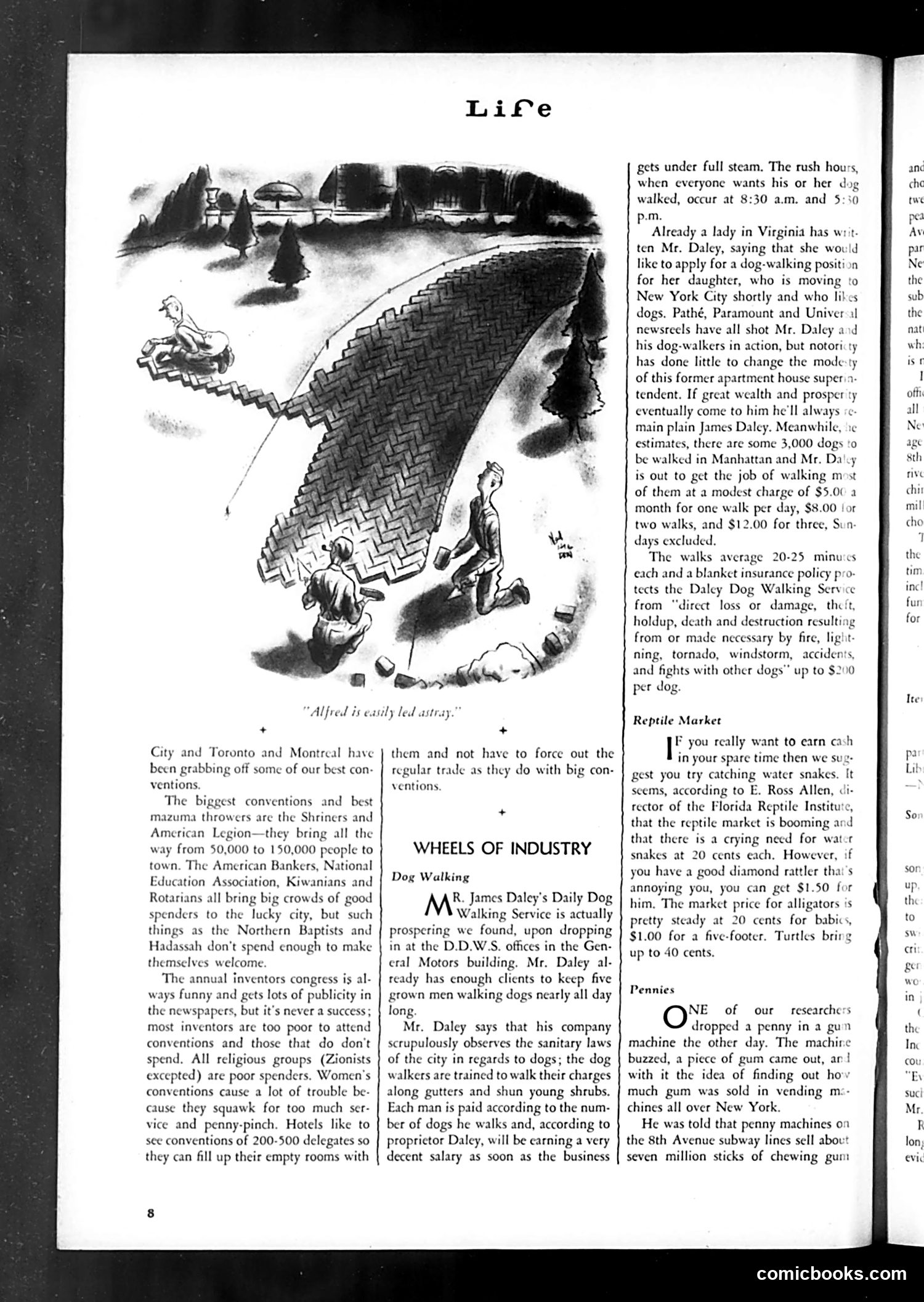
"Alfred is easily led astray" This cartoon satirizes the emerging dog-walking service industry in New York City. The illustration shows a small dog being led astray by larger dogs on leashes, with the caption suggesting that even a dog named "Alfred" can be easily manipulated or corrupted. The accompanying article discusses James Daley's "Daily Dog Walking Service," which employs multiple walkers to exercise Manhattan dogs for fees ranging from $5-12 monthly. The satire mocks this new commercial venture—the idea that New Yorkers are now paying strangers to walk their pets—by suggesting the service itself might lead dogs (and by extension, their owners' money) astray. It's social commentary on urban commercialization and the outsourcing of basic pet care to service industries.
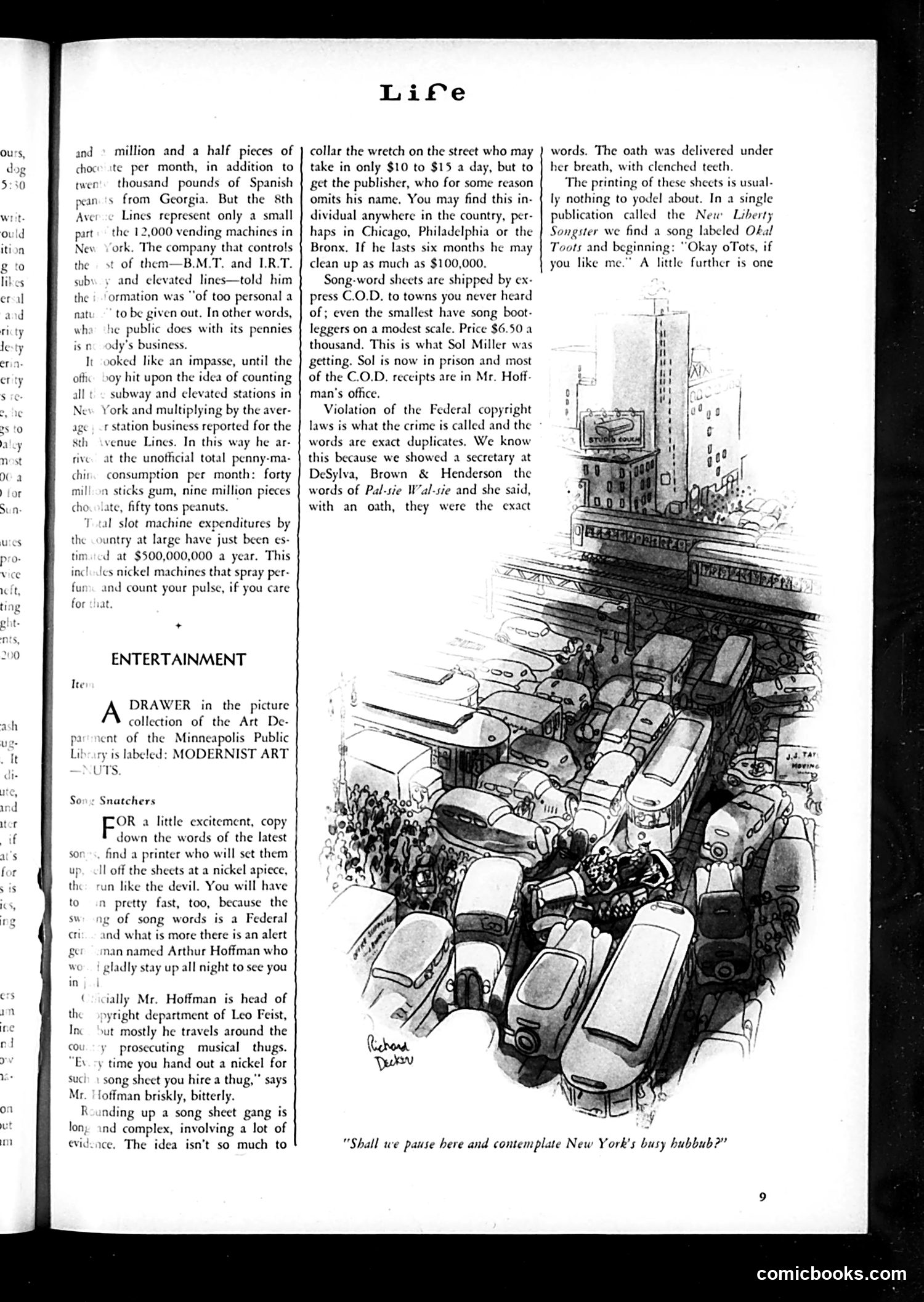
Analysis of Life Magazine Page This page contains a satirical illustration about urban congestion, captioned "Shall we pause here and contemplate New York's busy hubbub?" The drawing depicts an overhead view of a crowded parking lot or street filled with automobiles packed tightly together, with pedestrians visible among the vehicles. The accompanying text discusses copyright violations in the music industry, specifically mentioning Sol Miller's song-sheet piracy operation. The "Entertainment" section covers Arthur Hoffman, head of Leo Feist Inc.'s copyright department, who prosecutes musical theft. The cartoon satirizes New York City's growing automobile congestion and urban overcrowding during the early-to-mid 20th century, a common complaint in satirical magazines of that era. The juxtaposition of bumper-to-bumper traffic with the suggestion to "contemplate" the scene is ironic social commentary.
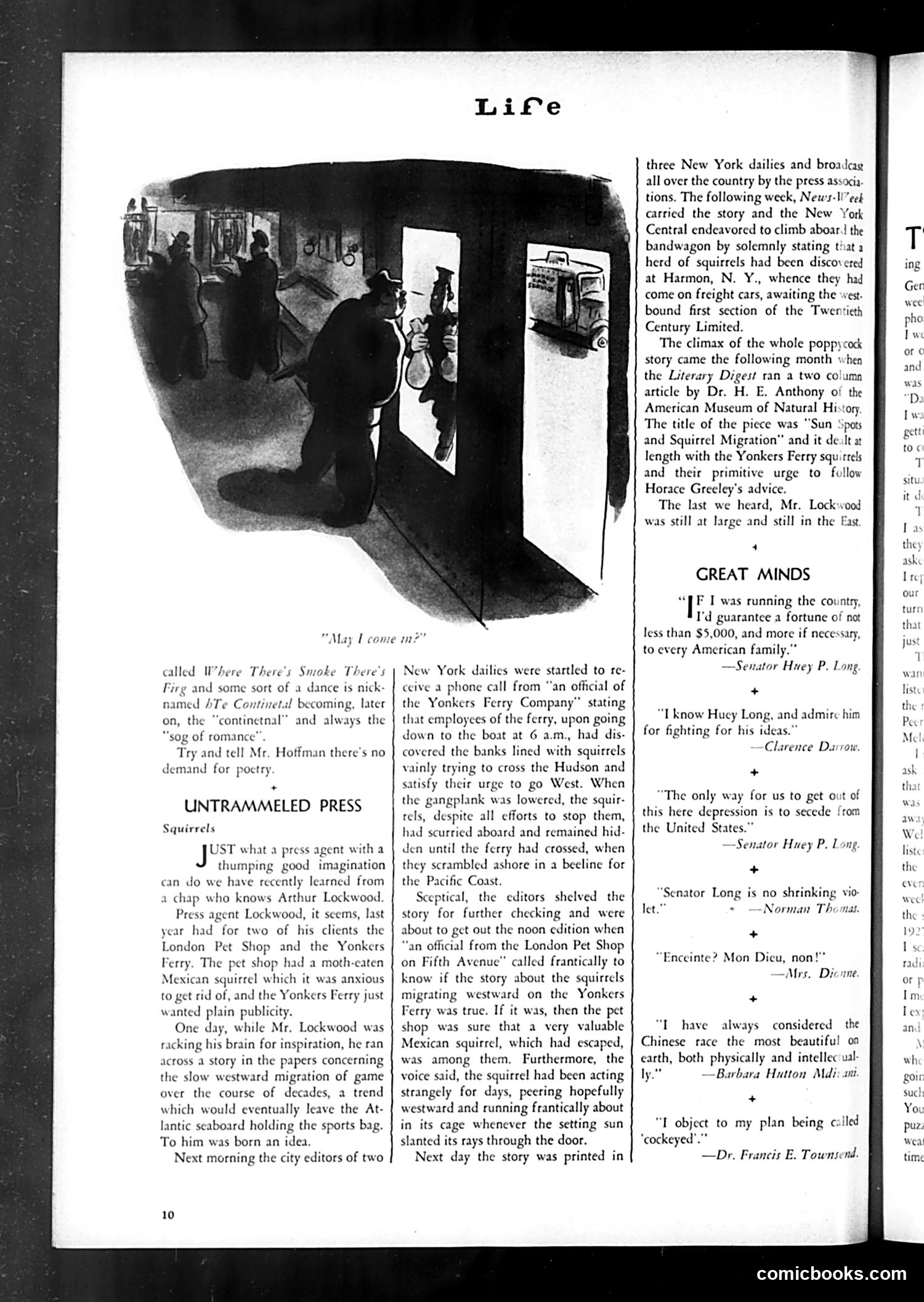
Analysis of This Life Magazine Page The main cartoon, titled "May I come in?", depicts a crowded subway car with passengers packed inside. The satire targets New York City's chronic overcrowding and poor public transportation conditions—a familiar complaint even in this era. The text discusses a humorous press story about squirrels discovered in Harmon, N.Y., that had escaped freight cars and were attempting to migrate west, following Horace Greeley's famous advice to "Go West, young man." The "Great Minds" section collects brief quotes from political figures like Senator Huey P. Long and others, expressing their opinions on various national issues, presented somewhat ironically to highlight their contradictions or absurdity.
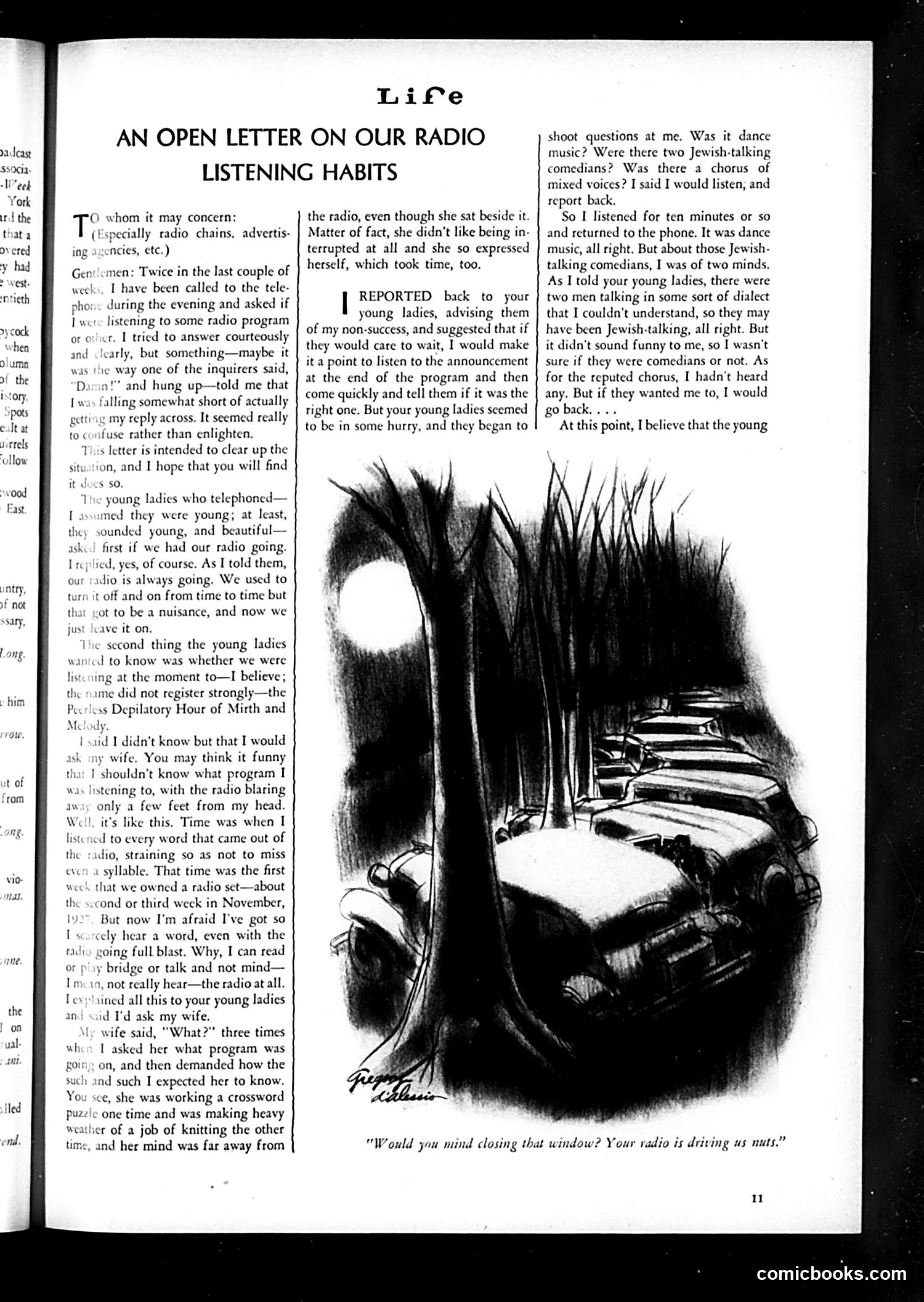
Analysis This page contains an open letter about radio listening habits, not a political cartoon. The letter-writer humorously complains about young women who called a radio station requesting that a program announcement be made, interrupting the broadcast. The accompanying illustration shows a car from behind with tall grass/reeds obscuring the view through its rear window, with the caption: "Would you mind closing that window? Your radio is driving us nuts." The satire is straightforward domestic humor: the joke depicts a couple parked in a secluded spot (implying romance or intimacy) being disturbed by loud radio noise from a nearby car. It's a mild complaint about radio's intrusive presence in everyday American life during the early radio era, when broadcasting was relatively new and somewhat inconsiderate radio use was apparently common enough to joke about.
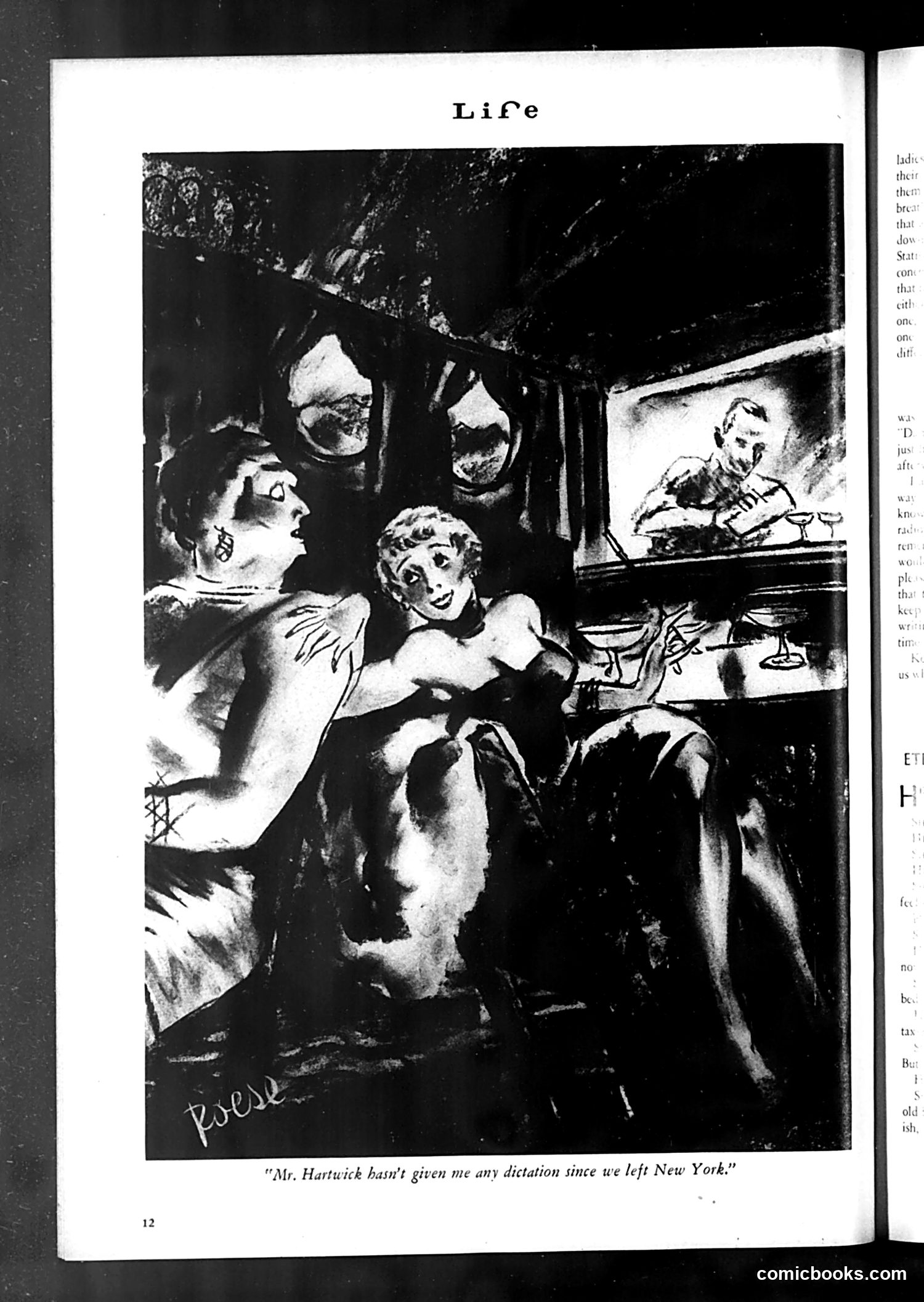
Analysis of Life Magazine Page This is a satirical illustration from Life magazine showing what appears to be a wealthy couple in an elegant interior setting. The caption reads: "Mr. Hartwick hasn't given me any dictation since we left New York." The joke targets upper-class social dynamics and marital relationships. The woman's complaint—that her husband hasn't been "dictating" to her since leaving New York—suggests she's accustomed to him controlling or dominating her at home. The humor derives from the absurdity that she actually *misses* his authoritarian behavior while on vacation or away from the city, implying their relationship is defined by his dominance. The illustration is signed, likely by the cartoonist. This reflects early-to-mid 20th century attitudes about gender relations and domestic hierarchy presented as comedic.
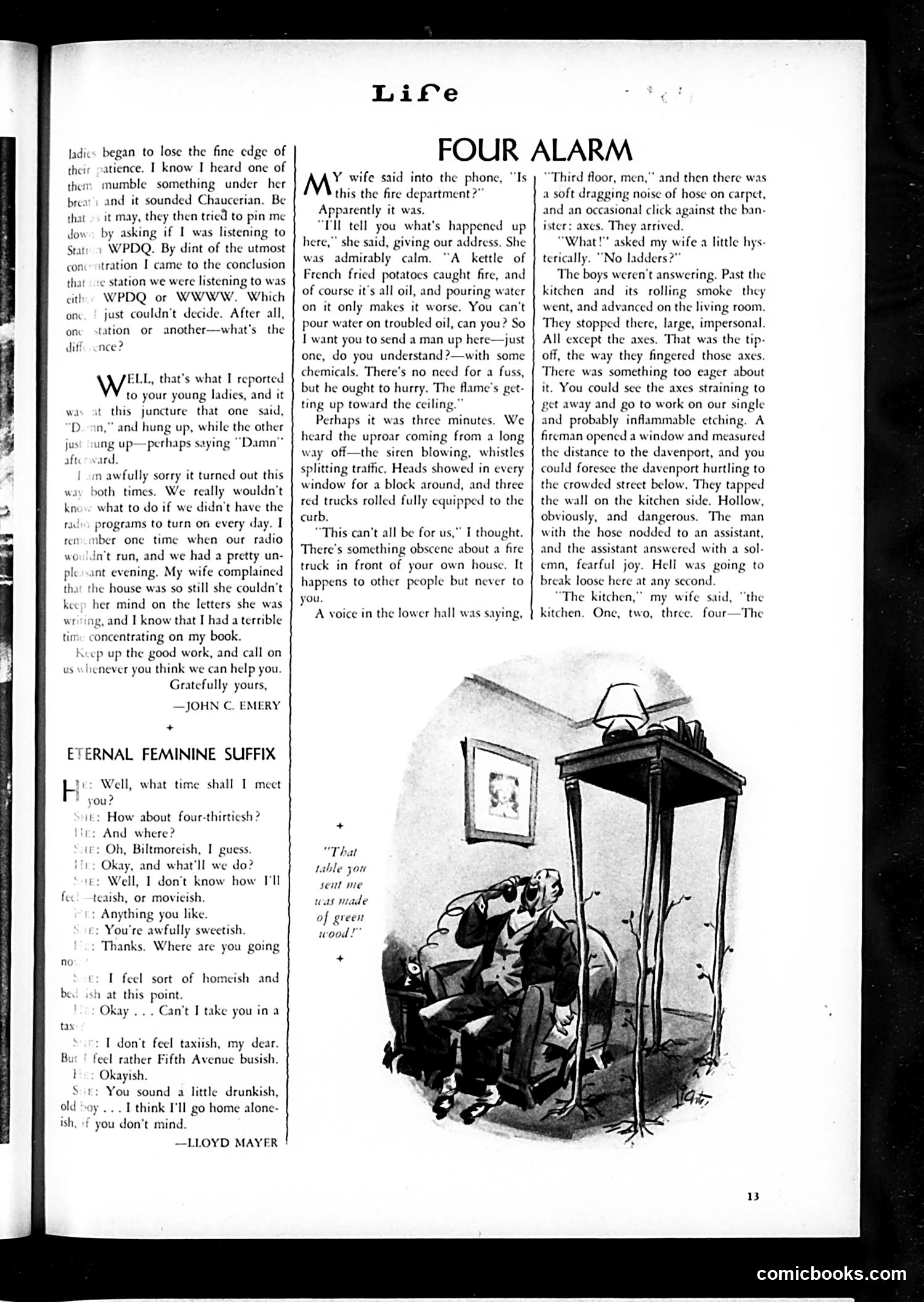
Analysis of Life Magazine Page This page contains three separate humor pieces: "Four Alarm" (center): A domestic comedy about a kitchen fire. The wife calls the fire department to report a grease fire, but gives overly detailed instructions about using chemicals instead of water. The humor derives from her verbose, controlling nature during an emergency—she's more concerned with being right about fire-fighting technique than with getting actual help. "Eternal Feminine Suffix" (left): A dialogue joke playing on women's indecisiveness. A man asks a woman for a meeting time and location, and she repeatedly adds qualifying phrases ("I guess," "I think," "I suppose"), suggesting women habitually hedge their statements with apologetic suffixes rather than speaking decisively. The cartoon (right) illustrates the fire department scene, showing firefighters responding to the house call.
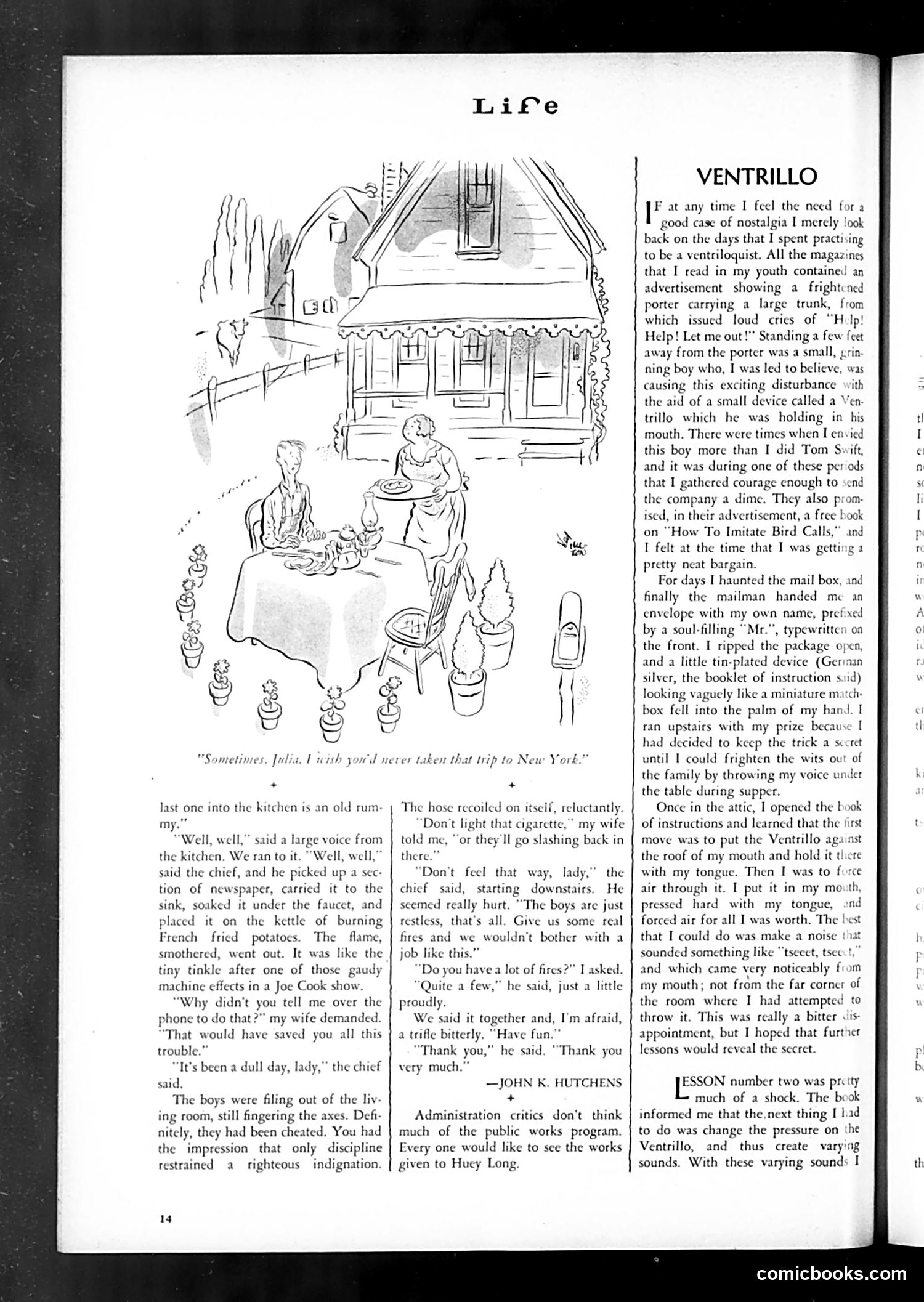
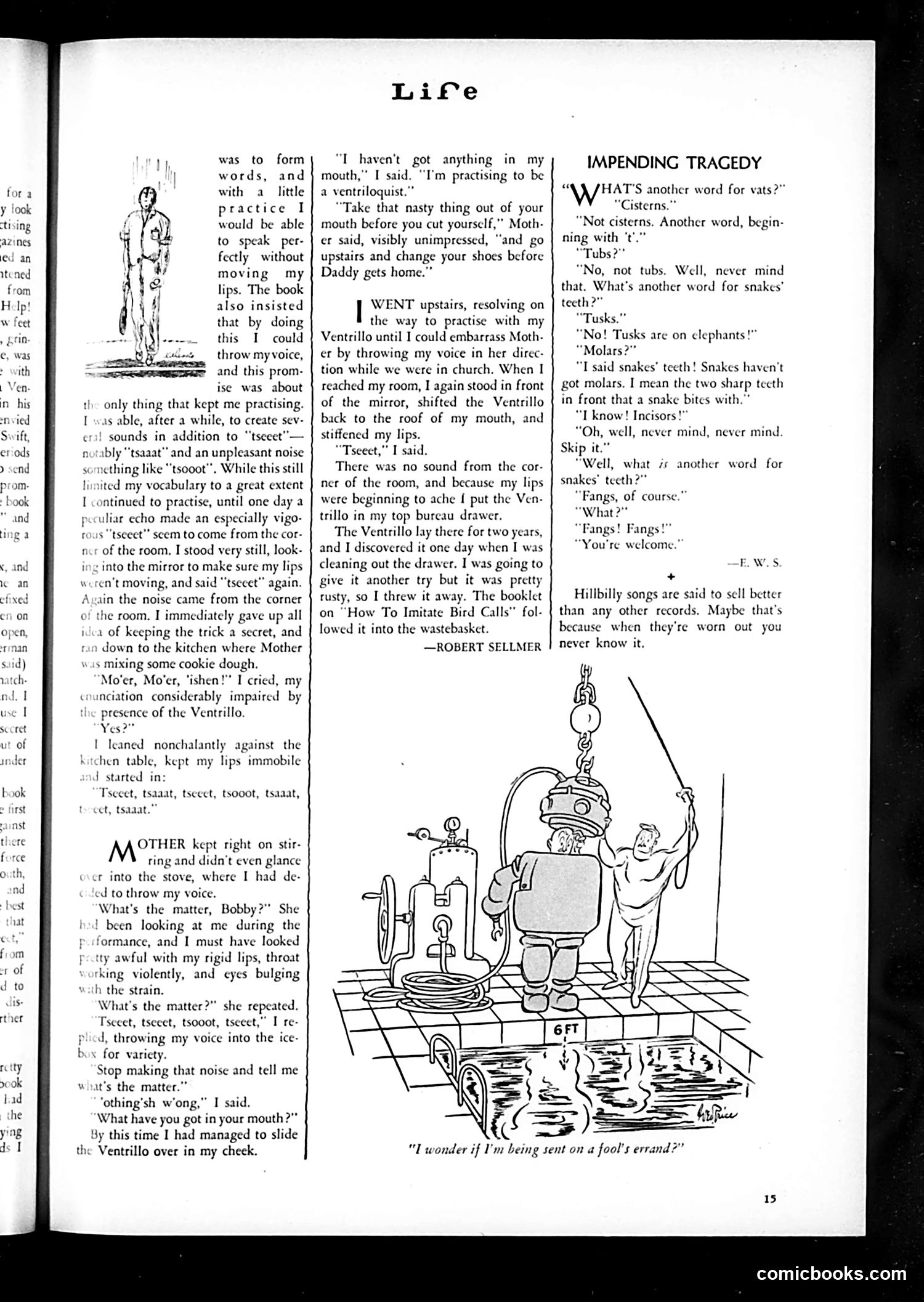
"Ventrillo" - A Ventriloquism Novelty The article humorously recalls the author's childhood fascination with a mail-order ventriloquism device called a "Ventrillo." The accompanying sketch shows a domestic scene with a woman and child at a table surrounded by potted plants. The satire centers on the gap between advertising hype and reality. The device promised excitement through bird-call imitation and ventriloquism tricks, but the author describes the actual experience as disappointing—a small, unglamorous tin device that produced underwhelming sounds. The humor lies in the nostalgic deflation of childhood expectations. What seemed like a miraculous "Help! Help!" device from a dramatic advertisement turned out to be a mundane novelty that required careful angle-work to create convincing noises. It's gentle satire on mail-order marketing's exaggerated promises to children.
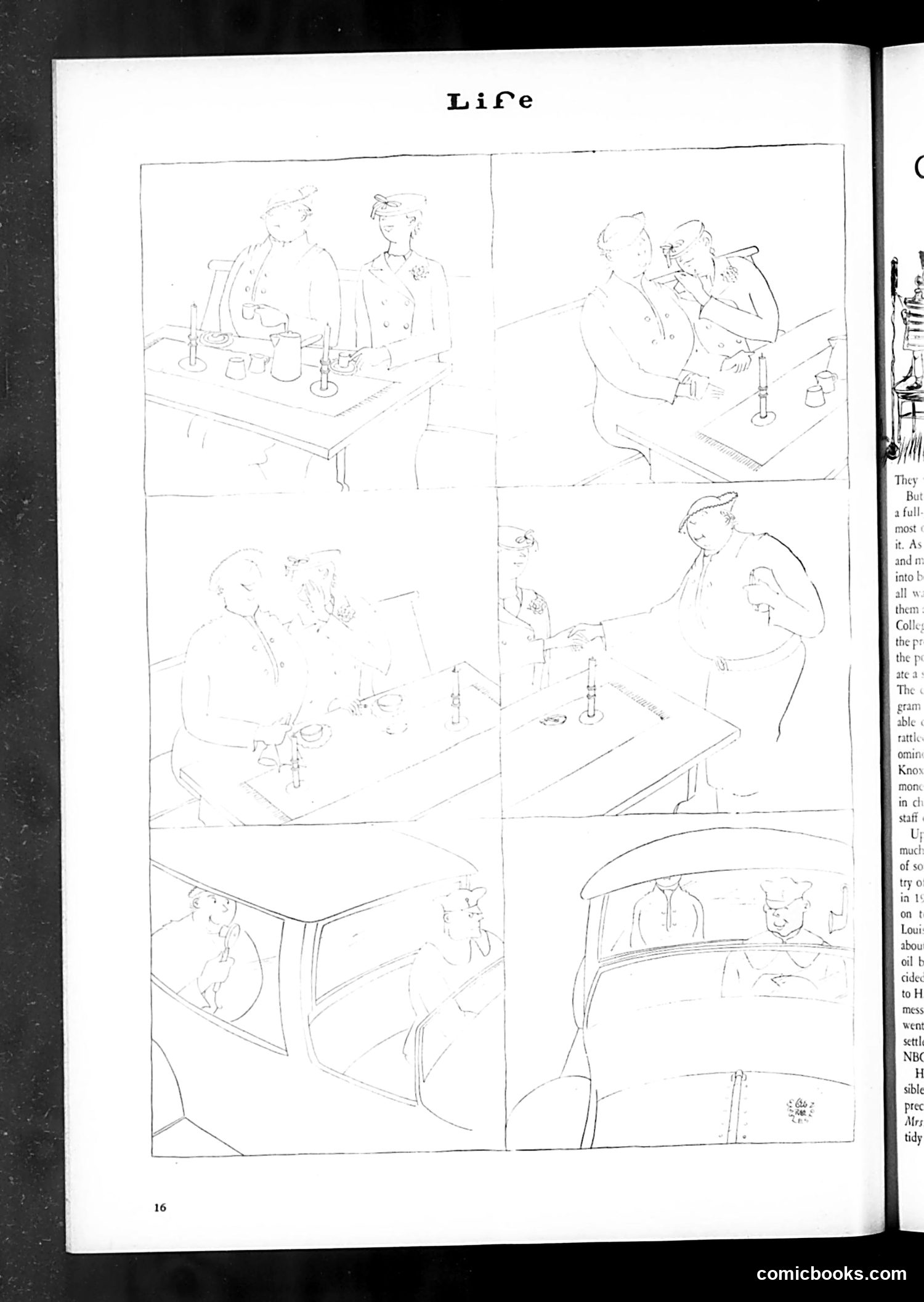
Analysis This page from *Life* magazine (page 16) presents a six-panel comic strip titled "Life" depicting what appears to be a domestic or social scenario. The sketchy, preliminary-style drawings show figures in various indoor settings—around tables, in vehicles, and other spaces. Without clearer details or legible dialogue in the image, the specific satirical target remains unclear. The crude line-work suggests this may be a rough draft or preliminary sketch rather than finished artwork. The right-hand text column is partially visible but too blurry to read definitively. To accurately identify the figures, political references, and satirical intent would require either sharper image resolution or visible captions/dialogue. I cannot responsibly identify specific individuals or determine the cartoon's point without clearer source material.
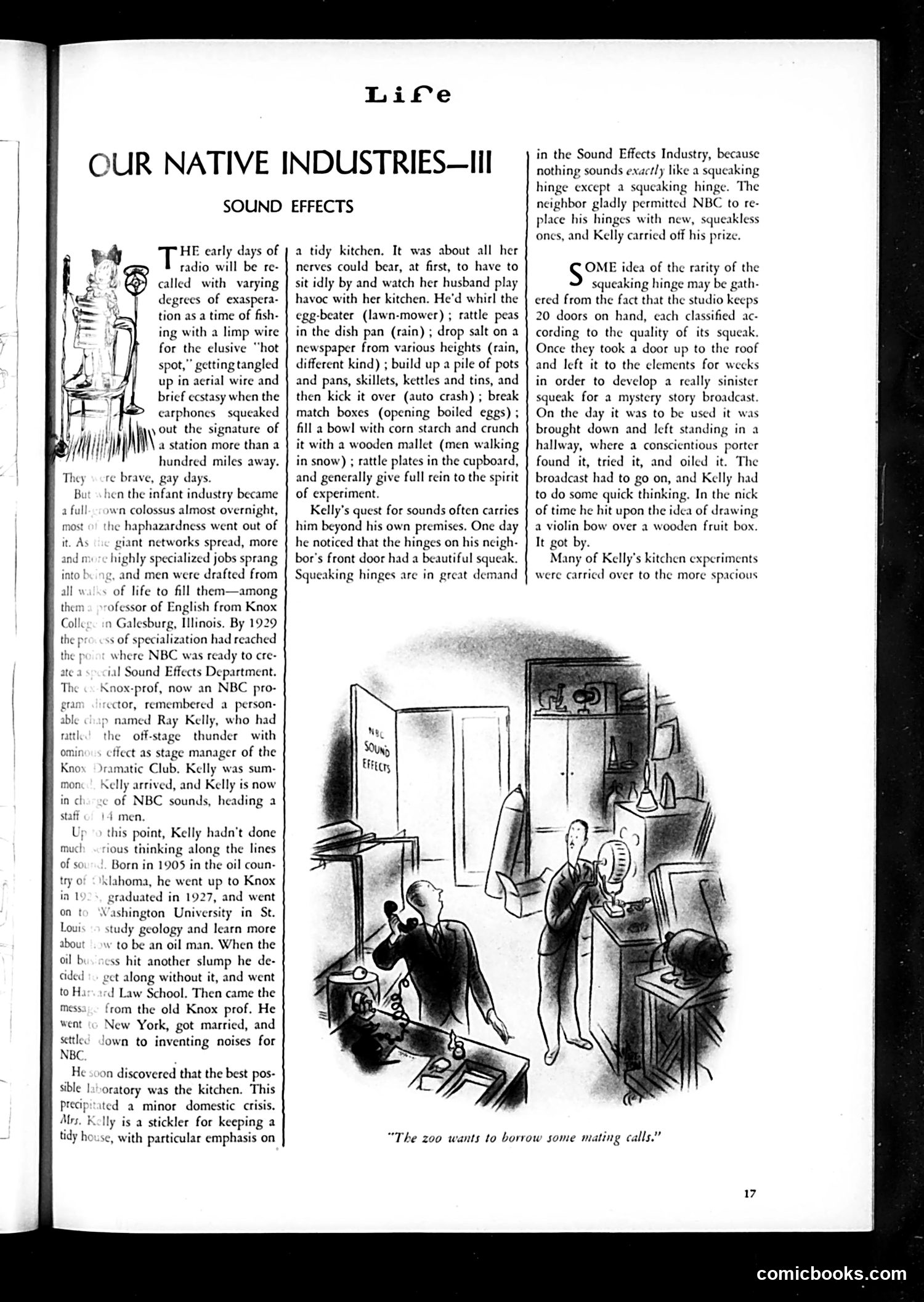
Explanation for Modern Readers This page describes NBC's Sound Effects Department, featuring Ray Kelly, who invented realistic sound effects for radio broadcasts. The accompanying cartoon illustrates Kelly's work: a man in a sound booth creates noises while another man operates equipment, with the caption "The zoo wants to borrow some mating calls." The joke plays on Kelly's ability to produce authentic animal sounds in the studio. The satire is gentle—it celebrates the ingenuity of American industry and specialized labor while poking fun at how convincingly Kelly could replicate nature. The cartoon reflects 1920s-1930s fascination with radio technology and the hidden craftspeople making broadcasts possible. The "mating calls" reference adds mild humor suitable for the era's standards.
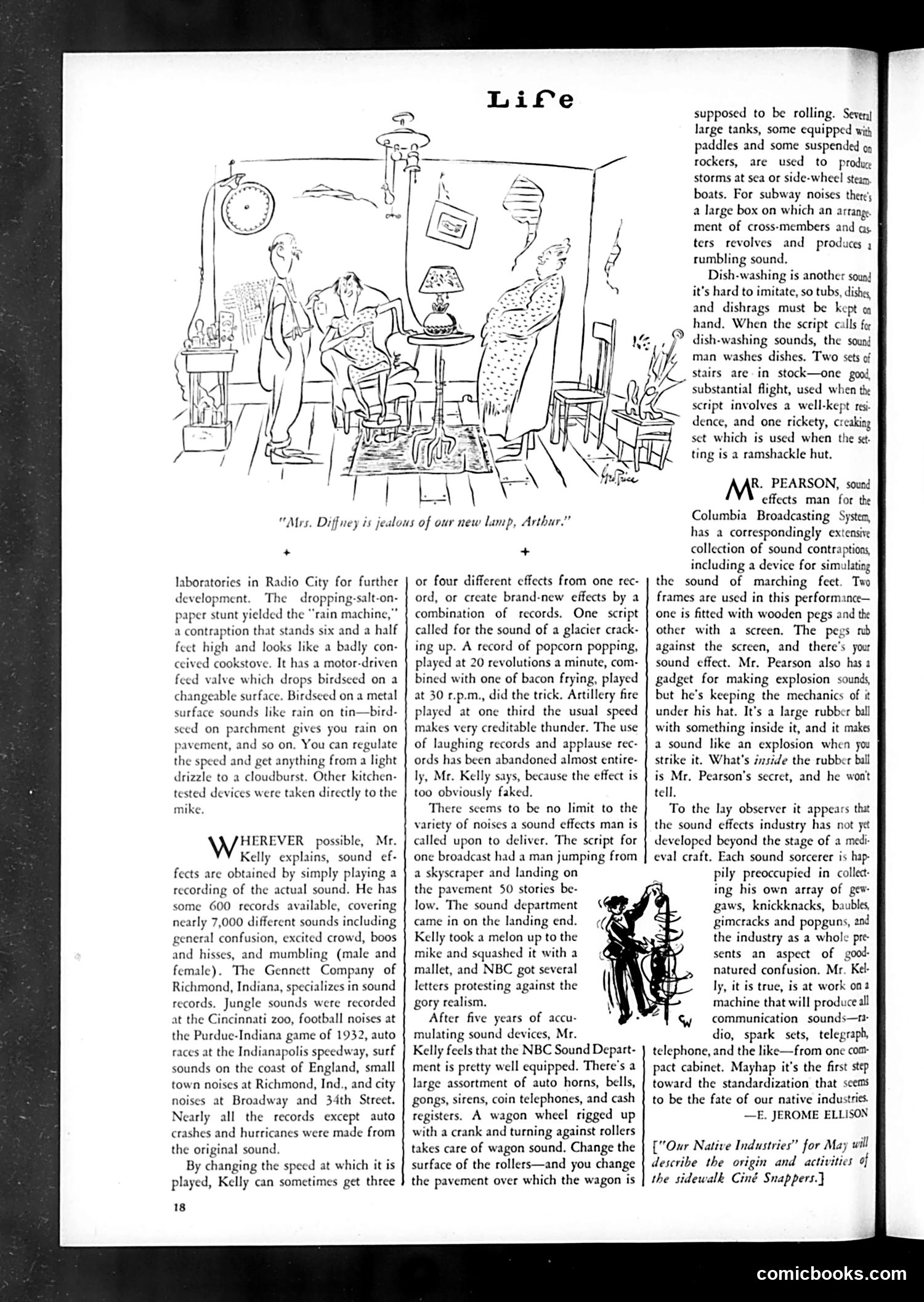
Cartoon Analysis: "Mrs. Diffsey is Jealous of Our New Lamp, Arthur" This cartoon satirizes domestic life and consumer culture. The sketch shows a woman (Mrs. Diffsey) gesturing jealously at a modern electric lamp while addressing a man (Arthur). The humor derives from the exaggerated reactions to new household technology—the woman's dramatic posture and body language suggest she's treating a mere lamp as a rival for attention. The accompanying article discusses sound effects in radio broadcasting, explaining how engineers create realistic sounds using records and mechanical devices. The cartoon's caption connects to broader early-20th-century themes: women's responses to modernization and the growing role of electric appliances in American homes, presented here as objects of domestic attention and jealousy.
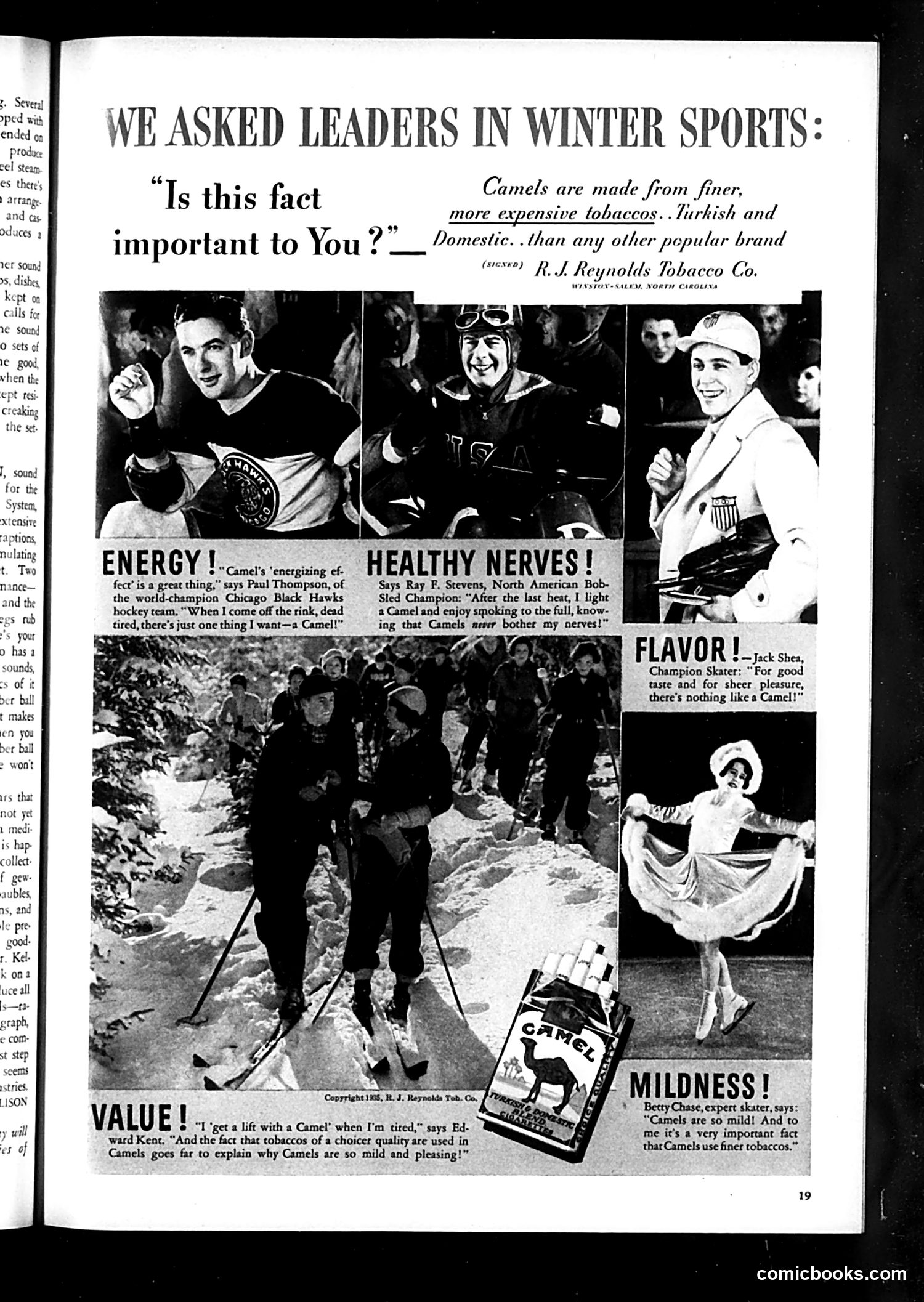
Analysis This is a Camel cigarette advertisement, not satire or political commentary. The ad uses endorsements from winter sports champions to promote cigarettes by associating smoking with athletic performance and health benefits. The page features testimonials from three named athletes: - A Chicago Black Hawks hockey player citing "energy" - A sled champion praising "healthy nerves" - Jack Shea (champion skater) emphasizing "flavor" Additional endorsements mention "value" and "mildness." A large photograph shows skiers on a snowy slope. For modern readers: This represents a now-shocking marketing practice where cigarette companies directly associated smoking with athletic achievement and physical wellness—claims now known as false and harmful. Such advertising is illegal today, but was standard mid-20th century tobacco marketing that deliberately misled consumers about health effects.
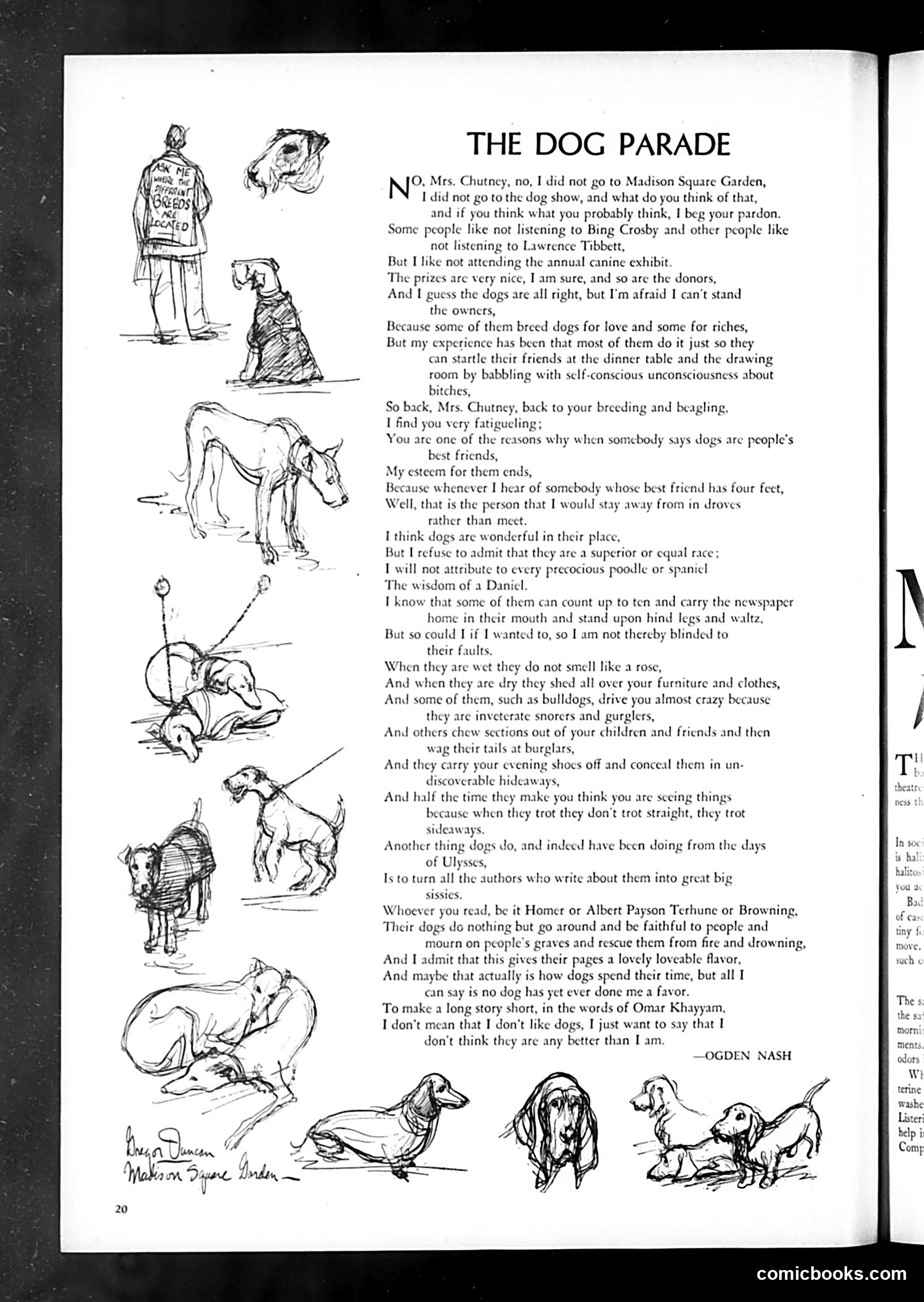
"The Dog Parade" by Ogden Nash This is a humorous poem satirizing dog-show culture and the pretentiousness of dog owners, illustrated with sketches of various dogs and their owners. Nash mocks wealthy New Yorkers who breed pedigree dogs primarily to boast at dinner parties about their "bitches" (female dogs), displaying self-conscious snobbery. He dismisses the romanticization of dogs in literature—referencing famous authors like Homer and Browning who portray canines as noble, faithful companions—as sentimental nonsense. The poem's central joke: dogs are ordinary animals with real flaws (they shed, snore, steal shoes, smell bad when wet), yet literature and high society treat them as superior beings. Nash's irreverent conclusion—that dogs are simply not better than humans—deflates the pretense surrounding dog shows and dog-loving society figures like the addressee "Mrs. Chutney." The sketches emphasize dogs' unglamorous reality: awkward postures, undignified behavior.
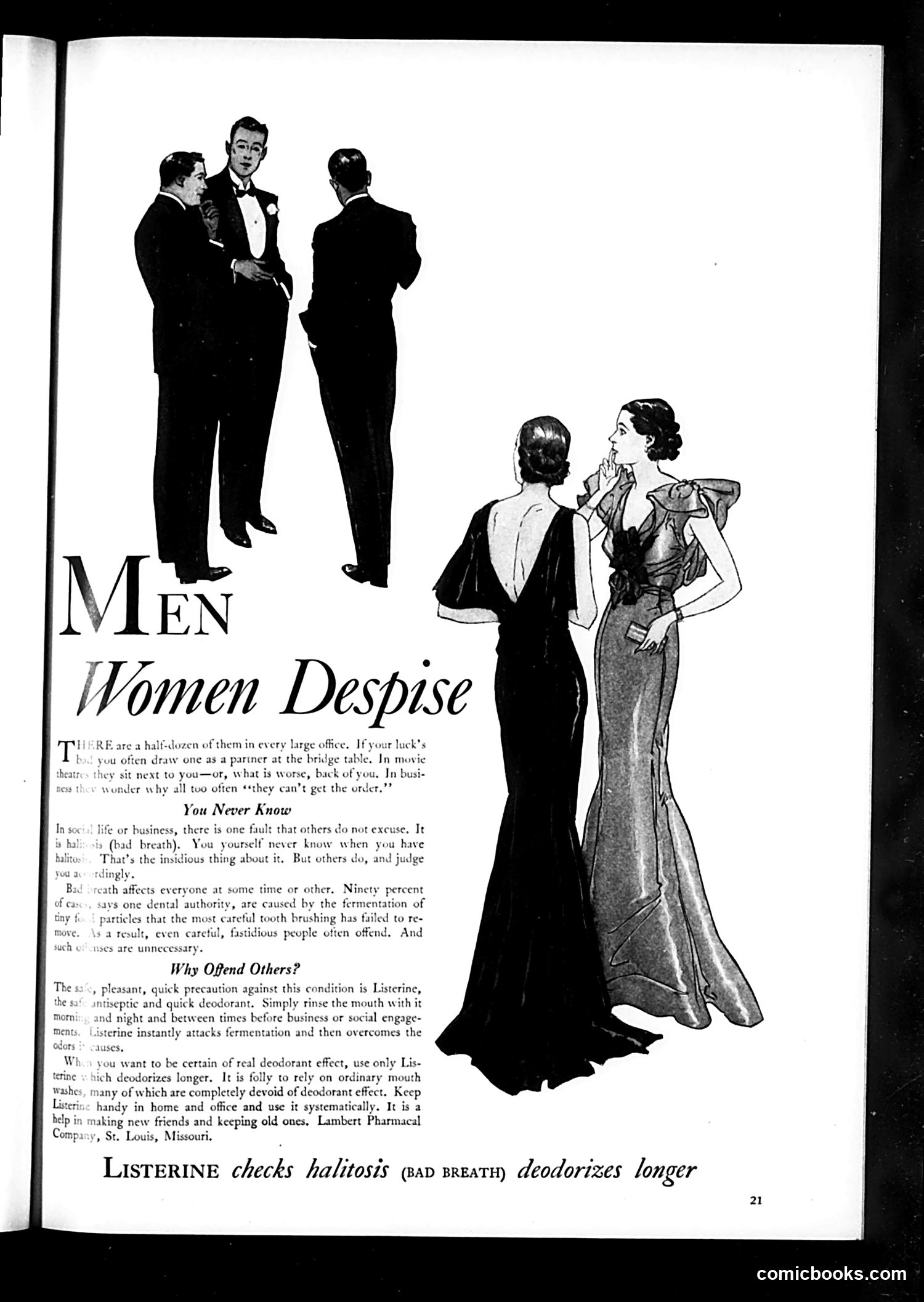
Analysis: "Men Women Despise" This is a Listerine advertisement, not political satire. The page uses social anxiety messaging typical of early-to-mid 20th century advertising. The illustration shows three men in formal wear (top) and two women in evening gowns (bottom), establishing an aspirational social context. The headline "Men Women Despise" refers to men with bad breath ("halitosis"). The text argues that bad breath is a social liability that can damage business and romantic prospects—one might be seated "back of you" at dinner or fail to "get the order" in business. The ad claims 90% of bad breath stems from tooth decay and fermentation, presenting Listerine as the solution for maintaining friendships and social standing. This reflects period attitudes where personal hygiene products were marketed by stoking fear of social rejection, particularly targeting anxieties about professional and romantic success.
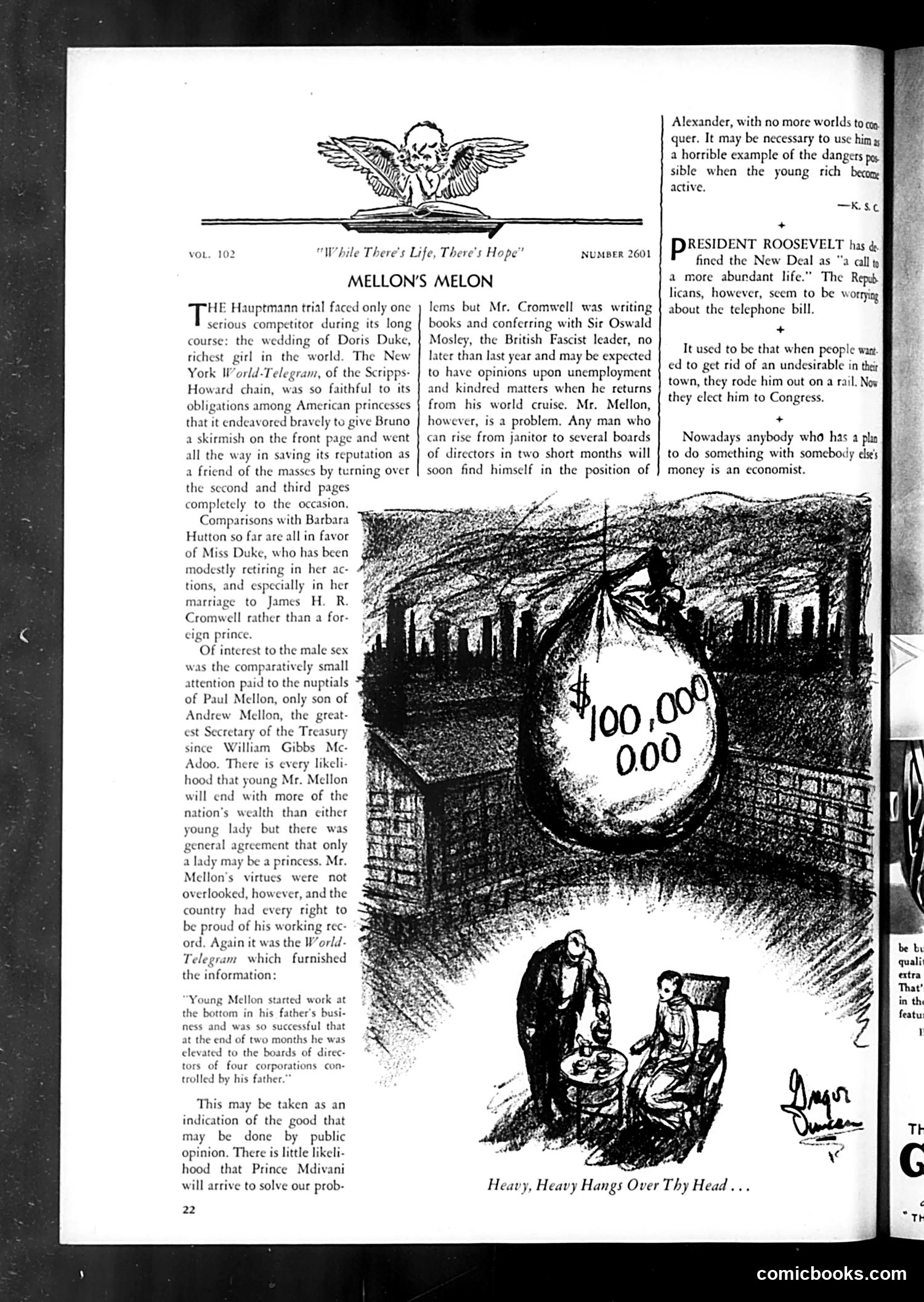
"Mellon's Melon" — Life Magazine Satire This article satirizes the disparity in media coverage and social attitudes toward wealthy heirs. The occasion: Paul Mellon (son of former Treasury Secretary Andrew Mellon) married quietly, receiving minimal press attention, while heiress Doris Duke's wedding dominated newspapers. The satire's targets: (1) Paul Mellon's meteoric rise—promoted from janitor to multiple corporate boards within two months simply because his father controlled the companies—illustrating nepotism's absurdity. Life warns he'll become "Alexander with no more worlds to conquer," implying dangerous idle wealth. (2) Class hypocrisy—society celebrates female heirs as "princesses" while dismissing male ones, yet Mellon's actual working credentials exceed Doris Duke's social status. The accompanying cartoon depicting "$100,000,000" hanging over a couple's head visualizes inherited wealth as an inescapable burden/curse. The piece mocks both the press and social conventions that valorize wealth while ignoring how it's actually accumulated—through family connections rather than merit.
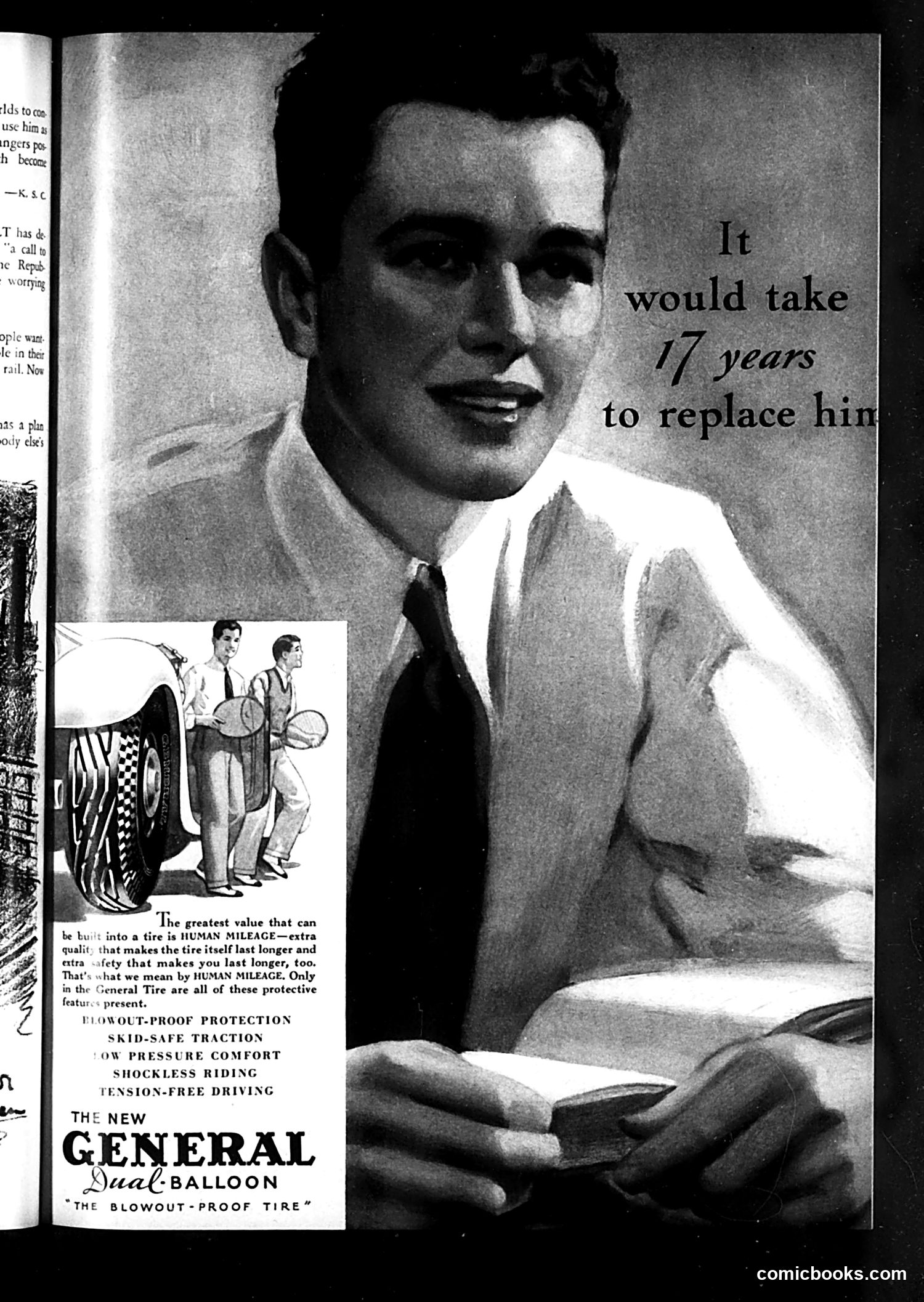
Advertisement Analysis This is primarily a tire advertisement for General's new "Dual-Balloon" tire, not political satire. The large portrait shows a well-dressed man with the caption "It would take 17 years to replace him," using this as a sales pitch: the tire prioritizes human safety through "HUMAN MILEAGE"—a marketing concept claiming the tire protects not just the vehicle but the driver's life itself. The smaller illustration shows men examining a tire, emphasizing the product's safety features: blowout-proof protection, skid-safe traction, and shock absorption. The messaging reflects early 20th-century concerns about automobile safety and reliability. The "17 years to replace him" phrase suggests the irreplaceable value of human life, positioning quality tires as a literal life-saving investment. This is advertising using social messaging rather than satire.
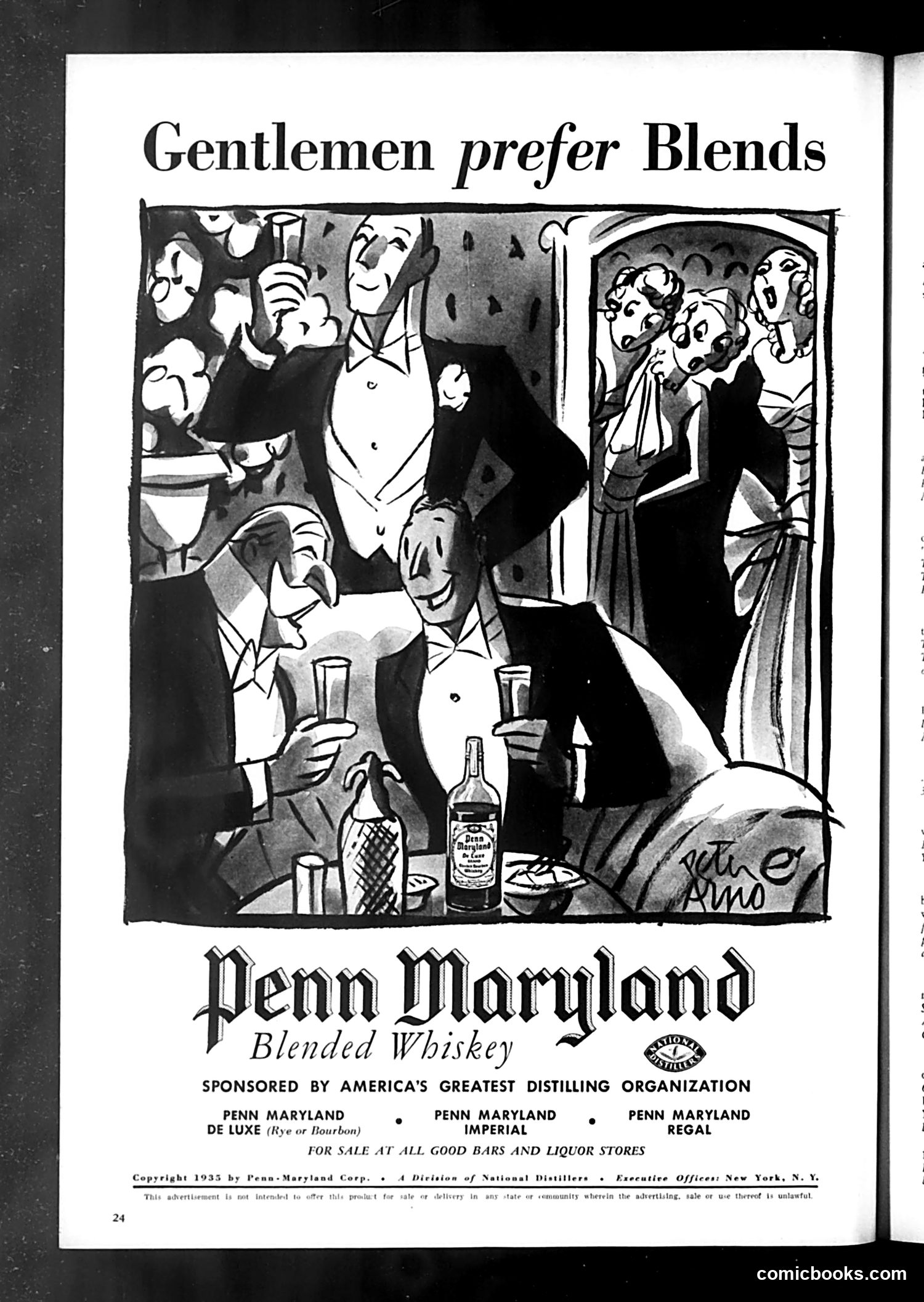
Analysis This is primarily a whiskey advertisement from 1935, not political satire. The headline "Gentlemen prefer Blends" is a commercial slogan playing on the popular phrase "Gentlemen Prefer Blondes" (a 1925 book/film reference). The cartoon depicts a sophisticated party scene with well-dressed men and women in formal attire, clustered around bottles of Penn Maryland whiskey products. The illustration promotes the product as associated with upscale social gatherings and refined taste. The "joke" is purely commercial: the advertisement suggests that discerning gentlemen choose blended whiskey. This appeared during Prohibition's repeal (1933), when the liquor industry aggressively marketed products to rebuild consumer culture. There is no political commentary or social satire present—it's straightforward period advertising targeting male consumers by associating the product with elegance and masculinity.
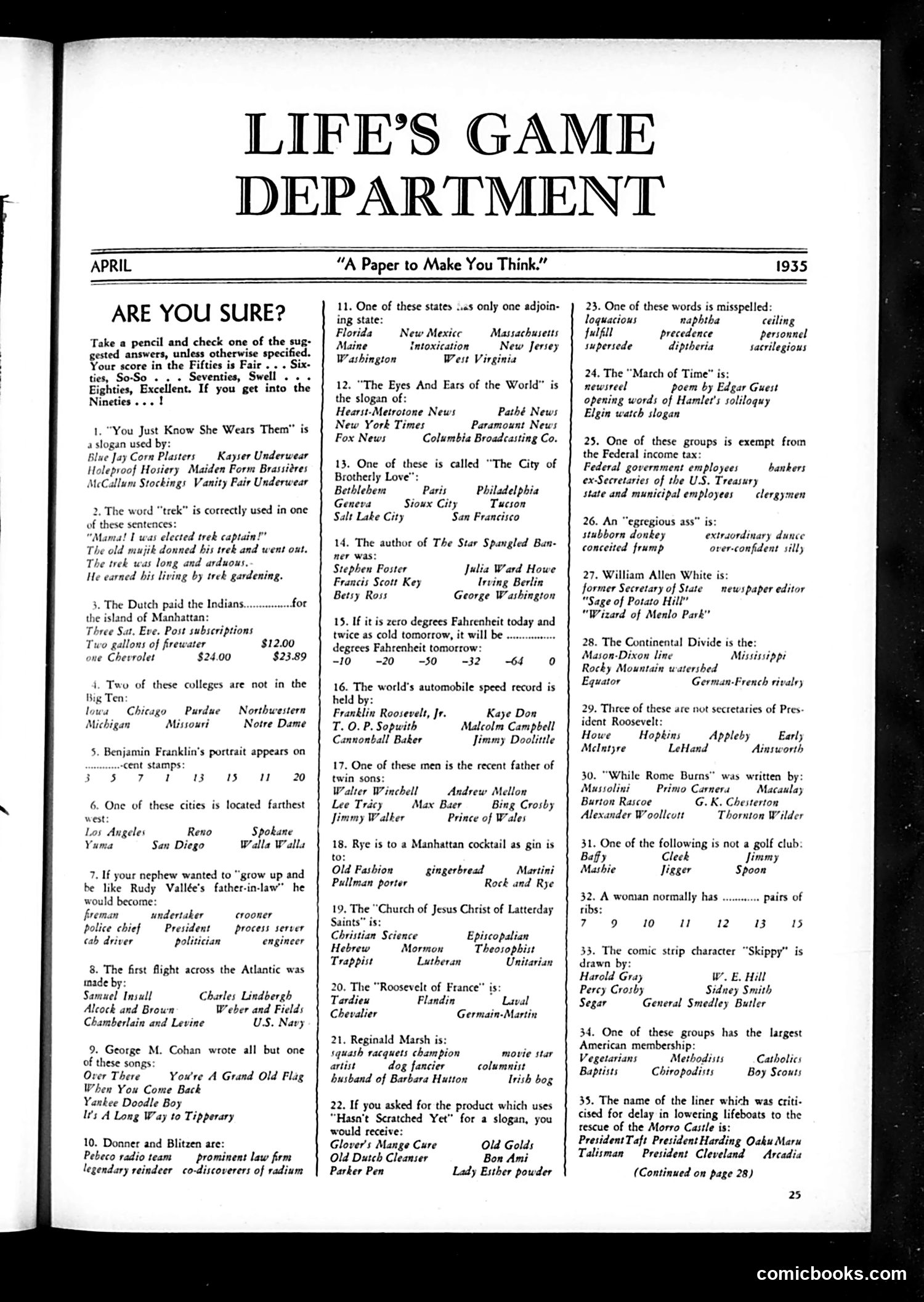
"Life's Game Department" - April 1935 This page is a trivia quiz, not a political cartoon. "Life's Game Department" was a recurring feature in *Life* magazine testing readers' knowledge on contemporary American culture, advertising, and current events. The questions reveal 1935 concerns: famous advertising slogans (Kayser underwear, Old Dutch cleanser), celebrity gossip (Rudy Vallée's father-in-law, Jimmy Walker, Reginald Marsh), recent aviation records, political figures (FDR, various French politicians), and popular culture references (George M. Cohan songs, movie newsreels). The scoring system (Fifties = Fair, Nineties = Excellent) gamifies general knowledge as entertainment—typical of Depression-era *Life* magazine's blend of humor and self-improvement content. The page demonstrates what educated American readers were expected to know in 1935.
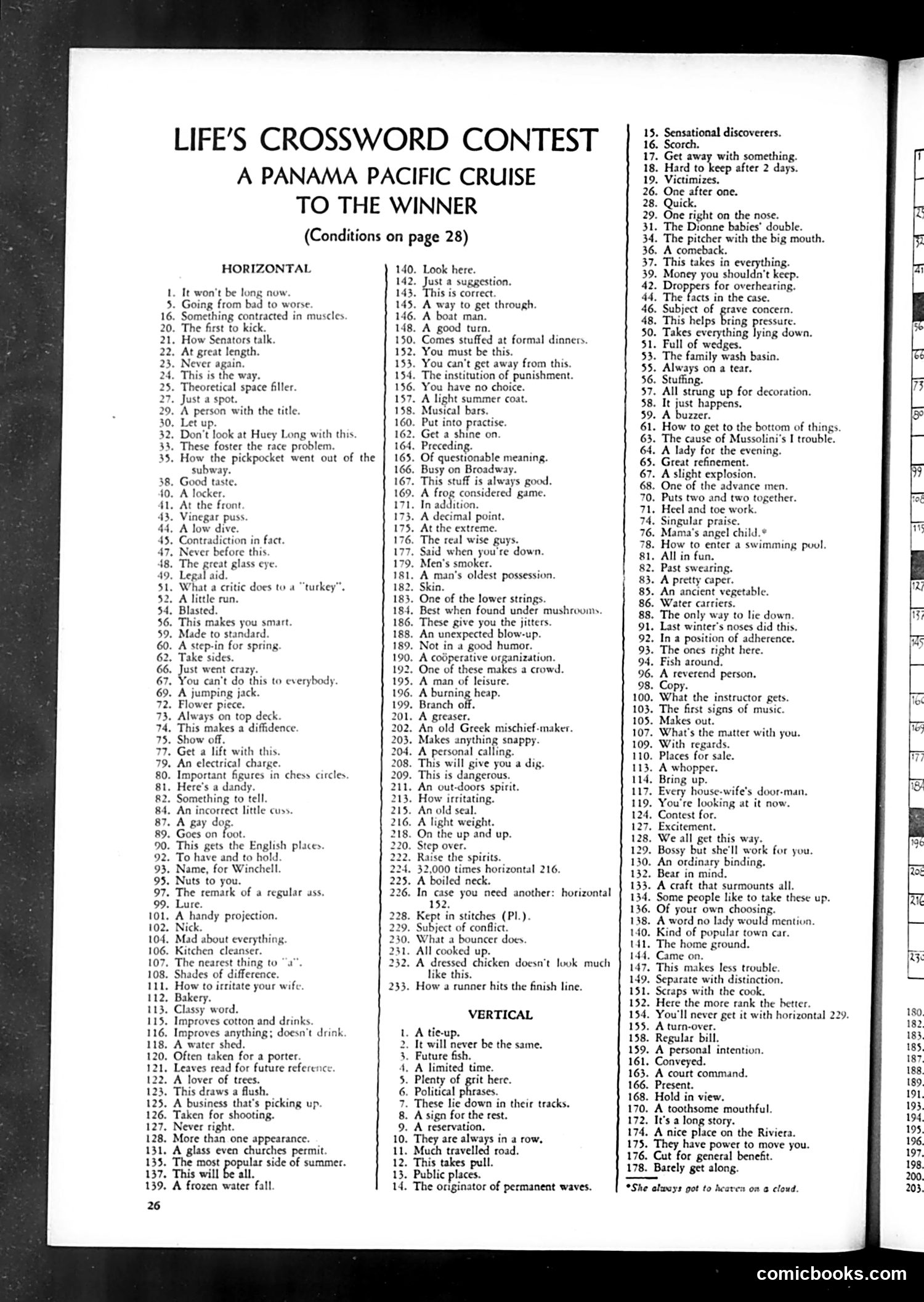
Life's Crossword Contest Page This page presents a crossword puzzle contest sponsored by Life magazine, with a Panama Pacific cruise as the grand prize. The puzzle itself—not a political cartoon—uses wordplay and contemporary references typical of 1930s American life. Key references visible in the clues include: - "Huey Long" (horizontal 32): A reference to the Louisiana politician and populist firebrand of the era - "Winchell" (horizontal 93): Walter Winchell, the famous gossip columnist - "Broadway" (horizontal 167): Then the entertainment center of America - Social commentary: Clues reference "the race problem," institutions like prisons and schools, and working-class life ("porter," "greaser") The puzzle reflects Depression-era concerns and popular culture, using light humor about everyday situations ("irritate your wife," "kitchen cleanser") mixed with references to contemporary public figures. This was typical of Life's satirical approach—accessible wordplay appealing to educated middle-class readers rather than pointed political satire.
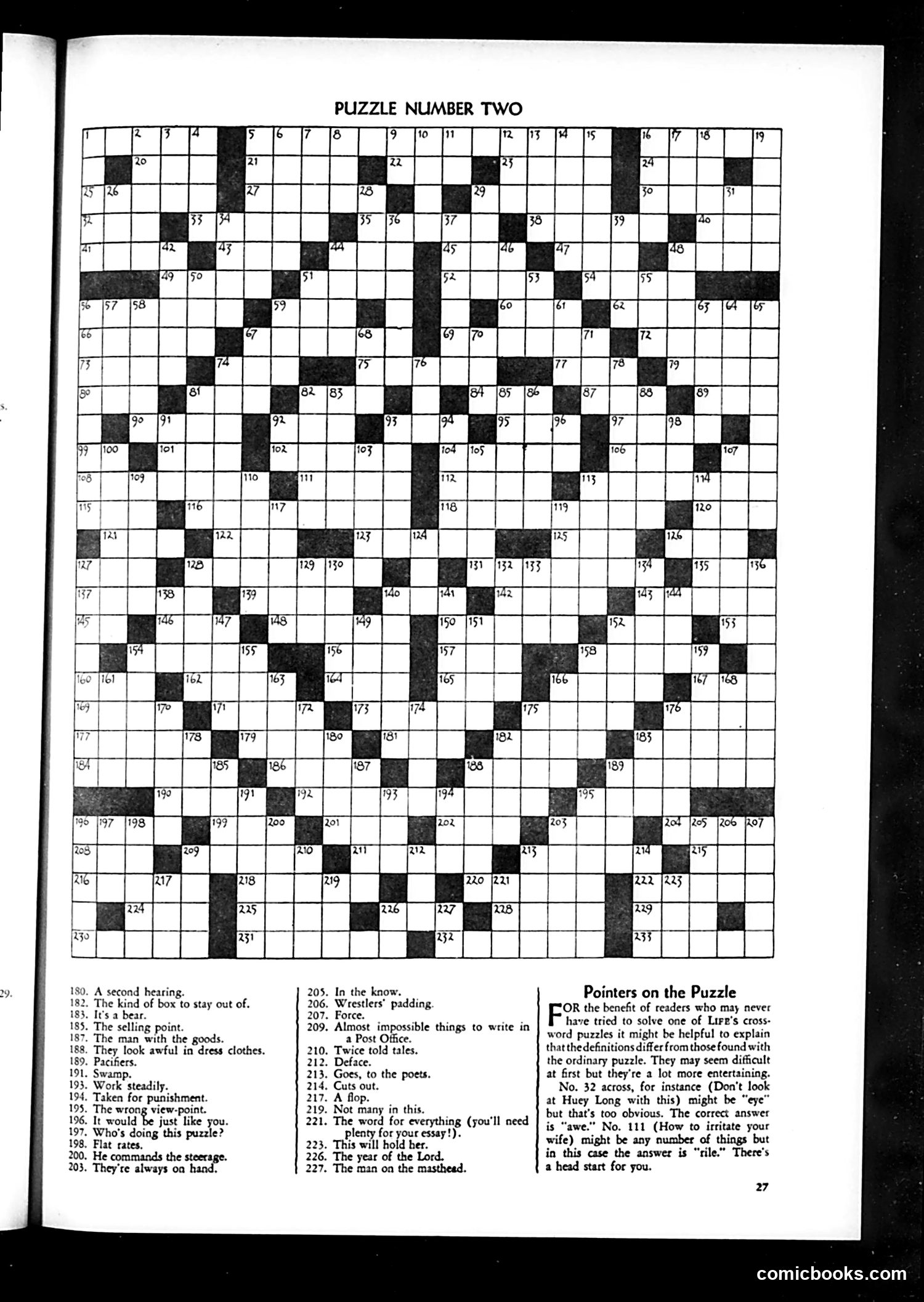
Puzzle Number Two Analysis This page presents a crossword puzzle from Life magazine with accompanying clue definitions and solving tips. Rather than straightforward crossword clues, Life's puzzles feature clever, indirect wordplay—the "pointers" section explains this approach to readers unfamiliar with the format. The example clues illustrate the satirical humor: clue 32 across references "Huey Long" (the controversial Louisiana politician of the 1930s) with the answer "awe" rather than something obvious like "eye." Clue 111 asks "How to irritate your wife" with the answer "rile." This represents Life's sophisticated, educated humor targeting literate readers who enjoyed witty wordplay and contemporary political references. The puzzle itself is primarily content rather than a cartoon, though it demonstrates the magazine's blend of entertainment and gentle social commentary typical of the era.
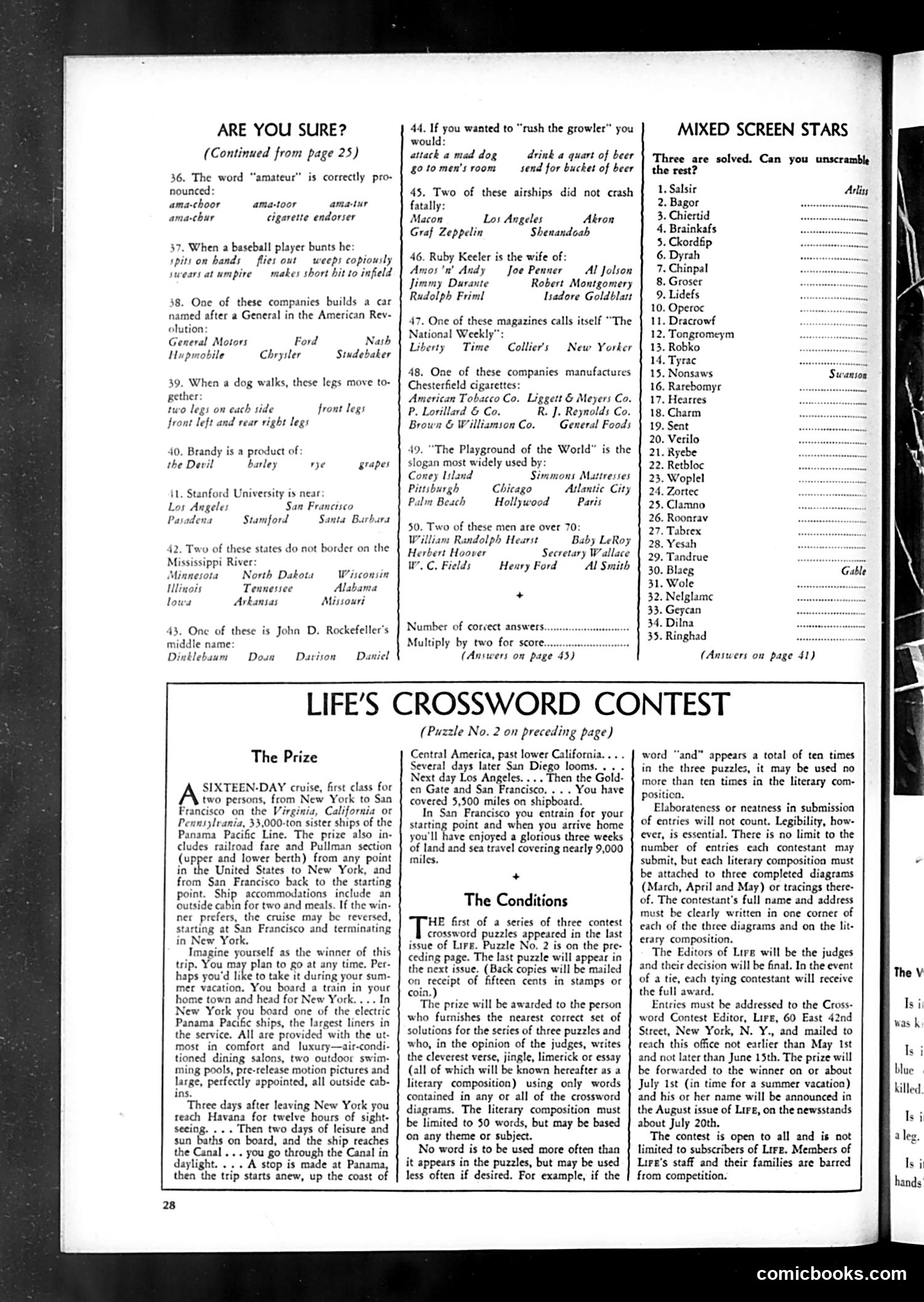
Life Magazine Quiz Page Analysis This page presents a trivia quiz titled "Are You Sure?" testing readers' knowledge of 1930s American culture. The questions cover: Cultural References: - Automobiles (General Motors, Nash, Ford) - Radio personalities (Amos 'n' Andy, Jimmy Durante, Al Jolson) - Film stars (Ruby Keeler, the "Mixed Screen Stars" scramble) - Publications (Liberty, Collier's, New Yorker) - Business figures (Rockefeller, Hearst, Henry Ford) - Current events (airship disasters—Graf Zeppelin, Akron, Macon) The Satire's Point: The quiz gently mocks Americans' pop-culture obsession while assuming readers would know celebrity gossip (Keeler's marriage to Jolson) and consumer brands better than geography or history. Period slang like "rush the growler" (send for beer in a bucket) reveals 1930s working-class vernacular. Modern Context: This reveals what Depression-era Life readers considered important knowledge—a snapshot of celebrity-driven consumer culture that remains recognizable today, though the specific names are largely forgotten.
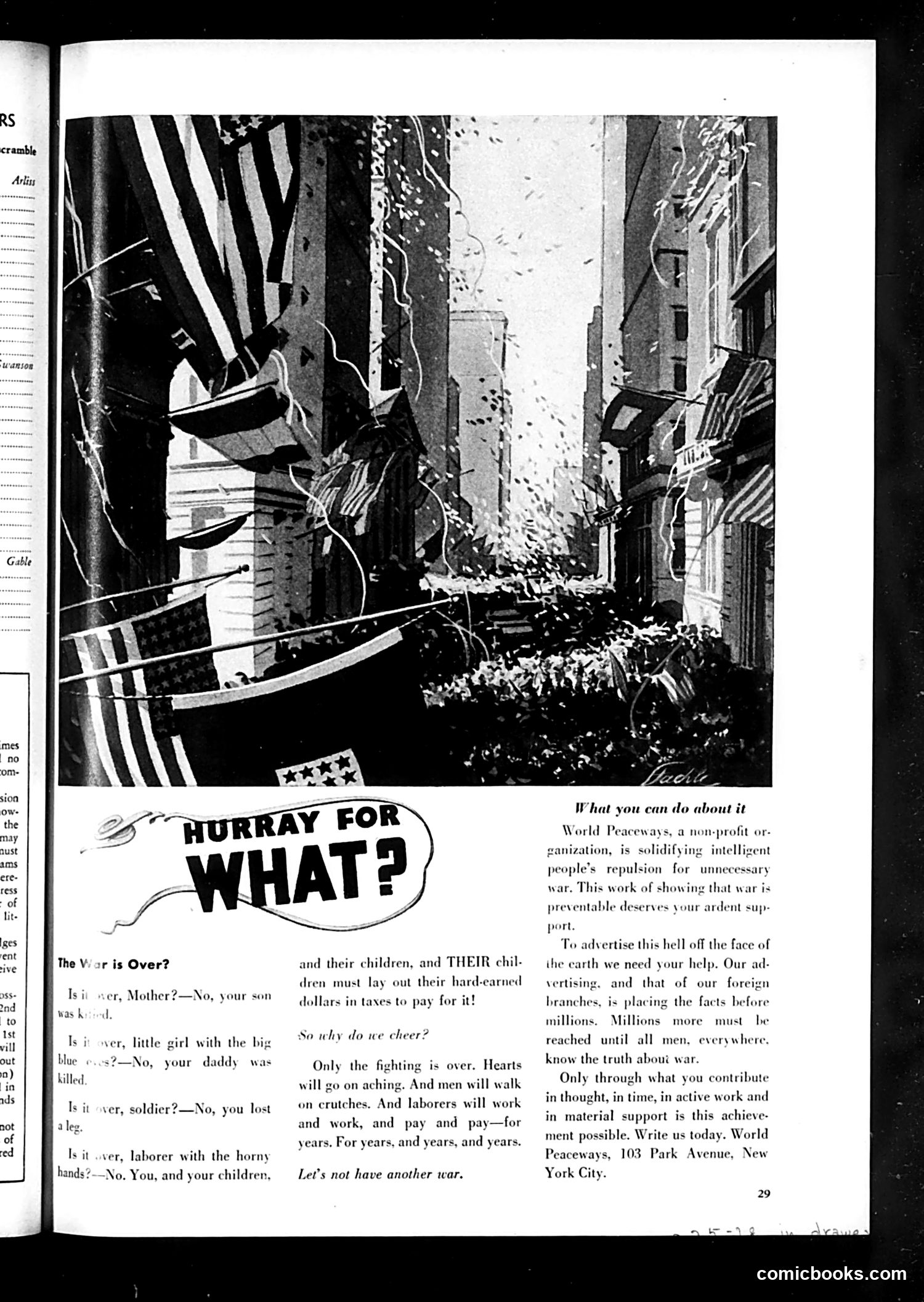
Analysis This page presents an anti-war advertisement disguised as satirical commentary on post-WWI disillusionment. The headline "Hurray for What?" sarcastically questions victory celebrations, followed by a series of rhetorical exchanges revealing war's true human costs: dead sons, lost fathers, disabled soldiers, and impoverished laborers forced to pay war debts for "years. For years, and years, and years." The photograph shows a ticker-tape parade with American flags—likely depicting WWI victory celebrations—which the text recontextualizes as hollow. The satire's point: civilians cheering wars don't bear the actual consequences; those costs fall on grieving families and workers for generations. The advertisement is for World Peaceways, a pacifist organization urging readers to support peace-advocacy work. This reflects 1920s-30s isolationist and peace movements gaining strength in America during the interwar period, when many questioned whether WWI's sacrifices had been justified.
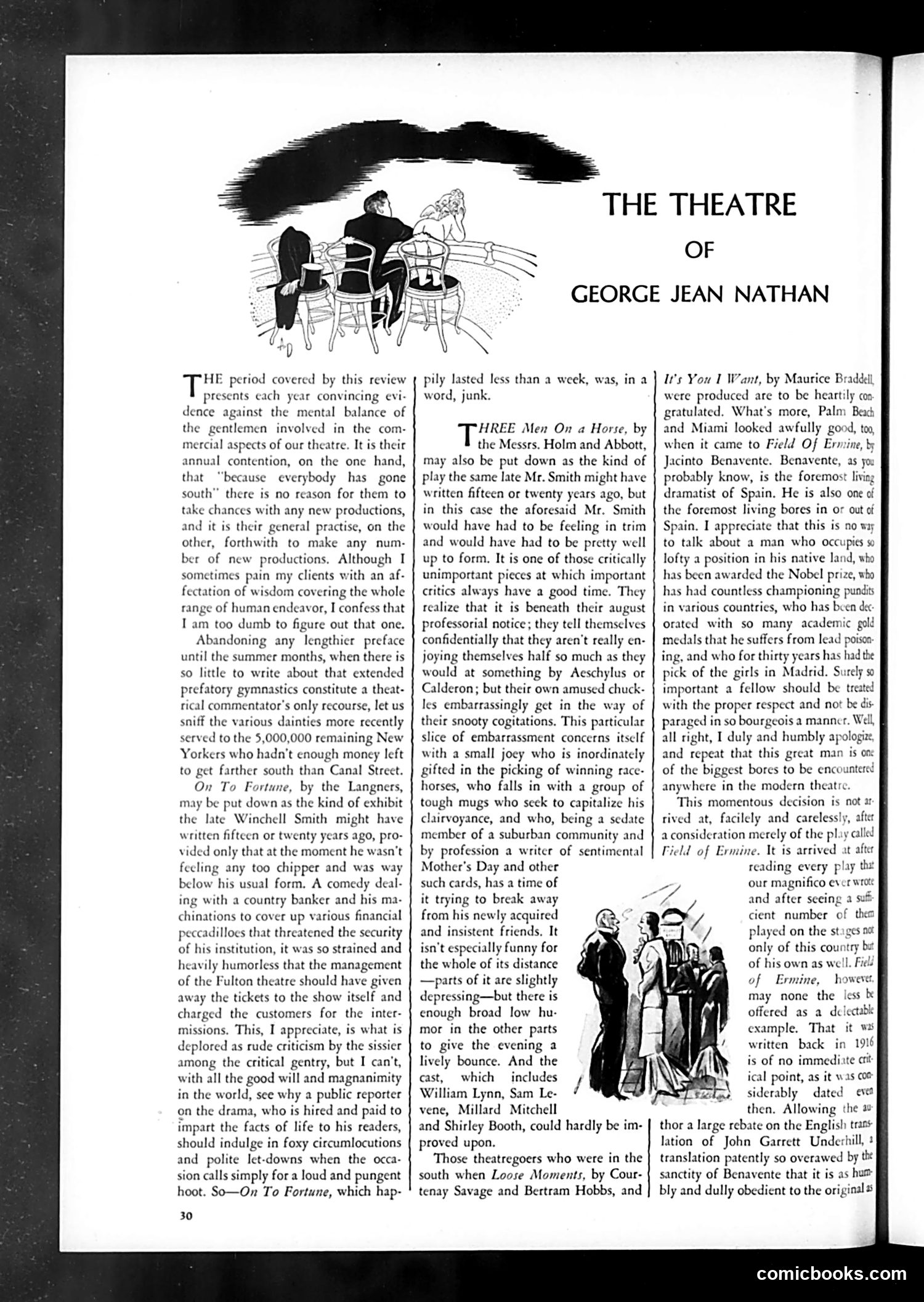
"The Theatre of George Jean Nathan" This is a theater review column by prominent critic George Jean Nathan. The page critiques recent Broadway productions, exemplifying Nathan's caustic writing style. Nathan savagely dismisses *On To Fortune* as "junk" — a play about a country banker covering up financial misconduct that he found "strained and heavily humorless." He attacks theater producers for logical inconsistency: claiming poor business conditions prevent new productions while simultaneously mounting numerous new shows. For *Three Men on a Horse*, Nathan is slightly more generous, acknowledging it's trivial entertainment about a man gifted at picking winning racehorses who gets entangled with gangsters. He notes that important critics enjoy ridiculing such "unimportant" plays while pretending to prefer classical drama (Aeschylus, Calderon). He praises the cast including William Lynn and Shirley Booth. The cartoon shows three figures in discussion, likely representing theatrical producers or critics debating the season's offerings. Nathan's perspective is distinctly elitist, dismissing commercial theater while maintaining standards he considers more serious.
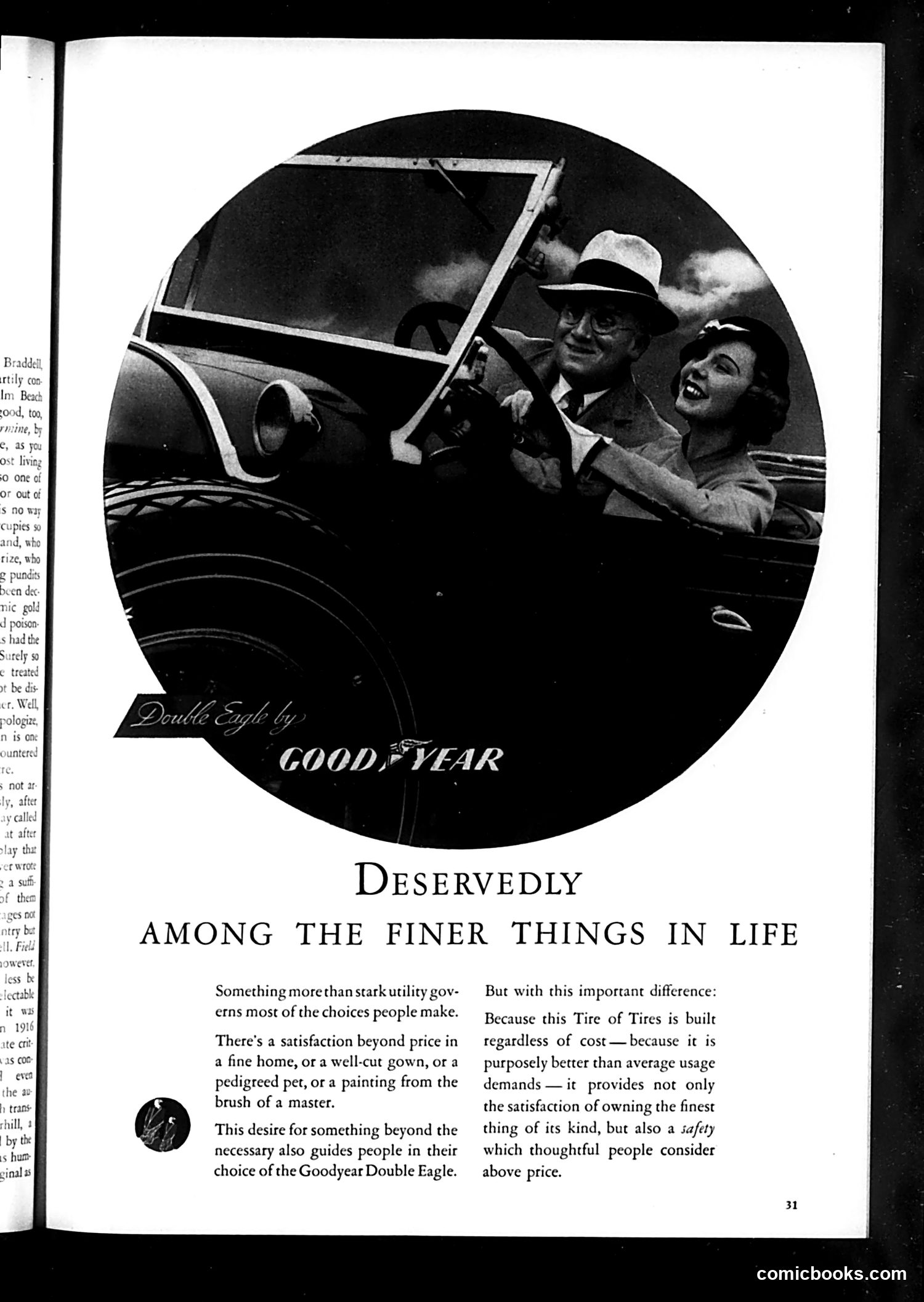
Analysis This is a Goodyear tire advertisement, not political satire. The page features a circular photograph of three people in a convertible automobile, smiling and appearing to enjoy leisure travel. The ad's argument appeals to aspirational consumers by positioning the Goodyear Double Eagle tire among "finer things in life"—alongside fine homes, quality clothing, and art. It claims the tire is built "regardless of cost" and offers superiority beyond mere utility, emphasizing both prestige and safety. The implicit message: buying premium tires reflects refined taste and responsible judgment, not just practical necessity. This marketing strategy targets middle-to-upper-class consumers willing to pay premium prices for quality and status symbols during what appears to be the early-to-mid 20th century automotive era.
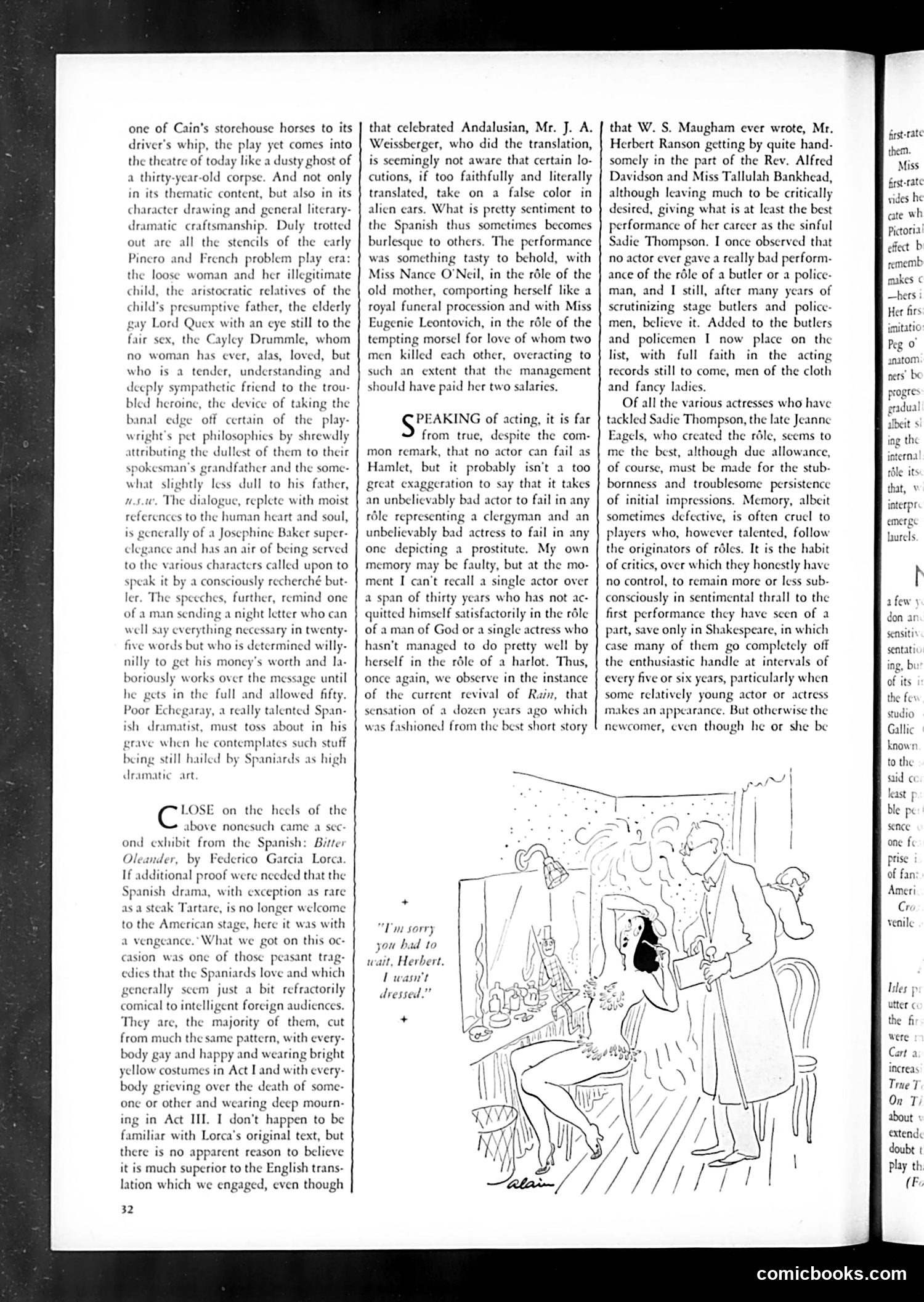
Life Magazine Theater Critique (Page 32) This page contains a theater review discussing recent Spanish drama productions on the American stage. The critic dismisses two plays: an adaptation of a Pinero-era work (criticized as dated melodrama with tired conventions) and Federico García Lorca's *Bitter Oleander*, which the reviewer finds entertainingly but unintentionally comic due to clumsy English translation and overwrought performances by actresses Nance O'Neil and Eugenie Leontovich. The included cartoon illustrates the review's point about acting, showing what appears to be a social scene with the caption "I'm sorry you had to wait, Herbert. I wasn't dressed!" — likely mocking theatrical affectation or the pretension of actors in society. The broader satire targets Spanish dramatic tradition as unsuitable for American audiences, suggesting such "peasant tragedies" translate poorly culturally and theatrically.
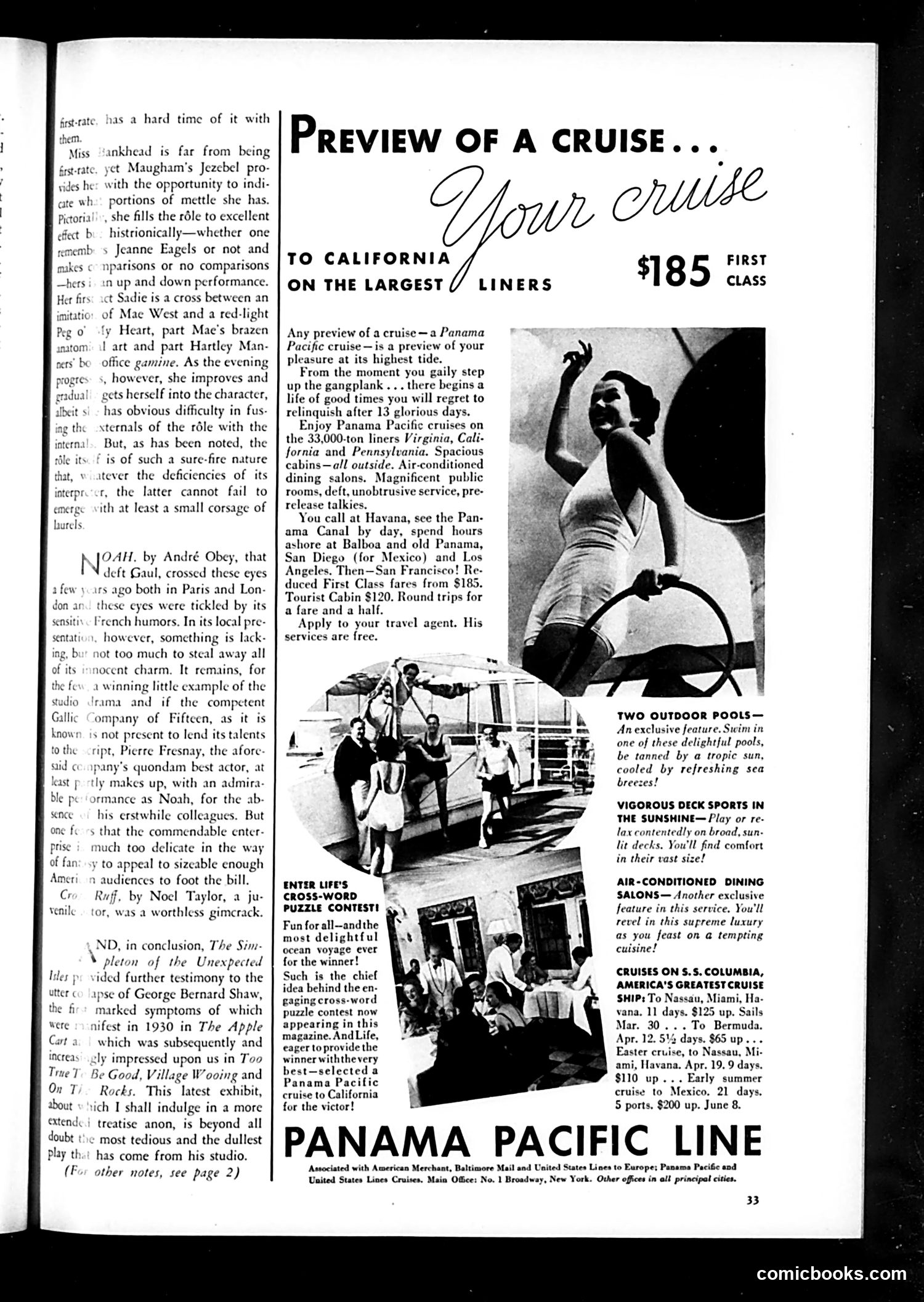
Analysis for Modern Readers This page is primarily advertising, not editorial satire. It contains a cruise advertisement for Panama Pacific Line's ships to California, prominently featuring a $185 first-class fare and various luxury amenities (pools, air-conditioned dining, deck sports). The upper portion includes theater reviews (discussing actresses like Bette Davis and plays by Noel Coward and George Bernard Shaw), but these are separate editorial content, not cartoons or satire requiring political context. The cruise ad itself uses typical mid-20th century marketing rhetoric—glamorous imagery of passengers enjoying leisure activities, emphasis on exotic ports (Havana, Panama Canal, Mexico), and luxury features. It also mentions a cross-word puzzle contest where the prize is the cruise itself. There is no political cartoon or satire on this page; it's a commercial magazine feature mixed with theater criticism.
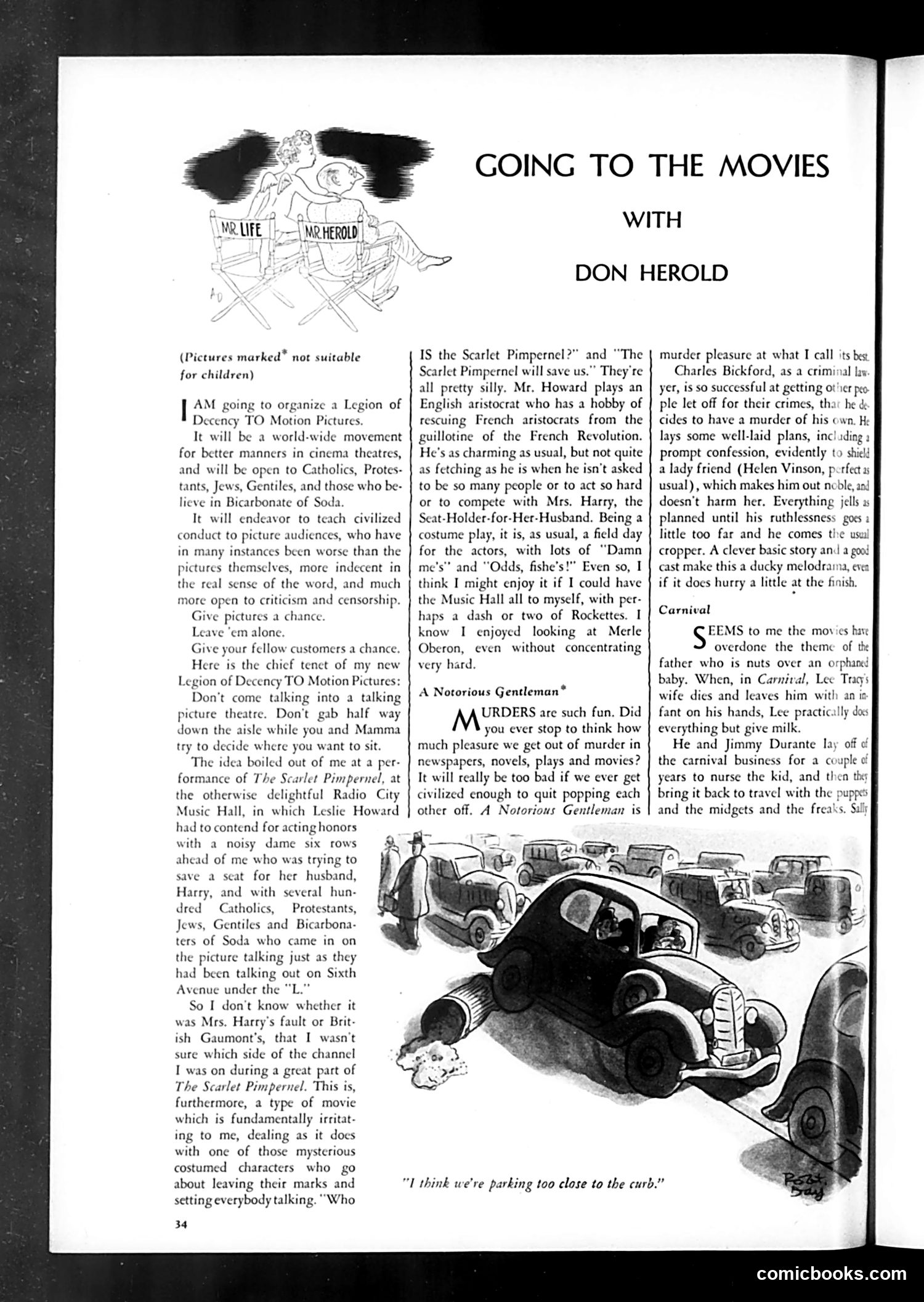
Analysis for Modern Readers This page is Don Herold's film criticism column for *Life* magazine. The content addresses two main issues: The "Legion of Decency" proposal: Herold satirizes the real Catholic Legion of Decency (formed 1933-34 to combat "immoral" films) by proposing his own legion focused on audience behavior in theaters—people talking during movies, saving seats, and disrupting others' viewing. He uses this as comic commentary on cinema etiquette rather than censorship. Film reviews: Herold reviews *The Scarlet Pimpernel* (Leslie Howard in a costume adventure) and *A Notorious Gentleman*, critiquing both the films and theater disruptions. He humorously complains that audience noise during the British film made him unsure "which side of the channel" he was on. The cartoon depicts crowded parking outside Radio City Music Hall, with the caption "I think we're parking too close to the curb"—visual humor about moviegoing crowds. The satire targets both audience rudeness and the emerging film censorship movement of the era.
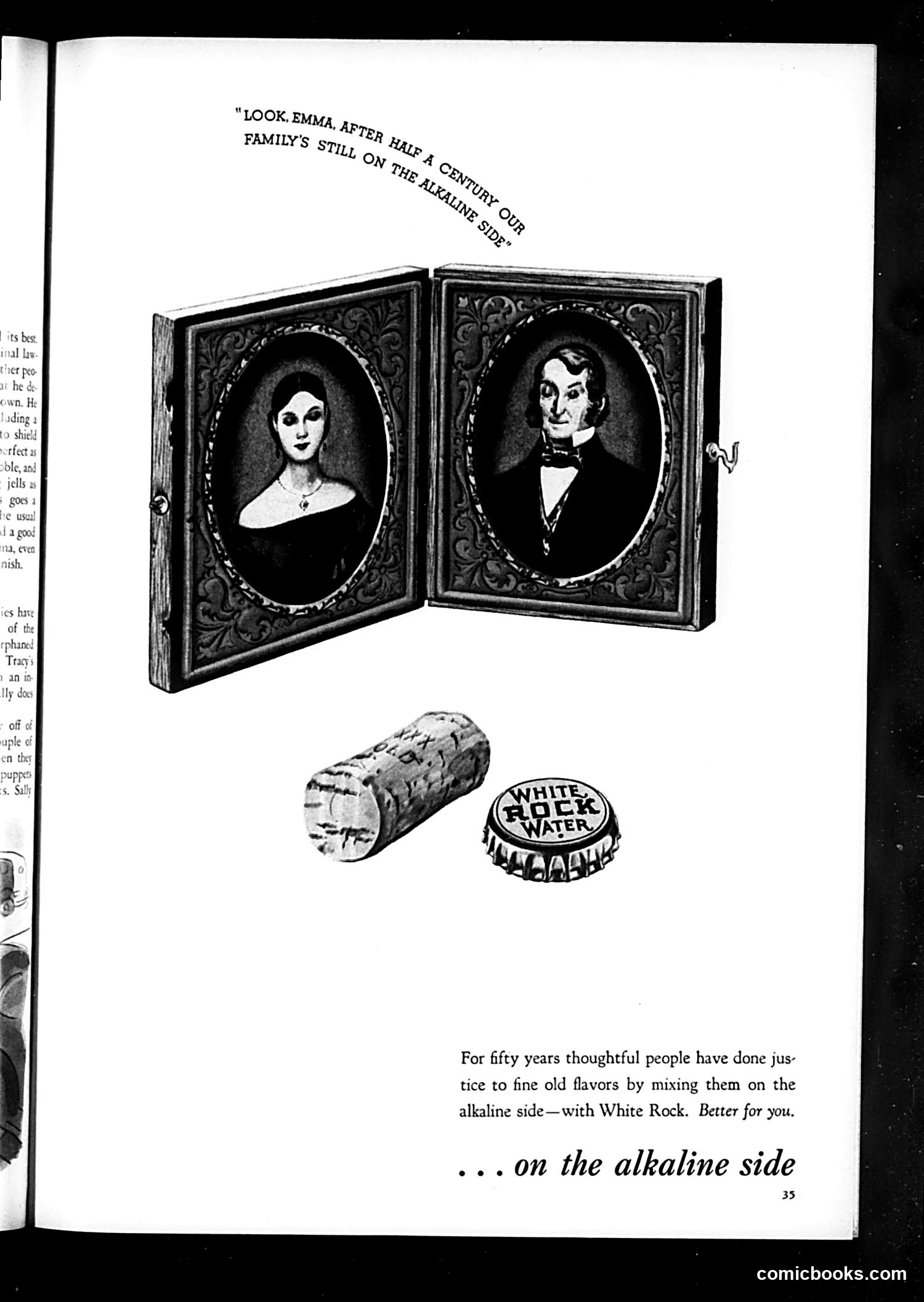
Advertisement Analysis This is a White Rock mineral water advertisement, not a political cartoon. The page features a decorative hinged daguerreotype case (period imagery suggesting 50+ years of tradition) containing two 19th-century portraits—likely representing the product's long heritage. The advertisement's appeal centers on health claims: mixing beverages "on the alkaline side" with White Rock water was promoted as beneficial. This reflects early 20th-century marketing that leveraged pseudo-scientific health trends around alkalinity, common in that era's consumer advertising. The historical portrait imagery suggests established tradition and respectability. The text emphasizes that "thoughtful people" have trusted this practice for decades, using authority and longevity as selling points.
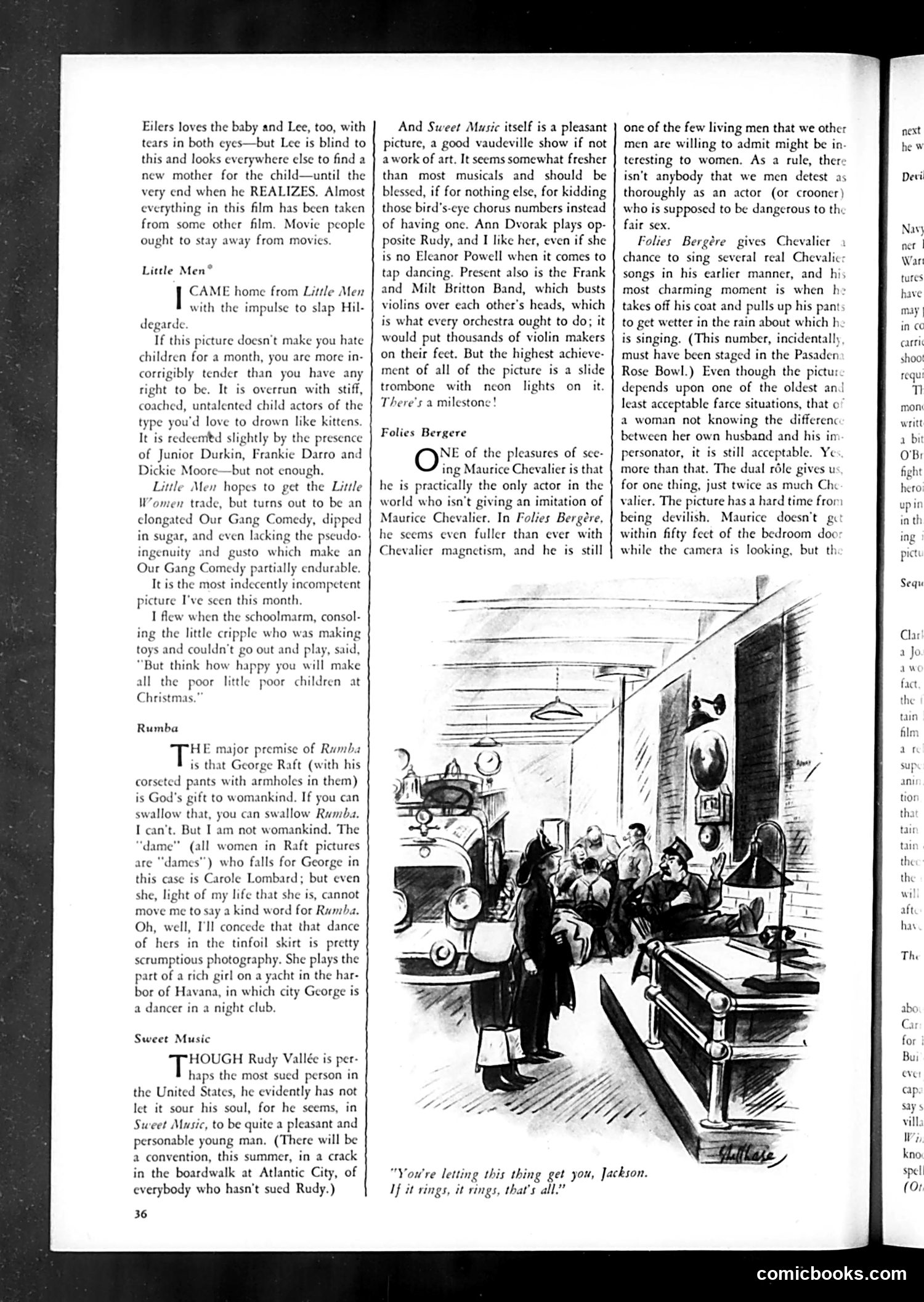
Analysis of Life Magazine Page This page contains brief, caustic film reviews typical of Life's satirical approach to 1930s cinema. The reviewer savagely critiques Little Men, calling it incompetent and filled with irritating child actors—only redeemed slightly by Junior Durkin, Frankie Darro, and Dickie Moore. The vitriol suggests the film was a failed attempt to capitalize on the success of *Little Women*. Rumba is mocked for its premise that George Raft (a dancer/actor known for romantic roles) is "God's gift to womankind." The reviewer dismisses the entire film but grudgingly acknowledges Carole Lombard's dance number in a "tinfoil skirt." Sweet Music receives marginally kinder treatment, praising Rudy Vallée's pleasant demeanor despite being "the most sued person in the United States"—likely referencing ongoing legal disputes. The review appreciates the film's vaudeville style and absurdist humor (neon-lit trombone, violins smashed by orchestras). Folies Bergère celebrates Maurice Chevalier as one of cinema's few genuinely charismatic actors, distinguishing him from other performers merely imitating him or relying on manufactured sex appeal.
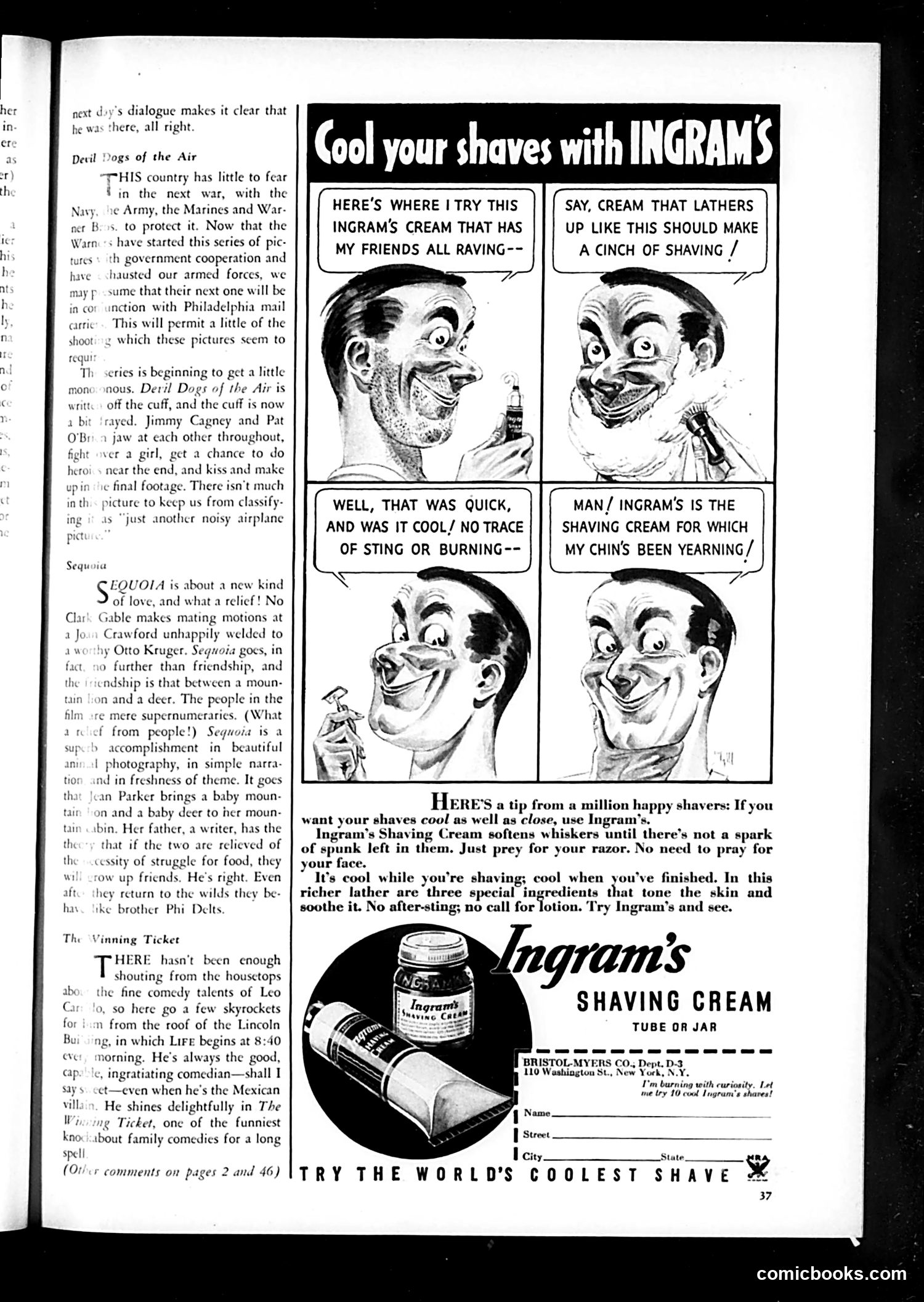
Ingram's Shaving Cream Advertisement This page is primarily a full-page advertisement for Ingram's Shaving Cream, not political satire. The comic strip format shows two men enthusiastically endorsing the product through dialogue about its cooling properties and smooth lather. The advertisement uses a popular 1930s marketing strategy: testimonial-style comics featuring everyday men praising the product's benefits—particularly that it produces no "sting or burning" and keeps the skin cool during and after shaving. The exaggerated facial expressions and excited dialogue ("Man! Ingram's is the shaving cream for which my chin's been yearning!") are typical of period advertising hyperbole. The left column contains movie reviews of contemporary films (*Devil Dogs of the Air*, *Sequoia*, *The Winning Ticket*), suggesting this is from Life magazine's entertainment section. The advertisement's placement here targets male readers interested in both cinema and grooming products.
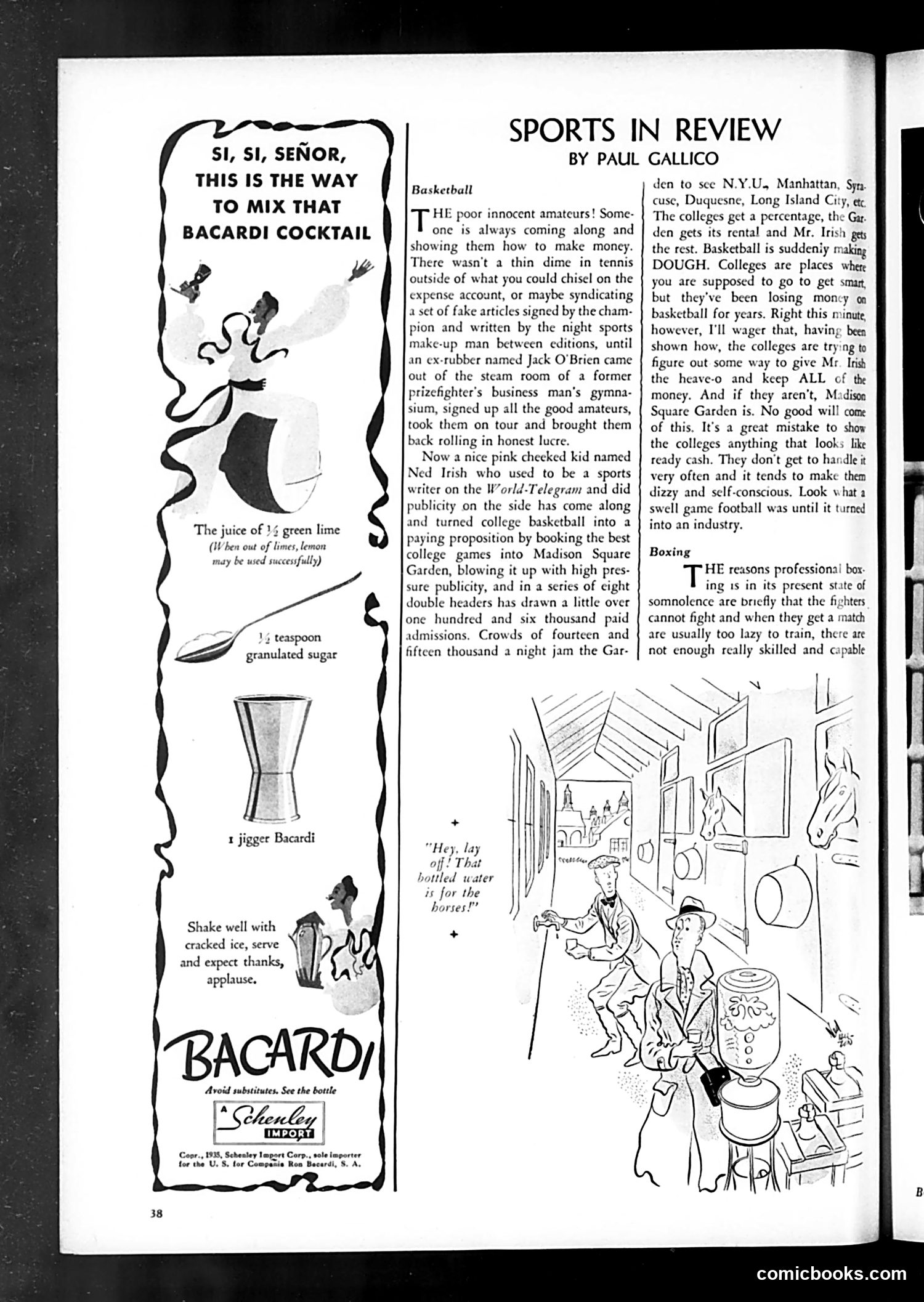
Sports in Review: College Basketball's Commercialization This page contains a Bacardi cocktail advertisement (left) and Paul Gallico's sports column (right) critiquing the commercialization of college athletics. Gallico discusses Ned Irish, a former sports writer who revolutionized college basketball by booking games into Madison Square Garden with high-pressure publicity. The arrangement generated enormous crowds (14,000-15,000 attendance) and substantial revenue—over 106,000 paid admissions across eight double-headers. The satire targets institutional greed: colleges, having discovered basketball generates money, will likely attempt to monopolize profits rather than share them with Irish or the Garden. Gallico cynically warns that exposing colleges to "ready cash" corrupts their educational mission—he uses football as a cautionary example of a sport ruined by becoming "an industry." The piece reflects 1930s anxiety about amateur athletics being compromised by commercial interests, with the implication that profit motive inevitably corrupts institutional integrity.
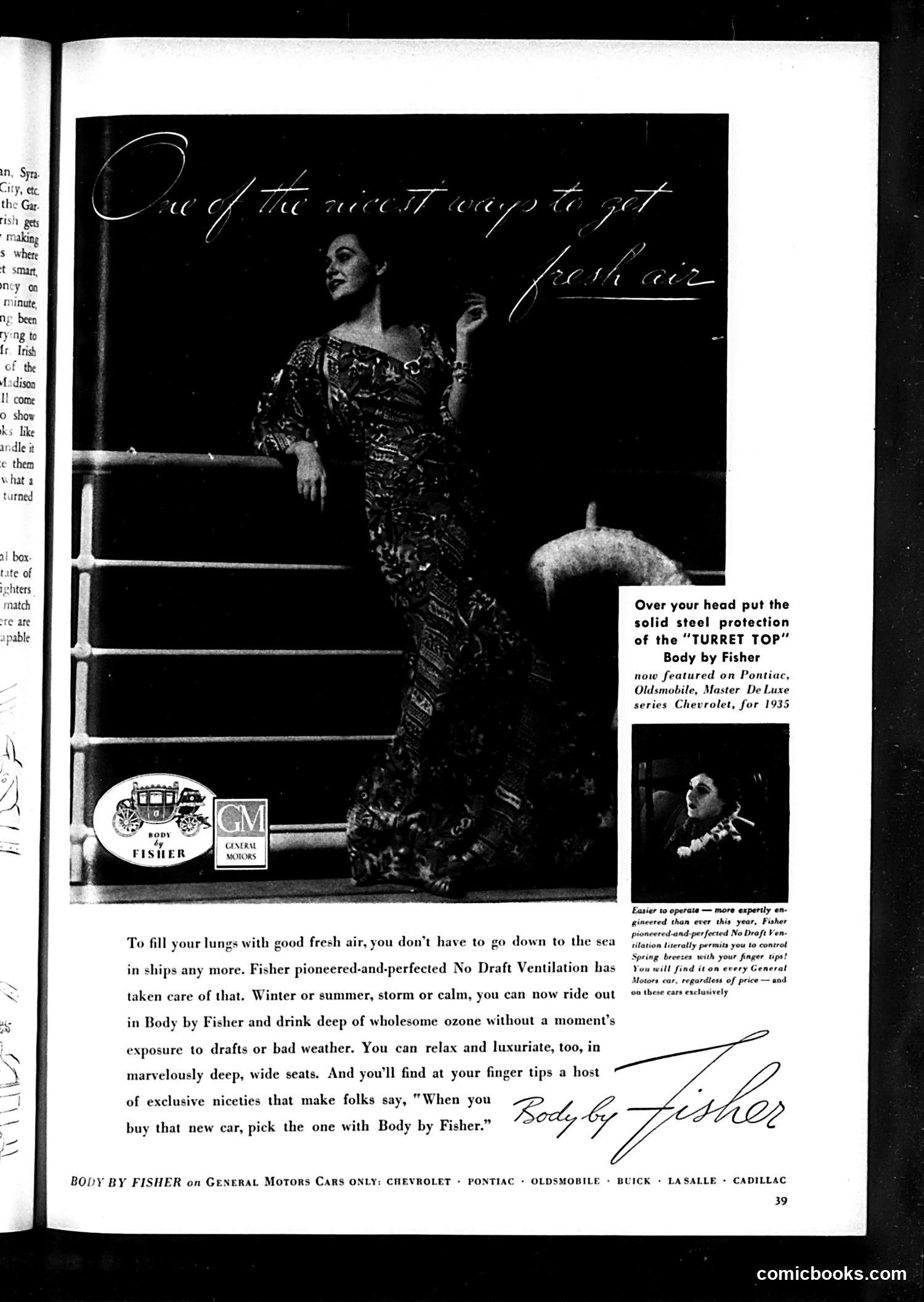
Analysis This is not a political cartoon or satire—it's a 1935 automobile advertisement for Body by Fisher, a General Motors coachbuilding subsidiary. The page features a glamorous woman in an elegant beaded dress posing next to a car, promoting Fisher's "No Draft Ventilation" and "Turret Top" safety features. The advertisement emphasizes modern comfort: fresh air circulation without drafts, deep seats, and exclusive luxury appointments. The smaller images showcase the mechanical innovations: the turret top's steel protection and the ventilation system's finger-tip controls. This represents typical Depression-era advertising strategy—emphasizing luxury, safety, and technological advancement to appeal to affluent consumers during economically difficult times. The aspirational imagery and elegant model position these vehicles as status symbols for the wealthy.
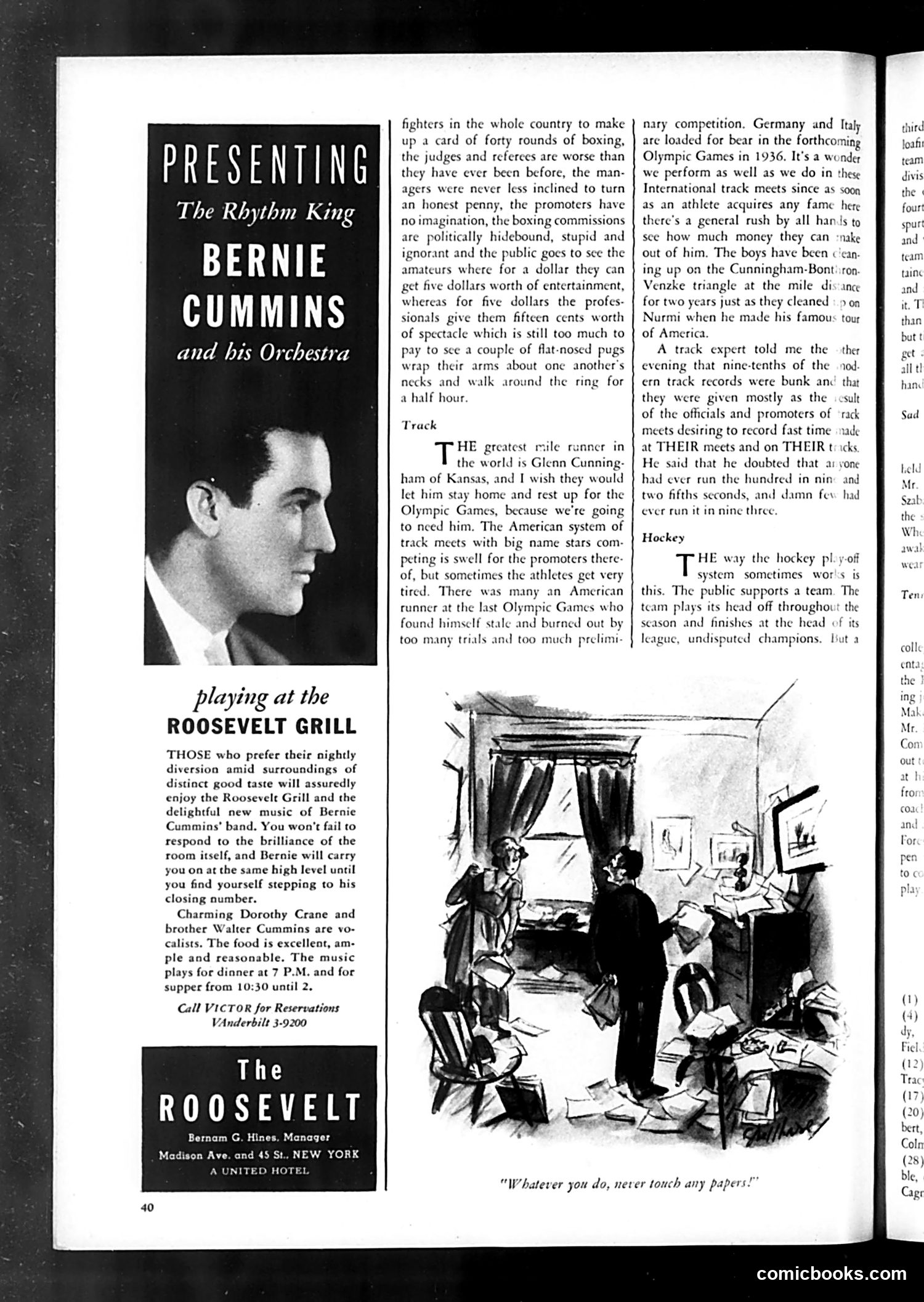
Analysis of Life Magazine Page This page mixes advertising with sports commentary. The left side advertises Bernie Cummins' orchestra performing at the Roosevelt Grill hotel in New York—a upscale dining establishment marketed to wealthy readers seeking "distinct good taste." The right side contains satirical essays critiquing American sports. The author attacks boxing as corrupt and poorly managed, with promoters and officials prioritizing profit over athlete welfare. He criticizes the American track meet system for overworking talented runners like Glenn Cunningham before the 1936 Olympics, contrasting this with Germany and Italy's more strategic athlete management. The cartoon (bottom right) depicts a messy office with the caption "Whatever you do, never touch any papers!"—likely satirizing bureaucratic chaos or disorganization, though its specific target is unclear from context alone. The commentary reflects 1930s concerns about commercialization of sports and American competitiveness versus rival nations.
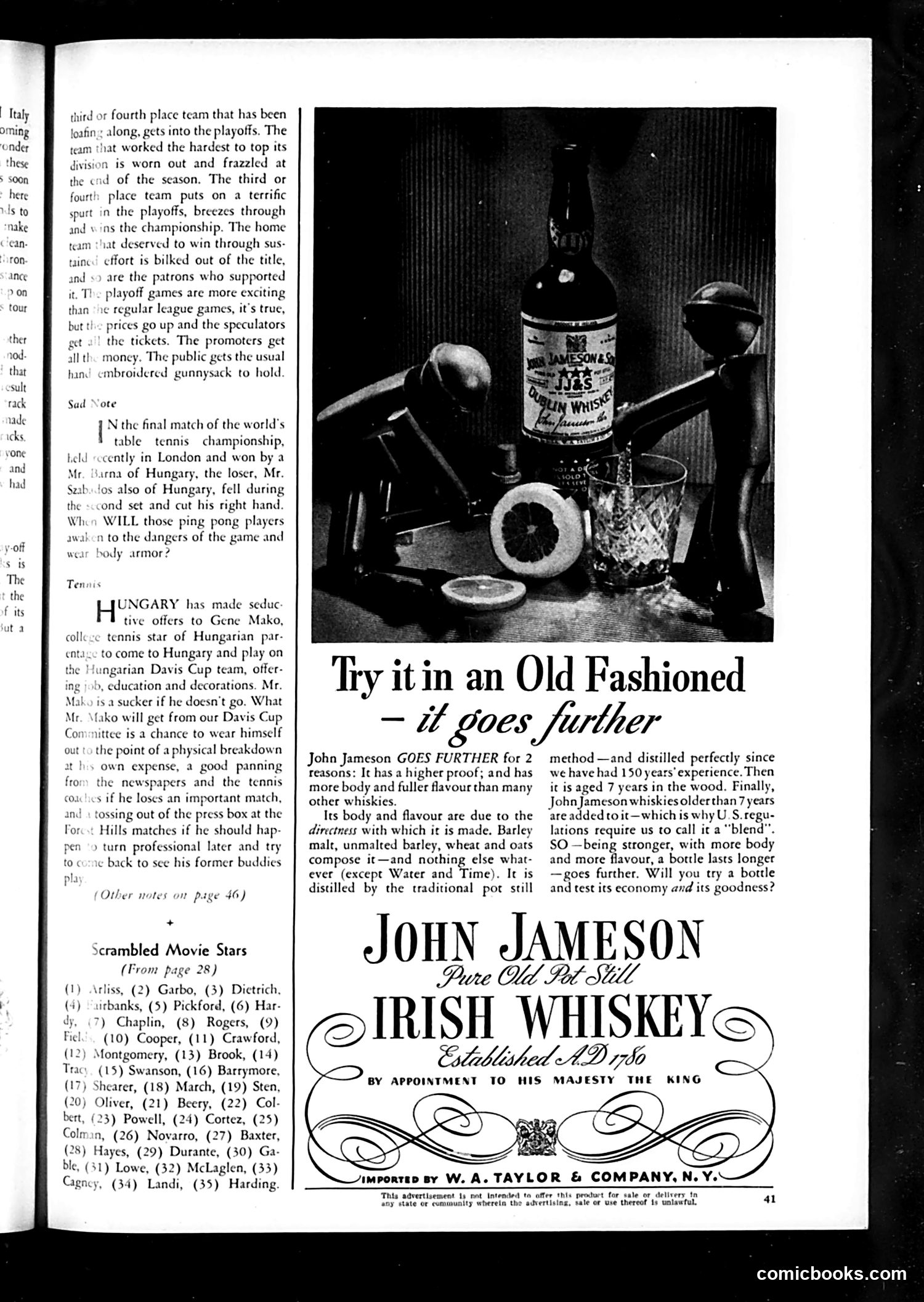
Analysis of Life Magazine Page Content This page is primarily an advertisement for John Jameson Irish Whiskey, not a political cartoon. The ad features a still-life photograph of a whiskey bottle with a glass and accessories, alongside marketing copy emphasizing the whiskey's higher proof, fuller flavor, and longer-lasting qualities ("goes further"). The text columns on the left contain brief notes about sports and entertainment, including commentary on tennis playoffs and references to Hungarian tennis players and American Davis Cup matters. There's also a "Scrambled Movie Stars" answer key listing Hollywood figures from a previous puzzle page. The whiskey advertisement itself reflects 1930s marketing conventions—associating quality spirits with sophistication and claiming superior product characteristics. The phrase "Old Fashioned" references both the classic cocktail and appeals to tradition, while the "goes further" messaging addresses Depression-era economics by suggesting economy and value. No satire or political commentary is evident on this page.
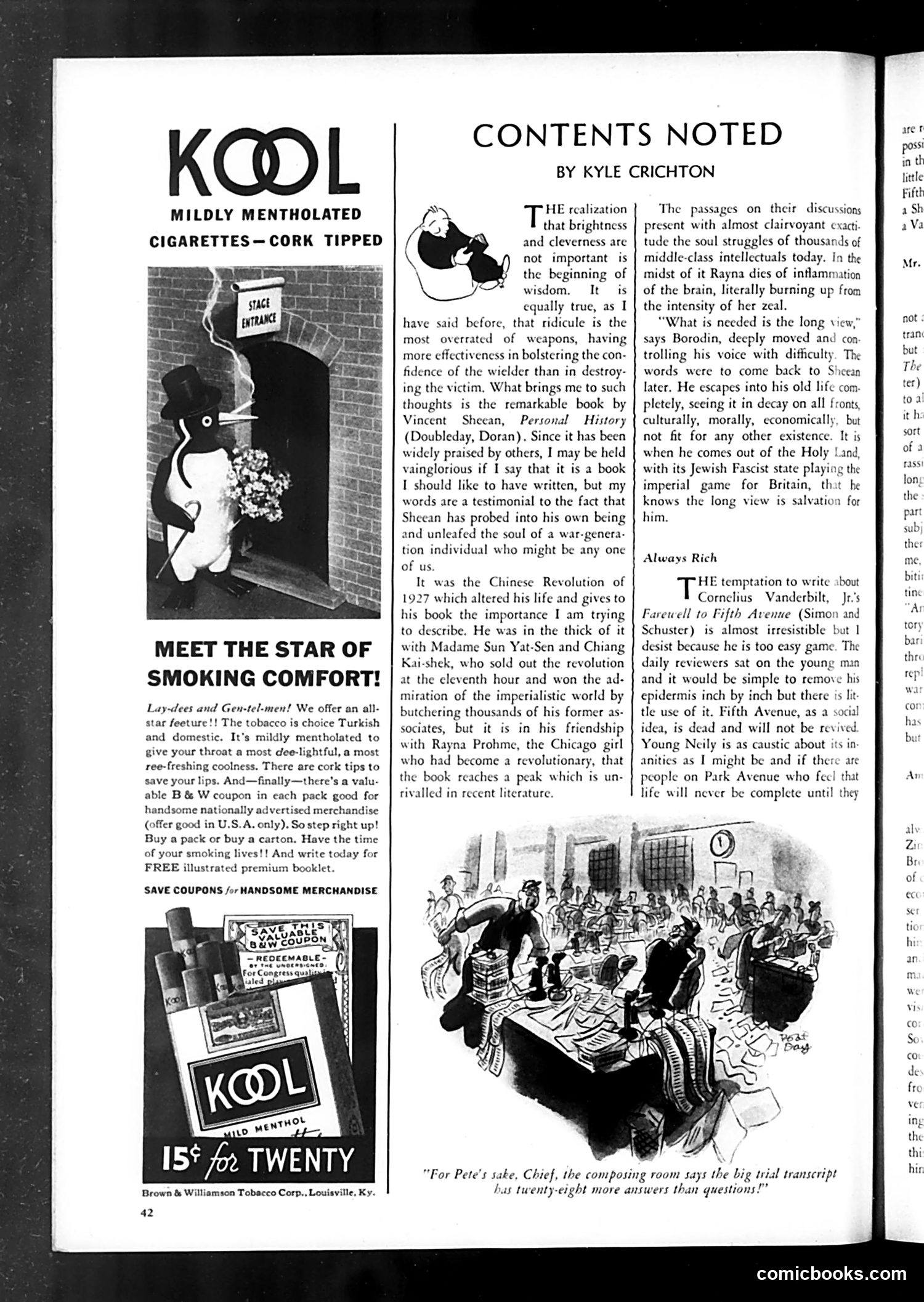
Political & Social Context for Modern Readers This page mixes cigarette advertising with book reviews by Kyle Crichton—a common 1930s magazine format. The Kool cigarette ad uses carnival-barker language ("Lay-dees and Gen-tel-men!") to pitch menthol cigarettes with cork tips, emphasizing comfort and offering B&W coupons for premiums. The imagery suggests working-class accessibility. The reviews discuss serious 1930s intellectual concerns: Vincent Sheean's *Personal History* explores disillusionment among leftist intellectuals during China's 1927 Revolution, particularly through the character Rayna Prohme, a Chicago radical who dies from revolutionary fervor. Crichton praises its psychological depth. The second review dismisses Cornelius Vanderbilt Jr.'s *Farewell to Fifth Avenue* as an "easy game"—mocking wealthy memoir-writing. Crichton suggests Fifth Avenue's social dominance is already "dead." The cartoon shows a newspaper composing room where someone reports the trial transcript has more answers than questions—likely satirizing verbose legal proceedings or confused journalism.
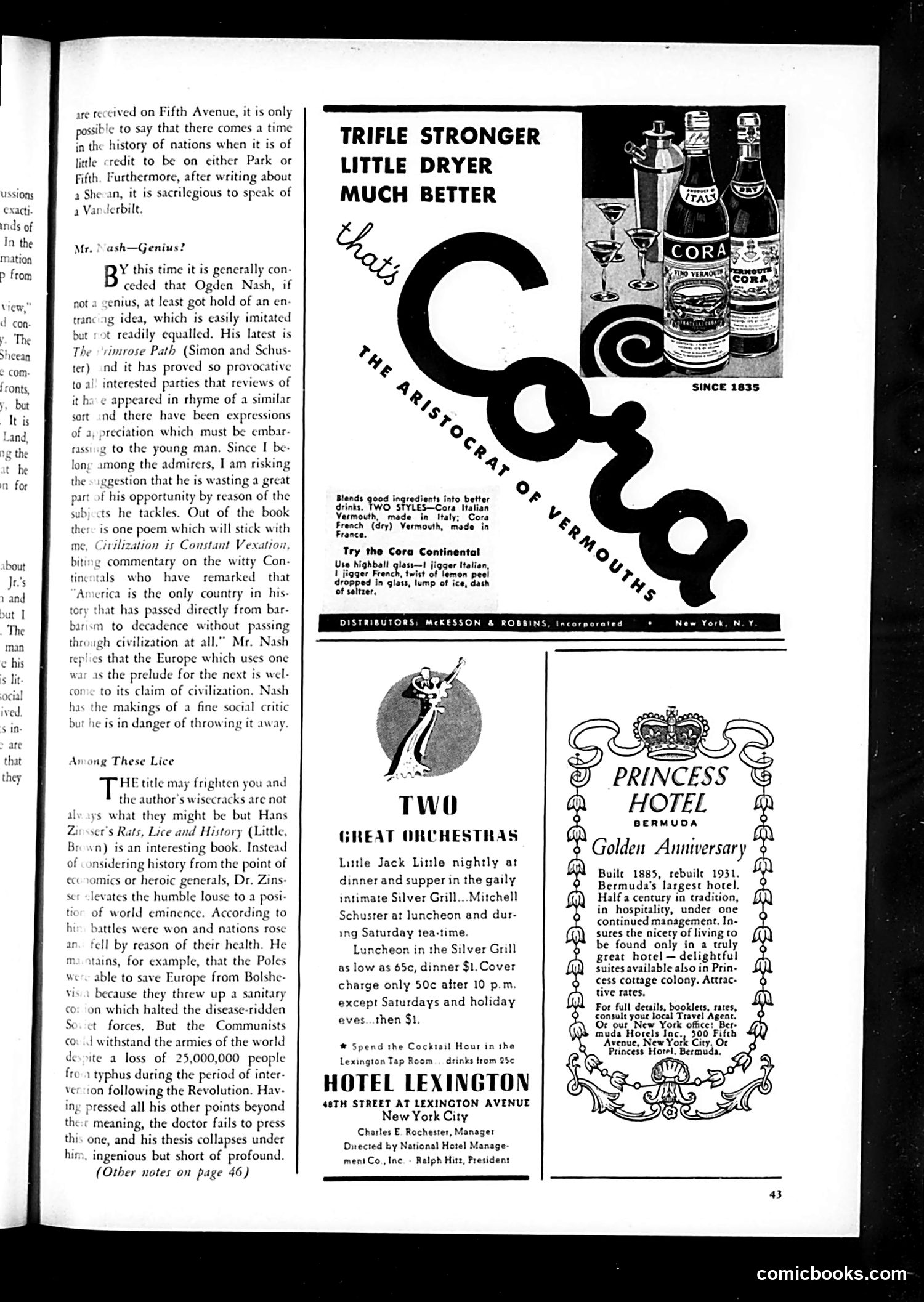
Analysis of Life Magazine Page This page mixes literary criticism with advertising. The main content includes: Text Commentary: A reviewer discusses poet Ogden Nash's latest book *The Primrose Path*, praising his wit but warning he risks wasting talent on trivial subjects. The review also covers Hans Zinsser's *Rats, Lice and History*, which unusually examines history through the lens of disease and parasites rather than traditional heroic narratives. Advertisements: The page features several period ads—a Cora vermouth advertisement (the large central graphic), listings for orchestral performances at the Silver Grill and Hotel Lexington, and a Princess Hotel Bermuda ad promoting its 50th anniversary. Historical Context: This appears to be from the 1930s based on design and references. The literary discussion reflects intellectual concerns of that era, while the upscale venue advertisements target affluent readers of *Life* magazine. No political cartoons appear on this particular page—it's primarily a mix of book reviews and commercial content.
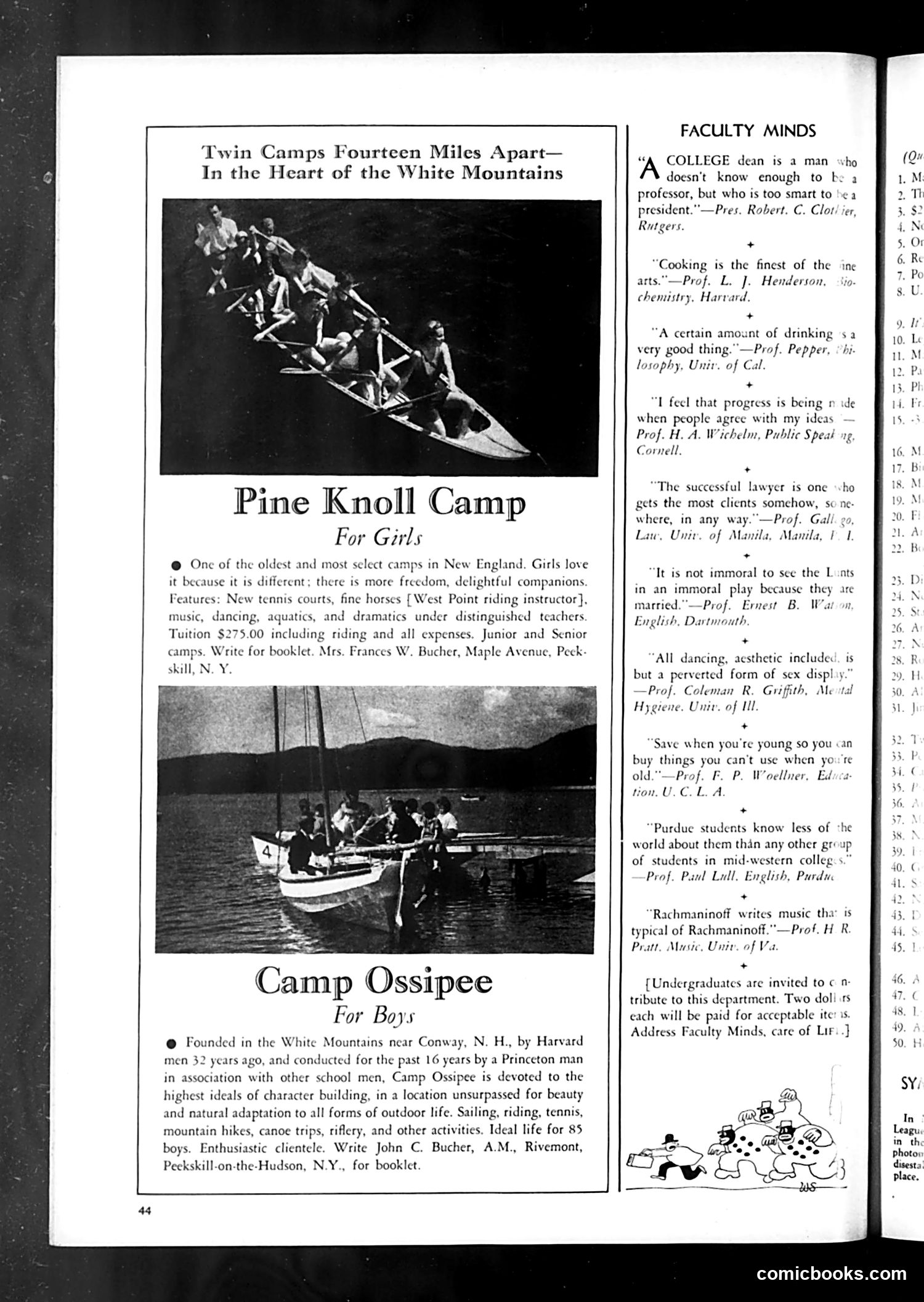
What This Page Means This is primarily advertising and humor rather than political satire. The left side promotes two summer camps in New Hampshire's White Mountains—Pine Knoll for girls and Camp Ossipee for boys—emphasizing traditional activities (horseback riding, tennis, canoeing) and character-building for affluent families. The right column, "Faculty Minds," is a humor feature satirizing academia. It collects absurd or pretentious quotes from actual college professors at institutions like Harvard, Yale, and Purdue. The humor works through incongruity: a dean admitting he's neither qualified to be a professor nor a president; a chemistry professor claiming cooking is "the finest of the arts"; a philosophy professor endorsing drinking; and most provocatively, a Dartmouth professor claiming it's not immoral to watch immoral stage plays if the characters are married. The satire targets intellectual pomposity and moral hypocrisy among academics. For modern readers, it reflects 1920s anxieties about professors as out-of-touch elitists making questionable moral pronouncements.
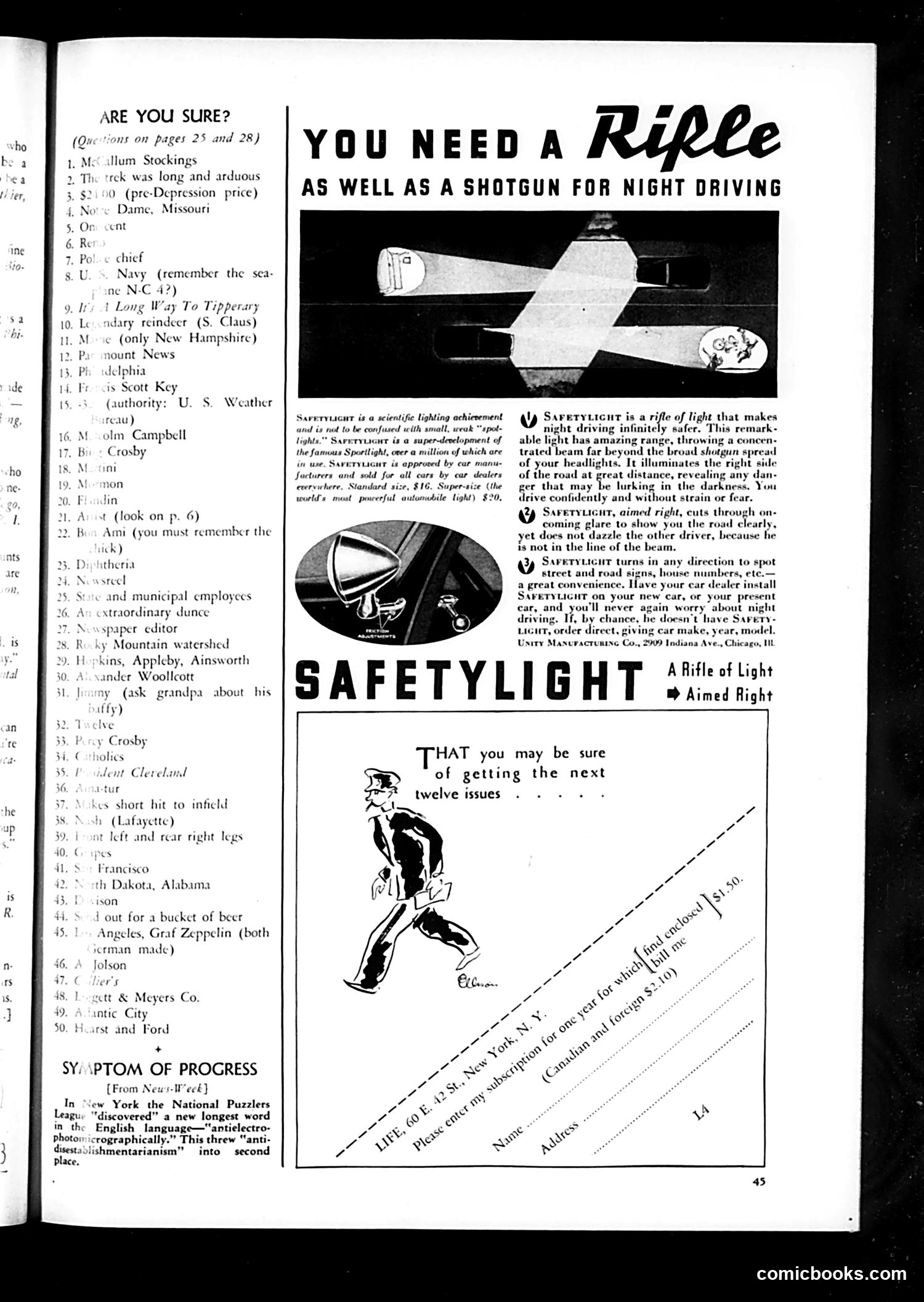
Analysis of Life Magazine Page 45 This page is primarily advertising, not satire or political commentary. The dominant content is a product advertisement for "Safetylight," an aftermarket automotive headlight system marketed for safer night driving. The ad uses military/weaponry metaphor—calling the light a "rifle" and comparing its beam spread to a "shotgun"—to emphasize the product's focused, powerful illumination. This was common 1930s-40s advertising language, playing on the idea of precision and power. The left column appears to be a quiz answer key (labeled "ARE YOU SURE?") listing numbered trivia answers, likely from an earlier puzzle in the magazine. The bottom note about "antielectrophotographically" is a brief humorous aside about record-long words. The small illustration of a running figure at bottom-left is a subscription promotion for Life magazine itself ("the next twelve issues"). Overall: This is a standard magazine page mixing trivia content and commercial advertising, not political satire.
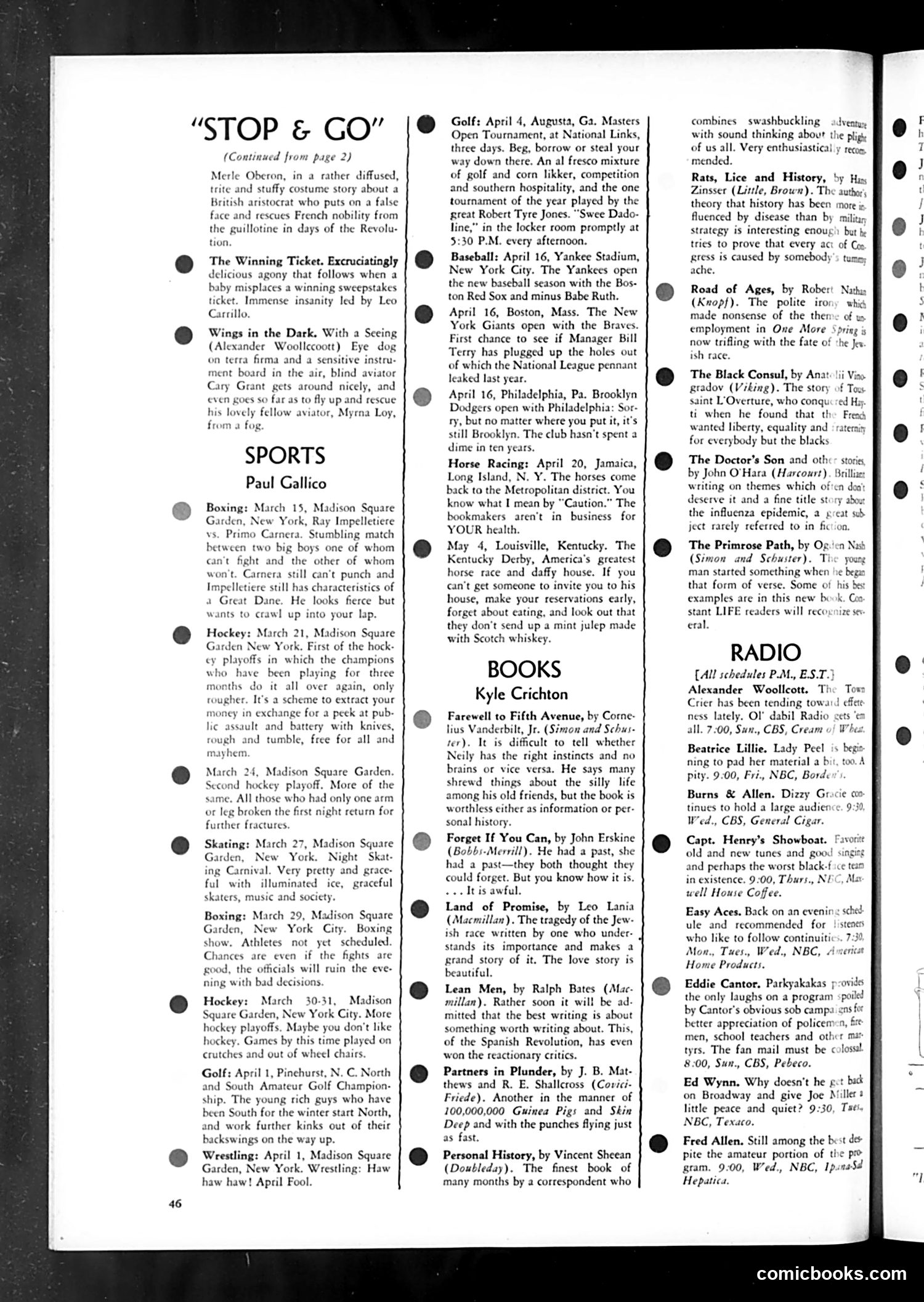
"Stop & Go" Entertainment Guide Analysis This page from Life magazine presents entertainment listings and sports commentary for spring 1935, authored by Paul Gallico, a renowned sportswriter. The content is satirical review rather than earnest recommendation. Gallico's humor derives from irreverent, brutally honest descriptions of sporting events and films. For example, he dismisses a boxing match between Ray Impelletiere and Primo Carnera as involving "two big boys one of whom can't fight and the other of whom won't." Hockey playoffs are mocked as "public assault and battery with knives" packaged for paying audiences. The tone suggests Sports fans attending events multiple times—hockey games "played on crutches and out of wheel chairs" by the third playoff round. Film reviews (Merle Oberon, Cary Grant) receive similarly deflating treatment. The Kentucky Derby is characterized as "America's greatest horse race and daffy house." This represents satirical sports journalism—entertainment criticism that entertains through cynicism rather than celebration, reflecting Depression-era irreverence toward glamorous spectacles.
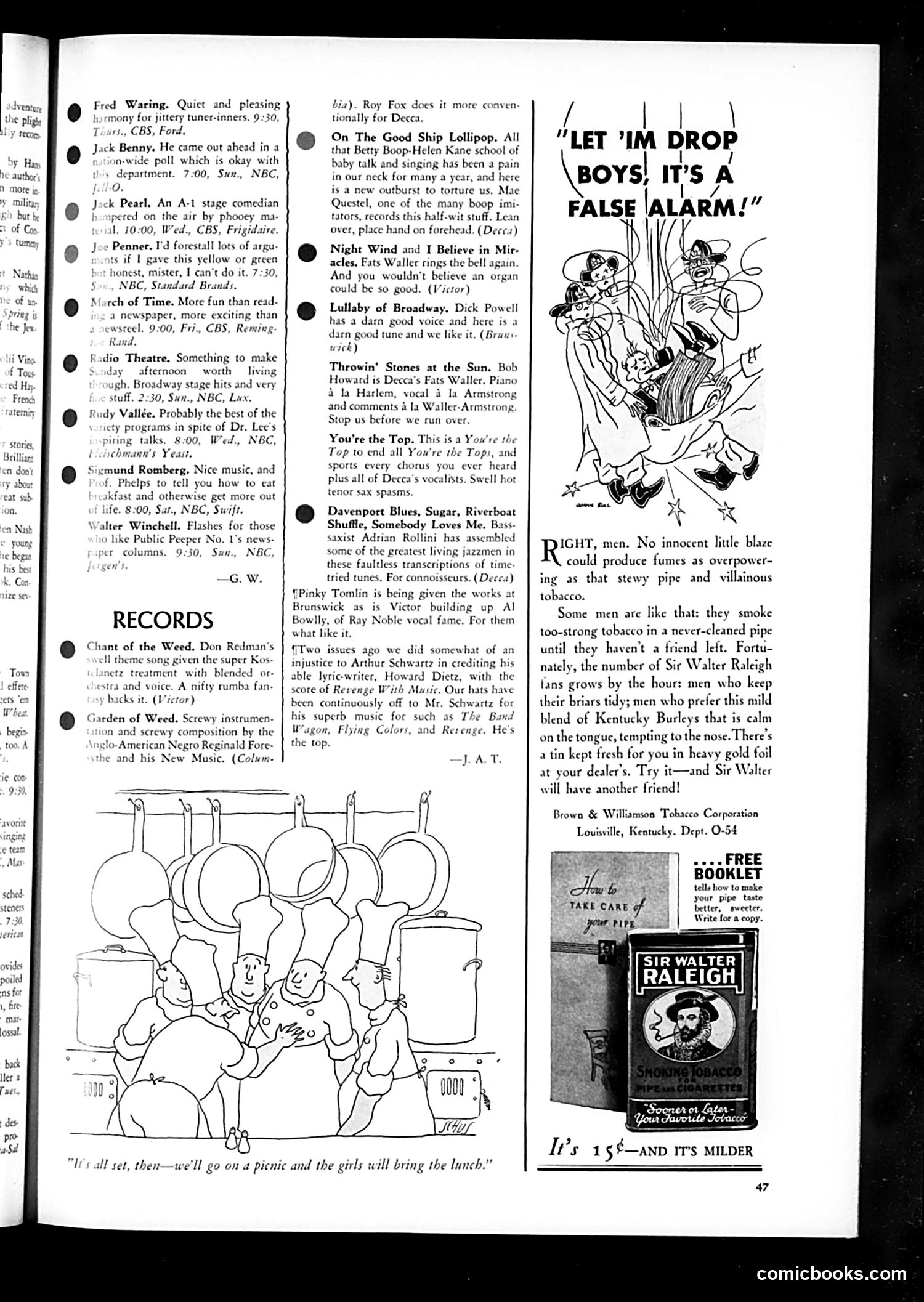
Cartoon Analysis: "False Alarm" This page contains two distinct elements: Left side: A radio and records review column listing popular broadcasts and jazz recordings from what appears to be the 1930s (Fred Waring, Jack Benny, Fats Waller are mentioned). Right side: A cartoon advertisement for Sir Walter Raleigh tobacco. The cartoon shows firefighters responding to an alarm—one shouts "Let 'im drop boys, it's a false alarm!"—upon realizing the heavy smoke isn't from a fire but from someone's pipe tobacco. The joke is a visual pun: the thick, acrid smoke from poorly maintained pipes smoking "too-strong tobacco" is so overpowering it resembles a fire emergency. The ad's message targets men who smoke inferior blends in dirty pipes, arguing that Sir Walter Raleigh's "mild blend of Kentucky Burleys" produces less offensive smoke and maintains friendships. This is a straightforward commercial advertisement using humor to sell tobacco by implying competitive products create social embarrassment through excessive odor.
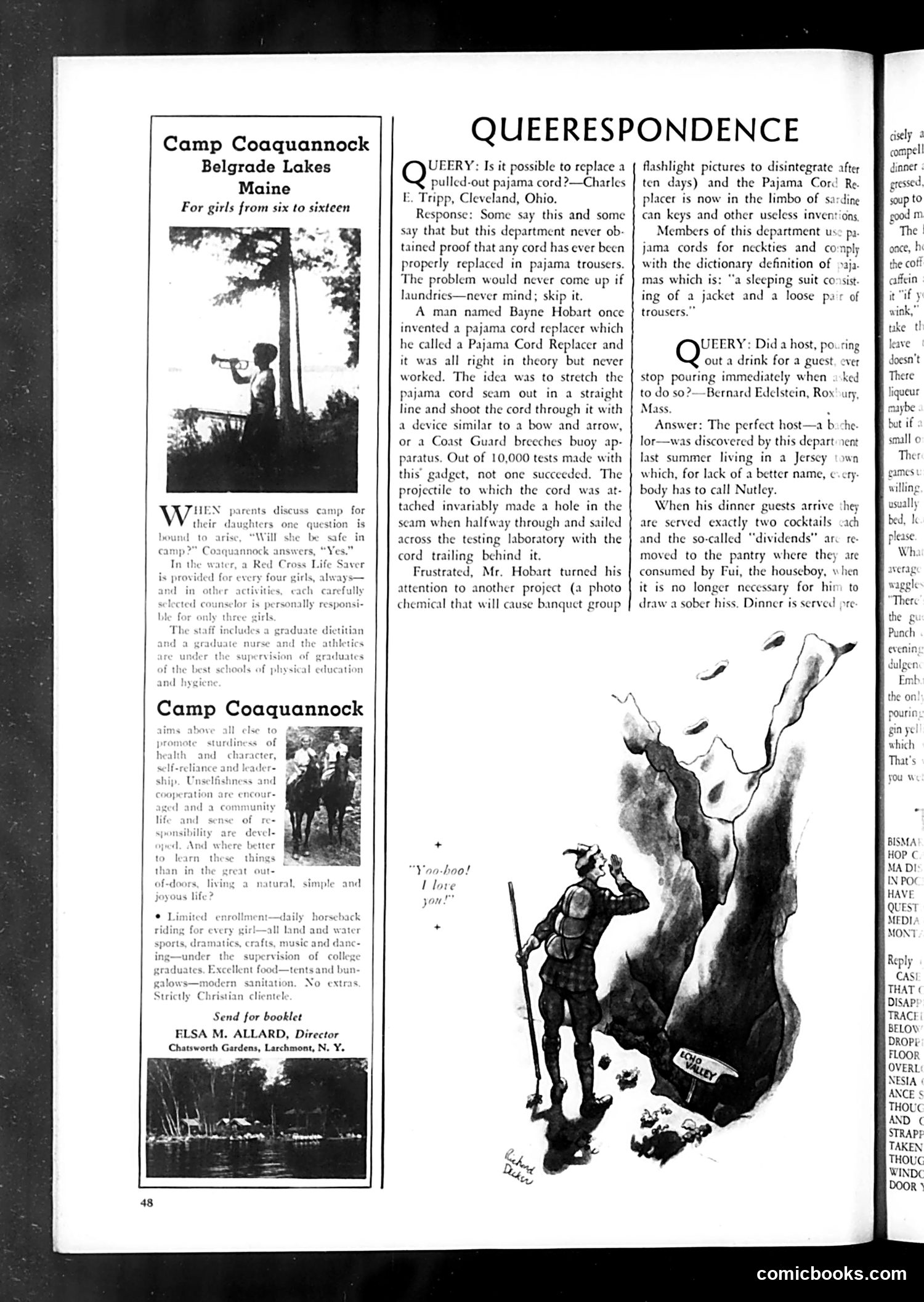
Querespondence Page Analysis This page features Life magazine's humorous advice column "Querespondence," which answers absurd reader questions with deadpan satire. The first query concerns replacing a lost pajama cord. The response explains that inventor Bayne Hobart created an elaborate contraption (similar to a bow-and-arrow or Coast Guard breeches buoy) to thread cords back through pajama seams. It failed spectacularly: of 10,000 tests, none succeeded—the projectile invariably tore through the seam and shot across the lab. The second query asks whether a perfect host would stop serving cocktails once a guest had enough. The answer describes a Jersey homeowner who serves guests exactly two drinks, then moves remaining bottles to the pantry where the houseboy consumes them after dinner. Both responses mock over-engineering mundane problems and social pretense. The cartoon (showing a figure launching items from a tree) likely illustrates the pajama-cord replacer device's ridiculous mechanics. The satire targets 1930s-40s consumer culture and etiquette obsession.
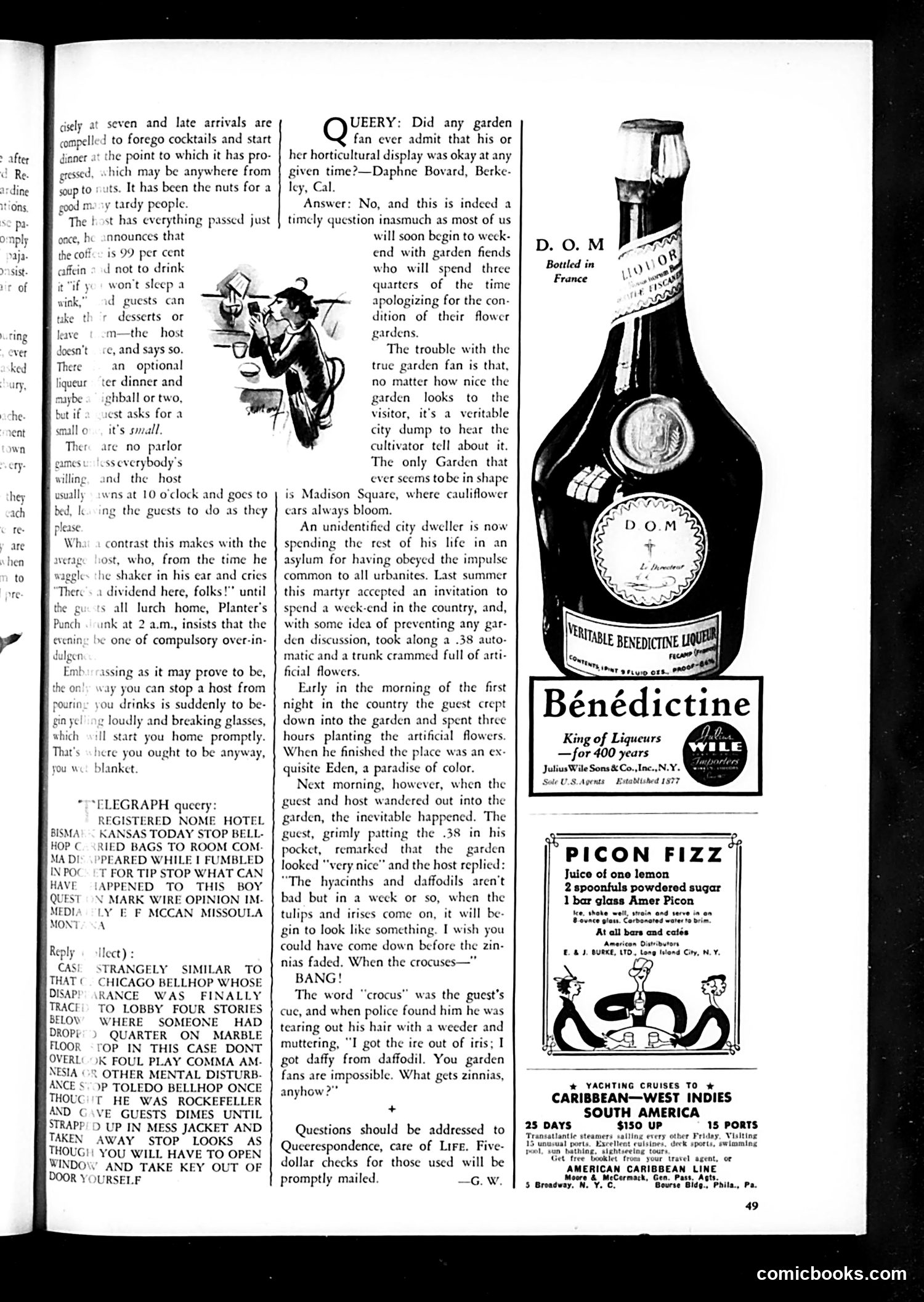
Life Magazine Page Analysis This page contains satirical commentary on early-20th-century American social conventions. The main feature is a humorous story about a city dweller who attempts to prevent garden-related conversation by planting artificial flowers at a country host's home—only to snap and shoot the host when he begins criticizing the garden and mentioning flowers like crocuses. The satire targets garden enthusiasts' obsessive habit of perpetually apologizing for their gardens' condition, no matter how attractive they appear. The exaggerated response (the guest's violent breakdown) mocks both the insufferable nature of garden complaints and urban-rural tensions. The page also includes a "Telegraph Query" section addressing a missing bellhop, illustrating Life's regular humor feature of absurd reader questions and responses. The advertisements (Benedictine liqueur, Picon Fizz, Caribbean cruises) are period-typical.
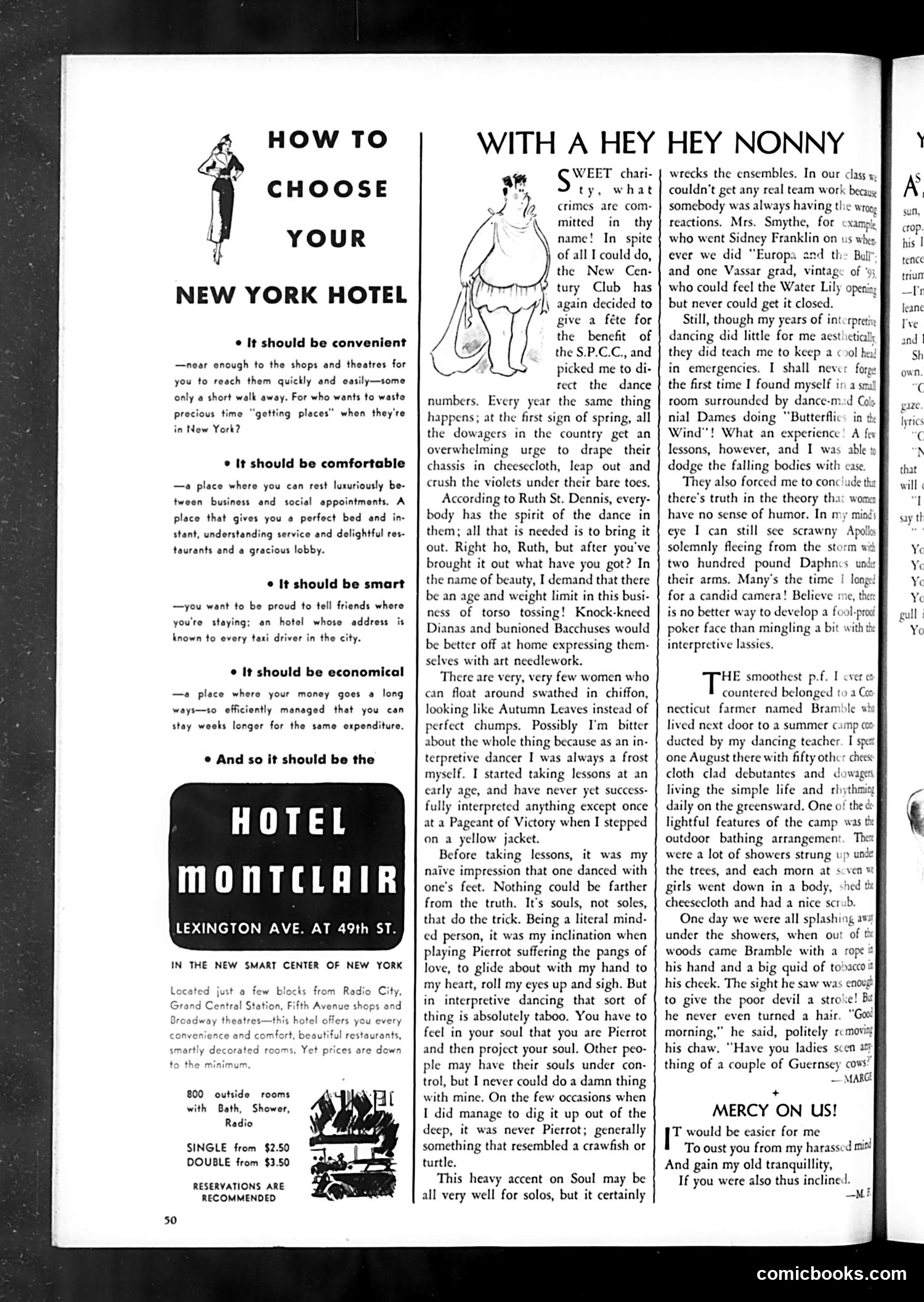
Explanation for Modern Readers This page contains a hotel advertisement (left) and a humorous essay (right) with accompanying illustration. The Satire: The essay, titled "With a Hey Hey Nonny," mocks interpretive dance and the wealthy women ("dowagers") who participate in charity benefit galas. The unnamed female narrator—herself a failed interpretive dancer—ridicules the pretension of "soul dancing" and the absurdity of older, overweight women attempting graceful movements in chiffon. The Joke: The author satirizes interpretive dance's emphasis on projecting one's "soul" rather than using actual technique. She describes her own failed attempts (stepping on a yellow jacket during a performance) and her classmates' mishaps, suggesting that untrained society women cannot successfully perform this art form, no matter how much spiritual feeling they attempt to project. The Reference: Ruth St. Denis (mentioned by name) was a famous pioneer of modern interpretive dance. The essay mocks her philosophy that "everybody has the spirit of the dance in them"—suggesting this is naive nonsense when applied to amateur socialites. The overall tone is satirical social commentary on 1920s-30s high society's amateur artistic pretensions.
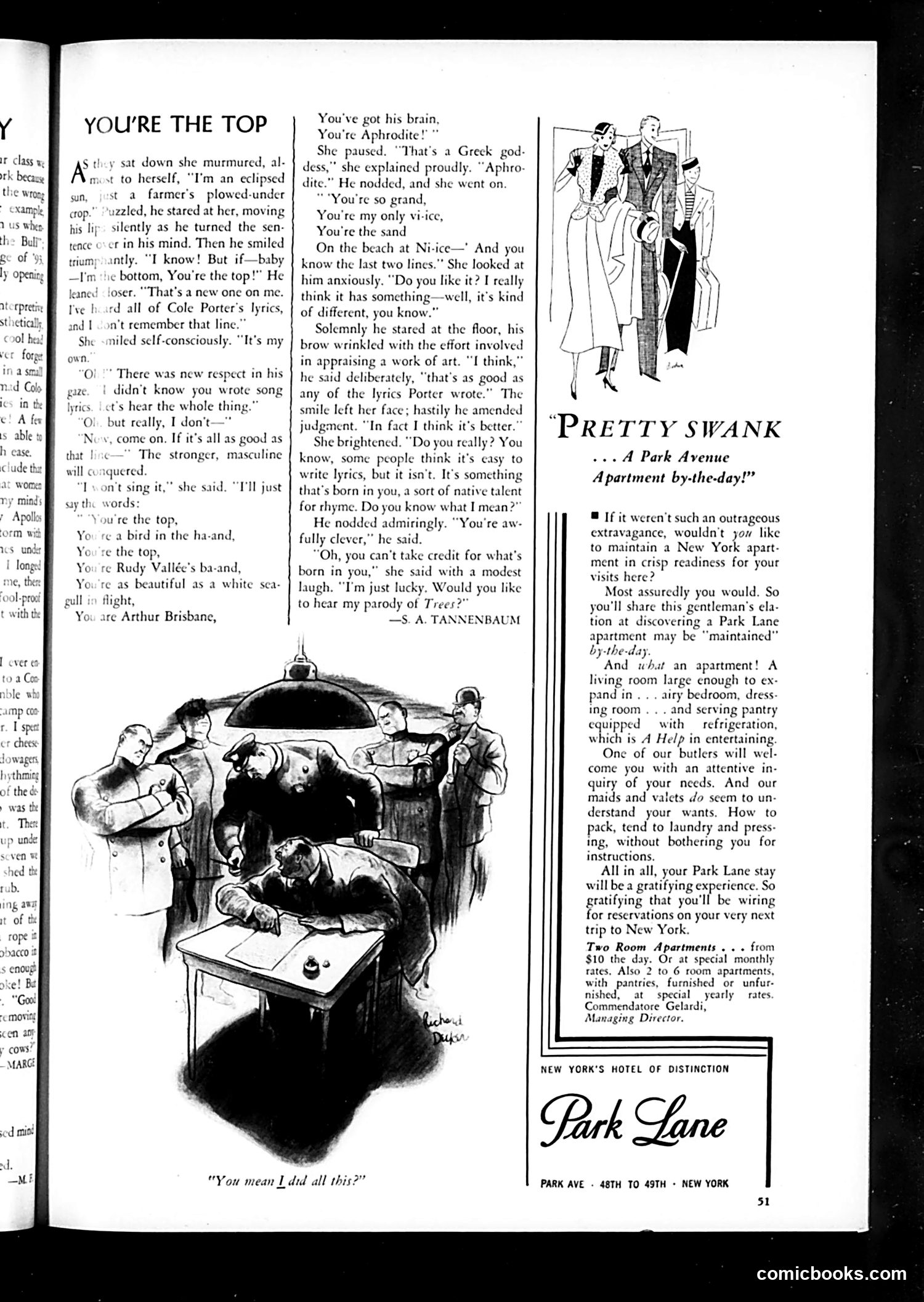
"You're the Top" - Satire of Amateur Songwriting This page features a short story satirizing a woman's pretentious attempt at songwriting. She's improvised lyrics she believes rival Cole Porter's famous 1934 song "You're the Top," inserting references to Greek mythology (Aphrodite) and French locations (Nice) to sound sophisticated. The humor lies in her self-deception: she's written mediocre doggerel but interprets the man's polite, awkward silence as admiration. When he finally praises her work—"that's as good as any of the lyrics Porter wrote"—she glows with pride, unaware his comment reflects mere politeness, not genuine assessment. The accompanying illustration shows the man's strained expression as he mentally struggles to evaluate her "art," capturing the social discomfort of the moment. The page also contains a Park Lane hotel advertisement (unrelated to the story's satire).
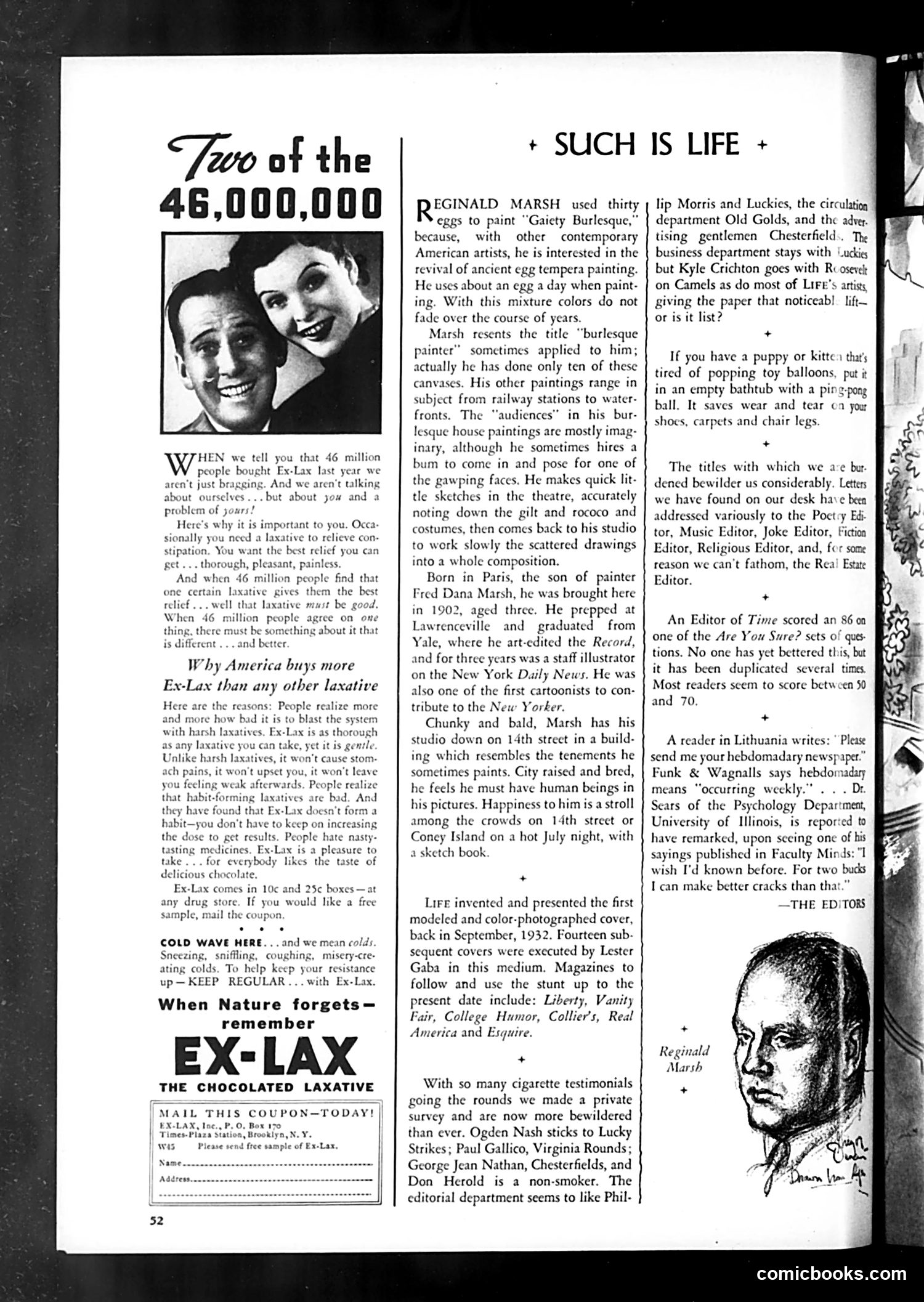
Explanation for Modern Readers This page contains two distinct elements: a full-page Ex-Lax laxative advertisement and a brief biographical article about artist Reginald Marsh. The ad uses humor based on a "problem" everyone experiences but doesn't discuss openly—constipation. It claims 46 million Americans bought Ex-Lax, appealing to conformity ("when 46 million people agree") and emphasizing the product is gentler than harsh competitors. The chocolate coating is highlighted as making medicine palatable. This represents typical mid-century advertising that was frank about bodily functions while maintaining discretion. The Marsh article celebrates an American painter known for depicting urban working-class scenes, particularly burlesque theaters. It notes he uses egg tempera (ancient technique) and refuses the limiting "burlesque painter" label, establishing him as a serious artist despite his subject matter. The biographical sketch humanizes him as a city observer who sketches from life. Both sections reflect 1930s-40s Life magazine's mix of accessible consumer culture and intellectual content.