life
Life — May 1935
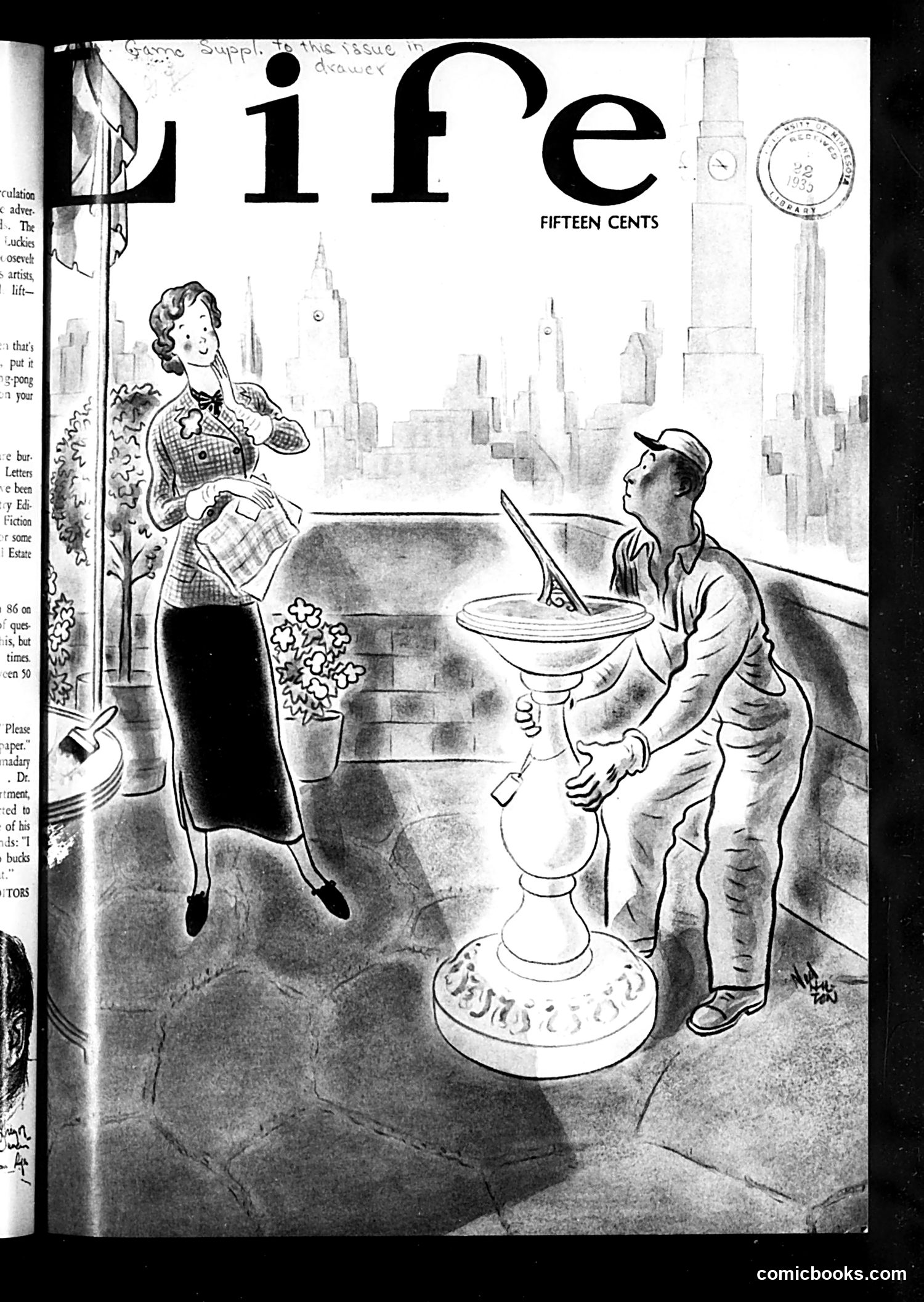
Analysis This is a Life magazine cover (fifteen cents) featuring a cartoon about urban bird control or pest management. The scene shows a woman in 1940s-style dress observing a man on a rooftop attempting to manage what appears to be large decorative birds or bird sculptures using nets and tools. Behind them is a stylized New York City skyline. The satire likely comments on urban pigeon or bird problems in cities—a persistent nuisance requiring creative or absurd solutions. The exaggerated scale of the birds and the man's elaborate equipment suggest mockery of either overly complicated pest-control methods or the growing bird population in crowded urban areas. The woman's amused expression implies the situation is ridiculous or impractical.
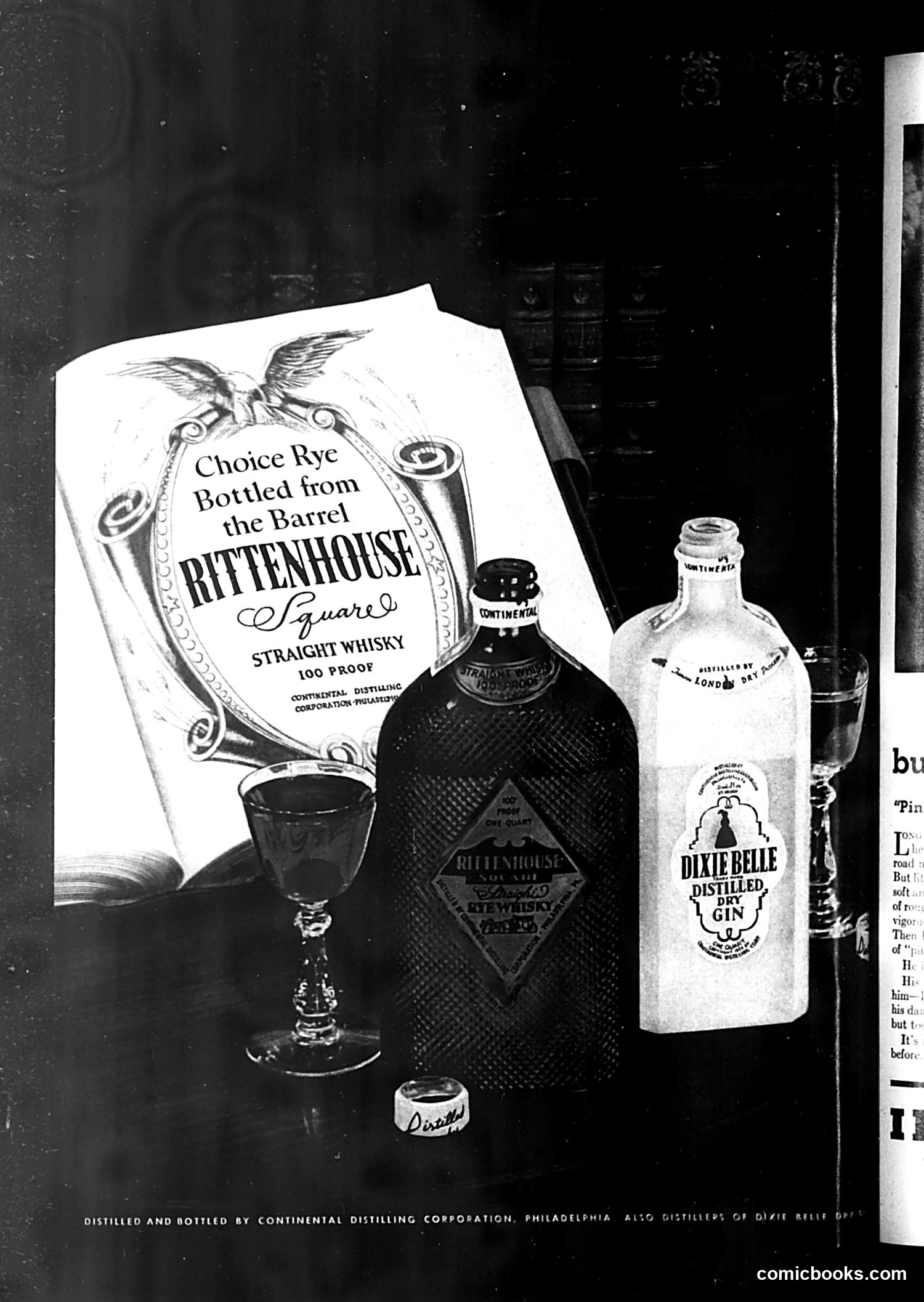
Analysis This page is primarily advertising content, not political satire or editorial cartoon. It displays liquor advertisements from the Prohibition era or immediate post-Prohibition period. The visible ads feature: - Rittenhouse Square rye whiskey (100 proof, straight whiskey) - Dixie Belle distilled dry gin - Both produced by Continental Distilling Corporation, Philadelphia The advertisement emphasizes "bottled from the barrel" quality and features decorative period imagery (eagle, classical styling). This represents commercial marketing during a time when alcohol sales were either newly legalized (post-1933) or heavily restricted, making such prominent advertising significant historically. There is no political commentary or satire visible—this is straightforward product promotion in a magazine format.
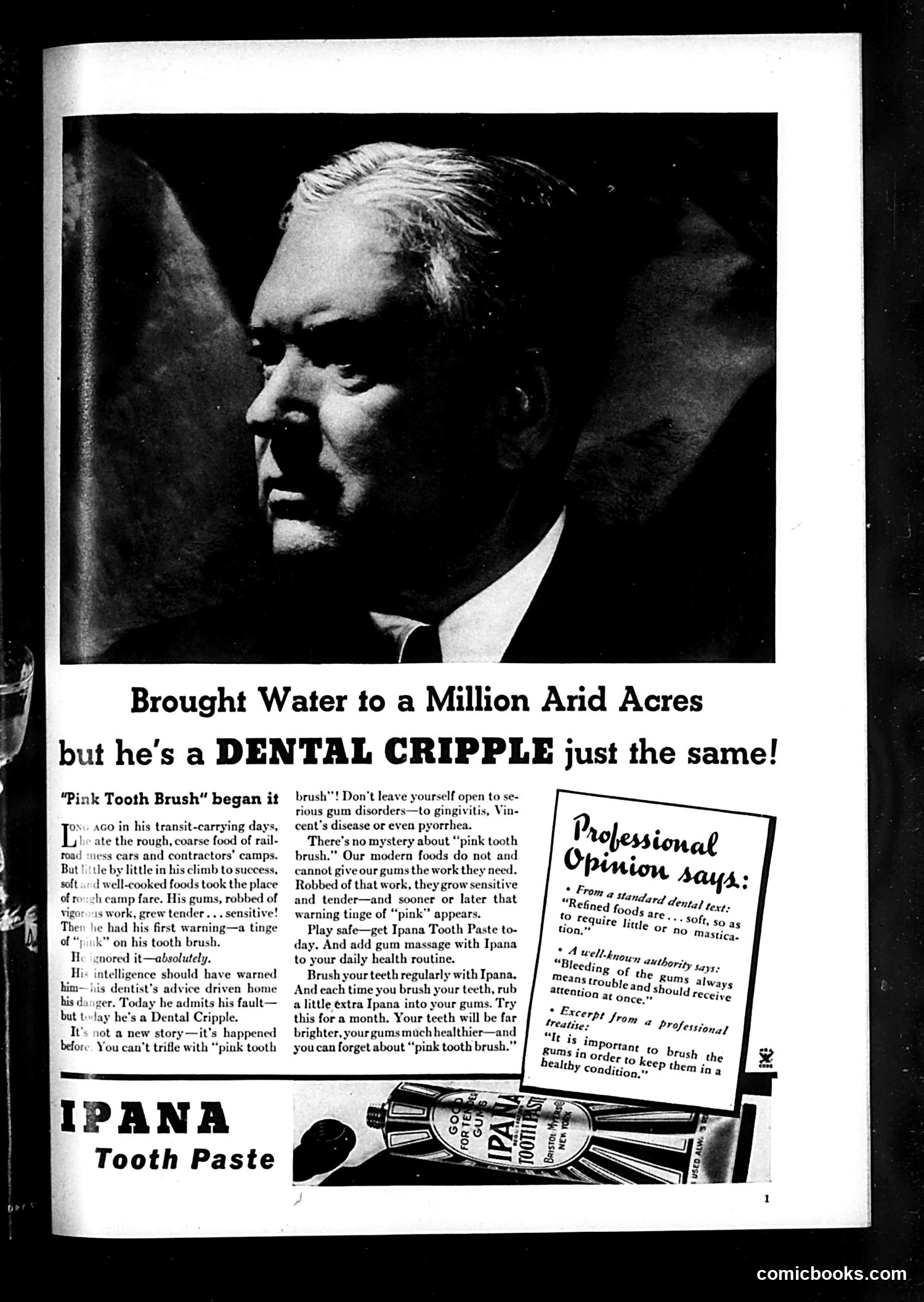
Analysis This is primarily a toothpaste advertisement, not political satire. The page advertises Ipana Tooth Paste. The headline mocks an unnamed public figure (shown in profile) who achieved something grand—"Brought Water to a Million Arid Acres"—yet suffers from "a DENTAL CRIPPLE" condition, suggesting poor dental health undermines his accomplishments. The joke relies on contrast: major infrastructure achievement means nothing if you have bad teeth ("pink tooth brush"). The advertisement implies that regardless of professional success, dental care through Ipana products is essential to personal credibility. The "Professional Opinion" box includes endorsements from dental authorities supporting the product's gum-care claims. This reflects vintage advertising strategy: using humor and mild shame to sell health products by suggesting personal grooming reflects character.
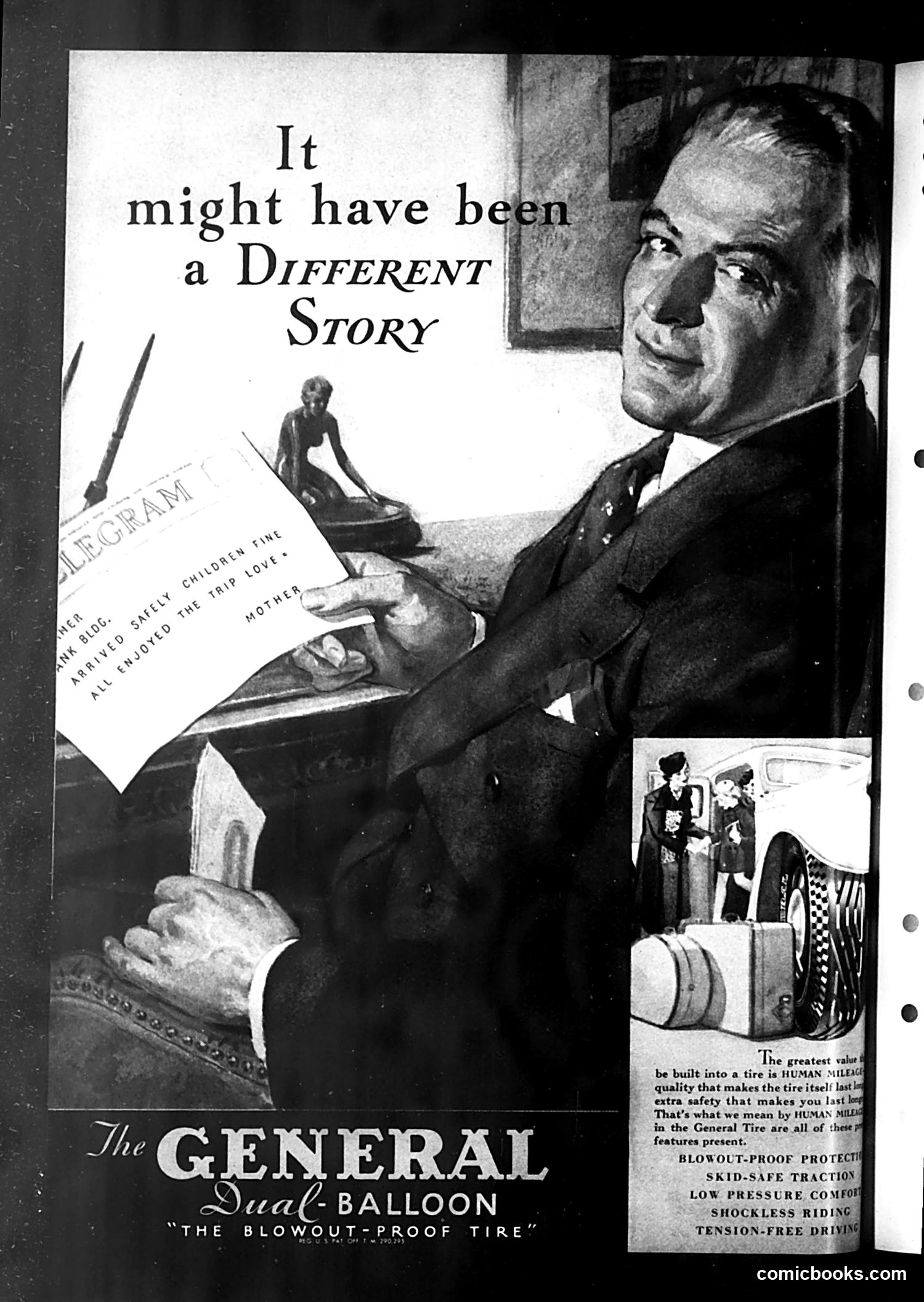
Analysis This is primarily a General Tire advertisement, not political satire. The page shows a man in business attire examining a tire while holding what appears to be a film strip or promotional material. The headline "It might have been a DIFFERENT STORY" suggests that choosing General's "Dual-Balloon" tire could have changed outcomes depicted in the smaller images—including what appears to be a domestic scene and a car situation. The ad emphasizes safety features: "Blowout-Proof Protection," "Skid-Safe Traction," "Low Pressure Comfort," "Shockless Riding," and "Tension-Free Driving." This is vintage commercial advertising using a narrative hook ("different story") to promote tire quality and reliability to mid-century consumers concerned with vehicle safety.
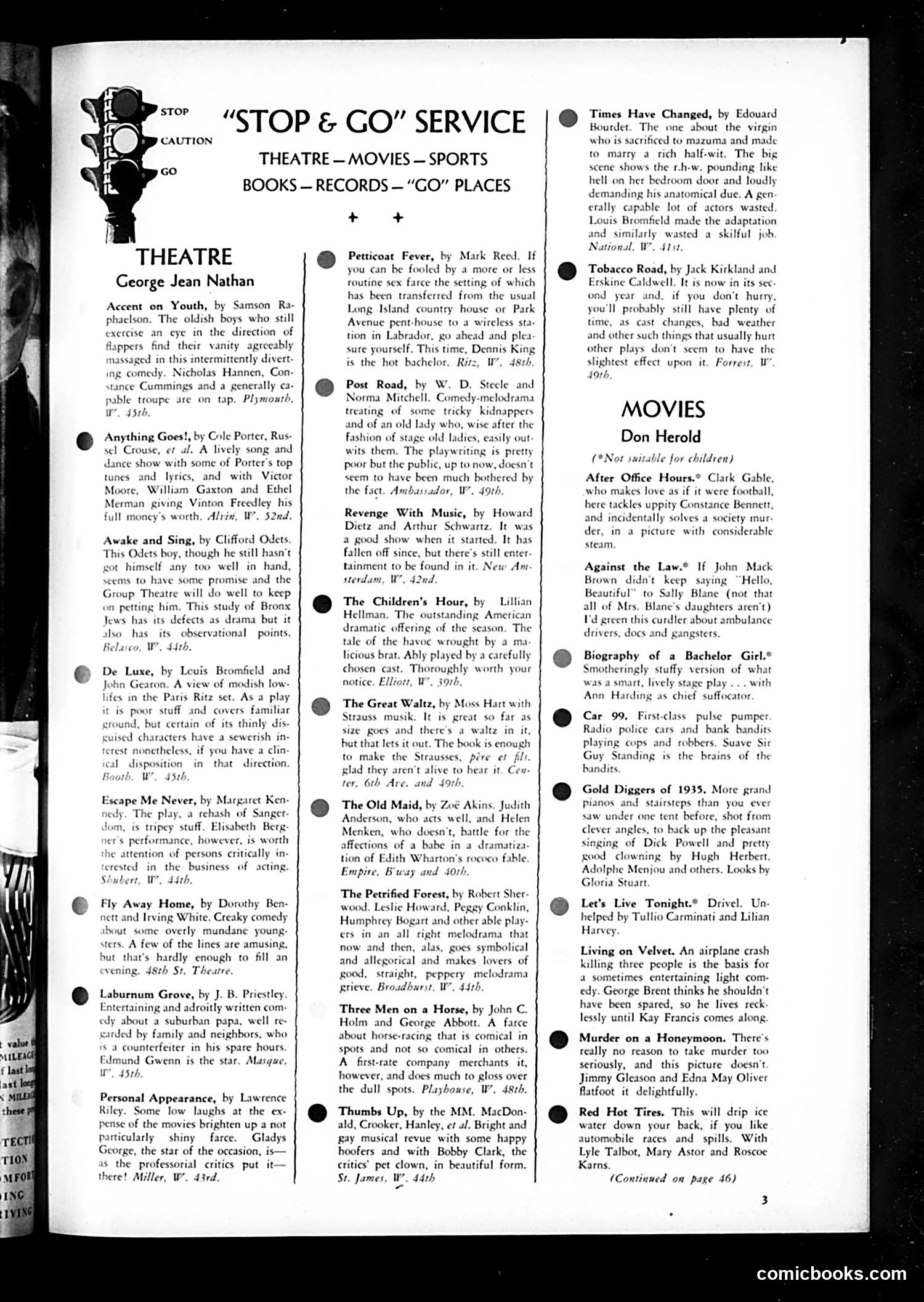
Analysis of Life Magazine Page This page is primarily entertainment criticism and advertising, not political satire. The "Stop & Go Service" masthead at top (with a traffic light) is a organizational device for organizing reviews of theatre, movies, sports, books, records, and entertainment venues. The content consists of theatre and movie reviews from what appears to be the 1930s-40s era. Critics review plays like "Anything Goes?" and "De Luxe," and films like "After Office Hours" and "Against the Law." The traffic light logo functions as a visual pun—reviews are organized like traffic signals, presumably with positive/negative assessments guiding readers on what entertainment to "go" see or "stop" avoiding. This is a structural conceit, not political commentary. The page reflects period entertainment journalism rather than satirical cartooning.
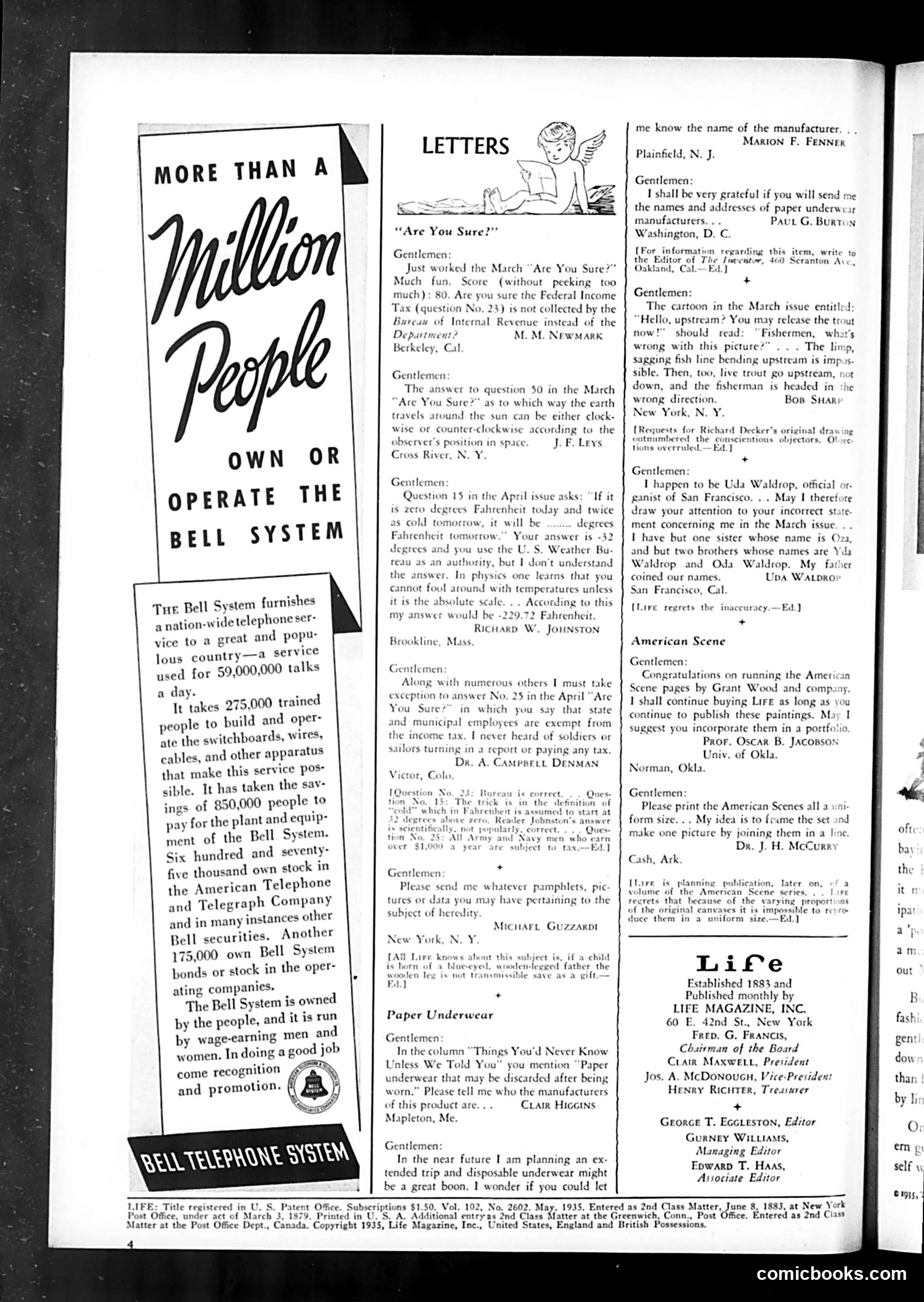
Life Magazine Letters Page & Bell System Advertisement This page consists primarily of a Bell Telephone System advertisement (left side) and a letters section (right side). The ad claims the Bell System serves "more than a million people" and operates nationwide telephone infrastructure, employing 275,000 people. It emphasizes Bell's scale and dominance in American telecommunications. The letters section contains reader responses to previous Life magazine content, including questions about Federal Income Tax collection methods, Earth's rotation direction, temperature calculations, and debates over American Scene illustrations. The page functions as typical magazine filler—combining advertising revenue with reader engagement. Nothing here represents political satire; rather, it's straightforward commercial promotion and correspondence reflecting early 20th-century American readers' curiosity about science, taxes, and illustration techniques.
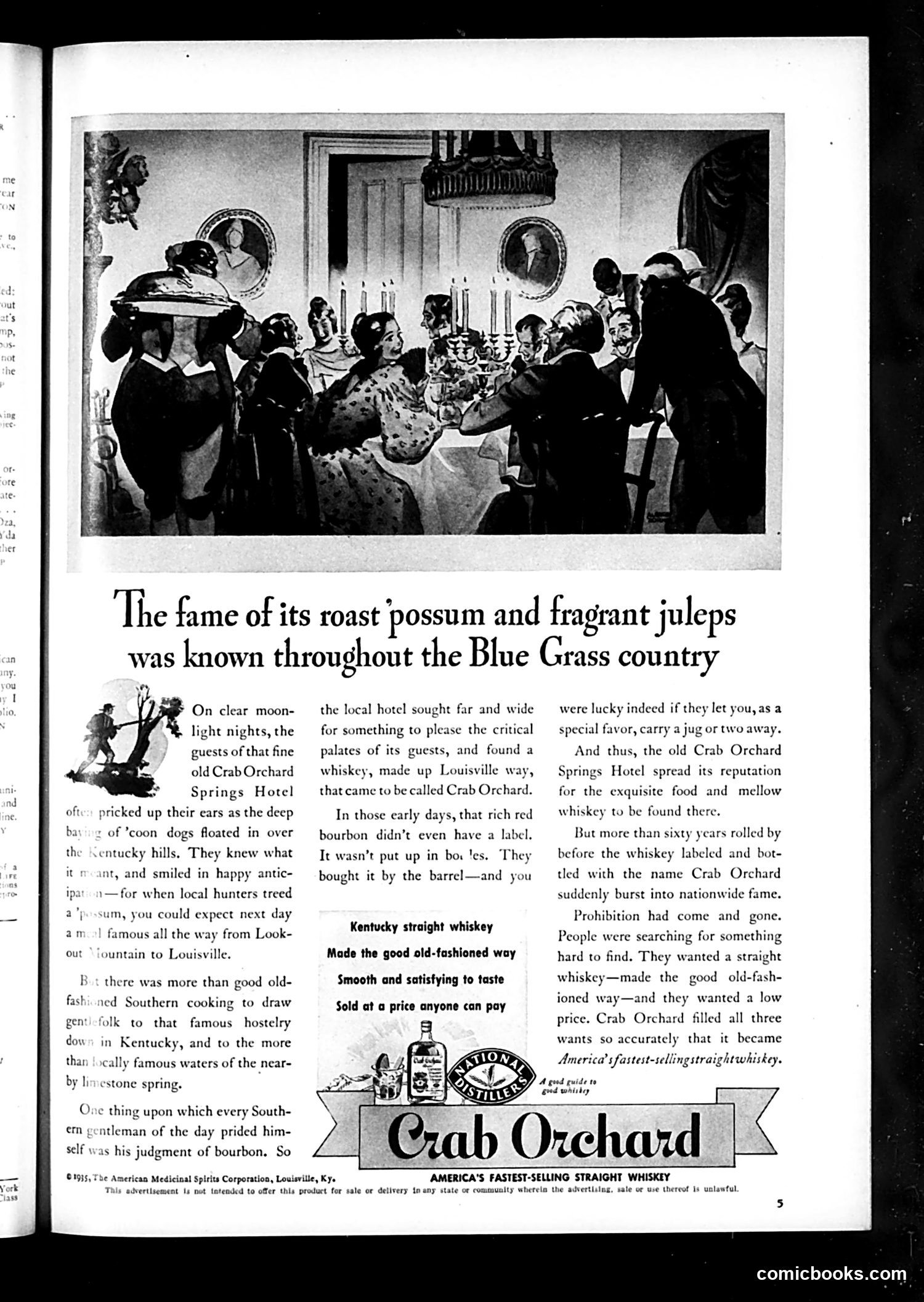
What This Page Contains This is primarily a Crab Orchard whiskey advertisement, not political satire. The image shows a formal dinner party at what appears to be the Crab Orchard Springs Hotel in Kentucky. The advertisement narrative describes how the hotel's famous "roast possum and fragrant juleps" attracted Southern gentleman visitors, and how the hotel's whiskey became renowned throughout the "Blue Grass country." The text emphasizes the whiskey's appeal: it's Kentucky straight whiskey, "made the good old-fashioned way," smooth and affordable. The ad claims Crab Orchard became "America's fastest-selling straight whiskey" after gaining local fame during Prohibition (when "Prohibition had come and gone"). This is commercial advertising exploiting nostalgia for antebellum Southern hospitality and pre-Prohibition traditions.
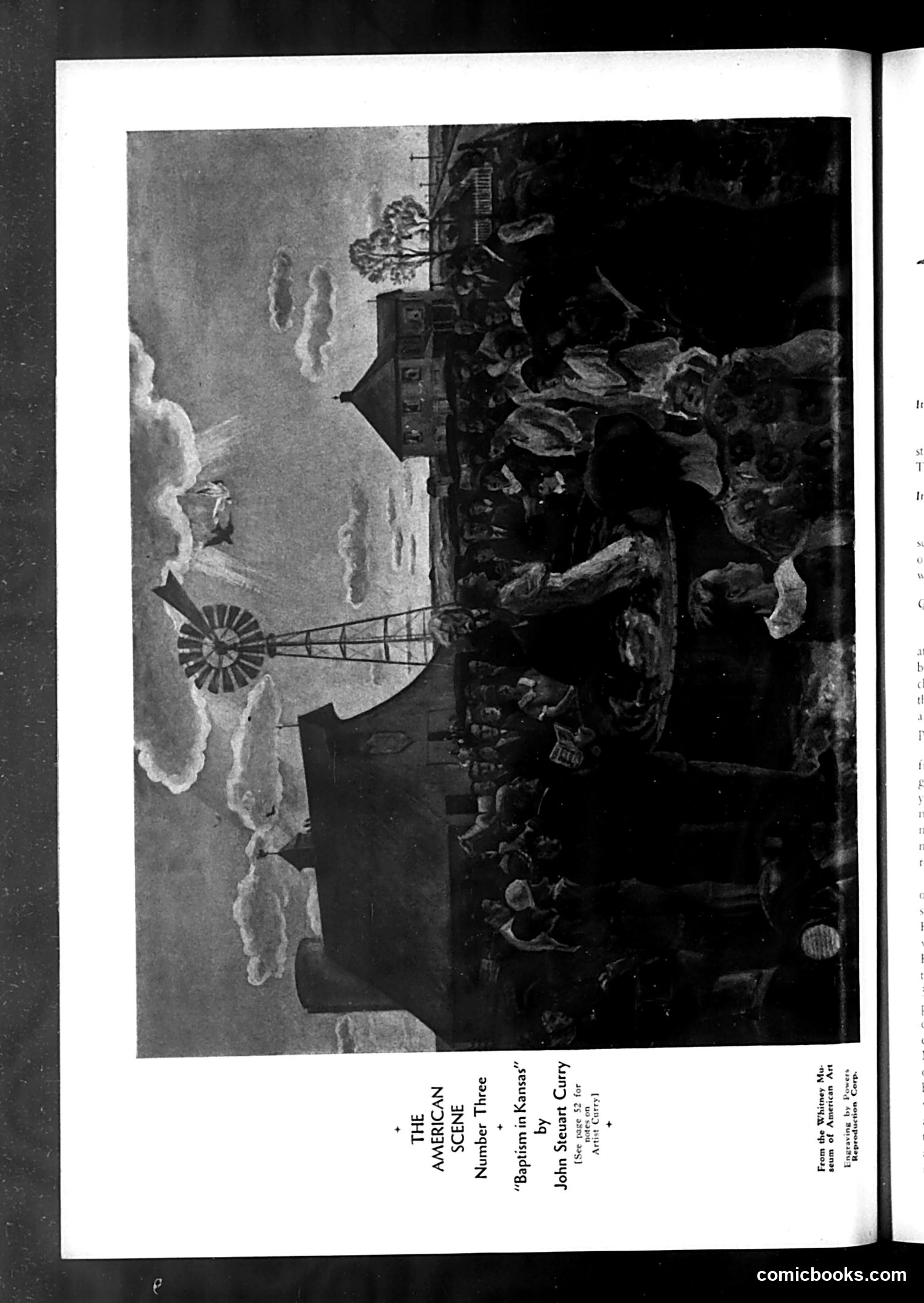
"The American Scene" - "Boganism in Kansas" This is a satirical illustration from *Life* magazine showing a scene titled "Boganism in Kansas," created by artist John Sloan Curry. The cartoon depicts what appears to be a rural American scene with a windmill on the left and a building on the right surrounded by figures. The term "boganism" suggests mockery of rural, unsophisticated behavior or culture (likely from "bog" — a derogatory reference to rural areas). The satire targets Kansas rural life during this period, presenting it as backwards or crude compared to urban American culture. John Sloan Curry was known for depicting American regional scenes, often with social commentary embedded in his imagery. The illustration uses exaggeration and dark imagery to reinforce the satirical critique of rural Midwestern life and values.
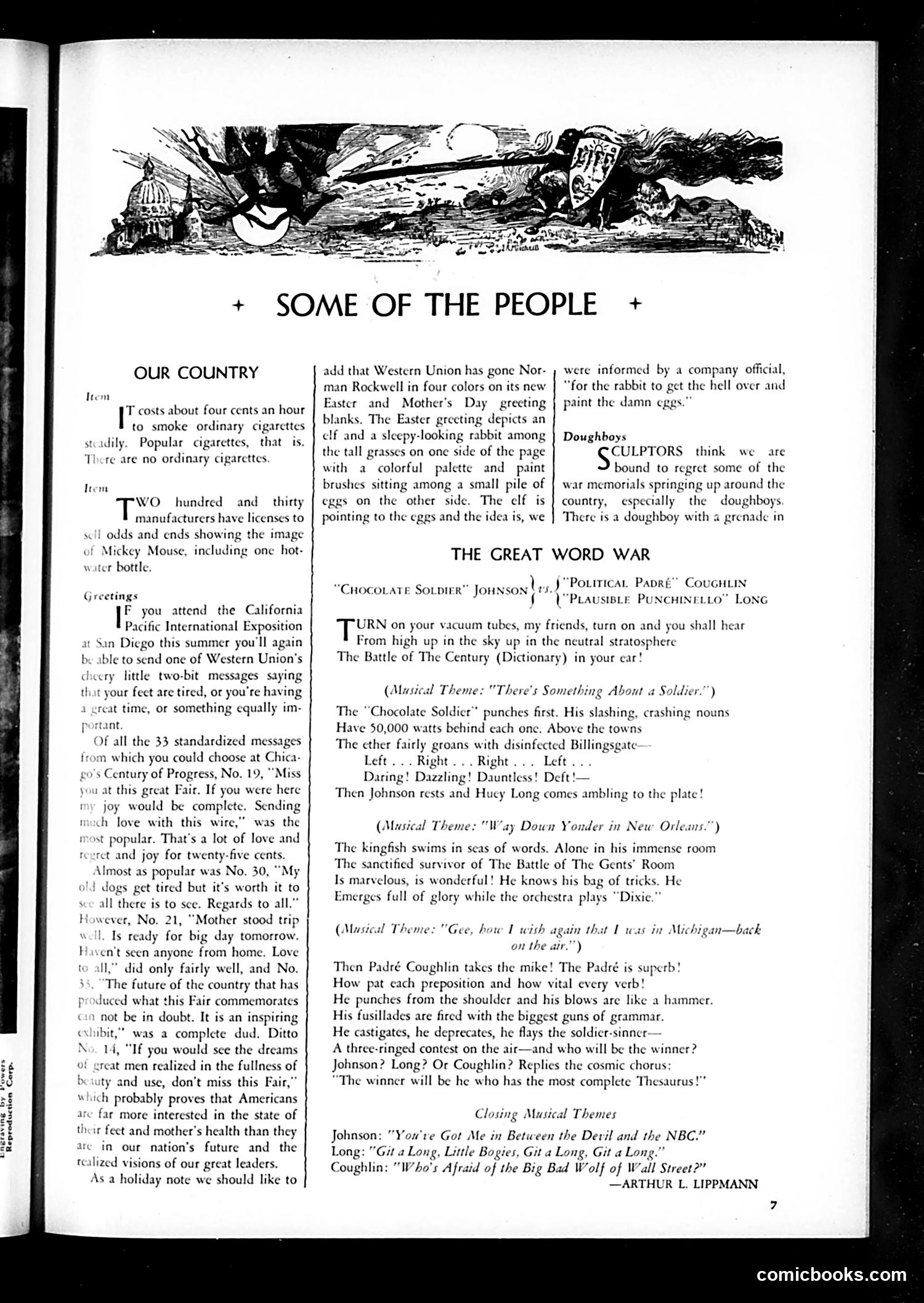
Life Magazine Page Analysis This page satirizes American consumer culture and wartime rhetoric. The "Some of the People in Our Country" section mocks ordinary citizens' priorities—smoking cheap cigarettes, collecting Mickey Mouse merchandise, and sending standardized greeting-card messages via Western Union. The main piece, "The Great Word War," is a humorous mock-battle between columnists "Chocolate Soldier" Johnson, "Political Padre" Coughlin, and "Plausible Punchinello" Long. The text describes them as competing verbally with "disinfectant billinggate" and grammatical "guns," satirizing their overwrought rhetorical styles and public prominence. The satire suggests these public figures engage in empty, performative conflict while ordinary Americans occupy themselves with trivial commercial pursuits—critiquing both celebrity punditry and mass consumer distraction during what appears to be the 1930s.
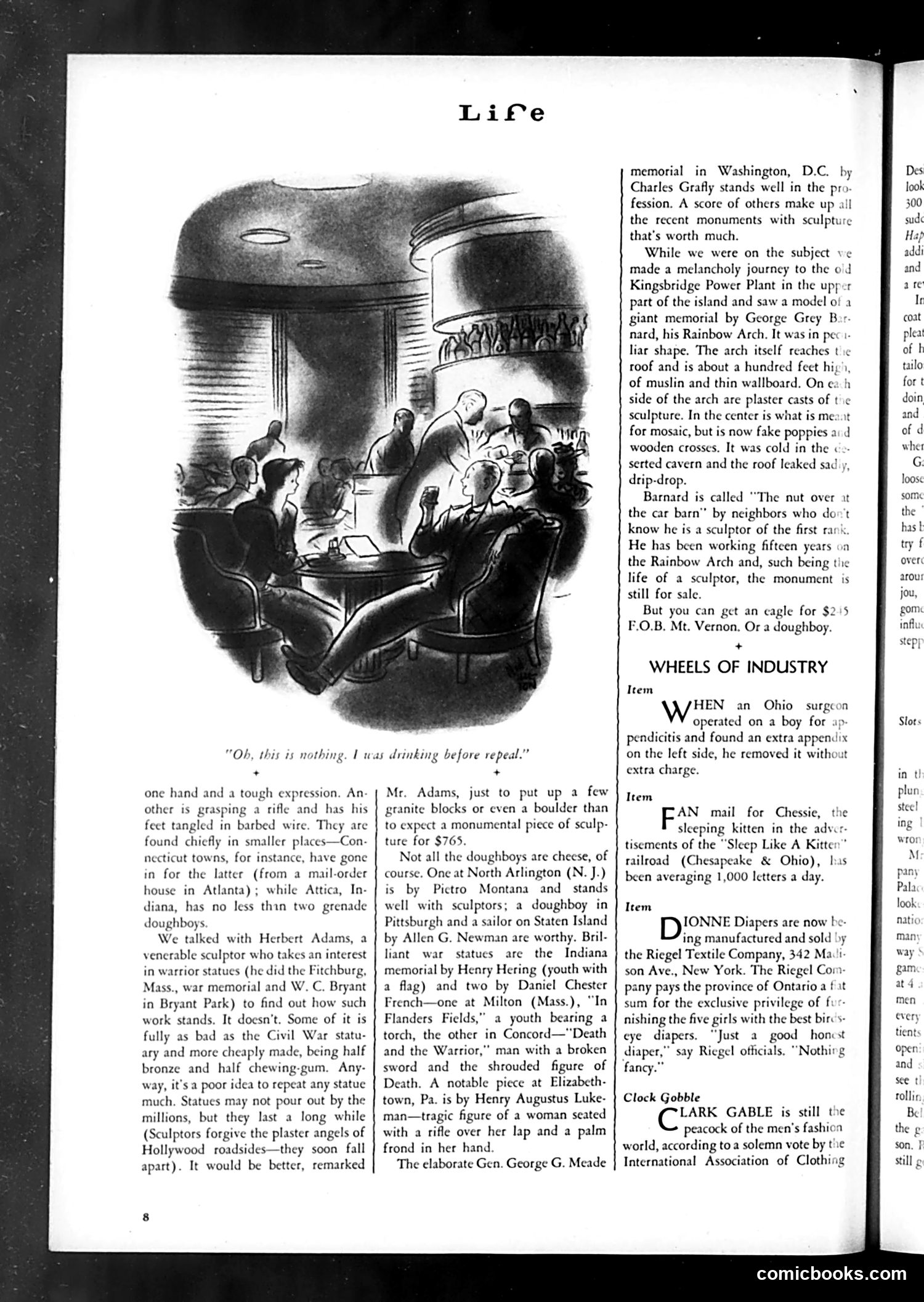
Cartoon Analysis This cartoon depicts a casual social gathering—appears to be a dinner or restaurant scene—where one figure says to another: "Oh, this is nothing. I was drinking before repeal." The joke references Prohibition's repeal (1933), when alcohol became legal again in America. The speaker is boasting that he was already drinking illegally during Prohibition, suggesting he's a seasoned drinker with experience circumventing the law. The humor lies in treating illegal drinking as a badge of honor or sign of sophistication. The surrounding figures appear to be ordinary diners, establishing this as everyday social commentary on how Americans viewed Prohibition's end—with some treating pre-repeal drinking as worldly experience worth mentioning casually in polite company.
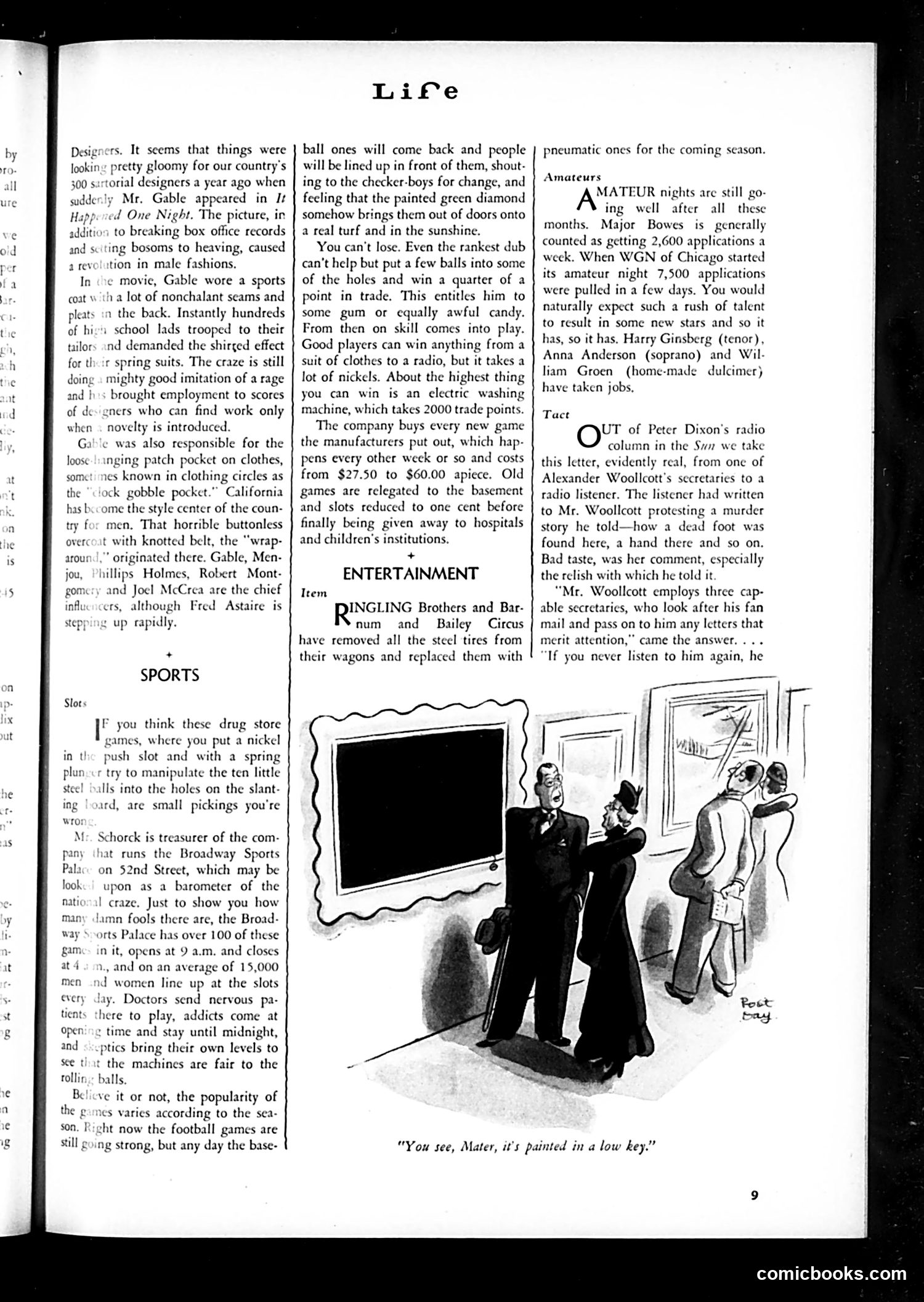
Analysis of Life Magazine Page This page contains three sections: Sports, Amateurs, and Entertainment. The main cartoon depicts a man in formal attire showing what appears to be a painting to a woman, while others peer through a window or opening behind them. The caption reads: "You see, Mater, it's painted in a low key." The satire here plays on the double meaning of "low key"—referring both to artistic technique (subdued lighting/tones in painting) and to something done secretly or discreetly. The context suggests the painting itself may be scandalous or inappropriate, and the man is making a joke to his mother ("Mater") about concealing its true nature through artistic pretense. The onlookers behind suggest this is a poorly kept secret despite the claimed discretion.
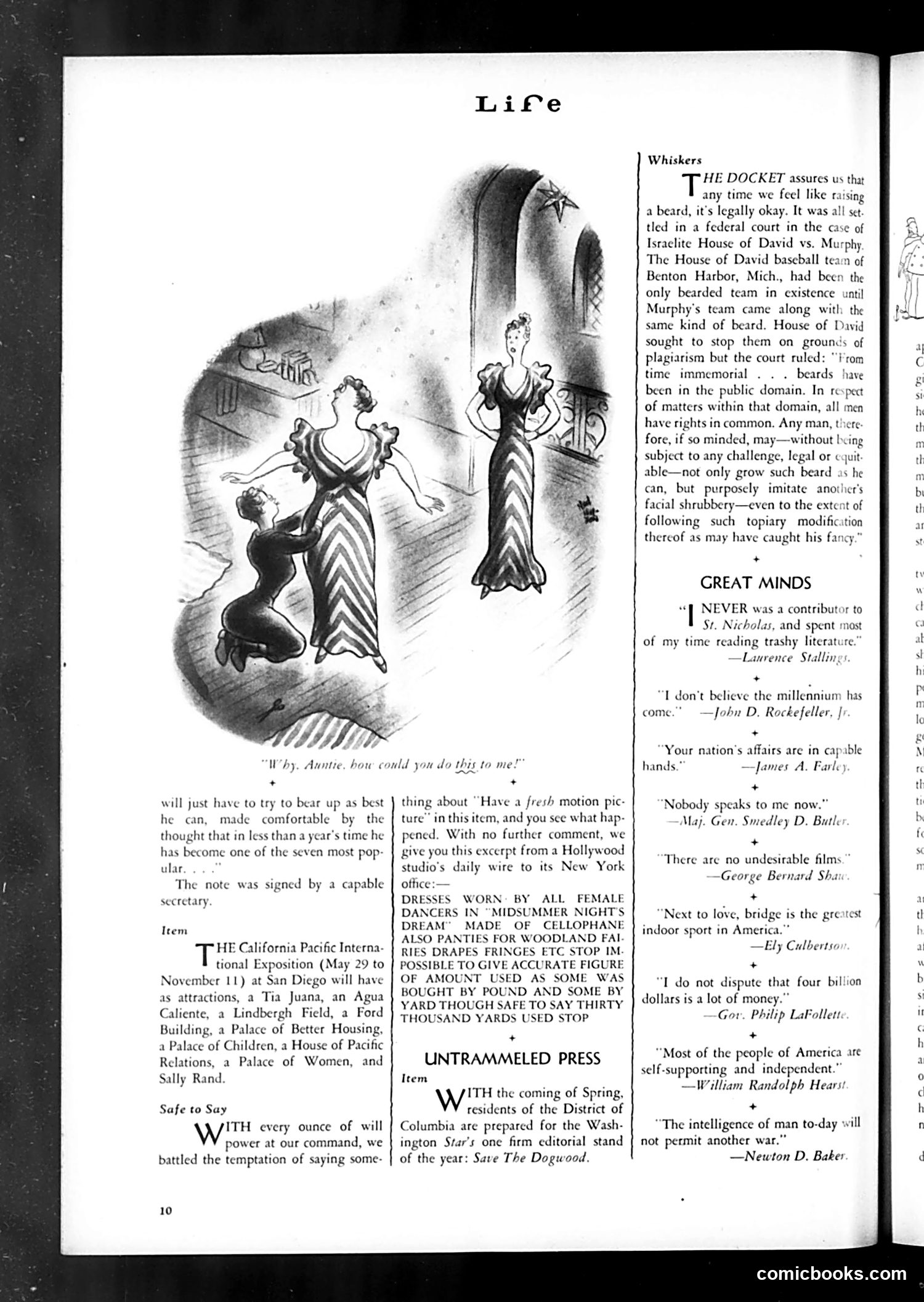
Analysis of Life Magazine Page This page contains a cartoon and several unrelated items. The main cartoon depicts two women in an elegant interior—one reclining/posing while another stands. The caption reads "Why, Aimée, how could you do this to me?" The accompanying text discusses a Hollywood studio's wardrobe choices for female dancers in a "Midsummer Night's Dream" production, noting the impracticality of cellophane costumes and excessive yardage. The cartoon appears to satirize theatrical vanity and costume absurdity—likely mocking either the pretensions of stage productions or actresses' competitive jealousy over costume choices. Without identifying "Aimée," the specific target remains unclear, though the satire targets theatrical world vanities typical of 1920s-30s Life magazine humor. The page also includes unrelated brief items about expositions and press matters.
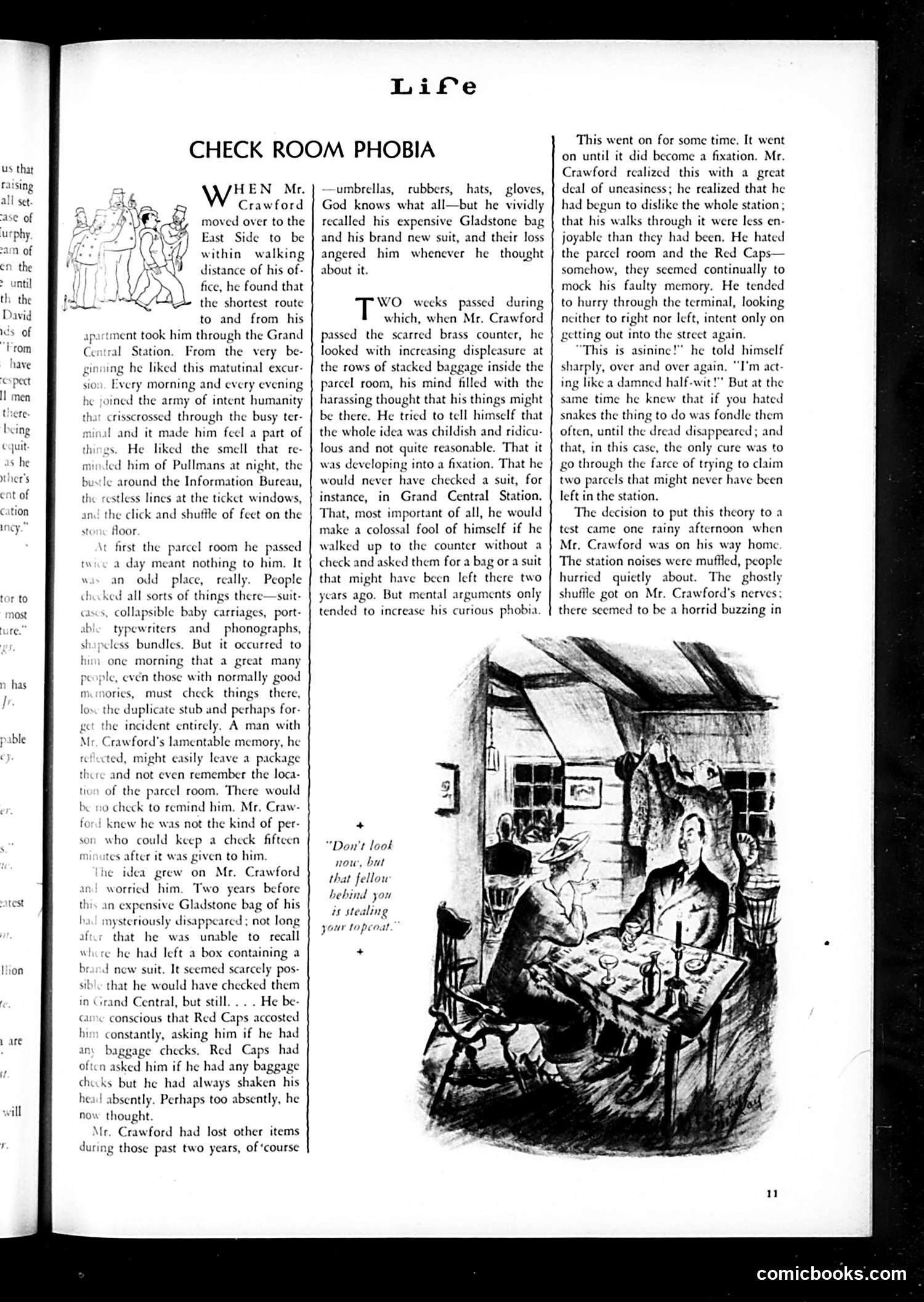
"Check Room Phobia" Explanation This satirical piece mocks Mr. Crawford's anxiety about leaving belongings in a train station's check room. The illustration shows the parcel room at what appears to be Grand Central Station. Crawford suffers from an obsessive fear that his checked items will be lost or stolen, despite having receipt stubs. The satire targets his irrational worry: he's so convinced disaster will strike that he repeatedly returns to verify his belongings remain there, creating what the text calls a "fixation." The joke exposes a common neurosis of the era—the modern traveler's anxiety about trusting institutions with personal property. His mental anguish over a potentially misplaced Gladstone bag becomes absurdly disproportionate, illustrating how urban anxieties could produce obsessive, paralyzing fears in ordinary people.
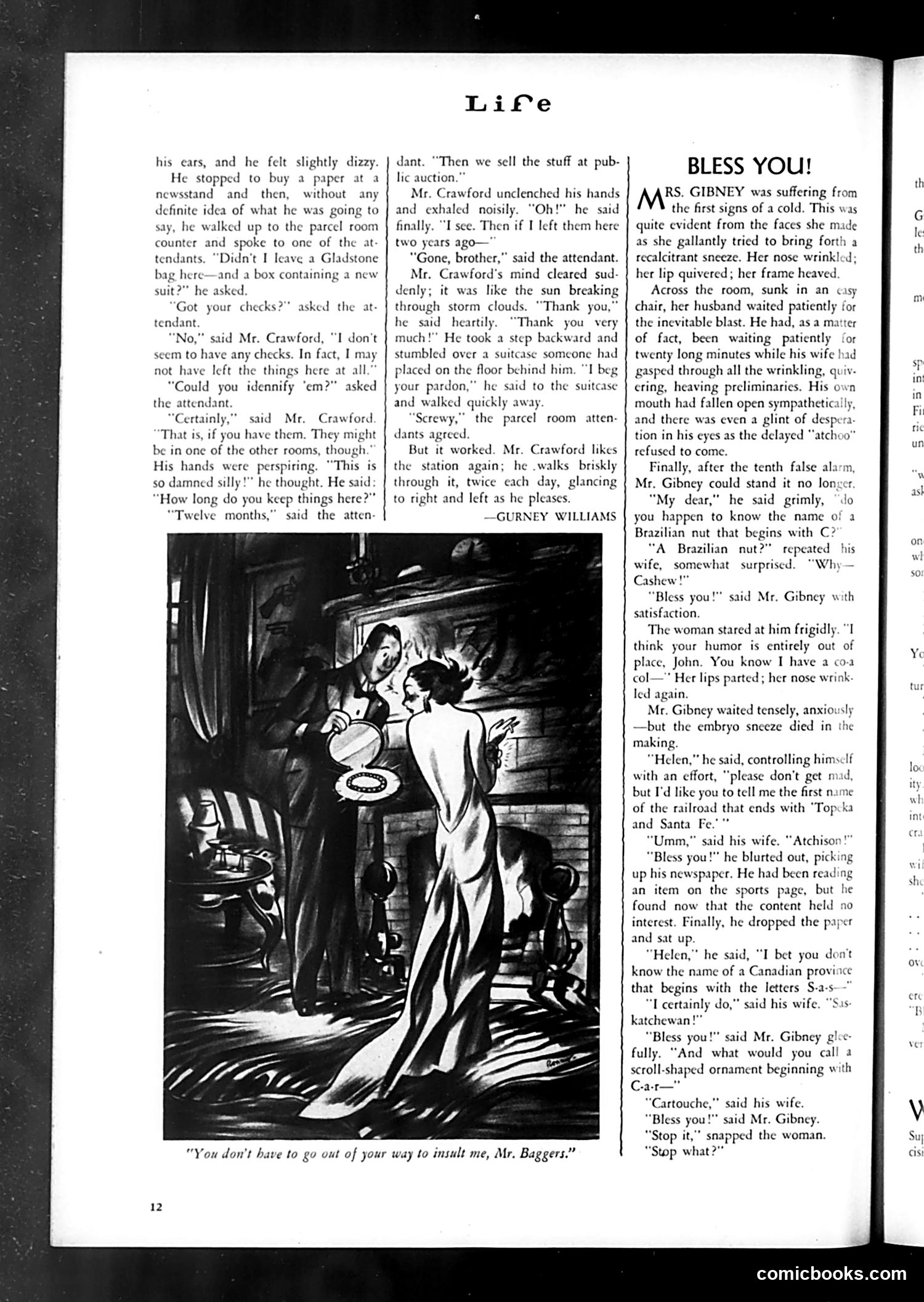
Analysis of "Bless You!" Page from Life Magazine This page contains a short story by Gurney Williams titled "Bless You!" paired with an illustration. The narrative depicts Mr. Gibney, a man whose wife is suffering from a cold, attempting to manage her irritation through various conversational tactics—asking her trivia questions about Brazilian nuts, Canadian provinces, and ornamental scrolls—all designed to distract her from her discomfort. The illustration shows a domestic interior scene with a woman in a negligée and a man, depicting an intimate moment interrupted by the wife's illness. The satire targets the awkwardness of masculine domesticity: husbands' bumbling attempts to comfort ailing wives through deflection rather than genuine sympathy. The repeated "Bless you!" (responses to sneezes) frames the comedy of failed male empathy during female illness.
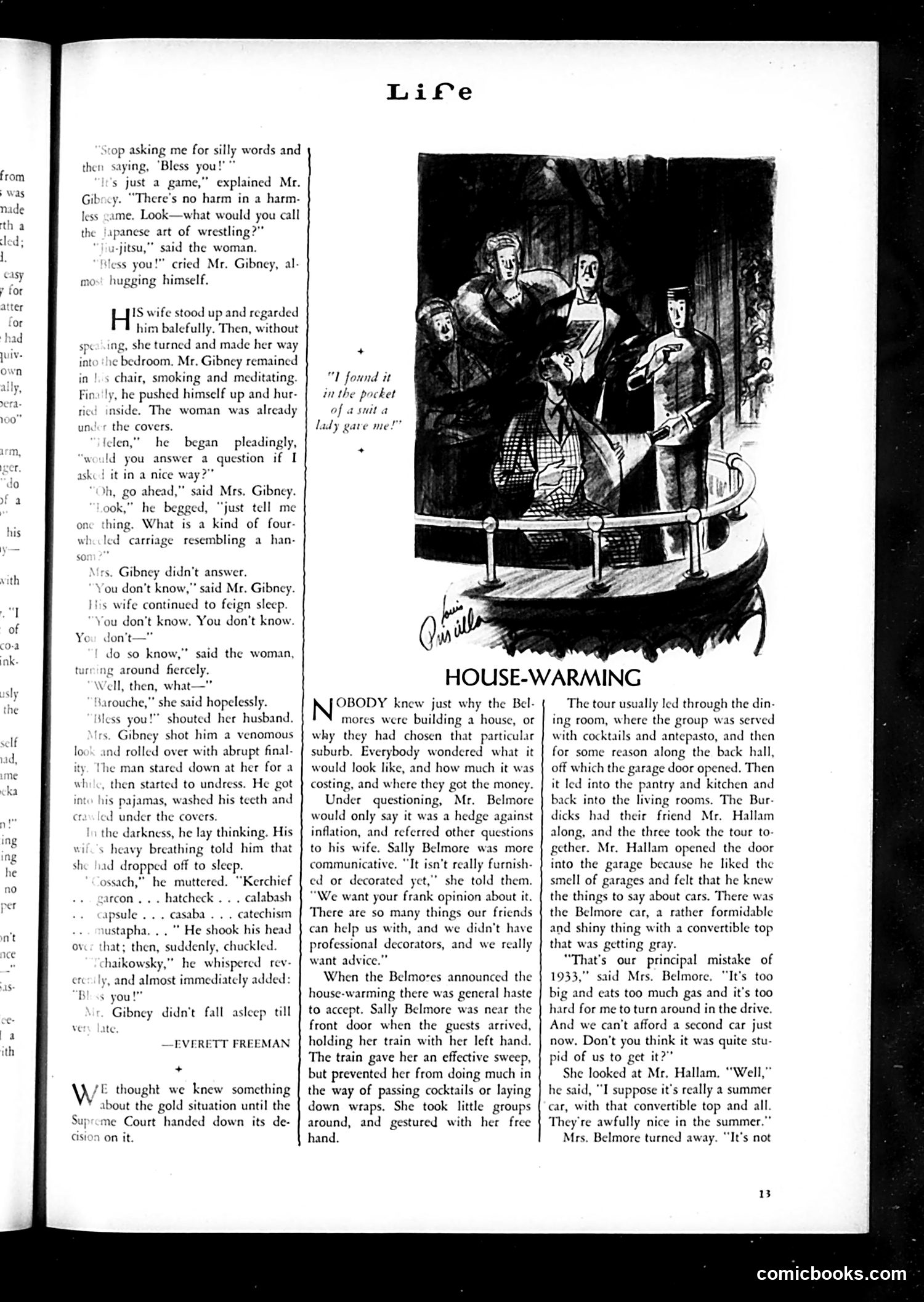
Analysis of Life Magazine Page This page contains a short story titled "House-Warming" by Everett Freeman, illustrated with a black-and-white drawing showing people at what appears to be a social gathering or party. The narrative depicts Mr. and Mrs. Gibney in a domestic scene. The story satirizes upper-middle-class social pretensions through dialogue about a housewarming party the Belmores are hosting. The humor centers on the couple's anxieties about decorating choices, their concern about impressing guests, and their insecurity about whether their taste is acceptable—reflected in their repeated requests for others' opinions. The illustration captures the social awkwardness of the gathering, showing guests examining the home while the hosts nervously seek validation. The satire targets 1930s-era consumer culture and status anxiety among the prosperous classes.
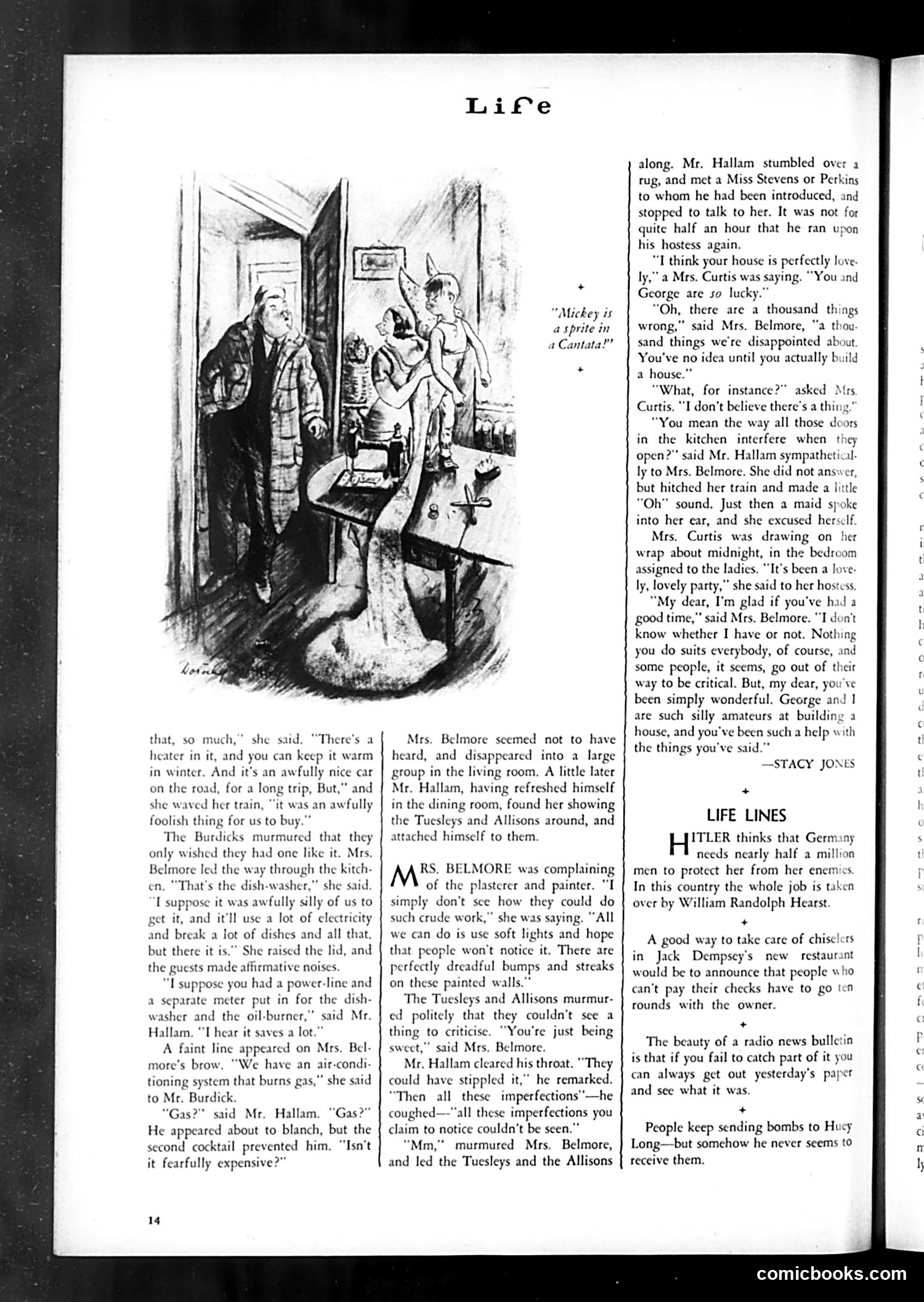
Analysis This page from *Life* magazine contains a narrative story titled "Life" with an accompanying sketch illustration. The illustration shows people in what appears to be a domestic interior scene—possibly a doorway or entryway with multiple figures interacting. The text is primarily a short story or humorous narrative about social interactions at a gathering or party. Characters include Mr. Hallam, Mrs. Curtis, Mrs. Belmore, and the Tuesleys and Allisons. The dialogue concerns complaints about home construction details (doors, heating systems, kitchen layouts) and social pleasantries about a house-building project. The piece appears to satirize middle-class social conventions and polite conversation rather than political figures. It's a domestic comedy focused on the mundane concerns and social rituals of affluent homeowners, likely from the early-to-mid 20th century.
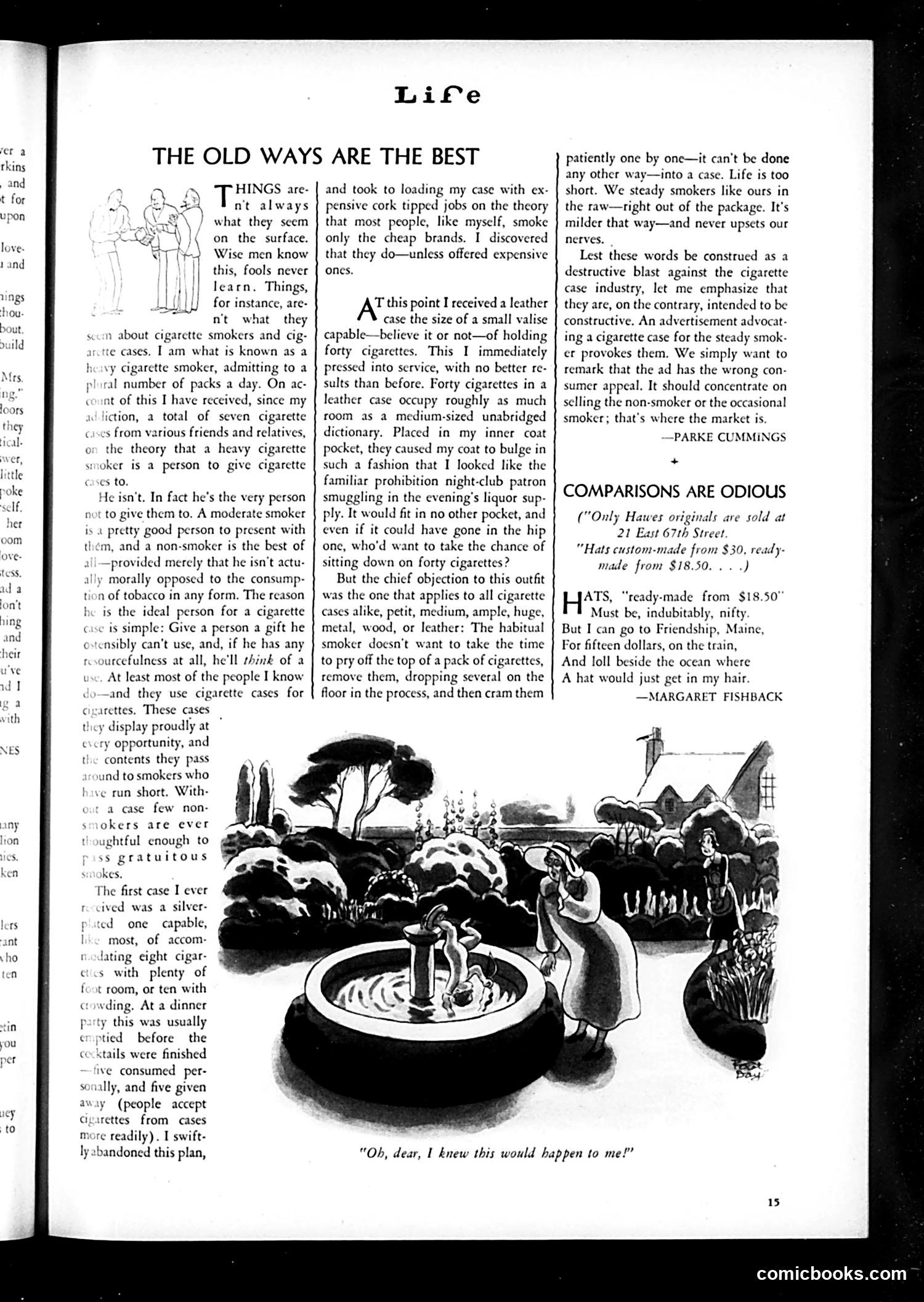
Analysis of This Life Magazine Page This page satirizes cigarette cases as gifts. The main article argues that cigarette cases are poor presents because smokers don't actually want them—they're impractical, cause coat bulging, and require prying open to access cigarettes. The cartoon illustrates the joke's punchline: a man at what appears to be a garden party or social gathering realizes too late that his expensive gift (a cigarette case) has caused him literal misfortune—he's fallen into a pond or fountain while struggling with it. The accompanying humor piece "Comparisons Are Odious" mocks ready-made hats as equally thoughtless gifts. The satire targets gift-giving conventions: expensive, fashionable presents that recipients don't actually use or want, a timeless social observation wrapped in period humor about smoking culture.
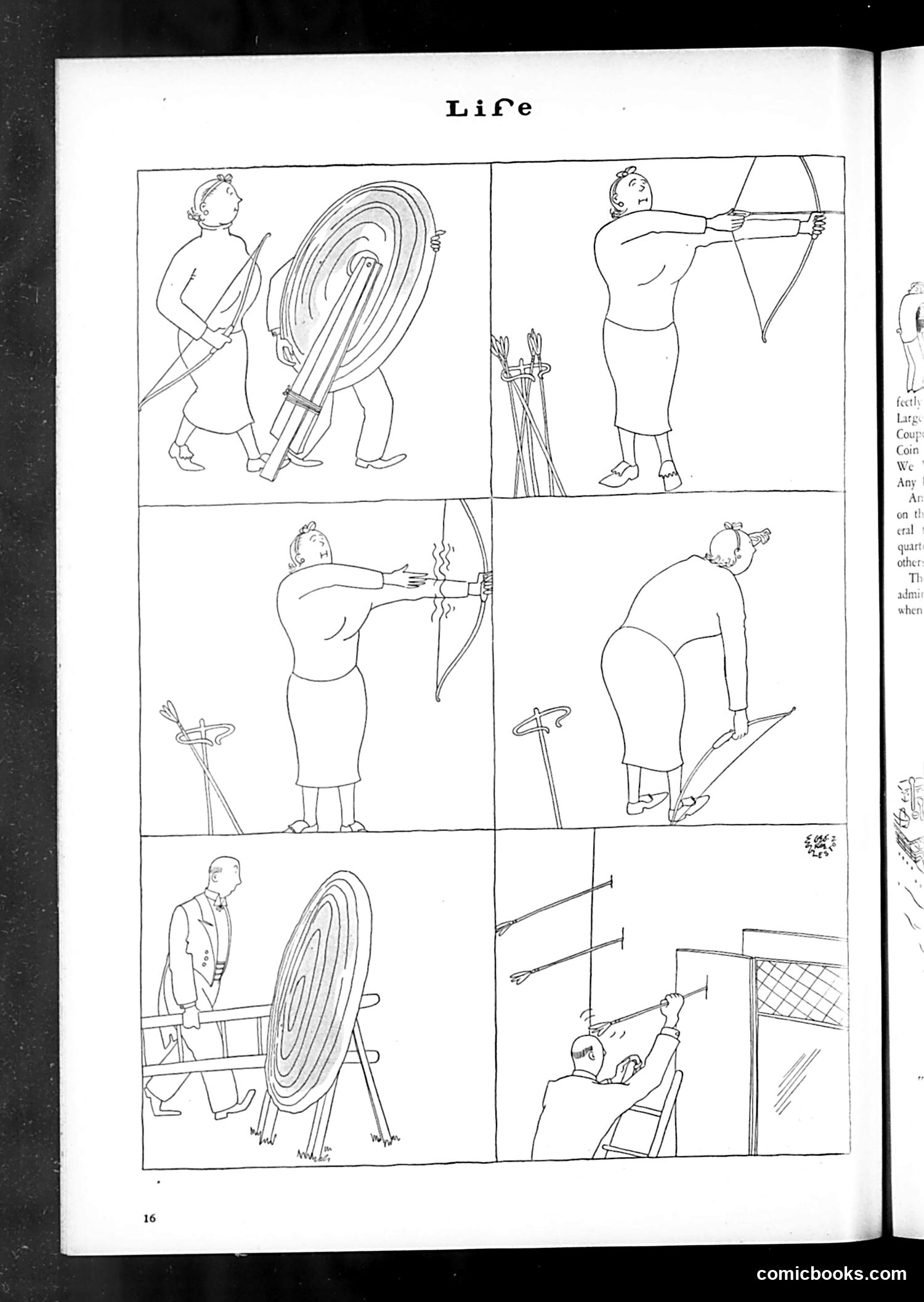
"Life" Comic Strip Analysis This page titled "Life" presents a six-panel comic strip depicting various hunting and sporting activities. The sequential narrative shows: 1. A man struggling with a large coiled rope or hose 2. An archer drawing a bow with arrows nearby 3. The archer attempting to shoot at a target 4. A figure skiing or sliding downward 5. A well-dressed man examining a large circular target or wheel 6. A person in a chair, possibly injured or resting, with a net visible The humor appears to satirize incompetence or misadventure in outdoor sports and hunting pursuits. The progression suggests escalating mishaps or comedic failures in athletic activities. Without visible dates or specific political references, this appears to be general satirical humor about recreational pastimes, likely mocking amateur sportsmen or the folly of taking up these activities.
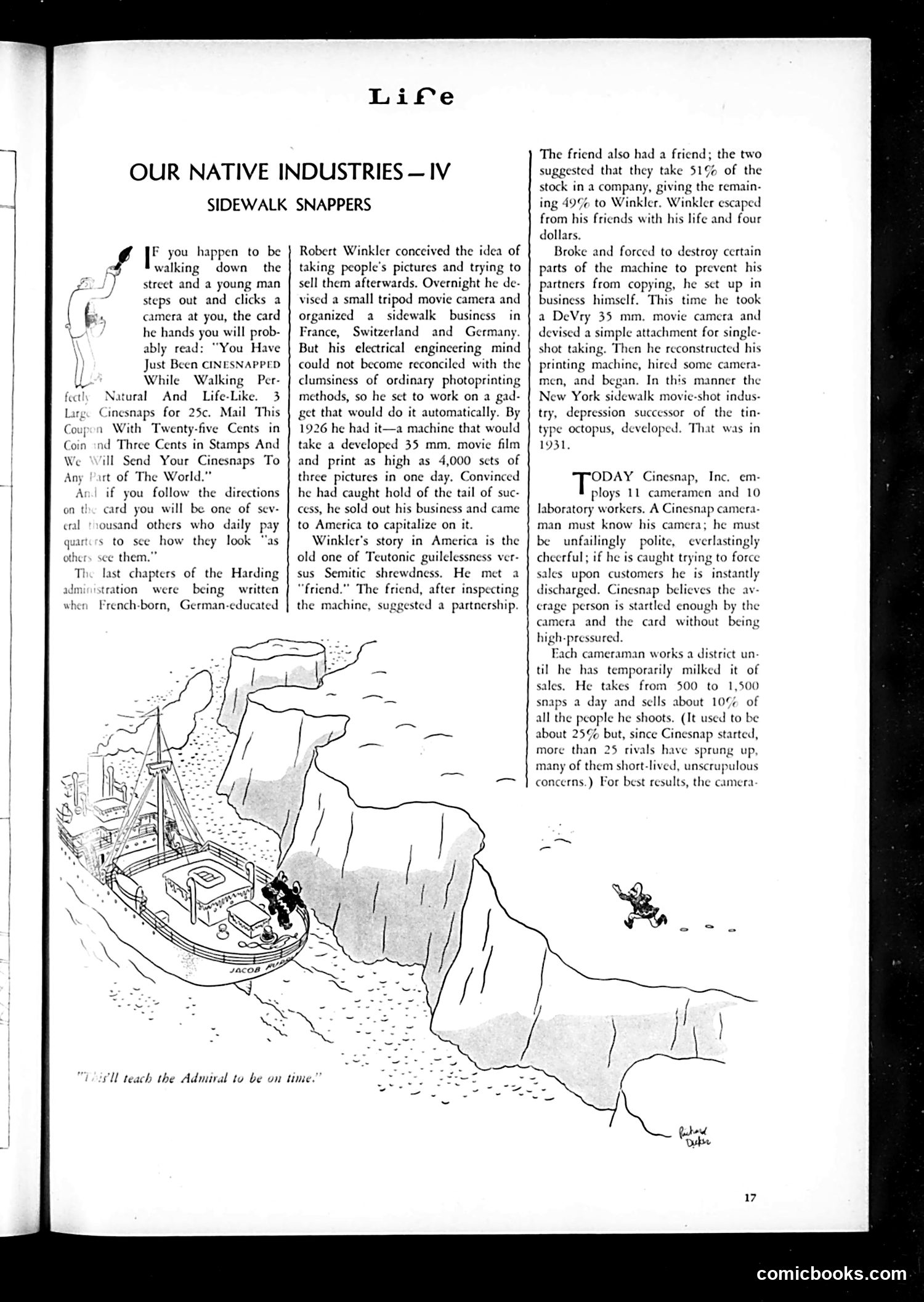
"Our Native Industries — IV: Sidewalk Snappers" This article describes Robert Winkler's invention of an automated sidewalk photography business. Winkler created a machine that would photograph pedestrians and print their pictures within hours, selling the photos back to them. The accompanying cartoon illustrates the concept: a ship's Admiral appears caught in the camera's tripod on a dock, humorously suggesting the indiscriminate nature of the device—it photographs anything in its path. The satire targets both the commercialization of street life and the mechanical impersonality of modern business. The article notes Winkler's company eventually faced competition from numerous imitators, poking fun at American entrepreneurship and the quick rise-and-fall of novelty industries during the 1930s.
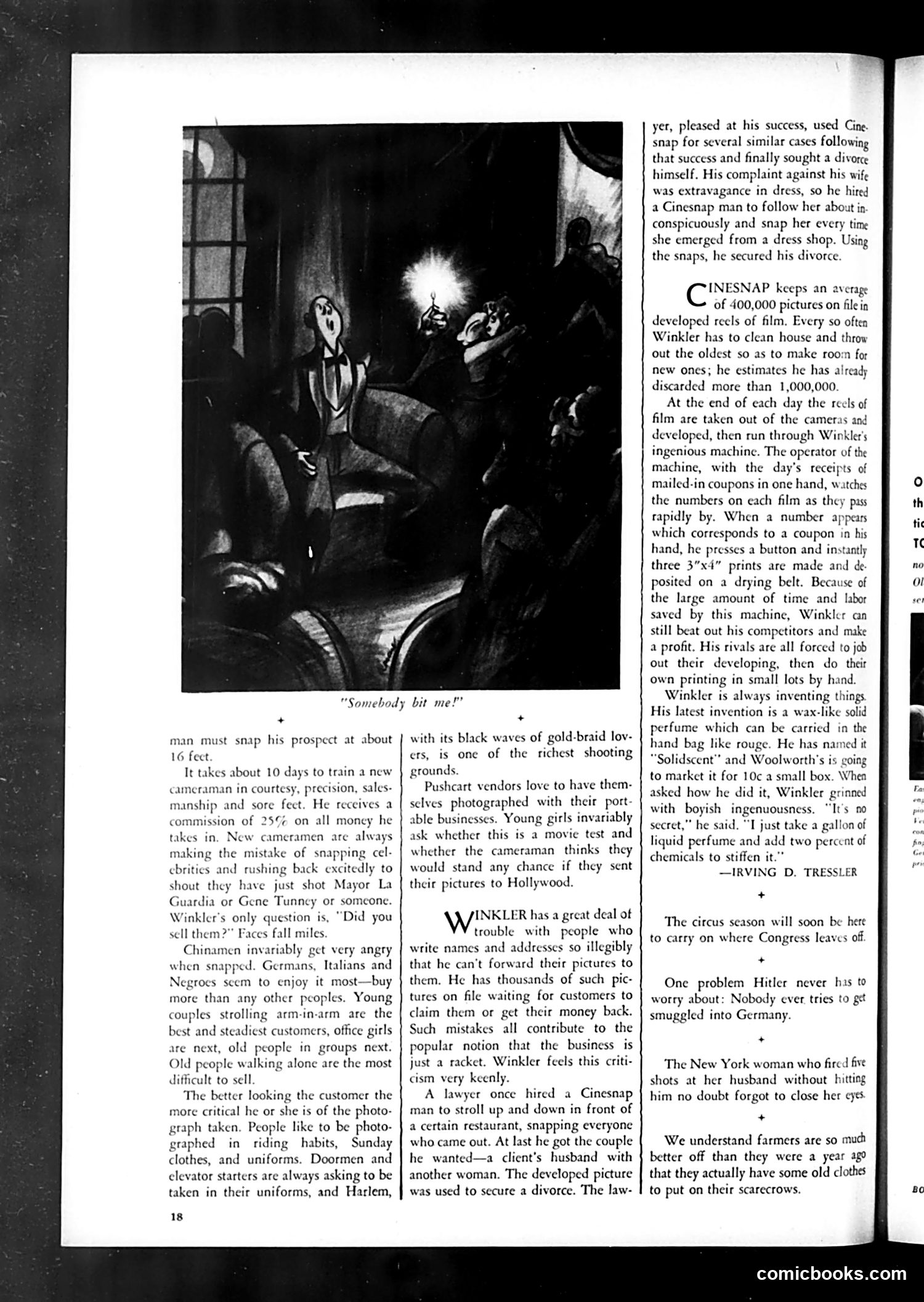
Analysis of Life Magazine Page The photograph titled "Somebody bit me!" illustrates a dramatic nighttime scene—likely depicting a crime or assault scenario common to detective/crime photography of the era. The accompanying text discusses Cinesnap, a candid photography service that captures unflattering moments of ordinary people in public. The satire targets: 1. Privacy invasion: Cinesnap operators follow unsuspecting subjects to document embarrassing moments 2. Divorce evidence: The text describes using such photos as legal proof of infidelity or misconduct 3. Commercialized surveillance: The business profits from exposing people's private lives The piece critiques how this invasive photography service—while technically legal—exploits personal misfortune for profit. It's social satire on early 20th-century paparazzi culture and the emerging conflict between commercial photography and individual privacy rights.
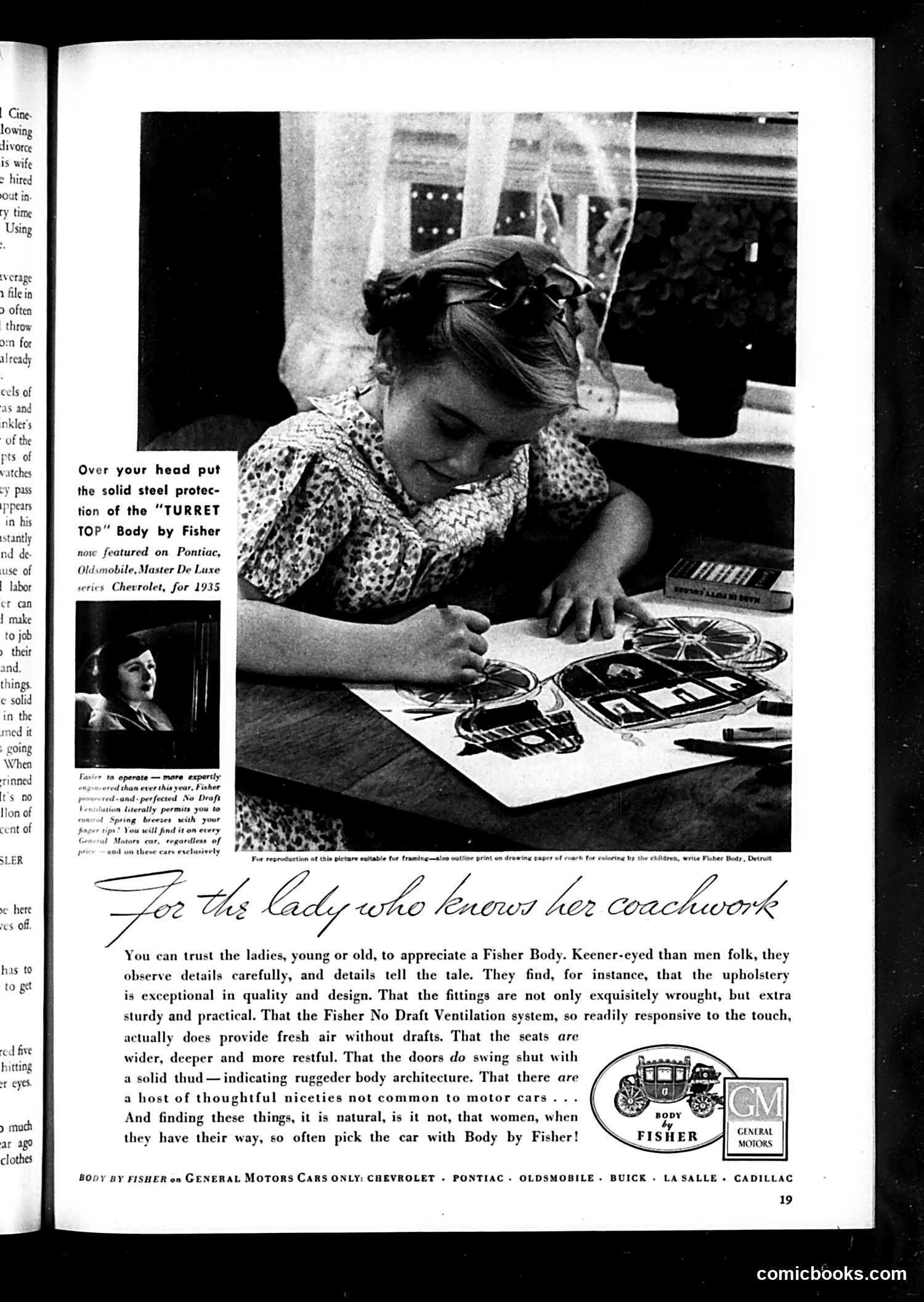
Analysis This is primarily advertising content, not political satire. It's a Fisher Body (General Motors) advertisement from what appears to be the 1930s, promoting car body quality to women. The main image shows a woman examining automobile body parts, illustrating Fisher Body's craftsmanship. The headline "For the lady who knows her coachwork" appeals to female consumers by suggesting that discerning women understand quality construction. The advertisement emphasizes features like the "Turret Top" steel protection, comfortable seats, and the "No Draft Ventilation system"—marketing durable, practical design to women. The copy addresses women as intelligent purchasers who notice details and appreciate fine engineering, positioning Fisher Body cars as a sophisticated choice for quality-conscious female buyers. This reflects 1930s advertising's emerging strategy of targeting women as independent car consumers.
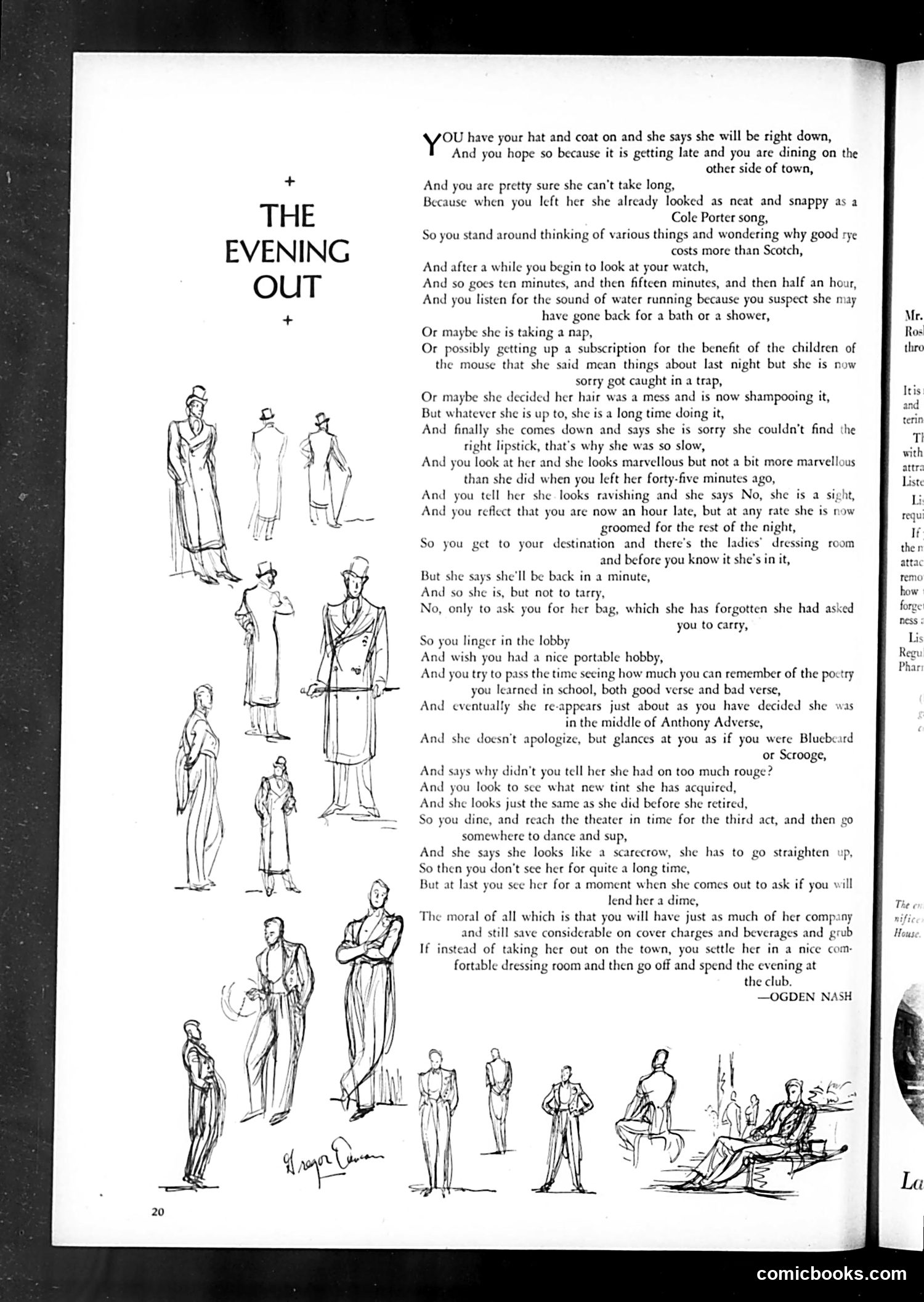
"The Evening Out" by Ogden Nash This humorous poem satirizes the frustrations of dating in the 1920s-30s. A man waits for his female date, who takes increasingly absurd amounts of time preparing—bathing, shampooing, acquiring new makeup—yet emerges looking identical to when he left her. The satire targets both genders: women's obsessive grooming habits and vanity (denying she looks good despite obvious effort), and men's resigned patience with romantic obligations. Nash mocks the evening's entire ritual—waiting in lobbies, theater delays, her disappearing into dressing rooms, finally asking to borrow money. The punchline's "moral" is cynical: he'd save money and see her just as much by skipping the date entirely and spending the evening at his club instead. The sketched figures on the page illustrate various male poses of waiting and impatience, reinforcing the poem's central complaint about male boredom during courtship rituals.
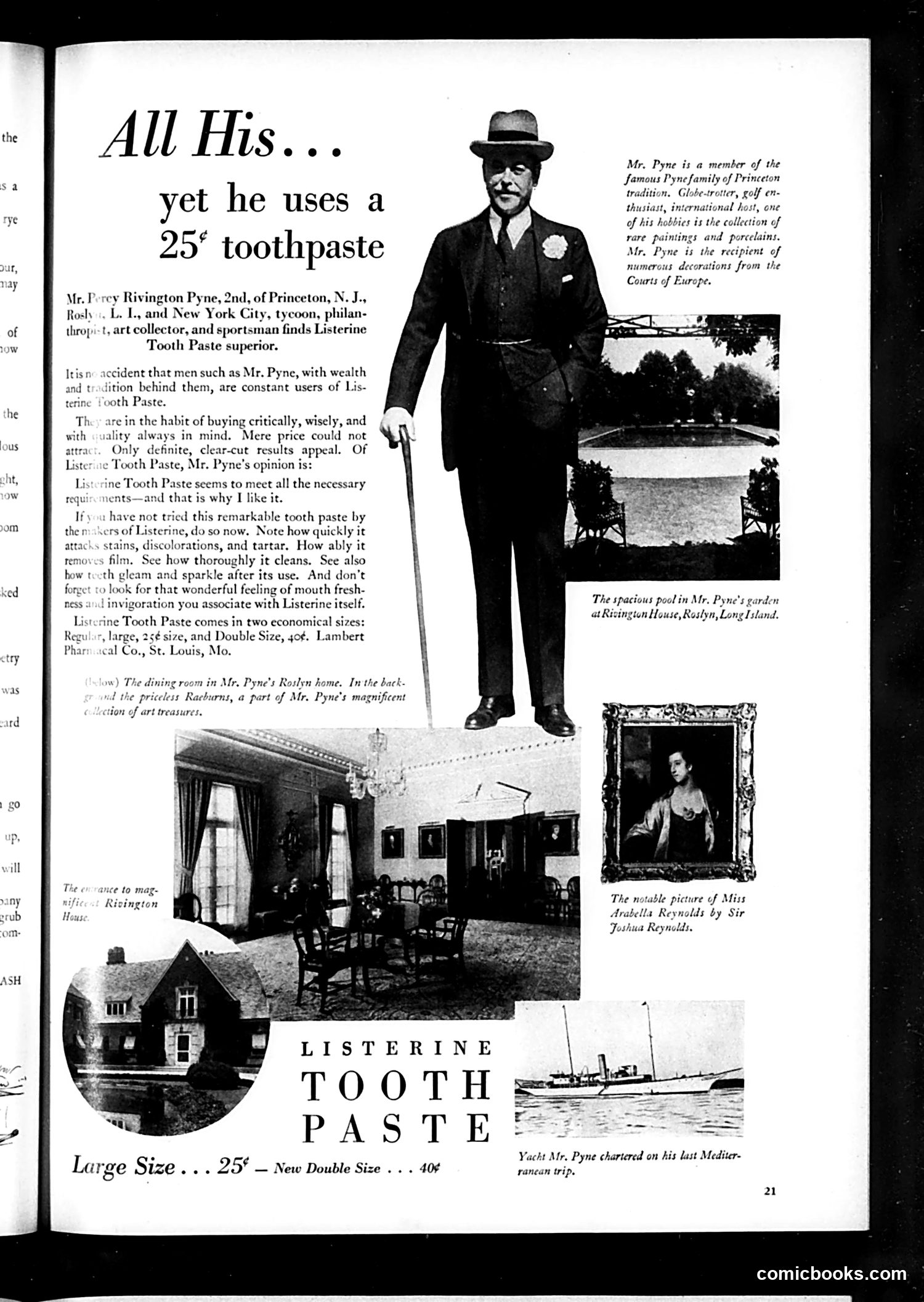
Listerine Toothpaste Advertisement This is primarily a product advertisement, not political satire. It promotes Listerine Toothpaste by endorsing it through Percy Rivington Pyne, 2nd—a wealthy Princeton tycoon, philanthropist, and art collector from prominent East Coast families. The implicit argument: a man of refined taste and wealth who owns European court decorations, priceless artworks (including a Joshua Reynolds), and a yacht still chooses inexpensive 25¢ toothpaste. This "appeals to quality-conscious buyers" by suggesting that even the ultra-wealthy prioritize results over price—and Listerine delivers both. The satire is mild social commentary: the ultra-rich, despite their ostentatious collections and estates, remain practical consumers. The humor lies in contrasting Pyne's lavish lifestyle with his down-to-earth dental hygiene choice, suggesting that good sense transcends wealth.
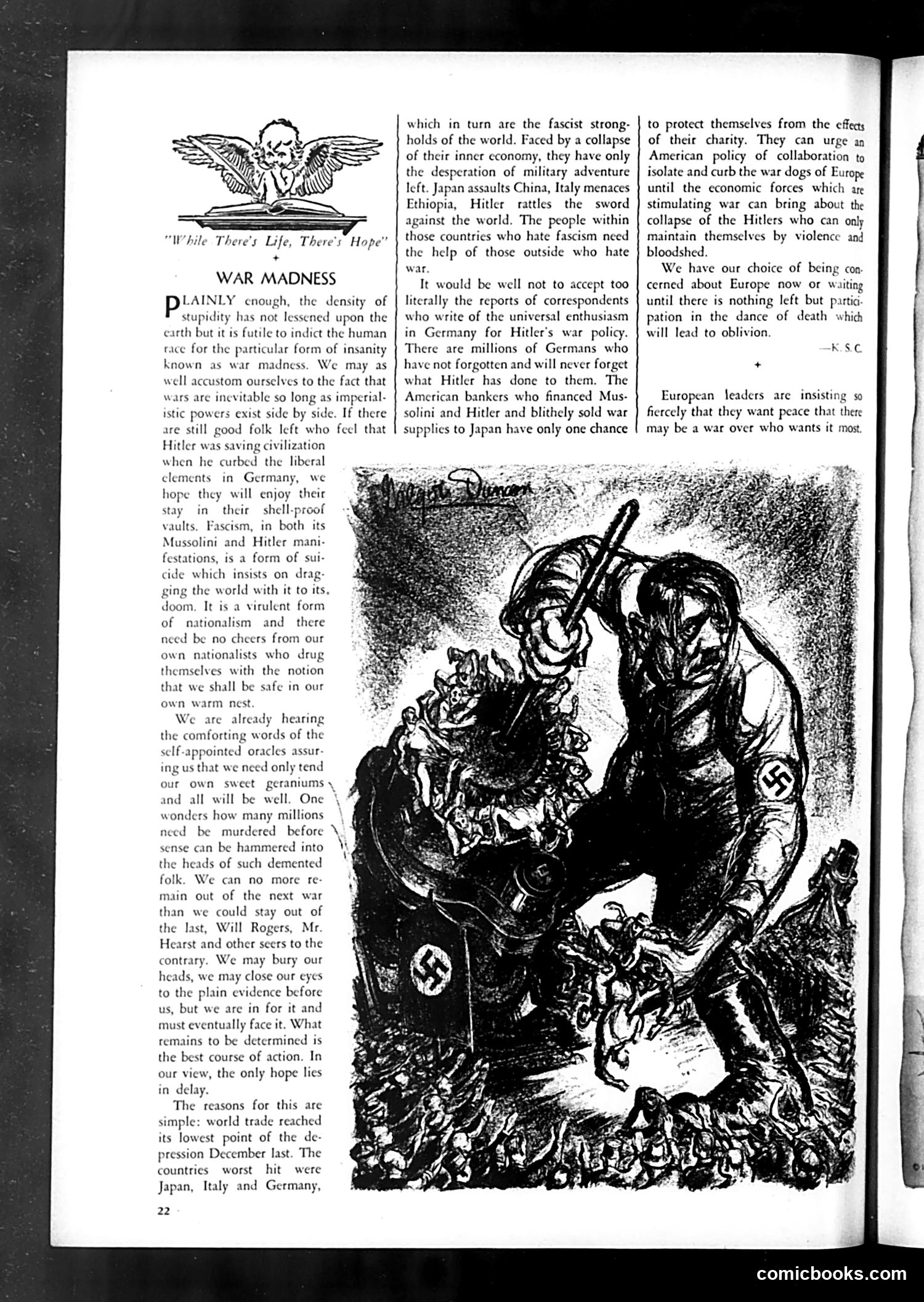
"War Madness" - Life Magazine Editorial Cartoon Analysis This page contains a fierce anti-fascist editorial (by K.S.C.) paired with a propaganda illustration depicting Nazi and fascist brutality. The cartoon shows Nazi figures (identifiable by swastikas) engaged in violence and destruction, trampling victims and spreading chaos—a visual representation of fascism as inherently destructive and suicidal. The text argues that Hitler, Mussolini, and Japan's militaristic regimes, economically desperate after the 1929 Depression's nadir in December 1932, are driven toward war by internal collapse. The author rejects isolationist complacency ("tending our own geraniums"), insisting America cannot avoid the coming conflict. Notably, the piece criticizes American bankers who financed fascist regimes, calling for economic isolation to destabilize them before military intervention becomes necessary. The closing ironic line—European leaders "insisting so fiercely that they want peace...may be a war over who wants it most"—captures pre-WWII diplomatic theater's bitter absurdity.
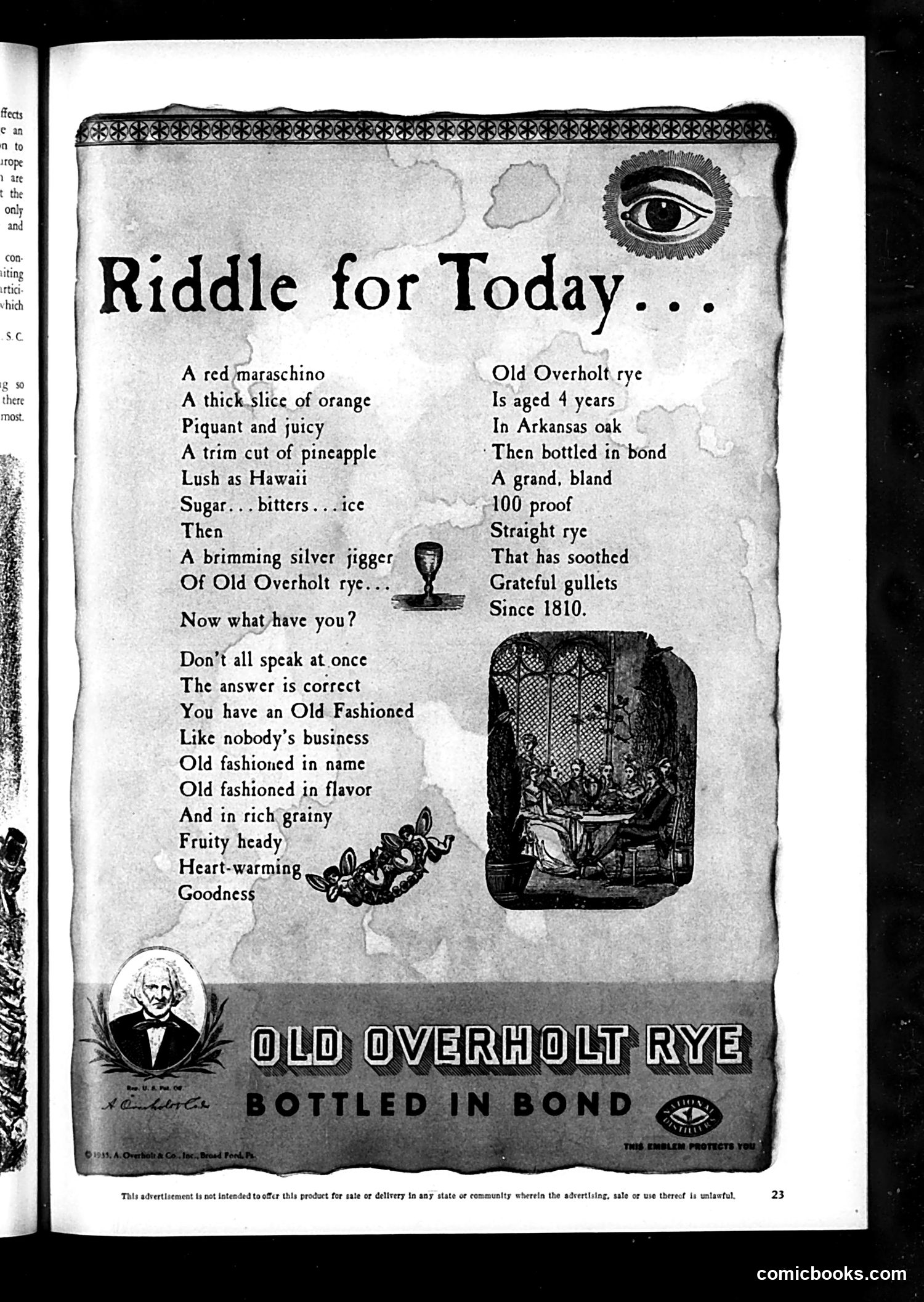
Analysis This is a whiskey advertisement for Old Overholt Rye, not political satire. It presents a playful riddle format advertising the drink as an "Old Fashioned" cocktail. The "riddle" lists ingredients (maraschino, orange, pineapple, sugar, bitters, ice) that combine into a jigger of Old Overholt rye whiskey. The answer—that you've made an Old Fashioned cocktail—is explained through the right column, which describes the whiskey's qualities: aged 4 years in Arkansas oak, 100 proof, produced since 1810. The decorative illustrations (an eye, jester, and tavern scene) are period-appropriate design elements. The disclaimer at bottom notes this cannot be advertised where alcohol sales were restricted—likely acknowledging Prohibition's lingering effects or state-level alcohol laws during the ad's publication period. This reflects 1920s-30s marketing when cocktail culture was resurgent and advertisers competed through witty, puzzle-based appeals.
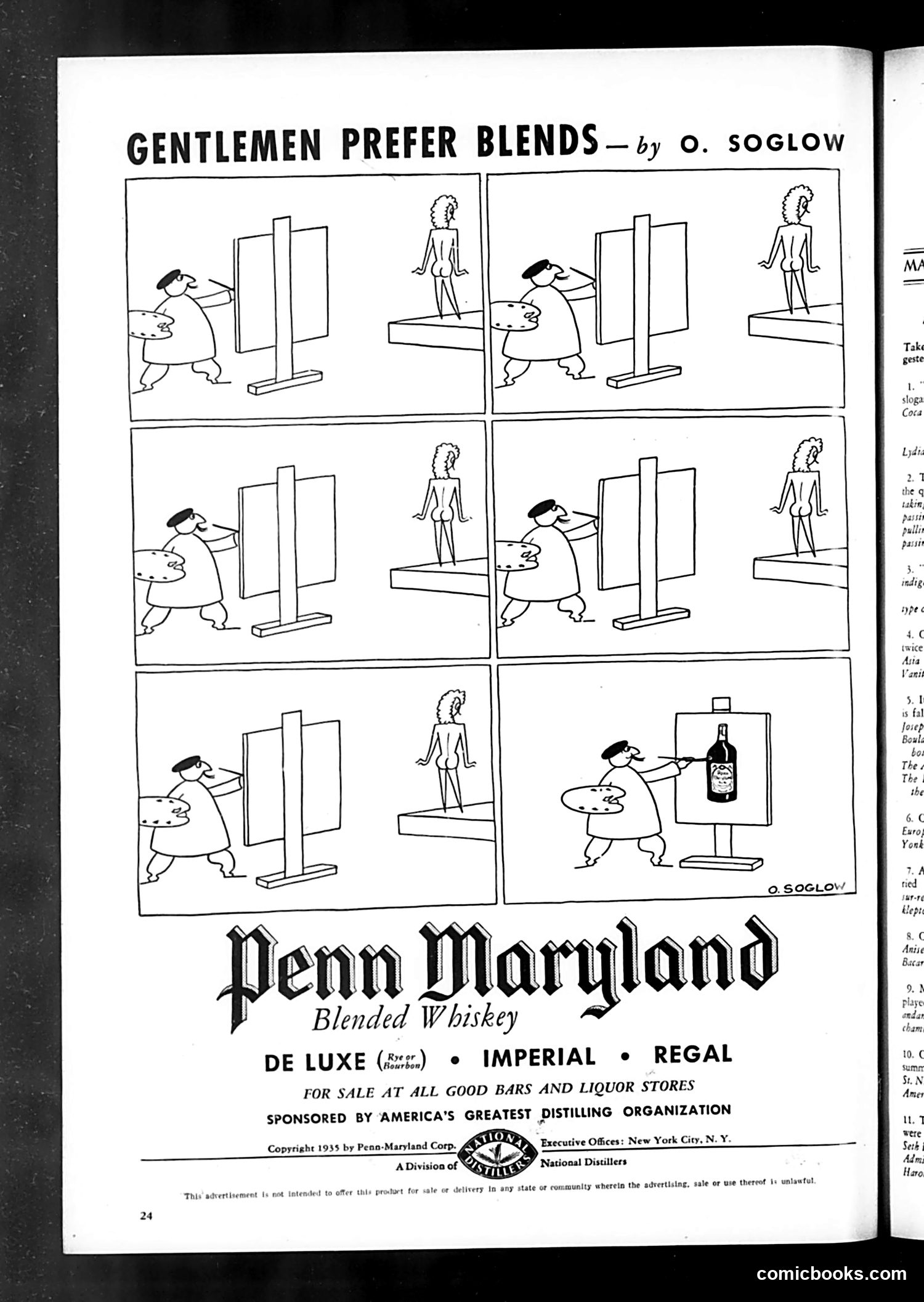
"Gentlemen Prefer Blends" - Penn Maryland Whiskey Advertisement This is a whiskey advertisement (not political satire), copyright 1935. The comic, drawn by O. Soglow, uses a visual pun on the phrase "gentlemen prefer blends" to advertise Penn Maryland blended whiskey. The six-panel sequence shows a man repeatedly adjusting a mirror or divider to frame a woman's body in different positions—a crude visual joke equating the blending/adjusting process with selecting or "mixing" an attractive woman. The final panel reveals a whiskey bottle instead, completing the "blend" reference. This reflects 1930s advertising conventions: crude objectification combined with casual misogyny. The ad promotes three varieties (De Luxe, Imperial, Regal) and notes it was "sponsored by America's greatest distilling organization" during the post-Prohibition era (alcohol sales had resumed in 1933).
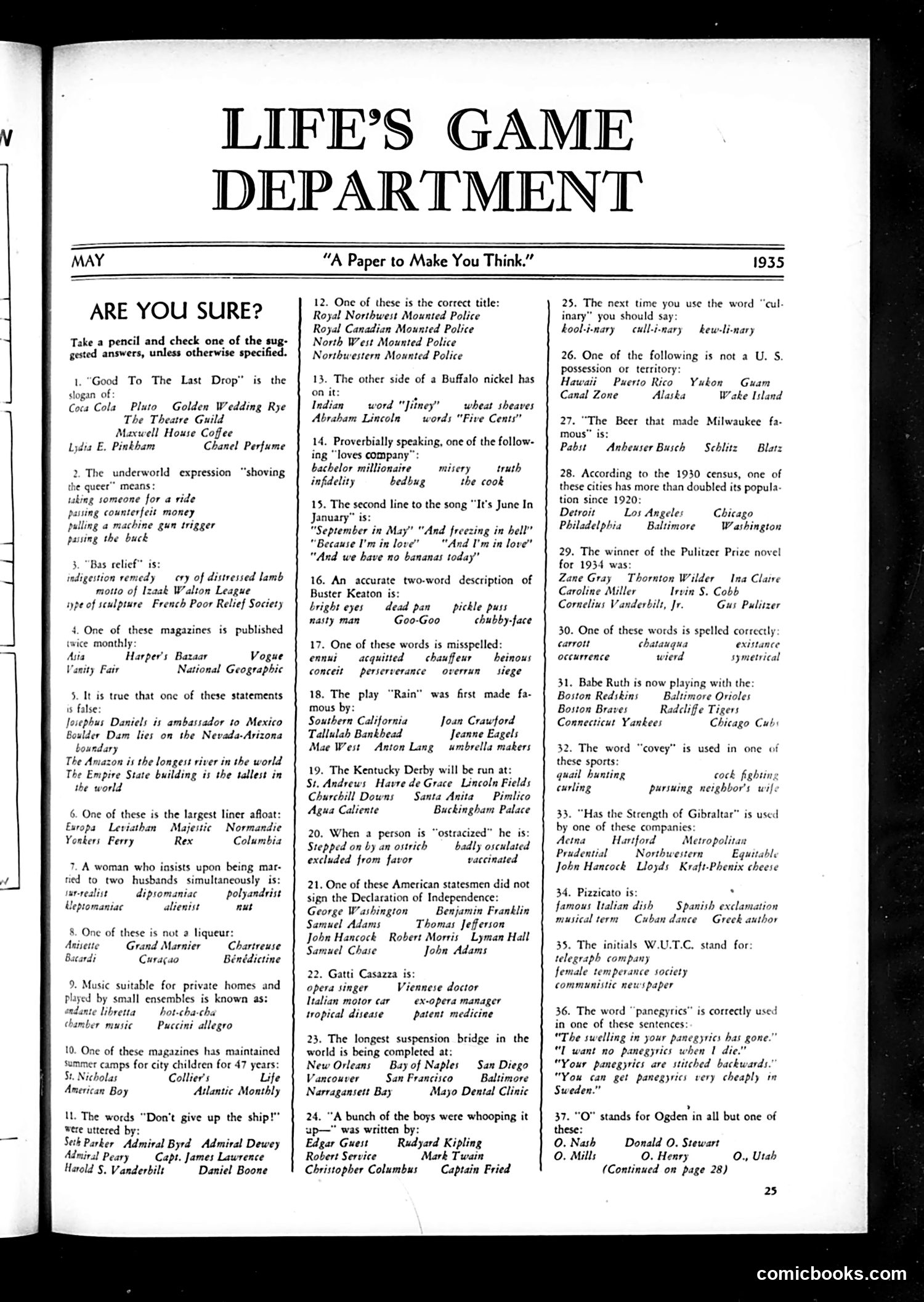
Life's Game Department Quiz Page (May 1935) This is a trivia quiz page, not a political cartoon. "Life's Game Department" was a recurring feature where readers tested their knowledge on contemporary culture, entertainment, history, and geography. The questions reflect 1930s American concerns: advertising slogans (Coca-Cola, Maxwell House), underworld slang, famous ships and explorers, entertainment figures (Tallulah Bankhead, Mae West), current events (Boulder Dam, Kentucky Derby), and historical facts (Declaration of Independence signers). Notable references include question 5's assertion that one statement about famous landmarks is false—the Empire State Building being "tallest in the world" would have been recent news (completed 1931). Questions about Buffalo nickels and Buster Keaton reflect popular culture of the era. This was educational entertainment for middle-class readers, testing their cultural literacy during the Great Depression.
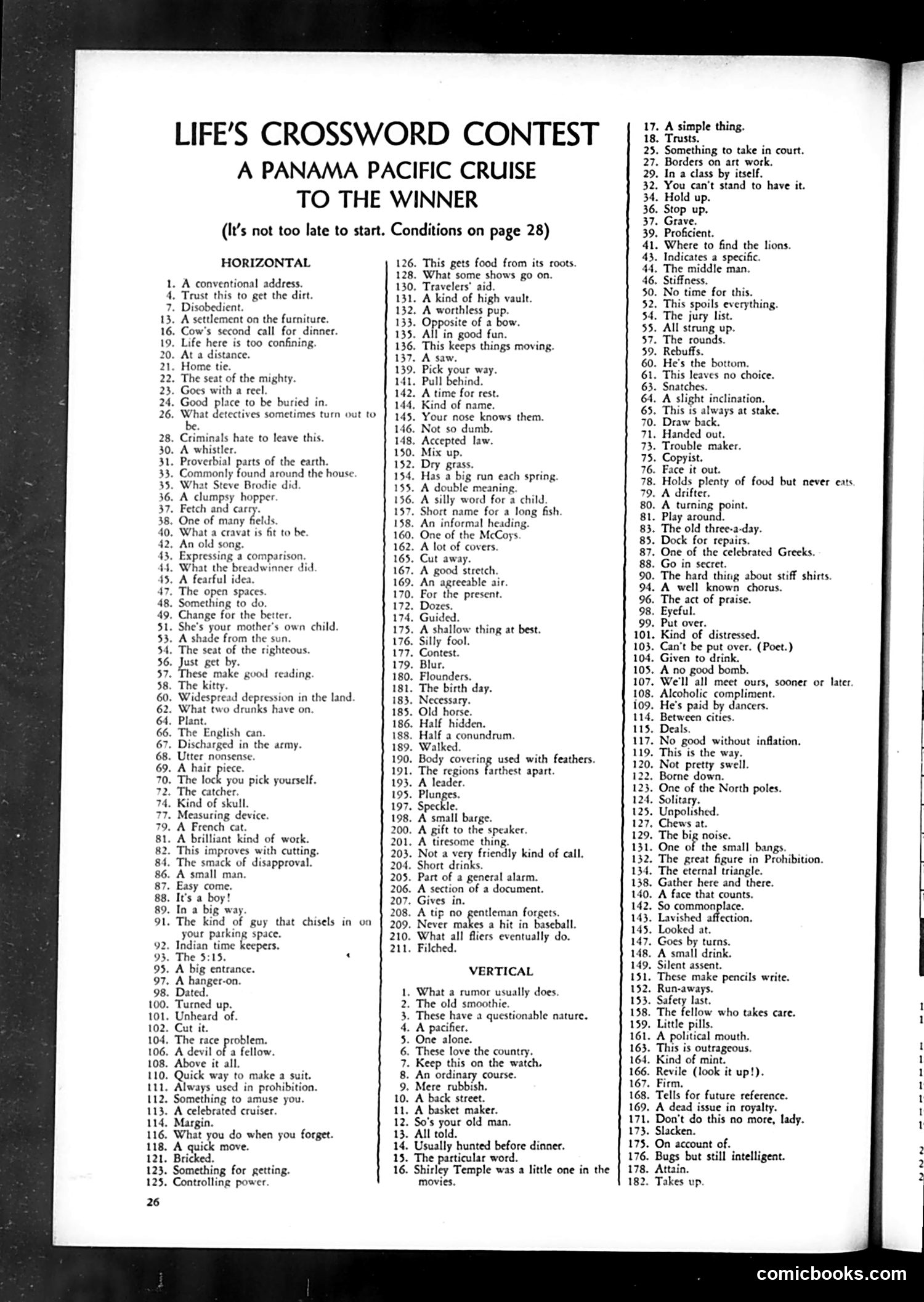
Analysis This page is not a cartoon or satirical content — it's a crossword puzzle contest announcement from Life magazine. Life is offering a Panama Pacific cruise as the grand prize to whoever solves their crossword puzzle correctly. The page displays the complete puzzle clues (both horizontal and vertical), with the actual grid presumably on another page. The clues themselves contain typical crossword humor and wordplay common to the era—puns, riddles, and oblique definitions. Some references appear dated (Steve Brodie, Shirley Temple, the McCoys), anchoring this to early-to-mid 20th century. The real content here is the contest itself: Life used crossword puzzles as a circulation-building promotional tool, offering travel prizes to engage readers. This reflects how magazines competed for audiences during this period, using puzzles and contests as reader-retention strategies.
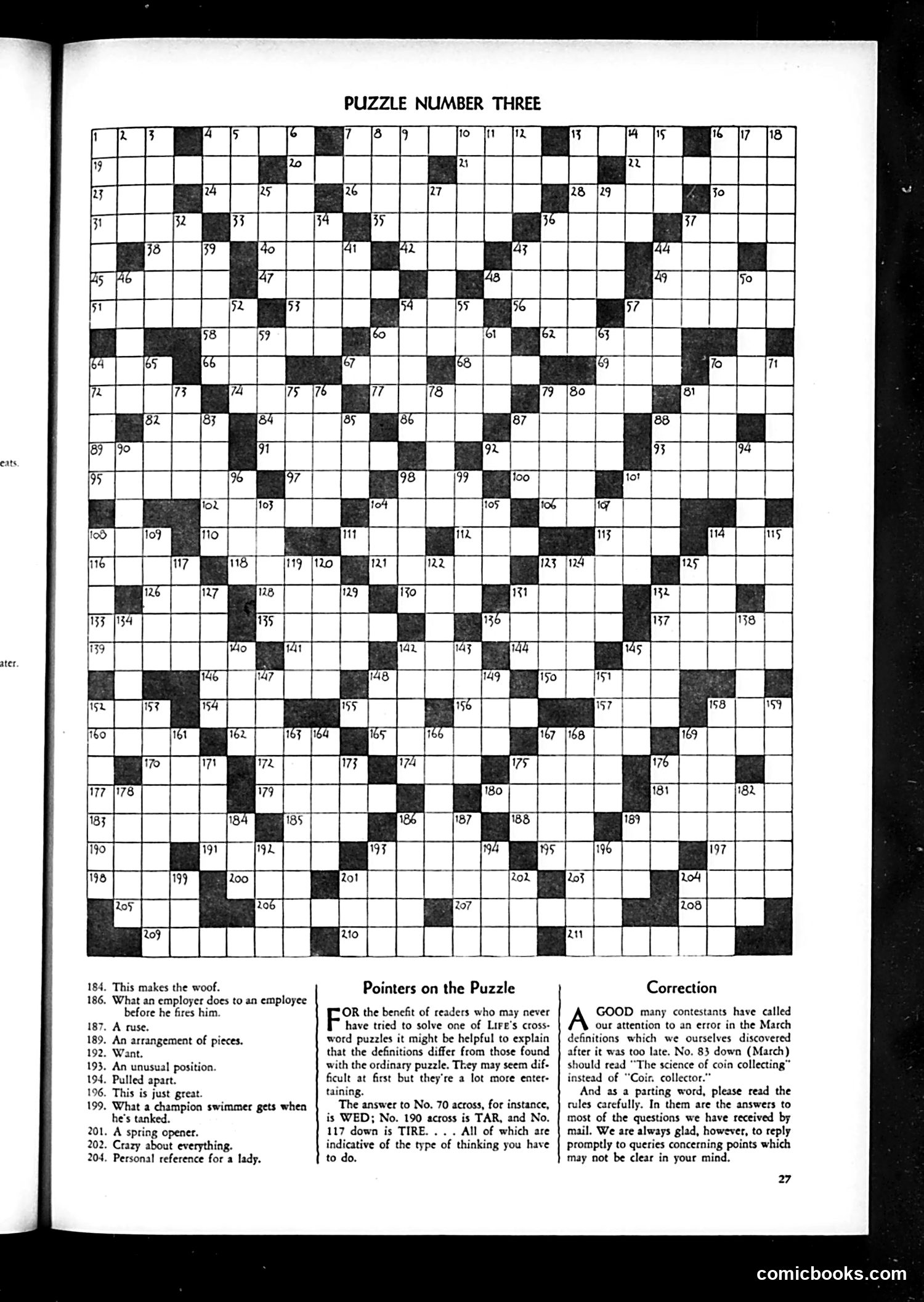
Puzzle Number Three - Life Magazine This page presents a crossword puzzle with deliberately tricky, indirect clue definitions rather than straightforward ones. The "Pointers on the Puzzle" section explains Life's approach: clues use wordplay and lateral thinking. For example, clue 70 across ("WED") and 117 down ("TIRE") require solvers to think beyond obvious definitions—they're testing cleverness, not just vocabulary knowledge. The "Correction" acknowledges an error in the March puzzle's clue 83 down, which should have read "The science of coin collecting" instead of "Coin collector." The editors note they receive reader mail about unclear points and welcome questions about ambiguous clues. This reflects Life's brand of intellectual entertainment—crosswords designed to amuse and challenge readers with witty misdirection rather than straightforward puzzle-solving.
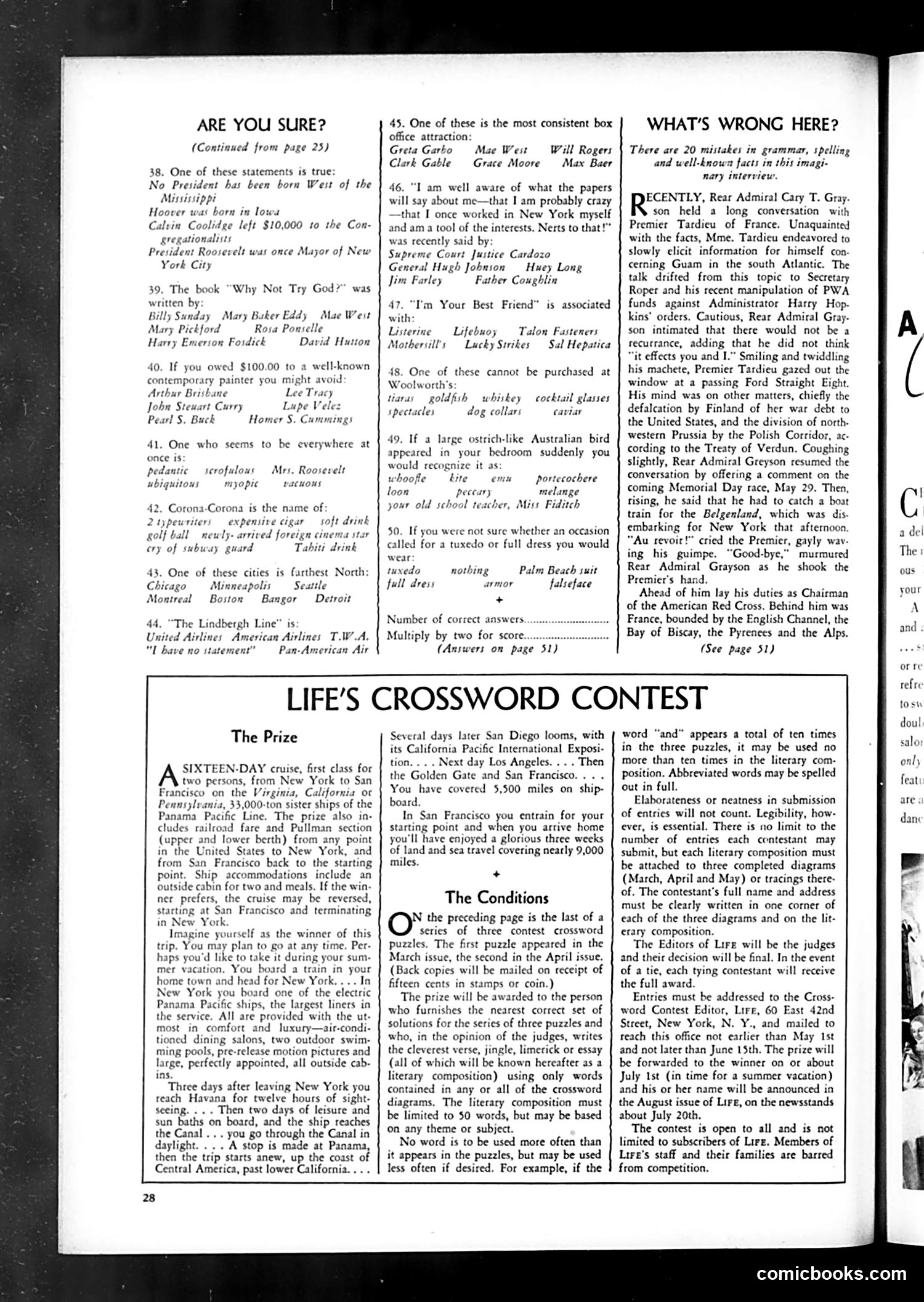
What This Page Shows This is a quiz/game page from Life magazine, featuring two contest elements: Upper Section ("Are You Sure?"): A trivia quiz with 50 questions testing knowledge of 1930s-40s American politics, entertainment, and culture. Questions reference figures like Mae West, Will Rogers, Huey Long, and Father Coughlin—all contemporary public figures. Lower Section ("What's Wrong Here?"): A satirical exercise where readers must spot 20 deliberate errors in a mock interview between Rear Admiral Cary Grayson and French Premier Tardieu. The text contains absurdities (Guam in the "south Atlantic," Finland's war debt to the US, Poland's Corridor dividing "northwestern Prussia") and grammatical mistakes ("it effects you and I") designed to test readers' knowledge and attention. This reflects Life's role as a humor and intelligence magazine that challenged educated readers while gently mocking public figures and current events of the era.
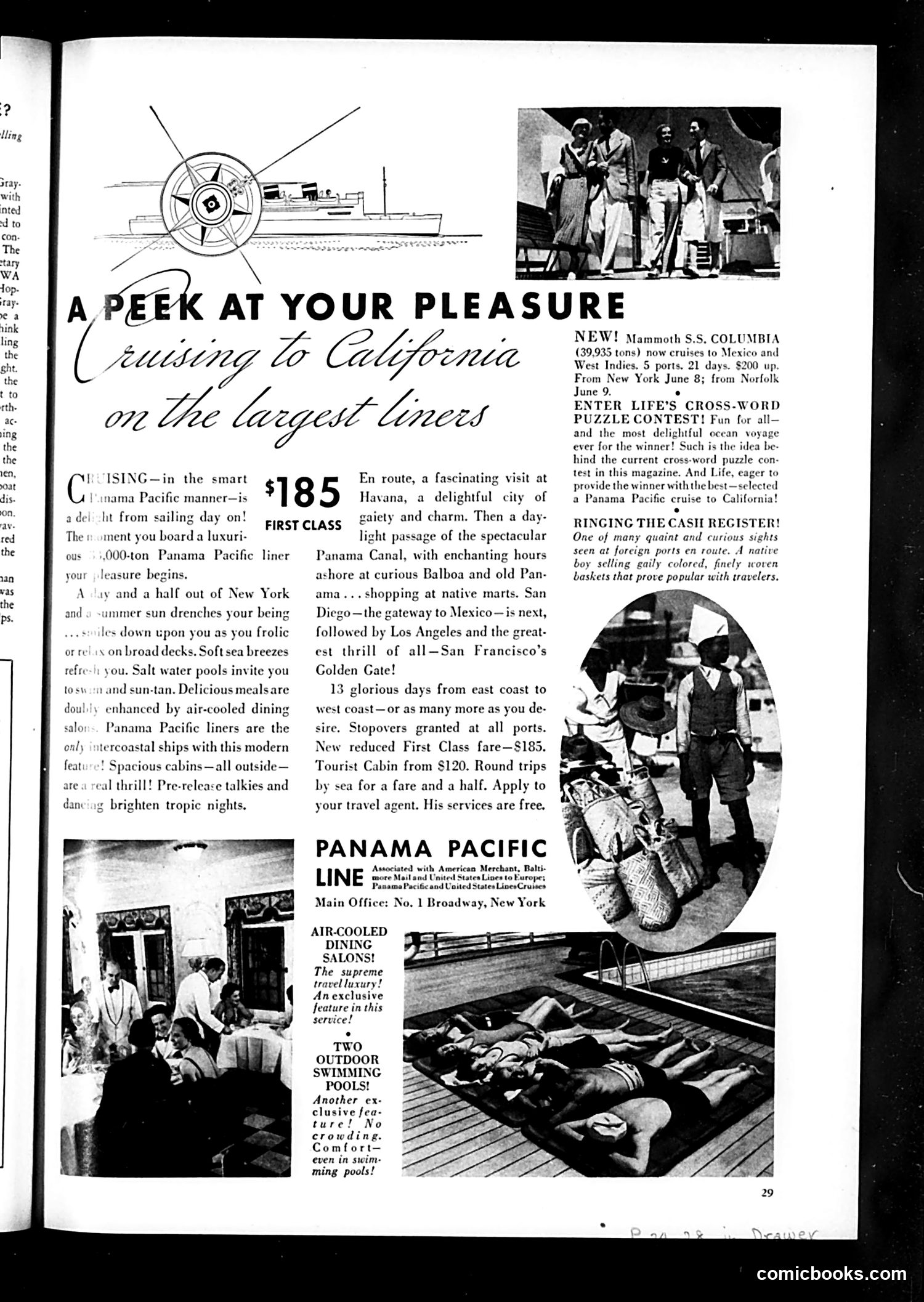
Analysis: "A Peek at Your Pleasure" This page is primarily advertising, not satire or political commentary. It promotes luxury cruise vacations on Panama Pacific liners for affluent American travelers. The main ad showcases first-class Caribbean and California cruises ($185 first class, $120 tourist cabin) with amenities like air-cooled dining salons and outdoor swimming pools—luxuries that would impress 1930s readers. The itinerary (Havana, Panama Canal, San Diego, Los Angeles, San Francisco) emphasizes exotic colonial and tropical destinations. The accompanying photographs show well-dressed passengers enjoying deck activities and poolside relaxation, as well as a native boy selling woven baskets—imagery that reflects the era's colonial tourism perspective where indigenous peoples and their crafts were exotic commodities for American consumers. A smaller box promotes Life magazine's crossword puzzle contest, with the grand prize being a Panama Pacific cruise to California. Context for modern readers: This represents pre-WWII leisure travel marketing to wealthy Americans, reflecting both genuine luxury innovation and the casual exoticism and colonial attitudes typical of 1930s tourism advertising.
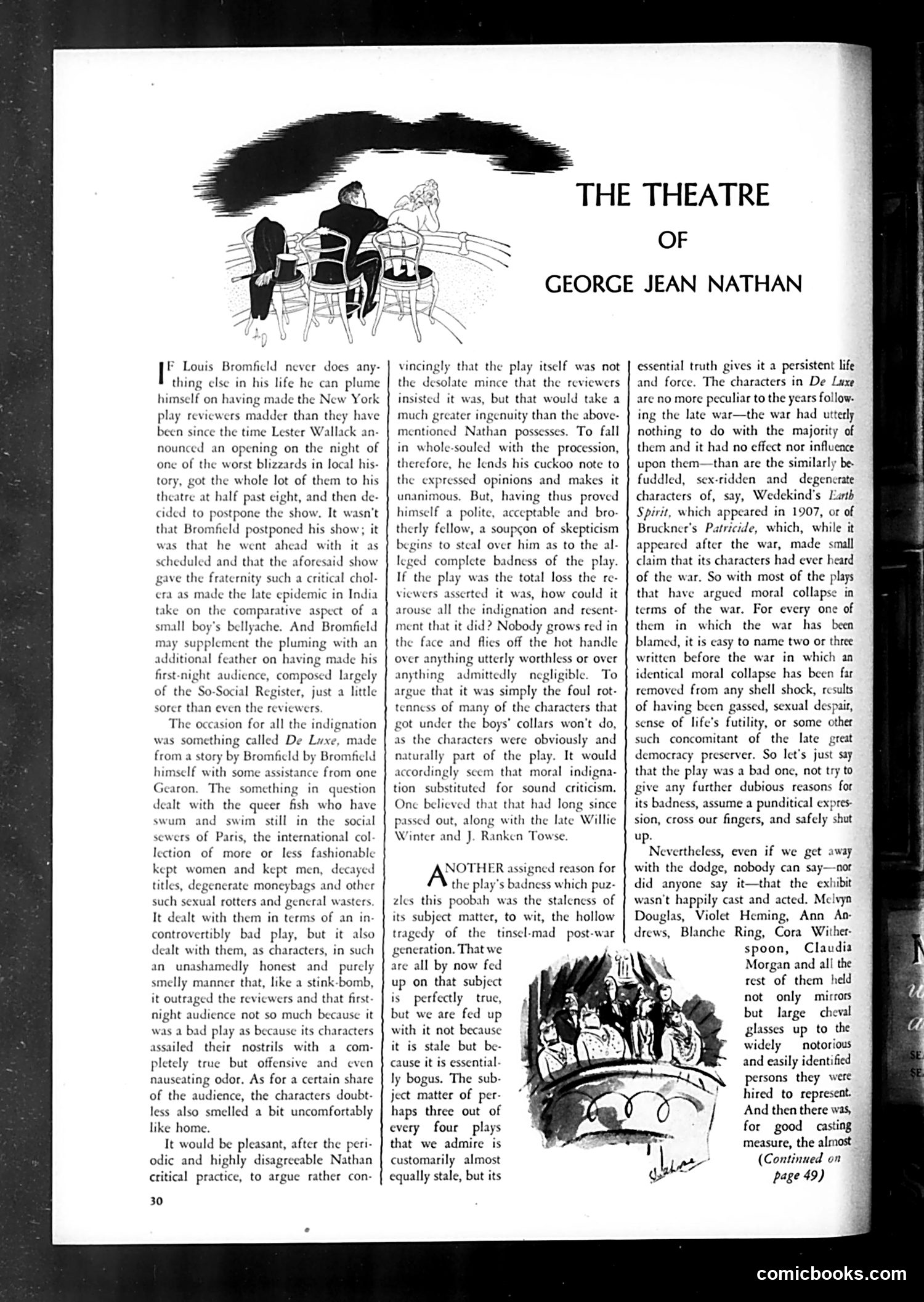
Analysis for Modern Readers This page critiques theatre critic George Jean Nathan and his review of Louis Bromfield's play *De Luxe*. The play depicts Paris's underworld of sex workers and corrupt aristocrats in unflinching, deliberately offensive language. Nathan initially joined other reviewers in condemning the play as worthless. The author argues this is hypocritical: if the play were truly "utterly worthless," it wouldn't provoke such outrage. The real issue, the piece suggests, wasn't the play's quality but moral prudishness disguised as criticism—a practice the author associates with outdated critics like Willie Winter and J. Ranken Towse (both dead theatre critics). The cartoon shows three figures seated together, likely representing Nathan and other reviewers. The satire attacks Nathan for abandoning independent judgment to follow the crowd's "moral indignation" rather than offering genuine dramatic criticism.
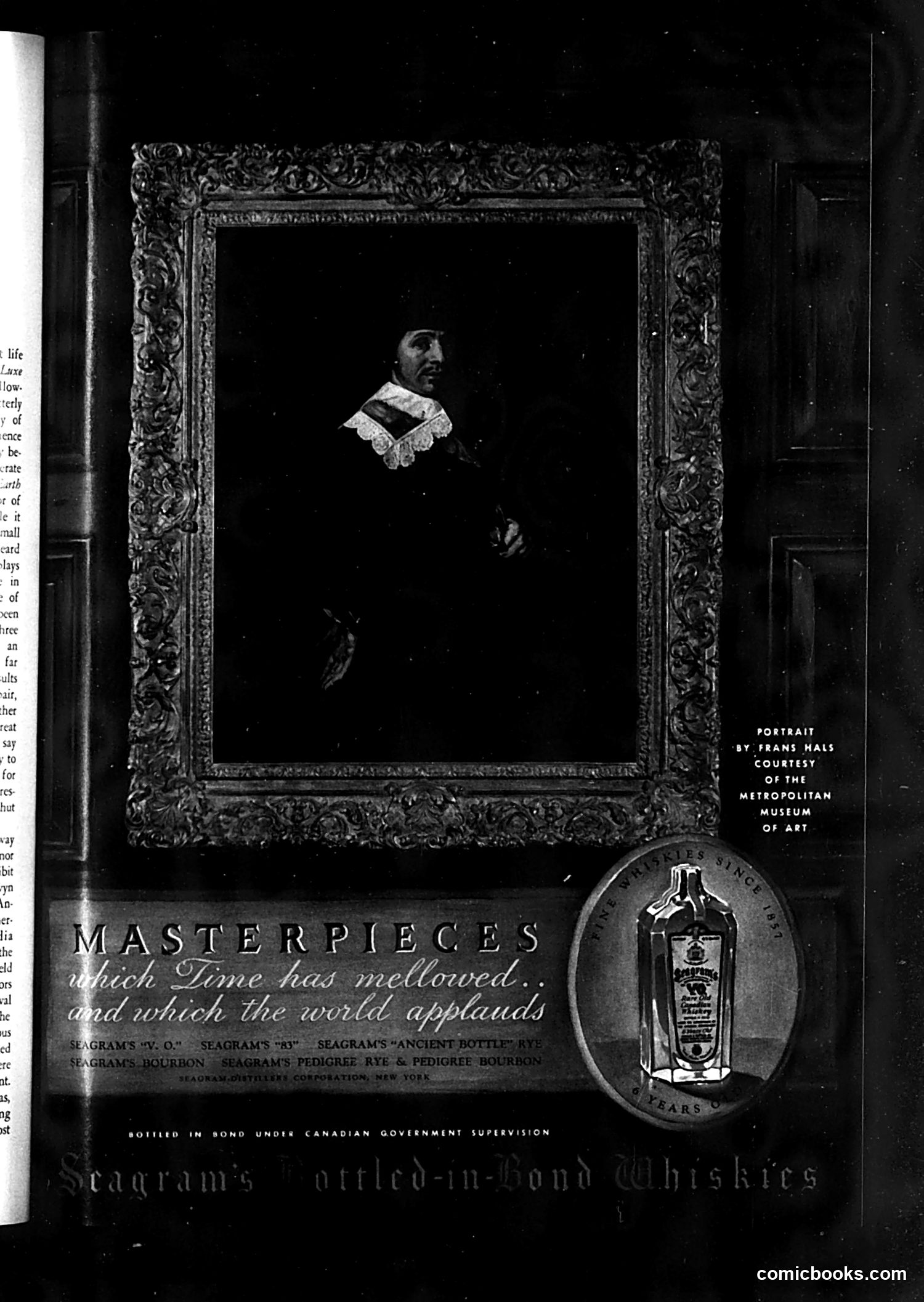
This is primarily a Seagram's whiskey advertisement, not a political cartoon. The page features a formal portrait in an ornate frame—showing a man in period dress with a white lace collar against a dark background. The ad's tagline reads "Masterpieces which Time has mellowed... and which the world applauds," drawing a parallel between aged whiskey and classic art. The "portrait" framing is the advertising conceit: presenting the liquor as a timeless masterpiece worthy of museum display. A circular Seagram's seal appears in the lower right. The ad notes the whiskey is "bottled in bond under Canadian government supervision," emphasizing quality control. There is no political satire on this page—it's commercial advertising using artistic prestige to market alcohol.
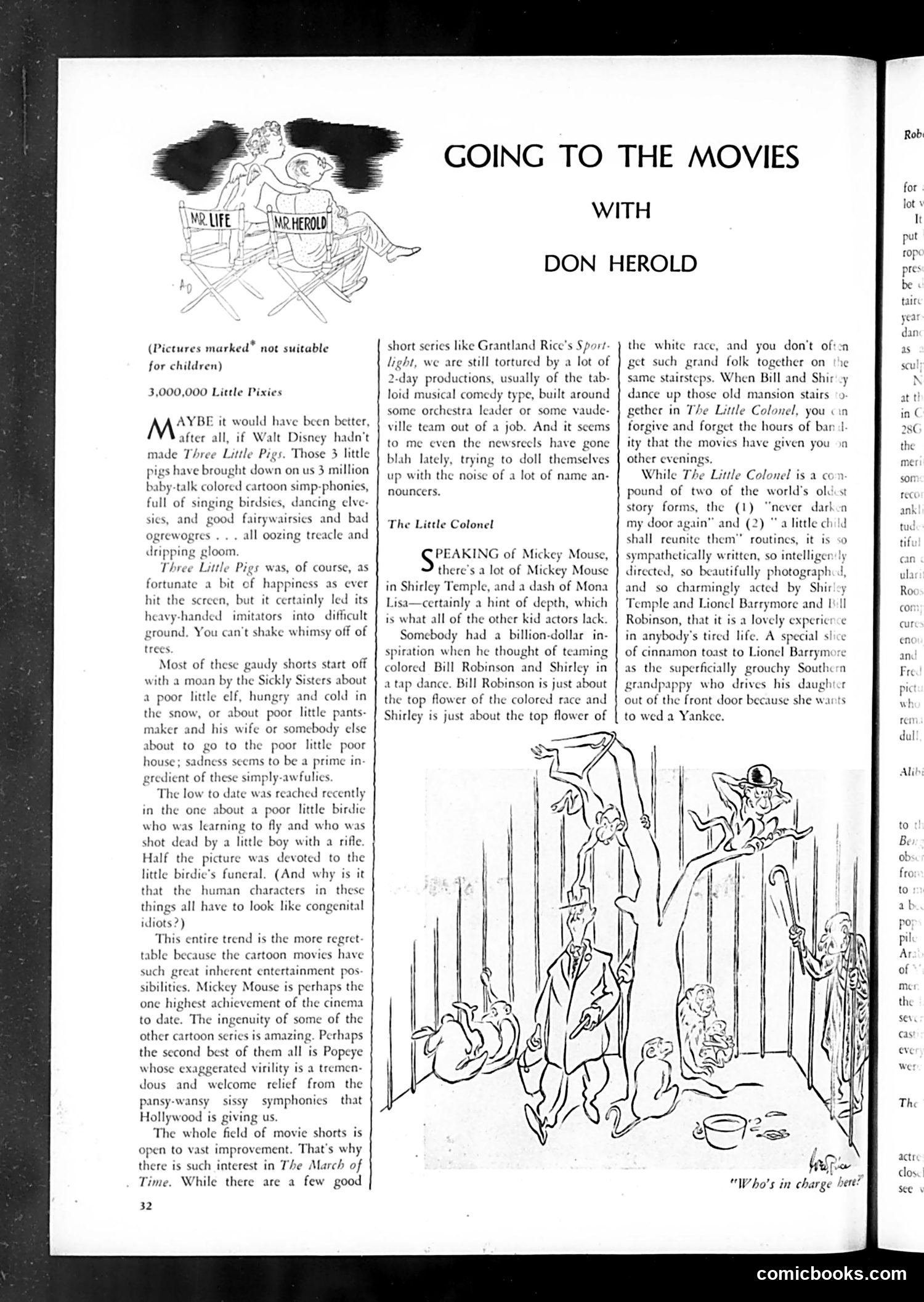
Analysis for Modern Readers This is Don Herold's film criticism column. The main cartoon depicts a chaotic scene with multiple figures crowded in a doorway or hallway, captioned "Who's in charge here?"—likely satirizing the confusion and lack of creative control in Hollywood's cartoon production. Herold criticizes the glut of inferior animated shorts that followed Disney's *Three Little Pigs* success. He argues imitators mindlessly replicate its saccharine sentimentality ("treacle and dripping gloom") with moralistic poverty narratives and anthropomorphic characters. He praises *Mickey Mouse* as cinema's highest achievement and defends *Popeye* for its masculine energy against "pansy-wansy sissy symphonies" dominating Hollywood. Regarding *The Little Colonel*, Herold celebrates Shirley Temple's talent and Bill "Bojangles" Robinson's dancing, explicitly praising their interracial partnership as rare and delightful—a notably progressive statement for 1935, though his phrasing ("top flower of the colored race") reflects period racial language conventions.
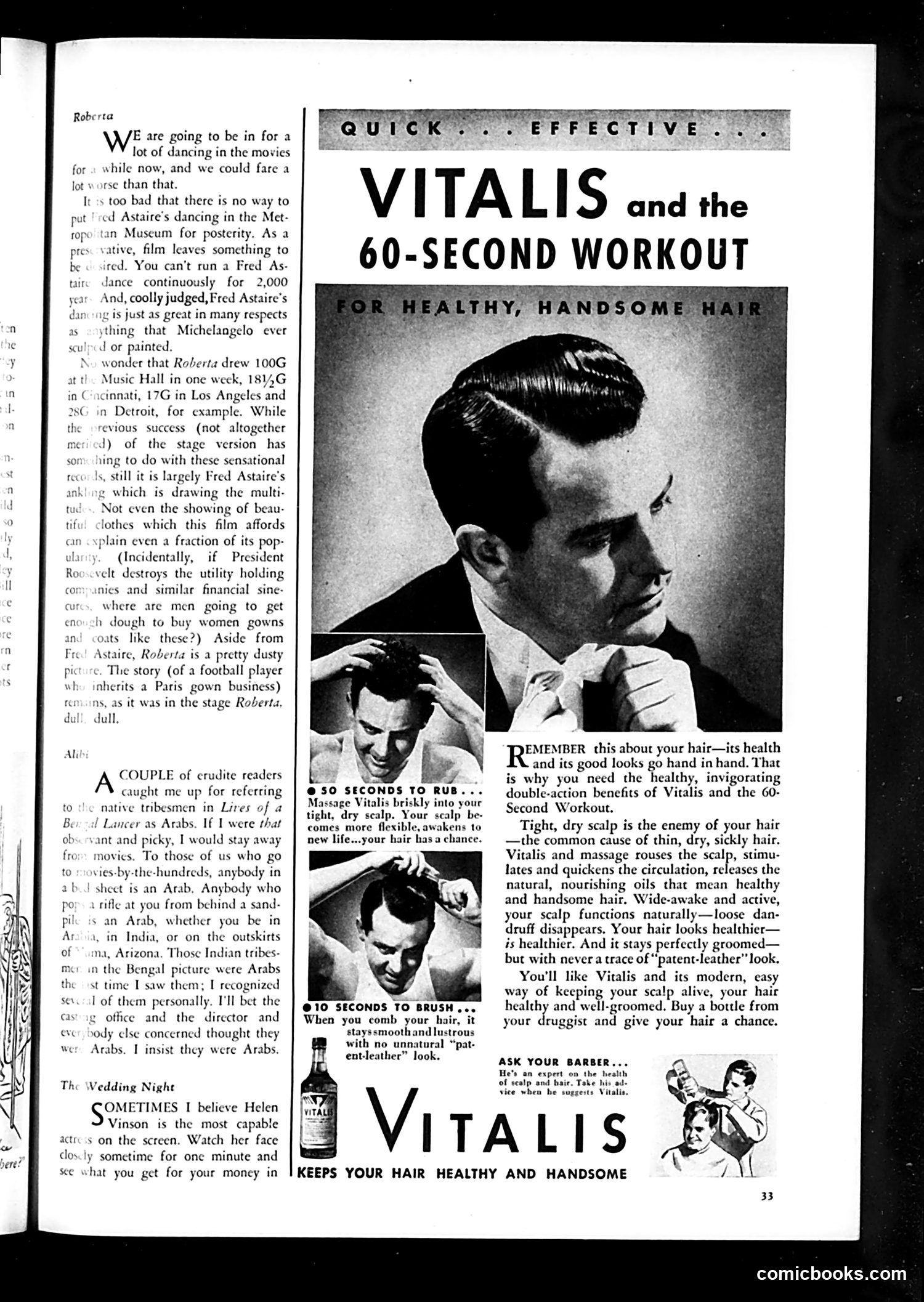
Analysis of This Life Magazine Page This page combines film criticism with advertising, primarily featuring a Vitalis hair product advertisement disguised as health advice. The Editorial Content: The left column discusses the movie *Roberta*, praising Fred Astaire's dancing as comparable to Michelangelo's artistic achievements. The writer defends casual movie-going attitudes, arguing that viewers reasonably call all non-European background characters "Arabs" regardless of actual origin—a reflection of 1930s Hollywood's indifference to authenticity in depicting non-Western peoples. This casual racism was unremarkable in period film criticism. The Advertisement: The right side promotes Vitalis with a "60-Second Workout"—a scalp massage routine claiming to cure tight, dry scalps and dandruff. The product emphasizes avoiding an artificial "patent-leather look," appealing to masculine grooming standards of the era. The advertisement includes photographs demonstrating the massage technique and includes a barber's endorsement for credibility. Context: This exemplifies how 1930s magazines blended editorial content with advertising, while simultaneously revealing period attitudes toward race and colonial subjects in cinema.
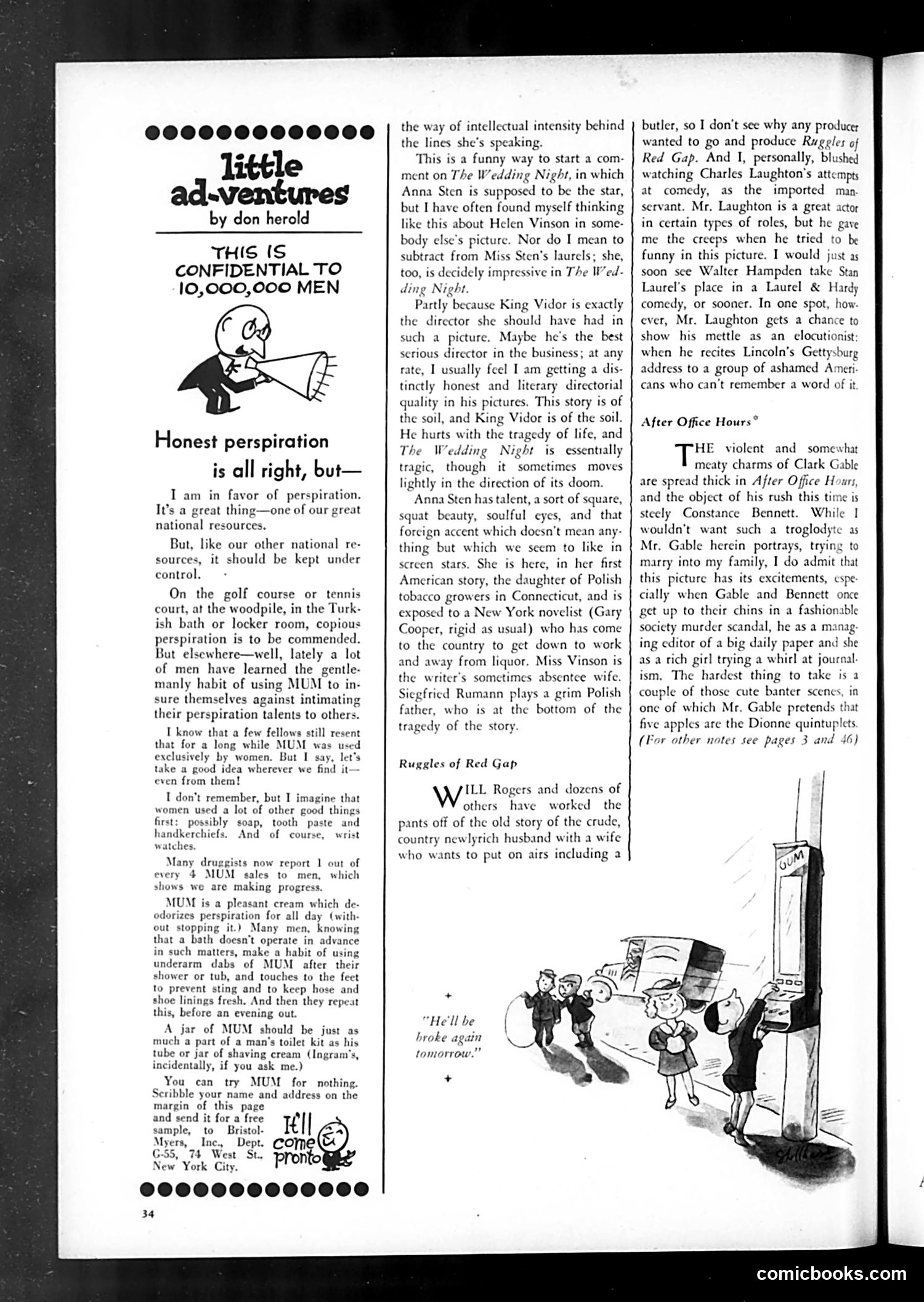
Life Magazine Page Analysis This page combines advertising with film criticism. The dominant content is a MUM deodorant advertisement disguised as a humorous essay by Don Herold. The satire targets masculine vanity: Herold facetiously promotes deodorant to men by claiming women invented it first, then jokes that men should adopt it without shame—comparing it to soap and toothpaste. The humor rests on mid-century anxiety about men using "feminine" products; one-in-four MUM sales now go to men, presented as social progress. Below this is film criticism discussing contemporary movies: *The Wedding Night* (starring Anna Sten, directed by King Vidor) and *Ruggles of Red Gap* (featuring Charles Laughton). Herold praises Vidor's serious directorial style and Sten's talent, while expressing embarrassment at Laughton's comedic acting in the latter film—suggesting his theatrical performance feels out of place in the role. The small cartoon illustrates a domestic scene, likely related to the film reviews below.
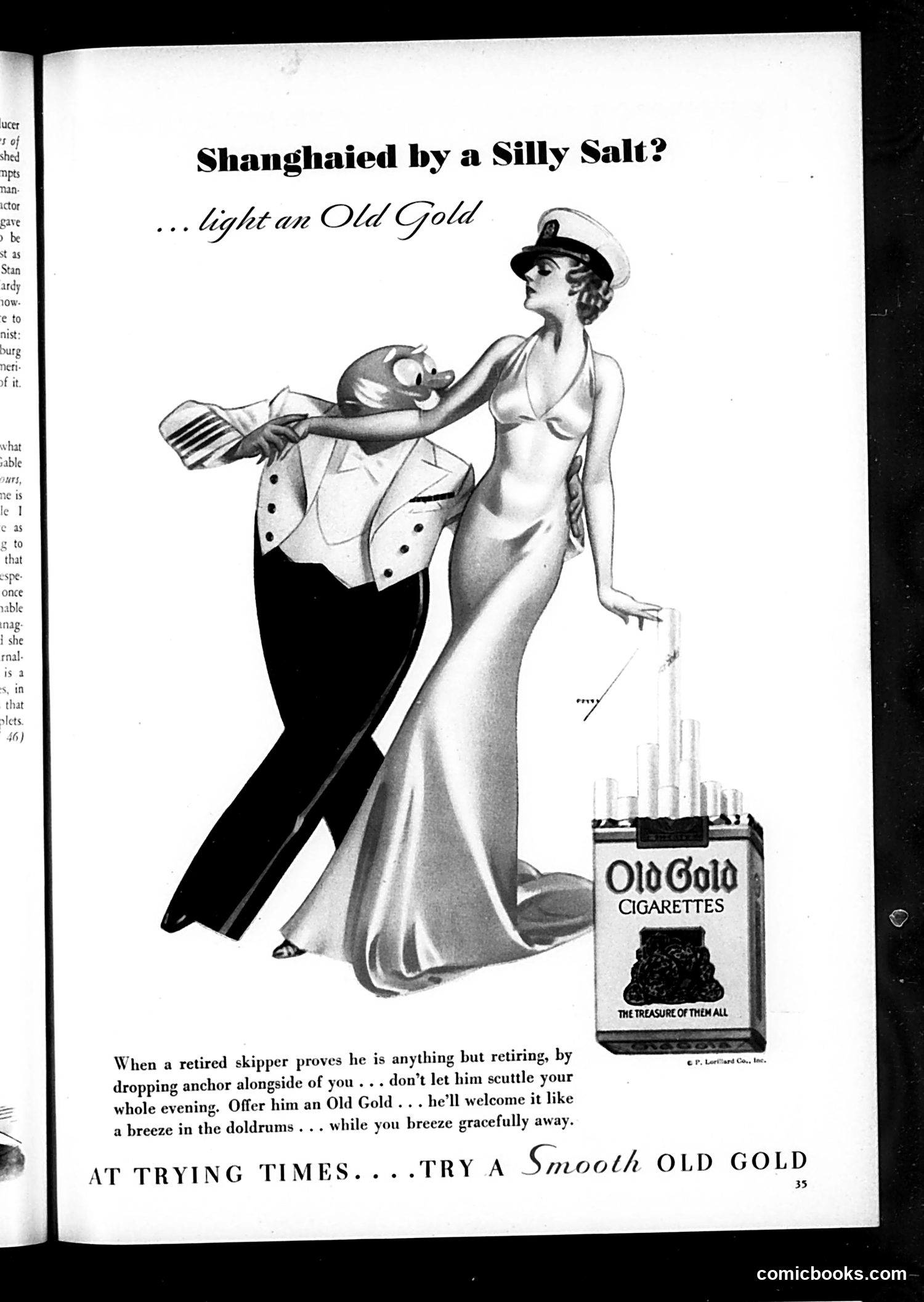
Old Gold Cigarettes Advertisement This is a cigarette advertisement disguised as humorous social advice. The illustration depicts a woman in an evening dress being approached by a retired sailor ("a silly salt") in naval uniform—a potentially unwanted social situation. The "joke" suggests offering the persistent sailor an Old Gold cigarette as a distraction, allowing the woman to escape gracefully. This reflects mid-century advertising tactics that used humor and gendered scenarios to sell products. The nautical terminology ("shanghaied," "anchor," "scuttle," "doldrums") extends the maritime pun throughout. The ad frames cigarette-giving as a polite social strategy for managing awkward encounters, positioning the product as a solution to social discomfort—a common advertising approach of this era.
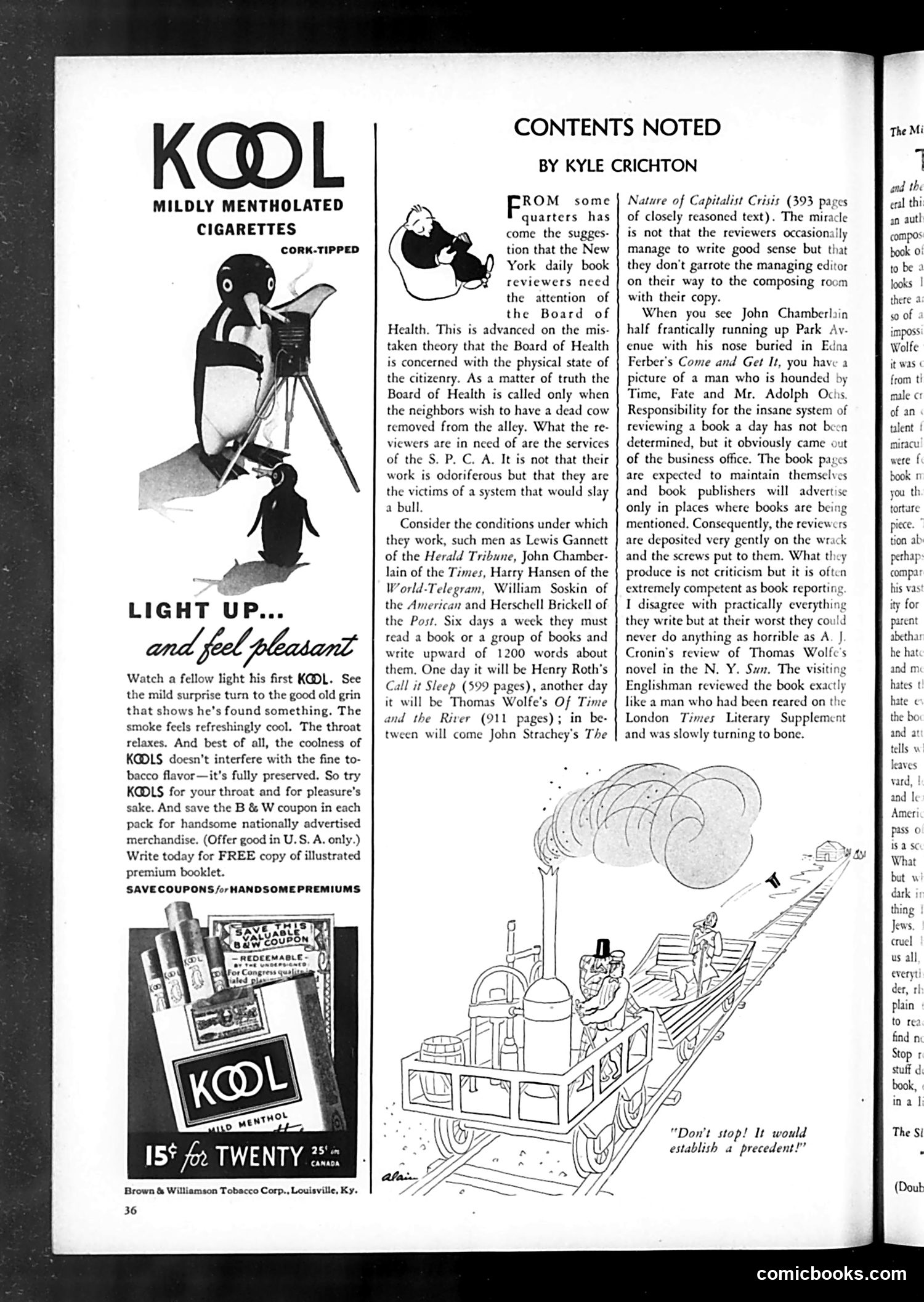
"Contents Noted" by Kyle Crichton — Page Analysis This page combines a Kool cigarettes advertisement (left) with a book review column (right). The Advertisement: Features stylized figures in a modernist design promoting menthol cigarettes with the slogan "Light up... and feel pleasant." The imagery emphasizes coolness and relaxation. The Column: Crichton critiques the brutal working conditions of major New York newspaper book reviewers—naming Lewis Gannett (Herald Tribune), John Chamberlain (Times), Harry Hansen (World-Telegram), William Soskin (American), and Herschell Brickell (Post). The Satire's Point: These prominent critics are systematically overworked, forced to read and review 1,200+ words daily about vastly different books (ranging from dense 900+ page novels to academic texts). Crichton argues this impossible schedule produces "competent book reporting" rather than genuine criticism, and sarcastically notes their output, while flawed, never reaches the incompetence of other reviews he's read. The column mocks both the publishing industry's profit-driven system and the human cost to serious literary criticism.
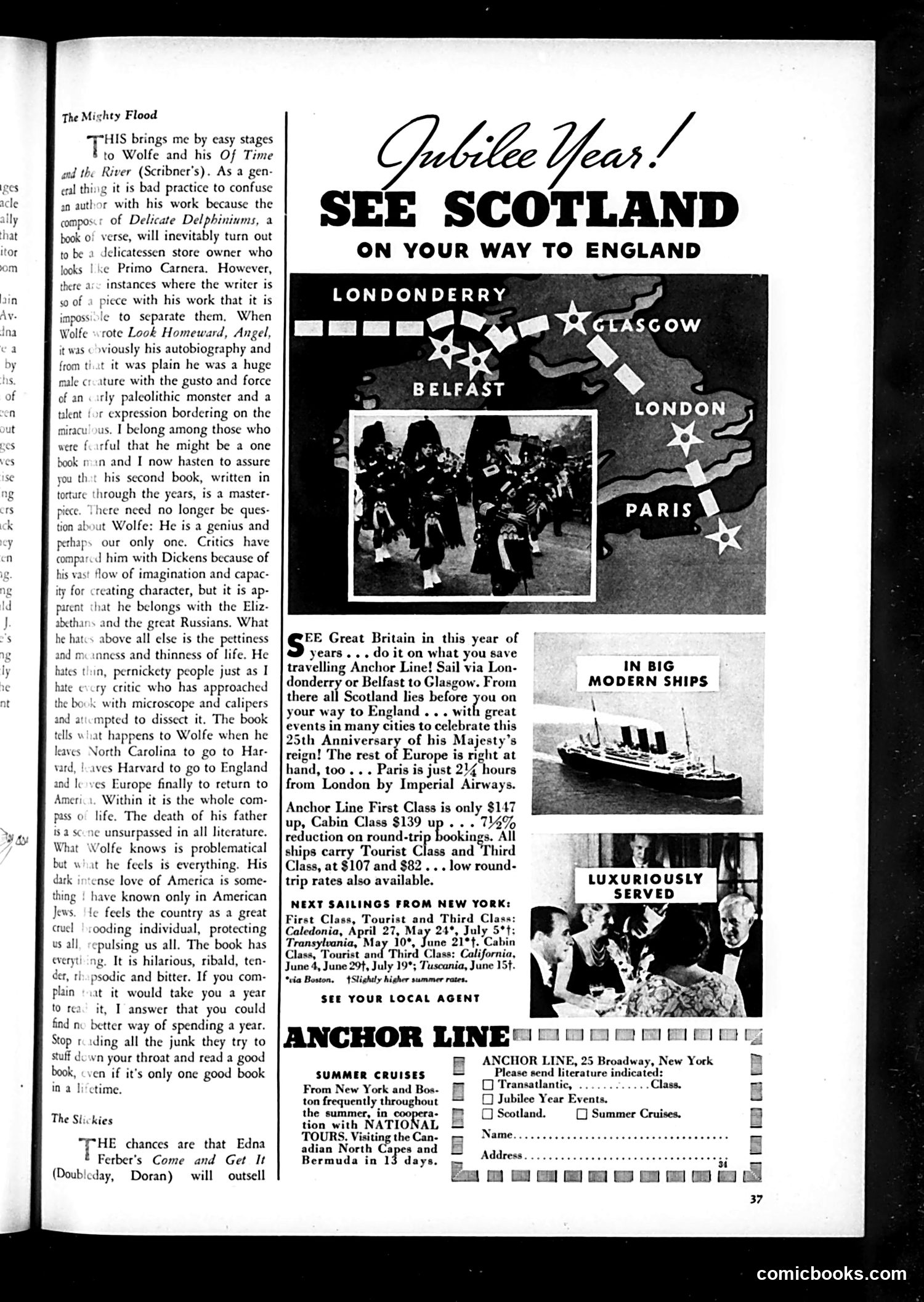
Analysis of This Life Magazine Page This page is primarily advertising with a literary review, not a political cartoon. The left column reviews Thomas Wolfe's novel *Of Time and the River*, praising him as a literary genius comparable to Dickens and the great Russians. The critic emphasizes Wolfe's emotional intensity and his passionate, complex portrayal of American life. The right side features Anchor Line shipping advertisements capitalizing on Britain's Silver Jubilee (the 25th anniversary of King George V's reign, mentioned in the text). The ads promote transatlantic passage to Scotland and England, with routes from New York to Glasgow, Belfast, and Londonderry, emphasizing the opportunity to see Scotland "on your way to England" during this celebratory year. Ships are advertised as modern and luxurious, with competitive pricing for first, cabin, tourist, and third-class accommodations. The page reflects 1930s travel marketing targeting American tourists eager to visit Britain during a significant royal anniversary.
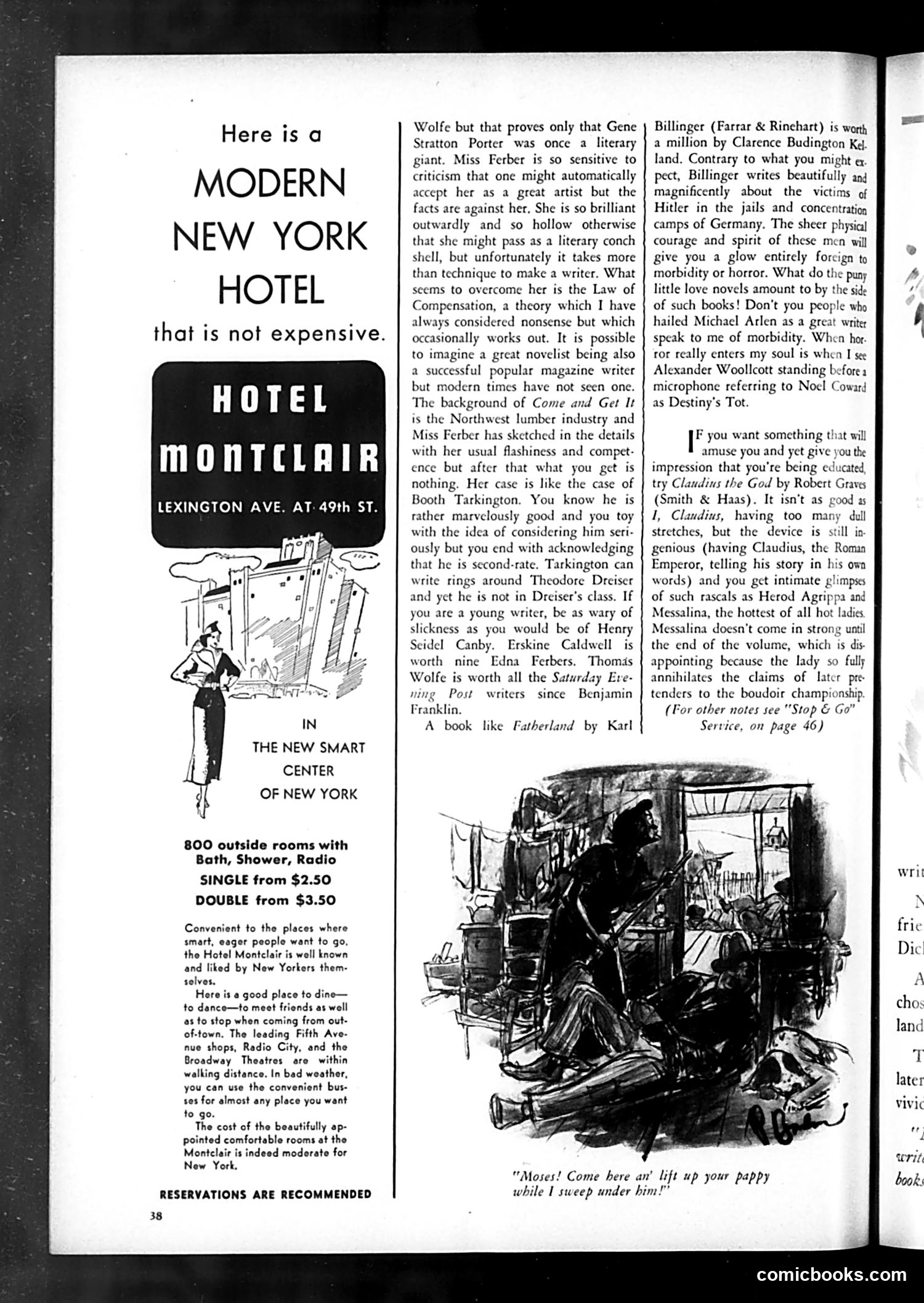
What This Page Means This is primarily a hotel advertisement for the Hotel Montclair, positioned as an affordable, modern option in Manhattan's new smart center, with rooms from $2.50-$3.50. The page also contains a literary book review critiquing contemporary American writers. The reviewer dismisses Edna Ferber as technically brilliant but hollow, comparing her unfavorably to Thomas Wolfe and praising Karl Billinger's book about Nazi concentration camp victims as more worthwhile than sentimental popular fiction. The cartoon at bottom shows a domestic scene: a Black person sweeping while holding up another person (likely their spouse), with the caption referencing "Moses" lifting someone. This appears to be a period racial stereotype joke playing on physical comedy and servitude, typical of 1930s-era Life magazine humor—content now recognized as offensive. The review's moral stance (valuing serious literature about Nazi atrocities over "morbid" love novels) suggests this page dates to the late 1930s-early 1940s, when Hitler's camps were becoming known.
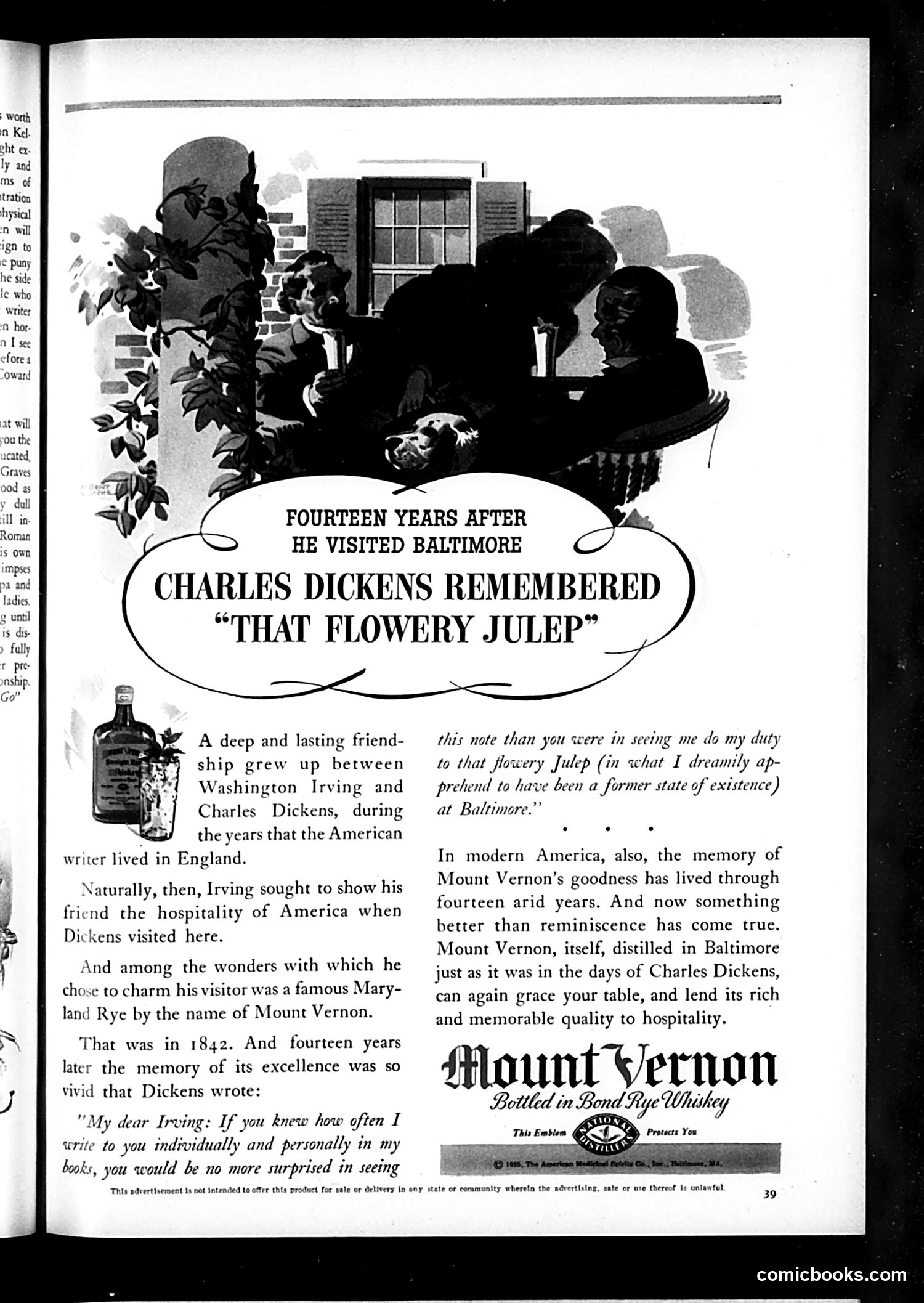
Analysis This is primarily a whiskey advertisement, not political satire. It uses a historical anecdote to market Mount Vernon Rye Whiskey. The ad references Charles Dickens' 1842 visit to America, when his friend Washington Irving served him Mount Vernon whiskey in Baltimore. Fourteen years later (1856), Dickens fondly recalled the drink in a letter to Irving, calling it a "flowery Julep." The advertisement exploits this literary reference for credibility—if the famous English author praised the whiskey so enthusiastically that he remembered it years later, it must be excellent. The silhouette illustration appears to show the two men in conversation, establishing the historical connection. The closing pitch argues that Mount Vernon whiskey can recreate that same quality of "hospitality" for modern drinkers, linking the product to genteel tradition and memorable social occasions. This is straightforward nostalgia-based advertising leveraging a real (or plausible) historical moment rather than satire or political commentary.
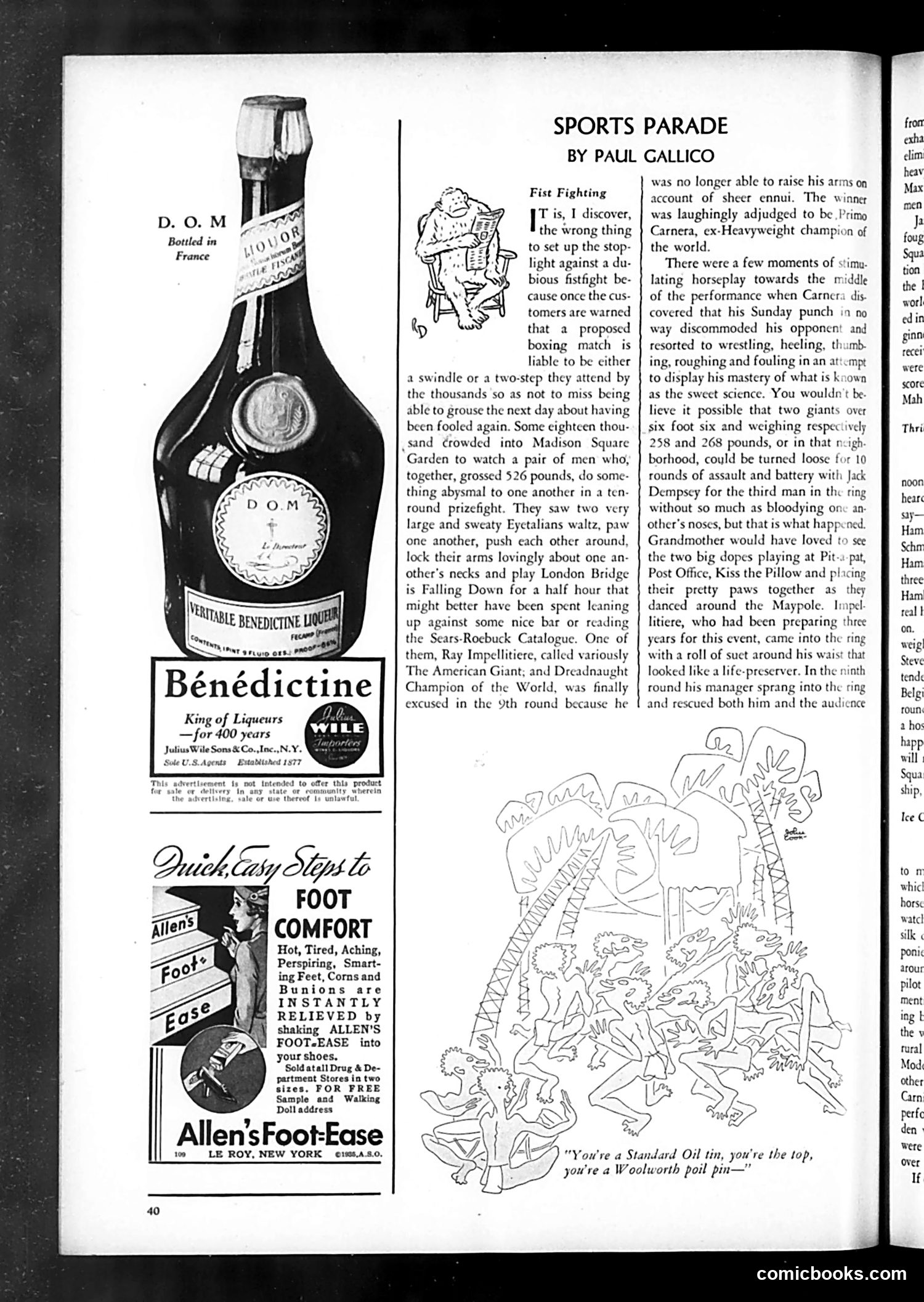
Analysis of "Sports Parade" by Paul Gallico This column satirizes a recent heavyweight boxing match between Primo Carnera (former heavyweight champion) and Ray Impellitiere at Madison Square Garden. Gallico's barb: despite 18,000 spectators paying to watch two massive fighters (combined 526 pounds), the bout was essentially a farce—the men barely fought, instead "waltzing" and engaging in "horseplay." The satire targets both the boxers' lack of effort and the paying public's gullibility. Carnera, unable to land effective punches, resorted to wrestling and fouling. Impellitiere arrived so out of shape (with a "roll of suet" around his waist) that his manager threw in the towel by round nine—no blood, no real combat, just theatrical laziness. Gallico mocks the sport's pretense as "the sweet science" when what fans actually witnessed was incompetence dressed as entertainment. The implied target: boxing's corruption and fans' willingness to be repeatedly swindled.
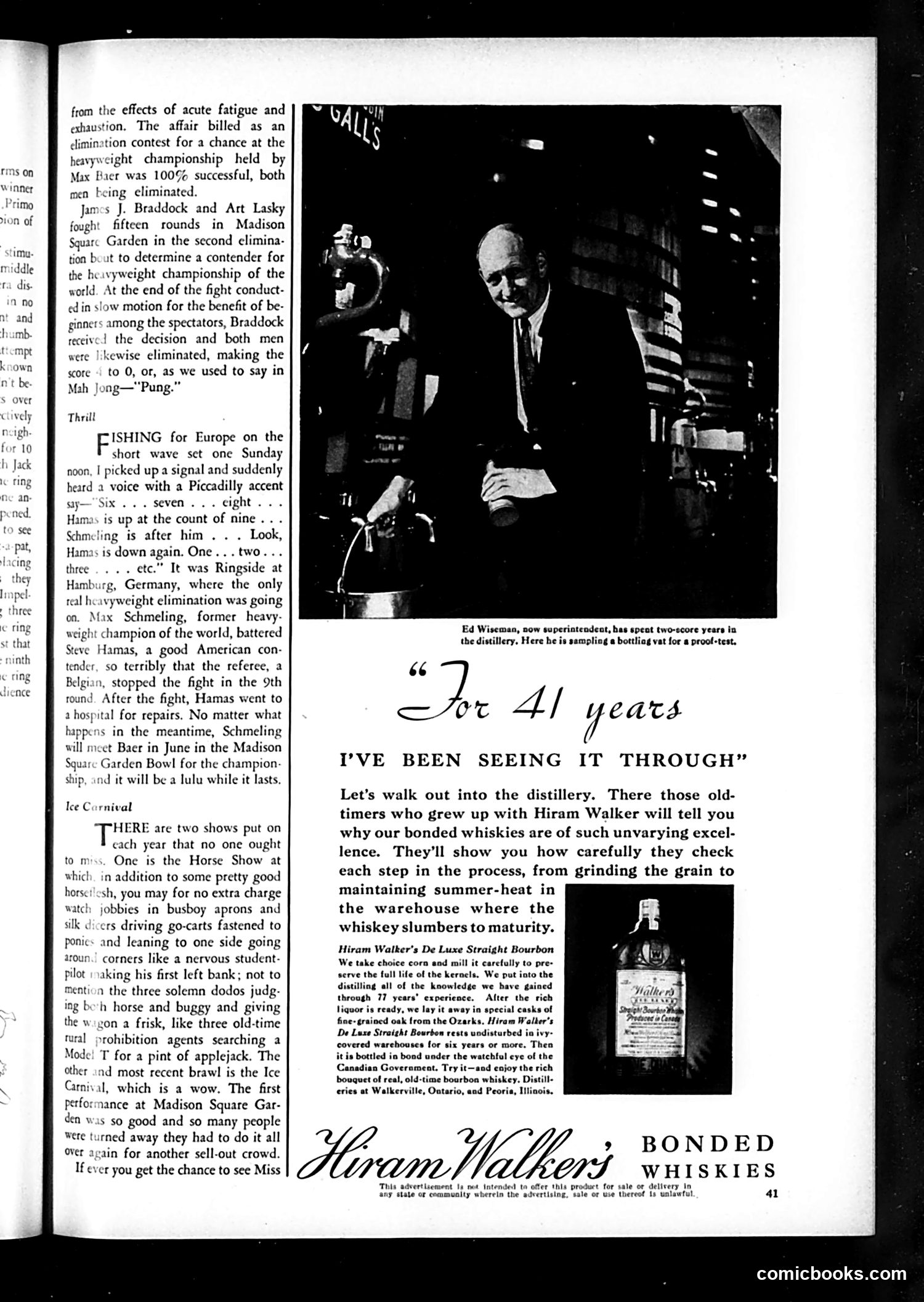
Life Magazine Page Analysis This page mixes sports satire with advertising. The main content critiques recent heavyweight boxing matches as anticlimactic "elimination contests." The Satire: The text mocks two fights billed as determining a heavyweight championship contender. James Braddock vs. Art Lasky at Madison Square Garden ended in mutual elimination—both fighters were so exhausted they were deemed equally unfit. The writer sarcastically compares the score to the game "Mah Jong," treating the boxers as interchangeable failures. More substantively, Max Schmeling's dominating knockout of American contender Steve Hamas in Hamburg is presented as the only "real" elimination bout. The implication: American boxing has become so mediocre that even a German fighter's decisive victory seems remarkable by comparison. Context: This reflects 1930s boxing's declining prestige and growing skepticism about fight legitimacy. The magazine uses sports reporting to poke fun at the sport's theatrical, predetermined-seeming outcomes. The page also includes an unrelated advertisement for Hiram Walker whiskey emphasizing quality control and aging.
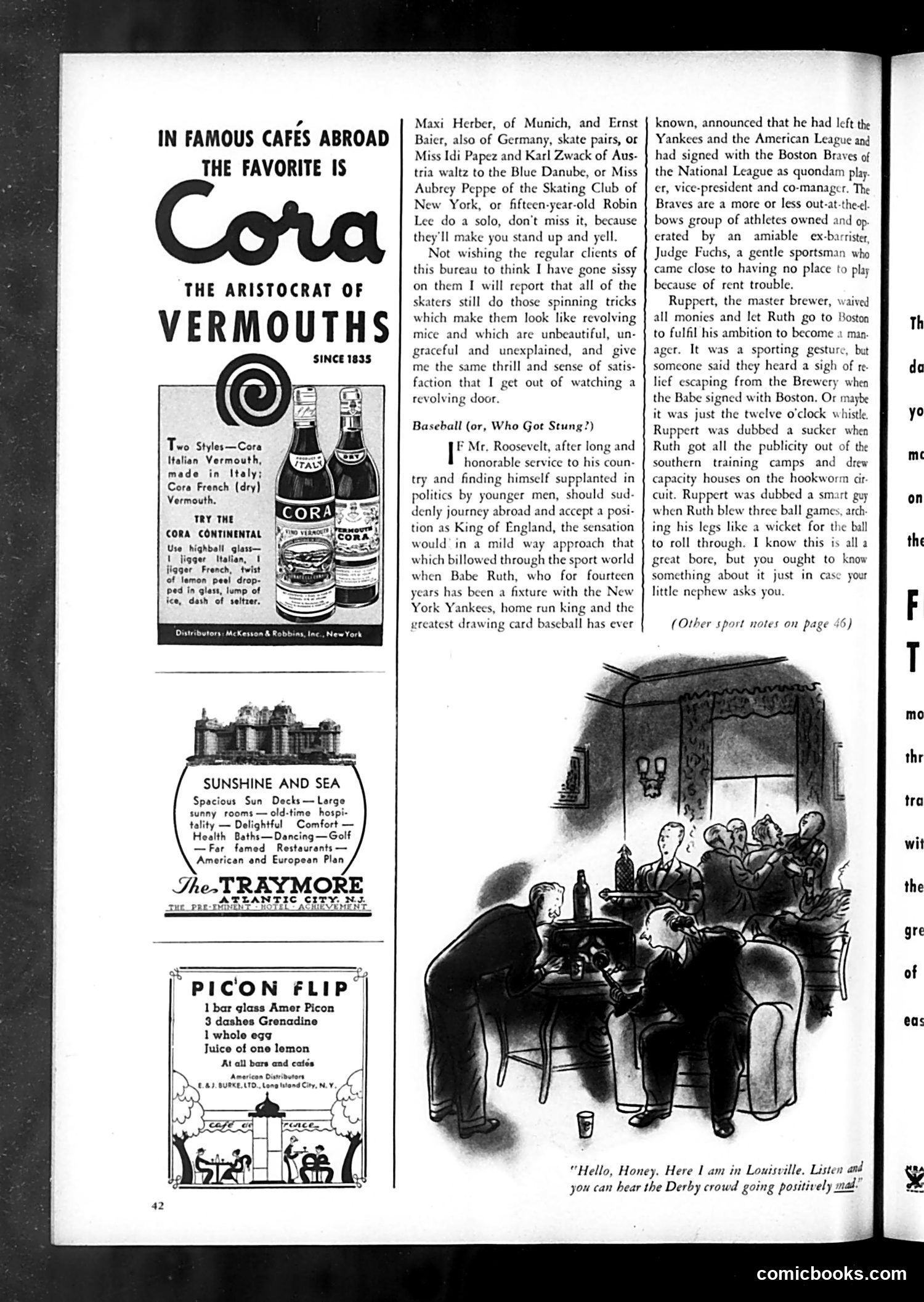
Explanation for Modern Readers This Life magazine page is primarily advertising and sports commentary from the 1930s. The Advertisements: Three liquor ads dominate the left side—Cora Vermouth, the Traymore Hotel in Atlantic City, and Picon Flip cocktail—typical of pre-Prohibition-repeal marketing. The Sports Content: The main article discusses Babe Ruth's shocking 1935 move from the New York Yankees to the Boston Braves as player-manager. The writer treats this as momentous—comparing it to President Roosevelt becoming King of England—because Ruth had been baseball's biggest star for 14 years. The satire mocks Yankees owner Jacob Ruppert as alternately "sucker" and "smart guy" depending on whether Ruth's presence helped or hurt the team. The piece's tone is deliberately dismissive ("great bore"), suggesting readers shouldn't care, yet the very length proves otherwise. The cartoon shows men in a bar listening to a radio broadcast of the Kentucky Derby—illustrating how sports brought Americans together through radio.
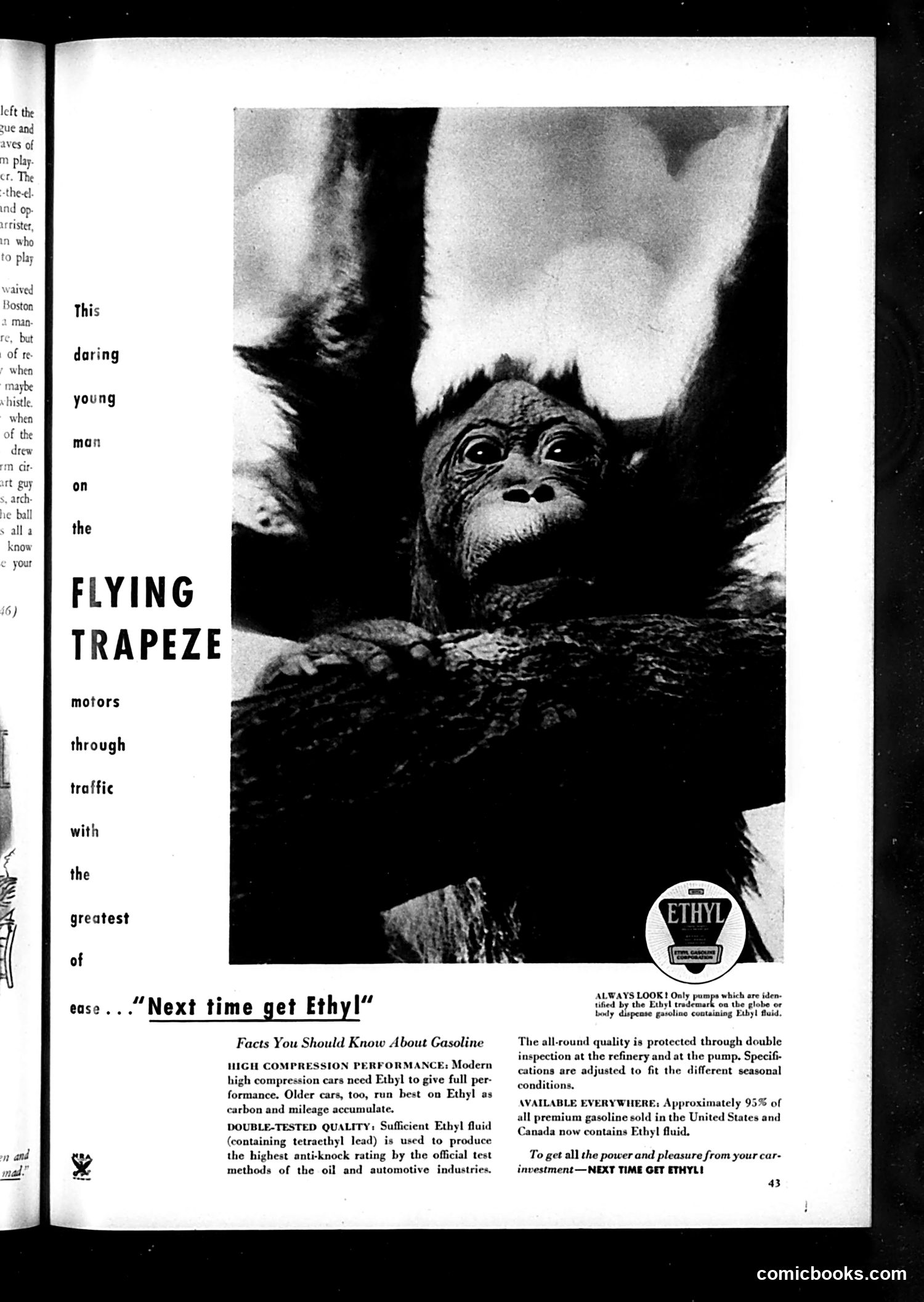
Analysis of Ethyl Gasoline Advertisement This is a full-page advertisement for Ethyl gasoline, not political satire. It uses a clever visual pun: a photograph of a chimpanzee performing acrobatics, captioned "This daring young man on the FLYING TRAPEZE," referencing the popular 1868 song "The Man on the Flying Trapeze." The advertisement's humor lies in depicting the chimp's dangerous mid-air stunt as analogous to driving with high-compression engines—both require specialized fuel (Ethyl) to perform safely "with the greatest of ease." The tagline "Next time get Ethyl!" positions the product as essential for smooth, trouble-free performance. The accompanying text emphasizes Ethyl's anti-knock properties and quality control, targeting consumers of modern automobiles. This dates to the leaded gasoline era, when Ethyl (tetraethyl lead) was marketed as a performance enhancer before its health hazards were recognized.
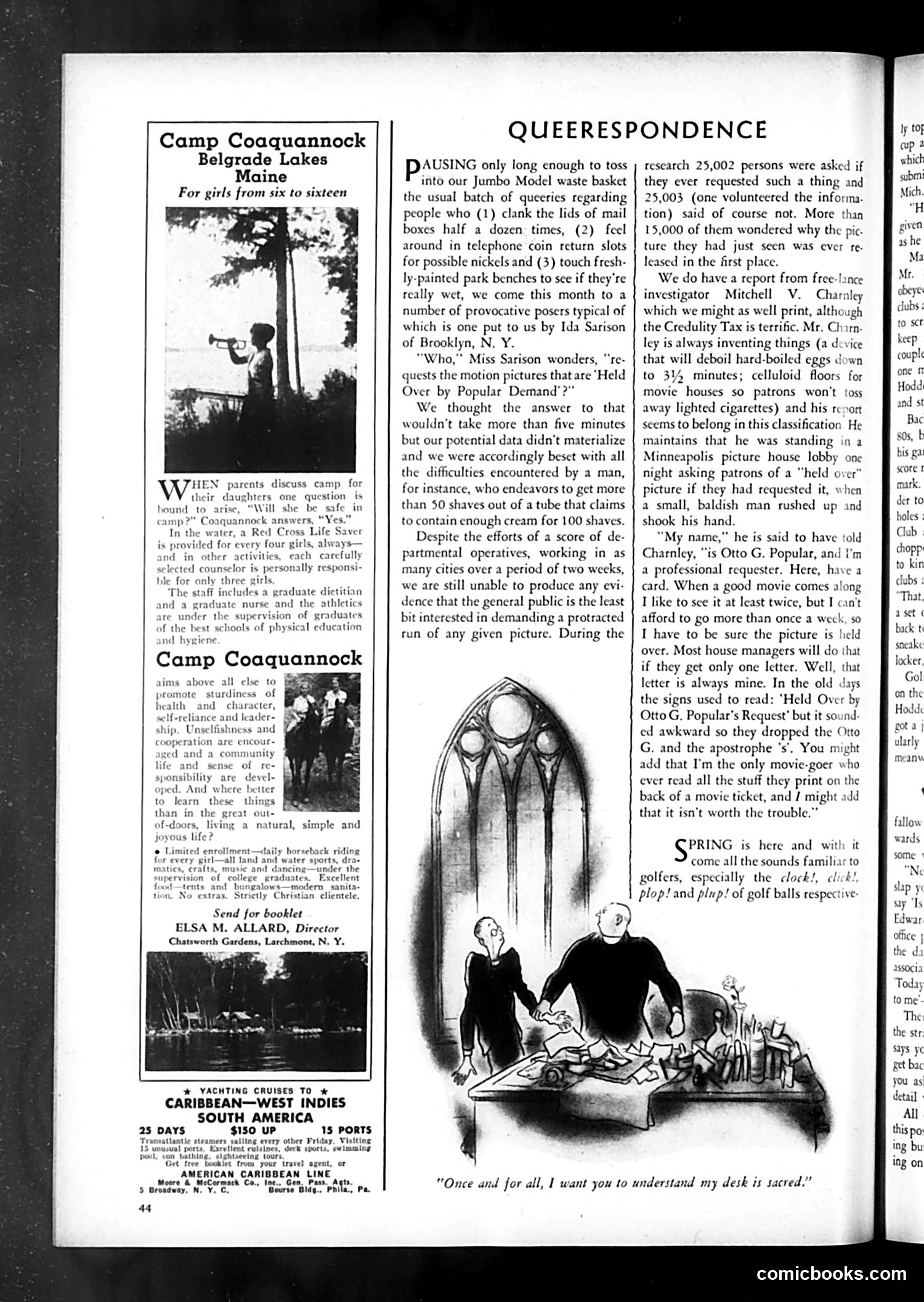
What This Page Means for Modern Readers This page contains camp and travel advertisements alongside a humor column called "Queerespondence." The main satirical piece investigates who requests movies be "held over by popular demand." Life's researchers asked 25,000+ people if they'd ever made such requests—nearly all said no, and many wondered why the film was released at all. The joke: studios advertise extended runs as audience-demanded, but the public doesn't actually request them. Life's investigators found only one "professional requester"—Otto G. Popular—a fictional character who floods theaters with letters to keep films running longer so he can watch twice without paying twice. The satire targets false advertising claims and the gap between what studios claim audiences want versus reality. It's a pre-internet critique of manufactured demand and deceptive marketing practices in the film industry. The cartoon (depicting two figures with what appears to be office equipment) accompanies this discussion but its specific reference remains unclear from the visible image.
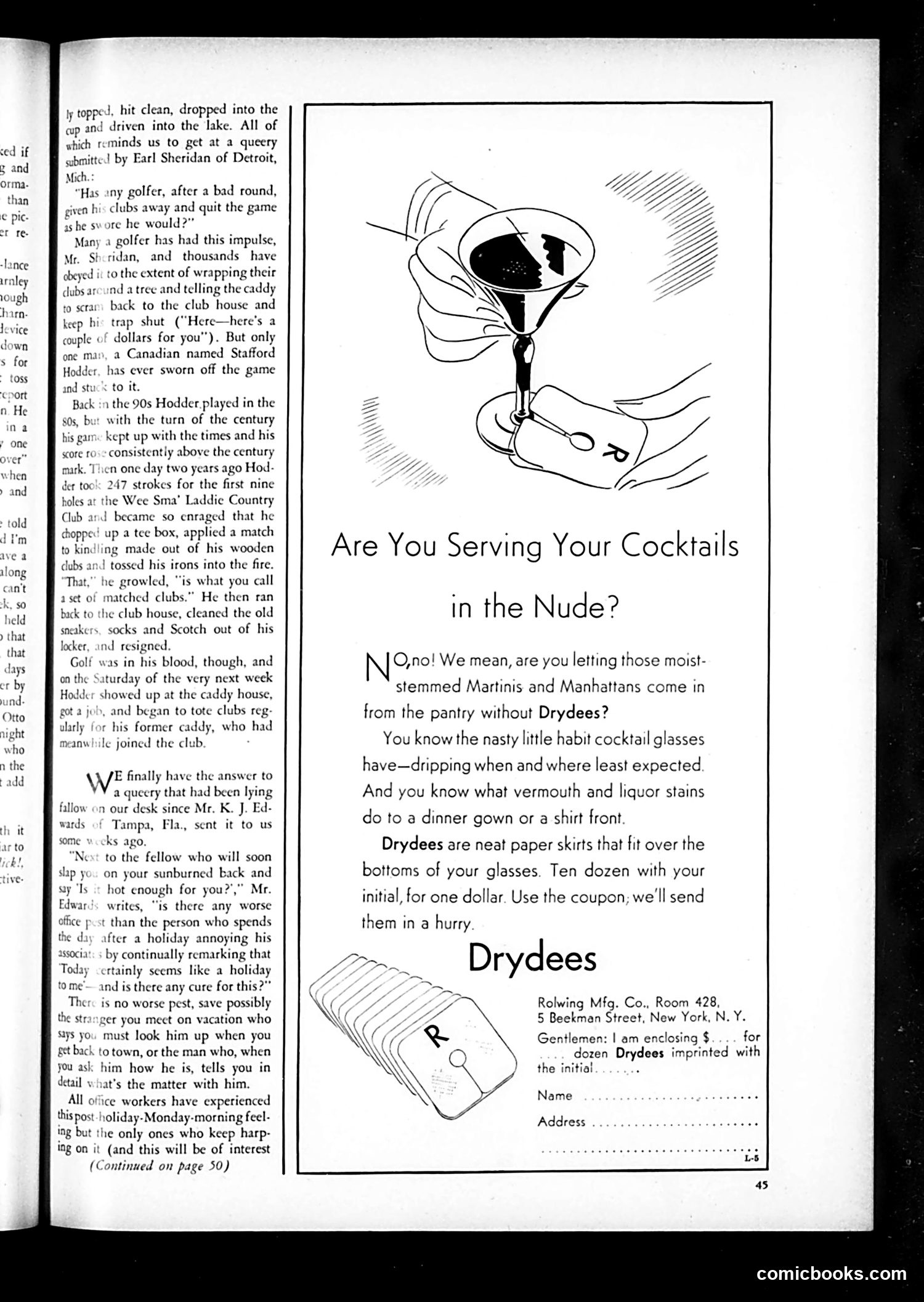
Life Magazine Page Analysis This page contains two distinct elements: a humorous article and a product advertisement. The Golf Story: The text discusses Stafford Hodder, a Canadian golfer who famously quit the sport after shooting 247 strokes on nine holes. In rage, he destroyed his clubs by burning them, then ironically returned the following week to work as a caddy—demonstrating that golf obsession transcends rational decision-making. The piece satirizes golfers' well-known impulse to quit after poor rounds, yet their inability to actually stay away from the game. The Advertisement: "Drydees" is a novelty product—decorative paper skirts that slip over cocktail glass stems to catch drips and prevent staining clothing. The ad humorously frames this as a solution to the "nasty little habit" of wet glasses ruining dinner clothes. The cheeky headline "Are You Serving Your Cocktails in the Nude?" uses sexual innuendo to grab attention for what is essentially a practical household item. Both elements reflect mid-20th century American leisure culture and consumer advertising strategies.
"Stop & Go" Film Reviews and Sports Calendar This page from *Life* magazine (April 23, 1935) contains film reviews and a sports calendar rather than political cartoons. The reviews, by critic Paul Gallico, offer witty assessments of current movies, mixing praise with barbed commentary—praising Fred Astaire's dancing while questioning his own taste, dismissing most plots as "stale," and mocking Edward G. Robinson's dual role as clever but gimmicky. The sports section highlights major American events: college rowing competitions, horse racing (Kentucky Derby, Preakness), baseball's opening day, and golf championships. Gallico's commentary is characteristically irreverent—describing the Harlem River as "charming and fragrant" (sarcastic, given its notorious pollution) and the Kentucky Derby as wilder than "Old Bedlam" (a mental asylum reference). The page reflects 1930s leisure culture and sports enthusiasm, with Gallico's sardonic voice dominating both sections.
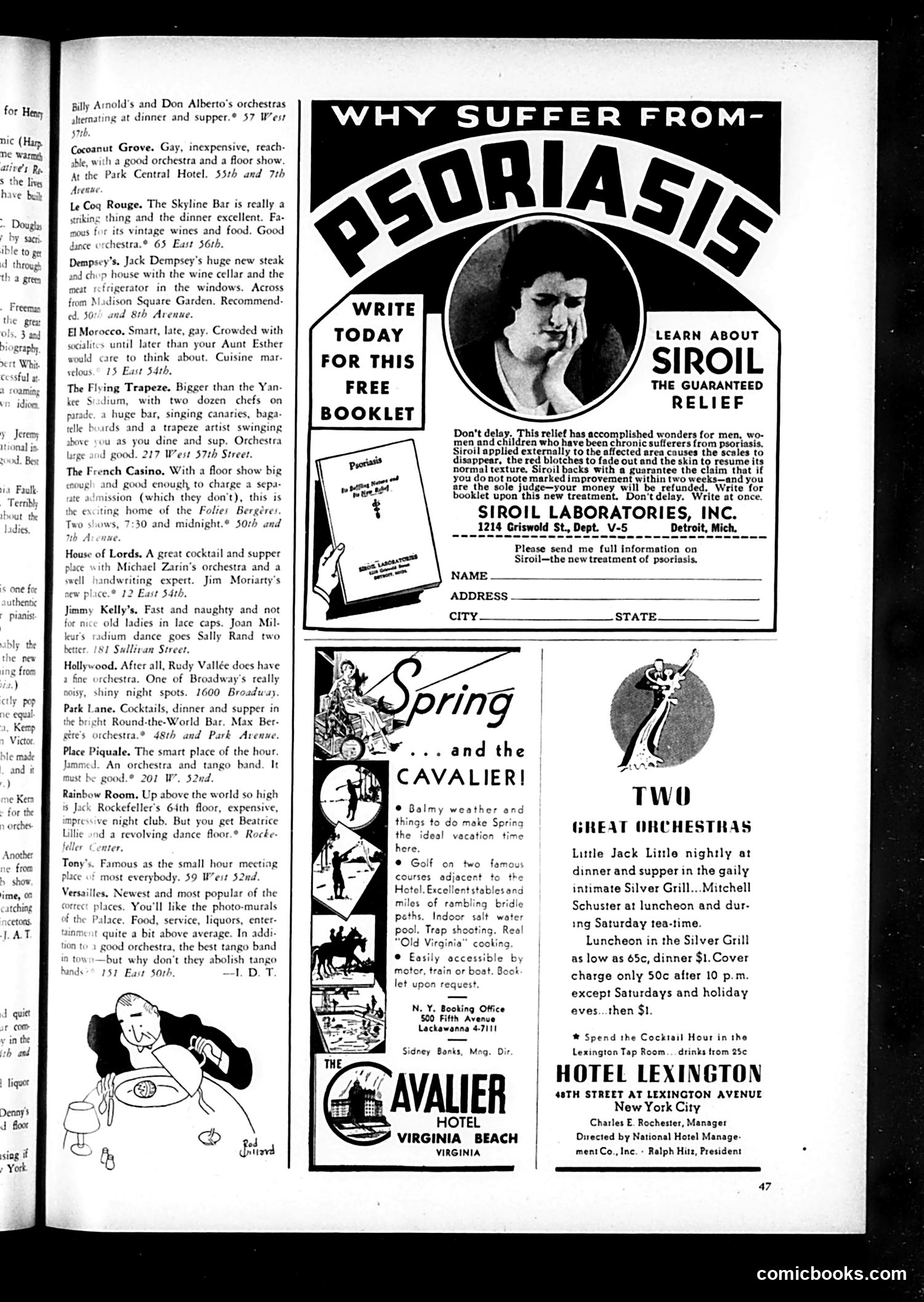
Analysis of Page 47 from Life Magazine This page is primarily advertising and restaurant/nightclub reviews rather than political satire. The main content consists of: 1. Left column: Reviews of New York City nightclubs and dining establishments (Cocoanut Grove, Le Coq Rouge, Dempsey's, etc.), listing their orchestras, entertainment, and locations. 2. Large center advertisement: A medical advertisement for "Siroil," a psoriasis treatment promising relief within two weeks with a money-back guarantee. The image shows a man's face, likely meant to demonstrate the product's effectiveness. 3. Right side: Hotel and entertainment advertisements, including the Cavalieri Hotel in Virginia Beach and the Hotel Lexington in New York City. The page reflects 1920s-30s American consumer culture—nightlife venues, medical remedies advertised with confident testimonials, and luxury hospitality. No political cartoons or satire are present; this is a commercial advertisement page typical of Life magazine's revenue model.
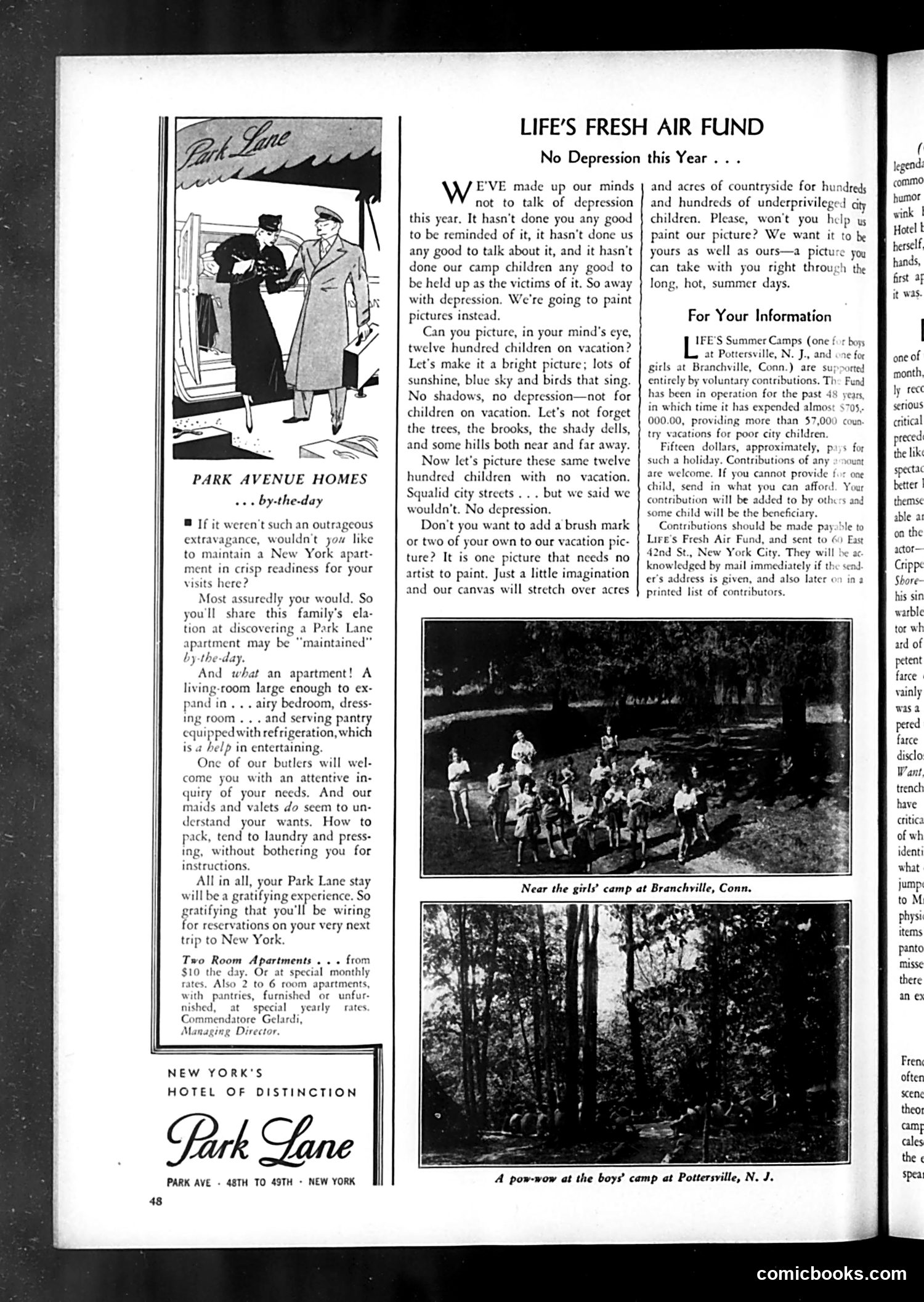
Life Magazine Page Analysis This page contains two distinct pieces: a hotel advertisement and a charitable appeal. Park Avenue Homes Advertisement (left): Promotes the Park Lane Hotel's luxury service of maintaining a fully-staffed apartment "by-the-day" for wealthy visitors. The illustration shows well-dressed people entering an elegant building. The copy caters to the affluent, promising butlers, maids, and valets who anticipate guests' needs without instruction—emphasizing effortless luxury living. Life's Fresh Air Fund (right): A Depression-era charitable campaign soliciting donations to send underprivileged city children to summer camps. The appeal uses positive imagery—sunshine, nature, countryside—while explicitly rejecting depression-themed messaging ("away with depression"). It requests $15 contributions per child and notes the fund has operated 48 years, spending approximately $705,000. The Stark Contrast: The juxtaposition is striking: luxury apartments maintained for occasional wealthy visitors appear alongside an appeal for poor children's basic summer access to fresh air. This likely reflects Life magazine's satirical sensibility, though whether intentional social critique or accidental editorial pairing remains unclear.
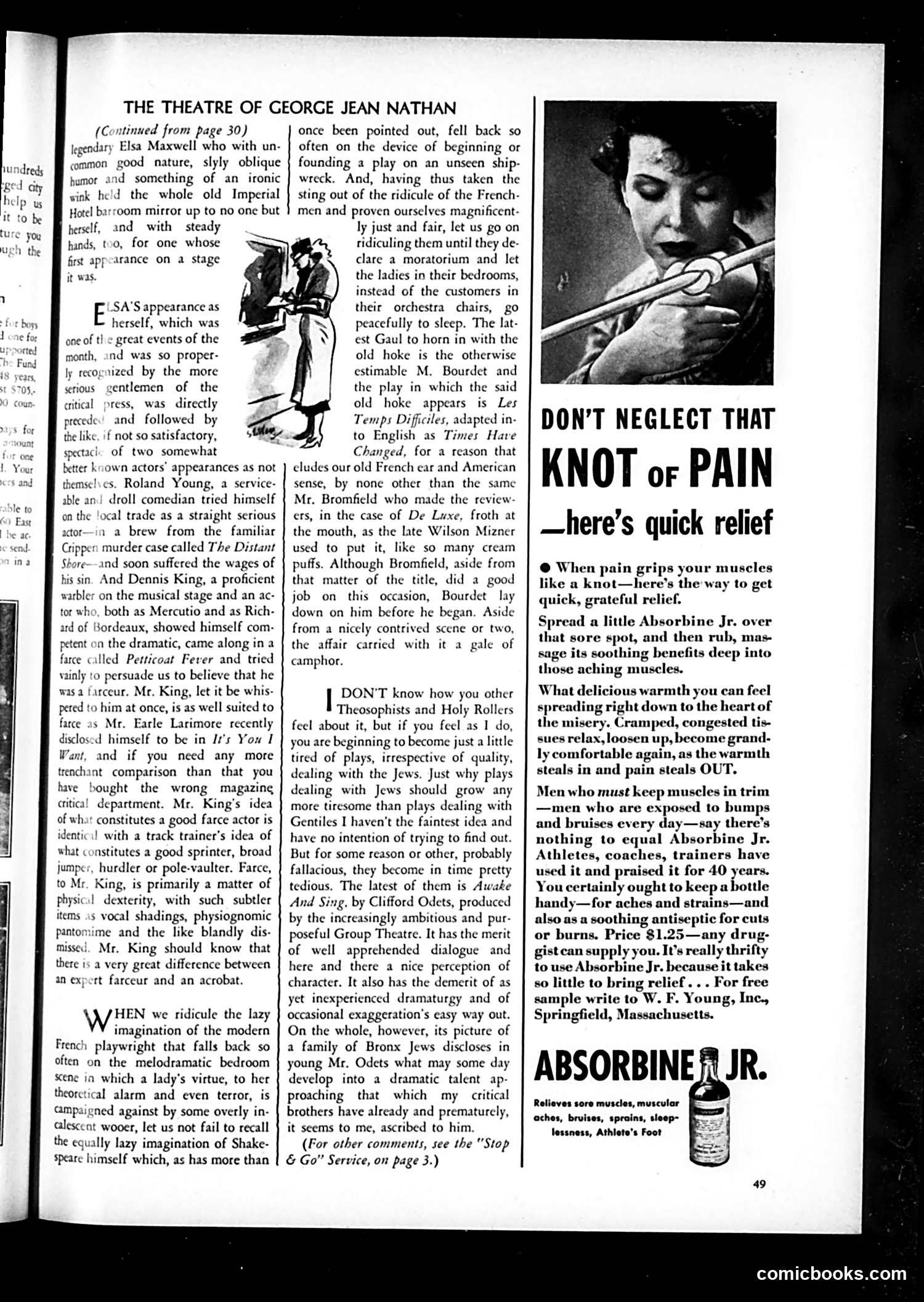
Theatre Review Page Analysis This page contains a theatre criticism column by George Jean Nathan reviewing contemporary Broadway productions, plus a vintage Absorbine Jr. pain relief advertisement. The Theatre Content: Nathan critiques recent plays and performances, including: - Elsa Maxwell's appearance as herself (apparently a notable social event) - Actor Roland Young attempting serious drama in "The Distant Shore" (based on the Crippen murder case) - Dennis King in the farce "Petticoat Fever," whom Nathan judges unsuited to comedy - French playwright M. Bourdet's "Les Temps Difficiles" (adapted as "Times Have Changed" by Louis Bromfield) The Satire: Nathan employs witty, dismissive critique—comparing King's approach to farce as merely acrobatic rather than subtle. He mocks French playwrights' reliance on bedroom-seduction melodrama while noting Shakespeare used similarly lazy plotting devices (shipwrecks). The tone is sophisticated, snobbish theatre criticism typical of the era. The Advertisement: An unrelated Absorbine Jr. ad promotes muscle pain relief, using testimonials about its 40-year track record.
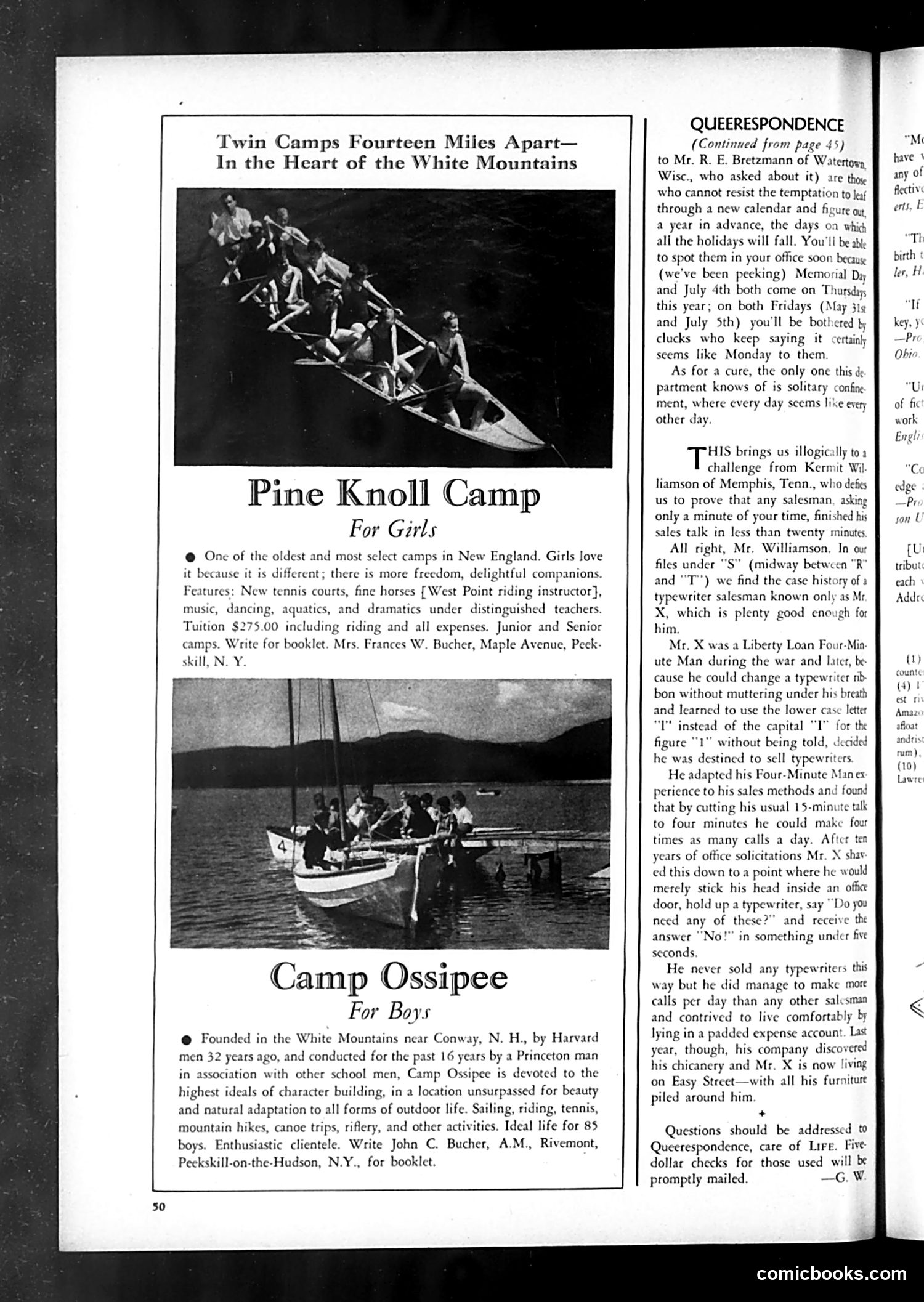
Life Magazine Page Analysis This page contains two summer camp advertisements (not political cartoons) and a humor column called "Queerespondence." The Camps Pine Knoll Camp and Camp Ossipee are competing facilities fourteen miles apart in New Hampshire's White Mountains—one for girls, one for boys. Both emphasize character-building, outdoor activities, and elite clientele (referencing Ivy League founders/conductors). The ads appeal to affluent families seeking prestigious summer experiences. The Humor Column The main content is a satirical anecdote about "Mr. X," a typewriter salesman who became obsessed with efficiency during the Four-Minute Man era (WWI Liberty Loan campaign). He reduced his sales pitch from 15 minutes to 4 minutes, eventually to mere seconds—but never actually sold anything. Instead, he padded expense accounts to survive, until his company discovered the fraud. The joke mocks corporate salesmanship and expense-account fraud as dark humor typical of 1920s-era Life magazine satire.
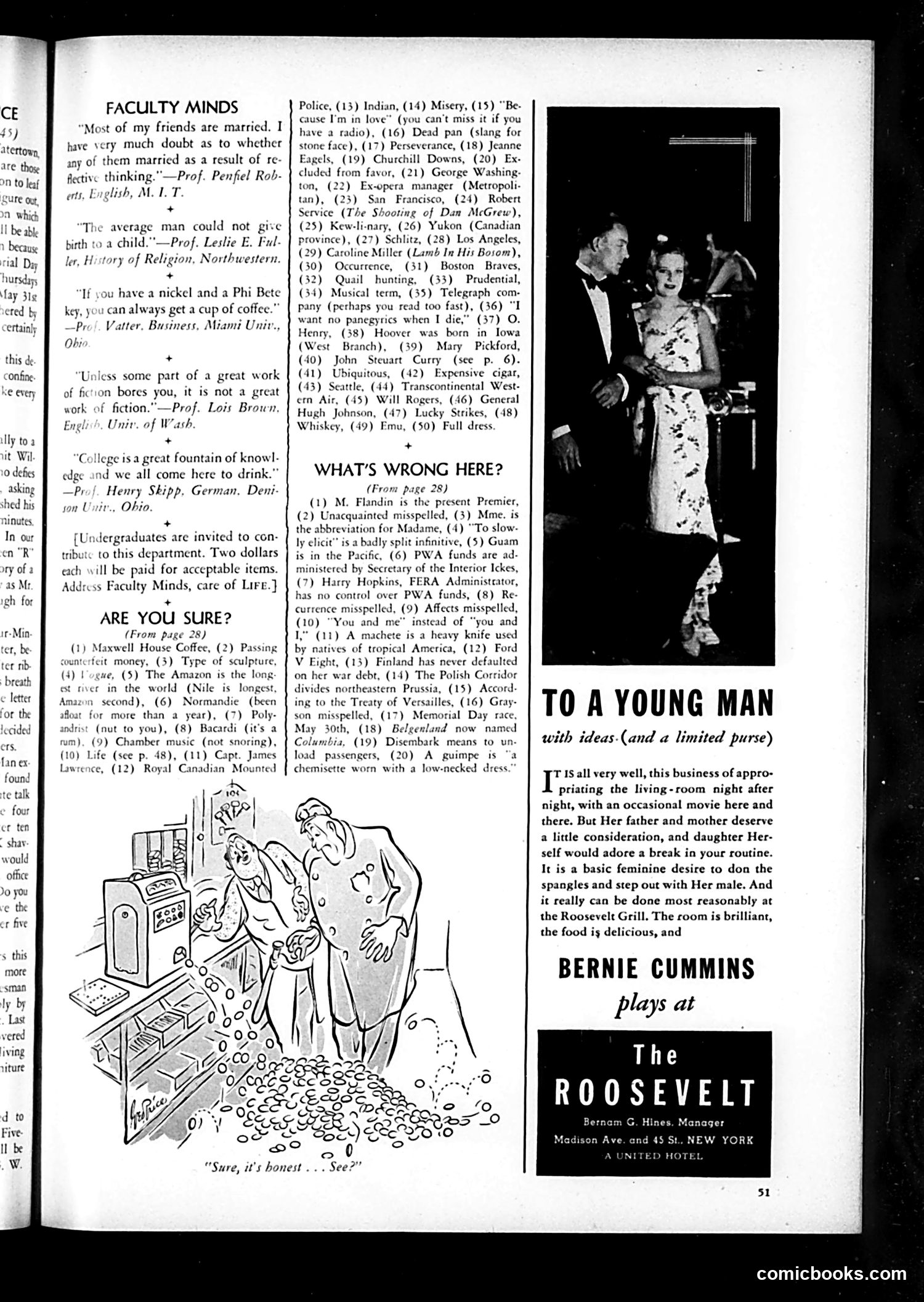
Explanation for Modern Readers This page contains two main sections: "Faculty Minds" collects witty quotes from college professors on topics like marriage, education, and intellect. It's a lighthearted feature mocking academic pretension through humorous one-liners. "Are You Sure?" and "What's Wrong Here?" appear to be answer keys to trivia and error-spotting puzzles from an earlier page (page 28, referenced multiple times). These were popular interactive features in Life magazine—readers would attempt to answer questions or find mistakes, then check their work against published answers. The cartoon labeled "Sure, it's honest...See?" depicts someone at a vending machine showering money everywhere, satirizing either consumer excess or the absurdity of certain products/claims. The specific target is unclear without the original context from page 28. The Roosevelt Hotel advertisement at bottom is standard period advertising, using Bernie Cummins as a celebrity endorsement for the establishment's dining facilities. This entire page reflects 1930s magazine culture: puzzle-based reader engagement, professorial humor, and integrated advertising.
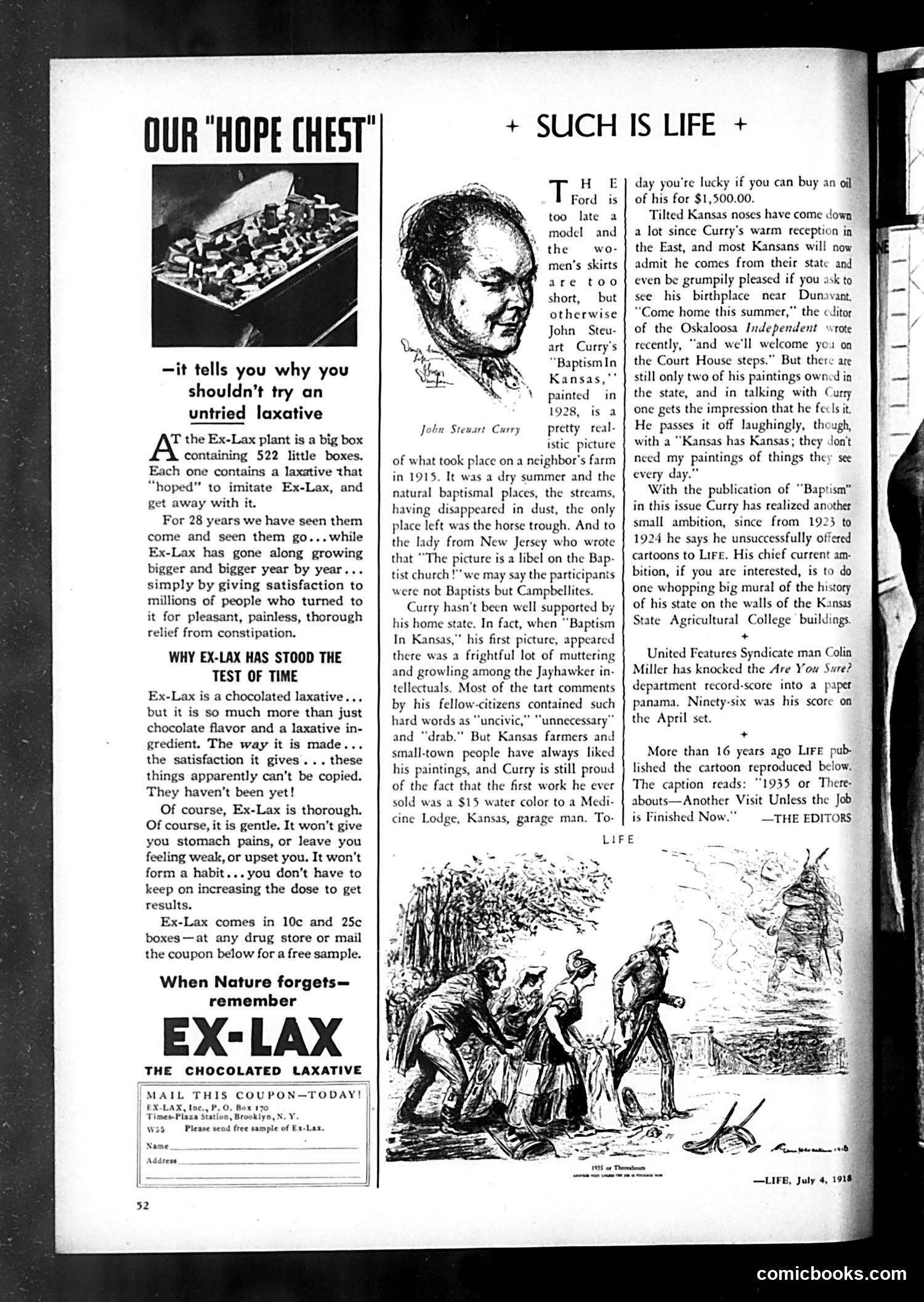
Explanation for Modern Readers This page combines two unrelated pieces: a laxative advertisement (Ex-Lax) and an art commentary on painter John Stewart Curry. The Ex-Lax ad uses mock-serious language claiming their product has outlasted 522 competitor laxatives over 28 years—a humorous "hope chest" metaphor suggesting failed competitors. The Curry section discusses his 1928 painting "Baptism in Kansas," depicting a horse-trough baptism from 1915. The commentary notes that Kansas intellectuals initially criticized the work as "uncivic" and "drab," viewing it as unflattering to the state. However, rural Kansans appreciated it. The piece celebrates Curry's growing Eastern recognition (his paintings now sell for $1,500) while noting Kansas has only two of his works—a somewhat resentful irony about hometown artists gaining prestige elsewhere before earning respect at home.