life
Life — June 1935
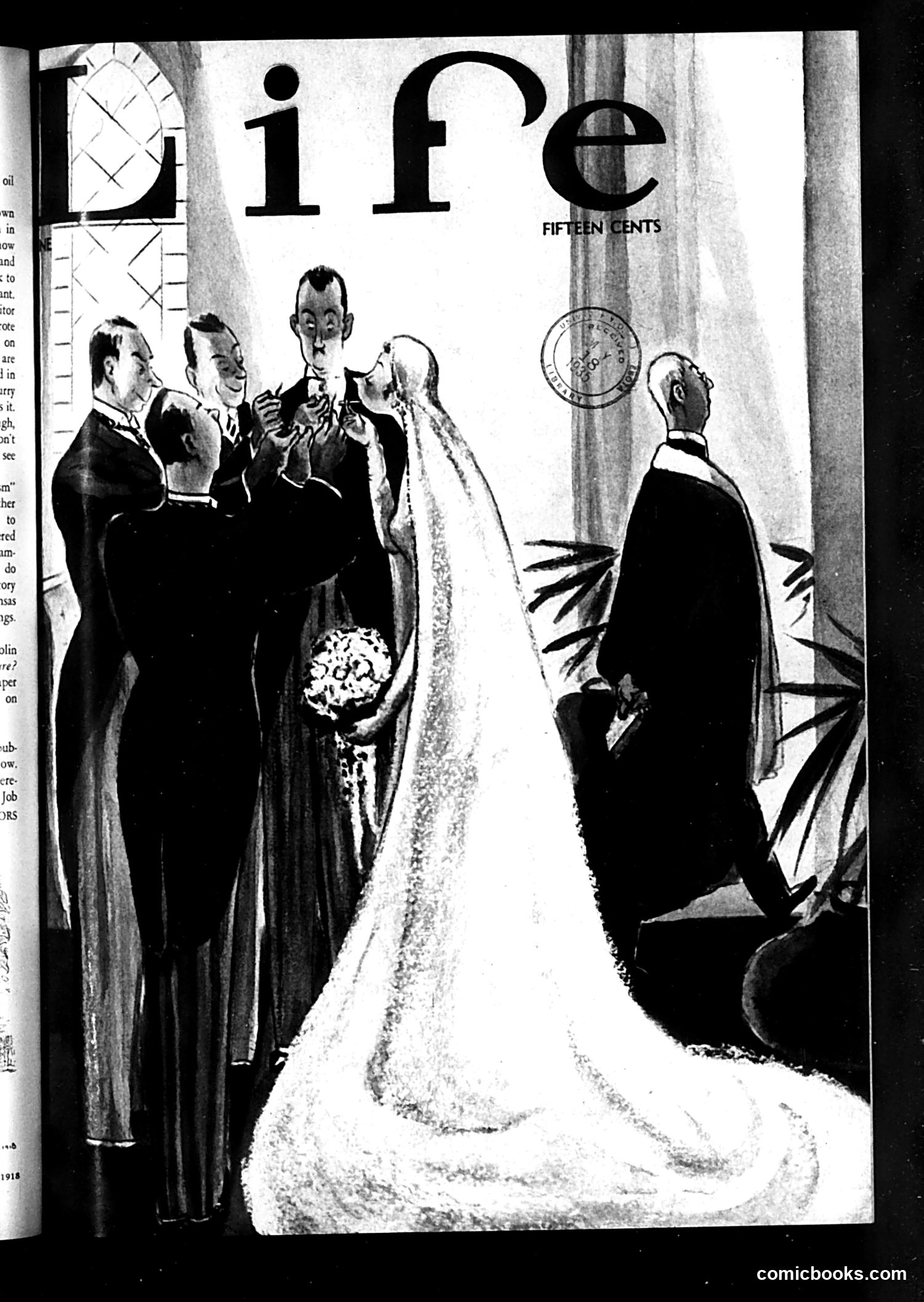
Life Magazine Cover Analysis This is a Life magazine cover (priced at fifteen cents) depicting a wedding scene. A bride in a long white gown with trailing veil stands at the altar surrounded by formally dressed men in dark suits. One man on the right appears to be a clergyman or official conducting the ceremony. The satire likely comments on marriage or a significant social/political union of the era, though without additional context from the magazine's date or text, the specific figures and event being referenced remain unclear. The formal, somewhat austere composition and the prominent positioning of the bride suggests this is satirizing a notable wedding, possibly involving public figures. The exact political or social commentary cannot be determined from the image alone.
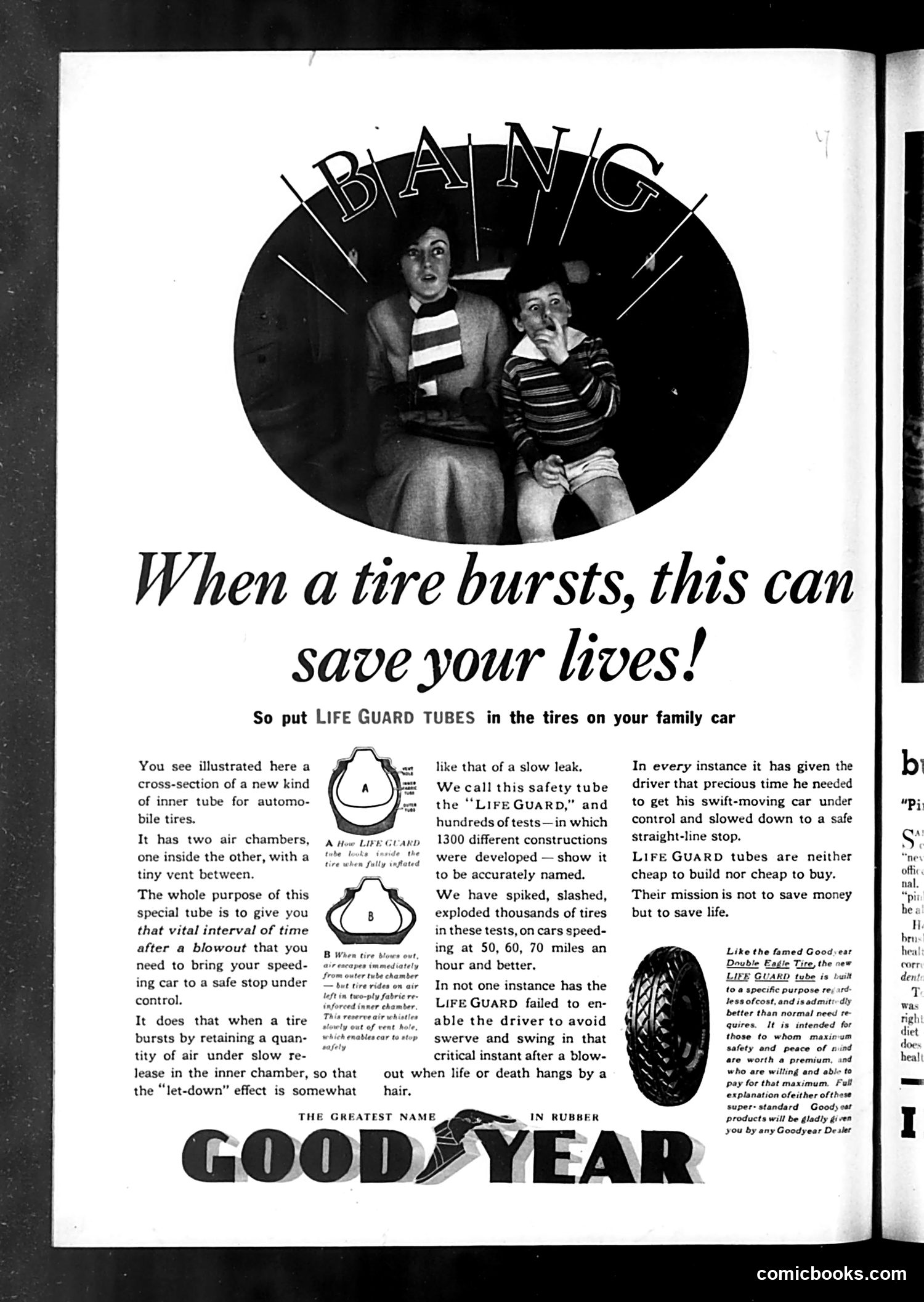
Analysis This is a Goodyear tire advertisement, not a political cartoon. The page promotes "Life Guard Tubes," a safety inner tube designed to prevent rapid tire deflation during blowouts. The image shows a woman and child in a circular frame labeled "BAING" (likely "BAILING"), illustrating a dangerous situation. The advertisement's pitch: when a tire bursts, the Life Guard tube's dual air chambers allow gradual pressure loss instead of sudden failure, giving drivers time to safely stop rather than lose control at high speed. The text emphasizes this is a safety feature, not a cost-saving one—explicitly stating Life Guard tubes are "neither cheap to build nor cheap to buy." The appeal is to family protection: avoiding the life-or-death scenarios of uncontrolled tire failure.
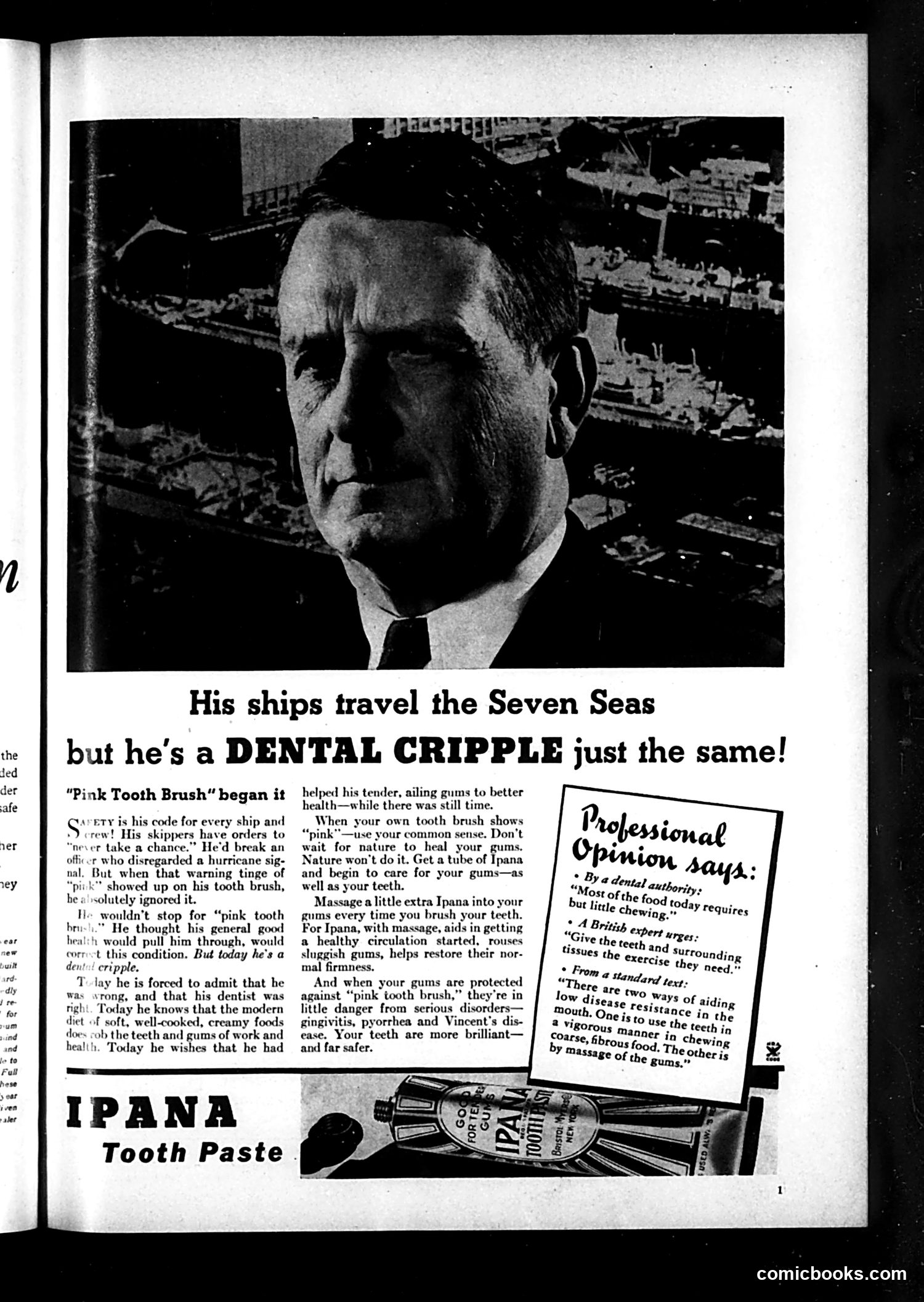
Analysis This is primarily an advertisement for Ipana Tooth Paste, not political satire. The page features a photograph of a stern-faced man (identity unclear from the image alone) with the headline "His ships travel the Seven Seas but he's a DENTAL CRIPPLE just the same!" The ad uses humorous contrast: despite commanding a shipping fleet—suggesting success and authority—the man suffers from poor dental health. The copy explains how "Pink Tooth Brush" (Ipana's branded brush) helps address gum disease through massage and better oral hygiene. The "Professional Opinions" box includes endorsements from dental authorities supporting the product's claims about gum care and tooth health. This reflects early-20th-century advertising's tendency to undermine confident figures' authority by exposing personal health vulnerabilities, using shame as a sales tactic.
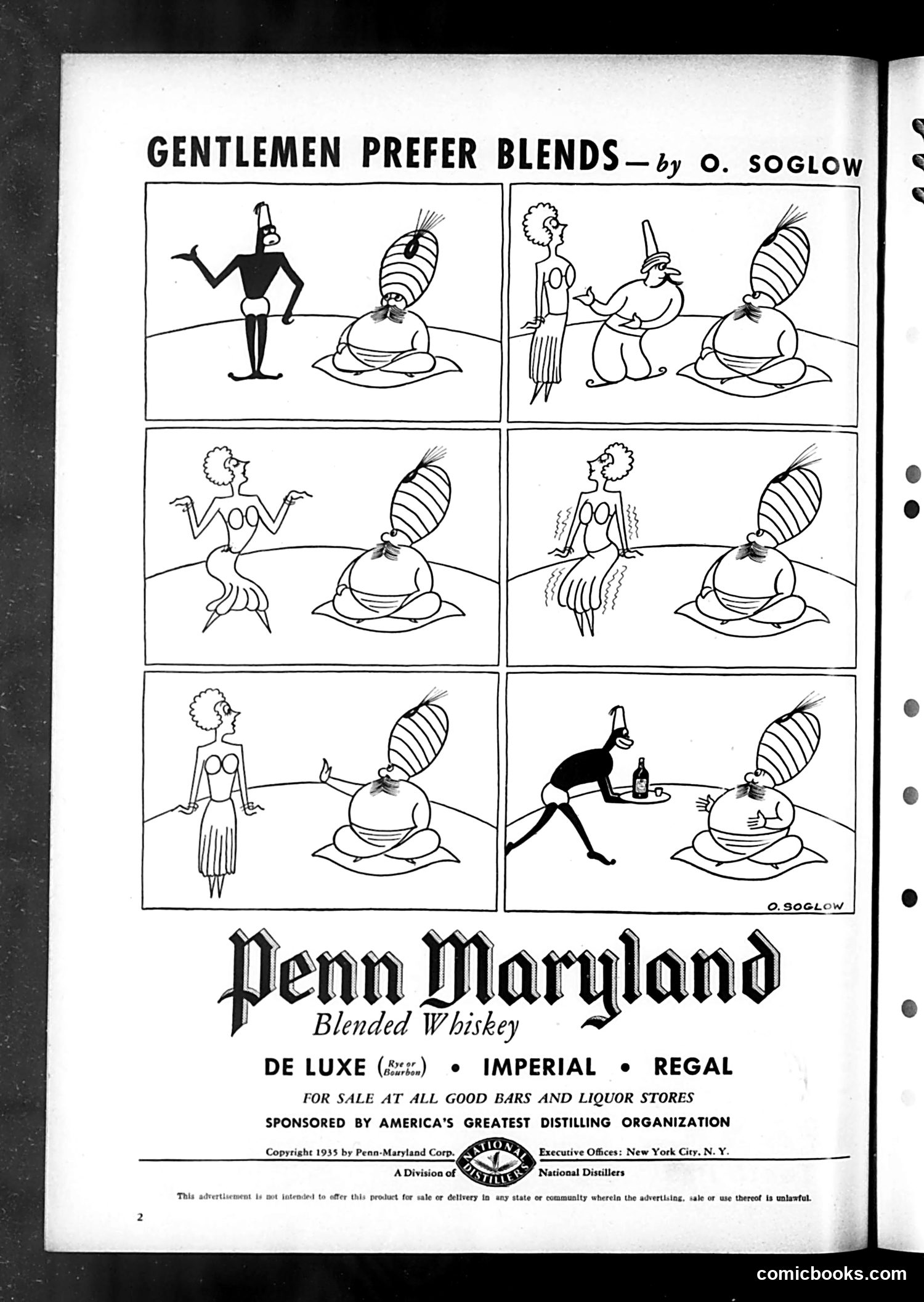
Penn Maryland Blended Whiskey Advertisement This is a 1933 whiskey advertisement by cartoonist O. Soglow titled "Gentlemen Prefer Blends." The six-panel comic shows a rotund man with a beehive-shaped head representing different whiskey blends, interacting with various women in different poses and situations—dancing, gesturing, sitting passively. The joke plays on the 1925 Anita Loos novel/film "Gentlemen Prefer Blondes," substituting "blends" (whiskey blends) for "blondes." It suggests that men prefer blended whiskey just as they prefer blondes—presented here through the women's varied, somewhat objectifying poses around the central male figure. The advertisement ran post-Prohibition repeal (note the 1933 copyright), marketing Penn Maryland whiskey through humor and sexual innuendo typical of the era's advertising approach.
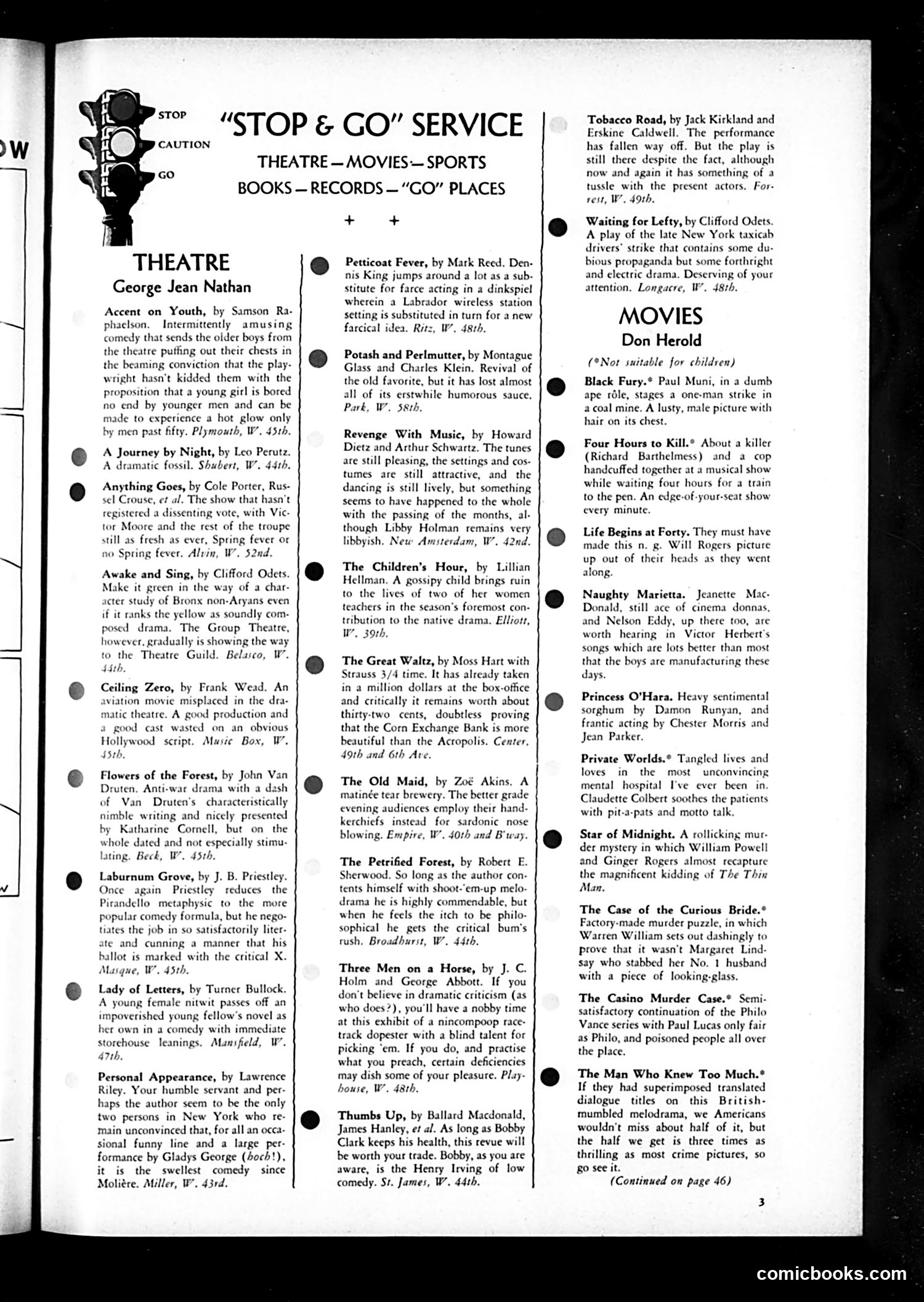
"Stop & Go" Service Page This page is primarily a theater and movie review section rather than political satire. The masthead features a traffic light symbol—the "Stop & Go" metaphor organizing entertainment reviews by recommendation level. The reviews critique Broadway plays (like "Accent on Youth," "Petticoat Fever") and films (including "Black Fury," "Four Hours to Kill"). The traffic light device humorously applies traffic-control concepts to entertainment: green light = recommended, yellow = caution/mixed, red = avoid. This is a consumer guide format typical of Life magazine's satirical approach—using visual wit (the traffic signal) to evaluate popular culture rather than political commentary. The page reflects 1930s theater and cinema landscape through contemporary critical assessment.
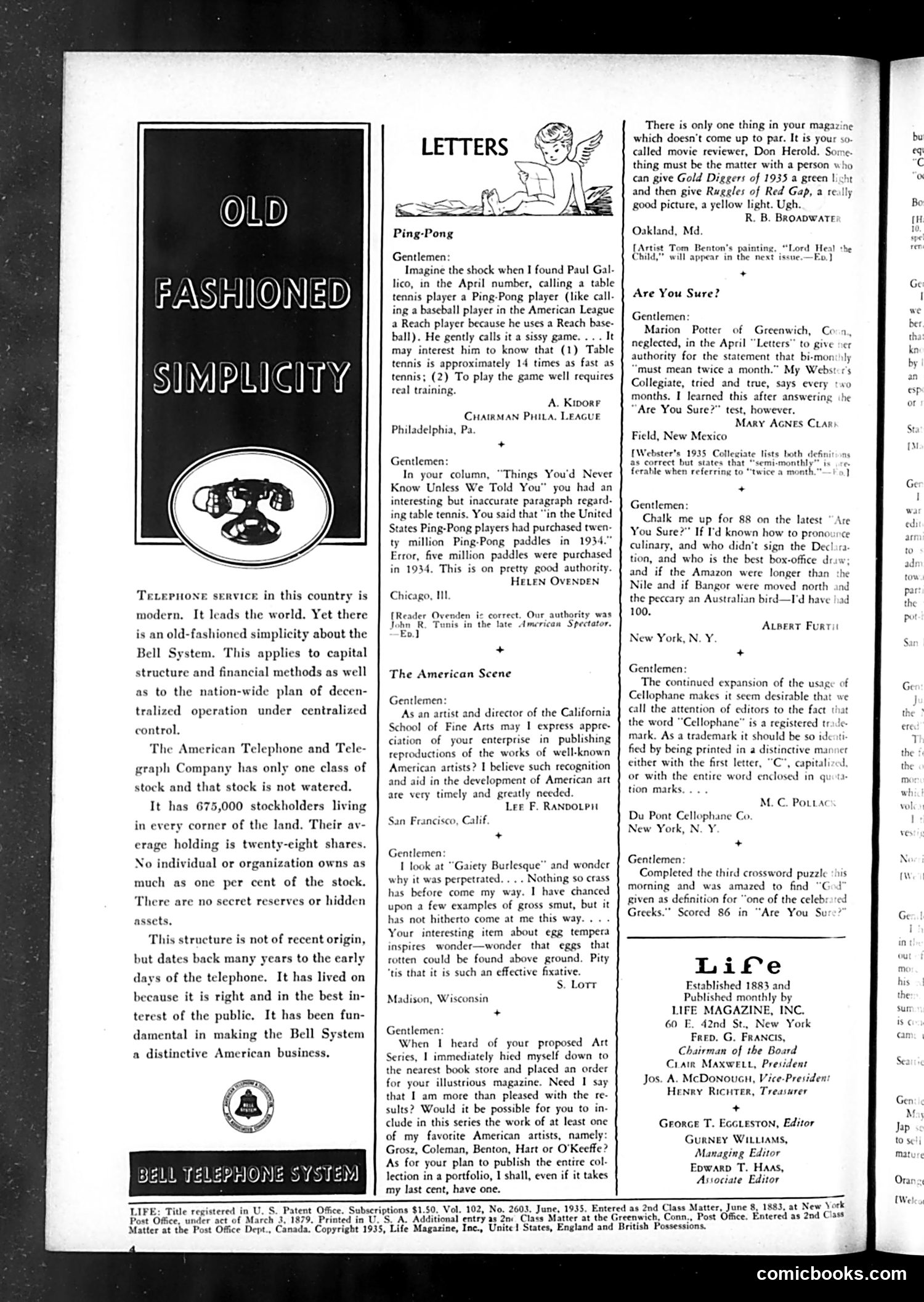
Analysis of Life Magazine Page (June 1935) This page consists primarily of a letters section and editorial/corporate information, not political cartoons. The main visual element is a Bell Telephone System advertisement featuring "Old Fashioned Simplicity"—an old rotary telephone shown in a decorative oval frame. The ad's irony is its central message: despite appearing antiquated, the Bell System's structure represents modern efficiency through "centralized control" and transparent corporate governance (no "secret reserves"). It's essentially praising the telephone monopoly's stability and public trustworthiness to potential investors. The letters discuss ping-pong, art recognition, and crossword puzzles—typical reader correspondence. There's no political satire evident on this particular page.
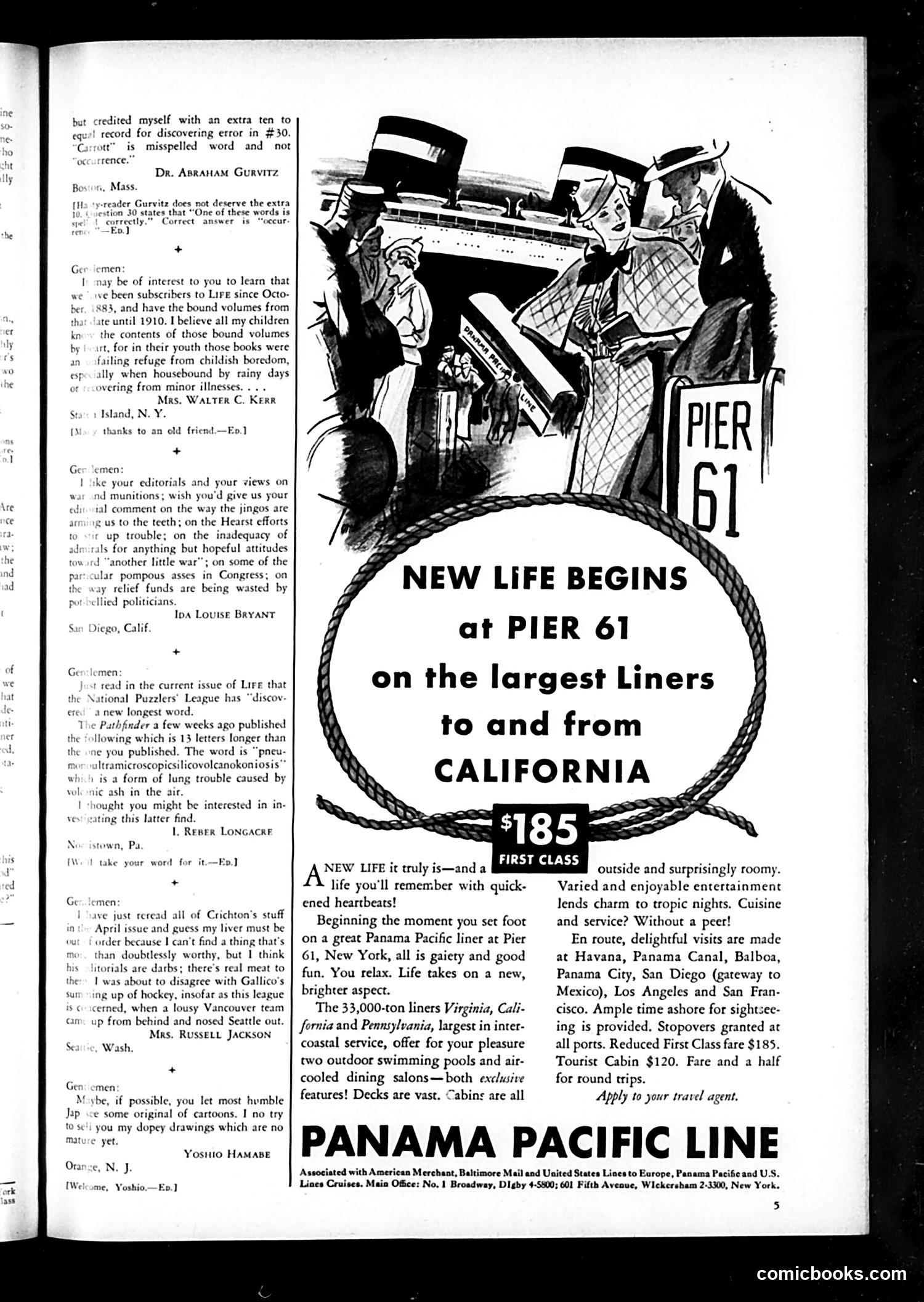
Content Summary This page consists primarily of reader letters and advertisements rather than editorial cartoons or satire. The left column contains correspondence from readers discussing *Life* magazine content, including references to puzzles and previous articles. The right side features a full-page advertisement for the Panama Pacific Line's ocean liner service to California. The ad depicts passengers boarding at "Pier 61" with luggage and top hats, promoting luxury voyage amenities: swimming pools, dining salons, and ports including Havana, Panama Canal, and San Francisco. First-class passage costs $185. This reflects the era's emphasis on steamship travel as premium transportation and entertainment—before commercial aviation dominated long-distance travel. The advertisement targets affluent readers seeking leisure voyages.
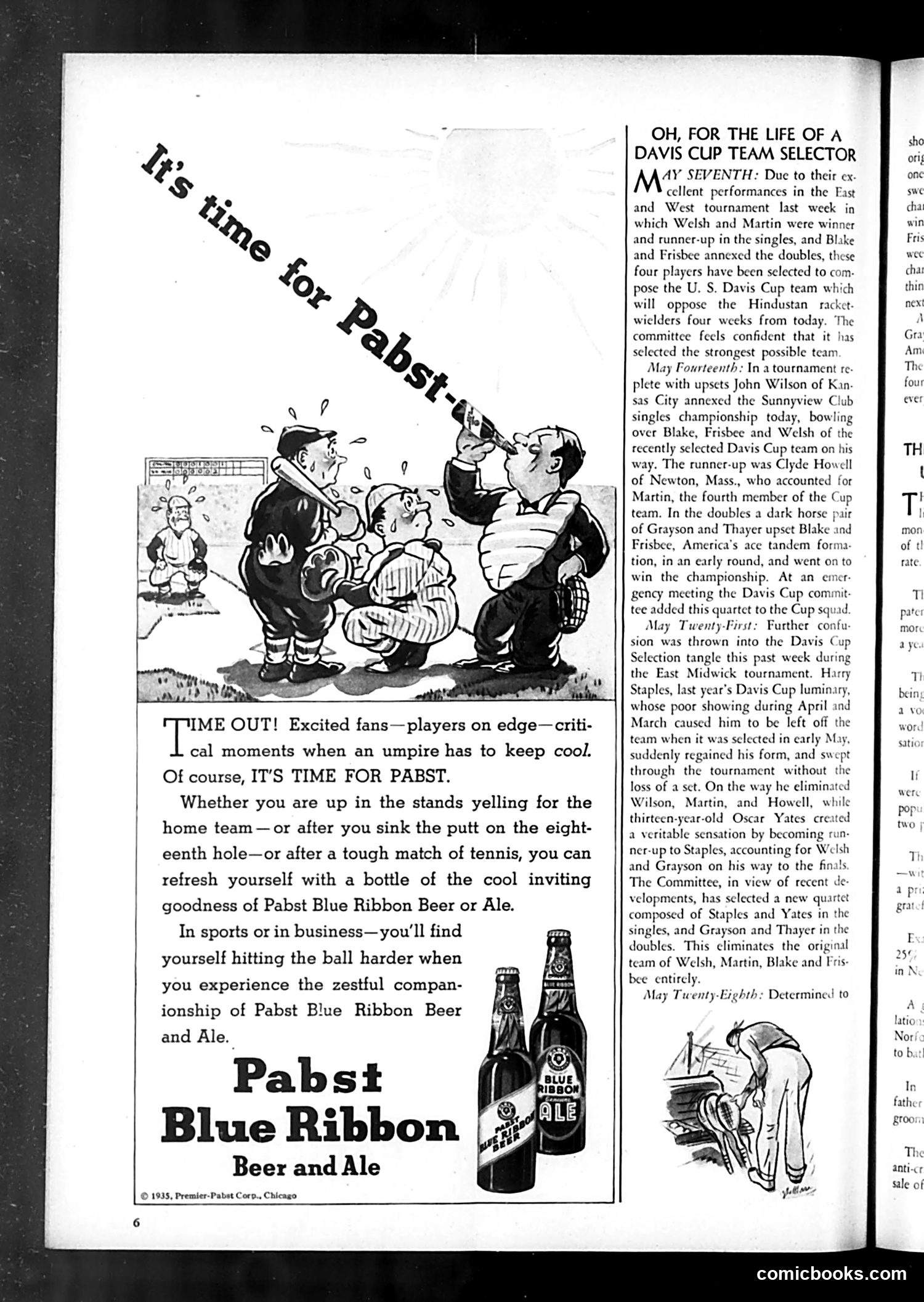
Analysis This page is primarily a Pabst Blue Ribbon Beer advertisement (1935, per copyright mark) rather than political satire. The left side features a sports-themed cartoon showing excited fans and players in heated moments—baseball, golf, and tennis contexts are referenced. The ad's message: drinking Pabst helps you "keep cool" during intense sporting moments and competitive situations. The right column contains a Davis Cup tennis article discussing U.S. team selection controversies. The text describes disputes over choosing four players for the Davis Cup team, with various tournament results and player performances detailed. The small cartoon at bottom right appears unrelated—possibly a maritime or fishing scene sketch. The page blends advertisement with sports journalism—a common 1930s magazine format.
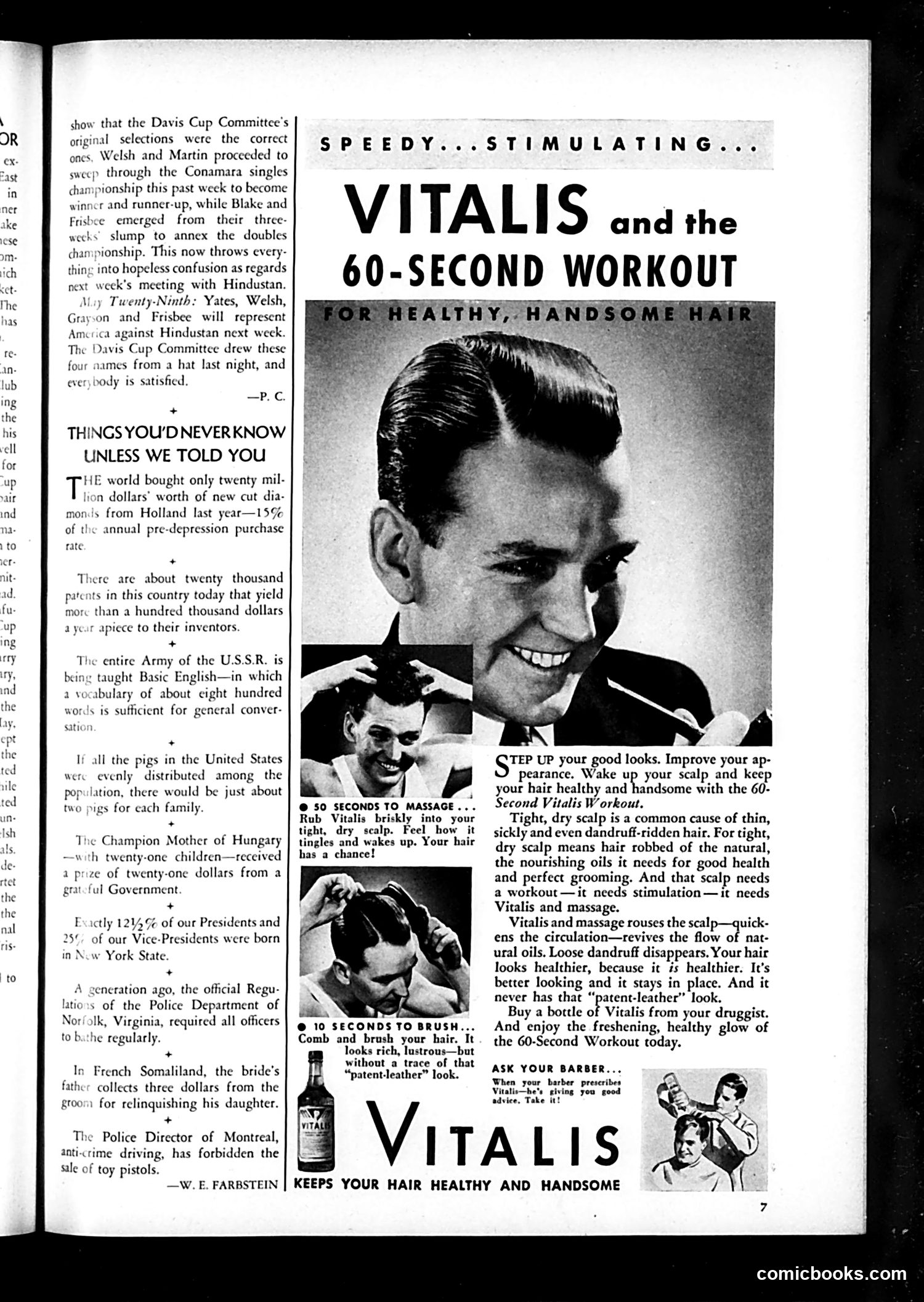
Content Analysis This page is primarily a Vitalis hair product advertisement, not political satire. The large right-side ad promotes Vitalis with a "60-Second Workout" for hair health through scalp massage and brushing. The left column contains a miscellaneous section titled "THINGS YOU'D NEVER KNOW UNLESS WE TOLD YOU"—a recurring Life magazine feature of quirky facts and observations. These include trivia about diamond purchases, patents, Army language training, pig distribution, Hungary's government payments, U.S. Presidents' birthplaces, and Montreal police policy. No political cartoon or satire is present. This is a standard magazine page mixing editorial filler with commercial advertising, typical of mid-20th century American periodicals. The Vitalis ad reflects period grooming standards emphasizing healthy, well-maintained hair as a marker of masculine appearance.
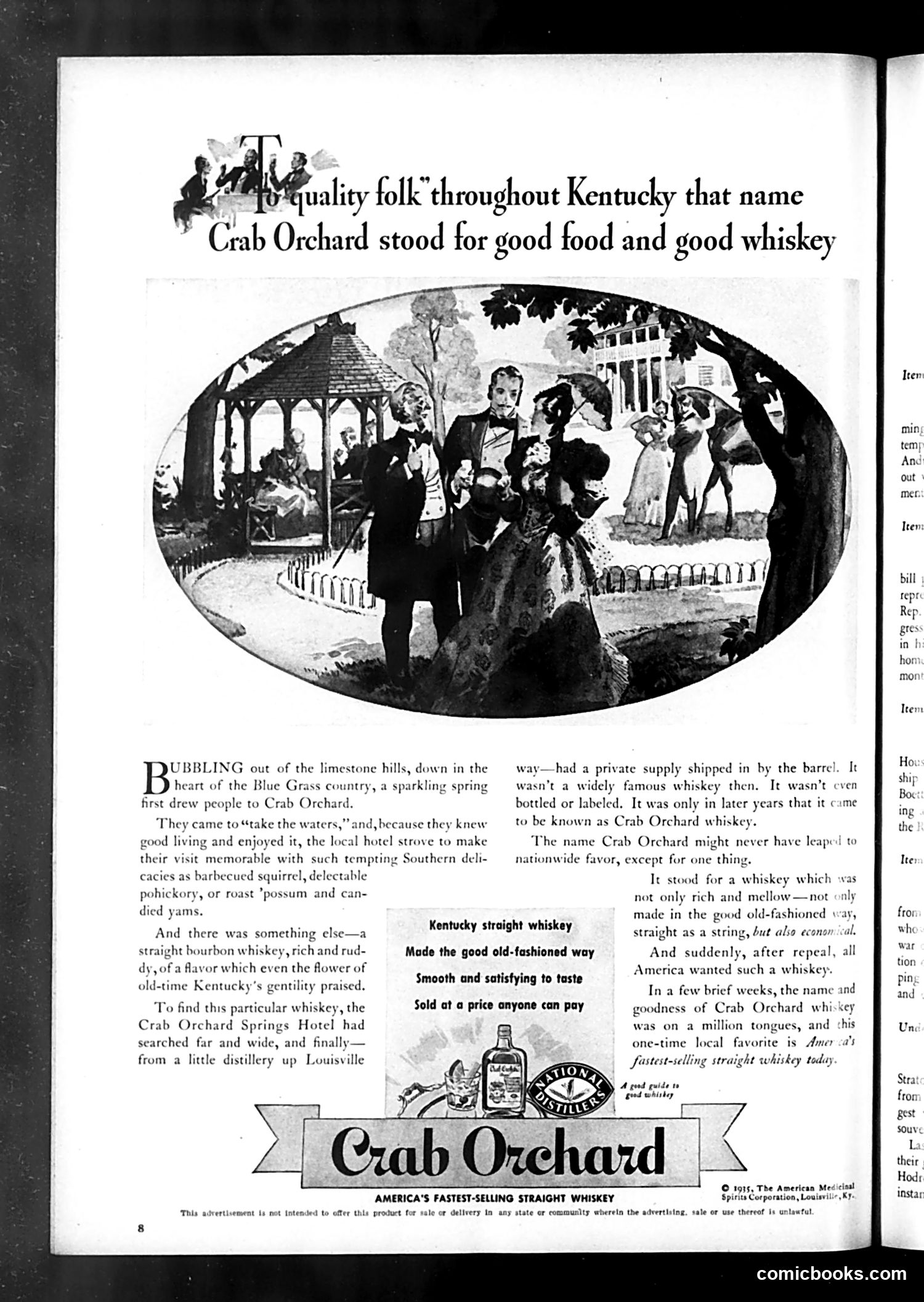
Crab Orchard Whiskey Advertisement This is a whiskey advertisement, not political satire. The page promotes Crab Orchard whiskey, "America's fastest-selling straight whiskey." The illustration depicts an elegant social gathering in Kentucky's Blue Grass country, showing well-dressed figures at what appears to be a garden party near a gazebo. The narrative explains that the whiskey gained popularity through word-of-mouth among quality-conscious Kentuckians who appreciated both "good food and good whiskey." The ad emphasizes the product's appeal: it's "smooth and satisfying to taste" and "sold at a price anyone can pay," positioning it as affordable quality. The text notes the brand became "America's fastest-selling straight whiskey" after achieving rapid regional popularity. This represents early 20th-century lifestyle advertising targeting middle and upper-class consumers.
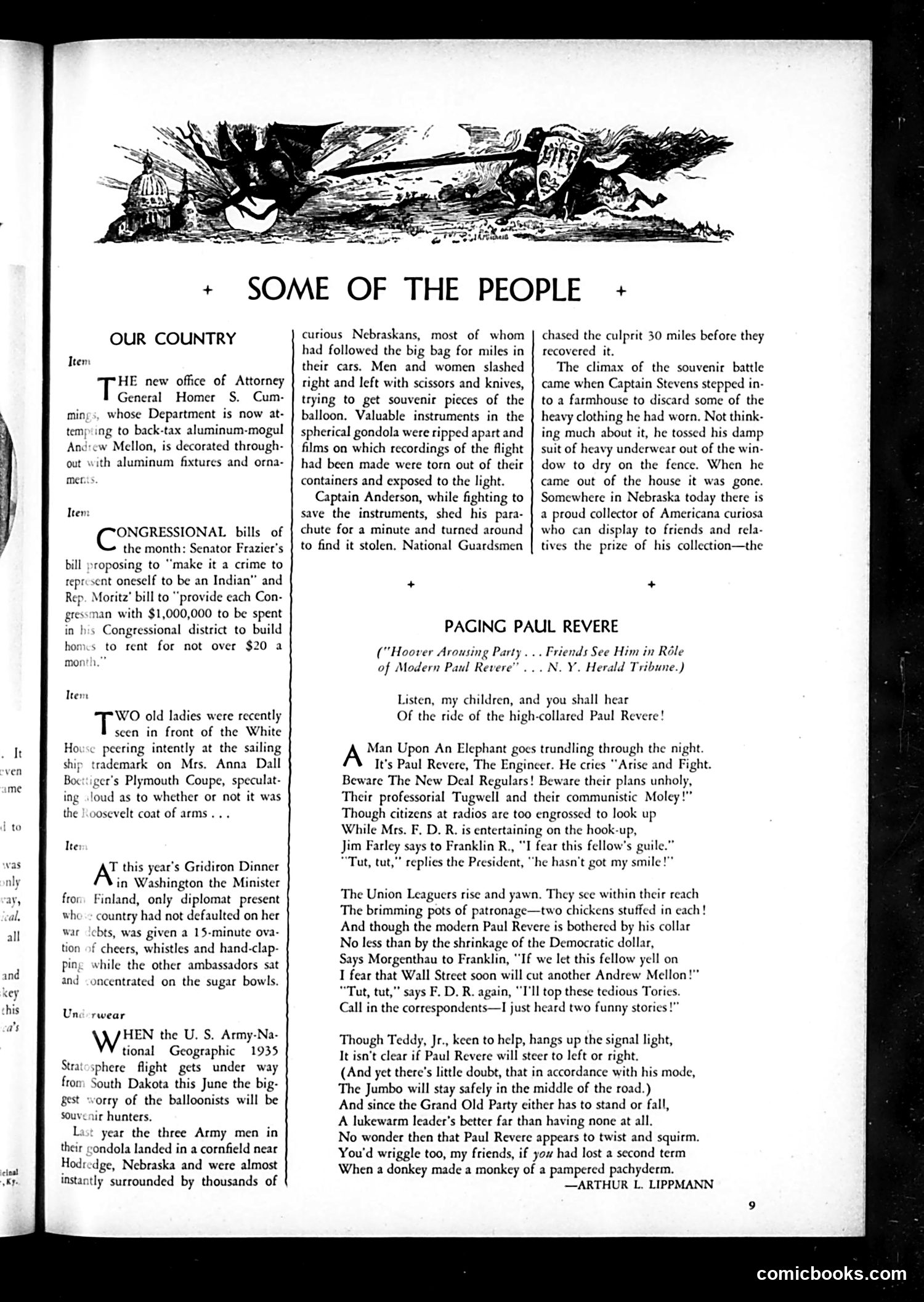
Analysis of "Some of the People" - Life Magazine Page This page contains political commentary and humor about contemporary events. The left column discusses recent news items: Attorney General Homer Cummings' new office decorations, Congressional bills (including one by Senator Frazier and Rep. Moritz), and anecdotes about White House visitors and a Gridiron Dinner. The main feature is "Pacing Paul Revere," a satirical poem by Arthur L. Lippmann mocking Paul Revere as a modern figure warning about the New Deal administration. The poem attacks Roosevelt's policies and cabinet members (Tugwell, Moley, and others), presenting them as threats. This reflects conservative criticism of FDR's New Deal programs during the 1930s Depression era. The satire targets New Deal supporters and government initiatives as dangerous innovations.
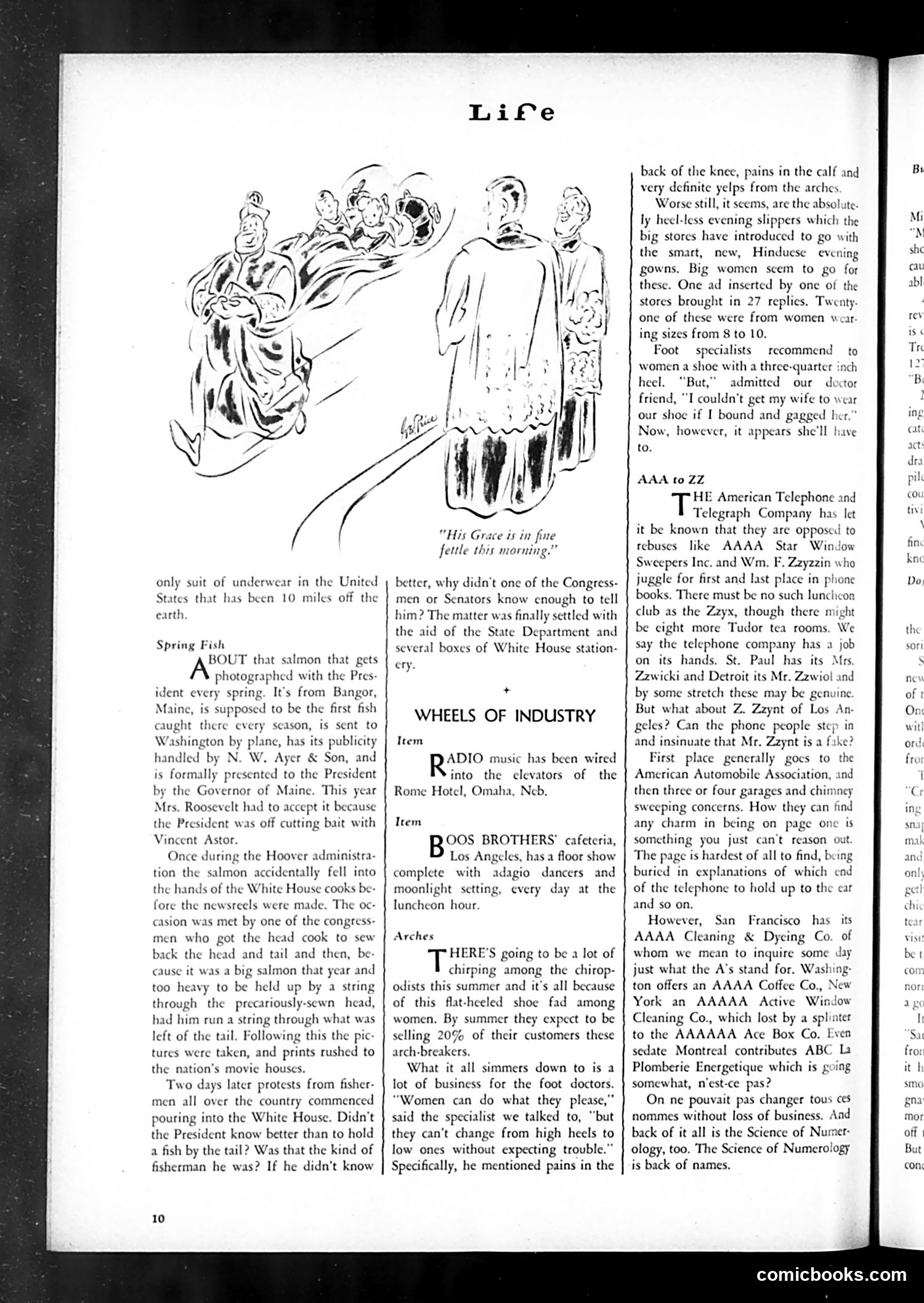
Analysis of Life Magazine Page This page contains miscellaneous satirical items rather than a single cartoon. The main illustration shows a figure labeled "His Grace is in fine fettle this morning," depicting what appears to be an elegantly dressed person surrounded by attendants or admirers—likely satirizing someone of high social status or political prominence, though the specific individual is unclear from the image alone. The text sections ridicule various absurdities: hemlines on women's shoes from big stores (sizes 8-10), the American Telephone & Telegraph Company's supposed opposition to unusual names (listing people with names like "Zzyzzyn"), and chiropodists' business booming due to poor shoe design. The satire targets consumer culture, corporate bureaucracy, and fashion industry excesses typical of Life's early 20th-century commentary.
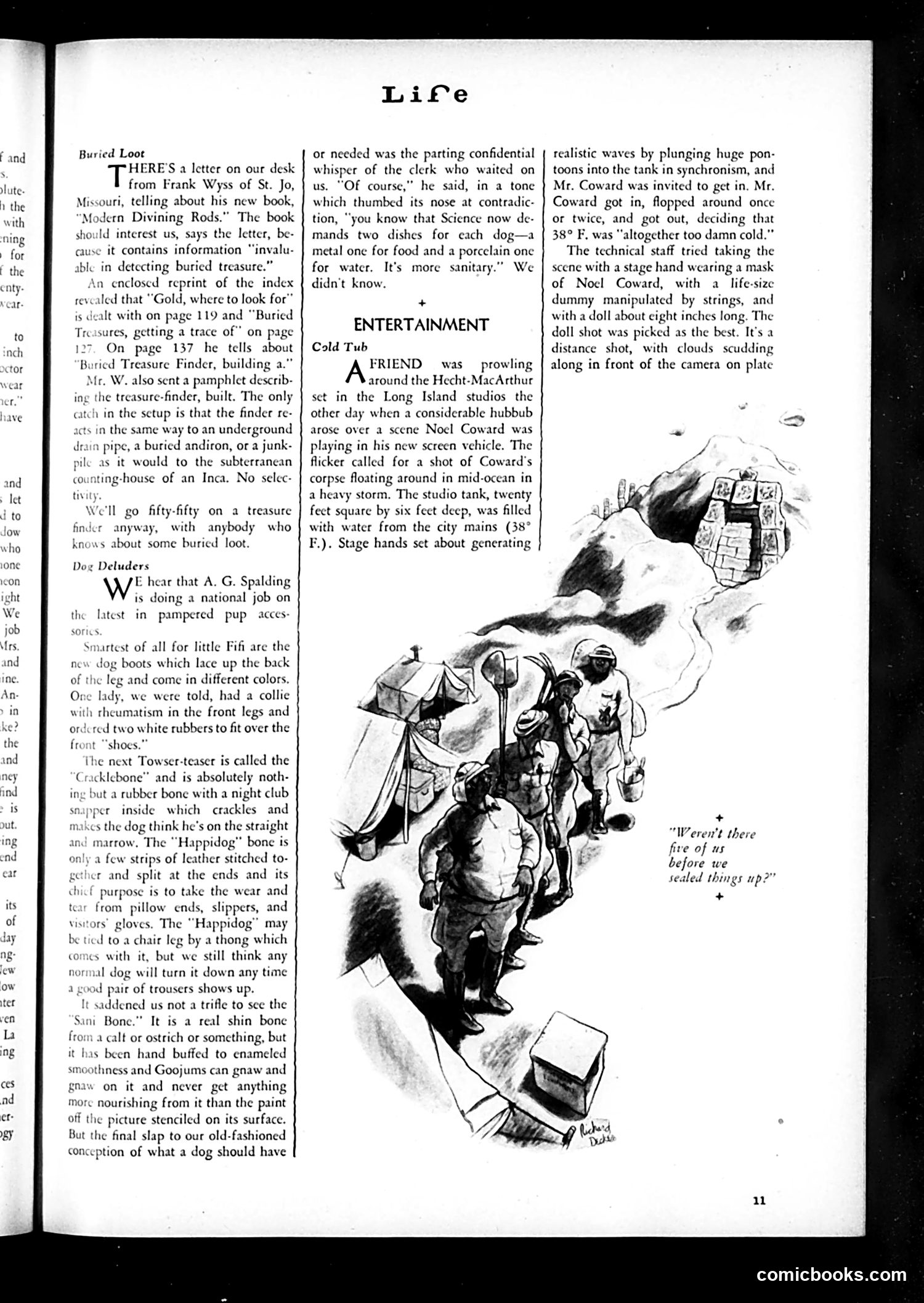
"Cold Tub" Entertainment Section This illustration depicts a film production scene at the Hecht-MacArthur set in the Long Island studios. The cartoon shows a movie crew filming an elaborate water tank sequence featuring actor Noel Coward in a new screen vehicle. The studio tank measures twenty feet square by six feet deep, filled with water from the city mains at 38°F. The satire mocks Hollywood's extravagant production methods: the massive apparatus required to film a simple scene of "Coward's corpse floating around in mid-ocean in a heavy storm." The contrast between the huge technical infrastructure and the modest narrative outcome—a dead body in water—illustrates the absurdity of film industry excess and overproduction for minimal dramatic effect.
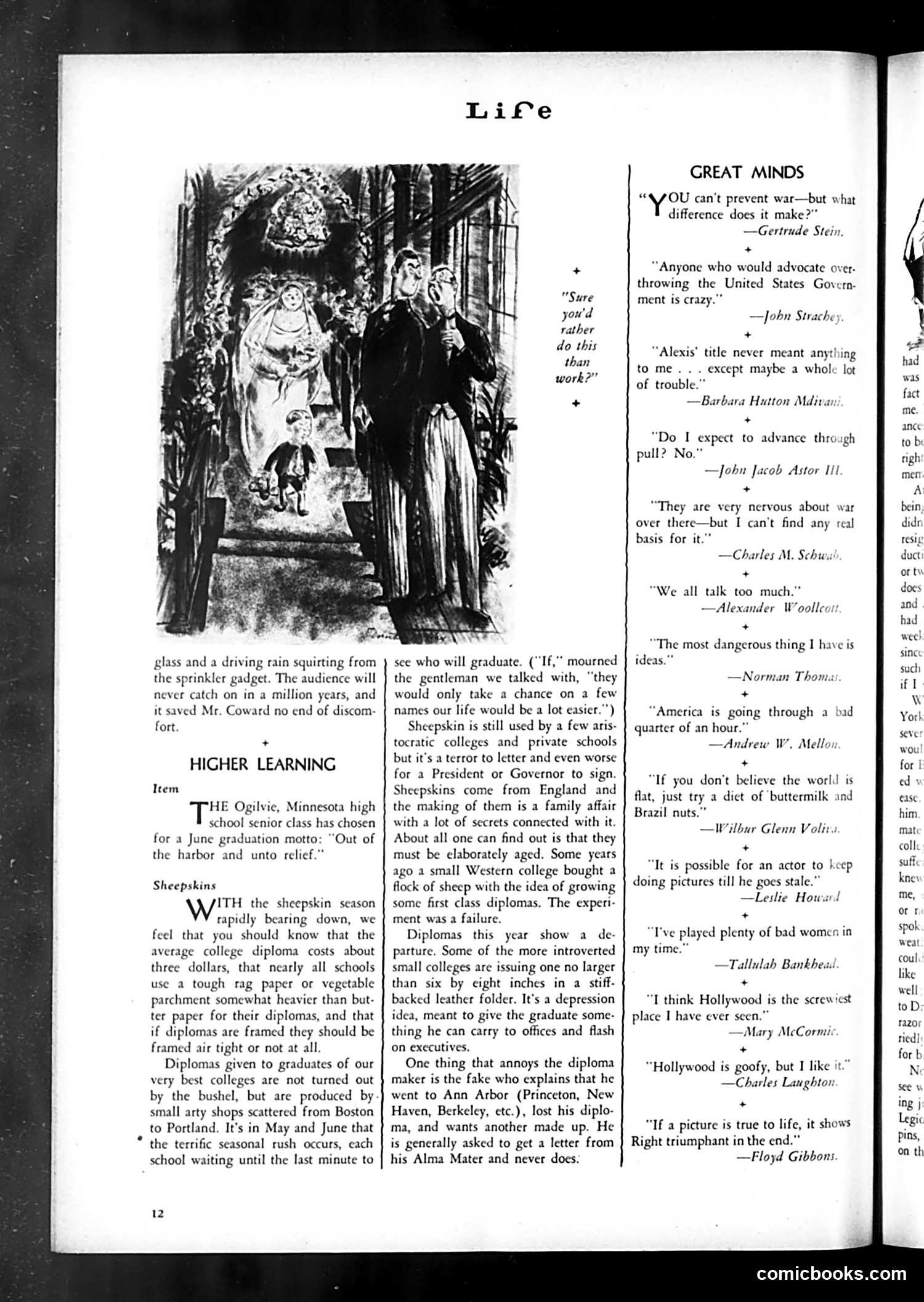
Analysis The main illustration shows two formally dressed men in what appears to be an ornate interior, with one asking the other: "Sure you'd rather do this than work?" This cartoon satirizes sheepskin diplomas—the section heading explains the joke. The text describes how college diplomas have become cheapened: they're mass-produced by small art shops scattered from Boston to Portland rather than being individually crafted. The satire targets how graduates pay considerable money for diplomas that look impressive but lack authenticity or meaning. The cartoon's implication is sharp: obtaining a diploma has become merely a purchased credential rather than evidence of genuine learning or accomplishment. The questioner's jab—suggesting diploma-shopping is preferable to actual work—highlights the hollow nature of this educational shortcut during an era when diploma fraud apparently concerned the magazine's readers.
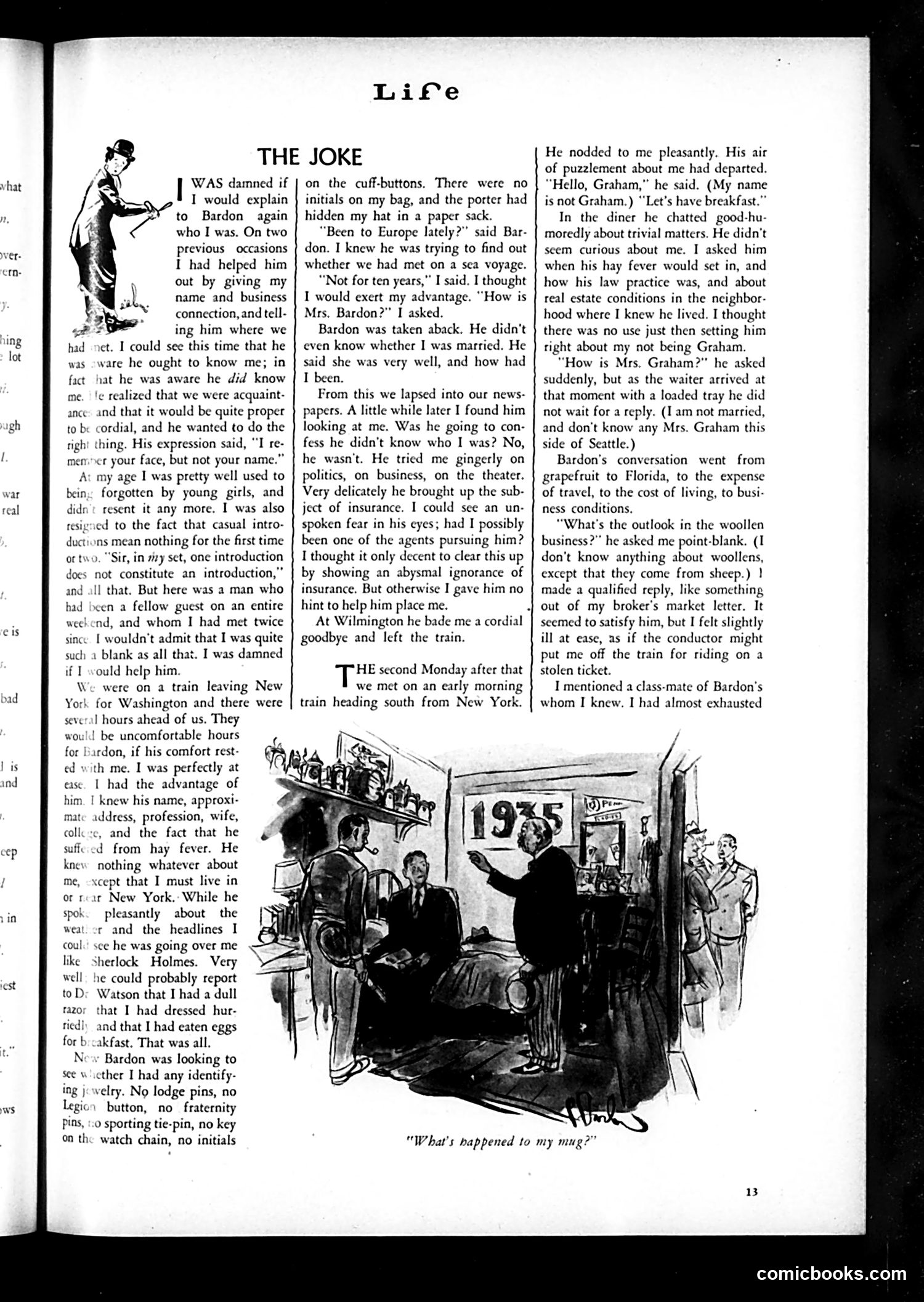
"The Joke" - Life Magazine Cartoon Analysis This page presents a humorous short story about mistaken identity on a train. The narrator helps a stranger named Bardon, who is traveling to Washington. Bardon, not recognizing the narrator despite their previous acquaintance, quizzes him extensively about his life to identify him—asking about his business, wife, insurance, and other personal details. The cartoon illustrates the punchline: the narrator later discovers his bag was switched with Bardon's on the train. The humor lies in the irony that while Bardon was trying to identify the narrator through interrogation, he unknowingly created the very confusion he was investigating by mixing up their belongings—a classic comedic case of overlooking an obvious solution while overcomplicating the problem.
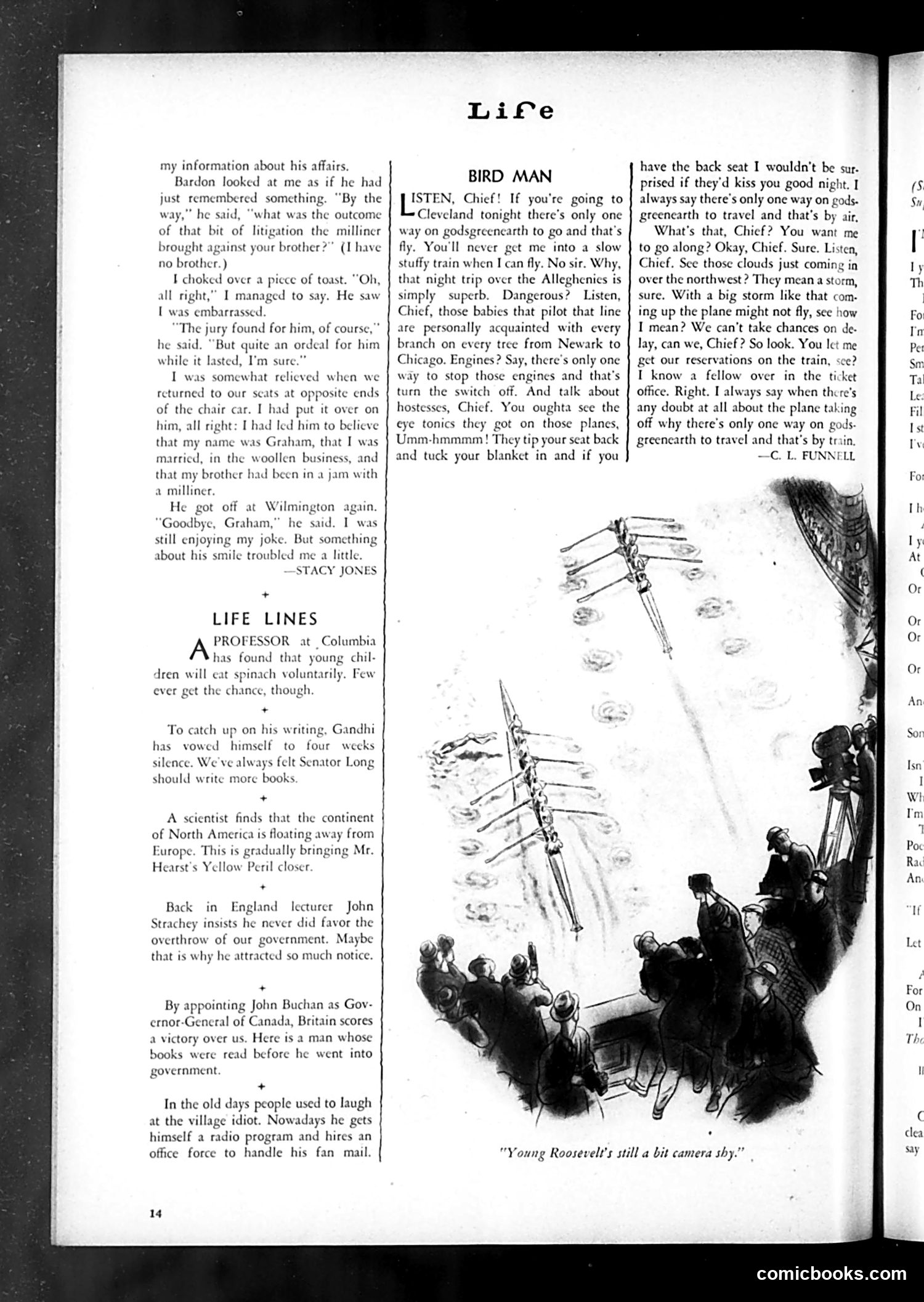
Analysis of Life Magazine Page This page contains a satirical piece titled "Bird Man" by C.L. Flannell, mocking someone (likely a public figure) who gives overly cautious travel advice. The speaker warns a "Chief" about airplane dangers—storm clouds, engine failures—with obsessive detail about seat locations and blankets, suggesting neurotic anxiety about flying. The accompanying illustration shows a cameraman and film crew in a precarious airplane setup, with the caption "Young Roosevelt's still a bit camera shy," indicating the satire targets Franklin D. Roosevelt or a Roosevelt family member's relationship with media and public appearances. The "Life Lines" section below offers brief social commentary on various topics including education and government, typical of the magazine's format.
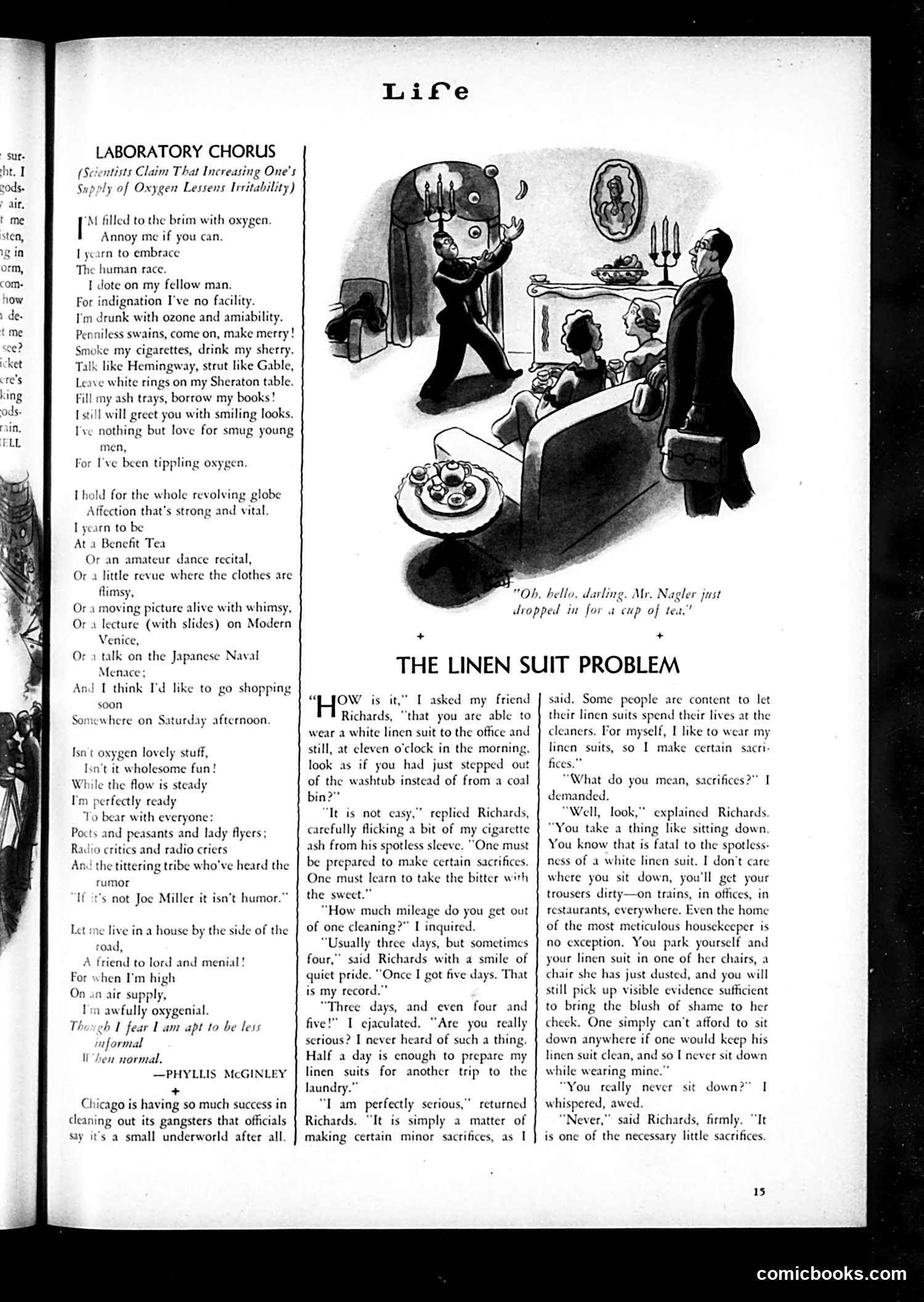
Analysis: "The Linen Suit Problem" This page contains a humorous article about men's practical clothing challenges, specifically maintaining white linen suits for office wear. The accompanying cartoon illustrates a domestic scene where a man in formal attire appears distressed while interacting with household staff or family members. The satire targets upper-middle-class male vanity and the contradiction between wanting to appear impeccably dressed while accepting that white linen inevitably becomes soiled through normal daily wear. Richards, the article's subject, learns from experience that maintaining pristine linen requires constant sacrifice—frequent cleanings and careful behavior. The joke reflects early 20th-century concerns about masculine respectability and the impractical nature of fashionable clothing for working men, mocking both the garment choice and society's expectations of appearance.
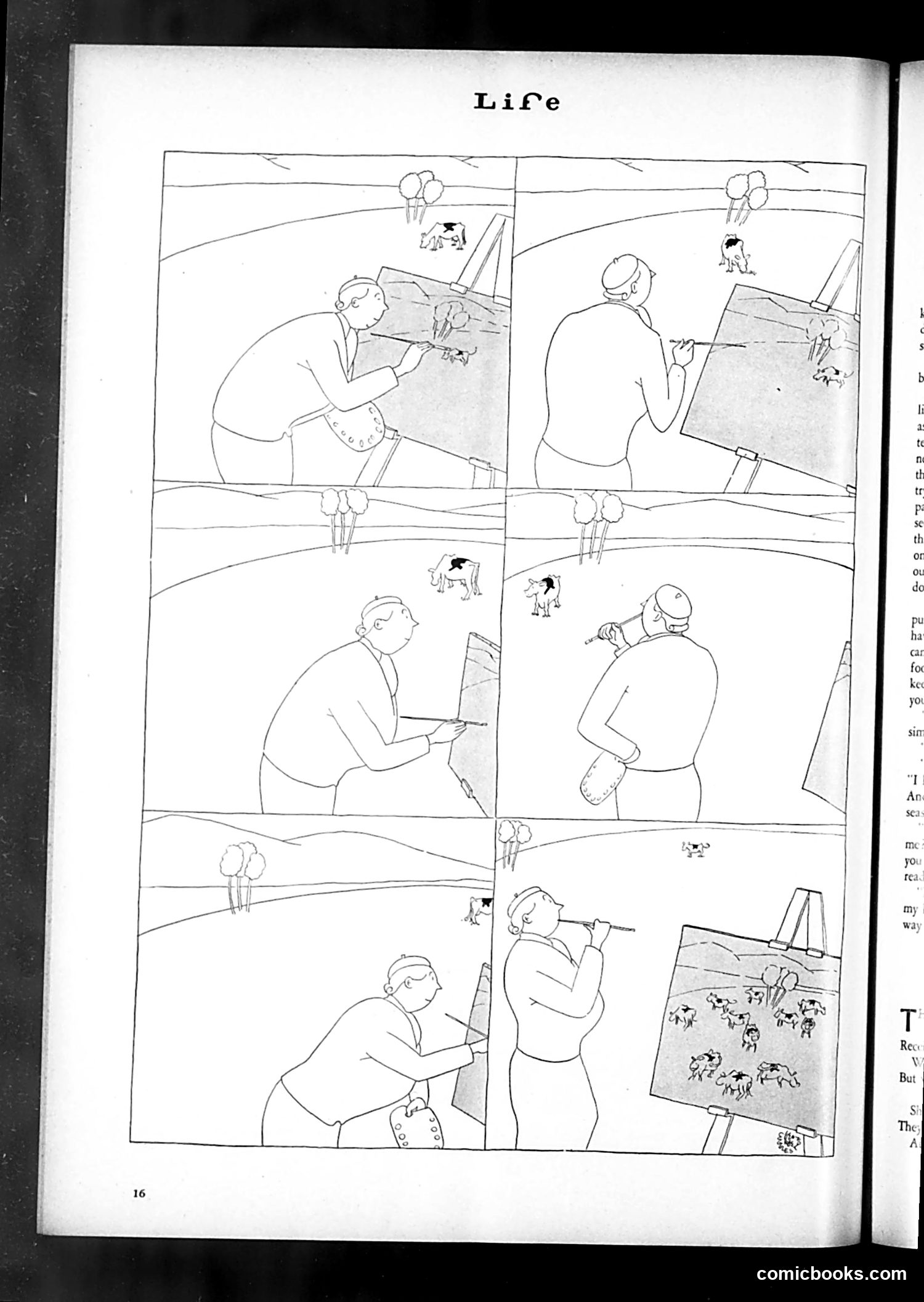
Analysis of "Life" Comic Page This page titled "Life" presents a six-panel comic strip showing a man attempting to paint a landscape scene. The sequence depicts his progressive frustration: he begins confidently setting up his easel and canvas by the seaside, sketches the basic composition, then becomes increasingly agitated as he works. By the final panels, he appears angry or exasperated, eventually abandoning the painting altogether. The satire targets amateur artists or Sunday painters—a common target of early 20th-century humor. The joke is that the idealized natural scenery he envisions cannot be captured through his modest artistic abilities, leading to mounting frustration. The comic mocks the gap between artistic ambition and execution among untrained enthusiasts.
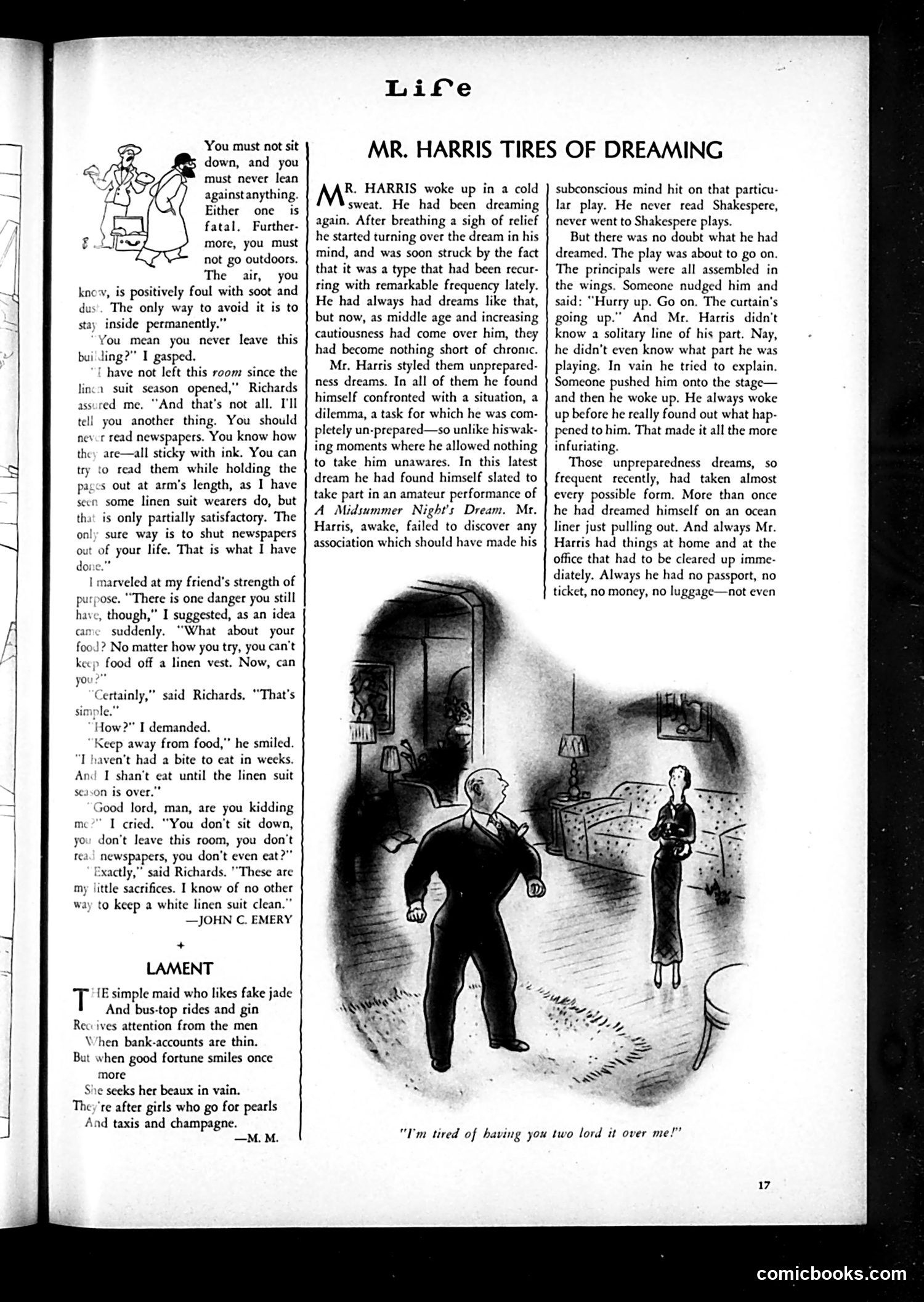
"Mr. Harris Tires of Dreaming" This story with accompanying illustration satirizes a middle-aged man trapped by anxiety and unpreparedness. Mr. Harris constantly dreams he's cast in amateur theatrical productions of *A Midsummer Night's Dream*—unprepared and panicked—reflecting his waking life anxieties about being unprepared for responsibilities. The cartoon shows Harris confronted by two figures (likely his wife and another person) in what appears to be a domestic scene. His distressed posture and their confrontational stance illustrate the satire's central joke: his perpetual state of unreadiness extends from his dreams into real life, where he's similarly unable to meet expectations at home and work. The piece humorously explores middle-class male anxiety about maintaining appearances and meeting social/domestic obligations.
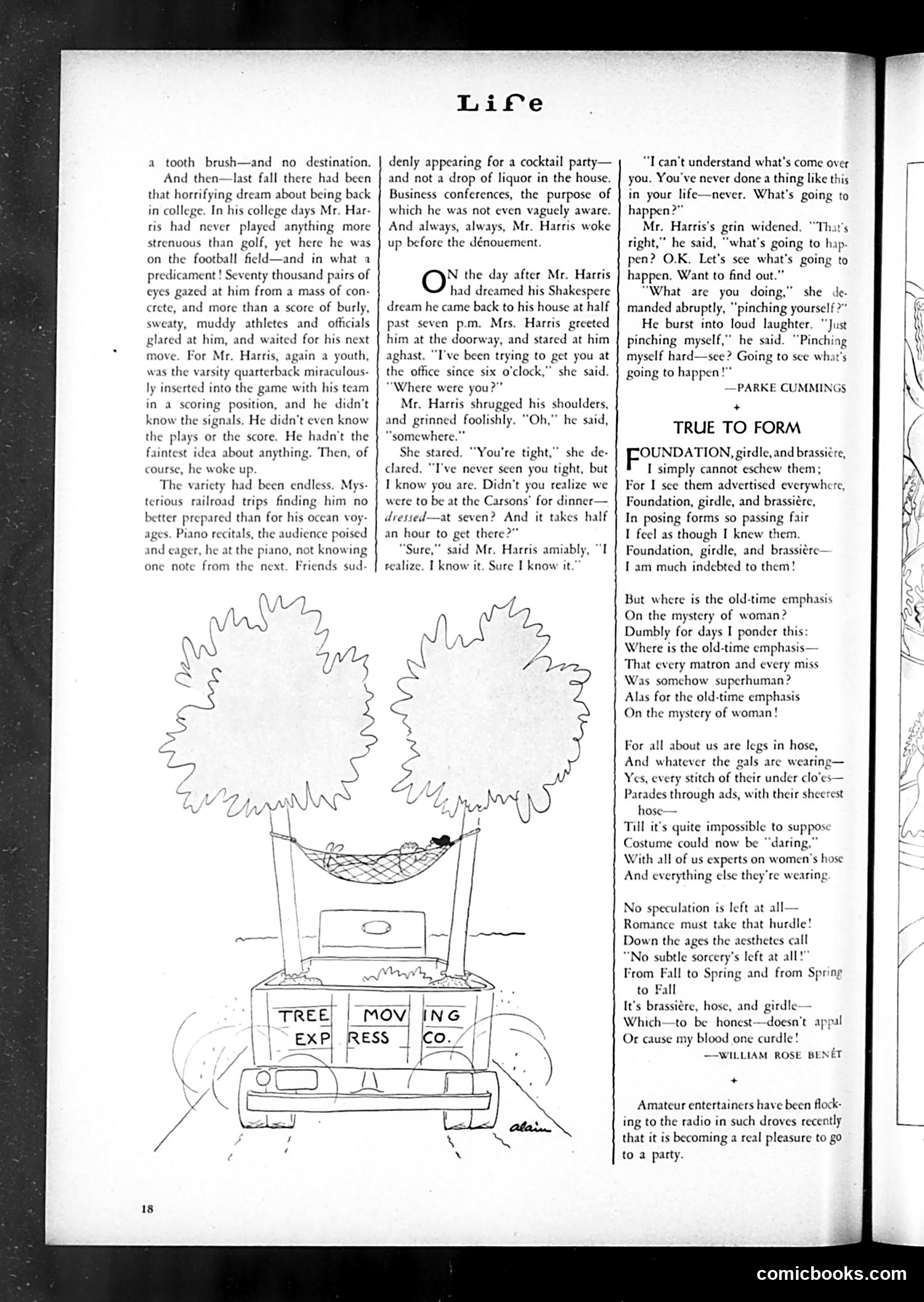
Analysis: Life Magazine Page This page contains a narrative story about Mr. Harris, a businessman who falls asleep at his desk and dreams of Shakespeare, then returns home to find his wife upset about his absence at a dinner party. The story satirizes the distracted modern husband prioritizing work over family obligations. The main cartoon shows a "Tree Moving Express Co." truck with an enormous tree (depicted with scribbled foliage) growing out of it—a visual gag about the absurdity of literally transporting trees via moving company. Below the story is a poem by William Rose Benét titled "True to Form," humorously lamenting women's fashion (brassieres, hose, girdles) and the loss of romantic mystery in modern times. It's satirical social commentary on 1920s-era femininity and changing courtship customs.
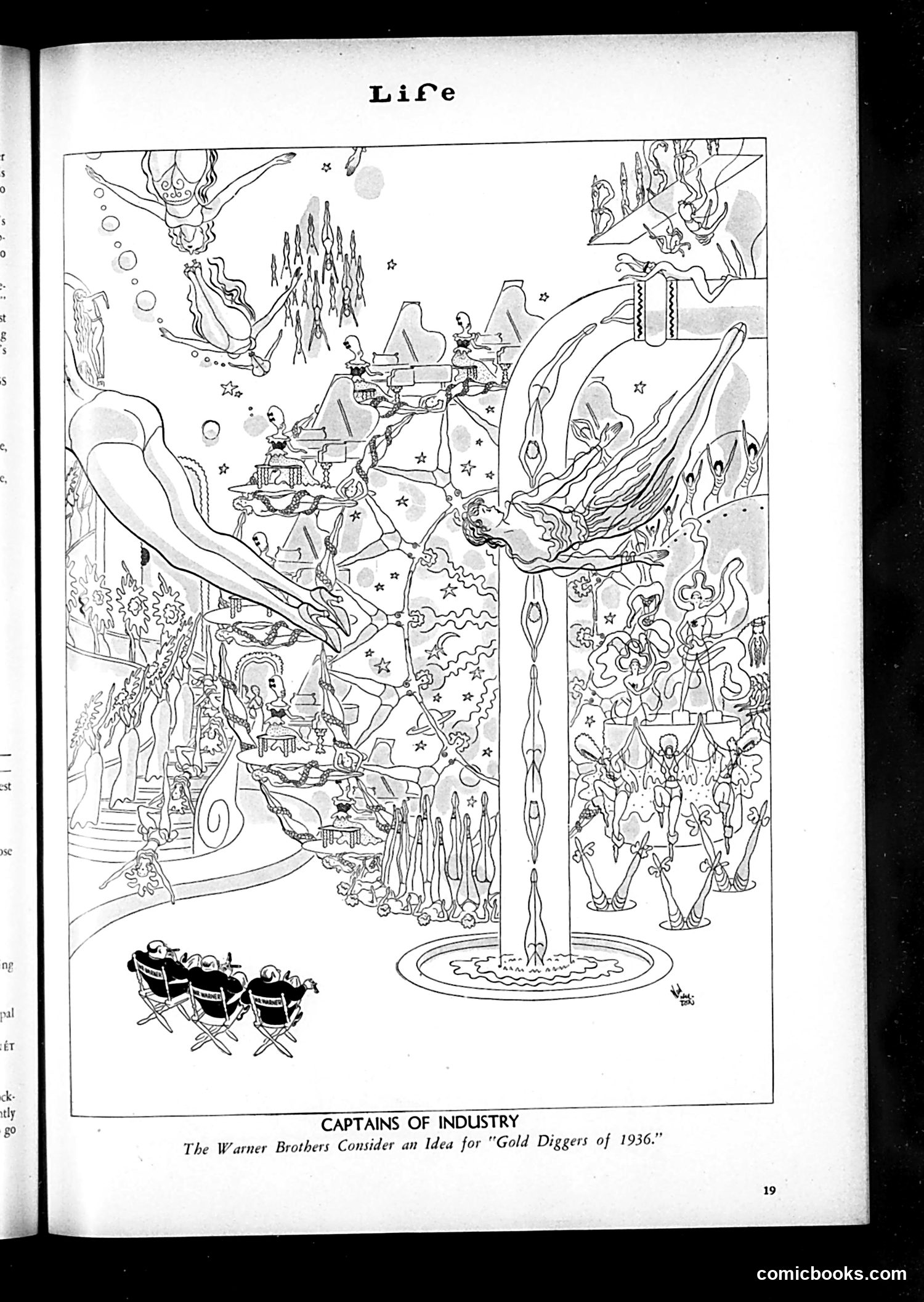
"Life" Magazine - "Captains of Industry" Cartoon This satirical illustration titled "Captains of Industry" depicts the Warner Brothers' concept for a 1936 film called "Gold Diggers." The cartoon shows an elaborate, fantastical underwater or dreamlike scene populated by numerous figures engaged in various activities—performers, dancers, and entertainers—surrounding a central fountain or tower structure. The satire appears to target Hollywood's extravagant musical production values and the film industry's lavish spectacle. The "Captains of Industry" label sarcastically refers to studio executives (the Warner Brothers) treating massive entertainment production as serious business. The lower left corner shows three figures in director's chairs observing this chaos, likely representing the decision-makers overseeing such expensive, elaborate productions. The joke critiques both Hollywood excess and corporate ambition in the entertainment industry.
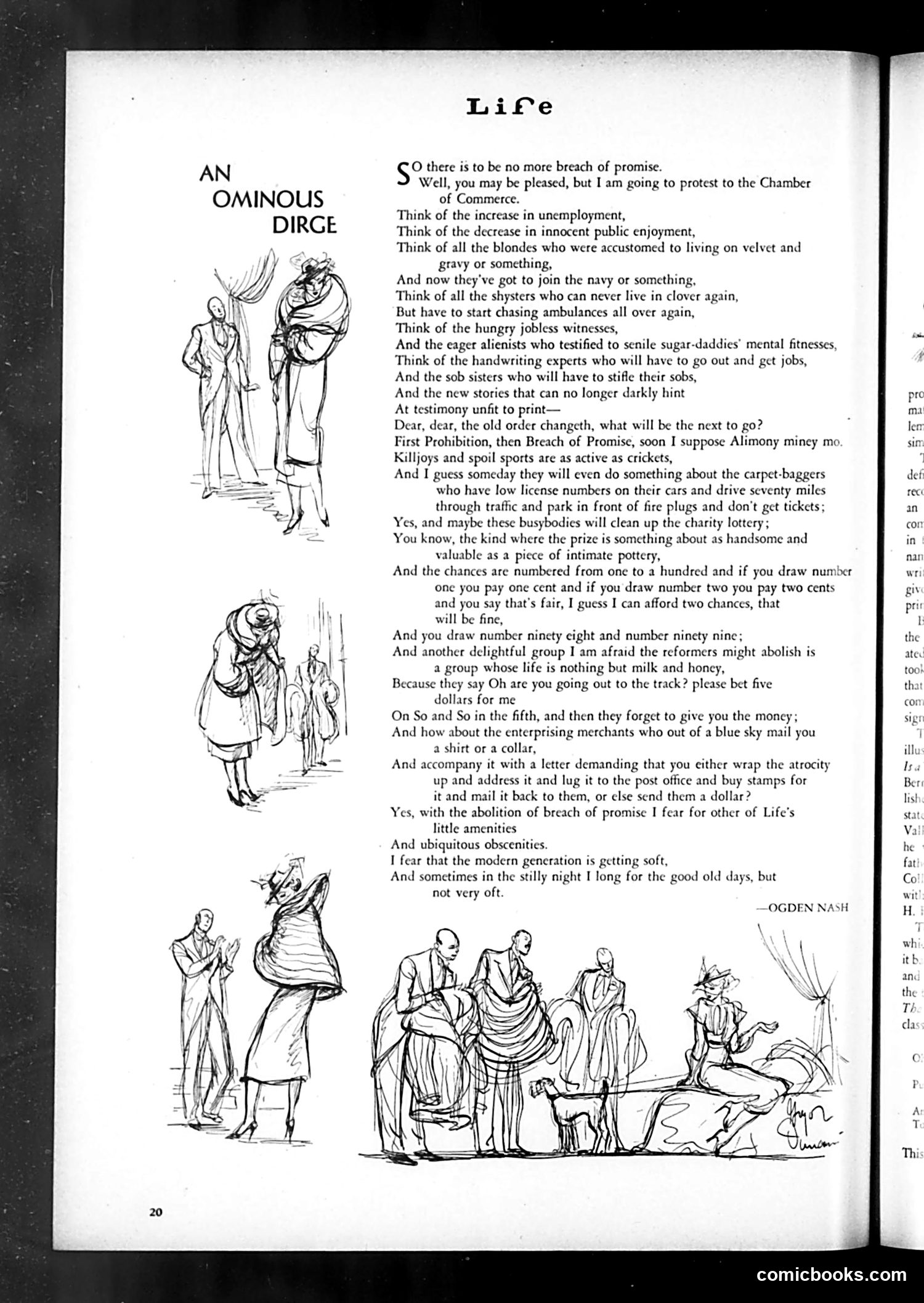
"An Ominous Dirge" by Ogden Nash This satirical poem, illustrated with sketches of various urban characters, laments the abolition of "breach of promise" lawsuits—legal claims women could file against men who broke marriage engagements. Nash humorously catalogs the supposedly catastrophic consequences: unemployed con artists, ambulance-chasing lawyers, handwriting experts, and gossip columnists who profited from scandalous testimony would lose their livelihoods. He sarcastically worries that reform movements ("killjoys") targeting breach-of-promise suits will eventually eliminate other "cherished" social evils: Prohibition (already happening), alimony, traffic violations, charity lotteries, and fraudulent mail schemes. The satire targets both reform movements and the parasitic professions they'd disrupt—suggesting that much of society's economy depends on exploitation and vice.
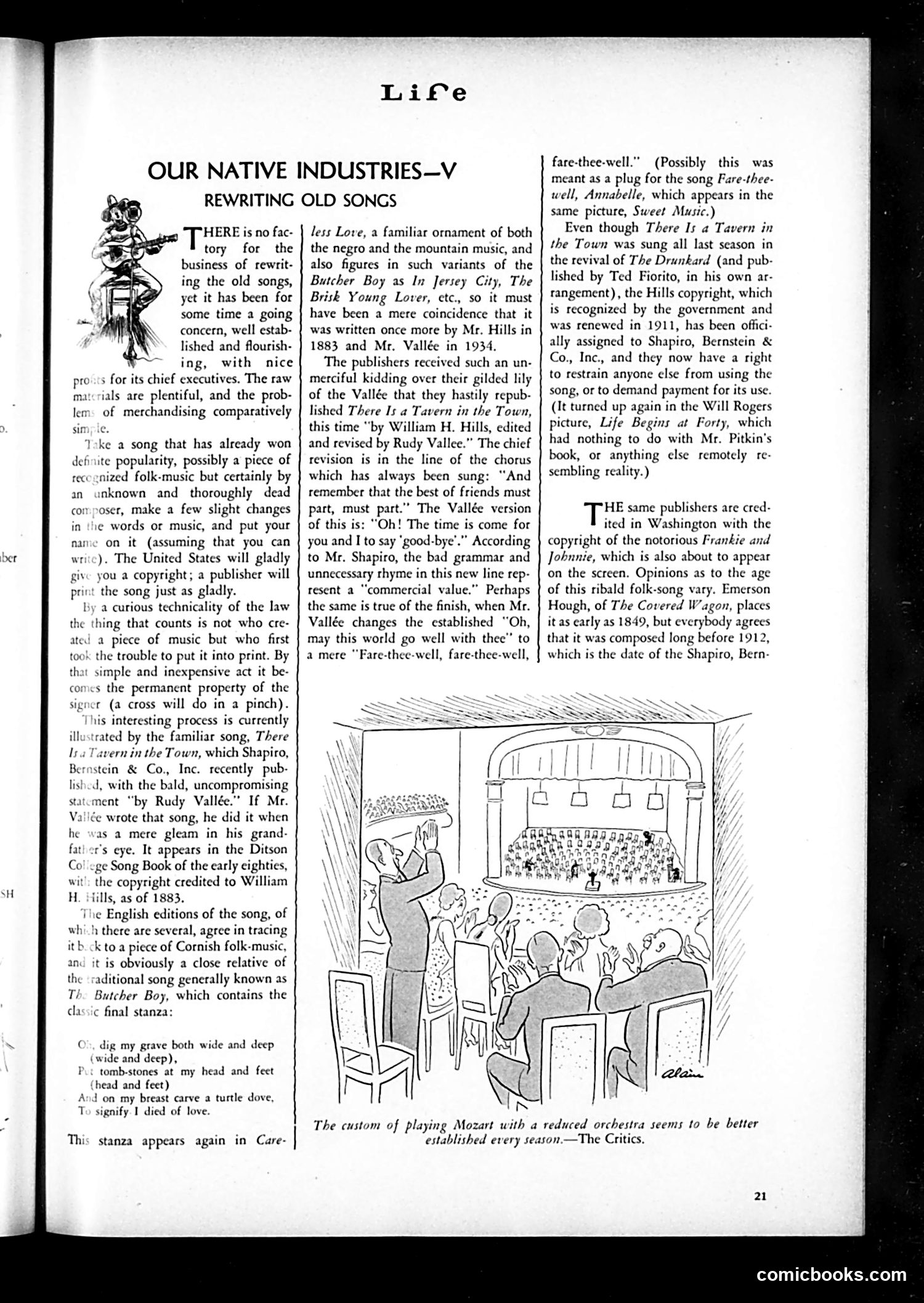
Analysis of "Our Native Industries—V: Rewriting Old Songs" This article satirizes music publishers' practice of copyrighting traditional folk songs by claiming modern authorship. The specific target is Rudy Vallée, a popular singer who claimed to have written "There Is a Tavern in the Town"—a song traceable to 1883 (credited to William H. Hills) and earlier to Cornish folk music. The satire highlights a legal loophole: copyright protection goes to whoever *first prints* a work, not who created it. Publisher Shapiro, Bernstein & Co. initially credited Vallée, then quietly shifted credit to Hills after public ridicule, calling Vallée's changes a "commercial value." The article also notes Vallée's unnecessary lyrical revisions ("good-bye" replacing traditional "must part") and mocks his involvement in the film *Life Begins at Forty*, sarcastically noting it had "nothing else remotely resembling reality." The cartoon (bottom) shows an orchestra performing to an audience—likely illustrating how such "revised" songs reach the public as original works.
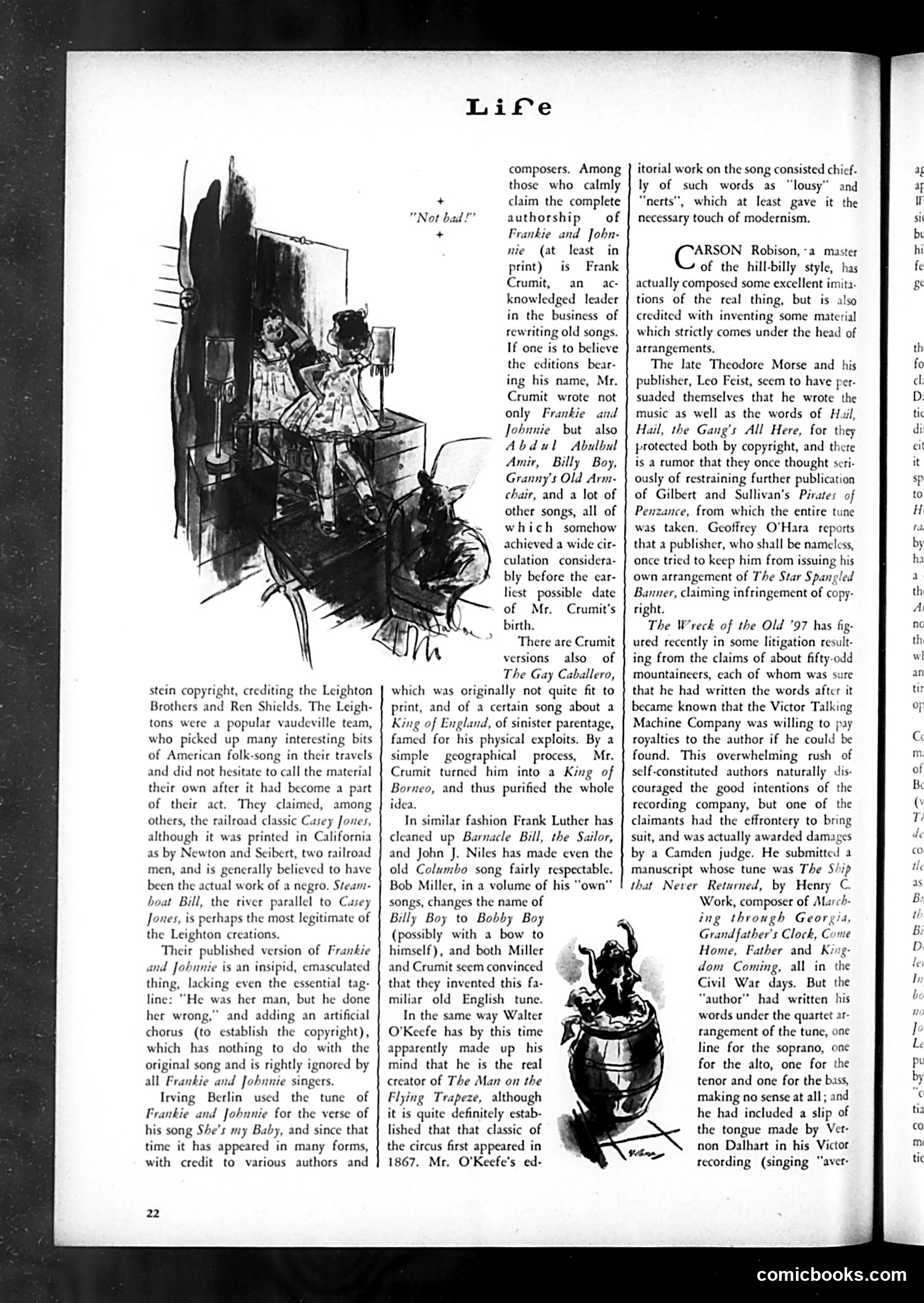
What This Page Means This article satirizes songwriting fraud in early 20th-century popular music. The text discusses how composers like Frank Crumit and Walter O'Keefe claimed authorship of traditional folk songs—"Frankie and Johnnie," "Casey Jones," "The Man on the Flying Trapeze"—that predated them by decades or were genuinely anonymous. The cartoons (showing figures at a piano) likely illustrate these dubious "composers" at work. The satire's point: these men profited through copyright claims on songs they merely "cleaned up" with minor lyrical changes ("lousy," "nerts") or slight arrangements, then marketed as original compositions. The article documents this as systematic theft, noting even Theodore Morse tried copyrighting Gilbert & Sullivan's melody. For modern readers: this exposes early copyright abuse and cultural appropriation in entertainment, particularly of Black and working-class folk traditions that lacked legal protection.
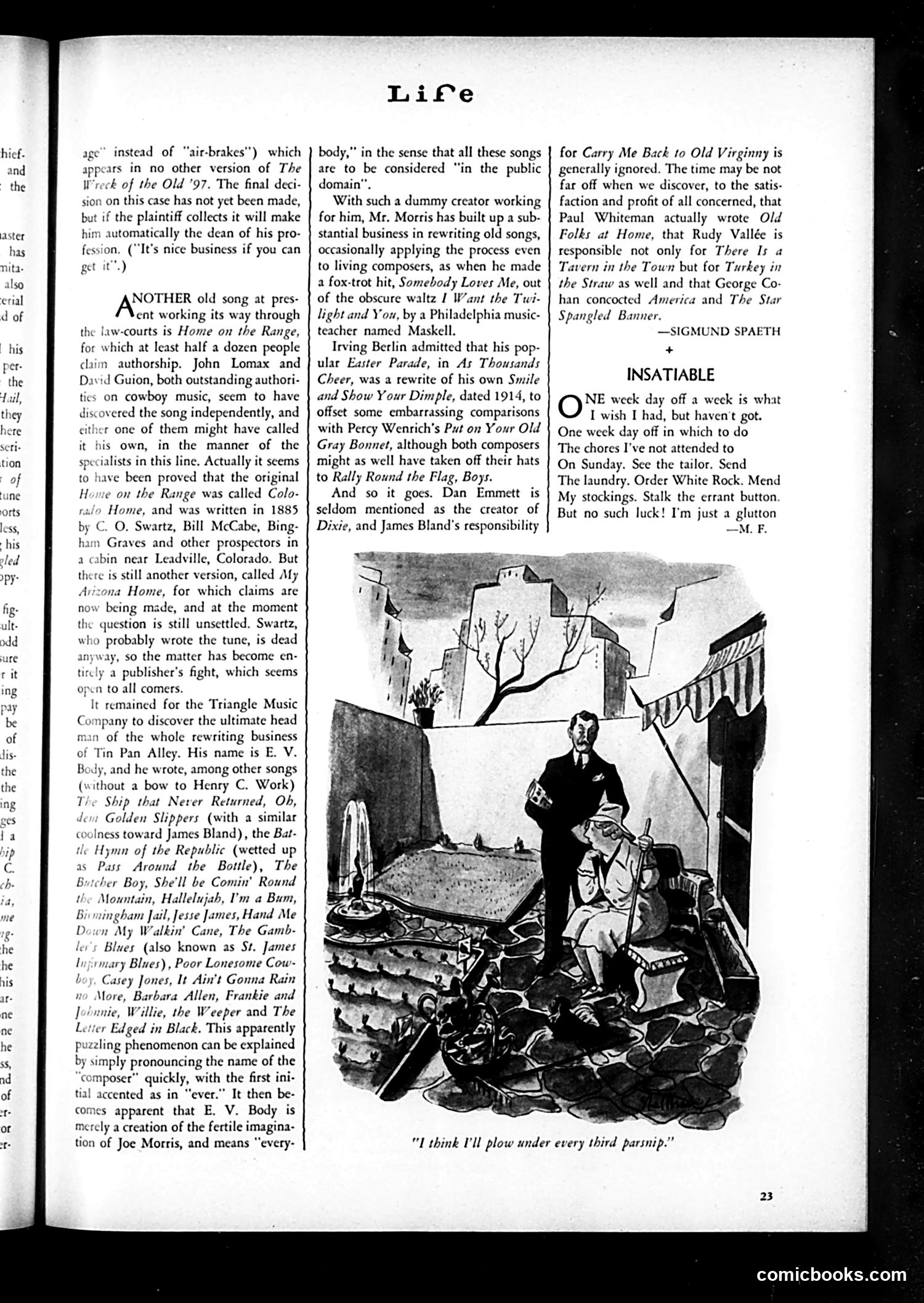
Analysis of Life Magazine Page This page satirizes the murky authorship of American folk and popular songs. The main target is Joe Morris, a music publisher who profits from rewriting old compositions. The article reveals Morris's scheme: he invented a dummy composer named "E. V. Body"—a pun on "everybody"—to claim authorship of folk standards like "Home on the Range," "Casey Jones," and "Barbara Allen," thereby placing them in the public domain and allowing him to freely rewrite and profit from them. The satire extends to legitimate composers: Irving Berlin rewrote his own 1914 song as "Easter Parade," and the true creators of classics like "Dixie" (Dan Emmett) and "Carry Me Back to Old Virginny" (James Bland) receive little credit. The concluding joke predicts absurd future misattributions—that Paul Whiteman or Rudy Vallée created 19th-century standards—mocking how copyright and authorship disputes have obscured the real origins of American popular music. The accompanying cartoon's caption ("I think I'll blow under every third parsnip") appears unrelated and unclear in context.
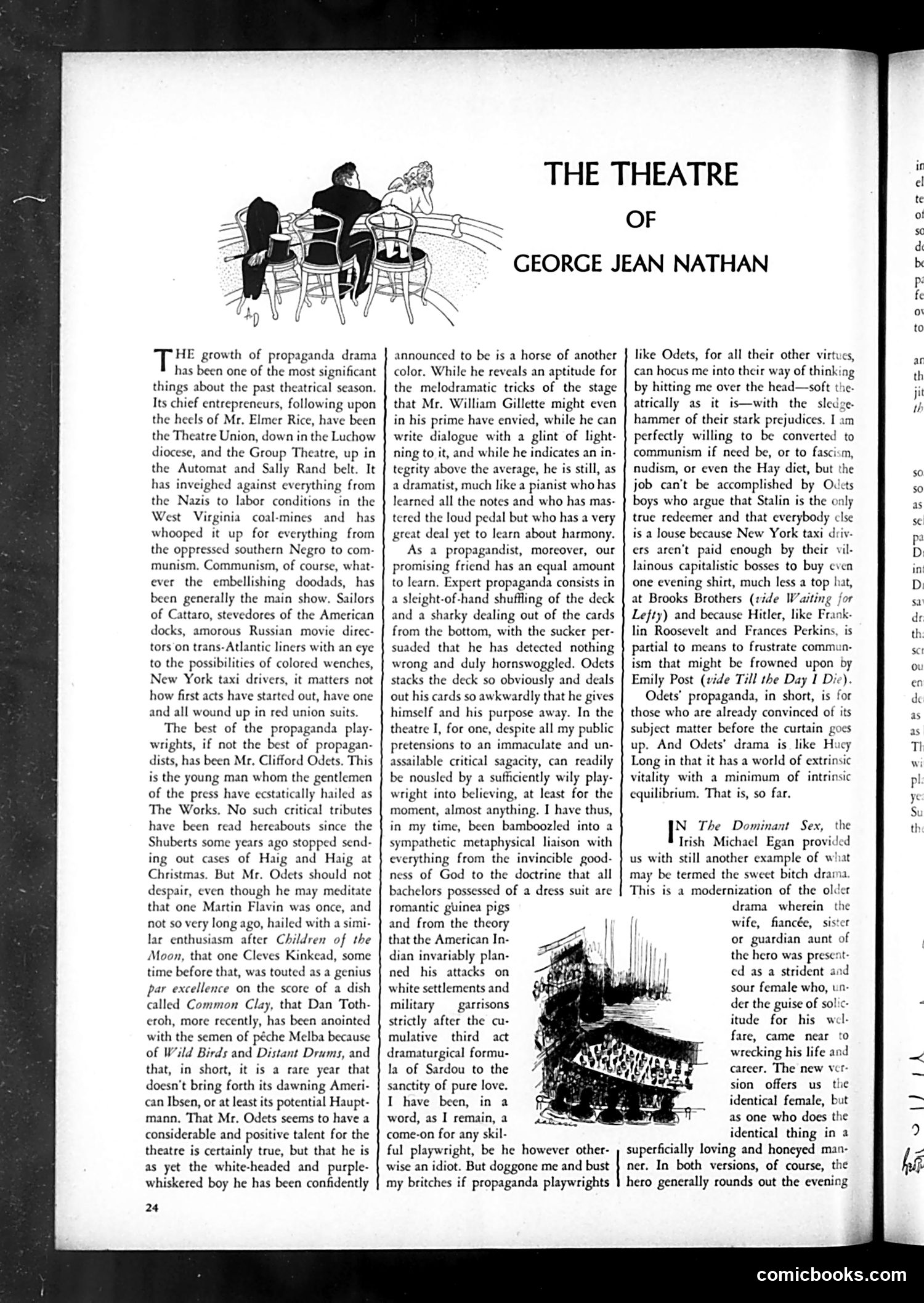
The Theatre of George Jean Nathan This is a theater criticism column by George Jean Nathan, a prominent American drama critic. Nathan satirizes the recent theatrical trend of propaganda drama—politically charged plays promoting left-wing causes, particularly communism. The column mocks Clifford Odets, a celebrated young playwright whom the press has hailed as a genius. Nathan argues Odets is overrated: while talented at melodrama and dialogue, he lacks sophistication as both dramatist and propagandist. Nathan compares him to overpraised predecessors (Martin Flavin, Dan Totheroh) who quickly faded from favor. The satire's point: Nathan dismisses both the plays' Communist messaging and the critical establishment's breathless enthusiasm for them. He argues effective propaganda requires subtle manipulation ("sleight-of-hand"), whereas Odets "stacks the deck so obviously" that audiences see through it. The illustration shows theater patrons—typical of the era's left-wing theater movement.
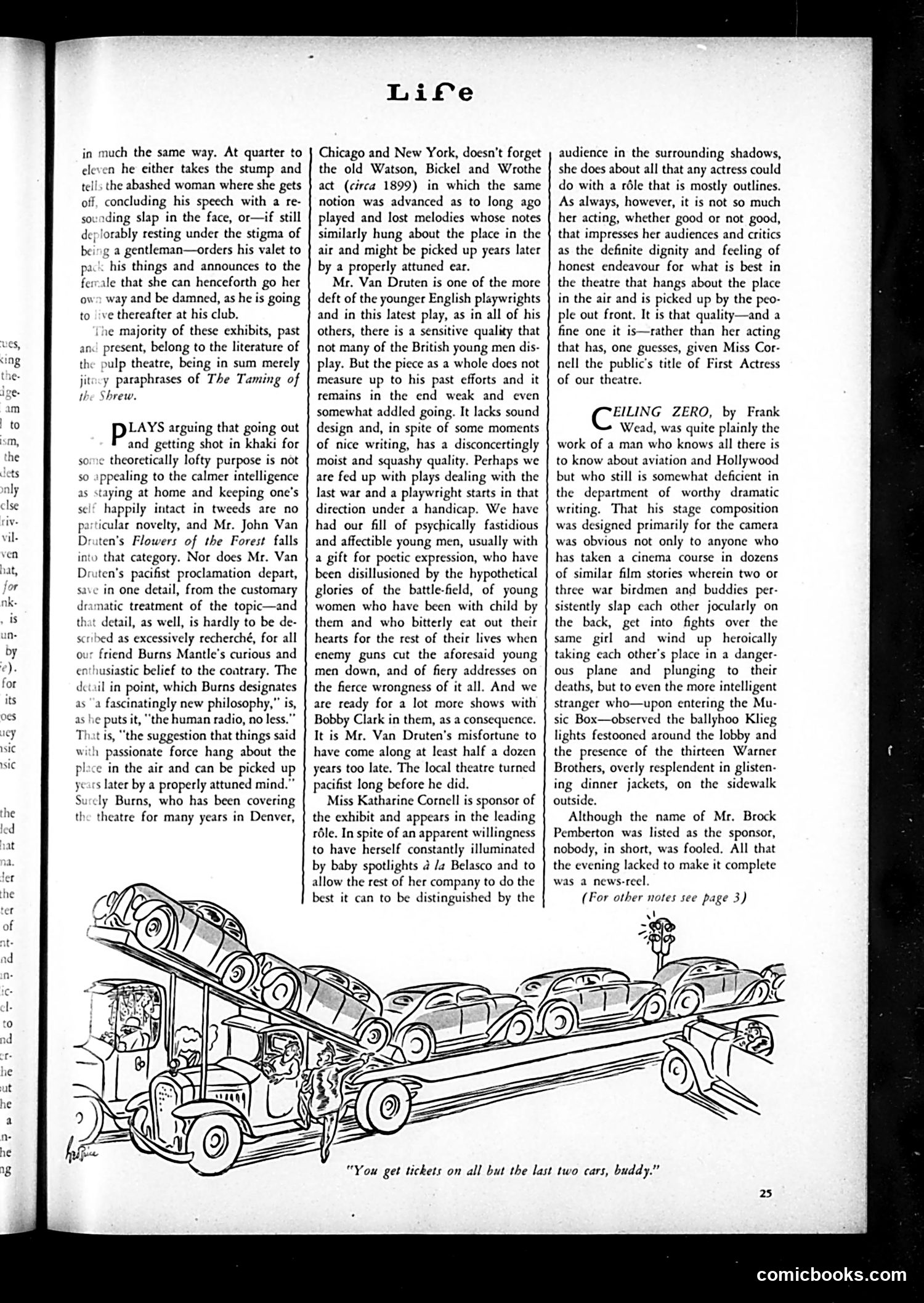
Analysis of Life Magazine Page This page contains theater criticism rather than a political cartoon. The main illustration is a humorous cartoon showing a crowded parking lot attendant struggling with an overflowing lot of automobiles, with the caption "You get tickets on all but the last two cars, buddy." The text reviews John Van Druten's play *Flowers of the Forest*, a post-World War I drama about pacifism and disillusionment. The critic dismisses it as derivative—comparing its "human radio" concept (where spoken words linger in the air) to a 1899 vaudeville act by Watson, Bickel, and Wrothe. He criticizes the play's weakness and "moist and squashy quality," suggesting audiences are tired of war-weary melodramas. He praises actress Katharine Cornell's efforts despite the thin role, and suggests audiences prefer comedies with Bobby Clark instead. The cartoon humorously illustrates the era's automobile abundance and parking challenges—a modern inconvenience for readers of the 1920s-30s.
Analysis I can see this is a black and white illustration showing multiple figures in what appears to be an interior scene, with dramatic lighting and expressive faces gazing upward. The style is consistent with early-to-mid 20th century satirical artwork. However, I cannot reliably read the OCR text beyond the "comicbooks.com" watermark, and the image quality makes it difficult to identify specific figures or read any captions that would clarify the satire's subject matter. Without legible text or clearly identifiable caricatures, I cannot responsibly identify which political or social figures are depicted or explain what specific event or issue this cartoon addresses. To provide accurate historical context, I would need either clearer text or additional identifying information from the source.
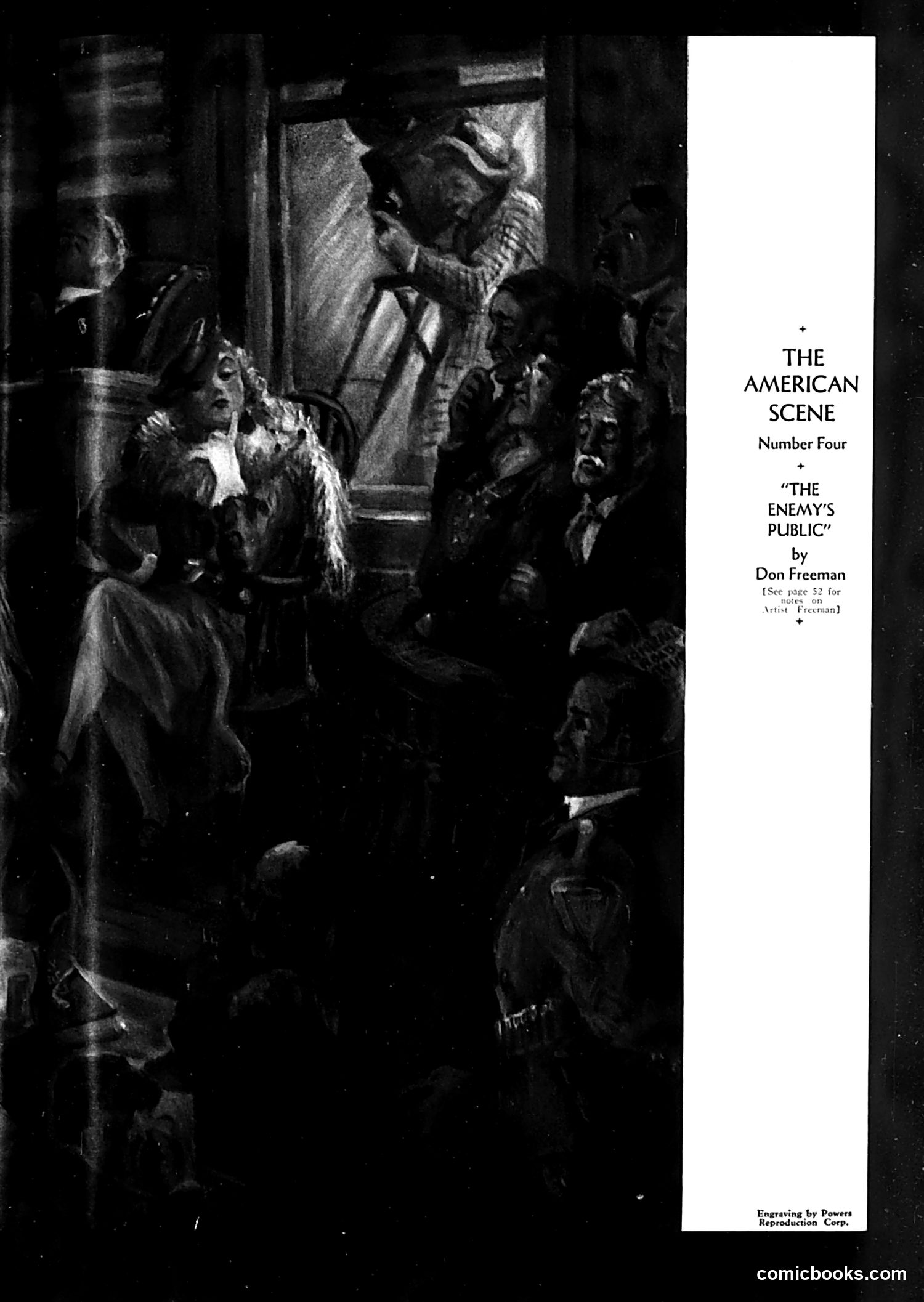
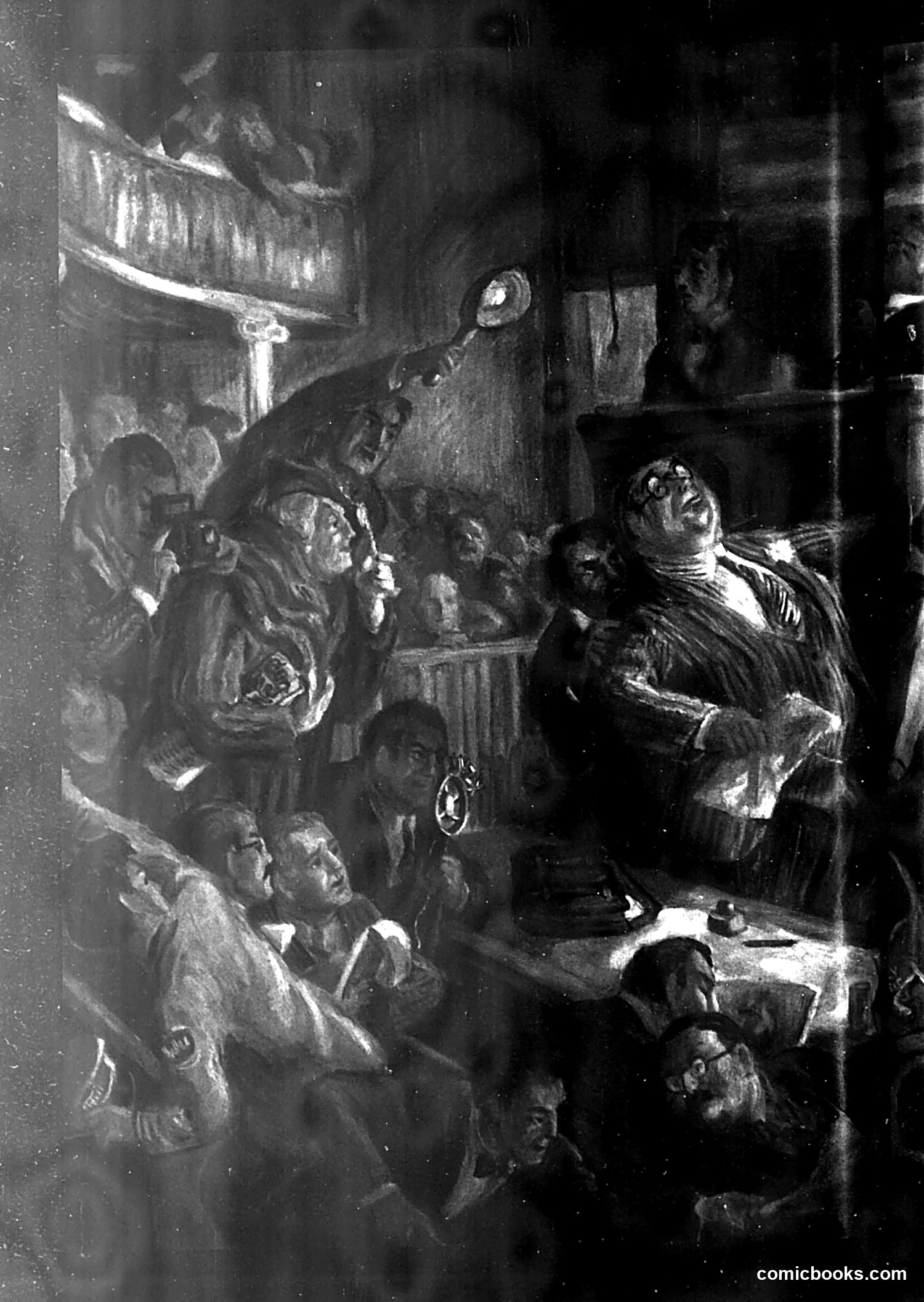
"The Enemy's Public" by Don Freeman This is a satirical illustration from Life magazine's "American Scene" series showing a crowded, tightly-packed group of working-class people in what appears to be a tenement or public building interior. The composition emphasizes their density and confined conditions. The title "The Enemy's Public" suggests social commentary on how marginalized or economically disadvantaged populations were viewed—possibly as threats or problems to be managed by authorities. The cramped, claustrophobic framing visually reinforces this perspective, depicting ordinary citizens in degrading circumstances. Freeman's engraving captures early-to-mid 20th century American urban social issues, likely critiquing both the actual living conditions of poor communities and the dismissive attitudes toward them from those in power—hence calling them "the enemy's public."
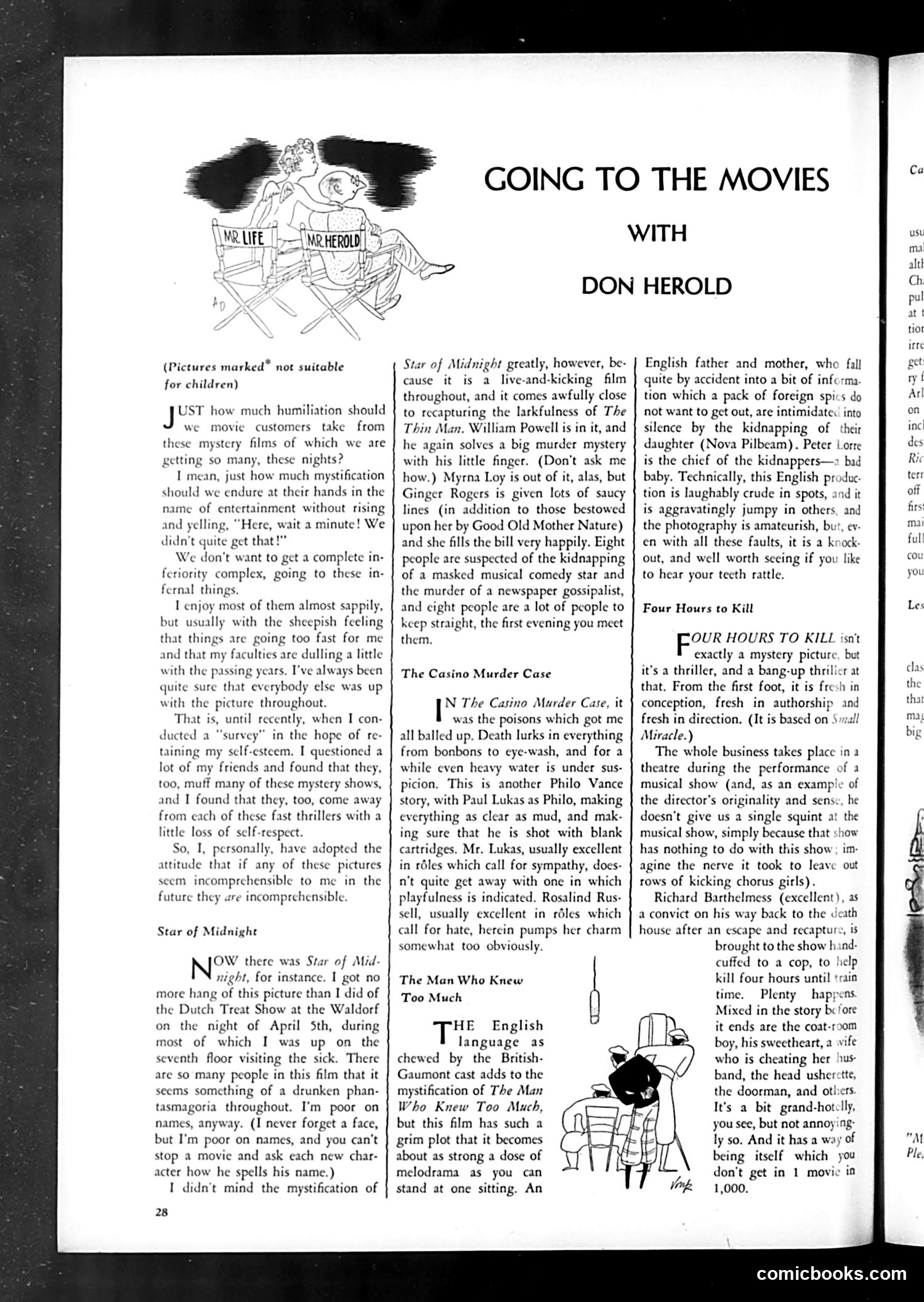
"Going to the Movies with Don Herold" - Life Magazine Movie Reviews This is a humorous essay by Don Herold, a satirist, complaining about confusing, fast-paced mystery films that audiences struggle to follow. Herold admits surveying friends who shared his problem: leaving theaters confused but pretending they understood everything. He reviews three contemporary mystery films: *Star of Midnight* (praising William Powell and Ginger Rogers despite its complexity), *The Casino Murder Case* (criticizing its convoluted poison plot and Paul Lukas's awkward performance), and *The Man Who Knew Too Much* (noting the British cast's accent makes comprehension harder, though the dark kidnapping plot compensates). The cartoon header shows two figures labeled "Mrs. Life" and "Mr. Herold" in director's chairs, indicating this is Herold's regular movie-critique column. The satire targets Hollywood's increasingly byzantine mystery plots that befuddle average viewers, mocking both cinema and audience expectations circa the 1930s.
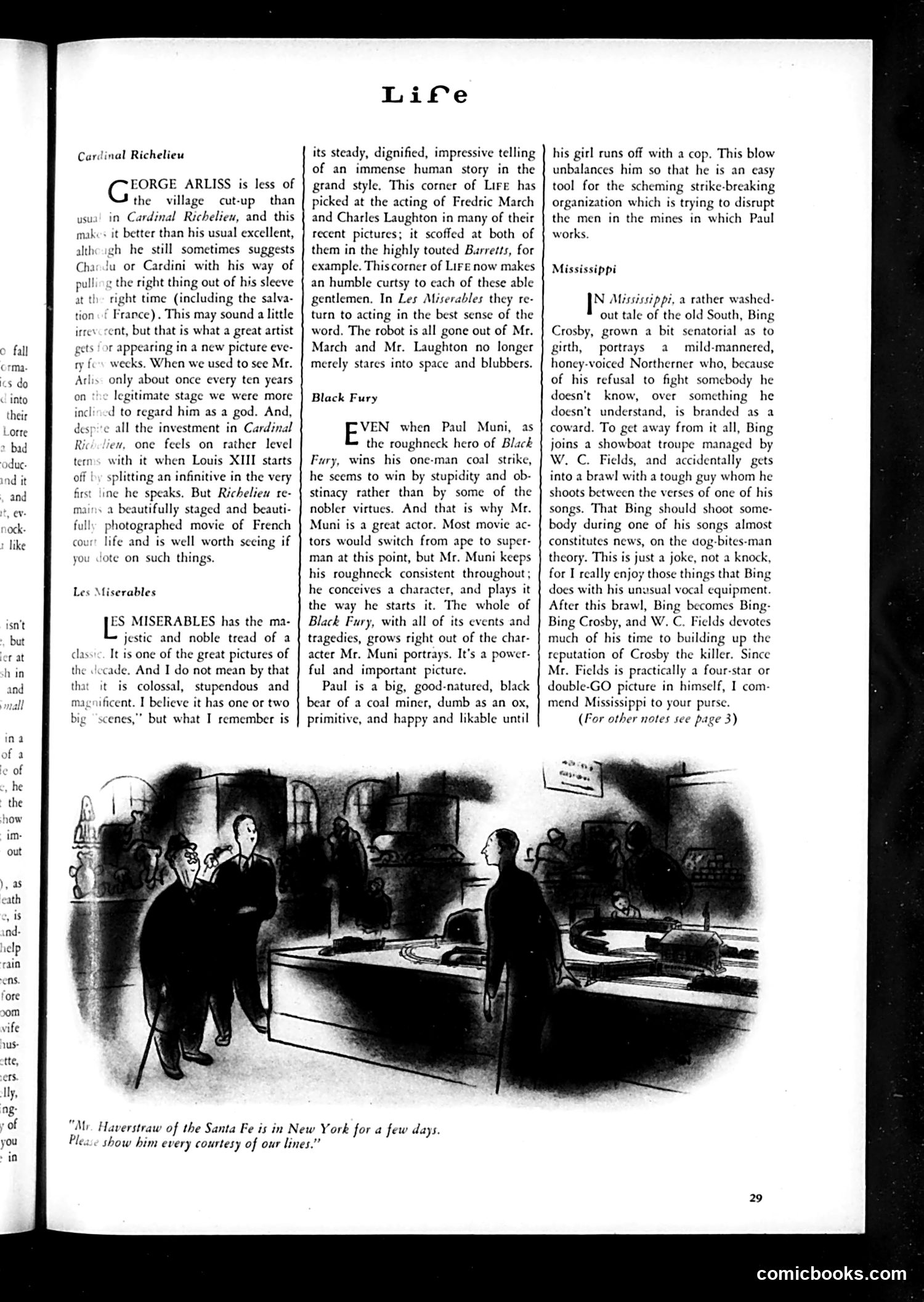
Life Magazine Page Analysis This page reviews four films. The cartoon at bottom appears to be an unrelated advertisement or filler—a sketch of men in what looks like a railroad station or office, with a caption about showing courtesy to a Santa Fe railroad passenger. It's not political satire but rather a corporate courtesy notice. The main content critiques contemporary 1930s films: - Cardinal Richelieu: Reviews George Arliss's performance, noting he's less of a "village cut-up" than usual - Les Misérables: Praises Fredric March and Charles Laughton for returning to serious acting after previous disappointing roles - Black Fury: Commends Paul Muni's consistent portrayal of a coal miner protagonist whose stupidity makes him vulnerable to strike-breaking manipulation—praised as realistic character work - Mississippi: Gently mocks Bing Crosby shooting someone mid-song, calling it humorous rather than serious criticism, and notes W.C. Fields builds up Crosby's "killer" reputation The reviews reflect 1930s film criticism valuing character authenticity and dramatic restraint over spectacle.
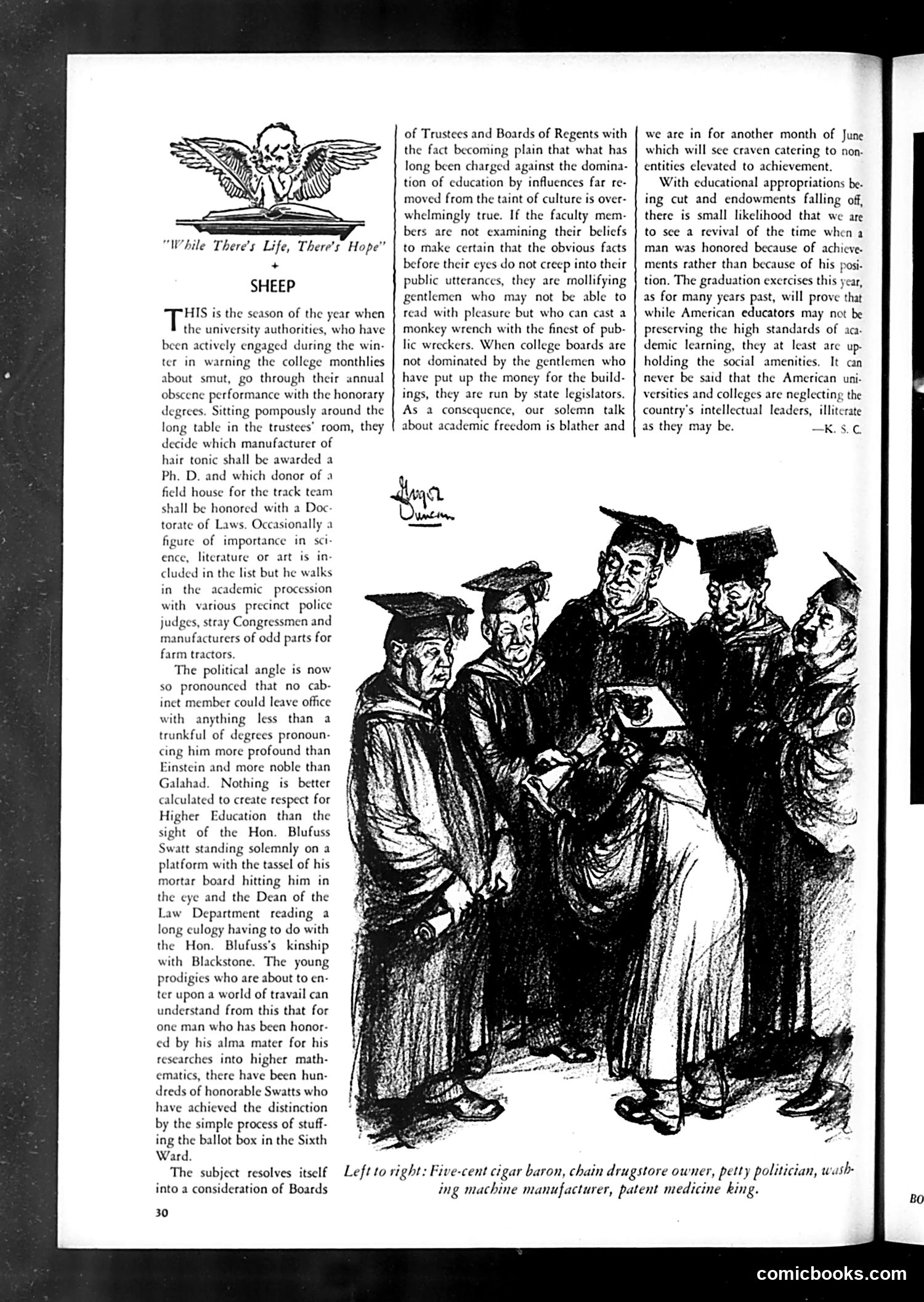
"Sheep" Cartoon Analysis This *Life* magazine satire attacks the corruption of American higher education through honorary degree awards. The cartoon depicts university trustees awarding Ph.D.s and Doctorates of Laws to wealthy businessmen and politicians rather than genuine scholars—depicted here as a cigar baron, drugstore owner, politician, washing machine manufacturer, and patent medicine king. The text argues that trustees prioritize donors who funded buildings and state legislators over academic merit. It mocks the spectacle of these unqualified recipients (called "honorable Swatts") standing alongside actual scholars in academic processions, claiming many received degrees through "stuffing the ballot box in the Sixth Ward"—implying corruption and vote-rigging. The satire's target: American universities compromising intellectual standards for money and political influence, betraying their educational mission.
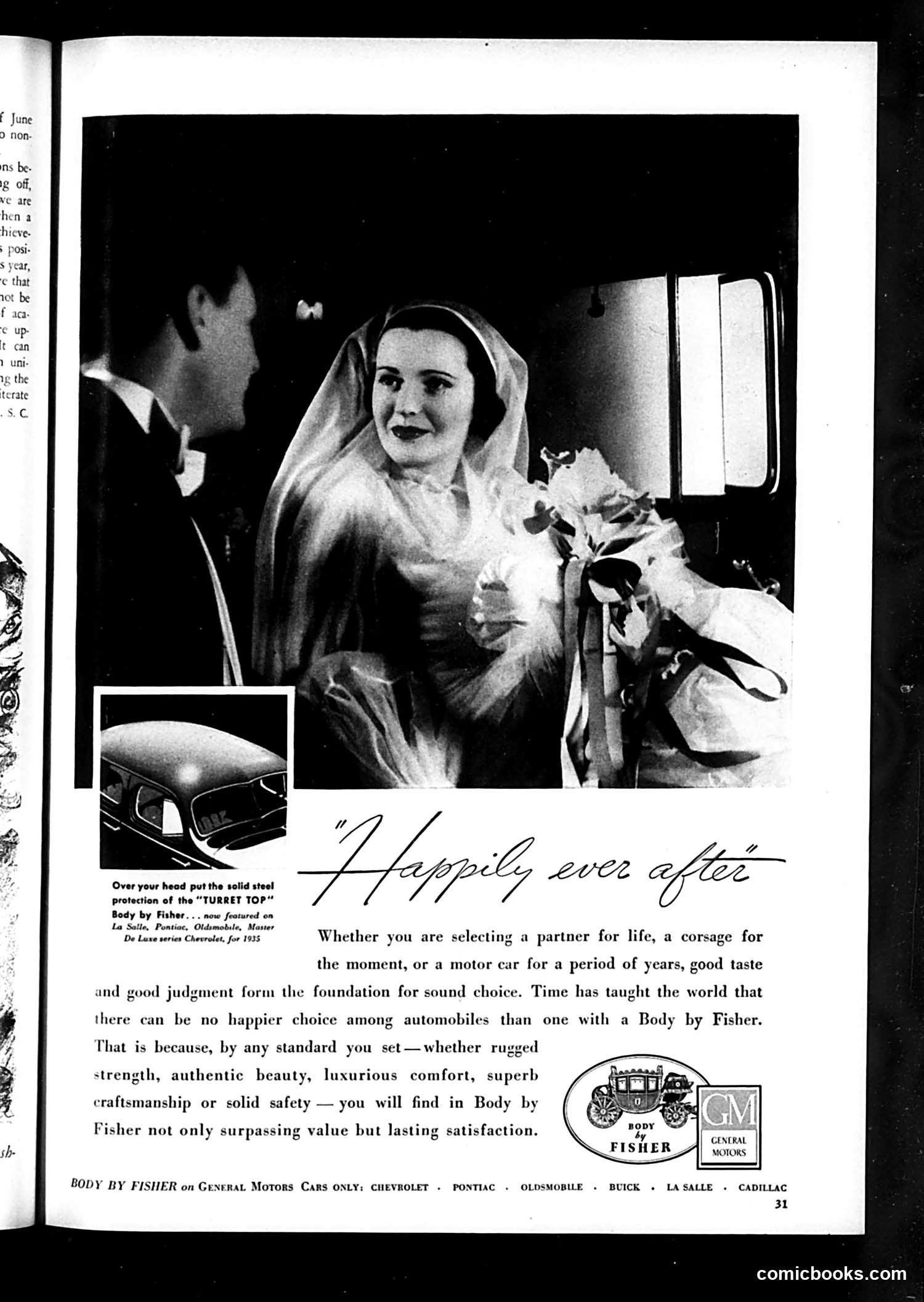
Analysis This is not a political cartoon but a General Motors advertisement for Fisher Body car bodies, dated 1935. The image shows a bride and groom inside a car, playfully equating selecting a marriage partner with choosing a motor vehicle. The ad's tagline—"Happily ever after"—extends this romantic metaphor. The "TURRET TOP" feature advertised was an early safety innovation: a reinforced steel roof designed to protect occupants. The ad emphasizes that good judgment in selecting a car (like selecting a life partner) means prioritizing durability, beauty, comfort, and safety. For modern readers, this reflects 1930s advertising's casual equation of consumerism with life's major decisions, and the era's nascent focus on automobile safety as a selling point. The gendered assumption that women would appreciate both wedding florals and vehicle features is typical of period advertising conventions.
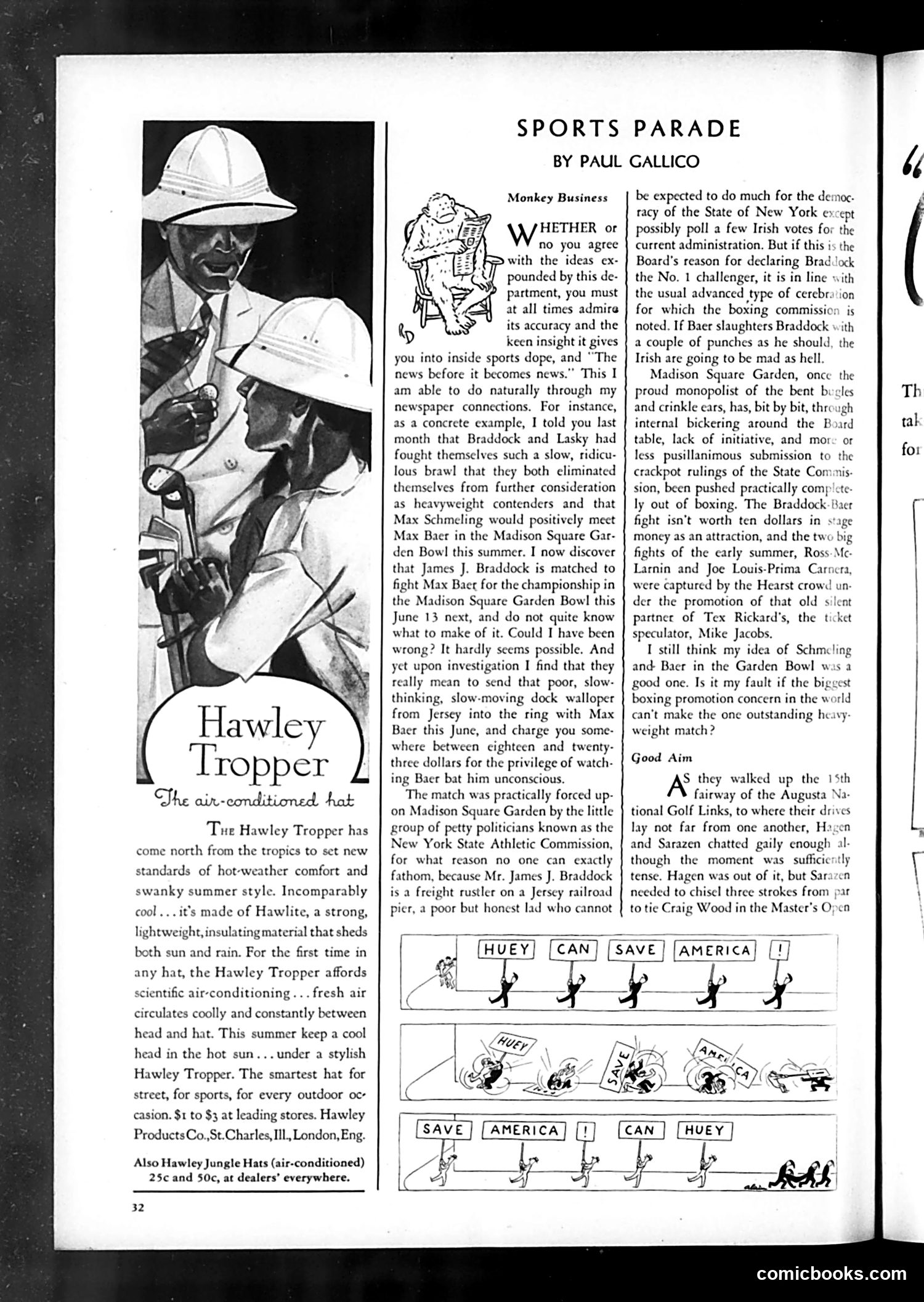
Sports Parade: A Boxing Commentary from the 1930s Paul Gallico's column satirizes boxing politics and the New York State Athletic Commission's decision to pit heavyweight champion Max Baer against James J. Braddock for the title on June 13. Gallico mocks this matchup as absurd—Braddock is characterized as a mere "dock walloper" and "freight rustler" from Jersey, unworthy competition for Baer, whom Gallico expects will knock him out quickly. The columnist's real frustration targets the Athletic Commission (depicted as "petty politicians") for forcing this unprofitable fight onto Madison Square Garden, presumably motivated by Braddock's ability to deliver Irish-American votes. Gallico criticizes the Garden's declining influence in boxing promotion, lost to rival promoter Mike Jacobs and Hearst interests. His tone is cynical about both the political manipulation and the degraded state of professional boxing management.
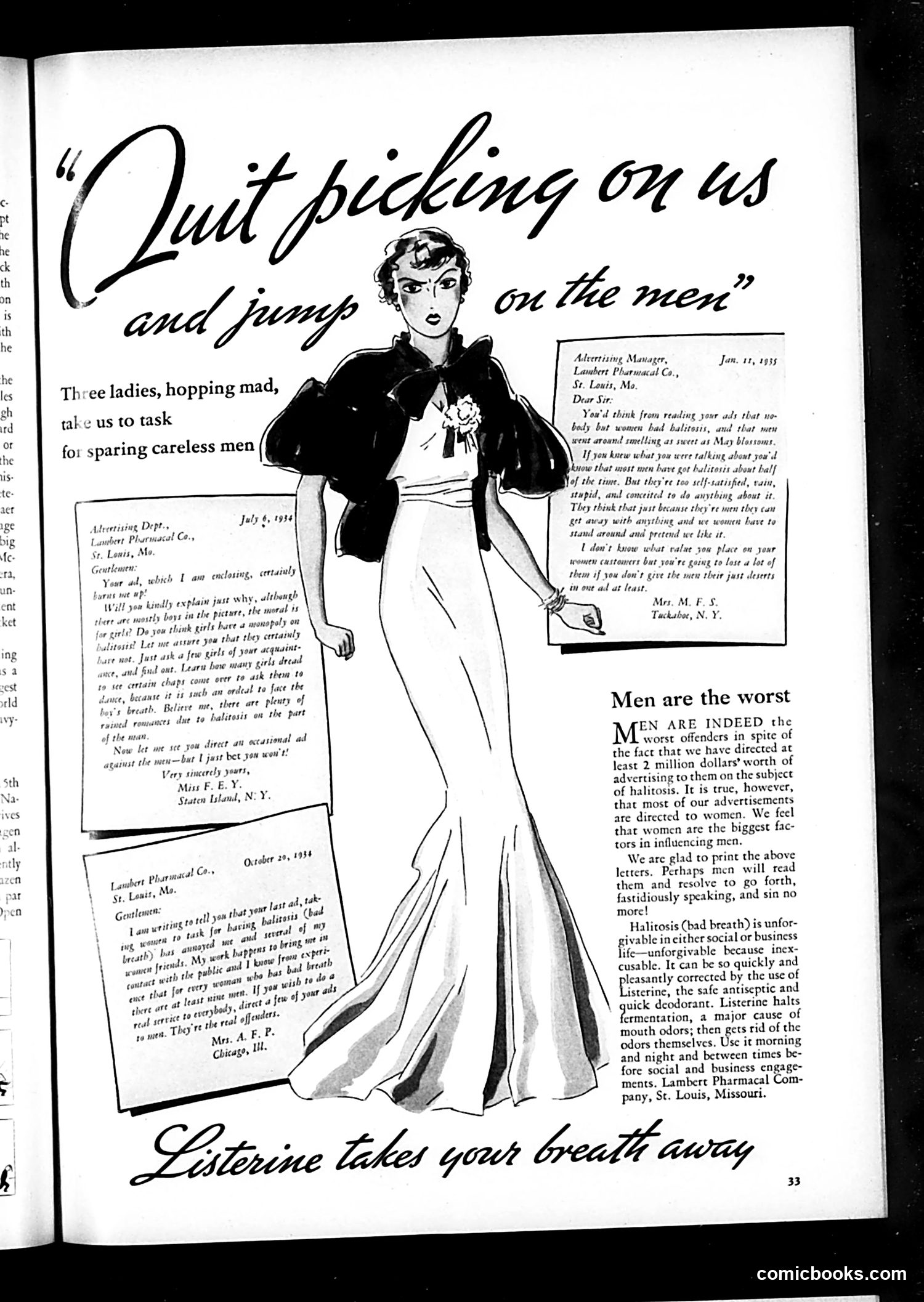
Analysis This is a Listerine advertisement disguised as reader correspondence, a common 1930s marketing technique. Three women write angry letters complaining that Lambert Pharmacal's advertising unfairly targets women about halitosis (bad breath) while ignoring men's offenses. The company's response admits men are "the worst offenders" but justifies targeting women because they're "the biggest factors in influencing men"—essentially arguing women should police men's hygiene. The illustration shows an elegant woman turning away from a man, visually supporting the message that bad breath makes men undesirable to women. The satire works on multiple levels: the fake outrage legitimizes the product's importance, the sexist premise (women must fix men) goes unquestioned, and the advertisement disguises itself as editorial content—all reflecting 1930s advertising ethics and gender dynamics where women bore responsibility for social propriety.
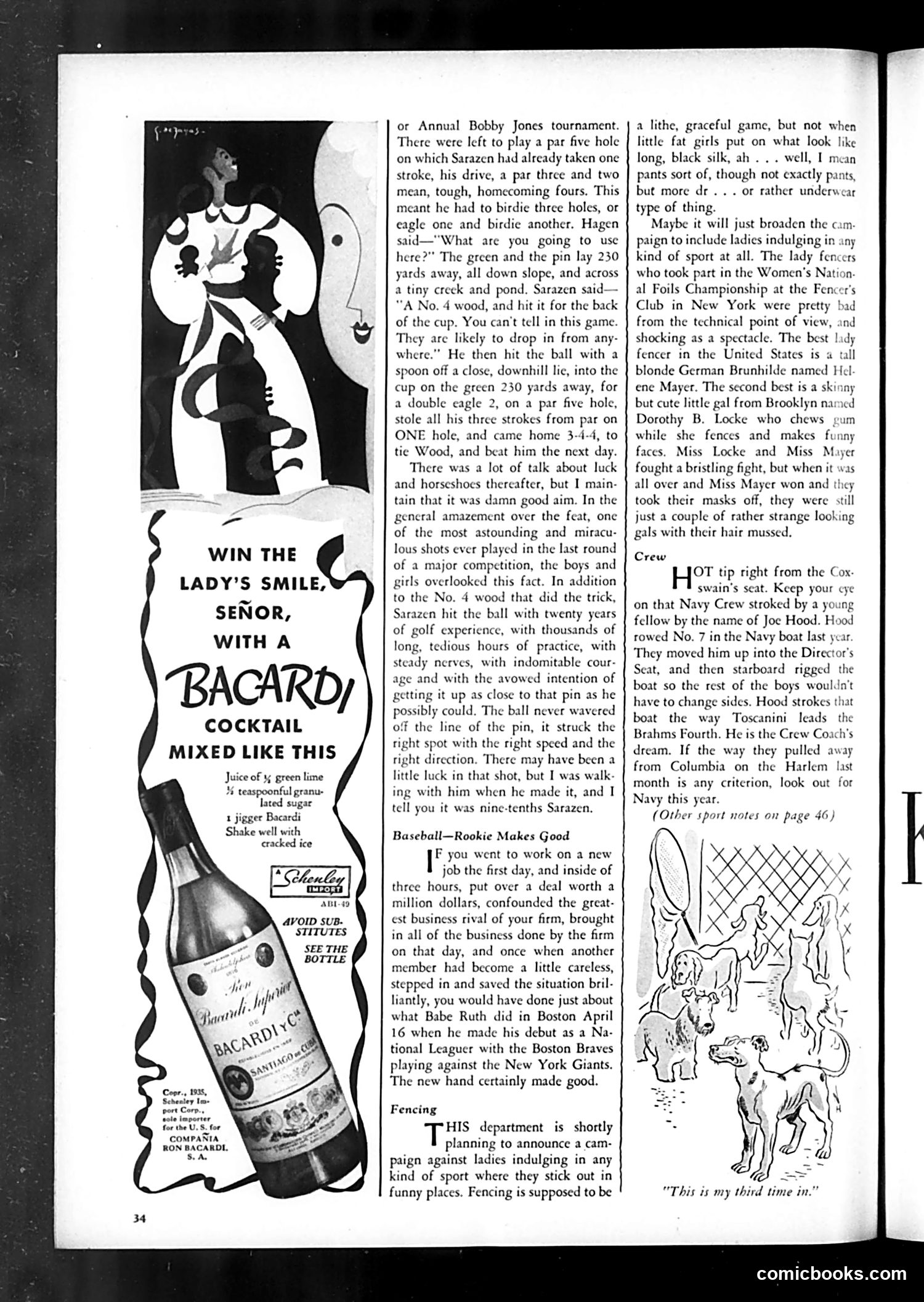
Analysis for Modern Readers This page combines sports commentary with advertising. The main content discusses three sports: Golf: Praises golfer Gene Sarazen's skill during a tournament, emphasizing that his remarkable 230-yard shot into the cup resulted from practice and technique, not luck. Baseball: Notes Babe Ruth's successful debut with the Boston Braves, drawing a workplace analogy—his first-day performance was extraordinarily productive. Fencing: Satirizes female fencers at the Women's National Foils Championship, mocking their appearance in fencing attire rather than evaluating their athletic skill. The commentary dismisses most competitors as "shocking" while singling out German fencer Helene Mayer and Brooklyn's Dorothy B. Locke for particular criticism (though admitting Mayer was technically superior). The advertisement promotes Bacardi cocktails with a romanticized "señor" figure, using dated ethnic stereotyping. The fencing section reveals dated sexism: women's bodies in athletic clothing are treated as absurd spectacle rather than serious competition.
White Rock Water Advertisement This is a vintage advertisement for White Rock brand soda water, not political satire. The image shows a half lemon with a bottle of White Rock sparkling water and the product's bottle cap. The tagline "Keep cool on the alkaline side..." is a marketing pun. It plays on the chemical property of alkalinity (the opposite of acidity) while also suggesting that drinking this refreshing beverage will keep one cool and comfortable. The lemon imagery reinforces the citrus/refreshment association, though White Rock water itself is unflavored. This appears to be mid-20th century advertising that uses a clever wordplay hook to promote the brand's sparkling water as a healthful, refreshing beverage.
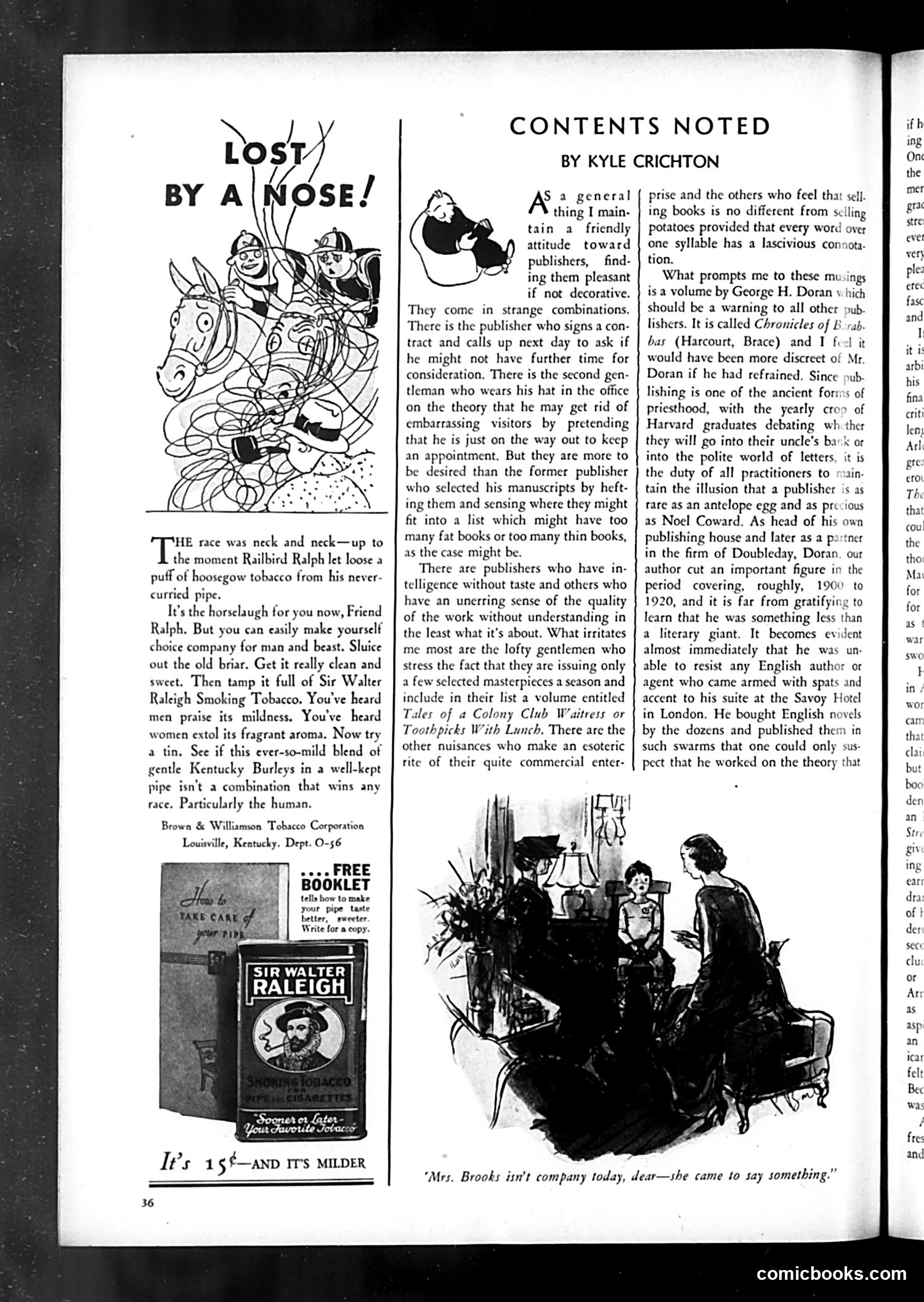
"Lost by a Nose!" - Advertisement & Editorial Content The left side is a Sir Walter Raleigh tobacco advertisement disguised as humor. "Railbird Ralph" loses a horse race because his pipe tobacco smells bad, offending the other competitors. The ad's joke: switching to mild Sir Walter Raleigh tobacco would make him socially acceptable ("wins any race. Particularly the human"). This reflects 1920s-30s advertising strategy—pairing products with social anxiety and self-improvement. The right side is Kyle Crichton's editorial column critiquing book publishers. He ridicules publishers who select manuscripts by weight, issue pretentious "masterpiece" lists with absurd titles like *Tales of a Colony Club Waitress*, and—his main target—George H. Doran, a prominent publisher who Crichton claims indiscriminately bought English novels to fill his catalog rather than exercise genuine literary judgment. The illustration shows a woman interrupting a business meeting, captioned sarcastically about unwanted company—likely illustrating editorial commentary about bad publishing decisions.
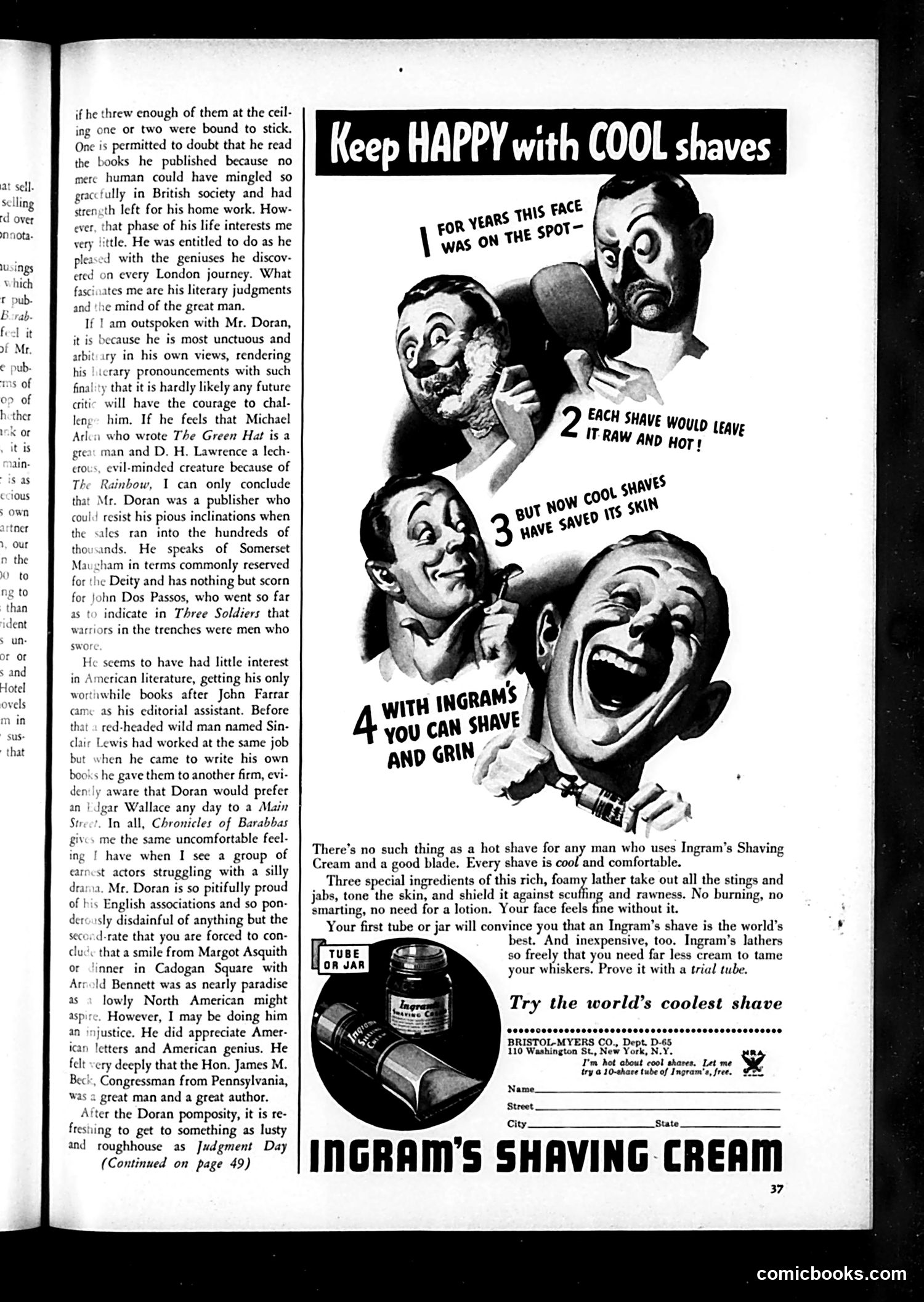
Content Analysis This page is primarily an advertisement for Ingram's Shaving Cream, not political satire. The left column contains book criticism (discussing publishers and authors like D.H. Lawrence and Somerset Maugham), while the right side features a commercial product ad. The shaving cream advertisement uses exaggerated facial caricatures—four men with grotesquely contorted expressions showing discomfort—to illustrate the problem being solved: painful shaving. The numbered sequence (1-4) presents the product's benefits: without cool shaves, faces get raw and irritated; Ingram's cream prevents this by providing a protective lather. The cartoon style is typical of 1920s-30s advertising humor: broad, somewhat crude facial caricatures designed to grab attention and make the product memorable through comedy. There's no political meaning here—it's straightforward commercial messaging using period-appropriate graphic exaggeration to sell a grooming product.
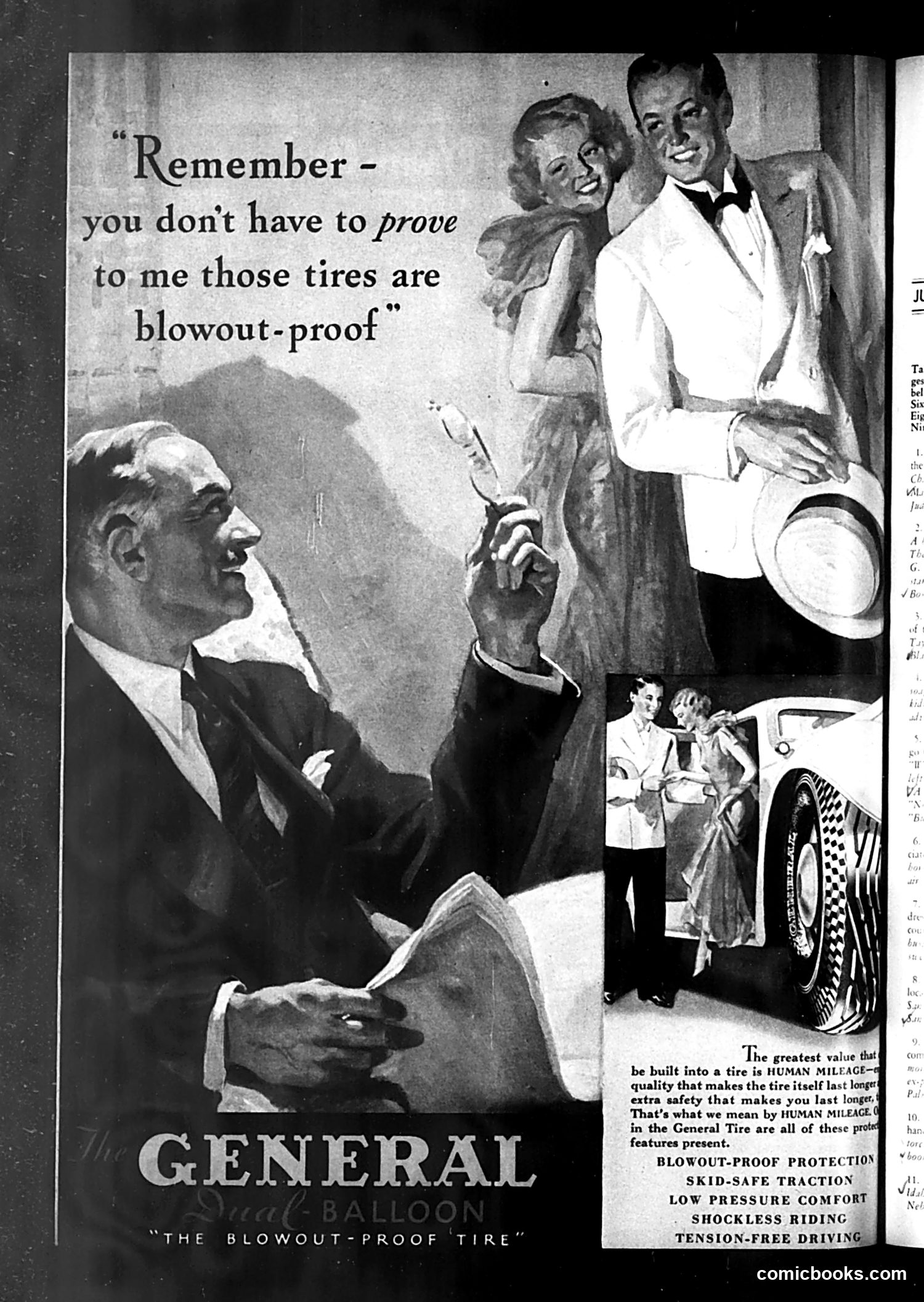
General Tire Advertisement Analysis This is a tire advertisement, not political satire. The "cartoon" depicts a salesman pitching General Balloon tires to a skeptical male customer, with an elegantly dressed couple observing in the background. The humor relies on the salesman's confidence claim: "you don't have to prove to me those tires are blowout-proof"—meaning the product's reputation speaks for itself. The ad emphasizes "human mileage" as the key value proposition: tires that last longer *and* keep passengers safe longer. The period details (formal attire, 1930s-40s styling) and product features listed (blowout-proof protection, skid-safe traction, tension-free driving) reflect contemporary automotive concerns. This was an era when tire blowouts were common hazards, making durability a major selling point. The page is primarily commercial advertising, using a light comedic approach to market tire reliability to mid-century American consumers.
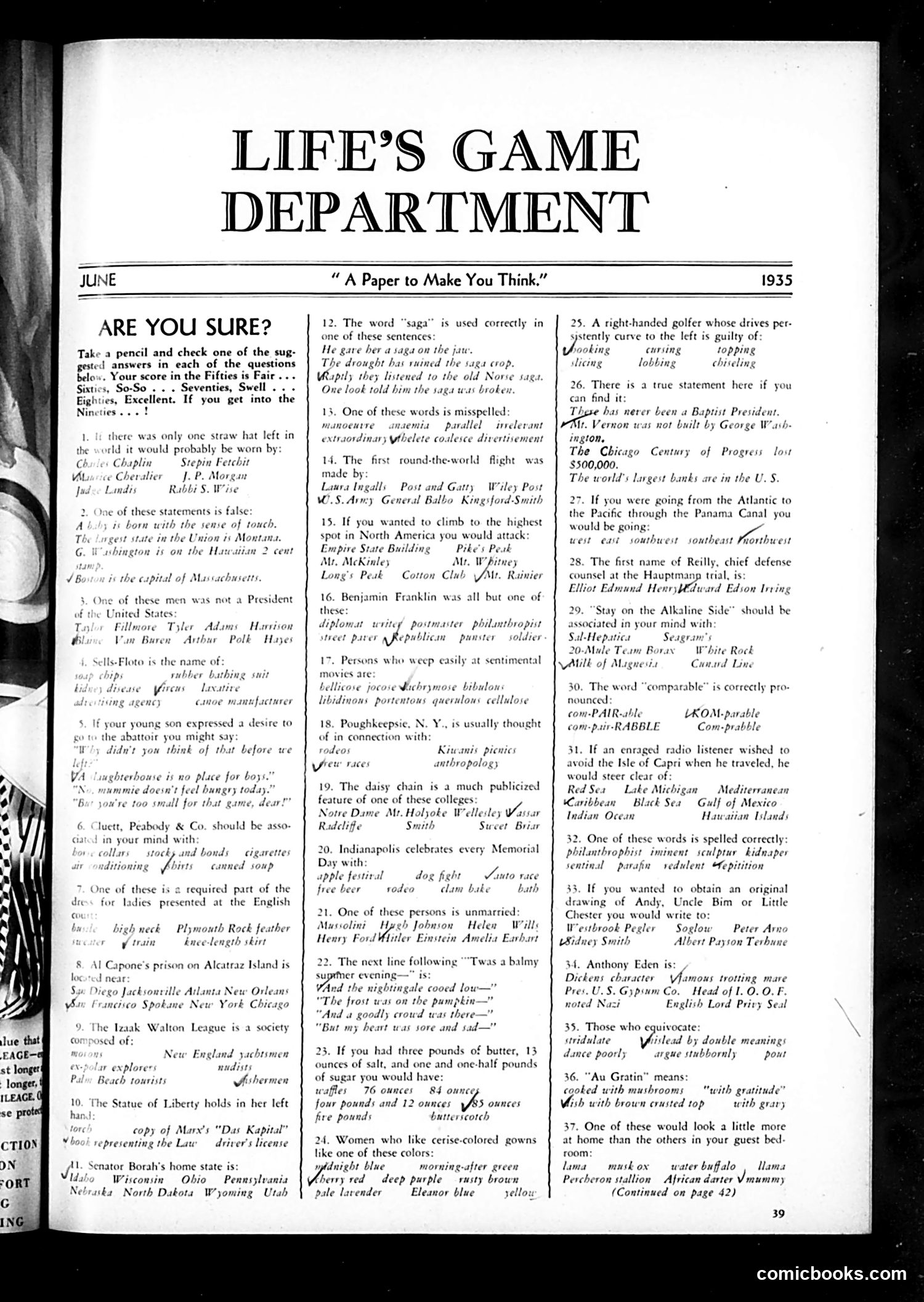
Life's Game Department Quiz (1935) This page is a trivia quiz from *Life* magazine's satirical "Game Department," testing readers' knowledge of 1930s culture, history, and current events. Questions reference contemporary figures (Mussolini, Hitler, Amelia Earhart), recent events (the round-the-world flight, Chicago's Century of Progress exposition), and popular culture touchstones. The humor lies in mixing genuinely difficult questions with absurd decoys—for instance, asking whether Charlie Chaplin or Stepin Fetchit would wear the last straw hat; whether "saga" applies to punching someone; or whether Benjamin Franklin was a "diplomat, writer, [or] philosopher." The quiz assumes readers are educated enough to catch obvious nonsense answers, making it both intellectually playful and gently mocking of middle-class pretensions about cultural literacy. Scoring ranges from "Fair" to "Excellent," inviting competitive participation.
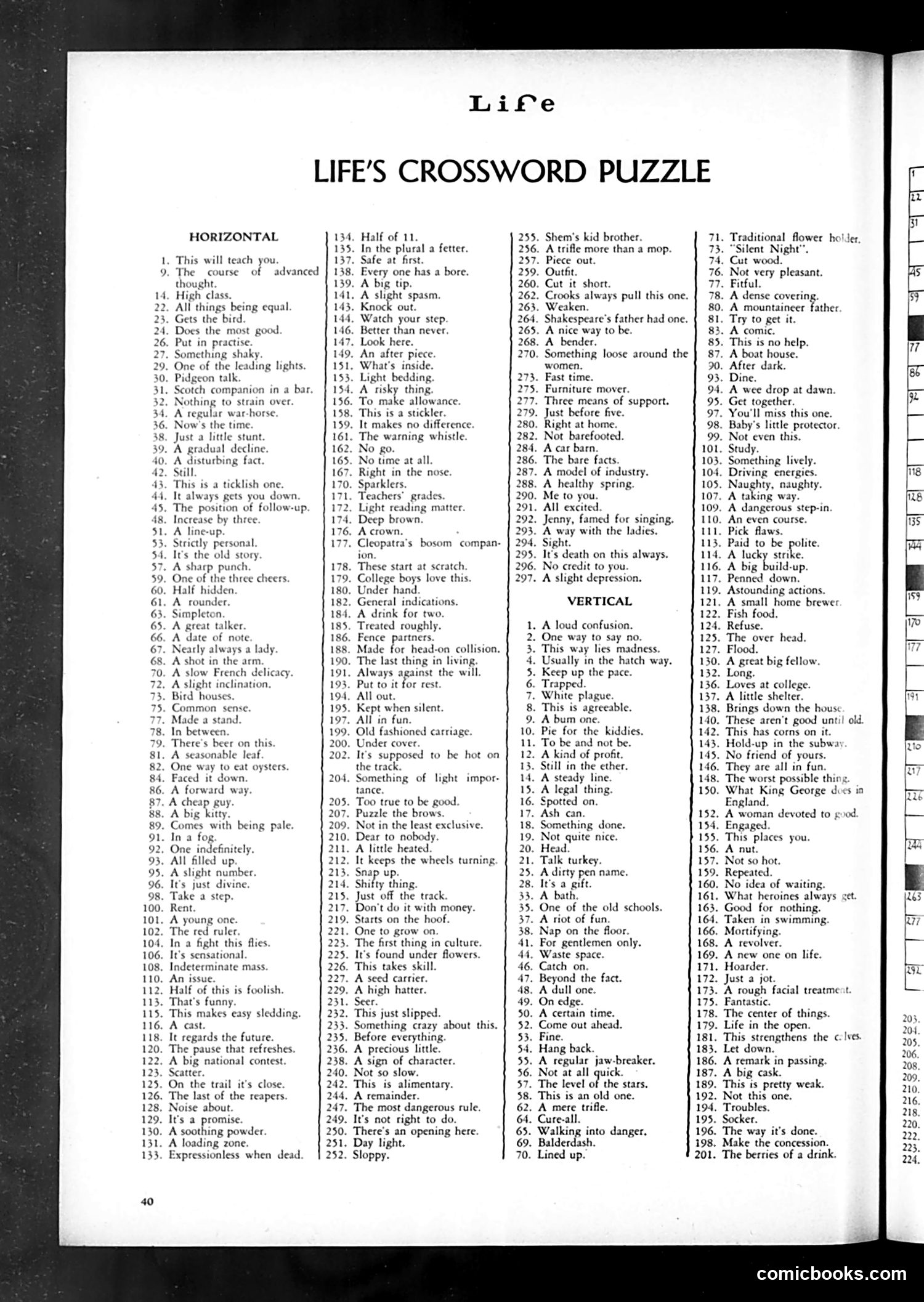
Life's Crossword Puzzle — Explanation for Modern Readers This page is simply a crossword puzzle, not a political cartoon or satirical content requiring historical context. "Life's Crossword Puzzle" is a word game where horizontal and vertical clues lead solvers to fill in interlocking answers. The clues use wordplay, puns, and riddles typical of early 20th-century humor — for example, "A big kitty" (likely LYNX), "The pause that refreshes" (REST), or "All things being equal" (TIED). There are no political figures, caricatures, or social commentary to decode. This is simply recreational puzzle entertainment, the kind Life magazine regularly published alongside its satirical articles and cartoons. Modern readers would recognize it as similar to crosswords in today's newspapers, though the vocabulary and clue style reflect its historical era.
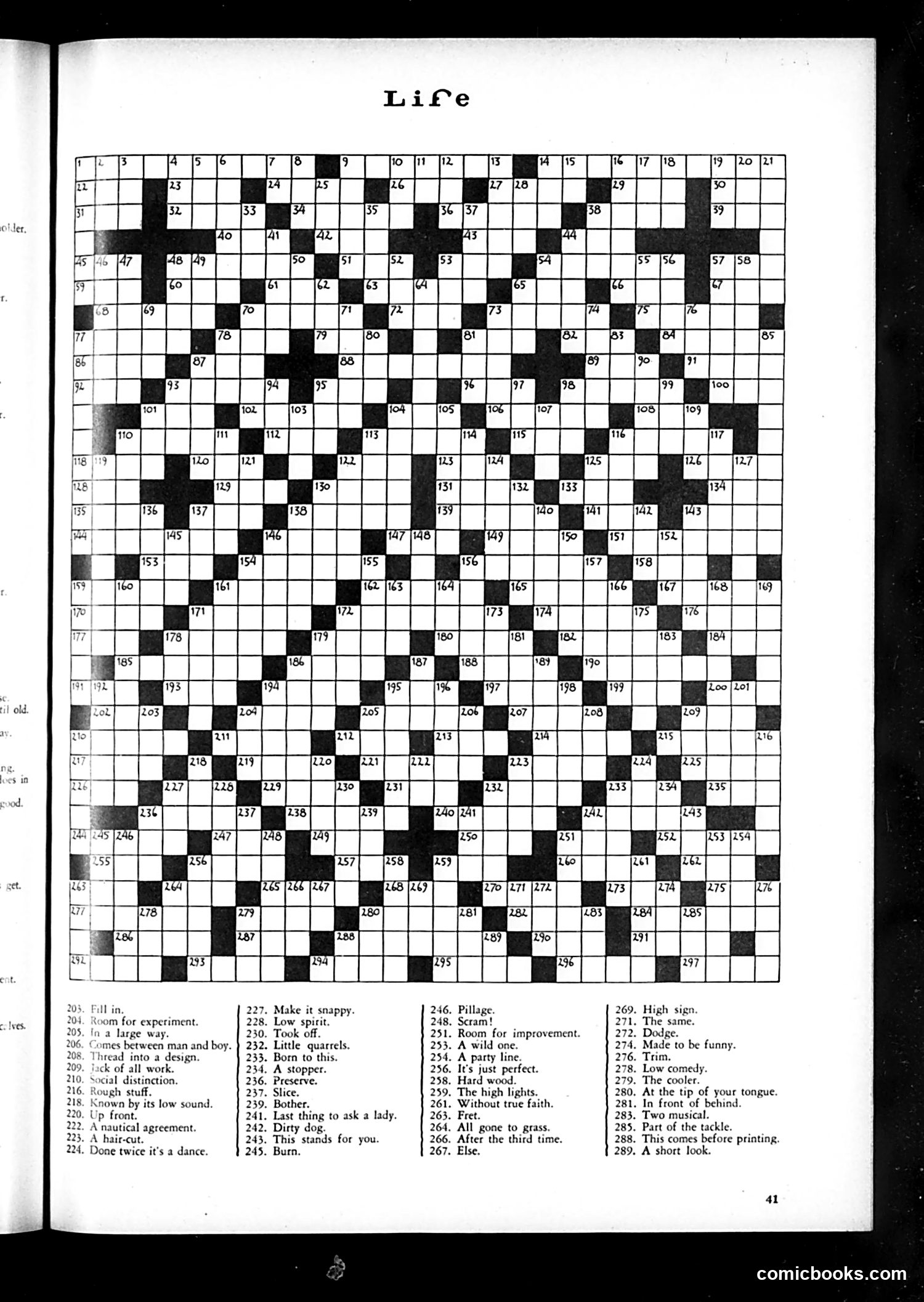
This is a Crossword Puzzle, Not a Political Cartoon This page is not a cartoon or satirical commentary—it's a crossword puzzle from *Life* magazine. The grid shows the numbered squares and black spaces typical of crosswords, with clues listed below organized by number. The clues are wordplay-based definitions requiring single words as answers. Examples include: "Room for experiment" (LAB), "A hair-cut" (BOB), "Done twice it's a dance" (STEP), and "Dirty dog" (CAD). There is no political or social satire here. This represents *Life*'s entertainment content—the magazine published humor, cartoons, and puzzles for leisure reading. The page number (41) and layout indicate this is typical puzzle-page filler material common in mid-20th-century magazines.
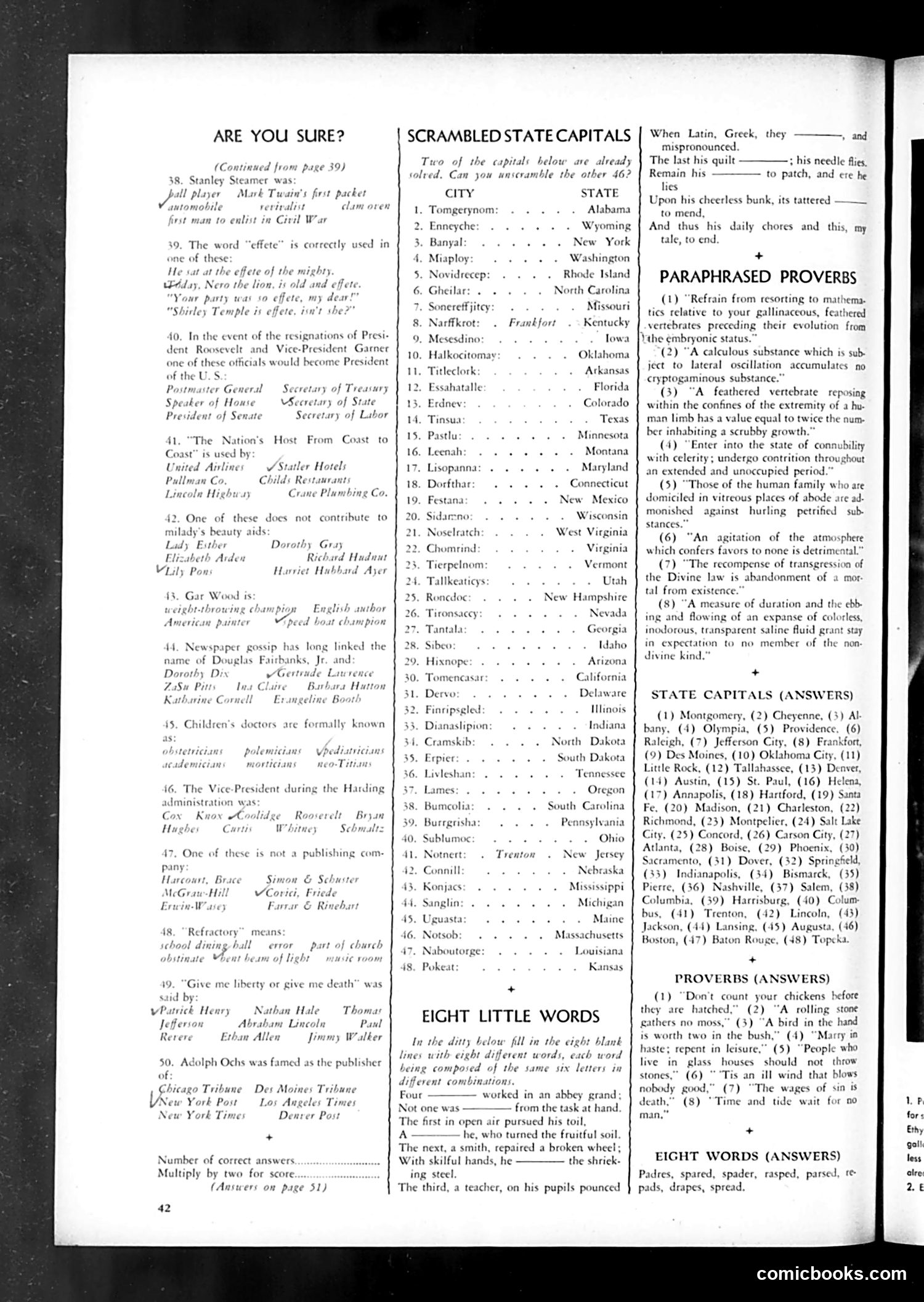
Analysis of Life Magazine Page This page contains puzzle and word-game content, not political cartoons. It includes: "Are You Sure?" – A trivia quiz testing readers' knowledge of American history, politics, and culture. Questions reference President Roosevelt, Vice-President Garner, and historical figures like Patrick Henry and Nathan Hale. "Scrambled State Capitals" – A word puzzle where readers unscramble city names to identify U.S. state capitals (e.g., "Tomgerynom" = Montgomery, Alabama). "Eight Little Words" – A fill-in-the-blank word puzzle about laborers (a monk, farmer, smith, teacher, prisoner) using anagrams. "Paraphrased Proverbs" – Humorous restatements of common sayings in deliberately complex vocabulary (e.g., "Don't count your chickens before they hatch" becomes academic jargon). These were typical interactive entertainments for 1930s-40s Life magazine readers, designed for mental exercise and amusement rather than social commentary.
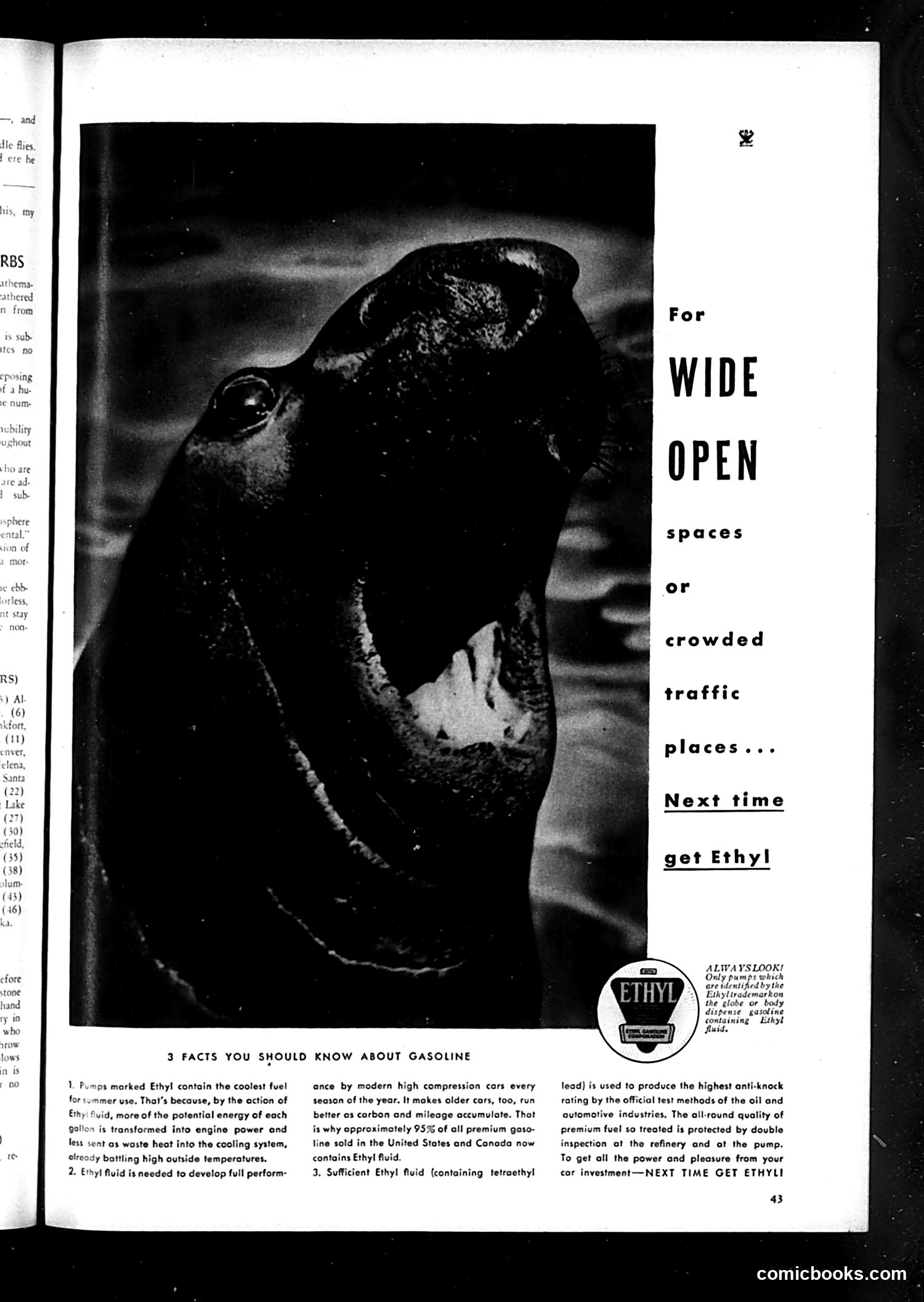
Analysis This is not a cartoon or satire, but rather a straightforward advertisement for Ethyl gasoline (a brand containing tetraethyl lead). The image shows a close-up of a dog's face with its mouth wide open—likely meant to convey enthusiasm or relief. The ad's tagline promises Ethyl fuel works "for wide open spaces or crowded traffic places," suggesting it performs reliably in all driving conditions. The "3 Facts" section is marketing copy claiming Ethyl's superiority: it runs cooler, improves engine performance, and provides better anti-knock properties than regular gasoline. The emphasis on "premium" fuel and "official test methods" appeals to consumer confidence. Historical context a modern reader would miss: This predates the 1970s leaded-gasoline ban. Tetraethyl lead was a standard, legal fuel additive then, later discovered to be extremely toxic. The advertisement presents it as an unqualified benefit rather than the environmental and health hazard it actually was.
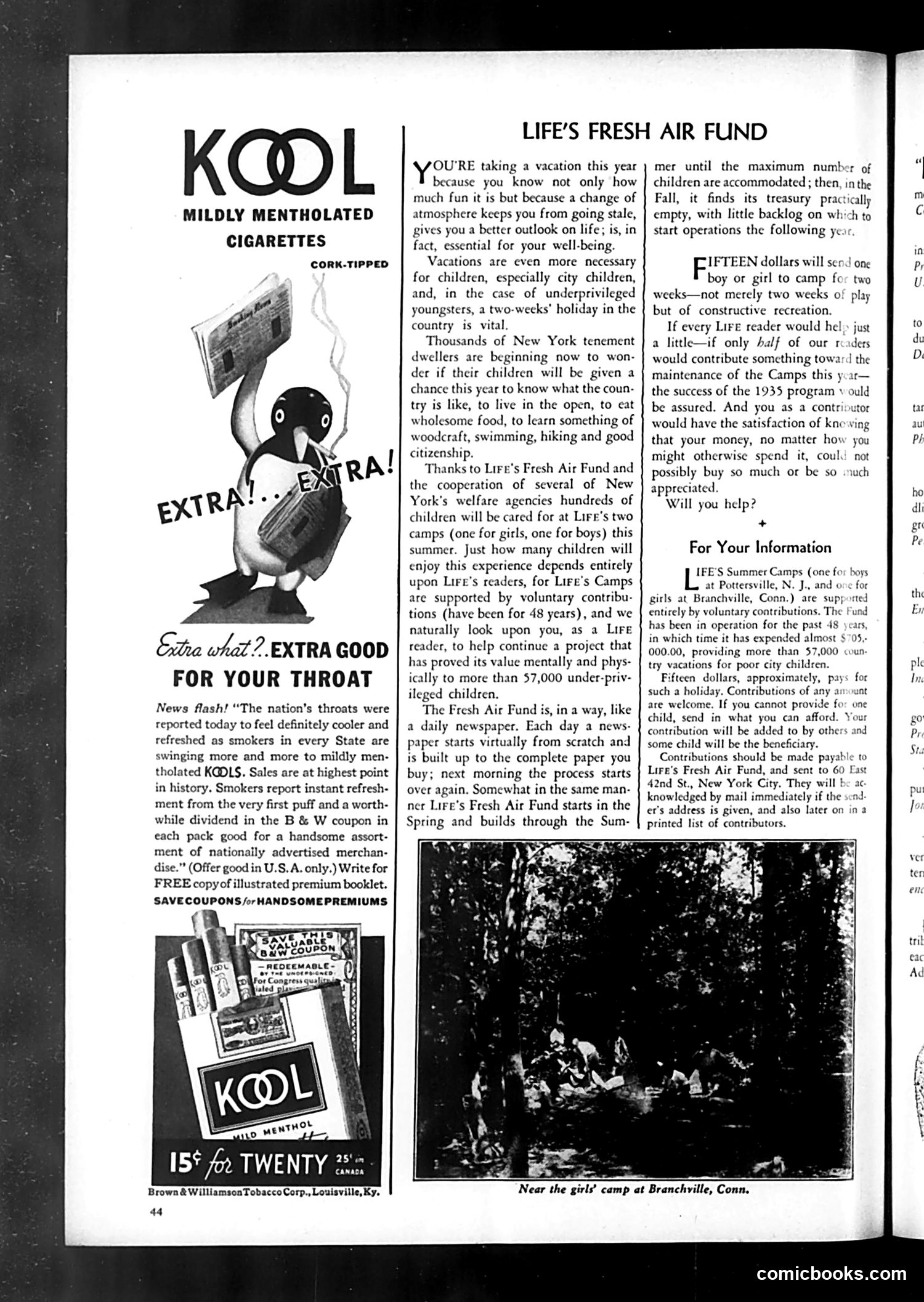
Analysis of Life Magazine Page This page combines advertising and charitable fundraising. Left side: A Kool cigarettes ad uses satirical "news flash" language mocking health claims. The cartoon pelican mascot appears absurd—the joke is that cigarettes refresh throats, which contradicts smoking's actual effects. The ad's tongue-in-cheek tone ("Extra good for your throat") suggests even 1930s audiences recognized tobacco industry claims as dubious. Right side: A genuine appeal for Life's Fresh Air Fund, a 48-year-old charity sending poor New York City children to summer camps. The text earnestly solicits donations ($15 per child) and provides accounting details to establish legitimacy. The irony: The page juxtaposes a cigarette company's frivolous marketing against a sincere plea to help underprivileged children. For modern readers, this starkly illustrates how openly tobacco was advertised even while addressing poverty and child welfare—topics with moral weight the ad industry exploited for juxtaposition and credibility.
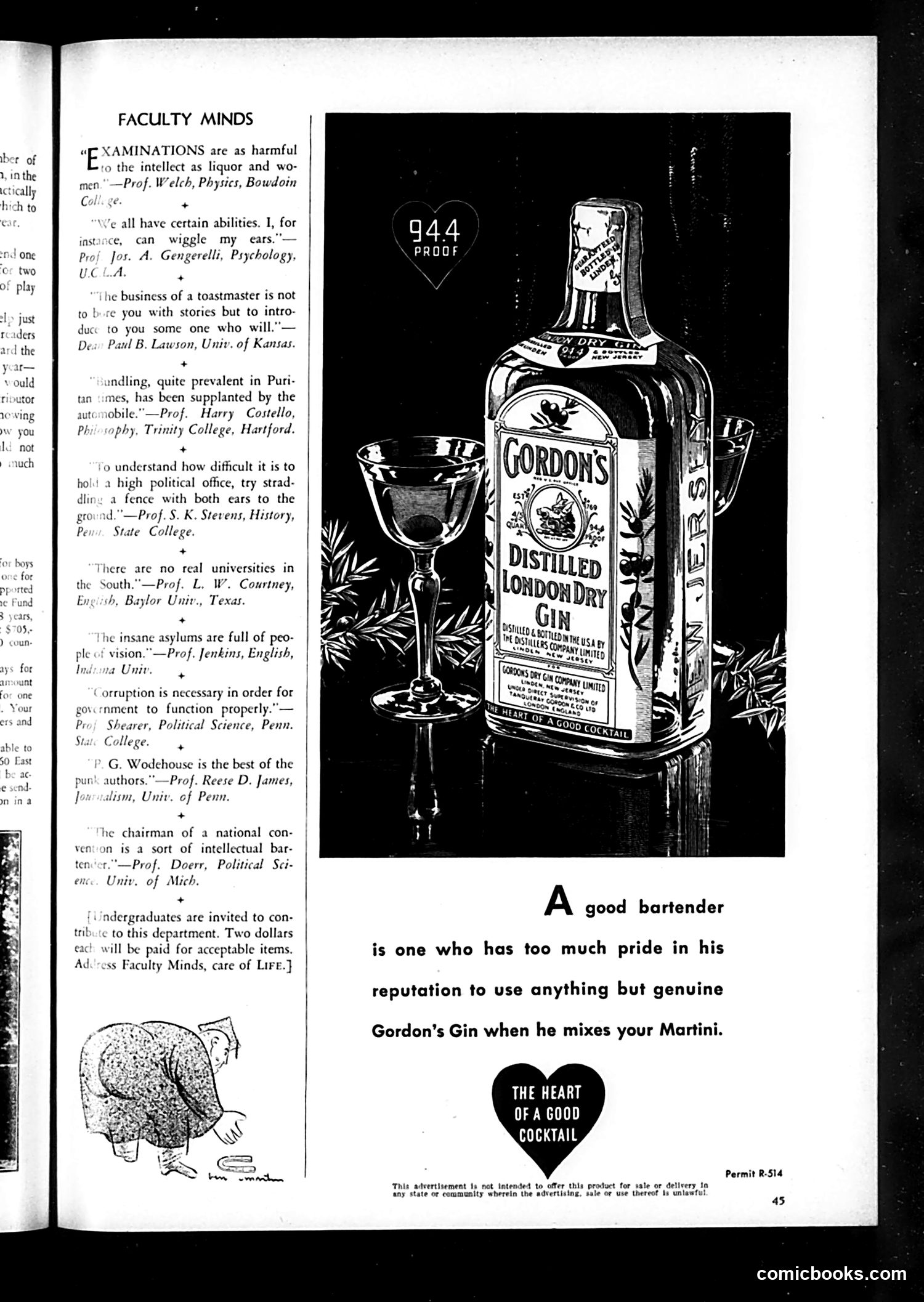
Life Magazine Page Analysis This page combines two distinct elements: a satirical "Faculty Minds" column and a Gordon's Gin advertisement. The Satirical Column collects absurd or provocative quotes attributed to real university professors from schools like Bowdoin, UCLA, and Penn. The humor relies on professors making contradictory, offensive, or ridiculous statements—such as one claiming "examinations are as harmful...as liquor and women" or another asserting "there are no real universities in the South." These quotes mock academic pretension and expose perceived hypocrisy or ignorance among intellectuals. The Advertisement (right side) uses the column's intellectual theme cleverly, positioning Gordon's Gin as the choice of discerning bartenders with "pride in his reputation." By pairing it with the column mocking academics, the ad subtly flatters readers while promoting the product. Historical Context: This likely dates to the Prohibition era's end or shortly after (note "Permit R-514"), when alcohol advertising was resuming in American publications.
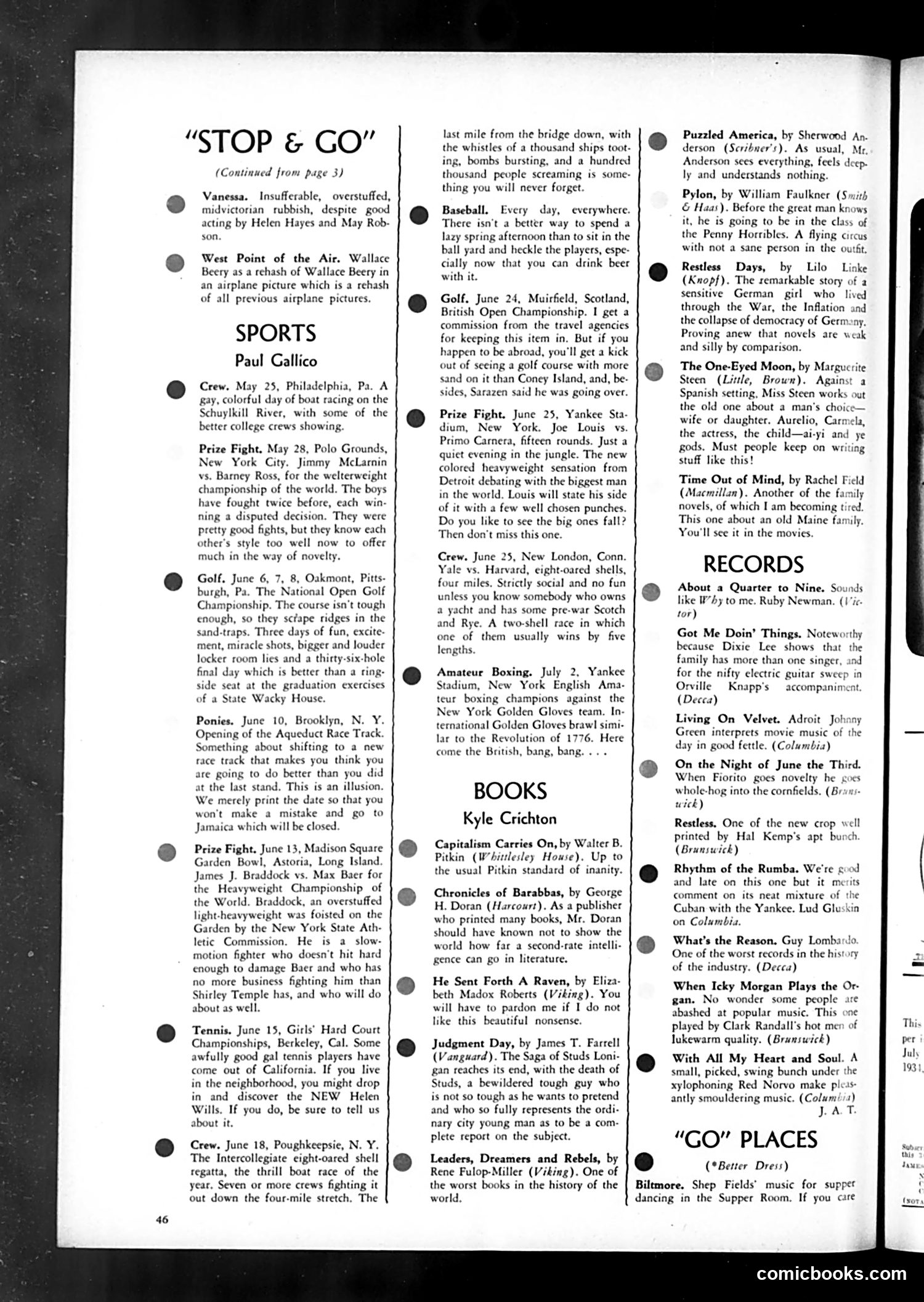
"Stop & Go" Entertainment Column (Life Magazine) This page contains film and sports reviews by Paul Gallico, a prominent sportswriter. The "Stop & Go" section reviews current movies—dismissing *Vanessa* as "insufferable, overstuffed, mid-victorian rubbish" despite Helen Hayes's performance, and *West Point of the Air* as derivative Wallace Beery repetition. The sports section catalogs upcoming June 1935 events: rowing, boxing (McLarnin vs. Ross), golf championships, horse racing, and notably Joe Louis vs. Primo Carnera—a heavyweight fight Gallico sarcastically describes as "a quiet evening in the jungle," a loaded racial reference reflecting 1930s casual racism about the Black boxer Louis and Italian immigrant Carnera. The tone is witty, cynical commentary for educated readers—dismissing predictable entertainment while promoting upcoming events. This is entertainment journalism, not political satire, though contemporary racial attitudes permeate the sports coverage.
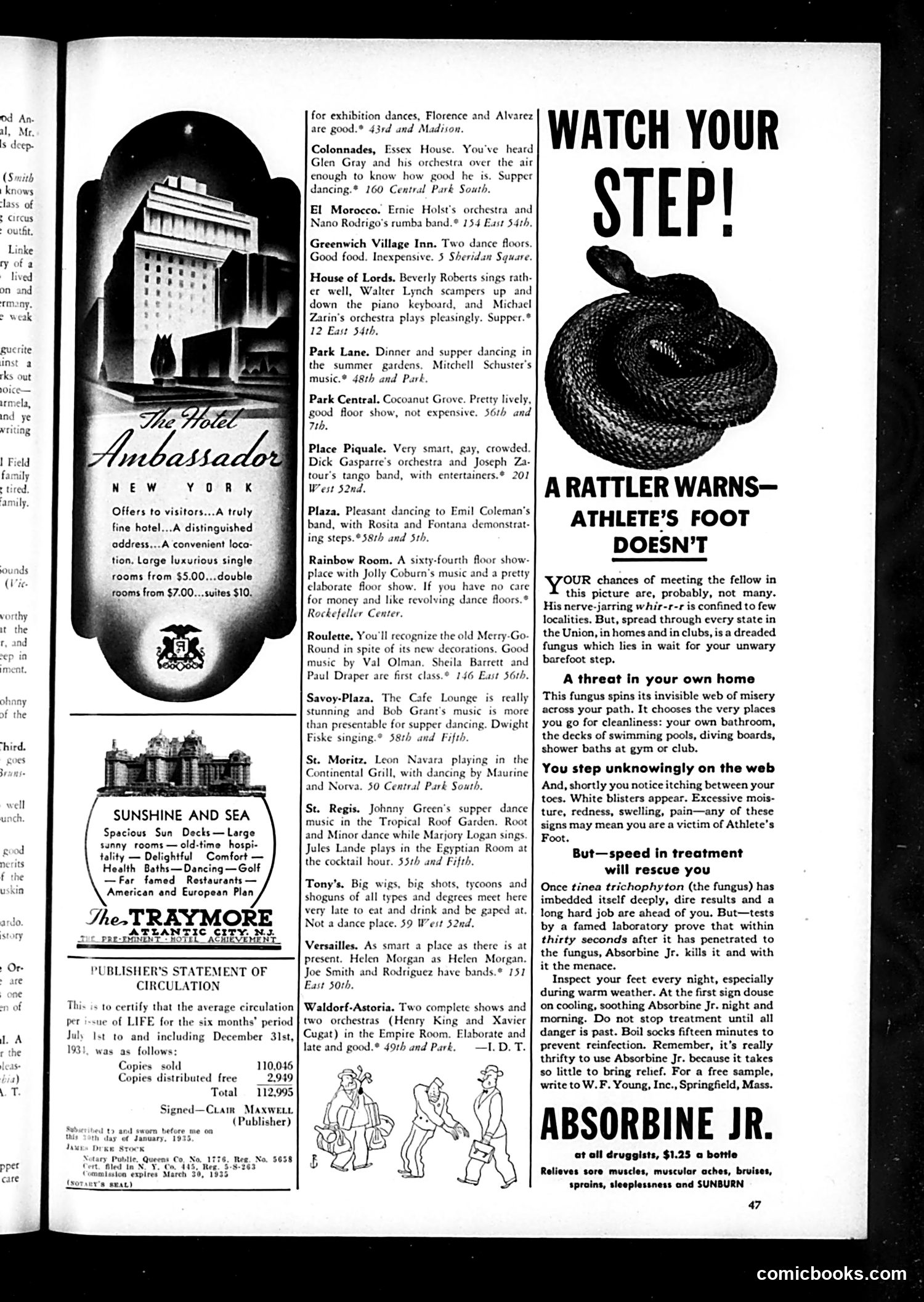
Analysis of Life Magazine Page (circa 1931) This page is primarily advertising and entertainment listings, not political satire. The left side features hotel advertisements (Hotel Ambassador, Traymore) and a publisher's circulation statement. The right side lists New York City nightclubs and dining venues popular in 1931—establishments like the Rainbow Room, Waldorf-Astoria, and Plaza, where wealthy patrons danced to orchestras. The only non-advertising content is an anti-fungal medicine advertisement for "Absorbine Jr." The accompanying illustration shows a rattlesnake with the headline "Watch Your Step!" It uses the rattler as a metaphor for athlete's foot fungus—an invisible threat lurking in public spaces like pools and clubs. The ad warns readers to inspect feet nightly and use the product to prevent infection. This reflects 1930s public health messaging that portrayed fungal infections as serious threats requiring commercial treatment, associating them with the unsanitary conditions of shared public spaces.
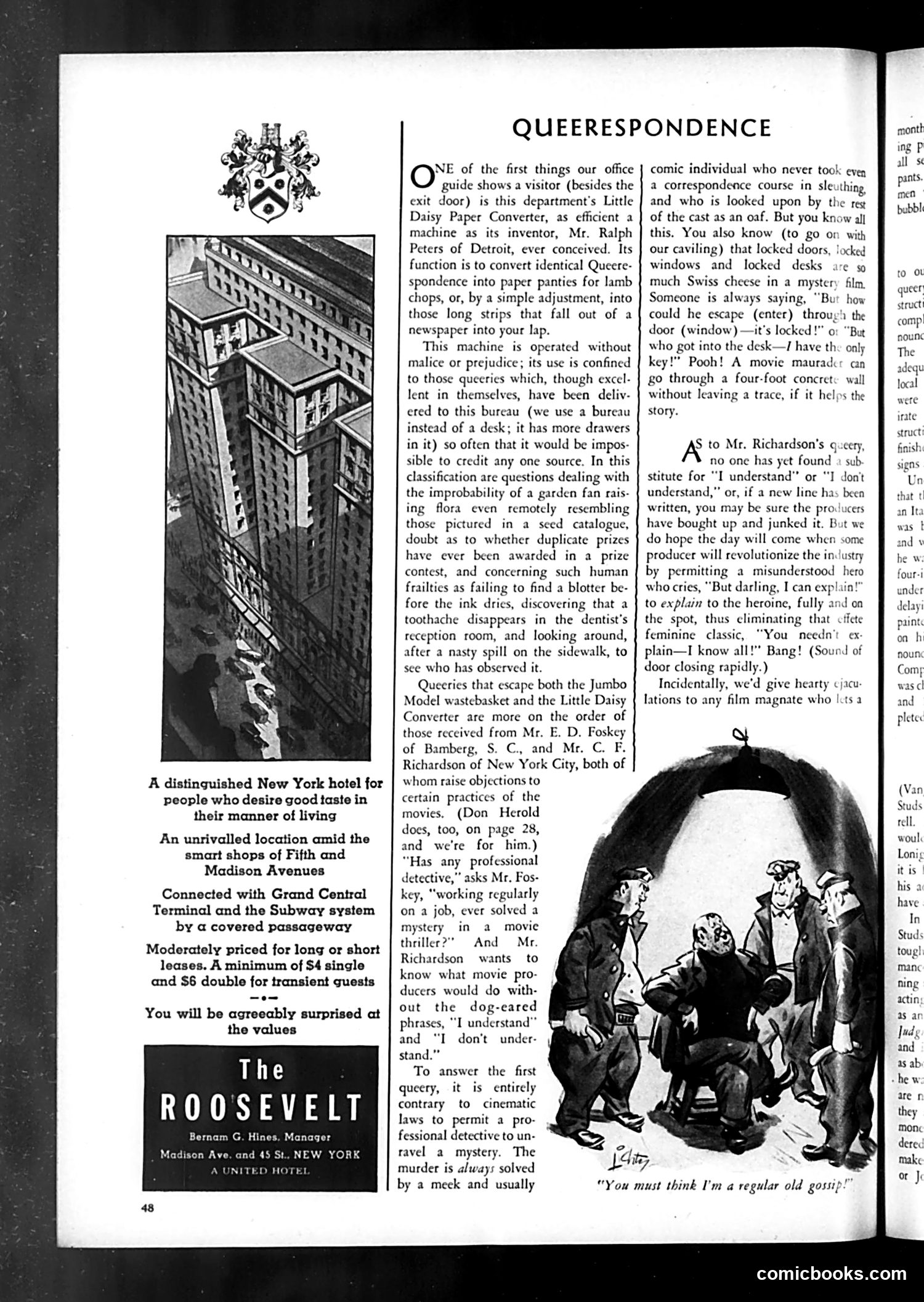
Analysis of This Life Magazine Page This page consists primarily of advertising and editorial content rather than political satire. The main advertisement promotes the Roosevelt Hotel in Manhattan, highlighting its location near Fifth and Madison Avenues, connection to Grand Central Terminal, and moderate pricing ($4-$6 per night). The "Queerespondence" section is the magazine's readers' advice column. It humorously addresses complaints from readers E.D. Foskey (South Carolina) and C.F. Richardson (New York) about common movie tropes. Their criticism: professional detectives never solve mysteries in films; instead, bumbling amateurs do. Additionally, movies overuse clichéd dialogue like "I understand" and "I don't understand." The accompanying cartoon (credited to "L. Maity") illustrates this complaint—showing what appears to be characters discussing whether someone is "a regular old goop" (slang for a foolish person), likely mocking typical movie dialogue and character types. This is lighthearted media criticism, not political satire.
Explanation for Modern Readers This page contains two distinct pieces of satirical content: The Construction Joke: A humorous anecdote about an Italian contractor named Giuseppe Rome who chronically delays projects. The joke relies on a period stereotype (Italian workers as slow/unreliable) and wordplay—Rome's delays are so legendary that when sub-contractors finally finish a job on time, the builder becomes so stressed he's "only as sound as a dollar" (a reference to the weakened dollar during economic instability). "If Women Could Vote on This": A satirical column questioning whether women should endorse "Mum" deodorant. It jokes that advertising campaigns promoting male deodorant use would benefit women by making men more pleasant. The piece mocks both consumer marketing and women's limited political/economic power—framing product endorsement as a substitute for actual voting rights. This reflects pre-suffrage or early women's suffrage era attitudes. Both pieces use humor to comment on contemporary frustrations: construction delays and gender inequality in consumer culture.
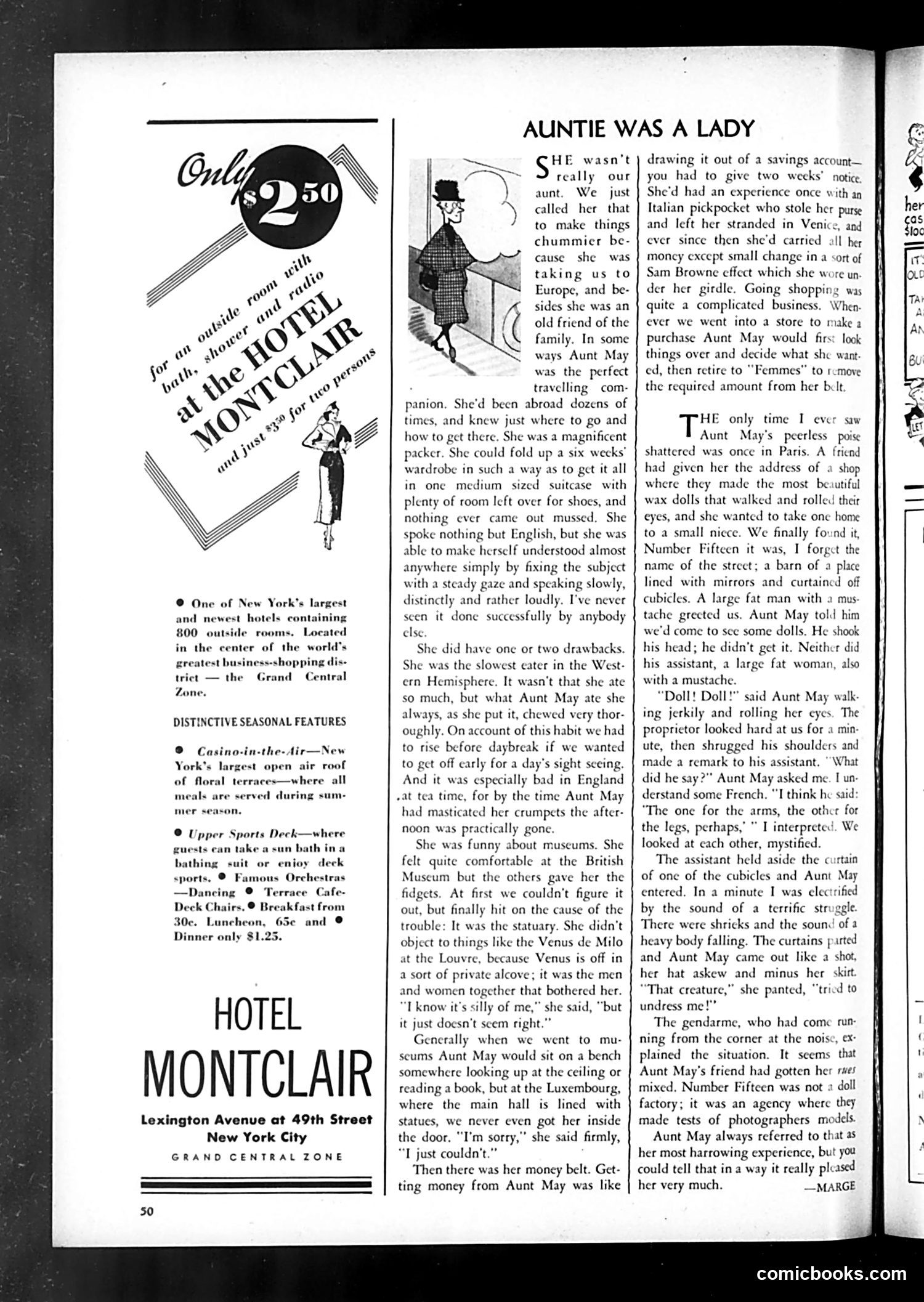
Analysis of "Auntie Was a Lady" This is primarily a humorous short story about a European travel companion, not a political cartoon. The narrative describes "Aunt May," an elderly American woman taking the narrator and others on a European tour. The "satire" is gentle social commentary on American tourist behavior and old-fashioned propriety. Aunt May embodies period stereotypes: she's prudish (uncomfortable with nude statuary in museums), overly cautious with money (hoarding it in a "money belt" after a Venice pickpocket incident), an extremely slow eater, and speaks English loudly to foreigners assuming they'll understand better. The humor derives from her contradictions—she's worldly and experienced yet provincial in attitudes, practical yet socially awkward. Her refusal to enter a museum room with co-ed statuary ("it just doesn't seem right") exemplifies early-20th-century American conservatism about propriety. This reflects 1920s-30s attitudes toward older generations and their rigid morality, presented affectionately rather than mockingly. The page also contains a Hotel Montclair advertisement.
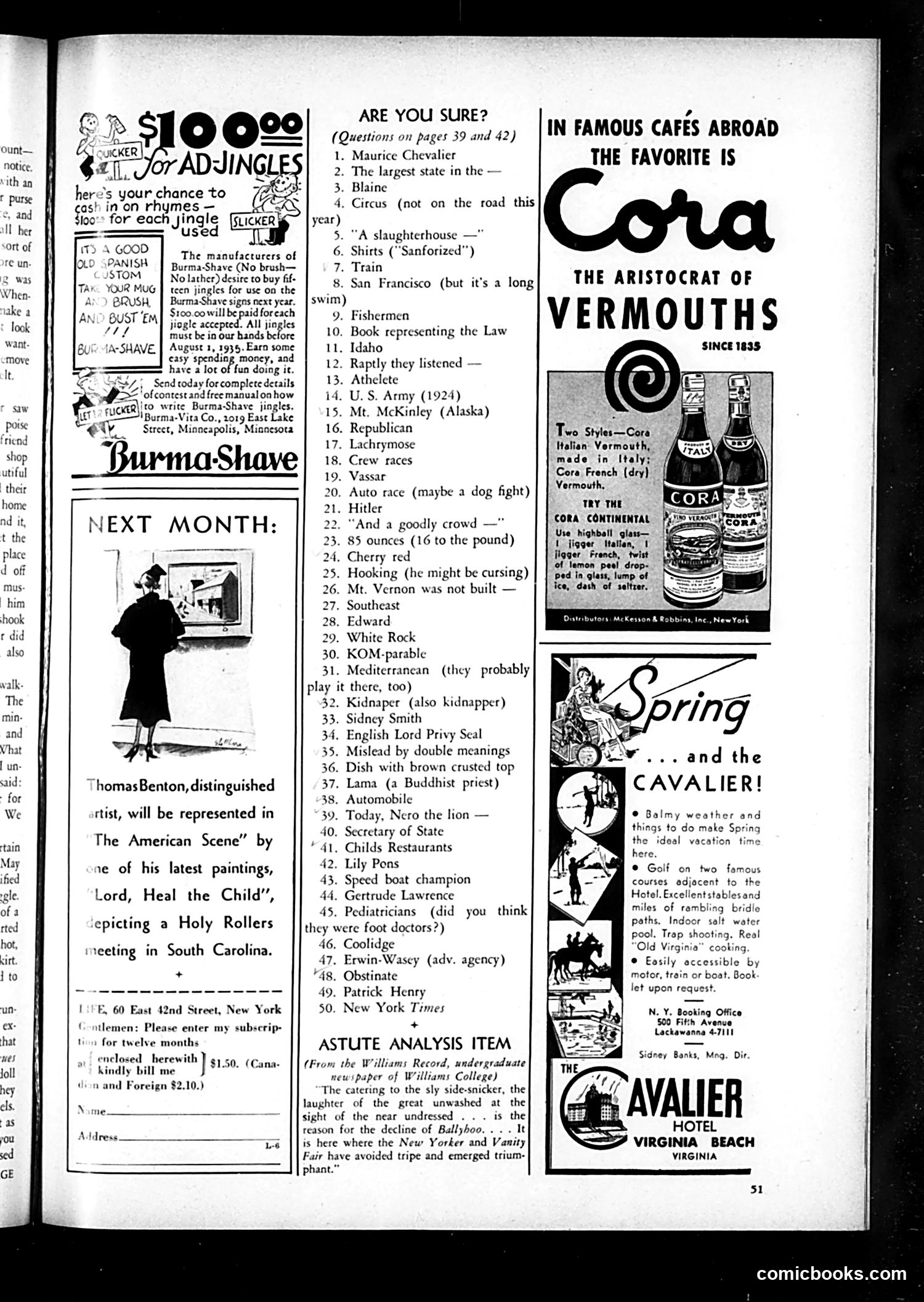
Analysis of Life Magazine Page Content This page contains primarily advertisements and contest materials rather than political satire. The main content includes: 1. Burma-Shave Jingle Contest: An advertisement offering $100 per accepted jingle for the shaving cream company's roadside signs. This reflects 1930s marketing and consumer engagement tactics. 2. Quiz/Answer Key: "Are You Sure?" appears to be answers to a previous quiz, featuring pop culture and current events references (Maurice Chevalier, Hitler, various celebrities). 3. Astute Analysis Item: A critical note from Williams College newspaper criticizing *Ballyhoo* magazine for crude humor, contrasting it favorably with *The New Yorker* and *Vanity Fair*—reflecting 1930s debates about magazine sophistication. 4. Product Advertisements: Cora Vermouth and The Cavalier Hotel promote luxury goods and leisure. The page reflects Depression-era consumer culture and contemporary magazine competition rather than political commentary.
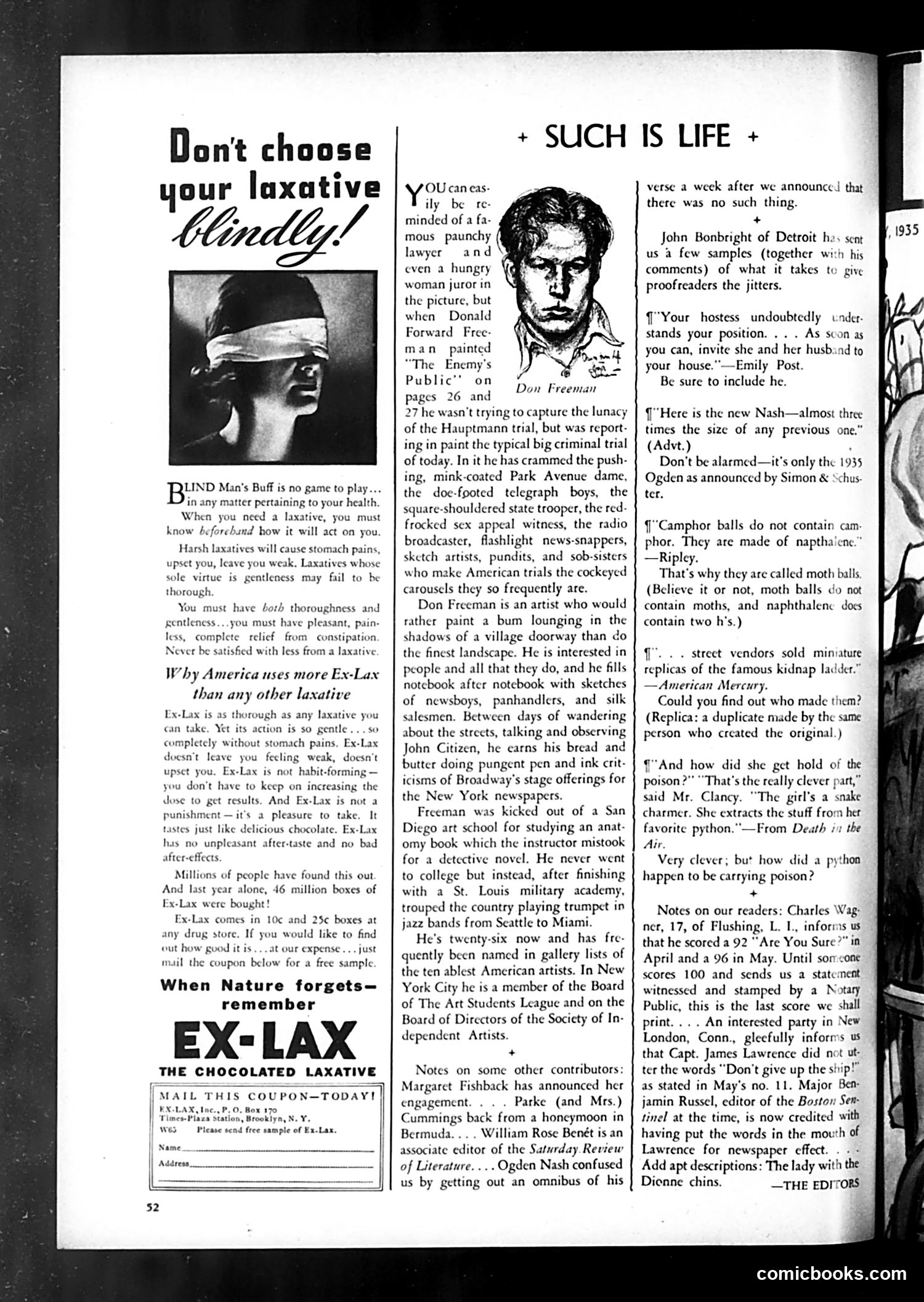
Analysis for Modern Readers This page contains primarily advertising and editorial content, not political satire. The main feature is a large Ex-Lax laxative advertisement using the "Blind Man's Buff" metaphor—warning readers not to choose laxatives carelessly, since they need both gentleness *and* effectiveness. It emphasizes Ex-Lax's popularity (46 million boxes sold annually) and pleasant chocolate taste. The secondary article, "Such is Life," profiles artist Don Freeman. It notes his painting "The Enemy's Public" (pages 26-27) depicts a sensational trial—apparently referencing the Hauptmann trial (the Lindbergh kidnapping case), though Freeman claims he wasn't specifically capturing that circus. The article describes Freeman's interest in ordinary people and urban street life, his unconventional background (kicked out of art school, played jazz trumpet), and his current standing in New York's art world. The page concludes with brief notes on other contributors and their life updates.