life
Life — July 1935
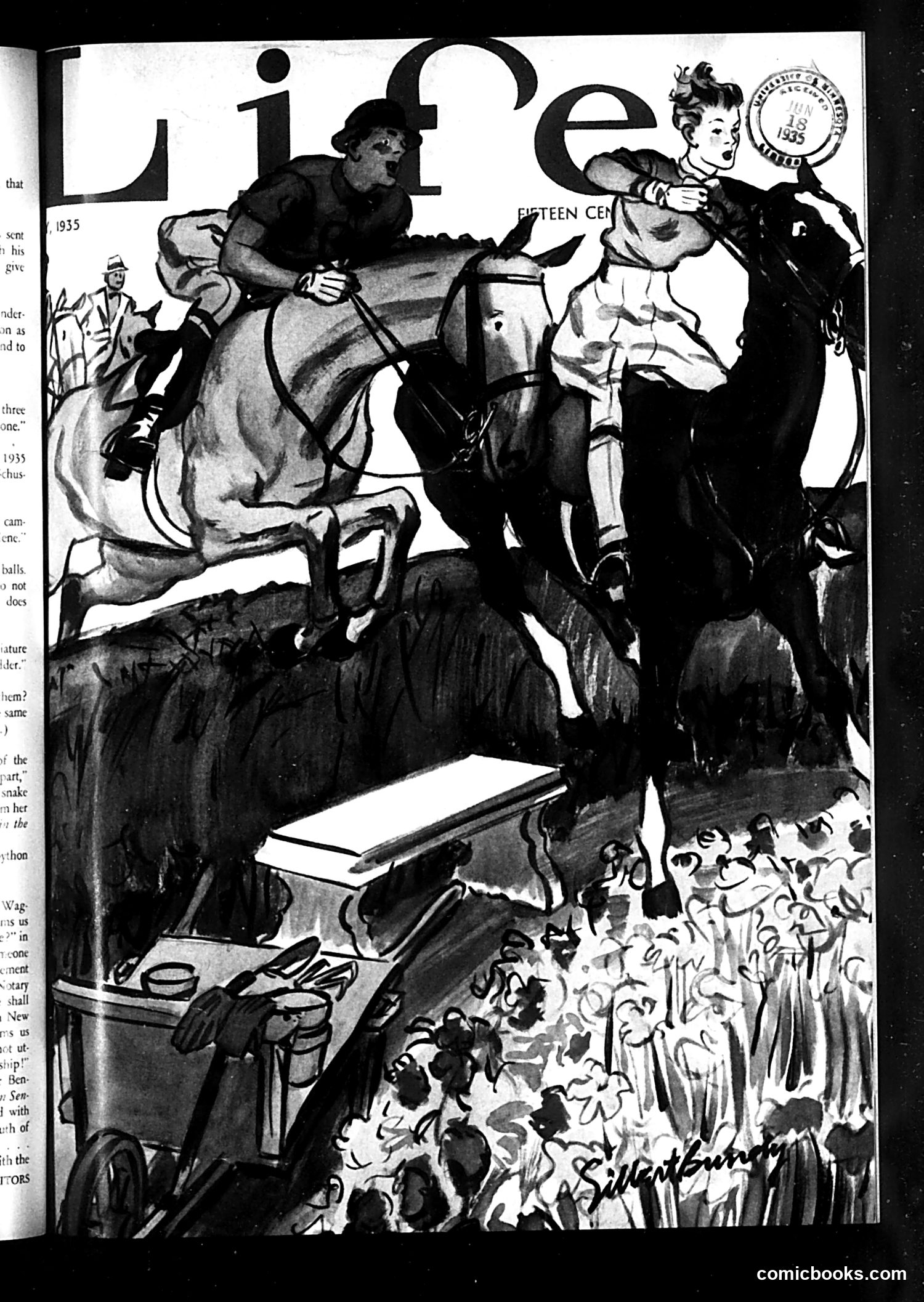
Analysis This 1935 *Life* magazine page features a satirical illustration signed by Silberberg depicting a chaotic scene of horse racing or equestrian sport gone awry. A jockey rides wildly on horseback while well-dressed spectators (appearing to be wealthy patrons or gamblers) scatter in panic below. A woman in fashionable dress recoils, and scattered betting slips or money litter the ground. The cartoon likely satirizes the unpredictability and chaos of horse racing gambling—a popular vice during the Depression era. The contrast between the upper-class spectators' refined appearance and their undignified scrambling suggests mockery of wealth and social pretension crumbling in moments of excitement or financial loss. The "15 CENTS" price mark indicates this was affordable mass-market satire targeting middle-class readers familiar with racing culture.
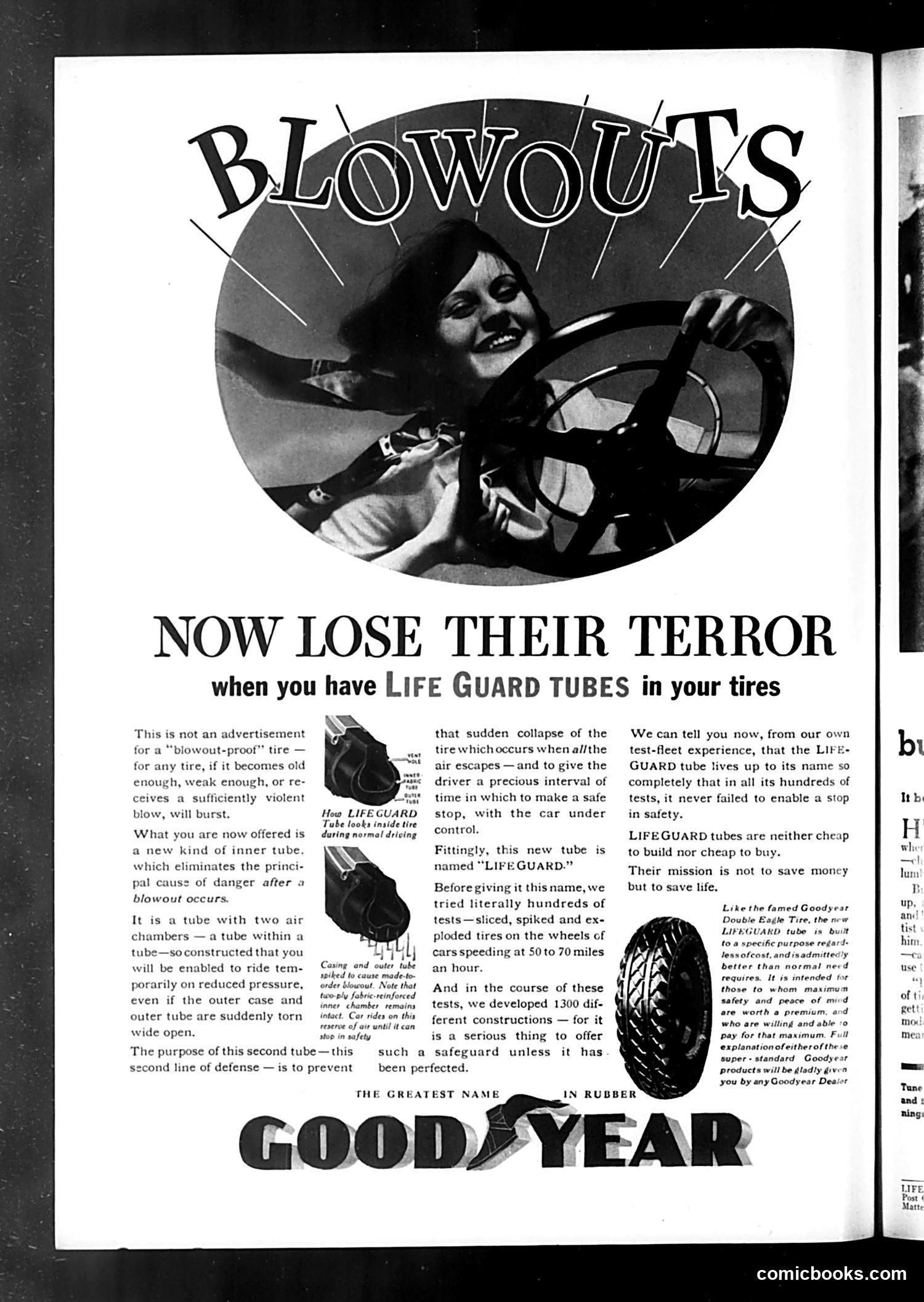
Analysis This is a Goodyear tire advertisement, not a political cartoon or satirical content. The page promotes Goodyear's "Life Guard" inner tubes for automobiles. The advertisement features a woman driver at a steering wheel, smiling confidently. The marketing message emphasizes safety: Life Guard tubes prevent blowouts by using a double-chamber design that reduces pressure if the outer tube tears, allowing drivers to reach safety before collapse occurs. The headline "NOW LOSE THEIR TERROR" refers to drivers' fear of sudden tire blowouts—a genuine highway hazard in the early automotive era. The ad claims Life Guard tubes have undergone rigorous testing at 50-70 mph speeds. This reflects early 20th-century automobile safety concerns when tire failure was a serious, potentially fatal risk. The smiling woman represents the newfound confidence and safety this product promises to motorists.

Analysis This is primarily a toothpaste advertisement, not political satire. The page features Ipana Tooth Paste marketing. The photograph shows a man labeled "The Old Man" to 1,000 Lumberjacks, but notably he's described as having a "dental cripple"—meaning his teeth are in poor condition despite his rugged persona. The advertisement uses this contrast humorously: even a tough wilderness figure needs proper dental care. The ad includes endorsements from a "famous scientist" and "dental authority" recommending Ipana paste and gum massage for healthier teeth and gums. It warns against soft foods and poor oral hygiene, which the copy suggests causes "pink tooth brush" (bleeding gums). This reflects early-20th-century advertising that linked personal hygiene products to social respectability and health—positioning proper tooth care as essential regardless of one's tough exterior or occupation.
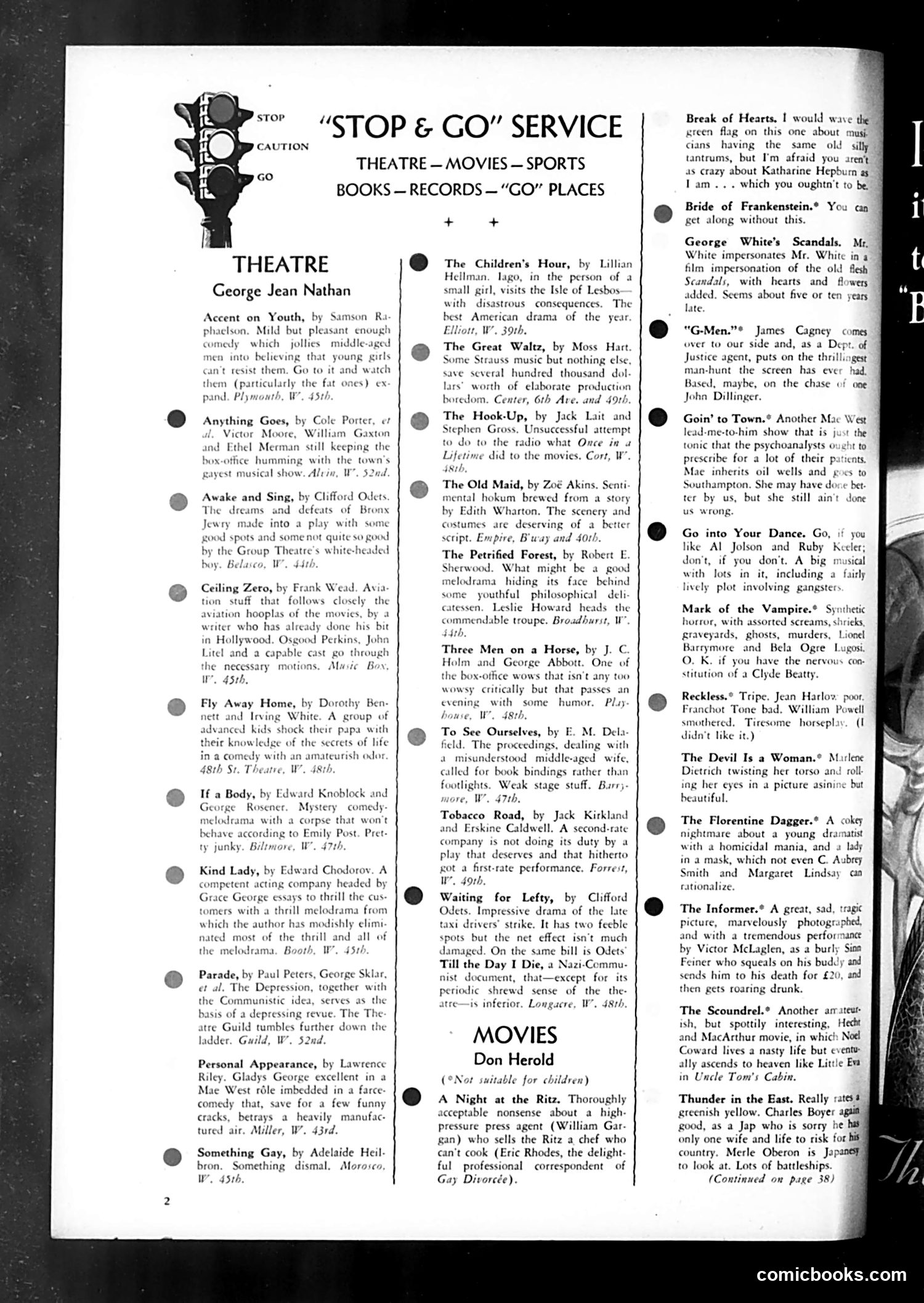
Page Analysis This appears to be a theatrical and entertainment review page from Life magazine, not a political cartoon page. The content consists of: Left column: "Stop & Go" Service—a traffic light graphic introducing theater reviews by George Jean Nathan, covering plays like "Accent on Youth," "The Children's Hour," and "Awake and Sing." Right columns: Movie reviews by Don Herold and brief capsule reviews of other films and plays. The satire: The page uses the traffic light metaphor to categorize entertainment—"Stop" (avoid), "Caution" (mixed), and "Go" (recommended)—making entertainment criticism accessible through familiar visual language. This is entertainment criticism, not political commentary. The humor derives from witty theatrical commentary rather than social or political satire. No specific caricatures or political figures appear.
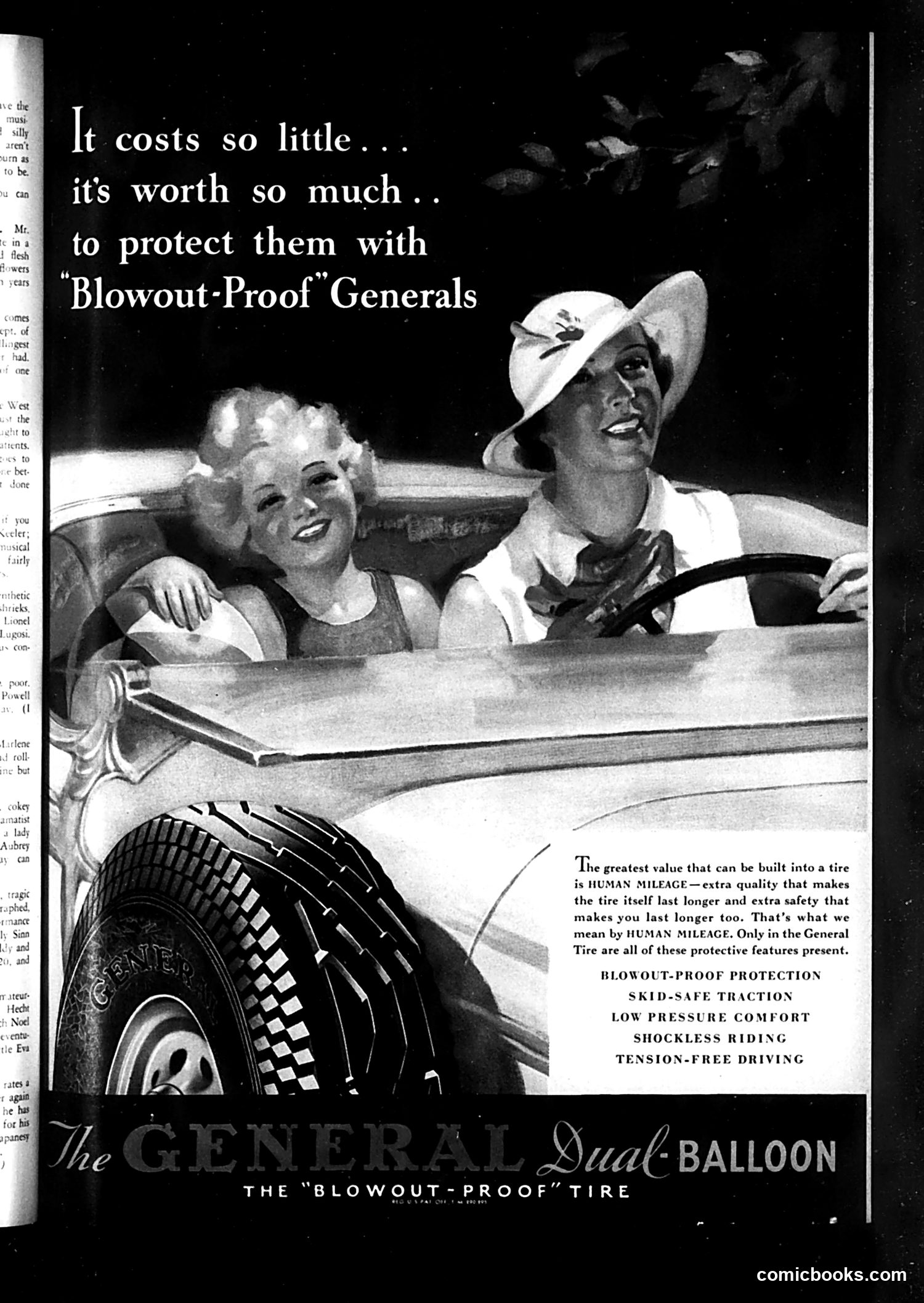
This is a General Tire advertisement, not political satire or editorial content. The ad uses a romantic couple in a convertible to promote "Blowout-Proof Generals"—tires marketed with safety features like "skid-safe traction," "low pressure comfort," and "shockless riding." The headline's wordplay ("It costs so little...it's worth so much") emphasizes affordability paired with protective benefits. The product name "Human Mileage" refers to tire durability extending vehicle lifespan. The young, attractive couple and convertible imagery appeal to 1940s consumers seeking both safety and leisure lifestyle. This represents typical mid-century automobile advertising strategy: combining romance/aspiration with practical product benefits to sell consumer goods. The page layout and styling suggest this appeared in Life magazine during the 1930s-1940s era.
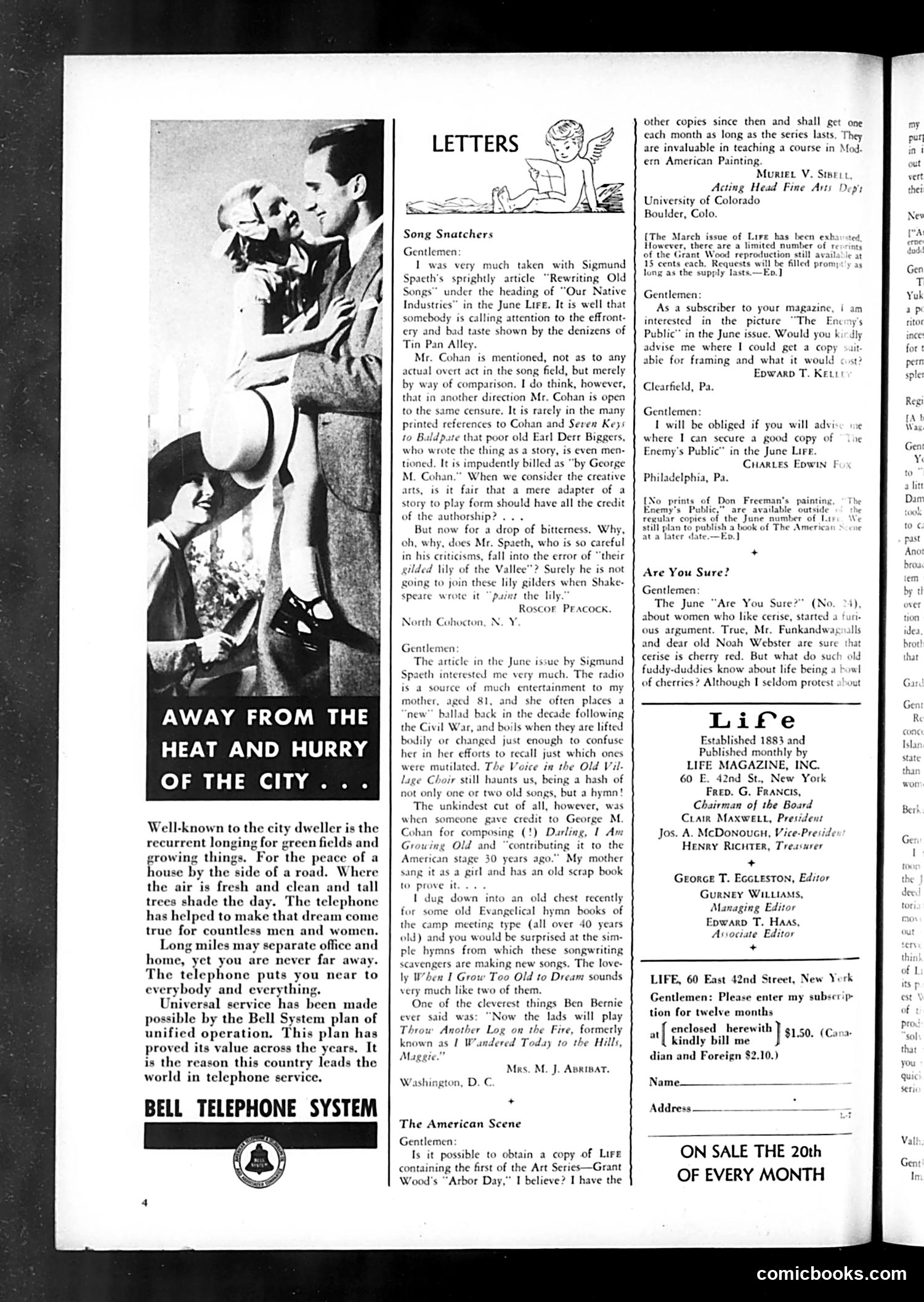
Analysis This page is primarily a letters section and advertising (Bell Telephone System ad) rather than political content. The photograph shows two figures in what appears to be a theatrical or comedic scene labeled "AWAY FROM THE HEAT AND HURRY OF THE CITY," though the specific identities and context are unclear from the image alone. The letters discuss magazine content: readers inquire about obtaining back issues of Life, ask about locating specific articles (like "The Enemy's Public"), and debate literary credits—particularly whether Sigmund Spaeth or George M. Cohan deserves credit for certain song compositions and arrangements. The page represents typical early-20th-century magazine operations: reader engagement, subscription promotion, and literary/artistic attribution disputes that occupied contemporary audiences.
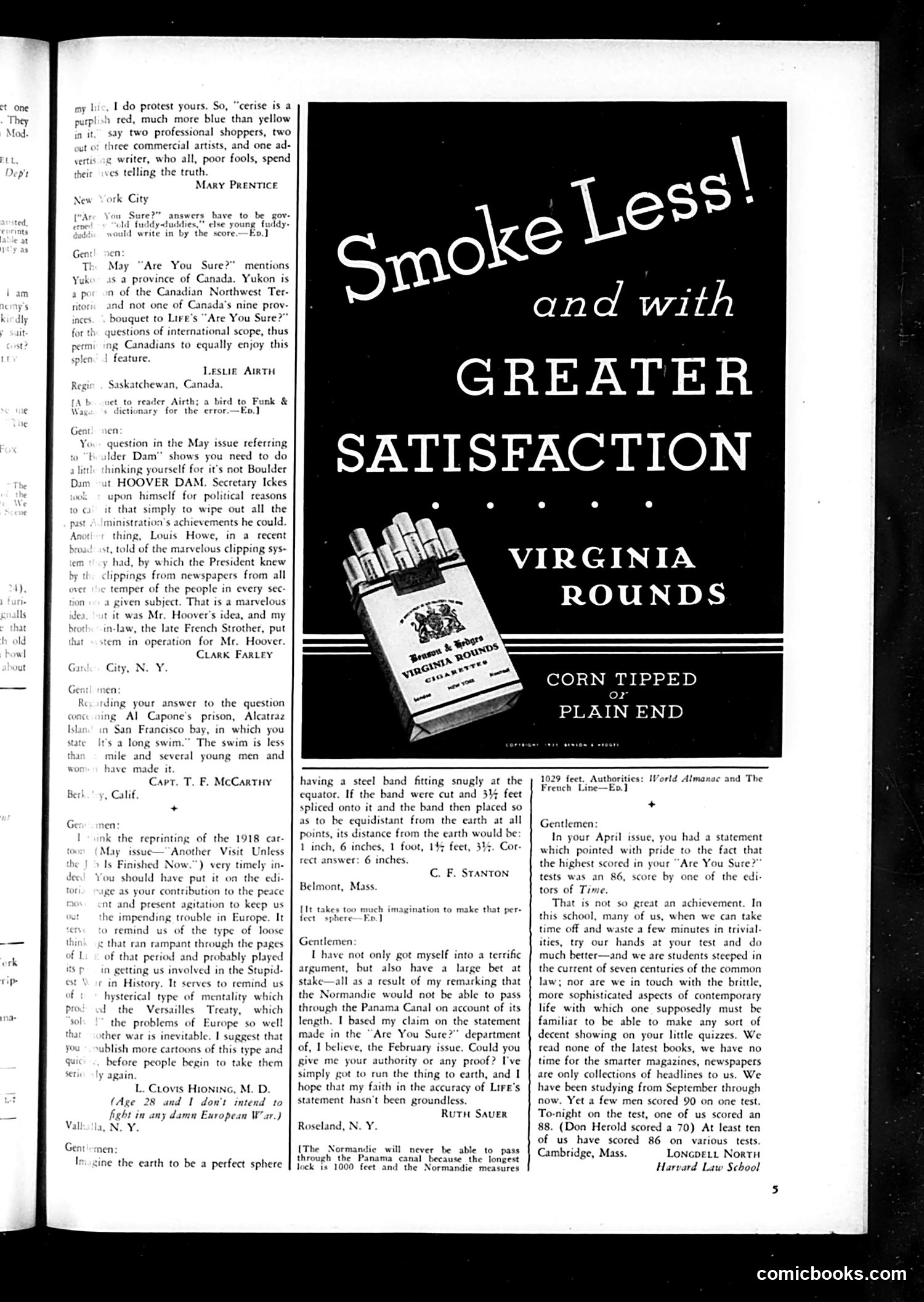
Virginia Rounds Cigarette Advertisement This page is primarily a cigarette advertisement for Virginia Rounds brand cigarettes, not political satire. The ad occupies the right half of the page and features a large image of a cigarette package. The headline "Smoke Less! and with Greater Satisfaction" reflects a common 1930s advertising strategy: marketing cigarettes as *less harmful* by emphasizing quality and reduced quantity rather than abstinence. The phrase "Corn Tipped or Plain End" refers to the filter design. The left side contains reader letters responding to various *Life* magazine articles, unrelated to the advertisement. This layout—mixing editorial content with full-page ads—was standard magazine practice of that era.
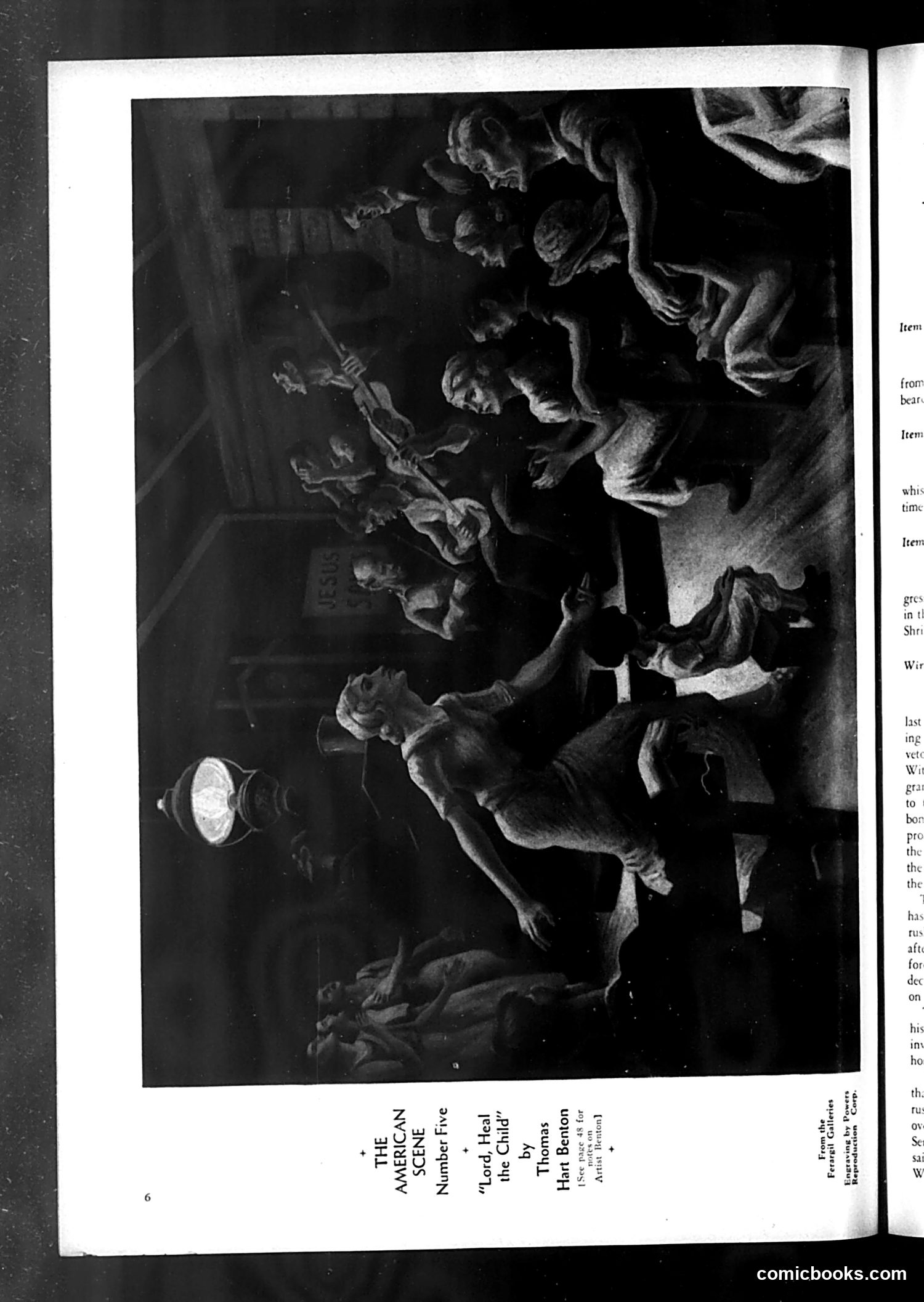
Analysis This appears to be page 6 from Life magazine, featuring an illustration titled "The American Scene" (Number Five), showing "Lord Held the Child" by Thomas Hart Benson (likely Thomas Hart Benton, the famous American regionalist painter). The black-and-white reproduction depicts a dramatic religious or allegorical scene with multiple figures gathered around a central luminous figure or object. The composition is dark and expressionistic, with figures rendered in Benton's characteristic style. However, I cannot definitively identify specific political or social references from the image alone without additional context about the publication date or accompanying article text, which appears to be cut off on the right margin. The dramatic religious imagery suggests social commentary typical of 1930s American art, but the specific satirical point remains unclear from this page alone.
Analysis of Life Magazine Page This page satirizes American infrastructure and celebrity culture circa the 1920s. The "Some of the People" section mocks contemporary absurdities: a congressman sleeping outdoors during traffic signals malfunction, excessive telegraph usage during the Shriners convention, and a $35,000 congressional appropriation for extra D.C. police during the convention. The main satirical piece, "Love Conquers All," ridicules Hollywood's perceived greed and California's tax threats. It portrays movie studios as self-pitying ("If they don't treat us good / There ain't a single season we should stay"), with state governors competing to attract the industry by offering tax incentives. The satire suggests Hollywood's disproportionate influence over American policy and the desperation of states competing for the film industry's economic benefits.
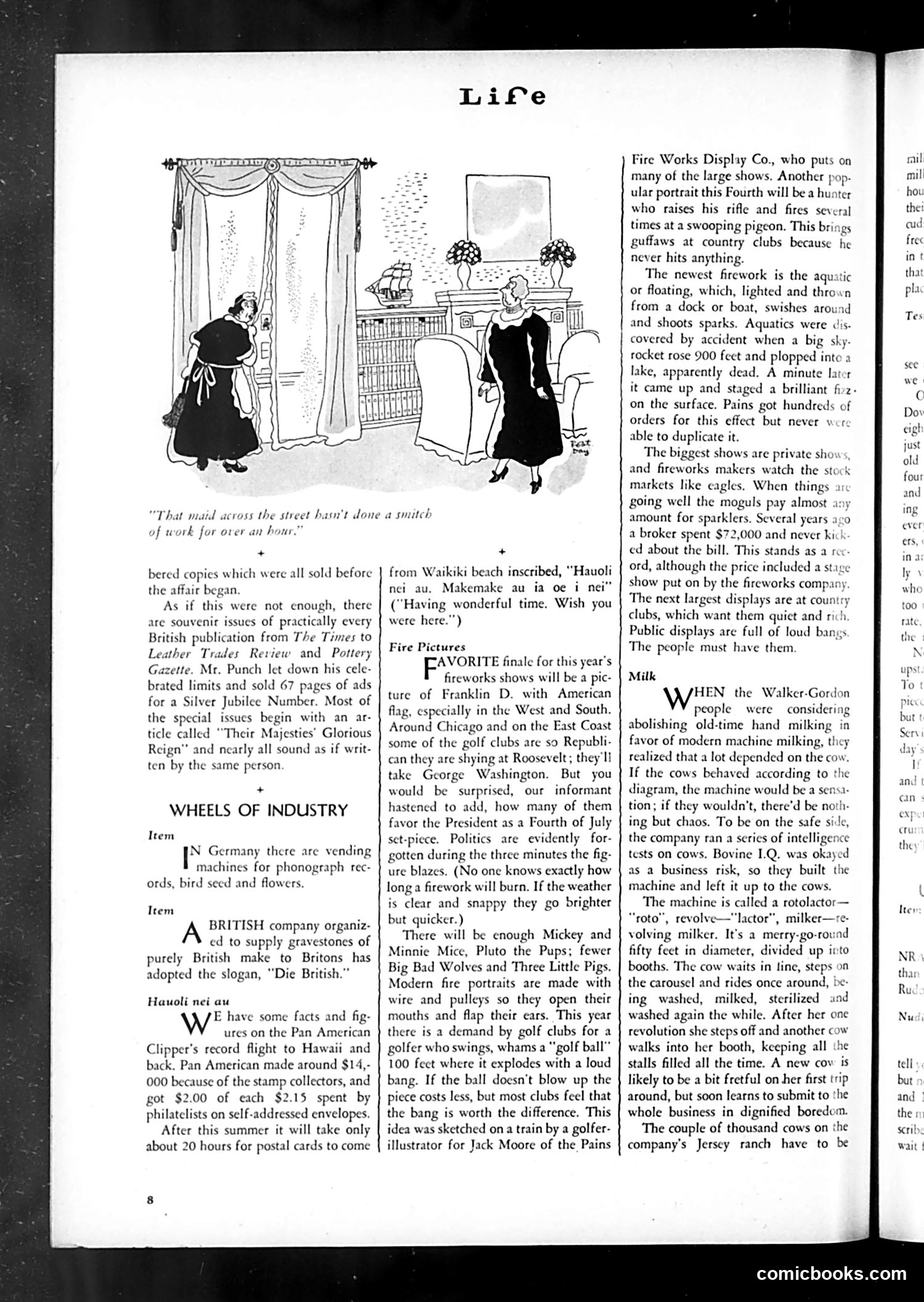
Analysis of Life Magazine Page The main cartoon depicts two women in 1920s dress in a domestic interior. One stands by a window/curtains while the other sits. The caption reads: "That maid across the street hasn't done a match of work for over an hour." What this means: This is social satire about idle wealthy women observing their servants' work habits. The joke relies on the irony that the speaker is herself doing nothing but watching—criticizing the maid's laziness while being leisurely. It reflects 1920s class dynamics and the employer-servant relationship, where affluent housewives had time to monitor domestic staff closely. The humor targets both the leisure class's judgment and their own idleness. The page also contains various short-form humor items about fireworks displays, British phonographs, and mechanical milking machines—typical of Life's miscellaneous content format.
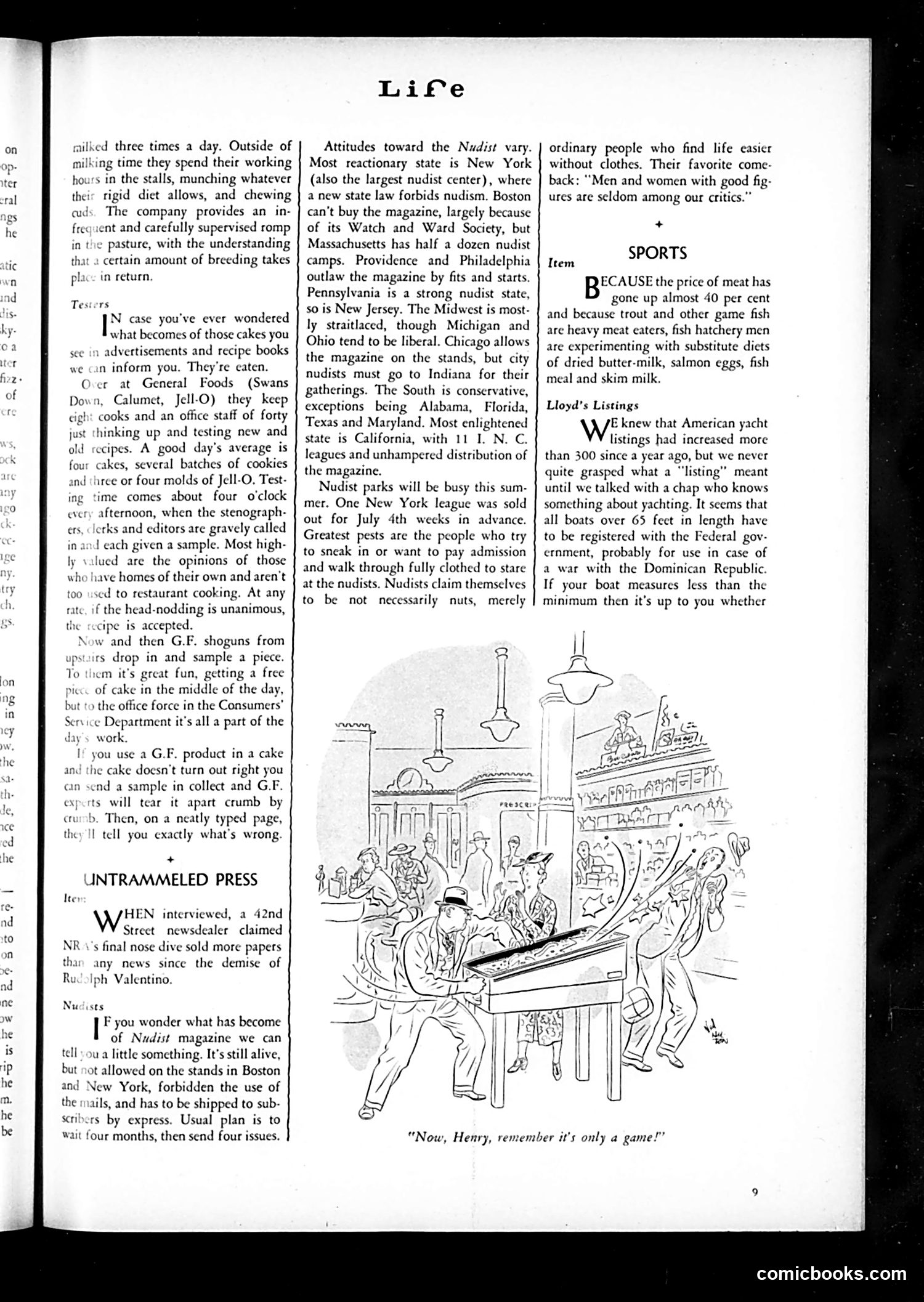
Explanation for Modern Readers The main cartoon illustrates a section titled "Sports" discussing meat rationing and game fish substitutes. The illustration shows a chaotic restaurant or dining scene where a large fish is being served at a table, with diners reacting with apparent surprise or dismay. The caption reads, "Now, Henry, remember it's only a game!" This is wartime satire: the cartoon mocks the necessity of serving unusual protein substitutes (like fish) instead of traditional meat during rationing, likely from the World War II era. The humor lies in the husband's need to reassure his wife that eating these unfamiliar foods is merely temporary—"a game"—while the visual chaos suggests the actual disruption to domestic dining customs was far from playful or acceptable to consumers.
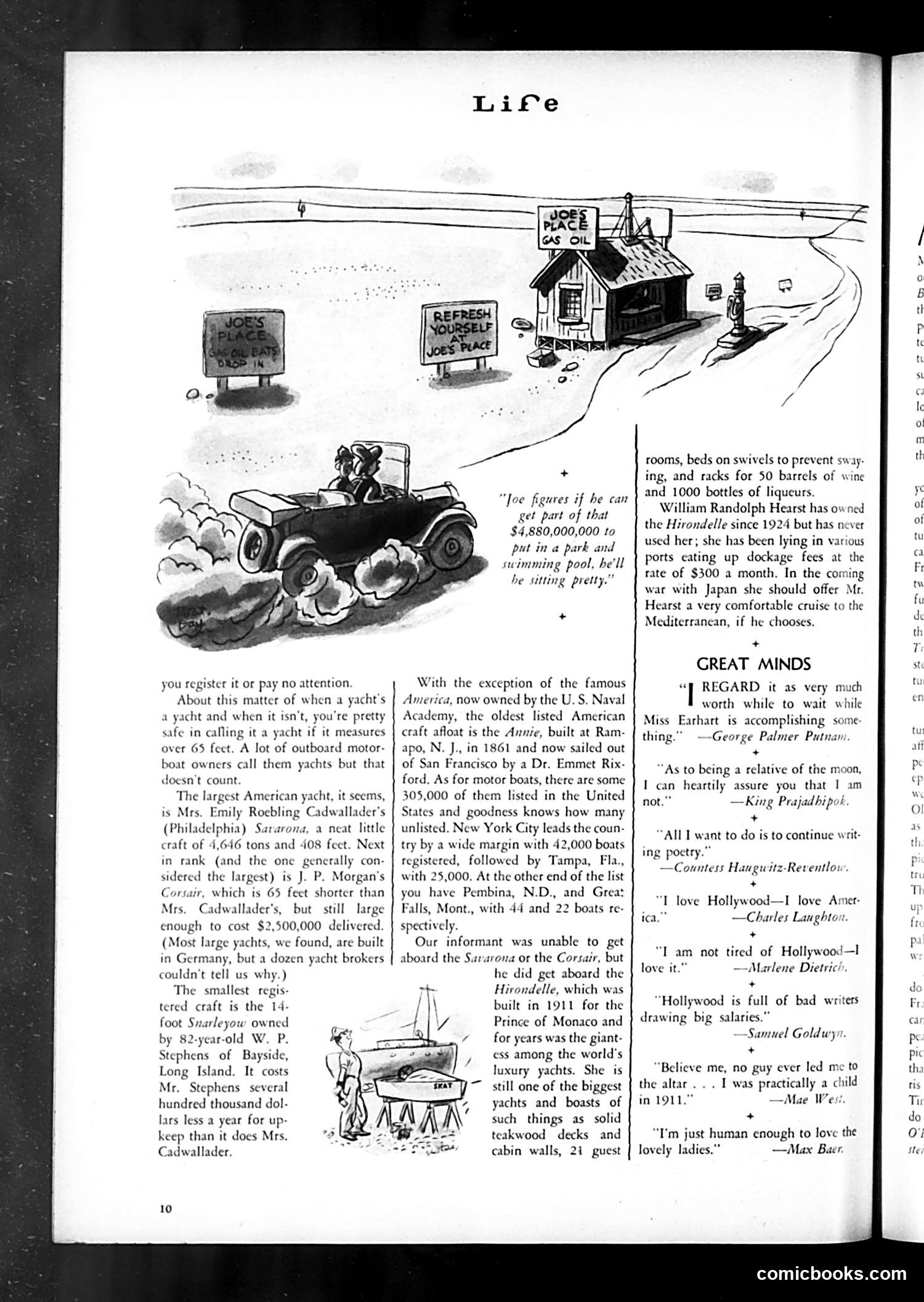
Analysis of Life Magazine Page This page from *Life* magazine contains satirical commentary about American wealth and leisure during the Jazz Age. The main cartoon depicts a nouveau-riche motorist at a roadside gas station, with a caption joking that he hopes to eventually afford parking his $4,880,000 yacht in a swimming pool—satirizing ostentatious wealth displays among the newly rich. The "Great Minds" section features humorous celebrity quotes about Hollywood, yachts, and romance, poking fun at celebrity culture and their vapid statements. The text discusses yacht ownership and luxury vessels, including references to William Randolph Hearst's ship *Hirondelle*, critiquing the extravagant spending habits of America's ultra-wealthy during a period of significant economic inequality. The overall satire targets the conspicuous consumption and self-absorption of the wealthy elite.
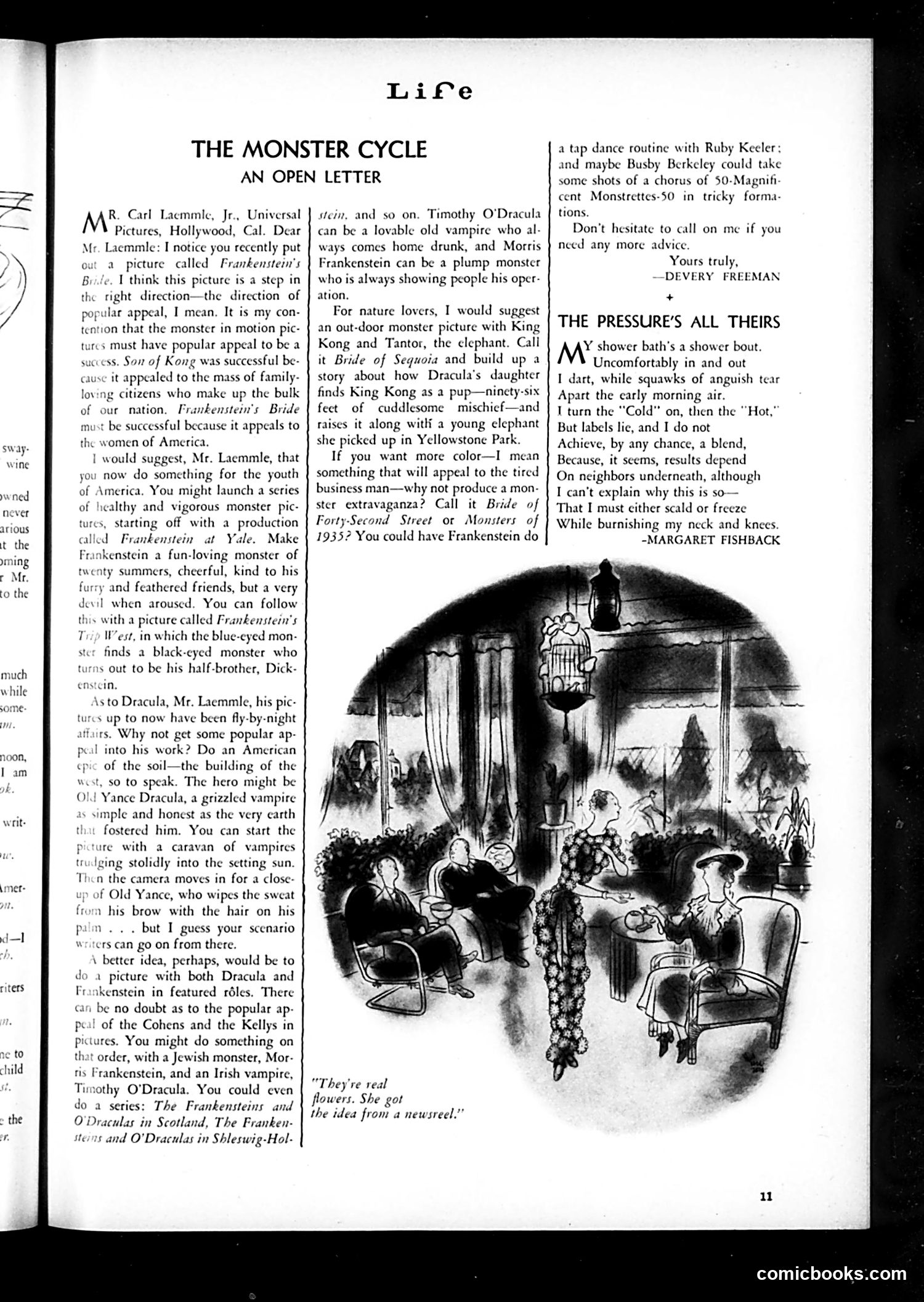
Analysis of Life Magazine Page This page contains an open letter from Beverly Freeman to Carl Laemmle Jr. at Universal Pictures, critiquing the studio's monster film strategy. Freeman argues that while *Frankenstein's Bride* was successful, Universal should now create diverse monster pictures appealing to broader audiences—suggesting outdoor adventures featuring King Kong, Dracula, and elephants rather than repeating the same formula. The accompanying cartoon illustrates a social gathering where a woman announces she's gotten "the idea from a neurosed" person, satirizing how creative ideas circulate through social networks and get diluted or misattributed in Hollywood culture. The piece reflects 1930s film industry debates about formula-driven sequels versus original content, and Hollywood's anxiety about sustaining audience interest in the monster-picture genre.
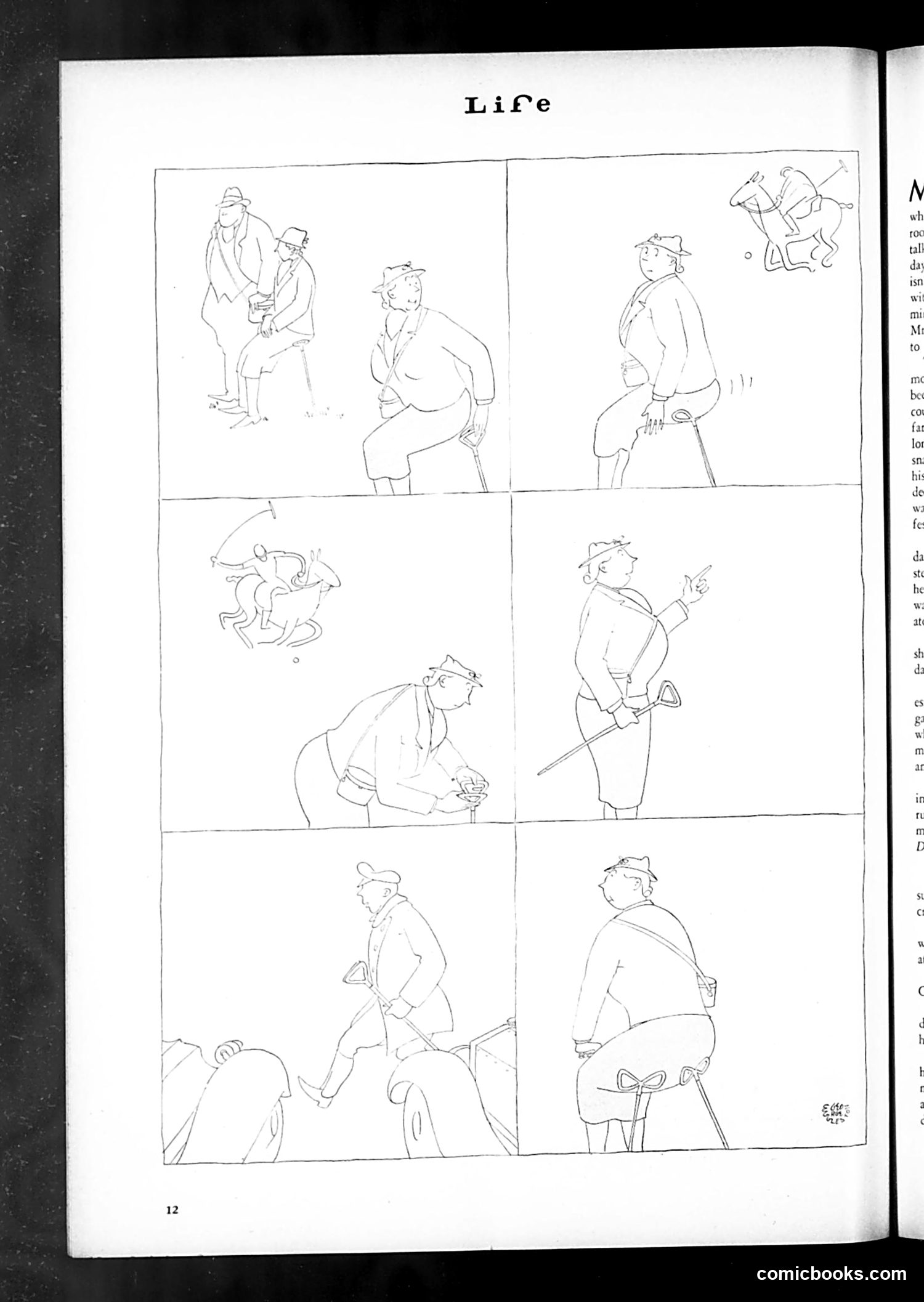
"Life" - Page 12 Analysis This page presents a multi-panel comic strip titled "Life" depicting a rotund gentleman in various scenes involving horses and riding activities. The cartoon appears to be satirizing an incompetent or comically inept horseman—showing him struggling with mounting a horse, falling off, being thrown, and generally mismanaging equestrian pursuits. The humor relies on physical comedy and the contrast between the character's apparent confidence (evidenced by his formal attire and demeanor in early panels) and his repeated failures with horsemanship. Without additional context about specific historical figures or events, the satire seems to be general social commentary on amateur or pretentious participation in upper-class activities like horseback riding. The style is typical of early-to-mid 20th century American satirical cartooning.
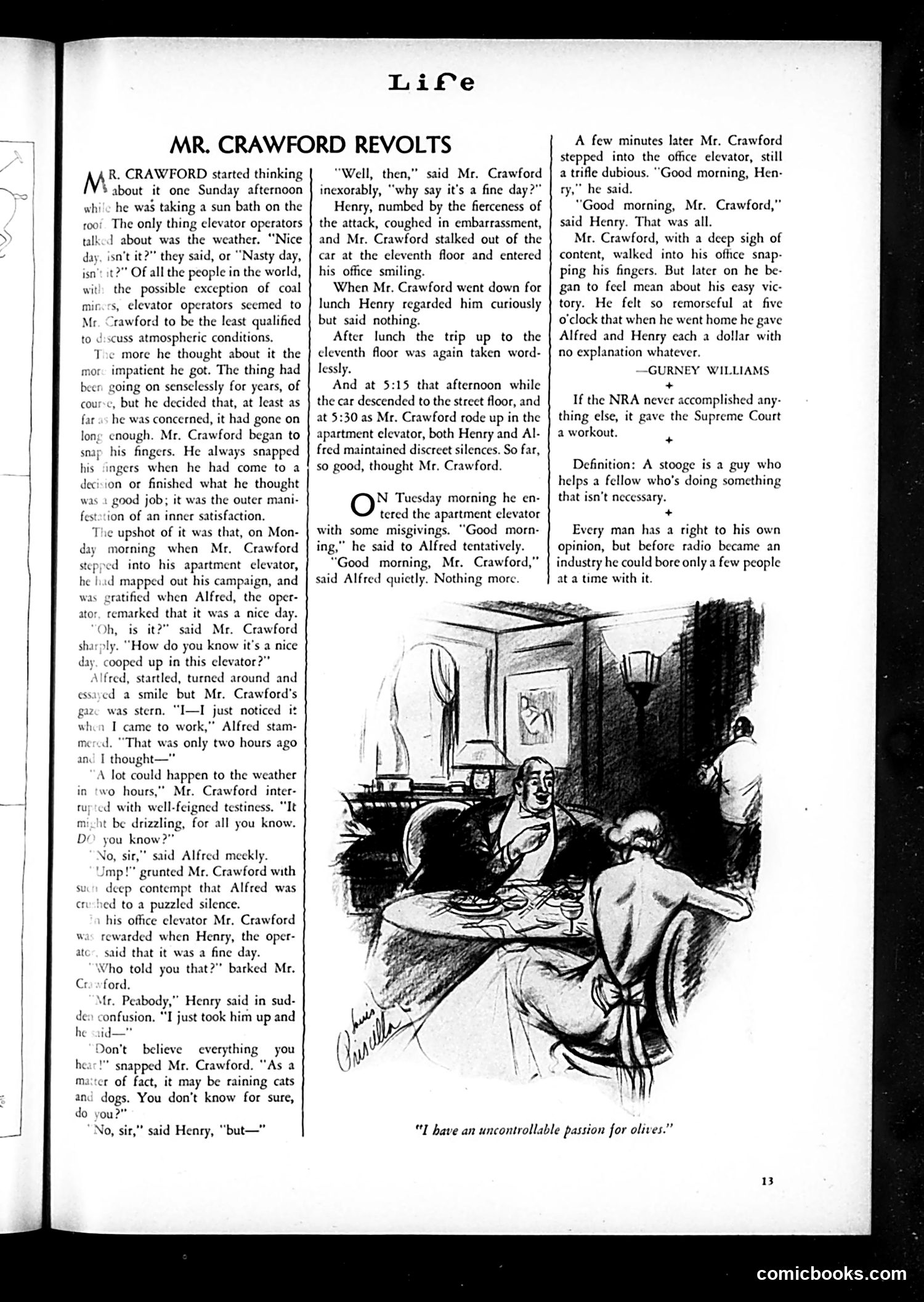
"Mr. Crawford Revolts" This satirical story mocks office workplace dynamics and class hierarchy. Mr. Crawford, an executive, becomes irked by his elevator operator Alfred's casual greeting and cheerful demeanor. Crawford obsesses over whether Alfred said "it's a nice day" or "it's a *fine* day," interpreting this as insubordination or excessive familiarity. The humor targets Crawford's petty authoritarianism—he's offended that a service worker dares speak to him as an equal. The illustration shows Crawford dining while appearing agitated. The accompanying definition of "stooge" reinforces the satire: Crawford represents the hypocritical boss who demands obedience while claiming workers should have "opinions." The story satirizes rigid 1930s workplace hierarchies and middle-management insecurity.
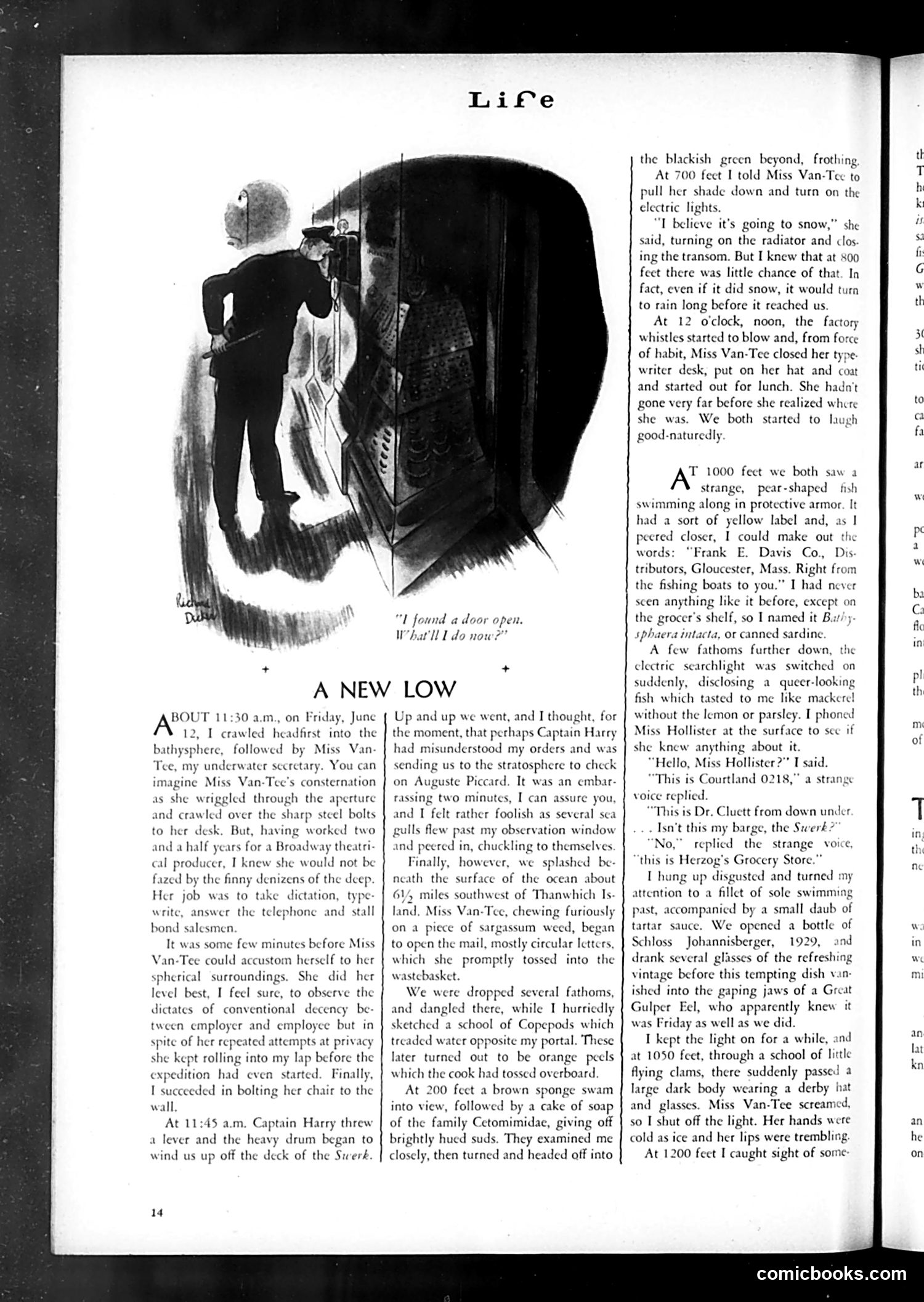
Analysis of Life Magazine Page This page features an illustration and article titled "A New Low," describing an underwater expedition. The cartoon shows a figure peering into what appears to be a submarine or observation chamber, with the caption "I found a door open. What'll I do now?" The article's "new low" refers to a literal descent—a deep-sea expedition where the narrator descended to 1,000 feet in a bathysphere (an early deep-sea exploration vessel). The illustration's humor plays on the phrase "new low," typically used to describe moral or social degradation, by depicting an actual physical descent into ocean depths. The article catalogs fantastical sea creatures encountered, suggesting this is adventure/exploration journalism rather than political satire. The humor derives from the double meaning of "low" and the speaker's absurd predicament of finding an open door during a dangerous dive.
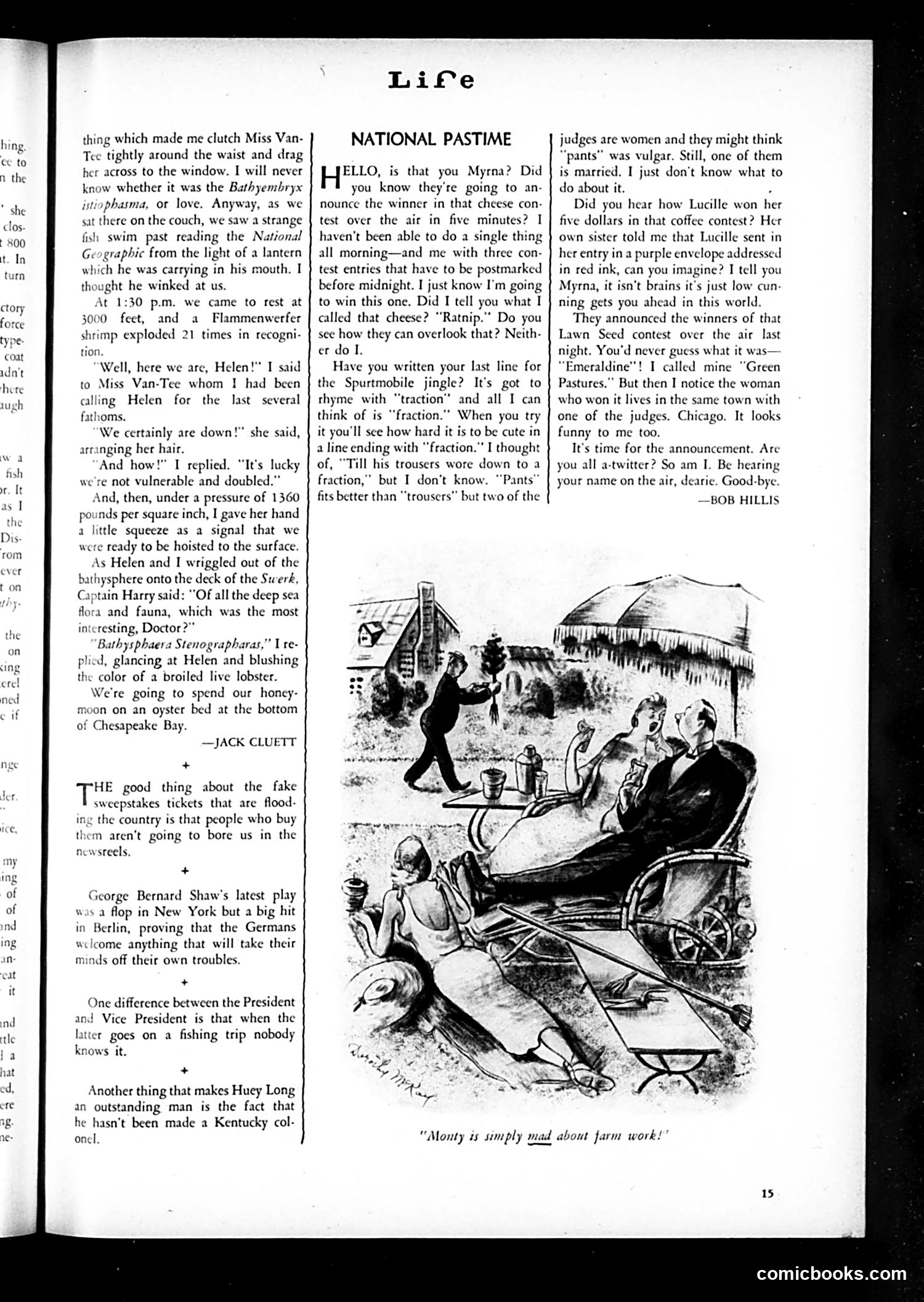
Political Cartoon Analysis The main cartoon shows people lounging at what appears to be a beach or resort setting, with one figure actively working (digging or laboring). The caption reads: "Monty is simply *mad* about farm work!" This is satire about wealthy individuals (likely the "Monty" character represents someone from the upper class) who engage in farm labor as a leisure activity or affectation—treating it as recreation rather than the actual grueling work ordinary people perform. The humor lies in the contrast between genuine agricultural labor and this dilettante's romanticized version of it as a fashionable pastime. The surrounding text discusses various trivial social topics, reinforcing Life magazine's satirical focus on the idle pursuits and pretensions of the wealthy during this era.
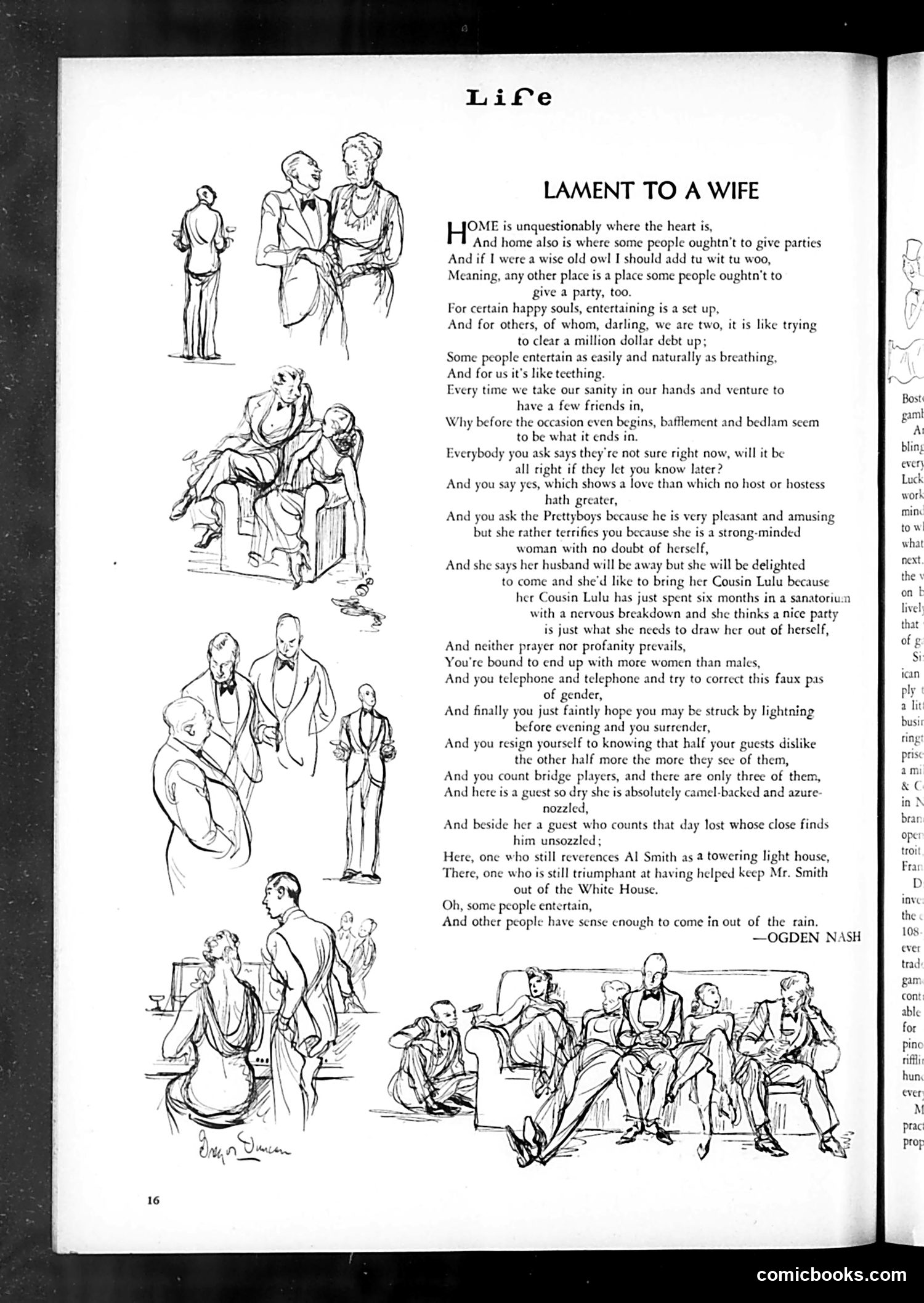
"Lament to a Wife" by Ogden Nash This is a humorous poem by celebrated American humorist Ogden Nash satirizing the social obligations of entertaining at home. The accompanying sketches illustrate various awkward party scenarios—guests arriving, mingling uncomfortably, and departing. Nash's satire targets upper-middle-class social conventions of the era, depicting entertaining as exhausting rather than enjoyable. The poem references specific anxieties: unpredictable guests, the difficulty of mingling, and the strain of hosting. Notable references include "Al Smith as a towering light house" and someone who "helped keep Mr. Smith out of the White House"—likely alluding to the 1928 presidential election and Smith's defeat. The overall message mocks how couples feel obligated to host despite finding it tedious, contrasting with society's expectation that entertaining represents proper domestic life.
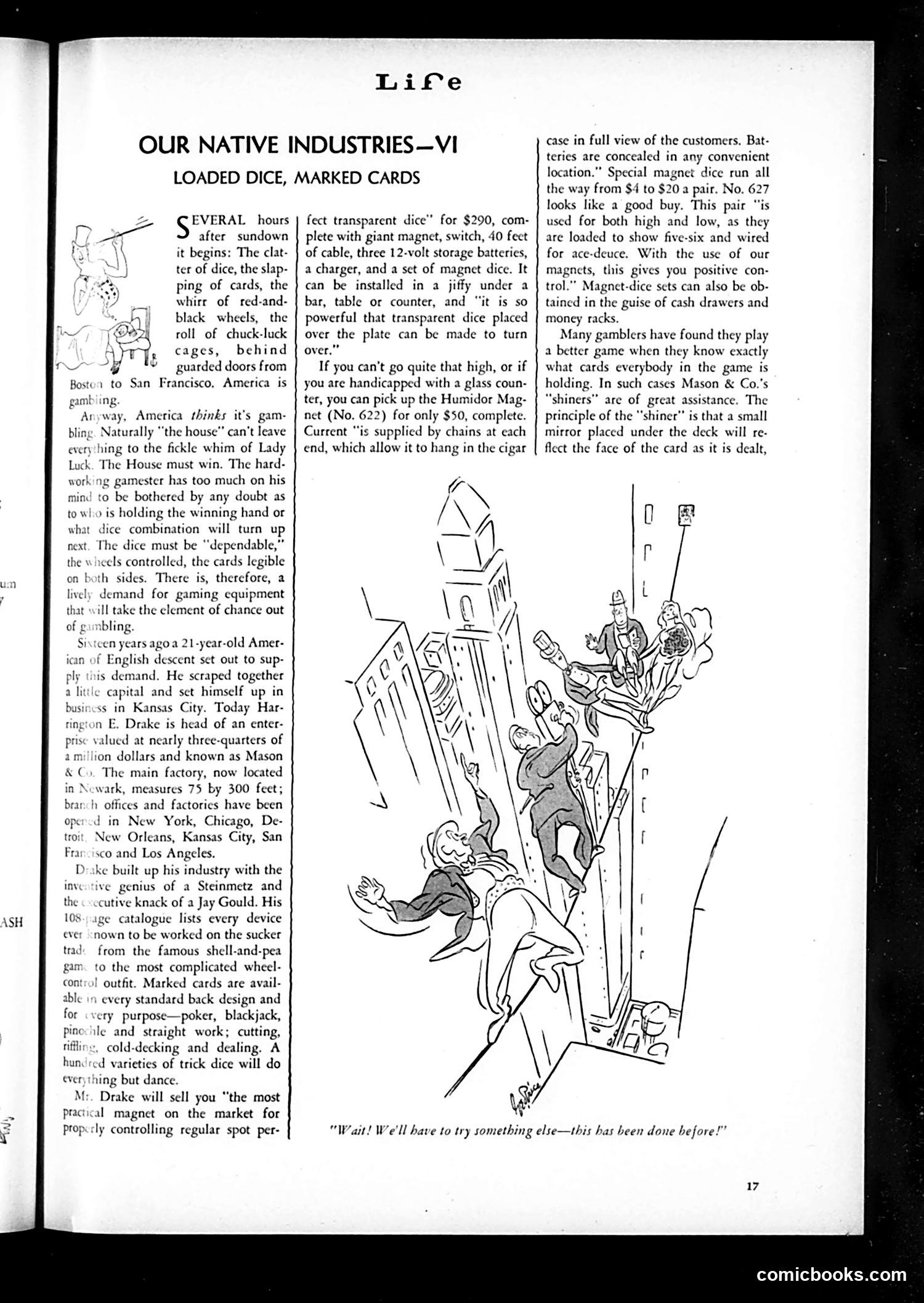
Analysis of Life Magazine Page: "Our Native Industries—VI: Loaded Dice, Marked Cards" This satirical article exposes gambling equipment fraud in early 20th-century America. The text describes how enterprising gamblers manufacture and sell rigged dice and marked cards to control game outcomes—eliminating chance entirely. The large cartoon illustrates the irony: people climbing a building (representing "getting ahead" or success) are being literally knocked down by falling money and gambling paraphernalia, suggesting that gambling schemes ultimately destroy their victims financially. The article mentions a real businessman, Harrison E. Drake, who built a fortune manufacturing this cheating equipment from Kansas City, expanding to multiple major cities. The satire mocks both the ingenuity of American entrepreneurship and its corruption—turning vice into organized, profitable industry while leaving ordinary gamblers ruined.
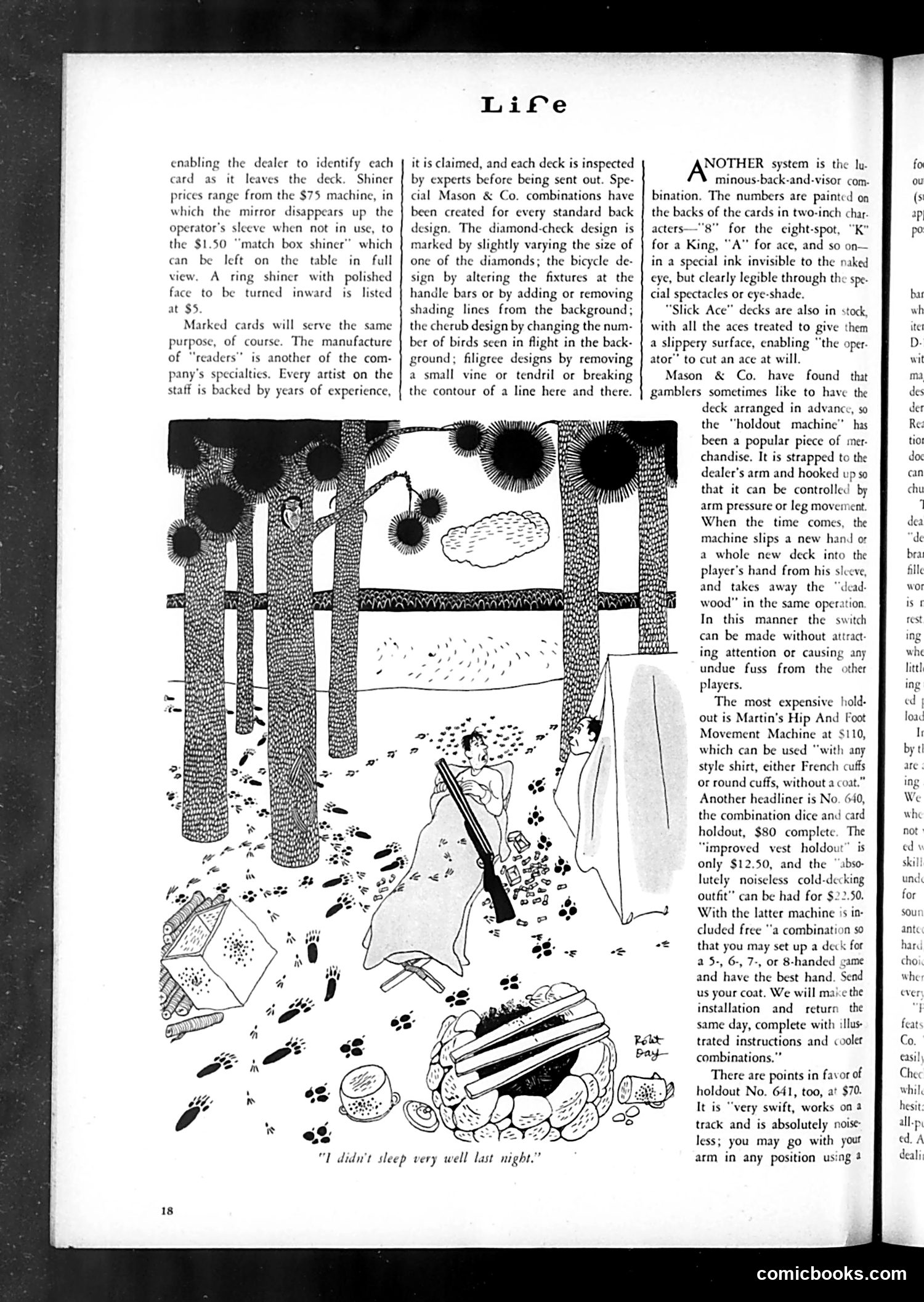
Analysis This page from *Life* magazine discusses cheating devices used in card games and gambling. The illustration depicts a man lying in bed at night, surrounded by playing cards and what appear to be card-dealing mechanisms scattered on the floor and furniture—shoes, devices, and paraphernalia of a card sharp or professional cheater. The caption reads: "I didn't sleep very well last night." The satire works on two levels: the text describes legitimate gaming equipment and card-marking systems sold by Mason & Co., while the cartoon humorously suggests the guilty conscience of someone using such cheating apparatus. The joke implies that even with mechanical aids, a cheater cannot sleep soundly—their illicit activities keep them awake with anxiety. It's a moral commentary wrapped in humor about dishonest gambling.
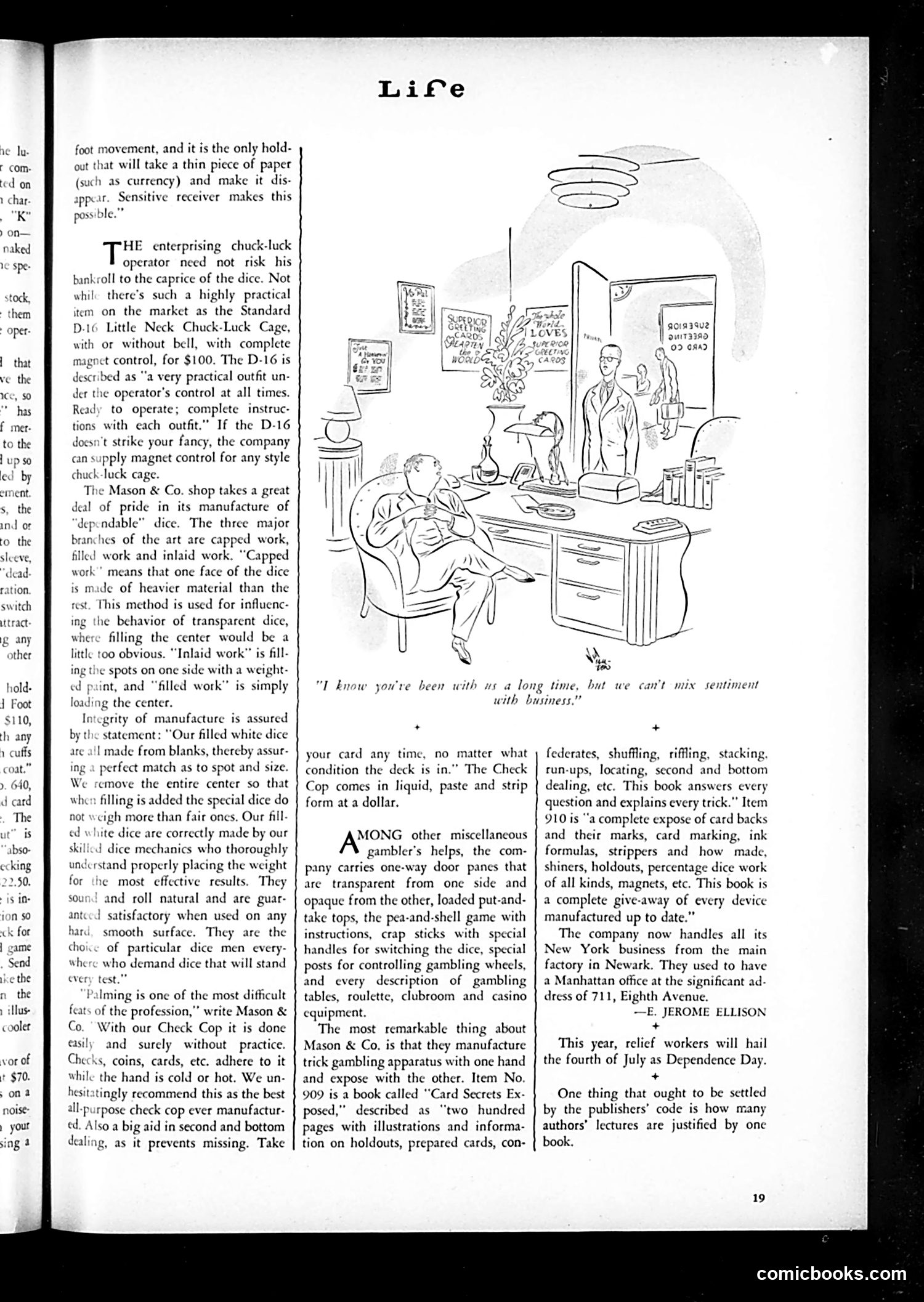
Life Magazine Page: Gambling Device Advertisement This page satirizes gambling equipment manufacturers, specifically Mason & Co. The illustration shows a salesman in an office demonstrating cheating devices to a seated client. Charts and diagrams on the walls display various gambling apparatus. The text discusses how Mason & Co. manufactures "trick gambling apparatus" including loaded dice, marked cards, and rigged equipment—openly advertising these tools for cheating at gambling. The caption quotes the salesman saying he cannot "mix sentiment with business," implying cynical acceptance of fraud. The satire mocks both the shameless marketing of cheating devices and the gambling industry's corruption. The piece suggests that dishonest gambling apparatus was apparently sold openly during this era, highlighting the era's widespread acceptance of systematic cheating in games of chance.
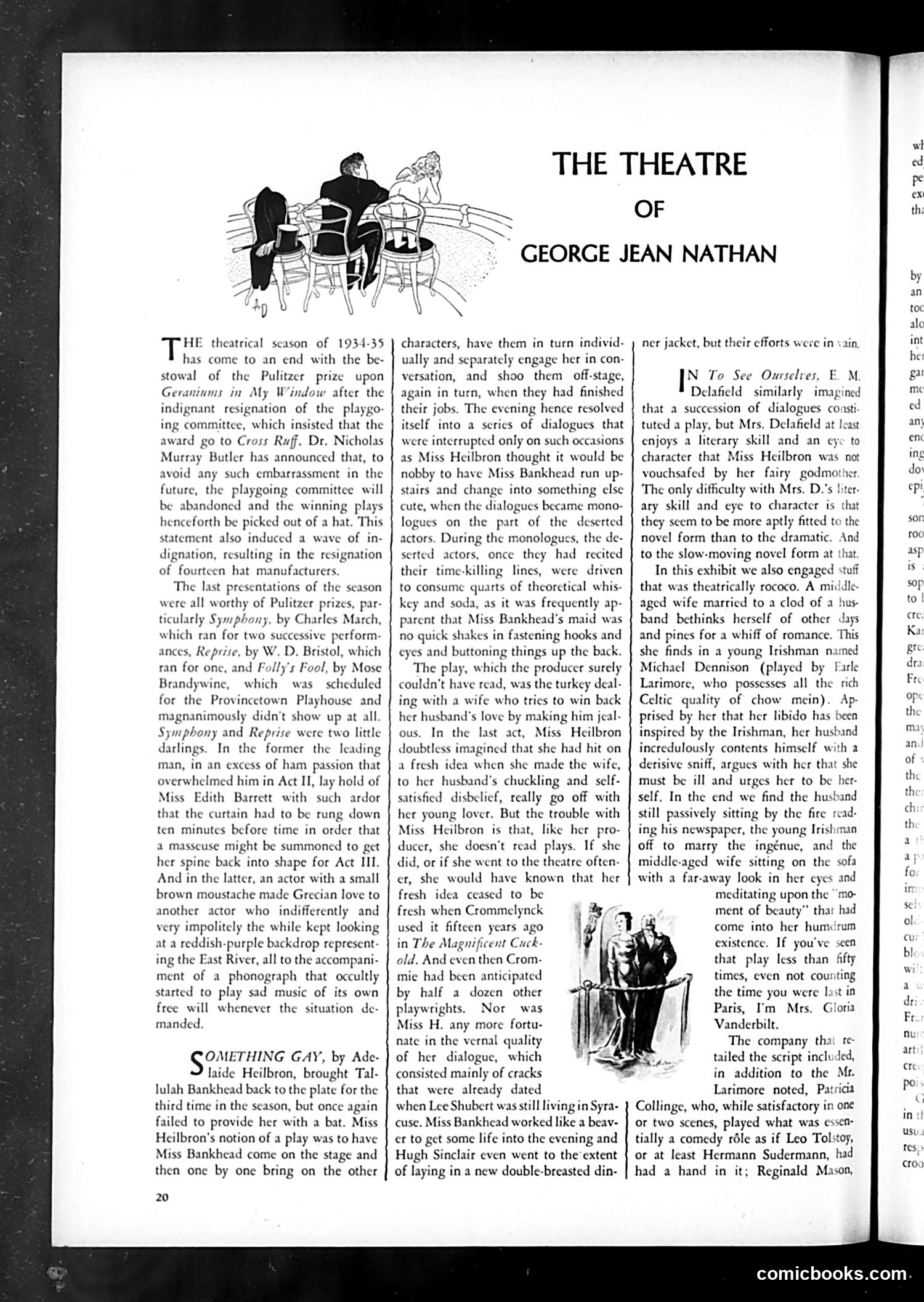
"The Theatre of George Jean Nathan" This is a theater criticism column by George Jean Nathan, the prominent American drama critic. The cartoon shows three figures seated and conversing—typical of Nathan's satirical approach to theater criticism. Nathan ridicules the 1934-35 Broadway season through mock-serious commentary. He sardonically reports that *Geraniums in My Window* won the Pulitzer Prize after committee controversy, leading Columbia University president Nicholas Murray Butler to propose selecting future winners "out of a hat"—Nathan mocks this by noting hat manufacturers then "resigned" in protest. The column savagely reviews several plays: *Symphony* was so bad the leading man's passionate scene required a masseuse for the actress afterward; *Something Gay* features Tallulah Bankhead in a framework play where she merely converses with actors who exit one-by-one. Nathan particularly mocks playwright Adelaide Heilbron for recycling a plot device from Crommelynck's *The Magnificent Cuckold* (fifteen years prior) without knowing it. The satire targets both mediocre theatrical productions and playwrights' artistic laziness and ignorance.
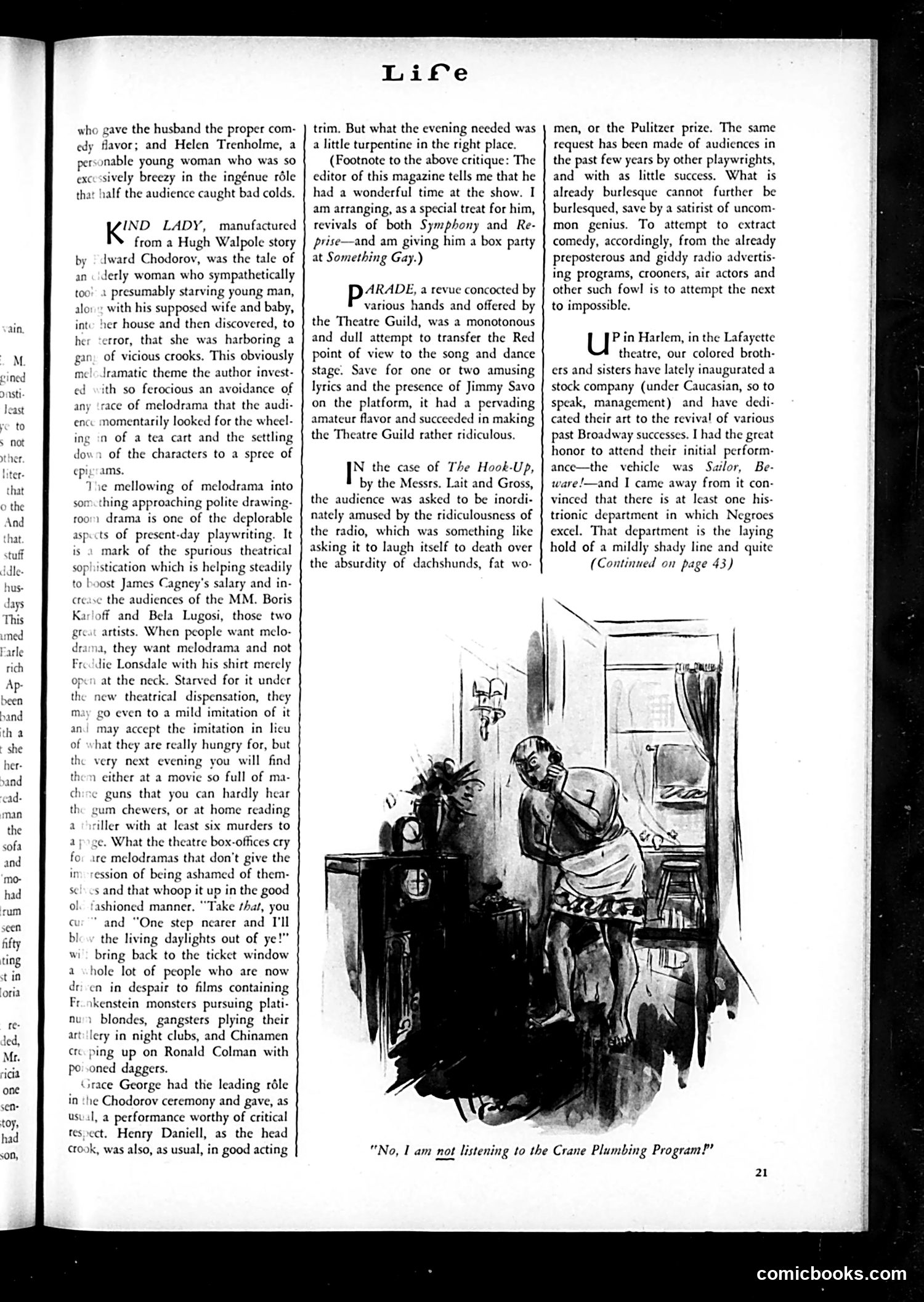
Life Magazine Theater Review - Page Analysis This page contains theater reviews from Life magazine's satirical "Life" column. The main cartoon shows a domestic scene with the caption "No, I am not listening to the Crane Plumbing Program!" — satirizing Americans' complaints about radio advertising interrupting entertainment. The reviews critique several Broadway productions with sharp wit. The writer argues that modern theater has become too refined, lacking the robust melodrama audiences actually crave. He notes people are abandoning theaters for films featuring gangsters and monsters, suggesting audiences hunger for genuine spectacle over "polite drawing-room drama." The reviews mention Grace George in a Chodorov play, a Theatre Guild revue attempting to make communism ("Red point of view") entertaining through song and dance, and *The Hook-Up*, which tries to satirize radio itself—a premise the critic deems futile, comparing it to trying to mock dachshunds or the Pulitzer Prize for being absurd. The overall tone critiques theatrical sophistication that strips entertainment of genuine excitement.
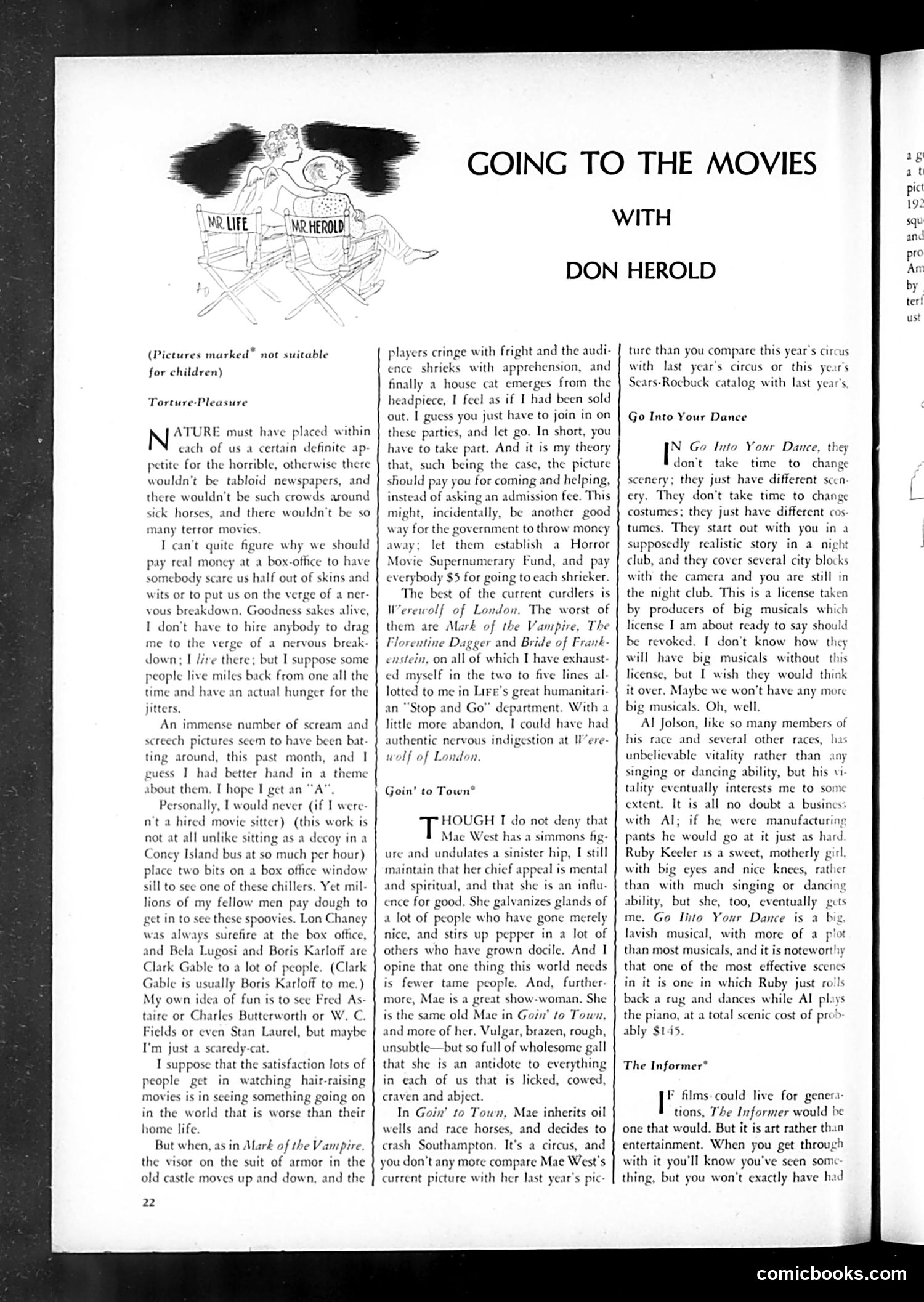
Analysis for Modern Readers This is Don Herold's film criticism column from Life magazine. The cartoon at top shows "Mr. Life" and "Mr. Harold" in director's chairs—a self-referential joke about the critic's dual role. "Torture-Pleasure" criticizes horror movies (specifically *Mark of the Vampire*, *Werewolf of London*, *The Florentine Dagger*, and *Bride of Frankenstein*). Herold argues audiences pay money to be frightened, which seems illogical unless their home lives are worse. He mocks *Mark of the Vampire* for a fake scare (a cat in armor), calling it a con. He proposes sarcastically that the government should *pay* people $5 to sit through horror films rather than charge admission. "Goin' to Town" defends Mae West against dismissal as merely sexual. Herold argues her real appeal is "mental and spiritual"—she energizes complacent people and represents boldness society needs. He praises her as a "great show-woman," noting she's authentically herself in the film. Both pieces reflect 1930s sensibilities: anxiety about mass entertainment's effects and appreciation for performers who challenged social conformity.
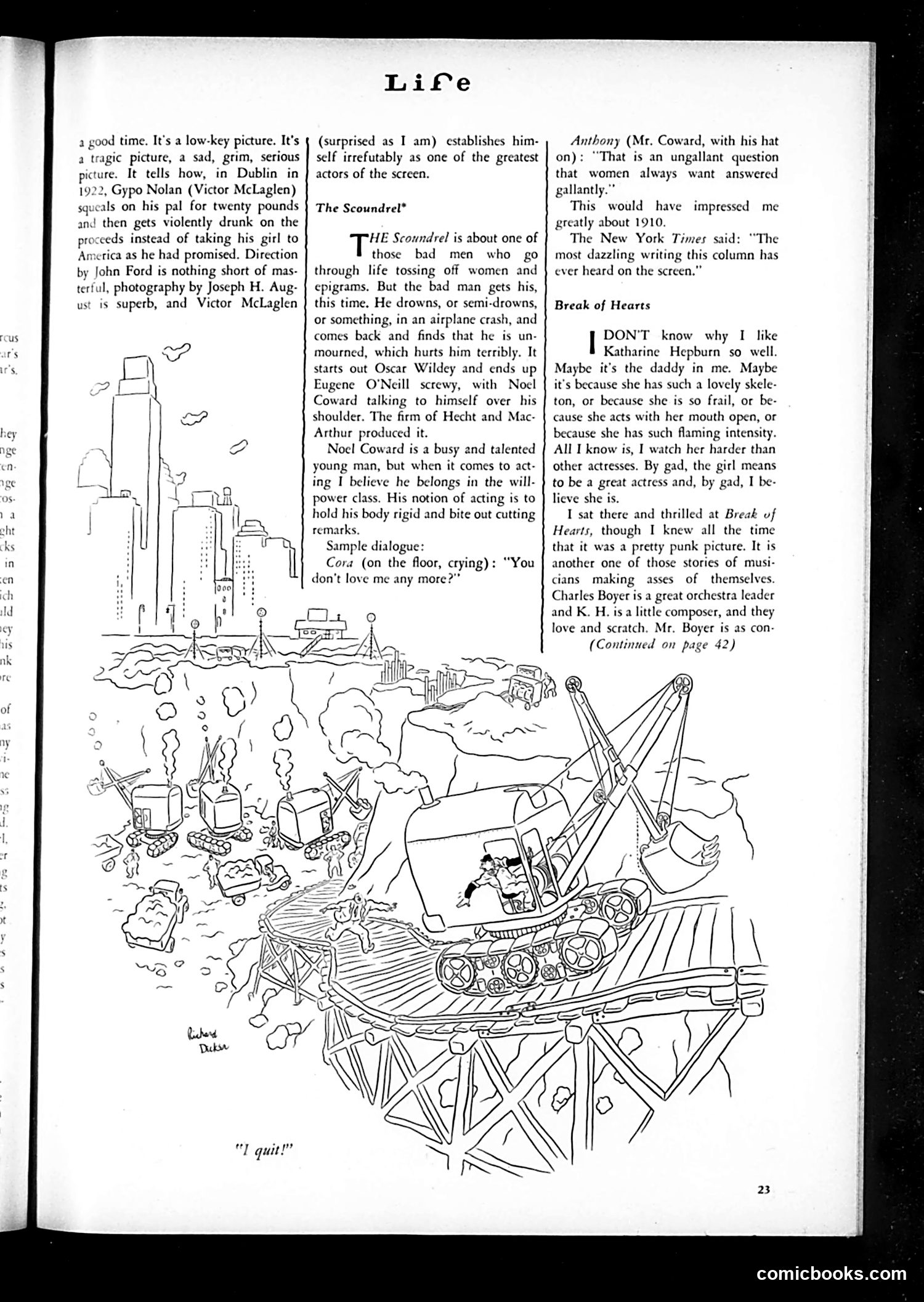
Life Magazine Movie Reviews (circa 1932-1935) This page contains film reviews from Life's "Life" column, critiquing three movies: "The Informer" (1922 Dublin setting): Reviews Victor McLaglen's performance as a man who betrays his friend for money, then drowns his guilt in alcohol. Director John Ford receives praise for this tragic drama. "The Scoundrel": Criticizes Noel Coward's stiff acting style, comparing the film's tone to Oscar Wilde's wit declining into Eugene O'Neill's heavy drama. The reviewer uses dated sarcasm about 1910 sensibilities to mock Coward's rigid delivery and witty but hollow dialogue. "Break of Hearts": The reviewer admits loving Katharine Hepburn's intense, committed performances despite recognizing the film itself as mediocre. It features Hepburn as a composer and Charles Boyer as an orchestra leader in a relationship drama—another story of "musicians making asses of themselves." The cartoon appears unrelated to these reviews, depicting an industrial/mining disaster scene with the caption "I quit!"
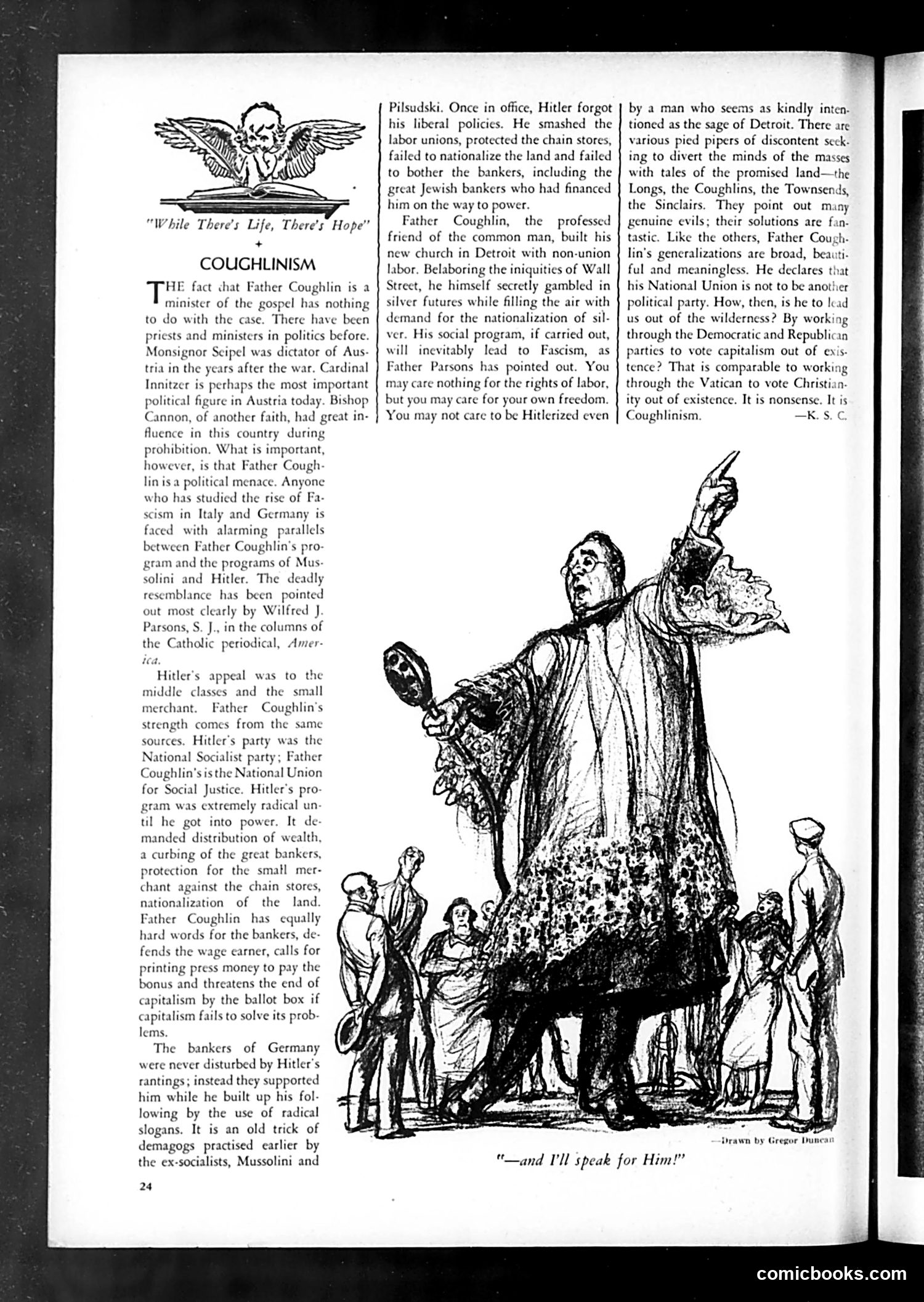
"Coughlinism" - Life Magazine Satire This page attacks Father Charles Coughlin, a Catholic priest and popular radio broadcaster of the 1930s, comparing him to Hitler and Mussolini. The Argument: The text warns that Coughlin's "National Union for Social Justice" mirrors fascist movements: both appeal to middle-class anxieties, use radical anti-banker rhetoric, and promise redistribution of wealth. However, the article notes Hitler abandoned these promises once in power—and suspects Coughlin would too. Evidence: Coughlin preached workers' rights while building his Detroit church with non-union labor, and condemned Wall Street speculation while secretly trading silver futures. The Cartoon: Shows a robed Coughlin as a demagogue ("I'll speak for Him!"), wielding masses like puppets. The imagery portrays him as a fascistic rabble-rouser exploiting common people's genuine grievances with false solutions. Context: Coughlin was a genuine political threat in the 1930s—a priest with millions of radio listeners promoting anti-capitalist, populist politics. The article groups him with Huey Long and other "pied pipers of discontent" misleading desperate Americans.
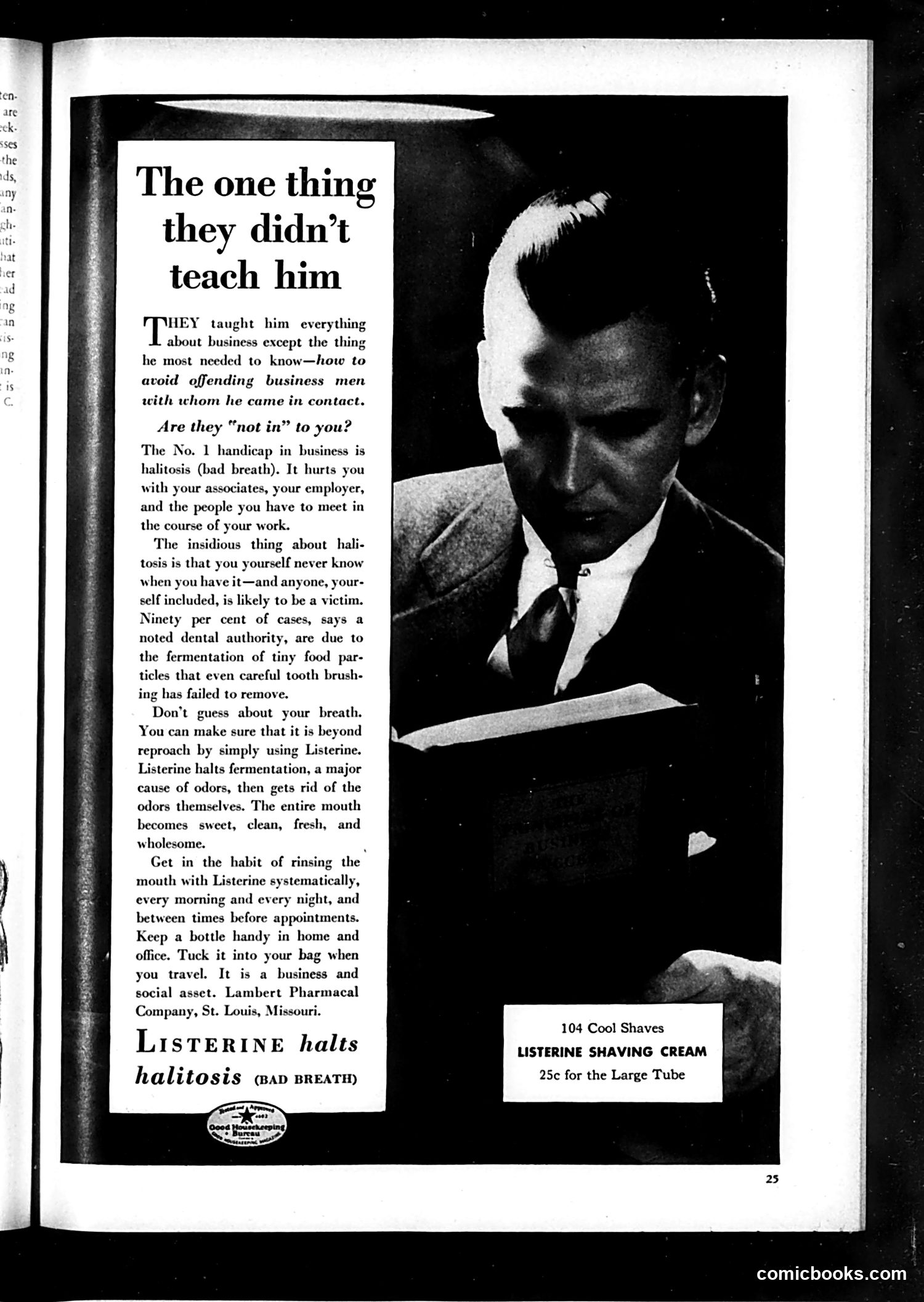
Analysis: Listerine Advertisement (Life Magazine) This is primarily a vintage advertisement, not political satire. It promotes Listerine mouthwash by targeting business professionals' anxieties about bad breath ("halitosis"). The accompanying photograph shows a well-dressed businessman, appearing uncomfortable or withdrawn—visually representing the social embarrassment caused by halitosis. The ad's premise is that while business schools teach everything else, they neglect this critical social handicap that undermines professional success. The satirical angle is subtle: the headline mocks business education itself, suggesting that avoiding offending colleagues matters more than traditional business knowledge. However, the primary purpose is product marketing, leveraging fears about social and professional acceptance to sell Listerine as a necessary business tool. The accompanying Listerine Shaving Cream offer (25¢) indicates this is a multi-product advertisement from the early-to-mid 20th century, when such "business and social asset" messaging was common marketing strategy.
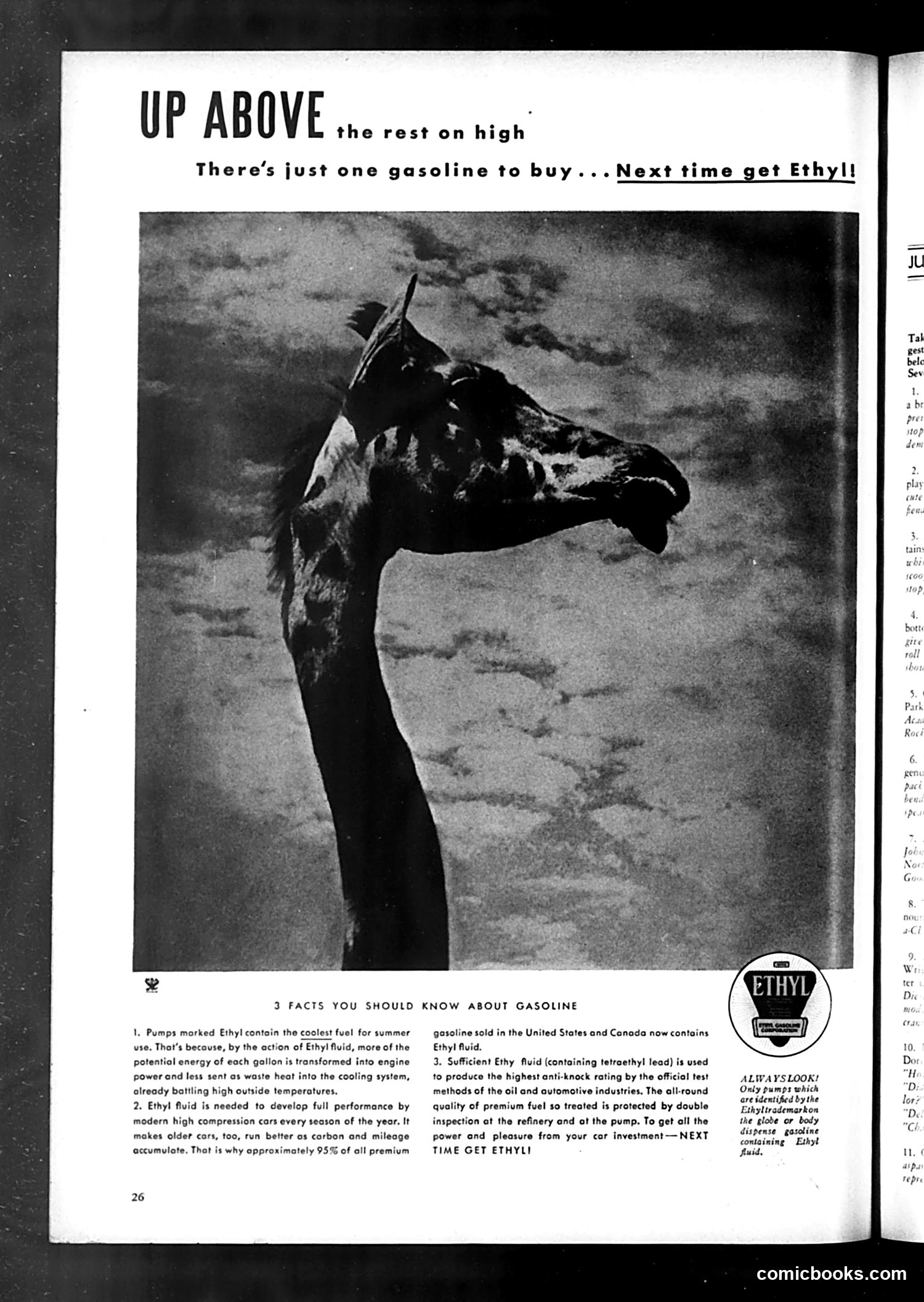
Ethyl Gasoline Advertisement This is a full-page advertisement for Ethyl gasoline, not satire or political commentary. The dramatic black-and-white photograph shows an airplane in a steep climb against a cloudy sky—a visual metaphor for performance and superiority. The ad promotes Ethyl-brand gasoline by claiming three factual advantages: superior cooling properties for summer driving, better performance in modern high-compression engines, and highest anti-knock ratings. The tagline "UP ABOVE the rest on high" uses the airplane image to suggest Ethyl fuel gives cars superior performance. The ad emphasizes that 95% of premium gasoline sold in the US and Canada already contained Ethyl fluid (tetraethyl lead), making the product essentially the market standard by this era. Consumers are instructed to look for the Ethyl trademark at pumps to ensure they're buying this brand. This represents straightforward mid-century automotive advertising rather than satirical commentary.
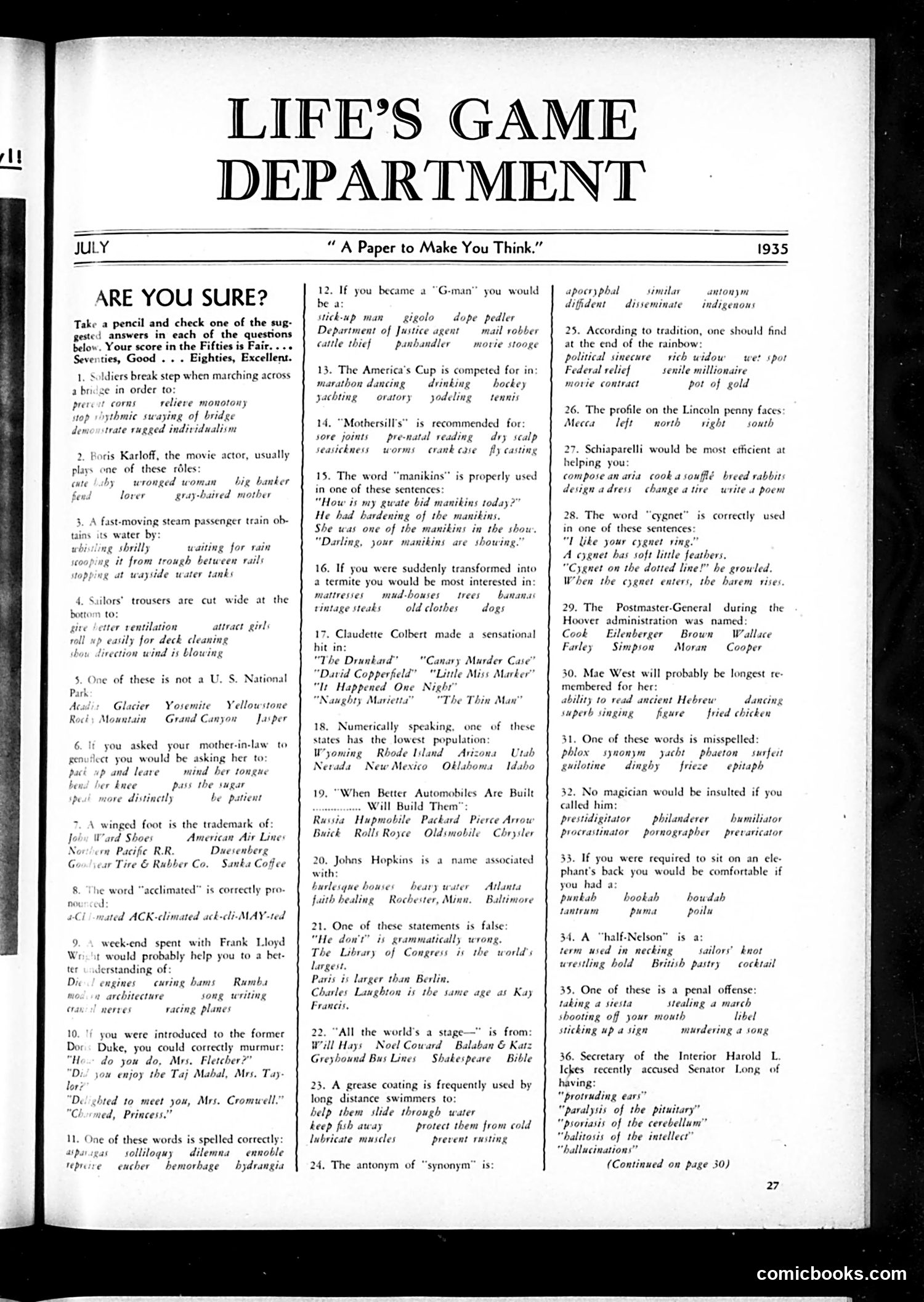
Life Magazine's "Are You Sure?" Quiz Page (July 1935) This page is a trivia quiz from Life magazine's "Game Department" — not a political cartoon. It's a recreational feature testing readers' knowledge across diverse 1930s topics: current events, entertainment, geography, vocabulary, and social customs. The questions reveal period concerns and references: G-men (FBI agents fighting crime), Frank Lloyd Wright's architecture, celebrities like Claudette Colbert and Boris Karloff, automobiles (Packard, Pierce-Arrow), and social etiquette (how to address a duchess). Question 21 oddly tests whether readers know Charles Laughton's age versus Kay Francis's. The quiz's difficulty levels (scoring in "Fifties" to "Eighties") suggest this entertained educated middle-class readers. Questions about "manikins" (fashion display figures) and "Mothersill's" (seasickness remedy) indicate specialized 1930s knowledge now obscure. This is essentially a precursor to modern trivia contests — brain entertainment for Depression-era readers.
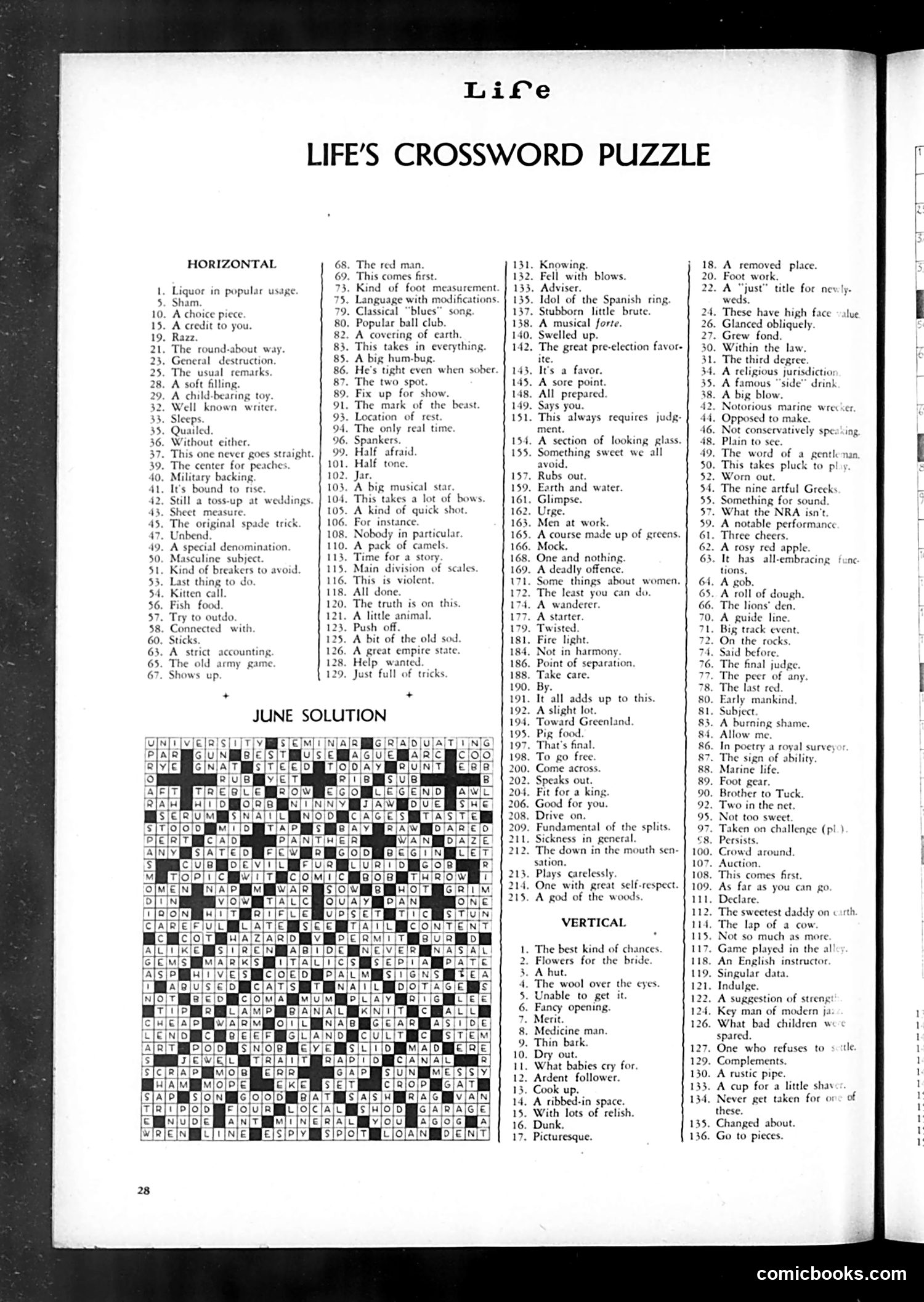
Life Magazine Crossword Puzzle Page This page presents Life's Crossword Puzzle for June—a standard puzzle feature common to the magazine. The clues reference contemporary 1930s-40s culture and slang: references to "the NRA" (New Deal's National Recovery Administration), popular entertainment figures ("a big musical star"), current events, and period idioms. Notable clues include topical references: "Toward Greenland" (likely Arctic exploration interest), "Brother to Tuck" (vaudeville comedian William Tuck), and various jazz-age slang terms ("The mark of the beast," "razz," "sham"). The "JUNE SOLUTION" grid shows the completed puzzle—a entertainment feature for readers to check their answers. This crossword type served dual purposes: entertainment and subtle cultural documentation, capturing what Life's educated, urban readership considered worthy trivia and current events worth encoding as puzzle clues. No political cartoon or satirical message appears; this is purely recreational content.
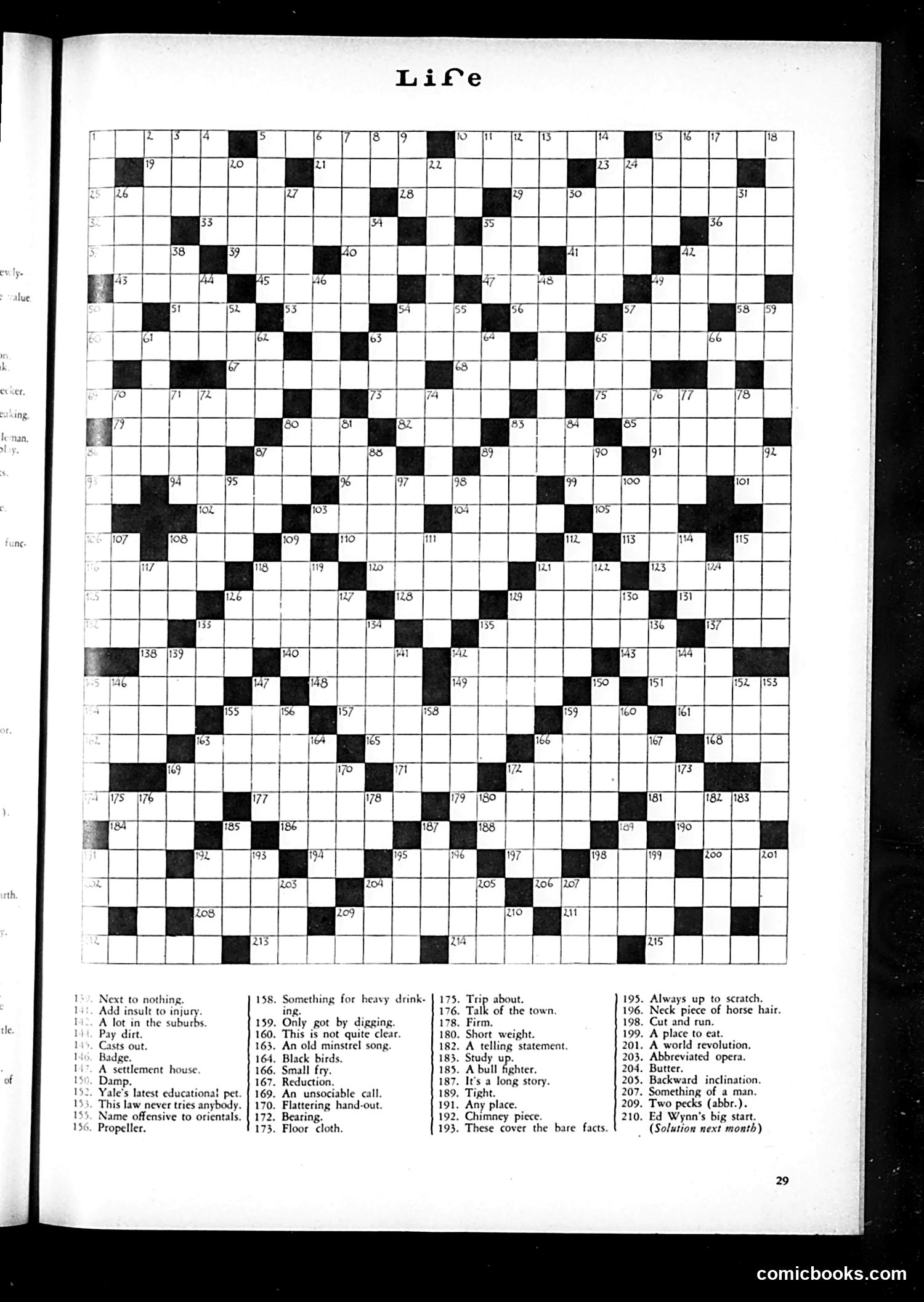
Life Magazine Crossword Puzzle This is a crossword puzzle page from *Life* magazine, a prominent American humor and satire publication. The puzzle itself is titled "Life" and consists of numbered clues with their answers to be filled into the grid above. The clues are typical of early-to-mid 20th century wordplay, mixing straightforward definitions with clever puns and period-specific references. Examples include "Yale's latest educational pet" (likely referencing a contemporary Yale initiative), "An old minstrel song," and topical items like "Ed Wynn's big start" (referencing the famous vaudeville performer). The puzzle represents the intellectual entertainment *Life* offered its educated, middle-to-upper-class audience—a blend of culture, wordplay, and contemporary social commentary delivered through recreational puzzles rather than political cartoons or satirical illustrations on this particular page.
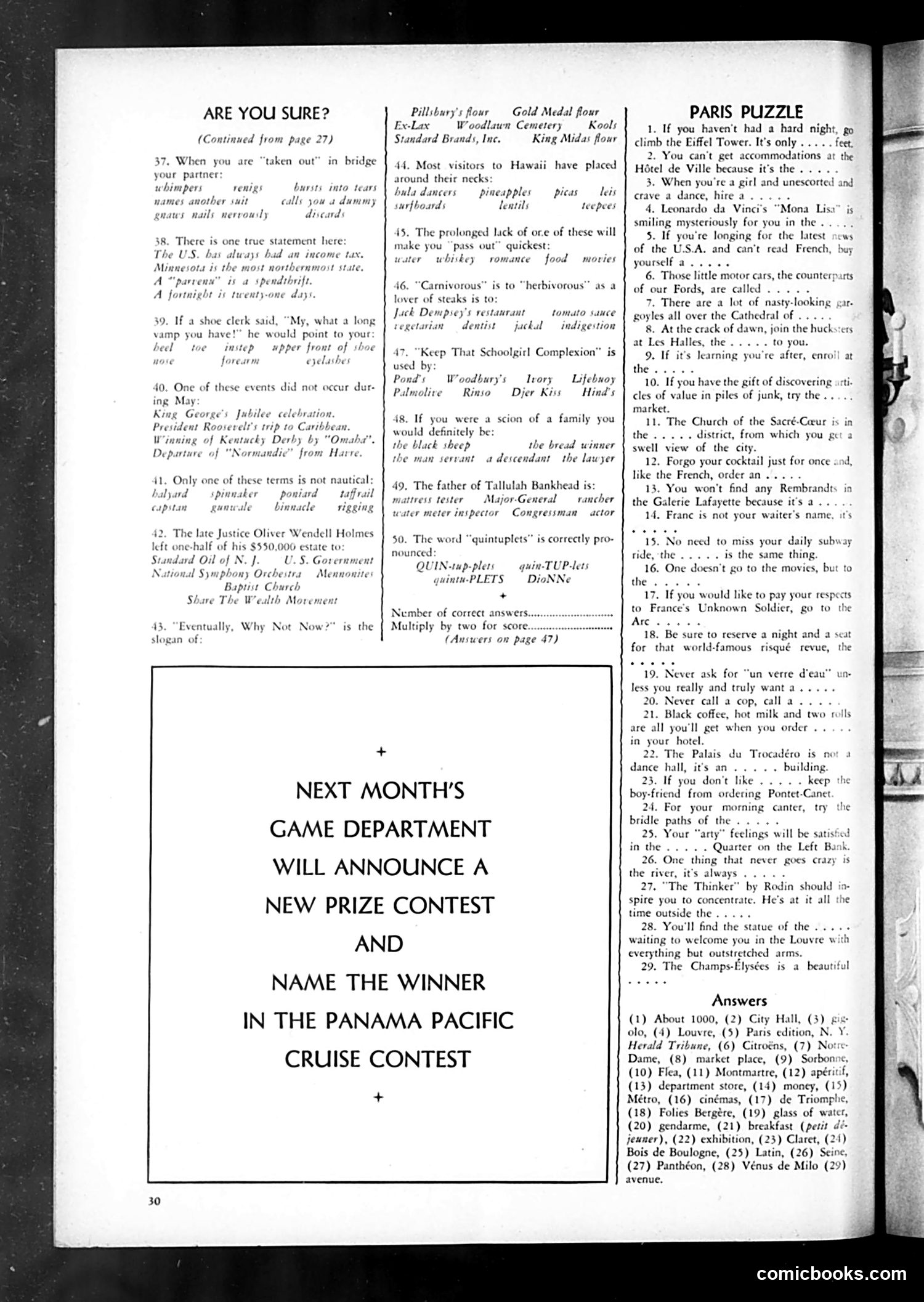
Life Magazine Quiz Page Analysis This page contains quiz questions testing readers' knowledge of facts, brand advertising, and travel trivia—typical of Life magazine's entertainment content. Left side ("Are You Sure?"): A general knowledge quiz covering bridge etiquette, U.S. history, grammar, and current events. Notable references include: - Question 40: Events from May (likely 1935), mentioning FDR's Caribbean trip and the Kentucky Derby - Question 43: References Huey Long's "Share the Wealth Movement" slogan - Question 49: References Tallulah Bankhead's father (a Congressman) Right side ("Paris Puzzle"): A fill-in-the-blanks game about Paris tourist attractions and cultural observations—Eiffel Tower, Louvre, Notre-Dame Cathedral, etc. Center announcement: Promotes next month's contest for a Panama Pacific cruise. This is primarily entertainment/game content with advertising, not political satire. The Huey Long reference is the only political element, appearing incidentally within a trivia question rather than as satirical commentary.
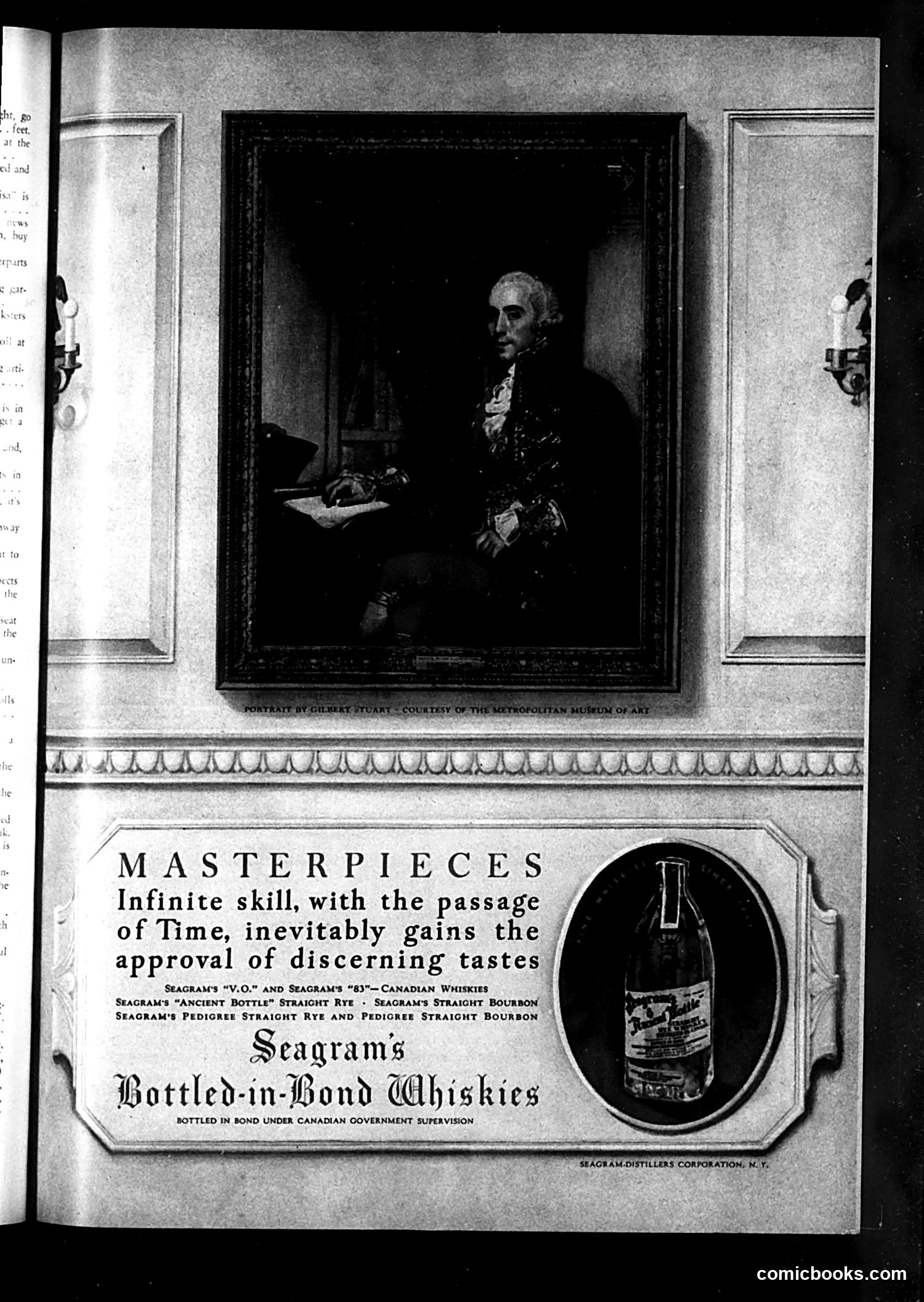
Analysis This page is primarily an advertisement, not a political cartoon. It features a portrait painting (credited to Gilbert Stuart, courtesy of the Metropolitan Museum of Art) at the top, depicting an 18th-century gentleman in formal attire. The ad uses this classical artwork to market Seagram's whiskeys. The advertising copy claims that "infinite skill, with the passage of Time, inevitably gains the approval of discerning tastes"—equating the enduring value of Old Master paintings with the quality and prestige of aged whiskey. The implicit message: just as Stuart's portrait is recognized as a masterpiece, Seagram's bottled-in-bond whiskeys gain legitimacy through time and tradition. The period portrait serves as a visual metaphor for timelessness and cultural authority, lending sophistication to the liquor brand. There is no satire present—this is straightforward luxury marketing using high art as a selling tool.
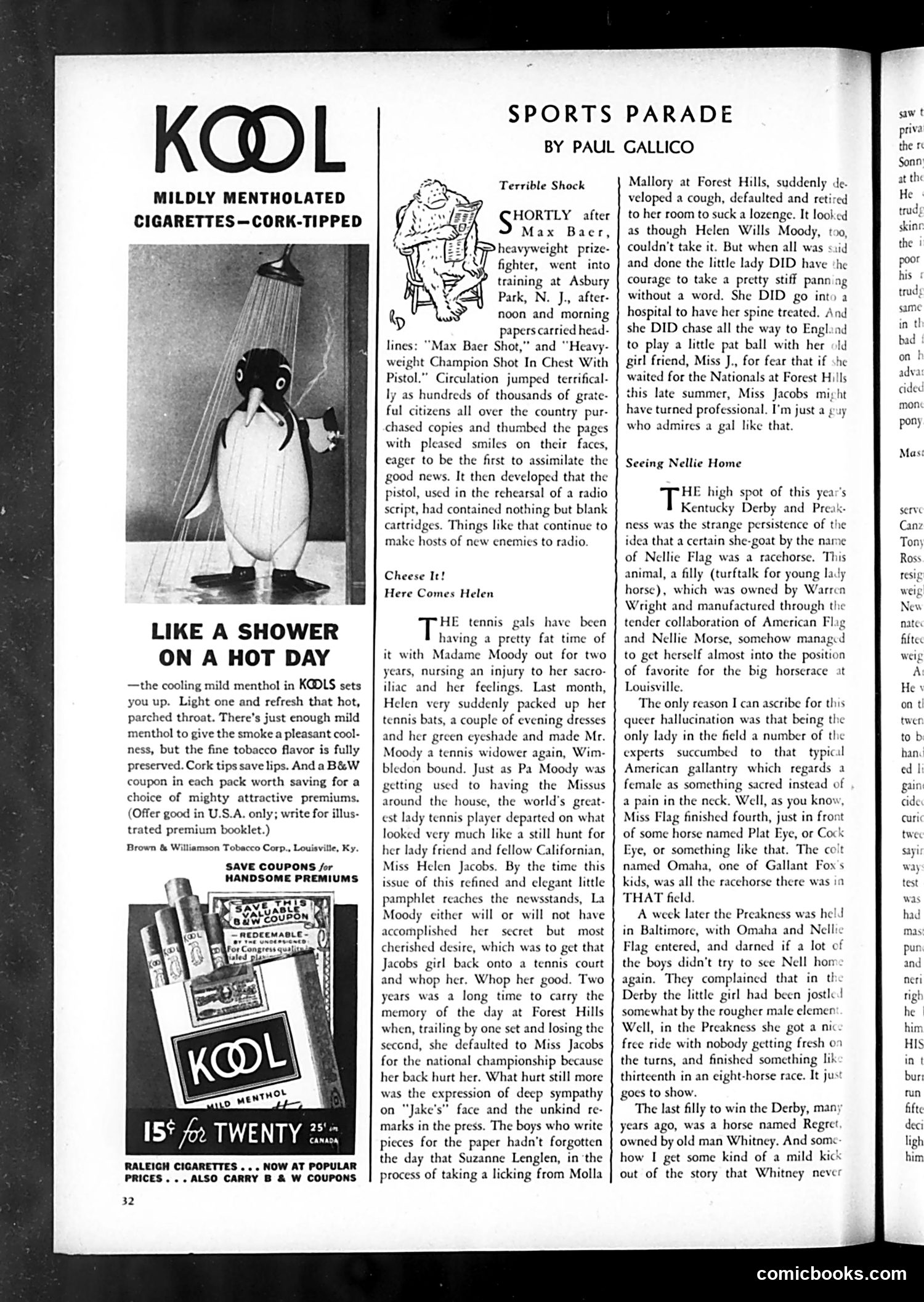
Sports Parade Column Analysis This page is primarily a cigarette advertisement (Kool and Raleigh brands) with a sports column by Paul Gallico, a famous sportswriter of the era. The column contains three brief gossip items about sports figures: 1. Max Baer incident: A humorous anecdote about sensational newspaper headlines reporting boxer Max Baer was "shot," which turned out to be blank cartridges from a radio script rehearsal—Gallico satirizes both the press's sensationalism and radio's incompetence. 2. Helen Wills Moody vs. Helen Jacobs: Tennis rivalry between two prominent female players. Moody had defaulted to Jacobs at Forest Hills, appearing to lack stamina. Gallico applauds Moody for later traveling to England to face Jacobs again, praising her resilience. 3. Nellie Flag: A she-goat (not a racehorse) that mysteriously competed in major races like the Kentucky Derby and Preakness, likely a humorous commentary on racing anomalies. The column's tone is lighthearted gossip typical of 1930s sports journalism.
Page Analysis: Life Magazine This page combines sports editorial content with a gin advertisement. The Editorial Content discusses boxing and horse racing anecdotes. The main narrative describes Lou Ambers' lightweight boxing championship fight against Barney Ross and Tony Canzoneri. The story emphasizes a psychological dynamic: Ambers, once Canzoneri's sparring partner and "punching bag," couldn't overcome the master-servant dynamic during their official bout. Despite being younger and stronger, Ambers lost because he remained psychologically subordinate to his former trainer. The piece illustrates how power relationships transcend physical ability. The Advertisement (right side) features Gordon's Distilled London Dry Gin with the slogan "The Sign of a Good Bar" and emphasizes that discriminating consumers choose Gordon's Gin globally. There is no cartoon or political satire on this page—it's primarily sports reporting paired with commercial advertising, typical of Life magazine's format during this era.
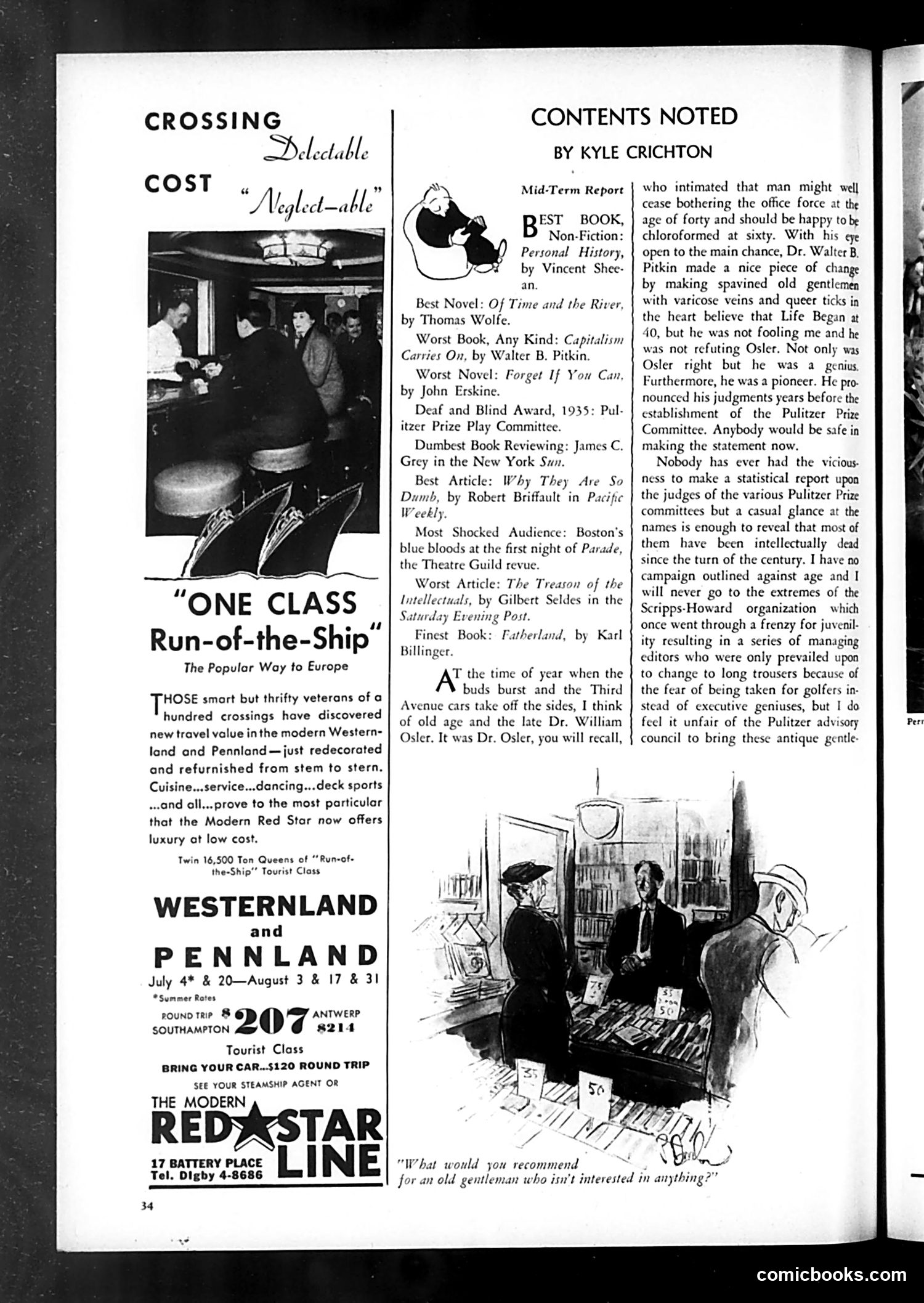
Page Analysis: Life Magazine Satirical Content This page combines advertising with Kyle Crichton's sardonic book review column. The main satire targets the Pulitzer Prize committees and aging intellectuals. The Central Joke: Crichton references Dr. William Osler's provocative suggestion that men should be "chloroformed at sixty," then mocks Walter B. Pitkin for profiting by contradicting this with his book "Life Begins at 40." Crichton agrees with Osler, arguing the Pulitzer Prize judges prove his point—they've been "intellectually dead since the turn of the century." The Cartoon: Shows three men in what appears to be a bookstore or library. The caption asks, "What would you recommend for an old gentleman who isn't interested in anything?"—a dry joke about the futility of recommending books to the intellectually moribund elders Crichton just criticized. Context: This reflects 1930s debates about generational obsolescence and meritocratic versus established authority. The satire assumes readers share Crichton's irreverent dismissal of age and institutional prestige. The page is primarily advertising for Red Star cruise lines (left column).
This page is primarily a commercial advertisement, not political satire or a cartoon. It's a full-page ad for Powers Reproduction Corporation, a commercial photography and printing company located in New York City. The image shows liquor bottles (Martell, Booth's Sloe Gin, and others) arranged as a product display photograph. The ad promotes Powers' new color photography service for advertising purposes. The text emphasizes that accurate color reproduction helps sell merchandise by showing customers exactly what products look like on store shelves. It highlights their skilled photographers, efficient equipment, and invites potential clients to contact them or visit their plant. This reflects the 1920s-30s advertising industry, when color photography for commercial use was still relatively new and a competitive selling point. There is no satirical or political content—it's straightforward business marketing.
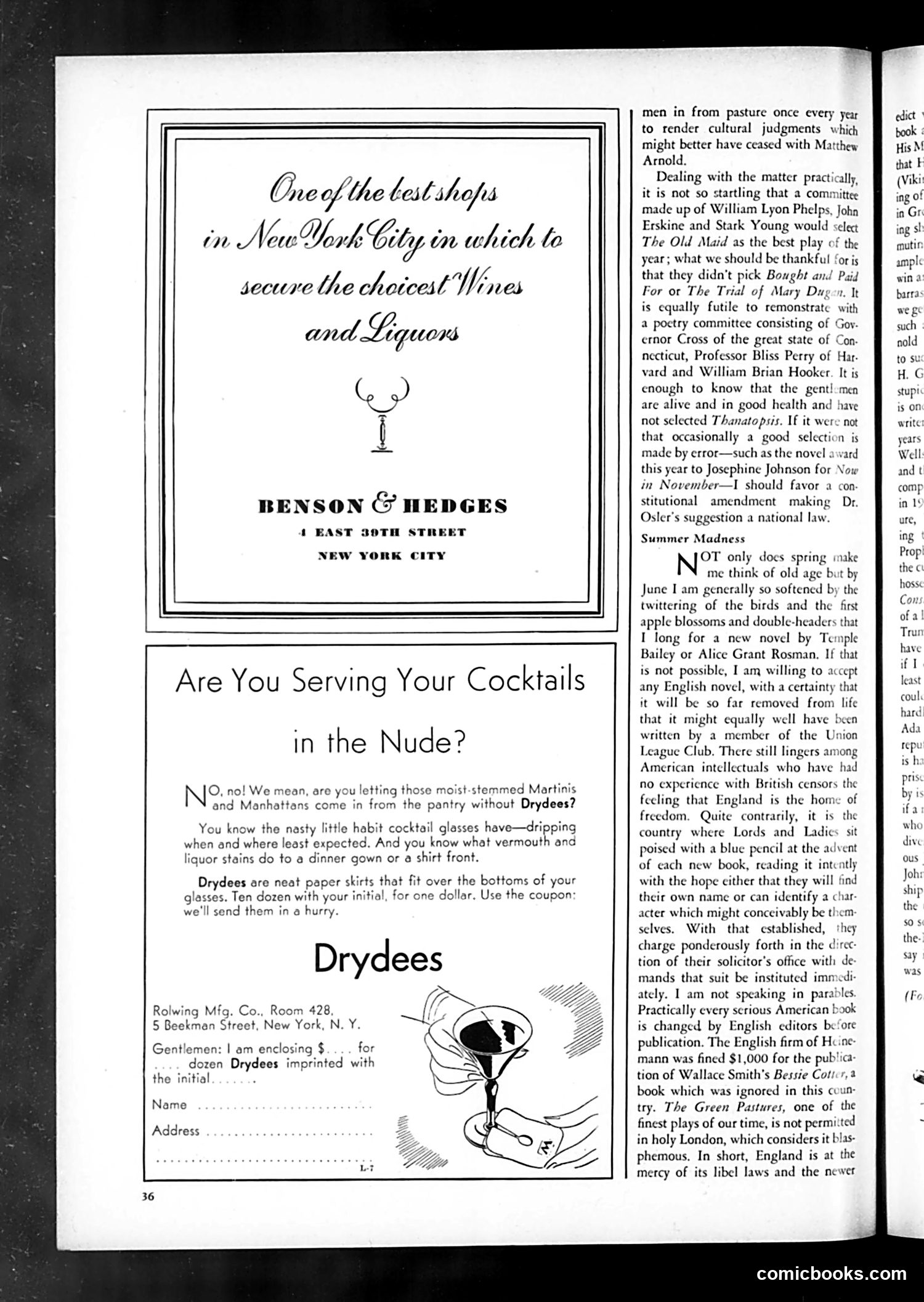
Explanation for Modern Readers This page contains two distinct advertisements rather than political cartoons: "Drydees" Advertisement: A product pitch for paper napkin skirts that fit around cocktail glass stems to prevent moisture stains on formal wear. The humor is mild—the opening rhetorical question "Are You Serving Your Cocktails in the Nude?" uses mock scandal to grab attention before explaining this is about protecting clothing from wet glasses at dinner parties. This reflects 1920s-30s concerns about maintaining proper etiquette and protecting expensive garments. Benson & Hedges Advertisement: A wine and liquor shop advertisement positioned as one of NYC's "best shops." The right column contains satirical commentary about literary awards committees and British censorship laws—social criticism rather than visual satire. The references to specific judges (William Lyon Phelps, Stark Young) and novels would have been familiar to contemporary readers but require historical knowledge to fully appreciate today.
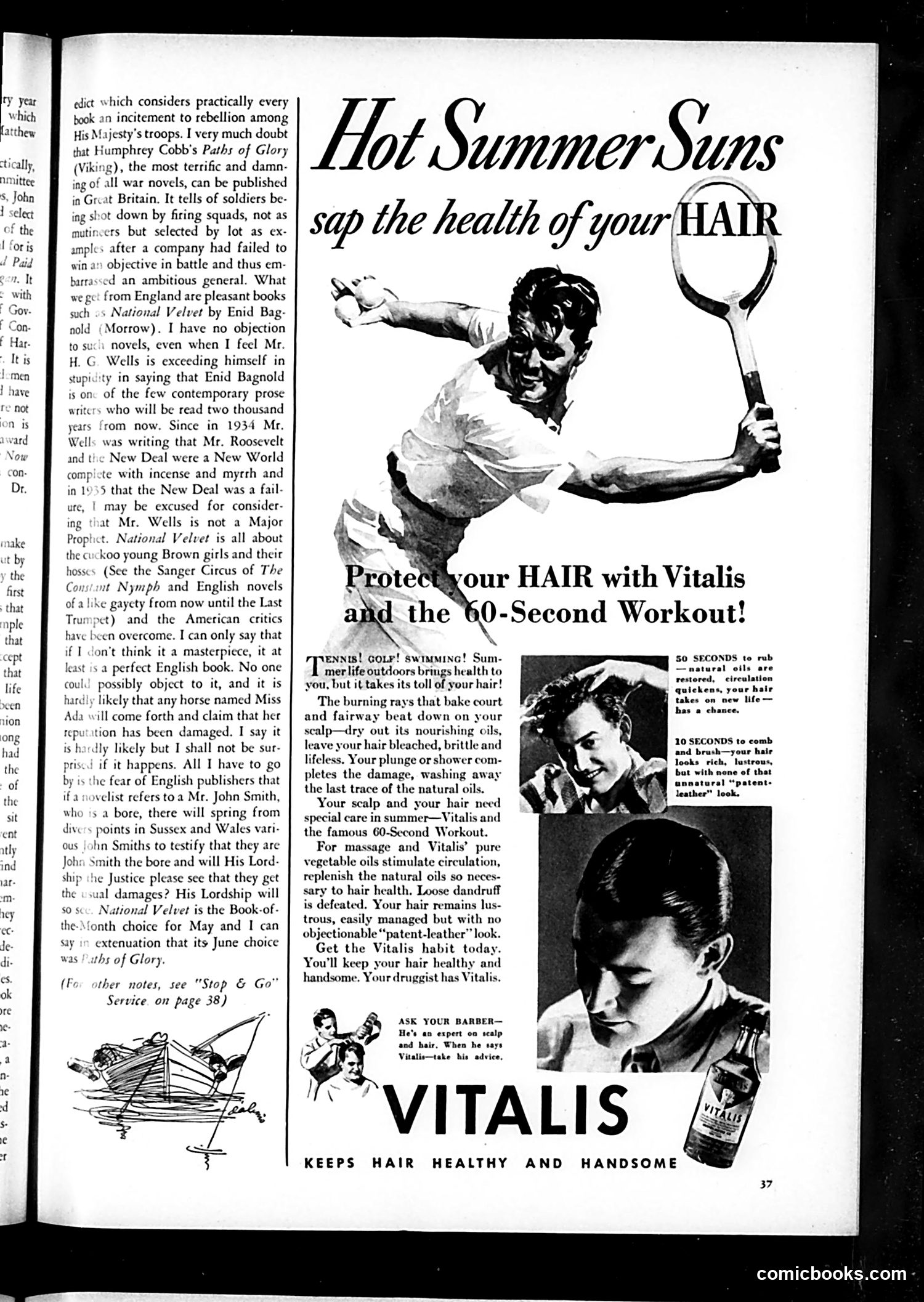
Analysis This page is primarily a Vitalis hair product advertisement, not political satire. The left column contains a book review discussing English and American literature, including references to Humphrey Cobb's *Paths of Glory* and Enid Bagnold's *National Velvet*. The right side features a full-page ad showing a man engaged in summer sports (tennis, golf, swimming) with text warning that sun exposure damages hair. The advertisement emphasizes Vitalis oil's ability to restore natural oils lost to summer heat and chlorine/salt water. The "60-Second Workout" refers to a massage technique using the product. Small illustrations show before/after hair conditions and instructions for barbers. No political cartoon or satire is present. This appears to be a standard vintage advertisement using then-contemporary imagery of active, healthy men to market grooming products—the "patent-leather" look referenced was apparently considered an undesirable artificial appearance in men's hair styling of this era.
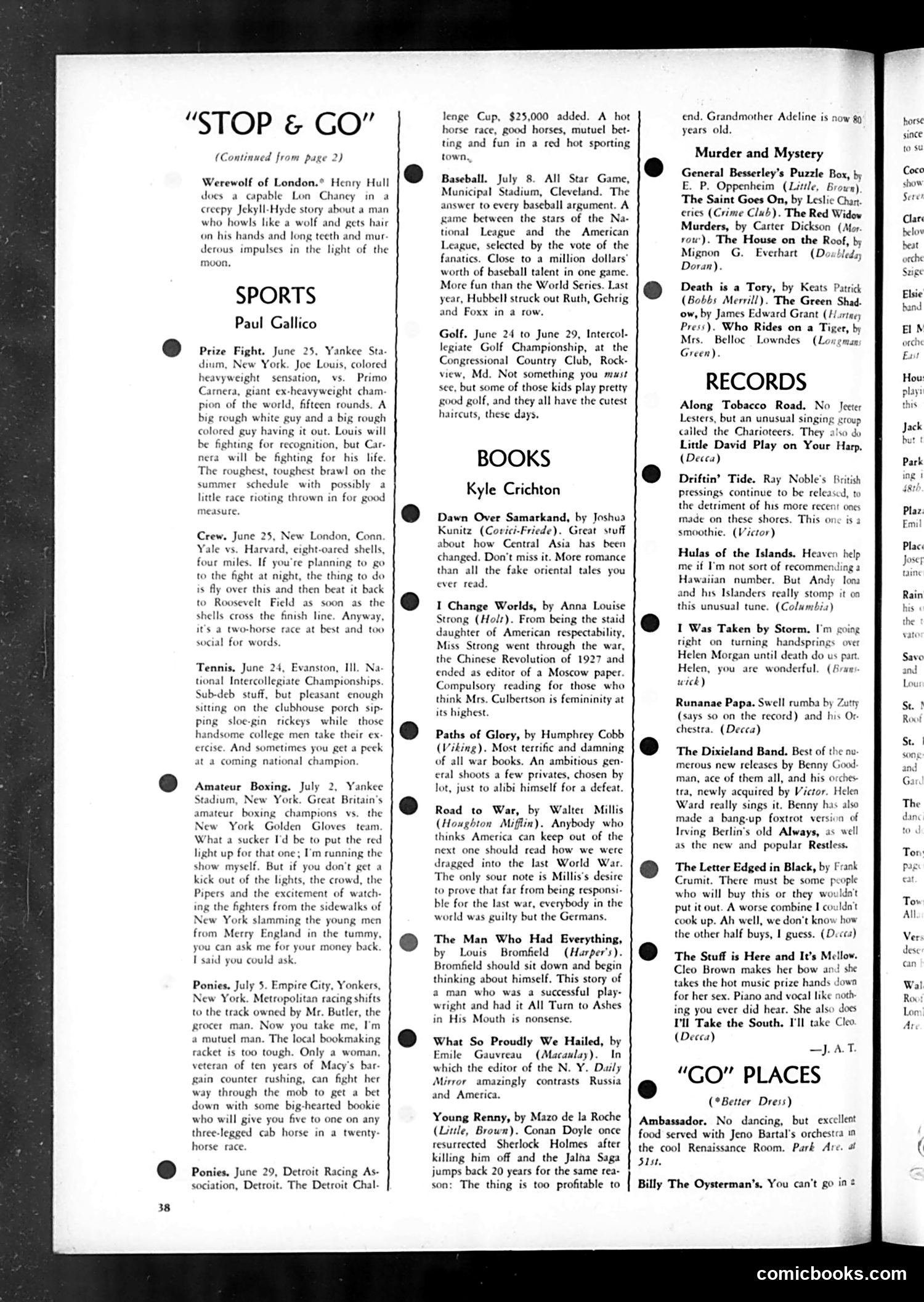
"Stop & Go" Magazine Page This page from *Life* magazine presents reviews of summer entertainment and sports by columnist Paul Gallico. The content reflects 1930s American attitudes, notably including explicit racial commentary in the sports section. In the boxing preview, Gallico describes the Joe Louis vs. Primo Carnera fight as "A big rough white guy and a big rough colored guy having it out," and predicts "a little race rioting thrown in for good measure"—normalizing racial tension around the event. Louis, a Black heavyweight contender, was a significant sports figure challenging racial barriers. The sports coverage otherwise covers typical summer events: tennis, crew, horse racing, golf, and baseball's All-Star Game. The books section reviews travel and political memoirs, including Anna Louise Strong's account of witnessing the Chinese Revolution and Soviet experience—reflecting 1930s intellectual interest in leftist politics. The tone is casual, gossipy, and insider-ish—characteristic of *Life*'s satirical voice.
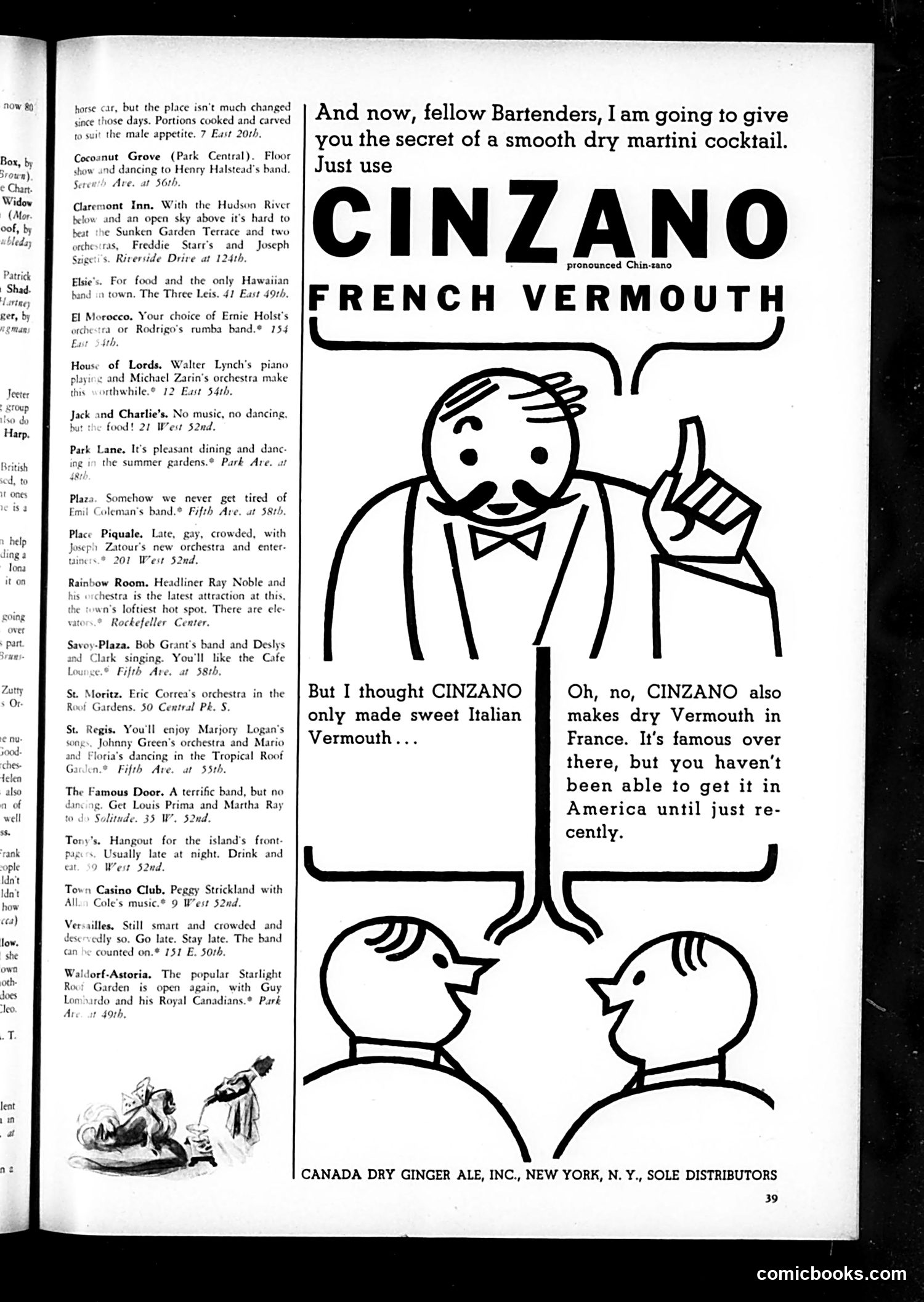
Cinzano French Vermouth Advertisement (Vintage Life Magazine) This is a full-page advertisement for Cinzano French Vermouth, disguised as editorial content to appeal to bartenders and cocktail enthusiasts. The advertisement uses a conversational comic format: a bartender (depicted with simple line drawings) reveals a "secret" for making dry martinis. A second figure expresses surprise that Cinzano makes dry vermouth—they thought it only produced Italian sweet vermouth. The bartender corrects them, explaining Cinzano's dry French vermouth is "famous over there" but newly available in America. This is classic early-20th-century advertising: creating perceived authority through bartender expertise, overcoming consumer misconceptions about the product, and emphasizing exclusivity and novelty ("until just recently"). The casual, conversational tone mimics editorial content to blend seamlessly into the magazine's entertainment listings on the facing page.
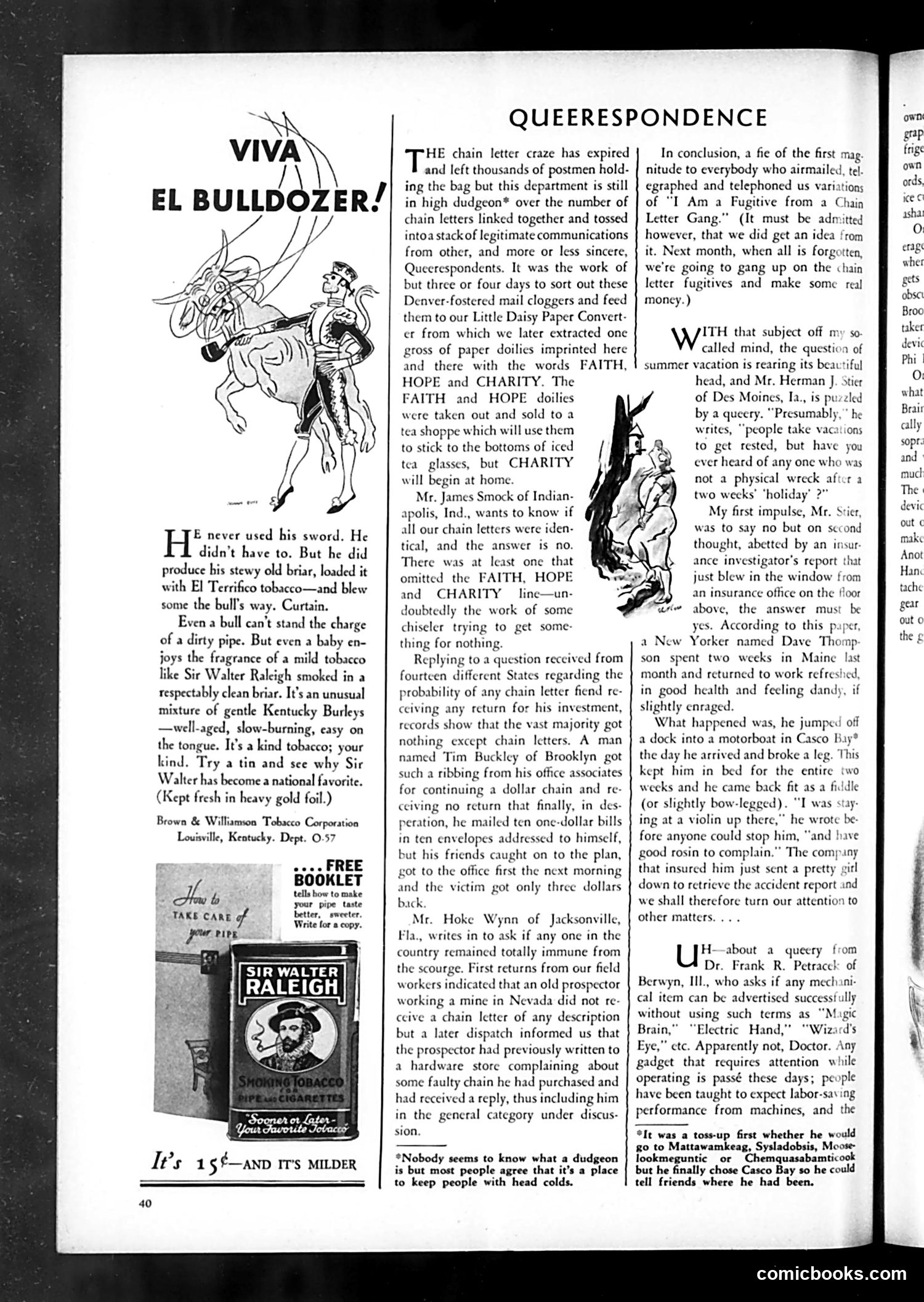
Explanation for Modern Readers This page contains a tobacco advertisement disguised as humorous content, plus a "letters to the editor" section satirizing chain letters. "Viva El Bulldozer!" cartoon: A matador-style figure uses a pipe (loaded with Sir Walter Raleigh tobacco) to repel a charging bull instead of a sword. The joke: the pipe's smoke is so unpleasant it defeats the animal. This is an advertisement for Sir Walter Raleigh pipe tobacco, implying it's strong but also "mild" and "kind" to smoke—a contradictory pitch typical of mid-century tobacco marketing. "Queerespondence" section: Life magazine's editors mock the 1930s chain-letter craze by describing absurd consequences: chain letters clogging the mail system, one man mailing himself money (caught by friends), and even a Nevada prospector inadvertently receiving a chain letter about faulty hardware. The humor mocks both the chain letters themselves and people gullible enough to participate, while poking fun at the magazine's own readers. The footnote defines "dudgeon" as "a place to keep people with head colds"—nonsensical wordplay.
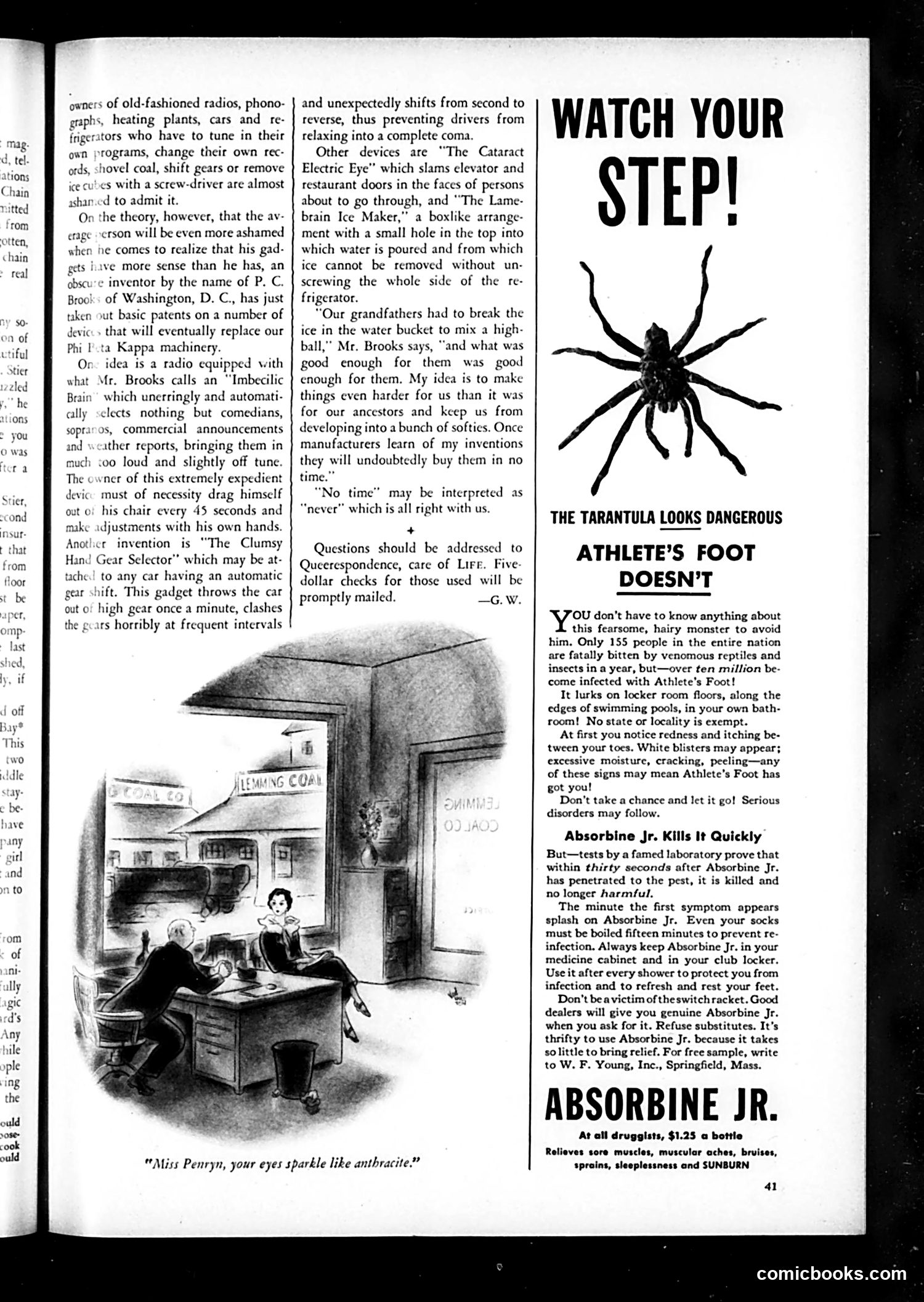
Explaining This Life Magazine Page This page contains two distinct elements: The Cartoon/Article (top): A satirical piece mocking modern convenience culture. Inventor P.C. Brooks has patented absurd "anti-convenience" devices—radios that only play comedians loudly and off-tune, car gear selectors that malfunction regularly, elevator doors that slam on people, ice makers that are deliberately difficult. The joke is that Brooks is intentionally making modern life *harder*, arguing people have become too soft. The satire critiques both consumer laziness and nostalgia for "the old days" when life was harder. The phrase "no time" interpreted as "never" suggests these ridiculous inventions will never actually be manufactured. The Advertisement (bottom): A vintage pharmaceutical ad for Absorbine Jr., a fungal treatment. The headline uses dark humor, juxtaposing a dangerous tarantula spider with the supposedly non-lethal but widespread threat of athlete's foot. The ad emphasizes that while tarantulas kill only 155 people yearly, athlete's foot infects ten million Americans—implying the "ordinary" health threat is actually more dangerous to the average person.
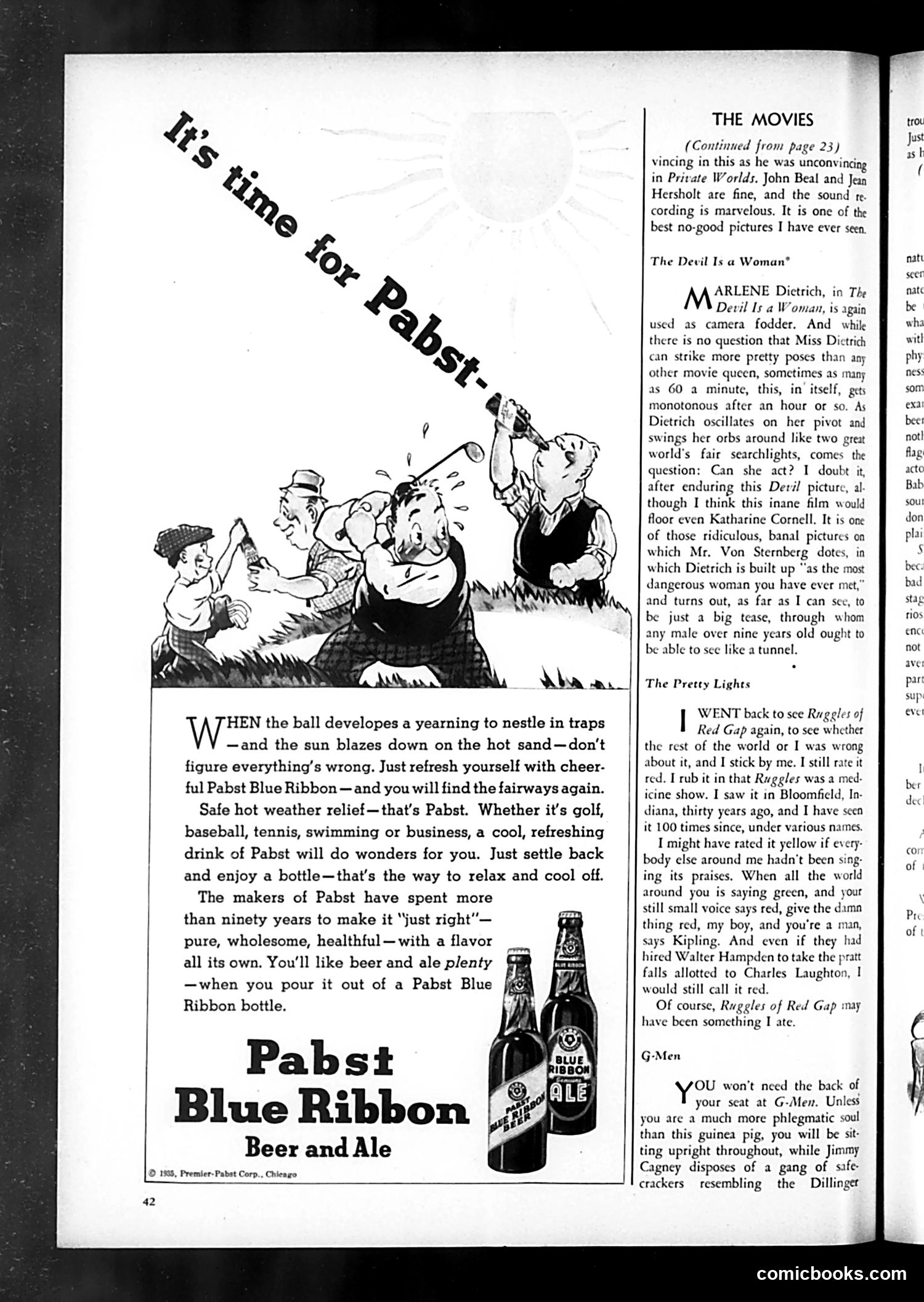
Analysis for Modern Readers This page mixes a Pabst Blue Ribbon beer advertisement with movie reviews from Life magazine's entertainment section. The cartoon illustrates a golfer frustrated on the links—a genteel leisure activity—refreshed by beer. The ad's implicit message: beer cures life's frustrations and enables relaxation. The reviews critique contemporary films: *The Devil Is a Woman* mocks Marlene Dietrich as mere "camera fodder," criticizing her repetitive poses (60 per minute) over actual acting ability. The reviewer questions whether audiences will endure such pretentious direction by Von Sternberg. *Ruggles of Red Gap* is dismissed as recycled entertainment seen dozens of times. *G-Men* receives praise for its action—presumably featuring gangster content referencing the Dillinger era (1930s FBI manhunts were headline news). The tone is satirical and dismissive of Hollywood's aesthetic pretensions while appreciating straightforward entertainment value.
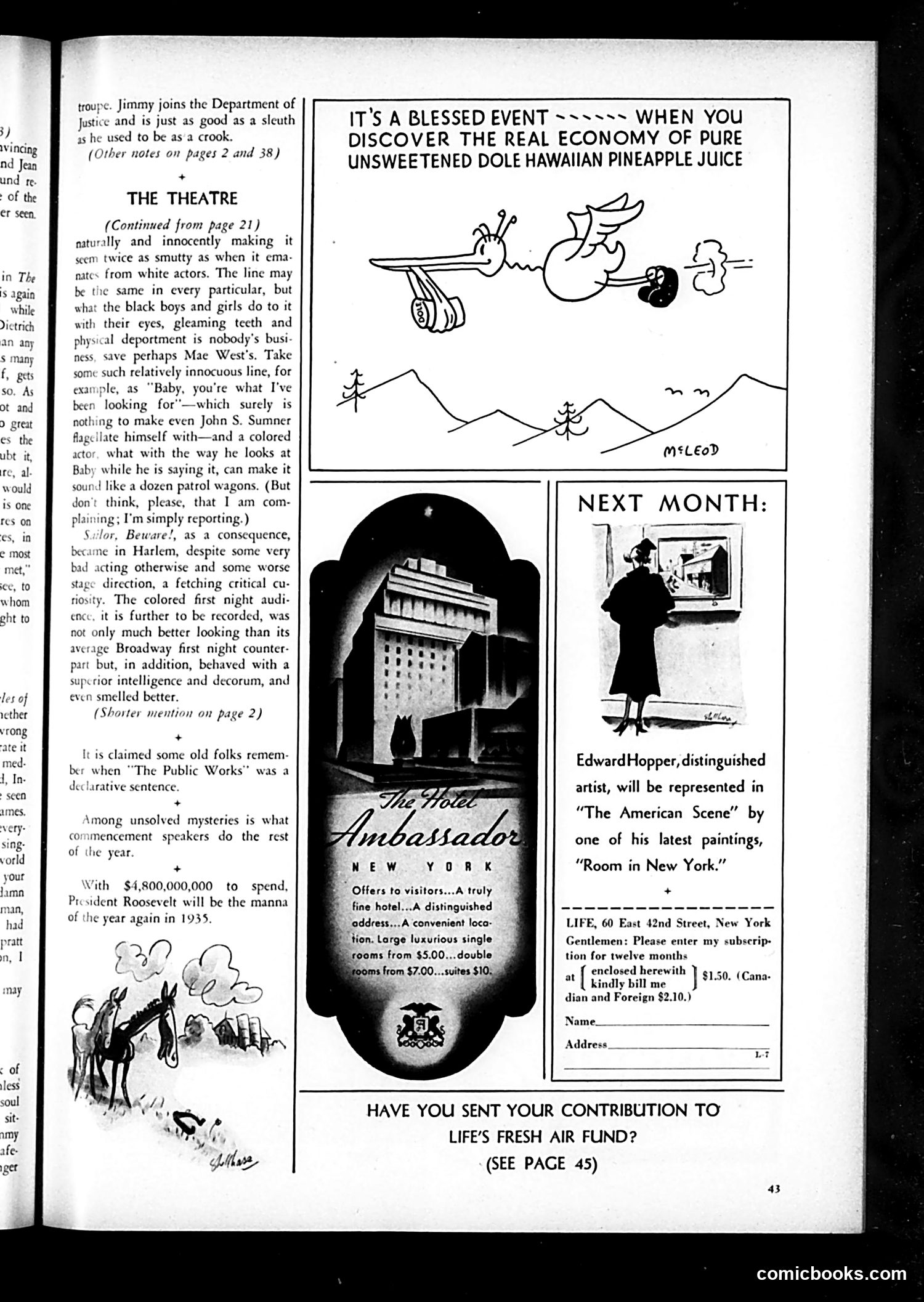
Analysis of Life Magazine Page 43 This page contains three distinct elements: Top Cartoon (Dole Pineapple Ad): A whimsical illustrated advertisement celebrating "unsweetened Dole Hawaiian pineapple juice" as an economical discovery. The cartoon shows a character flying with a pineapple, pitched as budget-friendly nutrition—likely appealing to Depression-era readers concerned with household economy. Theatre Review: Critique of a Harlem production called "Sailor, Beware!" The writer comments that Black performers deliver the same lines as white actors but make them seem more suggestive through physical expression and delivery. This reflects 1930s racial attitudes and theatrical conventions, where the reviewer appears to express both disapproval and fascination with Black performers' interpretive choices. Advertisements: The Hotel Ambassador (NYC) ad and subscription offer for LIFE magazine, plus a teaser for next month's feature on Edward Hopper's painting "Room in New York." The page reflects Depression-era consumer culture alongside period racial stereotypes in entertainment commentary.
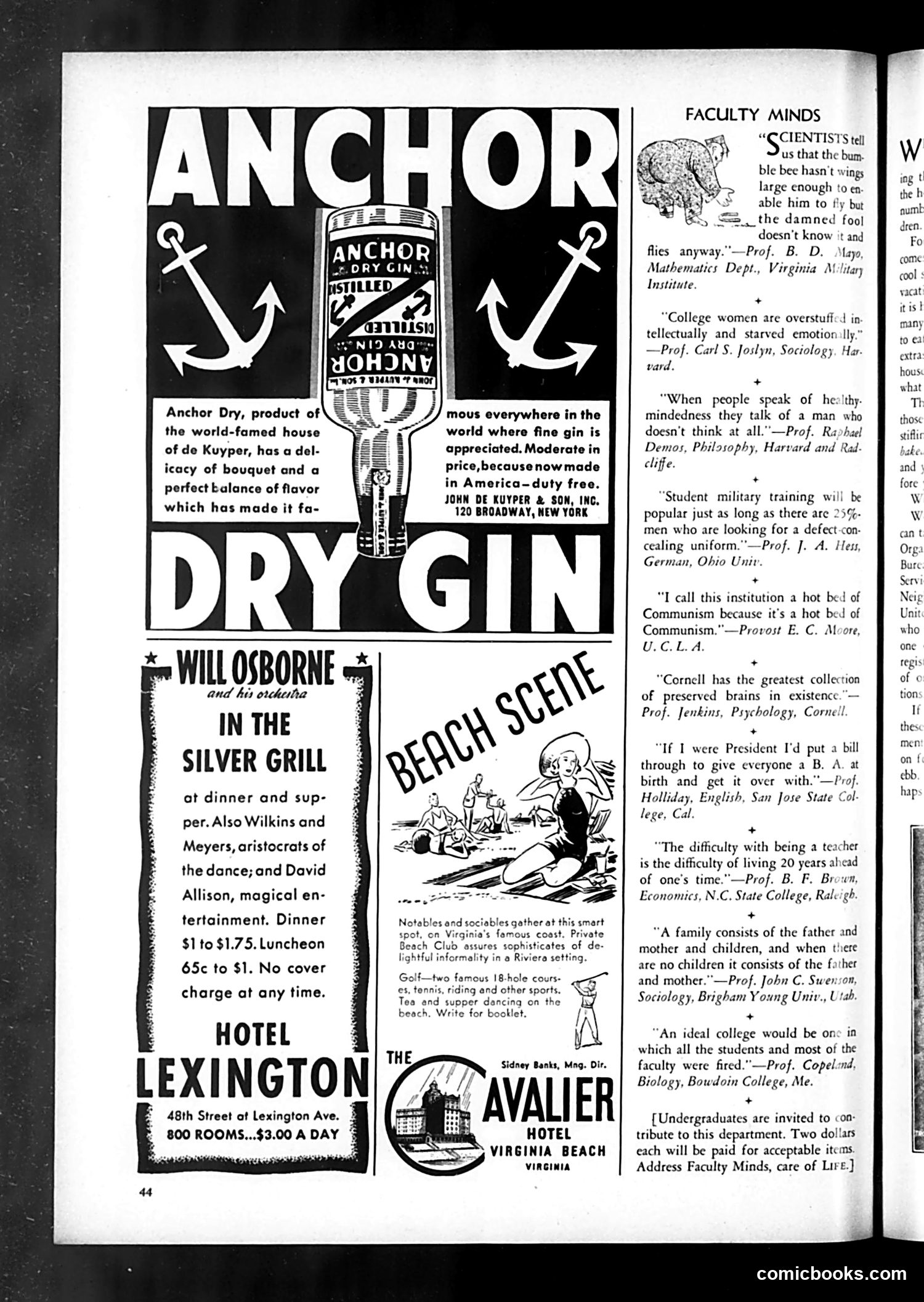
Analysis: "Faculty Minds" Satirical Column This page is primarily advertising (Anchor Dry Gin, hotels, entertainment venues), but includes Life magazine's humor column "Faculty Minds"—a regular feature mocking academia. The column presents absurdist quotes attributed to real university professors, exposing pretentious or illogical academic thinking. Examples include: - A professor stating the obvious ("family = father, mother, and children") as profound wisdom - A logic contradiction (calling an institution "communist because it's communist") - Cynical observations (the ideal college would fire most students and faculty) The satire targets inflated academic self-importance—how professors obscure simple truths in jargon, or make trivial statements sound intellectual. The column invites reader contributions, suggesting this was popular social commentary mocking the era's academic establishment. The humor relies on recognizing that educated people sometimes speak nonsense while maintaining an air of authority—a timeless target of satire.
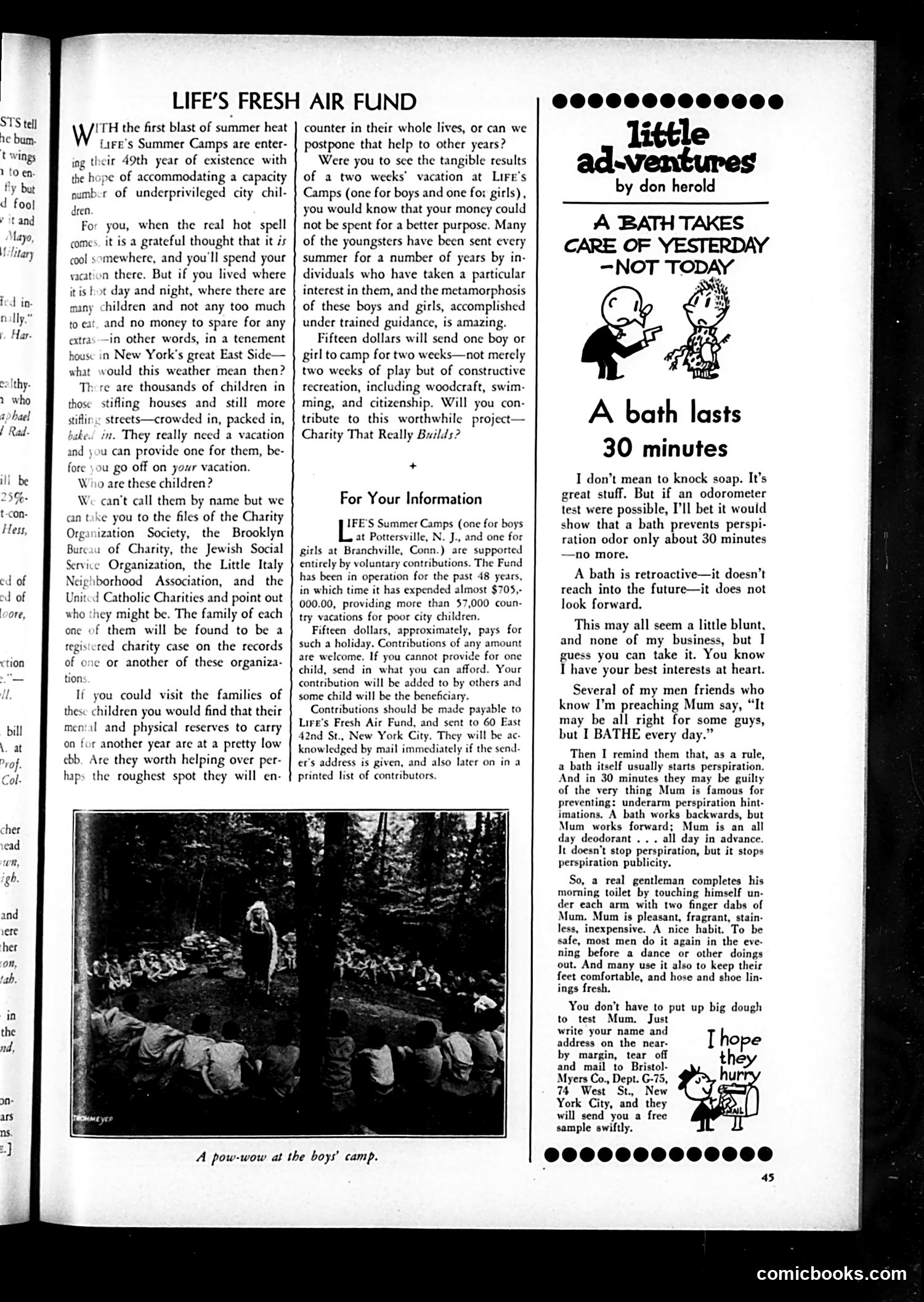
Life Magazine Page Analysis This page contains two distinct elements: a serious charitable appeal and a humorous advertisement. Left side: "Life's Fresh Air Fund" is an earnest solicitation for $15 donations to send underprivileged children from tenement housing in New York City (Brooklyn, Little Italy neighborhoods) to summer camps in New Jersey and Connecticut. The appeal emphasizes the physical and moral benefits of two-week vacations for poor urban children, referencing the program's 48-year history and $705,000 expenditure. A photograph shows children at "a pow-wow at the boys' camp." Right side: "Little Adventures" by Don Herald is a satirical comic about bathing and personal hygiene. The joke presents a deliberately blunt advertisement premise: that a bath only prevents body odor for 30 minutes, making it "retroactive" (cleaning yesterday) rather than "forward-looking." This appears to be mock-advertising copy mocking overconfident product claims—likely promoting deodorant as superior to bathing alone. The juxtaposition is striking: genuine social reform messaging alongside irreverent consumer humor.
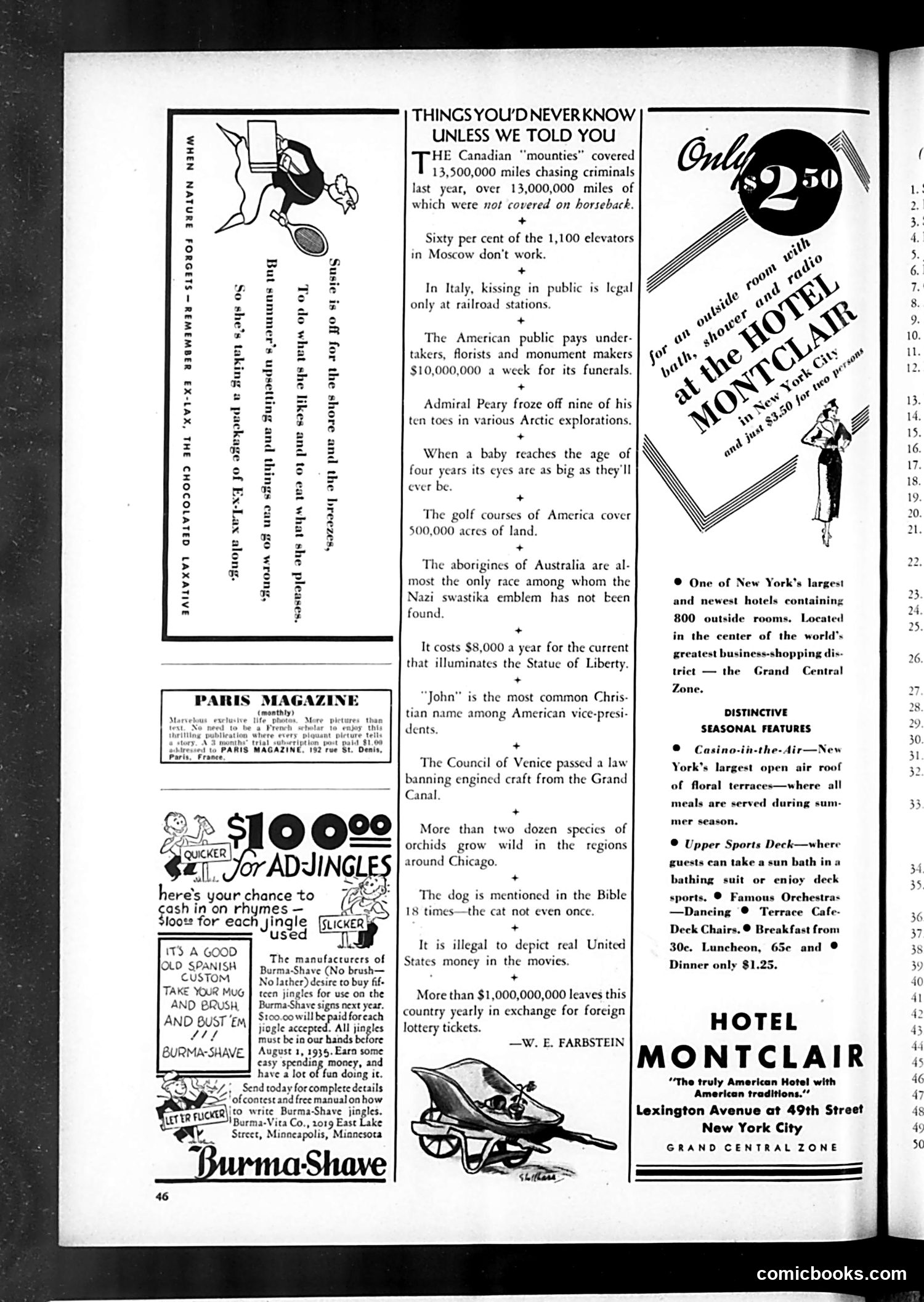
What This Page Means for Modern Readers This is primarily an advertising and trivia page from Life magazine, circa 1935. The main content consists of: 1. "Things You'd Never Know" trivia column: A humor feature presenting odd facts—Canadian mounties not riding horses, Moscow elevators breaking down, Italian public kissing laws—meant to amuse readers with absurdist observations. The Nazi swastika reference reflects pre-WWII casual mention before the symbol's full association with atrocities. 2. Burma-Shave contest ad: A company famous for roadside advertising jingles (appearing on sequential signs along highways) offering $100 per accepted rhyme—significant money during Depression-era 1935. 3. Hotel Montclair advertisement: Promoting a New York luxury hotel with amenities like rooftop gardens and orchestras. 4. Paris Magazine plug: Promoting a European publication. The page reflects 1930s consumer culture and the magazine's mixed editorial-advertising format typical of the era. No political cartoons or caricatures appear.
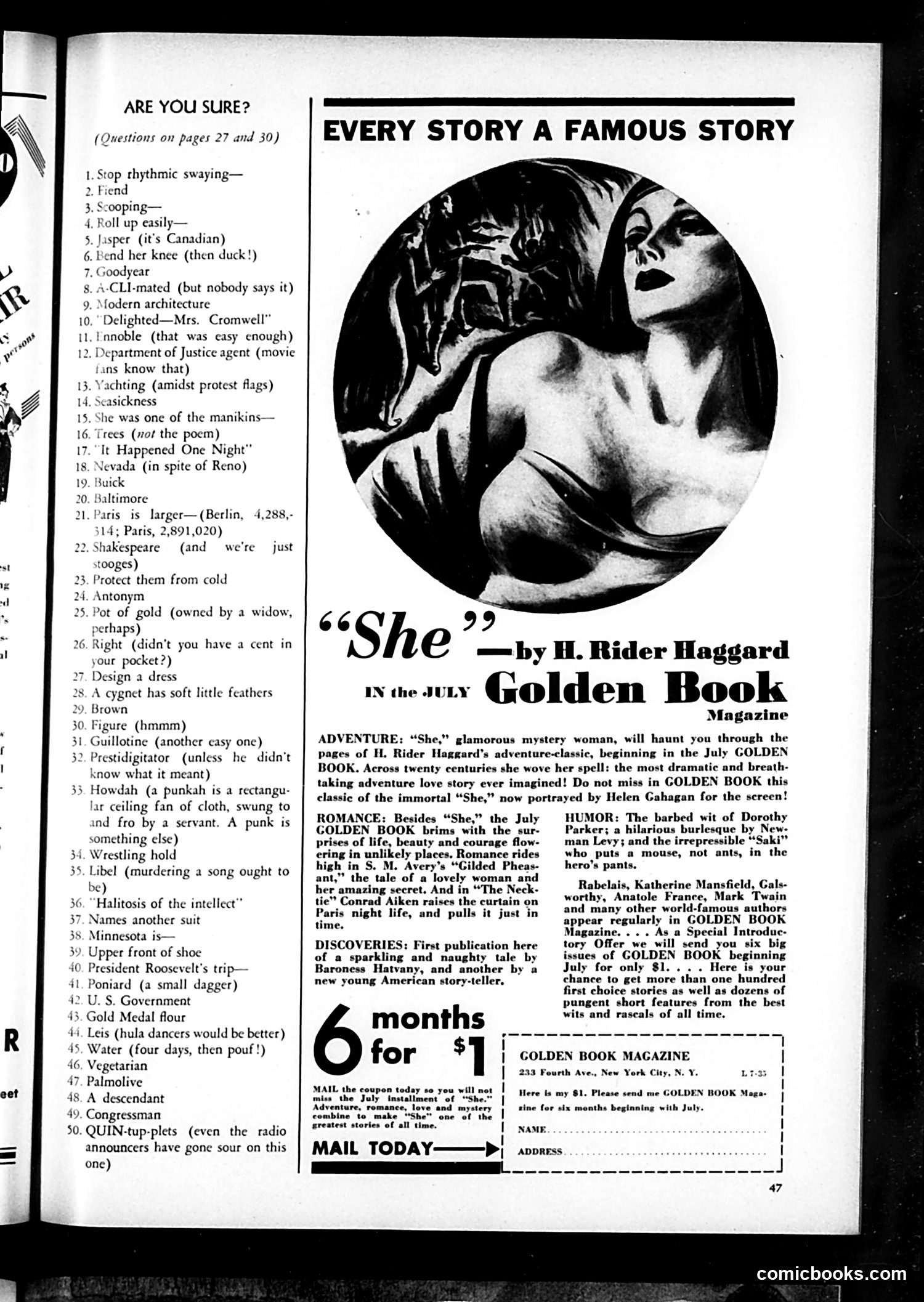
This Page: Quiz Answers and Magazine Advertisement This page contains two distinct elements: Left side: Answers to a quiz ("ARE YOU SURE?") from earlier in the magazine, featuring wordplay and riddle solutions. These are lighthearted brain-teasers typical of Life magazine's humor—puns and lateral-thinking puzzles. Right side: A full-page advertisement for *Golden Book Magazine*, promoting the July issue. The advertisement features actress Helen Gahagan portraying "She," the mysterious protagonist from H. Rider Haggard's famous adventure novel. The ad emphasizes the magazine's literary prestige, listing celebrated authors like Mark Twain, Katherine Mansfield, and Dorothy Parker. It's offering a subscription deal: six months for $1—positioned as an attractive introductory rate to build readership for this highbrow literary magazine. The contrast is typical of Life's format: accessible humor alongside sophisticated cultural content.
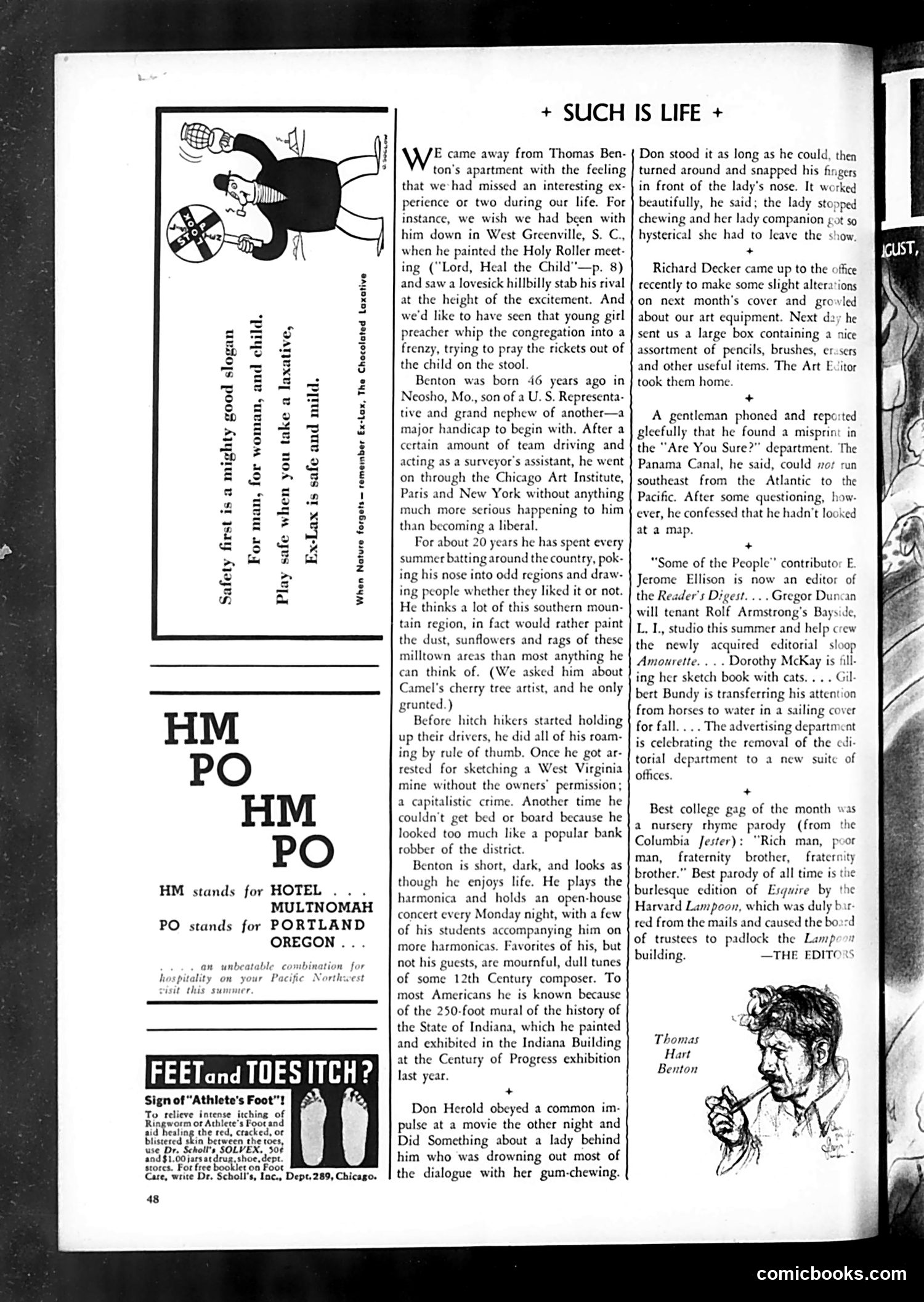
"Such Is Life" - Life Magazine Humor Column This page features Life magazine's casual humor column about artist Thomas Hart Benton, a prominent American regionalist painter known for depicting rural and working-class American life. The column celebrates Benton's adventurous lifestyle—traveling the country sketching ordinary people, including his famous depiction of a Holy Roller revival meeting in South Carolina. The anecdotes highlight Benton's unconventional approach: he was once arrested for sketching a West Virginia mine without permission, and he lived by hitchhiking and sketching strangers regardless of their consent. The column presents these as charming eccentricities rather than invasions of privacy—reflecting 1930s-40s attitudes toward artistic practice. The page also contains unrelated brief humorous items about mundane office life and two period advertisements (Ex-Lax laxative and Dr. Scholl's foot remedy), typical of Life's mixed-content format.