life
Life — August 1935
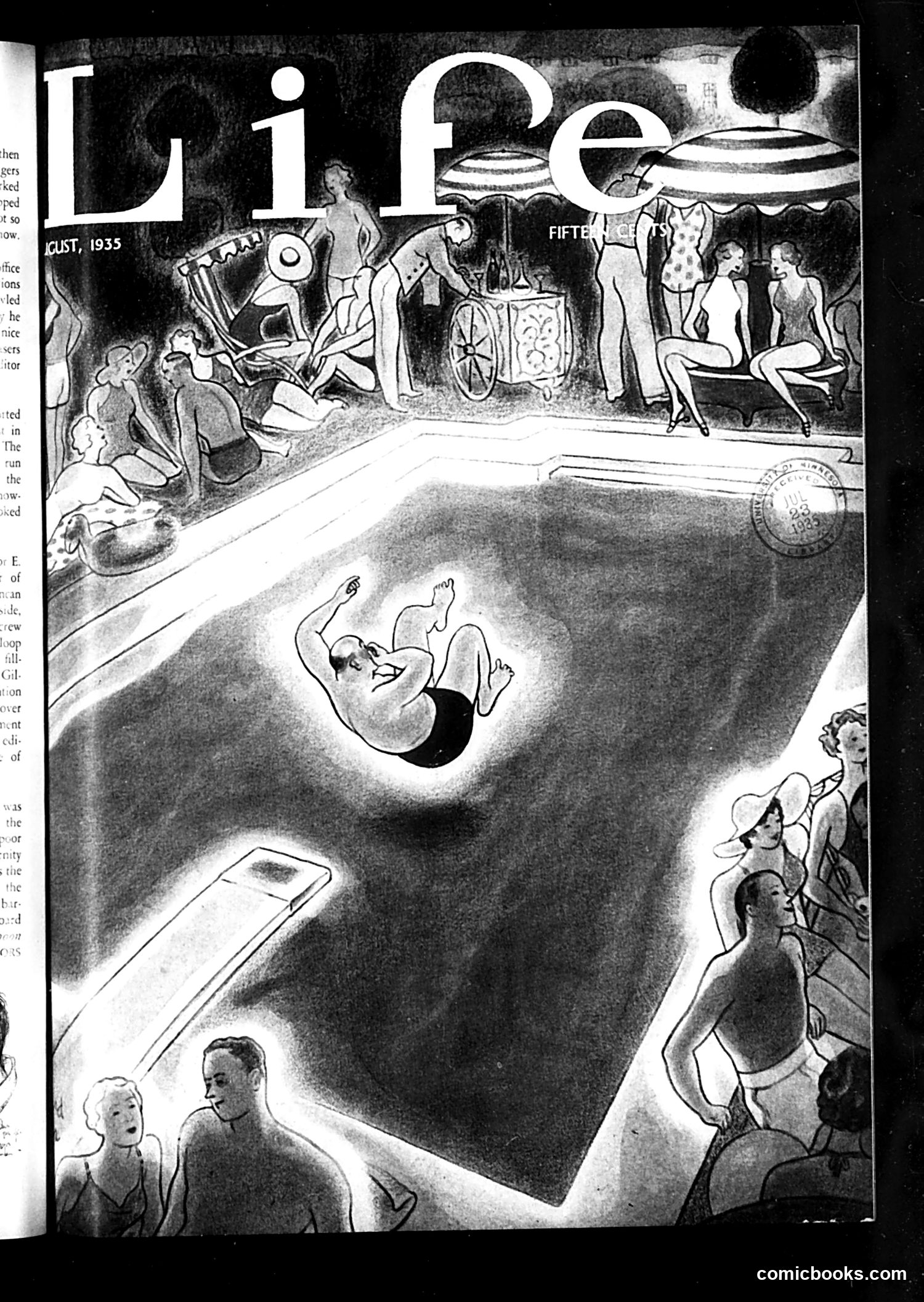
Life Magazine Page Analysis This appears to be a Life magazine cover from August 1935 featuring a satirical illustration of a swimming pool scene. The main cartoon shows a man diving or falling into an illuminated pool while well-dressed spectators watch from the sides—some seated, others standing near umbrellas and refreshment stands. The satire likely comments on leisure culture and class divisions during the Depression era. The contrast between the carefree poolside socialites and the figure in the water (who appears undignified or in distress) suggests commentary on social pretension or the gap between wealthy society and ordinary people's circumstances. The detailed rendering of the fashionable crowd emphasizes the artificiality of 1930s high-society recreation. Without additional text visible, the specific satirical target remains unclear.
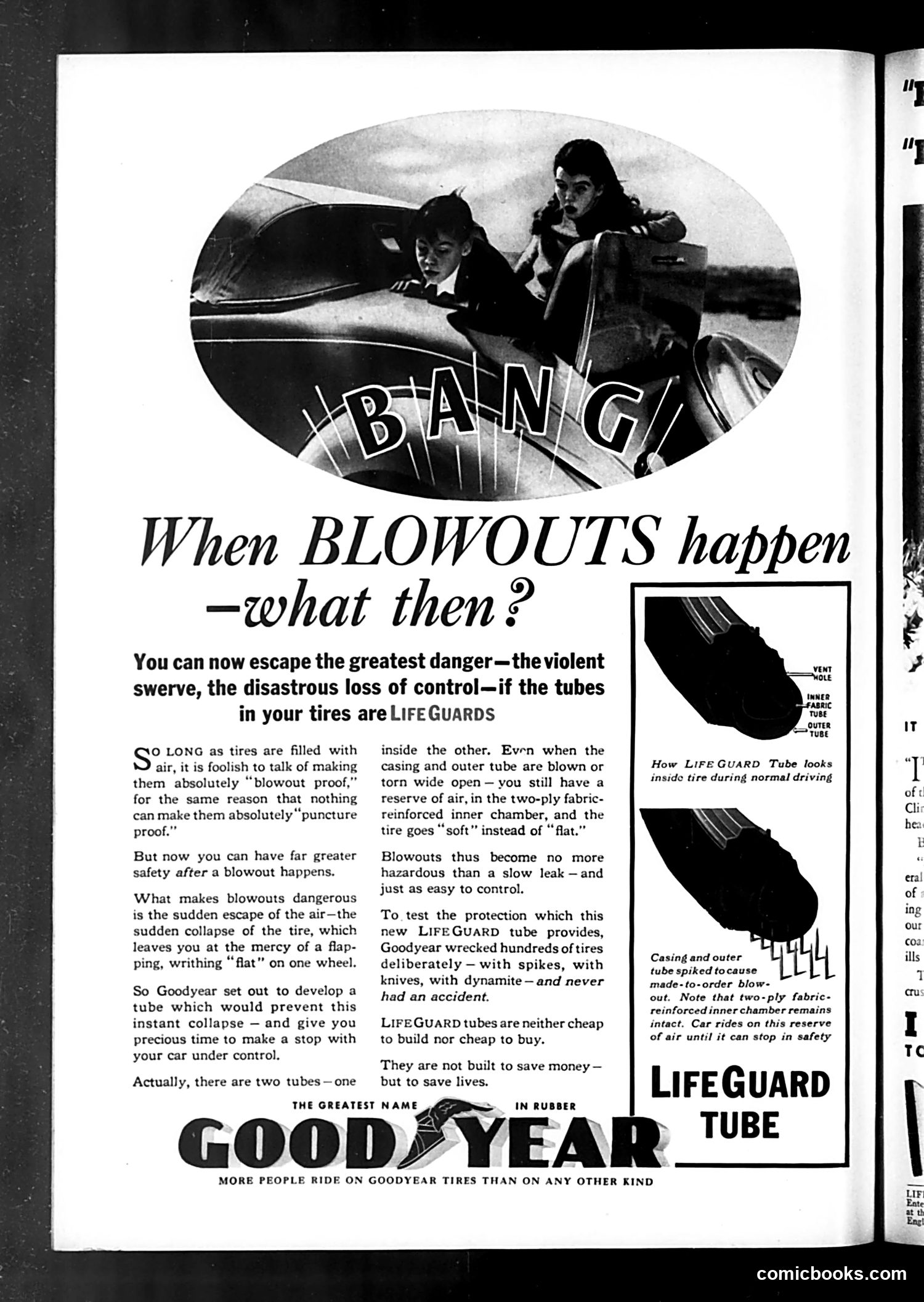
Analysis This is a Goodyear tire advertisement, not satire or political cartoon. The page promotes Goodyear's new "LifeGuard Tube" technology designed to prevent blowouts—a genuine safety hazard of early automotive travel. The dramatic oval illustration at top shows two men in a car experiencing a blowout ("BANG!"), emphasizing the danger. The ad explains that traditional tires could collapse suddenly when punctured, causing loss of control. Goodyear's innovation uses a two-ply reinforced inner chamber that allows gradual deflation instead of catastrophic failure. The diagrams show how the tube performs during normal driving versus after a blowout. The tagline "More people ride on Goodyear tires than on any other kind" establishes market dominance. This reflects genuine 1920s-30s automotive safety concerns—blowouts were common and genuinely dangerous at highway speeds.
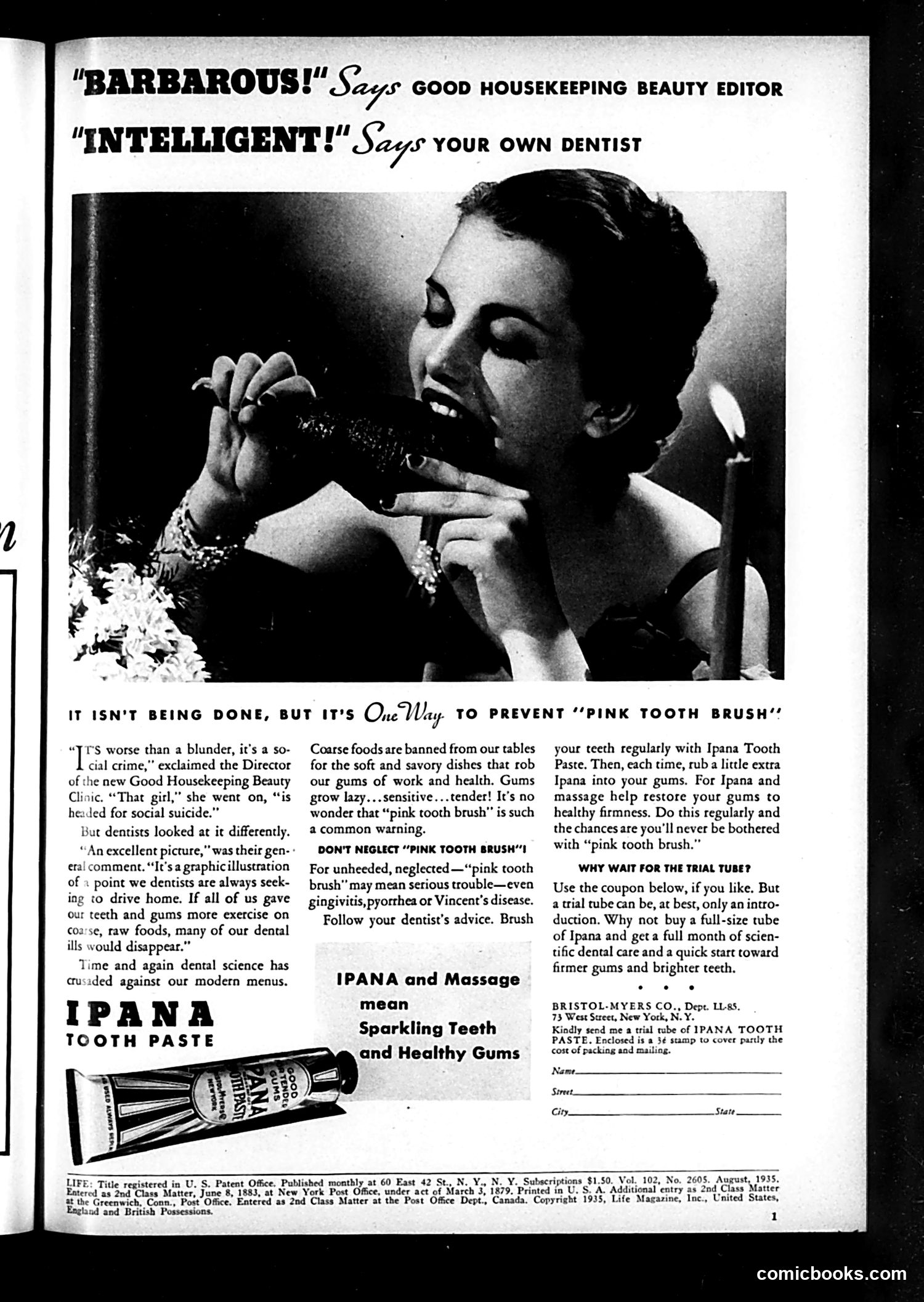
Analysis This page is primarily an advertisement for Ipana Tooth Paste, not a political cartoon. The ad uses a framing device where it quotes the "Good Housekeeping Beauty Editor" calling the product "barbarous" and "your own dentist" calling it "intelligent." The central image shows a woman applying the toothpaste. The advertisement addresses a then-common dental concern called "pink tooth brush"—bleeding gums caused by neglect or coarse foods. It warns that this condition could indicate serious diseases like gingivitis or pyorrhea, and promotes Ipana as a preventative solution through regular massage and brushing. This reflects mid-1930s advertising's strategy of creating anxiety about health conditions to drive consumer purchases.
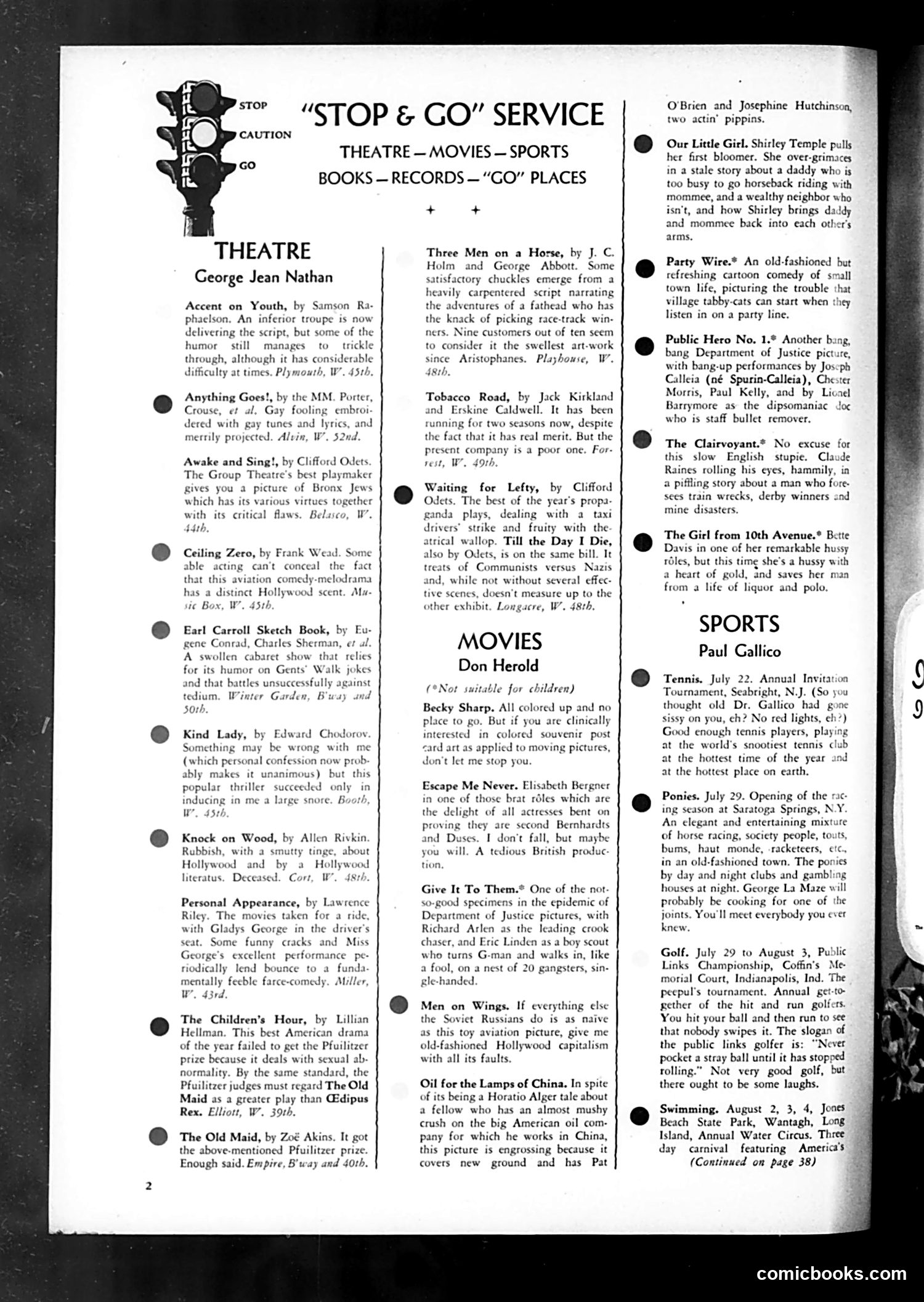
"Stop & Go" Service Page - Life Magazine This page is primarily entertainment listings and reviews, not political satire. It's a "Stop & Go Service" guide covering theatre, movies, sports, and cultural venues. The masthead features a traffic light illustration—a visual pun on the "Stop & Go" title, suggesting readers should "stop" to read reviews before deciding where to "go" for entertainment. The content includes brief theatrical reviews (e.g., "Three Men on a Horse," "Waiting for Lefty"), movie recommendations with warnings (noting one film is "*Not suitable for children*"), and sports event listings (tennis, ponies, golf, swimming). This was a practical consumer guide helping readers navigate entertainment options during what appears to be the 1930s-40s era. The humor is gentle and informational rather than political.
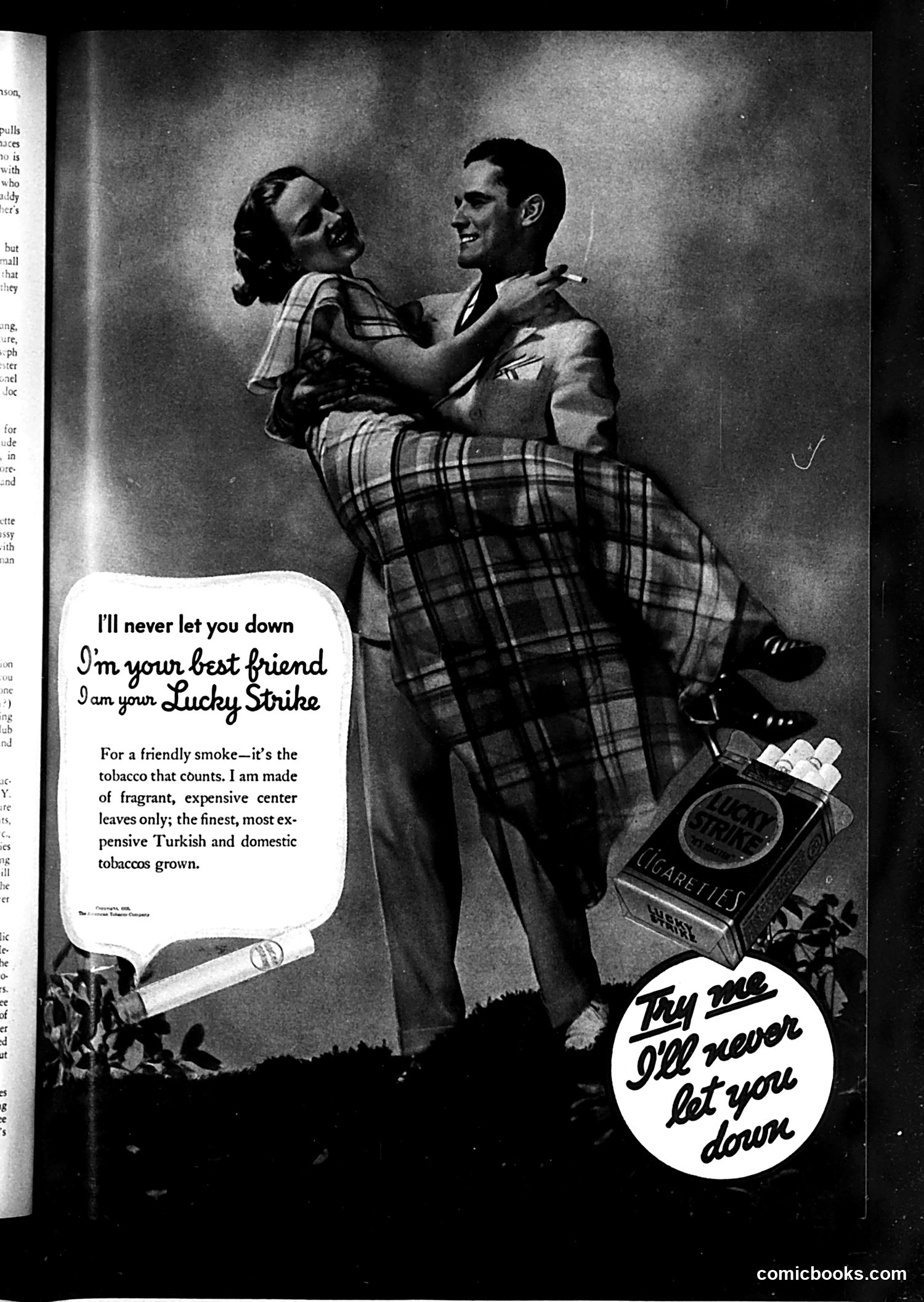
Analysis This is a Lucky Strike cigarette advertisement, not political satire. The ad uses romantic imagery to market cigarettes to mid-20th-century consumers. The scene depicts a man carrying a woman wrapped in a plaid blanket, both smiling. The accompanying text presents the cigarettes as a "best friend" and "Lucky Strike"—using friendship and romance as selling points. The ad emphasizes that Lucky Strikes are made from "fragrant, expensive center leaves only" and "the finest, most expensive Turkish and domestic tobaccos grown." For modern readers: This represents pre-warning-label cigarette advertising that normalized smoking as desirable, romantic behavior. The "friendly smoke" messaging targeted consumers before widespread understanding of health risks. Such ads are now prohibited, making this a historical artifact of mid-century marketing practices.
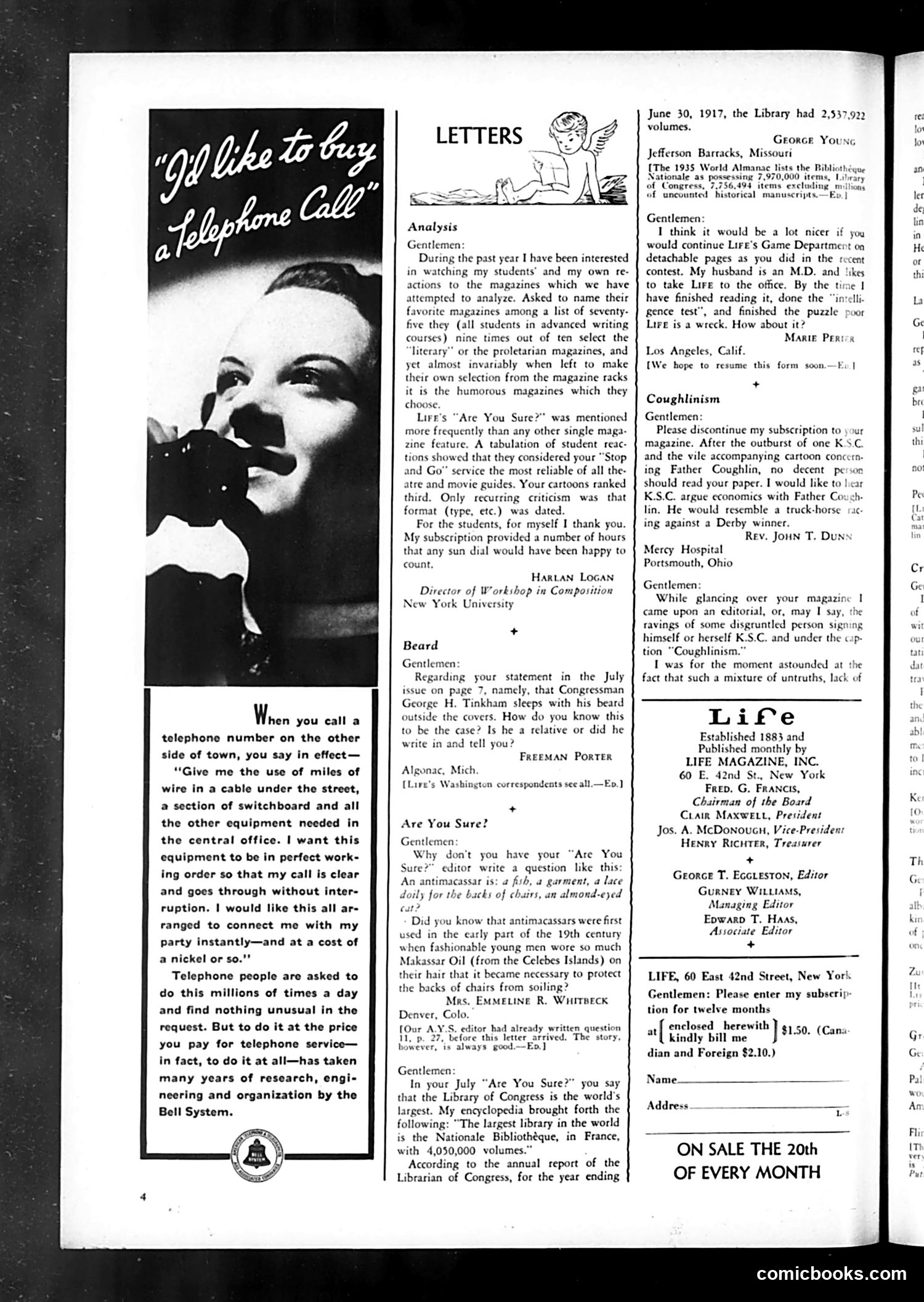
Analysis of This Life Magazine Page This page is primarily a letters section and masthead rather than a satirical cartoon. The left side features a Bell System telephone advertisement showing a man using a telephone, promoting the reliability and reach of telephone service across distances. The right side contains reader letters on various topics—magazine preferences, subscription complaints about "Coughlanism" (an anti-Catholic viewpoint the reader opposes), and editorial questions about library sizes and historical facts. The magazine's masthead identifies it as *Life*, established 1883, published monthly by Life Magazine, Inc., with Fred G. Francis as Chairman and George T. Eggleston as Editor. No political satire or caricature appears on this page—it's functional magazine infrastructure with advertising.
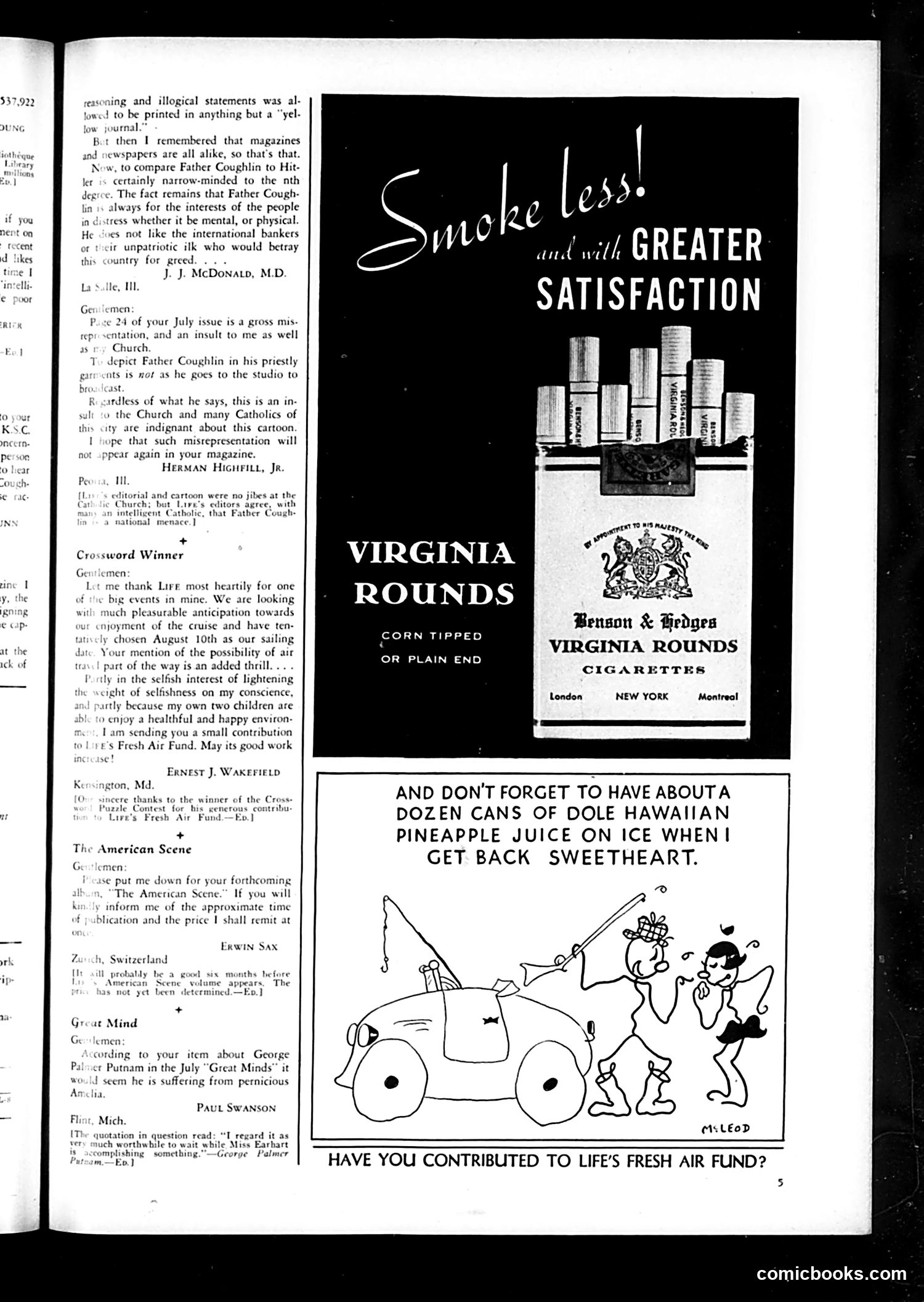
Content Analysis This page contains mostly advertisements and reader letters, not political cartoons. The main visual content includes: 1. Virginia Rounds cigarette ad (top right) - promoting "smoke less and with greater satisfaction," showing cigarette packages 2. Dole Hawaiian Pineapple juice advertisement (bottom) - featuring a cartoon of people enjoying juice, with the tagline "AND DON'T FORGET TO HAVE ABOUT A DOZEN CANS OF DOLE HAWAIIAN PINEAPPLE JUICE ON ICE WHEN I GET BACK SWEETHEART" The left column contains reader letters addressing previous magazine content, including discussion of Father Coughlin (a controversial Catholic priest of the era) and complaints about editorial decisions. The bottom asks "HAVE YOU CONTRIBUTED TO LIFE'S FRESH AIR FUND?" - referring to a charitable initiative. This appears to be a typical magazine page mixing advertising revenue with reader correspondence.
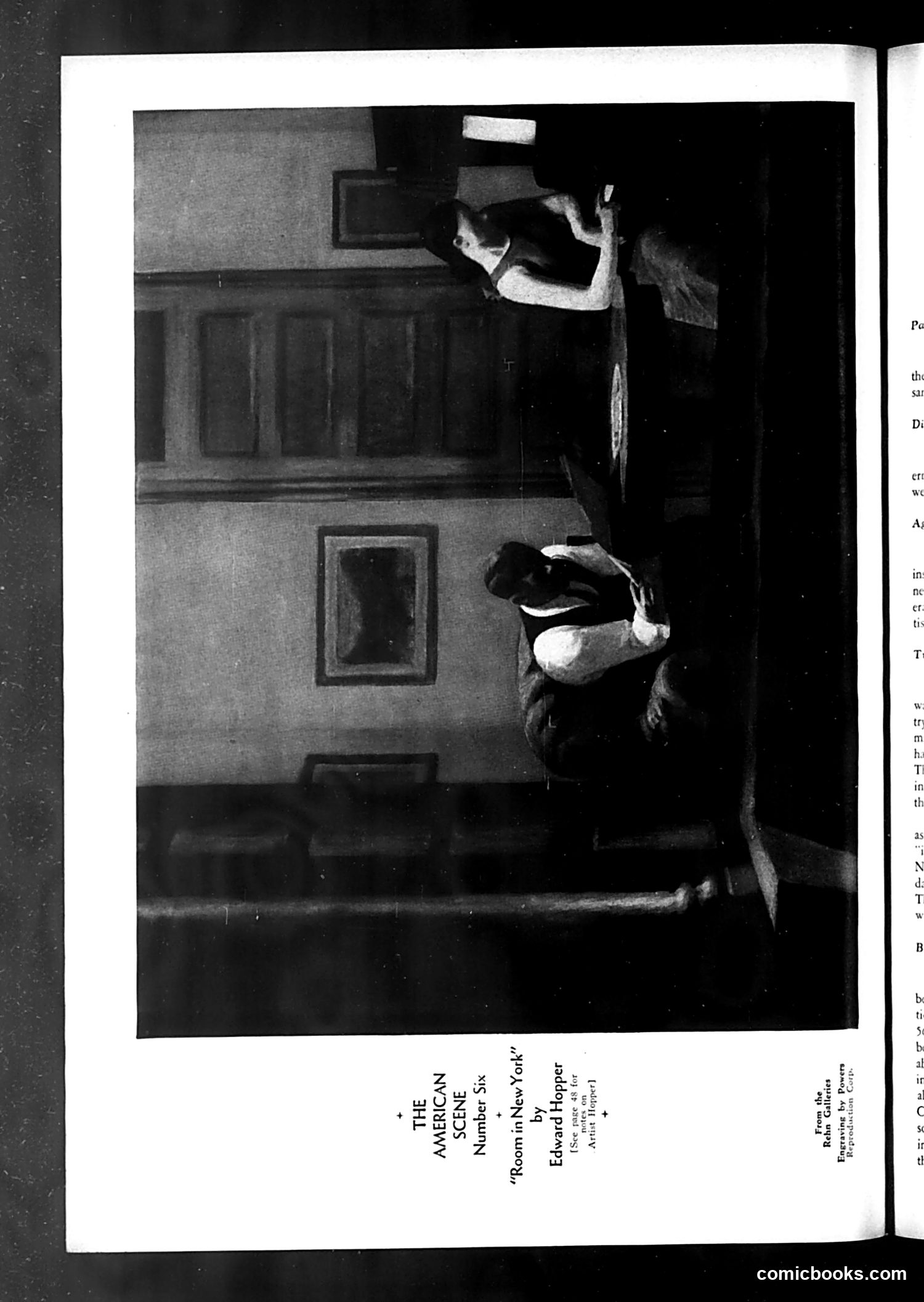
Analysis This page from *Life* magazine shows "The American Scene" titled "Number 5-x" with a scene labeled "Room in New York" by Edward Hopper. The image depicts Hopper's famous painting of urban isolation: a man and woman in a sparse apartment interior. The woman sits on a bed reading while the man stands nearby, both absorbed in separate activities, indifferent to each other's presence. Rather than political satire, this represents *Life*'s cultural commentary section featuring fine art. The "American Scene" series documented contemporary American life through visual art. Hopper's work exemplifies early 20th-century modernism's exploration of urban alienation and emotional distance—themes particularly resonant during America's industrial expansion. The painting critiques modern relationships' emotional disconnection within crowded city living.
Analysis of Life Magazine Page This satirical page mocks Congressional inefficiency and waste. The "Bill Yards" section notes that since 1789, Congress has introduced over 1,500,000 bills and resolutions—yet only about 13 or fewer per cent become law. Senator Copeland allegedly led the pack in 1936 with 250 bills and resolutions introduced. The "Song of the Supreme Court" parodies judicial self-importance, with nine justices singing that they avoid common concerns (postage stamps, telephones, infants) while serving as the "court of last resort in litigational legal." The chorus celebrates constitutional authority. The overall satire criticizes both legislative prolixity and judicial pomposity—Congress generates mountains of useless paperwork while the Supreme Court remains aloof from ordinary life.
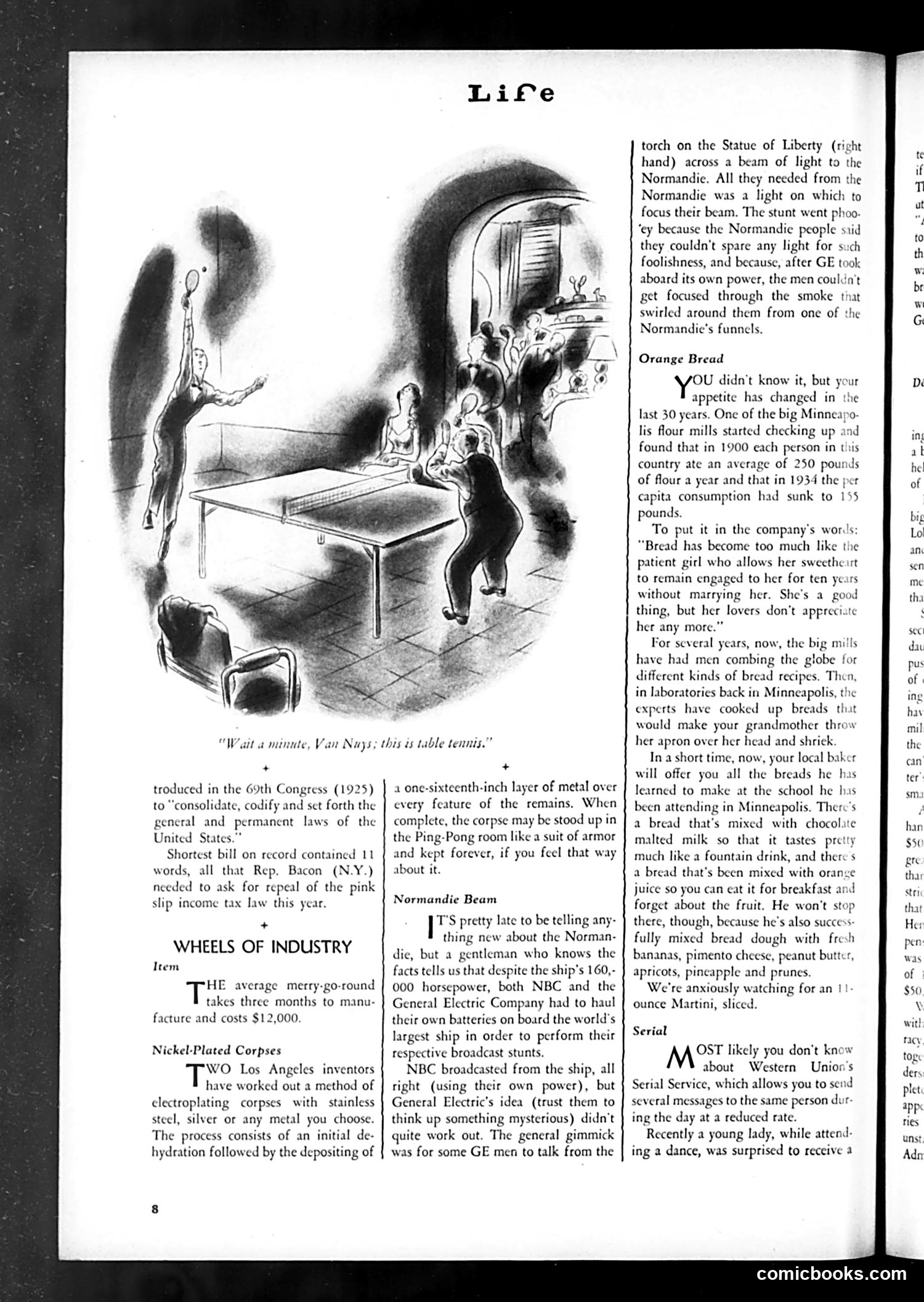
Political Cartoon Analysis The main cartoon on this page depicts a surreal, nightmarish scene with angelic and demonic figures around a table, captioned "Wait a minute, Wait Nays; this is table tennis." The image appears to be satirizing congressional debate or political maneuvering, likely referencing a specific legislative dispute. The caption's wordplay on "Wait" (possibly referencing a legislator's name) and "Nays" (voting terminology) suggests this mocks the formal procedures of Congress while the chaotic illustration emphasizes the absurdity or pandemonium behind closed doors. The accompanying articles discuss industrial manufacturing and consumer products, placing this in a broader context of American economic and technological commentary typical of *Life* magazine's satirical approach to contemporary issues.
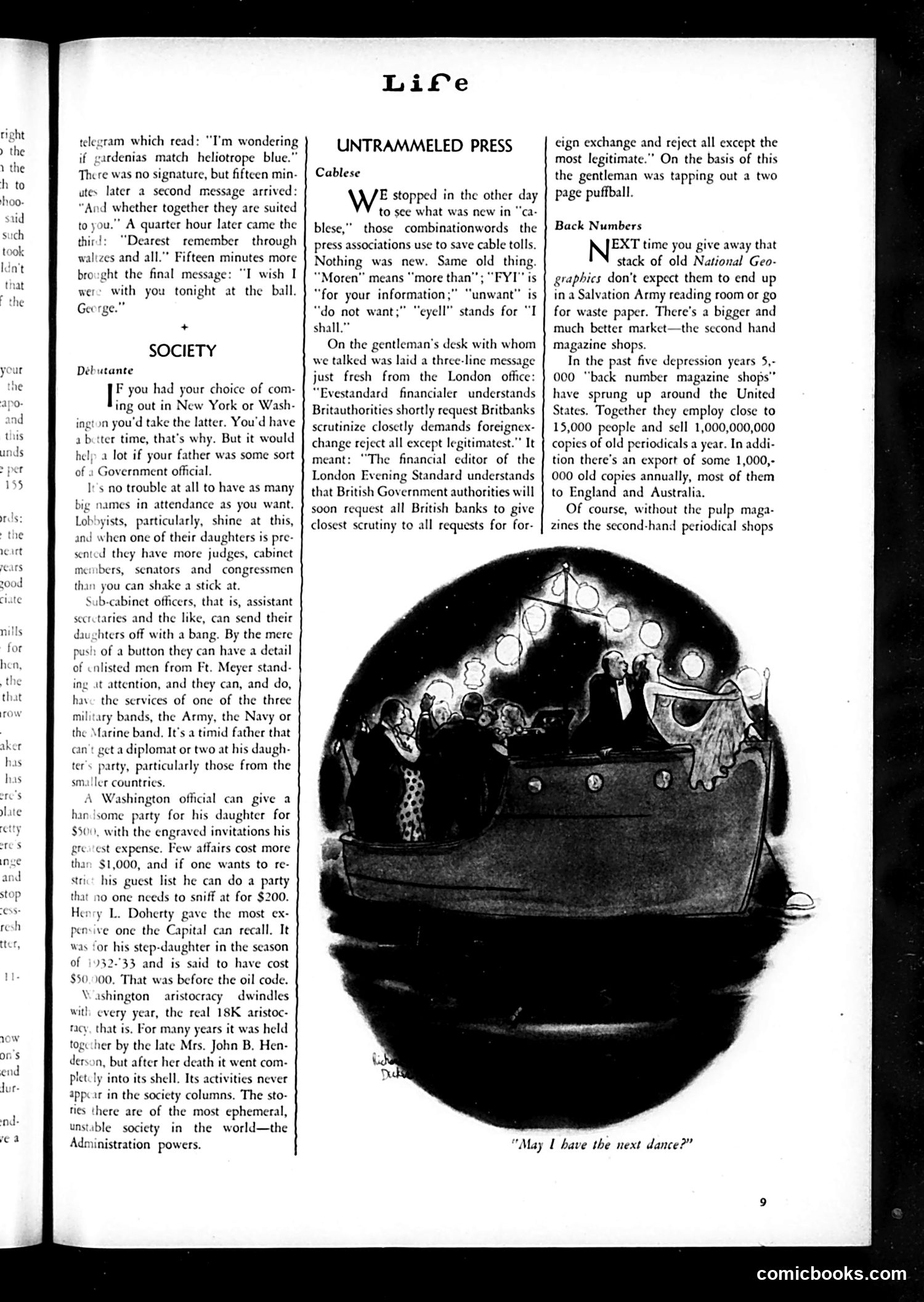
"May I have the next dance?" — Life Magazine Cartoon This cartoon depicts a formal dance or nightclub scene, showing elegantly dressed couples in what appears to be an upscale venue with hanging lights. A man in formal wear is asking a woman to dance, a conventional social interaction. The humor likely stems from the contrast between the refined, polished social setting and whatever unspoken tension or awkwardness the simple request implies. Given the page's "Society" section discusses Washington aristocracy and social conventions of the era, the cartoon probably satirizes the artificial politeness and rigid etiquette governing upper-class social interactions—where even a dance request carries weight and formality. The cartoon's point appears to be gentle mockery of how seriously high society treats routine social rituals.
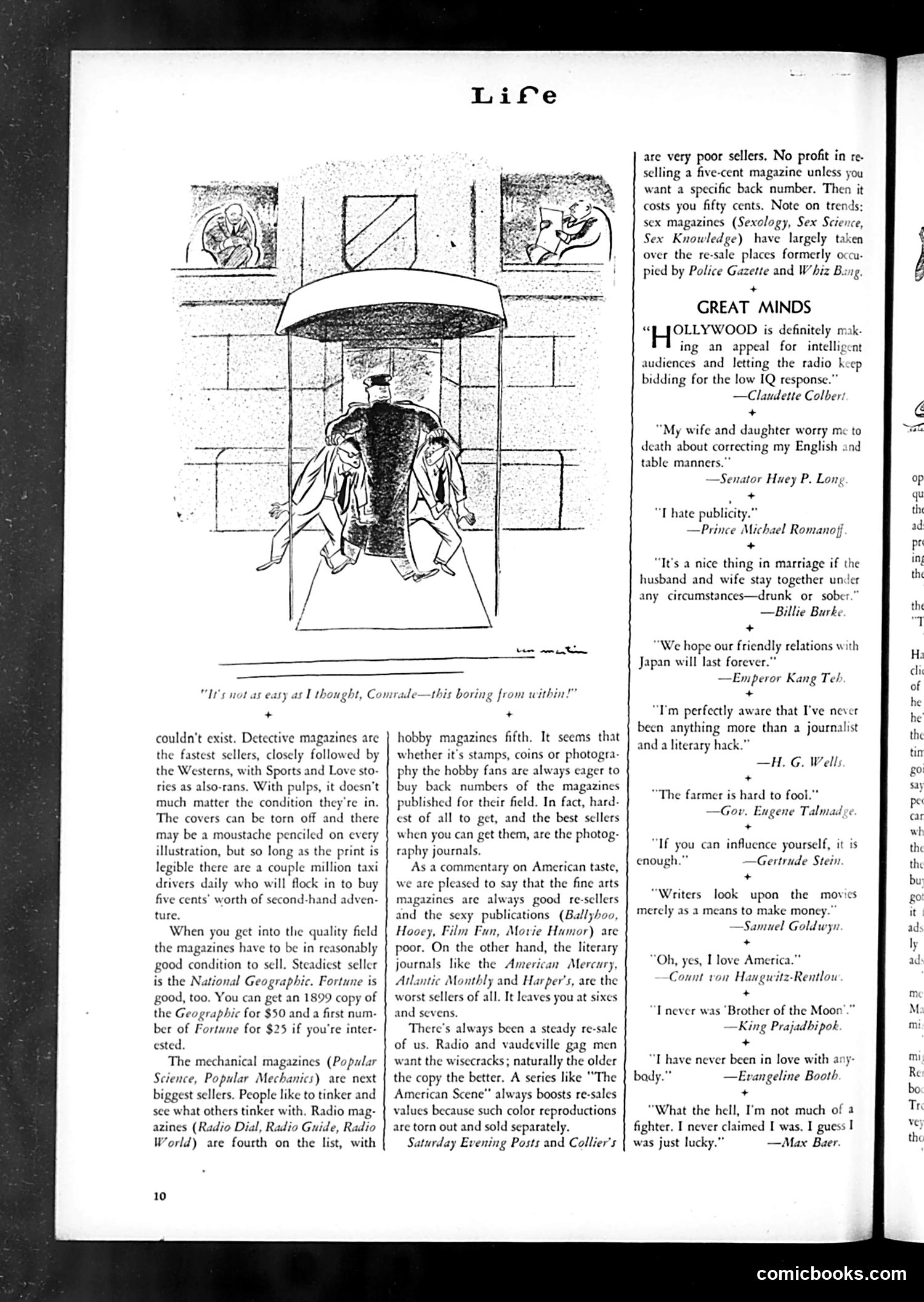
Analysis of Life Magazine Page The central cartoon depicts a person emerging from what appears to be a large radio or broadcasting device, with the caption "It's not as easy as I thought, Comrade—this boring from within!" The joke references communist infiltration fears during the Cold War era. The figure (likely representing a Soviet agent or communist propagandist) expected to easily undermine American society through radio broadcasting but is frustrated by the difficulty of the task. "Boring from within" was a contemporary phrase describing communist subversion tactics. The right column contains humorous quotes attributed to public figures (Claudette Colbert, Prince Michael Romanoff, etc.), typical of Life's satirical format. This reflects 1950s American anxiety about communist propaganda and media influence during the Red Scare period.
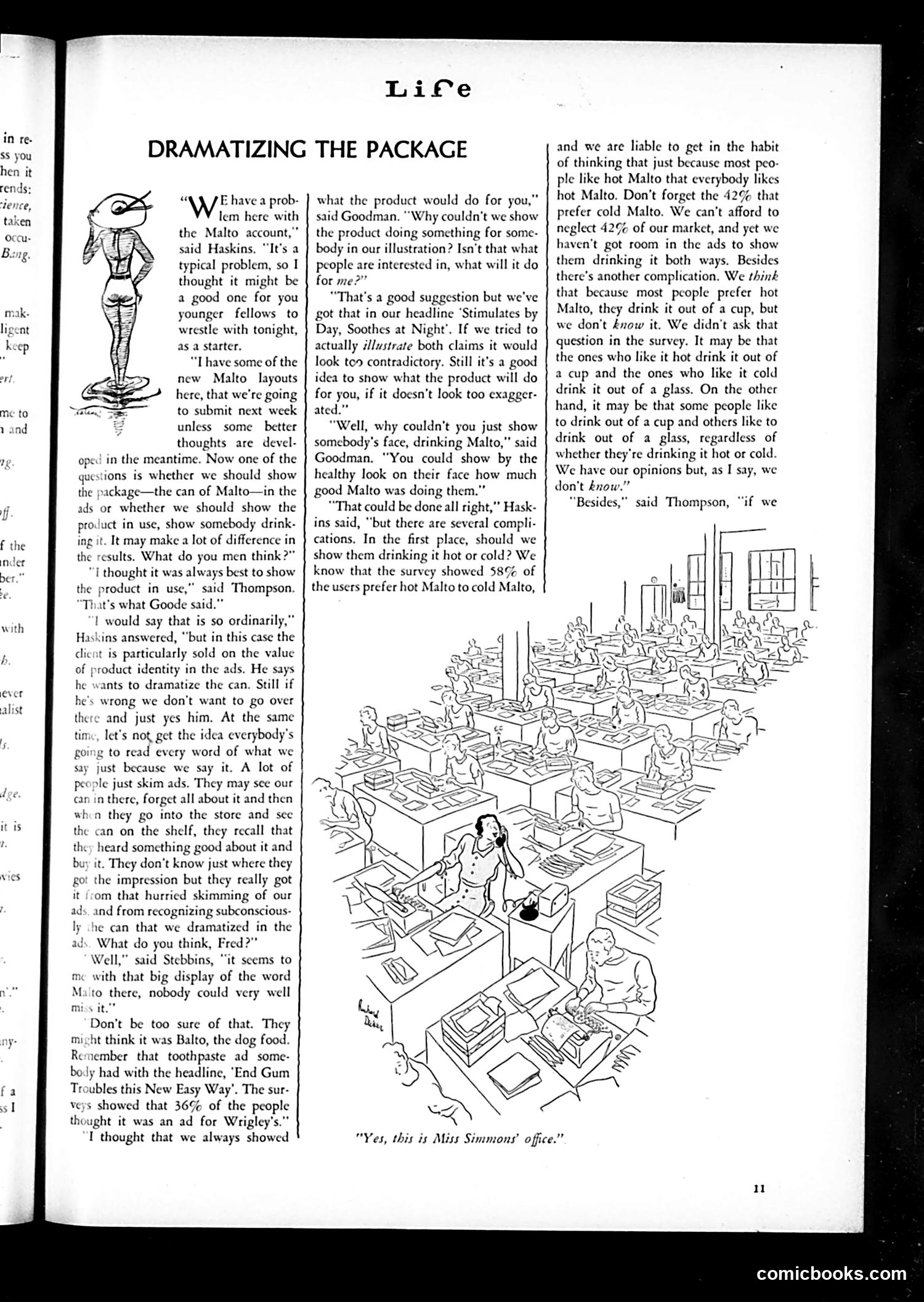
"Dramatizing the Package" - Life Magazine Satire This page satirizes advertising strategies for Malto, a malt beverage product. The debate centers on whether ads should show the *product in use* versus showing *healthy results* from consumption. The characters (Haskins, Goodman, Thompson, Sobbins, and Fred) discuss contradictory survey data: 58% prefer hot Malto, yet 42% prefer cold. The satire mocks how advertisers manipulate identical statistics to support opposite claims—and how consumers often don't retain ad messages accurately anyway. The large illustration shows a crowded office where one person drinks Malto, satirizing the absurdity of "showing the product in use" as an advertising strategy. The caption "Yet, this is Miss Simmons' office" suggests the lonely reality behind grandiose marketing promises.
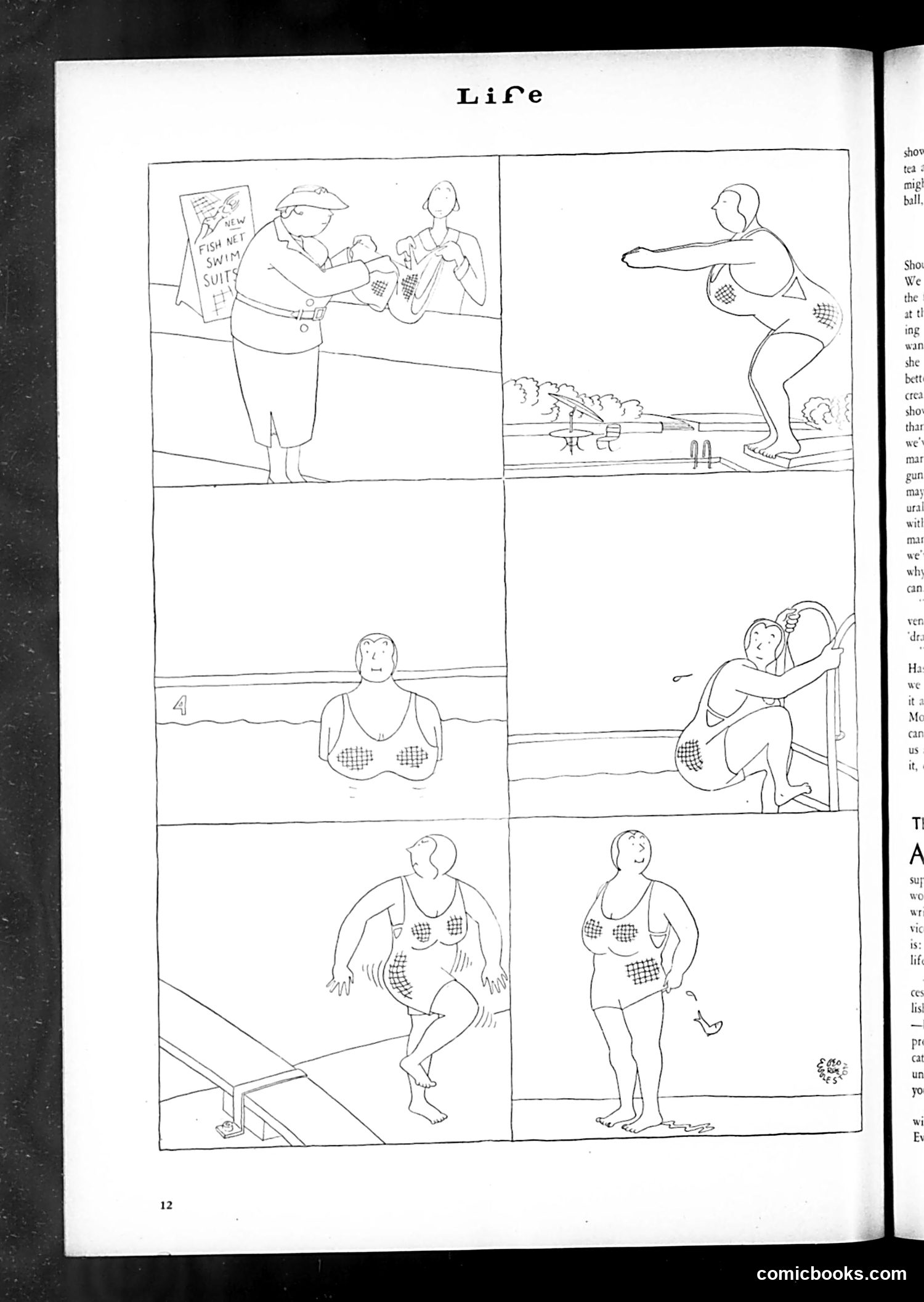
Analysis of "Life" Magazine Page This page presents a comic strip titled "Life" depicting a woman's day at the beach. The narrative follows a woman from the opening panel (where she's purchasing a swimsuit) through various beach activities: swimming, diving, and lounging. The satire appears to target women's body image and fashion standards of the era. The comic humorously tracks the woman's physical transformation—progressively appearing heavier or more exhausted through each panel—suggesting the contrast between idealized swimwear marketing and realistic female bodies. The repeated crosshatch patterns on her swimsuit in later panels emphasize her expanding figure, making the physical toll of beach activities the joke's centerpiece. This reflects mid-20th century American attitudes toward women's bodies and appearance.
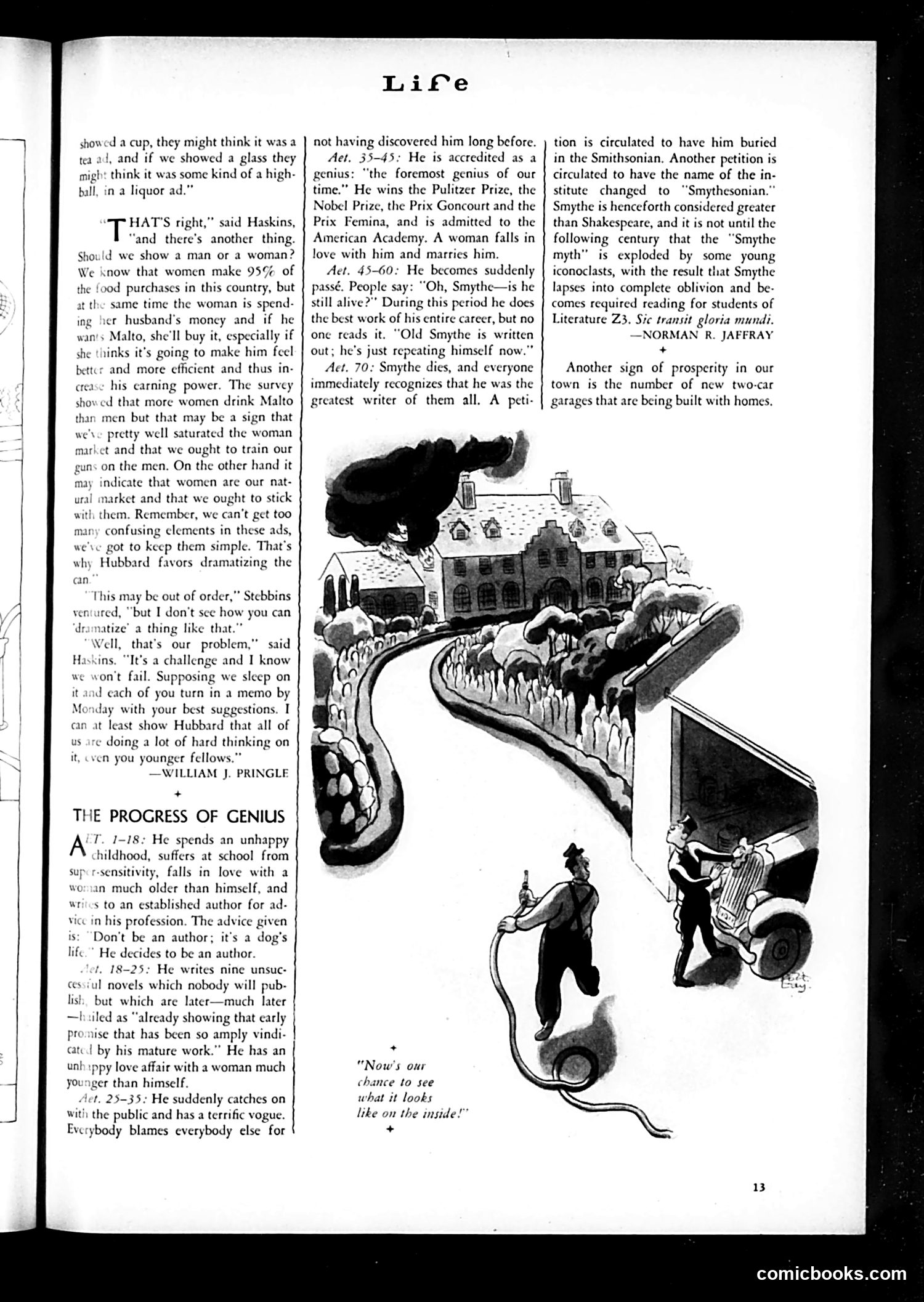
Analysis of Life Magazine Page This page discusses "The Process of Genius," focusing on an unnamed literary figure (likely fictional) whose career trajectory mirrors real author experiences. The text criticizes how established writers become repetitive and creatively stagnant—"Old Smythe is written out; he's just repeating himself now." The accompanying illustration shows a large mansion with vehicles and people, captioned "Now's our chance to see what it looks like on the inside"—suggesting opportunistic interest in a famous writer's property or personal life once their creative powers fade. The satire targets how the public and literary establishment simultaneously elevate then abandon aging authors, losing interest once their productive period ends. It's commentary on fame's transience and audience fickleness toward aging creative figures.
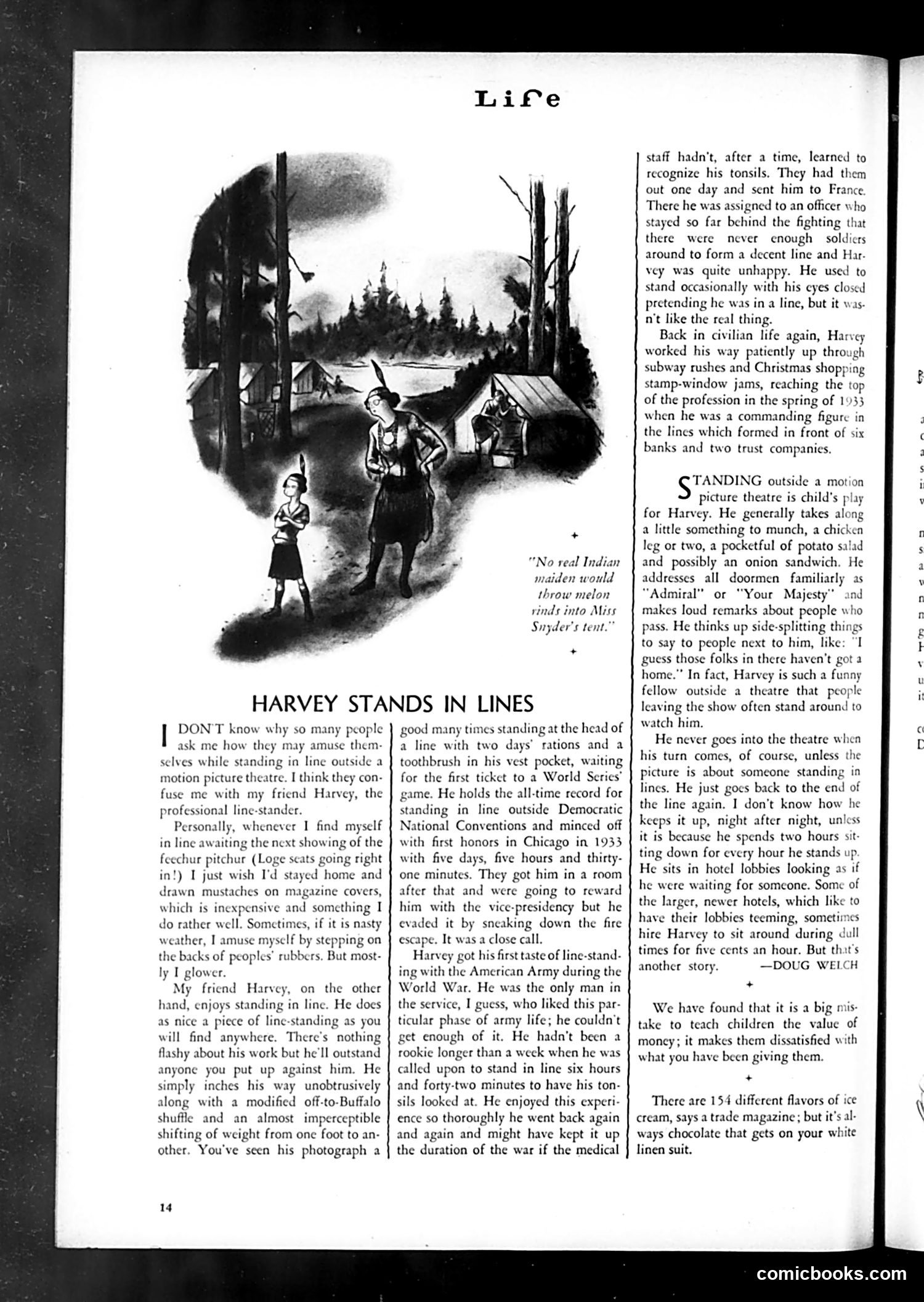
"Harvey Stands in Lines" This page satirizes a peculiar American character type: the compulsive line-stander. The accompanying illustration shows a man waiting outside a movie theater with supplies for an extended wait. The article celebrates Harvey, a professional "line-stander" who makes his living—and apparently finds genuine enjoyment—in queuing. The text notes he holds records for standing in lines at Democratic National Conventions and even endured six hours waiting for World Series tickets. The satire mocks both Harvey's unusual profession and American consumer culture's tendency to create such specialized niches. The piece gently ridicules the absurdity of someone deriving purpose and pride from this mundane activity, while also affectionately portraying him as a genuinely harmless eccentric who has found his place in Depression-era society.
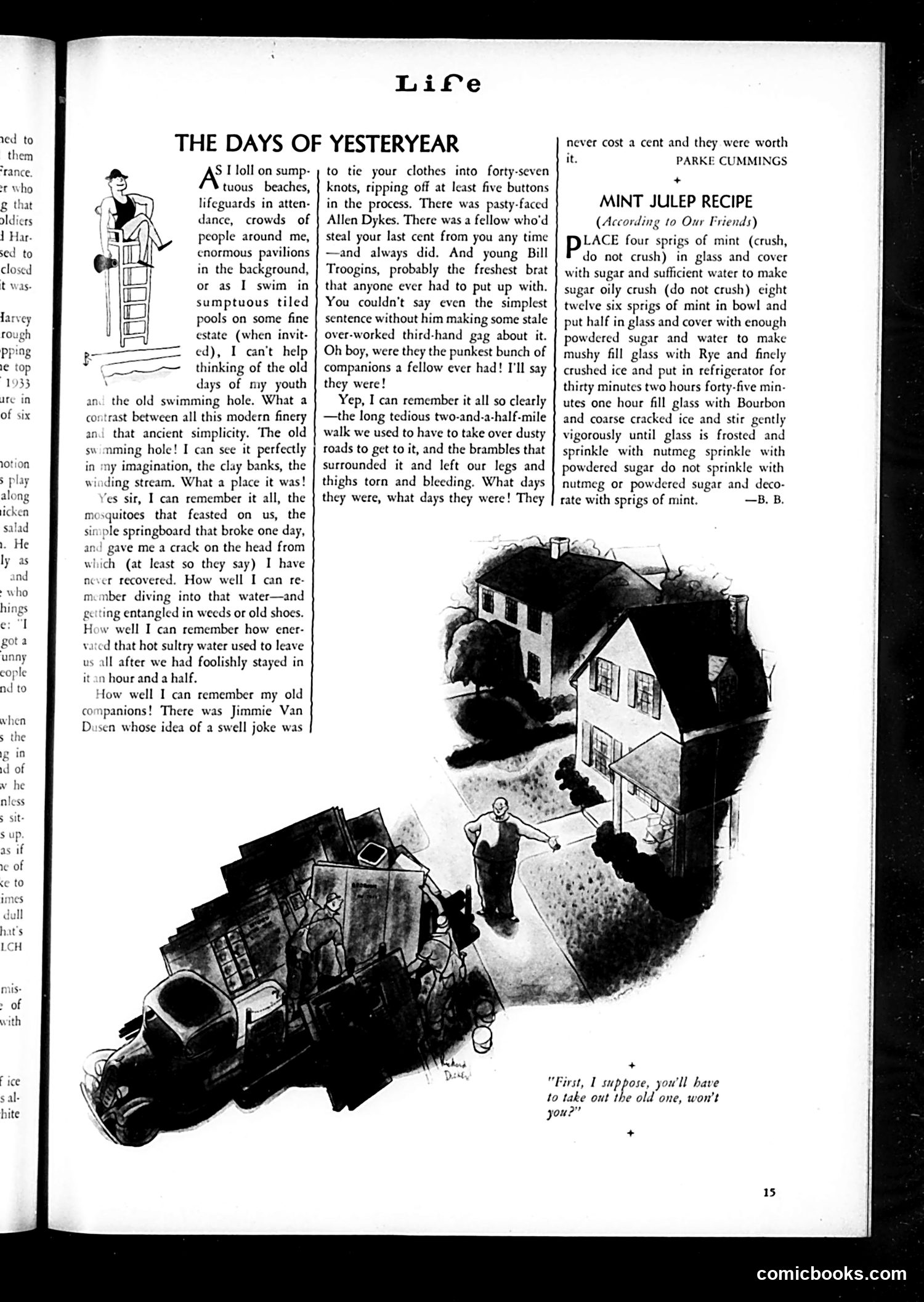
"The Days of Yesteryear" - Life Magazine Page This nostalgic essay reminisces about childhood swimming holes and simple pleasures from an earlier era. The author contrasts "modern finery" (depicted in the upper illustration showing an elaborate lifeguard tower) with the rustic simplicity of an old swimming hole—complete with makeshift changing areas and natural hazards like weeds and old shoes. The text humorously catalogs childhood mishaps: torn clothing, bleeding legs, and a cracked head from a broken springboard. The accompanying illustration shows children playing around a simple house and old car, evoking pre-1920s American rural/suburban life. A "Mint Julep Recipe" appears as sidebar content. The satire gently mocks modern recreational infrastructure by celebrating the dangerous, humble alternatives of earlier generations.
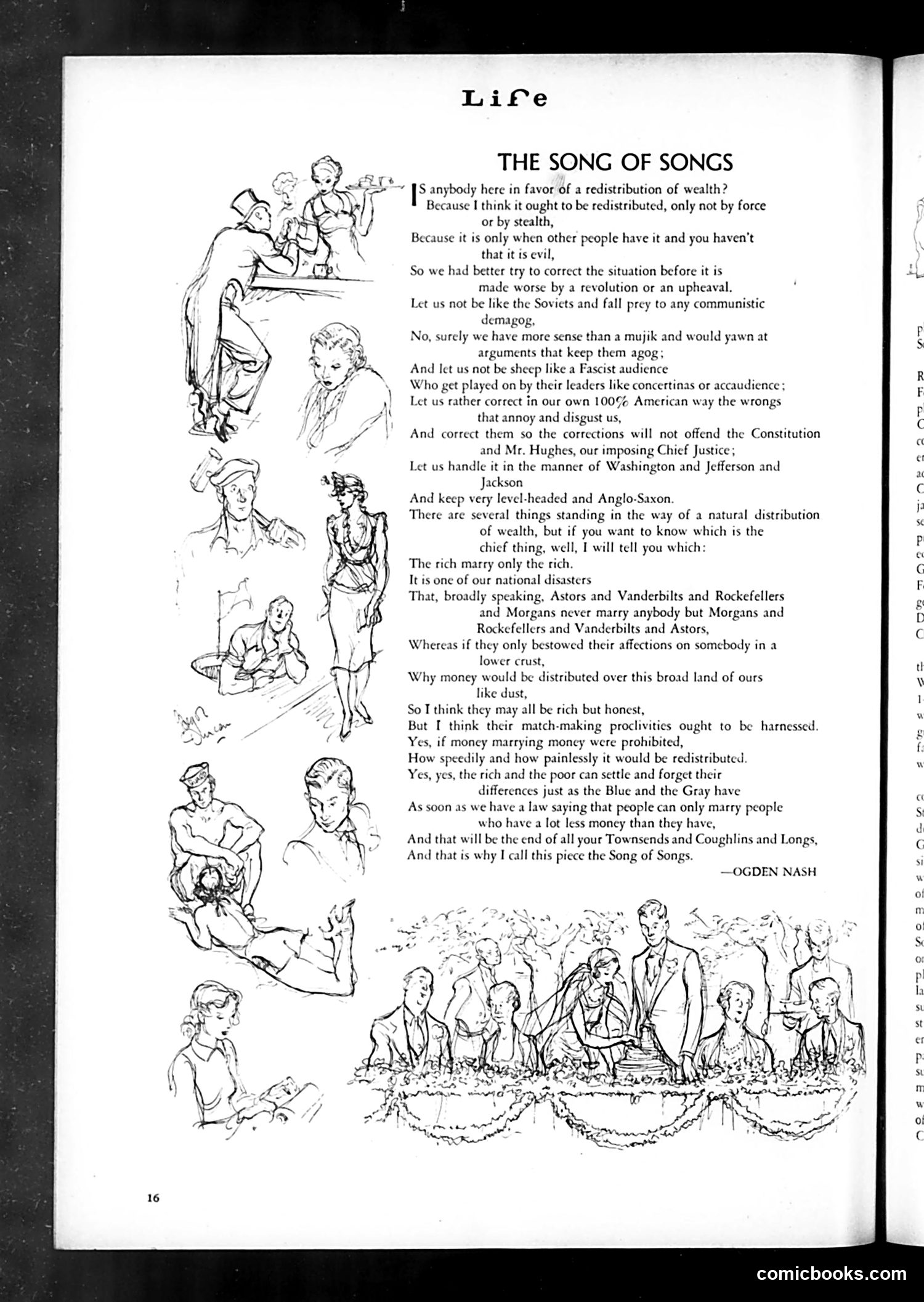
"The Song of Songs" by Ogden Nash This satirical poem by humorist Ogden Nash argues for wealth redistribution through constitutional means rather than revolution. Nash criticizes both communist and fascist approaches, advocating instead for American democratic reform. The poem targets wealthy families—likely referencing actual dynasties like Astors, Vanderbilts, and Rockefellers (named explicitly)—who intermarry to consolidate wealth and power. Nash's central argument: if the rich were forced to marry outside their class, wealth would naturally distribute across society, eliminating class disparities "just as the Blue and the Gray haves." The accompanying sketches illustrate various American social types and class interactions, supporting the text's theme of redistributing opportunity through social mixing rather than violent upheaval. The satire champions pragmatic American reform over revolutionary ideology.
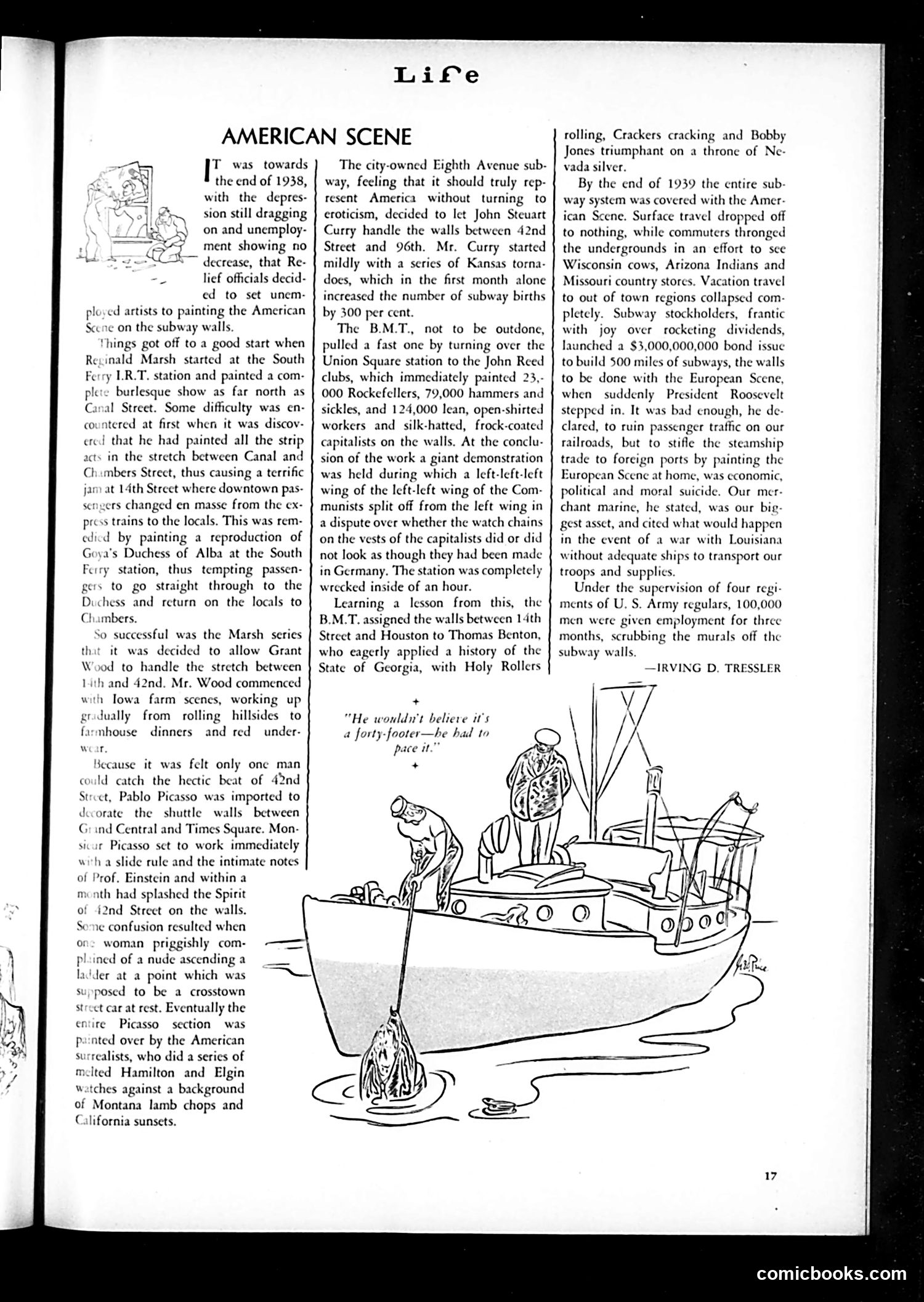
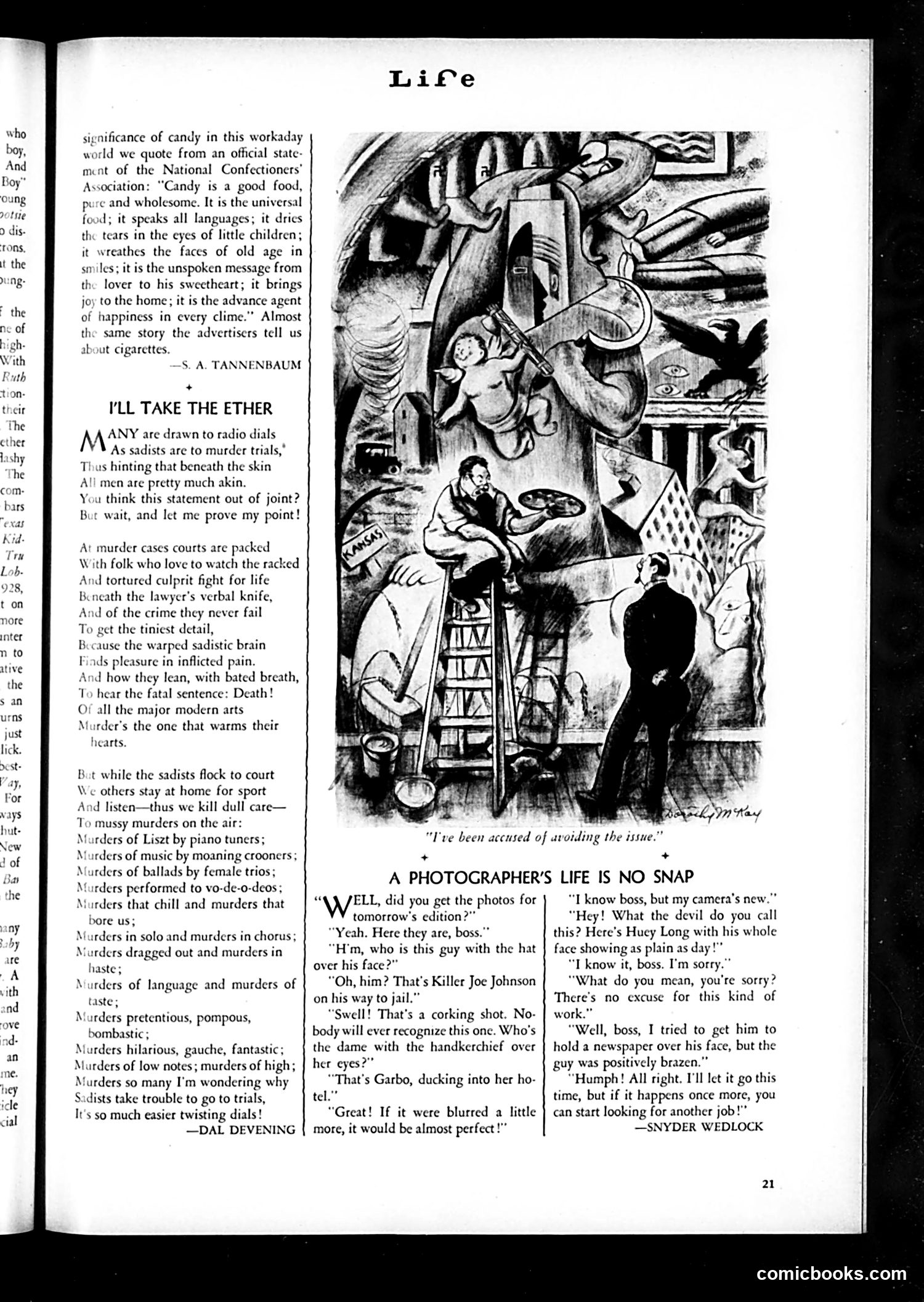
"American Scene" - NYC Subway Art Project (1938-1939) This page documents a Depression-era WPA initiative to paint murals on New York City subway walls. The text describes how artists, including those at the South Ferry station, created works depicting American scenes and labor. The cartoon illustrates a humorous incident: a painter hired to depict American themes inadvertently painted a nude figure ascending a ladder—mistaken by a woman for an actual crosstown street car at rest. The confusion led to the entire section being repainted by surrealist artists, who ultimately created abstract works against Montana landscapes and California sunsets. The satire mocks both the bureaucratic confusion of the art project and the public's bewilderment with modern artistic expression, contrasting representational Depression-era muralism with abstract surrealism.
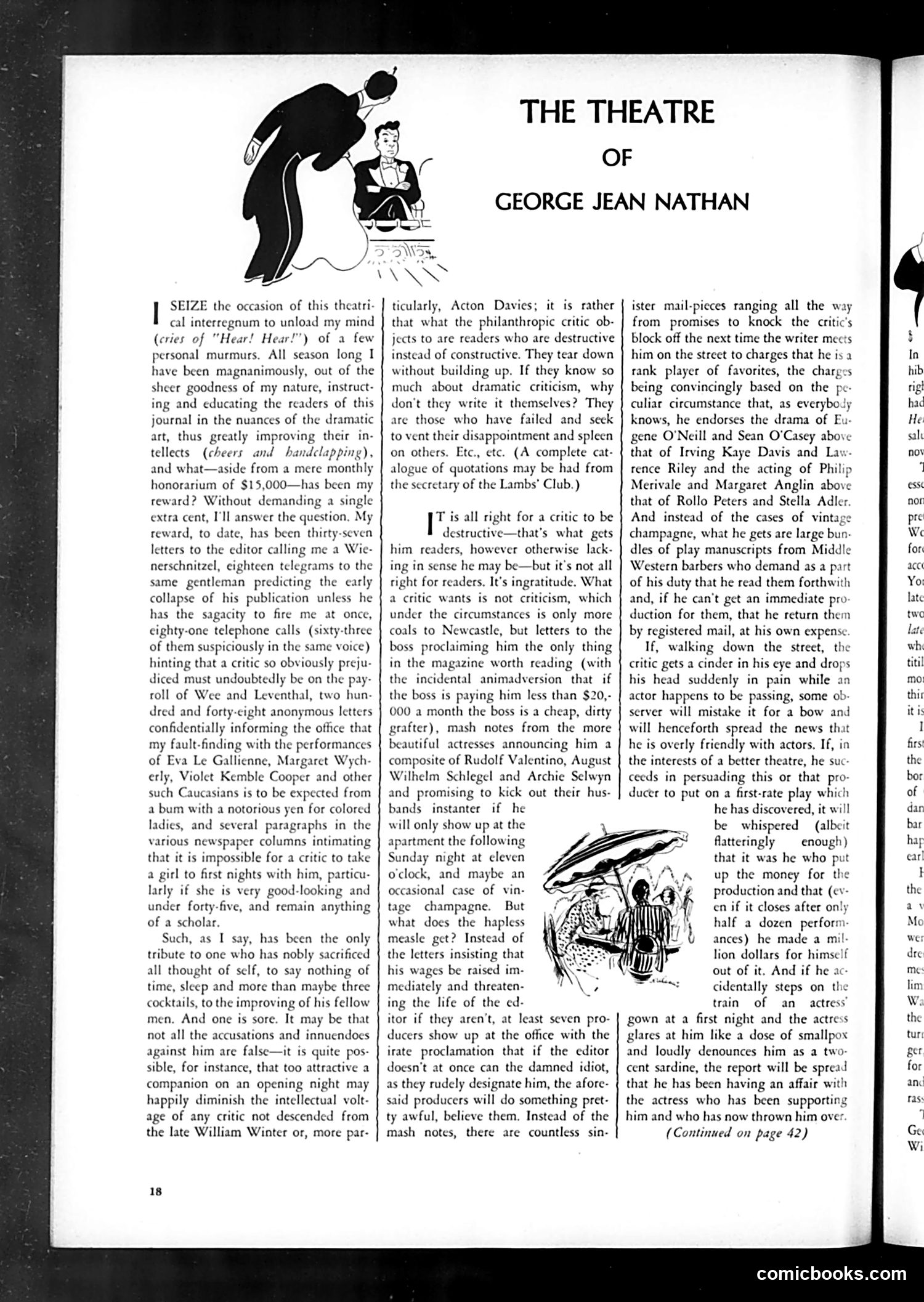
Analysis of "The Theatre of George Jean Nathan" This is a satirical editorial about theatre critic George Jean Nathan. The page critiques destructive critics who "tear down without building up" rather than constructively engaging with drama. The cartoon shows a figure in formal dress bowing deeply while another figure above appears to strike or pummel them—visualizing Nathan's harsh critical approach. The text specifically attacks critics who reject readers' favorite plays and performers (mentioning actors like Acton Davies and playwright Eugene O'Neill). Nathan apparently championed experimental drama while dismissing popular theatre, earning both praise and resentment. The essay's tone is biting: it suggests Nathan's critical authority, despite being "a rank player of favorites," carries disproportionate cultural weight in determining which plays succeed or fail—a power the author finds unjustly wielded.
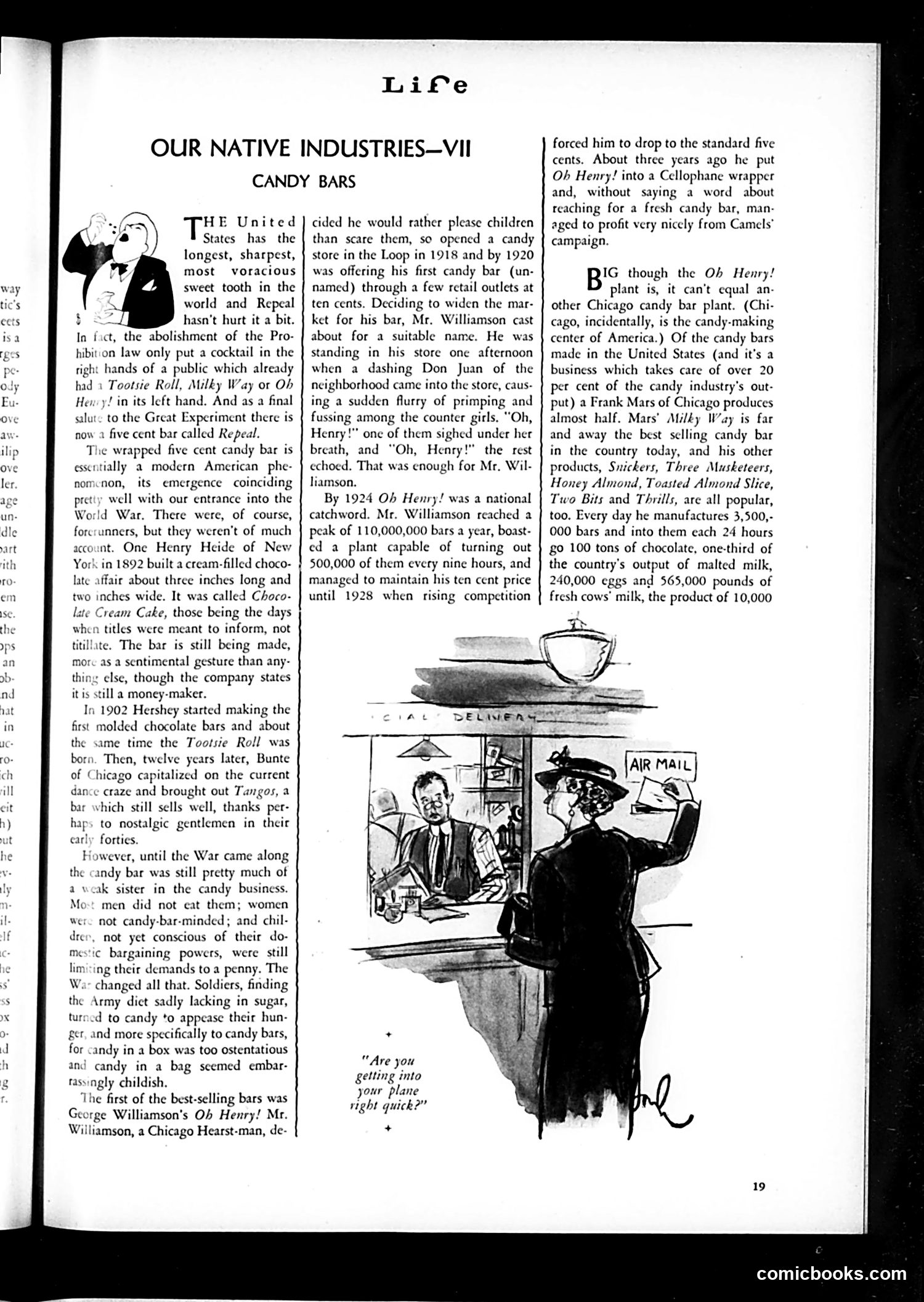
"Our Native Industries—VII: Candy Bars" This satirical article celebrates American candy bar manufacturing, particularly the "Oh Henry!" bar created by Chicago businessman George Williamson around 1918-1920. The text credits WWI with popularizing candy bars—soldiers craved them for quick energy and morale. The accompanying cartoon shows a woman at an airmail window asking "Are you getting into your plane right quick?" The humor appears to reference wartime urgency or possibly the novelty of airmail service itself, though the exact satirical target is unclear from the image alone. The broader article tone is genuinely boastful about American candy production capacity—110 million bars yearly by 1924—rather than mocking it, suggesting this piece celebrates rather than critiques industrial achievement.
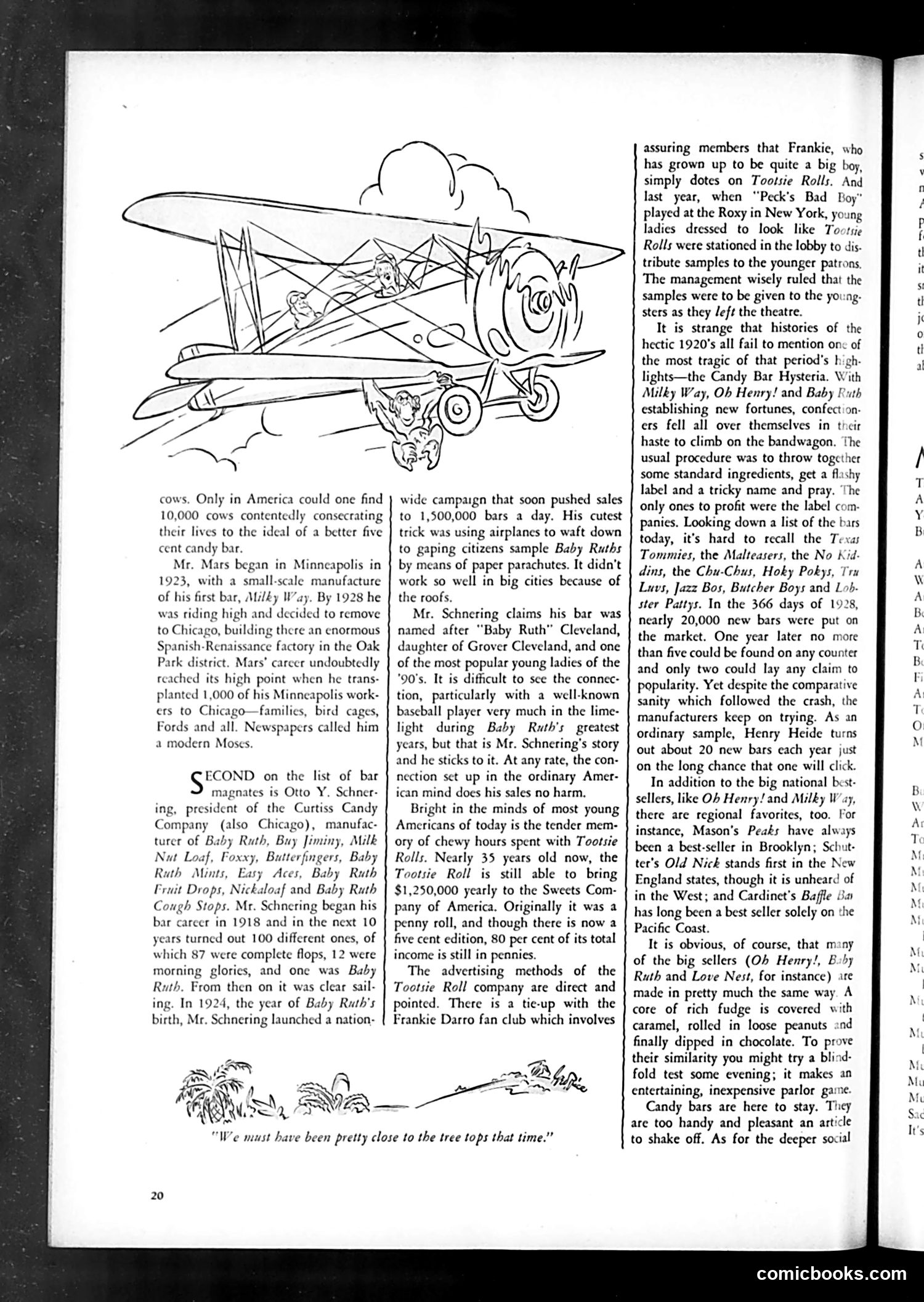
Candy Bar Magnates (Life Magazine Article) This page satirizes the American candy bar industry boom of the 1920s, profiling "bar magnates"—entrepreneurs who built fortunes on mass-produced confections. The cartoon depicts an airplane dropping candy samples by parachute, illustrating Otto Schnering's actual marketing stunt for Baby Ruth bars. The article mocks both the industry's explosive growth and its absurd promotional methods. The satire targets: - Mars and Schnering as self-made moguls whose commercial ambitions rival industrial titans - The "Candy Bar Hysteria" of 1928, when manufacturers threw together random ingredients with catchy names, creating thousands of failed products (Chu-Chus, Hoky Pokys, etc.) - Marketing excess: using airplanes, celebrity endorsements (Frankie Darro), and costumed promoters at movie theaters - The disconnect between Schnering's claim that Baby Ruth was named after President Cleveland's daughter versus the obvious reference to baseball player Babe Ruth The humor lies in treating candy manufacturers with the gravitas usually reserved for serious industrialists—calling Schnering a "modern Moses" for relocating workers—while documenting an entire industry's speculative bubble and subsequent collapse.
Explanation for Modern Readers This page contains two satirical pieces from *Life* magazine: "I'll Take the Ether" (by Dal Devening) critiques Americans' morbid fascination with radio crime dramas. The poem argues that people drawn to murder trial coverage and sensationalized radio broadcasts are revealing hidden sadistic impulses. It mocks the proliferation of cheaply-produced murder-themed entertainment on radio—from classical music butchered by bad performers to actual crime narratives—suggesting people satisfy dark impulses through entertainment rather than courtroom voyeurism. "A Photographer's Life Is No Snap" (by Snyder Wedlock) satirizes press photography and celebrity privacy invasion. A boss berates his photographer for getting *usable* photos of fugitive "Killer Joe Johnson" and actress Greta Garbo—praising blurred, unrecognizable shots—while complaining that politician Huey Long appears too clearly identifiable. The joke exposes the hypocrisy: the press simultaneously demands sensational images while pretending to respect subjects' privacy.
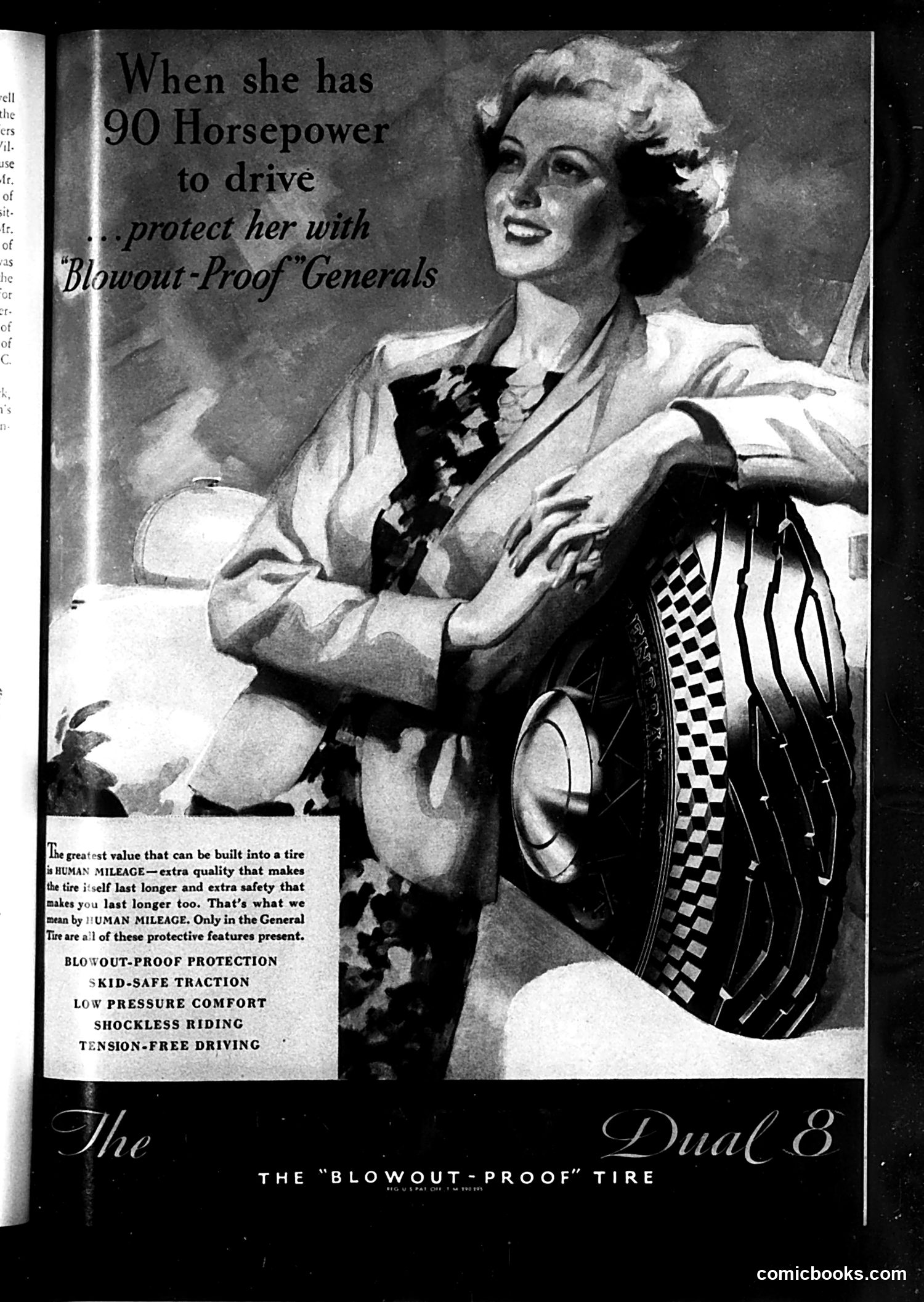
This is a tire advertisement, not political satire. It's a General Tire company ad from Life magazine promoting their "Dual 8" tire model. The ad uses a glamorous woman posing with a tire to market safety features to female drivers. The headline "When she has 90 Horsepower to drive" references the car's engine power, implying women need extra protection while driving. The ad emphasizes "HUMAN MILEAGE"—a marketing term meaning the tire protects both the vehicle and passengers through features like blowout-proof protection and skid-safe traction. This reflects mid-20th century automotive marketing that combined product claims with gender-coded appeals, positioning tire safety as particularly important for women drivers. The tone and imagery are typical of period advertising rather than editorial commentary.
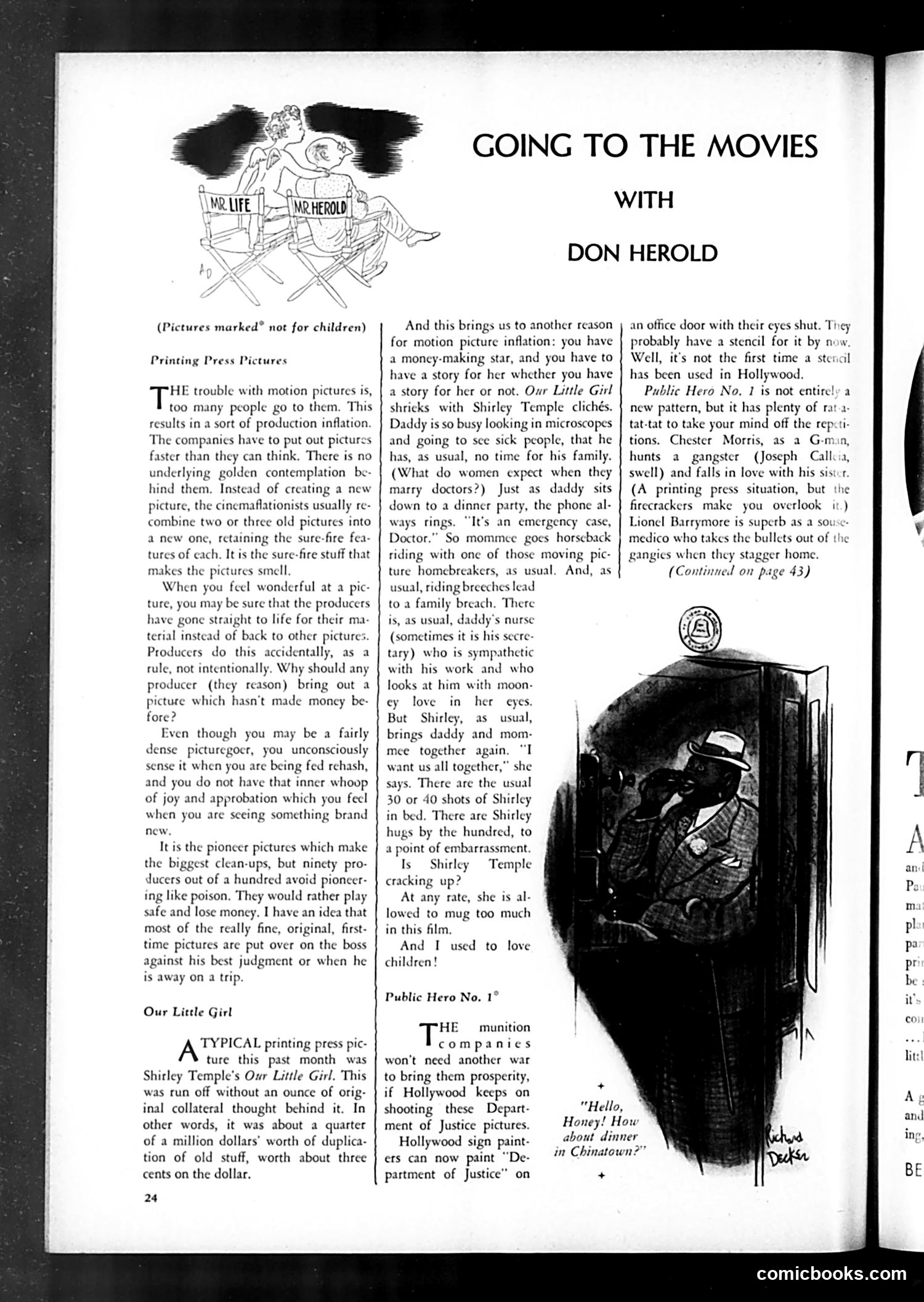
Analysis for Modern Readers This page critiques 1930s Hollywood's creative bankruptcy. The main article attacks the film industry for recycling old plots rather than creating original stories, using Shirley Temple's *Our Little Girl* as a prime example—calling it "$250,000 worth of duplication...worth about three cents on the dollar." The satire identifies a systemic problem: studios churn out formulaic pictures faster than they can think, combining proven elements (absent workaholic father, sympathetic nurse, child reconciliation) into interchangeable products. The author argues only accidental originality succeeds; producers deliberately avoid risk. The cartoon illustrates this through Don Herold's illustration of a generic crime drama (*Public Hero No. 1*), suggesting Hollywood has become so mechanical it could stencil "Department of Justice" onto any office door. The joke: studios produce these films so routinely and predictably that even the set dressing requires no thought. The critique captures a genuine 1930s complaint: mass production had contaminated cinema's artistic potential.
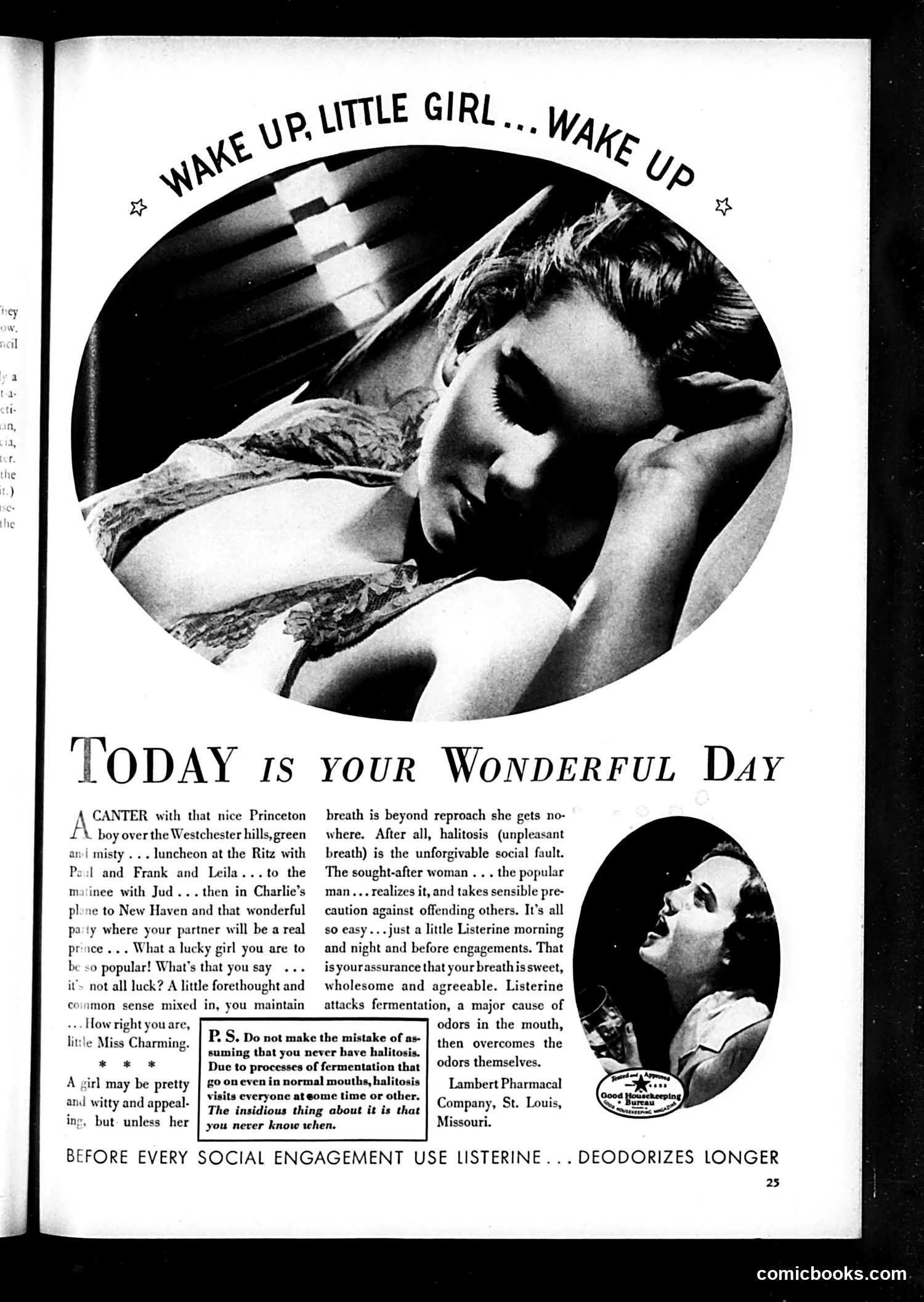
Analysis: Listerine Advertisement, Life Magazine This is primarily a Listerine mouthwash advertisement, not political satire. It uses a common advertising trope of the era: anxiety-based marketing targeting women. The "cartoon" element is satirical social commentary embedded within the ad itself. It depicts an idealized young woman's day—canoeing with a Princeton boy, lunching at the Ritz, attending theater—only to suggest this entire social success depends on having fresh breath. The implicit message: a woman's popularity and marriageability hinge on oral hygiene. The ad exploits the concept of "halitosis" (bad breath)—a term Listerine itself popularized—presenting it as a universal, unknowable condition that could destroy one's social standing at any moment. The satire lies in how absurdly the advertisement raises the stakes: your entire romantic and social future supposedly depends on this one product. The P.S. drives home the manipulative angle—even if you think you don't have the problem, you definitely do, you just don't know it. This reflects 1920s-1930s advertising culture that manufactured shame to sell products to women.
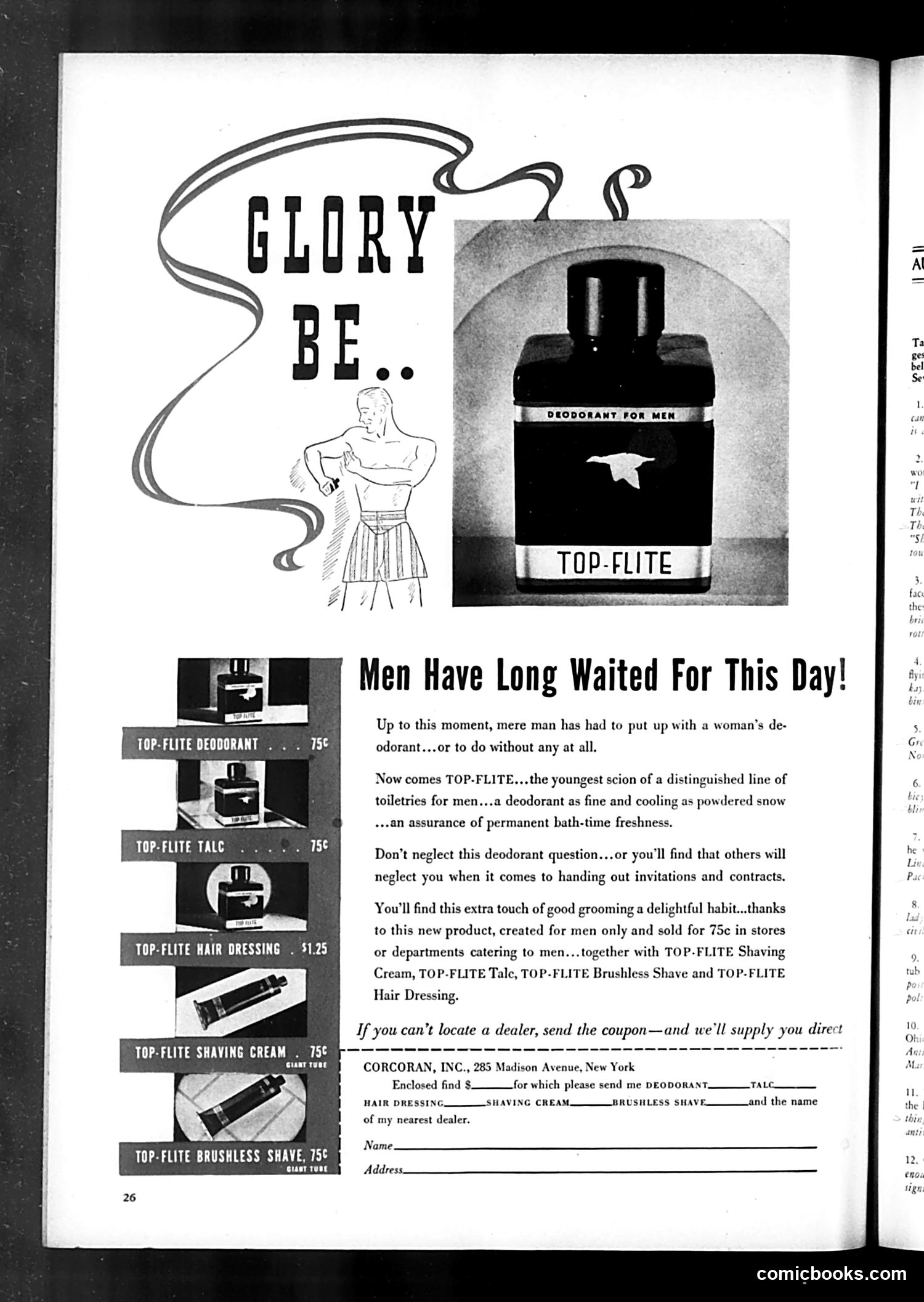
Analysis: Top-Flite Deodorant Advertisement This is a vintage men's grooming advertisement, not political satire. The page advertises Top-Flite deodorant and related products from Corcoran, Inc. The "joke" reflects mid-20th century gender marketing: the ad humorously frames male deodorant as a revolutionary product, claiming "men have long waited for this day" because previously they had only "a woman's deodorant...or to do without any at all." The satire is mild and self-aware—the ad playfully exaggerates the novelty of a deodorant "created for men only," using hyperbole about social consequences ("others will neglect you when it comes to handing out invitations and contracts") to mock both advertising excess and rigid gender norms. The illustration shows a muscular male figure, reinforcing the masculine branding typical of postwar consumer marketing. This reflects period assumptions that grooming products needed gender-specific positioning to appeal to male consumers.
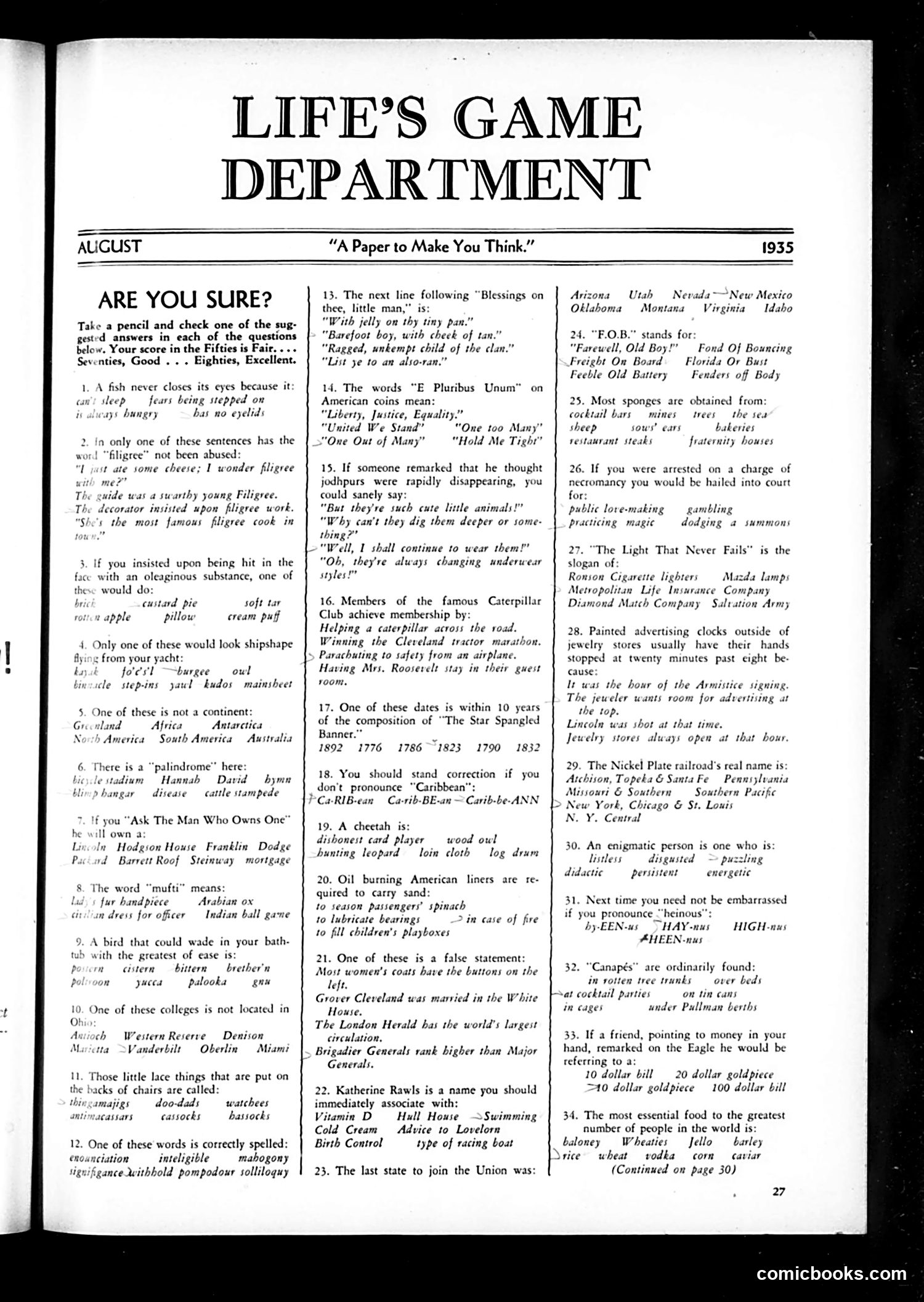
Life's Game Department - August 1935 This is a trivia quiz, not a political cartoon. The page presents 34 factual questions testing readers' knowledge across history, geography, language, and current events—designed as entertainment with the tagline "A Paper to Make You Think." The quiz reflects 1935 concerns: references to Katherine Rawls (likely the Olympic swimmer), Caterpillar Club (parachutists), pronunciation of "Caribbean," and questions about Grover Cleveland. One question asks about Mrs. Roosevelt (Eleanor), indicating her contemporary prominence. The tone is lighthearted trivia amusement. Readers could score themselves (Fifties=Fair through Eighties=Excellent), making it an early "self-help" quiz format. This represents Life magazine's satirical approach: testing readers' grasp of facts while gently mocking pretension and ignorance through multiple-choice traps with absurd options ("jodhpurs" as disappearing animals; sand in liners "to fill children's playboxes").
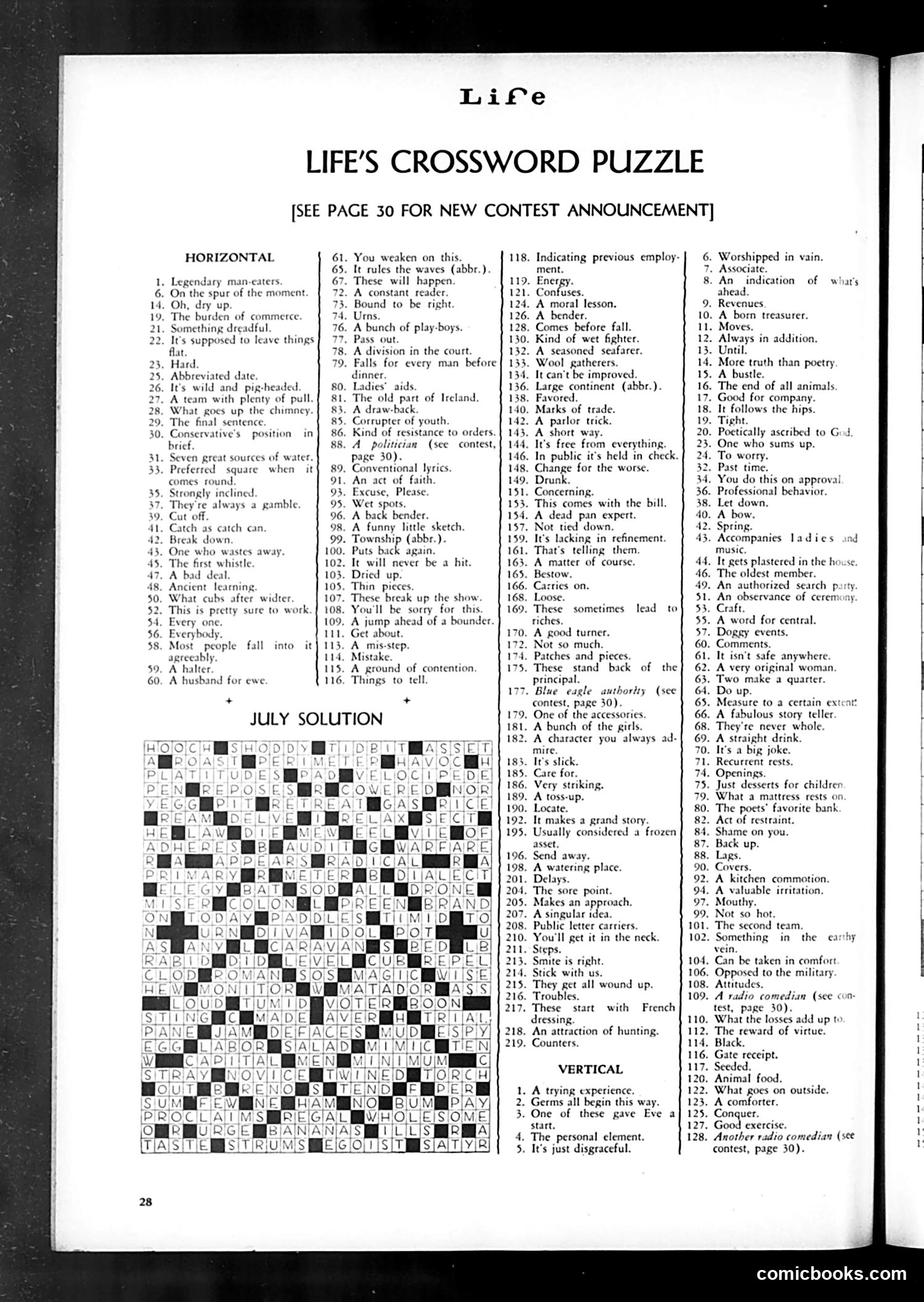
Life Magazine Crossword Puzzle Page This page contains Life magazine's crossword puzzle with its solution from July. It's not a political cartoon but rather a standard puzzle feature that was common in magazines of this era. The clues are typical crossword fare—wordplay, puns, and riddles reflecting 1930s-40s American life and culture. References include "Blue eagle authority" (likely referring to the New Deal's NRA symbol), conventional literary allusions, and everyday observations. One clue references "A politician (see contest, page 30)," suggesting this puzzle connected to a contest announced elsewhere in the magazine. The puzzle itself appears filled-in with the "JULY SOLUTION" shown in the grid below the clues. This was primarily entertainment content for readers rather than satire—Life's famous satirical cartoons appeared elsewhere in the magazine.
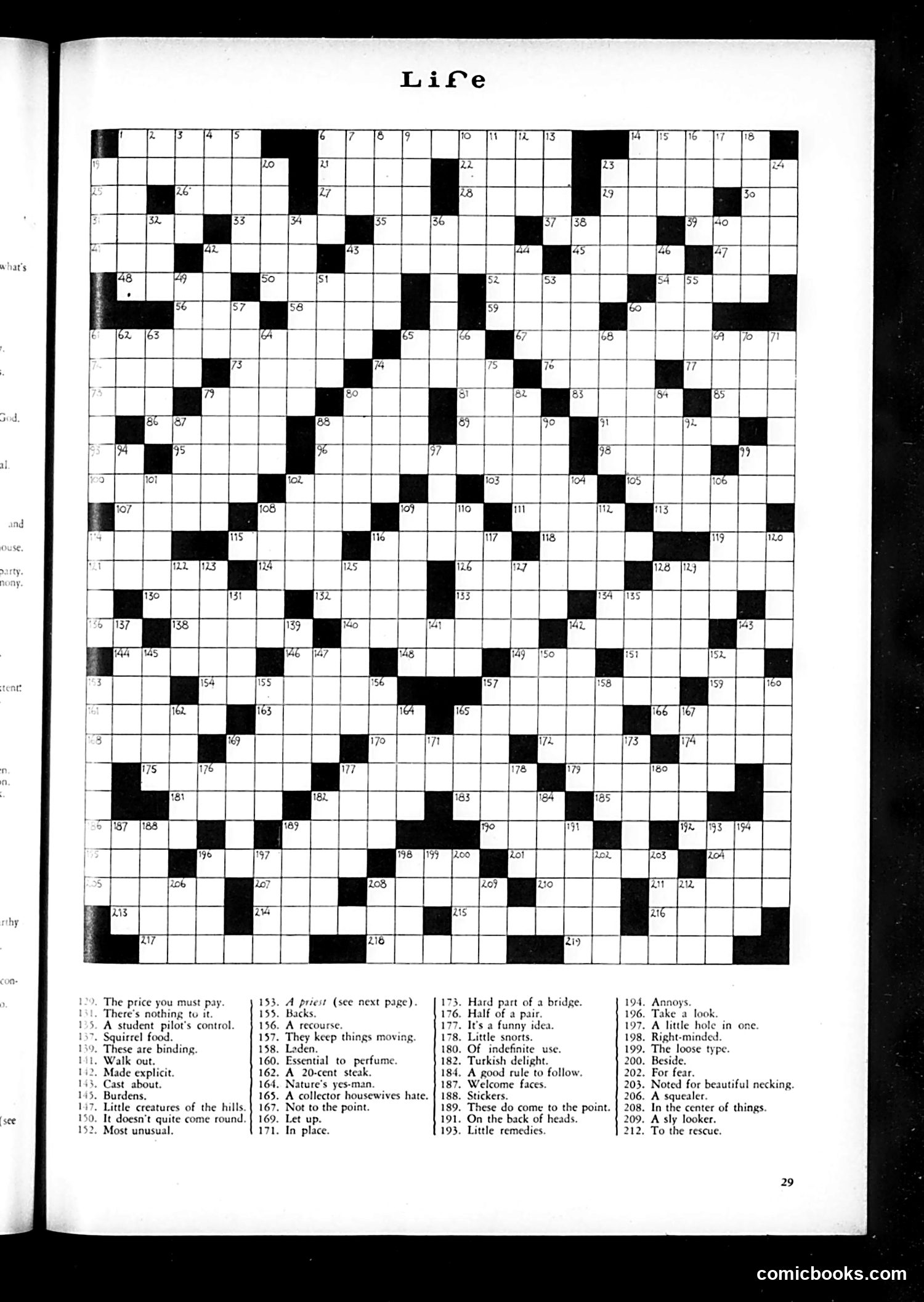
This Page is a Crossword Puzzle, Not a Political Cartoon This is page 29 from *Life* magazine and consists entirely of a large crossword puzzle titled "Life" at the top. The numbered clues listed below the grid are standard crossword definitions—wordplay and riddles meant to be solved by filling in the grid. There are no political cartoons, caricatures, or satirical commentary visible on this page. It's simply recreational content: a word puzzle for readers to solve. The clues use humor and clever misdirection typical of crossword puzzles (e.g., "A student pilot's control," "Squirrel food," "A 20-cent steak"), but this is puzzle convention, not political satire. This represents *Life*'s role as a general-interest magazine combining humor, commentary, and entertainment for a broad audience.
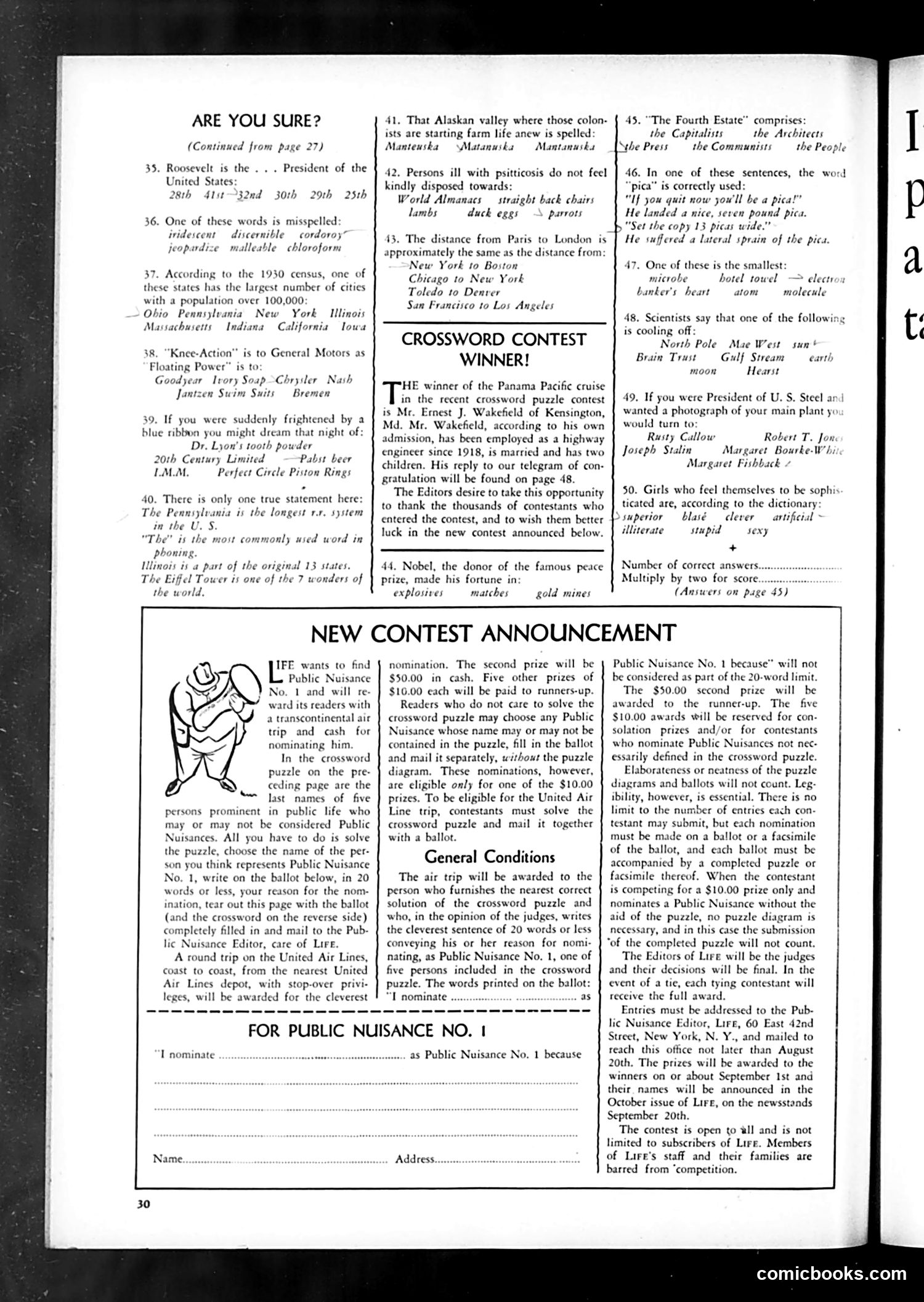
Life Magazine Contest Page Analysis This page from *Life* magazine presents a trivia quiz ("Are You Sure?") and announces a new reader contest to identify "Public Nuisance No. 1." The quiz questions mix straightforward facts with trick questions—some deliberately absurd (like whether Mae West or the sun is cooling off) and contemporary references that would resonate with 1930s readers: FDR's presidency number, brand names like Pabst beer and Chrysler, and figures like Mae West and William Randolph Hearst. The cartoon shows a caricatured figure labeled as the mystery "Public Nuisance"—though the specific identity isn't entirely clear from the image alone, the contest invites readers to nominate a contemporary public figure they consider bothersome or objectionable. The prize is a transcontinental air trip, reflecting the era's fascination with aviation as novelty and luxury. This contest format was typical of *Life*'s satirical engagement with current events and prominent personalities.
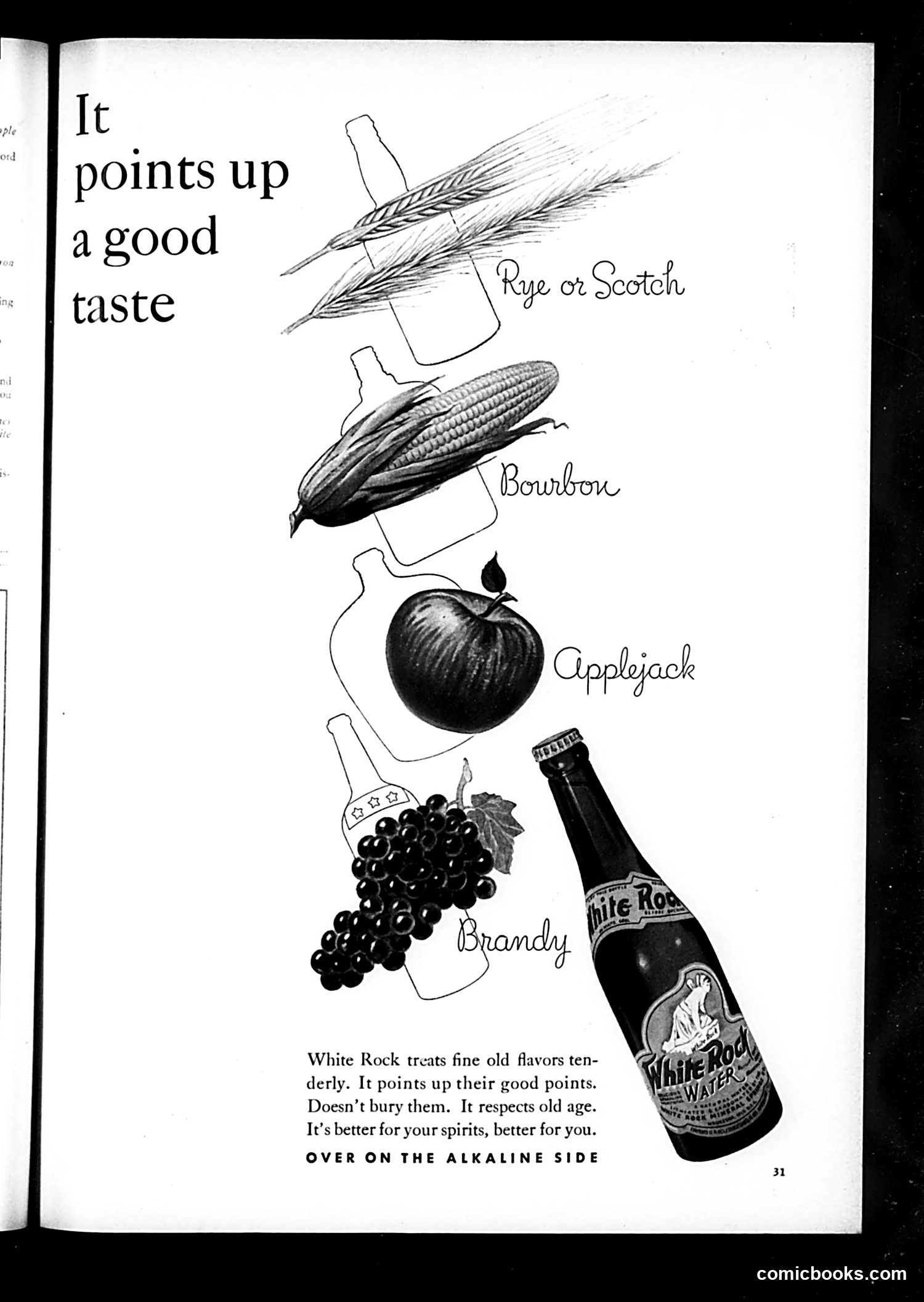
White Rock Water Advertisement This is a product advertisement, not political satire. It promotes White Rock brand water as a mixer for spirits and liqueurs. The illustration stacks ingredients vertically—rye or Scotch whisky, bourbon, applejack, brandy, and grapes—leading down to a White Rock bottle. The advertisement's messaging emphasizes that White Rock water "respects old age" and doesn't overpower premium spirits, instead "pointing up" (enhancing) their existing flavors. The phrase "over on the alkaline side" references water chemistry—alkaline water was marketed as superior for mixing drinks. This appears to be from the Prohibition era's end or shortly after, when alcohol advertising had recently become legal again in publications like *Life* magazine.
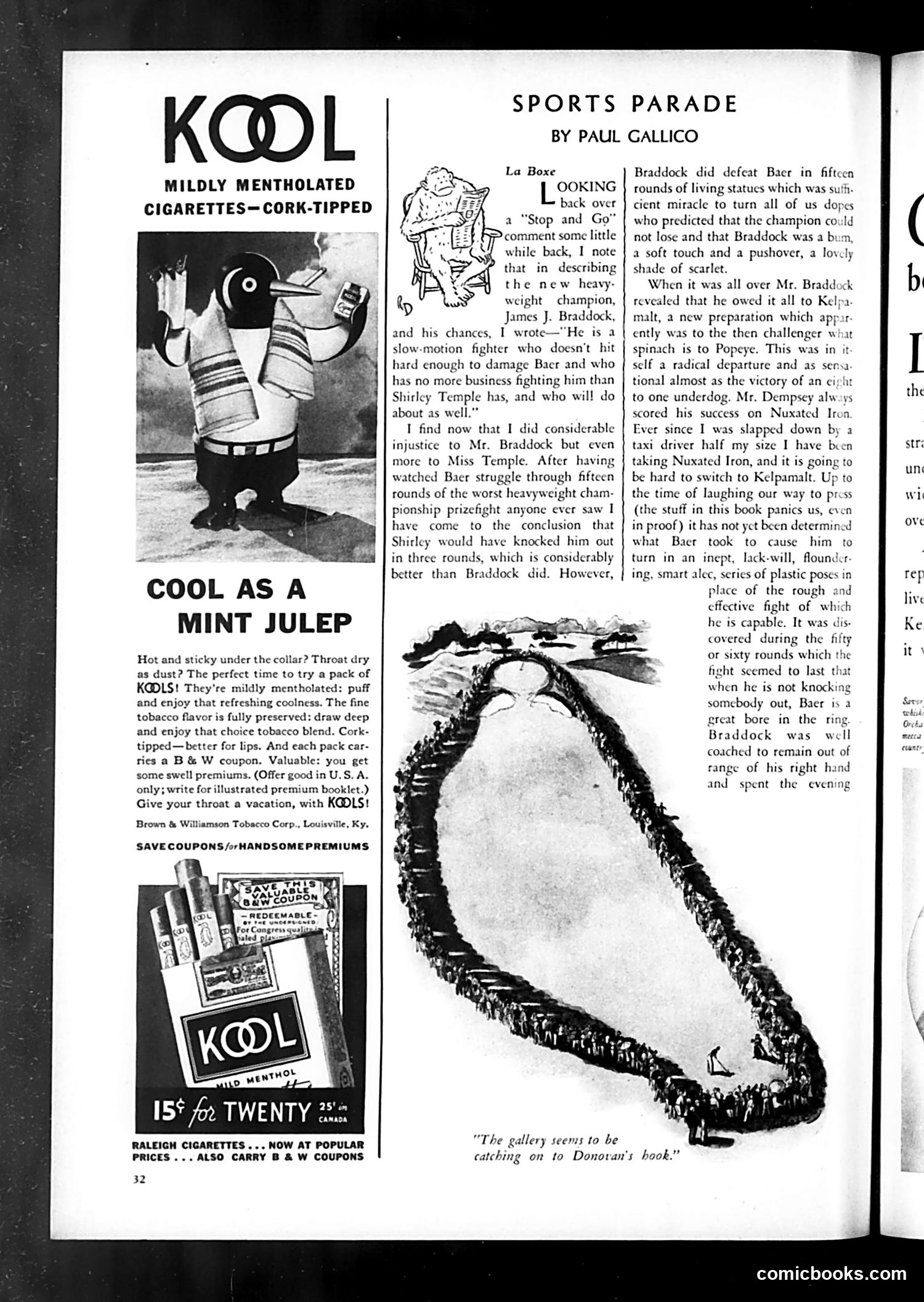
Analysis for Modern Readers This page combines a cigarette advertisement (left) with a sports column (right) by Paul Gallico about boxing. The Advertisement: Kool cigarettes are marketed as refreshing and cooling—the "mint julep" comparison appeals to summer comfort. The cork-tipped design and coupon premiums were standard 1930s marketing tactics. The Sports Column: Gallico writes about heavyweight champion James J. Braddock's surprising victory over Max Baer. The columnist admits he was wrong: he'd dismissed Braddock as hopelessly outmatched (comparing him unfavorably to child star Shirley Temple), but Braddock won by staying mobile and avoiding Baer's powerful right hand. The Cartoon/Illustration: The sketch depicts what "appears to be" a boxing ring or arena crowd—the caption reads "The gallery seems to be catching on to Donovan's book," referencing boxing strategy or technique. The page reflects 1930s boxing's popularity and the era's casual cigarette advertising alongside serious sports journalism.
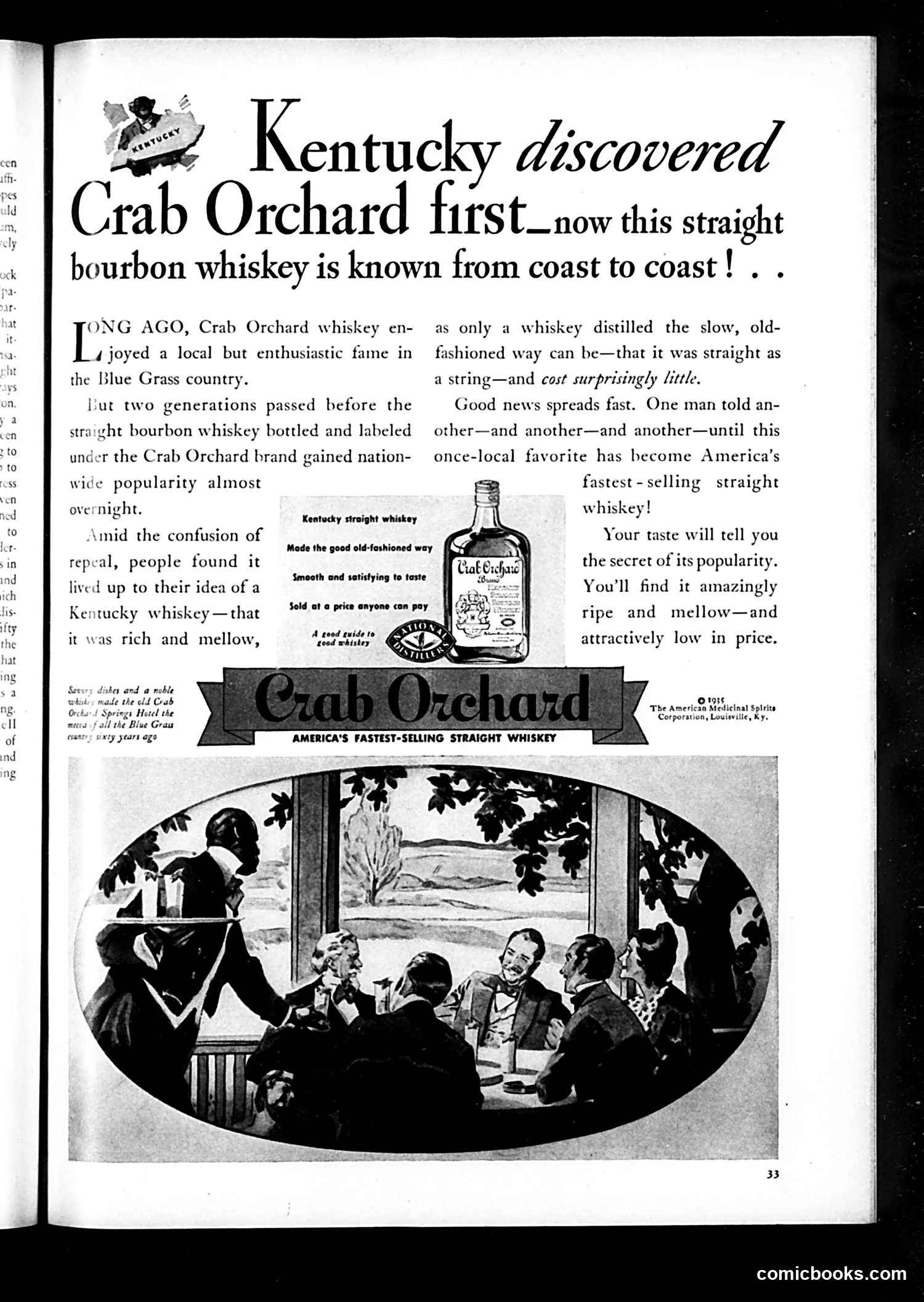
Analysis This is a whiskey advertisement, not political satire or a cartoon. It promotes Crab Orchard bourbon whiskey to modern readers. The page references Prohibition's repeal ("Amid the confusion of repeal"), which ended in 1933, explaining why bourbon could suddenly be advertised nationally. The narrative claims the whiskey enjoyed local Kentucky popularity for generations before becoming "America's fastest-selling straight whiskey." The lower illustration shows a social scene—well-dressed men dining or socializing—suggesting the product's association with sophistication and leisure. Key selling points emphasized: the whiskey is "straight" (pure bourbon), made the "old-fashioned way," tastes "ripe and mellow," and costs surprisingly little. The ad uses word-of-mouth narrative ("one man told another") as a marketing strategy, portraying organic popularity rather than aggressive salesmanship—typical advertising rhetoric of the era aimed at post-Prohibition consumers rediscovering legal spirits.
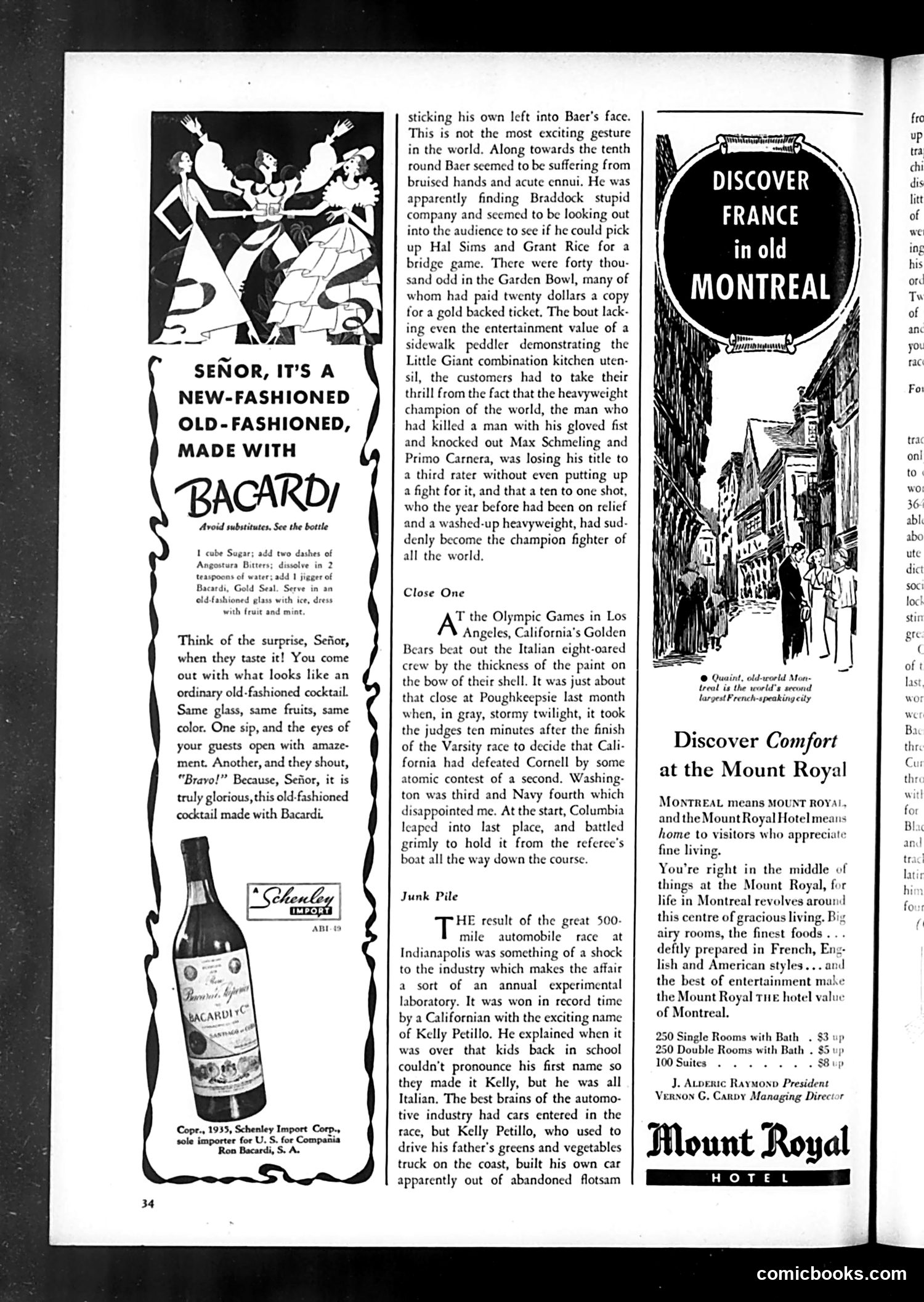
Life Magazine Page Analysis This page combines sports commentary with advertising. The main content discusses three recent sporting events: The Boxing Match: A heavyweight championship fight where the champion (likely Max Baer, based on the text mentioning he "knocked out Max Schmeling") lost his title to an underdog who'd been on relief the previous year. The writer mocks the bout as boring and poorly fought, with the champion apparently disinterested. Rowing Competition: A close race at Poughkeepsie where California narrowly defeated Cornell, with Columbia deliberately losing. The Indianapolis 500: Kelly Petillo, an Italian-American whose immigrant father drove a vegetable truck, won the prestigious race in a car he built himself—surprising the establishment automotive industry. The satirical point: underdog victories exposing the pretensions of established powers (boxing champions, Ivy League crews, Detroit engineers). The advertisements—Bacardi rum and Montreal's Mount Royal Hotel—are period luxury goods marketing to readers.
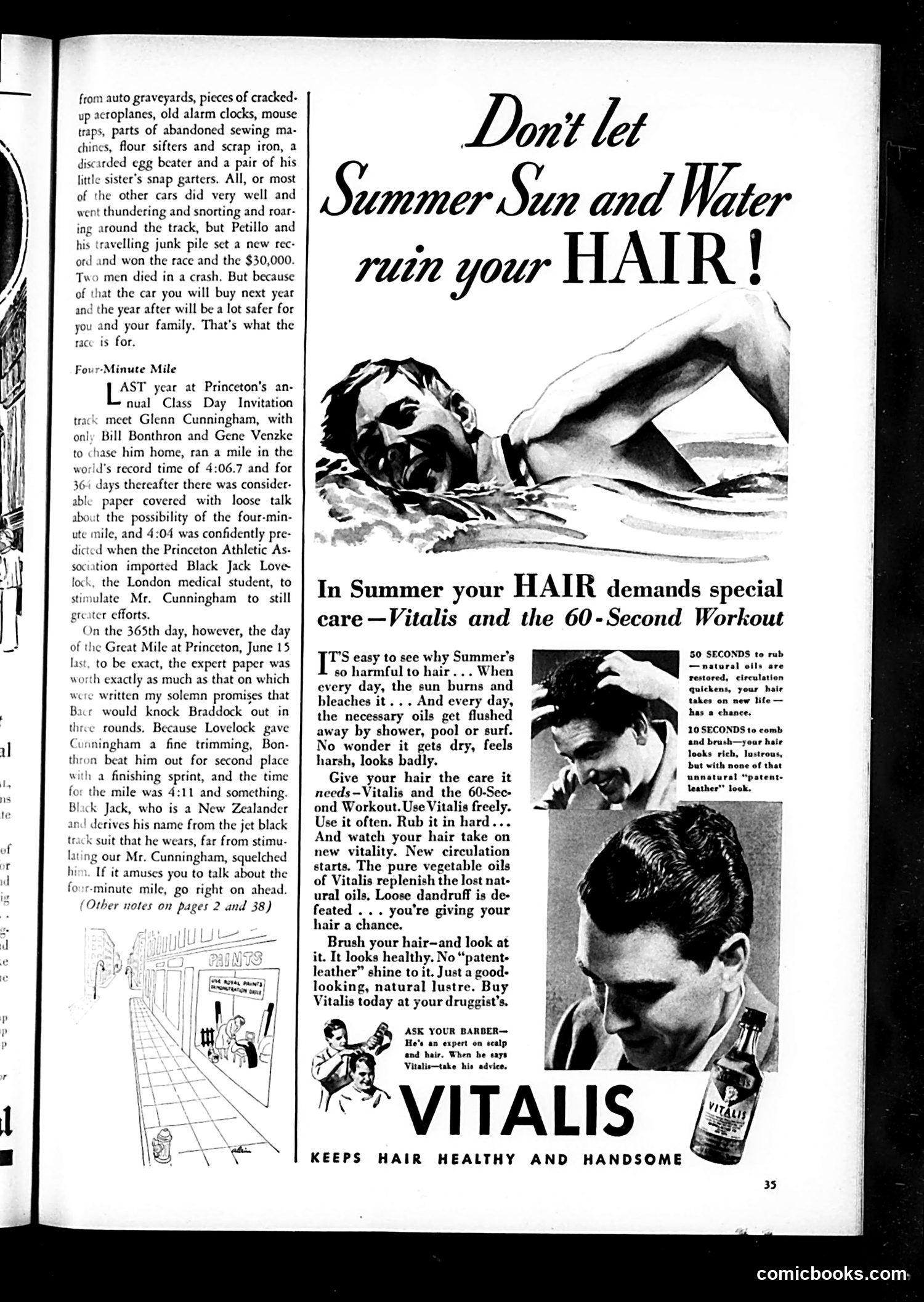
Page Content Explanation This page contains two distinct sections: a sports article and a hair product advertisement. Sports Article (Left): Discusses recent track and field records. References Glenn Cunningham's mile attempt at Princeton's Class Day meet, where he failed to break the four-minute mile despite expectations. The article notes that imported runner Jack Lovelock (a London medical student from New Zealand) actually beat Cunningham, with Bonthron placing second. The piece is satirical about media hype—comparing the worthless predictions about a four-minute mile to the author's own false promises that boxer Max Baer would defeat Joe Louis in three rounds. Advertisement (Right): A full-page Vitalis hair product ad warning men that summer sun and water damage hair. It promotes "Vitalis" and a "60-Second Workout" routine using vegetable oils to restore hair health and natural shine. The ad includes instructional illustrations and suggests asking your barber for advice. The page is primarily advertising, with sports commentary as secondary content.
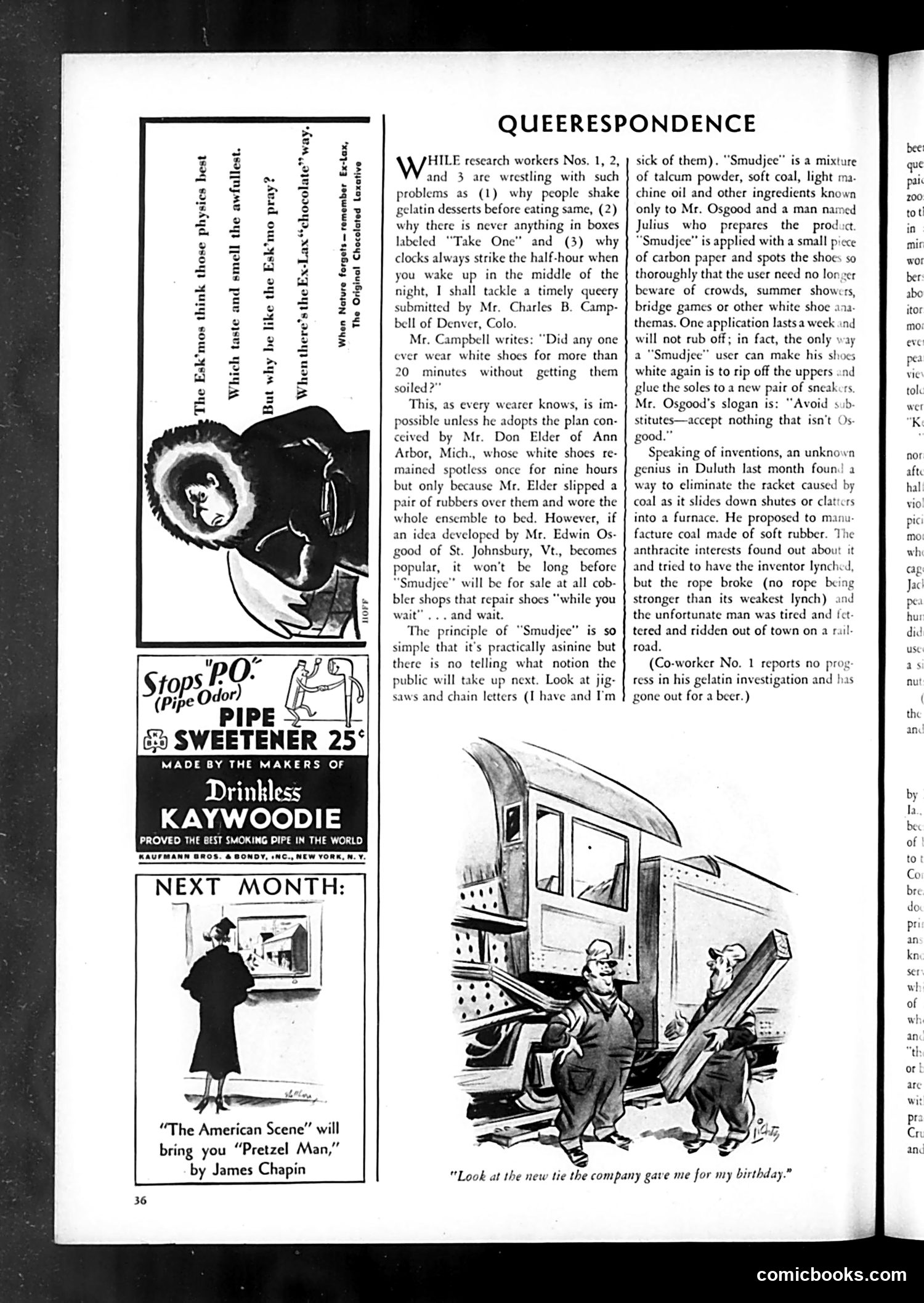
Life Magazine "Queerespondence" Page Analysis This page presents humorous reader correspondence featuring absurd fictional inventions and problems. The main article mocks trivial consumer concerns through invented products: "Smudjee" — a satirical "solution" to keeping white shoes clean, made of talcum, coal, and machine oil. The joke is that this deliberately dirties shoes permanently, making them unwearable; one must "rip off the uppers" to restore them. It parodies the era's consumer culture and dubious patent remedies. The rubber coal invention — another absurdist creation meant to reduce furnace noise. The satire targets industrial interests protecting outdated products, with a dark comedic reference to lynching ("the rope broke"). The cartoon (bottom right) shows workers admiring a new company tie as a "birthday" gift—mocking cheap corporate "perks" that insult rather than reward employees. The page satirizes 1930s consumer culture, product marketing, and workplace exploitation through deliberately ridiculous examples. The tone is cynical but lighthearted, typical of Life magazine's satirical approach.
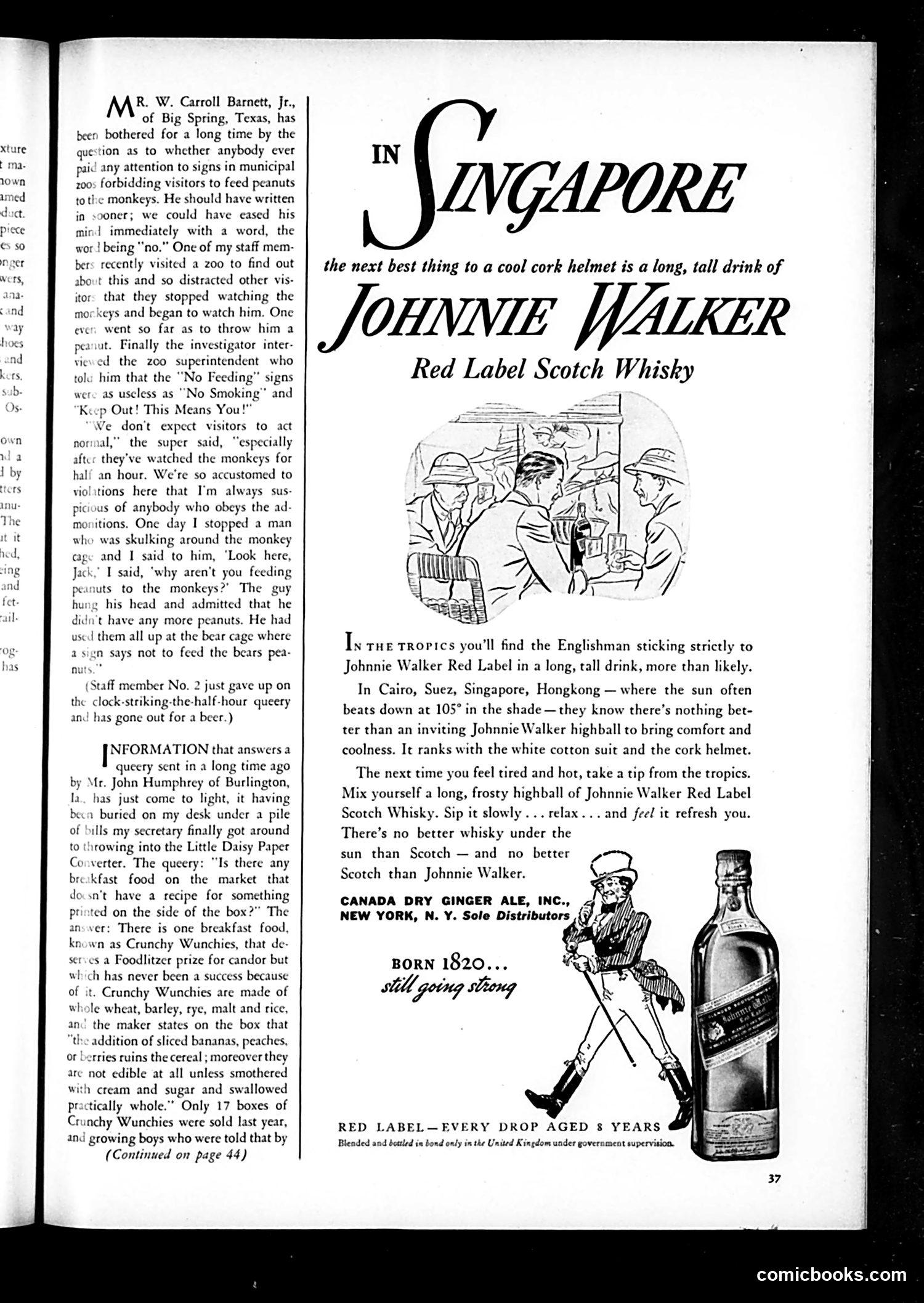
Life Magazine Page Analysis This page combines humorous editorial content with advertising. The main text humorously addresses reader queries: one about zoo "No Feeding" signs (which visitors ignore anyway), another about breakfast cereals with recipes printed on boxes (with the punchline that one cereal, "Crunchy Wunchies," advertises itself as inedible unless heavily modified with cream and sugar—a brutal honesty that doomed its sales). The full-page advertisement for Johnnie Walker Red Label Scotch Whisky uses colonial-era stereotypes, depicting British colonials in tropical locations (Cairo, Suez, Singapore) maintaining "proper" English habits through whisky drinking. The ad suggests that a "long, tall drink" of Scotch is as essential to tropical life as white cotton suits and cork helmets. It's marketing alcohol as a solution to heat and fatigue—imagery that reflects mid-20th-century attitudes toward both drinking culture and British imperial presence abroad.
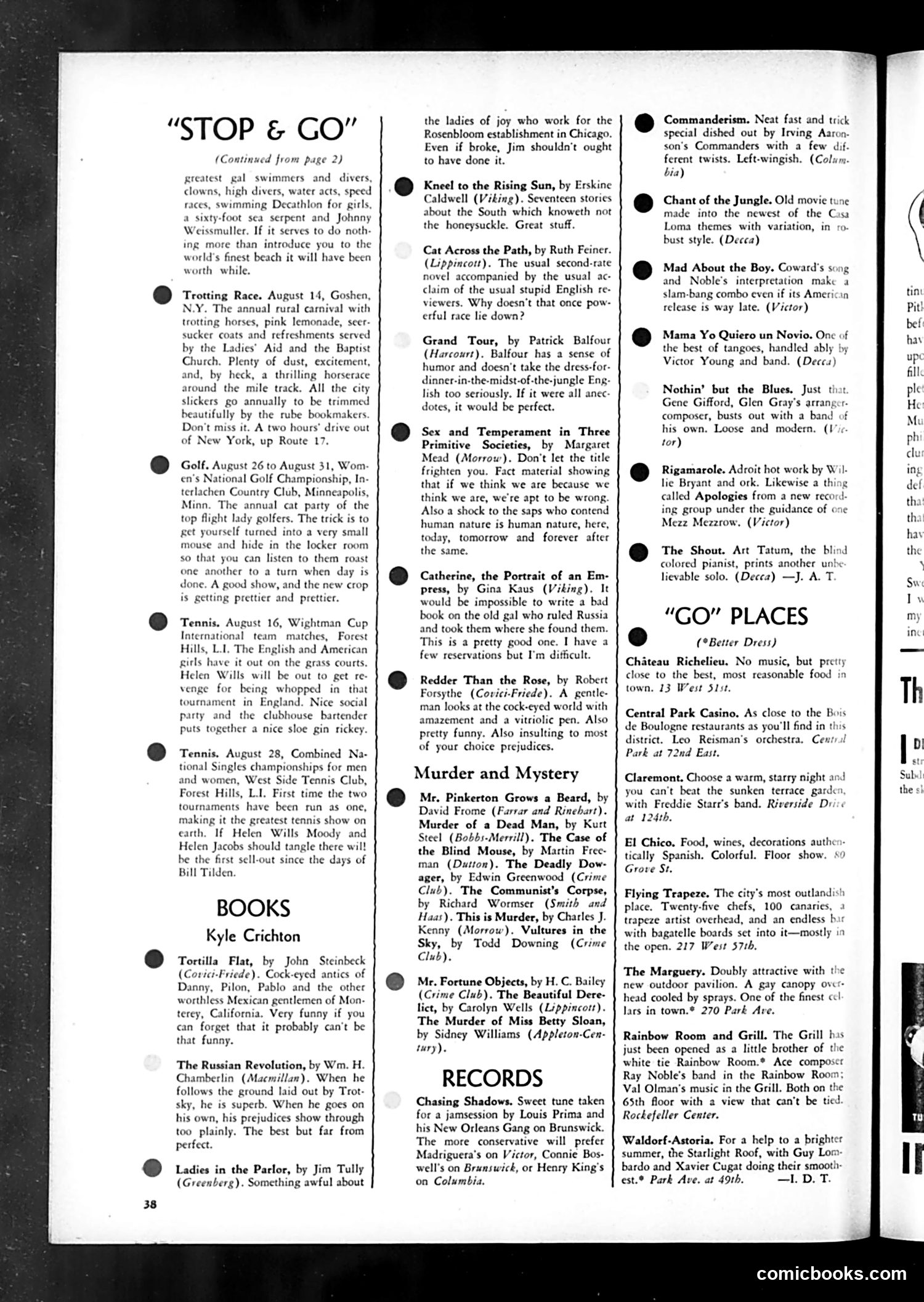
This page from *Life* magazine is primarily a reviews and recommendations section, not a political cartoon. It contains three main parts: "Stop & Go" lists summer recreational events (horse racing, golf, tennis tournaments) with witty commentary—the satire is mild social humor about spectators ("city slickers") and wealthy female golfers. Books reviews recent publications by Kyle Crichton, including Steinbeck's *Tortilla Flat*, Erskine Caldwell's *Kneel to the Rising Sun*, and Margaret Mead's anthropological study. The reviews are irreverent and opinionated, characteristic of *Life*'s satirical tone—dismissing English novelists as a "once powerful race" and praising Mead's work debunking fixed ideas about human nature. "Go" Places recommends Chicago and New York restaurants and entertainment venues. The overall content reflects 1930s leisure culture and intellectual trends rather than political satire. The humor targets pretension, stuffiness, and conventional thinking.
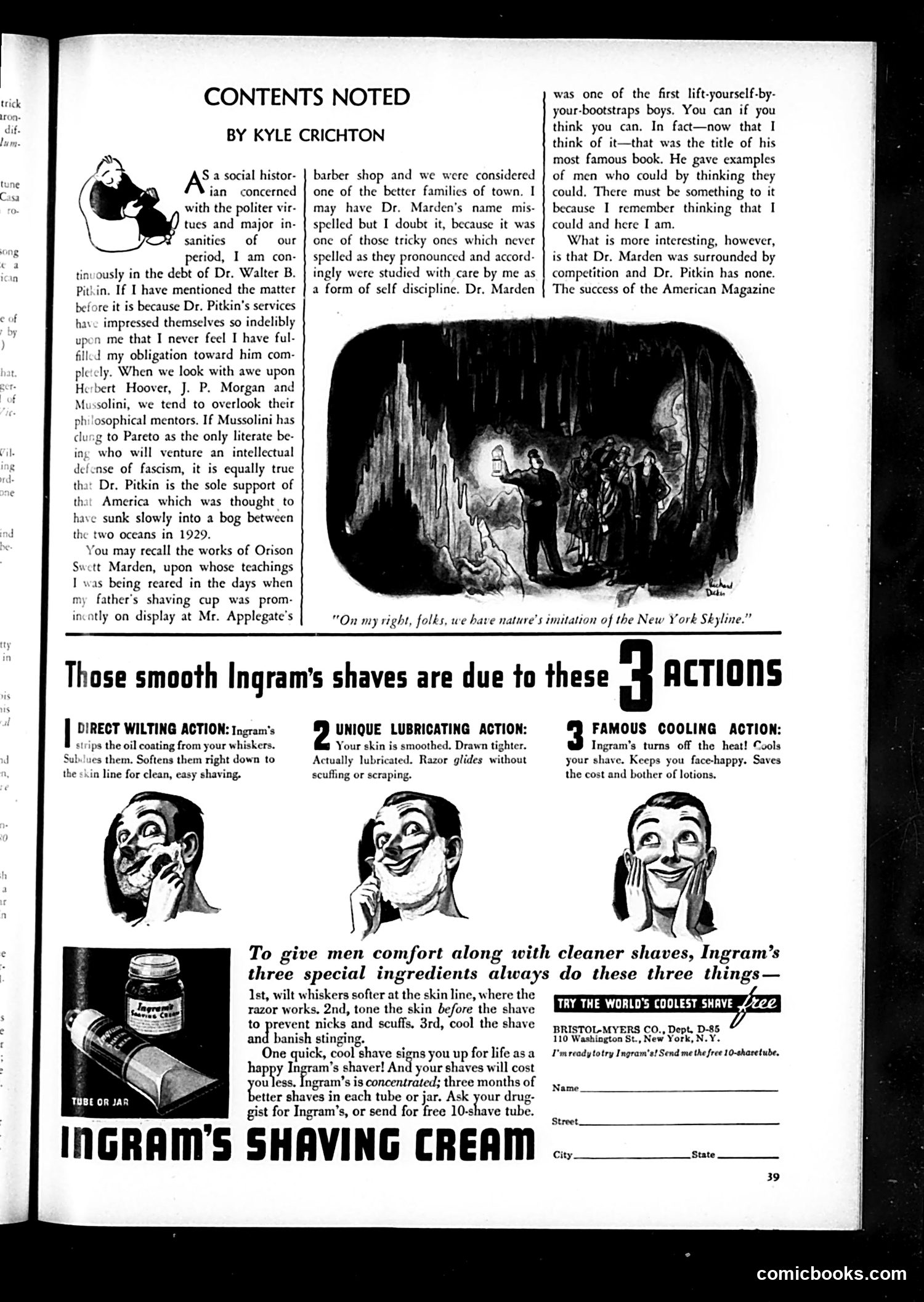
Analysis for Modern Readers This page is primarily advertising for Ingram's Shaving Cream, not political satire. The upper portion contains "Contents Noted," a column by Kyle Crichton discussing American self-help philosophy and its mentors (Dr. Pitkin, Orison Swett Marden). The column humorously traces how Crichton was raised on "bootstrap" ideology—the American belief that anyone can succeed through positive thinking. The cartoon captioning an illustration shows two men in what appears to be a cave, with one saying the rock formation resembles "nature's imitation of the New York Skyline"—a simple visual joke about seeing familiar shapes in natural formations. The advertisement below uses three illustrated faces demonstrating shaving benefits (wilting action, lubrication, cooling). This is straightforward product marketing typical of mid-20th-century magazine ads, not satire. The page illustrates how Life magazine blended editorial content with advertising.
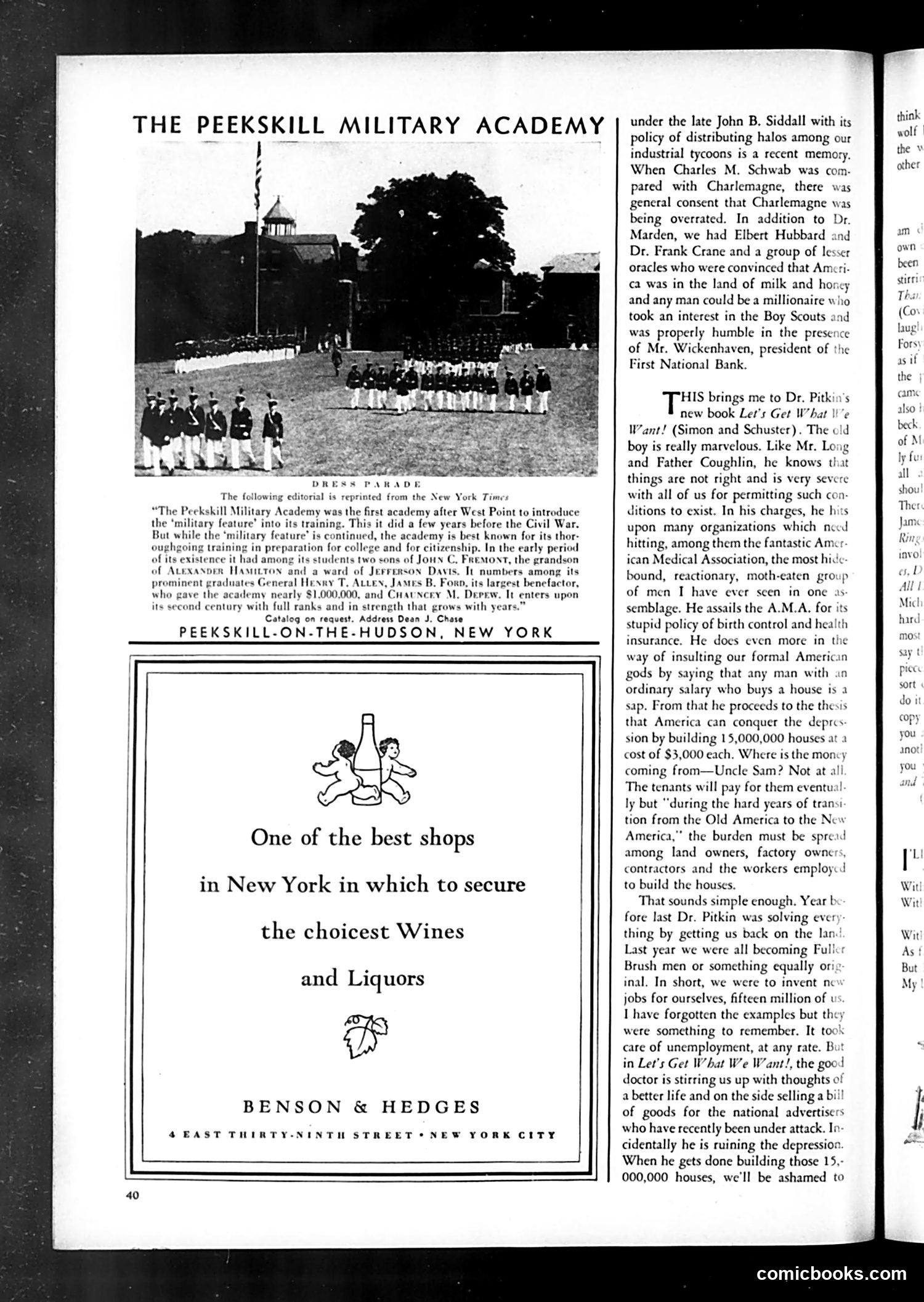
Analysis of This Life Magazine Page This page combines institutional promotion with social satire. The top features a photograph and history of Peekskill Military Academy, a legitimate educational institution founded before the Civil War. However, the main text is editorial satire attacking Dr. Arthur Pitkin, an author and motivational speaker. The unnamed critic mocks Pitkin's contradictory self-help schemes—each year offering a different solution to America's Depression-era problems (real estate schemes, getting back to farming, selling for Fuller Brush company). The satire targets Pitkin's naïveté: his latest book proposes building 15 million houses at $3,000 each would somehow solve unemployment, with costs magically distributed among landowners and workers rather than the government. The critic also attacks Pitkin's dismissal of the American Medical Association's birth control policies as "reactionary," viewing this as trendy radicalism masking opportunism—Pitkin ultimately serves advertisers while claiming social reform. The Benson & Hedges liquor advertisement below is unrelated editorial placement.
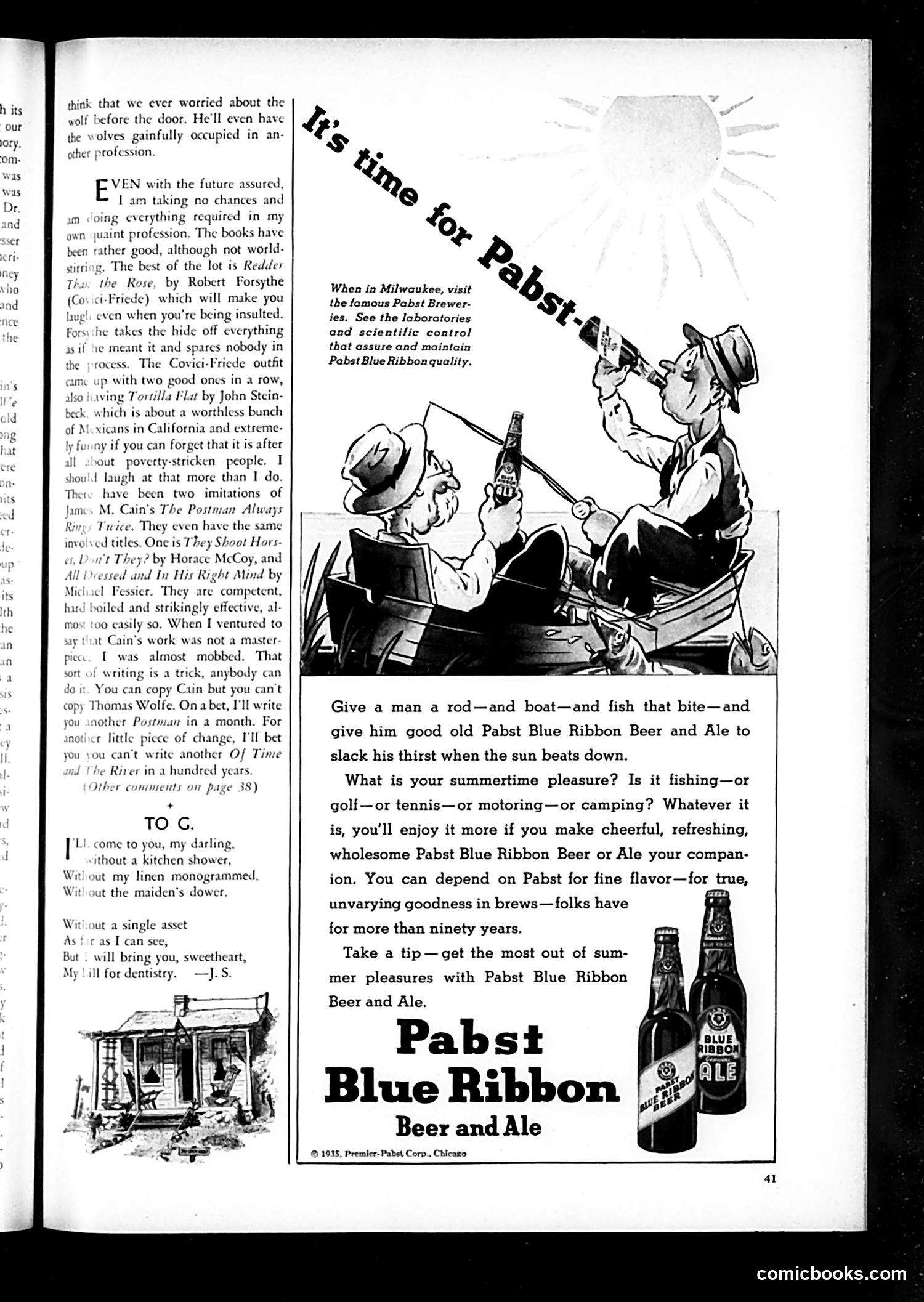
Content Analysis This page contains a literary column on the left and a full-page Pabst Blue Ribbon beer advertisement on the right. The left column discusses American literature—books by Robert Forsythe, John Steinbeck (*Tortilla Flat*), and James M. Cain (*The Postman Always Rings Twice*)—in a casual, opinionated tone typical of Life magazine's cultural commentary. The advertisement depicts two men fishing, using the period's standard selling approach: associating beer consumption with leisure and masculine outdoor activities. The copy emphasizes Pabst's quality ("ninety years," "fine flavor") and directly links drinking to summer recreation—fishing, golf, tennis, camping. Historical context: This is a 1935 publication, during Prohibition's repeal (1933), so breweries aggressively marketed their products as part of normal American life after thirteen years of illegality. The advertisement's casual celebration of beer-drinking reflects this newly-restored legitimacy.
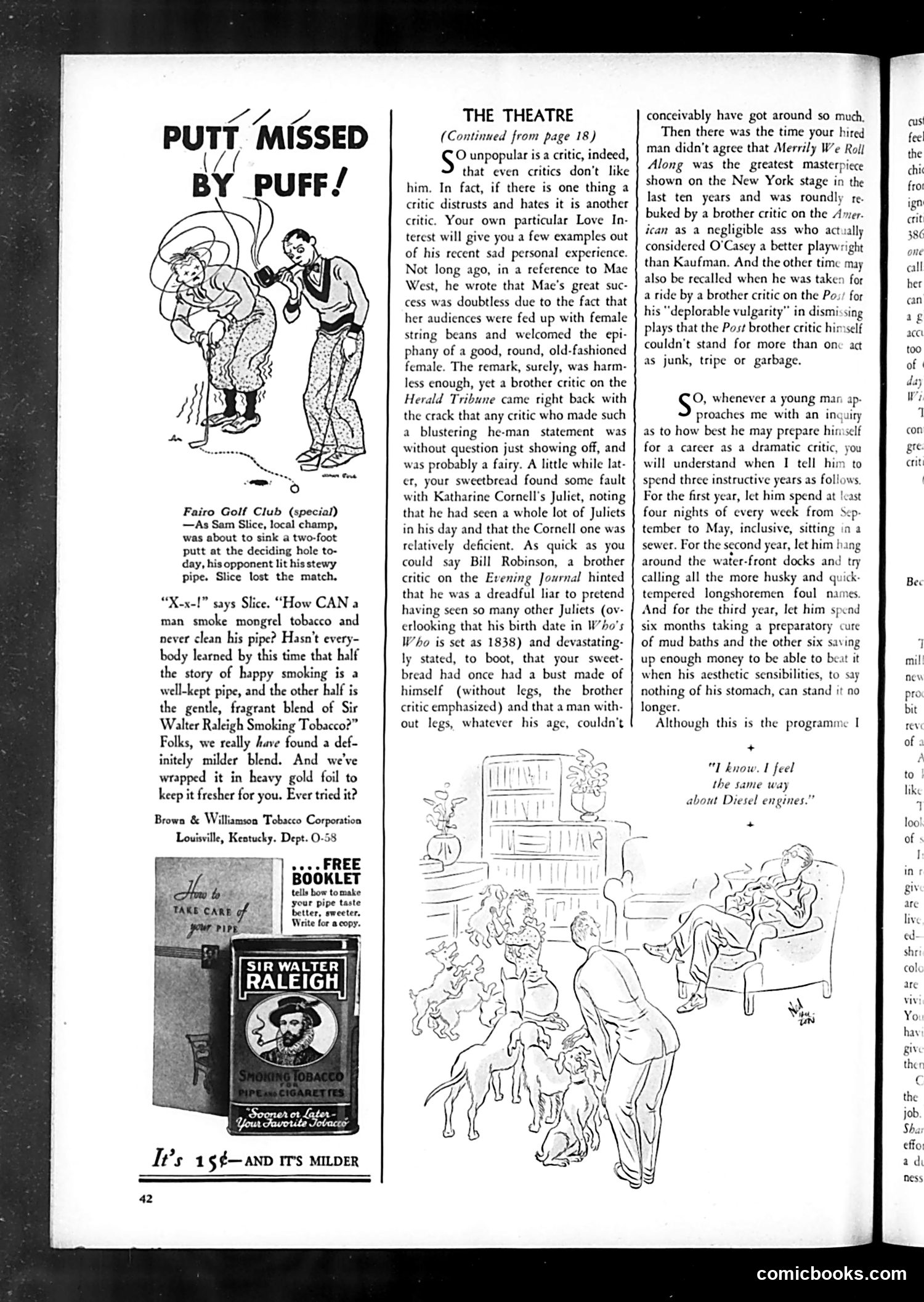
What This Page Means The left side is a tobacco advertisement disguised as humor. A golfer loses his match because his opponent smokes an inferior pipe tobacco, prompting a pitch for Sir Walter Raleigh brand—the joke being the setup itself (the pipe-smoking sabotage). The right side is a theater criticism essay mocking the professional cattiness among Broadway critics. The author describes critics harshly attacking each other over subjective theatrical opinions (Mae West's physique, Katharine Cornell's Juliet performance). The essay concludes with satirical advice for aspiring drama critics: spend a year in a sewer, then a year around dock workers insulting them, then a year taking mud baths—suggesting that only someone with no taste or refinement would pursue theater criticism. The satire's point: Theater critics are petty, hypocritical, and abuse their platform to personally attack colleagues while pretending to high standards. The job requires no actual qualification beyond tolerance for unpleasantness.
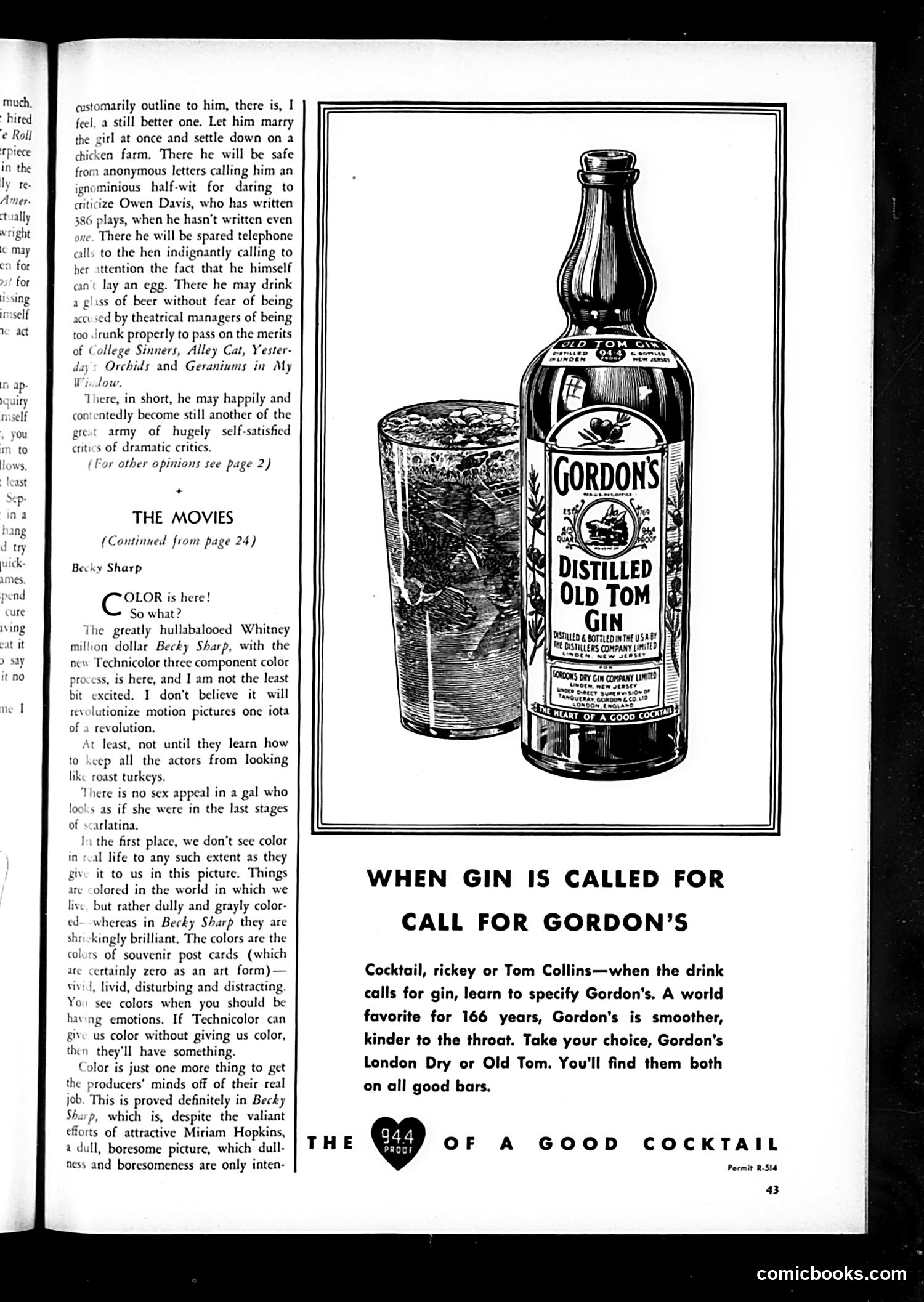
Page Analysis This page contains no political cartoon—it's primarily advertising and film criticism from Life magazine. The main content is a Gordon's Gin advertisement featuring a bottle and cocktail glass, emphasizing the brand's 166-year history and smoothness. Above it is a film review by "Becky Sharp" criticizing the new Technicolor movie of the same name. The reviewer argues that while Technicolor is technologically impressive, the film itself is dull and the colors are garish—"like souvenir post cards"—distracting from the story. The critic also mocks the lead actress Miriam Hopkins's appearance, suggesting Technicolor makes actors look like "roast turkeys" and that there's "no sex appeal in a gal who looks as if she were in the last stages of scarlatina." At page top, text discusses how a drama critic could escape criticism by becoming a chicken farmer instead, sarcastically suggesting this would spare him from "anonymous letters" and theatrical managers' complaints.
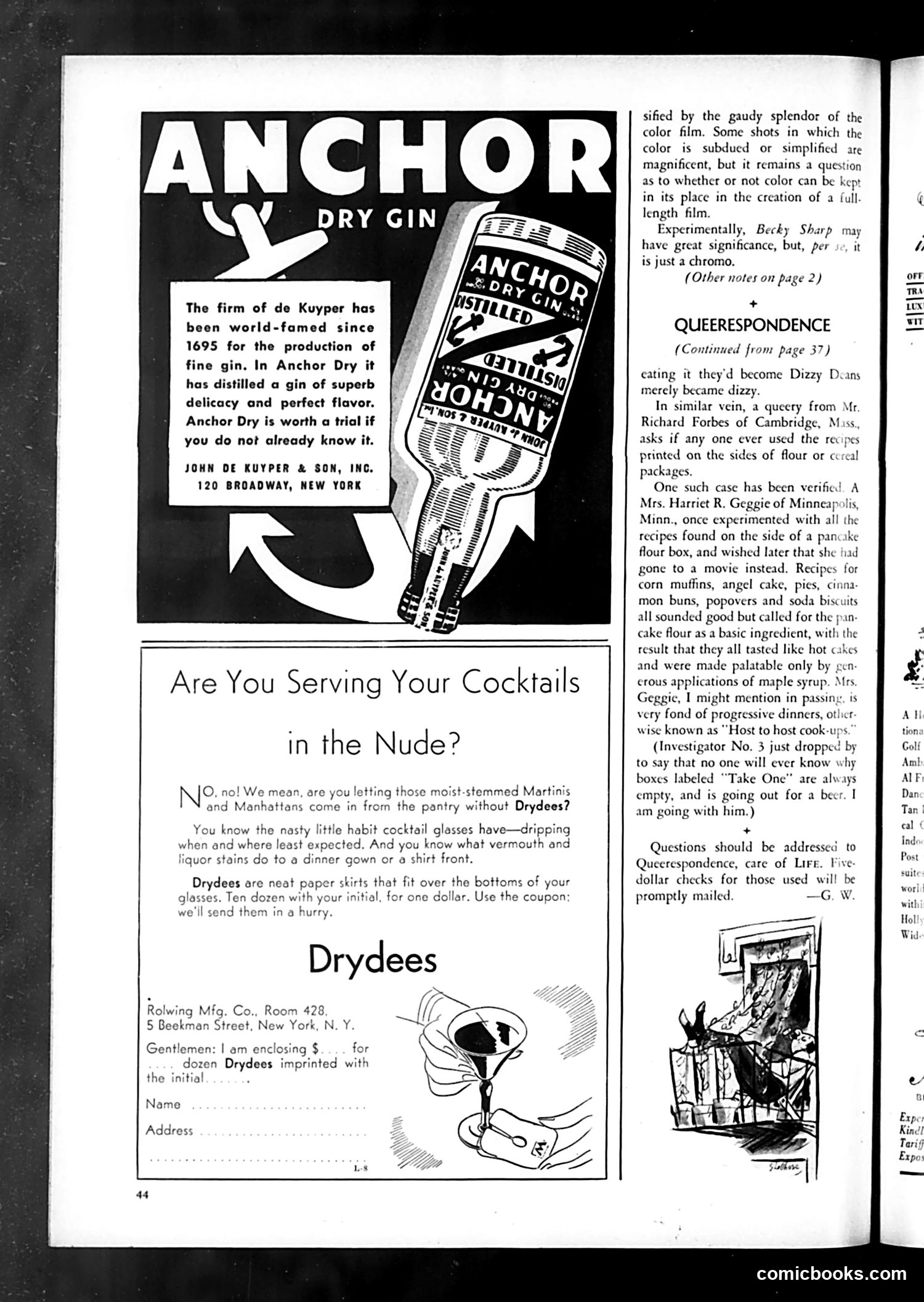
Page Analysis: Life Magazine Advertisements and Correspondence This page contains three distinct advertisements and a letters section, not political cartoons. Anchor Dry Gin ad (top): A straightforward liquor advertisement for de Kuyper's gin brand, established 1695, emphasizing quality and flavor. Drydees ad (center): A humorous product advertisement for paper napkin "skirts" that fit over cocktail glass bases to prevent drink drips from staining dinner clothes. The ad's title "Are You Serving Your Cocktails in the Nude?" uses mock-scandalized language to joke about exposed, wet glass bottoms—a relatable domestic problem for 1930s-40s entertaining. Queerespondence section (right): A letters column answering reader queries, including one about whether recipes printed on flour/cereal boxes were ever actually used. One verified example describes a woman who tested all pancake flour box recipes, finding they all tasted identical because flour was the base ingredient. The page reflects period attitudes toward cocktail entertaining and household management rather than political satire.
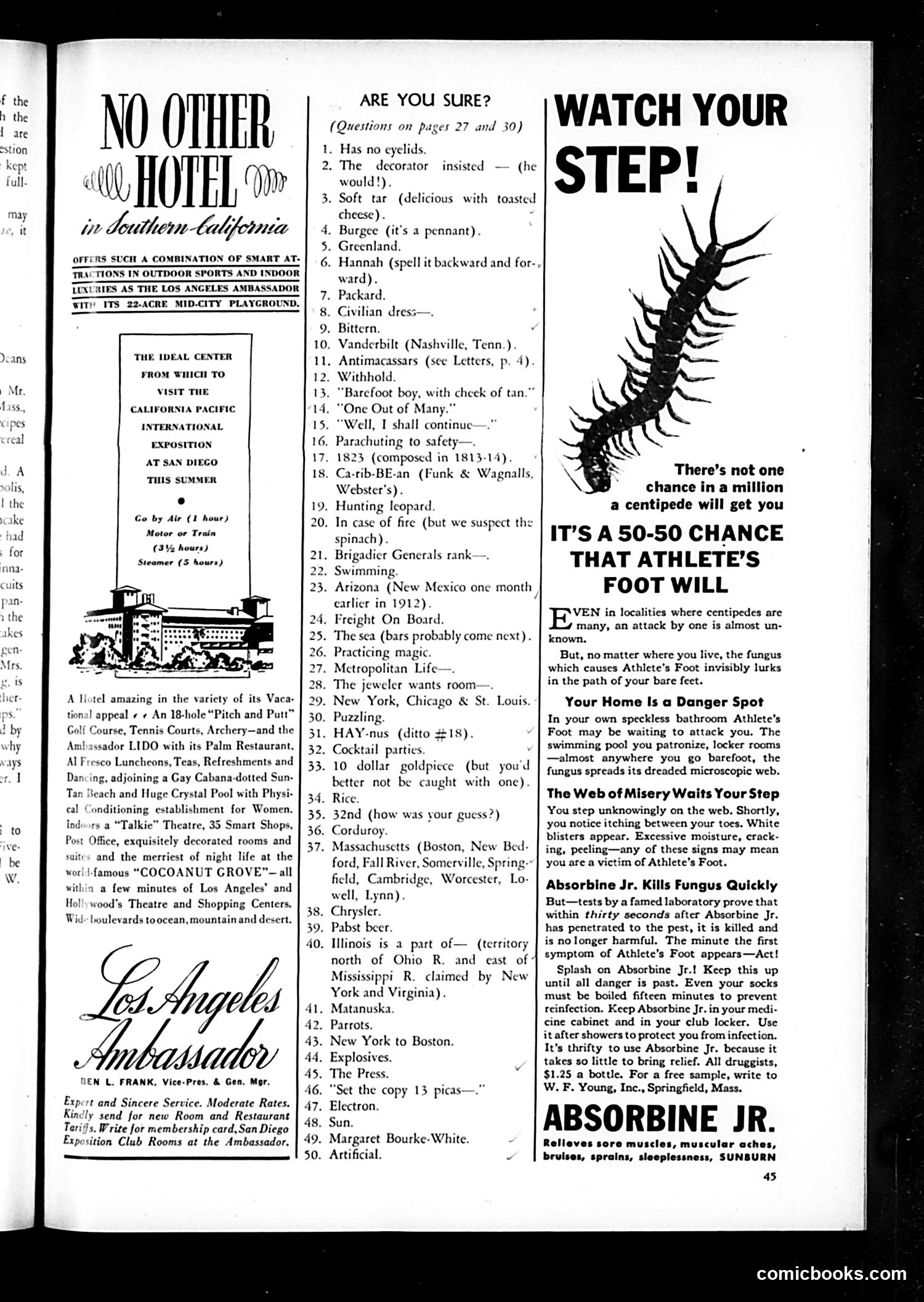
Analysis of This Life Magazine Page This page mixes hotel advertising with a quiz feature and a product advertisement. The left side promotes the Los Angeles Ambassador Hotel's amenities for tourists planning to visit San Diego's 1930s California Pacific International Exposition. The center contains an "Are You Sure?" quiz—a common Life magazine feature testing readers' knowledge on trivia across categories like geography, literature, and current events. The right side features a vintage advertisement for Absorbine Jr., a fungal treatment product. The ad uses fear-based marketing typical of Depression-era advertising: a grotesque illustration of a centipede introduces the product by establishing that while centipede bites are rare, athlete's foot is a common threat lurking in bathrooms, pools, and locker rooms. The ad emphasizes how the fungus spreads through everyday environments where barefoot exposure occurs, positioning the product as essential protection for modern Americans. This represents 1930s consumer marketing that capitalized on anxieties about hygiene and infection.
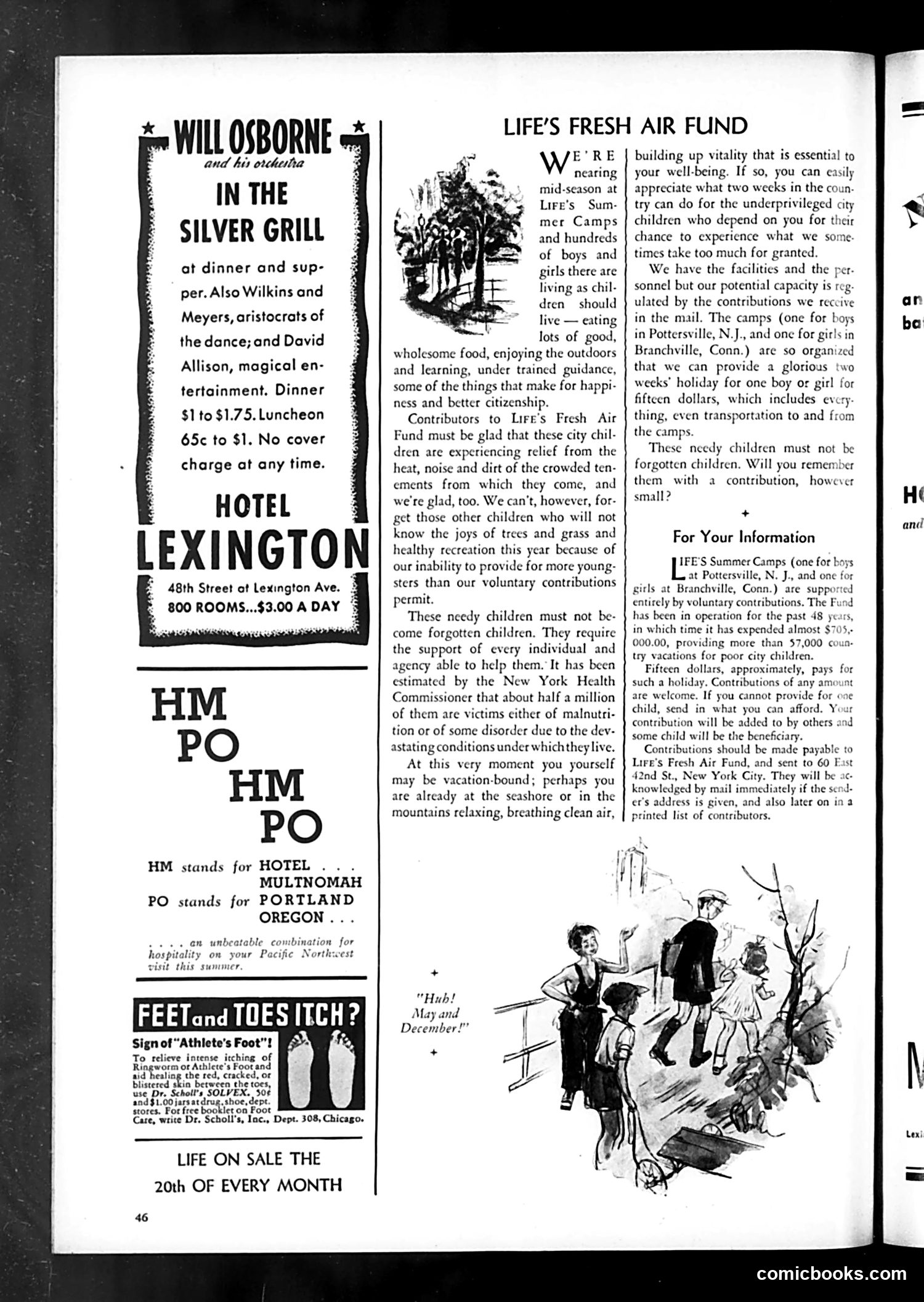
Life Magazine Page Analysis This page combines advertisements with a charitable appeal for Life's Fresh Air Fund, a real program providing summer camp vacations for underprivileged city children. The main content is a fundraising pitch emphasizing the contrast between vacationing readers and poor urban children suffering malnutrition and poor living conditions in tenements. The illustration labeled "Hub! May and December!" depicts this disparity—showing well-dressed adults and children enjoying outdoor recreation while implicitly referencing the forgotten poor children below. The campaign notes that $15 provides a two-week camp holiday, and mentions the fund has operated 48 years, spending nearly $700,000 on city children's vacations. The surrounding advertisements (Hotel Lexington, Hotel Multnomah-Portland, athlete's foot treatment) are incidental. The satirical *Life* magazine here functions as a vehicle for Progressive-era social welfare messaging, appealing to readers' conscience during vacation season to remember less fortunate children.
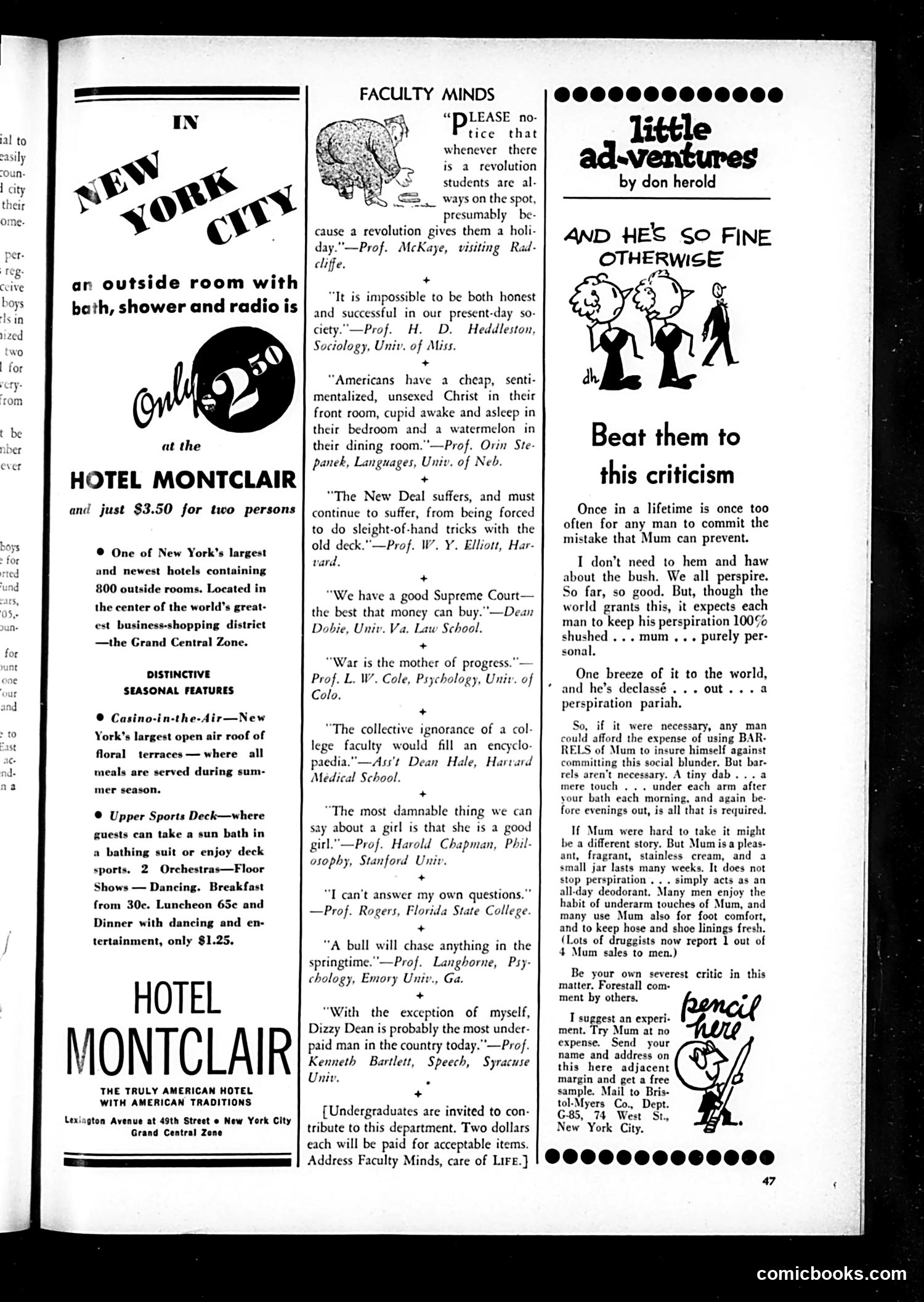
Analysis of Life Magazine Page This page contains two distinct sections: Left Side - Hotel Advertisement: A standard hotel ad for the Hotel Montclair in New York City, promoting rooms at $3.50 for two people with various amenities. Right Side - Satirical Content: The "Faculty Minds" section collects absurd or contradictory quotes attributed to college professors, mocking academic pretension and hypocrisy. Examples include a professor claiming the Supreme Court is "the best that money can buy" (suggesting corruption), another stating war is "progress," and one admitting "I can't answer my own questions." The satire targets professorial pomposity and the gap between academic authority and actual wisdom. Below this is "Little Ad-ventures" by Don Herold—a humorous cartoon about social anxiety regarding perspiration, followed by a Mum deodorant advertisement disguised as editorial advice. The Point: The page satirizes both academic pretension (through the contradictory faculty quotes) and consumer anxiety (through the perspiration humor), reflecting 1930s-era skepticism toward both intellectual and commercial authority.
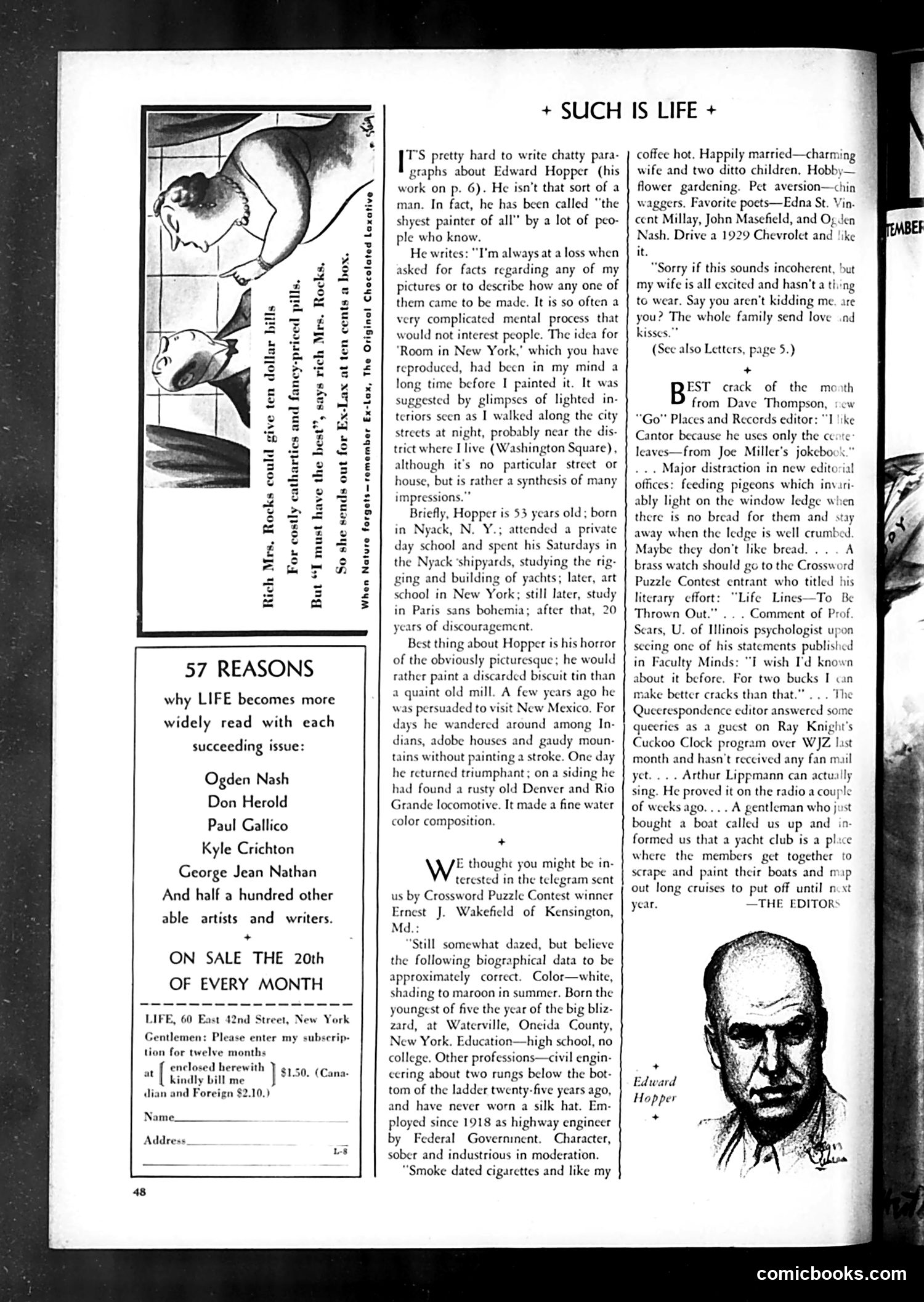
What This Page Means This is a Life magazine page mixing editorial content with advertising. The main feature profiles Edward Hopper, the painter (portrait shown), emphasizing his artistic shyness and deliberate avoidance of obvious scenic subjects. His quote explains how "Room in New York" synthesized impressions rather than depicting any specific location—a key point for understanding his modernist approach to American realism. The page also celebrates Life's contributors (Nash, Herold, Gallico, etc.) and reprints a humorous telegram from a crossword-puzzle contest winner, showcasing Life's signature blend of highbrow art criticism and lowbrow humor. The Ex-Lax advertisement at bottom reflects 1930s-40s magazine culture, when laxative ads were commonplace and socially acceptable in family publications—unthinkable by modern standards.