life
Life — September 1935
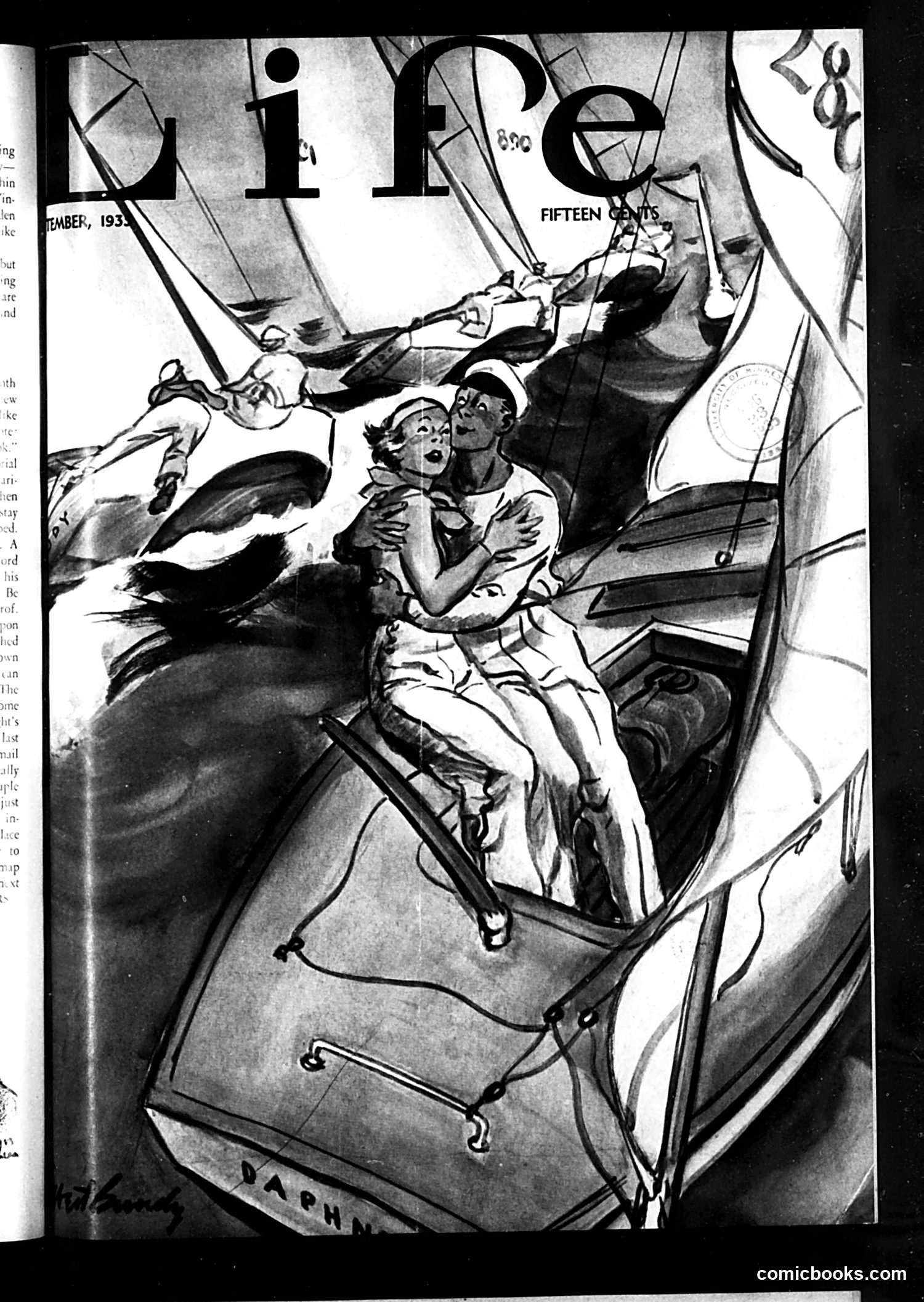
Life Magazine Illustration Analysis This appears to be a cover or advertisement illustration from Life magazine (dated December 1935, visible in the margin). The image shows a dramatic scene of what looks like a flying car or aircraft with passengers in distress—people are shown reacting with alarm and excitement inside the vessel. The illustration likely satirizes either: 1. Futuristic transportation technology and early aviation excitement 2. A contemporary scandal or accident involving wealthy or prominent figures The "Fifteen Cents" price and art style confirm this is from the 1930s era. The dramatic composition and exaggerated expressions suggest Life's typical approach: using humor and caricature to comment on modern anxieties, technological innovation, or social follies. Without clearer text, the specific subjects remain unclear, though the scene suggests some form of chaotic or dangerous situation presented for satirical effect.
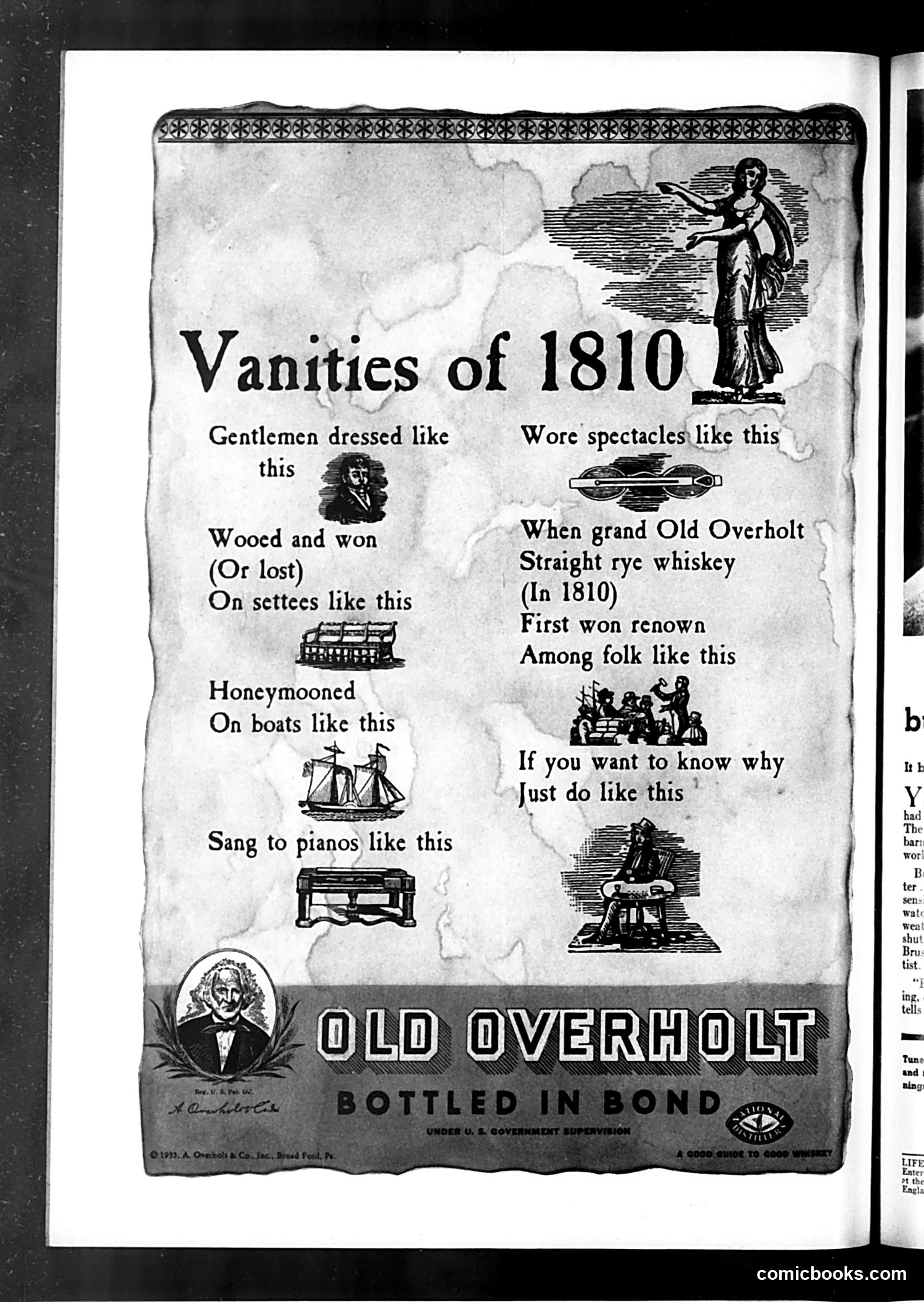
"Vanities of 1810" - Old Overholt Whiskey Advertisement This is a whiskey advertisement disguised as social satire. It humorously catalogs fashions and customs from 1810—gentlemen's clothing styles, spectacles, sailing vessels, pianos, and social gatherings—with the punch line that Old Overholt Straight Rye Whiskey "first won renown / Among folk like this" in that era. The joke appeals to nostalgia: drinking this whiskey connects the 1810s consumer to that romanticized historical period. The final line—"If you want to know why / Just do like this"—with an image of someone drinking, suggests the whiskey's popularity explains itself. It's essentially using period-costume humor to market liquor as a product with authentic historical pedigree, bottled during Prohibition enforcement (noted at bottom).
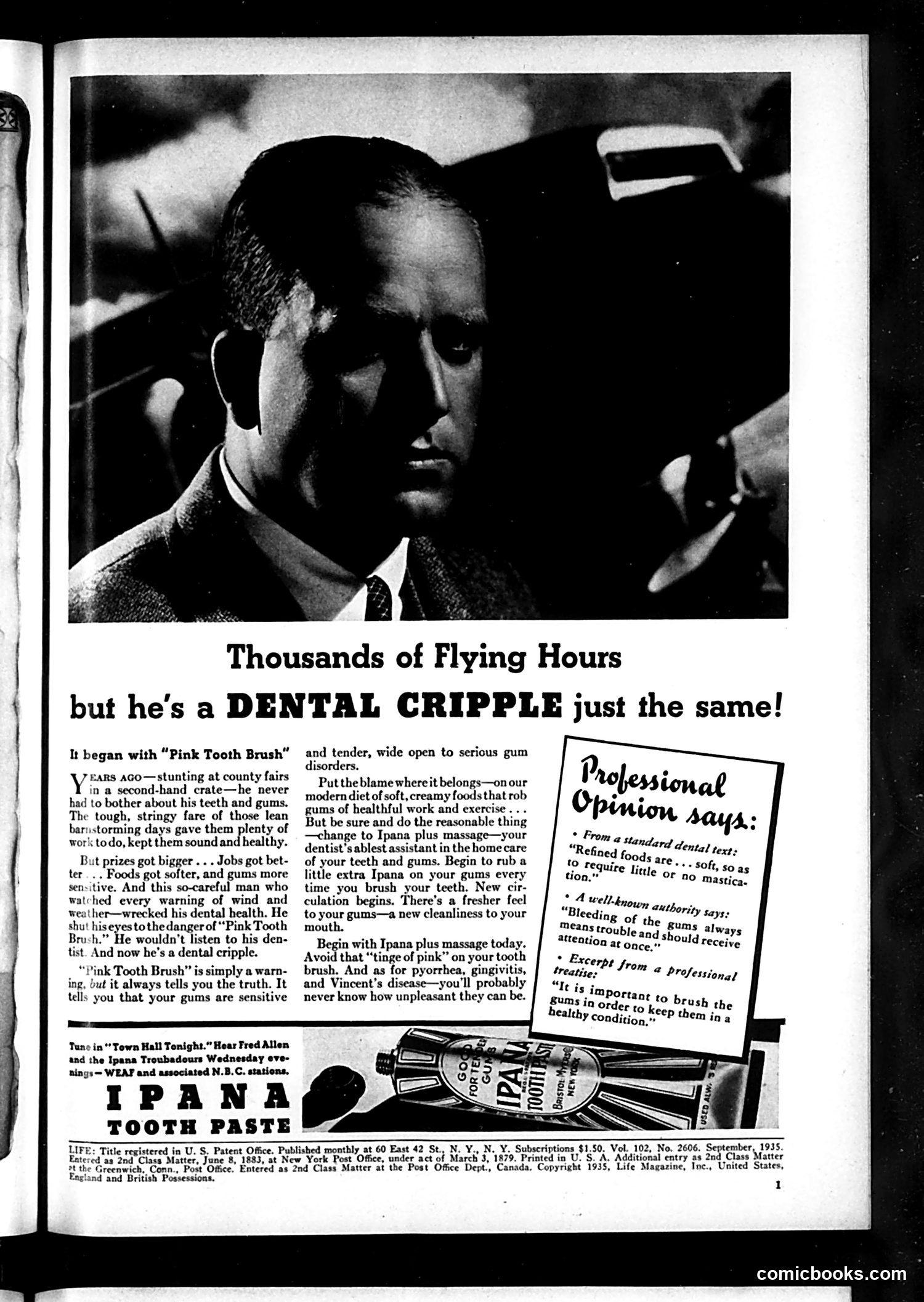
Analysis This is a toothpaste advertisement, not political satire. The ad features a photograph of a man in professional attire (appears to be a pilot or aviator based on context) with the headline "Thousands of Flying Hours but he's a DENTAL CRIPPLE just the same!" The humor exploits a contrast: despite professional accomplishment and experience, the man suffers from poor dental health. The ad suggests that even successful, experienced people neglect oral hygiene—specifically gum disease ("pink tooth brush," gingivitis, pyorrhea). The product, Ipana Tooth Paste, is pitched as the solution. A sidebar offers "Professional Opinion" from dentists endorsing proper brushing and gum care. This reflects mid-20th-century advertising strategy: using relatable anxiety (poor teeth despite success) to sell health products. The "dental cripple" term, now considered offensive, was common medical vocabulary of that era.
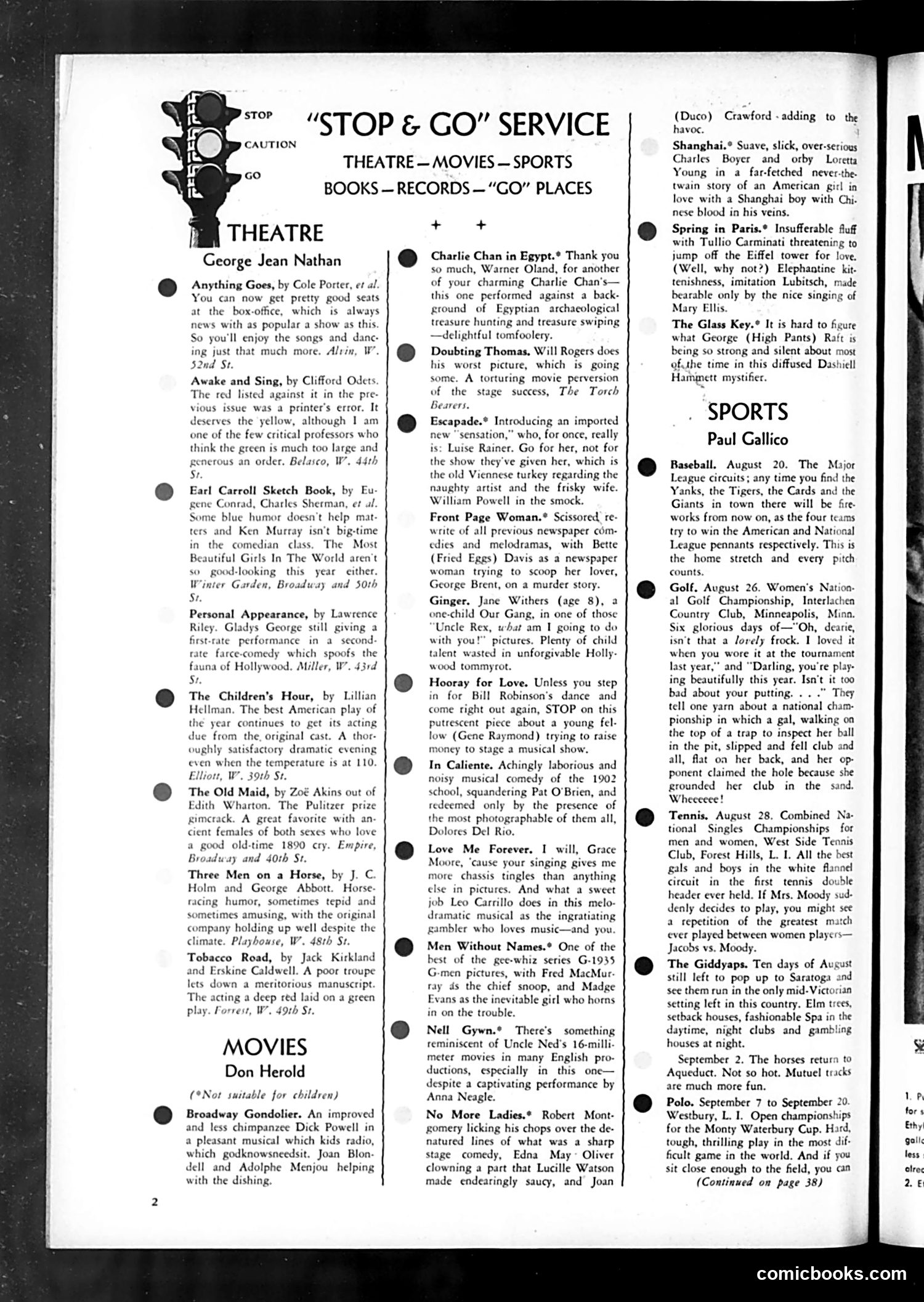
Analysis This page is primarily not a cartoon page, but rather a "Stop & Go" service guide — a listing of entertainment recommendations organized by traffic-light categories (Stop, Caution, Go). The single visual element is a traffic light illustration at the top left, used as a visual metaphor for the rating system. The light itself contains no caricature or political content. The content consists of three sections — Theatre, Movies, and Sports — each with brief reviews and recommendations from critics (George Jean Nathan, Don Herold, and Paul Callico respectively). These are straightforward entertainment recommendations using the traffic-light rating system to indicate quality. There is no political satire or social commentary on this page. It's a utilitarian service feature typical of Life magazine's format.
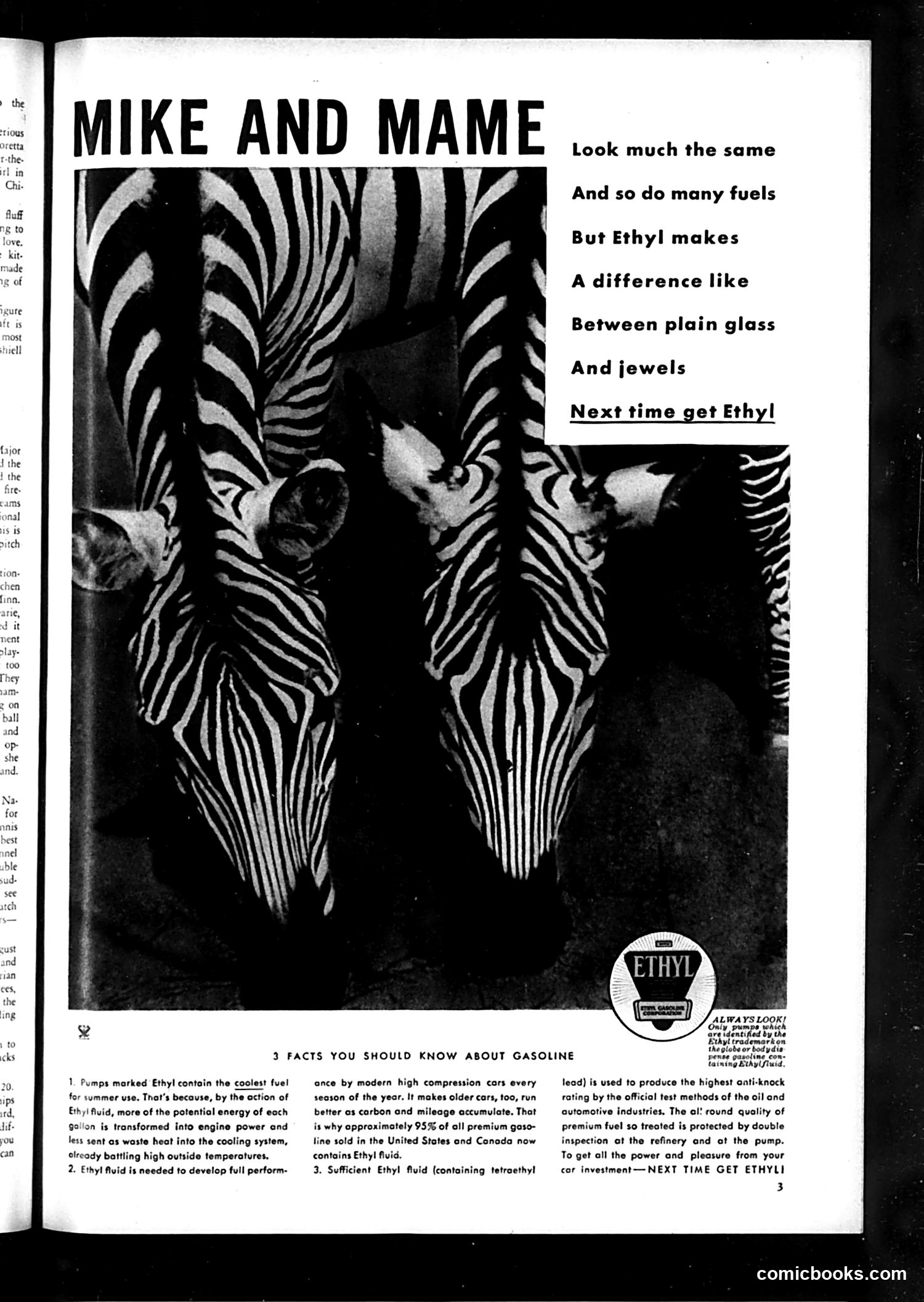
Analysis This is an advertisement for Ethyl gasoline, not political satire. The page uses the phrase "Mike and Mame" (likely referencing common names for generic "everyman" characters) to present two zebras side-by-side as a visual metaphor. The ad's message: regular gasoline and Ethyl gasoline look similar, but Ethyl contains an additive (tetraethyl lead) that makes a crucial difference—likened to the contrast between "plain glass and jewels." The three facts listed below explain Ethyl's technical advantages: superior fuel quality, better performance in high-compression engines, and protection against engine knock. This appears to be vintage advertising from the era when leaded gasoline was standard and marketed as a premium product, before lead's health hazards were widely known.
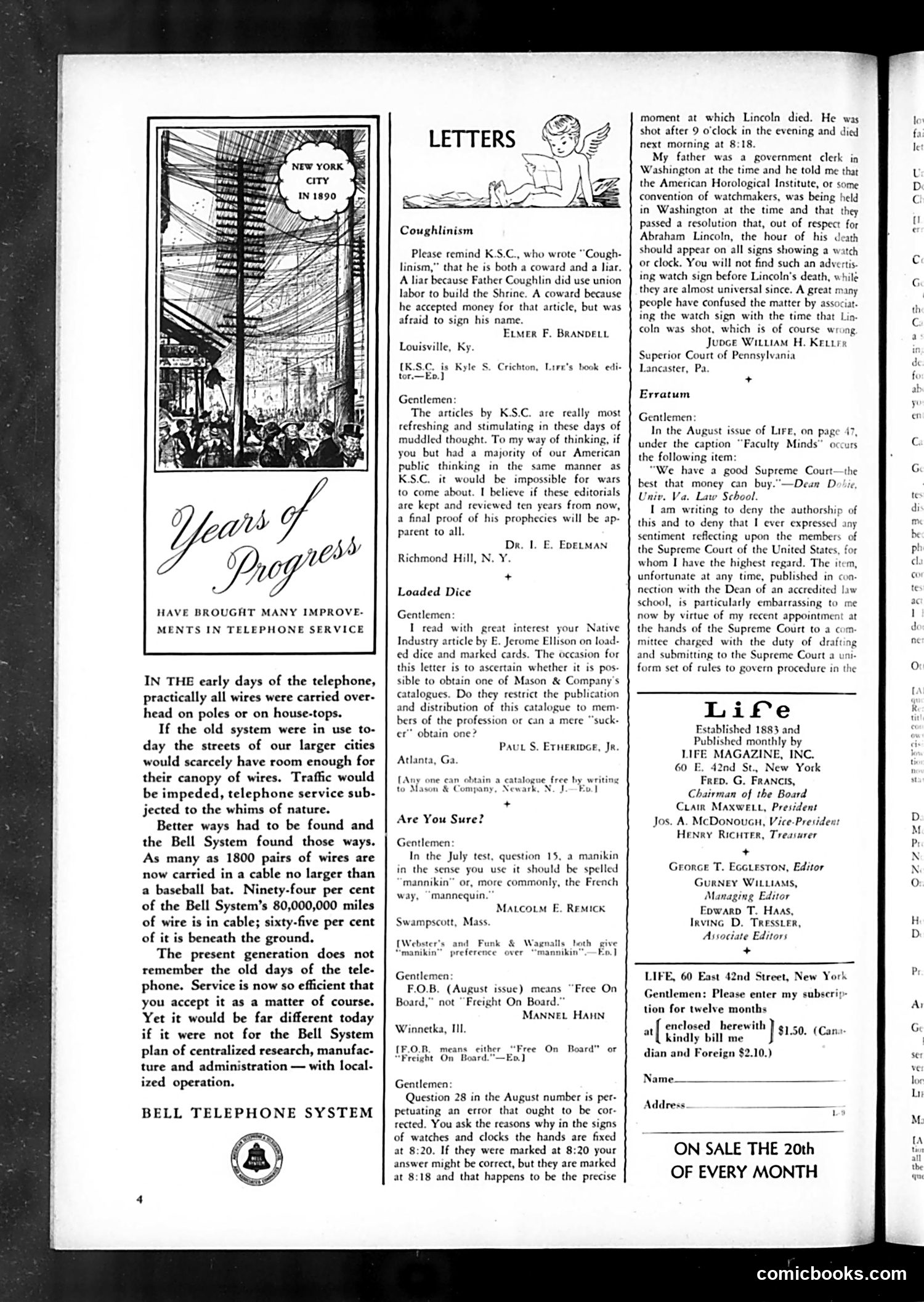
Analysis of Life Magazine Page This page is primarily letters to the editor and advertising rather than editorial cartoons. The left side features a Bell System telephone advertisement with a historical illustration of New York City in 1890, emphasizing how telephone infrastructure has expanded from those early days. The letters section addresses reader inquiries about various topics: a debate over whether Father Coughlin was a "coward and liar"; confusion about Lincoln's death time; a question about Mason & Company's dice catalog; debate over "manikin" vs. "mannikin" spelling; and confusion about F.O.B. shipping terminology. The page reflects early 20th-century concerns about language precision, commercial practices, and historical accuracy among educated readers.
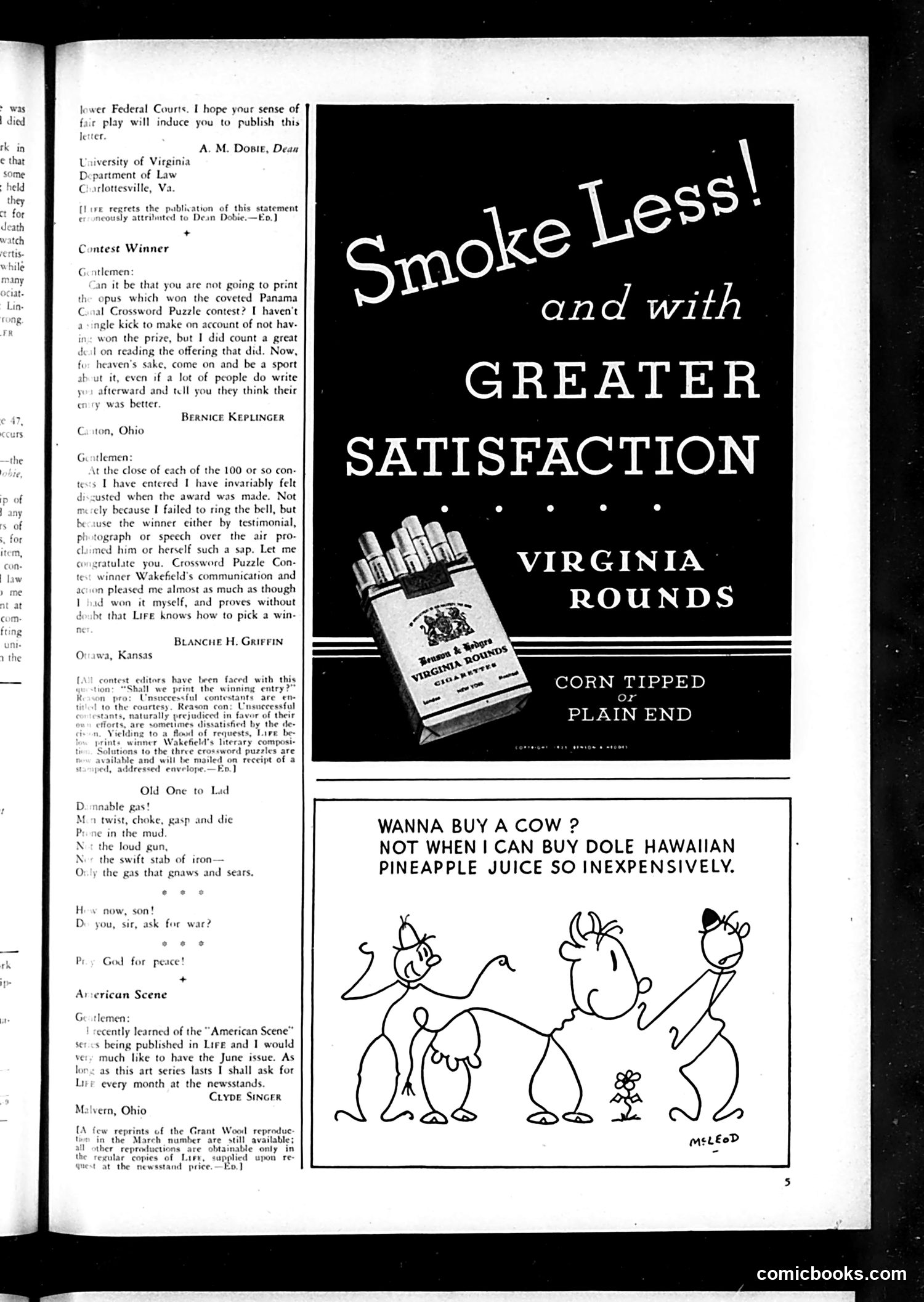
Analysis This page contains primarily advertising and reader correspondence, not political satire. The main visual content is a Virginia Rounds cigarette advertisement featuring the slogan "Smoke Less! and with GREATER SATISFACTION" — marketing a filtered cigarette by emphasizing reduced smoking volume rather than health concerns (notable given mid-century tobacco advertising practices). Below is a humorous cartoon by McLeod depicting simple stick figures discussing dairy farming. The joke: someone asks "Wanna buy a cow?" and another replies "Not when I can buy Dole Hawaiian pineapple juice so inexpensively" — a non-sequitur absurdist humor contrasting livestock ownership with affordable tropical juice, likely commenting on consumer priorities or post-war abundance. The left column contains reader letters responding to previous Life magazine contests and content, representing typical magazine correspondence of the era.
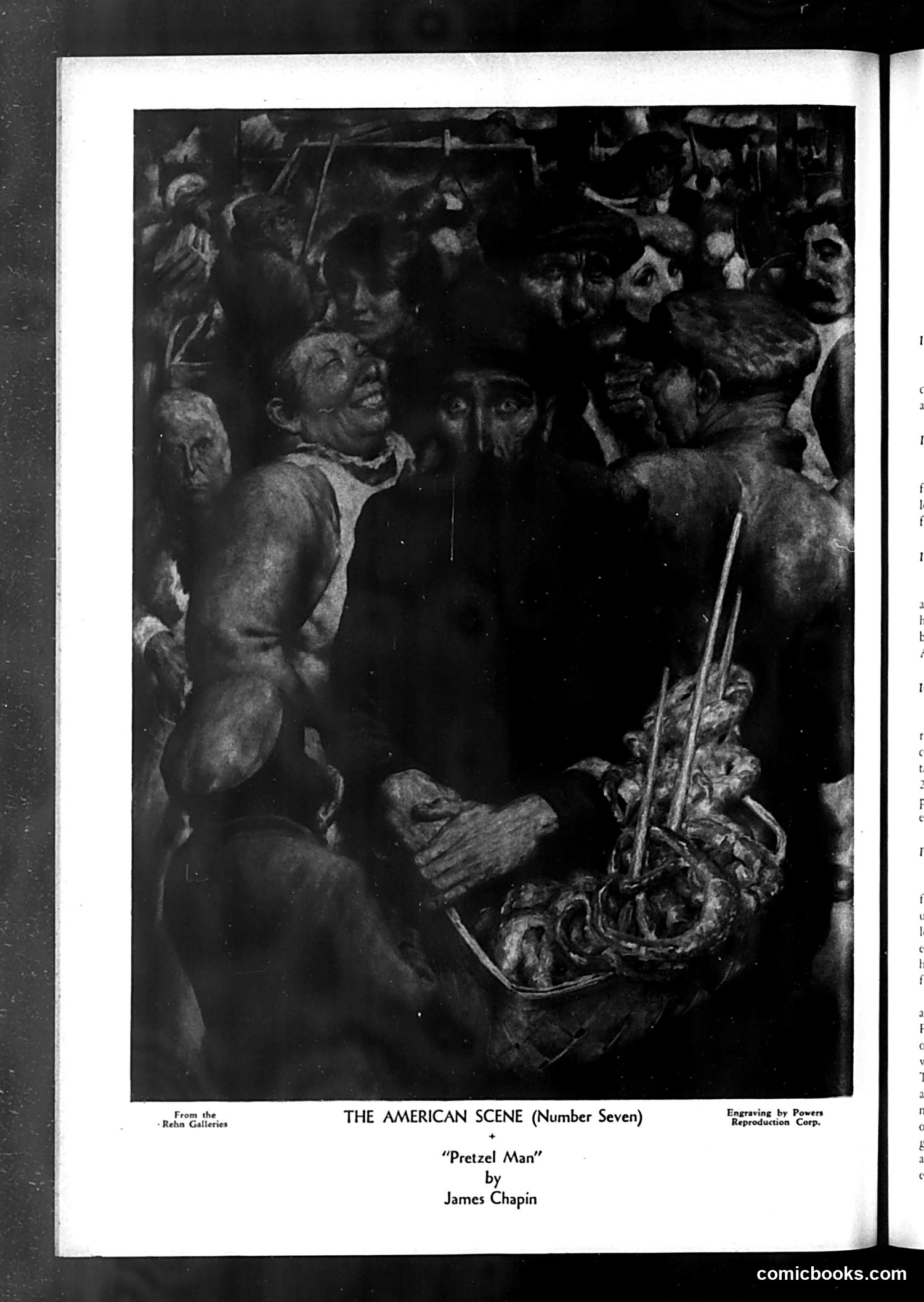
Analysis: "Pretzel Man" by James Chapin This page reproduces an artwork titled "Pretzel Man" by painter James Chapin, credited to the Rehn Galleries. The black-and-white image depicts a crowded street scene with multiple figures gathered around a central vendor or street performer. The composition suggests working-class or immigrant urban life, with figures shown in close, somewhat chaotic proximity. Without additional context about the specific date or publication, the social commentary appears to address American street commerce and working-class scenes. The "pretzel man" likely references ethnic street vendors common in early-20th-century American cities. Chapin's inclusion in *Life* magazine suggests the artwork was presented as socially significant commentary on American urban culture and class dynamics of the period.
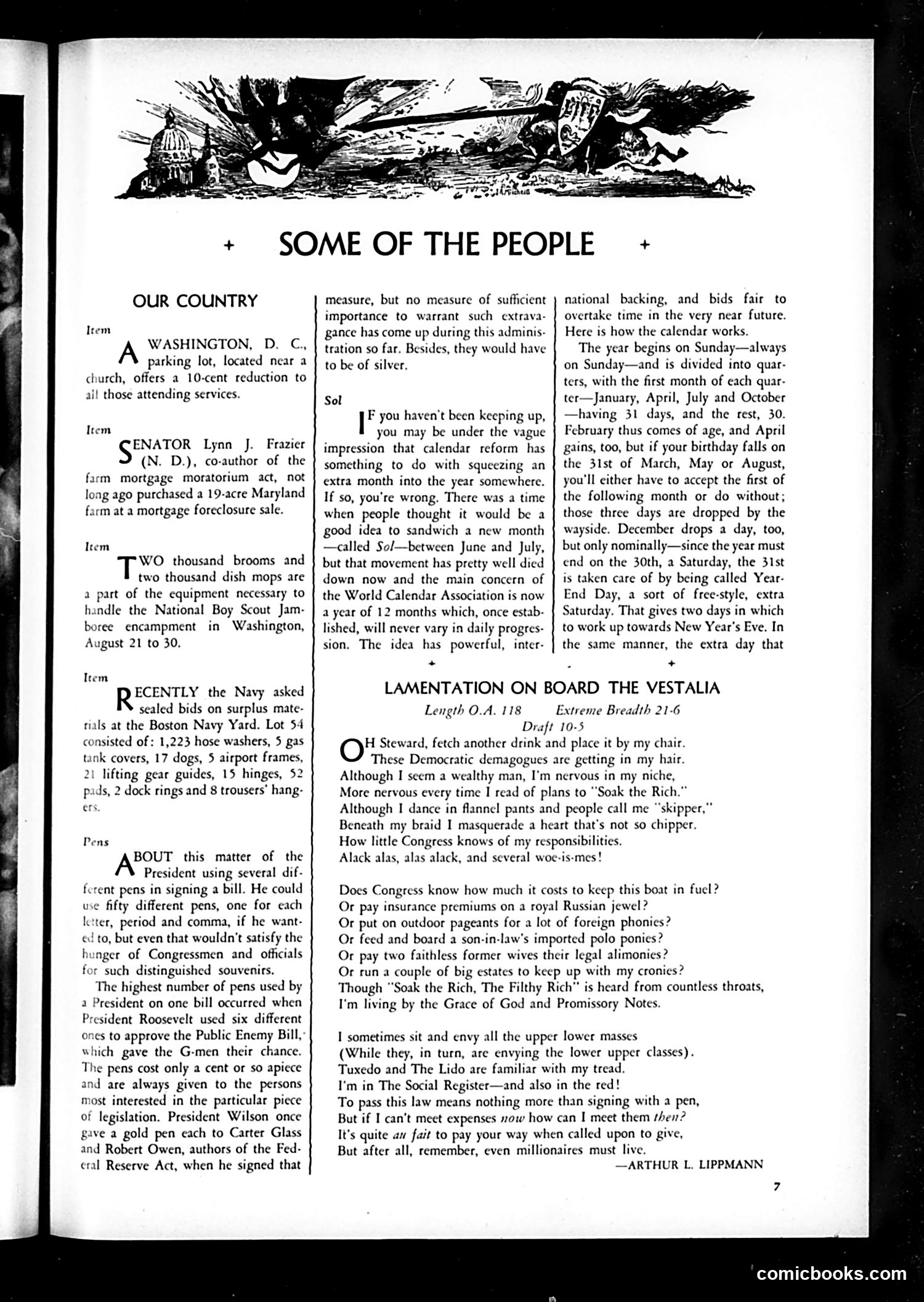
"Some of the People" - Life Magazine Page Analysis This page contains brief satirical items about American figures and institutions. The "Lamentation on Board the Vestalia" is a poem attributed to Arthur L. Lippmann, likely a wealthy person complaining about the costs of maintaining luxury and status—references to "Soak the Rich" rhetoric, keeping yachts fueled, paying former wives' alimony, and maintaining estates. The complaint appears to mock the ultra-wealthy's self-pitying attitude during economically difficult times, particularly the popular "soak the rich" sentiment of the Depression era. The other items mock government inefficiency (multiple pens used by presidents for bills) and bureaucratic absurdity. The overall tone is satirical critique of both wealthy elites and governmental excess, typical of Life magazine's social commentary.
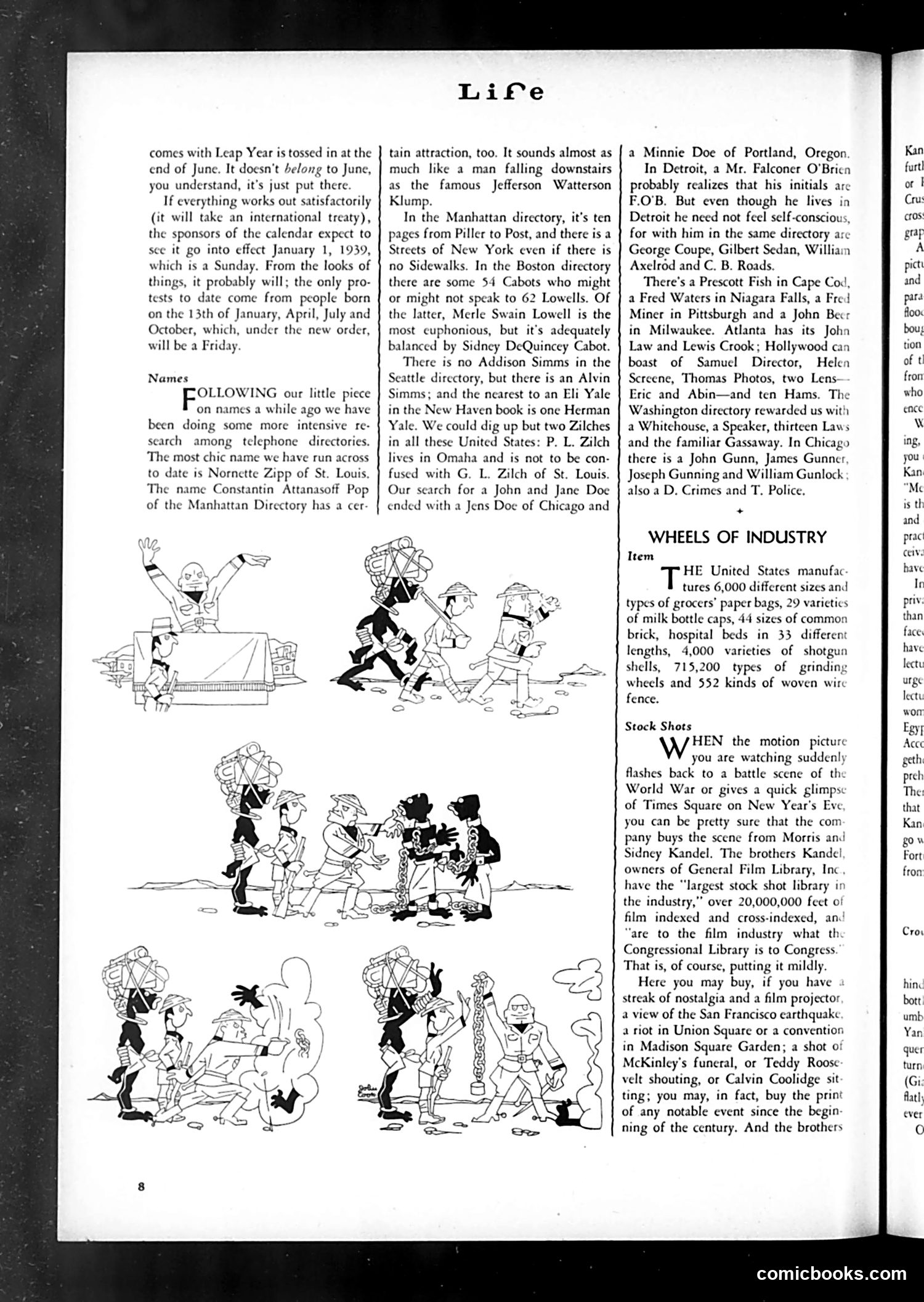
Analysis of Life Magazine Page This page contains two distinct sections: "Names" Section (left): A humorous piece about searching telephone directories for unusual names. It celebrates finding "Nornette Zipp of St. Louis" as the most chic name discovered, then catalogs amusing variations like multiple "John and Jane Does" across American cities. The accompanying cartoons show playful character sketches. "Wheels of Industry" Section (right): A straightforward informational piece listing American manufacturing statistics—6,000 paper bag sizes, 29 milk bottle cap varieties, etc.—meant to illustrate industrial diversity and productivity. "Stock Shots" Section: Describes Morris and Sindey Kandel's General Film Library, a stock footage company holding 20 million feet of indexed film available for purchase by filmmakers needing pre-existing scenes. The page mixes humor with practical industry information typical of Life magazine's editorial approach.
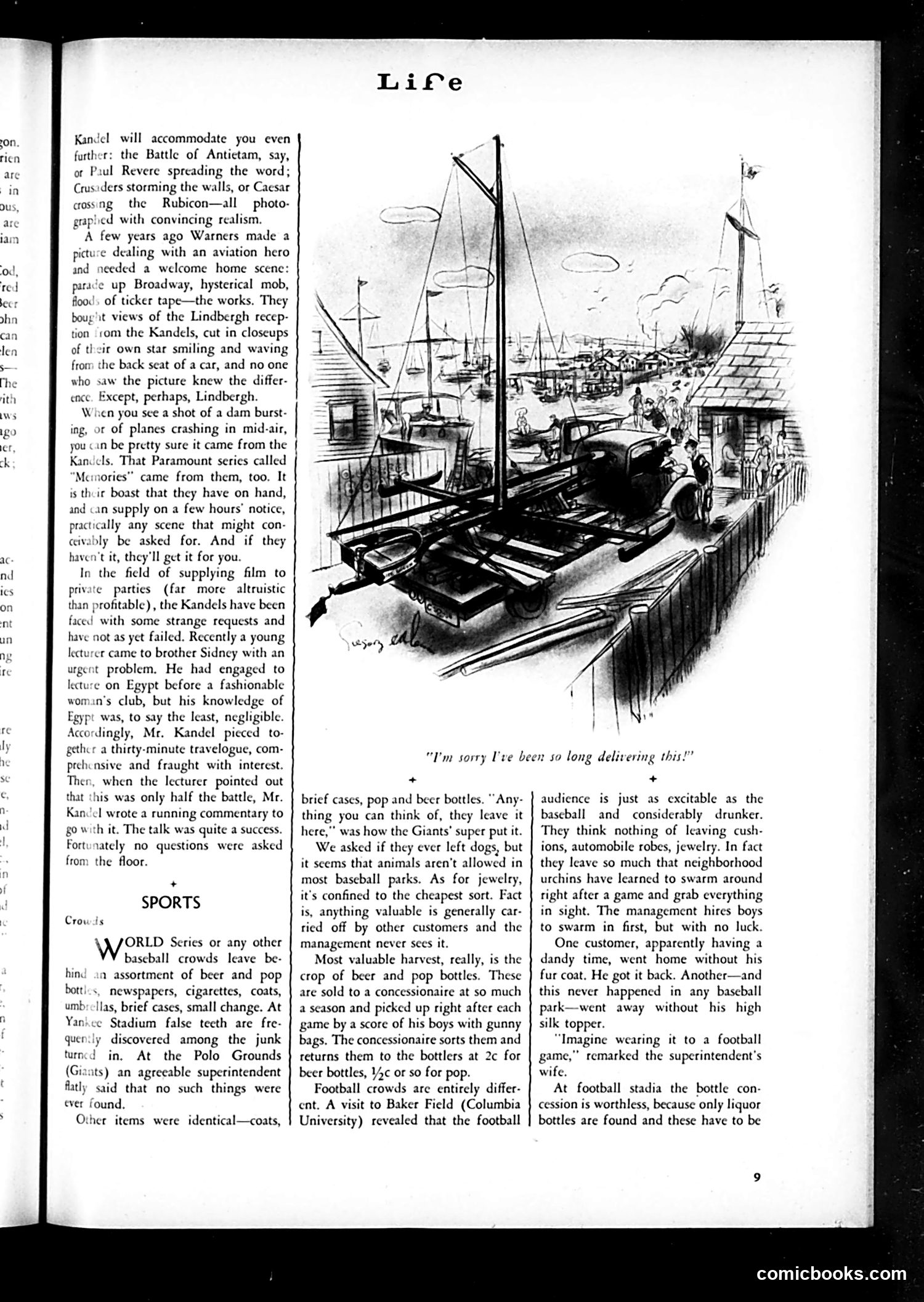
Analysis of Life Magazine Page 9 This page contains a sketch of a harbor scene with moored sailing vessels and the caption "I'm sorry I've been so long delivering this!" The accompanying text discusses how the film industry (particularly Kandel, apparently a studio executive) accommodates requests for movie scenes—Battle of Antietam, aviation footage, etc. The satire critiques Hollywood's willingness to provide any cinematic content on demand, treating film production like a delivery service. The harbor sketch humorously illustrates this concept: a slow sailing vessel apologizing for late delivery, metaphorically representing how studios scramble to fulfill client requests, sometimes delivering scenes that seem incongruously sourced or hastily assembled. The "SPORTS" section below discusses World Series crowds and baseball park concessions, showing typical period magazine content mixing entertainment industry satire with leisure activities.
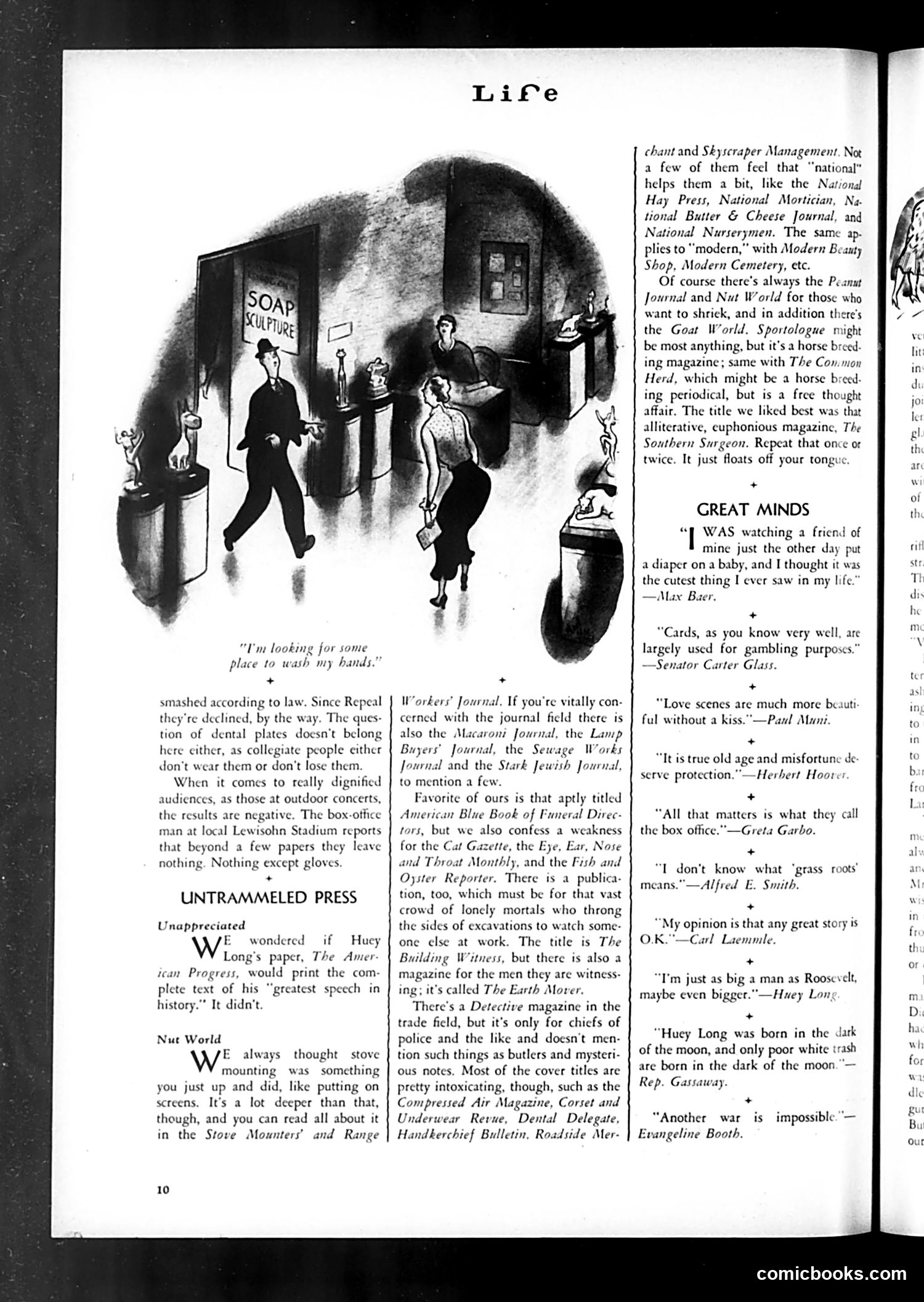
Analysis of Life Magazine Page This page contains editorial commentary on American periodicals and magazines rather than a political cartoon. The main illustration shows people in what appears to be a subway or public space, with a "SOAP" advertisement visible—likely satirizing commercial culture. The text discusses the proliferation of specialized magazines, mocking titles like *Peanut Journal*, *Nut World*, *Detective* magazines, and trade publications. The satire targets how American publishing has fragmented into increasingly narrow niches—from funeral direction to dental care to livestock breeding. The "Great Minds" section quotes celebrities' observations, appearing to contrast elevated commentary with the mundane magazine landscape being criticized. Overall, the page satirizes both magazine proliferation and American consumer culture's obsession with specialized, often trivial publications.
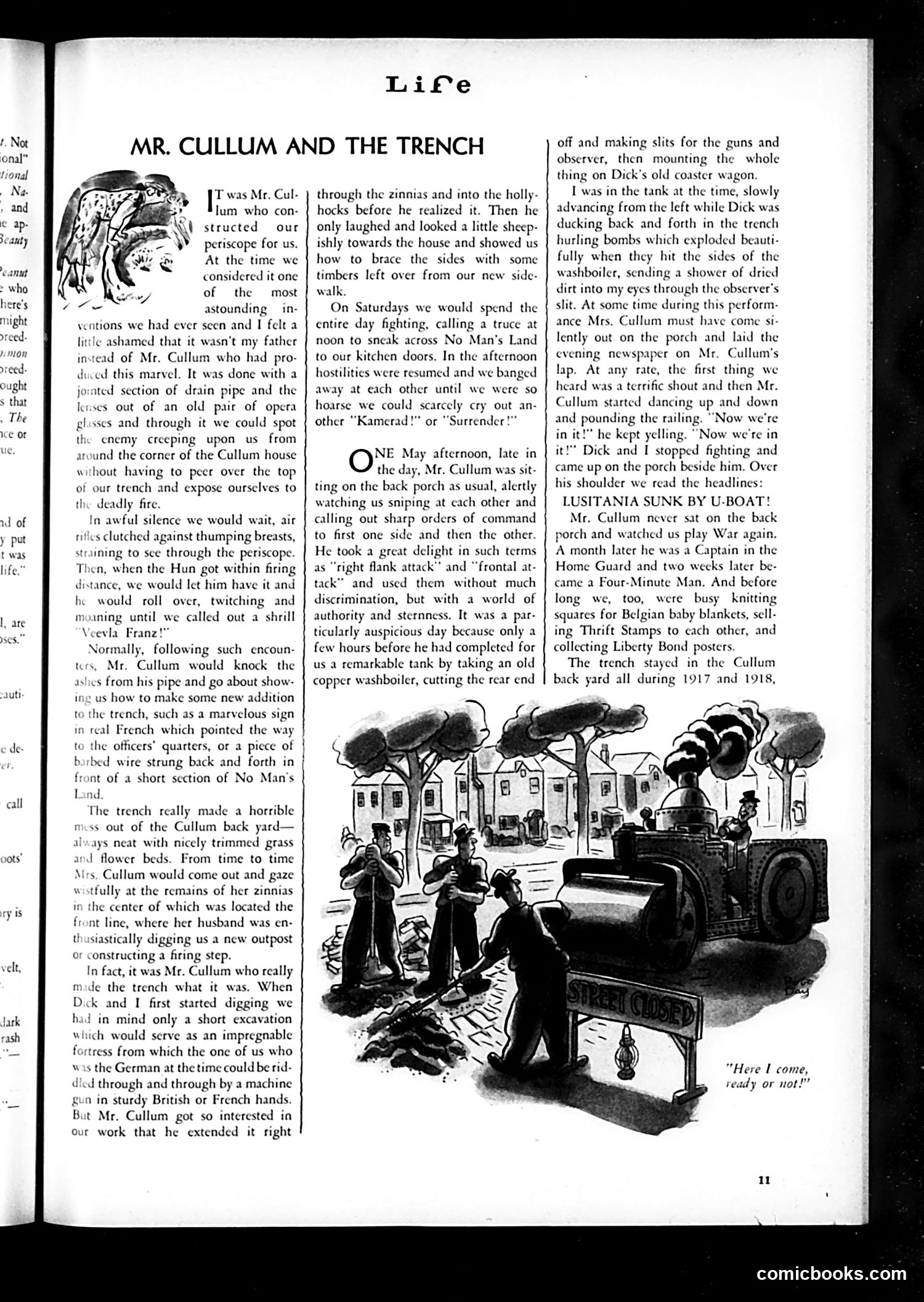
Analysis of "Mr. Cullum and the Trench" This is a humorous WWI-era account of Mr. Cullum, who constructed a trench in his backyard to simulate the Western Front experience. The narrative describes how he and his neighbor "Dick" engaged in mock warfare, complete with homemade artillery mounted on a coaster wagon and staged "attacks" using commands like "right flank attack" and "frontal assault." The satire targets American home-front enthusiasm for the war—civilians attempting to recreate combat conditions for entertainment and patriotic fervor. The illustration shows Mrs. Cullum observing the elaborate backyard military installation with apparent bewilderment ("Here I come, ready or not!"). The piece gently mocks how removed from actual warfare these backyard games were, while capturing the period's earnest, somewhat naive civilian war fever.
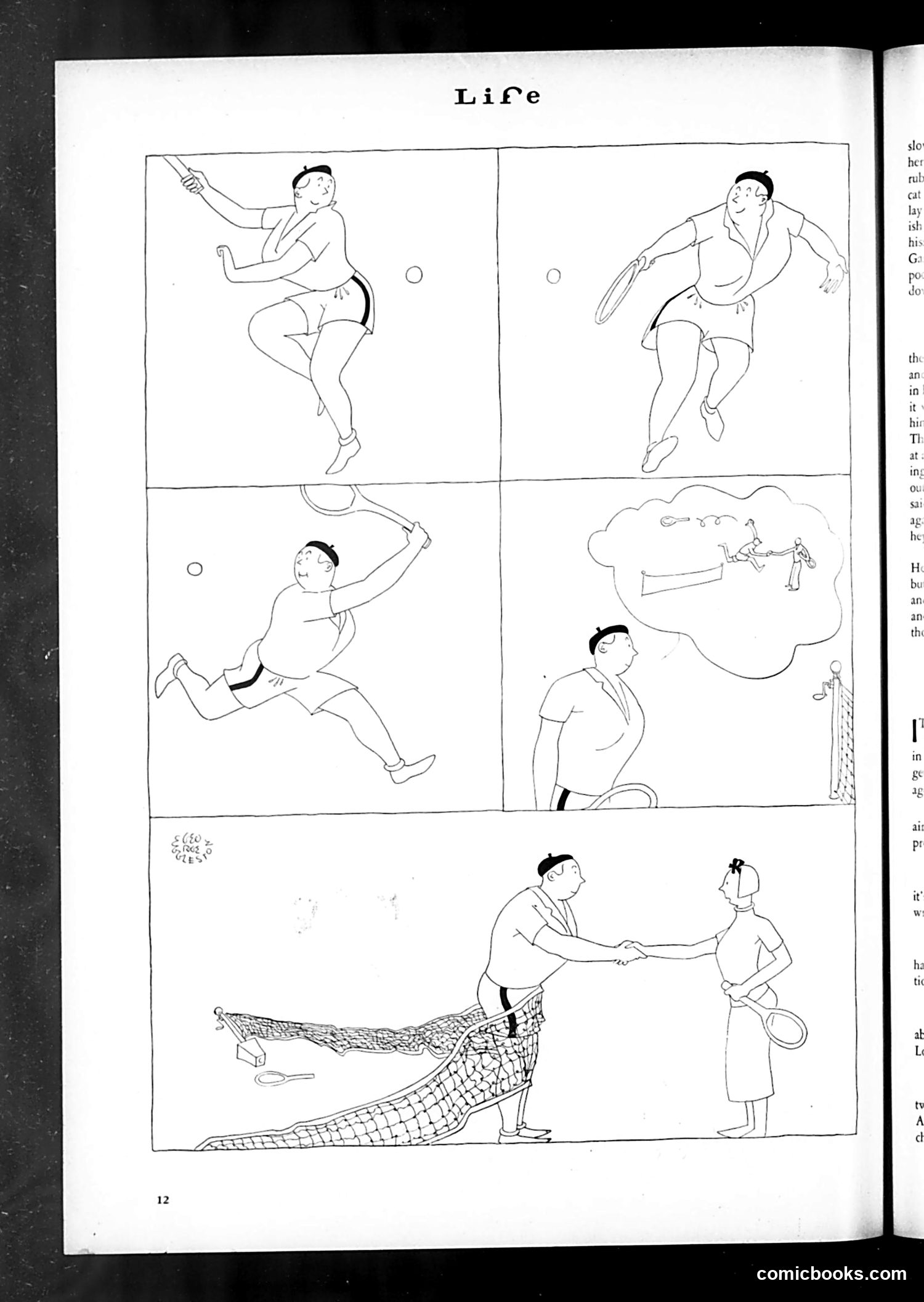
"Life" Comic Strip Page Analysis This page titled "Life" presents a six-panel comic strip depicting various recreational activities, likely from the early-to-mid 20th century based on the art style. The panels show: 1-3: A man playing tennis, progressing through serving and running movements 4: A dream sequence showing domestic leisure (man resting while woman attends to him) 5: The man awake, contemplating 6: The final panel shows the man and woman together with a large fish/crocodile, suggesting an actual fishing or hunting outing The satire appears to contrast fantasies of leisure and comfort (panel 4's domestic dream) with the reality of outdoor recreation. The humor lies in the gap between imagined relaxation and the strenuous, unpredictable nature of actual recreational pursuits. The mysterious appearance of the large creature in the final panel suggests unexpected complications arise in real life versus domestic fantasies.
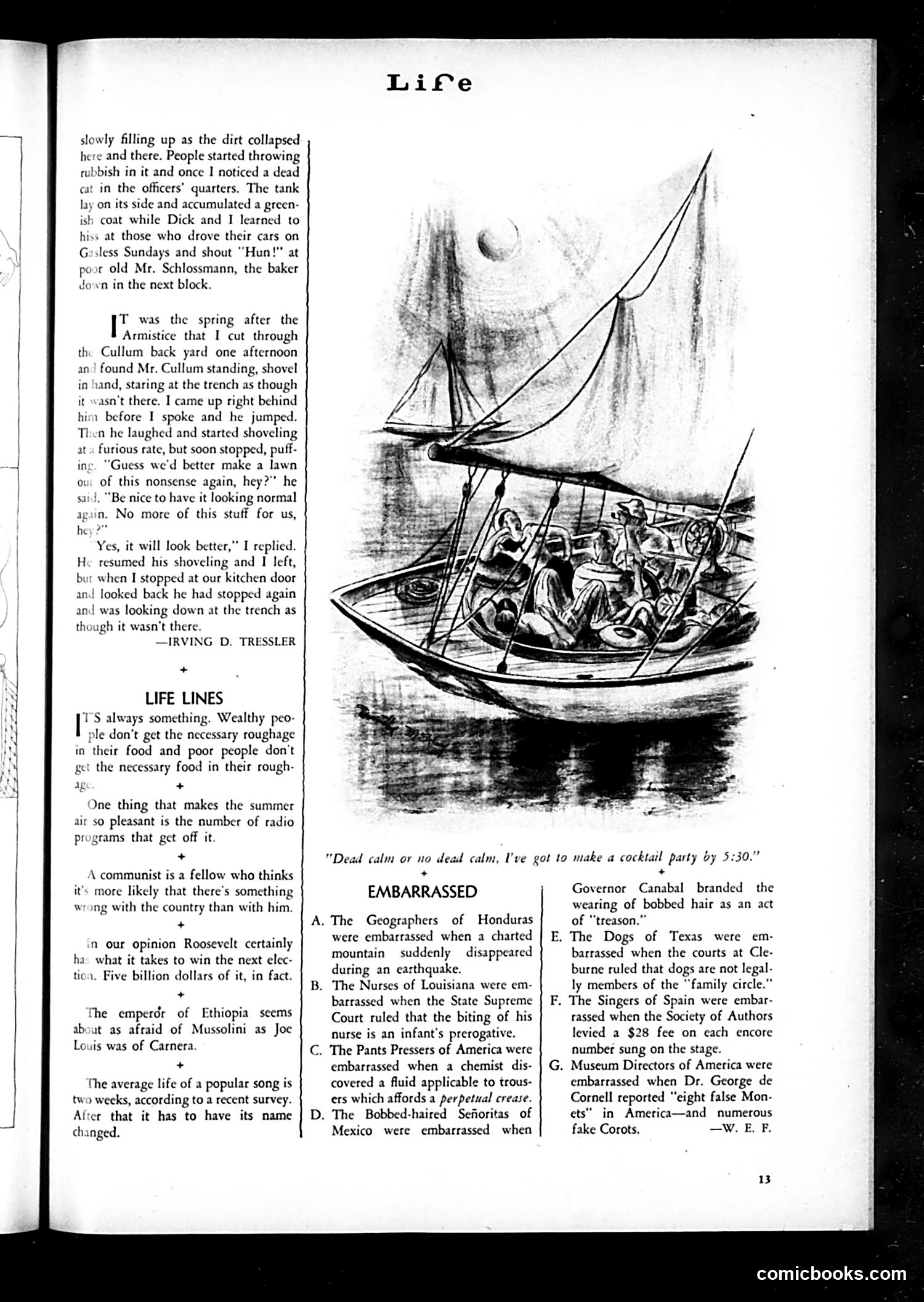
"Dead Calm or No Dead Calm, I've Got to Make a Cocktail Party by 5:30" This cartoon satirizes the priorities of wealthy leisure-class Americans, showing a sailboat in rough seas with passengers apparently unconcerned about dangerous conditions. The caption jokes that social obligations (attending a cocktail party) override practical safety concerns—a common Life magazine theme mocking upper-class frivolity and disconnection from reality. The accompanying "Life Lines" section contains satirical one-liners targeting various groups: communists, Roosevelt's political prospects, and Ethiopia's emperor. The "Embarrassed" feature humorously chronicles professional groups caught in awkward situations (nurses, geographers, etc.), using exaggeration to highlight social pretension and institutional absurdity. Overall, the page exemplifies Life's mid-20th-century style: mocking wealthy obliviousness through gentle satire.
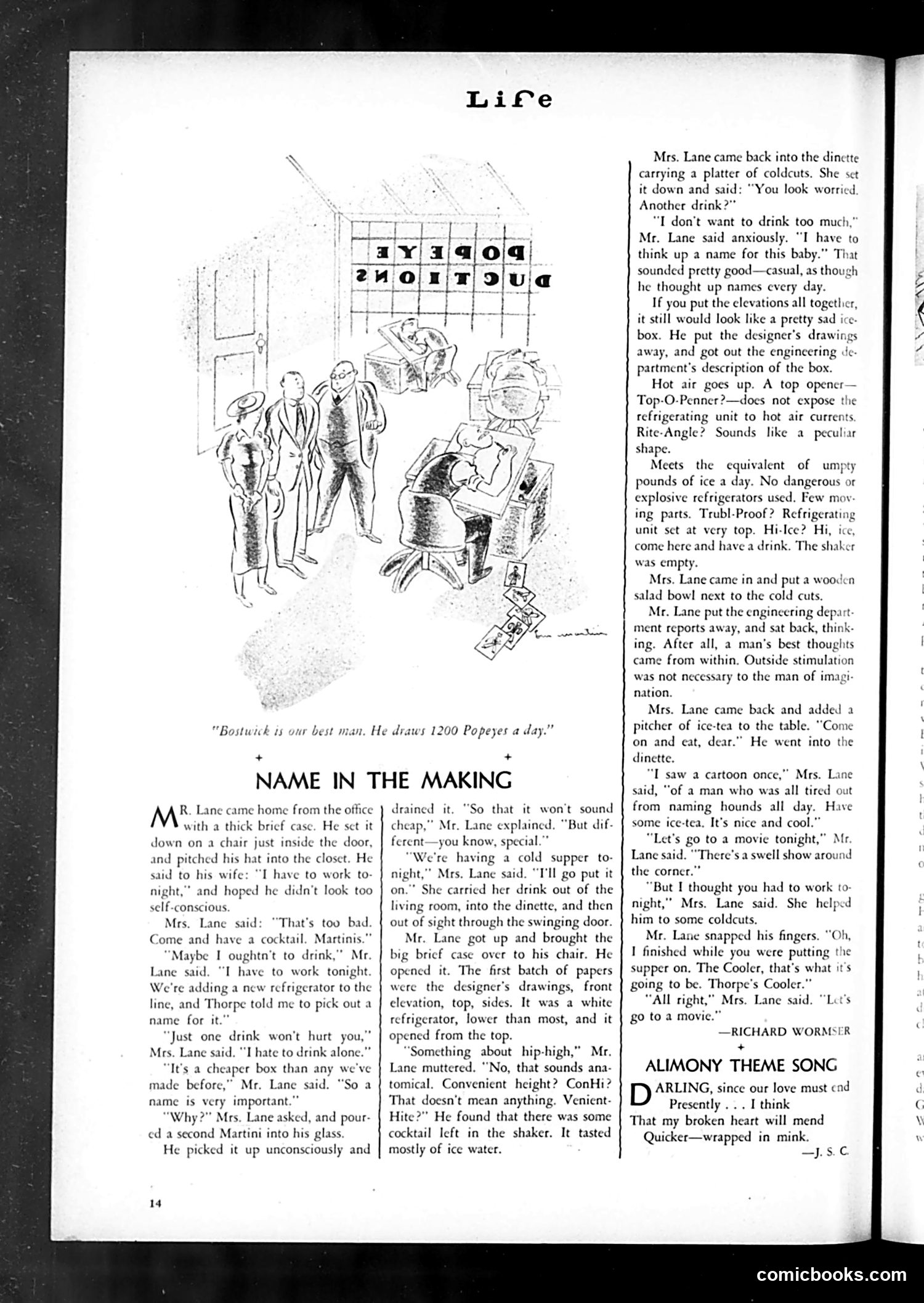
"Name in the Making" - Life Magazine Cartoon Analysis This is a domestic humor piece about Mr. Lane, who works in an office designing refrigerators. The cartoon shows him at home discussing naming a new refrigerator model with his wife Mrs. Lane. The satire targets corporate product-naming conventions and male creative pretension. Mr. Lane takes the refrigerator naming seriously, claiming "a man's best thoughts came from within" and rejecting outside stimulation—yet he's merely naming kitchen appliances. The joke is that he treats mundane consumer product design with overwrought artistic self-importance. Mrs. Lane's practical interruptions (offering drinks, suggesting movies) highlight the absurdity of his self-conscious creative posturing over something as ordinary as a household appliance. The cartoon mocks mid-century corporate culture and masculine pride in trivial design decisions.
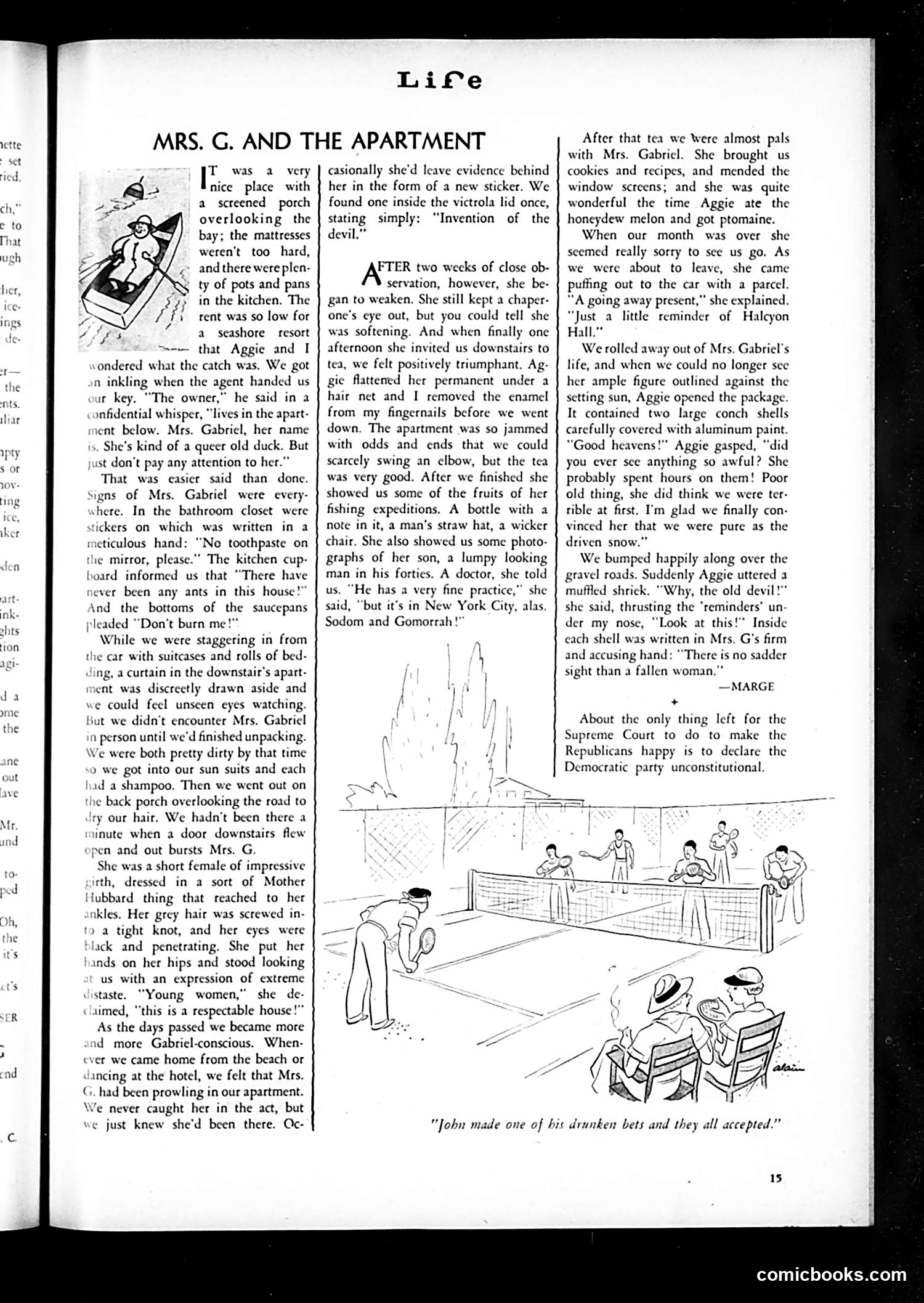
Analysis: "Mrs. G. and the Apartment" This is a humorous domestic narrative illustrated with sketches. The story describes an eccentric landlady named Mrs. Gabriel who intrudes into tenants' private lives with unsolicited cleaning advice and opinions. The accompanying illustrations show everyday scenes: a woman resting on a beach chair, and a tennis match. The political content appears minimal on this page. A brief editorial note at bottom-right references "the only thing left for the Supreme Court to do...declare the Democratic party unconstitutional," suggesting 1930s-era Republican critique of New Deal policies. The primary humor derives from Mrs. Gabriel's meddlesome nature and the narrator's resigned acceptance of her intrusions—a relatable domestic comedy rather than sharp political satire. The piece reflects mid-20th century American magazine humor targeting social awkwardness.
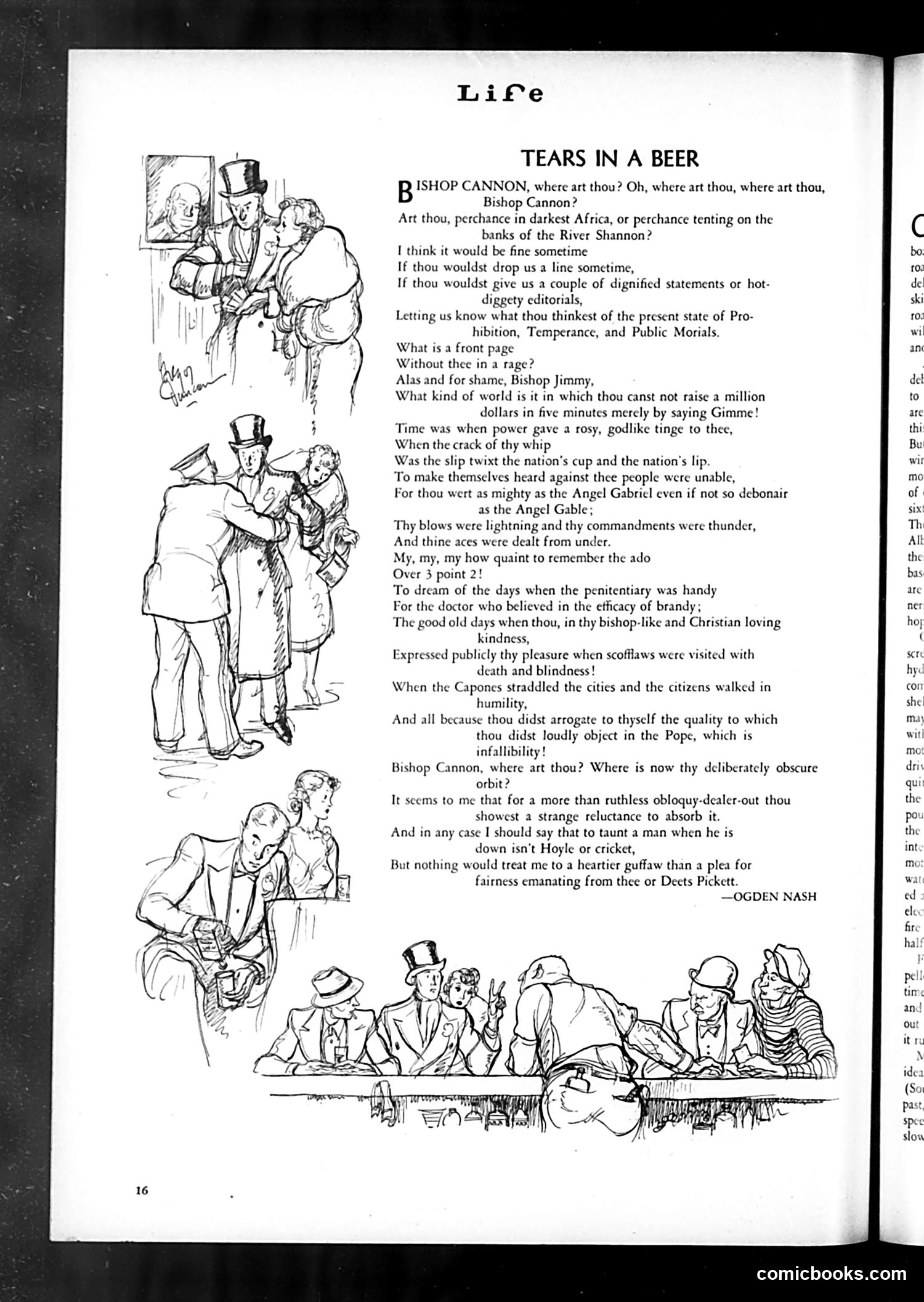
"Tears in a Beer" by Ogden Nash This satirical poem by humorist Ogden Nash addresses Bishop Cannon, a real historical figure (unclear from image alone which specific Bishop Cannon, but likely James Cannon Jr., a Methodist prohibitionist active in early 20th-century American politics). Nash mocks Cannon's apparent hypocrisy and moral authority on issues like Prohibition and "Public Morals." The repeated refrain "where art thou?" sarcastically questions Cannon's absence from public discourse or his evasiveness. The accompanying sketches show well-dressed men in bars or social settings, likely illustrating the contradiction between moral preaching and actual behavior during Prohibition. The satire suggests that strict moral crusaders like Cannon were disconnected from—or complicit in—the realities they condemned.
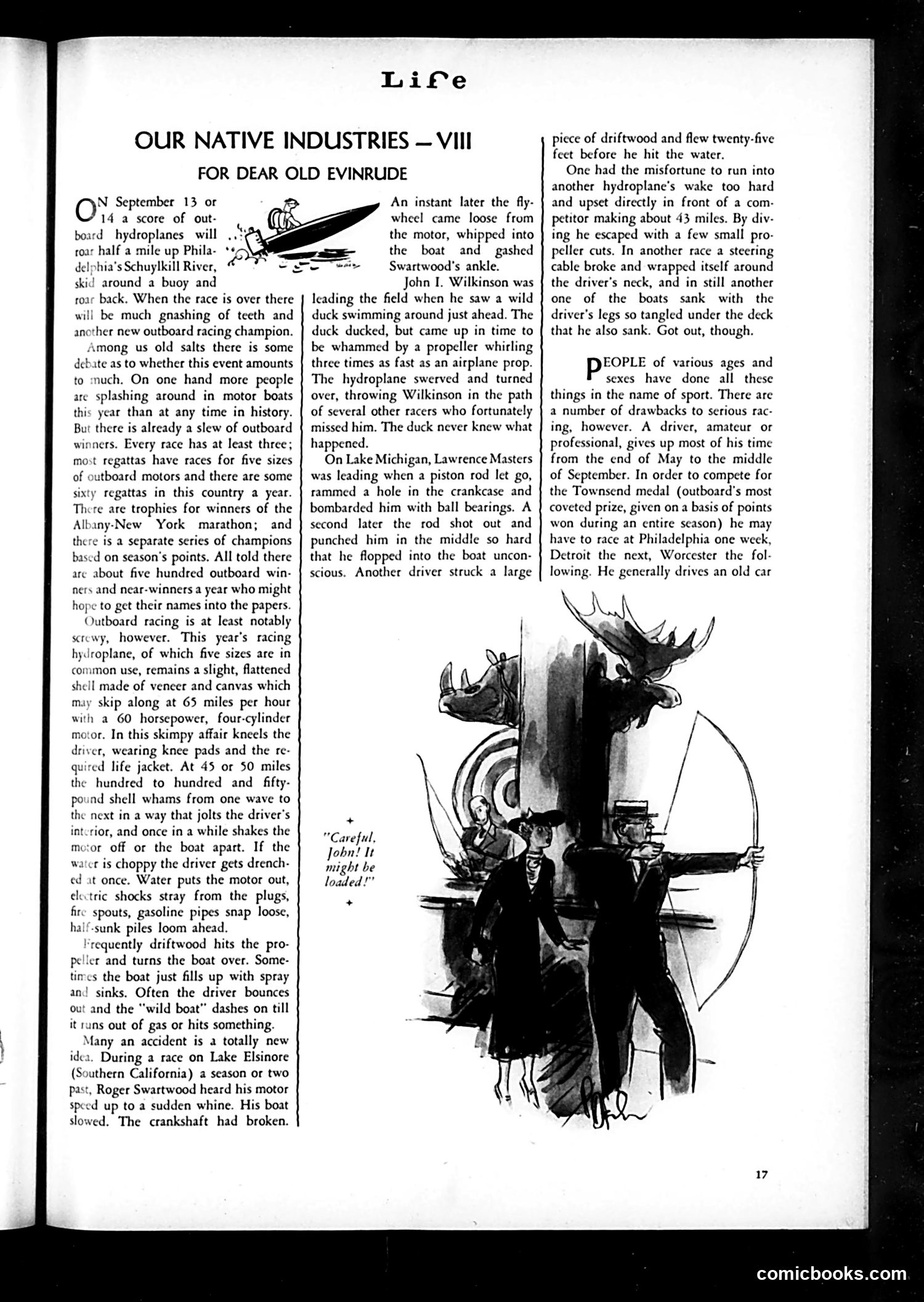
Analysis of Life Magazine Page This page discusses hydroplane racing, a popular early 20th-century sport. The article, "Our Native Industries—VIII: For Dear Old Evinrude," describes various accidents and dramatic incidents from competitive outboard motorboat racing on lakes across America. The accompanying illustrations depict racing mishaps: one shows a hydroplane flipping or crashing (top), while the lower cartoon humorously illustrates two men in formal dress nearly capsizing a boat, with the caption "Careful, John! It might be loaded!" The humor targets amateur boaters—likely wealthy dilettantes—who engaged in dangerous racing without proper skill. The satire mocks both the sport's inherent risks and the social pretension of gentlemen attempting competitive motorboat racing, playing on contemporary anxieties about new mechanical technologies and amateur sporting enthusiasm.
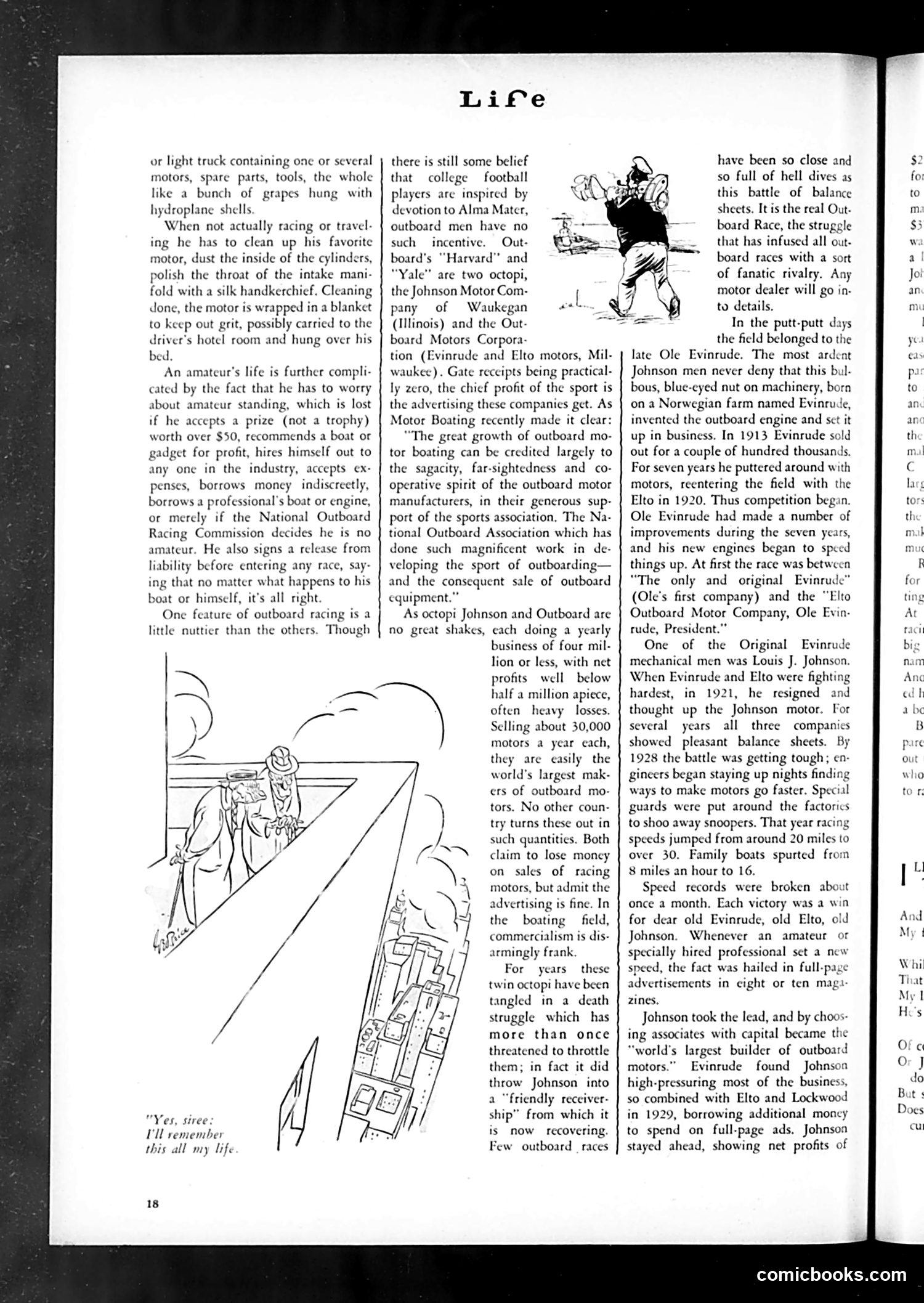
Analysis of Life Magazine Page This page discusses outboard motor racing and the business competition between Johnson and Evinrude motor companies. The cartoons illustrate the "death struggle" between these two manufacturers for market dominance in the growing recreational boating industry. The text describes how both companies claimed superiority, advertised aggressively in magazines, and competed fiercely on racing speeds—jumping from 20 mph to over 30 mph in boats. The bottom cartoon shows two businessmen (likely representing Johnson and Evinrude executives) in a small motorboat, with the caption "Yes, siree; I'll remember this all my life"—a sardonic comment on their bitter rivalry. The satire mocks the commercialism and exaggerated advertising claims both companies used to win market share during this competitive period.
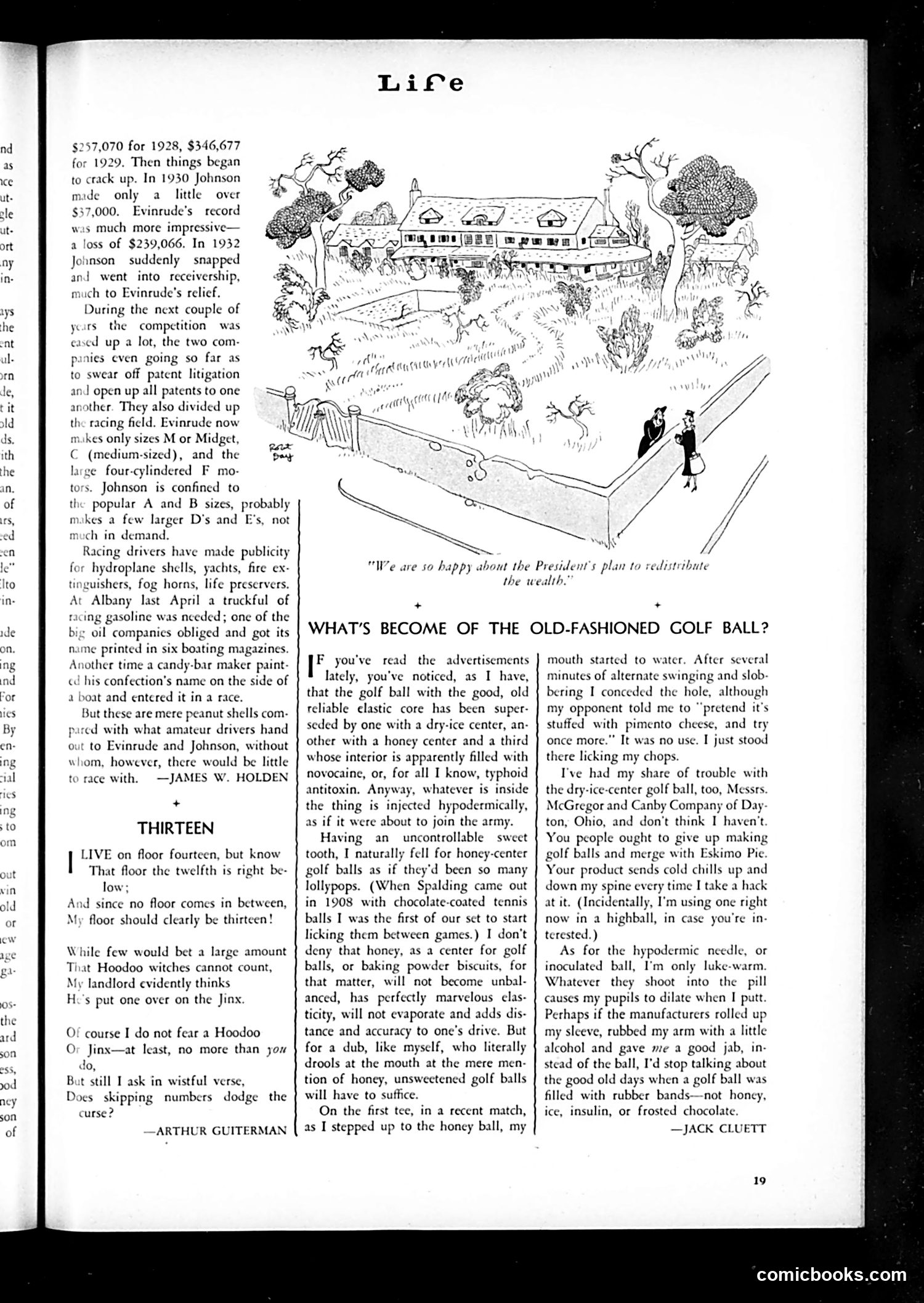
Analysis of Life Magazine Page 19 This page contains two unrelated pieces of satirical content: The Illustration: Shows a rural homestead with two figures in period dress observing the property. The caption references "the President's plan to redistribute the wealth," satirizing what appears to be Franklin D. Roosevelt's New Deal policies of the Depression era. The joke critiques wealth redistribution by depicting ordinary citizens observing someone else's redistribution of *their* property. "What's Become of the Old-Fashioned Golf Ball?" is a humorous essay by Jack Cluett discussing how modern golf balls with synthetic cores (versus old honey-filled balls) perform poorly. This is consumer-focused satire about product quality decline—a popular Life magazine theme mocking contemporary manufacturing compromises.
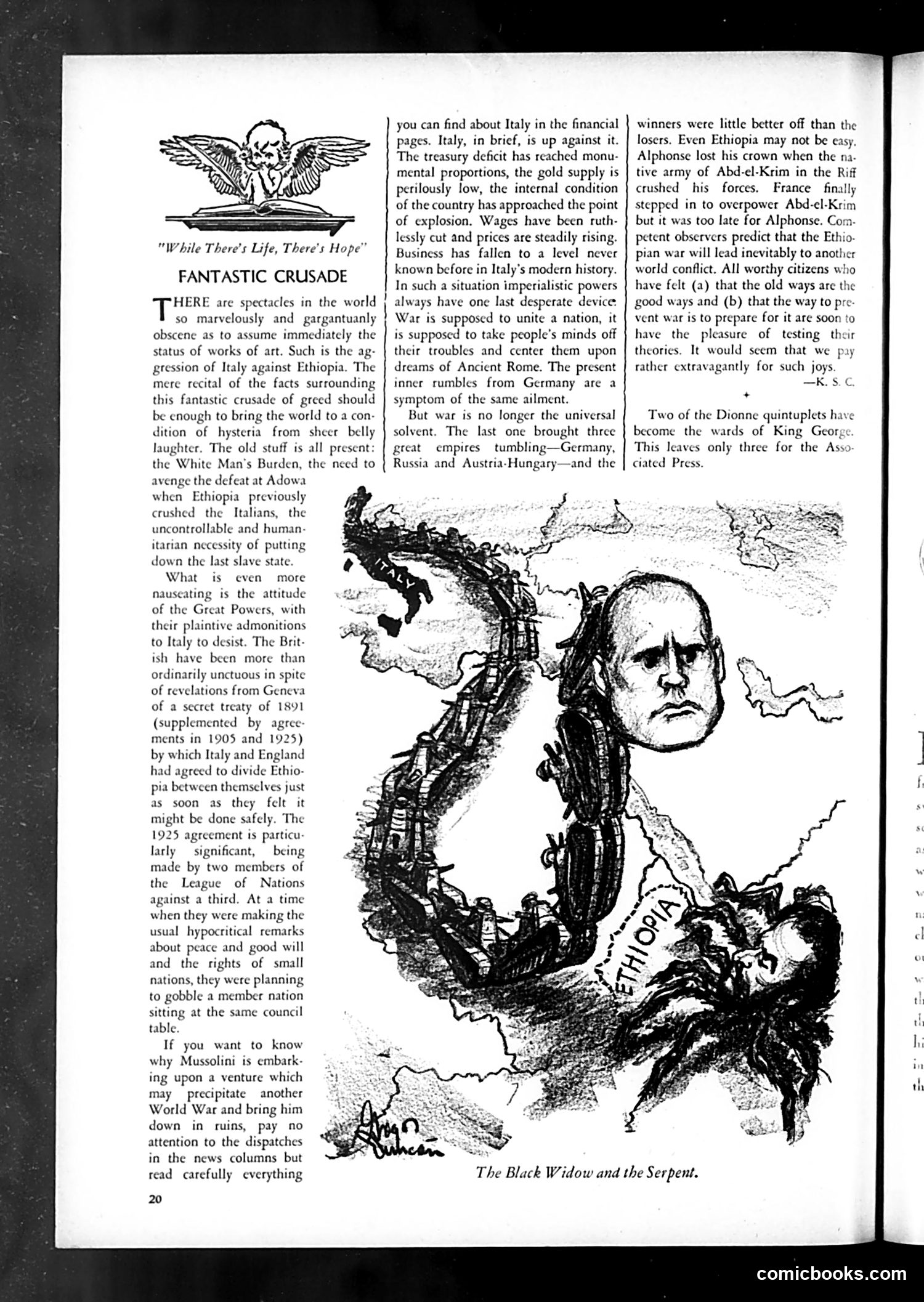
"The Black Widow and the Serpent" This political cartoon satirizes Italy's 1935 invasion of Ethiopia. The illustration depicts Italy as a serpent coiled around Ethiopia (labeled), with Mussolini's stern face emerging from the snake's body. The "Black Widow" reference in the caption likely alludes to Italy as a predatory female figure. The accompanying article excoriates Italy's aggression as economically motivated—driven by Italy's financial crisis, not humanitarian concerns. It mocks the hypocrisy of Western powers (particularly Britain) who publicly condemned the invasion while secretly holding a 1891 treaty agreeing to partition Ethiopia. The text criticizes the League of Nations for allowing member nations to plot against fellow members. The cartoon argues that imperialistic war, presented as unifying and glorious, is actually a desperate gamble by failing governments. For modern readers: this depicts pre-WWII fascist aggression and the failure of international institutions to prevent it.
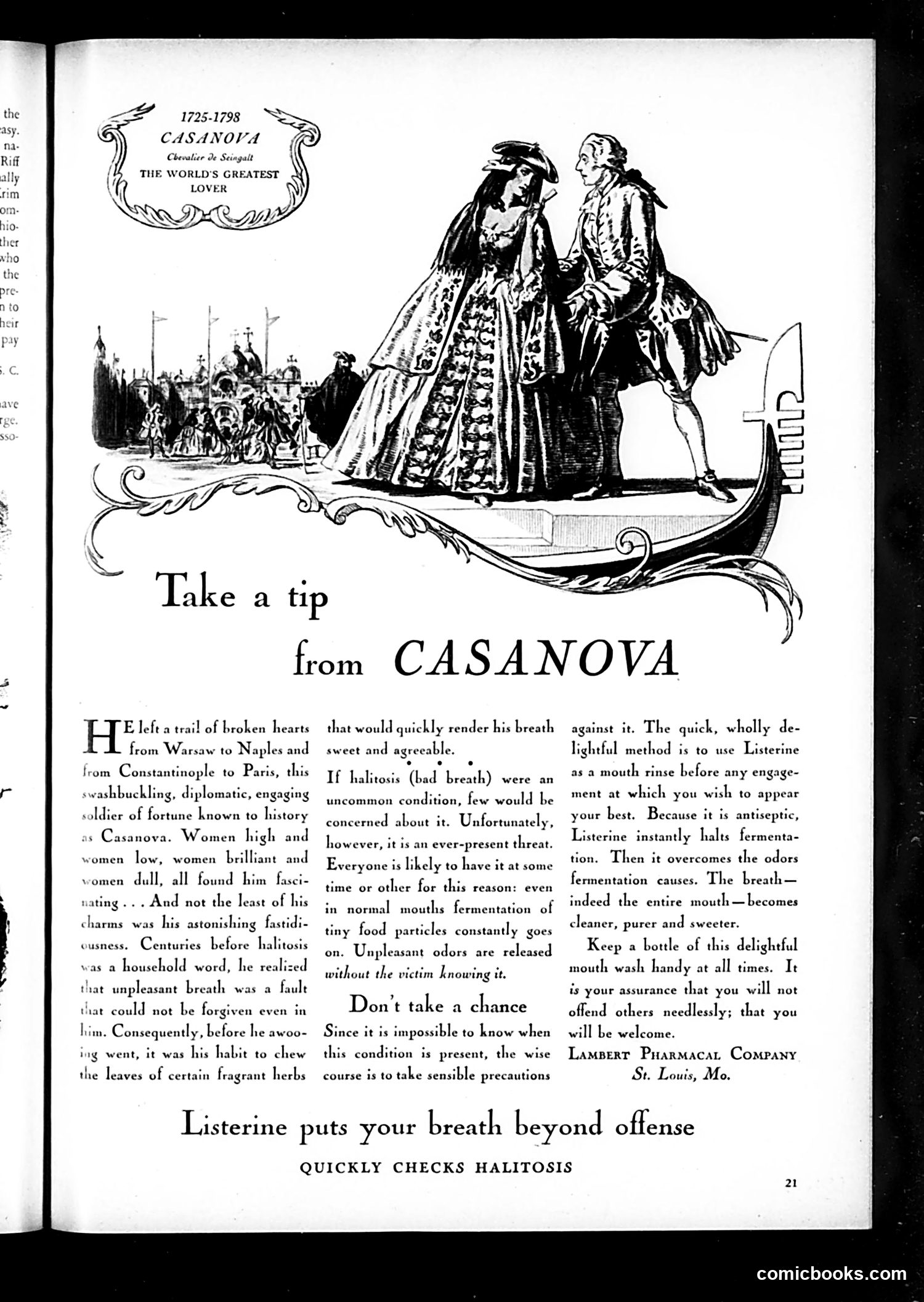
Casanova and Bad Breath: A Vintage Advertisement This is a Listerine mouthwash advertisement disguised as humor. The page invokes Casanova (1725-1798), the famous historical lover, to sell a product addressing "halitosis"—a term actually coined by Listerine's marketing in the 1920s to create anxiety around bad breath. The joke/sales pitch: Even history's greatest seducer succeeded partly through meticulous personal hygiene, specifically chewing fragrant herbs to sweeten his breath. The implication is clear—if Casanova needed fresh breath to charm women, so do you. The satire works by elevating a mundane hygienic product through romantic historical association, while the accompanying narrative explains halitosis in pseudo-scientific terms (food fermentation) to justify why the product is "necessary." This was typical early-20th-century advertising: manufacturing social anxiety to drive sales of consumer products.
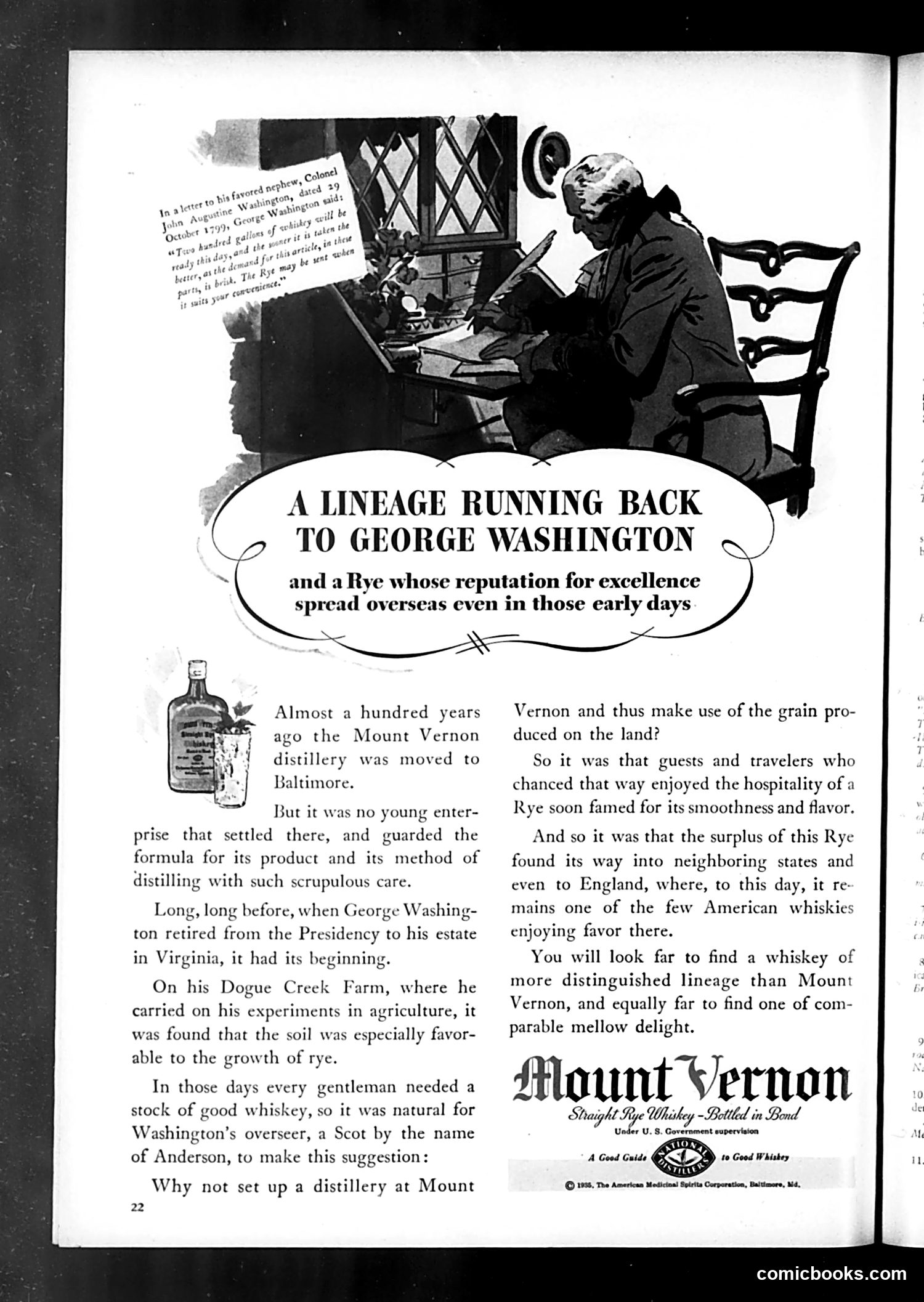
Mount Vernon Whiskey Advertisement This is a whiskey advertisement, not satire or political commentary. It's a 1938 marketing piece for Mount Vernon brand rye whiskey that uses historical prestige-building rather than humor. The ad claims the product descends from a distillery George Washington established on his Virginia estate using rye grown on his Dogue Creek Farm. It credits Washington's Scottish overseer, Anderson, with suggesting the operation. The narrative emphasizes the whiskey's "distinguished lineage" and long reputation for quality, even claiming it was exported to England. The illustration shows a colonial-era figure (likely representing Washington or his overseer) at a desk near a latticed window with a bottle and glass visible. This is straightforward brand heritage marketing—associating the product with America's founding father and early national prestige to justify its premium position and price. No satire is present; the ad simply leverages historical association for commercial purposes.
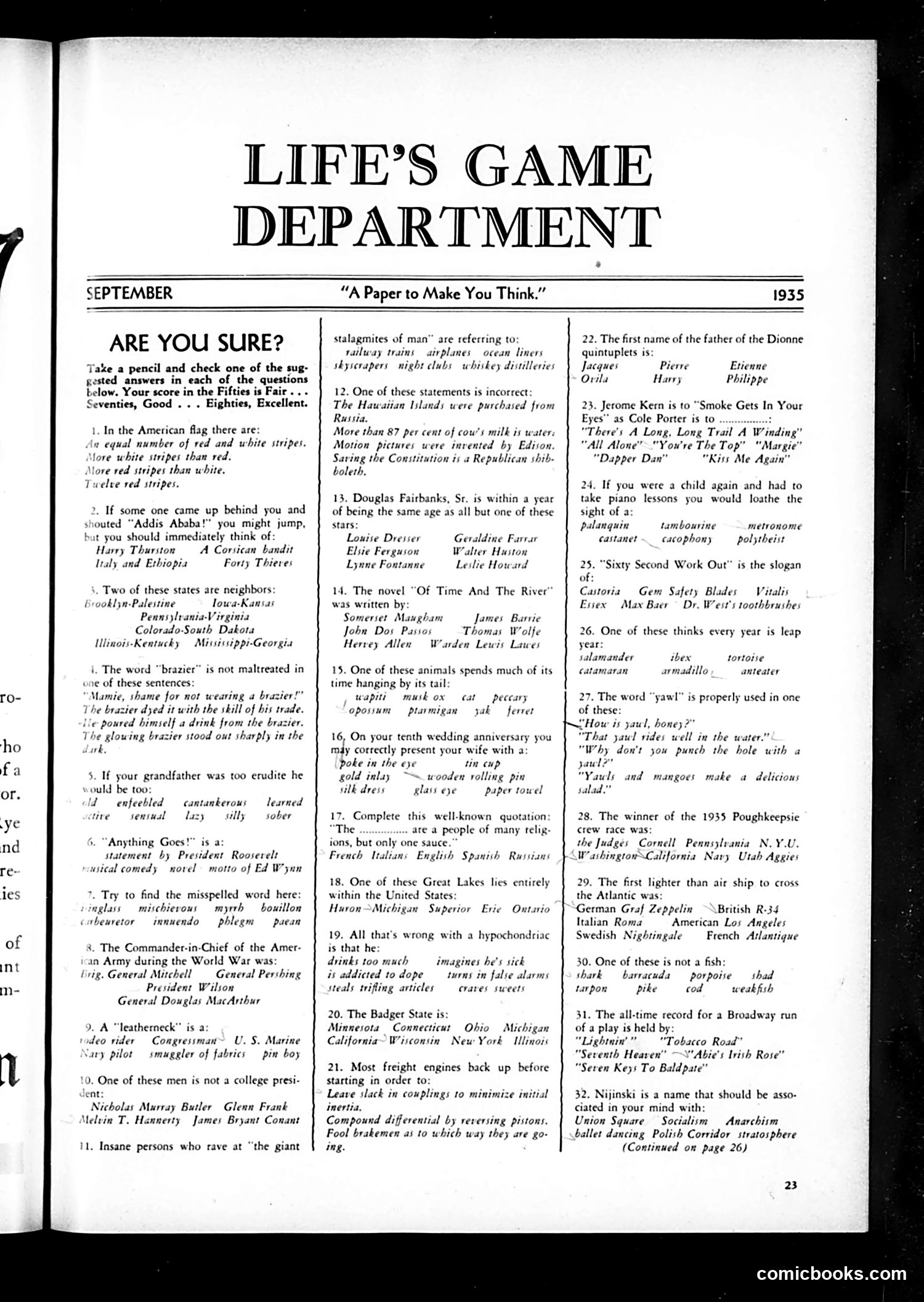
Life's Game Department - September 1935 This page features "Are You Sure?", a trivia quiz game testing readers' knowledge across history, geography, current events, and pop culture. It's designed as entertainment with scoring levels ("Fifties is Fair," "Eighties, Excellent"). The questions reveal 1935 preoccupations: references to Ethiopia (likely Mussolini's invasion that month), President Roosevelt, Hawaiian Islands, and contemporary entertainers like Douglas Fairbanks Sr. and the Dionne quintuplets (famous Canadian septuplets born 1934, major media sensation). Questions about World War generals and Great Lakes suggest typical educational trivia. The satire is gentle—poking fun at readers' assumed gaps in knowledge while celebrating American pop culture and current events. The quiz format itself was popular entertainment for magazines, offering both mental challenge and self-assessment humor. The title "Are You Sure?" playfully suggests readers often get answers wrong despite confidence.
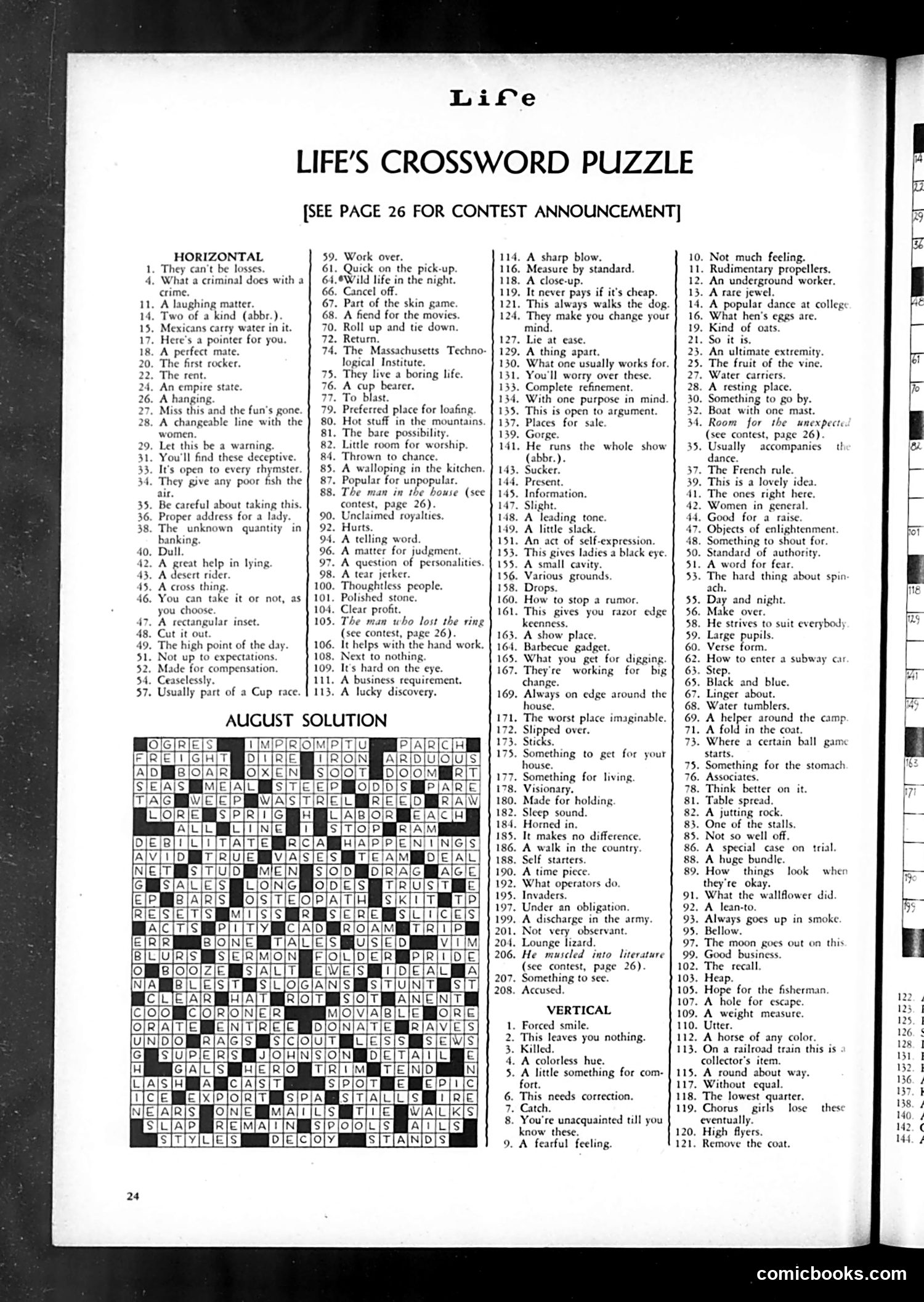
Life's Crossword Puzzle - August Solution This page presents Life magazine's crossword puzzle and its solution — a standard entertainment feature of the publication. There are no political cartoons or satirical commentary visible. The puzzle itself is a lighthearted word game with clues referencing everyday 1920s-30s life: "What a criminal does with a crime" (HIDES), "A perfect mate" (SOUL), "Popular for unpopular" (THE MAN IN THE HOUSE). Some clues reference contemporary culture or technology of the era. Notably, three clues reference "the man who lost the ring (see contest, page 26)," "He muscled into literature (see contest, page 26)," and "He ran the whole show (abbr.)" — suggesting this puzzle tied to a broader contest or current event described elsewhere in the magazine, though those details aren't visible here. This is purely recreational content with no satirical intent.
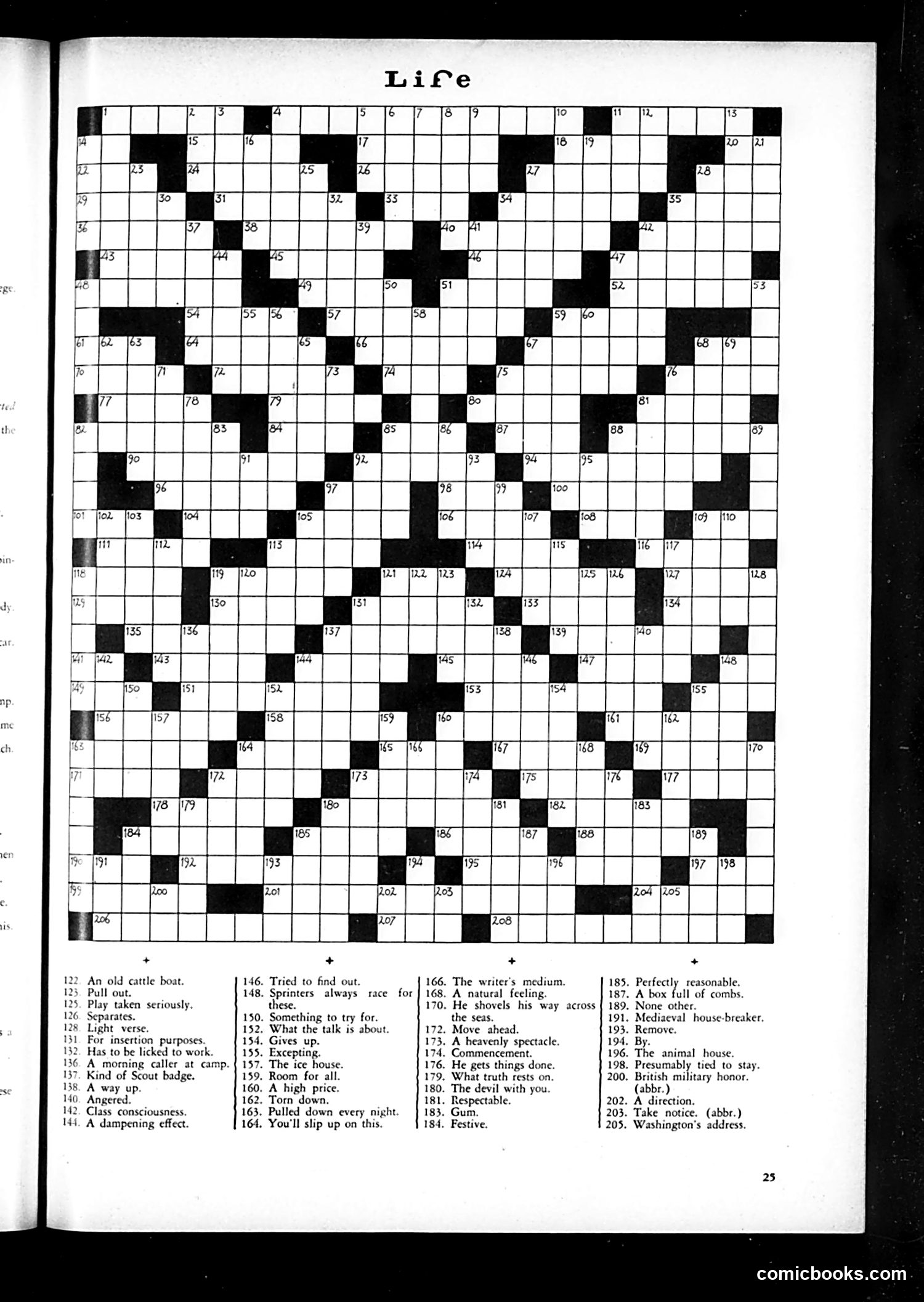
This is a Crossword Puzzle, Not a Political Cartoon This page from *Life* magazine contains a crossword puzzle titled "Life," not a political cartoon or satirical illustration. The numbered grid and accompanying clue list are standard crossword format. The clues are wordplay and riddles typical of crossword puzzles from this era—puns and indirect definitions requiring solvers to think laterally. For example, "An old cattle boat" (122 Down) likely means "ark," and "A dampening effect" (144 Across) suggests "wet blanket." Without a publication date visible on this page, the specific historical context is unclear, though references like "Washington's address" (205) and "British military honor" suggest mid-20th-century American content. The puzzle itself is entertainment, not social or political commentary.
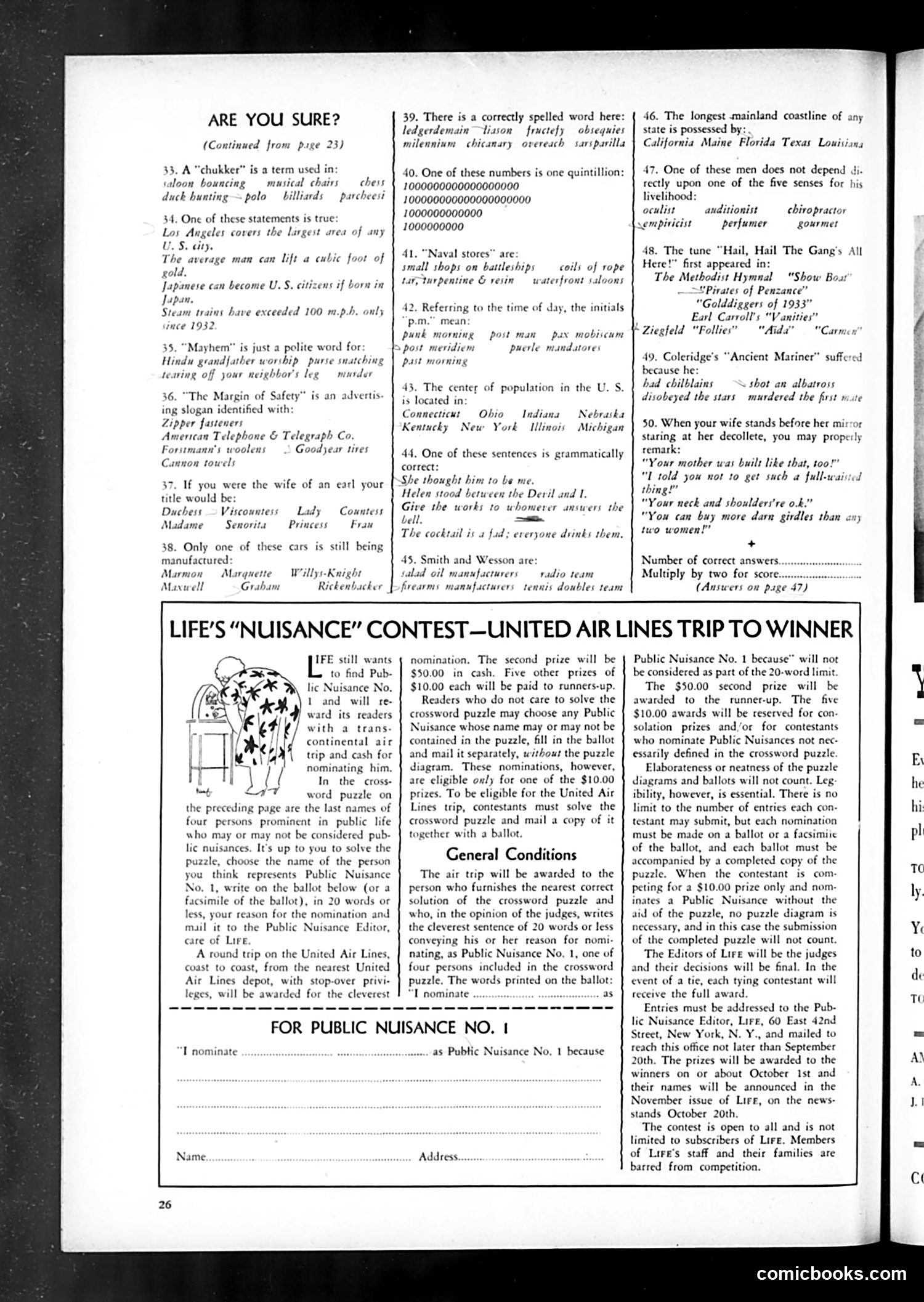
Life Magazine's "Public Nuisance" Contest This page features Life magazine's satirical contest asking readers to identify "Public Nuisance No. 1"—a prominent public figure considered bothersome or objectionable. Readers must solve a crossword puzzle containing four names of public figures, then nominate which one they consider the greatest nuisance, writing a 20-word explanation. The contest offers a United Air Lines trip as the grand prize, with $50 cash and additional $10 prizes for runners-up. The specific names in the puzzle are not visible here, but the contest reflects Life's tradition of irreverent social commentary—inviting readers to publicly shame whoever they deemed most irritating in public life during this period. The page also contains a trivia quiz ("Are You Sure?"), typical of Life's humor features.
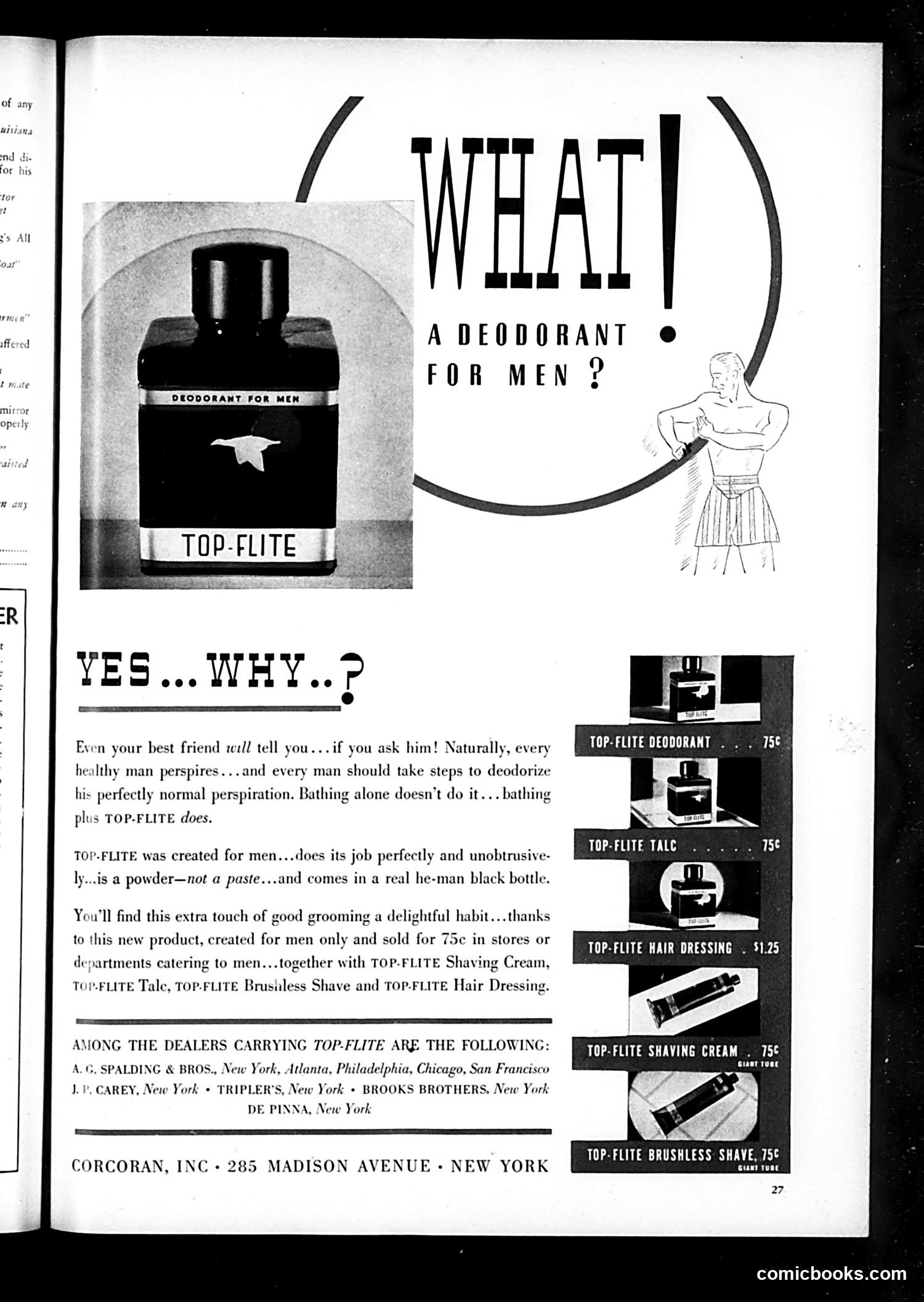
TOP-FLITE Deodorant Advertisement This is a vintage advertisement, not satire or political commentary. It promotes TOP-FLITE deodorant powder for men, employing a common mid-century advertising strategy: manufactured anxiety about social acceptability. The ad uses the rhetorical device "Even your best friend won't tell you"—implying men suffer from body odor but are too embarrassed to be warned about it. The illustration shows a woman with a thought bubble containing the product, suggesting female approval motivates male grooming. The marketing emphasizes masculine appeal: the product comes in a "real he-man black bottle," is powder (not paste), and targets "men only." The copy reassures buyers that healthy perspiration is "perfectly normal" but requires deodorizing—normalizing insecurity to sell the solution. Distribution through upscale men's retailers (Brooks Brothers, Spalding) positioned it as a grooming essential for aspirational consumers.
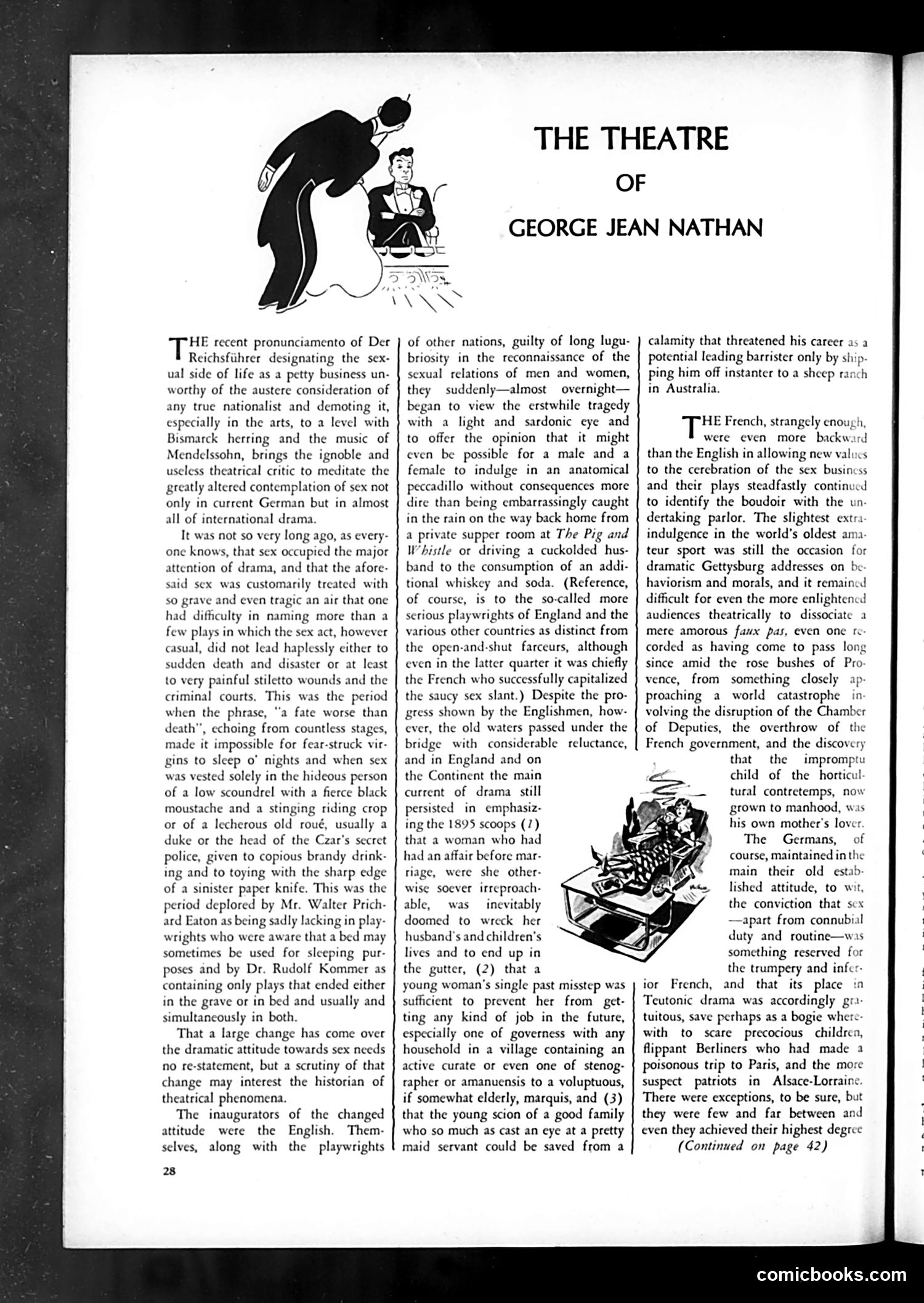
"The Theatre of George Jean Nathan" - Life Magazine This is a theatre criticism column by George Jean Nathan discussing how attitudes toward sex in drama have evolved across nations. The illustration shows a caricatured German military figure (likely referencing Nazi ideology) bowing obsequiously to a seated gentleman—satirizing the "recent pronouncement of Der Reichsführer" (a Nazi official) who declared sexual content unworthy of serious nationalist art. Nathan's essay traces how English playwrights gradually moved away from Victorian melodrama—where premarital sex meant "a fate worse than death," suicide, or villainy—toward more realistic portrayals where intimate relations needn't catastrophically end lives. He contrasts this progress with Continental drama's persistent moral rigidity regarding women's virtue and past indiscretions. The satire targets both German prudishness and outdated theatrical conventions treating sexuality as inherently tragic rather than human.
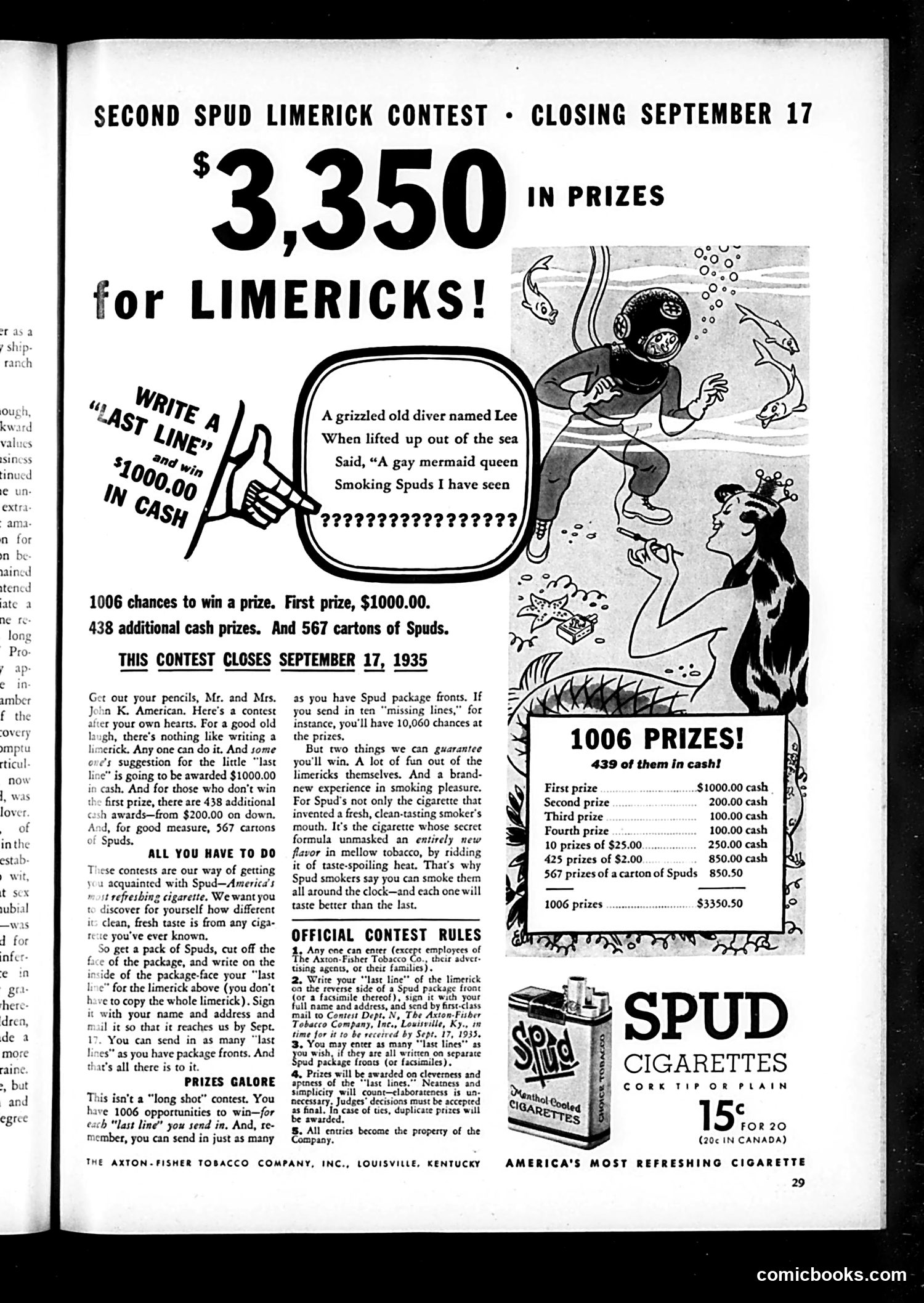
Spud Cigarettes Limerick Contest Advertisement This page is primarily a cigarette advertisement disguised as a contest, not political satire. The Axton-Fisher Tobacco Company is promoting Spuds cigarettes by sponsoring a limerick-writing contest with $3,350 in total prizes. The cartoon depicts a humorous limerick scenario: a "grizzled old diver named Lee" is pulled from the sea and describes seeing a "gay mermaid queen / Smoking Spuds." Readers must complete the final line. Key context for modern readers: This reflects 1935 advertising practices when cigarette companies could openly sponsor contests and make health claims ("fresh, clean-tasting"). The contest includes both cash prizes and cartons of cigarettes as rewards—marketing tactics now prohibited. The casual use of "gay" simply means "cheerful" or "carefree," common 1930s terminology. The page demonstrates how aggressively tobacco companies marketed directly to consumers before mid-20th-century smoking restrictions.
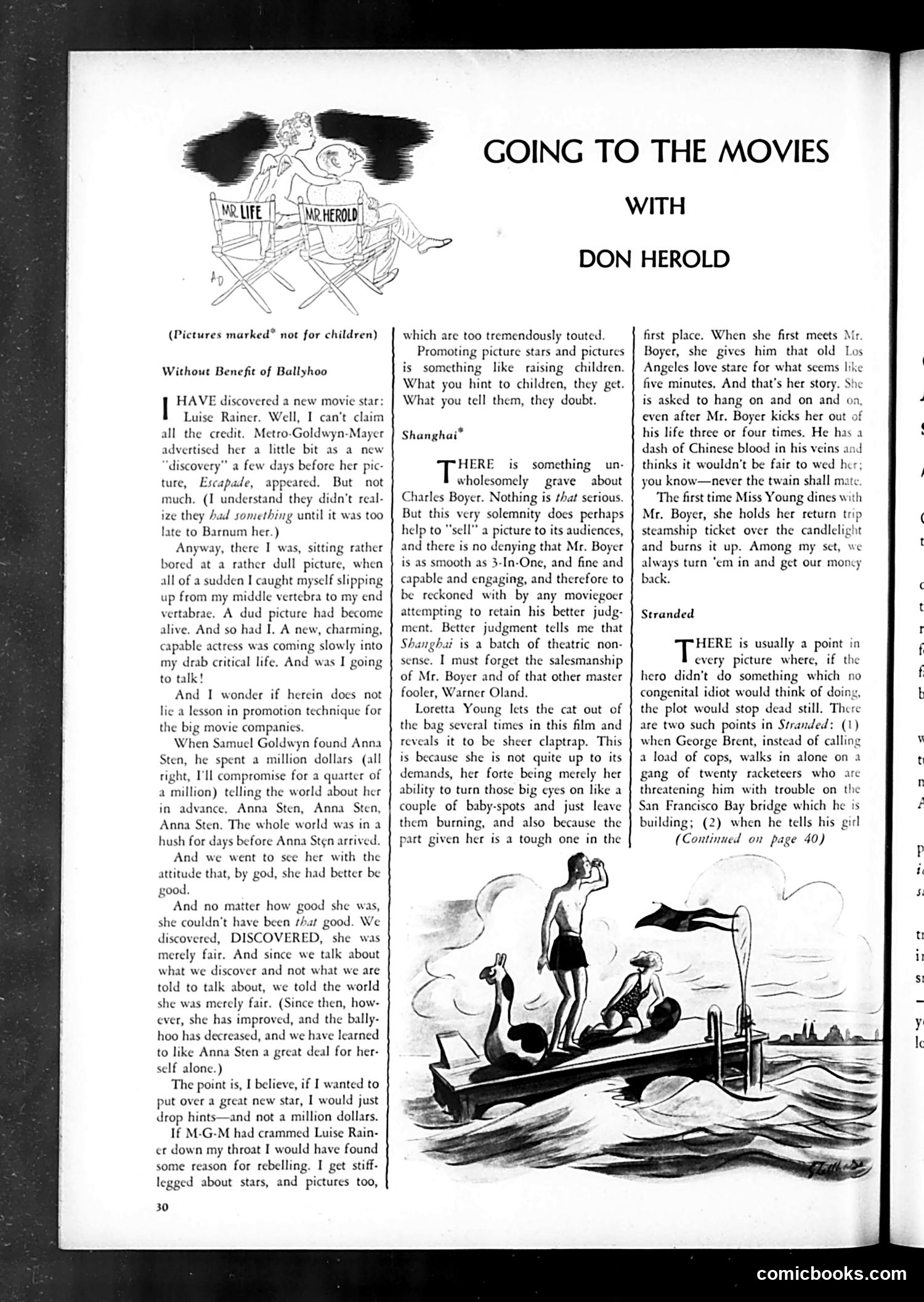
Analysis for Modern Readers This page from *Life* magazine reviews recent films by Don Herold, a satirist critiquing Hollywood's promotional practices and acting performances. Main Satire: Herold argues that heavy-handed movie studio publicity ("ballyhoo") backfires. He contrasts Samuel Goldwyn's expensive pre-release campaign for actress Anna Sten—which created inflated expectations she couldn't meet—with Metro-Goldwyn-Mayer's accidental success with Luise Rainer, whom audiences "discovered" organically. The joke: aggressive hype makes audiences skeptical and resentful, while subtle word-of-mouth creates genuine enthusiasm. Film Reviews: Herold dismisses *Shanghai* (featuring Charles Boyer and Loretta Young) as overwrought melodrama, mocking Young's one-note performance (her famous wide-eyed stare) and contrived plot elements (she burns her steamship ticket during dinner). He ridicules the film's artificial emotional gravity. The cartoon header shows film industry figures ("My Life," "My Harold") in directors' chairs, reinforcing the entertainment industry focus.
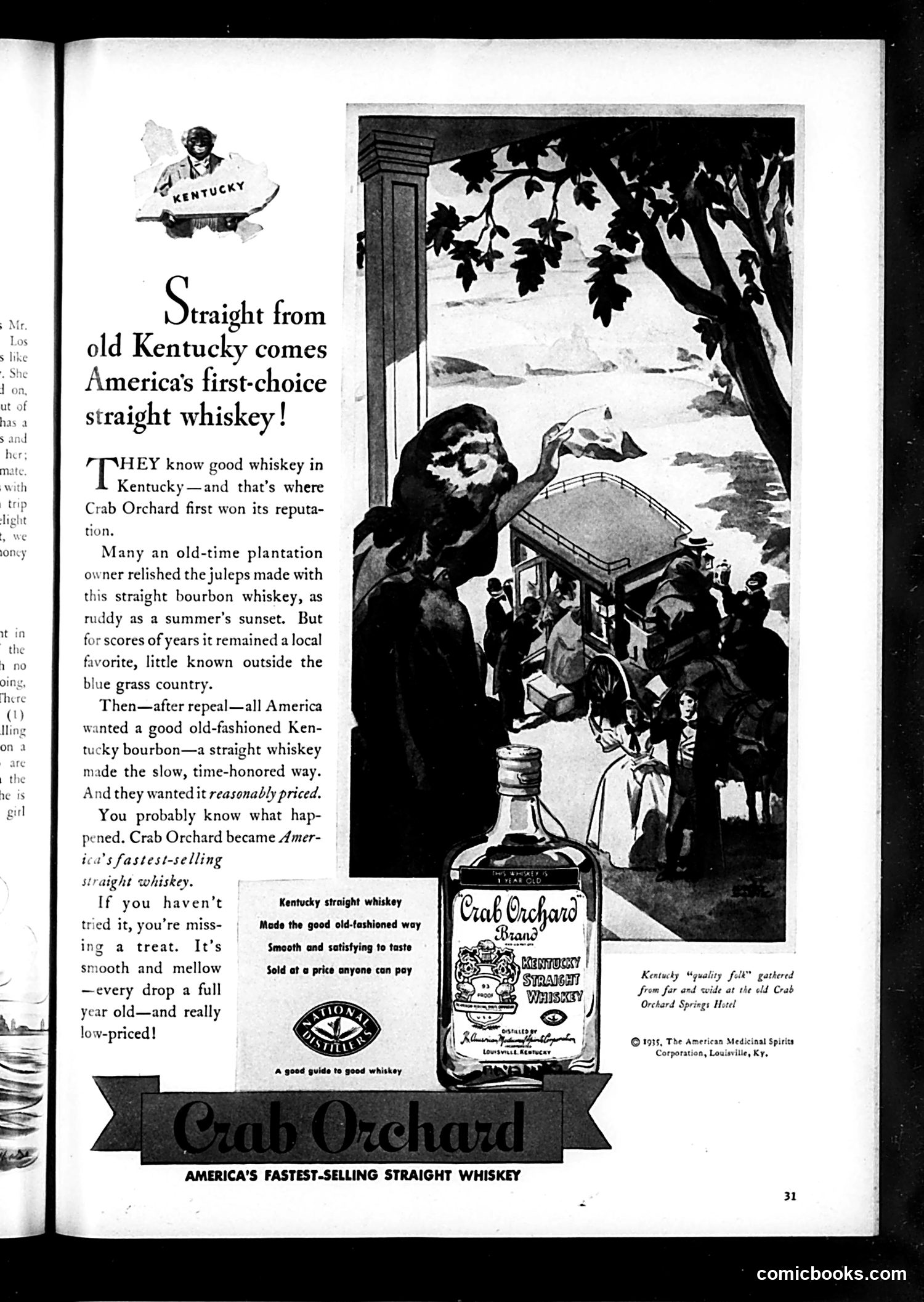
Analysis: Crab Orchard Whiskey Advertisement This is a whiskey advertisement, not political satire. The page promotes Crab Orchard bourbon, a Kentucky straight whiskey, positioning it as "America's fastest-selling straight whiskey." The narrative celebrates the brand's post-Prohibition success: it was a local Kentucky favorite before Prohibition ended (repealed in 1933), then became nationally popular when Americans sought "good old-fashioned Kentucky bourbon" made the traditional way at affordable prices. The illustration depicts a romanticized antebellum scene—figures gathering at the "old Crab Orchard Springs Hotel"—evoking nostalgia for pre-Civil War Southern plantation culture. This imagery was common in mid-20th-century advertising, using historical romance to market products. The ad emphasizes authenticity ("slow, time-honored way"), affordability ("reasonably priced"), and quality to appeal to post-Prohibition consumers seeking accessible luxury. There is no satirical content; this is straightforward commercial persuasion.
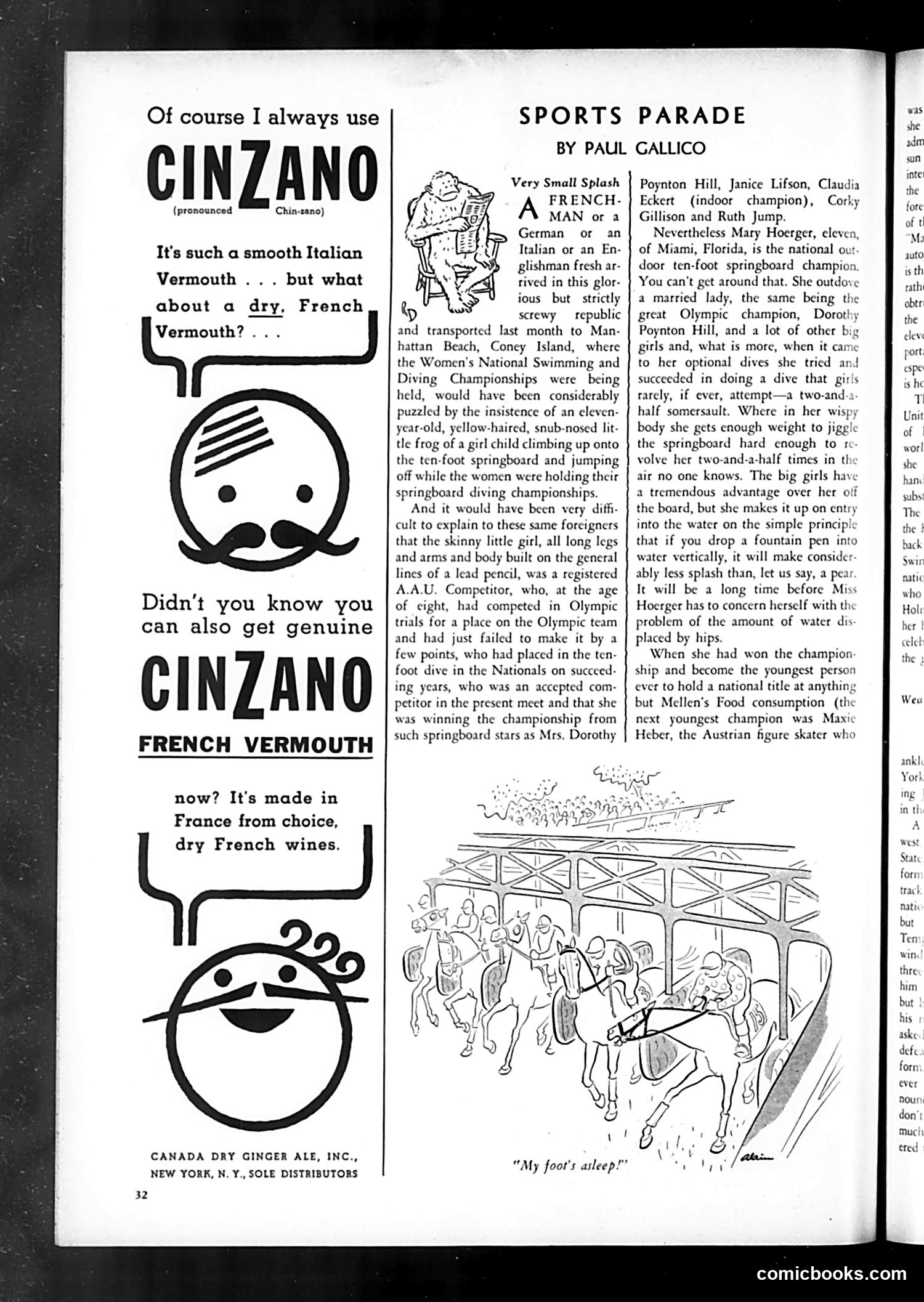
Page Analysis: Cinzano Advertisement and Sports Parade Column Left side: A Cinzano vermouth advertisement featuring a cartoon face with a distinctive mustache. The ad plays on national stereotypes, joking that while Cinzano is known as a smooth Italian vermouth, consumers may not realize a dry French version also exists—made in France from French wines. The humor relies on early 20th-century advertising's casual ethnic stereotyping. Right side: Paul Gallico's "Sports Parade" column celebrates Mary Hoerger, an eleven-year-old from Miami who won the national outdoor ten-foot springboard diving championship. The piece emphasizes the remarkable achievement: a tiny, lightweight child defeating adult competitors, including Olympic champion Dorothy Poynton Hill. Gallico humorously notes that foreign observers would find it bizarre that a registered A.A.U. competitor so young could compete at national level. The column highlights her executing a two-and-a-half somersault dive—a difficult maneuver rarely attempted by female divers at that time.
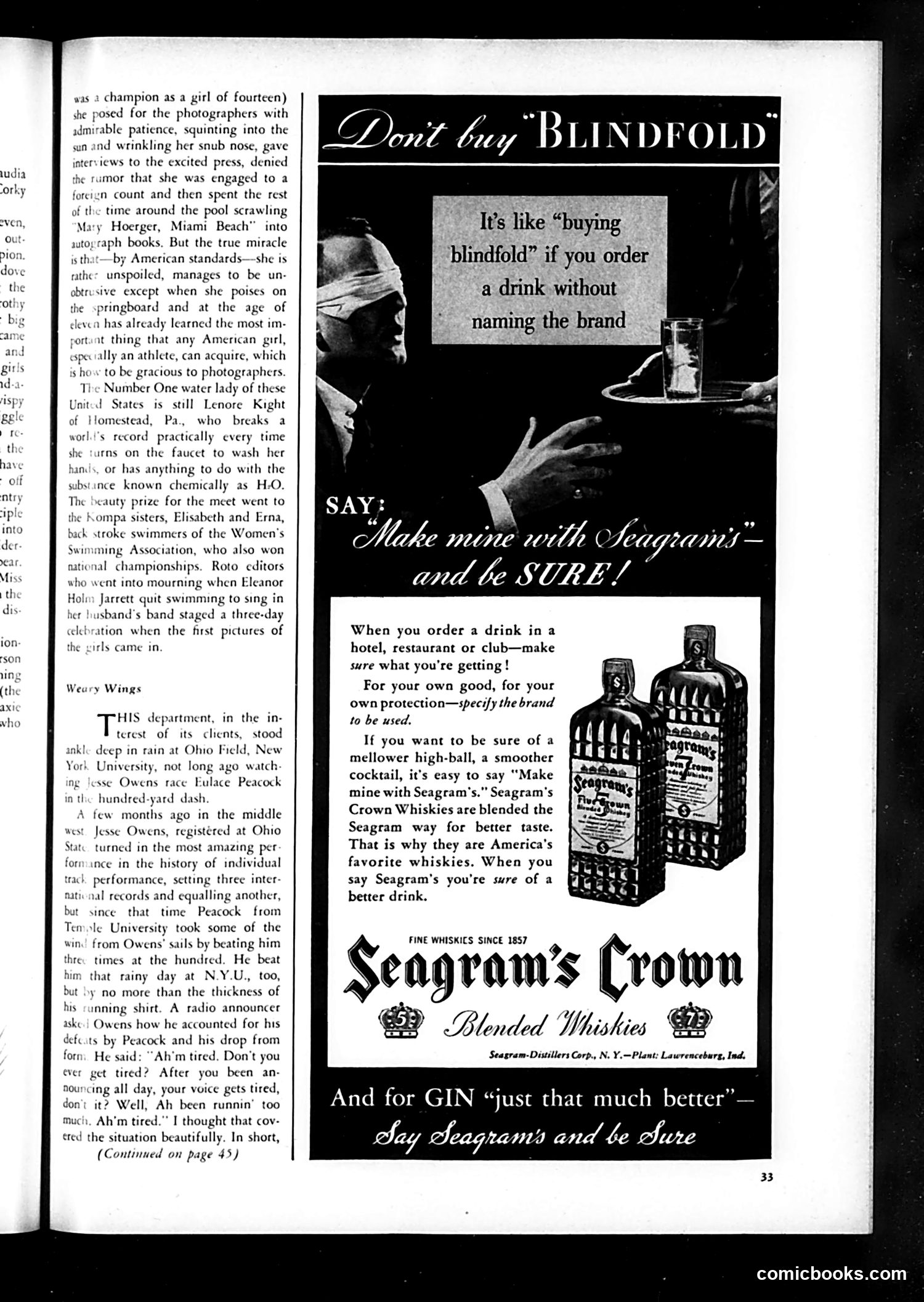
Analysis of This Life Magazine Page This page combines sports journalism with advertising, lacking political satire per se. The Editorial Content: The left column celebrates American athletic achievements, profiling champion swimmers and sprinters like Jesse Owens and Eulace Peacock. The tone celebrates American youth—particularly female athletes—for their grace and unspoiled character despite fame. There's a brief anecdote about Owens attributing his fatigue to voice strain from radio announcing, presented as charming homespun wisdom. The Advertisement: The dominant right side is a Seagram's Crown Whiskeys ad. The "blindfold" headline warns consumers against ordering drinks generically—you must specify the brand for quality assurance. This reflects Prohibition's recent repeal (1933), when brand-name advertising for alcohol was still novel and somewhat cautious in tone. Context for Modern Readers: The ad's emphasis on *naming the brand* reflects post-Prohibition anxieties about alcohol quality and consumer protection, while the sports section exemplifies mid-1930s American boosterism about athletic achievement and wholesome youth culture.
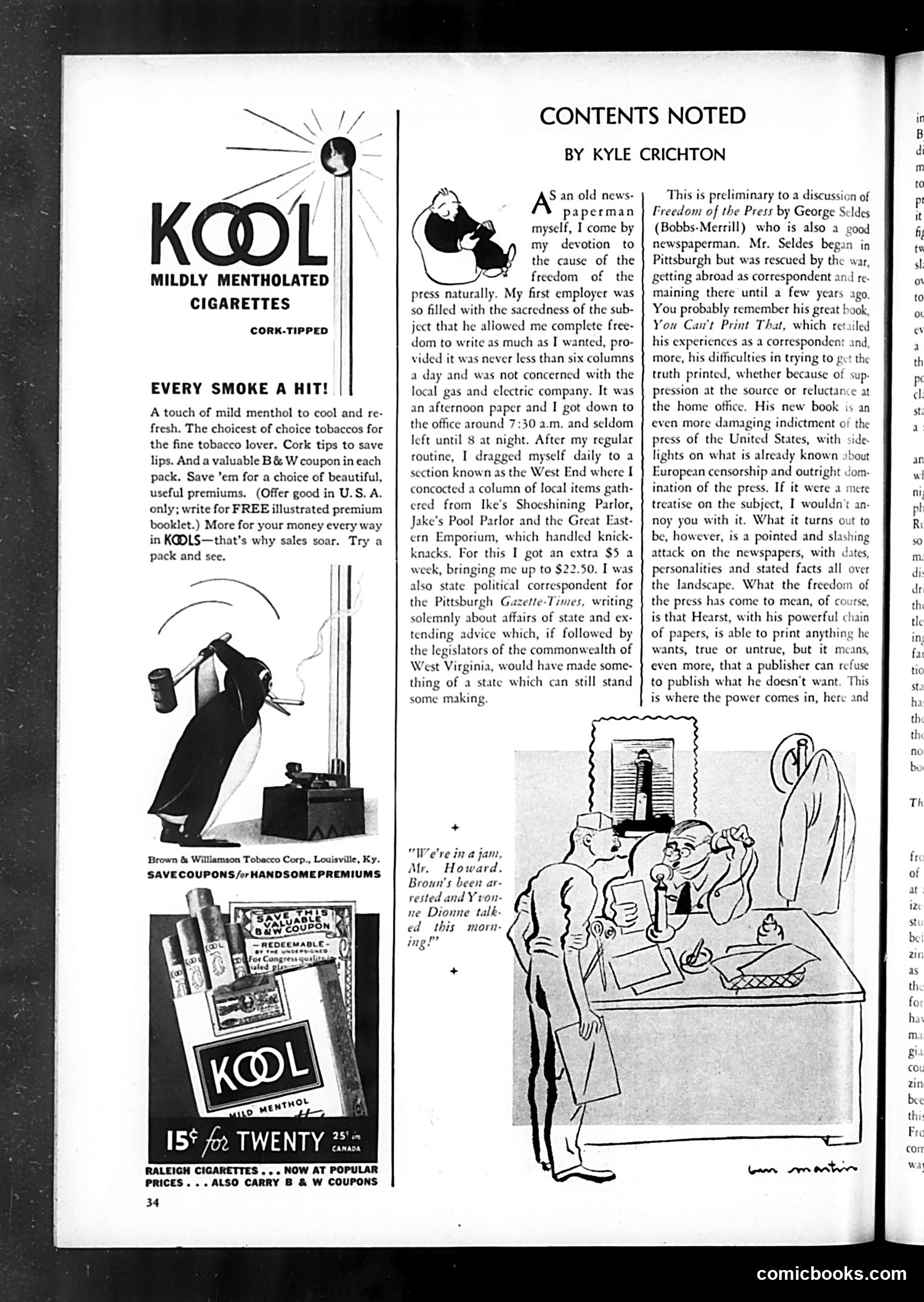
Analysis of Life Magazine Page This page combines cigarette advertising with editorial commentary on press freedom by Kyle Crichton. The Main Article: Crichton reflects on his early newspaper career, describing how he gained freedom to write six daily columns while also serving as state political correspondent for the Pittsburgh *Gazette-Times*. He sets up a discussion of George Seldes' new book *Freedom of the Press*, which critiques American newspaper practices. The Cartoon: The small illustration shows what appears to be a newspaper office in crisis—figures at a desk with one saying "We're in a jam, Mr. Howard. Broun's been arrested and Yvonne Dionne talked this morning." This likely references Heywood Broun (prominent journalist/columnist) and the Dionne Quintuplets (famous 1930s Canadian children), suggesting newsroom drama around obtaining stories. The Point: Crichton uses personal anecdotes to introduce Seldes' argument that press "freedom" actually means publishers can print or suppress what they choose—particularly Hearst's chain could publish anything regardless of truth, while refusing unfavorable stories.
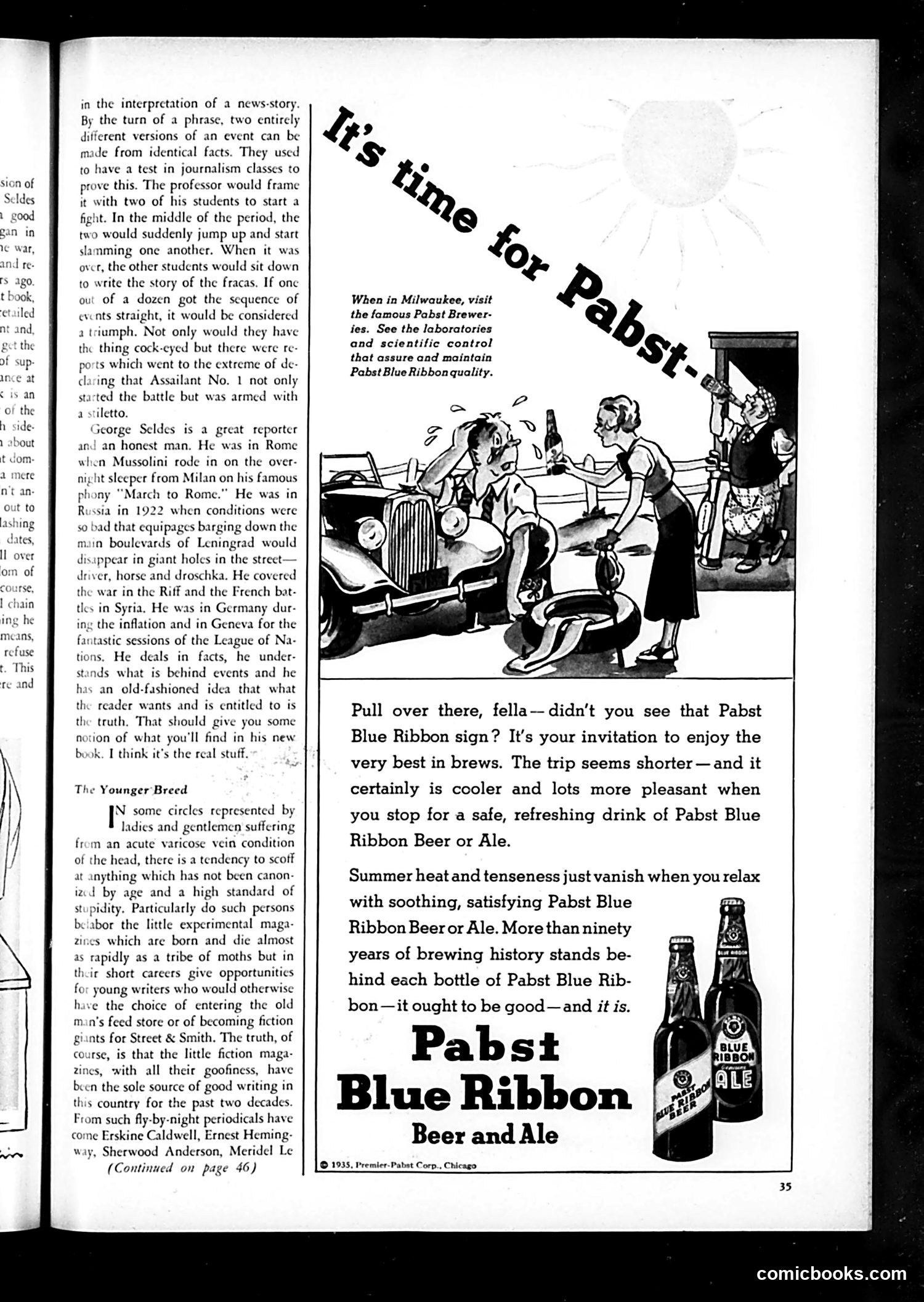
Analysis This page contains editorial content and advertising, not political satire. The left column discusses journalistic integrity through reporter George Seldes's work covering major 20th-century events (Mussolini's rise, Soviet Russia, WWI). It argues facts can be interpreted multiple ways, emphasizing the importance of honest reporting. Below that, "The Younger Breed" defends experimental literary magazines as valuable sources of American writing talent, naming Caldwell, Hemingway, and Anderson as examples—rejecting dismissive attitudes toward unconventional publishing. The right side is a Pabst Blue Ribbon beer advertisement (1935), featuring a cartoon of motorists discovering a Pabst sign while traveling. The ad uses the period's common trope of road-trip refreshment, inviting travelers to stop at Milwaukee's Pabst Breweries. It emphasizes 90 years of brewing tradition and quality control. There is no political cartoon or satire on this page—it's a magazine article paired with commercial advertising, typical of Life magazine's format in the 1930s.
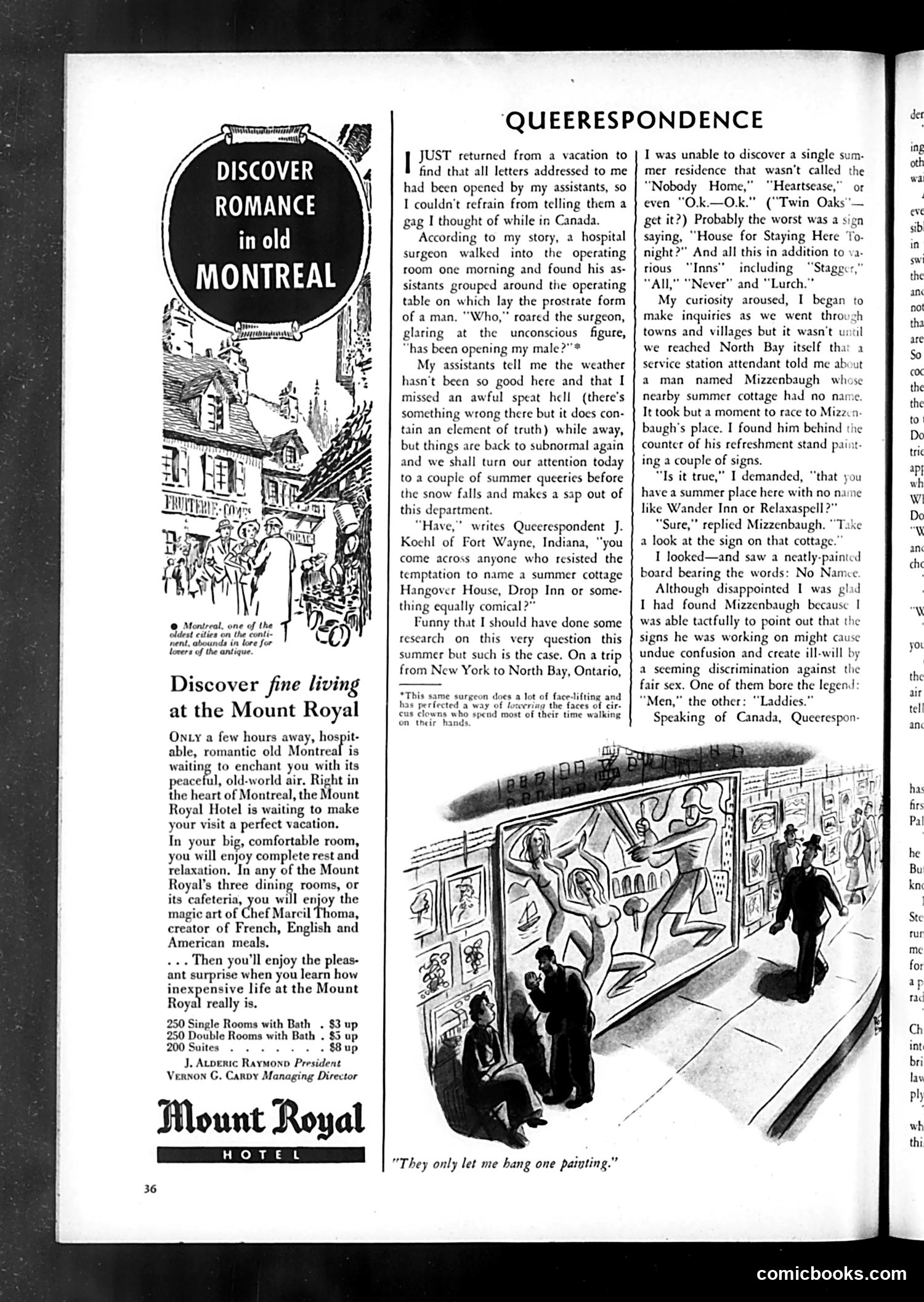
Analysis of Life Magazine Page This page combines a Mount Royal Hotel advertisement with "Queerespondence," the magazine's humorous letters column. The main cartoon (bottom right) depicts a train passenger viewing an art gallery car, captioned "They only let me hang one painting"—a visual pun about displaying artwork in a moving train. The letter column features a joke about a surgeon discovering his assistants opening patient mail, with a pun on "male/mail." More substantively, the correspondent describes searching Canadian cottage country for summer homes with *original* names, discovering they're all clichéd ("Hangover House," "Drop Inn," "Nobody Home," "Heartsease," "Twin Oaks"). The only exception: Mizzenbaugh's cottage, simply called "No Name." The writer then tactfully points out Mizzenbaugh's new business signs discriminate against women—one reads "Men," the other "Ladies"—a mild commentary on gender equality issues of the era. The satire targets both cottage-naming clichés and casual sexism in public signage.
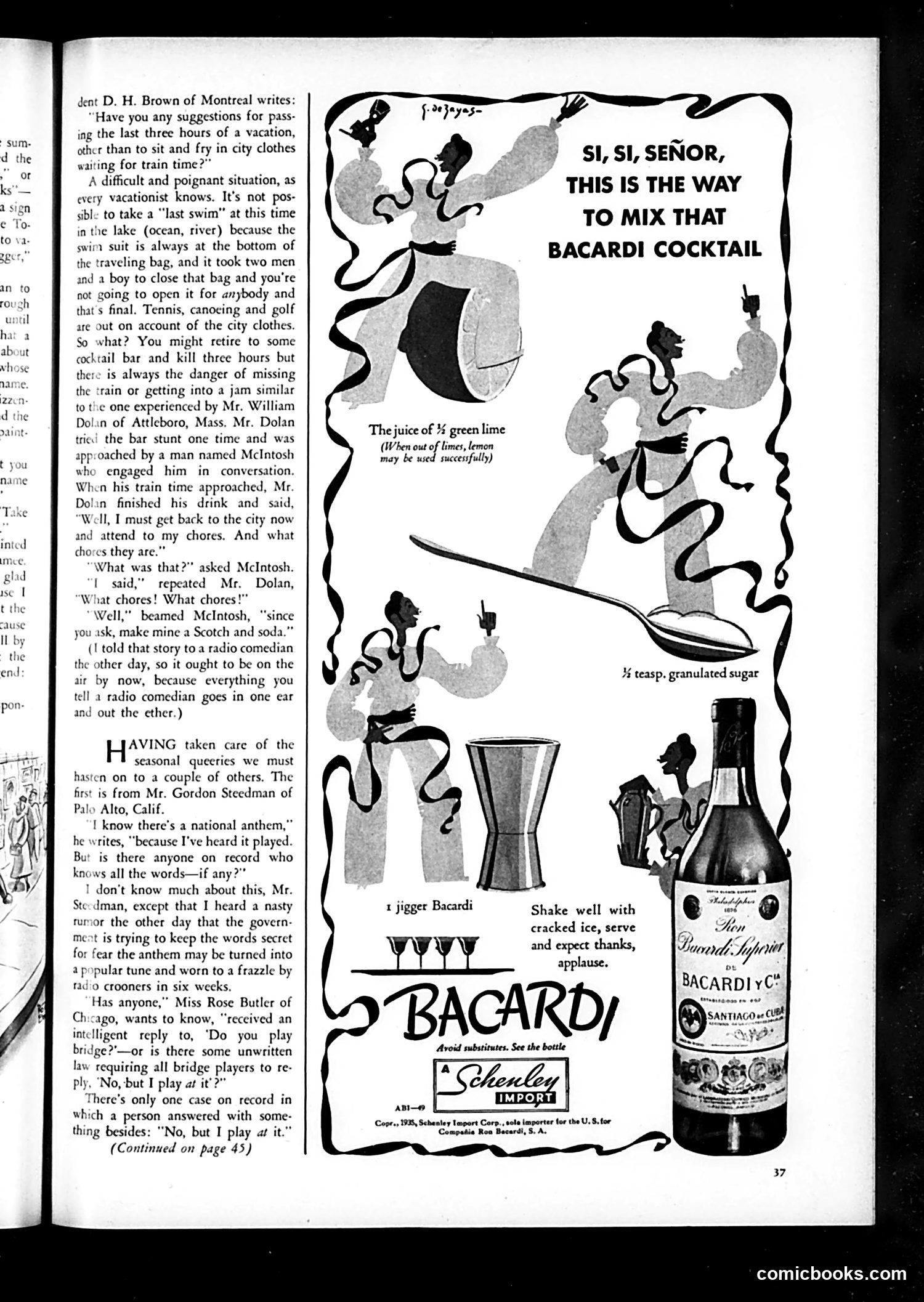
Analysis: Life Magazine Page (circa 1938) This page combines humor writing with a Bacardi advertisement. The left column contains three anecdotes answering reader queries about vacation time-killing, bridge playing, and national anthems—typical Life magazine humor that relies on puns and conversational misunderstandings. The joke about Mr. Dolan involves a mishearing: when he says he must attend to "chores," McIntosh hears it as a request for a drink order, leading to the punchline about ordering "Scotch and soda." The right side features an illustrated Bacardi cocktail recipe advertisement, styled with decorative art deco borders and whimsical illustrations. The recipe itself is straightforward—lime juice, sugar, and Bacardi rum—but the presentation emphasizes the exotic, sophisticated nature of cocktail culture to the magazine's upscale readership. The advertisement represents pre-Prohibition era drinking culture normalization, where spirits advertising was prominent in mainstream publications. Both elements reflect 1930s American leisure culture and humor conventions.
"Stop & Go" Book Reviews Page This is a book review column by Kyle Crichton from Life magazine. The page contains no political cartoons—instead, it's a satirical literary criticism section typical of Life's highbrow humor. Crichton reviews recent novels with witty, cutting commentary. He mocks authors like Sinclair Lewis ("you're better than that, Mr. Lewis"), dismisses Anita Stewart's writing as "embarrassingly bad," and praises George Cronyn's psychological character study while joking it's disturbing enough to warrant execution. The reviews also cover non-fiction, including George Seldes's "Freedom of the Press"—a book attacking American media impartiality that Crichton notes publishers won't publicize (ironic given the book's subject). The page then shifts to entertainment recommendations: records, books, and restaurants ("Go Places"), reflecting Life's sophisticated urban audience in the 1930s.
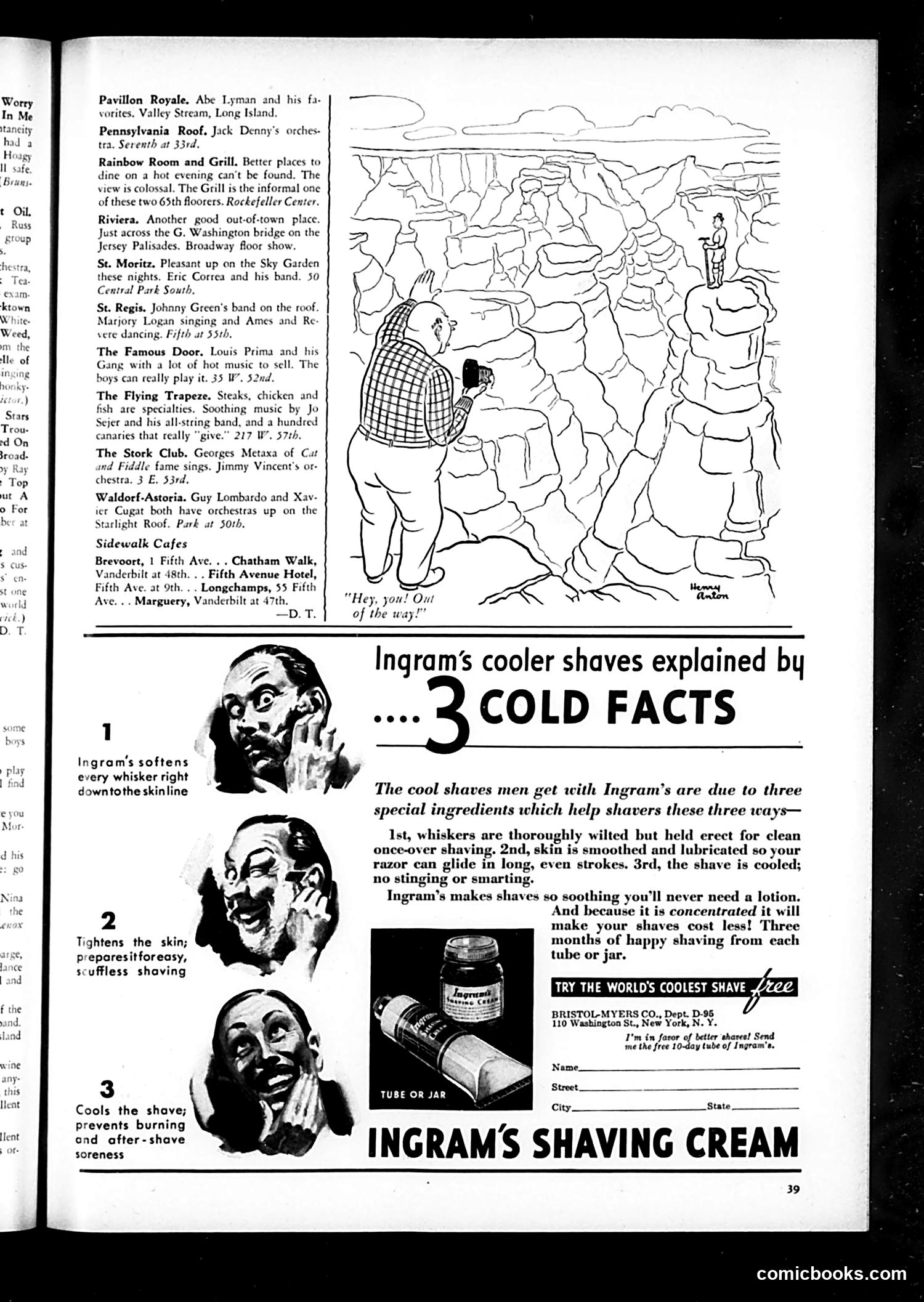
Analysis of Page 39 This page mixes two distinct elements: a nightlife guide and an advertisement. The Cartoon/Illustration (top): The sketch shows a couple dancing at what appears to be a 1930s nightclub or dance venue. The man in a checkered jacket and woman are depicted in a casual, lively pose. The caption reads "Hey, you! Out of the way!" — a simple comedic moment capturing the crowded, energetic atmosphere of popular dance halls of the era. This illustrates the listings below for upscale New York City venues (Rainbow Room, St. Moritz, Stork Club, etc.). The Advertisement (bottom): The Ingram's Shaving Cream ad uses a three-panel approach showing exaggerated male facial expressions to humorously demonstrate how the product works. The "3 Cold Facts" explain softening whiskers, smoothing skin, and cooling sensation—standard advertising copy for the time. Context: This appears to be from a 1930s-era *Life* magazine, reflecting the era's vibrant nightclub culture and period advertising conventions using facial caricature for product promotion.
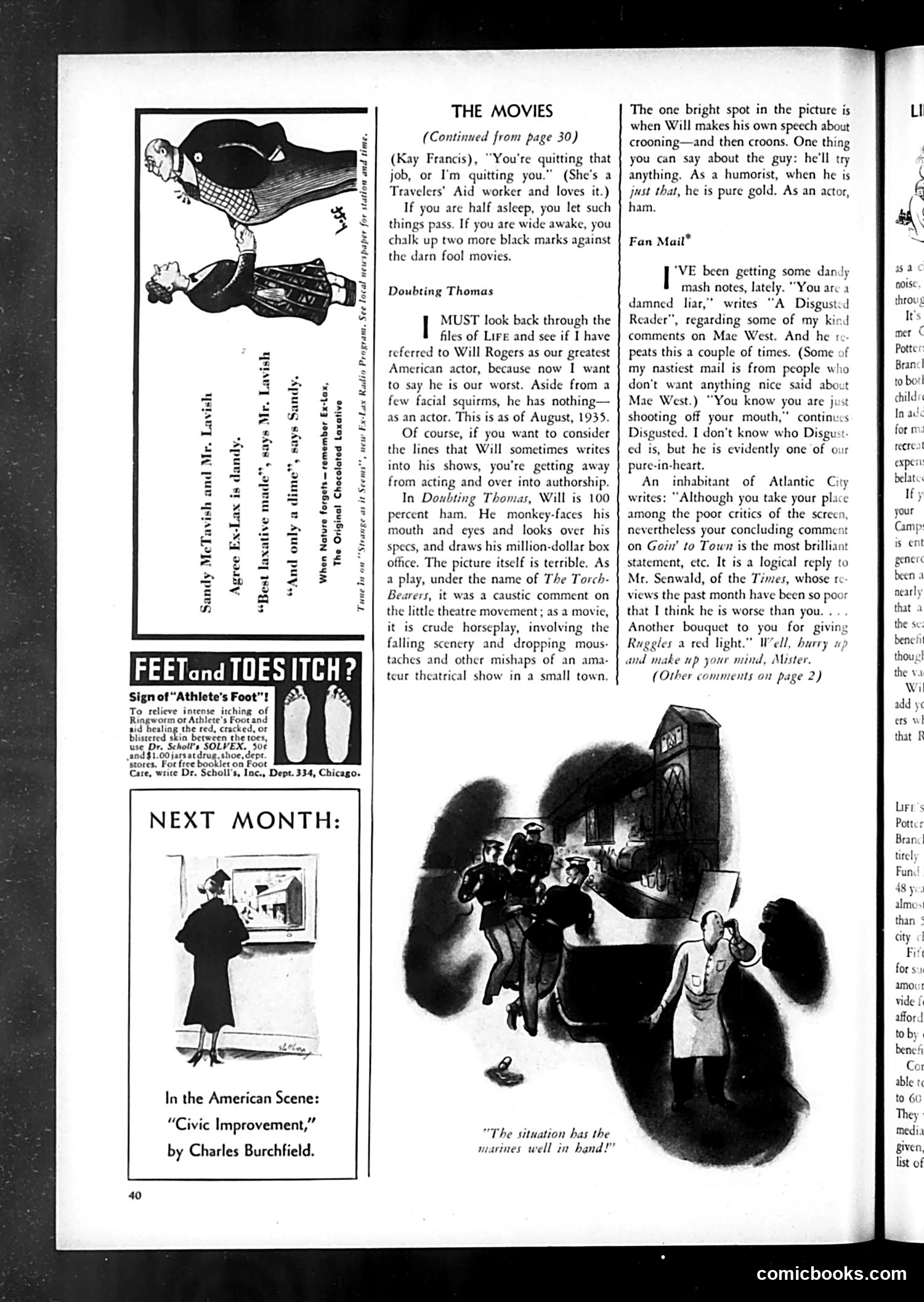
Life Magazine Page Analysis This page contains movie criticism and reader mail, along with period advertisements. The main content critiques Will Rogers in *Doubting Thomas*. The critic argues Rogers is an excellent humorist and writer but a terrible actor—"100 percent ham." The review dismisses the film itself as crude slapstick, contrasting it unfavorably with the play *The Torchbearers*, which had been sharper social commentary. The "Fan Mail" section prints reader responses, mostly critical of the magazine's movie reviews. One reader attacks the critic's praise of Mae West; another defends a different review as superior. The tone is playful, showing the magazine's readers actively debated its judgments. Advertisements for Ex-Lax laxative and Dr. Scholl's athlete's foot remedy occupy the lower portion—typical 1930s mass-market pitches. The crude humor ("Sandy McTavish and Mr. Lavish") reflects period advertising style. The page illustrates *Life*'s dual function: entertainment criticism with reader engagement, packaged alongside commercial sponsorship.
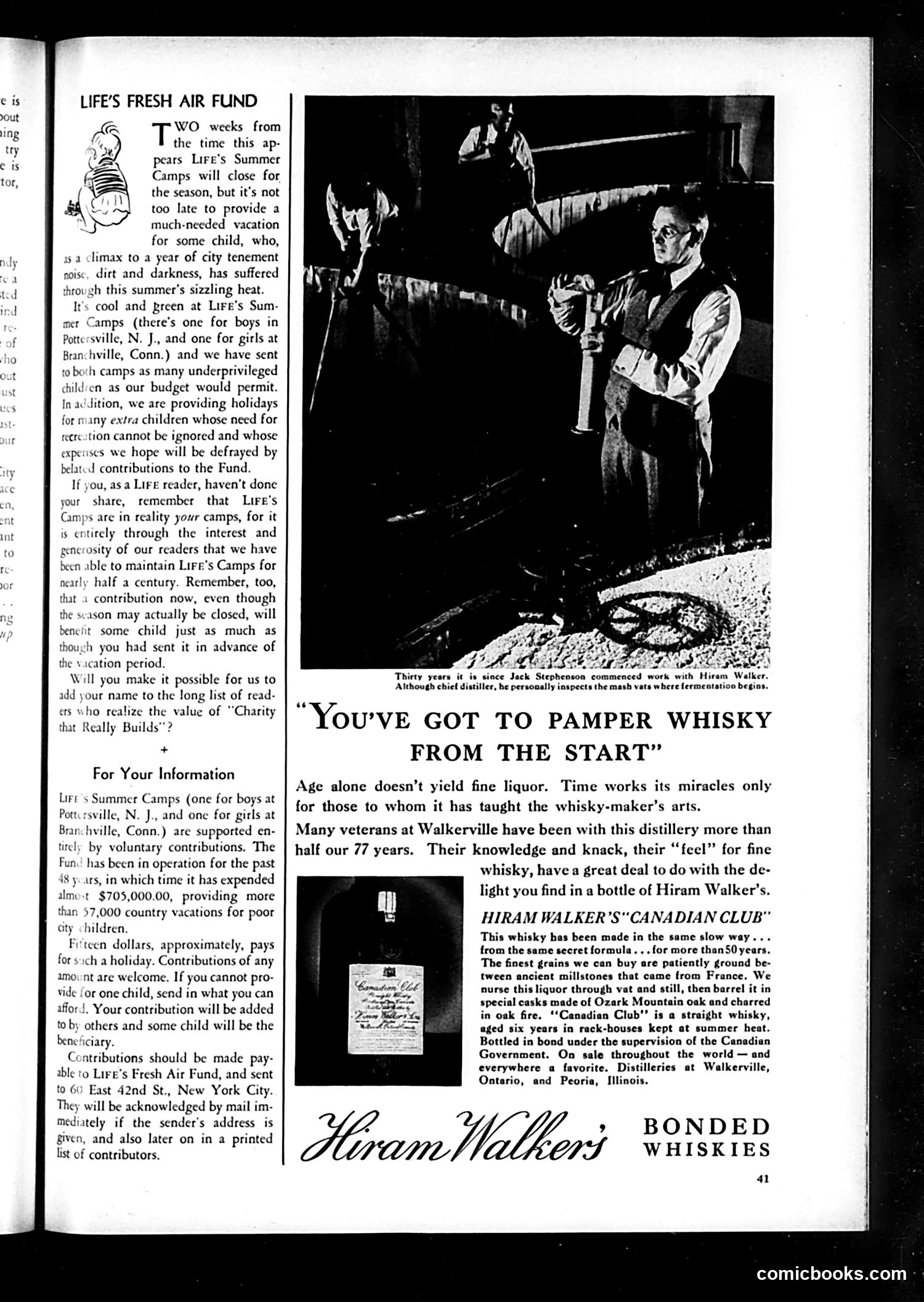
Analysis of Life Magazine Page This page contains two distinct elements: a charitable appeal and an advertisement. Left side: Life's Fresh Air Fund solicits donations to send underprivileged urban children to summer camps in New Jersey and Connecticut. The appeal emphasizes that city tenement children suffer through "sizzling heat" and need respite. Life has apparently run this charitable program for nearly 50 years, spending over $705,000 to provide 57,000 country vacations. The magazine urges readers to contribute, framing their camps as "yours" through reader generosity. Right side: A Hiram Walker's "Canadian Club" whisky advertisement featuring distillery workers. The ad emphasizes traditional craftsmanship—experienced veterans, slow production methods, French millstones, and oak aging—to justify premium pricing. The headline "You've Got to Pamper Whisky From the Start" positions quality liquor as requiring expertise and time. The juxtaposition is notably stark: charitable appeals for poor children appear alongside luxury alcohol marketing—a reflection of 1930s-era magazine economics where advertising funded philanthropic editorial content.
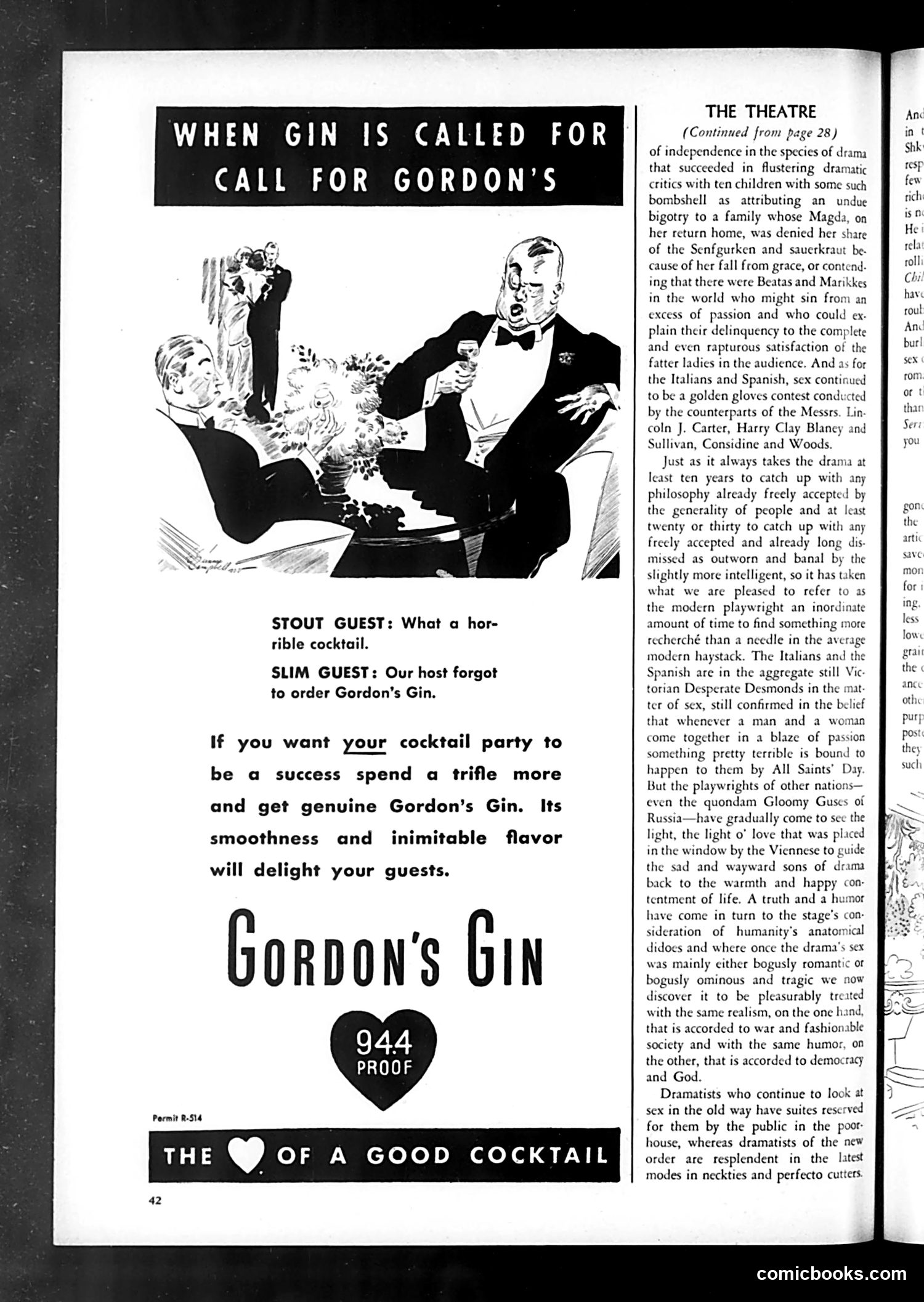
Gordon's Gin Advertisement with Theatre Satire This is primarily a Gordon's Gin advertisement from Life magazine, featuring a humorous cartoon about cocktail etiquette rather than political satire. The cartoon depicts two dinner guests critiquing their host's cocktail—one calls it "horrible," while the other explains the problem: the host forgot to order Gordon's Gin (944 proof). The joke is straightforward: serving inferior gin ruins a cocktail party. The accompanying theatre column discusses how modern playwrights are slowly catching up to contemporary attitudes about sex and passion, moving away from Victorian melodrama toward realistic treatment. The critic notes that Italian and Spanish dramatists remain trapped in outdated moral frameworks, while European writers (particularly Viennese and Russian) have adopted a more enlightened, humorous perspective. The advertisement's message is direct: to host a successful cocktail party, buy quality Gordon's Gin—presented as essential to social success, much like modern dramatists must adopt modern sensibilities.
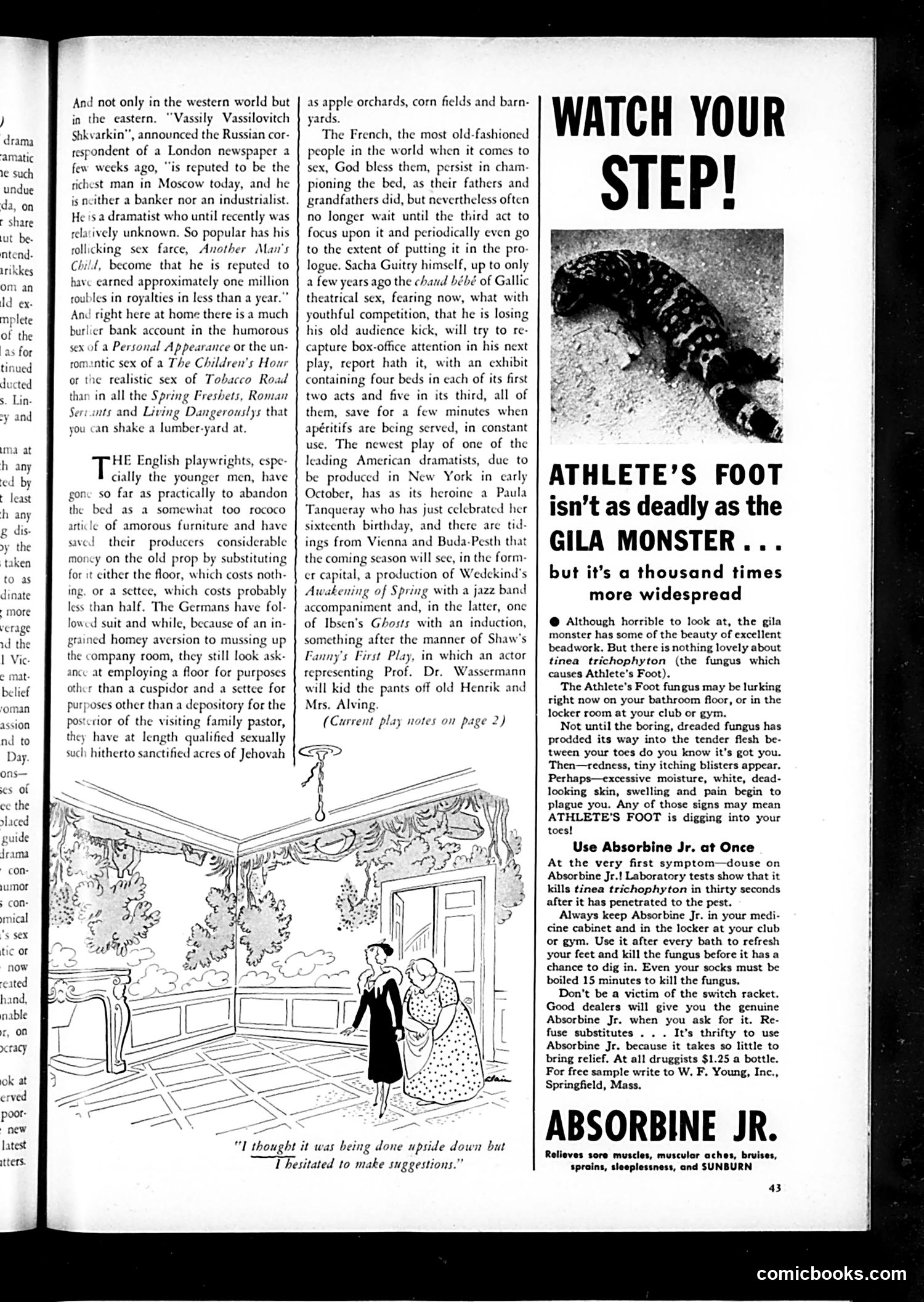
Analysis for Modern Readers This page contains two distinct elements: Left side: A theater column discussing how contemporary playwrights across Europe and America are increasingly using sexuality as dramatic subject matter. The writer catalogs trends: English/German playwrights replacing beds with floors or outdoor settings to save on props; French playwrights (notably Sacha Guitry) staging increasingly explicit bedroom scenes; and American dramatists tackling provocative age-gap relationships. The column satirizes how sex has become commercial theater's draw. Right side: A vintage medical advertisement for "Absorbine Jr.," a patent medicine claiming to treat athlete's foot fungus. The ad uses dark humor, comparing the fungal infection unfavorably to a Gila monster—supposedly less deadly but far more widespread. It promises rapid symptom relief and urges readers to buy the product at drugstores. The juxtaposition is incidental—simply how Life's pages were laid out—rather than intentional satire connecting the two pieces.
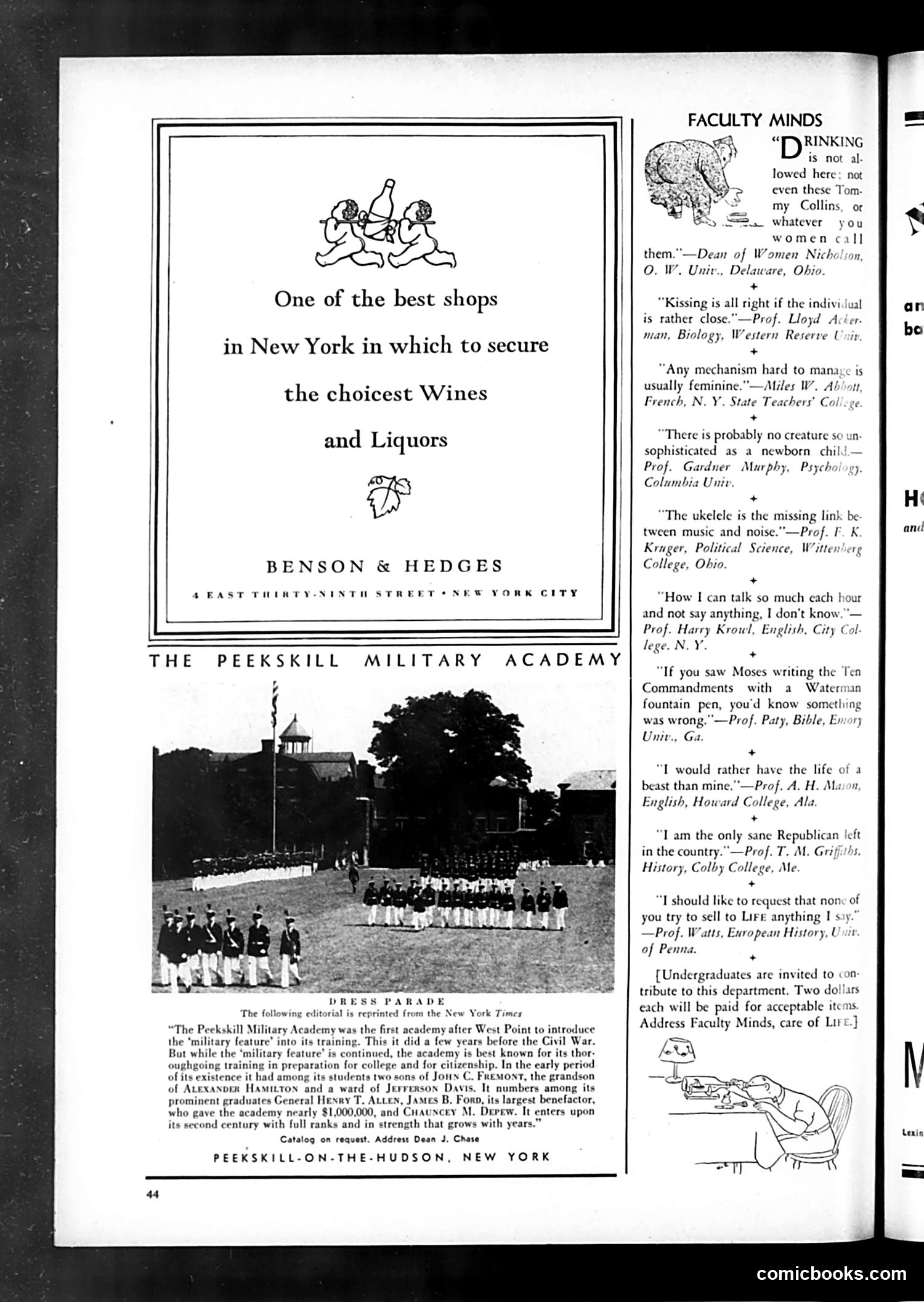
Faculty Minds: Academic Humor This page is primarily advertising and editorial content, with a humor column titled "Faculty Minds" on the right side. The "Faculty Minds" section collects funny, out-of-context quotes attributed to college professors from various institutions. The satire targets academic pretension and professorial eccentricity—professors making absurd pronouncements about drinking, kissing, gender, music, and politics. Examples include a dean claiming Tommy Collins cocktails are lowered standards, a professor declaring the ukulele "the missing link between music and noise," and another admitting "I can talk so much each hour and not say anything." The humor relies on exposing academics as pompous, contradictory, or absurdly philosophical about mundane matters. One professor claims to be "the only sane Republican left in the country"—likely targeting 1920s-30s academic culture. The page invites readers to contribute quotes for two dollars, suggesting this was a popular recurring feature mocking academia's self-importance.
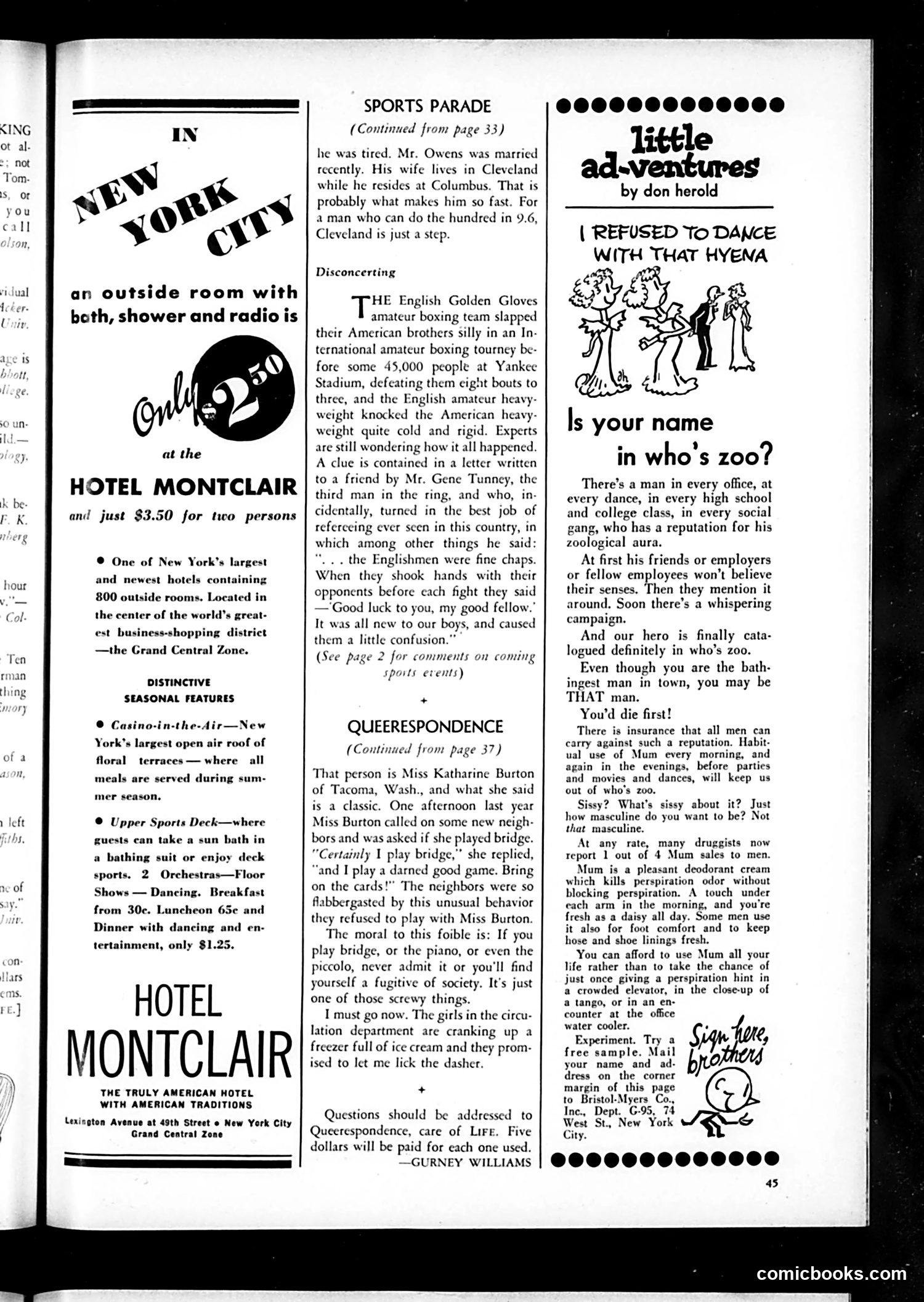
Explanation for Modern Readers This page contains mostly advertisements and humor columns, not political satire. The main content includes: 1. Hotel Montclair ad (left): A luxury hotel advertisement highlighting amenities and prices ($3.50 for two people). 2. Sports Parade column (center): Commentary on athlete Jesse Owens' speed (joking his Cleveland wife makes him fast) and the English Golden Gloves boxing team's surprising defeat of Americans, attributed to their polite sportsmanship ("Good luck, old fellow") confusing aggressive American fighters. 3. Little Ad-Ventures cartoon (right): A humorous advice column by Don Herald about personal hygiene and reputation. The joke warns that even clean men can gain a bad social reputation, then promotes Mum deodorant as insurance against being labeled socially awkward or undesirable—using the phrase "who's zoo" to suggest reputation-damaging behavior. The cartoon reflects 1930s-40s advertising anxieties about masculinity and social acceptance tied to personal hygiene products.
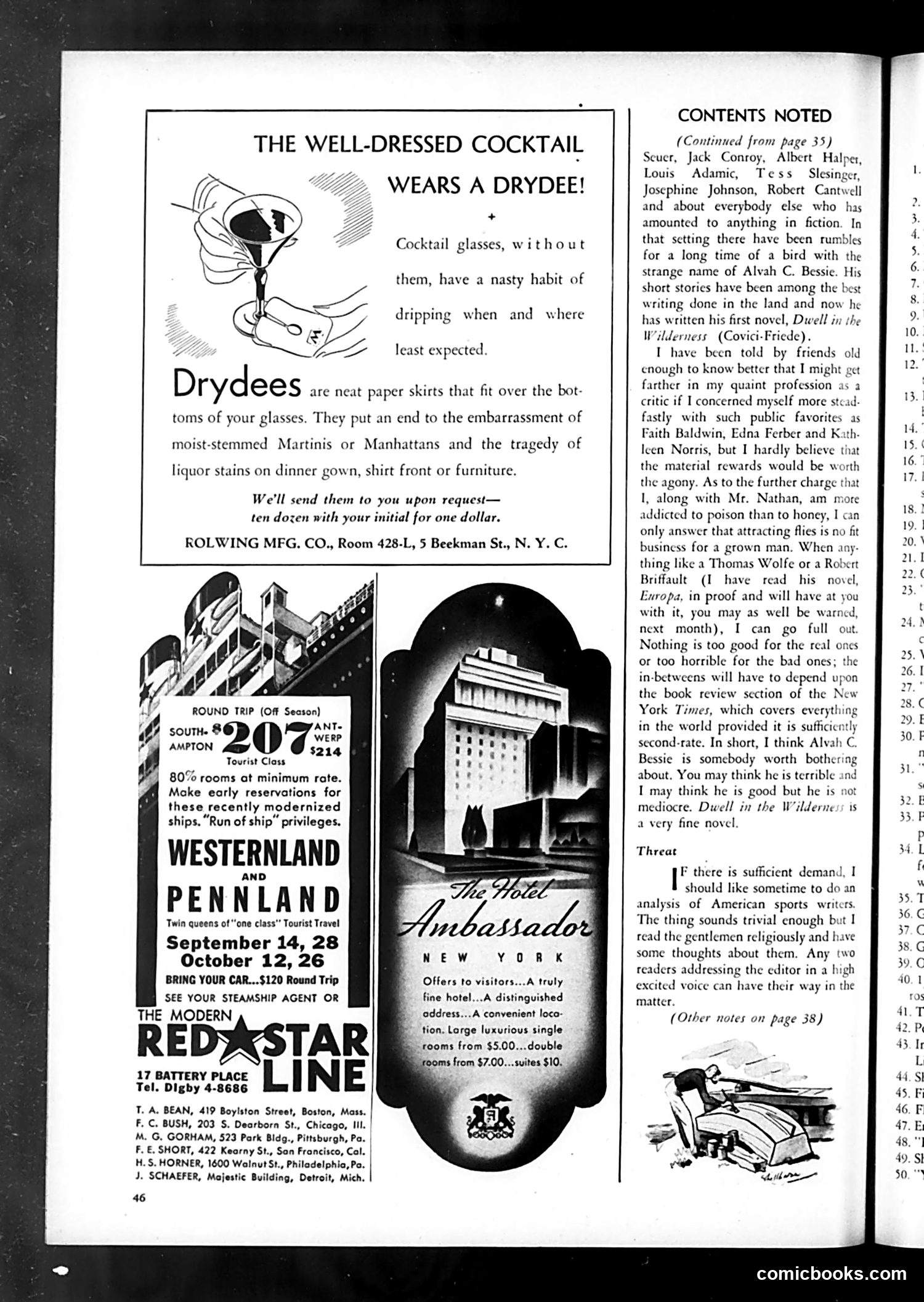
Analysis for Modern Readers This page combines editorial content with advertisements typical of 1930s *Life* magazine. The Main Cartoon/Advertisement: "The Well-Dressed Cocktail Wears a Drydee" advertises paper napkin skirts for cocktail glasses. The joke is straightforward: during Prohibition's end and the cocktail era, drinking vessels leaked onto clothing. Drydees solved this embarrassment—a practical product pitched through light humor about social awkwardness at dinner parties. The Editorial Section: The "Contents Noted" column reviews new fiction, discussing authors like Alvah C. Bessie and dismissing popular writers (Faith Baldwin, Edna Ferber) as unworthy of serious critical attention. The author defends focusing on quality literature over commercial success. Context: These are advertisements and book reviews from an era when cocktail culture was newly fashionable (post-Prohibition repeal, 1933) and literary magazines still reviewed serious fiction prominently. The tone reflects 1930s intellectual snobbery about "middlebrow" versus serious literature.
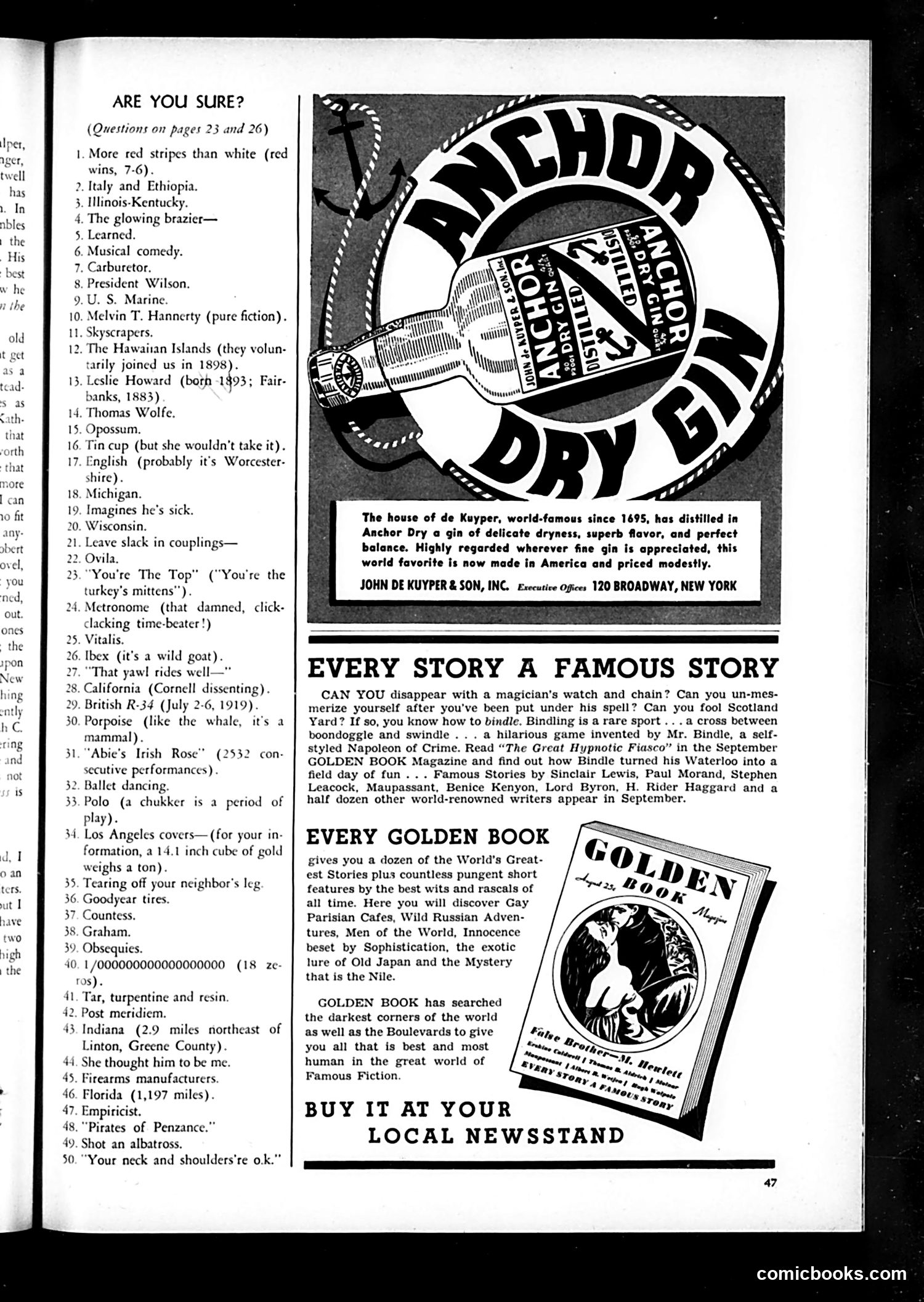
Content Analysis This page is primarily advertising and quiz answers, not satirical content. The top section presents answers to a trivia quiz from earlier in the magazine (pages 23 and 26). The answers reference American geography, culture, and entertainment—ranging from the American flag's stripe count to President Wilson to Leslie Howard. The advertisements dominate the page: Anchor Dry Gin (de Kuyper brand) — a Dutch distillery advertising their gin now produced in America during Prohibition's end or repeal era. Golden Book Magazine and Every Story a Famous Story — promoting the September issue, which features famous authors (Sinclair Lewis, Maupassant, Byron, etc.) and adventure tales. There is no political satire or caricature visible. The page reflects 1930s consumer culture and entertainment publishing rather than social commentary. The "Are You Sure?" header simply introduces the quiz-answer section for readers wanting to check their responses.
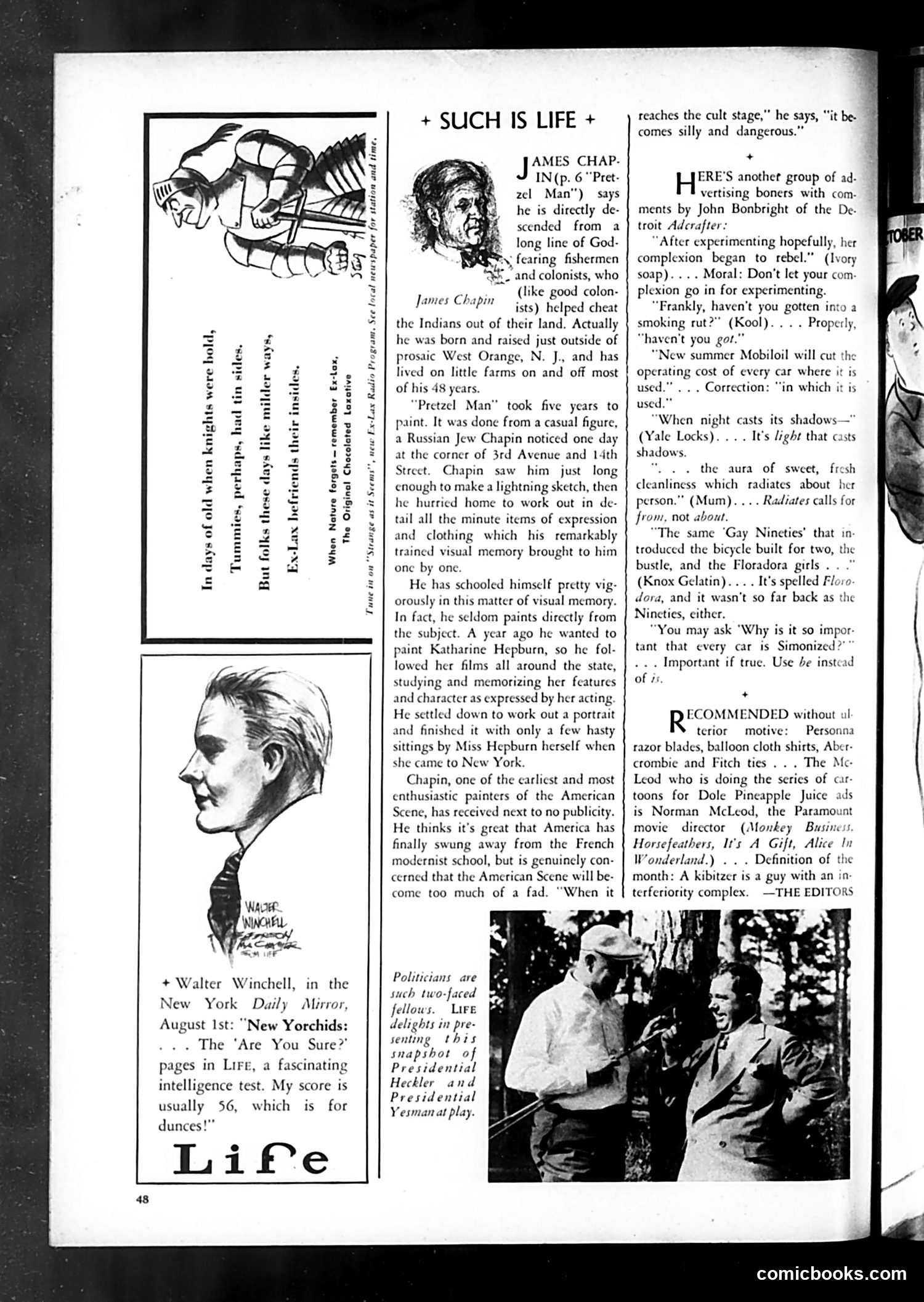
What This Page Means This Life magazine page contains three distinct sections: 1. "Pretzel Man" Profile: A biographical sketch of painter James Chapin, celebrated as part of the "American Scene" painting movement. The piece emphasizes his unusual method: he memorizes subjects from brief observation (like a Russian Jewish street vendor he glimpsed in Manhattan) or by studying actor Katharine Hepburn's film performances, rather than painting from live models. The point is to highlight serious American artists working outside French modernist traditions. 2. "Such Is Life" Cartoon: A single panel (upper left) illustrating the profile, showing the pretzel vendor subject. 3. Advertising Blunders: Grammar and usage mistakes from actual advertisements, critiqued by an advertising professional. Examples include misplaced prepositions ("radiates about" vs. "from") and awkward phrasing. This section mocks corporate carelessness—a common Life magazine feature. The page also includes a Walter Winchell gossip column reference and a photograph of politicians, captioned to note their duplicitousness.