life
Life — October 1935
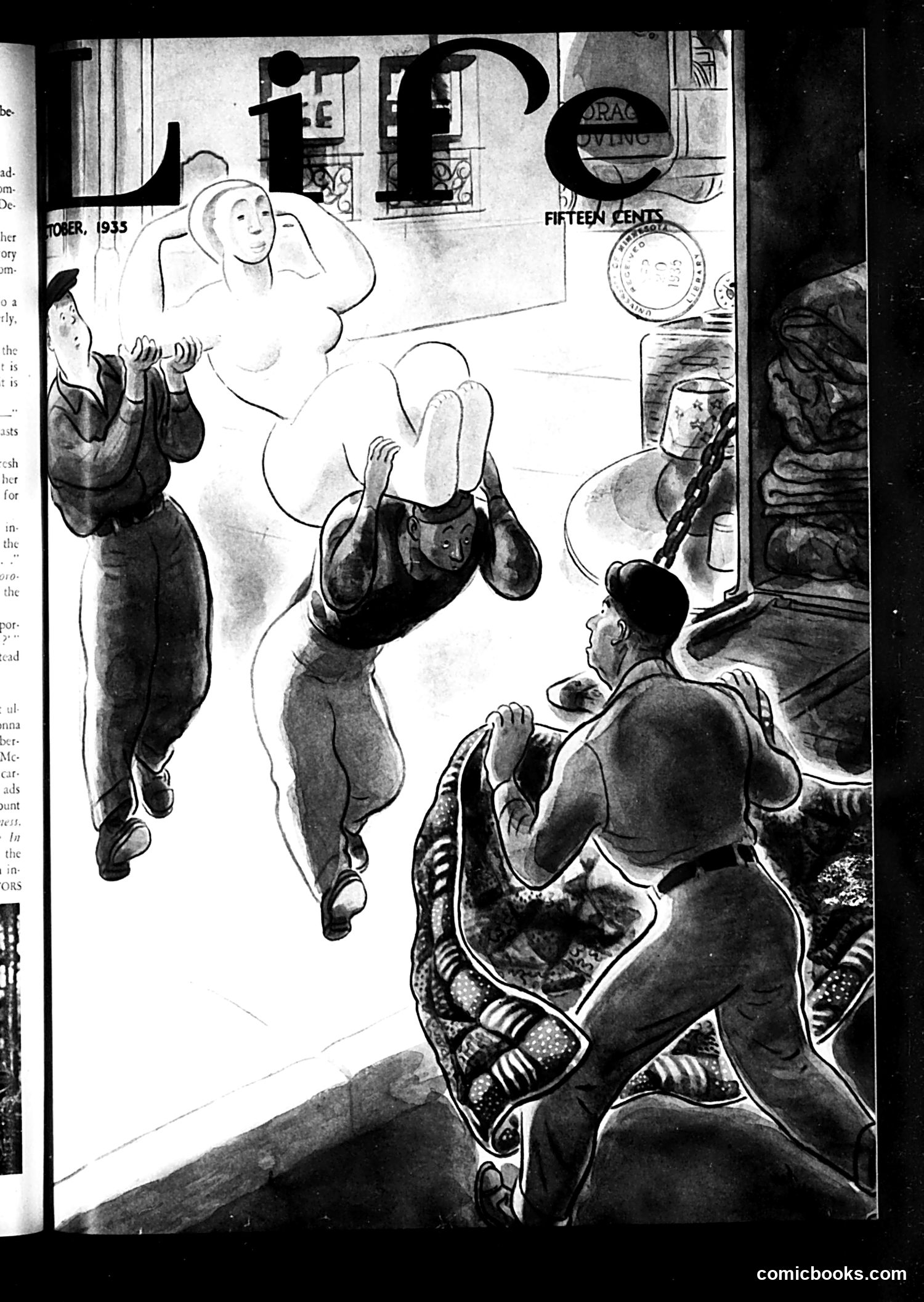
Analysis This appears to be a 1935 *Life* magazine cartoon satirizing the economic hardships of the Great Depression. The image depicts several figures in what looks like a Parisian street scene (note the French architecture and "Fifteen Cents" price marking, suggesting European tourism). The cartoon likely mocks either wealthy Americans vacationing abroad despite economic depression at home, or contrasts European leisure culture with American financial struggles. The exaggerated, rotund figures and their carefree demeanor suggest satire of excess or obliviousness to suffering. The "October, 1935" date and composition style are consistent with *Life's* satirical commentary on contemporary social and economic conditions during the Depression era. Without clearer text or identifying details, the specific targets remain unclear.
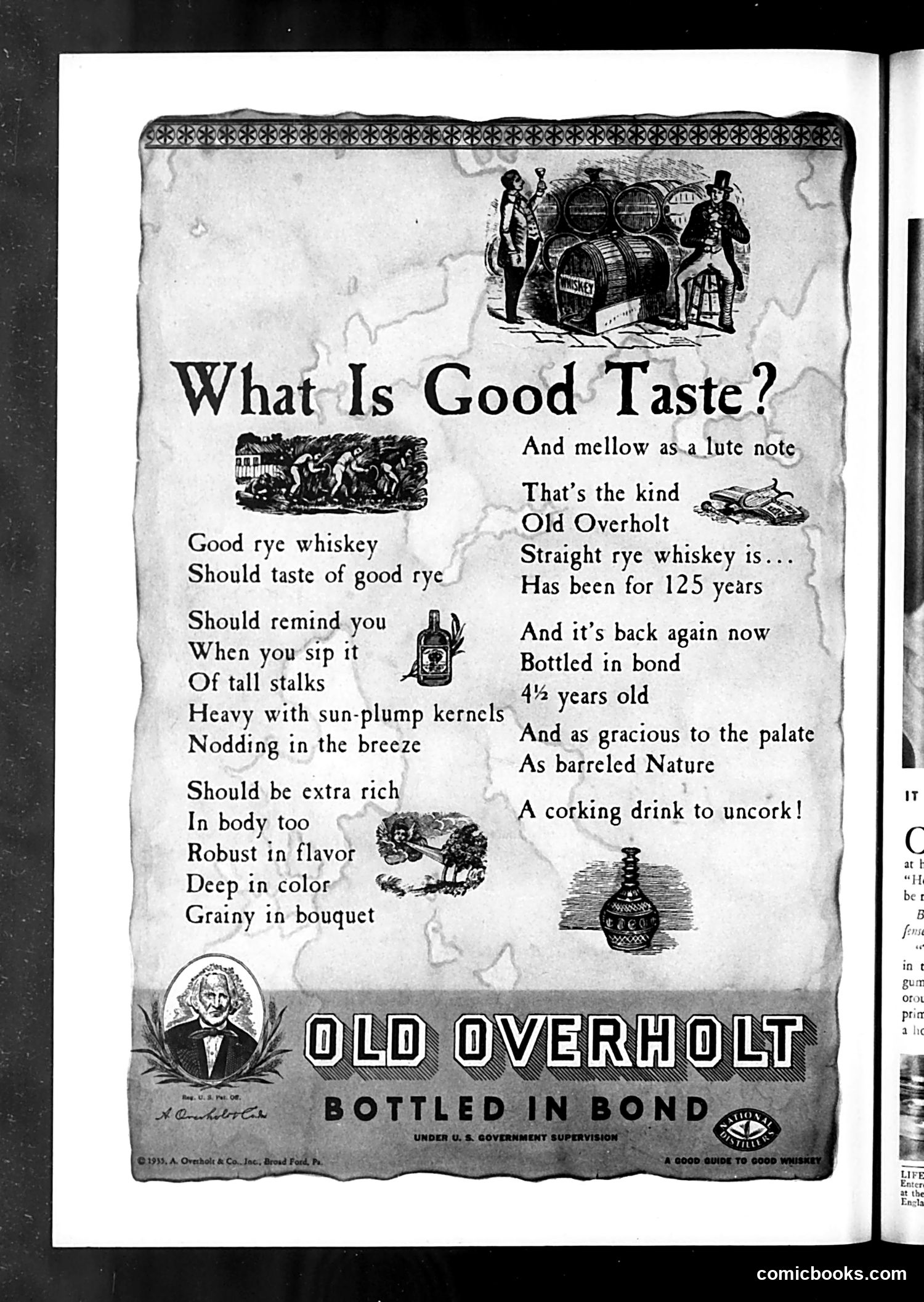
Old Overholt Whiskey Advertisement This is a straightforward advertisement rather than satire or political commentary. The page promotes Old Overholt straight rye whiskey, emphasizing its 125-year history and recent return to market after being "bottled in bond" for 4½ years. The ad uses poetic language to describe desirable whiskey qualities—"mellow as a lute note," "robust in flavor," "deep in color," "grainy in bouquet." It positions the product as refined and traditional ("A corking drink to uncork!"). The decorative illustrations include barrels, rye stalks, and a bottle. A period gentleman's portrait appears at the bottom. This appears to be from the 1930s era when whiskey was reintroduced after Prohibition's repeal, explaining the emphasis on the product's revival and legitimacy under government supervision.
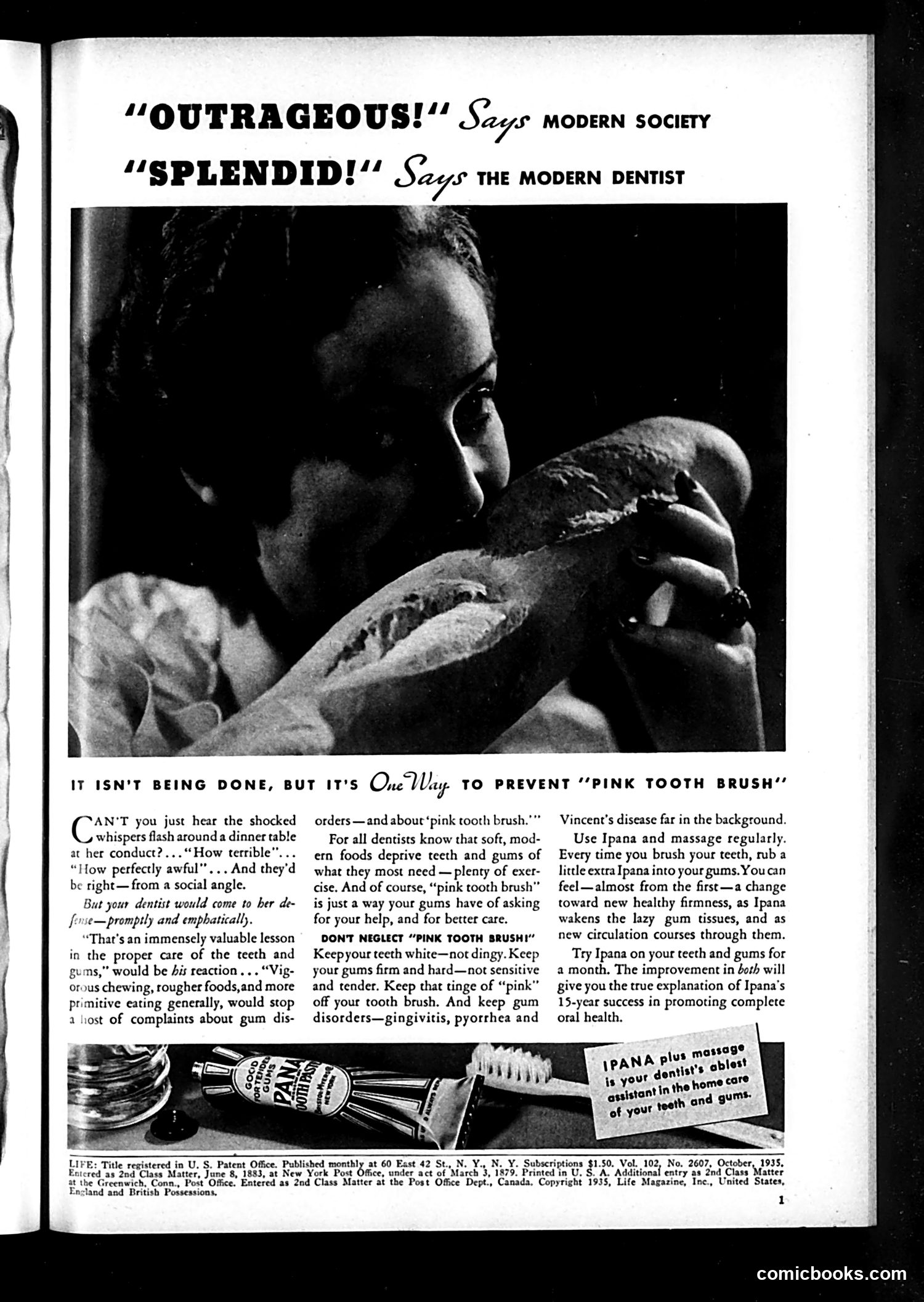
Analysis This is primarily a dental product advertisement for Ipana toothpaste and massage, not political satire. The page uses social commentary as marketing strategy. The ad presents a dinner table scene where guests react with shock ("OUTRAGEOUS!") to someone's dental hygiene practices. A modern dentist endorses Ipana, calling the situation "SPLENDID!"—meaning he approves of using Ipana to prevent "pink tooth brush," a condition where gums bleed during brushing. The satire targets social embarrassment: the implication is that poor oral hygiene causes visible gum disease, which is socially mortifying. The ad warns against neglecting teeth and gums, promoting Ipana massage as the modern solution to prevent conditions like gingivitis and pyorrhea. This reflects 1930s advertising's appeal to status anxiety and social conformity.
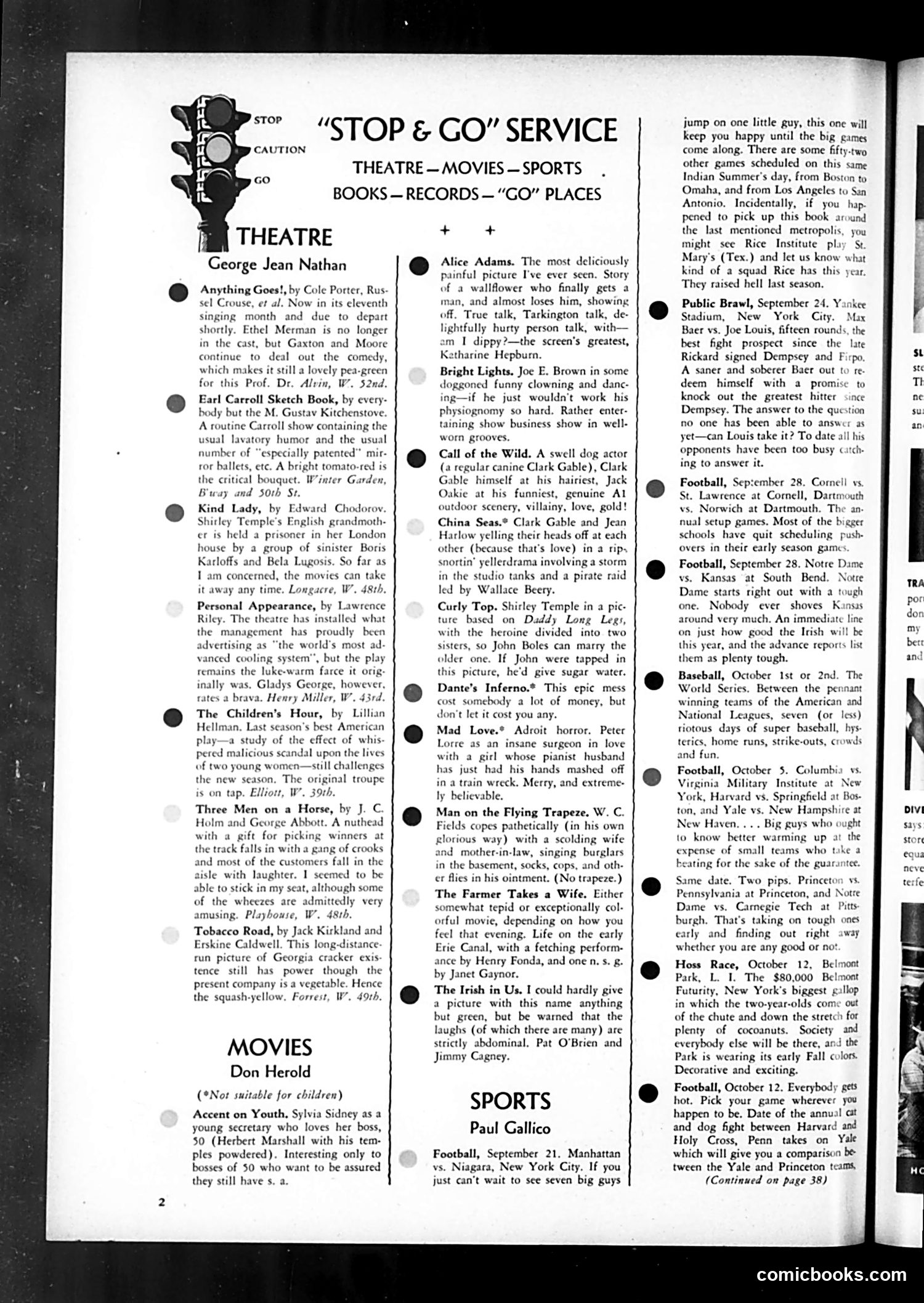
"Stop & Go" Service Page Analysis This is a guide page, not a political cartoon. It's a "Stop & Go" service feature recommending entertainment options across theatre, movies, and sports—organized by reviewer (George Jean Nathan for theatre, Don Herold for movies, Paul Gallico for sports). The traffic light graphic at top is merely a visual metaphor: "Stop" (red light—avoid), "Caution" (yellow—proceed carefully), "Go" (green—recommended). The content reviews contemporary 1930s films like *Alice Adams* and *Call of the Wild*, Broadway plays, and upcoming football games. Don Herold notes some films are "*Not suitable for children*." This is straightforward entertainment guidance—satirical magazine Life's curated recommendations for readers seeking leisure activities.
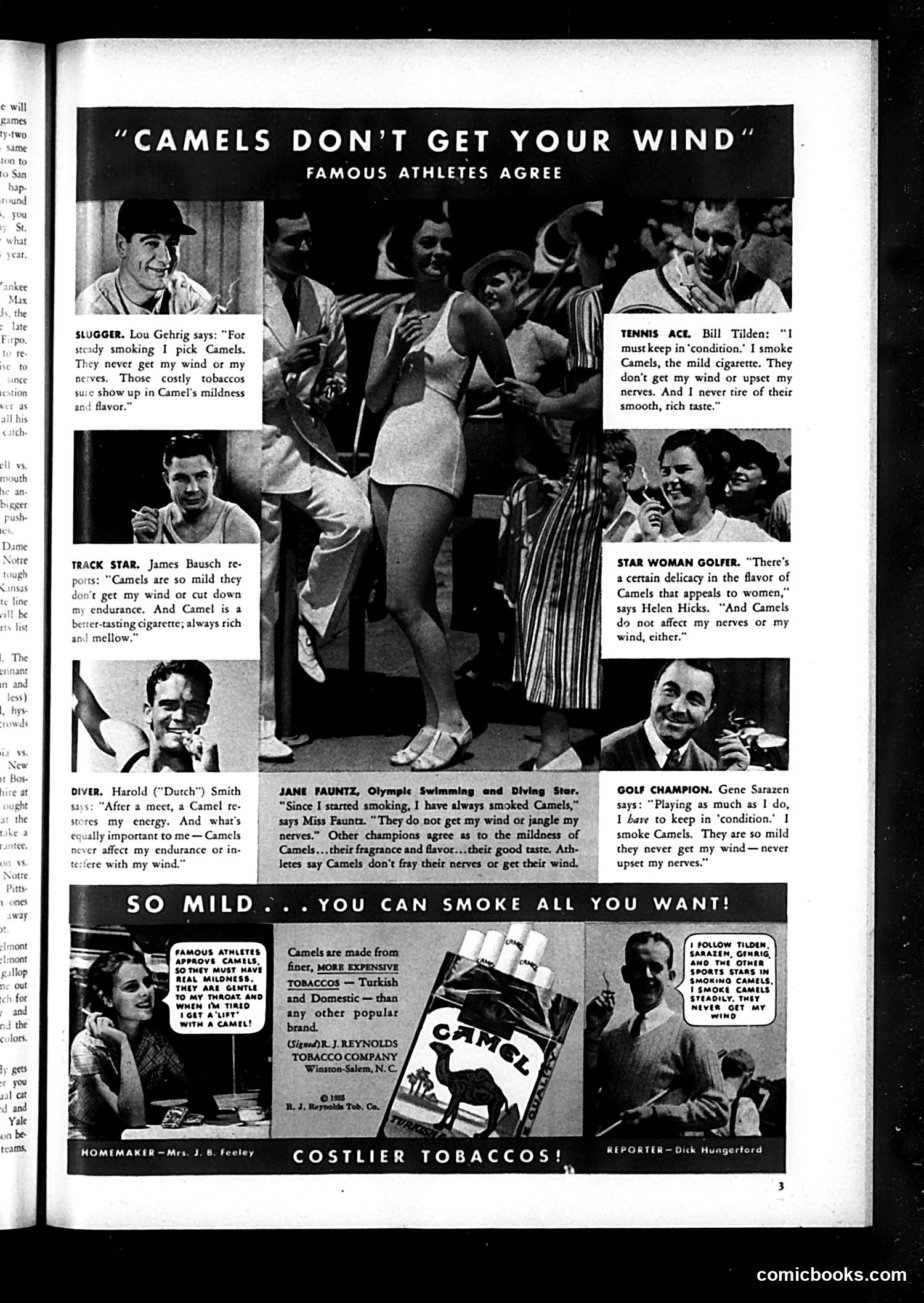
Analysis This is a cigarette advertisement, not satire or political commentary. It's a pro-smoking ad featuring testimonials from famous athletes of the era (Lou Gehrig, Bill Tilden, James Bausch, Harold Smith, Jane Fauntz, and Gene Sarazen), claiming that Camel cigarettes "don't get your wind" and won't affect athletic performance. The appeal is straightforward marketing: associating smoking with physical prowess and health. Each athlete endorses the product's mildness and claims it poses no threat to their conditioning or nerves. The bottom section emphasizes Camels use premium Turkish and domestic tobacco, positioning them as a luxury product. Modern context: This represents pre-regulation tobacco advertising, when health risks were completely unacknowledged and celebrity endorsements by elite athletes were considered persuasive selling tactics.
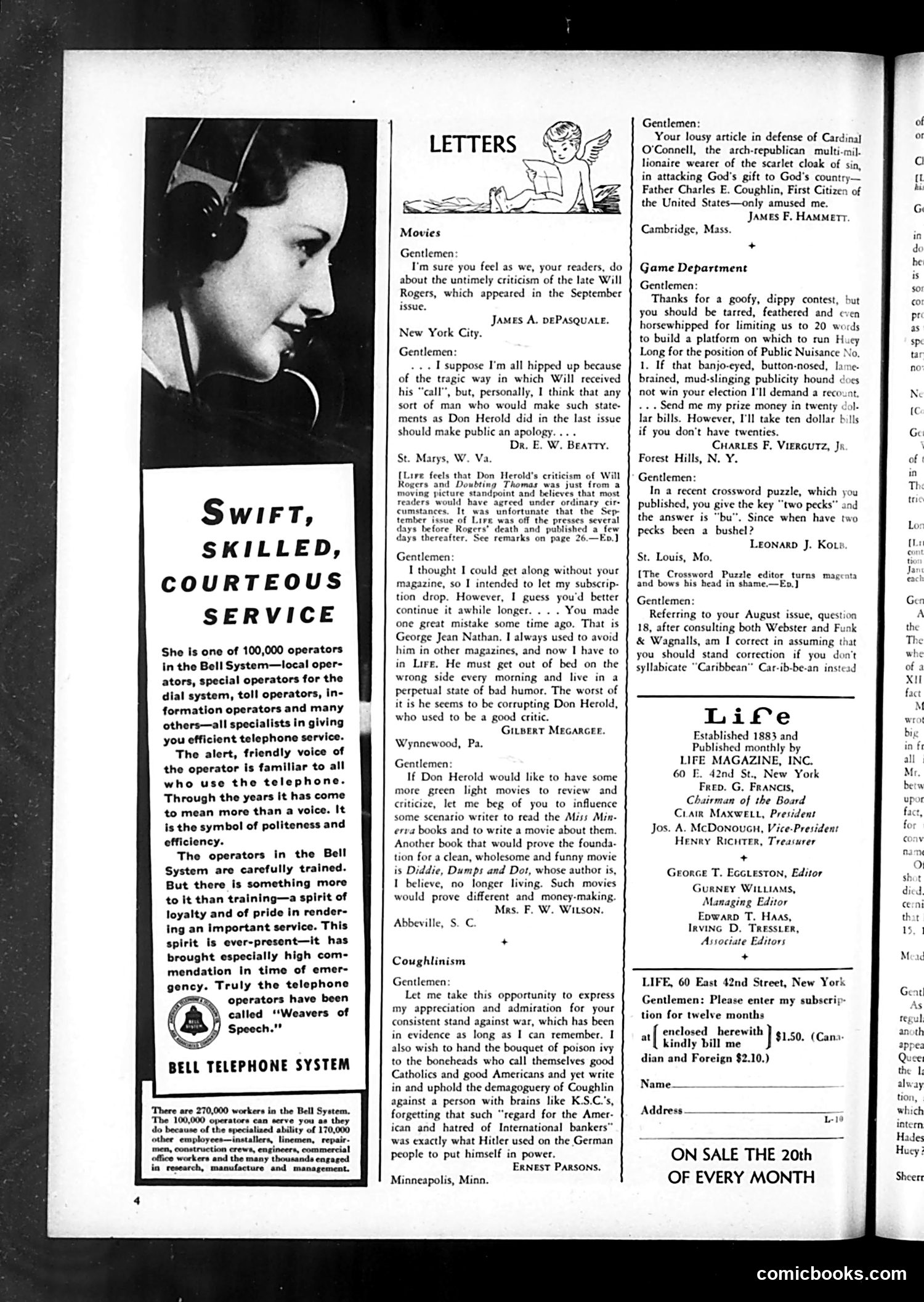
Analysis of Life Magazine Page This page is primarily advertising and editorial content, not political satire. The left side features a Bell Telephone System advertisement celebrating female telephone operators as "Swift, Skilled, Courteous" workers—part of early 20th-century corporate branding that positioned women in telephone service as essential infrastructure workers. The right side contains a Letters section with reader responses about movies, games, and other topics, plus Life Magazine masthead information. One letter references "Don Herold," a humorist, indicating contemporary magazine criticism. The content reflects 1930s-era concerns: job training, telephone service quality, and entertainment preferences. The photograph shows a telephone operator wearing headset equipment typical of that era. This is a corporate PR page, not political commentary—its purpose is legitimizing women's labor in emerging technology industries.
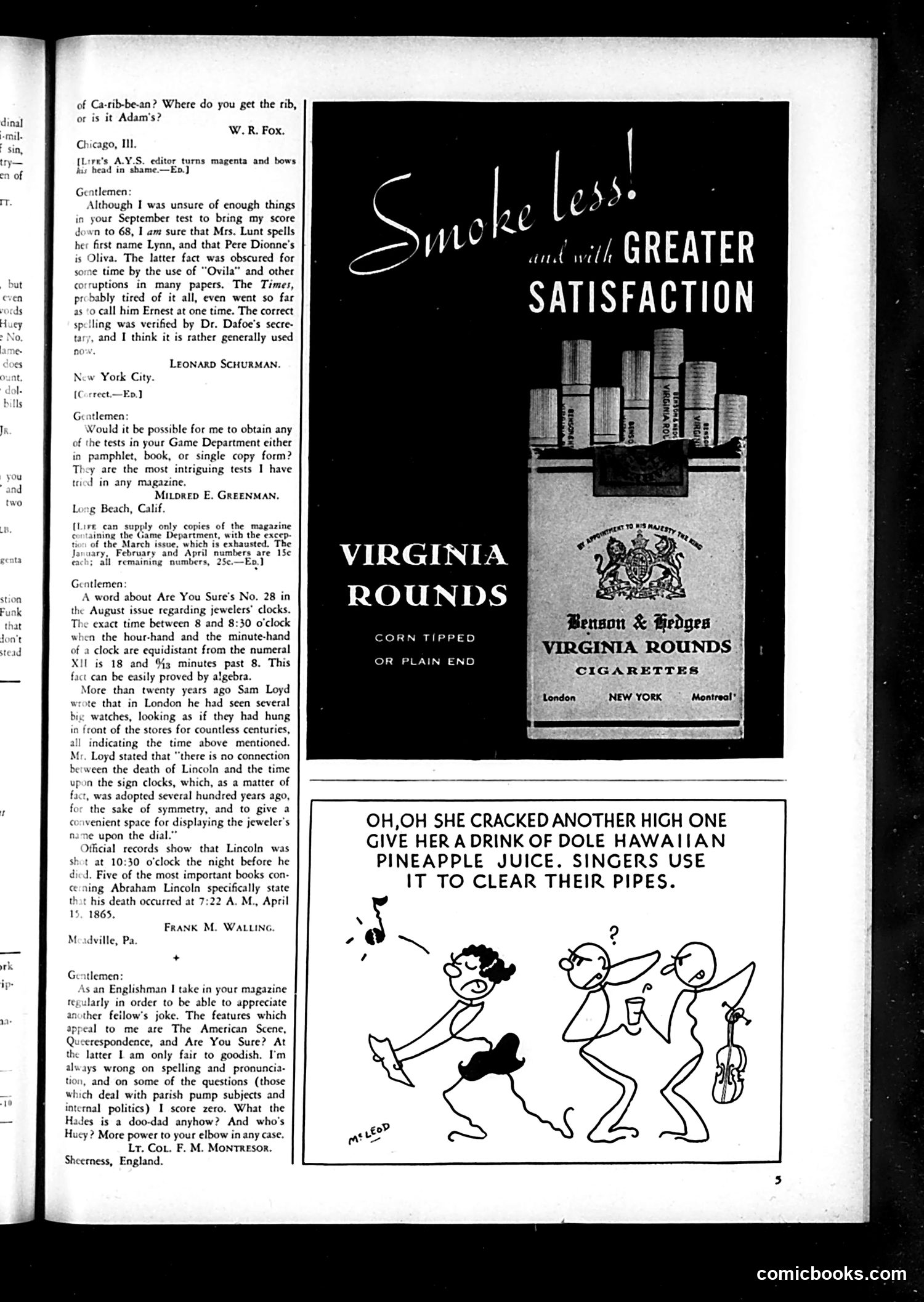
Analysis This page contains reader correspondence and advertisements rather than political satire. The left column features letters to the editor debating minor topics—spelling of character names, clock mechanisms, and Lincoln assassination timing. The right side displays a Virginia Rounds cigarette advertisement promising "smoke less...with greater satisfaction," and an unrelated cartoon about someone named Dole offering Hawaiian pineapple juice to "clear their pipes"—likely a crude digestive health joke common to early 20th-century humor. The cartoon depicts simple stick figures in exaggerated poses, typical of the era's style. There's no identifiable political content or satire on this particular page—it's primarily reader mail and period advertising.
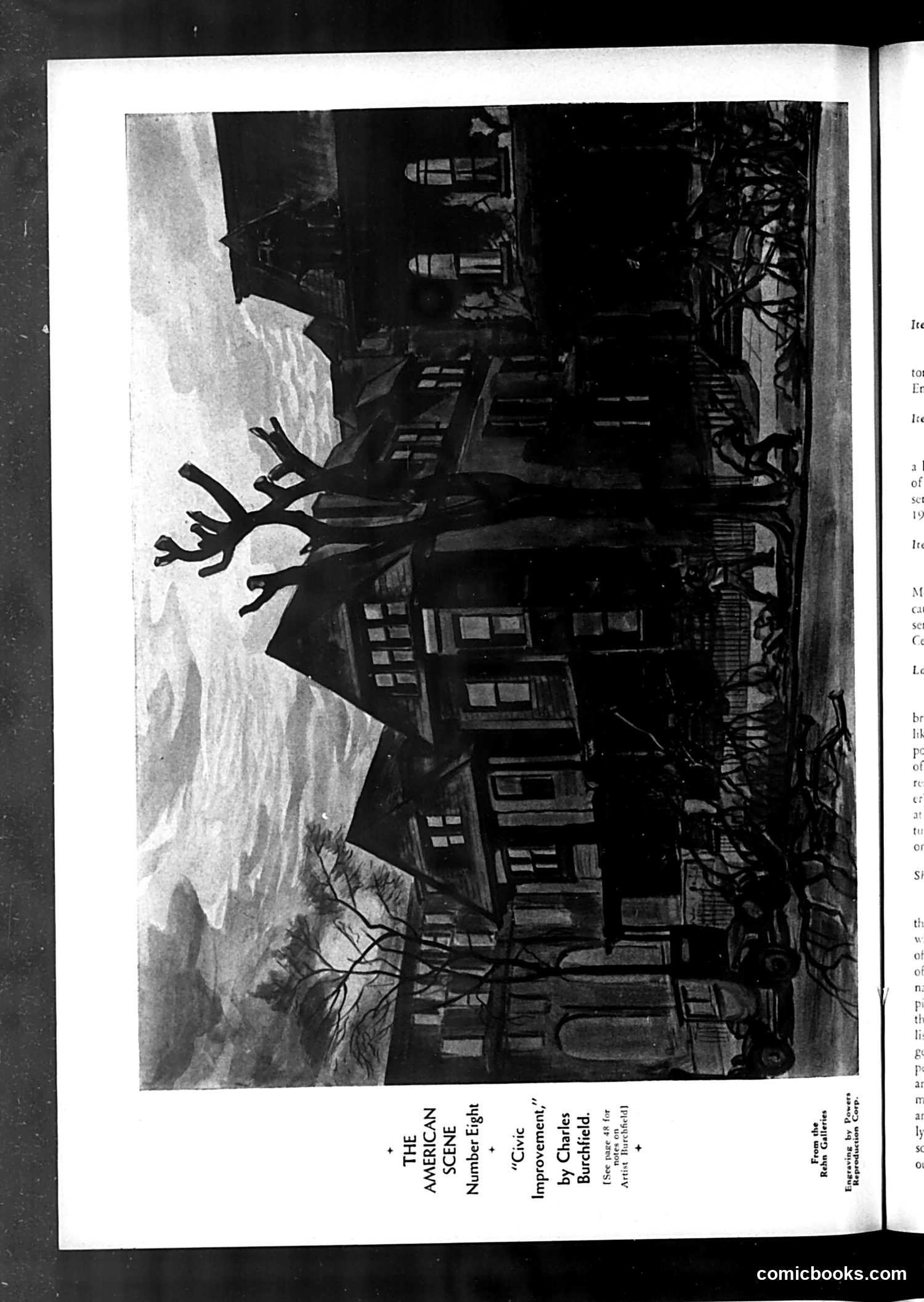
Analysis This page appears to be rotated 90 degrees in the scan, showing what should be viewed sideways. The caption reads "THE AMERICAN SCENE / Number Eight / Civic Improvements / by Corey Ford / Burchfield" (the artist). The image depicts a bare, gnarled tree in front of residential buildings with multiple windows. The tree appears skeletal and dead or severely damaged. This is likely satirical social commentary about urban development and "civic improvements" in America—suggesting that modernization efforts destroyed natural features. The juxtaposition of the dead tree against orderly residential architecture critiques how progress often came at nature's expense. The artist Corey Ford and illustrator Burchfield were known for such satirical observations of American life and culture in the mid-20th century.
"Some of the People" - Life Magazine Satire Page This page satirizes American political and governmental absurdities circa 1936. The "Our Country" section mocks: 1. Congressional waste: A House doorkeeper's budget submission of $11,000 to cover speeches sent to members during 1936—criticized as excessive spending. 2. Military morale efforts: The Army's attempts to keep soldiers happy at Fort Meyer through firing squads at Arlington Cemetery funerals (appears to reference grim military tradition as "entertainment"). 3. Ship naming practices: The arbitrary, sometimes ridiculous logic behind christening U.S. Navy vessels after states, fish, mythological characters, and deceased officials. The "Return to Arms" section uses stock-market gossip and cryptic conversation between investors to mock speculative stock trading and financial hype during the Depression recovery period.
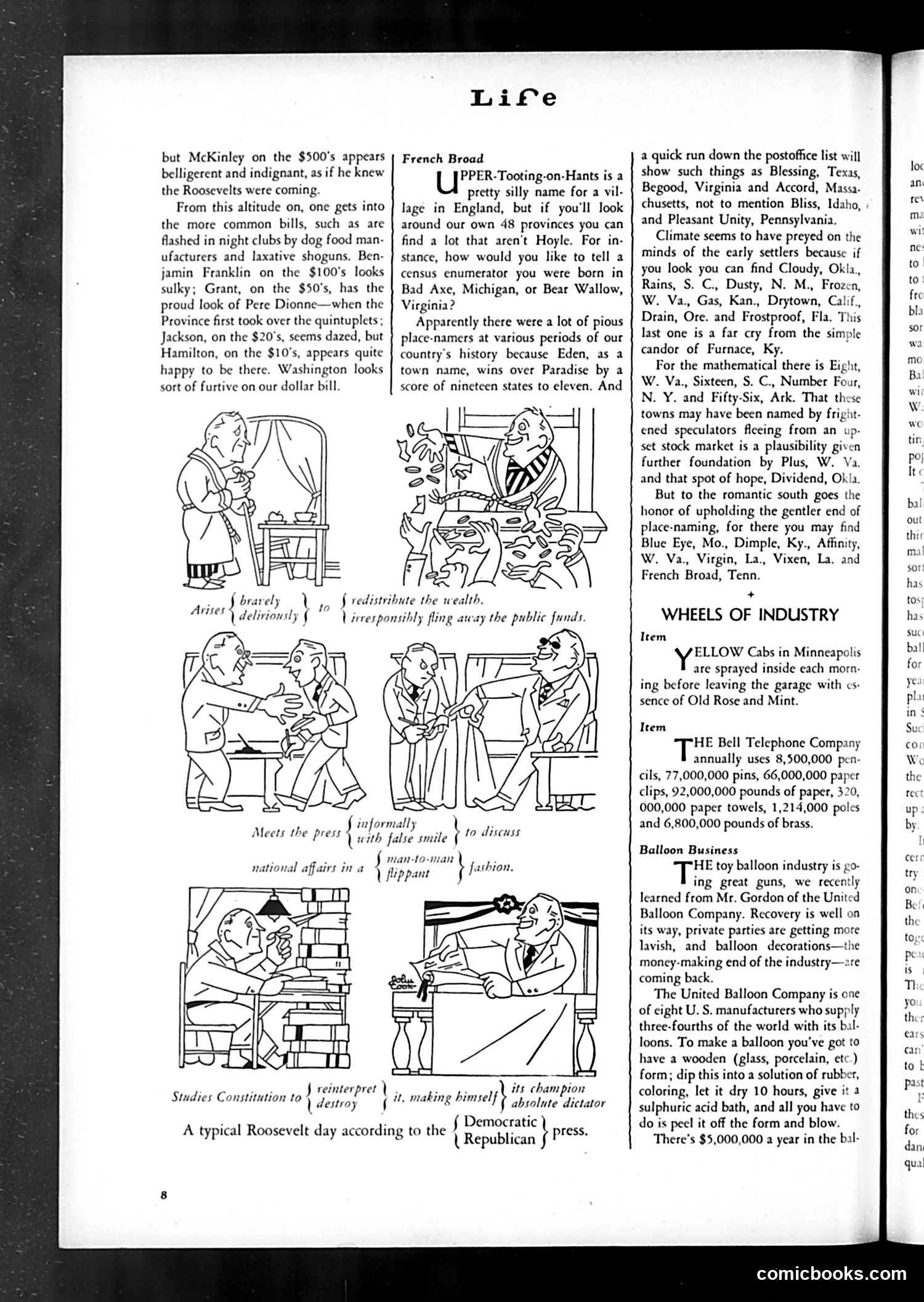
Analysis of Life Magazine Page This page contains satirical cartoons about President Franklin D. Roosevelt's daily activities, labeled "A typical Roosevelt day according to the [Democratic/Republican] press." The six cartoon panels mock how differently Democratic and Republican newspapers portrayed FDR's routine. Each panel shows the same activity interpreted two opposing ways: - "Briskly to redistribute the health" vs. "irresponsibly fling away the public funds" - "Informally with false smile" vs. "man-to-man fashion" - "Reinterpret destiny" vs. "make himself absolute dictator" The satire highlights partisan media bias—how the same presidential actions were spun as either progressive leadership (Democratic view) or reckless overreach (Republican view). This reflects 1930s New Deal-era political polarization, where FDR's expanding executive power was deeply controversial.
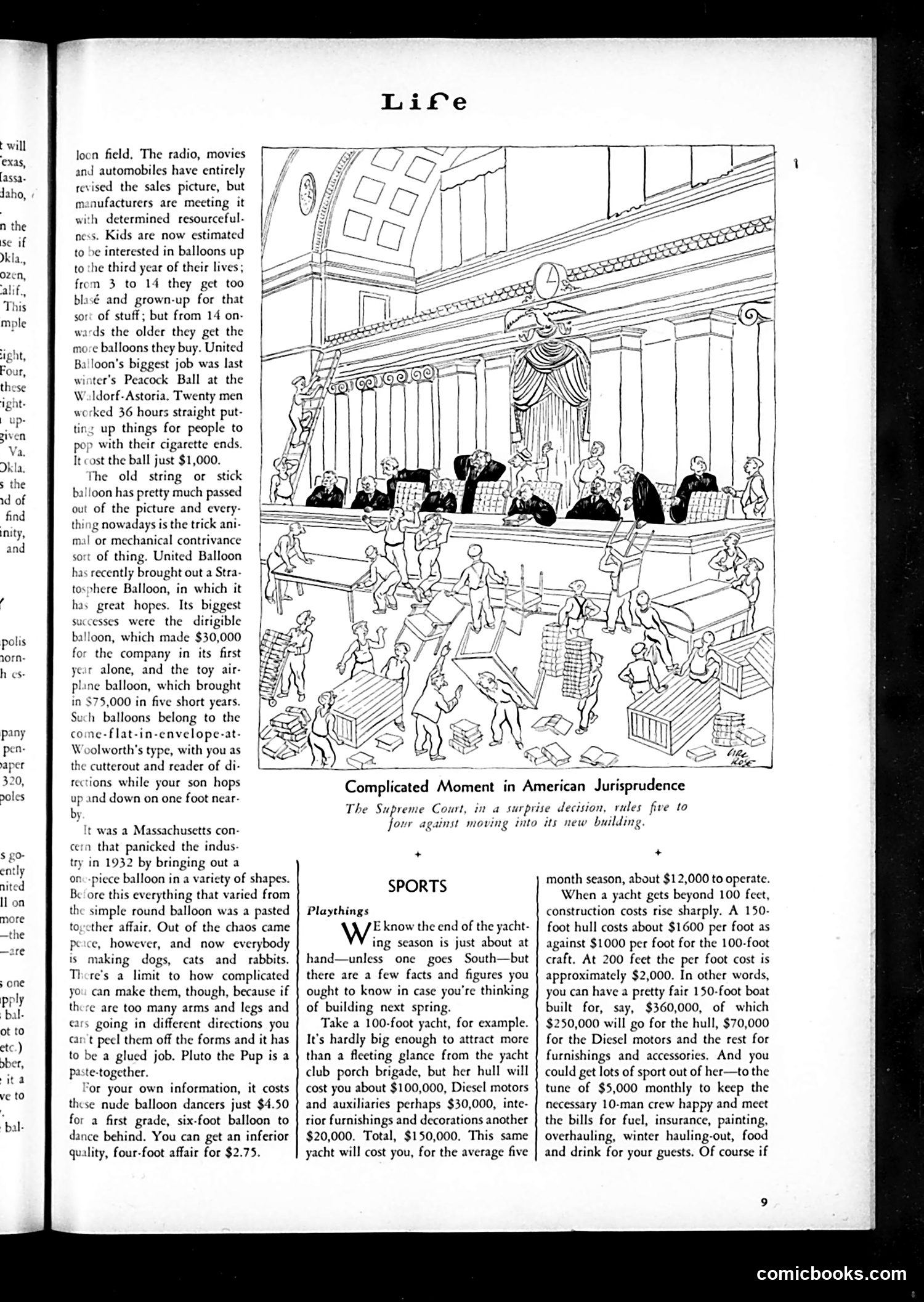
"Complicated Moment in American Jurisprudence" This cartoon satirizes the Supreme Court moving into its new building. The illustration shows the justices seated in an ornate courtroom while below, numerous people are physically engaged in moving activities—carrying boxes, furniture, and belongings in apparent chaos. The satire targets the contrast between the dignified, formal nature of the Supreme Court and the practical, messy reality of a major institutional move. By depicting the justices presiding over literal moving day chaos, the cartoonist mocks the idea that such an elevated body must deal with mundane administrative matters. The "complicated moment" of the title ironically suggests that even America's highest legal authority cannot escape ordinary logistical complications.
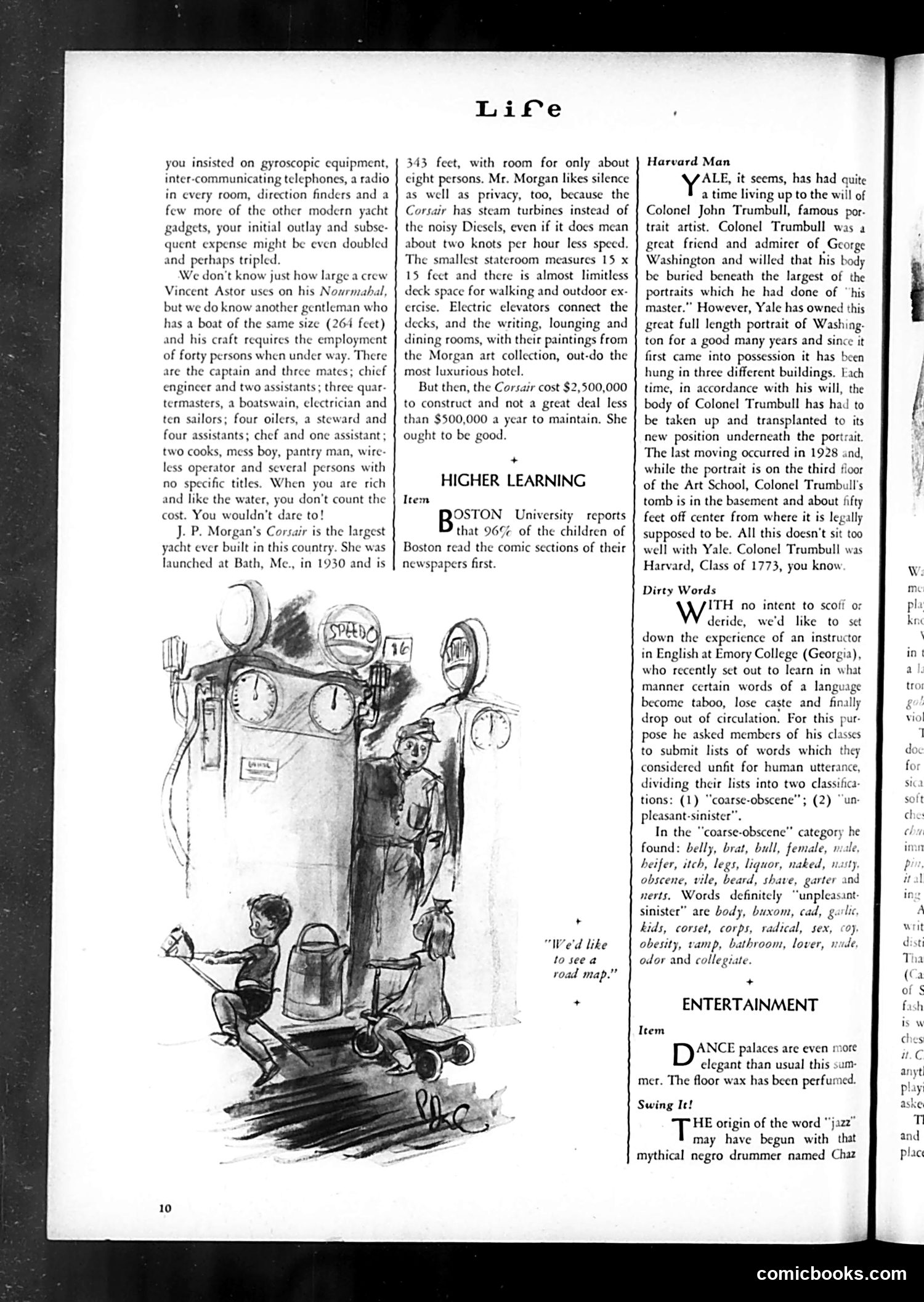
Analysis of Life Magazine Page (Page 10) This page contains three distinct sections: Top left: A satirical article about J.P. Morgan's yacht *Corsair*, mocking the wealthy banker's extravagant vessel—343 feet long, requiring 40+ crew members and costing $2.5 million to build and maintain annually. The satire targets gilded-age excess. Center illustration: A humorous cartoon showing a man surrounded by clocks and timing devices, captioned "We'd like to see a road map"—likely satirizing the complexity of modern scheduling or navigation. Right column: Sections on "Higher Learning" (Boston University's comic readership), "Dirty Words" (linguistic taboos), and "Entertainment" (dance venues and jazz origins). These are informational rather than satirical. The overall tone mocks wealth disparity and modern life's complications.
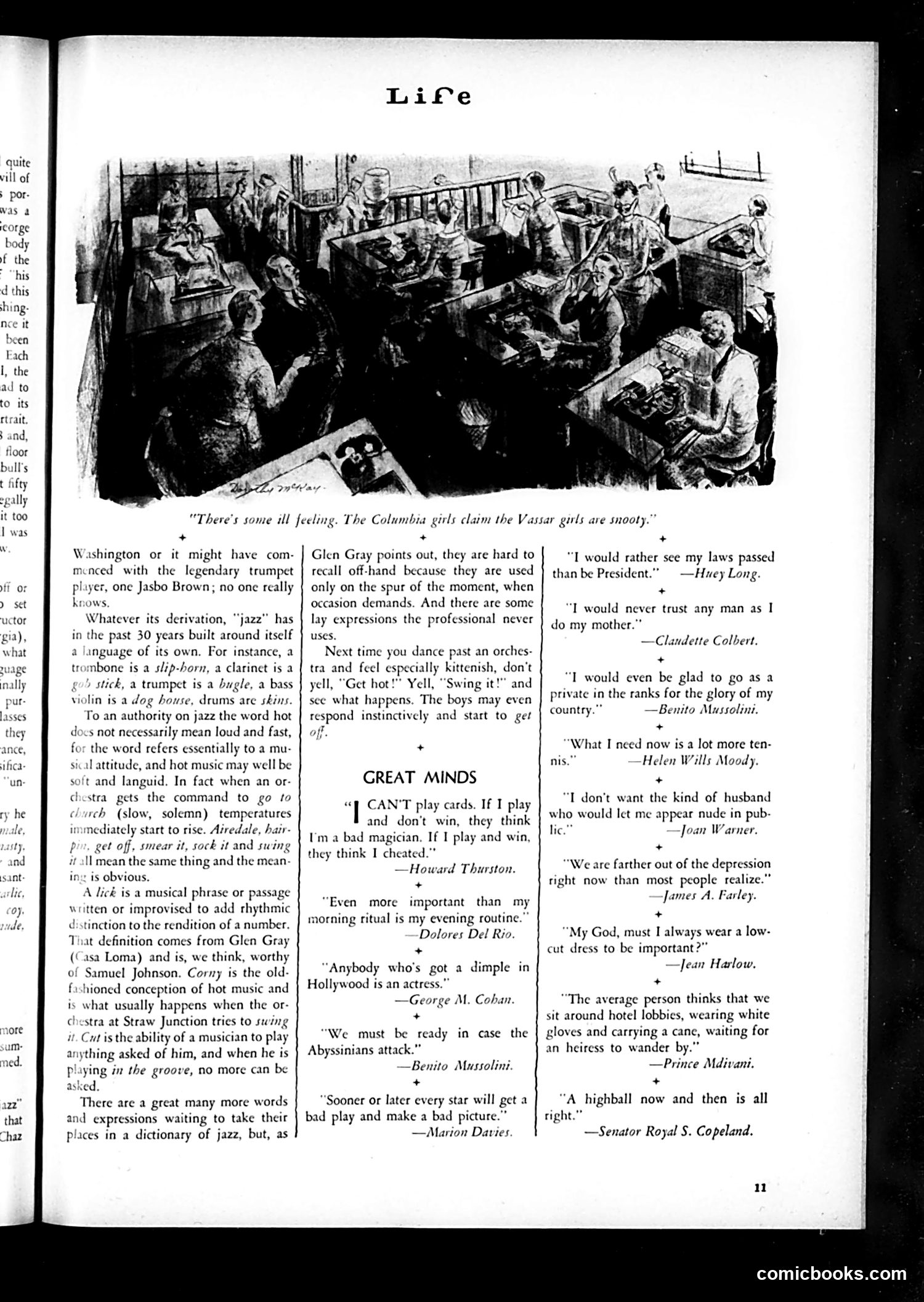
Analysis of Life Magazine Page The main illustration depicts a crowded nightclub or jazz venue with patrons dancing and socializing. The caption reads: "There's some ill feeling. The Columbia girls claim the Vassar girls are snooty." This is social satire about class tensions among young women from different colleges during the Jazz Age. Columbia and Vassar were prestigious institutions, but Vassar held particular elite status. The joke captures the snobbery and social hierarchies among educated young women in 1920s New York nightlife—specifically the rivalry between these college groups frequenting jazz clubs. The "Great Minds" section below contains humorous quotes from celebrities and politicians on unrelated topics, a common Life magazine feature. The overall page satirizes both high-society pretension and the era's emerging youth culture around jazz and nightclubs.
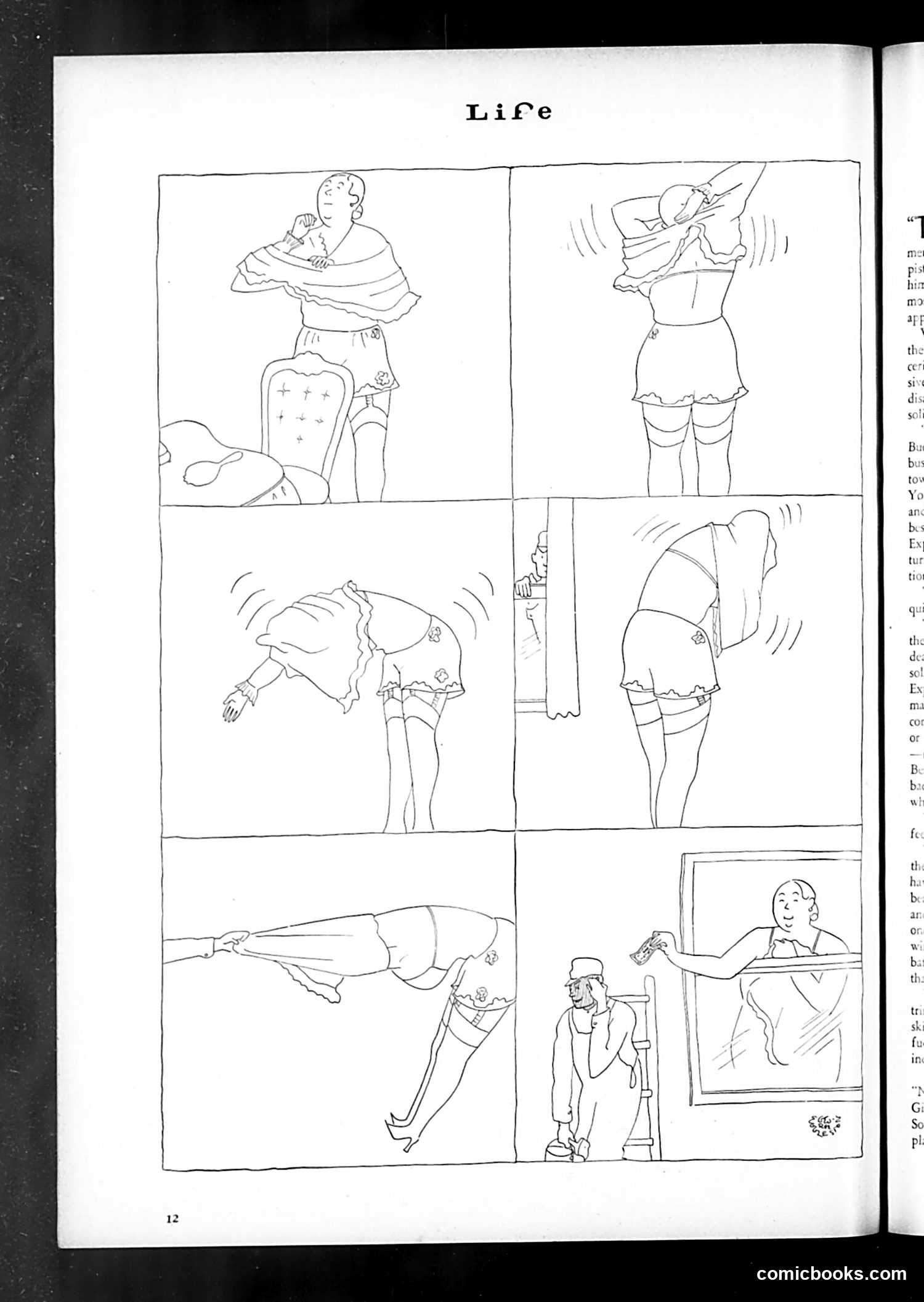
Analysis of "Life" Magazine Comic Strip - "Life" This six-panel comic depicts a woman's progressive undressing sequence, showing her removing clothing layer by layer. The title "Life" appears at the top. The humor appears satirical commentary on women's fashion and changing clothing styles, likely from the early 20th century based on the art style. The strip shows the woman starting fully clothed (top left) and progressively removing garments—shawl, outer dress, undergarments—ending nearly nude (bottom right panels). Without additional context text visible on this page, the precise satirical target is unclear. It likely mocks either: changing fashion standards making women's clothing progressively skimpier, or critiques women adopting more revealing clothing styles of the era. The final panels showing onlookers suggest social commentary about public reaction to women's changing dress codes.
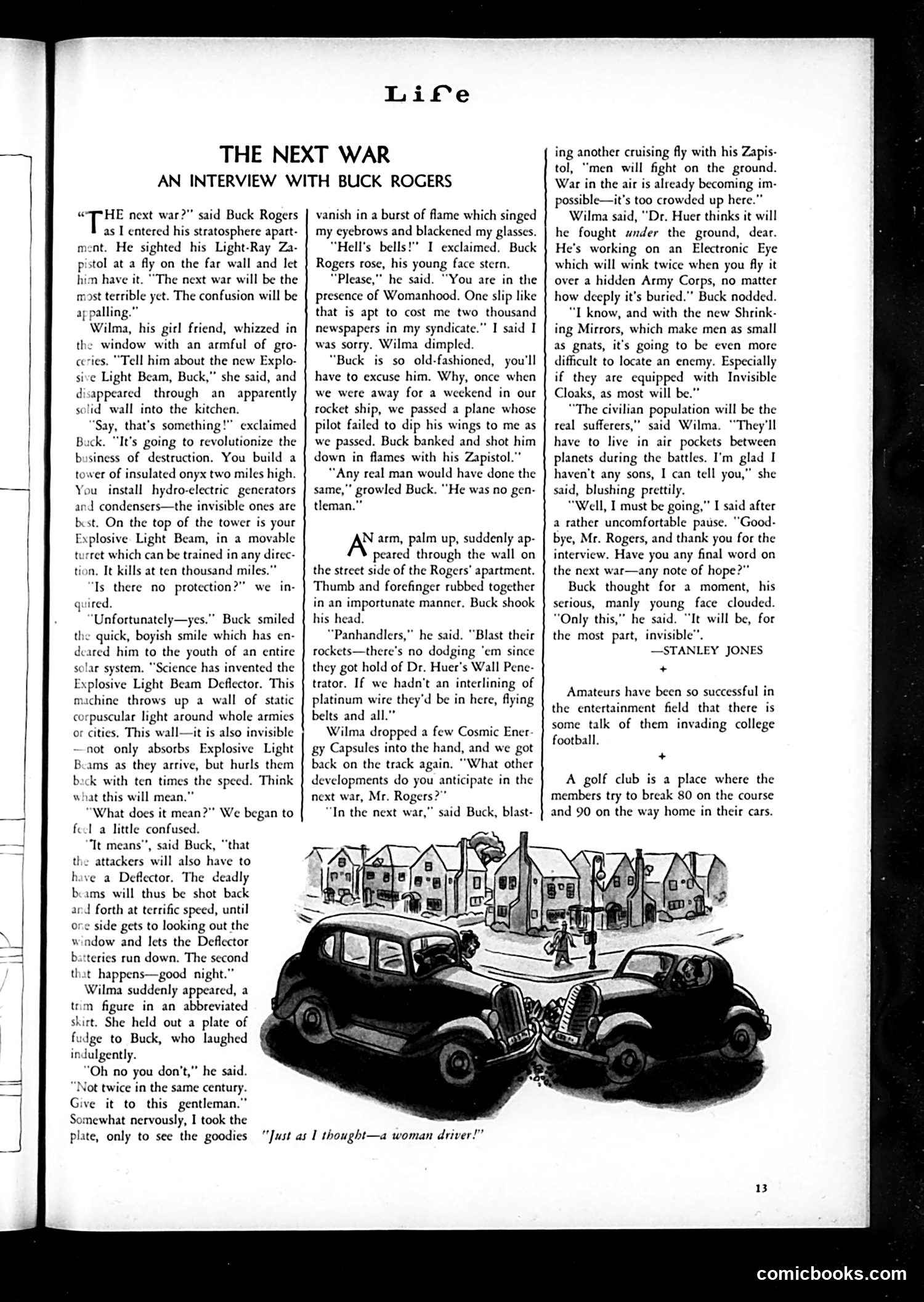
"The Next War: An Interview with Buck Rogers" This satirical piece imagines futuristic warfare technology. Buck Rogers discusses sci-fi weapons: an "Explosive Light Beam" that creates invisible walls destroying cities, and "Deflectors" that shoot down attacking aircraft. The humor lies in presenting absurdly advanced (for the 1920s-30s) weaponry as casual conversation. The accompanying illustration shows two cars colliding near houses, captioned "Just as I thought—a woman driver!" This reflects period sexism—the "joke" being that women drivers cause accidents, used here as a punchline unrelated to the futuristic warfare discussion above. The satire likely mocks both contemporary anxieties about future war technology and contemporary gender stereotypes simultaneously.
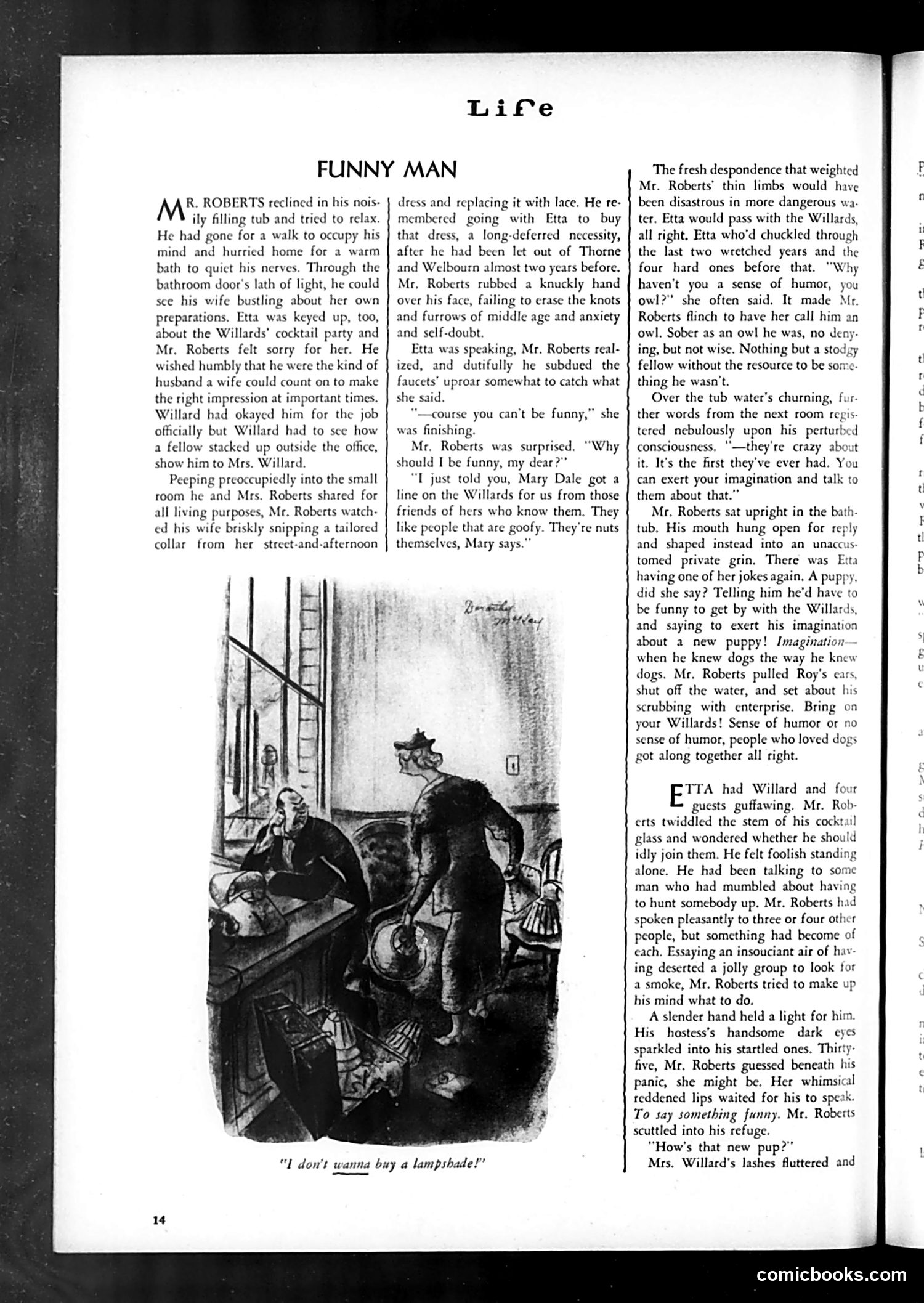
"Funny Man" - Life Magazine Story This page presents a short story titled "Funny Man" about Mr. Roberts, a man trying to be humorous at a cocktail party. The narrative describes Roberts attempting to impress guests—particularly the Willards—by being witty and entertaining, but struggling to succeed. The accompanying illustration depicts a social gathering where Roberts appears awkward among well-dressed guests. The caption reads "I don't wanna buy a lampshade!" — likely referencing a then-common joke or cliché about drunk party behavior (lampshade-wearing was stereotypical drunken antics). The story satirizes social anxieties of the era: the pressure to perform humor in polite company, the difficulty of "being funny on command," and the gap between one's self-perception and others' reception. It's essentially a gentle comedy about failed attempts at wit among the middle class.
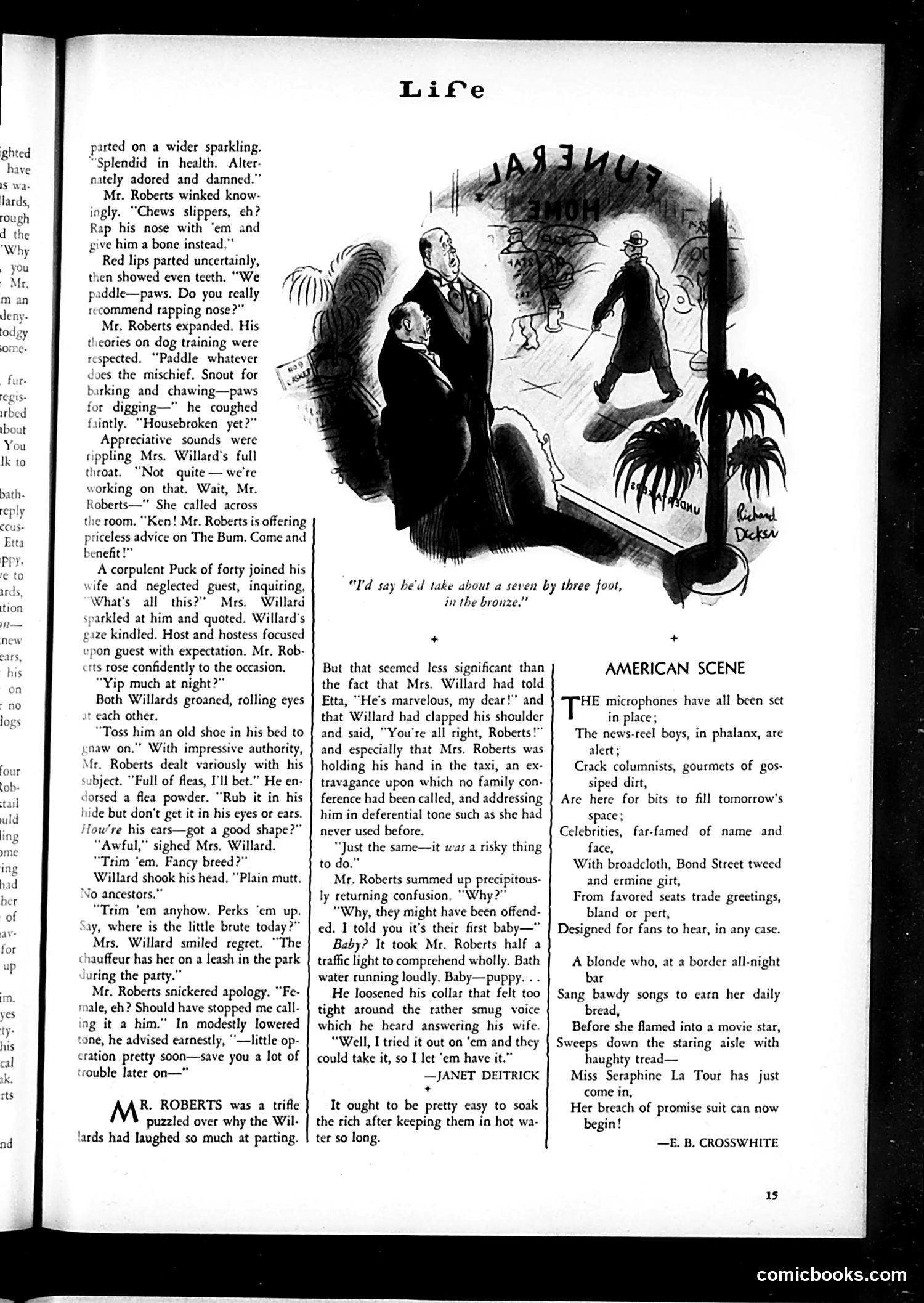
Analysis of Life Magazine Page This page contains a Richard Decker cartoon and prose story about Mr. and Mrs. Willard, wealthy socialites, and Mr. Roberts, their guest. The satire targets the idle rich: Mr. Roberts is puzzled why the Willards "laughed so much at parting" when he arrives, and the story reveals their neglectful, superficial behavior—they treat guests and dogs dismissively, offer contradictory advice, and generally lack genuine warmth or consideration. The cartoon shows figures in what appears to be a tropical setting, likely satirizing wealthy Americans abroad. The humor derives from depicting upper-class social pretension and the gap between their refined self-image and their actual boorish behavior toward service staff and companions.
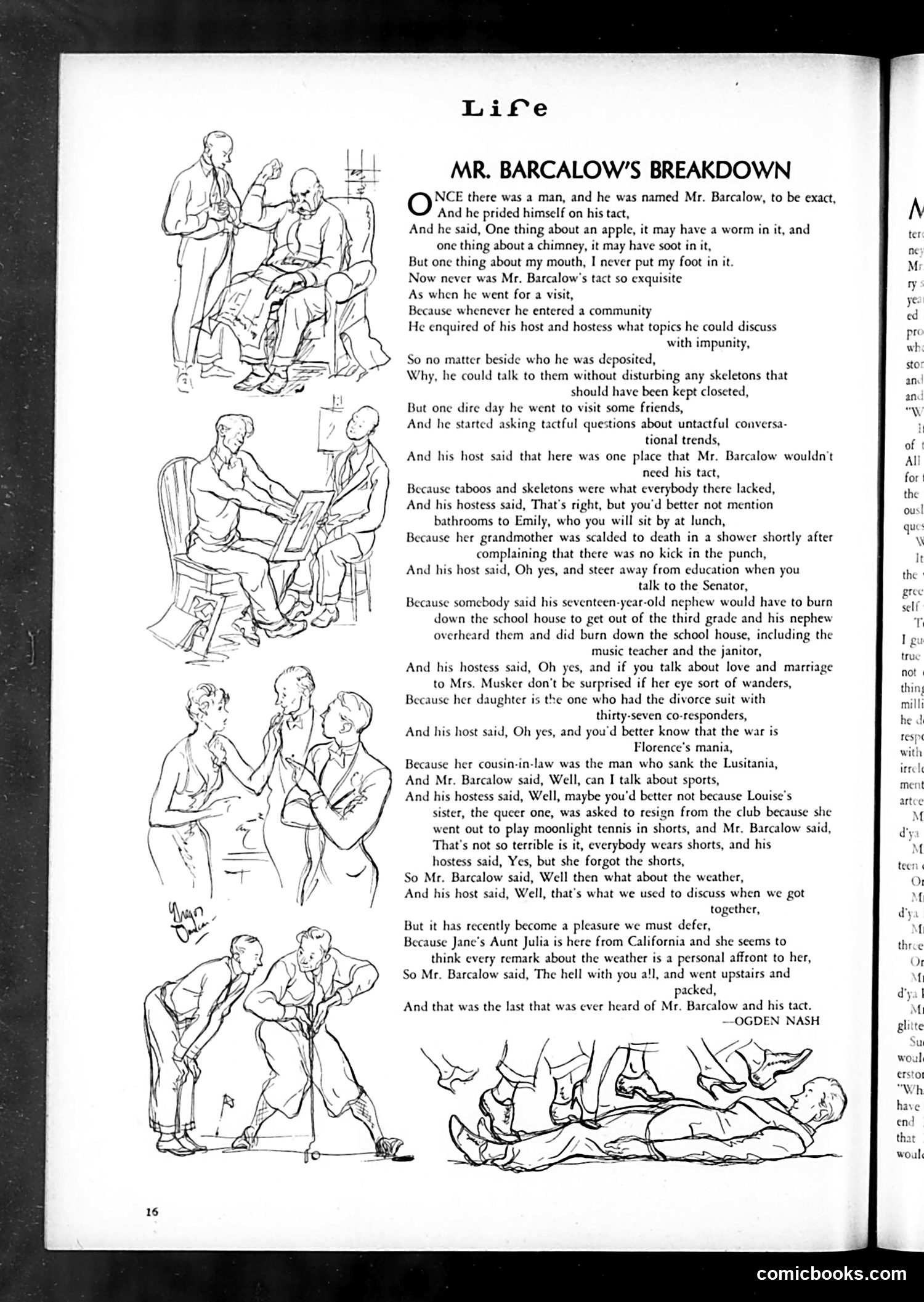
"Mr. Barcalow's Breakdown" by Ogden Nash This satirical poem, illustrated with sketches of social situations, mocks a man named Mr. Barcalow for his obsessive tactfulness. Nash describes how Barcalow meticulously avoids controversial topics in conversation—never mentioning mouths, chimneys, or apples with worms. However, the poem reveals Barcalow's fatal flaw: he visits friends and begins asking "tactful questions about untactful conversational trends." His hosts then list increasingly scandalous family secrets—a grandmother scalded in a shower, nephews burning down schoolhouses, divorces, affairs, and a sister forced to resign from a club. The satire concludes when Barcalow finally asks about the weather, only to learn his guest's visiting friend finds even that question personally offensive. The joke: obsessive politeness becomes social paralysis and unwitting rudeness.
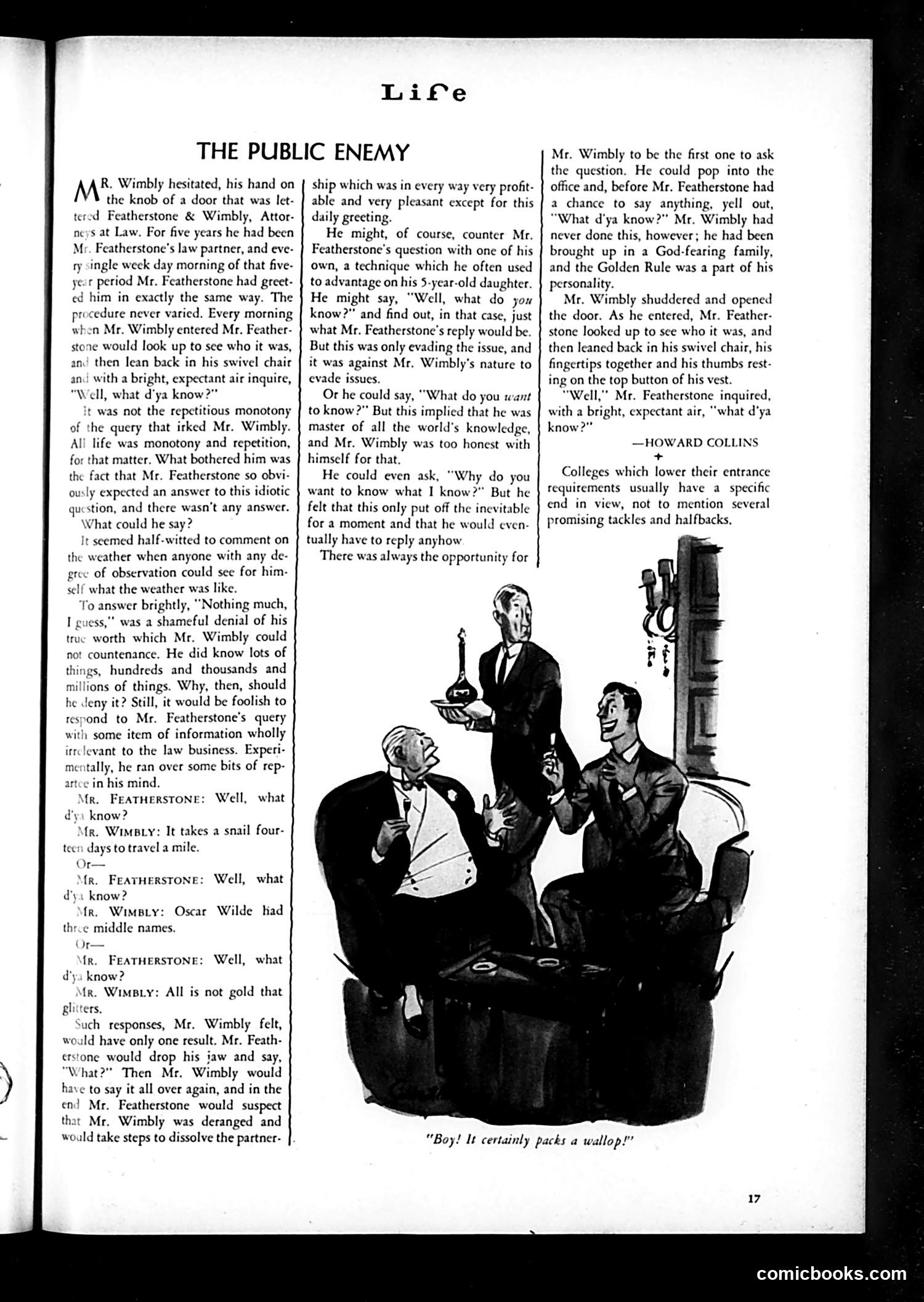
"The Public Enemy" - Life Magazine Satire This piece satirizes the tedious dynamic between business partners Featherstone and Wimbly. The humor centers on Featherstone's habit of asking Wimbly "What do you know?" each morning—a ritualistic question designed to trap Wimbly into an endless loop of providing trivial answers. The satire mocks: - Workplace monotony: The repetitive, meaningless exchange that defines their partnership - Professional pretense: Wimbly's inability to refuse or escape the dynamic despite its absurdity - The "public enemy" (Featherstone's question itself): Presented as the real villain The accompanying illustration shows three men in an office setting, with one appearing exasperated. The joke relies on recognizing how petty irritations in professional relationships can become unbearable through sheer repetition. This is workplace satire targeting corporate tedium.
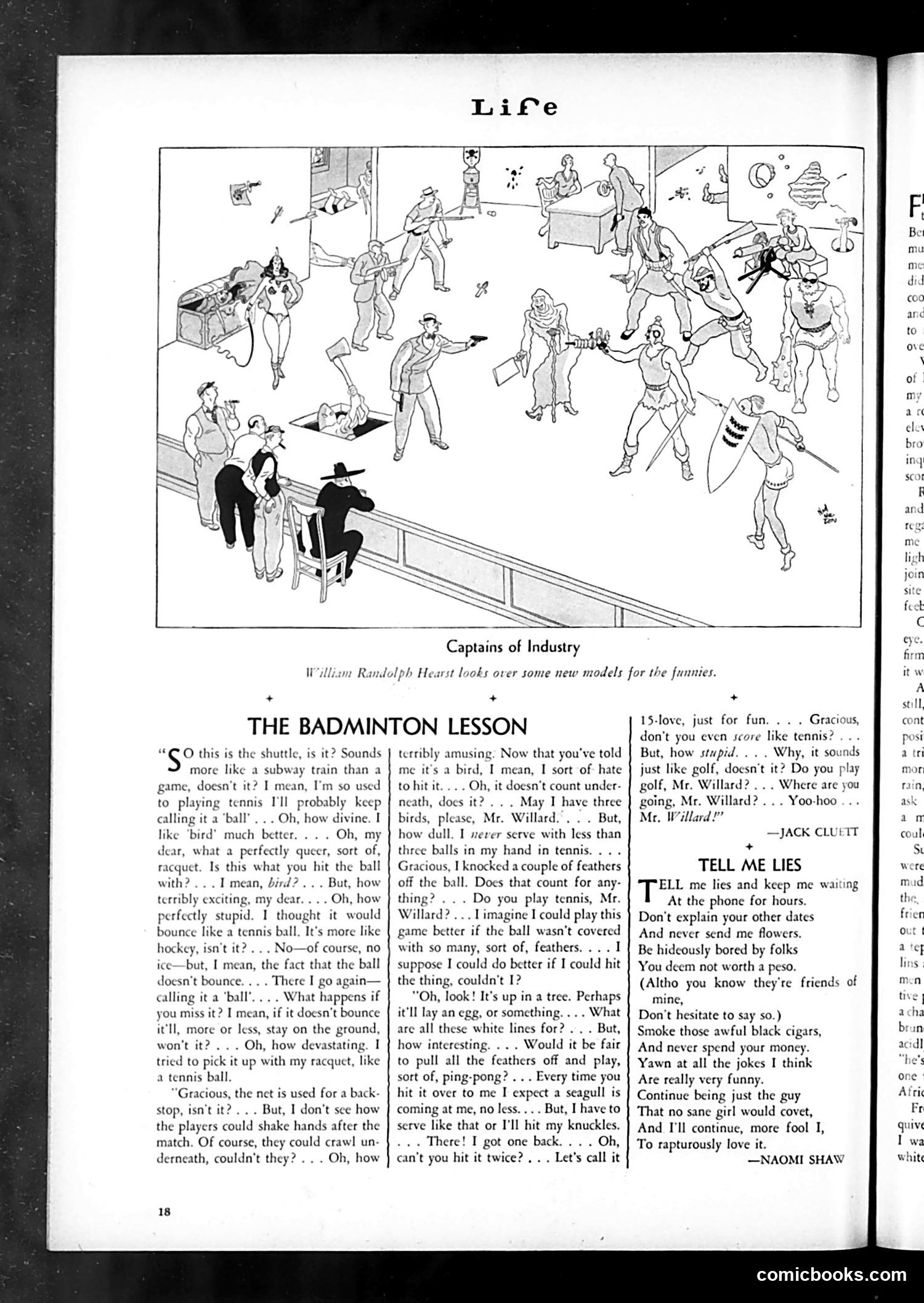
Analysis of Life Magazine Page The top illustration, captioned "Captains of Industry," depicts William Randolph Hearst examining fashion models. This satirizes Hearst's well-known influence over media and popular culture—suggesting he literally controls what Americans see and desire. Below are two pieces of light humor with no apparent political content: "The Badminton Lesson" is a comedic monologue about confusing badminton with tennis, playing on the speaker's unfamiliarity with the sport. "Tell Me Lies" is a humorous poem about dating deception—asking partners to fabricate romantic excuses rather than admit boredom or infidelity. Both lower pieces are purely entertainment, typical of Life's satirical-but-apolitical humor content during this era.
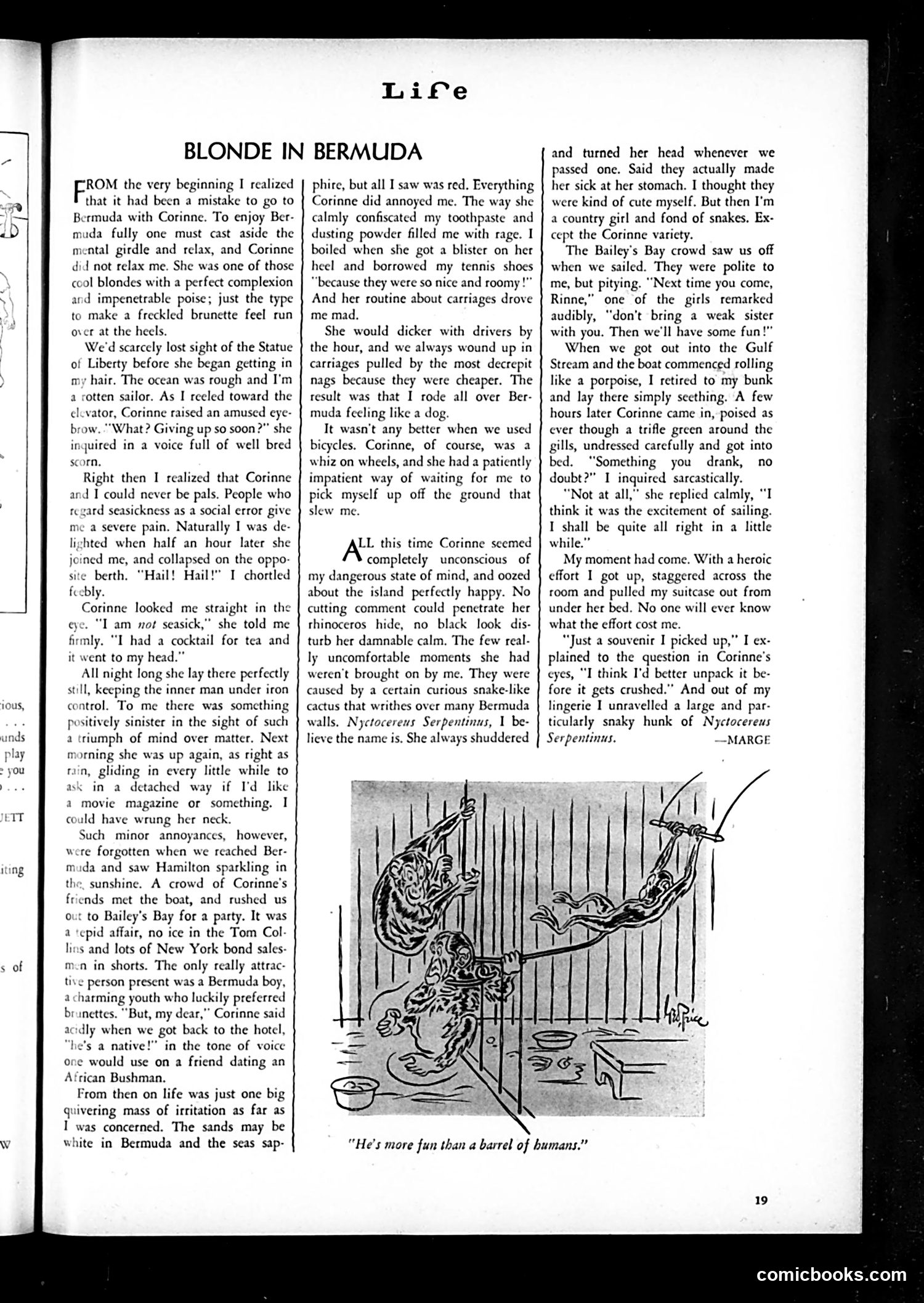
Analysis of "Blonde in Bermuda" This page contains a humorous travel narrative about a trip to Bermuda with a woman named Corinne, rather than political satire. The single cartoon at bottom depicts what appears to be a caged monkey or ape with the caption "He's more fun than a barrel of humans." The cartoon's humor relies on comparing animal entertainment to human company—a fairly straightforward comedic jab. The accompanying story satirizes Corinne's self-absorbed, complaining behavior during their vacation: her vanity, impatience, and constant demands make her tiresome company, making even a monkey seem preferable. This reflects early-to-mid 20th century *Life* magazine's style: light domestic satire rather than hard political commentary, targeting common social frustrations like difficult travel companions.
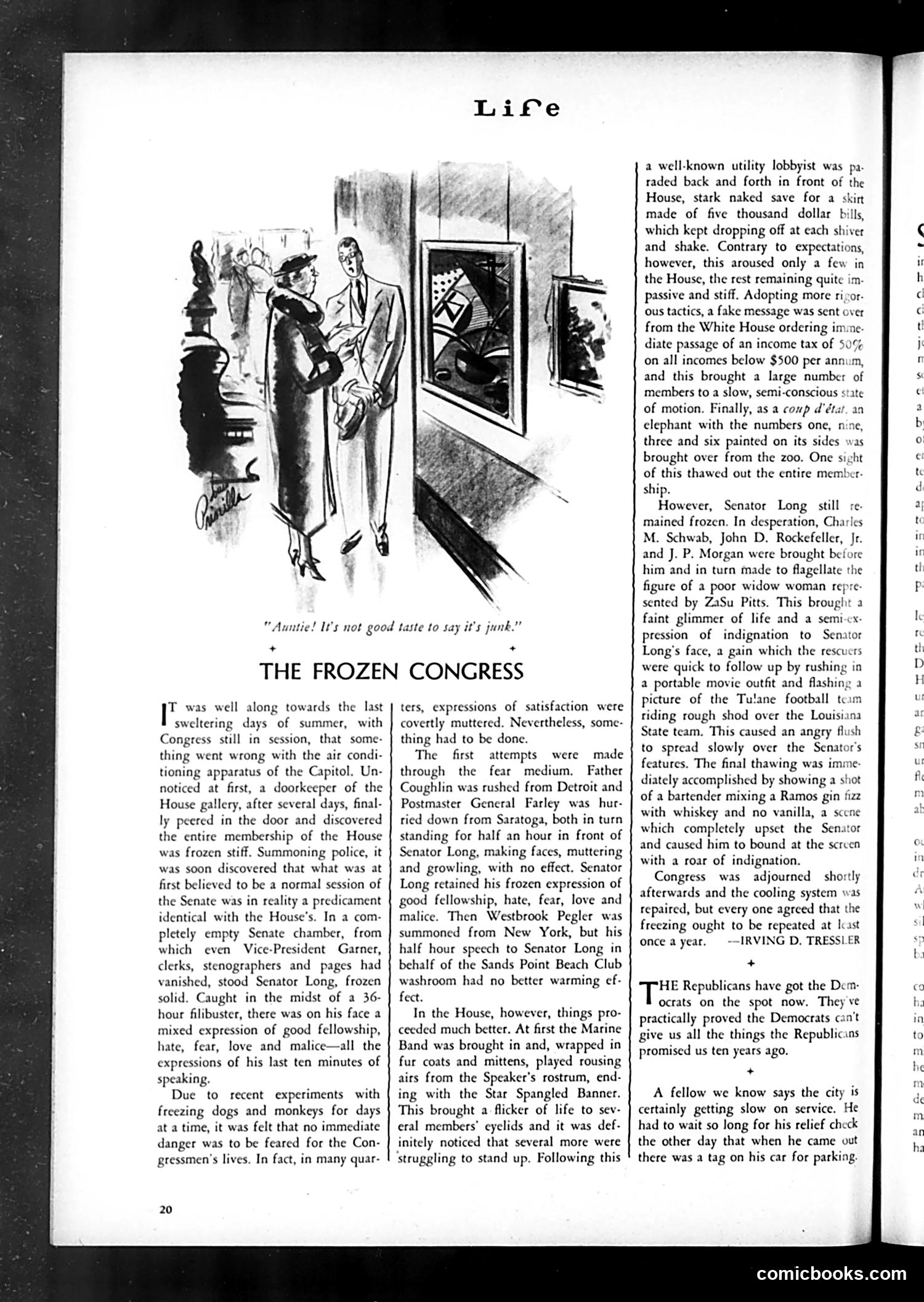
"The Frozen Congress" Satirical Article This is a humorous fictional piece mocking Congress during summer 1935. When the Capitol's air conditioning fails, Congress freezes solid—a joke suggesting legislative paralysis. Key figures satirized: - Senator Huey Long: depicted as a perpetual filibusterer, frozen mid-speech with contradictory expressions - Father Coughlin, Postmaster General Farley, Westbrook Pegler: contemporary political figures summoned unsuccessfully to "thaw" Long The satire targets: - Congressional inaction and obstruction (Long's famous filibusters) - Attempts to motivate politicians through appeals to fear, patriotism, and greed - Capitalist titans (Rockefeller, Morgan, Schwab) as ineffectual influences - Southern pride (the Tulane football team reference) The piece ridicules how Congress responds only to self-interest (naked lobbyists with money, threats of wealth taxes) or regional vanity. The "frozen" metaphor suggests Congress is already legislatively dead—the satire's dark implication that political theater substitutes for actual governing.
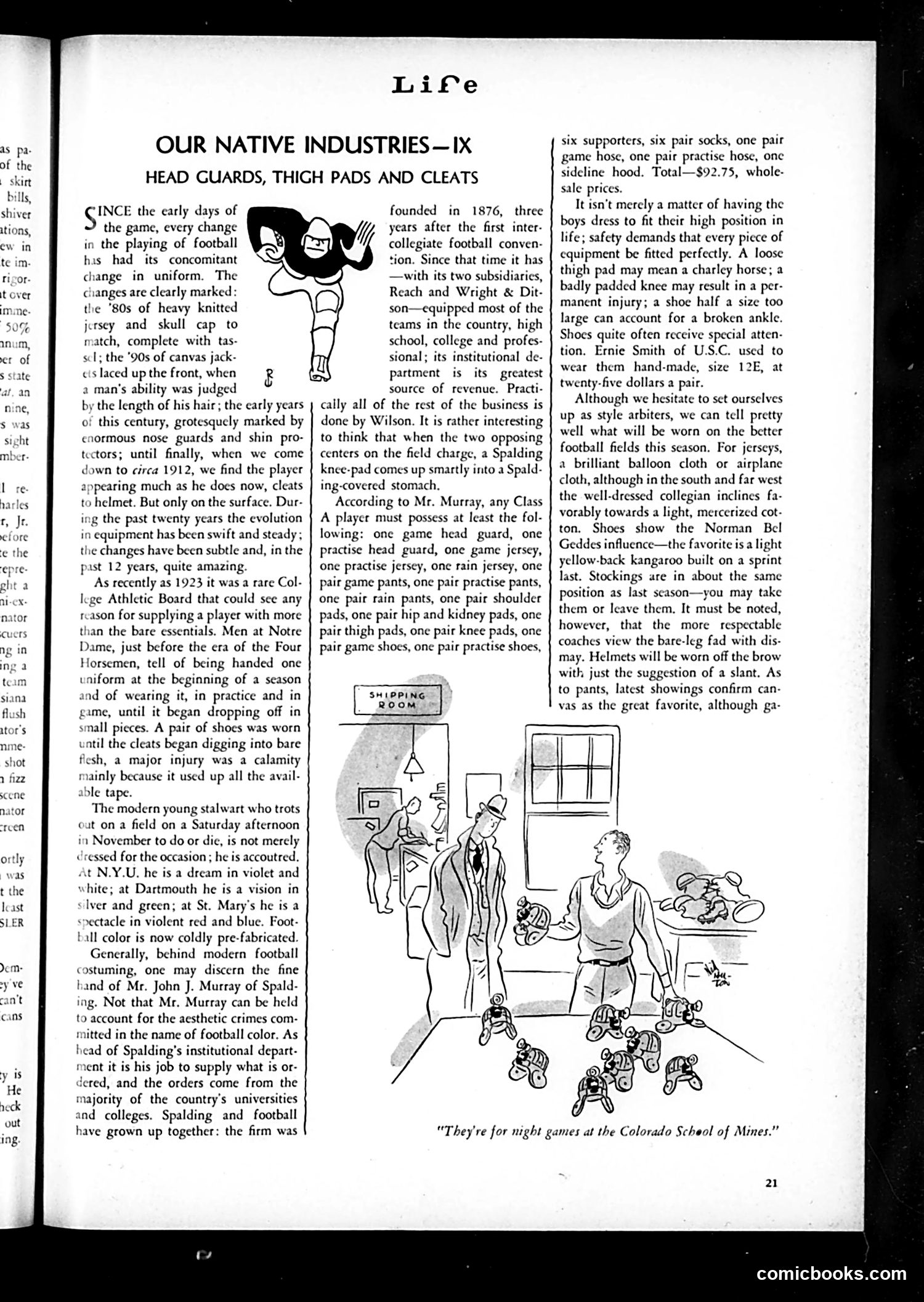
Explanation for Modern Readers This article celebrates American football equipment manufacturing, specifically Spalding's dominance in the industry. The main cartoon depicts a shipping room at Colorado School of Mines, showing a woman surrounded by young football players in uniform—likely illustrating the massive scale of equipment distribution to schools. The text traces how football uniforms evolved from simple 1880s knitted jerseys to elaborate 1920s protective gear. It credits John J. Murray of Spalding with standardizing equipment across American colleges and high schools since the company's 1876 founding. The satire is gentle: the article celebrates industrial progress and corporate efficiency while subtly noting the commercialization of college sports—universities now order standardized, colorful uniforms from Spalding rather than improvising. The detailed equipment list ($92.75 wholesale) underscores how capitalism has transformed amateur athletics into a consumer enterprise. The cartoon's caption humorously suggests even remote mining schools require full professional gear.
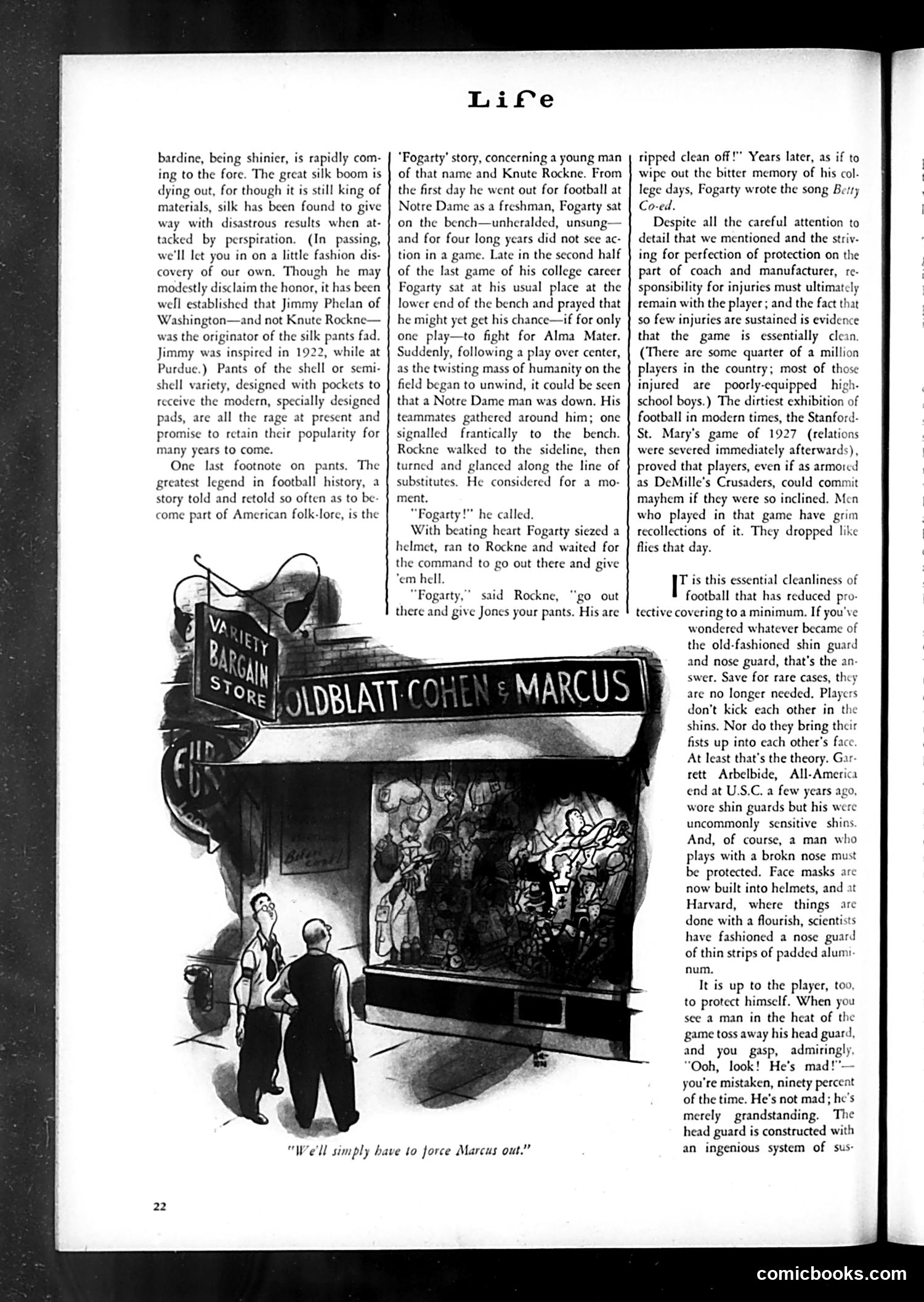
Life Magazine Football Article This page from *Life* magazine discusses early 20th-century football safety equipment and contains a humorous anecdote about Notre Dame football legend Knute Rockne. The Main Cartoon: Shows a storefront for "Oldblatt Cohen & Marcus" clothing store with the caption "We'll simply have to force Marcus out." This appears to be a satirical commentary on department store politics or internal business disputes—likely a play on the Jewish surnames of the store owners and contemporary tensions in retail/business. The "Fogarty" Story: The article recounts a famous (probably apocryphal) football legend: Rockne calls substitute player Fogarty into his final game, only to tell him to give his pants to another player whose are "ripped clean off." The punchline: Fogarty later channeled this humiliation into writing the college song "Betty Co-ed." Context: The piece argues modern football is cleaner than people assume, with better equipment reducing injuries and unsportsmanlike conduct. The article credits this safety culture to coaches and manufacturers' attention to detail.
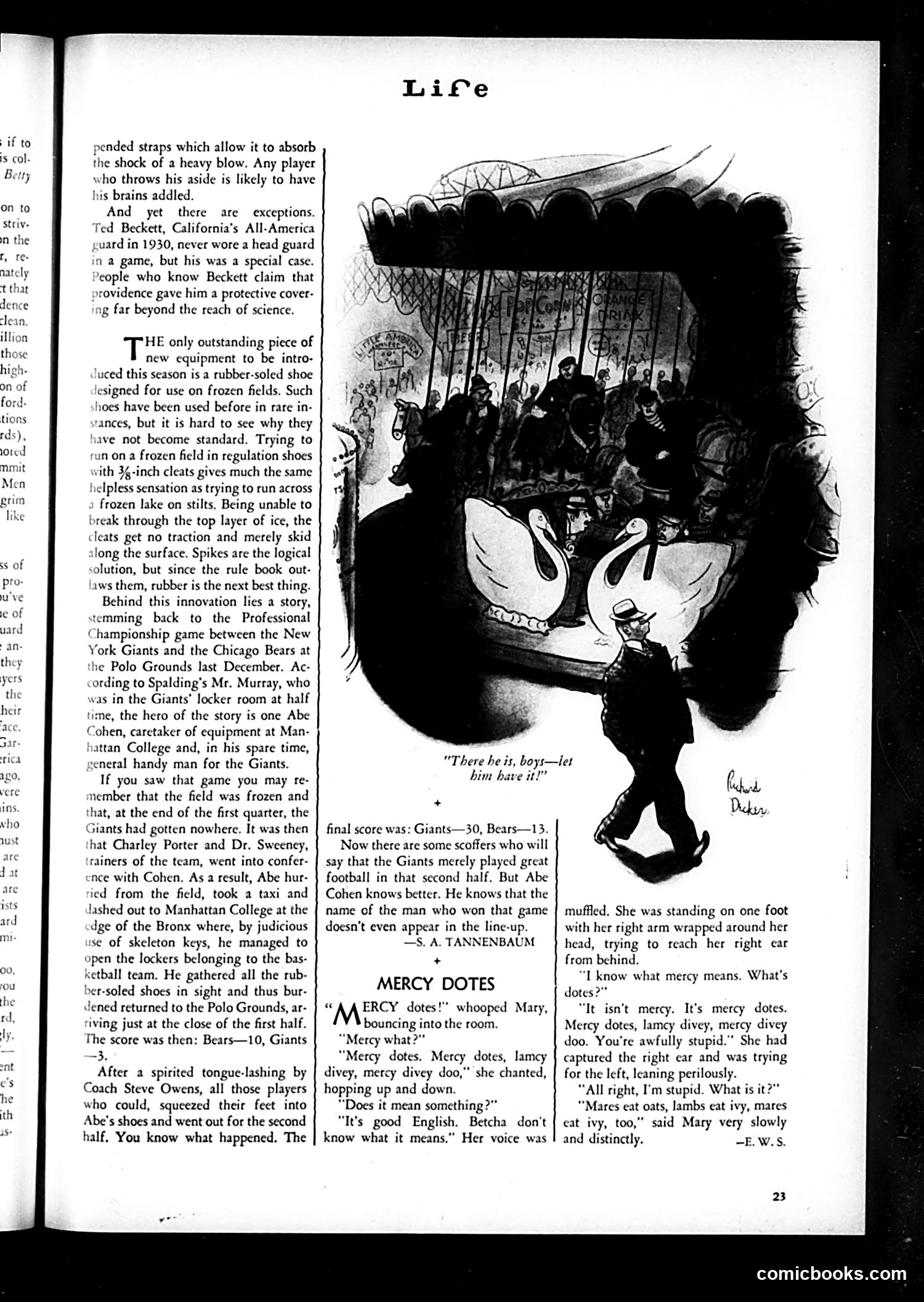
Life Magazine Page Analysis This page contains two satirical pieces typical of 1930s Life magazine humor: Top Article & Cartoon: Reports on football equipment innovation, specifically rubber-soled shoes introduced after a 1930 professional championship game between the New York Giants and Chicago Bears. The hero is Abe Cohen, equipment manager at Manhattan College, who allegedly broke into the basketball team's lockers to retrieve rubber-soled shoes mid-game, enabling the Giants' comeback victory (30-13). The satire mocks the idea that equipment—not athletic skill or coaching—determined the outcome. The cartoon illustrates the dramatic moment. "Mercy Dotes" Section: A humorous dialogue between an adult and a child (Mary) playing with a tongue-twister nonsense phrase that *sounds* like "mercy dotes" but is actually the nursery rhyme "Mares eat oats, lambs eat ivy, mares eat ivy too." The joke is the child's deliberate obfuscation and the adult's confusion—classic early 20th-century wordplay humor exploiting phonetic ambiguity. Both pieces exemplify Life's satirical approach: deflating institutional authority while celebrating clever subversion.
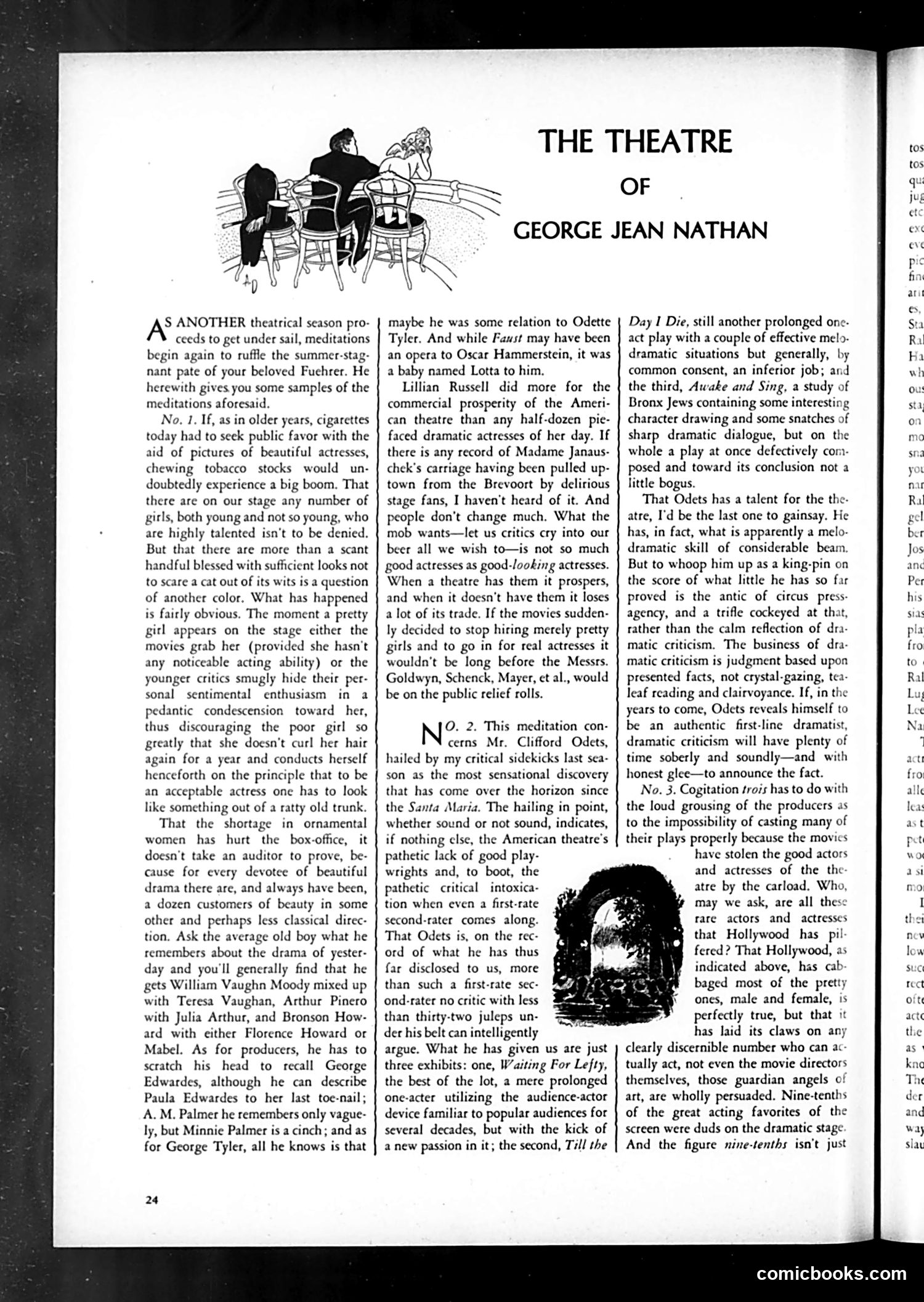
"The Theatre of George Jean Nathan" - Life Magazine This is a theater criticism column by George Jean Nathan, a prominent drama critic. The illustration shows Nathan (labeled "Fuehrer"—a joking reference to his authoritative critical voice) seated with theatrical figures. Nathan's satire targets two issues: 1. Beautiful actresses vs. talented ones: He argues that theater audiences and producers prioritize actresses' looks over acting ability. He cites Lillian Russell and Paula Edwardes as examples of beauties who drew crowds, while genuinely talented dramatic actresses like Madame Janauscheck are forgotten. He sarcastically notes the public prefers "good-looking actresses" to "good actresses," and that Hollywood has exploited this preference. 2. Overpraised playwrights: Nathan critiques fellow critics for hailing Clifford Odets as a "sensational discovery," arguing he's merely a "second-rater" whom only intoxicated critics could defend seriously. The column's tone is dismissive of both public taste and his fellow critics' judgment.
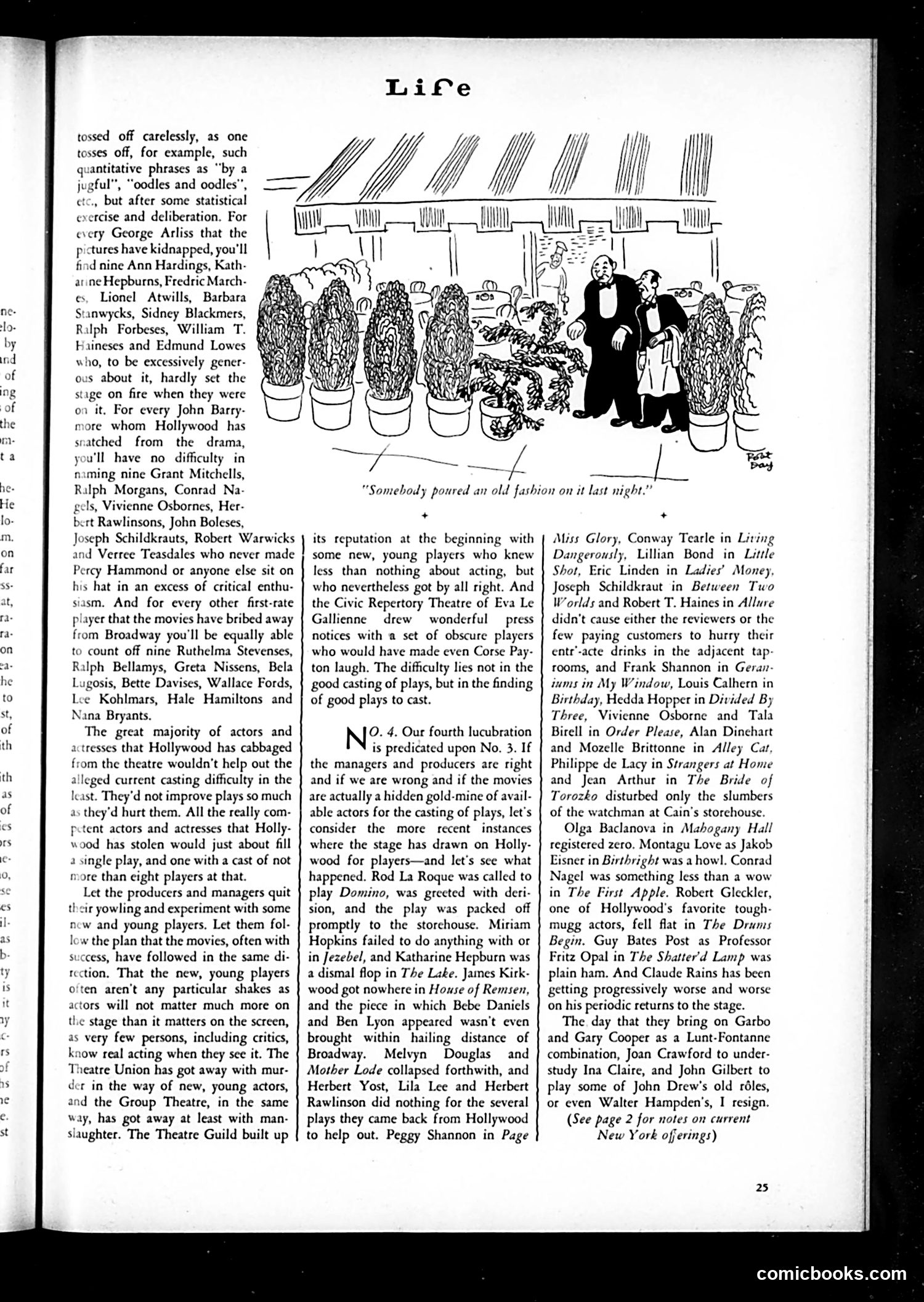
Analysis of Life Magazine Page This page critiques Hollywood's practice of raiding Broadway theater for established actors, arguing the strategy is misguided. The cartoon shows two well-dressed men amid potted plants with the caption "Somebody poured an old fashion on it last night"—a visual pun suggesting these theatrical "plants" (both literal and figurative) have been damaged by neglect or poor treatment. The text systematically counters claims that movie stars improve stage productions. It argues that for every genuine theatrical talent Hollywood acquired (naming George Arliss, John Barrymore), nine mediocre actors came with them. The author contends Broadway should instead develop new, young talent—citing the Theatre Guild and Group Theatre as successful examples. The second section documents recent failures of Hollywood-imported stars in plays (Rod La Roque, Miriam Hopkins, Katharine Hepburn), proving, the author argues, that screen success doesn't translate to stage success. The underlying point: theater needs fresh talent, not recycled movie actors.
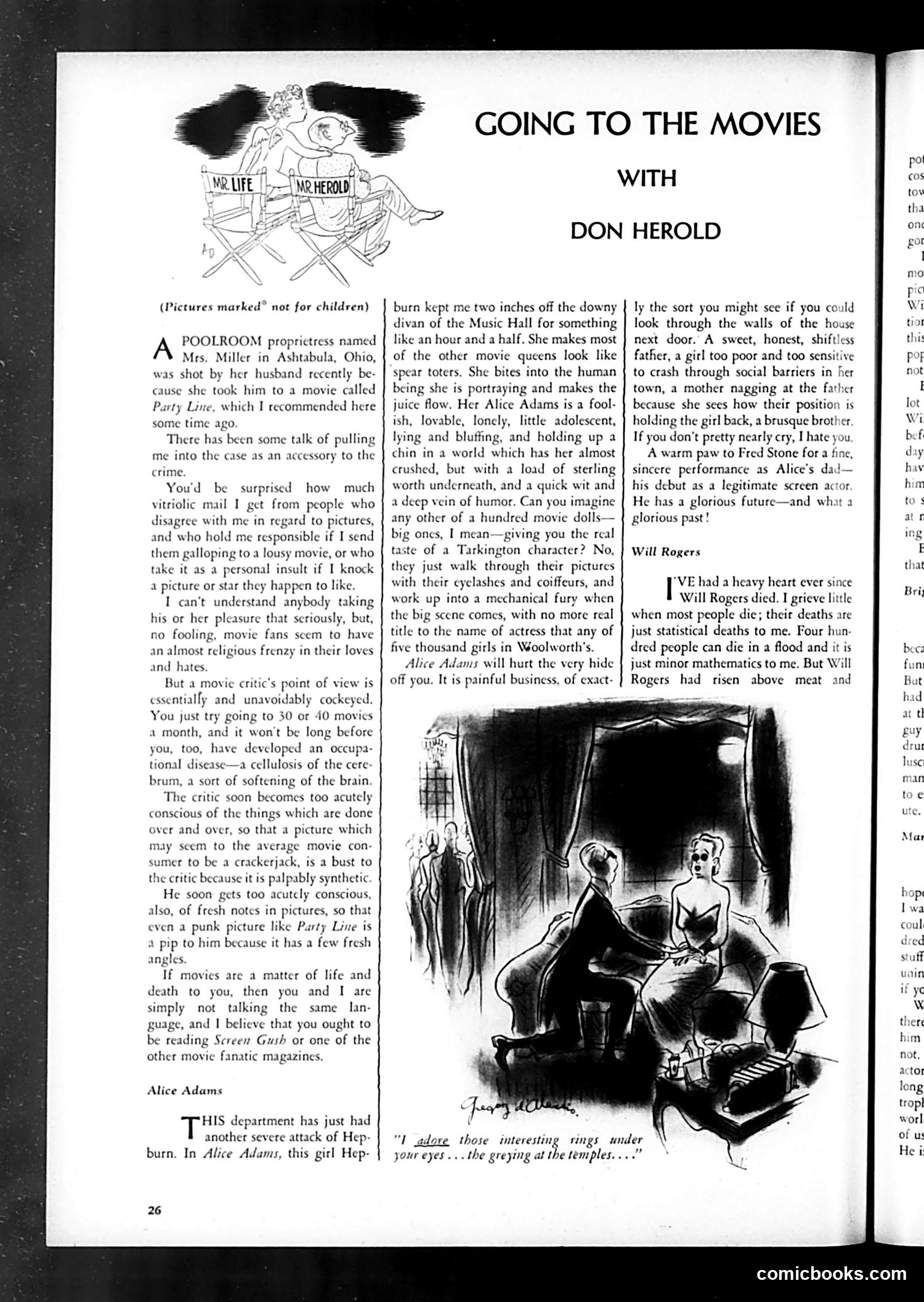
Movie Criticism and Celebrity Culture in 1930s Life Magazine This page presents Don Herold's film column criticizing both movie fans and fellow critics. The main article defends Herold against angry mail after a woman's husband shot her—blaming Herold for recommending a movie she wanted to see. Herold argues movie enthusiasts take films with "almost religious frenzy," while critics develop "cellulosis of the cerebrum" from watching too many films monthly, making them overly cynical. The piece then praises actress Katharine Hepburn's performance in *Alice Adams*, claiming she outshines other "movie queens" with authentic emotional depth rather than mechanical acting. Herold contrasts Hepburn's nuanced portrayal against Hollywood's formulaic starlets. The cartoon (signed by artist) shows a couple in a movie theater, with the caption "I adore those interesting rings under your eyes... the greying at the temples..." This likely mocks how cinema audiences romanticize artificial Hollywood glamour while missing reality.
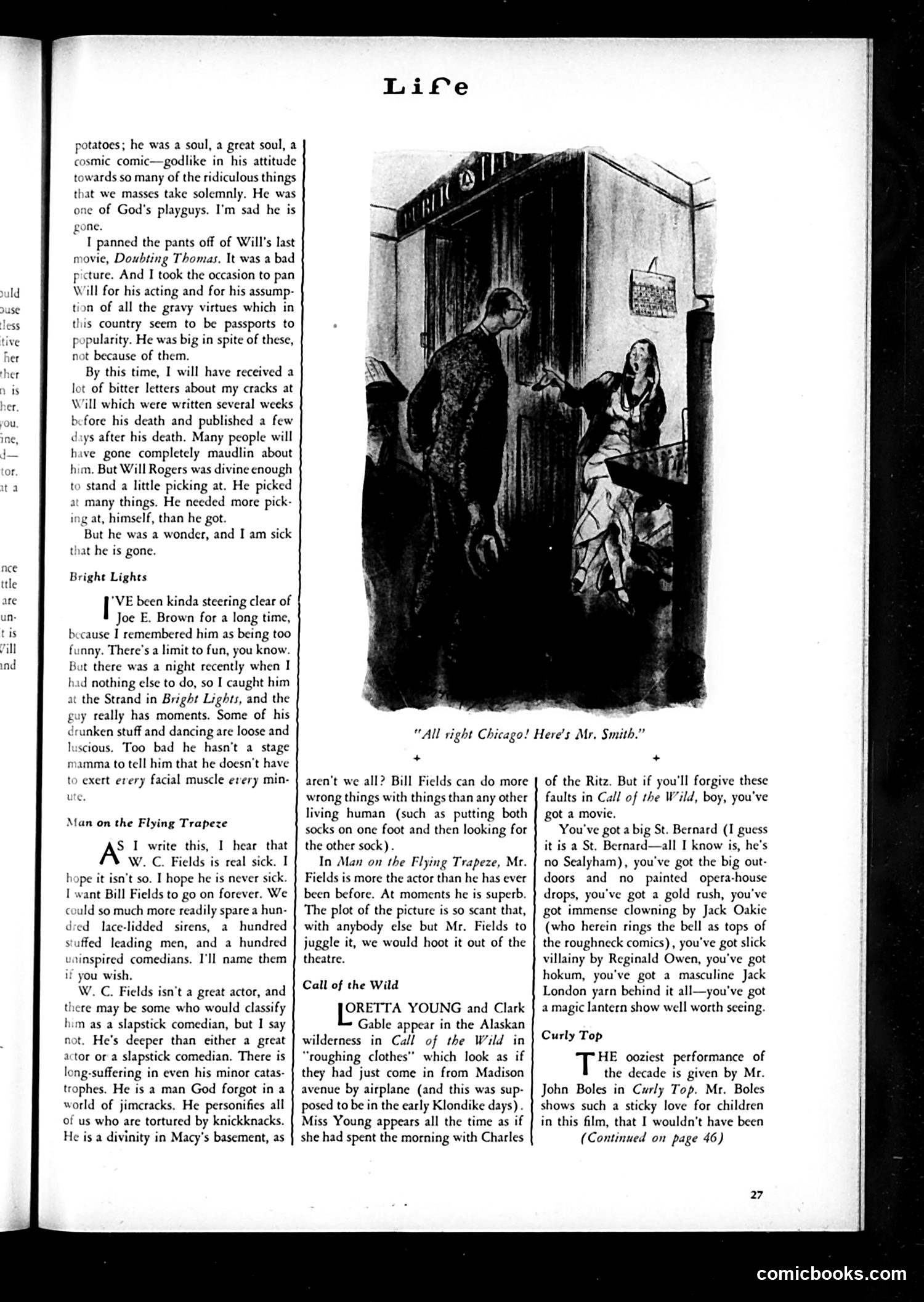
Life Magazine Film Reviews (circa 1935) This page contains film reviews from Life's "Life" section. The illustration shows a scene from one of the reviewed films, depicting what appears to be a doorway encounter with the caption "All right Chicago! Here's Mr. Smith." The reviews discuss several Hollywood films and actors. Most notably, the author laments Will Rogers's recent death, calling him a "cosmic comic" and "one of God's playguys," though the reviewer had criticized his acting in *Doubting Thomas*. Other reviews cover *Bright Lights* (featuring Joe E. Brown), *Man on the Flying Trapeze* (W.C. Fields), *Call of the Wild* (Loretta Young and Clark Gable), and *Curly Top* (John Boles). The reviewer praises Fields particularly as transcending mere slapstick, representing "all of us who are tortured by knickknacks." The tone is affectionate yet critical—praising genuine talent while mocking artifice (like Madison Avenue fashions in an Alaskan wilderness setting).
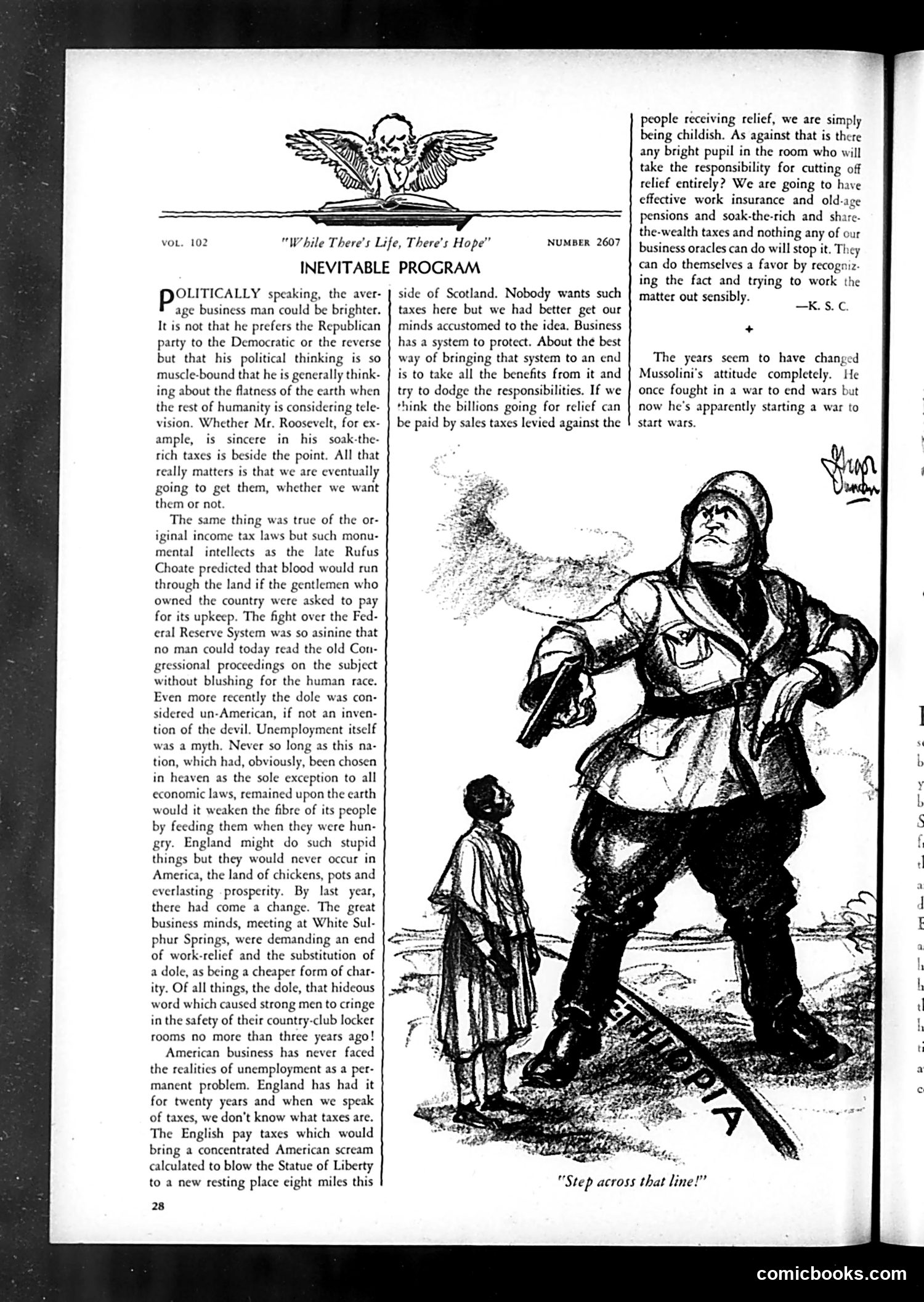
Political Cartoon Analysis This page from Life magazine contains an editorial cartoon critiquing American business leaders' resistance to New Deal policies under President Roosevelt. The Cartoon: The illustration shows a soldier or military figure confronting a civilian, with the caption "Step across that line!" This appears to reference the inevitability of progressive taxation and social welfare programs—the "line" representing a threshold that business resistance cannot prevent. The Context: The accompanying article argues that American business executives foolishly oppose taxes and relief programs (like the dole/unemployment assistance) that are economically inevitable, much as they once wrongly opposed income taxes and the Federal Reserve. The author contends that England has endured permanent unemployment for twenty years, making American taxes seem modest by comparison. The Point: The satire mocks wealthy businessmen for their short-sighted opposition to social spending, suggesting their resistance is futile and that accepting these programs sensibly serves their interests better than obstruction. A brief aside also criticizes Mussolini for apparently abandoning pacifism.
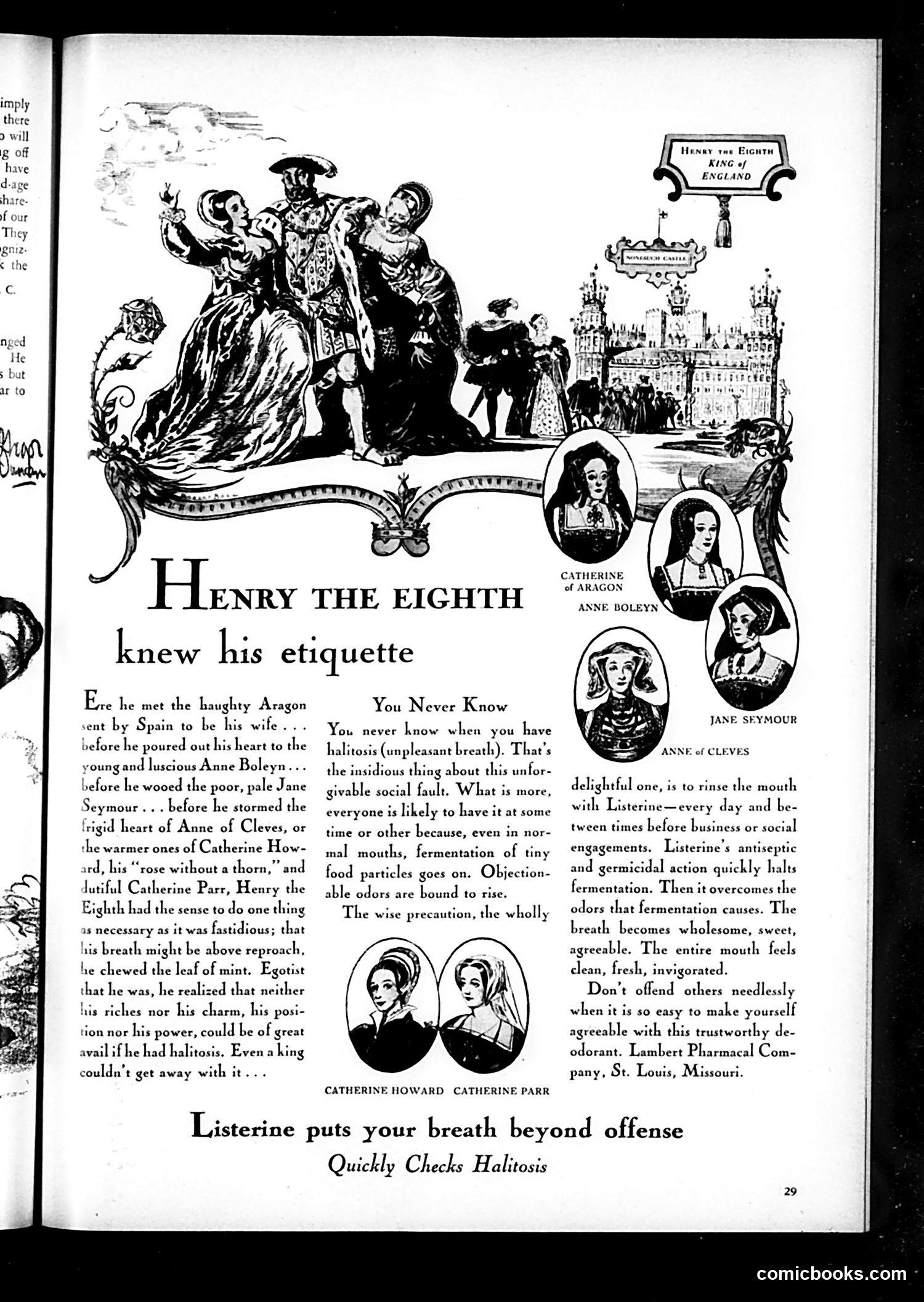
Henry VIII and Listerine: A Historical Advertisement This is primarily a Listerine mouthwash advertisement disguised as historical humor, from approximately the 1920s-30s. The "satire" uses Henry VIII's six marriages as a hook: the ad jokes that even a powerful king with immense wealth and charm couldn't succeed without fresh breath—implying halitosis (bad breath) is a universal social catastrophe that transcends class. The page features portraits of Henry's wives (Catherine of Aragon, Anne Boleyn, Jane Seymour, Anne of Cleves, Catherine Howard, Catherine Parr) and an illustration of the king at court with Windsor Castle in the background. The ad's pitch is straightforward anxiety-marketing: halitosis is an "insidious" social fault affecting everyone, even in "normal mouths." The solution? Daily Listerine use to prevent fermentation and kill odors. The "Henry knew his etiquette" framing is merely a device to make mouthwash seem historically essential and socially mandatory.
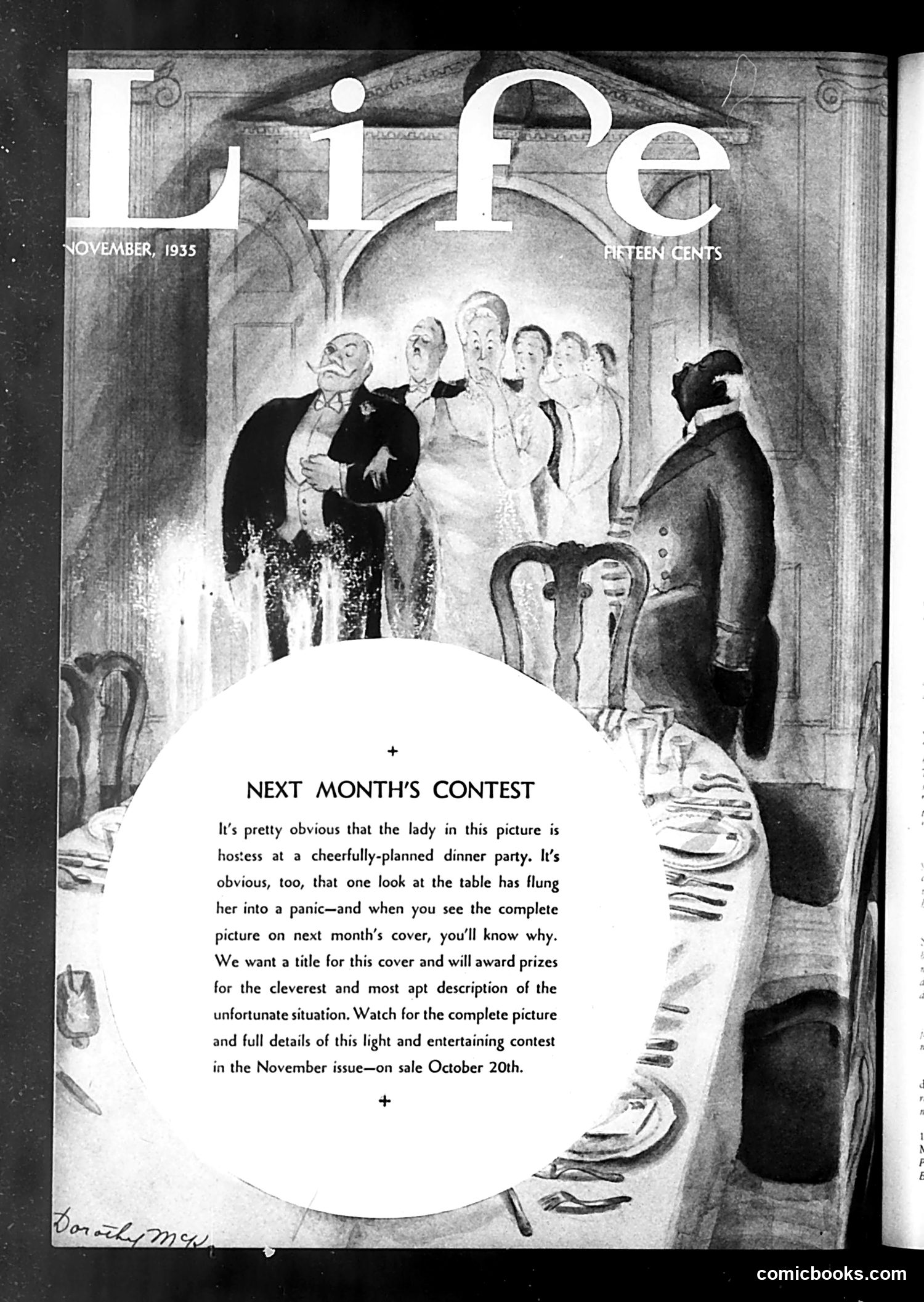
Analysis This November 1935 Life magazine page promotes a contest for the next month's cover. The illustration shows a dinner party scene where a formally-dressed hostess has apparently experienced some kind of disaster—her panicked expression and body language suggest something has gone wrong at the table. The magazine is inviting readers to submit clever titles or descriptions for the full cover image (which will reveal the complete "unfortunate situation"). This was a common interactive engagement strategy for magazines in this era, encouraging reader participation and increasing anticipation for the next issue. The humor relies on the contrast between the formal dinner setting and the implied mishap. Without seeing the full cover image, modern readers cannot identify the specific joke, though it likely involves a common dinner-party embarrassment or social faux pas typical of 1930s satirical humor.
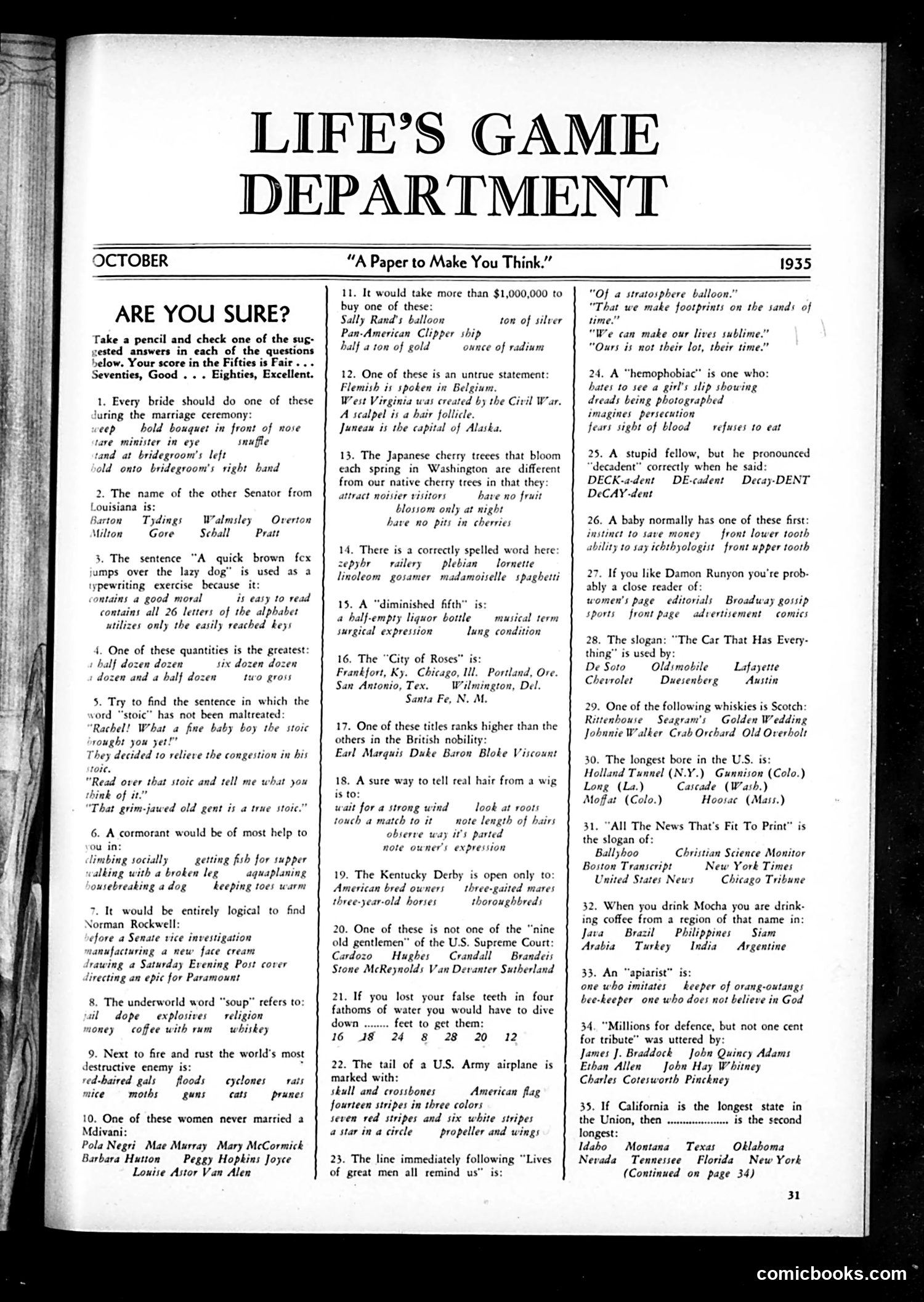
Life's Game Department: A 1935 Quiz This page presents "Are You Sure?"—a trivia quiz testing readers' knowledge of 1935 American culture, politics, and current events. Notable references include: - Question 10 references the Mdivani family, wealthy Georgian nobles known for marrying wealthy American heiresses (Barbara Hutton, Peggy Hopkins Joyce). - Question 20 asks about the "nine old gentlemen" of the U.S. Supreme Court—a contemporary political hot-button, as FDR was actively feuding with the conservative justices over New Deal legislation. - Question 19 references the Kentucky Derby, a major annual sporting event. - Questions 1-3 test basic civics, etiquette, and trivia. The quiz's casual tone—mixing serious knowledge with lighthearted observations—is typical of *Life* magazine's satirical approach. The difficulty range (from basic facts to obscure cultural knowledge) suggests readers' education levels varied widely.
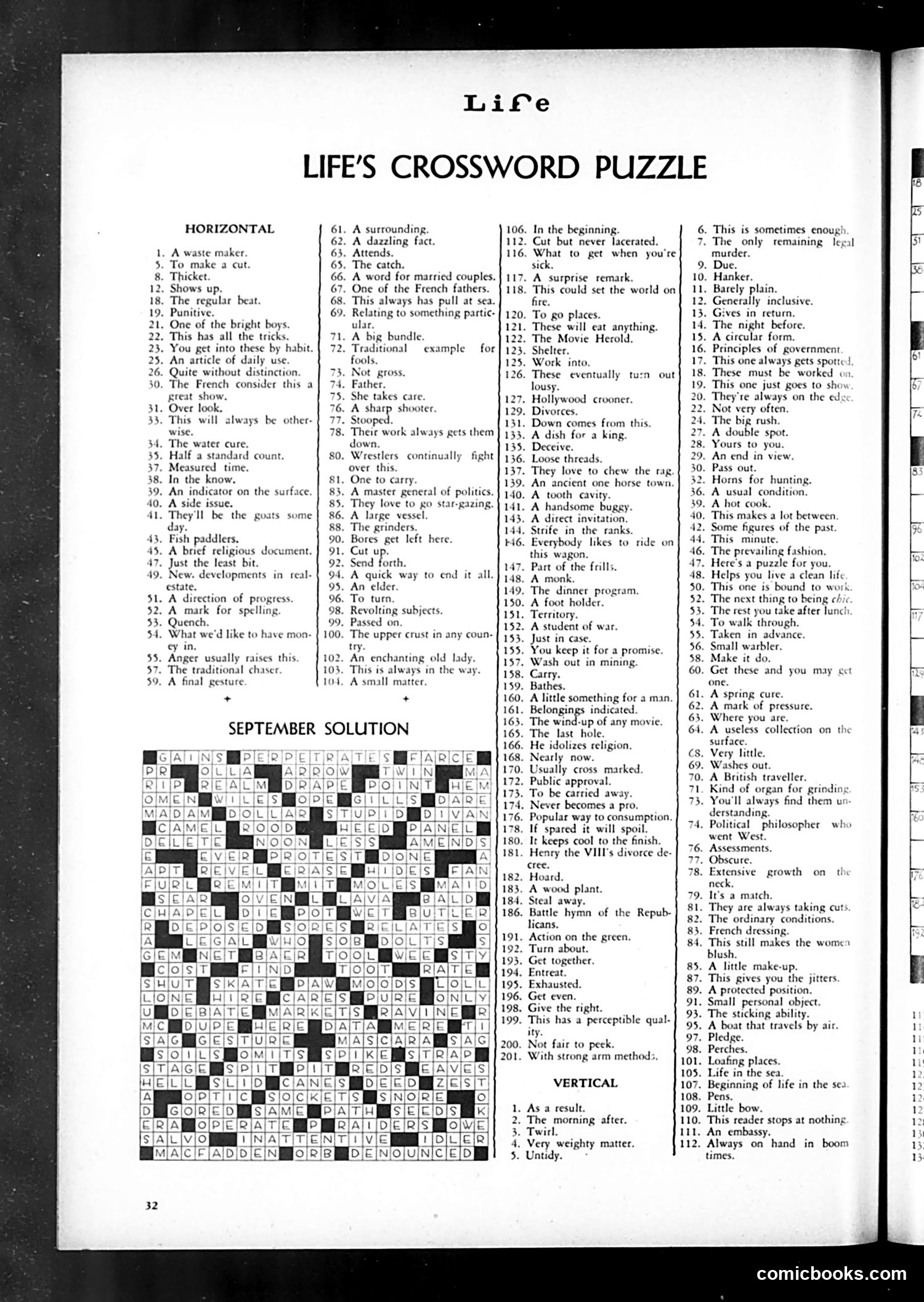
Life's Crossword Puzzle Page This page from *Life* magazine presents a standard crossword puzzle with its solution grid displayed below. It's not a political cartoon but rather a leisure/entertainment feature typical of *Life's* content. The puzzle itself uses wordplay and contemporary references as clues—some topical for the era (references to "Hollywood crooner," "The Movie Herold," "Henry the VIII's divorce decree," and "Battle hymn of the Republicans"). The clues employ *Life's* characteristic wit, mixing straightforward definitions with clever misdirection and puns. The "September Solution" grid shows the completed puzzle, allowing readers to check their answers. This type of intellectual entertainment was standard magazine fare, offering readers a diversion while also subtly reflecting contemporary culture, politics, and social commentary through its hidden vocabulary—typical of *Life's* approach to blending humor with cultural observation.
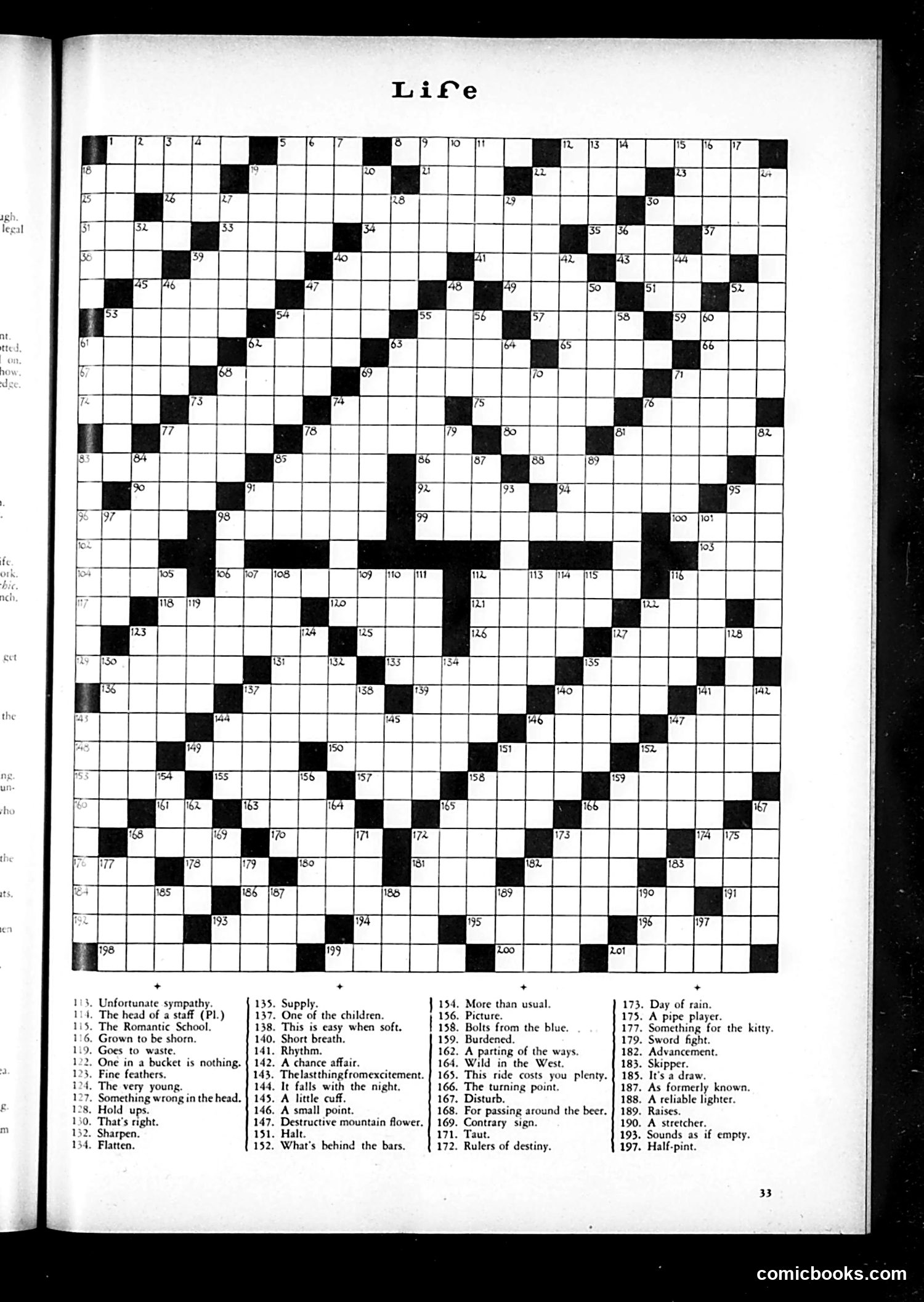
What This Page Shows This is a crossword puzzle from Life magazine, not a political cartoon. The page displays a large crossword grid numbered 1-201, with clues listed below organized in columns. The clues are typical crossword fare—wordplay, riddles, and definitions ranging from straightforward ("Supply," "Picture") to clever puns and double meanings ("Unfortunate sympathy," "Something wrong in the head," "This ride costs you plenty"). Historical context: Crossword puzzles were enormously popular in early-to-mid 20th century America, and Life—primarily a humor and satire magazine—frequently featured them as entertainment. This represents the magazine's lighter content rather than its better-known political satire. The page number (33) indicates this is from the magazine's interior. Without seeing the puzzle answers or knowing the publication date, we cannot determine if any clues contain topical references to specific historical events.
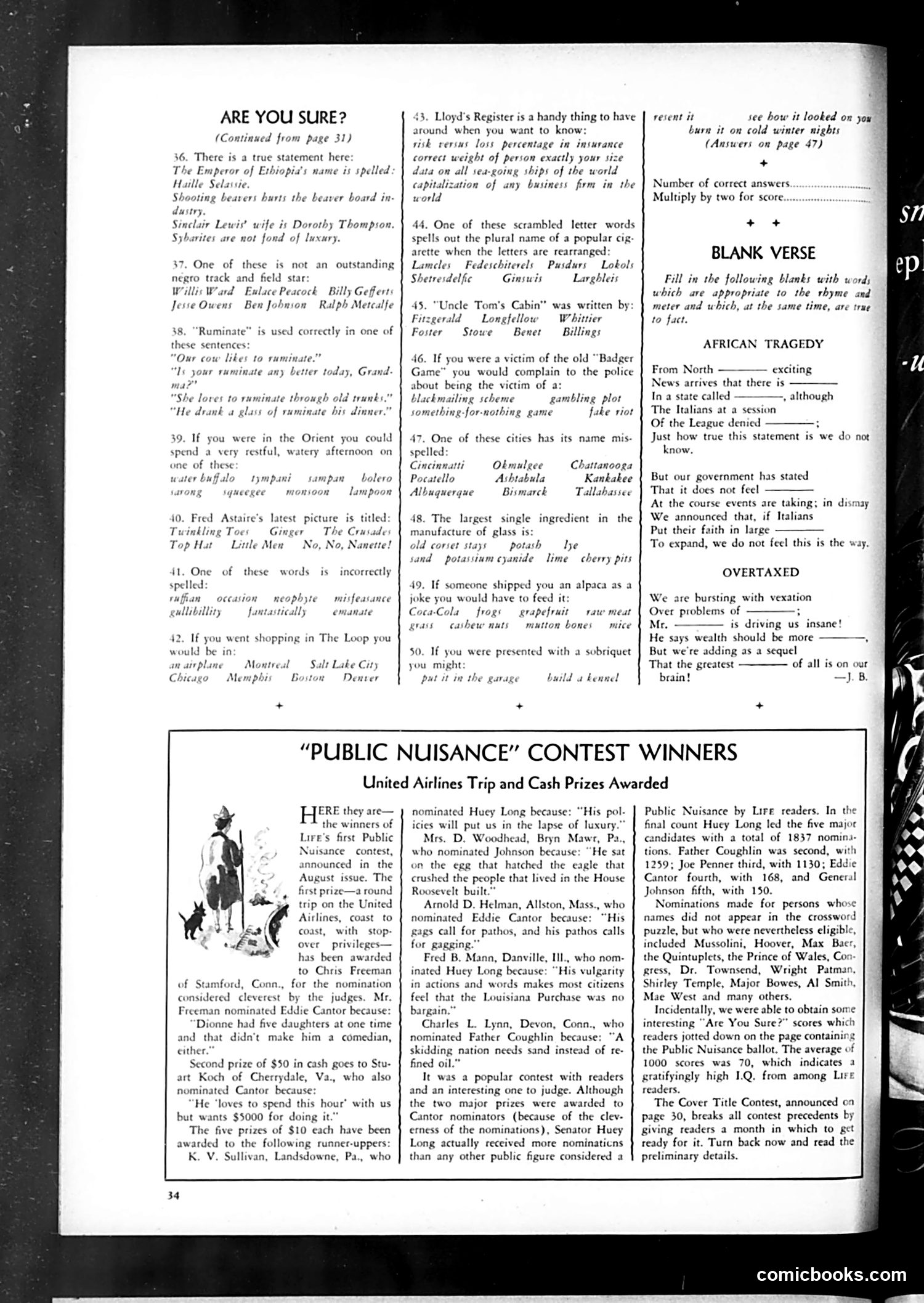
This page contains a quiz game titled "Are You Sure?" testing readers' knowledge of facts and trivia, alongside a "Blank Verse" poetry exercise and announcements of contest winners. The most historically significant element is the "Blank Verse" section addressing the Italian invasion of Ethiopia (1935-36). Readers must fill in blanks about Ethiopia's refusal to acknowledge the aggression before the League of Nations and America's formal disapproval of Italian expansion. This references Mussolini's colonial invasion and the League's ineffectual response—a major crisis of the 1930s. The page also announces winners of a "Public Nuisance" contest where readers nominated public figures, politicians, and celebrities considered annoying or problematic. The visible winners include Father Coughlin (a controversial radio priest), various politicians, and entertainment figures. This reflects Life magazine's satirical voice: combining intellectual games with pointed commentary on contemporary political failures and public irritations during the Depression era.
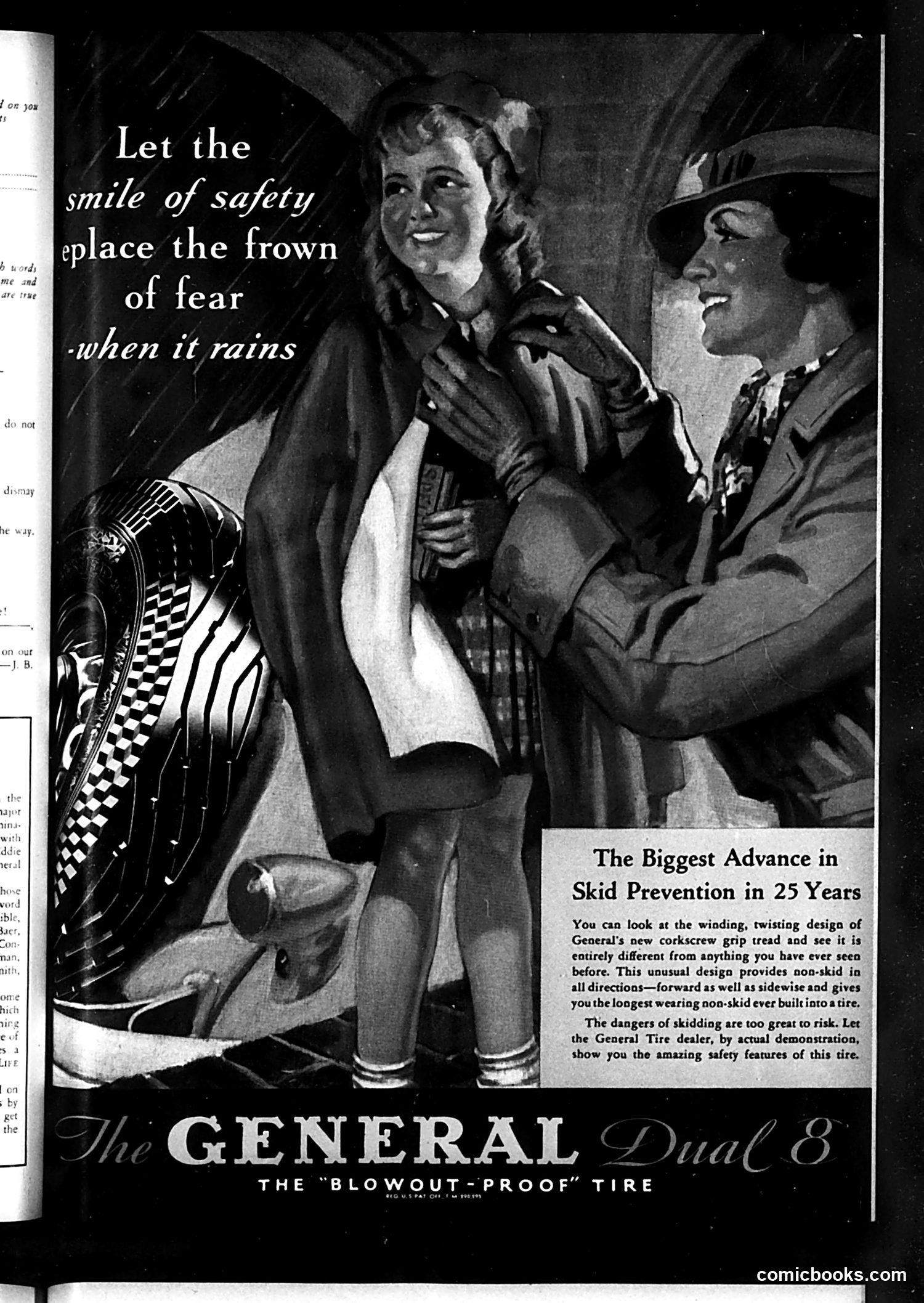
Analysis This is an advertisement, not a cartoon or satire. It's a General Tire company ad for their "Dual 8" model, emphasizing skid prevention technology. The image shows a man and woman in a car during rain—a domestic safety scenario designed to appeal to family consumers. The visual message is reassuring: the woman smiles confidently (the "smile of safety") rather than fearing dangerous road conditions (the "frown of fear"). The ad's copy promotes General's new "corkscrew grip tread" as "the biggest advance in skid prevention in 25 years," claiming it prevents skidding in all directions and offers superior wear. The "blowout-proof" tagline addresses another common automotive fear of the era. This reflects mid-20th-century advertising strategy: linking product safety features to emotional reassurance and domestic security, targeting consumers (particularly women and families) anxious about road hazards.
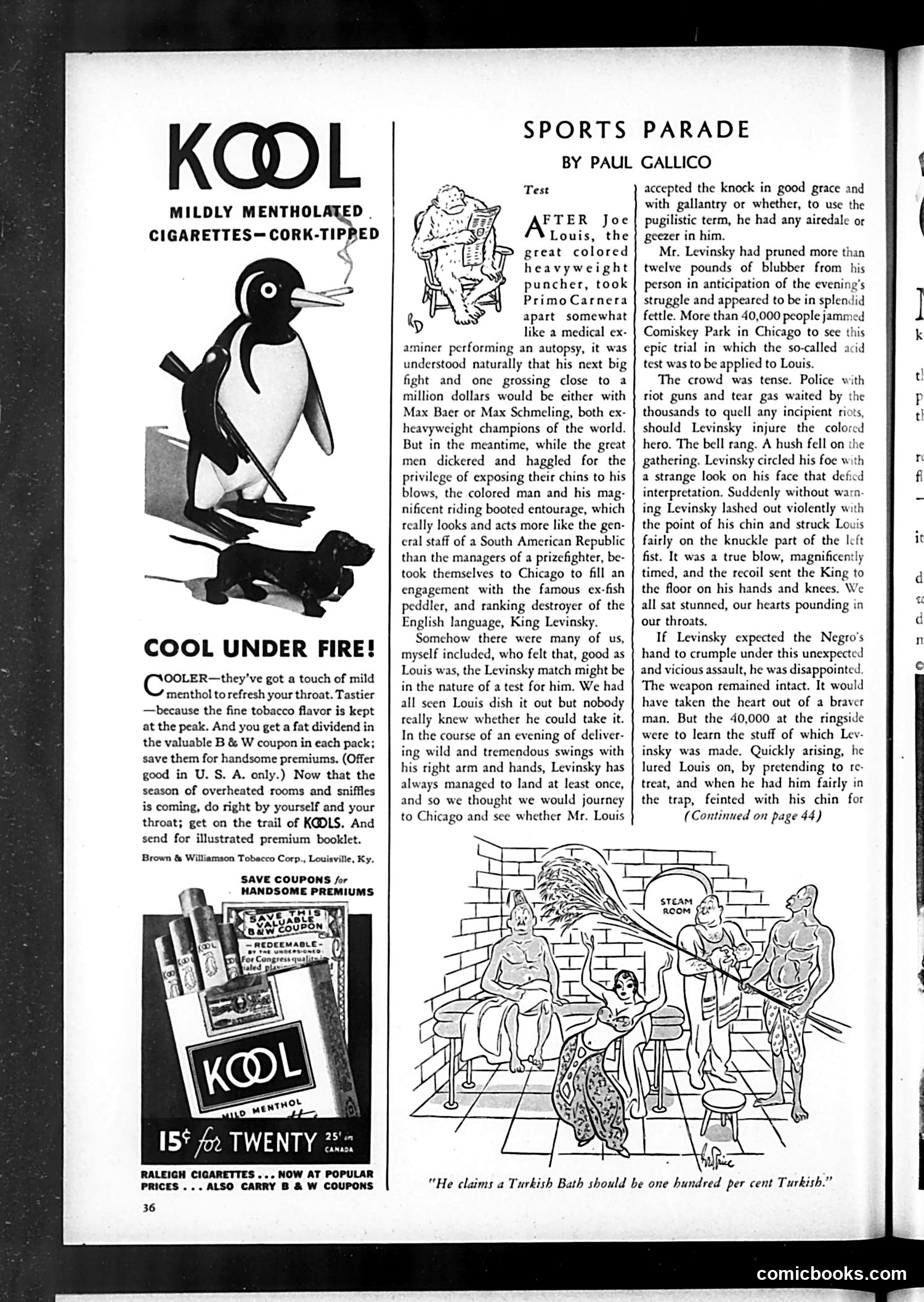
Analysis of Page Content This page contains a Kool cigarettes advertisement and Paul Gallico's "Sports Parade" column covering boxer Joe Louis's fight against King Levinsky in Chicago. The Sports Article's Context: Gallico describes Louis, the African American heavyweight champion, facing Levinsky in what the writer frames as a "test"—not of Louis's punching ability (already proven against Primo Carnera), but his ability to *take* a punch. The racial context is implicit but significant: the article emphasizes police presence and the crowd's tension, reflecting 1930s anxieties about a Black champion's dominance. The humor is largely self-deprecating regarding Levinsky, portrayed as a comical figure whose "chin" becomes his weapon—he literally knocks himself out striking Louis's fist. Gallico treats this as Levinsky's characteristic bumbling style. The cartoon at bottom depicts a steam room scene with the caption joking about "Turkish" authenticity—unrelated to the main article. The page itself is primarily advertising, with the Kool ad dominating the left side, promoting menthol cigarettes with coupons as premiums.
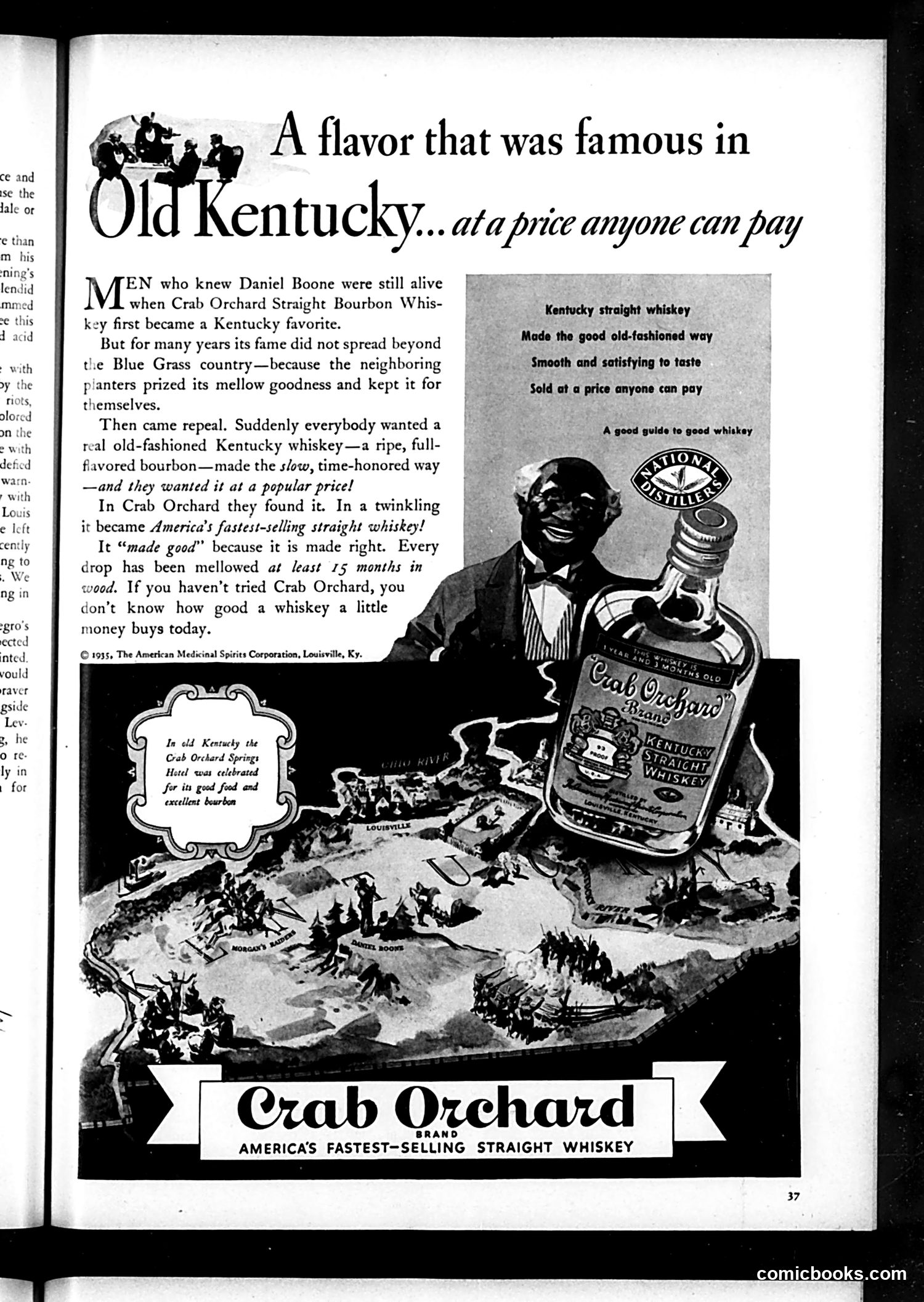
Analysis for Modern Readers This is a whiskey advertisement, not satire or political commentary. It's from 1935, shortly after Prohibition's repeal (1933), when alcohol sales resumed legally. The ad features a caricatured Black man holding a Crab Orchard whiskey bottle—a deeply racist imagery common in early 20th-century advertising. This "minstrel-style" figure was used to market products, reflecting the era's pervasive racial stereotyping. The pitch: Crab Orchard bourbon is "famous in Old Kentucky," aged 15 months, and—crucially—"a price anyone can pay." The post-Prohibition market wanted affordable whiskey, and the ad emphasizes value over luxury. Historical context: The reference to Daniel Boone and Kentucky heritage marketed the product as authentically American. The "fastest-selling straight whiskey" claim capitalized on pent-up demand after 14 years of Prohibition. The racist caricature represents a shameful advertising convention of the era that modern viewers find offensive.
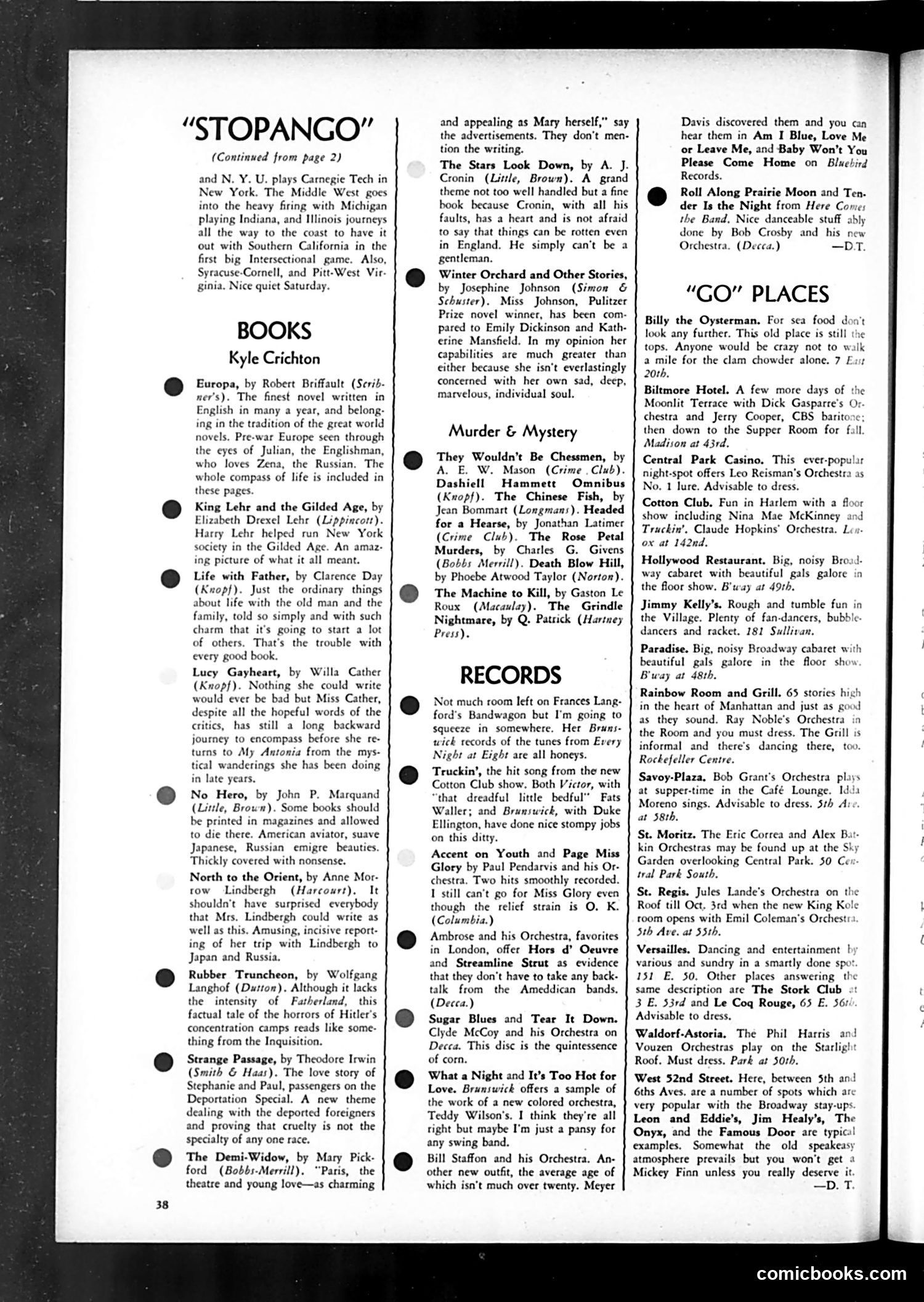
This page is primarily a book and entertainment review section from *Life* magazine, not a political cartoon page. Content Summary: Critic Kyle Crichton reviews contemporary novels across several categories: literary fiction (praising Robert Briffault's *Europa* and Anne Morrow Lindbergh's *North to the Orient*), society memoirs (Elizabeth Drexel Lehr's *King Lehr and the Gilded Age*), and socially conscious works (books about Nazi concentration camps and deported foreigners). He also lists mystery novels and record releases. Notable Context for Modern Readers: References to Hitler's concentration camps and deportations reflect 1930s awareness of Nazi atrocities. The inclusion of Willa Cather criticism and Pulitzer Prize winner Josephine Johnson shows the magazine engaged with serious literary discourse. The casual, witty tone of reviews was typical of *Life*'s intellectual approach during this era. This is primarily editorial content, not satire or political cartooning.
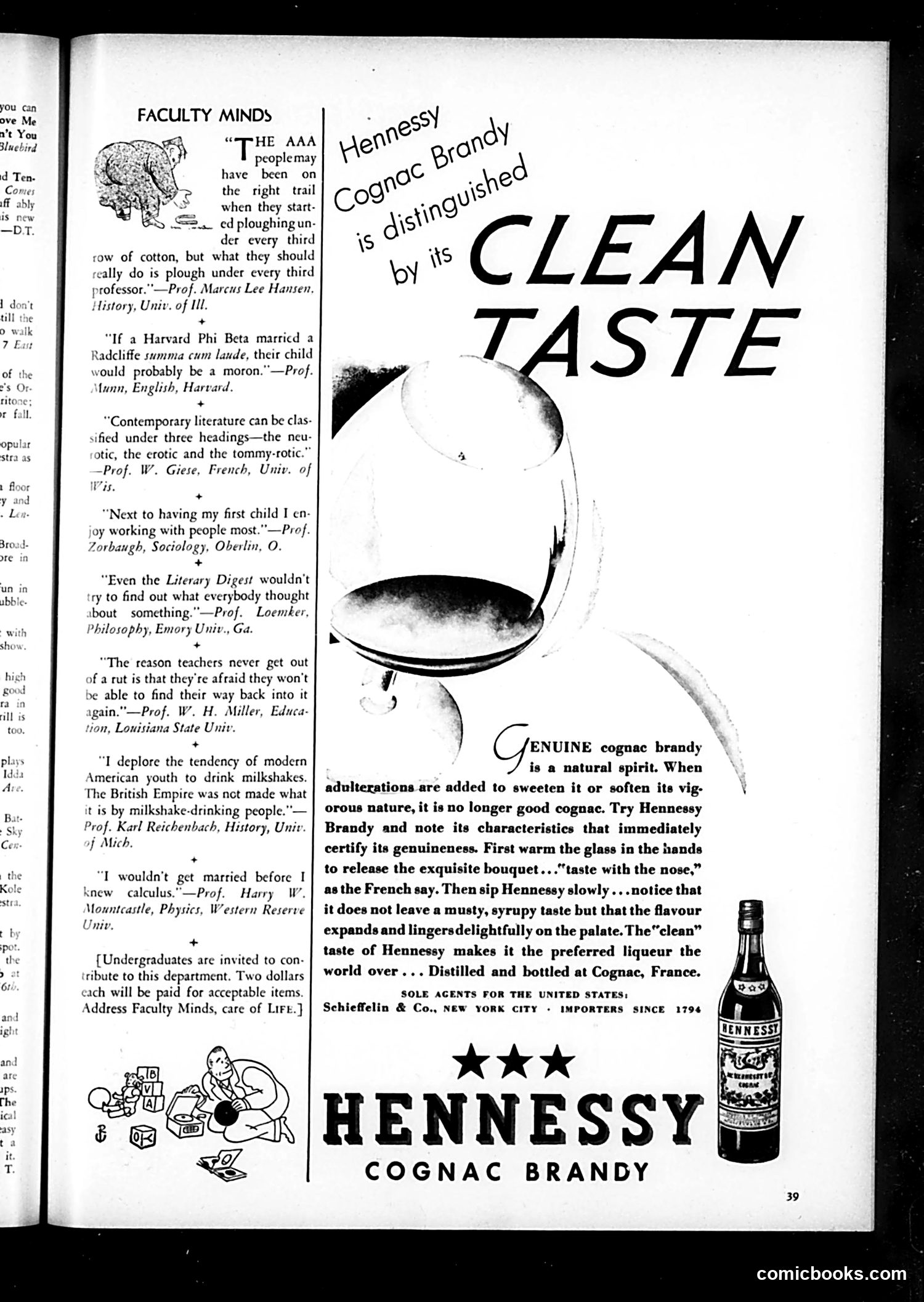
Page Analysis: Life Magazine This page combines satirical faculty commentary with a Hennessy Cognac advertisement. "Faculty Minds" Section (Left): A humor column collecting witty quotes from university professors at major institutions (Harvard, University of Illinois, Emory, etc.). The jokes mock academic pretension and absurdity—professors making sardonic observations about education, intelligence, and social behavior. For example, one suggests plowing under professors like cotton crops; another claims Harvard/Radcliffe marriages produce morons. The humor targets ivory-tower intellectuals as out-of-touch or hypocritical. Advertisement (Right): A full-page Hennessy Brandy ad emphasizing "clean taste" and purity—explicitly contrasting genuine cognac against adulterated versions. The ad uses French sophistication ("taste with the nose") to market the product to aspirational American consumers. Context: This reflects 1920s-30s Life magazine's satirical voice mocking academia while pages opposite advertised luxury goods to educated, affluent readers—the precise audience who'd recognize the professor references and appreciate both the intellectual jokes and refined liquor marketing.
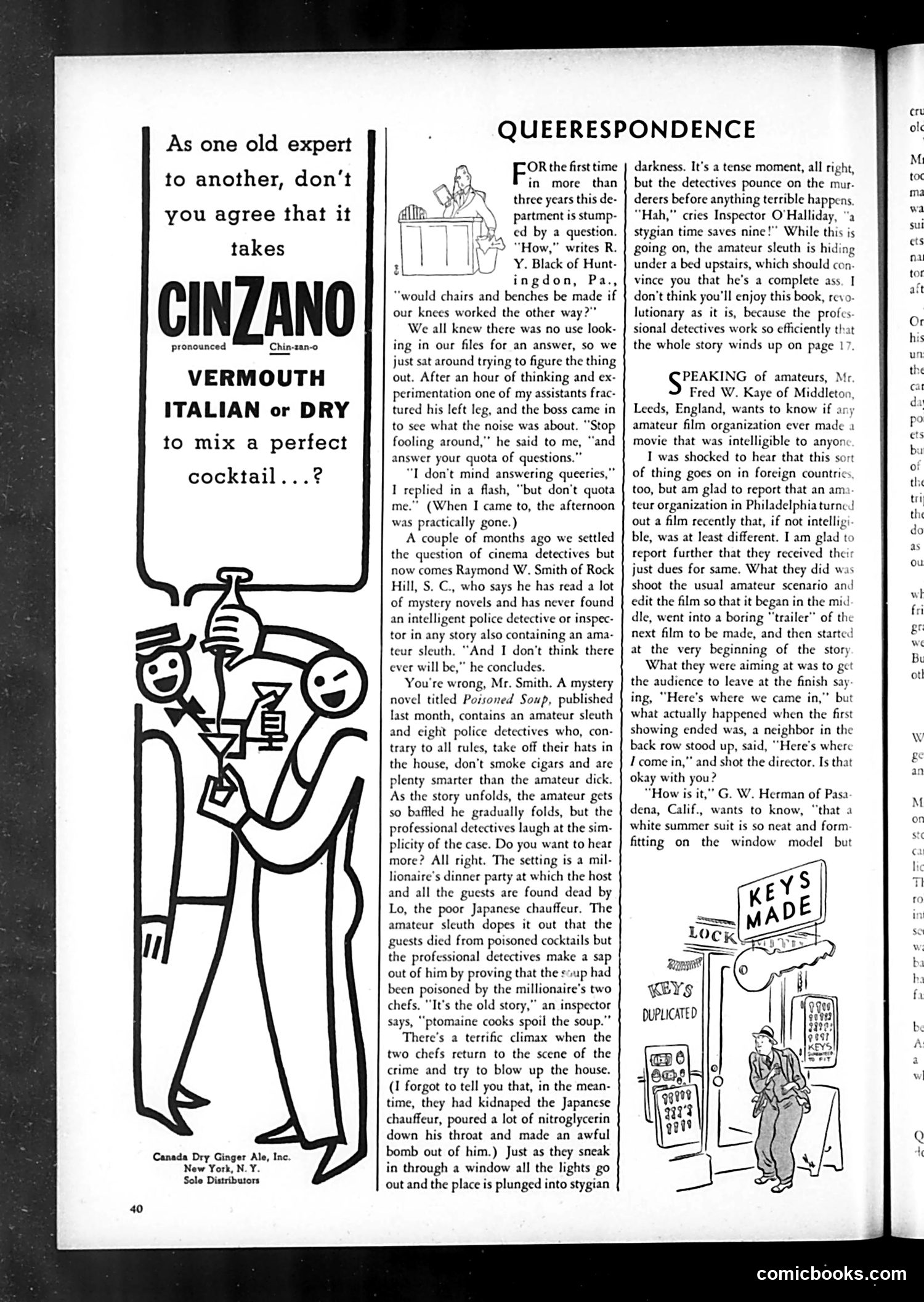
Analysis for Modern Readers This page contains advertising and a humor column from Life magazine's "Queerespondence" section. The Ad (Left): A Cinzano vermouth advertisement uses a stylized cartoon figure holding cocktail glasses, promoting the drink as essential for perfect cocktails. This reflects 1920s-30s advertising style. The Column (Right): Life's editors humorously respond to reader questions. Notable content includes: - A bizarre reader query about furniture design if knees bent backward - A review of a mystery novel called *Poisoned Soup* featuring amateur vs. professional detectives solving a millionaire's dinner-party murder - A complaint about amateur filmmaking quality, noting even foreign amateur organizations produce unintelligible films - Satirical commentary mocking both amateur sleuths (who hide under beds) and amateur filmmakers The humor relies on absurdist logic and the editors' deadpan responses to ridiculous premises. The *Poisoned Soup* plot summary—mixing poisoned cocktails, kidnapped Japanese servants, nitroglycerin bombs—parodies overwrought mystery fiction conventions popular at the time.
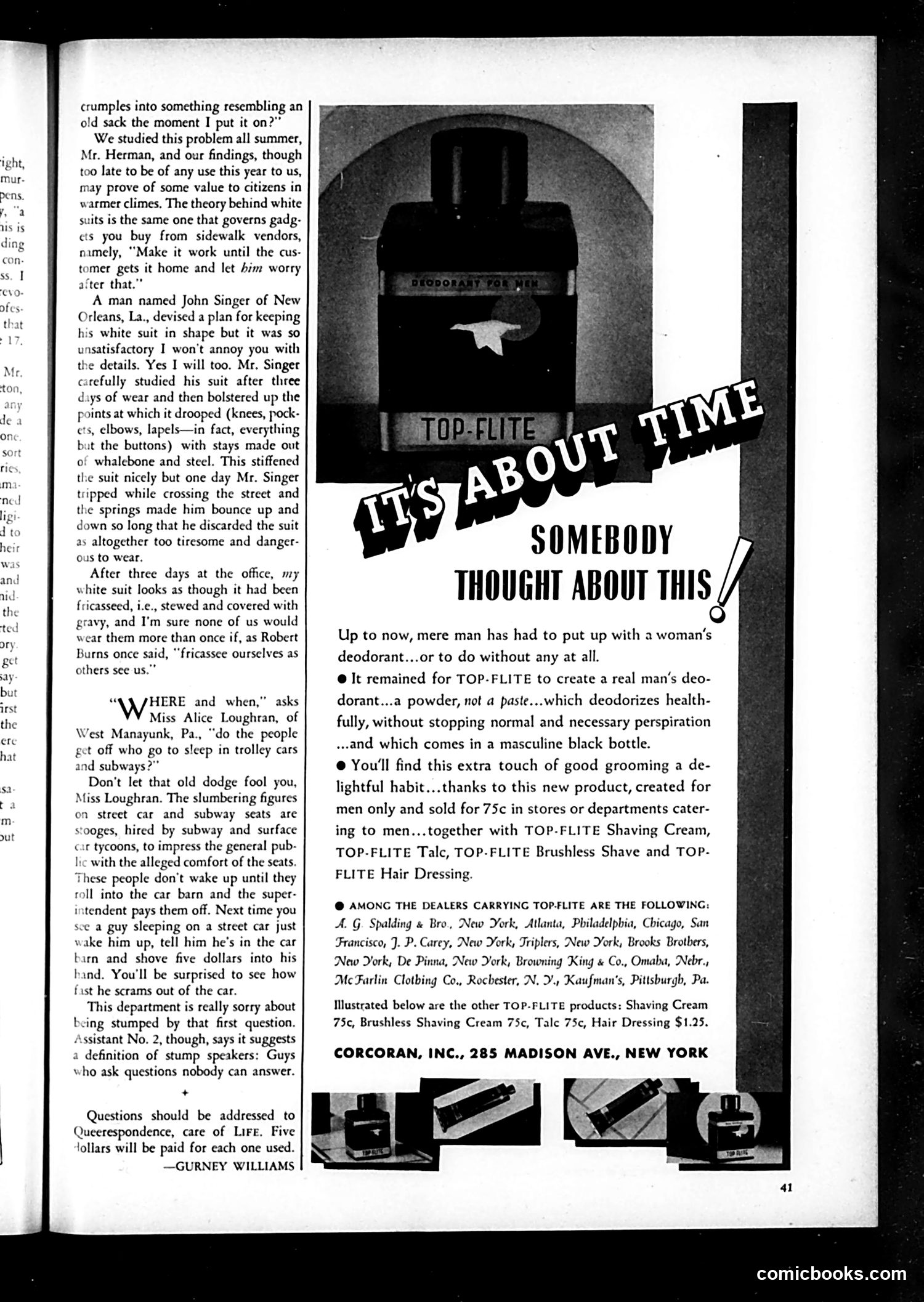
Explanation for Modern Readers This page mixes humor columns with advertising. The left side contains satirical Q&A pieces by Gurney Williams about practical problems: white suits that wrinkle immediately (with an anecdote about a New Orleans man who tried reinforcing his suit with whalebone stays, only to have them make him bounce uncontrollably), and a joke claiming subway sleepers are hired "stooges" paid by transit companies to advertise seat comfort. The right side is a full-page advertisement for TOP-FLITE men's deodorant powder. The ad's humor targets mid-century gender anxieties: it promises a "real man's deodorant" (powder, not paste) in a "masculine black bottle," implying women's products were inadequate for men. The copy emphasizes this is "created for men only," playing on post-WWII anxieties about masculine identity. The ad lists department stores and haberdasheries as retailers, targeting affluent male consumers concerned with "good grooming."
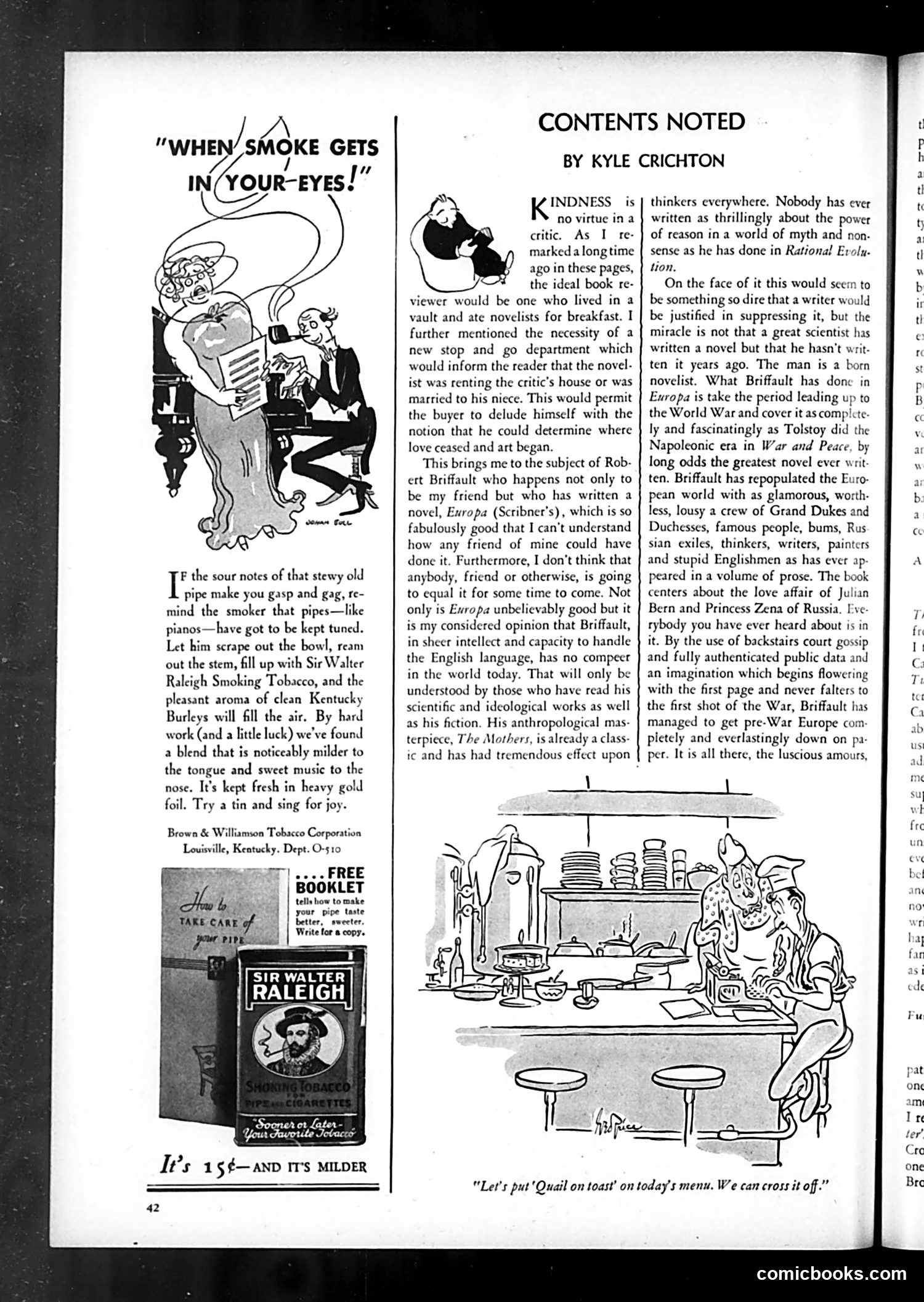
Page Analysis This page contains a Sir Walter Raleigh pipe tobacco advertisement (left) and a book review column titled "Contents Noted" by Kyle Crichton (right), plus a single-panel cartoon at the bottom. The Advertisement: Uses the phrase "When Smoke Gets in Your Eyes" (a popular song reference) as a hook, featuring an illustrated man coughing while smoking. It pitches the tobacco as milder and sweeter-smelling than competitors. The Cartoon: Shows a restaurant kitchen with chaotic activity. A waiter suggests adding "Quail on toast" to the menu, saying "We can cross it off"—a joke about the restaurant's tendency to remove dishes rather than successfully serve them, implying kitchen incompetence or ingredient shortages (possibly Depression-era rationing or scarcity). The Review: Crichton enthusiastically praises novelist Robert Briffault's *Europa*, comparing it favorably to Tolstoy's *War and Peace*, while humorously noting the conflict-of-interest problem when critics review friends' work.
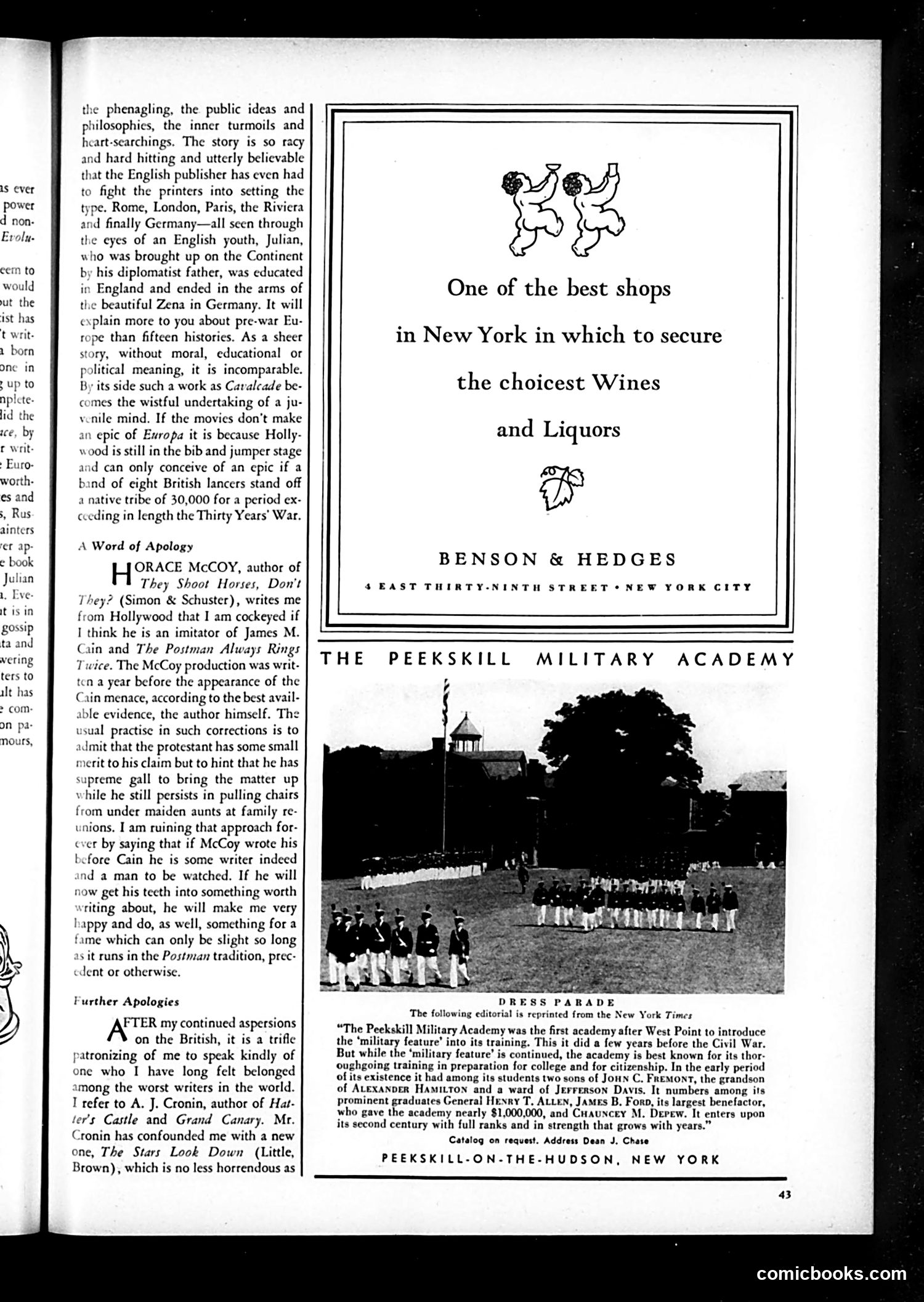
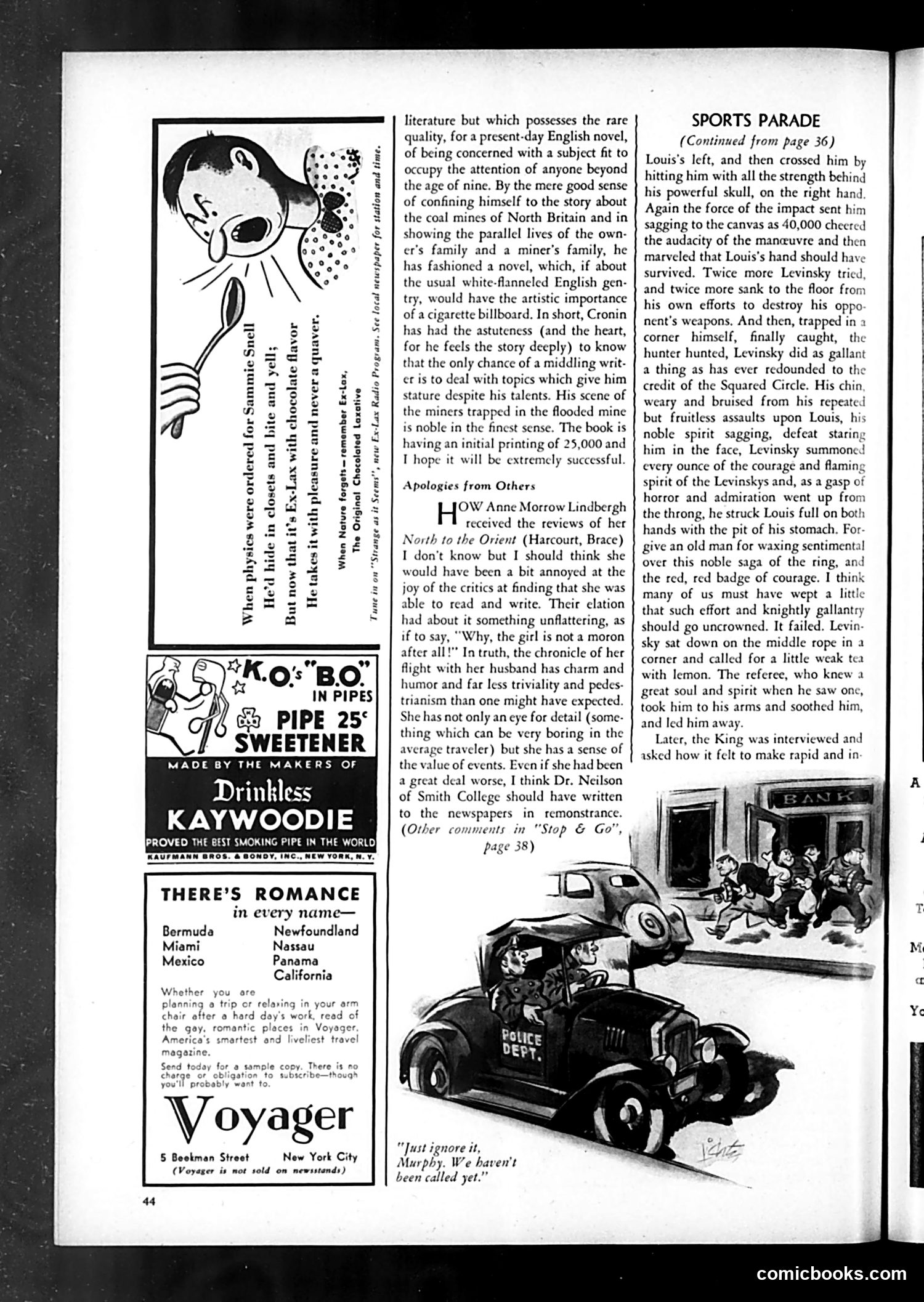
Analysis of Page 44 Content This page mixes advertisements with literary and sports commentary from Life magazine's satirical columns. The main cartoon depicts a police car involved in a minor traffic incident, with an officer saying "Just ignore it, Murphy. We haven't been called yet"—likely satirizing police indifference to minor infractions or bureaucratic apathy. The text includes reviews mocking critics' patronizing surprise at Anne Morrow Lindbergh's literacy following her aviation memoir *North to the Orient*. The passage sarcastically notes critics seemed shocked "the girl is not a moron after all," skewering their condescending attitudes toward women's intellectual capabilities. The sports section describes a boxing match involving Louis (likely Joe Louis) and Levinsky, celebrating Levinsky's gallant fighting spirit despite certain defeat. The advertisements promote travel magazine *Voyager*, Kaywoodie pipes, and Ex-Lax laxative—typical period consumer products targeting middle-class readers.
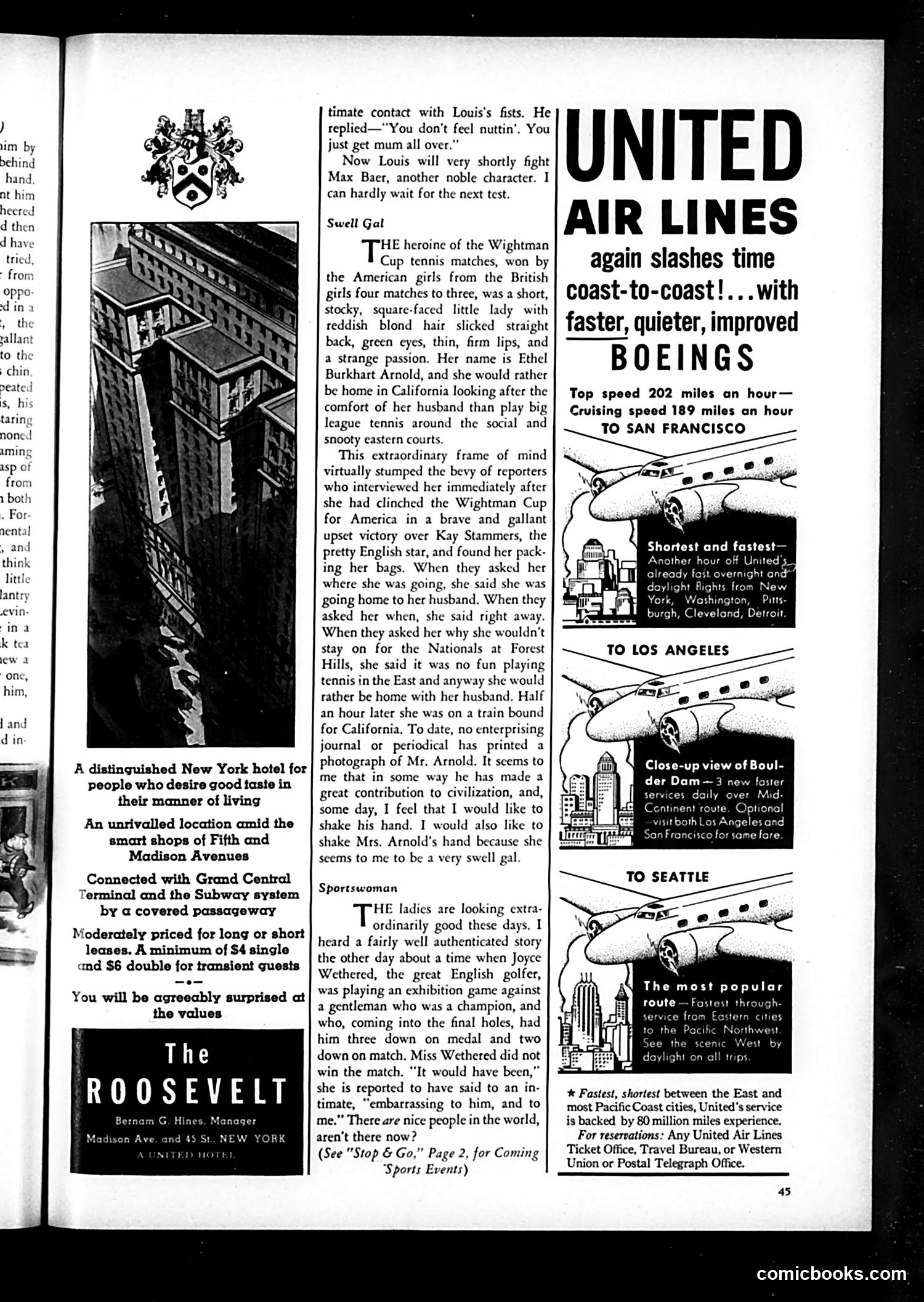
Analysis for Modern Readers This page blends sports commentary with advertising. The main editorial content discusses two female athletes: Ethel Burkhart Arnold — winner of the Wightman Cup (international women's tennis competition), praised satirically for her refusal to stay for further tournaments, preferring to return home to her husband. The author celebrates her priorities, treating her domestic choice as admirably counter-cultural to the era's competitive sports culture. Joyce Wethered — a renowned English golfer mentioned for deliberately losing an exhibition match to avoid embarrassing her male opponent. Again, the piece celebrates feminine deference. The satire is subtle: the author appears to genuinely admire these women for subordinating their athletic achievements to male comfort and domestic duty—values typical of 1930s gender expectations. Modern readers would recognize this as deeply gendered thinking, though presented as compliment. The page also features United Air Lines advertisements touting new Boeing aircraft's speed for cross-country travel.
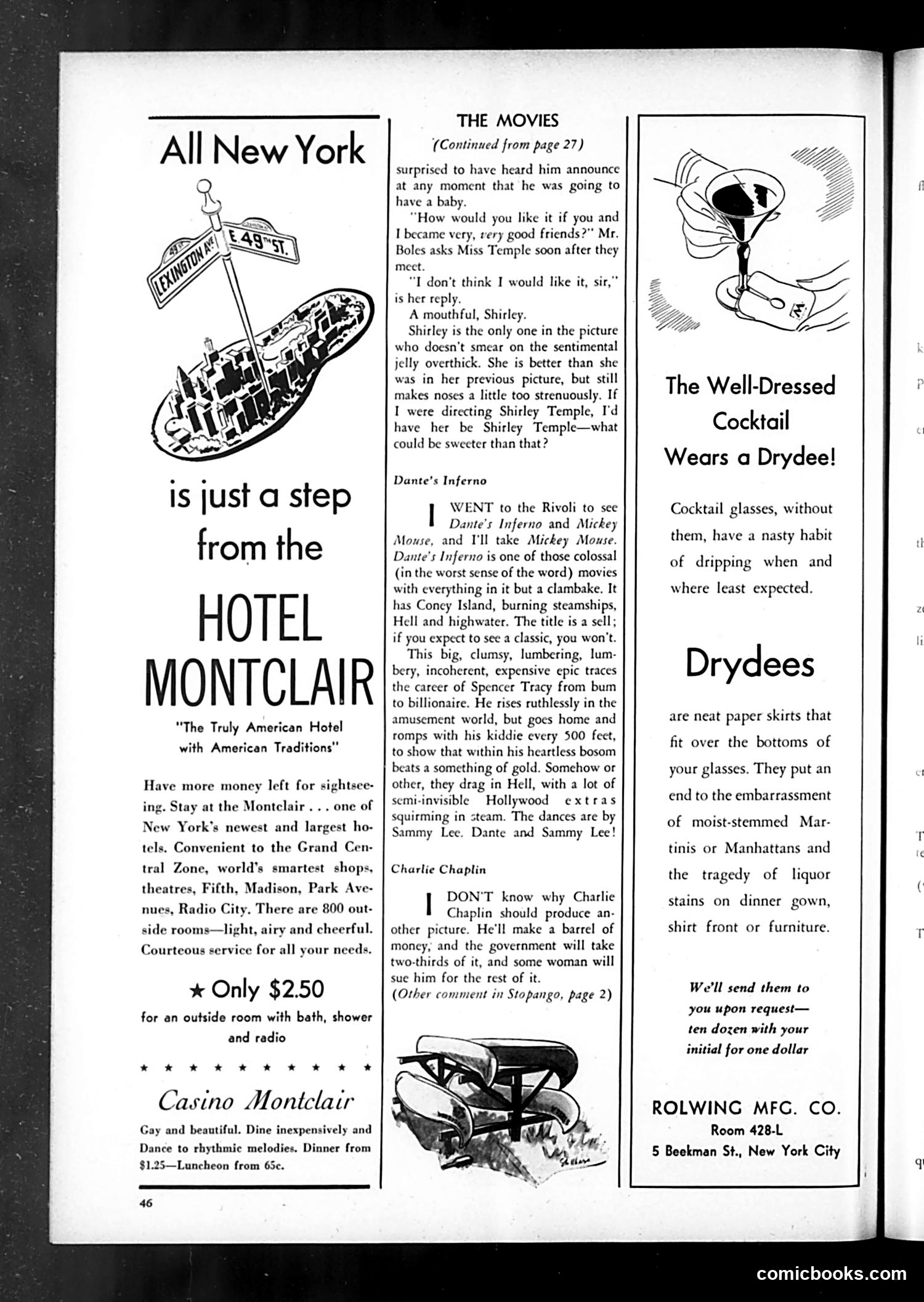
Analysis of Life Magazine Page This page blends hotel/restaurant advertising with film criticism—not political cartoons. The "All New York" section advertises the Hotel Montclair and its Casino, emphasizing affordable luxury ($2.50 rooms) for tourists visiting Manhattan's attractions. The movie reviews critique contemporary 1930s films: Shirley Temple (child star) is praised for restraint compared to overly sentimental acting; *Dante's Inferno* starring Spencer Tracy is mocked as an expensive, incoherent spectacle pretending to be art; Charlie Chaplin is subject to cynical commentary about taxes and litigation. The "Drydees" advertisement promotes a practical novelty product—paper skirts that prevent cocktail glasses from dripping on clothing, addressing a genuine social embarrassment of the era. This reflects Depression-era ingenuity marketing solutions to everyday problems. The page captures 1930s consumer culture: accessible hospitality, entertainment criticism, and gadget advertising aimed at middle-class New York readers.
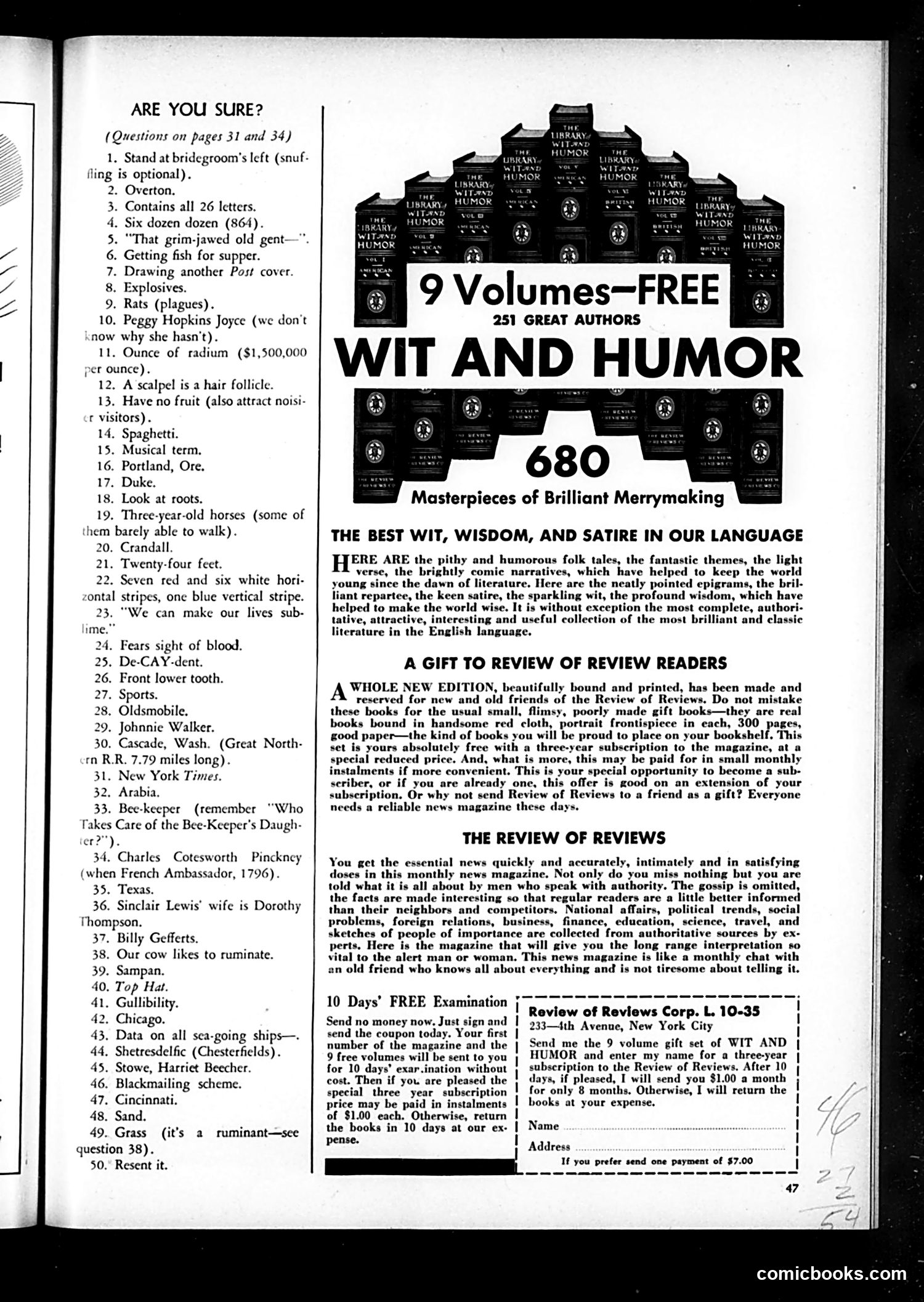
Content Analysis This page is primarily advertising for a book subscription offer, not a political cartoon. The left column contains a crossword puzzle answer key titled "ARE YOU SURE?" with 50 clues and answers—a typical Life magazine feature from this era. References include historical figures (Charles Cotesworth Pinckney as French Ambassador in 1796), contemporary celebrities (Peggy Hopkins Joyce, a 1920s socialite), and literary figures (Sinclair Lewis and his wife Dorothy Thompson). The right side advertises nine volumes of "Wit and Humor" by 251 great authors, offered free with a three-year subscription to *Review of Reviews* magazine. This was a common direct-mail marketing strategy of the period—bundling classic literature as incentive for magazine subscriptions. No political satire appears on this page. It's a straightforward puzzle answer key plus a subscription advertisement typical of Life magazine's mixed editorial/advertising format from approximately the 1920s-1930s.
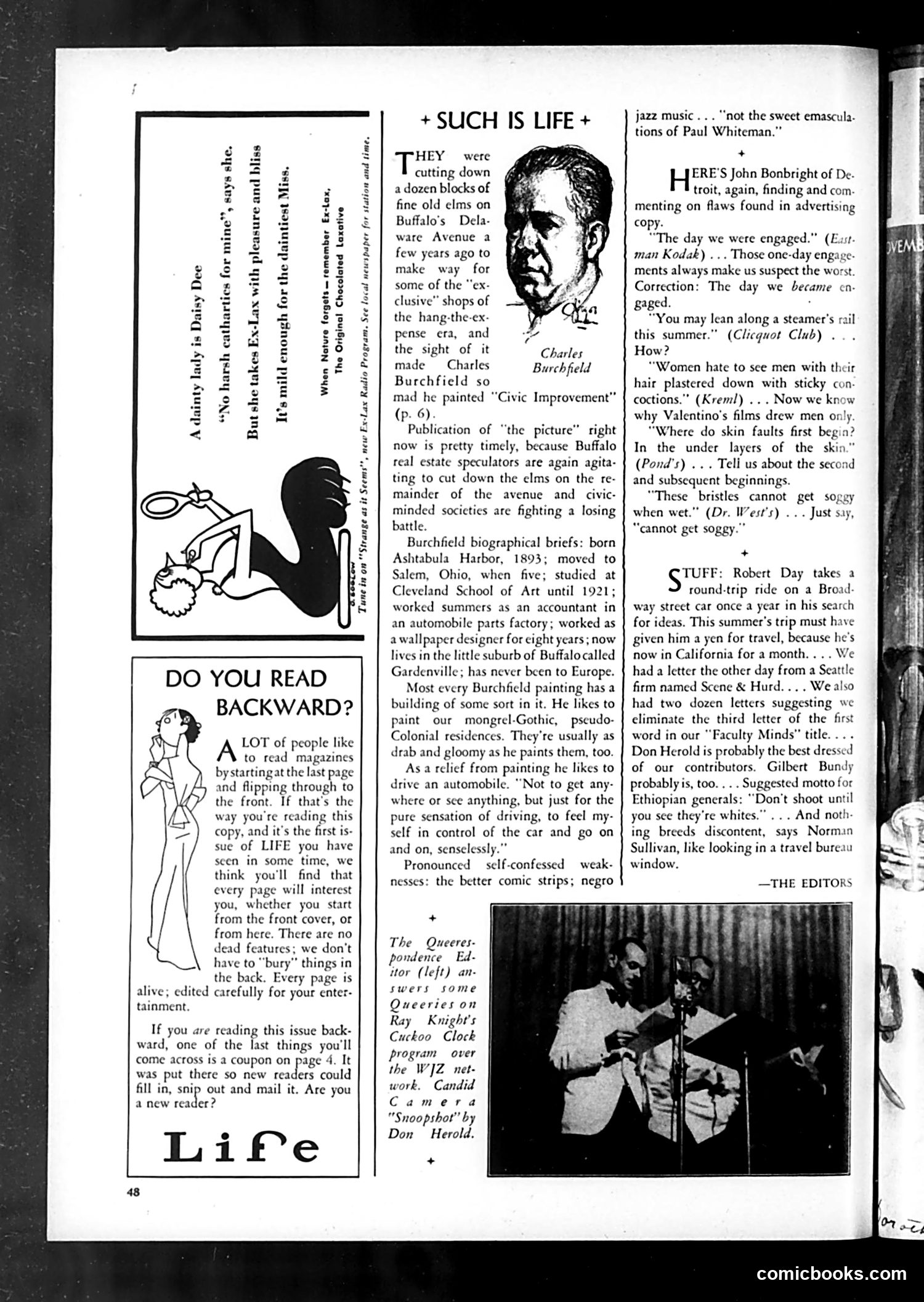
Explanation for Modern Readers This page from *Life* magazine contains two main elements: "Such Is Life" Feature: Artist Charles Burchfield's painting "Civic Improvement" critiques urban development. In Buffalo, developers cut down historic elm trees to build exclusive shops during the 1920s spending boom. Burchfield protested this destruction through his art. The article notes civic groups are fighting—unsuccessfully—against further tree removal, making the painting timely commentary on progress destroying natural heritage. "Queeries" Column: Advertising critic John Bonbright identifies absurd or poorly-worded claims in contemporary ads—like a steamer ad saying "lean along the rail" (unclear how) and hair product ads making illogical beauty claims. This mocks advertising's exaggerated, nonsensical language. Both sections satirize 1920s American excess: wasteful development and manipulative marketing.