life
Life — November 1935
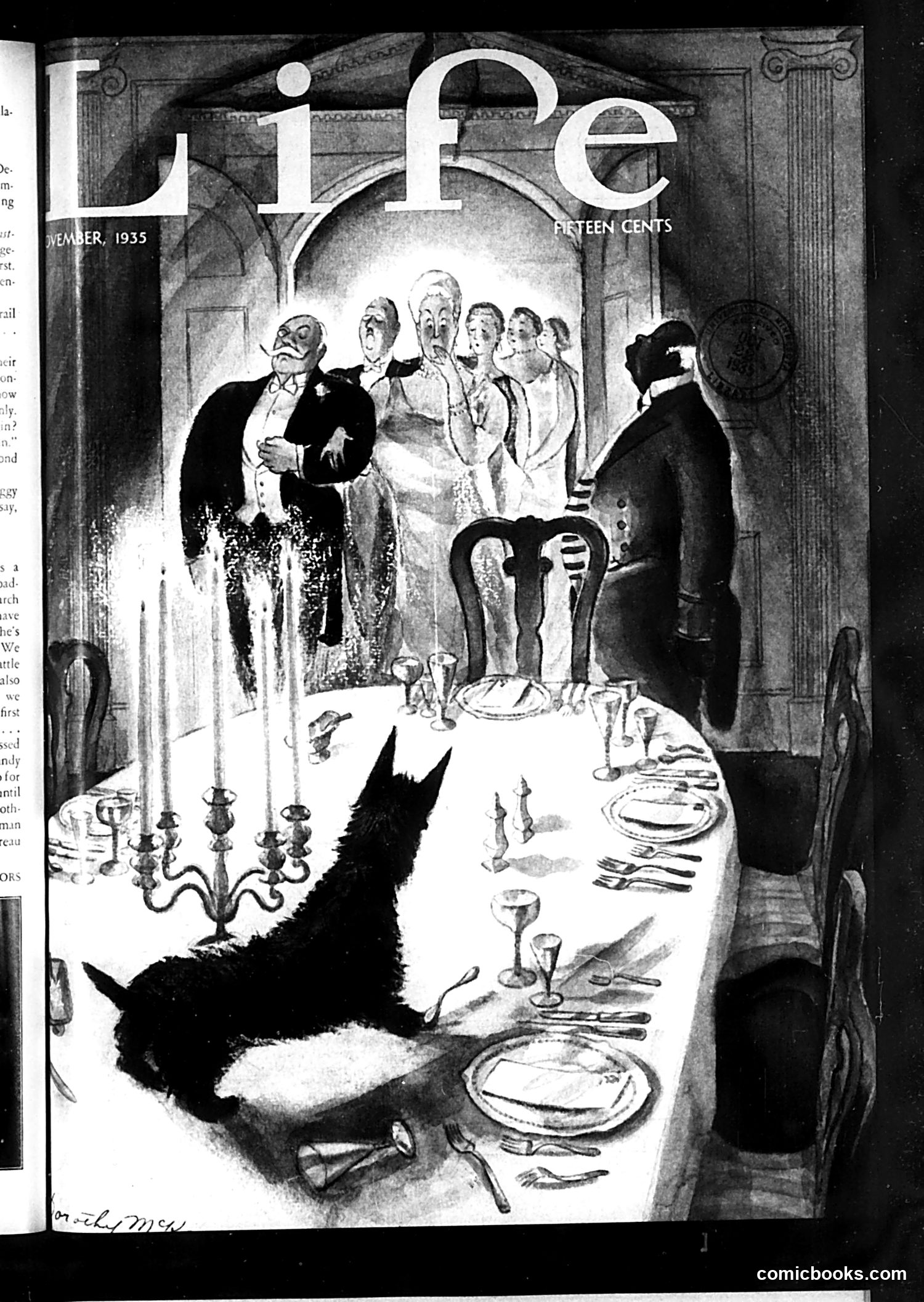
Life Magazine Cover, November 1935 This satirical illustration depicts a formal dinner party interrupted by an uninvited guest—a large black dog beneath the table. The well-dressed gentlemen appear shocked and dismayed by the animal's presence at their elegant meal, with candelabras and place settings visible. The cartoon likely comments on social disruption or an unwelcome intrusion into high society. The dog may represent a political figure, social movement, or scandal of 1935 that threatened to "crash" respectable gatherings. Without additional context from the magazine's text, the specific target of satire is unclear, though the visual metaphor effectively conveys how something considered vulgar or inappropriate has invaded a refined setting, causing considerable discomfort among the establishment figures present.
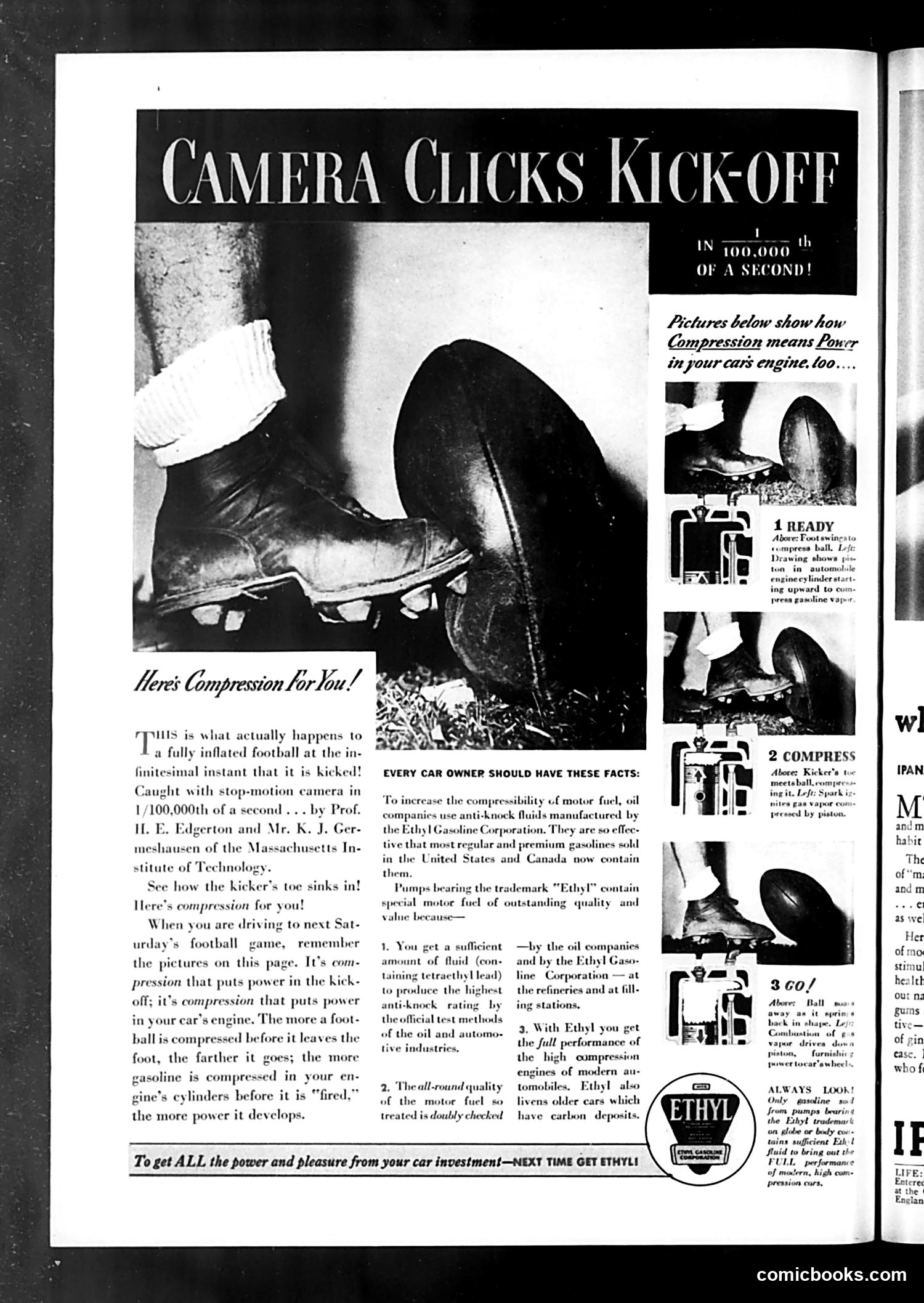
Analysis This is primarily a paid advertisement for Ethyl gasoline, not a satirical cartoon. The page uses a visual metaphor comparing engine compression to a football being kicked: just as compressing a football before kicking increases power, Ethyl gasoline's compression-enhancing additives increase engine power. The "Camera Clicks Kick-off" headline refers to high-speed photography (1/100,000th of a second) capturing a football at the moment of compression—a visual demonstration of the compression concept. The accompanying text and diagrams explain how Ethyl's anti-knock fluids improve fuel performance in automobile engines. This is straightforward commercial advertising using a clever sports analogy, not satire or political commentary.
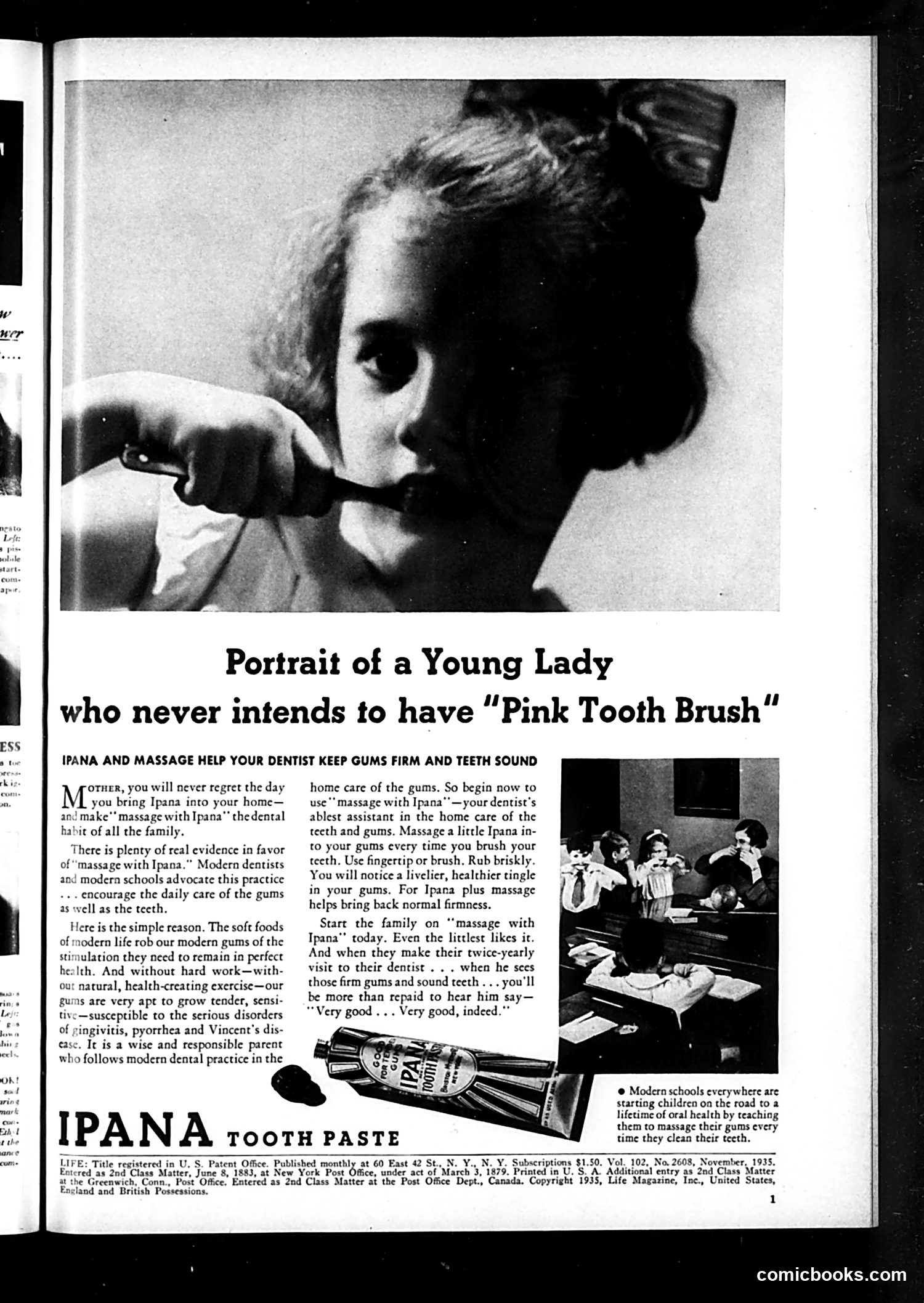
Analysis This is primarily a toothpaste advertisement, not political satire or a cartoon. The page promotes Ipana Tooth Paste using a portrait of a young woman and testimonial-style text. The ad's messaging reflects 1930s dental hygiene attitudes: it advocates for gum massage and regular dental care, positioning Ipana as a modern solution. The phrase "Pink Tooth Brush" in the headline appears to reference a common dental condition (inflamed gums), which the product claims to prevent. The accompanying photograph showing what appears to be a dental demonstration or family education scene reinforces the advertiser's authority on oral health. The copy emphasizes that following these practices prevents serious dental disease—a selling point in an era before widespread preventive dentistry. This is commercial advertising, not editorial content or satire.
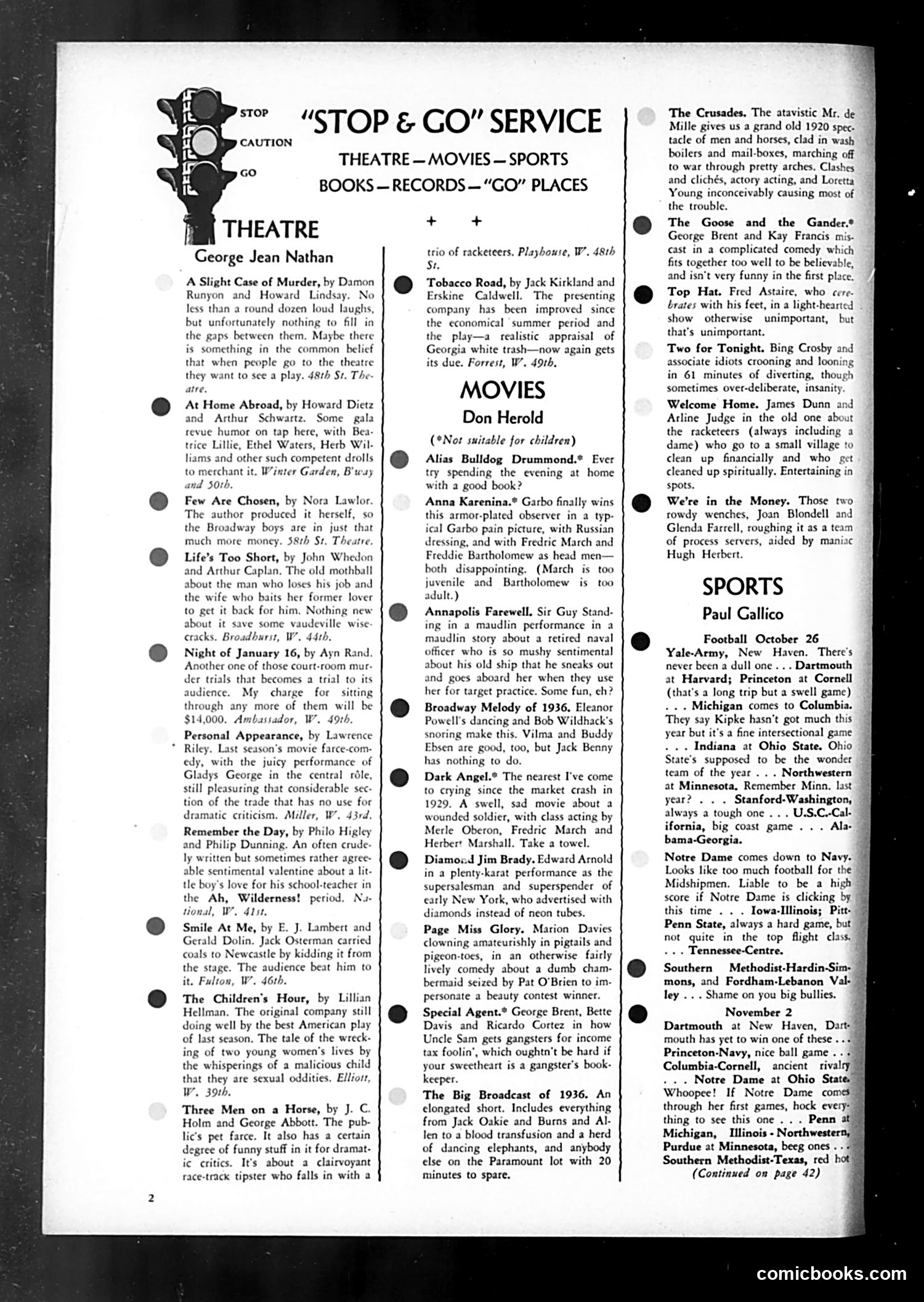
"Stop & Go" Service Page from Life Magazine This is a review and recommendation page, not a political cartoon. It's a "Stop & Go Service" guide — Life's critical ratings system for entertainment and cultural products (theater, movies, sports, books, records). The traffic light graphic at top left symbolizes the rating system: STOP (don't see/read), CAUTION (mixed reviews), and GO (recommended). The page contains brief reviews by critics George Jean Nathan (theater) and Don Herold (movies), plus Paul Gallico (sports). Each review uses the traffic light system to guide readers on what's worth their time and money. Examples: *Dark Angel* gets a STOP (sad, not recommended); *Alias Bulldog Drummond* gets a GO (entertaining). This was Life's practical service to readers navigating 1930s entertainment options.
I'm unable to provide a reliable analysis of this page. The image is predominantly black with very poor visibility—the main content area is nearly illegible, making it impossible to identify specific figures, caricatures, or visual details that would be essential for understanding the cartoon or satire. While text fragments are visible on the left margin, they are too fragmented and unclear to reconstruct meaningful context. Without being able to read both the visual content and accompanying text clearly, I cannot accurately identify the political or social references, the intended subjects of satire, or explain the joke to a modern reader. A higher-quality or clearer scan of this page would be necessary for proper analysis.
I can see this is a mostly black page with minimal visible content. On the right side, there's a partial text box beginning with "Here's" and what appears to be fragmented text below it, though it's too unclear to read reliably. The image quality and darkness make it difficult to discern any distinct cartoon figures or clear satirical content. Without being able to read the text clearly or identify specific illustrations, I cannot accurately explain what political or social references this page contains. The page appears to be either heavily damaged, poorly scanned, or primarily consisting of a dark advertisement or illustration that isn't legible in this reproduction. To provide accurate historical context, I would need a clearer version of the image.
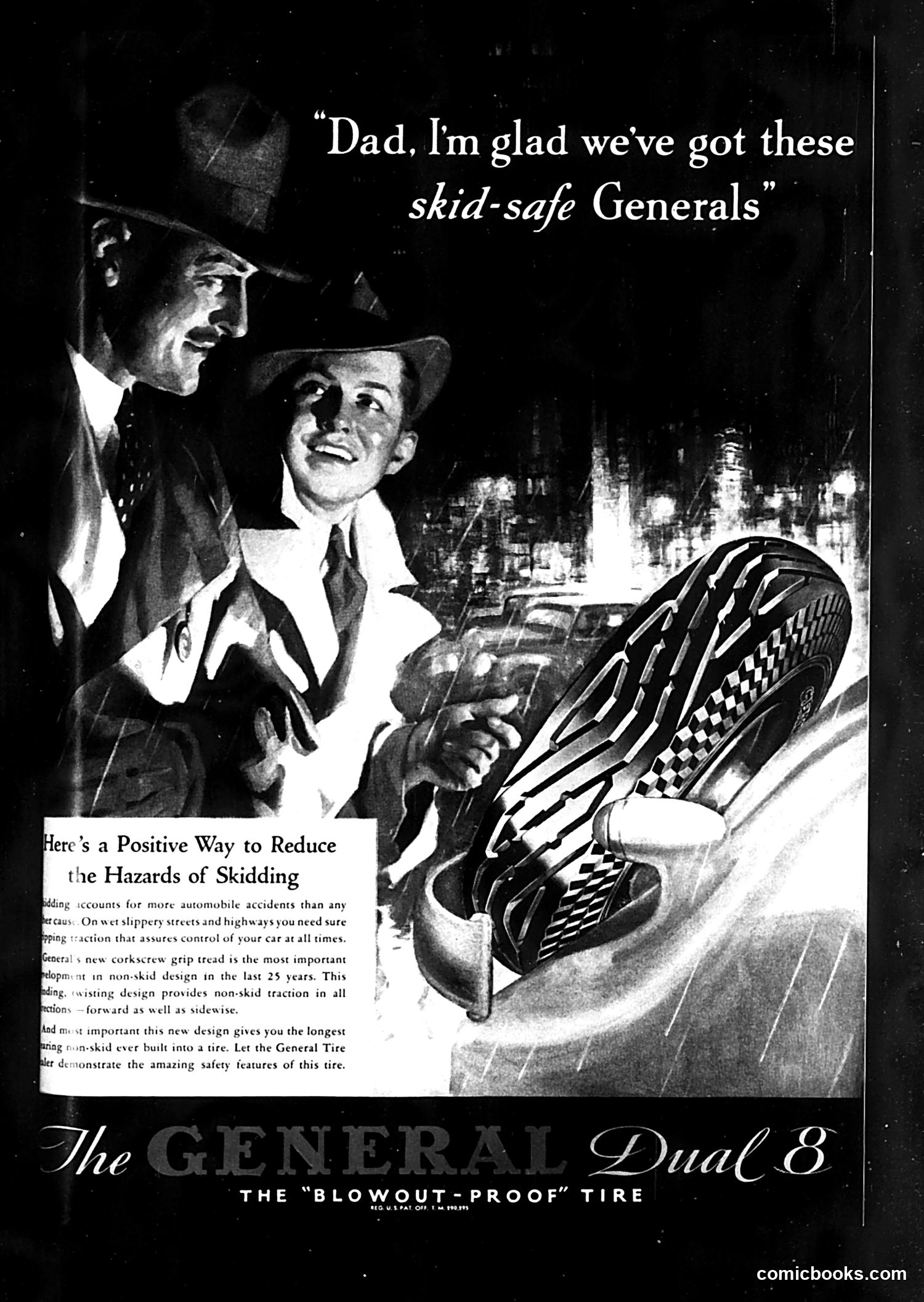
Analysis This is a vintage advertisement, not political satire. It's a General Tire company ad for their "Dual 8" tire, marketed as "blowout-proof." The image shows two men in formal dress and hats examining a tire. The younger man (apparently a son) says to the older man (his father): "Dad, I'm glad we've got these skid-safe Generals." The ad's humor is gentle and domestic rather than satirical—it plays on paternal reassurance. The father's pleased expression suggests approval that his son is using safe tires. The copy emphasizes the tire's non-skid tread design for safety "on wet slippers streets and highways." This reflects early-to-mid 20th century automotive safety messaging, when tire technology was a significant selling point and family safety was a key advertising appeal. The formal attire and language date it to roughly the 1920s-1930s era.
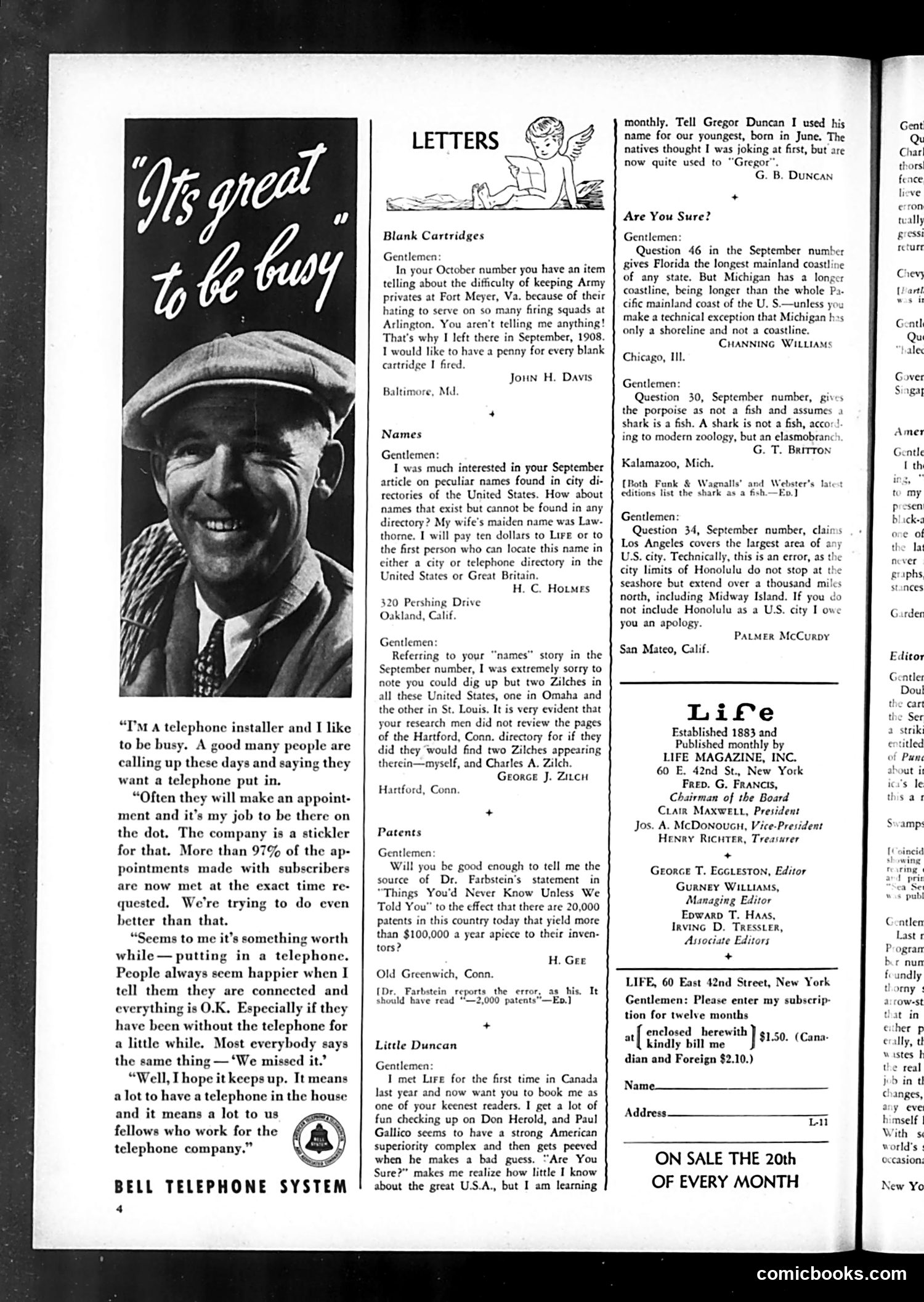
Bell Telephone System Advertisement This page is primarily a Bell Telephone System advertisement, not political satire. The large left-side image shows a smiling telephone installer in work clothes and cap, with the headline "It's great to be busy." The accompanying testimonial presents the installer's perspective: telephone installation work keeps him constantly busy and occupied, which he views positively. He emphasizes that the job offers steady employment, good pay, and the satisfaction of essential work. The ad argues that telephone company employment provides reliable, respectable work—a key selling point during economic uncertainty. The right side contains unrelated reader letters to *Life* magazine addressing various factual questions about geography, animals, and names.
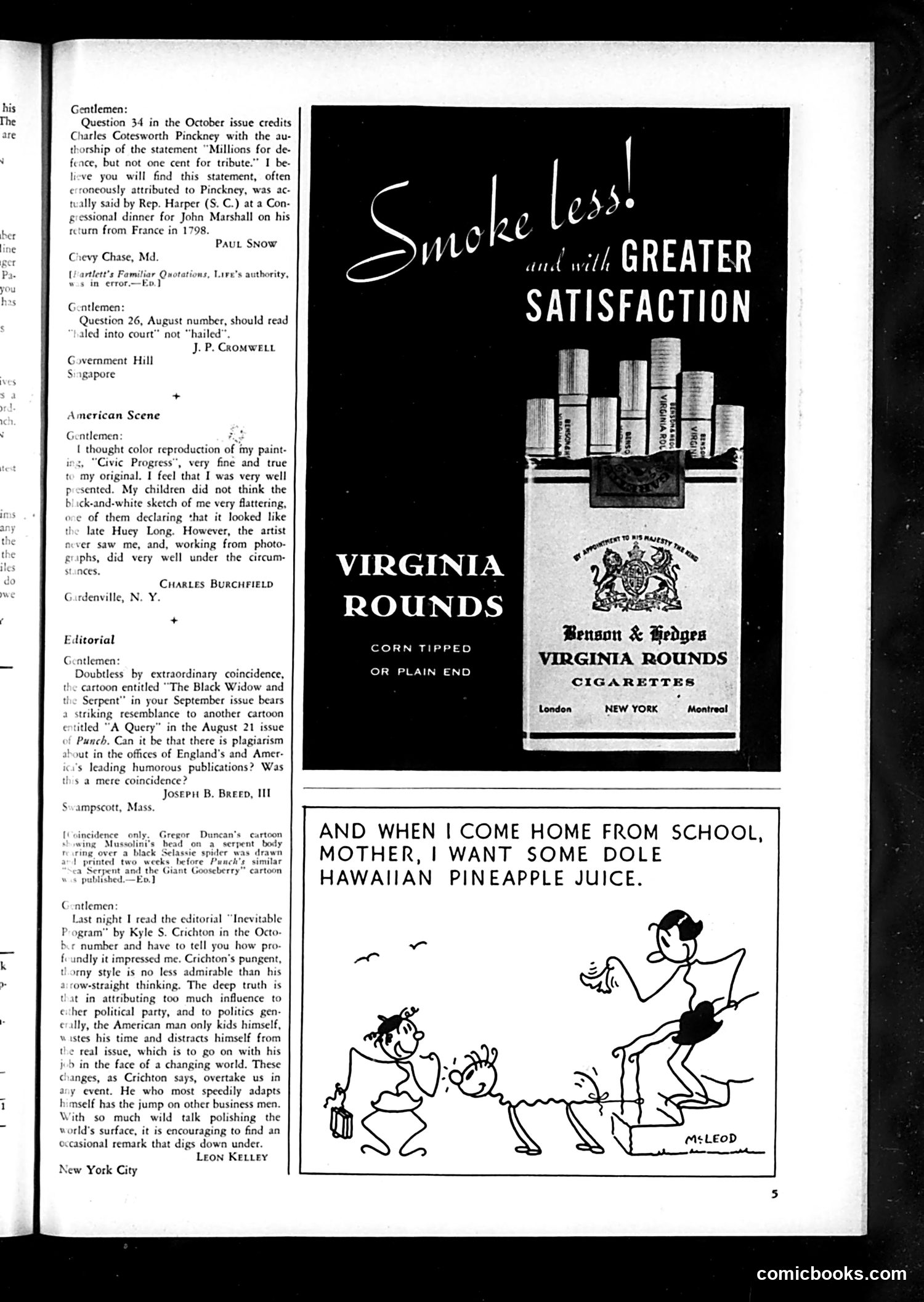
Analysis This page contains primarily advertisements and editorial letters, not political cartoons. The main visual content includes: 1. Virginia Rounds Cigarettes ad — a straightforward product advertisement emphasizing "smoke less and with greater satisfaction," featuring cigarette packages. 2. Dole Hawaiian Pineapple Juice cartoon — a simple, whimsical domestic scene showing a child returning from school requesting juice from their mother. This is a consumer product advertisement using humor and relatability rather than satire. The editorial letters address various magazine content questions, including references to artwork reproduction and cartoon attribution debates. There is no political satire on this page. It's primarily commercial advertising typical of mid-20th century magazines, using lighthearted illustration to market products to American consumers.
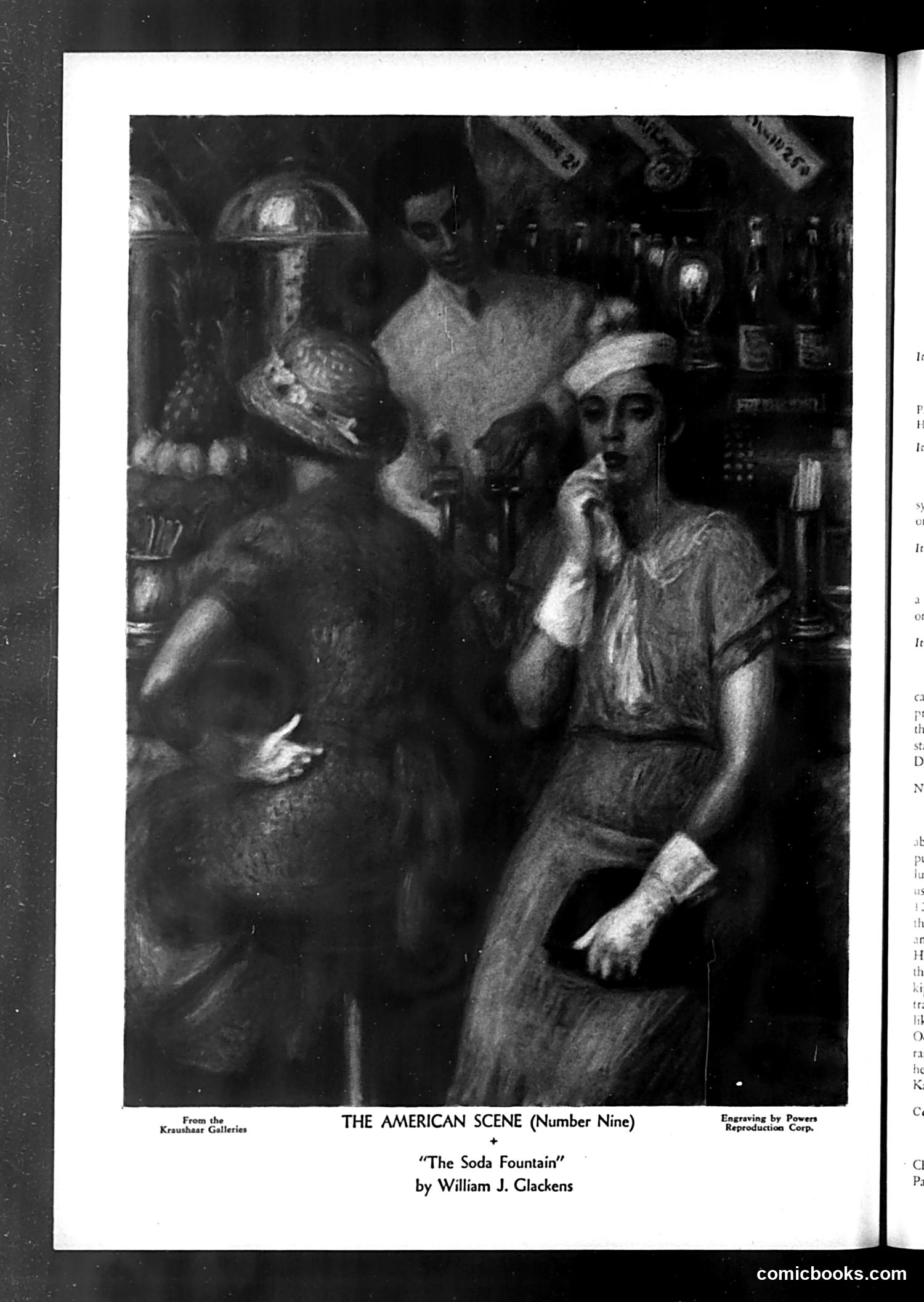
Analysis This is an engraving titled "The Soda Fountain" by William J. Clackens, presented as part of "The American Scene" series from the Kraushaar Galleries. Rather than political satire, it appears to be social commentary depicting everyday American life. The scene shows figures at what appears to be a soda fountain counter—a popular social gathering spot in early 20th-century America. The work captures ordinary people in a casual commercial setting, likely satirizing or observing class interactions, fashion, and social behaviors of the era. Soda fountains were important social spaces where different social strata mixed informally. Without additional contextual information about Clackens's specific intent or contemporary references, the precise satirical message remains unclear, though the subject matter itself—American consumer culture and social mixing—was itself often a target of commentary.
Analysis of "Some of the People—Our Country" Page This satirical page critiques American government inefficiency and political hypocrisy during the New Deal era. The header cartoon depicts chaos and disorder, setting a mocking tone. The left column lists absurd government facts: a zoo director's call to import gumbo to stop storks, Texas prison escapes, the Supreme Court building's single bathtub, and Capitol janitors struggling with vermin—all highlighting bureaucratic incompetence and waste. The "Prayers for Approaching Thanksgiving" section parodies both parties: Democrats praise FDR's social legislation while Republicans mock Democratic dogma and urge faith in a future Republican leader. "The Voters" cynically portrays citizens as bees merely surviving, grateful simply to be alive—suggesting widespread political apathy and resignation rather than engaged citizenship.
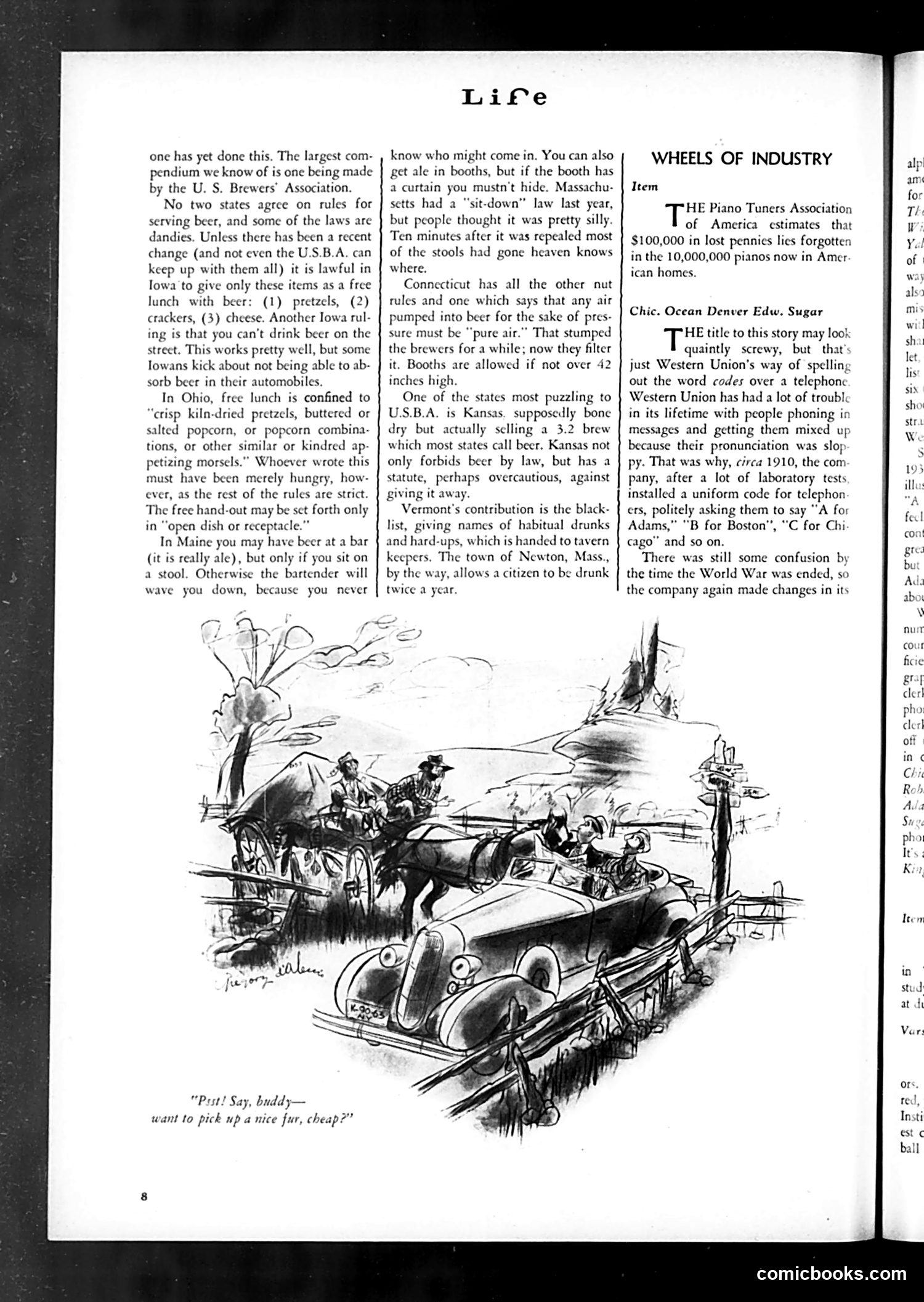
Cartoon Analysis: "Psst! Say, buddy—want to pick up a nice far, cheap?" This cartoon satirizes post-Prohibition era automobile culture and economic inequality. The sketch shows a well-dressed motorist in a sleek, modern car encountering a shabby figure with a horse-drawn cart—a visual contrast between new wealth and rural/working-class poverty. The caption's whispered proposition ("want to pick up a nice far, cheap?") suggests street hustling or black-market dealings, likely referencing the economic desperation of the Depression era. The juxtaposition mocks both the nouveau riche flaunting new automobiles and the impoverished who remained dependent on obsolete transportation. The surrounding text discusses state-by-state alcohol regulations post-Prohibition, contextualizing an era of rapid social change and class tensions in 1920s-30s America.
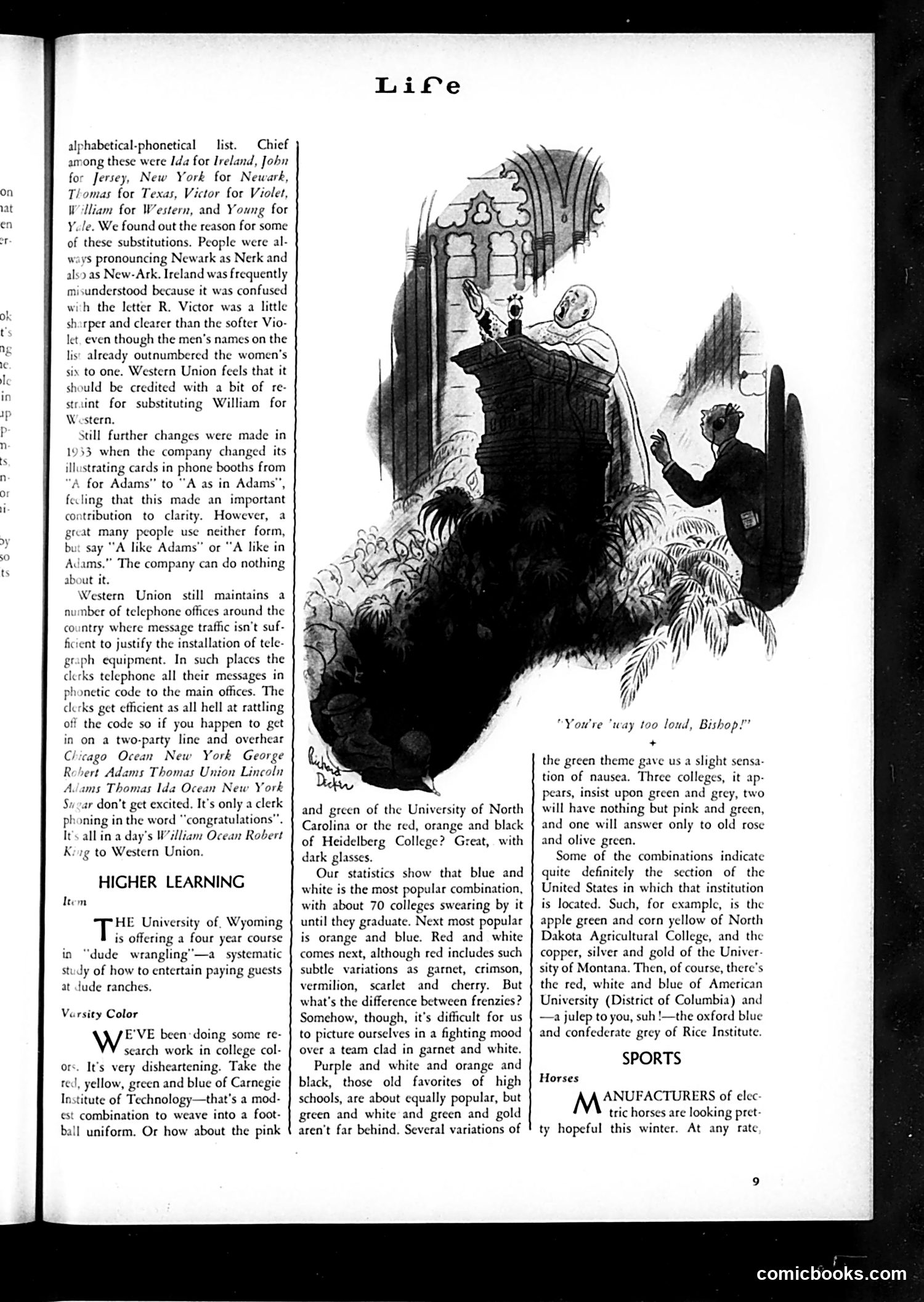
Political Cartoon Analysis The cartoon depicts a bishop being ejected forcefully through a church doorway by an unseen force, with the caption "You're way too loud, Bishop!" Context: This appears to satirize conflicts between religious authority and institutional constraints, likely referencing disputes over church noise or the bishop's outspoken behavior. The humor relies on the irony of a high church official being literally expelled for excessive volume—suggesting either: 1. A specific contemporary controversy about a bishop's public pronouncements, or 2. More broadly, tensions between traditional religious hierarchy and modern institutional management. The cartoon's positioning alongside text about college color schemes and Western Union suggests *Life* magazine's typical mixture of social commentary on education, technology, and religious institutions circa the mid-20th century.
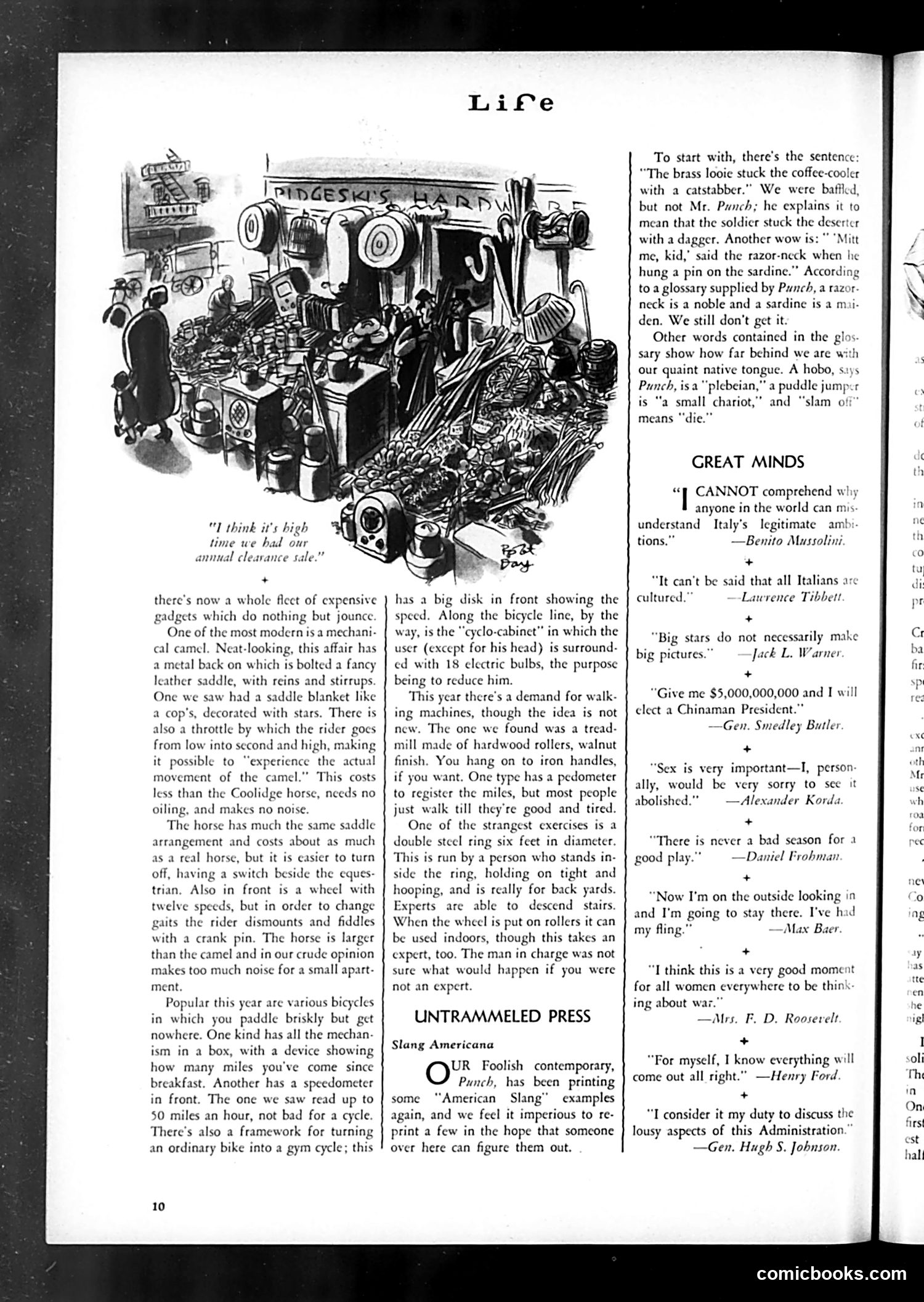
Analysis of Life Magazine Page 10 The main cartoon satirizes the modern automobile industry's obsession with unnecessary gadgets and features. The cluttered illustration shows a car overloaded with useless mechanical additions—springs, straps, pedometers, and various controls—meant to seem impressive but serving no practical purpose beyond novelty. The satire critiques how manufacturers add expensive, complicated features (like a "cycle" saddle or disk speedometer) that don't improve actual driving. The joke is that riders experience discomfort from these additions rather than benefit. The "Great Minds" section collects humorous quotes from notable figures like Mussolini and Henry Ford, using their statements for comedic effect—likely misquoted or taken out of context for satirical purposes. The page mocks both commercial excess and celebrity culture simultaneously.
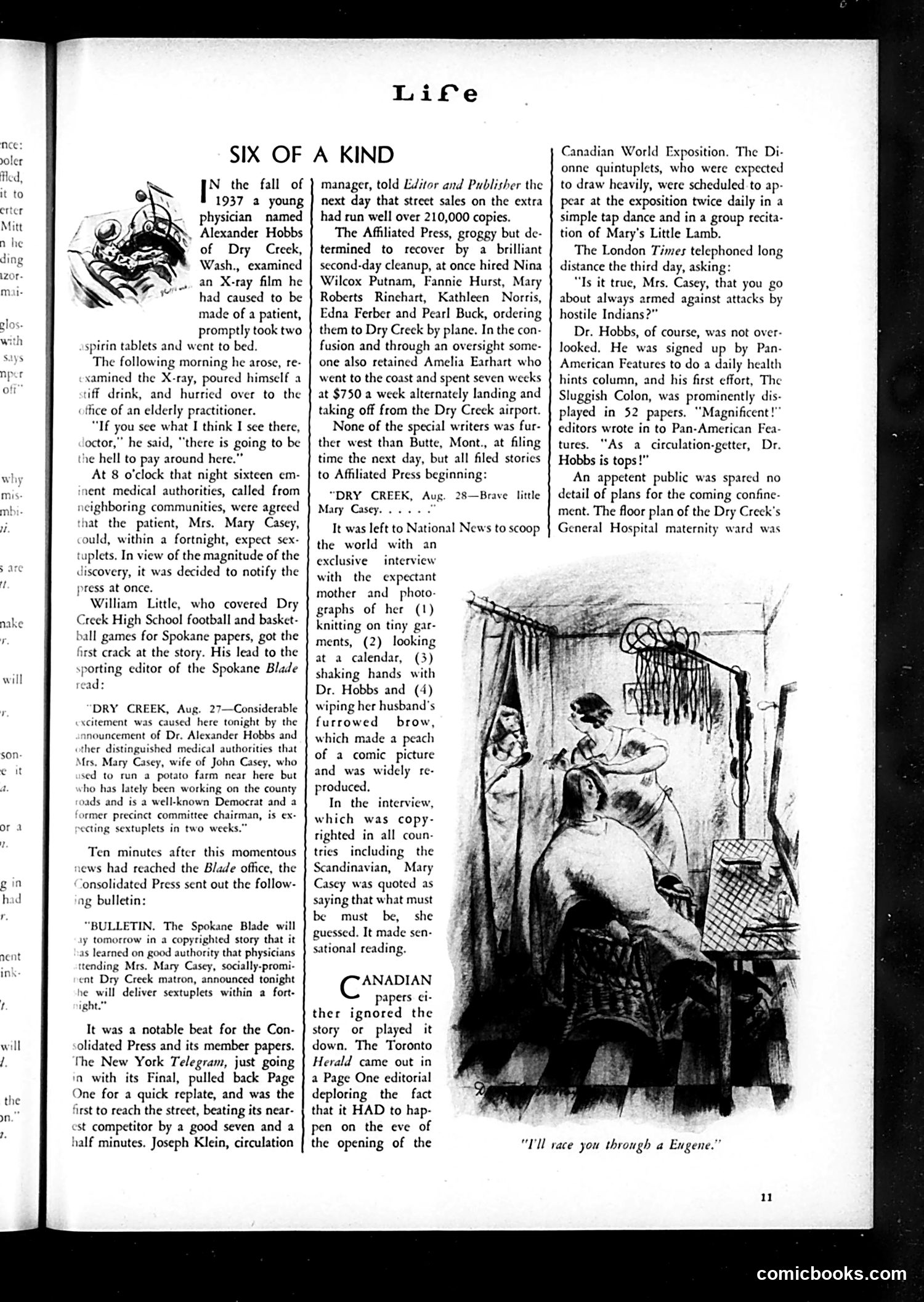
"Six of a Kind" - Life Magazine Article This page features a humorous article about Dr. Alexander Hobbs of Dry Creek, Washington, who examined an X-ray film and discovered a patient had swallowed six aspirin tablets. The story satirizes how this minor medical incident triggered a media frenzy—multiple newspapers and wire services competed to cover it first, with the Spokane Blade scooping competitors and the New York Telegram racing to match the story. The accompanying illustration shows a woman (Mary Casey, the patient's wife) in what appears to be a maternity ward, humorously titled "I'll race you through a Eugene," suggesting the absurdity of the media spectacle around this trivial medical occurrence. The satire mocks how newspapers sensationalize minor stories and compete desperately for exclusives.
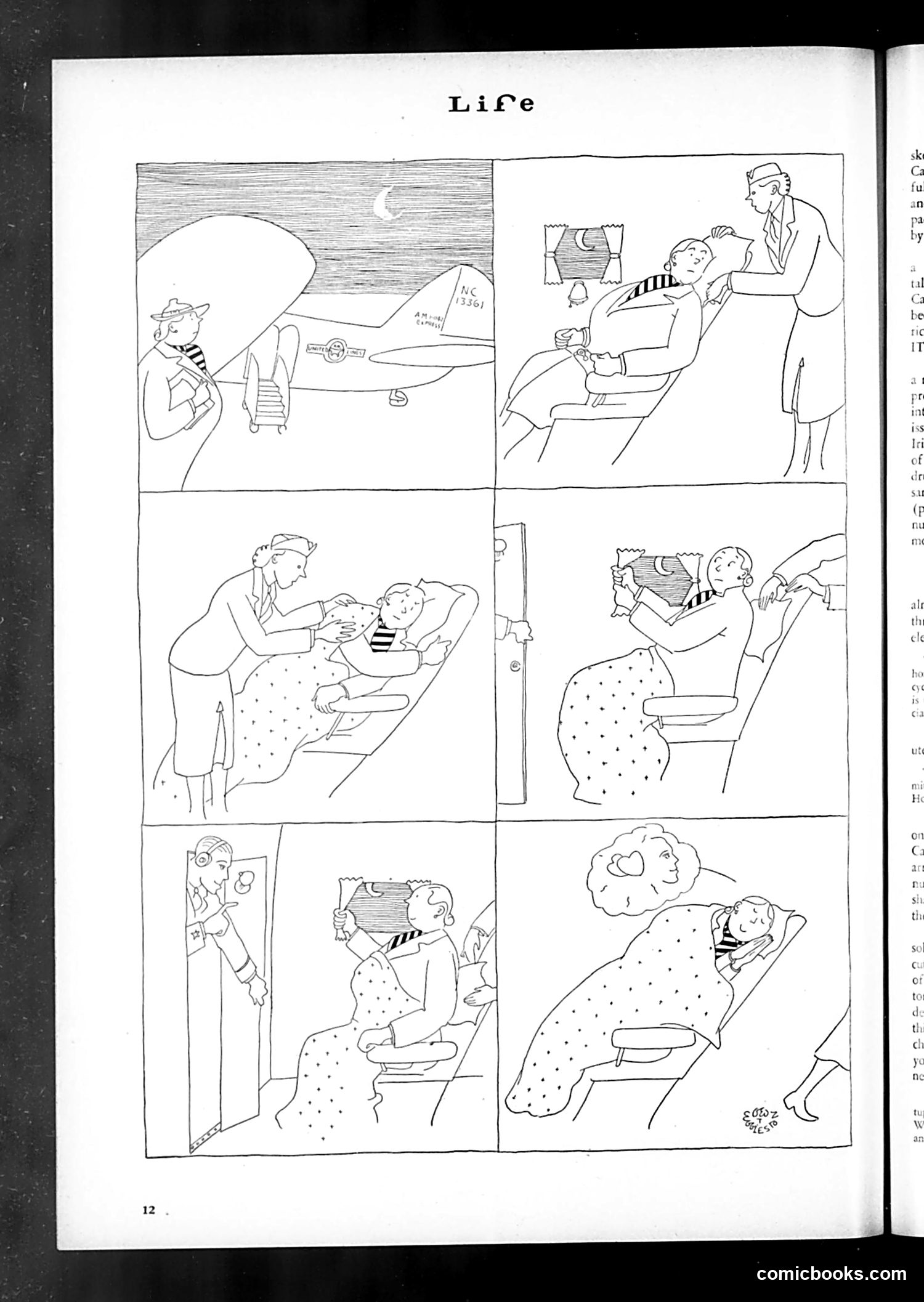
"Life" Comic Strip Analysis This six-panel comic strip titled "Life" depicts a domestic narrative spanning what appears to be an airplane journey and subsequent events. The strip shows: 1. A man and woman at an airport with an airplane 2. A medical/dental examination scene 3. A couple in bed together 4. An intimate bedroom scene 5. A man entering through a doorway 6. A final intimate scene The strip appears to be satirizing married life or domestic relations, progressing from travel/courtship through medical care to marital intimacy. The humor likely derives from the contrast between public conduct (airport, medical settings) and private domestic life. Without visible text or clearer context, the specific satirical point remains unclear, though the progression suggests commentary on marriage or relationships typical of *Life* magazine's social satire of its era.
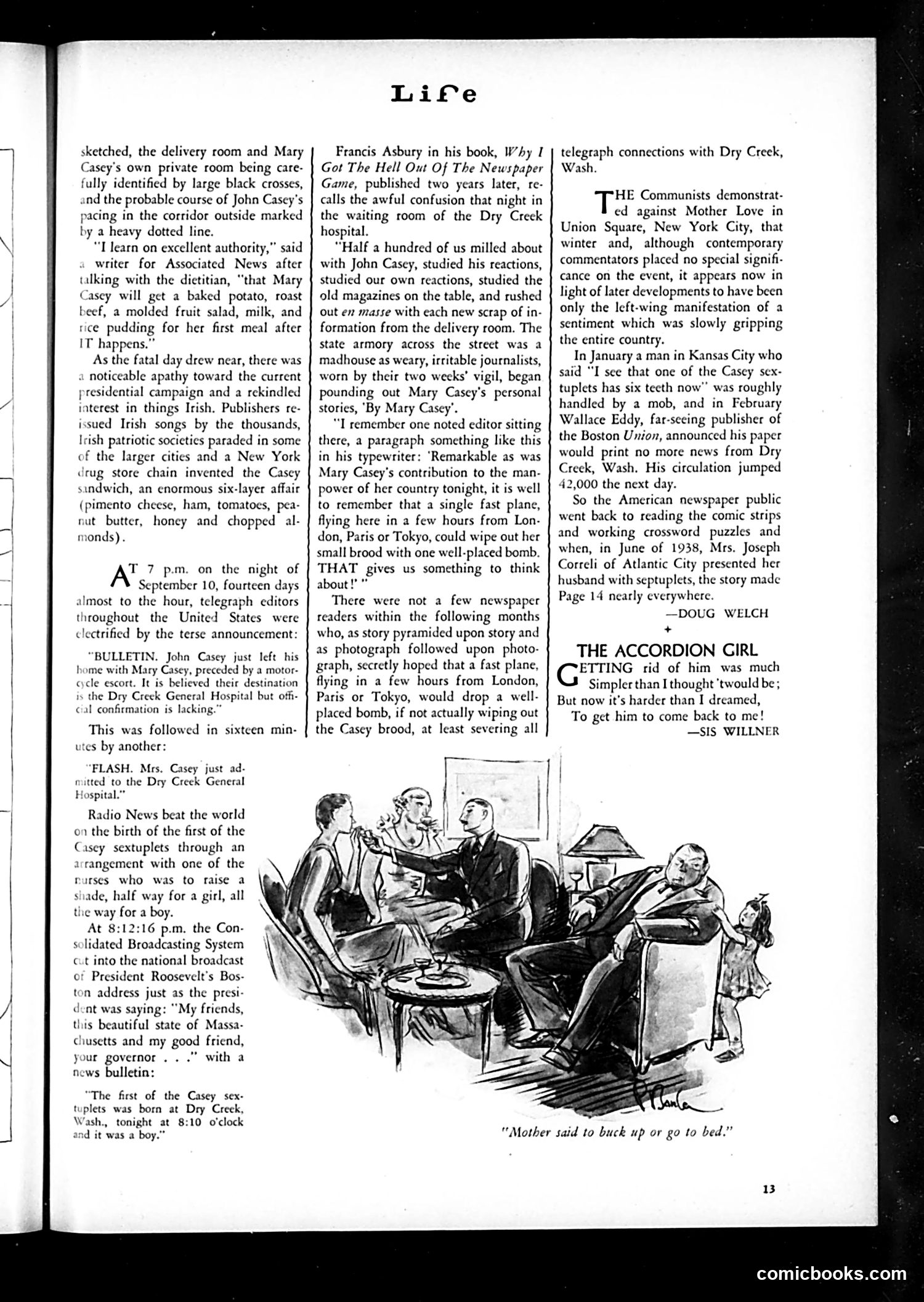
Analysis of "The Accordion Girl" Cartoon This single cartoon illustrates a domestic scene where a mother tells her child to "buck up or go to bed." The sketch shows adults gathered in a living room with a young girl present—likely the "accordion girl" referenced in the title by Willner. The satire appears to target sentimental or overly earnest children's entertainment of the era. The caption suggests the girl is being melodramatic or seeking attention, with the mother's practical dismissal serving as the joke's punchline. The cartoon mocks both the child's emotional performance and perhaps the popular entertainment culture surrounding such precocious young performers that was common in early-to-mid 20th-century America. The humor relies on period-specific expectations about children's behavior and parental discipline.
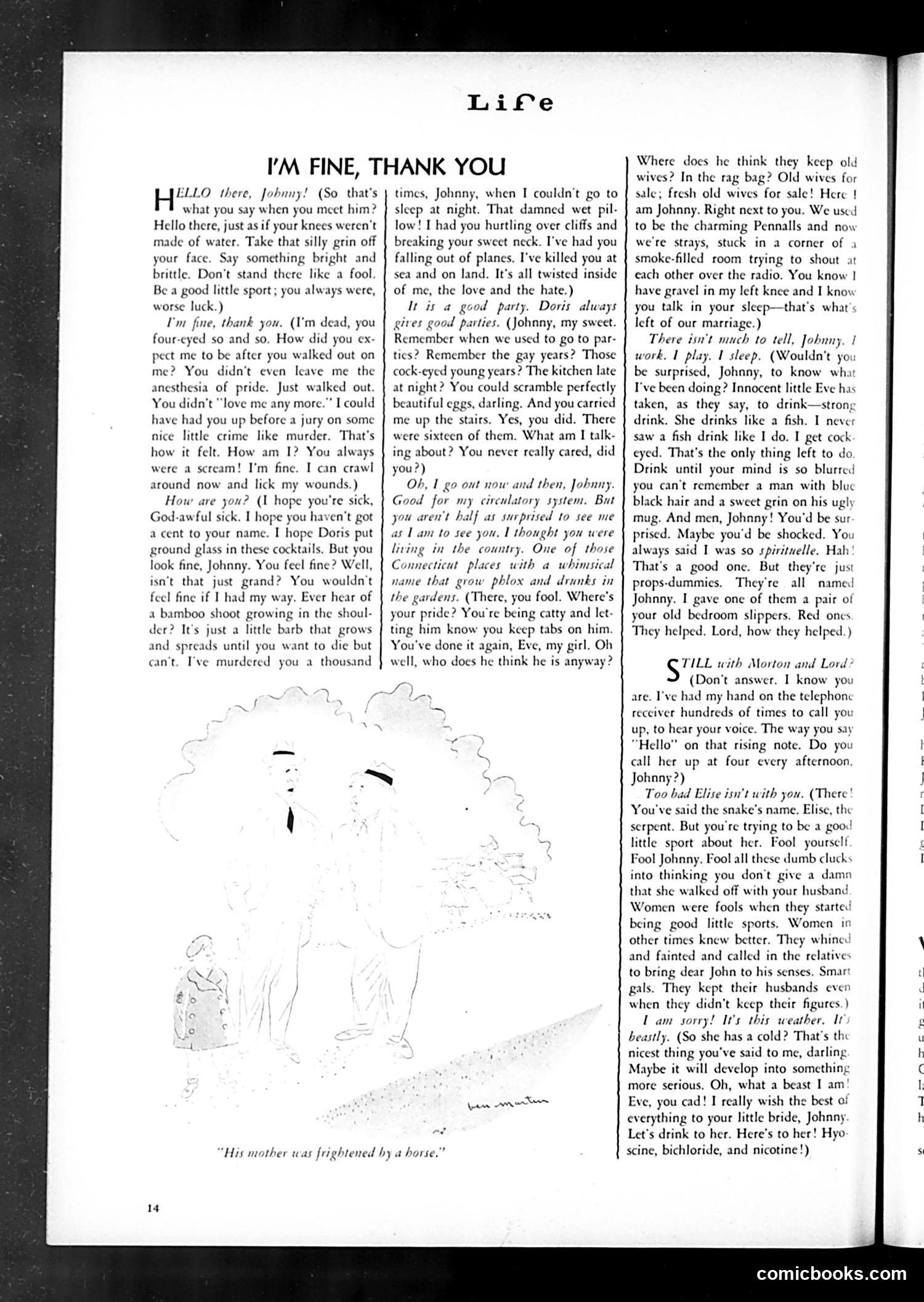
Analysis of "I'm Fine, Thank You" - Life Magazine This page presents a satirical monologue from a deceased wife addressing her husband Johnny from beyond the grave. The cartoon (captioned "His mother was frightened by a horse") depicts a ghostly female figure. The satire mocks marital dynamics of the era: the wife catalogs her grievances—Johnny's infidelity, emotional neglect, her alcoholism ("She drinks like a fish"), and his indifference to her suffering. She references Elise (likely a mistress), accuses him of infidelity during their marriage, and notes he never noticed her deteriorating health or drinking problem. The humor is dark, targeting both masculine negligence and the period's portrayal of "good little sport" wives who suffered silently. The final toast with "hypo sceine, bichloride, and nicotine" suggests she poisoned herself—a bitter punchline about wives driven to suicide by uncaring husbands.
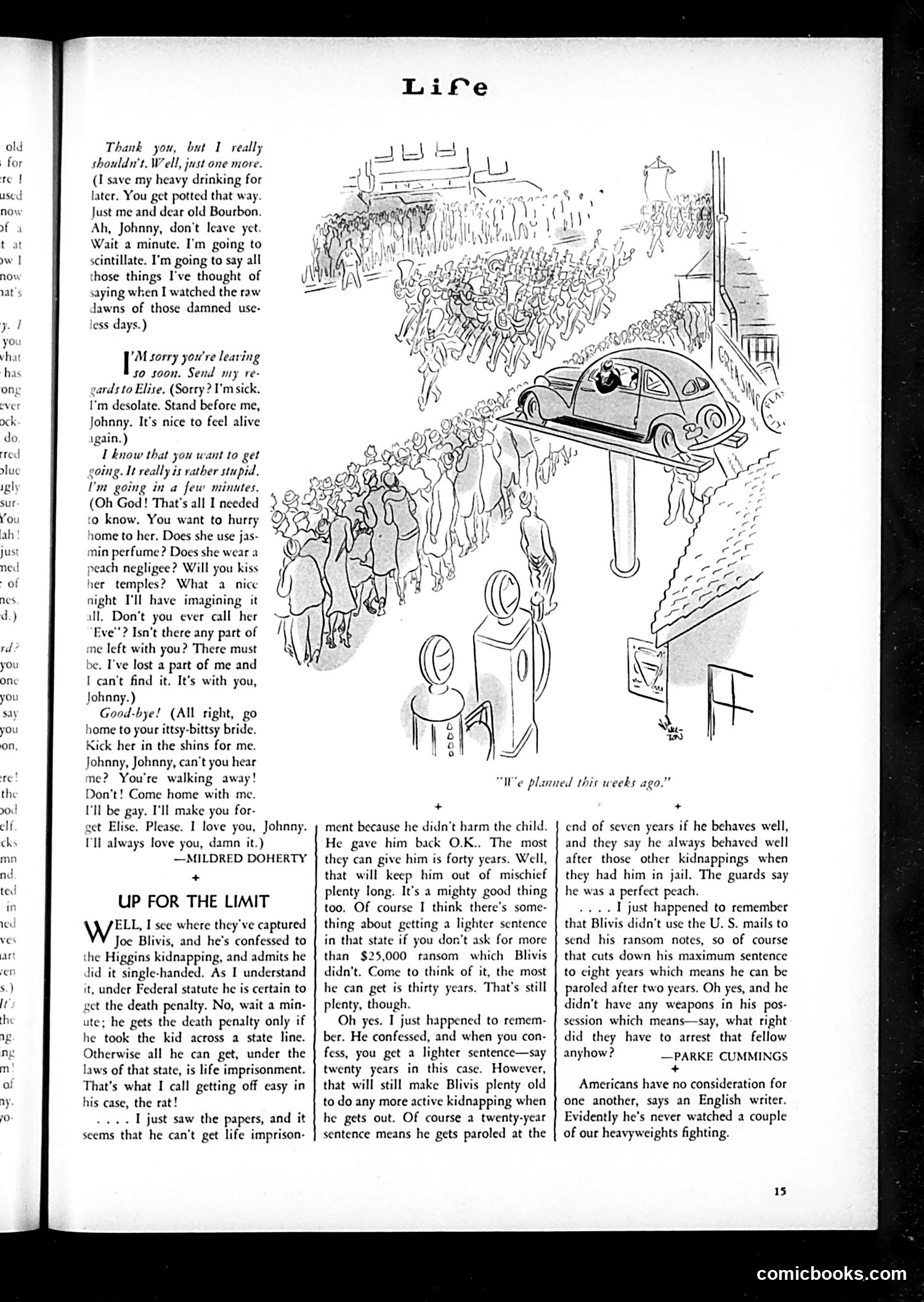
Analysis of Life Magazine Page This page contains two distinct pieces. The top section is a dialogue-heavy story or sketch titled "Life," depicting a romantic farewell where a man named Johnny leaves his girlfriend, promising to return. The illustration shows a massive crowd and a car being lifted, suggesting either a public spectacle or surreal departure. Below is an article titled "Up for the Limit" by Mildred Doherty, discussing kidnapping and criminal sentencing laws. It references a specific case involving someone named Blivis who committed kidnapping and received a lighter sentence than expected due to federal statute complications. The cartoon appears to satirize American legal inconsistencies regarding kidnapping penalties and interstate law enforcement. The broader page juxtaposes romantic drama with serious crime discussion, creating tonal contrast typical of Life's satirical approach.
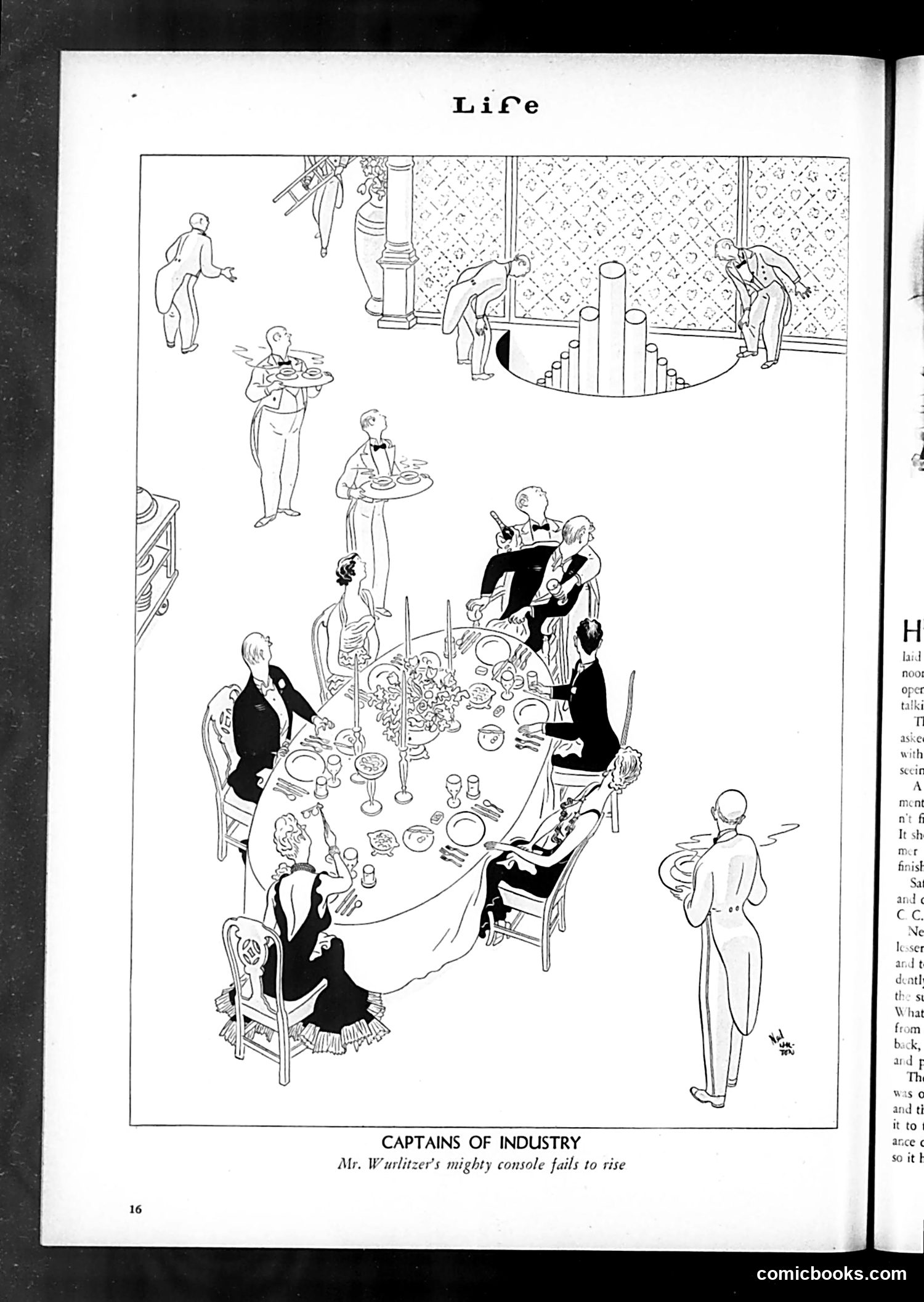
"Captains of Industry" Cartoon Analysis This satirical cartoon depicts wealthy industrialists dining together while workers perform various tasks around them. The caption reads: "Mr. Wurlitzer's mighty console fails to rise." The joke appears to reference a malfunctioning mechanical music console at what seems to be an elaborate dinner party. The cartoon satirizes the disconnect between wealthy "captains of industry" enjoying leisure and fine dining while laborers work in the background. The specific reference to "Mr. Wurlitzer" likely alludes to the Wurlitzer Company, known for manufacturing organs and entertainment equipment. The humor lies in the contrast: these powerful industrial figures are preoccupied with entertainment failures while presumably indifferent to working-class concerns, exemplifying the social inequality and class divisions of the era.
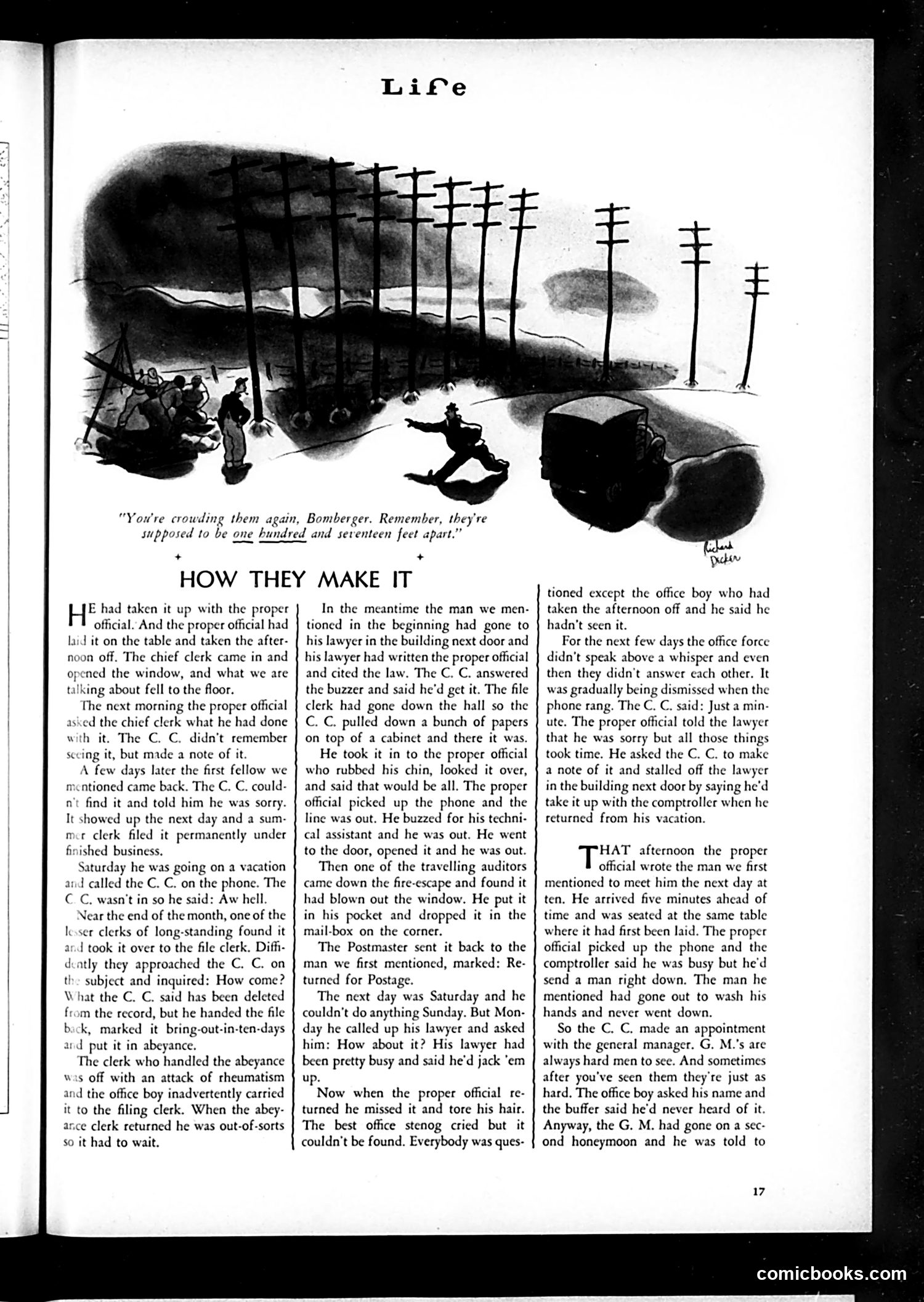
"How They Make It" - Life Magazine Satire This page satirizes bureaucratic incompetence and workplace dysfunction. The cartoon depicts an office where a document (marked "Returned for Postage") gets lost in the system, passed between multiple clerks and officials who fail to communicate or locate it. The narrative describes a "proper official" who initiates a chain of errors: the file disappears, reappears marked for return postage, and no one can track its whereabouts despite multiple office employees searching. The satire highlights how large organizations create inefficiency through poor coordination, lost accountability, and workers passing responsibility to each other rather than solving problems. The opening caption about "crowding them" and maintaining distance suggests this may reference post-WWI or Depression-era workplace conditions, though context isn't entirely clear from the page alone.
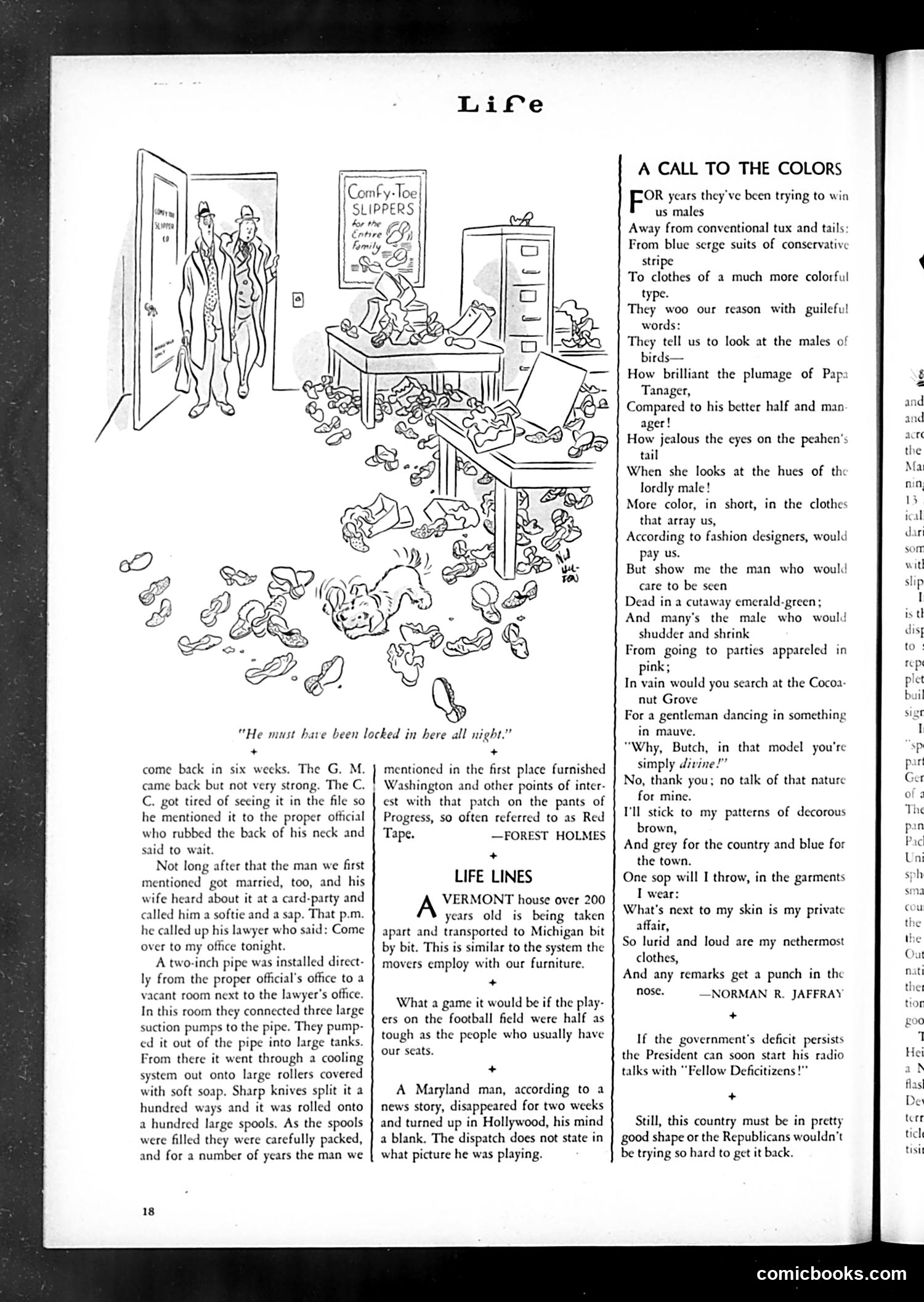
Life Magazine Satire Analysis The main cartoon depicts a chaotic office scene illustrating bureaucratic absurdity—specifically "red tape." The caption "'He must have been locked in here all night'" introduces a narrative about a government official's paperwork problem. The accompanying text describes how a simple filing issue spiraled into an elaborate, ridiculous solution: bureaucrats installed pipes and pumps to process the accumulated paperwork, eventually producing enough material to supply "Washington and other points of interest" with patches for worn pants—a metaphor for how bureaucratic inefficiency generates wasteful, pointless output. The "Call to the Colors" poem satirizes fashion designers' efforts to convince men to wear colorful clothing by comparing men to brightly-plumed birds, while mocking men's resistance to anything beyond conservative colors. It's a lighthearted commentary on gender and fashion conformity. The "Life Lines" section offers brief satirical observations on contemporary issues: absurd news stories, government deficits, and political cynicism about Republican intentions.
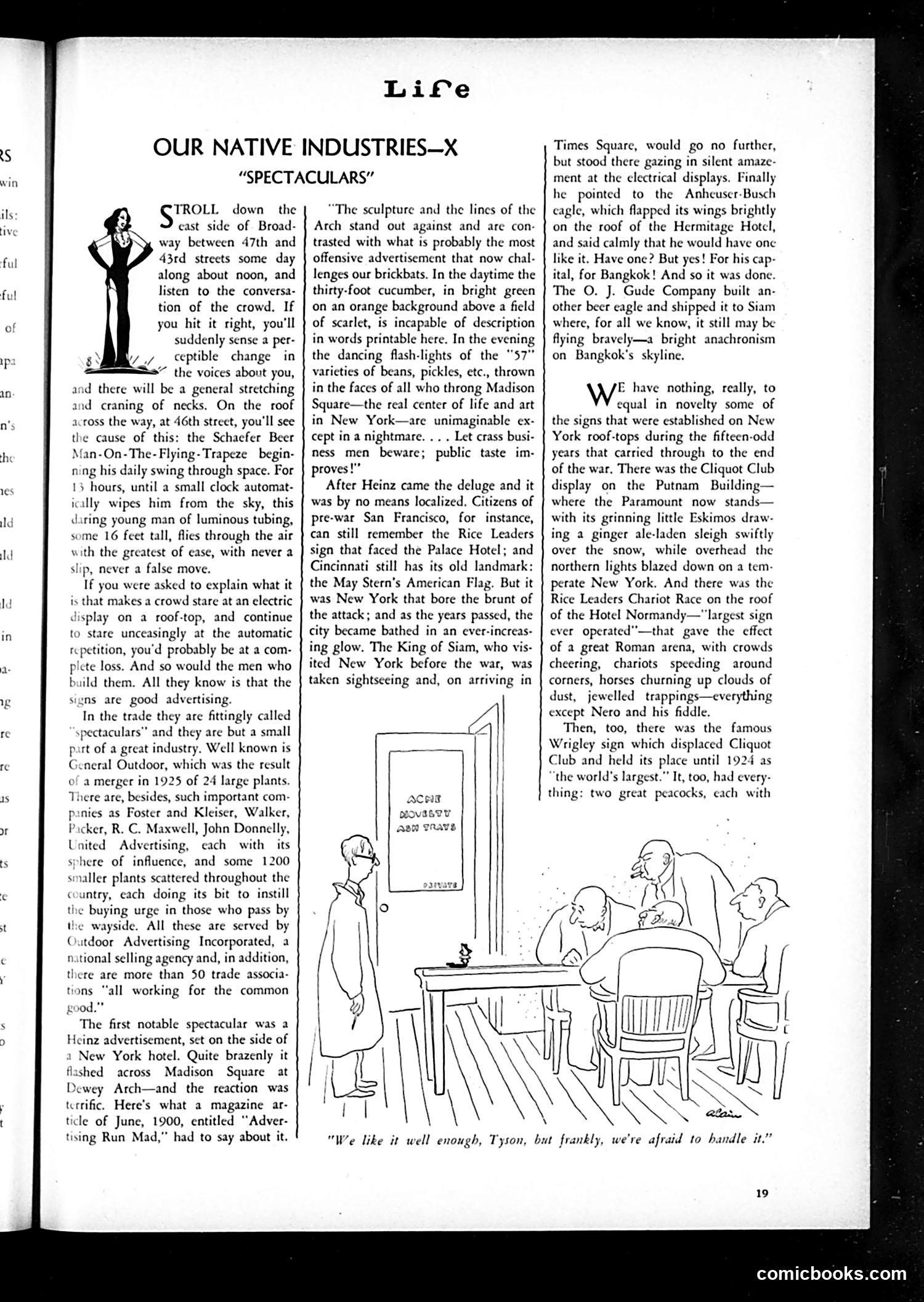
Analysis of "Our Native Industries—X: Spectaculars" This article satirizes the outdoor advertising industry's dominance of American cities, particularly New York. The piece traces how massive electric signs—called "spectaculars"—became ubiquitous on rooftops, using famous examples like the Heinz cucumber at Madison Square and the Anheuser-Busch eagle. The satire operates on multiple levels: it mocks how these advertisements mesmerize crowds (the "Man-On-The-Flying-Trapeze" sign), notes the irony that advertisers themselves don't understand *why* they work, and includes a contemporary 1900 magazine quote condemning the Heinz sign as "offensive" to art and taste—suggesting public outcry was ignored as advertising proliferated anyway. The anecdote about the King of Siam being so impressed he commissioned his own eagle underscores the absurdity: American commercial excess becomes a status symbol for foreign royalty. The accompanying cartoon shows businessmen discussing handling a controversial account, with one saying "we're afraid to handle it"—likely referencing tension between advertising's growth and lingering aesthetic objections.
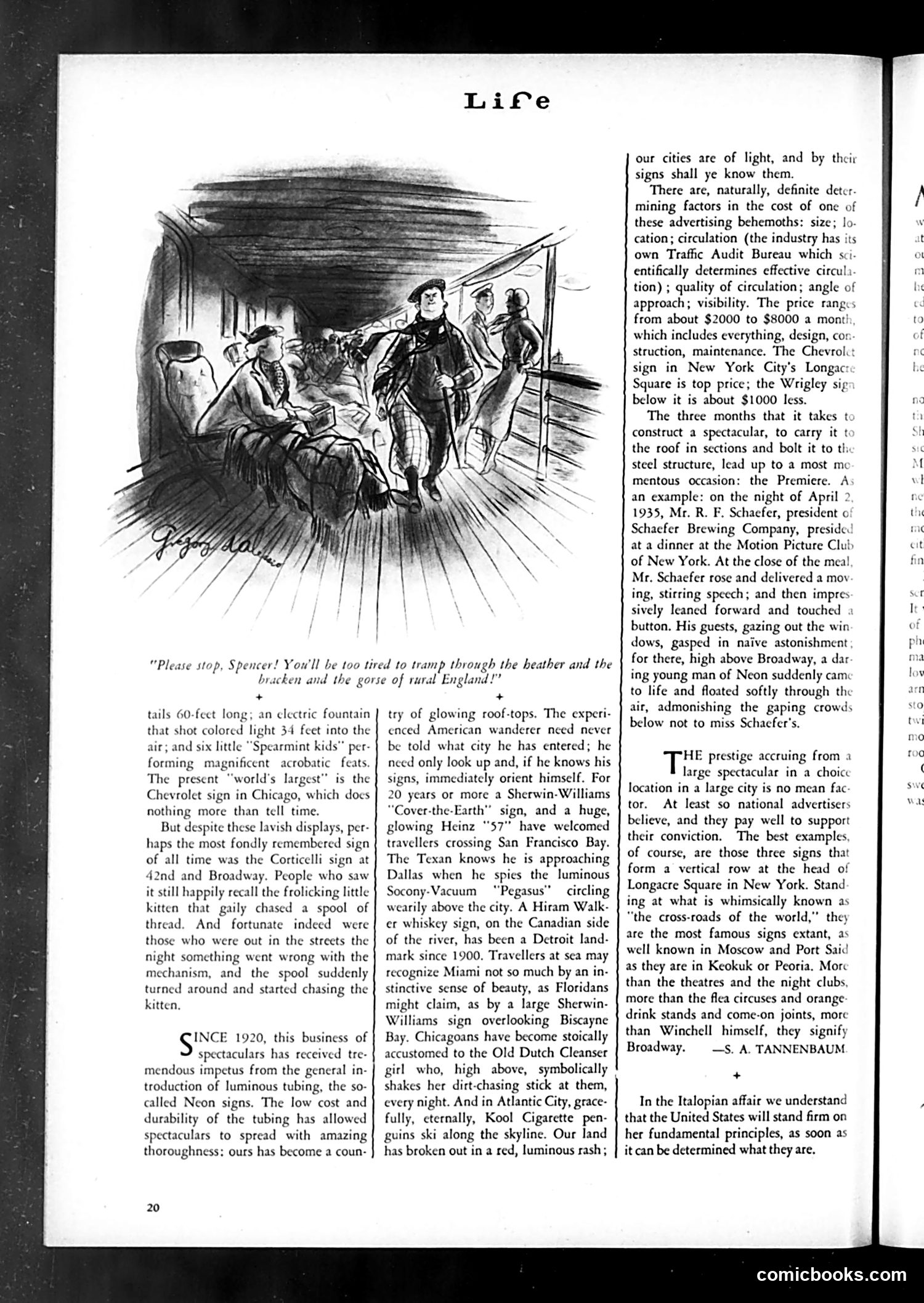
Cartoon Analysis: "Please Stop, Spencer!" The cartoon depicts a man on horseback urging his companion to slow down, warning he'll be too exhausted to enjoy the English countryside. The joke satirizes *American* tourists—particularly wealthy ones like "Spencer"—who rush through rural England in exhausted haste, missing the very natural beauty they've traveled to experience. This reflects early-20th-century American attitudes: newly wealthy industrialists taking European tours as status symbols but experiencing them superficially. The cartoon mocks this contradiction: the traveler is so eager to "do" England that he'll be too tired to actually *enjoy* it. The surrounding article about neon advertising signs emphasizes American commercial culture's dominance—cities identifiable by corporate logos rather than natural landmarks. The juxtaposition suggests satire of American materialism and its collision with European tradition and nature.
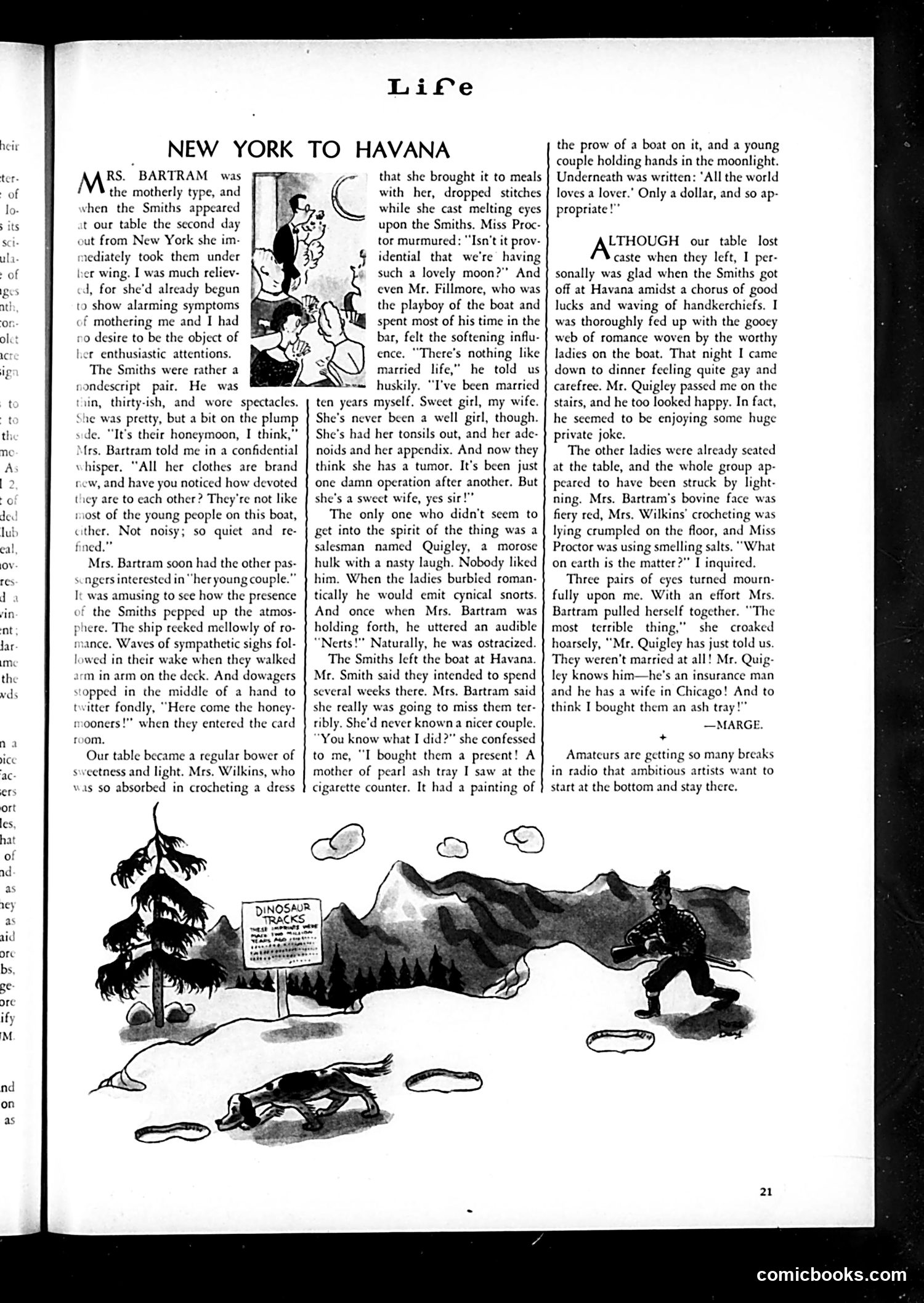
"New York to Havana" — Life Magazine Satire This story satirizes sentimentality and romantic delusion among ship passengers. Mrs. Bartram and other female travelers project idealized romance onto a newly-married couple (the Smiths), sentimentalizing their honeymoon while ignoring reality. Mr. Fillmore's casually grotesque monologue—describing his wife's endless surgeries while calling her "sweet"—exemplifies the disconnect between romantic fantasy and actual married life. The cynical salesman Quigley, initially mocked for his "Nerts!" outburst, represents honest skepticism toward manufactured emotion. The story implies something humiliating happens after the Smiths depart, suggesting Quigley knows the couple's true nature, puncturing the women's romantic bubble. The dinosaur-tracks cartoon below appears unrelated—likely a separate humor piece about paleontology or evolution. The satire targets sentimental self-deception and enforced group fantasy among respectable passengers.
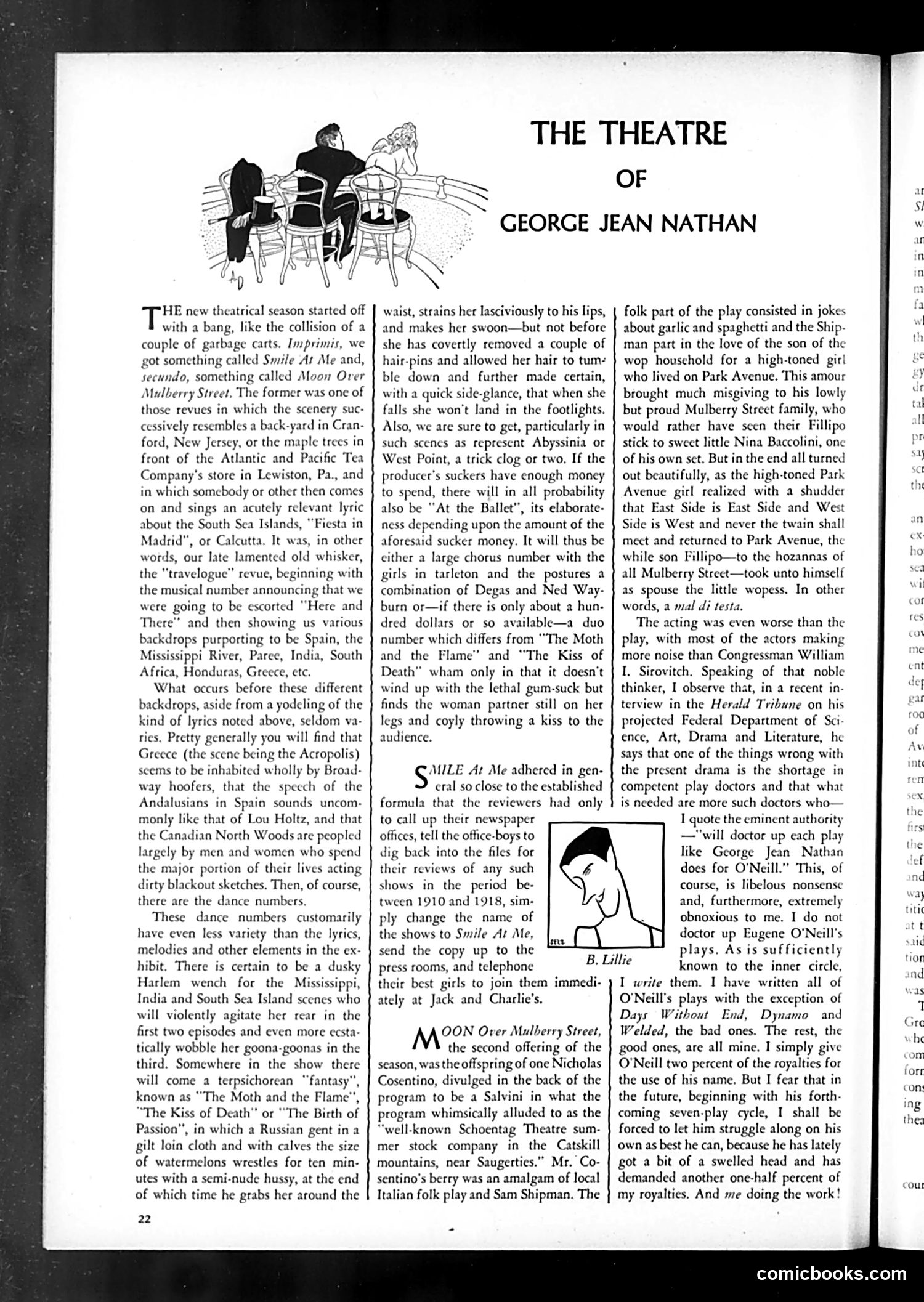
Theater Criticism: Nathan's Satire on Formulaic Broadway Revues This is George Jean Nathan's theater column critiquing the Broadway theatrical season. The small illustration shows a stylized face labeled "B. Lillie" (likely British comedian Beatrice Lillie). Nathan savagely mocks the standardized "travelogue revue"—a popular theatrical format featuring exotic backdrops (Spain, India, the South Seas) with interchangeable dance numbers and jokes. He ridicules how these shows use identical formulas: predictable dancing, racial stereotypes (the "dusky Harlem wench," the Russian strongman in gilt loincloth), and clichéd specialty acts. His key satire: reviewers are so bored they simply reuse old reviews from 1910-1918, merely changing the show's title. This attacks both the producers' lack of originality and critics' laziness. Nathan expresses contempt for theatrical mediocrity dressed up with spectacle and stereotypes—a scathing indictment of entertainment that prioritizes audience gullibility ("the producer's suckers") over artistry.
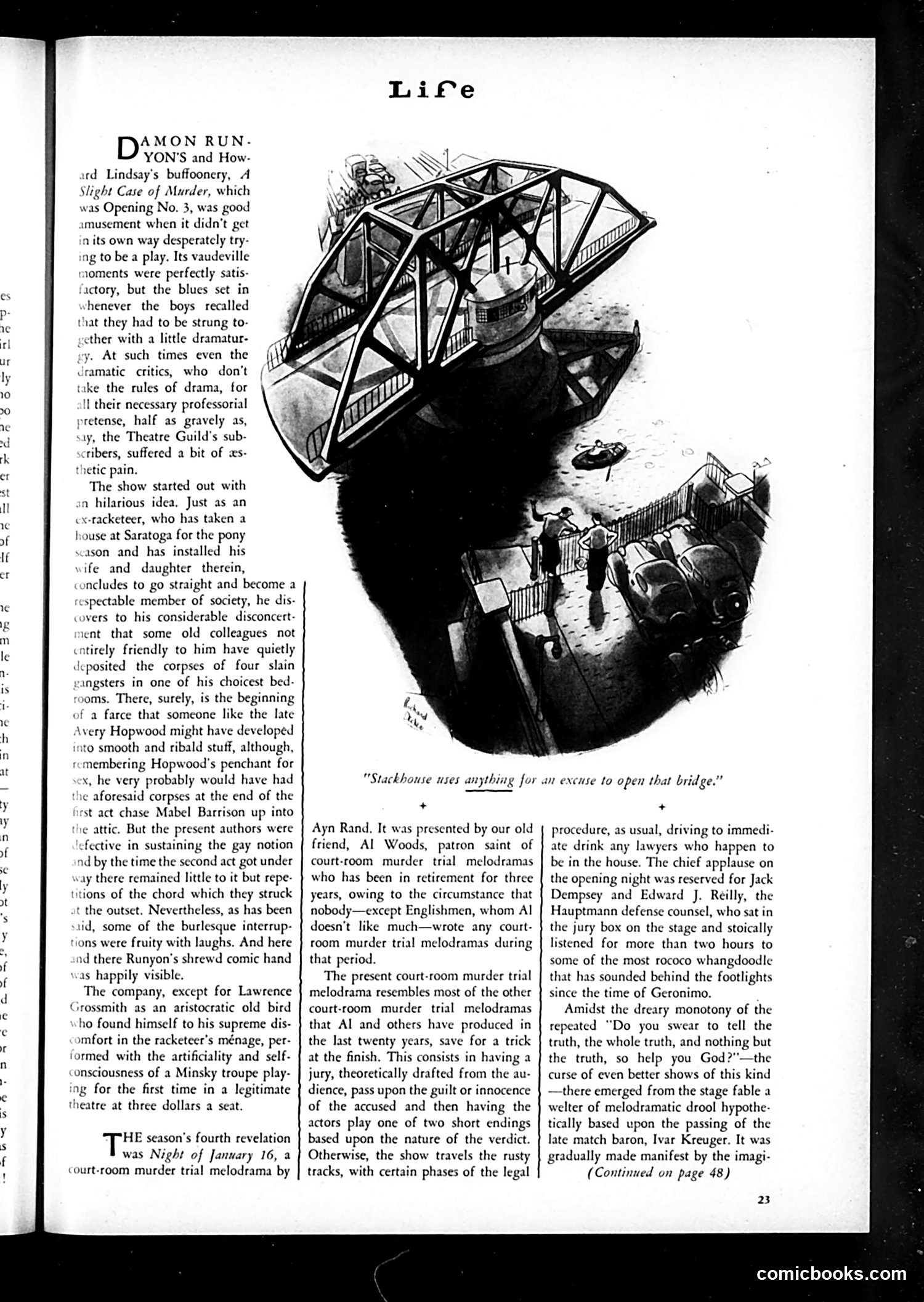
Life Magazine Theater Review Page This page reviews three Broadway productions from the 1930s. The main illustration depicts a bizarre theatrical set—an enormous tilted building or structure used in the play *A Slight Case of Murder* (a comedy by Damon Runyon and Howard Lindsay about an ex-gangster trying to go straight, only to find four corpses in his bedroom). The reviews are dismissive. *A Slight Case of Murder* is criticized for mixing vaudeville buffoonery with weak dramatic structure. *Night of January 16* by Ayn Rand is mocked as a standard courtroom melodrama with a gimmick: audience members serve as the jury and vote on the ending. The critic notes its formula is so tedious it drives lawyers to drink. The cartoon caption "Stackhouse uses anything for an excuse to open that bridge" appears unrelated to the theater reviews—likely a separate sidebar joke about bridge operations.
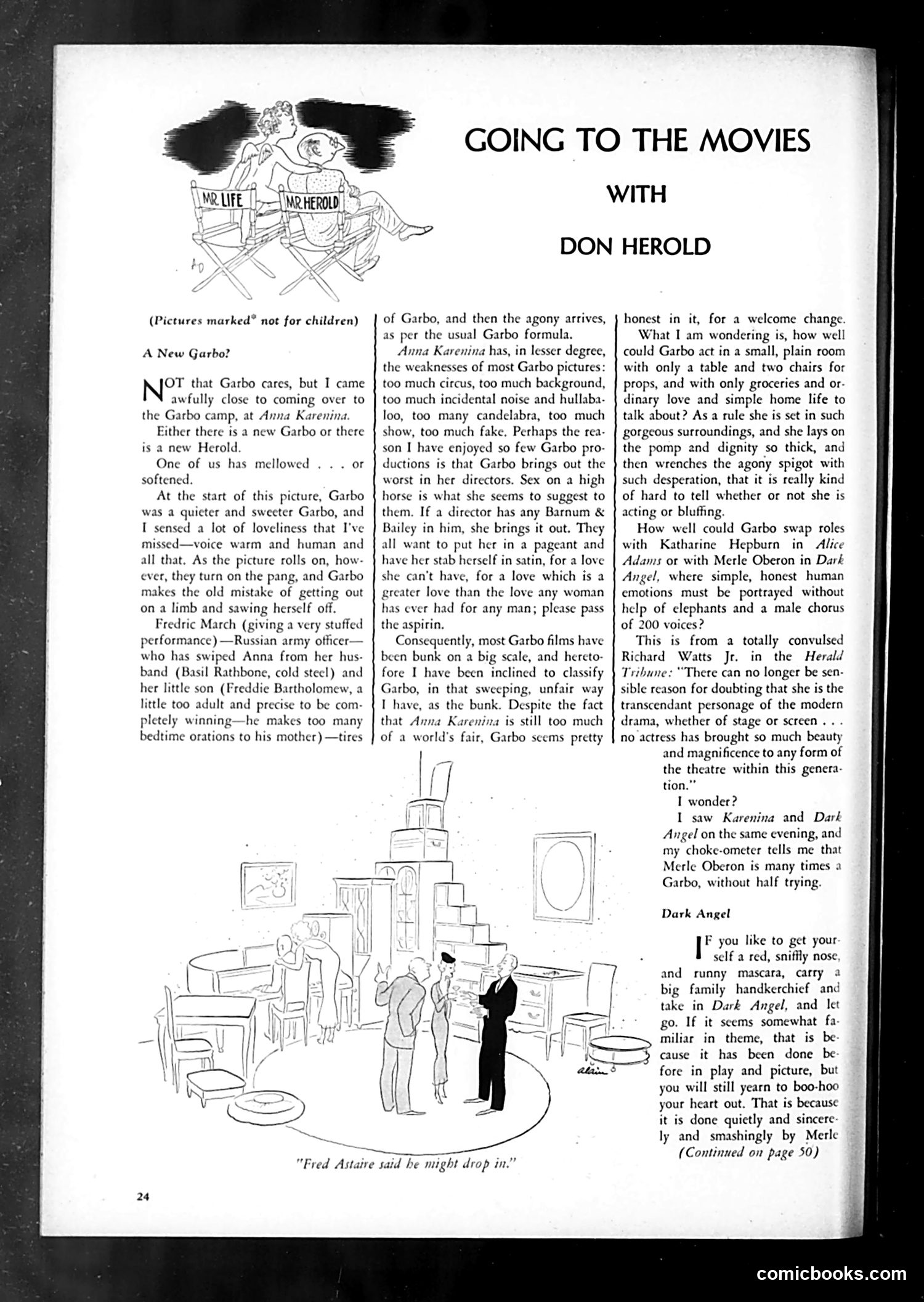
"Going to the Movies with Don Herold" This page is a film criticism column reviewing Greta Garbo's *Anna Karenina*. Herold critiques Garbo's acting style: she's typically surrounded by elaborate sets and pageantry that obscure whether she's genuinely acting or merely theatrical posturing. He questions whether Garbo could perform effectively in intimate, simple settings with minimal props—like Katharine Hepburn in *Alice Adams* or Merle Oberon in *Dark Angel*. The cartoon at bottom depicts a film set's crowded artificiality, captioned "Fred Astaire said he might drop in"—likely satirizing Hollywood's excess and name-dropping. Herold's core point: Garbo's magnificent presence may owe more to production spectacle than actual talent. He suggests rival actress Merle Oberon achieves greater emotional authenticity "without half trying."

I can see this is a page from Life magazine, but the image is almost entirely black with only faint, illegible content visible. On the left margin, there appears to be some text in small print, and at the bottom right, a "comicbooks.com" watermark is visible. The main body of the page is too dark to discern any cartoon illustrations, caricatures, or satirical content with any clarity. Without being able to read the OCR text reliably or see the visual content, I cannot accurately identify the figures, political references, or the satire's intended point. To provide a meaningful analysis, I would need a clearer or higher-contrast version of this page.

I can see this is a very dark, mostly black page from what appears to be a Life magazine issue, with minimal visible content except for "comicbooks.com" watermark at the bottom and some partially visible text on the right margin that's too blurry to read reliably. The page itself appears to be either a blank section, a heavily darkened image, or a scanning/reproduction issue that has rendered the original content nearly illegible. Without being able to discern actual cartoon figures, captions, or clear text, I cannot identify specific political references, satirical targets, or the intended message. To provide accurate historical analysis as requested, I would need a clearer image of the page content.
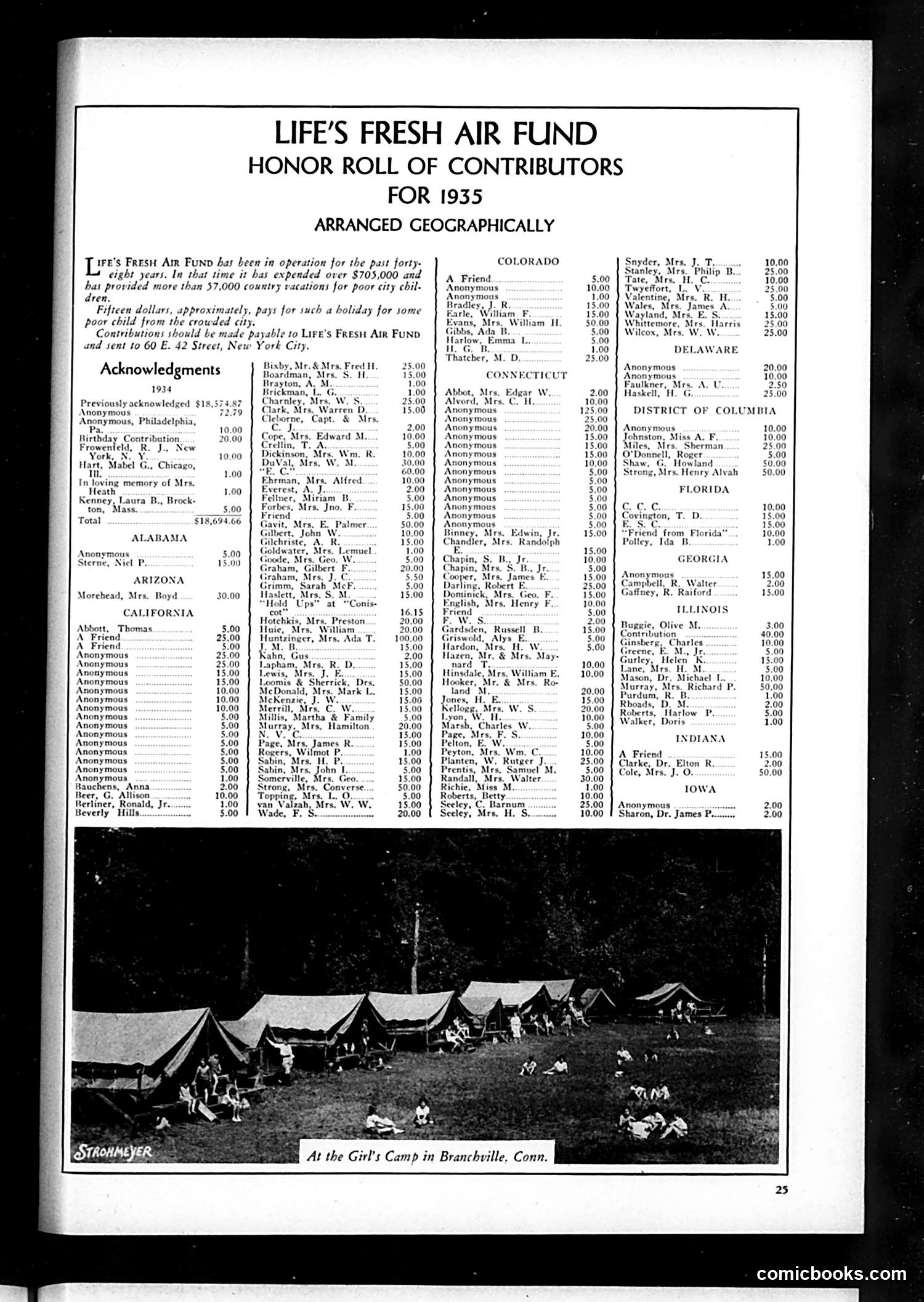
Life's Fresh Air Fund Honor Roll (1935) This page is not a cartoon but rather a charitable fundraising document—specifically, a list of donors to Life magazine's Fresh Air Fund for 1935. The fund provided country vacations for poor urban children, having distributed over 57,000 such holidays since its founding 48 years prior. Contributors could sponsor a child's holiday for approximately $15. The page lists hundreds of donors—individuals, families, and anonymous contributors—organized geographically by state, with donation amounts ranging from $1 to $100. The photograph below shows the *result* of these donations: a girl's camp in Branchville, Connecticut, with tents and children enjoying outdoor recreation. This reflects the Progressive Era charitable impulse to improve poor children's health and welfare through fresh air and nature exposure—a common philanthropic concern of the 1930s during the Great Depression. The "honor roll" publication strategy publicly recognized donors, encouraging further contributions.
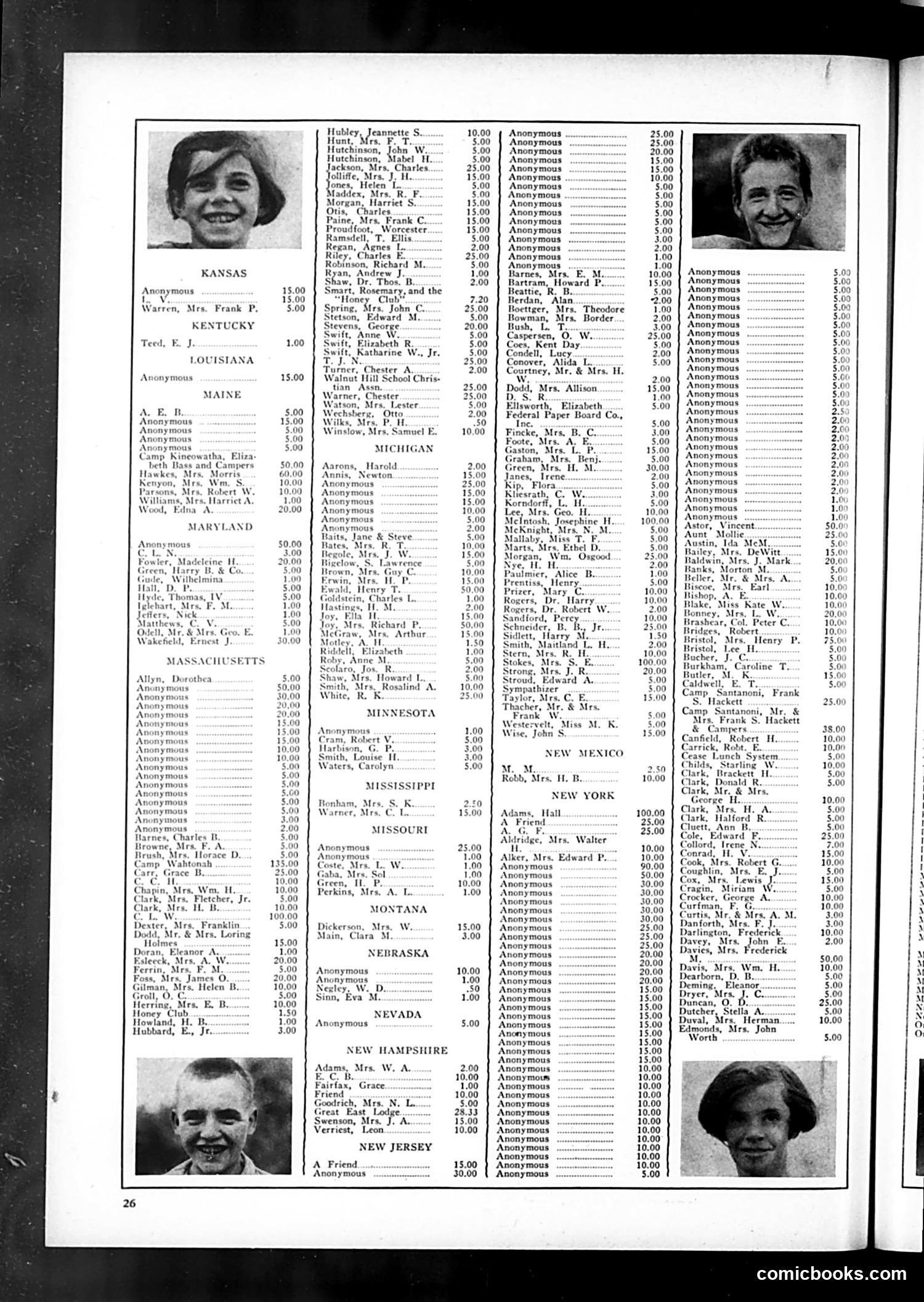
Life Magazine Donation List Page This page is primarily a fundraising donor list from Life magazine, not a cartoon or satirical content page. It displays names and donation amounts organized by U.S. state (Kansas, Kentucky, Louisiana, Maine, Massachusetts, Michigan, Minnesota, Mississippi, Missouri, Montana, Nebraska, Nevada, New Hampshire, New Jersey, and New Mexico). The three portrait photographs appear to be notable donors or editors but their identities aren't labeled on the visible page. The list includes both named individuals and numerous "Anonymous" donors, with contributions ranging from $1.00 to $100.00. This represents a solicitation record or acknowledgment of contributions, likely for a specific charitable cause or publication initiative that Life magazine supported. Without additional context or visible captions, the specific purpose of the fundraising cannot be determined from this page alone.
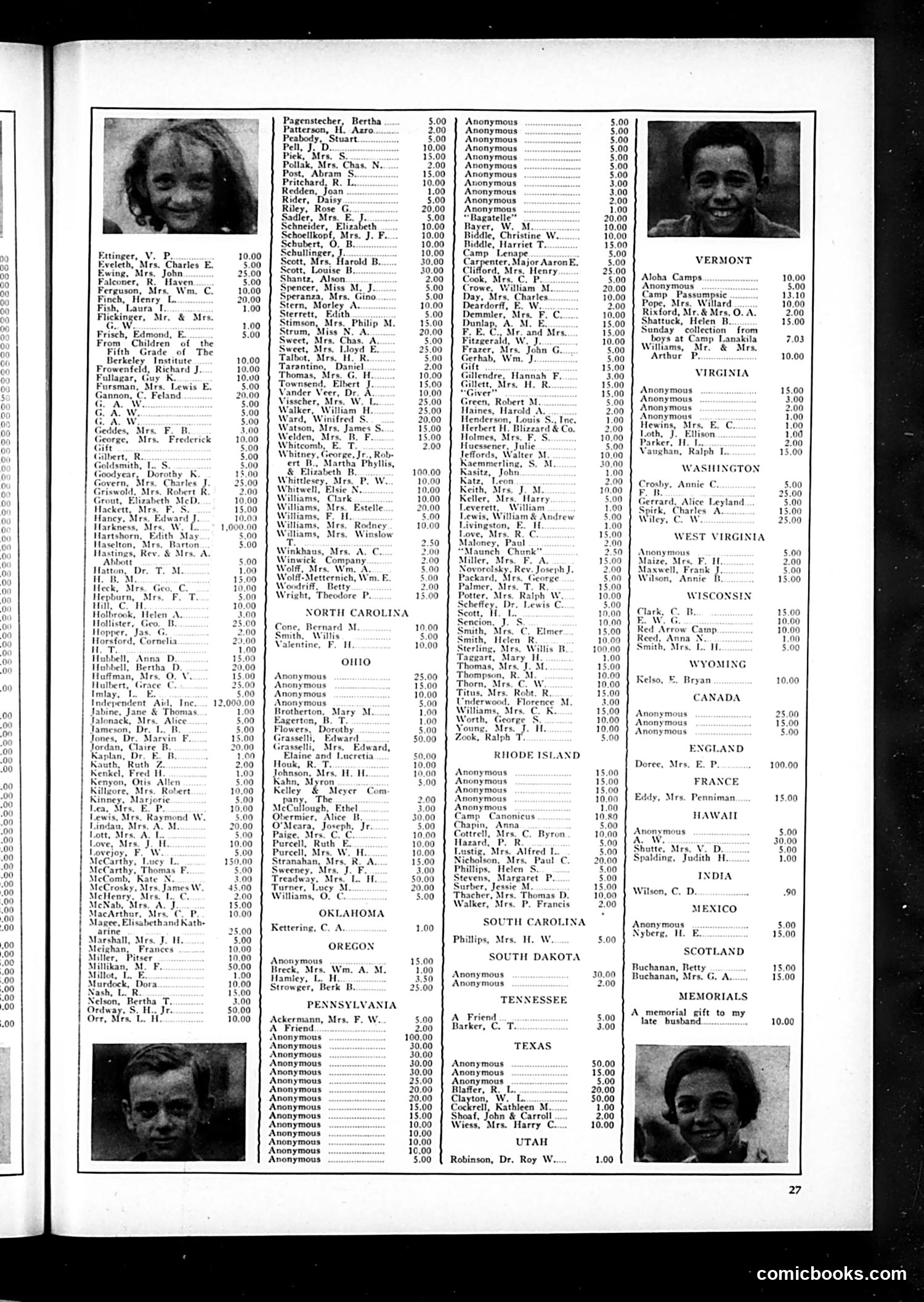
What This Page Shows This is a donor/contribution list from Life magazine—not a cartoon or satirical content page. The page consists almost entirely of names and monetary donations, organized by state (ending with sections for Vermont, Virginia, West Virginia, Wisconsin, Wyoming, Canada, England, France, Hawaii, India, Mexico, Scotland, and a "Memorials" section). Amounts range from $1.00 to $12,000.01. Three small photographs appear: two appear to be children's portraits at top and bottom left, and one at bottom right showing what appears to be a young person. These are likely included as illustrative humanitarian content related to whatever charitable or institutional cause Life was fundraising for. The satire or commentary, if any, is not evident from this page alone—it's purely a financial record of contributions, likely for an orphanage, relief fund, or similar institution that Life was supporting.
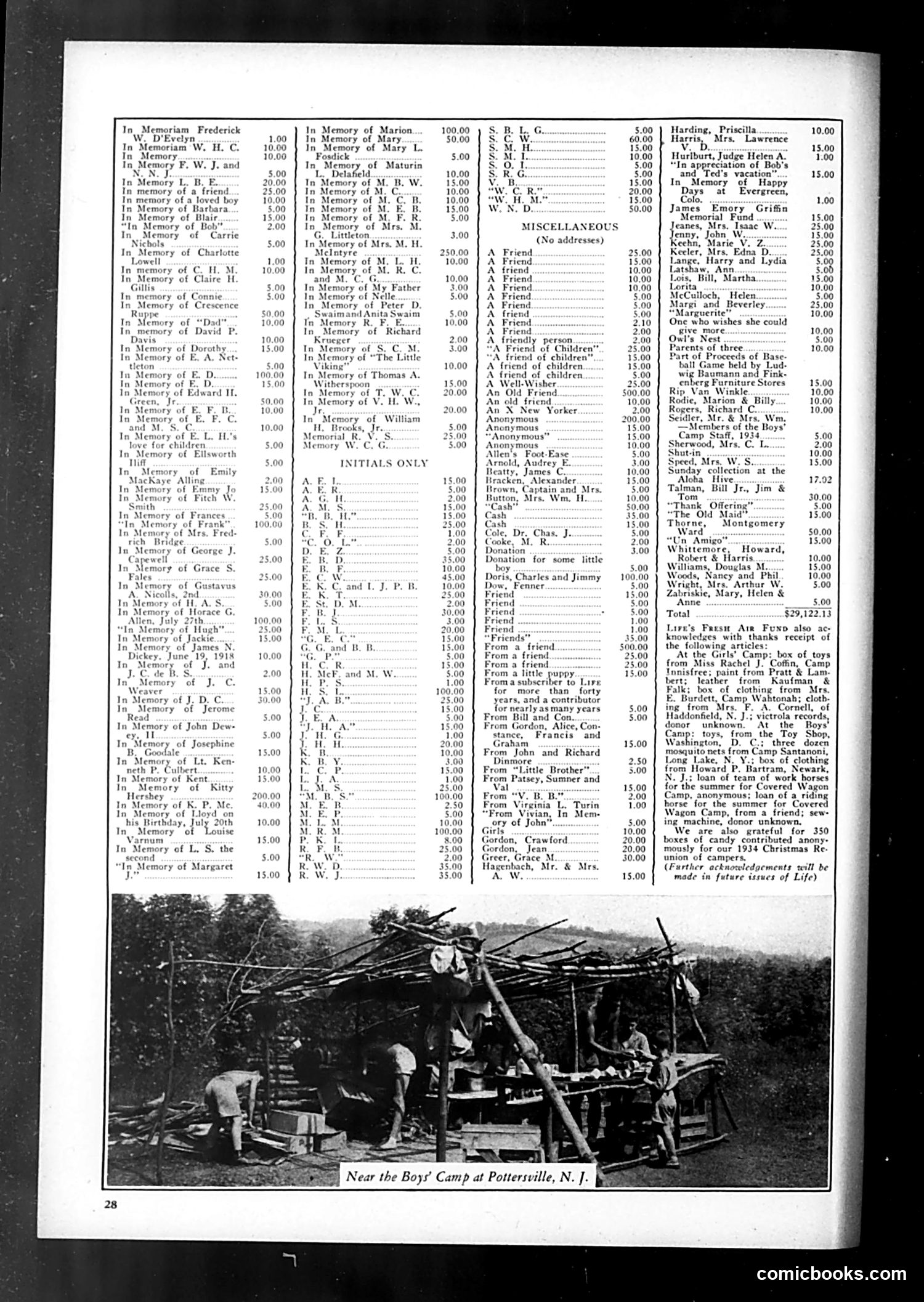
Page Analysis: A Charitable Contributions List This page is primarily a memorial and charitable donations listing, not a political cartoon. It appears from *Life* magazine and documents financial contributions—many "In Memory of" deceased individuals, ranging from $1 to $250. The donations support various causes including camps (notably "Near the Boys' Camp at Potterville, N.J." shown in the photograph below), memorial funds, and general charitable giving. The photograph shows a rustic camp structure with wooden logs and several people, illustrating where some donations were directed. This represents early 20th-century American philanthropy practices—publishing donor lists to encourage further giving and memorialize both contributors and those being remembered. The modest amounts ($1-25 typical) and personal nature of tributes reflect middle-class charitable culture of the era.

I appreciate the detailed instructions, but I must be honest: this image is almost entirely black with only a white margin visible on the left side. The OCR text provided contains only "comicbooks.com," which appears to be a watermark or website attribution rather than actual page content. I cannot identify any cartoons, figures, caricatures, political references, or satirical content from what's visible in this image. The page appears to be either severely damaged, improperly scanned, or deliberately obscured. To provide the analysis you've requested, I would need a legible image showing the actual cartoon(s) or text content from the Life magazine page.
I can see this is a page from Life magazine with "comicbooks.com" credited at the bottom, but the image quality is extremely poor—heavily darkened with only faint, illegible outlines visible. While I can make out what appear to be circular design elements or possibly faces in the background, I cannot reliably read any text, identify specific figures, or discern the content of any cartoons or satirical commentary. To provide accurate analysis of the political or social satire this page contains, I would need a clearer, higher-contrast version of the image. Without being able to read the OCR text or see details clearly, I cannot responsibly identify the references or explain the jokes to a modern reader.
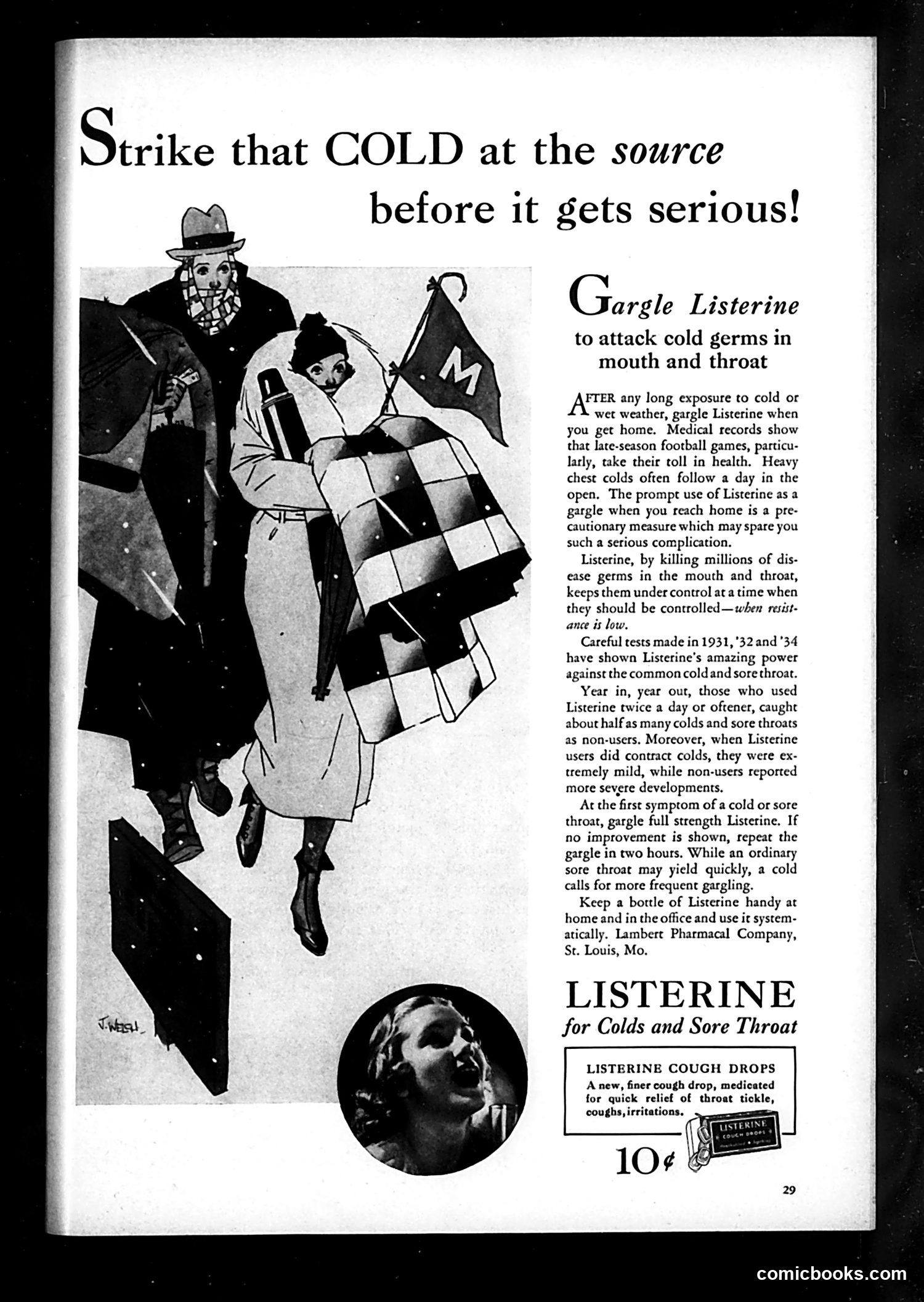
Listerine Advertisement (circa 1930s) This is a Listerine mouthwash advertisement, not political satire. The illustration depicts a couple caught in winter weather—the man in a coat and hat, the woman wrapped in a blanket—huddling together in snow. The dramatic imagery emphasizes vulnerability to cold and illness. The advertisement promotes gargling Listerine at the first sign of a cold or sore throat, claiming medical tests (1931-'34) prove users caught roughly half as many colds as non-users. It specifically references late-season football games as health hazards requiring preventive gargling. The page also advertises a new Listerine Cough Drops product (10¢). This reflects early-20th-century marketing strategies: creating emotional scenarios around health fears, citing scientific studies (however limited), and promoting preventive rather than curative medicine—relatively novel concepts at the time.
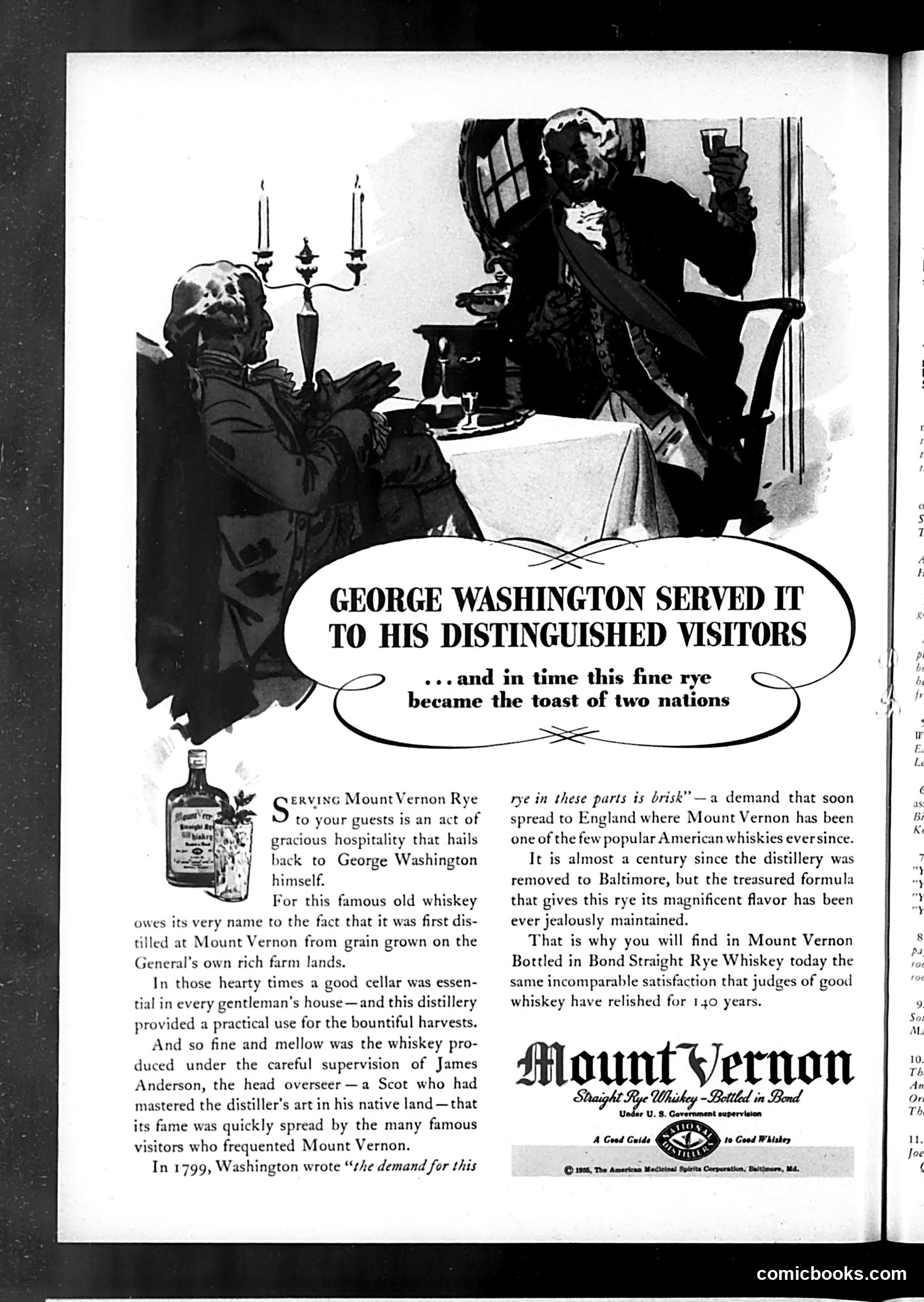
Mount Vernon Rye Whiskey Advertisement This is primarily a whiskey advertisement, not political satire. The illustration depicts George Washington entertaining distinguished visitors at Mount Vernon, with the caption claiming he "served it to his distinguished visitors." The ad trades on patriotic nostalgia and historical authority: it claims Mount Vernon Rye was actually distilled at Washington's estate by a Scottish overseer named James Anderson, using Washington's own grain. The text cites an 1799 quote from Washington himself about demand for "this rye." The central joke/appeal is that serving this whiskey to guests echoes Washington's own gentlemanly hospitality—buyers gain social prestige by association with the Founding Father. The ad emphasizes the formula's 140-year continuity, positioning the product as authentically American heritage. Whether Washington's distillery involvement is historically accurate appears designed to seem credible rather than satirical. This represents typical early-20th-century advertising strategy: wrapping commercial products in patriotic mythology and historical legitimacy.
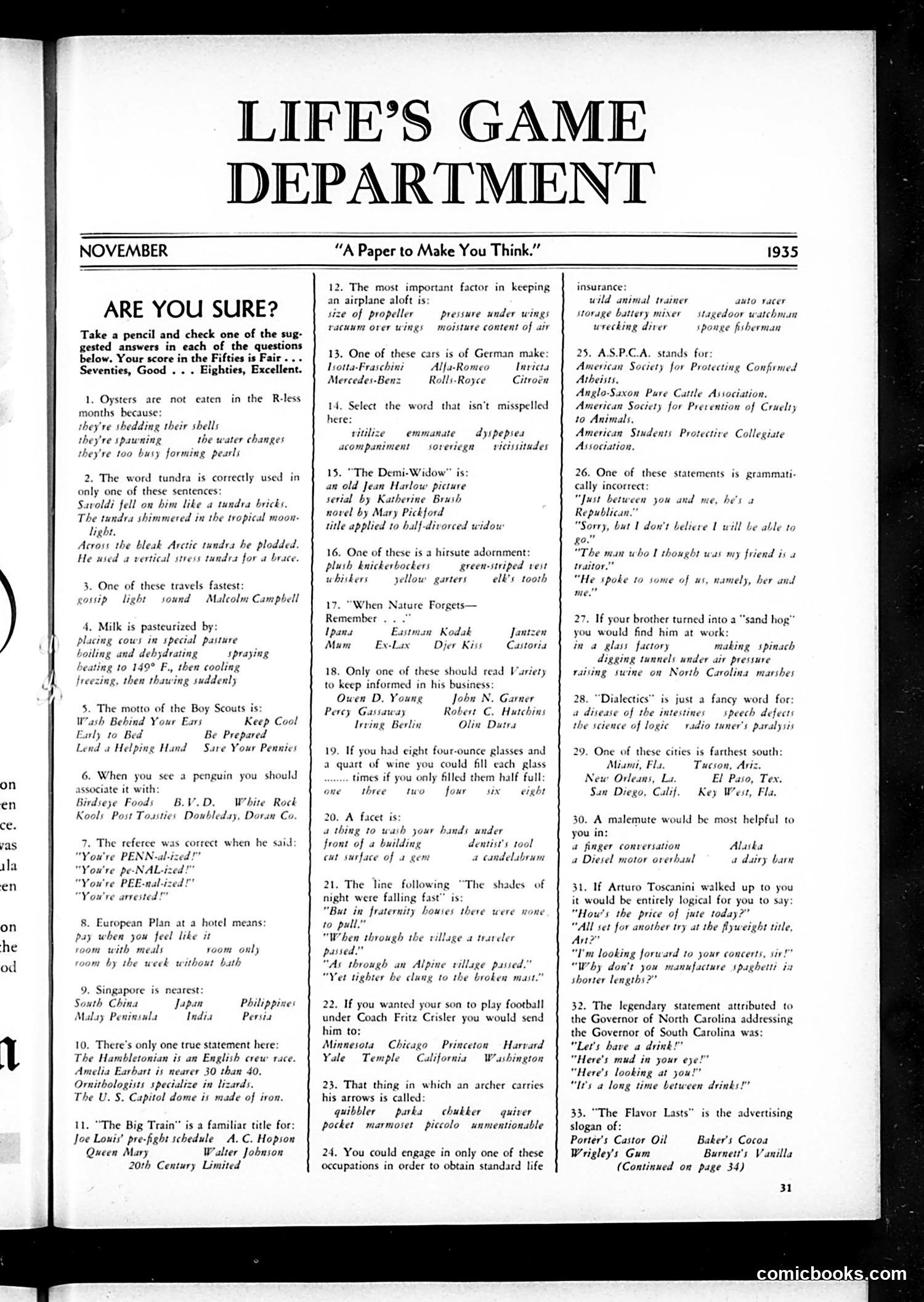
"Life's Game Department" - November 1935 This is a trivia quiz page, not a political cartoon. "Are You Sure?" presents 24 multiple-choice questions testing readers' knowledge across various topics: science (pasteurization, aviation), geography (Singapore, European hotels), sports (the "Big Train" is baseball's Walter Johnson), literature (the poem "Excelsior"), advertising slogans, and current figures. The questions reflect 1930s American culture: references to Amelia Earhart (still missing), Walter Johnson (famous pitcher), Jean Harlow and Mary Pickford (film stars), and brands like Ipana and Ex-Lax. Some questions are deliberately tricky—like distinguishing between correctly and incorrectly spelled words. Scoring rubrics range from "Fair" (50s) to "Excellent" (80s), making it an engaging self-test for magazine readers. This represents *Life* magazine's educational entertainment content from the Depression era.
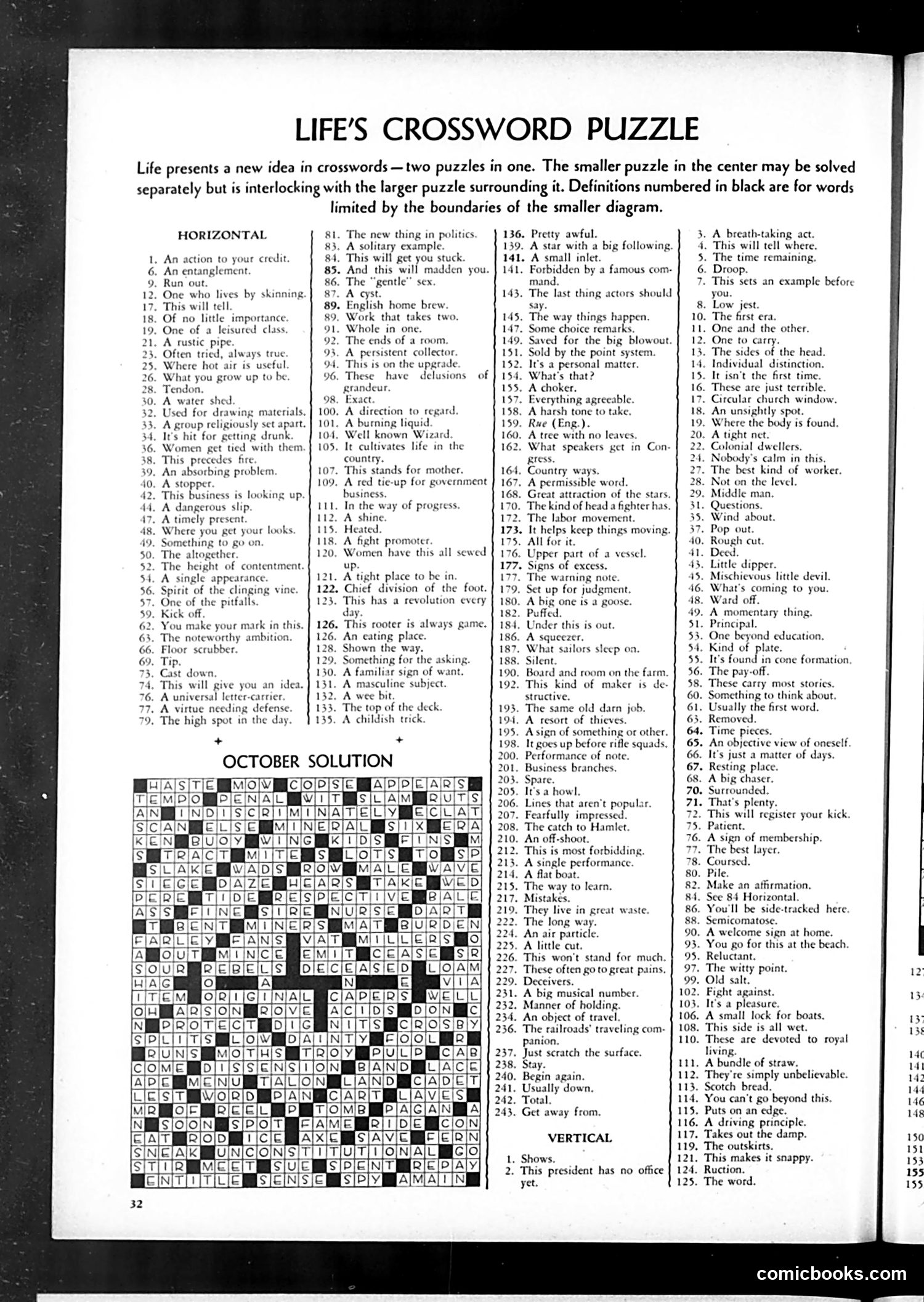
Life's Crossword Puzzle - October Solution This page presents a double crossword puzzle — a creative format where a smaller puzzle interlocks within a larger one. Rather than political satire, this is a intellectual entertainment feature typical of *Life* magazine during the early-to-mid 20th century. The puzzle itself is filled with clever, punny definitions that play on words and contemporary references. Examples include "The new thing in politics" (likely NEW DEAL, given the era), "Women have this all sewed up" (referencing women's suffrage or changing social roles), and various wordplay clues like "A fight promoter" and "This will get you stuck." The "October Solution" grid shows the completed puzzle answer. This represents *Life*'s approach to sophisticated humor and intellectual challenge — appealing to educated readers through wordplay rather than visual caricature. It's essentially the magazine's version of modern puzzle entertainment.
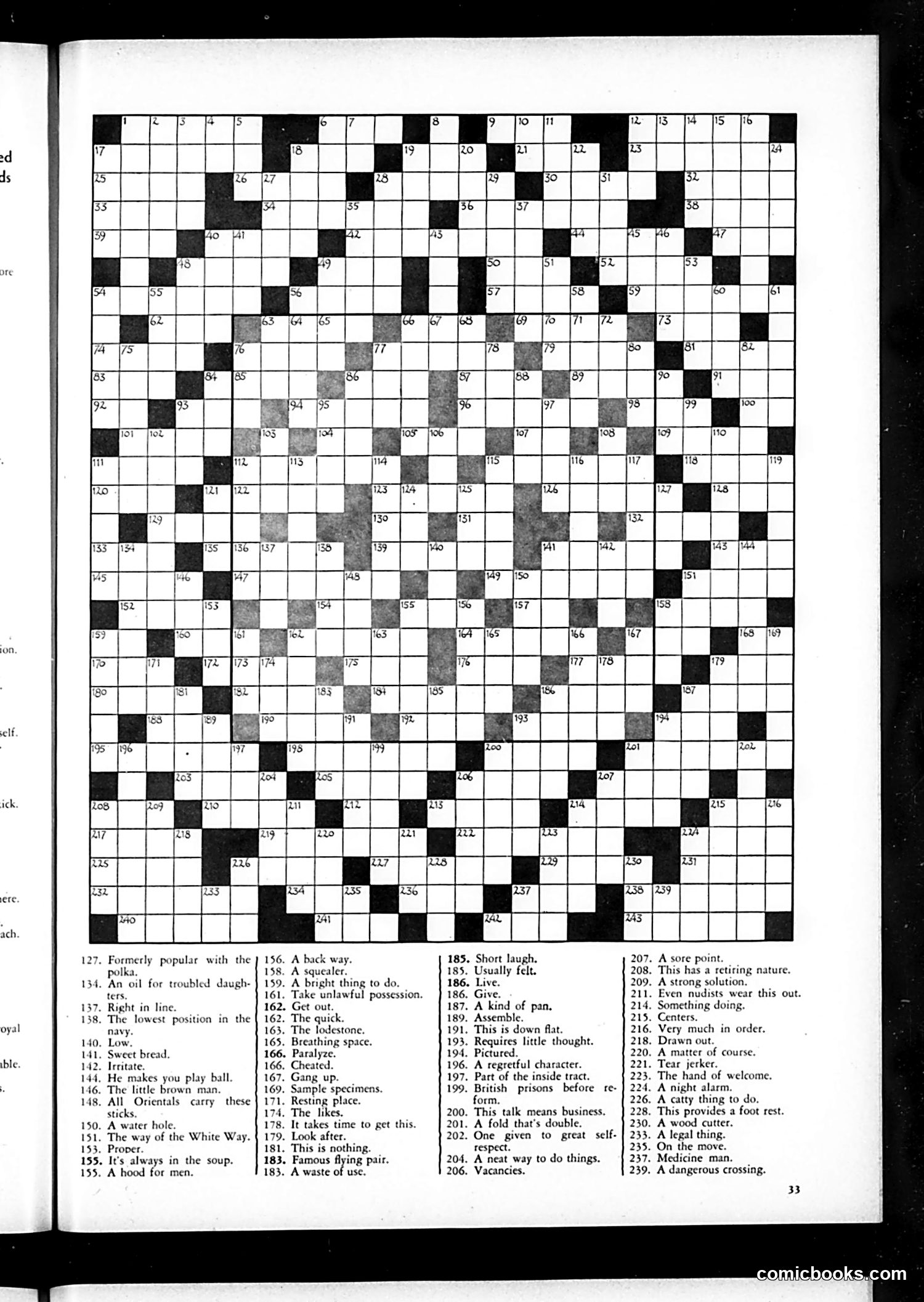
What This Page Shows This is a crossword puzzle page from Life magazine, not a political cartoon. The image displays a completed crossword grid with numbered clues listed below. The clues are typical wordplay riddles common to mid-20th century puzzles—puns and indirect definitions requiring lateral thinking. Examples include "146. The little brown man" (likely referencing a stereotypical caricature of an Asian person), "148. All Orientals carry these sticks" (chopsticks), and "156. A back way" (alley). Some clues reference period-specific cultural touchstones: "183. Famous flying pair" (Wright Brothers or similar aviation pioneers), "200. This talk means business" (presumably "brass tacks"), and various others mixing innocent wordplay with dated ethnic stereotypes typical of the era. This is recreational puzzle content, not satire or political commentary—a standard magazine feature from the mid-20th century.
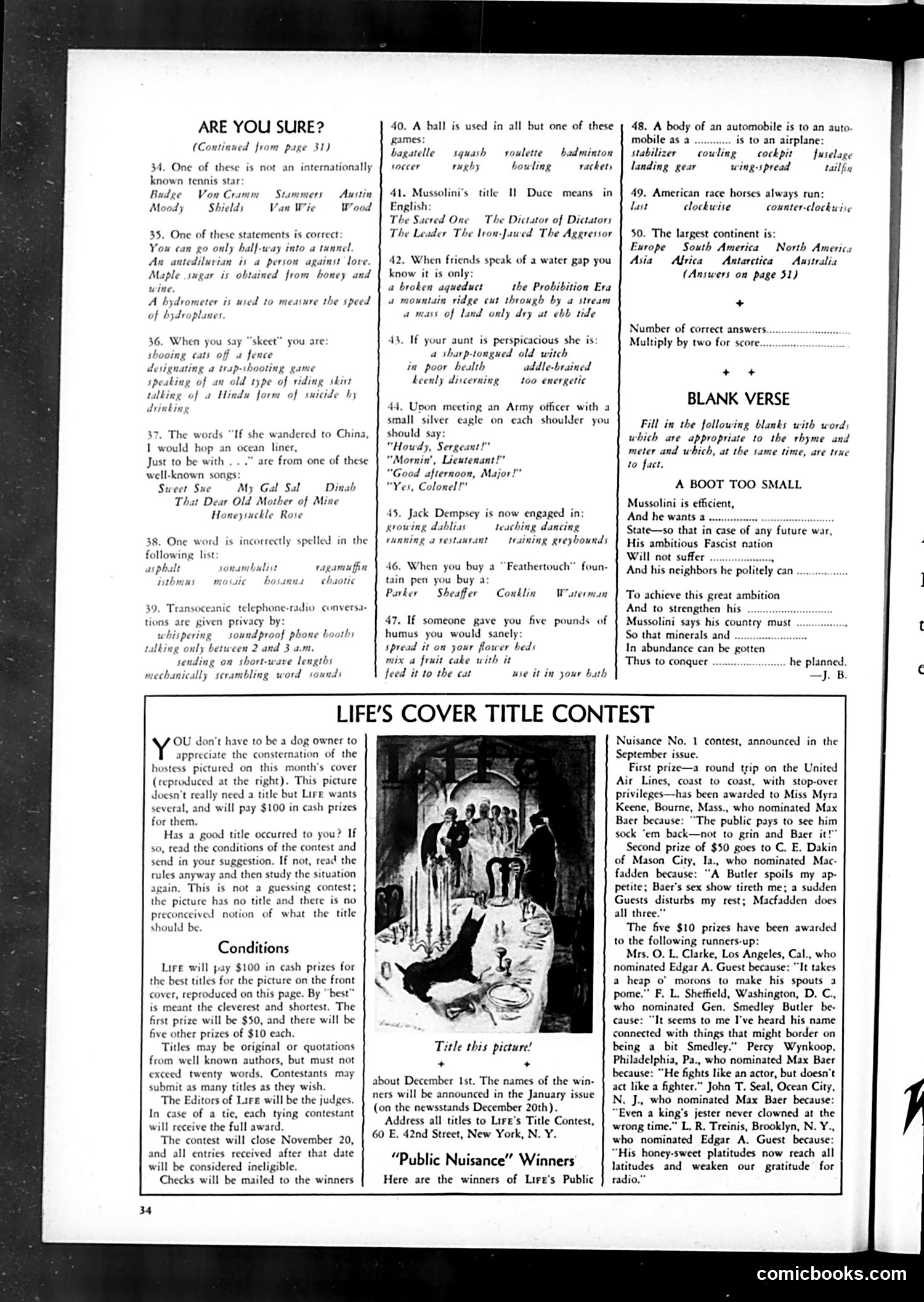
Life Magazine Cover Contest - Historical Context This page shows *Life* magazine's monthly contest asking readers to title the cover illustration (reproduced at right). The image depicts a formal dinner scene with what appears to be an awkward or embarrassing moment—likely a social faux pas that would have been immediately recognizable to 1930s readers. The contest offers $100 in prize money ($50 first prize, five $10 prizes) for the cleverest and shortest title in twenty words or less. The page emphasizes this is not mere guessing but requires understanding the social situation depicted. The remainder of the page contains a trivia quiz ("Are You Sure?") covering current events (Mussolini's title), sports celebrities (tennis stars, Jack Dempsey), and general knowledge—typical content for *Life*'s satirical, educated readership. The contest deadline is November 20, with winners announced in January.
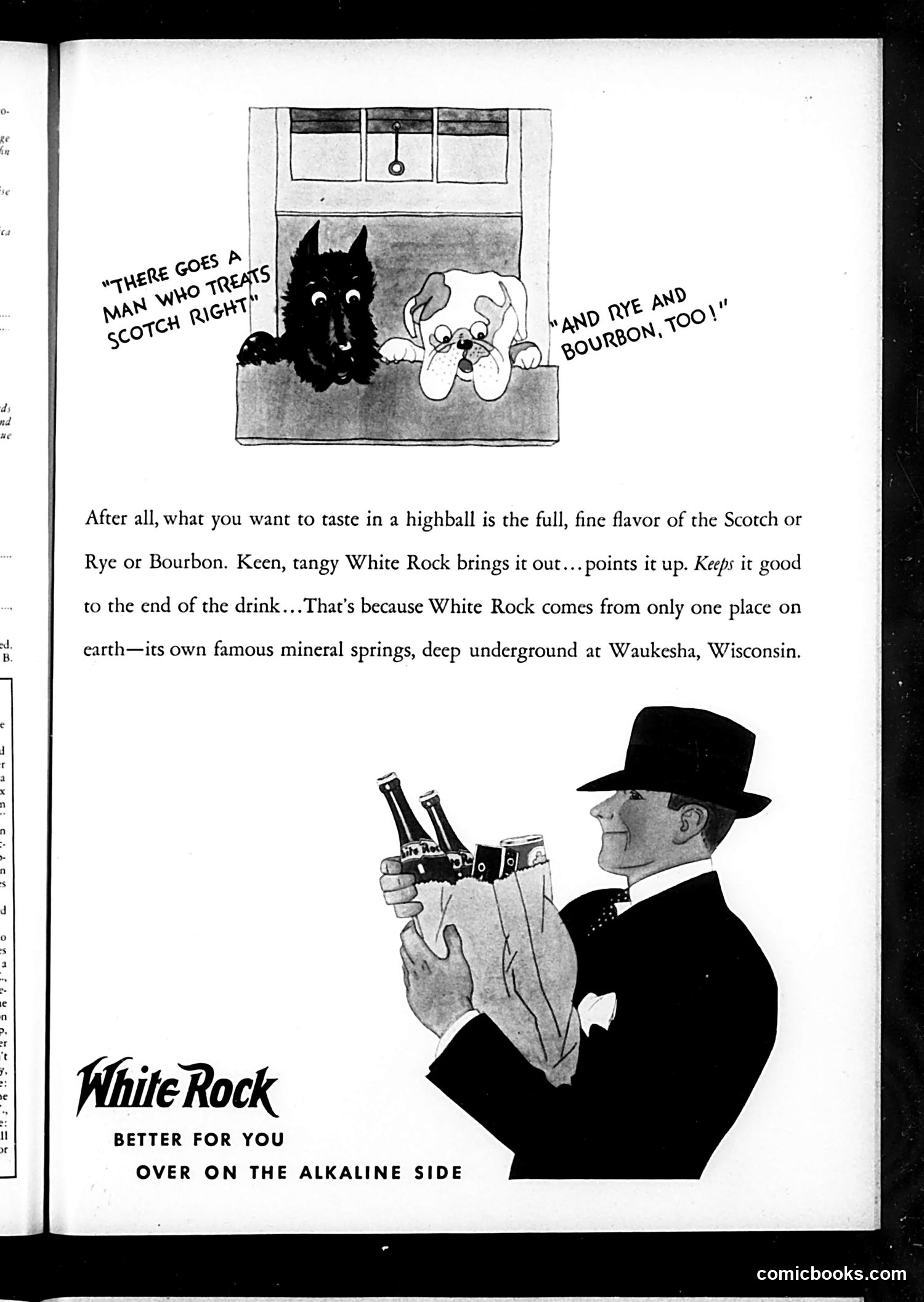
White Rock Mineral Water Advertisement This is a vintage advertisement, not political satire. The page promotes White Rock brand mineral water from Waukesha, Wisconsin. The cartoon depicts two dogs—one black, one white—at a bar window, with the black dog saying he wants "a man who treats Scotch right" and the white dog endorsing "Rye and Bourbon, too!" This humorous scene establishes that White Rock mineral water is the proper mixer for quality spirits. The lower illustration shows a well-dressed man in a top hat holding White Rock bottles, suggesting sophistication and refinement. The advertisement's claim centers on White Rock's mineral composition—specifically its alkaline properties—which allegedly enhance and preserve the flavor of liquor throughout the drink. The marketing emphasizes exclusivity through its single-source origin in Wisconsin.
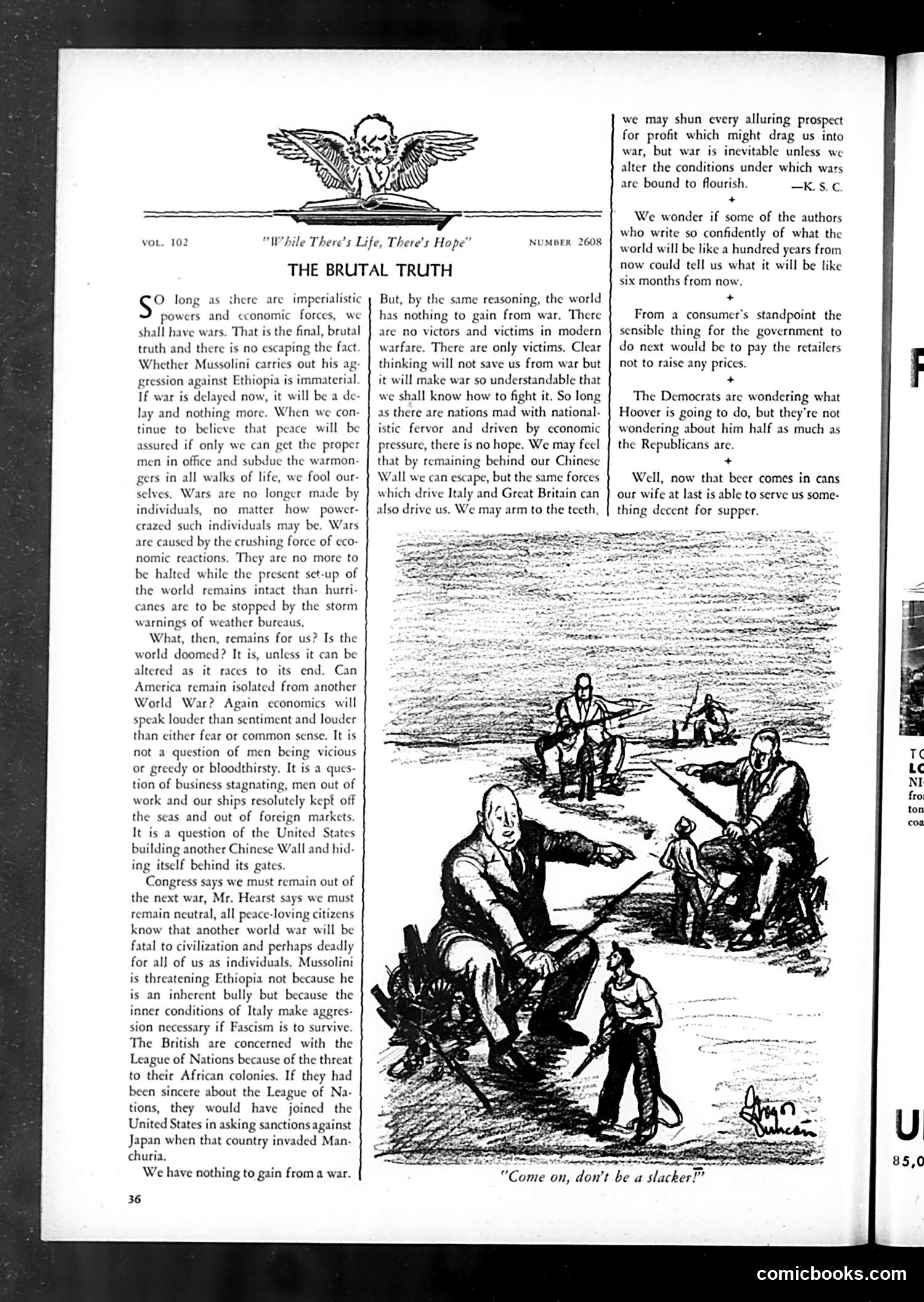
"The Brutal Truth" - Life Magazine Analysis This page presents a pessimistic editorial arguing that war is economically inevitable under the current global system. The article references Mussolini's aggression against Ethiopia and warns that America cannot isolate itself from coming conflict, regardless of neutrality policies or congressional declarations. The accompanying cartoon depicts emaciated figures on barren ground—likely representing war's human toll—with a central figure urging others forward with "Come on, don't be a slacker!" The image critiques jingoism and pressure to support military involvement. The editorial's core claim: wars aren't caused by individual tyrants but by structural economic forces. It dismisses both isolationism and pacifism as naive, suggesting only systemic economic change can prevent war. References to Hearst (a prominent isolationist publisher) and Japan's invasion of Manchuria anchor this to specific 1930s geopolitical tensions preceding World War II.
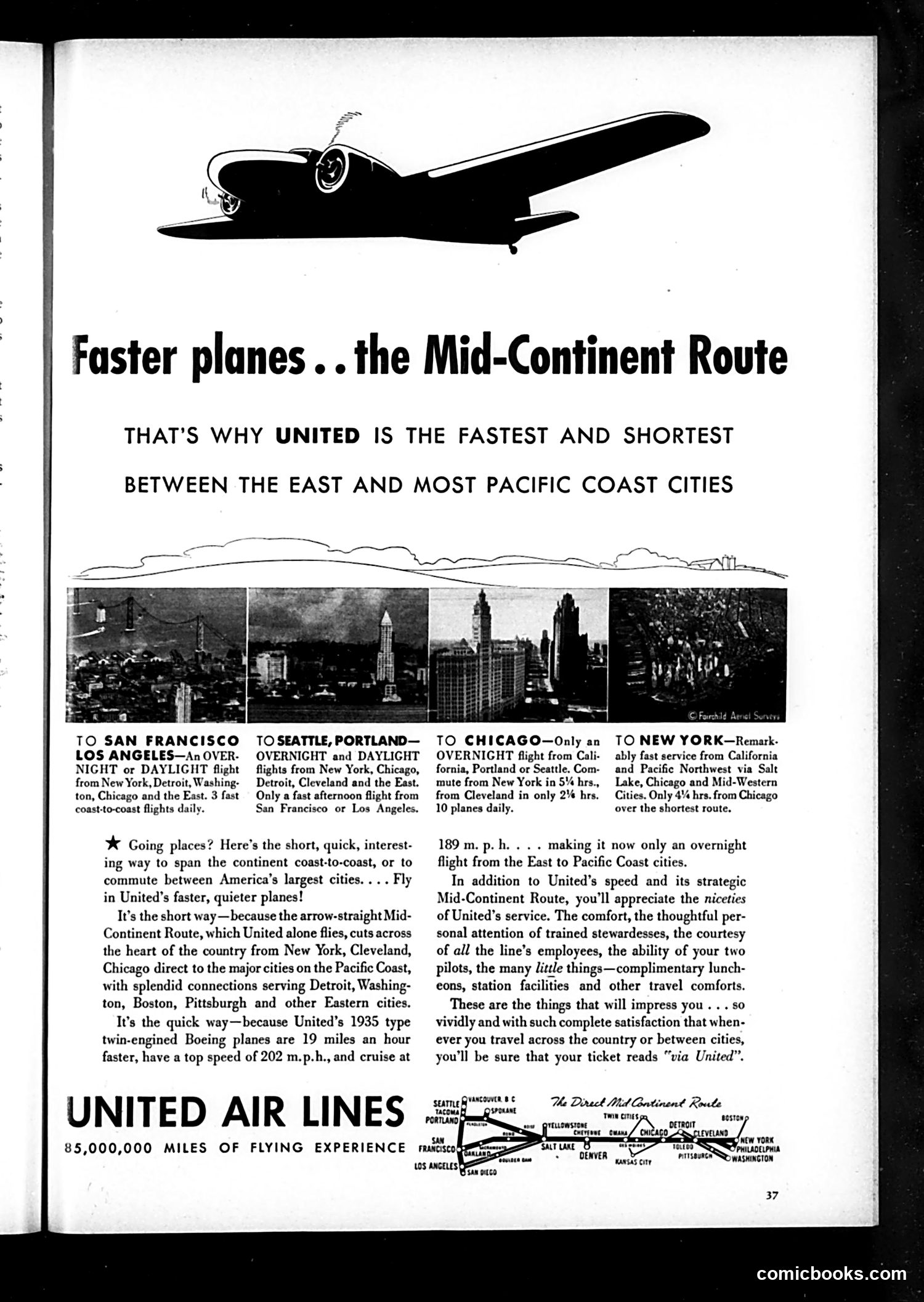
Analysis This is not a cartoon or satire—it's a straightforward commercial advertisement for United Air Lines, likely from the 1930s. The page promotes United's "Mid-Continent Route," a direct flight path across America's heartland connecting East Coast cities (New York, Detroit, Washington) to Pacific Coast destinations (San Francisco, Los Angeles, Seattle). The advertisement emphasizes: - Speed: United's Boeing planes cruise at 202 mph, making cross-country flights overnight - Efficiency: The mid-continent route is shorter and faster than alternatives - Service quality: Trained stewardesses, comfortable cabins, complimentary lunches The silhouetted aircraft at top and route map at bottom are purely illustrative. The text highlights competitive advantages—notably that United "alone flies" this particular route—and boasts "85,000,000 miles of flying experience." This represents early commercial aviation marketing when transcontinental flight was still relatively novel and a luxury service for business travelers and affluent passengers.
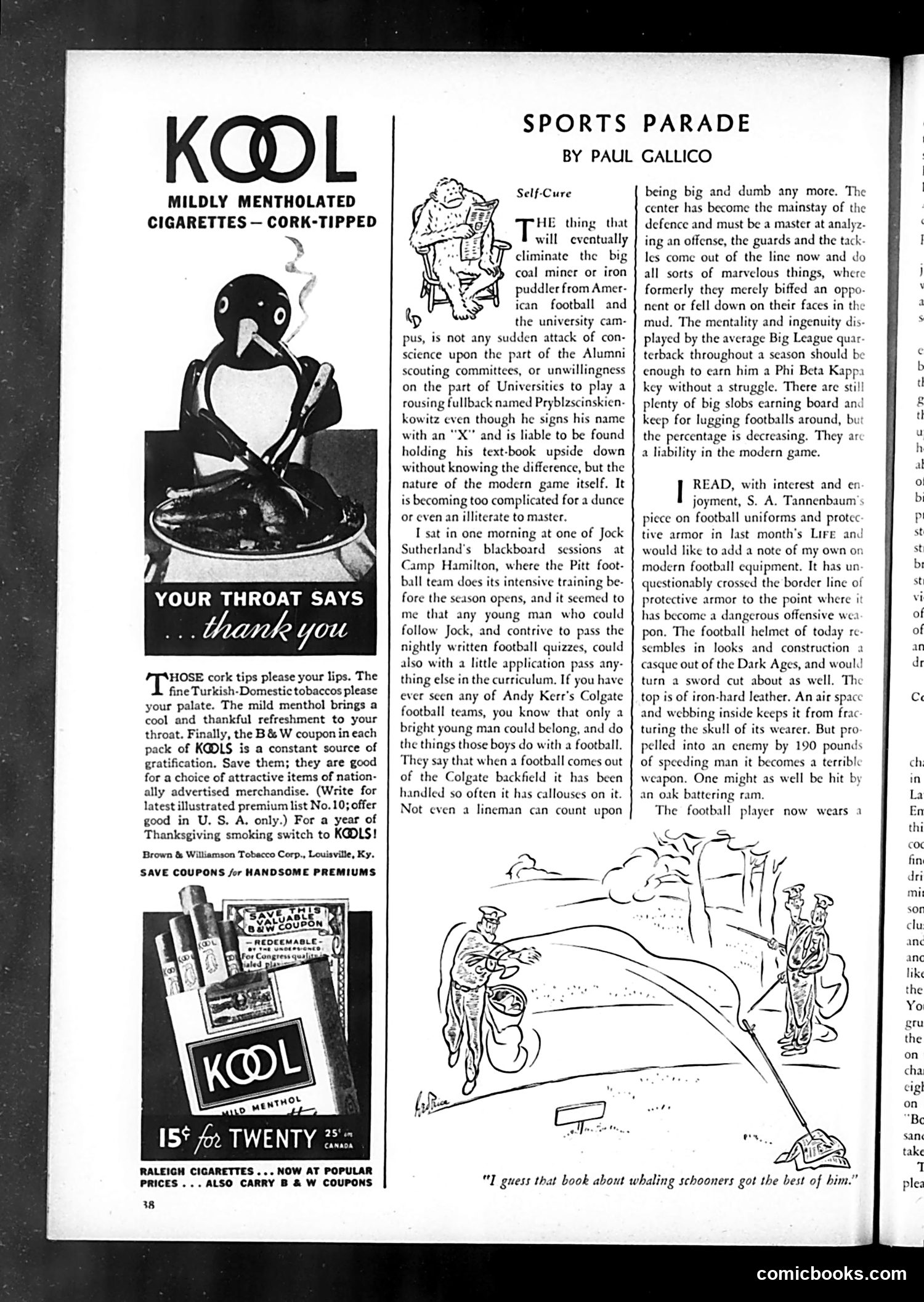
Sports Parade and Kool Cigarettes Advertisement This page pairs a cigarette ad with sportswriter Paul Gallico's column critiquing modern football. The Kool advertisement (left) features a penguin mascot and emphasizes the cigarettes' menthol cooling effect and cork tips. It promotes collecting B&W coupons for merchandise premiums—a common mid-century marketing tactic. Gallico's "Sports Parade" column argues that football has become intellectually demanding, eliminating the stereotype of the "big dumb" athlete. He cites coaches like Jock Sutherland (Pitt) and Andy Kerr (Colgate) whose complex playbooks and nightly quizzes require intelligence. He also critiques modern football protective equipment—helmets in particular—as having crossed from protection into dangerous weapons, comparing a helmeted player's impact to "an oak battering ram." The cartoon below shows figures examining wreckage, with the caption suggesting someone got knocked out after reading about whaling—a light joke about the column's earnest tone.
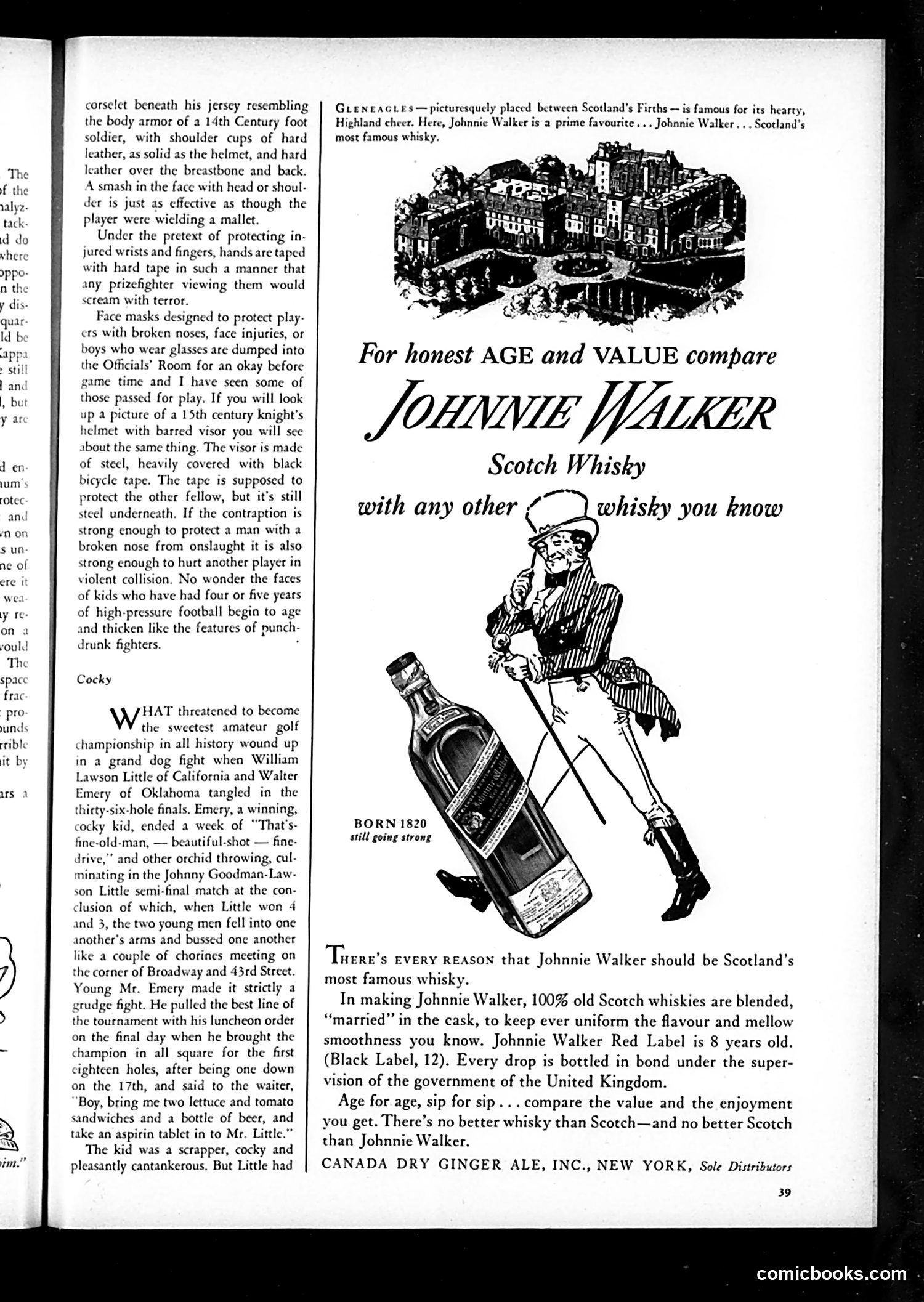
Life Magazine Page Analysis This page is primarily a Johnnie Walker Scotch whisky advertisement (bottom two-thirds), not political satire. The top portion contains editorial content about football, describing protective equipment worn by players—corselet armor, taped hands, steel face masks with bicycle tape—comparing them to medieval knight gear. The author argues this equipment, ostensibly protective, actually enables and conceals violent play, causing players' faces to age and thicken like "punch-drunk fighters." This is social criticism of American football's brutality. Below that is an anecdote ("Cocky") about amateur golfer Walter Emery's combative behavior during a 1930s championship, illustrating youthful arrogance and rivalry. The advertisement itself features a Scottish highlander figure with a Johnnie Walker bottle, emphasizing the whisky's age (born 1820), Scottish origin, and quality blending. The "Gleneagles" reference to Scotland's geography serves as atmospheric branding. This reflects the era's heavy alcohol advertising before mid-century restrictions.
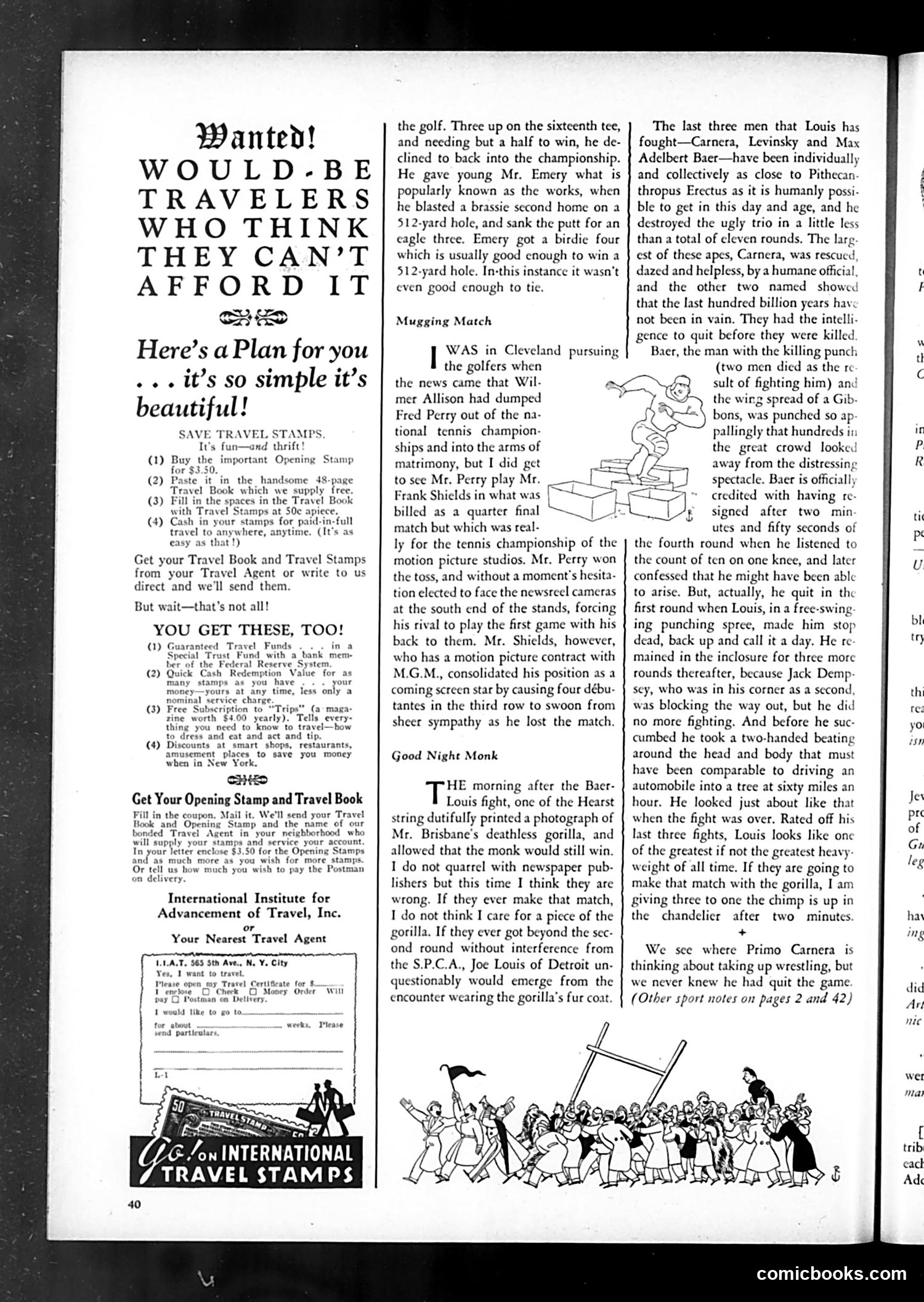
Life Magazine Page Analysis This page mixes advertising with sports commentary, typical of 1930s Life magazine. Main Content: The left side advertises "Travel Stamps"—a savings scheme where buyers accumulate stamps to fund travel, marketed as affordable adventure for budget-conscious Americans. Sports Commentary (Right Side): Three brief satirical pieces about contemporary athletes: 1. Golf anecdote: Appears to reference a specific match where a player declined a championship opportunity. 2. "Mugging Match": Comments on tennis players Fred Perry and Frank Shields competing near movie studios, with the author noting Perry strategically positioned himself facing newsreel cameras while Shields faced away—satirizing how motion picture contracts influenced athlete behavior during the Depression era. 3. "Good Night Monk": References the Baer-Louis heavyweight boxing fight, humorously suggesting a newspaper (Hearst's) claimed a gorilla could beat Joe Louis. The author dismisses this, asserting Louis would easily defeat all three recent opponents (Carnera, Levinsky, Baer), using unflattering anthropological language typical of the era's crude sports writing.
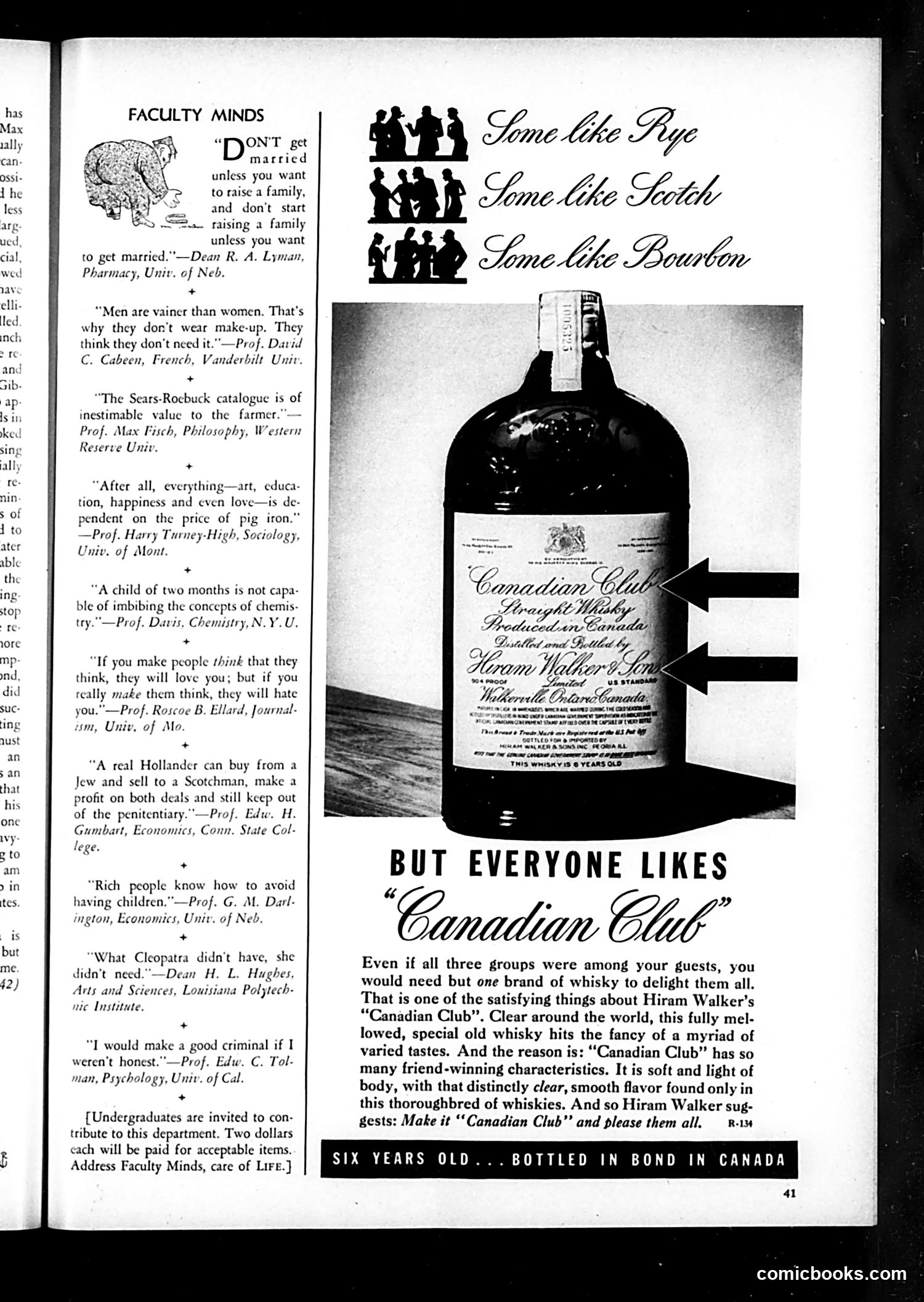
"Faculty Minds" and Canadian Club Advertisement This Life magazine page combines two elements: a humor column featuring absurdist quotes from university professors, and a whisky advertisement. The "Faculty Minds" section satirizes academic pretension by collecting deliberately ridiculous or oversimplified statements from real professors—spanning topics from marriage and vanity to economics and chemistry. The humor lies in highlighting the gap between scholarly authority and common sense; professors are presented as either overthinking trivial matters or reducing complex human experience to absurd determinisms (like "everything depends on pig iron prices"). The accompanying Canadian Club whisky ad uses silhouettes of social groups ("Some like Rye / Some like Scotch / Some like Bourbon") to suggest the drink bridges class and taste divisions. The advertisement's logic—one whisky pleases everyone—ironically mirrors the academic quotes' reductive thinking: complex human preferences distilled into simple solutions. This juxtaposition likely creates unintended comic effect, the ad's earnest universalism echoing the professors' oversimplifications.
Page Analysis: Life Magazine, November 1934 This page from Life magazine contains book and entertainment reviews rather than political cartoons. The "Stop & Go" column (continued from page 2) provides a satirical college football schedule for November, mixing genuine game recommendations with witty commentary on regional rivalries and social expectations. Key content includes Kyle Crichton's book reviews, notably critiques of works addressing Depression-era economics and labor ("Horse Shoe Bottoms" praising miners as human beings rather than "animals," and "Breakdown" on political economy). War Memoirs of Robert Lansing receives pointed criticism for allegedly plotting U.S. entry into WWI despite official neutrality—a reference to genuine historical tensions during the Wilson administration. The "Go Places" section advertises entertainment venues (Central Park Casino, restaurants). The "Records" and "Murder & Mystery" sections review popular cultural products of the period. This reflects Life's role as a comprehensive lifestyle and cultural commentary magazine for educated American readers.
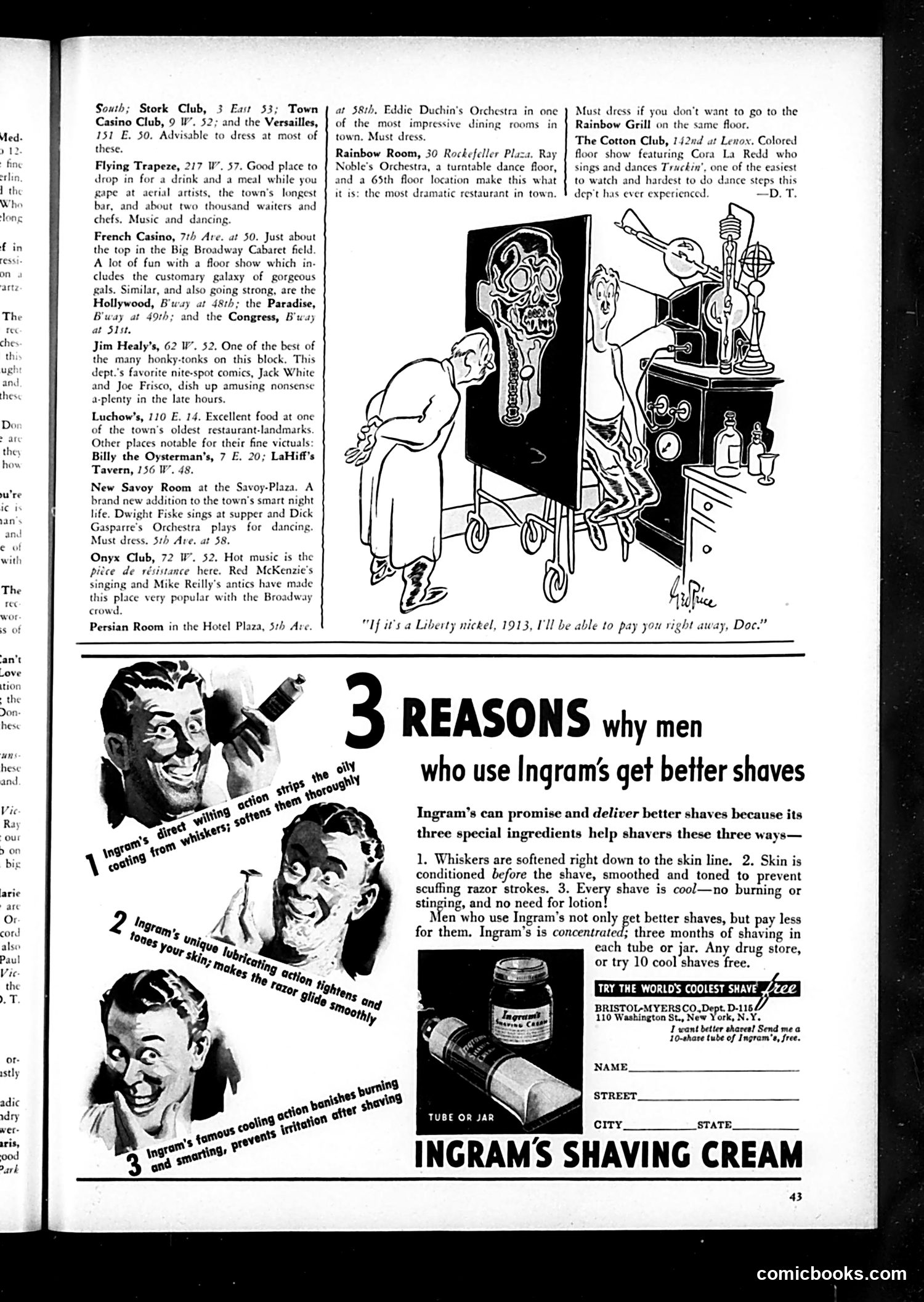
Analysis of Page 43 from Life Magazine This page combines entertainment listings with advertising and one cartoon. The Cartoon: The single illustration shows a man examining a baby carriage while speaking to a doctor. The caption reads: "If it's a Liberty nickel, 1913, I'll be able to pay you right away, Doc." The joke references the 1913 Liberty nickel—a valuable coin to collectors. The man is implying he cannot currently afford the doctor's bill but hopes the baby carriage contains this specific nickel, which he could sell to pay the debt. This plays on Depression-era financial desperation and the contemporary hobby of coin collecting. The Listings: The text describes New York City nightclubs and restaurants, including venues like the Stork Club, Cotton Club, and Rainbow Room—establishments catering to wealthy patrons seeking entertainment, dancing, and fine dining. The Advertisement: Ingram's Shaving Cream promotes its product's superior qualities and economy, targeting male consumers.
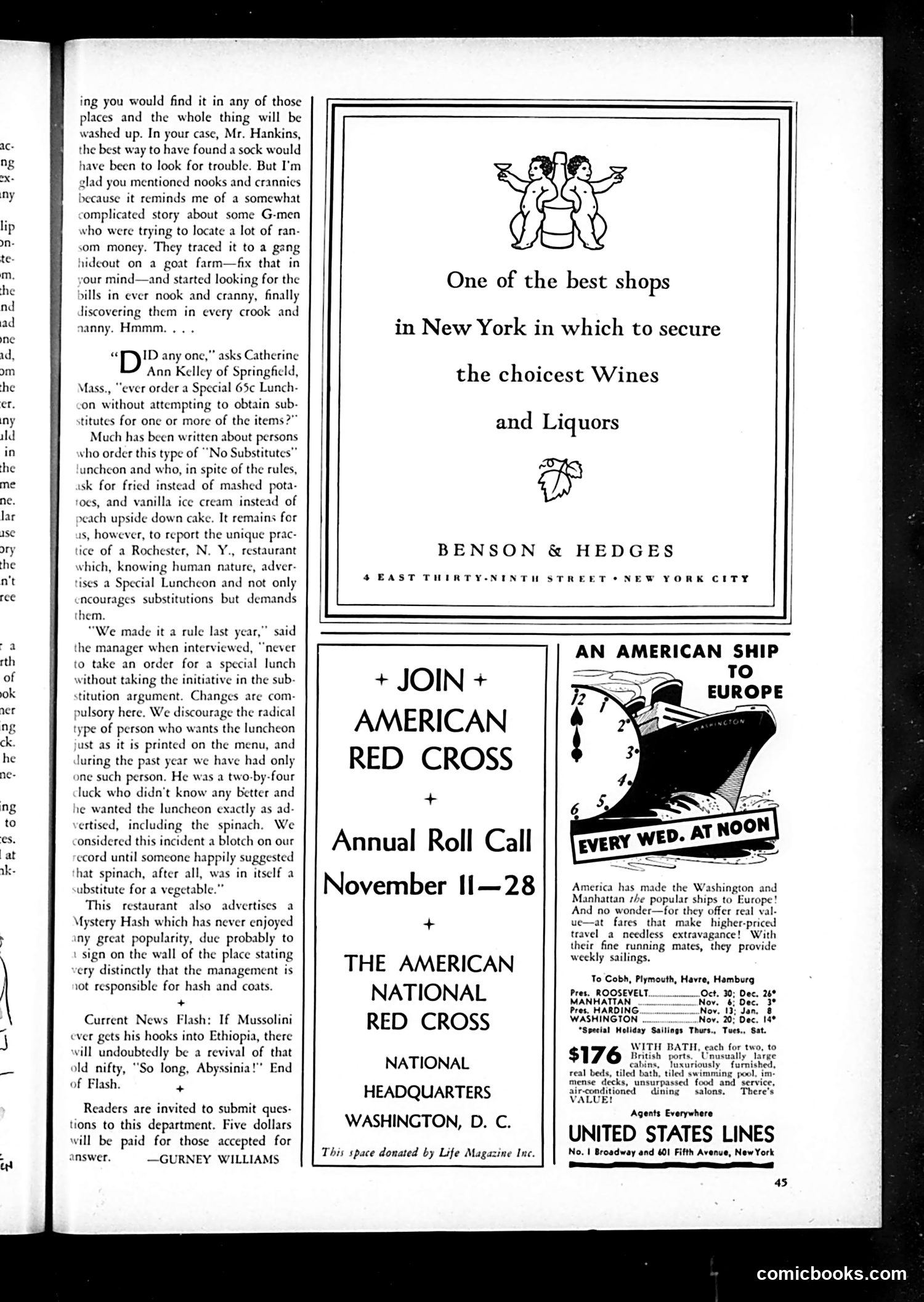
Life Magazine Page Analysis This page is primarily advertising with minimal cartoon content. The main features are: Advertisements: - Benson & Hedges wine and liquor shop (upper right) - American Red Cross Annual Roll Call recruitment (center left, November 11-28) - United States Lines ocean liners to Europe (lower right), promoting ships named after Presidents Roosevelt, Harding, and Washington with weekly sailings at $176 per person Editorial Content: The left column contains a humorous advice column by Gurney Williams discussing restaurant practices—specifically a Rochester, N.Y. restaurant that *encourages* menu substitutions rather than forbidding them, even considering spinach "a substitute for a vegetable" as a joke about their flexibility. Historical Context: The Red Cross appeal and ship advertisements reflect pre-WWII America (note the Mussolini/Ethiopia reference in the text). The magazine uses donated advertising space to promote civic organizations alongside commercial ventures.
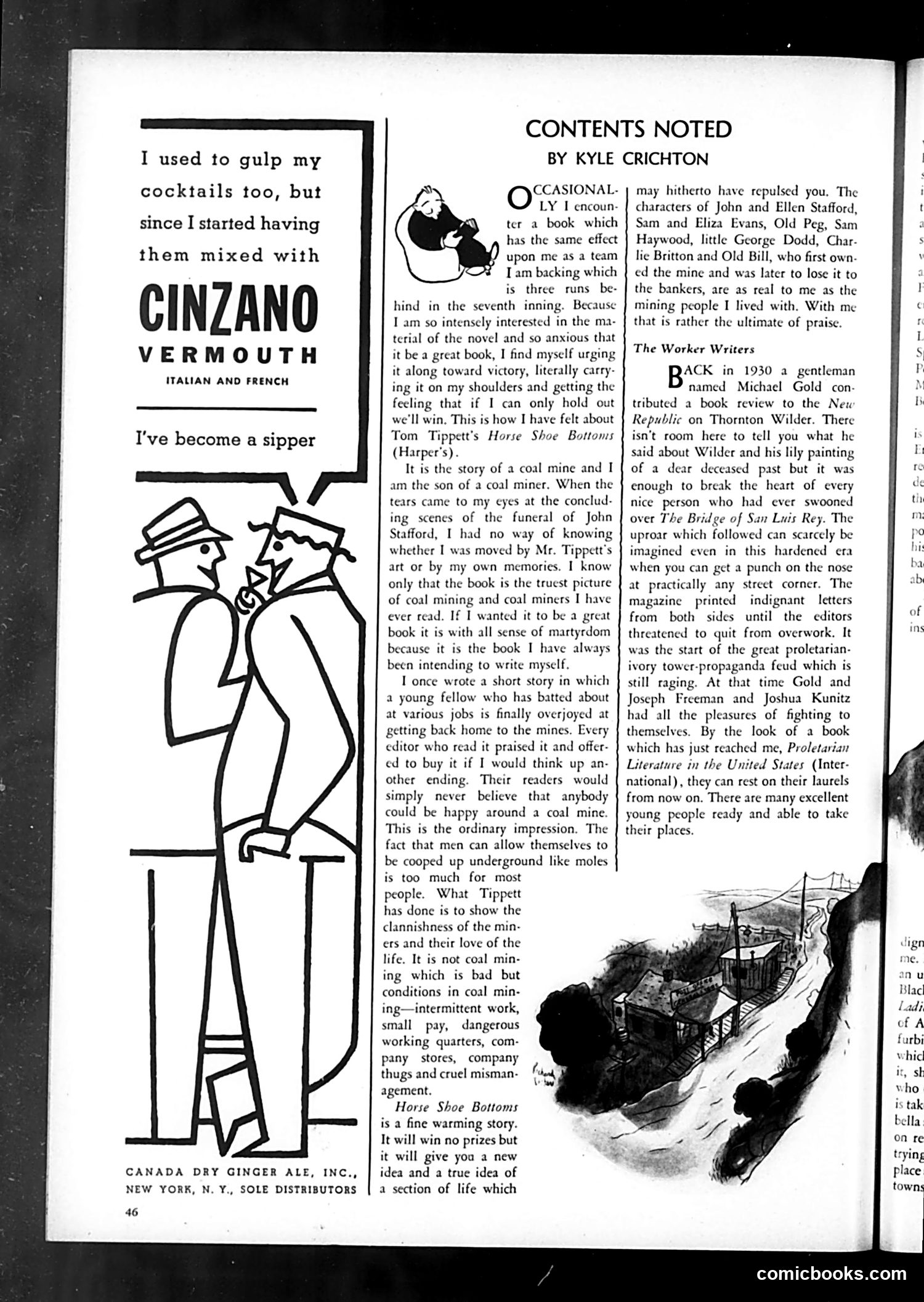
Analysis for Modern Readers This page contains a book review column by Kyle Crichton discussing Tom Tippett's *Horse Shoe Bottoms* (a novel about coal miners) alongside a sidebar about a 1930 literary controversy. The Cinzano advertisement (left) is simply a liquor ad using a simple cartoon of two figures toasting—unrelated to the editorial content. The substantive content discusses: 1. Tippett's coal-mining novel: Crichton praises it as authentic portrayal of miners' lives and conditions, emotionally moving him as someone with mining family connections. 2. The Michael Gold controversy: References a 1930 *New Republic* review where leftist critic Michael Gold attacked writer Thornton Wilder as overly refined/detached from working-class reality. This triggered a major literary feud between "proletarian" writers (emphasizing worker experiences) and more traditional/artistic writers. Gold and allies fought for literature addressing class struggle and labor conditions. The page illustrates Depression-era literary politics—debates about whether art should serve political/social causes or maintain aesthetic independence.
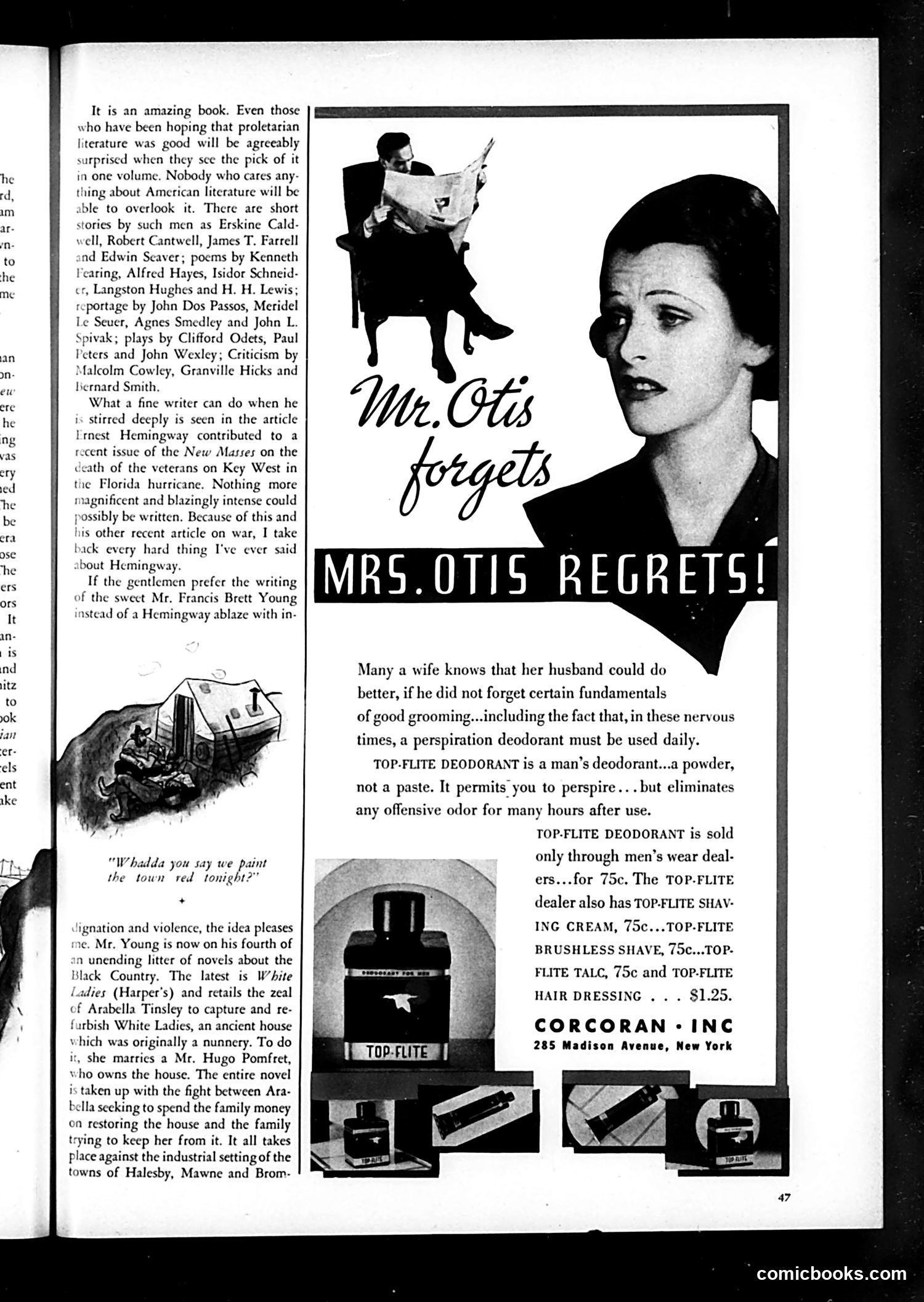
Analysis of Life Magazine Page This page combines literary criticism with advertising. The left side reviews a proletarian literature anthology and praises Ernest Hemingway's recent writing on social issues, while dismissing Francis Brett Young's conservative novels about English country life. The cartoon depicts a man reading a newspaper with the caption "Whadda you say we paint the town red tonight?"—satirizing dated slang and suggesting working-class masculinity. The advertisement uses this masculinity angle to sell Top-Flite deodorant, playing on spousal anxiety: wives must ensure their husbands maintain "good grooming" standards, particularly perspiration control, "in these nervous times" (likely referring to Depression-era social anxieties). The ad implies that a man's failure at basic hygiene reflects poorly on his wife—a common vintage advertising trope exploiting domestic anxiety to drive sales.
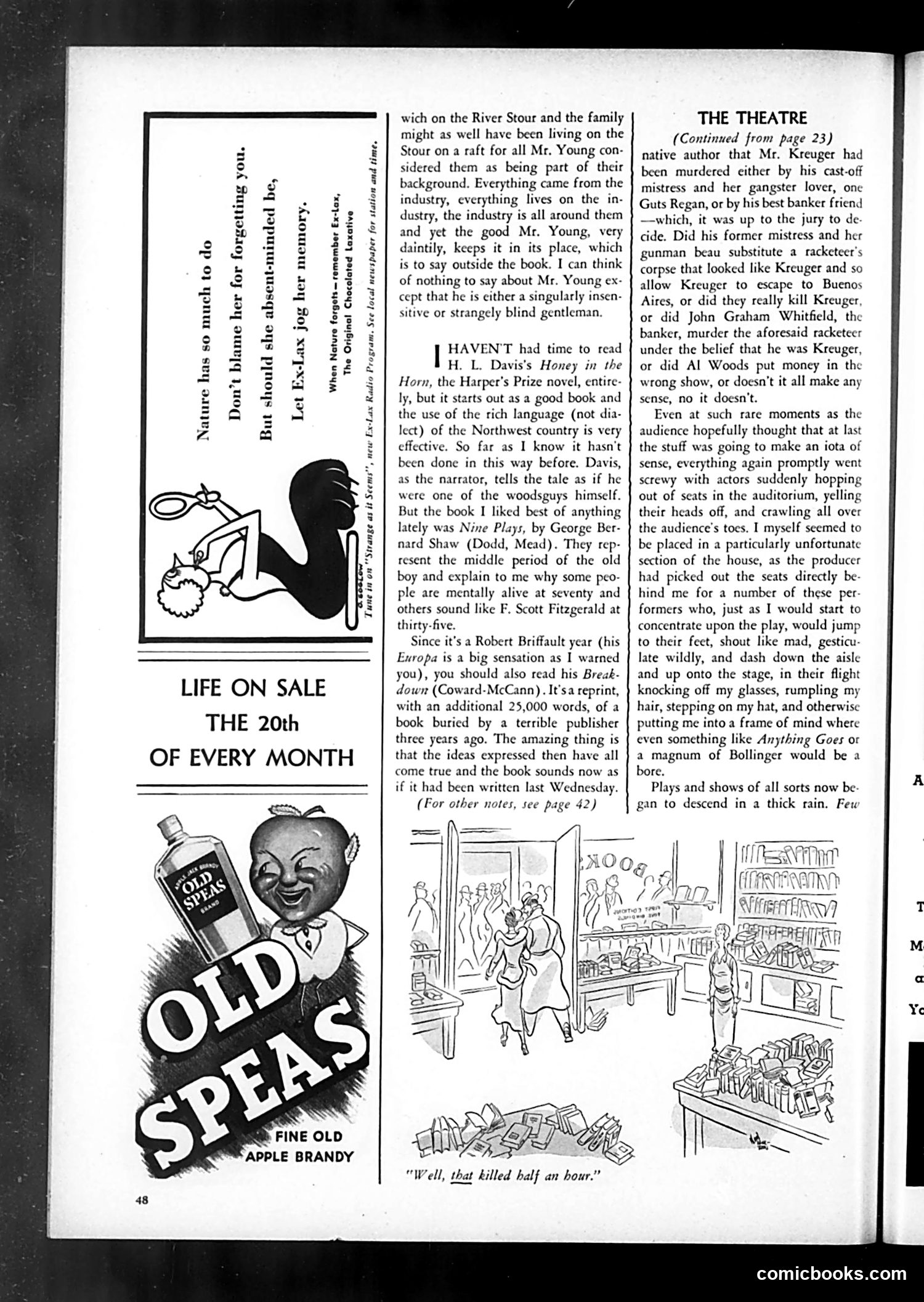
Page Analysis: Life Magazine This page mixes advertising and theater criticism. The left side features an Ex-Lax advertisement (a chocolate laxative) with a mild joke about forgetfulness, and an Old Spears brandy ad with a cartoonish character. The main content is a theater review (continued from page 23) critiquing a confusing murder-mystery play. The reviewer sarcastically catalogs the implausible plot twists—was the victim murdered by a gangster, a banker, or is the supposed victim alive in Buenos Aires? The joke is that the plot makes no sense. The review's complaint extends to the staging: actors inexplicably leap from audience seats onto the stage during performance, disrupting viewers. The cartoon at bottom shows an audience member amid chaos in what appears to be a packed theater lobby or standing area, with the caption "Well, that killed half an hour"—deadpan commentary on an entertainment that wastes viewers' time. The satire targets both incomprehensible theater plots and the gimmicky staging that prioritizes spectacle over coherence.
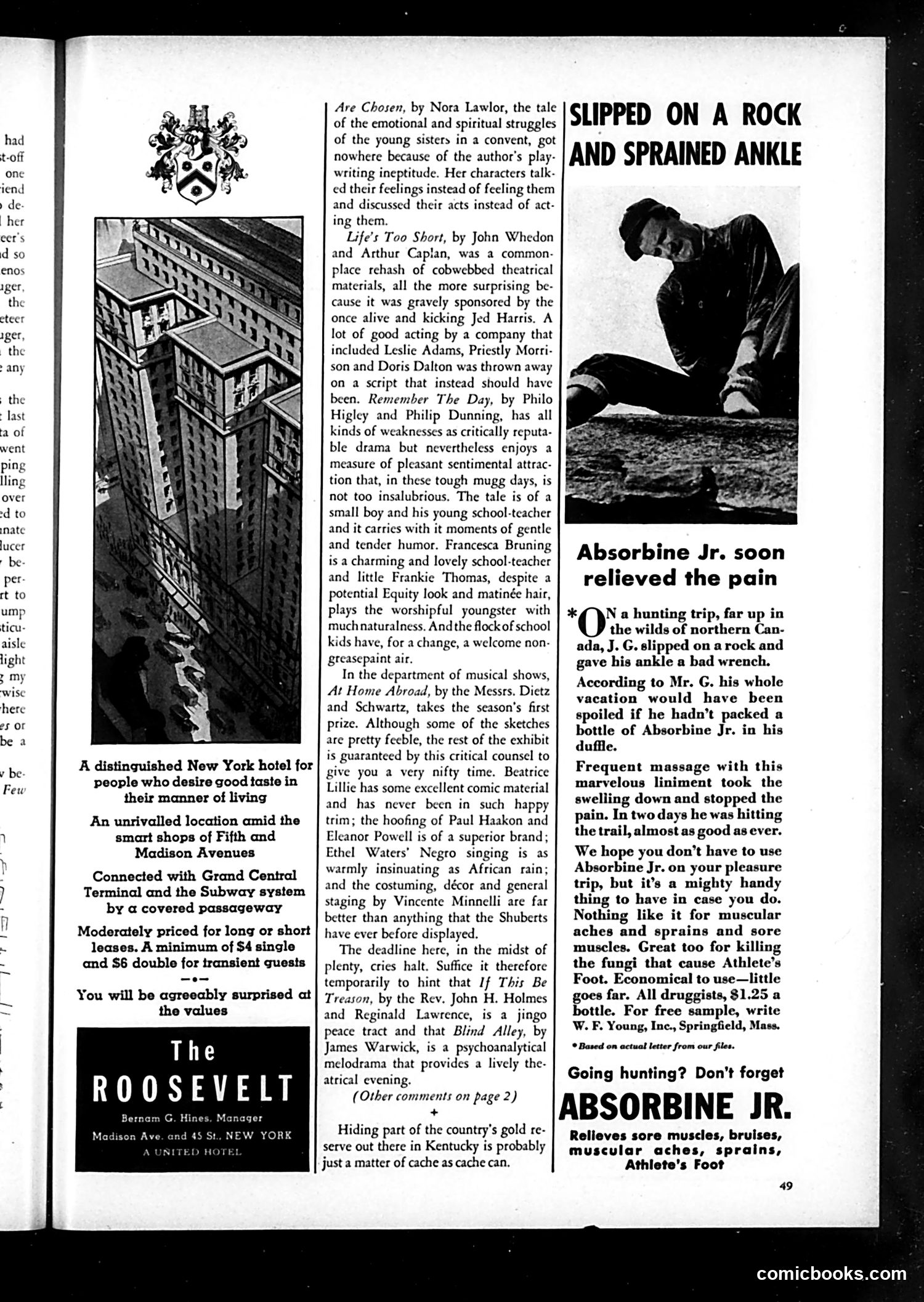
Page Analysis: Life Magazine (Vintage) This page combines theater reviews with advertisements. The left side features a hotel advertisement for The Roosevelt (a real Manhattan hotel), emphasizing luxury location near Fifth Avenue and Grand Central Terminal. The center contains theater criticism, reviewing Broadway shows including "Are Chosen," "Life's Too Short," "Remember The Day," "At Home Abroad" (praised highly), and others. The critic dismisses weak scripts despite good acting and praises the musical's staging by Vincente Minnelli and performances by Beatrice Lillie, Paul Haakon, and Ethel Waters. The right side is an Absorbine Jr. advertisement disguised as editorial content—a common advertising practice of the era. It presents a fictional testimonial about a hunting accident, using the product endorsement format to sell a liniment for sprains and muscle aches. The "Based on actual letter from our files" disclaimer indicates this was presented as reader-submitted, lending false credibility typical of vintage advertising. The page reflects 1930s-40s entertainment and consumer culture.
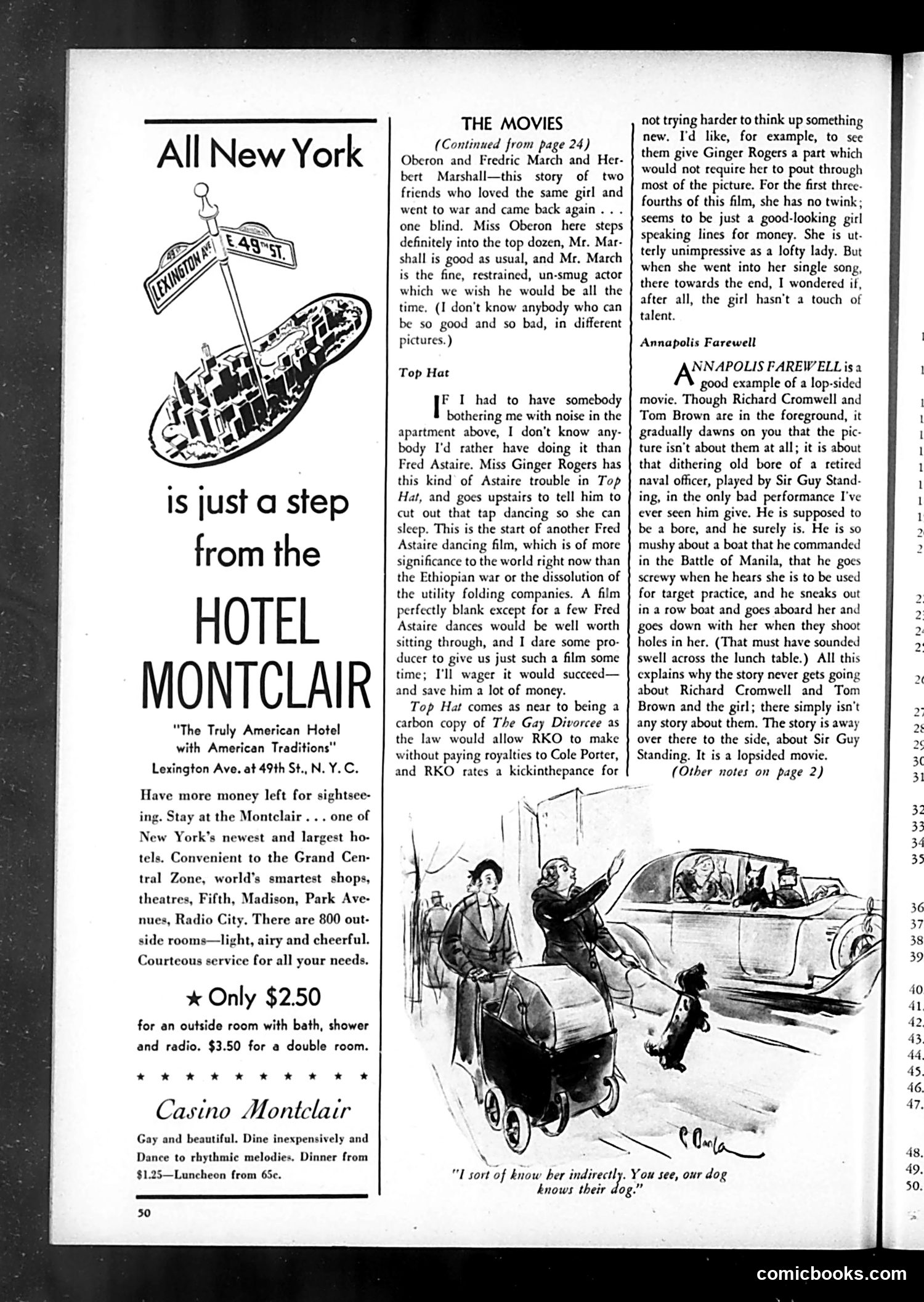
Page Analysis This page is primarily advertising with movie reviews, not political satire. The left side features two hotel ads (Hotel Montclair and Casino Montclair), promoting budget lodging ($2.50/night) and dining in 1930s New York. The right side contains film criticism reviewing three movies: a Merle Oberon/Fredric March drama about wartime romance; Top Hat with Fred Astaire and Ginger Rogers (criticized as a formulaic copy of *The Gay Divorcee*, praising Astaire's dancing while finding Rogers underutilized); and Annapolis Farewell, criticized as structurally flawed because Sir Guy Standing's subplot about a naval ship dominates, overshadowing the main plot with younger leads. The cartoon shows a street scene of people and a car with the caption joking about indirect acquaintance through dogs—simple social humor unrelated to the surrounding content.
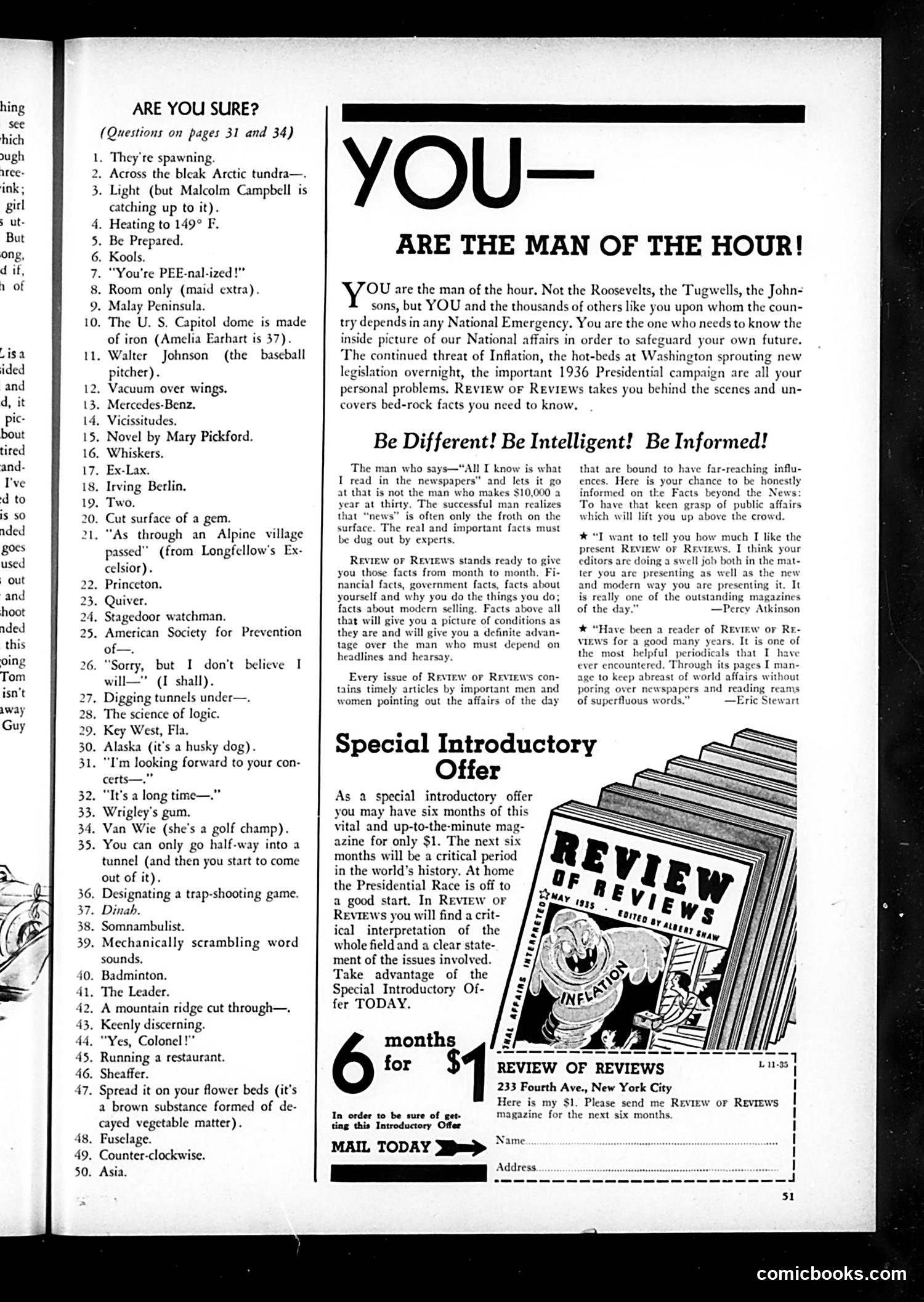
Explanation for Modern Readers This page is primarily advertising for *Review of Reviews* magazine, not a political cartoon. The "ARE YOU SURE?" section is a quiz (answers appearing on pages 31-34), likely from the same issue. The main content pitches the magazine to readers as essential for staying informed about 1936 American politics and economics. It appeals to ambitious men by suggesting that relying only on newspapers leaves you unprepared compared to successful competitors. The ad emphasizes the magazine covers national threats like inflation and Washington legislation, and prominently mentions the 1936 Presidential campaign—implying readers need insider analysis to make informed civic decisions. The testimonials from readers reinforce this: *Review of Reviews* provides "facts beyond the News" that newspapers miss. This reflects 1930s-era anxiety about economic uncertainty (the Depression) and political change, marketing specialized journalism as a path to personal success and civic competence.
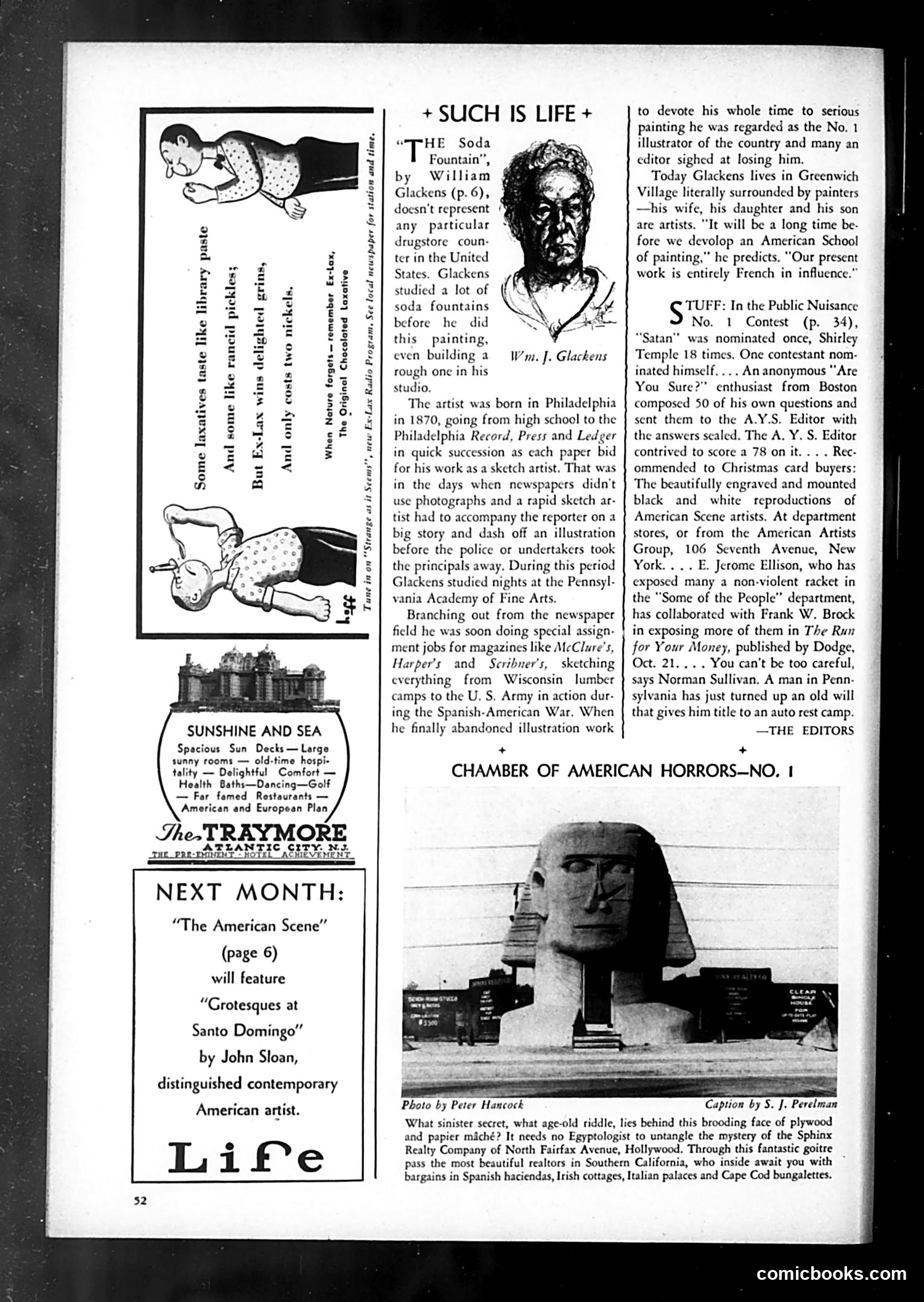
Life Magazine Page Analysis This page primarily features advertisements and editorial content rather than political satire. The main elements are: "Such Is Life" section: A biographical article on illustrator William Glackens (1870-living), praising his career progression from newspaper sketch artist to serious painter. The text notes he worked for Philadelphia papers and major magazines (McClure's, Harper's, Scribner's), covering subjects from lumber camps to the Spanish-American War. Cartoons (left side): Simple, unlabeled humorous drawings depicting people in awkward positions—likely generic satirical humor about everyday situations rather than specific political commentary. "Chamber of American Horrors—No. 1": A photograph of a large Sphinx-shaped structure at a Hollywood real estate office, captioned by S.J. Perelman. The satire mocks tacky American commercial architecture—specifically a real estate company using an oversized Egyptian sphinx as a gimmick to attract buyers with promises of exotic properties. The page is primarily lifestyle and cultural commentary typical of Life magazine's satirical approach to American consumer culture and artistic life.
I can see this is a page from Life magazine, but the image is almost entirely black or heavily degraded, making it impossible to discern any cartoon illustrations, caricatures, text details, or satirical content with confidence. The left margin shows fragments of text mentioning references like "school," "book," and what appears to be publication information, but the main content area—where political cartoons or satirical illustrations would appear—is not legible. Without being able to see the actual cartoon(s), identify figures, or read the accompanying text clearly, I cannot accurately explain what this page means or what political/social references it contains. A clearer image would be needed for proper analysis.