life
Life — December 1935
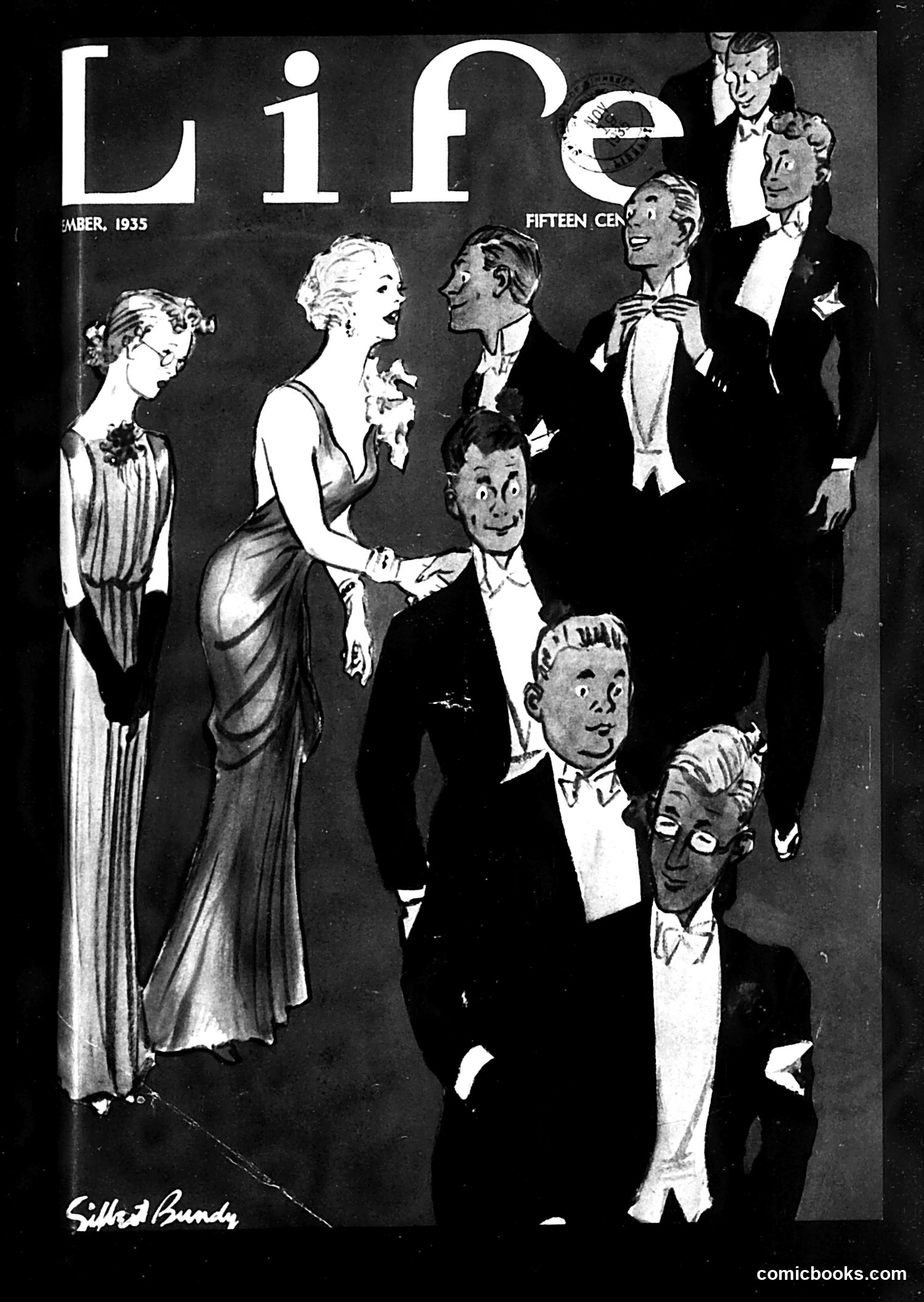
Life Magazine Cover, December 1935 This is a Life magazine cover (December 1935) illustrated by Sickel Bundy, depicting a formal evening social scene. The composition shows well-dressed figures in tuxedos and evening gowns at what appears to be a sophisticated party or gala event. The satire likely comments on 1930s high society and wealth during the Great Depression—a contrast between the elegantly dressed attendees and economic hardship affecting ordinary Americans. The exaggerated facial expressions and caricature style suggest mockery of the wealthy elite's indifference to wider social conditions. However, without identifying specific individuals in the illustration or additional text content, the precise satirical targets remain unclear from the image alone.
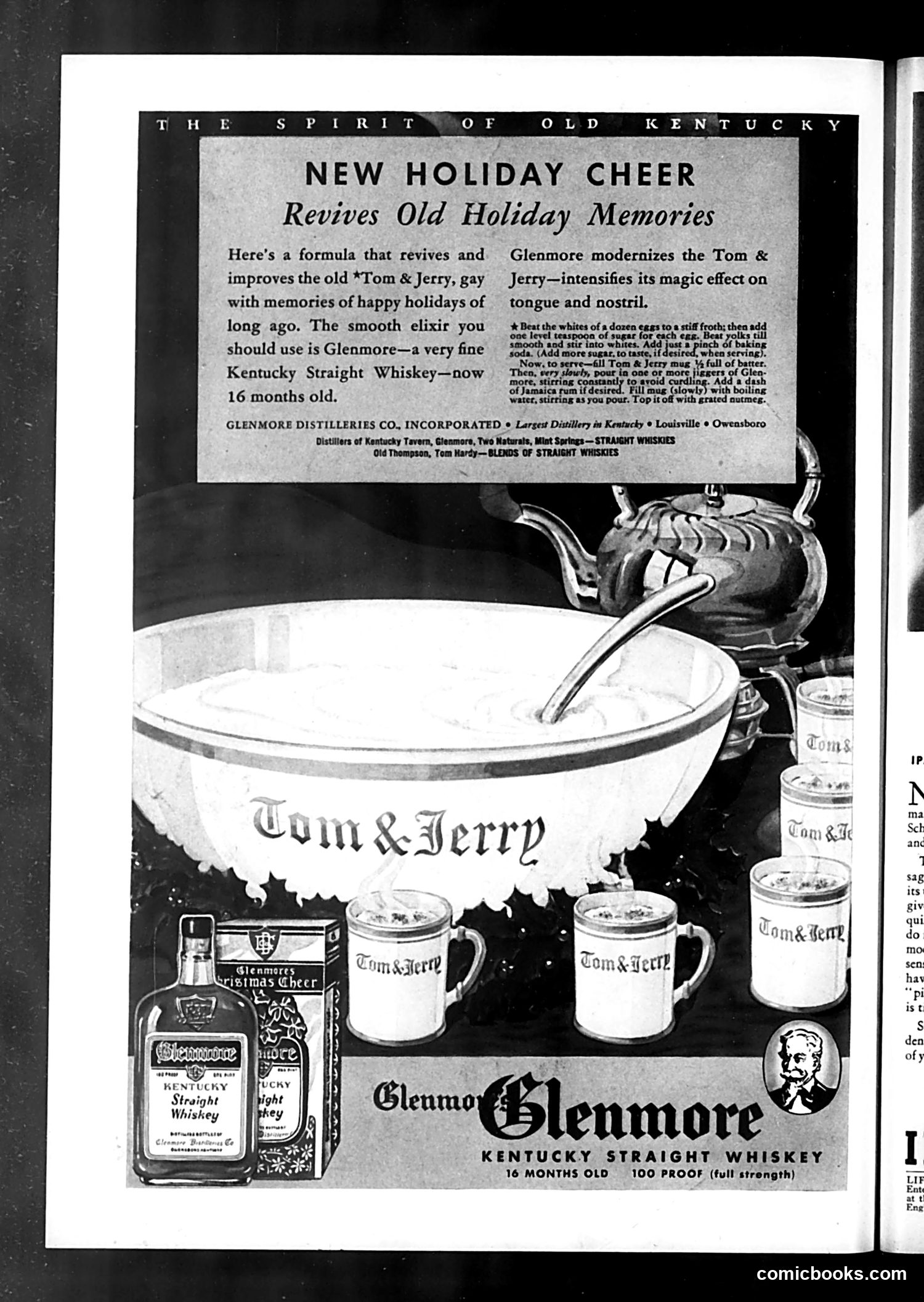
Analysis This is a whiskey advertisement, not political satire. It promotes Glenmore Kentucky Straight Whiskey by marketing a cocktail recipe called "Tom & Jerry"—a traditional holiday drink combining whiskey, eggs, sugar, and spices. The ad's humor appeals to nostalgia: it claims this "modernized" Tom & Jerry recipe "revives old holiday memories" from "long ago." The large central image shows an ornate punch bowl labeled "Tom & Jerry" with matching mugs and a whiskey bottle, positioned to suggest this is an elegant, festive drink. The satirical element is mild—merely mocking the idea that adding Glenmore whiskey "intensifies its magic effect on tongue and nostril," presenting liquor consumption as sophisticated holiday tradition-making.
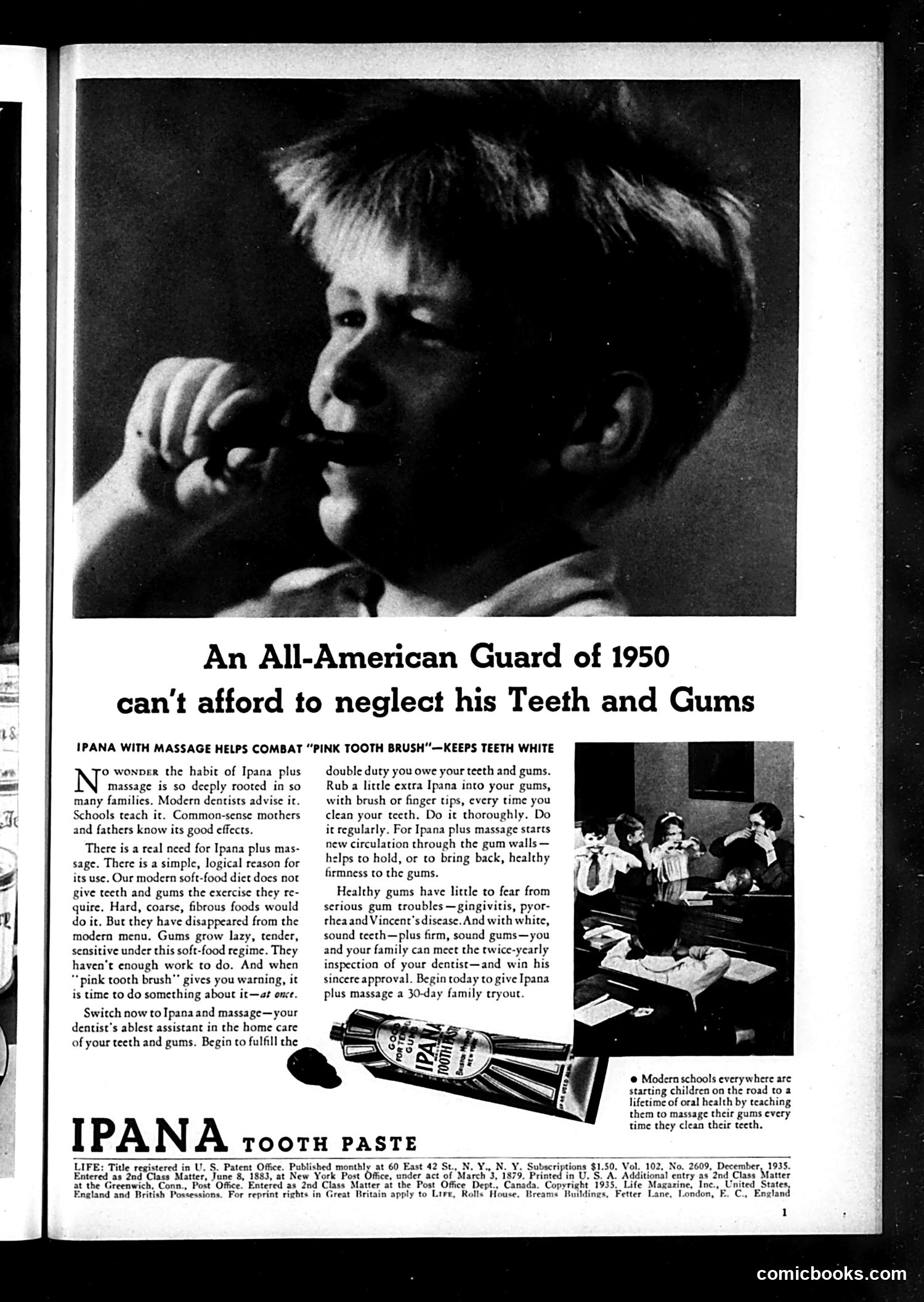
Analysis This is primarily a toothpaste advertisement, not a political cartoon. The page advertises Ipana Tooth Paste in Life Magazine (December 1935). The ad features a photograph of a young boy demonstrating tooth care and includes a separate photograph showing what appears to be a school setting, illustrating the advertiser's claim that "Modern schools everywhere are teaching children on the need for a lifetime of oral health by teaching them to massage their gums every time they clean their teeth." The headline references "An All-American Guard of 1950"—using patriotic language to encourage American families to adopt the dental hygiene practice of gum massage. The advertisement emphasizes that proper tooth and gum care prevents serious dental diseases. This is straightforward product marketing emphasizing health benefits, not satire.
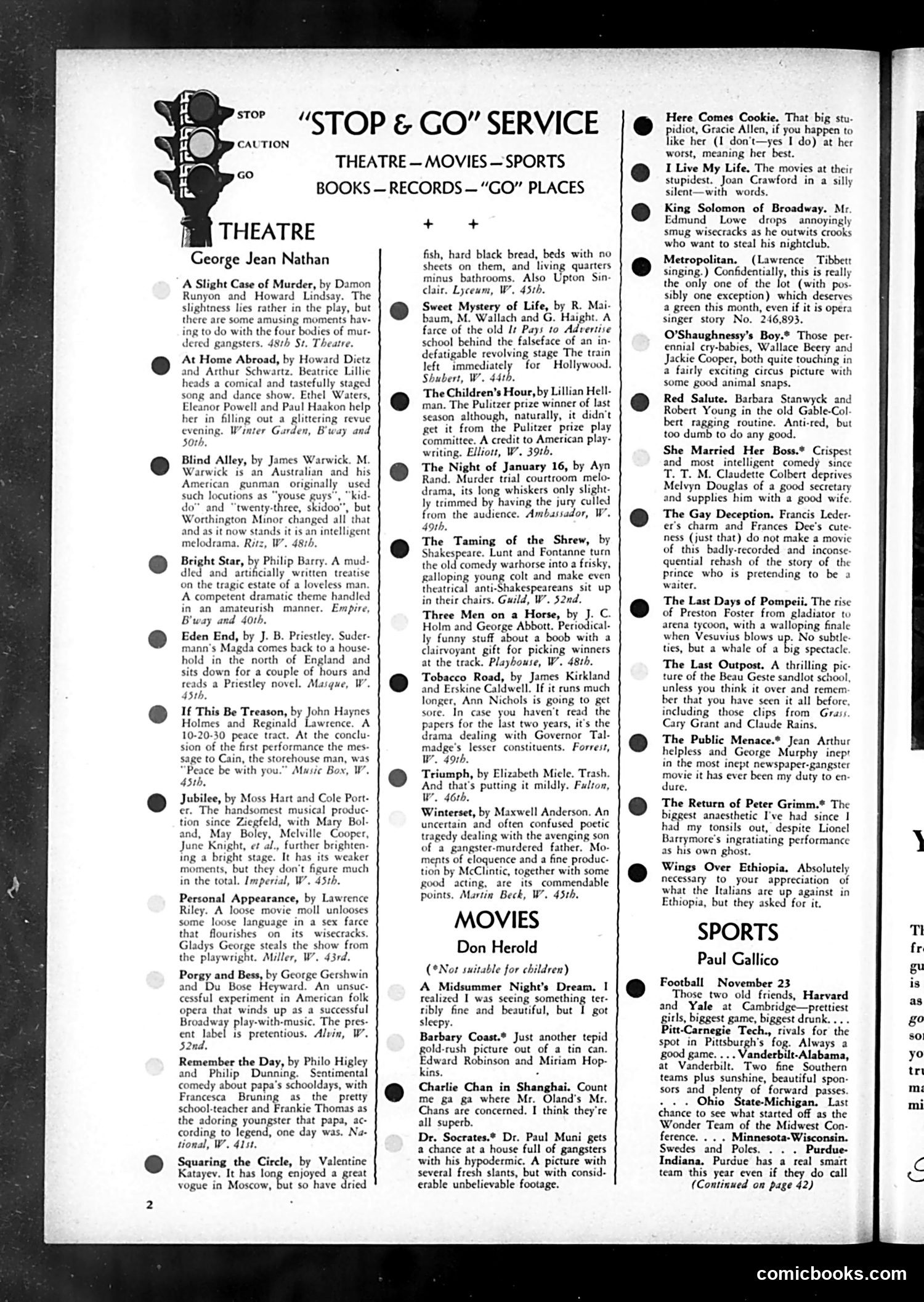
Content Analysis This page is primarily not a cartoon but a entertainment review section titled "Stop & Go Service," organized by George Jean Nathan. It contains capsule reviews of theater productions, movies, and sports events rather than satirical commentary. The "Stop & Go Service" device uses a traffic light graphic as its organizing metaphor—reviews apparently categorized by whether Nathan recommends stopping to see something (green light) or proceeding with caution/avoiding it (red light). The content focuses on contemporary 1920s Broadway shows, films, and sporting events with brief critical assessments. This appears to be a regular entertainment column providing readers quick guidance on cultural offerings, rather than political satire or social commentary typical of Life magazine's cartoons.
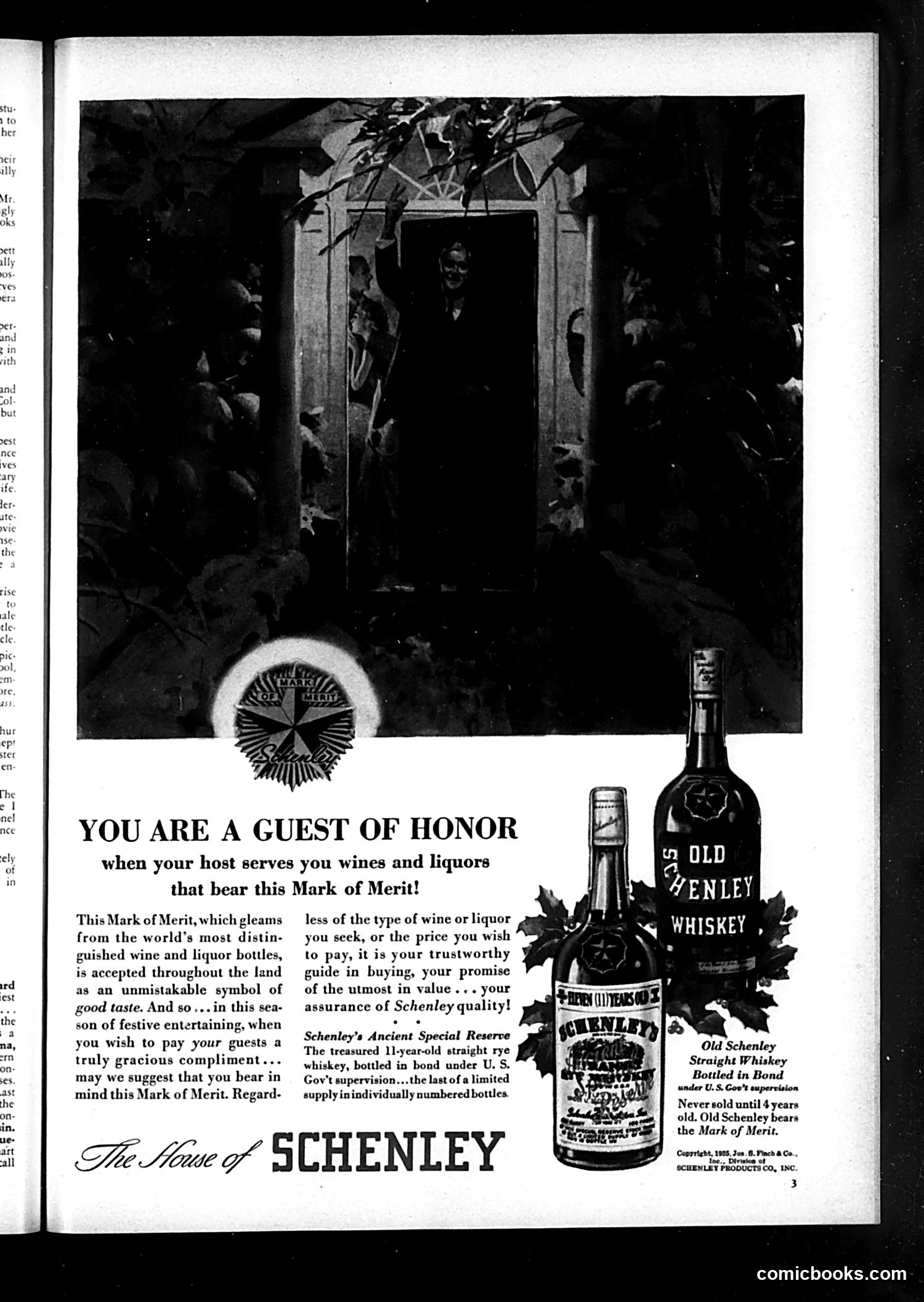
Analysis This page is primarily a Schenley whiskey advertisement, not political satire or editorial cartoon content. The ad features a photograph of an elegantly dressed woman standing in a doorway, framed by ivy or climbing plants, presented as aspirational imagery. The text positions Schenley's "Mark of Merit" as a symbol of refined taste and hospitality—assuring hosts that serving these branded spirits guarantees their guests will recognize quality. The advertisement emphasizes exclusivity ("good taste") and trust in the brand's reputation. It highlights specific products like "Old Schenley Whiskey" and "Schenley's Ancient Special Reserve." For modern readers: this represents vintage advertising's use of sophisticated imagery and social aspiration to market alcohol, targeting hosts concerned with impressing guests through branded luxury goods.
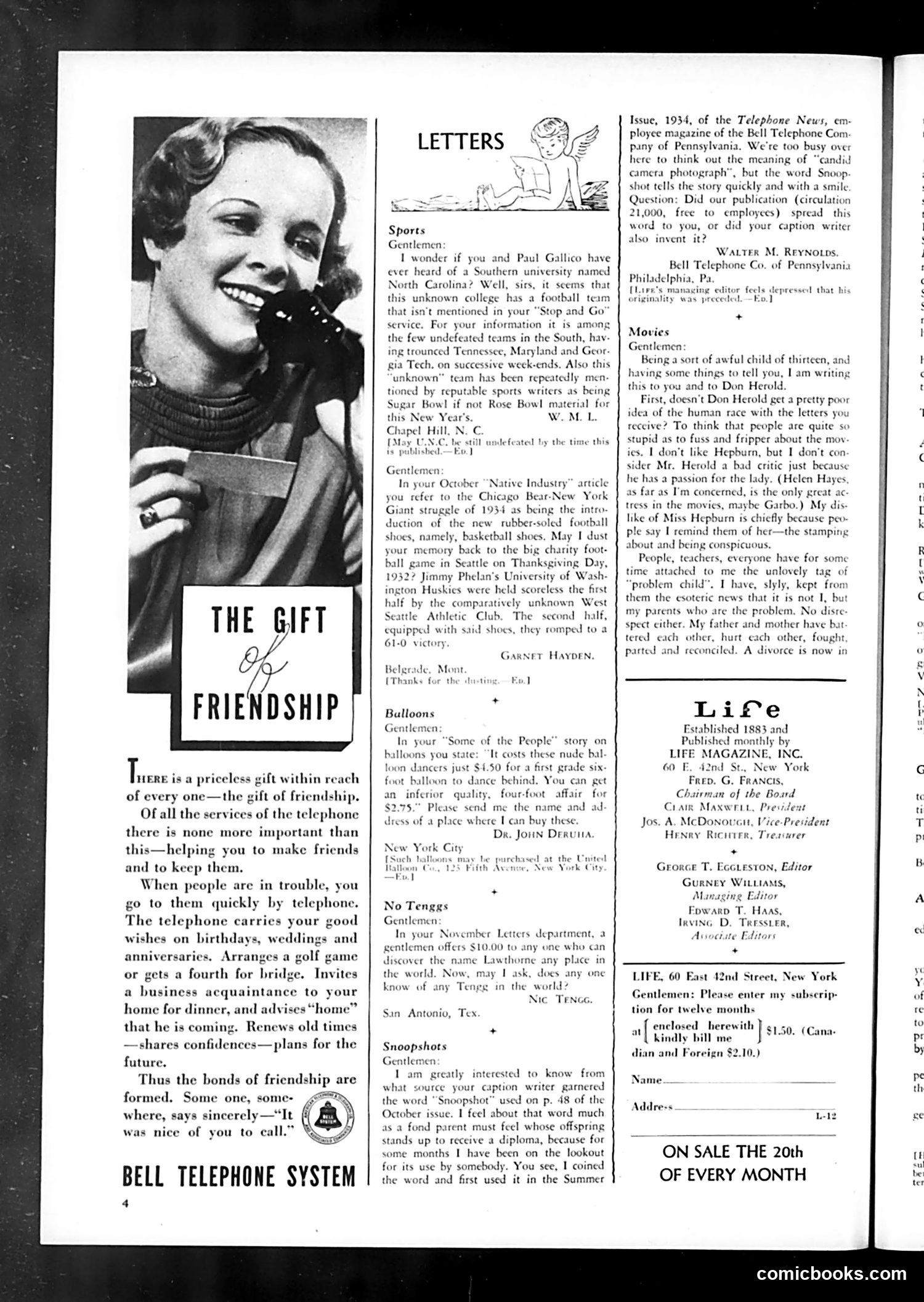
Analysis This page is primarily a letters-to-the-editor section for Life magazine, not a political cartoon. The main visual element is a Bell Telephone System advertisement featuring a woman on a telephone with the headline "THE GIFT OF FRIENDSHIP." The ad promotes telephones as a means of maintaining social bonds—helping readers "make friends and keep them" by calling for birthdays, anniversaries, and social invitations. It's a straightforward corporate advertisement emphasizing the telephone's social utility during an era when long-distance calling was still a significant service. The letters address various topics (sports, movies, balloons, tengas) but contain no obvious political satire. This appears to be a standard magazine page mixing reader correspondence with advertising.
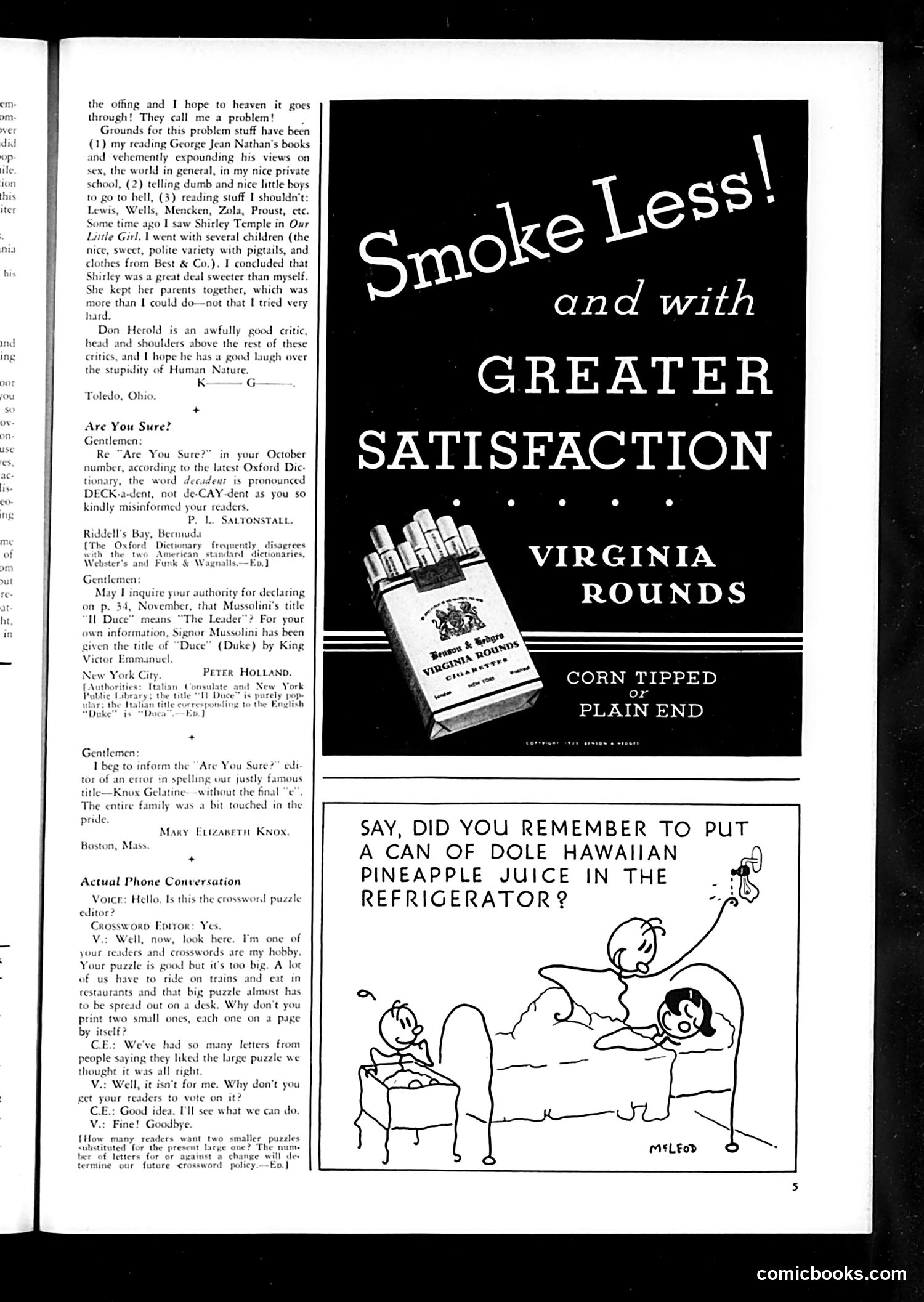
Analysis This page contains reader letters and advertisements rather than political cartoons. The letters section ("Are You Sure?") addresses corrections to previous issues—one reader corrects pronunciation of "decided" and another queries the meaning of "Il Duce" (Mussolini's title). The main advertisement promotes Virginia Rounds cigarettes with the slogan "Smoke Less! and with Greater Satisfaction," available "Corn Tipped or Plain End." The cartoon below is a simple domestic humor sketch by "McLeod" showing a wife reminding her husband about pineapple juice in the refrigerator—an everyday marital moment with no political content. The page reflects Life magazine's typical mix of reader correspondence and period advertising, including cigarette promotion then considered unremarkable.
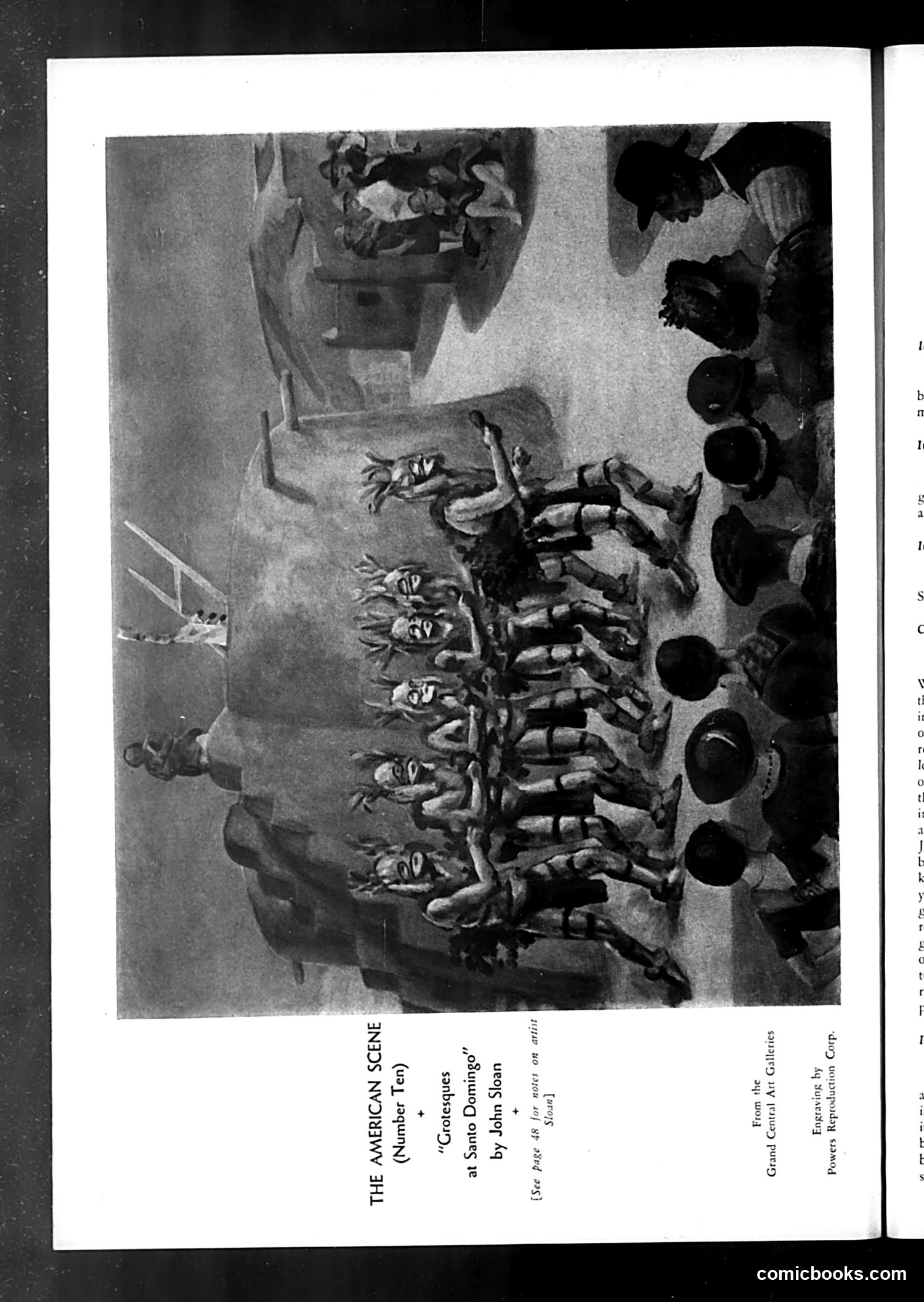
Analysis of "The American Scene" This page shows a photograph labeled "Croqueties at Santo Domingo" directed by John Sloan for the General Galleries. The image depicts dancers arranged in a choreographed formation, likely documenting a cultural or theatrical scene from Santo Domingo (now the Dominican Republic). Without additional context visible on this page, the satirical intent—if any—is unclear. The photograph appears to be presented straightforwardly as a cultural documentation rather than explicit political commentary. Life magazine frequently featured such ethnographic or theatrical content, though the framing and selection could itself constitute subtle social commentary on American attitudes toward Caribbean cultures during this period. The "American Scene" series likely aimed to document contemporary cultural practices, though modern viewers should consider the implicit biases of early 20th-century photojournalism.
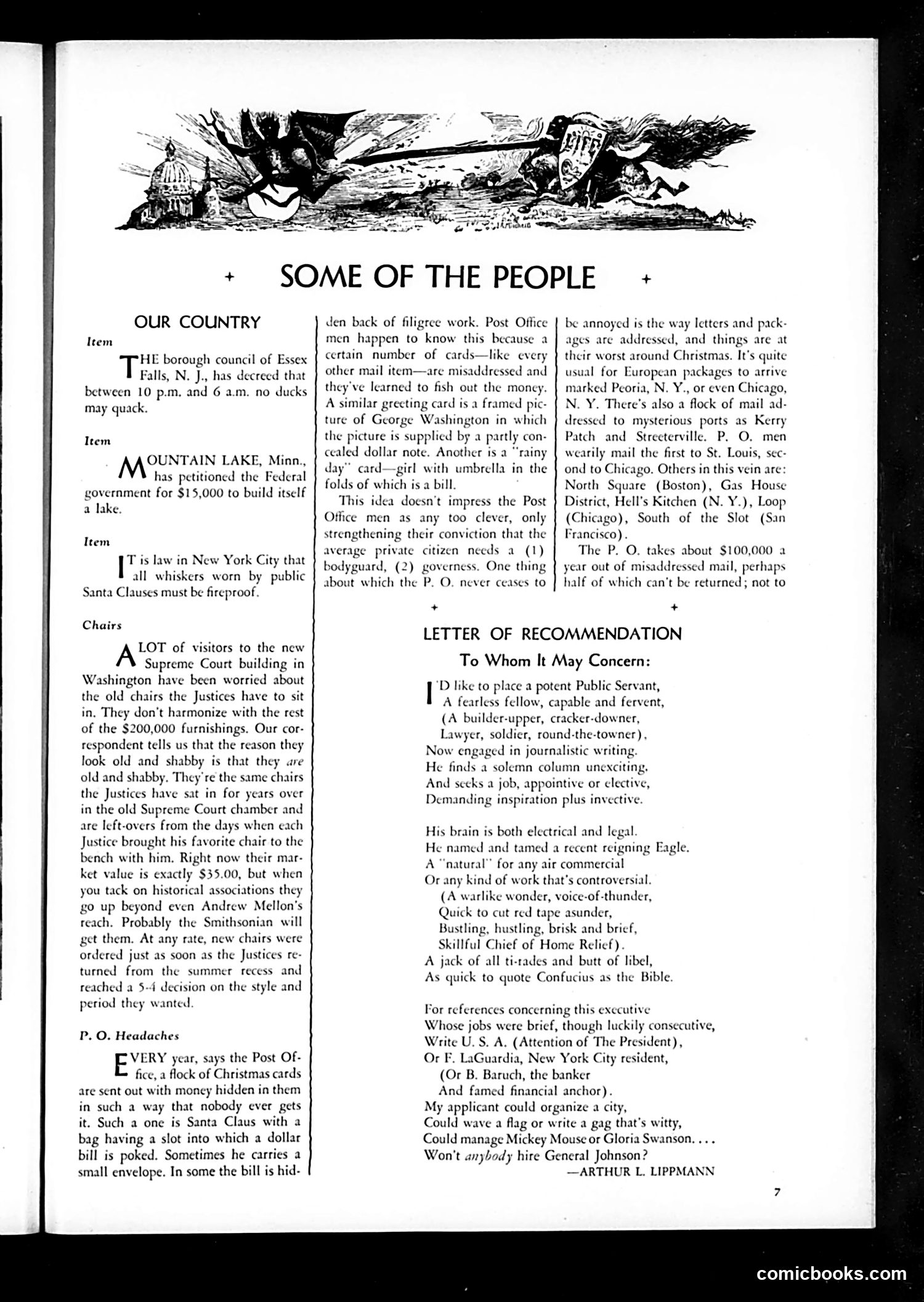
Analysis This page from *Life* magazine presents satirical commentary on American bureaucratic absurdities. The header illustration depicts chaos and folly. Content includes: - "Some of the People": Short items mocking government inefficiency—a New Jersey town banning ducks, a Minnesota lake-building petition, NYC whiskey laws, and Supreme Court justices' uncomfortable old chairs worth less than their $300,000 furnishings. - "P.O. Headaches": A satirical piece about Christmas cards with hidden money being mailed through the Post Office, suggesting postal workers might steal them—poking fun at both mail security and holiday gift-giving schemes. - "Letter of Recommendation": A humorous mock recommendation letter for a public servant, ironically praising contradictory qualities (fearless yet cautious, skilled yet controversial). It jokes about hiring "General Johnson," likely referencing a contemporary political figure, though identity is unclear. The satire targets government incompetence and bureaucratic irony.
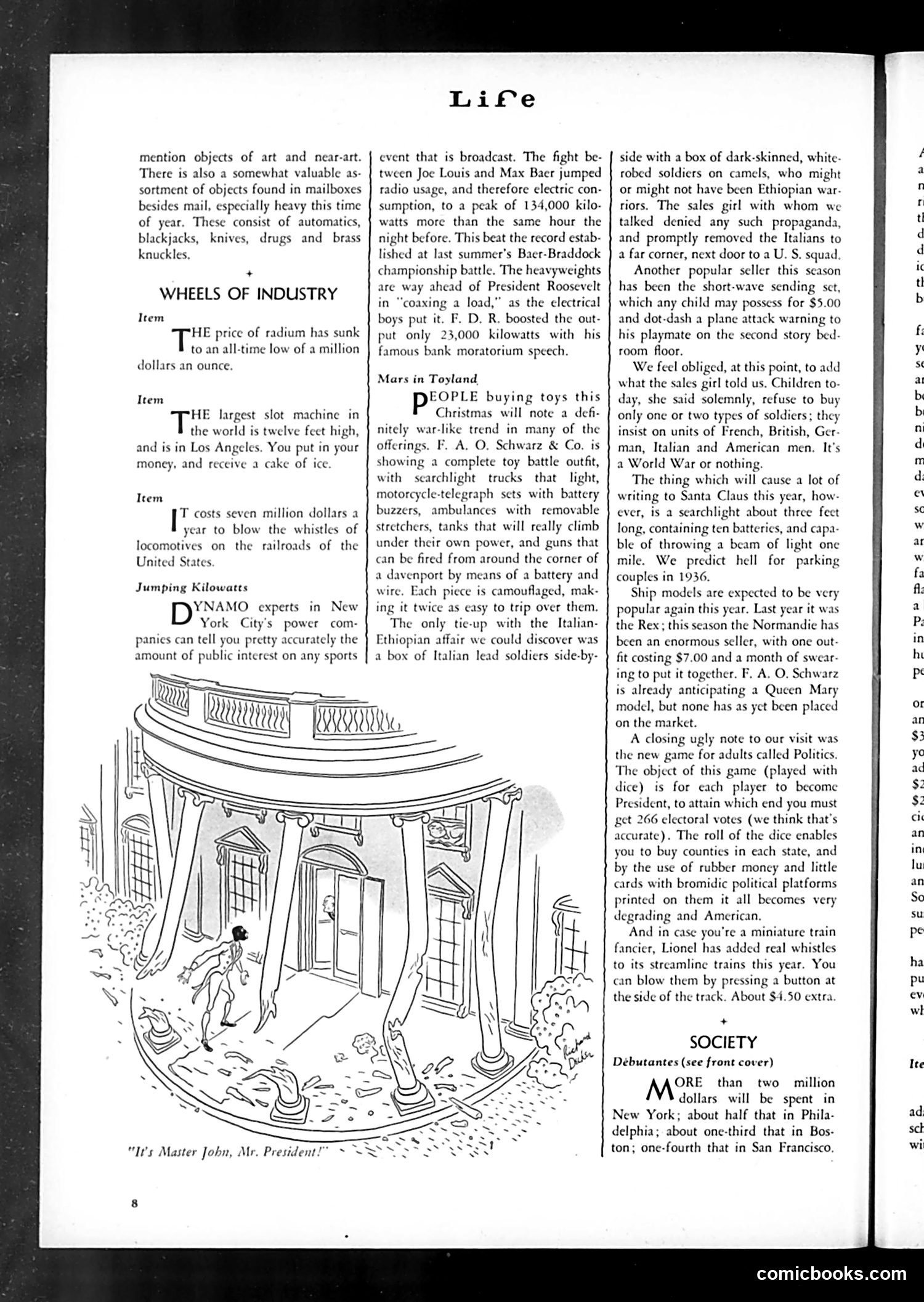
Analysis of Life Magazine Page The main cartoon depicts a massive classical building (appears to be a government structure) collapsing or sinking into the ground while a small figure below calls out "It's Master John, Mr. President!" This is political satire about government inefficiency or mismanagement under a presidential administration. The caption's reference to "Master John" and the building's catastrophic failure suggests criticism of failed policies or administrative collapse—likely commenting on contemporary political scandals or incompetence during the presidency referenced in the article text above (which mentions Roosevelt and industrial/power generation debates). The accompanying text discusses consumer goods, toys, and entertainment trends, suggesting this issue blends political commentary with lifestyle coverage typical of Life magazine's satirical approach to American culture.
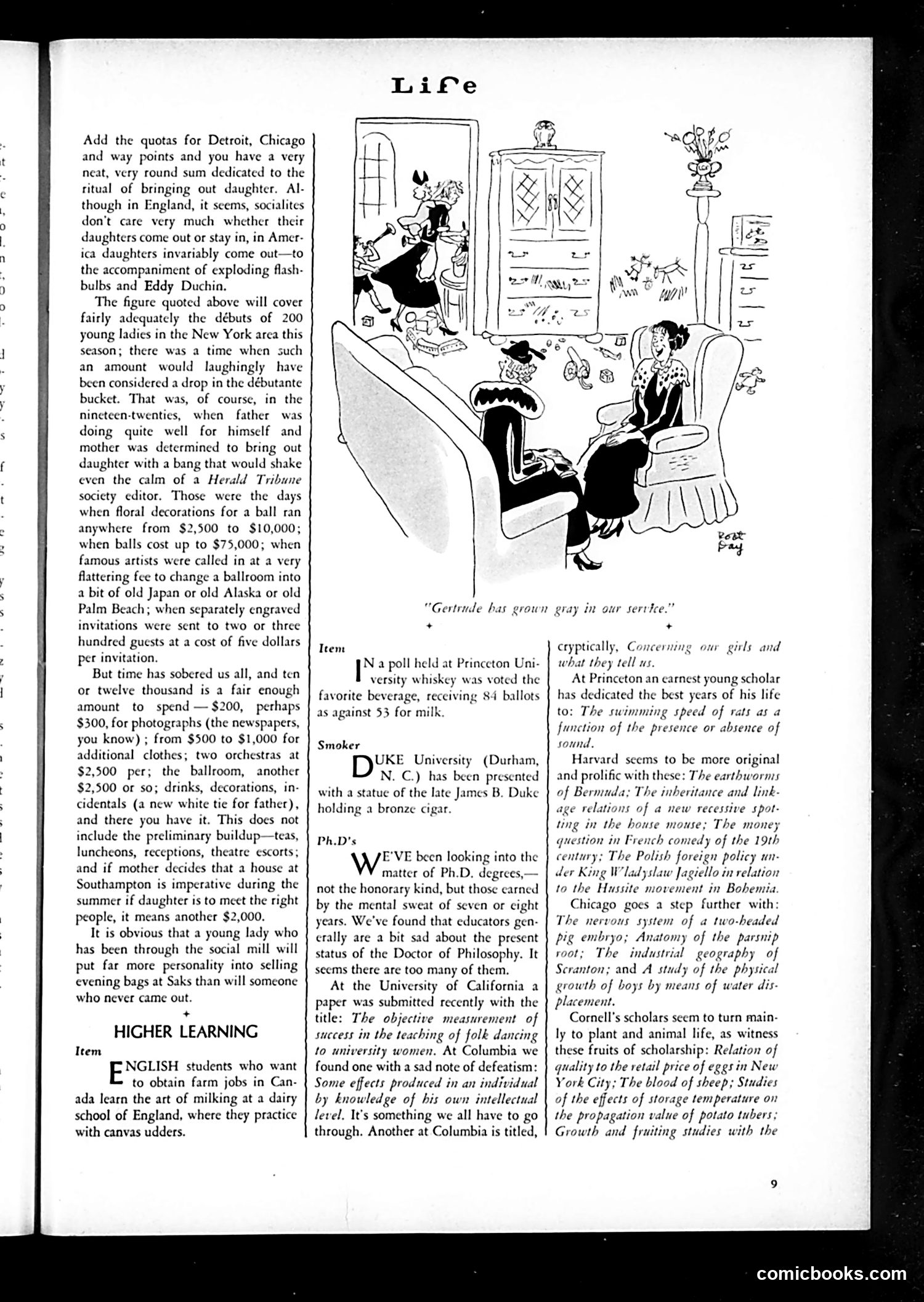
Life Magazine Page Analysis This page contains satirical commentary on American social life in the 1920s. The main cartoon depicts a chaotic domestic scene with a woman gesturing dramatically while a man sits in a chair—likely satirizing the "flapper" era's changing gender dynamics and social customs. The text discusses debutante balls costing up to $75,000, mocking wealthy families' extravagant coming-out rituals. It references specific universities (Princeton, Duke, UC, Columbia) conducting absurd academic studies—parodying the era's proliferation of obscure scholarly research. The humor targets: wealthy pretension, societal conformity, and the disconnect between elaborate social rituals and their actual value. References to "Gertrude has grown gray in our service" suggest servants' exhaustion from hosting endless social events. The satire aims at both the upper classes and academic institutions deemed unnecessarily frivolous.
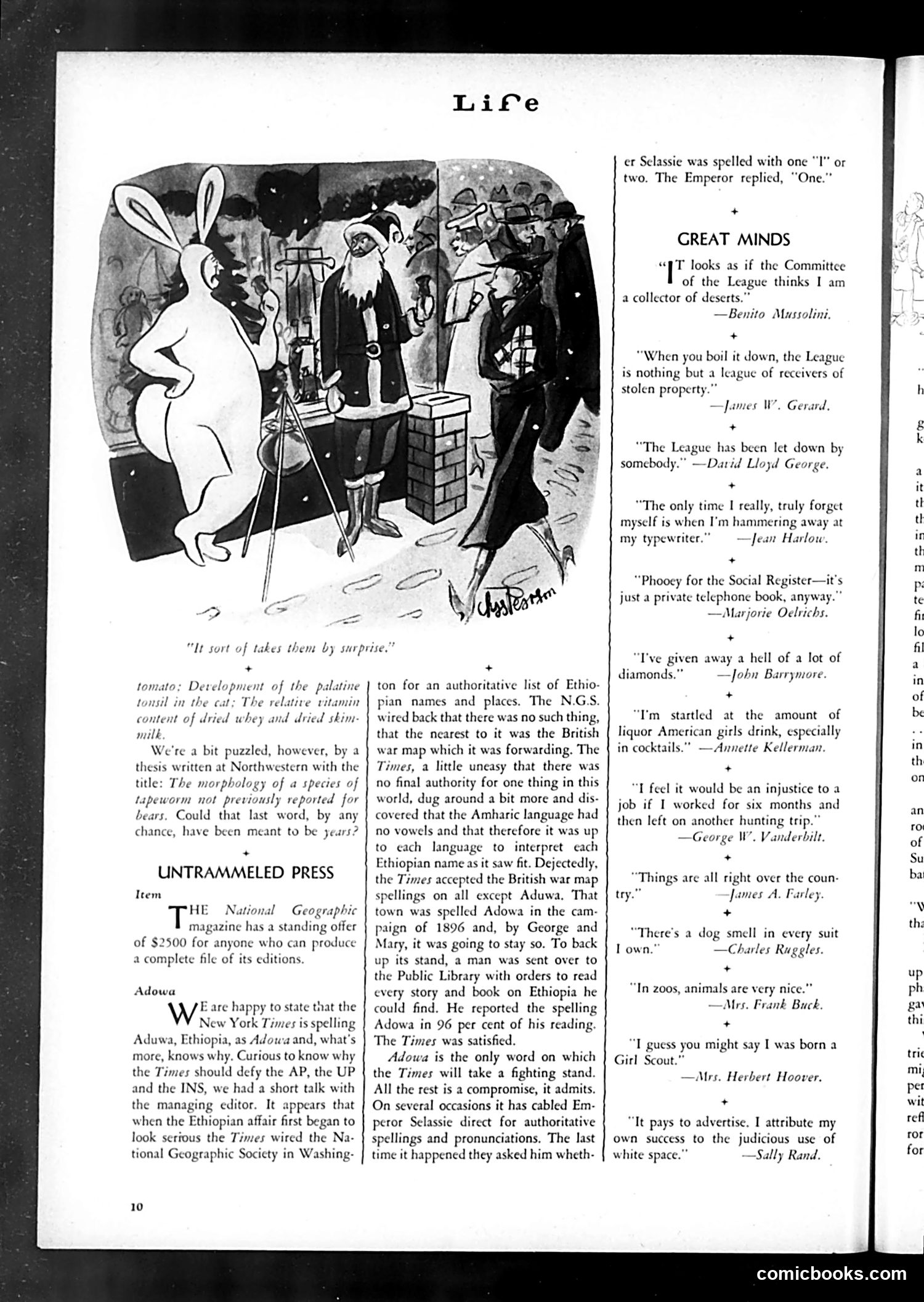
Cartoon Analysis The main cartoon shows a large anthropomorphic rabbit in formal dress presenting to what appears to be officials or dignitaries. The caption reads "It sort of takes them by surprise." The surrounding "Great Minds" section contains satirical quotes criticizing the League of Nations—comparing it to "a collector of deserts" (Mussolini), "a league of receivers of stolen property" (James W. Gerard), and suggesting it has "been let down by somebody" (David Lloyd George). Context: This page satirizes the League of Nations' ineffectiveness, likely from the 1920s-1930s. The rabbit cartoon's exact meaning is unclear from the image alone, but given the surrounding anti-League commentary, it appears to mock the League's surprising or absurd proposals or actions. The quotes reflect contemporary criticism that the League failed to prevent aggression or resolve international disputes.
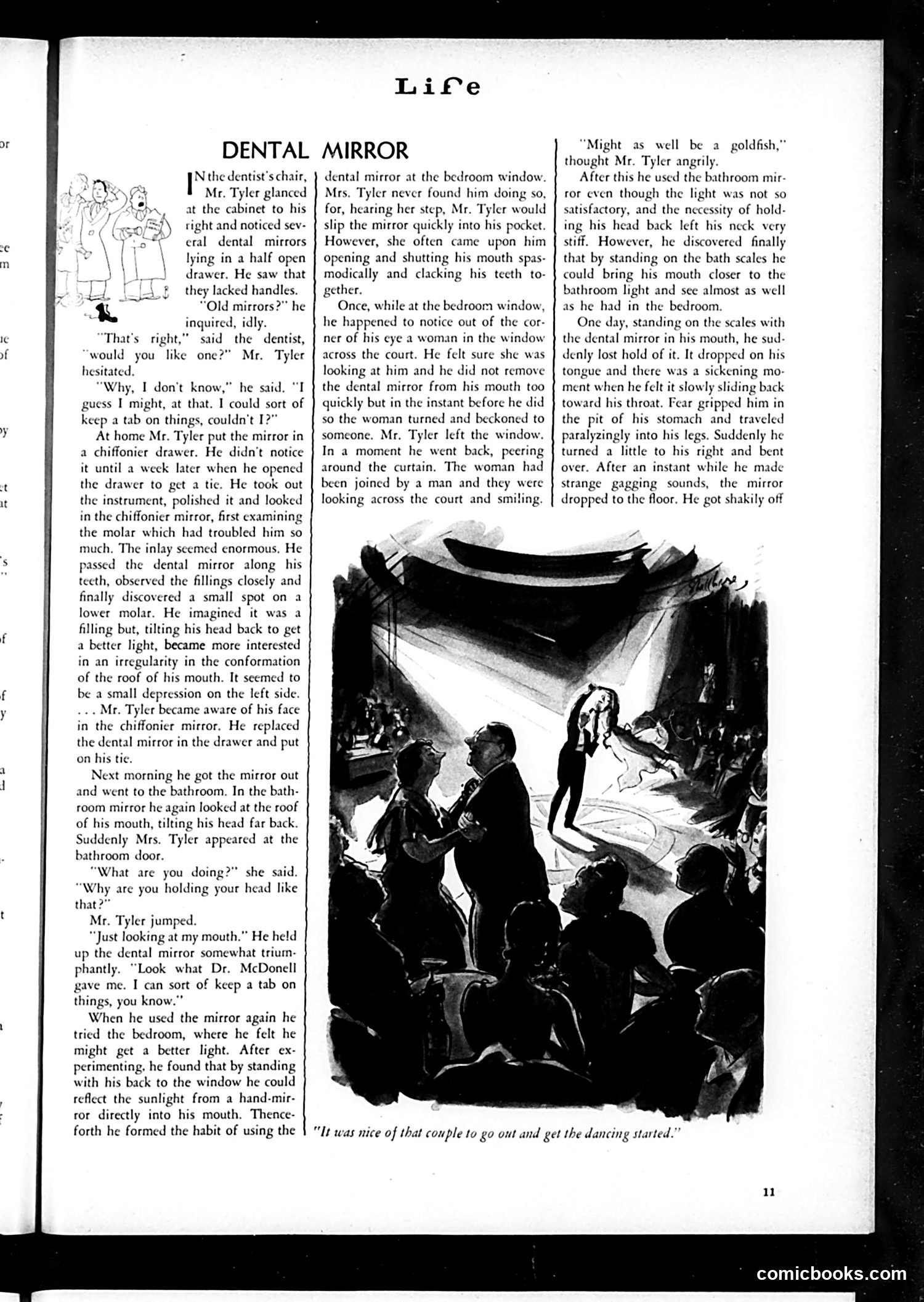
"Dental Mirror" - Life Magazine This is a humorous domestic story, not a political cartoon. Mr. Tyler borrows a dental mirror from his dentist to examine a tooth filling at home. He discovers the mirror works excellently when positioned at the bedroom window with sunlight reflecting into his mouth. The joke hinges on Tyler's obsessive use of this mundane tool—he becomes so absorbed in inspecting his teeth that his wife finds him standing awkwardly at the window, head tilted back. The illustration shows a social gathering where a couple begins dancing, with the caption suggesting Tyler has neglected social obligations for his dental mirror hobby. The satire gently mocks male absent-mindedness and the way men can become fixated on trivial pursuits, ignoring their wives' expectations for social participation.
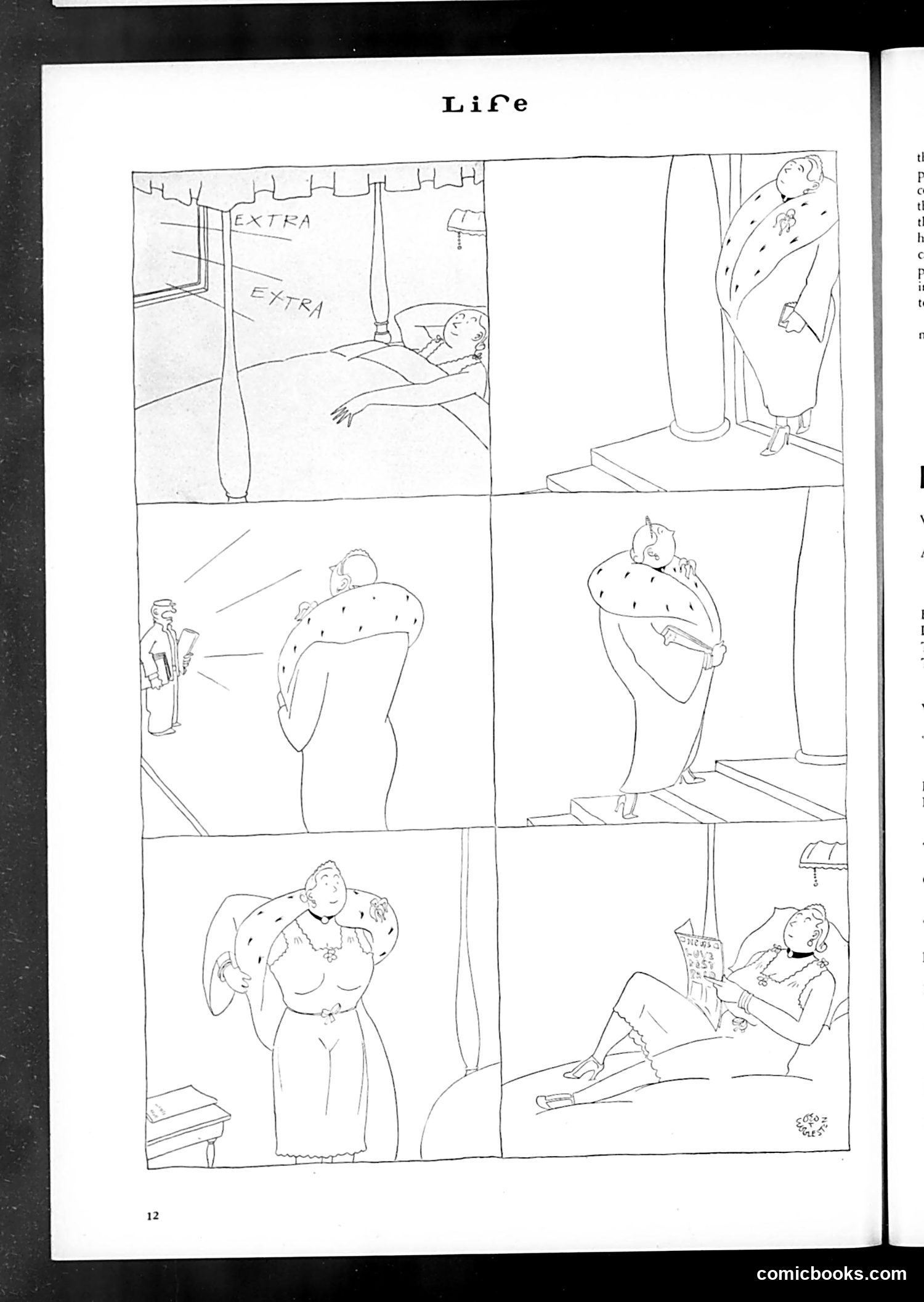
"Life" Comic Page Analysis This appears to be a single-panel comic strip titled "Life" depicting a domestic narrative through six sequential scenes. The comic illustrates a woman's daily routine, progressing from waking in bed (marked "EXTRA"), through getting dressed in increasingly elaborate clothing with feathered details, to various poses and activities. The progression suggests satire about women's fashion, vanity, and the effort involved in appearance maintenance during what appears to be the early-to-mid 20th century. The comic likely mocks the absurdity of contemporary women's fashion—particularly the exaggerated feathered garments and corseting—by showing the woman's transformation from simple bedwear to heavily adorned clothing. This reflects Life magazine's typical satirical approach to social customs and gender expectations of the era.
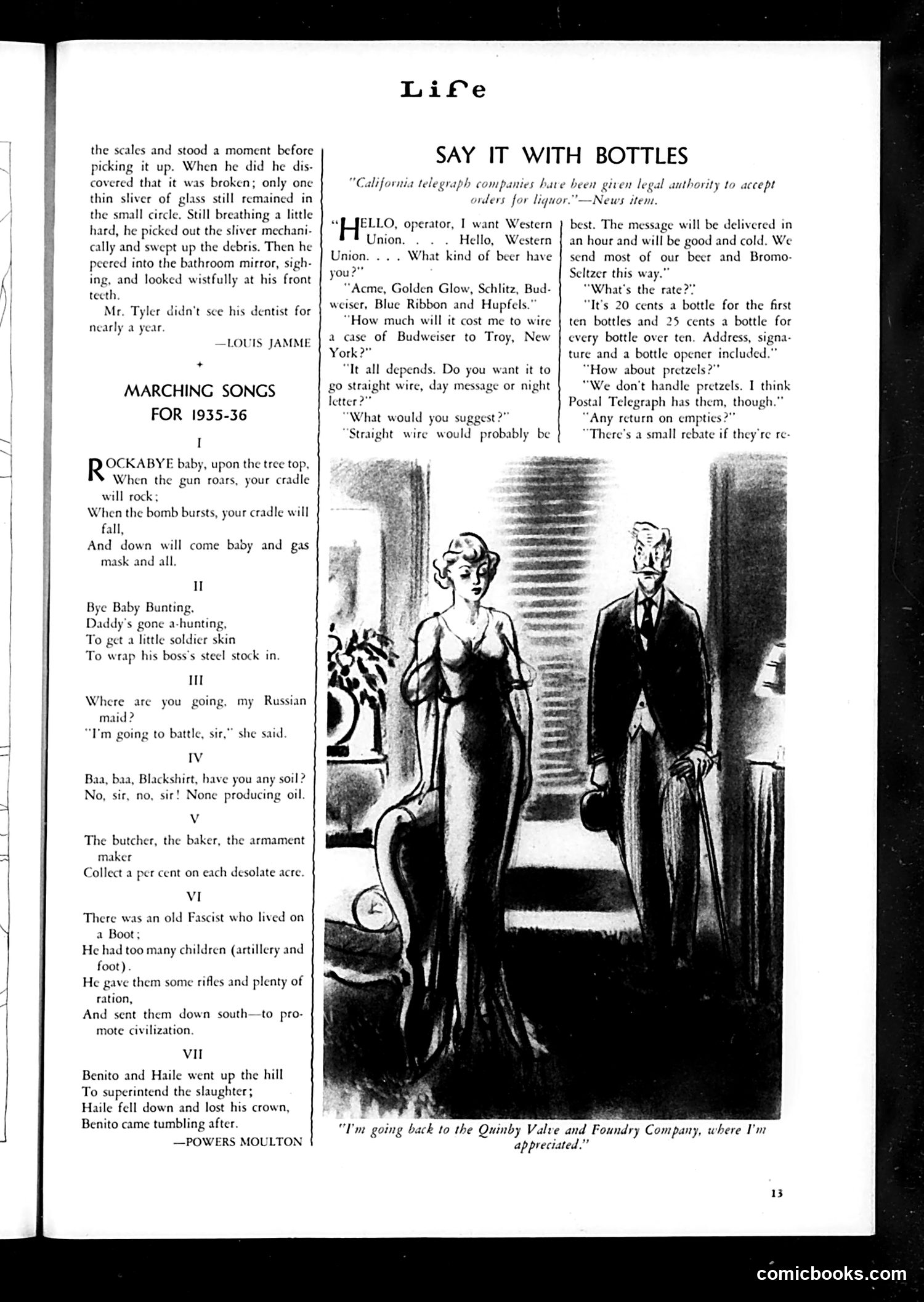
"Say It With Bottles" - Life Magazine Cartoon This cartoon satirizes California telegraph companies' newfound authority to deliver liquor orders during Prohibition. The humor hinges on this absurd loophole: while alcohol sales were illegal, companies could technically accept and transmit orders via telegraph. The dialogue shows an operator helping a customer send beer to Troy, New York—complete with bottle opener included. The joke: they're exploiting legal technicalities to circumvent Prohibition laws. The well-dressed couple in the illustration appears to represent consumers eagerly using this newfound delivery method. The title "Say It With Bottles" parodies the popular advertising slogan "Say It With Flowers," mocking how people were creatively—and somewhat ridiculously—finding ways around Prohibition's restrictions through legal gray areas.
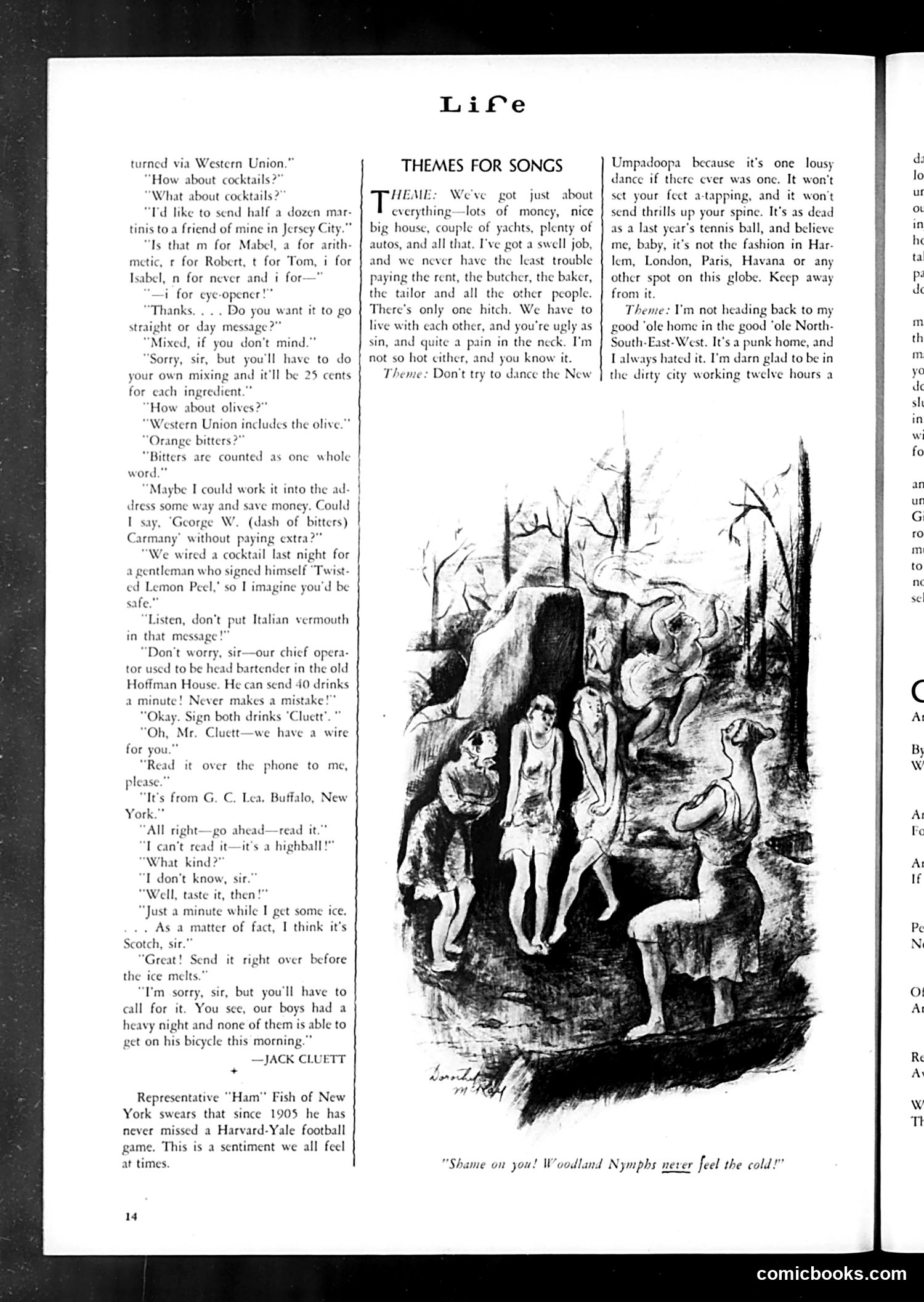
Page Analysis: Life Magazine This page contains a humorous dialogue about cocktail mixing (left) and an illustration (right) titled "Shame on you! Woodland Nymphs *never* feel the cold!" The illustration depicts classical woodland nymphs in a natural setting, apparently underdressed for cold weather. The caption's joke plays on the traditional artistic convention of depicting nymphs as scantily-clad figures in nature—the satire suggests that such mythological beings, as popularly portrayed in art, are somehow immune to cold despite minimal clothing. The left column is an anecdotal humor piece about someone (possibly Jack Cluett, bylined at bottom) attempting to order or prepare cocktails, featuring dated slang and casual 1920s-era conversational humor about bartenders and drink specifications.
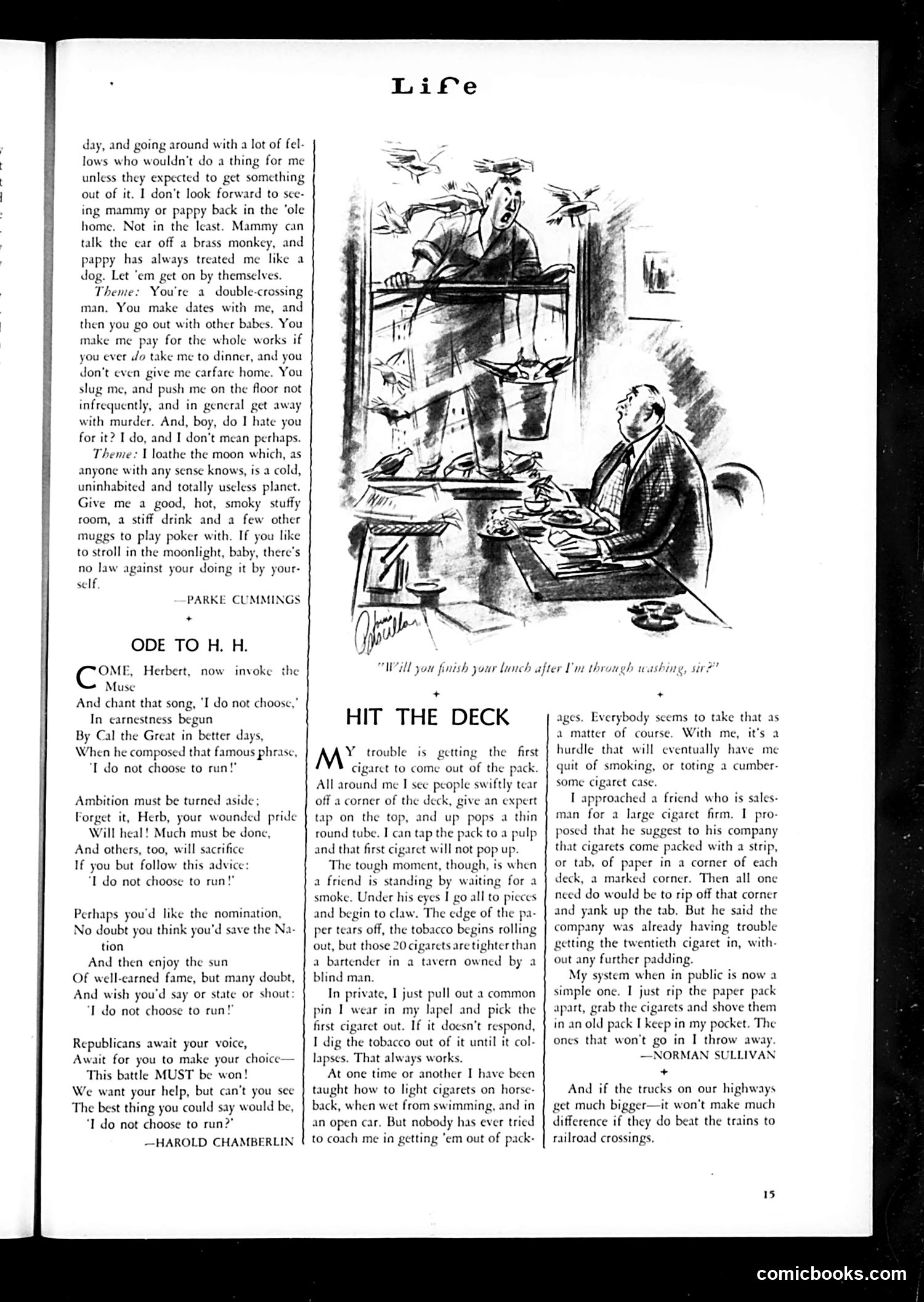
Political Cartoon Analysis: "Hit the Deck" The main cartoon depicts a man at a desk with cigarettes, addressing another man who asks "Will you finish your lunch after I'm through visiting, sir?" The accompanying article by Norman Sullivan discusses the difficulty of removing the first cigarette from a new pack—a common, relatable frustration. Sullivan describes various techniques: using a lapel pin, digging tobacco out with fingernails, or pulling the paper pack apart at marked corners. This is not political satire but rather humorous social commentary on everyday annoyances. The cartoon illustrates the awkwardness of smoking etiquette in shared office spaces, while the article validates readers' shared experience with a mundane but genuinely vexing consumer problem—the poorly-designed cigarette pack.
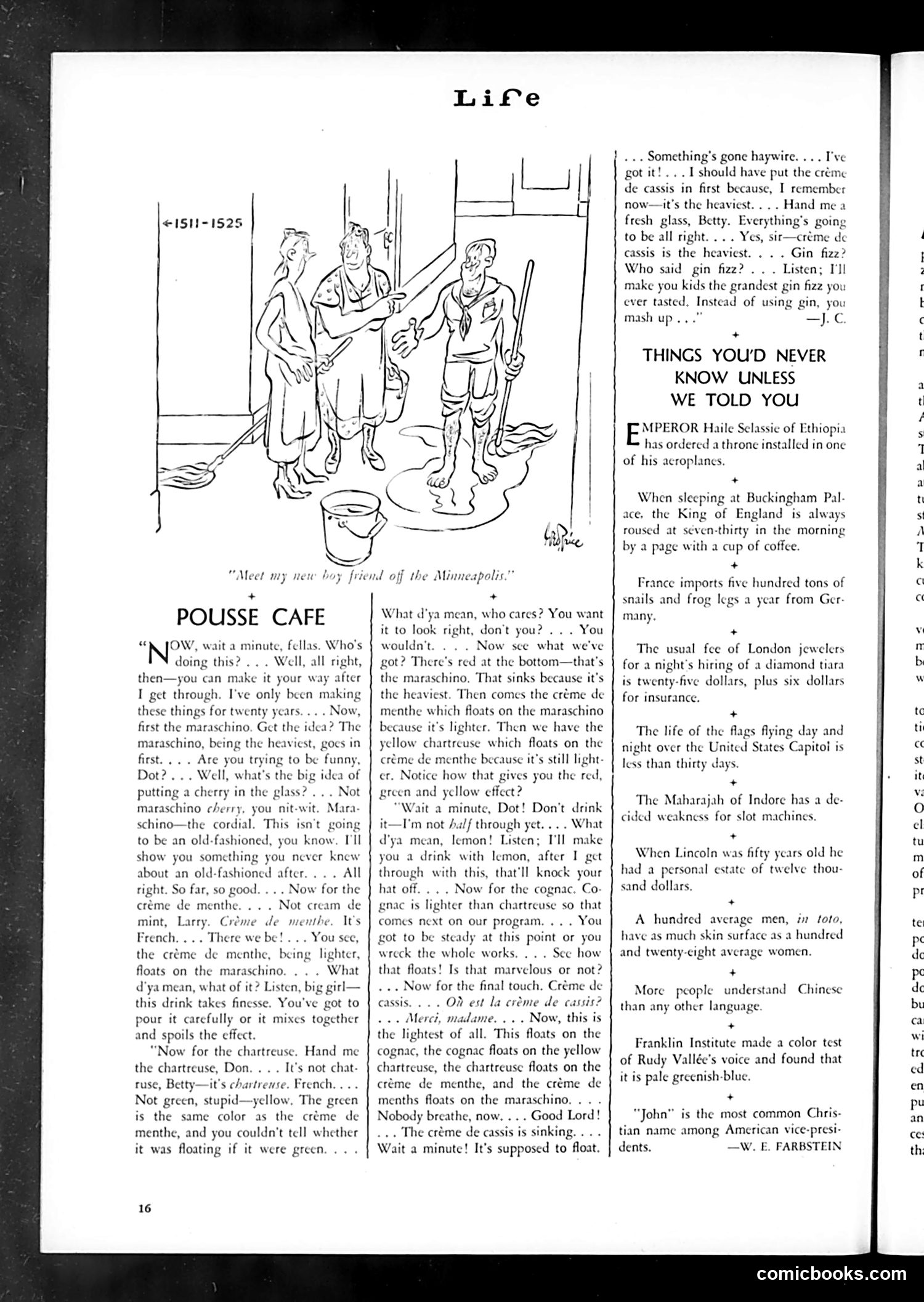
Analysis of Life Magazine Page 16 The Main Cartoon (dated 1511-1525) depicts three figures in period dress sharing a drink, with the caption "Meet my new boy friend off the Minneapolis." This appears to be satirizing casual social encounters, likely in a speakeasy context (given Prohibition-era references in the adjacent article). "Poulisse Cafe" is a humorous dialogue about mixing cocktails, specifically debating the proper preparation of a crème de menthe drink. The joke centers on whether the ingredient should "float" or sink, with one character insisting it's "supposed to float" despite sinking. This is gentle satire of bartending pretension and drinking culture disputes. The right column contains miscellaneous trivia tidbits—typical Life magazine filler content.
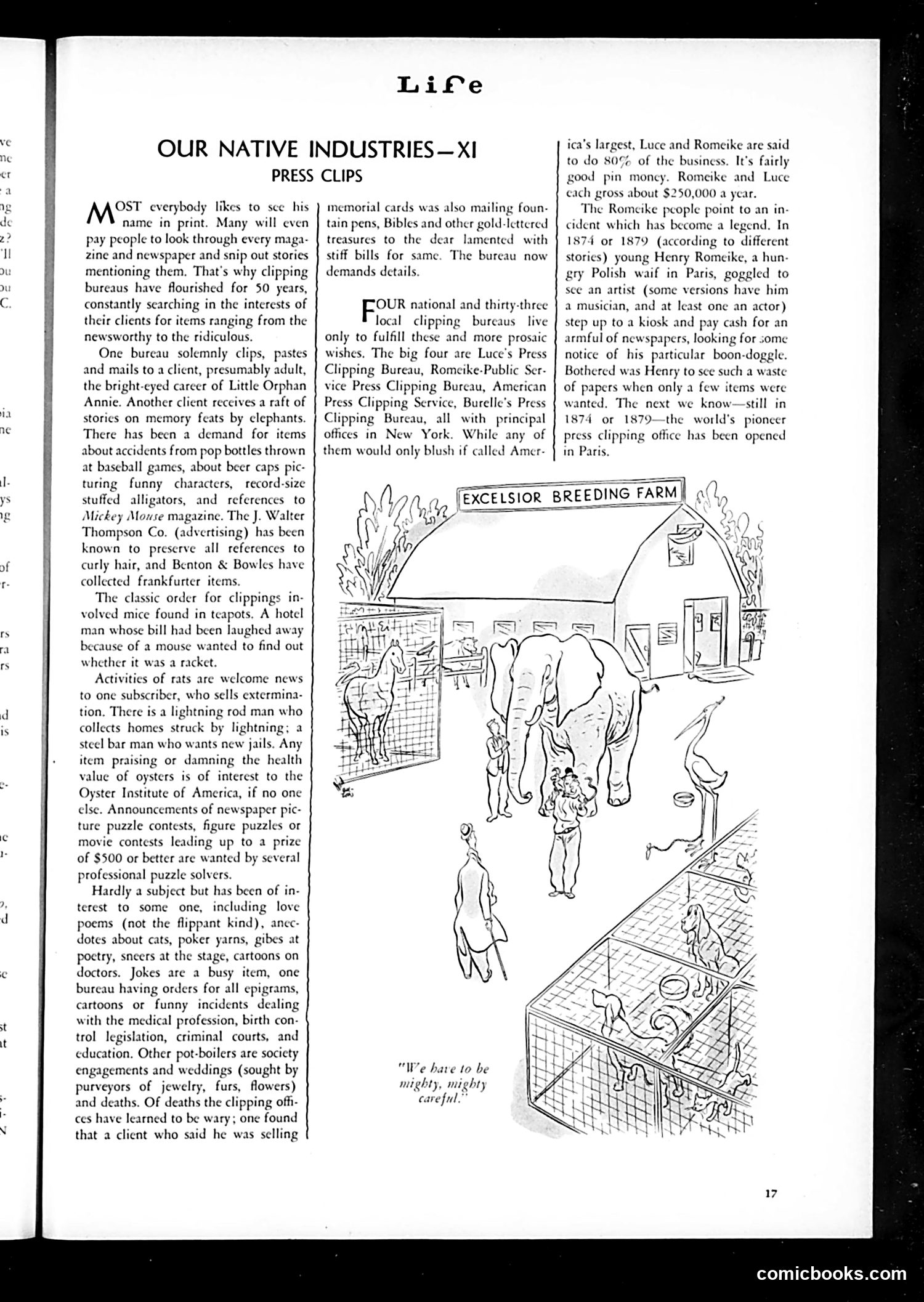
Excelsior Breeding Farm Cartoon This single-panel cartoon satirizes an elephant breeding operation. The illustration shows a large elephant inside a farm facility labeled "Excelsior Breeding Farm," with handlers and observers monitoring the situation. The caption reads: "If we have to be nightly, nightly careful." The satire appears to mock the difficulty and delicate nature of breeding elephants in captivity—treating animal husbandry as comically complicated labor requiring constant vigilance. This likely reflects early 20th-century public fascination with exotic animal farming and circus operations. The cartoon pokes fun at the elaborate precautions supposedly necessary for such specialized breeding, presenting it as an absurdly meticulous enterprise. The page itself discusses various newspaper clipping bureaus and unusual business practices, making this cartoon fit the theme of quirky American industries.
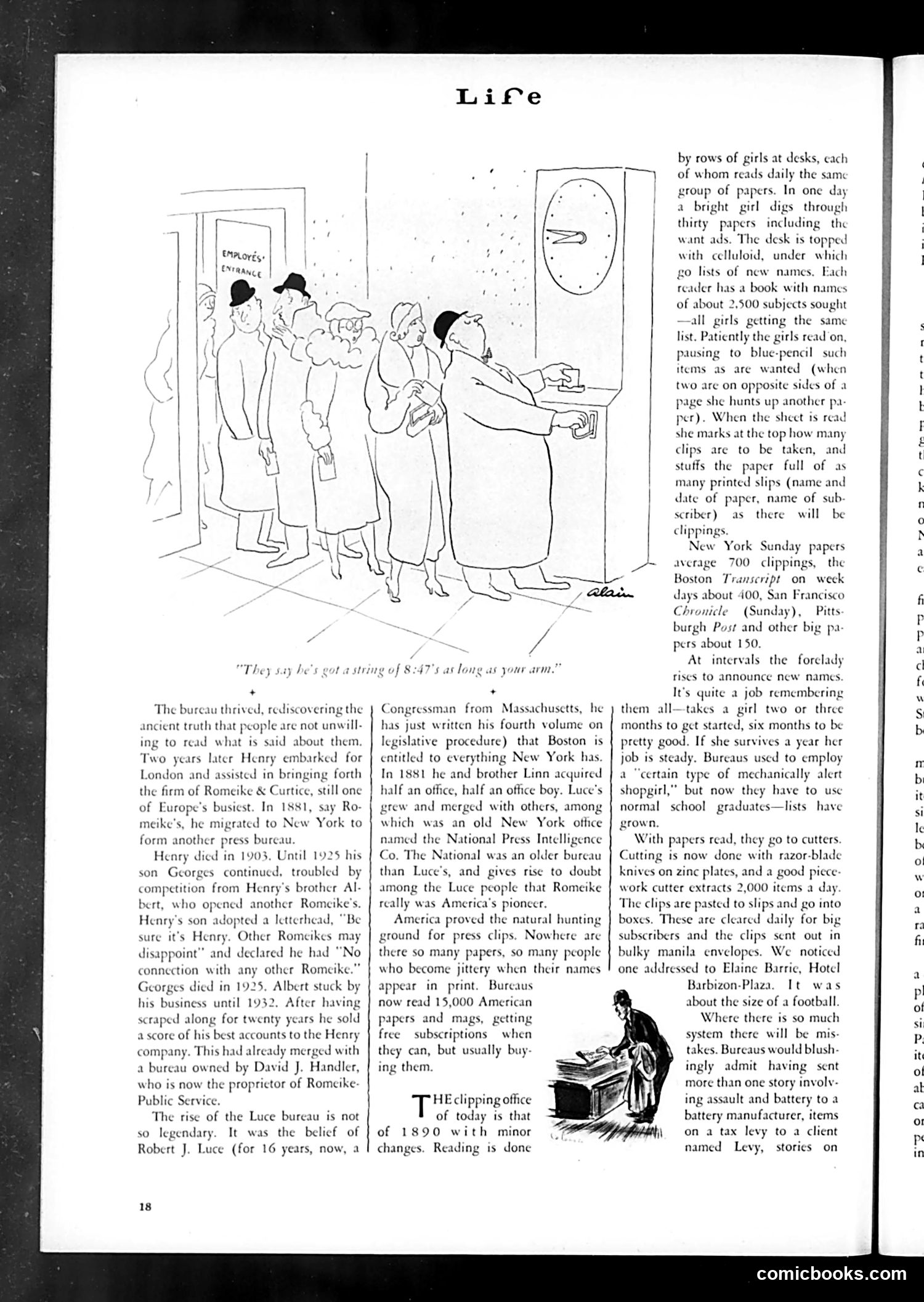
Cartoon Analysis The cartoon depicts a group of people crowding around a doorway, with one man stretching his arm out holding what appears to be a document or notice. The caption reads: "They say he's got a string of 8:47 a long as your arm." This is a satirical commentary on newspaper clipping bureaus—services that collected printed mentions of clients' names from publications. The "string of 8:47" refers to numerous clippings (8:47 likely representing a quantity or reference number). The cartoon ridicules the vanity of seeking widespread press coverage and those obsessively tracking their mentions in print. The crowded, eager scene mocks the narcissism involved in using clipping services to document one's public visibility. This reflects early 20th-century anxieties about media, publicity, and self-promotion culture.
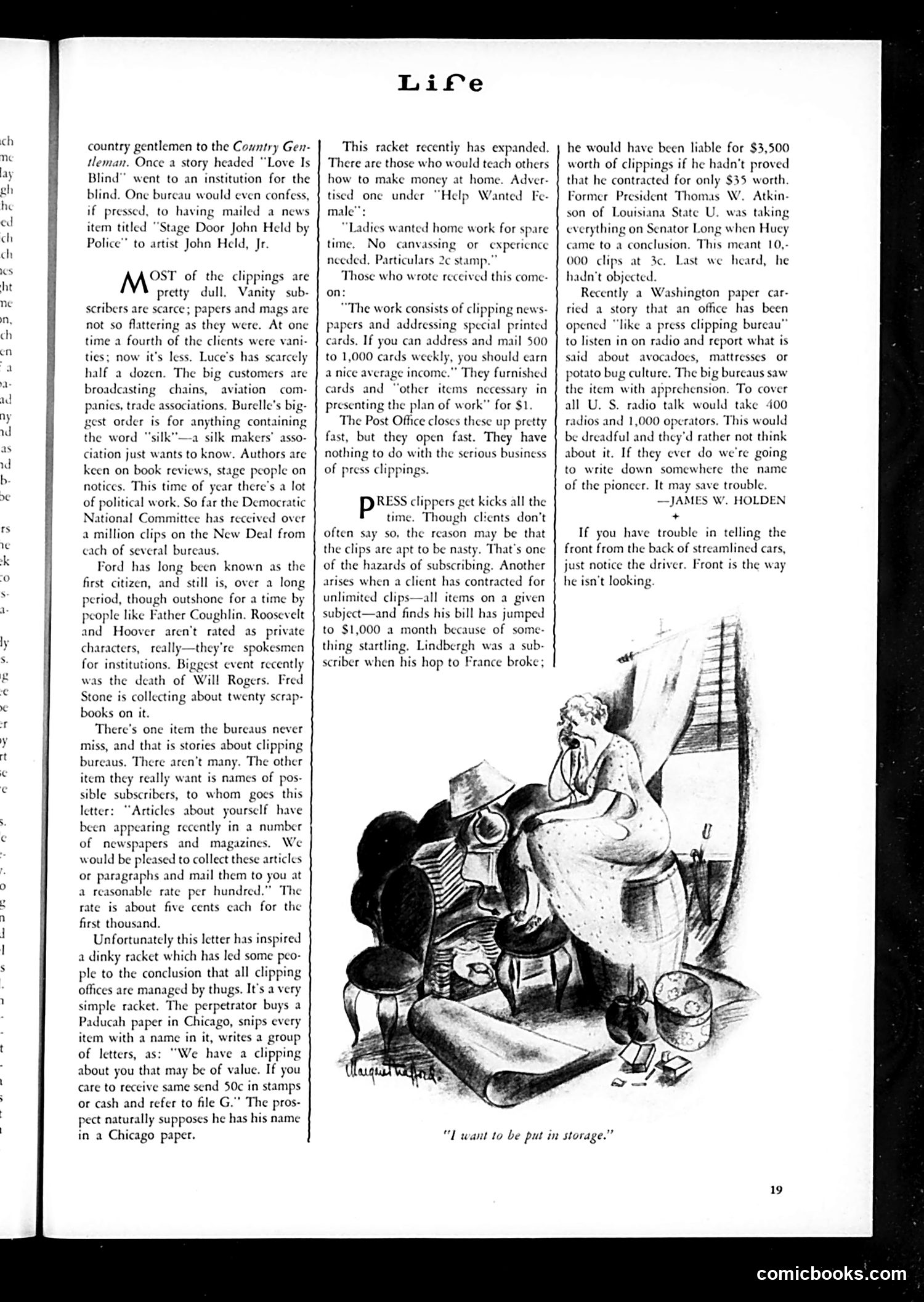
Political Cartoon & Content Analysis This Life magazine page satirizes mail-order scams and work-from-home schemes. The text describes various dubious "opportunities": clipping newspaper articles, addressing postcards, or selling subscriptions—all promising easy income but yielding little profit. The cartoon depicts a woman storing materials for one such scheme, saying "I want to be put in storage," suggesting the accumulated worthless items have become burdensome clutter. The satire targets the Depression-era proliferation of get-rich-quick frauds that preyed on desperate people seeking supplemental income. The magazine ridicules both the schemes themselves and the gullible subscribers who repeatedly fall for them, revealing how these operations exploit financial anxiety through false promises of passive earnings.
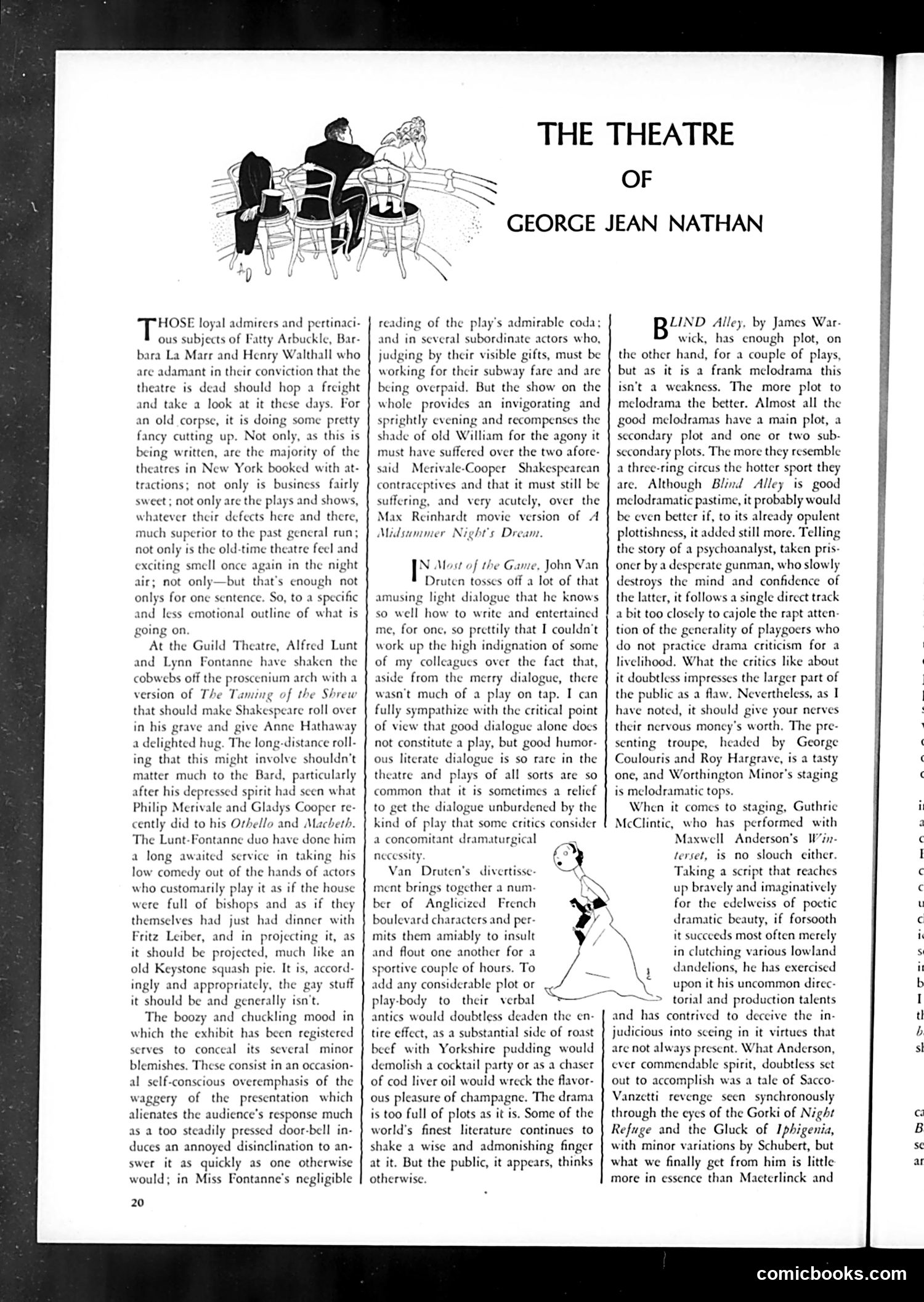
The Theatre of George Jean Nathan This is a drama criticism column by George Jean Nathan, a prominent early 20th-century theater critic. The page discusses current Broadway productions, not political satire. The illustration shows three figures seated in chairs—likely representing theater patrons or critics discussing plays. Nathan reviews several productions: Alfred Lunt and Lynn Fontanne's *The Taming of the Shrew* at the Guild Theatre (which he praises for its comedic energy), John Van Druten's *In Most of the Game* (praised for witty dialogue despite thin plot), and mentions of films and performances by actors like Fatty Arbuckle and Henry Walthall. Nathan's critique emphasizes that despite predictions of theater's death, Broadway remains vital. His commentary is literary and aesthetic rather than political—he's evaluating acting, direction, and dramatic construction of contemporary plays.
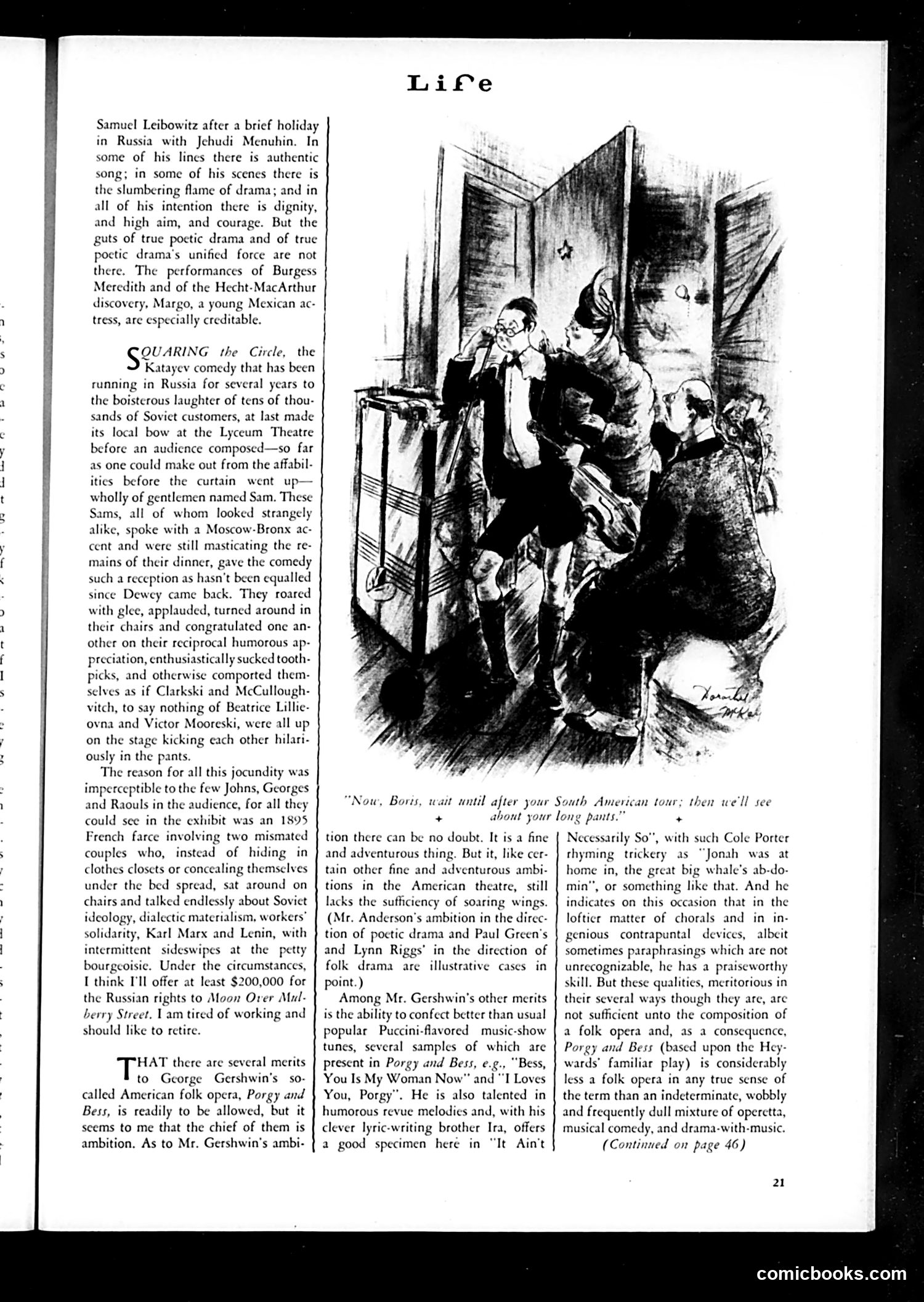
Life Magazine Page Analysis This page discusses theatrical productions, featuring a cartoon and critical reviews. The cartoon depicts what appears to be Russian or Eastern European immigrants at a theater—men in suits and hats—reacting enthusiastically to "Squaring the Circle," a Soviet Russian comedy. The satire mocks these working-class audience members (generically called "Sam") who find the play hilarious, while the author notes that non-ethnic audiences ("Johns, Georges and Raouls") found it tedious. The joke relies on ethnic stereotyping: immigrants supposedly found humor in the play's references to Marx, Lenin, and Soviet ideology, while educated American audiences saw only a dated 1895 French farce. The page also reviews George Gershwin's "Porgy and Bess," praising its ambition while criticizing its execution. The critic acknowledges Gershwin's musical talents but suggests the opera lacks the "soaring wings" of true artistic achievement.
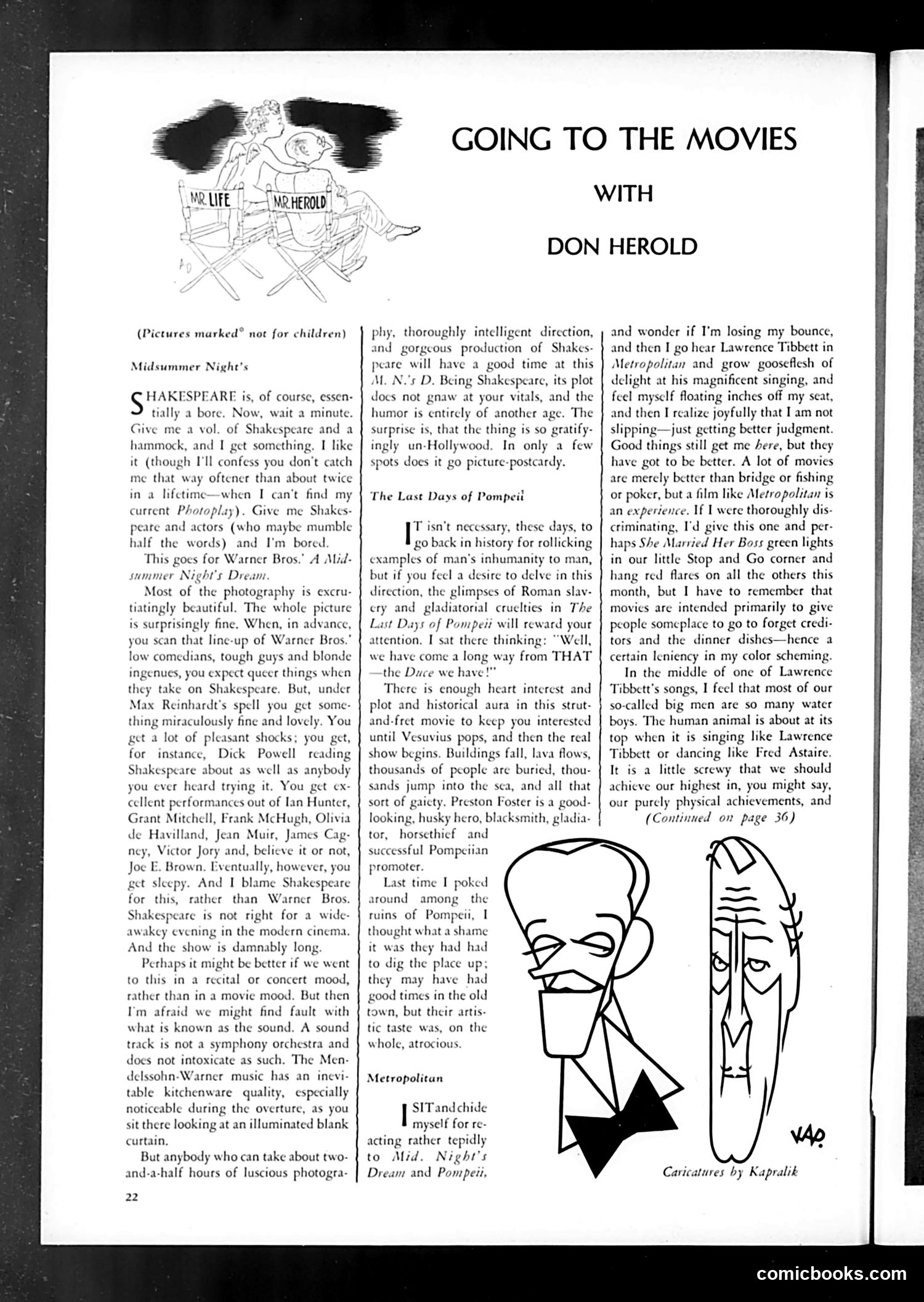
Analysis: "Going to the Movies with Don Herold" This is a film criticism column by humorist Don Herold reviewing three 1935 movies. The page contains two cartoon caricatures by Kapralik (artist credited at bottom) depicting what appears to be operatic or theatrical figures—likely representing characters from *Metropolitan*, the opera film discussed. Key points: - Herold reviews Warner Bros.' *A Midsummer Night's Dream* (directed by Max Reinhardt), praising its visual beauty and performances but finding Shakespeare itself tedious for cinema - *The Last Days of Pompeii* is deemed entertaining historical spectacle with an implicit dig at fascism ("we have come a long way from THAT")—referencing Mussolini's Italy - *Metropolitan* (an opera film, likely featuring Lawrence Tibbett) redeems Herold's flagging enthusiasm The satire: The column mocks both Shakespeare's unsuitability for modern film audiences and the pretentiousness of adapting classical material for Hollywood, while celebrating that grand opera can still move viewers emotionally in ways cinema often cannot.
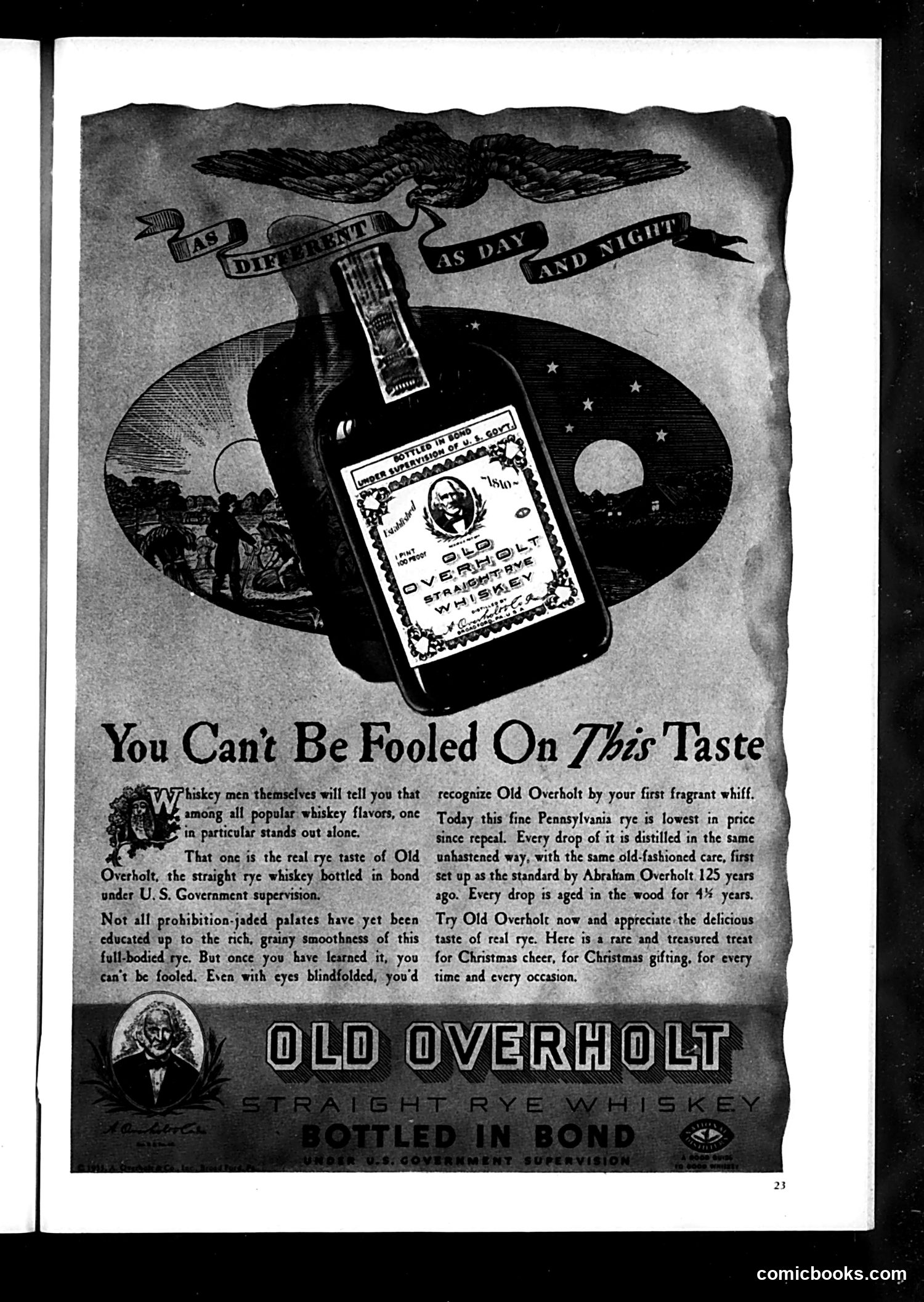
Analysis This is a whiskey advertisement, not political satire. It's an Old Overholt straight rye whiskey ad from the post-Prohibition era (likely 1930s-40s, given the reference to "repeal"). The imagery uses patriotic symbolism—an eagle, day/night imagery, and stars—to reinforce American heritage. The ad emphasizes that Old Overholt is a genuine Pennsylvania rye with 125 years of history, bottled under U.S. Government supervision, and aged 4½ years. The headline "You Can't Be Fooled On This Taste" is the central sales pitch: the whiskey's distinctive flavor is so recognizable that even blindfolded, one could identify it. For modern readers: this reflects early post-Prohibition marketing when alcohol companies rushed back to legitimate commerce, emphasizing tradition, government oversight, and quality to rebuild consumer confidence after 13 years of illegal production.
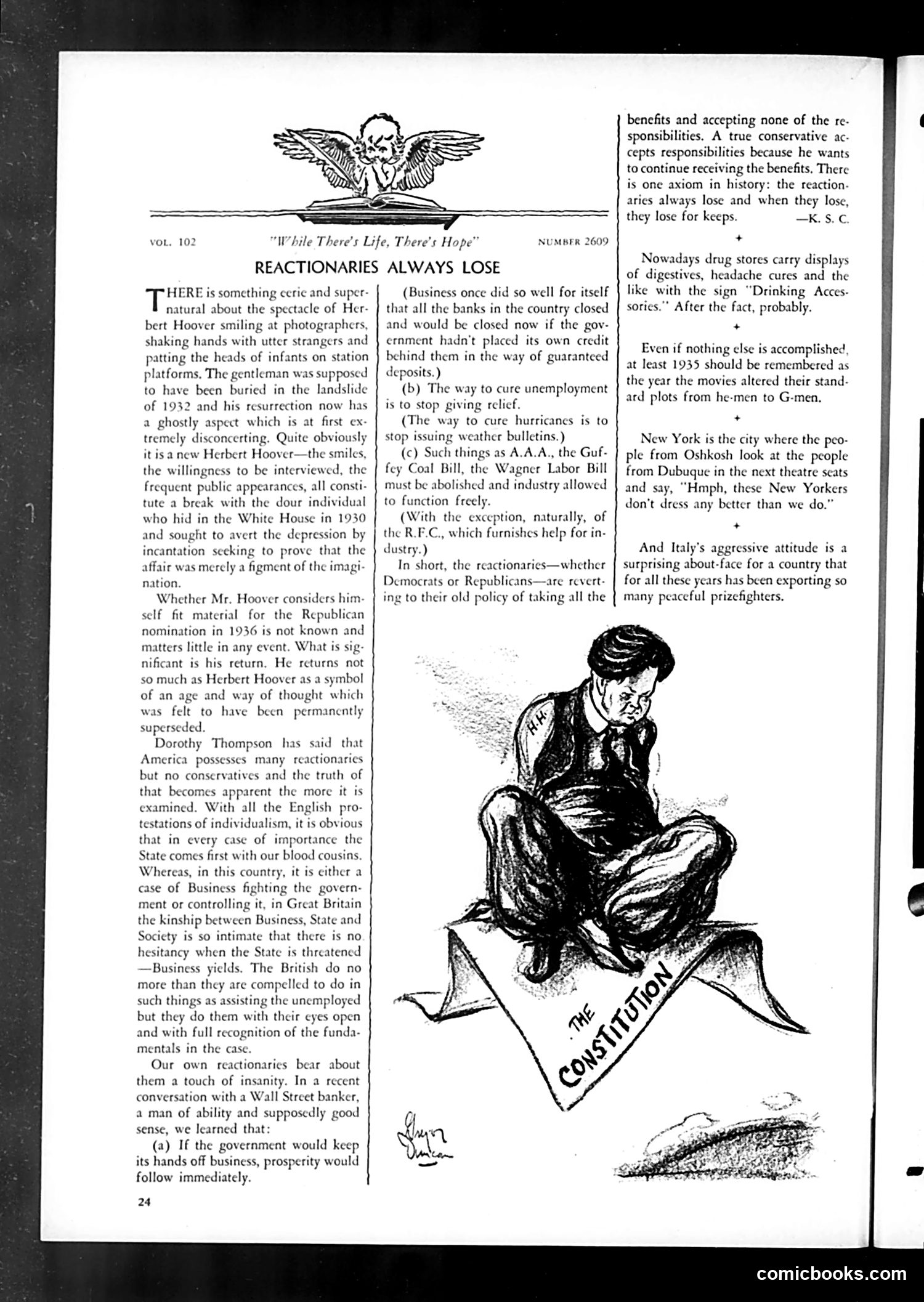
Political Satire: "Reactionaries Always Lose" This 1935 *Life* magazine article attacks American conservative opponents of Roosevelt's New Deal policies. The featured cartoon depicts "The Constitution" as a fragile document being crushed or destroyed—symbolizing reactionaries' claim that New Deal programs (like the AAA and Wagner Labor Bill) violate constitutional principles. The text ridicules what it calls "reactionary" thinking: the belief that government should abandon business regulation and social relief programs, yet paradoxically accept government aid (like RFC loans to banks). The author contrasts this with British conservatives, who accept state responsibility alongside state benefits. The essay uses former President Herbert Hoover's political reemergence as a symbol of outdated laissez-faire ideology supposedly "buried" in 1932. The title's optimism—"reactionaries always lose"—reflects Depression-era confidence that progressive policies would prevail. The cartoon visualizes conservatives' fear that New Deal reforms fundamentally undermine constitutional governance.
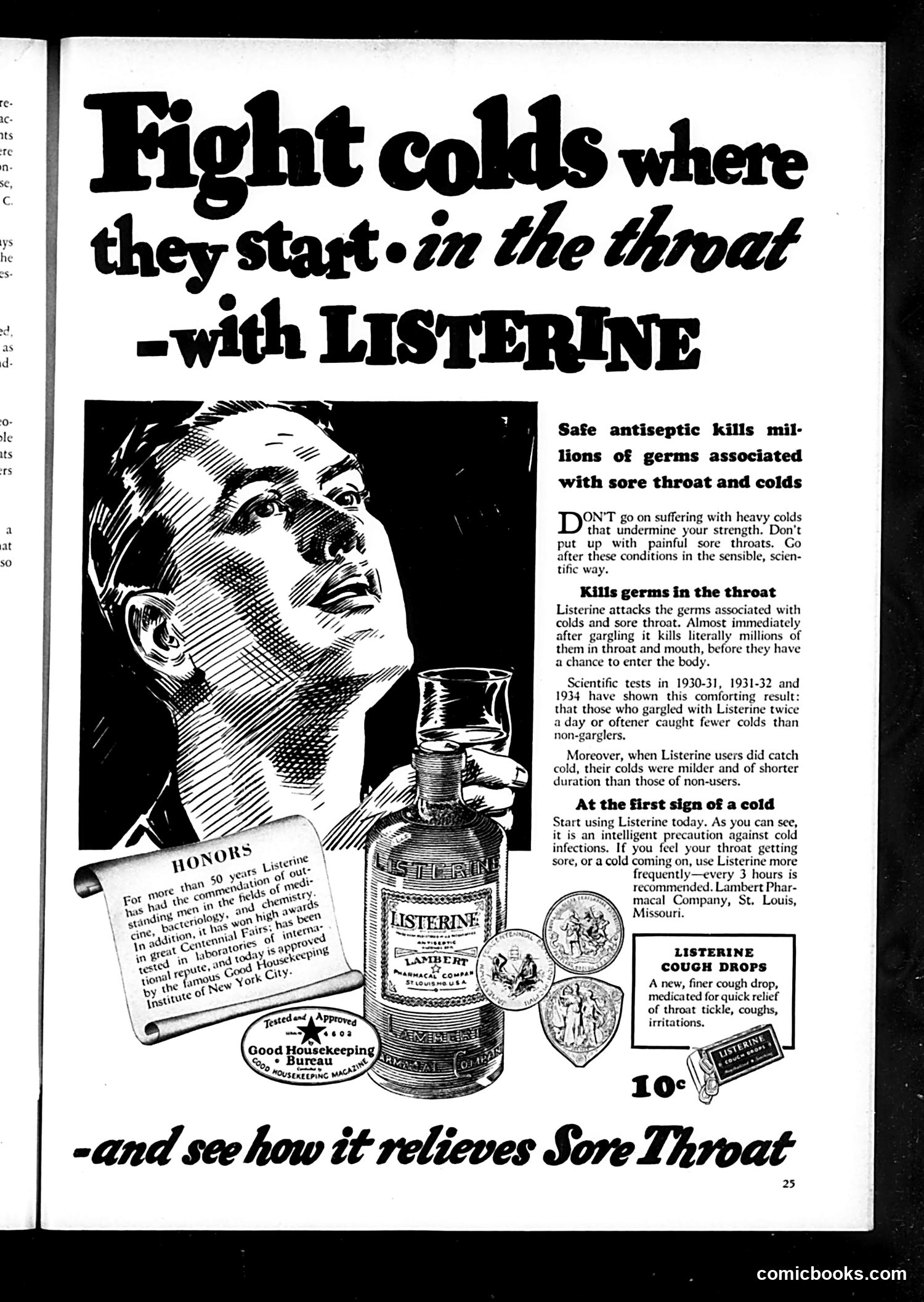
Analysis This is a Listerine advertisement, not political satire or cartoon content requiring historical context. The page promotes Listerine mouthwash as a cold and sore throat preventative. The illustration shows a woman gargling, presented as an endorsement of the product's effectiveness. The ad cites "scientific tests in 1930-31, 1931-32 and 1934" claiming users who gargled twice daily caught fewer colds than non-users, and experienced milder, shorter colds when infected. The "honors" seal references Good Housekeeping magazine's approval. The ad recommends frequent use—every three hours at first cold symptoms—and advertises a new Listerine Cough Drops product at 10 cents. For modern readers: this represents early twentieth-century marketing that made health claims (common before FDA regulation), presenting corporate research as scientific proof without the modern skepticism we'd apply today.
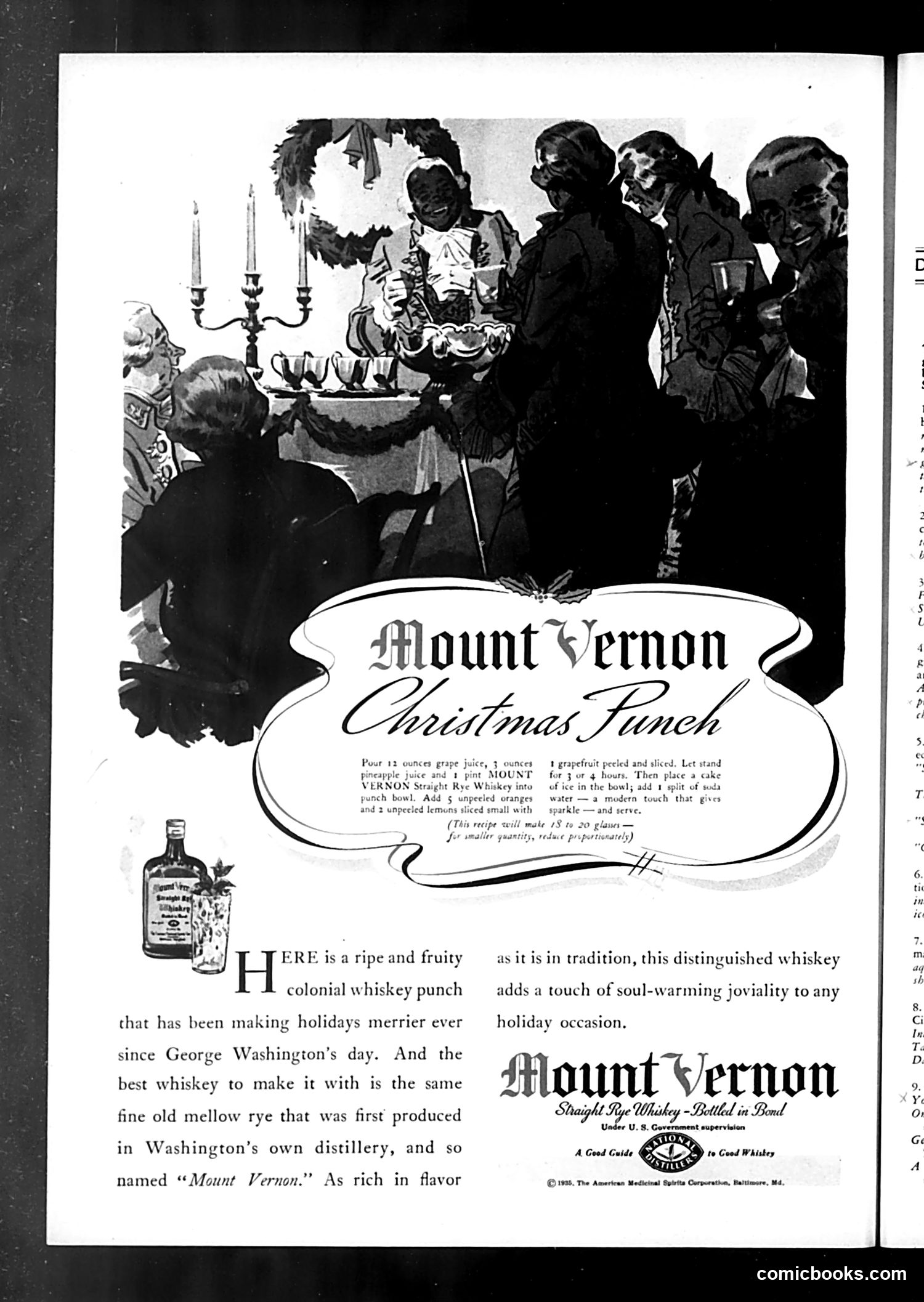
Mount Vernon Christmas Punch Advertisement This is primarily a whiskey advertisement, not political satire. The page promotes Mount Vernon brand rye whiskey by connecting it to George Washington and colonial American tradition. The illustration shows a festive holiday party scene with figures in formal dress gathered around a punch bowl decorated with holly. The ad copy claims the whiskey was "first produced in Washington's own distillery" and emphasizes its historical pedigree ("since George Washington's day"). The humor is gentle marketing rather than satire—the "ripe and fruity colonial whiskey punch" is presented as carrying on a distinguished American tradition. The recipe and the invocation of Washington's era are designed to make the product seem prestigious and authentically American, appealing to holiday entertaining. This reflects 1930s advertising strategy: linking consumer products to founding-era Americana for prestige and patriotic appeal.
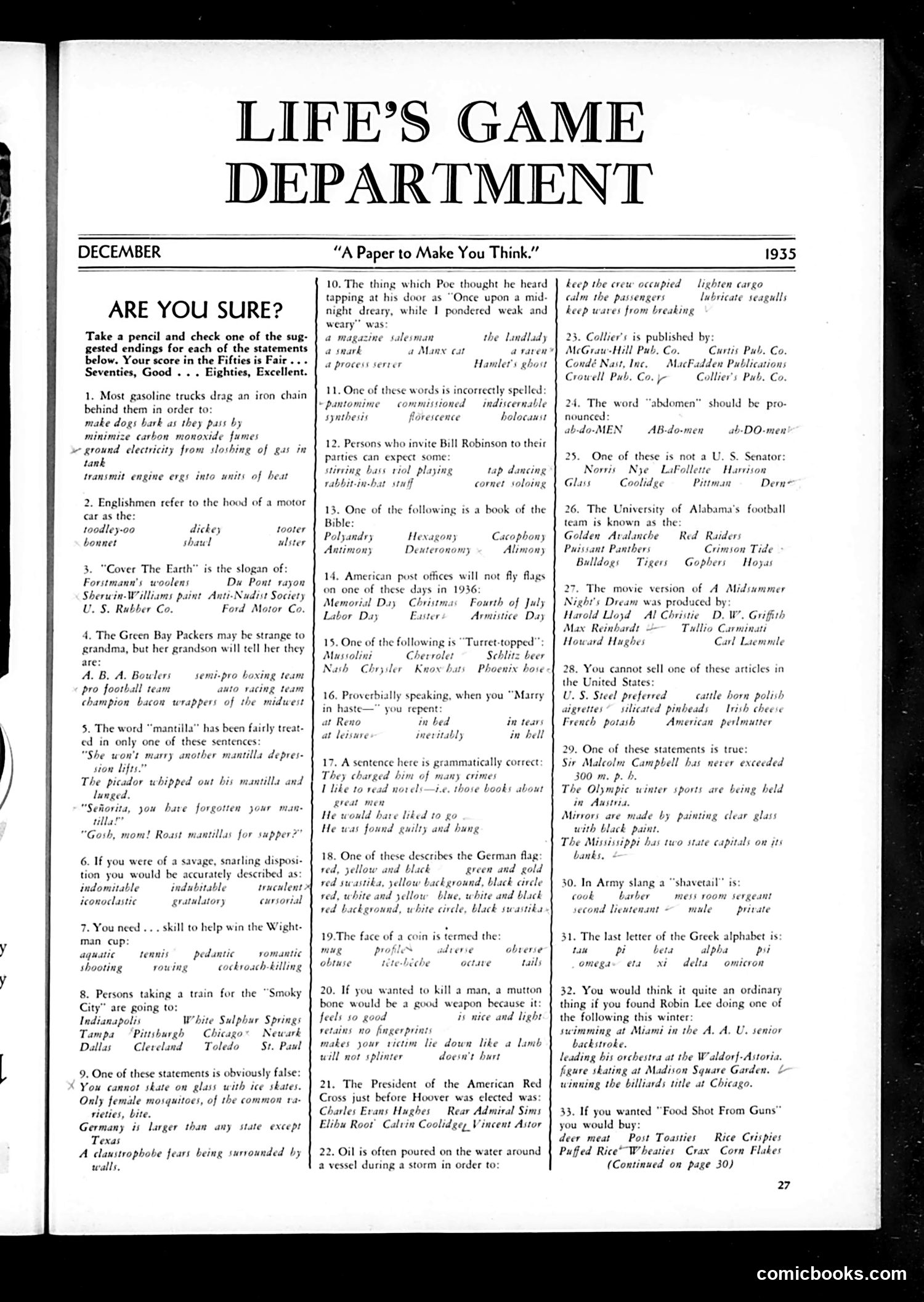
Life's Game Department - December 1935 This page is a trivia quiz designed to test readers' general knowledge across diverse topics. Rather than a political cartoon, it's an interactive feature typical of *Life* magazine's humor approach. The 33 questions span: automotive facts (gasoline truck chains ground static electricity), British terminology (bonnets), brand slogans (Sherwin-Williams' "Cover the Earth"), sports (Green Bay Packers as pro football), grammar, geography, current events, and popular culture. Question 18 notably asks readers to identify the German flag's appearance—significant given the date (1935), when Nazi Germany was rising under Hitler. The correct answer appears to be the swastika design. The quiz's framing ("Your score...Fifties is Fair...Seventies, Good...Eighties, Excellent") suggests readers competed for intellectual bragging rights. This reflects *Life*'s educated, middle-to-upper-class audience during the Depression era, using humor and self-assessment games to engage readers.
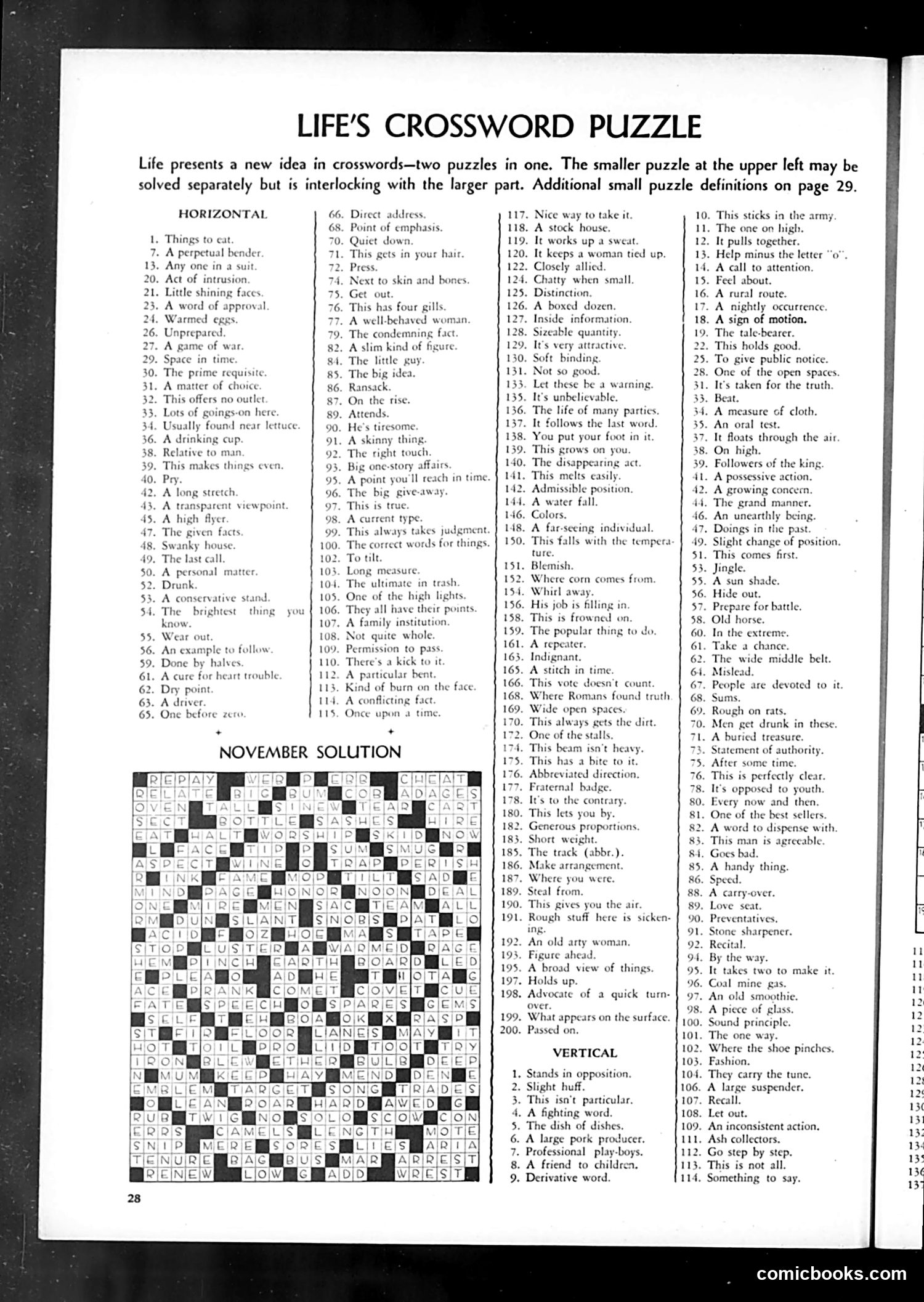
Analysis of "Life's Crossword Puzzle" This page presents a crossword puzzle, not a political cartoon. It's a recreational feature where *Life* magazine offered readers "a new idea in crosswords—two puzzles in one," with an interlocking smaller puzzle and larger puzzle. The clues are wordplay-heavy and humorous, typical of 1920s-era puzzle construction. Examples include puns ("A perpetual bender," "Warmed eggs," "A slim kind of figure") and contemporary references ("An old arty woman," "This vote doesn't count"). The "November Solution" shown is the completed answer grid from a previous month's puzzle. This is entertainment content, not satire. While *Life* was known for satirical cartoons and commentary, this particular page is simply a leisure activity for readers—the magazine's attempt to engage its audience with clever wordplay and cognitive challenge, reflecting early twentieth-century puzzle-solving as popular entertainment.
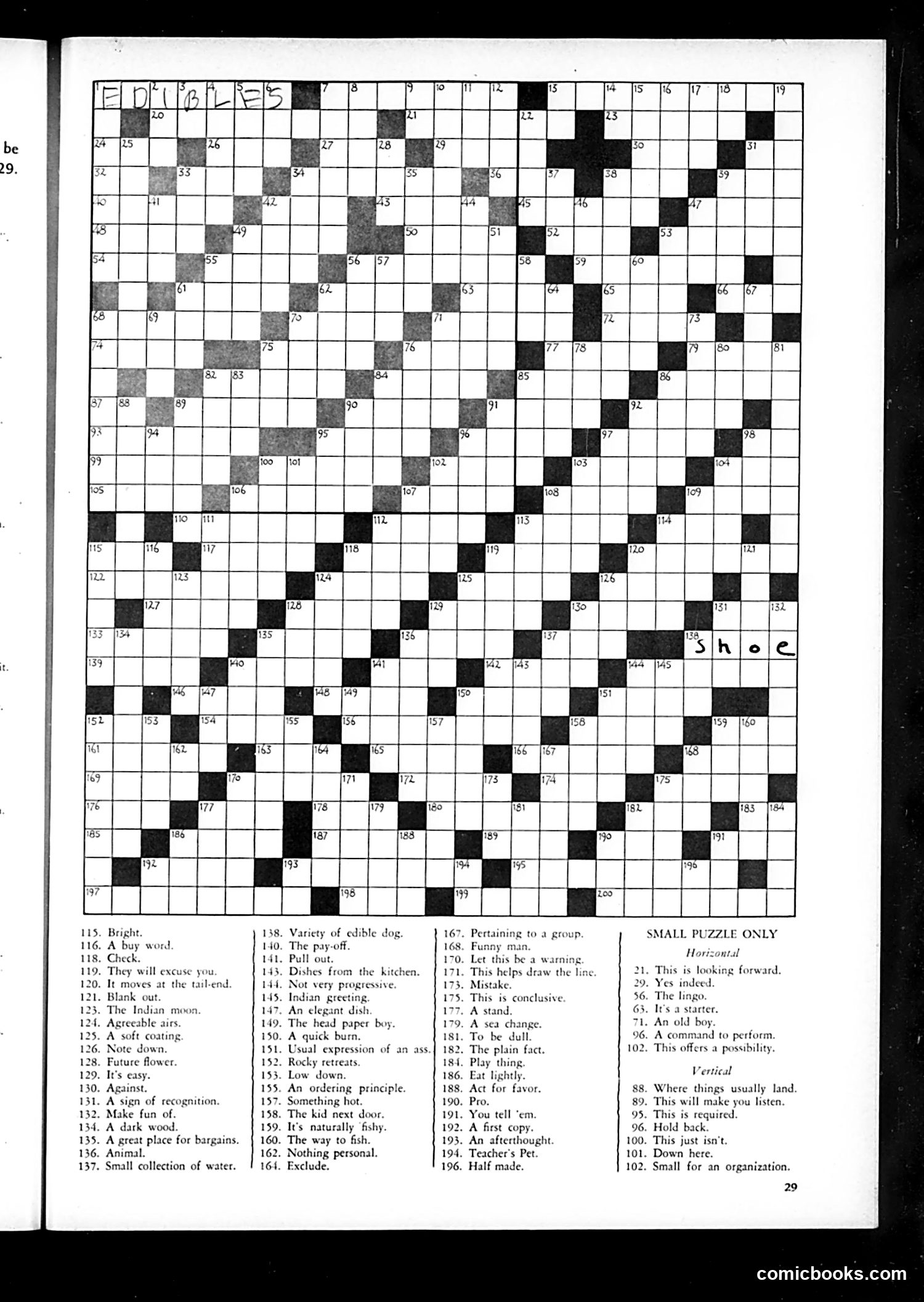
This is a Crossword Puzzle Page This page contains a large crossword puzzle grid with numbered clues listed below. There is no political cartoon or satirical content visible. The clues are typical crossword wordplay—riddles and definitions meant to be solved. Examples include "Bright" (115), "A buy word" (116), "Check" (118), and "The Indian moon" (122). The puzzle appears to be from *Life* magazine, which regularly featured crosswords alongside satirical content. The notation "SMALL PUZZLE ONLY" indicates this is a secondary puzzle, likely included as filler or entertainment alongside the magazine's main satirical cartoons and articles on other pages. Without additional context or the solved grid, the specific puzzle's theme—if any—cannot be determined.
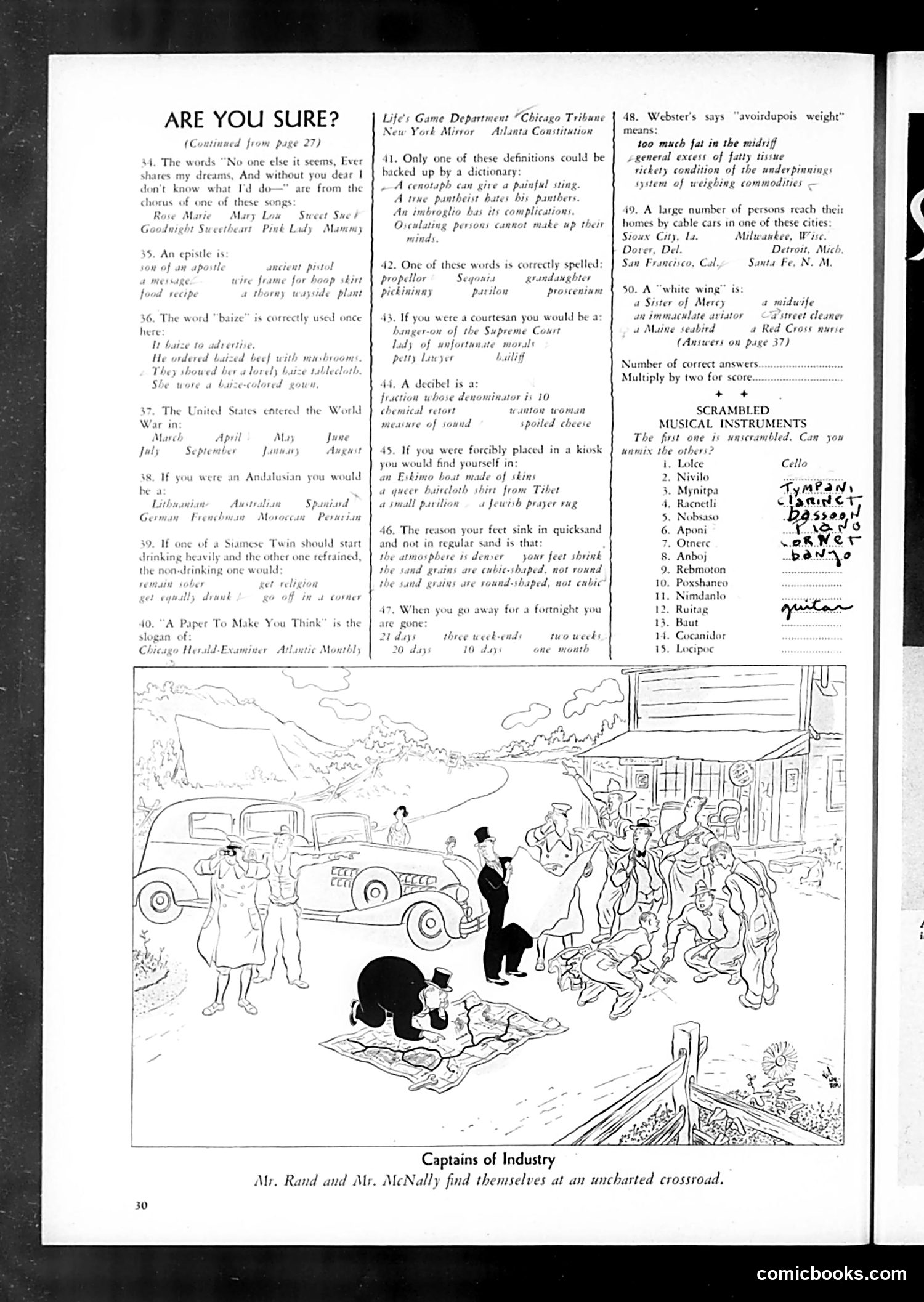
Explanation for Modern Readers This page contains a quiz/game feature titled "Are You Sure?" — a trivia challenge testing readers' knowledge across multiple categories (vocabulary, history, geography, etc.). Below it is a "Scrambled Musical Instruments" word puzzle where readers unscramble instrument names. The bottom illustration, captioned "Captains of Industry: Mr. Rand and Mr. McNally find themselves at an uncharted crossroad," is the satirical element. This references the famous *Rand McNally* map and atlas company. The cartoon depicts two well-dressed businessmen (representing the company's founders) literally standing lost at a rural crossroads, surrounded by ordinary citizens. The satire plays on irony: despite producing navigation maps meant to guide others, these "captains of industry" are themselves directionally lost — a gentle mockery of their prominence.
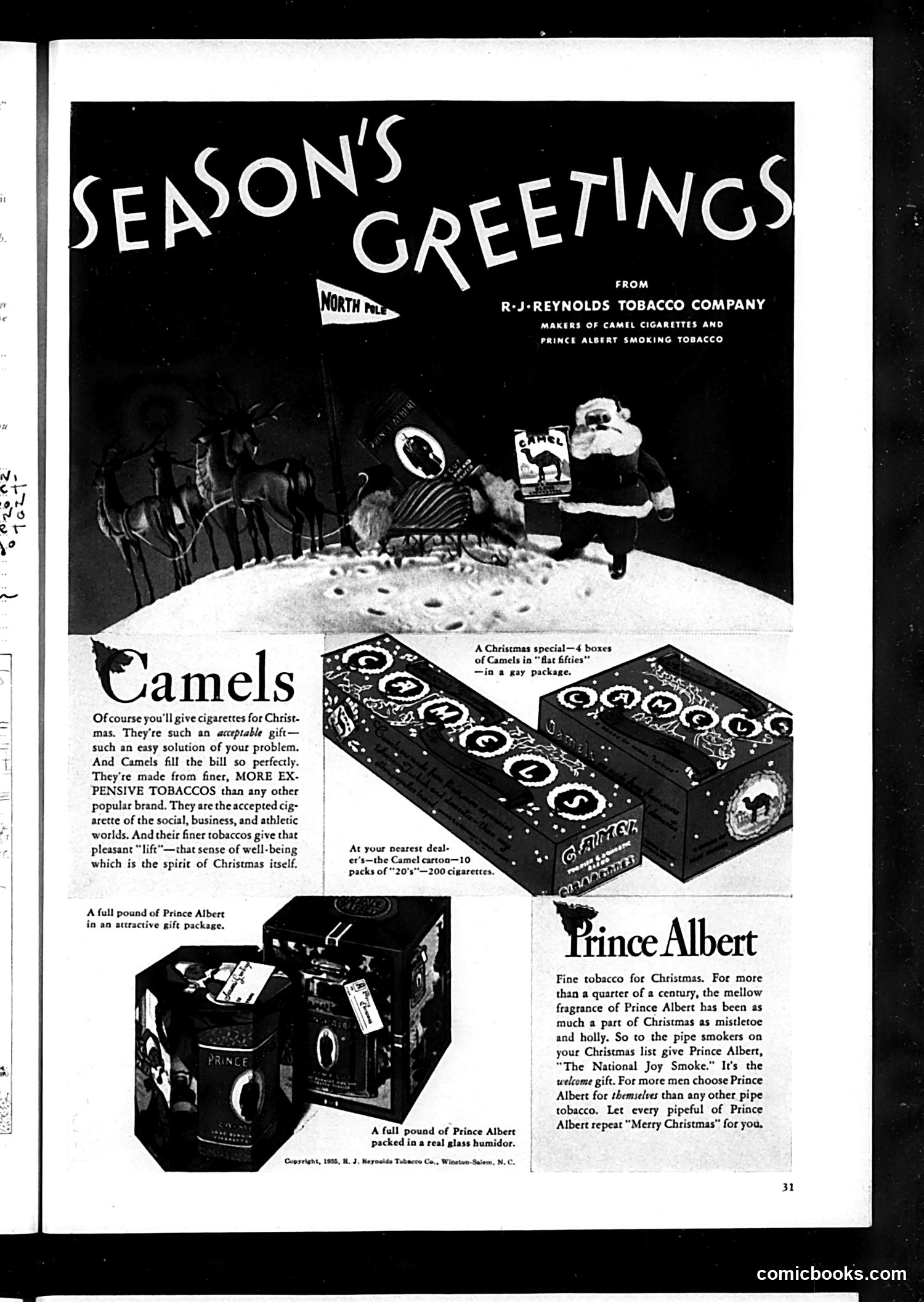
Season's Greetings Advertisement Analysis This is not a satirical cartoon but rather a straightforward tobacco advertisement from R.J. Reynolds, promoting Camel cigarettes and Prince Albert pipe tobacco as Christmas gifts. The "North Pole" scene depicts Santa and reindeer, framing tobacco products as ideal holiday presents. The ad's messaging—that cigarettes are "an acceptable gift" and "an easy solution of your problem"—reflects mid-20th century attitudes when smoking was socially normalized and widely advertised without health warnings. Key pitch: Camels use "finer, MORE EXPENSIVE TOBACCOS" and are "the accepted cigarette of the social, business, and athletic worlds," positioning smoking as sophisticated and aspirational. Prince Albert is marketed as a century-old tradition ("The National Joy Smoke"). By modern standards, this represents a striking example of how openly tobacco companies marketed addictive products to families during the Christmas season—something now illegal and socially unthinkable.
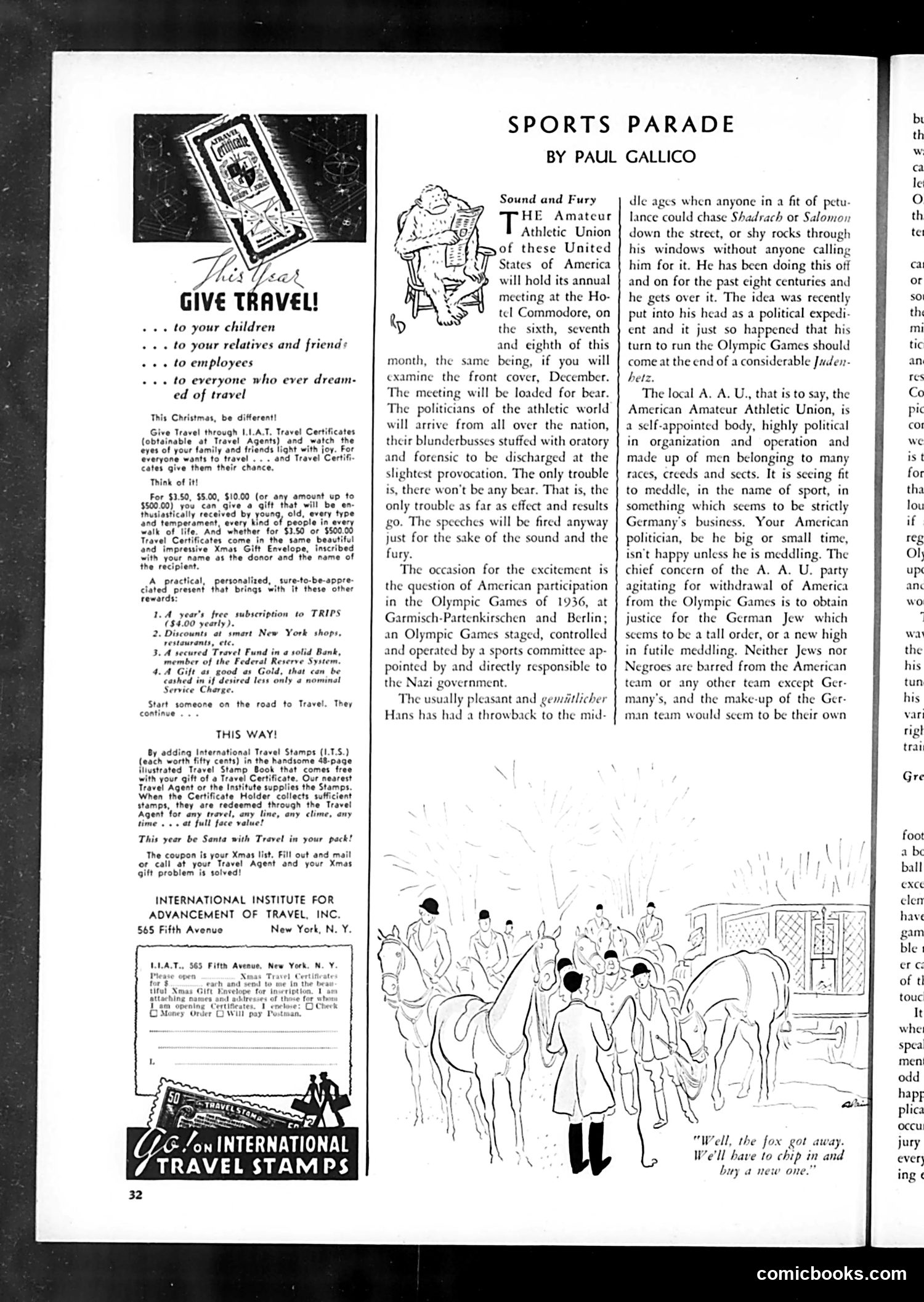
Sports Parade: 1936 Olympic Boycott Debate This is a sports column by Paul Gallico satirizing the Amateur Athletic Union's heated debate over American participation in the 1936 Berlin Olympic Games—controlled by Nazi Germany. Gallico uses the metaphor of "sound and fury" to mock the AAU's political posturing. He identifies the core issue: Nazi Germany's persecution of Jews, which prompted calls for an American boycott. However, Gallico appears skeptical of the AAU's moral stance, noting the organization is "highly political" and that American teams also exclude athletes (he mentions Negroes aren't barred from American teams "except Germany's," implying American segregation was likewise problematic). The satire suggests the AAU's righteous indignation rings hollow—politicians "meddling" in sports for grandstanding purposes while overlooking American discrimination. Gallico characterizes Nazi antisemitism as appealing to primitive instincts ("throwback to the middle ages"), depicting it as periodic hysteria rather than systematic ideology. The column reflects pre-WWII American ambivalence about Nazi Germany and skepticism toward activist positions.
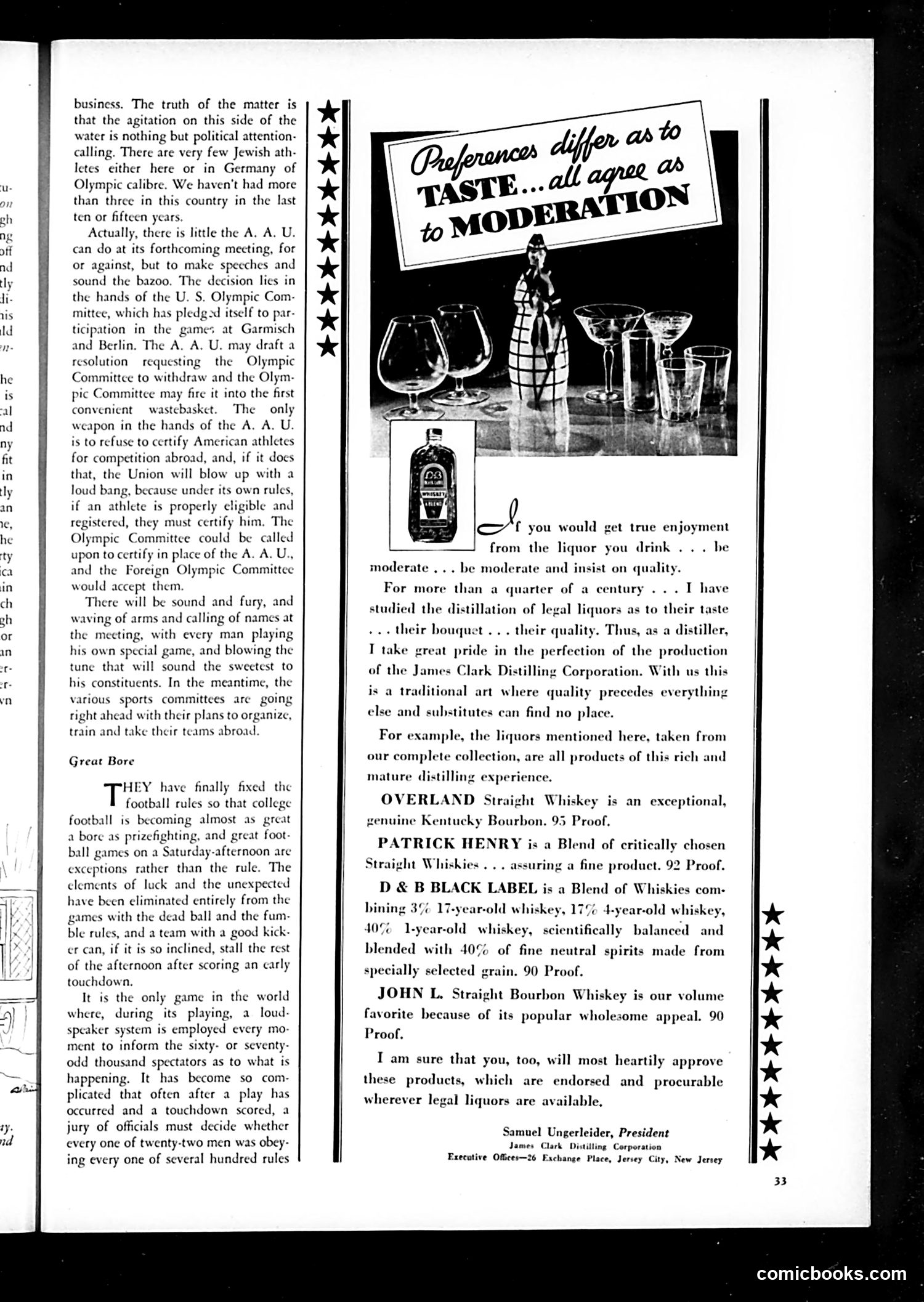
Page Analysis: Life Magazine Content This page contains two distinct elements: Left column ("Great Bore"): Commentary on college football rules, criticizing how recent regulations (dead ball, fumble rules) have made the sport overly cautious and boring. The author laments that strategic kicking now allows teams to stall games after scoring, and that the sport requires constant loudspeaker announcements and official judgment calls—making it unnecessarily complicated. Right side: A full-page liquor advertisement for James Clark Distilling Corporation, featuring their whiskey brands (Overland, Patrick Henry, D&B Black Label, John L.). The ad emphasizes quality and moderation in drinking, with a headline stating "Preferences differ as to TASTE... all agree as to MODERATION." The page also contains earlier text (top left) discussing the U.S. Olympic Committee's potential participation in 1936 Berlin Olympics, with dismissive remarks about Jewish athlete involvement and internal sports organization politics.
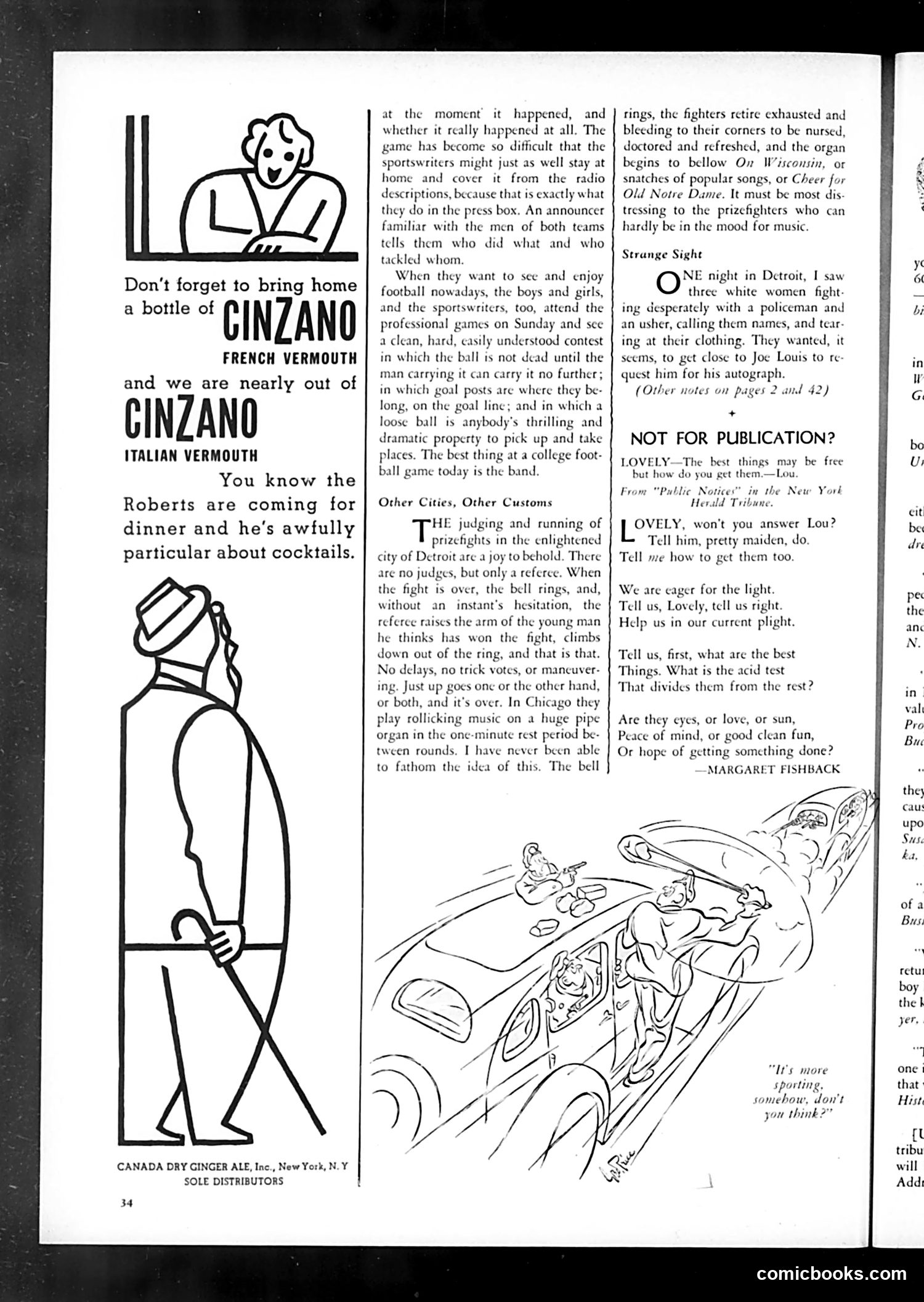
Analysis of Life Magazine Page This page combines advertising (Cinzano vermouth, Canada Dry ginger ale) with humorous social commentary. The main article critiques college football's decline by contrast with professional football. The author notes college games have become difficult to follow—announcers describe plays via radio rather than witnessing them live. He argues the real entertainment now comes from the band, not the game itself. Professional Sunday football, by contrast, offers clear, understandable action. The piece also mocks regional customs: Detroit's prizefight system (straightforward, efficient) versus Chicago's (absurdly playing cheerful organ music during rest periods when exhausted, bleeding fighters need quiet recovery). A brief anecdote describes three white women fighting with police and an usher in Detroit, desperately seeking Joe Louis's autograph—reflecting Louis's prominence as a Black boxing champion and his celebrity status during this era. The "Not for Publication" section is reader correspondence with verse commentary by Margaret Fishback, a regular contributor.
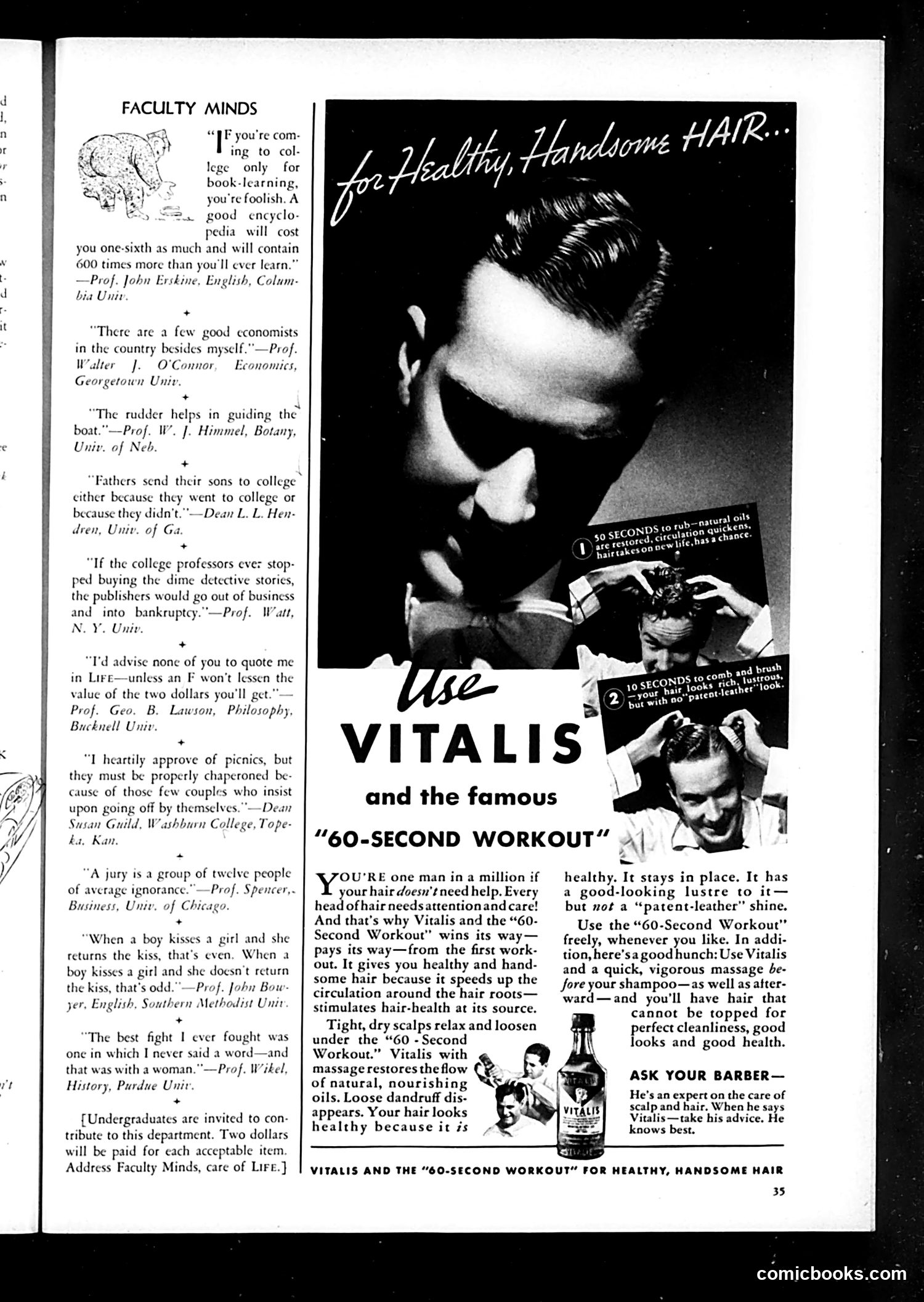
Content Analysis Left side: "Faculty Minds" is a satirical column featuring humorous quotes attributed to college professors. The jokes mock academic pomposity and self-importance—professors claiming superiority (one economist boasts he's among "a few good" in the country), making dubious logical claims (a professor equates kissing etiquette to mathematical "even" and "odd"), or admitting unflattering truths (professors buy dime detective stories; most jury members are ignorant). The satire targets professorial ego and the gap between academic pretense and reality. Right side: A full-page advertisement for Vitalis hair product, promoting its "60-Second Workout"—a scalp massage technique. The ad uses before/after photographs of men and claims the product stimulates hair health, eliminates dandruff, and improves appearance. It encourages readers to ask their barber about Vitalis, positioning the product as a professional recommendation. The page mixes editorial satire with commercial advertising, typical of *Life* magazine's format during this era.
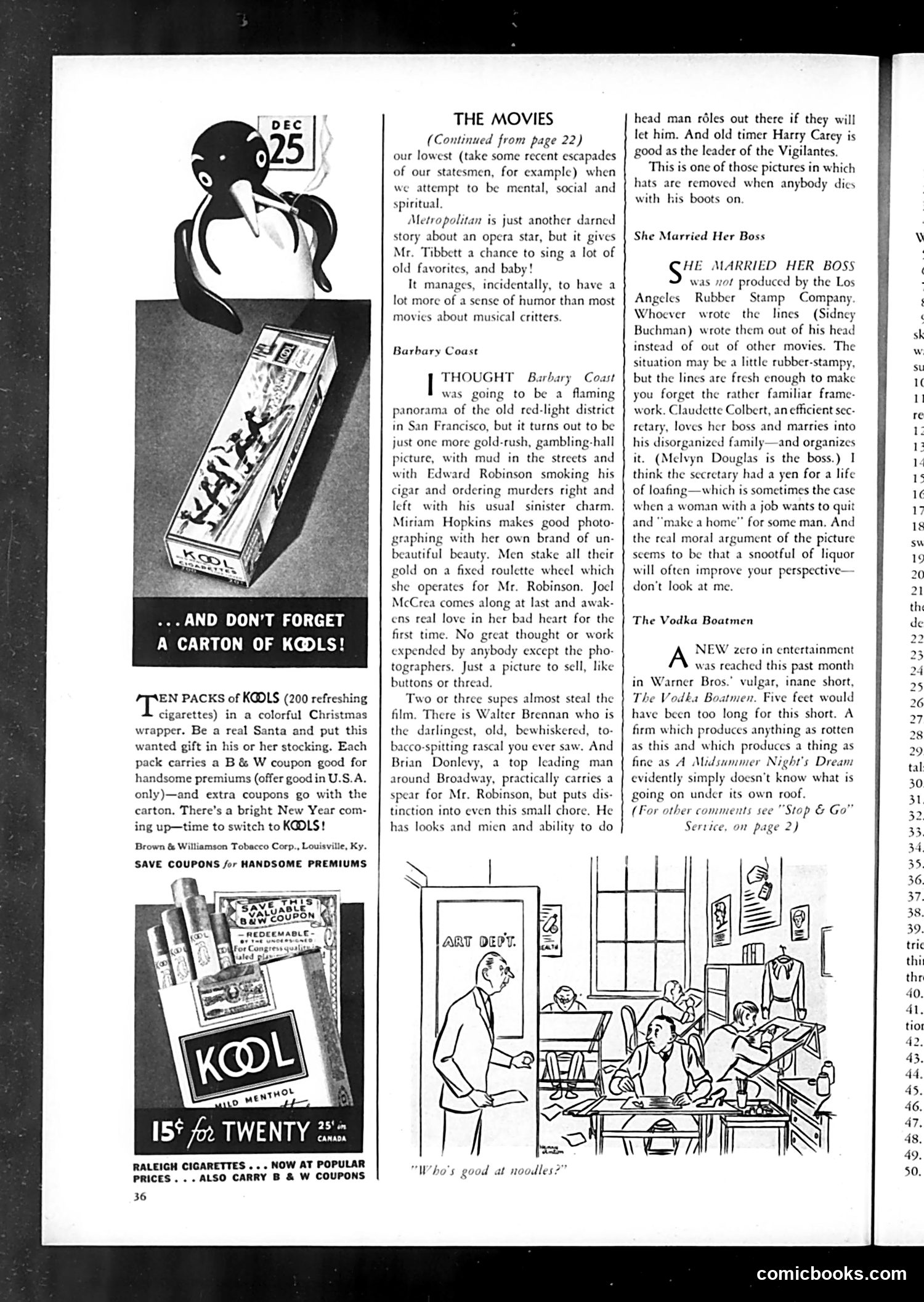
"The Movies" Page Analysis This page contains film reviews from Life magazine's movie section, not political cartoons. The main content critiques three films: Barbary Coast — A gold-rush melodrama with Edward Robinson as a villain. The reviewer dismisses it as formulaic but praises supporting actors Walter Brennan and Brian Donlevy for elevating minor roles. She Married Her Boss — The reviewer humorously compares it to a "rubber stamp" production (implying mechanical repetition) but credits fresh dialogue by Sidney Buchman. The plot involves a secretary marrying her boss and organizing his chaotic family. The Vodka Boatmen — A Warner Bros. short film harshly criticized as "vulgar" and "inane," with the reviewer sarcastically noting Warner Bros. simultaneously produces both terrible shorts and quality films like *A Midsummer Night's Dream*. The page also includes cigarette advertisements for Kools and Raleigh brands with B&W coupons—typical 1930s magazine advertising promoting smoking as a desirable gift.
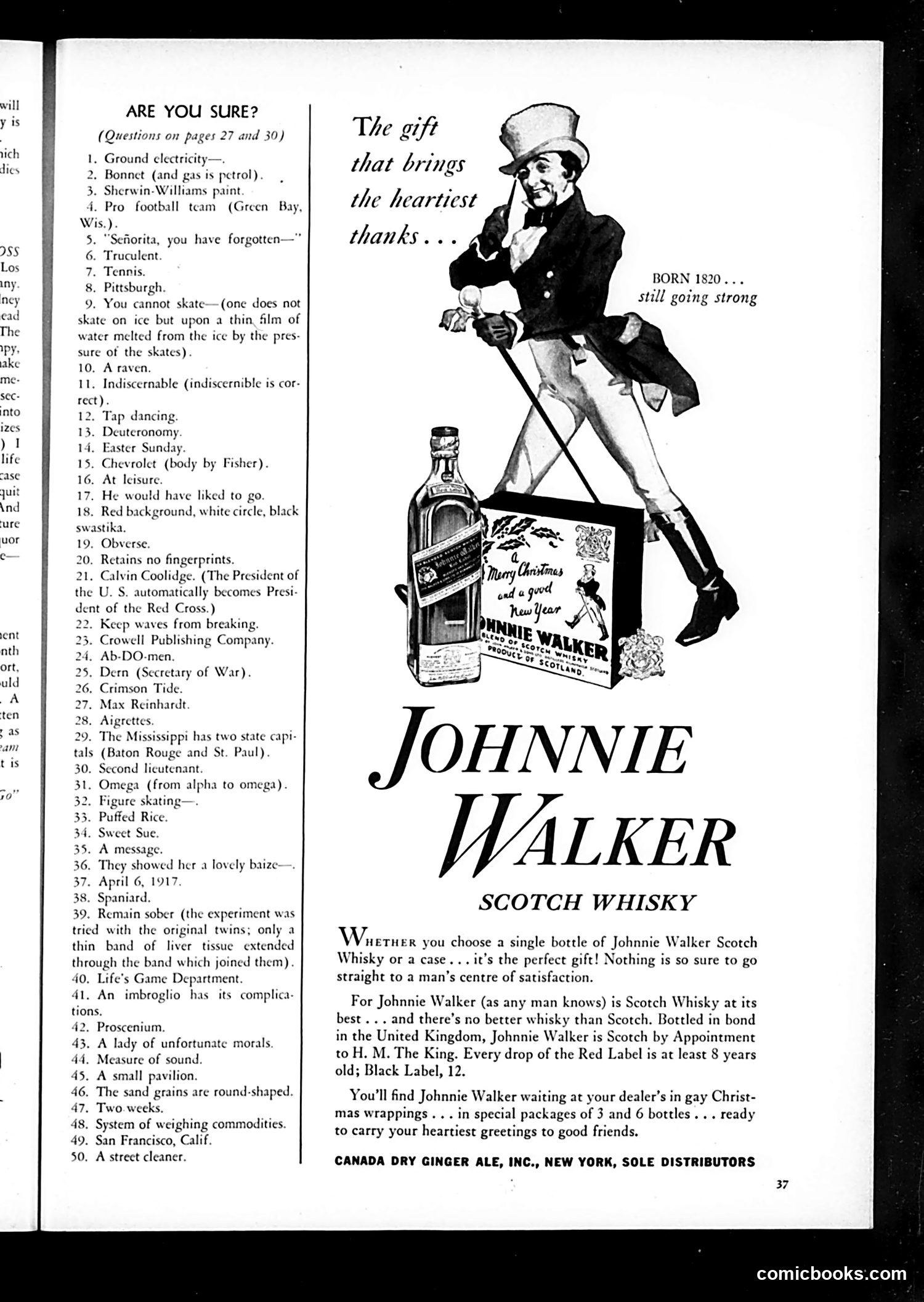
Page Analysis This page contains two distinct elements: Left side: An answer key to a trivia quiz from earlier pages of Life magazine, covering general knowledge questions (e.g., "Ground electricity," "Pro football team," "Calvin Coolidge"). Right side: A full-page advertisement for Johnnie Walker Scotch Whisky, featuring a caricatured gentleman in top hat and monocle positioned as if ice-skating, holding a bottle and gift box. The ad emphasizes the whisky's prestige ("Scotch by Appointment to H.M. The King") and suitability as a holiday gift. Historical context: This appears from the 1920s, when alcohol advertising was still legal in American magazines, before Prohibition's full enforcement. The genteel, aristocratic figure and British royal appointment reflect how luxury alcohol was marketed to wealthy American readers as a mark of sophistication and status. The page is primarily advertising with supplementary quiz answers; no political satire is present.
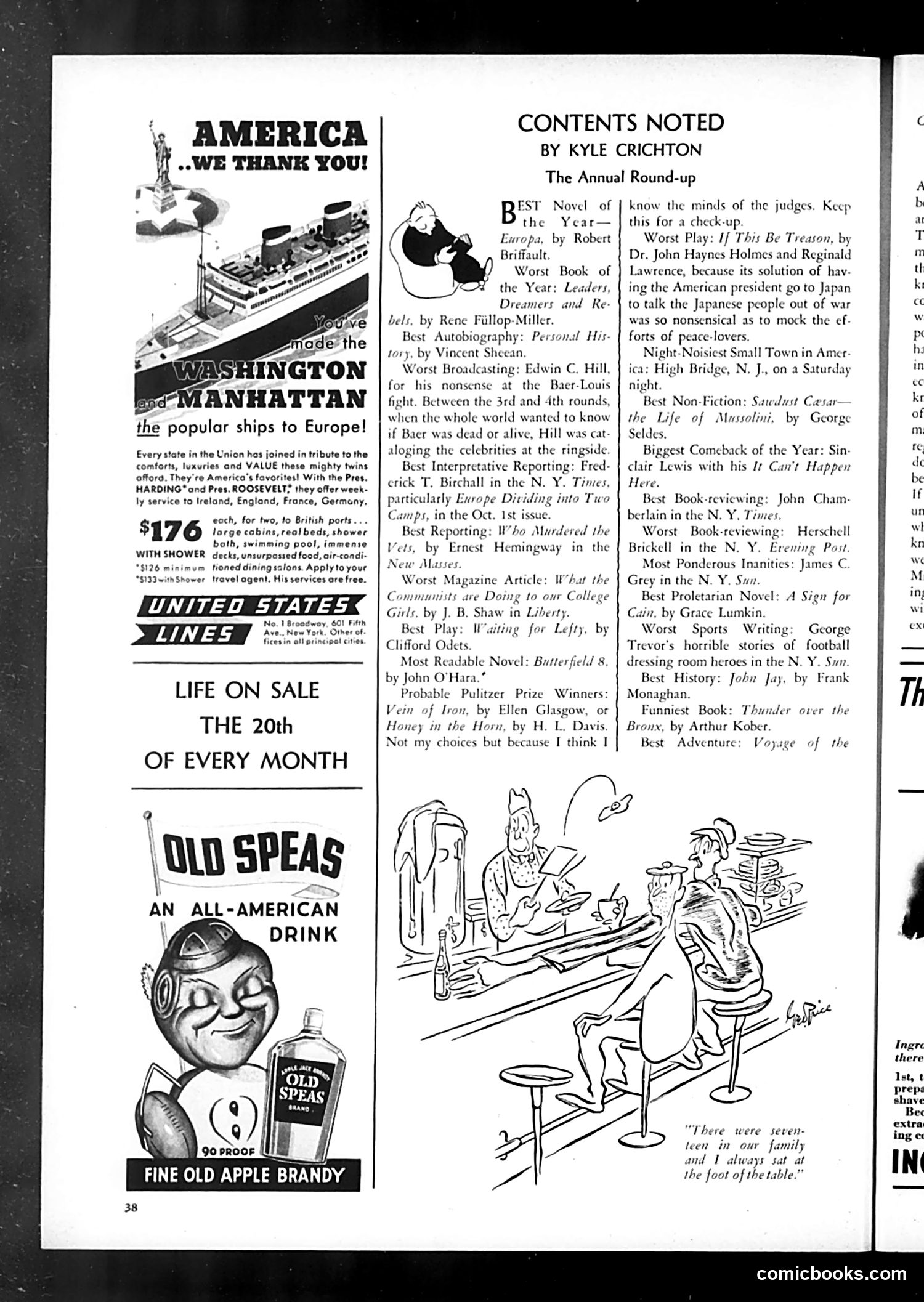
Political and Social Context of This Life Magazine Page This page from Life magazine (likely mid-1930s) contains Kyle Crichton's satirical "Annual Round-up" of the year's best and worst in literature, broadcasting, and culture. The cartoon depicts a family dinner scene with a humorous caption about seating arrangements—typical Life magazine humor requiring no special context. The book and cultural reviews reflect 1930s concerns: Hemingway's reporting on the "Vets" (likely the Bonus Army or similar Depression-era veterans' crisis), "Waiting for Lefty" (Clifford Odets' pro-labor play), and references to communist activity on college campuses. Crichton's dismissal of a peace play involving the American president negotiating with Japan reveals pre-WWII isolationism debates. The adjacent shipping advertisement emphasizing Presidents Harding and Roosevelt suggests national pride and transatlantic commerce as post-WWI normalcy. The Old Speas brandy ad targets male consumers—unremarkable by period standards.
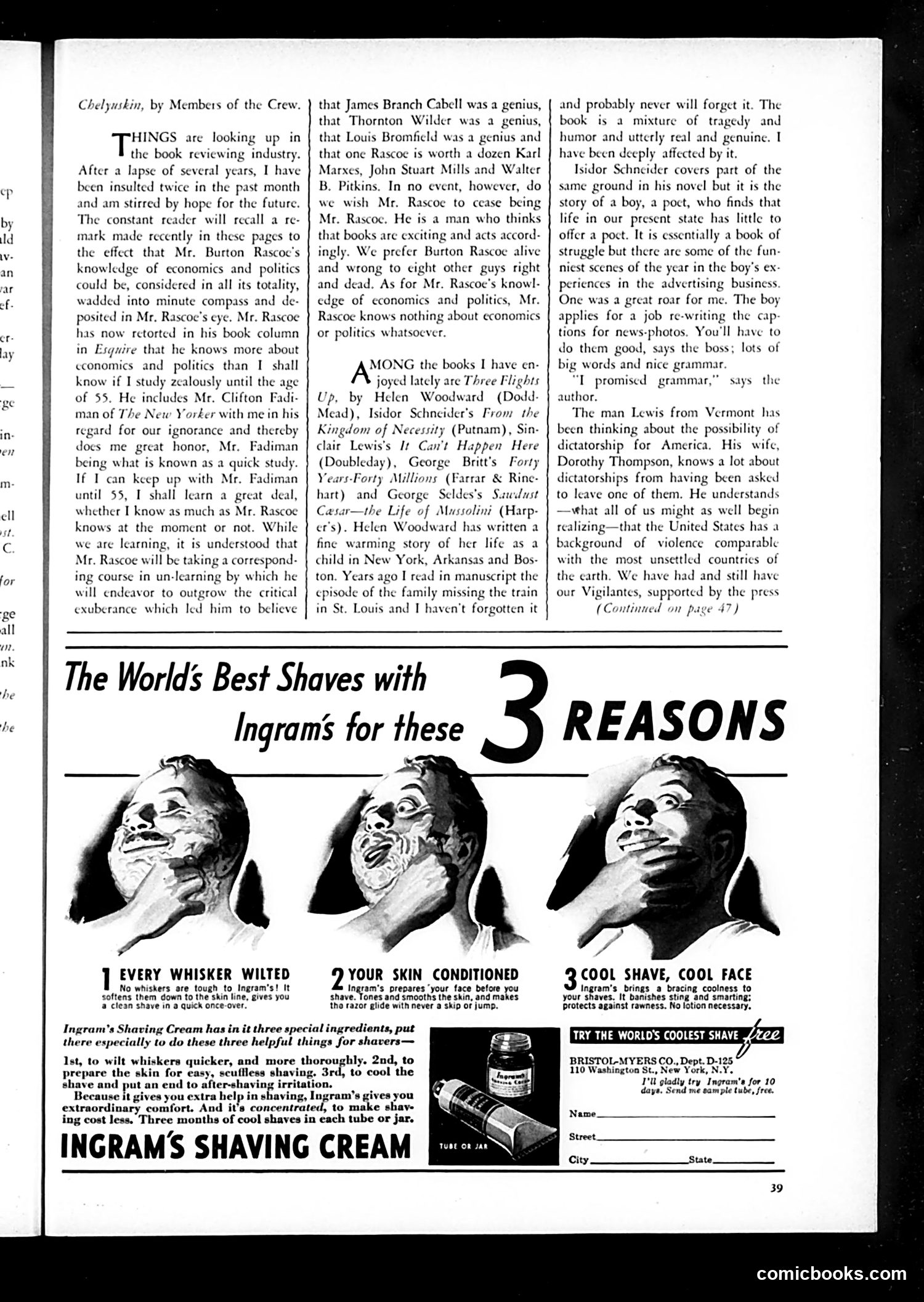
Analysis for Modern Readers This page contains a book review column (top two-thirds) and an advertisement (bottom third). The review discusses Burton Rascoe, a prominent literary critic of the era, in a playful dispute about intellectual authority. The author sarcastically claims Rascoe's knowledge of economics and politics could fit in his eye, while Rascoe countered that the author knows nothing about these subjects. The author humorously suggests Rascoe needs to "un-learn" his past poor critical judgments (wrongly calling Cabell, Wilder, and Bromfield geniuses), yet defends him as genuinely passionate about books—"alive and wrong" beats "right and dead." The column then reviews contemporary books, including works by Sinclair Lewis and a biography of Mussolini, reflecting 1930s literary interests. The Ingram's Shaving Cream advertisement uses exaggerated facial expressions and pseudo-scientific claims (three special ingredients for whisker-softening, skin conditioning, and cooling) typical of vintage grooming ads, employing humor and credibility-building language to sell a mass-market product.
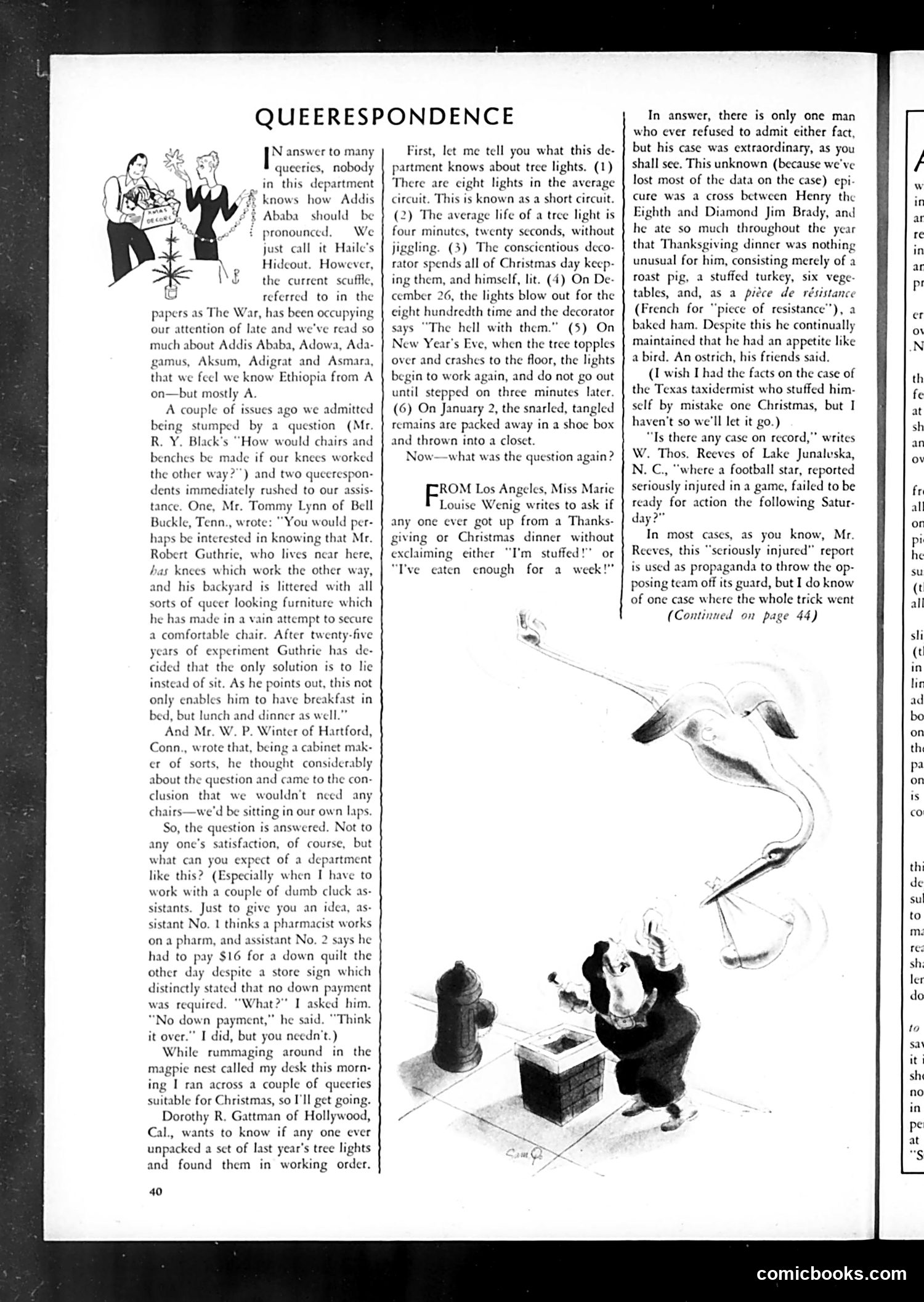
Life Magazine "Queerespondence" Page Analysis This is a humor column featuring reader-submitted questions and editorial responses. The page satirizes American consumer culture and holiday traditions circa the 1930s-40s. Key content: The main joke concerns Christmas tree lights—the editor humorously catalogs their notorious unreliability: they fail constantly, require all-day fussing, mysteriously work again only after the tree crashes, then tangle into storage. This satirizes the frustration of early electric holiday decorations, which were notoriously faulty. A secondary joke mocks Thanksgiving/Christmas overeating, referencing an unnamed "epicure" who ate so excessively year-round that holiday feasts meant nothing to him—comparing him to historical figures Henry VIII and "Diamond Jim" Brady (famous for lavish consumption). The cartoon illustrations (showing a large nose and figures with holiday items) reinforce these themes visually. The humor relies on readers' shared domestic experiences: broken lights and holiday excess were universal complaints among the magazine's middle-class audience.
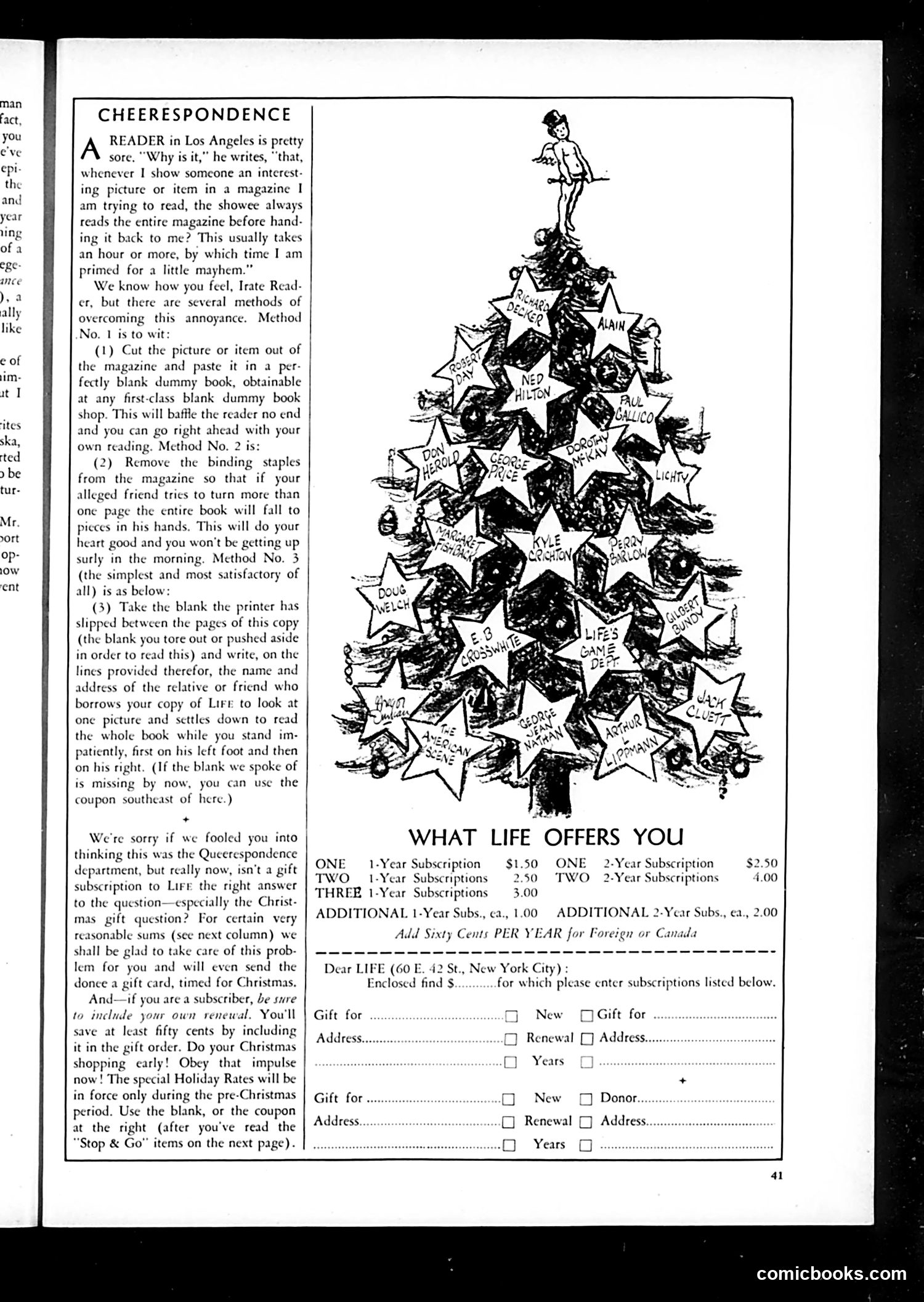
"Cheerspondence" — Life Magazine Reader Complaint This is a humorous advice column responding to a Los Angeles reader's frustration: when showing someone an interesting magazine picture, the borrower reads the *entire magazine* before returning it, wasting the original reader's time. Life proposes three satirical "solutions": 1. Cut out the item and paste it in a blank dummy book to confuse the borrower 2. Remove the binding staples so the magazine falls apart in the borrower's hands 3. (The actual solution) Fill out a subscription form to *give* them their own copy of Life The joke transforms the complaint into a sales pitch: rather than sabotage, simply buy them a subscription. The accompanying Christmas-tree cartoon listing names (celebrities and politicians whose identities are now unclear) is decorative. The page is primarily promotional material for Life magazine subscriptions, using humor to encourage gift giving during the pre-Christmas period.
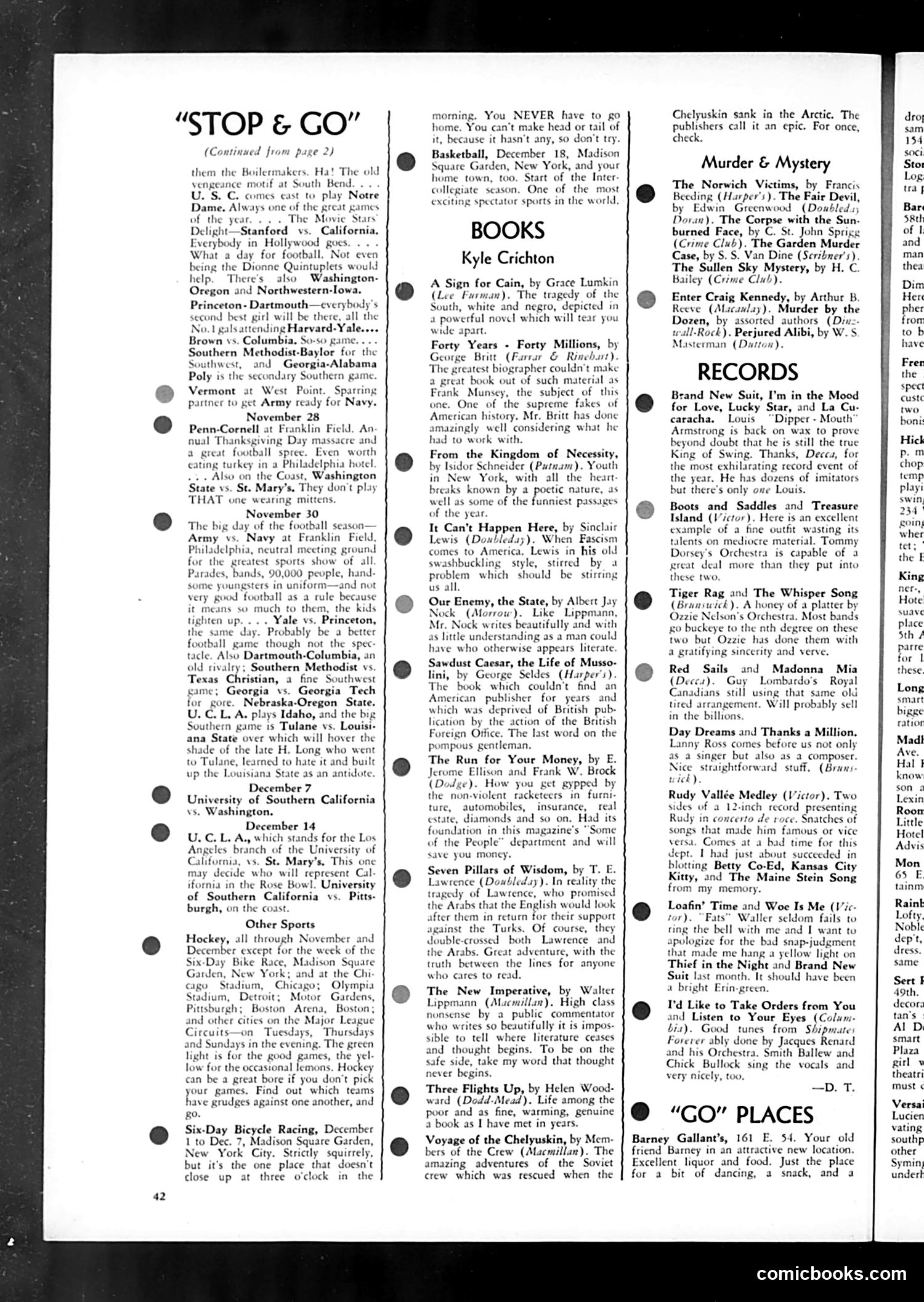
"Stop & Go" Entertainment Guide Analysis This page is a weekly entertainment guide from Life magazine, not a political cartoon. It lists recommended sports events and cultural activities for readers in late November-December. The "Stop & Go" format uses traffic light metaphors: green lights indicate must-see events (major college football games like Army-Navy, Yale-Princeton); yellow lights mark secondary attractions; readers should skip the rest. Key references for modern readers: - Multiple college football rivalries (Harvard-Yale, Army-Navy) that remain significant today - Madison Square Garden as a premier sports venue - Six-Day Bike Racing and Hockey as popular spectator sports (now obscure) - The Dionne Quintuplets, a famous 1930s celebrity family - "The shade of the late H. Long"—Huey Long, Louisiana politician The second half reviews current books and records. The tone is witty and advisory—this is lifestyle journalism helping affluent readers navigate entertainment options during the Depression era.
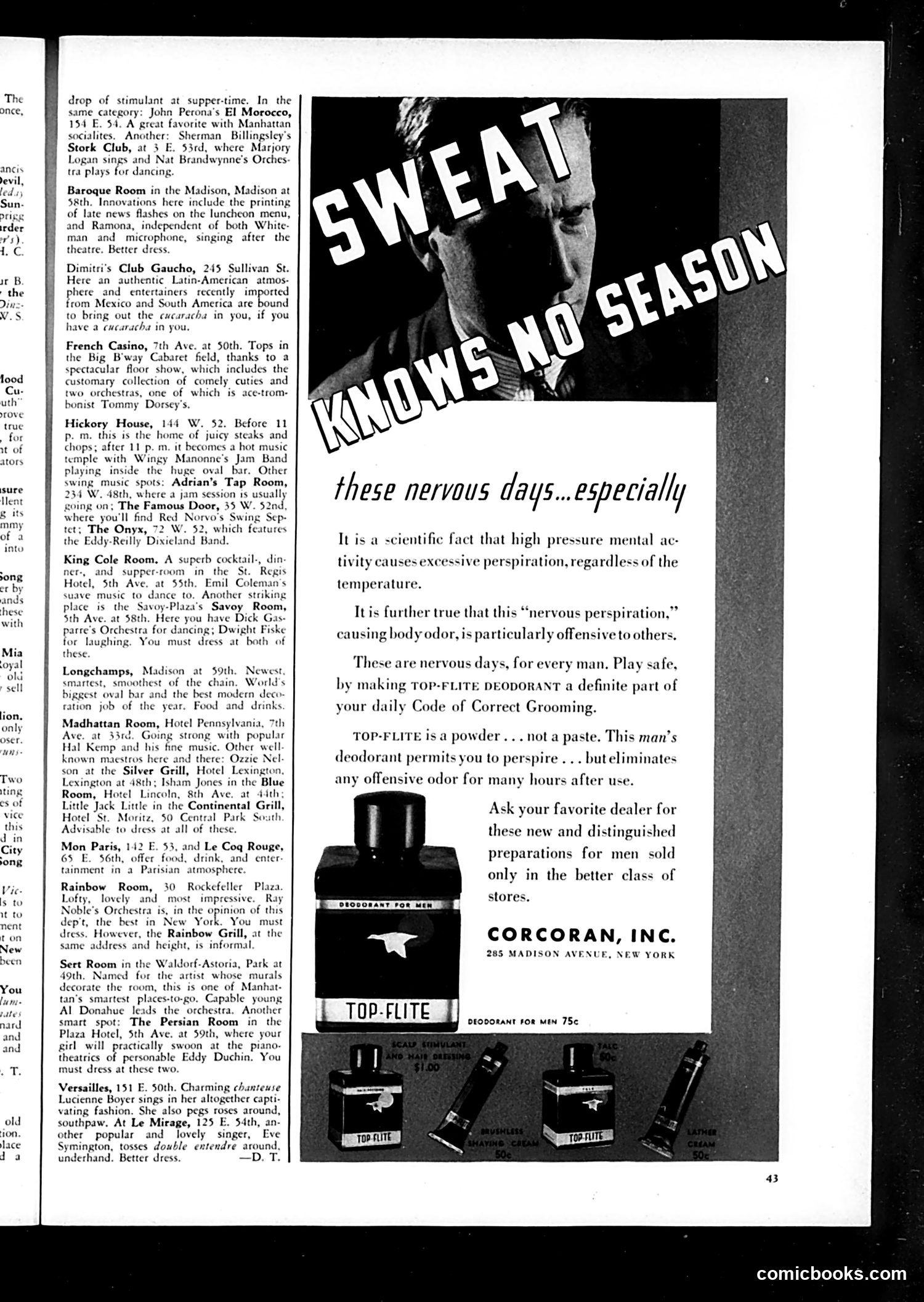
Advertisement Analysis This page is primarily a nightclub/restaurant guide for Manhattan, with a deodorant advertisement dominating the right side. The ad features Top-Flite deodorant by Corcoran, Inc., marketed to men. The headline "Sweat Knows No Season" addresses male anxiety about perspiration during "nervous days"—a gendered appeal to professional men's insecurities about bodily odor in social/business settings. The copy claims the powder deodorant eliminates odor "for many hours after use." The satirical edge comes from the magazine's implicit social commentary: Life's listing of swanky Manhattan nightclubs (El Morocco, Stork Club, Rainbow Room, etc.) positions these as status symbols for the urban elite. Simultaneously, the deodorant ad targets anxious men seeking to maintain respectability in these high-pressure social environments—suggesting that even wealthy, well-dressed men fear social humiliation from perspiration. The juxtaposition critiques masculine status anxiety and consumerism: you must dress correctly, go to the right clubs, *and* use the right deodorant to belong.
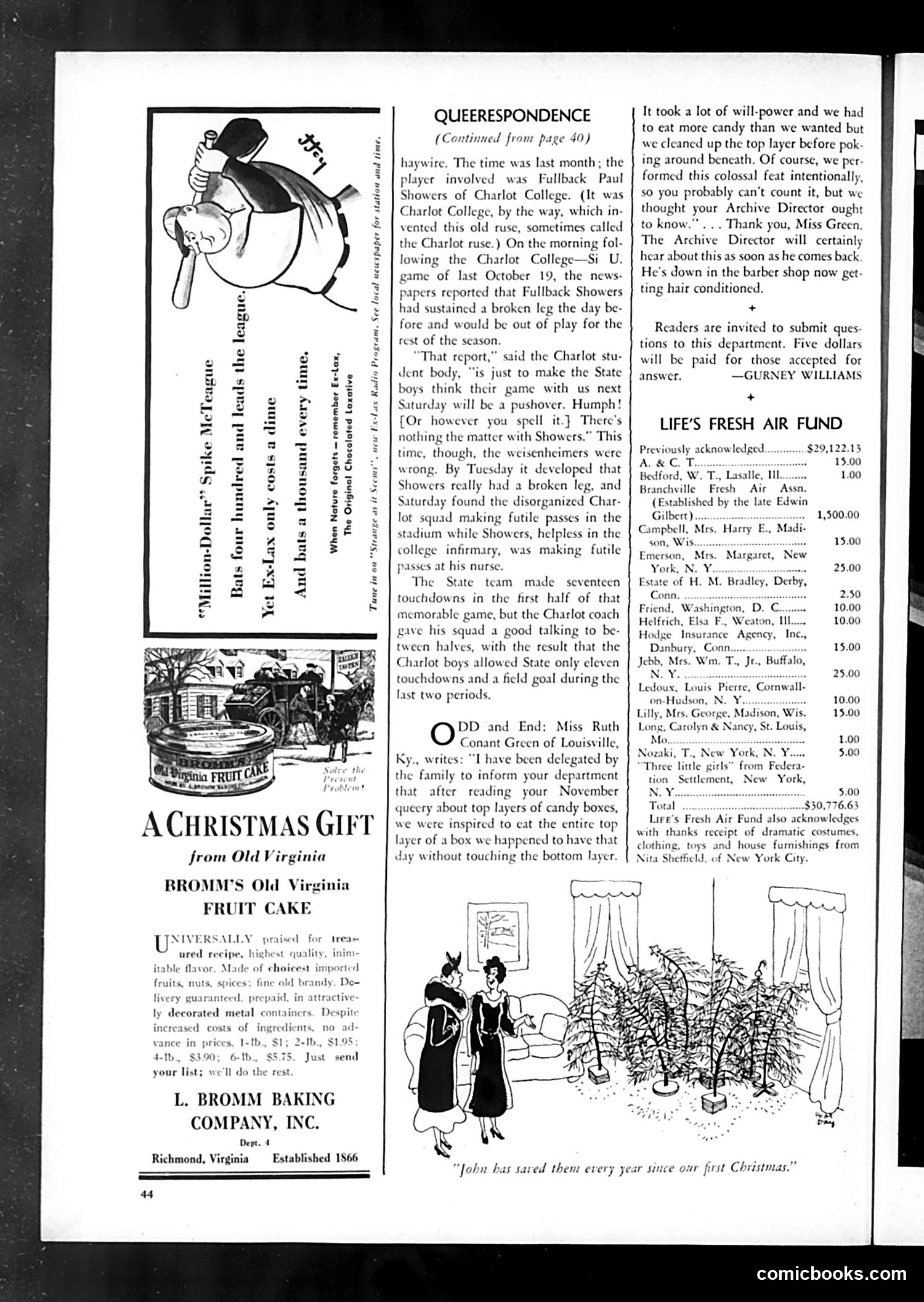
Cartoon Explanation This page is primarily advertising and advice columns rather than political satire. The top left cartoon about "'Million-Dollar' Spike McTeague" is a laxative advertisement (Ex-Lox), using baseball as its metaphor. The joke: the baseball player "bats a thousand every time," pun-intended to suggest the product's reliable bowel-movement effectiveness. The main correspondence section concerns a college football hoax at Charlot College, where students falsely claimed their fullback had a broken leg to deceive rivals, only to discover he actually *did* break his leg. The satire mocks the college's previous reputation for this deception trick—the irony being their cry-wolf strategy backfired. The page otherwise contains Christmas fruit cake advertising and a charitable donation list (Life's Fresh Air Fund for poor children's vacations). No significant political content is present.
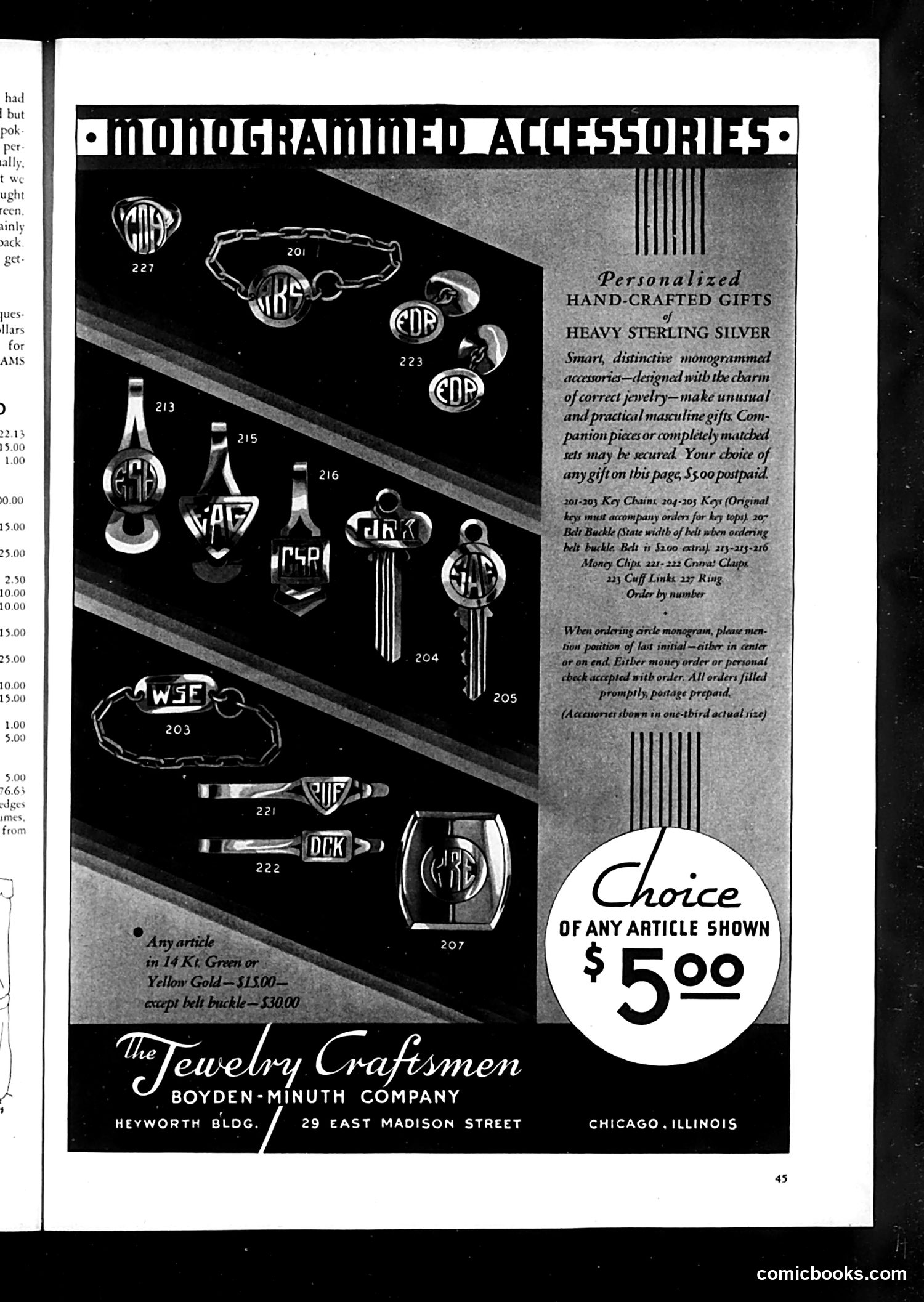
This is not a cartoon or satirical content—it's a vintage advertisement from Life magazine for monogrammed sterling silver accessories by the Boyden-Minuth Company of Chicago. The page displays personalized hand-crafted gifts in heavy sterling silver, including cufflinks, key chains, belt buckles, money clips, and rings. Each item is numbered for ordering purposes. The advertisement emphasizes these as "smart, distinctive" masculine gifts suitable for professionals or formal occasions. The prominent circular offer at bottom—"Choice of ANY ARTICLE SHOWN $5.00"—was the sales hook. This appears to be from an era (likely 1930s-1940s based on design style) when such monogrammed accessories were standard status symbols and professional gifts for men.
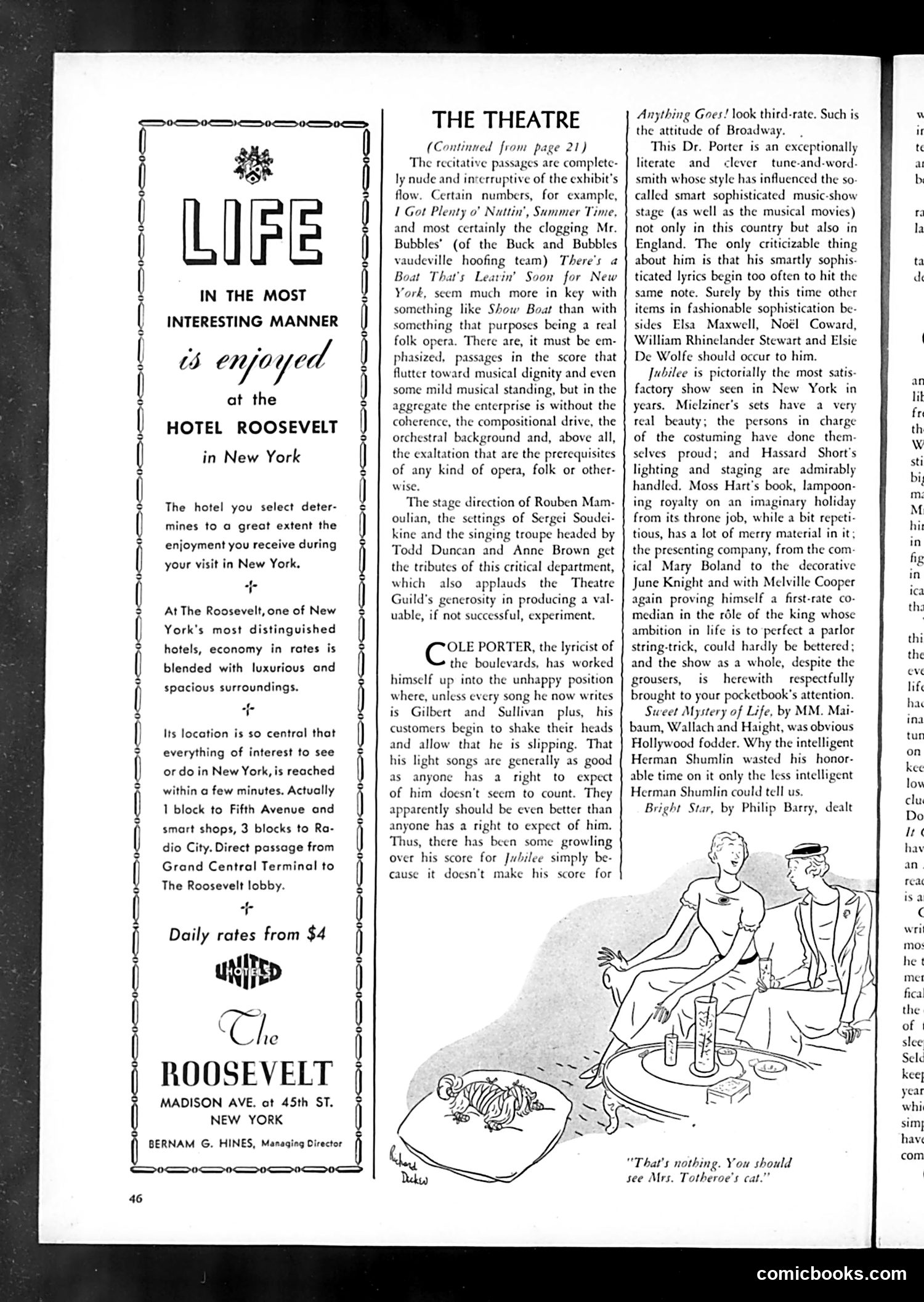
Analysis of This Life Magazine Page This page is primarily advertising and theater criticism, not political satire. The left side contains a hotel advertisement for the Roosevelt in New York, emphasizing its central location and affordable rates ($4 daily). The right side reviews theatrical productions, particularly discussing a folk opera (likely "Porgy and Bess," based on references to "Summer Time" and Todd Duncan). The critic praises the staging and direction but finds the score uneven—some numbers lack operatic dignity. A separate section criticizes Cole Porter, a famous Broadway lyricist. The writer argues Porter has become trapped by his own success: audiences now demand his songs match the sophistication of hits like *Anything Goes!*, making even good work seem disappointing by comparison. The critic notes Porter's lyrics are witty but repetitive, endlessly referencing the same high-society figures (Elsa Maxwell, Noël Coward). The cartoon shows two socialites dismissing something trivial—a joke about sophisticated Manhattan society's shallow concerns. This reflects 1930s Broadway culture and the pressures facing successful artists.
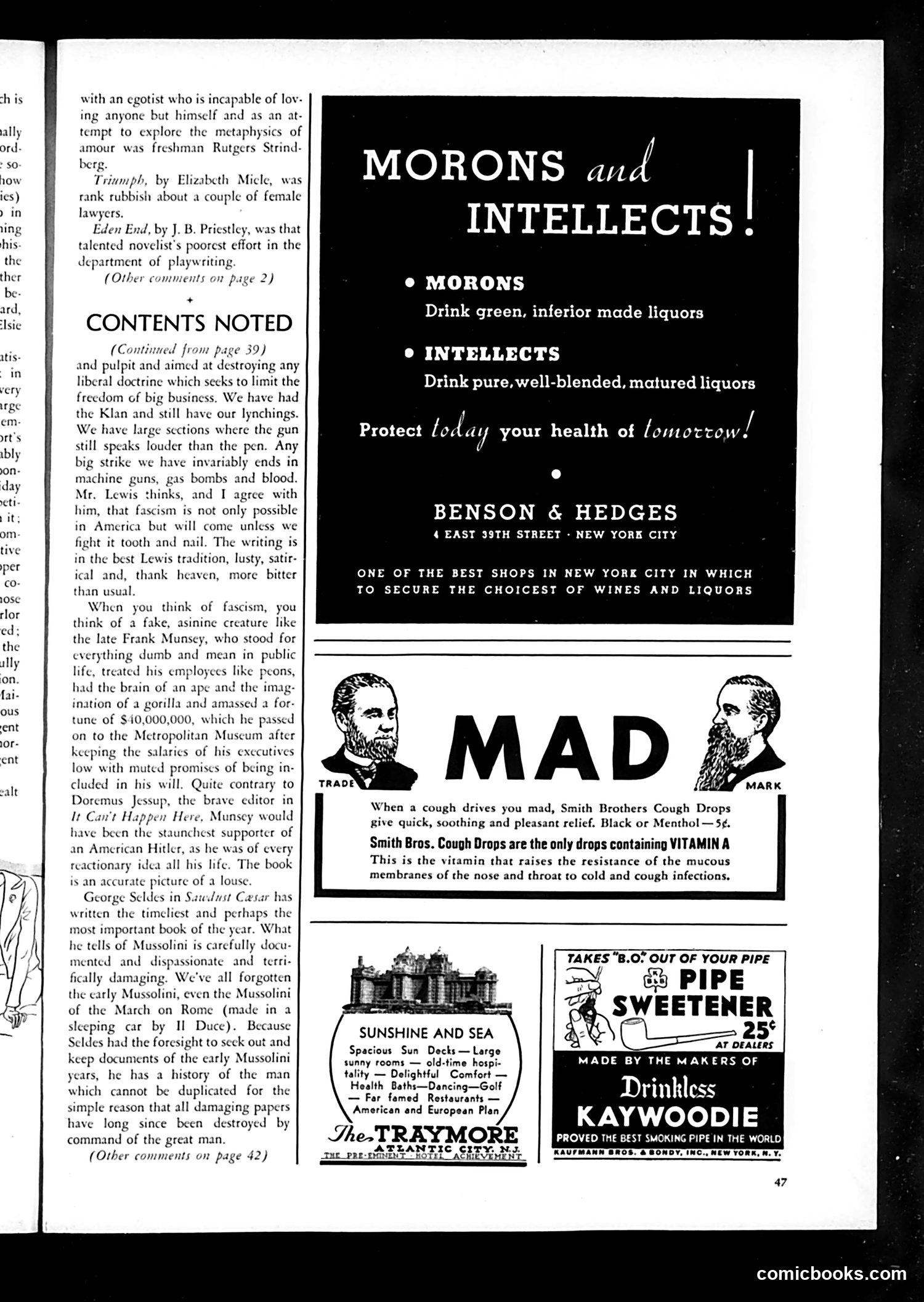
"Morons and Intellects": A 1930s Class Satire This page is primarily advertisements interspersed with book reviews. The most notable content is a liquor ad from Benson & Hedges that uses blatant class stereotyping: "Morons" drink "green, inferior made liquors" while "Intellects" drink "pure, well-blended, matured liquors." This reflects 1930s social attitudes—the ad equates taste in alcohol with intelligence and refinement, positioning the liquor merchant as serving society's "superior" class. It's simultaneously humorous and revealing of period snobbery. The reviews discuss anti-fascist literature, including George Seldes' *Sawdust Caesar* about Mussolini and a reference to Sinclair Lewis's *It Can't Happen Here*—reflecting contemporary anxiety about fascism's American potential. The criticism of industrialist Frank Munsey as a proto-fascist suggests writers viewed unchecked capitalism as dangerous.
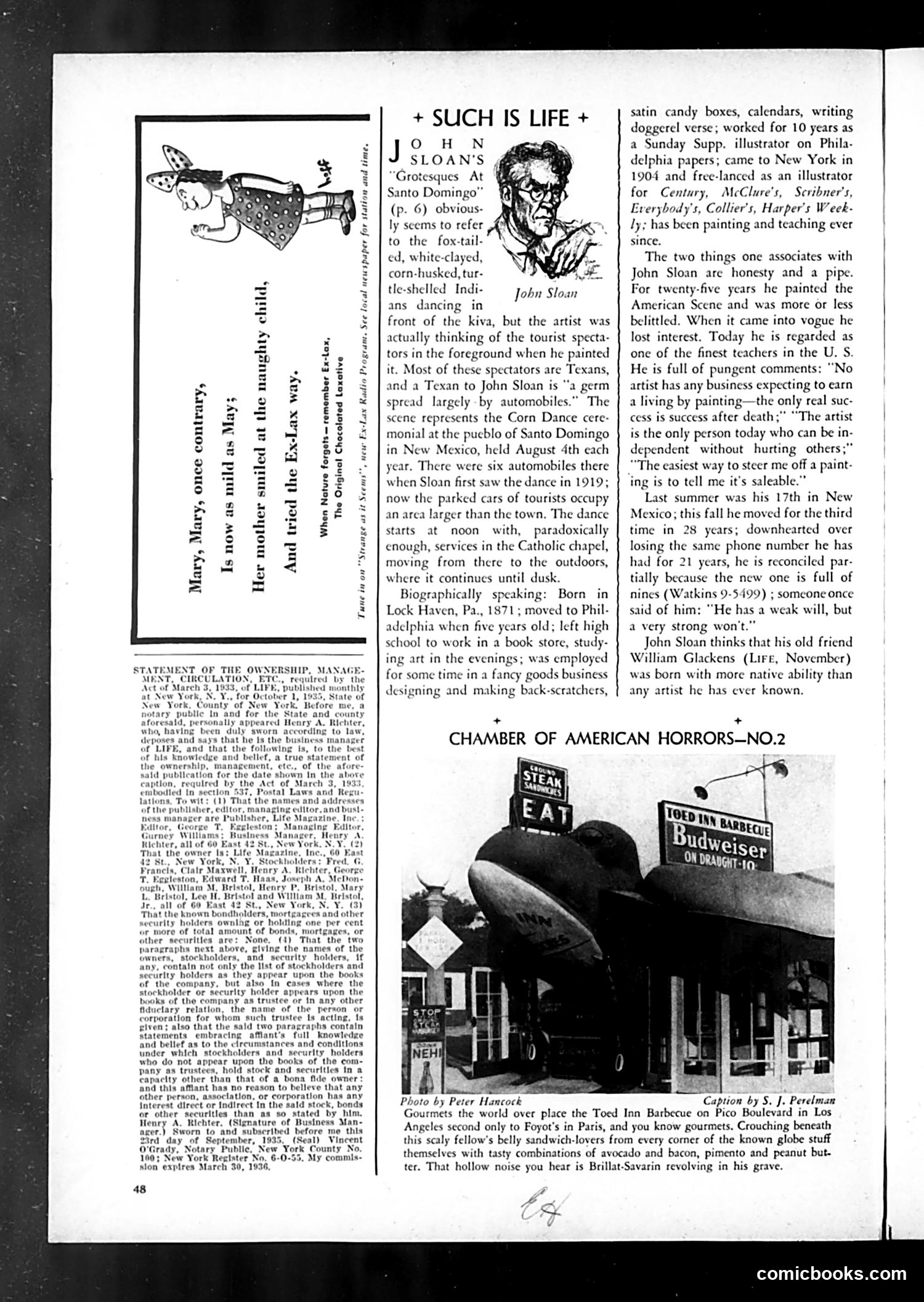
Analysis: "Such is Life" by John Sloan This page features artist John Sloan's satirical commentary on tourism and cultural commodification. The cartoon critiques how modern automobiles and tourists have invaded and transformed authentic Native American ceremonies. Sloan depicts the Corn Dance at Santo Domingo Pueblo in New Mexico, but the real subject of his satire is the *tourists themselves*—primarily Texans whom he characterizes as "germs spread largely by automobiles." His point: the pueblo's sacred ceremony has been overwhelmed by parked cars occupying more space than the town itself. In 1919, six cars attended; by the magazine's publication, tourists dominate the scene. The accompanying biography positions Sloan as an honest artist-teacher who rejected commercial success and shallow art trends. His cranky quotes ("No artist has any business expecting to earn a living by painting") reinforce his principled stance against materialism—a worldview reflected in his criticism of tourism's vulgar intrusion into indigenous culture.

I can see this is a page from Life magazine, but the image quality and OCR text provided are too fragmentary for me to identify specific cartoons, figures, or their satirical meaning with confidence. The visible text appears to be partial word fragments from column breaks or article text rather than coherent content that would explain the page's subject matter. To accurately explain the political or social satire to a modern reader, I would need either clearer imagery showing the actual cartoon(s) or more complete, legible OCR text. Without being able to read captions, identify depicted figures, or understand the referenced events or issues, I cannot responsibly interpret what this particular Life magazine page is satirizing.