puck
Puck — November 13, 1878
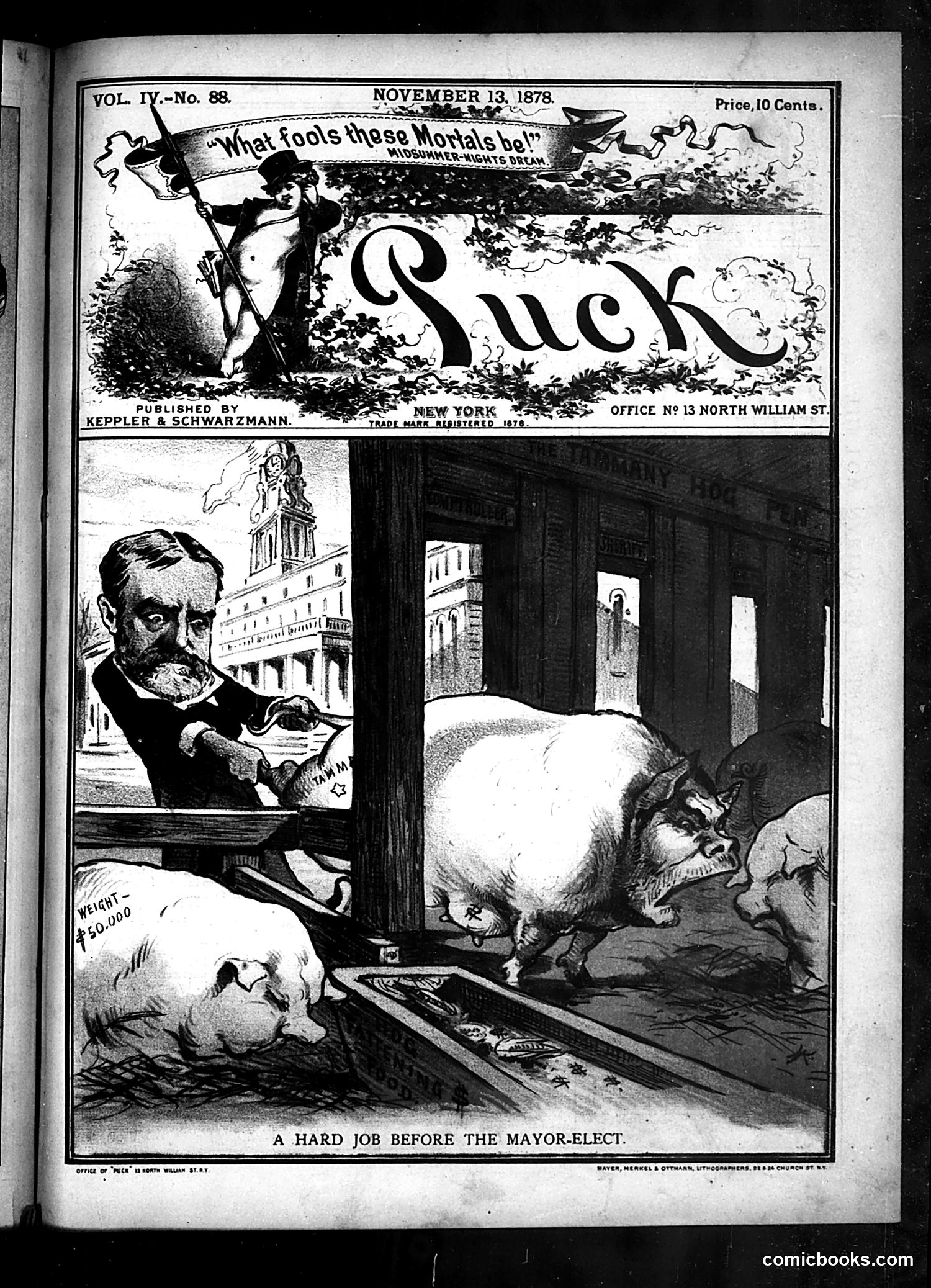
"A Hard Job Before the Mayor-Elect" This November 1878 *Puck* cartoon satirizes the incoming New York City mayor's daunting task of cleaning up municipal corruption. The main illustration shows a figure (the mayor-elect) struggling to remove filth and refuse from city hall, depicted as an overwhelming physical labor. The inset portrait with a classical government building likely represents either the outgoing mayor or a political figure associated with the corruption being addressed. The satire suggests that New York City government has become so thoroughly corrupted and neglected that the new mayor faces nearly impossible work restoring order and integrity. The metaphor of literal cleaning represents the figurative "cleaning house" needed in city administration—a common reform-era trope criticizing urban political machines and graft.
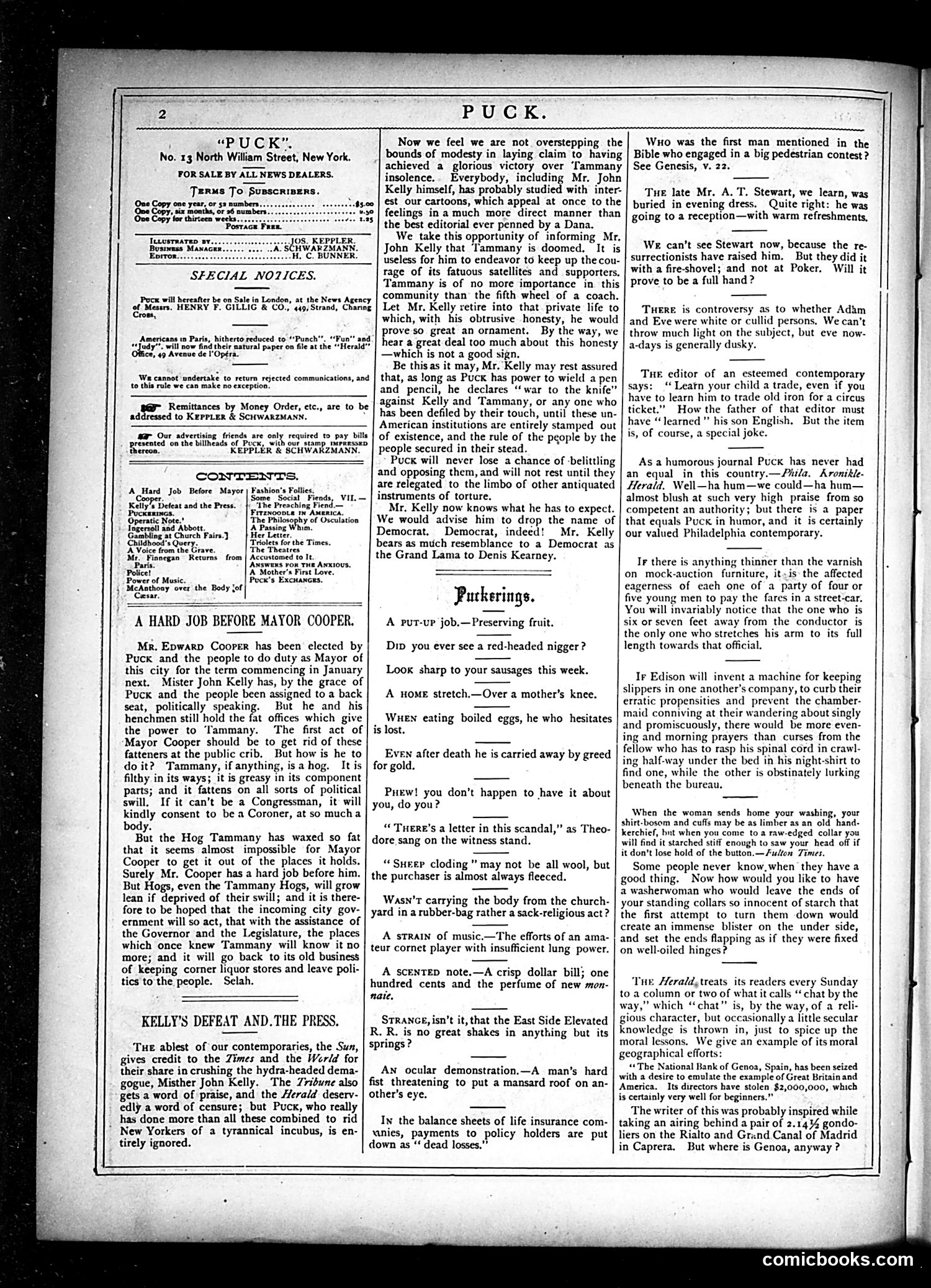
Analysis of Puck Magazine Page This page is primarily text-based content rather than cartoons. The main article, "A Hard Job Before Mayor Cooper," discusses Edward Cooper's election as New York Mayor. The satire criticizes Cooper's challenge in managing the city's political factions, particularly the tension between Mayor Cooper and John Kelly (a Tammany Hall boss), whose political machine dominated New York Democratic politics. The piece mocks Cooper's difficult position: he must either confront Tammany's power or appear weak. The satire suggests that managing these political rivalries is nearly impossible—a "hard job" indeed. "Puckerings" section contains brief satirical quips on contemporary social topics (fashion, comportment, insurance). The overall tone is political satire targeting NYC machine politics and reform efforts.
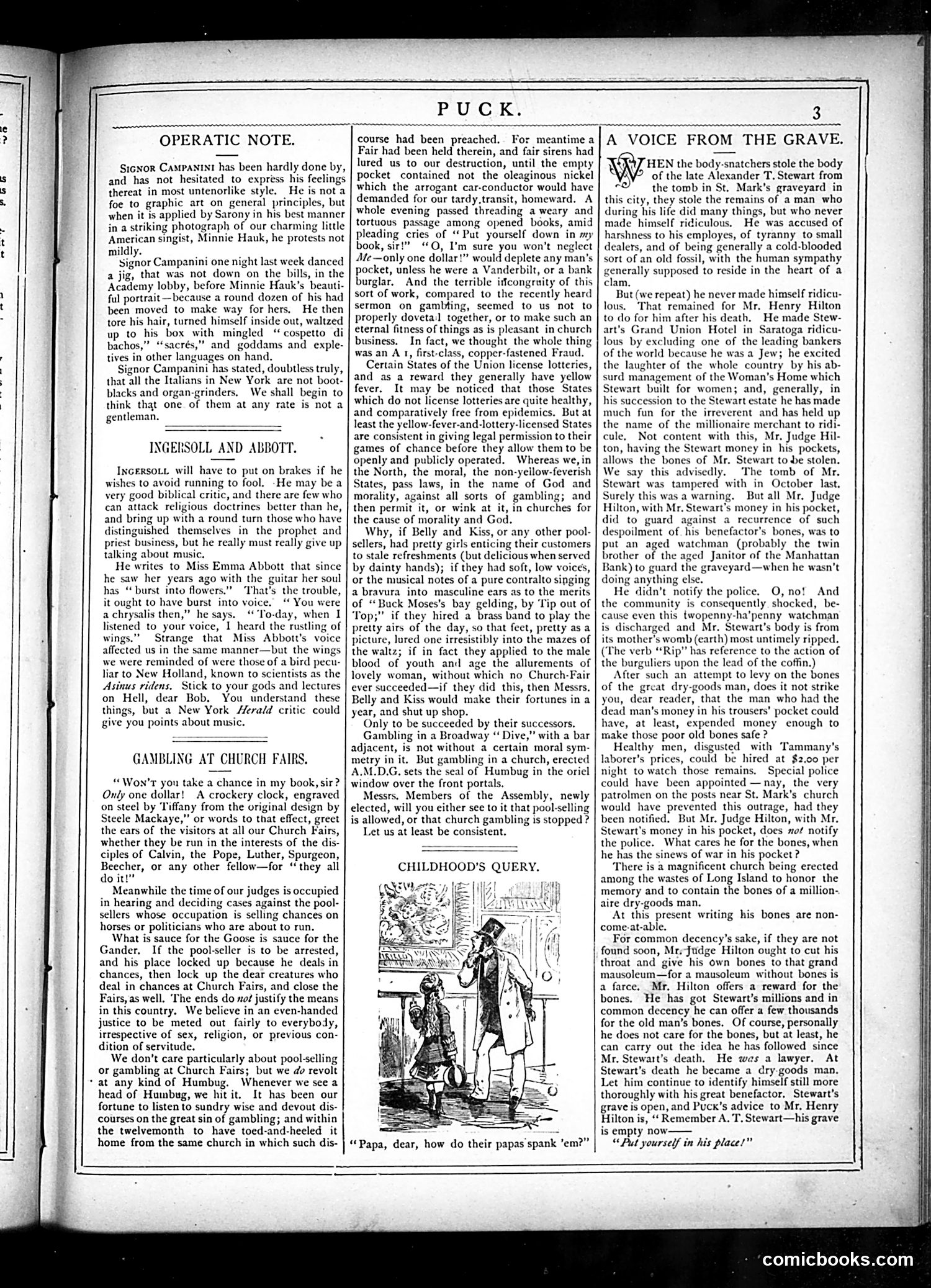
Analysis of Puck Page 3 This page contains three distinct articles and one illustration rather than political cartoons: "Operatic Note" mocks Signor Campanini's dancing at the Academy lobby, praising actress Minnie Hauk's beauty while satirizing his performance. "Ingersoll and Abbott" discusses Robert Ingersoll (likely the famous atheist lecturer) and his approach to religious criticism, praising his intellectual method. "Gambling at Church Fairs" criticizes the hypocrisy of churches running gambling games (lotteries, raffles) while condemning gambling elsewhere—a clear social satire on institutional moral inconsistency. "Childhood's Query" features an illustration of a child asking an adult about funeral customs ("Papa, dear, how do their papas spark 'em?"), creating dark humor about death and burial practices. The page emphasizes Puck's satirical critique of social and religious hypocrisy.
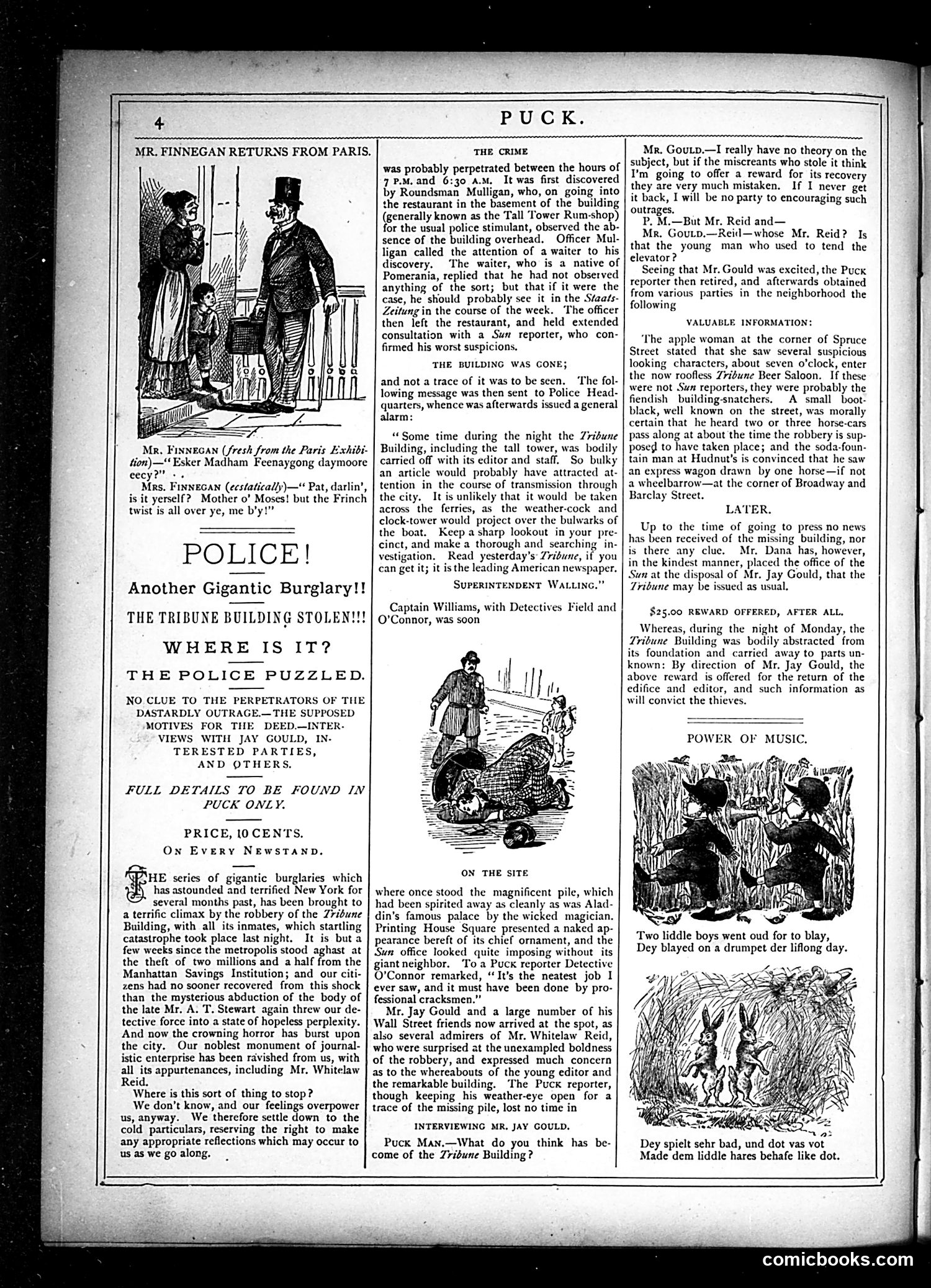
Puck Page Analysis This page satirizes the sensational theft of the Tribune Building in New York City—described as "another gigantic burglary." The main content features: The Crime: Police were baffled by the disappearance of the massive Tribune Building itself, stolen during the night. The text humorously notes this unprecedented theft left authorities with "no clue to the perpetrators." The Satire: Puck mocks both the audacious crime and police incompetence. The dramatic headline "POLICE PUZZLED" and reward offer ($25,000) underscore the absurdity—an entire building vanished without trace or explanation. Social Commentary: The piece satirizes New York's crime wave and law enforcement's helplessness against major criminals, while poking fun at the Tribune newspaper's sensationalism in covering such events. The accompanying illustrations and "Power of Music" poem provide lighter comic relief amid the burglary narrative.
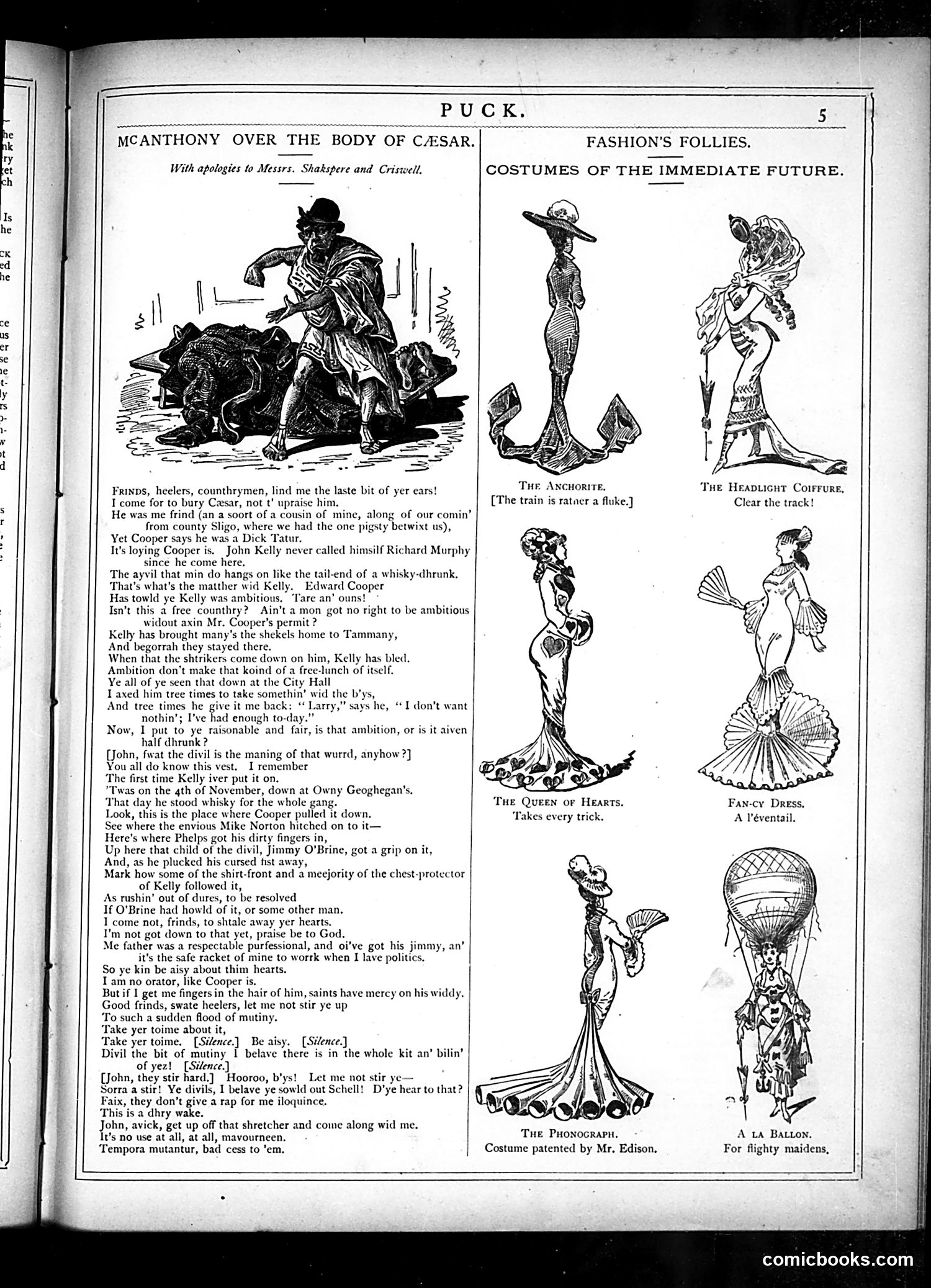
Page Analysis: Puck Magazine, Page 5 Left Side - "McAnthony Over the Body of Caesar": This satirical poem attacks a figure named Cooper (likely a political or public figure of the era), mocking his ambitions and comparing them unfavorably to historical figures. The caricature shows someone standing over a fallen body, referencing Shakespeare's *Julius Caesar*. The text criticizes Cooper's pretensions, his connection to a "whisky-drunk" gang, and his failed political aspirations. It appears to be Irish-American political satire, mentioning figures like "Jimmy O'Brien" and referencing specific locations (City Hall, Owny Geoghegan's). Right Side - "Fashion's Follies: Costumes of the Immediate Future": Humorous fashion predictions featuring exaggerated women's clothing designs—"The Anchorite," "Headlight Coiffure," "Queen of Hearts," and "A La Ballon"—satirizing contemporary fashion trends through absurd, impractical costume concepts.
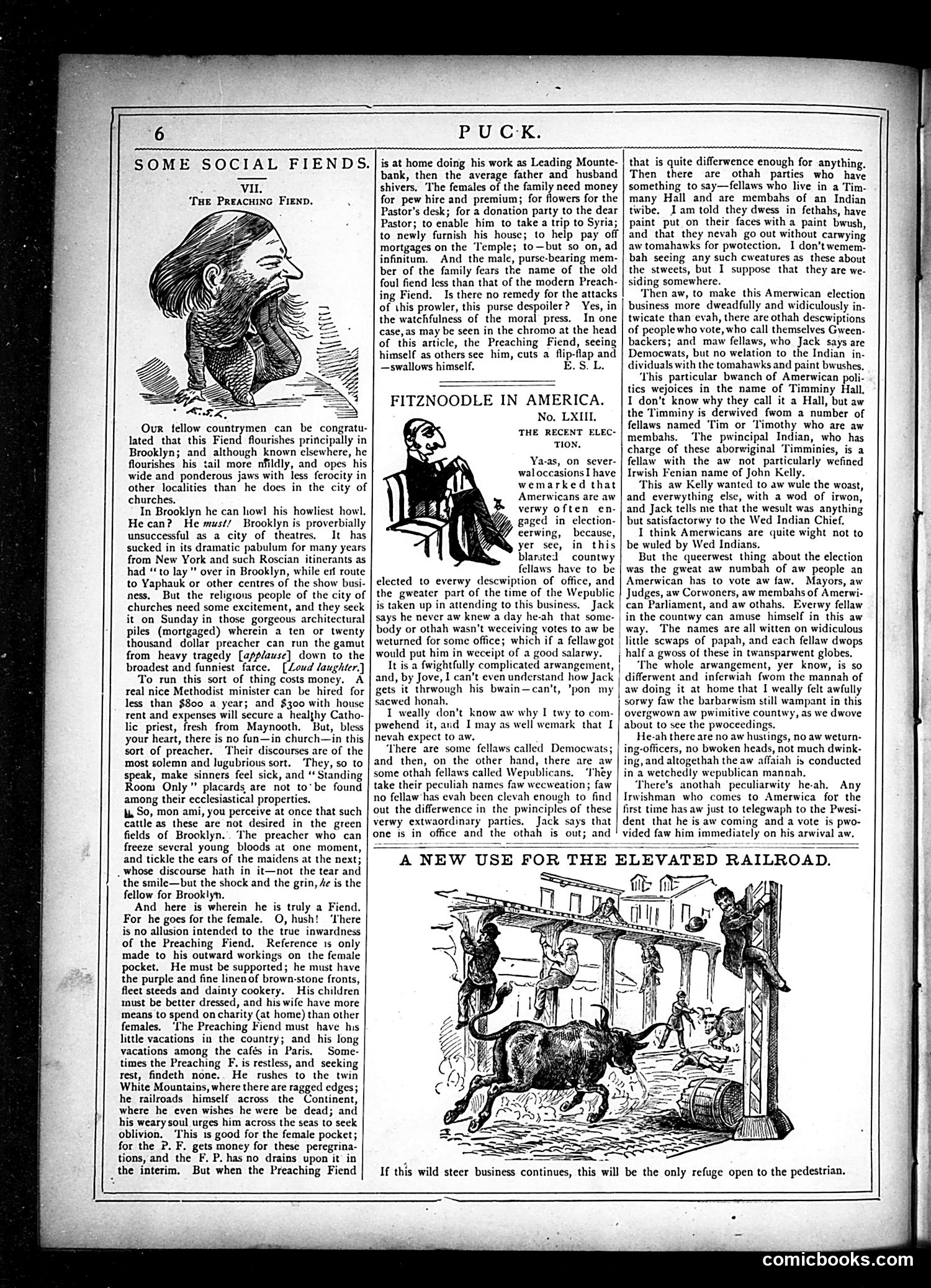
"Some Social Friends" - The Preaching Friend This satirical piece mocks the "Preaching Friend"—a self-righteous man who lectures others about morality while living hypocritically. The caricature depicts him as having an enormous mouth (suggesting endless talk) and a small brain, emphasizing that he talks more than he thinks. The text criticizes him for pontificating about proper behavior, charitable giving, and religious duty while neglecting his own family's needs and his wife's desire for basic comforts. The satire points out the common Victorian hypocrisy of men who publicly champion morality and temperance while privately being neglectful husbands and fathers. The "Preaching Friend" represents a specific social type that Puck's audience would recognize: the sanctimonious moralist exposed as a fraud.
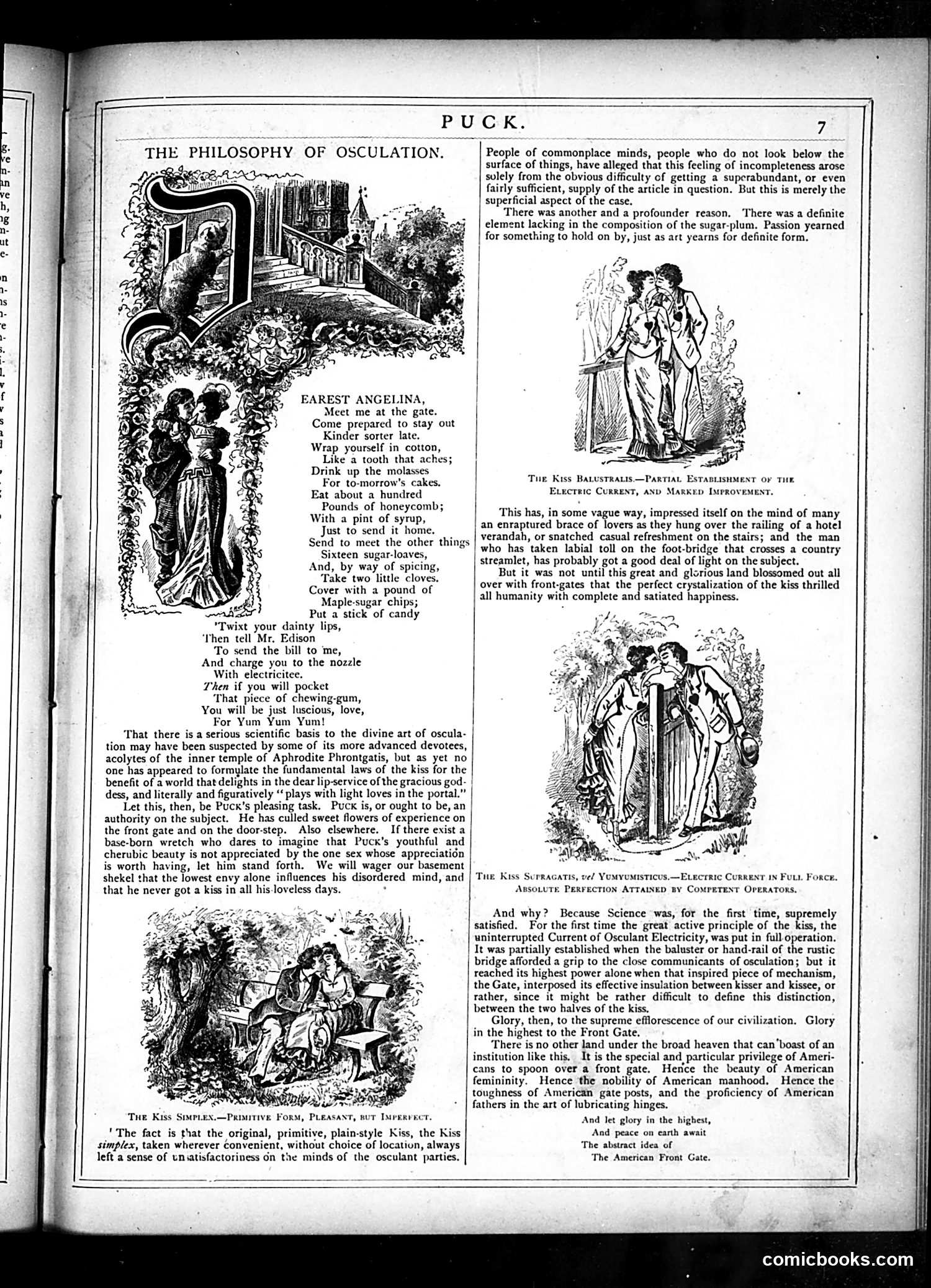
"The Philosophy of Osculation" — Puck Magazine This satirical piece mocks the scientific obsession with analyzing everyday human behavior. The main cartoon illustrates a couple kissing at a gate, captioned "The Kiss Balestrads—Partial Establishment of the Electric Current, and Marked Improvement." The satire ridicules how contemporary scientists and intellectuals attempted to explain romance and affection through pseudo-scientific frameworks (here, "electric current"). The accompanying poem pokes fun at a suitor instructing his beloved to kiss him using electrically-charged language, treating intimacy as a technical procedure rather than genuine emotion. The overall joke targets the Victorian era's tendency toward overwrought scientific explanations of simple human experiences—reducing love and kissing to electrical phenomena rather than acknowledging their emotional authenticity. It's social commentary on intellectualism run amok.
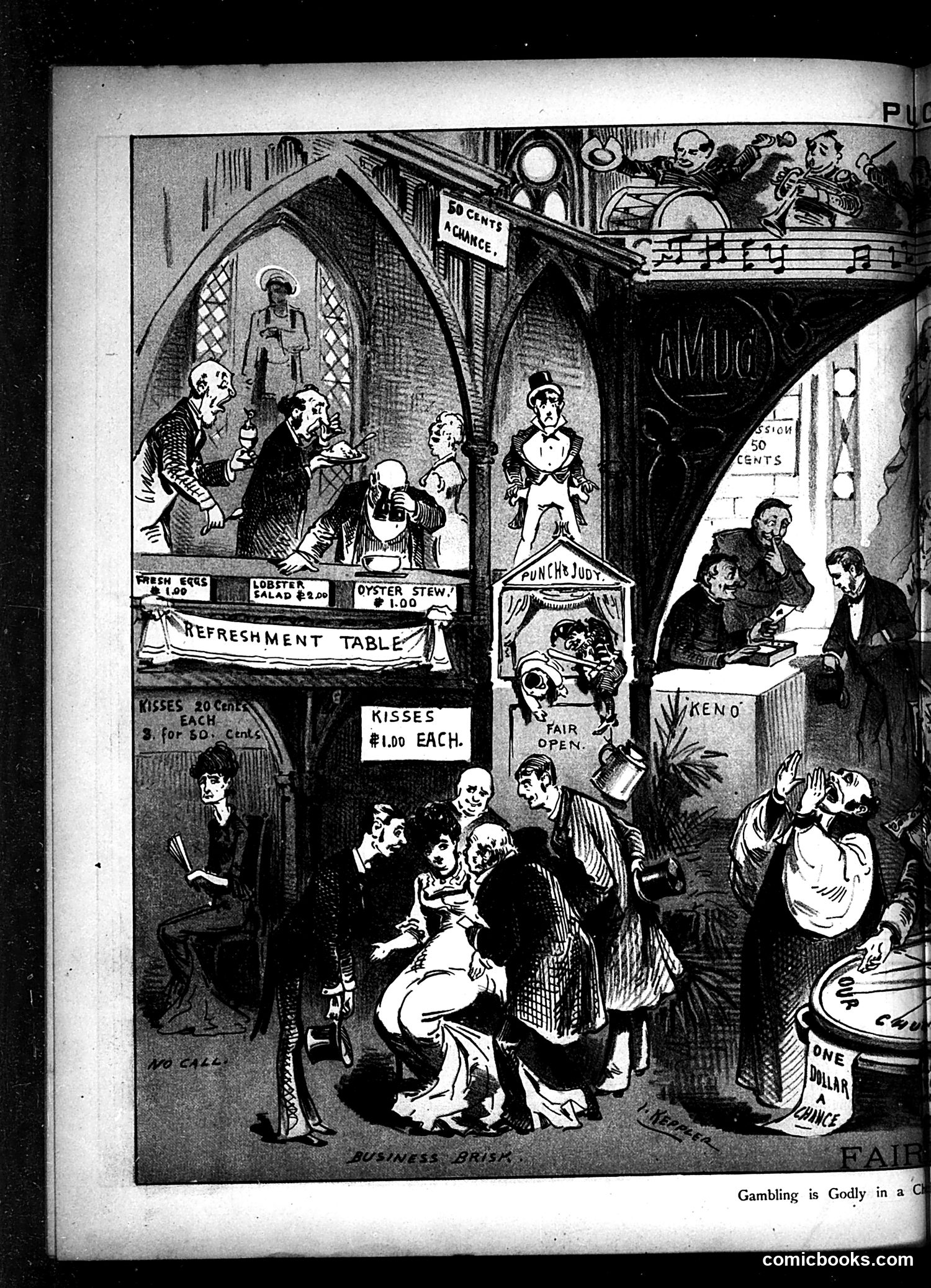
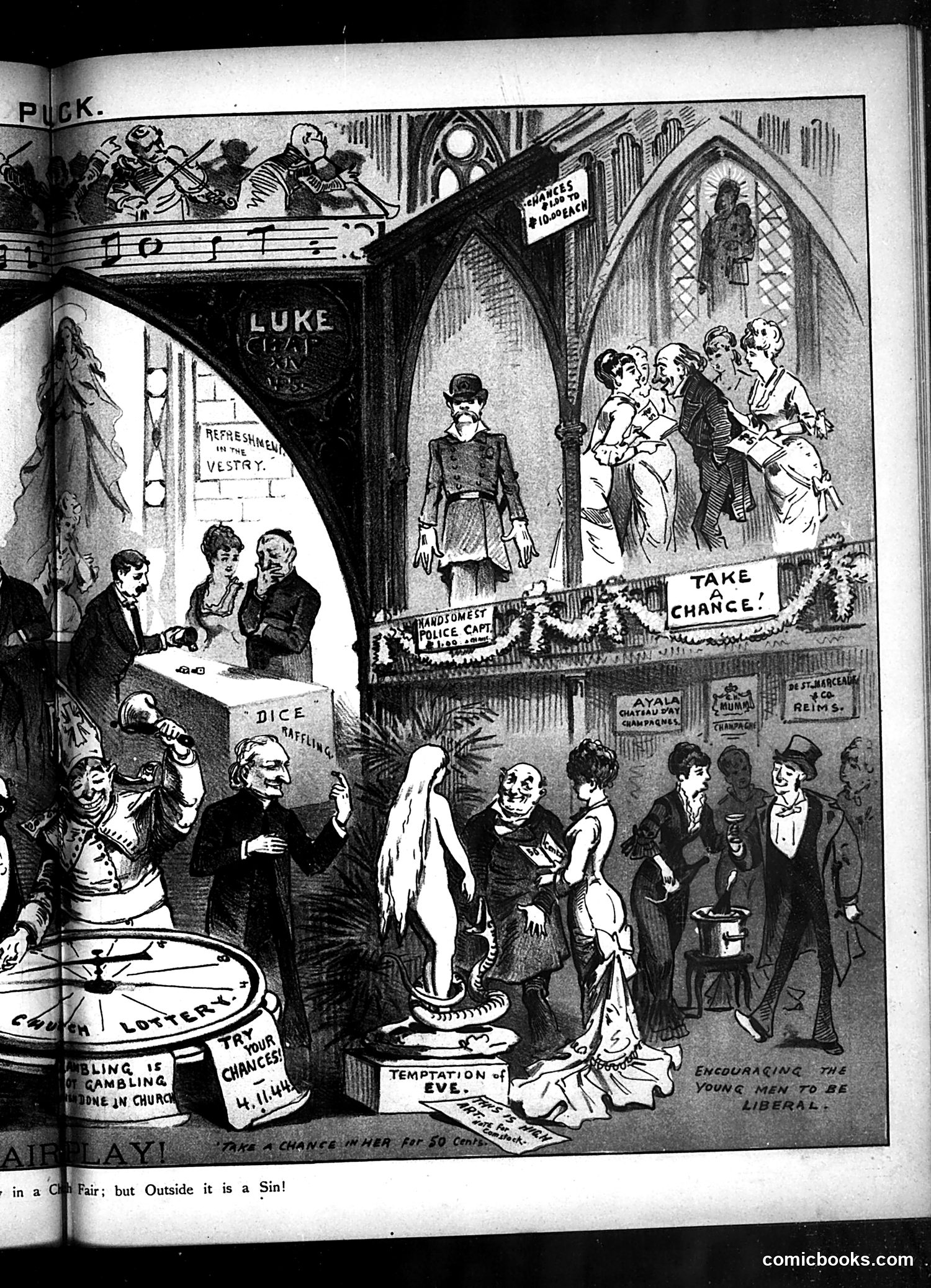
Political Satire Analysis This Puck cartoon satirizes moral hypocrisy regarding gambling and vice in 1890s America. The main scene contrasts religious spaces with secular ones: Upper panel: Inside a church, a minister preaches while congregants appear virtuous. Lower panel: Outside the same church, the same people engage in gambling ("Dice Raffling," "Try Your Chances"), visiting fortune tellers ("Temptation of Eve"), and other vices. Labels mock the contradiction: "Bling is Gambling Done in Church" versus gambling outside is sin. Right side: Church authorities "encouraging the young men to be liberal"—implying they hypocritically accept vice's financial benefits while condemning it publicly. The satire critiques institutional complicity: churches profit from parishioners' vices while maintaining moral authority. The overall message attacks Victorian-era religious institutions for selective morality.
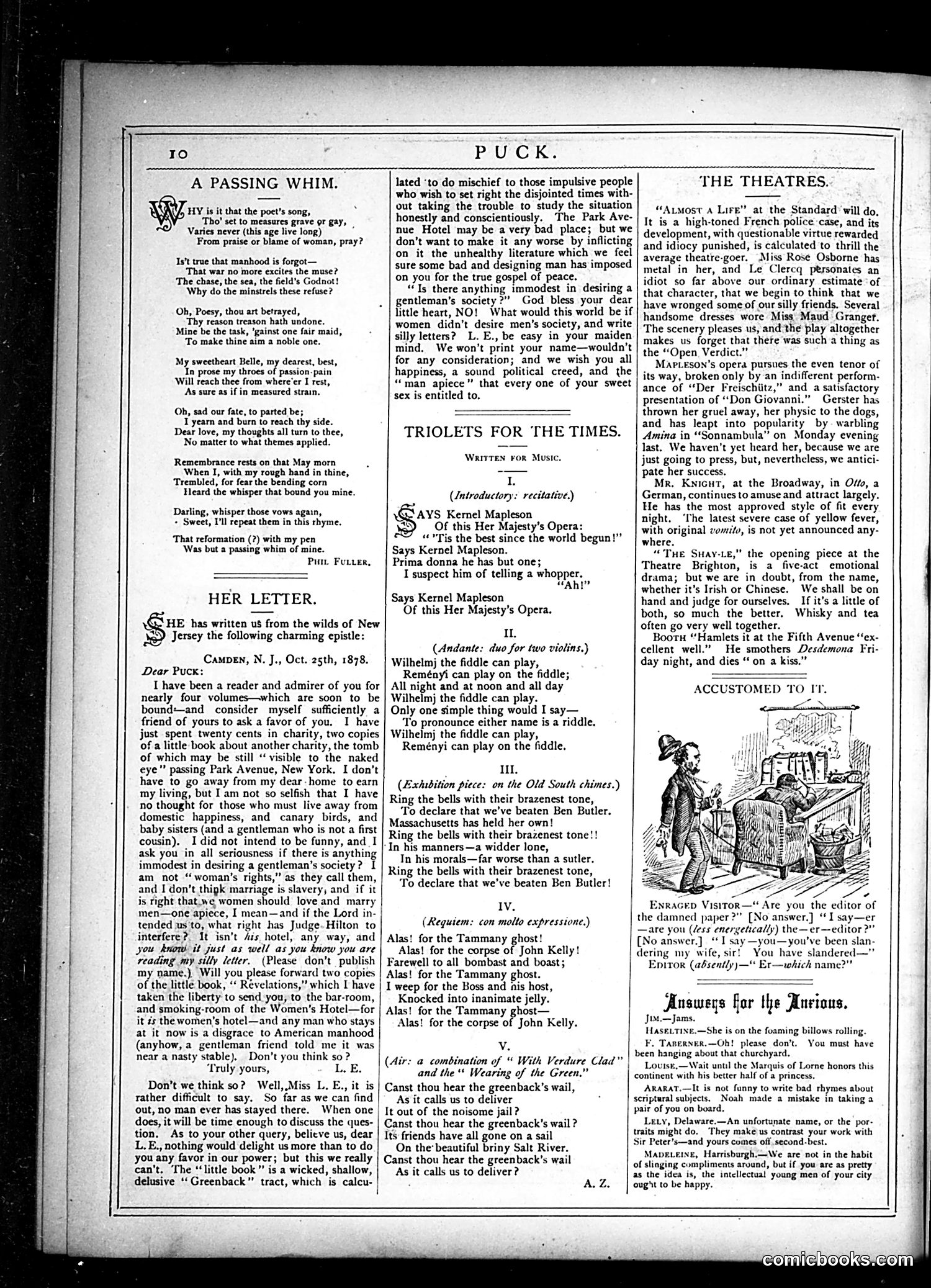
"Accustomed to It" - Political Cartoon Analysis This cartoon depicts an "Engaged Visitor" at what appears to be a newspaper office, confronting an editor about the publication's editorial practices. The visitor expresses exasperation, asking sarcastically if the editor is responsible for "slandering" and other journalistic misconduct ("which makes?"). The cartoon satirizes yellow journalism practices of the 1890s era—specifically the tendency of newspapers to publish sensational, unethical content for profit. The visitor represents the public's frustration with media irresponsibility, while the editor's implied nonchalance ("accustomed to it") suggests newspapers routinely engaged in libel and slander without consequence. This reflects broader Progressive Era criticism of unaccountable press power and the absence of legal protections against defamation.
Content Analysis This page from *Puck* contains the continuation of a serialized story titled "A Mother's First Love," featuring dialogue between characters named Lucy, Harry, and others. The text is presented as a narrative story rather than a political cartoon. The content depicts a sentimental domestic drama involving a mother's emotional conflict between her love for her child and her feelings for a man named Harry. There are no visible political cartoons, caricatures, or satirical illustrations on this page—just printed text in column format typical of *Puck's* serialized fiction. This appears to be a romantic/melodramatic story rather than political satire, which was common filler content in satirical magazines of this era alongside their primary cartoon offerings.
Analysis of Puck Page 12 This page contains primarily serialized fiction dialogue rather than political satire. The main narrative depicts a domestic drama involving characters named Lucy and Lord Lynn, with themes of devotion, sacrifice, and marriage expectations. The right column features "Puck's Briefings"—short satirical quips about contemporary society. These include observations on coffee, an untidy person, a dromedary (camel), and social commentary on dinner invitations and "whitebait times." The humor targets everyday Victorian-era social conventions and etiquette rather than specific political figures. Without visible caricatures or explicit political references on this particular page, the satire focuses on general social criticism typical of Puck's miscellaneous commentary sections.
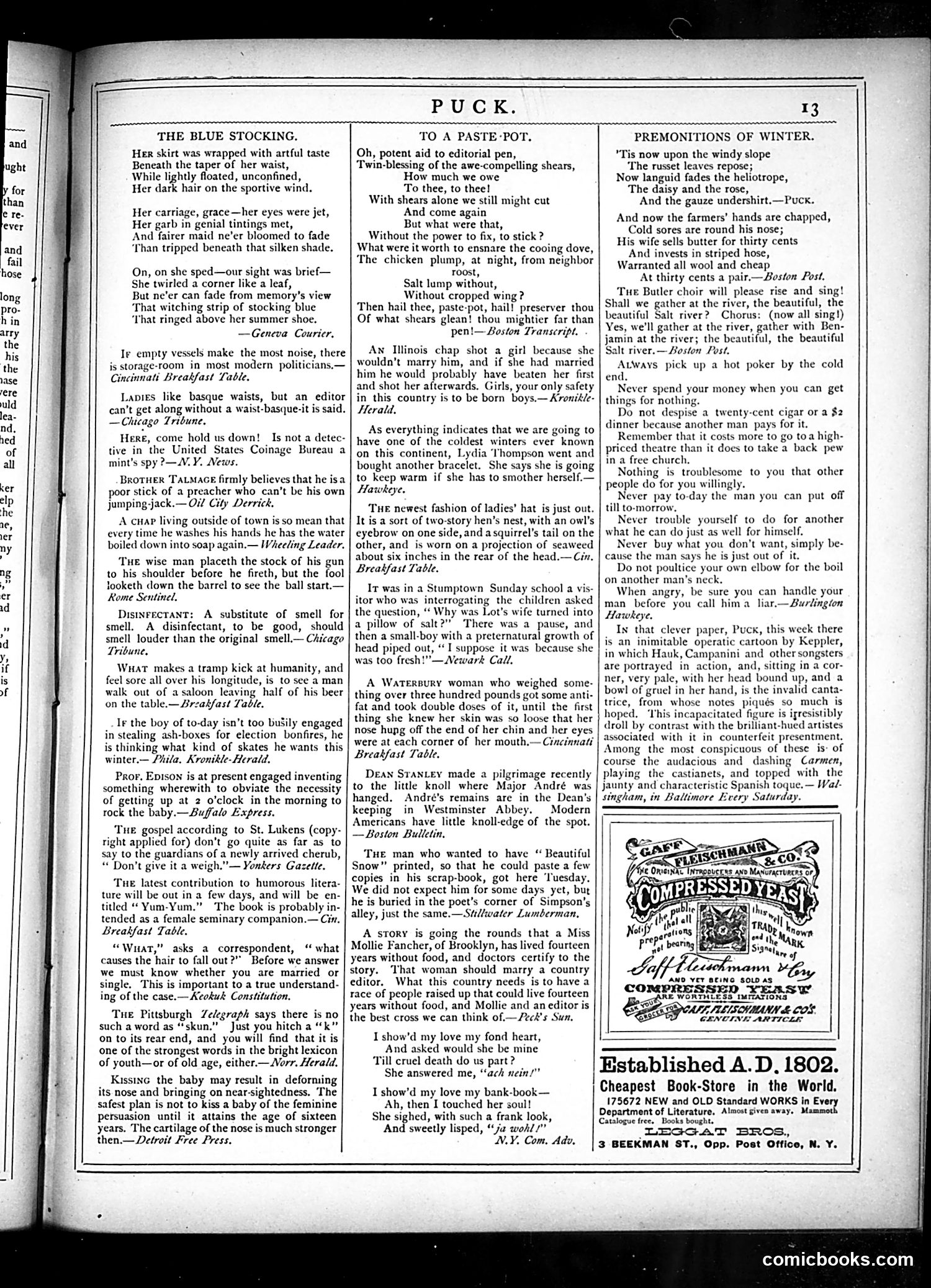
Analysis of Puck Magazine Page 13 This page is primarily text-based humor and short satirical pieces rather than illustrated cartoons. The content consists of brief, witty observations on contemporary social issues and absurdities. Notable pieces include: - "The Blue Stocking": Satirizes educated women and their pretensions - "To a Paste Pot": Editorial satire about bureaucratic inefficiency - "Premonitions of Winter": Humorous observations about seasonal discomforts The humor relies on wordplay, irony, and social commentary typical of Puck's satirical style—mocking American social conventions, gender roles, and everyday absurdities rather than specific political figures. The page includes period advertisements at bottom, including for Gaff Mischmann & Co. and an established bookstore.
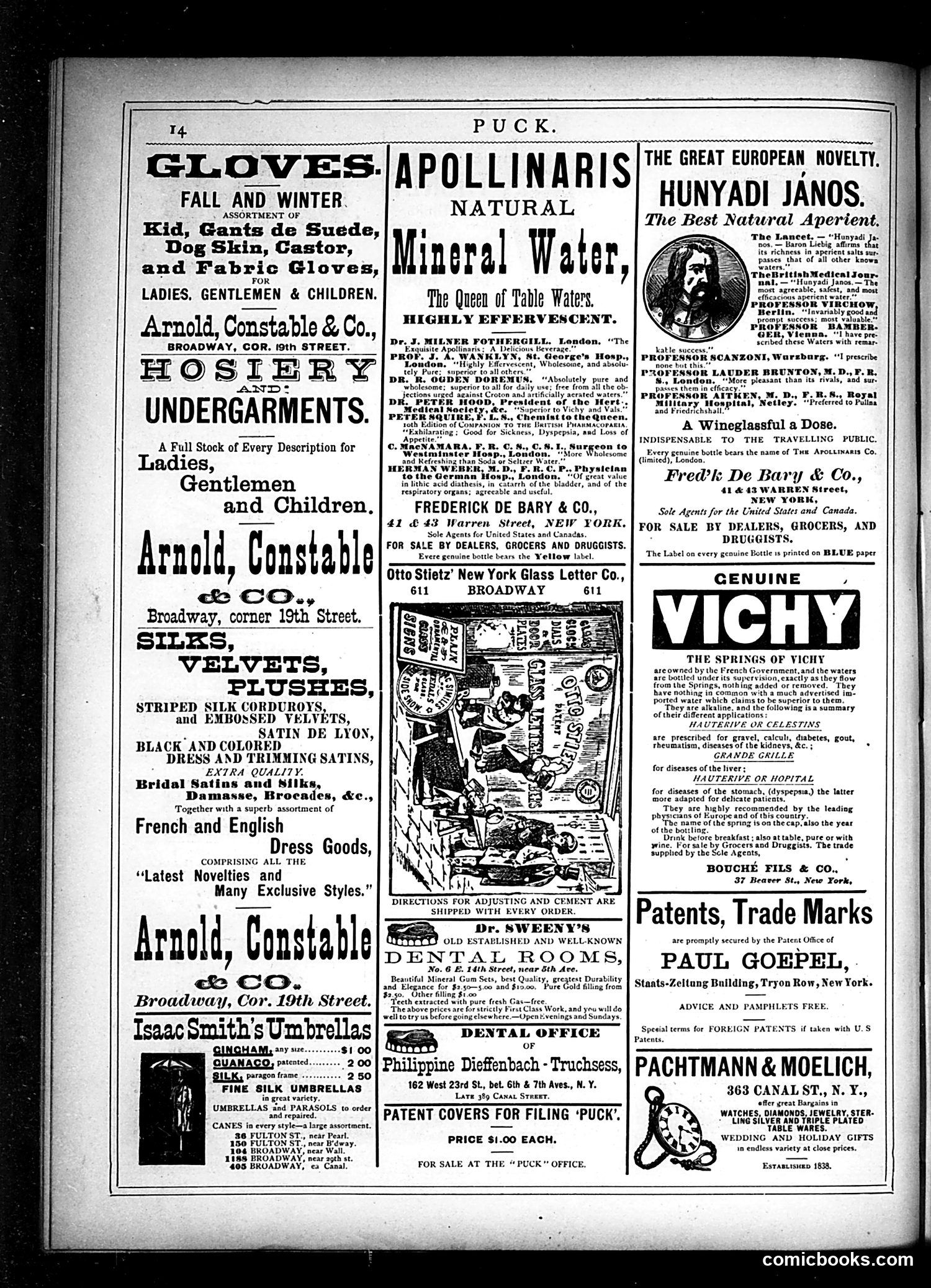
Analysis This page is primarily advertising, not political satire. It contains commercial notices for: - Arnold, Constable & Co. (department store on Broadway) advertising undergarments, silks, dress goods - Isaac Smith's Umbrellas - Apollinaris Natural Mineral Water ("Queen of Table Waters") - Vichy water for health ailments - Patent medicines and dental services - Puck magazine itself (patent covers for filing) The only potentially editorial content is the Hunyadi János water advertisement, featuring a portrait and claiming it's "The Best Natural Laxative"—a health product marketed prominently. The illustrated diagram appears to be instructions for Apollinaris water distribution or advertising materials. This is a typical 19th-century magazine back page: revenue-generating advertisements rather than satirical commentary.
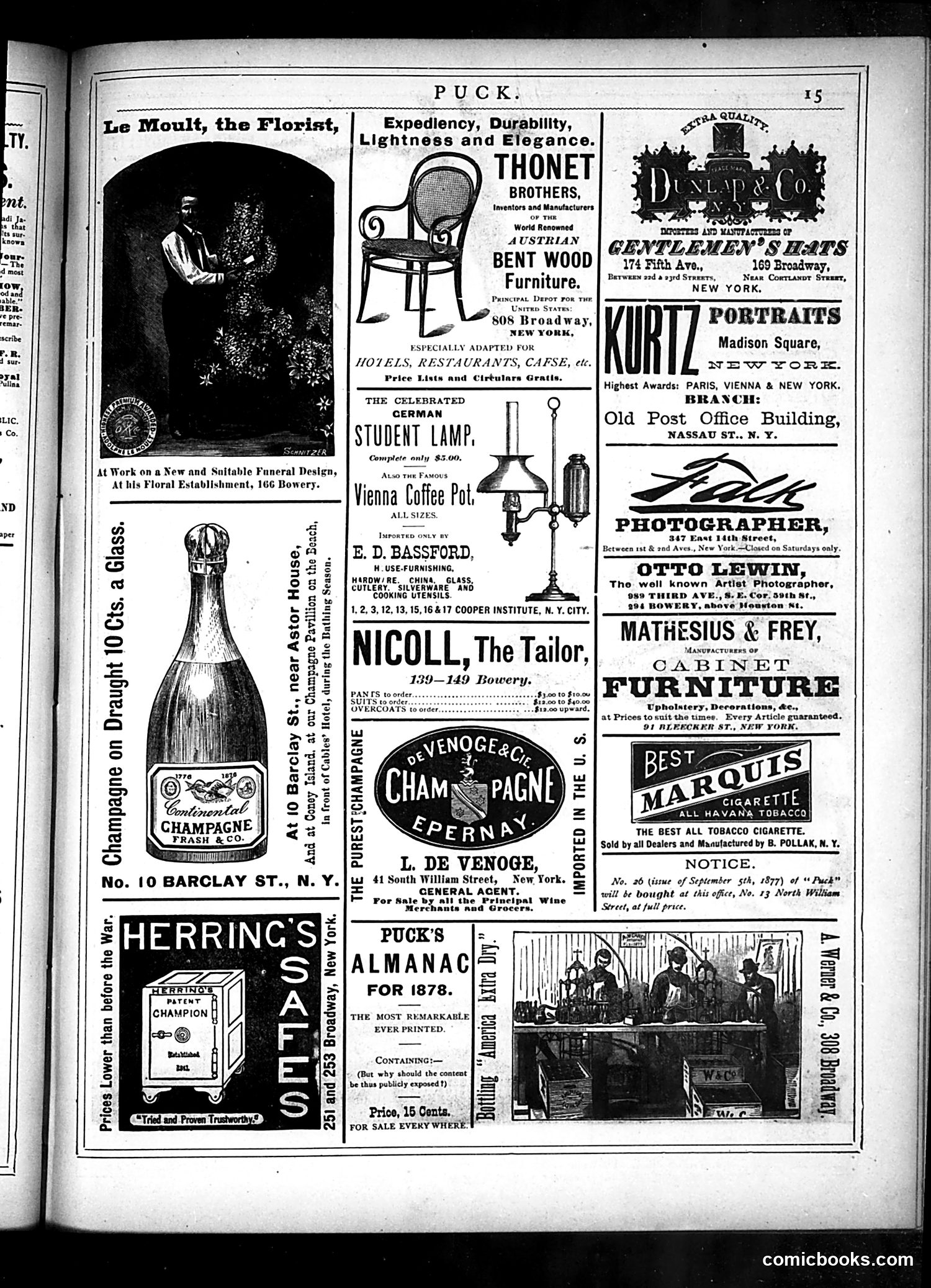
Page Analysis This is primarily an advertising page from Puck magazine (September 1877), with one notable illustration at top left. The main cartoon shows "Le Moult, the Florist" — a figure in period dress holding flowers in what appears to be a darkened interior. The caption indicates this is about a "New and Suitable Funeral Design," suggesting satirical commentary on commercialized funeral practices and florists' marketing of death-related services. The remainder of the page contains period advertisements for furniture, champagne, tailoring, photography, and other goods typical of 1870s New York commerce. Notable ads include Thonet bent-wood furniture, Herring's safes, and Puck's own 1878 Almanac (priced 15 cents). The satirical focus appears narrow, concentrated on the single funeral-design cartoon.
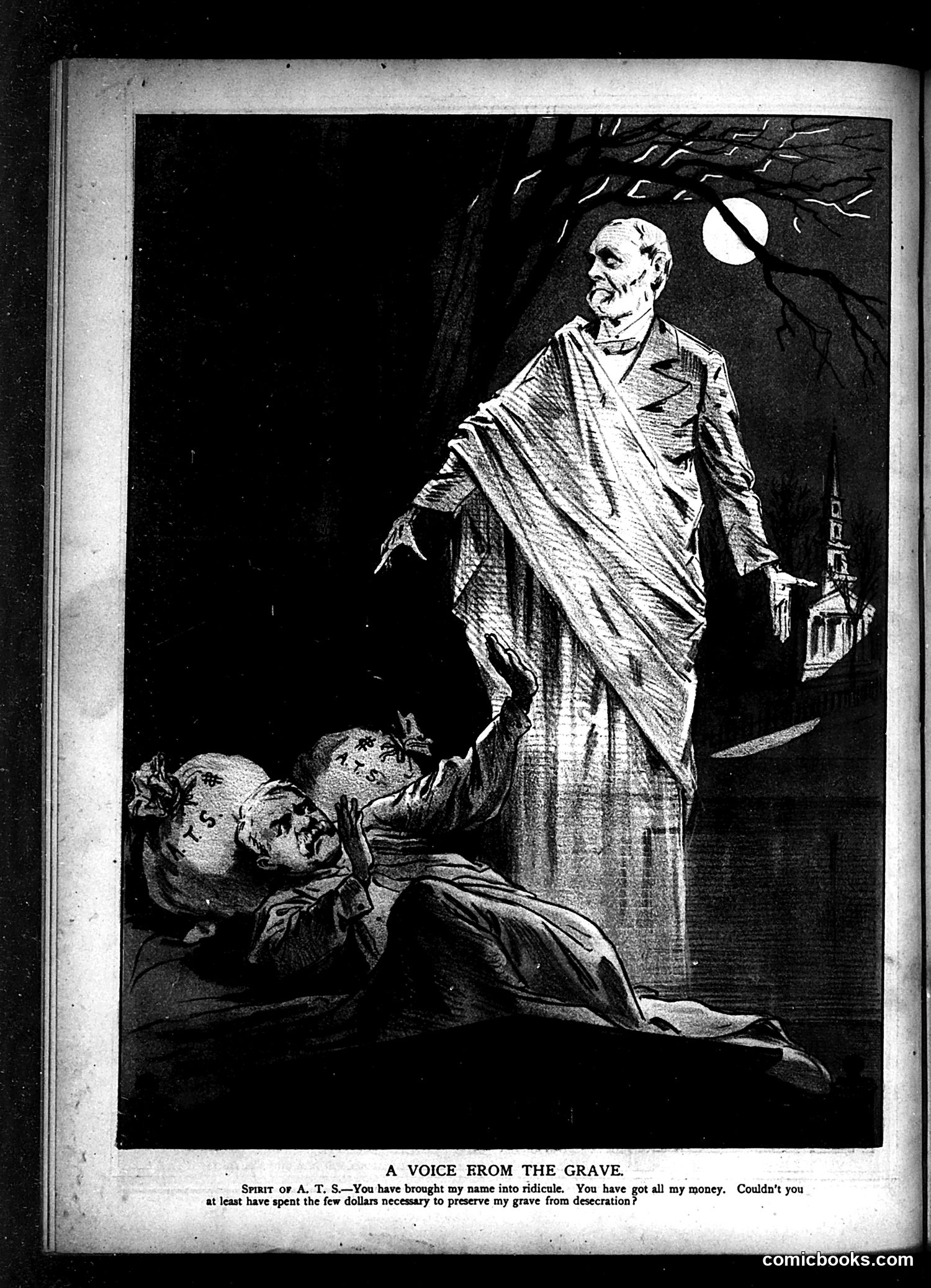
"A Voice from the Grave" This Puck cartoon critiques someone identified only as "Spirit of A.T.S." (initials unclear from context). The ghostly figure, wrapped in burial shrouds and appearing among bare branches under moonlight, accuses a living person of two things: bringing their name "into ridicule" and misappropriating their money while failing to spend even a small amount to maintain their grave "from desecration." The satire targets financial impropriety and neglect—suggesting someone is profiting from or misusing a deceased person's name or estate while denying basic respect to their memory. Without additional context identifying "A.T.S.," the specific target remains uncertain, but the cartoon clearly attacks what it presents as both financial dishonesty and disrespect toward the dead.